
International Research Journal of Engineering and Technology (IRJET) e-ISSN: 2395-0056
Volume: 12 Issue: 08 | Aug 2025 www.irjet.net p-ISSN: 2395-0072
International Research Journal of Engineering and Technology (IRJET) e-ISSN: 2395-0056
Volume: 12 Issue: 08 | Aug 2025 www.irjet.net p-ISSN: 2395-0072
Shourya Gupta1, Abhiraj Nair2
1Diploma Student, Department of Computer Engineering, Thakur Polytechnic, Kandivali East-400101
2 Diploma Student, Department of Computer Engineering, Thakur Polytechnic, Kandivali East-400101
Abstract - Hybridcomputingisaninnovativeapproachthat integrates classical computing, quantum computing, and cloud-edge computing to optimize performance, scalability, and efficiency. This paradigm shift enables systems to tackle complexcomputationalproblemsthattraditionalcomputing alone cannot handle. Hybrid quantum-classical models accelerate scientific research and AI by solving problems in drug discovery, physics, and deep learning. Edge-AI hybrid models improve predictive maintenance and real-time fault identification in manufacturing and industry, increasing productivity and cost-effectiveness. In order to enable safer and more intelligent transportation, autonomous cars use hybrid computing for AI-driven vision, quantum-powered route optimization, and cloud-based simulations. Notwithstanding its benefits, hybrid computing has integration,complexity,andvendorlock-inissuesthatcallfor creative fixes. This essay examines hybrid computing's architecture,uses,difficulties,andprospects,emphasizinghow it is revolutionizing a number of industries.
Key Words: Hybrid Computing, Classical Computing, Quantum Computing, Cloud Computing, Edge Computing, Predictive Maintenance, Autonomous Vehicles, Realtime Processing, Optimization.
1.INTRODUCTION
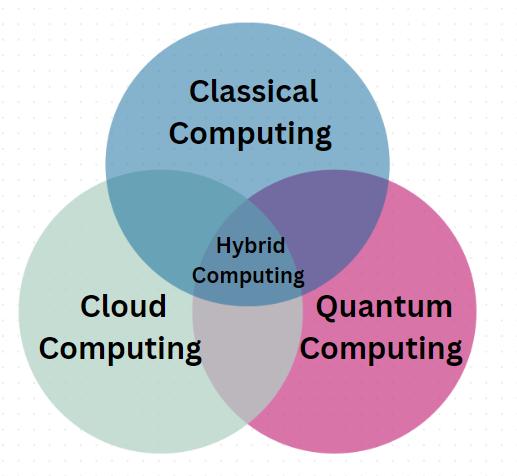
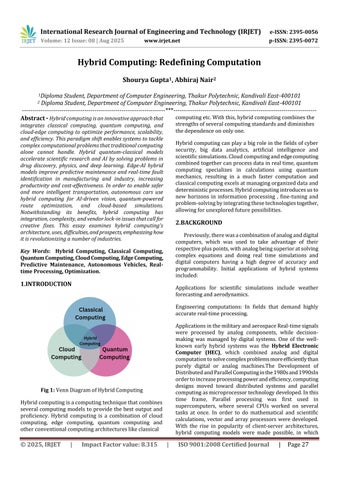
Hybridcomputingisacomputingtechniquethatcombines several computing models toprovidethe best outputand proficiency. Hybrid computing is a combination of cloud computing, edge computing, quantum computing and otherconventionalcomputingarchitectureslikeclassical
computingetc.Withthis,hybridcomputingcombinesthe strengthsofseveralcomputingstandardsanddiminishes thedependenceononlyone.
Hybridcomputingcanplayabigroleinthefieldsofcyber security, big data analytics, artificial intelligence and scientificsimulations.Cloudcomputingandedgecomputing combinedtogethercanprocessdatainrealtime,quantum computing specializes in calculations using quantum mechanics, resulting in a much faster computation and classicalcomputingexcelsatmanagingorganizeddataand deterministicprocesses.Hybridcomputingintroducesusto new horizons in information processing , fine-tuning and problem-solvingbyintegratingthesetechnologiestogether, allowingforunexploredfuturepossibilities.
Previously,therewasacombinationofanaloganddigital computers, which was used to take advantage of their respectivepluspoints,withanalogbeingsuperioratsolving complex equations and doing real time simulations and digital computers having a high degree of accuracy and programmability. Initial applications of hybrid systems included:
Applications for scientific simulations include weather forecastingandaerodynamics.
Engineering computations: In fields that demand highly accuratereal-timeprocessing.
ApplicationsinthemilitaryandaerospaceReal-timesignals were processed by analog components, while decisionmaking was managed by digital systems. One of the wellknown early hybrid systems was the Hybrid Electronic Computer (HEC), which combined analog and digital computationtosolvecomplexproblemsmoreefficientlythan purely digital or analog machines.The Development of DistributedandParallelComputinginthe1980sand1990sIn ordertoincreaseprocessingpowerandefficiency,computing designs moved toward distributed systems and parallel computingasmicroprocessortechnologydeveloped.Inthis time frame, Parallel processing was first used in supercomputers, where several CPUs worked on several tasks at once. In order to do mathematical and scientific calculations, vector and array processors were developed. With the rise in popularity of client-server architectures, hybrid computing models were made possible, in which
Volume: 12 Issue: 08 | Aug 2025 www.irjet.net p-ISSN: 2395-0072
certaintaskswerehandledlocallyandothersweredelegated tostrongdistantservers.Examplesincludethe Connection Machine (CM),whichusedamassivelyparallelarchitecture toprocessAI-relatedtasks.000s:CPU-GPUHybridizationand HeterogeneousComputingTheproliferationofdata-intensive applications led to the evolution of hybrid computing into heterogeneouscomputing,whichinvolvesintegratingvarious processortypesintoasinglesystem.Amongthesignificant developmentswere,CPU-GPUintegration:Originallycreated for graphics rendering, GPUs have been repurposed for parallelcomputingapplicationsincludingsimulations,deep learning,andbigdataanalytics.Hybridcloudcomputing:In order to improve scalability and cost effectiveness, businesses have begun combining on-premises and cloudbased resources. Hybrid cloud computing – Businesses started adopting a combination of on-premises and cloudbased resources for better scalability and cost efficiency. HybridCloud,Edge,andQuantum-ClassicalComputingfrom the2010stothePresent.Thecombinationofcloud,edge,and quantumcomputinghasfurtherbroadenedthefieldofhybrid computing. Contemporary hybrid structures consist of Hybrid cloud computing: Businesses use both public and private clouds to maximize workload dispersion, security, andcost.
Integrationofedgecomputinglowerslatencyandbandwidth consumptioninInternetofThingsapplicationsbyprocessing dataclosertothesource.Hybridquantum-classicalsystems In order to tackle complicated problems more quickly, businesses like IBM, Google, and D-Wave have created quantumcomputingframeworksthatintegrateclassicaland quantumprocessors.Hybrid Cloud Computing–Businesses started adopting a combination of on-premises and cloudbased resources for better scalability and cost efficiency. HybridCloud,Edge,andQuantum-ClassicalComputingfrom the2010stothePresent.Thecombinationofcloud,edge,and quantumcomputinghasfurtherbroadenedthefieldofhybrid computing.Businessesusebothpublicandprivatecloudsto maximizeworkloaddispersion,security,andcost.Including edgecomputingprocessesdataclosertothesource,reducing latency and bandwidth usage in Internet of Things applications.
CompaniessuchasD-Wave,Google,andIBMhavedeveloped frameworksforquantumcomputingthatcombinequantum andclassicalcomputers.
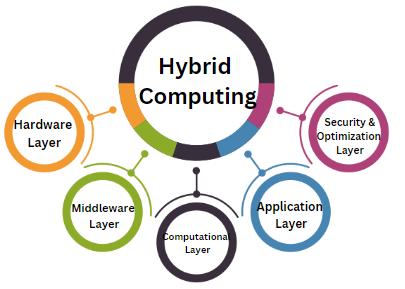
Foramuchgreaterperformanceandfasteroperation,hybrid computingcombinesseveral computational modelswhich include cloud-edge computing, quantum computing, and classicalcomputing.Thefollowinglayersarecommonlyseen inhybridcomputingarchitectures.
Thehardwarelayerofhybridcomputingincludesthreemain computingmodelsthose beingcloudcomputing,quantum computingandclassicalcomputing,eachofwhichimproves efficiency and performance. The CPUs, GPUs, TPU’s and FPGA’smakeupthebaseofthehardwareequipment,which manage general-purpose computing, structured data processing,andAIcomponents.Forcomplicatedproblems like cryptography, optimization, Natural Language Understanding(NLU),quantumcomputinghardware such as Quantum Processing Units (QPUs), superconducting qubits, and photonic quantum computers offers exponential speedups. This decreases the delay and increases usability. Fast data handling, quantum-classical integration frameworks, and a secure link between cloud, quantum and classical computing guarantees smooth communication and task distribution. They serve as the foundation for hybrid computing, facilitating advances in large-scale optimization issues, scientific research, and artificialintelligence.
The middleware layer serves as a link between cloud computing, quantum computing, and classical computing providing the required integration, management, flow control.DatabasemiddlewarelikeODBC,message-oriented middleware, transaction monitors and other middleware that let software to communicate with various hardware components are examples of middleware in classical
International Research Journal of Engineering and Technology (IRJET) e-ISSN: 2395-0056
Volume: 12 Issue: 08 | Aug 2025 www.irjet.net p-ISSN: 2395-0072
computing.MiddlewareincloudcomputingconsistsofAPI gateways, service meshes, function orchestration middleware, integration platforms. In edge computing, middleware can includes technologies like edge orchestrationmiddleware,IoTmiddleware,real-timedata processing security middleware etc. The middleware componentsandcrucialinlettinghybridsystemsmakefull use of being an integration of various other computing archetypes, as these are the components that allow the systemstomanagedata,maximizeefficiencyandmainthe security, thus permitting the hybrid systems their applications in artificial intelligence, cybersecurity, crypto etc.
3.3.Computational Layer
Themaintaskofthecomputationallayeristocombinethe models of cloud computing, quantum computing and classicalcomputingandimprovetheefficiencyandspeedof thedifficulttasks. BecauseclassicalcomputingusesCPUs, GPUs, and TPUs to handle structured, deterministic computations,itisideal fordailyprocessing,AIinference, and database administration. Quantum computing accelerates problem-solving in fields like optimization, cryptography, and molecular simulations by utilizing quantumparallelismviaQuantumProcessingUnits(QPUs) and frameworks like Qiskit and Cirq. Large-scale data analyticsandreal-timedecision-makingaremadepossible bycloudcomputing'sscalabilityanddistributedprocessing via edge devices, cloud-based AI models, and highperformance computing clusters. Through hybrid frameworks and APIs, these computational models work togethertoenabledynamicworkloaddistributionforspeed, accuracy,andefficiencyacrossarangeofapplications.
3.4.Application Layer
Hybrid computing's application layer depicts practical applicationswherecloud,quantum,andclassicalcomputing collaborate to improve problem-solving skills. Business applications, AI-driven analytics, and real-time data processing are all powered by classical computing, which guarantees the effective completion of standard computationaltasks. Quantumcomputingsolvesissuesthat traditionalsystemsfinddifficulttosolve,leadingtoadvances infinancialmodeling,cybersecurity,materialresearch,and drug discovery. Cloud computing is essential for applications like smart cities, autonomous systems, and large-scalesimulationsbecauseitimprovesaccessibilityby offering remote AI processing, IoT-based automation, and real-timedatainsights.
3.5.Securiy & Optimization
The secure, effective, and dependable operation of cloud, quantum,andclassicalcomputingsystemsisguaranteedby thesecurityandoptimizationlayerofhybridcomputing. To
safeguard data integrity and stop unwanted access, traditional computing depends on cybersecurity frameworks, firewalls, and encryption techniques. Postquantumsecurityandquantumcryptographyareintroduced byquantumcomputingtoprotectagainstpotentialdangers from quantum decryption capabilities. To secure remote processing and storage, cloud computing uses AI-driven threatdetection,data encryption,anddistributedsecurity models. Fault tolerance, error correction techniques, and intelligent task distribution are other features of hybrid computing that guarantee optimal performance while preserving high availability, low latency, and power efficiency. Invitalapplicationslikefinance,healthcare,and defense,thislayerisessentialforsafeguardingprivatedata andstreamlininghybridcomputationalworkflows
4.1.Classical
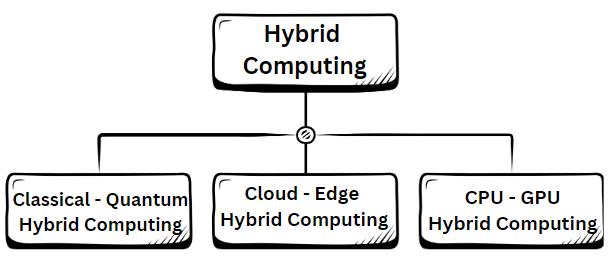
Aquantumcomputingsystemthatfunctionsintandemwith aclassicalcomputingsystemisknownashybridquantumclassicalcomputing.Thequantumprocessorreceivesdata from multipleclassical computers, whichalsomanagethe controlsystem,readoutthemeasurements,makethecloud accessible, and more. Without these classical systems completely integrated as hybrid computing systems, the quantum processor is useless because it can only do computation. Making it difficult to distinguish between analoganddigitalquantumcomputingmodels.Becauseofits accessibilityandeaseofuse,thedigitalmodelismorewidely usedthantheother.Buttheresultinghighmistakeratesare asourceoffrustrationforbothresearchersandhobbyists. Regardless of the definition, the ultimate objective of all parties is to identify applications for quantum computers withinthelimitationsnowinplace.
4.2.Cloud-Edge
Inordertomaximizeefficiency,scalability,andperformance, cloud-edgehybridcomputingisanarchitecturalconceptthat smoothly combines cloud and edge computing. Cloud computingprovidescentralized,high-processingpowerfor large-scalestorage,analytics,andmachinelearning,while edgecomputingbringscomputationclosertodatasources,
International Research Journal of Engineering and Technology (IRJET) e-ISSN: 2395-0056
Volume: 12 Issue: 08 | Aug 2025 www.irjet.net p-ISSN: 2395-0072
reducinglatencyandenhancingreal-timedecision-making. Inthishybridparadigm,edgedevices suchasIoTsensors, smartphones,andautonomouscars processtime-sensitive datalocally,whilecloudserversmanageheavycomputing workloads, long-term storage, and deep learning model training. This design ensures dynamic load balancing by allocating tasks between the edge and the cloud based on processingdemandsandnetworkcircumstances
4.3.CPU-GPU
CPU-GPUThegraphicsprocessingunits(GPUs)andcentral processing units (CPUs) are combined in a computational architecture called hybrid computing to optimize performance in a range of applications. Because of their design,whichenablescomplexlogicexecution,controlflow management,andsequentialprocessing,CPUsaresuitable for general-purpose computing. However, because GPUs specialize in massively parallel processing, which allows themtooperatethousandsofthreadssimultaneously,they areidealfordata-intensivetaskslikedeeplearning,scientific simulations,andbigdataanalytics.Thesetwoarchitectures are combined in hybrid computing systems to maximize computational efficiency. Using popular frameworks like NVIDIA CUDA, AMD ROCm, and OpenCL, developers may designoptimizedhybridprogramsthateffectivelydistribute workloadsbetweenCPUsandGPUs.
5.1.Scientific Research & AI
Quantum-classicalhybridmodels,whichintegratethebest aspectsofbothquantumandconventionalcomputers, are revolutionizingdrugdiscovery,physics,andAItraining.By simulating molecular interactions with unprecedented accuracy in drug research, hybrid models speed up the development of novel drugs. These models contribute to materials science and high-energy physics research. Quantum-enhancedmachinelearningimprovesgenerative AI models, natural language processing, and pattern identification. It pushes the boundaries of scientific advancementbyfusingclassicalandquantumcapacities.
5.2.Industry
Predictivemaintenanceandreal-timedefectidentificationin industrial settings are being revolutionized by edge-AI hybrid models, which integrate edge computing, cloud analytics,andAI-driveninsights.
Artificial intelligence(AI)-enhanced imageprocessingand sensor data are used in manufacturing lines for real-time defect detection. In order to minimize downtime and operatingexpenses,predictivemaintenanceusesAI-driven anomaly detection and sensor fusion to anticipate
equipmentbreakdownsbeforetheyhappen. Allindustrial sectorsbenefitfromthishybridapproach.
5.3.Autonomous Vehicle
Thedevelopmentofautonomousvehiclesisgreatlyaidedby hybrid computing, which combines artificial intelligence (AI), quantum algorithms, and cloud-based simulations to enhancereal-timeprocessing,safety,anddecision-making. AI-poweredperceptionsystemsinterpretsensorinputfrom cameras,LiDAR,andradarusingmachinelearningmodelsto detectobjectsandnavigatelanes. Throughthesimultaneous evaluationofseveralroutes,quantumcomputingimproves routeoptimization,allowingforquickerandmoreeffective navigation. Large-scale simulations and real-time data exchange between cars and intelligent traffic systems are madeeasierbycloud-basedhybridmodels,whichenhance trafficflowandoverallvehiclesafety
6.1.Enhanced Complexity
Managing a hybrid cloud infrastructure might present additional difficulties and complexities. Assuring smooth connectivity and data consistency between on-premises infrastructure and public cloud services, as well as integratingandorchestratingservicesacrossvariouscloud platforms,callsforin-house(oroutsourced)expertise. In ordertoaccessandgatherresources,hybridcloudsusually need software-defined networking, storage technologies, virtualization,andcontainerization.
6.2.Integration
Itmightbedifficulttointegratehybridcloudenvironments withcurrentITsystemsandapps. Whencombininglegacy systems with contemporary cloud technologies, including serverless environments or containers, compatibility problems,datamigrationcomplications,andinteroperability issuesfrequentlyoccur.
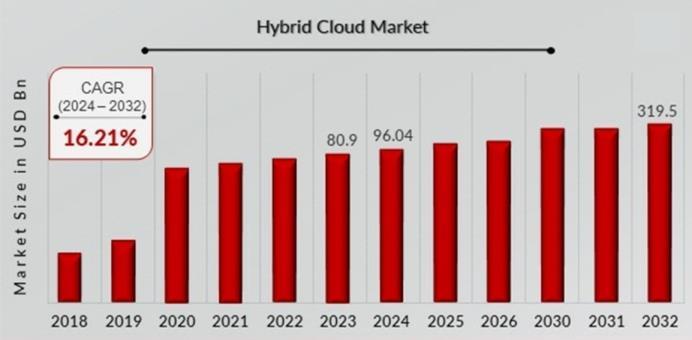
By2025,breakthroughinnovationsinhybridcomputingwill revolutionize data processing and storage. Integration of quantum computing will help areas like medication development and cryptography by solving complicated issues more quickly than before. Converged hybrid infrastructure will also simplify IT management by combiningnetworking,storage,andcomputer.TheHybrid Cloud Market size is projected to grow from USD 96.04 Billion in 2024 to USD 319.5 Billion by 2032, exhibiting a compoundannualgrowthrate(CAGR)of16.21%duringthe forecastperiod(2024-2032).[6]
Research
Volume: 12 Issue: 08 | Aug 2025 www.irjet.net p-ISSN: 2395-0072
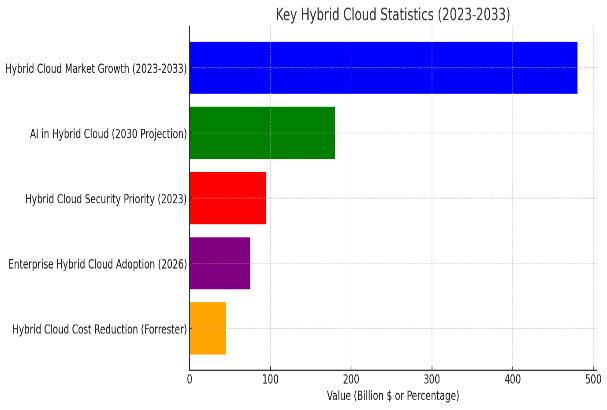
According to IBM's 2023 Cloud Security Report, 95% of businesses think security is a key consideration when implementing hybrid cloud solutions. Businesses will continue to prefer secure cloud solutions since the worldwidecybersecurityindustry,whichisdirectlyrelated tohybridcloudsecurity,ispredictedtoexpandfrom$173.5 billionin2022to$424.97billionby2030(FortuneBusiness Insights)
By 2025, edge and hybrid cloud computing (IDC) will be usedtoprocess90%ofenterprise-generateddataoutsideof traditional data centers. According to Allied Market Research, the AI market for hybrid cloud computing is expected to reach $180 billion by 2030, growing at a compoundannualgrowthrateof22%.
The most popular open-source orchestration platform in hybridcloudcomputingisKubernetes,whosepopularityhas increasedby84%since2021(CNCFAnnualSurvey2023). According to the Red HatStateof Enterprise Open Source 2024, 80% of businesses are spending money on opensource and multi-cloud solutions to boost flexibility and preventvendorlock-in.
AccordingtoanIDCreport,inanefforttocutexpensesand improve agility, 65% of businesses are switching from traditional on-premises IT infrastructure to hybrid cloud solutions. By 2025, infrastructure modernization is predictedtopropelthehybridcloudtosupportmorethan 50% of enterprise workloads worldwide (Gartner 2023 HybridCloudReport).
Through the integration of classical, quantum, and cloud computing,hybridcomputingrepresentsasignificantshiftin computationalparadigmstoaddressissuesinautonomous systems, manufacturing, scientific research, and artificial intelligence. Hybrid computing boosts productivity, scalability, and real-time decision-making by utilizing the advantages of each paradigm, opening the door to innovations in data processing and optimization. To guaranteebroadacceptance,nevertheless,issuesincluding systemcomplexity,interoperability,andsecurityconcerns need to be resolved. Cloud-edge integrations, AI-driven hybridmodels,andquantumcomputingdevelopmentsare all contributing to hybrid computing's potential to revolutionize technology. As more and more companies embrace hybrid infrastructures, this computing approach will keep spurring innovation and transforming computationalpowerinavarietyoffields.
[1]Amit Kumar Jain, 2022, Hybrid Cloud Computing: A Perspective, INTERNATIONAL JOURNAL OF ENGINEERING RESEARCH & TECHNOLOGY (IJERT) Volume11,Issue10(October2022)
[2]MichaelSeifert,StephanKuehnel,andStefanSackmann. 2023.HybridCloudsArisingfromSoftwareasaService Adoption: Challenges, Solutions, and Future Research Directions. ACM Comput. Surv. 55, 11, Article 228 (November2023),35pages.
[3]Alzahrani A, Alyas T, Alissa K, Abbas Q, Alsaawy Y, Tabassum N. Hybrid Approach for Improving the Performance of Data Reliability in Cloud Storage Management.Sensors(Basel).2022Aug10;22(16):5966. doi: 10.3390/s22165966. PMID: 36015727; PMCID: PMC9412250.
International Research Journal of Engineering and Technology (IRJET) e-ISSN: 2395-0056
Volume: 12 Issue: 08 | Aug 2025 www.irjet.net p-ISSN: 2395-0072
[4]Li, Xiaomin & Wan, Jiafu & Dai, Hong-Ning & Imran, Muhammad & Xia, Min & Celesti, Antonio. (2019). A Hybrid Computing Solution and Resource Scheduling Strategy for Edge Computing in Smart Manufacturing. IEEE Transactions on Industrial Informatics. PP. 1-1. 10.1109/TII.2019.2899679
[5]https://www.quera.com/blog-posts/hybrid-quantumcomputing-bridging-classical-and-quantum-worlds
[6] HybridCloudMarketSize,Share:Report-2032.
[7] Hybrid Computing Trends & Innovations 2025. FirstIgniteMarch14,2025
[8] UnderstandingHybridComputingin2025:Bridgingthe Gap Between Cloud and Edge Technologies. E&ICT Academy, IIT Kanpur - E&ICT Academy, IIT Kanpur. February13,2025
[9] J.I. Agulleiro, F. Vázquez, E.M. Garzón, J.J. Fernández, “Hybrid computing: CPU+GPU co-processing and its application to tomographic reconstruction” Ultramicroscopy,Volume115,2012,Pages109-114,ISSN 0304-3991.
[10] D.Brooks,"CPUs,GPUs,andHybridComputing"inIEEE Micro,vol.31,no.05,pp.4-6,September/October2011, doi:10.1109/MM.2011.85.
[11] Nedzelský, Roman. (2015). Hybrid cloud computing: SecurityAspectsandChallenges.
[12] Abdeslam Rehaimi, Yassine Sadqi, Yassine Maleh, GurjotSinghGaba,AndreiGurtov,Towardsafederated andhybridcloudcomputingenvironmentforsustainable and effective provisioning of cyber security virtual laboratories,ExpertSystemswithApplications,Volume 252,PartB,2024,124267,ISSN0957-4174