
International Research Journal of Engineering and Technology (IRJET) e-ISSN: 2395-0056
Volume: 12 Issue: 08 | Aug 2025 www.irjet.net p-ISSN: 2395-0072
International Research Journal of Engineering and Technology (IRJET) e-ISSN: 2395-0056
Volume: 12 Issue: 08 | Aug 2025 www.irjet.net p-ISSN: 2395-0072
Akshatha N S1, Aparna Gopinath2
1Assistant Professor, School of Architecture, DSATM, Karnataka, India
2Assistant Professor, School of Architecture, DSATM, Karnataka, India
Abstract - Concrete is the most widely used construction material in the world, and enhancing its properties through fiber reinforcement has become a focus of modern research. Fiber Reinforced Concrete (FRC) is a composite material in which small, uniformly dispersed fibers significantly improve the mechanical properties of concrete, such as compressive, tensile, flexural, and impact strength. This study investigates the performance of both synthetic and natural fibers in concrete. Steel Fiber Reinforced Concrete (SFRC) specimens were prepared using hook-end steel fibers with 0% and 0.5% volume fractions (aspect ratio 53.85, length 50 mm), while alkali-resistant glass fibers were used at 0% and 0.25% by weight of cement (cut length 12 mm), without admixtures. Test results oncube andcylinder specimens showed improved compressive andsplit tensile strength comparedto plain M30 concrete at both 7 and 28 days, validating the positive influence of fiber inclusion. Furthermore, the study explores the application of natural coir fiber as a sustainable alternative. Coir fibers, treated with natural latex to resist moisture, were incorporated at lengths of 20 mm, 25 mm, and 30 mm, in proportions of 0.5%, 0.75%, and1% by volume. The 28-day experimental results showed considerable improvement in both compressive and tensile strength, proving coir fiber's effectivenessasareinforcingmaterial.This research promotes the use of locally availablenaturalfibersin the civil engineering field, encouraging sustainability while achieving desirable mechanical performance in concrete.
Key Words: Fibre Reinforced Concrete, Steel Fibres, Glass Fibres, Coir Fibres, Compressive Strength, Split Tensile Strength, Natural Fibres, Sustainable Construction
Concrete is the most widely used construction material acrosstheglobeduetoitsexcellentcompressivestrength, durability,andversatility.However,itsinherentbrittleness andlowtensilestrengthlimititsperformanceundervarious loading conditions. To overcome these drawbacks, the incorporation of fibres into concrete has emerged as an effective solution, giving rise to what is known as Fibre ReinforcedConcrete(FRC).FRCisacompositematerialin which short, discrete fibres are uniformly distributed throughout the concrete matrix, enhancing its mechanical properties such as toughness, flexural strength, tensile strength,andresistancetocrackingandimpact.
Various types of fibres such as steel, glass, synthetic, and natural fibres have been employed in FRC to improve performance.Amongthem, steel fibres and glassfibres are widelyuseddueto theirhighstrengthandcrack-bridging capabilities. Recent advancements in sustainable construction have led to increased interest in the use of natural fibres,whicharebiodegradable,cost-effective,and locallyavailable.Onesuchpromisingmaterialis coir fibre, extracted from coconut husk, which offers acceptable strength,durability,andenvironmentalbenefits.
Thisresearchaimstoinvestigatethemechanicalbehaviour of FRC using steel fibres, glass fibres, and coir fibres. The studyincludesanexperimentalevaluationofcompressive and split tensile strength of concrete containing varying proportions and lengths of coir fibres, as well as a comparison with conventional M30 grade concrete and concrete reinforced with synthetic fibres. The goal is to encouragetheadoptionofeco-friendlymaterialsinmodern civilengineeringpractices.
Dragica Jevtić et al. (2008) examined the effect of steel fibres at 60 kg/m³ (0.45% by volume) combined with a superplasticizer.Theresultsshowedenhancedcompressive andflexuralstrengthatallages.Thepresenceofsilicafume further improved mechanical properties, making such composites suitable for both new construction and rehabilitationworks.
P. Rathish Kumar and K. Srikanth (2008) reported that while the addition of fibres showed minimal change in compressive strength, glass fibres significantly improved splittensileandflexuralstrengthoverpolypropylenefibres. Post-peak strain was higher in polypropylene specimens, althoughflexuralstrengthremainedlowerthanglassfibre specimens.
Mohammed Ezziane et al. (2011) studied standard and fibre-reinforced mortars under elevated temperatures (400°Cto1000°C).Hybridmortars(steel+polypropylene) demonstratedoptimalperformance.Polypropylenereduced internal pressure from heat, while steel fibres controlled crackingduringbothexposureandsubsequentloading.
Naturalfibressuchasflax,jute,hemp,andcoirhavegained attention for being lightweight, cost-effective, and
International Research Journal of Engineering and Technology (IRJET) e-ISSN: 2395-0056
Volume: 12 Issue: 08 | Aug 2025 www.irjet.net p-ISSN: 2395-0072
renewable.Harishetal.developedcoirfibrecompositesand analyzed mechanical properties using SEM imaging, comparing them with glass fibre composites. Wang and Huanganalyzedfibrelengths(8–337mm),concludingthat longer coir fibres had higher diameters and strength. Composite boards with coir fibre and rubber matrix were fabricatedandtestedfortensilestrength.
Nilza et al. utilizedthreeJamaicannaturalfibres bagasse, banana trunk, and coconut coir to fabricate composites. Theyanalyzedpropertieslikeashcontent,waterabsorption, andmoistureunderstandardizedtests.
Reis (2006) characterized epoxy polymer concrete reinforcedwithnaturalfibres(coconut,sugarcanebagasse, and banana). Results revealed a 25% increase in flexural strength and higher fracture toughness for coconut fibre composites.
Baruah and Talukdar (2007) studied plain and fibrereinforcedconcretewithfibrevolumefractionsrangingfrom 0.5%to2%,usingjuteandcoirfibres.Theyfoundthatcoir fibrereinforcedconcrete(CFRC)with2%fibreyieldedthe best results, showing 13.7%–32.7% improvements in compressivestrength,tensilestrength,flexuralstrength,and shearresistancecomparedtoplainconcrete.
Zengh (2008) and Yan (2000) investigatedtheeffectsof scrap tires and polyolefin fibres. Zengh noted a damping ratio increase of up to 144% and 75% for rubberized concrete.Yanfoundadecreaseinresponsefrequencywith increaseddampinginfibre-reinforcedcomposites.
Gunasekaran and Kumar (2008) reported that coconut fibreconcreteexhibited24%higherwaterabsorptionanda 19.1% increase in compressive strength after 28 days of curing,comparedtoplainconcrete.
Adevemi (1998)usedcoconutfibreasapartialreplacement for fine or coarse aggregates in a 1:2:4 mix ratio. The resulting concrete was lighter in weight and showed enhanced performance when compared to conventional concrete.
1.To evaluate the mechanical performance of concrete reinforcedwithsyntheticfiberssuchassteelandglassfibres intermsofcompressivestrengthandsplittensilestrength.
2.Toinvestigatetheeffectivenessofnaturalcoirfibreasa sustainableandlocallyavailablealternativereinforcement materialinconcrete.
3.Tocomparetheperformanceoffibre-reinforcedconcrete (FRC)withthatof4.conventionalM30gradeplainconcrete inbothfreshandhardenedstates.
5.Todeterminetheoptimalfibrecontentandlengthofcoir fibres(20mm,25mm,and30mm)atvaryingpercentages (0.5%,0.75%,and1%)forimprovedstrengthanddurability.
6.To study the influence of fibre type and dosage on the compressivestrengthandsplittensilestrengthofconcreteat 7and28daysofcuring.
7.To promote the use of sustainable and eco-friendly materials like coir fibre in civil engineering construction, encouragingenvironmentallyconsciousbuildingpractices.
8.Toassessthefeasibilityofintegratingnaturalfibresinto practical construction applications and validate their potentialasareplacementforsyntheticfibres.
The experimental program wasconductedto evaluatethe performanceofFibreReinforcedConcrete(FRC)usingsteel, glass,andcoirfibres.Testswerecarriedoutonbothfresh andhardenedconcretespecimens.
3.1
ThematerialsusedinthisstudyincludeOrdinaryPortland Cement, fine aggregates (sand), coarse aggregates, water, steelfibres,glassfibres,andnaturalcoirfibres.Coirfibres werepre-treatedwithnaturallatextoenhancedurability.
Cement:OPCusedastheprimarybinder.
Aggregates: Clean, angular coarse aggregates; fine aggregatesofstandardgrading.
Water:Potablewaterusedformixingandcuring.
Normal Consistency Test:ConductedusingVicatapparatus to determine the required water content for standard consistency.
Specific Gravity Test (Aggregates): Used to assess the qualityanddensityofcoarseaggregates.
3.3
Slump Test –Measuredworkabilityandconsistencyoffresh concrete.
Compaction Factor Test – Evaluated workability of concreteundercompaction.
Vee-Bee Test – Determined remolding time to assess workabilityforstiffmixes.
International Research Journal of Engineering and Technology (IRJET) e-ISSN: 2395-0056
Volume: 12 Issue: 08 | Aug 2025 www.irjet.net p-ISSN: 2395-0072
Compressive Strength Test – Conducted on cube specimens(150mm×150mm×150mm)at7and28days usingacompressiontestingmachine.
Split Tensile Strength Test – Performed on cylindrical specimenstoassesstensile strength.Plywoodstripswere usedtoensureuniformloaddistribution.
AllspecimenswerepreparedandtestedasperstandardIS codes.Theresultswerecomparedacrossvaryingfibretypes, lengths,anddosages.
4. EXPERIMENTAL RESULTS & ANALYSIS
1. Normal consistency of cement:
Result:
2. Specific gravity of coarse aggregate
Result:specificgravityofcoarseaggregateis= 2.64 & waterabsorption= 0.5
3. Compressive strength test on normal concrete
1. Comparison of normal concrete with coconut fibre concrete
Weghtof aggregatetaken 2018
Weightof saturatedaggregate suspended inwater+basket(W1)gm 3202
Weightofemptybasketinwater(W2) gm 1950
Weightofsaturatedaggregateinwater "WS"=(W1-W2)gm 1252
Weightof surfacedryaggregate(W3)= 2013
Weightofequalvlumeofwatertothe aggregate=(w3-Ws) 761
Weightofovendryaggregate'W4'gm 2010 specificgravity=W4/W3-(w1-W2) 2.64 Waterabsorption=W3-W4/W4*100% 0.5
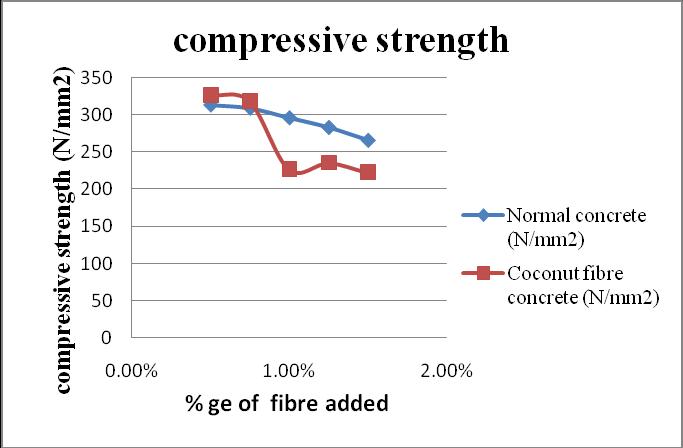
Chart -1:Comparisonofnormalconcretewithcoconutfibre concrete
Theexperimentalfindingsrevealthatlatex-treatedcoirfibre improves the compressive strength of concrete up to a specificdosage.Inaddition,thefibresaidinrestrainingthe
International Research Journal of Engineering and Technology (IRJET) e-ISSN: 2395-0056
Volume: 12 Issue: 08 | Aug 2025 www.irjet.net p-ISSN: 2395-0072
developmentofmicro-cracks,therebyenhancingtheoverall integrityoftheconcrete.
2.Comparisonofnormalconcretewithsteelfibreconcrete
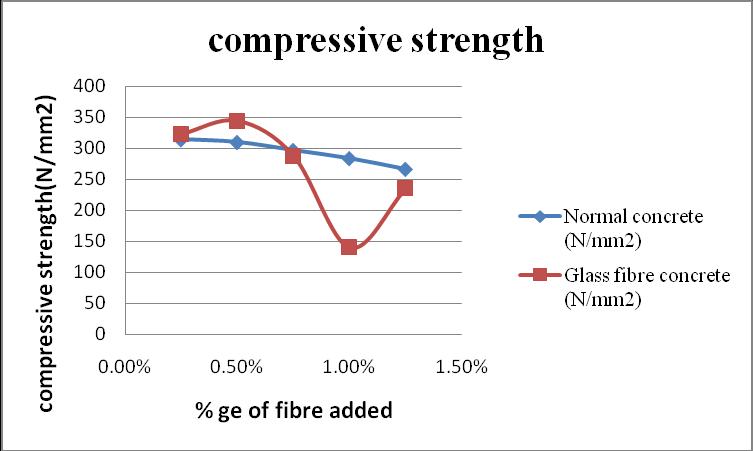
Chart -3:Comparisonofnormalconcretewithglassfibre concrete
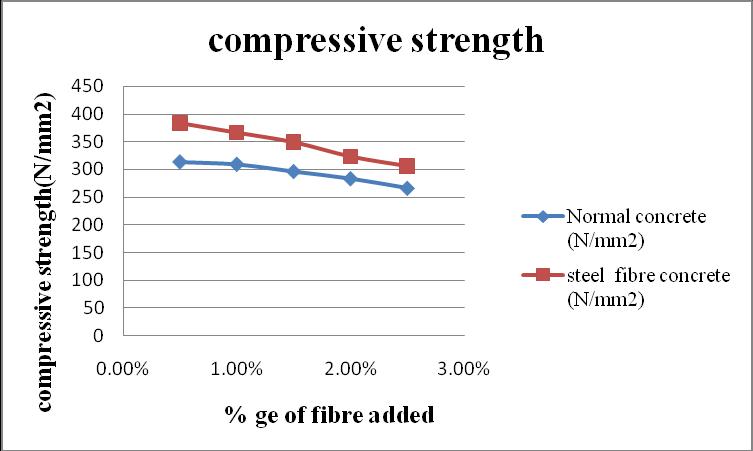
Chart -2:Comparisonofnormalconcretewithsteelfibre concrete
Anincreaseinfibrecontentbeyondacertainlimitresultsin a reduction in compressive strength when compared to conventionalconcrete.Theoptimumcompressivestrength wasobservedat0.5%fibrecontent.
3.ComparisionofnormalconcretewithGlassfibreconcrete
Thegraphillustratesthattheadditionoffibreenhancesthe compressivestrength,reachingamaximumvalueof344.44 N/mm².
1.Comparisonofnormalslumpwithcoconutfibre
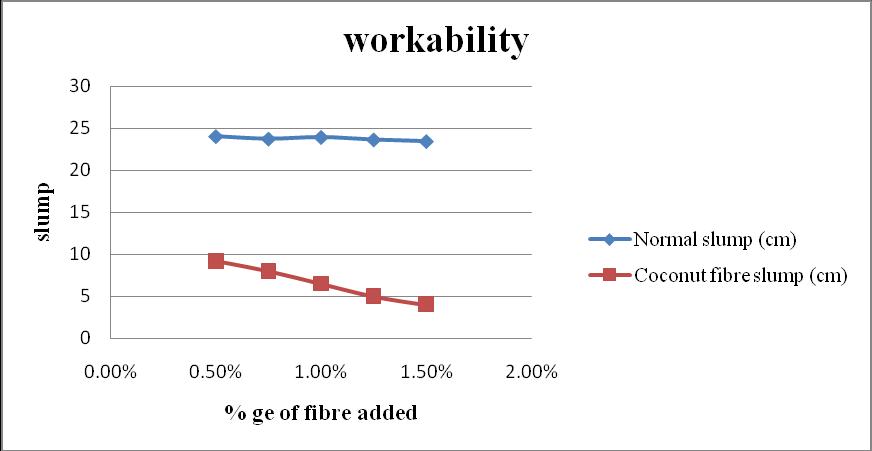
Chart -1:Comparisonofnormalconcretewithcoconut fibreconcrete
Asthepercentageoffibreaddedtotheconcreteincreases, the slump value decreases compared to that of normal concrete. This indicates a reduction in workability with higherfibrecontent.
| Page
International Research Journal of Engineering and Technology (IRJET) e-ISSN: 2395-0056
Volume: 12 Issue: 08 | Aug 2025 www.irjet.net p-ISSN: 2395-0072
2.Comparisionofnormalslumpwithsteelfibreconcrete.
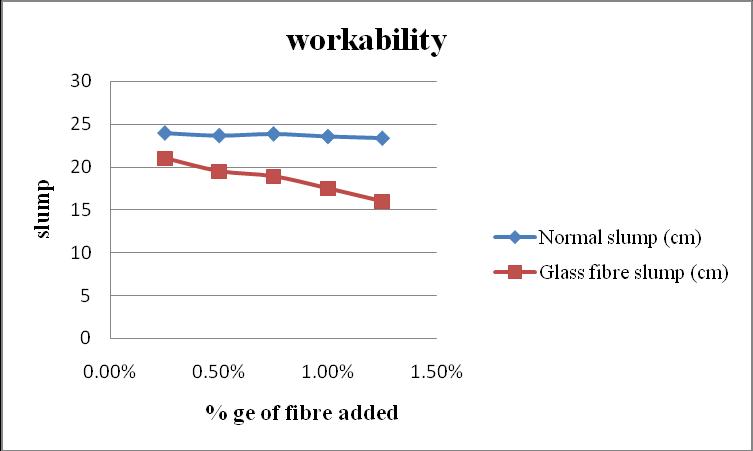
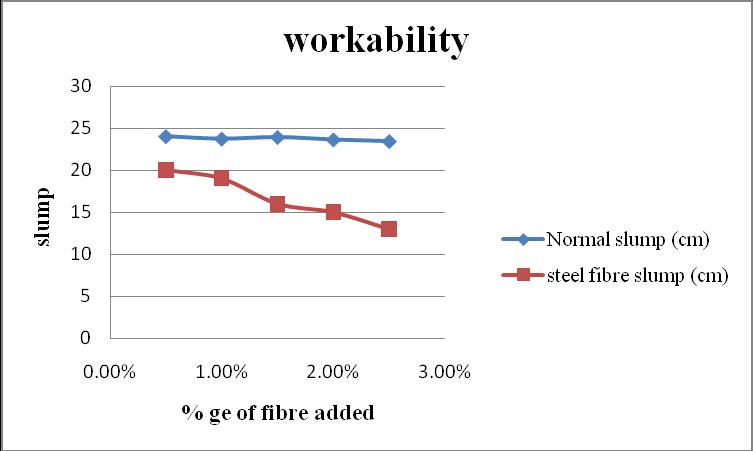
The addition of artificial fibres to concrete results in a gradual decrease in slump compared to normal concrete, indicating a reduction in workability. However, concrete containingartificialfibresdemonstratesbetterworkability thanmixesreinforcedwithnaturalfibres.
3.ComparisionofnormalslumpwithGlassfibre
%
Theslumpvalue ofconcrete withglassfibres issimilar to that of normal concrete, showing minimal reduction in workabilityevenasthepercentageofglassfibresincreases. Therefore,glassfibresprovidebetterworkabilitycompared toothertypesoffibres.
The total energy absorbed in fibre-reinforced concrete,asmeasuredbytheareaundertheloaddeflection curve, is approximately 10 to 40 times greaterthanthatofplainconcrete.
Theadditionoffibrestoconventionallyreinforced beams enhances fatigue life and reduces crack widthunderfatigueloading.
A cost saving of 10% to 30% can be achieved compared to conventional concrete flooring systems.
Inrecentyears,therehasbeenaparadigmshiftin materialsciencetowardstheuseofnaturalfibres, drivenbyenvironmentalconcernsandthelowcost oftheserenewableresources.
Theincorporationofsteelfibrescombinedwitha superplasticizer significantly improves both compressiveandflexuralstrengthatallages,with more pronounced effects observed in flexural strength.
Whiletheadditionoffibresdoesnotgreatlyimpact compressive strength at optimum levels, it substantially improves split tensile and flexural strength.Glassfibresdemonstratehigherstrength thanpolypropylenefibres.
Fibre-reinforced mortar is effective in repair and rehabilitationapplications,particularlyforconcrete grouting.
International Research Journal of Engineering and Technology (IRJET) e-ISSN: 2395-0056
Volume: 12 Issue: 08 | Aug 2025 www.irjet.net p-ISSN: 2395-0072
Both fibre content and fibre length play a critical role in enhancing the mechanical properties of mortar,similartotheinfluenceoffibretype.
Fibre mortar increases brick bond strength, enhances plaster strength, and reduces permeability.
[1]ACIcommittee,“State-of-theartreportinfibrereinforced concrete‟ACI554IR–82DetroitMechigan1982.
[2] Ahsan Habib, Razia Begum, Mohammad Mydul Alam (2013),"MechanicalPropertiesofArtificialFibresReinforced Mortars" International Journal of Scientific & Engineering Research,Volume4,Issue
[3]J.Endgington,D.J.Hannant&R.I.T.Williams,“Steelfiber reinforced concrete” Current paper CP 69/74 Building research establishment Garston Watford 1974. 9. C.D. Johnston, “Steel fiber reinforced mortar and concrete”, A reviewofmechanicalproperties.Infiberreinforcedconcrete ACI–SP44–Detroit1974
[4]CoconutFiberinConcretetoEnhanceitsStrengthand makingLightweightConcrete|IJERDEditorAcademia.
[5] These plant fibres herein referred as natural fibres, include coir, sisal, jute, Hibiscus cannabinus, eucalyptus grandispulp,malva,ramiebast,pineappleleaf,kenafbast, sansevieria leaf, abaca leaf, vakka, date, bamboo, palm, banana,hemp,flax,cottonandsugarcane(Ramakrishnaand Sundararajan,2005;Agopyanetal.,2005;Paramasivamet al., 1984; Ramakrishna and Sundararajan, 2005; Li et al., 2007; Asasutjarita et al., 2007; Toledo Filho et al., 2005; Munawar et al., 2007; Rao and Rao, 2007; Li et al., 2006; Fernandez,2002;Reis,2006;Aggarwal,1992).