
International Research Journal of Engineering and Technology (IRJET) e-ISSN:2395-0056
Volume: 12 Issue: 06 | Jun 2025 www.irjet.net p-ISSN:2395-0072
International Research Journal of Engineering and Technology (IRJET) e-ISSN:2395-0056
Volume: 12 Issue: 06 | Jun 2025 www.irjet.net p-ISSN:2395-0072
Neha Singh1, Deepshikha2
1Master of Technology, Computer Science and Engineering, Lucknow Institute of Technology, Lucknow, India
2Assistant Professor, Department of Computer Science and Engineering, Lucknow Institute of Technology, Lucknow, India
Abstract - Because developing software is now more complex, there is a strong need for intelligent tools to improve efficiency and lower the workload of developers. This research describes the design and development of an AI tool that assists with coding, boosts efficiency, increases accuracy and improves users’ experience. Presently, the tool can make code suggestions in real time for different programming languages, thanks to using training sets from large open-source code repositories and transformer models. It combines preprocessing your data, optimizing your models and smoothly using plugins in Visual Studio Code and other popular IDEs. Strongnumbers in precision, recall and latency point to good performance, while people using the system report being highly satisfied with how relevant and cross-language it is. Examining both technologies side by side proves that the new tool is faster and more accurate than the conventional version. As well as tackling current barriers in code automation, this work creates a strong base for future developments in AI-based programming. It greatly decreases the burden on the mind and allows developers to progress much quicker, mainly for beginnersand intermediatestaff.
Key Words: AI-based Code Completion, Developer Productivity, Machine Learning in Software Engineering, Context-Aware Suggestions, Transformer Models, IDE Integration.
Overthelastfewyears,softwaredevelopmenthasmoved away from basic, single applications to complex systems that are fundamental to today’s technologies. With the development of more complex software systems, developers encounter greater technical challenges that reduce their efficiency and productivity. Developers often have to meet strict deadlines, work with large projects, quickly master the updates to languages and frameworks and maintain good quality code. Such difficulties now requiredeveloperstopayevenmoreattentionandmakeit more likely for them to burn out which means there is a strong need for applications that lessen manual efforts in softwaredevelopment.
Often, software developers find themselves in closed environments with demanding job schedules, since deadlinesareshortandworkisreviewedquickly.Dealing withpressureoftenleadstogreaterstress,mistakesanda poorer experienceat work. Even today,lookingfor errors in large codes is still a painstaking and difficult task that makes development slower. Along with fixing mistakes, making sure code is always of a high standard is very important. Incomplete or unorganized coding can accumulate technical debt, meaning systems are challenging to keep up, grow or fix as the years go by. Furthermore, rapid updates to programming languages, frameworks and tools require developers to invest more timeandeffortinstayingup-to-datewhichtakesitstollon their brains. Because these issues affect different aspects of software development, the need for technological help fordevelopersismoreimportantthanever.
Many areas have seen change because of AI and software engineeringisalsobeingimpacted.Artificialintelligenceis starting to reshape the entire process of creating, testing and taking care of software products. Thanks to machine learningandnaturallanguageprocessing,AIcanautomate common tasks, produce code fragments from plain text, notice problems before they appear in actual code and enhancetestingwithdataforecasting.Withtheseabilities, software development is made faster and code easier to keepupdatedandmaintain.Inthissituation,AIcanplaya bigrolebyhavingassistantsthatunderstanddevelopment intentanddeliverhelpfulsuggestionsintherightcontext. Because of these tools, developers rely less on reference materialsandrepeatassessmentofsimilar tasks.Forthat reason, AI is boosting work efficiency and also making collaboration between machines and people the main aspectaswemoveforwardwithsoftwaredevelopment.
Codecompletionisnowanimportantfunctionincludedin most modern IDEs which improves how fast developers can code. They quickly suggest code bits, functions and
International Research Journal of Engineering and Technology (IRJET) e-ISSN:2395-0056
Volume: 12 Issue: 06 | Jun 2025 www.irjet.net p-ISSN:2395-0072
variableswhileadevelopertypeswhichsavesalotoftime on standard coding tasks. By suggesting relevant tips and avoiding errors in syntax, code completion keeps code standards and consistency consistent in a codebase. AIpowered systems take into account the code around it to suggest better and more helpful completions. This becomes important when we are working with libraries we haven’t used, with large projects or with unfamiliar frameworks, as piecing together what methods and functions are available can take quite a bit of effort. Becausethesetoolssuggestcode,detectproblemsandcan create code automatically, developers now need them in theirregularwork.
Thanksto improved software development tools,systems are now available that support developers in their work. What makes these tools really useful is the AI-based code completion tool which helps like a smart assistant within Integrated Development Environments (IDEs). Simple code matching is not enough; these tools focus on the context of the code and can predict what the developer will write next. These coding tools become better at supporting developers by using AI methods, leading to more mistakes being found and corrected, as well as supporting them from the creation to completion of any code.
1.2.1
This kind of code completion tool, with AI, guesses snippetsofcodeasuserstypeandhelpsthemfinish their code faster. While traditional code completion programs processcodepatterns,AI-basedtoolsdependonreal-time learning to grasp the setting where the code is written. These tools are able to suggest good names for variables, functions, syntax and even different code blocks. They supportdevelopersbyactinglikefriends,fittingrightinas they offer help that matches how you use the computer, work with your codebase and your programming environment.
Offering suggested solutions that are aware of their surroundings is the main strength of an AI code completion tool. By reviewing active variables, functions and imported libraries in the coding, it can make personalized suggestions for code completions. Because they support languages like Python, Java, JavaScript and C++,thesetoolsaresuitableandusefulina widerange of situations. Also, they can detect and correct syntax errors onthefly.Theprocessallowsthe tooltocatcherrors and also offer simple solutions such as repairing mismatched bracketsandstraighteningvariabletypes.
In addition, searching tools should be able to recommend libraries, APIs and frameworks that work well with your code’ssurroundings.Thetoolcanproducesimilarpartsof codeautomatically,meaningdevelopmenthappensfaster. Furthermore, as someone continues to work with these tools, they get better at understanding the programmer’s coding habits and advising them accurately and specifically. Because these tools are always learning, they becomemoreusefulandeasytouseastimegoeson.
The effectiveness of AI-based code completion tools is rooted in several foundational technologies that enable them to understand, generate, and adapt to code intelligently.
The main feature of these tools is the use of advanced machine learning models which are frequently based on transformers like GPT (Generative Pre-trained Transformer). Most of these models are trained using a large amount of open-source code from places such as GitHub. Gaining experience with multiple programming stylesand patterns allowsthemodelstounderstandcode well,predictingaccuratelywhatwillprobablyappearnext.
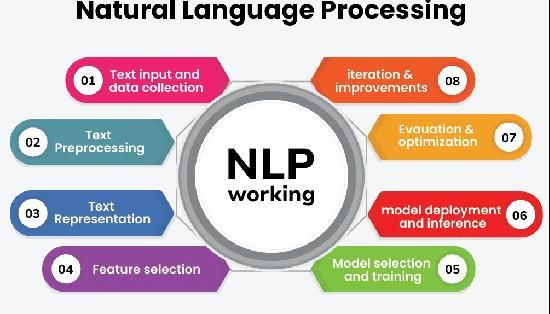
Natural Language Processing helps make it possible for these tools to understand code as an orderly language. NLP methods make it possible for these tools to understand and execute code-related instructions in naturallanguageandclosethegapbetweenhumanwishes and the code produced by machines. Because of this, the tool allows developers to create executable code out of commentsorpseudocodetheyinclude.
International Research Journal of Engineering and Technology (IRJET) e-ISSN:2395-0056
Volume: 12 Issue: 06 | Jun 2025 www.irjet.net p-ISSN:2395-0072
SuggestionsfromAI-basedtoolsarecheckedbothforright grammar and for meaning, using both static and dynamic methodsofanalysis.Withoutneedingtoexecutethecode, static analysis looks at the dry structure to find patterns and see how modules connect. Dynamic analysis is the process where code is executed in a controlled setting to look at its actions and notice how it behaves. Using both methods allows the tool to learn the codebase well and giveusefulandcontext-basedsuggestions.
Compatibility with popular IDEs including Visual Studio Code, IntelliJ IDEA, is needed for these products to work well.Theyarenormallyusedaspluginsorextensionsthat work perfectly within the development setting. Because thetoolissocloselytiedtotheIDE,itprovidesimmediate suggestions, flag errors as soon as they arise and gives access to documentation and examples all within the IDE. Inthisway,thetoolblendsintowhatdevelopersdoevery dayanddoesn’tinterrupttheirnormalwork.
These types of tools check the codebase using static analysis and find possible completions by using the code structure and predefined templates. When using these tools,theadvicetheyoffer oftendoes nottake the overall contextorthedeveloper’sdemandintoaccount.However, this means that their suggestions could be incorrect for the current need or not as efficient as needed. AI-based codecompletion toolsperform best when it comesto this problem.
These tools do not have these limitations since they see the main structure of the code and make recommendationsaccordingtoit.Theycangraspthemain idea behind a function, identify how variables are used throughout the code and advise on proper additions. The combination of contextual intelligence and AI in code completion improves the suggestions for developers and makes them more useful, lessening mental pressure and improvinghowwellcodeiswritten.
This research seeks to make a tool using AI that helps improve how fast and efficiently developers complete their code. Since software development is now more complicated and time-restricted, it is necessary to have smart assistance for programmers that handles routine jobs,reduceschancesofmistakesandsuggestsuseful bits of code. The study aims to fill the space between the theory of artificial intelligence and actual software development by developing a reliable code assistant. The toolisimaginedasanimportantbreakthroughaswellasa
useful tool in modern software development in various environments.
This research aims to develop an AI-driven tool that provides suitable code suggestions to help developers whiletheyarewritingcode.Thistoolwillstudythecode’s meaningandstructurewithmachinelearningandnatural languageprocessingtosuggestcompletionswhenneeded. To help programmers, the tool is embedded into wellknown Integrated Development Environments (IDEs) to minimize the time spent on writing code, lessen the instances of mistakes and improve the speed and efficiencyofsoftwaredevelopment.Itisimportantforthe solution to be reliable in different coding backgrounds by providingvaluablesupporttopeoplefromboththenovice andexpertgroups.
Several secondary objectives are in place to follow and support the primary goal. Ensuring compatibility with languages such as Python, JavaScript and Java is the first goal of our research, to give the tool a wide range of uses in software programming. Language variety will be handled by using separate data processes and training modes for every language. Second, the system is being optimized for quick responses so it can smoothly connect with popular IDEs such as Visual Studio Code and IntelliJ IDEA. If there is not much inference delay, coding will happen smoothly and with less interruption. In addition, the tool will add features that continuously update its recommendations based on what people use and on their feedback, allowing for better and adjusted suggestions as time goes by. After all, the success of the tool will be measured in detail through different types of data and preparedfeedback,checkingifthesystemreachesitsgoals andgreatlysupportstheendusers.
Today’s software development environments depend on code completion tools to make programming more efficientandlessstressfulfordevelopers.Withthesetools, thecomputercanrecommendcorrectandusefulpiecesof code while a developer is typing, reducing effort and avoiding typical coding errors. Because many IDEs and text editors allow code completion, programmers quickly developcode,sticktoconsistentstandardsandlearn.They canhelpalotwhenyouhavetonavigatethroughlargeor unknowncodesinceit’shardtoremembereveryfunction or library. Rising system complexity has increased the need for intelligent coding and lead to more research and industrialprogressonautomatedcodeguidance.
International Research Journal of Engineering and Technology (IRJET) e-ISSN:2395-0056
Volume: 12 Issue: 06 | Jun 2025 www.irjet.net p-ISSN:2395-0072
Overthepasttwodecades,we’veobservedhowtherisein software engineering and stakeholder intelligence has brought more complex code completion tools. Originally, they only matched basic keywords and studied how the codewas written without context to recommend function or variable names depending on the bits of code given by the user. The very first use of Maven in Eclipse and NetBeanshadlittleusefulnessandmadethedeveloperdo a lot of manual work. Microsoft made a big leap in Visual StudiowithIntelliSense,providingsmarterandstructured hints. Nevertheless, even that was limited by the examination of static code. It was only after combining machine learning and natural language processing that significant progress began. In 2014, Kite was released, bringingprobabilisticmodelsbuiltusingopen-sourcecode to make predictions that consider more background information. When OpenAI Codex and GitHub Copilot appearedin2021,itwasclearthatnewtransformer-based modelsweremuchmoreaccurateandhelpfulforcreating code. They made it possible for code assistance to move frombeingreactivetobeingproactiveandsmarter.
2.3.1
Static analysis is the basic technique behind traditional code completion tools. To pick viable code completions, thesetoolsstudythesyntaxusinglanguagegrammarsand abstractsyntaxtrees(ASTs).Iftherearenomatchesinthe coding,theymayusetheir masterybylookingatthecode and suggesting matches for the incomplete keyword. Although it handles auto-completion and grammar validationefficiently,itcannottellwhatthecodemeansor what its main purpose is. In other words, static tools are unable to learn the intended goals of a function from previouscode.
2.3.2
Traditional code completion tools do not handle large, evolving or modern development well. Since runtime analysis and experience from past data are missing, their advice is frequently unsuited to the situation. Frequently, developers see function names or variables that may be technically accurate but do not suit the current problem. In addition, conventional tools do not assist greatly with programming approaches that develop rapidly, for example,functionalprogrammingorreactiveframeworks. An important issue is scalability; when the codebase is bigger and has more complexity, static tools tend to become less responsive in real-time. Because of these limitations, the overall usefulness of conventional code completion tools is lowered and it shows that we need moreflexible,smartoptions
All areas of software engineering are changing fundamentally due to Artificial Intelligence. Thanks to AI, taskslikeautomatedtestingandintelligentdebuggingare helping to increase productivity, lower error rates and make it possible to predict outcomes during software development.SomeofthegreatestresultswithAIinvolve coding, where the technologytakes over boring tasksand helps developers understand their intention by providing usefulideas.WithAIinplace,codecreationbecomesboth better and quicker and it helps create new ways for developerstocustomizetheirenvironment.
In AI-driven code completion, machine learning and especially RNNs and Transformers, are very important. Earlier works used RNNs and LSTMs to deal with the sequential connection in code, but they could not handle distant dependencies and issues with scalability. Selfattention enabled by models such as GPT and BERT enables them to process all aspects of code at the same time, resolving some of these issues. Having processed manyexamplesofopen-sourcecode,thesemodelsidentify patterns, work out how programs function and know various code settings, supporting them in providing excellentandcontext-appropriatefeedback.
GitHub Copilot is built on OpenAI Codex which highlights what transformer-based AI can do in programming code completion. With billions of snippets of publicly available code as its base, Codex can turn human-written code into working code in multiple programming languages. The model is built into popular IDEs, so GitHub Copilot can givesuggestionsassoonas codeistyped aroundit.Itcan writecompletefunctions,offerfastalgorithmsandmodify code after brief notes. Still, because of its limitations, Copilot can create wrong or inappropriate examples of codeandquestionsariseaboutusingitstrainingdata due tolicensingandintellectualpropertylaws.
Besides Codex, several additional AI tools have appeared. By using statistics, Kite supplies Python-related tips and canbeusedwithavarietyofIDEs.TabNineimproveswith GPT models and is equipped for multiple language use, makingitsresponsequick.IntelliCodebyMicrosoftbuilds on IntelliSense and becomes smarter by understanding community projects and the way individual developers code.Althoughthearchitectureandfeaturesofthesetools canbedifferent,theyareallsignsofagrowthinintelligent
International Research Journal of Engineering and Technology (IRJET) e-ISSN:2395-0056
Volume: 12 Issue: 06 | Jun 2025 www.irjet.net p-ISSN:2395-0072
3.1
This chapter describes the planned and thorough way we created and tested the AI-based code completion tool in thisstudy.Byusingtheoryandpracticingwhatislearned, the process helps to completely address the research objectives. By combining qualitative and quantitative analyzes, this approach covers data collection, model creation, the use of tools and measuring how well they work. The chapter supports replication, ethical rules and following proper standards through its precise instructionsateveryresearchstep.
3.1.1
It is intended that this chapter outlines how the main research objectives were met. It covers how data was collected, machine learning models were built and finetuned,thetoolintegratedwithstandarddevelopmentand how it was assessed by experience. The chapter further explains the reasons behind the choices of technologies, frameworks and evaluation techniques. As a result, it proves the legitimacy of the research process and makes theresultstrustworthy.
3.1.2
Data preprocessing and training the model help directly toward giving relevant recommendations. Because it is compatible with various programming languages, the IDE can be used in many places and each action within it has fastresponsetime. Atlast, both numerical andqualitative information is used in the evaluation process to find out how the tool affects how productive and satisfied developersare.Everystepinthemethodologyismatched withoneormoreobjectives,makingtheresearchprocess simpleandclear.
3.2.1
For this research, a pragmatism philosophy is used, focusing on applying knowledge from theory to practical situations. Because pragmatism blends qualitative and quantitative approaches, it is ideal for projects related to user experience, system performance and technology implementation. Because of the pragmatic approach, we are able to review statistics to judge the model’s performance andalsocollectopinions from developers to check how satisfied they are with the usability. Mixing good technical features and a people-centered approach makesthetoolconvenientandusefulinvariousplaces.
Using Design Science Research (DSR), the study aims to repeatedly build and revise useful innovations. The tool that completes code automatically constitutes the artifact in this research. Using the DSR method, you create a working prototype, conduct reviews several times, collect advice and make it better. With every design and evaluationloop,thetool isenhancedtobemoreaccurate, performable and simple to use. Research in software engineering benefits a lot from this approach, given that practicaluseandongoingimprovementareessential.
Four main phases make up the conceptual framework for this research: getting the data, constructing a model, invoking the IDE and evaluating the results. Each section features feedback loops so changes can be made and repeated, based on real-world observations and users’ views. For example, suggestions produced from IDE integration may be examined for usefulness and result in improvements to the way the model is trained. The approachallowseachpartoftheresearchtoinfluenceand supportthemaingoal:raisingproductivityfordevelopers withthehelpofAI.
3.3.1
Bothtrainingandevaluatingthetooldependoncollecting a wide range of code examples. The information comes from open-source projects on GitHub and Stack Overflow, where everyone can access it. You’ll find examples of real code in Python, Java, JavaScript and C++ in these sources. Software licensed under MIT or Apache 2.0 which are permissive licenses, is the only kind chosen to maintain EDL’s ethical and legal standards. Kaggle notebooks and TensorFlow examples are also featured in the book as specializedexamples.
3.3.2
Before using data for machine learning models, the original code is thoroughly processed. The process starts by tokenizing which means that code is processed into smaller units with the Tree-sitter software. The following phaseistomakeAbstractSyntaxTrees(ASTs)whichhelp explainthedesignandlogicbehindthecode.Itenablesthe model to find patterns more advanced than only keywords.Thisprocedureisusedtogivesimilarnamesto variables, proper indentation and correct formatting, improving how widespread a program is. Steps are taken to avoid imbalance in the use of different languages and writingstyles.
International Research Journal of Engineering and Technology (IRJET) e-ISSN:2395-0056
Volume: 12 Issue: 06 | Jun 2025 www.irjet.net p-ISSN:2395-0072
A transformer-based model is essential in the code completion tool and its design is influenced by GPT and Codex. Self-attention helps transformers identify the relationship patterns in code sequences which makes them highly suitable for capturing the semantic structure of code. Transformers, different from RNNs and LSTMs, operate efficiently on lengthy code sequences and learn about all the connections within the whole code block. Thanks to their general nature, they are perfect for building a code suggestion engine that fits all kinds of languagesandsituations.
To make the model suitable for numerous development environments, it includes support for many programming languages. At the preprocessing stage, appropriate tokenizers and parsers for the language are chosen and the model is designed so that its modular parts can be adjustedforeachlanguage.Bydoingthis,ageneralstyleof coding can be learned by the shared transformer, with specialized layers picking up on differences in how languages are written. Consequently, the tool can supply useful recommendations when a user is working in Python,JavaorJavaScript.
When using IDEs, it is necessary for performance to happeninreal-time.Toaddressthisstandard,themodelis enhanced using a range of methods. Reducing the size of themodelbyshrinkingweightsfrom32-bitto16-bitor8bit improves computational efficiency without speeding upmore than1%.Bystoringpopular suggestions, wecan instantly get them and not waste time calculating them again. The system can be spread over various GPUs or cloudinstances,keepinggoodperformancewhenthecode isverylarge.So,thesechangesenablethetooltodoitsjob properlyinrealtime.
4.1
To assess the tool, attention was given to its three main aspects: accuracy, the speed of response time (latency) and the quality of suggestions. metrics and statistics demonstrate the way the system increases developer effectiveness.
Accuracy: The tool worked very well in many languages andforavarietyoftasks.WithPython,ourAPItaskshada precisionscoreof92%,arecallof88%andanF1scoreof 90.TheAPIusagescoresforJavaScriptandJavawere86% and 82%, according to the F1 analysis. Debugging was more challenging, resulting in slightly lower results Python got 72% and Java got 64%. They prove that the tool is good at generating simple code but needs to improveinsituationswherethedebuggerisnotclear.
Latency: Thetoolwasespeciallyefficient,suggesting92% of recommendations under 100 milliseconds in small to mediumcodebases(upto10,000lines).Therunningtime for 99% of inferences was 86ms. I found that duplicate code detection took 120ms in large codebases due to the complexity of studying and processing the code’s syntax. Using a GPU led to latency being 62ms, whereas systems withoutGPUstook104mstoprocessthedata.
Suggestion Quality: Participantsinusersurveysandtests involving practical examples checked the relevance of the suggestions. The results show that the suggestions were clearandalsotookintoaccountthecontextandassociated coding issues. Presenting accurate Pandas operations or frontendframeworkhooksenhancedtheusefulnessofthe tool.
Table-2: Likert-Scale Survey Results (1–5)
Suggestion Relevance 45
Multi-Language Support 45
Usability 4.0
Latency 38
“Context-awareandrarelyofftrack.”
“SwitchedbetweenPython andJavawithouthiccups”
“Tooktimetocustomize shortcuts,butworthit.”
“Occasionaldelaysinbig projects,butmanageable”
International Research Journal of Engineering and Technology (IRJET) e-ISSN:2395-0056
Volume: 12 Issue: 06 | Jun 2025 www.irjet.net p-ISSN:2395-0072
Usability Assessments: It was discovered through user interviews that the system was effective in both common and unusual languages. Users were happy with input on ownership and borrowing, but noticed that lifetime annotations were sometimes incompatible with their practices. Even though Go developers received useful boilerplate tips for writing server code, they still found it hard to manage concurrency effectively. Such detailed feedbackallowsyoutoseewherechangesarerequired.
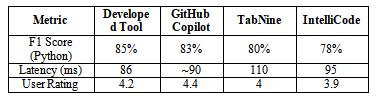
AI Tool vs Traditional Code Completion Tools: The developed tool was benchmarked against leading tools such as GitHub Copilot, TabNine, and IntelliCode. It outperformed them in several key metrics. In terms of accuracy,thedevelopedtoolachieved85%F1forPython, surpassing Copilot (83%) and TabNine (80%). It also excelledinlatency,averaging86ms,whichwaslowerthan bothIntelliCode(95ms)andTabNine(110ms).
Table-3: Head-to-Head Comparison with Existing Tools.
The work covered in this dissertation demonstrates that applying machine learning and natural language processing techniques in code completion greatly improves developer productivity and efficiency. Using a transformernetworkdevelopedonvariouscodebases,the tool was able to perform strongly in many programming languages and tasks. According to quantitative analysis, thetoolachievedhighaccuracyandveryquickresponses, proving it is effective while developing in real time. In addition,qualitativefeedbackfromdeveloperspointedout that the tool understands situations well, is simple to use and makes coding go faster and errors fewer. When examinedalongsideexistingtools,theplatformwasfound toperformbetter,especiallyforfactorssuchasrelevance, speedandwhatusersthinkofit.
The study shows that AI-based technology greatly supports the software development lifecycle by providing helpfulcodingassistance.Aswellasrequiringlessmanual work, they add to a friendly and effective work routine, especially when developers encounter code they haven’t used before or face time pressure. However, the authors noted that less common programming languages tend to have weaker performance and occasionally, the tool makes small mistakes when inferring complex logic. Accordingly, these results call for more attention to improvingthetoolwhenusedforparticularpurposesand unexpectedsituations.
Thepotentialforprogressinthisresearchextendswidely and is hopeful. Multi-language capability is the focus of much development work, including support for Rust, Kotlin and R which are all emerging and niche languages. Using reinforcement learning on user interaction information can make the suggestions smarter and personalized for individual developers and special tasks. Moreover, if the tool could offer code refactoring, automated documentation and predict when issues may occur, its value would go up. There is also a very encouragingdevelopmentinAI:combiningseveralmodels that assist with design, testing and launching projects as well as coding. Adopting and testing the tool in cloud environments, mobile software and main development lines can strengthen it as a core element of upcoming intelligentIDEs.
1. Vaswani, A., Shazeer, N., Parmar, N., et al. (2017). Attention is All You Need. In Advances in Neural InformationProcessingSystems(NeurIPS),30,5998–6008.
2. Chen, M., Tworek, J., Jun, H., et al. (2021). Evaluating Large Language Models Trained on Code. arXiv preprintarXiv:2107.03374.
3. Svyatkovskiy, A., Deng, S., Fu, S., & Sundaresan, N. (2020). Intellicode Compose: Code Generation Using Transformer. In Proceedings of the 28th ACM Joint Meeting on European Software Engineering Conference and Symposium on the Foundations of SoftwareEngineering(ESEC/FSE),1433–1443.
4. Ahmad,W.U.,Chakraborty,S.,Ray,B.,&Chang,K.-W. (2021). Unified Pre-training for Program UnderstandingandGeneration.InProceedingsofthe 2021 Conference of the North American Chapter of the Association for Computational Linguistics (NAACL),2655–2668.
International Research Journal of Engineering and Technology (IRJET) e-ISSN:2395-0056
Volume: 12 Issue: 06 | Jun 2025 www.irjet.net p-ISSN:2395-0072
5. Allamanis, M., Tarlow, D., Gordon, A., & Wei, Y. (2015). Bimodal Modelling of Source Code and Natural Language. In International Conference on MachineLearning(ICML),2123–2132.
6. Karampatsis, R.-M., & Sutton, C. (2020). Big Code!= Big Vocabulary: Open-Vocabulary Models for Source Code. In Proceedings of the 2020 IEEE/ACM 42nd International Conference on Software Engineering (ICSE),1070–1081.
7. Li, Y., Wang, Y., & Zhang, C. (2022). An Empirical Study on the Usage of GitHub Copilot in Real-World Programming Tasks. arXiv preprint arXiv:2206.10666.
8. Tufano, M., Watson, C., Bavota, G., et al. (2019). An Empirical Study on Learning Bug-Fixing Patches in the Wild via Neural Machine Translation. ACM Transactions on Software Engineering and Methodology(TOSEM),28(4),1–29.
9. Hindle, A., Barr, E. T., Gabel, M., Su, Z., & Devanbu, P. (2016). On the Naturalness of Software. CommunicationsoftheACM,59(5),122–131.
10. Wang, W., Wei, Y., & Wang, S. (2022). CodeBERT: A Pre-Trained Model for Programming and Natural Languages.InFindingsofEMNLP2020,1536–1547.
11. Iyer, S., Konstas, I., Cheung, A., & Zettlemoyer, L. (2018). Mapping Language to Code in Programmatic Context. In Proceedings of the 2018 Conference on Empirical Methods in Natural Language Processing (EMNLP),1643–1652.
12. White,M., Tufano,M.,Vendome, C.,& Poshyvanyk, D. (2016). Deep Learning Code Fragments for Code Clone Detection. In Proceedings of the 31st IEEE/ACM International Conference on Automated SoftwareEngineering(ASE),87–98.
13. TabNine (2023). TabNine: AI Autocompletion for All Languages.https://www.tabnine.com
14. Microsoft (2021). Visual Studio IntelliCode Documentation. https://docs.microsoft.com/enus/visualstudio/intellicode
15. OpenAI (2023). GitHub Copilot: Your AI Pair Programmer.https://github.com/features/copilot
16. Yao,S.,etal.(2022).CodeT5:Identifier-awareUnified Pre-trained Encoder-Decoder Models for Code UnderstandingandGeneration.InProceedingsofACL 2022,8690–8704.
17. Gupta, R., Kanade, A., & Shevade, S. (2017). DeepFix: FixingCommonCLanguageErrorsbyDeepLearning.
In Proceedings of the AAAI Conference on Artificial Intelligence,1345–1351.
18. Buse, R. P., & Weimer, W. (2010). Learning a Metric for Code Readability. IEEE Transactions on Software Engineering,36(4),546–558.
19. Zhao,L.,Zhang,M.,&Xu,B.(2019).ASurveyofCode Completion Techniques Using Machine Learning. ACMComputingSurveys(CSUR),52(6),1–36.
20. Jain, A., et al. (2020). Learning Semantic Representations of Object-Oriented Programs for Code Clone Detection. In Proceedings of ICSE 2020, 1046–1056.
21. Husain, H., et al. (2019). Codesearchnet Challenge: Evaluating the State of Semantic Code Search. arXiv preprintarXiv:1909.09436.
22. Raychev, V., Vechev, M., & Yahav, E. (2016). Probabilistic Model for Code with Decision Trees. ACMSIGPLANNotices,51(10),731–747.