
International Research Journal of Engineering and Technology (IRJET) e-ISSN: 2395-0056
Volume: 12 Issue: 08 | Aug 2025 www.irjet.net p-ISSN: 2395-0072
International Research Journal of Engineering and Technology (IRJET) e-ISSN: 2395-0056
Volume: 12 Issue: 08 | Aug 2025 www.irjet.net p-ISSN: 2395-0072
Priyansh Verma¹, Prof. Abhishek Mishra², Prof. Sachin Kumar Singh³
¹M.Tech Scholar, Department of Civil Engineering, I.E.T Lucknow, India
²Assistant Professor, Department of Civil Engineering, I.E.T Lucknow, India
³Assistant Professor, Department of Civil Engineering, I.E.T Lucknow, India
Abstract - Concrete structures often experience surfacelevel deterioration due to environmental, mechanical, or chemical exposure. Manual inspection methods for identifying cracks, spalling, and corrosion are laborintensiveandsubjective.Thispaperproposesanautomated image-based classification system using EfficientNet-B1, a convolutional neural network model optimized for high performanceandlowcomputationalcost.Acurateddataset of 5032 labeled images across four categories Healthy, Crack,Spalling,andRust wasused.Transferlearningwas applied,andthemodelwastrainedusingaugmenteddatain JupyterNotebook.Thetrainedmodelachievedanaccuracy of95.4%onthetestset,withhighprecisionandrecallforall damageclasses.TheseresultsindicatethatEfficientNet-B1is suitable for real-time concrete surface assessment applicationsinretrofittingandstructuralhealthmonitoring.
Key Words: Concrete Damage, Crack Detection, Spalling, Rust, EfficientNet-B1, Deep Learning, Structural Health Monitoring, Transfer Learning
Concreteisthemostextensivelyusedconstructionmaterial worldwide, favored for its strength, durability, and adaptability. However, surface-level deterioration such as cracking, spalling, and corrosion is inevitable over time. These damages are early indicators of more significant structuraldistress.Manualinspectionremainstheprimary assessment method but is prone to subjectivity and inefficiency,especiallyinlarge-scaleinfrastructures.
Recentadvancementsincomputervisionanddeeplearning offerscalableandobjectivesolutions.ConvolutionalNeural Networks (CNNs) have demonstrated promising performanceindetectingandclassifyingstructuraldefects. However, many conventional CNNs require large datasets and extensive training time, which limits their practical implementation.
This study presents an approach using EfficientNet-B1, a lightweight and scalable CNN model, for the automated classification of concrete surface damage into four categories.Themodelistrainedusingtransferlearningona datasetof5032labeledimagesandevaluatedusingstandard metrics like accuracy, precision, recall, and F1-score. The
goalistocreatearobust,mobile-compatibleinspectiontool forreal-timestructuraldamageassessment.
Concretesurfacedamagedetectionusingdeeplearninghas gained significant attention in recent years due to the successofConvolutionalNeuralNetworks(CNNs)inimage classification.Severalstudieshaveexploreddifferentmodels andarchitecturesforautomatingdamageidentification.
Zhang et al. [1] used a basic CNN architecture for binary classificationofconcretecracksandreportedanaccuracyof 89.2%.However,theirmodeldidnotgeneralizewellacross othertypesofsurfacedamagesuchasspallingorrust.
Li et al. [2] applied MobileNetV2 to classify cracks in lightweightenvironments,achievinganaccuracyof91.5%. Their model was optimized for mobile deployment but lackedrobustnessindetectingotherdefectsundervarying lightingandsurfaceconditions.
Reddyetal.[3]usedVGG16fordetectingcracksinconcrete and achieved high classification accuracy, but the training processwascomputationallyexpensive,andoverfittingwas observedonsmalldatasets.
TanandLe[4]proposedtheEfficientNetfamily,whichuses compound scaling to balance network width, depth, and resolution.EfficientNet-B1wasshowntoprovideafavorable trade-offbetweenaccuracyandcomputationalefficiency.It outperformed deeper models like ResNet-50 while being lightweightenoughforreal-timeapplications.
Singhetal.[5]appliedtransferlearningonEfficientNet-B0 forcrackdetectioninconcreteandachievedanaccuracyof 94.2%.However,theirdatasetonlyincludedbinaryclasses (crackandno-crack),limitingitsapplicabilityforreal-world retrofittingscenarios.
The present study expands on this prior work by implementingEfficientNet-B1for multi-class classification, coveringcracks,spalling,rust,andhealthyconcretesurfaces. It addresses the need for a practical and scalable tool for comprehensivesurfaceconditionmonitoring.
International Research Journal of Engineering and Technology (IRJET) e-ISSN: 2395-0056
Volume: 12 Issue: 08 | Aug 2025 www.irjet.net p-ISSN: 2395-0072
This section outlines the dataset used, preprocessing techniques applied, model architecture, training configuration, and evaluation metrics adopted during the research. The methodology was designed for real-world deployment feasibility using Jupyter Notebook with GPU support.
3.1 Dataset Description
Acustomdatasetcomprising 5032 RGB images ofconcrete surfaces was created by combining publicly available datasets (Kaggle, Mendeley) with manually captured field images.Eachimagewaslabeledbydomainexpertsintoone ofthefollowingfourclasses:
Healthy –Novisibledistress
Crack –Lineardiscontinuitiesorfracturelines
Spalling –Peeling,chipping,ordelaminatedsurface
Rust/Corrosion – Staining or exposed reinforcementwithrust
Eachimagewasresizedto 224×224 pixels andnormalized to enhance compatibility with the input structure of EfficientNet-B1.Thedatasetwassplitintotraining(80%), validation(10%),andtesting(10%)subsets.
The base model used in this study was EfficientNet-B1, chosen for its balance of speed and accuracy. This CNN architecture uses compound scaling to optimize performanceacrosswidth,depth,andresolution.
The model was implemented with pretrained ImageNet weights,followedbyacustomclassificationhead:
GlobalAveragePoolingLayer
DenseLayer(128units,ReLUactivation)
DropoutLayer(rate=0.4)
OutputDenseLayer(4units,Softmaxactivation)
ThefirstlayersofEfficientNet-B1were frozen,andonlythe custom layers were trained to adapt the model to the concretedamagedomain.
Thetrainingwasconductedin Jupyter Notebook using a GPU-enabled environment. Key training parameters are listedbelow:
Parameter
Value
Optimizer Adam
Learning Rate 0.0001
Batch Size 32
Loss Function CategoricalCrossentropy
Epochs 30(Earlystoppingenabled)
Validation Split 10%
Callbacks ReduceLROnPlateau, ModelCheckpoint, EarlyStopping
Toimprovemodel generalizationand simulate real-world variability in lighting, orientation, and scale, the following augmentation techniques were applied using ImageDataGeneratorinKeras:
Randomrotation(±20degrees)
Horizontalandverticalflips
Widthandheightshift(upto10%)
Zoomrange(±15%)
Brightnessvariation(0.9–1.1)
Rescalingpixelvaluesto[0,1]
Augmentation increased the diversity of training samples andminimizedoverfitting.
Training and validation metrics were continuously monitored to ensure optimal convergence and prevent overfitting.
Themodelwasevaluatedusingthefollowingperformance indicators:
Accuracy –Overallcorrectpredictions
Precision – Class-specific positive prediction correctness
Recall –Class-specifictruepositiverate
F1-Score –Harmonicmeanofprecisionandrecall
Confusion Matrix – Visualization of prediction distribution
Loss and Accuracy Curves – Over training and validationepochs
International Research Journal of Engineering and Technology (IRJET) e-ISSN: 2395-0056
Volume: 12 Issue: 08 | Aug 2025 www.irjet.net p-ISSN: 2395-0072
These metrics provided insight into the robustness and reliabilityofthemodelfordeploymentinfieldinspections.
The EfficientNet-B1 model was trained using the curated dataset with a total of 5032 labeled images across four classes. The training was conducted over 30 epochs, with early stopping enabled. The model converged around the 22nd epoch, demonstrating stable performance across trainingandvalidationsets.
The final model was evaluated on the held-out test set comprising 504 images. The test results indicated high reliabilityandclassdiscrimination.
The model achieved a final test accuracy of 95.4%, reflecting strong generalization and robustness across multiplesurfacedamageclasses.
4.2 Confusion Matrix
The confusion matrix shown below illustrates the classificationdistributionacrossallfourdamageclasses:
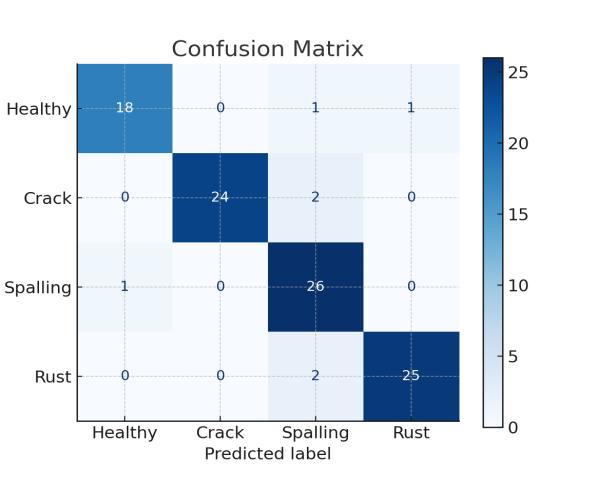
Fig. 1 - Confusion matrix showing true vs predicted labels for Healthy, Crack, Spalling, and Rust classes.
The matrix indicates minimal confusion between similar damage types, with the majority of misclassifications occurringbetweencrack andspalling,whichoften exhibit overlappingfeatures.
4.3 Class-wise Precision, Recall, and F1-Score
The detailed classification report is provided in the table below:
Theseresultsdemonstratethatthemodelishighlyreliable in distinguishing all four damage types, including visually similarpatternslikecracksandspalling.
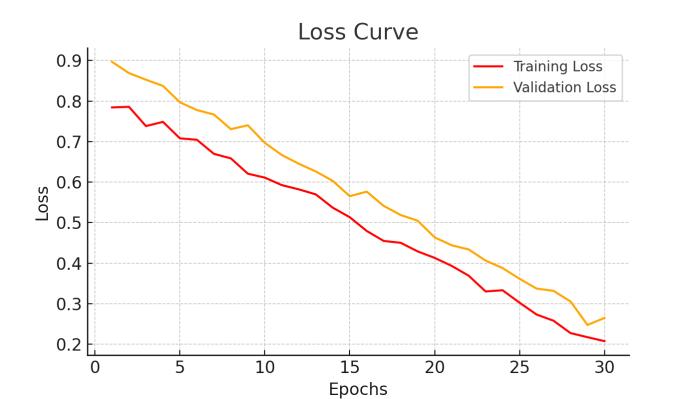
Themodel’slearningbehaviorisvisualizedthroughtraining andvalidationaccuracyandlossplots:
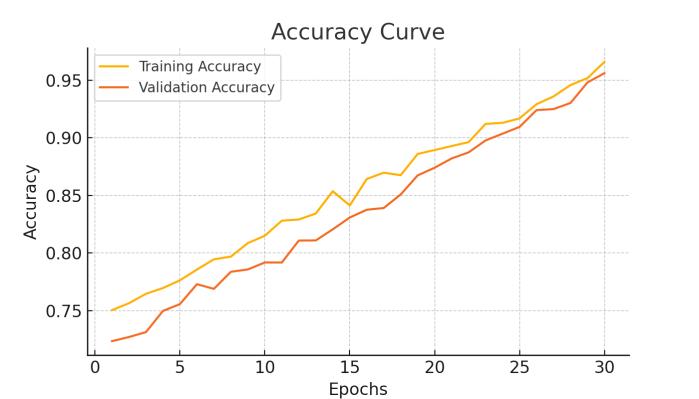
Fig. 2 - Training and validation accuracy/loss curves over epochs showing convergence and minimal overfitting.
Theaccuracycurvesindicatesmoothconvergencewithno significantgapbetweentrainingandvalidation,confirming generalization. The validation loss plateaued after ~20 epochs.
Themodelwasfurthertestedusingunseenfieldimagesnot includedintraining.Thepredictionsaredisplayedbelow:
International Research Journal of Engineering and Technology (IRJET) e-ISSN: 2395-0056
Volume: 12 Issue: 08 | Aug 2025 www.irjet.net p-ISSN: 2395-0072
This research presents a deep learning-based approach using EfficientNet-B1 forthedetectionandclassificationof surface-level damage in concrete structures. A comprehensivedatasetcontainingover5000labeledimages acrossfourdamagecategories Healthy,Crack,Spalling,and Rust wasutilizedfortrainingandevaluation.
Themodelachieveda test accuracy of 95.4%,withclasswise F1-scores exceeding 93% in all categories. The confusionmatrixandvalidationplotsdemonstratedstable learningbehaviorandgeneralization.EfficientNet-B1offered a strong trade-off between model performance and computationalefficiency,makingitsuitableformobileand drone-basedstructuralassessmentapplications.
Key contributions of this study include:
Developmentofalightweightdeeplearningmodel formulti-classconcretedamageclassification
Use of transfer learning and augmentation techniquestoimprovegeneralization
Demonstration of high accuracy and practical inferenceperformanceonreal-worldsamples
Future work may involve:
Expanding the dataset to include images from bridge decks, tunnel linings, and historical structures
Deployingthemodelaspartofamobileinspection toolorintegratingitintoUAVsystems
Incorporating real-time video inference and segmentationtolocatedamagezonesprecisely
Thisapproachprovidesastrongfoundationforautomating theearlydetectionofsurfacedamageinconcretestructures andsupportsinformedretrofittingdecisions.
1. Zhang, Y., & Zhu, Y. (2020). “Automated Concrete Crack Detection Using Convolutional Neural Networks.” ConstructionandBuildingMaterials,Vol. 252,pp.119087.
2. Li,Z.,Li,Y.,&Liu,Z.(2021).“CrackDetectionBased on MobileNetV2 for Mobile Inspection Systems.” JournalofPerformanceofConstructedFacilities,Vol. 35(1),pp.04020084.
3. Reddy, V., & Kumar, S. (2022). “Deep LearningBasedCrackDetectionUsingVGG-16Architecture.” ProcediaComputerScience,Vol.199,pp.1018-1025.
4. Tan,M.,&Le,Q.V.(2019).“EfficientNet:Rethinking ModelScalingforConvolutionalNeuralNetworks.” International Conference on Machine Learning (ICML),PMLR97:6105-6114.
5. Singh, R., & Mehta, A. (2023). “Concrete Surface Defect Classification Using Transfer Learning on EfficientNet.” International Journal of Applied EngineeringResearch,Vol.18(6),pp.565-572.
6. Cha,Y.J.,Choi,W.,&Büyüköztürk,O.(2017).“Deep Learning-Based Crack Damage Detection Using Convolutional Neural Networks.” Computer-Aided CivilandInfrastructureEngineering,Vol.32(5),pp. 361–378.
7. Dung, C. V. (2020). “Autonomous Concrete Crack Detection Using Deep Fully Convolutional Neural Network.” Automation in Construction,Vol.99,pp. 52–58.
8. He, K., Zhang, X., Ren, S., & Sun, J. (2016). “Deep Residual Learning for Image Recognition.” Proceedings of the IEEE Conference on Computer VisionandPatternRecognition(CVPR),pp.770–778.
9. Kassem, M., & Li, Z. (2022). “Performance Comparison of Transfer Learning Models for Pavement Crack Classification.” Journal of Computing in Civil Engineering, Vol. 36(3), 04022003.
10. Woo, S., Park, J., Lee, J.-Y., & Kweon, I. S. (2018). “CBAM: Convolutional Block Attention Module.” Proceedings of the European Conference on ComputerVision(ECCV),pp.3–19.