
International Research Journal of Engineering and Technology (IRJET) e-ISSN:2395-0056
Volume: 12 Issue: 03 | Mar 2025 www.irjet.net p-ISSN:2395-0072
International Research Journal of Engineering and Technology (IRJET) e-ISSN:2395-0056
Volume: 12 Issue: 03 | Mar 2025 www.irjet.net p-ISSN:2395-0072
Dr.Shubhangi Gondane1 , Mehul Phegade2, Vrushabh Upadhye3, Om Laychetti4
1Project Guide, Department Of Mechanical Engineering, PVG College of Engineering and Technology, Pune–411009
2, 3, 4 Students, Department Of Mechanical Engineering, PVG College of Engineering and Technology, Pune – 411009 ***
Abstract -This study explores the integration of Archimedes Screw Turbines for micro-hydropower generation in urban high-rise buildings. With an effective head of 3.96 meters and a discharge rate of 0.0547 cubic feet per second, the system demonstrates strong feasibility for rainwater energy conversion. Optimized screw design, including a 6.94-meter length at a 35° inclination, a diameter ratio of 0.5–0.6, and a blade pitch of 24.3 cm, ensures efficient water conveyance and structural stability. The turbine operates at 146.69 RPM with an efficiency of 71.2%, achieving stable power output. This research highlights the potential of rainwater-driven micro-hydro systems as a sustainable energy solution, complementing wind sources. This research work is more efficient and self-sustaining renewable energy models in urban environments andsustainable power generation
Key Words: Archimedes, Hydraulic Turbine, Prototype, renewable resources, Sustainability
As cities strive for sustainable energy solutions, integrating wind and rainwater energy offers a promising pathway. This research introduces an innovative method for generating electricity in high-rise buildings by harnessing both wind and rainwater as complementary renewable energy sources. The proposed system combinesa LiamF1 mini windturbine renownedforits efficiency in urban environments with an Archimedes screw-based hydraulic turbine to effectively convert rainwaterrunoffintousableenergy.
Urban areas often struggle with inconsistent wind patterns and space constraints, limiting the feasibility of large-scale renewable energy installations. The vertical axis wind turbine (VAWT) design is particularly wellsuited for high-rise buildings, as it efficiently captures wind from multiple directions and operates effectively at lower wind speeds typical of urban settings. Simultaneously, rainwater an often underutilized resource is channeled through an Archimedes screw mechanismtogeneratesupplementalpower.
By integrating these two renewable energy sources, the proposed system reduces reliance on conventional power grids while promoting sustainable urban development.
Enhancing energy generation in densely populated areas, this model represents a viable and scalable solution for improving building energy efficiency and advancing renewableenergyadoptioninsmartcities.
The objective is to design an Archimedes screw-based hydraulic turbine and an Archimedes screw wind turbine to generate renewable energy for a three-story building with a total area of 3,000 square feet. The hydraulic turbinewillutilizerainwaterrunofftoproduceelectricity, whilethewindturbinewillharnesswindenergy,ensuring efficient power generation within an urban setting. This dual-energy system aims to enhance sustainability by optimizing energy production in limited spaces, making it aviablesolutionforurbanrenewableenergyapplications.
1. Harness rainwater and wind energy from highrisebuildingsforcleanelectricity.
2. Integrate Archimedes screw and Archimedes screwwindturbineforhybridpowergeneration.
3. Optimize placement and design to maximize energyconversionefficiency.
4. Assess feasibility, scalability, and costeffectivenessforurbanapplications.
5. Select and integrate VAWT (vertical axis wind turbine) and Archimedes screw turbine for efficientenergygeneration.
Wind Energy Systems – Traditional horizontal-axiswind turbines (HAWTs) are widely used but are inefficient in urban areas due to inconsistent wind patterns. Verticalaxis wind turbines (VAWTs) offer better adaptability in cities by capturing wind from multiple directions and operatingatlowerwindspeeds.
Rainwater-Based Energy Systems – Existing rainwater harvestingsystemsprimarilyfocusonwaterconservation rather than energy generation. While some large-scale
International Research Journal of Engineering and Technology (IRJET) e-ISSN:2395-0056
Volume: 12 Issue: 03 | Mar 2025 www.irjet.net p-ISSN:2395-0072
micro-hydro turbines are used in water distribution networks, their application for localized urban energy productionremainslimited.
Hybrid Renewable Systems – Most hybrid energy solutions combine solar and wind power, with little research dedicated to integrating wind and rainwater energyforelectricitygeneration.
5. DESIGN OF PARTS IN CONVEYOR SYSTEM
Partsdesigned:
1. Archimedesscrewhydraulicturbine
5.1 Archimedes screw hydraulic turbine:
25-60 mm/day rainwater Western ghats Area of terrace(A):3000sqfeet
Height of terrace wall (H): 2.5 feet Consider rainfall
Depthtofeet:10mm=0.1312feet
Volumeofrainfallcollected=3000x0.1312 =393.9cubicfeet/day
DischargeRate=0.0547083cubicfeet/s =1.52lit/s
5.2 To Determine pipe diameter
FlowrateQ=AXV
A=crosssectionalareaofcircularpipe
(Wherehydraulicturbinearchimedesscrewstobe inserted)(sqfeet)
V=Velocityoffluid(feet/s) =(3-4m/s)forsmallhydroturbine =(0.5-13ft/s)
A=πx(d/2)^2
D=diaofpipe
RearrangethedbasedonQ&V;
d=2x√(Q/πxV)
d=2x√(0.0547/3.14x6.5)
d=0.1035835Feet
d=3.154cm
Let'sconsiderheightofeachFloorisgenerallyaround 9to10feet(~2.7mto3m)
soforthreestorybuildinglet'sconsiderthemaximum heightofthebuilding
Averageheightoftheonestoryis10feet
10x3=30feet
By adding some extra height for roof parapet,the total heightwouldbearound
30+3=33feet =10m
5.3. Archimedes screw design according to:
1. Turbine head, H = Z1 - Z2
Z1, Z2 are the heights of the free surface at turbine inlet&outlet.
Z1=33feet
Z2=33-13feet=20feet
H=Z1-Z2
H=33-20H=13feet
H=3.96meter
2.Screw length, L
L depends on the angle of installation & turbine head heightaccordingtogivenrelationship,
L=Z1-Z2/sinθ
=H/sinθL=3.96/sin(35°)
θ=35°→becausemaximumpowerisobtainedatthis angle.
3.No of blades (N)
No of blades should be chosen as to max power transmitted to shaft while keeping runner as light as possible.
N=2leadstomarginalincreaseinefficiency whileN=2 causesasignificantreductioninturbineperformance.
ThereforeN=3isconcludedasoptimalnoofblades
4. Diameter ratio(δ)
=Di/De
Range=0.45to0.55accordingtoourstudy experimentalresultsobtained.
After optimization study it concluded that diameter ratio shouldbe
0.54-fornoofbladestargeting1to4
The decrease in diameter ratio δ leads to an increase in Bladesurfaceaccompaniedbyanincreaseinthehydraulic forces that acts on blade, on the one hand the axial
2025, IRJET | Impact Factor value: 8.315 | ISO 9001:2008
International Research Journal of Engineering and Technology (IRJET) e-ISSN:2395-0056
Volume: 12 Issue: 03 | Mar 2025 www.irjet.net p-ISSN:2395-0072
component of the forces increases, causing higher axial thrust that loads to bearing and the torque it produces is notincreasesignificantly.
5. Blade Pitch (λ):
First we have to calculate the outer diameter of the Archimedesscrew.
De=(18.63KQ/N(1-δ3))3/7 =(18.63x0.00151xtan35/13(1-0.543)3/7
De=19.9cm
Λ=2ND e/k(4+N)
=0.243m
=24.3cm
Δ=Di/De
0.54=Di/0.199
Di=0.107m
6. Speed (n):
nlim=50/De2/3
n=146.690rpm
7. Volume of bucket Vb:
n =60Q/NVb
Vb =60Q/Nn
Vb= 60x0.00151/3x146.690
Vb= 0.0000205876m3
8. Turbine efficiency:
Average efficiency is 71.2% with standard deviation of 3.4%
9. Shaft Power:
Ps=9.81ηQH[KW]
Ps=9.81x0.71x0.0011x39.6
Ps=0.041608712[KW]
6. CAD MODELLING USING ANSYS SOFTWARE
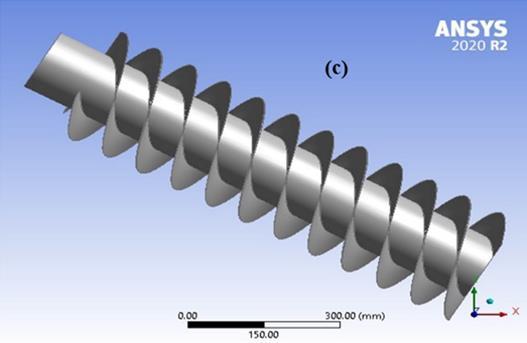
Figure1: Archimedean screw
7. RESULTS:
Turbine Head & Flow Rate – The effective head was meticulously calculated at 3.96 meters, with an estimated dischargerateof0.0547cubicfeetpersecond,renderingit highlysuitableformicro-hydropowerapplications.
Screw Design Optimization – The optimal screw length was precisely determined to be 6.94 meters, inclined at 35°, ensuring peak power generation. The diameter ratio (Di/De), ranging from 0.5 to 0.6, coupled with a blade pitch of 24.3 cm, facilitates seamless and efficient water conveyance. To strike the perfect balance between operational efficiency and structural robustness, an ideal configurationofthreeblades(N=3)wasselected.
Turbine Performance & Efficiency – Operating at an impressive 146.69 RPM with an efficiency of 71.2%, the turbineachievesastableshaftpoweroutputof0.0416kW, signifyingawell-optimizedandreliableenergyconversion system.
Practical Implications – This study reaffirms the immense potential of integrating rainwater-driven microhydro systems into high-rise buildings, seamlessly complementing wind and solar energy solutions. By harnessing multiple renewable sources, this innovative approach paves the way for a more sustainable and selfsufficienturbanenergyecosystem.
8. CONCLUSIONS:
Feasibility of Archimedes Screw Turbines – The researchconfirmstheviabilityofusingArchimedesScrew Turbines for small-scale hydropower generation in urban settings.
Efficiency & Performance – Design calculations and performance analysis indicate an energy conversion
International Research Journal of Engineering and Technology (IRJET) e-ISSN:2395-0056
Volume: 12 Issue: 03 | Mar 2025 www.irjet.net p-ISSN:2395-0072
efficiencyof over70%, effectivelyutilizing rainwaterflow forpowergeneration.
Optimized Design – Key turbine parameters, including blade configuration, diameter ratio, and pitch, were optimized to enhance efficiency while minimizing structuralstress.
Renewable Energy Potential – Rainwater-driven micro-hydro systems offer a viable renewable energy solution for high-rise buildings, complementing existing energysources.
Future Enhancements – Further advancements in materials, system integration, and energy storage can improveperformanceandsustainability.
Scope for Future Research – Experimental validation and real-world implementation can refine performance metrics and explore hybrid renewable energy models integrating solar, wind, and hydropower for maximum efficiency.
We would like to express our heartfelt gratitude to Dr.ShubhangiGondane (Project Guide, Mechanical Department, PVG’s COET, Pune) and Prof. Dr. M. M. Bhoomkar (Head of the Mechanical Department, PVG’s COET, Pune) for their constant guidance, support, and encouragement throughout our project. Their valuable insightsandexpertisehavebeenagreatsourceoflearning and inspiration, helping us successfully complete this research.
1. Zamani, M., Shafaghat, R., & Alizadeh Kharkeshi, B. (2023).“Numericalstudyofthehydrodynamicbehaviorof an Archimedes screw turbine by experimental data in order to optimize turbine performance: The genetic algorithm.”Journal of Applied and Computational Mechanics, 9,1060–1075.
2. Simmons, S. C., & Lubitz, W. D. (2021). “Analysis of internal fluid motion in an Archimedes screw using computational fluid mechanics” Journal of Hydraulic Research, 59,932–946.
3.Itti,G.,Fattore,F.,Brunori,A.Brunori,B.,&Brocchini,M. (2020). “Efficiency evaluation of a ductless Archimedes turbine: Laboratory experiments and numerical simulations” Renewable Energy, 146,867–879.
4.Renardy,S.,Benitez,J.P.,Tauzin,A.,Dierckx,A.,&Nzau Matondo,B.(2020).“Atlanticsalmonsmolt’sbehaviorata hydropower station offering multiple migration routes” . Hydrobiologia, 847,469–485.
5. Mueller, M., Knott, J., Pander, J., & Geist, J. (2022). “Experimentalcomparisonoffishmortalityandinjuriesat innovative and conventional small hydropower plants. Journal of Applied Ecology, 59,2360–2372.
6. Havn, T., Sæther, S., Thorstad, E., Teichert, M., Heermann,L.,Diserud,O.,Borcherding,J.,Tambets,(2017). “Downstream migration of Atlantic salmon smolts past a low-head hydropower station equipped with Archimedes screw and Francis turbines” Ecological Engineering, 105, 262–275.
7. Müller, G., & Senior, J. (2009). “Simplified theory of Archimedean screws ” . Journal of Hydraulic Research, 47, 666–669.
8. Simmons, S., & Lubitz, W. (2017). “Archimedes screw generators for sustainable energy development” IEEE International Humanitarian Technology Conference (IHTC) doi:10.1109/IHTC.2017.8058176
9. Lubitz, W. D., Lyons, M., & Simmons, S. (2014). “Performance model of Archimedes screw hydro turbines with variable fill level” . Journal of Hydraulic Engineering, 140(10),04014050.
10. Müller, G., & Senior, J. (2009). “Simplified theory of Archimedean screws” Journal of Hydraulic Research, 47(5),666-669.doi:10.3826/jhr.2009.3475.
11. Shukla, M. K., Jain, R., Prasad, V., & Shukla, S. (2011). “CFD analysis of 3-D flow for Francis turbine” MIT International Journal of Mechanical Engineering, 1,93-100.
12.Brada, K., &Radlik, K. (1996). “Water screw motor for micropower plant” . 6th International Symposium on Heat Exchange and Renewable Energy Sources,Szczecin,Poland.
13. Pandey, B., & Karki, A. (2017). Hydroelectric Energy: Renewable Energy and the Environment. Boca Raton: CRC Press.
16.Songin,K.(2017).“Experimental analysis of Archimedes screw turbines” (Master’s thesis, University of Guelph, Guelph,Canada).
17.Pauwels, I. S., Baeyens, R., Toming, G., Schneider, M., Buysse, D., Coeck, J., &Tuhtan, J. A. (2020). “Multi-species assessment of injury, mortality, and physical conditions during downstream passage through a large Archimedes hydrodynamic screw” (Albert Canal, Belgium). Sustainability, 12
18. Knott, J., Mueller, M., Pander, J., & Geist, J. (2023). Downstream fish passage at small-scale hydropower plants: Turbine or bypass? Frontiers in Environmental Science, 11
International Research Journal of Engineering and Technology (IRJET) e-ISSN:2395-0056
Volume: 12 Issue: 03 | Mar 2025 www.irjet.net p-ISSN:2395-0072



Mr.MehulPravinPhegade
BEMechanicalstudentat
PVG’sCOET,Pune
Mr.VrushabhVasantUpadhye
BEMechanicalstudentat
PVG’sCOET,Pune
Mr.OmRajeshLaychetti
BEMechanicalstudentat
PVG’sCOET,Pune