
International Research Journal of Engineering and Technology (IRJET) e-ISSN: 2395-0056
Volume: 12 Issue: 07 | Jul 2025 www.irjet.net p-ISSN: 2395-0072
International Research Journal of Engineering and Technology (IRJET) e-ISSN: 2395-0056
Volume: 12 Issue: 07 | Jul 2025 www.irjet.net p-ISSN: 2395-0072
P. S S SUNDAR KUMAR1 , Asst Prof. V. SRAVANI2
1PG student, Amrita Sai Institute of Science and Technology, Paritala, Vijayawada, Andhra Pradesh, INDIA. 2Asst Professor, Dept. of Civil Engineering, Amrita Sai Institute of Science and Technology, Paritala, Vijayawada, Andhra Pradesh, INDIA.
Abstract - Thisprojectfocusedonthedesignofhigh-rise residential building in modified octagonal tessellating pattern in the Vijayawada region. The main objective of this project is to determine the feasibility and performance oftheunique structural geometryinvarious soil-related challenges. Generally, in this region, high-rise buildings are restricted owing to poor soil conditions and groundwatertablelevels.Inaddition,theoctagonalshape in tessellating pattern of the flats in the building will be considered. The ETABS and SAFE software were consideredfordesigningandanalyzingthestructure.Main frame structures such as columns, beams, and slabs were designed using ETABS and Substructure was designed using SAFE software. The design adheres to the IS codes and considers the effects of torsion, lateral drift, and base reactions on the overall stability of the structure. This projectevaluatestheloaddistributionandwindresistance of an irregular geometrical building as well as high-rise buildinginteractionswithpoorsoilconditions.Theresults aim to demonstrate that with proper analysis and foundationdesign,modifiedoctagonaltessellatingpattern high-rise buildings can be a structurally efficient solution in height-constrained and geotechnically challenging regionslikeVijayawada.
Key Words: Story drift control, Dynamic response spectrum analysis, Soil structure interaction, Safe bearing capacity (SBC), Shear wall optimization, Finite Element method,Structuralserviceabilityassessment
1.INTRODUCTION
Rapidurbangrowthand limitedlandavailabilityhave led to vertical expansion in cities. In Vijayawada, Andhra Pradesh,high-risestructuresfacerestrictionsduetoblack cotton soil, which poses challenges like settlement and swelling. This study focuses on designing a G+15 residential building in suchgeotechnical conditions, using a modified octagonal tessellating pattern to enhance structuralperformanceandaestheticsunderlateralloads. ETABS software is used for 3D modelling, analysis, and design of the superstructure, while SAFE software is
employed for the foundation design, integrating finite elementanalysiswithcode-basedchecks.
Design and analyse a high-rise octagonal building usingETABSperIS875andIS1893.
Evaluate building response to wind and seismic forces.
DesignasuitableraftfoundationinSAFEforblack cottonsoil.
Recommend practical solutions for heightrestrictedzones.
1.2
Structural modelling and load application in ETABS.
WindandseismicanalysisperIndianstandards.
RaftfoundationdesignusingSAFE.
Non-structural elements (e.g., plumbing) are excluded.
Abhay Guleria (2014) analyzed various multistoried buildings with different plan configurationsusingETABS.Hisstudyemphasizes how structural behavior and lateral force distribution vary with geometry. This is particularlyrelevanttothe currentprojectwhere an octagonal plan is adopted, requiring efficient loadpathanalysis.
Kumar et al. (2012) investigated the response of structurally irregular building frames under seismic excitations. Their findings highlight the importance of symmetry and mass distribution, reinforcing the decision to incorporate a central shear wall core in the present design for lateral stability.
The study by Sheikh Arif Ahmed Pial (2025) addressestheanalysisanddesignofstructureson mixed soil conditions, such as partially soft and hard soils. This is analogous to the current study
International Research Journal of Engineering and Technology (IRJET) e-ISSN: 2395-0056
Volume: 12 Issue: 07 | Jul 2025 www.irjet.net p-ISSN: 2395-0072
whereexpansiveblackcottonsoilrequirescareful foundationplanning.
Harry Poulos (2001) provided a comprehensive analysis on the design and applications of piled raft foundations. His work supports the decision to use piled rafts in areas with low bearing capacity, as in the Vijayawada region. His studies emphasize how load sharing between raft and pilescanimprovebothsafetyandserviceability.
The report by Akhila Manne and Neelima Satyam D on 'Geotechnical Site Characterization for Vijayawada Urban' offers detailed data on soil types,bearingcapacities,anddepthprofiles.Their research confirms the presence of black cotton soil and validates the necessity for deep foundations,includingpiles,intheregion.
The G+15 modified octagonal tessellating pattern residential building, located in Vijayawada, was modelled in ETABS 22. The structure includes a central core with 2 staircases and 2 lifts, surrounded by 8 flats per floor. An RCC frame with shear walls around the core was used. Slabs and walls were modelled as shell elements, beams and columns as frame elements. Design followed IS 456:2000 and IS 13920:2016, considering flexure, shear, axialloads,andserviceability.
3.1
Data Collection: Geotechnical data used SBC of 600kN/m².
Planning:Columngridandloadpathestablished.
Modelling & Analysis: 3D model in ETABS, loads perIS875&IS1893.
Element Design: IS 456 & IS 13920 used for ductiledetailing.
Foundation: Raft foundation modelled in SAFE. Raftthicknessandpilespacingoptimized.
Drafting:ReinforcementdrawingsasperSP:34.
Safety Checks: Deflection, drift, stresses reviewed.
Assumptions:
Fixedsupportsassumedatbase.
Concretegrades:M30,M40;Steel:Fe550.
Windspeed:55m/s,SeismiczoneIII.
3.2 PROJECT WORKFLOW
The project progressed from planning to modelling, analysis, design, and detailing using ETABS and SAFE for foundationchecks.
3.3 MATERIAL & SECTION PROPERTIES
Concrete:M30&M40;Steel:Fe550
Column Sizes: 1750x1750 mm (GF), 1250x1250 mm(1F-5F),1000x1000mm(6F-Terrace)
Beams:750x1000mm
Slabs:200mmthick
ShearWalls:250mmthick(M40)
3.4 MODELLING OF STRUCTURE
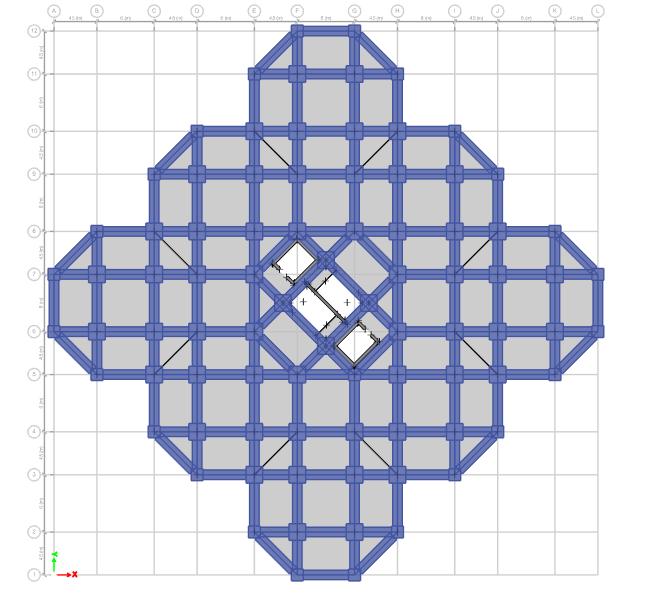
This image shows the typical structural floor plan of the high-risebuilding,renderedinETABSsoftware.
Clearly indicates the modified octagonal tessellating pattern, with 8 units arranged radially.
Thecentral core withtwoliftsandtwostaircases (northandsouthfacing)isvisible.
Placement of columns, shear walls, and loadbearingelementsisshown.
3.5 LOAD CONSIDERATIONS
Loadtypesandcodes:
DeadLoad(DL),LiveLoad(LL):IS875Part1&2
Wind Load (WL): IS 875 Part 3; Basic speed = 50 m/s
EarthquakeLoad(EQ):IS1893:2016;ZoneIII;R= 5,SoilTypeII
Load combinations: IS 456 & IS 875 Part 5; 26 different combinationsapplied.
3.6 ANALYSIS OF MODEL
StepsIncludedintheAnalysisStage:
1. ModelVerification
2. LoadAssignments
3. AnalysisType
4. RunningtheAnalysis
5. Post-AnalysisChecks
International Research Journal of Engineering and Technology (IRJET) e-ISSN: 2395-0056
Volume: 12 Issue: 07 | Jul 2025 www.irjet.net p-ISSN: 2395-0072
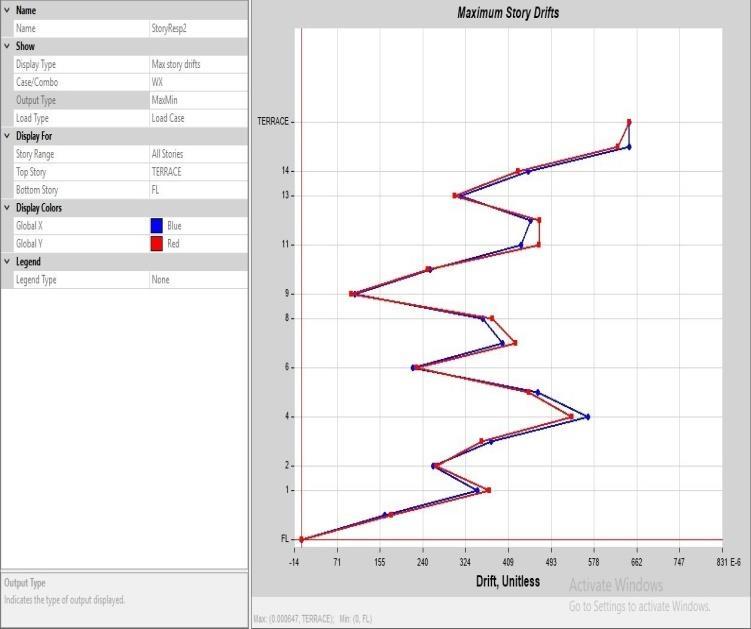
Analysisincludedlinearstaticandresponsespectrum methods.ETABSoutputsincludeddisplacements,forces, andreactions.
TimePeriod:~5.07sec(flexiblesystem)
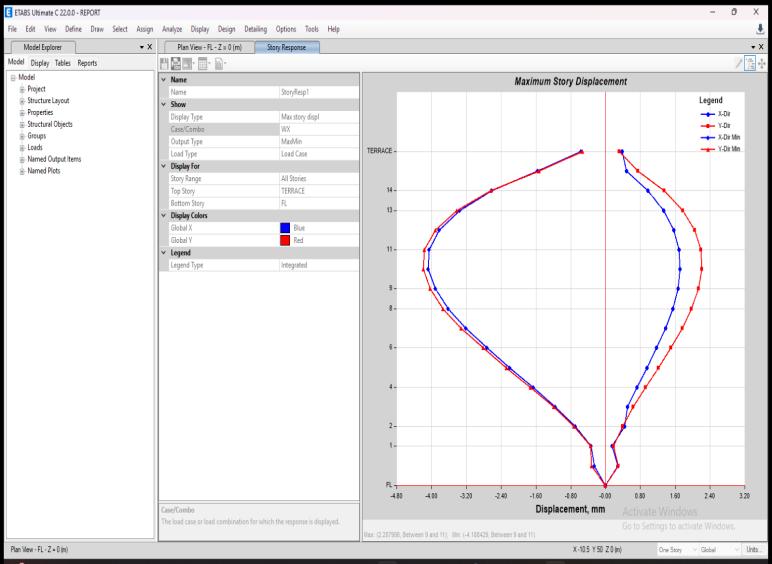
StoryDrift:Within0.004hlimit(maxatmid stories)
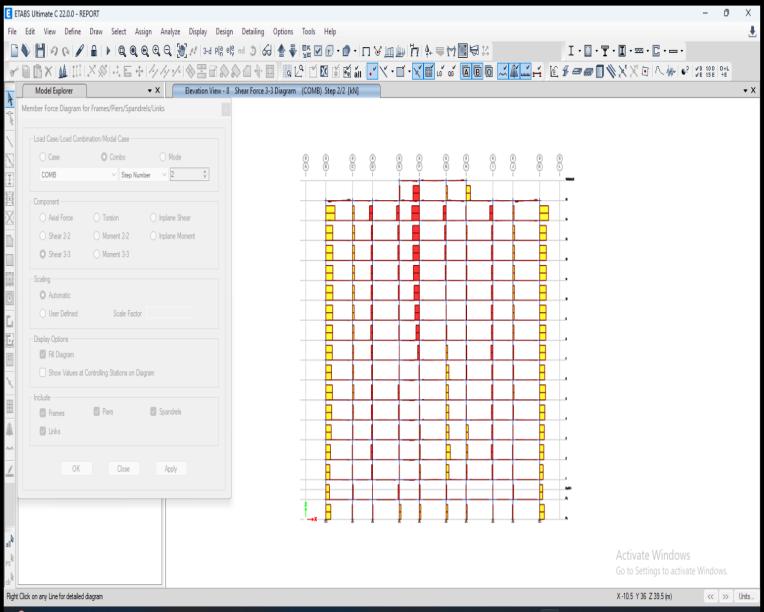
Diagrams:Bending,Shear,Torsion,andAxial Forces
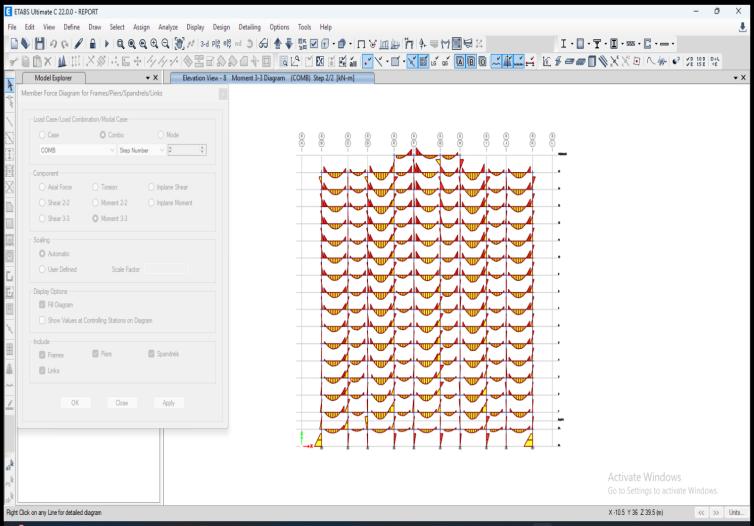
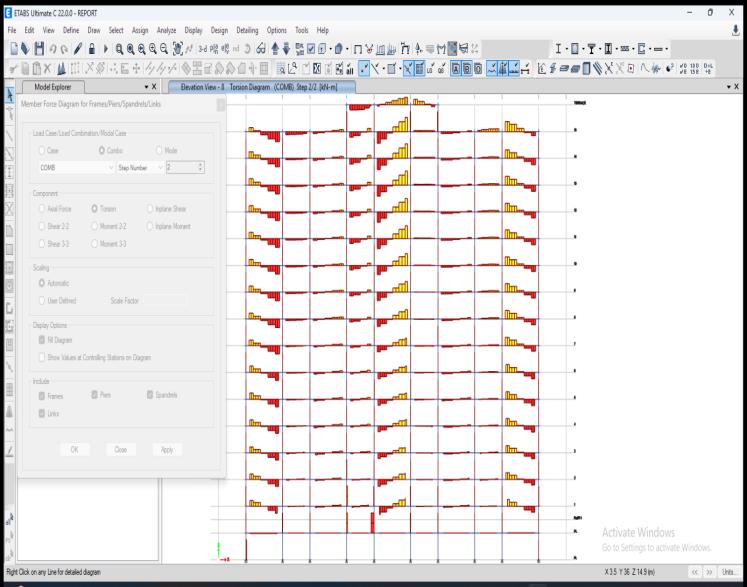
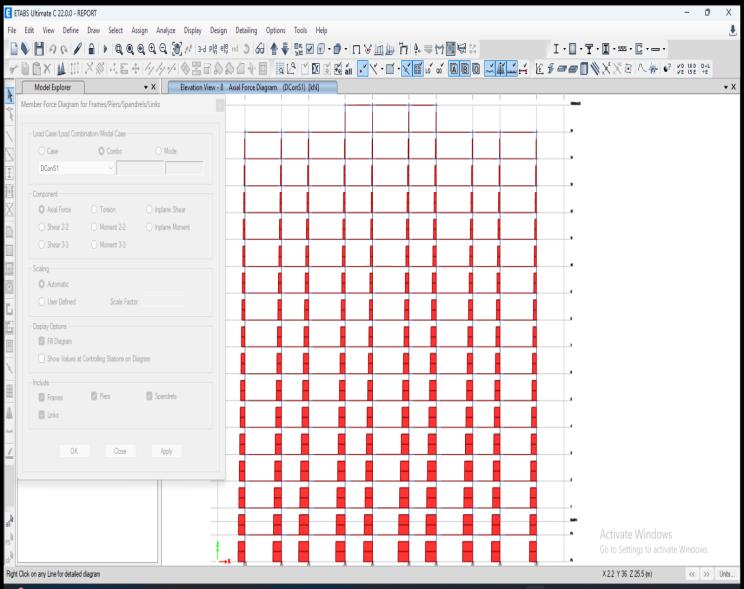
–
© 2025, IRJET | Impact Factor value: 8.315 | ISO 9001:2008 Certified Journal | Page170
Table -1: StoryDrift
LateralDisplacement:Wind-induceddeflectionis linearandacceptable
The structural design oftheG+15residential buildingwas performedusingETABSandSAFE,adheringtoIS456:2000 and IS 13920:2016. It involved sizing, arrangement, and detailingofstructuralelementstoresistverticalandlateral loads.
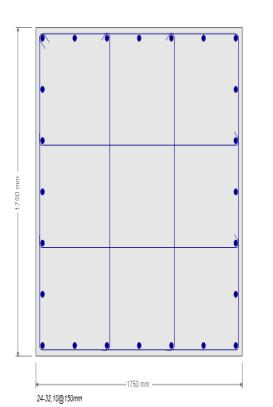
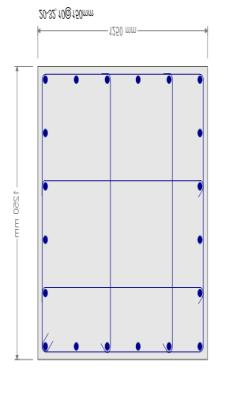
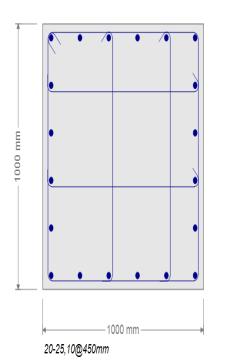
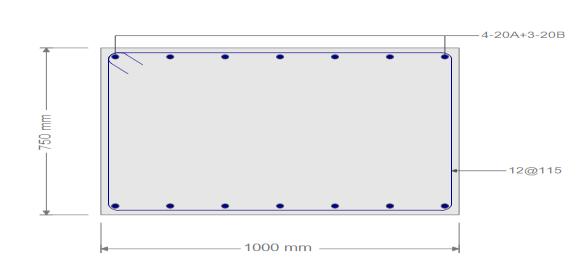
Concreteframes,comprisingmonolithicallycastbeamsand columns, transfer loads to the foundation. Columns were reinforced with uniformly spaced longitudinal bars and ties.Beamsincludedtopandbottombarsbasedonbending momentdistribution.Keysizes:
Columns: 1.75 m x 1.75 m (32 mm dia, 24 bars), 1.25 m x 1.25 m (25 mm dia, 20 bars), 1.00 m x 1.00m(20mmdia,20bars),confinement:10mm stirrups@150mmc/c
Beams: 12 mm bars @ 90–140 mm c/c; 20 mm and25mmbarsatcolumnjunctions
Deflection was within limits (Span/250), accounting for creepandshrinkage.
4.2 CONCRETE SLAB DESIGN
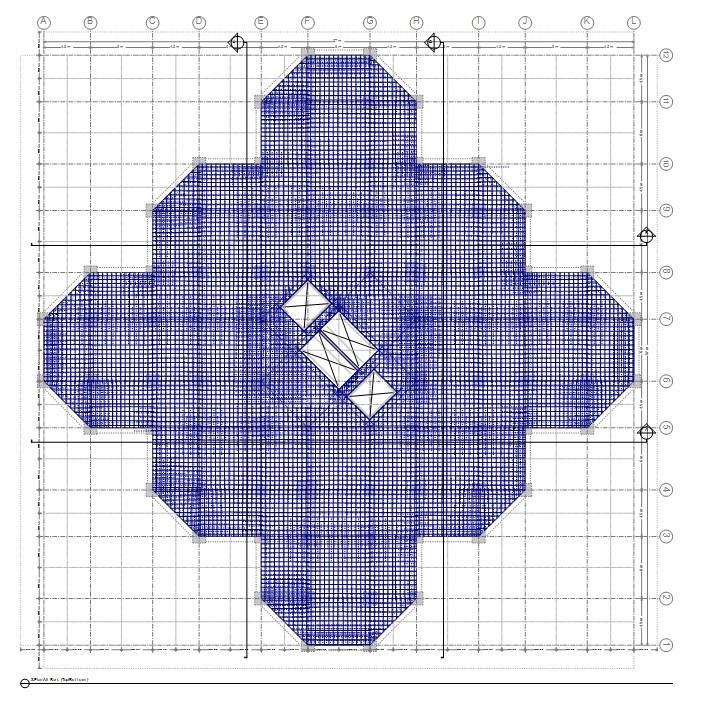
Slabs were designed as two-way systems with top reinforcement for negative moments and bottom reinforcement for positive moments. Detailing followed IS 456:2000.Reinforcement:
Mainslab:12mmdia@440mmc/c
Diagonaledge:10mmdia@375mmc/c
International Research Journal of Engineering and Technology (IRJET) e-ISSN: 2395-0056
Volume: 12 Issue: 07 | Jul 2025 www.irjet.net p-ISSN: 2395-0072
Openings (e.g., stairs/lift): 16 mm dia @ 440 mm c/c
Cornerandtorsionreinforcementwereprovidedtocontrol crackingandshearstresses.
4.3 SHEAR WALL DESIGN
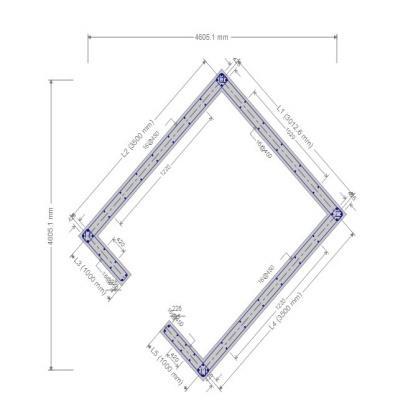
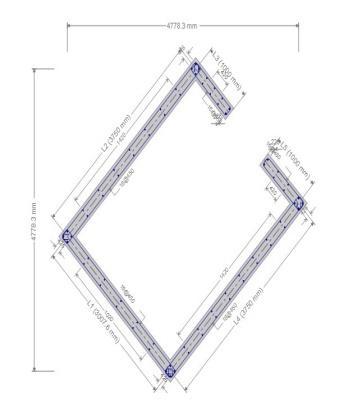
Shear walls, integrated with the lift core, resist wind and seismic loads. Centrally placed, they minimize torsional effects.Wallthickness:250mm.Reinforcement:
Vertical:16mmdia@450mmspacing
Horizontal:12mmdia@350mmspacing
DetailedasperIS456andIS13920forductilityandcrack control. Boundary elements were included near openings andwallends.Wallsarecontinuousfromraftfoundationto roof, ensuring effective lateral load resistance and structuralstability.
5. FOUNDATION DESIGN
The foundation of the G+15 residential building in Vijayawada was designed using a raft system, chosen due to the presence of expansive black cotton soil. The raft ensures even load distribution and minimizes differential settlement. Soil investigation revealed varying SBC values acrossdepths,withfinaldesignbasedon600kN/m²after stabilization.
5.1 FOUNDATION CONSIDERATION
Raftfoundationwasselectedbasedon:
Poor shrink-swell characteristics of black cotton soil.
HighloadintensityfromG+15structure.
Close column spacing unsuitable for isolated footings.
Cost and construction efficiency compared to piles.
Enhancedrigidityagainstseismic/windloads. Raftfoundationwasplacedat2.5mdepthandmodelledin SAFE software, known for its FEA capability and soilstructureinteractionmodelling.
5.2 RAFT FOUNDATION DESIGN
KeyDesignInputs:
RaftThickness:2500mm
ConcreteGrade:M40
SteelGrade:Fe550
BearingCapacity:600kN/m²
SAFEOutput:
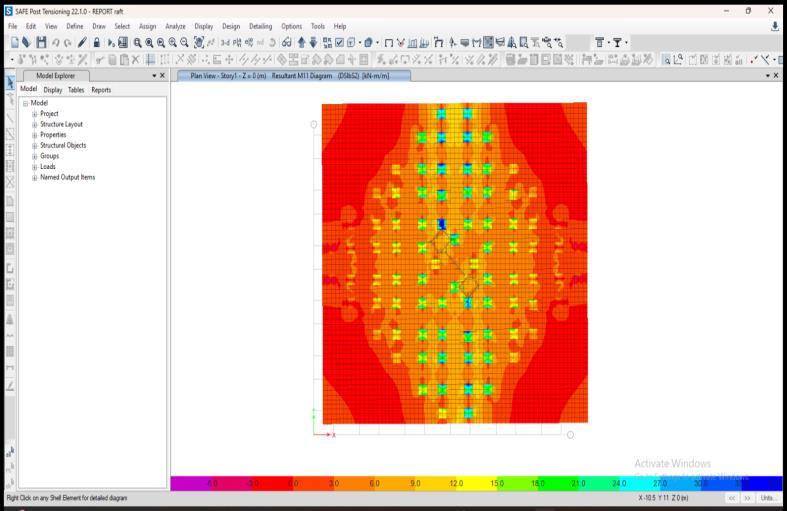
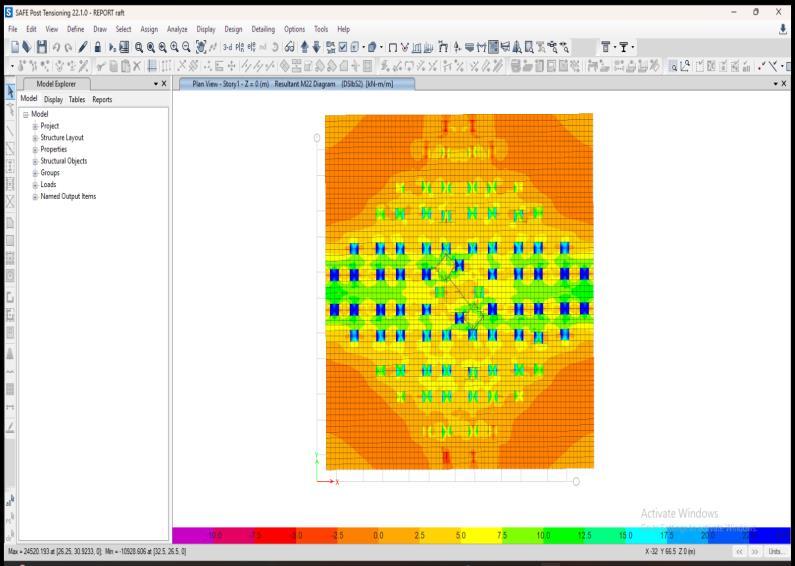
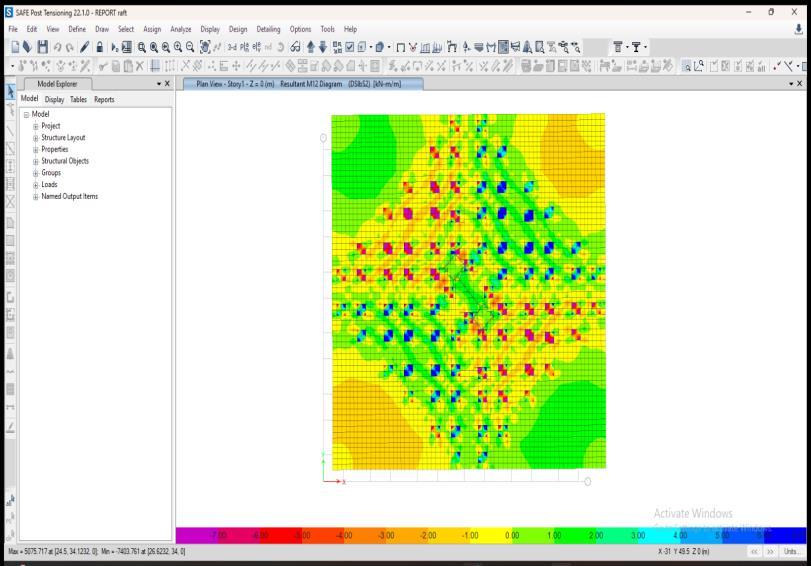
Mx,Mybendingmomentcontours
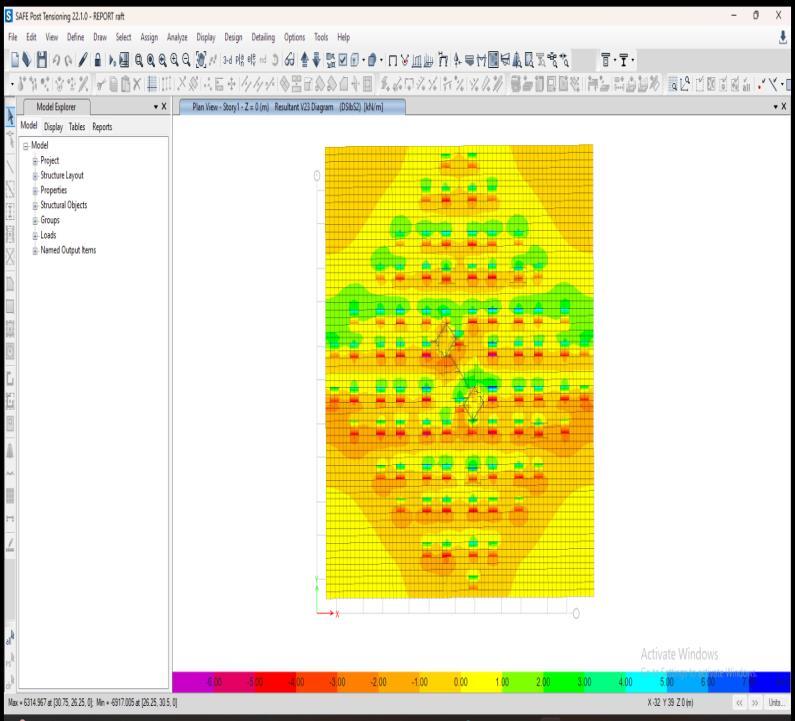
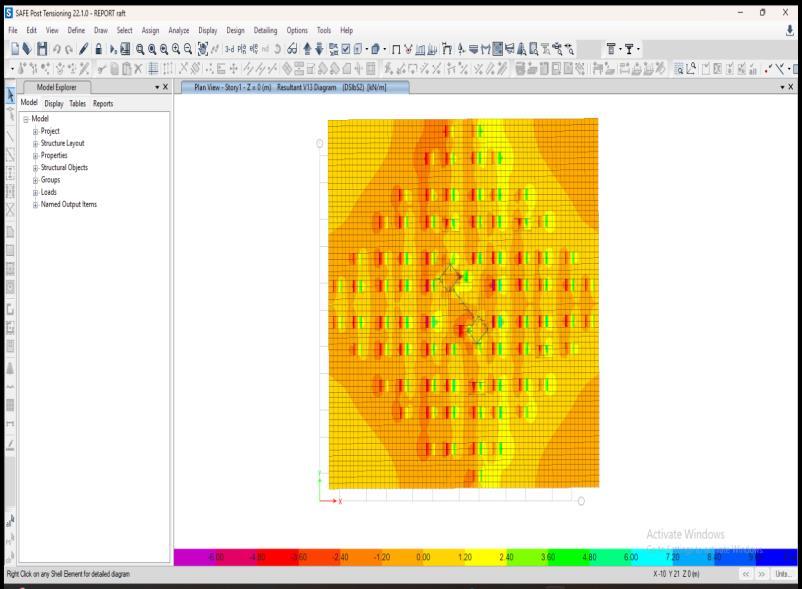
Torsionandverticalshearplots
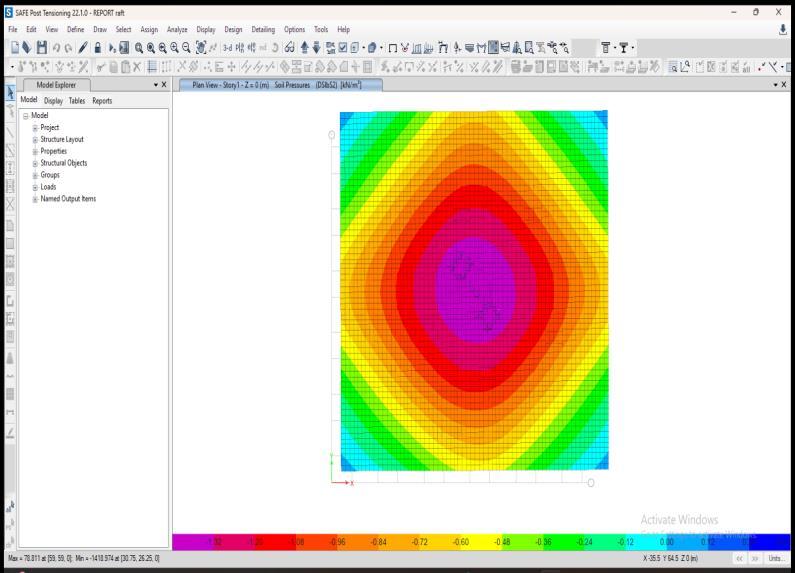
Soilpressuredistribution
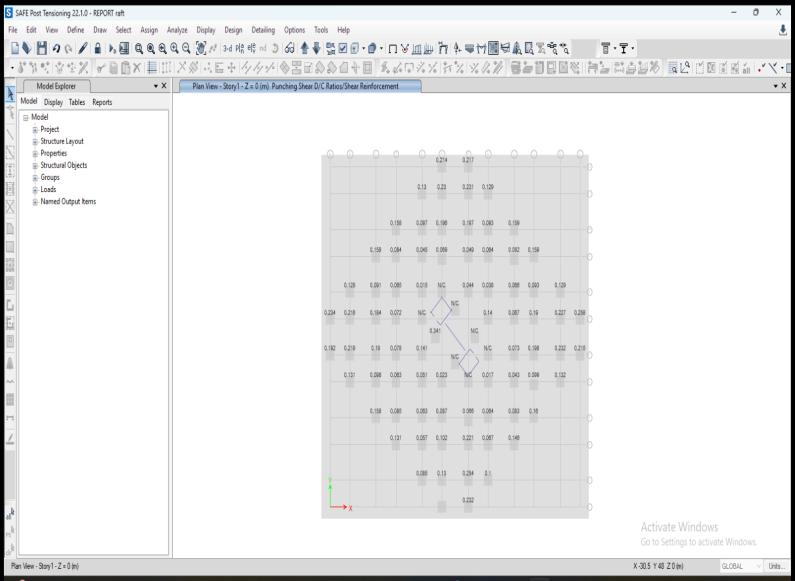
Punchingshearcheck(Safe)
Deflectionwithinlimits
International Research Journal of Engineering and Technology (IRJET) e-ISSN: 2395-0056
Volume: 12 Issue: 07 | Jul 2025 www.irjet.net p-ISSN: 2395-0072
International Research Journal of Engineering and Technology (IRJET) e-ISSN: 2395-0056
Volume: 12 Issue: 07 | Jul 2025 www.irjet.net p-ISSN: 2395-0072
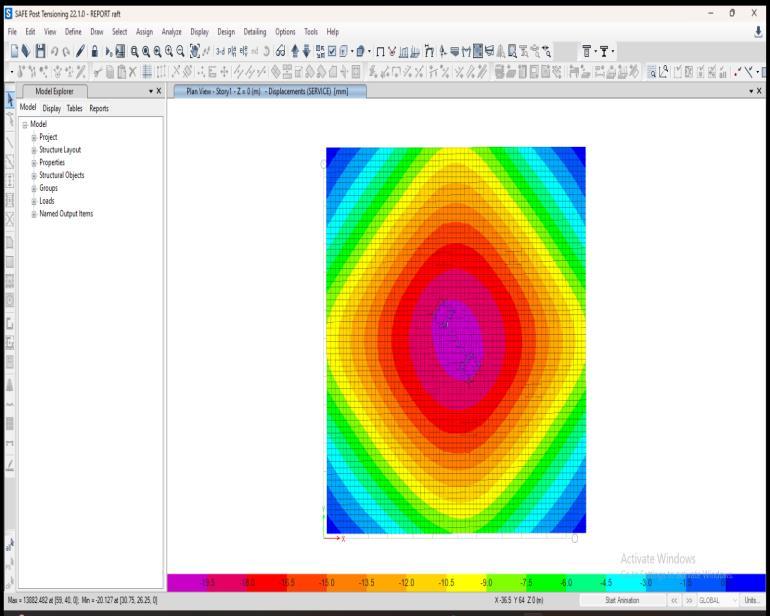
Fig - 19: Deflection
ReinforcementDetails:
BottomLayer:25mm@75mmc/c(XandY)for soilpressureandpositivemoments
Top Layer: 20 mm @ 300 mm c/c over columns fornegativemomentsanduplift
The foundation design complied with IS 456:2000 and IS 2911.Theraftsafelyresistedcombinedgravityandlateral loads, with reinforcement detailing optimized from SAFE output.
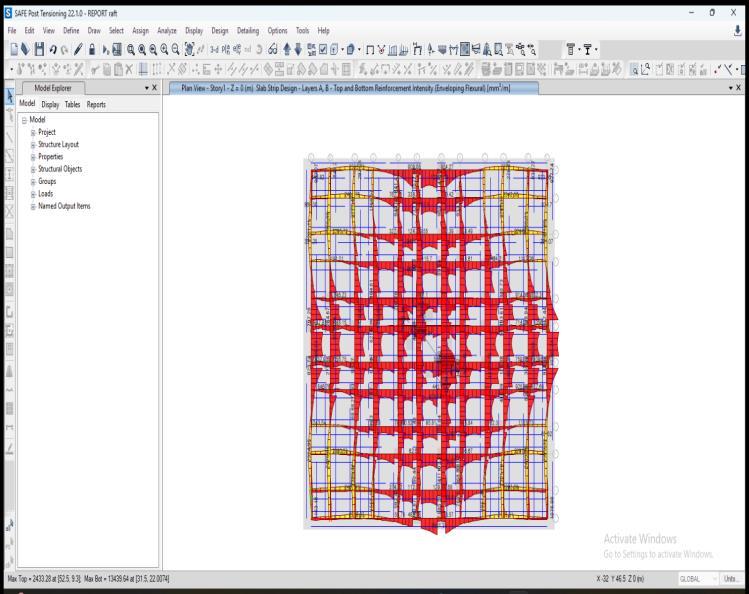
Fig - 20: RaftReinforcementintensity
Parameter Result
MaxStoryDrift
0.0289(1/35)
BaseShear(EX,EY) 6028.13kN
TimePeriod 5.073sec
MaxAxialLoad 1,263,988kN
P-DeltaStability Stable
Beam/ColumnDesign Passed(nooverstress)
Table -2: Results
The building satisfies the drift criteria for all criticalloadcombinations.
Base Shear values indicate a symmetric and balanced lateral force distribution, appropriate fortheoctagonalconfiguration.
Time period is appropriate and supports the naturalvibrationmodeofthebuilding.
No instability observed. The structure is P-Delta stable.
Structural framing design is safe as per IS 456:2000criteria.
The raft was designed with a thickness of 2500 mm and subgrade modulus of 13,680 kN/m³. Soil pressure under service load combinations remained within the safe bearingcapacityatallsections.
SAFEanalysisresults:
Maximum vertical settlement = 11.4 mm (well below75mmallowable).
Punchingshearratios(Vu/Vc)<1.0atallcolumn locations.
Reinforcement was concentrated near the core and column strips, with top and bottom bars in bothdirectionsspacedat150–250mmusing16–25mmDiabars.
A detailed modelling and analysis of the RCC framed octagonal building was completed in ETABS, incorporating shear walls as lift cores for improvedlateralstiffness.
Modal analysis confirmed an acceptable fundamental time period (~5.07s), indicating structuralflexibilitywithinsafelimits.
Storey drift checks showed performance close to the code limit, with the structure responding safelytolateralseismicloadsperIS1893.
International Research Journal of Engineering and Technology (IRJET) e-ISSN: 2395-0056
Volume: 12 Issue: 07 | Jul 2025 www.irjet.net p-ISSN: 2395-0072
Axial forces, bending moments, and shear forces inbeams,columns,andshearwallswerefoundto be within design limits and were adequately reinforced.
The foundation system was modelled as a raft foundation in SAFE, to overcome the low bearing capacityandexpansivenatureofblackcottonsoil.
Analysis of soil pressure distribution, settlement, and punching shear confirmed that the raft performed within safety margins under critical loading.
Guleria, A. (2014). Structural Analysis of a Multi-Storeyed Building Using ETABS for Different Plan Configurations. International Journal of Engineering Research & Technology (IJERT), 3(5), ISSN: 22780181.
Kumar, A., Dhiman, P., & Gupta, A. (2012). Study of ResponseofStructurallyIrregularBuildingFrames to Seismic Excitations. International Journal of Civil, Structural, Environmental and Infrastructure EngineeringResearchandDevelopment,2,25–31.
Manne, A., & Satyam, N. D. (2011). Geotechnical Site CharacterizationforVijayawadaUrban.
Kumar, A., Dhiman, P., & Gupta, A. (2012). Study of ResponseofStructurallyIrregularBuildingFrames to Seismic Excitations. International Journal of Civil, Structural, Environmental and Infrastructure EngineeringResearchandDevelopment,2,25–31.
Pial, S. A. A. (2025). Analysis & Design of Multi-Storey BuildingonPartiallySoftandPartiallyHardSoil.
Poulos, H. G. (2001). Piled Raft Foundations: Design and Applications. Geotechnique, 51(2), 95–113. https://doi.org/10.1680/geot.2001.51.2.95
Bureau of Indian Standards. (2000). IS 456:2000 - Plain and Reinforced Concrete – Code of Practice. New Delhi:BIS.
Bureau of Indian Standards. (1987). IS 875 Part 1 – Code of Practice for Design Loads (Other than Earthquake) for Buildings and Structures: Dead Loads. New Delhi: BIS.
Bureau of Indian Standards. (1987). IS 875 Part 2 – Code of Practice for Design Loads (Other than Earthquake) for Buildings and Structures: Imposed Loads. New Delhi:BIS.
Bureau of Indian Standards. (1987). IS 1897 – CRITERIA FOR EARTHQUAKE RESISTANT DESIGN OF
STRUCTURES: GENERAL PROVISIONS AND BUILDINGS.NewDelhi:BIS.