
International Research Journal of Engineering and Technology (IRJET) e-ISSN: 2395-0056
Volume: 12 Issue: 08 | Aug 2025 www.irjet.net p-ISSN: 2395-0072
International Research Journal of Engineering and Technology (IRJET) e-ISSN: 2395-0056
Volume: 12 Issue: 08 | Aug 2025 www.irjet.net p-ISSN: 2395-0072
Tanmay Khaladkar
Tanmay Khaladkar , Department of Mechatronics Engineering, Symbiosis Skills & Professional University, Pune, Maharashtra, India
Abstract - This paper details the design and implementation of an automatic wiper system using a servo motor, Arduino Nano, and a rain detection module. When raindrops are detected by the sensor, the sensor will trigger the wiper system to operate automatically, requiring no human activation. The circuit will operate the wipers with a servo motor, use an Arduino Nano as a CPU, and use a rain sensor module to detect water. The intention of this project is to work toward driver convenience, particularly in small instrumentation such as automation prototypes or model cars.
Keywords: Rain Sensor, Arduino Nano, Servo Motor, Automation,EmbeddedSystems
1. INTRODUCTION
Automaticwipersinmoderncarsarebothconvenientand safeininclementweather.Thisiswhatthisprojectaimsto show. This project detects the presence of water from a raindrop sensor, processes data from that signal with an Arduino Nano, and wipes with the help of a servo motor. Therefore, this prototype is a prime example of how you canautomaterepetitivetaskswithsimplehardware.
1.1Motivation and Objective
Manually controlling the windshield wipers can be a nuisance. The project takes a simple embedded systems approachtoautomatethesituation.
The objective is to have an automatic rain sensing system tooperateaservo-controlledwipersystem,eliminatingthe needformanualcontrol.
1.2 Overview of Components:
TheArduinoNano, whichis keyto thesystem,actsasthe microcontroller and responds to a Rain Sensor Module (MH-RD).Therainsensorusesaresistivegridtodetect,or not detect, water on its surface. The wiper is triggered once the rain sensor detects rain. The Arduino activates a servo motor to control the wiper mechanism using the inputsfromtherainsensor.
Thehardwareconfigurationincludesarainsensorplate,an ArduinoNanoboard,aservomotor,abreadboard/Jumper wires,andasignalconditioningmodule(comparator).The actual rain sensor module consists of the sensing plate whichdetectsraindropsthroughitschangeofresistivityon its edge, as well as the signal processing module which changes these analogue resistance values into a digital signalthattheArduinocanread.Theconnectionsarequite simple, connecting pin for the servo motor is into one of the PWM pin of the Arduino, and the AO/DO pins of the rain sensor module are then connected to the Arduino Nano. Finally, the Arduino Nano which powers the individualcomponents(5VUSBsupplyoperated).
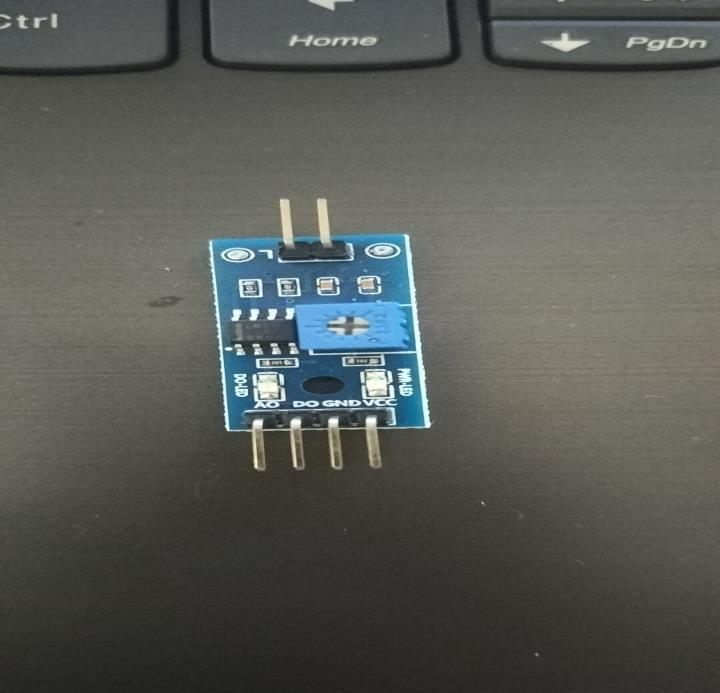
When rain droplets land upon the sensing plate, the resistance changes. The rain sensor module consists of a moisture detecting sensing plate and a signal processing modulewhichconsistsofacomparatorwithanalogueand digitaloutputs.ThedigitaloutputalternatesbetweenHIGH and LOW depending upon a threshold set by the onboard
International Research Journal of Engineering and Technology (IRJET) e-ISSN: 2395-0056
Volume: 12 Issue: 08 | Aug 2025 www.irjet.net p-ISSN: 2395-0072
potentiometer; whereas the analogue output, gives a variable voltage proportional to the amount of water depositiononthesensingplate.Thisdualoutputcapability enables accuracy of detection and control in multiple applications.Duetothiscapability,therainsensormodule isareliableandsimplemodulethatisparticularlyusefulin systems like smart irrigation, weather stations, and automatedwipersystems.
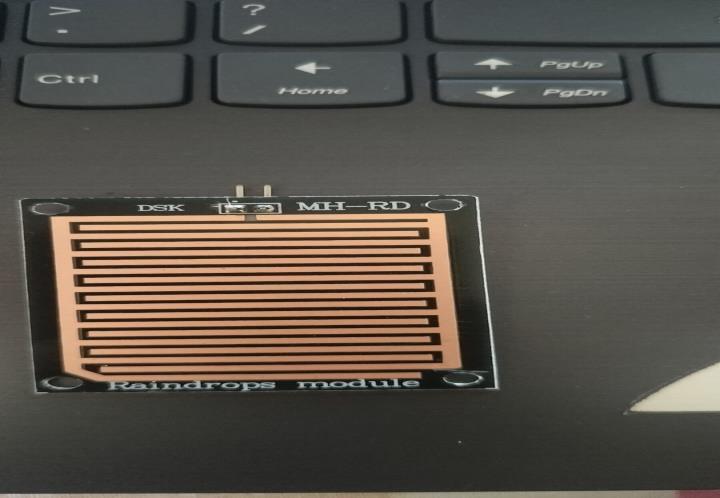
A flat PCB that has a grid of conductive tracks, the rain drop sensing pad is designed to sense the presence of water.Whenraindropslandonthepad,thewaterbridges the conductive tracks and this results in a change in resistance. The presence of rainfall and its intensity are then established by using this change as input to further signalprocessing.
Connections:
TheArduinoNanoisconnectedtotheAO/DOpinsofthe rainmodule.
TheArduinoNano'spinislinkedtotheservosignalpin. PowerissuppliedviaUSB(5V).
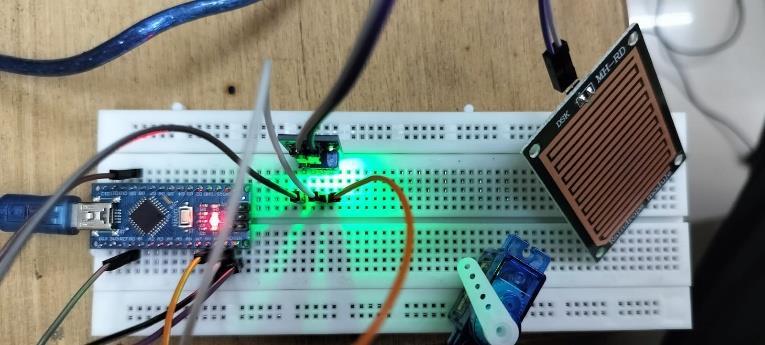
-3: connections
The Arduino code tracks continuous output from the rain sensor module. The servo motor exhibits wiping action, swinging back-and-forth, every time it detects raindrops (digital output LOW). The servo will return to its original startlocationatthesametimethatwaterisnotlocated.
Importantcapabilities:
RaindetectionusinganalogRead()anddigitalRead()
ControllingtheservowithServo.write().
Timing logic and debouncing to allow for smooth operation.
When watercameincontactwith thesensorplatetotest theprototype,theservomotorimmediatelybegantowipe the surface as it recognized raindrops. Fast action was possiblebecauseoftheshortdelaybetweendetectionand servo movement. While testing the prototype, the system reacted successfully to multiple rain events, indicating it works as intended. This idea could be used for solar panels, vehicles, and any other surface that needs automaticmaintenanceandcleaning.
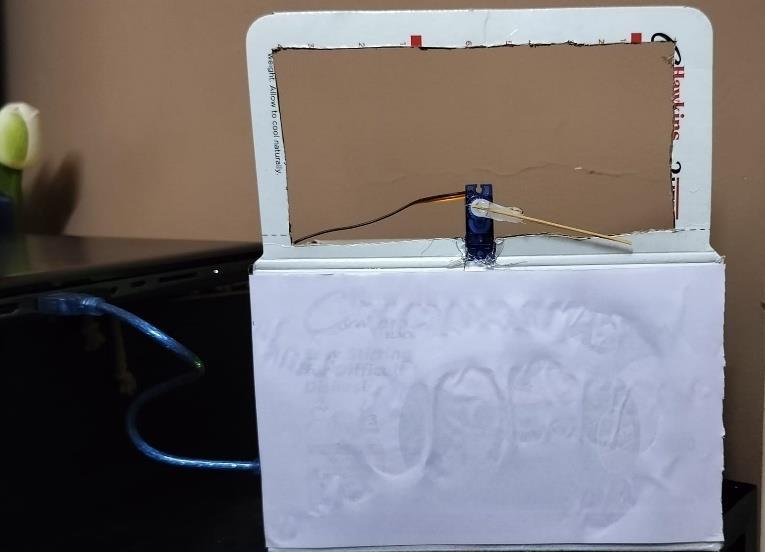
Fig -4: Result(createdawiper-screenprototype&a woodenstickisattachedtotheservo’sarmactingas wiper)
The goal of the project is to present a way to connect the use of an Arduino Nano, servo motor, and rain sensor, to create a simple low cost and efficient process to activate wipersautomatically.Theprototypecanbeexpandedand adapted for practical real-time use with automated machinery,vehicles,orwindows.
International Research Journal of Engineering and Technology (IRJET) e-ISSN: 2395-0056
Volume: 12 Issue: 08 | Aug 2025 www.irjet.net p-ISSN: 2395-0072
[1]ArduinoIDE–https://www.arduino.cc/en/software
[2]Datasheet–RainSensorModuleMH-RD
[3]EmbeddedSystemsandAutomationBasics–Journalof Mechatronics,2023
© 2025, IRJET | Impact Factor value: 8.315 | ISO 9001:2008 Certified Journal | Page44