
International Research Journal of Engineering and Technology (IRJET) e-ISSN: 2395-0056
Volume: 12 Issue: 07 | July 2025 www.irjet.net p-ISSN: 2395-0072
International Research Journal of Engineering and Technology (IRJET) e-ISSN: 2395-0056
Volume: 12 Issue: 07 | July 2025 www.irjet.net p-ISSN: 2395-0072
K. DHANUSH1, Keerthana B2, Dr. Shanthi M.B3 ,
1Bachelor of Engineering, Department of Artificial Intelligence & Data Science, CMR Institute of Technology, Bengaluru, Karnataka, India
2Bachelor of Engineering, Department of Artificial Intelligence & Data Science, CMR Institute of Technology, Bengaluru, Karnataka, India
3Professor, Head of Department, Department of Artificial Intelligence & Data Science, CMR Institute of Technology, Bengaluru, Karnataka, India
Abstract - Human-elephant conflict is a pressing issue in India, especially where expanding agriculture overlaps with elephant habitats. As deforestation and habitat loss intensify, elephants are often driven into human settlements, leading to significant crop damage, property loss, and fatalities on both sides. Conventional solutions like electric fencing are costly, ecologically damaging, and sometimes harmful to wildlife. This researchproposes a dual-featureElephant Barrier System that offers a sustainable, non-lethalapproachtomitigatesuch conflicts. The first feature uses high-pitched, non-harmful acoustic signals such as bee buzzing and frequencies in the 3–10 kHz range to deter elephants based on their natural aversions. The second feature employs motion sensors and camera modules to detect elephant movement and send realtime alerts, including images, to farmers via a mobile application. By combining behavioral deterrents with smart monitoring, this system supports peaceful coexistence and presents a scalable, eco-friendly model suitable for regions facing similar human-wildlife conflicts.
Key Words:
Human-Elephant Conflict, Smart Wildlife Detection, Motion Sensors, Camera-Based Monitoring, Non-lethal WildlifeBarrier,IoTinWildlifeConservation,MobileAlert System.
1.INTRODUCTION
Indiaishometoover27,000Asianelephants morethan half of the world’s population. But as cities grow, forests shrink, and farmlands expand, elephants are losing their naturalhomes.Thisforcesthemtowanderintovillagesand farms,especiallyinstateslikeKarnataka,Odisha,Assam,and Kerala, where encounters often lead to damaged crops, financialloss,andeveninjuriesordeathsonbothsides.
1.1
Traditional methods like electric fences, firecrackers, and patrollingareeithertoocostly,risky,orsimplynoteffective overtime.Elephantsareintelligentanimalsandoftenfind
ways to bypass physical barriers, which calls for smarter, saferalternatives
This paper presents a two-part Elephant Barrier System designed to reduce such conflicts. It uses highfrequency, non-harmful sounds to gently keep elephants awayandcombinesthiswithasmartdetectionsystemthat alertsfarmersinrealtimethroughamobileapp.Byblending naturalbehavioralcueswithmoderntechnology,thissystem aims to protect both people and elephants, encouraging peacefulandsustainablecoexistence
2. Literature
Human-elephant conflict (HEC) remains a critical issue in India, affecting agriculture, human safety, and wildlife conservation. Various methods have been developed to prevent elephants from entering farmlands, ranging from traditionalbarrierstosmart,technology-drivensolutions.
Conventional deterrents like electric fences and trenches are widely used but have limitations. Elephants oftenadaptandlearntoovercomethesebarriers(Sukumar, 2003).Additionally,suchmethods canbe harmful, raising ethicalconcernsinconservationefforts.
Inrecentyears,bio-acoustictechniqueshaveshown promiseasnon-lethalalternatives.ResearchbyKinget al. (2007)demonstratedthatplayingbeebuzzingsoundscould successfully deter elephants from crop fields in African regions,encouragingexplorationofsound-baseddeterrents.
IoT-basedwildlifedetectionsystemshavealsobeen introduced. For instance, Ghosh et al. (2021) used motion sensorsandcamerastotrackanimalmovementandnotify forest authorities. However, many of these systems lack directcommunicationwithlocalfarmersandarenoteasily scalableinremoteareas.
The proposed Elephant Barrier System aims to bridge this gap by integrating high-frequency acoustic deterrentswithreal-timeimagealertssenttofarmersviaa mobileapp.Thisapproach offersa practical,humane,and
International Research Journal of Engineering and Technology (IRJET) e-ISSN: 2395-0056
Volume: 12 Issue: 07 | July 2025 www.irjet.net p-ISSN: 2395-0072
3. Problem Statement:
Todevelopanintelligent,non-lethalelephantbarriersystem that detects wildlife intrusions in agricultural areas and sends real-time alerts to farmers. The system should also deterelephantsusinghigh-frequency,non-harmfulacoustic signals, minimizing human intervention and avoiding physicalharmtoanimals.
4. Present System:
Theexistingsystemsforpreventingelephantintrusionsin agricultural regions primarily rely on traditional methods suchaselectricfences,firecrackers,andmanualpatrolling. These approaches are either harmful to wildlife, laborintensive,orineffectiveovertime,aselephantsoftenadapt andbypassphysicalbarriers.Additionally,thesemethodsdo not offer any intelligent alert system to inform farmers in real-time.
Some recent systems have introduced basic automationusingPIRsensors,ultrasonicsensors,buzzers, andGSMmodulestodetectmotionandnotifyusersviaSMS. However, these systems still lack real-time visual confirmation, animal classification capabilities, and smart deterrentstailoredtospecificwildlifebehavior.
Moreover,mostofthesesetupsfailtoincorporatea non-lethal deterrence mechanism like sound-based repellents. There is also minimal integration with userfriendlyinterfacessuchasmobileapplications,limitingtheir practicalusabilityinruralareas.Theselimitationshighlight theneedforamoreefficient,intelligent,andanimal-friendly systemtopreventelephantintrusionsandreducecroploss.
5.
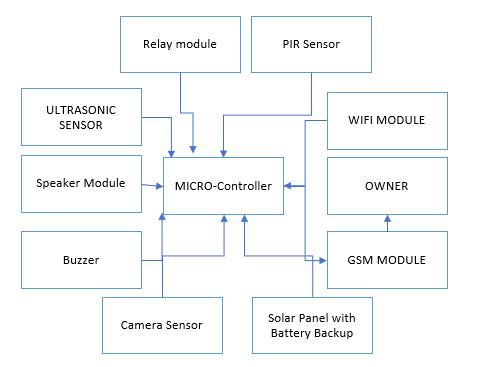
Theproposedsystemisdevelopedusingamicrocontrollerbasedsetup,preferablyRaspberryPiorArduino,whichacts as the control unit for processing input from sensors and coordinating outputs. PIR (Passive Infrared) sensors are deployed to detect motion caused by large animals like elephants.Whenmotionisdetected,thecameramoduleis triggered to capture real-time images, which are then transmitted to the farmer's mobile application through a GSMorWi-Fimodule.Aspeakermoduleisintegratedtoemit high-pitched, non-harmful deterrent sounds such as bee buzzinginthe3–10kHzrange.Theentiresystemispowered using solar panels with battery backup to ensure uninterrupted operation in remote agricultural areas. Additionally,abuzzerisusedtoprovidealocalaudioalertto nearbyfarmers.Thecompactandweatherproofhardware design enables the system to be deployed along field boundarieswithminimalmaintenanceandhighreliability.
The primary objective of the proposed Elephant Barrier System is to design and implement a smart, reliable, and animal-friendly solution to mitigate the growing issue of human-elephant conflict in agricultural zones near forest borders.Thesystemaimstodetectthepresenceofelephants using motion sensors and camera modules, generate realtime alerts to farmers via a mobile application, and proactively deter elephants using high-frequency, nonharmful acousticsignals.Bycombiningthesefeatures,the system intends to provide a safer, technology-driven alternativetotraditionalmethodslikeelectricfencingand manual patrolling, which are often expensive, dangerous, andineffectiveovertime.
Thescopeofthisprojectextendstoenhancingfarm security in rural and forest-adjacent regions, especially where human and animal territories increasingly overlap duetohabitatdestruction.Thesystemisdesignedtooperate autonomously, even in low-infrastructure settings, using solarpowerandGSMorWi-Ficommunication.Itpromotes ecological harmony by avoiding any physical harm to wildlife,whileempoweringfarmerswithtimelyinformation toprotecttheircrops.Futurescopeincludesexpandingthe system to detect and classify different wild animals, integrate AI-based threat level analysis, and connect to centralizedforestmonitoringsystemsforbroaderwildlife managementapplications.
7. Recommended System:
Therecommendedsystempresentsacutting-edgeapproach to mitigating human-elephant conflict through a combination of real-time detection, intelligent alerts, and behavioral deterrents. At the heart of the system lies a microcontrollerplatformsuchasRaspberryPiorArduino, actingasthecentralunitthatprocessessensorinputsand coordinates system responses. Multiple Passive Infrared (PIR) sensors are strategically deployed along the boundariesofthefarmlandtodetectmotioncausedbylarge intruding animals, especially elephants. Upon motion detection, the system is triggered to activate a camera modulethatcapturesreal-timeimagesorvideoevidenceof theintrusion.
These images are instantly transmitted to the farmer’s smartphone through a GSM or Wi-Fi module, enablingremotemonitoringandquickresponse,evenfrom distant locations. Simultaneously, a high-frequency sound emitter produces non-harmful but disturbing acoustic signals suchasbeebuzzingorsharptonesintherangeof 3–10 kHz known to trigger avoidance behavior in elephants. This dual-layered approach not only warns the farmerbutalsoattemptstorepeltheanimalfromthefield boundary, reducing the chances of damage before it even occurs.
International Research Journal of Engineering and Technology (IRJET) e-ISSN: 2395-0056
Volume: 12 Issue: 07 | July 2025 www.irjet.net p-ISSN: 2395-0072
Inaddition,abuzzerisactivatedlocallytoserveas anaudiblealarm,alertingneighboringfarmersandscaring offwildlife.Thesystemisentirelysolar-poweredwithbuiltinbatterysupport,ensuringsustainableanduninterrupted operation eveninremoteandpower-scarcerural regions. With its compact design, low maintenance, and environmentally friendly components, this system can be easily deployed across multiple vulnerable zones. By combining automation, real-time communication, and species-specificdeterrents,theproposedsystemestablishes arobustandintelligentdefensemechanismthatredefines wildlifeconflictpreventioninagriculturallandscapes.
8. Method:
The proposed system follows a systematic approach to detect, deter, and alert in the event of elephant intrusion. TheoperationbeginswiththedeploymentofPIR(Passive Infrared) sensors along the perimeter of the agricultural field. These sensors continuously monitor for motion by detecting changes in infrared radiation caused by moving animals.Oncesignificantmotionisdetected,thePIRsensors send a signal to the microcontroller (Raspberry Pi or Arduino),whichactsasthesystem'sbrain.
Upon receiving the signal, the microcontroller activates the camera module, which captures real-time imagesorshortvideoclipsoftheintruder.Thesevisualsare then transmitted to the registered farmer’s mobile phone usingeitheraGSMmoduleorWi-Fi,dependingonavailable infrastructure. This ensures that farmers are immediately informed of any potential threats, even if they are not physicallypresentnearthefield.
Simultaneously, the microcontroller triggers the speakersystemtoemithigh-pitcheddeterrentsounds,such asbeebuzzingorshrillfrequenciesinthe3–10kHzrange, which elephants instinctively avoid. In addition, a buzzer providesaloudon-sitealerttonotifynearbyindividualsand possiblyscareofftheanimal.
Thesystemoperatesonsolarenergysupportedbya battery backup to ensure uninterrupted performance in remoteareas.Allcomponentsarehousedinweatherproof enclosures to withstand harsh environmental conditions. The design emphasizes low power consumption, autonomousfunctionality,andscalability,makingitsuitable for widespread implementation in elephant-prone agriculturalzones.
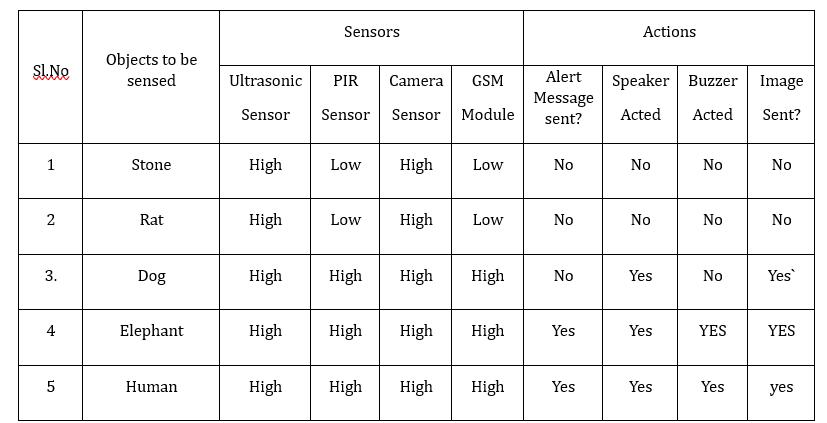
TheproposedElephantBarrierSystemwastestedagainst various objects and intruders such as stones, rats, dogs, humans,andelephantstoevaluateitssensorresponseand alert mechanisms. The results showed that the system effectivelydistinguishedbetweenrelevantandnon-relevant intrusionsbasedonmotiondetectionandobjectsize.
Incaseslike stones and rats,thePIRsensorsdid not activate due to low thermal signature and minimal motion.Asaresult,theGSMmoduledidnotsendalerts,and neitherthebuzzernorspeakerweretriggered.Thisensures thatfalsepositivesareminimized.
When tested with larger animals such as dogs, humans,and elephants,allmajorcomponents PIRsensor, camera module, and GSM module responded appropriately.Thesystemcapturedimages,activatedsound deterrents (speaker), and sent alert messages to the registered user’s mobile device. In the case of elephant detection,thesystemperformedatfullcapacity,triggering the speaker, buzzer, and alert message, confirming its suitabilityforhigh-threatintrusions.
Table 2: The table below summarizes the sensor responses and actions triggered during testing
International Research Journal of Engineering and Technology (IRJET) e-ISSN: 2395-0056
Volume: 12 Issue: 07 | July 2025 www.irjet.net p-ISSN: 2395-0072
1: Chart Showing the Working of the prototype
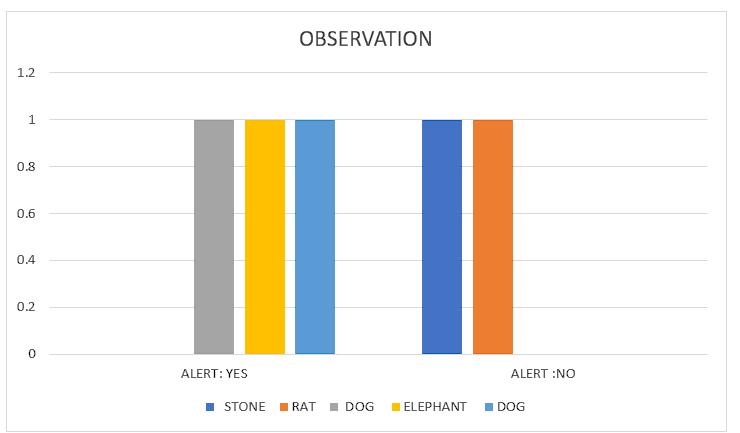
The proposed Elephant Barrier System demonstrates a significant improvement over conventional intrusion prevention techniques used in agricultural fields. The test observationsconfirmthatthesystemeffectivelyidentifies and responds to potential threats based on the size and movement of intruders. Smaller, non-threatening entities like stones and rats do not trigger the system, thereby reducingfalsealarmsandunnecessaryalerts.Thismakesthe system energy-efficient and practical for continuous operation.
The integration of PIR sensors with a camera moduleensuresthatreal-timevisual evidenceiscaptured only when substantial movement is detected. The image transmission via GSM and the activation of deterrent modules such as speakers and buzzers work reliably for larger animals like elephants and humans, which are categorized as high-risk intruders. The delay between detectionandnotificationisminimal,providingfarmerswith atimelyalertfornecessaryaction.
Thesystem’slayeredresponse startingwithsound deterrentsfollowedbyloudbuzzeralarms allowsforboth passive and active repulsion. Solar power support further makesitviableforruralandforest-borderingregionswith limitedaccesstoelectricity.Overall,theresultsdemonstrate that the system can provide effective, real-time crop protectionwhilealsoadheringtoethicalwildlifepractices.
Advantages:
Non-lethalandanimal-friendlydeterrentmethod.
Real-time detection and alert through mobile application.
Reducedfalsealarmsforsmallorirrelevantobjects.
Works on solar power, making it ideal for remote areas.
Easy to install and maintain with low operational cost.
Supports image-based evidence for wildlife monitoring.
Reduces need for manual patrolling and electric fencing.
Disadvantages:
Initial setup cost may be high for small-scale farmers.
Limited detection range without proper sensor placement.
Image quality may vary in poor weather or low light.
Requires basictechnical knowledgeforsetupand monitoring.
DependenceonGSM/Wi-Fimayaffectalertdelivery innetwork-poorareas.
The proposed Elephant Barrier System offers a practical, intelligent, and humane solution to address the rising incidentsofhuman-elephantconflictinagriculturalregions. ByintegratingPIRsensors,cameramodules,high-frequency acoustic deterrents, and real-time alert mechanisms, the systemsuccessfullydetectswildlifeintrusionsandresponds withminimal humanintervention.Itensuresthatfarmers arenotifiedinstantlywhiledeterringelephantsusingnonlethalmethodssuchasbee-likesoundsandbuzzeralarms. Thesystem’ssolar-powereddesignandminimalfalsealarms makeitsuitablefordeploymentinremoteareaswithlimited infrastructure.Theresultsandobservationsconfirmthatthe system functions effectively under various conditions and can be a reliable tool for protecting crops and promoting peacefulcoexistencebetweenhumansandwildlife.
The proposed system has strong potential for future development and wider applicability. One key area of improvement is the integration of AI-based animal classificationusingimageprocessingandmachinelearning to automatically identify the type of intruder and assess threat levels more accurately. The system can also be expanded to detect a wider range of animals such as wild boars, deer, and monkeys, which are common threats in manyregions.
Additionally, cloud-based data storage can be introduced to log intrusion history, analyze wildlife movementpatterns,andassistforestofficialsinlong-term conservation planning. The mobile application can be enhancedwithGPSmapping,voicealertsinlocallanguages,
International Research Journal of Engineering and Technology (IRJET) e-ISSN: 2395-0056
Volume: 12 Issue: 07 | July 2025 www.irjet.net p-ISSN: 2395-0072
and connectivity with government or forest department networksforquickerresponseincriticalcases.
Drone integration for aerial monitoring and live surveillance can also be considered for larger farmland areas. Lastly, the system can be customized for use in nationalparks,bordersecurity,andotherzonesrequiring intelligent intrusion detection with minimal human supervision.
References:
[1]L.E.King,I.Douglas-Hamilton,andF.Vollrath,“African elephants run from the sound of disturbed bees,” Current Biology, vol. 17, no. 19, pp. R832–R833, Oct. 2007. DOI: 10.1016/j.cub.2007.07.038
[2] R. Vigneshwar and R. Maheswari, “Development of EmbeddedBasedSystemtoMonitorElephantIntrusionin ForestBorderAreasusingInternetofThings,”International JournalofEngineeringResearch,vol.5,no.7,pp.594–598, 2016.
[3] S. Yadahalli, A. Parmar, and A. Deshpande, “Smart Intrusion Detection System for Crop Protection by using Arduino,”20202ndInternationalConferenceonInventive Research in Computing Applications (ICIRCA), 2020, pp. 405–408.DOI:10.1109/ICIRCA48905.2020.9182868
[4] R. Nikhil, B. S. Anisha, and R. Kumar P., “Real-Time Monitoring of Agricultural Land with Crop Prediction and Animal Intrusion Prevention using Internet of Things and Machine Learning at Edge,” 2020 IEEE International ConferenceonElectronics,ComputingandCommunication Technologies (CONECCT), 2020. DOI: 10.1109/CONECCT50063.2020.9198508
[5] P. S. Dhake and S. S. Borde, “Embedded surveillance systemusingPIRsensor,”InternationalJournalofAdvanced TechnologyinEngineeringandScience(IJATES),vol.2,no.5, pp.123–126,2014.
[6]K.Rao,R.Maikhuri,S.Nautiyal,andK.G.Saxena,“Crop damageandlivestockdepredationbywildlife:acasestudy from Nanda Devi Biosphere Reserve, India,” Journal of Environmental Management, vol. 66, no. 3, pp. 317–327, 2002.
[7] A. V. Deshpande, “Design and Implementation of an IntelligentSecuritySystemforFarmProtectionfrom Wild Animals,” International Journal of Science and Research (IJSR),vol.5,no.2,pp.764–768,2016.
2025, IRJET | Impact Factor value: 8.315 |