
International Research Journal of Engineering and Technology (IRJET) e-ISSN: 2395-0056
Volume: 12 Issue: 05 | May 2025 www.irjet.net p-ISSN: 2395-0072
International Research Journal of Engineering and Technology (IRJET) e-ISSN: 2395-0056
Volume: 12 Issue: 05 | May 2025 www.irjet.net p-ISSN: 2395-0072
R B Aarthinivasini1 , Sridevi S2 , Subashini M3 , Roshini P4 , Shanjana P5
1Professor, Dept. of IT, Meenakshi College of Engineering, Tamilnadu, India
2UG Scholar, Dept. of IT, Meenakshi College of Engineering, Tamilnadu, India
3UG Scholar, Dept. of IT, Meenakshi College of Engineering, Tamilnadu, India
4UG Scholar, Dept. of IT, Meenakshi College of Engineering, Tamilnadu, India
5UG Scholar, Dept. of IT, Meenakshi College of Engineering, Tamilnadu, India ***
Abstract - Phishing is a significant cybersecurity issue, particularly on platforms like WhatsApp, where users often receive deceptive messages, harmful links, and media files. This project focuses on designing an AI-based phishing detectiontoolintegratedintoaWhatsAppWebClone,which actively blocks phishing threats before user interaction. Advanced ML and DL models are used in the system to examine messages, links, and visual content for threats. Technologies like Next.js, Socket.io, and PostgreSQL support the frontend, real-time communication, and backend data storage for seamless operation. The core AI module, developed in Python, utilizes OpenCV, Tesseract OCR, BERT, CNN and Google's Safe Browsing API to identify phishing patterns in shared content. Zegocloud helps enable secure and verified voice and video calls by managing authentication and encrypted transmission. The application alsofeaturesvoicedeepfakedetectionusingadvancedaudio analysis to flag potential synthetic threats. Testing in various phishing scenarios showed reliable detection accuracy and effective mitigation of fraudulent transmissions. Future enhancements include integrating deepfake detection for video and voice calls, implementing behavioral analysis, deploying AI-powered CAPTCHA, and extending the system to mobile applications beyond the WhatsAppWebclonetofurtherstrengthensecurity.
Key Words: Artificial Intelligence, Phishing Detection, WhatsApp Web, Deepfake detection, Google safe browsing API, Zego Cloud, URL detection, Image detection
Phishinghasemergedasaseriouscyberthreat,especially on instant messaging platforms like WhatsApp. These platformsarefrequentlyexploited byattackerstodeceive users through fraudulent messages, disguised URLs, and misleadingmediacontent.Traditionalphishingprevention strategies often fail to address real-time communication threats. This project introduces an AI-enhanced phishing detection system within a WhatsApp Web clone. The solutionintegratesadvancedNaturalLanguageProcessing (NLP), Computer Vision (CV), and machine learning techniques to detect and block phishing attempts in real
time.KeycomponentsincludeBERTfortextclassification, OpenCVandCNNforimage-baseddetection,andWav2Vec for analyzing voice messages. The system ensures secure communicationthroughAES-256encryptionandsupports future enhancements for deepfake prevention and behaviouralanalysis
The aim of this project is to develop an AI-powered phishing detection system integrated within a WhatsApp Web clone, capable of identifying and preventing phishing attacks in real time. By utilizing techniques from Natural Language Processing (NLP), Computer Vision (CV), this systemwillanalyzemessages,URLs,images,and deepfake voice message to detect potential phishing threats before user interaction. The goal is to enhance user security, prevent social engineering attacks, and create a safer messagingenvironment.
The objective of this project is to develop an AI-powered phishing detection system within a WhatsApp Web clone thatcanidentifyandpreventphishingattacksinrealtime before users interact with harmful content. The system willuseNLP(BERT)toanalyzechatmessages,GoogleSafe Browsing API for URL detection, and OpenCV with Tesseract OCR for phishing image analysis. Additionally, the system will provide real-time alerts to notify users of potential threats while ensuring secure messaging through end-to-end encryption (AES-256). The chat applicationwillbebuiltusingNext.js,Prisma,PostgreSQL, and WebSockets to support fast and secure communication, with future enhancements planned for voicephishingdetectionandAI-drivenfraudprevention.
The primary purpose of this project is to safeguard users fromphishingattackswithinamessagingplatform.Unlike traditional phishing detection systems that operate on emails and web browsers, this system actively prevents phishing inside real-time messaging applications. The AI-
International Research Journal of Engineering and Technology (IRJET) e-ISSN: 2395-0056
powered system aims to reduce financial fraud, identity theft, and cyber scams by integrating advanced AI techniquesdirectlyintochatapplications.
Enhance security for WhatsApp-like messaging platformsbyproactivelydetectingphishingcontent.
Preventcyberfraudthroughearlyphishingdetection beforeusersinteractwithmaliciouscontent
Improve digital trust by ensuring secure communicationwithoutprivacyrisks.
Provide real-time AI-based protection that works acrosstextmessages,URLs,andmultimediacontent.
1.4 Scope
The scope of this project is to develop a fully functional WhatsApp Web clone with built-in AI-powered phishing detection. It focuses on real-time messaging security, ensuring that phishing attacks are identified before they cancauseharm
Real-time Chat System - Built using Next.js, Prisma, PostgreSQL,andWebSockets
Phishing Detection in Messages & URLs - AI analyzestextmessagesandlinksinrealtime.
Image-Based Phishing Detection - Uses Computer Vision(OCR+CNN)toanalyzephishingimages
Real-TimeAlerts&Prevention-Usersreceiveinstant phishingwarningsbeforeclickingmaliciouscontent
DataSecurity&Encryption:Messagesareend-to-end encryptedwithAES-256advancedencryption.
ScalabilityforFutureEnhancements:Thesystemwill allow future features like voice and video call phishing detection, behavioural analysis and AIpoweredfraudalerts
Extensive research has explored phishing detection, mainly focusing on email and website protection. Rulebased filtering and blacklists were early attempts but lacked adaptability to evolving attack methods. Recent approaches involve AI, combining NLP, ML, and CV techniques. Sharma et al. utilized ensemble models like RandomForestandXGBoostforURLclassification.BERT, introduced by Devlin et al., improved phishing detection by capturing contextual semantics in text. Image-based phishing detection using CNNs and OpenCV has also shown promising results, particularly for detecting altered logos and scam screenshots. Real-time threat detection using WebSockets, and secure communication
via JWT or OAuth protocols, are critical to modern chat systems. Our system combines these state-of-the-art techniques to deliver a unified phishing prevention tool tailoredtomessagingplatforms.
The growing prevalence of phishing attacks represents a critical challenge in the field of cybersecurity, targeting users through deceptive messages, fraudulent URLs, and malicious attachments. Traditional phishing detection techniques, such as rule-based filtering and blacklisting, have shown limitations in detecting zero-day phishing attacks, where attackers continuously modify their strategies to evade detection [1]. To overcome these limitations, various AI-based phishing detection systems have been proposed, integrating Machine Learning (ML), Natural Language Processing (NLP), and Computer Vision (CV)toenhancephishingidentificationaccuracy[2].
One of the earliest approaches to phishing detection was rule-based filtering, which relied on analyzing message patterns, domain age, and textual features to classify phishing attempts. Sharma et al. (2021) introduced an ensemble learning model combining Random Forest and XGBoost for phishing detection in URLs, improving classification accuracy [3]. However, rule-based approachesstrugglewithdetectingnewphishingpatterns, leading to the adoption of AI-driven models capable of learning from evolving attack strategies [4]. Liang et al. (2022) introduced a deep reinforcement learning model that dynamically adapts to new phishing strategies by learning from user interactions, significantly improving real-timephishingdetectionaccuracy[5].
With the advancement of NLP techniques, deep learning models like Bidirectional Encoder Representations from Transformers (BERT) have become effective for textbased phishing detection. Research by Yang et al. (2021) demonstrated that transformer-based models outperform traditional ML classifiers in detecting phishing messages and emails by understanding context and semantic patterns [6]. Inspired by these findings, our project integrates BERT for chat message analysis in WhatsApp Web Clone, ensuring accurate phishing detection before userengagement
In addition to text-based phishing detection, image-based phishing detection has gained attention due to attackers using fake QR codes, fraudulent logos, and phishing website snapshots to deceive users. Studies by Kumar et al. (2020) and Li et al. (2021) successfully implemented OpenCV and Convolutional Neural Networks (CNNs) to analyzephishingimages,detectingscamlogosandaltered imagesinphishingattacks[7].Ourprojectadoptsasimilar approach by integrating OpenCV and Tesseract OCR for analyzing shared images in WhatsApp Web Clone, ensuringmulti-modalphishingdetection.
Volume: 12 Issue: 05 | May 2025 www.irjet.net p-ISSN: 2395-0072 © 2025, IRJET | Impact Factor value: 8.315 | ISO 9001:2008 Certified Journal | Page1805
International Research Journal of Engineering and Technology (IRJET) e-ISSN: 2395-0056
Volume: 12 Issue: 05 | May 2025 www.irjet.net p-ISSN: 2395-0072
Anothercrucialaspectofoursystemis real-timephishing prevention. Research on Socket.io and WebSocket-based securityarchitecturesbyChangetal.(2020)highlightsthe benefits of low-latency, bidirectional data flow, making it ideal for instant messaging applications [8]. Our implementation of Socket.io enables real-time scanning and detection of phishing messages, providing immediate alertsbeforeusersinteractwithmaliciouscontent.
Authenticationandsecuritymechanismsarealsoessential for preventing phishing attacks. Researchers have emphasized the importance of OAuth and JWT-based authentication in securing messaging platforms, preventing unauthorized access and message tampering [9]. Our project integrates NextAuth.js for secure authentication to verify user identities before accessing the chat system. Additionally, Google Safe Browsing API, widely used in cybersecurity applications, enhances our phishing prevention capabilities by cross-checking URLs inrealtime[10].
Emergingthreatssuchasvoiceandvideophishingrequire advanced security measures. Studies have shown that attackersmanipulatevictimsthroughvoicecallsandvideo messages, making detection more challenging [11]. To address this, our project integrates ZegoCloud's WebRTC API for encrypted voice and video calls, ensuring secure communicationandreducinginterceptionrisks[12].
Insummary,theliteraturehighlightstheneedfora multimodal phishing detection system in messaging applications, integrating NLP-based text analysis, image recognition, real-time messaging security, and authentication mechanisms. While existing studies have focused on individual aspects of phishing prevention, our project combines these techniques into a single AIpowered phishing detection system for WhatsApp Web Clone. By leveraging BERT for text phishing detection, OpenCVforimageanalysis,NextAuth.jsforauthentication, GoogleSafeBrowsingAPIforURLsecurity,andZegoCloud for secure communication, our system offers a comprehensive and real-time phishing prevention solution. Future enhancements may include federated learning and adversarial AI techniques to further strengthen phishing detection against evolving cyber threats[13][14][15].
The current phishing detection systems primarily rely on outdated techniques such as static blacklists, rule-based spamfilters,andpredefinedheuristics.Thesesystemsare onlyeffectiveagainstpreviouslyidentifiedthreatsandfail to detect newer or evolving phishing attacks. Real-time protectionissignificantlylacking,asmostsolutionsdonot analyze content dynamically or instantly. While some
systems can detect suspicious text messages, they often fail to analyze phishing attempts delivered via images, voice messages, or multimedia. Furthermore, traditional systems alert users only after a phishing link is clicked, which defeats the purpose of early detection. In addition, security and privacy remain major concerns, with many systems lacking end-to-end encryption and proper authentication mechanisms, leaving user data vulnerable tocyberthreats.
Detectsonlyknownphishingpatterns;failstohandle zero-dayattacks.
No real-time scanning or instant alerts before user interaction.
Lackscapabilitytoanalyzeimages,voicemessages,or multimediaforphishing.
Poor data privacy and no advanced encryption or securecommunicationmechanisms.
The proposed system introduces an AI-powered phishing detection system integrated into a WhatsApp Web Clone, offering real-time and multi-modal phishing detection capabilities. This system utilizes Natural Language Processing (NLP) for message analysis, Computer Vision (CV)andConvolutionalNeuralNetworks(CNNs)forimage phishing detection, and audio processing models like Wav2Vec for deepfake voice detection. The integration of Optical Character Recognition (OCR) enhances the ability toextractandanalyzetextembeddedinimages.Real-time alert mechanisms notify users immediately when suspiciouscontent(text,URL,image,orvoice)isdetected, helping prevent interaction with phishing attempts. Additionally,AES-256encryptionisusedtoensuresecure message transmission, protecting user data from interception or tampering. The system is designed to be scalable and can be extended to other messaging platformsbeyondWhatsApp,makingitfuture-ready.
AI-Based Real-Time Phishing Detection – Uses BERT NLP, OpenCV, and ML algorithms for phishing prevention.
Google Safe Browsing API for URL Verification –DetectsmaliciousURLsbeforeuserinteraction
Image-Based Phishing Detection – Scans images, QR codes,andfakeloginscreenstopreventscams.
Real-Time Alerts and Notifications – Warns users beforeengagingwithphishingmessages.
The architecture is built using a modular and scalable approachtofacilitateawiderangeoffunctionalitiessuch
International Research Journal of Engineering and Technology (IRJET) e-ISSN: 2395-0056
Volume: 12 Issue: 05 | May 2025 www.irjet.net p-ISSN: 2395-0072
aschatmessaging,mediasharing,voiceandvideocalling andadvancedsecuritydetectionsasshowninfigure4.1.
The frontend of the application is developed using the Next.js framework, which allows server-side rendering and static site generation, improving performance and user experience. The application follows a modular structure with key components, including the Login Page, Chatlist Module, Search and Messaging Module, Media Sharing Module, Voice and Video Call Module, and the Voice Notes Module. These modules collectively deliver a user interface that replicates the essential features of WhatsApp Web, offering users an intuitive and engaging environment.
The backend infrastructure is engineered to support realtimeinteraction,userauthentication,dataencryption,and AI-based analysis. The Prisma ORM acts as an interface between the application and the PostgreSQL database, ensuring efficient data querying with built-in validation and error handling. Firebase Authentication is utilized to handle user login and secure session management. Additionally, NextAuth.js is integrated for supporting third-party login providers and extending authentication mechanisms.
To extend functionality and ensure system security, FAST API is used as a lightweight, high-performance web framework for building RESTful APIs that connect to various AI-based modules. One such module is the image phishing detection system, which combines OpenCV for image preprocessing, Tesseract OCR for text extraction and BERT for contextual analysis of the extracted text. This system is designed to identify and block images that contain embeddedphishing content beforetheyreachthe user.
Similarly, the application incorporates a URL phishing detection system that leverages the Google Safe Browsing API. Whenever a user shares a link, the system crosschecks it against a constantly updated database of known phishing, malware, and deceptive websites. To combat deepfake threats, especially in voice messages and calls, the system includes a deepfake voice detection module. This component uses Wav2Vec for extracting speech features from voice recordings and XGBoost, a gradient boosting machine learning algorithm, to classify whether thevoiceis real orsyntheticallygenerated. Byintegrating this capability, the application not only supports voice communication but also ensures the integrity and authenticityoftheaudiocontent.


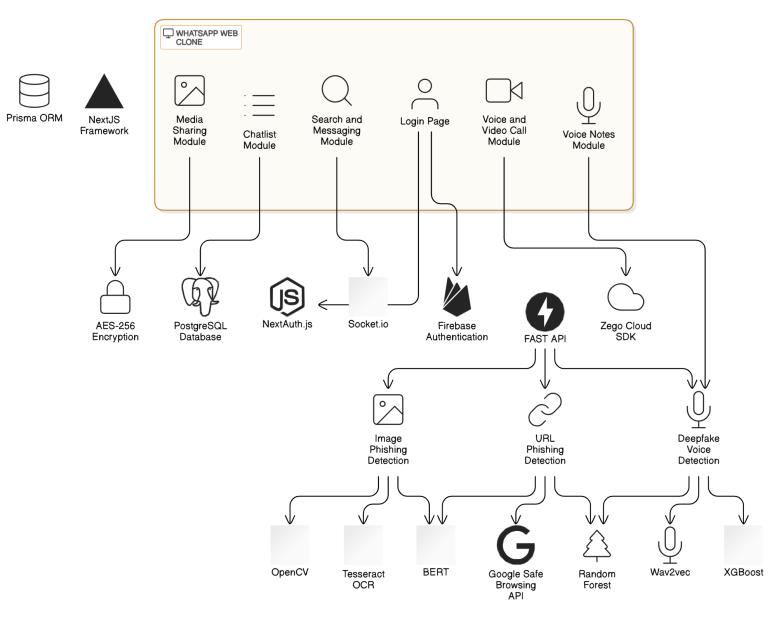
4.1. Architecturediagram

Socket.io plays a pivotal role in enabling real-time messaging by establishing bi-directional event-based communication between the server and the client. This is essentialforimplementinglivechatandmessagedelivery indicators such as seen ticks and typing status. Communication data including messages and media are encrypted using AES-256 encryption, which is a widely trusted encryption standard ensuring that all user data is protected from unauthorized access during transmission andstorage.
Thereal-timevoiceandvideocommunicationfeaturesare supported through the Zego Cloud SDK, which provides a reliable and scalable media streaming solution. This SDK enables high-quality audio and video calling functionality with low latency and efficient bandwidth management, mimicking the smooth experience users expect from platformslikeWhatsApp.
In conclusion, the architecture combines the strengths of modern web development frameworks, real-time communication protocols, secure data handling mechanisms,andadvancedAI-drivensecuritymodules.
The login module provides secure user authentication using email/password or third-party logins. It allows users to personalize their profile with a name, bio, and profile picture. Features include encrypted communication, secure password storage, session management (single sign-on), and informative error handling. Login attempts are logged for monitoring, and userscanlogoutsecurely.
This module allows users to record, preview, delete, and send audio messages with playback controls. It supports hands-free recording with visual waveform feedback, adjustable playback speed, and timestamped audio. AES-
International Research Journal of Engineering and Technology (IRJET) e-ISSN: 2395-0056
Volume: 12 Issue: 05 | May 2025 www.irjet.net p-ISSN: 2395-0072
256encryptionensuressecuretransmissionandplayback isrestrictedtointendedrecipientsforprivacy.
Supports one-on-one and group calls using WebRTC and ZegoCloudSDKwithadaptivebitratestreaming.Provides real-time call status, call history, and missed call alerts. Features include automatic fallback to audio in low bandwidth, participantdisplay,andend-call confirmation. All communications are encrypted end-to-end for privacy andsecurity.
Organizesongoingandpastchatswithmessagepreviews, timestamps, and read/unread indicators. Shows contact names and profile pictures, supports real-time online status, chat sorting, and a responsive scrolling interface. Enhancesaccessibilitytofrequentlycontactedusers.
5.5.
Enables efficient message and contact search with realtimedeliveryandreadstatuses.Supportstext,multimedia, emojis, and maintains a secure, complete chat history. Includes keyword, contextual, and contact-based search functions to simplify navigation and improve user interaction.
5.6.
Allows secure sharing of images, videos, documents, and audio using AES-256 encryption. Supports multiple formatsandreal-timephishingdetectionusingOCRandAI models. Alerts users to threats before viewing/download, and applies content moderation using CNNs. Media is timestamped, preview-enabled, and optimized for crossdevicecompatibility.
The primary aim of implementation is to deliver a fully functional product that matches the design specifications and satisfies user requirements. For our AI-Powered Phishing Detection System integrated with a WhatsApp Web Clone, this means ensuring that all modules phishing detection in text, images, and voice messages, real-time alerting system, secure login, and encrypted communication work seamlessly together within the messaginginterface.
Thisstagealsofocusesonsettinguptheappropriate environment configurations, installing dependencies, connecting to real-time databases like Firebase, and deploying APIs built using frameworks like FastAPI. Testing plays a critical role during implementation. It involves running the system with sample data, validating
phishing detection responses, checking user interface responsiveness, and correcting bugs. Error handling, logging, and data validation mechanisms are also finalized toensuresystemrobustness.
In addition, security measures such as implementing AES256 encryption for chats, secure OAuth-based login via Firebase, and phishing verification through Google Safe Browsing API are deployed during implementation. The systemisthentestedunderreal-timeconditionsusinglive datatoensureitsaccuracy,responsiveness,andreliability.
Another essential part of implementation is user configurationandtraining.Evenifthesystemistechnically sound,itmustbeeasytouse.Therefore,theinterface,user onboarding, and feedback mechanisms are fine-tuned duringthisstage.DeploymenttoolslikeVercelareusedto publish the frontend application, while backend services are hosted on platforms like Firebase and AWS for high availabilityandscalability.
Code Integration:Combining different modules intoa unified,functioningsystem.
Environment Setup: Installing software,libraries, and dependenciesacrossalldevelopmentanddeployment environments.
API&DatabaseConnection:Linkingthebackendlogic to databases (PostgreSQL, Firebase) and integrating real-time APIs (FastAPI, Google Safe Browsing, ZegoCloud).
Unit & Integration Testing: Testing individual componentsandtheirinteractivity.
Real-Time Data Testing: Feeding live inputs (URLs, images, audio files) to test detection response times andaccuracy.
Error Correction & Optimization: Identifying bottlenecksandrefiningalgorithmsforperformance.
Deployment: Hosting frontend and backend using toolslikeVercelandFirebase.
UserAcceptanceTesting(UAT):Evaluatingthesystem withenduserstoensureitmeetsexpectations.
Monitoring & Maintenance: Logging system activity, collectinganalytics,andplanningfutureupdates.
Through successful implementation, the system transitions from a theoretical model to a real-world application capable of detecting phishing attacks across multiple communication formats URLs, images, and voice. It demonstrates how AI, when integrated with secure communication tools, can proactively protect users from phishingthreatsinrealtime.Thesystemisnowreadyfor
International Research Journal of Engineering and Technology (IRJET) e-ISSN: 2395-0056
Volume: 12 Issue: 05 | May 2025 www.irjet.net p-ISSN: 2395-0072
deployment,usertesting,andfurtherrefinementbasedon feedbackandevolvingcyberattackpatterns.
The results obtained from the implementation of the AIPowered Phishing Detection System demonstrate the practical effectiveness of integrating real-time threat detection into a messaging environment like WhatsApp Web. The system was tested across various phishing scenarios, including suspicious URLs, image-based scams (likeQRcodesandfakeloginscreens),andvoicemessages potentially generated using deepfake technology. Upon interacting with potentially harmful content, the system successfully triggered alert popups, warning users before they could proceed. This proactive alert mechanism playedacriticalroleinreducinguserexposuretophishing content. The AI models specifically those using machine learning algorithms like Naïve Bayes and Random Forest for URL classification, and CNN-based models for image analysis consistently achieved high detection accuracy in controlledtestingenvironments.
Furthermore, the deepfake voice detection module using LSTM and GAN architectures was able to distinguish between human and AI-generated audio samples, adding an extra layer of protection against voice phishing (vishing).TheintegrationofGoogleSafeBrowsingAPIfor URL validation and AES-256 encryption for data protection enhanced the overall security and reliability of thesystem.
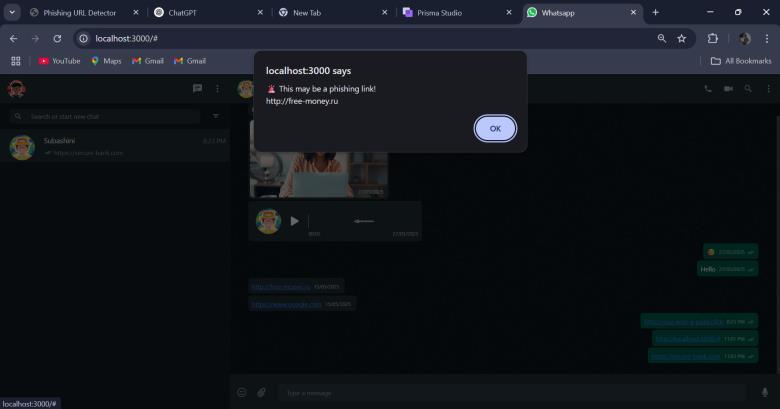
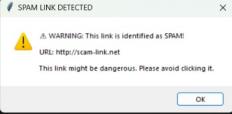
In Figure 7.1 shows that the system automatically detects maliciousURLsinchats.Awarningpopupnotifiestheuser of a potentially dangerous link. This helps users to avoid falling victim to malicious websites. Security features are deeplyintegratedintothemessagingflows.
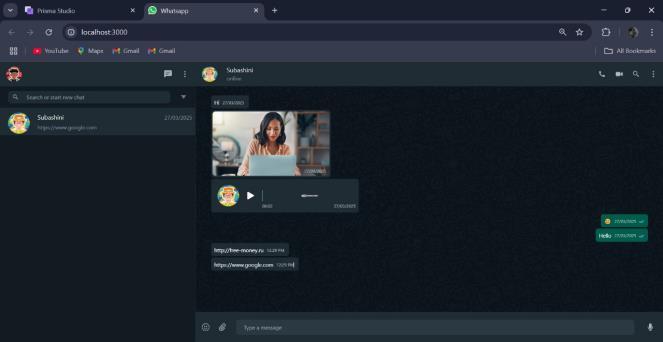
InFigure7.2showsthatthisscreenshowsaphishingalert for an image with a suspicious link. The system detects malicious image content and warns the user. It prevents users from falling for phishing tricks disguised as images. Awarningpopuphighlightsthedetectedthreat.
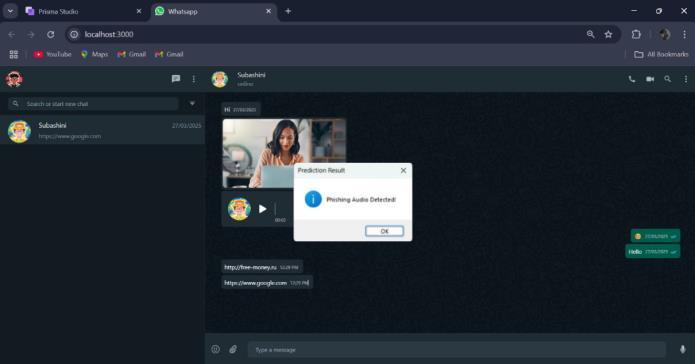
In Figure 7.3 shows that inside the chat, a phishing detection feature scans voice messages. An alert is shown whenaphishingaudioisdetected.Thisimprovessecurity by preventing audio-based social engineering. The warningpopupensuresusersstayawareofthreats.
The AI-powered phishing detection system for WhatsApp Web Clone represents a significant advancement in realtime cybersecurity for messaging applications. With the increasing sophistication of phishing attacks, traditional security measures such as blacklisting and rule-based filtering have proven inadequate in preventing evolving threats. This project successfully integrates machine learning, deep learning, and real-time monitoring to proactively identify phishing attempts in text messages, URLs, and multimedia content. By leveraging NLP models like BERT for text classification, OpenCV for image-based phishing detection. The incorporation of Google Safe Browsing API for real-time URL scanning and NextAuth.js forsecureauthenticationaddsanextralayerofprotection to the platform. Furthermore, the system’s real-time communicationframework,builtwithNext.js,Prisma,and
International Research Journal of Engineering and Technology (IRJET) e-ISSN: 2395-0056
WebSockets, ensures seamless user experience while maintainingsecuritystandards.
Unlike conventional phishing detection techniques, which operate in a reactive manner, this implementation provides a proactive approach to phishing prevention, significantly reducing user exposure to cyber threats. As phishing techniques continue to evolve, future improvements Future enhancements include integrating deepfakedetectionforvideoandvoicecalls,implementing behavioral analysis, deploying AI-powered CAPTCHA, and extending the system to mobile applications beyond the WhatsApp Web clone to further strengthen security. By integrating these advanced security mechanisms, this project lays a strong foundation for secure and intelligent real-timecommunication,contributingtothefutureof AIdriven cybersecurity solutions in digital messaging platforms
To strengthen further the AI-powered phishing detection system for WhatsApp Web Clone, several enhancements canbeimplementedinfuture:
BehaviouralAnalysis –AIanalyzesbuserinteractions to detect suspicious behaviour and alerts the user instantly
Deepfake Voice & Video Call Phishing Detection –Implement Generative Adversarial Networks (GANs) and deep learning models to detect AI-generated scamcallsandmanipulatedvideos.
AI-Powered CAPTCHA for User Verification –Implement AI-based CAPTCHA in high-risk conversationstodetectandblockbot-drivenphishing attempts.
Mobile App Development (Android & iOS) – Extend thephishingdetectionsystemto mobileapplications, ensuringusersremainprotectedacrossalldevices.
These enhancements will significantly improve security, scalability, and phishing detection accuracy, that ensures real-time messaging applications remain resilient against emergingcyberthreats
[1] Dalsaniya,Abhay.(2023).AI-BasedPhishingDetection Systems:Real-TimeEmailandURLClassification.
[2] Manurung, Ferdinand & Munawir, & Pradeka, Deden. (2025). Spam and Phishing Whatsapp Message Filtering Application Using TF - IDF and Machine Learning Methods. Green Intelligent Systems and Applications.5.1-13.10.53623/gisa.v5i1.551.
[3] Ansari, Meraj Farheen & Sharma, Pawankumar & Dash, Bibhu. (2022). Prevention of Phishing Attacks Using AI-Based Cybersecurity Awareness Training. 3. 61-72.10.47893/IJSSAN.2022.1221.
[4] Mughaid A, AlZu'bi S, Hnaif A, Taamneh S, Alnajjar A, Elsoud EA. An intelligent cyber security phishing detection system using deep learning techniques. Cluster Comput. 2022;25(6):3819-3828. doi: 10.1007/s10586-022-03604-4. Epub 2022 May 14. PMID:35602317;PMCID:PMC9107003.
[5] Aruna, Ms.M.G & V, Maheswari & M, Pranethaa. (2023). A web application for real-time phishing website detection. interantional journal of scientific research in engineering and management. 07. 1-11. 10.55041/IJSREM26477.
[6] M. Sameen, K. Han and S. O. Hwang, (2020) "PhishHaven An Efficient Real-Time AI Phishing URLs Detection System," in IEEE Access, vol. 8, pp. 83425-83443,doi:10.1109/ACCESS.2020.2991403.
[7] Bauskar, Sanjay & Madhavaram, Chandrakanth & Galla, Eswar Prasad & Sunkara, Janardhana Rao & Gollangi,HemanthKumar.(2024).AI-DrivenPhishing Email Detection: Leveraging Big Data Analytics for Enhanced Cybersecurity. SSRN Electronic Journal. 44. 7211-7224.10.2139/ssrn.4980647.
[8] S.Asiri, Y. Xiao, S. Alzahrani,S. Liand T.Li, (2023) "A Survey of Intelligent Detection Designs of HTML URL Phishing Attacks," in IEEE Access, vol. 11, pp. 64216443,doi:10.1109/ACCESS.2023.3237798.
[9] L.TangandQ.H.Mahmoud,(2022)"ADeepLearningBasedFramework forPhishingWebsiteDetection,"in IEEE Access, vol. 10, pp. 1509-1521, doi: 10.1109/ACCESS.2021.3137636.
[10]LAMINA, Oladimeji Azeez et al. (2024) Ai-Powered Phishing Detection And Prevention. Path of Science, [S.l.],v.10,n.12,p.4001-4010.ISSN2413-9009.
[11]Y. A. Alsariera, M. H. Alanazi, Y. Said, and F. Allan, (2024) “An Investigation of AI-Based Ensemble Methods for the Detection of Phishing Attacks”, Eng. Technol. Appl. Sci. Res., vol. 14, no. 3, pp. 14266–14274.
[12]Basit, A., Zafar, M., Liu, X. et al. (2021) A comprehensive survey of AI-enabled phishing attacks detection techniques. Telecommun Syst 76, 139–154. https://doi.org/10.1007/s11235-020-00733-2
[13]W. Li, S. Manickam, Y. -W. Chong, W. Leng and P. Nanda,(2024)"AState-of-the-ArtReviewonPhishing Website Detection Techniques," in IEEE Access, vol.
Volume: 12 Issue: 05 | May 2025 www.irjet.net p-ISSN: 2395-0072 © 2025, IRJET | Impact Factor value: 8.315 | ISO 9001:2008
International Research Journal of Engineering and Technology (IRJET) e-ISSN: 2395-0056
12, pp. 187976-188012, doi: 10.1109/ACCESS.2024.3514972.
[14]Arun, Akshaya, and Nasr Abosata. (2024) "Next Generation of Phishing Attacks using AI powered Browsers."arXivpreprintarXiv:2406.12547.
[15]Ravindra, Salvi & Sanjay, Shah & Gulzar, Shaikh & Pallavi, Khodke. (2021) “Phishing Website Detection Based on URL.” International Journal of Scientific Research in Computer Science, Engineering and Information Technology. 589-594. 10.32628/CSEIT2173124.

Volume: 12 Issue: 05 | May 2025 www.irjet.net p-ISSN: 2395-0072 © 2025, IRJET | Impact Factor value: 8.315 |

Mrs. R. B. Aarthinivasini is a Professor in the Department of Information Technology at Meenakshi College of Engineering, Tamil Nadu. She specializes in computer science Withacademicexperience,she is passionate about guiding UG scholarsincutting-edgeresearch.
Sridevi S is a final-year UG scholar in the Department of Information Technology at Meenakshi College of Engineering. Her research interestsincludeUI/UXdesigning and AI applications. She actively participates in academic projects She aims to pursue a career in designing


Subashini M is a final-year UG scholar in Information Technology at Meenakshi College of Engineering. She is focused on machine learning and data security research. Subashini has worked on academic projects involving AI-based threat detection. She aspires to become a technology innovator in digital security.
Roshini P is a final-year UG scholarintheDepartmentofITat Meenakshi College of Engineering. She has a keen interest in web technologies, AIbased systems, and information security. Her academic involvement includes developing user-friendly applications. She is

committed to contributing to the fieldofsecurecommunication.
Shanjana P is a final-year UG scholar in Information Technology at Meenakshi College of Engineering. Her areas of interestincludehuman-computer interaction and secure application development. She has collaborated on team-based AI research projects. She is dedicated to solving real-world problems through innovative technology.