
International Research Journal of Engineering and Technology (IRJET) e-ISSN:2395-0056
Volume: 12 Issue: 06 | Jun 2025 www.irjet.net p-ISSN:2395-0072
International Research Journal of Engineering and Technology (IRJET) e-ISSN:2395-0056
Volume: 12 Issue: 06 | Jun 2025 www.irjet.net p-ISSN:2395-0072
Er Ankush Pathania1* , Er. Aman Choudhary2
1,2Assistant Professor, Baddi University of Emerging Sciences & Technology Makhnumajra, Baddi, Distt. Solan, H.P.173205, India.
ABSTRACT
With population growth, urbanization and digitalization accelerating global energy demand, sustainability and environmental challenges continue to grow particularly because fossil fuels are still relied upon. Solar, wind, biomass, hydro and geothermal energy, collectively known as renewable energy (RE) technologies have taken positions as necessarysubstitutestodecarbonizetheenergysector.Butbarrierssuchasintermittency,highcapitalcosts,limitedgrid integrationandsociopoliticalconstraintsexistforitsdeployment.InthispaperweexplorehowArtificialIntelligence(AI) cantransformthehurdlestoRE,acrosstheREvaluechain,fromgenerationanddistributiontostorage,consumptionand governance. By improving the predictive modeling, demand forecasting, real-time optimization and lifecycle assessment, AI improves on efficiency. In addition, AI enabled tools for policy simulation, participatory planning and sustainability monitoring are indispensable for grappling with environmental trade‑offs and questions of social equity. Through synthesisofcurrentliterature,thisstudysynthesizesrecentliteraturetoshowthattheintegrationofAIisnotonlyabouta technological upgrade, but a system wide innovation that needs to be integrated with context sensitive policy, digital infrastructureandinclusivegovernance.ItisconcludedthatAIandREtechnologiestogethercreateagreatopportunityto enablesustainable,resilientandequitableenergytransitionsaroundtheworld.
Keywords: Renewable Energy, Artificial Intelligence, Sustainability, Energy Transition, Decarbonization, Smart Grids, Biomethane,LifecycleAssessment,EnergyEquity,PredictiveAnalytics.
1. Introduction
Thisdrawsdemandforunprecedentedglobalenergyneedsduringtimesofexpandingglobaleconomy,rapidurbanization, digitalizationandrapidlyexpandingglobalpopulationduringthe21stcentury.TheInternationalEnergyAgency(IEA)in itslatest(2016)reportshowsthatifnotransformative policyandtechnology(smart)shiftsaremadetoshiftfromfossil fuels,thenglobalenergyconsumptionwillgrowbyalmost50percentby2050,inwhichfossilfuelswillremainsignificant contributor in terms of energy supply. However this alarming trajectory is environmentally problematic, significantly because of the accelerated global climate change owing to anthropogenic greenhouse gas (GHG) emissions [1]. It is explicitlywarnedbytheIntergovernmentalPanelonClimateChange(IPCC)thatforavoidingcatastrophicclimatetipping points, global warming needs to be limited to 1.5°C above the preindustrial levels. Such a transition requires a massive shifttorenewablefromfossilbasedenergysystems.
Tsolakis et al. [6] also suggest the dual implementation of both AI and blockchain technology for sustainable and transparent renewable energy supply chains. Through their work they draw out how AI can be leveraged to perform predictivemaintenance,demandforecastingandoperationaloptimizationinthedecentralizedenergynetworksandhow blockchain ensures traceability, trust and data integrity amongst the various stakeholders. In particular, this duality of smart technologies is highly applicable to renewable systems, one where efficiency and resilience are very important underdistributedarchitectures.
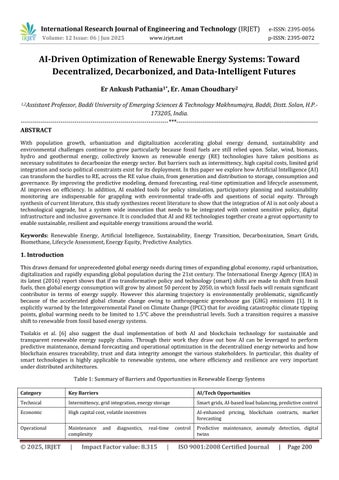
Table1:SummaryofBarriersandOpportunitiesinRenewableEnergySystems
Category KeyBarriers
Technical Intermittency,gridintegration,energystorage
Economic Highcapitalcost,volatileincentives
Operational Maintenance and diagnostics, real-time control complexity
AI/TechOpportunities
Smartgrids,AI-basedloadbalancing,predictivecontrol
AI-enhanced pricing, blockchain contracts, market forecasting
Predictive maintenance, anomaly detection, digital twins
International Research Journal of Engineering and Technology (IRJET) e-ISSN:2395-0056
Volume: 12 Issue: 06 | Jun 2025 www.irjet.net p-ISSN:2395-0072
Environmental Landuseissues,materialsourcingforrenewables
Policy/Governance Market failures, regulatory delays, lack of digital infrastructure
Social Publicresistance,knowledgegaps,inequitableaccess
AI/TechOpportunities
LifecycleanalysisthroughAI,materialstracking
AI-driven policy simulations, participatory planning platforms
Educationalgorithms,inclusivedatamodels
Theabovetable1illustratesthatAIisnotjustatechnologicaltoolbuta systemic enabler bridgingtechnicallimitations, enhancing decision-making, and supporting long-term energy planning.The motivation for this paper stems from the growing body of evidence suggesting that a tight integration between AI and renewable energy is both desirable and increasinglyfeasible.AsAImatures,itsapplicationsextendfrompredictivemeteorologicalmodelingforwindturbinesto optimizingbiomassyields,asshowninrelatedstudies.AI'sabilitytolearnfromvastandheterogeneousdatasetsmakesit uniquelysuitedforrenewableenergysystemsthataredecentralized,variable,anddynamicallyevolving.Thisconvergence ofAIandrenewableenergyalsoraisescriticalresearchandpolicyquestions.HowcandevelopingeconomiesleverageAI withoutexacerbatingdigitaldivides?WhataretheenergyfootprintsofAIitself,andhowdotheyoffsetitsdecarbonization benefits?HowcanAIhelpnavigateenergyequity,geopoliticalrisks,andcommunityacceptance factorsthatSovacoolet al. [4] call the non-technical core of sociotechnical systems?These questions underline the need for a new research paradigm that treats energy transition not as a purely technological upgrade but as a data-driven, human-centered transformation.
Stage AIApplication
Generation Forecasting solar/wind availability, adjusting output in real time
Transmission Gridfrequencyregulation,faultdetection
Distribution Smartmetering,prosumerbehaviorprediction
Storage Batteryhealthprediction,optimalcharge/dischargecycles
Consumption AI-enabledbuildingmanagementsystems
Governance & Policy Emission tracking, scenario modeling, subsidy impact simulations
PotentialImpact
Minimizescurtailment,stabilizesoutput
Reducesoutages,improvesgridreliability
Increases user engagement, demand-side flexibility
Extendsbatterylife,reducesoperationalcost
Energysavings,peakloadshaving
Evidence-based policymaking, better subsidy design
This paper aims to synthesize existing literature on the integration of AI within the renewable energy domain and exploreitspotentialasadriverforsustainable,efficient,andsociallyequitableenergytransitions.Thespecific objectives are:
1. To review major renewable energy systems (solar, wind, biomass, hydro, geothermal) and the technical barrierstheycurrentlyface.
2. To map the role of AI inoptimizinggeneration,distribution,storage,andconsumptionwithinrenewableenergy infrastructures.
3. To explore policy frameworks, geopolitical contexts, and sociotechnical systems that mediate the deploymentofAIintherenewablesector.
4. To identify limitations, ethical dilemmas, and environmental footprints associatedwithAIapplications.
5. To provide recommendations for future interdisciplinary research, investment strategies, and governance mechanisms.
Our climate is moving toward renewable energy technologies, not only is it a climate imperative and not only is it an economic opportunity. Fossil fuel reserves are being depleted while environmental costs of carbon intensive energy systemsareincreasingandrenewableenergy(RE)technologiesarebecomingsustainable,decentralizedandincreasingly
International Research Journal of Engineering and Technology (IRJET) e-ISSN:2395-0056
Volume: 12 Issue: 06 | Jun 2025 www.irjet.net p-ISSN:2395-0072
cost competitive alternatives. Solar, wind, biomass, hydro and geothermal technologies have over the last two decades undergone great innovations that have reshaped the world’s energy landscape whereby some nations are at grid parity and some declare energy autonomy. In this section we provide a granular overview of these technologies, their current developmentandanoverviewoftheextenttowhichtheyareAIready.
2.1.1
Solar photovoltaic (PV) systems convert sunlight directly into electricity using semiconductor materials. These systems arewidelyscalable fromrooftopinstallationstoutility-scalesolarfarms.Angetal.[8]emphasizedthatsolarenergyhas the highest technical potential globally, with annual solar radiation reaching up to 1,500–2,000 kWh/m². Despite this promise,efficiencyratesarelimitedbypanelmaterial,temperaturesensitivity,andangleofincidence.Recentadvancesin thin-film technologies, particularly those involving nickel oxide (NiO) films, have improved energy conversion efficiency while reducing cost and environmental footprint. Ukoba et al. [9] reviewed the spray pyrolysis technique for depositing NiO thin films, highlighting it as a cost-effective method for producing scalable PV materials with high purity, goodadhesion,andenhancedelectricalcharacteristics.
2.1.2
Wind turbines harness kinetic energy from airflows and convert it into mechanical and subsequently electrical energy. Rohrig et al. [10] described the evolution of wind technologies from land-based turbines to sophisticated offshore platforms.Thearticleoutlineskeyinnovations,includingsmartturbinecontrol,advancedaerodynamicbladedesign,and AI-basedwindpatternforecasting.Withglobalwindcapacitysurpassing700GWin2022,windenergyplaysacentralrole in national energy strategies.Yet, intermittency and spatial variability remain persistent challenges. The development of smart grids and AI-enhanced predictive models for wind speed are addressing these issues by optimizing scheduling andloadmanagement.
2.1.3
Hydropower is the most mature and widely deployed RE source, accounting for 16% of global electricity generation. It involves converting the gravitational potential energy of water into electricity using turbines. Ang et al. [11] categorize hydro into large-scale (>100 MW), small-scale, and micro-hydro systems, the latter being increasingly relevant for decentralized,off-gridregions.However,largehydroprojectsofteninvolveecologicaltrade-offs,includingbiodiversityloss and displacement. The future of hydro lies in integrating run-of-river, pumped storage, and AI-optimized water flow regulation toimproveefficiencyandreduceimpact.
2.1.4
Biomass energy derives from organic materials including agricultural waste, wood, and algae. It can be converted into electricity, heat, or biofuels via thermochemical (combustion, pyrolysis) or biochemical (fermentation, anaerobic digestion)processes.Sayedetal.[12]underscorebiomassastheonlyREformthatdirectlygeneratescarbon-basedfuels, making it a bridge in the transition from fossil fuels.Key challenges include feedstock availability, land use competition, and emissions from improper combustion. Innovations such as biomethane production through optimized digestion processesandAI-drivenprocesscontrolaretransformingbiomassintoaprecisionenergysource.
2.1.5
GeothermalsystemstapintotheEarth’sinternalheatforpoweranddirectheating.Thesesystemsarelocation-dependent, typically viable in geologically active regions. Ang et al. [8] identify geothermal as highly reliable due to its 24/7 operational capacity and low carbon intensity. However, upfront drilling costs and environmental risks (e.g., induced seismicity) present constraints. Advances in AI-enhanced seismic prediction, reservoir modeling, and drilling automation arehelpingmitigatethesebarriers.
International Research Journal of Engineering and Technology (IRJET) e-ISSN:2395-0056
Volume: 12 Issue: 06 | Jun 2025 www.irjet.net p-ISSN:2395-0072
EnergySource
SolarPV 15–22%
Table
–1,800 ~45
Wind 30–45% 1,200–2,000 ~10
Hydro 35–45% 1,000–5,000 ~4
Biomass 20–35% 1,500–3,000 10–50
10–20% 2,500–5,000 ~5
Biomass energy, especially biomethane production, has gained significant attention due to its dual role in waste management and energy generation. The integration of chemical pretreatment, advanced catalysts, and machine learning hastransformedthistraditionalprocessintoahigh-efficiency,low-emissiontechnology.
Onepromising pathway for sustainable methane production isthe methanation of carbon dioxide usinghydrogenand heterogeneouscatalysts.Azizetal.[9]provideadetailedreviewofcatalyticstrategiesforCO₂hydrogenation.TheSabatier reaction (CO₂ + 4H₂ → CH₄ + 2H₂O) is catalyzed by metals like Ni, Ru, and Co on supports like Al₂O₃ and CeO₂.Heterogeneous catalysts offer advantages in reactor stability, recyclability, and scalability These systems are increasingly optimized using AI-based simulations and real-time control algorithms, reducing reaction time, energy use,andside-productformation.
Olatunji and Madyira [6], [7] investigated the oxidative and thermal pretreatment of biomass, such as Xyris capensis and Arachishypogea shells,toenhancebiomethaneyields.Theirstudiesdemonstratethatpretreatmentaltersthe lignincellulose-hemicellulose ratio, improving microbial digestibility. Results showed up to 40% increase in methane yield using oxidative pretreatment, compared to untreated feedstocks.Machine learning models are now being employed to optimizepretreatmentparameters,suchaspH,temperature,andretentiontime,basedon multi-variable datasets from previousexperiments.
Innovation
OxidativePretreatmentofBiomass
HeterogeneousCatalystsinCO₂Methanation
ThermalTreatmentofAgriculturalWaste
Co-DigestionModeling
MachineLearninginAnaerobicDigestion
+30–40% Moderate Processoptimization
+25%CH₄Selectivity High(lowertemp) Catalystdiscovery,reactiontuning
+20%
Moderate
+15–50% High
Varies(site-specific)
Structuralanalysis,AIimagerecognition
AI-basedfeedratioprediction
Predictivecontrol,gasqualityanalysis
In summary, the renewable energy landscape is undergoing a profound transformation driven not only by material science but increasingly by AI and data-centric innovations. Each RE technology presents unique strengths and constraints,buttheincorporationofintelligentsystemsoffersaunifyingopportunitytoovercomeintermittency,optimize performance,andreduceenvironmentalimpacts.Biomassandmethanation,oncerelegatedtonicheapplications,arenow central to circular economy models, especially when coupled with AI and green hydrogen pathways. Their relevance willonlygrowinafuturethatprioritizes carbon neutrality, waste valorization, and system-level integration.
As the world accelerates its transition to renewable energy (RE) sources to address climate change and energy security challenges, it becomes essential to examine not only the technological and economic dimensions of RE, but also its
Volume: 12 Issue: 06 | Jun 2025 www.irjet.net
e-ISSN:2395-0056
2395-0072
environmentalandsustainabilityimplications.Whilerenewablesinherentlypromisecleanerenergyproduction,theirlifecycle impacts, integration dynamics, and interaction with broader socio-environmental systems require deeper scrutiny. Thissectionsynthesizesinsightsfromrecentresearchtocriticallyassesshowrenewableenergysystemsinfluencecarbon emissions,resourceutilization,andsustainabilityperformance.
Energy efficiency the ability to produce more output with less energy input has emerged as a cornerstone of climate mitigation strategies. In the transportation sector, which is one of the largest contributors to carbon dioxide (CO₂) emissions globally, even marginal improvements in energy efficiency can result in disproportionately large emission reductions.
Li et al. [12] analyzed 30 Chinese provinces from 2005 to 2019, revealing a nonlinear relationship between energy efficiency and carbon emissions.Theirfindingsdemonstratedthatwhenenergyefficiency(measuredasGDPperton ofstandardcoal equivalent) exceededa thresholdof0.473millionRMB/t,a 1%increasein efficiencyledtoa 0.926% reduction in CO₂ emissions nearly double the mitigation observed below the threshold. Moreover, the study highlighted that urbanization further contributes to emissions control, although to a lesser degree than energy efficiency itself.This empirical validation reinforces the argument that renewable energy deployment without efficiency optimization may fail to deliver the full climate benefit. A multidimensional approach that couples RE adoptionwithenergyperformancemetricsisvital.
The Environmental Kuznets Curve (EKC) hypothesis posits an inverted U-shaped relationship between income and environmental degradation. In early stages of economic growth, emissions increase with income; however, beyond a certainincomethreshold,societiescanaffordcleanertechnologies,therebyreducingemissions.
Wang etal.[14]revisitedthisframework usingpanel data from208countriesbetween1990and2018.Their analysis revealedthat:
TheEKCturningpointwasaround $19,203 GDP per capita
Renewable energy consumption had stronger decarbonization effects before this threshold,while human capital investments were more effective afterward.
Natural resource rents were found to aggravate emissions, suggesting the dangers of fossil-fueled rent economies.
Their work confirms that RE adoption is more impactful in developing economies where fossil-based emissions are rising. However, for high-income nations, policy emphasis should shift toward innovation, circular economy models, and governance mechanisms
Evans et al. [3] proposed a framework to assess sustainability indicators for renewable technologies beyond direct emissions.Theirmethodevaluated:
Lifecyclegreenhousegas(GHG)emissions
Waterconsumption
Landuse
Socialandeconomicexternalities
Energypaybacktime(EPBT)
They ranked RE technologies based on these indicators, finding wind energy as the most sustainable, followed by hydro, solar,and geothermal,while biomass scoredlowestduetocombustion-relatedemissionsandlandintensity.
International Research Journal of Engineering and Technology (IRJET) e-ISSN:2395-0056
Volume: 12 Issue: 06 | Jun 2025 www.irjet.net
p-ISSN:2395-0072
Table 5: Sustainability Indicator Comparison for Key Renewable Technologies
*Social Impact Score is a composite metric based on job creation, public acceptance, and displacement risks, derived fromEvansetal.[15].
3.4 Unintended Environmental Trade-Offs
While renewable energy reduces direct emissions, it may also introduce second-order environmental impacts. These include:
Solar PV and battery waste:Theaccumulationof end-of-life panels and lithium-ion batteries hasbecomean emerginge-wastechallenge.
Hydropower ecological disruption: Large dams alter river ecosystems, affecting biodiversity and displacing communities.
Wind turbine bird and bat mortality:Rotorbladecollisions,particularlyduringmigratoryseasons,haveraised conservationconcerns.
Biomass combustion: Incomplete combustion can lead to black carbon emissions and health hazards, particularlyinpoorlyventilatedsystems.
These issues require systems-thinking approaches supported by AI models that simulate long-term impacts and optimizedesignsforminimumenvironmentaldisruption.
through AI
Artificial Intelligence offers powerful tools to enhance the sustainability profile of renewable energy systems. Specific applicationsinclude:
1. Life Cycle Assessment (LCA) automation: AI algorithms can model entire supply chains to quantify emissions, waste,andresourceuseacrossthelifecycle.
2. Predictive environmental monitoring: Satellite imagery combined with machine learning detects environmentaldegradationnearREprojects(e.g.,deforestationnearbiofuelplantations).
3. Circular economy planning: AI assists in component reuse optimization (e.g., wind turbine blades), enhancing resourcecircularity.
Table6:AI-DrivenSustainabilityToolsinRenewableEnergySystems
Function
LCApredictionfornewREprojects
Neuralnetworks
Fastersustainabilitycompliance
Biodiversityimpactdetection(wind) Remotesensing+ML Reductionofecologicalexternalities
Gridcarbon-intensityoptimization Reinforcementlearning Reducedmarginalemissionfromenergydispatchdecisions
Wasteandmaterialrecoverymodeling Optimizationalgorithms Improvedrecyclabilityofsolarpanelsandturbines
Predictivewaterusemodeling(hydro) Time-seriesregression Waterconservationinmulti-usereservoirs
International Research Journal of Engineering and Technology (IRJET) e-ISSN:2395-0056
Volume: 12 Issue: 06 | Jun 2025 www.irjet.net p-ISSN:2395-0072
4.Conclusion
There is a dual imperative for the 21st century energy paradigm which lies in accelerating the deployment of renewable energy (RE) and overcoming the complex sustainability, governance and social justice barriers to that transition. This paper synthesizes the literature on how the world’s energy demand is growing at an ever increasing rate due to urbanization,digitalizationandeconomicexpansionandthattheworldneedstorapidlytransitionawayfromfossilfuels. However,carbonintensivesystemsremaindominantandpresentsignificantenvironmentalrisksthroughgreenhousegas (GHG)emissions,includingtheriskthatthe1.5°CclimatetargetestablishedbytheIPCCmaynotbeachievable.However, implementation of renewable energy sources (e.g. solar, wind, hydro, biomass and geothermal) is crucial for decarbonization,buteachpresentsitsowntechnical,operationalandsocio−environmentallimitations.
1. IEA,“WorldEnergyOutlook2022,”[Online].Available:https://www.iea.org/reports/world-energy-outlook-2022
2. A.Evans,V.Strezov,andT.J.Evans,“Assessmentofsustainabilityindicators forrenewableenergytechnologies,” Renew.Sustain.EnergyRev.,vol.13,pp.1082–1088,2009.
3. P. A. Owusu and S. Asumadu-Sarkodie, “A review of renewable energy sources, sustainability issues and climate change mitigation,” Cogent Eng., vol. 3, 2016. [Online]. Available: https://www.tandfonline.com/doi/abs/10.1080/23311916.2016.1167990
4. B. K. Sovacool, D. J. Hess, S. Amir, et al., “Sociotechnical agendas: Reviewing future directions for energy and climate research,” Energy Res. Soc. Sci., vol. 70, 2020. [Online]. Available:https://www.sciencedirect.com/science/article/pii/S2214629620301924
5. Q. Wang, F. Zhang, R. Li, and J. Sun, “Does artificial intelligence promote energy transition and curb carbon emissions?Theroleoftradeopenness,” J.Clean.Prod.,vol.447,2024
6. N.Tsolakis,R.Schumacher,M.Dora,etal.,“Artificialintelligenceandblockchainimplementationinsupplychains: Apathwaytosustainabilityanddatamonetisation?” Ann.Oper.Res.,vol.327,pp.157–210,2022.
7. T. Z. Ang, M. Salem, M. Kamarol, et al., “A comprehensive study of renewable energy sources: Classifications, challengesandsuggestions,” EnergyStrategyRev.,vol.43,2022.
8. K. O. Ukoba, A. C. Eloka-Eboka, and F. L. Inambao, “Review of nanostructured NiO thin film deposition using the spraypyrolysistechnique,” Renew.Sustain.EnergyRev.,vol.82,pp.2900–2915,2018.
9. K.Rohrig,V.Berkhout,D.Callies,etal.,“Poweringthe21stcenturybywindenergy Options,facts,figures,” Appl. Phys.Rev.,vol.6,no.3,2019.
10. E. T. Sayed, T. Wilberforce, K. Elsaid, et al., “A critical review on environmental impacts of renewable energy systemsandmitigationstrategies,” Sci.TotalEnviron.,vol.766,2021.
11. M.A.A.Aziz,A.A.Jalil,S.Triwahyono,etal.,“CO₂methanationoverheterogeneouscatalysts:Recentprogressand futureprospects,” GreenChem.,vol.17,pp.2647–2663,2015.
12. K. O. Olatunji and D. M. Madyira, “Optimization of biomethane yield of Xyris capensis grass using oxidative pretreatment,” Energies,vol.16,2023.
13. K. O. Olatunji, D. M. Madyira, N. A. Ahmed, et al., “Biomethane production from Arachis hypogea shells,” Biomass Convers.Biorefin.,vol.14,2024.
14. R.Li,L.Li,andQ.Wang,“Theimpactofenergyefficiencyoncarbonemissions:Evidencefromthetransportation sectorinChinese30provinces,” Sustain.CitiesSoc.,vol.82,p.103880,2022.
15. Q.Wang,F.Zhang,andR.Li,“RevisitingtheenvironmentalKuznetscurvehypothesisin208counties:Therolesof trade openness, human capital, renewable energy and natural resource rent,” Environ. Res., vol. 216, p. 114637, 2023.
16. A.Evans,V.Strezov,andT.J.Evans,“Assessmentofsustainabilityindicatorsforrenewableenergytechnologies,” Renew.Sustain.EnergyRev.,vol.13,pp.1082–1088,2009.