
International Research Journal of Engineering and Technology (IRJET) e-ISSN:2395-0056
Volume:12Issue:06|Jun2025 www.irjet.net p-ISSN:2395-0072
International Research Journal of Engineering and Technology (IRJET) e-ISSN:2395-0056
Volume:12Issue:06|Jun2025 www.irjet.net p-ISSN:2395-0072
Miss. Pratiksha Sakhare1 , Miss. Nimbalkar Srushti2 , Mr. Sugare Dattaprasad3
1Fourth Year Student Of Degree in Civil Engineering, JSPM’s Bhagwant Institute of Technology, Barshi.
2Fourth Year Student Of Degree in Civil Engineering, JSPM’s Bhagwant Institute of Technology, Barshi.
3Assistant Professor, Department Of Civil Engineering ,JSPM’s Bhagwant Institute Of Technology, Barshi.
ABSTRACT:- With the increase in vehicle numbers, traffic congestion has become a major issue in Indian cities, especially during emergencies. This project proposesaHydraulicTrafficReductionSysteminstalled in footpaths, allowing them to temporarily lower to roadlevelusinghydraulicjacks.Thiscreatesextraspace for emergency vehicles to pass through. Once clear, the footpath returns to its original height. The system is cost- effective, space-saving, and requires no special construction making it a smart and practical solution foremergencytrafficmanagement.
KEY WORDS:- Hydraulic Traffic System, Traffic Calming, Emergency VehicleAccess, Footpath Conversion.
1. INTRODUCTION:-
Traffic engineering ensures safe and smooth movement on roads. With rising vehicle numbers, congestion and delays especially for emergency vehicles have increased.Tosolvethis, we propose a hydraulic system in footpaths that creates extra road space during emergencies, helping reduce traffic quickly and efficiently.
1.1 Concept:-
This is a smart, hydraulic road plate system embedded in roads. It automatically rises or lowers based on vehicle speed, traffic density, or time (like near schools orzebracrossings).Itusessensorsandhydraulicpower tocontroltrafficwithoutpermanentspeedbreakers.
1.2 Benefits:-
Smooth traffic control without damagetoVehicles.
Emergencyvehiclefriendly.
Energy-saving and smart-city compatible.
A) Dr. Pritesh Prajapati,Pragnesh H Prajapati – A ResearchPaperonTrafficJamatSignalCrossRoad
They discussed about the various system used for controllingtrafficcongestionandproblemsit.
B) Prashant S. Kottalagi, Mahesh P. Patil, Saloni I. Jamada- AResearchPaperonTrafficJamatSignalCross Road
They discussed about the hydraulic system for parking thevehicles.
C) Vaishali Mahavar, Prof.Jayesh Juremalani- A Research Paper on Traffic control devices used world wide.
Theydiscussedaboutthemany methodsoftrafficsignal controlling also gives the best adaptability and optimizationideasintrafficsignalcontrol.
D) Amudapuram Mohan Rao, Kalaga Ramachandra Rao- A Research Paper on Measuring UrbanTrafficCongestion.
They discussed about the possible ways to identify and measure metrics for urban arterial congestion. Also discussed measurementcriteria.
3. METHODOLOGY:-
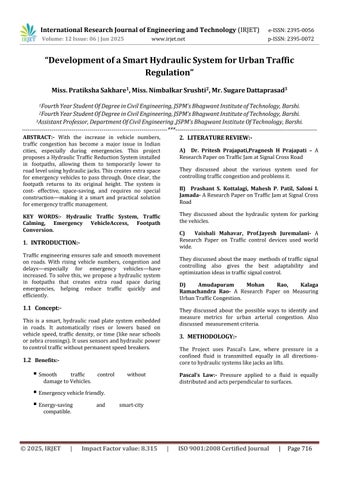
The Project uses Pascal’s Law, where pressure in a confined fluid is transmitted equally in all directionscoretohydraulicsystemslikejacksanlifts.
Pascal’s Law:- Pressure applied to a fluid is equally distributedandactsperpendiculartosurfaces.
Volume:12Issue:06|Jun2025 www.irjet.net
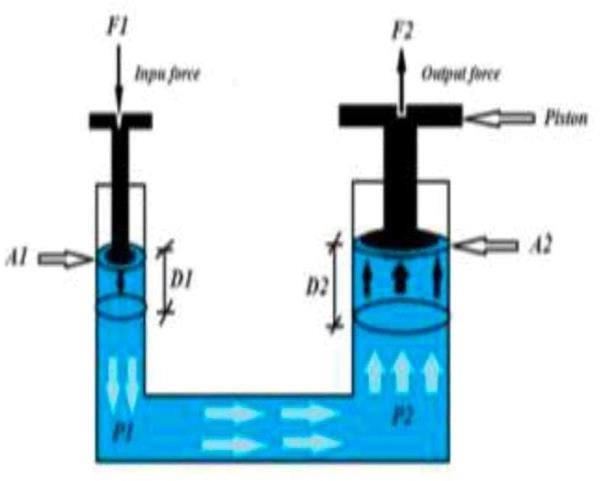
Fig-1:Pascal’slawconceptdiagram
3.1 WorkingOfHydraulicJack:-
HydraulicPrincipleSummary
F=Force,P=Pressure,D=Distancemoved,V=Volumeof liquid,A=Cross-sectionalarea
v=A×D………D=V/AWorkDone(Input=Output)W=F×D So,
F1D1=F2 D2
SubstituteD=V/A
F1 ×(V1/A1)=F2×(V2/A2)
Dividebothsidesbyvolume(F1/A1)×V1=(F2/A2)×V2
ButF/A=P(Pressure)
So, P1×V1 = P2×V2For incompressiblefluids
P1=P2
Conclusionisthat,
In a hydraulic system, pressure applied at one point is transmitted equallythroughoutthefluid,allowing force to be multiplied or transferred –enabling tasks like liftingafootpathusingsmallinputforce.
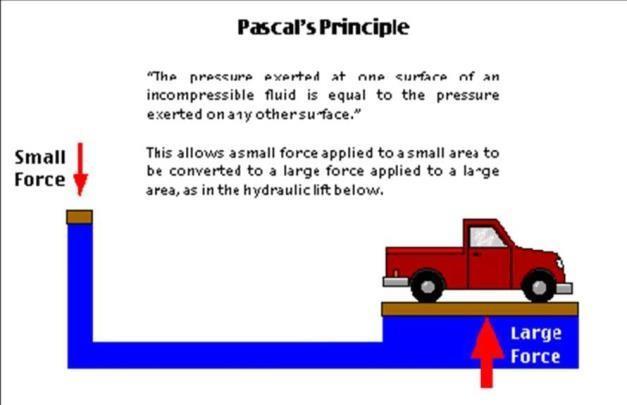
Hydraulic systems are used in industries to lift and moveheavyloadswithhighefficiencyandcontrol.
Benefits: Transmit large force with small parts. Precise,smooth,andworksintoughconditions
Issue:Componentsarecostlyandhardtoreplace
Solution: Using a rack and pinion can lower costs whilemaintainingfunction.
Use Case: Ideal for footpath lifting and easy to demonstratewithsimple models.
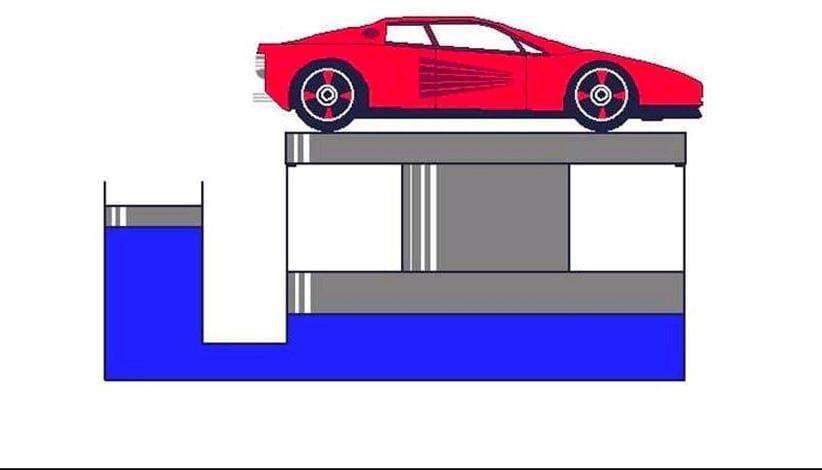
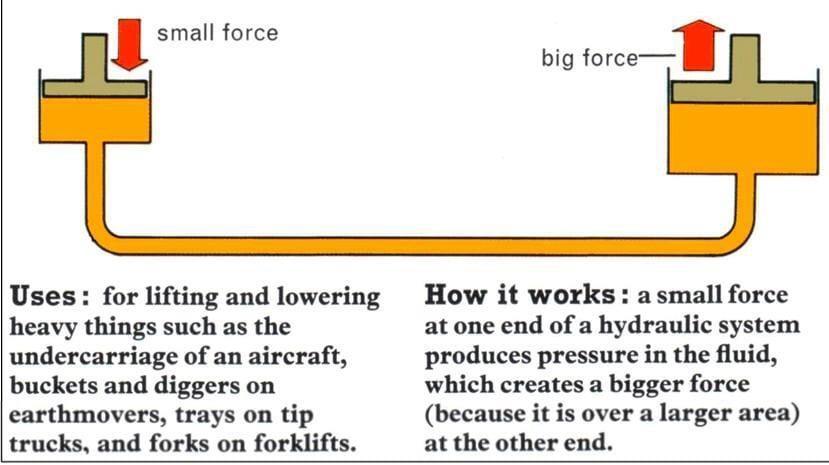
Hydraulic lifts operate on Pascal’s Law, which states that pressure applied to a confined fluid is transmittedequallyinalldirections.
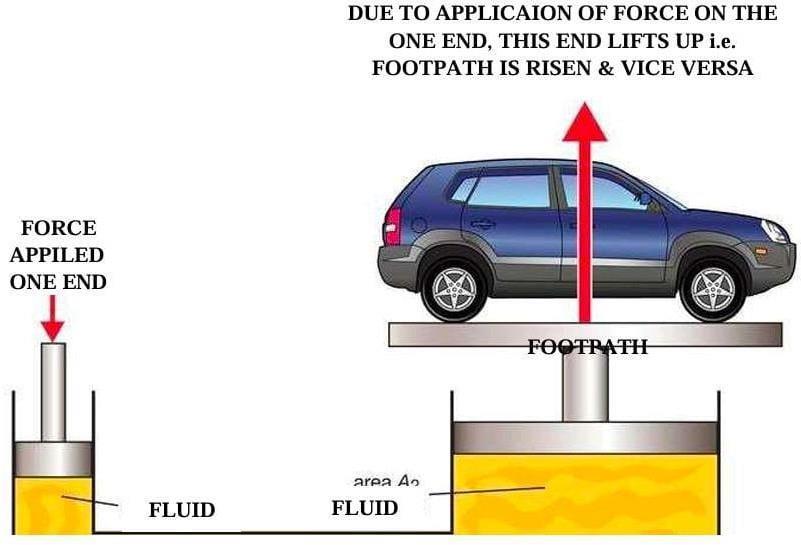
The system uses a fluid-filled cylinder and two pistons of different sizes P1 with a smaller area (A1) and P2 with a larger area (A2). When a small force (F1) is applied to piston P1, it generates pressurethatistransmittedthroughthefluid,causing piston P2 to move upward with a greater force (F2), calculatedasF2=(A2/A1)×F1.
To lift the car, a pump pushes oil into the cylinder, raisingthepistonandthelift.Tolowerthelift,avalve opens allowing the oil to return to the reservoir, and thecardescendsbygravity. The lift remains at a certainlevel when the pump stops and oil is trapped inthecylinder.
Thesystemiscontrolledbybuttonsintheliftcar,and dependingonthedesign,thecylindercanbeholedor hole-less.Hydraulicliftsoffer the advantage oflifting heavy loads with a relatively small input force, and the principles behind them are not only applied in engineeringfieldslikefluidmechanics,pipeflow,and dam design but also occur naturally in the human body’svascularsystem.
Traffic jams delay everyone, but emergency vehicles can't afford to wait. To solve this, a Hydraulic Traffic Reduction System (TRS) is proposed, where the footpath lowers to road level during emergencies, creatingextraspaceforvehiclestopass.Afterward,a hydraulic jack restores it to its original position, ensuringquickmovementforemergencyservices.
To help emergency vehicles bypass traffic, the footpath temporarily lowers using hydraulics, creating an extra lane. After use, it returns to normal—saving timewithout changing road design.
International Research Journal of Engineering and Technology (IRJET) e-ISSN:2395-0056
Volume:12Issue:06|Jun2025 www.irjet.net p-ISSN:2395-0072
This system ensures faster response time for emergency services without permanently altering roadlayouts.
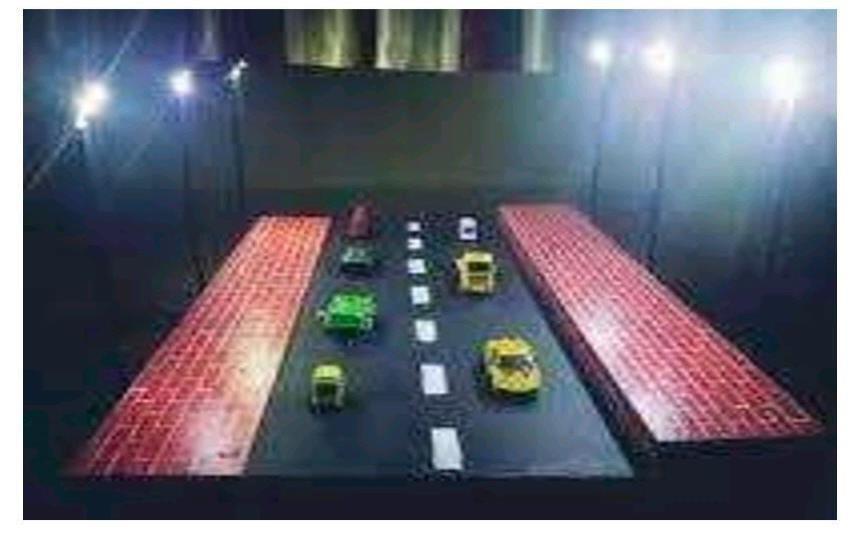


5. RESULTS:-
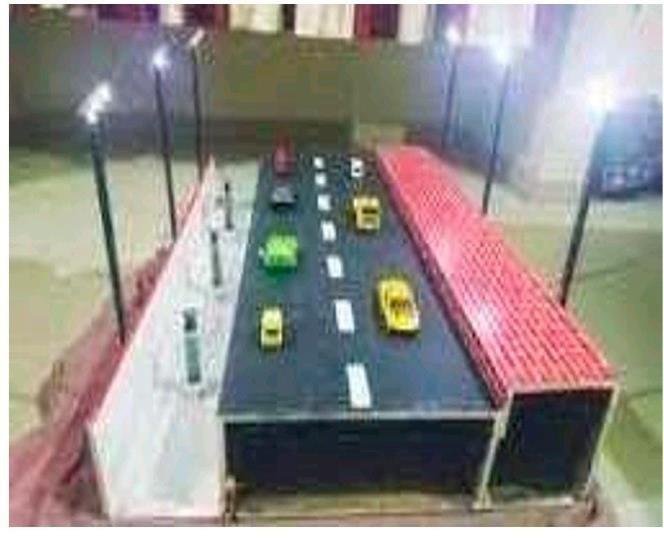
Our project uses the basic principles of hydraulics, particularly Pascal’s Law, which states that pressure appliedtoafluidistransmittedequallyinalldirections. The model includes a road setup with footpaths equipped with syringe-based hydraulic jacksthatactas pistons.Inemergencies,thefootpathtemporarilylowers to align with the road surface, allowing emergency vehiclestopass.
6. FUTURE SCOPE:-
The hydraulic footpath system offers a smart, dualpurpose solution footpath by default, emergency lane whenneeded.Ithelps:
Reducetrafficcongestion
Improveemergencyresponse
Savelandspace
Supportsmartcityinfrastructure
Once cleared, the footpath returns to its original position, helping manage traffic during critical situations.
Actualdemonstrationofmodels inroads
International Research Journal of Engineering and Technology (IRJET)
Volume:12Issue:06|Jun2025 www.irjet.net
7. CONCLUSION:-
Traffic congestion remains a major urban challenge, driven by overpopulation andvehicledensity.Ourstudy proposes an innovative solution integrating a hydraulicjacksystemintothefootpath,allowingittoact asanemergencylanewhenneeded.
This system requires no special construction, reduces land use and cost, and ensures faster emergency response.It’sasmart,space-savingsteptowardefficient urbanmobility.
8. ACKNOWLEDGMENT:-
I sincerely thank Prof. Sugare D.S., Assistant Professor, Civil Engineering, Bhagwant Institute of Technology, Barshi,forhisvaluableguidanceandsupportthroughout my project on “DEVELOPMENT OF A SMART HYDRAULIC SYSTEM FOR URBAN TRAFFIC REGULATION”
Special thanks to Prof. Jawale S.D. Assistant Professor & HeadOfDepartment,forthishelpandencouragement.
I am alsograteful to the Principal and Dr. Shiral R.N. for providingnecessaryfacilitiesandmotivation.
9. REFERENCES:-
1) Thomas L speer, TRAFFIC SIMULATOR APPARATUS@Ww-feeyJan28,1964 T.1
SPEER3,119,257
2) Cassidy, John I., Chaudhy.M. Hanif and Roberson. John A. “Hydraulic Engineering”,John Wiley & Sons,1998.
3) A.Kumar, R.R Sing, Traffic congestion and possible solution in urban transport system, 4th International Conferenceon EmergingTrendsin Engineering Technology, Science and Management,2017,603-607