London: The Roger Cline Collection - Volume 2

Page 1


The Cline Collection - Prints

Volume II

Volume I - Prints

Foreword / 5

Introduction to Prints / 11

Roger Cline / 15

Panoramas and Prospects / 16 - 227

Bridges / 230 - 317

Life on the River / 320 - 359

Volume II - Prints

Transport for London / 6 - 31

Palaces, Politics, and Princes / 34 - 115

Parks and Promenades / 118 - 155

Churches and Chapels / 158 - 189

Industry, Education, and Amusement / 192 - 261

Markets and Sqaures / 264 - 273

Sets / 276 - 313

Handkerchiefs / 316 - 339

Volume III - Maps 1572-1840

Introduction to Maps / 5 - 7

Volume IV - Maps 1841-1933

Volumes V - Books

Introduction to Books / 5 - 7

London City is Mighty Pretty / 10 - 183

Plans and Prospects / 186 - 225

Life on the River / 228 - 303

Volume VI - Books

Transport for London / 6 - 15

Palaces, Politics and Princes / 18 - 51

Parks and Promenades / 54 - 61

Churches and Chapels / 64 - 115

Industry, Education and Amusement / 118 - 185

Suburban Sprawl / 188 - 215

Bibliography / 216

Daniel Crouch Rare Books Ltd 4 Bury Street, St James’s London SW1Y 6AB

+44 (0)20 7042 0240 info@crouchrarebooks.com crouchrarebooks.com

ISBN 978-1-7384410-9-9

Catalogue edited by Arnie Anonuevo, Daniel Crouch, Rose Grossel, Kate Hunter, Ellida Minelli, Théophile De-Proyart, Mia Rocquemore, Dawlat Simko and Nick Trimming

Design by Ivone Chao and Nicky Valsamakis

Photography by Louie Fasciolo and Marco Maschiao

Cover: item 411

Terms and conditions: The condition of all books has been described. Each item may be assumed to be in good condition, unless otherwise stated. Dimensions are given height by width. All prices are net and do not include postage and packing. Invoices will be rendered in £ sterling. The title of goods does not pass to the purchaser until the invoice is paid in full.

Printed by Park Communications on FSC® certified paper. Park is an EMAS certified company and its Environmental Management System is certified to ISO14001. 100% of the inks used are vegetable oil based, 95% of press chemicals are recycled for further use and, on average 99% of any waste associated with this production will be recycled. This document is printed on Galerie Matt made of material from wellmanaged, FSC®-certified forests and other controlled sources. The pulp used in this product is bleached without the use of chlorine (ECF).

London: The Roger Cline Collection (Prints II)

TRANSPORT FOR LONDON

SCOTT, Edm[un]d; [after H.] RAMBERG

The Embarkment.

Publication London, Thos. Macklin No.39 Fleet Street, Novr. 9 1782.

Description Oval stipple engraving, printed in sepia.

Dimensions

S: 432 by 480mm (17 by 19 inches).

P: 420 by 460mm (16.5 by 18 inches).

I: 330 by 415mm (13 by 16.5 inches).

References Benezit Dictionary of Artists.

Embarking at the Embankment

On this engraving, the embankment is depicted as a place to load and unload travellers on rowing boats. Boats were a common means of transport, as it was easy to go east when the tide was low, and west with high tide.

Edmund Scott (1758-c1811) was a pupil of Francesco Bartolozzi (1727-1815). Unlike his tutor, however, he used crayon etching, to which he added sanguine and sepia.

PRESTAL, [Maria] C[atharina]; [after] [John] RATHBONE

The Red Lion at Kilborn.

Publication [London, 1789].

Description Etching, with hand-colour.

Dimensions

S: 440 by 545mm (17.5 by 21.5 inches).

P: 400 by 504mm (15.75 by 27.75 inches).

I: 303 by 415mm (12 by 16.5 inches).

References

BL Maps K.Top.30.7.c.; BM 1880,1113.5574; Crace, XXXVI.77.

The Edgware Road

A view of The Red Lion, a roadside inn on the Edgware Road at Kilburn. The Edgware Road is a long straight road which runs from Oxford Street to St John’s Wood, following the course of the old Roman road heading north out of London to the Middlesex village of Edgware and beyond. There were a number of inns built to serve travellers along the road, including The Red Lion which dated back to the fifteenth century. An example of the print in the Crace Collection bears the imprint of John Cary, and is dated 15 January 1789.

John Rathbone (1750-1807) was a prolific painter of landscapes in oil and watercolour. Between 1785 and 1806, Rathbone exhibited 48 landscapes at the Royal Academy, and two at the Society of Artists.

Maria Catharina Prestel (1747-1794) was an engraver, specializing in aquatint. Born in Nuremberg, she married Johann Gottlieb Prestel in 1772 and was a pupil of his. After separating from him, she moved to London in 1786, where she worked for John Boydell.

DAGATY, [Edouard]

View’s of London. No 1. Entrance of Piccadilly or Hyde Park Corner Turnpike, with a view of St. Georges Hospital.

Publication [London], Ackermann 101 Strand, August 1797.

Description Engraving with aquatint, in full contemporary hand-colour.

Dimensions

S: 440 by 585mm (17.5 by 23 inches).

P: 360 by 450mm (14.25 by 17.75 inches).

I: 310 by 420mm (12.25 by 16.5 inches).

References Adams, 78.1; BM, 1948,0315.4.134.

Hyde Park Corner

By the late-eighteenth century, Hyde Park Corner had become a bustling thoroughfare, heavy with traffic heading into central London. In the present plate, a stagecoach, a popular mode of transport, with people sitting on the roof (the cheapest way to travel), makes its way along the road. In the background stands the turnpike gate at Hyde Park Corner, one of the busiest toll gates in London, at which money was collected to pay for the maintenance of the road (highly unpopular, they were known as “the most ruthless highwayman of them all”). This toll gate had been in place since 1721, but would be taken down in 1825 and sold at auction. In the foreground to the right is St George’s Hospital, founded in 1733. The hospital moved to its present site, in Tooting, in 1980, but the building still stands as The Lanesborough hotel.

DAGATY, [Edouard]

Views of London. No 2. Entrance of St. Georges Road or the Obelisk Turnpike with a View of the Royal Circus.

Publication London, Ackermann, 101 Strand, August, 1797.

Description

Engraving with aquatint, in full contemporary hand-colour.

Dimensions

S: 440 by 585mm (17.5 by 23 inches).

P: 360 by 450mm (14.25 by 17.75 inches).

I: 310 by 420mm (12.25 by 16.5 inches).

References Adams, 78.2; BL, Ktop, XXII 6.b; BM, 1880,1113.5354; Crace, XXXV.20.

The Royal Circus

During the eighteenth century, the transport of goods in and out of London was largely done by stage wagons with tarpaulin hoods and wide wheels useful for navigating the frequently rough and muddy roads outside the city. The Royal Circus, shown in the background of the present print, was opened on 7th November 1762 on Blackfriars Road. The Circus would burn down in 1799, then again in 1805, after which it would be rebuilt as the Surrey Theatre.

HILL, J[ohn]; [after] A[ugustus] PUGIN

View of the Highgate Archway. Dedicated by permission to H.R.H. the Prince Regent by Directors of the Highgate Archway Company. John Nash Architect.

Publication

London, A. Pugin, 39 Keppell Street Russell Square, Aug.t 12, 1812.

Description Aquatint, in full contemporary hand-colour.

Dimensions

S: 500 by 620mm (19.75 by 24.5 inches). P: 485 by 605mm (19 by 24 inches). I: 385 by 540mm (15.25 by 21.25 inches).

References BL, K.Top.30.1.1.h; GAC, 4791.

The Highgate Archway Company

Architectural draughtsman and scholar Auguste-Charles Pugin (17621832), who anglicized his name to Augustus Charles upon moving to England to flee the revolution in his native country, produced numerous prints of London during his career. He therefore naturally took an interest in the business of the Highgate Archway Company, which was established in 1809 to make a subterranean passageway through Highgate Hill, which it executed at the huge cost of £103,000. Pugin made an image of the area during the lengthy engineering project, showing the excavated site, and also a view of the completed structure.

The latter shows the stone-fronted archway surmounted by smaller arches supporting a bridge. It is viewed in the distance from a crossroads, at the far end of a long road on which travellers are proceeding either by coach, horse, or foot. Undulating gently, the surrounding land is dominated by fields and trees, with only a few buildings in sight. The present print was engraved in 1813 after Pugin by aquatinter John Hall, three years before he emigrated to Philadelphia.

FIELDING, Theodore [Adolphus]; [after] James POLLARD

The Elephant and Castle on the Brighton Road.

Publication London, J. Watson, 7 Vere Street, Feb. 7, 1826.

Description

Engraving with aquatint, in full contemporary hand-colour, tear to right and left margin not affecting image skilfully repaired , laid on card.

Dimensions

S: 625 by 830mm (24.25 by 32.5 inches).

P: 585 by 800mm (23 by 31.5 inches).

I: 540 by 775mm (13.25 by 30.5 inches).

References Museum of London, 002039.

The Elephant and Castle Inn was a public house and busy staging post. Urban legend has it that the name “Elephant and Castle” is a Cockney corruption of “Infanta de Castilla”, and a reference to Eleanor of Castile (1241-1290), but the Inn more likely derives its name from the coat of arms of the Cutler’s Guild, which featured an elephant as a nod to the use of ivory in cutlery handles. The inn gives its name to the present area of London. There are a variety of vehicles shown going past the inn, including a private coach, stage coaches going to Bognor and Brighton, and a wagon. Theodore Henry Adolphus Fielding (1781-1851) was an English painter, engraver, and author.

James Pollard (1792-1867) was a British painter well-known for his sporting and mail coach scenes.

DANIEL

CLEGHORN, J[ohn]; [after] T[homas] H[osmer] SHEPHERD

Regent’s (or London,) Canal, The East Entrance to the Islington Tunnel, &c.

Publication [London, c1827].

Description Engraving with aquatint, fine contemporary hand-colour.

Dimensions

S: 356 by 492mm (14 by 19.5 inches).

P: 308 by 433mm (12 by 17 inches).

I: 245 by 360mm (9.75 by 14.25 inches).

Legging it through Islington Tunnel

Islington Tunnel opened in 1818, and was built by the engineer James Morgan (1776-1856). Lacking a towpath, barges originally had to be “legged” through the tunnel, a technique that involved two people on either side of the vessel propelling it forward by pushing off the tunnel walls with their feet. Islington Tunnel, part of Regent’s Canal which provided a link from Paddington Basin to Limehouse Basin and beyond, was 878 metres in length, making it the longest tunnel in the City.

The print was engraved by John Cleghorn (1784-1873), who would also engrave plans of Regent’s Park and Oxford, and architectural plates, after a work by watercolourist Thomas Hosmer Shepherd (1791-1864), who specialized in topographical scenes of London.

[ROSENBERG, Charles]; [after] James POLLARD

West Country Mails at the Gloucester Coffee House, Piccadilly.

Publication

London, Thomas McLean, 26 Haymarket / Paris, Giraldon Bovinet, Passage Vivienne 26, 1828.

Description

Engraving with aquatint, fine contemporary hand-colour, laid on card.

Dimensions

S: 515 by 745mm (20.25 by 29.5 inches).

References

BM, 1880,1113.2035; Crace, X.101; Museum of London, A25651.

How do you like your coffee?

A series of carriages and carts line up in front of a row of establishments on Piccadilly. To the left is the Gloucester Hotel and Coffee House, from the balcony of which two women and a child survey the scene, with “Boone - Hat Maker” at the centre, and “Joseph Miller - Fish Salesman and at Billinsgate [sic]” to the right. In the mid-eighteenth century, Piccadilly was the hub from which the majority of west country services departed. In the present print, among the four carriages are two headed for Poole and one for Exeter. Of the two carts, one is labelled “Traveller - Fast Coach - Exeter”, while the other, which has already set off, at a gallop, is provided by “W.J. Waterhouse”.

The print is after a work by James Pollard (1792-1867), well-known for his mail coach scenes, engraved by etcher and aquatinter Christian Rosenberg (c1756-1844).

REEVE, R[ichard] G[ilson]; [after] James POLLARD

The Royal Mails Starting from The General Post Office, London.

Publication

London, Thos. McLean, 26 Haymarket, April 19th, 1830.

Description Engraving with aquatint, fine contemporary hand-colour.

Dimensions

S: 515 by 685mm (20.5 by 27 inches). I: 422 by 628mm (16.75 by 24.75 inches).

A view of the General Post Office in the City of London, showing the mail coaches departing. The Post Office was designed by Sir Robert Smirke (1780-1867) and built between 1823 and 1829, this print made soon after to celebrate its opening. Pollard produced this and another print, entitled ‘The Royal Mail’s Departing’, in the same year, suggesting that views of new buildings were profitably popular.

EMBLEM, G.J.; [after] T[homas] ALLOM

The Post Office, St. Paul’s Cathedral, and Bull & Mouth Inn. London.

Publication London, J. Robins & Sons, Tooley Street, [c1834].

Description Engraving with etching.

Dimensions

S: 320 by 500mm (12.5 by 19.75 inches).

P: 290 by 470mm (11.5 by 18.5 inches).

I: 200 by 405mm (8 by 16 inches).

References

BM, 1880,1113.4078; Crace, XXXV.144; Hyde, [Stationers’ Almanack], pp30-31; Museum of London, 58.22/27.

The Bull & Mouth Inn

The Bull & Mouth Inn was a coaching inn that had its origins in the sixteenth century, its name possibly a corruption of “Boulogne Mouth”, alluding to the French town besieged by Henry VIII in 1544. It was pulled down and remodelled in 1830, replaced by the Queen’s Hotel. The present plate, shows the reconstructed hotel, with the old sign of the Bull & Mouth Inn (which is now in the sunken garden of the Museum of London) fixed to the façade of the new building. To the left is the General Post Office, newly opened in 1829. The building, however, suffered from structural flaws and would be demolished in 1912.

Hyde has identified the print as the headpiece for the 1834 Stationers’ Almanack. This example, however, lacking the almanack heading, text, and the arms of the company, would appear to have been sold separately.

Sleeping on the job

CHILDS, G.; [and]

To the Right and Hon. The Viscount Morpeth, M.P. this print of the proposed railway street through Westminster as connected with those Metropolitan Improvements in which his Lordship has ever taken so prominent a part.

Publication [London], M & N Hanhart, 1836.

Description

Lithograph, with hand-colour, laid on card.

Dimensions

S: 590 by 885mm (23.25 by 35 inches).

I: 475 by 820mm (18.75 by 32.25 inches).

George Howard, Viscount Morpeth (1802-1864), served in the government under Lords Melbourne, Russell, and Palmerston. This plate is dedicated to him by the architect, W.B. Moffat, and shows a proposed railway line through central London. On the left-hand side of the lithograph, a man is sleeping while he is supposed to be working as a stonecutter. The project was never realized because even at that time, lands near Westminster Abbey were prohibitively expensive and laying a new railway track would have been financially unrealistic.

HARRIS, J[ohn]; [after] Ja[me]s POLLARD

Scenes on the road, or a trip to Epsom and back.

Publication

London, Ackermann & Co. 96. Strand, May 30th, 1838.

Description

Etching with aquatint, in full contemporary hand-colour.

Dimensions

S: 410 by 565mm (16.25 by 22.25 inches).

P: 400 by 560mm (15.75 by 22 inches).

I: 325 by 500mm (13 by 19.75 inches).

References YCBA, Folio B 2011 30.

“dash off for Epsom races”

A lively scene, illustrating a series of travellers, in carriages or on horseback, passing Hyde Park Corner, on their way to Epsom Racecourse. Below the image, one each side of the title, runs a song, from Isaac Pocock’s 1810 musical farce ‘Hit or Miss!’:

“With spirits gay I mount the box, the tits up to their traces, My elbows squar’d, my wrist turn’d down, dash off for Epsom Races; With buxton bit, bridoon so trim, three chestnuts and a grey, Well couple up my leaders then, ye hip! we bowl away”.

The print was engraved by John Harris (1811-1865), after a work by James Pollard (1792-1867), a British painter well known for his sporting and mail coach scenes.

HARRIS, J[ohn]; [after] Ja[me]s POLLARD

The Four-in-Hand Club. Hyde Park. Respectfully dedicated to its distinguished Members by The Publishers.

Publication London, Dean & Co. Threadneedle Street, [after 1838].

Description Engraving with aquatint, fine contemporary hand-colour.

Dimensions

S: 435 by 617mm (17 by 24.5 inches).

P: 430 by 603mm (17 by 23.75 inches).

I: 356 by 550mm (14 by 21.5 inches).

References cf BM, 1880,1113.1894.

Drag race

The Four-In-Hand Club, a coach driving club, was founded in April 1808, by Charles Buxton, the inventor of the Buxton bit, along with some friends. The Club would regularly drive as a group to Salt Hill, where they would spend a convivial evening and night, before driving back to London. The FHC encountered difficulties in 1820, revived in 1822 with slightly different club rules, but only lasting until 1826.

A further collaboration between John Harris and James Pollard, for whom see also item 251.

BOURNE, J[ohn] C[ooke]

Entrance Portico Euston Grove Station.

Publication

London, J.C. Bourne 19 Lamb’s Street & Ackermann & Co, Strand. Printed by Day & Haghe, Sept. 1st. 1838.

Description

Lithograph with tint stone and hand-colour.

Dimensions

S: 325 by 546mm (12.75 by 21.5 inches). I: 229 by 399mm (10 by 15.75 inches).

References Adams, 231.2; BM, 1880,1113.4739; Crace, XXXI.20; Science Museum Group of London, 1978-2552.

John Cooke Bourne’s lithograph of Euston Arch and the neoclassical screen of the Euston Grove railway terminus was published among his ‘Drawings of the London and Birmingham Railway’ of 1839 (for which, see also items 254 and 255). The print was made after a wash drawing executed in April 1838.

Euston Station, which opened in July 1837, was London’s first inter-city railway station, home to the London and Birmingham Railway. Designed by architect Philip Hardwick (1792-1870), its monumental entrance, illustrated at the centre of the present plate, was the largest propylaeum ever built. The old station would be demolished in the early 1960s, with Euston rebuilt, modernized, and with room for the new tube station.

BOURNE, J[ohn] C[ooke]

Building the Stationary Engine House, Camden Town. April 1837.

Publication

London., J.C. Bourne 19 Lamb’s Street & Ackermann & Co, Strand. Printed by C. Hallmandel, July 1838.

Description

Lithograph with tint stone and hand-colour.

Dimensions

S: 350 by 534mm (13.75 by 21 inches).

I: 288 by 435mm (11.5 by 17 inches).

Engine house under construction

John Cooke Bourne’s lithograph of the Engine House under construction in Camden Town was published among his ‘Drawings of the London and Birmingham Railway’ of 1839 (for which, see also items 253 and 255).

BOURNE, J[ohn] C[ooke]

Building retaining wall &c. Near Park street, Camden Town 1836.

Publication

London, J.C. Bourne 19 Lamb’s Street & Ackermann & Co, Strand. Printed by C. Hullmandel, Dec 1838.

Description

Lithograph with tint stone and hand-colour.

Dimensions

S: 340 by 545mm (13.5 by 21.5 inches). I: 278 by 418mm (11 by 16.5 inches).

References Adams, 231.4; BM, 1880,1113.4745; Crace, XXXI.26; Science Museum Group, 1978-349/1.

The railway under construction in Camden

John Cooke Bourne’s lithograph of Camden Town was published among his ‘Drawings of the London and Birmingham Railway’ of 1839 (for which, see also items 253 and 254). It focuses on a gully, with tracks passing under a bridge, carts loaded with earth, and men hard at work.

DUNCAN, E[dward]

View of the London and Croydon Railway. From the deep cutting made through the Hill at New Cross. Looking towards the Greenwich Railway.

Publication [London], 105 Leadenhall Street, 1st June, 1838.

Description Chromolithograph.

Dimensions

S: 440 by 605mm (17.5 by 24 inches). I: 282 by 488mm (11 by 19.25 inches).

References GAC, 4992.

Two important London railway lines

This plate depicts the London and Croydon Railway, looking towards the many arches of the London and Greenwich Railway, which would open in 1839, London’s first steam railway and first completely elevated railway, which opened between 1836 and 1838.

Edward Duncan (1803-1882) began his career as an engraver, apprenticed to Robert Havell, principal engraver of Audubon’s monumental ‘Birds of America’. Influenced by the work of Robert’s brother William, however, Duncan began to experiment with watercolour and would become best known for his work as a marine watercolourist.

HUNT, Charles; [after] W. SHAYER

The Duke of Beaufort Coach Starting from the Bull & Mouth, Regents Circus, Piccadilly.

Publication

London, I. W. Laiard, 1 Leadenhall St., 1841.

Description

Aquatint in full contemporary hand-colour, laid on card.

Dimensions

S: 600 by 675mm (23.75 by 26.5 inches).

P: 530 by 640mm (21 by 25 inches).

I: 445 by 590mm (17.5 by 23.5 inches).

The Bull & Mouth in the West End

The Bull & Mouth Inn was a popular coaching inn, in St Martins-Le-Grand, that dated back to the sixteenth century (for a description of which, see item 249). Here, its Western Coach Office, in Piccadilly, which served London’s West End, is illustrated. A mail coach stands outside the office, ready to depart, with several passengers sitting on top of the carriage and a group of spectators watching from the curb.

[ANONYMOUS]

The Thames Tunnel Paper, To commemorate the day of the opening of the Tunnel as a Thoroughfare for Foot Passengers, March 23, 1843.

Publication [London, 1843].

Description Lithograph.

Dimensions

S: 340 by 216mm (13.5 by 8.5 inches).

I: 115 by 168mm (4.5 by 6.75 inches).

The world’s first sub-fluvial tunnel

The Thames Tunnel, which connects Rotherhithe and Wapping, was the first ever sub-fluvial tunnel, the purpose being to offer passage for pedestrians as the docks on each side of the river were being expanded. It took more than 18 years to construct, under the supervision of FrenchBritish engineer Sir Marc Isambard Brunel (1769-1849), the father of Isambard Kingdom Brunel. The present print was made to commemorate the tunnel’s opening, in 1843.

PRIOR, T[homas] A[biel]; [after] G[eorge] H[enry] ANDREWS

[Views of the Thames Embankment].

Publication [London, c1865].

Description Engraving.

Dimensions

S: 355 by 540mm (14 by 21.25 inches).

P: 260 by 465mm (10.25 by 18.5 inches).

I: 210 by 420mm (8.25 by 16.5 inches).

References Benezit Dictionnary of Artists.

Boats upon the Thames

George Andrews (1816-1898) first trained as an architect, before turning to painting, exhibiting watercolours both at the Society of Painters in Watercolours and at the Royal Academy. His view of London, engraved by Thomas Abiel Prior (1809-1886), looks out from the South Bank along the river towards St Paul’s in the distance. The Thames is packed with rowing, steam, and sail boats, many carrying passengers and wares.

WALTON, Frank; [and] Walter WILSON

[The Meet of the Four-in-Hand Club. Hyde Park].

Publication [London, c1886].

Description Photo-oleograph.

Dimensions S: 580 by 980mm (22.75 by 38.5 inches).

A society mash-up

The Four-In-Hand Driving Club was refounded in 1856 for the practice of recreational carriage driving. This aquatint illustrates a meet of the Club in Hyde Park, peppered with society figures and royalty: the Prince of Wales sits in a carriage driven by the Duke of Beaufort, in the foreground to the left; the Prince lifts his hat to the Duke of Connaught, who stands leaning with his elbow on the edge of another carriage, carrying the Princess of Wales; in the foreground to the right, a mounted policeman directs the traffic, while Oscar Wilde observes the scene.

The print is based on a, now lost, oil painting by Frank Walton (1840-1928), which was, in turn, based on a collage of society photographs. A wood-engraved key to this print is part of the British Museum Collections. Frank Walton and Walter Wilson (1851-1921), collaborated on a similar project, ‘The Lawn at Goodwood’, both would be reproduced from 1886.

A

WALTON, Frank; [and] Walter WILSON

The Meet of the Four-in-Hand Club. Hyde Park.

Publication

London, Manchester, & New York, S. Hildesheimer & Co., January 15th, 1886.

Description Photo-oleograph.

Dimensions

S: 630 by 1030mm (25 by 4 inches). I: 580 by 980mm (22.75 by 38.5 inches).

A further example of Walton’s and Wilson’s illustration of a meet of the Four-in-Hand Club at Hyde Park, for a description of which see item 260.

DANIEL CROUCH

BRANGWYN, Frank

[Old Cannon Street Railway Bridge].

Publication [London, c1913].

Description Etching, printed in sepia.

Dimensions

S: 775 by 825mm (30.5 by 32.5 inches). P: 710 by 725mm (28 by 28.5 inches). I: 710 by 725mm (28 by 28.5 inches).

References

Christopher, ‘London’s Historic Railway Stations Through Time’, 2015, pp67-68.

Old Cannon Street station

In the foreground of this etching, workers chat on the wharf, while, on the opposite bank, a couple of men are digging. Through the middle of the plate runs a canal, with small boats travelling along it. Overhanging the scene is a railway bridge and the magnificent entrance to Cannon Street Station, which opened in 1886, with its iron and glass frame. Today, the station retains its two towers, but the roof has been replaced by a modern structure.

Frank Brangwyn (1867-1956) was a prolific artist, who operated across multiple media: metalwork, furniture, glass, ceramics, textiles, woodcuts, lithographs, and - as here - etching. Starting his career employed by William Morris, he would go on to take on such varied commissions as designing the façade of Siegfried Bing’s art gallery, ‘L’Art Nouveau’, in Paris, producing illustrations for ‘The Graphic’, and producing murals for London’s Skinner’s Hall.

PALACES, POLITICS, AND PRINCES

VERTUE, George; [?after Robert PEAKE]

Potentissimae Elizabethae Angliae Reginae ad Nobilisimum D.D. Henricum Cary &c. The Royal Procession of Queen Elizabeth to visit the Hon. Henry Carey Lord Hindson &c.

Publication London, Georgius Vertue, [1742-1743].

Description Engraving.

Dimensions

S: 572 by 690mm (22.5 by 27.25 inches). P: 454 by 562mm (18 by 22 inches). I: 437 by 546mm (17.25 by 21.5 inches).

References

BM, 1989,0128.109; Strong, ‘The Cult of Elizabeth I’, 1999, pp17-46;; Wellcome Library, 570462i; Wells-Cole, ‘Scissors-andpaste in two paintings of Elizabeth I’, The Burlington Magazine, 2012, 154, pp834838 (painting reproduced p835).

Elizabeth’s royal procession

Elizabeth I, bedecked in jewels and elaborately dressed, here is depicted at the centre of a procession, carried in a sedan chair. The precise occasion of the procession has been a matter of contention. George Vertue, the prolific London engraver (1684-1756) responsible for the present engraving, claims, in explanatory text below the image, that Elizabeth is here on her way to visit her cousin Henry Carey, 1st Baron Hunsdon, and that his engraving is after an oil painting commissioned by Hunsdon to commemorate the occasion. Alternative theories, however, include that Elizabeth is on her way to the wedding of Lord Herbert to Lady Anne Russell, which took place in 1600, or even that this is the celebratory procession to St Paul’s following the 1588 victory over the Spanish Armada .

The engraving is after the so-called ‘Procession Picture’, itself a matter of some mystery, as regards its attribution. Roy Strong’s theory that it is by the artist Robert Peake (c1551-1619) is now the most widely accepted.

TURNER, Charles; [after] DELARAM

James the First, King of Great Britain. Engraved by Charles Turner from an extreme rare print by Delaram.

Publication London, S. Woodburn, 1/2, St Martin’s Lane, [1816].

Description Mezzotint, printed in sepia.

Dimensions

S: 340 by 270mm (13.5 by 10.75 inches).

P: 335 by 263mm (13.25 by 10.5 inches).

I: 856 by 225mm (33.75 by 9 inches).

References BM, 1880,1113.1123; Crace, I.5; Hind II, pp215-242.

James I on horseback

Charles Turner (1774-1857) was an English mezzotint engraver and draughtsman who specialized in portraiture. In this print, after Francis Delaram (fl1610-1625), King James is depicted on horseback, in a style reminiscent of Velázquez’s equestrian portrait of Philip IV of Spain. Behind and beneath James, his imposing stance emphasizing his power over it, lies London, the theatres of the South Bank, including Shakespeare’s Globe, of whose company, the King’s Men, James was patron, in the foreground. Delaram was also responsible for some early books of flowers, beasts, and birds, and probably the earliest English drawing book.

[PRICKE, Robert; after Anthony VAN DYCK]

Serenissimus Princeps Carolus Dei Gratia Angliae Scoliae Fraunciae & Hibernae Rex &c.

Publication [London, 1669-1698].

Description Etching.

Dimensions

S: 428 by 268mm (17 by 10.5 inches).

P: 335 by 233mm (13.25 by 9.25 inches).

I: 288 by 206mm (11.5 by 8 inches).

References BM, 1850, 1109.20.

Portrait of Charles I

A three-quarter length portrait of Charles I, set against the Thames, with Westminster and Whitehall behind, wearing a hat and a cloak, adorned with a Garter Star. Charles I had popularized the form of the Order of the Garter (the highest order of English knighthood) as a star, to be worn by Knights on their left arm, often embroidered with silver thread, gold, or even diamonds.

Robert Pricke (c1642-1708) was a bookseller, printseller, engraver, and translator, possibly a pupil of renowned engraver Wenceslaus Hollar. He met the demand for architectural works, in the aftermath of the 1666 Great Fire, translating and publishing such key works as Alexandre Francine’s ‘A New Book of Architecture’. The present work is after Anthony van Dyck (1599-1641), leading court painter of Charles I, known, in particular, for his equestrian portraits of the king.

HOEYE, Rombout van den

Olivarius Cromwell Exercituum Angliae Reipublicae Dux Generalis. Locum - Tenens et Gubernator Hiberniae Oxoniensis Acadermiae Cancellarius.

Publication [Amsterdam], Rombout van den Hoeye, [1650-1658].

Description Engraving.

Dimensions

S: 604 by 452mm (23.75 by 17.75 inches).

P: 595 by 443mm (23.5 by 17.5 inches). I: 558 by 433mm (22 by 17 inches).

References

BM, 1935,0413.210; Museum of London, 46.78/821; Layard, ‘Catalogue Raisonné of Engraved British Portraits from Altered Plates’, 1927, p130.

A portrait of Oliver Cromwell

An equestrian portrait of Oliver Cromwell, showing him against the backdrop of the River Thames and the London skyline, emphasizing his importance and his control over the seat of power in the country. Following the execution of King Charles I in January 1649 and the establishment of the Commonwealth, Cromwell was named “Lord Protector” in 1653. Cromwell’s titles are given at the bottom of this print as leader of the armies of the English Republic, interim governor of Ireland, and chancellor of the University of Oxford (a title which he lost in 1657, giving the latest possible date of the print). The Latin poem at the bottom of the print lauds Cromwell for his achievements, calling him “regibus hic frater; populis pater” (“brother to kings, parent to nations”), motivated by the “vera religione”, the “true religion” of Protestantism. This would have been well-received in the Netherlands, where this print was published, the Protestant Dutch Republic having recently concluded the Eighty Years’ War against Catholic Spain in order to gain recognition as an independent country.

Rombout van den Hoeye (1622-1671) was a Dutch publisher and printmaker, who often published political prints. He would later publish a satire showing Cromwell aping the station of a king.

O’Donoghue and Hake describe the print as a reworked version of Haelweg’s portrait of Christian IV of Denmark, but Layard disputes this.

CAUKERCKEN, C[ornelis van]; [after] Abr[aham] van DIEPENBEECK

Charles le second: Roy de la Grande Bretagne.

Publication [Antwerp, 1657].

Description Engraving.

Dimensions

S: 455 by 545mm (18 by 21.5 inches).

P: 384 by 500mm (15 by 19.75 inches).

I: 376 by 495mm (14.75 by 19.5 inches).

References BM, 1868,1212.464.

The heavenly coronation of Charles II

Cornelis van Caukercken (1626-1680) was an engraver and printmaker based in Antwerp, who produced plates after Rubens, Van Dyck, and other Flemish artists. He worked frequently with Abraham van Diepenbeeck (1596-1675), who had been in England during the reign of Charles I. In the present print, Charles II is depicted on horseback, with Athena, surrounded by angels and cherubs, above, about to crown him. To his right is Cupid, holding a plumed helmet, while Mercury, with his distinctive winged helmet and caduceus, looks up to Charles, and Mars, bottom-left, in the midst of battle, lunges at a three-headed dragon. In the background stands the Thames and, behind it, the city of London.

Below the image is a paean to Charles, which reads:

“Que Pallas soit vôtre guide, Cupidon vôtre Page, Mars le Capitaine qui conduise vôtre courage; Que votre propre monture soit le Pegase aile, Et Mercure, comme laquaÿ, toûjours a vôtre côte, Que la Fortune soit en votre seul pouvoir soûmise, Elle, qui sur nos testes est jusques icÿ assise”.

(“May Pallas be your guide, and Cupid your squire, Mars the captain who drives your courage; May your own steed be the winged Pegasus, And Mercury, as attendant, always at your side; May Fortune be acquiescent in your power alone, She, who is always sat just here above our heads”).

[?HOOGHE, Romeyn de]

Einzug Wilhelmi Henrici Prinzen von Orange zufunffsigen Konigs in England etc. in Londen.

Publication [Frankfurt, Matthaeus Merian, 1688].

Description Engraving.

Dimensions

S: 343 by 398mm (13.5 by 15.75 inches).

P: 310 by 375mm (12.25 by 14.75 inches).

I: 302 by 366mm (12 by 14.5 inches).

References Museum of London, A25866.

William of Orange enters London

William III landed at Brixham, in Devon, on 5th November 1688. He had come at the invitation of seven men (“The Immortal Seven”) to depose King James II. Discontent had been brewing against the overtly Catholic James II since his accession, but it was only with the prosecution of the Seven Bishops and the birth of James’s Catholic son (ensuring a Catholic succession), in 1688, that leading members of the English political class decided to take action. Events would culminate in the so-called “Glorious Revolution”, a mostly (though not entirely) peaceful coup, with James deposed and William declared king, ruling jointly with James’s daughter Mary. In the present plate, possibly by Dutch engraver Romeyn de Hooghe (1645-1708), who worked closely with William III, William is shown entering the city of London for the first time.

TERASSON, H.

His Majesty’s Royal Banqueting House of Whitehal, London 1713.

Publication [London], 1713.

Description Engraving with etching.

Dimensions

S: 510 by 610mm (20 by 24 inches).

P: 425 by 580mm (16.75 by 23 inches).

I: 381 by 566mm (15 by 22.5 inches).

References Adams, 22.34; BM, M,23.51.

The Banqueting House at Whitehall

H. Terasson (fl1713-1717) was a relatively little-known etcher active in London during the early-eighteenth century. He made trade cards, designed and engraved for prominent mapmaker George Willdey, and contributed plates to works such as the revised edition of ‘Britannia Illustrata’ published in the 1720s. One of his engravings to feature in the latter was a view of the Banqueting House in Whitehall. The entrance to the Palace of Whitehall is visible on the left, while on the right there are four canons set into the wall. In the foreground many figures are depicted going about their business, some on horseback, some by foot, and others in coaches, while several dogs run about.

The construction of the Banqueting House, now the only part of the Palace of Whitehall to survive, was begun in 1619 and completed, shortly after, in 1622. Designed by Inigo Jones, with beautiful ceilings adorned by nine Rubens paintings, it is one of the earliest examples of Palladian architecture in England. The building was made to host the elaborate entertainment put on by British monarchs, although in the case of Charles I it is better known as the scene of his decapitation.

COLLINS, Ja[mes]

A Prospect of Lodge the seat of Ye Right Honorable Lord Teynham at Linstead in Kent.

Publication [London], I. Smith, [c1715].

Publication Engraving.

Dimensions

S: 509 by 599mm (20 by 23.5 inches).

P: 423 by 545mm (16.5 by 21.5 inches).

I: 374 by 525mm (14.75 by 20.75 inches).

Lynsted Lodge

The present plate depicts the Elizabethan manor house at Lynsted, in Kent, Lynsted Lodge, known as “Logge” (Lodge). Constructed by Sir John Roper (d1618) in 1599, the four-storey E-shaped house was said to have as many windows as there are days of the year. Sir John Roper would be made 1st Baron Teynham, in 1616, an honour bestowed for being the first of the Kent gentry to recognize James I as king.

James Collins (fl1680-1716) was a draughtsman and engraver, whose work included engraving cartouches on multiple maps for the hydrographer Greenville Collins, architectural plates, and satires. He seems to have been local to Lynsted, known to have operated from the village between 1705 and 1707.

BENOIST, A.; [and] D.M. MULLER; [after] Inigo JONES

Of His Britannick Majesty’s Palace of White Hall the Westminster side.

Publication [London], Dec. Ye. 6th 1748.

Description Engraving.

Dimensions

S: 625 by 980mm (24.5 by 38.5 inches).

P: 600 by 950mm (23.5 by 37 inches).

I: 600 by 920mm (23.5 by 36.25 inches).

References GAC, 0/606.

Inigo Jones’s Palace - from Westminster

Inigo Jones (1573-1652) was the single most significant architect of the English early modern period. On a tour of Italy, in the company of the Earl of Arundel, he was introduced to the groundbreaking ideas of Venetian architect Andrea Palladio (1508-1580), ideas that he would put into practice upon his return, introducing Palladianism to England. Appointed Surveyor of the King’s Works in 1615, he designed both the Queen’s House, at Greenwich, and the new Banqueting House, at Whitehall Palace (for which, see item 269). He was then commissioned by King Charles I, in the 1630s, to build a new palace at Whitehall, which would incorporate the Banqueting House. His design, which, with its symmetry and clean lines, reflects the principles of Palladianism, is illustrated in the present print. Owing initially to a lack of funds and, ultimately, to the outbreak of the English Civil War, in 1642, the plans would never come to fruition. The present engraving is by French engraver Antoine Benoist (1721-1770), perhaps most notable for being the first man to engrave an illustration of a cricket match, in 1743, and D.M. Muller, about whom little is known.

BENOIST, A.; [and] E. ROOKER; [and]; CANOT [and]; D.M. MULLER; [after] Inigo JONES

The Water Side.

Publication [London, Antoine Benoist], 29th March, 1748.

Description Engraving.

Dimensions

S: 625 by 953mm (24.5 by 37.5 inches). I: 595 by 915mm (23.5 by 36 inches).

References GAC, 7109.

Inigo Jones’s Palace - from the Thames

A further illustration of Inigo Jones’s proposed plans for a new Palace of Whitehall (for a description of which, see item 271), here viewed from the Thames, with the Palace reflected in the river.

The present plate is a collaboration between Antoine Benoist and the elusive D.M. Muller, for descriptions of whom, see item 271, Edward Rooker (1724-1774), who combined his production of architectural plates with a 20-year career as an actor, singer, and dancer, one of David Garrick’s principal actors at the Drury Lane Theatre, and Pierre-Charles Canot (c1710-1777), who engraved several prints after contemporary paintings, many by artist Samuel Scott.

MULLER, D.M.; [after] Inigo JONES

Of His Britannick Majesty’s Palace of White Hall the Charing Cross side.

Publication [London], Aug. 25, 1749.

Description Engraving.

Dimensions

S: 625 by 953mm (24.5 by 37.5 inches).

I: 600 by 930mm (23.5 by 36.5 inches).

References GAC, 7110.

Inigo Jones’s Palace - from Charing Cross

A further illustration of Inigo Jones’s proposed plans for a new Palace of Whitehall (for which, see also item 271), here viewed from Charing Cross.

Inigo Jones’s Palace - the grounds

MULLER,

D.M.; [after] Inigo JONES

Of His Britannick Majesty’s Palace of White Hall the Park side.

Publication [London], May. 15th, 1749.

Description Engraving.

Dimensions

S: 622 by 950mm (24.5 by 37.5 inches).

P: 595 by 917mm (23.5 by 36 inches).

I: 595 by 910mm (23.5 by 35.75 inches).

References GAC, 653.

A further illustration of Inigo Jones’s proposed plans for a new Palace of Whitehall (for which, see also item 271), here showing the exquisitely manicured garden, complete with neoclassical statues, that would have sat in the grounds.

[ANONYMOUS]

[Palais Episcopal de Westminster à Londres].

Publication [London, c1750].

Description Engraving, with contemporary hand-colour.

Dimensions S: 230 by 410mm (9 by 16 inches).

A bustling Westminster street

On the right-hand side of this plate stands the imposing Palace of Westminster, with Westminster Abbey visible behind it. In the street, people go about their business, on foot or by carriage. The print is a “vue d’optique”, a type of engraving that, when viewed through a zograscope, would give a three-dimensional effect.

RIGAUD, J[acques]

Prospect of Hampton-Court from the Garden side. This is a very noble Royal Palace situate upon the River Thames about twelve miles above London, it was built by Cardinal Wolsey and being forfeited With his other Estates to Henry VIII, has bilong’d to under the Crown ever since, considerable additions have been made to it under several Reigns, but the new part of the structure is owing mostly to King William 3e.

Publication Paris, chez l’auteur rue St. Jacques vis a vis le Plessis, [1751].

Description Engraving.

Dimensions

S: 555 by 765mm (15.5 by 29 inches).

P: 390 by 733mm (22 by 30.25 inches).

I: 345 by 715mm (13.5 by 28.25 inches).

Hampton Court with its gardens

Jacques Rigaud (1681-1754) was a French topographical engraver and dealer, who opened a shop in Paris in 1720. He is principally known for his engravings of French cities, gardens, and châteaux, in particular his series of 138 engravings, ‘Les Maisons Royales de France’, which was completed posthumously, by his nephew, Jean-Baptiste Rigaud. In England, he produced prints of Stowe, St James’s Park, Richmond Park, and, as here, Hampton Court Palace. The view emphasizes the new, baroque extension of the palace, built by William III in the 1690s, with its exquisite formal gardens, the remains of the Tudor palace visible in the background.

PARR; [after Jacques] RIGAUD

A view of the Royal Palace of Hampton Court - Vüe du Palais Royal de Hampton Court.

Publication London, Laurie & Whittle, 12th May, 1794.

Description Engraving, with hand-colour, laid on card.

Dimensions

S: 328 by 471mm (13 by 18.5 inches).

P: 262 by 397mm (10.25 by 15.75 inches).

I: 230 by 385mm (9 by 15.25 inches).

Hampton Court with its gardens - by “Parr”

A further example of Jacques Rigaud’s view of Hampton Court (for which, see item 276), here a later English edition, engraved by “Parr”, about whom little is known, though he also seems to have been responsible for a 1753 engraving of the Foundling Hospital, after Louis-Philippe Boitard.

[ANONYMOUS]

A view of the Mansion House, apointed for the Residence of the Lord Mayor of London - Vue de l’Hotel de Lord Maire de Londres.

Publication [London], Aug. 20th, 1751.

Description Engraving, with hand-colour.

Dimensions

S: 304 by 452mm (12 by 18 inches).

P: 245 by 395mm (9.75 by 15.5 inches).

I: 225 by 385mm (9 by 15.25 inches).

References Timbs, ‘Curiosities of London’, 1855, pp540-541.

London triumphant in Trade and Commerce

The present engraving depicts the Mansion House, residence of the Lord Mayor of London, which was built between 1739 and 1752, under the supervision of architect George Dance the Elder (1695-1768). Palladian in style, it has a portico supported by six Corinthinan columns, on top of which is a pediment with a bas-relief sculpture, designed by Sir Robert Taylor (1714-1788), an allegorical scene of London triumphant in Trade and Commerce. Across the print, roofs and steeples are hand-coloured in blue. The image is a “vue d’optique”, a type of engraving that, when viewed through a zograscope, would give a three-dimensional effect. The zograscope shows the mirror-image of a plate, which is why the title (‘L’Hotel de Lord Maire A Londres’) at the top of the plate is printed in reverse.

[ANONYMOUS]

A View of the Mansion House apointed for the Residence of the Lord Mayor of London during the Year of his Mayoraltry... Vüe de l’Hotel de Lord Maire de Londres ou le Magistrat fait sa Demeure durant l’année de sa Magistrature.

Publication [London], Aug. 20th, 1751.

Description Engraving, with contemporary hand-colour in full.

Dimensions

S: 305 by 420mm (12 by 16.5 inches).

P: 245 by 395mm (9.75 by 15.5 inches).

I: 225 by 385mm (8.75 by 15.25 inches).

A further example of item 278, here with detail, such as roofs and the robes of people walking in the street, picked out in red.

MÜLLER JNR; [after] J[ohn] MAURER

A View of the Tower with the Bridge & part of the City of London from the River / Vue de la Tour, du Pont et partie de la Ville de Londres pride de la Riviere.

Publication [London], 1753.

Description Engraving.

Dimensions

S: 340 by 495mm (13.5 by 19.5 inches).

P: 260 by 400mm (10.25 by 15.75 inches).

I: 225 by 380mm (9 by 15 inches).

The Tower and the Thames

This view of the Tower of London shows the Thames in front of the Tower filled with sailing and rowing boats, the many arches of London Bridge and the dome of St Paul’s Cathedral visible in the distance. With the advent of the Hanoverian period, at the start of the eighteenth century, repairs had been undertaken on the Tower, amid fears of a Scottish rebellion. It continued, too, to serve as a prison, notable inmates including Simon Fraser, 11th Lord Lovat, who was imprisoned after the Battle of Culloden, 1746, and would become the last person to be executed on Tower Hill, on 9th April 1747. This period, too, however, saw the growth of the Tower as a tourist attraction, with particular draws including the menagerie, the Spanish Armory, which exhibited the trophies of Elizabeth I’s victory over the Armada, and the Crown Jewels.

The print was engraved by John Müller Junior, possibly the engraver Johann Sebastian Müller (c1715-1792), after an image by John Maurer (fl1713-1761), who produced several engravings and pen-and-ink drawings of architectural scenes in London.

[ANONYMOUS; after Thomas BOWLES]

A view of Saint James’s Palace Pall Mall - Vüe du Palais Royal de St. Jacques Pall Mall.

Publication [Paris], 1753.

Description Engraving, with contemporary hand-colour.

Dimensions

S: 328 by 500mm (13 by 19.75 inches).

P: 240 by 390mm (9.5 by 15.25 inches).

I: 216 by 380mm (8.5 by 15 inches).

References cf GAC, 12524.

Carried through St James’s

A perspective view of St James’s Palace, looking down Pall Mall. As the print is a “vue d’optique”, a fashionable entertainment in elite drawing rooms, the image is reversed, with St James’s Palace to the left and Pall Mall to its right. In the foreground is an ornate carriage, while two men carry a sedan chair, and people in elaborate dress walk around.

FOURDRINIER, [Pierre]; [after Samuel] WALE

The Lord Mayor’s Mansion House, shewing the Front of the House & the West Side - Le Palais de Lord Mayor.

Publication [London], Dec. 2nd, 1754.

Description Engraving.

Dimensions

S: 313 by 456mm (12 by 18 inches).

P: 265 by 412mm (10.5 by 16.25 inches).

I: 233 by 402mm (9 by 16 inches).

References

BM, Ee,6.124; Timbs, ‘Curiosities of London’, 1855, pp540-541; YCBA, B1977.14.17500.

The Mayor’s Mansion

The present engraving depicts the Lord Mayor’s Mansion House, erected in 1752 (for a description of which, see item 278). This plate was first published in 1751 by John Bowles, but was later re-issued with the sixth edition of Stow’s ‘Survey’, in 1754.

Pierre Fourdrinier (1698-1758) was employed in engraving portraits and book illustrations during his early career in Amsterdam. He later moved to England and opened a stationery business, producing a series of books consisting of numerous folding charts and marine paintings which were displayed in Vauxhall Gardens.

Tour Tower.

Publication Augsburg, [c1760].

Description Engraving, text in German beneath the image.

Dimensions

S: 192 by 290mm (7.5 by 11.5 inches).

P: 173 by 280mm (6.75 by 11 inches).

I: 140 by 280mm (5.5 by 11 inches).

The present work is an engraving of the Tower of London, with explanatory text in German given beneath the image.

Georg Christoph Kilian (1709-1781) was a German engraver and printmaker, son of painter and engraver Georg Kilian (1683-1745), and the last of a dynasty of Augsburg-based engravers. He published several atlases, including the ‘Kleiner Atlas’ (1757), ‘Kriegs Atlas’ (1758), and ‘America Septentrionalis’ (1760).

ROOKER, Edw[ar]d; [after] P[aul] SANDBY

A View of St. James’s gate, from Cleveland Row.

Publication [London], Edwd Rooker, Decr. 31 1766.

Description Etching.

Dimensions

S: 430 by 570mm (17 by 22 inches).

P: 403 by 560mm (16 by 22 inches).

I: 376 by 529mm (15 by 21 inches).

References Adams, 58.1; BM, 1978,U.3558.

St James’s Gate

A view of St James’s Palace, taken from Cleveland Row, with Pall Mall in the background to the left. In the foreground, three stonemasons are at work, while two soldiers stand guard in front of the Palace.

Edward Rooker (1724-1774) combined his work as an etcher and engraver, known for his architectural plates, with a career as an actor, singer, and dancer, one of David Garrick’s principal actors at the Drury Lane Theatre, for at least 22 seasons.

Paul Sandby (1731-1809), artist, etcher, aquatint engraver, and printseller, is principally known for his topographical views and watercolours. A founder member of the Royal Academy, he was also appointed chief drawing-master at the Royal Military Academy, in Woolwich, a role which he held from 1768 until 1796.

Provenance

With the stamp of Grossh. Museum zu Schwerin on the verso of the sheet.

JUKES, F[rancis]; [after] W[illiam] MOSS

To the Rt. Honble. Earl Ashburnham this Plate part of Sommerset House in the Strand is most humbly Dedicated by His Lordships Obedient & Obliged Servt. W.Moss [with] To the Rt. Honble. Earl Ashburnham this Plate part of Sommerset House in the Strand is most humbly Dedicated by His Lordships Obedient & Obliged Servt. W.Moss.

Publication

London, W.Moss No.8 Chapel Court Cavendish Square, 31st March, 1777.

Description Two engravings.

Dimensions

Each

S: 485 by 695mm (19 by 27.25 inches).

I: 435 by 680mm (17 by 26.75 inches).

Somerset House from without and within

Construction of the new Somerset House began in 1776, built on the site of the house constructed by Edward Seymour, Duke of Somerset in 1547, which had, throughout the eighteenth century, gradually been falling into disrepair, no longer a royal residence, but used as apartments, offices, and storage. Designed by Swedish-Scottish artist William Chambers (1723-1796), also known for the Pagoda at Kew Gardens, it was intended to be a public building, which would house educational and government organizations, among them the Royal Academy of Arts, the Royal Society, the Society of Antiquaries, the Navy Board, the Stamp Office, and the Tax Office. The first of the present pair of views shows the main entrance to Somerset House from the street, while the second depicts its interior courtyard.

ROOKER, Edw[ar]d; [after] M. A. ROOKER

The Horse-Guards.

Publication London, John Boydell, Cheapside, Jan. 1st., 1777.

Description Etching.

Dimensions

S: 410 by 550mm (16 by 21.75 inches). I: 377 by 529mm (15 by 21 inches).

References cf [earlier state] Adams, 58.3; BM, 1880,1113.2764.

Horse Guards

Horse Guards is viewed here through a grand arch, with huge doors. The building had been commissioned by George II in 1745, to serve as a barracks and stable for the Household Cavalry and as a centre of military administration. The building was designed by architect and landscape architect William Kent (1685-1748), whose portfolio also included Chiswick House and the gardens at Stowe. Horse Guards is Palladian in style, but the Baroque clock tower on top of the building results in a curious incongruence of forms. The clock, made by Thwaites, was, before the construction of Big Ben, the largest in Westminster. In the foreground of the print, a family of brush-sellers walk under the arch, loaded with their wares, while a man walks along, accompanied by his dog, and a blind beggar leans against the door.

The present work is a collaboration between father and son Edward Rooker (1724-1774) and Michael Angelo Rooker (1746-1801). Edward Rooker combined his work as an etcher and engraver, known for his architectural plates, with a career as an actor, singer, and dancer, one of David Garrick’s principal actors at the Drury Lane Theatre, for at least 22 seasons. Michael Angelo was also involved in the world of the theatre, serving as principal scene-painter at the Haymarket, credited as Signer Rookerini. His teasing nickname Michael “Angelo” was given to him by artist Paul Sandby - and it stuck.

This plate is from Boydell’s 1777 reissue of Rooker’s series.

ROOKER, Edw[ar]d; [after] P[aul] SANDBY

Scotland Yard with part of the Banqueting-House.

Publication London, John Boydell, Cheapside, Jan. 1st. 1777.

Description Etching.

Dimensions

S: 440 by 580mm (17.5 by 23 inches).

P: 415 by 555mm (16.25 by 21.75 inches).

I: 377 by 529mm (37.5 by 42.75 inches).

References cf [earlier state] Adams, 58.4; BM, 1880,1113.2782.

This etching presents a view of Scotland Yard, with part of the Banqueting House at Whitehall Palace, designed by Inigo Jones, visible in the background to the left. Scotland Yard, while now synonymous with the Metropolitan Police Service, whose first headquarters were in Great Scotland Yard, is so-called because of the diplomatic representatives who used to be accommodated there, before the Scottish Embassy in England was established. In the foreground to the left, a group of four men gesture noisily, while a woman and child carry pails of water, and, to the right, two men stand beside a wall in discussion. One of these men is holding a copy of a book, titled ‘Vans House a Poem’. In 1703, Jonathan Swift had written a satirical poem, in which he called the English baroque house, built by renowned architect Sir John Vanbrugh (1664-1726), situated near to Scotland Yard, “A Thing resembling a Goose Py”. The name stuck, and the house became known as “Goose-Pie House”, a “goose-pie” being an oddly-shaped dish. This plate is from Boydell’s 1777 reissue of Rooker’s series.

J. C. STADLER ; [after] Jos[ep]h FARINGTON

View of Somerset Place, including the Adelphi &c.

Publication

London, W. Byrne No.79 Titchfield Street, Jany. 4, 1791.

Description

Engraving with aquatint, in contemporary colour.

Dimensions

S: 485 by 695mm (19 by 27.5 inches).

P: 465 by 670mm (18.5 by 26.5 inches).

I: 410 by 620mm (16 by 24.5 inches).

References BM, 1880,1113.1442; GAC, 6904.

Somerset House from the river

The print shows Somerset House, which had begun to be rebuilt, to a design by Sir William Chambers (1723-1796), in 1776, as viewed from the river. Behind Somerset House are illustrated the Adelphi and, further to the left, the York Water Tower, while, in the foreground, a series of boats sail along the Thames.

Joseph Stadler (1780-1822) was a German engraver, who settled in London in the 1780s and specialized in aquatint engraving, reproducing many works by the English artist and diarist, Joseph Farington (1747-1821). Farington was an original member of the Royal Academy, and helped found the now defunct British Institution. He specialized in topographical views of Britain, which were particularly popular while continental war prevented travel.

“Concord” or “conquered”?

STADLER, J.C.; [after] A[uguste] PUGIN

The House in Portman Square of his Excellency L.G. Otto, Minister Plenipotentiary from the French Republic to the Court of Great Britain, as it appeared on the night of the general illumination for Peace, the 29th April 1802.

Publication

London, A. Pugin, to be had of Mr. Summers, New Bond Street & for M. Stadler Villiers Street Strand, July 1802.

Description Aquatint, with hand-colour.

Dimensions S: 548 by 745mm (21.5 by 30 inches). I: 470 by 664mm (18.5 by 26 inches).

References BM, 1880,1113.4561; GAC, 17692; Walford, ‘Old and New London’, 1872, p413.

Louis-Guillaume Otto (1754-1817) was a French diplomat, posted to London in 1800. He played a pivotal role in the negotiations that would lead to the 1802 Treaty of Amiens, signing the preliminary agreement in 1801, with British Foreign Secretary Lord Hawkesbury (1770-1828). The Treaty of Amiens would bring an end to the French Revolutionary Wars (1792-1802) and would bring in 14 months’ uneasy peace (the Napoleonic Wars would begin in 1803).

The present print illustrates the illuminations outside Otto’s house in Portland Square in celebration of the Treaty of Amiens. Walford, in his 1878 work ‘Old and New London’, describes the scene - and its unintended outcome:

“A very curious print is in existence showing the illumination of M. Otto’s house in celebration of the event. On the front was a row of large oil-lamps forming the word “Concord”, and on either side were the initials “G.R.”, for “George III”, and “R.F.”, “République Française” - the first time, no doubt, and probably the last, on which those two names stood united. This illumination was somewhat unfortunate, for a London mob, unwittingly, interpreted “Concord” into “Conquered”. All the ambassador’s windows were smashed in consequence. When the word “Concord” was removed, its place was supplied by “Amitié”; but the stupid mob read this as “Enmity”, and insisted on its removal also. Mr Planché, who was present, writes: “The storm again raged with redoubled fury. Ultimately, what ought to have been done at first was done: the word ‘Peace’ was displayed, and so peace was restored to Portman Square for the evening”.” (Walford).

An accurate view (drawn & etched by J. T. Smith, Engraver of the Antiquities of London &Westminster) from the House of W. Tunnard Esq. On the Bankside adjoining the scite of Shakespeare’s Theatre -on Wednesday the 8th January 1806.

Publication

London, J.T. Smith No. 36, Newman Street. Febr. 15th, 1806.

Description Engraving with etching.

Dimensions

S: 315 by 502mm (12.5 by 19.75 inches).

P: 270 by 460mm (10.75 by 18 inches).

I: 235 by 455mm (9.25 by 18 inches).

References BM, 1880,1113.1504; Crace, VI.284.

Horatio Nelson (1758-1805), British naval commander, was shot dead on 21st October 1805, aboard HMS ‘Victory’, at the Battle of Trafalgar. Considered a national hero, his body was brought back to England, to lie in state at Greenwich Hospital, where over 15,000 people came to pay their respects. From there, his body was taken up the river to Whitehall, as the present print illustrates, to spend the night before the funeral at the Admiralty, before being taken through the streets of London to St Paul’s Cathedral. Nelson’s state funeral was, at the time, the grandest to be held for any non-royal.

Below the image bottom-left and bottom-right, explanatory text sets out the composition of the procession, while bottom-centre a quotation from 2 Maccabees (“He was ever the defender of the Citizens, both in body & mind; and continued his love towards his countrymen all his life.”) follows a poem:

“Dear is the Triumph, where one breath must tell“Though Victory crown’d him, yet the Hero fell!””

John Thomas Smith (1766-1833) was an antiquarian and etcher, known for his prints of London, who, in 1816, would become keeper of prints and drawings at the British Museum.

CLARK, J[ohn]; [and] H. MURKE; [after] TURNER

Lord Nelson’s Funeral Procession by Water, From Greenwich Hospital to White-Hall, Jany. 8th 1806 - Taken from Bank-side Exhibiting a View of St. Paul’s London Bridge & C.

Publication London, Edwd. Orme, 59 Bond Street, March 1, 1806.

Description

Engraving with aquatint, in full contemporary colour wash.

Dimensions

S: 350 by 495mm (13.75 by 19.5 inches).

I: 300 by 480mm (12 by 19 inches).

Nelson’s departure

A further illustration of the funeral procession that carried Nelson’s body along the Thames from Greenwich to Whitehall (for a description of which event, see item 290). Here, the scene is framed by St Paul’s Cathedral, on the left, and London Bridge, on the right. Onlookers crowd the South Bank of the Thames, the river packed with boats.

The print was engraved by John Heaveside Clark (1771-1863), also known as “Waterloo Clark”, inventor of a portable diorama, and Henri Merke (fl1799-1820), a specialist in aquatint, after a painting by “Turner”, about whom little is known.

HAVELL, R[obert] & Son; [after] J. BURNETT

Buckingham House, Middlesex, A Palace of Her Majesty. To Mr Watts Russell of Ilam Hall, an admirer and patron of the Fine Arts, this plate is inscribed.

Publication

London, R. Havell, No.3 Chapel Street, Tottenham Court Road, June 2, 1817.

Description Engraving with aquatint, fine contemporary hand-colour.

Dimensions

S: 320 by 470mm (12.5 by 18.5 inches).

P: 280 by 367mm (11 by 14.5 inches).

I: 200 by 295mm (8 by 11.75 inches).

References Abbey, 395.11; Adams, 141.2; BM, 1948,0315.4.146.

A winter scene at Buckingham House

In this winter scene, Buckingham Palace, which, built for the Duke of Buckingham in 1703, had been a royal residence since 1761, appears dusted with snow. In the foreground, people are skating (and slipping) on the ice, while, to the left, several figures huddle round a fire. The print is dedicated to Jesse Watts-Russell (1786-1875), who lived at Ilam Hall, in Staffordshire. Watts-Russell had acquired the Hall, which was inherited by his wife, Mary Watts, in 1816, only a year before the publication of this print. From 1821, he would set about rebuilding the old hall in Gothic style, and would also redesign the village of Ilam, in the chalet style of a Swiss village, reminded by the Staffordshire hills of the Swiss alps.

The plate was engraved by “Havell & Son”, that is the partnership of Robert Havell (1766-1832) and his son, also Robert (1793-1878), after a work by John Burnett (1784-1868), painter and engraver, principally known for his portraits, landscapes, and rural scenes.

HAVELL, Rob[er]t & SON; [after] G[eorge] SCHARF

Representation of the Election of Members of Parliament for Westminster 1818Representation des Elections des Membres de Parlement pour Westminster, 1818.

Publication

London, G. Scharf, 3 Martins Lane, Charing Cross, and Messrs Colnaghi & Co. Printsellers, Cockspur Street, Novr, 1818.

Description Engraving with aquatint, fine contemporary hand-colour.

Dimensions

S: 419 by 532mm (16.5 by 21 inches).

P: 395 by 510mm (15.5 by 20 inches).

I: 308 by 442mm (12 by 17.5 inches).

References

BM, 1880,1113.3088; BM [Satires], 13006; Crace, XVIII.102.

A political party

The present plate illustrates the 1818 election of the Members of Parliament for the constituency of Westminster. Against the backdrop of St Paul’s Church, Covent Garden, the six candidates stand on a stage, in front of a crowd of people holding banners that include “Maxwell For Ever”, “Magna Charta”, “Hold To The Law”, and “Universal Suffrage”. The two seats would be won by Francis Burdett (1770-1844) and Samuel Romilly (1757-1818). Both men were tenacious reformers (indeed, Westminster, as a constituency, had a reputation for being a hotbed of radicalism). Burdett was a renowned proponent of electoral reform, including universal male suffrage and vote by ballot, anticipating, in these interests, the Chartist movement, that would grow in the 1830s. Romilly is perhaps best remembered as a keen abolitionist and for his campaign against capital punishment. He would commit suicide in 1818, the year of his election, following the death of his wife, Anne Garbett. The plate was engraved by the father-and-son partnership of Robert Havell (1766-1832) and Robert Havell (1793-1878), after a work by German-born watercolourist, draughtsman, and lithographer George Scharf (1788-1860), principally known for his scenes of contemporary London life and for his scientific illustrations (including illustrations for Charles Darwin).

STADLER, J[oseph] C[onstantine]; [after] J. GENDALL

View of the Admiralty.

Publication

London, R. Ackermann’s Repository of Arts, Oct 1st, 1818.

Description

Etching with aquatint.

Dimensions

S: 462 by 585mm (18 by 23.75 inches).

P: 432 by 523mm (17 by 20.5 inches).

I: 354 by 474mm (14 by 18.75 inches).

References

Benezit Dictionary of Artists; BM, 1880,1113.2779.

The Admiralty

The present print illustrates the Admiralty, a U-shaped brick building, designed by architect Thomas Ripley (1682-1758) and completed in 1726. The screen in front of the building was added by Robert Adam (1728-1792), architect of the Adelphi, in 1788. In the foreground stand a group of elegantly dressed people, while a boy pulls a donkey.

Joseph Stadler (1780-1822) was a German engraver, who settled in London in the 1780s and specialized in aquatint engraving.

John Gendall (1790-1865) was born in Devon and began his career working as a servant. After coming to the notice of Rudolph Ackermann, he moved to London, and worked on a number of Ackermann’s publications, including the 1821 ‘A Picturesque Tour of the Seine, from Paris to the Sea’, which he illustrated in collaboration with Augustus Pugin. Later in life, he would return to Exeter, where first he set up a business, then an art school.

HAVELL, D[aniel]; [after] J[ohn] GENDALL

View of the Tower of London.

Publication

London, R. Ackermann’s Repository of Arts, 101, Strand, Octr 1819.

Description

Engraving with aquatint, in full contemporary hand-colour.

Dimensions

S: 450 by 600mm (17.75 by 23.5 inches).

P: 420 by 525mm (16.5 by 20.75 inches).

I: 530 by 495mm (21 by 19.5 inches).

References Adams, 221.16; BM, 1880,1113.1676; Crace, VIII.71.

Delivery for the Tower!

Published in 1819, this view of the Tower of London was engraved by Daniel Havell (1786-1826), principally known for his travel and topographical aquatint plates, after a work by Devon-born artist John Gendall (1790-1865), a frequent collaborator with Ackermann. The Tower of London stands out behind the Thames, filled with boats of various sizes, an anchored barge in the foreground carrying goods in large parcels and barrels.

HAVELL, D[aniel]; [after] J[ohn] GENDALL

Westminster Hall & Abbey as seen from Westminster Bridge.

Publication

London, R. Ackermann’s repository of Arts, Jan, 1, 1819.

Description Etching with aquatint.

Dimensions

S: 508 by 652mm (20 by 25.75 inches).

P: 398 by 512mm (15.75 by 20 inches).

I: 354 by 486mm (14 by 20 inches).

References

BM, 1880,1113.1334; London Picture Archives, 20698.

Taking a nap in Westminster

A view of Westminster Hall and Westminster Abbey, taken from Westminster Bridge. Figures mill on the balustrade of the bridge, in the foreground, with two people sleeping in an alcove overhung by a street lamp. In front of the iconic west towers of Westminster Abbey, designed by Nicholas Hawksmoor (1661-1736), stands Westminster Hall. Built in 1097, it is virtually the only part of Westminster Palace now to survive and is the oldest building in the Parliamentary estate. At the time of its construction, it was the largest hall in England, and probably in Europe. Over the years, it has served various functions, but is perhaps most notable for being the location of the first English parliaments.

The work was engraved by Daniel Havell (1786-1826), principally known for his travel and topographical aquatint plates, after a work by Devon-born artist John Gendall (1790-1865), a frequent collaborator with Ackermann.

W.J.

A Sketch of the Premises in Cato Street, where Thistlewood and his Associates assembled on the Night of Wednesday, the 23rd Feby. 1820 for the purpose of Assassinating His Majesty’s Ministers.

Publication London, R. Ackermann, Strand, 1820.

Description Engraving, with hand-colour.

Dimensions S: 345 by 290mm (13.5 by 11.5 inches).

The Cato Street Conspiracy

Plan showing the house in Cato Street, off the Edgware Road, where the Cato Street Conspirators had assembled on 23rd February 1820, with the plan to assassinate the British Prime Minister and the Cabinet. The group were influenced by the writings of Thomas Spence (1750-1814), who called for universal suffrage, public ownership of land, and the end of the aristocracy. Their plot, however, never came to fruition, betrayed by one of their number, George Edwards, a spy. The present plan sets out, with an alphabetical key, principal points in the Cato Street Conspirators’ encounter with the police, for example: “D: left door from which it is said Thistlewood escaped” (Thistlewood being Arthur Thistlewood (1774-1820), one of the group’s leaders) and “G: ladder by which the Officers went up and at the top of which was a trap door torn away (with a Railing) it is supposed in the Scuffle”. Five of the conspirators would be executed for treason and another five transported to Australia.

?MRM

The King’s Birth-Day on which occasion The Royal Mail Coaches, the Coachmen and Guards in New Liveries, and the Horses in New Harness, and Decorated with Ribbons move in Procession through some of the Principal Streets of London.

Publication

London, G. Humphrey 27th St James’ Street, May 30, 1821.

Description

Engraving with aquatint, in full contemporary colour.

Dimensions

S: 240 by 540mm (9.5 by 21.5 inches).

P: 225 by 535mm (9 by 21 inches).

I: 180 by 510mm (7 by 20 inches).

A Royal Birthday

George IV came to the throne in 1820 when he was 57, after serving intermittently as regent for 22 years. His long wait for the throne had seen him grow old and ill, and his father’s refusal to give him power while he was crown prince saw him take an interest in fashion and art, building the neo-Mughal Brighton Pavilion. The present print, by the anonymous “MRM”, dates to 1821, the year of George’s coronation. Here, the lavish procession, which accompanied his birthday, is illustrated, with a procession of coaches, driven by liveried coachmen, a succession of horses, and onlookers crowding the pavement and looking out of windows. The scene is set against the façade of Carlton House, George IV’s London residence, which had been substantially remodelled for him, in sleek neoclassical style, by architect Henry Holland (1745-1806).

DANIEL CROUCH RARE BOOKS
LONDON: THE ROGER CLINE COLLECTION (PRINTS II)

DUBOURG, [Matthew]

The Queen Returning from the House of Lords.

Publication

London, R. Bowyer, 74 Pall Mall, 1821.

Description Engraving with aquatint, fine contemporary hand-colour.

Dimensions

S: 372 by 474mm (14.75 by 18.75 inches).

P: 370 by 470mm (14.5 by 18.5 inches).

I: 275 by 366mm (11 by 14.5 inches).

References

BM, 1934,0807.4; GAC, 12530; YCBA, B1977.14.17702.

Sweet Caroline

This print, which shows Caroline of Brunswick-Wolfenbüttel (1768–1821) returning from the House of Lords, is from Robert Bowyer’s ‘An Impartial Historical Narrative of those Momentous Events’, which details the “trial” of Queen Caroline, following the death of George III, in 1820.

Estranged from his wife from four days after the birth of their daughter, Princess Charlotte, as soon as George IV became king he took steps to exclude Caroline from the Royal family for good. The, now nominally, Queen Caroline, living in exile in Europe, became incensed, and immediately tried to return to England to fight for her rights. The whole argument devolved into a political mess: the King supported by the conservative factions, and the Queen by the majority of the public and some radical factions. While the outcome was in Caroline’s favour, George persisted in refusing to allow her to be crowned with him, barring her entry into Westminster Abbey on the day of his coronation. Less than two weeks later, Caroline suddenly - and conveniently - died of a short but painful illness.

Matthew Dubourg (fl1806-1838) was an engraver and aquatinter, often in collaboration with John Heaviside Clark (1771-1863).

Regent Street, From Piccadilly.

Publication [London, 1822].

Description

Engraving with aquatint, in colour.

Dimensions

S: 427 by 558mm (17 by 22 inches).

P: 424 by 523mm (16.75 by 20.5 inches).

I: 338 by 483mm (13.5 by 19 inches).

References BM, 1880,1113.2096.

Regent Street was designed by architect John Nash (1752-1835), who was also responsible for Brighton’s Royal Pavilion, Marble Arch, and Buckingham Palace, and opened in 1819. It was named after the future George IV, at that time Prince Regent, and was designed to connect Carlton House, George’s town residence, with Regent’s Park. While Nash had envisioned Regent Street to be straight, in the style of a French boulevard, existing buildings meant that it gained its distinctive curve. The present view looks south, towards Carlton House.

COLLINGWOOD-SMITH, [William]

[Lambeth Palace].

Publication [London, c1830].

Description Watercolour.

Dimensions

S: 232 by 648mm (9 by 25.5 inches).

A view of Lambeth Palace from the North Bank of the Thames, shown at low tide, with a man sitting in a boat on the foreshore. Lambeth Palace has been the London residence of the Archbishop of Canterbury since the thirteenth century. To the right of the Palace stands the church of St Mary-at-Lambeth, which dates to 1377. It is said that Hollar, when preparing to draw his 1647 ‘Prospect of London and Westminster’ (for which, see item 11) took as his vantage point the top of the tower. By the 1970s, the dilapidated church was due for demolition, but was saved by Rosemary and John Nicholson, who established the Garden Museum in the church building.

William Collingwood Smith (1815-1887) was an artist and art teacher, notable for his marine and landscape paintings.

DANIEL CROUCH RARE BOOKS
LONDON: THE ROGER CLINE COLLECTION (PRINTS II)
The Royal procession at the opening of

London Bridge

CATNACH, J.

Royal Procession on the opening of London Bridge with the Arrangements of the Entertainement. Monday. Aug. 1, 1831.

Publication London, J. Catnach, 2 Monmouth Court, 7 Dials, [1831].

Description Engraved broadsheet.

Dimensions S: 501 by 380mm (19.75 by 15 inches).

References Science Museum, 1950-306/2.

Illustration of the royal procession that accompanied the opening of the new five-arch London Bridge, designed by Scottish engineer John Rennie (1761-1821), on 1st August 1831. The text below the illustration describes the meeting of the London Bridge Committee at Guildhall, at which arrangements were made for the procession. A tent was to be pitched on the bridge, in which tables would be laid for the royal party and for nobility; then, the bridge was to be covered in 400ft of awning (“so that the compony [sic] will be as effectually secured against bad weather as if they were to be shut up in the Guildhall”), under which would be two rows of tables for a further 1,560 people. Plans were elaborate: “every thing that can contribute to render the spectacle delightful to the public will be done, at least so far as the Committee may be able to satisfy the public curiosity”. At the end of the text are two poems, ‘New London Bridge and King William for ever!’ and ‘The Landing of Royal William and Adelaide at London Bridge’, which opens:

“Horse to horse, and man to man, To London City leads the van, To welcome on a glorious plan, THE QUEEN AND ROYAL WILLIAM.”

James Catnach (1792-1841), known as “Jemmy” or “Old Jemmy” was a Northumberland-born publisher, based in Seven Dials, who chiefly produced broadsheets, chapbooks, and penny dreadfuls. His work was often highly sensational - sometimes too much so: Catnach was jailed for six months in 1818 for the libellous claim that a Drury Lane butcher was selling human flesh as pork meat.

[HEATH, William]

House of Parliament. [The Destruction of the Houses of Lords & Commons by Fire on the 16th of October 1834].

Publication [London, Rudolph Ackerman, at the New Sporting Magazine Office, 194 Regent Street, 3rd November, 1834].

Description Lithograph, proof before letters.

Dimensions

S: 435 by 590mm (17 by 23.25 inches). I: 255 by 367mm (10 by 14.5 inches).

References BM, 1872,0511.960

The Houses of Parliament aflame

This dramatic lithograph by William Heath (1795-1840), an artist best known for his satirical prints, depicts the destruction of the Palace of Westminster in the fire of 1834. The entire palace would be razed to the ground, apart from Westminster Hall, the undercroft of St Stephen’s Chapel, and the Jewel Tower. Flames pour from the building’s windows and rooftops, while the agents of the London Fire Engine Establishment, accompanied by their mascot, the dog Chance, try in vain to put them out with jets of water. In the foreground local residents lean out of their windows to watch the disaster unfold, with the crowd gathered on the street below also watching on as the Palace burns.

J.H. Lynch; [after] T[homas] HOPPER

New Palace Yard designed by T. Hopper.

Publication

London, 50 Upper Seymour & 9 Euston Square, [c1834].

Description Coloured lithograph.

Dimensions

S: 383 by 645mm (15 by 25.5 inches). I: 276 by 615mm (11 by 24.5 inches).

References

Barker and Hyde, ‘London as it Might Have Been’, 1982, p102; Walker, ‘The Palace of Westminster after the Fire of 1834’, Walpole Society, Vol 4, 1972-1974, pp94-122.

Hopper’s Houses of Parliament

Following the destruction of the Palace of Westminster, in a fire of 1834, a competition was launched, which would be entered by nearly 100 aspiring architects, to design a replacement, in Gothic or Elizabethan style. Among the contendors was Thomas Hopper (1776-1856), a favourite architect of George IV. His design, as illustrated here, would have seen an elaborate “Royal Entrance”, flanked on one side by the original Westminster Hall, on the other by a corresponding building, which would serve as the “Peers’ Entrance”. To the left of this would be a “Guard House”, while, to the right of Westminster Hall would be law courts.

Hopper would be less than pleased by his failure to win the competition, as Barker and Hyde note: “Most vehement among the disappointed architects was Thomas Hopper [...] He disliked competitions, and soon after the results were announced his voice was raised among those of angry dissidents who held a meeting at the Thatched House Tavern, St James’s Street. He accused the Commissioners of incompetence, said the site should first have been subjected to an inquiry, and claimed that the Gothic style would not resist London smoke and atmosphere from the river. Nursing so many objections, it seems rather surprising that Hopper took part in the competition at all”.

The lithograph was produced by James Henry Lynch (fl1815-1865), after Hopper’s design.

BOYS, Thomas Shotter

The Tower of London, being one of the forthcoming series of views entitled “London as it is”, from original drawings by Thomas Shotter Boys.

Publication London, XI Golden Square, Regent Street, November, 2, 1841.

Description Lithograph.

Dimensions

S: 385 by 550mm (15.75 by 21.75 inches). I: 200 by 430mm (8 by 17 inches).

References Art Institute Chicago, 1940.603.16.

The artist depicted

A view of the Tower of London, from the series ‘London As It Is’, by watercolourist and lithographer Thomas Shotter Boys (1803-1874). Shotter Boys has depicted himself, standing in a top hat, busy at work, in the foreground of the painting, surrounded by a small crowd of children. The area in front of the Tower is filled with people, milling around, while, in the distance, on the left, is visible the “Johnson Smirke” building. This building, which opened in 1809, named after the two architects James Johnson (d1807) and Robert Smirke (1780-1867) who designed it, was intended as an expanded home for the Royal Mint, which it would house until 1967.

Tower in the clouds

PRIOR,

T. A.; [after] E[dward]

DUNCAN

[The Tower of London].

Publication [London, 1851].

Description Engraving.

Dimensions

S: 355 by 540mm (14 by 21.25 inches).

P: 260 by 465mm (10.25 by 18.5 inches).

I: 210 by 420mm (8.5 by 16.5 inches).

References Hyde [Stationers’ Almanack], p51.

Opened to the public in 1842, the Victorian era saw the transformation of the Tower of London from neglected defensive structure to popular tourist attraction. The Victorian imagination was captured by the romantic idea of the medieval Tower, an interest reflected both in popular culture, with, for example, the publication of such works as William Harrison Ainsworth’s 1840 historical novel ‘The Tower of London’ (a fictionalized account of the last days of Lady Jane Grey), and in architecture, as demonstrated by Anthony Salvin’s (1799-1881) extensive remodelling of the Tower, with the aim to restore the castle to its original medieval state. In the present print, the Tower, shrouded in cloud, looms above a Thames packed with ships.

Thomas Abiel Prior (1809-1886) was an artist and engraver, best known for his engravings after works by Turner.

Edward Duncan (1803-1882) began his career as an engraver, apprenticed to Robert Havell, principal engraver of Audubon’s monumental ‘Birds of America’. Influenced by the work of Robert’s brother William, however, Duncan began to experiment with watercolour and would become best known for his work as a marine watercolourist.

Hyde has identified the print as the headpiece for the 1851 Stationers’ Almanack. This example, however, lacking the almanack heading, text, and the arms of the company, would appear to have been sold separately.

DICKINSON, W. Robert; [and] Lowes DICKINSON

To The Rt. Honble. Viscount Combermere G.C.B. & G.C.H. and the Officers of the First Regiment of Life Guards. This Print is most respectfully dedicated by their obedient servants W. Robert and Lowes Dickinson.

Publication

London, Dickinson and Co. Ltd., 114 New Bond Street, [1851].

Description

Lithograph in full contemporary handcolour with albumen highlights.

Dimensions

S: 225 by 280mm (8.75 by 11 inches). I: 185 by 245mm (72.25 by 96.75 inches).

The first regiment of the Life Guards

In this lithograph, the Life Guards are shown coming out of Horse Guards, the barracks of the Household Cavalry, of which, along with the Blues & Royals, the Life Guards form a part. The lithograph is dedicated to Stapleton Cotton, 1st Viscount Combermere (1773-1865), who, in 1829 had been made honorary Colonel of the 1st Regiment of Life Guards. Following a military career which saw him gain distinction under Wellington in the Peninsular Wars, he was appointed to various roles in colonial administration, first Governor of Barbados, then Commander-in-Chief in India. He is known to have owned plantations on Saint Kitts and Nevis and received financial compensation from the British government following the 1833 Slavery Abolition Act.

The lithograph was produced by brothers Lowes Cato Dickinson (1819-1908) and William Robert Dickinson (1815-1887), partners, along with their brother Gilbert Bell Dickinson (1825-1908) in the company Dickinson Brothers of Bond Street.

Walker, E.

The New Palace at Westminster.

Publication London, Lloyd Brothers & Co 22 Ludgate, May 8th 1851.

Description Tinted lithograph.

Dimensions

S: 530 by 1030mm (21 by 40.5 inches). I: 355 by 920mm (14 by 36.25 inches).

References Royal Collection Trust, 703109.

The new Westminster Palace from the river

A lithograph view of the new Houses of Parliament, designed in GothicRevival style by Sir Charles Barry (1795-1860), in collaboration with Augustus Pugin (c1812-1852), after the original Palace of Westminster was destroyed by fire in 1834. Although this print, published in 1851, shows a finished structure, the building would not open until 1860.

The lithograph was printed by the firm Day & Son, which was established in around 1824 and which, in its heyday, was the principal chromolithographic printing firm in Britain. The firm would, however, run into difficulties in the 1860s, facing legal action after they printed banknotes for Lajos Kossuth (1802-1894), iconic Hungarian revolutionary, who played a prominent role in Hungary’s struggle for independence from Austria.

MACLURE, A[ndrew]

Passing Apsley House.

Publication London, Maclure, Macdonald & Macgregor, [1852].

Description Lithograph.

Dimensions

S: 375 by 554mm (14.75 by 22 inches). I: 260 by 404mm (11.5 by 16 inches).

References Wellcome Collection, 46828i.

Apsley House

A lithograph illustrating the funeral procession of the Duke of Wellington, who died in 1852, passing in front of his London residence, Apsley House. The event was momentous, with a contemporary report in Colburn’s United Service Magazine describing how “a million and a half of people beheld and participated in the ceremonial, which was national in the truest and largest sense of the word”.

Apsley House was built in the 1770s, to a design by noted architect Robert Adam (1728-1792), for Henry Bathurst, Lord Apsley. In 1807, the house was bought by Richard Wellesley, 1st Marquess Wellesley, and then by Richard’s brother, Arthur, who would become the Duke of Wellington. Wellington would undertake substantial alterations to the house, employing the architect Benjamin Dean Wyatt (1775-1852). The house is also known as “Number 1 London”, because it was the first house encountered after passing through the toll gate at Hyde Park Corner.

[?PARROTT, William]

River View from Lambeth Palace.

Publication [London, c1860].

Description Lithograph, laid on card.

Dimensions

S: 275 by 440mm (11 by 17.5 inches). I: 230 by 400mm (9 by 15.75 inches).

A view of the Houses of Parliament from Lambeth Palace, with Westminster Abbey in the background to the left, and the Thames crowded with boats, one of which is loading stones, in the foreground. The rebuilt Houses of Parliament, designed by Charles Barry, following the destruction of the old Palace of Westminster in an 1834 fire, would open in 1860.

William Parrott (1813-1869), originally an Essex farmer’s son, was apprenticed to the engraver John Pye, before training as a painter. He exhibited at the Royal Academy, the British Institution, and the Society of British Artists.

RlVIÈRE, Ch[arles]

The Tower of London.

Publication Paris, Maison Martinet, 1862.

Description Lithograph, with hand-colour.

Dimensions

S: 270 by 385mm (10.75 by 15 inches). I: 178 by 260mm (7 by 10.25 inches).

A romantic view of the Tower

Lithograph view of the Tower of London, with the iconic White Tower, the oldest part of the Tower of London, constructed in 1066, at the centre, and the Thames littered with boats and ships.

Charles Rivière (fl1860-1875) was a French lithographer, who produced views of iconic sites in Paris, including the Pantheon, Tour Saint-Jacques, and the Place de la Bastille, as well as London landmarks, among them the Tower of London, as here, the Houses of Parliament (for which, see item 312), and St Paul’s. Much of his work was published by Parisian publishing house Maison Martinet, which was established in 1822 and continued in existence, as a shop on the Rue de Rivoli, until the 1990s.

RlVIÈRE, Ch[arles]

A further work by lithographer Charles Rivière, for a biography of whom see item 311. Here, the Houses of Parliament are illustrated, as seen from the South Bank, with Lambeth Palace visible in the foreground on the right, and the foreshore crowded with people. 312

Le Parliament/House of Parliament.

Publication Paris, Maison Martinet, 1862.

Description Lithograph, with hand-colour.

Dimensions

S: 270 by 385mm (10.75 by 15 inches). I: 178 by 260mm (7 by 10.25 inches).

[DUDLEY, Robert]

London Bridge, kept by Honourable Artillery Company of London March 7th 1863 [Plate 7] [and] The Mansion House March 7th 1863 [Plate 8] [and] St Paul’s March 7th 1863 [Plate 9] [and] Temple Bar March 7th 1863 [Plate 10] [and] Trafalgar Square March 7th 1863 [Plate 11] [and] Waterloo Place of Pall Mall March 7th 1863 [Plate 12].

Publication [London, Day & Son], 1863 .

Description Six chromolithographs, laid on card.

Dimensions

Plate 7

S: 365 by 550mm (14.25 by 21.75 inches).

I: 220 by 320mm (8.75 by 12.5 inches).

Plate 8

S: 365 by 550mm (14 by 21.75 inches).

I: 214 by 290mm (8.5 by 11.5 inches).

Plate 9

S: 365 by 550mm (14.25 by 21.75 inches).

I: 220 by 280mm (875 by 11 inches).

Plate 10

S: 365 by 550mm (14.25 by 21.75 inches).

I: 190 by 295mm (7.5 by 11.75 inches).

Plate 11

S: 365 by 550mm (14.25 by 21.75 inches).

I: 210 by 323mm (8.5 by 12.75 inches).

Plate 12

S: 365 by 550mm (14.25 by 21.75 inches).

I: 195 by 325mm (7.75 by 13 inches).

References

National Portrait Gallery, D33986, D33987, D33988, D33989, D33990, D33991.

A Royal wedding

On 10th March 1863, Princess Alexandra of Denmark married Albert Edward, Prince of Wales, the eldest son of Queen Victoria, in a ceremony at St George’s Chapel, Windsor.

To commemorate the occasion, artist Robert Charles Dudley (1826-1909), whose prolific output ranged from seascapes to book-covers to Christmas cards, produced a series of 41 chromolithographs. These were to illustrate the book ‘A Memorial of H.R.H. Albert Edward Prince of Wales and H.R.H. Princess of Denmark’, published by Day & Son, a firm known for their luxurious picture books. Dudley’s illustrations ranged from Alexandra’s jewellery, to the signing of the marriage attestation deed, to, as the present six prints detail, Alexandra’s arrival tour of London, which took nearly three hours, passing through sites from London Bridge to St Paul’s to Trafalgar Square.

[ANONYMOUS]

Grand Reception of H.R.H .The Princess Alexandra, into London. Arrival of Her Royal Highness, at the Triumphal Arch London Bridge, & Guard of Honour of the Hon. Artillery Compy, 7th March, 1863.

Publication [London, c1863].

Description Lithograph, with hand-colour, laid on card, incorporating printed title.

Dimensions

S: 530 by 650mm (21 by 26 inches). I: 360 by 480mm (14.25 by 19 inches).

Alexandra enters London

On 7th March 1863, Princess Alexandra of Denmark arrived in Gravesend, Kent, to marry Edward, Prince of Wales, three days later. Here, she is shown crossing London Bridge, about to enter the City, accompanied by much pomp and pageantry. Along the bridge have been placed medallion portraits of Kings of Denmark, with the Danish flags flying above, crowned by golden elephants and ravens, the national symbols of Denmark. At the end of the bridge stands an imposing triumphal arch, 60ft high, topped with a painting of Britannia, accompanied by sea gods and goddesses, escorting Princess Alexandra to the shores of England. Above this is an inscription, adapted from Shakespeare’s ‘Tempest’ for the occasion:

“Honour, riches, marriage, blessing, Long continuance and increasing, Hourly joys be still upon you, England showers her blessings on you”.

ADLARD, Henry; [after] John O’CONNOR

Westminster Embankment and Floating Bath.

Publication [London], Stationers’ Company’s Almanac, 1876.

Description Engraving with etching.

Dimensions

S: 270 by 445mm (10.75 by 17.5 inches). I: 200 by 365mm (8 by 14.5 inches).

References BM, 1978,U.3515; Hyde [Stationers’ Almanack], p63.

The floating bath on the Thames

In the foreground on the right of this engraving stands an unusual structure: the “Floating Bath”. This floating swimming pool, close to Hungerford Bridge, had opened in July 1875, its cast-iron, shiplike structure built by the Thames Iron and Shipbuilding Company. The water was drawn from the river, with a concerted effort made to ensure its cleanliness, as an article in the ‘Illustrated London News’ explains: “[The water] is passed through a filtering apparatus, which completely removes all mud and other matter that may be in suspension in the water, but still allows water to retain its natural salts and soft refreshing qualities”. The success of such an effort is dubious. The same article notes: “Attempts were made to free the bathing water from the tint pervading it; but it was apprehended that, in effecting this decolorisation, the water would become less pleasant to bathe in”.

In October 1876, there would be added to the floating bath the mechanisms necessary to freeze the river water in the winter, so that the Floating Bath could become an ice-rink, the Floating Glaciarium. The enterprise was, however, short-lived, folding in 1885, purchased by the South Eastern Railway Company.

The print was the headpiece for the 1876 Stationers’ Almanack.

HOLLOWAY, C[harles] E[dward] [Tower of London].

Publication [London], 1884.

Description Etching.

Dimensions

S: 475 by 660mm (18.75 by 26 inches).

P: 355 by 525mm (14 by 20.75 inches).

I: 320 by 495mm (12.75 by 19.5 inches).

A view of the Tower of London, with the Thames, crowded with ships, in the foreground, by Charles Edward Holloway (1838-1897). Holloway is best-known for his work as a landscape and marine artist, though he began his career designing stained glass for William Morris. He studied at Leigh’s Studio in London, a school known for being comparatively more progressive, admitting women, charging a lower fee, and encouraging its students to be experimental. He would go on to exhibit frequently at the Royal Academy, and would become a prominent early figure in the Impressionist movement in England.

BURGESS, Walter W[illiam]

[View of the Palace of Westminster].

Publication

London, Gladwell, May the 22nd, 1889.

Description Etching, printed in sepia.

Dimensions

S: 547 by 695mm (21.5 by 27.25 inches).

P: 425 by 600mm (16.75 by 23.5 inches).

I: 350 by 540mm (13.75 by 21.25 inches).

Barry’s Houses of Parliament

In the background of this print stand the Houses of Parliament, with Big Ben, a flock of birds flying in front of its clock face, to its right, and, the two Gothic towers of Westminster Abbey visible behind. The seven-arch, cast-iron Westminster Bridge, which had opened in 1862, was the work of architect and engineer Thomas Page (1803-1877); its Gothic accents designed by Charles Barry, architect of the Houses of Parliament, stretches across the left of the print. A boat is grounded on the South Bank, while two people and a dog walk across the muddy foreshore.

Walter William Burgess (1845-1908) was an etcher, who exhibited at the Royal Academy and the Royal Society of Etchers. He is perhaps best known for his collection of etchings, ‘Bits of Old Chelsea’.

BURGESS, Walter W[illiam]

[The Houses of Parliament].

New York, Paris and London, Frederick Kepperd, [c1894].

Publication

Etching (selected proof).

Dimensions

S: 655 by 900mm (25.75 by 35.5 inches).

P: 565 by 800mm (22.25 by 31.5 inches).

I: 525 by 780mm (20.75 by 30.75 inches).

The Gothic and the Neogothic

A view of New Palace Yard, looking towards the Gothic Westminster Hall, the only surviving portion of the twelfth-century Palace of Westminster, which had been destroyed by fire in 1834. Barry’s Neogothic Houses of Parliament are visible to the left of the print, with the Victoria Tower, the tallest tower in the Houses of Parliament, standing out in the background. In front of Westminster Hall are iron railings, interspersed with gas lamps. These are the “Globe” gas lamps produced by William Sugg & Co, the UK’s oldest lighting company, founded in 1837.

Walter William Burgess (1845-1908) was an etcher, who exhibited at the Royal Academy and the Royal Society of Etchers. He is perhaps best known for his collection of etchings, “Bits of Old Chelsea”.

BRUNET DEBAINES, [Alfred Louis]

[The Palace of Westminster from the Thames].

Publication

London, Thomas Agnew and Sons. Publishers, 39, Old Bond Street, 1894.

Description Etching.

Dimensions

S: 650 by 950mm (25.5 by 37.5 inches).

P: 560 by 800mm (22 by 31.5 inches).

I: 450 by 740mm (17.75 by 29.5 inches).

A view of the Houses of Parliament, as seen from the Thames, engraved by French artist and printmaker, Alfred-Louis Brunet-Debaines (1845-1939), principally known for his architectural etchings and street-scenes. BrunetDebaines studied in France under such notable artists as Maxine Lalanne, Leon Gaucherel, and Jules Jacquemart. In 1870, he was invited to England by artist, art critic, and author Philip Gilbert Hamerton (1834-1894), significant theorist of the English Etching Revival, whose journal, ‘The Portfolio’, established in 1870, championed printmaking - etching, in particular.

TUXEN, L[aurits]; [and] R[asmus] CHRISTIANSEN

[The Royal Procession (Queen Victoria Jubilee, 22nd of June 1897)].

Publication

London, I. P. Mendoza, St. James Gallery 40 King Street, St. James SW, December 15th, 1898.

Description

Photo-gravure on india mounted on wove.

Dimensions

S: 895 by 1100mm (35.5 by 4.5 inches).

P: 630 by 785mm (24.75 by 31 inches).

I: 530 by 705mm (21 by 27.75 inches).

References Royal Collection Trust, 751194.

Queen Victoria’s Diamond Jubilee Procession

Queen Victoria celebrated her Diamond Jubilee on 22nd January 1897, accompanied by much pomp and pageantry. The present print looks down Ludgate Hill from the steps of St Paul’s Cathedral, with the spire of St Martin Ludgate (a notable Wren Church) on the right. In the centre of the image is the statue of Queen Anne, erected in 1712 to commemorate the completion of St Paul’s, with Queen Victoria riding in a carriage, shaded by a parasol, just below this to the right. The scene is described in a contemporary account in the ‘Illustrated London News’:

“At St. Paul’s the Archbishop of Canterbury, the Bishop of London, with a large body of ecclesiastical dignitaries, splendidly vested, received her Majesty with prayer and benediction as she sat in her carriage, surrounded by such a throng of spectators as never before gathered within the shadow (though there was not much of that) of Wren’s glorious dome. Then amid the strains of a spontaneously sung National Anthem, the procession moved Citywards, crossed London Bridge into the Borough, and returned by Westminster Bridge to Buckingham Palace, where the Queen rested from the labour - no light one - of receiving the salutations of nearly two millions of the people to whom her messages of the morning had been sent”.

Laurits Tuxen (1853-1927) was a Danish painter and sculptor, one of the “Skagen Painters”, who combined Realism and Impressionism to create authentic scenes of everyday life. He would continue to work in association with the Royal Family, painting, in 1902, a private picture of King Edward VII in his coronation robes. Rasmus Christiansen (1863-1940) was a pupil of Tuxen, and, as well as producing work in his own right, from portraits to military scenes, would collaborate again with Tuxen on a portrait of Queen Victoria.

LA DELL, [Thomas] Edwin

The Tower of London.

Publication

London, The Baynard Press for School Prints LTD, [1946].

Description Lithograph.

Dimensions

S: 490 by 765mm (19.5 by 30.25 inches).

References Tate, P01710; V&A, CIRC.226-1948.

From

The present print, which illustrates the Tower of London, was published as part of the remarkable “School Prints” series. The scheme was the brainchild of Brenda Rawnsley (1916-2007), whose vision was to make high-quality, contemporary art accessible to young children. In this, she took inspiration from the work of her husband, Derek, who, prior to his death in 1943, had founded School Prints Ltd, which loaned reproductions of Old Masters to schools. For the “School Prints” series, Brenda secured contributions from such artists as L.S. Lowry, Henry Moore, John Nash, and, as here, Thomas Edwin La Dell (1914-1970), printmaker, lithographer, and illustrator, who had served as a war artist in WW2 and would become known for his work for Lyons Tea Rooms. Following the success of the “School Prints”, Brenda would sign-up artists, among them Picasso, Braque, and Matisse, for a European series. This enterprise, however, would be limited in its success, considered too avant-garde for schools.

TERRY PLEDGE, Charles

[Annex to Westminster Abbey, Queen’s Coronation 1953].

Publication [London, c1953].

Description Original drawing.

Dimensions

S: 310 by 575mm (12.25 by 22.5 inches).

References Lewis, ‘Eric Bedford, Who Changed London’s Skyline, Dies at 91’, New York Times, Dec. 13, 2001.

Coronation annex to Westminster Abbey

An original illustration of the temporary annex to Westminster Abbey, constructed for the 1953 coronation of Queen Elizabeth II (1926-2022). The annex was designed by architect Eric Bedford (1909-2001), who served as Chief Architect to the Ministry of Public Building and Works, from 1951. Bedford was also responsible for the Coronation Arches, four steel arches that stood over the Mall, and the striped kiosks that stood in Hyde Park for the occasion. Bedford is perhaps most famous, however, for his design of the BT Tower (originally known as the Post Office Tower), which was completed in 1965 and was, at the time, the tallest building in London.

Charles Terry Pledge (1887-1962) was a British architect, who was among the architects who represented Great Britain in the “Architecture” category in the art competitions held as part of the 1948 Olympics. He did not, however, place, though he was a talented draughtsman, and a senior architect at the Ministry of Works, responsible for “Conference Room 8” of the General Assembly Building of the United Nations.

BAWDEN, Edward

The Palace of Westminster.

Publication [London, 1966].

Description

Linocut print, on woven paper. Artist’s proof 72/75.

Dimensions

S: 640 by 797mm (25.25 by 31.5 inches). I: 510 by 660mm (20 by 26 inches).

References

Cecil Higgins Art Gallery, ‘Edward Bawden’, 2008.

A lamp at Westminster

The present work is part of a series of nine colour linocuts of famous London monuments, commissioned by Editions Alecto in 1966. It depicts the Palace of Westminster, set against a gold and grey sky.

Edward Bawden (1903-1989) was an English artist, whose designs ranged from prints, to garden metalwork furniture, to posters, to book covers. Often associated with Eric Ravillious, he was a member of the Great Bardfield Artists, a group of artists who lived in the village of Great Bardfield, in Essex, and are principally associated with figurative art.

BAWDEN, Edward

The Tower of London.

Publication [London, 1966]

Description Linocut, artist’s proof, signed and titled.

Dimensions

S: 625 by 770mm (24.5 by 30.25 inches). I: 510 by 665mm (20 by 26.25 inches).

The Tower

The present work is part of a series of nine colour linocuts of famous London monuments, commissioned by Editions Alecto in 1966. It displays the Tower of London set against a blue sky.

HANSBRO, Brendan [Patrick]

New Parliament Buildings, Westminster.

Publication [London], 1999.

Description

Pen and ink with gouache and watercolour, with ‘collage’ cut outs.

Dimensions

S: 515 by 492mm (20.25 by 19.25 inches). I: 460 by 440mm (18 by 17.5 inches).

Portcullis House

A new Parliament Building, Portcullis House, opened in 2001, the work of architects Michael Hopkins and Partners. The building’s unusual contours, designed to reflect the character of a Thames-side palace, is emphasized by Hansbro’s stylistic rendering of the structure.

DANIEL CROUCH

HANSBRO, Brendan [Patrick]

Houses of Parliament.

Publication [London, c2000].

Description

Etching, printed in two colours (artist’s proof).

Dimensions

S: 755 by 567mm (29.75 by 22.5 inches).

P: 590 by 440mm (23.25 by 17.5 inches).

I: 590 by 440mm (23.25 by 17.5 inches).

Surreal Houses of Parliament

In this drypoint, the artist Brendan Patrick Hansbro presents the Houses of Parliament as surreal, stylized, dreamlike. On the pavement, people go about their business, made miniature in relation to the huge Houses of Parliament and Big Ben that loom above. The surreal nature of the scene is augmented by the oversized gargoyles and the play of light in intervals between the towers.

PARKS AND PROMENADES

DU BOSC, C[laud]; [after] Alex[ande]r GORDON

Urbis Londiny Fluvy Thamesis, templi palaty viridary Greenovicensium at austro conspectus. Qualem delineavit, illustrissimoque Dno: Dno: Archibaldo Grant equiti baronetto Alexander Gordon in animi grati testimonium D.D.D.

Publication London, Claud du Bosc, Charles Street Covent Garden, 1731.

Description Engraving with etching.

Dimensions

S: 550 by 775mm (14 by 30.5 inches).

P: 505 by 750mm (20 by 30 inches).

I: 445 by 730mm (17.5 by 29 inches).

References BM, 1880,1113.5519; Crace, XXXVI.22; Hyde, [private notes].

Greenwich from One Tree Hill

A view over Greenwich and London, taken from One Tree Hill, named after the single tree at its summit. At the bottom of the hill stands the Queen’s House, gifted by King Charles I to his wife, Henrietta Maria, the first major commission for renowned architect Inigo Jones, and the first building in England to be designed in classical style. Behind this is the Royal Hospital, Greenwich, designed by Christopher Wren. The hospital is shown half-complete, only the dome of the King William Court, behind the Queen’s House to the left, finished, most likely because this print was published 20 years before the construction of the Royal Hospital was completed, in 1751. In the background is the Isle of Dogs, still empty, undeveloped land, as it would remain until the construction of the West India Docks commenced, in 1802.

The print was engraved by Claude du Bosc (c1682-1746), a French engraver and printseller, who was brought to England in 1711, as part of a team commissioned to engrave the Raphael cartoons at Hampton Court. It is after a work by painter and antiquarian Alexander Gordon (1692-c1754), who produced treatises on hieroglyphics and on mummies.

The view was advertised in the ‘Daily Post’ on 19th April 1741: “This Day is publish’d, and beautifully Engraven on a large Sheet of the finest Imperial Atlas Paper, a View of London...”.

RIGAUD, [Jacques]

Prospect of Greenwich / Veue de Greenwich.

Publication

Paris, chez I’auteur rue St. Jacques vis a vis le Plessis, 1736.

Description Engraving.

Dimensions

S: 555 by 765mm (22 by 30 inches).

P: 390 by 733mm (15.5 by 29 inches).

I: 350 by 715mm (14 by 28 inches).

References BM, 1880,1113.5520; Crace, XXXVI.24.

Greenwich from the Observatory

A view from the hilltop at Greenwich over Greenwich Park, landscaped by French garden designer André le Nôtre (1613-1700), with the Queen’s House and the Royal Hospital in the distance, and the Royal Observatory in the foreground to the left. The Royal Observatory was founded in 1675, on the orders of Charles II. Originally known as “Flamsteed House”, after John Flamsteed (1646-1719), the first man to be appointed to the position of Astronomer Royal, the building was designed by Sir Christopher Wren (1632-1723), with the assistance of the polymath Robert Hooke (1635-1703), Wren’s assistant at the time. The Observatory was founded with the aim of solving the problem of longitude. Up until this time, ships had been able quite easily to determine their latitude, that is their position north-south, but had been unable to judge their longitude, that is their position east-west, frequently leaving seafarers lost. Innovation at Greenwich, however, would solve this problem and, ultimately, revolutionize navigation.

Jacques Rigaud (1681-1754) is principally known for his engravings of French cities, gardens, and châteaux, in particular his series of 138 engravings, ‘Les Maisons Royales de France’, which was completed posthumously, by his nephew, Jean-Baptiste Rigaud. In England, he produced prints of Stowe, St James’s Park, Richmond Park, and Hampton Court Palace.

RIGAUD, J[acques]

Prospect Of St James Park from Buckingham House / Veue Du Parc St James Dessinée de l’Hostel de Buckingam.

Publication Paris, chez l’auteur vis a vis le Plessis rue St. Jacques, 1736.

Description Engraving.

Dimensions

S: 555 by 765mm (22 by 30 inches).

P: 390 by 733mm (15.5 by 29 inches).

I: 350 by 715mm (14 by 28 inches).

References BM, 1880,1113.2390; Crace, XIII.9; GAC, 4785; Royal Collection Trust, 702566.

St James’s from Buckingham House

A view of St James’s Park, taken from what is now Buckingham Palace and was, in 1736, the private residence of Sir Charles Sheffield (c1706-1774), an illegitimate son of John Sheffield (1648-1721), 1st Duke of Buckingham and Normanby, who had built the house. The site would be acquired by George III in 1761, as a London residence with greater privacy for his wife and family.

St James’s Park had been redesigned by Charles II in the 1660s, with the help of French landscape architect André Mollet (1600-1665). Inspired by Charles’s love for formal French gardens, the remodelled St James’s Park, constructed along a series of straight lines, as the present print illustrates, featured lawns, walkways, and a showstopping tree-lined canal.

MULLER, I[ohann] S[ebastian]; [after] S[amuel] WALE

The Triumphal Arches, Mr. Handel’s statue &c. in the South Walk of Vauxhall Gardens. - Les Arcs de Triomphe, avec la Statue du celebre musicain Handel, dans les Jardin de Vauxhall.

Publication

London, Robert Wilkinson in Cornhil, 85 Carringon Bowles in St. Pauls Church Yard, [after 1751].

Description Engraving.

Dimensions

S: 347 by 481mm (14 by 19 inches).

P: 276 by 410mm (11 by 16 inches).

I: 260 by 395mm (10.25 by 15.5 inches).

References

BM, 1880,1113.5476; Crace, XXXV.142; cf YCBA, B1977.14.18703.

“peculiarly adapted to the taste of the English nation” (Boswell)

While the fashionable Vauxhall Gardens had opened in 1661, their zenith was reached in the mid-eighteenth century, after they were taken over by Jonathan Tyers (1702-1767), a period which the present print, published in 1751, reflects. Vauxhall Gardens was notable for being open to all for the same price, allowing people of any class to enjoy the live orchestra, a supper, the glittering lights that illuminated the gardens in the evenings - or an amorous encounter on the unlit Druid’s Walk.

In the centre of the print stand the triumphal arches of the South Walk, which were designed to evoke the ruins of Palmyra, of which there was a painting at the end of the walkway. To the right is the statue of Handel by noted French sculptor Louis-François Roubiliac (1702-1762), now in the V&A, which attracted significant attention at the time for its revolutionary informality and realism, being a representation of an ordinary person in everyday dress.

Johann Sebastian Müller (1715-c1792) was a German-born engraver and botanist. The present print is after a work by Samuel Wale (1714-1786), a prolific book-illustrator, and a founder member of the Royal Academy.

WOOD, I[oseph]; [after] P[eter] TILLEMANS

The View from One-Tree Hill in Greenwich Park. From an original Picture of P. Tillemans in the Collection of the Rt. Honble. The Earl of Radnor.

Publication London, John Boydell, Cheapside, 1774.

Description Engraving with aquatint, in full contemporary hand-colour.

Dimensions

S: 425 by 685mm (17 by 27 inches). I: 420 by 670mm (16.5 by 26.5 inches).

References GAC, 4786, 5841.

A leisurely day at Greenwich

A view across Greenwich Park from One Tree Hill. In the foreground, figures, including several people on horses, and a few children, enjoy the view from the summit, looking over the Queen’s House, with the twin domes of the Royal Hospital behind it, and the City in the distance, St Paul’s visible on the horizon. To the left, on an adjacent hill, stands the Royal Observatory.

The plate is by Joseph Wood (fl1746-1763), an engraver and printseller, known to have produced views, maps, and botanical plates, after a painting by Flemish artist Peter Tillemans (c1685-1734), notable, in particular, for his sporting and topographical works. Tillemans’s painting was in the collection of the 4th Earl of Radnor, John Robartes (1686-1757), who lived at Radnor House, in Twickenham. The location of Robartes’s painting is now unknown, though it might be the example now held in the collection of the Bank of England. The present print is a later state of Wood’s engraving, first published in 1744, with both sides of the Royal Hospital complete (the earlier state shows only the King William dome).

LOWRY, Wilson; [after] George ROBERTSON

A View of Kenwood, the Seat of the Earl of Mansfields, In the county of Middlesex.

Publication London, John Boydell, Cheapside, Jan. 1st, 1781.

Description Engraving, laid on card.

Dimensions

S: 410 by 543mm (16.25 by 18.75 inches). I: 352 by 520mm (13.75 by 20.5 inches).

References BM, 1880,1113.5590; YCBA, B1978.43.1070.

Kenwood House, Hampstead

The pastoral feel to this scene, with a flock of sheep and several of Lord Mansfield’s prized long-horn cattle in the foreground, watched over by three men, one of whom appears to be sketching the scene, reflects how far removed Kenwood House, in Hampstead, was from London’s urban centre in the eighteenth century. The estate had been bought by noted jurist William Murray (1705-1793), 1st Earl of Mansfield, perhaps best remembered for his ruling in the 1772 James Somerset case, generally interpreted to have determined that slavery held no basis in English common law, in 1754. Murray commissioned renowned architect Robert Adam (1728-1792) to remodel the house in neoclassical style, adding an Ionic portico and imposing columns to the façade.

Wilson Lowry (1760-1824) was an engraver, who is principally known for his scientific and technical work. The print is after a painting by landscape artist George Robertson (1742-1788), who also produced historical, mythological, and biblical scenes.

POLLARD, R[obert]; [and] F[rancis] JUKES; [after] T[homas] ROWLANDSON

Vaux-Hall.

Publication

London, by J. R. Smith no.83 Oxford Street. June 28th, 1785.

Description

Engraving with aquatint, in full contemporary hand-colour.

Dimensions

S: 550 by 845mm (21.5 by 83 inches).

P: 545 by 780mm (21.5 by 30.75 inches).

I: 542 by 780mm (21.25 by 30.75 inches).

References BM, 1880,1113.5484.

Satire at the Theatre

Caricaturist Thomas Rowlandson (1757-1827) is known for his salacious, scabrous, robust social satire, influenced by the bawdy, exaggerated style of William Hogarth. Here, he depicts a lively evening concert at Vauxhall Gardens (for a description of which, see item 330), in a scene peppered with the celebrities of the Georgian era.

At the centre is renowned vocalist Frederica Weichsel, who leans over the edge of the balcony, mid-performance. To her left are the orchestra, with a grand organ behind them, while, in the supper box below, sits Dr Johnson, knife and fork in hand, accompanied by James Boswell, his biographer, and author Oliver Goldsmith. In the crowd, Georgiana, Duchess of Devonshire, socialite, writer, and activist, stands arm-in-arm wtih her sister, Henrietta Ponsonby, Countess of Bessborough. To the right is the Prince of Wales, who would become George IV, distinguished by the star on his red coat, whispering into the ear of Mary “Perdita” Robinson, the actress, writer, and poet, with whom he had conducted an affair, although, at the time this print was published, their relationship was long over.

The print was engraved by painter, engraver, and publisher Robert Pollard (c1755-1838), with aquatint by Francis Jukes (1745-1809).

SOIRON, F[rançois] D[avid]; [after] Edw[ar]d DAYES; [and] GAUGAIN T[homas]; [after] Edw[ar]d DAYES

The Promenade in St. James’ Park [and] An Airing in Hyde Park.

Publication [London, T. Gaugain, No. 15 Five Fields Row, Chelsea, 1793] [and] London, T. Gaugain, No. 4 Little Compton Street, Soho, 1796.

Description

A pair of stipple engravings, one with contemporary hand-colour.

Dimensions [Promenade]

S: 450 by 687mm (17.75 by 27 inches).

I: 410 by 660mm (16.25 by 26 inches).

[Airing]

S: 497 by 720mm (19.5 by 28.25 inches).

P: 457 by 680mm (18 by 26.75 inches).

I: 412 by 650mm (16.25 by 25.5 inches).

References [Promenade] BM, 1860,0728.117; [Airing] BM, 1860,0728.118.

A walk in the park

A fine pair of views. The first print illustrates a crowd in St James’s Park, where Londoners of all classes would go to see and be seen; a young man stoops to recover a lady’s glove on the left, and another leans over the back of a lady’s chair on the right. The park became especially popular after George III bought the nearby Buckingham Palace, the neoclassical building in the background of the present print, in 1761, intended as a retreat for his wife, Queen Charlotte, and which, accordingly, became known as the Queen’s House.

The second print shows a scene in Hyde Park, which was the fashionable place to ride in London, as shown by the mounted gentlemen and the lady in a carriage in the background. Rotten Row was the place for individual riders, and the Drive was the home of the light carriages which came into fashion as the surfaces of the London roads improved. Edward Dayes (1763-1804) was a British painter and draughtsman to the Duke of York. Thomas Gaugain (1748-1805) and François David Soiron (b1764) were French and Swiss-born engravers respectively, who came to England to ply their trade.

SCHUTZ, H[einrich]; [after] F[ranz] J[oseph] MANNSKIRSCH

No.3 A View in St James’s Park of the Horse Guards & St Pauls Taken from Buckingham House.

Publication London, Ackermann’s Gallery No 101 Strand, Jan 1, 1798.

Description Engraving with aquatint, fine contemporary hand-colour.

Dimensions

S: 367 by 438mm (14.5 by 17.25 inches).

P: 365 by 438mm (14.5 by 17.25 inches).

I: 318 by 420mm (12.5 by 16.5 inches).

References cf Abbey, 216.3; Adams, 110.3; BM, 1880,1113.2321; Crace, XII.69.

A wander in St James’s Park

In the present print, several figures stroll around St James’s Park, including two children playing with a dog, several soldiers, and women in elegant dresses, one of whom is carrying a parasol. The view looks towards the long straight canal, which had been a feature of the park, since it was remodelled by Charles II in the 1660s. In the background is the dome of St Paul’s Cathedral, with the Horse Guards building to its right.

Both Franz Joseph Manskirch (1768-1830), an artist who produced paintings of landscapes and battle-scenes, and aquatint engraver Heinrich Joseph Schutz (1760-1822), were frequent collaborators with the publisher Rudolph Ackermann (1764-1834), who published the present plate.

SCHUTZ, H[einrich]; [after] F[ranz] J[oseph] MANNSKIRSCH

No.4 A View in St James’s Park of Buckingham House Taken from the Parade.

Publication London, Ackermann’s Gallery No 101 Strand, Jan 1, 1798.

Description Engraving with aquatint, fine contemporary hand-colour.

Dimensions

S: 367 by 438mm (14.5 by 17.25 inches).

P: 365 by 438mm (14.5 by 17.25 inches).

I: 318 by 420mm (12.5 by 16.5 inches).

References cf Abbey, 216.4; Adams, 110.4; BM, 1880,1113.2322; Crace, XII.70.

Soldiers in St James’s Park

A further collaboration between Manskirch and Schutz (for biographies of whom, see item 335), here a view from the parade ground at Horse Guards, across St James’s Park, with the canal on the left, towards Buckingham House. In the foreground mingle soldiers, civilians, children, and dogs.

EARLOM, R[ichard]; [after] Rob[er]t SMIRKE JUN[IO]R

To the King’s Most Excellent Majesty This Print, representing His Majesty Reviewing the Volunteer Corps assembled in Hyde Park, in honor of his Birthday, June 4. 1799, Is by his gracious permission dedicated by his faithful & loyal subjects John & Josiah Boydell.

Publication

London, J. & J. Boydell No.90, Cheapside; & at the Shakespeare Gallery, Pall Mall, June 4, 1801.

Description Engraving with aquatint, laid on paper.

Dimensions

S: 630 by 880mm (24.75 by 34.75 inches).

I: 590 by 880mm (23.25 by 34.75 inches ).

References BM, 1877,0811.740; Wessely, ‘Richard Earlom, Verzeichniss seiner Radirungen und Schabkunstblätter’, 1886, 99.

Reviewing the volunteers

The present view depicts a ceremony held in Hyde Park to review the Volunteer Corps, which was held in honour of the King George III’s birthday in June 1799. The event was decribed in the ‘Oxford Journal’: “Yesterday the Volunteer Corps were reviewed in Hyde Park by his Royal Highness the Duke of Gloucester in the presence of his Majesty. His Majesty, attended by the Prince of Wales, was on the ground at nine in the morning, the different corps having previously assembled and taken their respective positions in line… On the eight cannon being fired, three cheers were given, and the Music played, “God Save the King””.

This aquatint was made by engraver Richard Earlom (1743-1822), who was born and died in London but trained under Italian artist Giovanni Battista Cipriani and specialized in mezzotint. He produced many prints drawn after prominent artists of his day, including Sir Joshua Reynolds and Calude Lorraine. The present scene was originally drawn by Robert Smirke (1753-1845), who exhibited at the Royal Academy from 1786 to 1800, and then in 1805 and 1815. Although a full Royal Academician, Smirke was barred from appointment as Keeper of the Royal Academy by George III himself, who was unimpressed with the artist’s radical and revolutionary opinions.

The scene shows the immense scale of the ceremony, which dominated the entire eastern section of the park, still known today as the Parade Ground. The reservoir of the Chelsea Waterworks and the buildings fronting Park Lane are visible on the right, with the fields directly above the park now home to the buildings of Bayswater and Notting Hill.

- as it never was

ATKINSON, I[ohn] A[ugustus]; [and] T. BAXTER; [and] R[obert] & D[aniel] HAVELL; [after] W[illia]m KINNARD

To His Royal Highness George Prince Regent of the United Kingdom. This View of a Triumphal Arch proposed to be erected at Hyde Park Corner Commemorative of the Victories achieved by the British Arms during The Reign of His Majesty King George the Third, is with the Gracious Permission of His Royal Highness most humbly dedicated by his most dutiful and devoted Servant William Kinnard.

Publication London, April 1813.

Description Engraving with aquatint in full contemporary hand-colour.

Dimensions

S: 582 by 737mm (23 by 29 inches). I: 490 by 673mm (19.25 by 26.5 inches).

References BM, 1880,1113.1990; Brindle, ‘The Wellington Arch and the western entrance to London’, The Georgian Group Journal, Vol XI, 2001, pp47-92; Crace, X.56; YCBA, B1978.43.268.

Wellington Arch was constructed in the 1820s, to a design by Decimus Burton (1800-1881), a response both to the British victory in the Napoleonic Wars and to the renovated Buckingham Palace, to which it provided a triumphal approach.

Proposals for a monumental gateway, set at Hyde Park Corner, to serve as an imposing “western entrance” to London, long predate Burton, with early designs set forth by such prominent architects as Robert Adam, in 1778, and John Soane, in 1796. The present print, however, records a design by a more obscure name in the history of architecture, William Kinnard (1788-1839). District surveyor of the parishes of St Giles-inthe-Fields and St George, Bloomsbury, little is known about Kinnard, beyond his acrimonious quibble with Soane over planning permission for Soane’s remodelling of his house in Lincoln’s Inn Fields.

Kinnard’s arch is monumental, with grand Corinthian columns and an elaborate series of sculptures, the Latin inscription at the top of the arch an effusive dedication to King George III.

John Augustus Atkinson (c1775-1830) was an English artist, engraver, and watercolourist, who accompanied his stepfather to Russian court of Catherine the Great, aged only eight, where he would learn to paint, almost exclusively military scenes in oils. It was only upon his return to London, in 1802, that he switched to watercolours and aquatint. The present print was engraved in collaboration with Thomas Baxter (1782-1821), draughtsman, outline etcher, and porcelain painter, with the aquatint by Daniel and Robert Havell.

[ANONYMOUS]

Grand Jubilee in Honour of Peace. This National Festival to Celebrate the Return of Peace and the Centenary of the illustrious House of Brunswick reigning over these Kingdoms. This view represents the lowland and Canal in St. James’ Park with Chinese bridge and Pagoda the tents for refreshment and dining and ascent of MT. Sadler in the car with his Balloon this scene of Festivity was on Augt. 1. 1814.

Publication [London], J. Pitts No 14 Great St. Andrew Street Seven Dials, Augt. 1814.

Description Engraving, with hand-colour.

Dimensions S: 375 by 480mm (14.75 by 19 inches). I: 335 by 455mm (13.5 by 18 inches).

References Princeton Aeronautical Illustrations Collection, GC014.

The present print shows the festivities that took place in St James’s Park, as part of the celebrations for the 1814 Grand National Jubilee. A key below the image (A-I) sets out points of interest, including “The Canal with boats and pleasure barges” and “Wooden booths for dancing &c.”. In the sky is the hot air balloon, commandeered by balloonist Windham William Sadler (1796-1824), who, in 1817, would make the first successful crossing of the Irish Sea in a balloon. On a bridge over the canal is an exquisite pagoda, designed by none other than John Nash (1752-1835). The illumination of the pagoda, later in the day, was to result in disastrous consequences. The structure would burst into flames, seriously injuring several people and killing one.

[ANONYMOUS]

A Correct Representation of the Company Going to & Returning from His Majesty’s Drawing Room at Buckingham Palace, St. James’ Park. A distant view of the Green Park, Piccadilly &c. London.

Publication London, G. Humphrey, 27 St. James’ Street, May 25th, 1822.

Description Engraving with aquatint, fine contemporary hand-colour.

Dimensions

S: 312 by 567mm (12.25 by 22.25 inches).

P: 295 by 550mm (11.75 by 21.75 inches).

I: 250 by 515mm (10 by 20.25 inches).

Royal crowds at Buckingham Palace

A lively crowd of men, women, soldiers, carriages, dogs, and horses fills the space in front of Buckingham Palace, in the present print, assembled to watch the comings and goings of people visiting the King. Green Park is visible in the background, with the houses of Piccadilly behind. In 1822, when the present print was published, George IV had been on the throne for two years. In the mid-1820s, he would begin his redesign of Buckingham Palace, under the auspices of architect John Nash.

The print was published by George Humphrey (c1773-c1831), best known as a publisher of caricatures.

DANIEL CROUCH
LONDON: THE ROGER CLINE

ROSENBERG, R[ichard]; [and] C[harles ROSENBERG; [after] James POLLARD

Hyde Park Corner.

Publication

London., J. Watson, 2 Vere Street, Cavendish Square, June 27, 1828.

Description

Engraving with aquatint, fine contemporary hand-colour.

Dimensions

S: 530 by 700mm (21 by 27.5 inches).

P: 505 by 674mm (20 by 26.5 inches).

I: 412 by 605mm (16.25 by 24 inches).

References cf BM, 1949, 0411. 5256; Selway, 33.

Hyde Park Corner

The iconic screen at Hyde Park Corner, illustrated in the present print, was designed by architect Decimus Burton (1800-1881). Completed in 1828, it is a monumental structure, 33 metres-wide, with three arches, tied together by a series of ionic columns, and a frieze, inspired by the Parthenon marbles, running across the top of the central arch. The screen was originally conceived to stand as a cohesive composition with Wellington Arch, also designed by Burton, with those approaching Buckingham Palace to pass, first, through the screen, then the arch, before reaching the Palace. Due to a road-widening scheme, however, in the 1880s, Wellington Arch would be moved to its present site, now a roundabout by Hyde Park Corner.

Pollard’s depiction of the screen is lively, filled with horse-drawn carriages, pedestrians, people on horseback - and even a dog. James Pollard (1792-1867) was a sporting painter and engraver. He began his career engraving his father Robert’s pictures, and gained a reputation for his own sporting and coaching scenes after receiving a commission from Edward Orme, the royal printseller, for an inn signboard.

ROSENBERG, R[ichard]; [and] C[harles ROSENBERG; [after] James POLLARD

The Grand Entrance to Hyde Park.

Publication London, Mess. Fores, May 1st. 1844.

Description Engraving with aquatint, hand-colour.

Dimensions

S: 504 by 680mm (20 by 26.75 inches). I: 412 by 609mm (16.25 by 21 inches).

Hyde Park Corner - a later state

A further example of James Pollard’s print of Hyde Park Corner, here a later state, with the title changed from ‘Hyde Park Corner’ to ‘The Grand Entrance to Hyde Park’, and the three carriages running across the front of the print all re-engraved, perhaps to bring their style more up-to-date.

[HAYES, M.A.]

[The Life Guards] To the most noble the Marquis of Londenderry, G.C.BS G. C. H., and the Officers of the 2nd Regiment of Life Guards. This Print is most respectfully dedicated by their obedient Servants W. Roberts and Lowes Dickinson.

Publication [London], Dickinson & co., c1850.

Description

Lithograph, printed in colours and finished by hand.

Dimensions

S: 575 by 710mm (23 by 28 inches). I: 470 by 635mm (18.5 by 24.75 inches).

Life Guards by the Park

The 2nd Regiment of Life Guards, in scarlet tunics and elaborate helmets topped with a white “onion-shaped” plume, passing the Wellington Arch at Hyde Park Corner, while it was still topped with the statue of Wellington. Eight and a half metres tall, the equestrian statue had been erected in 1845, designed by Matthew Cotes Wyatt (1777-1862). Controversial, due to its incongruity both in scale and in style, with Decimus Burton’s neoclassical arch, the statue would be taken down in 1885, and moved to Aldershot.

The print is dedicated to Charles William Vane (1778-1854), an Anglo-Irish nobleman, soldier, and politician. He was Colonel of the 2nd Regiment of Life Guards between 1843 and 1854.

PYALL, H[enry]; [after] H[erbert

A View of the Grand Western Entrance into London, At Hyde Park Corner.

Publication London, Thomas McLean 26 Haymarket, June 25th, 1831.

Description Engraving with aquatint, fine contemporary hand-colour, laid on card.

Dimensions

S: 645 by 845mm (25.5 by 33.25 inches). I: 590 by 830mm (23.25 by 32.75 inches).

References BM, 1880,1113.1984; Crace, X.48.

Hyde Park Screen

A beautifully coloured print of the screen at Hyde Park Corner, with the newly remodelled Apsley House to the right. In the centre is the royal carriage, surrounded by mounted soldiers, pursued by an excited dog and with William IV within, raising his top hat to bystanders. Pedestrians and equestrians alike have moved to the sides of the road to let the royal party through, and those close enough to see the occupant are raising their hats as well, even the small boy playing with a hoop in the centre foreground. William IV had come to the throne only a year before, after his two elder brothers had died without issue. Never expecting to be king, he had spent most of his life pursuing his twin passions of the navy and women, and had amassed nine illegitimate children.

HILSCHER; [after] [Georg Emanuel] OPITZ

Die Konigl. Grossbrittanische Armee Revue. 1te. ABTH Tableau

General de l’Armee R. Britanique, 1te Sect. Dedie a Son Altesse

Royal Mons Albrecht Duc de Saxe

Coburg Gotha etc. etc.

Publication Dresden, Louis de Kleist, 1841.

Description

Engraving with contemporary hand-colour, neatline border in manuscript just outside platemark.

Dimensions

S: 645 by 955mm (25.5 by 39.25 inches).

P: 580 by 730mm (23 by 28.75 inches).

I: 480 by 665mm (19 by 26.25 inches).

References Stolzenburg, ‘Neue Deutsche Biographie’, 1999, p554.

Queen Victoria reviews her troops

Georg Emanuel Opiz (1775-1841) was an Austrian artist and author. While based mostly in Leipzig, his work was heavily influenced by that of Hogarth. The present plate shows Queen Victoria reviewing her troops, among them the Highlanders, a pair, in their kilts, in the foreground to the left, and the artillery, on top of the hill to the right. In the background is the city of London, the dome of St Paul’s visible on the horizon.

BOYS, T[homas] Shotter

The Horse Guards & C. From St. James Park.

Publication [London, 1842].

Description Lithograph, with hand-colour.

Dimensions

S: 365 by 533mm (14.5 by 21 inches). I: 245 by 450mm (9.75 by 17.75 inches).

References V&A, E.198-1942; Met, 19.71.2(14).

The Horse Guards in St James’s

Watercolour painter and lithographer, Thomas Shotter Boys (1803-1874) was well-known during his career for his urban landscapes. As a young man he went to Paris, where he met and worked with Richard Bonington. Together with Adolphe Rouargue and Turgis, he produced, in 1833, the collection entitled ‘Picturesque Architecture Drawn from Life’. On his own, he produced the 28 lithographs included in ‘Picturesque Architecture in Paris, Ghent, Antwerp, Rouen’, published in London in 1839.

The present lithograph shows the lake in St James’s Park (remodelled in the 1820s, from Mollet’s formal canal, to become gentler and more undulating), with passers-by strolling along its edge, and two children, in the foreground, feeding in the ducks. In the background is the Horse Guards building.

BOYS, T[homas] S[hotter]

Buckingham Palace from St. James’ Park.

Publication [London, 1842].

Description Lithograph, with hand-colour.

Dimensions

S: 365 by 533mm (14.5 by 21 inches). I: 245 by 450mm (9.25 by 17.75 inches).

References V&A, E.71-1935; Met, 19.71.2(11).

Buckingham Palace from St James’s

Charming view of Buckingham Palace, as seen from St James’s Park. In the foreground is the St James’s Park lake, remodelled, in the 1820s, from Mollet’s sobre, straight canal, to a softer, more romantic waterway, with two artificial islands (West Island and Duck Island), both visible in the present print. By the water’s edge, women and children feed the ducks, while, on the water, two figures row a boat loaded with what looks like hay.

SKELTON, Joseph; [after] Henry GRAVES

[Coaching Scene in Knightsbridge with Hyde Park Corner and Park Lane in the background].

Publication [London, c1850].

Description Lithograph.

Dimensions

S: 580 by 930mm (21 by 36.75 inches). I: 515 by 880mm (20 by 34.75 inches).

Coaching through Knightsbridge

Two seal brown horses pull a cabriolet carriage, carrying two elegantly dressed men, through a London park, a cloud of dust rising in their wake. The print, by Joseph John Skelton (1783-1871), known for his engravings of topographical and antiquarian subjects, is after a painting by Henry Richard Graves (1818-1882), a portrait painter, who also worked as a clerk for the India Board in London. As the note below the image states, the painting was in the collection of Lord George Paget (1818-1880), Graves’s cousin, a soldier turned Whig politician.

MACLURE, A[ndrew]

Departure from the Horse Guards.

Publication London, Maclure, Macdonald &Macgregor, [1852].

Description

Lithograph, laid on card, incorporating printed title.

Dimensions

S: 375 by 554mm (14.75 by 22 inches). I: 260 by 404mm (11.5 by 16 inches).

References Wellcome Collection, 46827i.

The funeral of the Duke of Wellington

This print shows the funerary procession of the Duke of Wellington, who had died on 14th September 1852, aged 83, departing Horse Guards. From here it would proceed, accompanied by 10,000 soldiers and watched by over 1,000,000 people, to St Paul’s, where, on the request of Queen Victoria, Wellington was to be interred “with all the honour due to his eminent public services and transcendent merits” (The London Gazette).

Andrew Maclure (1812-1885) was an artist, painter, and lithographer. His lithography business, MacLure, MacDonald & Co, established in 1835, would go on to become “Ornamental Printers to the Queen”, be the first, purportedly, to use steam power for lithographic printing, and would invent a power-driven lithographic printing press, in 1853.

[BARFOOT, James Richard, or James Widdowfield]

The Star of the West.

Publication [London, c1865].

Description Two lithographs, with hand-colour, one dissected.

Dimensions

[Dissected jigsaw]

S: 360 by 460mm (14.25 by 18 inches).

[Undissected sheet]

S: 435 by 570mm (17.25 by 22.5 inches).

I: 370 by 525mm (14.5 by 20.75 inches).

References Hannas, ‘The English Jigsaw Puzzle’, 1972.

An equestrian jigsaw puzzle

The present lithographs illustrate three lively equestrian scenes at Rotten Row, in Hyde Park, at the centre of each of which is the “Star of the West”, a beautiful woman in a striking red hat, riding with graceful elegance. Hannas has suggested that this woman be identified either as the actress Adah Isaacs Menken (1835-1868), famed for her performance in ‘Mazeppa’, as part of which she rode onto the stage on horseback, wearing only fleshcoloured tights, or as renowned courtesan Catherine Walters (1839-1920), known as “Skittles”, who was noted for her equestrian skill.

Hannas has also identified ‘The Star of the West’ as the work either of James Richard Barfoot (b1794), or of his son, James Widdowfield (b1838), based on the distinctive rose motif, which she regards as the Barfoot “signature”, and the distinctive style of dissection visible in the jigsaw.

The

SARCNY & CO AUTO; [after] Henry BARRAUD

[Hyde Park Corner].

Publication

Newcastle-on-Tyne, Robert Turner, August 16th 1870.

Description

Carbon-photograph, proof before letters, laid on card.

Dimensions

S: 800 by 1400mm (30.5 by 55 inches).

P: 780 by 1355mm (30.75 by 53.5 inches).

I: 590 by 1185mm (23.25 by 46.75 inches).

The iconic triple-arched Hyde Park Screen, designed by Decimus Burton (1800-1881), is here viewed with the Wellington Arch (at this stage, still topped by Wyatt’s controversial equestrian statue of Wellington) visible behind. In the foreground, a crowd of elegant and fashionably dressed people mingle, in amongst carriages and mounted policemen, while, at the very front, a man can be seen walking four dogs on a lead.

The print is a carbon print, or “autotype”, produced by Sarcny & Co Auto, who describe themselves as “licensees of the Autotype Company”. The Autotype Company was established in 1868, its founders John Robert Johnson and Ernest Edwards having bought the patent to the carbon photographic process, from inventor Joseph Swan.

The company produced photographs of works of art, as the present example, providing a processing service for photographers who could use the autotype/carbon process under licence (as Sarcny & Co seem to have done).

GOUPIL & CO; [after] G.H. BARRABLE; and R.P. STAPLES

Australia v. England.

Publication

London & Manchester, P. Hildesheimer & Co. Limited / Paris, Goupil & Co., 1887.

Description

Photogravure, with separate engraved key sheet (390 by 585mm (15.25 by 23 inches)).

Dimensions

S: 1220 by 780mm (48 by 30.75 inches).

P: 710 by 1135mm (28 by 44.75 inches).

I: 525 by 1025mm (20.75 by 40.25 inches).

References Melbourne Cricket Club Museum, M14263, M6112.

The present print, after a painting commissioned to celebrate the centenary of the MCC (Marylebone Cricket Club), founded in 1787, shows an imagined cricket match between England and Australia, supposed to have taken place in 1887 (as the fixture card held by a woman bottom-left attests) at Lord’s, the home of the MCC, and - some would say - the spiritual home of the sport.

The two teams are a fantasy compilation of some of the most iconic names of nineteenth-century cricket: W.G. Grace (1848-1915), the inventor of modern batmanship, has just hit a ball bowled by Frederick Robert Spofforth (1853-1926), “The Demon Bowler”, Australia’s first true fast bowler. Standing up, to the right of the stand, the Prince of Wales is accompanied by Princess Alexandra, holding a white parasol.

The print is a photogravure, produced by Goupil & Cie, who traded in fine art reproductions of paintings and sculptures, after a painting by G.H. Barrable (fl1873-1887) and Sir Robert Ponsonby Staples (18531943), noted artist and eccentric, also known as the “barefoot baronet”. Today, the original painting hangs in the Pavilion at Lord’s.

[ANONYMOUS]

The Great Volunteer Review by H:R:H the Prince of Wales, July 8th 1899.

Publication London, G. W. Bacon & Co., Ltd., 127 Strand, 1899.

Description Chromolithograph.

Dimensions

S: 535 by 745mm (21 by 30 inches). I: 475 by 705mm (18.75 by 27.75 inches).

The great volunteer review

An illustration of the review of 30,000 volunteer troops, by the Prince of Wales, the future King Edward VII, which took place in 1899. The review was organized to mark the centenary of that undertaken by King George III, in 1799, of the volunteer units which had been raised in 1793, in response to the outbreak of the French Revolutionary Wars (for which, see item 337).

The various troops, which include the East London Brigade, a volunteer force created in 1859, and the Massed Bands of the Guards, in the midst of playing, are identified by an alphabetical key, set out below the image.

CHURCHES AND CHAPELS

KING, Dan[iel]; [after] D[avid] LOGGAN

On St Pauls’ Cathedral represented by Mr. Dan. King.

Publication

London, D: King, delin et Excudit. Ao, 1658.

Description

Broadsheet with nine engraved vignette views and two plans of St Paul’s Cathedral, together with a poem in English and Latin, view of London from Southwark below, with key to its left and short history to the right; trimmed to within neatline, old folds.

Dimensions

S: 390 by 460mm (15.5 by 18 inches).

Rare broadsheet illustrating St Paul’s Cathedral before the Great Fire.

To the upper part of the sheet are three views of St Paul’s: from the north; before the spire collapsed in 1561; and the view from the south. Below is a paean to St Paul’s in English and Latin by Edward Benlowes, flanked by views of the west end and east end of the cathedral, a floor plan of the east end including the quire, and an interior view of the east end. Below the poem is a brief history of St Paul’s, a dedication by Daniel King to presumably Edward Benlowes, a floor plan of the cathedral, and interior views of: the quire; from the west end to the quire; and the church of St Faith under St Paul’s. Below this is a prospect of London from Southwark by Loggan flanked by a key, and a brief history of the city.

The work was engraved and drawn by Daniel King (fl1656-1661). King was born in Chester around 1615, was apprenticed to Randle Holme of the Chester Painters’ Company in 1630, and was accepted into the Company in 1639. In around 1656 he moved to London but records show that he had returned to Chester by 1659, where he died in around 1661. He is known to have worked with Wenceslaus Hollar on ‘The GroundPlott of Chester...’ and the ‘The Isle of Man exactly described...’, both published in 1656. However, he is best remembered for his views and plans of cathedrals and churches, published in ‘The Cathedrall and Conventuall Churches of England and Wales’ (1656).

The poem in both English and Latin is signed by one Benevolus, believed to be Edward Benlowes (1603-1676), a gentleman poet and patron of the arts. Although born into significant wealth Benlowes would die in relative poverty due to this openhanded generosity to his friends and relations.

The print was later reissued by John Overton bearing his imprint “at the White Horse without Newgate”. Overton resided at this address between 1669 and 1707.

KIP, J[ohannes]; [after] B[ernard] LENS

The Inside of the Choir of ye Cathedral Church of St Paul’s London.

Publication

London, Henry Overton at the White Horse without Newgate, 1713.

Description Engraving, laid on card.

Dimensions

S: 485 by 632mm (19 by 25 inches).

P: 483 by 633mm (19 by 25 inches).

I: 453 by 593mm (18 by 23 inches).

References cf Museum of London, A14450; Organ Database, https://www.orgbase.nl/

The quire of St Paul’s

The present print offers a rare view of the original configuration of the quire of St Paul’s Cathedral, with the organ separating the quire from the nave, its double-sided case showcasing exquisite baroque carvings by Grinling Gibbons (1648-1721), perhaps the most iconic name in English wood-carving, also responsible for work in Windsor Castle and Hampton Court Palace. This organ case would be split, in 1872, to offer an unobstructed view of the quire and the High Altar from the west end of the cathedral, with one half being placed on the north side of the quire and one on the south.

The print, engraved by Dutch engraver and printer Johannes Kip (c1652-1722), who moved to London, following William of Orange and his wife Mary, after the Glorious Revolution, is after a work by Bernard Lens, more likely Bernard Lens II (1659-1725), mezzotint engraver, than his son Bernard Lens III (1682-1740), noted miniaturist.

[Kip, Johannes; after Bernard LENS]

The Inside of the Cathedrall Church of St Paul’s London.

Publication [London, Printed and Sold by Henry Overton at the White Horse without Newgate, 1713].

Description Engraving, laid on card.

Dimensions

S: 465 by 560mm (18.5 by 22 inches). I: 464 by 560mm (18.25 by 22 inches).

The nave of St Paul’s

A view of the magnificent chequered nave of St Paul’s, looking towards the Grinling Gibbons double-sided organ case (the reverse view to item 355). Chequered floors have been common in churches since the Middle Ages, with the juxtaposition of black and white thought to reflect the opposition between good and evil, light and darkness, sin and salvation.

COLLINS, J[ames]

The North Prospect of Westminster Abbey.

Publication

London, Capt. Rhodes in St. Dunstans Court Fleet Street, [1714-1716].

Description Engraving.

Dimensions S: 493 by 682mm (19.5 by 28.75 inches). I: 446 by 669mm (17.5 by 26 inches).

References Adams, 22.28; cf BM, 1880,1113.2540.

The north prospect of Westminster Abbey

A view of the North Prospect of Westminster Abbey, showcasing the magnificent gothic North Transept. In the foreground, a carriage drawn by two horses has come to a halt, its driver in conversation with three figures in aristocratic dress, while people come and go.

The plate was engraved by James Collins (fl1680-1716), who produced several plates of English cathedrals, in 1705, many of which would go on to be featured in the ‘Nouveau Théâtre de la Grande Bretagne’. He is possibly the James Collins who aroused the suspicion of the authorities, both in 1696 and 1699, suspected of printing or importing portraits of the deposed Stuart dynasty.

The present print was issued both in volume two of the ‘Nouveau Théâtre de la Grande Bretagne’ and, as here, as a separately-issued print (with the imprint ‘Sold by Capt Rhodes in St Dunstans-Court Fleet-street’).

[KIP, Johannes]

The South Prospect of the Church of St Clements Danes.

Publication [London, David Mortier, 1719-1720].

Description Engraving.

Dimensions S: 395 by 540mm (15.5 by 21 inches).

References Adams, 22.31; cf. BM, G,6.144 (first state).

Oranges and lemons

The church of St Clement Danes, the headliner of the nursery rhyme ‘Oranges and Lemons’, is here shown as it stood after its 1682 reconstruction by Sir Christopher Wren (following a period of deterioration), and mid-way through the construction, which commenced in 1719, of its spire, designed by Scottish architect James Gibbs (1682-1754), whose other work includes the elegant St Martin-in-the-Fields and Oxford’s monumental, domed Radcliffe Camera. The present example is the second state of the print, with the top three stages of the tower shown as rebuilt, but only the first stage of the steeple constructed.

The origins of the church’s unusual name are obscure, but possibly derive from the ninth-century Danish community in London who built the church.

Oranges and lemons, another state

KIP,

Johannes

To the Right Honorable Cecill Earl of Exeter, Baron Cecill of Burleigh and Patron of this Noble structure the Church of St. Clements Danes. This plate is humbly dedicated by John Kip.

Publication

London, I. Smith in Exeter charge in the Strand, [c1719].

Description Engraving.

Dimensions

S: 580 by 660mm (22 by 26 inches).

P: 560 by 590mm (22 by 23 inches).

I: 555 by 582mm (21.75 by 23 inches).

References: Adams, 22.31.

Kip’s engraving of St Clement Danes, here in its third state, with a 130mm strip, engraved with the two upper stages of the steeple, added. For a description of the second state of the print, see item 358.

The print is dedicated to the Earl of Exeter, around whose coat of arms the title is written, below the image. This is John Cecil, 6th Earl of Exeter (1674-1721), who owned a large estate nearby to the church, on the Strand.

LOCKLEY, D[avi]d

The New Church in the Strand London.

Publication [London], 1719.

Description Engraving with etching.

Dimensions

S: 622 by 515mm (24.5 by 20 inches). P: 562 by 436mm (22 by 17 inches). I: 532 by 435mm (21 by 17 inches).

References Adams, 22.32; BM, 1890,0507.14.

St Mary-le-Strand

Illustration of St Mary-le-Strand, from the ‘Nouveau Théâtre de la Grande Bretagne’. The church was the first of the 50 new churches commissioned after the Great Fire of London to be built, with work commencing in 1714, the structure completed in 1719, and the church consecrated in 1724. Designed by James Gibb (1682-1754), its elaborate baroque architecture was not uncontroversial, especially after one of the decorative urns fell and killed a pedestrian, in 1812. Together with St Clement Danes, also boasting a Gibbs spire, it is one of the two “Island Churches” which sit in the middle of the Strand.

David Lockley (fl1712-1718) was a jobbing engraver, about whom little is known. He produced views, portraits, trade-cards, and plans.

[SIMON, J.; after William EMMETT]

The East Prospect of St. Pauls Church London.

Publication

London, I. Smith, Exeter Exchange in the Strand, 1720.

Description Engraving.

Dimensions

S: 520 by 315mm (20.5 by 12.5 inches).

P: 265 by 224mm (10.5 by 8.75 inches).

I: 260 by 223mm (10.5 by 8.75 inches).

References Adams, 22.20.

St Paul’s - the East prospect

A view of the eastern façade of St Paul’s Cathedral, with depth and perspective given to the architectural features by shading and illumination, and a scale-bar delineated bottom-centre. The title is given in English on either side of the dome, while, beneath the image, it is set out in French and in Latin.

The print is most likely after an image by William Emmett, who produced a series of engravings of St Paul’s Cathedral in 1702.

St Martin-in-the-Fields

VERTUE, G[eorge]

The South Prospect of St. Martin’s Church in the Liberty of Westminster [with] The Plan of St Martin’s Church before it was pull’d down in 1730, [and] The West Prospect of St. Martin’s Church in the Fields, Westminster.

Publication [London, George Vertue, 1744].

Description Three engravings.

Dimensions

[South prospect]

S: 373 by 540mm (14.75 by 21.25 inches).

P: 238 by 330mm (9.25 by 13 inches).

I: 230 by 315mm (9 by 12.5 inches).

[Plan]

S: 370 by 540mm (14.5 by 21.25 inches).

P: 245 by 360mm (9.75 by 14.25 inches).

I: 240 by 358mm (9.5 by 14 inches).

[West prospect]

S: 370 by 540mm (14.5 by 21.25 inches).

P: 242 by 330mm (9.5 by 13 inches).

I: 230 by 316mm (9 by 12.5 inches).

References

[South prospect] Adams, 36.58; BM, 1880,0911.1253; BM, 1880,1113.3021; RA, 17/1022; [Plan] RA, 17/1021; [West prospect] RA, 17/1024.

A set of three engravings, all by George Vertue, which present views of St Martin-in-the-Fields, as it stood at the start of the eighteenth century, before its reconstruction by James Gibbs. The first print shows the church from the south; the second gives a floorplan; and the third shows the church from the west.

V[ERTUE], G[eorge]

A View of the West Front of the Chappel dedicated to St. Thomas on London Bridge; also the Inside View from West to East of the said Chappel as it was first built, An 1209 [and] The Inside Perspective View of the Under Chappel of St. Thomas within London Bridge from the West to the East End, the Foundataion was laid in ye Reign of K. Hen. 2d. Ao. 1176.

Publication [London, G. Vertue in Brownlow Street, Drury Lane, 1747-1748].

Description Etchings with some engraving.

Dimensions

[West front]

S: 525 by 490mm (20.75 by 19.25 inches).

I: 520 by 465mm (20.75 by 19.25 inches).

[Inside perspective]

S: 514 by 485mm (20.25 by 19 inches).

I: 510 by 463mm (20 by 18.25 inches).

References

[West front] BM, G,10.45; RA, 17/1042; [Inside perspective] RA, 17/1044.

St Thomas’s Chapel, London Bridge

A pair of engravings, both of which illustrate the chapel of St Thomas, which was built into the fabric of London Bridge. The chapel, dedicated to Thomas Becket, had been constructed in 1209. Although it would be deconsecrated in 1548, during the Reformation, the building would not be completely demolished until the demolition of the Old Bridge itself, in 1832, used in the meantime as a warehouse.

The first print shows, top-left, an exterior view of the west front of the chapel, top-right, an interior view of the chapel from west to east, and, centre, two views of London Bridge, face-on and aerial, both with the chapel in the middle. Beneath this, explanatory text is housed in an ornately elaborate cartouche.

The second print shows, at the top, an interior view of the chapel, from west to east, with surveyors at work, as if engaged in drawing the “Plan of the Chappel” held by the figure standing to the left. Below this is an interior view of the under chapel from the south, with boats sailing on the Thames visible through the windows, and two figures looking out at the river.

WALKER, An[thon]y; [after] J[oh]n DONOWELL

To the Reverend Dr. Henry Gally, Rector, this Sectional View of the Parish church of St. Giles in the Fields.

Publication London, I. & J. Taylor n°56 Holborn, [1753].

Description Engraving.

Dimensions

S: 365 by 420mm (14.5 by 16.5 inches).

I: 310 by 410mm (12.25 by 16.25 inches).

St Giles in the Fields

The church of St Giles in the Fields was, until the late-sixteenth century, synonymous with capital punishment. In the corner of the churchyard stood gallows, where criminals were hanged and disembowelled, having drunk a bowl of ale, known as the “St Giles Bowl”, as their last refreshment. Even after Tyburn became the chief site of public hanging, executed criminals, such as Claude Duval, the highwayman, were still often buried at St Giles.

By the early-eighteenth century, the church itself was in a state of some disrepair, resulting in the construction of a new church, designed, in Palladian style, by Henry Flitcroft (1697-1769), with an elegant interior, featuring ornate ceilings and impressive raised galleries, as the present plate illustrates.

The print was engraved by Anthony Walker (1726-1765), considered one of the most gifted engravers of his time, after John Donowell (fl1753-1786), a prominent architect-draughtsman, known for his topographical views of London.

ROOKER, Edw[ar]d; [after] P[aul] SANDBY

The West Front of St Paul’s Covent Garden.

Publication

London, Edw Rooker, Dec. 31st, 1766.

Description Etching.

Dimensions

S: 470 by 620mm (18.5 by 24.5 inches).

P: 403 by 560mm (16 by 22 inches).

I: 376 by 529mm (15 by 21 inches).

References Adams, 58.5; BM, 1880,1113.3052; Crace, XVIII.66; GAC, 6898.

St Paul’s, Covent Garden

A print of Inigo Jones’s striking Palladian church, St Paul’s Covent Garden, by etcher and engraver (and moonlighting actor, singer, and dancer) Edward Rooker (1712-1774), after a work by artist, etcher, printseller, and founder member of the Royal Academy, Paul Sandby (1731-1809).

From the right of the church, a child’s funeral procession is approaching, with female mourners dressed in white. To the left stands a man, accompanied by his dog, and a woman with a basket on her head.

Provenance:

With the ink Stamp of Grossh. Museum zu Schwerin on the verso.

MORRIS, Tho[ma]s; [after] William MARLOW

[Pair of views of St Paul’s Cathedral from Ludgate and from Monument, with St Magnus Church].

Publication

London, John Curtis, Twickenam Middlesex & to be had of Mr March Stationer, Ludgate Hill, 1795.

Description A pair of engravings with etching.

Dimensions

Each

S: 690 by 435mm (27 by 17 inches).

P: 560 by 425mm (22 by 16.75 inches).

I: 510 by 405mm (20 by 16 inches).

References

BM 1880,1113.3861 [Monument]; BM 1880,1113.3257 [Ludgate].

St Paul, the Monument, and St Magnus

John Curtis, better known as a landscape painter, was a pupil and lodger of William Marlow in the early 1790s, whose paintings of these London landmarks he had engraved by Thomas Morris. William Marlow (1740-1813), made his Grand Tour in the mid-1760s and came back to England influenced by Piranesi, Panini, and Canaletto.

The plate of St Paul’s cathedral is dedicated to “To Sir. James Sanderson Knight & Bart.,” (1741–1798) a banker and an MP. He started business buying and selling hops before entering the financial industry. One of his greatest successes is the transformation of the Bridewell Hospital, where he took in the poor and the lost.

The Church of St Magnus burnt during the Great Fire of 1666 but under the direction of Sir Christopher Wren, the body of the church was substantially reconstructed by 1676. The present print also encompasses the Monument, which was erected as a memorial of this tragedy and had stood near St Magnus’s since 1671. The doric column built of Portland stone was also designed by Christopher Wren and Robert Hooke. In the churchyard are some stones from Old London Bridge and the remains of a Roman wharf.

The ‘View of Fish Street Hill from Grace Church Street Representing the Monument and the Church of St. Magnus London Bridge’ is dedicated to “The Right Honourable Thomas Skinner, Lord Mayor of the City of London”.

[ANONYMOUS]

Surry Chapel.

Publication

London, Rob. Wilkinson, n°58 Cornhill, Jan 1st, 1798.

Description Engraving.

Dimensions

S: 285 by 460mm (11.25 by 18 inches).

P: 275 by 430mm (10.75 by 17 inches).

I: 240 by 400mm (9.5 by 15.75 inches).

References

BM, 1880,1113.5341; Crace, XXXV.7; London Picture Archive, p5402482.

The Surrey Chapel

Surrey Chapel, described in ‘Old and New London’ as “an ugly octagonal building, with no pretensions to any definite style of architecture”, opened in 1783, unusual in welcoming all Christian denominations, including nonconformists. It operated under the auspices of Methodist Reverend Rowland Hill (1744-1833), known for his charismatic and arresting preaching (his tours could attract crowds of 20,000) and for his friendship with Edward Jenner (he would open a clinic attached to the chapel, where children could receive their smallpox vaccination).

In 1910, the chapel would become a hugely successful boxing ring, run by Dick and Bella Burge. After Dick’s death, in 1915, Bella would continue to run the ring alone, becoming the first female boxing promoter.

BAILEY, John; [after] Thomas GIRTIN

To the Rt. Honble. The Earl of Essex, This Print of St. Paul’s from St. Martins Le Grand; The site for the New Post Office; Drawn by the late Thomas Girtin, Is with permission respectfully dedicated by His Lordship’s obliged humble Serv.t J. Girtin.

Publication

London, J. Girtin 8 Broad Strt. Golden Square, Nov. 24, 1815.

Description Engraving with aquatint.

Dimensions

S: 660 by 500mm (26 by 19.75 inches).

P: 600 by 480mm (23.75 by 19 inches).

I: 479 by 395mm (19 by 15.75 inches).

A view looking towards St Paul’s Cathedral from St Martin le Grand, the busy thoroughfare between Cheapside and Aldersgate Street. The street is named after the church which once stood at its eastern end, a church which, as the note below the image describes, until 1697, was notable for offering rights of sanctuary: “Here a large College was founded AD 700 by Wythred, King of Kent, & rebuilt & chiefly endow’d by two Noble Saxon brothers, Ingelric & Edward about the year 1056 & even made independent of regal, papal, or other ecclesiastical power & also had the dreadful privilege of sanctuary allowed to Murderers, Robbers &c &c a privilege most tenaciously vindicated by its holy rulers - The College was surrendered in 1548, when it was pulled down”.

The street is, here, packed, jostling with horse-and-carts, pedestrians, dogs, street-sweepers, and people popping in and out of the various shops. As the title of the print notes, St Martin le Grand was to become “the site for the New Post Office”, with the construction of the General Post Office to commence in 1825. St Martin le Grand would become synonymous with the Post Office, of which the headquarters would remain there until 1984, in much the same way as Scotland Yard is synonymous with the Metropolitan Police.

The print was engraved by John Bailey (1750-1819), after a painting by Thomas Girtin (1775-1802), who, along with J.M.W. Turner, was one of the most significant watercolour artists of the late-eighteenth century.

STADLER, J[oseph]; [after] J[ohn] GENDALL

North East View of Westminster Abbey.

Publication [London, R. Ackermann’s Repository of Arts, 101 Strand, Septr 12 1817].

Description

Aquatint and etching with hand-colour.

Dimensions

S: 455 by 582mm (18 by 23 inches).

P: 390 by 512mm (15.5 by 20 inches).

I: 342 by 482mm (13.5 by 19 inches).

References BL Maps, K.Top.24.4.q.2; YCBA, B1977.14.16422.

Westminster Abbey with Lady Chapel

A view of Westminster Abbey from the north east, with the Henry VII Lady Chapel standing out on the left. The chapel is the burial place of 15 monarchs, including Elizabeth I, Mary I, James I, and Charles II. It is also famous for its magnificent pendant fan-vaulted ceiling. In the foreground, people stroll along the road, which is now Abingdon Street.

The print was engraved by German engraver and specialist in aquatint Joseph Stadler (1780-1822), after a work by Devon-born artist John Gendall (1790-1865), a frequent collaborator with Ackermann.

WAGSTAFF, C[harles]

An Interior view of the New Parish Church of St. Mary-le-Bone, with its rich Velvet Furniture &c.

Publication

London, D.G. Williams 41, Gt. Marylebone Street. Portland Place, Feb. 4th, 1822.

Description

Lithograph, with hand-colour.

Dimensions

S: 410 by 570mm (16 by 22.5 inches).

P: 346 by 424mm (14 by 17 inches).

I: 270 by 378mm (11 by 15 inches).

Velvet hangings at St Mary-le-Bone

A view of the interior of St Marylebone Church, described in the title as the “New Parish Church”. Indeed, the church, the fourth iteration of St Marylebone’s, had been constructed between 1813 and 1817, to a design by Thomas Hardwick (1752-1829). The present plate highlights the “rich Velvet Furniture”, designed by “Mr. Williams, Upholsterer to the Royal Family”, with sumptuous fittings adorning the organ and the pulpit. The lone male figure walking up the aisle is, perhaps, Williams himself.

Charles Wagstaff (fl1798-1850) was an engraver and mezzotinter, best known for his portraits and his works on historical subjects.

WOOLNOTH, William; [after] John HARWOOD

Viro admodum Reverendo Carolo Ricardo Sumner D.D. Episcopo Landavensi Ecclesiae Cathedralis Sancti Pauli Decano, &c.

Publication

London, John Harwood, 3, Pall Mall Place, January 1st, 1828.

Description Engraving, laid on card.

Dimensions

S: 482 by 662mm (19 by 26 inches).

P: 471 by 591mm (18.5 by 23.5 inches).

I: 405 by 531mm (16 by 21 inches).

References BM, 1873,0712.494.

The arches of St Paul’s

An illustration of the interior of St Paul’s Cathedral, showing the procession for the installation of Charles Richard Sumner (1790-1874) to the deanery of the cathedral. To the left, passers-by, including a couple with their child, the man pointing towards the procession, watch the scene. Sumner was a prominent member of the Church of England and was consecrated Bishop of Llandaff and Dean of St Paul’s in 1826.

The print was engraved by William Woolnoth (1780-1837), principally known as a landscape and architectural engraver, after a painting by topographical draughtsman John Harwood (fl1818-1829).

WALKER, Francis S.

St Paul’s by Moonlight.

Publication

London, P & D Colnaghi & Co., 13 & 14 Pall Mall East. March 2nd, 1883.

Description Etching.

Dimensions

S: 950 by 650mm (37.5 by 25.75 inches).

P: 905 by 635mm (35.75 by 25 inches).

I: 880 by 605mm (34.75 by 29 inches).

St Paul’s rising from the smoke

Atmospheric view of St Paul’s Cathedral, as seen from the South Bank, with its dome and western towers emerging out of the smoke that pours from the chimneys of the houses and warehouses lining the North Bank. In the foreground, a barge, loaded with wares, moves along the Thames. The etching, by Irish artist Francis Walker (1848-1916), is listed in the ‘Catalogue of the Eighth Annual Exhibition’ of the Royal Society of Painter-Etchers, of which Walker was a member, for sale at £12 framed and £10/10s unframed.

before St Paul’s

LAW, David

[St Paul’s from Southwark].

Publication [London], 1884.

Description

Etching with drypoint.

Dimensions

S: 460 by 597mm (18 by 23.5 inches).

P: 410 by 520mm (16 by 21 inches).

I: 290 by 415mm (11.5 by 16.5 inches).

In the present etching, St Paul’s emerges from behind a wall of warehouses on the North Bank of the Thames, with smoke rising from the chimneys, and empty boats moored on the South Bank.

David Law (1831-1901) was a watercolour painter and etcher, who began his career as an engraver (indeed, until 1870, he was a “hill” engraver for the Ordnance Survey). He played a key role in the Etching Revival and was a founder member of the Society of Painter-Etchers. His daughters, Annie and Beatrice, were also prominent artists.

Boats

Low

SADDLER, John; [after] John O’CONNOR

St. Paul’s Cathedral and the City of London School.

Publication London, Stationers’ Company’s Almanac, 1884.

Description Engraving with etching.

Dimensions

S: 250 by 445mm (10 by 17.5 inches). I: 195 by 375mm (7.75 by 14.75 inches).

References Hyde [Stationers’ Almanack], pp64-65.

A view of St Paul’s Cathedral, with City of London School to its left. The school grew out of a fifteenth-century bequest left to educate sons of London citizens. In 1823, the Corporation of the City decided that the excess income from the bequest should be used to found a permanent school. The school was unusual in that it accepted non-Anglican and Jewish pupils, and was a day rather than boarding school. It was also the first school in England to include science on the curriculum.

The present engraving was featured in the Stationers’ Alamanack of 1884.

by the artist

BURGESS, Walter W[illiam]

[View of St Paul’s from Lambeth].

Publication [London], 1906.

Description

Etching, signed by the artist in pencil at lower left, laid on card.

Dimensions

S: 510 by 690mm (20 by 27 inches).

P: 440 by 590mm (15.75 by 23.25 inches).

I: 370 by 585mm (14.5 by 23 inches).

Sir Thomas R. Dewar (1864-1930) was a whisky magnate turned MP, who created several “Challenge Shields” for sports, including cycling, swimming, and shooting, as well as the Dewar Trophy, awarded by the RAC, for “Outstanding British Technical Achievement in the Automotive Industry”.

It is uncertain for which Dewar award the present certificate, inscribed “This is to certify that Mr Morris Casey holds the Challenge Trophy for the Year 1906”, was awarded. The plate depicts St Paul’s Cathedral, with the Watts Patent Shot Tower in the foreground.

For a further example of a “Dewar Challenge Trophy” certificate, see item 199.

BRANGWYN, Frank [St Paul’s].

Publication [London, c1910].

Description Etching, printed in sepia.

Dimensions

S: 720 by 840mm (28.5 by 33 inches).

P: 655 by 770mm (25.5 by 30.25 inches).

I: 650 by 770mm (25.5 by 30.5 inches).

A stylistic view of St Paul’s

Frank Brangwyn (1867-1956) was a prolific artist, who operated across multiple media: metalwork, furniture, glass, ceramics, textiles, woodcuts, lithographs, and - as here - etching. Starting his career employed by William Morris, he would go on to take on such varied commissions as designing the façade of Siegfried Bing’s art gallery, ‘L’Art Nouveau’, in Paris, producing illustrations for ‘The Graphic’, and producing murals for London’s Skinner’s Hall.

His view of St Paul’s has a haunting impact, with a striking depth of darkness and light, viewed through a dense construction site. Brangwyn consistently put labour, illustrated with intense physical effort, at the core of his work, identifying himself with the working man.

PIMLOTT, Philip

[St Paul’s from Ludgate Hill, London].

Publication

London, Frederick F. Dennis, 419 Chancery Lane, April 4th, 1910.

Description Etching.

Dimensions

S: 501 by 339mm (19.75 by 13.5 inches).

P: 403 by 260mm (15.75 by 10.25 inches).

I: 403 by 260mm (16 by 10.25 inches).

St Paul’s from Ludgate Hill

Pimlott’s view of St Paul’s shows the cathedral looming above the bustling Ludgate Hill. Running left to right across the street is the railway bridge, which ran to Ludgate Hill railway station. The bridge was constructed in the 1860s and was highly unpopular, since, as the present etching illustrates, it completely obscured the view along Ludgate Hill to St Paul’s. It would be demolished in 1990.

Philip Pimlott (1871-1960) was an etcher and painter, who exhibited at the Royal Academy, was elected an Associate of the Royal Society of Painter-Etchers, and drew advertising graphics for the London Midland & Scottish Railway.

ALDIN, Cecil

[Gateway to the Priory Church of St. Batholomew the Great].

Publication

London, Alfred Bell & Co. Ltd., 6 Old Bond Street, March 2nd 1925.

Description

Crayon lithograph, finished by hand, signed at lower left by the artist, blind stamp of Fine Art Trade Guild.

Dimensions

S: 680 by 400mm (26.75 by 15.75 inches).

I: 510 by 255mm (20 by 10 inches).

Gateway to St Bartholomew’s

A view of the gatehouse to the church of St Bartholomew the Great, the oldest church in the city of London, founded in 1123, and strongly associated with medicine, as the continued existence of the neighbouring St Bart’s Hospital attests. During the Reformation, much of the structure of the church was destroyed, including the nave, and, in 1595, a house was built above the remnants of the nave’s southern doorway. This structure was refaced, during the Georgian period, but, in 1917, damage from a zeppelin bomb revealed the original Tudor façade, which remains visible, as a gatehouse, to this day.

Cecil Aldin (1870-1935) was an illustrator best known for his paintings and sketches of animals.

ALDIN, Cecil

[View of St Paul’s from Fleet Street].

Publication London, Eyre, Spottiswood Ltd., 4 Middle New St., [c1930].

Description Crayon lithograph finished by hand.

Dimensions

S: 560 by 465mm (22 by 18.25 inches). I: 393 by 291mm (15.5 by 11.5 inches).

London bus in front of St Paul’s

Cecil Aldin, in his work ‘Cathedrals and Abbey Churches of Old England’, describes St Paul’s as “one of the finest specimens of English renaissance architecture”, which “has led the full life of the City, sharing its triumphs no less than its sufferings”. Here, he depicts St Paul’s as viewed from Fleet Street, with an iconic red double-decker bus driving towards it.

EDUCATION, AND AMUSEMENT

HOLLAR, W[encelsaus]

Byrsa Londinensis, vulgo The Royall Exchange of London.

Publication London, 1644.

Description Etching.

Dimensions

S: 325 by 420mm (12.75 by 16.5 inches). P: 295 by 395mm (11.5 by 15.5 inches). I: 290 by 390mm (11.5 by 15.25 inches).

References

BM, 1880,1113.3674; Crace, XXII.38; New Hollstein, 557.II; Pennington, 1036 II.

“Lo heere the Modell of Magnificence”

The Royal Exchange was the first commercial building in England, established by Sir Thomas Gresham (1519-1579), inspired by his experience of the Bourse in Antwerp. Officially opened by Elizabeth I, in 1571, it served as a purpose-built centre for trading stocks. The first structure, illustrated here, would burn down in the Great Fire of 1666.

The court is packed with people, including two Russian merchants, in their distinctive fur caps, bottom-left, and, just to their right, a woman selling broadsides. The colonnade which surrounds the court supports the first floor, which features niches, filled with statues of English monarchs, while, to the left, rises the bell tower, on top of which is a grasshopper, the emblem of Thomas Gresham, probably a play on the first syllable of his name.

Dominating the top-half of the print is an elaborate cartouche, flanked by two angels, with, at the top, a Latin dedication, then, in the central cartouche, a poem in Latin and in English, in praise of the Exchange (“Lo heere the Modell of Magnificence, Th [sic] Exchange of London thorough [sic] Europe fam’d”), signed “H. Pechamus”, and, below this, a portrait medallion with an image of Thomas Gresham.

The present example is the second state of the print, with revision to the Latin text in the top cartouche, and the addition of Gresham’s portrait.

TAYLOR, Tho[mas]

The Navy Office London. To the Right Honourable the Principal Officers & Commissioners of Her Majesties Navy. This prospect of the Navy Office is humbly presented by your Hono. most humble servant Tho Taylor. Anno 1714.

Publication [London], Tho: Taylor at the Golden Lyon in Fleet Street, 1714.

Description Etching.

Dimensions

S: 516 by 623mm (20.5 by 24.5 inches).

P: 471 by 594mm (18.5 by 23.25 inches).

I: 422 by 580mm (16.5 by 22.75 inches).

References BM, 1880,1113.3969; Crace, XXV.35.

The Navy Office

A view of the Navy Office, which stood in Seething Lane, west of Tower Hill. The present building was completed in 1684, designed by Sir Christopher Wren, after its predecessor burnt down, in 1673, and would remain the home of the Navy Office until 1788, when it would relocate to Somerset House. In the foreground, people stroll outside the Office, while, in the sky, the title-cartouche is held by four putti. From the fourth volume of Thomas Badeslade and John Rocque’s ‘Vitruvius Britannicus’ (for further information, see item 383).

Thomas Taylor (fl1711-1726) was a printseller and mapseller, who sold “all sorts of the best maps, and French, Dutch and Italian prints at reasonable rates”, among them, reissued maps by Robert Morden and Richard Blome, and views by John Harris and Sutton Nicholls.

VERTUE, Geo[rge]

The View of the Charity-Children in the Strand, upon the VII of July, MDCCXII.

Publication [London], 1715.

Description Engraving with etching.

Dimensions

Joined:

S: 542 by 1325mm (21.25 by 52.25 inches).

P: 380 by 1280mm (15 by 50.5 inches).

I: 375 by 1270mm (14.75 by 50 inches).

References

BM, 1880,1113.2871; Crace, XVII.82; GAC, 6352; Royal Academy, 17/2176 [right-sheet only]; Yale, 6275194; YCBA, B1977.14.17901.

Charity children

On 7th July 1713, a national day of celebrations took place, to commemorate the Peace of Utrecht, which ended the War of the Spanish Succession. The present print illustrates the festivities that unfolded along the Strand. Lining the road are stands filled with children from the “Bluecoat Schools”, charity schools, so-called because of their distinctive blue uniform. In front of them pass the carriages of noblemen, part of the procession from Parliament House to St Paul’s Cathedral.

The children sang as a mass choir, the two scrolls, bottom-left and bottom-right, detailing the two hymns (“Lord give the Queen thy saving health” and “Glory to God, who reigns on high”). The text, bottomcentre, which is given both in Latin and in English, provides further details:

“By the care & provision of the Trustees of the several CharitySchools in & about London & Westminster near IV thousand Charity Children Boys & Girls, being new cloathed were placed upon a Machine extended in length 620 feet, which had in breadth eight ranges of feats one above another: During the whole procession which lasted near three Hours, they sung & repeated the Hymns, which were prepared upon the expectation of her Majesty’s Royal Presence. The Like View of the Charity Children was presented to his Majesty King George, on the south side of St Pauls, when he made his Publick Entry into the City of London, upon the XX of September, MDCCXIV”.

The engraving was commissioned by Sir Richard Hoare (17091754), Lord Mayor of London at the time.

CAMPBELL, Co[len]

The Elevation of Lindsey House in Lincolns inn fields, is most humbly Inscribed to the Rt. Honorable the Marquiss of Lindsey Lord Great Chamberlain of England &c. Elevation de L’Hostel de Lindsey dans la place de Lincolns inn fields a Londres.

Publication [London, 1715].

Description Engraving.

Dimensions

S: 244 by 261mm (9.5 by 10.25 inches).

References Adams, 24.22; BM, G,6.259; GAC, 18642; RA, 17/1592.

Lindsey House

Lindsey House, which now stands at 59-60 Lincoln’s Inn Fields, is the oldest house in the square, built in the mid-seventeenth century by Sir David Cunningham. It takes its name, however, from the Earls of Lindsey, two of whom owned the house in the eighteenth century. While its design is often attributed to Inigo Jones, there is no evidence to support this.

The present print is from the series ‘Vitruvius Britannicus’, by Scottish architect Colen Campbell (1676-1729), the most celebrated book on architecture published in Britain in the eighteenth century, and which established Neo-Palladianism as the dominant architectural style of the time. The books form a catalogue of design, containing engravings of English buildings by Inigo Jones and Sir Christopher Wren, as well as Campbell himself, and other prominent architects of the era.

[HULSBERGH, Henry after Colen CAMPBELL]

The Elevation of a New Design of my own Invention in the style of Inigo Jones.Is most humbly Inscribed to his Grace the Duke of Argyle &c. Knight of the most Noble Order of the Garter. Elevation D’un nouveau Dessein De mon Invention tres humblement Dedié a Monseigneur Le Duc D’Argile.

Publication [London, 1715].

Description Engraving.

Dimensions

S: 270 by 440mm (10.75 by 17.5 inches).

P: 245 by 375mm (9.75 by 14.75 inches).

I: 245 by 374mm (9.75 by 14.75 inches).

References NGS, P 2912.2; RA, 17/1573.

“a New Design of my own Invention”

The present print shows the elevation of a house, proposed for the Duke of Argyll, most likely John Campbell, 2nd Duke of Argyll (1680-1743). As the title notes, the design is in the style of Inigo Jones, characterized by beautifully proportioned symmetry and classical forms. While it does not seem that the present building was ever constructed, in the 1720s, James Gibbs would design Sudbrook House, at Petersham, Surrey, for the Duke. The house is now home to Richmond Golf Club. The print is from Campbell’s work ‘Vitruvius Britannicus’, for further discussion of which, see item 383.

[HULSBERGH, Henry after Colen CAMPBELL]

The prospect of Montague house to the Street London. Elevation de l’Entree de l’Hostel de Montague à Londres.

Publication [London, 1715].

Description Engraving.

Dimensions S: 210 by 366mm (8.25 by 14.5 inches).

References Adams, 24.13; BM, 1880,1113.4414; Crace, XXVIII.77; GAC, 18643; RA 17/1579.

Montagu House, the gateway

A prospect of the gateway to Montagu House, with the entrance gate at the centre, a screen wall, and a pavilion at each corner. The first Montagu House was constructed in 1679, to a design by Robert Hooke, only to be destroyed, seven years later, by fire. The second Montagu House was then designed by French architect Pouget, about whom little is known, with a beautiful mansard roof and ornate interiors. In its day, the house was the grandest private residence in London. Through the eighteenth century, however, Bloomsbury became less fashionable, and the 2nd Duke of Montagu would move to Whitehall, leaving Montagu House to fall into neglect. Its fortunes would change, however, in 1753, when it was bought by the trustees of the British Museum, to become the museum’s first home.

The print is from Campbell’s work ‘Vitruvius Britannicus’, for further discussion of which, see item 383.

SIMON, James

The North Prospect of Mountague House.

Publication [London, c1715].

Description Engraving.

Dimensions

S: 497 by 632mm (19.5 by 25 inches).

P: 475 by 590mm (18.75 by 23.25 inches).

I: 437 by 583mm (17.25 by 23 inches).

References Adams, 22.49; BM, 1872,0810.1051; GAC, 479.

Montagu House, inside the forecourt

A view of the façade of Montagu House, with its beautiful French-style mansard roof, looking across the forecourt, with its central fountain, classical nude sculptures, and landscaped lawns and shrubbery. The plate would be included in volume four of the ‘Nouveau Théâtre de la Grande Bretagne’.

HULSBERGH, H[enry]; [after] Colen CAMPBELL

The great Gate at Burlington house in Pickadilly. Erected by the Rt. Honble. Richard Boyle Earl of Burlington and Cork. Lord High Treasurer of the Kingdom of Ireland &c. Le grand Port de Maison Burlington dans Pickadilly a Londres.

Publication [London, 1725].

Description Engraving.

Dimensions

S: 260 by 390mm (10.25 by 15.5 inches).

P: 250 by 378mm (10 by 15 inches).

I: 247 by 370mm (9.75 by 14.5 inches).

References Adams, 24.42; BM, 1880,1113.2059; Crace, X.125; RA, 08/1354.

The “great gate” at Burlington House

A view of the “great gate” to Burlington House, which was designed by Colen Campbell in 1718. Campbell’s gate was intended to resemble a triumphal arch, and also bears close similarity to Inigo Jones’s York Watergate, constructed in 1626. The gate would be demolished in 1867, after the site was sold to the British government, to make way for the new forecourt that would house the five “Learned Societies” (among them the Society of Antiquaries and the Geological Society).

The print is from Campbell’s work ‘Vitruvius Britannicus’, for further discussion of which, see item 383. Henry Hulsbergh (fl17021729), who produced a lot of work for ‘Vitruvius Britannicus’, is identified as the engraver.

[HULSBERGH, Henry; after Colen CAMPBELL]

General Plan of Burlington House and Offices in Pickadilly.

Publication [London, 1725].

Description Engraving.

Dimensions

S: 445 by 228mm (17.5 by 9 inches).

P: 380 by 250mm (15 by 9.75 inches).

I: 247 by 370mm (9.75 by 14.5 inches).

References Adams, 24.40; cf BM, G,5.78; RA, 08/1358.

A ground-plan of Burlington House, which includes details such as the “Chappel”, top-right, and the “Kitchin”, centre-left, and shows the great gate and Doric colonnade, at the bottom, opening into a substantial central courtyard.

The print is from Campbell’s work ‘Vitruvius Britannicus’, for further discussion of which, see item 383.

The present example is the second state of the print, with the title in English only (the BM and RA examples have the title both in English and in French).

HULSBERGH, H[enry]; [after] Co[len] CAMPBELL

The West Front of the Rolls in Chancery Lane, Erected by His Most sacred Majesty King George, is most humbly Inscrib’d to the Rt. Honourable Sr. Joseph Ickyll Master of the Rolls. La Face Occidentale de la Rolls dans la rue de Chancery Lane a Londres.

Publication [London, 1725].

Description Engraving.

Dimensions

S: 258 by 382mm (10 by 15 inches).

P: 256 by 375mm (10 by 14.75 inches).

I: 250 by 373mm (10 by 14.75 inches).

References Adams, 24.45.

Rock and Rolls

A view of the west front of the Rolls House, just off Chancery Lane, which had been constructed to a design by Colen Campbell, in 1718. At the centre, stairs lead up to a doorway, with Ionic columns on either side. Across the top of the building runs a series of six statues, classical in style. The print is dedicated to Sir Joseph Jekyll (1663-1738), who became Master of the Rolls (a senior judge, responsible for keeping the “rolls”, i.e. records, of the court of chancery) in 1717, and whose official residence was the Rolls House.

The print is from Campbell’s work ‘Vitruvius Britannicus’, for further discussion of which, see item 383. Henry Hulsbergh (d1729), who produced a lot of work for ‘Vitruvius Britannicus’, is identified as the engraver.

MAURER, J[ohn]

A Perspective View of the Royal Exchange London.

Publication [London], John Bowles at ye black Horse in Cornhill, 1741.

Description Engraving.

Dimensions

S: 465 by 560mm (18.5 by 22 inches).

P: 410 by 470mm (16 by 18.5 inches).

I: 350 by 440mm (13.75 by 17.5 inches).

References BM, G,12.18; London Picture Archive, 5989.

Royal Exchange with St Paul’s

The first Royal Exchange had burnt down in the Great Fire of 1666, the present plate illustrating the second structure, designed by Edward Jerman, which opened in 1669. At the top of the tower is a giant grasshopper, which supposedly survived the 1666 fire. The grasshopper was Gresham’s emblem, and featured on his crest, probably a play on the first syllable of his name.

The present plate was drawn and engraved by John Maurer (fl1713-1761), who produced several engravings and pen-and-ink drawings of architectural scenes in London.

FOURDRINIER, P[aul]

Plan & Elevation of an Hospital for the Maintenance & Education of Exposed & Deserted Young Children, Approv’d of & Ordered to be Erected, by the Governors & Guardians at their General Quarterly Meeting, held on Wednesday 30th June, 1742.

Publication [London, 1742].

Description Engraving.

Dimensions

S: 475 by 303mm (18.75 by 12 inches).

P: 460 by 285mm (18 by 11.25 inches).

I: 445 by 270mm (17.5 by 10.75 inches).

References

BM, 1880,1113.4785; BM, Q,8.23; Crace, XXXI.66; Wellcome Collection, 36637i.

The Foundling Hospital

The Founding Hospital was established in 1739 by the philanthropist Thomas Coram (1668-1751), following a 17-year-long campaign. The aim of the Hospital was to take care of and to educate London’s most vulnerable children. Mothers could leave their babies at the Hospital (often with a distinguishing token, for example, a scrap of fabric, a trinket, or a marked coin). The babies would spend their first five years in the care of foster families in the countryside, before returning to the Hospital, where they would receive schooling. Then, aged 16, girls would generally be sent into domestic service, and boys, aged 14, would be apprenticed in a range of trades or would enter military service.

At the top of the present print is an elevation of the façade of the hospital from Red Lyon Street, at the bottom is the elevation from the side, and in the centre is a plan of the complex, with an alphabetical key A to O detailing the various features. The construction of the Hospital would commence in 1742.

GRIGNION [and] CANOT; [after] S. VALE

A Perspective View of the Foundling Hospital with Emblematic Figures.

Publication [London], 14th April 1749.

Description Engraving.

Dimensions

S: 420 by 540mm (16.5 by 21.25 inches).

P: 345 by 450mm (13.5 by 17.75 inches).

I: 288 by 425mm (11.5 by 16.75 inches).

References BM, 1880,1113.4786; Crace, XXXI.67.

“where babes deserted find a safe retreat”

A charming view of the Foundling Hospital, with several groups of figures milling around outside. In the foreground, a group of children dance around a statue of Venus and Cupid, in a symbolic celebration of birth. In the background, a statue of Diana is visible, an allusion to charity. An elegantly-dressed couple are walking through the gate into the Hospital courtyard, while another couple approach from the left. Three men dressed in French style stand chatting on the right, possibly the “sneering Frenchmen” alluded to in the poem below the image.

The print is dedicated to John Russell, 4th Duke of Bedford (1710-1771), who was the first president of the Foundling Hospital, by one Margrett Granville, whom we have been unable to trace.

The print was engraved by Pierre Charles Canot (c1710-1777) and Charles Grignon (1721-1810), after a work by Samuel Wale (1714-1786), whose name is misspelt on the imprint as “Vale”, prolific book-illustrator, and founder member of the Royal Academy.

[ANONYMOUS; after Thomas Bowles]

The Inside View of the Royal Exchange at London. Vue de dedans de la Bourse Royale a Londres.

Publication Paris, chez Basset rue S. Jacques, [c1750].

Description Engraving, with hand-colour.

Dimensions

S: 320 by 469mm (12.5 by 18.5 inches)

I: 250 by 410mm (10 by 16 inches).

P: 284 by 427mm (11.25 by 16.75 inches).

A packed Royal Exchange

An interior view of the Royal Exchange, London’s commercial centre, as it stood in the mid-eighteenth century. A large open courtyard, which is where merchants would meet and conduct their trade, is enclosed on each side by a cloistered complex that housed hundreds of shops. Poised in niches on the upper-floor are statues of various British kings and queens, whose robes the present colourist has painted red and blue, as also the clothes of the people crowding the space below.

The present example, after Thomas Bowles, is a “vue d’optique”, that is, a type of engraving that, when viewed through a zograscope, would give a three-dimensional effect. The zograscope shows the mirrorimage of a plate, which is why the present print is a reflection of Bowles’s original.

[BOWLES, Thomas]

[A View of the Royal Exchange London. Vüe de la Bourse Royale à Londres].

Publication

[London, Robert Sayer, 1751].

Description

Copper engraved ‘hold-to-light’ print, windows cut out with paper backing, panes added in manuscript on backing, with contemporary colour.

Dimensions

S: 253 by 411mm (10 by 16 inches).

I: 230 by 385mm (9 by 15.25 inches).

References BM, 1948,0315.11.121.

Windows aglow at the Royal Exchange

Here, the view is taken along Cheapside, looking towards St Paul’s, with the Royal Exchange standing out on the right. The street is packed with carriages and with people, and, in the foreground on the right, a carriage has overturned, with several people trying to push it upright once more.

Unusually, each window has been cut out, with a paper backing pasted behind, creating a unique three-dimensional effect, and a warm glow, when the print is held to the light.

Thomas Bowles (1712-1767) was responsible for numerous engravings, both botanical prints, and views of London, some of which, as the present example, were after his own design.

COLE, B[enjamin]

A View of the Foundling Hospital.

Publication London, [1756].

Description Engraving.

Dimensions

S: 250 by 410mm (10 by 16 inches).

P: 203 by 323mm (8 by 12.75 inches). I: 183 by 315mm (7.25 by 12.5 inches).

References Adams, 37.23; BM, 1880,0911.850; Wellcome Collection, 36977i.

The Foundling Hospital from beyond the walls

A view of the Foundling Hospital, looking through its gates and into its grounds. A carriage drives across its driveway, and elegantly-dressed figures wander up and down.

The print was engraved by Benjamin Cole (c1697-1783), who came from a dynasty of engravers and instrument-makers (of whom at least three others were also called Benjamin). His engravings included maps, architectural plates, bookplates, botanical prints, trade-cards, and portraits - the latter of which perhaps comprises his most intriguing work, with portraits including renowned pirates Ann Bonny and Mary Read, notorious poisoner Mary Blandy, and the female soldier Hannah Snell.

[ANONYMOUS]

A View of the Foundling Hospital.

Publication [London, 1756, or later].

Description Engraving.

Dimensions

S: 250 by 410mm (10 by 16.25 inches).

P: 203 by 323mm (8 by 12.75 inches).

I: 183 by 315mm (7.25 by 12.5 inches).

References Wellcome Collection, 36978i.

The Foundling Hospital - in reverse again!

The present example is a later state of item 395, here with the horse and carriage, which appeared in the driveway in the first state, and various of the figures in the Hospital grounds, removed, and the imprint “B. Cole sculp.”, below the image lower-right, replaced by “No.n6”. The image has also been reversed, with the right-hand, not the left-hand, gate open.

[ANONYMOUS]

Prospectus Palatii Regii Somerseti cum Ecclesia S. Mariae Londini. Vista del Palacio Real De Somerset con la Iglesia de Nuestra Señora a Londres.

Publication [London, c1760].

Description Engraving, with contemporary hand-colour in full.

Dimensions

S: 325 by 425mm (12.75 by 16.75 inches).

I: 285 by 415mm (11.25 by 16.25 inches).

A “vue d’optique” (that is, an engraving that, when viewed through a zograscope, gives a three-dimensional effect) of Somerset House, with the church of St Mary-le-Strand opposite it, and, in the distance, the spire of the church of St Clement Danes. The image is reversed because a zograscope shows the mirror-image of a plate.

Interestingly, the title is given both in Latin and in Spanish, which suggests it may have been made for a European market.

398 [ANONYMOUS]

Le Marché aux Fleurs à Londres. Vue perspective du Marché aux Fleurs à Londres.

Publication Paris, chez Daumont, rue St. Martin, [c1770].

Description Engraving, with contemporary hand-colour in full.

Dimensions

S: 270 by 400mm (10.75 by 15.75 inches).

I: 230 by 380mm (9 by 15 inches).

Covent Garden began, quite ad-hoc, in 1656, as temporary stalls in the garden of the London residence of the Duke of Bedford. It grew to become one of the largest markets in London, selling fruit, vegetables, and flowers. By the mid-seventeenth century, however, it had become a less salubrious district, noted for its taverns and its brothels.

The present print is a “vue d’optique”, that is, a type of engraving that, when viewed through a zograscope, would give a three-dimensional effect. The zograscope shows the mirror-image of a plate, which is why the title ‘Le Marché aux Fleurs à Londres ‘ is given in reverse above the image.

Jean-François Daumont (fl1740-1775) was a publisher of wallpaper and playing cards, as well as of vues d’optique. He moved to the Rue St Martin address in 1768, so the present example can be dated post-1768, and before the end of his career, in 1775.

MALTON, T[homas]

The Bank.

Publication

London, T. Malton & co. No.8 Carlisle Street, Soho, Sept. 1st, 1781.

Description

Engraving with aquatint, printed in sepia.

Dimensions

S: 381 by 513mm (15 by 19.25 inches).

P: 365 by 500mm (14.25 by 19.75 inches).

I: 328 by 477mm (13 by 19 inches).

References

BM, G,12.95; Museum of London, A25125; YCBA, B1977.14.15237.

The Bank on Threadneedle Street

The Bank of England, on Threadneedle Street, was designed, in Palladian style, by George Sampson (d1759), in 1734. The present print, published in 1781, which looks towards the Bank from the Mansion House, shows Threadneedle Street on the cusp of change. The church of St Christopher le Stocks, which stands to the left of the Bank, would be demolished, in 1782, to make way for an extension of the structure. Then, in 1788, under the auspices of Sir John Soane, the building would be substantially rebuilt and redesigned.

Threadneedle Street is bustling with activity. To the left, men unload a cart, while, at the centre, a man on crutches, with one leg, walks across the road, accompanied by a dog, and a trio of smartly-dressed men, all wearing black hats, stand in conversation. To the right is “Irwin’s Fruit Lozenge Warehouse” and, behind it, “Richardson & Goodlucks Lottery Office”, which would be contracted by the government, in 1813, to run the state lottery. .

Thomas Malton (1748-1804) was an architectural watercolourist, aquatinter, and teacher, who counted J.M.W. Turner among his pupils.

WARD, W[illiam]; [after] G[eorge] GARRARD

A View from the East-end of the Brewery Chiswell Street.

Publication

London, G. Garrard No.43 Little Britain & W. Ward Warren Place, Kentish Town, Jany. 1, 1792.

Description Engraving with mezzotint.

Dimensions

S: 470 by 574mm (18.5 by 22.5 inches).

P: 458 by 556mm (18 by 22 inches).

I: 440 by 552mm (17.5 by 21.75 inches).

References BM, 1875,0710.167.

Delivery at the brewery

The print illustrates Whitbread Brewery, the first purpose-built, massproduction brewery in Britain, based in Chiswell Street, in Islington. In the foreground stands a horse, whose cart has just been unloaded (a man, behind, is rolling a barrel), held by a man, wearing a leather apron, and holding a whip. To the right, a group of men chat round some barrels. In the background is the brewery, its chimneys smoking.

William Ward (1766-1826) is generally regarded as one of the leading pointillist and mezzotint engravers of his day. He became mezzotint engraver to the Duke of York, in 1804, and engraver to the Prince of Wales, in 1813. The present print is after a work by painter, sculptor, and early lobbyist for copyright law in art, George Garrard (1760-1826).

[William James BENNETT; after Frederick NASH]

[New Bridge street, Blackfriars. To the Chairman, Deputy Chairman & Court of Directors, of the Albion Fire and Life Insurance Company, this View is respectfully inscribed].

Publication [London, E. Nash, 46 Howland Street, Fitzroy Square, Decr 1809].

Description Aquatint, with contemporary hand-colour in full.

Dimensions

S: 360 by 530mm (14 by 21 inches). I: 350 by 511mm (13.75 by 20 inches).

References BM, 1880,1113.3239; Crace, XIX.107.

The Albion Fire and Life Insurance Company

With Ludgate Circus running across the foreground, this aquatint looks down New Bridge Street, towards Blackfriars Bridge. In the foreground on the left are the headquarters of the Albion Fire and Life Insurance Company, which operated between 1805 and 1858, and undertook a range of insurance, both in the UK and overseas. In the centre of the road is an obelisk, which had been erected in 1775, dedicated to John Wilkes (1725-1797), who had been Lord Mayor of London.

The print is by William James Bennett (1782-1844), after a work by Frederick Nash (1782-1856). Bennett and Nash were neighbours, and would become brothers-in-law, in 1824, after Bennett married Nash’s sister Eliza. Soon after, however, Bennett would be forced to emigrate to the US, following a financial scandal, from where he would continue to produce topographical aquatints.

HAVELL, D[anie]l; [after] T[homas] H[osmer] SHEPHERD

A View of the Bank of England.

Publication

London, Ackermann’s Repository of Arts, 101 Strand, Augt. 1st 1816.

Description

Engraving with aquatint in contemporary hand-colour, minor matt burn to lower corners.

Dimensions

S: 430 by 560mm (17 by 22 inches).

P: 420 by 530mm (16.5 by 20.5 inches).

I: 355 by 490mm (14 by 19.5 inches).

References

Adams, 221.4; BM, 1880,1113.3658; Crace, XXII.22; YCBA, B1977.14.10380.

The Bank of England expanded

The Bank of England, here, stands as it was after its substantial redesign, much of it under the auspices of Sir John Soane, beginning in 1788, with the church of St Christopher le Stocks, which once stood to the left of the Bank, demolished to make way for the Bank’s expansion. To the left is the Mansion House, with its iconic pediment holding a bas-relief sculpture which depicts an allegorical scene of London triumphant in Trade and Commerce. Threadneedle Street is busy with pedestrians and with carriages.

Daniel Havell (1785-1822) was an English topographical engraver, whose works fuelled the booming demand for aquatint views during the reign of George III. Thomas Hosmer Shepherd (1791-1864) was a watercolourist, who specialized in topographical scenes of London.

HAVELL, D[anie]l; [after] T[homas] H[osmer] SHEPHERD

A View of the Royal Exchange. Cornhill.

Publication

London, R. Ackermann’s Repository of Arts, 101 Strand, July 1st 1816.

Description Aquatint with etching, with hand-colour in full.

Dimensions

S: 492 by 580mm (19.5 by 23 inches).

P: 442 by 528mm (17.5 by 20.75 inches).

I: 370 by 495mm (14.5 by 19.5 inches).

References Adams, 221.3; BM, 1880,1113.3720; Crace, XXII.84; Museum of London, 35.97/40.

Shoppers at the Royal Exchange

A view of the Royal Exchange, looking down Cornhill, towards St Paul’s Cathedral. At street level are a number of shops, among them a “News Paper Office” and a shop selling medicines. On the arch furthest to the right of the Exchange building is a graffito relating to a “Nu [sic] Corn Bill”. On the balcony of the top-left window of the Exchange is a board advertising the “Royal Exchange Insurance”.

STADLER, J[oseph] C[onstaintine]; [after] D[avid] LAING

A South View of the New Custom House. Reduced from a Drawing by D. Laing, esq. the Architect

Publication

London, R. Ackermann’s Repository of Arts 101 Strand, April 1, 1817.

Description Aquatint with etching, with hand-colour.

Dimensions

S: 430 by 535mm (17 by 21 inches). I: 352 by 490mm (13.75 by 19.25 inches).

References

BM, 1880,1113.1634; GAC, 15875; Museum of London, C861; YCBA, B1977.14.1282.

Customs House by the architect

A view of the new Custom House, used for the collection of customs duties, which was designed by David Laing (1774-1856) and constructed between 1813 and 1817. The south side of Laing’s building, as illustrated here, featured Ionic colonnades and bas-relief sculpture, which depicted allegorical representations of the arts and sciences, and of commerce and industry. People wander along the riverside, while boats are depicted on the water, and London Bridge is just visible in the background.

The success of Laing’s structure, however, would be short-lived. In 1825, its foundations gave way and the building partially collapsedresulting in Laing’s dismissal.

Joseph Stadler (1780-1822) was a German engraver, who settled in London in the 1780s and specialized in aquatint engraving.

405 BLUCK, J[ohn]; [after] T[homas] H[osmer] SHEPHERD

View of Somerset House, from the Strand.

Publication

London, R. Ackermann’s Repository of Arts, 101 Strand, Jan.1, 1819.

Description

Etching with aquatint, hand-colour in full.

Dimensions

S: 465 by 575mm (18.25 by 22.75 inches).

P: 430 by 528mm (17 by 9.25 inches).

I: 345 by 485mm (13.5 by 19 inches).

References Adams, 221.14; BM, 1880,1113.2912; Crace, XVII.123.

Sheep, ladders, cavalry...

A view of the Strand, with Somerset House dominating the right of the print, and the church of St Mary-le-Strand to the left. The street is packed with activity: a man herding a flock of sheep, while another passes in front of him, carrying a ladder and a bucket, cavalry, a young street-sweeper, a man rolling a barrel, and several dogs.

The print was engraved by aquatint engraver John Bluck (fl1791-1819) after a work by watercolourist Thomas Hosmer Shepherd (1791-1864), who specialized in topographical scenes of London.

A busy day at the brewery

BROMLEY,

J; [after] [Dean]

WOLSTENHOLME

A Correct View of the Hour Glass Brewery belonging to Messrs. Calvert & Co.

Publication [London, 1821].

Description Engraving with etching and aquatint.

Dimensions

S: 510 by 640mm (20 by 25 inches).

I: 450 by 600mm (17.75 by 23.75 inches).

The present print depicts the Hour Glass Brewery, which had been founded in 1432, at 89 Thames Street. In 1759, the brewery was acquired by the Calvert family. By 1760, it had become London’s principal brewery, and, between 1784 and 1791, it had become the second-largest brewery in the world, measured in terms of volume of beer produced.

James Bromley (1800-1838) was an engraver, perhaps best known for his portraits. The present engraving is after a work by Dean Wolstenholme the Younger (1798-1882), a painter and engraver, principally of hunting and shooting scenes. He also produced views of London’s brewery yards, as here, and (an enthusiastic pigeon-fancier himself) illustrated a book on managing and breeding pigeons.

[BLUCK, John; after Thomas Hosmer SHEPHERD]

[The Quadrant, Regent Street].

Publication [London, Ackermann’s Repository of Arts, 101 Strand, May 1, 1822].

Description Engraving with aquatint, proof before letters.

Dimensions S: 385 by 520mm (15 by 20.5 inches). I: 335 by 490mm (13 by 19.25 inches).

References Adams, 221.17; BM, 1880,1113.2084; Crace, X.150.

The County Fire Office

The County Fire Office was an insurance company, founded in 1807. Its offices, illustrated here, next to Piccadilly Circus, at 50 Regent Street, were designed by Robert Abraham (1773-1850), with their frontage by John Nash (1752-1835). On the top of the building sits a sculpture of Britannia. The street is filled with pedestrians, carriages, and soldiers on horseback. The print was engraved by aquatint engraver John Bluck (fl1791-1819), after a work by Thomas Hosmer Shepherd (1791-1864), a watercolourist, who specialized in topographical scenes of London.

REEVE, [Richard] G[ilson]; [after] A[mbrose] POYNTER

This View of the Royal Hospital of St. Katharine.

Publication [London], J. Taylor 59 High Holborn, June, 1827.

Description Engraving with aquatint.

Dimensions

S: 332 by 530mm (13 by 20.75 inches).

P: 304 by 520mm (12 by 20.45 inches).

I: 228 by 432mm (9 by 17 inches).

References BM, 1895,0617.486; Wellcome Collection, 38636i.

St Katharine’s Royal Hospital

A view of St Katharine’s Hospital, Regent’s Park. The hospital moved from near the Tower of London, where it had stood since its foundation, in 1147, by Queen Matilda, to Regent’s Park, in 1825, after its original building was demolished to make way for the construction of St Katharine Docks. Neogothic in style, it was designed by Ambrose Poynter (1796-1886), an architect known for his (sometimes controversial) fusion of Palladian and Gothic styles. In the centre is the chapel, while to the left and to the right are the houses of the sisters and of the brothers (as the plan, labelled A-E, below the image, sets out).

Richard Gilson Reeve (1803-1889) was an engraver and aquatinter, principally known for his sporting prints, landscapes, and marine prints.

REEVE, R[ichard] G[ilson]; [after] S[amuel] OWEN

The Custom House.

Publication

London, R. Ackermann, 96, Strand, 1828.

Description Engraving with aquatint, with contemporary hand-colour in full.

Dimensions

S: 260 by 330mm (10.25 by 13 inches). I: 170 by 260mm (6.75 by 10.25 inches).

References GAC, 5955.

Custom House from the Thames

A view of the Custom House, as it stood after the collapse, in 1825, of the building constructed in 1817 by David Laing (1774-1856), and its subsequent reconstruction, to a design by Robert Smirke (1780-1867), an official architect to the Office of Works, who would also design the British Museum and the General Post Office building. The river is crowded with boats, and, in the background, the Monument, St Paul’s Cathedral, and the church of St Magnus the Martyr are visible.

The print was engraved by Richard Gilson Reeve (1803-1889), after a work by Samuel Owen (c1769-1857), a painter principally of subjects on marine and shipping themes, known for his Romantic, atmospheric style, as here.

[STADLER, Joseph Constantine]

[The Horseshoe or Meux Brewery].

Publication [London, c1830].

Description Engraving with aquatint, with contemporary hand-colour.

Dimensions

S: 480 by 625mm (19 by 24.5 inches). I: 455 by 610mm (18 by 24 inches).

References London Picture Archive, 20065.

The London Beer Flood

The Horse Shoe Brewery, at the junction of Tottenham Court Road and Oxford Street, was established in 1764, later becoming a major producer of “porter” (a type of ale), as Henry Meux & Co. Along with Whitbread Brewery, it was one of the largest breweries in London. It is perhaps best known, however, for its role in the London Beer Flood of 1814.

On 17th October, a vat at the brewery, its metal hoops corroded, burst, releasing the equivalent of 2,500,000 pints of beer, the force of which broke through the walls of the brew-house and swept into the surrounding neighbourhood of St Giles Rookery, a densely-populated slum. Eight people died, ranging in age from three to 63, with one girl losing her mother, brother, and grandmother.

Nonetheless, the brewery remained operational (and would do so until 1922, when it would be demolished to make way for the Dominion Theatre). Here, the street is filled with beer carriages, transporting barrels of beer to distribute throughout the city.

READ, B[enjamin]

View near Grosvenor Gate Hyde Park London. Winter Fashions for 1835 & 36.

Publication

London, B. Read, 12 Hart St, Bloomsbury Sqe. London & Broad Way New York America, 1835-1836.

Description

Engraving with aquatint, printed in two colours and finished by hand, laid on card.

Dimensions

S: 440 by 575mm (17.5 by 22.75 inches). I: 395 by 555mm (15.5 by 22 inches).

References Hyde and Cumming, ‘The Prints of Benjamin Read, Tailor and Printer’, 2000, pp262-284.

A fashion show at Hyde Park

Benjamin Read’s Regency fashion prints were the most successful advertising of their day. Read was a tailor by profession, but realized the potential for producing high quality prints of his wares. They were particularly effective not only because of their distinctive style and elegant colour, but also because they showed Read’s clothes on fashionable people in fashionable surroundings. They allowed the viewer to imagine themselves not only in the clothes but also in the milieu.

As he sold mainly menswear, which was less subject to change, Read would issue only two prints per year, for summer and winter fashions. They were so well-known that they soon had imitators, and Read even offered a service to improve other tailors’ fashion plates before publication. The present scene is set in Hyde Park, with Park Lane in the background, and Grosvenor House picture gallery to the right.

READ, B[enjamin]; [and] H. BODMAN

View in the Regents Park London. Winter Fashions for 1836 & 37.

Publication

London, B. Read & H. Bodman, 12 Hart St. Bloomsbury Sqe. & 95 Strand London, also Broad Way New York America, 1836-1837.

Description

Engraving with aquatint, printed in two colours and finished by hand.

Dimensions

S: 505 by 675mm (19.75 by 27 inches).

P: 470 by 593mm (20 by 23.25 inches). I: 404 by 560mm (16 by 22 inches).

References Hyde and Cumming, ‘The Prints of Benjamin Read, Tailor and Printer’, 2000, pp262-284.

A fashion show at Regents Park

A further example of a fashion plate by Benjamin Read (for further discussion of which, see item 411).

The present scene is set in Regent’s Park, with figures walking along a newly-created path, which ran north in line with Portland Place. In the background is the Colosseum, a temporary structure, which housed, amongst other things, an enormous panoramic painting of London, a popular attraction. The women’s bonnets reflect the fashion for the winter of 1836, and the men’s bright checked trousers reflect a growing taste for this style.

Henry Bodman is described in London trade directories as a tailor and woollen draper.

READ, B[enjamin]; [and] H. BODMAN

View of Carlton Terrace near the York Pillar London. Winter Fashions for 1837 & 38.

Publication

London, B. Read & H. Bodman, 12 Hart St. Bloomsbury Sqe. & 93 Strand, also Broad Way New York America, 1837-1838.

Description

Engraving with aquatint, printed in two colours and finished by hand.

Dimensions

S: 505 by 675mm (19.75 by 27 inches).

P: 470 by 593mm (20 by 23.25 inches). I: 404 by 560mm (16 by 22 inches).

References Hyde and Cumming, ‘The Prints of Benjamin Read, Tailor and Printer’, 2000, pp262-284.

A fashion show at Carlton Terrace

A further example of a fashion plate by Benjamin Read (for further discussion of which, see item 411).

The present scene is set on Carlton Terrace, looking towards the Duke of York’s Column, with the towers of Westminster Abbey visible in the background. The central figure is in evening dress, his trousers with a strap under the foot, while other figures wear natty checked and striped trousers.

READ, B[enjamin]

London & Paris Spring & Summer Fashions for 1848.

Publication

London Read & Co. 12, Heart St. Bloomsbury Sq & Broad Way, New York, America, 1848.

Description Engraving with aquatint, printed in two colours and finished by hand.

Dimensions S: 463 by 616mm (18.25 by 24.25 inches). I: 433 by 595mm (17 by 23.5 inches).

References Hyde and Cumming, ‘The Prints of Benjamin Read, Tailor and Printer’, 2000, pp262-284 [this print not located by Hyde].

A fashion show at Gloucester Gate

A further example of a fashion plate by Benjamin Read (for further discussion of which, see item 411).

The present scene is set at Gloucester Gate, on the edge of Regent’s Park, looking towards Gloucester Gate Terrace, designed by John Nash, with the chapel of the Royal Hospital of St Katharine, designed by Ambrose Poynter, behind that, and Cumberland Terrace in the distance.

[HEATH, William]

[The Destruction of the Royal Exchange by Fire on Jany. 10th 1838. Drawn on stone by Mr William Heath from a sketch made by him on the spot...].

Publication

[London, Rudolph Ackermann at his Eclipse Sporting Gallery, 191 Regent Street, 1838].

Description

Lithograph, with hand-colour, artist’s proof.

Dimensions

S: 435 by 590mm (17 by 23.25 inches). I: 255 by 367mm (10 by 14.5 inches).

References

BM, 1880,1113.6145; Crace, XXII.92*; Museum of London, A18164.

Fire at the Royal Exchange

On 10th January 1838, an overheated stove in Lloyd’s coffee house started a fire that would consume the Royal Exchange. The present print shows the building engulfed by flames, with several fire-engines, in the foreground, attempting to put it out, men carrying boxes and parcels away from the scene, and crowds gathered to watch the spectacle. The grasshopper, the symbol of Thomas Gresham, who had founded the Exchange, in 1566, stands out, at the top of the Exchange’s tower against the smoke-filled sky.

Following the destruction of the Exchange, a new building, designed by William Tite (1798-1873), an architect perhaps best-known for his early railway stations (including Carlisle, Perth, Barnes, and Axminster), would be constructed, opening in 1844. Tite’s structure would have an imposing, eight-column entrance, inspired by the Pantheon in Rome.

416 [ANONYMOUS]

The Royal Exchange on Fire. As it appeared on the Night of Wednesday January the 10th 1838.

Publication

London, W. Morgan 25 Bartletts Buildings Holborn, [c1838].

Description Lithograph.

Dimensions

S: 220 by 245mm (8.75 by 9.75 inches).

I: 165 by 212mm (6.5 by 8.25 inches).

Fire at the Royal Exchange - still blazing

A further illustration of the 1838 fire at the Royal Exchange (for which, see also item 415). Here, in the foreground, firemen pump water from two horse-drawn water stores, to little effect, as flames and smoke billow from the Exchange.

HIGHAM, Tho[ma]s

View of the Architectural Improvements in the Vicinity of the Bank and the Mansion House.

Publication [London], Stationers’ Almanack, 1838.

Description Engraving, defective.

Dimensions

S: 247 by 457mm (9.75 by 18 inches). I: 205 by 407mm (8 by 16 inches).

References BM, 1880,1113.3666; Crace, XXII.30; Hyde, [Stationers’ Almanack] p37; YCBA, B1977.14.17517.

The City from the Stationers’ Almanack

A view, which featured in an 1838 Stationers’ Almanack, looking down King William Street, in the City, with the corner of the Bank of England (the so-called “Tivoli Corner”, for which Sir John Soane took his inspiration from the Temple of Vesta at Tivoli) visible on the left, and part of the Mansion House appearing from behind a shop on the right. In the background at the centre is the Monument to the 1666 Great Fire.

SANDS; [after] John D. PAINE

Design for the Royal Exchange, to Sir Martin Archer Shee, P.R.A. and the council of the Royal Academy of Arts, London, this design which obtained the first premium (the Gold Medal of the Royal Academy).

Publication

London, Henry Leggatt & Co. 85, Cornhill, 1839.

Description

Engraving with aquatint in full contemporary hand-colour.

Dimensions

S: 490 by 605mm (19.25 by 23.75 inches).

P:426 by 565mm (16.75 by 22.25 inches).

I: 326 by 530mm (13 by 20.75 inches).

The Royal Exchange as it could have been

The Royal Exchange has burnt down twice in its history: first, in the 1666 Great Fire, and second in a fire of 1838. Following this second conflagration, a competition was launched to design a new Exchange building. The present print presents one of the designs put forward for this competition, by architect J.D. Paine (fl1828-1843). Paine had studied at the Royal Academy and won a Royal Academy gold medal in 1833. His imposing scheme features a magnificent cupola and rows of Corinthian columns.

In the note beneath the image, Paine explains his design: “the hall of commerce is situated in the centre of the building beneath the dome surmounted by atlas supporting the world, the angles of the building are to be appropriated to the consuls, coffee houses & trade of the four quarters of the globe, embellished with emblematical sculpture and the remaining portions occupied by Lloyds, sale rooms, underwriters, brokers, insurance and other mercantile offices, estimated to produce a net rental of at least 4 per cent upon the entire cost of the building and upon the intended site”.

Paine’s would not, however, be the winning entry, the design of William Tite (1798-1873), which stands to this day, ultimately being chosen.

Tho[ma]s HIGHAM; [after] G[eorge Belton] MOORE

View of the Reform Club House in Pall Mall Now Building by Charles Barry Architect.

Publication [London], Stationers’ Almanack, 1840.

Description Engraving, defective.

Dimensions

S: 248 by 449mm (9.75 by 17.75 inches). I: 213 by 400mm (8.5 by 15.75 inches).

References

BM, 1880,0911.1195; Hyde, [Stationers’ Almanack] p39; YCBA, B1977.14.18199.

Featured in an 1840 Stationers’ Almanack, the present engraving illustrates the Reform Club, which had been founded in 1836 as a progressive home for the Radicals and Whigs, who had supported the 1832 Great Reform Act, and which became the headquarters of the Liberal Party. Designed by Sir Charles Barry (1795-1860), who would also redesign the Houses of Parliament, it would not be completed until 1841. In the background are visible both the National Gallery, which had only opened in 1838, and Nelson’s Column, for which construction had started in 1840.

[ANONYMOUS]

Messrs. Truman, Hanbury, Buxton & Co.’s. Brewery, To Whom this Print is Respectfully Dedicated by their Obliged Servant J. Moore.

Publication

London, J. Moore at his Wholesale Looking Glass and Picture Frame Manufactory No.1 &2 corner of West Street Upper St. Martins Lane, 1842.

Description

Engraving with aquatint, with contemporary hand-colour in full.

Dimensions

S: 524 by 710mm (20.5 by 27.5 inches). P: 520 by 650mm (20.5 by 25.75 inches). I: 450 by 600mm (17.5 by 23.5 inches).

References

London Picture Archive, 22732; Museum of London, 60.110

Brick Lane Brewery

The Black Eagle brewery on Brick Lane, in Spitalfields, was founded in the 1660s by Thomas Bucknall. By 1694, it had ended up in the hands of Joseph Truman, who passed the business to his son, Benjamin (c1699-1780). The Black Eagle brewery would make Benjamin an extremely wealthy man: he would be knighted and would have his portrait painted by none other than Thomas Gainsborough. Following Benjamin’s death, Sampson Hanbury (1769-1835), and then his nephew Thomas Fowell Buxton (1786-1845), brother-in-law of social reformer Elizabeth Fry, became partners in the business. By 1853, Truman, Hanbury, Buxton & Co. had become the largest brewery in the world.

Carts travel up and down the street, carrying barrels of beer, while, in the background, a railway bridge of the Eastern Counties Railway line, with a train crossing it, is visible.

[?WOLSTENHOLME, Dean, after] [Brick Lane Brewery].

Publication [London, c1842].

Description Engraving with aquatint, proof before letters.

Dimensions

S: 595 by 710mm (23.5 by 28 inches).

P: 540 by 650mm (21.25 by 25.5 inches).

I: 455 by 600mm (18 by 23.5 inches).

Brick Lane Brewery - keep the barrels rolling

The present print of a brewery shows a hive of activity, with the courtyard filled with grooms and horses, men rolling barrels, and dogs, and the sky filled with smoke. The brewery illustrated is probably to be identified with Brick Lane Brewery (for which, see item 420).

[ANONYMOUS]

The Right Honourable John Kinnersley Hooper, Lord Mayor. William Cubitt, Esq. M.P., and Charles Hill, Esq., Sherriffs. Order of Procession, Tuesday, November 9th, 1847.

Publication [London], 1847.

Description Lithograph.

Dimensions

S: 625 by 503mm (24.5 by 20 inches).

The Lord Mayor’s Parade of 1847

The order of procession for the 1847 Lord Mayor’s Show, a spectacular, carnivalesque event, which has taken place each year since the thirteenth century. The newly-elected Mayor, here, John Kinnersley Hooper (wine merchant and alderman of Queenhithe), processes to Westminster, to swear loyalty to the Crown, accompanied by a crowd that included, in 1847, as the present print sets out: the “Under Beadle of the Worshipful Company of Vintners”, the “Vintner’s Swan Marker, with a Silk Scarf and Cockades”, “Ancient Herald, Habited in a Tabard, with the Arms of England; and Plumed”, and “Ancient Knight, Mounted on a Charger, armed Cap-à-piè, in a Suit of Burnished Brass Scale Armour, and Plumed”.

[ANONYMOUS]

St Peter’s Hospital Founded Octr. 2nd 1618 as rebuilt by the Fishmongers Company at Wandsworth, Surrey. View of the North Front [and] St Peter’s Hospital Founded Octr. 2nd 1618 as rebuilt by the Fishmongers Company at Wandsworth, Surrey. View of the South Front.

Publication [London], Aug. 1, 1849.

Description A pair of lithographs.

Dimensions

Each approximately: S: 477 by 660mm (18.75 by 26 inches). I : 273 by 502mm (10.75 by 19.75 inches).

References

[North Front] London Picture Archives, 20622; Wellcome Collection, 39597i; [South Front] London Picture Archives, 20623; Wellcome Collection, 39596i.

St Peter’s Hospital

St Peter’s Hospital had been founded by the Fishmonger’s Company in 1615, in Newington. In the 1840s, the Company decided to move the hospital from Newington to Wandsworth, then in leafy Surrey. The new hospital was designed by Richard Suter (1827-1894), the architect for the Fishmonger’s Company. Suter would emigrate to Australia later in his career, and would become one of the most prolific architects in Queensland in the late-nineteenth century.

His design for St Peter’s Hospital, as illustrated in the present two lithographs, was Tudor in style, with the hospital arranged over three sides of a quadrangle, with a chapel at the centre.

Music from the Great Exhibition

[THE MUSICAL BOUQUET]

The Great Exhibition Waltz of 1851 [and] The Great Exhibition Polka of 1851 and the Mariner’s polka.

Publication

London, London Office 192 High Holborn, & W Strange, 21 Paternoster Row, 1851.

Description

Two pieces of woodcut sheet music, each folded folio, with steel-engraved header.

Dimensions [Waltz]

S: 335 by 251mm (13.25 by 10 inches).

I: 147 by 232mm (5.75 by 9 inches).

[Polka]

S: 340 by 250mm (13.5 by 9.75 inches).

I: 145 by 232mm (5.75 by 9 inches).

Two pieces of music, composed in honour of the 1851 Great Exhibition, the first a waltz, the second a polka (the last page of which also includes Wallerstein’s ‘The Mariner’s Polka’). Both pieces were issued as part of the “Musical Bouquet” series, which published cheap sheet music for a general audience. William Strange (fl1799-1852), whose imprint appears on ‘The Great Exhibition Waltz’, was a bookseller, publisher, and printer associated with “Musical Bouquet”.

[ANONYMOUS]

Saint Ann’s Society Schools, Brixton Hill, Surry.

Publication

London, R. Martin & Co., 14th St Martin’s Lane & 26 Long Acre, [1857].

Description Lithograph.

Dimensions

S: 466 by 316mm (18.5 by 12.5 inches). I: 356 by 252mm (14 by 10 inches).

St Ann’s School

An illustration of Saint Ann’s Society School, on Brixton Hill, constructed in 1826, with its elegant neoclassical façade, and separate sides for boys, on the left, and girls, on the right. The school was founded in 1709, with the purpose, as the text beneath the image sets out of: “Educating, Clothing, and wholly Maintaining the Legitimate Offspring of necessitous Persons From All Parts, whether Orphans or not, more especially the Descendants of Parents who have seen better days. It is adapted for the reception of 100 Boys and 50 Girls, which number is now nearly complete. The Society likewise provides Education and Clothing for 31 Boys and 30 Girls, at its Day School in Saint Ann’s Lane, Aldersgate, London”.

Below the image, a boy and a girl hold up a banner, displaying the school’s name and foundation date.

[ANONYMOUS]

Trial and Sentence of W.G. Youngman, for the Murder of his Mother, 2 Brothers, and Sweetheart at Walworth.

Publication London, 2 & C, Monmouth-court Seven Dials, [1860].

Description Engraved broadsheet.

Dimensions S: 380 by 250mm (15 by 10 inches).

The Trial of W.G. Youngman

The present broadsheet recounts the sensational case of William Godfrey Youngman, who, in 1860, murdered his mother, his two brothers, and his fiancée. He persisted in denying his guilt, maintaining, as the account in the present broadsheet details, that: “this is my mother’s doing, she came to the side of the bed where my brother and I were sleeping, she killed him, and made a stab at me, and I, in my own defence, wrenched the knife from her, and killed her”. The events would, 40 years later, be serialized (and embellished) by Sir Arthur Conan Dyle, in the Strand Magazine, as ‘The Holocaust of Manor Place’.

Below the illustration of the court-room is an account of the trial, and bottom-centre, a rather florid poem, which ends:

“The spirit of his murdered mother, Will haunt the villain night & day, And his two little smiling brothers, And his sweetheart he did cruelly slay.”

[ANONYMOUS]

Life, Trial, Confession and Execution of W.G. Youngman for the Murder of his Mother, Sweetheart, and his Two Brothers at No. 16, Manor Place, Walworth, on Tuesday, September 4th, 1860.

Publication London, H. Such 123, Union Street, Borough, [1860].

Description Engraved broadsheet.

Dimensions

S: 500 by 380mm (19.75 by 15 inches).

“he looked firmly and silently into the dark face of death”

A further broadsheet recounting the trial of William Godfrey Youngman (for discussion of which, see item 426). The present example covers his execution, with an illustration of Youngman at the gallows, to the left and right of which is a poem, entitled ‘G. Youngman’s farewell to the World’. The text, below, recounts the scene at Horsemonger Gaol: “At an early hour an immense body of men, women and children, began to congregate round the Gaol and its immediate vicinity, every window or house-top that commanded a sight of the gallows, was crowded with spectators, all anxious to obtain a glance of the wretched murderer”. Then, the moment of execution (before which, Youngman had, finally, made a full confession), is described in rather hyperbolic terms: “Then for an instant - and what an instant it must have been! - he looked firmly and silently into the dark face of death, standing alone on the shore of that wide ocean of eternity, beneath whose waves he was soon to sink”.

RlVIÈRE, Ch[arles]

Douane et pont de Londres. I

Custom House London Bridge.

Publication Paris, Maison Martinet, [1862].

Description Lithograph, with hand-colour.

Dimensions

S: 270 by 385mm (10.75 by 15 inches). I: 178 by 260mm (7 by 10.25 inches).

Charles Rivière (fl1860-1875) was a French lithographer, who produced views of iconic sites in Paris, including the Pantheon, Tour Saint-Jacques, and the Place de la Bastille, as well as London landmarks, among them the Custom House, as here, the Houses of Parliament (for which, see item 312), and the Tower of London (for which, see item 311). Much of his work was published by Parisian publishing house Maison Martinet, which was established in 1822 and continued in existence, as a shop on the Rue de Rivoli, until the 1990s.

The present work illustrates the Custom House, as it stood after its collapse, in 1825, and subsequent reconstruction, to a design by Robert Smirke (1780-1867). The river is serene, peppered with boats, and with John Rennie’s five-arch London Bridge, which had opened in 1831, visible in the background. Landmarks on the shore include St Paul’s Cathedral, the Monument to the 1666 Great Fire, and the church of St Magnusthe-Martyr.

[ANONYMOUS]

[Design for a New Foot Bridge at the Crossing] at Bottom of Ludgate Hill, London.

Publication [London], Kell Bro[ther]s. Castle St Holborn, [c1863].

Description

Lithograph, with hand-colour, title trimmed to second line.

Dimensions

S: 485 by 622mm (19.25 by 24.5 inches).

P: 475 by 275mm (18.75 by 22.5 inches).

I: 425 by 655mm (16.75 by 22.25 inches).

References Barker and Hyde, ‘London as it might have been’, 1982, pp169-170.

An imagined bridge at Ludgate Hill

A charming illustration of Manchester-born engineer Thomas Dunn’s (1813-1871) innovative proposal of 1863, for a safe pedestrian crossing at the treacherous Ludgate Circus.

Traffic congestion had become an increasing hazard throughout the nineteenth century, so much so that the City Commissioners of Sewers were tasked with suggesting schemes to relieve the danger to pedestrians. Subways were rejected, for fear they might become “a lurking place for thieves, or the means of their escape”; solid aerial bridges were rejected, deemed cumbersome and ugly; but the cast iron aerial bridges, patented by Dunn, to sit at such busy junctions as Mansion House, Fenchurch Street, and, as here, Ludgate Circus, were deemed a possibility. With a spiral staircase at each corner, they would allow pedestrians to cross the road safely above the traffic of carriages and horses.

Dunn’s proposal, however, would never be realized. As Barker and Hyde note: “The decisive argument against these crossings was that there was infinitely less danger to life and limb in braving the traffic than would occur in falling down the steps”

The lithograph was printed by Kell Brothers (fl1860-1870s), who were based in Holborn, and produced many works relating to railways.

S[WAIN], J[oseph]; [after Henry Towneley Green]

Sunday at the Foundling Hospital.

Publication [London], The Illustrated London News, December 7,1872.

Description Wood engraving.

Dimensions

S: 395 by 540mm (15.5 by 21.25 inches).

I: 315 by 488mm (12.5 by 19.25 inches).

References Wellcome Collection, 23524i.

“an uncommonly beautiful sheet” (Van Gogh)

A wood engraving by Joseph Swain (1820-1909), one of the most prolific wood-engravers of the nineteenth century, who produced engravings both for ‘Punch’ and for the ‘Cornhill Magazine’, after a work by Henry Towneley Green (1836-1899), watercolourist and illustrator, who produced illustrations, in a distinctively sentimental, yet realistic, style, for periodicals such as ‘The Graphic’, and, as Swain, the ‘Cornhill Magazine’.

Towneley Green’s illustration of Sunday lunch at the Foundling Hospital would be praised by none other than Vincent Van Gogh, who wrote, in a letter, of 1883, to his friend, Anthon van Rappard: “it is a feast in a London foundling hospital, orphan girls of some kind, sitting at the table. Oh, you’ll be crazy about it!”.

It was a fashionable pursuit for wealthy visitors to attend the morning service, on a Sunday, at the Foundling Hospital, then to watch the children have their lunch, and to look at the works of art on display in the picture gallery in the West Wing (including works donated by William Hogarth, a great supporter of the Hospital).

BOEHMER, E.

Whitehall Court. Archer & Green. Architects.

Publication London, Sprague & Co., 22, Martins Lane, Cannon St. E.C 1885.

Description Photolithograph.

Dimensions

S: 540 by 940mm (21.25 by 37 inches). I: 430 by 860mm (17 by 33.75 inches).

Whitehall Court

A view of Whitehall Court, on the North Bank of the Thames, built in elaborate, French-Renaissance style, with mansard roofs and turrets. The south end of the complex was completed in 1884, designed by Thomas Archer and A. Green, as luxury apartments (notable residents including William Gladstone and George Bernard Shaw), while the north end, designed by Alfred Waterhouse (who would also design Manchester Town Hall, University College Hospital, and the Natural History Museum) was to become the home of the National Liberal Club.

The building is perhaps most notable, however, for having been among the properties speculatively developed by Victorian fraudster Jabez Balfour (1843-1916), through the Liberator Building Society. The Society would collapse in 1892 - and Balfour would flee to Argentina, not to be arrested until 1895, charged with and imprisoned for embezzlement.

432 F. PLUMMER & CO.; [after] Arthur W. ALLEN

Tit-Bits from ye Olde Cheshire Cheese Chop House.

Publication [London, 1889].

Description Photolithograph.

Dimensions S: 266 by 188mm (10.5 by 7.5 inches).

“Shall I not take mine ease in mine inn” (Shakespeare)

A menu from Ye Olde Cheshire Cheese, a pub, established in 1538, which has garnered a host of literary associations over the years, boasting such patrons as Charles Dickens (who references the establishment in ‘A Tale of Two Cities’), Mark Twain, Sir Arthur Conan Doyle, P.G. Wodehouse - and Hercule Poirot, who dines there in ‘The Million Dollar Bond Robbery’. On the front of the menu is an illustration featuring vignettes of the interior of the pub, including “Ye Cosey Corner” and “Ye Old Fire-Place”, above the scene “A Lecture From Ye Doctor”, presumably Samuel Johnson. The menu itself, on the verso of the print, includes such delights as “Ye famous Rumpsteak”, “Lark, Oyster, Kidney and Mushroom Puddings”, and “Tripe & Onions”.

RICHARDSON

[Plan for a National Gallery of Sculpture].

Publication [London], 1912.

Description Original drawing, with colour wash, on delicate paper.

Dimensions S: 346 by 753mm (13.75 by 29.75 inches).

Plans for a new National Gallery of Sculpture

A plan for a new National Gallery of Sculpture, to sit on the Embankment, designed by Sir Albert Edward Richardson. Richardson proposed to reuse the façade of the General Post Office building, which, having been in operation since 1829, was closed in 1910, to be replaced by the newer, and larger, King Edward Building, on King Edward Street. His plan, however, would not come to fruition, and the General Post Office building would be demolished, in 1912.

Sir Albert Edward Richardson (1880-1964) was a champion of English domestic classicism from the seventeenth to the nineteenth century, at the time a neglected field. While he did design new commissions, for example, Manchester Opera House (1912), much of his work, especially following the Second World War, was focussed on restoration, as is the case with, for example, St James’s Church, Piccadilly, and the Nelson Stairs at Somerset House.

DANIEL CROUCH

[MONK, William]

The Foundling Hospital.

Publication [London, c1914].

Description Etching.

Dimensions

S: 195 by 295mm (7.75 by 11.5 inches).

P: 175 by 250mm (7 by 9.75 inches).

I: 175 by 250mm (7 by 9.75 inches).

References Wellcome Collection, 38232i.

The Foundling Hospital from “Monk’s Calendar”

A view of the exterior of the Foundling Hospital, with the statue of the Hospital’s founder, Thomas Coram (c1668-1751) at the centre. The statue had been erected in 1856, sculpted by William Calder Marshall (1813-1894), whose notable commissions included statues for Westminster Abbey, St Paul’s Cathedral, and the Albert Memorial.

William Monk (1863-1937) was a British etcher and engraver. Having trained first at Albion House, in his native Chester, then at the Royal Academy, Antwerp, he would become one of the leading practitioners of architectural engraving of the late-nineteenth and early-twentieth centuries, and a prominent figure in the British Etching Revival. He is perhaps best known for the ‘Calendarium Londinense’, often referred to as “Monk’s Calendar”, that he produced each year.

FRESHWATER, J. R

Elevation of Front 87 Harley St. W. Three Eights Scale.

Publication [London], [19]20.

Description Lithograph, with contemporary hand-colour.

Dimensions

S: 770 by 560mm (30.5 by 22 inches). I: 725 by 525mm (28.5 by 20.75 inches).

References Bartlett School of Architecture, ‘Survey of London’, p38.

This lithograph presents an elevation of 87 Harley Street, in the early twentieth century. The house was rebuilt, in 1911, under the direction of architect Claude W. Ferrier (1879-1935), a Scottish architect, whose, most notable achievement is perhaps his design of the west and east stands of the stadium of Arsenal football club. There seems to have been a private hospital established at 87 Harley Street, in 1836, Harley Street being synonymous with healthcare.

FLETCHER, Hanslip

The Chapel at the Foundling.

Publication [London], 1925.

Description Lithograph.

Dimensions

S: 220 by 350mm (8.75 by 13.75 inches).

I: 160 by 245mm (6.25 by 9.75 inches).

The chapel of the Foundling Hospital

A lithograph of the chapel at the Foundling Hospital, with rows of children filing in to the tiered seats in the gallery, just before the visitors arrive.

Hanslip Fletcher (1874-1955) was an etcher, painter, and illustrator, and skilled architectural draughtsman . In addition to producing work for newspapers, including the ‘Daily Telegraph’ and the ‘Sunday Times’, he exhibited at the Royal Academy and Goupil & Cie. Fletcher was also a member of the Art Workers’ Guild, founded in 1884, which brought together artists, architects, designers, and craftsmen, united under the guiding principles of the Arts and Crafts Movement.

COFFIN, Ernest

Jubilee Decorations - London, Summer 1935. The Selfridge Decorations as seen from the corner of Oxford Street and Duke Street - occupying a street frontage (including the New Building) of about 1,200 feet.

Publication [London, 1935].

Description Chromolithograph.

Dimensions

S: 500 by 770mm (15.75 by 30.5 inches). I: 405 by 710mm (16 by 28 inches).

Selfridges during the Jubilee of 1935

George V celebrated his silver jubilee in 1935, being the first British monarch to do so. Here, Selfridges, the department store founded in 1909, is shown bedecked with exuberant decorations, to mark the occasion. The flags of various countries flutter from the rooftop, while large Union Jacks hang down the shop’s façade. Perhaps most impressively, a monumental Britannia, accompanied by two lions, stands above the shop’s entrance.

The street is crowded with people admiring the spectacle.

Ernest Coffin (fl1920-1940) was an artist and illustrator who produced several posters, mostly of cities, such as London and Oxford, and often for railway companies..

COFFIN, Ernest

Jubilee Decorations - London, Summer 1935. The above picture portrays the central feature of the Selfridge Decorations as displayed during the fortnight of the King’s Jubilee Celebrations in London.

Publication [London], 1935.

Description Chromolithograph.

Dimensions

S: 600 by 590mm (23.75 by 23.25 inches).

I: 425 by 440mm (16.75 by 17.5 inches).

Britannia at Selfridges

A further illustration of Selfridges, decorated for George V’s Silver Jubilee, by Ernest Coffin (see also, item 437). Here, the image focuses in particular upon the monumental Britannia that topped the building, about which an explanatory note below the image provides further detail:

“The statues of Britannia and of the lions and the angels, which rested on the top of the pylons, were designed and modelled by Sir Wm.

Reid Dick, R.A. Britannia measured from the base to the top of the trident 32 feet. The lions measured 35 feet in length. The Union Jacks were each 50 feet long. The emblems suspended on the purple velvet represented: the Order of the Garter; the Star of India; the Victoria Cross”.

Sir William Reid Dick (1878-1961) was a Scottish sculptor, who would hold the post of Sculptor in Ordinary for Scotland for King George VI, from 1938, and, then, for Queen Elizabeth II, until his death, in 1961.

MARKETS AND SQUARES

ROOKER, Edw[ar]d; [after] T[homas] SANDBY

Covent Garden Piazza.

Publication [London], Edwd. Rooker Queens Court, Queen Street, Lincoln’s Inn Fields, Feb. 20, 1768.

Description Etching.

Dimensions

S: 430 by 570mm (17 by 22 inches).

P: 403 by 560mm (16 by 22 inches).

I: 376 by 529mm (15 by 21 inches).

References Adams, 58.6; BM, 1880,0911.1300; GAC, 2077.

Under the arches at Covent Garden

A view looking into the piazza of Covent Garden, from the south-east side of the colonnade. Various figures cluster underneath the arches, including a woman selling shoes, a beggar, two shoe-shiners, and a man dozing, leaning against a sedan chair.

Edward Rooker (1724-1774) combined his work as an etcher and engraver, known for his architectural plates, with a career as an actor, singer, and dancer, one of David Garrick’s principal actors at the Drury Lane Theatre, for at least 22 seasons.

Thomas Sandby (1721-1798) was the elder brother of fellow artist Paul, and, like his brother, was one of the founder members of the Royal Academy.

BLUCK, J[ohn]; [after Augustus] PUGIN; [and Thomas] ROWLANDSON

A Bird Eye View of Smithfield Market taken from The Bear & Ragged Staff.

Publication

London, R. Ackermann’s Repository of Arts, 101 Strand., 1st Jany, 1811.

Description Engraving with aquatint, with contemporary hand-colour in full, laid on card.

Dimensions S: 241 by 503mm (9.5 by 19.75 inches).

References Museum of London, A18115.

A packed meat market

A view of Smithfield Market, as taken from the Bear and Ragged Staff inn, which stood on the north side of West Smithfield, in Faringdon. There has been a market on the site since the tenth century, making it one of the oldest markets in London. Smithfield specialized in sheep and cattle, as the present print reflects, with animals crammed into pens, into which men peer, conducting a thorough examination of any potential purchases. Groups of figures cluster in discussion, negotiating, or haggling over prices.

The plate was engraved by aquatint engraver John Bluck (fl17911819), after a work by painter, etcher, and caricaturist Thomas Rowlandson (1757-1827) and Augustus Pugin (1762-1832), skilled architectural draughtsman, writer, and artist in his own right - and father of the renowned architect of the same name, Augustus Pugin (1812-1852).

[ANONYMOUS]

[Bartholomew Fair, 1721].

Publication

London, J. F. Setchel, 23, King Street, Covent Garden, [c1824].

Description Etched outline only.

Dimensions

S: 335 by 555mm (14 by 22 inches). P: 288 by 555mm (11.5 by 22 inches).

A print, intended to be made into a fan, illustrating St Bartholomew’s Fair, here etched in outline only. The fair was held annually, from 1133 to 1855, on and around the 24th of August. The explanatory text, added below the image in items 442 and 443 gives an account of the fair, designed to appeal to an early-nineteenth century audience fascinated by antiquarianism:

“This Fair was granted by Henry the 1st, to one Rahere, a witty and pleasant gentleman of his Court, in aid and for the support of an Hospital, Priory, and Church, dedicated to St. Bartholomew, which he built in repentance of his former profligacy and folly. The succeeding Priors claimed, by certain Charters, to have a Fair every year, during three days, viz; on the Eve, the Day, and on the Morrow of St. Bartholomew. At this period the Clothiers of England, and Drapers of London, kept their Booths and Standings there, and a Court of Piepouder was held daily for the Settlement of all Debts and Contracts. About the year 1721, when the present interesting View of this popular Fair was taken, the Drama was considered of some importance, and a series of minor although regular Pieces were acted in its various Booths. At Lee and Harper’s the Siege of Berthulia is performing, in which is introduced the Tragedy of Holifernis. Persons of Rank were also its occasional visiters, and the figure on the right is supposed to be that of Sir Robert Walpole, then Prime Minister. Fawkes, the famous conjuror, forms a conspicuous feature, and is the only portrait of him known to exist. The remaining amusements are not unlike those of our day, except in the articles of Hollands and Gin, with which the lower orders were then accustomed to indulge unfettered by licence or excise”.

[ANONYMOUS]

Bartholomew Fair, 1721.

Publication

London, J. F. Setchel, 23, King Street, Covent Garden, [c1824].

Description Engraving with aquatint.

Dimensions

S: 335 by 555mm (13.25 by 22 inches). P: 288 by 555mm (11.5 by 22 inches).

References Museum of London, A6861; YCBA, B1978.43.337.

The fan continues...

A further example of the uncut fan, illustrating St Bartholomew’s Fair, for a full description of which, see item 441, here, without hand-colour.

[ANONYMOUS]

Bartholomew Fair, 1721.

Publication

London, J. F. Setchel, 23, King Street, Covent Garden, [c1824].

Description Engraving with aquatint, with hand-colour.

Dimensions

S: 330 by 225mm (13 by 24.75 inches). P: 285 by 560mm (11.25 by 22 inches).

References Museum of London, A6861; YCBA, B1978.43.337.

The fan continues... in colour!

A further example of the uncut fan, illustrating St Bartholomew’s Fair, for a full description of which, see item 441, here, with hand-colour.

MACLURE, A[ndrew]

Passing Trafalgar Square.

Publication

London, Maclure, Macdonald & Macgregor, [1852].

Description

Lithograph, printed on india paper and mounted within lithograph border, rounded at upper corners.

Dimensions

S: 375 by 554mm (14.75 by 22 inches). I: 260 by 404mm (11.5 by 16 inches).

References Wellcome Collection, 46830i.

Trafalgar Square

This print shows the funerary procession of the Duke of Wellington, who had died on 14th September 1852, aged 83, passing through Trafalgar Square. Nelson’s Column, which had been completed in 1843, stands out, rising above the skyline, while, to the right, the National Gallery, which had opened in 1838, is visible.

Andrew Maclure (1812-1885) was an artist, painter, and lithographer.

His lithography business, MacLure, MacDonald & Co, established in 1835, would go on to become “Ornamental Printers to the Queen”, be the first, purportedly, to use steam power for lithographic printing, and would invent a power-driven lithographic printing press, in 1853.

[ANONYMOUS]

The Great International Exhibition Front view in the Cromwell Road.

Publication [London], Leighton Brothers, 1862.

Description Lithograph, printed in colours and finished by hand, trimmed and laid down on card.

Dimensions

S: 336 by 552mm (13.25 by 21.75 inches). I: 232 by 469mm (9 by 18.5 inches).

References BM, 1937,1105.2.

The International Exhibition of 1862

The International Exhibition of 1862 was a world’s fair, which, with 28,000 exhibitors from 36 different countries, intended to build on (and exceed) the success of the 1851 Great Exhibition, held at Crystal Palace. Notable exhibits included Charles Babbage’s analytical engine, generally considered to be the first computer, the first plastic (known as “parkesine”), and the Asprey antique box.

Its building, however, designed by Francis Fowke (1823-1865), an Irish architect, whose work was often Renaissance in style, and who would go on to design the National Gallery of Ireland and parts of the V&A, was less of a success. Constructed from a combination of brick, iron, and glass, it was branded by the ‘Art Journal’ a “wretched shed”. Following the Exhibition, it would be demolished, its parts reused for the construction of Alexandra Palace. The Cromwell Road site is now home to the Natural History Museum and the Science Museum.

Leighton Brothers (fl1858-1895), run by brothers George Leighton and Charles Blair Leighton, were printers of colour wood-engravings and, as here, lithographs. The present lithograph was issued as a supplement to the ‘Illustrated London News’, in May 1862.

[ANONYMOUS]

Metropolitan Meat and Poultry Market. Erected by the Corporation of London on the Site of Smithfield.

Publication [London], Kell Bros. Castle St. Holborn, E.C., [c1868].

Description

Chromolithograph, laid on card, incorporating printed title.

Dimensions

S: 300 by 794mm (12 by 31 inches).

I: 300 by 790mm (11.75 by 31 inches).

Metropolitan meat

A view of the new Smithfield Market, on Charterhouse Street, which opened, as a meat market, on 24th November 1868. The previous iteration of the market, as a livestock market, had closed in 1855, too small in scale to meet London’s demand, to be replaced by the Metropolitan Cattle Market, in Islington. The building was designed by Sir Horace Jones (1819-1887), who would also design Billingsgate and Leadenhall Markets, as well as Tower Bridge.

The lithograph was printed by Kell Brothers (fl1860-1870s), who were based in Holborn, and produced many works relating to railways.

MEDINA, G

[Piccadilly Circus].

Publication [London, 19]08.

Description Pen and wash.

Dimensions

S: 505 by 665mm (20 by 26.25 inches). I: 475 by 645mm (18.75 by 25.5 inches).

It’s like Piccadilly Circus

Piccadilly Circus is here shown hectically crowded with people, carriages, horses, and buses. Billboards advertise a plethora of goods, from “Nestles Swiss Milk”, to BDV cigarettes, to “Prepared Cocoa”, sold by James Epps and Co Ltd, at 48 Threadneedle Street. In the foreground is a newspaper boy, holding a ‘Gazette’, with the melodramatic headline “West End Tragedy. 2 Killed. 3 Injured. Shocking Sights at Great Explosion”.

SPOONER, [Charles]; [after] [William] HOGARTH

[The Four Times of Day].

Publication [London, c1738-1767].

Description

Set of four engravings with mezzotint.

Dimensions

Each approximately:

S: 360 by 255mm (14.25 by 10 inches).

P: 359 by 255mm (14 by 10 inches). I: 330 by 250mm (13 by 10 inches).

References [Morning] BM Satires, 2366; BM, 1860,0623.77; Paulson [third edition], 146; [Noon] Paulson [third edition], 147;; [Evening] Paulson [third edition], 148; [Night] Paulson [third edition], 149; Yale, 16034726.

24 hours in London

William Hogarth (1697-1764) completed ‘The Four Times of Day’, in 1736, as a series of oil paintings, and, in 1738, would reproduce them as engravings. The present set was engraved by Irish engraver Charles Spooner (d1767), who produced popular prints for printsellers such as the Bowles family and Robert Sayer.

The icy winter scene in ‘Morning’ unfolds in Covent Garden, with the pediment and solid Doric columns of St Paul’s Church standing in the background on the left. In front of this is Tom King’s Coffee House, infamous more for its associations with prostitution than for its coffee. Inside, a fight has broken out, with a gentleman’s wig flying out the door. In front of this, two soldiers make advances on two women, watched, in shock, by a lady, carrying a fan. In the background, a man, possibly quack doctor Richard Rock (c1690-1777), holds a placard advertising “Dr Rocks” medicine. Rock was particularly well-known for his concoctions which supposedly cured venereal disease.

The second scene, ‘Noon’, takes place in Hog Lane, Westminster, just after the Sunday service, with people pouring out of chapel. The spire of the church of St Giles in the Fields is visible in the background. On the left-hand side are two inns. The first is called “The Good Woman”, through the window of which can be seen a man and a woman, in the middle of an argument, the woman throwing a plate of food out onto the street. The second, in the foreground, is called “Good Eating”, in front of which a boy cries, having just broken a plate of food, and a woman, carrying a pie, embraces a black man.

The third scene, ‘Evening’, is set in rural north London, in the height of summer. In front of the pub, the “Sir Hugh Middleton”, inside which a party of men are sat smoking, pass a couple with their three children, fatigued by the heat. In the front, the man carries the youngest child, whose shoe has just fallen off, his wig slipping off his head. His wife walks next to him, carrying a fan, illustrated with a scene from the story of Venus and Adonis. Behind them, the other two children squabble, and, in the lead, a forlorn spaniel trudges along.

The final scene, ‘Night’, occurs near Charing Cross, the statue of Charles I, which stood there, visible in the background. In the foreground, to the left, is a barbers, whose sign reads “Shaving Bleeding & Teeth Drawn with a Touch”. Through the open window, a barber can be seen shaving the chin of a man sat in a chair. From the window above, a chamber-pot is being emptied - right onto the head of a drunken freemason below. To the right, a coach, “The Salisbury Flyer”, has overturned, with alarmed faces peering out of the coach window, at the bonfire burning beside it.

Icons of London

DANIELL, William

London.

Publication

London, William Daniell, No.9 Cleveland Street Fitzroy Square, 1804-1805.

Description A set of six engravings, with hand-colour.

Dimensions

Each approximately:

S: 490 by 730mm (19.25 by 28.75 inches).

P: 470 by 710mm (18.5 by 28 inches). I: 400 by 650mm (15.75 by 25.5 inches).

References [Plate One] BM, G,13.11; [Plate Two] BM, G,13.12; [Plate Three] BM, G,13.13; [Plate Four] BM, G,13.14; [Plate Five] BM, G,13.15; [Plate Six] BM, G,13.16. 449

A set of six views of London, engraved, and published by William Daniell. The prints, numbered I to VI, form a sequence, moving along the Thames from Greenwich, past the Tower of London, London Bridge, St Paul’s, and Somerset House up to Westminster. William Daniell (1769-1837) was a painter and engraver, specializing in scenery, who often worked with George Dance the Younger (1741-1825), the architect and designer.

ORME, Edward

[Annals of Regency London].

Publication [London, Edward Orme, c1817].

Description 12 engraved circular medals, with contemporary hand-colour in full, laid down on heavier stock.

Dimensions: Diameter [each]: 70mm (2.75 inches).

References Brown, ‘A catalogue of British historical medals 1760-1960’, 1980, 960.

Medals of London

A set of 12 engraved circular medals, which would originally have been housed in a bronze medal box. Each illustrates a recent development in London, including Drury Lane Theatre, Waterloo Place, Regents Park (here, “Regency Park”), the “New Docks”, and Highgate Archway. The set was possibly published to coincide with the tour of England undertaken by Duke Nicholas, soon to be Tsar Nicholas I of Russia, in 1817, who would have visited each of these sites, while in London.

Edward Orme (1775-1848) was an engraver, publisher, and property developer. He was appointed printseller in ordinary to George III, in 1799, and editor of prints to George IV, in 1820. Alongside his prolific publishing career, with an output of over 700 illustrations, Orme developed Orme Square, Moscow Road, and St Petersburgh Place, in Bayswater, the latter two probably named in commemoration of the state visit of Tsar Alexander I, in 1814.

That’s

DOBBS; and [WHITING & BRANSTON]

[A group of five tickets for the coronation of King George IV].

Publication [London], 1821.

Description

Five tickets, wood-engraved, printed in two colours, on blind-embossed paper.

Dimensions

Various dimensions.

(S: tallest height 245mm (9.75 inches); shortest height: 190 (7.5 inches); longest width 260 (10.25 inches); shortest width: 135mm (5.25 inches)).

References

Harris, ‘Experimental Graphic Processes in England 1800-1859’, Journal of the Printing Historical Society, 1968, pp62-63; Moger, ‘The Favour of Your Company’, 1980, p8; Rickards, ‘Encyclopedia of Ephemera’, 2000, p5.

A group of five tickets for the coronation of King George IV, an extravagantly opulent event, which also boasted “by far the most impressive of coronation ticket operations” (Rickards).

The group comprises:

1. A used ticket for Westminster Abbey, inscribed with the number “2669”, top-right, “North Door, Vaultings Bay No 3 & 4”, below the image bottom-left, and the printed signature of Kenneth Howard, 1st Earl of Effingham, bottom-right. At the centre is an illustration of George IV being crowned by an angel, allegorical figures, including Britannia, Hibernia, Scotia, and Justice, on either side. The blind-embossed border features a pattern of roses, thistles, and shamrocks.

2. An unused ticket for Westminster Hall, marked “Not Transferable”, below the image bottom-left, printed in red, black, and blue, to distinguish it from the black and blue scheme used for tickets for the Abbey, and surrounded by a blind-embossed border of oak leaves.

3. A pass ticket for Westminster Abbey, with an illustration of the Abbey at the centre, the detail of the Abbey’s Rose Window picked out at each corner, and with a blind-embossed border of foliage and royal insignia.

4. A pass ticket for the procession, with an illustration of George IV, at the centre, in the guise of a Roman Emperor, riding a chariot drawn by four horses, an angel on each side, and with a blind-embossed border of foliage and royal insignia.

5. A pass ticket for Westminster Hall, with a circular border of roses, thistles, and shamrocks, and with a blind-embossed border of foliage and royal insignia.

The tickets were printed by Whiting & Branston, who made use of Sir William Congreve’s (1772-1828) innovative compound-plate process. Originally designed to protect against fraud when printing banknotes, it allowed for different colours to be printed at the same time. The blindembossed border was produced by Dobbs, a leading manufacturer of fine embossed, ornamental, and illustrated cards, active throughout the nineteenth century, who frequently collaborated with Whiting & Branston.

KRONHEIM & SKIRVING; [after Thomas HORNOR; and Edmund Thomas PARRIS]

A Description of the Colosseum: As Re-opened in M.DCCC.XLV. Under the Patronage of Her Majesty the Queen, and H.R.H. Prince Albert. With Numerous Illustrations, and Eight Coloured Sections of the Panorama of London.

Publication [London, J. Wertheimer and Co. Finsbury Circus, c1845].

Description

A set of eight sepia plates and eight coloured and embossed plates.

Dimensions

Each:

S: 185 by 230mm (7.25 by 9 inches).

References Adams, 203; Hyde, [private notes]; Hyde, ‘Thomas Hornor: Pictural Land Surveyor’, Imago Mundi 29, pp23-34.

The Hornor-Parris Panorama

Thomas Hornor (1785-1844) was a land surveyor, landscape gardener, and accomplished artist, who sketched a vast panorama of London, as seen from the summit of St Paul’s, undertaking the work from a precarious wooden cabin atop scaffolding above the dome of the cathedral.

With the backing of banker Rowland Stephenson (1782-1856), Hornor commissioned artist Edmund Thomas Parris (1793-1873) to transform his drawings into a painting that would cover 40,000 square feet of canvas, to be displayed in the custom-built Colosseum, just to the east of Regent’s Park. Hornor’s vision, however, turned into disaster after Stephenson was forced to flee to the US, in an effort to escape significant gambling debts. In a tricky financial situation himself, Hornor opened the Colosseum, in 1829, exhibiting Parris’s (still incomplete) painting – but would soon (as many suspected) follow Stephenson to the States.

Meanwhile, the Colosseum itself passed into the hands of trustees, fell into decline, and, in 1843, was sold for 23,000 guineas. It was, subsequently, remodelled by William Bradwell, who added a “Glypoetheca” (sculpture gallery), a stalactite cavern, a Gothic aviary, a replica of Mont Blanc, and a Swiss-style chalet.

There exist two, very rare, prints of Hornor’s panorama, as painted by Parris, one by J. Henshall (c1836) and one by Edward Barwick. The present examples are reduced copies of eight prints of Hornor’s panorama, which appear in John Britton’s ‘A Brief Account of the Colosseum in the Regent’s Park, London’ (1829). For each section there is one embossed sheet printed in blue, pink, and yellow, and one sheet, printed in brown, with an explanatory key below the image.

The plates were engraved by Kronheim & Skirving, with the embossing by Dobbs, Bailey & Co, a leading manufacturer of fine embossed, ornamental, and illustrated cards, active throughout the nineteenth century.

EDWARDS, Edwin

[Fifteen views of London inns].

Publication [London, Auguste Delâtre], 1871[-1881].

Description A set of 15 etchings.

Dimensions

Each sheet approximately: S: 450 by 390mm (17.75 by 15.25 inches).

References

[Boar’s Head Inn sign] YCBA, B1977.14.18800; [Fulham Bridge Tavern] Museum of London, 42.50/26; YCBA, B1977.14.16676; [Star and Garter] YCBA, B1977.14.17958; [Crab Tree Inn] YCBA, B1977.14.16949; [Adam and Eve Inn] BM, 2019,7015.125; YCBA, B1977.14.15690; [Riverside Taverns] YCBA, B1977.14.16778; [Bell Inn, backview only] YCBA, B1977.14.16574; [Warwick Arms] YCBA, B1977.14.18784; [Tabard Inn] YCBA, B1977.14.18365.

Outs and Inns

A set of 15 etchings of London pubs, from Edwin Edwards’s series, ‘The Inns of Old London’, for which Edwards had been producing prints since 1871, and which would be published in three volumes, issued in 1873, 1880 and 1881 (the latter two volumes published posthumously by his wife, Ruth). Only 150 examples of the series were published, after which the plates were destroyed.

1. Outs and Inns [title-page]: view of the Four Swans pub, at Waltham Cross, with its distinctive “gallows-style” sign spanning the road, on top of which sit four swans, carved out of elm. At the base of the sign on the right is written “E. Anglia Pt. 2”. Behind the pub is the Eleanor Cross, erected in the 1290s, which gives Waltham Cross its name.

2. Sign of the Boar’s Head Inn, Eastcheap [frontispiece]: the Boar’s Head Inn plays a prominent role in Shakespeare’s ‘Henry IV, part one’, as the setting for much carousing by Falstaff and Prince Hal. The sign illustrated in this etching is now housed at the Globe Theatre.

3. Fulham Bridge Tavern: the tavern is illustrated in the background on the left, a flag waving from its rooftop. In the foreground is the toll house, which stood on the Fulham side of the old Putney Bridge. With Bazalgette’s new bridge opening in 1886, the old bridge, and its toll house, would be demolished.

4. Star and Garter, Putney: view from the north bank of the river. The pub would be demolished in 1900, to be replaced by mansion flats.

5. Crab Tree Inn, Hammersmith: as it stood in the late-nineteenth century, surrounded by trees, on the banks of the peaceful Thames.

6. Adam and Eve Inn, Chelsea: with its galleries overlooking the Thames. The pub would be pulled down to make way for the construction of Chelsea Embankment, which would open in 1874.

7. Riverside Taverns, Greenwich: Greenwich at low tide, with several pubs lining the banks of the Thames.

8. George Inn, Harlow; Spread Eagle, Snaresbrook; Want’s Inn, Hoddesdon: three Essex and north London pubs, including the sign for the Spread Eagle, at Snaresbrook, which was Winston Churchill’s local.

9. King’s Head, Chigwell: immortalized by Dickens as “The Maypole” in ‘Barnaby Rudge’, here, two carriages pass in front of it.

10. White House Inn and White Hart Inn, River Lea: two pubs on the banks of the River Lea; the White House Inn, on Hackney Marshes, was a haunt of notorious highwayman Dick Turpin.

11. Bell Inn, Edmonton: front and back view of this pub in north London. At the top of the roof on the front view is an advertisement for “Whitbread’s Porter”.

12. Green Dragon, Bishopsgate: view towards the livery stables, a figure attending to a cart in the foreground.

13. Warwick Arms, Newgate Street: galleried inn, a figure uses a water pump on the foreground to the left.

14. Tabard Inn, Southwark: established in 1307, a key resting point for pilgrims, on their way to Canterbury Cathedral, and referenced in Chaucher’s ‘Canterbury Tales’.

15. Sign for the Green Dragon Inn, Bishopsgate: the exterior of which Edwards had illustrated as item 12 in this set.

[VARIOUS MAKERS]

[A group of nine souvenir napkins commemorating royalty].

Publication London, [various publishers], 1897-1934.

Description Nine crepe paper napkins.

Dimensions

Various dimensions (most approximately: S: 360 by 360mm (14.25 by 14.25 inches); Diamond Jubilee Procession: S: 435 by 325mm (17.25 by 12.75 inches)).

References Crawford, ‘Ephemera: Mrs Sarah Burgess, Printer’, https://womanandhersphere.com.

A napkin fit for a king

A collection of nine crepe paper napkins, commemorating various events relating to the Royal Family.

Souvenir napkins, such as these, were produced from the latenineteenth to the mid-twentieth century, to accompany public events, from society weddings and the Lord Mayor’s Show , to the First World War and, as here, coronations, jubilees, and state visits.

The napkins would be printed on squares imported from Japan, with the decorative border pre-printed (the present examples feature floral motifs, Union Jacks, and Japanese children). They would then be sold on the street for a penny, to crowds present at the event, often to be taken home, framed, and used as interior decoration. The information printed on the napkin was, usually, practical, as, for example, the route and order of a procession, or the itinerary of a state visit.

Among the present group are souvenirs from Queen Victoria’s Diamond Jubilee Procession, of 1897; the 1934 Royal Wedding of George, Duke of Kent, and Princess Marina of Greece, which includes details of the three celebratory processions and a list of bridesmaids; the state visits of the King and Queen of Sweden and of King Alfonso XIII of Spain; and Queen Alexandra’s ‘Letter to the Nation’, following the death of her husband, Edward VII (“From the depth of my poor broken heart I wish to express to the whole Nation and our kind People we love so well my deep-felt thanks for all their touching sympathy in my overwhelming sorrow and unspeakable anguish”).

The publishers of these souvenirs were various and include, as the present examples: S. J. Garraway (who is also recorded as having printed a palmistry scientist handbill, c1895); Chandler & Haskings; the East Lion Printing Co; the Mayfield Publishing Company; and, perhaps most notably, the inimitable Sarah Burgess. Burgess, known as “Auntie”, “the friend of thousands of kerb-sellers and costers” (‘Good Morning’, 5th June, 1945), seems to have opened her business in the late-nineteenth century, and was still in operation in 1945, aged 80, selling toys, joke books, confetti, and street guides, in addition to commemorative souvenirs.

BURGESS, S[arah]; and [ANONYMOUS]

[A group of three stencils relating to society weddings].

Publication London, [various publishers], 1912-1916.

Description Three crepe paper napkins.

Dimensions

Each approximately: S: 360 by 370mm (14.25 by 14.5 inches).

“All blessings and happiness to them”

A group of three crepe paper napkins, commemorating the weddings of Claud G. Spiller and Ethel Hamilton Allfrey, Walter Sclater-Booth and Frances Mary Burdon, and Robert Balfour and Iris FitzGeorge. The latter includes a detailed description of the bride’s dress and attendants: “the bride will wear a robe of silver brocade draped on white charmeuse and silver tissue, and from her shoulders will fall a Court train of soft white chiffon velvet lined with racked satin and edged with ermine”.

Two of the napkins were produced by Sarah Burgess, for further discussion of whom, see item 454, while the third is anonymous.

BURGESS, S[arah]

[A group of three souvenir napkins commemorating the Lord Mayor’s Show].

Publication

London, Burgess, Printer, York Place, Strand, W.C. / S. Burgess, 8, York Place, Strand, WC2, 1916-1930.

Description

Three crepe paper napkins.

Dimensions

Each approximately: S: 350 by 355mm (13.75 by 14 inches).

To serviette the city of London

A group of three crepe paper napkins, issued as souvenirs, in 1916, 1918, and 1930, to commemorate the Lord Mayor’s Show, an annual event, which has taken place since the thirteenth century, in which the newly-elected Mayor processes, accompanied by much pageantry, to swear loyalty to the Crown.

The napkins all feature practical information for the day’s event, both the route of the Lord Mayor’s procession (in 1916 and 1930, a circular route starting and ending at the Guildhall, and in 1918 a route from King Street to the Law Courts), and the composition of the parade (in which, in 1918, “women’s auxiliary corps play[ed] a large part”, with “lorries carrying womem [sic] at work at field kitchens, Wrens making mines, Penguins making aeroplanes, and Munition Workers making shells and aerial bombs, Quartermistresses will be seen driving waggons [sic], and Land Workers will carry farm implements and appliances for wood cutting”).

The present three napkins were all produced by Sarah Burgess, for further discussion of whom, see item 454.

BURGESS, S[arah]

[A group of seven souvenir napkins commemorating the First World War].

Publication

London S. Burgess, 8, York Place, Strand, W / Burgess, Printer, York Place, Strand, W.C. / S. Burgess, 8, York Place, Strand, W.C.2, 1917- 1927.

Description Seven crepe paper napkins.

Dimensions

Each approximately: S: 355 by 340mm (14 by 13.5 inches).

Remembering the First World War

A collection of seven crepe paper napkins, issued to commemorate the First World War.

Included in the collection are: two napkins commemorating the first daylight air raid of the First World War, which took place on 13th June 1917, recording the numbers of fatalities and casualties, and with one naming 18 children killed in the raid; a napkin celebrating the Armistice, with medallion portraits of King George V and Queen Mary on either side of an illustration of a soldier; and four napkins issued to mark Remembrance Day, each with an illustration of the Cenotaph at the centre, borders either of poppies or of Union Jacks, and an account of the ceremony.

The present seven napkins were all produced by Sarah Burgess, for further discussion of whom, see item 454.

COFFIN, Ernest

[Set of ten posters for the 1924 British Empire Exhibition].

Publication London, The Dangerfield Printing Co. Ltd., 1924.

Description Set of 10 chromolithographs.

Dimensions

Each approximately S: 1010 by 630mm (39.75 by 24.75 inches). I: 745 by 495mm (29.25 by 19.5 inches).

References

[Bridge across the Great Lake] Yale, 2020770; [Entrance Gate India Pavilion] Yale, 2020764; [HM Government Building] Yale, 2020807; [Malaya Pavilion] Yale, 2020763; [Newfoundland Pavilion] Yale, 2020801; [North East Colonnade] Yale, 2020804; [North Entrance] Yale, 2020802; [Palace of Engineering] Yale, 2020803; [Palace of Industry] Yale, 2020765; [Walled City of West Africa] Yale, 2020805.

The British Empire Exhibition

The British Empire Exhibition was held in 1924, in Wembley Park, with the aim of keeping the Empire unified and stable, at a point when anticolonial sentiment was growing. Exhibits ranged from elephants, to miniature railways, to sculptures made from butter. The present posters, designed by Ernest Coffin (fl1920-1940), an artist and illustrator who produced several posters, mostly of cities, and often for railway companies, feature a border composed of the flags and national symbols of various countries in the British Empire.

The central image in each poster shows a feature of the Exhibition, from “The Newfoundland Pavilion” and “The Walled City of West Africa”, to “The Palace of Engineering”, a massive hanger, which housed a range British products, made using materials from around the Empire, and “The Malaya Pavilion”, which exhibited a range of flora and fauna from, what is now, Malaysia, as well as its natural resources, with paved rubber tiles in the outer hall.

The posters were printed by Dangerfield & Co., a printing company perhaps best-known for the stylish posters which they produced for London Transport, with whom they had a contract, in the early-twentieth century.

OAKLEY, Barbara [for Constance Spry]

[17 original drawings relating to the coronation of Elizbeth II].

Publication [London, c1952-1953].

Description Pen and ink, with watercolour.

Dimensions

Various dimensions (tallest height 730mm (28.75 inches); longest width 810mm (32 inches); shortest height 305mm (12 inches); narrowest width 275mm (10.75 inches)).

Drawings from the coronation of Queen Elizabeth II

A collection of drawings, presenting London decorated for the coronation of Queen Elizabeth II.

Among the collection are three drawings of floral schemes: window boxes with blue hydrangeas, from which flow drapes held up by gold crowns and fans of flags; baskets of flowers hanging from elegant white posts decorated with crowns; and window boxes with white flowers and gold cord, held up by laurel wreaths. These are all signed “Barbara G. Oakley”, whom we have been unable to trace, for Constance Spry (1886-1960), the floral artist, who revolutionized floristry, with her informal, asymmetric, dramatic schemes, and who would be responsible for the flowers at Elizabeth II’s coronation. She would also, alongside Rosemary Hume, create the recipe for “coronation chicken”, served at the event.

The set also includes: a drawing of the Ministry of Agriculture and Fisheries, decorated with flags, sailors standing to attention in front; Dover House and the Cabinet Office, bedecked with banners; a scheme for an ambitious sculpture to sit in the “East Carriage Drive”; a decoration for the Admiralty, with a resplendent blue arch topped with the royal monogram “EIIR”; and one of the four steel coronation arches, at the Mall, designed by Eric Bedford (1909-2001), the man behind the BT Tower, which were floodlit at night, sparkling, with their metalwork crowns and golden cane fan-shaped designs, topped by a lion and a unicorn.

HANDKERCHIEFS

[ANONYMOUS]

The Present Taste of the Nobility and Gentry exhibited at the grand Masquerade ball in Soho Square.

Publication [London, 1771].

Description Handkerchief, printed in brown on cotton, laid on card.

Dimensions S: 745 by 645mm (29.25 by 25.5 inches).

References Hoskin, ‘Considerations on a Handkerchief’, https://www.vam.ac.uk; Schoeser, ‘Printed Handkerchiefs’, 1988; cf V&A, T.314-1960 [printed in blue].

An exuberantly decorated cotton handkerchief, which commemorates a 1771 masquerade ball, held in Soho Square. At the centre are two cupids, each holding a mask, with a rural landscape behind them. Encircling these are various figures, all in fancy dress, among them: Mr Punch, attacking “The Old Witch”, with a pitch-fork, “Pantaloon”, “Columbine”, “An Indian Prince”, and “Mad Tom”. In each of the four corners of the handkerchief is a further figure: “A Highland Laddie”, “The Great Mogul”, “The Pastry Cook”, and “Father Francis”. The figures are interweaved with foliage, flowers, and musical instruments.

The masquerade ball in question could be one organized by opera singer (and lover of Casanova) Teresa Cornelys (1723-1797), which she held at her house at Carlisle House, in Soho Square. These balls were so popular that, in 1770, Parliament actually adjourned early so that MPs could leave in time to attend.

Handkerchiefs have been produced as souvenirs since the seventeenth century, to mark all manner of occasions, from royalty and celebrities, to politics, scandal, and satire, victories in battle, and unusual events. They became increasingly popular in the eighteenth century, alongside the fashion for snuff-taking, the snuff-taker, having inhaled their snuff, needing a handkerchief to sneeze into and with which to wipe their face and hands. Through the nineteenth century, however, as handkerchiefs became more commonly printed from lithographs, rather than engraved plates, their practical value declined, as their colour would run if washed, leaving them more as popular mementos, to be picked up in conjunction with most major events.

SLACK, [John]

A Faithful Representation of the Trial of her Most Generous Majesty Caroline Queen of England.

Publication [Manchester, c1820].

Description Handkerchief, printed in sepia on cotton.

Dimensions S: 455 by 630mm (18 by 24.75 inches).

References Museum of London, 2015.5/211, 53.123; Schoeser, ‘Printed Handkerchiefs’, 1988, 25.

Turning

A theatrical illustration of the infamous 1820 “trial” of Queen Caroline, in which King George IV attempted to divorce the wife from whom he had been estranged since shortly after their marriage, on grounds of her adultery.

The House of Lords is shown packed with peers, all, intently, watching the proceedings unfold. A key, numbered one to 18, below the image, sets out people and points of interest: from “The Throne”, to “Temporary Galleries for the additional number of Peers”, to the “Queens [sic] Attorney General Mr Brougham”, and “Mr Gurney the short-hand Writer”. Caroline, herself, sits bottom-right, staring, dignified, straight ahead. Top-centre is a medallion portrait of “Bartolomo Bergami”, that is Bartolomeo Pergami (c1783-1842), whom Caroline had employed as a servant, in 1814, after she moved to Italy – and with whom she was widely assumed to be conducting an affair.

The scene was drawn and engraved by John Slack (fl1819-1820), a Manchester-based engraver, best-known for a handkerchief that he produced to commemorate the Peterloo Massacre, of 1819.

[BISHOP, John Leander]

Hackney Coach & Cabriolet Fares.

Publication [London, c1832-1834].

Description

Handkerchief, printed in black on silk.

Dimensions

S: 870 by 900mm (34.25 by 35.5 inches).

References

Art Institute Chicago, 1963.728; Museum of London, A10434, 50.26, 30.153/1, 85.172, 85.173; Schoeser, ‘Printed Handkerchiefs’, 1988, 2; YCBA, 1112 0550.

A blow-by-blow guide to coaching

A comprehensive guide to London’s hackney coaches and cabriolets. Listed in alphabetical order, starting top-left, is an A-Z of fares, extending from Adam Street to Whitechapel. Also given are specific fares from various locations to “the Theatres” and various regulations, including “Refusal to Pay a Fare”, “Refusal to Take a Fare”, “Deposit for Wating”, and “Abusive Language”.

Vignettes illustrate five London landmarks (the New Post Office, the Royal Exchange, St Paul’s Cathedral, “Opera or King’s Theatre”, and Covent Garden Theatre), four different types of coach, and four coachmen.

As Schoeser notes, to have such a guide printed on light, foldable silk would have had its practical advantages, far easier and more convenient to consult than a large, unwieldly piece of paper.

The plate was engraved by John Leander Bishop (1810-1868), about whom little is known.

Provenance

With the initials “LH” neatly embroidered in red silk bottom-right.

[ANONYMOUS]

Destruction of the Houses of Lords & Commons by Fire, on the 16th October 1834, taken from the opposite Bank of the Thames.

Publication [London, c1834].

Description Handkerchief, printed in brown and yellow on silk.

Dimensions S: 760 by 875mm (30 by 34.5 inches).

Silk handkerchief commemorating the destruction of the Houses of Parliament by fire, in 1834. The entire structure would be razed to the ground, apart from Westminster Hall, the undercroft of St Stephen’s Chapel, and the Jewel Tower. Flames and smoke billow from the buildings, with crowds pouring onto the foreshore of the Thames, to watch the disaster unfold. In the foreground, the South Bank, too, is filled with people, some having even climbed on top of wooden poles, in an effort to get a better view.

[ANONYMOUS]

The Thames Tunnel. Opened the 25 Day of March 1843.

Publication [London, 1843].

Description Handkerchief, printed in brown on cotton, laid on card.

Dimensions S: 405 by 535mm (16 by 21 inches).

References Museum of London, 85.252.

A nose for innovation

Souvenir handkerchief commemorating the opening, in 1843, of the Thames Tunnel, the first ever sub-fluvial tunnel, which connects Rotherhithe and Wapping. Designed by Sir Marc Isambard Brunel (1769-1849), its purpose was to provide easy passage for pedestrians from one side of the river to the other, as the docks on each side expanded.

At the centre, in a circular border topped by a medallion portrait of “Sir Isambart Marc Brunel”, is an illustration of the staircase leading down into the tunnel. Top-left and top-right are depictions of the Rotherhithe and the Wapping entrance, while, below, is a diagram of the cross-section of the tunnel, with an explanatory key A to E, the Thames, filled with boats, above.

[ANONYMOUS]

Greenwich Hospital.

Publication [London, c1850].

Description

Handkerchief, printed in sepia on cotton.

Dimensions

S: 370 by 380mm (14.5 by 15 inches).

The sea and the wind that blows

At the centre of the present handkerchief is an illustration of the Royal Hospital at Greenwich, with the Royal Observatory visible on top of the hill in the distance. In the foreground, various boats, including a ceremonial barge, cluster the Thames.

Above and below the image, explanatory text sets out the history and purpose of the Hospital, as well as the Hospital’s sources of funding, and the sailor’s allowances: “formerly a royal palace, [it] was in 1694 converted by William III into a royal hospital for old and disabled seamen, the widows and children of those who lost their lives in the service, and for the encouragement of navigation […]”.

WELCH MARGETSON & CO; [after DAY & SON]

The Crystal Palace in Hyde Park Building for the Great Exhibition in London, 1851.

Publication London, Welch Margetson & Co, [c1851].

Description Handkerchief, printed in black on silk, red border.

Dimensions S: 865 by 890mm (34 by 35 inches).

Red nose day

A silk handkerchief, edged in vibrant red, presenting the iconic Crystal Palace, the building designed to house the 1851 Great Exhibition, which showcased art, design, and industry from across the globe, with exhibits ranging from the Koh-i-Noor, at the time the largest diamond in the world, to an iron piano frame, to a machine that used leeches to predict the weather.

The handkerchief was printed by Welch, Margetson & Co, a firm of menswear manufacturers, established in 1832, who produced shirts, collars, neckties, scarves, braces, and, as here, handkerchiefs. The image is after one published by Day & Son, the most prominent British chromolithographic printers of the nineteenth century.

[ANONYMOUS]

[Souvenir handkerchief from the Great Exhibition].

Publication [London, c1851].

Description Handkerchief, printed in black on silk.

Dimensions S: 840 by 890mm (33 by 35 inches).

References cf BM, 1901,0727.1; V&A, T.88-1961.

A nose-blowing exhibition

Elaborate souvenir handkerchief from the 1851 Great Exhibition. At the centre, Mercury, with his winged helmet and caduceus, stands on a pedestal, illuminated by a dazzling sun, the Crystal Palace in the background. At Mercury’s feet, a group of men from across the world hold hands, in a display of unity, a sentiment reflected, too, by the allegorical depictions of the four continents in each corner of the handkerchief, each with “Pax” (“peace”) printed beside them. Above, a medallion portrait of Queen Victoria and Prince Albert, in profile, is topped by a representation of Time.

The British Museum holds a modern impression on paper taken from the block used to print this handkerchief. It describes the block as “intended for printing a handkerchief but never apparently used”. The present example and that held by the V&A, printed on white silk with a yellow border, would seem, however, to refute this.

[ANONYMOUS]

Exhibition of the Works of Industry of All Nations, 1851.

Publication [London, c1851].

Description Handkerchief, printed in black on silk, magenta border.

Dimensions S: 810 by 870mm (32 by 34.25 inches).

References cf V&A, T.87-1961.

Souvenir handkerchief from the 1851 Great Exhibition, with the Crystal Palace in the background, and, in the foreground, people milling around in the national dress of countries across the globe, reflecting the international scale of the event.

That the present collection also includes an example of this handkerchief with a blue border (item 469) and that the V&A holds an example with a red border, suggests that souvenirs, such as this, were available for visitors to buy in a variety of colourways.

[ANONYMOUS]

Exhibition of the Works of Industry of All Nations, 1851.

Publication [London, c1851].

Description Handkerchief, printed in black on silk, blue border, laid on board.

Dimensions S: 800 by 855mm (31.5 by 33.75 inches).

References cf V&A, T.87-1961.

For noses from across the nations – a further example

A further example of item 468, here edged with a blue border.

[ANONYMOUS]

[Souvenir handkerchief from the Great Exhibition].

Publication [London, c1851].

Description

Handkerchief, printed in black on silk, red border and inset, laid on board.

Dimensions

S: 760 by 840mm (30 by 33 inches).

Highly decorative souvenir handkerchief from the 1851 Great Exhibition. At the centre is a depiction of the monumental Crystal Palace, in front of which mill people from across the globe, surrounded by allegorical representations of the four continents. Within the border on the left-hand side is a vignette illustrating the arts and sciences, with an easel, a telescope, and an artist’s palette; within the border on the right is a vignette illustrating agriculture and commerce, with a sheath of wheat, a train, and a ship. At the bottom is a medallion portrait of Prince Albert, surrounded on one side by a prospect of London, and, on the other, of the docks at Glasgow.

[ANONYMOUS]

Crystal Palace, Printed in the Machinery Department.

Publication [London, c1856].

Description Handkerchief, printed in black on cotton, tasselled border.

Dimensions S: 460 by 680mm (18 by 26.75 inches).

The Crystal Palace moved from its original site, in Hyde Park, to Sydenham Hill, in south London, in 1854, with the grounds surrounding the Palace exquisitely landscaped, as the present handkerchief illustrates. Such was the volume of cascades, fountains, and terraces, that two water towers, visible at each end of the Palace, had to be constructed, designed by Isambard Kingdom Brunel, operational from 1856. These, gathering a tremendous load of water from three different reservoirs, supplied the water features across the gardens.

Below the image, statistics are given for the length, central height, and breadth of the Palace, with a note stating that the handkerchief was “Printed in the Machinery Department”. Here, a number of printing presses provided newspapers, handkerchiefs, and other novelties for visitors to the Exhibition.

[ANONYMOUS]

Crystal Palace, Printed in the Machinery Department.

Publication [London, c1856].

Description Handkerchief, printed in black on cotton, red border.

Dimensions S: 620 by 630mm (24.5 by 24.75 inches).

References cf Museum of London, 80.415, 2015.5/4; 2015.5/2 [all with different borders to the present example].

The present example is similar to item 471, but the image does not extend as far to the right, the statistics below the image are printed either side of the title, rather than below it, and are smaller in size, and the handkerchief is edged with a red border. Welling up – again

[ANONYMOUS]

The Industrial Palace - 1862. South Kensington. Promoted by H. Late R.H. The Prince Consort.

Publication [London], 1862.

Description Handkerchief, printed in black on silk.

Dimensions S: 650 by 625mm (25.5 by 24.5 inches).

It’ll blow your socks off

Souvenir handkerchief from the 1862 International Exhibition, a world’s fair, which, with 28,000 exhibitors from 36 different countries, intended to build on (and exceed) the 1851 Great Exhibition. While the text below the image states that the Exhibition had been “Promoted By H. Late R.H. The Prince Consort”, the role of Albert, whose enthusiastic input had shaped the Great Exhibition, was, in fact, minimal. Beset by health problems from the 1850s, he would die in 1861.

In the foreground of the scene, pedestrians, carriages, and figures on horseback mill around, while, in background stands the impressive building constructed for the occasion, designed by Francis Fowke (1823-1865). A controversial structure of brick, iron, and glass, branded by the ‘Art Journal’ a “wretched shed”, it would be demolished after the Exhibition.

[ANONYMOUS]

Madame Tussaud & Son’s Exhibition.

Publication [London, c1884].

Description Handkerchief, printed in black on cotton.

Dimensions S: 575 by 610mm (22.75 by 24 inches).

Souvenir handkerchief from Madame Tussaud’s, showing the façade of the building on the Marylebone Road, to which the waxworks moved in 1884. Madame Tussaud’s was founded in 1835, at the Baker Street Bazaar, by the inimitable Marie Tussaud (1761-1850), who came to the UK from France, in 1802, bringing with her wax models of famous and historical figures (many of whom had met the guillotine in the French Revolution).

[ANONYMOUS]

Festival of Britain Souvenir 1951.

Publication [London], 1951.

Description Handkerchief, silkscreen printed on rayon.

Dimensions

S: 260 by 270mm (10.25 by 10.75 inches).

The scent of innovation

Stylish souvenir handkerchief from the 1951 Festival of Britain. The festival, which took place 100 years after the Great Exhibition, was intended as a “tonic to the nation”, wearied by wartime austerity and destruction, showcasing cutting-edge science, technology, architecture, and design.

At the centre of the handkerchief is the main site of the festival, on the South Bank. The futuristic, rocket-like structure, the Skylon, stands out, on the bank of the Thames, with the Dome of Discovery, at the time the largest domed building in the world, and the Royal Festival Hall behind. In each corner is a notable London landmark: the Tower of London, Piccadilly Circus, the Houses of Parliament, and Regent Street.

Turn static files into dynamic content formats.
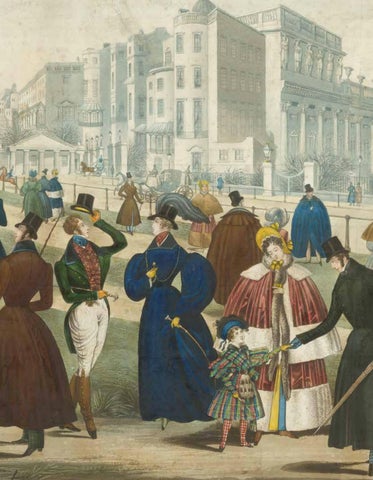
Create a flipbook
Issuu converts static files into: digital portfolios, online yearbooks, online catalogs, digital photo albums and more. Sign up and create your flipbook.