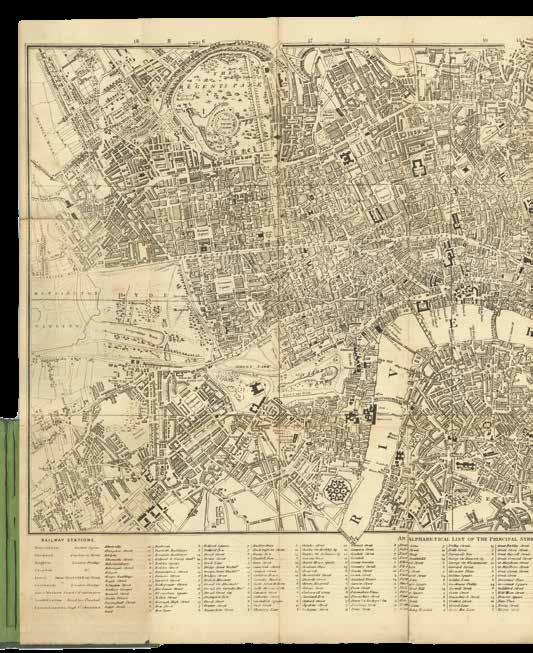
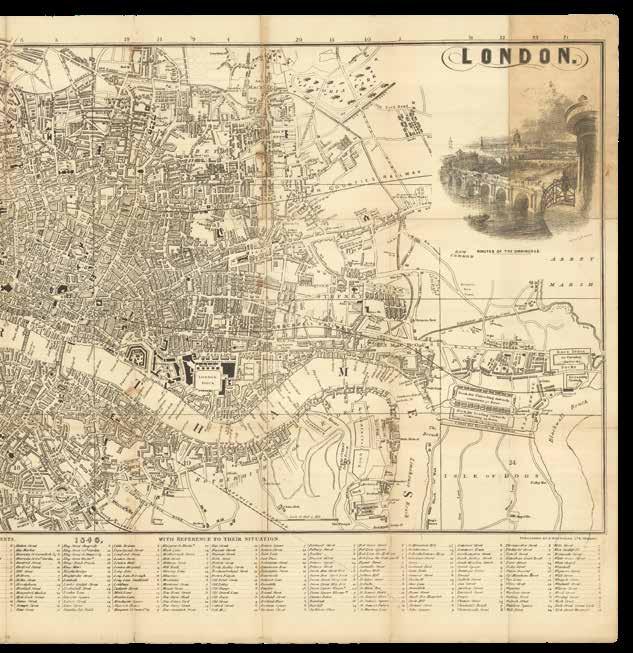
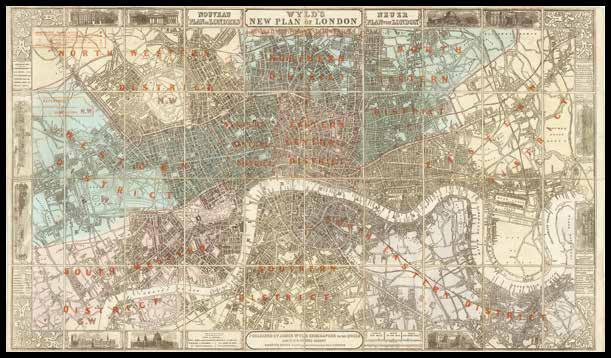
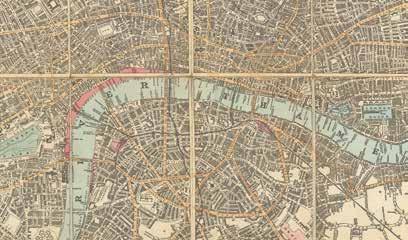
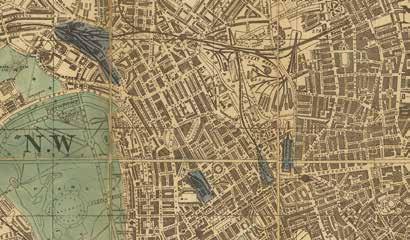
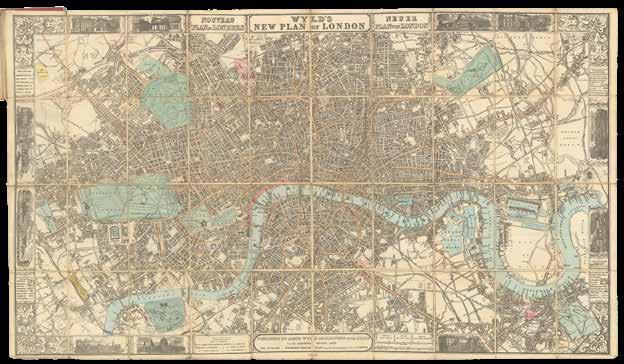
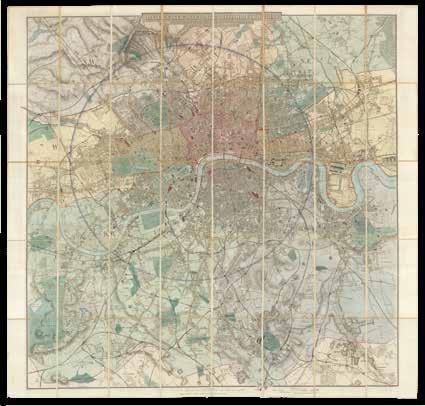
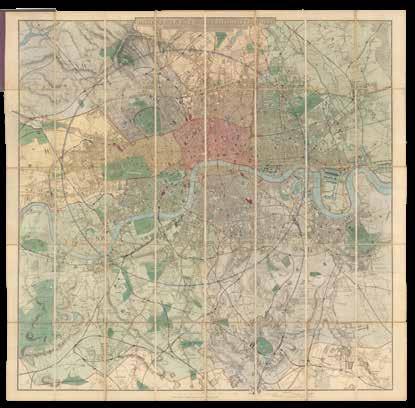
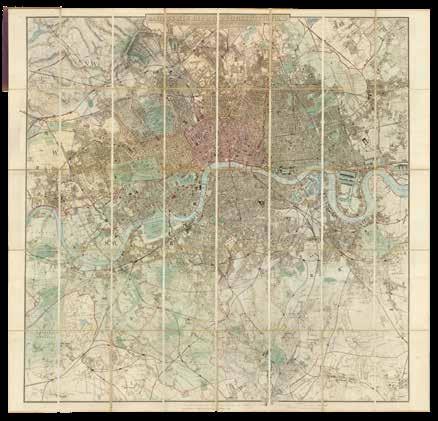
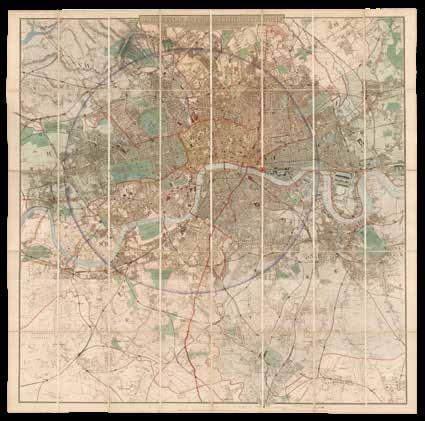
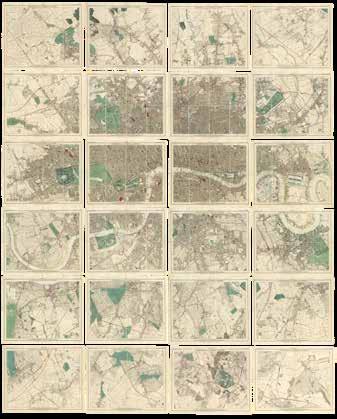
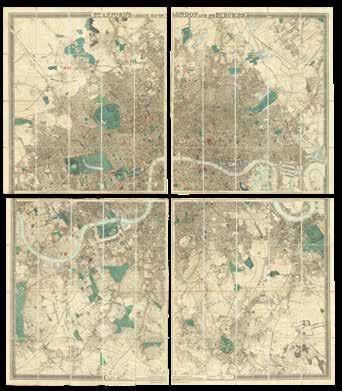
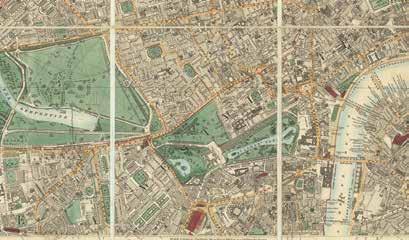
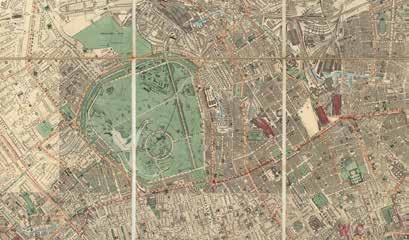
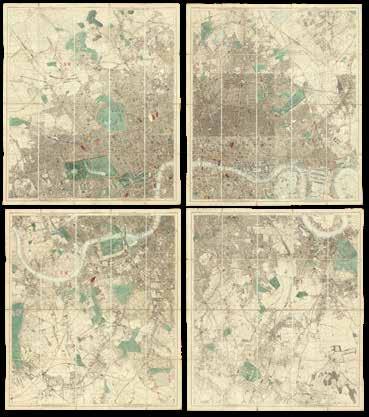
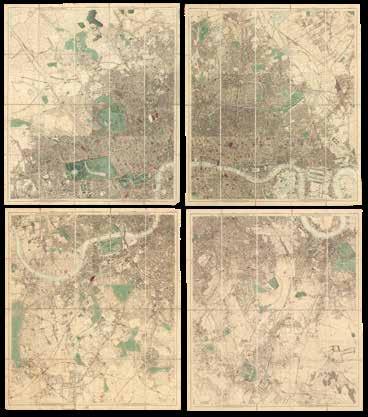
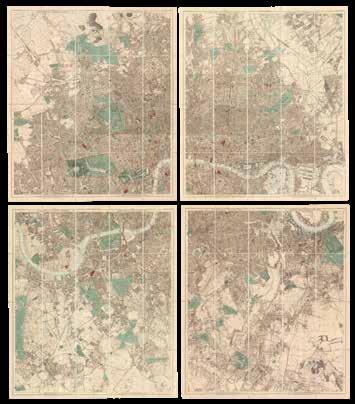
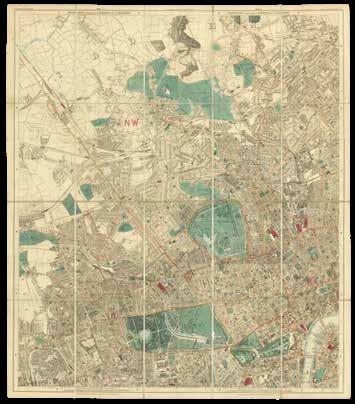
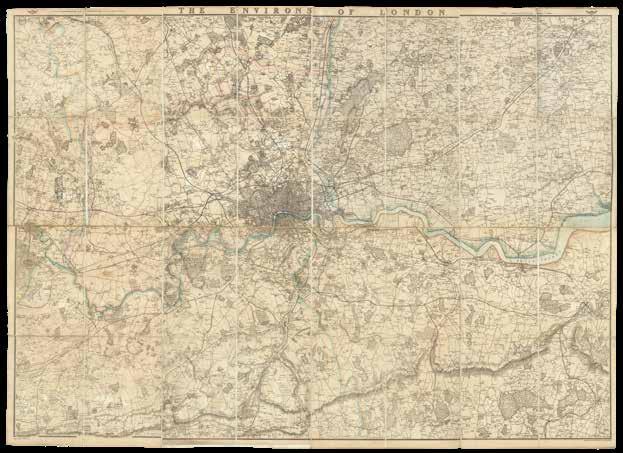
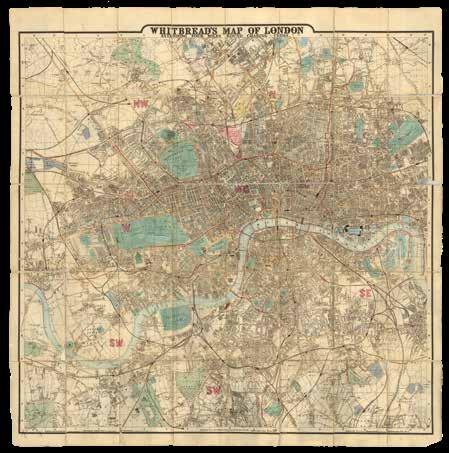
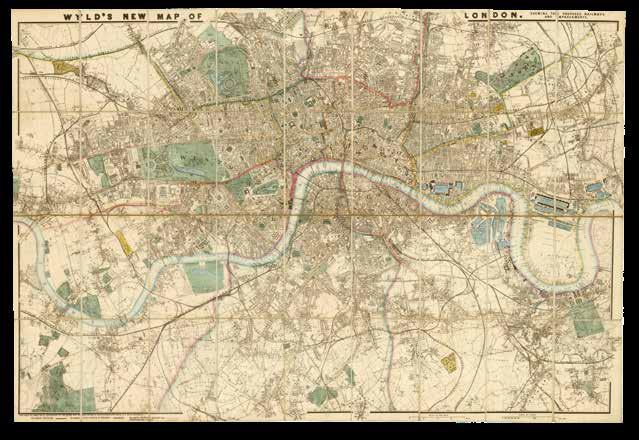
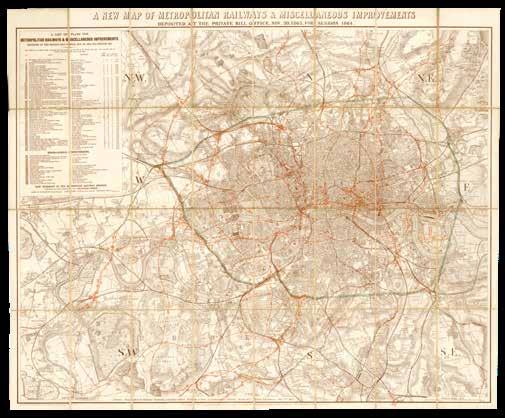
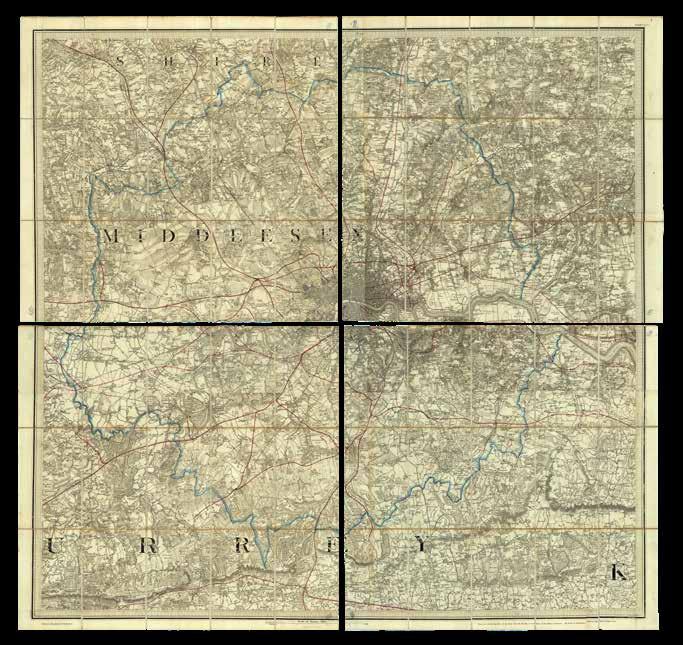
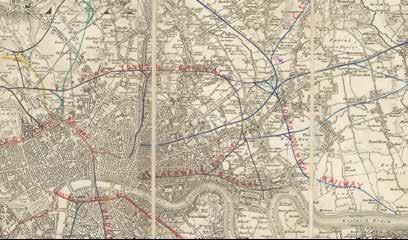
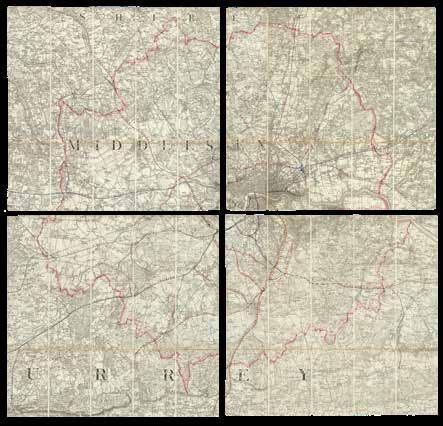
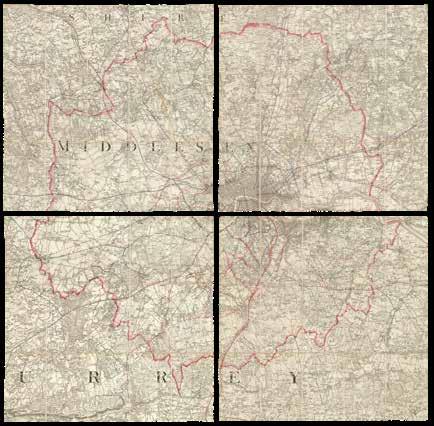
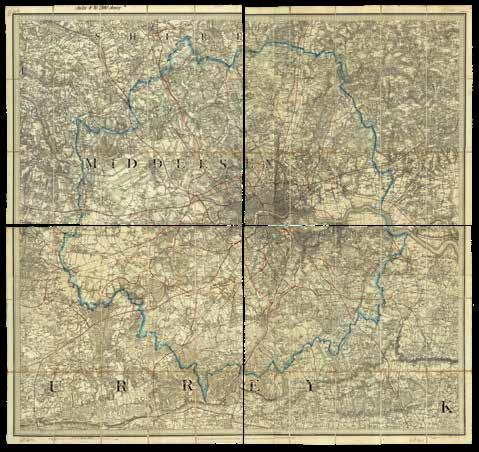
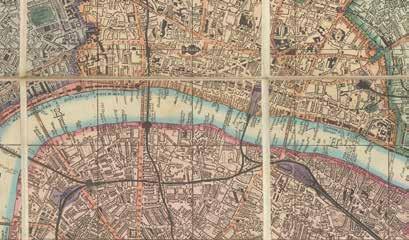
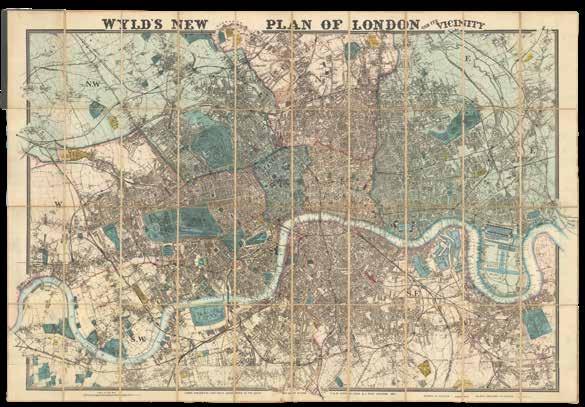
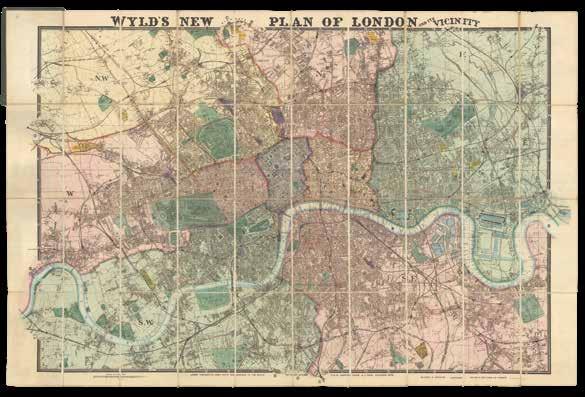
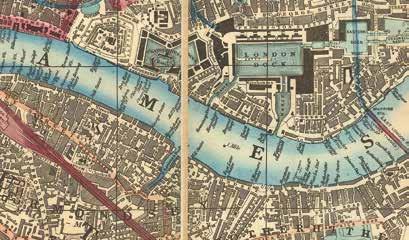
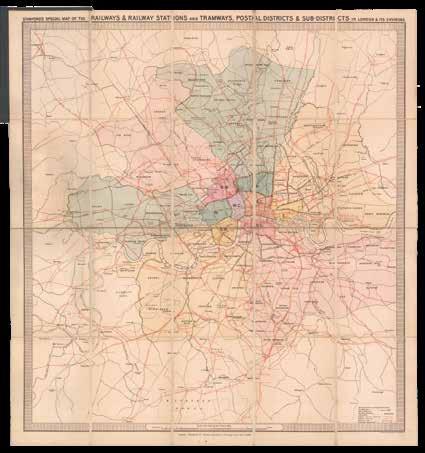
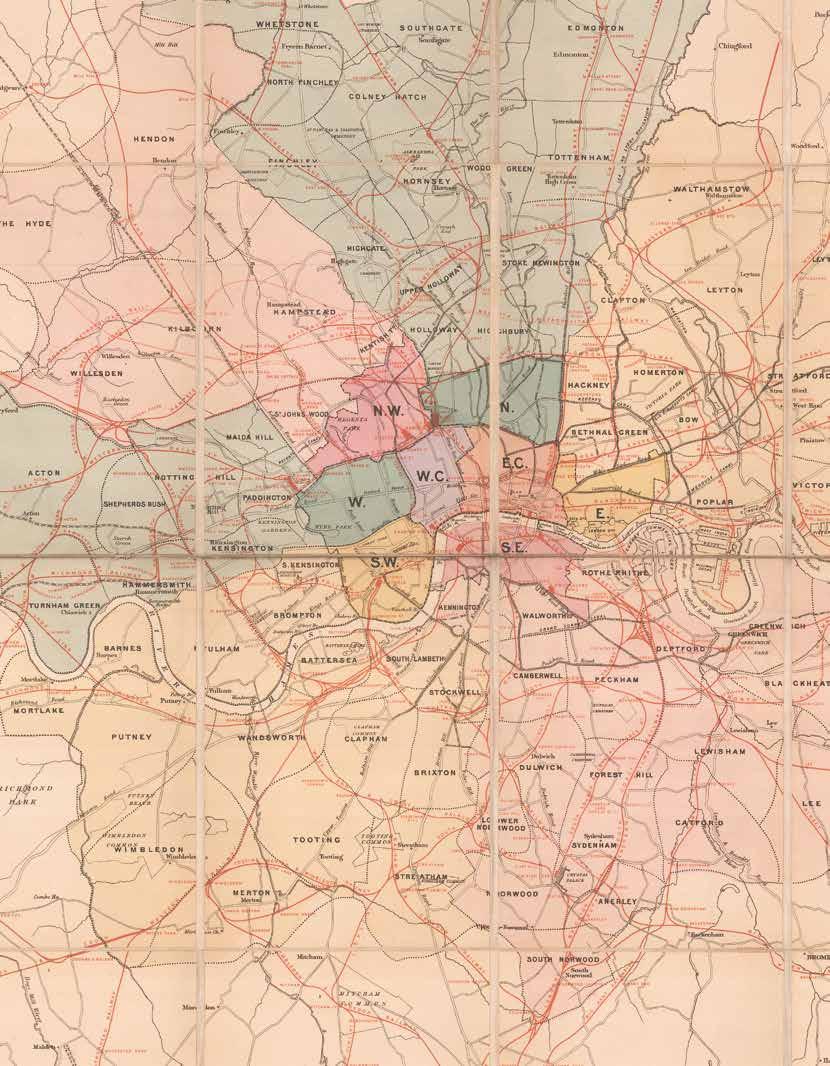
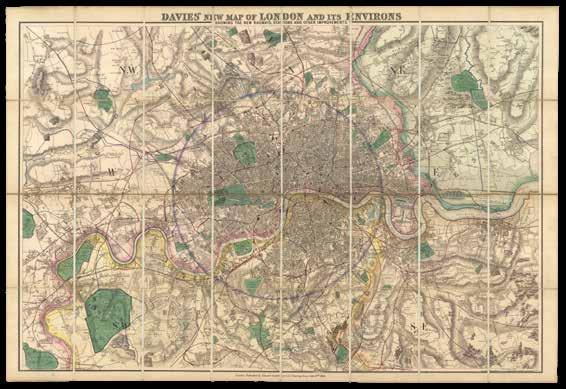
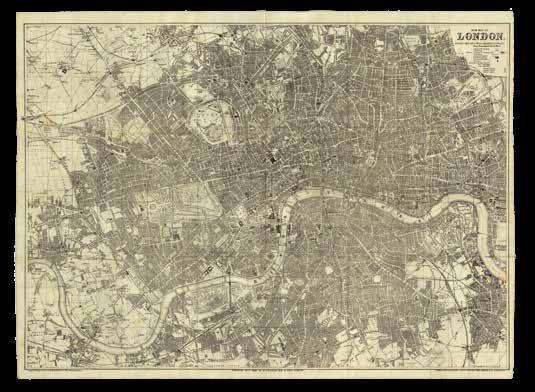
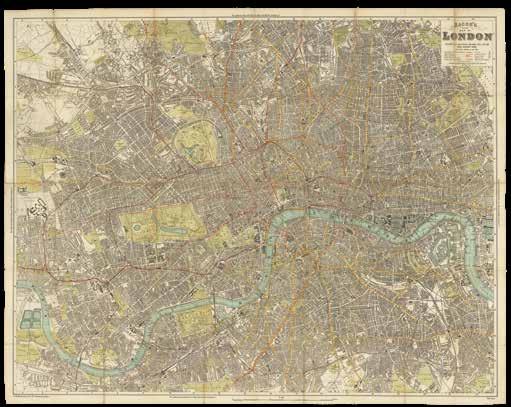
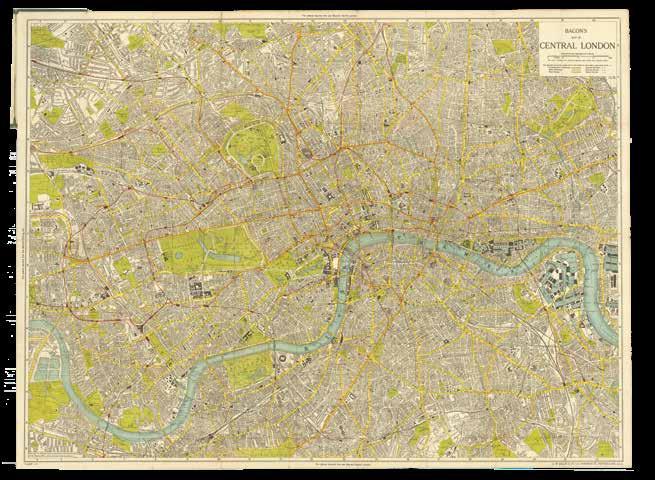
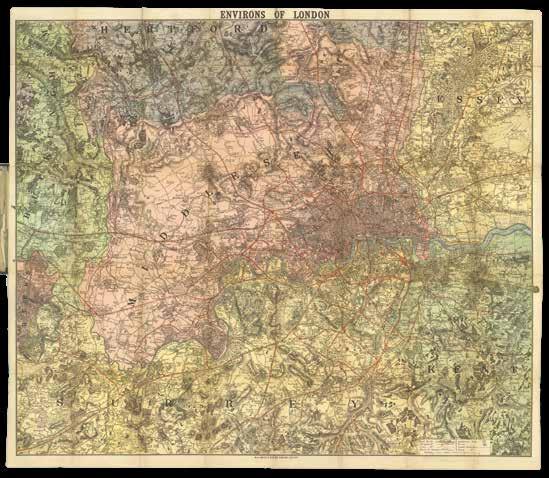
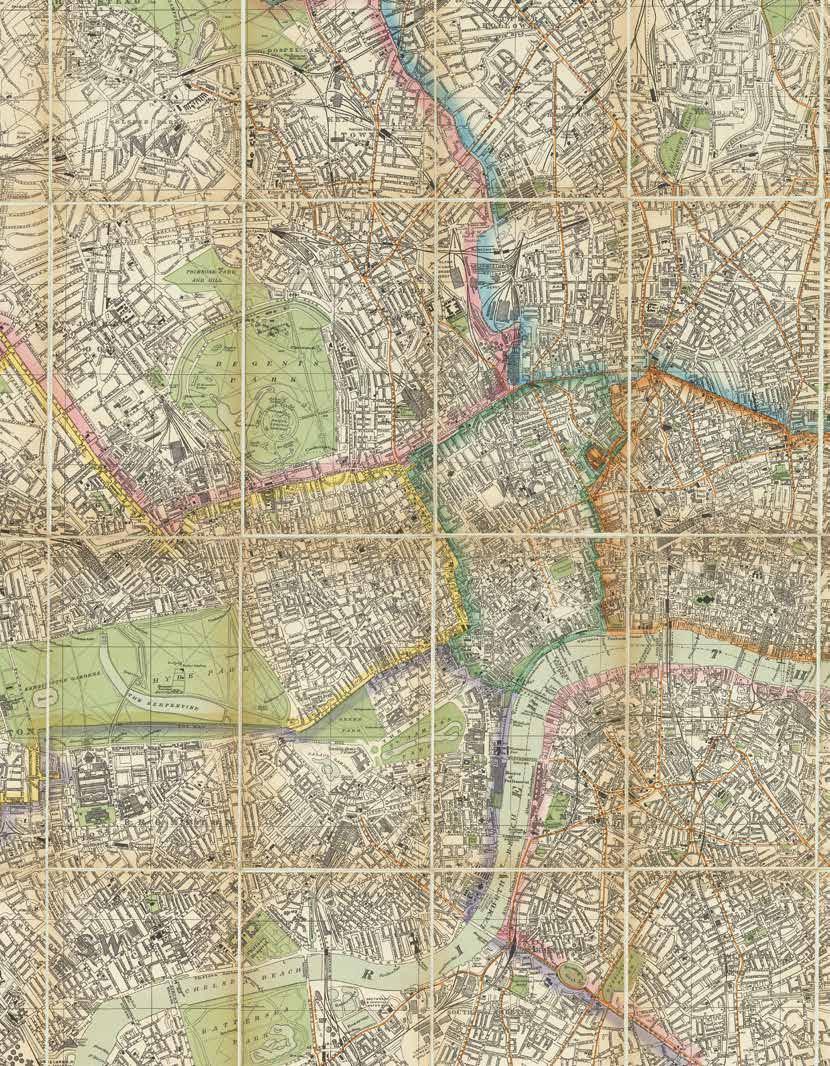
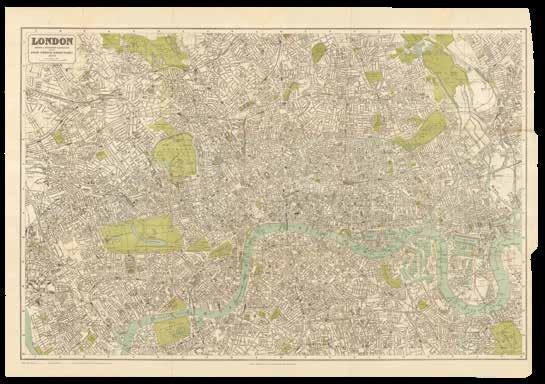
Catalogue edited by Arnie Anonuevo, Daniel Crouch,Rose Grossel, Kate Hunter, Ellida Minelli, Théophile De-Proyart, Mia Rocquemore, Dawlat Simko and Nick Trimming
Design by Ivone Chao and Nicky Valsamakis
Photography by Louie Fasciolo and Marco Maschiao
Cover: item 1005
Terms and conditions: The condition of all books has been described. Each item may be assumed to be in good condition, unless otherwise stated. Dimensions are given height by width. All prices are net and do not include postage and packing. Invoices will be rendered in £ sterling. The title of goods does not pass to the purchaser until the invoice is paid in full.
Printed by Park Communications on FSC® certified paper. Park is an EMAS certified company and its Environmental Management System is certified to ISO14001. 100% of the inks used are vegetable oil based, 95% of press chemicals are recycled for further use and, on average 99% of any waste associated with this production will be recycled. This document is printed on Galerie Matt made of material from wellmanaged, FSC®-certified forests and other controlled sources. The pulp used in this product is bleached without the use of chlorine (ECF).
London: The Roger Cline Collection (Maps II)
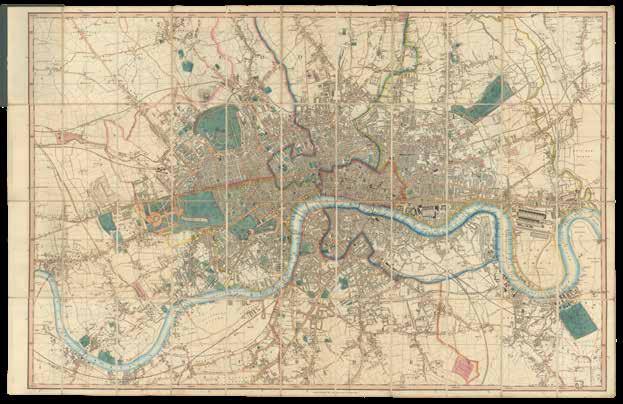
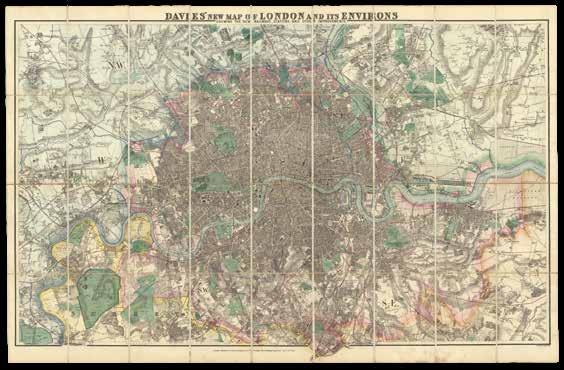
DAVIES, Benjamin Rees
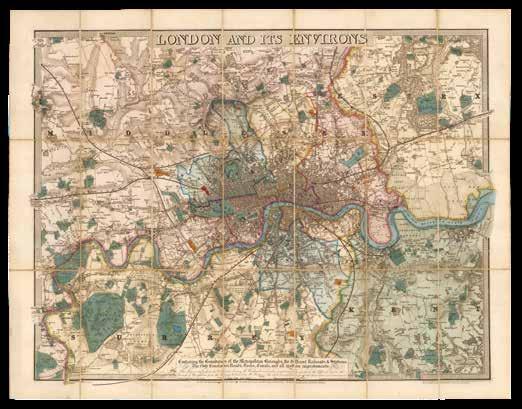
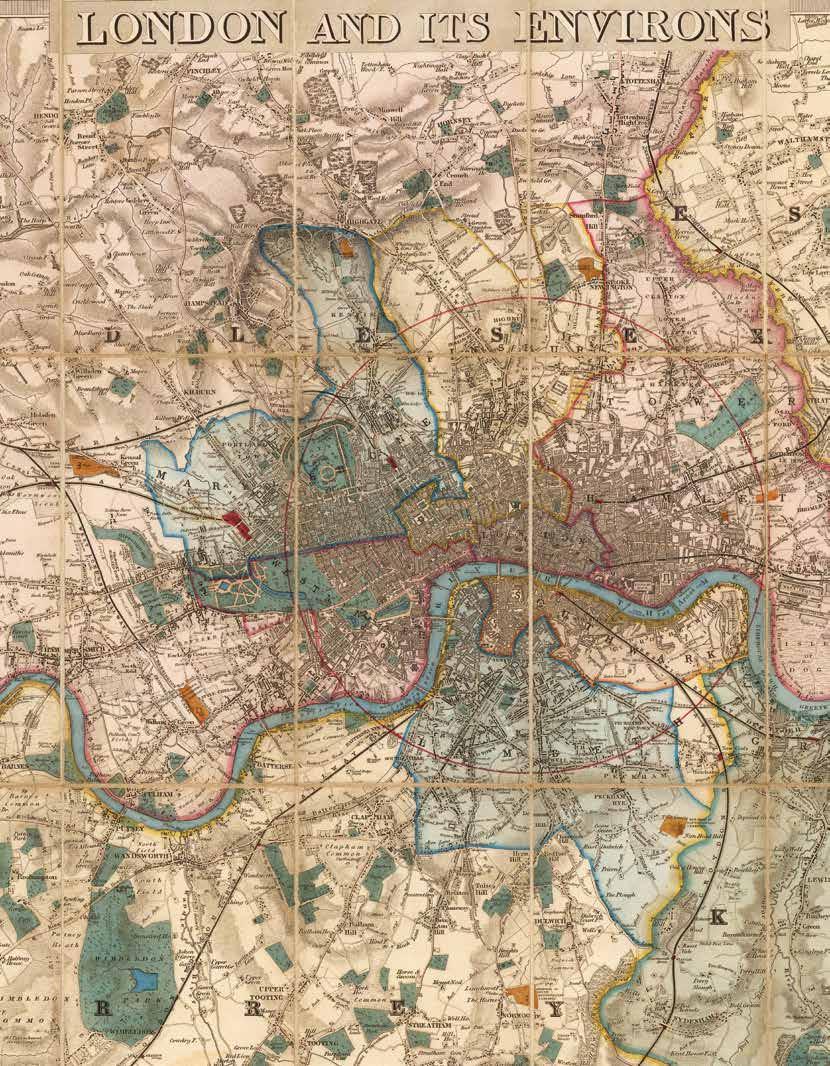
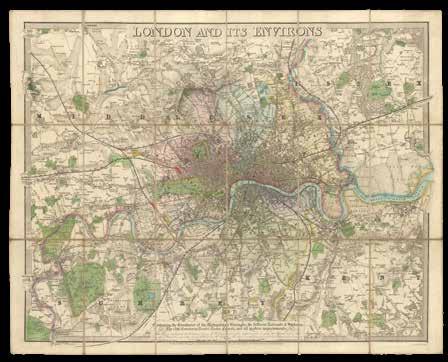
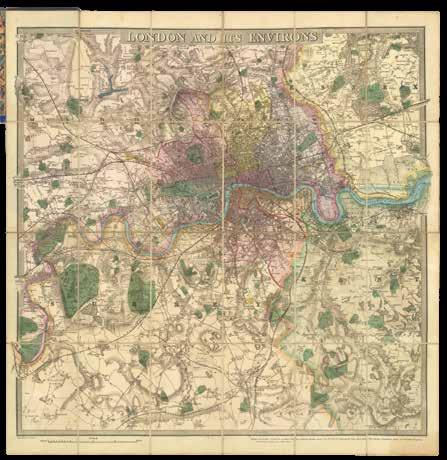
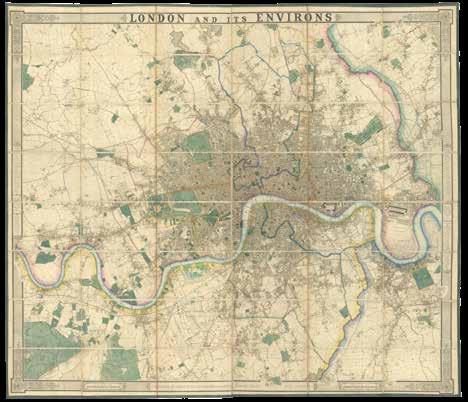
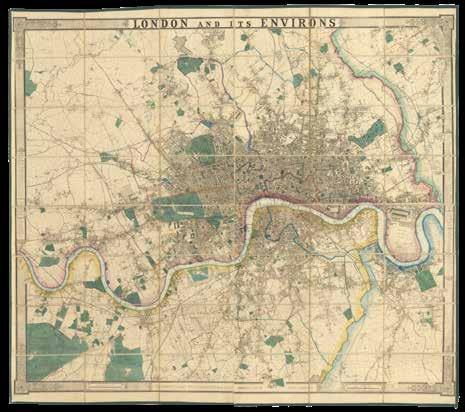
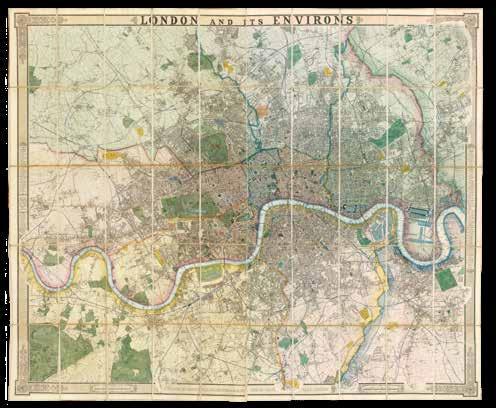
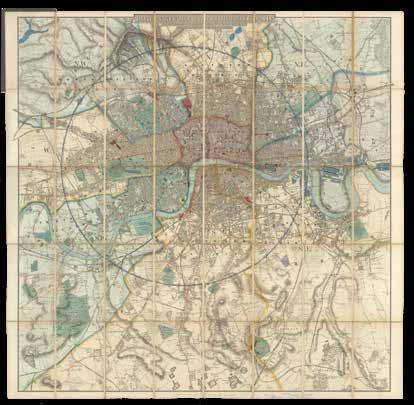
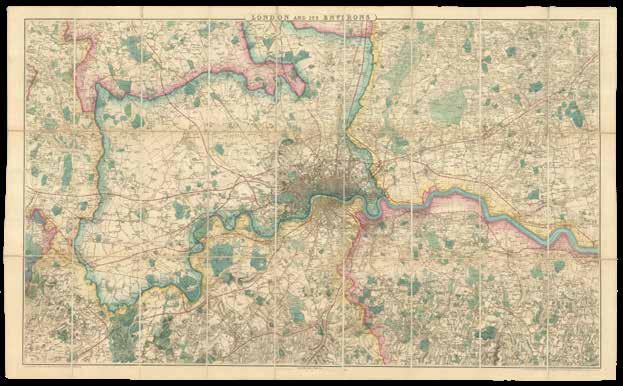
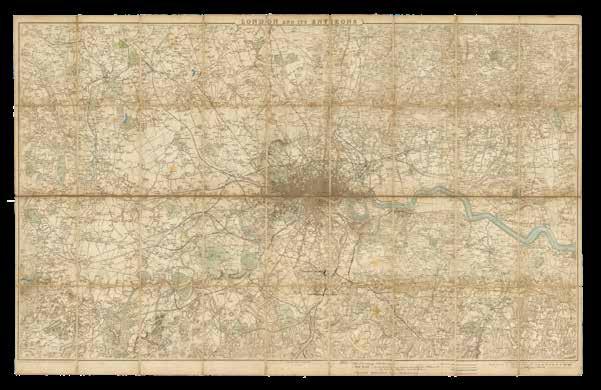
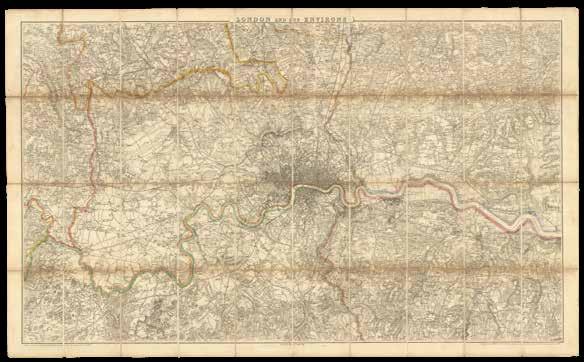
London and its Environs Containing the Boundaries of the Metropolitan Boroughs, the different Railroads & Stations, The New Cemeteries, Roads, Docks, Canals ….
Publication London, T.& W. Boone, 1841.
Description
Engraved map, dissected and mounted on linen, folding into dark green cloth boards, spine split and covers nearly detached.
Dimensions 535 by 685mm (21 by 27 inches).
Scale (approx.) 1.4 inches to 1 statute mile.
References Howgego 372 - This state, with Boone’s name in the imprint, not listed.
A Boone to London
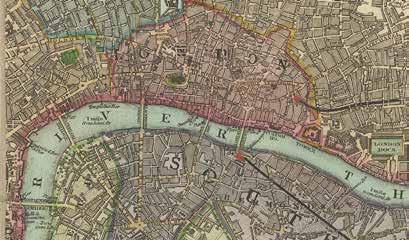
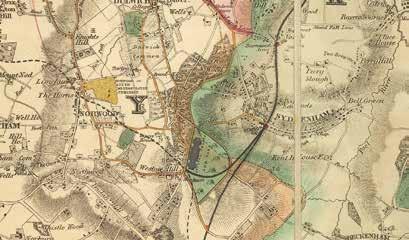
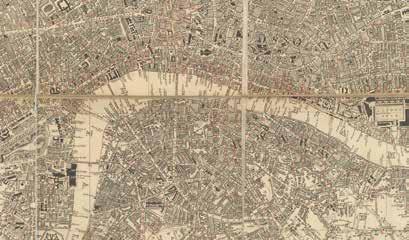
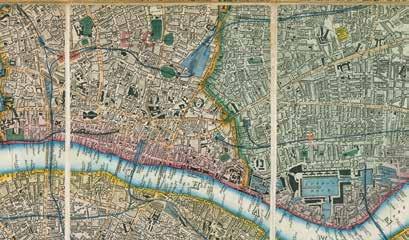
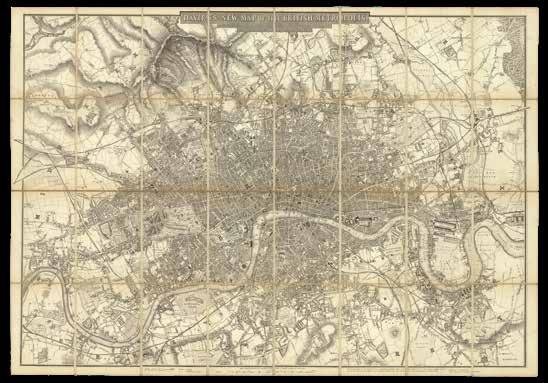
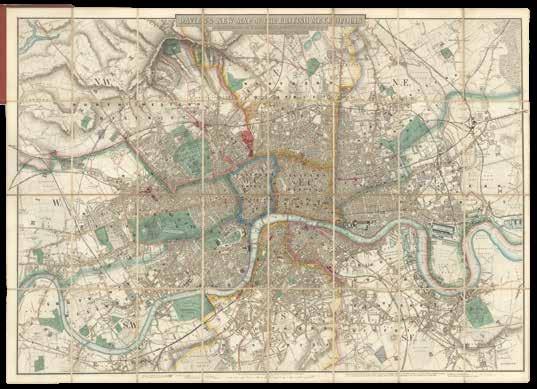
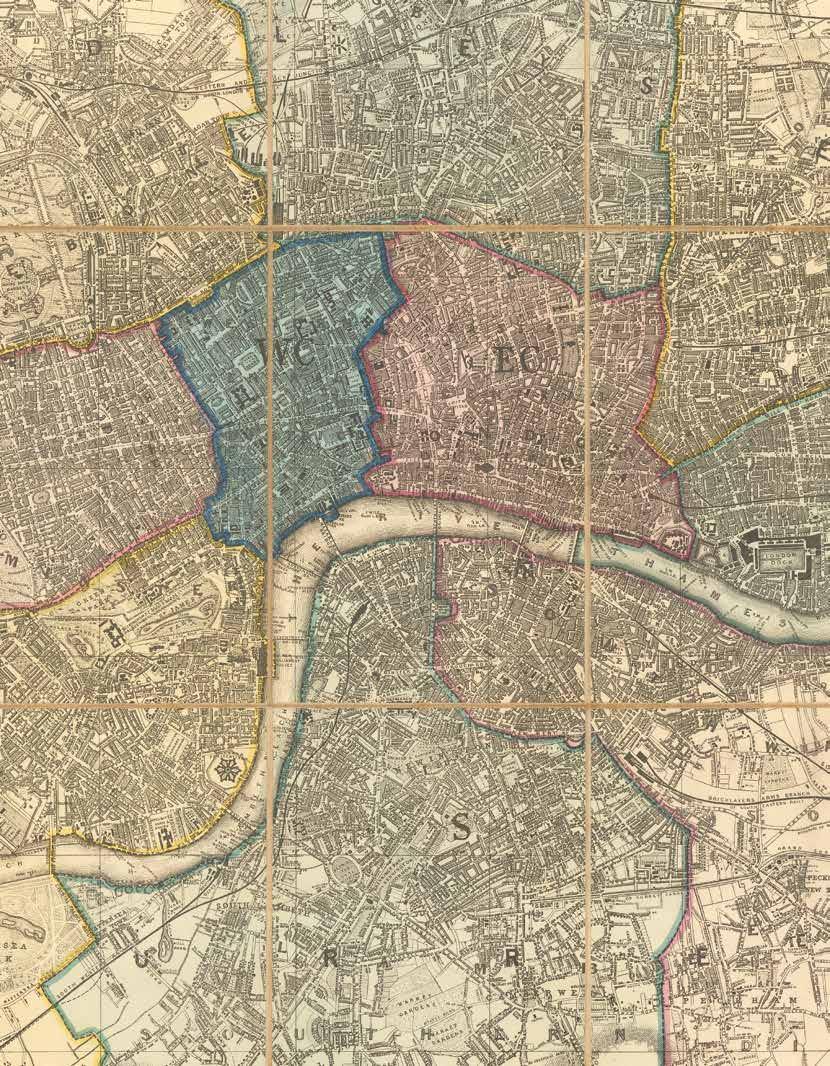
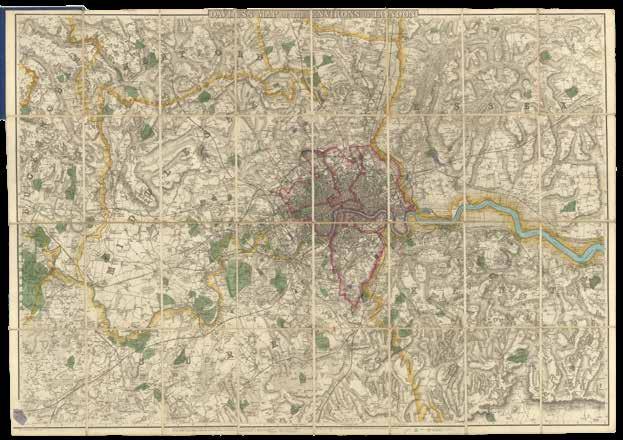
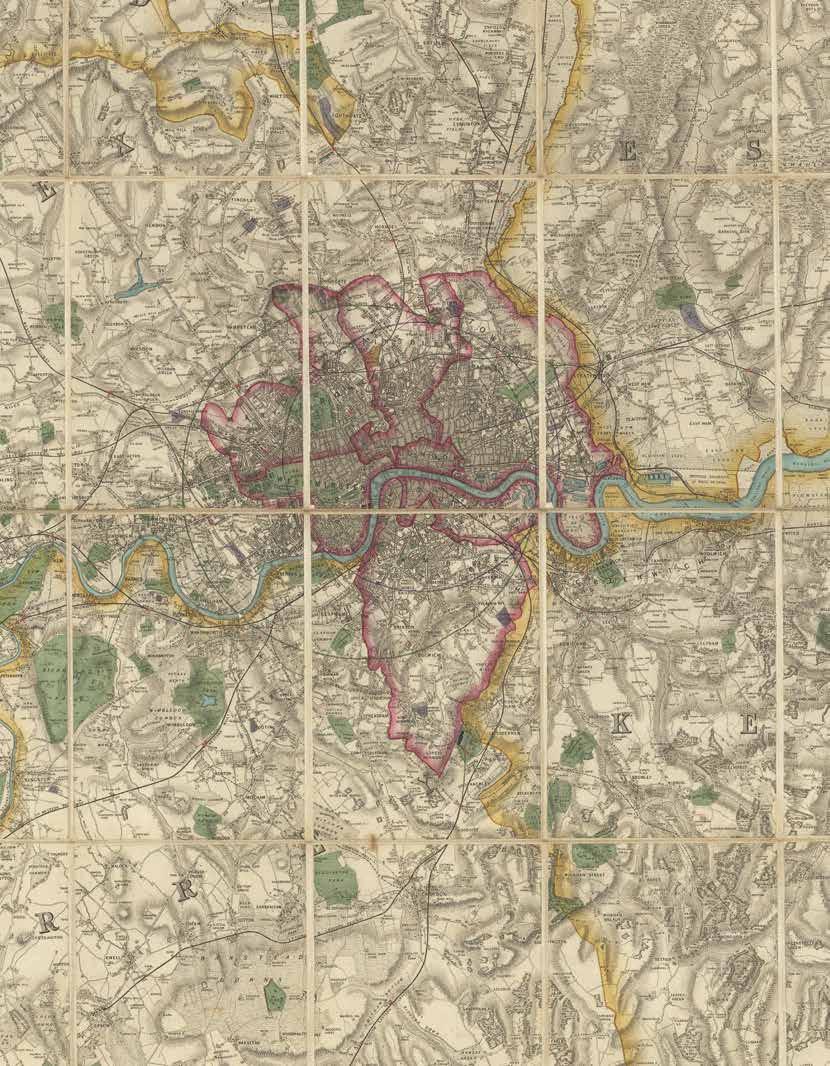
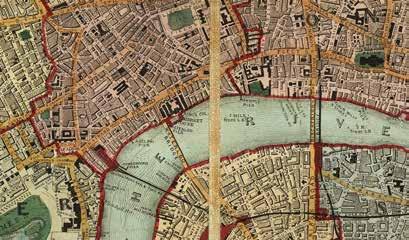
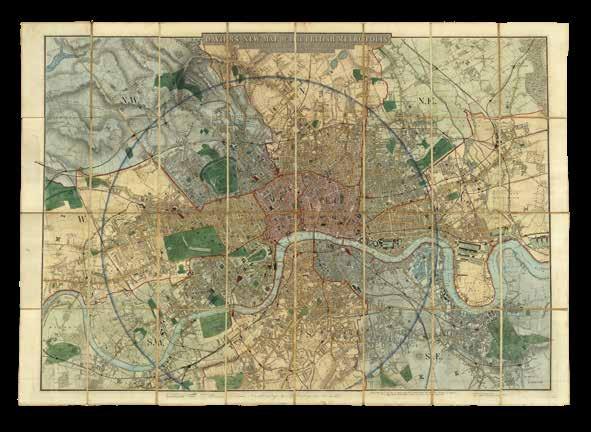
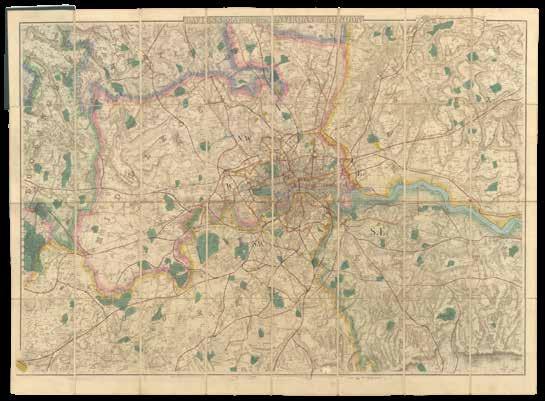
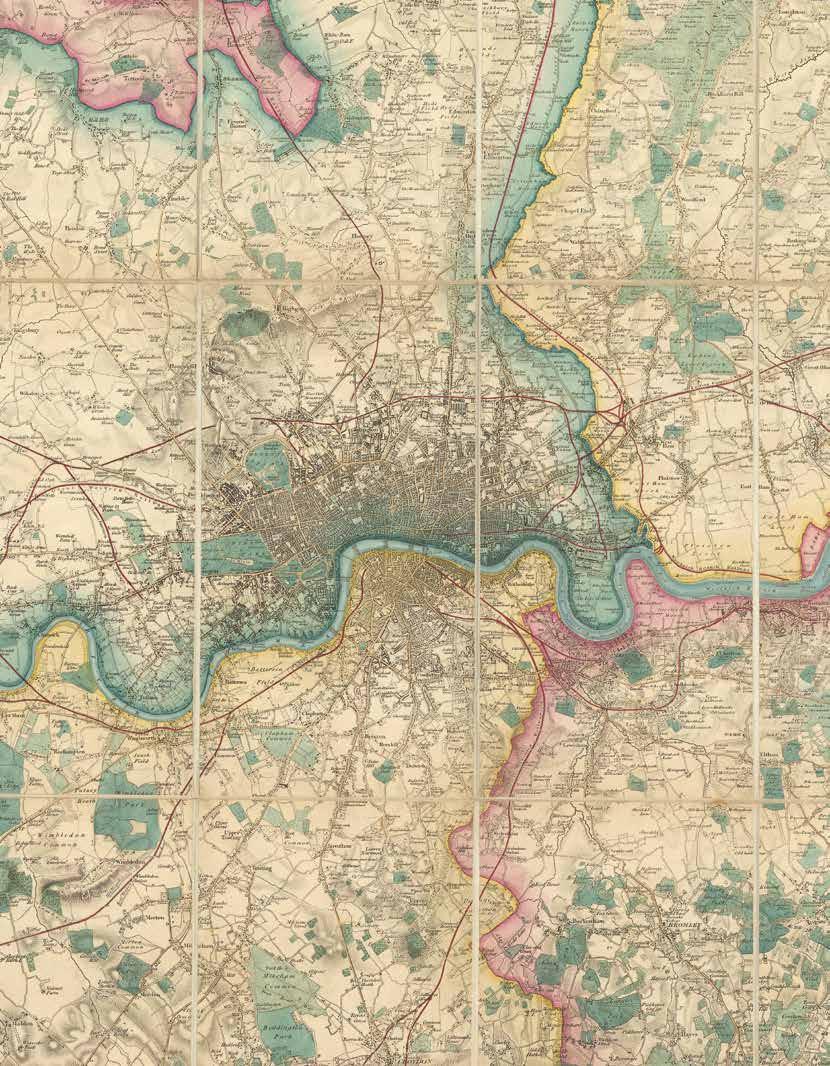
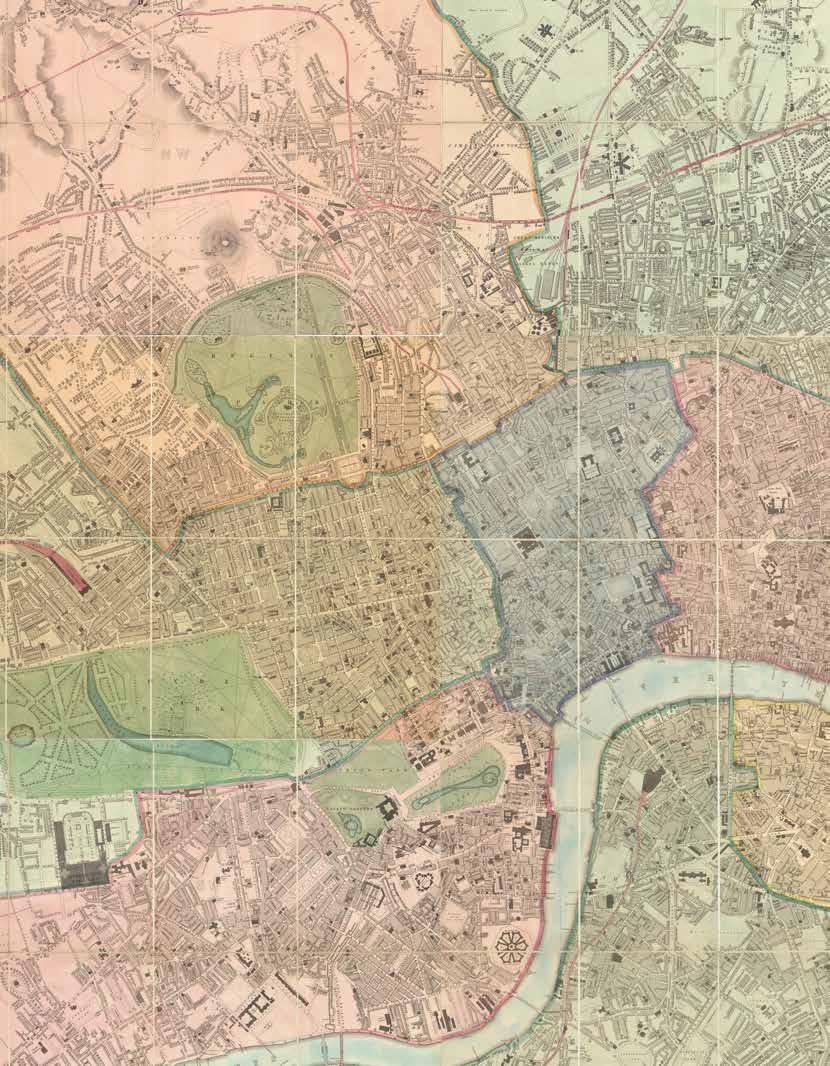
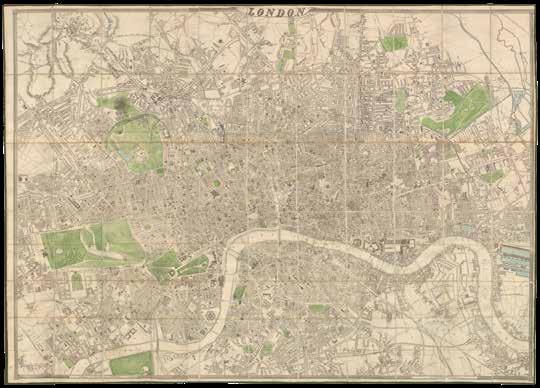
This example of Davies’s map of the environs of London, is finely coloured, and show the boundaries of both the counties, and newly created Metropolitan Boroughs, brought in by the Great Reform Act of 1832. Also marked roads, rivers, forests parks, towns, villages, and railways. Fenchurch Street (open 1841) is marked. Benjamin Rees Davies (1789-1872) was a prolific map and writing engraver, cartographer, publisher and printer, working in central London.
The plan bears the imprint of T. & W. Boone. The brothers William Boone (1790-1873) and Thomas (1795-1870) were in business by 1817. They moved from the Strand to New Bond Street in 1830. They traded as T & W Boone and later as Thomas Boone & Son until 1873. In 1860
their nephew Thomas Boone II replaced William in the firm. Thomas Boone I died in 1870 aged 75 and William in 1873 aged 83. In 1872 the firm was sold to Frederick S Ellis (Ellis & White).
DAVIES, B[enjamin] R[ees]
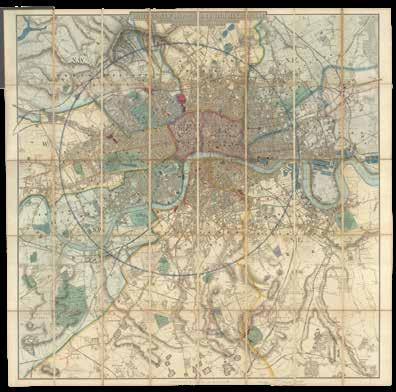
London and its Environs Containing the Boundaries of the Metropolitan Boroughs, the different Railroads & Stations, The New Cemeteries, Roads, Docks, Canals ...
Publication London, B. R. Davies, [c1842].
Description Engraved map, hand-coloured, minor staining, dissected and mounted on linen, folding into grey paper boards, upper board detached.
Dimensions 535 by 685mm (21 by 27 inches).
Scale (approx.) 1.5 inches to 1 statute mile.
References Howgego 372 (2a).
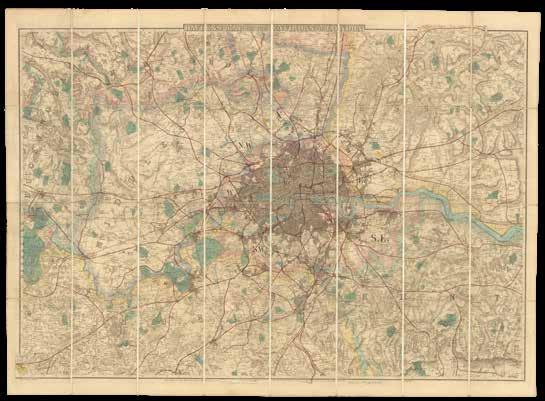
The second state of Davies’s detailed map of the city of London and its extensive suburbs. Fenchurch Street station shown (1841) but not South Eastern Railway (1842).
DAVIES, B[enjamin] R[ees]
London and Its Environs.
Publication
London, Charles F. Cheffins, 1854.
Description Engraved map, hand-coloured, dissected and mounted on linen, folding into blue cloth covers, blind stamped and lettered in gilt.
Dimensions 695 by 695mm (27.25 by 27.25 inches).
Scale (approx.) 1.5 inches to 1 statute mile.
References Howgego 372 (8).
The eighth state of Davies’s detailed map of London, updated to show the Crystal Palace at Sydenham.
JOBBINS, John Richard
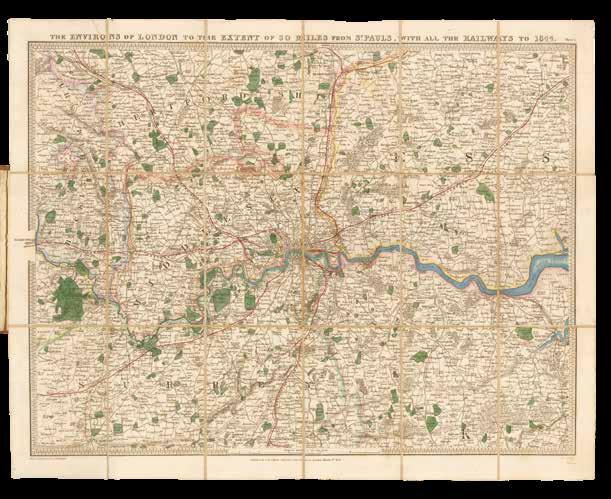
The Environs of London To the extent of 30 miles from St. Paul’s, with all the railways to 1844.
Publication
London, John Richard Jobbins, 1844.
Description
Engraved plan, original hand-colour, minor foxing, dissected and mounted on linen, brown cloth boards, lettered in gilt.
Dimensions
355 by 470mm (14 by 18.5 inches).
Scale
3 inches to 1 statute mile.
References Howgego 372a (3).
Get the Jobbins Done
Detailed map of the countryside 30 miles from St Paul’s. As well as the usual features, such as roads, rivers, towns, villages, forests, and county boundaries, all clearly marked. The map pays particular attention to the railways, which are highlighted in red. Bricklayers Arms station in Southwark, opened in 1844, is clearly marked.
John Richard Jobbins (1798-1866) surveyor, mapmaker, engraver, publisher, draughtsman, and lithographer, worked in Holborn. He was briefly in partnership with Charles Frederick Cheffins, as “Jobbins & Cheffins” (1834-1836), whose sister Jane he had married in 1831.
WYLD, James
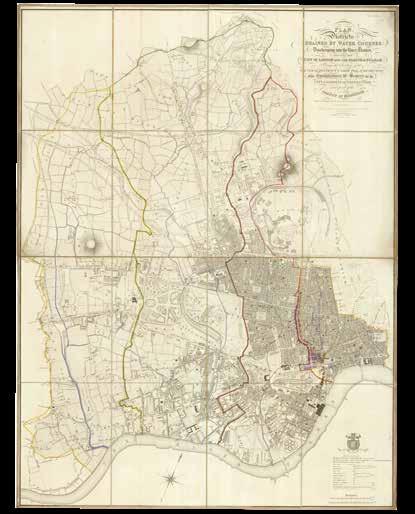
Plan of the Districts Drained by Water Courses, Disbarging intio the River Thames, between the City of London and the Parish of Fulham Being that portion of the General District Under the Jurisdiction of the Commissioners of Sewers of the City & Liberty of Westminster, and the part of the county of Middlesex.
Publication London, James Wyld, 1840.
Description
Engraved plan, dissected and mounted on linen, French bookseller’s label to verso.
Dimensions 1300 by 970mm. (51.25 by 38.25 inches).
Detailed plan of the sewer system covering west London, stretching north to south from Hampstead to the Royal Hospital Chelsea, and west to east from Kensington to Lincoln’s Inn. A key to the bottom right of the plan lists open watercourses, main Sewers, and collateral sewers, all marked in blue to the plan. Each district is delineated in different colours and marked in the key.
Although the Commissioners of Sewers for London Westminster had been around since 1596, it was not until 1807 that their area of jurisdiction was defined by statute; it then included all parishes within what is now the County of London west of the City and north of the Thames as far as Stamford Brook, with part of Willesden. The same statute gave the Commissioners power to control the construction of new sewers. The commission would later be absorbed by the Metropolitan Commission of Sewers, in 1849.
LEWIS, S[amuel]
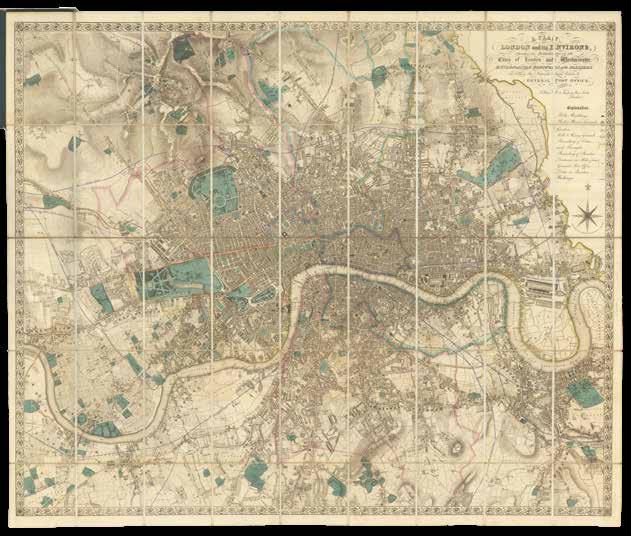
A Plan of London and its Environs shewing the Boundaries of the Cities of London and Westminster, Metropolitan Boroughs and Parishes and Distances in Miles & Quarters of the principal Roads from the General Post Office.
Publication London, S. Lewis, [c1840].
Description Engraved plan, hand-coloured, dissected and mounted on linen, folding into blue marbled paper endpapers.
Dimensions 960 by 1140mm (37.75 by 45 inches).
Scale (approx.) 4 inches to 1 statute mile.
References Howgego 373a (2) ; Darlington 421.
A Dower Map
This map was published by Samuel Lewis (1782-1865), who is best remembered for his ‘Topographical Dictionaries’ of Great Britain. For the present map Lewis employed the engraver John Crane Dower (c1791-1847), who was responsible for engraving several of Greenwood’s large-scale county maps. Dower’s clarity of line so evident in his work for Greenwood is evident here. A key below the title provides information on public buildings, parks, gardens, elevation, city, parish, and borough boundaries, miles from the General Post Office and railways.
WYLD, James
Wyld’s Plan of the City of London.
Publication London, James Wyld, [c1840].
Description
Engraved plan, hand-coloured, dissected and mounted on linen, edged in green silk, folding into blue marbled paper endpapers.
Dimensions 635 by 1320mm (25 by 52 inches).
Scale (approx.) 12.75 inches to 1 statute mile.
References Howgego 374 (1).
Go Wyld in the City
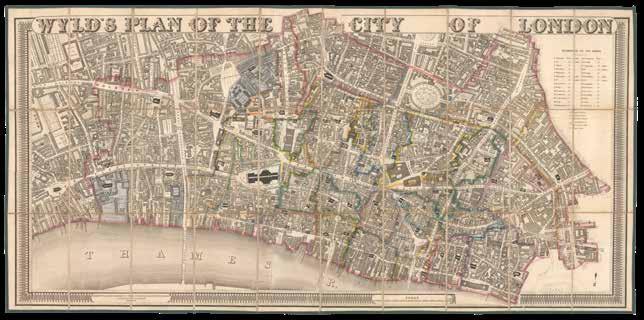
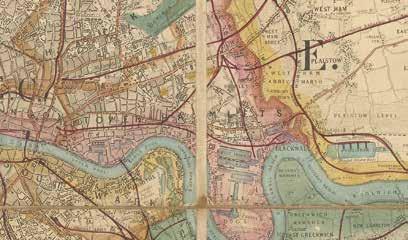
Wyld’s large-scale detailed plan of the City spans Central London from Barbican in the north to Lower Thames Street in the south and from St. Clement Dane’s Church (Strand) in the west to Aldgate in the east. It was based on a map by Richard Horwood, whose plates Wyld had inherited from William Faden, and which he updated with more recent developments, such as the Blackwall railway (1840).
WYLD, James
Wyld’s Plan of the City of London.
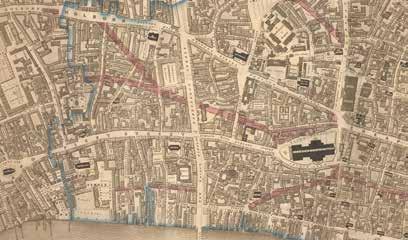
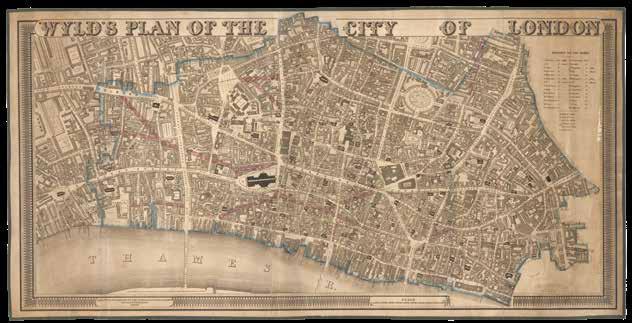
This edition of Wyld’s map shows proposed new streets marked in red: west end of St Paul’s to Faringdon Street, then to Great New Street and Holborn; Aldergate Street to Smithfield; and Mansion House via the east end of St Paul’s to Blackfriars. Although not all the proposed roads were constructed, both the extension to Cannon Street, and the Queen Victoria Street from the west of Bank, would be built in the 1860s. 739
Publication London, James Wyld, 1842.
Description
Engraved plan, hand-coloured, on two sheets, mounted on linen, edged in green silk.
Dimensions 635 by 1320mm (25 by 52 inches).
Scale (approx.) 12.75 inches to 1 statute mile.
References Howgego 374 (2).
BAUERKELLER, G.
Bauerkeller’s New Embossed Plan of London.
Publication London, Ackermann & Co, 1841.
Description Embossed plan, printed in colours, dissected and mounted on linen, folding into brown self-covers.
Dimensions 690 by 1150mm (27.25 by 45.25 inches).
Scale
6 inches to 1 statute mile.
References Howgego 377 (1).
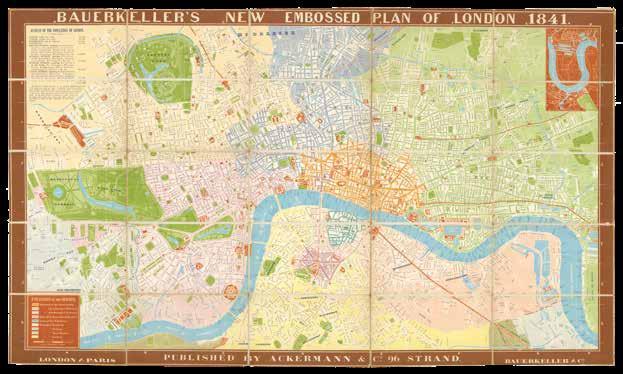
This extraordinary embossed plan shows each locality in a different colour and built up areas raised in white, similar to the technique of Braille. Extending from Islington in the north to Kennington in the south and from Kensington High Street in the west to the West India Docks, with an inset of Greenwich at a smaller scale. A unique style of cartography in very good condition.
In an advertisement in the ‘Sporting Magazine Advertiser’ Ackermann announces its publication: ‘... The Buildings are raised, and, with the Railroads, Parks, Squares, &c. apper very prominent. The Parishes are also distinguished in delicate tints., and the entire arrangement is so remarkably conspicuous that, whether for the Visitor or the Office, its utility will be generally acknowledged” (Howgego).
A table to the upper left of the plan records a population of just over 1.5 million in 1841, with 122,000 residing in the City of London. The number of houses is estimated to be above 197,000; there are over 80 squares and some 10,000 streets.
FROGGETT, J[ohn] W[alter]
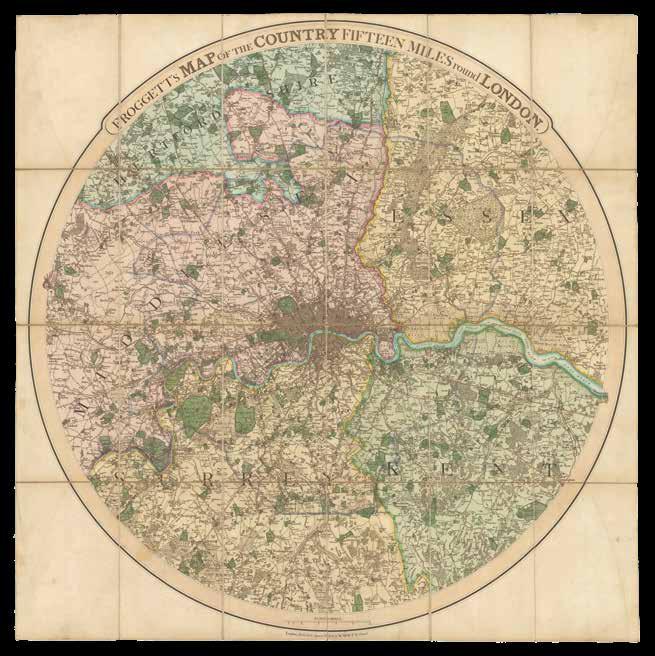
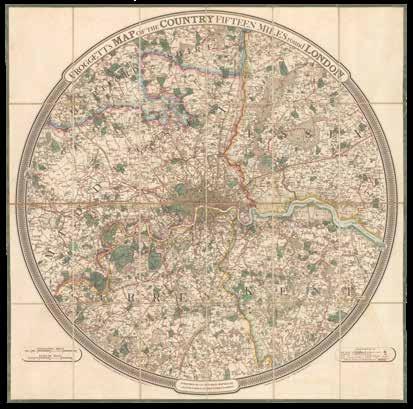
Froggett’s Map of the Country Fifteen Miles round London.
Publication London, W. New, 1833.
Description Engraved map, hand-coloured, some foxing, dissected and mounted on linen, folding into brown cloth slip case, with publisher’s label.
Dimensions 905 by 905mm (35.75 by 35.75 inches).
Scale 1 inch to 1 statute mile.
References Howgego 382 - This state not listed and pre-dates those that are.
A Circular Froggett
John Walter Froggett (1784?-1850) was an engraver, publisher and writing engraver for the Ordnance Survey. This circular map of London and the country 15 miles around, extending from Broxbourne to Caterham and from Greenhithe to Uxbridge. The proposed London & Birmingham Railway and the London & Greenwich Railway, both of which would be completed by 1838.
FROGGETT, J[ohn] W[alter]
Froggett’s Map of the Country Fifteen Miles round London.
Publication London, G. F. Cruchley, [c1844].
Description Engraved map, hand-coloured, dissected and mounted on linen, some damp staining to verso, fold into brown cloth slipcase, with publisher’s label.
Dimensions 925 by 931mm (36.5 by 36.75 inches).
Scale 1 inch to 1 statute mile.
References Howgego 382 - This state not listed.
An unrecorded state of Forgett’s map extending 15 miles around the capital. The present edition, published in the mid-1840s, has been updated with new details such as the West London Railway (1846) and the railway to the Bricklayers Arms (1844). It does not show the Hungerford Suspension Bridge (1845), however, indicating a possible date of 1844. It also has the addition of population statistics printed alongside every major settlement.
FROGGETT, J[ohn] W[alter]
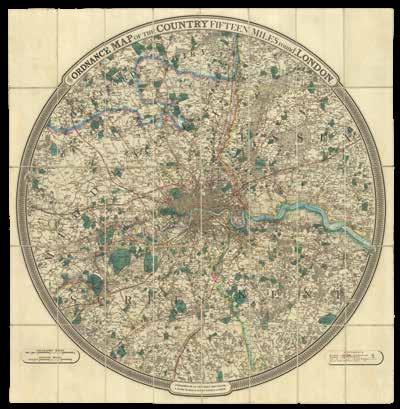
From the Ordnance Map of the Country Fifteen Miles round London.
Publication London, G. F. Cruchley, 1853.
Description Engraved map, hand-coloured in outline, dissected and mounted on linen, folding into, brown cloth slipcase, with publisher’s label.
Dimensions 930 by 906mm (36.5 by 35.75 inches).
Scale 1 inch to 1 statute mile.
References Hyde D&H 382 (1).
Map shows several recent developments in the capital, such as the Crystal Palace at Sydenham (opened 1854), and King’s Cross Station (1852). Furthermore, the North & South Western Railway extends from Willesdden to Kew (1853).
DAVIES B[enjamin] R[ees]
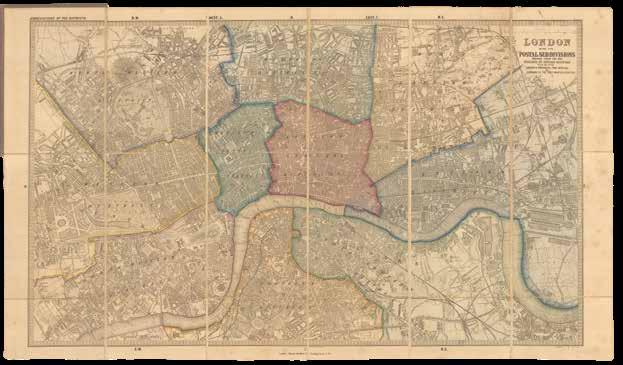
London with its postal subdivisions. Reduced from the map prepared by Edward Stanford for use in the London & Provincial Post Offices by Command of the Post Master General.
Publication London, Edward Stanford, 1856.
Description Engraved map, hand-coloured, dissected and mounted on linen, folding into purple cloth boards, with publisher’s label.
Dimensions 405 by 695mm (16 by 27.25 inches).
Scale 3.25 inches to 1 statute mile.
References Hyde D&H 385 (4).
Stanford’s Useful Knowledge
Edward Stanford (1827-1904) was a highly successful publisher, known for his accurate maps of London. He began his career working for Trelawny Saunders, an enterprising mapmaker who supplied a daily weather chart for the Great Exhibition. Stanford started his own business in 1853, was elected a fellow of the Royal Geographical Society the following year and set about expanding the cartographical aspect of the firm. Stanford’s great rival was James Wyld, with both publishers producing numerous maps of the capital over the course of their careers. The present map, extending from Dalston to Kennington, and from Kensington to Poplar, was first issued by Benjamin Rees Davies for the Society for the Diffusion of Useful Knowledge, by 1856 the work was being published by Edward Stanford who has updated it to displays the postal districts that had recently been introduced. It is also accompanied by a 32-page street index.
DAVIES B[enjamin] R[ees]
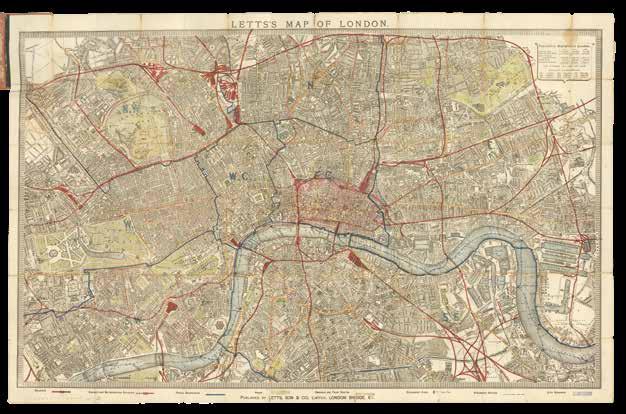
Letts’s Map of London.
Publication London, Letts, Son & Co., [c1884].
Description
Engraved plan, hand-coloured, dissected and mounted on linen, folding into red cloth covers, gilt.
Dimensions
395 by 650mm (15.5 by 25.5 inches).
Scale 3.25 inches to 1 statute mile.
References Hyde D&H 385 (20).
John Letts (1772-1851), the founding father of the Letts of London, and the eponymous diary, seems to have taken on the premises of James Asperne (1757-1820), bookseller and publisher of the ‘The European Magazine’ upon his death.
Letts had served an apprenticeship as a bookbinder, before setting up in business as a stationer in the City of London in 1796. From the Royal Exchange his clientele included merchants and traders in the City. One of the chief requirements of the latter, apart from the regular recording of financial transactions, was a need to know about the movements of ships to and from the Port of London. This they obtained from a diary in which prominence was given to the working week, with a cash ruling through the diary section and tide tables in the opening pages. Lett’s had acquired the S.D.U.K. plates for the map from Stanford in 1876. It featured as a map in several atlases and also in a guide book.
The extensive railway network is now highlighted in red including the stations.
DAVIES
B[enjamin] R[ees]
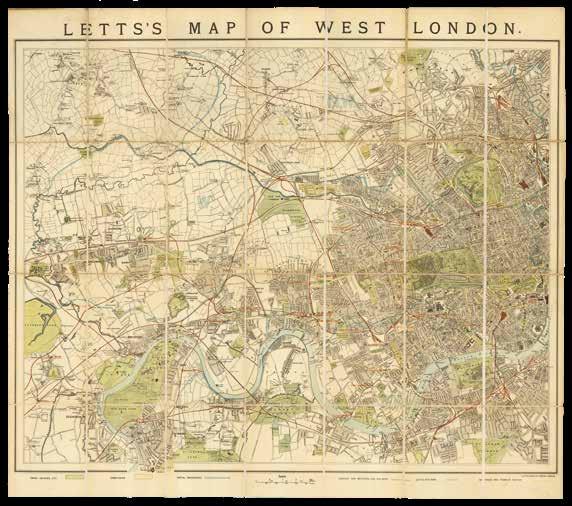
Lett’s Map of West London.
Publication London, Letts, Son & Co., [c1890].
Description
Engraved plan, printed in colours, dissected and mounted on linen, with 37pp guide, all housed in green cloth covers, with publisher’s label, rubbed.
Dimensions 610 by 770mm (24 by 30.25 inches).
Scale
3 inches to 1 statute mile.
References Hyde D&H 385 (22).
The plan now appears in ‘Lett’s popular atlas’ published in 1899, the map is now separated into west, and east London.
MOGG, Edward
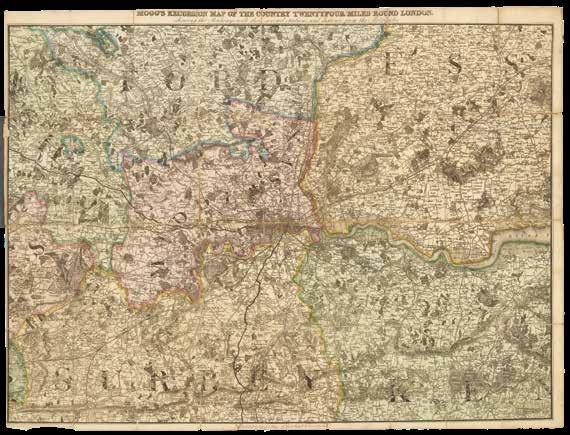
Mogg’s Excursion Map of the Country Twenty Four Miles Round London Shewing the Railways with their several Stations and distance from the Metropolis.
Publication
London, Edward Mogg, [c1844].
Description
Engraved map, partially hand-coloured, wear to folds and slight soiling, dissected and mounted on linen, grey paper boards, rebacked, with publisher’s green label.
Dimensions 560 by 740mm (22 by 29.25 inches).
Scale 1 inch to 2 statute miles.
References Howgego 386, though possibly later state.
Tours with a Moggy
Edward Mogg’s “excursion map” extends far into the counties that surround London, from Welwyn to Albury, and from Marlow to Canvey. The map, as the title suggests was intended for day trips from London to the surrounding counties. With the rapid expansion of both the railways, and London’s urban middle-class, excursions, and weekends away, had never been easier, or more affordable.
[ANONYMOUS; after Ralph AGAS]
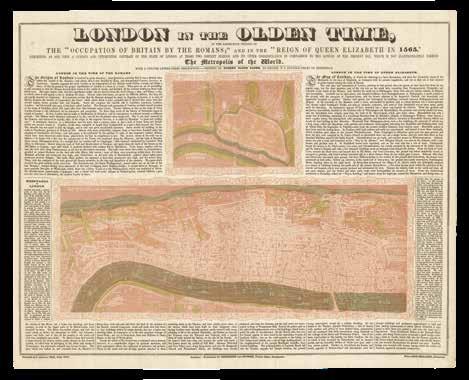
London in the Olden Time, the occupation of the Romans; and the “Reign of Queen Elizabeth in 1565”. Exhibiting at one view a curious and interesting contrast of the state of London at Those two distant periods, and the utter insignificance in comparison to the London of the present day, which is not inappropriately termed- The Metropolis of the World.
Publication
London, Shepherd and Sutton, Foster Lane, Cheapside, July 1844.
Description
Lithograph, printed from three tint stones, comprising two bird’s-eye plans surrounded by text describing ‘London in the Time of the Romans’ and ‘...in the time of Queen Elizabeth’, mounted on linen.
Dimensions 440 by 545mm (17.25 by 21.5 inches).
From Veni, Vidi, to Vicky
London has an immensely long history, and the present print appears to claim that its supremacy as a city was destined since the period of Roman invasion, throughout the Elizabethan period, to the Victorian era. Shown are comparative depictions of the city in ancient and Tudor times, neither of which are said to compare with the contemporary London, or “The Metropolis of the World”.
WYLD, James
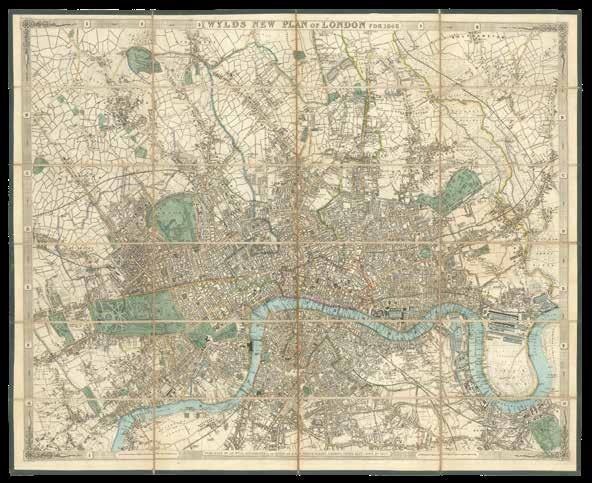
Wyld’s New Plan of London for 1846.
Publication [London], James Wyld, 1846.
Description Engraved plan, hand-coloured, minor foxing, dissected and mounted on linen, with publisher’s label on verso, buff coloured marbled endpapers.
Dimensions 570 by 740mm (22.5 by 29.25 inches).
Scale (approx.) 3 inches to 1 statute mile.
References Howgego 388 (2a).
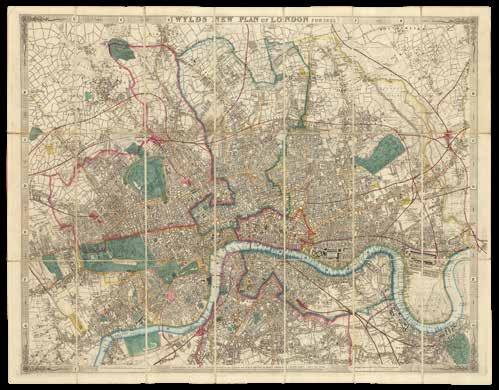
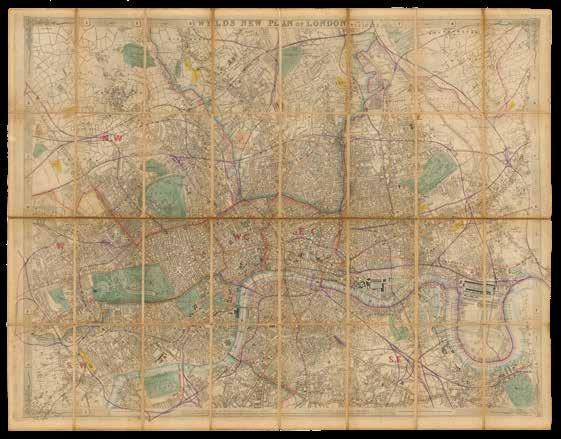
James Wyld’s plan is somewhat unusual, as London is no longer central to the plan, with Wyld extending the work much further north, to include areas such as Highgate and Finsbury Park; foreshadowing the great building boom of the late Victorian Era.
WYLD, James
Wyld’s New Plan of London for 1861.
Publication London, James Wyld, 1861.
Description
Engraved plan, hand-coloured, dissected and mounted on linen, folding into dark red paper slipcase, with publisher’s label, rubbed.
Dimensions 570 by 735mm (22.5 by 29 inches).
Scale (approx.) 3 inches to 1 statute mile.
References Howgego 388 - This state not listed.
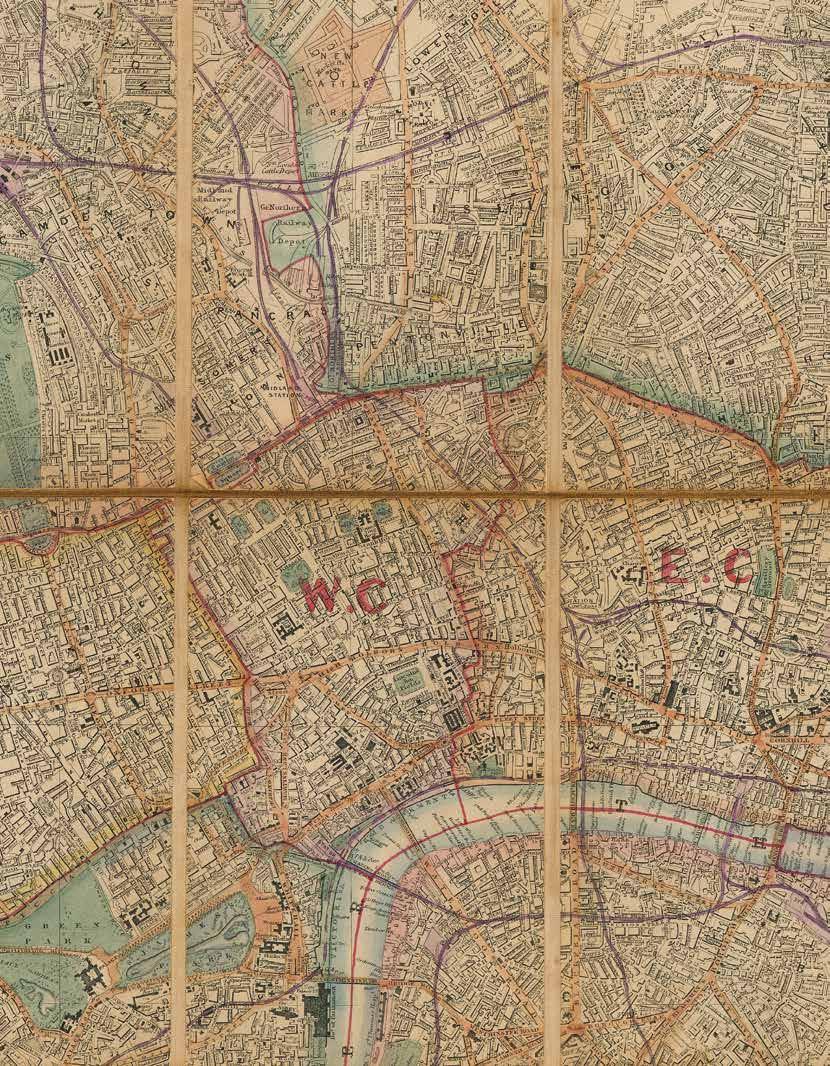
A further example of James Wyld’s map of London, the present example published in 1861. Victoria railway is now shown to Victoria Station (1860).
WYLD, James
Wyld’s New Plan of London and its Vicinity.
Publication London, James Wyld, [c1874].
Description
Engraved plan, hand-coloured, dissected and mounted on linen, folding into brown marbled paper endpapers, rubbed.
Dimensions
565 by 725mm (22.25 by 28.5 inches).
Scale (approx.) 3 inches to 1 statute mile.
References Hyde D&H 388 - this state not listed.
A further example of James Wyld’s map of London, updated to show the Royal Albert Suspension Bridge (1873) and Great Eastern Railway extended to Liverpool Street (1874), although the station (opened 1875) is not yet coloured.
WYLD, James
Wyld’s New Plan of London and its Vicinity.
Publication London, James Wyld, 1888.
Description Engraved plan, hand-coloured, dissected and mounted on linen, folding into red cloth covers, with publisher’s label, slightly soiled.
Dimensions 600 by 770mm (23.5 by 30.25 inches).
Scale (approx.) 3 inches to 1 statute mile.
References Hyde D&H 388 - This state not listed.
A further example of James Wyld’s ‘New Plan of London’, updated to 1888. The Cold Bath Fields House of Correction is shown demolish and cleared, also known as The Steel, it was used to house prisoners serving two years or less, founded by James I in the early seventeenth century.
CRUCHLEY, [George Frederick]
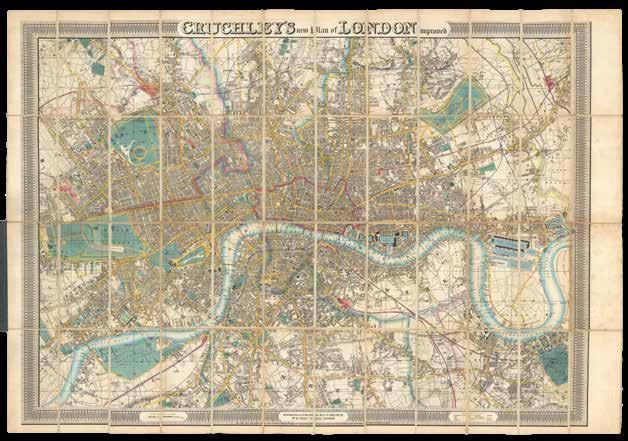
Cruchley’s New Plan of London Improved.
Publication London, Cruchley, [c. 1848].
Description Engraved plan, hand-coloured, dissected and mounted on linen, ex libris of George Cable, folding into green cloth covers, with publisher’s label, with stamp of “The Honourable PS. Pierrepont, Evenley Hill, Brackley”, slight split to spine.
Dimensions 850 by 1185mm (33.5 by 46.75 inches).
Scale 5 inches to 1 statute mile.
References Howgego 388A.
Victoria Park
Cruchley’s improved plan of London, based on Wyld’s earlier work, spans the city and shows Victoria Park (1846), the East and West India Docks and Birmingham Junction Railway, and the London and South Western Railway’s extension north from Nine Elms, the later two being shown as proposed. Victoria Park was designed by John Nash’s student Sir James Pennethorne, between 1842-1846. The park would provide access to green space in the east end of London, for the expanding urban population to enjoy walks, and recreation. Just like her cousins in the west - Hyde Park, Regents Park, and Battersea Park - Victoria would become known as one of the many “lungs of London”.
MOGG, Edward
Mogg’s London and its Environs drawn from the latest surveys. Cover title: Mogg’s Cab Fare Distance Map and London Guide.
Publication London, E. Mogg, 1857.
Description
Engraved plan, hand-coloured, mounted on linen, 33pp guide attached, folding into original brown cloth covers, with publisher’s label.
Dimensions 510 by 680mm (20 by 26.75 inches).
Scale
3 inches to 1 statute mile.
References Hyde D&H 390 (6).
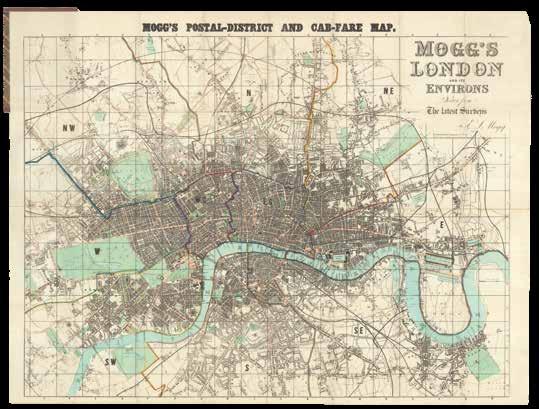
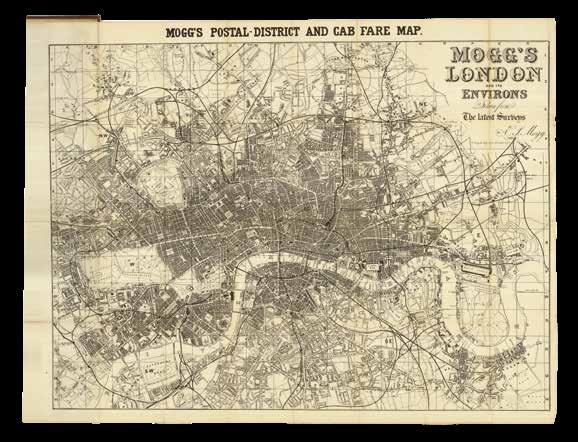
The 1857 editon of ‘Mogg’s London’, bears the additional title of ‘Mogg’s Postal-District and Cab-Fare Map’. The accompanying guide provides a list of cab fares together with an index of streets, squares and cab stands. The map bears gridlines for ease of reference, the extent of the Two Penny Post, as well as the new postal districts, which had been bought in 1857, in order to make sorting ans delivery easier. A system that would be adopted throughout Great Britain and the world.
MOGG, Edward
Mogg’s London and its Environs drawn from the latest surveys. [Title in upper border:] Mogg’s Postal-District and Cab Fare Map.
Publication London, E. Mogg, 1876.
Description
Engraved plan, 84pp guide to cab fares, folding into red cloth covers, lettered in gilt, spine detached from booklet.
Dimensions 510 by 680mm (20 by 26.75 inches).
Scale
3 inches to 1 statute mile.
References Hyde D&H 390 (11).
Great Eastern is shown to Liverpool Street. The inner circle line is shown complete, possibly prematurely as Northumberland Avenue is not shown.
MOGG, Edward
Modern London and Its Environs Drawn from the Latest Surveys By E. S. Mogg.
Publication
London, E. S. Mogg, 14 Great Russell Street, [1850].
Description
Engraved plan, original hand-colour, minor offsetting, dissected and mounted on linen, folding into original green marbled paper slipcase, with publisher’s label, worn.
Dimensions
375 by 640mm (14.75 by 25.25 inches).
Scale
3 inches to 1 statute mile.
References Howgego 391 after state 3. with date on slipcase now 1850.
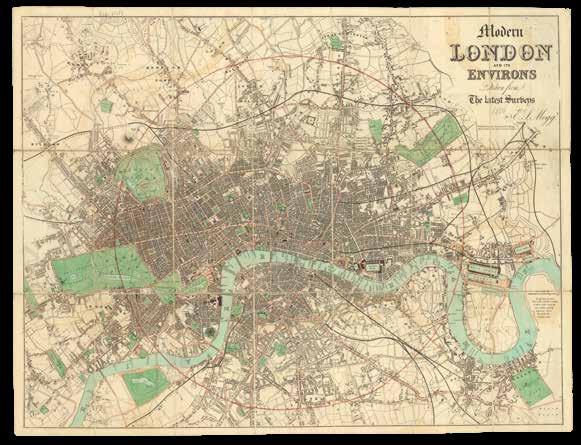
The plan shows parks and squares highlighted in green; several railways are marked, including South Western, which is shown to Waterloo Station; the extent of the Penny Post is marked by a red circle of three miles from the General Post Office; roads coloured in orange mark the Omnibus routes. Edward Mogg (fl.1803-1860) was a cartographer, engraver, and publisher, active in London at the beginning of the nineteenth century. Rather unusually for the time he not only drew his own maps, but also engraved them. The business was mainly based upon the production of pocket travel guides and maps.
WELCH & MARGETSON
Plan of London and Its Environs.
Publication
London, Welch & Margetson, [c1845].
Description
Engraved plan, printed on silk, loss to lower left skilfully repaired.
Dimensions
780 by 820mm (30.75 by 32.25 inches).
Scale 4 inches to 1 statute mile.
References Not in Howgego.
A Tailored Plan
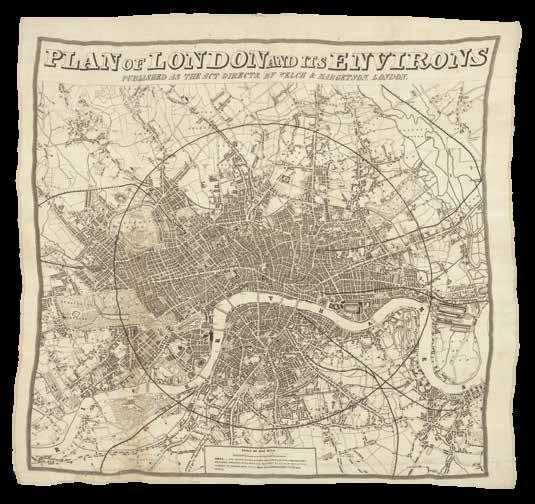
Map of London printed on silk and publsihed by the clothing manufacturer Welch and Margetson. Welch, Margetson and Company, a firm of menswear manufacturers specialising in shirts, collars, silk handkerchiefs, silk neckties, scarves and braces, was established in 1832. They would grow to become one of the largest shirt and tie manufacturers of the Victorian era, with factories, in London, Dublin, and Australia. The plan shows the Bricklayer’s Arms branch line in Southwark (1844) but the South Western railway terminate at Nine Elms, Waterloo would not open until 1848.
BOOTH, George London.
Publication London, J. Reynolds, 1846.
Description
Engraved plan, with index below, tears to old folds, folding into green cloth covers with publisher’s label.
Dimensions 430 by 780mm (17 by 30.75 inches).
Scale 3.25 inches to 1 statute mile.
References Howgego 395.
George Booth’s plan of the city provides a wealth of information. Public buildings are marked and named in bold. A key below the plan lists the principal railways and their stations, and London’s main roads, and streets. The plan has been extended to the east to incorporate the East India Docks. Below the title is a vignette view of London from above Hungerford Bridge looking towards St Paul’s.
DANIEL CROUCH
LONDON: THE ROGER CLINE
DAVIES, B[enjamin R[ees]
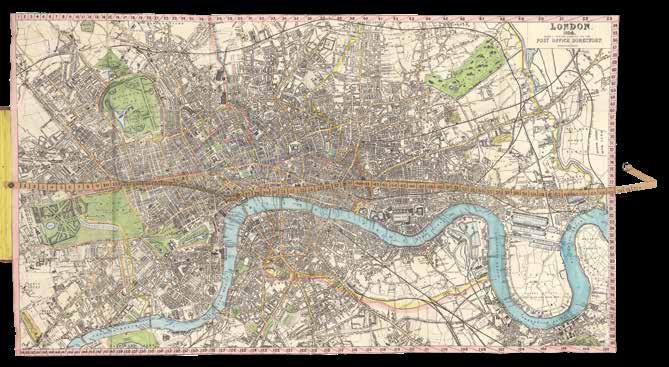
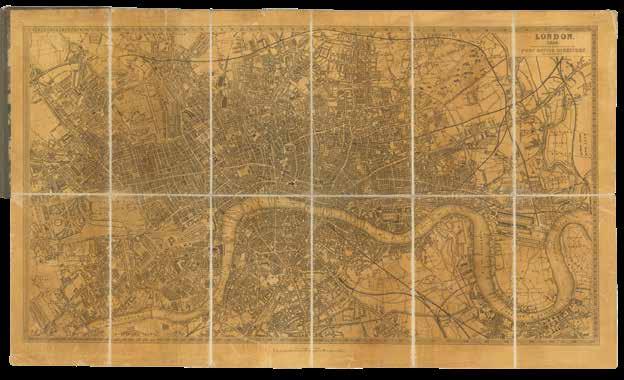
London 1854 Drawn & Engraved expressly for the Post Office Directory. [Cover title:] Schlesinger’s Patent indicator map of London
Publication London, Schlesinger, 1854.
Description
Engraved map in hand colours mounted and dissected on linen, folding into purple cloth boards, embossed gilt and blue title on cover.
Dimensions
675 by 370mm (26.5 by 14.5 inches).
Scale
3 inches to 1 statute mile.
References Hyde D&H. 404 (4).
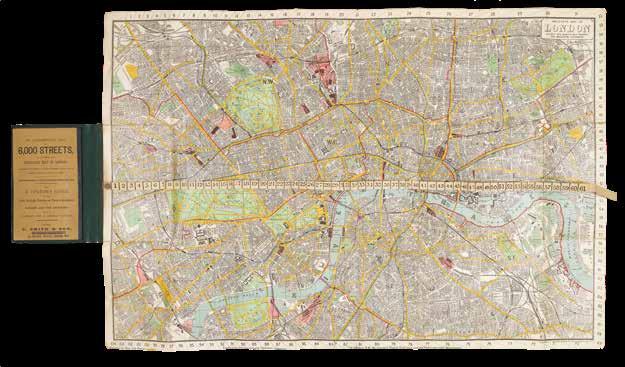
To Indicate the Way
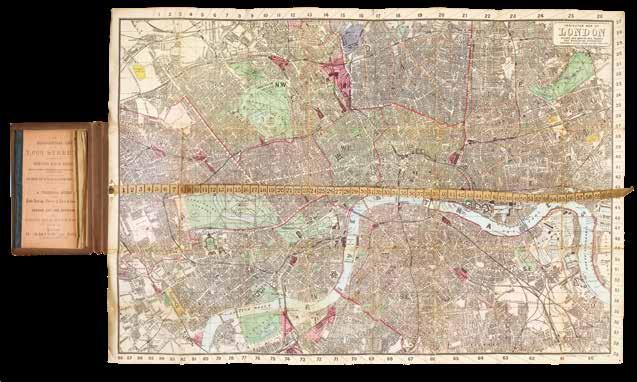
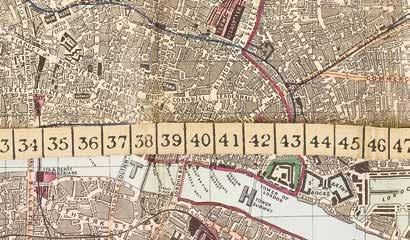
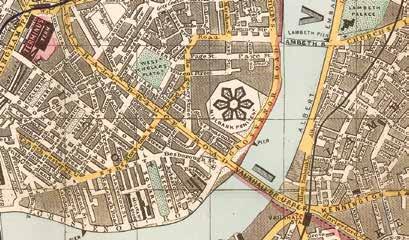
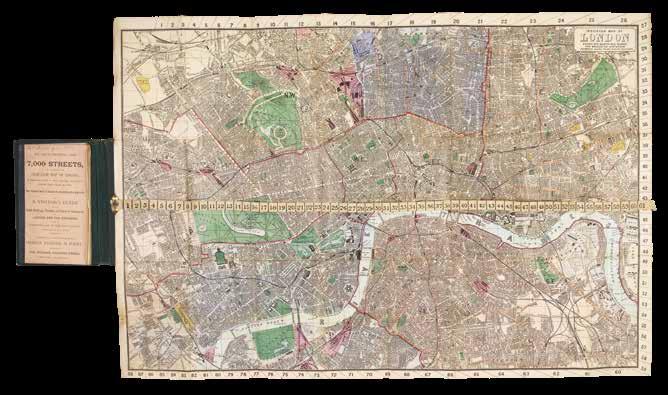
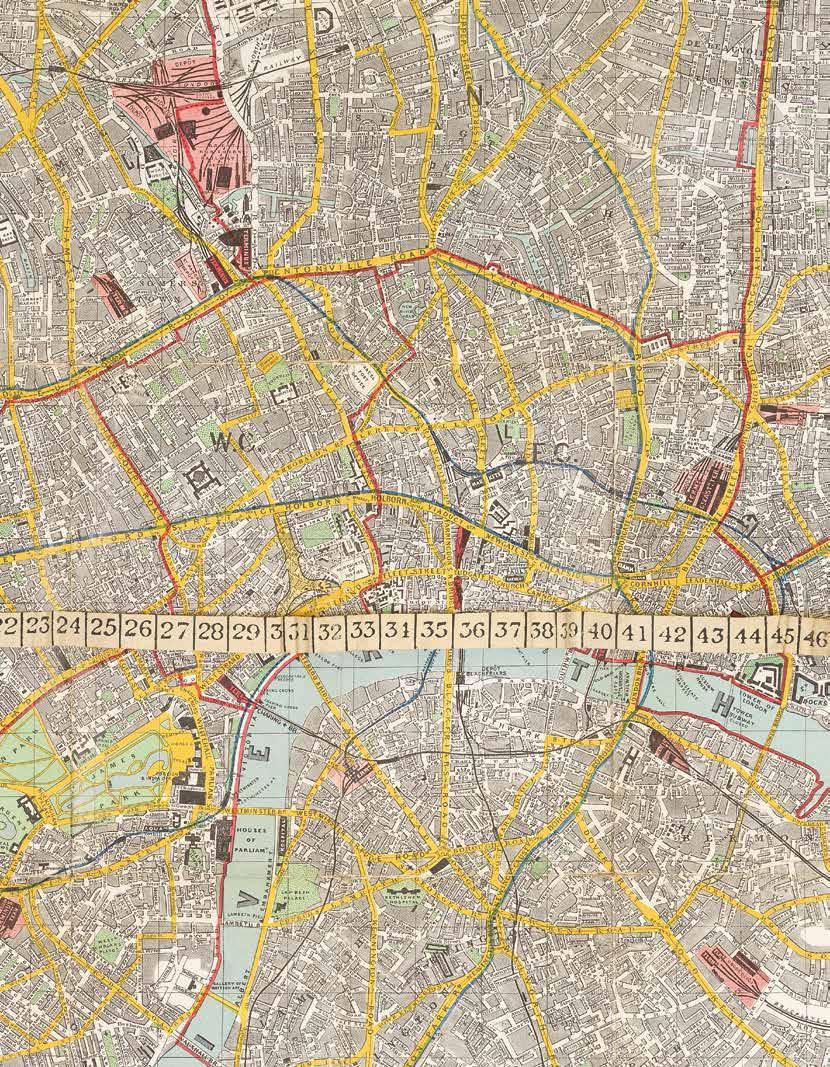
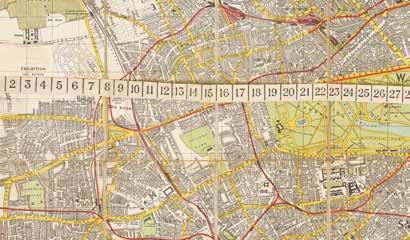
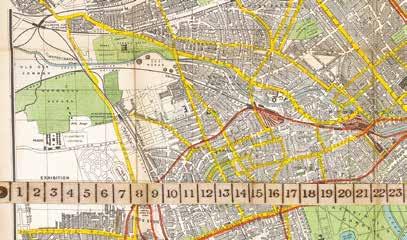
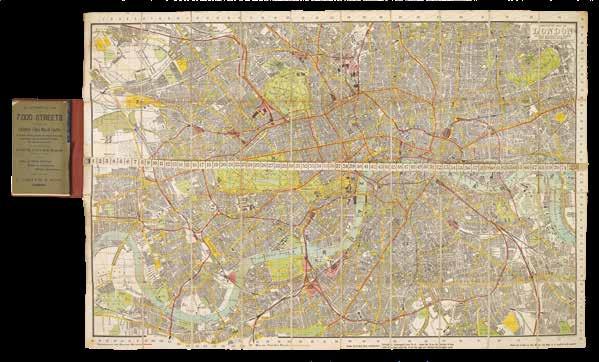
Originally issued to accompany the Post Office Directory - as stated in the title - and published by Kelly & Co. The present map contains an indicator tape, with the cover title ‘Schlesinger’s Patent Indicator Map’. These “indicator maps”, where places could easily be found by the use of the attached measuring tape in conjunction with the coordinates published in an attached guide, would become hugely popular throughout the second half of the nineteenth century. Joseph Scheslnger’s foray into London maps would have appear to have been shorted live, as this is the only map that bears he’s imprint. The following year the map would bear the imprint of Kelly & Co.
DAVIES, B[enjamin R[ees]
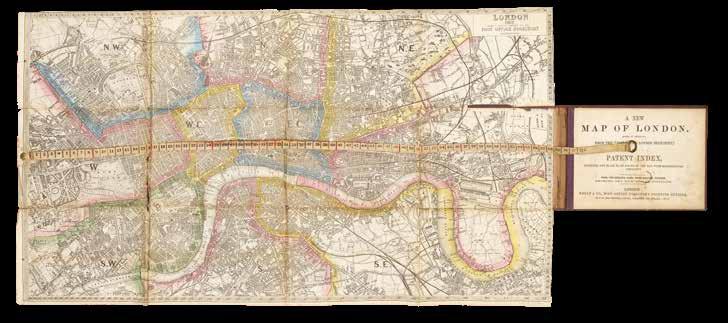
A New Map of London copied, by permission, from the “Post Office London Directory” with patent index, enabling any place to be found on the map ...
Publication London, Kelly & Co., 1857.
Description
Engraved map mounted and dissected on linen, has a five-inch tear and several holes at folds.
Dimensions 675 by 370mm (26.5 by 14.5 inches).
Scale
3 inches to 1 statute mile.
References Hyde D&H 404 (6).
Now bearing the imprint of Kelly & Co.
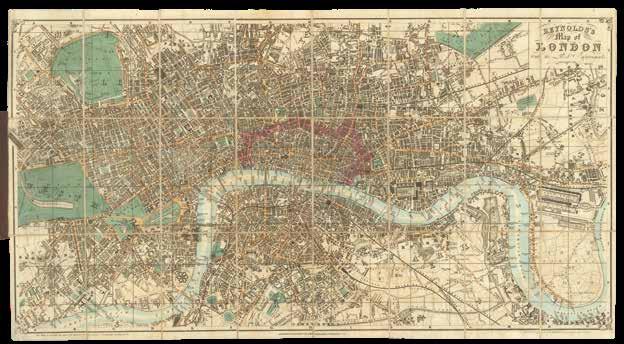
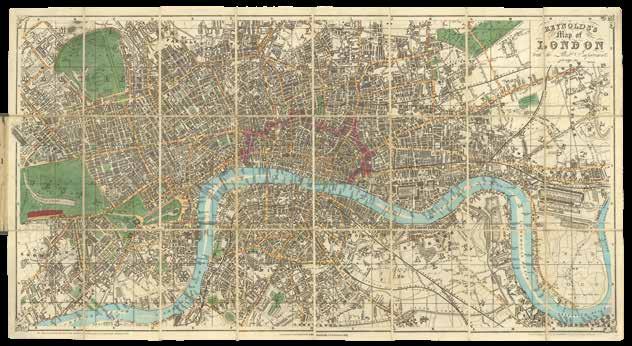
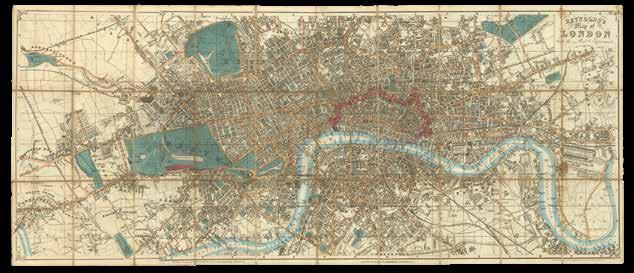
REYNOLDS, James
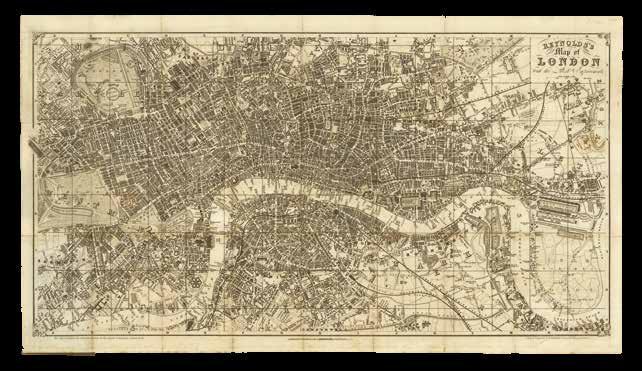
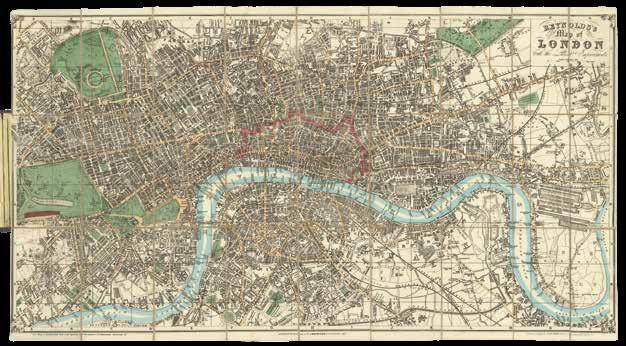
Reynolds’s Map of London with the latest improvements.
Publication London, J. Reynolds, 1847.
Description Engraved plan, hand-coloured in outline, 11[pp] index, dissected and mounted on linen, folding into red cloth slipcase, lettered in gilt.
Dimensions
430 by 790mm (17 by 31 inches).
Scale
4 inches to 1 statute mile.
References Howgego 406 (1).
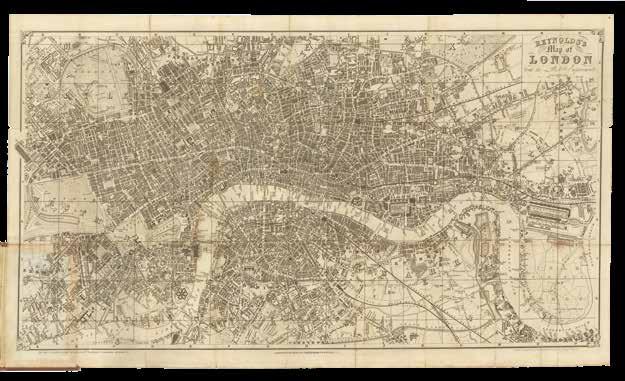
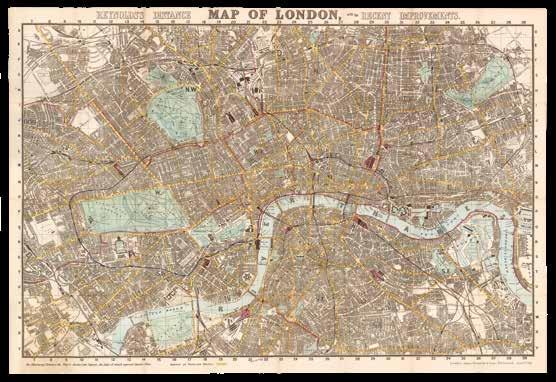
Reynold’s London
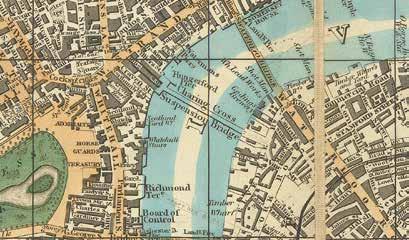
The earliest recorded state of James Reynold’s map of London, extending from Pentonville to Camberwell, and from Paddington to the Isle of Dogs. The Hungerford Suspension Bridge (1845) is shown, and Lambeth Bridge appears as proposed, alongside a further proposed bridge to link Belvedere Road and Richmond Terrace. Among the railways under construction are the Blackwall Railway extension north from Limehouse, and the South Western Railway extended to Hungerford Suspension Bridge and St Saviour’s Dock.
James Reynolds (1817-1876) map and chart seller, based in London, produced numerous maps, and guides to the city. Following his retirement the firm was continued by his two sons William Henry, and Frederick, they would later sell the business to the publisher Charles Smith at the end of the nineteenth century.
REYNOLDS, James
[Title to cover:] Reynolds’s Splendid New Map of London showing Grand Improvements for 1847 with a correct and Extensive list of Sights and Amusements.
Publication London, J. Reynolds, 1847.
Description
Engraved plan, folding into later slipcase preserving original label, with index attached.
Dimensions 448 by 785mm (17.75 by 31 inches).
Scale
4 inches to 1 statute mile.
References Howgego 406 itermediate state between (1) and (1a) with date still 1847.
Cover now bears: Reynold’s Splendid New Map of London...’
REYNOLDS, James
Reynolds’s Map of London with the Latest Improvements.
Publication London, J. Reynolds, 1849.
Description Engraved plan, 11[pp] index, folding into brown cloth covers, with publisher’s label.
Dimensions 405 by 765mm (16 by 30 inches).
Scale
4 inches to 1 statute mile.
References Howgego 406 (2).
A further example of Reynold’s map of London, it shows minor difference to South Western Railway extension.
REYNOLDS, James
Reynolds’s Map of London with the latest Improvements.
Publication London, J. Reynolds, 1851.
Description
Engraved plan, hand-coloured in outline, dissected and mounted on linen, 9[pp] index and guide, a few pages creased, folding into blue cloth covers, with publisher’s label.
Dimensions 430 by 790mm (17 by 31 inches).
Scale
4 inches to 1 statute mile.
References Howgego 406 (3).
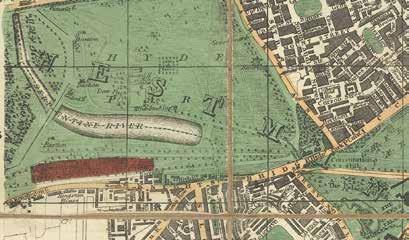
The Northern Railway extending to King’s Cross (1850). The Crystal Palace appears in Hyde Park, and a proposed bridge (never to be built) is shown between Westminster Bridge Road and Whitehall.
REYNOLDS, James
Reynolds’s Map of London with the Latest Improvements.
Publication London, J. Reynolds, 1852.
Description
Engraved plan, hand-coloured in outline, dissected and mounted on linen, 36pp index and guide with plan of West London, folding into green cloth covers, blindstamped and lettered in gilt.
Dimensions 410 by 760mm (16.25 by 30 inches).
Scale
4 inches to 1 statute mile.
References Hyde D & H 406 (1)
REYNOLDS, James
Reynolds’s Map of London with the Latest Improvements.
Publication London, J.Reynolds, 1852.
Description
Engraved plan, hand-coloured in outline, dissected and mounted on linen, 36pp index and guide, folding into green cloth covers, blind stamped and lettered in gilt.
Dimensions 405 by 1010mm (16 by 39.75 inches).
Scale
4 inches to 1 statute mile.
References Hyde D & H 406 (1) but with the western extension now forming part of the map.
A further example of Reynold’s map of London, here updated to show the Crystal Palace in Hyde Park blocked out in red, and a proposed bridge (never to be built) between Belvedere Road and Richmond Terrace. It is accompanied by a 36-page index and guide, which includes a plan extending westwards to Hammersmith on the same scale, and a small-scale map showing the main places of interest in London.
A further example of the 1852 edition of Reynold’s map of London, but with the western extension now forming part of the map.
SMITH, Charles
Smith’s New Map of London and Environs.
Publication London, C. Smith & Sons, 1846.
Description Engraved plan, hand-coloured, dissected and mounted on linen, slipcase preserving original label, rubbed.
Dimensions 705 by 1090mm (27.75 by 43 inches).
Scale
3.5 inches to one mile.
References Howgego 407 - predates states listed by Howgego.
I’ll meet you at the Cemetery Gates
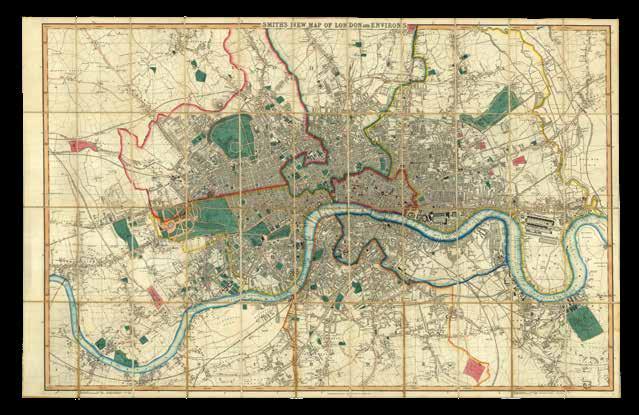
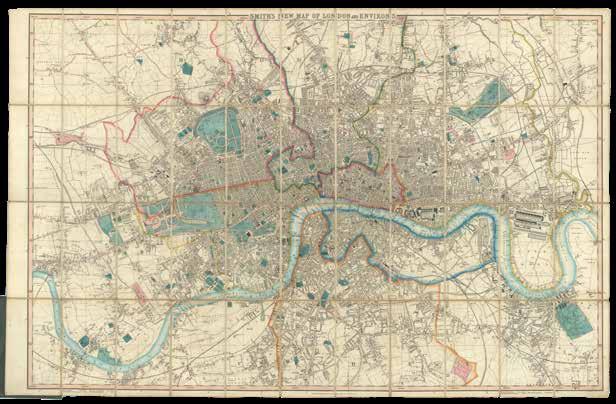
Smith’s ‘New Map of London and its Environs’ encompasses the entirety of the central city and much of its surburban sprawl, from Stoke Newington in the north to Peckham Rye in the south, and from Hammersmith in the west to Stratford in the east. One of the more interesting aspects of the map is Smith highlighting of the newly constructed cemeteries in pink: General Cemetery (Kensall Green); London and Westminster Cemetery - now Brompton Cemetery (Chelsea); Nunhead Cemetery., Tower Hamlets Cemetery, and Abney Park Cemetery. These together with West Norwood, and Highgate, became known as the “Magnificent Seven”, and were established in the mid nineteenth century to alleviate overcrowding in existing parish burial grounds as London’s population expanded.
SMITH, Charles
Smith’s New Map of London and Environs.
Publication London, C. Smith & Son, 1849.
Description Engraved plan, hand-coloured in outline, dissected and mounted on linen, folding into green cloth covers, blind stamped and lettered in gilt, rubbed.
Dimensions 680 by 1040mm (26.75 by 41 inches).
Scale (approx.) 3.6 inches to 1 statute mile.
References Howgego 407 (2a).
The 1849 edition of Smith’s ‘New Map of London and its Environs’. The date in imprint is altered to 1849.
SMITH, Charles
Smith’s New Map of London and Environs.
Publication London, C. Smith & Son, 1853.
Description
Engraved plan, hand-coloured in outline, dissected and mounted on linen, folding into green cloth covers, blind stamped lettered in gilt, with metal clasp.
Dimensions 710 by 1095mm (28 by 43 inches).
Scale 3.5 inches to 1 statute mile.
References Hyde D&H 407, this state not listed.
It shows recent developments such as Kings Cross Station (1852). The Great Exhibition, however, is still indicated in Hyde Park although it was no longer staged there, and the South Western Railway her extends to St Saviour’s Dock, although in reality it never did.
The Sewage Men Cometh
DAVIES, Benjamin Rees
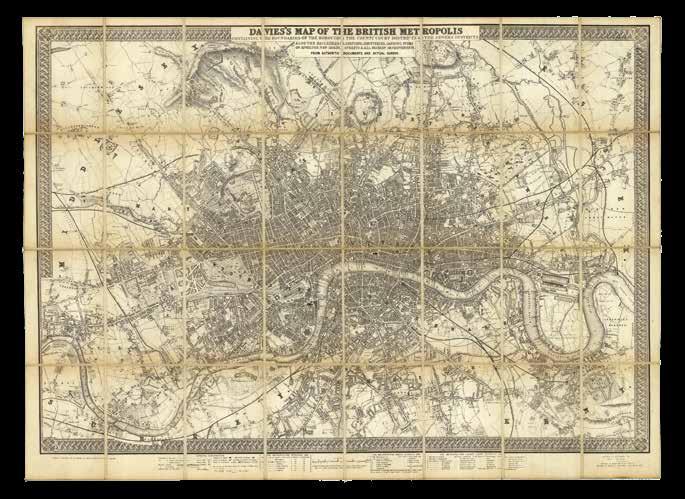
Map of the British Metropolis Containing the boundaries of the Boroughs, the County Court Districts, and the Sewer Districts.
Publication London, B. R. Davies, 1848.
Description Engraved plan, dissected and mounted on linen, folding into green cloth slipcase, with bookseller’s label.
Dimensions 635 by 910mm (25 by 35.75 inches).
Scale
3 inches to 1 statute mile.
References Howgego 410 (1).
The first state of Davies’s map of London from Stamford Hill to Clapham, and from Barnes to Leytonstone. As well as highlighting the recently constructed railways, and public buildings, the plan also marks London’s Sewer Districts. By the middle of the nineteenth century London had begun to struggle with the huge amount of sewage and waste produced by the rapidly expanding metropolis. The Thames had become an open sewer, with outbreaks of cholera becoming common place. In order to address the public health concerns the government passed the Metropolitan Commission of Sewers Act in 1848. The commissioner’s oversaw the development of the sewage system, and the closing down of some 200,000 cesspits. In 1849, Josepsh Bazalgette would join as chief engineer, eventually designing the great sewage network that would transform the city.
WYLD, James
London and its Environs.
Publication
London, James Wyld, [c1849].
Description
Engraved map, hand-coloured in outline, border pasted on, dissected and mounted on linen, folding into maroon slipcase, with publisher’s label, rubbed.
Dimensions 1070 by 1250mm (42.25 by 49.25 inches).
Scale (approx.) 3.75 inches to 1 statute mile.
References Howgego 415 - This state not listed.
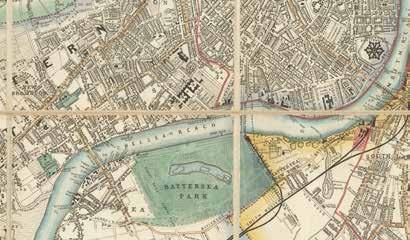
Battersea Park’s first layout
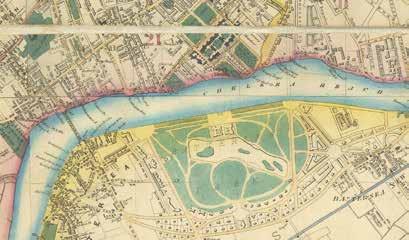
Wyld’s large plan presents many villages not yet absorbed into the great metropolis. Extending from Crouch End in the north to Norwood in the south, and from Acton in the west to Stratford in the east, recent developments including Waterloo Station (1848) and Battersea Park, shown with its first proposed layout (1848). The railway link between Brentford and Barnes (1849), however, does not yet appear.
WYLD, James
London and its Environs.
Publication
London, James Wyld, [c.1850].
Description
Engraved map, hand-coloured in outline, border pasted on, dissected and mounted on linen, edged in green silk, folding into, dark red cloth slipcase, with publisher’s label, rubbed.
Dimensions 1070 by 1250mm (42.25 by 49.25 inches).
Scale (approx.) 3.75 inches to 1 statute mile.
References Howgego 415 (2).
A further edition of Wyld’s plan of London, now showing the railway link between Brentford and Barnes (1849).
WYLD, James
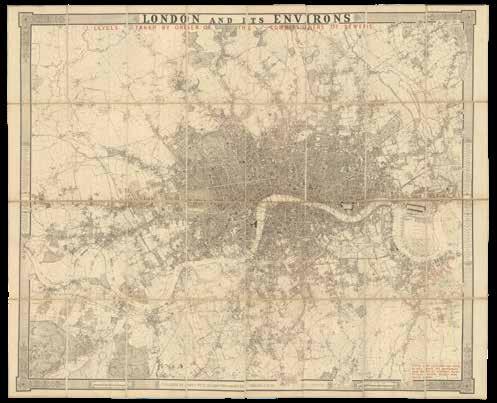
London and its Environs. Levels taken by Order of the Commisioners of Sewers.
Publication
London, James Wyld, [c1875].
Description
Engraved map, dissected and mounted on linen , folding into contemporary green cloth slip case, slightly rubbed.
Dimensions 1070 by 1270mm (42.25 by 50 inches).
Scale (approx.) 3.75 inches to 1 statute mile.
References c.f. Hyde D&H 415 - this state not recorded.
Wyld about Sewers
James Wyld’s plan has been repurposed to show the respective water levels throughout London. Water levels were a key factor in controlling the flow of water through Jospeh Balzellgette’s new sewage network, which had been completed by the middle of the 1870s. In the decorative border red lettering notes that “the altitudes are given in feet above the approximate mean water at Liverpool being 12½ feet below Trinity High Water Mark”. Likewise, water levels are also marked in red throughout the various parishes shown.
WYLD, James
London and its Environs.
Publication
London, James Wyld, [c1875].
Description
Engraved map, hand-coloured, dissected and mounted on linen, folding into black cloth covers, with publisher’s label.
Dimensions 1050 by 1235mm (41.25 by 48.5 inches).
Scale 3.75 inches to 1 statute mile.
References Hyde D&H 415A (3).
It has here been updated to show the Great Eastern Railway extended to Liverpool Street (1874), and Metropolitan Railway extended to Liverpool Street Station (1875), as well as the District Raiway’s spur to Waltham Green.
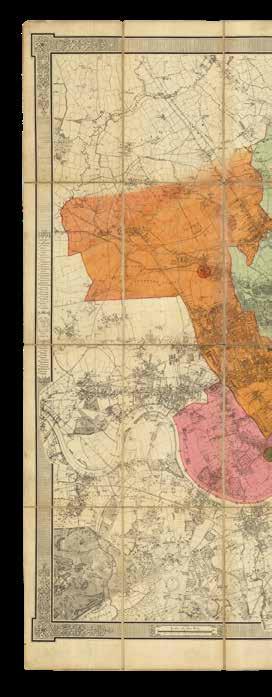
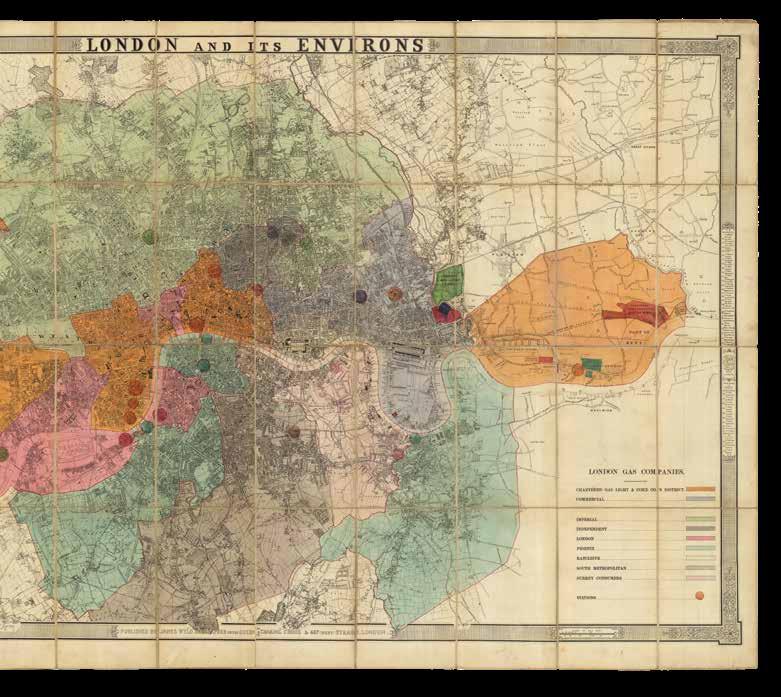
WYLD, James
London and its Environs. London Gas Companies.
Publication London, James Wyld, [c1875].
Description Engraved map, hand-coloured, dissected and mounted on linen, red marbled paper endpapers.
Dimensions 1050 by 1235mm (41.25 by 48.5 inches).
Scale 3.75 inches to 1 statute mile.
References Hyde D&H 415A (1).
The Gas-man Cometh
A further example of Wyld’s map of London and its environs published in the 1870s to show the Gas Companies and their jurisdictions. Although gas had been used to light London streets from the early ninenteenth century, it was not until the latter half of the cnetury that compnaies began supplying gas to the home, for heating and cooking. The plan shows just how dramatic the uptake was of the new technology.
DANIEL CROUCH RARE BOOKS
LONDON: THE ROGER CLINE COLLECTION (MAPS II)
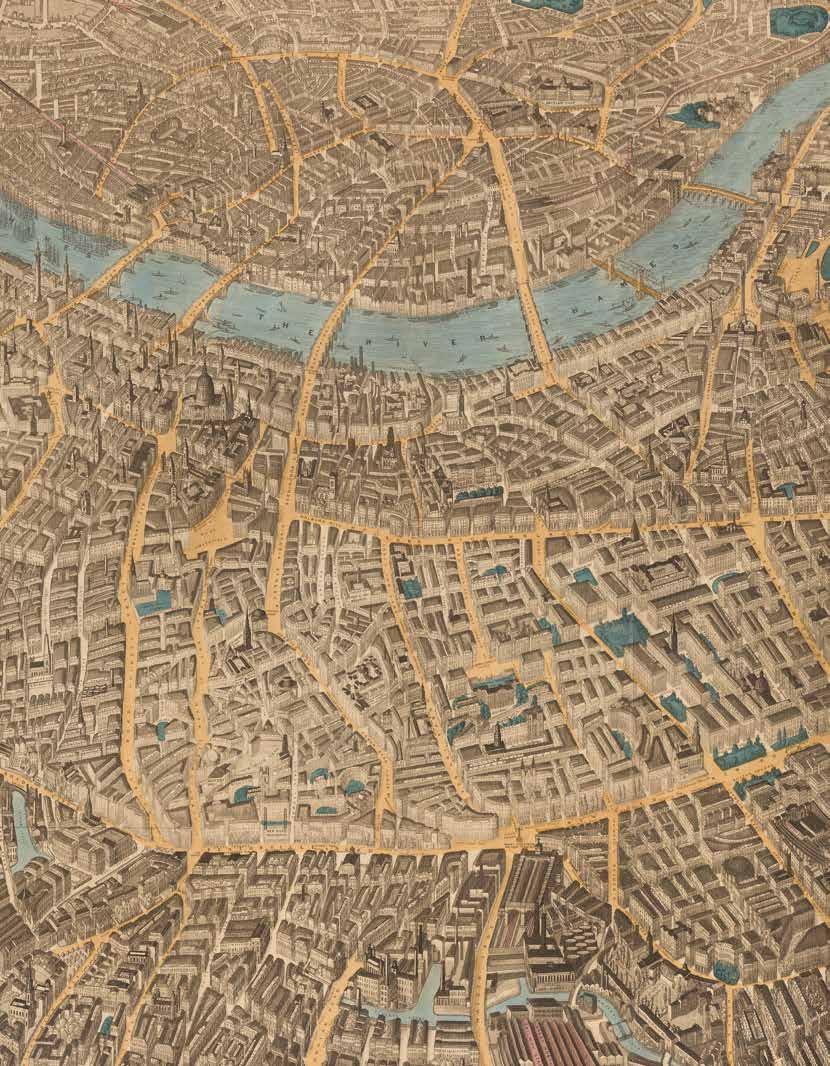
BANKS, John Henry, & Co.
A Balloon View of London as Seen from the North.
Publication London, Banks, [c1852].
Description
Engraved map with acquatint, handcoloured, dissected and mounted on linen, folding into blue cloth boards, with publisher’s label, gilt, spine slightly split.
Dimensions
610 by 1030mm (24 by 40.5 inches).
Scale
7.5 inches to 1 statute mile.
References Hyde 3 (3).
777
BANKS, John Henry, & Co.
A Balloon View of London.
Publication London, Edward Stanford, 1859.
Description
Engraved map with acquatint, handcoloured in outline, dissected and mounted on linen, folding into blue cloth coves with publisher’s label.
Dimensions
610 by 1030mm (24 by 40.5 inches).
Scale
7.5 inches to 1 statute mile.
References Hyde 3 (5).
Balloon View
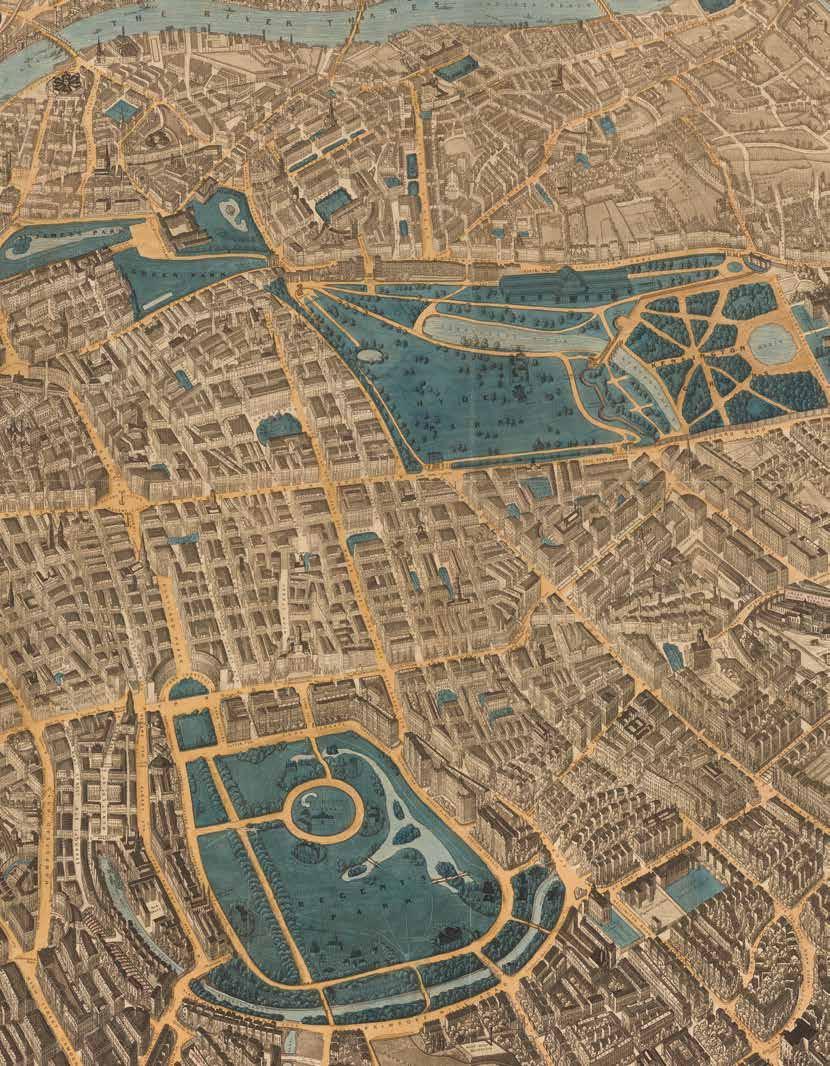
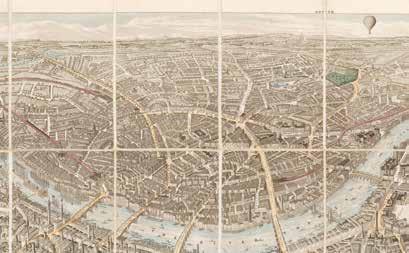
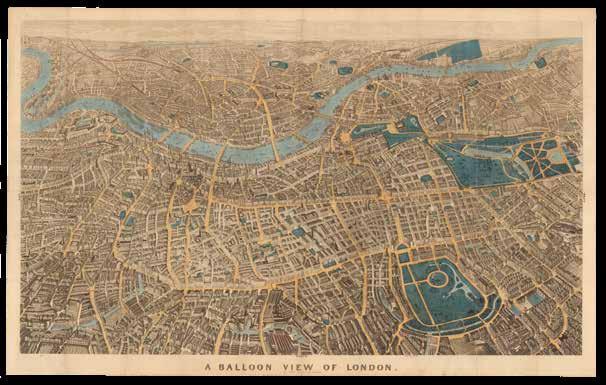
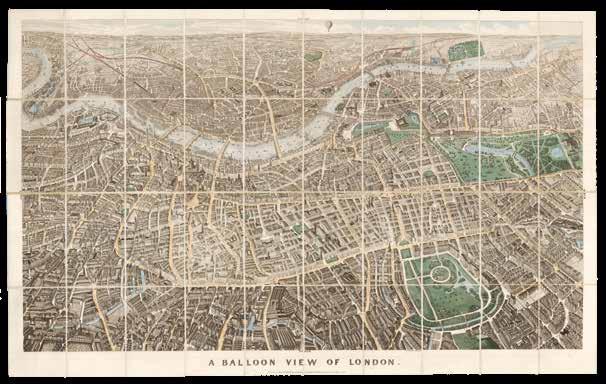
John Henry Banks (1816-1879) was a printer, engraver, and publisher active in London during the middle of the nineteenth century. He is most noted for his birdseye views of London taken from both the north and the south, entitled “balloon views”. The present view shows London as seen from the north. In the foreground is Regents Park with Camberwell and the North Downes in the distance; with the view stretching from Greenwich Reach in the east to Kensington Palace in the west. Main roads are coloured in orange, parks, pleasure gardens and squares in green and railways in pink. The Great Exhibition is shown in Hyde Park (1851), and in the centre foreground is King’s Cross Station (1852).
A further example of Banks’s “balloon view” of London, updated to 1859; with the imprint of Edward Stanford. Crystal Palace is now shown at Sydenham, and a small balloon has been inserted on the southern horizon.
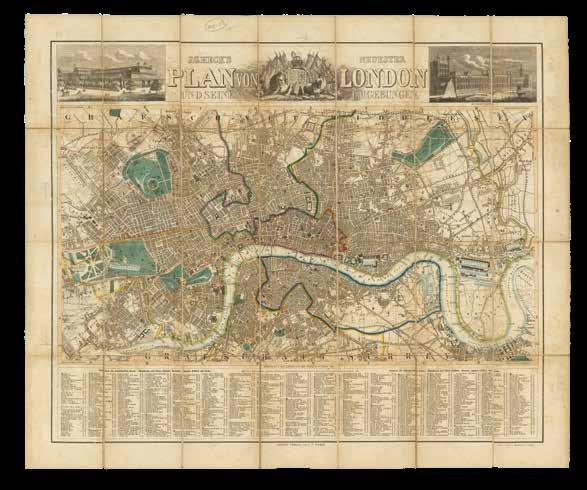
HECK, J[ohann] G[eorg]
Heck’s Neuester Plan von London Undseinen Umgebungen.
Publication Leipzig, J. J. Weber, [1851].
Description Engraved plan, hand coloured, dissected and mounted on linen, folding into green cloth covers, lettered in gilt.
Dimensions 630 by 745mm (24.75 by 29.25 inches).
Scale 3 inches to 1 statute mile.
References Hyde 14.
A German Invasion
In 1851 German bookseller, publisher, cartographer and author Johann Georg Heck published a detailed map of central London for his countrymen visiting the Great Exhibition; the original position of the ‘Crystal Palace’ is shown on the south edge of Hyde Park.
Flanking the title are vignette views of Crystal Palace, and the Houses of Parliament. Below is an extensive street index.
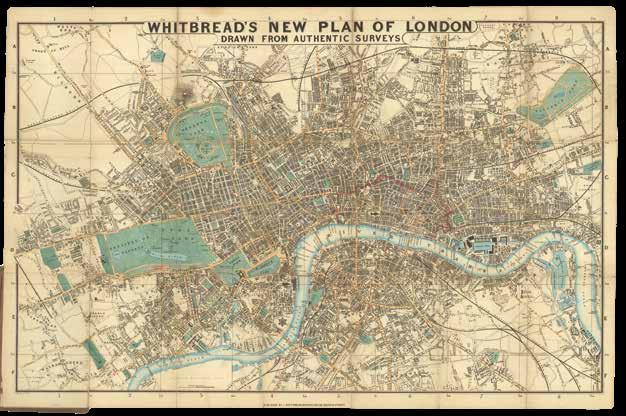
WHITBREAD, [Josiah]
Whitbread’s New Plan of London drawn from authentic surveys.
Publication London, J.Whitbread, 1851.
Description
Engraved plan, hand-coloured in outline, mounted on linen, 30 pp index and guide, folding into brown cloth covers, with publisher’s label, rubbed.
Dimensions 410 by 635mm (16.25 by 25 inches).
Scale (approx.) 3.1 inches to 1 statute mile.
References Hyde 24A (1).
The Great Exhibition
One of the many maps to capitalize on the Great Exhibition, and the large amount of tourist that came to see the exhibition,, not only from Great Britain, but from all around the world. The Great Exhibition or ‘Great Exhibition of the Works of Industry of All Nations’, would be the father of all subsequent World Fairs, which became showcases for trade and innovation throughout the nineteenth and twentieth centuries. So successful was the fair that the profits would be used to create the Albert Hall, The Natual History Museum, and the Victorian and Albert Museum, as well as the site cleared for the building of King’s Cross Station. Accompanying the map is a 30-page street index and guide.
Josiah Whitbread (fl 1850-1879) map publisher active in the middle of the nineteenth century, had premises at 142 Oxford Street, production guides and plans of the city. When he retired the majority of his plates were sold to Philip and Son.
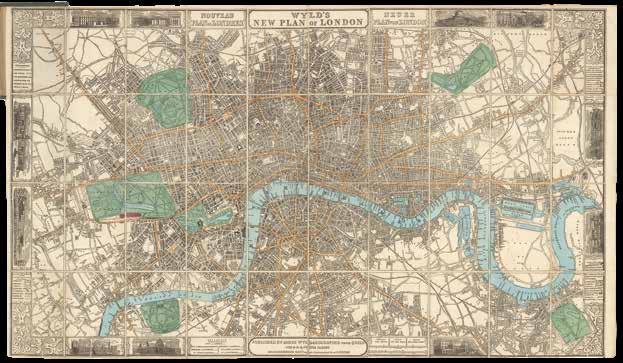
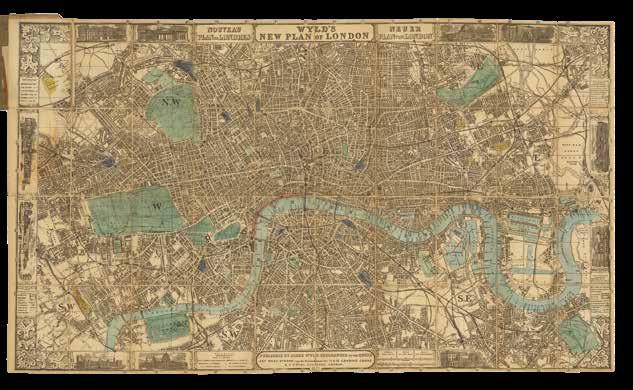
WYLD, James
Wyld’s New Plan of London.
Publication
London, James Wyld, 1851.
Description
Wood-engraved plan, hand-coloured in outline, vignette views to boarderss, folding into green blind stamped cloth covers, faint gilt lettering.
Dimensions
550 by 940mm (21.75 by 37 inches).
Scale approx.) 3.6 inches to 1 statute mile.
References Hyde 25 (1).
Wyld’s Great Globe
Wyld first published the present map in 1851, taking advantage of the influx of visitors into in London to see the Great Exhibition in the Crystal Palace. It was designed as both a map and a tourist guide: the border contains keys in English, French and German, and vignettes of must-see landmarks. Crystal Palace is picked out in red, and occupies a large proportion of the south side of Hyde Park; it is also depicted in one of the views to the map’s border. In the border at the top right is Wyld’s own “Model of the Earth”. This was a vast globe of 18.39m in diameter, with a representation of the world depicted in plaster-of-paris on its interior surface. Originally offered to the Great Exhibition, it was rejected due to its size and the committee’s reluctance to allow the exhibition to be used for commercial gain. It was installed in Leicester Square instead (visible on the map), and attracted almost as many visitors as the Exhibition itself. In 1853, the first year that visitor records were kept, it is estimated that 1.2 million people were admitted.
WYLD, James
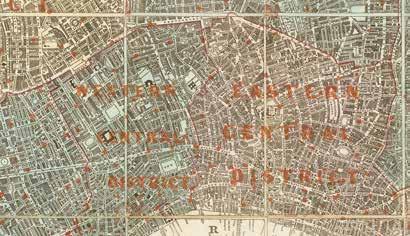
Wyld’s New Plan of London Divided into Postal Districts.
Publication London, James Wyld, 1857.
Description
Wood-engraved plan, printed in colours, mounted on linen, folding into blue cloth covers, lettered in gilt, rubbed.
Dimensions
550 by 940mm (21.75 by 37 inches).
Scale (approx.) 3.5 inches to 1 statute mile.
References Hyde 25 (8).
The 1857 edition of Wyld’s London map, with its eleven engraved views of public buildings, and now overprinted in red to show postal districts, post receiving houses and pillar letter boxes. Postal districts were introduced in 1856.
WYLD, James
Wyld’s New Plan of London.
Publication London, James Wyld, 1863.
Description
Wood-engraved plan, hand-coloured, dissected and mounted on linen, folding into red paper covers, with publisher’s label, rubbed.
Dimensions 545 by 925mm (21.5 by 36.5 inches).
Scale (approx.) 3.5 inches to 1 statute mile.
References Hyde 25 (11).
The 1863 edition of Wyld’s London map. Shows Charing Cross Station (opened 1864), and lines to Board Street and Cannon Street Stations (open 1866). The recently started Embankment is marked in red.
WYLD, James
Wyld’s New Plan of London.
Publication London, James Wyld, 1874.
Description
Wood-engraved plan, hand-coloured in outline, dissected and mounted on linen, folding into white paper covers, with publisher’s label, spine repaired.
Dimensions 545 by 925mm (21.5 by 36.5 inches).
Scale (approx.) 3.5 inches to 1 statute mile.
References Hyde 25 (15).
Wyld’s London map, with stations marked in purple.
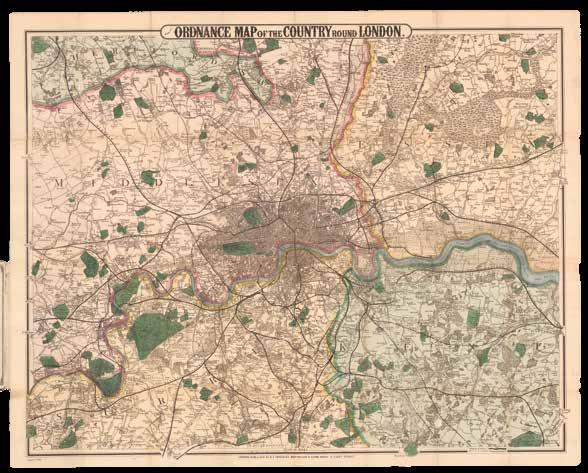
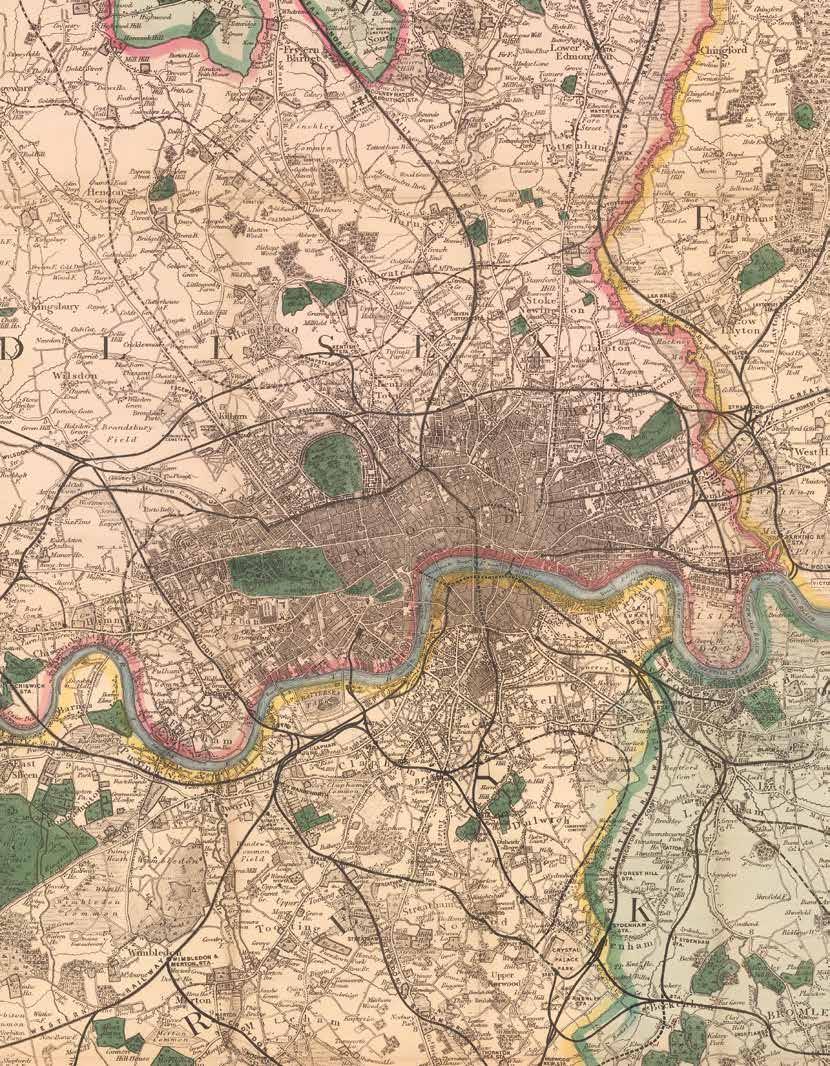
CRUCHLEY, George Frederick
From the Ordnance Survey of the Country round London.
Publication London, Cruchley, [1863].
Description
Hand-coloured lithograph plan, a few significant tears, folding into dark blue cloth covers, with publisher’s label, rubbed and scuffed.
Dimensions
550 by 695mm (21.75 by 27.25 inches).
Scale 1 inch to 1 statute mile.
References Hyde 26 (5), but without date in margin.
Based on the Ordnance Survey
Cruchley’s London map of 1863 encompasses the capital and its suburbs from High Barnet to Croydon, and from Hayes to Hornchurch. Railways shown in progress include the London, Chatham & Dover to Farringdon, the South Eastern to Charing Cross, the Metropolitan from Farringdon to Moorgate, and the Great Northern to Broad Street.
Cruchley now makes a virtue of the work being based on the Ordnance Survey. By the middle of the nineteenth century the OS had began to dominate the surveying of the UK, with private mapmakers and sellers now using their more accurate maps.
DAVIES, Benjamin Rees
Davies’ ‘New Map’ of the British Metropolis. The Boundaries of the Boroughs, County Court Districts, Railways, and Modern Improvements.
Publication
London, Edward Stanford, 1854.
Description Engraved plan, dissected and mounted on linen, housed in red cloth slipcase, with publisher’s label.
Dimensions
650 by 935mm (25.5 by 36.75 inches).
Scale
3 inches to 1 statute mile.
References Hyde 27A (4).
Albertopolis
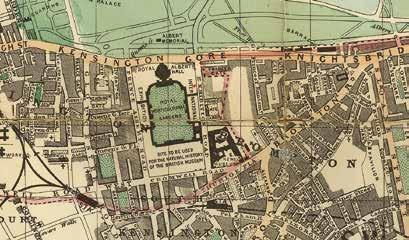
The plan shows the site of the “Estate of H[er] M[ajesties] Commissioners for [the] Exh[ibitio]n of 1851”. Although the Commission was initially set up to run the Great Exhibition. The event proved such as success that it made a profit of £186,000, which the Commission, under the leadership of Prince Albert, used to purchase an estate in South Kensington. The estate marked on the plan, would become known as Albertopolis and would become a hub of cultural and scientific learning, including institutions such as: The Victoria and Albert Museum, The Natural History Museum, Imperial College, The Royal Colleges of Art and Music, and the Royal Albert Hall.
DAVIES, B[enjamin R[ees]
Davies’s New Map of the British Metropolis The Boundaries of the Boroughs, County Court Districts, Railways, and Modern Improvements.
Publication
London, Edward Stanford, [c1859].
Description Engraved plan, hand-coloured, dissected and mounted on linen, folding into maroon cloth boards, lettered in gilt, rubbed.
Dimensions
650 by 975mm (25.5 by 38.5 inches).
Scale
3 inches to 1 statute mile.
References Hyde 27A (6).
Here updated to show the West End & Crystal Palace Railway extension to Battersea Park Bridge as complete (1858), and Victoria Railway under construction (completed 1860). Victoria Station itself is not yet shown.
DAVIES, Benjamin Rees
Davies’s New Map of the British Metropolis The Boundaries of the Boroughs, County Court Districts, Railways, and Modern Improvements.
Publication
London, Edward Stanford, [c1858].
Description
Engraved plan, hand-coloured, dissected and mounted on linen, folding into purple cloth boards, lettered in gilt.
Dimensions
910 by 940mm (35.75 by 37 inches).
Scale
3 inches to 1 statute mile.
References Hyde 27B (4).
DAVIES, Benjamin Rees
Davies’s New Map of the British Metropolis The Boundaries of the Boroughs, County Court Districts, Railways, and Modern Improvements.
Publication
London, B.R. Davies, [c1862].
Description
Engraved plan, hand-coloured, dissected and mounted on linen, mapseller’s advert to verso, fold into original blue cloth covers, gilt lettered, dampstained.
Dimensions 970 by 990mm (38.25 by 39 inches).
Scale 3 inches to 1 statute mile.
References Hyde 27B - This state not listed.
Here with the addition of a southern extension sheet; updated to show the West End & Crystal Palace Railway extension to Battersea Park Bridge as complete (1858), and Victoria Railway under construction (completed 1860). Victoria Station itself is not yet shown.
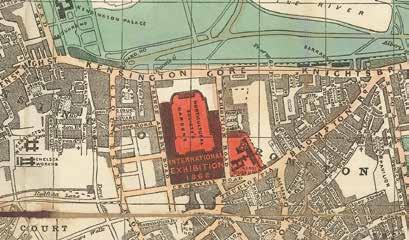
Here with the addition of a southern extension sheet; updated to show the railway to Victoria Station (1860), the International Exhibition in Cromwell Road (1862), and Lambeth Bridge (1862). The South Eastern Railway’s extension from London Bridge to Charing Cross (completed 1864) is shown in progress.
DAVIES, Benjamin Rees
Davies’s New Map of the British Metropolis The Boundaries of the Boroughs, County Court Districts, Railways, and Modern Improvements.
Publication London, Edward Stanford, 1869.
Description
Engraved plan, hand-coloured, dissected and mounted on linen, folding into blue cloth boards, lettered in gilt lettering, rubbed.
Dimensions 990 by 1020mm (39 by 40.25 inches).
Scale 3 inches to 1 statute mile.
References Hyde 27B intermediate state between (7) and (8).
A further example of Davies’s map of London, here with the addition of a southern extension sheet; updated to show the District Railway to Westminster (1868). It also anticipates Queen Victoria Street (1871) without supplying its name, but does not yet show the East London Railway (built 1869).
DAVIES, B[enjamin] R[ees]
Davies’s New Map of the British Metropolis The Boundaries of the Boroughs, County Court Districts, Railways, and Modern Improvements.
Publication London, Edward Stanford, 1871.
Description
Engraved plan, hand-coloured, dissected and mounted on linen, folding into mauve cloth covers, with title in gilt, spine rubbed and faded.
Dimensions 915 by 925mm (36 by 36.5 inches).
Scale 3 inches to 1 statute mile.
References Hyde 27B (10).
The map has been updated to show the District Railway extending to Mansion House (1871).
791
DAVIES, Benjamin Rees
Davies’s New Map of the British Metropolis The Boundaries of the Boroughs, County Court Districts, Railways, and Modern Improvements.
Publication
London, Edward Stanford, 1882.
Description Engraved plan, hand-coloured, dissected and mounted on linen, folding into red cloth covers, lettered in gilt, rubbed.
Dimensions
915 by 925mm (36 by 36.5 inches).
Scale
3 inches to 1 statute mile.
References Hyde 27B - This state not listed.
It has been updated to show the Metropolitan Railway to Aldgate (1876), and District Railway’s line from Earl’s Courtt o Putney Bridge (1880).
792
DAVIES, B[enjamin] R[ees]
Davies’s New Map of the British Metropolis The Boundaries of the Boroughs, County Court Districts, Railways, and Modern Improvements.
Publication
London, Edward Stanford, 1889.
Description Engraved map, hand-coloured, dissected and mounted on linen, folding into purple cloth covers, lettered in gilt, spine faded.
Dimensions 915 by 925mm (36 by 36.5 inches).
Scale 3 inches to 1 statute mile.
References Hyde 27B (18).
Updated to 1889 with developments such as the Metropolitan Railway to Aldgate (1876), and District Railway’s line from Earl’s Court to Putney Bridge (1880). The Tothill Fields Prison site has been cleared (1884), and Shaftsbury Avenue appears (1886). The site has been cleared for building Somers Town Goods Depot (opened 1887).
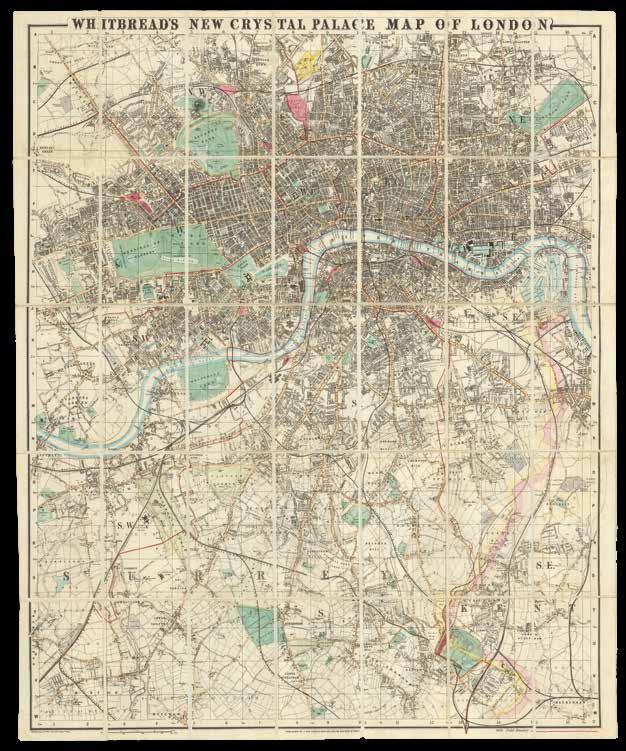
WHITBREAD, [Josiah]
Whitebread’s New Crystal Palace Map of London.
Publication London, J. Whitbread, 1863.
Description Lithograph plan, hand-coloured, dissected and mounted on linen, minor damp staining to verso, with 48pp street index and cab fares list, all housed in pale green cloth slipcase, lettered in gilt.
Dimensions 670 by 815mm (26.5 by 32 inches).
Scale (approx.) 3 inches to 1 statute mile.
References Hyde 37 (4).
The Crystal Palace’s New Home
Josiah Whitbread (fl 1854-1879) was a mapseller and publisher, with premises at 142 Oxford Street. In essence he would appear to only have produced one map of London, which issued in various shapes to reflex the growth of Victorian London. Here Whitbread’s map extends south to included Crystal Palace, the new home of the building that housed the Great Exhibition. The Crystal Palace had been moved to Sydenham Hill in 1853, and opened by Queen Victoria in 1854. New Railways include the Metropolitan Railway from Paddington to Farringdon (1863), and the South Eastern Railway to Charing Cross (1864).
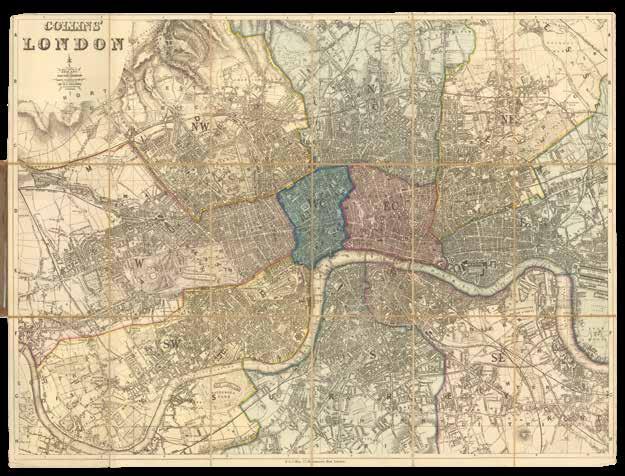
COLLINS, [Henry George]
Collins’ London.
Publication
London, H. G. Collins, [c1856].
Description
Engraved plan, hand-coloured, dissected and mounted on linen, 32pp index and guide, detached, folding into purple cloth boards, with publisher’s label, spine split with remnants of sellotape.
Dimensions 540 by 735mm (21.25 by 29 inches).
Scale (approx.) 3 inches to 1 statute mile.
References Hyde 38 (2).
An Embezzler’s Map
Henry George Collins (1808-c1871), map maker, engraver, and bookseller was active during the middle of the nineteenth century. His career began inauspiciously, unsuccessful as a bookbinder he was declared bankrupt in 1839. Later he worked for the print and playing card publisher Rock & Co., but was accused by the firm of embezzlement, for which he served four months in prison. It was at this time that he turned his hand to mapmaking and publishing, partnering with Anthony la Riviere, and John Kelly. However, Collins was almost as unsuccessful at the map trade as he was at bookbinding, and sales were slow. This might explain the text below the title of the current map, which states that Collins was the winner of the “Only medal awarded to England in the New York Exhibition of Maps, Atlases, Globes”. This is most likely a fiction to appeal to the American tourist in London, as they is no evidence of such a fair or award. In 1857, he was declared bankrupt, with the majority of his stock ending up in the hands of Edward Stanford.
DAVIES B[enjamin] R[ees]
Davies’s Map of the Environs of London.
Publication
London, B. R. Davies, 1855.
Description
Engraved map, hand-coloured in outline, dissected and mounted on linen, fold into blue cloth boards, lettered in gilt, rubbed.
Dimensions
740 by 1060mm (29.25 by 41.75 inches).
Scale
1 inch to 1 statute mile.
References Hyde 39 (1).
Highlighting the Metropolitan Boroughs
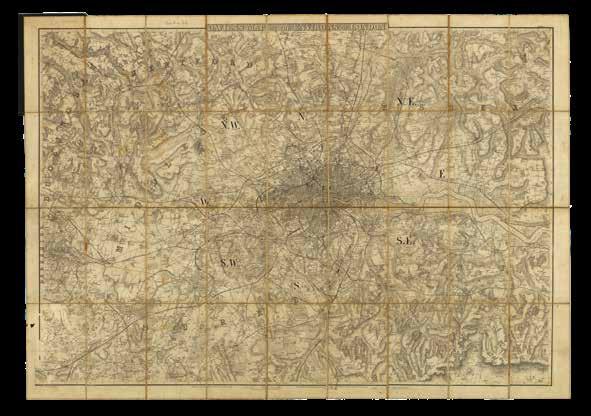
Davies’s map of London and its environs extends from Cheshunt to Leatherhead, and from Windsor to Brentwood. It shows the West End & Crystal Palace Railway (completed 1856) still in progress. Two circles mark the four mile radius from St Paul’s and the 3 mile radius of the General Post Office. The distance from termini are marked on the railways. The Metropolitan boroughs are outlined in red, and the county boundaries in yellow. Elevation is marked by hatchuring, with woods, parks, and forest in green. The map also shows roads, railways, rivers, towns, and villages.
DAVIES B[enjamin] R[ees]
Davies’s Map of the Environs of London.
Publication London, Edward Stamford, 1858.
Description
Engraved map, hand-coloured in outline, dissected and mounted on linen, Standford advert to endpaper.
Dimensions
775 by 1090mm (30.5 by 43 inches).
Scale
1 inch to 1 statute mile.
References Hyde 39 (3).
The 1858 edition of Davies’s Map of London and its environs has been updated with the proposed extension to Wet End & Crystal Palace Railway to Battersea.
DAVIES B[enjamin] R[ees]
Davies’s Map of the Environs of London.
Publication London, Edward Stamford, 1859.
Description
Engraved map, hand-coloured in outline, dissected and mounted on linen, bookplate of George Parker Heathcote to verso, folding into dark green cloth covers.
Dimensions
775 by 1090mm (30.5 by 43 inches).
Scale
1 inch to 1 statute mile.
References Hyde 39 (4).
The 1859 edition of Davies’s Map of London and its environs has been updated with the East London Railway extending through the Thames Tunnel to Wapping from New Cross.
DAVIES B[enjamin] R[ees]
Davies’s Map of the Environs of London.
Publication London, Edward Stamford, 1860.
Description Engraved map, dissected and mounted on linen, fold into green cloth boards, lettered in gilt, rubbed, spine frayed.
Dimensions
740 by 1060mm (29.25 by 41.75 inches).
Scale 1 inch to 1 statute mile.
References Hyde 39 (5).
DAVIES B[enjamin] R[ees]
Davies’s Map of the Environs of London.
Publication London, Edward Stamford, 1865.
Description Engraved map, hand-coloured, dissected and mounted on linen, fold into red cloth covers, lettered in gilt, rubbed.
Dimensions
740 by 1060mm (29.25 by 41.75 inches).
Scale 1 inch to 1 statute mile.
References Hyde 39 intermediate state between (6) and (7).
The 1860 edition of Davies’s map of London and its environs, shows the newly constructed Victoria railway.
The 1865 edition of Davies’s map of London and its environs, shows the South Eastern Railway extending to Charing Cross.
DAVIES B[enjamin] R[ees]
Davies’s Map of the Environs of London.
Publication
London, Edward Stamford, 1870.
Description
Engraved map, hand-coloured in outline, dissected and mounted on linen, folding into dark green cloth covers.
Dimensions
725 by 1040mm (28.5 by 41 inches).
Scale
1 inch to 1 statute mile.
References Hyde 39 (9).
The 1870 edition of Davies’s map of London and its environs has been updated with the East London Railway extending through the Thames Tunnel to Wapping from New Cross (1869).
DAVIES B[enjamin] R[ees]
Davies’s Map of the Environs of London.
Publication
London, Edward Stamford, 1894.
Description
Engraved map, hand-coloured in outline, dissected and mounted on linen, Stanford’s labels on endpaper and inside cover, folding into dark blue cloth boards, lettered in gilt, rubbed.
Dimensions
745 by 1040mm (29.25 by 41 inches).
Scale
1 inch to 1 statute mile.
References Hyde 39 (16).
The 1894 edition of Davies’s map of London and its environs, here the Millbank Penitentiary is still present (demolished 1890), but Tower Bridge (opened 1894) is shown.
PAYNE, Albert Henry [London].
Publication [Leipzig & Dresden, A. H. Payne, c1862].
Description
Engraved map, mounted on linen, cropped to neatline with some minor wear at folds , folding into purple cloth boards, lettered in gilt, spine faded.
Dimensions 465 by 745mm (18.25 by 29.25 inches).
Scale 4 inches to 1 statute mile.
References Not listed in Hyde. c.f. Hyde 41.
Successor to the Great Exhibition
This extremely scarce map by Albert Henry Payne extends from Kingsland to Kennington, and from Notting Hill to Shadwell. It bears no title or imprint, but is related to ‘Payne’s Plan of London’ (Hyde 41), showing the International Exhibition in Cromwell Road (1862). Payne (1812-1902) was an English engraver, painter, and illustrator, who lived and worked in Leipzig from 1839 onwards.
The International Exhibition of 1862, was like its 1851 father, intended to showcase the latest arts and industry from around the world. Situated on the Cromwell Road, now the site of the Natural History Museum, and Science Museum, the exhibition boasted among other advances Charles Babbage’s analytical engine, a precursor to the modern computer.
ORDNANCE SURVEY
London and its Environs.
Publication Southampton, Ordnance Survey, 1857.
Description
Engraved map, hand-coloured, dissected and mounted on linen, folding into dark green cloth slipcase, with label of James Wyld.
Dimensions 670 by 1100mm (26.5 by 43.25 inches).
Scale 1 inch to 1 statute mile.
References Hyde 52 (1).
Extending from Windsor to Gravesend, and from Potters Bar to Epsom, this Ordnance Survey of London and its suburbs shows the Great Northern Railway to Kings Cross (1852), but surprisingly does not show some of the lines built subsequently, such as the London & Crystal Palace Railway, the Bow & Barking Branch Railway from Bromley, or the Woodford Branch Railway. A note in the margin in the lower left-hand corner states that it was “Engraved originally in 7 separate sheets which have been joined into 1 sheet by the Electrotype process”.
The Electrotype process had been invented in the late 1830s, and consisted of making a mould of the plate, which would be sprayed with copper paint, then dipped into a copper solution, in which an electric current is passed through. The copper ions would slowly build up on the plate, creating a perfect copy of the original.
Engraved map, hand-coloured in outline, dissected and mounted on linen, folding into marbled cloth cover.
Dimensions 710 by 1100mm (28 by 43.25 inches).
Scale 1 inch to 1 statute mile.
References Hyde 52 (2).
Second state of the Ordnance Survey map of London, here with the Crystal Palace shown at Sydenham.
ORDNANCE SURVEY
London and its Environs.
Publication Southampton, Ordnance Survey, 1861.
Description Engraved map, dissected and mounted on linen, folding into red slip case, foxing along folds.
Dimensions 665 by 1090mm (26.25 by 43 inches).
Scale 1 inch to 1 statute mile.
References Hyde 52 (3).
A further example of the Ordnance Survey map showing London and its suburbs. Here the Victoria Railway is shown to Victoria Station (1860), and the South Eastern Railway has been extended to Hungerford Bridge.
ORDNANCE SURVEY
The date in print has been changed to 1864, but there have been no changes made to the map. 806
London and its Environs.
Publication Southampton, Ordnance Survey, 1864.
Description Engraved map, hand-coloured, mounted and fold.
Dimensions 628 by 1080mm (24.75 by 42.5 inches).
Scale 1 inch to 1 statute mile.
References Hyde 52 (4).
807
ORDNANCE SURVEY
London and its Environs.
Publication Southampton, Ordnance Survey, 1861 but 1875.
Description Engraved map, hand-coloured, dissected and mounted on linen, minor dampstaining to folds, folding into faded purple cloth slipcase, rubbed.
Dimensions 665 by 1110mm (26.25 by 43.75 inches).
Scale 1 inch to 1 statute mile.
References Hyde 52 (9).
A further example of the Ordnance Survey map of London which, despite showing an imprint date of June 1861, and represents the situation in c1868 and carries the statement “Electrotyped in 1875”. Indeed the Midland Railway is extended to St Pancras (1868), and the St Johns Wood Railway (1868) and the Tottenham & Hampstead Junction Railway (1868) are also shown.
REYNOLDS, James
Reynolds’s Map of Modern London.
Publication London, James Reynolds, 1859.
Description
Engraved plan, hand coloured in outline, mounted on linen, tears to old folds, lacking guide, folding into red cloth covers, with publisher’s label, rubbed and scuffed.
Dimensions 735 by 475mm (29 by 18.75 inches).
Scale
3.5 inches to 1 statute mile.
References Hyde 54 (3).
Reynold’s most successful publication
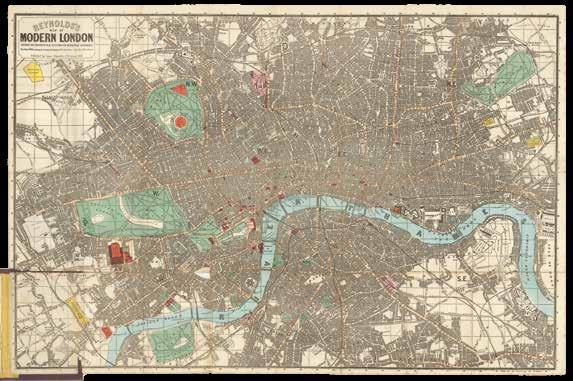
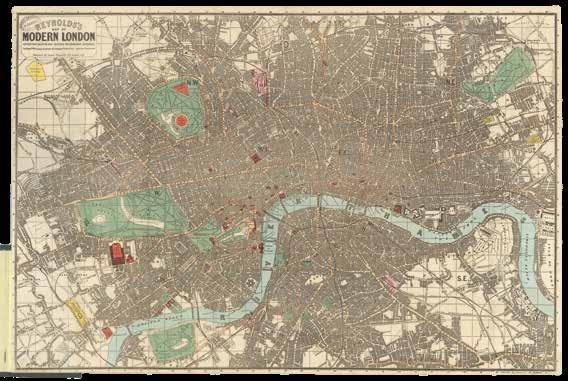
James Reynolds (1817-1876) publisher and bookseller, at 174, The Strand, produced several maps of London, together with travel guides and popular science books. He would be made Fellow of the Royal Geographical Society in 1874; Stanford acting as one of his sponsors. Following his death in 1876 his business was carried on by his sons William Henry, and Frederick, who would later sell their business to Charles Smith, with whom they had long collaborated. ‘Reynolds’s Map of Modern London...’ was probably his most successful cartographic publication, with editions printed from 1857 to the turn of the Twentieth century. The would later bear the addition of a measuring tape for to aid navigation. The present 1859 edition shows ground being cleared for Albertopolis. The terminus for the West End and Crystal Palace railway shown at Battersea.
REYNOLDS, James
Reynolds’s Map of Modern London.
Publication London, James Reynolds, 1862.
Description
Engraved plan, hand-coloured in outline, tears to old folds, 36pp index and guide, folding into red cloth covers, with publisher’s label.
Dimensions 475 by 735mm (18.75 by 29 inches).
Scale
3.5 inches to 1 statute mile.
References Hyde 54 (6).
Reynolds’s 1862 map of London shows the International Exhibition in Cromwell Road (1862), and Lambeth Bridge (1862). The Metropolitan Railway to Farringdon (1863) and the South Eastern to Charing Cross (1864) are already shown, although not yet finished, and the Victoria Embankment (begun in 1864) appears as proposed.
REYNOLDS, James
Reynolds’s Map of Modern London. quarter-mile sections for measuring distances.
Publication London, James Reynolds, 1862.
Description
Engraved plan, hand-coloured in outline, mounted on linen, library stamp on map, 34pp London Guide and adverts, folding into original green covers, lettered in gilt.
Dimensions 510 by 740mm (20 by 29.25 inches).
Scale
3.5 inches to 1 statute mile.
References Hyde 54 (7).
The date in imprint is the same as the previous map, but with the addition of ‘… for measuring distances’ to the title.
REYNOLDS, James
New Map of London with the Recent Improvements 1873.
Publication London, James Reynolds, 1873.
Description
Engraved plan, hand-coloured in outline, mounted on linen, lacking guide, folding into blue blinded stamped covers, lettered in gilt.
Dimensions
510 by 740mm (20 by 29.25 inches).
Scale
3.5 inches to 1 statute mile.
References Hyde 54 (15).
REYNOLDS, James
Indicator Map of London; Divided into Quarter Mile Squares for Measuring Distances.
Publication London, C. Smith & Son, 1883.
Description
Engraved plan, hand-coloured, mounted on linen, with 46pp. index and guide and measuring tape, housed in red cloth covers, lettered in gilt.
Dimensions
510 by 765mm (20 by 30 inches).
Scale
3.5 inches to 1 statute mile.
References
Hyde 54 intermediate state between (23) and (24)
Reynolds’s 1873 map of London, bears a new title, and shows the District Line extended to Cannon Street. The Albert Hall is show, as is the proposed extension of the Great Eastern to Liverpool Street.
The 1883 edition bears the imprint of Charles Smith, a measuring tape and numbers to the borders have been added to enable the user to locate places listed in the index. The Tothill Fields Prison still stands it will be demolished in 1884 and the Inner Circle is only shown to Mansions Hous (complete by 1884).
REYNOLDS, James
Indicator Map of London Divided into Quarter Mile Squares for Measuring distances.
Publication London, C. Smith & Son, [1885].
Description
Engraved plan, printed in colours, mounted on linen, with 68pp index and guide and measuring tape, housed in green cloth covers, lettered in gilt, rubbed.
Dimensions 510 by 765mm (20 by 30 inches).
Scale
3.5 inches to 1 statute mile.
References Hyde 54 (25).
The American Exchange which is marked in purple on the Strand on the map, and on the cover title, was advertised as the “Headquarters for Americans in Europe”, and provided services for travellers including mail delivery, currency exchange, tourist information and the booking of travel and accommodation. The Tothill Fields Prison has been demolished (1884) and the Inner Circle is shown complete (1884), though without Tower Station, thus giving a speculative date of the mid-1880s.
REYNOLDS, James
Reynold’s Distance Map of London with the Recent Improvements.
Publication
London, C. Smith & Son, 1891.
Description
Engraved plan, printed in colours, mounted on linen, 56 [pp] guide and index, all housed in green cloth covers, lettered in gilt.
Dimensions 475 by 735mm (18.75 by 29 inches).
Scale
3.5 inches to 1 statute mile.
References Hyde 54 (30).
The 1891 edition of Reynolds’s map of London. The plan still shows Millbank Penitentiary. The prison closed in 1890, with demolition carried out the following year. The site had been acquired by the sugar baron Henry Tate for the location of his gallery of British Art, known today as Tate Britain.
REYNOLDS, James
Indicator map of London Divided into quarter mile squares for measuring distances.
Publication London, C. Smith & Son, [c1901].
Description
Engraved plan, printed in colours, mounted on linen, with indicator tape, 59 pp index, pasted to upper pastedown, green cloth blind stamped covers, lettered in gilt.
Dimensions 490 by 740mm (19.25 by 29.25 inches).
Scale 3.5 inches to 1 statute mile.
References Hyde 54 (32).
A later state of Reynolds’s map of London, here updated to show Kingsway and Aldwych (begun 1901) under construction.
STANFORD, Edward
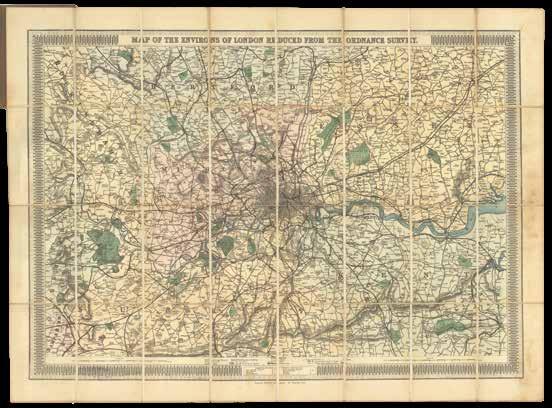
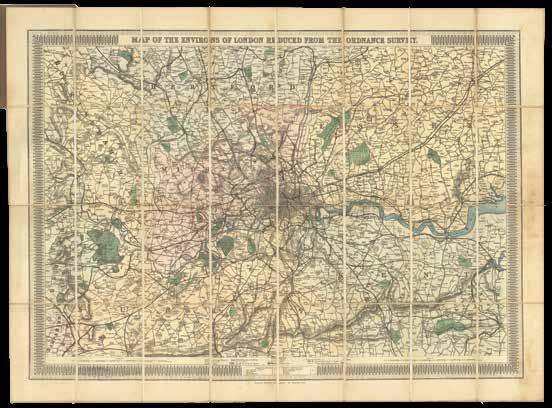
Map of the Environs of London Reduced from the Ordnance Survey.
Publication London, Edward Stanford, [c1857].
Description Engraved map, hand-coloured, dissected and mounted on linen, folding into dark blue cloth boards, gilt.
Dimensions
570 by 820mm (22.5 by 32.25 inches).
Scale
1 inch to 2 statute miles.
References Hyde 55 (1).
The most successful mapmaker of the Victorian Era
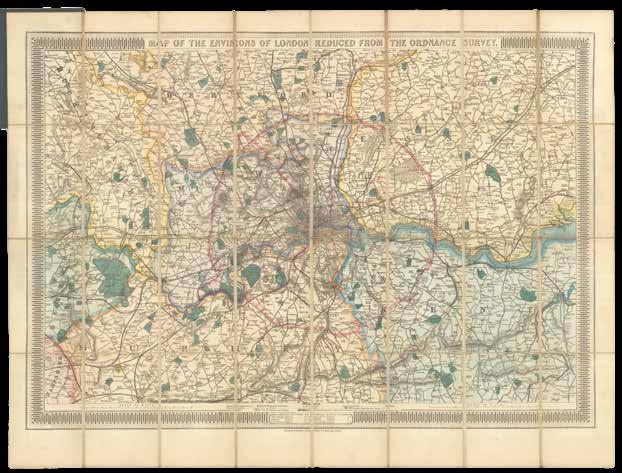
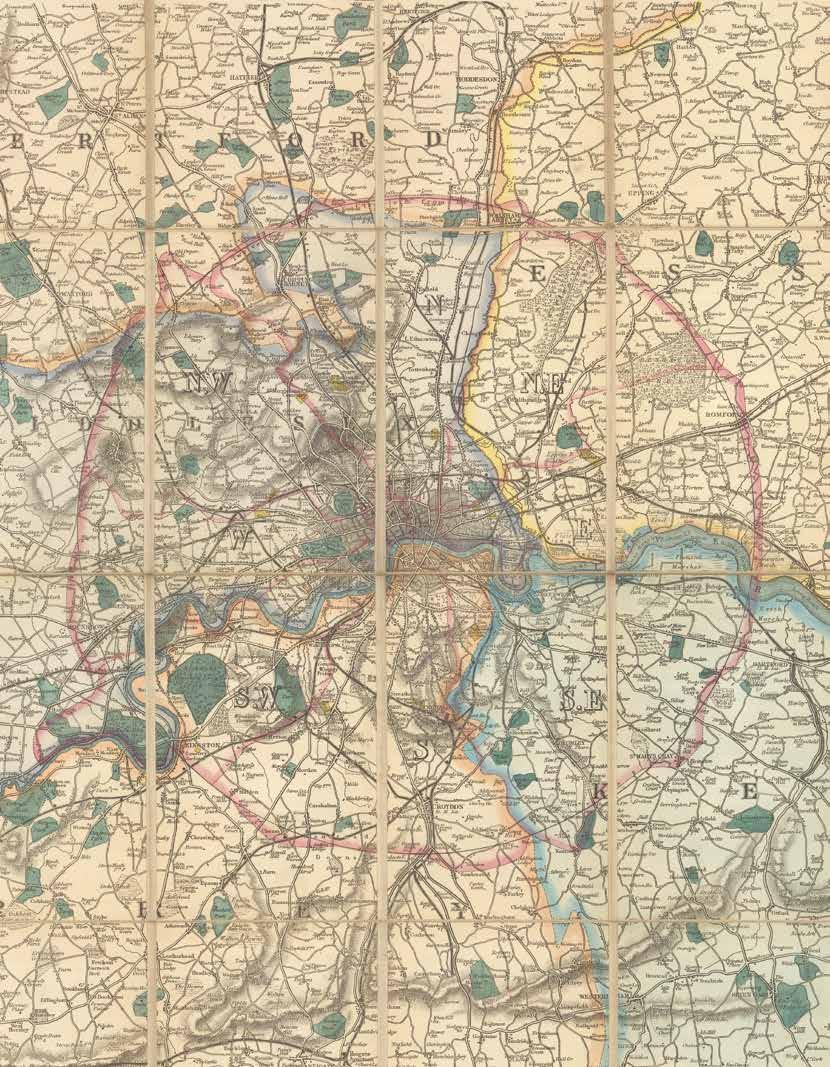
Stanford’s map of London and its environs, marks postal and district boundaries; two circles show the 4 mile radius from Charing Cross and the 12 mile radius based on the General Post Office. The figures next to towns and cities represent their distance from London, with further information on market days. The railway link from Lewisham to Beckenham (1858) is marked but not the Mid-Kent Railway from Beckenham to St Mary Cray (1858).
Edward Stanford (1827-1904) was an English mapmaker and publisher, who built his firm to be the largest (and best) mapmakers and publishers in London by the end of the nineteenth century. In 1847 he returned to London to work for Trelawney William Saunders, becoming first a partner and then taking over the firm, founding “Stanford’s Geographical Establishment” in 1857. When Edward I retired in 1882, the firm passed to his son Edward II (1856-1917) and continues to the present day, as Stanfords.
STANFORD, Edward
Map of the Environs of London Reduced from the Ordnance Survey.
Publication London, Edward Stanford, [c1881].
Description
Engraved map, hand-coloured, dissected and mounted on linen, minor foxing folding into faded purple cloth covers, with publisher’s label, spine faded and split.
Dimensions 565 by 810mm (22.25 by 32 inches).
Scale
1 inch to 2 statute miles.
References Hyde 55 - This state not listed.
This edition of Stanford’s map shows the Metropolitan Railway’s extension between Willesden and Harrow (1880), and railway to Gallions (1880). The South Eastern Railway’s extension from West Wickham to Hayes (1882), however, does not yet appear.
STANFORD, Edward
A further example of Stanford’s map of London and its suburbs, showing the Metropolitan Railway extended from Harrow to Pinner, and the South Eastern Railway’s extension from Woodside to South Croydon (1885). 818
Map of the Environs of London Reduced from the Ordnance Survey.
Publication London, Edward Stanford, [c1885].
Description
Engraved map, hand-coloured, dissected and mounted on linen, folding into brown cloth covers, with publisher’s label, upper cover detached.
Dimensions 565 by 810mm (22.25 by 32 inches).
Scale 1 inch to 2 statute miles.
References Hyde 55 - This state not listed.
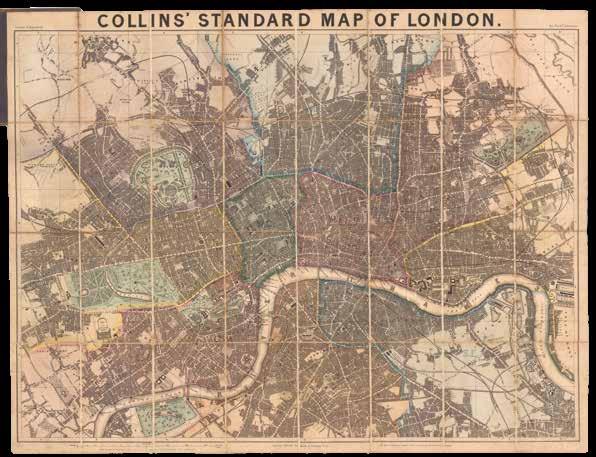
COLLINS, Henry George
Collins’ Standard Map of London.
Publication
London, Edward Stanford, [c1862].
Description
Engraved plan, hand-coloured, dissected and mounted on linen, folding into faded blue cloth boards, with publisher’s label.
Dimensions 610 by 825mm (24 by 32.5 inches).
Scale 4 inches to 1 statute mile.
References Hyde 56A (2).
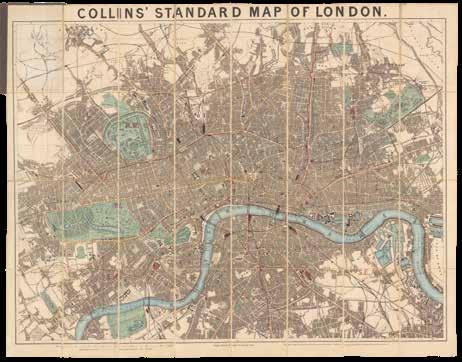
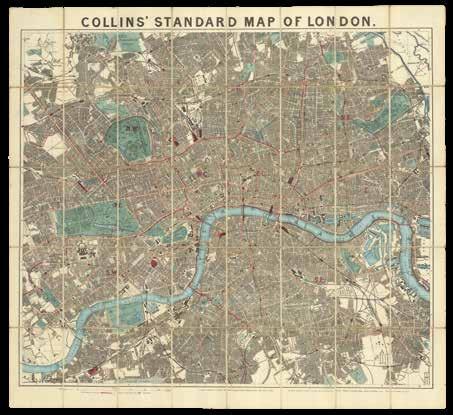
Stanford Acquires Collins
The plates for this map were acquired by Edward Standford from the firm of Southgate & Barrett, who held an auction of H.G. Collins’ stock in 1858. A further 210 copies of the map where acquired the following year at another auction of Collins’ stock. Despite this no copy of the map wth the imprint of H.G. Collins or Collins Bros., has been located. The map with it’s clear and simple design would hugely popular and Stanford would continue to issue maps based on Collins’ work for the next 35 years. ‘Collins’ Standard Map of London’ extends from Hampstead to Camberwell Green, and from Notting Hill to Limehouse. The International Exhibition of 1862 is shown in the Cromwell Road.
COLLINS, Henry George
Collins’ Standard Map of London.
Publication
London, Edward Stanford, [c1866].
Description
Engraved plan, hand-coloured, dissected and mounted on linen, 24pp index and guide, folding into brown cloth covers, with publisher’s label.
Dimensions 610 by 825mm (24 by 32.5 inches).
Scale 4 inches to 1 statute mile.
References Hyde 56A intermediate between states (5) and (6).
It shows the Northern Railway to Broad Street (1866), the South Eastern Railway to Cannon Street (1866), and the Metropolitan Railway to Moorgate (1865). The Midland Railway to St Pancras and the remaining part of the Inner Circle appear as proposed.
COLLINS, Henry George
Collins’ Standard Map of London.
Publication London, Edward Stanford, 1892.
Description
Engraved map, hand-coloured, dissected and mounted on linen, folding into blue cloth boards, with publisher’s label, map detached and spine split at top.
Dimensions 845 by 730mm (33.25 by 28.75 inches).
Scale (approx.) 4 inches to 1 statute mile.
References Hyde 56B (8).
A further edition of Collins’s map of. London, with an extension to the south to include West Brixton, and from Notting Hill to Limehouse. Tower Bridge (opened 1894) is already shown, as is Millbank Penitentiary (demolished 1890).
SMITH, Charles & Son
Smith’s Map of the Environs of London.
Publication London, C. Smith & Son, [c1898].
Description Engraved map, hand-coloured in outline, dissected and mounted on linen, minor staining to old folds, red marbled paper endpapers.
Dimensions
610 by 800mm (24 by 31.5 inches).
Scale 1 inch to 2 statute miles.
References Hyde 59 (5).
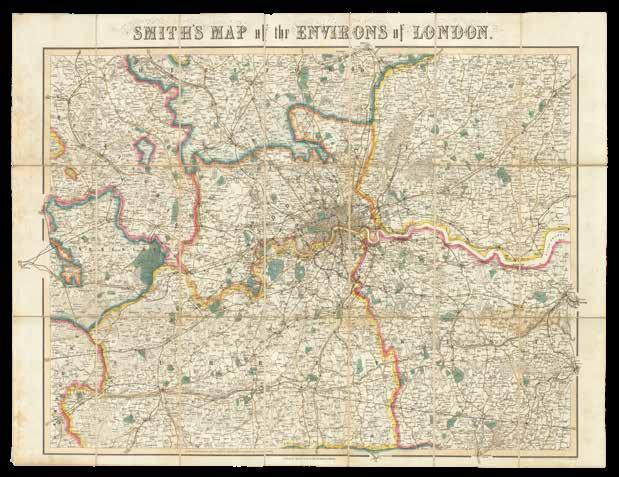
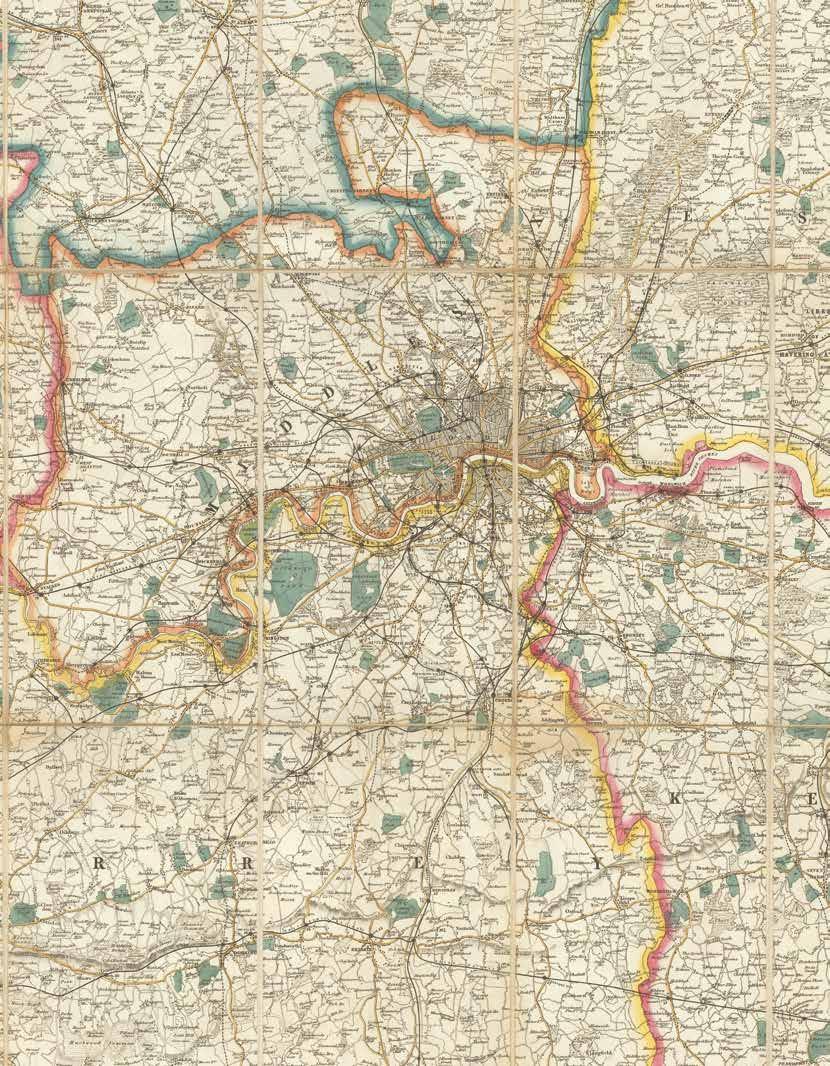
The fifth state of Smith’s map of London, as recorded by Hyde, the present edition has been updated to show the boundary of the London County Council and the Great Central Railway to Marylebone under construction. Also marked is a circle of four mile radius based on Charing Cross; the railway stations are marked with the distance for their London terminus. By the time this map was published, the firm was now being run by Charles’s grandson Guildford Smith.
[KELLY & CO., probably]
London 1855, Drawn and Engraved Expressly for the Post Office Directory.
Publication London, [probably Kelly & Co.,]1855.
Description
Engraved plan, varnished, dissected and mounted on linen, brown cloth covers, with manuscript label, rubbed, with loss to spine.
Dimensions
380 by 680mm (15 by 26.75 inches).
Scale
3 inches to 1 statute.
References Not in Hyde but c.f. Hyde 61 for later editions.
Before the Yellow Pages
Although the map is on the same and scale (three inches to the mile) as subsequent editions published by Kelly & Co., the map only extends north to south from Dalston to The Oval, and west to east from Kensington to the East India Docks. The map bears no imprint and proceeds the states listed by Hyde.
Freeric Festus Kelly (d 1883) became chief inspector of letter carriers in 1836, he also took over publication of the ‘Post Office London Directory’ - mentioned in the map’s title. The Directory was a proto Yellow Pages, listing businesses and trades people in London. Although Kelly held a public post, the Directory was privately published, a conflict of interest that Kelly clearly exploited for his own commercial gain; much to the annoyance of his competitors.
KELLY & Co.
London, 1879 Drawn & Engraved expressly for the “Post Office Directory” 1879.
Publication London, Kelly & Co, 1879.
Description
Engraved map, dissected and mounted on linen, damp stains along folds and on spine and a nine inch light red crayon mark on map, folding into green cloth covers, with bookseller’s label of Edward Stanford’s label on cover.
Dimensions 670 by 915mm (26.5 by 36 inches).
Scale 3 inches to 1 statute mile.
References Hyde 61 (22).
Extending from Highgate to Dulwich, and from Barnes to West Ham, this map, first published in 1847, spans London and includes the post code districts. The map appeared regularly in the ‘Post Office London Directory’, from 1859-1890, and was also issued (as here) as a folding map, with the postal district boundaries marked. For the 1879 edition the map has been divided into half mile squares lettered and numbered to the margin.
Scale Approximately 5 statue miles to 1 inch. 825
Map of the Parish of St Pancras in the County of Middlesex 1874. The map is made to the order of the Vestry of the Parish of St. Pancras and published by their Obedient Servant Edmund Daw.
Publication London, Published by E. Daw, 114 Fetter Lane, 1860.
Description
Large engraved plan with contemporary hand-colour in full, dissected and mounted on linen, list of Ecclesiastical districts upper left, list of wards with their distinguishing colours lower right, folding into original green cloth covers, upper cover detached.
Dimensions 760 by 1600mm (30 by 63 inches).
Daw’s detailed plan of mid-Victorian St Pancras
Rare and detailed plan of St Pancras, orientated with north to the right, and extending from the Royal Zoological Gardens, to Euston Station and from Highgate to University College London. The plan is coloured according to wards and has a key to ecclesiastical districts to the upper left.
DAW, Edmund
826
DAW, Edmund
Map of the Parish of St Pancras in the County of Middlesex 1874. The map is made to the order of the Vestry of the Parish of St. Pancras and published by their Obedient Servant Edmund Daw.
Publication London, Published by E. Daw, 114 Fetter Lane, 1874.
Description
Large engraved plan, dissected and mounted on linen, fine original full-wash colour, list of Ecclesiastical districts upper left, list of wards with their distinguishing colours lower right, folding into original red cloth covers, lettered in gilt, rubbed and scuffed.
Dimensions
760 by 1600mm. (30 by 63 inches).
Scale
Approximately 5 statue miles to 1 inch.
Now updated to 1874 and marking the huge construction boom in the second half of the nineteenth century.
Take me to the Bridge
STANFORD, Edward
Stanford’s Map of the British Metropolis and Suburbs.
Publication London, Edward Stanford, 1880.
Description Engraved map, hand-coloured, dissected and mounted on linen, folding into faded dark purple cloth covers, with publisher’s label.
Dimensions 650 by 775mm (25.5 by 30.5 inches).
Scale 3 inches to 1 statute mile.
References Hyde 69B - This state not listed.
Extending from Upper Holloway in the north to Herne Hill in the south, and from Hammersmith in the west to Greenwich in the east, Stanford’s map of the ‘British Metropolis’ is based on Benjamin Rees Davies’s ‘New Map of the British Metropolis’,which Stanford had published for Davies since 1853. Boundaries of counties are shown as are boroughs, county court districts and postal districts. The District Railway’s line from Earl’s Court to Putney Bridge is marked (1880).
STANFORD, Edward
Stanford’s Map of the British Metropolis and Suburbs.
Publication London, Edward Stanford, 1884.
Description Engraved plan, hand-coloured, dissected and mounted on linen, folding into brown cloth covers, with publisher’s label, faded.
Dimensions 650 by 775mm (25.5 by 30.5 inches).
Scale 3 inches to 1 statute mile.
References Hyde 69B - This state not listed.
Stanford’s 1884 map of London shows the inner circle line complete.
STANFORD, Edward
Stanford’s Map of 12 Miles Round London.
Publication London, Edward Stanford, 1874.
Description Lithograph map hand-coloured, dissected and mounted on linen, folding into original red cloth slip case, with publisher’s label, upper cover almost detached.
Dimensions 645 by 625mm (25.5 by 24.5 inches).
Scale 1 inch to 1 statute mile.
References Hyde 70 - This state not listed.
The railway extends to Alexandra Palace (1873), the Great Northern Railway’s branch to Barnet (1872), and Great Eastern Railway’s line from Bethenal Green to Lower Edmonton (1872).
STANFORD, Edward
Stanford’s Map of 12 Miles Around London.
Publication London, Edward Stanford, 1895.
Description Lithograph map, hand-coloured, dissected and mounted on linen, folding into purple cloth boards, with Stanford’s labels, faded.
Dimensions 630 by 625mm (24.75 by 24.5 inches).
Scale 1 inch to 1 statute mile.
References Hyde 70 - this state not listed.
Railways are Red, Rivers are Blue
Stanford’s map of 12 miles round London shows the metropolitan boroughs outlined in red, together with there postal districts. Further out county boundaries are marked, with the numerous railway lines highlighted in red. Tower Bridge, opened in 1894, is marked spanning The Thames. Elevation is marked by hatchuring, forests, woods, and parks marked green, with roads, rivers, towns, and villages clearly marked.
“Indispensable for any study of London”
WEEKLY DISPATCH
London.
Publication
London, Weekly Dispatch, 1862.
Description
Engraved plan, on nine sheets, handcoloured, dissected and mounted on linen, folding into pale blue slip case.
Dimensions 635 by 465mm (25 by 18.25 inches).
Scale (approx.) 9.5 inches to 1 statute mile.
References Hyde 73 (1).
The map was compiled and engraved by Edward Weller F.R.G.S. and issued in parts as a supplements with the ‘Weekly Dispatch’ newspaper from 1861 to 1862. “Comparing it with Stanford’s [Library Map] it would be unfair to say that one is better than the other, since each has features particular to itself, and each shows a certain amount of detail not shown on the other. The ‘Weekly Dispatch’ map is on a larger scale and it is therefore clearer, but Stanford’s covers a larger area; Stanford’s map shows the layout of public gardens etc. and also gives bench marks, which are not given on the ‘Dispatch’ map, whilst the latter has post office receiving houses, pillar boxes, and money order offices - details which are not shown on Stanford’s. Both maps are indispensable for any study of London during this period” (Hyde).
Description Engraved plan, hand-coloured, dissected and mounted on linen, folding into green cloth slipcase.
Dimensions 1090 by 1300mm (43 by 51.25 inches).
Scale (approx.) 9.5 inches to 1 statute mile.
References Hyde 73 (4).
Weekly Dispatch ‘Map of London’ dated 1863, bearing the imprint of Cassell, Petter, and Galpin. The firm would later become Cassell and Company, one of the leading British publisher’s throughout the twentieth century.
WEEKLY DISPATCH
Cassel’s Map of London.
Publication London Cassell, Petter & Galpin, [c1866].
Description Engraved plan, hand-coloured, dissected and mounted on linen, in four sections, folding into red morocco slip case, gilt.
Dimensions 690 by 950mm (27.25 by 37.5 inches).
Scale (approx.) 9.5 inches to 1 statute mile.
References Hyde 73 - This state not listed.
It shows the Temporary Wooden Bridge at Blackfriars (1863), Broad Street Station (1866), the Metropolitan Railway to Moorgate (1865), the London, Chatham & Dover Railway (1866), and the South Eastern Railway to Cannon Street (1866). Victoria Embankment and Queen Victoria Street are shown under construction.
The Second Great Exhibition
ILLUSTRATED LONDON NEWS
London. Guide to the International Exhibition Supplement to the Illustrated London News, May 24, 1862.
Publication London, Illustrated London News, 1862.
Description
Engraved plan, mounted on linen, folding into purple cloth boards, with manuscript label, faded.
Dimensions
740 by 1040mm (29.25 by 41 inches).
Scale 4 inches to 1 statute mile.
References Hyde 82.
The maps focus is the International Exhibition on Cromwell Road (now the site of the Natural History Museum and the Science Museum) to which it was made as a guide. 11 years since the Great Exhibition, the fair showcased the latest technological improvements including: he electric telegraph, submarine cables, the first plastic, Parkesine , machine tools, looms and precision instruments . The map shows the South Eastern Railway extension to Charing Cross is shown in progress, while the London, Chatham & Dover Railway is shown to an intended station at Smithfield.
PHILIP, [George] & Son
Philip’s New Plan of London 1862.
Publication
London, George Philip & Son, 1862.
Description
Engraved plan, hand coloured, mounted on linen, lacking index, folding into green cloth boards, with salmon coloured illustrated publisher’s label to upper cover.
Dimensions
485 by 725mm (19 by 28.5 inches).
Scale 3.5 inches to 1 statute mile.
References Hyde 85 (1).
The Exhibition of 1862
George Philip (1800-1882) began as bookseller in Liverpool, in 1834, but the stock soon expanded to include maps and travel books. George’s son George Junior joined the firm in 1848. In 1856, the firm opened a London premises at 32, Fleet Street. Their first map of the Metropolis was produced, like so many in 1862, to accompany the Great Exhibition. It was compiled and engraved by Edward Weller, the mapmaker responsible for the ‘Weekly Dispatch’s large scale plan published the previous year. The plan extends from Kingsland in the north to Denmark Hill in the south, and from Brook Green in the west to Old Ford in the east.
PHILIP, George
Philip’s New Plan of London.
Publication
London, George Philip & Son, 1865.
Description
Engraved plan, some minor foxing, 16pp index and guide to cab fares, folding into green cloth covers, with publisher’s label.
Dimensions
495 by 755mm (19.5 by 29.75 inches).
Scale approx.) 3.5 inches to 1 statute mile.
References Hyde 85 (2).
The South Eastern Railway also now extends to Charing Cross Station (1864).
PHILIP, George
Philip’s New Plan of London.
Publication
London, George Philip & Son, 1871.
Description
Engraved plan, hand-coloured, mounted on linen, 20 pp index with a two page sketch map of central London, folding into dark green cloth boards, with publisher’s label, rubbed.
Dimensions
485 by 725mm (19 by 28.5 inches).
Scale (approx.) 3.5 inches to one statute mile.
References Hyde 85 (5).
The Inner Circle extending to Blackfriars (1870), and the remaining part as “constructing”.
PHILIP, George
Philip’s New Plan of London 1880.
Publication
London, George Philip & Son, 1880.
Description
Engraved plan, hand-coloured, mounted on linen, 20pp index with a two page sketch map of central London, folding into dark green cloth covers, with publisher’s label.
Dimensions
481 by 725mm (19 by 28.5 inches).
Scale (approx.) 3.5 inches to 1 statute mile.
References Hyde 85 (14).
The Metropolitan Railway extended to Aldgate (1876) and the Clerkenwell Road finally named (1878).
PHILIP, George
Philip’s New Plan of London 1887.
Publication
London, George Philip & Son, 1887.
Description
Engraved plan, hand-coloured, backed on japan paper, 35[pp] index with a two page sketch map of central London, both map and index loose, folding into dark brown cloth covers, with publisher’s label, spine repaired.
Dimensions
481 by 725mm (19 by 28.5 inches).
Scale (approx.) 3.5 inches to 1 statute mile.
References Hyde 85 intermediate state between (17) and (18).
A later state of Philip’s map of London, which now shows the Inner Circle Line complete.
PHILIP, George
Philip’s New Plan of London 1890.
Publication
London, George Philip & Son, 1890.
Description
Engraved map, hand-coloured, dissected and mounted on linen, evenly age-toned.
Dimensions
490 by 750mm (19.25 by 29.5 inches).
Scale (approx.) 3.5 inches to 1 statute mile.
References Hyde 85 - This state not listed.
An unrecorded state of Philip’s map of London, which now shows the City & South London Railway under construction to King William Street.
STANFORD, Edward
Stanford’s Library Map of London and its Suburbs.
Publication London, Edward Stanford, [1862].
Description Engraved plan, hand-coloured in outline, dissected and mounted on linen, in four sections, with red marbled paper endpapers.
Dimensions
830 by 950mm (32.75 by 37.5 inches).
Scale 6 inches to 1 statute mile.
References Hyde 91 (1).
Stanford’s Great Map of London
This first edition large-scale, detailed set of maps is derived from a series of 24 sheets extending from Highgate in the north to Crystal Palace in the south, and from Shepherds Bush in the west to Greenwich in the east. It shows the London & Charing Cross Railway as far as Hungerford Suspension Bridge, and the Metropolitan Railway as far as Granville Square. Lambeth Bridge is shown complete. A site in Whitehall has been cleared Dover Railway. This map is remarkable for its detail and the thoroughness of the survey. In effect it superseded Greenwood’s map, first issued in 1827. Railway companies, the Metropolitan Board of Works and other such bodies were crying out for a map giving detailed topographical particulars of London. A team of surveyors was employed and the result was a remarkable map with a “vast amount of detail, and clarity”. Stanford was awarded a medal at the International Exhibition in 1862, the jury declaring that “no maps exceed for beauty and accuracy those contributed by Mr Stanford”. It was produced with libraries in mind and the amount information included on the map is immense, boundaries for counties, county courts, postal deliveries, the poor law districts and parliamentary boroughs. Parks, railways and omnibus routes on the present example are coloured, and indeed the ‘Library Map’ could be coloured to suit the purchaser’s specific requirements.
STANFORD, Edward
Stanford’s Library Map of London and its Suburbs.
Publication London, Edward Stanford, [c1863].
Description
Engraved plan, hand-coloured in outline, dissected and mounted on linen, in 24 sections, each section folding into purple cloth covers, lettered in gilt, all housed in a purple cloth slipcase, some dampstaining to slipcase.
Dimensions 360 by 445mm (14.25 by 17.5 inches).
Scale 6 inches to 1 statute mile.
References Hyde 91 - This state not listed.
Although the date on the map states that the it was published on February 15 1862, the present state differs from the earliest. Unlike the first recorded state, it sows the site of Hungerford Market, cleared for the building of Charing Cross Station, the Metropolitan Railway from Paddington to Farringdon, and the Elephant & Castle Station on the London, Chatham & Dover Railway.
STANFORD, Edward
Stanford’s Library Map of London and its Suburbs.
Publication London, Edward Stanford, 1877.
Description
Engraved plan, hand-coloured, dissected and mounted on linen, in four sections, purple marbled self-covers with key sheet, folding into dark purple cloth slip case, case defective.
Dimensions 1880 by 1640mm (74 by 64.5 inches).
Scale
6 inches to 1 statute mile.
References Hyde 91 (12).
Now updated to show Clerkenwell Road (1878), which is not, however, named, and the site for Sion College on Victoria Embankment, which has been cleared for construction. Sion College’s history stretched back to the seventeenth century, as a college for the clergy. The college moved from its old premises on London Wall to 56 Victoria Embankment in 1886.
STANFORD, Edward
Stanford’s Library Map of London and its Suburbs.
Publication London, Edward Stanford, [c1884].
Description
Engraved plan, hand-coloured, dissected and mounted on linen, in four sections, purple marbled self covers, with key sheet, folding into dark purple cloth slipcase, case defective.
Dimensions
1880 by 1640mm (74 by 64.5 inches).
Scale
6 inches to 1 statute mile.
References Hyde 91 - This state not listed.
Although it carries the words “Corrected to January 1st 1877”, the map has been revised beyond that date. It shows Inner Circle complete (1884), the site or Somers Town Goods Depot (opened 1886) cleared for construction, and Tothill Fields Prison (demolished 1884) still standing.
STANFORD, Edward
Stanford’s Library Map of London and its Suburbs.
Publication London, Edward Stanford, 1886.
Description
Engraved plan, hand-coloured, dissected and mounted on linen, in four sections, purple marbled self-covers, with key sheet, folding into dark purple cloth slipcase, gilt, rubbed.
Dimensions
1880 by 1640mm (74 by 64.5 inches).
Scale
6 inches to 1 statute mile.
References Hyde 91 (15).
A further example of Stanford’s Library map of London, with Somers Town Good’s Station now shown.
STANFORD, Edward
Stanford’s Library Map of London and its Suburbs.
Publication London, Edward Stanford, [c1891].
Description
Engraved plan, hand-coloured, dissected and mounted on linen, in four sections, purple marbled self-covers, with key sheet, folding into blue marocco slip case, gilt.
Dimensions
1880 by 1640mm (74 by 64.5 inches).
Scale
6 inches to 1 statute mile.
References Hyde 91 (17).
It shows City and South London Railway to King William Street (1890), although Millbank Penitentiary (demolished 1890) is still shown.
STANFORD, Edward
Stanford’s Library Map of London and its Suburbs.
Publication London, Edward Stanford, [c1894].
Description
Engraved plan, hand-coloured in outline, dissected and mounted on linen, in four sections, red marbled paper endpapers, with key sheet pasted on.
Dimensions
1880 by 1640mm (74 by 64.5 inches).
Scale
6 inches to 1 statute mile.
References Hyde 91 (17).
Updated to show the City & South London Railway to King William Street (1890), New Scotland Yard (1891), the Imperial Institute (1893), and Tower Bridge (1894). Regent Circus has been renamed Piccadilly Circus (1893), and panorama rotundas are shown in Ambrosden Avenue and York Street. The Millbank Penitentiary (demolished 1890) is still shown.
The
WEEKLY DISPATCH
The Environs of London.
Publication London, Weekly Dispatch, [1862].
Description
Engraved plan, hand-coloured in outline, dissected and mounted on linen, folding into green cloth slipcase.
Dimensions 920 by 1290mm (36.25 by 50.75 inches).
Scale 1 inch to 1 statute mile.
References Hyde 93 (1).
Another map made by Edward Weller and presented in the ‘Weekly Dispatch’ extends across London from St. Albans to Dorking, and from Windsor to Chatham. The sheets for this map were presented gratis to purchasers of the ‘Dispatch’ between July and August 1862. The South Eastern Railway is shown prematurely reaching Charing Cross (opened 1864), while the London, Chatham & Dover Railway is shown as proposed to Farringdon Road (opened 1863).
WHITBREAD, Josiah
Whitbread’s Map of London extending Four Miles Round Charing-Cross.
Publication London, J. Whitbread, [c1871].
Description
Engraved plan, hand-coloured, old folds reinforced with tape, housed in modern grey card chemise with label.
Dimensions 670 by 710mm (26.5 by 28 inches).
Scale
3 inches to 1 statute mile.
References Hyde 95 - this state not listed.
The
Albert Hall
For this map Whitbread has extended his 1851 survey north and west to cover more of London. The map dates from around 1871 as both the Royal Albert Hall is shown together with the railway to Swiss Cottage, and the Inner Circle Line from Moorgate to Queen Victoria Street.
The Royal Albert Hall’s - one of the great concert and entertainment venues in London - construction began in 1867,, with the building being opened by Queen Victoria in 1871. The huge glass dome, spanning some 20,000 square feet, is still the largest unsupported glass dome in the world.
WYLD, James
Wyld’s New Map of London shewing the proposed railways and improvements.
Publication London, James Wyld, 1863.
Description
Lithograph plan, hand-coloured, dissected and mounted on linen, folding into brown cloth slipcase, with publisher’s label, rubbed.
Dimensions
710 by 990mm (28 by 39 inches).
Scale 3.75 inches to 1 statute mile.
References Hyde MI 8.
Metropolitan Improvements
This is one of the so called Metropolitan Improvement maps. The sheer pace and volume of construction work taking place in 1860s London, led to the leading publisher’s of the time, such as Wyld and Stanford, to reissue their earlier maps, with the new and intended improvements superimposed. Although principally intended for use by parliamentary committees, and the Metropolitan Board of Works, the maps were also intended for the general citizen, who wished to know how a particular development might affect their property.
Although Wyld stopped publishing Improvement maps at the end of the 1860s, Stanford would continue to issue them into the early 20th Century, the plans achieving a semi-official status.
Further Metropolitan Improvements
STANFORD, Edward
851 Stanford’s Proposed railways are overprinted in red and numbered, while cross reference is made with the key, in which further details are given. The new boundary of the Metropolitan Railway District, as proposed by the House of Lords in 1863, is shown in green. The plan shows a staggering 55 new railway schemes.
A New Map of Metropolitan Railways & Miscellaneous Improvements Deposited at the Private Bill Office Nov. 30, 1863, for Session 1864.
Publication
London, Edward Stanford, 1864.
Description
Lithograph plan, projected railway lines in red, dissected and mounted on linen, folding into green cloth covers, with publisher’s label.
Dimensions 675 by 850mm. (26.5 by 33.5 inches).
Scale 2 inches to 1 statute mile.
References Hyde MI (12).
Coal Tariffs - Making London Great Again
ORDNANCE SURVEY
[Title to slipcase:] Environs of London [Coal Duty Map].
Description Engraved map, hand-coloured, some manuscript annotations, dissected and mounted on linen, in four sections, folding into red morocco slipcase, gilt.
Dimensions 910 by 960mm (35.75 by 37.75 inches).
Scale 1 inch to 1 statute mile.
References Hyde 101 this state not listed.
The Ordnance Survey map extends from St. Albans to Dorking, and from Slough to Brentwood, showing the county boundary neatly hand-coloured around London. The blue line depicts the border of the Coal Duties, marking the point where coal tariffs were due to the Corporation of London. The boundary was marked by a series of 280 posts or obelisks, of which 210 remain standing. Originally set at a radius of 20 miles from the General Post Office, in 1845. The present map shows the boundaries bought in after the 1861, Coal & Wine Duties Continuance Act, which reduced the area to that of the Metropolitan Police Districts. It also presents the railway to Victoria (1860), the Great Western & Brentford Railway (1860), and the Hampstead Junction Railway (1860).
ORDNANCE SURVEY
[Title to slipcase:] Environs of London [Coal Duty Map].
Description Engraved map, hand-coloured, some manuscript annotations, dissected and mounted on linen, in four sections, folding into red morocco slipcase, gilt.
Dimensions 450 by 475mm (17.75 by 18.75 inches).
Scale 1 inch to 1 statute mile.
References Hyde 101 (1).
A further example of the Ordnance Survey map of London, here updated to show the Charing Cross Railway (1864), the London, Chatham & Dover Railway to Ludgate (1864), and the Metropolitan Railway to Farringdon (1863).
Description Engraved map, hand-coloured, dissected and mounted on linen, in four sections, folding blue morocco slip case, gilt title to spine.
Dimensions 920 by 940mm (36.25 by 37 inches).
Scale 1 inch to 1 statute mile.
References Hyde 101 (2).
A further example of the Ordnance Survey map of London, here updated to show the Great Northern Railway to Broad Street (1866), and the District Railway to Westminster (1868).
Description Engrave map, hand-coloured, mounted and dissected on linen, in four sections, district area outlined in blue, railways marked in red, folding into red morocco slipcase lettered in gilt.
Dimensions 910 by 960mm (35.75 by 37.75 inches).
Scale 1 inch to 1 statute mile.
References Hyde 101 (2) .
A further example of the coal duty map. This example with South Eastern railway shown to Cannon Street (c 1868), Great Northern to Broad Street, District to Westminster, and Midland to St Pancras.
STANFORD, Edward
A New Map of the Metropolitan Railways & Miscellaneous Improvements. Deposited at the Private Bill Office, Nov. 30, 1865, for Session 1866.
Publication
London, Edward Stanford, 1865.
Description
Engraved map, over printed in red, dissected and mounted on linen, folding into purple cloth covers, with publisher’s label.
Dimensions
880 by 790mm. (34.75 by 31 inches).
Scale
3 inches to 1 statute mile.
References c.f. Hyde MI 30 for 1868 edition.
London keeps improving
This is one of the so-called Metropolitan Improvement maps. The sheer pace and volume of construction work taking place in 1860s London, led to the leading publisher’s of the time, such as Wyld and Stanford, to reissue their earlier maps, with the new and intended improvements superimposed. Although principally intended for use by parliamentary committees, and the Metropolitan Board of Works, the maps were also intended for the general citizen, who wished to know how a particular development might affect their property.
Although Wyld stopped publishing Improvement maps at the end of the 1860s, Stanford would continue to issue them into the early 20th Century, the plans achieving a semi-official status.
STANFORD, Edward
Map of London and its Environs shewing the boundary of the jurisdiction of the Metropolitan Board of Works, also the boundaries of the City of London ...
Publication
London, Edward Stanford, 1884.
Description Engraved plan, hand-coloured, dissected and mounted on linen, folding into blue cloth slipcase, with publisher’s label.
Dimensions
625 by 990mm (24.5 by 39 inches).
Scale
2 inches to 1 statute mile.
References Hyde 105 (6).
Metropolitan Board of Works
From the mid-1860s until the second decade of the twentieth century Stanfords used their two-inch to one mile map of the Metropolitan Board of Works area as the topographical base map upon which they superimposed a great variety of thematic detail. Thus it was used to illustrate coroners’ districts, tramways, ecclesiastical districts, new administrative boundaries, and election results. This set of plans was published primarily with the needs of the Metropolitan Board of Works in mind. There is no evidence to suggest that the M.B.W. actually commission the plans, and it would appear that the ever-enterprising Stanford published them as he saw their use in aiding the Council’s work. Extending from Crouch End down to Crystal Palace, and from Kew across to Bexley Heath, this map of London has parish boundaries shown in red and the River Thames with blue infill. There is also an inset with details of elected Board members and the number of inhabited houses in the parishes.
STANFORD, Edward
[Title on slipcase: London Government Maps] [1] Map of London and its Environs, shewing the Boundary of the Jurisdiction of the Metropolitan Board of Works; [2] Map of London and Its Environs... Water Companies’ Districts; [3] Map of London and Its Environs... Gas Companies’ Districts; [4] Map of London and Its Environs... Parliamentary Boroughs; [5] Map of London and Its Environs... Poor Law Unions.
Publication London, Edward Stanford, 1884.
Description Five engraved plans, hand-coloured, dissected and mounted on linen, housed in red cloth slipcase with publisher’s label.
Dimensions 629 by 997mm (24.75 by 39.25 inches).
Scale
2 inches to 1 statute mile.
References Hyde 105 (7), (8), (9), (10), (1 1).
Municipal Endeavours
An interesting set of maps representing the following: Sheet I, Municipal Districts, Sheet 2, Water Companies, Sheet 3, Gas Companies, Sheet 4, Parliamentary Boroughs Sheet 5, Poor Law Unions Each map has the various utilities etc. in colour.
STANFORD, Edward
Stanford’s Map of the County of London according to the Local Government Act, 1888.
Publication London, Edward Stanford, 1888.
Description
Engraved plan, printed in colours, dissected and mounted on linen, folding into brown cloth slipcase, with publisher’s label, upper cover detached.
Dimensions 625 by 990mm (24.5 by 39 inches).
Scale
2 inches to 1 statute mile.
References Hyde 105 (16).
A further example of Stanford’s map of London, here with Electoral Divisions and Urban Sanitory Districts as well as Boroughs shown in different colours.
STANFORD,
Edward
A Map of the County of London showing the boundary of the jurisdiction of The London County Council, also the boundaries of the Sanitory Districts ...
Publication
London, Edward Stanford, 1898.
Description Engraved plan, printed in colours, dissected and mounted on linen, blue cloth covers with publisher’s label.
Dimensions 635 by 1005mm (25 by 39.5 inches).
Scale 2 inches to 1 statute mile.
References Hyde 105 (24).
A later state of Stanford’s map of London and its suburbs, with Parishes and Boroughs delineated by colour, and an inset giving statistics of Vestries, Area, Inhabited Houses, Population and Rateable Value.
The red boundary marks the extent of the jurisdiction of the London County Council (L.C.C.), set up in 1889, it was the first London wide municipal authority to be directly elected, and the most ambitious local government body of its day.
STANFORD, Edward
A Map of the Metropolitan Boroughs & Wards within the County of London.
Publication London, Edward Stanford, 1902.
Description
Engraved plan, printed in colours, dissected and mounted on linen, folding into brown cloth covers, with publisher’s label, rubbed.
Dimensions 635 by 1000mm (25 by 39.25 inches).
Scale
2 inches to 1 statute mile.
References Hyde 105 (32).
A further example of Stanford’s map of London from the start of the twentieth century, shows Metropolitan Boroughs and Wards.
DANIEL CROUCH
LONDON: THE ROGER
Postal Districts and Cemeteries
862 REYNOLDS, James
Reynolds’s New Map of London and its Suburbs.
Publication London James Reynolds, 1872.
Description
Lithograph map, hand-coloured, dissected and mounted on linen, 24 pp. index and guide includes six pages of sketch maps of routes to various suburban towns, folding into red cloth covers, title in gilt to upper cover.
Dimensions 635 by 985mm (25 by 38.75 inches).
Scale (approx.) 3.5 inches to 1statute mile.
References Hyde 114 (5).
James Reynolds’s 1872 map of London and her suburbs, marks the boundaries of the postal districts, railway termini are marked in pink, with the major cemeteries coloured yellow, including six of the magnificent seven. Kensley Green, Highgate, Abney Park, Tower Hamlets, Nunhead, and Brompton cemeteries. These together with West Norwood, would be constructed in the middle of the nineteenth century to relieve overcrowding in London parishes’ burial grounds. The plan also marks postal districts, and is divided into quarter mile squares, with numbers and lettered to the margin. This edition has been updated to show the projected construction of Liverpool Street Station (completed 1875).
REYNOLDS, James
Reynolds’s New Map of London and its Suburbs.
Publication London, James Reynolds, 1875.
Description
Lithograph plan, hand coloured, dissected and mounted on linen, brown marbled endpapers.
Dimensions
635 by 985mm (25 by 38.75 inches).
Scale (approx.) 3.5 inches to 1 statute mile.
References Hyde 114 - this state not listed.
A further example with the site cleared for building New Law Courts in the Strand. Metropolitan Railway and Great Eastern Railway extended to Liverpool Street Station (1875).
REYNOLDS, James
Reynolds’s New Map of London and its Suburbs.
Publication London, James Reynolds, 1874.
Description Lithograph plan, hand-coloured, dissected and mounted on linen, 36pp index and guide, folding into dark green cloth boards, lettered in gilt.
Dimensions 635 by 985mm (25 by 38.75 inches).
Scale 3.5 inches to 1 statute mile.
References Hyde 114 (7).
A further example of Reynolds’s map of London, with date changed in imprint to 1874, shows Royal Albert Suspension Bridge and Holborn Viaduct station.
REYNOLDS, James
Reynolds’s New Map of London and its Suburbs Cover Title: Map of London and its Suburbs.
Publication London, James Reynolds & Sons, 1878.
Description Lithograph plan, hand-coloured, dissected and mounted on linen, 36pp guide bound in at front, folding into original green cloth blind stamped covers, lettered in gilt.
Dimensions 635 by 1020mm (25 by 40.25 inches).
Scale 3.5 inches to 1 statute.
References Hyde 114 - This state not listed.
A further example of Reynolds’s map of London, here updated to show the South Eastern Railway’s connection between Greenwich and Maze Hill (1878). The Metropolitan Railway has also been extended to Aldgate (1876), and the East London Railway to Shoreditch (1876) and Northumberland Avenue is shown (1876).
866 REYNOLDS, James
Reynolds’s New Map of London and its Suburbs.
Publication London, James Reynolds, 1887.
Description
Lithograph plan, hand-coloured, dissected and mounted on linen, with 64 pp index and guide, upper pastedown, housed in brown cloth covers, lettered in gilt.
Dimensions 635 by 985mm (25 by 38.75 inches).
Scale (approx.) 3.5 inches to 1 statute mile.
References Hyde 114 (13) except for title which is still as (11).
The India Museum next to the Royal Horticultural Gardens, in Sourh Kensington is clearly marked. The India Museum - opened in 1880would become the site of the Imperial Institute, the foundation stone was laid in 1887 and opened in 1893. After the Second World War the Institute would be renamed The Commonwealth Institute and moved to Holland Park.
REYNOLDS, James
Reynolds’s New Map of London and its Suburbs.
Publication London, James Reynolds, 1893.
Description
Lithograph plan,hand-coloured, dissected and mounted on linen, folding into black cloth boards, with a yellow publisher’s label.
Dimensions 635 by 985mm (25 by 38.75 inches).
Scale
(approx.) 3.5 inches to 1 statute mile.
References Hyde 114 (15).
The site of Millbank Penitentiary has been cleared for building of Tate Gallery (1890), Tower Bridge appears (opened 1894), and the City & South London Railway is shown to King William Street (1890).
868 WHITBREAD, [Josiah]
Reduced Ordnance Map of London.
Publication London, J. Whitbread, [c1868].
Description
Lithograph plan, hand-coloured, 44pp guide and index, folding into green cloth covers, with publisher’s orange label, slightly worn.
Dimensions 550 by 815mm (21.75 by 32 inches).
Scale 3.75 inches to 1 statute mile.
References Hyde 118 - This state not listed.
Photographically Enlarged
The present map is a photographically enlarged version (to 3.5 inches to the mile) of Whitbread’s 1851 work. The map’s emphasis is on transport, with cab fares given and the railway network particularly emphasised. It shows the Metropolitan Railway built as far as Kensington (1868) and District Railway in progress to Blackfriars, as well as the progress of the East London Railway (opened to Wapping in 1869, completed to Shoreditch 1876). Queen Victoria Street (completed 1871) is also under construction. The postal districts, established several years earlier, appear across London.
WHITBREAD, [Josiah]
Reduced Ordnance Map of London.
Publication London, J. Whitbread, 1878.
Description
Lithograph plan, hand-coloured, dissected and mounted on linen, folding into dark green cloth boards, publisher’s label in gilt to upper cover.
Dimensions 550 by 815mm (21.75 by 32 inches).
Scale (approx.) 3.75 inches to 1 statute mile.
References Hyde 118 (7).
A further example of Whitbread’s ‘Reduced Ordnance Map of London’. Whitbread’s address now reads, “17 Charlotte Street”. Shows the newly opened Royal Aquarium.
WYLD, James
Wyld’s New Plan of London & Its Vicinity.
Publication London, James Wyld, 1869.
Description
Lithograph plan, hand-coloured, dissected and mounted on linen, folding into green cloth covers, rubbed.
Dimensions
790 by 1170mm (31 by 46 inches).
Scale 3.75 inches to 1 statute mile.
References Hyde 119 (2).
Dashing through the railway boom
Wyld’s map extends north to south from Highgate to Clapham, and from west to east from Hammersmith to Greenwich. Cemeteries are marked in yellow, and railways are shown completed (solid line), and under construction (dashed line). The sheer number of which, gives some idea to vast pace of construction of the network at the time.
The map has been updated with Queen Victoria Street (1869), and the Midland Railway to St Pancras (1869). Railways in progress include East London Railway from New Cross to Shoreditch, and the Inner Circle from Westminster to Moorgate.
WYLD, James
Wyld’s New Plan of London and its vicinity.
Publication London, James Wyld, 1870.
Description
Lithograph plan, hand-coloured, dissected and mounted on linen, some ink stains on verso, folding into pale green cloth covers, with publisher’s label.
Dimensions 720 by 1035mm (28.25 by 40.75 inches).
Scale (approx.) 3.5 inches to 1 statute mile.
References Hyde 119 (3).
The third state of Wyld’s ‘New Plan of London’, now updated to show Blackfriars underground station (1870).
CRUCHLEY, George Frederick
Reduced Ordnance Map of London.
Publication
London, G. F. Cruchley, 1868.
Description
Lithograph plan, hand-coloured, dissected and mounted on linen, 32pp street index, folding into blue blind stamped covers, lettered in gilt, rubbed.
Dimensions 690 by 940mm (27.25 by 37 inches).
Scale
5 inches to 1 mile.
References Hyde 121 (1).
The O.S. Reduced
By the middle of the nineteenth century more and more map publishers were relying on the Ordnance Survey, as a base for their maps of not only London by the rest of Great Britain. Cruchley’s map centres on west and central London, terminating the map at Wapping in the east. The City of London is marked in red, with the stations and railway lines marked pink, parks green, and major roads orange.District Railway is shown to Westminster (1868), Midland Railway to St Pancras (1868), and St John’s
Wood Railway from Baker Street to Swiss Cottage (1868). The Albert Hall (1868) appears as ‘New Hall of Arts & Science.
CRUCHLEY, George Frederick
Reduced Ordnance map of London.
Publication
London, G. F. Cruchley, [c1869].
Description
Lithograph plan, hand-coloured, dissected and mounted on linen, 32pp street index and guide, folding into blue cloth covers,, gilt title on cover, in very good condition.
Dimensions 650 by 900mm (25.5 by 35.5 inches).
Scale
5 inches to 1 statute mile.
References Hyde 121 (2).
A further example of Cruchley’s ‘Reduced Ordnance Map of London’, the East London Railway is now shown to Wapping Station.
CRUCHLEY, George Frederick
Reduced Ordnance map of London.
Publication London, Gall & Inglis, [c1878].
Description
Lithograph plan, hand-coloured, mounted on linen, 36 pp. street index and guide, folding into green cloth covers, with publisher’s label, Cruchley’s label to upper cover, minor tears at folds.
Dimensions 640 by 890mm (25.25 by 35 inches).
Scale 5 inches to 1 statute mile.
References Hyde 121 (8).
A reduced Ordnance Survey of the urban London area published by Gall and Inglis, who took over Cruchley’s copper plates in 1877. It shows the Inner Circle as if complete, though Tower Station does not appear. Clerkenwell Road is both shown and named (1878), as is the Royal Aquarium. Opened in 1876, the Aquarium and Winter Garden, hosted popular circus, variety, and music hall acts.
CRUCHLEY, George Frederick
Reduced Ordnance map of London.
Publication
London, Gall & Inglis, [c1878].
Description
Lithograph plan, hand-coloured, dissected and mounted on linen, 36 pp. street index and guide, folding into green cloth boards, Cruchley’s title in gilt on cover.
Dimensions
700 by 930mm (27.5 by 36.5 inches).
Scale 5 inches to 1 statute mile.
References Hyde 121 - This state not listed.
The Inner Circle Line between Liverpool Street and Mansion House is shown in progress.
STANFORD, Edward
A New Map of Metropolitan Railways, Tramways & Miscellaneous Improvements Deposited at the Private Bill Office Nov. 30, 1868, for Session 1869
Publication London, Edward Stanford, 1869.
Description
Engraved map dissected and mounted on linen, train lines and stations in red, folding into dark green cloth covers, bookseller’s title in gilt to cover.
Dimensions 625 by 825mm (24.5 by 32.5 inches).
Scale 4 inches to 1 statute mile.
References Hyde MI (33).
This is one of the so called Metropolitan Improvement maps. The sheer pace and volume of construction work taking place in 1860s London, led to the leading publisher’s of the time, such as Wyld and Stanford, to reissue their earlier maps, with the new and intended improvements superimposed. Although principally intended for use by parliamentary committees, and the Metropolitan Board of Works, the maps were also intended for the general citizen, who wished to know how a particular development might affect their property.
Although Wyld stopped publishing Improvement maps at the end of the 1860s, Stanford would continue to issue them into the early 20th Century, the plans achieving a semi-official status.
LUCAS, George Oakley
Plan of the Parish of St Mary Le Bone in the County of Middlesex.
Publication London, Edward Gulliford, 1869.
Description
Folding engraved map with contemporary hand-colour in full, dissected and mounted on linen, folding into original blind-stamped red cloth covers, faded.
Dimensions 1190 by 1250mm (46.75 by 49.25 inches).
References Kain and Oliver, The Tithe Maps of England and Wales; BL Crace Port. 14.17.(2.).
Marylebone
A map of Marylebone, which was brought into existence by the Great Reform Act of 1832; the constituency would last until 1885, when it was then split in eight new divisions. A succession of aristocratic owners building in the area had transformed Marylebone into one of the most fashionable areas in London, aided by the lure of Regent’s Park. Notable landmarks still recognisable today include Lord’s Cricket Ground and the Zoological Gardens. The map shows the final site of the famous ground, home of the MCC; the owner, Thomas Lord, had set up clubs in two other locations in north London before moving it to St John’s Wood. A contemporary landmark is visible to the southeast of the park; the ‘Diorama’ or London Colosseum. The Colosseum was purpose-built to house an enormous panoramic painting of London created by the artist Thomas Hornor, and had added a sculpture gallery by the time the present map was created.
Little is known of the surveyor, George Oakley Lucas; he produced another parish map of Paddington (Kain and Oliver, TQ 261819), one of Hurstborne Tarrant in Hampshire (SU 365550) and a work on the use of the slide rule.
Rare: Only one institutional example known, at the BL.
STANFORD, Edward
Stanford’s Special Map of the Railways & Railway Stations and Tramways, Postal Districts & Sub Districts in London and its Environs.
Publication London, Edward Stanford, 1874.
Description Engraved map, hand-coloured, dissected and mounted on linen, folding into green cloth covers, with publisher’s label.
Dimensions 615 by 565mm (24.25 by 22.25 inches).
Scale 1 inch to 1 statute mile.
References Hyde 127A (2).
Tramways of London
Stanford showing London’s railways built and sanctioned in red, and tramways in black.
The Tramways first appeared on London Streets in the early 1860s, when horse drawn trams operated between Marble Arch and Notting Hill Gate. The first lines were operated by the appropriately named American entrepreneur, George Francis Train. Train was arrested, in 1861, for “breaking and injuring” the Uxbridge Road, and his plans were put on hold.
An Act of Parliament was issued in 1870, stating that rails had to be recess into the road, and shared with other road users. The first lines authorised by Parliament ran from: Blackheath to Camberwell; Brixton to Kennington; Whitechapel to Bow; and Kensington to Oxford Street.
STANFORD, Edward
Davies’ New Map of London and its Environs Showing the new Railways, Stations and other Improvements.
Publication London, Edward Stanford, 1869.
Description
Engraved map, hand-coloured in outline, dissected and mounted on linen, folding into purple slip case, publisher’s labels on endpapers and cover, rubbed.
Dimensions 675 by 1010mm (26.5 by 39.75 inches).
Scale
2 inches to 1 statute mile.
References Hyde 128A (1).
Davies and Stanford buddy up
From 1848 onwards Benjamin Rees Davies began publishing maps in partnership with Edward Stanford - as here. Stanford would continue to publish Davies’ maps following his passing in 1872. The present map covers London and her environs. The extent of the Two Penny Post is marked in blue, county boundaries highlighted, and railways marked in red. Other features include postal districts, elevation marked with hatchuring, forests, woods, and parks coloured green, rivers, roads, towns, and villages. The District Line extends to Westminster (opened 1868).
STANFORD, Edward
Davies’ New Map of London and its Environs Showing the new Railways, Stations and other Improvements.
Publication London, Edward Stanford, 1896.
Description
Engraved map, hand coloured, dissected and mounted on linen, folding into faded purple slipcase, with publisher’s label, rubbed.
Dimensions 680 by 1120mm (26.75 by 44 inches).
Scale
2 inches to 1 statute mile.
References Hyde 128B (6).
A further example of Davies’s map of London published by Stanford, with an extension to the east. Here updated to show the site on Embankment cleared for the building of the Tate Gallery (completed 1897), as well as the recently opened Tower Bridge (1894).
STANFORD, Edward
Stanford’s Geological Map of London showing superficial deposits.
Publication London, Stanford, 1882.
Description
Engraved map, hand-coloured, dissected and mounted on linen, folding into green cloth covers, lettered in gilt.
Dimensions 620 by 680mm (24.5 by 26.75 inches).
Scale 1 inch to 1 statute mile.
References Hyde 136 (2).
Underground London
The impact of the Ordnance Survey and contemporary interest in geology led the Superintendent of the OS to authorise Henry de la Beche, the Vice-President of the Geological Society to found the Ordnance Geological Survey (now known as the British Geological Survey) in 1835. A decade later, the Geological Survey Act was passed which mandated a survey of the entire country, and the OGS produced several of the area around London. This map was compiled for Stanford by James B. Jordan (1838-1915), who had worked for the Mining Records Office and the OGS. Jordan used OGS surveys and the maps of Robert Mylne and William Whitaker as sources; the second edition of the map tells the viewer that it was “surveyed principally by William Whitaker”, a fellow member of the OGS. The present example is the first edition. The key at the top identifies the different types of soil deposits and geological formations found in the Greater London area.
WYLD, James
Wyld’s Map of the Superficial Geology of London and its Environs.
Publication London, James Wyld, [c1878].
Description
Engraved map, hand-coloured, dissected and mounted on linen, folding into black cloth boards, with publisher’s label.
Dimensions 445 by 645mm (17.5 by 25.5 inches).
Scale
1 inch to 1 statute mile.
References Hyde 140 (3).
Geology and Railways
Encompassing London and its suburban sprawl, this curious map was derived from Whitaker, Condamine and Mylne, i.e. from irreconcilable sources, and though published by James Wyld, its authorship remains a mystery. The many colours used on the map are identified by a key in the upper right-hand corner, which indicates the composition of the geological stratum in each area: aluminium, peat, brick, gravel, sand, clay and flint. Despite having a focus on natural geology, the map nonetheless continues to show the railway network that has by now expanded throughout the capital and surrounding regions.
Fire, fire, pour on water...
LONDON, CITY CORPORATION
General Plan of the City of London, showing the position of the Fire Hydrants as fixed by the Corporation.
Publication London, Standidge 1880.
Description
Lithograph plan, printed in colours, dissected and mounted on linen, red cloth endpapers, lettered in gilt.
Dimensions 700 by 1240mm (27.5 by 48.75 inches).
Scale 23 inches to 1 statute mile.
References Hyde 144 (2).
One of three plans of the Square Mile, produced by the City of London Corporation to show the civic infrastructure. The others included sewers, and street lighting. William Haywood (1821-1894) was a surveyor and civil engineer, and along with Joseph Bazalgette, is credited with revolutionising London’s sewage system.
Going Underground
DISTRICT RAILWAY
[Ttile to upper cover:] The “District” Railway map of London Second Edition.
Publication London, Edward Stanford, 1874.
Description
Lithograph plan, printed in colours, folding into yellow paper covers, with publisher’s label.
Dimensions 610 by 900mm (24 by 35.5 inches).
Scale 3.75 inches to 1 statute mile.
References Hyde 148 - This state not listed.
The Metropolitan Railway - the District’s sister company - opened the first underground line, in 1863, connecting Paddington, Euston, King’s Cross, ending at Farringdon Road, near Smithfields in the City. The District Railway was formed in 1864 to complete an “inner circle” of lines - what we now know as the Circle and District Lines - connecting the main railway termini in London. The District began rapidly expanding both east, west, and south. In 1871, the Inner Circle Line services began running from Mansion House to Morgate Street, via South Kensington and Paddington; both this together with lines to West Brompton, and Hammersmith are marked red on the plan, with the main lines marked in black.
BACON, George Washington
Bacon’s Pictorial Map of the Environs of London from the latest Ordnance Surveys, divided into three mile squares and circles.
Publication London, G.W. Bacon, [c1875].
Description
Lithograph map, hand-coloured, tears to old folds, 8pp guide, pasted to upper endpaper, folding into green cloth covers, lettered in gilt.
Dimensions
640 by 800mm (25.25 by 31.5 inches).
Scale 1 inch to 1 statute mile.
References Hyde 153 (2)
Bacon’s map is clearly aimed at the growing demand for day excursions from London to the Home Counties, that the new railway network had encouraged.. Concentric circles, and squares three miles apart, provide easy calculation of distance, and the 36 vignette views to the borders, and others to the map, give a brief view of the local tourist attractions from the Hampton Court Palace, Harrow School, and Crystal Palace.
SMITH, W[illiam] H[enry] & Son
W. H. Smith & Son’s Plan of London.
Publication London, W.H. Smith, [c1880].
Description Engraved plan, printed in colours, mounted on linen, folding into dark green cloth covers, publisher’s labels on endpapers, lettered in gilt to upper cover.
Dimensions 535 by 800mm (21 by 31.5 inches).
Scale (approx.) 3.2 inches to 1 statute mile.
References Hyde 155 (4).
W. H. Smith!
William Henry Smith (1825-1891) began in business, in 1848, running book stalls on all the stations on the London and North Western Railway. By the end of the 1850s he would have control of all the book stalls throughout the rail network. As well as selling books, he sold candles to read them by, and blankets to keep the reader warm. He also was sold railway maps. This map is an extension of Smith’s first ‘Plan of London’ published in the early 1870s, Extends from Hampstead in the north to Stockwell in the south, and from Hammersmith in the west to Bow in the east, Smith’s map of London includes recent updates to London’s infrastructure, including the Metropolitan Railway’s extension to Finchley Road (1880). The map would prove hugely popular with editions being printed well into the Twentieth Century.
887 SMITH, W[illiam] H[enry] & Son
London.
Publication London, W.H. Smith, [c1882].
Description Engraved plan, printed in colours, mounted on cloth, with 29 pp guide and index (lacking last leaf) loose, housed in green cloth covers, lettered in gilt.
Dimensions 565 by 800mm (22.25 by 31.5 inches).
Scale (approx.) 3.25 inches to 1 statute mile.
References Hyde 155 (8).
A further example of Smith’s plan of London, here updated to show the Inner Circle extended to Tower Hill (1882).
SMITH, W[illiam] H[enry] & Son
London.
Publication London, W. H. Smith, [c1884].
Description Engraved plan, printed in colours, mounted on linen, 32 pp index and guide to upper pastedown, all housed in green cloth covers, lettered in gilt.
Dimensions 565 by 800mm (22.25 by 31.5 inches).
Scale (approx.) 3.25 inches to 1 statute mile.
References Hyde 155 (9).
A further example of Smith’s ‘Plan of London’, with updates including the completion of the Inner Circle (1884), and the cleared site of Tothill Fields Prison (1884).
SMITH, W[illiam] H[enry] & Son
London.
Publication [Edinburgh John Bartholomew, c1887].
Description
Engraved map, printed in colours, mounted on linen, with 31 pp index and guide pasted to upper pastedown, all housed in green cloth covers, lettered in gilt.
Dimensions
585 by 840mm (23 by 33 inches).
Scale 3.25 inches to 1 statute mile.
References Hyde 155 - This state not listed.
A further example of Smith’s ‘Plan of London’, with updates including the completion of the Inner Circle (1884), Shaftsbury Avenue (1886) and Charing Cross Road (1887). Tothill Fields Prison no longer shown (demolished 1884). Information supplied includes postal districts, omnibus routes, tramways, railways and underground railways.
SMITH, William Henry & Son
London.
Publication
London, W. H. Smith, [c1887].
Description
Engraved map, printed in colours, mounted on linen, 31 pp guide and index, all housed in green cloth covers, lettered in gilt.
Dimensions 570 by 810mm (22.5 by 32 inches).
References Hyde 155 - This state not listed.
Shows the American Exhibition at Earls Court (1887). The American Exhibition showcased the latest art and technology from the United States, and also included the “Wild West” show featuring Baffalo Bill.
891 SMITH, W[illiam] H[enry] & Son
London.
Publication Edinburgh, John Bartholomew, [c1890].
Description
Engraved map, printed in colours, mounted on linen, 31 pp guide and index, bound in, all housed in green cloth covers, lettered in gilt.
Dimensions 585 by 840mm (23 by 33 inches).
Scale 3.25 inches to 1 statute mile.
References Hyde 155 - This state not listed.
A further example of Smith’s ‘Plan of London’, with updates including the Inner Circle complete (1884), Somers Town Goods Station (1887), and City & South London Railway from Newington to King William Street (1890). Millbank Penitentiary (demolished 1890) is still shown.
SMITH, W[illiam] H[enry] & Son
New Plan of London.
Publication London, W. H. Smith, [c1897].
Description
Engraved map, printed in colours, dissected and mounted on linen, folding into green cloth covers, lettered in gilt.
Dimensions
570 by 815mm (22.5 by 32 inches).
Scale (approx.) 3.25 inches to 1 statute mile.
References Hyde 155 (19).
“British Art Gallery” (i.e. The Tate) shown on the site of Millbank Prison. The site of proposed Marylebone station marked.
SMITH, W[illiam] H[enry] & Son
New Plan of London.
Publication London, W. H. Smith, [c1898].
Description
Engraved plan, printed in colours, printed on Pegamoid waterproof cloth, 40pp index and guide folding into cream cloth covers, rubbed.
Dimensions
560 by 800mm (22 by 31.5 inches).
Scale (approx.) 3.25 inches to 1 statute mile.
References Hyde 155 - This state not listed.
The Central Railway is shown under construction from Bayswater to Liverpool Street. The cover title here appears as ‘W.H. Smith & Son’s Waterproof Plan & Guide London’.
894
SMITH, W[illiam] H[enry] & Son
New Plan of London.
Publication Edinburgh, John Bartholomew, [c1899].
Description
Engraved plan, printed in colours, printed on cloth, 37 pp index and guide pasted to upper pastedown, orange cloth covers with printed title.
Dimensions
560 by 800mm (22 by 31.5 inches).
Scale (approx.) 3.25 inches to 1 statute mile.
References Hyde 155 - This state not listed.
A further example of Smith’s map of London with updates including the “British Art Gallery” i.e. the Tate (1897), the Waterloo & City Railway (1898), the proposed Marylebone Station (1899), and the Central Railway from Bayswater to Liverpool Street under construction.
SMITH, W[illiam] H[enry] & Son Bartholomew’s Plan of London.
Publication London, W. H. Smith, [c1904].
Description
Engraved map, printed in colours, mounted on linen, folding into blue cloth covers, with title in black and red.
Dimensions
570 by 815mm (22.5 by 32 inches).
Scale (approx.) 3.25 inches to 1 statute mile.
References Hyde 155 (19).
A further example of Smith’s London map, now bearing the naqme of John Bartholomew. The map shows Kingsway and Aldwych (1905), the Tate Gallery is now named so, and the building that now houses H.M. Treasury, is shown completed on Whitehall.
SMITH, William Henry & Son
New Plan of North London.
Publication London, W. H. Smith [c1895].
Description
Engraved plan, printed in colours, mounted on linen, folding into blue cloth covers with printed title.
Dimensions 590 by 850mm (23.25 by 33.5 inches).
References Not in Hyde but c.f. Hyde 155 for base map.
By the end of the nineteenth century London had expanded to such an extent that plans of the whole city became unwieldy, for the traveller, and so mapmakers began issuing plans of sections of the city as here. Smith’s plan of north London, cuts off the city just north of the Thames, and extends all the way to Alexandra Palace. “Ally Pally”, the People’s Palace, was opened in 1873. The venue would become a much loved institution, hosting all manner of sporting and cultural events, including the seminal sporting event of the year, The World Darts Championship.
SMITH, William Henry
New Plan of South London.
Publication London, WH. Smith, [c1895].
Description
Engraved map, printed in colours, mounted on linen, three inch tear along fold, 40pp street index and guide, folding into blue cloth covers, Bartholomew’s labels on endpapers and verso of map, cover slightly rubbed.
Dimensions 560 by 800mm (22 by 31.5 inches).
Scale approx.) 3.25 inches to 1 statute mile.
References Not in Hyde but c.f. Hyde 155 for base map.
Smith’s plan heads south as far as Crystal Palace, named after the monumental glass and iron edifice that had housed the Great Exhibition of 1851, which had been relocated their by 1854. The building would become an important exhibition venue, hosting numerous shows, and events throughout the Victorian era. Unfortunately, its popularity would decline in the twentieth century - never earning the sobriquet “Crissy Pally” - and the building was eventually destroyed by fire in 1936.
SMITH, William Henry
New Plan of South London.
Publication London, W. H. Smith, [c1900].
Description
Engraved plan, printed in colours, mounted on linen, folding into blue cloth covers with printed title, rubbed.
Dimensions 500 by 815mm (19.75 by 32 inches).
Scale (approx.) 3.25 inches to 1 statute mile.
References Not in Hyde but c.f. Hyde 155 for base map.
Tower Bridge (1894) and the Tate Gallery (1897) are both shown, whereas Kingsway and Aldwych (begun 1901) are not yet started.
BACON, George Washington
Bacon’s New Map of London, Divided into Half Mile Squares & Circles.
Publication London, G. W. Bacon [c1876].
Description
Lithograph plan, hand-coloured, 49pp street guide and index, including two maps one folding at rear of guide, all housed in original brown cloth covers, with green publisher’s label.
Dimensions 620 by 825mm (24.5 by 32.5 inches).
Scale
4 inches to 1 statute mile.
References Hyde 160A (1).
Guy’s and St Thomas Hospital
Bacon’s plan bears gridlines of half mile squares and circles for easy of navigation. A key below the title provides information on stations, tamways, buses, public buildings, churches, and theatres. One of the most prominent public buildings marked on the plan is St Thomas Hospital, situated directly across the Thames from the Houses of Parliament, on land largely reclaimed during the construction of the Albert Embankment, in the late 1860s. The foundation stone was laid in 1868, with the building opened to patients in 1871. The hosiptal was one of the first to employ Florence Nightingales “pavillion principle” - by having a series of separate ward buildings at right angles to the river frontage set 125 feet apart and linked by low corridors. As can be clearly seen on the plan. Other new construction to the plan include the Metropolitan Railway to Liverpool Street (1875) and Liverpool Street Station (1875). East London Railway, however, appears only as far as Rotherhithe (1869), and Northumberland Avenue (1876) is shown though not yet named.
BACON, George Washington
Bacon’s New Map of London.
Publication
London, G.W. Bacon, [c1886].
Description
Lithograph plan, hand-coloured in outline, mounted on linen, with 68 pp guide and index to upper pastedown, all housed in black cloth covers, with publisher’s label.
Dimensions
650 by 970mm (25.5 by 38.25 inches).
Scale
4 inches to 1 statute mile.
References Hyde 160D - This state not listed.
BACON, George Washington
Bacon’s New Map of London, Divided into Half Mile Squares & Circles.
Publication London, G. W. Bacon [c1892].
Description
Lithograph plan, hand-cooloured, a few tears to old folds, folding into brown cloth covers, with publisher’s label, upper cover almost detached.
Dimensions
650 by 950mm (25.5 by 37.5 inches).
Scale
4 inches to 1 statute mile.
References Hyde 160D intermediate state between (1) and (2).
By the end of the nineteenth century London had expanded to such an extent that plans of the whole city became unwieldy, for the traveller, and so mapmakers began issuing plans of sections of the city as here. Bacon has extended his plan to the west as far as Chiswick, with the plan extending only as far as Wapping in the east. A key below the plan provides information on railways, tamways, churches, theatres, school boards, county courts, police courts, and boundaries of postal districts. The London School Boards set up by act of Parliament in 1870, provided elementary eduction, for the first time, for the whole of urban population. The Baords would be abolished in 1902, and replaced with local education authorities. Updated to show the Inner Circle complete (1884), and the site of Tothill Fields Prison (demolished 1884) cleared.
The westward extension shows the imposing structure of Wormwood Scrubs prison, marked Convict Prison to the plan, construction of which would be completed by 1891. Millbank Penitentiary, remains standing, it would be demolished later in the 1890s to make way for the Tate Gallery.
BACON, George Washington
Bacon’s New Map of London Divide into half mile squares and circles.
Publication London, G.W. Bacon, [c1899].
Description
Lithograph plan, printed in colours, mounted on linen, 64pp stranger’s guide, folding into dark blind stamped green cloth covers, lettered in gilt.
Dimensions 770 by 975mm (30.25 by 38.5 inches).
Scale
4 inches to 1 statute mile.
References Hyde 160 F (2).
High
on the Hogg
Although bearing the same title as the previous plan, this example extends west to east from Kensington to the West India Docks, and north to south from Highbury to Herne Hill. The Imperial Institute in South Kensington (open 1893) - now the site of Imperial College - is shown, as is the newly constructed Marylebone Station (open 1899).
903
BACON, George Washington
New Map of London, divided into half mile squares & circles.
Publication London, Peter And Galpin Cassell, [1878].
Description
Lithograph plan, mounted on linen and folded.
Dimensions 750 by 1020mm (29.5 by 40.25 inches).
Scale 4 inches to 1 statute mile.
References Hyde 160G (3).
This edition of Bacon’s New Map of London extends west to east from Hammmersmith to Limehouse and north to south from Holloway to Brixton. The title has been amended removing Bacon’s name, and the imprint now reads: “Published with Part 69 of the Cassells Old & New London”. ‘Old and New London: A Narrative of his its History and its Peoples’, by George W. Thornbury. First published in 1872, the present map was published for the 1878 edition, as it shows Clerckenwell Road, opened in 1878, which connected Old Street and Theobalds Road the City.
BACON, George Washington
Bacon’s New Map of London
Divide into half mile squares and circles from Charing Cross.
Publication London, G.W. Bacon, [c1908].
Description
Lithograph plan, printed in colours, mounted in linen, a few tears to old folds, 64pp stranger’s guide, folding into dark green cloth covers, lettered in gilt.
Dimensions
770 by 975mm (30.25 by 38.5 inches).
Scale
4 inches to 1 statute mile.
References Hyde 160 G, this edition not listed.
The Franco British exhibition of 1908 - in part to celebrate the signing of the Entente Cordial in 1904 - is shown just north of Shepherd’s Bush. The area would become known as White City due to the exhibition buildings being painted brilliant white.
BACON, George Washington
Bacon’s Map of Central London.
Publication London, G.W. Bacon, 1939.
Description
Lithograph plan, printed in colours, mounted on linen, tear to old fold, 26pp guide and index, folding into green cloth covers, with printed title.
Dimensions 770 by 975mm (30.25 by 38.5 inches).
Scale 4 inches to 1 statute mile.
References Hyde 160G this state not listed.
Grounds for Defence
The maps title has now changed to Bacon’s Map of Central London. The area to the north of the Houses of Parliament has been cleared for the construction of the Ministry of Defence Building. Designed by the architect Vincent Harris, construction was interrupted by the outbreak of war, and was not completed until 1951.
SMITH, W[illiam] H[enry] & Son
Environs of London.
Publication London, W.H. Smith, [c1880].
Description
Engraved map, hand-coloured, mounted on linen, original dark green cloth boards, with publisher’s label, crease to upper board.
Dimensions 710 by 840mm (28 by 33 inches).
Scale 1 inch to 1 statute mile.
References Hyde 171 (2).
Based on the Ordnance Survey
The map, based on the Ordnance Survey, is coloured by county. A key to the lower right provides information on railways (coloured red), turnpike roads, cross roads, gentlemen’s seats, woods, county boundaries, and Poor Law Union boundaries. The map shows the District Railway from Earl’s Court to Putney Bridge (1880), with lines from Egham to Wraysbury apparently under construction.
STANFORD, Edward
Map of Greater London.
Publication
London, Edward Stanford, and Cassell, Petter, and Galpin & Co., [c1878].
Description
Lithograph folding map, partially handcoloured, tears to old folds, with minor loss.
Dimensions 690 by 650mm (27.25 by 25.5 inches).
Scale 0.75 inches to 1 statute mile.
References Hyde 173 (1).
Greater London
The map was published to accompany part 1 of Cassell’s ‘Greater London: a narrative of its history’ by Edward Walford, which was originally published in 24 fascicles. The edition shows the Metropolitan railway extending to Aldgate.
Though the blue highlighted area is named Greater London, the administrative area highlighted covers the extent of the Metropolitan Police District, first created in 1829, and expanded in 1840. Though with some revision throughout the twentieth century, it would become the template for the Greater London administrative area.
Dis-strictly London
DISTRICT RAILWAY
The Improved “District Railway” Map of London.
Publication London, W. Adams [c1879].
Description
Lithograph plan, printed in colours, mounted on linen, folding into cream cloth covers, with publisher’s label, housed in black slip case, lettered in gilt to upper cover.
Dimensions 585 by 995mm (23 by 39.25 inches).
Scale
3.5 inches to 1 statute mile.
References Hyde 176A (2).
Although extending slightly further west than the earlier ‘District Railway Map of London’ (see item 884), it retains its cousin’s use of red to demote the District Railway lines, with the other railways marked in black. Both the authorised Inner Circle Completion line (blue) and the ‘proposed’ Inner Circle Completion line (dotted red line) with its extension to Whitechapel are shown. The “proposed” line was ultimately the one constructed. Railways under construction include Ealing to Acton, and District Line to Fulham.
DISTRICT RAILWAY
The Improved “District Railway” Map of London.
Publication London, W. Adams [1880].
Description
Lithograph plan, printed in colours, some minor loss to old folds, mounted on linen, folding into red paper covers, with publisher’s title, defective.
Dimensions 585 by 995mm (23 by 39.25 inches).
Scale
3.5 inches to 1 statute mile.
References Hyde 176A (3).
Another example of the District railway map. The words “Second Edition” appear upper left, with extensions of the line to Ealing, Acton, and Fulham shown open.
The Improved “District Railway” Map of London.
Publication London, W.J. Adams & Sons, [1880].
Description Engraving.
Dimensions
620 by 1035mm (24.41 by 40.75 inches).
References Hyde 176B (1) - for base map.
The Western District
Although this plan covers the same area as the previous work, it does extend very slightly further north and west. Although the base plan corresponds with Hyde 176B, the District Line is marked in grey rather than red, and the other rail and tramways are marked but not highlighted. Each station is named in manuscript, and between the stations is a lowercase “c” followed by a number. Unfortunately, it is not entirely clear what these numbers signify.
DISTRICT RAILWAY
The Improved “District Railway” Map of London (Third Edition).
Publication London, W. J. Adams, 1882.
Description
Lithograph plan, printed in colours, folding into purple paper covers, with publisher’s title.
Dimensions
620 by 1020mm (24.5 by 40.25 inches).
Scale (approx.) 3.5 to 1 statute mile.
References Hyde 176B (2).
Although this plan covers the same area as the previous work, it does extend very slightly further north and west, and bears the words ‘Entered in Stationers Hall’ to the lower right. The railway south of Putney Bridge is shown as proposed, and the proposed site of Paddington Park, just north of Westbourne Park, is marked. The station was never constructed.
DISTRICT RAILWAY
The “District Railway” Map of London Fifth Edition.
Publication London, W. J.Adams, [1887].
Description
Lithograph plan, printed in colours, mounted on cloth, folding into paper covers, with printed publisher’s title, rubbed, housed in maroon calf slipcase, lettered in gilt.
Dimensions 610 by 1020mm (24 by 40.25 inches).
Scale (appox.) 3.5 inches to 1 statute mile.
References Hyde 176B (4).
A further edition of the District Railway map, to celebrate Queen Victoria’s Golden Jubilee. Several railways are shown authorised or under construction: branches of Regent’s Park, City and Docks railway to Camden Station and Holloway. The American Exhibition is shown in Earl’s Court, which featured Bufallo Bill.
DISTRICT RAILWAY
The “District Railway” Map of London. 5th Edition.
Publication London, W. J.Adams, [c1892].
Description
Lithograph plan, printed in colours, mounted on linen, plan folding into dark blue cloth covers, rubbed.
Dimensions 610 by 1020mm (24 by 40.25 inches).
Scale (appox.) 3.5 inches to 1 statute mile.
References Hyde 176B (5).
It includes an inset of the line running from Putney Bridge to Wimbledon, and new railways include the City & South London Railway from Stockwell to King William Street (1890). An exhibition is shown at Earl’s Court.
DISTRICT RAILWAY
The “District Railway” Map of London Sixth Edition.
Lithograph plan, printed in colours, dissected and mounted on linen, folding into violet card boards, rubbed and scuffed.
Dimensions 615 by 1060mm (24.25 by 41.75 inches).
Scale (appro.) 3.5 inches to 1 statute mile.
References Hyde 176B (8).
New railways include the Great Eastern Railway to Marylebone, while railways under construction include the Central Railway from Shepherd’s Bush to Liverpool Street, and the Baker Street & Waterloo Railway.
DISTRICT RAILWAY
The “District Railway” Map of London Sixth Edition.
Lithograph plan, printed in colours, mounted on linen, minor wear to old folds, folding into biege paper covers with title printed in red, rubbed.
Dimensions 615 by 1035mm (24.25 by 40.75 inches).
Scale (approx.) 3.5 inches to 1 statute mile.
References Hyde 176B (9).
The present state showing North Ealing and the railway extension to Uxbridge as complete. Other new railway developments include the Central Railway from Shepherd’s Bush to Bank, and the Waterloo & City Railway from Waterloo to Bank. Railways authorised or under construction include the Brompton & Piccadilly Circus Railway, and the City & Brixton Railway.
DISTRICT RAILWAY
The “District Railway” Map of London Seventh Edition.
Publication London, Sampson Low, Marston, [1908].
Description Lithograph plan, printed in colours, a few pencil marks, mounted on linen, folding into beige cloth covers, with publisher’s label, rubbed.
Dimensions 615 by 1035mm (24.25 by 40.75 inches).
Scale (approx.) 3.5 inches to 1 statute mile.
References Hyde 176B (11).
New railways including the Charing Cross, Euston & Hampstead Railway to Golders Green and Highgate.The City & South London Railway has also been extended to Euston, and the Franco-British Exhibition of 1908 appears.
KELLY & Co.
Kelly’s Map of the Suburbs of London.
Publication
London, Kelly & Co, [c1884].
Description
Engraved map, dissected and mounted on linen, folding into red calf covers.
Dimensions
680 by 910mm (26.75 by 35.75 inches).
Scale
1 inch to 1 statute mile.
References Hyde 178 (1).
Mapping Suburbia
This plan is a re-drawing of the map by Benjamin Rees Davies first published in 1860. Extending from Potter’s Bar to Epsom, and from Staines to Brentwood, the map bears a circle of 12 miles from the General Post Office, marking the boundary of London’s Postal District, both relief and a graduated border omitted. The District Railway from Earls Court to Putney Bridge, is shown as is and the Metropolitan Railway to Harrow.
The advent of the underground, especially the Metropolitan Railway, would be a catalyst for suburban growth, with wealthy Londoner’s seeking a greener healthier space, away from smog of London. These sedate, wife swapping locales, would be immortalised by John Betjeman in his 1973 documentary Metro-Land.
KELLY & Co.
Kelly’s Map of the Suburbs of London.
Publication
London, Kelly & Co, [c1884].
Description
Engraved map, hand-coloured in outline, dissected and mounted on linen, folding into red cloth covers, lettered in gilt.
Dimensions
680 by 910mm (26.75 by 35.75 inches).
Scale
1 inch to 1 statute mile.
References Hyde 178 (2).
Railway to Hounslow (1884) is shown, but not the Metropolitan Railway beyond Harrow (1885). Postal Districts outlined in colour.
PHILIP, [George]
Large Scale Map of the Environs of London for Pedestrians and Cyclists.
Publication London, George Philip & Son, [c1893].
Description
Engraved map, hand-coloured, mounted on linen, folding into brown cloth boards, with publisher’s label to upper cover and endpaper.
Dimensions 665 by 895mm (26.25 by 35.25 inches).
Scale
1 inch to 4 statute miles.
References Hyde 178 - This state not listed.
The map now bears the imprint of George Philip & Sons, title amended, and key added. Large areas of Epping Forest have been cleared for development. Postal districts are now coloured. City & South London Railway to King William Street (1890). Tower Bridge (opened 1894), however, does not yet appear. Postal Districts now coloured.
BRADSHAW, George
Bradshaw’s Railway, Station, and Guide map to the Environs of London 25 miles round.
Publication
Manchester, George Bradshaw, [c1872].
Description
Lithograph map, mounted on linen, minor staining on map, folding into brown cloth covers, rubbed.
Dimensions
300 by 400mm (11.75 by 15.75 inches).
Scale
1 inch to 3 statute miles.
References Hyde 182 - This state not listed.
The map was published in the ‘Saturday half holiday guide’, and extends far into the surrounding counties, from Hatfield to Guildford, and from Windsor to Chelmsford, this map appeared in Bradshaw’s Railway Guides, which were published monthly from 1867 to 1887. Proposed railways include the North Metropolitan, a railway from Fulham to Hammersmith, another from Finchmore Hill to Wapping, and one further line from Walworth to Peckham. The Inner Circle has been extended to Mansion House (1871), and the railway to Alexandra Park is shown (1873).
BACON, George Washington
Bacon’s Large-Print Map of London and Suburbs.
Publication London, G. W. Bacon, [c1882].
Description
Lithograph plan, printed in colours, some tears to old folds, 60 pp index and guide, pasted to upper pastedown, folding into black cloth covers, with publisher’s label.
Dimensions 685 by 875mm (27 by 34.5 inches).
Scale 2.5 inches to 1 statute mile.
References Hyde 191. (1)
An American in London
George Washington Bacon (1830-1922) an American mapmaker and publisher, and serial entrepreneur, moved to London in the 1860s, where he began working for the American atlas publisher, Joseph Colton. Although he was elected to the Royal Geographic Society in 1866, his ambitious business plans got ahead of him, and he was declared bankrupt in 1867. Following this set back he decided to concentrate on the map business, founding G.W. Bacon & Co.. He would acquire both Edward Weller’s plates to his county atlas, and later the stock on James Wyld. In 1871, e became an English citizen, and his business would become one of the most successful map publishers of the later Victorian period. The buisness would be bought by W. & A. K. Johnston in 1922.
The plan is coloured by postal districts, with the parks marked in green. An inset to the upper left shows the extension to Hampton Court.
BACON, George Washington
Bacon’s Large-Print Map of London and Suburbs.
Publication London, G. W. Bacon, [c1901].
Description
Lithograph plan, printed in colours, mounted on linen, 48 pp index and guide, pasted to upper pastedown, folding into black cloth covers, lettered in gilt.
Dimensions 685 by 875mm (27 by 34.5 inches).
Scale
2.5 inches to 1 statute mile.
References Hyde 191 - This state not listed.
Central Railway as far as Bank, the Waterloo & City Railway, and Marylebone Station. It still shows Newgate Prison, demolished 1903.
BACON, George Washington
Bacon’s Large-Print Map of London And Suburbs.
Publication London, Bacon & Co., [c1902].
Description
Lithograph map, printed in colours, mounted on linen, 60 pp guide and index, lose, folding into brown cloth covers, lettered in gilt, split at head of spine.
Dimensions
725 by 890mm (28.5 by 35 inches).
Scale
2.5 inches to 1 statute mile.
References Hyde 191 - This state not listed.
Bacon’s map shows London at the beginning of the twentieth century, with both Kingsway and Aldwych under construction (begun 1901, completed 1905), and Newgate Prison (demolished 1903) still shown.
BACON, George Washington
Bacon’s Large-Print Map of London and Suburbs.
Publication London, G.W.Bacon, [c1908].
Description
Lithograph plan, printed in colours, tears to old folds, 62 pp guide and index, loosefolding into Coloured paper plan, folding into blue cloth covers, with printed title.
Dimensions 685 by 875mm (27 by 34.5 inches).
Scale
2.5 inches to 1 statute mile.
References Hyde 191 - This state not listed.
The Franco-British Exhibition was a large public fair held in London between 14 May and 31 October 1908. It was the first in the series of the White City Exhibitions. The exhibition attracted 8 million visitors and celebrated the Entente Cordiale signed in 1904 by the United Kingdom and France. The chief architect of the buildings was John Belcher.
BACON, George Washington
Bacon’s Large-Print Map of London and Suburbs.
Publication London, [G. W. Bacon], [c1910].
Description
Lithograph map, printed in colours, dissected and mounted on linen, 49 pp guide and index, folding into brown cloth covers, with publisher’s label.
Description 685 by 875mm (27 by 34.5 inches).
Scale
2.5 inches to 1 statute mile.
References Hyde 191 - This state not listed.
Although the plan of the Franco-British Exhibition is still shown, it is now marked “Exhibition”. Wood Lane station is now marked, which would serve as the station for both Franco-British Exhibition, and the Olympic Games of 1908. The station would be close in 1959.
BACON, George Washington
Large-Print Map of London and Suburbs.
Publication London, G. W. Bacon, [c1926].
Description
Lithograph plan, printed in colours, mounted on linen, folding into red cloth covers, with publisher’s title.
Dimensions 685 by 875mm (27 by 34.5 inches).
Scale
2.5 inches to 1 statute mile.
References Hyde 191 - This state not listed.
The plan now marks Wembley Stadium, which hosted the F.A. Cup final in 1923. Exhibition Station, which was opened to service the British Empire Exhibition of 1924, is shown. It would later be renamed Wembley Exhibition, and then Wembley Stadium in 1928.
BACON, George Washington
Bacon’s Large-Print Map of London and Suburbs.
Publication London, G. W. Bacon, [c1936].
Description
Lithograph plan, printed in colours, mounted on linen, some wear to old folds, 38 pp guide and index, folding into red cloth covers with printed title.
Dimensions 690 by 880mm (27.25 by 34.75 inches).
Scale
2.5 inches to 1 statute mile.
References Hyde 191 - This state not listed.
A further example of Bacon’s large map of London, with an attached guide giving details of London’s population in 1931 and referring to the assumption of passenger transport by the London Passenger Board in 1933.
BACON, George Washington
Bacon’s New Ordnance Map of London and Suburbs.
Publication London, G.W. Bacon & Co., [c1885].
Description
Lithograph map, printed in colours, dissected and mounted on linen, folding into original blind stamped green cloth slipcase, lettered in gilt.
Dimensions 760 by 1010mm (30 by 39.75 inches).
Scale (approx.) 2.5 inches to 1 statute mile.
References Hyde 207.
Elementary Education my dear Watson
The map clearly marks the Parliamentary, Metropolitan and School Board areas. The London School Board had been created following the Elementary Education Act of 1870. It created elected school boards, which had power to build and run elementary schools where there were insufficient voluntary school places; they could also compel attendance. In most places, the school boards were based on borough districts or civil parishes, but in London the board covered the whole area of the Metropolitan Board of Works – the area today known as Inner London.
PHILIP, George & Son.
Ordnance Survey Plan of the City of London Drawn and Engraved by John Bartholomew, F.R.G.S.
Publication
London, W.H. Smith & Son, [c1885].
Description
Engraved plan, printed in colours, folding into faded orange covers, with publisher’s label.
Dimensions
485 by 670mm (19 by 26.5 inches).
Scale
12 inches to 1 statute mile.
References Hyde 212 (2).
Extending from the Theatre Royal to Whitechapel High Street and from Northampton Square to Southwark Bridge Road, this map shows the boundary of the City of London and the boundaries of all the parishes, with ground plans of important public buildings. Although the plan bears the title ‘Ordnance Survey’, it was not published or licensed by the O.S. During the nineteenth century the Survey was far more relaxed when it came to commercial map-makers publishing reproductions of their map. Bartholomew, among others, took full advantage of this. In 1901, however, there was a change of attitude and copyright was enforced, with Bartholomew made a scapegoat.
BACON, George Washington
Bacon’s Large Scale Plan of the City of London.
Publication London, G. W. Bacon, [c1900].
Description
Lithograph plan, printed in colours, dissected and mounted on linen, 15 pp index, folding into blue cloth covers, with printed title, with mapseller’s address pasted on.
Dimensions 435 by 740mm (17.25 by 29.25 inches).
Scale
12 inches to 1 statute mile.
References Not in Hyde c.f. Hyde 212 for similar plan.
You can see St Paul’s Apse!
Bacon’s detailed plan of the Square Mile at the beginning of the twentieth century. So detailed is the plan that Bacon has included the internal layout of public buildings and parks, including St Paul’s, Somerset House, and The Bank of England.
GOAD, Charles E.
Insurance Plan of London.
Publication London, C. E. Goad, 1886-1892.
Description
Index and 12 volumes, over 400 handcoloured lithograph plans, index bound in half black morocco, over black cloth boards, red morocco label to spine.
Dimensions
635 by 530mm (25 by 20.75 inches).
Scale
1 inch to 40 feet.
References Hyde 219.
Insuring a Goad Outcome
Charles Goad (1848-1910) was born in Surrey, but moved to Canada in 1869, working initially as a civil engineer on various railway projects. In 1875 he spotted a demand for street maps that specifically showed information related to the risk of fire, and set up the Charles E. Goad Company in Montreal. Assisted by teams of surveyors, Goad mapped streets and buildings at new levels of detail, specifically noting their construction materials, wall thickness, interior dimensions, room arrangement and function, type of roof, proximity to fire hydrants and fire-extinguishing appliances, and the locations of doors, windows and skylights. Building materials were colour-coded for flammability, so spatial concentrations of particular risks were immediately apparent. Initially, the business struggled and Goad continued his railway work, but soon it took off, and by the mid 1880s its series of large-scale insurance plans covered more than 1,300 places in Canada. There can be little doubt that Goad was influenced by the fire insurance maps of Daniel Alfred Sanborn (1827-83), who founded the Sanborn Map Company in New York in 1867, and Goad eventually bought out their Canadian interests.
In 1885, Goad returned to England and made London his base for a similarly comprehensive coverage of British towns and cities. Between 1886 and 1892, he produced his monumental plan of London. Copies of any editions are rare, as they were not deemed to be publications, and therefore were not legally deposited at the Britain’s national libraries.
PHILIP, George & Son
Philip’s New Map of London
Extending four and a half miles around Charing Cross, showing omnibus routes, tramways, railways and stations.
Publication London, George Philip, [c1896].
Description
Engraved plan, printed in colours, dissected and mounted on linen, 60pp index with two page sketch map of central London, folding into light green cloth boards.
Dimensions
715 by 1000mm (28.25 by 39.25 inches).
Scale 3 inches to 1 statute mile.
References Hyde 223B (4).
Tate lays the ground work
Philip’s for his ‘New Map of London’ has used the central section of his ‘Library Map’ published in 1888. The map extends from Finsbury Park down to Balham, and from Willesden Junction across to West Ham. Tower Bridge appears (1894) and the site for the Tate Gallery (opened 1897) is shown vacant.
PHILIP, George & Son
Philip’s New Map of London Extending four and a half miles around Charing Cross showing omnibus routes, tramways, railways and stations, and postal districts.
Publication London, George Philip, [c1899].
Description Engraved plan, printed on cloth, folding into, red cloth slipcase with printed title.
Dimensions 720 by 990mm (28.25 by 39 inches).
Scale 3 inches to 1 statute mile.
References Hyde 223B (5).
Shown are the Tate Gallery (1897), although not yet the roads around it, the Waterloo & City Railway (1898), and the Great Central Railway shown to Marylebone Station (1899).
PHILIP, George & Son
Philip’s New Map of London
Extending four and a half miles around Charing Cross, showing omnibus routes, tramways, railways and stations, and postal districts.
Publication London, George Philip, [c1900].
Description
Engraved plan, printed in colours, dissected and mounted on linen, 68pp index and guide, folding into red cloth covers with title printed in black.
Dimensions
720 by 990mm (28.25 by 39 inches).
Scale
3 inches to 1 statute mile.
References Hyde 223B - state between (5) and (6).
A further example of Philip’s ‘New Map of London’, published around the start of the twentieth century but not yet showing Kingsway and Aldwych (begun 1901). The Tate Gallery and surrounding area is now complete.
PHILIP, George & Son
Philip’s New Map of London.
Extending four and a half miles around Charing Cross, showing tramways, railways and stations, and postal districts.
Publication London, George Philip, [1909].
Description
Engraved plan, printed in colours, dissected and mounted on linen, 52 pp picture guide, and 34 pp index, folding into red cloth covers.
Dimensions
720 by 990mm (28.25 by 39 inches).
Scale 3 inches to 1 statute mile.
References Hyde 223B (6).
Shows Franco-British Exhibition at White City (1908).
STANDFORD, Edward Outer London.
Publication
London, Edward Stanford, [1909].
Description
Lithograph map, hand-coloured in outline, dissected and mounted on linen, folding into red cloth covers, with publisher’s label.
Dimensions 520 by 705mm (20.5 by 27.75 inches).
Scale 1 inch to 1.7 statute miles.
References Hyde 225 this state not listed.
This really is the limit
Edward Stanford’s map of Outer London, was first published in 1887, in his ‘London Atlas of universal geography’. The map extends north to south from Wormley to Chaldon, and west to east from Windsor to Tilbury. County boundaries are marked, as is the boundary of the Greater London (thick red line), in accordance with the Registrar General’s reports (ie the census findings); the boundary of ‘Inner London’, again in accordance with the R.G.’s reports. The city of London is marked in yellow.
The printer’s code suggests that the present edition was printed in 1909, but the railway between Rayners Lane and South Harrow (1910) is shown, even though the line railway north of Enfield constructed in the same year is not.
PHILIP, George, & Son
Philip’s New Library map of London and its Environs.
Publication London, George Philip, [c1898].
Description
Lithograph plan, printed in colours, dissected and mounted on linen, purple marbled endpapers, folding into brown cloth slip case, with publisher’s label.
Dimensions 1100 by 1465mm (43.25 by 57.75 inches).
Scale (approx.) 3.25 inches to 1 statute mile.
References Hyde 229 (2).
The L.C.C.
Philip’s ‘New Library Map’, first published in around 1888, was intended as direct competition to Edward Stanford’s map of the same name. The map spans the capital and its extensive suburbs from Muswell Hill in the north to Mitcham in the south and from Turnham Green in the west to Welling in the east. The Tate Gallery (1897) appears on the South Bank in Central London. The boundary of the London County Council is marked in red. The L.C.C. was set up in 1889, and was the largest and most ambitious local government body of its day.
PHILIP, George, & Son
Phlip’s New Library map of London and its Environs.
Publication London, George Philip, [c1920].
Description
Lithograph plan, printed in colours, dissected and mounted on linen, some staining at folds, some ink marginalia, red marbled endpapers.
Dimensions 1100 by 1415mm (43.25 by 55.75 inches).
Scale (approx.) 3.25 inches to 1 statute mile.
References Hyde 229 (4).
A further example of Philip’s ‘Library map’ of London, here updated to show the boundaries of the new postal districts introduced 1917, and GPO sorting offices.
PHILIP, George, & Son
Philip’s New Library map of London and its Environs.
Publication London, George Philip, [c1925].
Description
Lithograph plan, printed in colours, dissected and mounted on linen, with 133pp index, bound in green cloth, all housed green cloth slipcase, title in gilt.
Dimensions 1100 by 1475mm (43.25 by 58 inches).
Scale (approx.) 3.25 inches to one mile.
References Hyde 229 - This state not listed.
The key below has been expanded to include parliamentary boroughs and districts, and all modes of public transport. The Franco-British Exhibition is now marked Exhibition Ground, Golders Green has been developed, and the North Line now shown to Edgware Road (completed 1924).
Freehold’s
for sale, tuppence a bag?
NEWSON, H.C
Plan of Very Valuable Freehold Ground Rents, at Islington, N. For Sale by Mr. H.C. Newson. 1888 [with] By Order of Trustees for Sale. Very Valuable Freehold Ground Rents at Islington for Sale at auction 11th July, 1888.
Publication [London, 1888.
Description Lithograph.
Dimensions 566 by 432mm (22.28 by 17 inches).
This plan shows freehold ground rent plots, for houses in Islington, that would be auctioned on 11th July 1888. These rents would prove hugely profitable for the successful bidder, giving them the ability to charge ground rents to the leaseholder’s who owned the flats and properties on their land. Over a third of all London property is leasehold. Seen as unjust by many, there has recently been attempts to reform, and potentially banning new leaseholds.
Use your Indicator!
SMITH, Charles & Son
Extended Indicator Map of London Divided into Quarter Mile Squares For Measuring Distances.
Publication London, C. Smith & Son, 1888.
Description
Lithograph plan, hand-coloured, mounted on linen, with indicator tape, with 64 pp guide and index to upper cover, housed in red cloth slipcase, lettered in gilt.
Dimensions
610 by 890mm (24 by 35 inches).
Scale
3.5 inches to 1 statute mile.
References Hyde 230 (1).
The “indicator map” became hugely popular during the end of the nineteenth century, and would be synonymous with the firm of Charles Smith & Son. With the use of the tape, and grid lines to the plan, the user (having consulted the accompanying index) could rapid ascertain the exact location of any street or place.
On the plan railway terminals are marked red, cemeteries yellow, and parks green. The plan also shows London postal districts. The “indicator map” became hugely popular during the end of the nineteenth century, and would be synonymous with the firm of Charles Smith & Son. With the use of the tape, and grid lines to the plan, the user (having consulted the accompanying index) could rapid ascertain the exact location of any street or place. The site for Somers Town Goods Depot (opened 1887) has been cleared, so too has that of Cold Bath Fields Prison (1887).
SMITH, Charles & Son
Extended Indicator Map of London Divided into Quarter Mile Squares For Measuring Distances.
Publication
London, C. Smith & Son, 1889.
Description
Lithograph plan, hand-coloured, mounted on linen, with indicator tape, 64 pp guide and index to upper cover, James Wyld’s imprint pasted to index and map, folding into red cloth covers, lettered in gilt, with Wyld’s label pasted on.
Dimensions
610 by 890mm (24 by 35 inches).
Scale
3.5 inches to 1 statute mile.
References Hyde 230 (2).
SMITH, Charles & Son
Reynold’s Map of London with the Recent Improvements.
Publication London, James Reynold’s and Sons, 1895.
Description
Lithograph plan, hand-coloured, several tears to old folds, 60[pp] index and guide, folding into green cloth covers, with publisher’s label.
Dimensions
600 by 820mm (23.5 by 32.25 inches).
Scale
3.5 inches to 1 statute mile.
References Hyde 230 same title as (8) but dated 1895.
Another example of Smith’s ‘Indicator Map’, the site for Somers Town Goods Depot (opened 1887) has been cleared, so too has that of Cold Bath Fields Prison (1887). The Imperial Institute is now marked, though the building would not be completed until 1893.
Another example of Charles Smith’s Indicator map of London, but with the title changed to ‘Reynold’s Map of London with the Recent Improvements’. Shows Millbank Penitentiary levelled but the Tate Gallery yet to be built.
SMITH, Charles & Son
The “Duplex” Map.
Publication London, E. J. Larby, [c1908].
Description
Two lithograph plans, printed in colours, printed recto and verso, 69 pp index and guide, loose, folding into light blue cloth covers with printed title.
Dimensions 570 by 865mm (22.5 by 34 inches).
Scale 3.5 inches to 1 statute mile.
References Hyde 230, map on reverse Hyde 278.
Around 1908, publisher E. J. Larby published a two maps of London on the two sides of one mapsheet. The first, which had originally been published as Charles Smith’s ‘Extended Indicator Map of London’, shows the boundaries of the Metropolitan Boroughs. The second, Smith’s ‘Cycling Map of the Environs of London’, extends further afield into the capital’s environs. To the upper right the plan’s title has been removed and now bears a list of 28 Metropolitan Boroughs, numbered to the plan.
SMITH, Charles & Son
Indicator map of London Divided into quarter mile squares for measuring distances.
Publication London, C.Smith & Son, 1908.
Description
Lithograph plan, printed in colours, mounted on linen, with indicator tape, with 54pp guide and index, folding into red cloth covers, with printed title lettered in gilt, rubbed.
Dimensions
585 by 890mm (23 by 35 inches).
Scale
3.5 inches to 1 statute mile.
References Hyde 230. Intermediate state between (8) and (9).
A further edition of Smith’s indicator map of London shows the site of the “Franco-British Exhibition” (1908).
SMITH, Charles & Son
The plan now shows the Hammersmith Workhouse - adjacent to Wormwood Scrubs. Opened in 1905 it was derided by some, due to its “luxurious” fittings, as a “Pauper’s Paradise”. 946
Indicator map of London Divided into quarter mile squares for measuring distances.
Publication London, C. Smith & Son, 1913.
Description
Lithograph plan, printed in colours, mounted on linen, folding into red cloth boards, lettered in gilt.
Dimensions
585 by 890mm (23 by 35 inches).
Scale
3.5 inches to 1 statute mile.
References Hyde 230 (10).
SMITH, Charles & Son
Indicator map of London Divided into quarter mile squares for measuring distances.
Publication London, C.Smith & Son, [c1916].
Description
Lithograph plan, printed in colours, mounted on linen, 12pp index, folding into dark blue cloth board, lettered in gilt.
Dimensions 585 by 890mm (23 by 35 inches).
Scale
3.5 inches to 1 statute mile.
References Hyde 230 (11).
The Bakerloo railway line is shown to Kilburn Park.
He’s got some Gall
GALL & INGLIS
Cruchley’s Handy map of London.
Publication London and Edinburgh, Gall & Inglis, [c1888].
Description
Engraved plan, hand-coloured, index to railway stations inside front cover, folding into fawn cloth boards.
Dimensions 460 by 710mm (18 by 28 inches).
Scale (approx.) 3.75 inches to 1 statute mile.
References Hyde 235 (1).
When Cruchley’s stock and plates were auctioned off by Hodgson in 1877, the majority of the material was acquired by the Scottish firm Gall and Inglis, who would go on to publish them for many years. It is interesting to note that the sales catalogue records just how many plates Cruchley had acquired from the firms of Bowles & Carver, and John Cary; most notably William Smith’s ‘Geological Atlas’. Cruchley’s ‘Handy map of London’ spans the capital, with recent developments shown, including Charing Cross Road (1887), and the cleared site of Cold Bath Fields Prison (1887), and Somers Town Goods Depot next to St Pancras Station (1887).
GALL & INGLIS
Cruchley’s Handy Map of London.
Publication London and Edinburgh, Gall & Inglis, [c1898].
Description
Engraved map, hand-coloured, mounted on linen, folding into fawn cloth boards, spine split and cover stained.
Dimensions 460 by 710mm (18 by 28 inches).
Scale (approx.) 3.75 inches to 1 statute mile.
References Hyde 235 - This state not listed.
The Tate Gallery (marked National Gallery) is shown (1897). The Great Central Railway is shown “under construction” to Maylebone, (opened 1899).
GALL & INGLIS
Cruchley’s Handy Map of London.
Publication London, Gall & Inglis, [c1900].
Description
Engraved plan, printed on colours, mounted on linen, some wear to old folds, 24 pp index and guide, pasted to upper pastedown, dark green cloth with printed title.
Dimensions 460 by 710mm (18 by 28 inches).
Scale 3.75 inches to 1 statute mile.
References Hyde 235 - This state not listed.
Kingsway and Aldwych (begun 1901) appear in outline.
GALL & INGLIS
Gall & Inglis’ Handy map of London.
Publication [London and Edinburgh, Gall & Inglis, [c1906].
Description
Engraved plan, printed in colours, mounted on cloth, 26pp index and guide pasted to upper pastedown, folding into green cloth covers with title in red and black, rubbed.
Dimensions 460 by 710mm (18 by 28 inches).
Scale 3.75 inches to 1 statute mile.
References Hyde 235 - This state not listed.
Updated to show Kingsway and Aldwych (completed 1905), and the Bakerloo Line extended to Elephant & Castle (1906).
GALL & INGLIS
Gall and Inglis’ Handy map of London.
Publication [London, Gall & Inglis, c1906].
Description
Engraved plan, printed in colours, mounted on linen, lacking index, folding into red cloth covers, with printed title.
Dimensions 460 by 710mm (18 by 28 inches).
Scale (approx.) 3.75 inches to one statute mile.
References Hyde 235 - This state not listed.
Dated to around 1906 as the Bakerloo Line is extended to Elephant and Castle (1906) and Piccadilly Line to Strand (1907). Though Hampstead line to Charing Cross is not shown, which was opened halfway through 1907.
Subterranea
953
PHILIP,
George Junior
Philip’s Geological Map of the Environs of London, showing the nature of the soil and the elevation of the land. Compiled mainly from the Geological and Ordnance Surveys.
Publication London, G. Philip & Sons, [c1890].
Description
Lithograph map, printed in colours, dissected and mounted on linen, folding into dark brown covers, with publisher’s label, with extensive ink stains to label.
Dimensions 680 by 930mm (26.75 by 36.5 inches).
Scale 1 inch to 1 mile.
References Hyde 245.
A detailed map of the geological make up of London and it’s environs. The work is taken from the Ordnance Geological Survey. The geological mapping of the country began in 1832, when Henry de la Beche produced geological maps of parts of southwestern England. The survey gained further impetus in the 1860s, when, under the guidance of Roderick Impey Murchison. It was during this time that London was mapped. The map covers what is now Great London, in superb detail.
KELLY & Co.
London Drawn & Engraved expressly for the Post Office Directory 1906.
Publication London, Kelly’s Directories, 1906.
Description
Engraved map, printed in colours, dissected and mounted on linen, 70pp index, folding into red cloth covers, lettered in gilt.
Dimensions
700 by 1060mm (27.5 by 41.75 inches).
Scale
4 inches to 1 statute mile.
References Hyde 249 (16).
The
Yellow Pages of Its Day
Kelly’s ‘Post Office Directory Map’, appeared regularly in the Post Office London Directory from 1891 onwards. The Yellow Pages of its day, ‘Kelly’s Directory’, listed all business and trades people in a particular city. Began in 1836, when Frederic Festus Kelly took over the publication of the ‘Post Office London Directory’, the firm by the beginning of the twentieth century, have expanded to cover most of Great Britain.
955 KELLY & Co.
London Drawn & Engraved expressly for the Post Office Directory 1910.
Publication London, Kelly’s Directories, 1910.
Description Engraved map, printed in colours, mounted on linen, folding.
Dimensions 700 by 1060mm (27.5 by 41.75 inches).
Scale 4 inches to 1 statute mile.
References Hyde 249 (20).
The words “Exhibition Ground” have been removed from the Area of White City, home of the 1908 “Franco-British Exhibition”.
KELLY & Co.
London Drawn & Engraved Expressly for the Post Office Directory 1915.
Publication London, Kelly’s Directories, 1915.
Description Engraved plan, printed in colours, mounted on linen, 72pp guide and index, folding into red slip case with purple label, marbled endpaper, rubbed.
Dimensions
700 by 1060mm (27.5 by 41.75 inches).
Scale (approx.) 4 inches to 1 statute mile.
References Hyde 249 (25).
The date in imprint now changed to 1915. “Exhibition Ground”, now amended to “Great White City”.
KELLY & Co.
Post Office Directory Map of London.
Publication London, Kelly’s Directories, 1912.
Description
Engraved plan, printed in colours, dissected and mounted on linen, lacks index, folding into red cloth covers, lettered in gilt.
Dimensions
700 by 1060mm (27.5 by 41.75 inches).
Scale (approx.) 4 inches to 1 statute mile.
References Hyde 249 (22).
A further example of Kelly’s ‘Post Office Directory Map of London’, published in 1912. Postal Districts now hand-coloured in outline, but White City is again marked “Exhibition Ground”.
BOOTH, Charles
Descriptive Map of London Poverty 1889.
Publication London, 1889.
Description
Lithograph plan, printed in colours, on four sheets, mounted on linen, together with key sheet, 131[pp] appendix, housed in green cloth covers, with stamped title.
Dimensions 1050 by 1250mm (41.25 by 49.25 inches).
Scale 6 inches to 1 statute mile.
References Hyde 252.
Quite the most important thematic maps of the Metropolis in the nineteenth century were those which accompanied Charles Booth’s monumental survey (Hyde). A fascinating map of fundamental importance to British social reform, based upon Stanford’s ‘Library Map of London’. The colouring of the map depicts, by street: “The Lowest Class. Vicious, semi-criminal” (black); “Very Poor, casual. Chronic Want” (blue); “Poor. 18s to 21s a week for a moderate family” (light blue); “Mixed. Some comfortable, others poor” (purple); “Fairly Comfortable. Good ordinary earnings” (pink); “Well-todo. Middle class” (red); “Upper-middle and Upper classes. Wealthy” (yellow). Charles Booth (1840-1916), shipowner and writer on social questions, began his long and successful career as shipowner at the age of twentytwo, when he joined his eldest brother Alfred as partner in Alfred Booth & Co. He grew up with the Trade Union movement, and in general sympathy with its earlier policy, but its later developments he regarded with misgiving. Booth had always taken an interest in the welfare of working men, but it was not until he was past middle age that there began to appear the works which established his reputation as a writer on social questions, including his “inquiry into the condition and occupations of the people of London”, the earlier part of which appeared, along with this map, as ‘Labour and Life of the People’ (1889), and the whole as ‘Life and Labour of the People in London’ (1891-1903). Booth’s works appeared at a critical time in the history of English social reform. A lively interest was being taken in the problems of pauperism, and it was coming to be recognized that benevolence, to be effective, must be scientific. ‘Life and Labour’ was designed to show “the numerical relation which poverty, misery and depravity bear to regular earnings and comparative comfort, and to describe the general conditions under which each class lives”. Among the many who helped him to compile his material, and edit it, were his wife’s cousin, Miss Beatrice Potter (Mrs. Sidney Webb) and (Sir) Graham Balfour for the earlier volumes, and Ernest Aves for the later. It was no proper part of Booth’s plan to analyse economic changes or to trace the course of social development. His object was to give an accurate picture of the condition of London as it was in the last decade of the nineteenth century. In this light, his ‘Life and Labour” was recognized as perhaps the most comprehensive and illuminating work of descriptive statistics which had yet appeared. Booth married in 1871 Mary, only daughter of Charles Zachary Macaulay, and granddaughter of Zachary Macaulay. There were three sons and four daughters of the marriage. He died 23 November 1916 at his home, Gracedieu Manor, Whitwick, and was buried at Thringstone, Leicestershire.
BAKER. Chas., & Co.
London in the beginning of the 20th Century. This Plan of London is sold at one penny, and it is also included in the later editions of the A.B.C. guide to London, a publication which sold at Threepence, and can be obtained at Chas. Baker & Co’s Stores, Limtd., (...)
Publication London, Chas Baker, 1901.
Description Off-set lithograph, coloured, bird’s-eyeview from the south looking north.
Dimensions 470 by 820mm (18.5 by 32.28 inches).
References Ralph Hyde, Printed maps of Victorian london, 254.
Suits You Sir!
Charles Baker and Co. was an important gentleman’s clothier throughout the century that followed the 1860s. The company specialized in school boys’ uniforms and this map was incorporated in the A.B.C. Guide of London sold with garments. Pictorial elements are here combined with axonometric mapping, so that famous buildings are depicted from an equidistant elevated perspective, creating an effective view of their façades and rooftops.
STANFORD, Edward
Stanford’s New Map of the County of London on the scale of Four Inches to the Mile.
Publication
London, Edward Stanford, 1894.
Description
Lithograph plan, printed in colours, in five sections, dissected and mounted on linen, purple marbled endpapers, folding into black cloth book slip case, gilt lettering on spine, worn and rubbed.
Dimensions
Four sheets (N.E., N.W., S.E., S.W.) 665 by 810mm; fifth (East) measures 1315 by 415mm Total: 1315 by 2035mm.
Scale 4 inches to 1 statute mile.
References Hyde 266 (1).
Sole Agent for the sale of O.S. Maps
The plan extends from Crouch End down to Mitcham and Kingston, and from Ealing across to Welling. Parks and open spaces controlled by London County Council are coloured dark green. Information from the Ordnance survey are shown (Stanford much to the anger of his competitors, had become sole agent for the sale of O.S. maps in 1884) including the position of board schools, hospitals, fire stations, and all other public buildings. The extent of the London County Council marked red.
STANFORD, Edward
Stanford’s New Map of the County of London on the scale of Four Inches to the Mile.
Publication London, Edward Stanford, 1905.
Description
Lithograph plan, printed in colours, on 20 sheets, some loss to margins, finger soiled, key sheet to upper pastedown, housed in quarter green buckram folio over brown paper boards, with publisher’s label.
Dimensions
Four sheets (N.E., N.W., S.E., S.W.) 665 by 810 mm; fifth (East) measures 1315 by 415 mm Total: 1315 by 2035 mm.
Scale 4 inches to 1 statute mile.
References Hyde 266 (4).
The date in imprint has been altered to 1905, and now shows Tate Gallery, Marylebone Station, Kingsway, and Aldwych.
DANIEL CROUCH RARE
LONDON: THE ROGER CLINE COLLECTION (MAPS II)
WYMAN & Sons Ltd
Parishes Etc. with the County of London.
Publication London, Wyman & Sons Ltd, 1894.
Description Lithograph map, printed in colours, folding.
Dimensions 720 by 940mm (28.25 by 37 inches).
Scale 2 inches to 1 statute mile.
References Hyde 267.
Black, Green, Blue, Red
The map accompanied the report by The Royal Commission on the Amalgamation of the City and the County of London which had been created in 1889. In 1894 when the report was published Lord Rosebery then Prime Minister, accepted all the recommendations of the commission, however when a Conservative government under Lord Salisbury came to power in 1895 the reforms were almost entirely abandoned. The map marks parish boundaries within the county of London (black); Poor Law Unions (green); county council and parliamentary seats (blue) and local government areas (red).
Get on your Bike!
GALL & INGLIS
Gall & Inglis Map of the Environs of London for Cyclists, Tourists &c. Showing the Country for Twenty Five Miles on each side of St. Paul’s.
Publication London, Gall & Inglis, [c1895].
Description
Two engraved maps, printed in colours, mounted on linen, folding into faded red cloth endpapers, with publisher’s label.
Dimensions 575 by 715mm (22.75 by 28.25 inches).
Scale 1 inch to 2 statute miles.
References Hyde 273.
A map of London and the country 25 miles round intended for the day tripper, and cyclist. With the popularisation of the pneumatic bicycle tire, by John Boyd Dunlop, in 1887, cycling had exploded as a cheap, and affordable means of transport, with both men and women heading out for recreational rides through the home counties. The line from Bexleyheath to Dartford (1895), is shown complete.
BARTHOLOMEW, [John]
London Environs Fifty Mile Radius.
Publication London, Edward Stanford, [c1896].
Description
Engraved map, printed in colours, dissected and mounted on linen, folding into purple cloth endpapers, with publisher’s label, rubbed.
Dimensions 610 by 610mm (24 by 24 inches).
Scale 1 inch to 4 statute miles.
References Hyde 281.
Allez to Calais!
With a 50-mile radius from the capital, the map encompasses much of southern and central England, from Ipswich down to the south coast, and from Oxford across to Ramsgate. It seems to show the Great Central Railway in progress to Marylebone. It also highlights in red roads suitable for cars and cycles and the proposed line of the Channel Tunnel.
Proposals for a tunnel under the English Channel had been mooted from the early nineteenth century. However, it was not until the 1880s, when concrete plans were put in place. Although work began in 1882 on both sides of the Channel, works were stopped in 1883, as the British military feared that the tunnel would be used as an invasion route.
STANFORD, Edward
Stanford’s Map of Central London.
Publication
London, Edward Stanford, 1901.
Description
Engraved plan, printed in colours, dissected and mounted on linen, beige cloth with printed title, head of spine lacking, rubbed.
Dimensions 640 by 980mm (25.25 by 38.5 inches).
Scale 4 inches to 1 statute mile.
References Hyde 286 - This state not listed.
Central London
At the end of the nineteenth century, Stanford published a map of Central London, for which he used the central section of his ‘New Map of the County of London’ (published 1894); spanning the capital from Kentish Town in the north to Clapham Common in the south, and from Turnham Green in the west to Whitechapel in the east.
STANFORD, Edward
Stanford’s Map of Central London.
Publication
London, Edward Stanford, 1930.
Description Engraved plan, printed in colours mounted on linen, 72pp index, blue cloth covers, slightly rubbed.
Dimensions 920 by 630mm (36.25 by 24.75 inches).
Scale 4 inches to 1 statute mile.
References Hyde 286 - This state is not listed.
Extensive changes to previous plan. On Whitehall, The War Office is marked (1906), The Ministry of Labour (1916), The Ministry of Transport (1919). London University (now Imperial College) founded in 1909, and the Royal School of Art and Needlework (1903), shown in South Kensington.
STANFORD, Edward
Stanford’s Map of Central London.
Publication London, Edward Stanford, 1950.
Description
Lithograph plan, printed in colours, dissected and mounted on linen, folding into blue cloth endpapers, with label torn.
Dimensions 655 by 950mm (25.75 by 37.5 inches).
Scale 4 inches to 1 statute mile.
References Hyde 286 - This state not listed.
The site cleared on the South Bank for the Festival of Britain, however, is shown, indicating a date of around 1950.
Three Maps in One!
GALL & INGLIS
Gall & Inglis’ Reduced Ordnance Map of London.
Publication London, Gall & Inglis, [c1900].
Description
Lithograph plan, printed in colours, uncoloured extension to plan on verso, 50 [pp] index and guide to upper pastedown, folding into red cloth covers with title.
Dimensions 705 by 990mm (27.75 by 39 inches).
Scale 5 inches to 1 statute mile.
References Hyde 295 (2).
Extending from Tufnell Park in the north to Kennington in the south, and from Shepherds Bush in the west to Wapping in the east, the reduced Ordnance Survey of London includes a 50-page street index and guide to the capital. There are a total of three maps, one plan of the city, and maps of Central and Outer London, with four continuation plans to the verso. Among the recent developments shown on the survey are the Tate Gallery (1897) and The Great Central Railway to Marylebone Station (1899). The accompanying guide book states that the Prince of Wales opened the Wallace Collection on 22 June 1900, and also refers to “Her Majesty” (i.e. Queen Victoria, died 1901).
GALL & INGLIS
Gall & Inglis Large Scale “5 Inch” Map of London.
Publication London, Gail & Inglis, [c1906].
Description
Lithography plan, printed in colours, continuation of map to North, East, and South, to verso, a few tears to old folds, 58 [pp] guide and index, folding into red cloth covers Folding coloured map, slightly torn along folds, and creases to front cover; otherwise an excellent map in red cloth covers.
Dimensions 705 by 990mm (27.75 by 39 inches).
Scale 5 inches to 1 statute mile.
References Hyde 295 - This state not listed.
A further example of the reduced Ordnance Survey map of London published by Gall & Inglis. The c1906 edition has been updated to show Kingsway and Aldwych (completed 1905), and the City & South London Railway to Angel and connecting up at Holloway. The Central Railway, however, has not yet been extended to Liverpool Street.
PETTY & Sons
[Cover title:] Historic Haunts in and Around London’s Highway; [Map] Original Historic Map Showing Ancient Palaces, and Footprints of Great Men.
Publication London, Petty & Sons, [c1898].
Description
Lithograph map, printed in red and black, 37pp guide, beige paper covers with title.
Dimensions 360 by 460mm (14.25 by 18 inches).
References Not in Hyde.
In the footsteps of the famous
Charming map of central London, stretching from St Martin’s Lane to Blackfriar’s Bridge, with an inset of the City. Street names and places are printed in red with the details of the famous men and women in black. The map states that the guide was “specially designed for the International Health Association of 17, Fleet Street”.
Some of the numerous famous people mentioned include: Nell Gwynne, who lived on Dury Lane; Voltaire who resided in Maiden Lane; and George Sale (1697-1736), translator of the Quran, died in Surrey Street in 1736.
COOK, Thomas & Son
Cook’s Literary and Historical Map of London.
Publication London, Thomas Cook & Son, 1899.
Description
Engraved plan, grid reference printed in red, some discolouration to old folds, 96pp index and guide, pasted to upper pastedown, beige cloth covers with printed title, rubbed.
Dimensions 535 by 855mm (21 by 33.75 inches).
Scale
1 inch to 3.15 statute miles.
References Hyde 302.
Don’t just book it, Thomas Cook it!
Thomas Cook and Son had, by the end of the nineteenth century, become one of the largest tour operators in the world, and has been credited with the invention of mass tourism. As the map title suggests the work was aimed at the tourist market, with 96-page guide attached detailing London’s literary highlights and history. Extending from Hampstead down to Clapham, and from Ravenscourt Park eastwards to West Ham, Cook’s map includes Marylebone Station (1899) appears in central London, and the Thomas Cook offices are printed in red.
RAILWAY CLEARING HOUSE
The Official Railway Map of London and its Environs Railway Clearing House, London, 1913.
Publication London, The Railway Clearig House, 1913.
Description
Lithograph map,printed in colours, dissected and mounted on linen, folding into original brown cloth covers lettered in gilt.
Dimensions 1010 by 1295mm (39.75 by 51 inches).
Scale (approx.) 11 inches to 1 statute mile.
References Hyde 308 (5).
The map, which extends from Barnet to Sutton and from Ashford to Abbey Wood, was one of a series of maps covering the whole of Britain and showing the exact distances between stations and junctions. Their primary function was to allocate proportions of ticket fares so that the separate Railway companies would receive the correct revenue. All Railways are therefore highlighted in different colours according to ownership.
RAILWAY
CLEARING HOUSE
The Official Railway Map of London and its Environs Railway Clearing House, London, 1915.
Publication London, The Railway Clearig House, 1915.
Description
Lithograph map, printed in colours, dissected and mounted on linen, folding into original brown cloth covers lettered in gilt.
Dimensions 1010 by 1295mm (39.75 by 51 inches).
Scale (approx.) 11 inches to 1 statute mile.
References Hyde 308 (6).
The title now bears the date 1915, though there have been no changes to the map.
RAILWAY CLEARING HOUSE
The Official Railway Map of London and its Environs Railway Clearing House, London, 1921.
Publication London, The Railway Clearig House, 1921.
Description
Lithograph map, printed in colours, dissected and mounted on linen, folding into original brown cloth covers lettered in gilt.
Dimensions 1010 by 1295mm (39.75 by 51 inches).
Scale (approx.) 11 inches to 1 statute mile.
References Hyde 308 (8).
Date altered to 1921. East Acton Station (opened 1920) is now marked, south of Wormwood Scrubs.
975
STANFORD, Edward
A New Map of the Metropolitan Railways & Miscellaneous Improvements. Deposited at the Private Bill Office, Nov. 29, 1902, for Session 1903.
Publication London, Edward Stanford, 1903.
Description Engraved map, over-printed in red, dissected and mounted on linen, folding into green cloth covers, with publisher’s label.
Dimensions
880 by 790mm (34.75 by 31 inches).
Scale
3 inches to 1 statute mile.
References c.f. Hyde MI 70 for 1901 edition.
Always Improving!
This is one of the so-called Metropolitan Improvement maps. The sheer pace and volume of construction work taking place in 1860s London, led to the leading publisher’s of the time, such as Wyld and Stanford, to reissue their earlier maps, with the new and intended improvements superimposed. Although principally intended for use by parliamentary
committees, and the Metropolitan Board of Works, the maps were also intended for the general citizen, who wished to know how a particular development might affect their property.
Although Wyld stopped publishing Improvement maps at the end of the 1860s, Stanford would continue to issue them into the early 20th Century, the plans achieving a semi-official status.
The London District
DISTRICT RAILWAY
The “District” Map of Greater London and Environs.
Publication London, [Sampson Low, Marston, 1902].
Description
Lithograph map, printed in colours, mounted on linen, some splits to old folds, folding into green paper covers, with publishers title in red, rubbed.
Dimensions 615 by 1035mm (24.25 by 40.75 inches).
Scale: 1 inch to 1 statute mile.
References Not in Hyde.
This District map of Great London covers a much larger area than it’s London cousin. It shows the line from Harrow to Uxbridge (opened 1904) as “in construction or authorised”. To the lower left is an inset of the Henley and Reading section.
DANIEL CROUCH
LONDON: THE ROGER
977
DISTRICT RAILWAY
[The “District” Map of Greater London and Environs First Edition].
Lithograph map, printed in colours, title pasted over with label for “Great Thoughts” literature magazine, mounted on linen, folding into light brown paper covers, with advertisement for “Great Thoughts” magazine, rubbed.
Dimensions 615 by 1035mm (24.25 by 40.75 inches).
Scale 1 inch to 1 statute mile.
References Not in Hyde.
A further example of the ‘District Railway Map’, now updated to show the construction of the Great Western Railway’s extension west of Greenford Green (opened 1906).
978
DISTRICT RAILWAY
The “District” Map of Greater London and Environs Second Edition.
Publication
London, Sampson Low, Marston, [?c1907].
Description
Lithograph map, printed in colours, dissected and mounted on linen, folding into beige cloth covers, with publisher’s label, some wear to folds, rubbed.
Dimensions 615 by 1035mm (24.25 by 40.75 inches).
Scale 1 inch to 1 statute mile.
References Not in Hyde.
Marks the Franco-British Exhibition of 1908. This event, which attracted eight million attendees, was held in celebration of the Entente Cordiale signed by the United Kingdom and France in 1904. Among the most memorable incidents at the exhibition was the explosion of a hot-air balloon, which tragically killed two people and injured six others.
PHILIP, George
Philip’s Clear-Print Reference Plan of the County of London.
Publication London, George Philip & Son, [c1903].
Description
Engraved plan, printed in colours, mounted on linen, 52pp picture guide, and 34pp index, folding into brown cloth clovers, with title printed in black.
Dimensions 663 by 885mm (26 by 34.75 inches).
Scale
2 inches to 1 statute mile.
Early twentieth plan of London. A key below the plan provides information on bus, and tram routes, the underground, and parks controlled by the London County Council, and other parks. The London. County Council took over the administrations of the parks in 1888. The boundary of the L.C.C. is marked in red.
Tate Gallery is shown complete (1897), and Marylebone Station (open 1899); the Hammersmith Workhouse is not shown (opened 1905).
BACON, George Washington
Bacon’s Large-Print Map of the Environs of London.
Publication London, G.W. Bacon, [c1905].
Description
Lithograph map, hand-coloured, dissected and mounted on linen, folding into red cloth covers lettered in gilt.
Dimensions 765 by 1000mm (30 by 39.25 inches).
Scale 1 inch to 1 statute mile.
References Not in Hyde.
Large Print Pig
Based on the Ordnance Survey, the map extends from St. Albans to Epsom, and from Beaconsfield to Upminster. The map is coloured by county, with the London County Council outlined in purple. To the low left and right is a list of towns and villages, and a distance table. The Central Railway (1900), the Great Northern & City Railway (1904), and the railway from Harrow to Uxbridge (1904), but not the railway from Northolt westwards (1906).
BACON, George Washington
Bacon’s Large-Print Map of the Environs of London.
Publication London, G.W. Bacon, [1908].
Description
Lithograph plan, printed in colours, dissected and mounted on linen, folding into red cloth slipcase, lettered in gilt, spine split.
Dimensions
780 by 1014mm (30.75 by 40 inches).
Scale
1 inch to 1 statute mile.
The Central Railway is shown to Bank, while the Great Northern Railway’s line northward from Enfield (completed 1910) appears under construction. Kingsway and Aldwych (completed 1905) are shown, and Watkin’s “Eifel Tower”, demolished by high explosives in 1907, still appears at Wembley.
BACON, George Washington
Large-Print Map of the Environs of London.
Publication London, G. W. Bacon, [1924].
Description
Lithograph map, hand-coloured, mounted on cloth, folding into buff cloth covers, with publishers label.
Dimensions
725 by 935mm (28.5 by 36.75 inches).
Scale
1 inch to 1 statute miles.
The “British Empire Exhibition” (1924) appears in Wembley Park; this colonial exhibition was opened by King George V on April 23, 1924, and its coverage on BBC Radio was the first ever broadcast by a British monarch. Of the 58 territories which then remained part of the British Empire, all participated with the exception of Gambia and Gibraltar. Each was given a pavilion in which to display items that reflected their local culture and architecture.
The Drain takes the Strain
GALL & INGLIS
Pocket Map of the Suburbs of London.
Publication London, Gall & Inglis, [c1898].
Description
Two engraved maps, printed in colours, dissected and mounted on linen, folding into red cloth boards, publisher’s label on inside cover, rubbed.
Dimensions
525 by 640mm (20.75 by 25.25 inches).
Scale
1 inch to 1 statute mile.
References Not in Hyde.
A pocket map of London’s suburbs, this map extends from Enfield to Croydon, and from Hounslow to Romford. The Waterloo & City Railway (1898) appears, but not yet the Great Central Railway to Marylebone (1899), indicating a date of 1898.
The Waterloo & City Line., the shuttle line between Waterloo and Bank in the heart of the city, is affectionately (or not) known as the Drain.
Opened in 1898 it would be the second underground railway line in London.
FORSTER GROOM, E[dward]
Groom’s Pocket Map of London.
Publication
London, Forster Groom & Co., [c1900].
Description
Lithograph plan, hand-cooloured, mounted on linen, folding into black cloth covers.
Dimensions 490 by 750mm (19.25 by 29.5 inches).
Scale: (approx.) 3.75 inches to 1 statute mile.
Bride and Groom
Edward Forster Groom and Company, had presmises at 15 Charing Cross, where they sold maps and military publications during the late nineteenth and early twentieth century.
The plan shows both Tate Gallery (open 1897), and Marylebone Station (1899), Coldbath Field Prison is cleared (1890) but with no new construction work. St Bride’s Church on Fleet Street is clearly marked.
BARTHOLOMEW, [John]
Bartholomew’s Plan of London In Four Sections: North-West, NorthEast, South-West and South-East.
Publication
Edinburgh, John Bartholomew & Co. [c1922].
Description
Lithograph map, printed in colours, dissected and mounted on linen, folding into dark red cloth slipcase, with mapseller’s label.
Dimensions 1155 by 1550mm (45.5 by 61 inches).
Scale 3.5 inches to 1 statute mile.
References Not in Hyde.
Bartholomew’s plan of London and parts of its suburbs. A key below the plan marks postal district boundaries, bus, trams, trains, and the underground. The Northern Line only shown as far as Golder’s Green (opened 1907), the extension to Hendon Central would opened in 1923. London County Hall is shown complete (opened 1922).
STANFORD, Edward
Metropolitan Water Board. Map of District Showing Position & Names of Stations, Boundary of Water.
Publication London, Edward Stanford, [c1910].
Description
Hand-coloured lithograph map, dissected and mounted on linen, 32pp index, folding into green cloth covers, slightly split along spine.
Dimensions 615 by 570mm (24.25 by 22.5 inches).
Scale
1 inch to 2 statute miles.
Water Boarding
The Metropolitan Water Board was a municipal body formed in 1903 to manage the water supply in London, UK. The members of the board were nominated by the local authorities within its area of supply. In 1904 it took over the water supply functions from the eight private water companies which had previously supplied water to residents of London. The board oversaw a significant expansion of London’s water supply infrastructure, building several new reservoirs and water treatment works. Extending from Luton to Dorking and from Windsor to Gravesend, Stanford’s map is focused on London’s water. It shows the boundary of “Water London” and its districts in different colours, with pumping stations indicated. The index contains details of water intakes, wells and springs, pumping stations, reservoirs and filter beds accompanied by details of their capacity and the size of their engines.
Going Wonderground
GILL,
Macdonald
The Wonderground Map of London Town Drawn by MacDonald Gill.
Publication London, G.W. Bacon, 1914.
Description
Lithograph map printed in colours, dissected and mounted on linen, folding into beige self-covers, with publisher’s advert, evenly age-toned, tears to old linen.
Dimensions 750 by 940mm (29.5 by 37 inches).
References
Burden, Elizabeth, “MacDonald Gill’s Wonderground Map of 1913 and Its Influence on Twentieth Century Mapmaking”, July 22, 2011.
Gills humorous map of London and its underground stations.
“During his lifetime MacDonald Gill’s acclaim rested on artistic endeavours of amazing diversity; one area of particular celebrity involved the pictorial maps he designed for both governmental and private organisations. The first of these maps was commissioned in 1913 as a poster for use in the stations of the privately held Underground Electric Railways Company. The enthusiasm of the public for this poster was such that a smaller version, titled the Wonderground Map of London Town, was published for sale the following year.
On the occasion of Gills death in 1947 the Journal of the Royal Institute of British Architects referred to this Wonderground Map as a cartographical masterpiece. Its groundbreaking design, with emphasis on visual and verbal whimsy and bold primary colors, awakened a generation of cartographers to the imaginative possibilities of pictorial mapmaking (Elizabeth Burden).
The text around the map reads:
“The Heart of Britain’s Empire Here is Spread Out for Your View. It Shows You Many Stations & Bus Routes Not a Few. You Have Not the Time to Admire it All? Why not Take a Map Home to Pin on Your Wall”.
London County Hall
988
BACON, George Washington
[Title on slipcase:] Bacon’s Large Scale Plan of Central London.
Publication London, G. W. Bacon, [c1920].
Description
Lithograph map, printed in colours, large area outlined in red, folding into green paper covers, with printed title and imprint.
Dimensions
480 by 730mm (19 by 28.75 inches).
Scale
4 inches to 1 statute mile.
References Not is Hyde.
Map of Central London published by George Washington Bacon in the early 1920s. London County Hall is marked. The L.C.H. would become the headquarters of the London County Council (LCC). Designed by the architect Ralph Knott, it was began in 1911, and officially opened by George V in 1922. The building would cease to be the seat of London governance, when Margaret Thatcher abolished the Great London Council in 1986. The building now contains two hotels, and the London Aquarium, among other attractions.
A red border has been added containing the City, Westmister and the West End, and areas north of the Euston Road. Several roads south of Kentish Town have been marked in red, with red dot marked Arlington Road. It is unclear what these annotations represent.
BARTHOLOMEW, [John]
Bartholomew’s One Inch to the Mile Environs of London.
Publication Edinburgh, J. Bartholomew, [c1922].
Description Lithograph map, mounted on cloth and folding into blue cloth covers.
Dimensions 710 by 925mm (28 by 36.5 inches).
Scale 1 inch to 1 statute mile.
Elevation my Dear Watson
Bartholomew’s map of London extends from Epping to Woking and from Ascot to Bexley. A key below provides information on main roads, first class roads, secondardy roads, other roads, footpaths, railways, underground railways (completed and under construction), county boundaries, woods, and mansion houses with parks. The map is coloured by altitude, with dark brown about 700 feet, and dark green sea level to 50 feet above.
BARTHOLOMEW, John
Bartholomew’s One Inch London Environs.
Publication London, Royal Automobile Club, [c1926].
Description
Lithograph map in original colours, mounted and dissected on linen, folding in a green paper boards book.
Dimensions 745 by 990mm (29.25 by 39 inches).
Scale 1 inch to 1 statute mile.
A further edition of Bartholomew’s map of London updated to 1926. The key has been moved to the lower right along with the key to gradients, which have been reduced. Major roads are marked by the letter “A”, the new classification system had been bought in by the Ministry of Transport in 1923, to signify major routes between large towns and cities. The Hendon Aerodrome has been renamed the London Aerodrome.
STANFORD, Edward
Municipal Edition. Stanford’s New two inch Map of London and its Environs.
Publication London, Edward Stanford, 1917.
Description
Engraved plan, printed in colours, dissected and mounted on linen, folding into maroon cloth slip case, with publisher’s label, spine faded.
Dimensions
675 by 1095mm (26.5 by 43 inches).
Scale
2 inches to 1 statute mile.
Municipal Edition
Stanford’s ‘New Two-Inch Map of London’ extends from Seven Sisters down to Norbury, and from Hanwell across to Welling. Stanford’s ‘Two inch’ map was repeatedly used as a base map for numerous Metropolitan Improvements, throughout the early twentieth century, including road networks, and the boundaries of the numerous municipal authorities. Here the map has been over printed in red, and shows the extent of the London County Council, together with the boundaries of the boroughs, districts, and parishes.
STANFORD, Edward
Municipal Edition. Stanford’s New two inch Map of London and its Environs.
Publication London, Edward Stanford, 1926.
Description
Engraved plan, printed in colours, dissected and mounted on linen, folding into dark blue cloth covers, with publisher’s label, lacking spine.
Dimensions
675 by 1095mm (26.5 by 43 inches).
Scale 2 inches to 1 statute mile.
The map is now dated 1926. The explanation to the lower border has been expanded. Wembley Stadium is now shown (open 1923).
993
STANFORD, Edward
Main Road and Tramway Edition. Stanford’s New Two Inch Map of London and its Environs.
Publication London, Edward Stanford, 1922 [but 1924].
Description
Engraved plan, printed in colours, dissected and mounted on linen, folding into green cloth slipcase, with publisher label, rubbed.
Dimensions 1085 by 680mm (42.75 by 26.75 inches).
Scale
2 inches to 1 statute mile.
This edition of Stanford’s “two-inch” map of the capital presents tramways printed in red, and the main roads in orange. The “British Empire Exhibition” appears at Wembley Park (opened 1924). 994
STANFORD, Edward
Administrative County. Stanford’s New two inch Map of London and its Environs.
Publication London, Edward Stanford, [1934].
Description
Engraved plan, printed in colours, dissected and mounted on linen, folding into green cloth covers, with bookseller’s label.
Dimensions
670 by 1090mm (26.5 by 43 inches).
Scale
2 inches to 1 statute mile.
A further example of Stanford’s “two-inch” map of London, with the London County Council boundary highlighted in red. Both Wembley and White City Greyhound tracks are marked, both opened in 1927.
GILL, Macdonald
London’s Underground. Map of the Electric railways of London. Railways of London Underground Railways Group.
Description Folding lithograph map, printed in colours.
Dimensions 250 by 330mm (9.75 by 13 inches).
From Wonderground to Underground
Produced before Henry Beck’s iconic map of 1933, this map of London’s underground network shows each line is shown in a different colour. To the verso are details of first and last trains, a plan of London’s theatres, sketch plans of the city and Kensington, and diagrams of transport connections.
BACON, George Washington
Bacon’s Gem Map of London and Suburbs.
Publication London, G. W. Bacon, [c1909].
Description
Lithograph plan, printed in colours, mounted on linen, folding into biege cloth covers, with printed title, rubbed.
Dimensions 535 by 600mm (21 by 23.5 inches).
Scale 2.25 inches to 1 statute mile.
References BLMC maps 3480.
A Little Jewel
As well as production larger scale maps of London at the beginning of the twentieth century, Bacon produced a series of maps for the pocket or purse. Folded up they ended to be not much large than the palm of your hand. As well as the Gem map, the firm also produced ‘Midget’ (see item 1000), and ‘Ruby’ (see item 1001) maps of the capital; named to signify their small, jewel-like quality.
The present map shows the London County Hall (opened 1922), the Greyhound track at White City is not marked (opened 1927).
Macdonald Gill’s 1922 promotional post for the London Underground. Although the map bears the same artistic style as his iconic ‘Wonderground’ map of 1914, the area covered is slightly different with the plan extending slightly further west and east to include East Acton and Whitechapel, though only going as far south as the Oval.
As with his previous map, it bears verse to the border.
“In the heat of the summer you will find me cool in the cold of the Winter find me warm, Come down underground, You’ve bought you your ticket?
Your health man I’m thinking of, No long ‘twill stick it for cheapness, Celerity what else can compare, You are fed up above, Feed below on our fare”.
Much of the verse is plainly untrue. The Underground now as then, was never cool in summer, and although certainly polluted it might have been a better place to be that the smog choked streets.
London Calling
[DAILY TELEGRAPH]
The Daily Telegraph New Telephone Rates Map.
Publication London, [c1922].
Description Lithograph map, printed in colours, mounted on linen, folding into dark green cloth endpapers, with publisher’s label, label torn at corners.
Dimensions 730 by 980mm (28.75 by 38.5 inches).
Scale (approx.) 1 inch to 1 statute mile.
In 1922 the ‘Daily Telegraph’ published a map of London from Hounslow to Barking, and from Enfield to Croydon, which shows details of the new telephone rate which had been introduced in the July of that year. In addition to the main map, there are 56 smaller maps, centred around a Telephone Exchange, with concentric rings denoting tariffs. Also included is a table of charges between major exchanges in the London area.
[DAILY
TELEGRAPH]
The Daily Telegraph Postal Map of London & Suburbs Geographia. Publication London, 1922.
Description
Lithograph plan, printed in colours, dissected and mounted on linen, green endpapers. with publisher’s label, some wear.
Dimensions 735 by 895mm (29 by 35.25 inches).
Scale 2.5 inches to 1 statute mile.
New Postcodes
The same year as its map of the new telephone rates, the ‘Daily Telegraph’ published a map of London showing the capitals postal codes, new districts having been introduced in 1917. The map includes an inset for Croydon at a scale of approx 1.9 inches to one mile.
BACON, George Washington
Bacon’s “Midget” Map of Central and West London.
Publication London, G. W. Bacon [c1922].
Description
Lithograph plan, printed in colours, folding into blue paper covers, with printed title, rubbed.
Dimensions 490 by 620mm (19.25 by 24.5 inches).
Scale 3 inches to 1 statute mile.
Midget Maps
One of a series of pocket sized maps produced by the Bacon firm at the beginning of the twentieth century.
The London County Hall is marked (opened 1922), the greyhound track at White City is not marked (opened 1927).
BACON, George Washington
Bacon’s Ruby Map of London and Suburbs.
Publication London, G. W. Bacon, [c1930].
Description
Lithograph plan, printed in colours, mounted on cloth, 36pp index and guide, folding into green cloth covers, with prined publisher’s title.
Dimensions 540 by 670mm (21.25 by 26.5 inches).
Scale (approx) 2 inches to the mile.
Ruby London
One of a series of pocket sized maps produced by the Bacon firm at the beginning of the twentieth century.
The London County Hall is marked (opened 1922), both Wembley and White City show the greyhound track (open 1927).
BACON, George Washington
[Title to cover:] Bacon’s Footpath Map. North West London and Environs.
Publication London, G.W.Bacon, [c1931].
Description
Lithograph map printed in colours, mounted on linen, folding into red cloth covers, with publisher’s label.
Dimensions 510 by 710mm (20 by 28 inches).
Scale
1 inch to 1 statute mile.
Rambling On
Extending from St.Albans to Barnes, and from Windsor to Waltham Abbey, the map highlights London’s footpaths, which are shown in dark blue across the capital. The printer’s code suggests a date of 1931.
A note below the plan acknowledges the help of the Commons, Open Spaces and Foot Paths Preservation Society (now more simply the Open Spaces Society) and the Federation of Rambling Clubs (now the Rambler’s Association).
BOOTH, Charles
Descriptive Map of London Social Conditions (1929-30).
Publication [London, S. King & Son Ltd, 1932].
Description
13 lithograph folding maps, printed in colours, housed in two blue cloth slipcases, crest of the LSE to upper cover, gilt, lettered in gilt to spine.
Dimensions
1. 700 by 1010mm (27.5 by 39.75 inches).
2. 600 by 1010mm (23.5 by 39.75 inches).
3. 650 by 640mm (25.5 by 25.25 inches).
4. 810 by 500mm (32 by 19.75 inches).
5. 580 by 780mm (22.75 by 30.75 inches).
6. 250 by 210mm (9.75 by 8.25 inches).
7. 770 by 970mm (30.25 by 38.25 inches).
8. 650 by 830mm (25.5 by 32.75 inches).
9. 660 by 1040mm (26 by 41 inches).
10. 480 by 590mm (19 by 23.25 inches).
11. 930 by 520mm (36.5 by 20.5 inches).
12. 540 by 1010mm (21.25 by 39.75 inches).
13. 210 by 260mm (8.25 by 10.25 inches).
A New Booth for the 20th Century
The New Survey of London was begun in 1928 and concluded in 1933 as a deliberate attempt to update Charles Booth’s ‘Survey of Life and Labour in London’. It was directed by Sir Hubert Llewellyn Smith who had been one of Booth’s assistants. The Survey was based at the London School of Economics and was financed by the Laura Spelman Rockefeller Trust and by donations raised by Beveridge from London organisations. Llewellyn Smith published his findings in 1930-1934 as ‘The new survey of London life and labour (London, 1930-1935)’. The growth of London forced Llewellyn Smith to publish the new map in two different scales: six inches to the mile for inner London; and four inches to the mile for outer London. Although decision allowed for great detail within the more densely populated centre, no longer could the maps be joined to form a complete overview of London poverty.
WHISTLER, Rex
The Financial News Map of the Stock Exchange.
Publication [London, 1933.
Description Lithograph plan.
Dimensions
450 by 582mm (17.71 by 22.91 inches).
References “Rex Whistler.” The Grove Dictionary of Art. New York: Macmillan. 2000.
The Bear and the Bull
This whimsical view presents the 21 most prolific investment opportunities of the day, with figures representing Colonial Mines, Home and Foreign Rails, Shipping companies and Insurance all enclosed within the walls of the London Stock Exchange. Along the lower edge of the plate, there is a cartouche housing the title, beneath which is a numbered key identifying the symbolic figures; on either side stands a king and a personification of lady luck, who is blind-folded. A further cartouche to the right showing a personified bull and bear in typical banker’s attire. Floating above the scene are the figures of Mercury, the Roman god of thievery, and a female allegory representing abundance.
1005
BECK, Harry
Map of London’s Underground Railways. A new design for an old map. We would welcome your comments. Please write to Publicity Manager, 55, Broadway, Westminster, S.W.1.
Publication
London London Transport, 55, Broadway, Westinster, S.W.1, [January, 1933].
Description
Chromolithograph plan, title, list of places of interest and theatres to verso.
Dimensions
142 by 202mm (5.5 by 8 inches).
First state of Beck’s iconic tube map
A fine example of Beck’s iconic map of the London Underground System. The map was designed by the 29 year-old engineer Harry Beck. Abandoning the restrictions of a geographically correct layout, the map actually constitutes a diagram of the network, showing relationships rather than distances to scale. By using only verticals, horizontals and diagonals, and adopting a clear colour scheme, Beck created a design classic, both easy to use and aesthetically appealing. After the positive public response to the limited trial run issued in 1932, the design was formally adopted in 1933, becoming an essential part of London Transport’s campaign to project itself as a modern, rational and efficient system. The design remains in use to this day, having become essential to the comprehensibility of complex transport networks all over the world.
The present example is the first state of the map issued in January of 1933: the interchange stations are marked with a diamond; the Piccadilly Line is under construction between Enfield West and Cockfosters, due to be opened mid-summer of 1933.