Catalogue edited by Arnie Anonuevo, Daniel Crouch, Rose Grossel, Kate Hunter, Ellida Minelli, Théophile De-Proyart, Mia Rocquemore, Dawlat Simko and Nick Trimming
Design by Ivone Chao and Nicky Valsamakis
Photography by Louie Fasciolo and Marco Maschiao
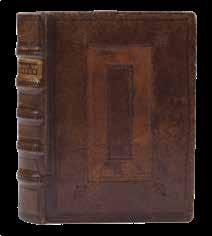
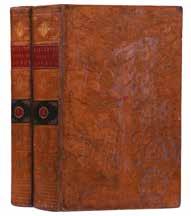
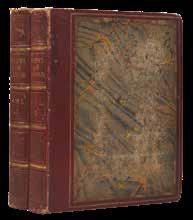
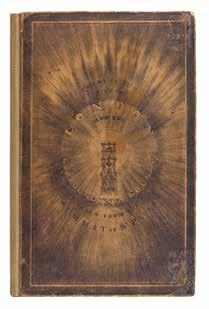
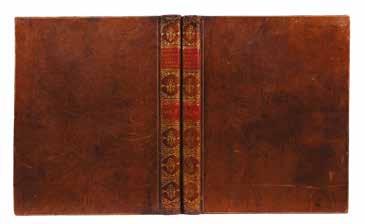
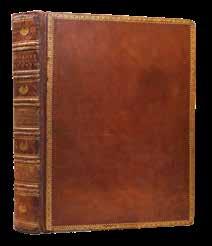
Cover: item 1109
Terms and conditions: The condition of all books has been described. Each item may be assumed to be in good condition, unless otherwise stated. Dimensions are given height by width. All prices are net and do not include postage and packing. Invoices will be rendered in £ sterling. The title of goods does not pass to the purchaser until the invoice is paid in full.
Printed by Park Communications on FSC® certified paper. Park is an EMAS certified company and its Environmental Management System is certified to ISO14001. 100% of the inks used are vegetable oil based, 95% of press chemicals are recycled for further use and, on average 99% of any waste associated with this production will be recycled. This document is printed on Galerie Matt made of material from wellmanaged, FSC®-certified forests and other controlled sources. The pulp used in this product is bleached without the use of chlorine (ECF).
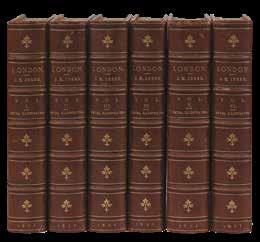
London: The Roger Cline Collection (Books I)
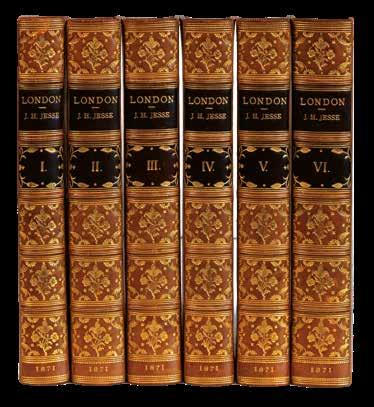
Volumes V and VI are distillations of Roger Cline’s vast library of books that together depict London in all its infinite variety: the largest such collection in the world in private hands. This is the equivalent of one bookcase out of about 40 - approximately 200 works out of about 30,000 - that record the rise of the metropolis, and over the course of more than 400 years, capture its elusive identity, from the early modern period to the present day.
Ever since, and probably before, the Romans built a bridge over the River Thames in around AD 40, roughly where London Bridge has stood (and fallen down) for centuries, London has been regarded as an entity to be reckoned with. Indeed, one of William I’s first acts in 1067 reaffirmed the rights and privileges of all Londoners, dating back to the reign of Edward the Confessor. In the Magna Carta of 1215, London is the only city specifically mentioned by name, and its rights as an independent estate are clearly established: “the City of London shall have all its ancient liberties by land as well as by water”.
Some of the earliest works in Cline’s London Library, are inspired by these two proto-charters, and include seven re-iterations of the precedent they set, in the face of frequent attempted interference from the Crown, from 1647 during the interbellum to the general election of 1722. However, the very earliest book in Cline’s London Library, is a far more ambitious project: a first edition of the first printed history of London, John Stow’s (1524-1605) most famous work, ‘A Survey of London’, published in 1598 (item 1006). It is represented in many of its issues, which is not surprising, as it is a book that has remained in print ever since it was first published. On the face of it, it is a topographical survey of the city and its earliest suburbs, taking its credentials from available literature. However, and arguably more important, it is a personal, and often dramatic, portrait of the living metropolis, extending to cover the entire sixteenth century. Stow was “an eyewitness to events from the death of Henry VIII to the accession of James I he provides important insights into the political and cultural life of his age from the perspective of a London citizen who never styled himself as a gentleman” (Beer).
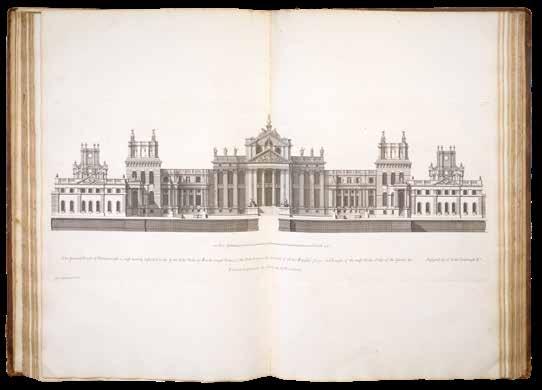
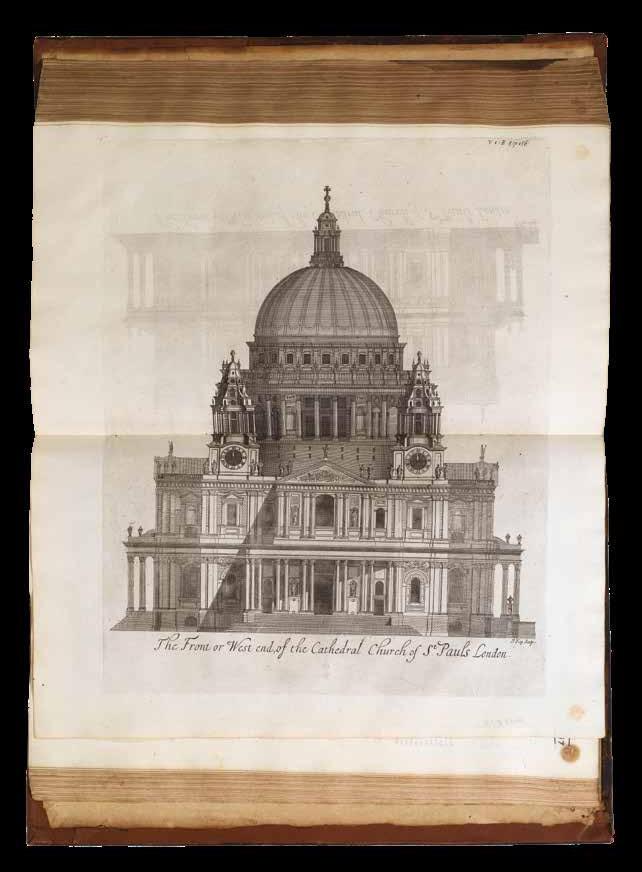
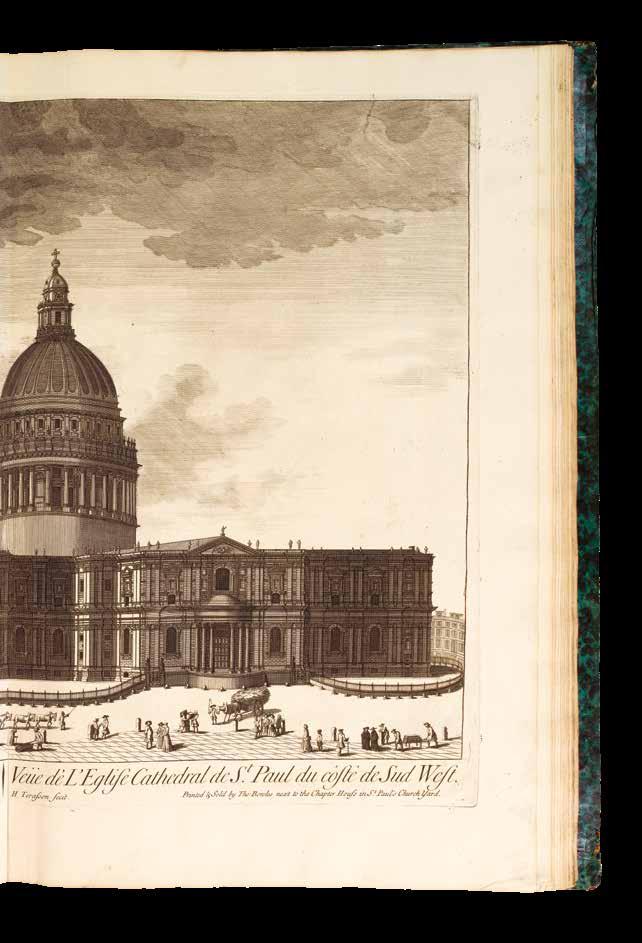
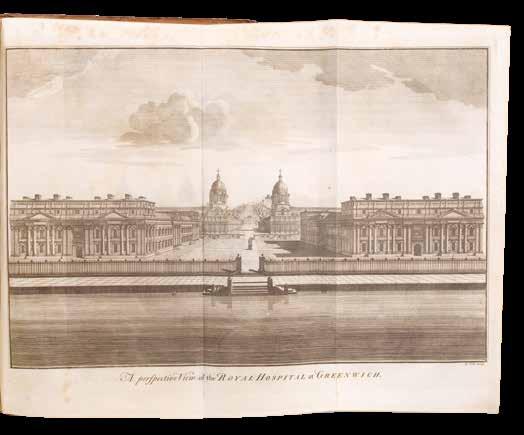
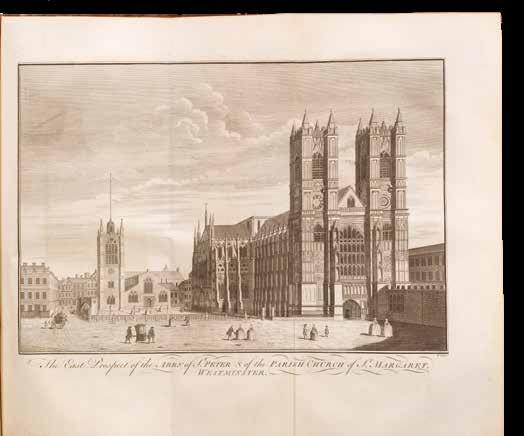
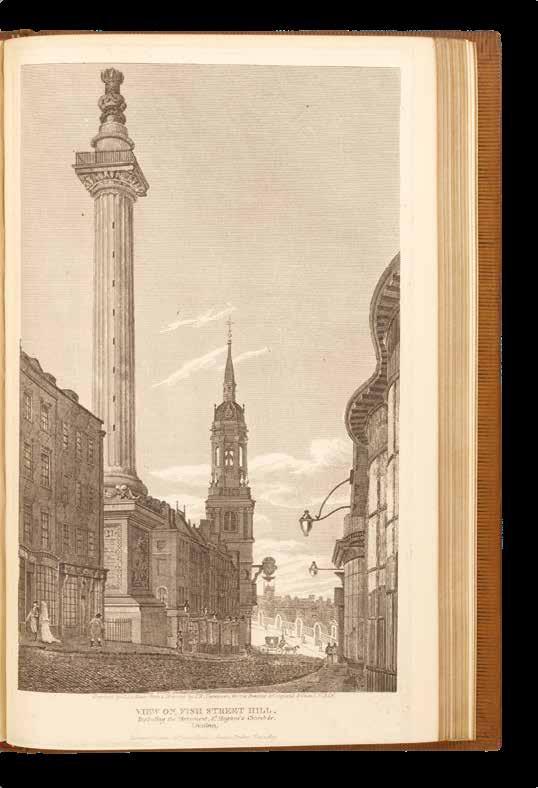
Cline’s London Library takes in most major events in the early history of London - plague, pestilence, and the Great Fire - but also contains a comprehensive record of the architecture and infrastructure of the City. Individual architectural masterpieces on a grand-scale are on display in West and Toms’s survey of pre-fire churches, ‘Perspective Views of all the Ancient Churches, and other Buildings, in the Cities of London, and Westminster, and Parts adjacent, within the Bills of Mortality’ (1736-1739) (item 1159), and Kips’s ‘Nouveau Théâtre de la
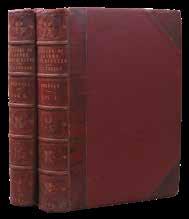
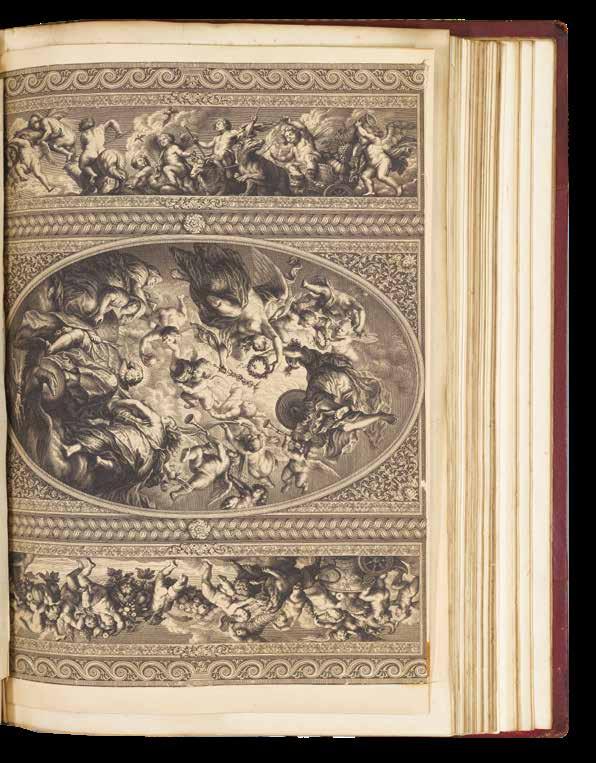
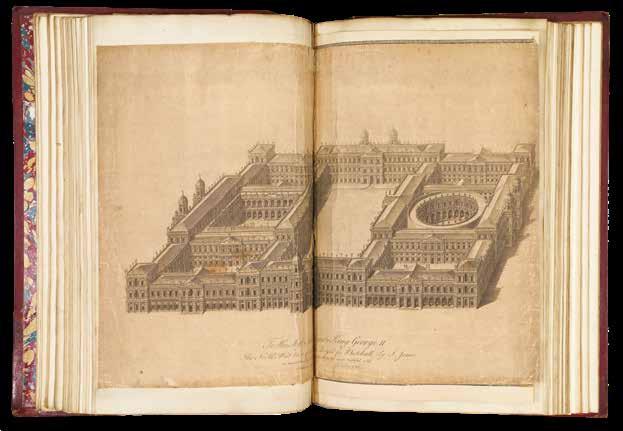
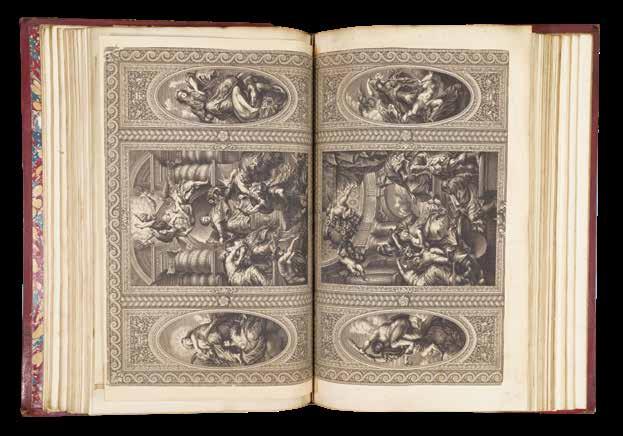
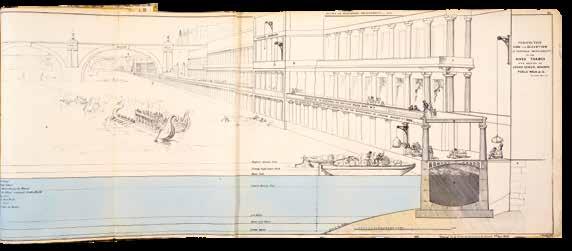
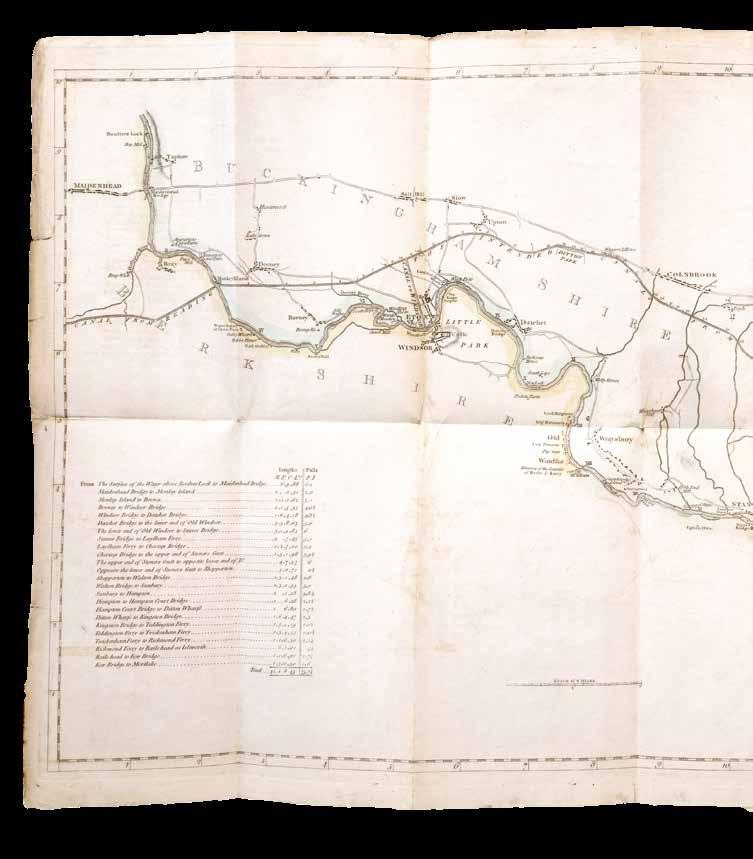
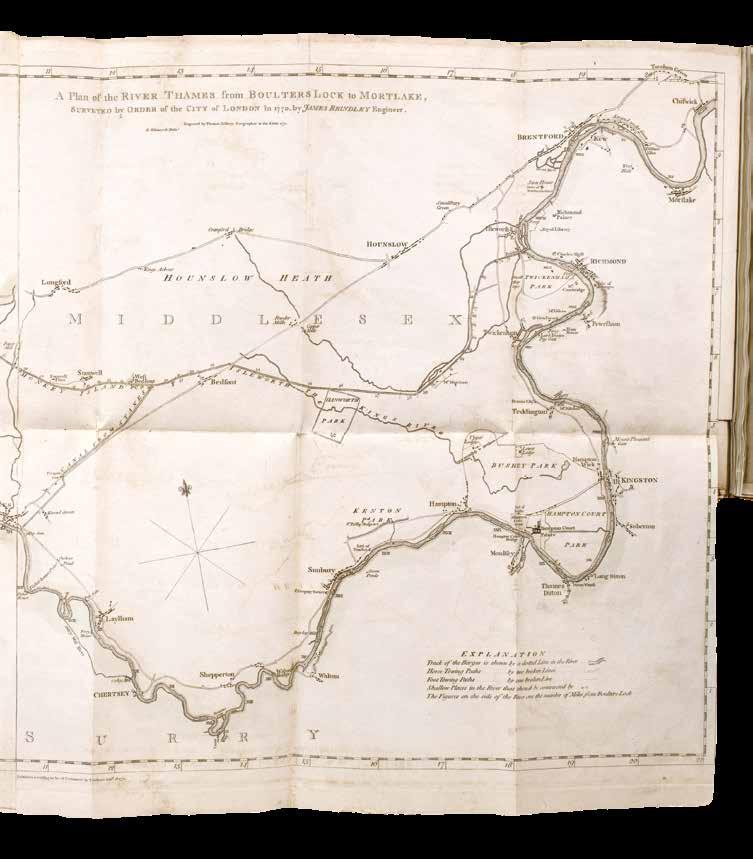
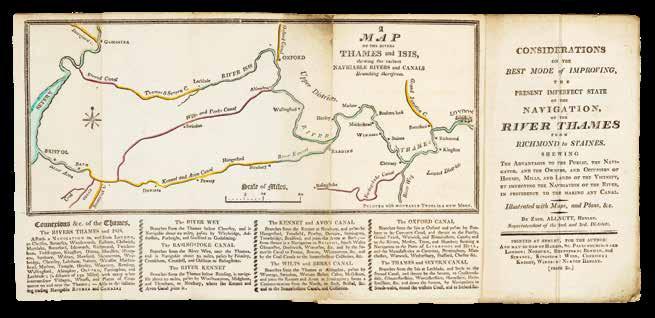
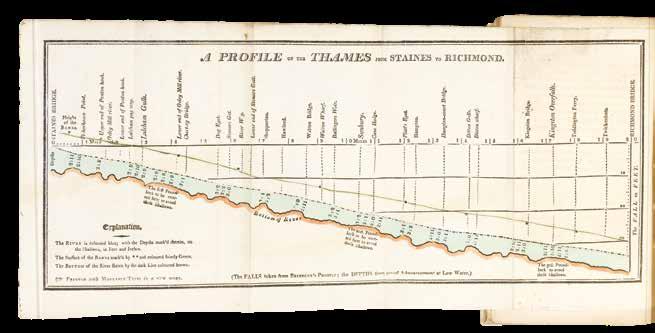
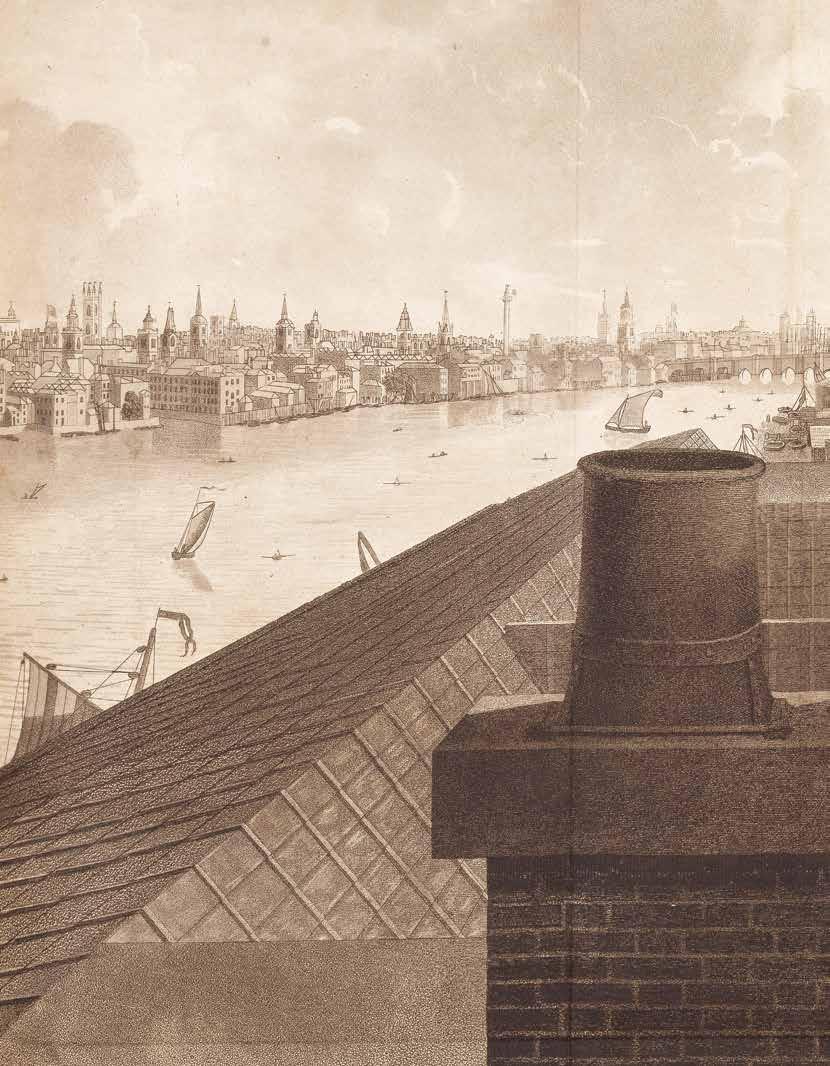
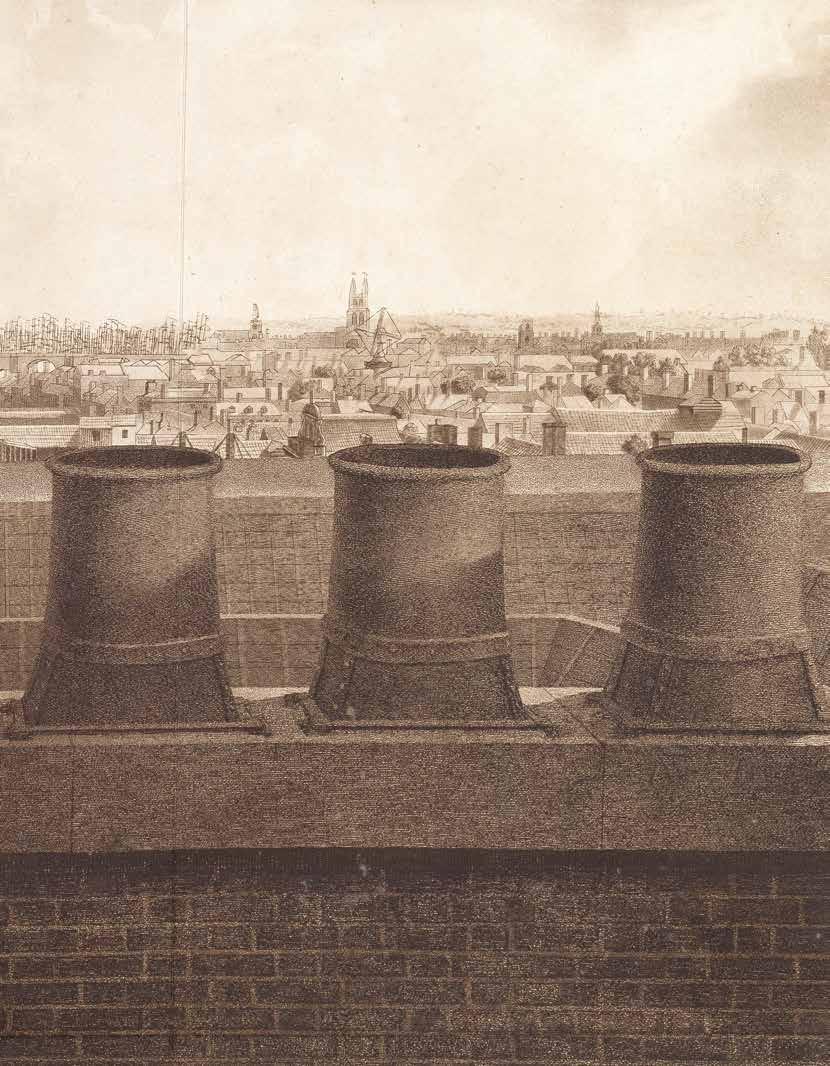
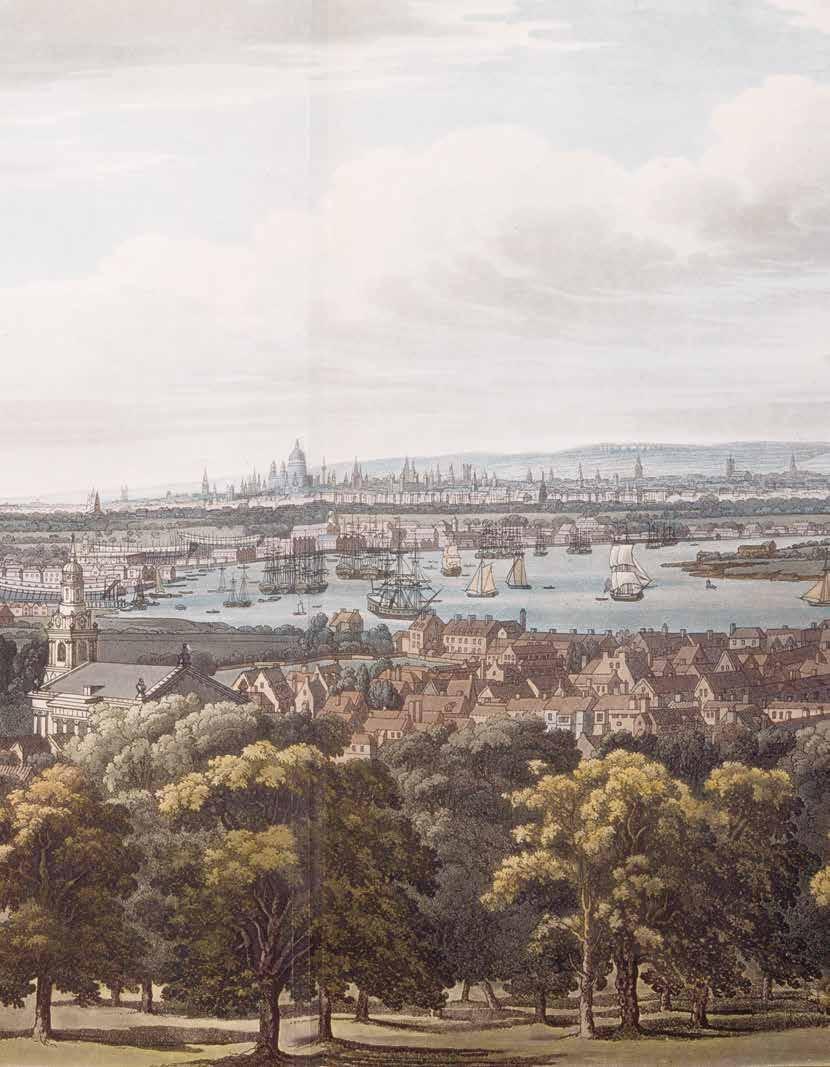
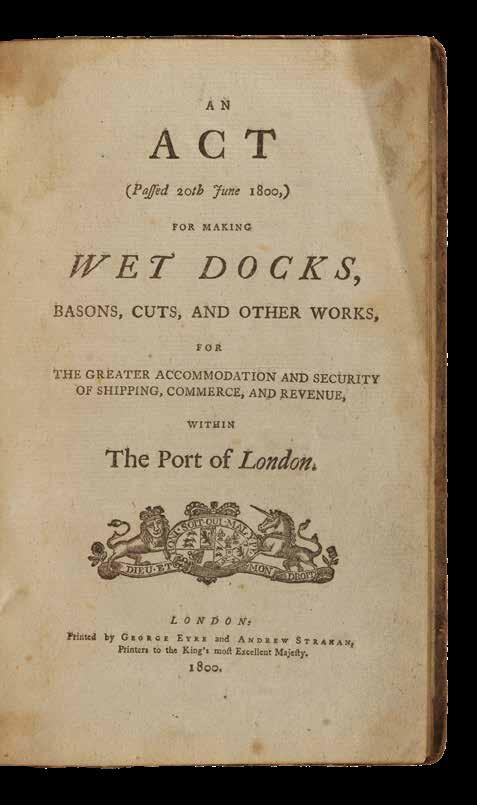
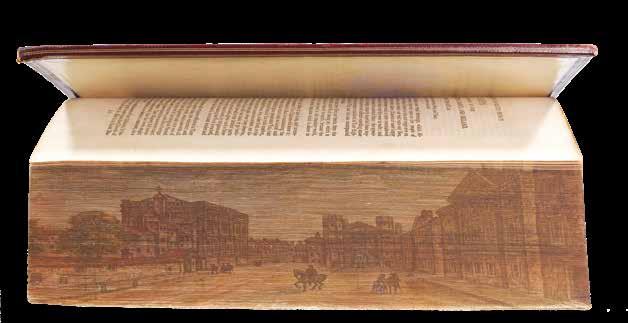
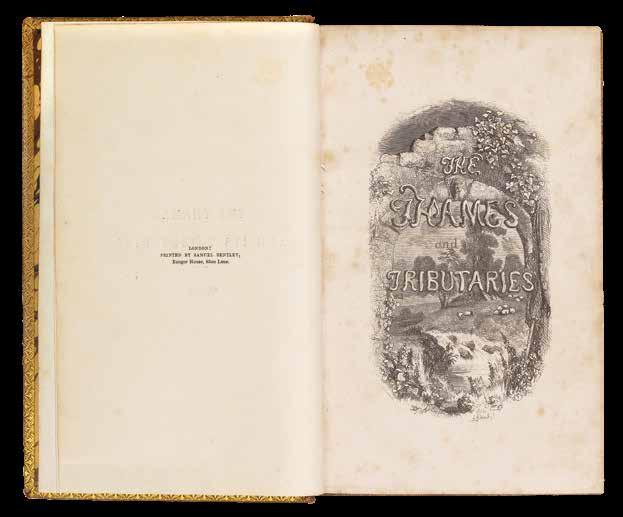
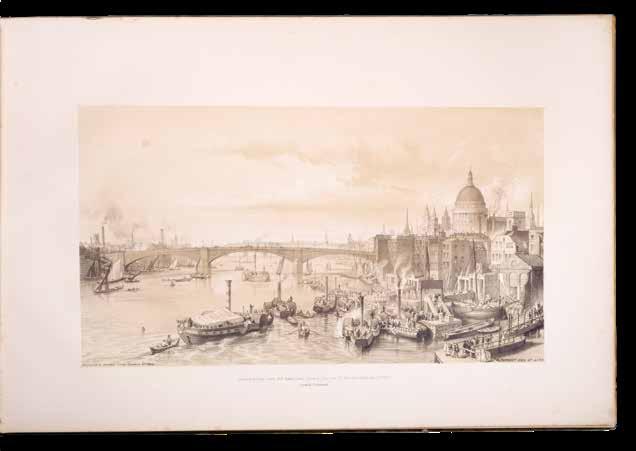
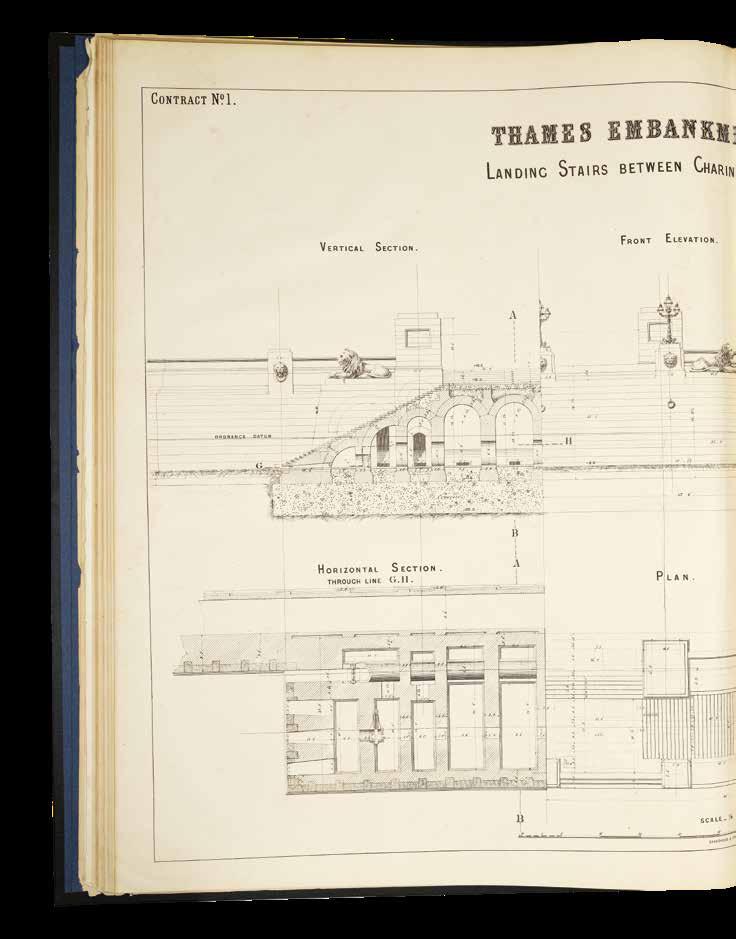
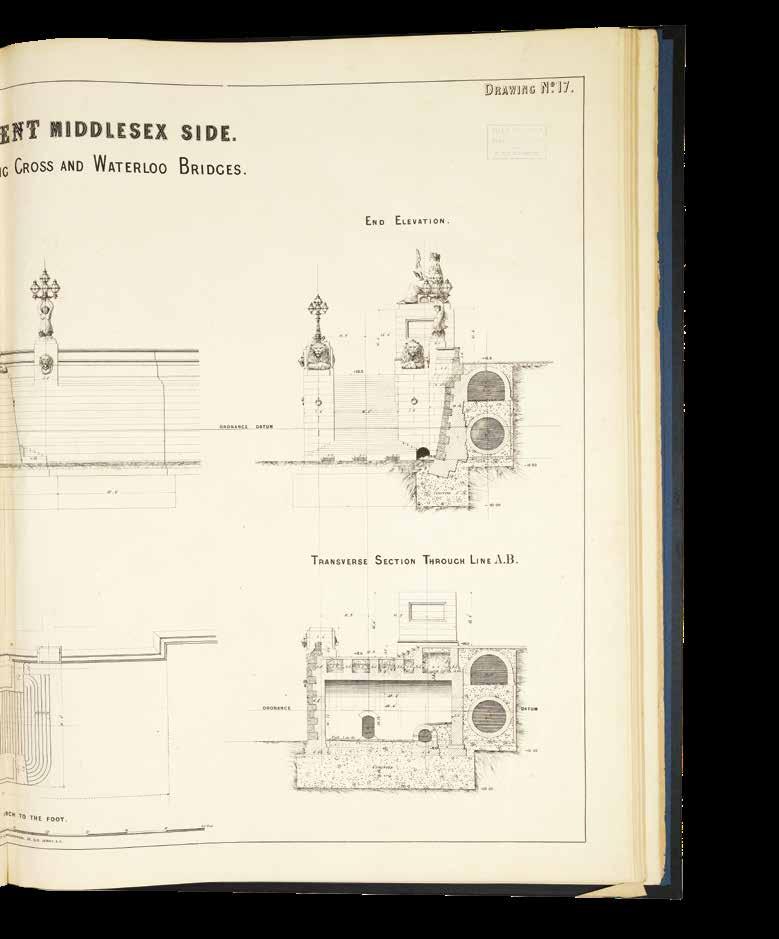
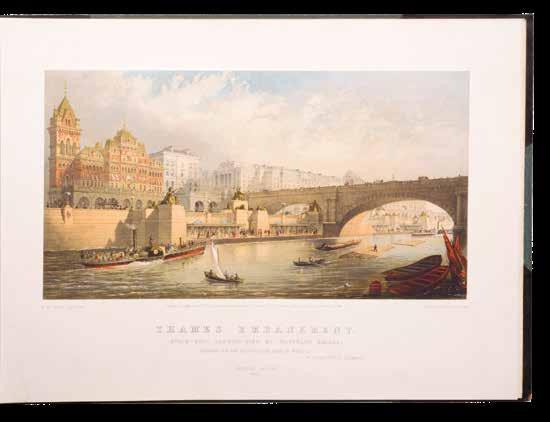
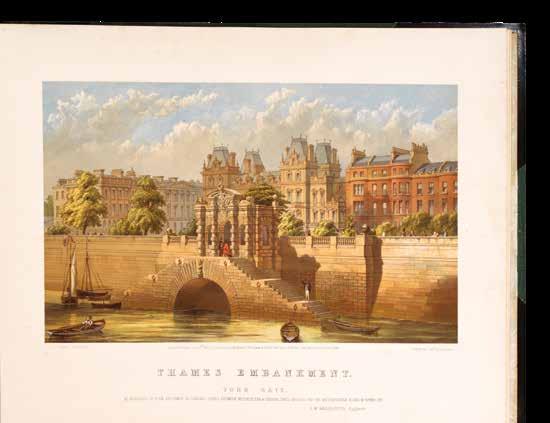
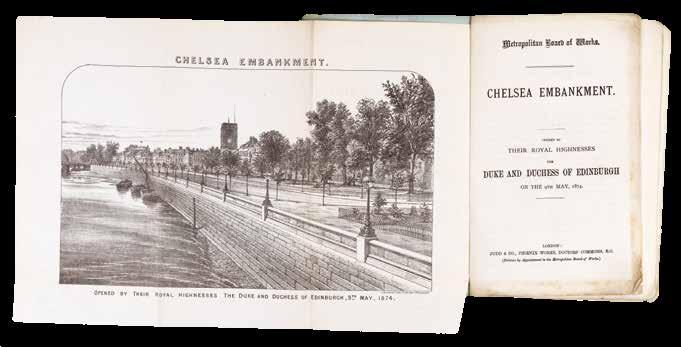
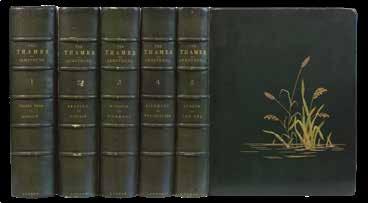
Grande Bretagne’ (1724-1728) (item 1144); and are matched by descriptions of the great municipal efforts to tame the exponentially expanding infrastructure of the City, and the river that runs through it, the Thames. Plans to dredge the river, introduce canals, build retaining embankments, and wet and dry docks, are comprehensively recorded in writing, and expansively illustrated. They culminate in Sir Joseph William Bazalgette’s (1819–1891) plans to solve one of the most serious health problems facing the expanding metropolis of London during the nineteenth century... what to do with all the do? (item 1130). This meant integrating the low-level sewer, and the Metropolitan District Railway. This was no mean feat as the sewerage system eventually extended to 1300 miles of sewers, 82 miles of the main west–east intercepting sewers, and four pumping stations (Deptford (1865), Crossness (1865), Abbey Mills (1868), and Western (1875)); the construction of the Albert (1868), Victoria (1870), and Chelsea (1874) embankments, and 52 acres of riverside land reclamation! Some of the most beautifully illustrated works in the Library capture the Thames’s lyrical beginning, and industrial ending, from its source to the sea. John Boydell and his nephew Josiah’s lavish production, ‘An History of the River Thames’ (1794-1796), appears in five separate editions. One of these has been grangerized with more than 200 extra-illustrations (item 1109). More than 20 other works in the Library have been similarly expanded, in one case by a further 1000 illustrations (item 1071). The popular late eighteenth- and early nineteenthcentury fashion for first cutting out from one book, and then pasting into another, various related portraits and views, was established in 1769, when James Granger (1723-1776) published a ‘Biographical History of England. “He had collected some 14,000 engraved portraits cut from books to serve as illustrations in his book. In addition, his book contained a number of blank pages for illustrations, prints, newspaper cuttings, or anything else he might filch later” (Freeman).
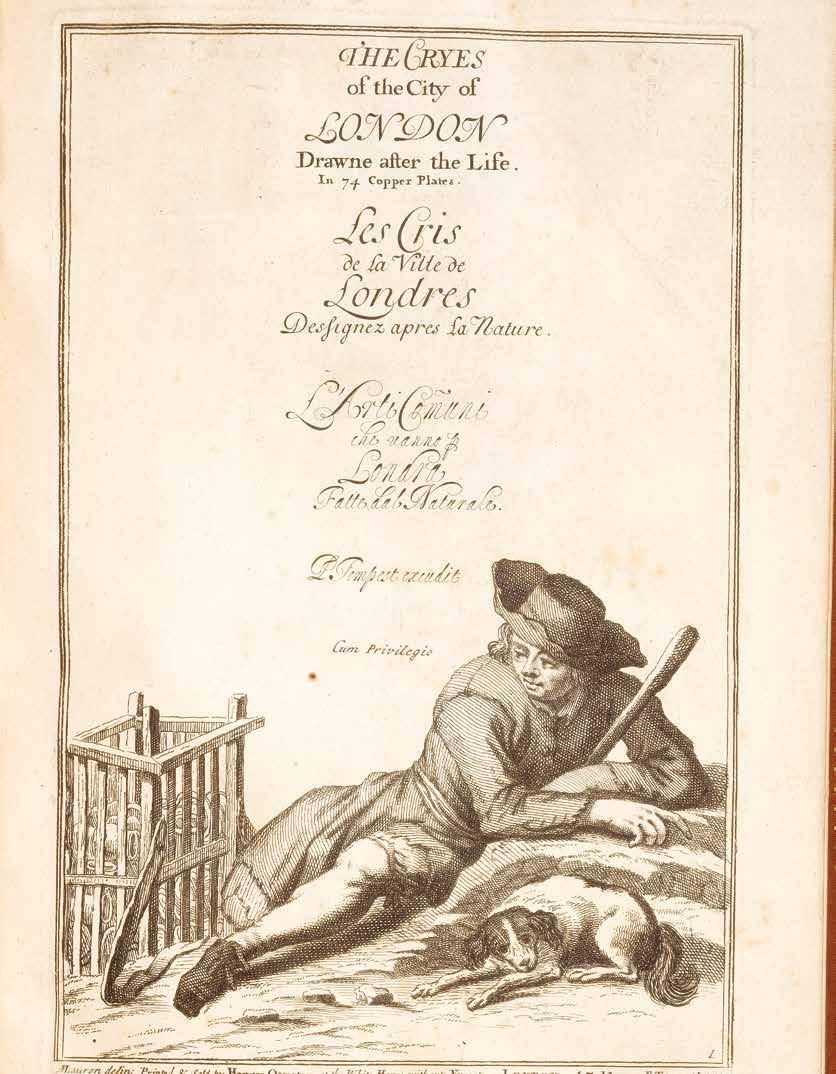
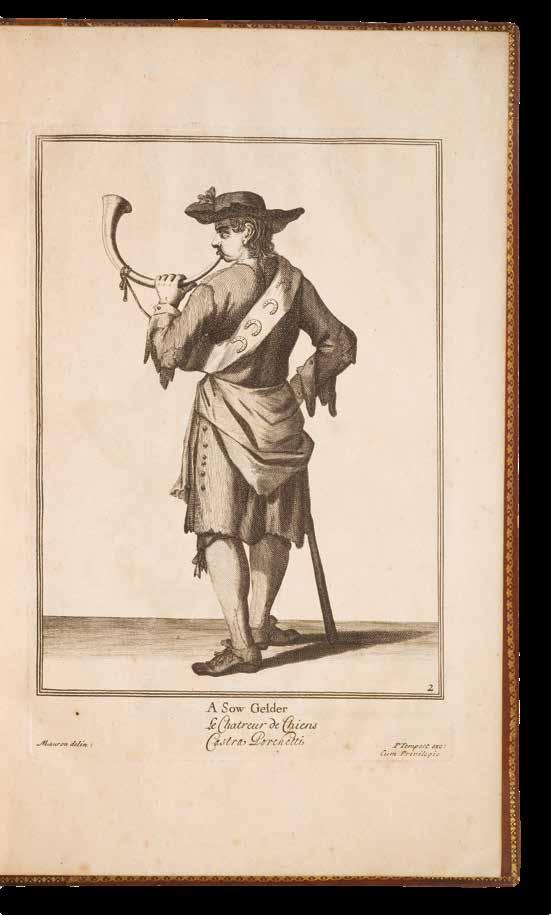
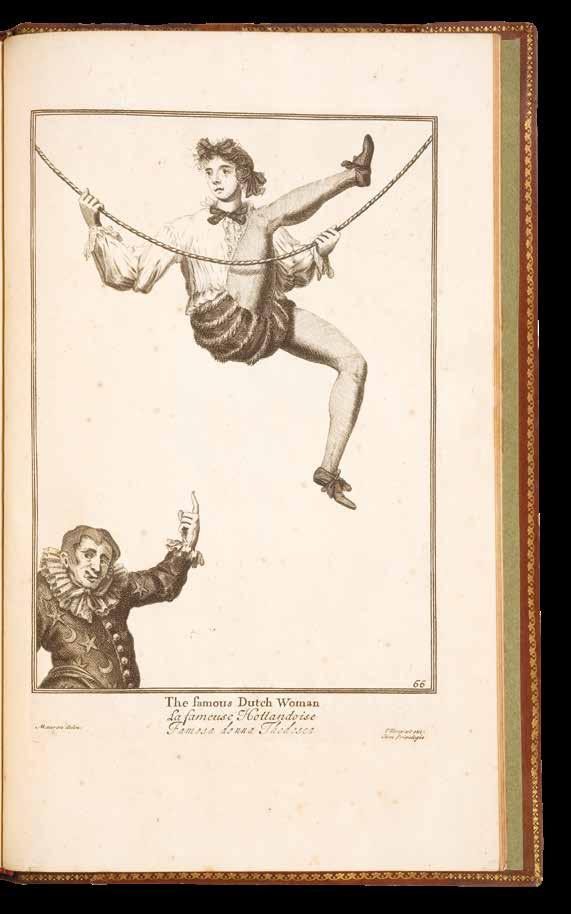
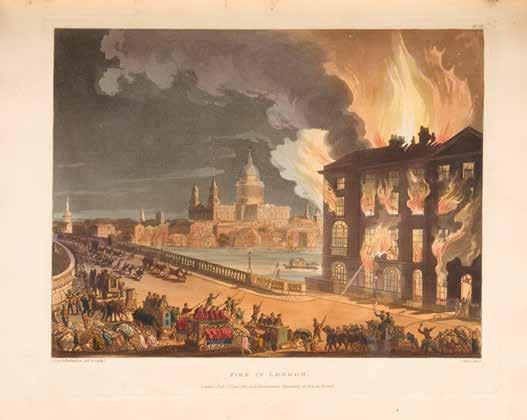
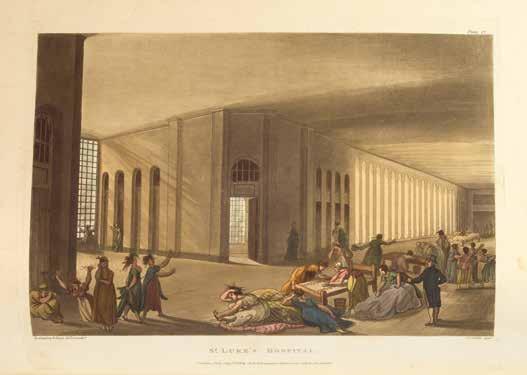
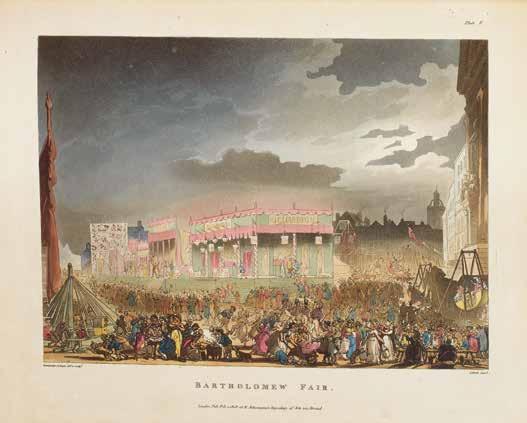
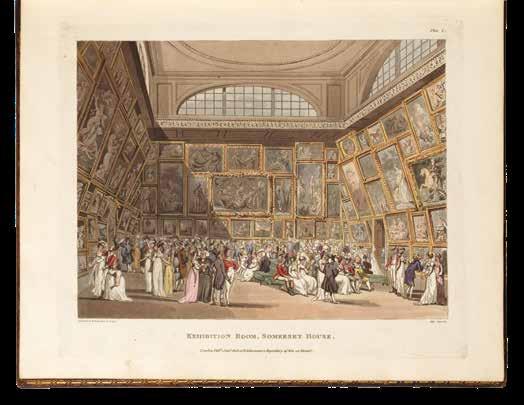
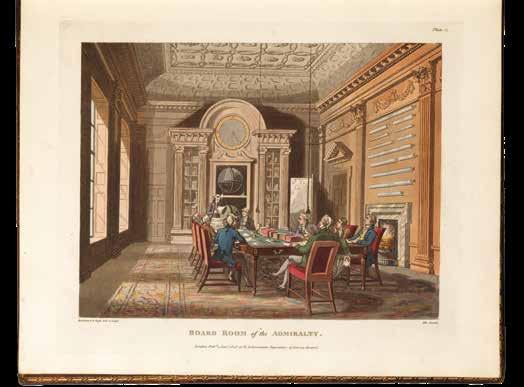
Cline’s London Library celebrates the populace too: from Samuel Lee’s ‘A Collection of the Names of the Merchants Living in and about The City of London’ (1677) (item 1016), the first such directory, to Mauron’s ‘Cryes’ (1733) (item 1028), to Ackermann’s ‘Microcosm’ (1806) (item 1050), no one is too great or too small to escape Cline’s attention.
Probably, the single-most impressive event, which placed London at the centre of the British Empire and was celebrated by contemporary critics, as well as in Cline’s London Library, must be the Great Exhibition of 1851. The brainchild of Prince Albert, the Great Exhibition was the largest trade show conceived, and yet of all the wonders of the newly industrialized world on display, the greatest exhibit was the Crystal Palace itself. Essentially a monumental glass conservatory, Paxton based his design on the lily house he had been commissioned to build for the Duke of Devonshire at Chatsworth. In 1852 the building was
removed to Sydenham, where it was destroyed by fire in November 1936. About 100,000 objects were displayed by more than 15,000 contributors; half of the ten miles of exhibition space show-cased the genius of British industry and manufacture, from both home and the colonies abroad. A great exhibition in its own right, Roger Cline’s London Library is a literary goldmine. Together, its thousands of volumes narrate the story of the city and its inhabitants across time.
LONDON CITY IS MIGHTY PRETTY
John Stow’s famous account of Tudor England
STOW,
John
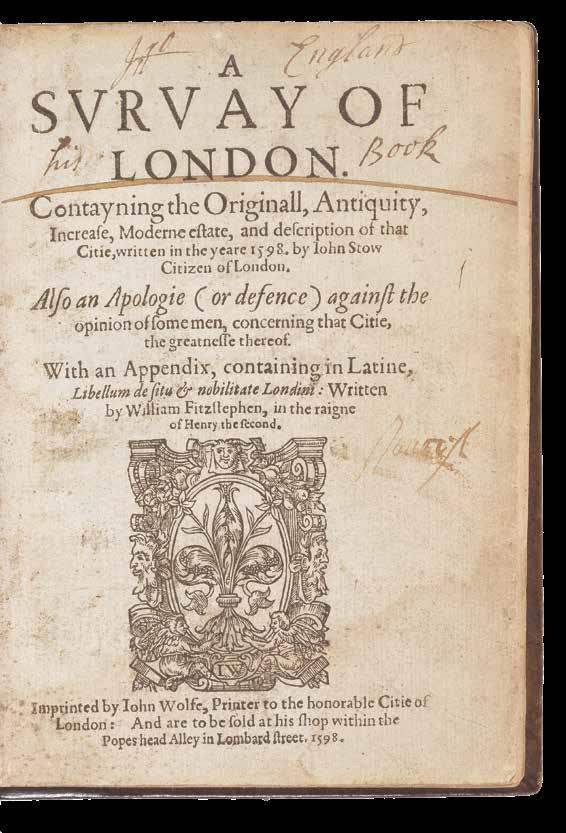
A Svrvay of London. Contayning the Originall, Antiquity, Increase, Moderne estate, and description of that Citie, written in the yeare 1598. by Iohn Stow Citizen of London. Also an Apologie (or defence) against the opinion of some me, concerning that Citie, the greatnesse thereof. With an Appendix, containing in Latine, Libellum de situ & nobilitate Londini: Written by William Fitzstephen, in the raigne of Henry the Second.
Publication
London, Imprinted by Iohn Wolfe, Printer to the honorable Citie of London: And are to be sold at his shop within the Popeshead Alley in Lombard street, 1598.
Description Small quarto (180 by 130mm). Numerous wood-engraved initials; modern panelled calf antique.
‘The Carl H. Pforzheimer Library: English literature, 1475-1700’, 1940, 992; ESTC 117887.
First edition of John Stow’s (1524-1605) most famous work, ‘A Survey of London’: it has remained in print ever since.
Not only is the book a topographical survey of the city and its suburbs drawing on available literature, but it is also a personal, and often dramatic, portrait of the living metropolis, extending to cover the entire sixteenth century. Stow was “an eyewitness to events from the death of Henry VIII to the accession of James I he provides important insights into the political and cultural life of his age from the perspective of a London citizen who never styled himself as a gentleman” (Beer).
No record of any formal schooling for Stow survives, suggesting that he was self-taught. The son of a tallow-chandler, Stow, in later life would move in society with the likes of John Dee, William Camden, Ben Jonson, and Henry Savile; and count the Earl of Leicester, Archbishops Parker and Whitgift, and several Mayors of London, as his patrons. He was the only fellow of the Society of Antiquaries who was not a gentleman by birth.
Stow was an assiduous researcher and prolific collector of books and manuscripts - a number of which survive in institutions. His own publications include: ‘The workes of Geffrey Chaucer, newly printed, with divers addicions whiche were never in printe before’ (1561); thirty-three works of John Skelton, ‘Pithy Pleasaunt and Profitable Workes of Maister Skelton’ (1568); ‘Certaine worthy manuscript poems of great antiquity preserved long in the studie of a Northfolke gentleman (1597); his ‘Chronicles of England’ (1580), and the ‘Annales of England’ (1592), are detailed accounts of English history, which include the reigns of Edward VI, Mary, and Elizabeth, based on his own records, and those of close correspondents, and eventually extended to the accession of James I to the throne of England and Scotland.
This is an example of the second issue of Stow’s ‘Survey...’, with the errata on 2H10v.
Provenance
With the early ownership inscriptions of “Jn.o England” on the title-page and dedication leaf.
A new edition of Stow’s ‘Survey’
STOW, John
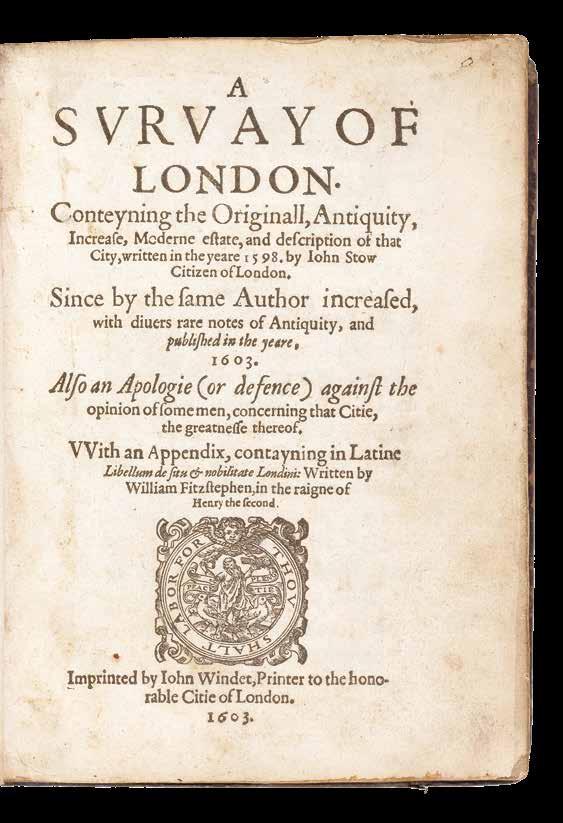
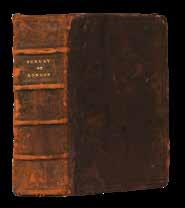
A Svrvay of London. Conteyning the Originall, Antiquity, Increase, Moderne estate, and description of that City, written in the yeare 1598. by Iohn Stow Citizen of London. Since by the same Author increased, with diuers rare notes of Antiquity, and published in the yeare, 1603. Also an Apologie (or defence) against the opinion of some men, concerning that Citie, the greatnesse thereof. With an Appendix, contayning in Latine Libellum de situ & nobilitate Londini: Written by William Fitzstephen, in the raigne of Henry the Second.
Publication
London, Imprinted by Iohn Windet, Printer to the honorable Citie of London, 1603.
Description Small quarto (190 by 140mm). Numerous woodcut initials; contemporary full calf.
Collation
Pages [viii], 579, [iii]; A4, B-2O8, 2P3 (lacking final leaf).
References ESTC S117889.
Second, and expanded, edition of Stow’s ‘Survey of London’, first published in 1598, the final leaf (2P3r) a list of errata. Without the portrait of Stow found in very few examples.
Provenance
Various early ownership inscriptions to endleaves, dating from 1734.
Munday and Dyson’s first revision of Stow
STOW, John; MUNDAY, Anthony MUNDAY; and DYSON, Humfrey
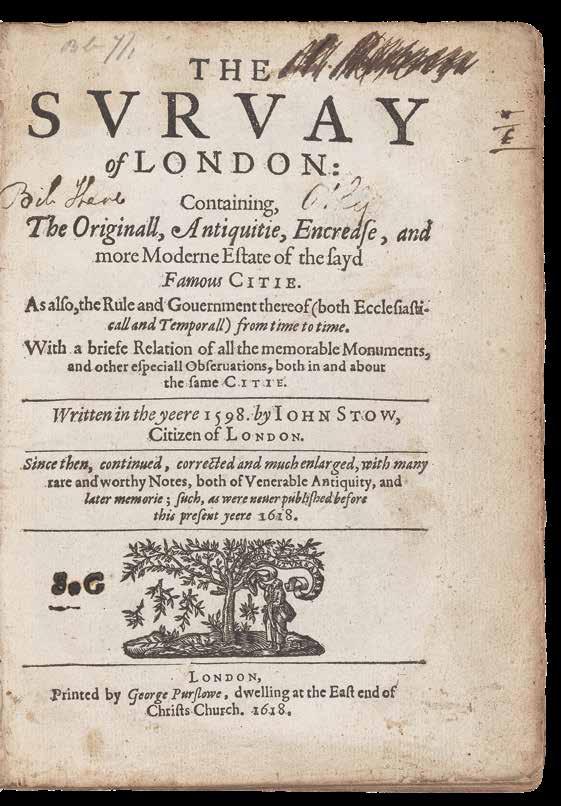
The Svrvay of London: Containing, The Originall, Antiquitie, Encrease, and more Moderne Estate of the sayd Famous Citie. As also, the Rule and Government thereof (both Ecclesiasticall and Temporall) from time to time. With a briefe Relation of all the memorable Monuments, and other especiall Observations, both in and about the same Citie. Written in the yeere 1598 by Iohn Stow, Citizen of London. Since then, continued, corrected and much enlarged, with many rare and worthy Notes, both of Venerable Antiquity, and later memorie; such, as were never published before this present yeere 1618.
Publication London, Printed by George Purslowe, dwelling at the East end of Christs Church, 1618.
Description
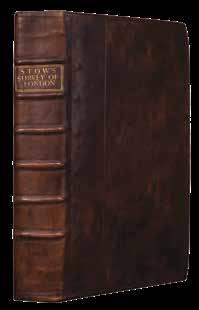
Small quarto (190 by 140mm). Numerous woodcut head- and tail-pieces and initials; contemporary calf, rebacked to style in the nineteenth century.
First Munday and Dyson issue. When John Stow died in 1605, he bequeathed the task of carrying on the never-ending project of this ‘Survey of London’ (1598) to his friend, playwright and translator, Anthony Munday (1560 -1633). His companion-in-arms was the renowned book collector, Humfrey Dyson (died 1633). Munday includes a fond memory of Stow: “Much of his good mind he had formerly imparted to me, prevailing with mee so farre, by his importunate perswasions, to correct what I found amisse, and to proceed in the perfecting of a Worke so worthy”.
Provenance
Various early inscriptions to front endpapers and title-page.
STOW, John; MUNDAY, Anthony; and DYSON, Humfrey
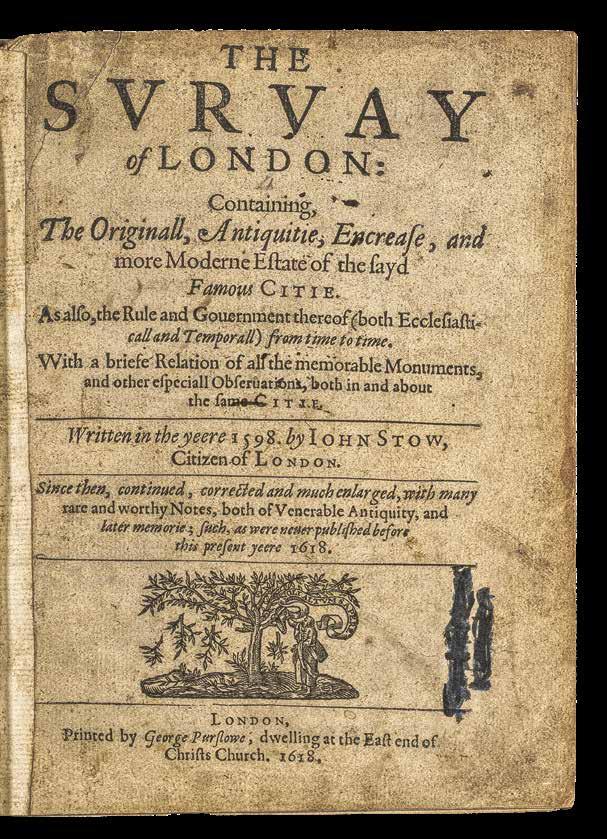
The Svrvay of London: Containing, The Originall, Antiquitie, Encrease, and more Moderne Estate of the sayd Famous Citie. As also, the Rule and Government thereof (both Ecclesiasticall and Temporall) from time to time. With a briefe Relation of all the memorable Monuments, and other especiall Observations, both in and about the same Citie. Written in the yeere 1598 by Iohn Stow, Citizen of London. Since then, continued, corrected and much enlarged, with many rare and worthy Notes, both of Venerable Antiquity, and later memorie; such, as were never published before this present yeere 1618.
Publication London, Printed by George Purslowe, dwelling at the East end of Christs Church, 1618.
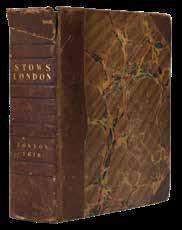
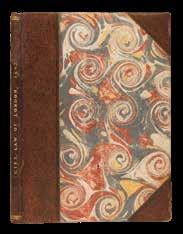
Description Small quarto (180 by 140mm). Numerous woodcut head- and tail-pieces and initials; nineteenth century half brown morocco, marbled paper boards, gilt, worn.
Another example of the first Munday and Dyson issue of Stow’s ‘Survey...’.
Provenance
1. With the ownership inscription of Edward Lowis, dated 1678, on the verso of the title-page;
2. A lengthy ownership inscription of James Orchard Halliwell-Phillipps (1820-1889), Shakespearean scholar and bibliophile;
3. With the bookplate of Eric Quayle (1921-2001), bibliophile, of Zennor Cornwall on the inside front cover.
STOW, John; MUNDAY, Anthony; and DYSON, Humfrey
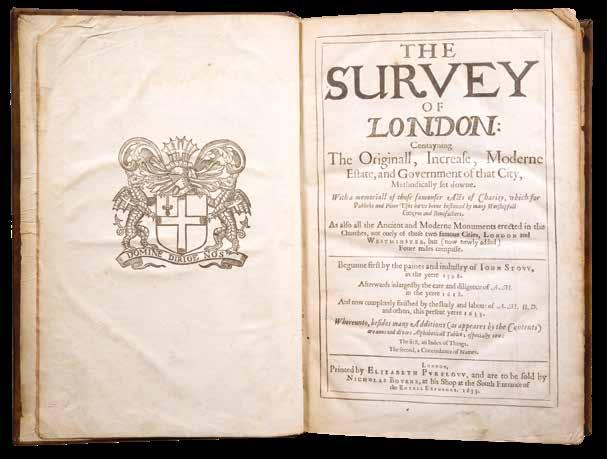
The Survey of London: Contayning The Originall, Increase, Moderne Estate, and Government of that City, Methodically set downe. With a memoriall of those famouser Acts of Charity, which for Publicke and Pious Uses have beene bestowed by many Worshipfull Citizens and Benefactors. As also all the Ancient and Moderne Monuments ereted in the Churches, not onely of those two famous Cities, London and Westminster, but (now newly added) Foure miles compasse. Begunne first by the paines and industry of John Stow, in the yeere 1598. Afterwards inlarged by the care and diligence of A.M. in the yeere 1618. And now completely finished by the study and labour of A.M. H.D. and others, this present yeere 1633. Whereunto, besides many Additions (as appeares by the Contents) are annexed divers Alphabeticall Tables; especially two: The first, an Index of Things. The second, a Concordance of Names.
Publication London, Printed by Elizabeth Purslow, and are to be sold by Nicholas Bourne, at his Shop at the South Entrance of the Royall Exchange, 1633.
Description Folio (335 by 215mm). Woodcut Arms of the City of London, numerous woodcut head- and tail-pieces and initials; full modern calf antique.
Collation
Pages [xvi], 534-939, [xxx]; [A]8, B-4N6.
References ESTC S117597.
Munday and Dyson’s second revision of Stow
Issue with Munday and Dyson credited on the title-page, and leaf 4K6 a cancel, with notes from Henry Marten on bottom of page 939.
No sooner had Munday and Dyson’s new edition of Stow’s survey arrived on the booksellers’ shelves, that a new revision was being planned. It was published in 1633, the year in which they both perished.
Provenance
With Ben Weinreb, “Bought from Sir John Summerson Aug 1989 & repaired”.
The Interbellum in London
THE CITY OF LONDON
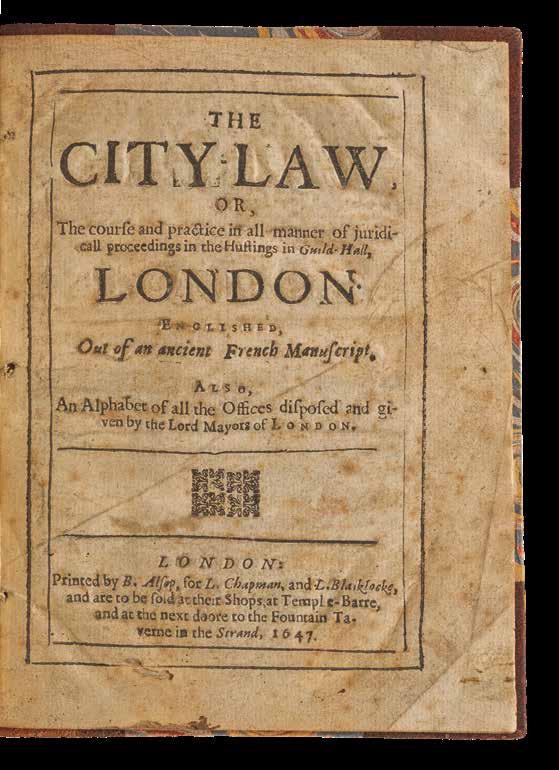
The City-Law, or, The course and practice in all manner of juridicall proceedings in the Hustings in Guild-Hall, London. Englished, Out on an ancient French Manuscript. Also Alphabet of all the Offices disposed and given by the Lord Mayors of London.
Publication
London, Printed by B. Alsop, for L. Chapman, and L. Blaiklocke, and are to be sold at their Shops at Temple-Barre, and at the next doore to the Fountain Taverne in the Strand, 1647.
Description Small quarto (180 by 130mm). Modern half calf, marbled paper boards, title-page a bit browned and wormed at edges.
Collation
Pages: [viii], [1]-62; A-H4, I3.
References ESTC R210027.
1647 was an interesting year for the City of London. At the beginning of 1647, Charles I had been handed over to the English Parliament by the Scots and imprisoned. A power vacuum remained between the three main protagonists of the First Civil War: Royalists, the New Model Army, and the Presbyterians of the English and Scottish Parliaments; each of which bargained with Charles, under the assumption that their own governance was dependent on his acceptance of their cause. The current document, published in the midst of this chaos, attempts to remind the reader of the independence of the municipality, and the orderliness of legal tradition - they were whistling in the wind.
Raising money for the parliamentary cause during the English Civil War
THE CITY OF LONDON;
BROWNE, John
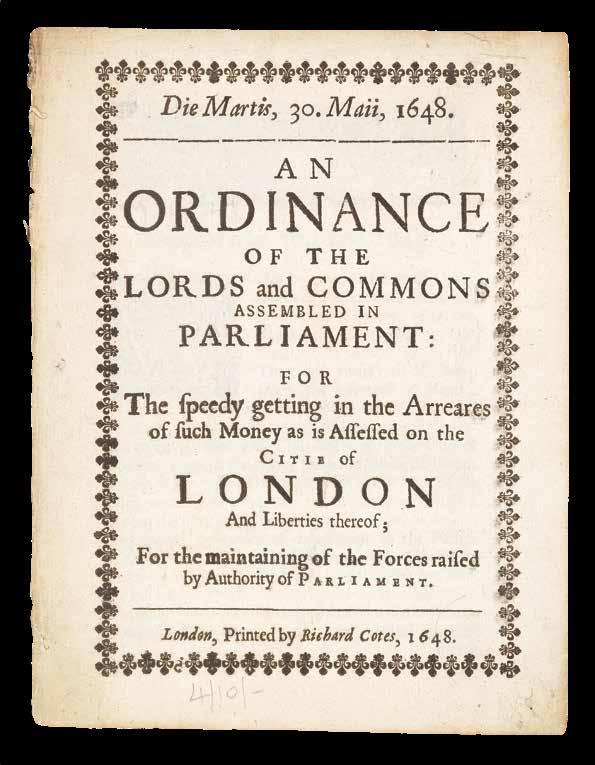
An Ordnance of the Lords and Commons assembled in Parliament: for the speedy getting in the Arreares of such Money as is Assessed on the Citie of London and Liberties thereof; for the maintaining of the forces raised by authority of Parliament.
Publication
London, Richard Cotes, 30th May, 1648.
Description Small quarto (175 by 135mm). Decorated with woodcut devices, removed from a sammelband.
Collation
Pages 4; A4.
For most of the Civil War, the City of London sided with the Parliamentarians (Roundheads), against the Royalists (Cavaliers), giving the Roundheads access to the City’s wealth. However, they failed to pay their army adequately. The current ‘Ordinance’ attempted to address this shortfall, without success.
The ordnance is signed by “Io. Browne Cleric. Parliamentorum”. Browne (c1608–1691), was a parliamentary official from March 1638, when he was appointed clerk of the parliaments. “Browne was a firm adherent of the parliamentarian cause and following the final break between the king and parliament in 1642 he remained at Westminster to serve the House of Lords there. The abolition of the house in March 1649 deprived him of his employment until the Restoration. On 25 June 1650 the House of Commons ordered the records of the House of Lords in Browne’s custody to be delivered to Henry Scobell, whom they had appointed their clerk and designated clerk of the parliaments. However, at the first meeting of the convention on 25 April 1660 the House of Lords ordered Scobell to return the records to Browne, who was reinstated as clerk of the parliaments, making a declaration of loyalty to Charles II on 30 May. He served the house for a further thirty years until his death” (Sainty).
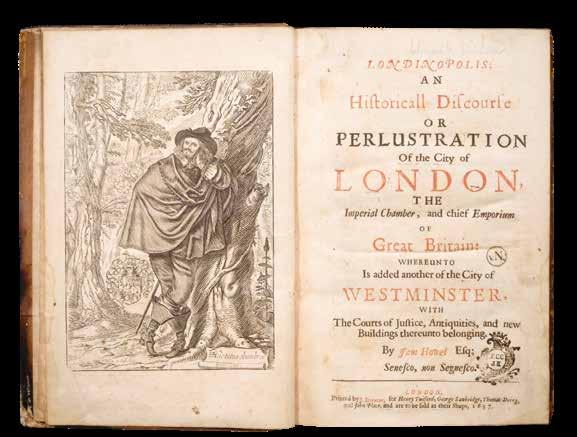
HOWELL, James
Londinopolis; an Historicall Discourse or Perlustration of the City of London, the Imperial Chamber, and chief Emporium of Great Britain: whereunto is added another of the City of Westminster, with the Courts of Justice, Antiquities, and new Buildings thereunto belonging.
Publication London, Printed by J. Streater, for Henry Twiford, George Sawbridge, Thomas Dring, and John Place, and are to be sold at their Shops, 1657.
Description
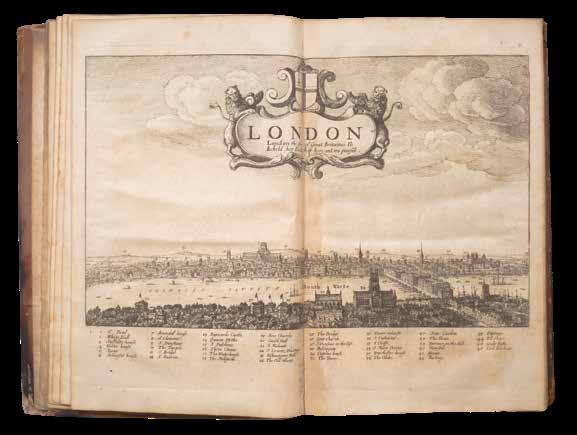
Octavo (275 by 180mm). Title-page printed in red and black. Etched frontispiece portrait of the author, and double-page bird’s-eye view of London by Wenceslaus Hollar; contemporary speckled calf, rebacked to style, early scorch-marks to front cover.
References Adams, ‘London Illustrated 1643-1851’, 1983, 7; Pennington, ‘A Descriptive Catalogue of the Etched Work of Wenceslaus Hollar 1607–1677’, 1012; Wing, ‘Short-title catalogue of books printed in England, Scotland, Ireland, Wales, and British America, and of English books printed in other countries, 1641-1700’, 1945-51, H3091.
With a view of London by Hollar
Although Howel’s history of London is largely cribbed from John Stow’s, it includes two magnificent engravings. The first is a portrait of the author by Claude Mellon and Abraham Bosse, showing him nowhere near the metropolis of London, but rather in an ancient English forest, resting beneath the shade of a large oak “Robur Britanicum”, with his coat-ofarms and motto “Heic tutus obumbror” - ‘Here I am safely overshadowed’. In an earlier state of the plate, a horse and page appear where the coat-ofarms now is.
Hollar’s view of London extends to the north from Whitehall to St. Katherine by the Tower, and to the south from Paris Garden to beyond St. Olave, Southwark. It contains a “number of topographical anachronisms which puzzled A.M. Hind (Hind 17) and where were analysed by Scouloudi (pages 55-56). From the styles the authorities infer that it was engraved by Hollar and at about the time the book was published. However, it shows the Swan Theatre which had disappeared by 1632 and the buildings north of London Bridge which were burned in 1633, and fails to record alterations to St. Paul’s Cathedral made by Inigo Jones, 1631-42. None of these inconsistencies is observable in Hollar’s famous long view from Bankside of 1647 (Hind 16), which makes it the harder to understand why he should have chosen to engrave either from a drawing which he must have known was out of date by his former master, Mathias Merian, for inclusion in Gottfried’s ‘Neuwe Archontologia Cosmica’ (no 2) published in 1638” (Adams).
Provenance
1. On the title-page: armorial ink library stam “P.C.C. J.K.”;
2. With the collector’s mark of K. F. F. von Nagler (1770-1846), Lugt 2529, career diplomat and Postmaster General, in Bavaria and Berlin;
3. Bookplate removed from the inside front cover;
4. Early twentieth-century pencilled inscription “belonging to Mr. Sayer”.
Lyricising, while London burns
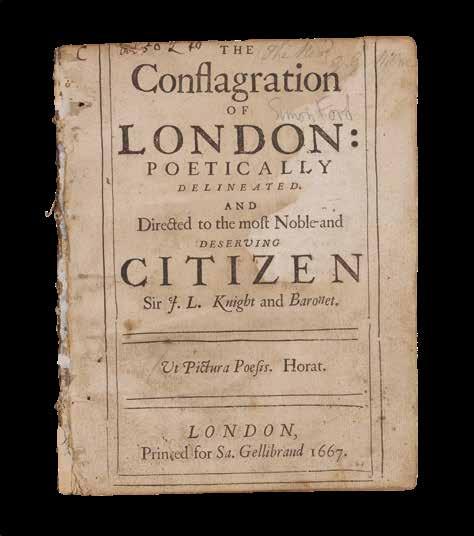
THE FIRE OF LONDON; FORD, Simon
The Conflagration of London: Poetically delineated. And Directed to the most Noble and Deserving Citizen Sir J.L. Knight and Baronet.
Publication London, Printed for Sa. Gellibrand, 1667.
Description Small quarto (180 by 140mm). Removed from a sammelband, a bit wormed in the gutter, and waterstained.
Controversial clergyman, Simon Ford (1619-1699), had a sideline in writing poetry about contemporary events, such as the Fire of London, as here.
Provenance
Nineteenth-century pencilled ownership inscription of “The Rev.d G.G. Milne” on the title-page.
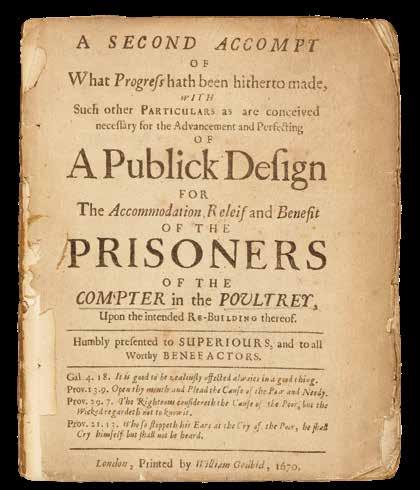
GIFFARD, Humphry
A Second Accompt of What Progress hath been hitherto made, with Such other Particulars as are conceived necessary for the Advancement and Perfecting of a Publick Design for the Accommodation Releif and Benefit of the Prisoners of the Compter in the Poultrey, Upon the intended Re-Building thereof.
Publication London, Printed by William Godbid, 1670.
Description
Small quarto (185 by 145mm). 20 pages, removed from a sammelband, browned and frayed at edges.
Keeping the poultry compter
Giffard, who has signed himself “Gyffard” in his opening address to “Worthy Patriots”, was keeper of the Poultry, a debtor’s prison, from about 1662. He gives a pre-Great Fire of London description of the sordid conditions of the prison, followed by his attempts at raising subscriptions to rebuild to a new design after the Fire, which had destroyed it and his home. The Poultry was rebuilt, and eventually razed to the ground in 1817, when it was replaced by a chapel.
The first City of London Directory: “Very usefull and necessary” (Title-Page)
THE
CITY OF LONDON; LEE, Samuel
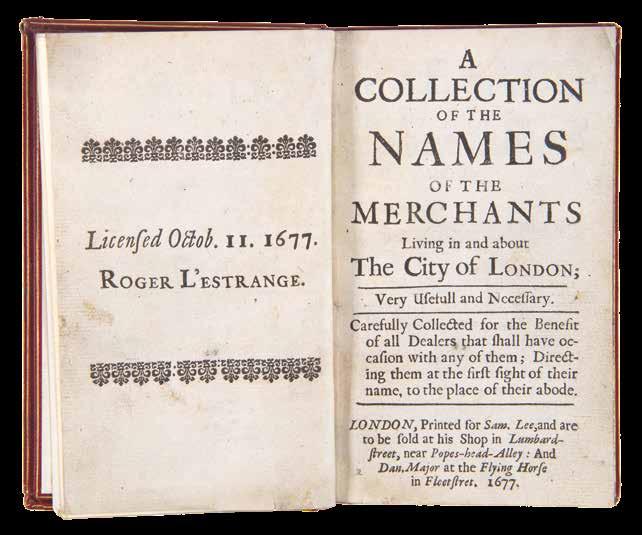
A Collection of the Names of the Merchants Living in and about The City of London; Very Usefull and Necessary. Carefully Collected for the Benefit of all Dealers that shall have occasion with any of them; Directing them at the first sifhte of their name, to the place of their abode.
Publication
London, Printed for Sam. Lee, and are to be sold at his Shop in Lumbard-street, near Popes-head-Alley: And Dan. Major at the Flying Horse in Fleet Street, 1677.
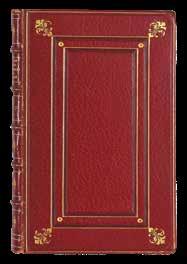
Description Octavo (145 by 85mm). Modern panelled red morocco, gilt, by Riviere & Son.
Collation
Pages [128]; A4, B-H8, I4.
References ESTC R19915.
First and only edition, “Licensed Octob. II. 1677”, by Roger L’Estrange.
Compiled by Samuel Lee (1625-1691), better known for publishing religious works, who writes in the ‘Preface’: “Although the publishing of the ensuing Pamphlet (or Catalogue) may at the first view, seem to several persons a ridiculous and preposterous attempt, yet the Author of this poor Collection humbly hopes, that it will not be exploded or rejected by you, for whose ease and convenience (together with your foreign correspondents) he principally intended it...”. Lee lists the merchants and tradesmen alphabetically, giving their street address, by sadly not listing the nature of their business, except for the appendix, which lists “all the Goldsmiths that keep Running Cashes”. Much is made in the literature of the listing of Alexander Pope, linen merchant and father of the poet.
Although Lee intended “shortly to Reprint this Catalogue, with Additions” a second edition was not forthcoming. However, the next comprehensive London ‘Directory’, ‘The directory: containing An Alphabetical list of the Names and Places of Abode of the Directors of Companies, Persons in Publick Business, Merchants, and other Eminent Traders in the Cities of London and Westminster, and Borough of Southwark’, (1736), was updated and reprinted by Henry Kent every few years until his death in 1771, and then subsequently augmented and reissued by other publishers.
Rare: only ten institutional examples known; only this example at auction since 1918.
The Charter of Confirmation of 1675
THE CITY OF LONDON; S.G, Gent
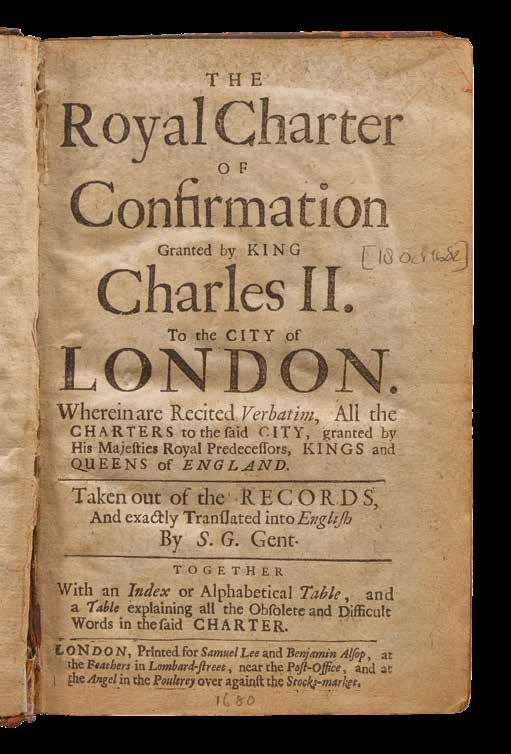
The Royal Charter of Confirmation Granted by King Charles II. To the City of London. Wherein Recited Verbatim, All the Charters to the said City, granted by His Majesties Royal Predecessors, Kings and Queens of England. Taken out of the Records, and exactly Translated into English By S.G. Gent. Together with an Index or Alphabetical Table, and a Table explaining all the Obsolete and Difficult Words in the said Charter.
Publication
London, Printed for Samuel Lee and Benjamin Alsop, at the Feathers in Lombard-street, near the Post-Office, and at the Angel in the Poultry over against the Stocks-market, [1680].
Description
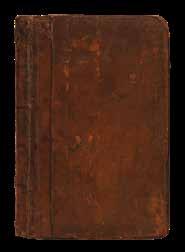
Octavo (170 by 110mm). Contemporary tan calf, rebacked to style at an early date, dampstained, inner hinge expertly repaired.
Also published under Samuel Lee’s sole imprint, and dated 1680. Signed on the last page, this “24th Day of June, in the 15th Year of Our Reign”, so 1675, this is one of many charters that municipal governments throughout England petitioned for renewal throughout Charles II’s reign. The current renewal was printed here, five years later, against the backdrop of the Exclusion Crisis (1679-1681). In May 1679, Anthony Cooper, Earl of Shaftesbury (1621-1683) and James Scott, Duke of Monmouth (1649-1685), introduced a bill in the House of Commons with the intention of excluding Charles II’s Catholic brother, James, from the succession. Shaftesbury’s bill had tremendous support, and it seemed probable that the bill would pass, so Charles exercised his royal prerogative to dissolve parliament. The Exclusion Bill eventually passed the House of Commons in 1681, but was defeated in the House of Lords. The crisis influenced politics for more than two hundred years: the exclusionists increasingly became known as “Whigs”, lobbying against Catholicism; while the “Tories” supported the Monarchy and the Church.
Provenance
1. With the ownership inscription of Edmon Jones on the inside front cover;
2. Also the early twentieth century inscription of John T. Pierce; 3. And of Ernest G. Atkinson, dated January 1913, and his bookplates.
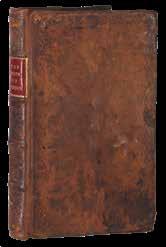
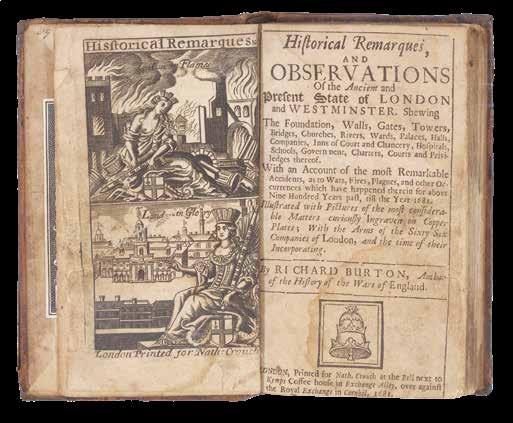
CROUCH, Nathaniel as “Richard Burton”
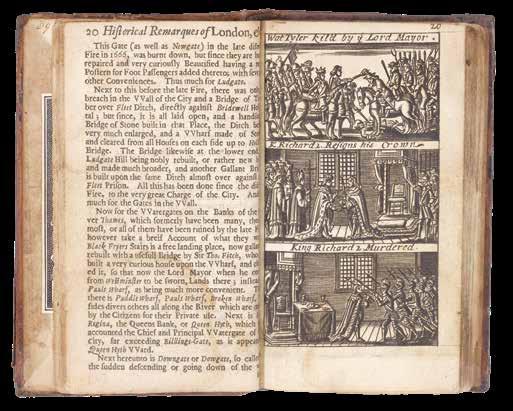
Historical Remarques, and Observations of the Ancient and Present State of London and Westminster. Shewing the foundation, walls, gates, towers, bridges, churches, rivers, wards, palaces, halls, companies, Inns of Court and Chancery, hospitals, schools, government, charters, courts and priviledges thereof. With an account of the most remarkable accidents, as to wars, fires, plagues, and other occurrences which have happened therein for above nine hundred years past, till the year 1681. Illustrated with pictures of the most considerable matters curiously ingraven on copper plates; with the arms of the sixty six companies of London, and the time of their incorporating.
By Richard Burton, author of the History of the wars of England.
Publication London, printed for Nath. Crouch at the Bell next to Kemps Coffee house in Exchange Alley, over against the Royal exchange in Cornhil, 1681.
Description
Two parts bound in one volume. Duodecimo (140 by 85mm). Wood-engraved frontispiece, 5 plates, a vignette illustration and 11 pages of heraldic crests, without the single advertisement leaf at the end, a bit browned and stained, with a few short marginal tears and losses; contemporary calf, decorated in blind, recased preserving the original spine, new red morocco lettering-piece.
Collation
Pages [iv], 116, [ii], 119-234; A-K12.
References
Elligott for ODNB; ESTC R468992.
Crouch is “A very ingenious person...[who] can talk fine things upon any subject” (Dunton)
Nathaniel Crouch (1640–1725?), bookseller and writer, was apprenticed to the London bookseller Livewell Chapman from 1656 and opened his first bookshop in the fateful year of 1666. Nevertheless, Crouch thrived, and the “catalogues which he printed at the end of all his books indicate that his bookshop carried a large amount of stock... John Dunton praised the elder Nathaniel Crouch as “a very ingenious person … [who] can talk fine things upon any subject”... Crouch was best-known to his contemporaries as the author and publisher of a number of historical works written under the pseudonym Robert Burton or R. B. This pseudonym was a reference to the author of ‘The Anatomy of Melancholy’ (1620). The Anatomy became a best-seller partly because it translated hundreds of quotations from Greek and Latin into English, thereby giving many humbly educated men a passing knowledge of the classics. In a similar fashion Crouch’s history books presented shortened and simplified versions of serious works to audiences that might otherwise never have read them (Elligott)
Provenance
1. With the contemporary ownership inscription of Richard May on the recto of the frontispiece; the eighteenth-century engraved trade card of A. Symon, “High German Doctor” in Bulwark Street, Dover, on the recto of the frontispiece;
2. With the ownership inscription of Daniel Saffory, dated 1772 on the recto of one of the platers;
3. With the engraved armorial bookplate of John W. Trist, FSA and collector of coins and medals, on the inside front cover, and his ownership inscription on the recto of the first blank, dated 1893.
Whigs versus Tories
THE CITY OF LONDON
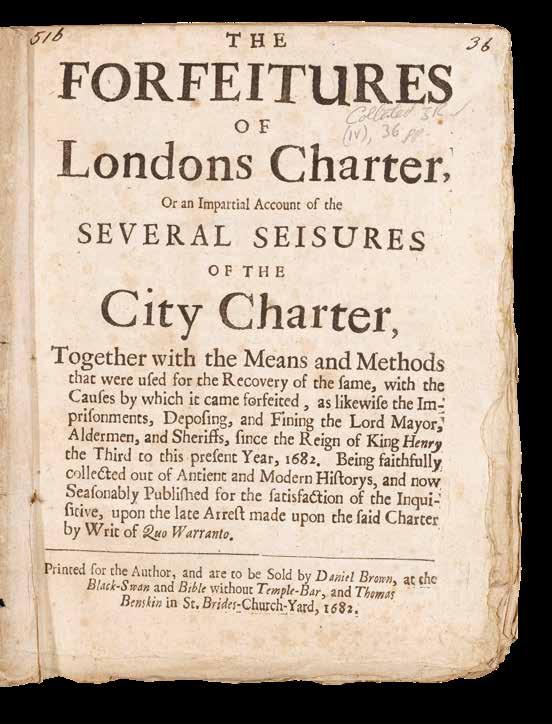
The Forfeitures of Londons Charter, or an Impartial Account of the Several Seisures of the City Charter, together with the means and methods that were used for the recovery of the same, with the causes by which it came forfeited, as likewise the imprisonments, deposing, and fining the Lord Mayor, aldermen, and sheriffs, since the reign of King Henry the Third to this present year, 1682. Being faithfully collected out of antient and modern historys, and now seasonably published for the satisfaction of the inquisitive, upon the late arrest made upon the said charter by writ of quo warranto.
Publication
London, Printed for the Author, and are to be Sold by Daniel Brown, at the Black-Swan and Bible without Temple-Bar, and Thomas Benskin in St. Brides-Church-Yard, 1682.
Description
Small quarto (200 by 160mm). Original plain paper front self-wrapper, uncut, stabbed and sewn as issued.
Collation
Pages [ii], 36; [A] - E4.
References ESTC 18801.
“Since the Charter was granted to the Antient and Famous City of London by William the Conqueror, Henry the Second, and other Kings of this Realm, we find several Inspections have been made into it, and that at Sundry times the Priviledges and Charter of the Said City hath been taken away and suspended; The Historical Relation of which, as it is Recorded by the most Authentick of our English Writers. Being now thought Seasonable and useful, is intended to be the Subject of this Treatise” (page 1).
Although claiming to be an impartial account of all the occasions on which the reigning monarch had cause to force the surrender of, or alter, their charter with the City of London, the author is clearly on the side of Charles II here. In the wake of the Exclusion Crisis of 1679-1681, in which Whigs (those in opposition to the possibility of the Catholic Duke of York’s succession to the throne, and to the Church’s persecution of Protestant Nonconformists), had ultimately unsuccessfully, pitted themselves against the Tories (who supported the monarchy and the church), the king set about dismantling the municipal independent authority of City boroughs, including that of the City of London. The “writ of quo warranto”, inspired by Tory loyalists, and quoted at the end of the treatise, questions under what right the Whig “Mayor and Commonalty and Citizens of the City of London,... use and enjoy [their Liberties], Priviledges, and Franchises”, which led to a Tory landslide at the next election.
The second charter of William and Mary
THE CITY OF LONDON
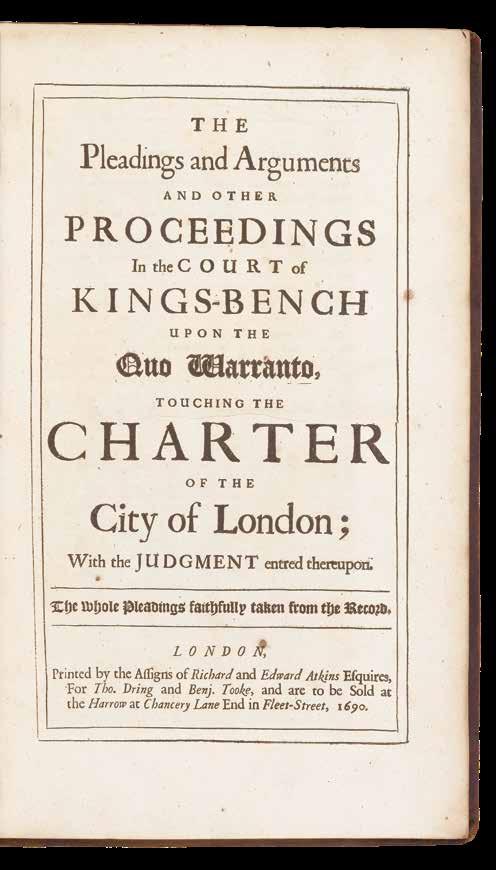
The Pleadings and Arguments and other Proceedings in the Court of the Kings-Bench upon the quo warranto, touching the Charter of the City of London.
Publication London, Printed for the Assigns of Richard and Edward Atkins Esquires, For Tho. Dring and Benj. Tooke, and are to be Sold at the Harrow at Chancery Lane End in FleetStreet, 1690.
Description Folio (325 by 195mm). Contemporary reverse calf, rebacked to style, preserving gilt morocco lettering-piece and one decorative panel.
References Glasman, ‘The City of London’s Strange History’, 2014.
During the reign of the Stuart kings and queens of England, Scotland and Ireland, two notable attempts were made to reform the way the City of London was run. “One led to the execution of the king, the other – an attempt by Charles II to establish that the monarchy was the source of the Corporation [of London]’s authority – led to the Stuarts’ replacement by William and Mary, whose Second Charter in 1690 leaves no doubt as to who were the greatest beneficiaries of the Glorious Revolution. It declared: “That the mayor, commonalty and citizens of London shall for-ever hereafter remain, continue and be, and prescribe to be, a body politic, in re, facto, et nomine … and shall have and enjoy all their rights, gifts, charters, grants, liberties, privileges, franchises, customs, usages, constitutions, prescriptions, immunities, markets, duties, tolls, lands, tenements, estates and hereditaments whatsoever” (Glasman).
Provenance
With the ownership inscription and annotations of “W: Ambler, Durham, June 2.d 1775”.
CAMPBELL, Colen
Vitruvius Britannicus or, the British Architect containing the Plans, Elevations, and Sections of the Regular Buildings, both Publick and Private in Great Britain. With a variety of New Designs; in 200 large Folio Plates. Engraven by best Hands, and Drawn either from the Buildings themselves, or the Original Designes of the Architects.
Publication
London, Sold by the Author over against Douglas Coffee-house in St. Marins-lane, John Nicholson in Little Britain, Andrew Bell at the Cross-Keys in Cornhil. W. Taylor in Pater-Moster-Row, Henry Clements in St. Pauls Church-yeard, And Jos. Smith in Exeter-Change, 1715, 1717, 1725.
Description
Three volumes. Elephant folio (510 by 360mm). Engraved title-page and dedication leaf to volume one, and 97 further plates numbered 3-100, engraved title-page to volume II, and a further 98 plates (bound without plate 60), letterpress title-page to volume III, printed in red and black, 93 plates (bound without plates 1-2, 57-60 - of Wilton, 71-72of Woodstock), for a total of 291 of an expected 298 numbered plates, with some double-numbered and others quadruplenumbered, volume II very browned; volumes one and II, contemporary polished panelled calf, blind and gilt, volume III contemporary polished calf, decorated in blind and gilt, hinges worn.
“‘Vitruvius Britannicus’ decisively shaped the development of classical architecture in eighteenth-century England” (Connor)
Colen Campbell (1676–1729), British architect, was initially a brilliant young lawyer, however, in the years following the Act of Union Campbell reinvented himself as an architect in England. He launched himself on the scene in 1712, when he designed his first building, Shawfield Mansion, Glasgow; submitted numerous designs for a commission to build fifty new churches in London; and attained a prestigious commission from Sir Richard Child for Wanstead, a grand house just outside London. Wanstead, with its imposing projecting portico of Corinthian columns, with unfussy decoration to walls and windows, marked the return to a simpler, more classical, even Palladian, manner of ornament, than the fashionable baroque designs that immediately preceded it.
In 1714, Campbell was invited, by a group of booksellers, to contribute to their work on British buildings, ‘Vitruvius Britannicus’, and bring his new architectural look, and own designs, to what would otherwise have been a fairly conventional topographical record of well-known public landmarks and private estates. Campbell is credited as the author on the title-page, probably writing the introduction and accompanying text.
The text of his introduction was “a powerful statement of pride in the achievement of British architects, a call to order against the extravagance of Italian baroque architecture for which the example of Palladio, mediated by Inigo Jones, was the ideal corrective... A second volume, intended at the outset, appeared in 1717, and a third was added in 1725... By then the work boasted an impressive list of 692 subscribers, headed by five members of the royal family, indicating a degree of popularity reached by few books of comparable scale. As may be expected in a book which focused on aristocratic houses, the lists show a higher proportion of noble subscribers, and a smaller proportion of artisans, mainly from the building trades, than was the case in the more specifically architectural books which followed the lead of ‘Vitruvius Britannicus’” (Connor).
Provenance
1. Kirkleatham Library label on the inside front cover of each volume; 2. With the blind library stamp of Ing Alfred Albini Ovl Arkitekt on each title-page.
STOW, John; and STRYPE, John
A Survey of the Cities of London and Westminster: Containing The Original, Antiquity, Increase, Modern Estate and Government of those Cities.
Publication
London, A. Churchill, J. Knapton, R. Knaplock,... [and others], 1720.
Description
Two volumes. Folio (390 by 240mm). Titlepages printed in red and black; volume one: large folding map ‘A New Plan of the City of London’, 2 folding, 17 doublepage, and 24 full-page engraved plates; volume II: 17 double-page and 9 full-page engraved plates, illustrated throughout with woodcuts in the text, early fore-edges to volume I stained; contemporary panelled calf, decorated in blind, recased preserving contemporary covers, rebacked to style, inner hinges of volume one strengthened, bookplate removed, endpapers to volume II renewed, bookplate obscured.
Adams, ‘London Illustrated 1643-1851’, 1983, 25; Darlington and Howgego, ‘Printed Maps of London 1553-1850’, 1978, 16, 8; Martin & McConnell for ODNB; Merritt, ‘The reshaping of Stow’s Survey: Munday, Strype, and the protestant city’, 2001, pages 52–88.
“The survey has a multiple personality”
Bibliophile, general antiquarian and biographer, John Strype (1643-1737) was commissioned to edit a revised version of John Stow’s already monumental ‘Survey of London’ (1598), and immediately enlisted the help of the London archives, the city livery companies, the clergy, the librarians of Lambeth Palace, the Tower of London, and private individuals of like mind.
Most of the material was gathered, and engravings prepared by 1707, but the publication of Edward Hatton’s ‘New View of London’ (1708) queered his pitch: it was smaller, cheaper, and Strype’s project was shelved unfinished. But less is not always more, and Hatton’s book fell short of public opprobrium. Strype’s project was revived in 1716, and eventually published in 1720, as here.
Strype included what he “believed to have been Stow’s entire original text, which had by this time been conflated with the 1618 and 1633 additions of Anthony Munday. His own additions, where he had identified gaps in Stow’s narrative and where the passage of time demanded them, were clearly identified as such in the margins. Inevitably his own protestant convictions and his abhorrence of popery led him to be selective and even emphatic in the space allocated to the provision of almshouses and other charitable donations, and in the details of sermons and services held within the city. Political events, such as the defeat of the Armada, the civil war, the Jacobite period, and the return to an assured Protestantism all called for judgmental comment. Strype was however one of three editorial voices writing in the first person and the present tense” (Martin & McConnell).
As a result “The survey has a multiple personality, switching with little warning from nostalgic Elizabethan antiquary [Stow] to triumphalist Jacobean pageant-master [Munday] to diligant post-restoration recorder of events [Strype] and back again” [Merritt].
Provenance
1. Small library label of Battle Abbey, in Hastings; 2. With Sotheby’s 1959; with B.H. Blackwell Ltd, Oxford, 1987.
STOW, John; and STRYPE, John
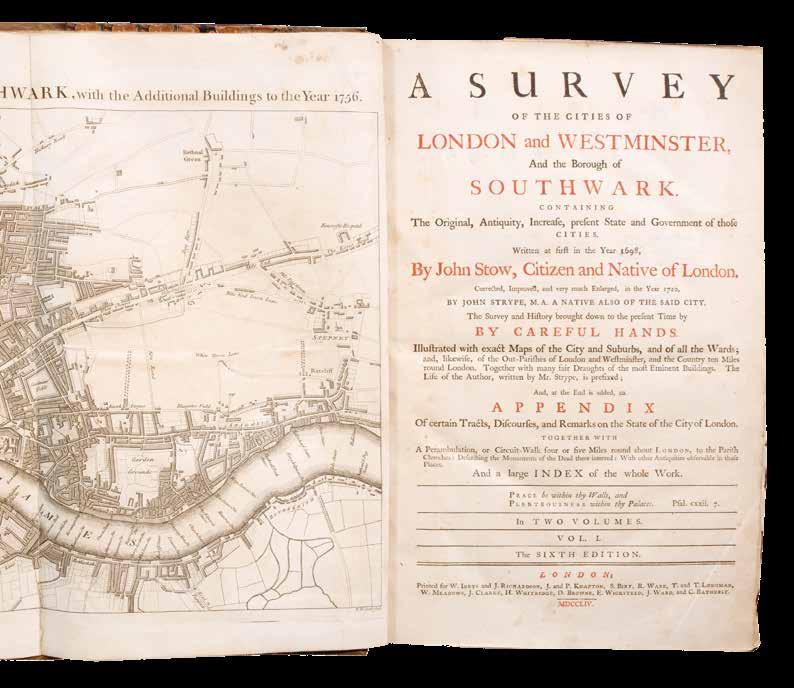
A Survey of the Cities of London and Westminster, and the Borough of Southwark. Containing The Original, Antiquity, Increase, Present State and Government of those Cities. Written at first in the Year 1698 [sic], By John Stow, Citzen and Native of London...
Publication
London, Printed for W. Innys and J. Richardson, J. and P. Knapton, S. Birt, R. Ware, T. and T. Longman,.... 1754-1755.
Description
Two volumes. Folio (400 by 255mm). Title-pages printed in red and black; volume one: 2 folding frontispiece maps, 28 double-page and folding (including one not called for by Adams, and a duplicate plan of Crippelgate), and 41 full-page plans and plates; volume II: 42 double-page and 88 full-page engraved plates, without the folding ‘A New Mapp...’ and plate of Westminster Abbey, some occasionally heavy spotting, or two marginal repairs; modern half calf, nineteenth century marbled paper boards.
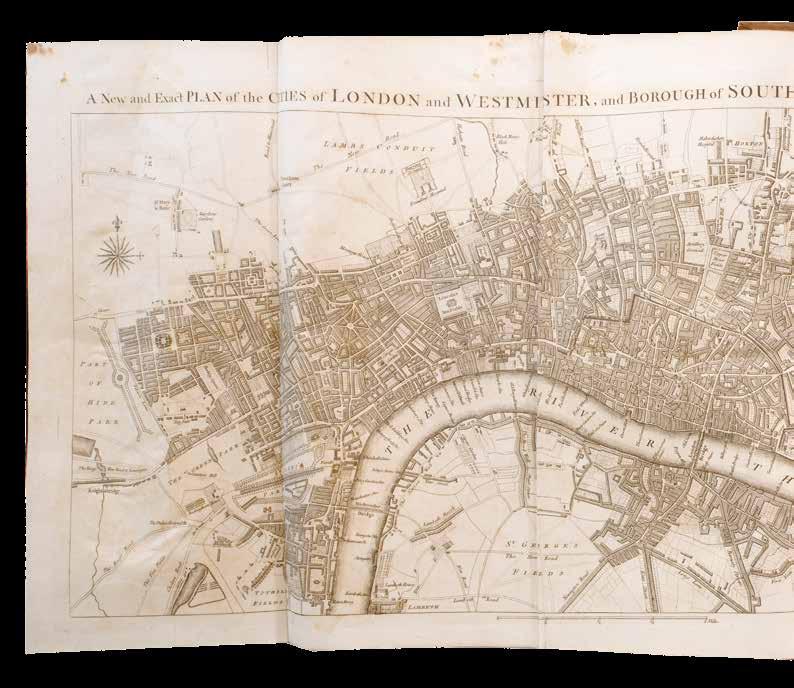
This sixth edition of Strype’s Stow, was issued in parts from February 1754 to July of 1757. As Adams reports “It must have been quite a job for the publishers to keep this stream of illustrative material flowing and, although perhaps a few maps and views were specially commissioned, they largely depended on three tributaries of pre-existing work. A little under half consisted of nearly all the plates made for the fifth edition with minor alterations of the ward and parish maps, the burnishing out of the original references to volume, Book and page numbers and the addition of Part numbers and an appropriate publication-line. The rest was drawn chiefly from two other sources: the current stock-in-trade of the printseller John Bowles and the architectural plates engraved by Benjamin Cole for the second edition of Maitland’s ‘History of London’, which was coming out also in Parts, between 1754 and 1756”.
Provenance
With the engraved armorial bookplate of Frederick Vigne (1861-1939) on the inside front cover of the first volume.
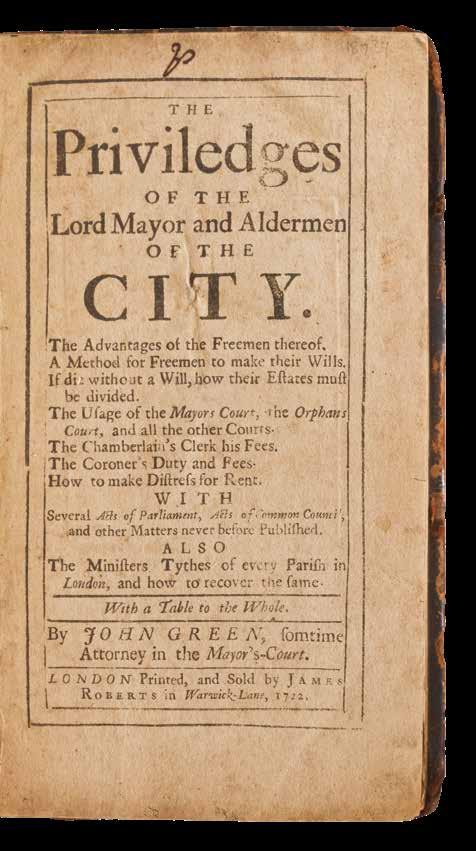
THE CITY OF LONDON; and GREEN, John
The Priviledges of the Lord Mayor and Aldermen of the City. The Advantages of the Freemen thereof. A Method for Freemen to make their Wills. If die without a Will, how their Estates must be divided. The Usage of the Mayors Court, the Orphans Court, and all the other Courts. The Chamberlain’s Clerk his Fees. The Coroner’s Duty and Fees. How to make Distrss for Rent. With Several Acts of Parliament, Acts of Common Council, and other Matters never before Published. Also the Ministers Tythes of every Parish in London, and how to recover the smae. With a Table to the Whole. By John Green, somtime Attorney in the Mayor’s Court.
Publication London, Printed, and Sold by James Roberts in Warwick-Lane, 1722.
Description Octavo (195 by 115mm). Contemporary full calf.
Collation Pages [xiii], [1]-215; A-O8, P4.
London in 1722
Concerning all aspects of life in London in the early-eighteenth century, from the rights of apprentices, to the size of fishermen’s nets, and the meaning of Hotchpot Wills. However, there is no mention of the decision to require traffic across London Bridge to keep to the left, which subsequently became a national requirement.
NORDEN, John
Nordens preparatiue to his Speculum Britanniae intended a reconciliation of sundrie propositions by divers persons tendred concerning the same; [with] NORDEN, John. Speculum Britanniae: An Historical and Chorographical Description of Middlesex and Hartfordshire. London, 1723.
Publication London, Daniel Brown, 1723.
Description
Two works in one volume. Octavo (227 by 170mm). Title-pages, half-title printed in red and black; frontispiece, four folding engraved maps, two plates; contemporary calf with the supra libros of the Earl of Essex.
The first English county map to mark roads
Later edition of this book by John Norden (c1547-1625), first printed in 1593. Norden conceived the ‘Speculum Britanniae’ in 1583, “when he fell into the company of Portugal’s King Antonio, who, exiled by the annexation of his country by Philip of Spain, came to England looking for support. In the preface to his ‘Speculum’ of Cornwall, Norden told how he fell to travelling with the followers of ‘Don Anttonie’, “for the most part very learned”, and how they questioned him about the names of the places through which they passed and the nature of things they saw. Culturally and administratively the county was the dominant social unit in early modern England, and inspired by the Portuguese visitors Norden next wrote in 1591 a small guidebook to Northamptonshire (where he was surveying at the time), containing some historical and antiquarian background and a résumé of the economic and social life of the county. To complete the description he included a map of the county. This, his first county map, was not very innovative, being based closely on an earlier map by Christopher Saxton, and it and the guide remained unpublished until 1720. In 1593, however, Norden produced the next part of the ‘Speculum’, a guide to Middlesex. The text followed the formula established by the description of Northamptonshire but the map of the county and its two plans of Westminster and the City of London were, like all his later maps, his own, and not based on Saxton’s work. Norden’s ‘Middlesex’ was the first English county map to mark roads, and his inclusion of a characteristic sheet, giving a key to symbols used on the map, introduced this practice to English cartography” (Kitchen for ODNB).
Provenance
The Earls of Essex (supra libros).
OVERTON,
Henry; HOOLE, John; HARRIS, John; and COLE, Benjamin
Album of views of Monuments in England, France, Italy and Spain.
Publication
London, Sold by Henry Overton at y.e White Horse without Newgate, [c1715-1730].
Description
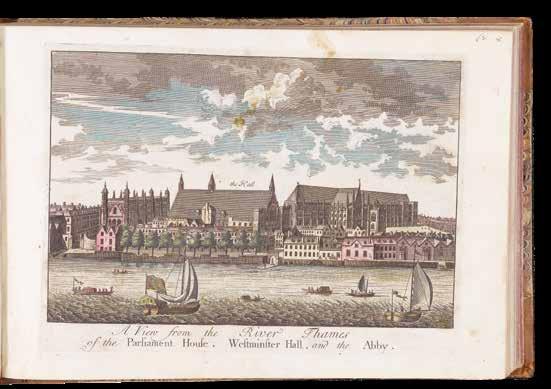
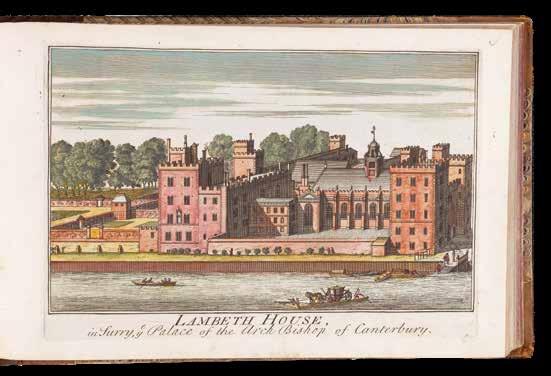
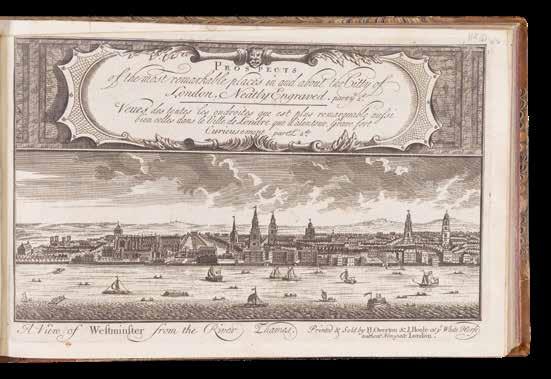
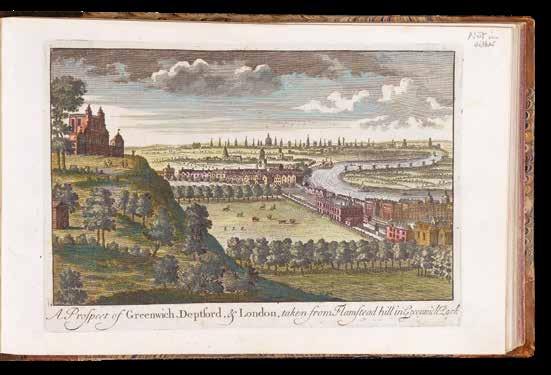
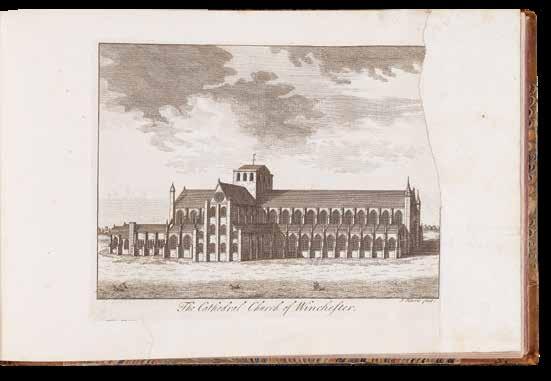
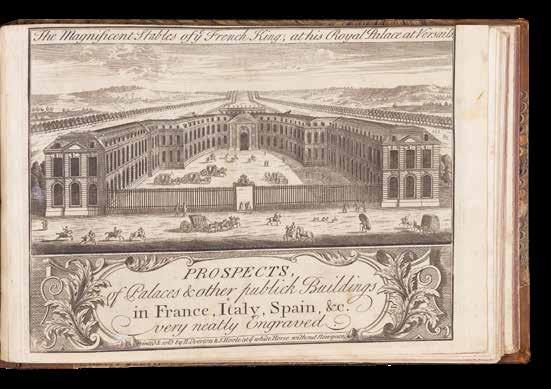
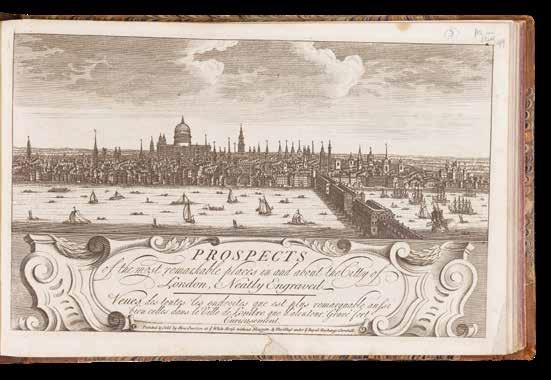
Four works, in five parts, in one volume. Oblong quarto (185 by 295mm). Engraved title-page and 18 plates for ‘View’s of all the Cathedral Church’s...’, three plates torn with loss to the image and repaired; engraved title-page and 16 plates for ‘Britannia Illustrata’; engraved vignette title-page and 21 plates for ‘Prospects,... Citty of London’ II, four with contemporary hand-colour; engraved title-page and 28 plates for ‘Prospects,... Citty of London’ I; engraved title-page and 38 plates for ‘Prospects,... France, Italy, Spain’, one with contemporary hand-colour; nineteenth century half tan calf, marbled paper boards, a bit worn.
Four rare suites of plates from Henry Overton, regarded by Adams as the “earliest reliable” of London: ‘View’s [sic] of all the Cathedral Church’s [sic] of England and Wales &c neatly Engrav’d. Vues de toutes les Englises Cathedralles d’Angleterre et de Galle &c. proprement gravee’. Sold by Henry Overton at y.e White Horse without Newgate, [1715]. All of the plates were engraved by John Harris I (fl1700–1740), whose earliest work was for Joel Gascoyne, on his large-scale surveys of Cornwall and the parish of St. Dunstan Stepney in Middlesex. This was followed in 1711 by a series of architectural plates and bird’s-eye views, as here, and for David Mortier’s ‘Britannia illustrata’ (1720). However, Harris is now best-known for his large engravings, after Wenceslaus Hollar, of each of the prospects of old St Paul’s Cathedral, which were published in the second edition of William Dugdale’s ‘The History of St Paul’s Cathedral in London’ (1716).
The plates
The four suites are:
1. ‘Britannia Illustrata, or Views of all the Palaces, several Seats and other Publick Buildings of England, very neatly Engrav’d. Les Veues de les Palais, et de diverses belles Maisons, et d’Autres Publiques Batiments de L’Angleterre, Graves fort Curieusement’. London, Printed & Sold by H. Overton & J. Hoole, at the white Horse without Newgate, 1724.
2.‘Prospects of the most remarkable places in and about the Citty of London, Neatly Engraved. Part y.e 2.d. Veues des toutes les androites que est plus remarquable aussi bien celles dans le Ville de Londre que d’alentour, Grave fort Curieusement part l’ 2.de’. London, Printed & Sold by H. Overton & J. Hoole at y/e White Horse without Newgate, [c1728].
3. ‘Prospects of the most remarkable places in and about the Citty of London, Neatly Engraved - Veues des toutes les endroites que est plus remarquable aussi bien celles dans le Ville de Londre que d’alentour, Grave fort Curieusement’. Printed & Sold by Hen: Overton at y.e White Horse without Newgate, & Tho: Glass under y.e Royal Exchange Cornhill, [c1730].
4. ‘Prospects, of Palaces & other publick Buildings in France, Italy, Spain, &c. very neatly Engraved’. Printed & Sold by H. Overton & J. Hoole at y.e white Horse without Newgate, [1724].
Including a number of views of Versailles, as well as the Escorial in Spain and St. Peter’s in Rome. Many are signed by Benjamin Cole and after original designs by Charles Le Brun.
The plates for ‘Britannia Illustrata’ and the ‘Prospects of... the Citty of London’ are a compilation of reduced versions of those issued by Overton in his previous ‘Britannia Illustrata’ of 1707-1714, from John Stow’s ‘Survey...’ of 1720, and John Bowles’s inventory of views,
also published in the 1720s. They are bound indiscriminately after the three title-pages, and include all the engravings called for by Adams for the first suite of ‘Prospects...’, most of those for the second (without Adams 14, 25, 26, 39, 55, 59, 61, 69-74), with the addition the three not issued with the ‘Prospects...’ (ie Adams 75-77). The plate of the ‘Inside of the Choir of ye Cathedral Church of St. Paul’ is signed by Benjamin Cole, who went on to illustrate Maitland’s ‘History of London’ (1756).
The son of eminent London printer and publisher, John Overton, Henry I took over the family business in 1707. According to newspaper advertisements on record, Overton joined John Hoole in business from the 6th August, 1724 to 8th or 10th of May, 1733. A joint catalogue, dated 1734, probably denotes the partners’ attempts to liquidate their joint assets, although the partnership finally ended with Hoole’s death on 25th December, 1734. Although his cartographical output was less prolific than that of his father, John, Henry continued to publish maps and major atlases until 1764, when he handed the business down to his nephew, who shared his name and later sold the firm to Cluer Dicey.
Provenance
With the nineteenth-century ownership inscription of Charley Harvey on the inside front cover.
NICHOLLS, Sutton
London Described, or, the most noted Regular Buildings both Publick and Private with the Views of several Squares in the Liberties of London & Westminster. Exhibited in divers Elevations & Perspective Views, Engraved after Drawings exactly made from y.e Buildings By an able Artist. To which are added the Prospects of Royal Palaces of England, of Chelsea Hospital, Greenwich Hospital, Blenheim House and of the famous Light House built on Edystone Rock, &c.
Publication Printed for Tho.s Bowles in St. Pauls Church-Yard, & Io.n Bowles at the Black Horse in Cornhill [1724-1731].
Description Folio (530 by 350mm). Engraved title-page in French and English; two double-page engraved maps, and 46 double-page plates, one plate lower left corner torn with loss and renewed; near contemporary half tan calf, marbled paper boards, worn.
References Adams, ‘London Illustrated 1643-1851’, 1983, 196; Peltz for ODNB.
Exceptionally rare “pleasurable mementoes of early eighteenth century urbanity”
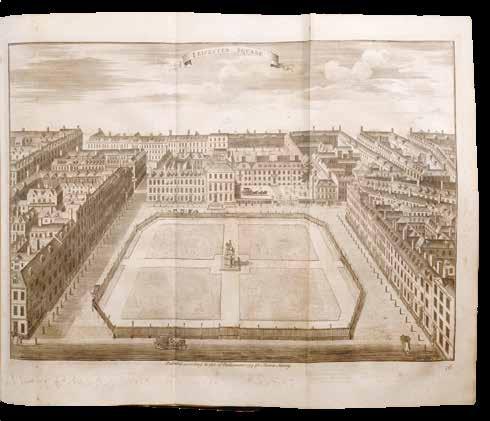
A very rare example of this album of views of London, one of only three known. With two plates not included in the other examples. Including twenty-nine of the best of Sutton Nicholls’s topographical plates, particularly his bird’s-eye views of London’s squares, described by Adams as “pleasurable mementoes of early eighteenth century urbanity”.
“The extent to which the family of Bowles dominated the London print market may be judged from the fact that at the time this collection was being got together, Thomas Bowles had been trading in St. Paul’s Churchyard since 1712, where he remained ‘next to the Chapter House’ for the rest of his long career. His younger brother, John, having retained his premises at Mercer’s Hall as a warehouse, had opened another establishment nearby in the Stocks Market. Between them they had three London addresses. Thomas’s name appears in some of the publicationlines of ‘London Described’ because he was originally, like his brother, a map and printseller and publisher. But by 1725, he had also emerged as an engraver and it is in this role that his name is to be found on some of the plates” (Adams).
Sutton Nicholls (fl1680–1740), specialized in topographical designs and architectural elevations, “many of which he either engraved or etched himself. Despite his rather ‘crude and hasty draughtsmanship’ (Adams), the frequent inaccuracy of his views, and an apparently shaky grasp of perspective, he was repeatedly employed to produce illustrations for antiquarian accounts and topographical surveys of London... Nicholls’s best works are his modest bird’s-eye views of London squares and buildings, published by John Bowles as ‘Prospects of the Most Noted Buildings in and about London’ [as here], each with a distinctive title on an engraved banderole and an assortment of foreground figures which served both as scale referents and an indication of urban life” (Peltz).
Including two plates not in Adam, so not in the Guildhall example, nor in the British Museum: ‘Grosvenor Square’, with the inscription in French regarding the granting of small portion of Hyde Park to the gentlefolk of that area of London to take some fresh air; and ‘St. Martin’s Church’.
Rare: no examples have appeared in commerce in available records; only two institutional examples known, at the Guildhall, London, and the British Museum.
Provenance
1. Two plates annotated in French, in the margins with relevant history, in a contemporary hand;
2. With a twentieth century bookplate, “Ex Libris Vallis Dei”, on the inside front cover.
LAURON, Marcellus as “Mauron”, otherwise known as “Old Laroon”
The Cryes of the City of London Drawne after the Life. In 74 Copper Plates.
Publication London, Printed & Sold by Henry Overton at the White Horse without Newgate, 1733.
Description Folio (200 by 320mm). Engraved title-page, and 73 further numbered plates with captions in English, French and Italian; nineteenth century tan calf, decorated in blind, rebacked to style, all edges gilt.
References Shesgreen, ‘The Editions, Imitations and Influences of Laroon’s Cryes of the City of London’ in ‘Studies In Bibliography XXXV’, 1982, pages 258-271.
“His thoughts in his pictures show him to be a man of levity, of loose conversation and morals suteable to his birth & education, being low & spurious” (Vertue)
Marcellus Laroon, the elder (1648–1702), “old Laroon”, was born at the Hague in the Netherlands, the “son of Marcel Lauron, a French painter of portraits and landscapes. Lauron apprenticed his son to a history painter before taking him (after 1660) to London, where Laroon trained until about 1670 with ‘La Zoon’ (perhaps Hendrick Sonnius, Lely’s assistant), and with Balthazar Flesshier, a painter of seascapes and portraits. He then became a portrait painter in Yorkshire (where, he told George Vertue, he met Rembrandt at Hull). After returning to London, Laroon joined the Company of Painter–Stainers in 1674,... where he excelled in drapery painting” (Thackray).
However, it is for these images of London’s street-traders, and the directness of his gaze, that Laroon is best remembered. Twenty-four of the fencing plates for ‘The Art of Defence’ (1699), were by him, as well as some erotic engravings that were sold at Will’s Coffee House, Bow Street, in 1691.
The first “complete” edition of the ‘Cryes’, was published by Pierce Tempest (1653-1717) in 1689, with the engravings made by John Savage. John Overton issued his first set in 1711, crediting Tempest with the engravings. The original engraved plates were still being used to print collections in the early-nineteenth century.
MOTTLEY, John as “Robert Seymour”
A Survey of the Cities of London and Westminster, Borough of Southwark, and Parts Adjacent.
Publication
London, Printed for J. Read in Whyte-Fryars, Fleet-Street, 1734-1735.
Description
Two volumes. Folio (395 by 245mm). Titlepages printed in red and black, double-page engraved folding frontispiece map, eight engraved plates, illustrated throughout with vignettes; modern tan paneled calf, gilt antique, preserving the original endpapers.
First book edition of J. Read and John Mottley’s revision of John Stow’s ‘Survey of London’ (1598), originally issued in parts between 1733 and 1735.
“Robert Seymour” was actually John Mottley (1692–1750), playwright, who entered Grub Street for a living, when his expectations of an inheritance, patronage, and a career at the Excise Office, were dashed. He published a number of plays in collaboration with others, almost always under a pseudonym, as here, whether out of fear of social stigma, or of the bailiff is unknown. His last work, ‘The Compleat List of All the English Dramatic Poets’ (1747) was appended to Thomas Whincop’s play ‘Scanderbeg’, serves as his hitherto unknown bibliography.
Provenance
1. With the early engraved armorial bookplate of O.G. St. John on the inside front cover of each volume;
2. With the engraved armorial bookplate of Charles Edward Harris St. John (1843-1917) on the inside front cover of each volume.
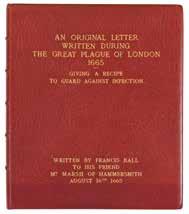
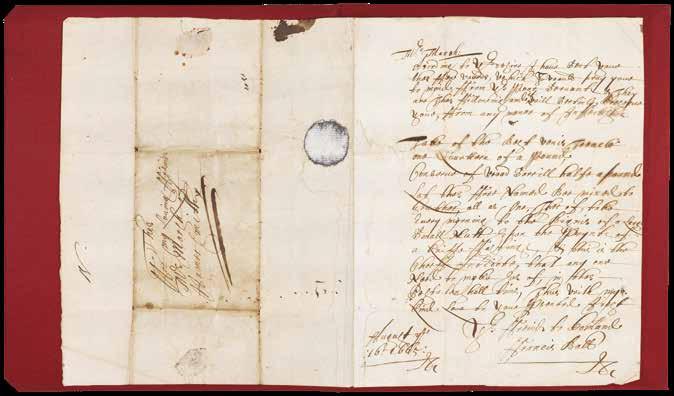
BALL, Francis
Autograph Letter Signed, “FFrancis Ball”, and addressed “This to my Loving Ffriend Mr. Marsh of Hammersmith”.
Publication London, August 16th, 1665.
Description
Single leaf, folded to make four pages, written on one side, with integral address leaf, old sealone or two pale waterstains, contemporary instains; preserved in custom red cloth chemise and red morocco, gilt, clamshell case (225 by 170mm).
How to survive the Black Death: “It will sertinly preserve you ffrom any manner of inffectshon”
Written at the height of the second wave of the Great Plague of London, during which 6,000 deaths were reported a week, and which had started in the suburb of St. Giles-in-the-Fields in the late autumn of 1664.
“Mr. Marsh, According to yrs recivd I have sent youo thes ffew words which I would pray youo to mind, ffrom yr pooor servant & they are this ffollowing and it will sertinly preserve youo, ffrom any maner of inffection. Take of the Best Venis Treacle
One Quarter of a Pound, Conserve of Wood Sorrill half a pound, Lat this ffore named bee mixed to feather all as one, Ther of, take Every morning to the Bigneis of a Large Small Nutt upon the Poynt of a Knife ffasting, & this is the Cheeff Antidote, that any one Need to make us of, in this Pestalenshall times, This with my kind Love to you Psonted I rest Yr ffriend to Comand Ffrancis Ball”
The chief ingredient - Venice Treacle - about which Daniel Defoe comments, in his ‘History of the Great Plague’ (1754): “Venice Treacle is sufficient of itself to resist the Contagio,... According to this Opinion I several times took Venice Treacle, and found a Sweat upon it, and thought myself as well fortified against the infection as any one could be fortified by the Power of Physic” (page 276).
Provenance
1. Taken from the “General Account and Memorandum Book” (1759) of Sir Henry Gott of Newlands, near Chalfont St. Giles, celebrated huntsman, keeper of Kensington, Richmond and Windsor Gardens during the reign of George III, collector of recipes; probably acquired from his tenant William Marsh, descendant of the Marsh to whom the letter was addressed (Sawyer catalogue note);
2. With Chas J. Sawyer, catalogue note;
3. Red morocco library lable of William Alfred Foyle (1885-1963), the founder of Foyle’s bookshop.
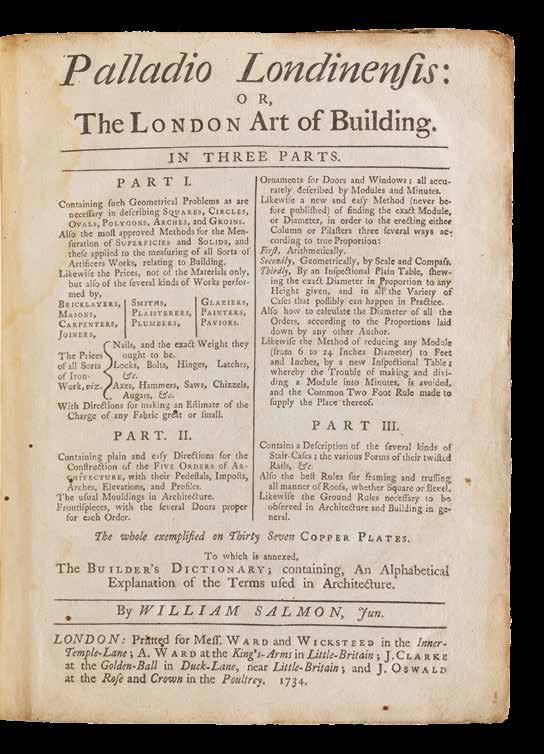
SALMON, William
Palladio Londinensis: or, the London Art of Building.
Publication
London, Printed for Mess. Ward and Wicksteed in the Inner-Temple-Lane; A Ward at the King’s-Arms in Little Britain; J. Clarke at the Golden-Ball in Duck-Lane, near Little-Britain; and J. oswald at the Rose and Crown in the Poultry, 1734.
Description
Quarto (225 by 175mm). 36 numbered engraved plates, many folding, pencil drawings to versos of 17 plates, four folding maps, with tears, dampstained; modern half brown calf, marbled paper boards, gilt.
References Campbell for ODNB.
The eighteenth-century go-to building manual, with plentiful pencilled drawings
William Salmon (c1701–1779) wrote four affordable, and therefore, very influential manuals for builders: ‘The Country Builder’s Estimator, or, The Architect’s Companion’ (1733); ‘Palladio Londinensis, or, The London Art of Building, in Three Parts’ (1734) [as here], geometry, orders, stairs and roof structures, followed by a dictionary; was added as an appendix; ‘The Builder’s Guide’ (1736); and ‘The London and Country Builder’s vade mecum’ (1741).
The ‘Palladio Londinensis’, was “reprinted more times than any other book of its type and became the standard building manual for nearly forty years. Many of the elements such as doors and door-cases illustrated therein were repeated in buildings throughout the country, becoming standard forms in the eighteenth century. Its popularity can also be attributed to its numerous engravings, many of which were drawn not by Salmon himself but by Edward Hoppus, who worked as surveyor in the London Assurance Company from 1729 until his death in 1739. Hoppus may also have been an editor of, if not the source for, much of the information on London building prices” (Campbell).
Provenance
Annotated with scholarly drawings on the versos of the plates, throughout.
The second charter granted by William and Mary to the City of London
THE CITY OF LONDON; “J.E.”
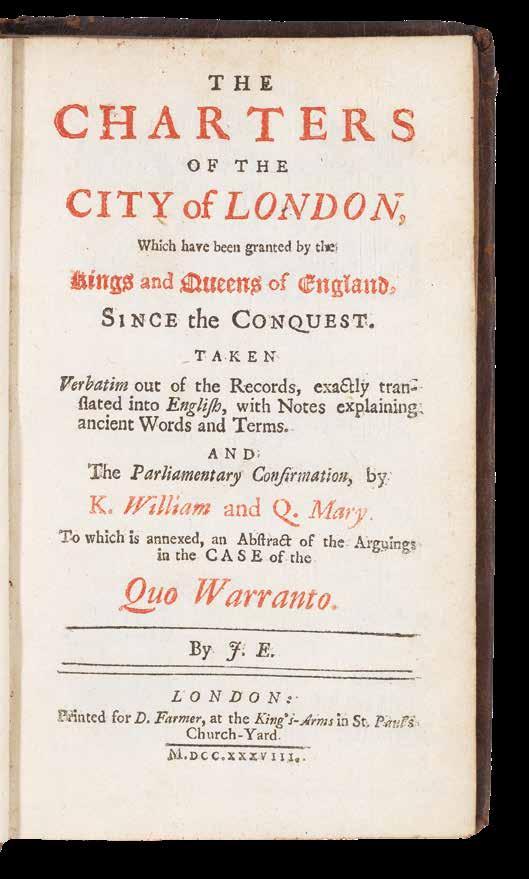
The Charters of the City of London, which have been granted by the Kings and Queens of England, Sind the Conquest. Taken Verbatim out of the Records, exactly translated into English, with Notes explaining ancient Words and Terms. And the Parliamentary Confirmation, by K. William and Q. Mar. To which is annexed, and Abstract of the Arguings in the Case if the Quo Warranto.
Publication London, Printed for D. Farmer, at the King’sArms in St. Paul’s Church-Yard, 1738.
Description Duodecimo (165 by 100mm). Title-page printed in red and black; contemporary speckled calf, gilt.
Collation
Pages [i] - 269, [xi]; [A]4, B-2A6, 2B2.
References Glasman, ‘The City of London’s Strange History’, 2014.
Including the text of the 1690 Charter granted to the City of London by King William and Queen Mary, who succeeded to the throne of England, Scotland and Ireland in 1689, after the Glorious Revolution which deposed James II. During the reign of the Stuart kings and queens of England, Scotland and Ireland, two notable attempts were made to reform the way the City of London was run. “One led to the execution of the king, the other – an attempt by Charles II to establish that the monarchy was the source of the Corporation [of London]’s authority – led to the Stuarts’ replacement by William and Mary, whose Second Charter in 1690 leaves no doubt as to who were the greatest beneficiaries of the Glorious Revolution. It declared: “That the mayor, commonalty and citizens of London shall for-ever hereafter remain, continue and be, and prescribe to be, a body politic, in re, facto, et nomine … and shall have and enjoy all their rights, gifts, charters, grants, liberties, privileges, franchises, customs, usages, constitutions, prescriptions, immunities, markets, duties, tolls, lands, tenements, estates and hereditaments whatsoever”” (Glasman).
Provenance
With the stencilled bookplate of John Benson Beetham (1808-1878) on the inside front cover, and nineteenth-century annotations on the front free endpaper.
MAITLAND, William; and TOMS, William Henry
The History of London, from its Foundation by the Romans, to the Present Time. Containing a Faithful Relation of the Publick Transactions of the Citizens; Accounts of the several Parishes; Parallels between London and the other Great Cities; its Governments, Civil, Ecclesiastical and Military; Commerce, State of Learning, Charitable Foundations, &c. With the several Accounts of Westminster, Middlesex, Southwark, and other parts within the Bill of Mortality. In Nine Books. The Whole Illustrated with a Variety of Fine Cuts. With a Compleat Index.
Publication
London, Printed by Samuel Richardson, in Salisbury-Court near Fleet street, 1739.
Description
Folio (405 by 255mm). Double-page engraved frontispiece map, three doublepage and 20 full-page plates, engravings in the text; contemporary speckled calf, rebacked preserving the original spine.
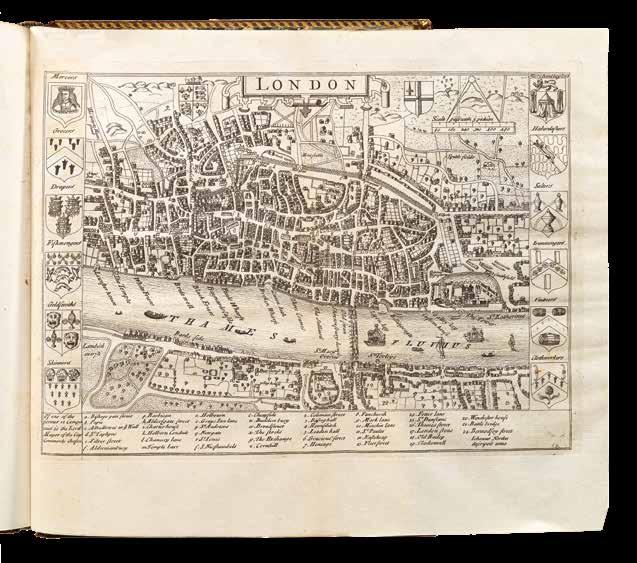
With a reduction of the sixteenth-century Agas map of London
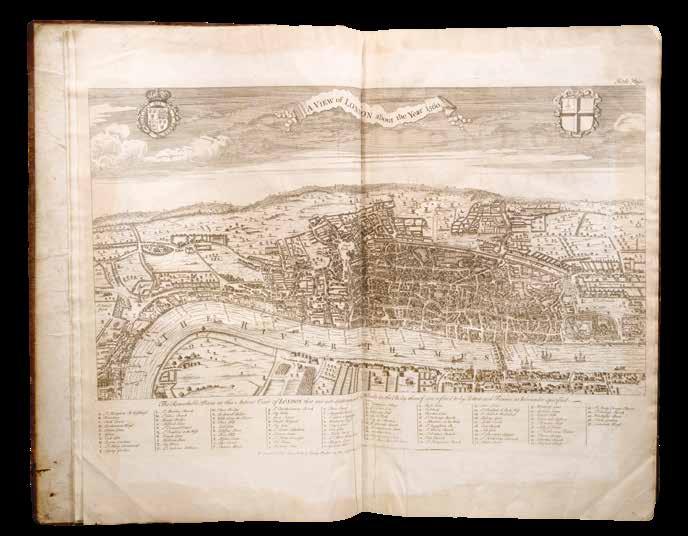
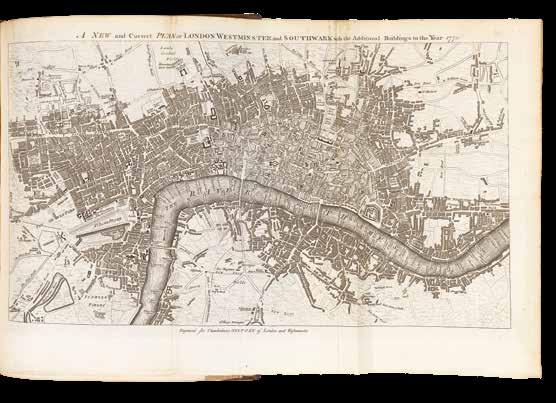
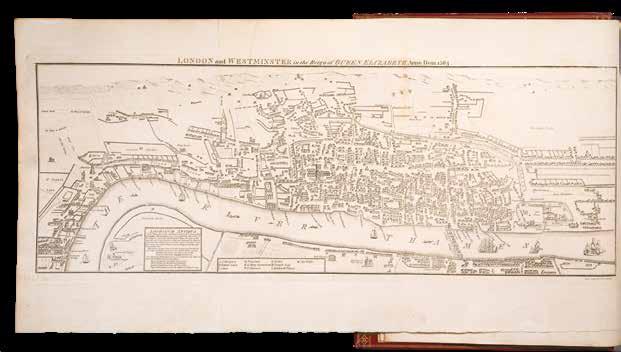
With ‘A View of London about the Year 1560’, a bird’s-eye view of Elizabethan London, which offers a sweeping perspective of the city in great detail. Extending from Westminster Abbey to the Tower of London, in addition to notations provided throughout the map, the key at the bottom provides a further guide to 95 other landmarks and streets throughout the city. The bear- and bull-baiting arenas are both depicted on the south side of the Thames - precursors of the playhouses of Elizabethan playwrights such as Shakespeare. It is probable that the source for this view is ‘Civitas Londinium’ attributed to Ralph Agas - one of the earliest views of London, along with Braun and Hogenberg’s depiction of 1572. This map was originally printed from woodblocks around 1561, but no copies from that date survive. In the late 1730s, the artist and engraver George Vertue copied Agas’s view from “an ancient print in the possession of Hans Sloane”, a fact commemorated in the text below the key, “Reduced to this Size from a Large Print in the Collection of Sr Hans Sloane Bart anno 1738”.
The engraver of the other views in Maitland’s survey was William Henry Toms (died 1765), who is probably best known for engraving Henry Popple’s large wall-map of North America ‘A Map of the British Empire in America’ (1733). The 1730s were his most prolific and most desperate period, as in addition to the Popple map, this series, he was engraving another two: for Francis Blomefield, ‘An Essay towards a Topographical History of the County of Norfolk’; and with Robert West, ‘Perspective Views of all the Ancient Churches, and other Buildings, in the Cities of London, and Westminster, and Parts adjacent, within the Bills of Mortality’ (1736-1739). All to pay the medical bills for his ailing wife.
William Maitland’s ‘History of London’ (c1693-1757), was a huge success, and ran to several editions. It was first published, as here, by Samuel Richardson, better known as the great English novels, such as ‘Pamela’ (1740) and ‘Clarissa’ (1748).
Provenance
Silas Palmer MD, ‘53 on the title-page; leather gilt book label of Eric Hyde Lord Sexton, FSA (1902-1980), on the inside front cover, his sale Christie’s 1981. Sexton was editor of volume 6 of ‘The arts in early England’ (1903-1937).
MAITLAND, William; TOMS, William Henry; and COLE, Benjamin
The History of London, from its Foundation to the Present Time:...
Publication
London, By the King’s Authority, Printed for T. osborne and J. Shipton, in Gray’s-Inn; and J. Hodges, near London-Bridge, 1756.
Description
Two volumes. Folio (405 by 255mm). Double-page folding engraved map of London, two full-page maps, and four fullpage plates in volume one, double-page engraved folding frontispiece map, and ten further double-page and folding, and 104 full-page (two supplied), to volume II; contemporary tree calf, the smooth spine decorated in gilt panels with red and black morocco lettering-pieces, rebacked preserving the original spine.
The greatly revised and expanded second edition of Maitland’s already comprehensive survey of London, was issued one year before his death. It includes the ‘A View of London about the Year 1560’, and twenty of the original engravings from the first edition by William Henry Toms (died 1765). The additional engravings are by Benjamin Cole (1697-1783), and although many of them are original some follow pre-existing architect’s designs or from those first issued by Robert West and Toms in their ‘Perspective Views of all the Ancient Churches, and other Buildings, in the Cities of London, and Westminster, and Parts adjacent, within the Bills of Mortality’ (1736-1739).
“The subjects of Cole’s plates supplemented the traditional views of the Tower, Guildhall and other historic sites and were a new departure in that they featured recently erected buildings, with a pre-ponderance of churches. Plates of no fewer than 79 churches and chapels were added to the three which appeared in the 1739 edition and Cole introduced 26 more of these and eight more public buildings as ornaments on the 17 ward maps” (Adams). The current example includes an engraving of St. Alphage, not called for by Adams.
William Maitland’s ‘History of London’ (c1693-1757), was a huge success when it was first published in 1739, and ran to several editions.
Provenance
With the engraved armorial bookplate of the Earls of Haddington on the inside front cover of each volume.
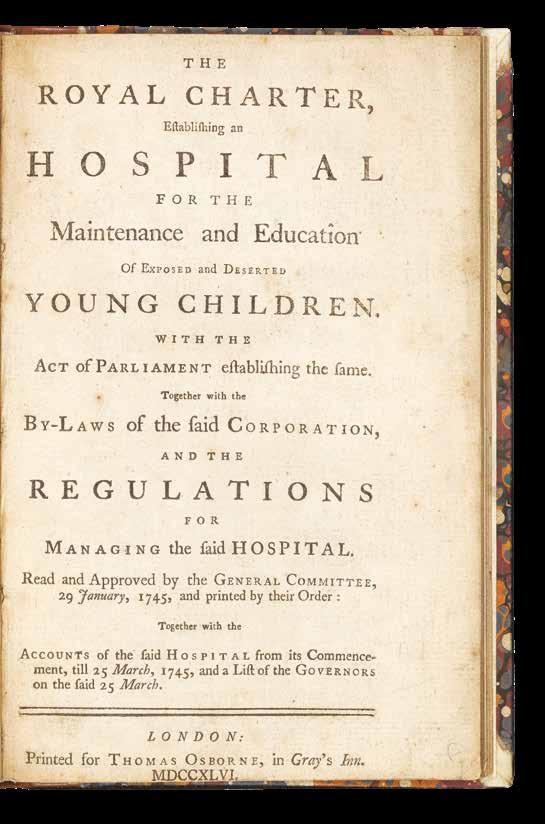
FOUNDLING HOSPITAL
The Royal Charter Establishing an Hospital for the Maintenance and Education of Exposed and Deserted Young Children. With the Act of Parliament establishing the same. Together with the By-Laws of the said Corporation, and the Regulations for Managing the said Hospital. Read and Approved by the General Committee, 29 January, 1745, and printed by their Order: Together with the Accounts of the said Hospital from its Commencement, till 25 March, 1745, and a List of the Governors on the said 25 March.
Publication London, Printed for Thomas Osborne, in Gray’s Inn, 1746.
Description Quarto (190 by 115mm). 16-page publisher’s catalogue at end; modern speckled calf backed marbled paper boards, antique.
Collation
Pages [1]-48, 16; A-F4, A8.
References ESTC T4734.
A template for eighteenth-century philanthropy
Thomas Coram (c1668-1751) is amongst those listed as a Governor of the newly formed Foundling Hospital, however, were it not for him, the “great Numbers of helpless Infants, daily exposed to Destruction”, would not have had the “Reception, Maintenance, and proper Education” that he provided in instigating the foundation of the institution.
For ten years, from 1694, Coram had been in charge of a shipyard in Boston, Massachusetts. On his return to England in 1704, he retained considerable interests in North America and lobbied parliament to import naval stores from there, in order to reduce dependence on Scandinavia; and promoted the colonization of the northeastern reaches of New England and Nova Scotia; and eventually, in 1732, became a trustee for the new colony of Georgia.
While living at Rotherhithe and “pursuing his business interests in London, Coram regularly travelled a route on which he saw abandoned children, some dead, others dying. In 1722, motivated by an enduring blend of Christian benevolence, practical morality, and civic spirit, he decided to take action.
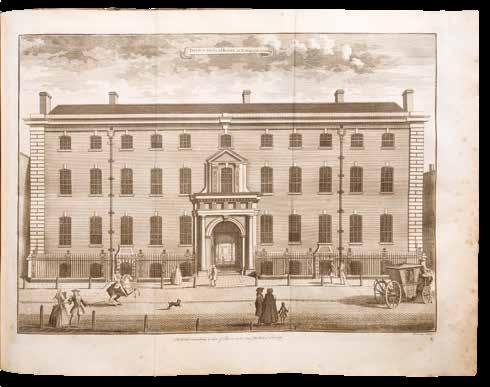
Inspired by examples of foundling hospitals on the continent, he advocated one for London... The Foundling Hospital charter was signed by the king on 14 August 1739, and the first meeting of the governors was held at Somerset House that November. Coram scouted sites for the hospital, designed a corporate seal, researched foundling hospitals on the continent, and inspected temporary quarters in Hatton Garden. At that site the hospital opened its doors on 25 March 1741. Later that year irregularities at the hospital were aired publicly and Coram was implicated in having been indiscreet in his criticisms. Details are murky, but Coram’s active participation in the hospital’s governance ended in the spring of 1742. The new purpose-built hospital, at Lamb’s Conduit Fields, began to receive children on 1 October 1745... If the oft-told story is true that Coram sat in the Foundling Hospital arcade in his last years distributing gingerbread to the children, it was a momentary rest from more active projects. His greatest achievement was to provide the template for eighteenth-century philanthropy of a secular foundation modelled on the joint-stock company, of which the Foundling Hospital was the first and finest expression” (Taylor).
GWYNN, John; and JOHNSON, Samuel
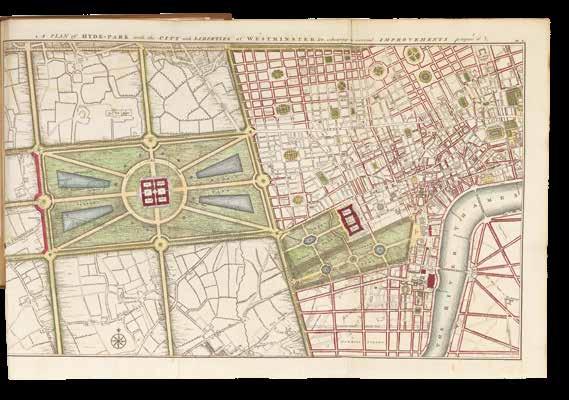
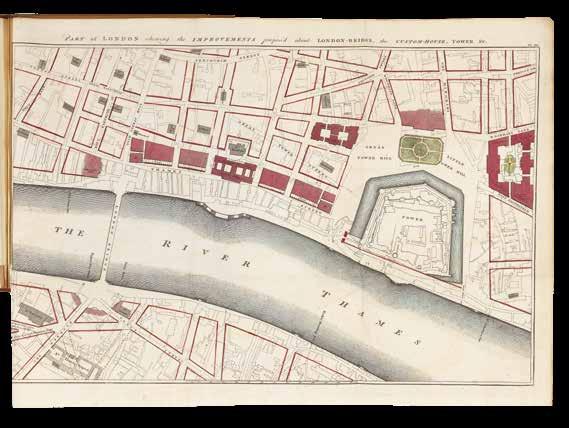
London and Westminster Improved, Illustrated by Plans. To which is prefixed, A Discourse on Publick Magnificence; with Observations on the State of the Arts and Artists in this Kingdom, wherein the Study of the Polite Arts is recommended as necessary to a liberal Education: concluded by some proposals relative to Places not laid down in the Plans.
Publication London, Sold by Mr. Dodsley, and at Mr. Dalton’s Print-Warehouse in Pall-Mall, Mr. Bathoe in the Strand, Mr. Davies in RusselStreet, Covent-Garden, and by Mr. Longman in Pater-noster-Row, 1766.
Description Quarto (260 by 210mm). four large folding engraved maps with contemporary handcolour in part; modern speckled calf antique.
Collation
Pages [xvi],132; a4, a4, B-R4, S2.
References Ionides for ODNB.
In response to the “Rage of the building...carried to so great a height for several years past...” (Preface)
‘A Plan of Hyde-Park with the City and Liberties of Westminster &c, shewing several Improvements propos’d’; ‘Part of Westminster at large shewing the Improvements propos’d about Leicester-Fields, CoventGarden, the Newse &c’; ‘Part of London shewing the Improvements propos’d about the Mansion-House, Royal-Exchange, Moor-Fields &c’; ‘Part of London shewing the Improvements propos’d about LondonBridge, the custom-House, Tower &c’.
To complement his beautiful plans of London, Gwynn has added a ‘Discourse on public magnificence’, “believing that public works would give employment to artists and craftsmen and help to bring wealth to the country. This far-sighted work has been considered “one of the most remarkable books ever written about the planning and architecture of London” (Summerson) and many of Gwynn’s proposals were subsequently executed; it is for this work that Gwynn is best remembered” (Ionides).
It is said, in the literature, that the dedication to King George III, or sometimes, the preface, was written by Gwynn’s great friend, Samuel Johnson, however, it seems much more likely that if he wrote any of this work, that it was the introduction: “The sums expended by foreigners may be considered as a laudable tax on their curiosity, whose ideas being excited by same, can never be satisfied but by ocular demonstration and had we more ample means of gratifying that thirst after novelty and amusement, numbers would continually flock over to our nation, as we continually do to their” (page xiv).
Fire and pestilence
HARVEY, Dr. Gideon, the elder
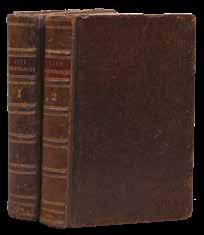
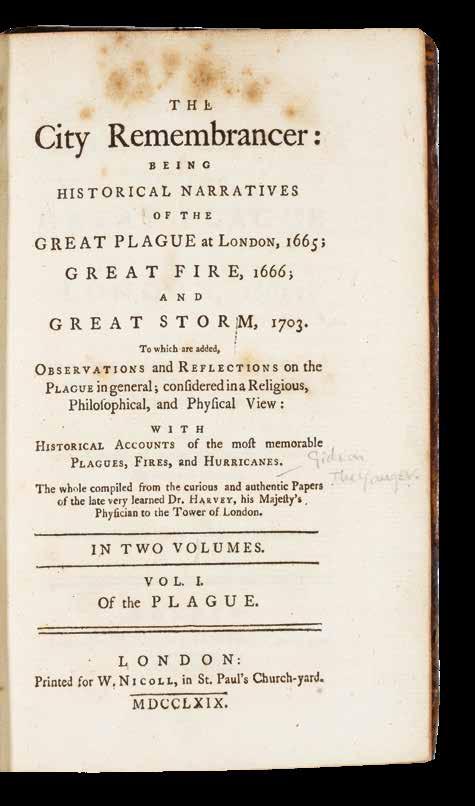
The City Remembrancer: being Historical Narratives of the Great Plague at London, 1665; Great Fire, 1666; and Great Storm, 1703. To which are added, Observations and Reflections on the Plague in general; considered in a Religious, Philosophical, and Physical View: with Historical Accounts of the most memorable Plagues, Fires, and Hurricanes.
Publication London, W. Nicoll, 1769.
Description Two volumes. Octavo (190 by 123mm). Contemporary mottled calf.
References Wallis for ODNB.
Gideon Harvey (1636–1702), the elder, was born in the Netherlands but spent much of his life, from a young age, in London, where he eventually settled. He became a “prolific writer with a lively and witty style” (Wallis), and the current work is an amalgam of his back catalogue of works on a variety of diseases, including plague, scurvy, venereal disease, and fevers. He physician to the Tower of London, and probably physician-in-ordinary to the king.
CHAMBERLAIN, Henry of HattonGardon
A New and Compleat History and Survey of the Cities of London and Westminster, the Borough of Southward, and Parts adjacent; from the earliest accounts, to the beginning of the year 1770.
Publication
London, J. Cooke, at Shakespear’s Head, No. 17 Pater-Noster-Row, [1770].
Description
Folio (360 by 230mm). Engraved frontispiece, two large folding maps, and 65 full-page plates, one with large inkstain; contemporary full tan calf, gilt, rebacked to style, later endpapers.
Collation
Page [1]-682; [xiv]; A-8A2, a-b2, [-]2.
References Adams, ‘London Illustrated 1643-1851’, 1983, 48; Bonnell for ODNB.
“...From the invasion of Julius Caesar to the present time” (Title-Page)
First issue, with four-pages of subscribers, rather than six. John Cooke (c1730–1810) made a fortune selling popular works, such as this one, in weekly numbers. “Religious works, practical manuals, and jest books dominated his work; nearly half of fifty-four titles in his c1770 catalogue contain the words “complete” or “universal”, as in ‘The Complete English Brewer and The Gardener’s Universal Guide’. His folios and quartos were sold in parts, each 6d. number “enriched” with a copperplate-engraving. Keen attention to advertising these illustrations was displayed in his catalogue of c1784, a sign that his son Charles Cooke was now active in the concern. Depictions of torture and “general Scenes of Pagan Barbarity and Popish Cruelty”, for example, adorned Southwell’s New Book of Martyrs. Likewise, the ‘Universal Family Bible’ (called Southwell’s, though compiled by Robert Sanders) was “embellished” with 100 plates “taken from the finest Paintings of the most esteemed Masters”. The many editions of this title reportedly netted the publisher £30,000” (Bonnell).
Many of the illustrations in Chamberlain’s ‘History...’ are by Samuel Wale, engraved by Charles Grignion, and are distinguished by their splendid rococo frames.
HARRISON, Walter
A New and Universal History of London, description and Survey of the Cities of London and Westminster, the Borough of Southwark and their Adjacent Parts.
Publication
London, John Cooke, [1775].
Description Quarto (360 by 230mm). Two folding engraved maps, engraved frontispiece, 113 full-page plates; contemporary colour calf, rebacked to style, red morocco lettering piece on the spine, worn.
Another history of London from the publisher John Cooke
Only five years after the publication of Chamberlain’s ‘London’, John Cooke embarked upon another history in weekly parts, this time ascribed to one Walter Harrison. Seventy numbers were issued in all of which 40 consisted of 12 pages of text and 30 of eight pages. The final work was completed in the spring of 1777.
John Cooke (c1730–1810) made a fortune selling popular works, such as this one, in weekly numbers. “Religious works, practical manuals, and jest books dominated his work; nearly half of fifty-four titles in his c1770 catalogue contain the words “complete” or “universal”, as in ‘The Complete English Brewer’ and ‘The Gardener’s Universal Guide’. His folios and quartos were sold in parts, each 6d. number “enriched” with a copperplate-engraving. Keen attention to advertising these illustrations was displayed in his catalogue of c1784, a sign that his son Charles Cooke was now active in the concern. Depictions of torture and “general Scenes of Pagan Barbarity and Popish Cruelty”, for example, adorned Southwell’s New Book of Martyrs. Likewise, the ‘Universal Family Bible’ (called Southwell’s, though compiled by Robert Sanders) was “embellished” with 100 plates “taken from the finest Paintings of the most esteemed Masters”. The many editions of this title reportedly netted the publisher £30,000” (Bonnell).
Provenance
Francis Eyre (bookplate).
BOSWELL, James; CRUIKSHANK, Isaac; and COLLINGS, Samuel
The Attic miscellany or Characteristic mirror of men and things, including the Correspondent’s Museum.
Publication London, Printed for Bentley, 1789-1790.
Description
Three volumes bound in two. Octavo (204 by 122mm). 24 engraved plates, of which 12 folding in volume one, 26 engraved plates, of which 12 folding, in volume II; all after Inigo Barlow, W. Locke, Samuel Collings, James Boswell et al; twentieth century mottled calf, gilt, by Pratt.
First edition. These two volumes include satirical texts on social gatherings, biographies, short novels and even a monthly diary of current events during the first years of the French Revolution.
Provenance
A Knight of the Garter (bookplate).
PENNANT, Thomas of London
Publication
London, Printed for Rob.t Faulder, No 42, New Bond Street, 1790.
Description
Quarto (230 by 190mm). Engraved title-page, interleaved with blank pages and extra-illustrated with more than 500 engravings mounted in an amateurish fashion; late nineteenth century brown cloth, red morocco lettering-piece on the spine, recased and worn.
“Composed from observations of perhaps half my life” (Advertisement)
First edition of Pennant’s iconic tour around London, interleaved in the late nineteenth century and extra-illustrated with anything vaguely relevant that was to hand.
Thomas Pennant (1726–1798), probably best known as one of Britain’s pre-eminent natural historians, his many travels to London were published as ‘A Journey from Chester to London’ (1782), and as ‘[An Account] of London’ (1790), which took the form of a tour around the capital. Following his retirement from his travels, “Pennant started to extra-illustrate many of his books with notes and illustrations that he believed added further information to his writings. Due to his enthusiastic descriptions of the practice in his final two publications, the fact became well-known among his readers and soon a fashion for “pennantising” his books developed among amateur antiquarians... and entrepreneurial print sellers offered prints of places mentioned in the book for collectors to add to their copies. Among these were John Thomas Smith, whose ‘Antiquities of London and its Environs’ (1791-1800) included crossreferences to Pennant on each of its 96 plates and Robert Wilkinson, whose periodical ‘Londina Illustrata’ (1808-34) was published with the intention of helping readers extra-illustrate their Pennants. These efforts further spurred “pennantisers” to embellish their books. Such was the fashion to own an extra-illustrated copy of Pennant’s London that by the 1820s, some booksellers even sold copies that already had additional plates pasted into them” (Royal Collection Trust online).
Provenance
Ownership inscription dated June 1878 obscured on an early blank.
SMITH, John Thomas
Antiquities of London and Environs, Engraved & Published by J. T. Smith, Dedicated to Sir James Winter Lake, Bar.t F.S.A. Containing many Curious Houses, Monuments & Statues, never before Publish’d, and also from Original Drawings, Communicated by several Members of the Antiquarian Society, with Remarks & References to the much admired Works of Mr. Pennant, Stowe, Weaver, Camden, Maitland, &c.
Publication London, J. Sewell,... et al Jan. 18, 1791 - 1800.
Description Folio (335 by 265mm). Engraved title-page and 96 engraved plates, three in colours; contemporary tree calf, recased.
References Adams, ‘London Illustrated 1643-1851’, 1983, 70; Peltz for ODNB.
Perfect for Pennantising
John Thomas Smith (1766–1833), printmaker and draughtsman, son of the printseller and sculptor Nathaniel Smith (c1738 - 1809), was initially apprenticed to sculptor Joseph Nollekens (1737–1823) where his father also worked. However, in 1784, they left Nollekens and set up their own studio, where the younger Smith’s prints were published and sold. One of his earliest patrons was John Charles Crowle (1738–1811), who “employed Smith’s delicate and precise views in his extra-illustrated copies of Thomas Pennant’s ‘Some Account of London’ (1790), now in the British Museum, Smith also became acquainted with this new fashion in print collecting. Sensing the commercial opportunities arising from extra-illustration, in 1791 Smith brought out his first part-work, a series of ninety-six modest etchings and aquatints entitled ‘Antiquities of London’ (1791–1800) [as here], which he innovatively promoted “to be bound up with Mr. Pennant’s London”” (Peltz). He cannily included page references to Pennant in his engraved captions, and few extraillustrated Pennants are without engravings by Smith.
Provenance
1. Inscribed by “Douglas to Cordelia M. Trollope 1866” on the inside front cover;
2. With the library label of Rev. P.B. Clayton beneath.
MALTON, Thomas
A Picturesque Tour through the Cities of London and Westminster, illustrated with the most interesting Views, accurately delineated and executed in Aquatinta.
Two volumes. Folio (415 by 350mm). Engraved title-pages and dedication leaves, 100 aquatint plates, some occasionally heavy spotting; early nineteenth century diced russia, gilt, marbled edges.
References Abbey, ‘Scenery of Great Britain and Ireland in aquatint and lithography, 1770-1860’, 1972, 204; Ann Saunders for ODNB.
“The expanding metropolis at its most elegant and most self-assured” (Saunders)
First edition. The magnificent aquatints in this series, arguably Thomas Malton the younger’s most important work, “catch the expanding metropolis at its most elegant and most self-assured. Among so much good topographical work at this period, Malton’s views are particularly valuable because they often show an unexpected angle or record an otherwise neglected building. For example, he shows the north, Threadneedle Street, façade of the second Royal Exchange as well as its better-documented Cornhill, southern, frontage and for good measure he throws in another plate of the now vanished arcade on the northern front as well. The elegant little figures, which lend humanity to the building and which include a street vendor with a trayful of toys and novelties, may well be by Francis Wheatley” (Saunders).
Thomas Malton the younger (1751/2–1804), James Malton the elder (1726–1801), and James Malton the younger (died 1803), were each architectural draughtsman, of intermittent success. During one of these moments, Thomas Malton the younger, had his portrait painted by Gilbert Stuart, more famous for painting George Washington. In 1782, he had been awarded a gold medal by the Royal Academy, where his artwork had been shown since 1773. Although he exhibited hundreds of drawings, paintings, and designs of streets and buildings in London, Oxford, and Cambridge, various mansions in the home counties, East Anglia, Yorkshire, and Bath, the RA disparaged him, refusing to elect him a member, on the grounds that he was “only a Draughtsman of Buildings, but no Architect”. So, he promptly set about painting the views of London that constitute this work, to prove them wrong. Sadly, the attempt failed.
From 1796 Malton gave drawing classes from his home in Long Acre, Covent Garden, “among his pupils were Thomas Girtin and the young J. M. W. Turner. The latter was sent away by Malton, who found his pupil’s approach too imaginative for the exact representation required from an architectural draughtsman, but the youth was afterwards readmitted and in later life would say: ‘But my real master, you know, was Tom Malton of Long Acre’” (Saunders).
Provenance
1. Inscribed in a twentieth century hand “From the Marquess of Exeter’s Library”, verso of front free endpaper;
2. With Bernard Quaritch;
3. With the “Old East India House” bookplates of Boies Penrose II (1902-1976), renowned American bibliophile, on the inside front cover of each volume.
MILLER, William
Select views in London and Westminster of the most Elegant Buildings and Picturesque Situations.
Publication London, Colnaghi & Co., 1795-1800.
Description Oblong folio (270 by 420mm). 12 engraved plates, with the text for each bound separately at the end; cloth-backed wrappers with original front wrapper laid down.
This example is identical in content to that in the British Museum, except that all of the current plates are proofs before letters, with the publication line and credits lightly etched. There are 12 engravings by William Miller (c1740–1810), which accord with Adams (page 180) n° 1-8 and 11-14. This copy is bound with the original printed wrapper for the second collection of four prints. Plates n° 9-12 are the later Colnaghi issue of 1800. The views are: Horse Guards, Charing Cross, York House, Westminster Hall, Old Palace Yard, Westminster Abbey, Whitehall, East India House, Temple Bar, Custom House and Newgate. The title on the printed wrapper clearly credits the drawings to William Miller although Adams attributes the draughtmanship to James Miller.
IRELAND, Samuel
Picturesque Views, with an Historical Account of the Inns of Court, in London and Westminster,...
Publication London, C. Clarke,... and published by R. Faulder, ... and J. Egerton, 1800.
Description Quarto (320 by 230mm). 21 aquatints with contemporary hand-colour in full; contemporary tree calf, rebacked to style.
Collation Pages [xvi], [1]-254, [i]; a-b4, A-2I4.
The inns and outs of court
An attractive example of Ireland’s illustrations of the Inns of Court, the last in a series of successful travel accounts, which began with ‘A Picturesque Tour through Holland, Brabant, and Part of France’ (1790). However, he is now best remembered as being closely related to the scandal of the so-called “Shakespeare Papers” forged by his son in 1794. A deathbed declaration of his firm belief in their authenticity has not dispelled hundreds of years of belief in his complicity in the fraud.
The Monument
THE FIRE OF LONDON
The Column, called the Monument, Described, Erected to Perpetuate the the Dreadful Fire of London in the Year 1666; of the rebuilding of the City, under the inspection of the great architect Sir Christopher Wren, Knt. Together with The Building, Dimensions, Inscriptions, and all that is necessary to be known of this famous Pillar; to which is added, some account of the devastation of that Fire and the loss computed.
Publication
London, J. Bryan, Grocers’ Hall Court, Poultry; for Samuel Arnott, Keeper of the Monument, [20th March, 1805].
Description Octavo (180 by 110mm). Wood-engraved frontispiece, uncut; modern half tan calf, marbled paper boards, original plain front wrapper bound in.
Collation Pages [1]-22; [A12].
Samuel Arnott, member of the Company of Fletchers, trading as a silk-mercer in Birchin Lane, off Cornhill, in 1784, until 1794 when he was declared bankrupt. By 1805, he had been appointed Keeper of the Monument, a post granted by the Corporation of the City of London “to an elderly citizen who has fallen on hard times”. While the post itself carried a stipend of only £20 per annum, the keeper could increase this tenfold by admission charges, and the sale of descriptive pamphlets [this one for sale at sixpence!]. It was customary for the keepers to express their gratitude to the City for their appointment in these pamphlets, and Arnott duly did so:
“Full threescore years life’s various scenes I’ve past, And Providence has fix’d me here at last Within those ancient walls to find repose, From all the sorrow that Misfortune knows: With thankfulness to pass my latest hour, With gratitude proclaim kind Friendship’s power; Whilst life remains God’s mercy to record, And pray my friends may gain a blest reward”
Provenance
Inscribed “James Liscombe Ejus Liber 1813” on the original front wrapper.
PENNANT, Thomas
Some Account of London: The Fourth Edition, with considerable Additions.
Publication
London, Printed for Robert Faulder, New Bond-Street, by R. Taylor and Co. 38 ShoeLane, Fleet-Street 1805.
Description
One volume bound in two. Quarto (305 by 235mm). Additional engraved vignette title-page, 15 plates, and one folding map, extra-illustrated with 283 additional engraved, etched, or mezzotinted, views, plans, panoramas, portraits and plates, some folding, others with contemporary hand-colour; near contemporary fine red morocco, gilt-extra, green silk endleaves, all edges gilt.
Posthumously “Pennantised” - with a portrait of the Rev. Mr. James Granger
First published in 1790, this a lavishly extra-illustrated, and beautifully bound, example of the fourth edition.
The additional illustrations are mostly eighteenth- or nineteenthcentury prints including, most aptly, a portrait of the ‘Rev., Mr. James Granger’ (1775), who first popularised the fashion for first cutting out from one book, and then pasting into another, various related portraits and views, now known as “grangerising”. In 1769, Granger (1723-1776) published a ‘Biographical History of England from Egbert the Great to the Revolution, Consisting of Characters Dispersed in Different Classes, and Adapted to a Methodical Catalogue of Engraved British Heads’, in six volumes. “He had collected some fourteen thousand engraved portraits cut from books to serve as illustrations in his book. In addition, his book contained a number of blank pages for illustrations, prints, newspaper cuttings, or anything else he might filch later” (Freeman).
Other notable inclusions are:
Wenceslaus Hollar’s portrait of Alexius Bierling, after Hans Holbein (1649)
John Stow’s ‘Survey...’ (1754)
Francis Grose’s ‘Antiquarian Repository’ (from 1770)
John Thomas Smith’s ‘Antiquities of London’ (from 1791)
Samuel Ireland’s ‘Picturesque Views of the Inns of Court’ (1800)
Brayley & Herbert’s ‘Concise Account ... of Lambeth Palace’ (1806)
Provenance
With the engraved armorial bookplate of Sir Lionel Phillips (1855-1936), mining magnate, on the inside front cover of each volume.
HUGHSON, David
London; being an accurate History and Description of the British Metropolis and its Neighbourhood, to Thirty Miles extent, from an actual Perambulation.
Publication
London, Printed by W. Stratford, CrownCourt, Temple-Bar, for J. Stratford, No 112, Holborn-Hill; and sold by all other Booksellers, 1805-1809.
Description
Six volumes bound in nine. Octavo (220 by 135mm). Six stipple-engraved frontispieces and additional title-pages,150 engraved plates, extra-illustrated with a further 1420 plates of views, maps, and portraits; contemporary full green morocco, gilt, all edges gilt.
Originally published in 149 parts, for binding into six volumes, here extended to nine with more than 1400 additional illustrations. Volume one is a “discursive history of London to the year 1800” (Adams), volumes II, III, and IV, “blend topography, antiquities, local history and architecture with guidebook information”, accompanied by eleven “perambulations” within London, in the first four published volumes. The original stipple-engraved frontispieces and title-pages which depict views of turnpikes supported by putti and allegorical women, are by members of the Courbould family.
Adams asserts that David Hughson was in fact David Pugh, elsewhere it is speculated that he was Edward Pugh (1763-1813), the miniature painter and topographer, author of the posthumous ‘Cambria Depicta’ (1816).
CAMDEN, William; and GOUGH, Richard
Britannia: or, a Chorographical Description of the Flourishing Kingdoms of England, Scotland, and Ireland, and the islands adjacent; from the earliest antiquity... Translated from the edition published by the author in MDCVII. Enlarged by the latest discoveries by Richard Gough.
Publication London, John Stockdale, 1806.
Description
Four volumes (420 by 260mm). Engraved frontispiece portrait, 57 mostly folding engraved maps, and 103 engraved plates; contemporary full diced russia, gilt, all edges marbled.
References
Chubb, ‘The printed maps in the atlases of Great Britain and Ireland’, 1927, CCLXXII.
Exceptionally fine example of Gough’s revision of Camden
An exceptionally fine and handsome example of Gough’s enlarged second edition, with maps engraved by John Cary.
Richard Gough (1735-1809) was “undoubtedly the leading antiquary of his day” (Sweet), with a singular interest in the antiquities of native Britain. He never travelled abroad. His revision of Camden’s ‘Britannia’, was first published in 1789, having been in the works since 1773. Over the course of seven years, he translated Camden’s text, and then took a further nine to publish the work. He visited every county himself, and tapped into a wide network of fellow antiquaries to gather new information, check proofs, etc. In 1806, it was reprinted in four volumes, as here, with corrections and additions. “A third edition was due to be published but was set back by the fire at Nichols’s printing office in 1808, and Gough’s health thereafter declined too rapidly to see the project through. The plates and the notes were left to the Bodleian Library along with Gough’s other papers, and it was hoped that the delegates of Oxford University Press would oversee the publication of the revised edition, but the volumes with the notes and additions still remain in the Bodleian’s manuscript collection, unpublished” (Sweet).
William Camden (1551-1623) began work on his ‘Britannia’ in 1577, after receiving a great deal of encouragement from many of the leading cartographers of the day, most notably Abraham Ortelius. The work would take him nine years, with the first edition appearing 1586. The work, published originally in Latin, is a county-by-county description of the British Isles, detailing the country’s landscape, geography, antiquarianism, and history. It was to prove hugely popular with six editions being published in the first twenty years, alone. During his lifetime Camden continued to revise and expand the text with each new edition. He drew upon unpublished text by the likes of William Lambarde, and travelled extensively throughout Britain collecting first hand information, even taking the time to learn Welsh and Old English.
Provenance
With the early engraved bookplate of A. Campbell on the inside front cover. Probably Archibald Campbell (1846-1913), son of George Douglas Campbell (1823-1900), 8th Duke of Argyll; historian, partner in Coutts and Co; JP and Deputy-Lieutenant for Argyllshire; author of ‘Records of Argyll’ (1885), ‘Notes on swords from Battlefield of Culloden’ (1894), ‘Highland dress, arms, and ornament’ (1899), ‘Armada canon’ (1899), and ‘Reveries, poems’ (1902).
ACKERMANN, Rudolph
R. Ackermann’s Repository of Arts No. 101 Strand. Microcosm of London.
Publication
London, T. Bensley Printer, Bolt Court, Fleet Street, London [1806-1807].
Description
Three volumes. Quarto (330 by 270mm). Wood-engraved title-pages and engraved dedication leaves to each volume, 104 aquatint plates with contemporary handcolour in full, some offsetting of plates onto text leaves, some text leaves browned, bound without half-titles; twentieth century full crimson morocco gilt and black, by Morrell, all edges gilt.
Abbey, ‘Scenery of Great Britain and Ireland in aquatint and lithography, 1770-1860’, 1972, 212; Adams, ‘London Illustrated 1643-1851’, 1983, 99; Ford for ODNB; Prideaux, ‘Aquatint Engraving’, 1909, page 121; Tooley, ‘Some English Books’, 1935, page 19.
An
early issue of Ackermann’s Microcosm, bound from the original parts
A handsome example of Ackermann’s famous work, picturing and describing life in, and the architecture of, London at the turn of the nineteenth century, bound from the original parts.
The plates are from drawings by Thomas Rowlandson (1756-1827) and Augustus Pugin (1762-1832). Pugin supplied the architectural drawings which have an accuracy and serene beauty which provides the perfect contrast to Rowlandson’s figures of the population of London engaged in their everyday life. From high court judges to prisoners in the stocks, from James Christie on the rostrum to street vendors, all London life is here. The excellence of the work is completed by the text, which forms an admirable adjunct to the plates, with volumes one, and II by William Henry Pyne (1769-1843) and volume III by William Combe (1741-1823).
Rudolph Ackermann (1764–1834), better known as the publisher of some of the finest colour-plate books of the nineteenth century, was originally a coach-maker, for the great and the good, including George Washington, Pope Pius VII’s carriage for Napoleon’s self-coronation, and the funeral carriage of Admiral Lord Nelson. Between 1791 and 1820 Ackermann published thirteen books of designs for carriages. As a publisher, “he was both creative and efficient, bringing to the commercial production of colour plate books innovative techniques and an uncompromising attention to detail which ensured uniform high quality” (Ford).
Ackermann brought out his monthly magazine, ‘The Repository of Arts’, from 1809, and published it for the next twenty years. Full of the latest fashion, social and literary news, it was and is an important source for Regency style.
The discernible watermarks in the current example are 1806-1807 for each volume, with three plates are in Abbey’s first or early state.
Provenance
With the modern bookplate of E. Peter Jones on the inside front cover of each volume.
ACKERMANN, Rudolph
R. Ackermann’s Repository of Arts No. 101 Strand. Microcosm of London.
Publication
London, T. Bensley Printer, Bolt Court, Fleet Street, London [1817].
Description
Three volumes. Quarto (340 by 275mm). Wood-engraved title-pages and engraved dedication leaves to each volume, 104 aquatint plates with contemporary handcolour in full, some offsetting of plates onto text leaves; contemporary full tan calf, elaborately decorated in gilt and blind, rebacked to style by Aquarius, all edges gilt.
Abbey, ‘Scenery of Great Britain and Ireland in aquatint and lithography, 1770-1860’, 1972, 212; Adams, ‘London Illustrated 1643-1851’, 1983, 99; Ford for ODNB; Prideaux, ‘Aquatint Engraving’, 1909, page 121; Tooley, ‘Some English Books’, 1935, page 19.
Ackermann’s Microcosm
A handsome example of Ackermann’s famous work, picturing and describing life in, and the architecture of, London at the turn of the nineteenth century.
The discernible watermarks in the current example are 1816-1817 for each volume, and the plates are generally in Abbey’s second or later state.
Provenance
1. With the engraved library label of “E. Smith” on the inside front cover of each volume;
2. With the ink library stamp of R.E. Beckett dated April, 1907 on the recto of the first blank and half-title.
MALCOLM, James Peller
Anecdotes of the Manners and Customs of London during the Eighteenth Century; including the charities, depravities, dresses, and amusements, of the citizens of London, during that period; with a Review of the State of Society in 1807. To which is added, a sketch of the domestic and ecclesiastical architecture, and of the various improvements on the metropolis.
Publication London, Longman, Hurst, Rees, and Orme, 1808 - 1811.
Description
Two volumes. Quarto (260 by 205mm). 24 engraved plates with contemporary hand-colour in full, 44 uncoloured engraved plates; contemporary blind panelled calf, gilt supra-libros on each cover, rebacked to style, inner hinges strengthened
First edition. Born in Philadelphia, James Peller Malcolm (1767-1815) moved to London as a young man to study art, training under Benjamin West and in the Royal Academy. Although he specialised in historical and landscape paintings, he discovered that these were not in great demand, and so engraved plates for books of topography and history, for which he eventually came to be elected Fellow of the Society of Antiquaries.
The ‘Anecdotes’, “is a discursive social history dealing at large with topics such as theatrical performances, pleasure gardens, sports, places of worship and period costume; it relies to a great extent on newspaper reports and magazine articles and is altogether a much less serious piece of historical writing than his first work, ‘Londinium Redivivum’” (Adams).
Provenance
With the contemporary engraved armorial bookplate of James Walwyn Esq.r, (1744-1800), of Longworth, Herefordshire, on the inside front cover of each volume. Senior partner of the merchant bank, Walwyn & Co., and Whig member of Parliament for Hereford, only making one speech, on the innkeepers’ petition against their losses from billeting, in January of 1795.
PENNANT, Thomas; RUBENS, Peter Paul; and JEFFERY, Edward
Mr. Pennant’s History of London, Westminster, and Southwark: Illustrated with Portraits, Views, Historical Prints, Medals. &c. Together with an Appendix and Index.
Publication
London, Edward Jeffery, No. 11 Pall Mall; by B. McMillan, Bow-Street, Covent-Garden, 1814.
Description
Two volumes. Folio (530 by 335mm). Frontispiece portrait of Pennant by Stanier, tipped-in, 169 leaves of extra-illustrations, some loose, some extractions, some browning; publisher’s half red morocco, gilt, a bit worn at the extremities.
Pennant’s London, one of 25 for extra-illustrating from the library of the City of London
First published in 1790, this is one of 25 folio examples printed especially for extra-illustrating, of a total edition of 200 by Edward Jeffery (1777-1837) an entrepreneurial printseller, who cashed-in on the fashion for “Pennantising”: “The quarto edition of Mr. Pennant’s ‘History of London’ being entirely out of print, and the folio extremely rare, I was induced, by accidentally seeing an octavo edition printing at Mr. M’Millan’s, to agree with the Publisher of that edition to over-run the work, and ptint on my own account twenty-five copies in folio, and one hundred and seventy-five copies in quarto, and to make an Index and Appendix on an extensive scale, containing much valuable and amusing matter omitted by the original author. This edition is published without any Illustrations of prints whatever; but titles are printed, for the purchasers who choose to amuse themselves in the pursuit of illustrating; and an assortment of some hundreds of portraits, views, medals, and historical prints, may be had together or separate, at the Publisher’s” (Edward Jeffery, “Advertisement”).
Highlights of the current illustrations include:
Woodcuts from an early edition of John Foxe’s ‘Acts and Monuments’ (1563 or later), showing the burning of Jerome of Prague, John Hus, and the fateful mistake of Fredericus I, in holding Pope Adrian’s stirrup on the wrong side.
Wencesalaus Hollar’s ‘Palatium achiepiscopi Canurariensis propae Londinum Lambeth House’ (’Prospects’, 1647) [Pennington 1038’ –not numbered in the plate; and his ‘S: Marie Overs in Southwark’ (’Prospects’, 1647), trimmed to neatline.
Richard White’s portrait of ‘Edward, Earle of Clarendon’, 1703.
An anonymous ‘Perspective View of St. Peters Westminster with the Towers & Spires as designed by Sr. Christopher Wren’ (1705).
Pieter van Gunst’s engraved portrait of Queen Henrietta Maria after van Dyck (c1715).
Thornhill’s engraving of the Ephesians burning their books on witchcraft, for the cupola of St. Paul’s Cathedral ‘Qui illicita tractaverant cremabant libros. Act. Ap: cap. 19. v. 19’, (c1719).
Three engravings of the designs by Rubens of the ceilings of the Banqueting House in Whitehall, ‘The Benefits of the Government of James I’, ‘The Union of the Crowns of England and Scotland’, ‘The Apotheosis of James I’ (1720), the only surviving in-situ ceiling painting by Flemish artist, Sir Peter Paul Rubens.
Various works from ‘Britannia Illustrata’ (1724), including the Banqueting House in Whitehall.
Various engravings from the ‘London Magazine (or Gentleman’s Monthly)’ (from 1732).
A preponderance of engravings by Benjamin Cole and other artists, from Maitland’s ‘History of London’, 1756, including the large plate of the ‘West Prospect of St. Paul’s Cathedral’.
Rocque’s single-sheet map ‘A Correct Plan of the Cities of London & Westminster & Borough of Southwark, Including the Bills of Mortality with the Additional Buildings &c’, 1761.
Bowen’s double-page map ‘A New and Correct Map of the Countries Twenty Miles Round London’ (c1770).
Thomas Wood after John Pye the elder, ‘South View of the said City [London] and part of Southwarke as it appeared about the Year 1599’ (1771), very worn.
A rare double-page engraved plate of the North-West view of the Palace of Westminster, by E. Ferris, very brown.
Views from various of George Vertue’s works, including, ‘Views of St. Thomas’s Chapel within London Bridge, etc’ (1751-1785).
Rare: no examples of the folio edition of this work have appeared in the market in available records.
Provenance
1. Engraved bookplate of the Arms of the City of London on the inside front cover;
2. The bookplate of Shelley Holford (1887-1963) of Essex on the front free endpaper; penciled inscription on verso of first blank “Arthur N. Ethries.
PENNANT, Thomas; and JEFFERY, Edward
Mr. Pennant’s History of London, Westminster, and Southwark: Illustrated with Portraits, Views, Historical Prints, Medals. &c. Together with an Appendix and Index.
Publication
London, Printed for the Illustrator [but Edward Jeffery, No. 11 Pall Mall; by B. McMillan, Bow-Street, Covent-Garden] 1814.
Description
Three volumes. Quarto (305 by 230mm). Letterpress title-page printed in red and black to each volume, five full-page engraved maps, 248 engraved views and portraits, some with contemporary handcolour; contemporary full blue morocco, gilt, top edges gilt.
Pennant’s London, one of 175 for extra-illustrating
First published in 1790, this is one of 175 quarto examples, printed especially for extra-illustrating, of a total edition of 200, by Edward Jeffery (1777-1837) an entrepreneurial printseller, who cashed-in on the fashion for “Pennantising”.
Highlights of the current illustrations include:
A number of engraved portraits from William Faithorne’s ‘Effigies Regum Anglorum A Wilhelmo Conquestore’ (c1640-1645), sold by Robert Peake.
5 engraved views of London by Wencesalaus Hollar, numbered in the plate ‘Palatium achiepiscopi Canurariensis propae Londinum Lambeth House’ (1647) [Pennington 1038’ – not numbered in the plate; and his ‘S: Marie Overs in Southwark’ (1647), trimmed to neatline.
Several mezzotint portraits by Samuel Woodburn, heightened with contemporary hand-colour.
Provenance
With the engraved armorial bookplate of William Curling on the inside front cover of each volume.
PENNANT, Thomas; and JEFFERY, Edward
Mr. Pennant’s History of London, Westminster, and Southwark: Illustrated with Portraits, Views, Historical Prints, Medals. &c. Together with an Appendix and Index.
Publication
London, Printed for the Illustrator [but Edward Jeffery, No. 11 Pall Mall; by B. McMillan, Bow-Street, Covent-Garden] 1814.
Description
Four volumes. Quarto (305 by 230mm). Letterpress title-page printed in red and black to each volume, five full-page engraved maps, 248 engraved views and portraits, some with contemporary hand-colour; contemporary full green morocco, gilt, all edges gilt.
Pennant’s London, one of 175 for extra-illustrating
First published in 1790, this is one of 175 quarto examples, printed especially for extra-illustrating, of a total edition of 200, by Edward Jeffery (1777-1837).
Highlights of the current illustrations include:
A number of engraved portraits from William Faithorne’s ‘Effigies Regum Anglorum A Wilhelmo Conquestore’ (c1640-1645), sold by Robert Peake.
A few engraved views of London by Wenceslaus Hollar, numbered in the plate ‘Palatium achiepiscopi Canurariensis propae Londinum Lambeth House’ (1647) [Pennington 1038’ – not numbered in the plate; and his ‘S: Marie Overs in Southwark’ (1647), trimmed to neatline.
Several mezzotint portraits by Samuel Woodburn, heightened with contemporary hand-colour.
MILLS, Alfred
London in Miniature. With Engravings of its Public Buildings and Antiquities, ....
Publication
London, Printed for Darton, Harvey, & Darton, Gracechurch-street, And J. Harris, St. Paul’s Church-Yard, 1814.
Description
Miniature quarto (60 by 55mm). 47 woodengraved plates; publisher’s original red roan.
Downsizing London
One in a series of miniature books that Alfred Mills (1776-1833) illustrated for Darton. It is possible that Mills also wrote the accompanying text, designed to be of interest to children: “Christ’s Hospital is not a very handsome building, but it is applied to the noble purpose of education a thousand children” (page 35); and of the Royal Academy: “At the bottom of the staircase, is a huge statue of Hercules, who was an ancient hero, and lived in the very earliest ages; when, I suppose, he made himself useful to his fellow creatures, by destroying the wild beasts that infested the forests” (page 62).
Provenance
Inscribed on the recto of the first blank: “Lucy Prideaux 1826 Sarah Prideaux”.
Bringing down the Customs House
LAING,
David
Plans, Elevations, and Sections, of Buildings Public and Private, executed in Various Parts of England, &c. Including the New Custom-House, London, with Plans, Details, and Descriptions.
Publication
London, Printed by Bensley and Sons, Boult-Court, Fleet-Street; and Published by J. Taylor, Architectural Library, High Holborn, 1818.
Description
Folio (490 by 350mm). 14 doublepage, and 29 full-page engraved plates, numbered 1-57, engraved vignette headand tail-piece, some occasionally heavy spotting; contemporary full red morocco, elaborately decorated in gilt, spine in six compartments with five raised bands, a little worn at the extremities.
First and only edition of this work which is a testament to “one of the major architectural scandals of the nineteenth century, and the ruin of Laing’s career”.
The re-building, by David Laing, in 1817, of the Customs House in London. The Customs House is one of the most unlucky buildings in London. The first House was built in 1275, and has been replaced many times, as a result of disaster: it was burnt down during the Great Fire of London in 1666, and rebuilt by Christopher Wren; then that building was damaged in 1714 by a gunpowder explosion, and rebuilt by Thomas Ripley, using Wren’s foundations; it burnt down again in 1814, and Laing, as surveyor to the Board of Customs, was commissioned to rebuild it. Things did not go well from the beginning: his first innovative design was rejected; his second for a massive rectangular block was; but construction was slow, hampered by delays and disputes between Laing and the constructors Miles and Peto; by the end of 1817 the costs had far exceeded his original estimates; he was investigated by the office of works who discovered alarming discrepancies between what Laing had specified and the work executed, and he was suspected of fraudulent collusion with the contractors; Laing’s conduct was widely believed to be “in the highest degree improper and reprehensible. More seriously, cracks had appeared in the vault of the king’s warehouse in 1820, and in 1824 part of the long room’s river façade collapsed, followed by the king’s warehouse vault and the long room floor” (Brindle).
David Laing (1775 – 1856), had started out with great promise, articled to John Soane in 1790, and still in Soane’s office when he exhibited a design for a saloon at the Royal Academy in 1795. Between 1839 and 1852 Laing and his wife were keeping a boarding house at 2 Manchester Street in Brighton. This address has been inscribed beneath Laing’s signature on the dedication leaf, and then subsequently erased, the first plate is also inscribed, lower right “Da.d Laing”, and it is possible that this example was intended for presentation after the dust had settled on the whole Customs House affair.
Provenance
Possible presentation copy, inscribed with Laing’s Brighton address beneath his signature on the dedication leaf, and then subsequently erased, the first plate is also inscribed, lower right “Da.d Laing”.
BUSBY, Thomas Lord
Costume of the Lower Orders of London. Painted and Engraved from Nature.
Publication
London, Published for T.L. Busby, by Messrs. Baldwin and Col,... at the Artist’s Depository,...(one door above GoodgeStreet, [1820].
Description Quarto (285 by 230mm). Frontispiece and 23 etched plates with contemporary handcolour in full; modern full green morocco gilt-extra, all edges gilt.
References Tooley, ‘Some English Books’, 1935, 123.
“Milk-maid: ...they are almost universally Welsh or Irish girls, strong and healthy by nature, and invigorated by exercise and early rising”
“Every exertion to the delineating and engraving the Characters will be given; and as they will nearly all be drawn from individuals, it is presumed they will be found unusually interesting”. It is true, some of the plates are portraits of named individuals, and the accompanying text does humanise, in most instances, what could otherwise become caricature: “Billy Waters, the Dancing Fiddler. This eccentric man was born in America, and lost his leg by falling from the top-sail yard to the quarterdeck, in the Ganymede sloop of war, under the command of Sir J. Purvis. Thus being rendered incapable of serving England, he supports himself, and those dependent on him, by Fiddling, Dancing, and Singing, through all parts of the metropolis; affording a lesson to the thoughtful, and no little amusement to the thoughtless”.
However, more often than not the portraits are generic types, “that students in rustic picturesque character will find the Costumes proper subjects for copying”.
Provenance
With the bookplate of John Louis Ketterlinus of Philadelphia on the inside front cover.
ROWLANDSON, Thomas
Cries of London or characteristic sketches of the Lower Orders.
Publication
London, Supplement to S. Leigh’s New Picture of London, 1820.
Description
Quarto (220 by 140mm). 45 fine coloured aquatint plates after Thomas Rowlandson out of a series of 54 plates, without plates 1,2,3,4,5,6,39,40, and 52; later full tan calf, elaborately decorated in blind, with gilt fillets, spine with compartments, all edges gilt, a bit worn.
References Tooley, ‘Some English Books’, 1935, 424.
Rowlandson cries for the last time
On January 1, 1799, Rudolph Ackermann (1764-1834) published the first of eight plates by Rowlandson (1756-1827) of his iconic ‘Cries of London’. The cost was two shillings and six pence coloured, or one shilling and six pence uncoloured. Rowlandson continued to add to the “Cries” and in 1820, the complete set of fifty-four prints was published under the title of ‘Characteristic Sketches of the Lower Orders’, as here.
Provenance
Francis Gray Smart (bookplate).
TAYLOR, Charles
The Public Edifices of the British Metropolis; with Historical and Descriptive Accounts of the Different Buildings,...
Publication
London, C. Taylor, 160, Fleet Street; Sherwood, Gilbert and Piper, Paternoster Row; Simpkin, Marshall and Co. Stationers’ Court; T. Hughes, Ludgate Hill, and T. Mason, Jun. Holborn, 1825 1825.
Description
Folio (340 by 245mm). Engraved frontispiece and 20 plates; original publisher’s half green morocco, grey paper boards, printed paper label on the front cover, worn.
Collation
Pages [i], 1-21, interleaved with blank sheets.
References Not in Adams.
London in the round
The engravings include distinctive circular views of St. Paul’s Cathedral, three of Westminster Cathedral, four of churches, Buckingham Palace, Horse Guards, Whitehall, Somerset House, the Pantheon in Oxford Street, the Bank of England, The Royal Exchange, Blackfriars’ and Westminster Bridges, and the Monument.
Charles Taylor (1756–1823), and his brothers Isaac (1759–1829) and Josiah (1761–1834) were all engravers. Charles, the least successful, is now best known for his ‘The Picturesque Beauties of Shakespeare’ (1783–7), and an exhaustive new edition, in English, of Calmet’s ‘Dictionnaire historique et critique de la Bible’ (1734). He laboured on the project for twenty-six years, before it was published in 1797, and immediately hailed as a model for biblical scholarship.
Provenance
With the ownership inscription of Clarence J. Peille on the front free endpaper.
LAMI, Eugene Louis
Souvenirs de Londres.
Publication
Paris, Giraldon Bovinet, 1826.
Description
Large oblong quarto (262 by 340mm). 12 lithographed plates with contemporary hand-colour; contemporary half-calf, marbled paper boards, original front wrapper laid down.
References
Abbey, ‘Scenery of Great Britain and Ireland in aquatint and lithography, 1770-1860’, 1972, 228; Ray, ‘The Art of the French Illustrated book’, pages 203-204.
A Frenchman’s view of London
Eugène Louis Lami (1800-1890) became a painter of fashionable Paris during the period of the July Monarchy and the Second French Empire. Before this fame, Lami undertook a journey to England in 1826, having studied painting under Horace Vernet and Baron Gros’s supervision. From his voyage around the British Isles, Eugène Lami drew these sketches presenting London in a beautiful light. This album of twelve small lithographs is best regarded as a trial run for the masterly ‘Voyage en Angleterre’.
SOANE, John
Designs for Public and Private Buildings.
Publication
London, Priestley and Weale, High Street, Bloomsbury, Rodwell, Bond Street, Colnaghi & Co., Pall Mall East, and Ridgeway, Piccadilly, 1828.
Description
Folio (480 by 295mm). Engraved title-page, 55 plates printed on India paper and laid down onto heavier stock, some spotting, lacking half-title, a few wormtracks in the gutter; contemporary drab paper boards, rebacked in green cloth.
Collation
Pages [iii]-iv, [ii], [1]-36; b, [-], B-K, [-].
References
‘Fowler architectural collection of the Johns Hopkins University’, 1961, 338.
A visual summary of Sir John Soane’s career
First edition, and intended as a “continuation of the ‘Designs for Public Improvements in London and Westminster’ (1827) which had been printed in only twenty-five examples.
This album is a visual summary of Sir John Soane’s (1753-1837) career, beginning on the title-page, which includes a vignette of Soane’s design for a “triumphal bridge”, which won him a gold medal at the Royal Academy in 1776, and honorary membership of the Parma Academy in 1780. All the designs were exhibited at the Royal Academy, and include some of his most famous: designs for the new Law Courts, the House of Lords, Dulwich College, and the Bank of England. Soane had been appointed Architect to the Bank of England as early as 1788, a post which he held until as late as 1833, “by which time he had doubled its size to 3½ acres. He cannot have guessed in 1788 how lucrative and extensive his work there would be, for the expansion of the bank was partly promoted by the fact that Pitt used it to raise funds to finance the Napoleonic wars... Regarded as a major national monument, the bank was illuminated on great public events such as the peace of Amiens in 1802, the visit to London of the allied sovereigns in 1814, and the battle of Waterloo in 1815” (Watkin).
TIMBS, John
Arcana of Science and Art: or, one thousand popular inventions and improvements, abridged from the transactions of public societies, and from the scientific journals, British and Foreign - of the past year.
Publication London, John Limbard, 1828-1837.
Description Ten volumes. Octavo (185 by 105mm). Illustrated throughout with four folding and 34 full-page plates with tissue guards, and numerous wood-engraved vignettes, some occasional light spotting; publisher’s green cloth, maroon morocco lettering pieces on the spines.
All about everything
An exceptionally fine set of this compendium of abridged scientific papers, many of which features news of latest developments in London, related to: the Hammersmith Suspension Bridge, the Suspension Gates at London Docks, London Bridge, Thames Tunnel, the Brunswick and Goodman’s Fields theatres, London University, East London Waterworks, London Zoo, the London to Birmingham Railway, Greenwich TimeBall, Buckingham Palace Gates, and much more from around Britain and the rest of the world.
John Timbs (1801–1875) was editor of the ‘Arcana of Science’, which was superseded in 1839 by the ‘Year Book of Science and Art’. He was a major contributor and editor of various London magazines from a young age, beginning with the ‘Monthly Magazine’ in 1820, then the ‘Mirror of Literature’, which he edited from 1827 to 1838, ‘The Harlequin: a Journal of Drama’ (May - July 1829), the ‘Literary World’, which he edited during 1839 and 1840; and the ‘Illustrated London News’, of which he was sub-editor under Dr Charles Mackay from 1842 to 1858.
Under the pseudonyms of “Horace Welby” and “Horace Foote” he wrote about every conceivable subject.
Provenance
With the engraved armorial bookplate and ownership inscription of William Atkinson on the front endpapers of each volume.
SHEPHERD, Thomas Hosmer; and ELMES, James
Metropolitan Improvements; of London in the Nineteenth Century.
Publication London, Jones & Co. Temple of the Muses, 1828.
Description
Two volumes. Quarto (265 by 210mm). Additional engraved title-page to each volume; one engraved plan of Regent’s Park, and 156 engraved views on 29 sheets to volume one; 168 engraved views on 70 sheets to volume II, some occasionally heavy spotting; contemporary red morocco, marbled paper panels, gilt, all edges gilt.
“One of the most generally appreciated topographical series of the century” (Adams)
Bound from the original 41 quarto numbers, or eight parts, with two views per plate. Also available in 80 weekly octavo numbers with a single view per plate.
Thomas Hosmer Shepherd (1793 – 1864) came to prominence when in 1826, when Jones & Co. commissioned a series of views of London’s newest buildings, streets, and squares from him for inclusion in ‘Metropolitan Improvements’ (1827), as here. His now-familiar images were subsequently reworked and re-issued for Charles Frederick Partington’s ‘Natural History and Views of London’ (1835) and Charles Knight’s ‘London’ (1841–4).
Provenance
With a few sheets of twentieth century notes tipped-in to the front of volume II.
Collection of head-pieces from the ‘Stationers’ Almanack’
ALLOM, Thomas; HAVELL, William and Frederick; and SHEPHERD, Thomas H.
“Views in London” [cover].
Publication
London, J. Robins & Sons, Tooley Street, Southwark, [1830-1837].
Description
Oblong folio (325 by 520mm). 7 Engraved plates; contemporary green embossed cloth, stabbed and sewn as issued, maroon morocco lettering-piece on the front cover.
References Hyde, ‘London Displayed’, 2010.
These engravings were originally printed as the head-piece for the Stationers’ annual Almanack, a single sheet broadside, which included a calendar of important events from the previous year beneath the image. The majority of these are by the artist and architect Thomas Allom (1804–1872), who in 1834, was a founder member of the Institute of British Architects, of which he became a fellow in 1860.
Joseph Robins published from Tooley Street, alone from 1800 to 1812, and under an imprint including his sons from 1813 to 1837.
The images are:
‘The Post Office, St. Paul’s Cathedral, and Bull & Mouth Inn. London’ (1834) BM 1880,1113.4078
‘Greenwich Hospital’ (1833) BM 1880,1113.1747
‘The National Gallery - Charing Cross, from the Design of S. Wilkins
Esq.re, Architect’ (1836) BM 1881,0312.90
‘British Museum Grand Central and Egyptian Saloons’ (1830) BM 1880,0911.1073
‘Covent Garden Market’ (1832) BM 1880,0911.1299
‘Goldsmith’s Hall’ (1835) BM 1880,1113.4083
‘Windsor Castle’ (1837) BM 1880,0612.349
Provenance
With the ownership inscription of Hubert Memz, dated 1928, on the inside front cover.
HERBERT, W.
Illustrations of the site and neighbourhood of the New Post Office, comprehending Antiquarian notices of St Martin’sle-Grand, and its liberty and the Adjoining united parishes of St. Anne, St Agnes, and St. John, Zachary with an Appendix containing an account of the antient mourning bush tavern &c. Aldgergate.
Publication London, Smales and Tuck, 1830.
Description Octavo (212 by 132mm). Engraved frontispiece, one folding map with contemporary hand-colour, one plate; contemporary half green calf, marbled paper boards
The first purpose-built post office in England
“The New Post Office”, was the first purpose-built post office in England. Opening in 1829 it was demolished less than one hundred years later, in 1912.
Shaping Victorian London
SELECT COMMITTEE ON METROPOLIS IMPROVEMENTS
Collection of Parliamentary “Reports on Metropolis Improvements”.
Publication
Ordered by the House of Commons, to be printed, 2nd August 1836 - 1851.
Description
Twelve Parliamentary Reports in five volumes. Folio (345 by 215mm). 167 large folding lithographed street maps of London, and plans of the River Thames, two full-page; original printed paper wrappers, some tears and repairs, bound into modern half tan calf, marbled paper boards, gilt.
References
Dyos, ‘Urban Transformation: a note on the objects of Street Improvement in Regency and Early Victorian London’, 1957; ‘The Observer’, 14 April 1861.
When Victoria inherited the throne in 1837, she and her husband Prince Albert, immediately set about improving the efficiency, and the morals, of the London metropolis. The reports in this collection fall in the fallow ground between the death of John Nash (1835), who had a great influence on the architectural shape of London, and the founding of the Metropolitan Board of Works (1856), and have a twin focus: improving the maze that was the streets of London, and improving the River Thames for the increasing burden of commercial navigation.
Between 1832 and 1851, a succession of parliamentary select committees issued between them some fifteen reports covering a wide variety of these schemes to transform the street plan of central London, both trifling and dramatic, of which 12 were ultimately carried through in modified form: Farringdon Road, Commercial Street, New Oxford Street, Victoria Street, and New Cannon Street were either begun or completed during these years. “Even the most casual reading of these reports reveals the concern felt on all sides at the demonstrable relationship between housing conditions and public health; and,... the marked extent to which ‘improvers’ relied on street improvement as the adjusting mechanism” (Dyos).
Proposals were first put forward to create an embankment along the Thames by Christopher Wren, when he was rebuilding the city after the Great Fire. A lack of finance and conflicting interests prevented this and other subsequent proposals from coming to fruition, until the great civil engineer Sir Joseph Bazalgette initiated his proposals for a sewage system in Central London: “the most extensive and wonderful work of modern times” (Observer).
Joseph William Bazalgette first began to work on the new system as early as 1849, when he was appointed assistant surveyor to the Second Metropolitan Commission of Sewers for London. But his proposals were not put into effect until after the instigation of the Metropolitan Board of Works in 1856.
The Reports include:
‘Report from the Select Committee on Metropolis Improvements; with the Minutes of Evidence and Appendix’. 2nd August 1836.
55 pages; 15 folding lithographed street plans, with contemporary hand-colour in part; original drab printed paper wrappers.
‘First Report from the Select Committee on Metropolis Improvements; with an Appendix’. 23rd May 1838.
182, iv, 41, [iv], [ii], [ii], [ii], pages; 39 folding lithographed street plans on 41 sheets, with contemporary hand-colour in part; original drab printed paper wrappers.
‘First Report from the Select Committee on Metropolis Improvements; with the Minutes of Evidence and Appendix’. 25th June 1840.
84 pages; original drab printed paper wrappers.
‘First Report on Metropolis Improvements - 1840. Plans’.
8 folding lithographed street plans, with contemporary hand-colour in part; original blue printed paper wrappers.
‘Second Report from Select Committee on Metropolis Improvement; with the Minutes of Evidence, Appendix, Index, and Plan’. 14th July 1840.
32 pages. One folding lithographed street plan, with contemporary hand-colour in part; original drab printed paper wrappers.
‘First Report of the Commissioners appointed by Her Majesty to inquire into and consider the most effectual means of Improving the Metropolis, and pf Providing increased facilities of communication within the same’. 27th January 1844.
261 pages; 58 folding lithographed plans of the Thames and the Embankment, with contemporary hand-colour in part, seven folding uncoloured lithographed plans, five folding letterpress tables; original blue printed paper wrappers.
‘Second Report of the Commissioners appointed by Her Majesty to inquire into and consider the most effectual means of Improving the Metropolis, and pf Providing increased facilities of communication within the same’. 7th May 1845.
245 pages, plus [vi]; 9 folding lithographed plans of the Thames and the Embankment, with contemporary hand-colour in part, 1 folding uncoloured lithographed plan; original blue printed paper wrappers.
‘Third Report of the Commissioners appointed by Her Majesty to inquire into and consider the most effectual means of Improving the Metropolis, and of Providing increased facilities of communication within the same’. 1845.
72 pages; 8 folding lithographed plans of the Thames and the Embankment, with contemporary hand-colour in part, 2 full-page plans; original blue printed paper wrappers.
‘Fourth Report of the Commissioners appointed by Her Majesty to inquire into and consider the most effectual means of Improving the Metropolis, and pf Providing increased facilities of communication within the same’. 1845.
12 pages; 1 folding lithographed plan, with contemporary hand-colour in part; original blue printed paper wrappers.
‘Fifth Report of the Commissioners appointed by Her Majesty to inquire into and consider the most effectual means of Improving the Metropolis, and pf Providing increased facilities of communication within the same’. 1846.
30 pages; 12 folding lithographed plans of the Thames, with contemporary hand-colour in part; original blue printed paper wrappers
‘Sixth Report of the Commissioners appointed by Her Majesty to inquire into and consider the most effectual means of Improving the Metropolis, and pf Providing increased facilities of communication within the same’. 1847.
44 pages. 4 folding lithographed plans of the Thames, with contemporary hand-colour in part; original blue printed paper wrappers.
‘Seventh Report of the Commissioners appointed by Her Majesty to inquire into and consider the most effectual means of Improving the Metropolis, and pf Providing increased facilities of communication within the same’. 1851.
42 pages; 4 folding lithographed plans of the Thames, with contemporary hand-colour in part; original blue printed paper wrapper.
The nineteenth-century equivalent of Google Maps’ Street View app - in original parts
TALLIS, John
Tallis’s London Street Views, exhibiting upwards of one hundred Buildings in Each Number, elegantly engraved on Steel, with a commercial directory corrected every month, the whole forming a complete Stranger’s Guide through London, and by Reference, from the Directory to the engravings, will be seen all the Public Buildings, Places of Amusement, Tradesmen’s Shops, name and trade of Every Occupant, &c. &c.
Publication
London, John Tallis, [1838-1840].
Description
78 (of 88) original parts. Oblong octavo (140 by 230mm). Each part with a doublepage engraved street map of London, decorated with a vignette of a local landmark and contextual map, with two leaves of descriptive text and advertisements, parts 79-82 and 86 in partial facsimile with maps present, parts 85, 87 and 88 in full facsimile, without parts 14 and 76, duplicate of part 24; original publisher’s printed paper wrappers, in buff, green, pink, or blue, preserved in modern cloth clamshell box.
An extraordinary survival, in the original publisher’s parts. Described by the ‘London Gazette’ as “one of the wonders of the present age, and not the least too, is a most singular and successful effort to depict a plan of London, and we believe that other towns are to follow by giving a representation of each street, with the front of every house. It is a most amusing and useful affair: besides endless variety of architectural effect displayed in contrast, the several inscriptions and sign-boards are faithfully recorded, and the work servers for a directory, as well as a street plan, which will enable a stranger to recognise the identical house in any street to which he may wish to proceed” (inside front wrapper).
Nothing like Tallis’s directory of London streets had appeared before, and only Google Maps has superseded it since. The complete series was originally, issued in eighty-eight parts, with descriptive text and advertisements; the current album includes the street maps to parts 1 - 69, but bound without part 5, Newgate Street to St. Christopher’s Hospital. Starting at New London Bridge, and ending with Westminster Bridge Road, each street is shown in extraordinary detail, every building on both sides is accurately rendered and drawn to scale, numbered and commercial use noted. A further eighteen views were issued, in slightly larger format, in 1847.
This series is amongst the earliest work of John Tallis (1818-1876). From 1842, he worked with his brother Frederick, first from an address in Cripplegate, and then Smithfield. Their partnership was dissolved in 1849, and thereafter John Tallis operated as Tallis & Company. He issued an ‘Illustrated Atlas and Modern History of the World’ (1851), in which each map is notably decorated with vignettes, as here.
Provenance
Compiled by C.W.F. Goss, F.S.A., Librarian of Bishopsgate Institute, 1926, and with his Roneo printed ‘Alphabetical List of Sections of Tallis’ “London Street Views” 1838-40’.
TALLIS, John
Tallis’s London Street Views, exhibiting upwards of one hundred Buildings in Each Number, elegantly engraved on Steel, with a commercial directory corrected every month, the whole forming a complete Stranger’s Guide through London... The Public Buildings, Places of Amusement, Tradesmen’s Shops, name and trade of Every Occupant.
Publication London, John Tallis, [1838-1840].
Description
Oblong octavo (140 by 230mm). 68 double-page etched and engraved street maps of London, each with a vignette of a local landmark and contextual map, early maps a little loose; nineteenth century half tan calf, marbled paper boards, a bit scuffed, hinges starting.
Street smart
The current album includes the street maps to parts 1 - 69, but bound without part 5, Newgate Street to St. Christopher’s Hospital. Starting at New London Bridge, and ending with Westminster Bridge Road, each street is shown in extraordinary detail, every building on both sides is accurately rendered and drawn to scale, numbered and commercial use noted. A further eighteen views were issued, in slightly larger format, in 1847.
Including an illicit bookselling business from a residential neighbourhood
WHITTOCK, Nathaniel
On the Construction and Decoration of the Shop Fronts of London. Illustrated with Eighteen Coloured Representations, Exhibiting the Varies Styles of the Present Period, for the use of builders, carpenters, shopkeepers, &c.... forming an Appendix to the Decorative Painter and Glazier’s Guide, by the same author.
Publication
London, Sherwood, Gilbert, and Piper, 1840.
Description
Quarto. Engraved frontispiece, and 17 plates on 16 leaves, all with contemporary hand-colour, heightened with gum arabic, illustrated throughout with woodengravings; modern red calf backed cloth, gilt, endpapers renewed, without bookseller’s catalogue at end, some plates a bit loose.
Collation [ii], [1]- 12; [A]-D2.
First edition, illustrating twenty-one shop fronts from late-Georgian, early-Victorian London. Some remain, such as that for Fortnum and Mason, on Piccadilly: “the elegant front of Messrs. Fortnum and Mason’s Italian warehouse, No. 182, Piccadilly. This, and a shop recently erected in the Strand, which is almost a copy of that in Piccadilly, are the only shops in London that are built in the Palladian or Italian style of architecture...”; plate XV illustrates how to run an illicit bookselling business from a basement in a residential neighbourhood: when “the houses are no longer fit for a retired family, but have become valuable situations for business,... the clause in the lease becomes a severe restriction, and the shop front in this Plate shows the means of evading it. That part of the front containing the books are the two parlour windows; the shutters are lines with shallow glass cases, sufficiently deep to contain prints, screens, or other articles sold by the book and printseller” (page 11).
“When George III ascended the throne, and during the greater part of his long reign, the British metropolis was more famed for its commerce than its architectural splendour. With the exception of St. Paul’s Cathedral, Westminster Abbey, a few churches and public buildings, London appeared a vast mass of unornamented brick dwellings and warehouses; and we can easily excuse foreigners that have described the streets and squares of rich and lofty England as long ranges of dingy brick walls, in which square holes are broken for the admission of light” (page [1]).
Rare: while there are a number of institutional examples, this is the only to be appear in commerce since 2001.
Provenance
John Evan Bedford (died 2019), art and antique dealer, who gifted a significant collection of rare books, manuscripts, artworks and objects related to furniture, to the University of Leeds, now the John Evan Bedford Library of Furniture History.
KNIGHT, Charles [selfproclaimed editor]
London.
Publication London, Charles Knight and Co., 1841-1844.
Description
Six volumes bound in twelve. Quarto (255 by 175mm). Six letterpress vignette title-pages, six manuscript title-pages with engraved inset vignettes, extra-illustrated with more than 1000 engraved and lithographed plates and portraits, some coloured; modern maroon morocco, gilt, top edges gilt, rebacked to style.
“Few words spoken amon men have, or have ever had, so much significancy for the imagination as the word London” (Page 181)
Charles Knight (1791–1873), publisher and writer was still a teenager when he was recognized as a “confirmed bibliophile, and a buyer and seller of second-hand books and a collector of rare books”. He became a prolific publisher, of amongst many other things, the ‘Penny Magazine’, and ‘Knight’s Weekly Volumes’. His extensive collected work on ‘London’, as here, includes a number of unusual articles, such as “Street Noises” and “London Antiquaries”.
The more than one thousand extra-illustrations are mostly nineteenthcentury, however, the frontispiece to volume one is the inset map of “London” form John Speed’s map of Middlesex, with contemporary hand-colour.
BOYS, Thomas Shotter; and OLLIER, Charles
Original Views of London As It Is. Drawn from Nature expressly for this Work and Lithographed... Exhibiting its Principal Streets and Characteristic Accessories, Public Buildings in Connexion with the Leading Thoroughfares, &c. &c. &c. with Historical and Descriptive Notices of the Views.
Publication
London, Thomas Boys [sic], Printseller to the Royal Family, 11 Golden Square, Regent Street, 1842.
Description
Portfolio (23 plates: 570 by 460mm; three plates: 290 x 570mm). Text in English and French, lithographed dedication leaf, bound in original publisher’s red cloth backed buff printed paper wrappers; 26 lithographed plates, with contemporary hand-colour, mounted on card; together, loose as issued, preserved in original maroon morocco backed maroon cloth, maroon morocco lettering-piece decorated in gilt on the front cover, linen ties.
References
Abbey, ‘Scenery of Great Britain and Ireland in aquatint and lithography, 1770-1860’, 1972, 239; Adams, ‘London Illustrated 1643-1851’, 1983, 196; Noon for ODNB; Ray, ‘The Illustrator and the book in England from 1790 to 1914’, 1976, 87; Tooley, ‘Some English Books’, 1935, 104.
“The finest of the lithograph books on London” (Tooley), with some plates coloured by the artist
“A book of considerable importance; apart from the beauty of its plates, it records London at a period when good pictorial records were few. The London of the 1840s is probably more difficult to reconstruct than that of any period in the nineteenth century” (Abbey).
Thomas Shotter Boys (1803–1874) was apprenticed between 1817 and 1823 to the London engraver George Cooke. Made free, he moved to Paris, where he stayed until 1837. These were happy times for him, and he became the intimate friend of the British artist Richard Parkes Bonington. Bonington introduced Boys to a circle of influential patrons, artists, and literati of the day. Having originally worked in watercolour, by the 1830s Boys became increasingly enamoured of lithography, providing many of the plates for the Picardie and Langedoc volumes of Baron Isidore Taylor’s ‘Voyages pittoresques et romantiques dans l’ancienne France’.
In 1839, based on his own watercolours, Boys issued his own of twenty-six views of ‘Picturesque Architecture in Paris, Ghent, Antwerp, Rouen, etc.’. This was followed in 1841 by a ‘Series of Views in York’. His ‘Original Views of London as It Is’ (1842), which “introduced a vivacity previously unknown in the architectural delineation of this metropolis”, was to be his most celebrated series, after which his work fell out of fashion. “By 1850 Boys had spent his creative capital, and his financial fortunes began a steady and steep decline. For the last twenty years of his life he worked intermittently as a drawing master and a reproductive lithographer in London, but he died in oblivion and near poverty on 10 October 1874 at 30 Acacia Road, St John’s Wood” (Noon).
Rare: only two examples of the de luxe issue, with hand-coloured plates mounted on card, have appeared in available records.
Provenance
With the early ownership inscriptions of “Jn.o England” on the titlepage and Dedication leaf.
BOYS, Thomas Shotter; and OLLIER, Charles
Original Views of London As It Is. Drawn from Nature expressly for this Work and Lithographed... Exhibiting its Principal Streets and Characteristic Accessories, Public Buildings in Connexion with the Leading Thoroughfares, &c. &c. &c. with Historical and Descriptive Notices of the Views.
Publication
London, Thomas Boys [sic], Printseller to the Royal Family, 11 Golden Square, Regent Street, 1842.
Description
Portfolio (540 by 470mm). Text in English and French; tinted lithographed frontispiece and 25 plates; original publishers half maroon morocco, buff printed paper boards, extremities worn.
References
Abbey, ‘Scenery of Great Britain and Ireland in aquatint and lithography, 1770-1860’, 1972, 239; Adams, ‘London Illustrated 1643-1851’, 1983, 196; Noon for ODNB; Ray, ‘The Illustrator and the book in England from 1790 to 1914’, 1976, 87; Tooley, ‘Some English Books’, 1935, 104.
“A book of considerable importance” (Abbey)
Also issued in a de luxe edition, loose in portfolio, with plates hand-coloured.
BRAGG, G.F.; and SEXTON, Frederick
“Villas Round London” [cover].
Publication London, Williams & Co 141 Strand, [c1860]
Description Oblong folio (300 by 425mm). 12 tinted lithographs, numbered 13-24, with contemporary hand-colour in full; original publisher’s brown cloth, gilt.
The Victorian villa
A fine and attractive example of the third series, of three: with the running title at the top of each plate: ‘Modern Cottage and Villa Architecture’, lithographed by the L’Enfant brothers at 12 Rathbone Place, after C.F. Bragge [i.e. Bragg] and Frederick Sexton. None of the architects has been identified, but the villas and cottages depicted are very distinctive, and include: two ‘Villas near Regents Park’; two ‘Regents Villas’; three ‘Villas Notting Hill’; two ‘Elizabethan Villa, Notting Hill’; one ‘Elizabethan Villas, Stockwell’; one ‘Holly Field Villas, Surbiton Hill’; and one ‘Villa, St. John’s Wood’.
The “villas” are not images of John Nash’s palatial designs for Regent’s Park, but rather more modest, although most are still detached and self-contained, homes for the Victorian middle classes on the rise, set within a leafy suburban retreat. The “cottages” are, in effect, the poor man’s villa, semi-detached houses, designed as a pair of dwellings under one grand gable. The inclusion of the plate of ‘Holly Field Villas, Surbiton Hill’ dates the portfolio to about 1860, when the area was developed. This example is from the “Private Library” of Blackie & Son, the publishing firm that issued their own, more thorough, survey of ‘Villa and cottage architecture : select examples of country and suburban residence recently erected. With a full descriptive notice of each building’ in 1868.
Exceptionally rare: only one example appears in available records, offered as one volume in the complete series of three at Sotheby’s in 2007; Columbia University holds the second and third series, Winterthur has a selection, and the University of Texas Libraries, the third series, as here.
Provenance
With the library label of “Blackie & Son Limited. Private Library” on the inside front cover.
BUNNING, James Bunstone; HAWKINS II, George; and PENNETHORNE, Sir James
“London, Smithfield & Public Record Office Plans & Elevations” [cover].
Publication London, 1850-1851.
Description Folio (520 by 380mm). Two double-page tinted lithographs, two double-page and folding engravings with contemporary hand-colour in outline, each laid down on contemporary linen, dusty and a bit browned; original publisher’s black morocco backed, black cloth, gilt, worn.
Plans for Smithfield Market and the public records office
Bunning’s plans are lithographed by George Hawkins II, and printed by J. King: ‘Ground Plan of Proposed Improvements in the Neighbourhood of Smithfield’ (1851); and ‘Isometric view of Proposed Improvements in the Neighbourhood of Smithfield’ (1851), from his series ‘Isometric View, Ground Plan, & Elevations, of the Improvements in the Neighbourhood of Smithfield, proposed by the Corporation of London, 1851’.
In 1843, James Bunstone Bunning (1802-1863) was appointed “clerk of the city’s works”, a title which was elevated in 1847 to “City Architect”. His many projects included: in 1845, a new street from the west end of Cheapside to Carey Street; in 1846, the widening of Threadneedle Street, and the construction of New Cannon Street, opened in 1854; in 1848, the first plan for the raising of Holborn valley; in 1849, the coal exchange; in 1852, the City prison, Holloway; in 1853, the Freemasons’ Orphan Schools, Brixton; in 1855, the metropolitan cattle market; in 1856, two new law courts in Guildhall; and in 1858, the interior of Newgate. Projects unfinished at his death, were for lodging-houses for the poor, Victoria Street, converting Farringdon market into baths; designs for increasing the width of London Bridge; for improvements in the library of Guildhall; and in 1861 for a new meat market at Smithfield, improvements for which he had submitted in these drawings of 1851. They were ultimately rejected. The market was moved to Copenhagen Fields in Holloway, Islington, in 1855.
Pennethorne’s plans are: ‘Plan of the General Record Repository, about to be Erected on the Rolls Estate’ (December 2nd, 1850); and ‘No. I. Plan of the Rolls Estate and of other Properties in the Neighbourhood thereof shewing how they would be affected by the erection of the proposed Public Record Office and by Public Improvements’ (January 25th 1857).
Sir James Pennethorne (1801-1871), spent much of his working life working for the Crown Estate and the Commissioner of Works, which included the large, austere Public Record Office in Chancery Lane, as here, with an elaborate Gothic exterior hiding a fiercely utilitarian fireproof interior.
Provenance
With the engraved armorial bookplate of the Law Society on the inside front cover, and their withdrawal stamp on the front free endpaper.
JESSE, John Heneage
London: Its Celebrated Characters and Remarkable Places.
Publication
London, Richard Bentley, 1871.
Description
Three volumes bound in six. Quarto (295 by 230mm). Additional title-pages printed in red and black. Extra-illustrated with nearly 800 engraved views, plans and portraits, many with later hand-colour, all, including text leaves, professionally tipped-in or inset into heavier stock; modern half red morocco gilt-extra, all edges gilt, by Bayntun.
“Such sites and edifices as have been rendered classical either by the romantic or literary association of past times” (Preface)
Originally published in three octavo volumes, it is hard to find a set that has not been “granderised”, as here. This example is extra-illustrated with mostly nineteenth-century images of people and places in and around London.
John Heneage Jesse (1809 - 1874) wrote about “royalty, courts, and romantic, often lost, causes. In an age when history was highly regarded and widely read, he found a particular niche. He should be regarded more as a popular early to mid-Victorian writer than as a historian (Schnorrenberg). His sister, Matilda Charlotte Houstoun, led a “much more adventurous and interesting life than he, said “He was entirely free from any gifts, either of fancy or imagination”, which explained “the somewhat dry tone of his works”” (Schnorrenberg).
Provenance
With the engraved bookplate of Hermann Marx (died 1947), bibliophile, who bequeathed his extra-illustrated copy of Pennant’s ‘London’ in 13 volumes, to the British Museum, on the inner front cover of each volume.
JESSE, John Heneage
London: Its Celebrated Characters and Remarkable Places.
Publication London, Richard Bentley, 1871.
Description
Three volumes bound in six. Octavo (195 by 130mm). Additional title-pages printed in red and black. Extra-illustrated with more than 300 engraved views, plans and portraits, including six aquatint frontispieces with contemporary handcolour, professionally tipped-in or inset into heavier stock; contemporary full brown panelled morocco, gilt, all edges gilt.
Extra-illustrated with views by Ackermann
Originally published in three octavo volumes, it is hard to find a set that has not been “granderised”, as here. This example is extra-illustrated with mostly nineteenth-century images of people and places in and around London, including hand-coloured aquatint frontispieces by Rudolph Ackermann from his ‘Select Views of London’ (1816).
JESSE, John Heneage
London: Its Celebrated Characters and Remarkable Places.
Publication London, Richard Bentley, 1871.
Description
Three volumes bound in six. Octavo (190 by 130mm). Extra-illustrated with more than 189 engraved views, plans and portraits, professionally tipped-in; modern full tan calf, gilt, all edges gilt, by Morrell.
Jesse “Grangerised”, again
Originally published in three octavo volumes, it is hard to find a set that has not been “grangerised”, as here.
DIXON, Henry; BOOL, Alfred and John; and MARKS, Alfred
Society for Photographing relics of Old London.
Publication
London, Society for Photographing relics of Old London, 1875-1885.
Description
Four portfolio volumes (430 by 350mm). 120 photographs, carbon print on paper, mounted on blue boards.
Photographing old relics
In 1875, the Society for Photographing relics of Old London was shaped by a desire to document significant buildings and architecturally notable artifacts with a new tool: the photograph. Alfred Marks, John and Alfred Bool were scared to lose Old London as Old Paris disappeared with Haussman’s urban project. Obviously, it wasn’t the same case in London, but magnificent buildings were threatened with destruction. For ten years, the Society took photographs of sites selected under George Birch’s supervision; a well-known architect. In 1881 Alfred Marks began to publish detailed letterpress descriptions of the photos, including the prints issued before 1881.
STOW, John
A Survay of London Contayning the Originall, Antiquity, Increase, Modern Estate, and Description of that Citie, written in the year 1598. Edited by Henry Morley, LL.D.
Publication London, George Routledge and Sons, Limited,... [1890].
Description
One volume bound in three. Octavo (210 by 140mm). Additional manuscript title-pages “Survay of London by John Stow. Special Copy with Additional Illustrations” and dated 1880, half-titles; extra-illustrated throughout with 343 engraved views and portraits, some folding, some handcoloured, all professionally inset into paper, or tipped-in; twentieth century full ochre morocco, gilt.
“London
under Elizabeth”, extra-illustrated
First edition of Stow’s great survey of London to be edited by Henry Morley. Although Morley published the work without illustrations, this example is extra-illustrated with an interesting and profuse selection of views and portraits. While many of the plates are from earlier editions of Stow, and nineteenth-century sources, the earliest are snippets cut from engravings by Benjamin Cole and other artists, from Maitland’s ‘History of London’ (1756). Many of the folding plates are from George Walpoole’s ‘The New British Traveller or a Complete Modern Universal Display of Great-Britain and Ireland’(1784). But also include, Benjamin Green’s vignette of ‘Christ’s Hospital’ (1793), soft-ground etching printed in ochre and black, with colour wash, and Samuel Williams Reynolds’s ‘Oxford’ (c1820s) etched proof, with hand-colour.
Provenance
1. With the engraved armorial bookplates of Howard Pease (fl1900-1931), Otterburn Tower, Northumberland on the inside front cover of each. Pease was a “wealthy antiquary from the Middleborough area”; 2. With the modern bookplate of W.S. Adams, dated 1973, on the verso of each front free endpaper.
WHEATLEY, Henry B.
London Past and Present. Its History, Associations, and Traditions.
Publication
London, John Murray, 1891
Description
Three volumes in seventeen. Octavo (240 by 150mm). 17 additional printed title-pages printed in red and black. Extraillustrated with 1900 mostly eighteenth and nineteenth century engraved portraits, views, plans and maps, all professionally tipped-in or inset into heavier stock; contemporary full blue morocco, gilt, top edges gilt, by Riviere and Son.
With nearly 2000 extra portraits, views, maps and plans
Henry Benjamin Wheatley (1838–1917), was a distinguished bibliographer with broad range of interests, and “keen antiquary and topographer” (Lee), whose first work was to compile a ‘Catalogue of the Board of Trade Library’ (1866). Thereafter he was clerk and librarian to the Royal Society, member of the Library Association, inspector of the Cambridge University Library from 1877, and secretary to the Society of Arts, from 1879. He was particularly interested in Samuel Pepys, Samuel Johnson, John Dryden, and William Morris. He wrote three chapters for the ‘Cambridge History of English Literature’ (1912–13), ‘London Past and Present’ [not quite as here!] (1891), a series of ‘Handbooks of Practical Art’. “He was a member of the bibliographical club the Sette of Odd Volumes and served as its president in 1909, and he was also the president of the Bibliographical Society from 1911 to 1916. In 1877 he founded the Index Society, which was plagued by financial problems. In 1891 it amalgamated with the British Record Society’s index library, an institution with rather different aims, and it was not until 1957 that an organization embodying Wheatley’s ideals came into existence. Few book indexes can be conclusively attributed to Wheatley, but he certainly wrote ‘What is an Index?’ (1878) and ‘How to Make an Index’ (1902), the latter of which has not been superseded; the essay on indexes in the ninth edition of the ‘Encyclopaedia Britannica’ (1881) was also by him” (Lee).
As if that wasn’t enough, Wheatley wrote several works on bookbindings, his own collection of which sold at auction in 1918. He collected portraits, bookplates, and maps, many of which are undoubtedly included in this set.
Provenance
With a copy of Wheatley’s bookplate tipped-in to the inside front cover of volume one, with an overslip signed by him dated 1909.
PLANS AND PROSPECTS
BUCK, Samuel; and BUCK, Nathaniel
... This Twelfth Collection of Twenty four Views....
Publication
London, No. 1. Garden Court Middle Temple,... by Sam.l & Nath.l Buck, March 25th, 1737.
Description
Oblong folio (400 by 300mm). 24 engraved views; contemporary full tan calf, worn.
Samuel Buck, “in the tradition of Hollar and Dugdale... set out to record by means of pen and ink sketches the abbeys, priories and castles remaining in every English county, some of which were unlikely to survive for the admiration of a further generation” (Adams). The first selection of twenty-four views was published in May of 1726. The following year his brother Nathaniel joined in the enterprise. The current selection, published ten years later included views of the Tower of London and Lambeth Palace, familiar components of sets of London engravings, having appeared previously as subjects in Wenceslaus Hollar’s ‘Prospects’ (1647), Joseph Smith and David Mortier’s ‘Nouveau Theatre de la Grande Bretagne’ (1724), and in the Overton family’s ‘Prospects’ (c1720-30).
Including these views of greater London: ‘The North-west View of Lambeth-Palace, in the county of Surry’ ‘The East View of King Henry VII Palace , on Richmond Green’ ‘The South-West View of Sion-Abby, in the County of Middlesex’ ‘The South View of the Tower of London’ ‘The West View of the Tower of London’
STORER, James; GREIG, John and HERBERT, William
Select Views of London and its Environs; containing a Collection of Highly-Finished Engravings, from Original Paintings and Drawings, accompanied by copious letter-press descriptions of such objects in the Metropolis and the surrounding Country as are most remarkable for antiquity, architectural grandeur, or picturesque beauty.
Publication
London, Published by Vernor and Hood, Poultry; J. Storer and J. Greig, 1804-1805.
Description
Two volumes in one. Folio (310 by 240mm). Vignette title-pages, 60 plates of engravings, and vignettes throughout, some occasional spotting, especially at end; contemporary full blue morocco, gilt, all edges gilt.
First edition. The text is attributed to William Herbert (1772-1851), who began his career as an actor and singer (1795-1801), after which he “concentrated on researching and writing London history and, until about 1815, selling books and prints. His earliest published work was a contribution to Longman’s ‘Annual Review’ (1802). Between 1803 and 1805 he worked for the publishers Vernor and Hood compiling a miscellany with Edward Wedlake Brayley, ‘Syr Reginalde, or, The Black Tower’ (1803), editing Thomas Thornton’s ‘Sporting Tour through the North Part of England’ (1804), and writing his first substantial book— ’Antiquities of the Inns of Court and Chancery’ (1804)—and the descriptions to accompany Storer and Grieg’s ‘Select Views of London and its Environs’ (1804–5).... He was appointed first librarian of the City of London’s Guildhall Library. Primarily concerned with building up the collections on London, he increased the library’s stock from about 1700 books to over 10,000, adding numerous prints and drawings, some miscellaneous antiquities, and manuscripts including one of the most notable purchases, the deed signed by William Shakespeare” (Nurse for ODNB).
Provenance
With the contemporary engraved armorial bookplate of James Comerford on the inside front cover
BRITTON, John
The Architectural Antiquities of Great Britain represented and illustrated in a series of views, elevations, plans, sections, and details, of various Ancient English Edifaces: with historical and descriptive accounts of each.
Publication
London, Longmans, Hurst, Rees, and Orme,... and the Author, 1807-1814.
Description
Four volumes. Quarto (280 by 210mm). Additional engraved title-pages to each volume, lacking general engraved titlepage, and more than 270 engraved plates, some spotting; fine contemporary full tan calf, elaborately decorated in gilt and blind, with armorial supra-libros in the centre of each cover, all edges gilt, possibly by George Mullen of Dublin.
References
Adams, ‘London Illustrated 1643-1851’, 1983, 97; Crook for ODNB.
“Britton’s most successful undertaking and certainly his most profitable” (Crook)
John Britton (1771-1857) is best known for his voluminous work ‘The Beauties of England, Scotland, and Wales’, first published in 25 parts between 1801 and 1816 with Edward Wedlake Brayley. However “Britton’s rapidly growing knowledge of antiquities, as well as his quest for higher standards of illustration, had been restricted by the cursory format of ‘The Beauties’. His next series, the ‘Architectural Antiquities of Great Britain’, set out to exhibit “specimens of the various styles” of medieval architecture by “correct delineations and accurate accounts … drawn and engraved with scrupulous accuracy” and by “enlarged representations of particular parts and ornaments, with ground plans etc.”. His publishers, Messrs Longman and Taylor, were co-operative. His engravers, notably Smith, Roffe, Rawle, Woolnoth, and the Le Keux brothers, were supremely competent. His list of “scientific artists” was dazzling: Prout, Nash, Alexander, Hearne, Wyatville, Porden, Wilkins, Cotman, Buckler, Gandy, Wild, Westall, Dayes, Fielding, West, Turner, Shee, Repton, Blore, and Mackenzie. The result was possibly Britton’s most successful undertaking and certainly his most profitable. The first four volumes appeared fairly quickly, in 1807, 1809, 1812, and 1814 [as here]. A fifth, ‘A Chronological History and Graphic Illustrations of Christian Architecture in England’, appeared in 1827” (Crook).
Provenance
With the supra-libros of Charles William Bury, 1st Earl of Charleville (1764 - 1835), antiquarian, on each cover.
BRAYLEY, Edward Wedlake; and BRITTON, John
The Beauties of England, Scotland, and Wales; or Delineations Topographical, Historical, and Descriptive of each County. Illustrated with a choice selection of Engravings from the most esteemed works of Topographical Illustration.
Publication London, Printed for the Illustrator, 1819.
Description
Five volumes, bound in ten (240 by 145mm). Title-pages printed in red and black, 55 double-page or folding engraved views and maps, some with contemporary hand-colour, 233 full-page, captioned in a contemporary hand, one or two dampstains; contemporary gilt-panelled calf, rebacked to style.
References Adams, ‘London Illustrated 1643-1851’, 1983, 104; Crook for ODNB.
Extra-illustrated ‘Beauties’
First published in 25 parts between 1801 and 1816, this set includes the text of the 1816 re-issue in five volumes, with 150 engravings, ‘A Topographical and Historical description of London and Middlesex’, published by Sherwood, Neely and Jones. It was “the brain-child of two friends, Edward Brayley, an apprentice enameller, and John Britton who was working for a Clerkenwell tavern keeper. The publishers Vernor & Hood had commissioned from Britton the ‘Beauties of Wiltshire’ and, having written it with Brayley’s help, he persuaded Hood to take a principal share in a further project which was to embrace no less than the whole of England and Wales. In June 1800 the two friends started tramping the shires, sometimes covering as much as 50 miles a day, and the first Number, a description of Bedfordshire, was published in April 1801 with Berkshire and Buckinghamshire following hard on its heels. The partnership became a regular topographical factory. In 1804, after the first five volumes were completed, the authors claimed to have travelled “over an extent of upwards of 3,500 miles”. Britton attended to bibliographical matters and correspondence and assembled source books and, although their joint names appeared on the title-pages of the first six volumes, the writing was left largely to Brayley. He was under extreme pressure to deliver the substantial monthly instalments promised and sometimes fell into arrears even though, according to Britton, he often wrote for 14 to 16 hours at a stretch with a wet handkerchief tied round his throbbing head” (Adams).
This is Edward Wedlake Brayley’s (1773–1854) most famous work, but he is also known for a popular ballad called ‘The Powder Tax, or, A Puff at the Guinea Pigs’. He died in Soho of the cholera outbreak of 1854, that led to John Snow’s groundbreaking epidemiological survey that established that the Broad Street pump was the main source of the deadly infection.
John Britton (1771–1857), antiquary and topographer, first met Brayley in a Clerkenwell bookshop in 1789. Britton was responsible for some of the historical commentaries of the ‘Beauties’, and “for most of the travelling, correspondence, collection of historical materials, and the direction of draughtsmen and engravers... The two authors travelled 3500 miles, often on foot; between 8 June and 20 September 1800 they walked 1350 miles. Britton was the organizing genius throughout. In the crowded field of English topography there had been nothing so comprehensive since ‘Magna Britannia et Hibernia’ (1720–31), the enlarged edition of Camden’s ‘Britannia’... In addition, a whole school of artists and engravers had grown up under Britton’s direction: Samuel Prout and Frederick Mackenzie, John and Henry Le Keux, Edward Blore, George Cattermole, R. W. Billings, and Henry Shaw” (Crook).
HORNER, Thomas
Prospectus. View of London, and the Surrounding Country, Taken with Mathematical Accuracy from an Observatory purposely erected over the Cross of St. Paul’s Cathedral; to be published in Four Engravings.
Publication London, T. Horner, 1823.
Description Octavo (245 by 150mm). Engraved folding double-page frontispiece and one plate, with large irregularly shaped folding plate on four joined sheets; contemporary lithographed pictorial drab paper boards, rebacked in cloth, new endpapers.
References Baigent for ODNB; cf Adams, ‘London Illustrated 1643-1851’, 1983, 159 and 203.
Prospectus for Horner’s “most spectacular project” (Baigent)
Second edition. The prospectus for Thomas Horner’s (1785–1844), “most spectacular project, that of a 360-degree panorama of London with the summit of St Paul’s as the viewpoint. In a cabin precariously balanced on scaffolding erected in connection with repairs to the cathedral, he sketched and measured. Although he attracted considerable publicity for his enterprise and admiration for his courage, few subscribed to his initial scheme of publishing the work as a series of prints. However, the MP and banker Rowland Stephenson sponsored the construction in Regent’s Park of a dome by Decimus Burton, second in size in England only to that of St Paul’s, in which Hornor’s work was to be displayed. In it in 1825 the artist E. T. Parris began the daunting task of transferring views from flat sheets to 42,000 square feet of curved canvas. It was due for completion in 1827 but was far from finished by the end of 1828 when Stephenson absconded to the USA, deeply in debt. In January 1829 Hornor threw open the unfinished Colosseum to the public, who could enjoy the panorama at various levels, riding upwards in the ‘ascending room’, the first passenger lift in England and Hornor’s own design. Income was large, but costs were larger yet, and later that year Hornor also absconded to the USA. There he did some second-rate work before dying in penury (and possibly insane) in New York city on 14 March 1844” (Baigent).
BRITTON, John; and JONES, T.E.
The Auto-biography of John Britton, F.S.A. Honorary Member of Numerous English and Foreign Societies (vide back of fly title). In Three Parts: viz. Part I. Personal and Literary Memoir of the Author; Part II. Descriptive Account of His Literary Works; Part III. (Appendix Biographical, Topographical, Critical, and Miscellaneous Essays. Copiously Illustrated [and] A Descriptive Account of The Literary Works of John Britton, F.S.A. &c., &c., &c., (From 18001849). Being a Second Part of his Autobiography.
Publication
London, Printed for the Author, as presents to Subscribers to “The Britton Memorial”, 1850-1849 [sic].
Description
Two volumes. Quarto (275 by 215mm). Frontispiece, engraved title-page to volume one, 14 engraved plates and three tinted lithographs, extra-illustrated with three engravings, including a two portrait of Britton inscribed by him; contemporary diced calf, gilt, all edges gilt.
Extra-illustrated with two engraved portraits of Britton inscribed in pencil by him in volume one to N. Carlisle, and in volume II to John Parry, both of must have subscribed to this “Britton Memorial”.
The strange and rambling life of John Britton (1771–1857) is well accounted for in this book. However, he is best remembered for ‘The Beauties of England and Wales’ that eventually ran to twentyseven bound volumes and took twenty years to complete.
Provenance
1. With the carte de visite of Mr. Charles Hall Crouch, fellow antiquarian with an interest in churchyard inscriptions;
2. The modern bookplate of Robert J. Hayhurst, scion of the Hayhurst family of pharmacists, on the inside front cover.
LONDON’S BRIDGES; HERBERT, Henry, Ninth Earl of Pembroke and Sixth Earl of Montgomery
... An Act for building a Bridge cross the River Thames, from the New Palace Yard in the City of Westminster, to the opposite Shore in the County of Surrey.
Publication London, John Baskett, Printer to the King’s most Excellent Majesty, 1736.
Description Folio (320 by 200mm). Modern grey paper boards.
Collation
Pages 431-459; 5Q2, 5R-5Z2.
References Connor for ODNB.
Breaking the monopoly on crossing the River Thames
The construction of a Westminster Bridge had been contentious for decades, and plans faced persistent opposition from the City of London Corporation, which owned London Bridge, the only foot crossing of the Thames in London; and the Company of Watermen, who had a monopoly on boat crossings. However, the first stone was eventually laid in 1739 and officially opened in November of 1750.
The most ardent advocate for the building of a bridge at Westminster was architect, Henry Herbert, Earl of Pembroke (1689-1750): “Pembroke’s most important architectural activity involved neither his own estates nor the houses of his friends, but a major transport artery, in London: here he acted not as architect, but as tireless promoter. Amid much pamphlet controversy, an act of parliament sanctioning the building of a bridge at Westminster was passed in 1738; Lord Pembroke laid the first stone in January 1739 and the last one (of the main structure) in 1747. The last of his 120 attendances at meetings of the bridge commissioners was on the morning of his death. He was the consistent supporter of the engineer Charles Labelye, whose original idea for construction by the use of caissons faced continuous opposition from other contestants for the arduous commission, as spiteful as they were inexpert. When a pier subsided in 1747, Pembroke was lampooned in ‘The Downfall of Westminster Bridge, or, My Lord in the Suds’” (Connor).
HAWKSMOOR, Nicholas
A Short Historical Account of London-Bridge with a Proposition for a New Stone-Bridge at Westminster as also An Account of some Remarkable Stone-Bridges abroad, and what the best authors have said and directed concerning the Methods of building them. Illustrated with proper cuts. In a Letter to the Right Honourable the Members of Parliament for the City and Liberty of Westminster.
Publication
London, Printed for J. Wilcox, at Virgil’s Head, against the New Church in the Strand; and sold by the Booksellers of London and Westminster. 1736.
Description
Quarto (260 by 205mm). Five large folding engraved plates at end by Benjamin Cole and William Henry Toms after Hawksmoor, browned; modern tan calf backed contemporary marbled paper boards.
Collation
Pages [1]-47; A2-M2.
References
Prior, ‘The Medieval Bridge in the Georgian City: London Bridge’, 2010.
Hawksmoor’s plans for a new London Bridge
This is one of celebrated architect, and protégé of Sir Christopher Wren, Hawksmoor’s last works, as he died the same year. His is the first in-depth, technical account of the inadequacies of the old London Bridge for the modern metropolis that London was becoming. Although, rather ironically, Hawksmoor’s plans for the new bridge hark back to the original medieval bridge of 1209. Work on the new London Bridge began only seven years after Hawksmoor’s report, and by 1762 was “no longer a disharmonious street over water”, but a “single unified work of architecture” (Prior).
Provenance
“Presented to Christopher Davy Esq., by Henry Lowndes” on the front free endpaper, and a note in Lowndes hand mentioning that he purchased the book in 1832.
An early history of Westminster Bridge
LONDON’S BRIDGES; Anonymous
Gephyralogia. An Historical Account of Bridges, Antient and Modern, From the most early Mention of them by Authors, down to the present Time. Including A more particular History and Description of the New Bridge at Westminster. And An Abstract of the Rules of Bridge-Building, by the most eminent Architects. With Remarks, comparative and critical, deduced both from the History and the Rules, and applied to the Construction of Westminster-bridge. To which is added, by way of Appendix, An Abridgement of all the Laws relating thereto.
Publication
London, Printed for C. Corbett, Bookseller, at Addison’s Head over-against St. Dunstan’s Church in Fleetstreet; and Sold by all Booksellers in Town and Country, 1751.
Description
Octavo (200 by 130mm). Wood engraved frontispiece ‘A South View of Westminster Bridge’; modern half brown calf, marbled paper boards, gilt.
References ESTC T40799.
Including a brief account of bridges all over the world, and a section on bridges “On the Thames”, which include: Caversham Bridge, Putney Bridge, Walton Bridge, and a “History of the project of Westminster bridge, with remarks Of the measures taken for building it,... Remarks on the tide, &c.,... Labelye’s design, ... His method proposed for executing it,... The engine for driving piles,... The caisson,... The first pier built,... Reflexion on the neglect piling,... Table of the arches, &c.,... Money raised and granted, &c.,...Reasons for the choice of place,...” and much more.
Provenance
With the contemporary ownership inscription, and marginal annotations, of John Boorer at the head of the title-page.
HEAL, Sir Ambrose; ENGLEFIELD, Sir Henry C.; and others
A Sammelband of works related to London Bridge.
Publication London, 1821-1900.
Description
Nine works in one volume. Octavo (225 by 140mm). Extra-illustrated with an ALS from Englefield, dated 1811, six double-page or folding plates, and 14 full-page plates, including one aquatint with contemporary hand-colour, all depicting aspects of London Bridge; contemporary half black morocco, marbled paper boards.
Old and new London Bridges from the library of Ambrose Heal
ENGLEFIELD, Sir Henry C. ‘Observations on the Probably Consequences of the Demolition of London Bridge’. London, J. Mawman, 1821.
“AN ARCHITECT”. ‘The Conduct of the Corporation of the City of London considered, in respect of the designs Submitted to it, for Rebuilding London Bridge, in a Letter to George Holme Sumner, Esq. M.P.’ London, Priestley and Weale, 1823.
DAVY, Christopher. ‘A Professional Survey of the Old and New London Bridges, and their Approaches, including Historical Memorials of both Structures; with remarks on the probably effects of the changes in progress on the Navigation of the Thames’. London, M. Salmon, 1831. Frontispiece and 13 plates; original grey paper wrappers, printed paper label on the front cover.
ALLEN, George. ‘Plans and Designs for the Future Approaches to the New London Bridge, with a Memorial Submitted to the Court of Common Council, and now under the Consideration of the New Bridge Committee; comprising suggestions for the formation of a Quay for the Reception of Steam Vessels, the Opening of the New Streets and Avenues, and the Improvement of Existing thoroughfares, within the City of London and the Borough of Southwark’. London, J. Robins and Sons, 1828. Folding lithographed frontispiece, three folding maps with contemporary hand-colour in outline; original publisher’s printed paper front wrapper.
“Of the Terms or Names of the Various Parts Peculiar to a Bridge, and the Machines, &c., Used about it; Disposed in Alphabetical Order”, from ‘A Dictionary of the Terms. wood-engraved vignettes throughout; pages 98-166.
“Opening of the New London Bridge”, from ‘The Mirror of Literature, Amusement, and Instruction’. No. 502, Saturday, August 6, 1831. Full-page wood-engraving; pages 81-85.
LUCEY, Mr. William. ‘Old London Bridge’. London, Alfred Boot, 1864.
WHITE, J.G. ‘A Short History of Old London Bridge’. Printed for Private Circulation. [1900] One folding, and one full-page plate; original printed paper wrappers.
Provenance
With the bookplate of Sir Ambrose Heal (1872-1959), shopkeeper, designer, and collector.
LONDON’S BRIDGES
Report of the Committee of Magistrates, appointed to make enquiry respecting the Public Bridges in the County of Middlesex.
Publication London, Printed by J. Rider, Little Britain, 1826.
Description
Large quarto (300 by 235mm). Publisher’s original tan cloth, printed paper label on the spine, rebacked to style.
“The propriety, and even the necessity, of establishing some general and certain rule, as a criterion of what out correctly to be termed a bridge” (Page 6)
A report into the cost of repair and maintenance of all bridges in the County of Middlesex, and more importantly, exactly which body is liable for the costs.
But first, what actually constitutes a bridge? “... if all the Drains or Culverts over these little streams are to be considered as Bridges to be maintained by the County, it might,... be insisted, that the County must also repair three hundred feet of road at each end of every such Bridge or Drain... Such a proposition is too absurd to be entertained!” (page 7).
THAMES TUNNELS; THAMES TUNNEL COMPANY
Equisses des Travaux du Passage de Communication sous la Tamise de Rotherhithe a Wapping, pres de Londres.
Publication Londres, G. Schulze, 1828.
Description
Oblong octavo (105 by 140mm). One double-page engraved map, two engraved panoramas, 12 full-page plates including two tinted and one with an overlay; twentieth century half black calf, marbled paper boards.
Report on the hiatus in work on the Thames tunnel, in French
Work on the first tunnel under the Thames, extending from Rotherhithe to Wapping, began in 1825, but after a series of tragic floods, work stopped in January 1828 for seven years. The current report includes plates that clearly show the cause of the problem, as the tunnel progressed beneath a cavity in the river bed above. Eventually, the government advanced a loan of £246,000 to allow work to continue. By the time this report was published, it would still be another year before the tunneling reached Wapping.
Even while the tunnel was being constructed, visitors could pay a penny to descend the shafts and watch the slow progress of Brunel’s tunnelling shield. After sixteen years, and accounting for the hiatus in work, that was at an average rate of only four inches a day. Souvenirs of the tunnel, were sold inside, along with refreshments. In the Wapping shaft, a splendid diorama was on display, and a steam powered Pianoforte entertained the crowds; and in the Rotherhithe shaft, a “Saloon of Arts”, was available for taking portraits.
LONDON’S BRIDGES; DAVY, Christopher
A Professional Survey of the Old and New London Bridges, and their Approaches, including Historical Memorials of both Structures; with remarks on the probably effects of the changes in progress on the Navigation of the Thames.
Publication London, M. Salmon, Wine Office Court, Fleet Street, 1831.
Description Octavo (210 by 130mm). Wood-engraved frontispiece portrait of Rennie, and 13 plates after drawings by Christopher Davy; modern grey paper boards, fragile and repaired original wrappers bound-in.
Davy’s illustrations, and much of the text, were being published concurrently in “a series of papers ‘on the Bridges over the Thames’,... in the ‘Mechanics’ Magazine’” (author’s “Notice”). The “new” London Bridge, designed by Sir John Rennie (1761-1821) (and possibly his sons), was officially opened on the 1st of August, 1831, less than two weeks before the anonymous author of this pamphlet wrote the “Notice” that accompanies it. The author is supportive of the Rennies’ original plans, and critical of the changes made to it by the Corporation of London, principally the decision to choose a new location for the crossing, which resulted in exponentially rising costs associated with creating new approaches to the bridge on both banks of the Thames.
The old and new London Bridges
LONDON’S BRIDGES; COOKE, Edward Williams; COOKE, George; and RENNIE, George
Views of the Old and New London Bridges. Drawn and Etched... with Scientific and Historical Notices of the Two Bridges; practical observations of the tides of the River Thames; and a Concise Essay on Bridges, from the earliest Period; &c. &c. derived from information, contributed exclusively for this work.
Publication
London, Brown and Syrett,... J. and A. Arch,... Paul and Dominic Cplnaghi and Co. Printsellers to the Royal Family,... and George and E.W. Cooke, 1833.
Description Folio (470 by 330mm). 12 etched plates, seven on India paper and mounted on heavy stock; contemporary half red morocco, green cloth, gilt, red morocco lettering-piece on the front cover, a little scuffed.
George Rennie (1761-1821), the son of renowned builder of bridges, including Waterloo Bridge, Southwark Bridge, and London Bridge, John Rennie (1761-1821), claimed to have made the original design for the “new” London Bridge, himself, in 1820. He wrote the ‘Historical Description of the Old Bridge’, and the ‘Historical Account of the New London Bridge’, for this book, although, the honours, including a knighthood for the work, went to his brother John.
“In arranging materials for the illustrations of ‘London and its Vicinity’, the Old Bridge of the metropolis could not be overlooked,interesting as it was, from its situation, its commercial consequence, and its influence on the navigation of the most important river in the British Empire, - combined with its historical associations - the knowledge that its days were numbered, and the time fast approaching when not a vestige wold be left to mark the spot it had occupied throughout the long space of nearly seven hundred years” (‘Address’).
The work was published by prolific engraver George Cooke (17811834) and the etchings are from drawings made by his soon to be more famous son, the marine painter, Edward William Cooke (1811-1880). In this example, seven of the plates are stated “proof” and printed on India paper - 5-8, and 10-12.
LONDON’S BRIDGES; COOKE, Edward William; COOKE, George; and RENNIE, George
Views of the Old and New London Bridges. Drawn and Etched... with Scientific and Historical Notices of the Two Bridges; practical observations of the tides of the River Thames; and a Concise Essay on Bridges, from the earliest Period; &c. &c. derived from information, contributed exclusively for this work.
Publication London, Brown and Syrett,... J. and A. Arch,... Paul and Dominic Cplnaghi and Co. Printsellers to the Royal Family,... and George and E.W. Cooke, 1833.
Description Folio (475 by 340mm). 12 etched plates; contemporary full green morocco, gilt, a little scuffed.
The publisher’s advertisement, laid down on the inside front cover, states: “... etched by Edward William Cooke, From a series of accurate Drawings made by himself, previous to the commencement, and during the progress, of the New Bridge...” It was intended that the work be issued in “Three Parts,... at intervals of Three Months,...”. “Proofs of the Plates for the succeeding Parts may be seen” at the publisher, John Brown’s premises in Old Broad Street.
[With]: COOKE, E.W. ‘Old and New London Bridge: A Selection of Drawings reproduced from originals in the possession of the Guildhall Art Gallery’. London, London Topographical Society, 1970. Publication No 113.
Provenance
With the supra libros of James William Mitchell (1836-1879).
Presentation copy, from one artist to another
LONDON’S BRIDGES; COOKE, Edward William; COOKE, George; and RENNIE, George
Views of the Old and New London Bridges. Drawn and Etched... with Scientific and Historical Notices of the Two Bridges; practical observations of the tides of the River Thames; and a Concise Essay on Bridges, from the earliest Period; &c. &c. derived from information, contributed exclusively for this work.
Publication
London, Brown and Syrett,... J. and A. Arch,... Paul and Dominic Cplnaghi and Co. Printsellers to the Royal Family,... and George and E.W. Cooke, 1833.
Description Folio (475 by 340mm). 12 etched plates; contemporary half tan calf, glazed tan muslin, worn.
[With]: COOKE, E.W. ‘Old and New London Bridge: A Selection of Drawings reproduced from originals in the possession of the Guildhall Art Gallery’. London, London Topographical Society, 1970. Publication No 113.
Provenance
Presentation copy, inscribed at the head of the title-page: “To Edmund Cotman from his friend E.W. Cooke, June 1833”. This is probably Miles Edmund Cotman (1810-1858), watercolour painter, son of John Sell Cotman (1782–1842), artist of the Norwich school, and drawing master of King’s College School, London, who began exhibiting his own work when he was only thirteen.
LONDON’S BRIDGES; and WALKER, James
Report on Westminster Bridge, made by Order of the Commissioners.
Publication London, Printed by Order of the Committee of Commissioners, 1837.
Description Quarto (270 by 210mm). 12-pages; original brown printed paper wrappers, preserved in modern brown cloth chemise.
References Smith for ODNB.
Westminster Bridge was falling down
As this report into condition of Westminster Bridge indicates, renowned British Civil Engineer, James Walker (1781-1862) was frequently consulted on projects related to the infrastructure of the chief waterways of England, and London in particular. He designed Vauxhall Bridge, the first iron bridge over the Thames (1816). Walker also designed and built “all the important lighthouses in the first half of the nineteenth century, including Belle Toute, Start Point, St Catherine’s, the Needles, the Smalls, and Menai Strait, but his greatest work was Bishop Rock lighthouse at the Isles of Scilly. Walker’s firm designed some twenty-nine towers for Trinity House” (Smith). Not surprisingly, he was president of the Institution of Civil Engineers for an unprecedented, and never to be repeated, eleven years.
THAMES TUNNELS; THAMES TUNNEL COMPANY
An Explanation of the Works of the Tunnel under the Thames from Rotherhithe to Wapping.
Publication London, W. Warrington,... and sold at the Tunnel,... 1840.
Description
Oblong octavo (100 by 130mm). Doublepage engraved frontispiece, 2 further double-page plates, one folding panorama, 6 full-page plates including one tinted and heightened in silver, and one with an overlay; original grey paper wrappers, stabbed and sewn as issued, with printed pink paper label on the front cover.
The Thames Tunnel Company explains
Work on the first tunnel under the Thames, extending from Rotherhithe to Wapping, began in 1825, but after a series of tragic floods, work stopped in January 1828 for seven years. Eventually, the government advanced a loan of £246,000 to allow work to continue. By the time this report was published, it would still be another year before the tunneling reached Wapping.
Even while the tunnel was being constructed, visitors could pay a penny to descend the shafts and watch the slow progress of Brunel’s tunnelling shield. After sixteen years, and accounting for the hiatus in work, that was at an average rate of only four inches a day. Souvenirs of the tunnel, were sold inside, along with refreshments. In the Wapping shaft, a splendid diorama was on display, and a steam powered Pianoforte entertained the crowds; and in the Rotherhithe shaft, a “Saloon of Arts”, was available for taking portraits.
Provenance
The list of Directors of the Thames Tunnel Company, altered to note John Curtis as new company solicitor.
DANIEL CROUCH
LONDON: THE ROGER
LONDON’S BRIDGES; BRIDGES JOINT COMMITTEE OF THE CORPORATION OF LONDON AND METROPOLITAN BOARD OF WORKS
Report of the Proceedings of the Committee Since its Constitution in 1869 Ordered by the Joint Committee to be Printed.
Publication London Jas. Truscott & Son, 25th November, 1873.
Description
Octavo (210 by 140mm). 16 pages; original publisher’s blue printed paper wrappers, old folds, a bit frayed at the edges.
“The Kew and other Bridges Act” of 1869
The “London Coal and Wine Duties Continuance Act” of 1868, provided that duties obtained from tolls on the bridges at Kew, Kingston, Hampton Court, Walton and Staines, on the Thames, and those at Chingford and Tottenham Mills on the Lee, should be discontinued in July of 1889. This report includes current and projected revenues.
LONDON’S BRIDGES; DREDGE, James
Thames Bridges, From the Tower to the Source. Reproduced from “Engineering”.
Publication
London, Offices of “Engineering”, 35 and 36, Bedford Street, Strand, 1897.
Description
Oblong folio (225 by 280mm). 77 photogravures on heavy stock, illustrated throughout with engravings, occasionally light spotting; contemporary half maroon morocco, green cloth, gilt, extremities a little worn.
Bridging the Thames
Illustrating and describing 112 bridges that span the Thames from The Tower Bridge to the Fosseway at Trewsbury Meadow, “the first Bridge over the Thames”. All are illustrated after photographs by J.A.C. Branfill and F.W. Jackson.
LIFE ON THE RIVER
THAMES TUNNELS
Official Programme of the Royal Opening of the Blackwall Tunnel, ... by H.R.H. The Prince of Wales, K.G., Accompanied by H.R.H. The Princess of Wales, On behalf of Her Majesty The Queen.
Publication London, On Saturday, May 22nd, 1897, At 3.30.
Description
Single sheet pink paper, folded to make four pages (190 by 130mm).
“Open to the public for ever”
Connecting Blackwall and Greenwich, the Blackwall Tunnel was the largest sub-aqueous tunnel yet built, when construction began in 1892. It was opened to great fanfare in May of 1897, all of which is captured in great detail by this official programme.
Interesting book about fishery on the Thames
GRIFFITHS, Roger
An Essay to prove that the jurisdiction and conservancy of the River Thames &c. is committed to the Lord Mayor and City of London, both in point of Right and Usage by prescription, charters acts of Parliament, decrees upon Hearing before the King.
Publication London, Printed by Robert Brown, 1746.
Description Octavo (195 by 110mm). Contemporary mottled calf.
Collation Pages xvi, [iv], 296.
First edition. Roger Griffiths begins his writings by a physical description of the Thames and in particular, tides and their effects on the river’s banks. As Water-bailiff, the author argues that a registration of every fisherman on the Thames would be easier to enhance tax incomes of fishery. This is followed by a list of fishes to be found in the river, the Tench, the Barbel, the Sea-bream, Lamprey, Barbott and their foody characteristics.
BOYDELL, John
Album of Engravings of London.
Publication
London, John Boydell, 1747-1755.
Description Folio (530 by 320mm). 108 leaves with engraved plates tipped-in; eighteenth century calf backed marbled boards.
Some of Boydell’s earliest views, sold for a shilling a-piece
An album containing 50 of Boydell’s views of the Thames (1750-1755); two related in London; two of Chester (1749) and Beeston (1747). Supplemented with 5 views in London by Laurie and Whittle (1794); 17 by John Bowles and his various business associates; four by other printers from the late 1790s; followed by later additions of 80 steel engravings from the nineteenth century.
John Boydell was apprenticed to William Henry Toms (died 1765) in 1741, probably best known for engraving Henry Popple’s large wall-map of North America, ‘A Map of the British Empire in America’ (1733). “At first he copied prints after Claude and Poussin. He was advised to draw at the St Martin’s Lane Academy and attended there five nights a week. His master was ‘subject to be in Liquor, and very Outrageous and at such times striking his Servants and beating the wainscott with his fist’ (Autobiography, 85). But, to Boydell, Toms was ‘very civil’ and ‘us’d to call me Mr Boydell—althou’ an Apprentice’. Boydell had little time for his colleagues in Toms’s studio. Louis-Philippe Boitard, he recalled, ‘lost much time in taking snuff’, while Jean Baptiste Chatelain, who was paid by the hour, ‘would often come for half an hour receive sixpence go and spend it amongst bad women in Chick Lane and Black-boy Alley’ (ibid., 83). Boydell himself would have made the perfect model for Hogarth’s industrious apprentice. In 1746 he engraved a large plate of Penzance and paid Toms a further £30 to release him from his final year’s service” (Clayton).
On his own, Boydell prospered greatly, so-much-so that he bought Hogarth’s prints in 1786, the same year that went into partnership with his nephew, Josiah Boydell (1752–1817), as apprentice. Between 1790 and 1791, he was Lord Mayor of London. However, his greatest work, his series of illustrations to the works of Shakespeare, was also his undoing, and he died virtually bankrupt.
Provenance
With the engraved armorial bookplate of J. W. Carmichael on the inside front cover.
BRINDLEY, James; and WITWORTH, Robert
[Report] To the Committee of the Common-Council of the City of London.
Publication
London, December 12th, 1770, [but 1771].
Description
4 leaves, one large folding engraved map on two joined sheets (575 by 1070mm), and one folding profile on three joined sheets (320 by 2130mm), each with contemporary hand-colour in part; original blue paper wrappers, stabbed and sewn as issued, bound into modern half tan calf, marbled paper boards.
Collation Pages 1-[4], [ii].
References ‘Kress library of economic literature’, 10796.1.
Brindley’s exceptionally rare report of his survey of the
River Thames
A very fine example of Brindley’s extremely rare report. In addition to the three-page report on his survey of the River Thames, is Brindley’s two-page, ‘A description of the profile or section of the River Thames, from Boulter’s Lock to Mortlake’; with the very rare large folding map, ‘A Plan of the River Thames from Boulters Lock to Mortlake, surveyed by order of the City of London in 1770, by James Brindley, Engineer. R. Whitworth delint. Engraved by Thomas Jefferys, Geographer to the King 1771’ (January 18th, 1771), and the long ‘A Profile of the River Thames, from Boulters Lock to Mortlake, etc’.
When James Brindley (1716–1772), was commissioned by the Committee of the Common-Council of the City of London to survey the Thames in July of 1770, he was the foremost expert on canals in Britain, having became involved in their construction, in the late 1750s. The object of the survey was to identify the “most material Obstructions and Inconveniences that attend the present Navigation, which are considerable and many” (page I). Brindley is confident of the solution: “the most effectual Way to do it, would be by making Dams and (Cistern) Locks, the Dams to pound up one to another”. The expense of such a project, however, would run to “five or six times the Expense of making a Canal”.
In spite of the support of the City of London for Brindley’s scheme, the project failed owing to the opposition of landowners on the lines both of the river and the canals, and of traders at Henley, Marlow and Maidenhead. In the next year, “as a result of the general feeling in favour of canal navigation, an Act was passed which increased the already unwieldy number of Thames Commissioners set up in 1751 when the Commission was created, and including all persons living in the counties of Middlesex, Surrey, Berks, Bucks, Oxon, Gloucestershire and Wiltshire, who were rated to the land-tax for an estate of £3,000 a year in value in those counties, and all persons resident in those counties who possessed an estate of £3,000. Various official members, such as certain members of Parliament, heads of Oxford colleges, clergy, town officials and representatives of the Wey Navigation were added. It was soon agreed that the Commission controlled the river from Cricklade to Staines, and the City of London the remainder, and the Commissioners began to build ten pound-locks in that part of the river which had been criticized by the supporters of the London Canal. Eight of these locks were opened by the end of I773” (Hadfield).
In 1774, after Brindley’s death, his assistant Robert Whitfield extended the survey to include London Bridge, revised the map.
Rare: only the present example of the complete report, or the large folding map, has appeared in commerce in available records, having sold at auction in 1980, although the ‘Profile...’ is offered regularly; only two institutional examples of the complete report are known, at Goldsmith’s, and the British Library.
ALLNUTT, Zach[ary], Superintendant of the 2nd, and 3rd. Districts
Considerations of the Best Mode of Improving, the present state of the Navigation, of the River Thames from Richmond to Staines. Shewing the advantages to the Public, the Navigator, and the Owners, and Occupiers of Houses, Mills, and Lands of the Vicinity, by Improving the Navigation of the River, in Preference to the Making any Canal.
Publication
Henley, For the Author: and may be had of Harris, St. Pauls Church-Yard London: Norbury, Brentwood: Benham, and Strange, Kingston: Webb, Chertsey: Knight, Windsor: Norton Henley, [1805].
Description
Octavo (185 by 115mm). Folding map and profile, both “printed with moveable types in a new mode” with contemporary handcolour in outline and in part, one full-page plan; later marbled paper wrappers.
References Kress, ‘Library of Economic Literature’, 19117.
Improving navigation on the River Thames
The folding panoramas are: ‘A Map of the Rivers Thames and Isis, shewing the various Navigable Rivers and Canals Branching therefrom’, and ‘A Profile of the Thames from Staines to Richmond’.
Allnutt openly admits his reliance on the survey of the Thames by James Brindley and Robert Whitworth of 1770, in drawing his own conclusions for improving navigation on the Thames between Richmond and Staines. He favours following the example of the “good effects that have been produced in the Upper Districts of the Thames, by the Works already executed in the Mode here recommended, of making short side Cuts, and Pound-locks in them, with opening Wiers: -- These Means have rendered the Navigation in the Upper Parts of the River, very safe, certain, and expeditious, and the Tolls are so low, as to enable the Navigator to carry Goods cheaper than they are carried on Canals,...” (page 3). The building of Teddington Lock in 1811, would seem to be a direct result of Allnutt’s proposals.
Rare: only one example found, in the British Library.
Sharp versus Adam
SHARP, Granville
Remarks concerning the Encroachments on the river Thames near Durham Yard.
Publication London, Printed by G. Bigg, 1771.
Description
Two parts in one volume. Octavo (185 by 110mm). Contemporary cats-paw calf , rebacked, stained, worn.
Collation
Pages [ii], xvi, [i], 42, [viii].
References ESTC T46739.
Even though Granville Sharp starts his text with a general glimpse of London, the purpose of his writings is mostly a criticism of the new project propounded for the Adelphi by Robert Adam. Granville Sharp was the son of Dr Thomas Sharp, the Archdeacon of Northumberland. He was born in 1735 and held a significant position in the Ordnance Office under King George III. He was also a Biblical scholar, classicist, talent musician, and noted abolitionist, proposing a colony of free Africans in Sierra Leone.
Provenance
Lord Walsingham (bookplate).
“For convenience, some copies have been printed, to circulate in private channels where they might be thought usefull”
PORT
OF LONDON; VAUGHAN, William
On Wet Docks, Quays, and Warehouses, for the Port of London; with Hints Respecting Trade.
Publication London, 1793.
Description Octavo (230 by 140mm). 27 pages uncut and unopened; original grey paper wrappers, stabbed and sewn as issued.
References Carlyle for ODNB.
Written by one of the original investors in the London Dock Company, William Vaughan (1751-1850), the son of Samuel Vaughan, a former plantation and slave owner, turned political reformer, and founder of the Bill of Rights Society. The London Docks were first proposed in the 1790s to secure enclosed wet docks on the River Thames, to alleviate the increasing congestion on the river, and protect vessels as they loaded and unloaded their wares.
In 1791, the younger Vaughan “endeavoured to form a society for the promotion of English canals, and, with this end in view, made a collection, in three folio volumes, of plans and descriptions relating to the subject. Failing in his objective, he turned his attention to docks, on which he became one of the first authorities. From 1793 to 1797 he published a series of pamphlets and tracts advocating the construction of docks for the port of London, and on 22 April 1796 he gave evidence before a parliamentary committee in favour of the bill for establishing wet docks. In 1839 he published many of these papers, prefaced by a memoir of his own life. The great development of London as a port must be regarded as partly due to his unceasing exertions” (Carlyle).
BOYDELL, John and Josiah; and BIRNIE, Frederick, after ASTON, Henry and BARKER, Robert
An History of the River Thames.
Publication
London, W. Bulmer and Co., for John and Josiah Boydell, 1794-1796.
Description
Two volumes bound in four. Folio (425 by 310mm). Folding engraved map, ‘The Course of the River Thames, from its Source to the Sea’ on two joined sheets, 76 sepia aquatint plates by J.C. Stadler after J. Farington with contemporary hand-colour in full, extra-illustrated and interleaved with 203 inset portraits, 466 topographical or architectural plates, ten original drawings and an autograph letter; full maroon morocco, gilt by Riviere & Son, all edges gilt.
Abbey, ‘Life in England, in Aquatint and Lithography’, 1956, page 460; Abbey ‘Scenery of Great Britain & Ireland’, 1972, 432.
Boydell’s
Thames extra-illustrated, and including Birnie’s panorama of London
A superbly extra-illustrated example of Boydell’s already beautiful book showing the course of the Thames. The later issue, without the additional title-pages, and dedication leaves. Finely bound in four volumes, with additional original watercolours, engraved portraits and views, professionally inset, and interleaved.
The added plates include an example of Frederick Birnie’s rare aquatint panorama of London, regarded as the first panorama, on six folding sheets, laid down on linen (c430 by 3300mm), from drawings taken from the roof of the Albion Sugar Mills at the south end of Blackfriars Bridge in the winter of 1790-91, by the young Henry Barker.
The ten original watercolour drawings are: portraits of John Selden, William Juxon and Catherine of Braganza; a ‘View of the Penitentiary’ by Thomas Hosmer Shepherd (1793-1864), signed and dated 1829, who came to prominence when in 1826, Jones & Co. commissioned a series of views of London’s newest buildings, streets, and squares from him for inclusion in ‘Metropolitan Improvements’ (1827); London Bridge; St. Olave Southwark; Mickleham Church Surry; The Old Tabard Inn; Woolwich Military School and the Barracks at Woolwich, signed by William Henry Bartlett (1809-1854), who illustrated a number of travel books for the publisher George Virtue.
The majority of the fifty-four hand-coloured views are aquatints supplied by Ackermann’s ‘Picturesque Tour of the River Thames’, and ‘The History of the Colleges of Winchester, Eton, and Westminster’ (1816), with his ‘Map of the River Thames, from Oxford to its Mouth’ (1828) also included.
These are supplemented by twenty-five hand-coloured lithographs from William Delamotte’s ‘Original Views of Oxford, its Colleges, Chapels, and Gardens’ (1843); and Samuel Ireland’s sepia aquatints from the ‘Picturesque Views on the River Thames’ (1792-99).
Many of the larger portraits are from the ‘Magna Britannia’ (1814) by Daniel and Samuel Lysons, and John Faber’s mesmerizing mezzotint portraits of the 1730s.
The thirty-one double-page topographical plates are from: Joseph Smith’s ‘Britannia Illustrata’ (1708-1715); Johannes Kip’s ‘Nouveau Théâtre de la Grande Bretagne’, including the large folding ‘Oxoniae Prospectus. A Prospect of the University and City of Oxford’ (1705), laid down on linen; and Boydell’s ‘Collection of One Hundred Views in England and Wales’ (1755).
Provenance
With the armorial bookplate of William Henry Smith (1903-1948), 3rd Viscount Hambleden, on the inside front cover of each volume. Smith was great-grandson of the founder of W.H.Smith’s the stationery firm.
BOYDELL, John and Josiah
An History of the River Thames.
Publication
London, W. Bulmer and Co., Shakespeare Printing Office, for John and Josiah Boydell, From the Types of W. Martin, 1794-1796.
Description
Two volumes. Folio (415 by 315mm).
Double-page engraved map, ‘The Course of the River Thames, from its Source to the Sea’ on two joined sheets, 76 aquatint plates by J.C. Stadler after J. Farington, including three double-page, with contemporary hand-colour in full, some offsetting of text onto plates, some spotting; contemporary tree calf, spines decorated in seven compartments, with scarlet morocco lettering-pieces in two.
References Abbey, ‘Scenery of Great Britain and Ireland in aquatint and lithography, 1770-1860’, 1972, 432.
Boydell’s Thames
A fine example of the first issue, on large-paper, of Boydell’s beautiful book showing the course of the Thames, with the additional title-pages and dedication leaves.
Provenance
With the red ink collector’s stamp of Röttger Graf von Veltheim (1781-1848) on the verso of each first title-page.
BOYDELL, John and Josiah
An History of the River Thames.
Publication
London, W. Bulmer and Co., for John and Josiah Boydell, 1794-1796.
Description
Two volumes in one. Folio. Folding engraved map, ‘The Course of the River Thames, from its Source to the Sea’ on two joined sheets, 76 aquatint plates by J.C. Stadler after J. Farington, including three double-page, one laid down, with contemporary hand-colour in full; contemporary diced Russia.
References Abbey, ‘Scenery of Great Britain and Ireland in aquatint and lithography, 1770-1860’, 1972, 432.
Boydell’s Thames
Another example of Boydell’s beautiful book showing the course of the Thames. The later issue, without the additional title-pages, and dedication leaves.
Provenance
With the engraved armorial bookplate of Samuel Ryland (1764-1843) on the inside front cover.
The creation of the London Dock Company
PORT OF LONDON; THE LONDON DOCK COMPANY
An Act (Passed 20th June 1800,) for making Wet Docks, Basons [sic], cuts, and other Works, for the Greater Accommodation and Security of Shipping, Commerce, and Revenue, within the Port of London.
Publication
London, George Eyre and Andrew Strahan, Printers to the King’s most Excellent Majesty, 1800.
Description
Octavo (200 by 125mm). Original half tan calf, marbled paper boards, very worn.
Collation
Pages [1]-136, [xi]; [A]-H8, I4, K6.
This Act lists all the original investors in the London Dock Company, first proposed in the 1790s to secure enclosed wet docks on the River Thames, to alleviate the increasing congestion on the river, and protect vessels as they loaded and unloaded their wares. Their monopoly on managing all vessels carrying rice, tobacco, and brandy (excluding all those from the East and West Indies) was for twenty-one years. The London Dock officially opened five years after this Act proposed, at “The Hermitage Dock, also at or near the River Side between Bell Dock and Wapping Old Stairs, also at or near Shadwell Dock, so that the said Piers do not project more than Thirty Feet from the present Bank of the River, and so as not to injure the Navigation of said River” (page 9). At its peak, the eventual dock was able to accommodate as many as five hundred vessels, more than two hundred tonnes of goods, including seven acres of wine vaults.
The London Docks were preceded as the first enclosed docks on the Thames, by the West India Docks at the Isle of Dogs in 1802. The East India Company Docks opened at Blackwall in 1806.
THAMES EMBANKMENT
BAYNES, Thomas Mann; and HULLMANDEL, Charles Joseph
A Lithographic Sketch of The Banks of the Thames, from Westminster Bridge to London Bridge, shewing the Proposed Quay, and some other Improvements suggested by Lieut.-Colonel Trench; to which are annexed, A Survey of that Part of the River, and A Prospectus of the Proposed Plan.
Publication London, Hurst and Robinson; ... and J. Dickinson, January 1825.
Description
Oblong folio (275 by 690mm). Two-page ‘Prospectus’, lithographed folding plan of the River Thames, and nine panoramic lithographed views with contemporary hand-colour in full; original grey paper wrappers, printed paper label on the front cover, edges a bit frayed.
Bayne’s
plans
for the
A Quay on the Thames in colour
Sir Frederick William Trench (c1777–1859), army officer and politician, was promoted to colonel and appointed aide-de-camp to the king in 1825. Trench is best known, however, as a “self-appointed expert on public architecture... In July 1824 he launched a project for a quay or embankment on the north side of the Thames from Westminster to Blackfriars; despite much criticism in March 1825, he introduced a bill to authorize its construction, but he was checkmated by riverine interests... In 1841, when metropolitan improvement was again being debated, he revived his Thames quay scheme, into which he introduced a railway, in an open Letter to Lord Duncannon, the public works minister; he again urged it on the royal commission of 1844, but with complete lack of success” (Port).
The panoramas are after drawings by Thomas Mann Baynes (1794–1876), English artist and lithographer, who was probably the son of the watercolour artist James Baynes (1766-1837). The plates were printed by Charles Joseph Hullmandel (1789–1850), who would become the finest, and most prolific, lithographic printer in Britain of his day, having met Alois Senefelder, the inventor of the technique, in Paris in 1818. Most of the major improvements made to lithography in Britain in the 1820s and 1830s can be attributed to him. In 1835, he printed the colour plates for Hoskins’s ‘Travels in Ethiopia’ (1835), the first of their kind to be published in Britain.
THAMES EMBANKMENT
BAYNES, Thomas Mann; and HULLMANDEL, Charles Joseph
A Lithographic Sketch of The Banks of the Thames, from Westminster Bridge to London Bridge, shewing the Proposed Quay, and some other Improvements suggested by Lieut.-Colonel Trench; to which are annexed, A Survey of that Part of the River, and A Prospectus of the Proposed Plan.
Publication London, Hurst and Robinson; ... and J. Dickinson, January 1825.
Description
Oblong folio (275 by 690mm). Two-page ‘Prospectus’, lithographed folding plan of the River Thames, and nine uncoloured panoramic lithographed views; original grey paper wrappers, printed paper label on the front cover, edges a bit frayed.
“It is proposed to make A Quay on the North Bank of the River” (Prospectus)
An uncoloured example.
The Holy Bible containing the Old and New Testaments translated out of the Original Tongues: and with the Former Translations diligently compared and revised by His Majesty’s special command. Appointed to be read in churches.
Description Octavo (235 by 160mm). Contemporary red straight-grained morocco, gilt spines, narrow gilt border round sides, gilt turnins, gilt edges, concealing two fore-edge paintings.
With a double fore-edge painting of the Thames
[Bound with:] POLING, Daniel A. ‘In Remembrance Louis John Kolb 1865-1941’, four leaves (165 by 125 mm), loosely inserted.
Provenance
“To my daughter [Kathy] with the hope that she reads this book in addition to admiring it and the wish of her[…] 9,1939” (inscription).
ACKERMANN, Rudolph
A History of The University of Oxford, its colleges, halls, and public buildings.
Publication
London for R. Ackermann, by L. Harrison and J. C. Leigh, 1814.
Description
Two volumes. Quarto (340 by 265mm). Half-titles, stipple-engraved portrait of the Chancellor, Lord Grenville, 64 handcoloured aquatints engraved by Bluck, Hill, and Stadler after Pugin, Mackenzie, Westall, and 17 hand-coloured line and stipple engraved costume plates of University figures, some occasionally heavy offsetting of plates onto text, watermarked J. Whatman 1813; near contemporary diced russia, rebacked to style.
Abbey, ‘Scenery of Great Britain and Ireland in aquatint and lithography, 1770-1860’, 1972, 280; Tooley, ‘Some English Books’, 1935, 5.
Ackermann’s Oxford
First edition, and an early issue, of Ackermann’s famous history of Oxford. Rudolf Ackerman (1764-1834) gained his reputation as great publisher of colorplate books with the publication of ‘The Microcosm of London’ in 1808-1810. The text of ‘A History of The University of Oxford’ was written by William Combe (1742-1823), and Frederic Schoberl (1775-1853) in twenty monthly parts. They were illustrated with these magnificent views in aquatint. As often, the 33 portraits of founders are lacking in this copy.
Provenance
1. With the ownership inscription of J. White of Wisebech; 2. And of Henry Leach (the Admiral?).
COOKE, William Bernard and George; COMBE, William; OWEN, Samuel; and DE WINT, Peter
Descriptions to the Plates of Thames Scenery [and Views of the Thames].
Publication London, John Murray,... and W.B. Cooke, 1818 [-1822].
Description
Two volumes. Octavo text volume (245 by 170mm); and quarto album (310 by 280mm) with 75 engraved plates, the first numbered, bound without titlepage, preliminaries and plate 35a, some occasionally heavy spotting; uniform near contemporary half green morocco, marbled paper boards, gilt.
The plates, engraved by the Cooke brothers, William Bernard (1778-1855) and prolific engraver George Cooke (1781-1834), are after drawings by Samuel Owen (1768-1857) and Peter De Wint (1784-1849), and include thirty-eight that were originally issued in the 1811 edition of William Combe’s ‘The Thames’. This revised and augmented edition was originally issued in six parts, each with thirteen engravings. They follow the course of the Thames from its source at Thames Head near
Cirencester, to Southend, and are dated March 1814 to August 1822. The accompanying text was also issued separately with the plates, and so is unpaginated, and is similarly based on that for the 1811 edition.
HAVELL, William; and HAVELL, Robert
A Series of Picturesque Views of the River Thames from the Drawings of W.m Havell Dedicated to the Commissioners of the Thames Navigation by their humble Servant, Robt. Havell.
Publication London, by Thomas McLean, 1818.
Description Elephant folio (580 by 460mm). Uncoloured aquatint title-page and 12 aquatints with contemporary hand-colour in full, printed on buff washed card; contemporary half red morocco, marbled paper boards, red morocco lettering-piece on the front cover, recased.
References Abbey, ‘Scenery of Great Britain and Ireland in aquatint and lithography, 1770-1860’, 1972, 433; cf Adams, ‘London Illustrated 1643-1851’, 1983, 133; Tooley ‘Some English Books’, 1935, 255.
Up-river from Windsor Castle
Second edition, first published in 1812 by Robert Havell. Adams calls William Havell (1782-1857) the most talented artist of the Havell family, that included Daniel, father of Robert Sr., and grandfather of the Robert Jr., who between them created the magnificent plates for John James Audubon’s ‘Birds of America’ (1827-1839). The work on this volume of romantic scenes on the upper reaches of the River Thames was the first joint venture between the two major branches of the Havell family.
The plates comprise: Oxford, Abingdon Bridge & Church, Wallingford Castle, Caversham Bridge, View of the Thames, An Island on the Thames, The Weir, Clifden Spring and Woods, View of Taplow, Windsor Castle, Datchet Ferry and Staines Church.
Provenance
1. With Tice and Lynch, New York, 1936, purchased by; 2. Horace Havemayer, given to; Doris Havemeyer Catlin (note pasted to inside front cover).
HASSELL, John
Excursions of Pleasure and Sports on the Thames, Illustrated in a series of engravings in aquatinta, Coloured after Nature, accompanied by a descriptive and historical account of every town, village, mansion, and the adjacent country on the banks of that river; the places and periods for enjoying the sports of Angling, Shooting, Sailing, &c. also a particular accout of all places of amusement in its vicinity, and the list of Inns and Taverns for the Accommodation of Company.
Publication London, W. Simpkin and R. Marshall, 1823.
Description Octavo (165 by 100mm). Aquatint frontispiece and 23 plates with contemporary hand-colour in full; contemporary half tan calf, marbled paper boards, gilt.
References Abbey, ‘Scenery of Great Britain and Ireland in aquatint and lithography, 1770-1860’, 1972, 221; Tooley, ‘Some English Books’, 1935, 250.
An exquisitely illustrated guide to the Thames
A beautiful guide to the Thames, by John Hassell (1767–1825), who published many such books, which he illustrated with aquatints after his own paintings, including: ‘A Tour of the Isle of Wight’ (1790), ‘A Picturesque Guide to Bath, Bristol Hot-Wells, the River Avon and the Adjacent Country’ (1793), ‘Views of Noblemen’s and Gentlemen’s Seats … in the Counties Adjoining London’ (1804), ‘Picturesque rides and walks, with excursions by water, thirty miles round the British metropolis’ (1818), and ‘Excursions of Pleasure and Sports on the Thames’ (1823), as here.
Provenance
With a contemporary gift inscription on the recto of the first blank to “Huson Morris, 5th June 1823, Preserve this Book with Care, W:I[..]ny”.
St. Katharine Dock
PORT OF LONDON
Plain Statement of Facts Connected with the Proposed St. Katharine Dock, in the Port of London, to be established upon the principle of Open and General Competition.
Publication London, Printed for J.M. Richardson, 1824.
Description Octavo (205 by 135mm). 29 pages; removed from a sammelband.
In 1796, the City of London Corporation applied for an Act of Parliament to convert the district of St. Katharine’s, which lay to the east of the Tower of London, into a wet dock. The attempt failed and a syndicate of merchants constructed new docks at the Isle of Dogs (West Indian Company, 1802), Wapping (London Docks, 1805), and Blackwall (East India Company, 1806).
However, by the early 1820s, when the monopolies granted to these companies expired, a new consortium, as the St. Katharine Dock Company, led by ship-owner John Hall, reconsidered redeveloping St. Katharine. The idea was not without opposition, as the development would destroy more than 1,250 houses and tenements, displacing more than 11,000 inhabitants, in addition to historic buildings. Nevertheless, the St. Katharine Dock Bill was eventually passed by Parliament in June 1825.
Provenance
With the contemporary ownership inscription of C.H.G. Brewster on the title-page.
The argument against developing St. Katharine as a wet dock
PORT OF LONDON
A Reply to the Authorized Defence of the St. Katherines [sic] Dock Project: Dedicated to the Right Honourable the Chancellor of the Exchequer.
Publication
London, Printed by Thomas Davison, Whitefriars; and Published by John Richardson, Royal Exchange; and Rodwell and Martin, Bond-Street, 1824.
Description
Octavo (210 by 135mm). 36 pages; original tan paper wrappers, stabbed and sewn as issued, rubbed.
The plans to redevelope St. Katherine’s was not without opposition, not least from the investors in the pre-existing wet docks, one of which seems to be the author of this pamphlet.
Additionally, the development would destroy more than 1,250 houses and tenements, displacing more than 11,000 inhabitants, in addition to historic buildings. Nevertheless, the St. Katharine Dock Bill was eventually passed by Parliament in June 1825.
THAMES EMBANKMENT; TRENCH, Colonel Sir Frederick William
A Collection of Papers relating to the Thames Quay; with hints for some further improvements in the Metropolis.
Publication London, Printed for Carpenter and Son, Old Bond Street, 1827.
Description Quarto (270 by 220mm). Folding engraved frontispiece map and two further maps with contemporary hand-colour in part, five uncoloured lithographed folding, one with an overlay, and nine full-page plates; contemporary blue diced cloth, tan morocco lettering-piece on the spine.
Trench’s plans for a Thames Quay
Provenance
With the engraved armorial bookplate of Sarah Sophia Child-Villers, countess of Jersey (1785–1867), political hostess, on the inside front cover.
THAMES EMBANKMENT;
TRENCH, Colonel Sir Frederick William
A Collection of Papers relating to the Thames Quay; with hints for some further improvements in the Metropolis.
Publication
London, Printed for Carpenter and Son, Old Bond Street, 1827.
Description
Quarto (280 by 225mm). Half-title, and eight pages of publisher’s advertisements bound at the beginning; folding engraved frontispiece map and two further maps with contemporary hand-colour in part, five uncoloured lithographed folding, one with an overlay, and nine full-page plates; publisher’s original grey paper boards, printed paper label on the spine, a bit chipped at the head and foot.
Trench’s
plans for a Thames Quay, in original boards
An example in original publisher’s boards.
Provenance
With the contemporary ownership inscription of Henry Goulburn (1794-1856), politician, on the front cover.
PORT OF LONDON; ELMES, James
A Scientific, Historical, and Commercial Survey of the Harbour and Port of London.
Publication
London, John Weale, Architectural Library, 1838.
Description Folio (545 by 370mm). Engraved frontispiece map, title-page, 19 plates, and one vignette, a bit spotted; contemporary half green morocco, worn.
“The greatest haunt of commerce in the world” (‘Mechanics’ Magazine’)
Published as ‘Division IV’ of ‘Public Works of Great Britain’, 1838. Issued separately simultaneously, with an additional four leaves of preliminary text. With a magnificent ‘Chart of the Harbour and Port of London’, minutely detailing the location of each wharf, dock, and mooring; with soundings, tides, and distances marked; canals, service roads and the brand-new London and Greenwich Railway shown. Drawn at a time of unprecedented expansion: in a little less than twenty years, the Port of London had experienced an exponential increase in commercial trade. The total number of British cargo vessels being serviced in 1837 was 4,058, and foreign cargo, 1,530, representing an increase since 1835 of between three and four hundred percent. Much of this was due to the introduction of steam-powered vessels, the English fleet being only four strong in 1820, and more than one hundred and sixty by 1837.
James Elmes (1782–1862), had successful careers as both architect and author. Educated at the Royal Academy Schools from 1805, he exhibited thirty-six designs at the Royal Academy between 1801 and 1842, built up an architectural practice in London and Sussex, was vice-president of the Royal Architectural Society, and surveyor to the Port of London from 1809 to 1848.
Meanwhile, in 1816, he edited and published the ‘Annals of Fine Arts’, in which several of John Keats’s poems first appeared, including his ‘Ode to a Nightingale’, ‘Ode on a Grecian Urn’, and ‘On Seeing the Elgin Marbles’. His ‘Memoirs of the Life and Works of Sir Christopher Wren’ (1823) is the first life of Wren to be written, and later he sold a manuscript volume of Wren’s papers, known as “Court orders”, to Sir John Soane.
PORT OF LONDON; ELMES, James
A Scientific, Historical, and Commercial Survey of the Harbour and Port of London.
Publication London, John Weale, Architectural Library, 1838.
Description Folio (540 by 360mm). Engraved frontispiece map, title-page, 19 plates, and one vignette, a bit spotted; modern half calf over cloth, contemporary morocco lettering-piece just about preserved on the front cover.
With a large chart of the Harbour and Port of London
Issue for separate publication, with an additional four leaves of preliminary text, published simultaneously as ‘Division IV’ of ‘Public Works of Great Britain’, 1838.
Provenance
Given as a prize to James Leslie, by the Council for the Institution if Civil Engineers, for “the valuable communication “On the works of Dundee Harbour” (morocco, gilt, label on the inside front cover).
MACKAY, Charles
The Thames and its Tributaries; or rambles among the rivers.
Publication London, Richard Bentley, 1840.
Description
Two volumes. Octavo (210 by 130mm). Illustrated half-title in each volume, 58 engraved plates by Thos Gilks; contemporary full panelled tan calf, gilt, all edges marbled, a bit worn.
A rambling river
Charles Mackay (1814-1889) was a Scottish poet and journalist who became famous during the American Civil War as correspondent for The Times. Mackay published ‘Songs and Poems’ (1834), a ‘History of London, The Thames and its Tributaries or, Rambles Among the Rivers’ (1840), ‘Extraordinary Popular Delusions and the Madness of Crowds’ (1841). In this text on the Thames River, the author has endeavoured to be as near to complete accuracy but sometimes, he mingled poetry and reality to depict the scenery.
PARROTT, William; and HULLMANDEL, Charles Joseph
London from the Thames. Dedicated by especial permission to the Rt. Hon.ble the Lord Mayor.
Publication London, Henry Brooks [March - November, 1841.
Description
Oblong folio (370 by 540mm). Tinted lithographed title-page/dedication leaf and 12 plates; publisher’s blue cloth, gilt, a bit shaken and unevenly faded.
References Abbey, ‘Scenery of Great Britain and Ireland in aquatint and lithography, 1770-1860’, 1972, 237; Adams, ‘London Illustrated 1643-1851’, 1983, 198.
Young Victoria’s London
An album of stunning views of the Thames, capturing the cornucopia of life that thrived on it and its banks during the early reign of Queen Victoria: from boat-builders to Sunday worshippers. With plates lithographed by Parrott, Hullmandel and Hanhart. The twelve plates were originally published in parts and issued in wrappers. Then the title-page was printed for inclusion in a portfolio of loose plates mounted on card, with handcolour in full, and without captions; and bound edition, as here, uncoloured and with captions.
Those plates without captions were probably lithographed by Parrott himself, as he claims within the plate “W. Parrott del et Lithog”. They are: ‘Westminster & Hungerford from Waterloo Bridge’, ‘Somerset House, St. Paul’s & Blackfriars Bridge from Waterloo Bridge’, ‘West India Docks from the Southeast’ (which is dated within the plate, October 1840), ‘Greenwich and the Dreadnought’.
The title-page and the three plates that are lithographed by Charles Joseph Hullmandel (1789–1850), have his imprint in the caption. He would become the finest, and most prolific, lithographic printer in Britain of his day, having met Alois Senefelder, the inventor of the technique, in Paris in 1818. Most of the major improvements made to lithography in Britain in the 1820s and 1830s can be attributed to him. In 1835, he printed the colour plates for Hoskins’s ‘Travels in Ethiopia’ (1835), the first of their kind to be published in Britain. They are: ‘Waterloo Bridge from the West with a Boat Race’ (June 25th 1841), ‘Southwark Bridge from London Bridge’ (April 15th 1841), ‘The Pool from London Bridge. Morning’ (April 15th 1841).
The remaining five plates were lithographed by M & N Hanhart, and bear their imprint: ‘Chelsea with Part of the Old Church & Sir Hans Sloanes Tomb’ (November 1841), ‘Lambeth & Westminster from Millbank’ (November 1841), ‘London Bridge from the Pool’ (November 1841), ‘The Pool looking towards London Bridge’ (May 1841), ‘Ship Building at Limehouse, the President on the Stocks’ (March 1841).
William Parrott (b1813), originally an Essex farmer’s son, was apprenticed to the engraver John Pye, before training as a painter. He exhibited at the Royal Academy, the British Institution, and the Society of British Artists.
THE ILLUSTRATED LONDON NEWS; and SMYTHE, Frederick James
Panorama of London and the River Thames.
Publication
London, [William Little, for] The Illustrated London News Office, 198 Strand, [January 11th, 1845].
Description
Wood-engraved panorama in six blocks on two sheets joined (300 by 2730mm), with contemporary hand-colour in full, folding lithographed ‘Key to the Panorama....’ laid down on inside front cover; original publisher’s red cloth, gilt.
References Abbey, ‘Life in England in Aquatint and Lithography, 1770-1860’, 1953, 568.
London in 1844
A large-scale and detailed panorama of the Thames, extending from Kensington Palace in the west to Blackheath in the east, issued free to subscribers to the first weekly illustrated news magazine, ‘The Illustrated London News’, but also available to readers for one whole penny. Listing 237 locations, including the Thames Tunnel, both the Old and New Shot Towers, on either side of Waterloo Bridge, the hospital ship HMS ‘Dreadnought’, and the newly opened Royal Exchange.
AZULAY, Bondy
Grand Panorama of London and the River Thames, from the Western Stone Wharf, Westminster, to the Royal Victualling Office, Deptford.
Publication London, Sold by Azulay, Thames Tunnel, [1849].
Description
Wood-engraved panorama on seven sheets (142 by 4570mm), mounted on contemporary wooden roller, title printed on green paper label laid down on verso.
References Abbey, ‘Life in England, in Aquatint and Lithography’, 1956, 568.
Showing the Hungerford Bridge under construction
This striking engraved panorama of London and the River Thames was first issued by ‘The Illustrated London News’ in 1843, and later extended. From the Western Stone Wharf to the Royal Victualling Office, this panorama represents a continuous view of the river as well as the various landmarks (monuments, bridges, churches, etc.) flanking it. This is the longest version, with a timber wharf inserted to obscure the unbuilt portion of Hungerford Bridge.
A great to-do!
THAMES EMBANKMENT; BAZALGETTE, Joseph William
Metropolitan Board of Works, Thames Embankment Middle Sex Side. Contract Drawings. To Accompany Specification Contract No.1 Works between Westminster and Waterloo Bridges.
Publication Standidge & Co. Lithographers July 1863.
Description Elephant folio (670 by 500mm). 35 doublepage lithographed plans; later black cloth gilt.
Sir Joseph William Bazalgette (1819–1891), throughout his long career as a civil engineer, tackled and solved one of the most serious health problems facing the expanding metropolis of London during the nineteenth century... what to do with all the do?
Bazalgette began to work seriously on the problem in 1849, when he was appointed assistant surveyor to the second metropolitan commission of sewers for London. This body became the Metropolitan Board of Works in 1855. In 1856, he was appointed as chief engineer to the MBW, and held the post until it was replaced by the London County Council in 1889.
The first work of the MBW, beginning in 1859, was to complete the design and implement the sewage commission’s plans for the main drainage system of London. This meant integrating the low-level sewer, the Victoria Embankment, and the Metropolitan District Railway, which eventually extended to 1300 miles of sewers, 82 miles of the main west–east intercepting sewers, and four pumping stations: Deptford (1865), Crossness (1865), Abbey Mills (1868), and Western (1875). The northern system, or Middlesex side of the Thames, as illustrated here, was running by 1868 and the whole completed with the opening of the Western pumping station, in 1875.
During the course of this work, three and a half miles of the Thames, as it ran through central London, was embanked, resulting in the construction of the Albert (1868), Victoria (1870), and Chelsea (1874) embankments, and fifty-two acres of riverside land reclamation. In 1865, shortly after the publication of these plans, Bazalgette was joined by his son Edward who eventually became responsible for metropolitan bridges.
The detailed engineers plans in this volume include:
1 – 2 “General Plan”, extends from Westminster Bridge to Waterloo Bridge
3 – 5 “Sections of the Foreshore”
6 “Sewers. Interception of Minor Sewers and Drains”
7 – 9 “River Wall”, including “Details of Mouldings”
17 – 18 “Landing Stairs between Charing Cross and Waterloo Bridges”
19 – 24 “Steam Boat Pier at Waterloo Bridge”
25 “Overflow and Outlet of the Victoria Street and Regent Street Sewers”
26 “Overflow & Outlet of the Northumberland Street Sewer”
27 “Junction of Northumberland Street & Craven Street Sewers”
28 “Overflow and Outlet of Savoy St. Sewer”
29 – 30 “Sewers” – elements
31 “Northumberland Street Sewer, details of Penstock”
32 “Savoy Street Sewer, details of Penstock”
33 “Sewers, details of Penstock for Savoy St. Sewer outlet”and 34 “Borings”.
Exceptionally rare: the only other examples known are institutional, housed at the Victoria and Albert Museum, which also holds the volume for “Contract 3”, and the Wellcome Institute.
Provenance
With the ink library stamps of:
1. The Bibliotheque de l’Ecole Imperiale des Ponts et Chausees, founded in 1747, as an engineering school;
2. Alfred Durand-Claye (1841-1888), student and then professor at l’Ecole Imperiale des Ponts et Chausees, and ultimately Chief Engineer of the City of Paris;
3. The Musee D’Hygiene, Ville de Paris, also with their binding and supra libros, closed in 1971.
THAMES EMBANKMENT; BAZALGETTE, Joseph William; WALKER, Edmund; BRYSON, Robert M.; DUTTON, Thomas Goldsworth; and THOMAS, Robert Kent
Thames Embankment [cover].
Publication London, Day & Son, 25th July, 1863 to 11th June, 1864.
Description
Oblong quarto (330 by 440mm). Six chromolothographed plates, mounted on heavier stock and captioned in the margins; near contemporary half green morocco, green cloth, gilt, by Riviere & Son, all edges gilt.
References Halliday, ‘The Great Stink of London’, 2001; ‘The Observer’, 14 April 1861.
‘The most extensive and wonderful work of modern times’ (Observer)
A rare series of six magnificent chromolithographs showing artists’ impressions of the completed Thames Embankment after, and showing the progression of Bazalgette’s designs.
Proposals were first put forward to create an embankment along the Thames by Christopher Wren, when he was rebuilding the city after the Great Fire. A lack of finance and conflicting interests prevented this and other subsequent proposals from coming to fruition, until the great civil engineer Sir Joseph Bazalgette initiated his proposals for a sewage system in Central London: “the most extensive and wonderful work of modern times” (Observer).
Bazalgette first began to work on the new system as early as 1849, when he was appointed assistant surveyor to the second metropolitan commission of sewers for London. This body became the Metropolitan Board of Works in 1855. In 1856, he was appointed as chief engineer to the MBW, and held the post until it was replaced by the London County Council in 1889. The first work of the MBW, beginning in 1859, was to complete the design and implement the sewage commission’s plans for the main drainage system of London. During the course of this work, three and a half miles of the Thames, as it ran through central London, was embanked, resulting in the construction of the Albert (1868), Victoria (1870), and Chelsea (1874) embankments, and fiftytwo acres of riverside land reclamation.
Two of the plates are by Edmund Walker (fl1850-1856):
‘Thames Embankment. Steam-boat landing pier at Waterloo Bridge. Designed for Metropolitan Board of Works by J.W. Bazalgette, Engineer (First Design)’
‘Thames Embankment. Steam-boat landing pier between Waterloo Bridge and Blackfriars Bridges. Designed for Metropolitan Board of Works by J.W. Bazalgette, Engineer (First Design)’.
One by Robert M. Bryson (fl1855-1876):
‘Thames Embankment. Steam-boat landing pier at Waterloo Bridge. Designed for Metropolitan Board of Works by J.W. Bazalgette, Engineer (Amended Design 1863)’.
Two by Thomas Goldworth Dutton (1819-1891):
‘Thames Embankment. Temple Steam-Boat Pier and Landing Stairs. Designed for Metropolitan Board of Works by J.W. Bazalgette, Engineer’ .
‘Thames Embankment. York Gate. As Arranged to form Entrance to Landing Stairs between Westminster & Charing Cross Bridges for the Metropolitan Board of Works by J.W. Bazalgette, Engineer’.
One by Robert Kent Thomas (1816-1884): ‘Thames Embankment. Steam-boat Landing Pier at Westminster Bridge. Designed for the Metropolitan Board of Works by J.W. Bazalgette, Engineer’.
The plates are lithographed by Day & Son. The founder of the firm, William Day (1797-1845), set up in business in 1824, and from about 1831, worked with L. Haghe and traded as Day & Haghe, responsible for the plates for David Roberts’s ‘The Holy Land, Syria, Idumea, Arabia, Egypt & Nubia’ (1842–9). When Haghe left to become an artist, the firm continued as Day & Son. The son, being William Day the younger (1823-1906), also referred to as “WJ Day”. “WJ Day experienced financial difficulties around 1861 related to his printing of banknotes for Louis Kossuth, who was reportedly planning a revolution against the King of Hungary, and was taken to court; he was forced from the firm c1865, it failed in 1867 and was later amalgamated with Vincent Brooks” (British Museum Collections online).
Rare: a smattering of these images can be found in the Royal Collection Trust, and the Yale Center for British Art; but this appears to be the only comprehensive collection of the views to have been offered, in available records.
Provenance
With Maggs Bros., 1921.
The Chelsea Embankment
THAMES EMBANKMENT; METROPOLITAN BOARD OF WORKS;
after designs by BAZALGETTE, Joseph William
Chelsea Embankment. Opened by Their Royal Highnesses the Duke and Duchess of Edinburgh on the 9th May, 1874.
Publication London, Judd & Co., Phoenix Works, Doctors’ Commons, E.C. (Printers by Appointment to the Metropolitan Board of Works) 1874.
Description Octavo (210 by 140mm). 10 pages. Folding lithographed frontispiece view, and two further plans and views at end; original publisher’s blue printed paper wrappers, a little thumbed.
An account of the history of the construction of the Chelsea Embankment, “the third Embankment of the Thames executed by the Metropolitan Board of Works within the last ten years, comprising the length of nearly 3 1/2 miles of embankment and public thoroughfare, which has reclaimed 52 acres from the old mud foreshore of the river” (page 1). With three views of Chelsea Embankment, and one map of the River Thames between the Battersea and London Bridges, by Standing & Co.
ARMSTRONG, Sir Walter
The Thames from its Rise to the Nore.
Publication
London, J.S. Virtue & Co., Limited, [c1900].
Description
Two volumes in five. Quarto (305 by 240mm). Two additional engraved titlepages, 16 engraved and or etched plates, illustrated throughout with engravings in the text, extra-illustrated with 42 original watercolours, 74 aquatints with contemporary hand-colour in full, 63 uncoloured aquatints, and over 500 engraved maps, plates, and etchings, all professionally inset into heavier stock, or tipped-in; late nineteenth century fine binding of green morocco inlaid with a design of reeds and rushes, gilt, by Zaehnsdorf, hinges strengthened on volume one.
With a series of important etchings of the upper reaches of the Thames
A lavishly and interestingly illustrated augmentation of Armstrong’s work on the course of the River Thames, in a superb designer binding.
The folding maps include William ‘Tombleson’s Panorama Map of the Thames and Medway’ (1875), John Cooke’s ‘The Course of the River Thames, to the Sea...’ (1793), the small vignette watercolours are signed by Alfred MacDonald (1868–1903) and Claude Hamilton Rowbotham (1864-1949); 74 of the aquatints are plates from John and Josiah Boydell’s ‘An History of the River Thames’ (1794-1796), and include the three large plates. 51 sepia aquatints are from Samuel Ireland’s ‘Picturesque Views on the River Thames’ (1792-99); there are four aquatints from Gascoigne’s ‘Images of Twickenham’ (1794) by Spyres after Wells; and a suite of five small aquatints of Hampton Court. Nine of John Boydell’s (1720-1804) early views of the Thames, originally published in 1752 and 1753, but probably from his ‘A Collection of One Hundred Views in England’ (1770) are included, as are a few plates from the same series by John Bowles, and Robert Sayer. A number of Alexander Hogg’s engravings from ‘England Displayed’ (c1770) are amongst the most profuse of the earliest images, as are William Tombleson’s from ‘Tombleson’s Thames’ (c1835-40) from the mid-nineteenth century. However, the most attractive and interesting plates are an extensive series of 30 etchings of the upper reaches of the Thames by Francis S. Walker (1848-1916), and ten double-page by David Law (1831-1901), signed by the artist in the lower margin.
Provenance
With the engraved armorial bookplate of Newton Hall, Cambridge on the inside front cover of each volume, and their shelfmark on the verso of each front free endpaper.
London Docks in 1900
PORT OF LONDON
List of Wharves, Piers, &c., on Both Sides of the River. Part I. London Bridge to Poplar. Pages 1 to 8; Part II. London Bridge to East Greenwich. Pages 9 to 16.
Listing more than 400 wharves, quays, dry docks, stairs, both public and private, from London Bridge Steps to Poplar Dry Dock and Fenning’s Wharf to the Union Tavern and Stairs, on both sides of the River Thames. Rare: only known in one other example, at the National Maritime Museum in Greenwich.
Provenance
With the ownership inscription of “J.R. Blackie 4.5.00” on the verso of the front free endpaper.
WILSON, George Washington
Photographs of the Thames.
Publication Aberdeen, before 1902.
Description 14 albumen photographs of London, initialled and numbered in the negative, mounted on heavy stock, some mounts frayed and with or two short tears; preserved in original publisher’s maroon cloth portfolio, gilt, recased preserving the front and back covers (Image size: 190 by 285mm; overall size: 380 by 540mm).
London in the 1870s
Portfolio of popular views of London by celebrity photographer, George Washington Wilson (1823–1893). The images date from the 1870s, when Willcox & Gibbs, manufacturers of fine sewing machines, had their flagship store in Cheapside. After 1880, they moved to Wigmore Street. There are no cars on the streets of London, and very few women too, apparently. The boats on the Thames are under sail, oar, or paddle-steam.
After several false starts, Wilson eventually settled in Aberdeen as a portrait miniaturist, just as photography, being more fashionable, cheaper, and possibly truer to life, became the fashionable medium of portraiture. By 1853, Wilson and his colleague John Hay, were offering both media at their studio in Aberdeen. But, success came at last, when Queen Victoria commissioned Wilson and Hay to record the progress of building her new retreat at Balmoral. A number of Wilson’s photographs were used as the basis for the illustrations of Queen Victoria’s ‘Leaves from the Journal of our Life in the Highlands’ (1868), followed by an edition illustrated with forty-two of Wilson’s photographic prints. In 1873, he was granted a royal warrant.
Wilson’s entrepreneurial spirit guided him to the bright idea of providing a burgeoning tourism market with photographic souvenirs. Photographing throughout Britain, a “combination of aesthetic judgement and technical virtuosity produced Wilson’s celebrated views of the loch of Park, in 1859, which for the first time successfully rendered sky and foreground in a single exposure. Capturing motion in a photograph was a goal for many photographers: Wilson’s views of Princes Street, Edinburgh, also of 1859, revealed to an enchanted audience pedestrians and traffic stilled by his camera. Critical acclaim at the 1862 International Exhibition in London and reviews in the leading art and photographic journals boosted sales of Wilson’s photographs throughout Britain and overseas, and his was a household name when the craze for stereoscopic views was at its height. Unlike many other photographers who still regarded photography as a handicraft, Wilson applied the methods of the factory to the production of his prints. In 1864, he made and sold over half a million prints. Such was his success that he built new premises on the outskirts of Aberdeen in 1876 to cope with the increased demand. There he kept 45,000 negatives on file and a large staff, producing an annual output of several million prints. Despite constantly adapting to the market, the future of the company was threatened by the new printing technology which made it possible to print half-tone reproductions of photographs as postcards. It went into voluntary liquidation in 1902, nine years after Wilson’s death” (Taylor).
The photographs are of:
‘The “Horse Guards” London’, 1151
‘Cheapside London’, 2702
‘The Tower of London, from the Surrey Side’ 2703
‘The New Law Courts, Strand, London’, 2704
‘The Houses of Parliament, looking to Westminster Bridge, London’, 2709
‘On the Thames, at Greenwich Hospital’, E7108
‘The Thames Embankment, from Waterloo Bridge, 2718
‘The Bank of England, London’ 2720
‘The Thames at Richmond’ 2909
‘On the Thames at Hampton Court’, 2913
‘Hampton Court Palace, South Front from the River’, 2916
‘Hampton Court Palace, from the South-East’, 2918
‘Great Fountain and Long Canal , Hampton Court Palace’, 2924
‘On the Thames at Richmond’ 2929
ISON, W.L.
“Thamesland - Sweet Thames Run Softly” [and] “Thamesland ... Down the River to the Sea. 19471953”. Permission to reproduce all or any of the photographs in this collection has been given to The General Steam Navigation Company”.
Two volumes. Oblong folio (330 by 430mm). One double-page colour printed map, 202 black and white photographs, on 117 leaves of heavy black stock, seven loose; original cloth covers.
Early twentieth century photographs of the course of the Thames
Comprehensive and lyrical photographs from the “Source of the Thames” at Trewesbury Mead to the Channel, mostly taken in the ten years following WWII, but including some much earlier photographs from 1910 and 1923. As the photographer, Ison, has given permission to the General Steam Navigation Company to reproduce any or all of their images, it is likely that the photographer was a regular passenger on their famous Thames pleasure steamers.
Photographs include most of the major landmarks as the Thames runs its course, but also a number of well-known sailing and steam vessels, including the Cutty Sark.