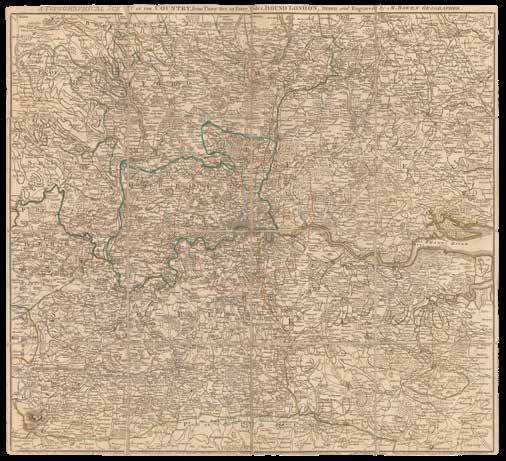
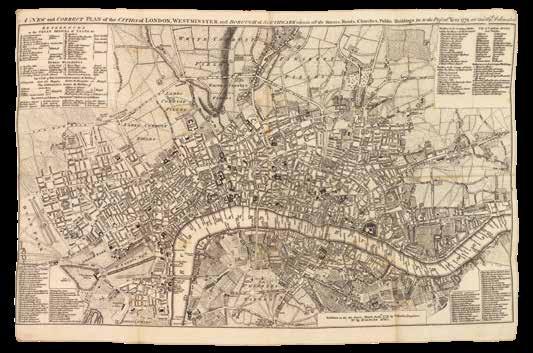
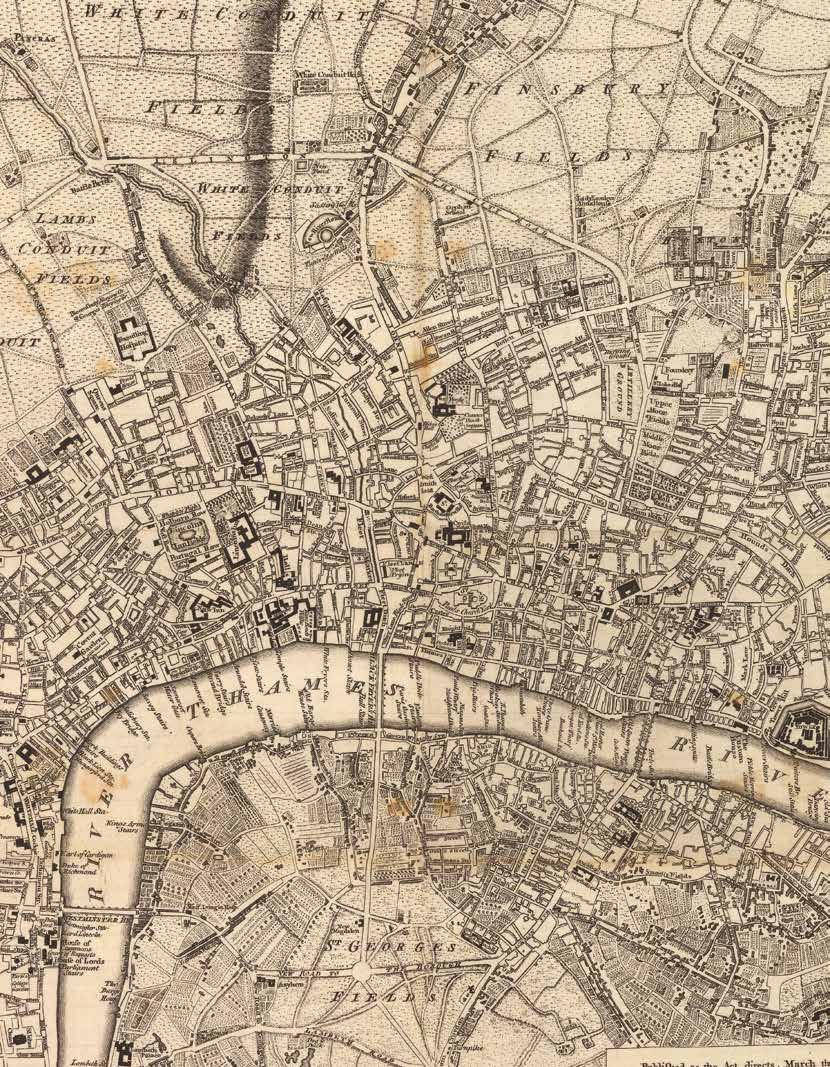
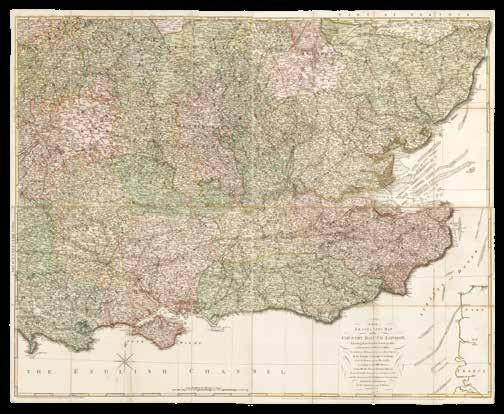
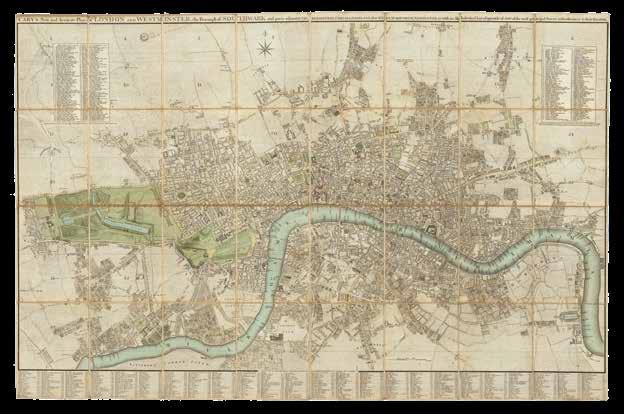
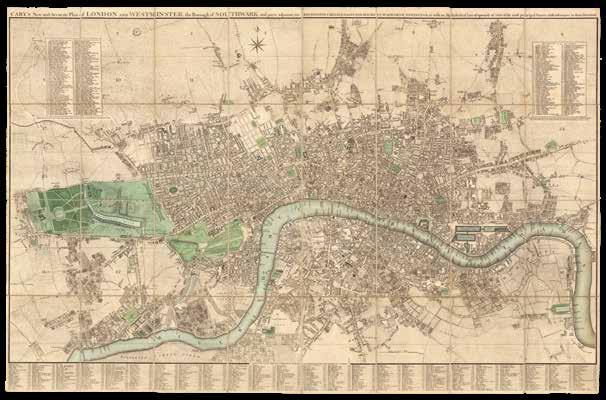
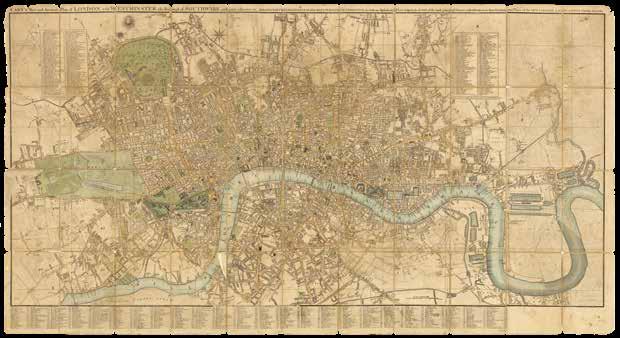
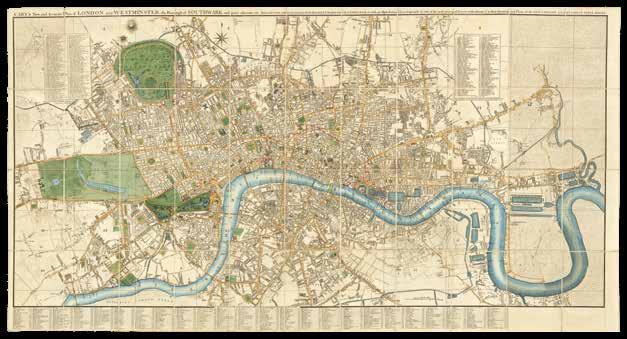
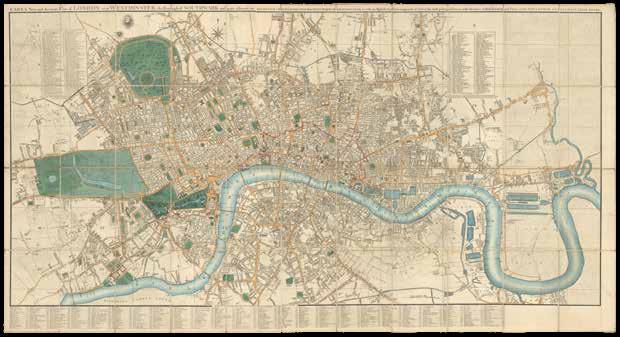
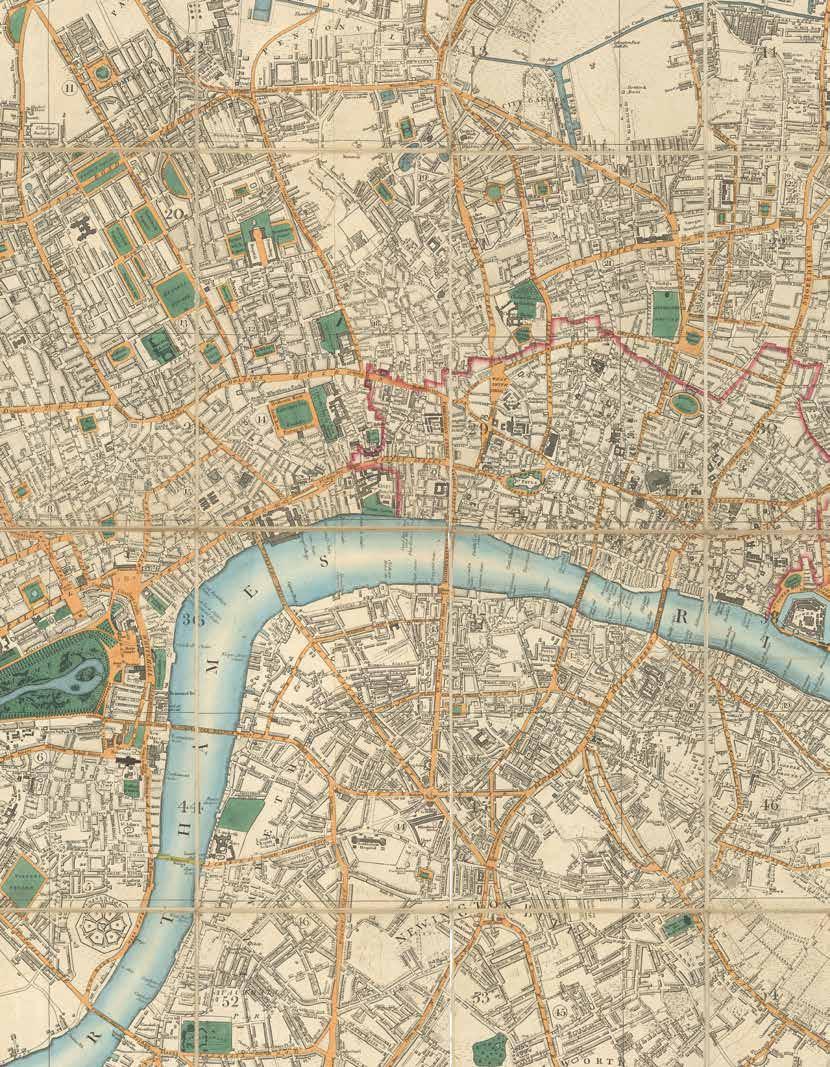
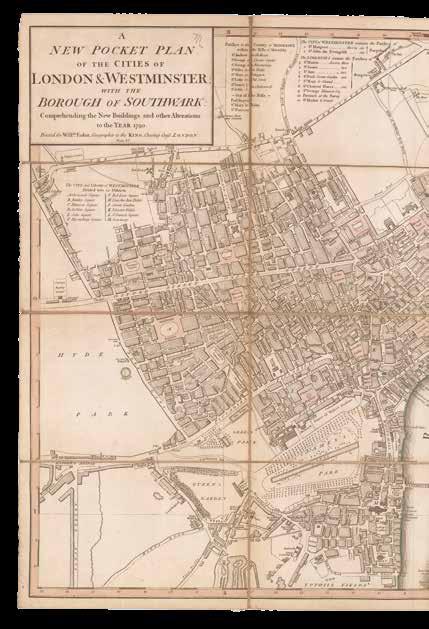
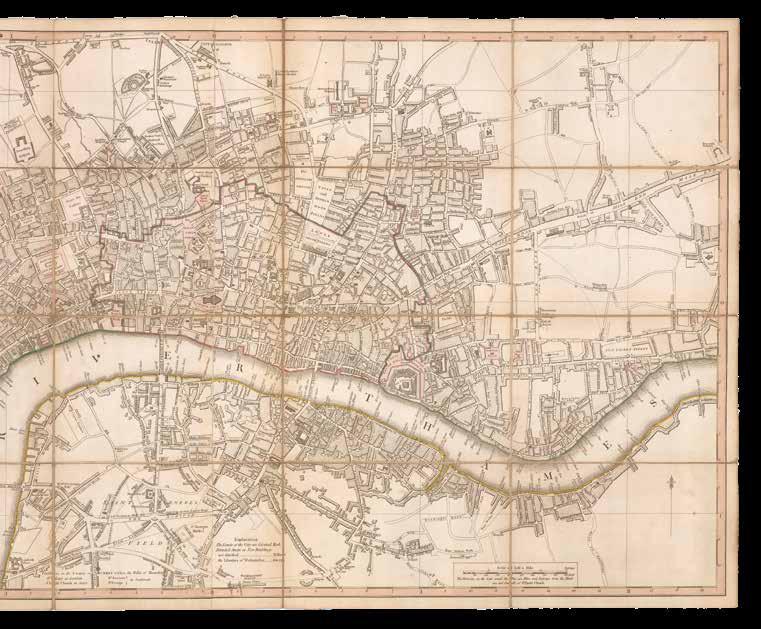
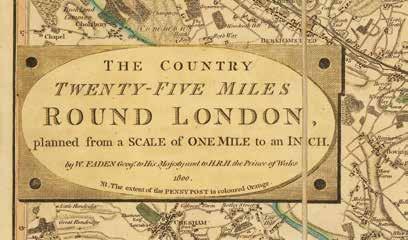
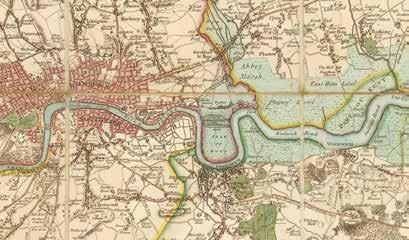
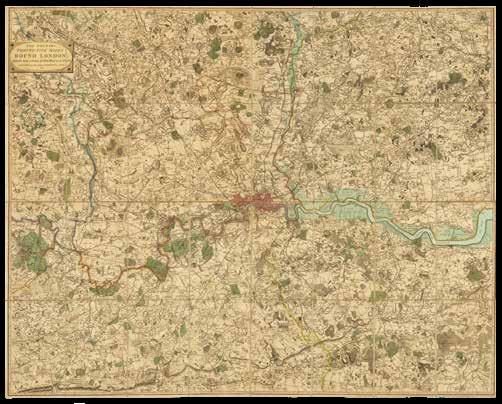
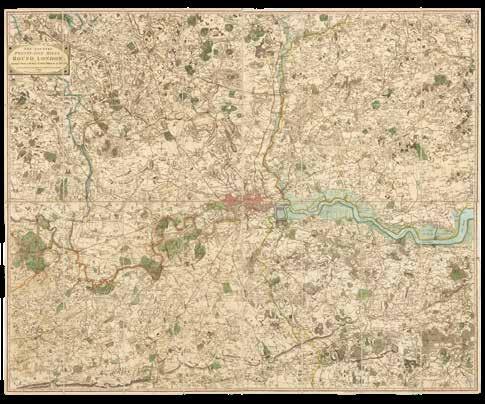
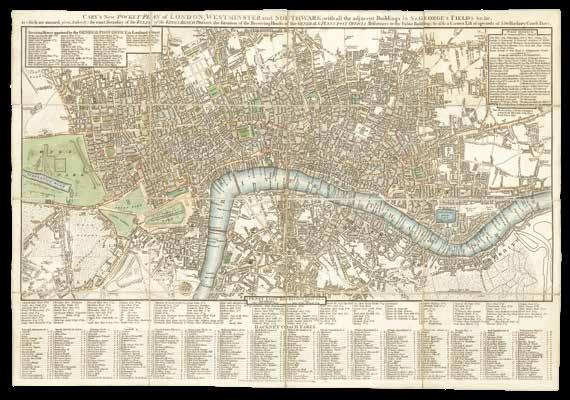
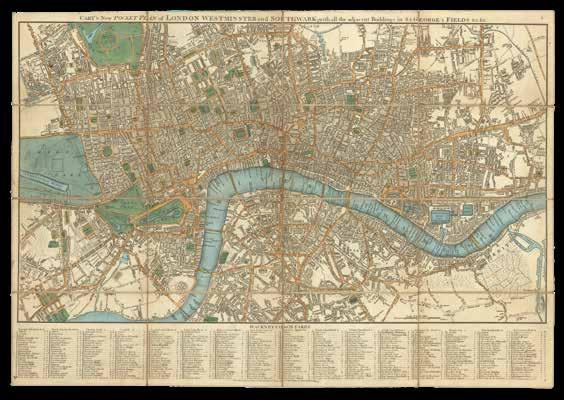
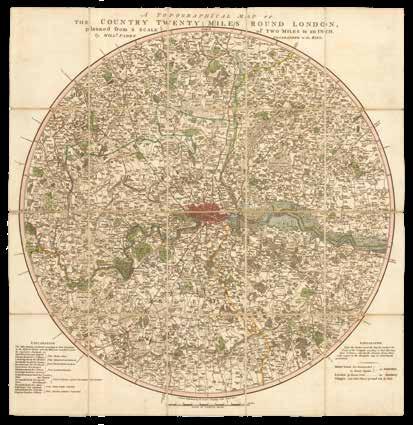
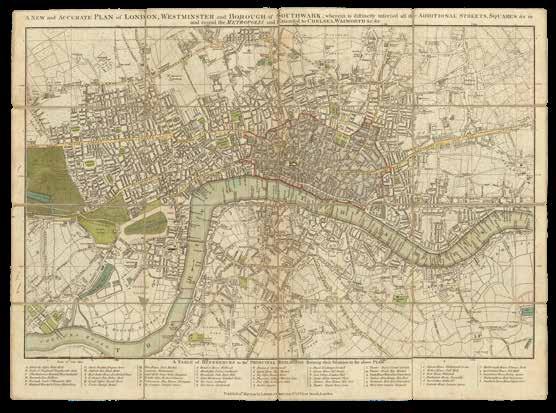
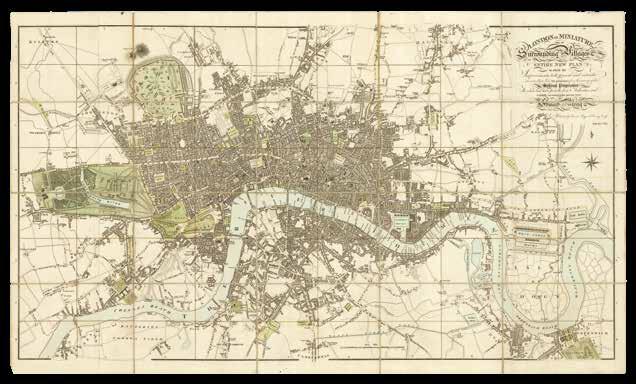
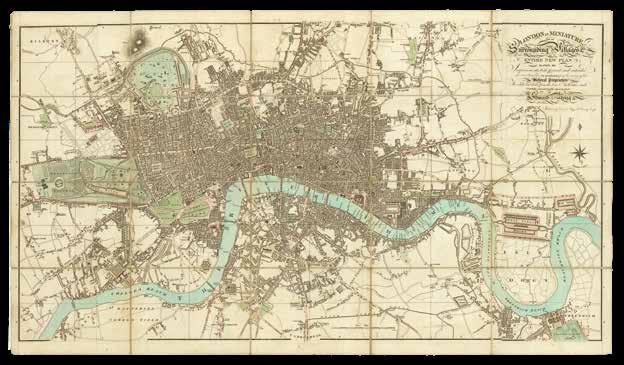
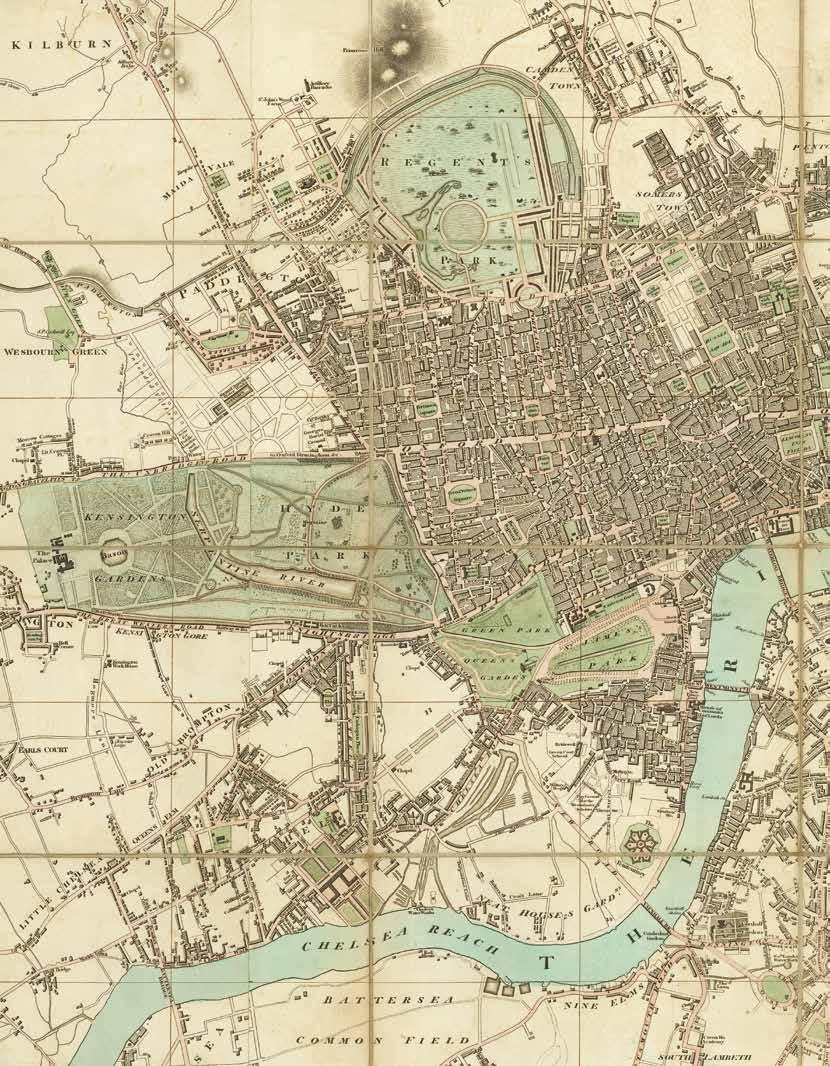
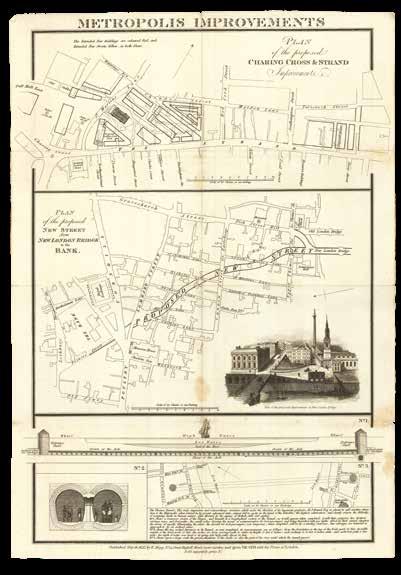
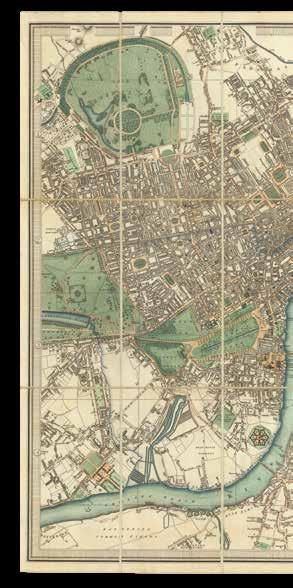
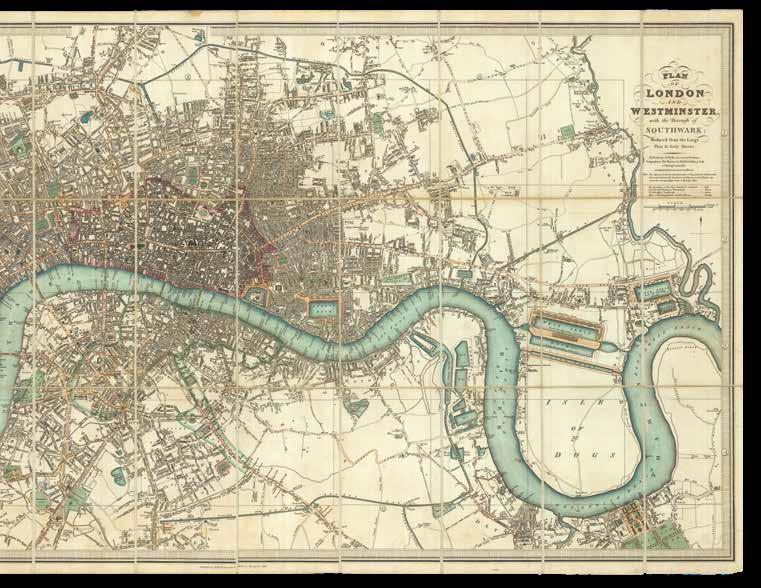
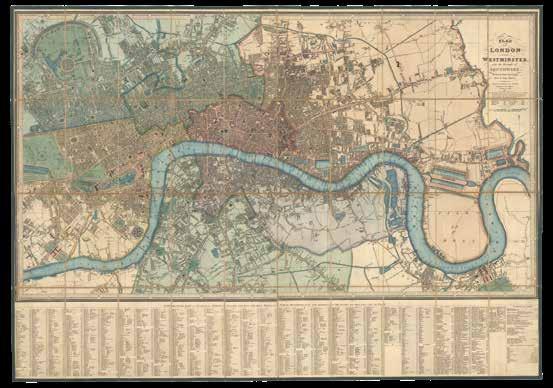
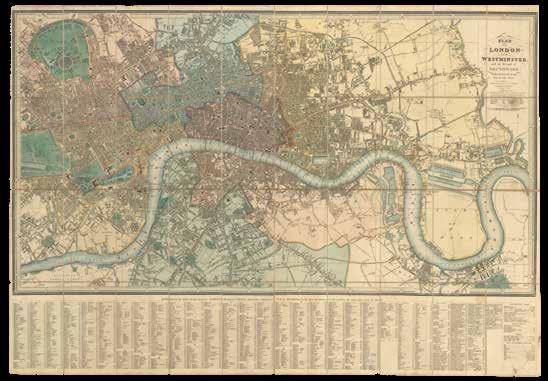
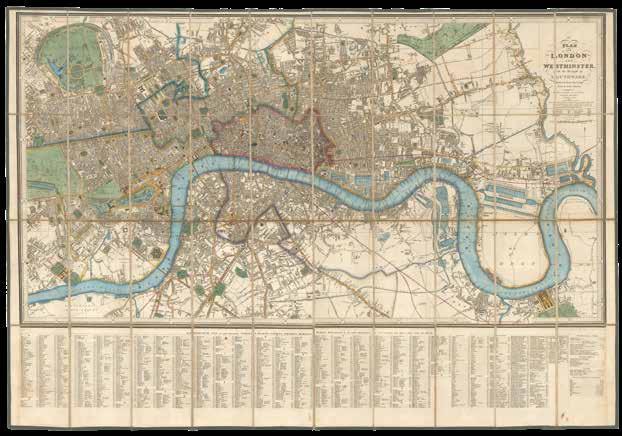
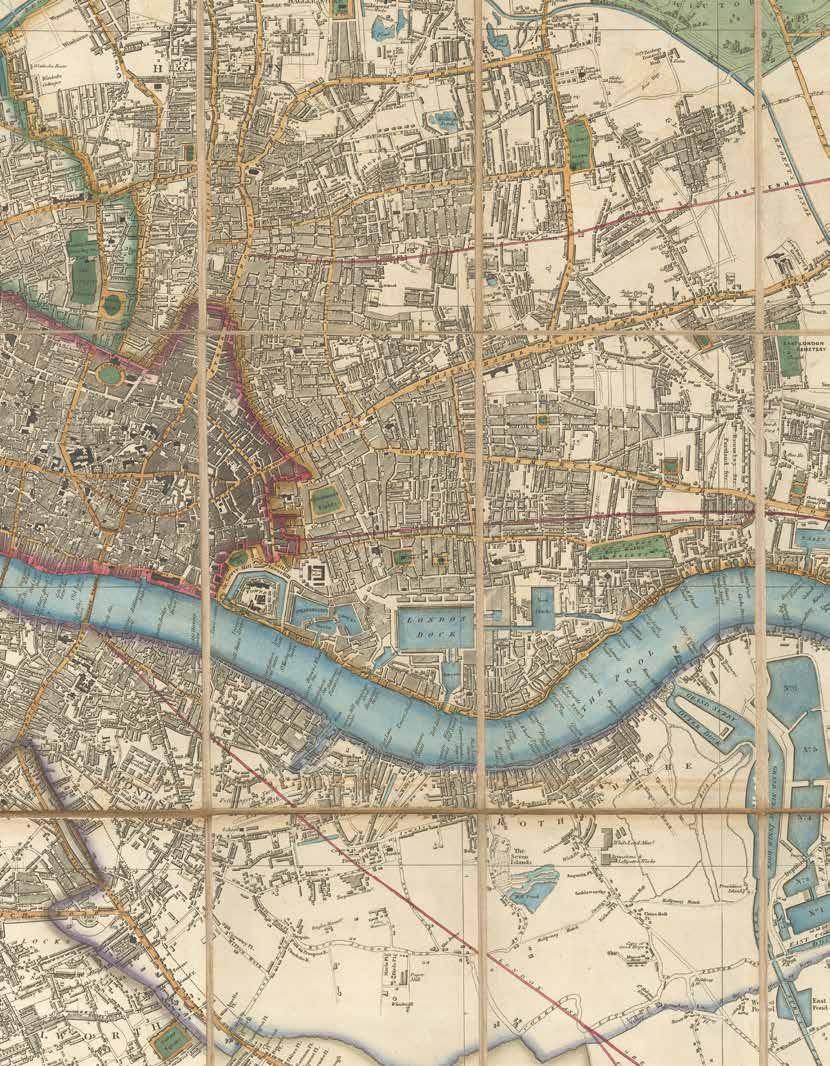
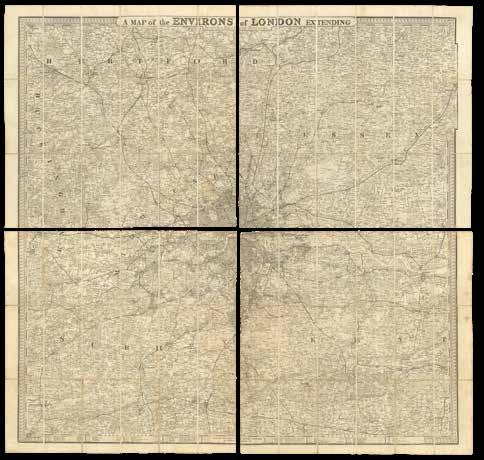
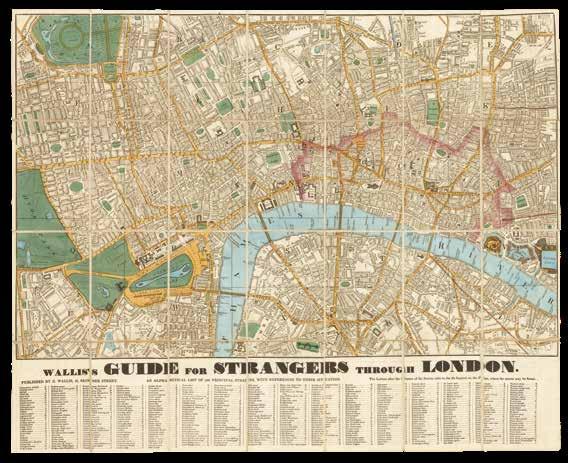
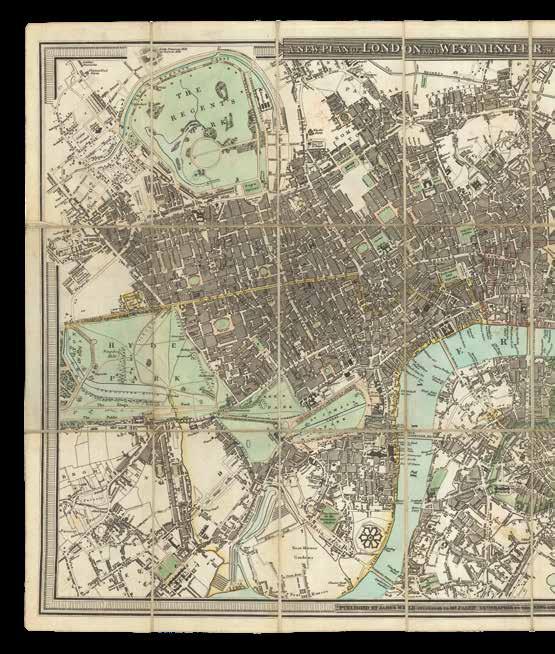
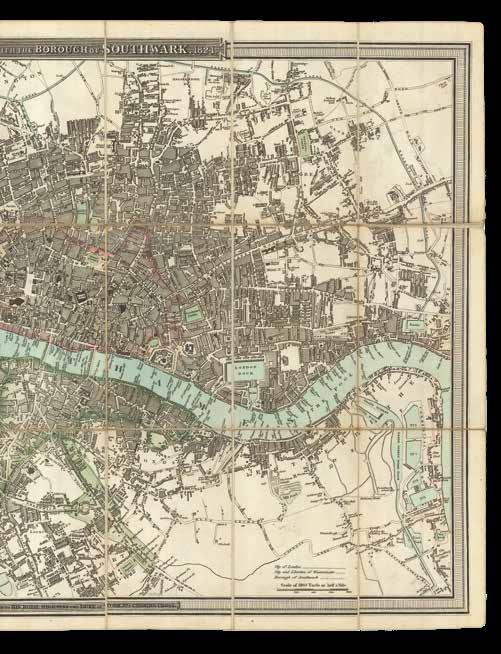
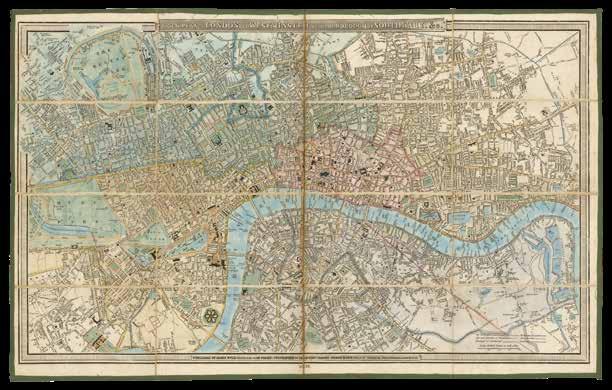
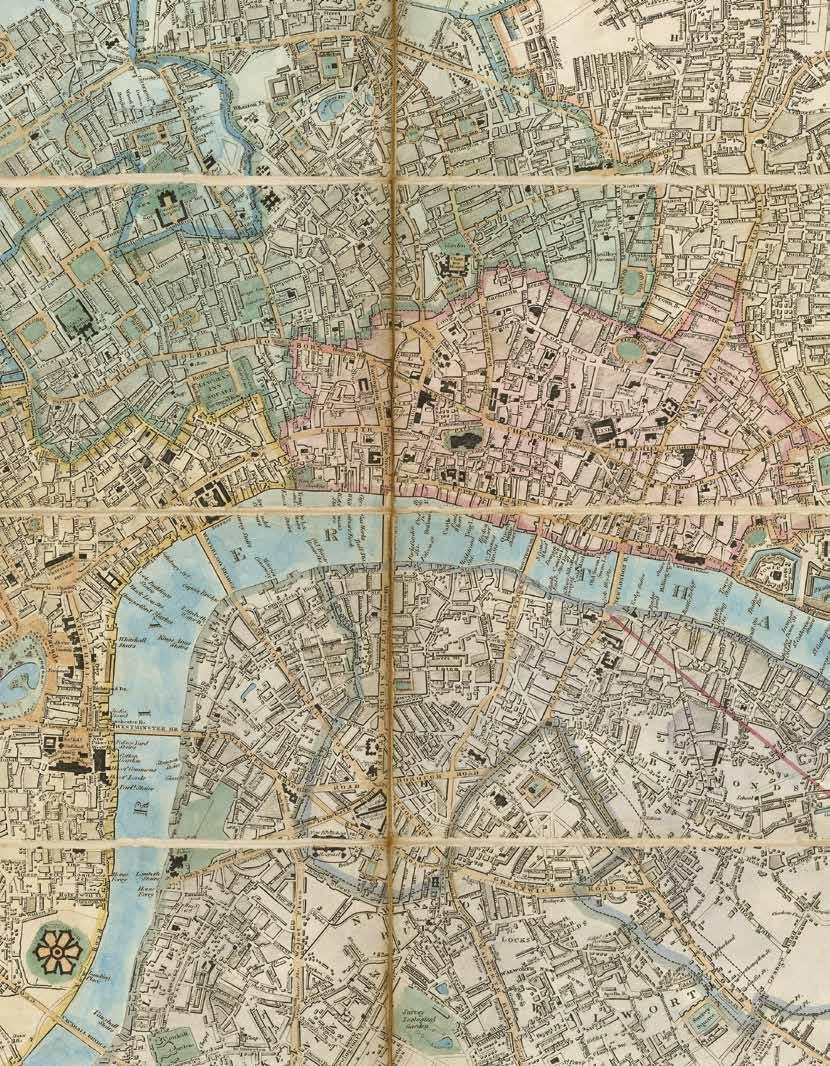
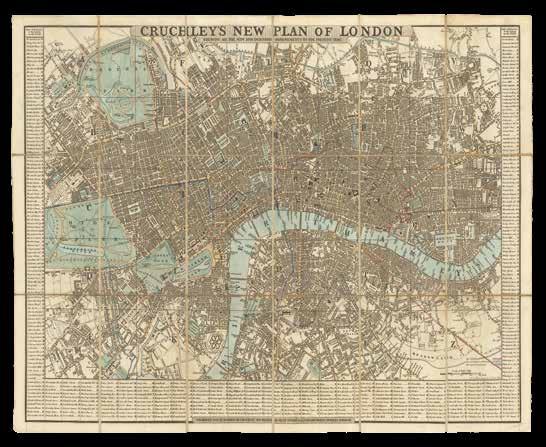
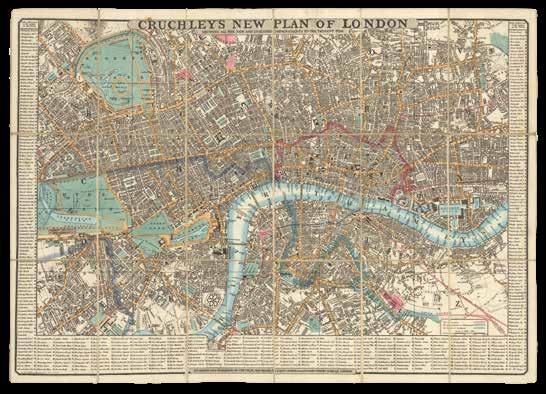
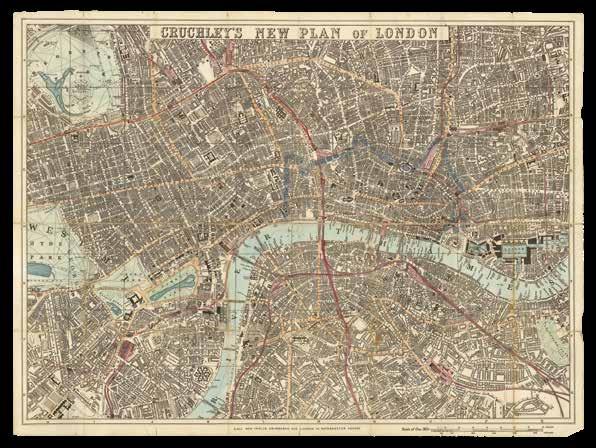
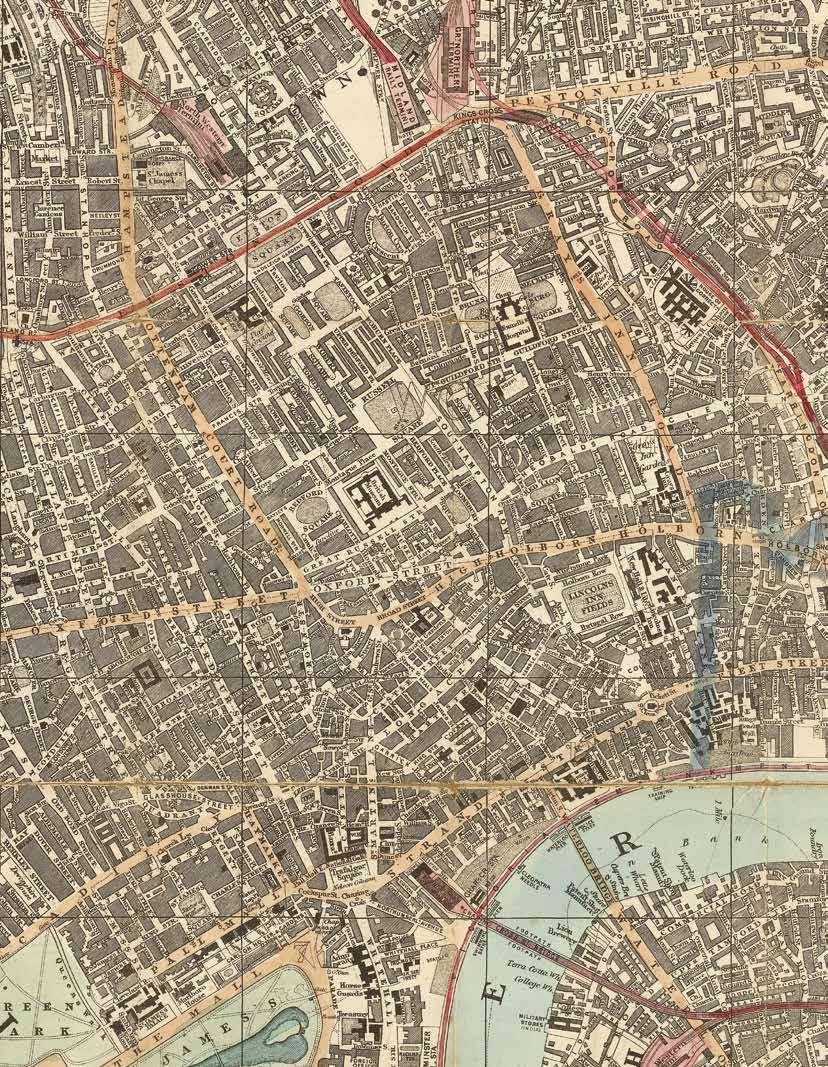
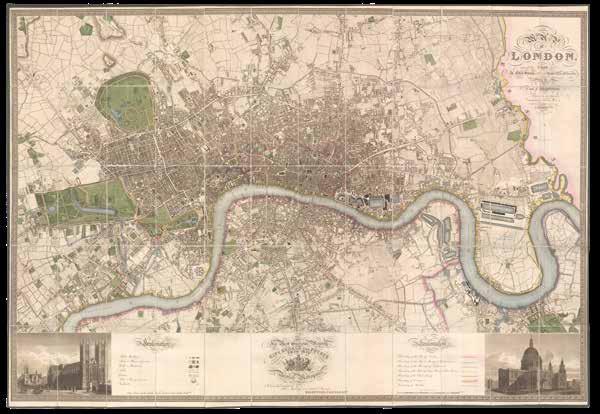
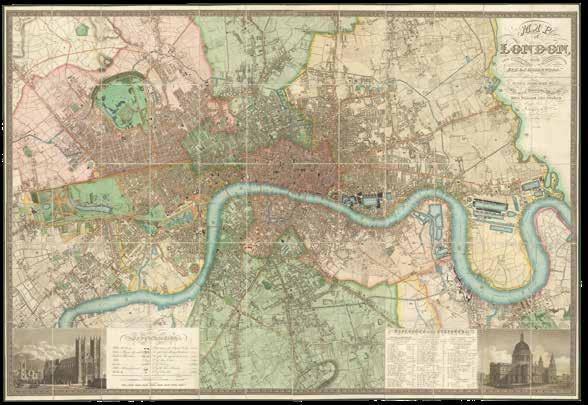
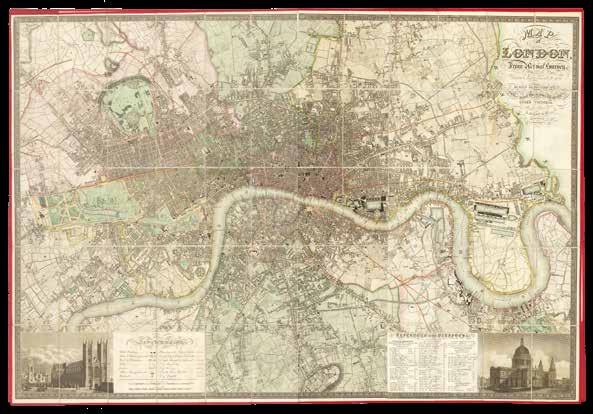
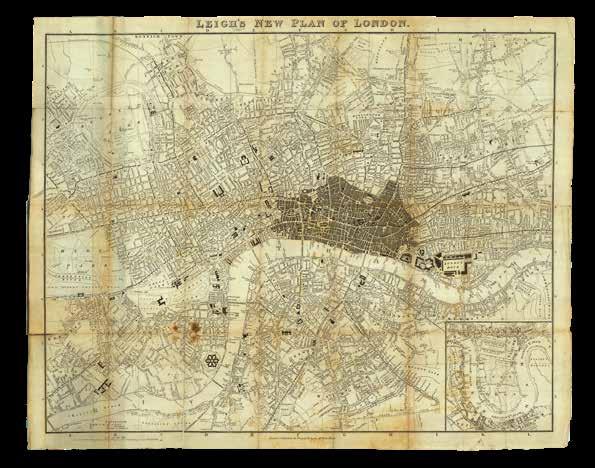
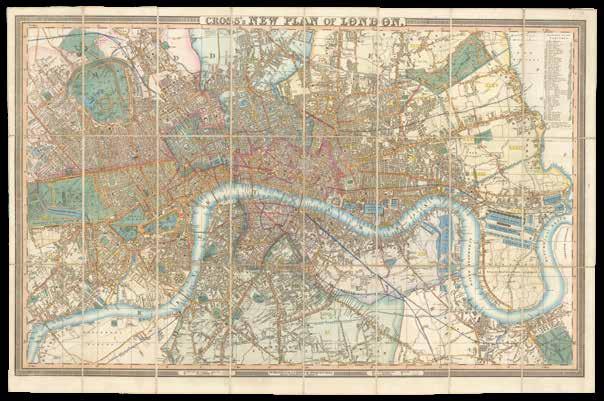
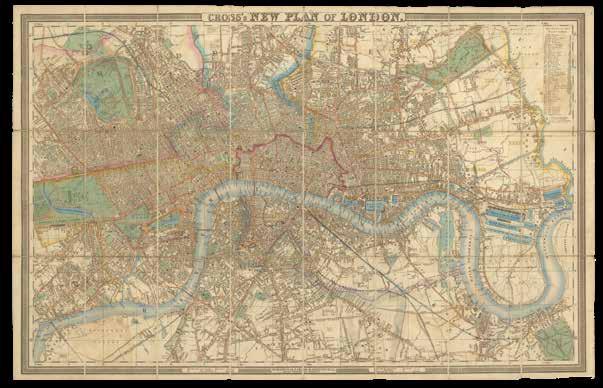
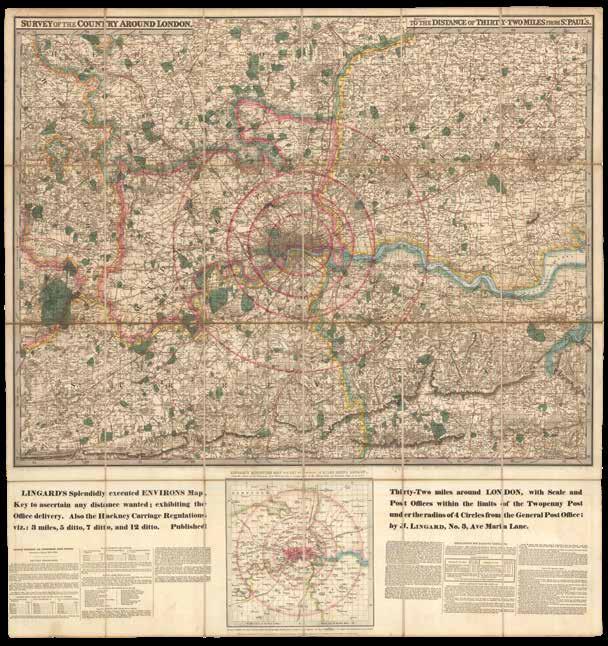
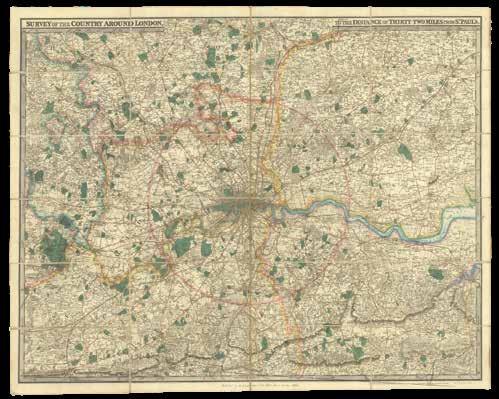
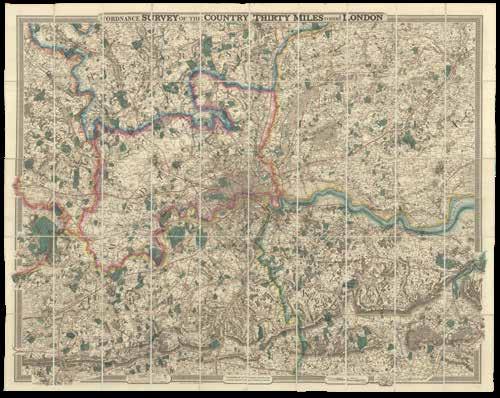
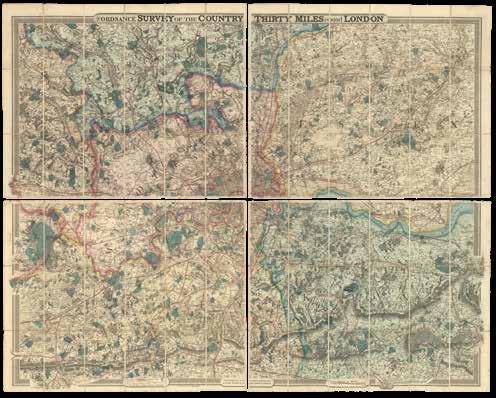
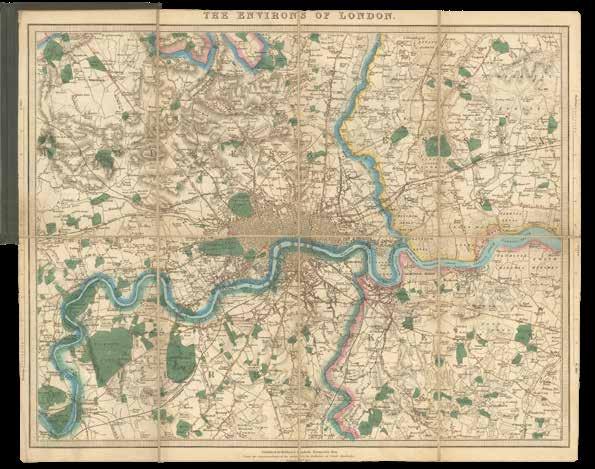
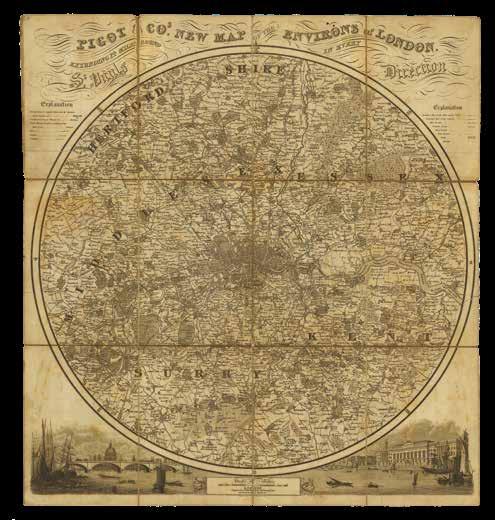
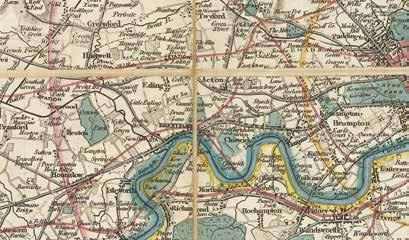
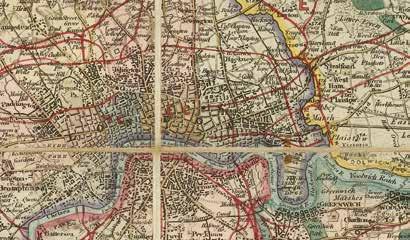
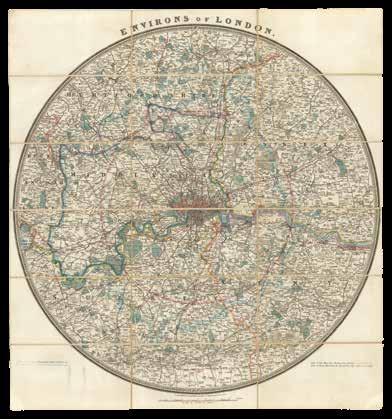
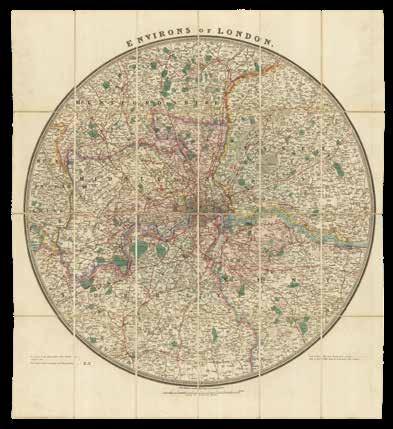
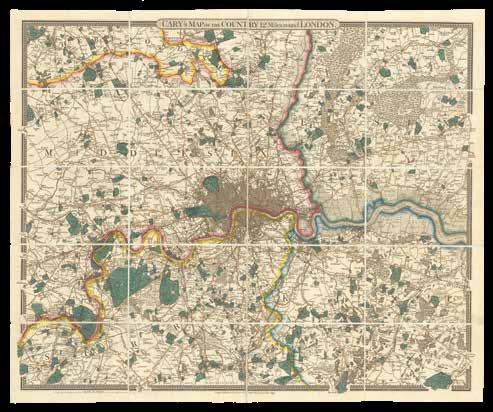
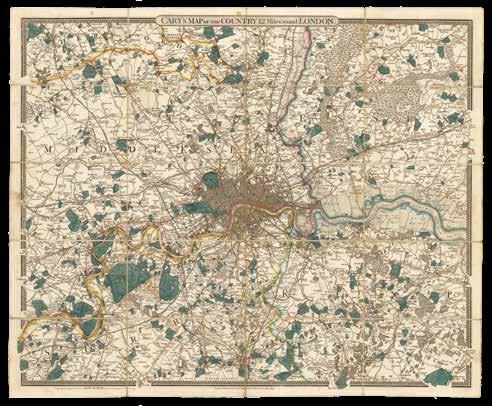
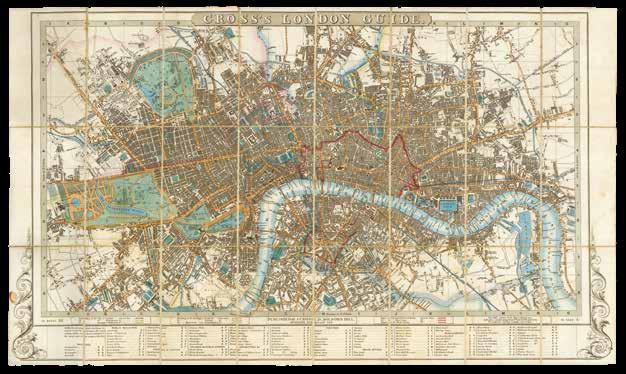
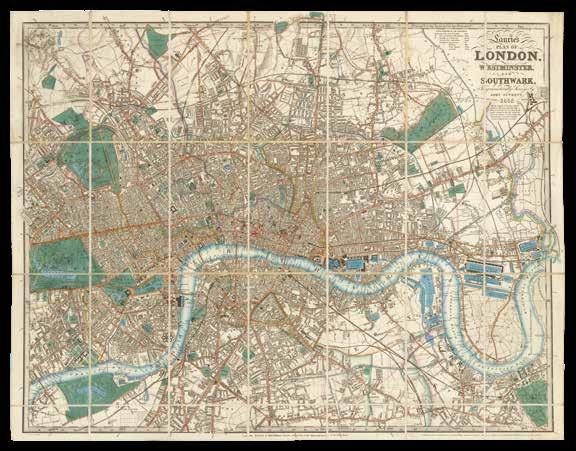
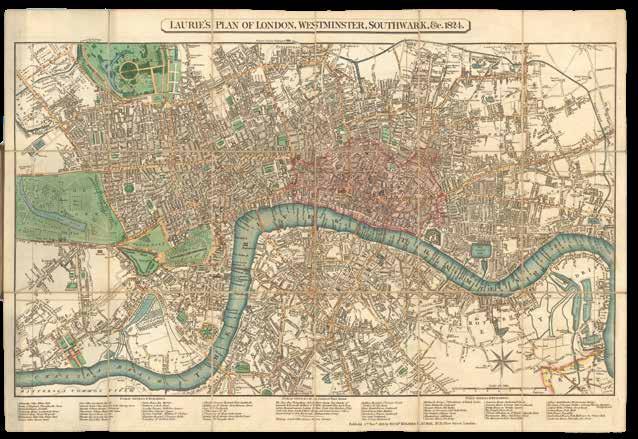
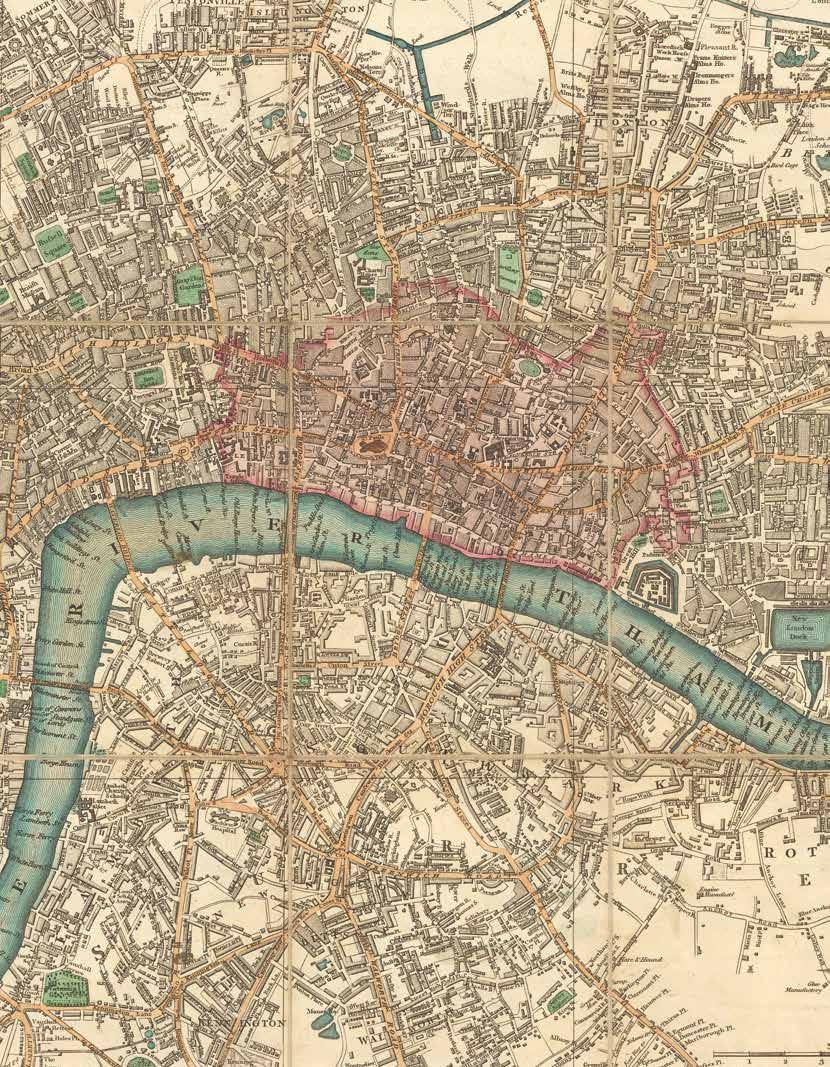
Catalogue edited by Arnie Anonuevo, Daniel Crouch,Rose Grossel, Kate Hunter, Ellida Minelli, Théophile De-Proyart, Mia Rocquemore, Dawlat Simko and Nick Trimming
Design by Ivone Chao and Nicky Valsamakis
Photography by Louie Fasciolo and Marco Maschiao
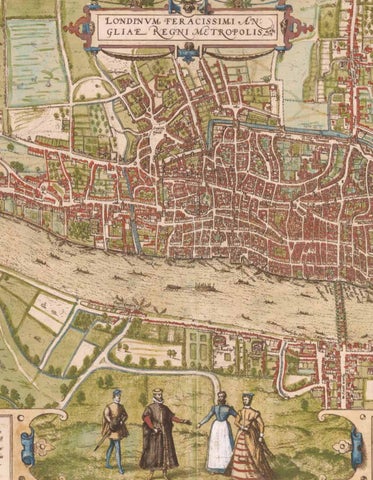
Cover: item 476
Terms and conditions: The condition of all books has been described. Each item may be assumed to be in good condition, unless otherwise stated. Dimensions are given height by width. All prices are net and do not include postage and packing. Invoices will be rendered in £ sterling. The title of goods does not pass to the purchaser until the invoice is paid in full.
Printed by Park Communications on FSC® certified paper. Park is an EMAS certified company and its Environmental Management System is certified to ISO14001. 100% of the inks used are vegetable oil based, 95% of press chemicals are recycled for further use and, on average 99% of any waste associated with this production will be recycled. This document is printed on Galerie Matt made of material from wellmanaged, FSC®-certified forests and other controlled sources. The pulp used in this product is bleached without the use of chlorine (ECF).
London: The Roger Cline Collection (Maps I)
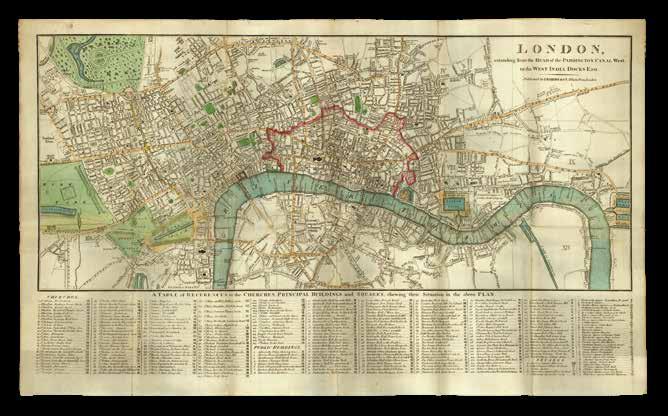
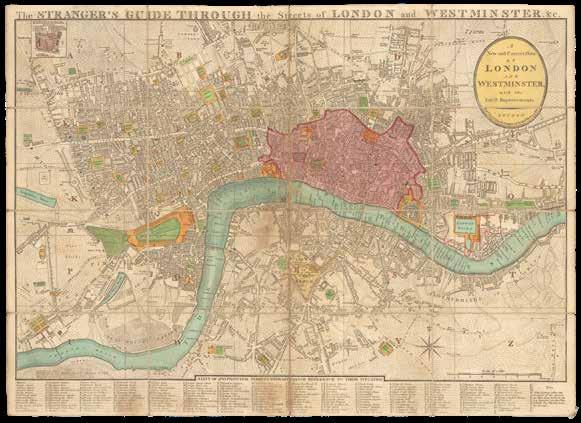
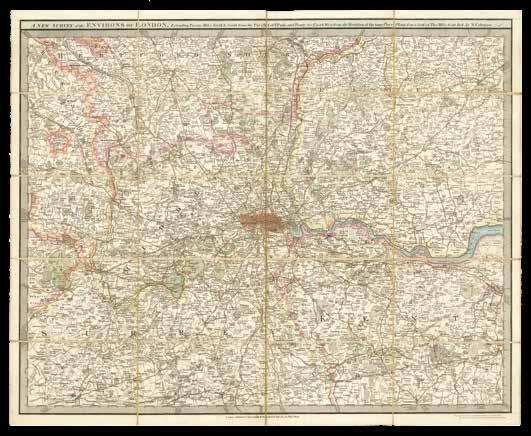
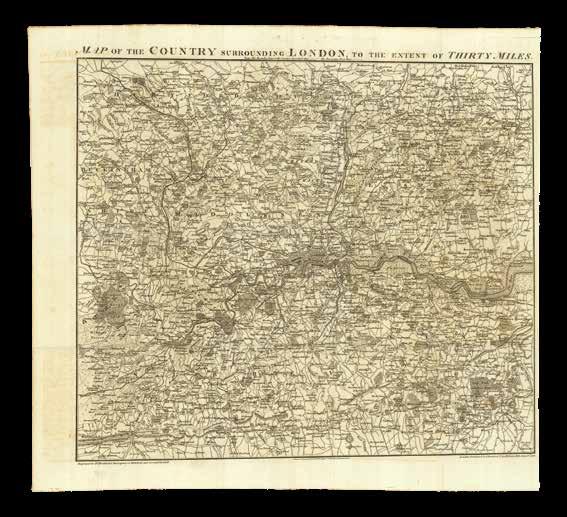
From the eighteenth to the twentieth century, London underwent a series of dramatic changes thanks to the Industrial Revolution, the influx of new inhabitants, and the arrival of advanced technologies. The 500 maps and plans in this catalogue, published between 1572 and 1933, document the development of this protean city.
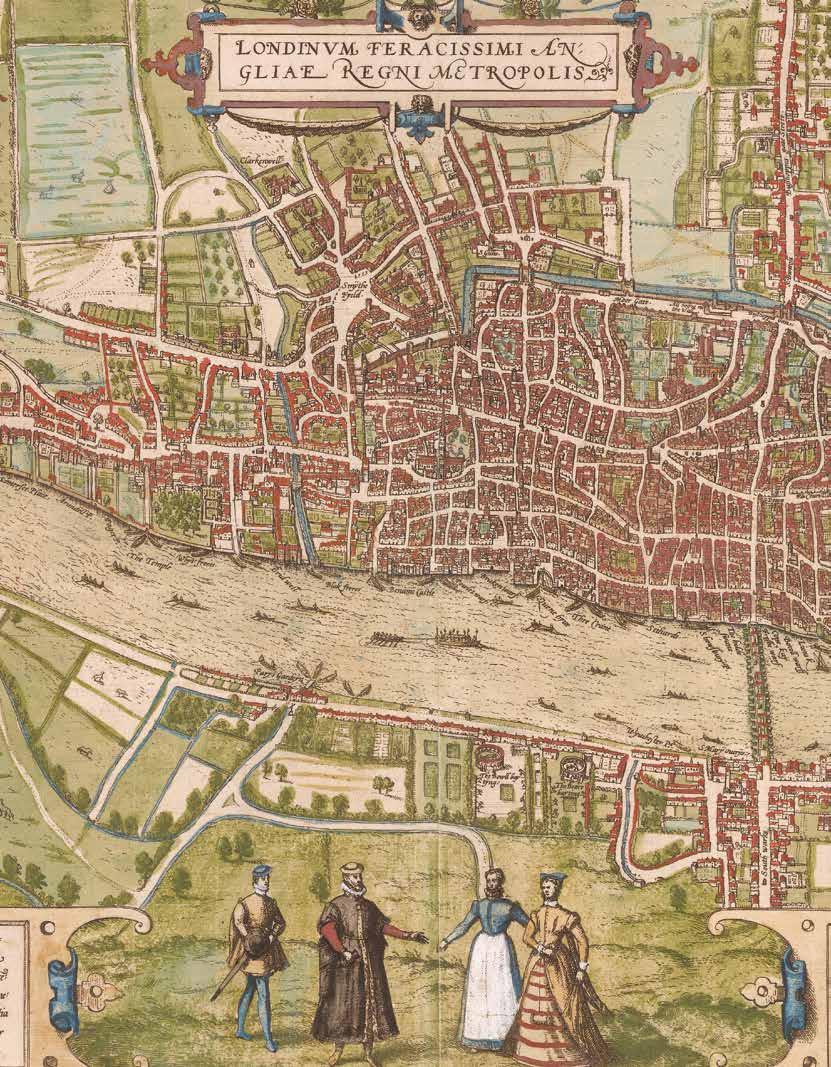
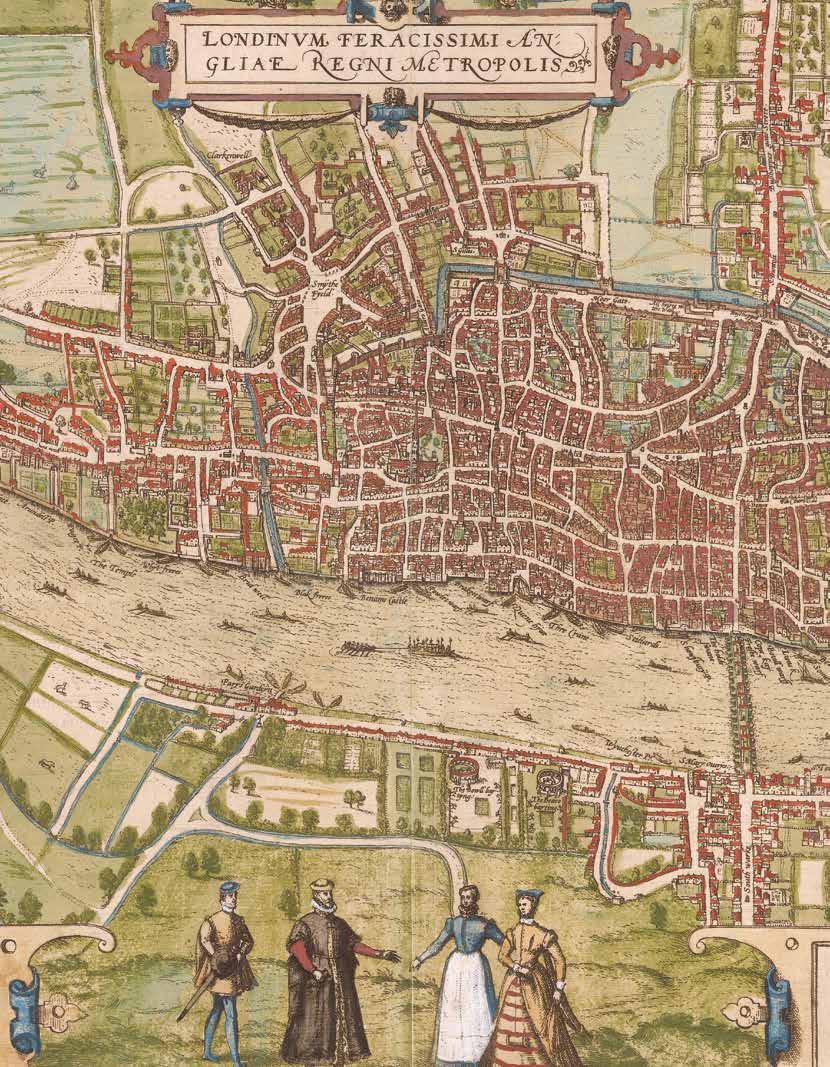
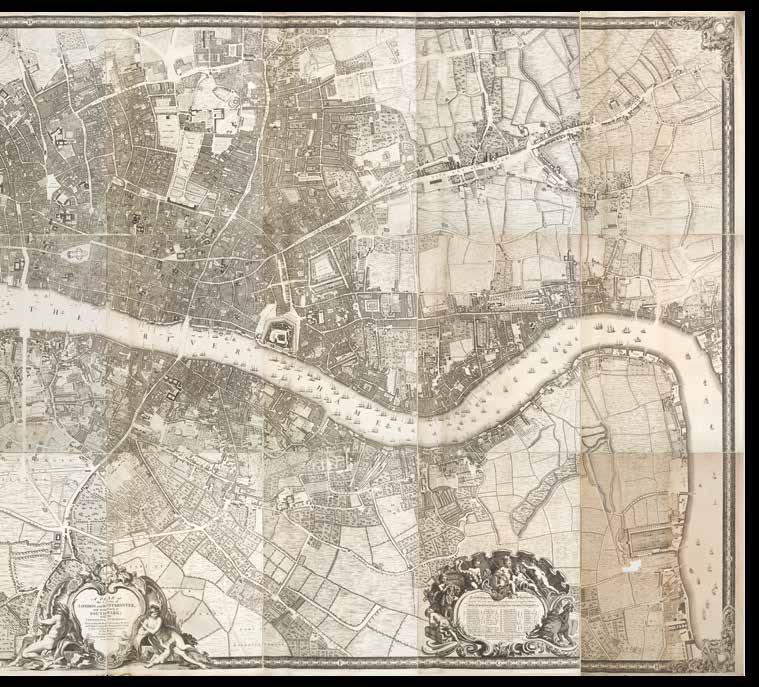
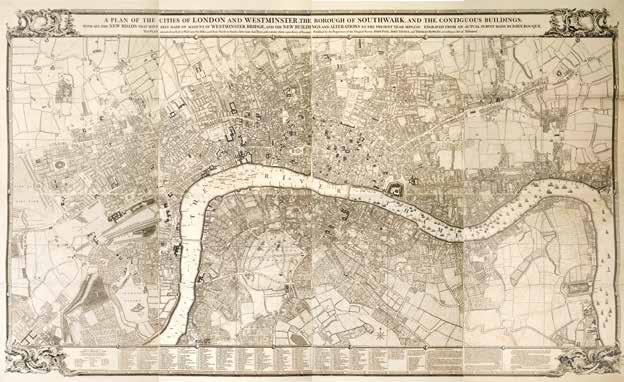
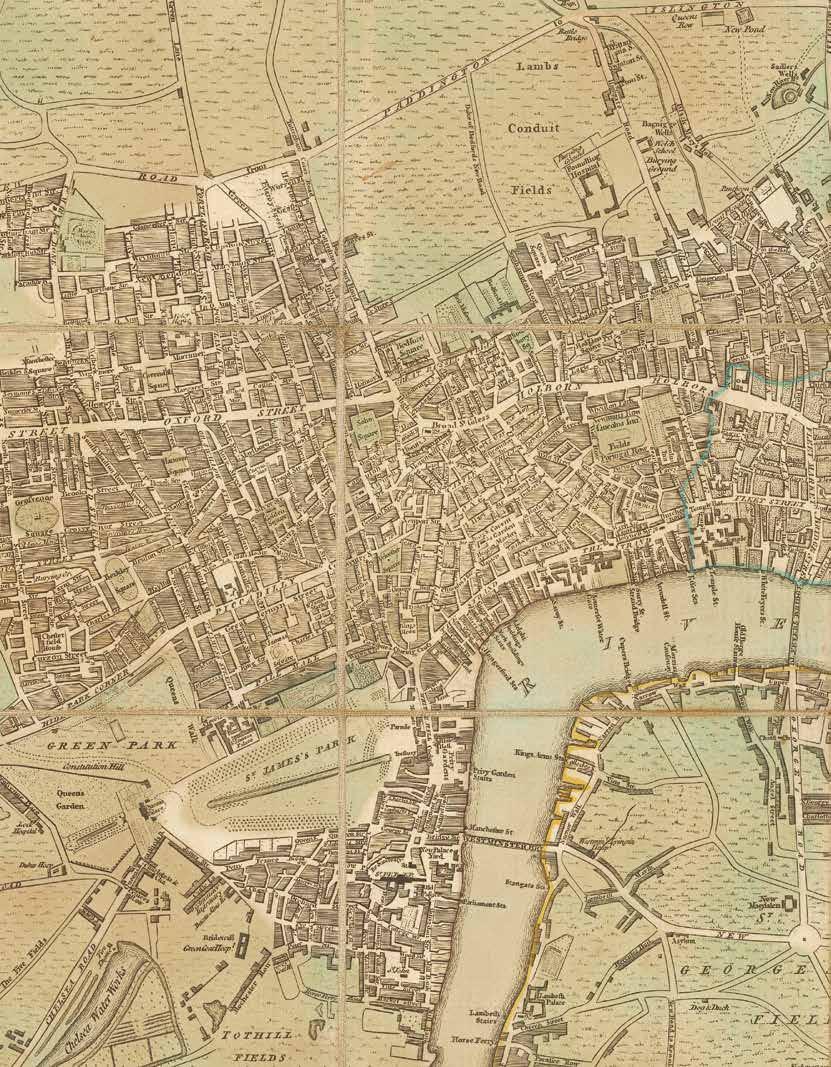
The collection begins with the rare first state of the earliest extant plan of London: Braun and Hogenberg’s ‘Londinium’ (item 476). Although published in 1572, the plan is clearly based upon information gathered some years earlier as several buildings destroyed before this date appear. The first accurate large scale survey of the capital is John Rocque’s ‘A Plan of the Cities of London and Westminster and Borough of Southwark, with the contiguous Buildings’ (item 496), a monumental work of cartography combining highly accurate surveying with Rocque’s eye for artistic detail. Not only is it an invaluable source of information about Georgian London, but it also had great influence on many later depictions of the city.
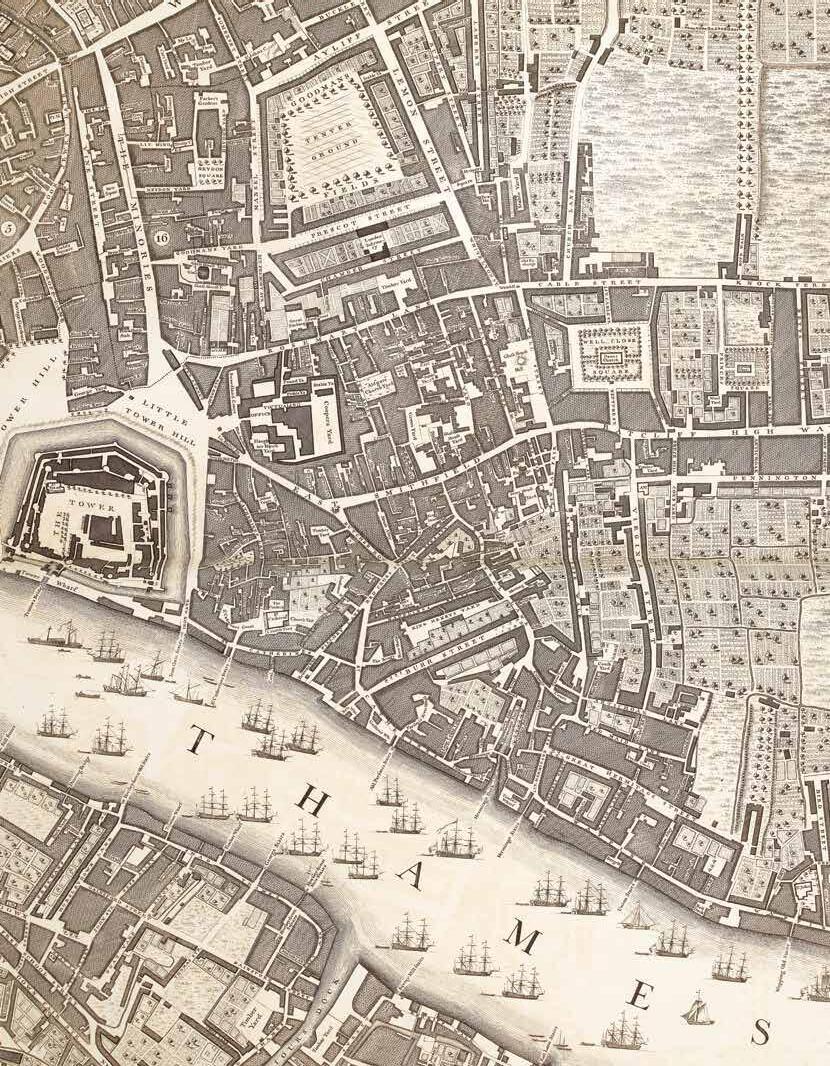
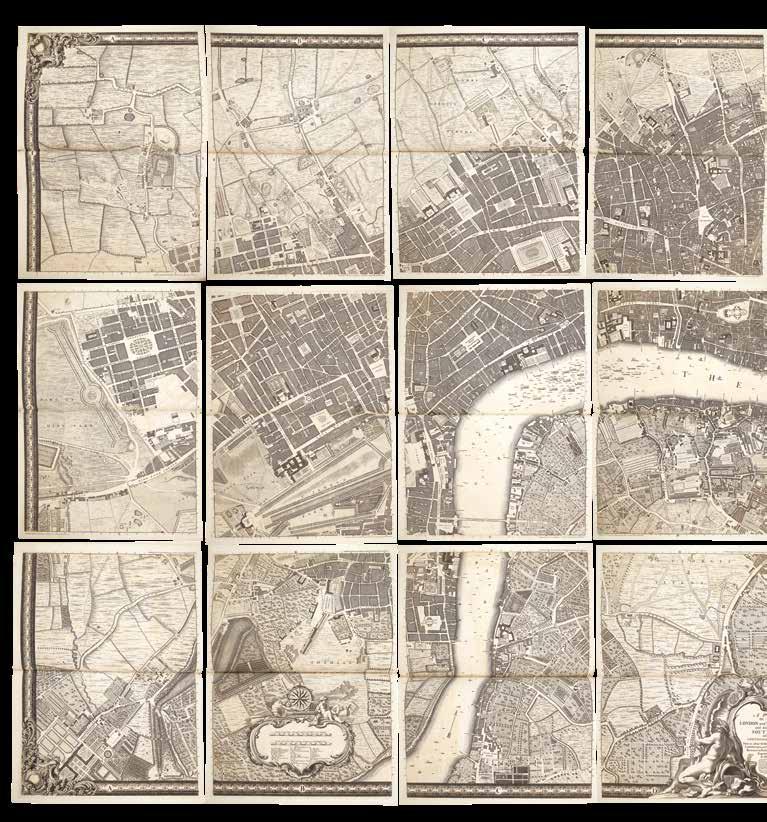
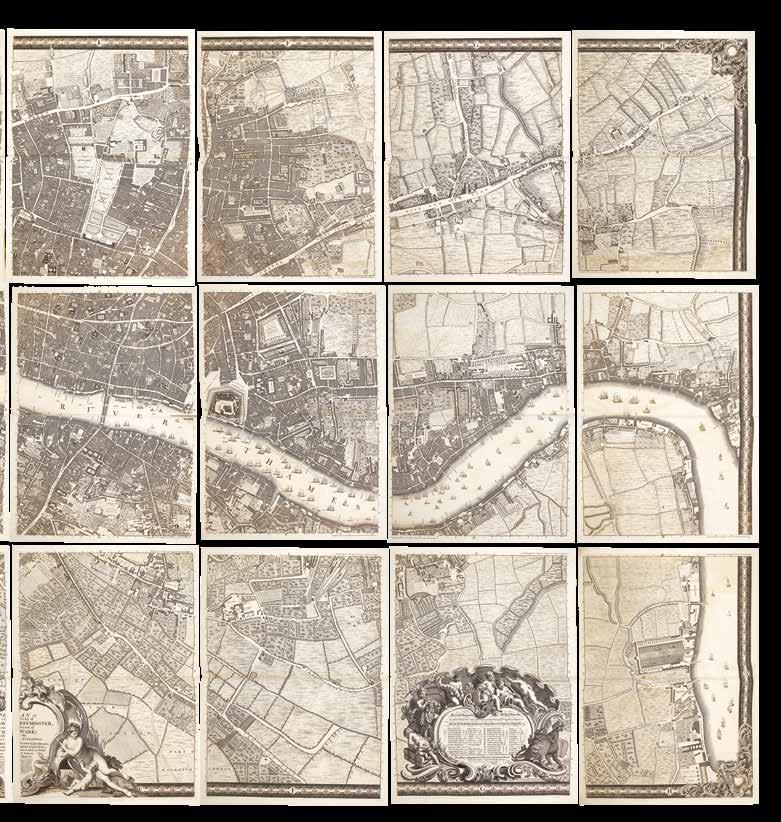
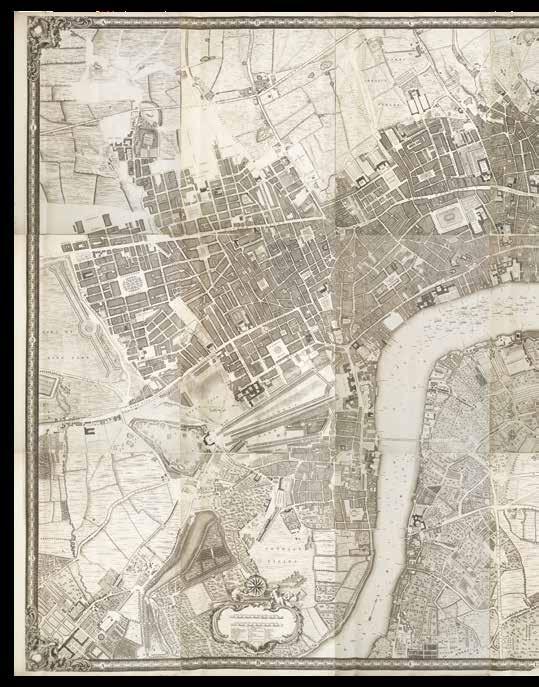
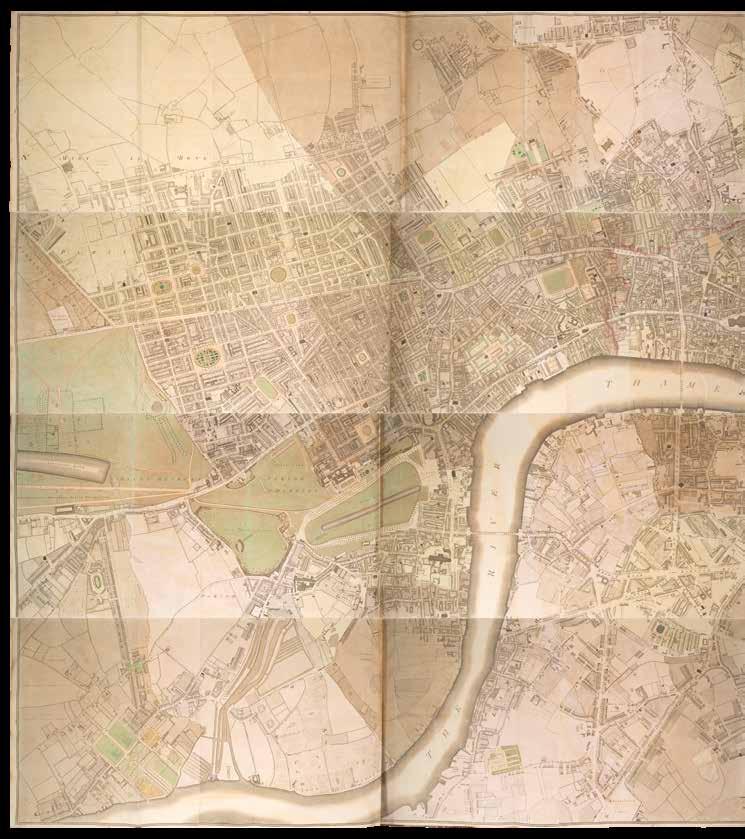
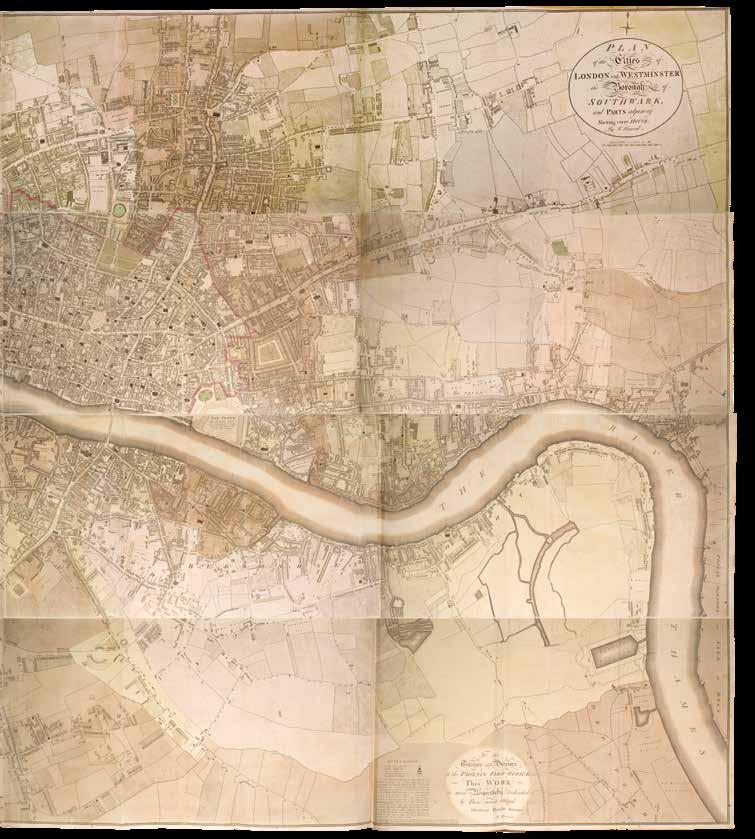
50 years later, Richard Horwood was inspired by Rocque’s work to produce his own ‘Plan of the Cities of London and Westminster the Borough of Southwark, and Parts adjoining Shewing every House’ (item 555). The largest map ever printed in Britain at the time, and the first attempt to produce a map of London with all houses delineated and numbered, it proved an invaluable aid for the Phoenix Fire insurance office, for whom it was produced. Furthermore, being on the very same scale as Rocque’s plan, it allows for a direct comparison of London in the middle, and at the end, of the eighteenth century, clearly displaying how the liminal areas at the periphery of the city had quickly been swallowed up by the metropolis as the Industrial Revolution took its course.
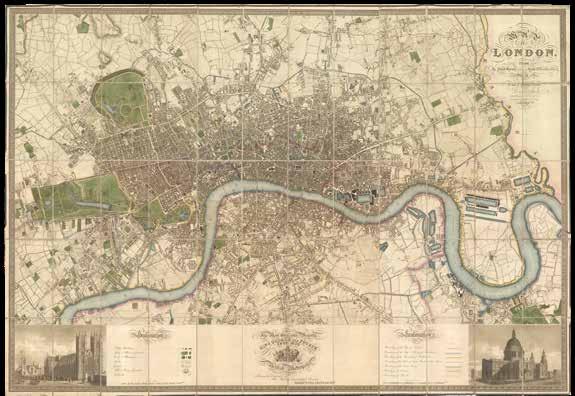
Then, in the early-nineteenth century, Christopher and John Greenwood set new standards for large-scale surveys of the capital with their ‘Map of London, from an actual Survey made in the Years 1824. 1825 & 1826’ (item 667). Again London is shown to have expanded even further into the surrounding countryside, with new constructions popping up everywhere. These early and important large-scale maps of London help to trace the capital’s development from a dense urban centre to the first global mega city.
Such a progression undoubtedly brought challenges along with its advantages. Between 1714 and 1840, London’s population swelled from around 630,000 to nearly 2,000,000, and then again to 6,500,000 during the reign of Queen Victoria. This influx of inhabitants, encouraged by the promise of work in the city’s numerous new factories, meant that urban planning measures had to be taken to make it a liveable place. The opening of the London Underground in 1863, for example, released pressure on the centre by allowing workers to commute from the less-crowded suburbs. The Metropolitan Railway from Paddington to Farringdon, which was the very first urban underground railway in the world, and
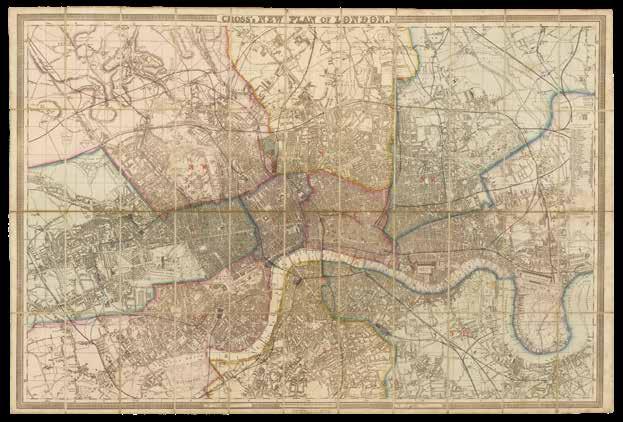
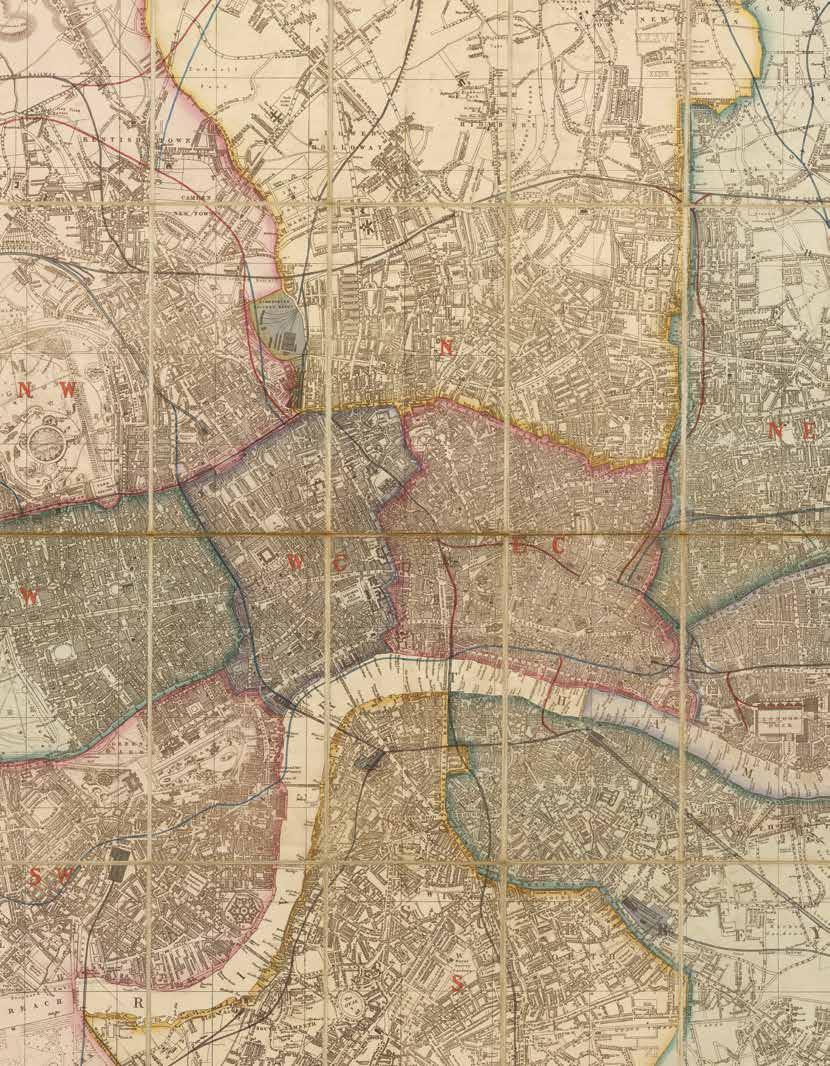
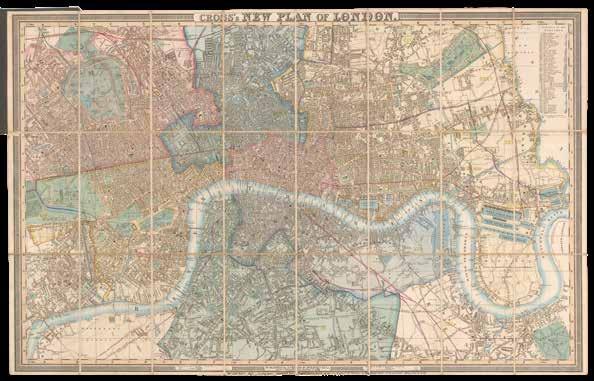
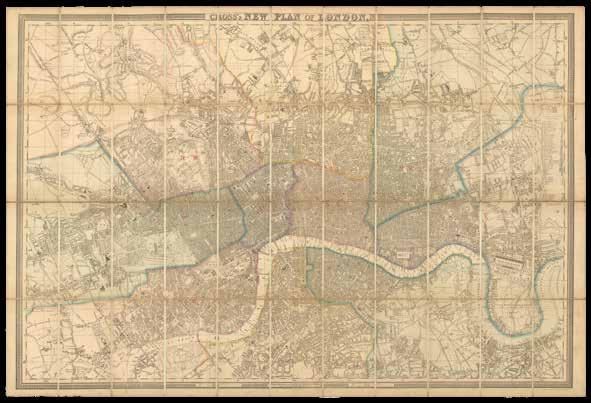
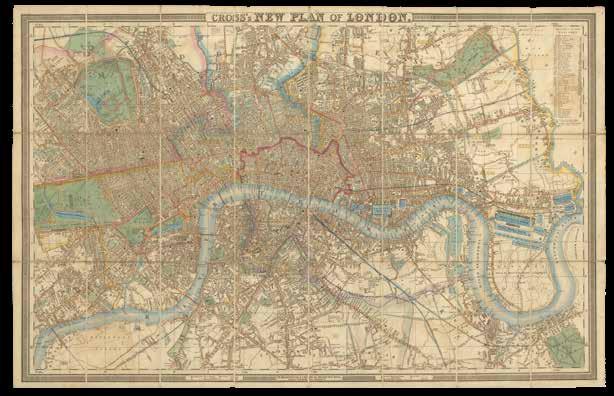
the beginning of London’s iconic tube network, is shown on Joseph Cross’s ‘New Plan of London’ (item 672).
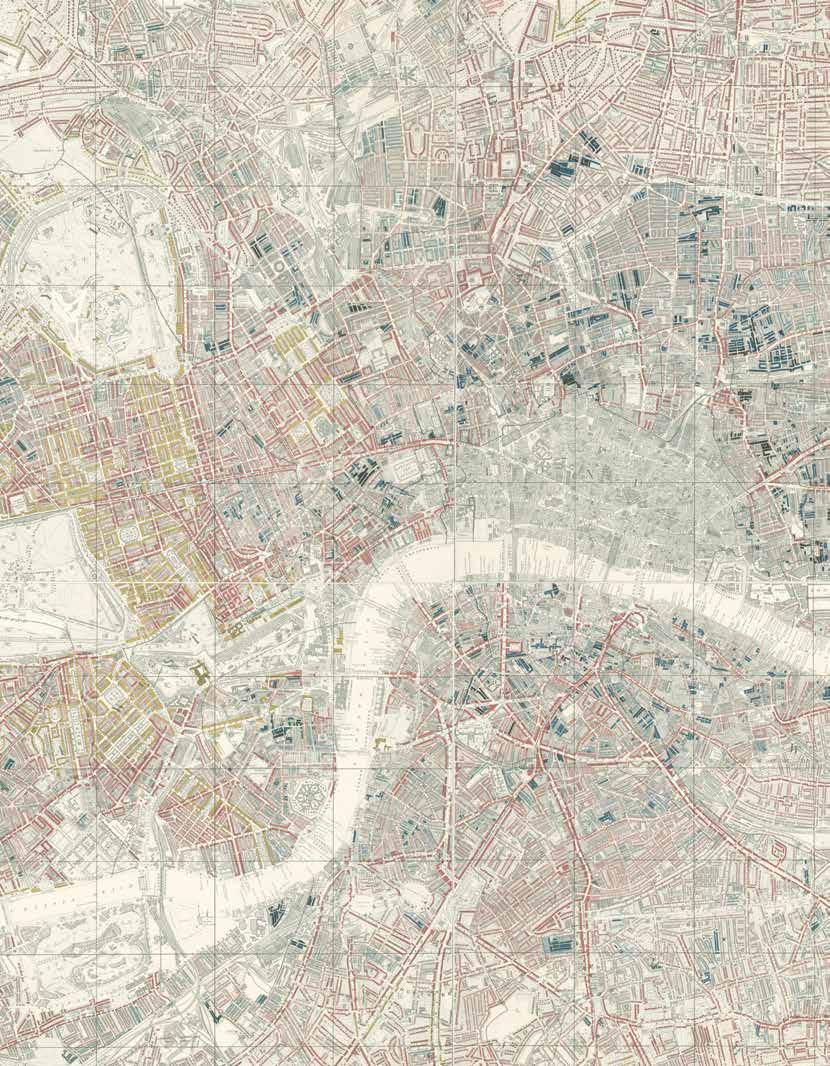
Public health also had to be taken into account, with the disposal of human and industrial waste into the Thames finally culminating in the “Great Stink of 1858”, as well as several serious bouts of cholera. Consequently, James Wyld’s ‘London and its Environs’ (item 773), among others, was commissioned for the investigation of London’s sewers, with water levels marked in red across the capital’s parishes. Around the same time, social reformer Charles Booth published another map concerning public welfare. The so-called “poverty map” depicts London’s districts according to their social demographic. Delineated by colour, streets are categorized as: “The Lowest Class. Vicious, semi-criminal” (black); “Very Poor, casual. Chronic Want” (blue); “Poor. 18s to 21s a week for a moderate family” (light blue); “Mixed. Some comfortable, others poor” (purple); “Fairly Comfortable. Good ordinary earnings” (pink); “Well-to-do. Middle class” (red); “Upper-middle and Upper classes. Wealthy” (yellow).
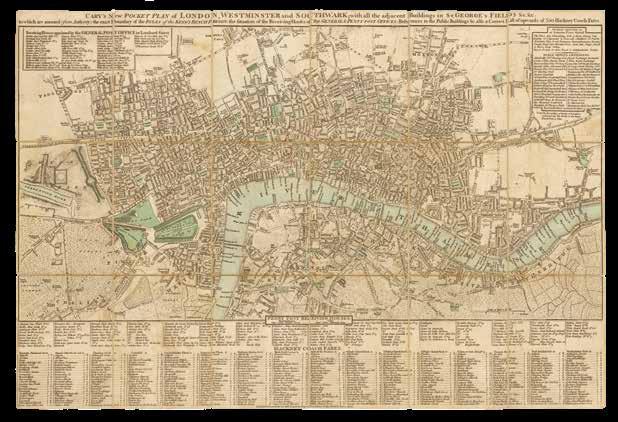
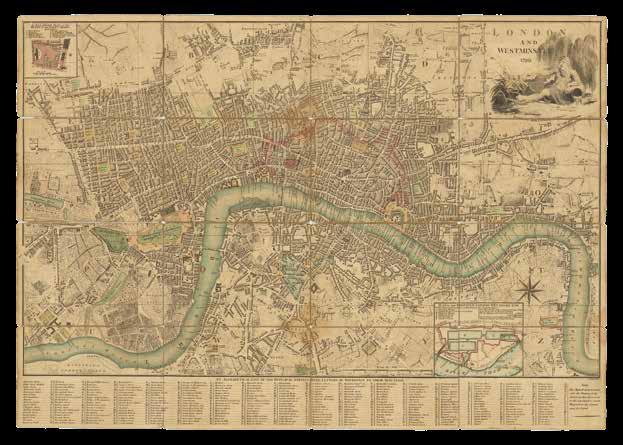
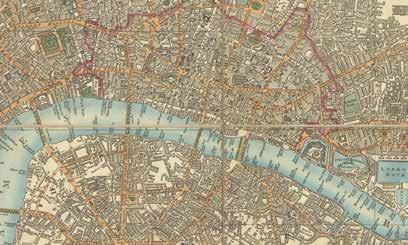
Alongside the tidal wave of new residents, both rich and poor, London’s great expansion also gave rise to a boom in tourism. Thus many traveller’s maps and guides were published, often by the capital’s most prolific mapmakers. On some occasions, such material was inspired by contemporary events and celebrations, such as Wyld’s map to the Great Exhibition of 1851 (item 780), while others were aimed at pleasure-seekers more generally, including Gall & Inglis ‘Bicycle map’ spanning London and the surrounding counties (item 963). The “pocket plans” produced by numerous publishers, such as Bowles (item 511), Faden (item 538), Cary (item 550), and W. H. Smith (item 886), were eventually transformed into the famous A-Z guides to London that remain popular today.
Despite all depicting the same city, the maps within this catalogue are remarkably varied. Spanning 550 years of London’s history, with multiple points of focus, from sanitation to travel, what they all share in common is the wish to render intelligible a chaotic and ever-changing city.
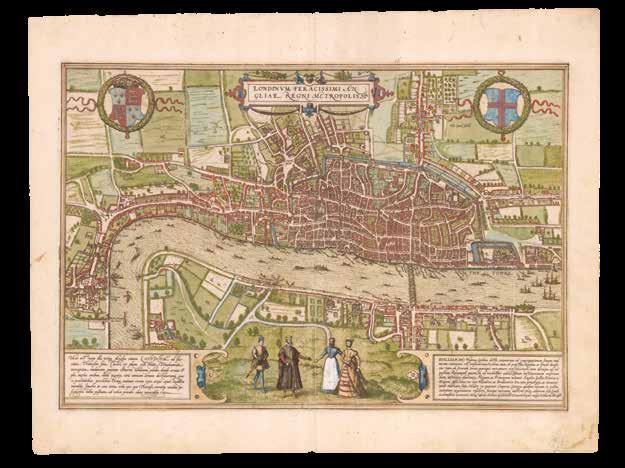
[BRAUN, Georg and HOGENBERG, Franz]
Londinium Feracissimi Angliae Regni Metropolis.
Publication [Cologne, 1572].
Description Hand-coloured engraving.
Dimensions 330 by 485mm (13 by 19inches).
Scale
6.5 inches to 1 statute mile.
References Howgego 2 state 1.
The first printed plan of London
Rare first state of the first printed plan of London. This magnificent plan was first published in Braun and Hogenberg’s seminal town book ‘Civitates Orbis Terrarum’, (1572). London is depicted in bird’s-eye view from the south looking north. Above the plan is the title in Latin flanked by the royal and the City of London’s arms. In the foreground are four figures in traditional Tudor dress, together with two cartouches with text. The text on the left-hand side is a paean to London, which is said to be “famed amongst many peoples for its commerce, adorned with houses and churches, distinguished by fortifications, famed for men of all arts and sciences, and lastly for its wealth in all things”; the text to the right deals with the Hanseatic League, which is praised for its global trade and its “tranquility and peace in public affairs”, and names their trading hall in London, known as the Stillard.
Although published in 1572, the plan is clearly based upon information gathered some years earlier. St Paul’s is shown with its spire, which was destroyed in 1561; the cross in St Botolph’s Churchyard is shown, although it was destroyed in 1559; and York Place, so named in 1557, is given its old name ‘Suffolke Place’. Upon the Thames, the royal barge can be seen, together with numerous ferrymen and sailing vessels. On the south bank of the river is the new district of Southwark, with its theatres, and bull and bear baiting pits. To the left is Westminster - connected to the City by a single road - with Westminster Abbey clearly visible. To the north of Westminster, cows are depicted grazing in open fields.
The view was most definitely derived from a 15-sheet city plan, of which only three plates have survived. The original plan was probably commissioned by the Hanseatic League, at sometime around 1550, hence the praise heaped upon the League in the text on the plan.
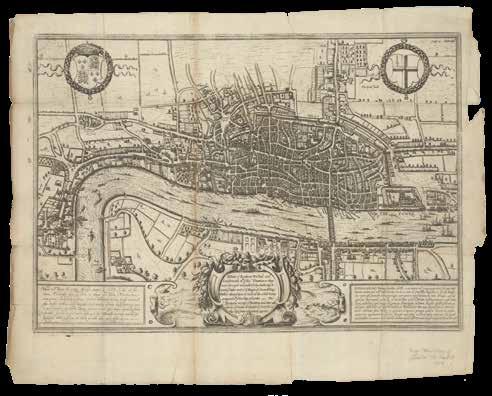
HATTON, Ed. [after. Georg BRAUN [and] Frans HOGENBURG
A Plan of London Westm[inste] r and Southwark with ye Riv[e] r Thames as they were Survey’d and publish’t by Authority toward ye latter end of ye Raign of Queen Elizabeth, or about ye year of our lord 1600, which being compared with ye New Map of London--The prodigious increase of Building and other alterations of ye names & situations of Street &c. in this last Century will plainly appear.
Publication [London, 1707-1708].
Description Double-page engraved map, some loss to right margin not affecting image.
Dimensions
330 by 484 mm (13 by 19 inches).
Scale
6.5 inches to 1 statute mile.
References Howgego 2 state 4.
Braun’s plate makes it to London
Braun and Hogenberg’s view of the city had a considerably long life, passing through the famous Amsterdam mapseller Johannes Janssonius in the 1650s, eventually being acquired by the London bookseller Edward Hatton, who published the final iteration, in his work ‘A New View of London’ (1708).
Hatton has replaced the Latin wording in the lower central cartouche with English text, and a line of text to the upper right “page 1. Introducn.”
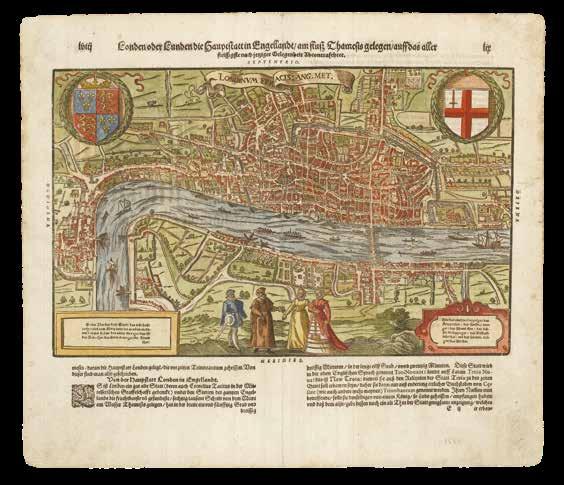
MUNSTER, S[ebastian] [after] BRAUN, Georg [and] Frans HOGENBURG
Londinum Feracis: Ang. Met.
Publication [Basel, 1598].
Description Engraving.
Dimensions 225 by 355mm (9 by 14 inches).
Scale 5 inches to 1 statute mile.
References Howgego 6 state 1.
Munster’s
This map first appeared in the 1598 edition of Sebastian Münster’s ‘Cosmographia’. It is based upon Braun and Hogenberg’s map of the city published in 1572. The title is on a swallow-tailed banderole above the map, and is flanked by the royal and City coats-of-arms. Below the map are four figures, copied from Hogenberg’s original, with two blocks of descriptive text.
Münster’s ‘Cosmographia’ on either side, first published in 1544, was one of the earliest histories of the world. It was hugely successful, running into numerous editions throughout the sixteenth and early seventeenth centuries in Latin, French, German, and English.
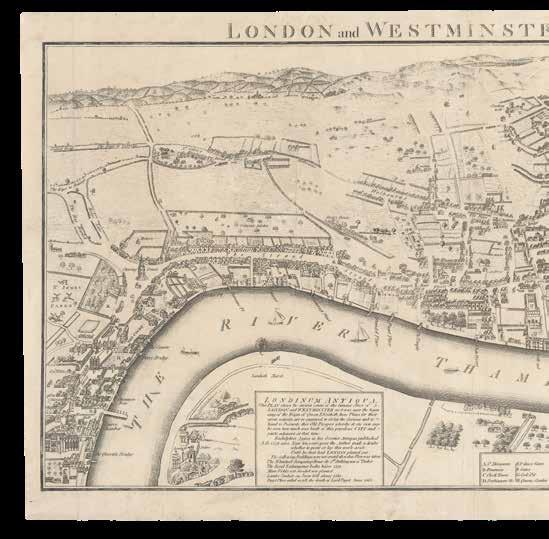
[AGAS, Ralph; attributed to]
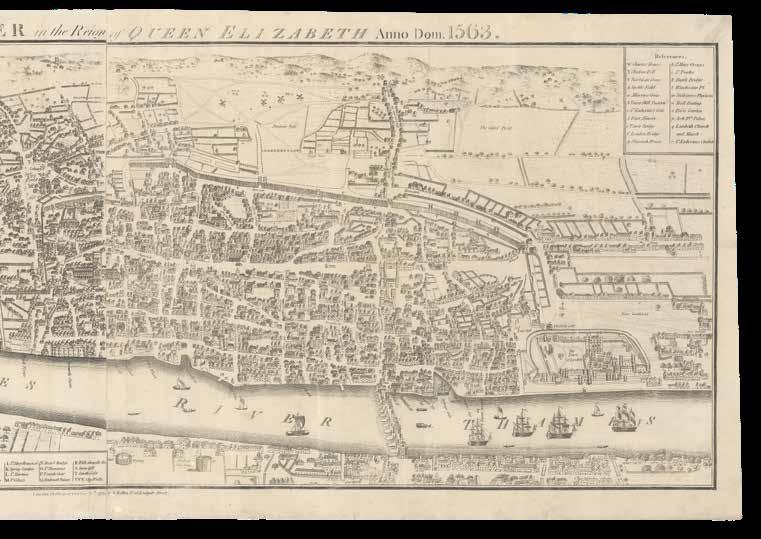
London and Westminster in the Reign of Queen Elisabeth Anno Dom. 1563.
Publication London, J. Wallis No 16 Ludgate Street, October 30th 1789.
Description Engraved map.
Dimensions 405 by 1070mm (16 by 42 inches).
References Howgego 8a.
The “Agas” map
The plan was first published by the antiquarian George Virtue, in 1737. Virtue states that the map was based on the work of Ralph Agas, a map that Virtue describes as of “great Scarcity”. There is some doubt as to whether Agas was the maker of the original plan, as Vertue is the sole source for that attribution.
The map is one of only three known printed depictions of London from the sixteenth century. It captures the City as it was developing beyond its original walls, but with farms and pastures still much in evidence nearby. Deer can still be seen in St. James Park. The major roads of entry to the city are shown and named, many of which are now-well known thoroughfares
within the city. Many streets shown in the plan also bear names familiar to us. Much of the City of London’s wall is still intact, and the Tower complex is well detailed. At the very lower left is Westminster Abbey, and just to the north is Scotland Yard, which contains a curious, smoking, dome structure, perhaps for the heating of tar for caulking ships. St. Paul’s Cathedral is shown without a steeple, which fell in 1561, offering some corroboration to Vertue’s 1560 date as the time depicted by the plan. Bear and bull baiting rings can be seen in the plan on the south bank of the Thames across from the City.
[ANONYMOUS, after Ralph AGAS]
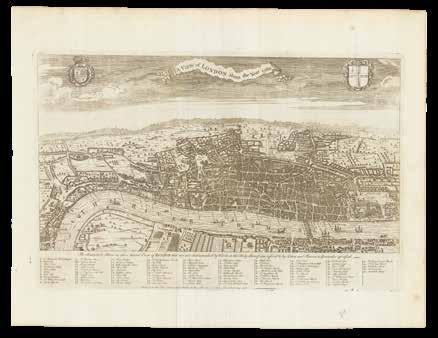
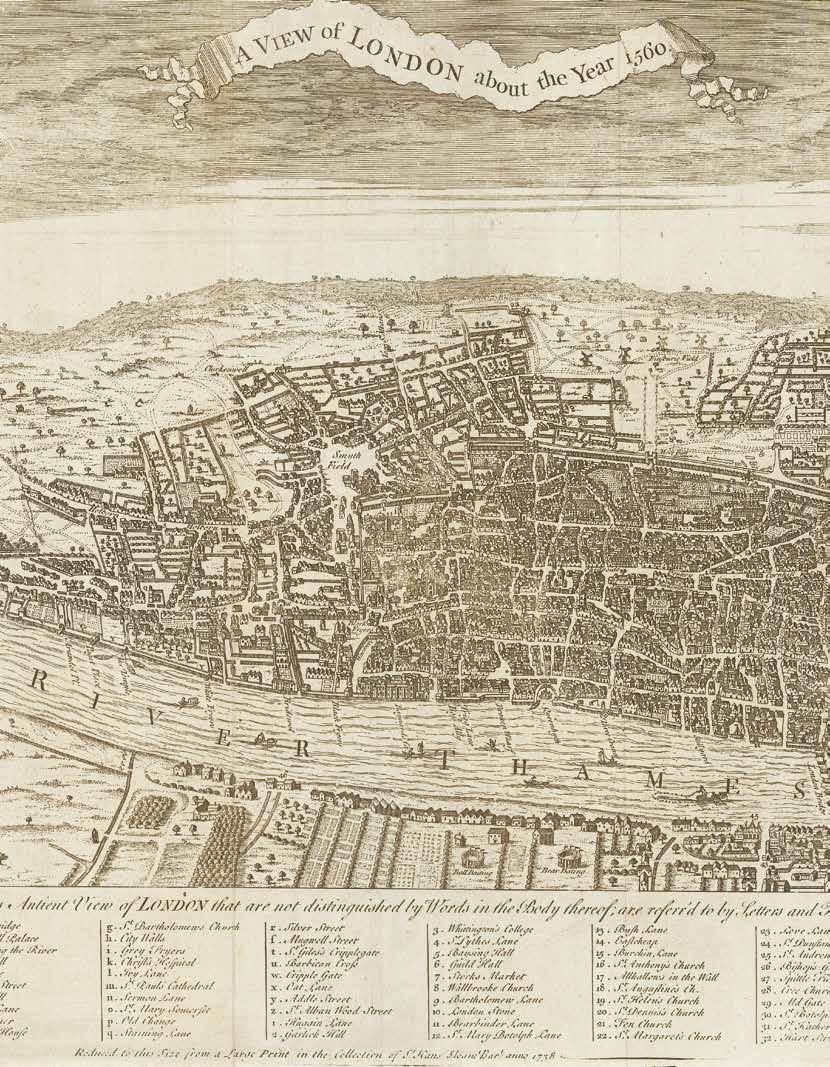
A view of London about the Year 1560.Reduced to this Size from a Large Print in the Collection of Sir Hans Sloane, Bart. anno 1738.
Publication [Probably London, 1738].
Description Engraved map, with key below.
Dimensions 305 by 475mm (12 by 18.7 inches).
Reference Howgego 8b.
This bird’s-eye-view of Elizabethan London offers a sweeping panorama of the city with incredible detail extending from Westminster Abbey to the Tower of London. In addition to notations provided of the map, the key at the bottom provides a further guide to 95 other landmarks and streets throughout the city. The bear- and bull-baiting arenas are both depicted on the south side of the Thames - precursors of the playhouses of Elizabethan playwrights such as Shakespeare.
It is likely that the source is ‘Civitas Londinium’ attributed to Ralph Agas - one of the earliest views of London alongside Braun and Hogenberg’s depiction of 1572. This map was originally printed from woodblocks around 1561, but no copies from this date survive. In the 1630s more copies were produced from the original blocks after being updated.
In the late 1730s, the artist and engraver George Vertue copied this view of London in 1560 from “an ancient print in the possession of Hans Sloane”, which was likely an early seventeenth century version of the Agas map in Sloane’s collection. Sloane went on to bequeath his notable collection to the nation in 1753 that subsequently became the founding collection of the British Museum. The present map commemorates Sloane with text below the key that reads “Reduced to this Size from a Large Print in the Collection of Sr Hans Sloane Bart anno 1738”.
This anonymous view is based on Vertue’s first of three states and served as the title plate to William Maitland’s ‘History and Survey of London From its Foundation to the Present Time’ published in 1739.
HAYWARD, Gulielmus [and] John GASCOYNE
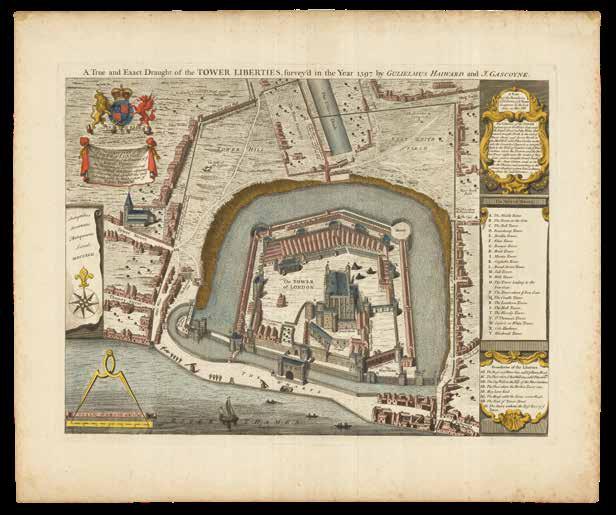
A True and Exact Draught of the Tower Liberties, survey’d in the year 1597 by Gulielmus Haiward and J. Gascoyne.
Publication London, Society of Antiquaries, 1742.
Description Hand-coloured engraving.
Dimensions 416 by 550mm (16 by 21 inches).
References B.L. Maps Crace Port. 8.42.
The Tower of London, exempt from urban control by virtue of its position as part of the Crown Lands. As a result, the area often became the centre of civil unrest, such as in 1595 when a crowd of around one thousand Londoners gathered to riot. Following this contention, the Privy Council began investigations into the precise boundaries of the Tower Liberties, and in 1597 draughtsmen William Hayward and John Gascoyne were commissioned to prepare a plan of the area.
The survey produced by Hayward and Gascoyne reflects the authorities’ agenda in funding the project, with the cartography accompanied by a wealth of written and visual information about the legal, geographical and historical standing of the Liberties. Alphabetical and numerical keys are used to identify important boundaries or sites. The Tower itself is shown in detail, with the Lieutenant’s Lodgings, the Jewel House, the Queen’s Lodgings, the Queen’s Gallery, the Privy Garden, and other landmarks clearly identified. Tower Hill stands to the northwest, with the “Posts of the Scaffold” clearly marked, while on the opposite side East Smithfield is shown as a wasteland crossed with paths. To the east a further row of houses are visible on the boundary of the Liberties, while the southern section of the draught is dominated by the Tower Wharf and the Thames, populated by boatmen and river craft. The plan’s title features along the top, with a description in a banner at top left, below the Royal Arms. The compass star is at left centre, with scale bar and dividers at bottom- and top-left.
The original manuscript plan made by Hayward and Gascoyne for the Privy Council is no longer extant, but in 1742 a printed edition was made by George Vertue for ‘Vetusta Monumenta’, a series of papers issued by the Society of Antiquaries of London between 1718 and 1906. Vertue’s work was drawn from the original plan, which had been purchased the previous year by the Duke of Montagu.
[BOWEN, Emanuel after Wenceslaus HOLLAR]
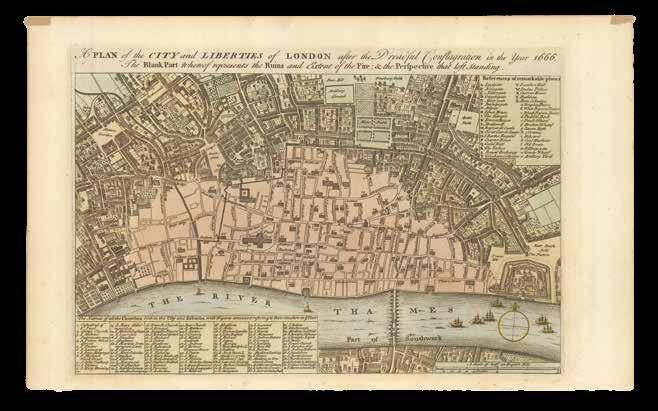
A Plan of the City and Liberties of London after the Dreadful Conflagration in the Year 1666.
Publication [London], 1756.
Description Engraving with hand-colour.
Dimensions 226 by 338 (9 by 13 inches).
Scale
c6.75 inches to one statute mile.
References Adams 51/001. Howgego 19b.
The Great Fire
This map is based on Wenceslas Hollar’s seminal map of the city ‘A Map of the Groundplot of the Citty of London...’., published in the year of the Great Fire, and recording the devastation wrought by the fire. The present plan on a somewhat smaller scale was engraved by Bowen and published in William Maitland’s ‘The History of London from its Foundation to the Present Time’ (1756).
[KNIGHT, Valentine]
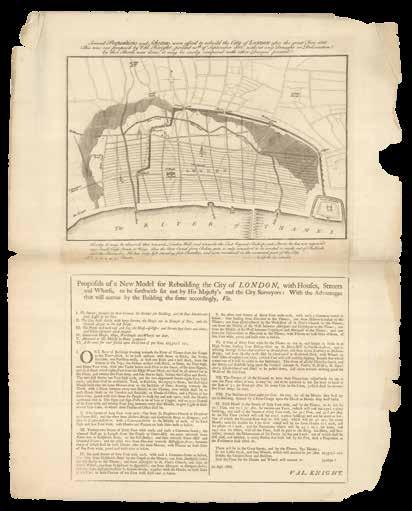
Several Propositions and Schemes were offer’d to rebuild the City of London, after the Great Fire of 1666.
Publication [London], 20 Sept. 1666.
Description
Etching with letterpress, with loss to margins not affecting image.
Dimensions 277 by 364 mm (11 by 14 inches).
References B.M. n°186 20614.1442.
Locked up for a plan
Following the Great Fire there were several plans drawn up by such luninaries as Robert Hooke, Christopher Wren, and John Evelyn, who all called for a realignment of the streets. Also among their number was Captain Valentine Knight who had fought on the Royalist side during the Civil War. Valentine’s grid system was augmented by the addition of a toll canal, the fees from which could be used to raise money for the reconstruction. Charles II was so enraged by the suggestion that he would want to “draw a benefit to himself from so public a calamity of his people”, that he briefly had Knight incarcerated.
LEAKE, John; Wencelslaus HOLLAR
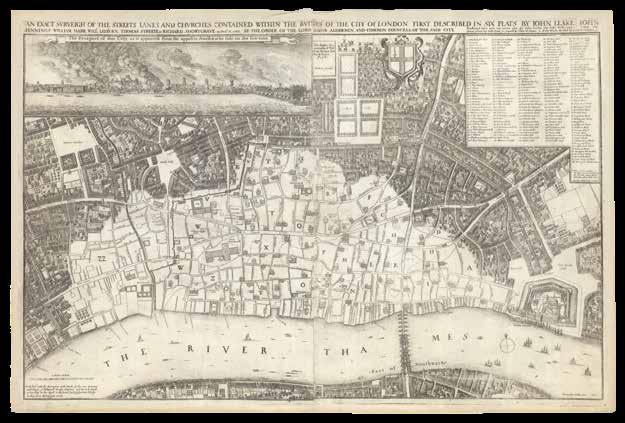
An Exact Surveigh of the Streets Lanes and Churches contained within the Ruines of the City of London. First Described in Six Plats by John Leake.
Publication [London], 1667.
Description Engraved plan, on two sheets joined, top and side remargined.
Within days of the fire’s aftermath, new street layouts were being submitted to the king by architects including Christopher Wren, Robert Hooke, and the cartographer Richard Newcourt the elder. But before any plan could be implemented, accurate surveys were needed to chart the extent of the destruction. The king commissioned Wenceslaus Hollar and Francis Sandford to survey the City, and the corporation commissioned a team of surveyors, whose results were submitted on a plan drawn by John Leake.
No example of Leake’s original plan on six sheets, mentioned in the title of the present work, has been found, with Howgego postulating that it was most likely never engraved. The present work was engraved by Wencelslaus Hollar on two sheets, and includes a prospect of the fire to the upper left, and an extensive key, listing wards, churches, and other public buildings.
[ANONYMOUS]
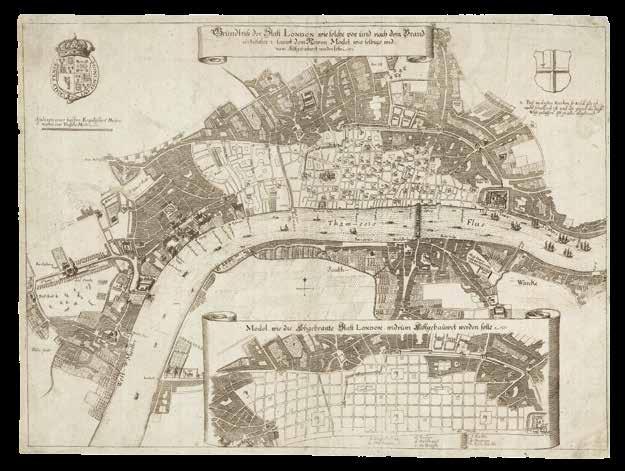
Grundtriss der Statt London wie solche vor und nach dern Brand anzuschen sampt dern Newen Model wie selbige wid rum Auffgebauwet werden solle.
Publication [Frankfurt, Merian Heirs, c1677].
Description Engarved plan.
Dimensions 315 by 430mm (12.4 by 16.93 inches).
Scale 5 inches to 1 statute mile.
References Howgego 25.
Robert Hooke’s proposed plan
Matthaüs Merian (1593-1650) was one of the best engravers of his time. When he died, his children took over his business and continued to publish his work, including the present map of London. It shows the scheme of the City after the Great Fire of London, which the Germans and the Dutch had seen as retribution on their English enemies.
Post Great Fire plans were not just published in London, with many plans produced in the Low Countries, and Germany, as here. The plan shows the extent of the fire’s destruction, with buildings numbered, though no key is present. Below the plan is Robert Hooke’s proposed layout for the reconstructed city. Like Wren and Knight, Hooke has chosen a rectalinear design. One of the overriding reasons why these types of plan never came to fruition was the vast compensation that would have to be paid to the existing landowners; who unlike their buildings survived in considerable number. The plan was published in ‘Theatri Europaei’ (1677), by Merian’s Heirs.
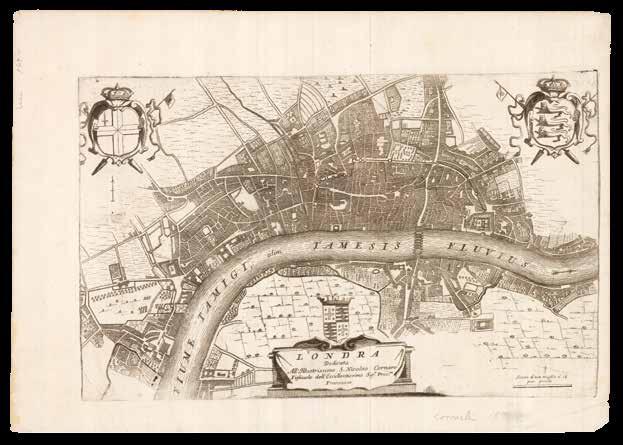
CORONELLI, Vincenzo Mario
Londra. dedicata all’illustrissimo S. Nicolao Cornaro Figliuolo dell’Eccellentissimo Sigre Procre. Francesco.
Publication [Venice], 1689.
Description Engraving.
Dimensions 565 by 420mm (22.5 by 16.5 inches).
Scale 4 inches to 1 statute mile.
References Howgego 37.
A Venetian View
The plan is flanked by the arms of the City of London to the left, and the Royal Standard to the right. Below the plan is the title and dedication to Nicolao Cornaro, a leading member of the Venetian aristocracy. The title is surmounted by another coat-of-arms. Whose arms they are is uncertain, however, they are probably those of Cornaro. The only placename to appear on the plan is that of the River Thames.
The plan was published in Coronelli’s rare ‘Citta, fortezze, isole, e porti principali dell’Europa in pianta...’ in Venice 1689.
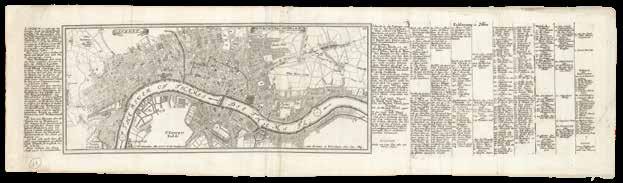
BODENEHR, Gabriel Londen, Westminter and Southwark.
Publication [Augsburg, Gabriel Bodenehr, c1720].
Description Engraved plan on two sheets joined, extensive key to right.
Dimensions 201 by 757mm (8 by 30 inches).
Scale 4.5 inches to 1 statute mile.
References Howgego 57.
“Die
Haupt-Statt von Engelland”
A German plan of the city by Grabriel Bodenehr, distinguished by the extensive text to the left and right of the plan, which contains a brief history of the city together with a key to public buildings, streets, and stairs. The present plate is the second state of the engraving, the first made under John Striedbeck, and this one twenty years later in 1720 by Gabriel Bodenehr.
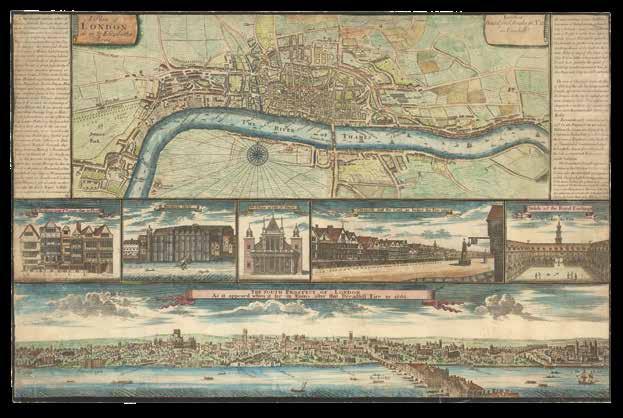
BOWLES, Thomas [after Ralph AGAS]
A plan of London as in Q. Elisabeth Days. The South Prospect of London as it appeared when it lay in the Ruins after that Dreadful Fire in 1666.
Publication
London, John Bowles at Black Horse in Cornhill, 1723.
Description
Hand-coloured engraved plan, with five inset views, and a prospect below.
Dimensions 355 by 545mm (13.98 by 21.46 inches).
A fine separately published map and propsect of the city as it appeared during the reign of Elizabeth I and after the destruction caused by the great fire. Published by John Bowles in 1726, the view of the west facade of St Paul’s Cathedral, which includes the renovations made by Inigo Jones, is based on the 1658 engraving by Wenceslaus Hollar. The view of Cheapside and the Cross is copied from a work by Callo.
The view of Baynards Castle records the keep as it stood before the fire, when Elizabeth I was entertained by the Earl of Pembroke with dinner and fireworks.
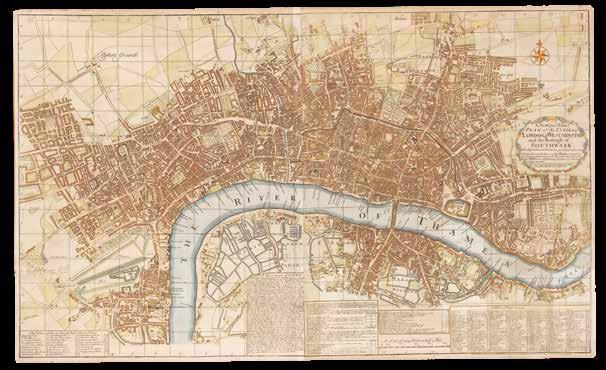
[SMITH, Joseph]
A New and Exact Plan of the Cities of London & Westminster and the Borough of Southwark with all additional New Buildings to the present year 1725.
Publication
London, J. Smith, next to Fountain Tavern in the Strand, 1725.
Description
Engraved plan on two sheets, joined, handcoloured, laid down.
Dimensions
594 by 982 mm (23.38 by 38.66 inches).
Scale
10 inches to 1 statute mile.
References
B.M. M, 23.2-3 ; Adams 1983, London Illustrated 1604-1850: a survey and index of topographical books and their plates (22.14); B.L. Maps.Crace II. 84; Howgego 71 state 2.
I don’t go south of the river
The plan bears grid lines for ease of reference; the title appears to the right of the plan in a fine cartouche. Many of the most prominent public buildings are shown in elevation, including Lincoln’s Inn, St Paul’s, Temple, Somerset House, and Burlington House. The plan shows much of the new West End development including Grosvenor Square, Mount Street, and Cavendish Square. Below the plan is a description of London, watermen and hackney coach rates, and a list of important public buildings and streets with their grid reference. The rates for watermen are given for both “oars” (a two man boat) or Sculls (single man); the hackney cabs are said to number 800 and are allowed to “Ply in London” and “Bills of Mortality”, all licenced cabs bear a number on the coach door.
This edition appears in Joseph Smith’s edition of the ‘Nouveau Theatre de la Grande Bretagne’, Vol. III, the title page of which bears the date 1724.
ROCQUE, John
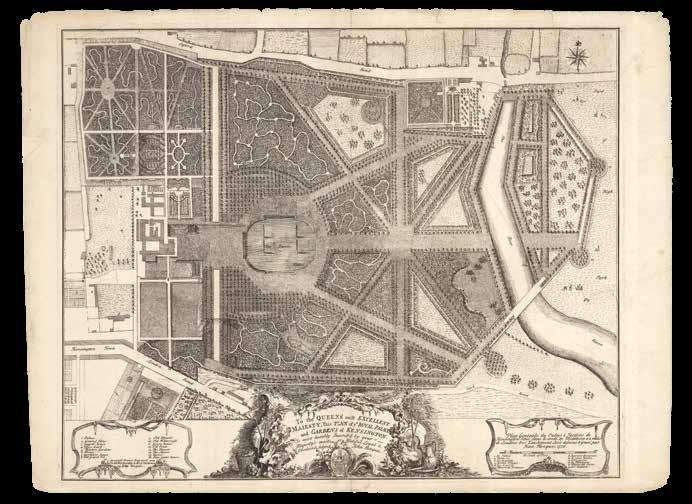
To the Queen’s most Excellent majesty, this plan of the Royal Palace and Gardens of Kensington. His most humbly inscrib’d by your Majesty’s most Dutiful Loyal & Obedient subject John Rocque. [title repeated in French].
Publication John Rocque, [1736].
Description Engraving.
Dimensions 530 by 660mm (21 by 26 inches).
References
B.L. Maps Crace Port. 10.1.
Queen Caroline’s Place
Kensington Palace was originally the suburban residence of Lord Chancellor Flinch, Earl of Nottingham, and it was known as Nottingham House. It was set in a large deer park that Henry VIII used for hunting. In 1689 the house was bought by William III who turned it into Kensington Palace. The building was enlarged from designs by Sir Christopher Wren; the gardens, under the instruction of Queen Mary, were landscaped by royal gardeners and were transformed with paths and flower-beds at right angles, in formal Dutch patterns, so as to make William feel at home.
It wasn’t until 1727, when Queen Caroline moved into the palace, that the Dutch gardens were replaced by the current Charles Bridgman design, which included the round pond, the Broad Walk and the Temple Lodge, as well as the planting of several thousand trees. The gardens were opened on Saturdays to anyone who was respectably dressed.
Rocque’s plan shows the full extent of the work implemented by Queen Caroline on the gardens. It also shows the grand mansions along Kensington Gore and the buildings along the High Street and Church Lane. Rocque, a French Huguenot, emigrated with the rest of his family to London in the 1730s, where he began to ply his trade as a surveyor of gentlemen’s estates, and with plans of Kensington Gardens, and Hampton Court. He is most famous for his magisterial 1746 survey of the city of London, which took nine years to produce.
WHITEWORTH, Robert
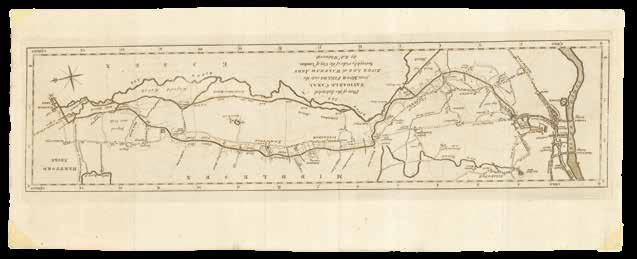
Plan of the Intended Navigable Canal from Moor Fields into the River Lee at Waltham Abby.
Publication [London, 1773].
Description Engraved map.
Dimensions 147 by 522 mm (5.78 by 20.55 inches).
Canal Mania
During the decades spanning the end of the eighteenth and the beginning of the nineteenth centuries, a phenomenon known as Canal Mania, manifested itself as a period of intense canal building and accompanying speculative frenzy. An early advocate of the canal was Robert Whitworth, who in 1773 published a report proposing plans for a new canal to ease the Thames traffic in central London. Encircling North London and so altogether bypassing the Thames, his proposed channel would run from the Lee Navigation at Waltham Abbey to a basin at Moorfields. A further waterway would leave this basin for Marylebone to form a connection with another canal to Drayton. Whitworth’s canal would largely follow the natural contour of the land, meaning that locks could be avoided.
Whitworth’s plan never became a reality, due to intransigence of the River Lee Trustees.
VERTUE, George after John FISCHER
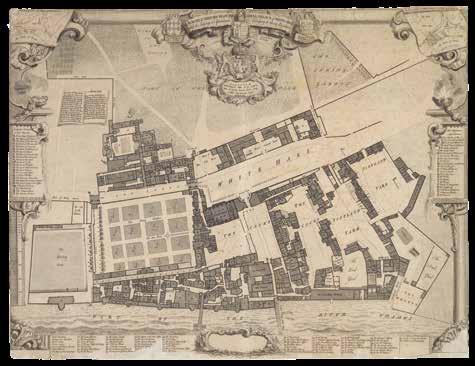
A Survey & Ground Plot.
Publication [London, 1747].
Description Engraved plan.
Dimensions 537 by 696 mm (21.14 by 27.40 inches).
References Royal Collection Trust n°RCIN 703082.
A reissue of John Fisher’s 1680 survey of Whitehall, showing Scotland Yard, Horse Guards, and the River Thames. At the upper corners are small plans of the Archbishop of York’s palace at Westminster and the old Palace of Whitehall in 1698. The title-cartouche is held up by the crests of Hubert de Burgh, Earl of Kent, Walter Grey, and Cardinal Wolsey, both Archbishops of York. Together, they represent the history of the site before it became Whitehall. Hubert de Burgh was an Angevin nobleman who was one of the guarantors of the Magna Carta, and defeated an invading French fleet at the Battle of Goodwin Sands in 1217. He had a mansion on the site in the 1230s. The land was sold to Walter Grey, possibly to raise money for the Crusades, who in turn made it the official residence of the Archbishops of York, gifting it to the diocese. It remained their seat until Cardinal Wolsey became Archbishop. After his fall, Henry VIII took York Place as his official London residence, renaming it Whitehall. The royal arms are underneath, with an acknowledgement of Henry’s ownership.
In the plan itself, the various apartments are numbered, with a key at the bottom showing who they belong to.
The plan is dedicated to William Bentinck, 2nd Duke of Portland, in whose possession the original survey was, according to an inscription at the lower edge. George Vertue (1684-1756) was an engraver and antiquary, whose patron was Margaret Bentinck, Duchess of Portland, who presumably enabled Vertue to copy the survey.
ROCQUE, John; Richard PARR
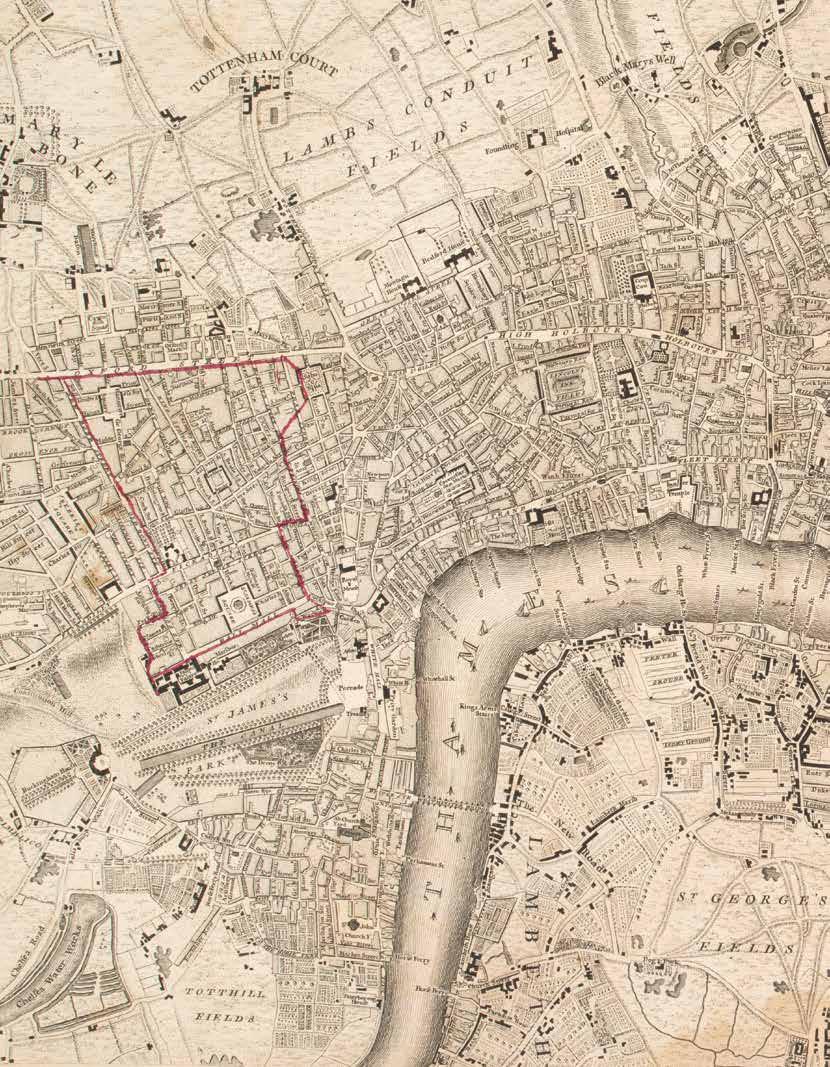
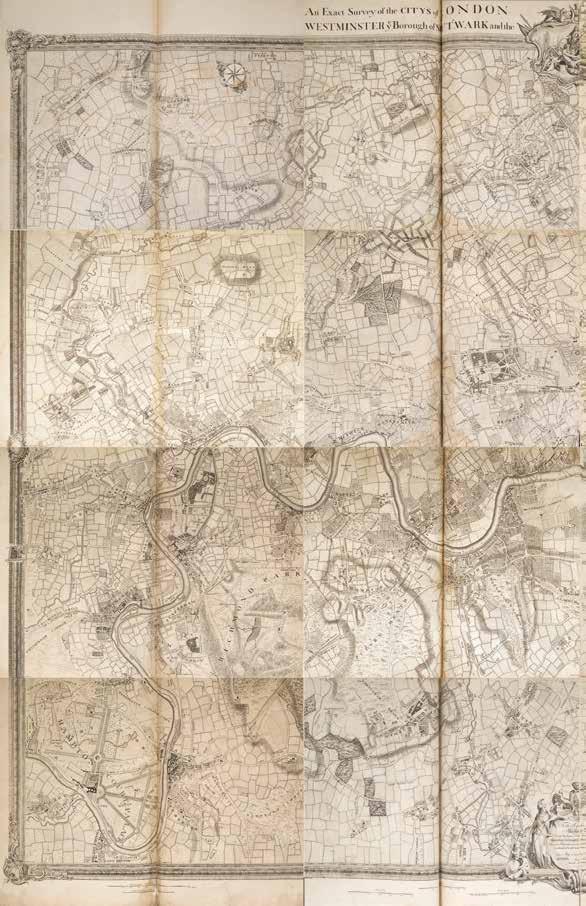
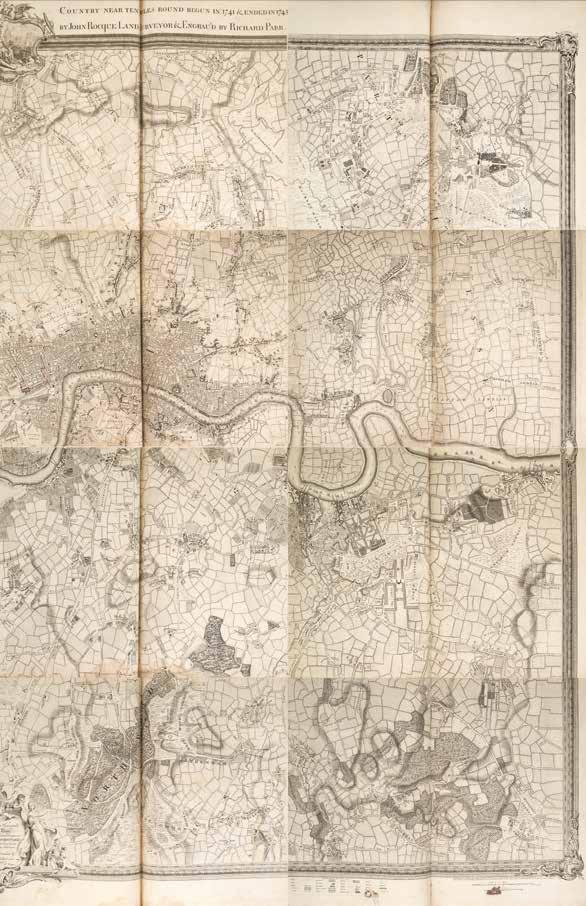
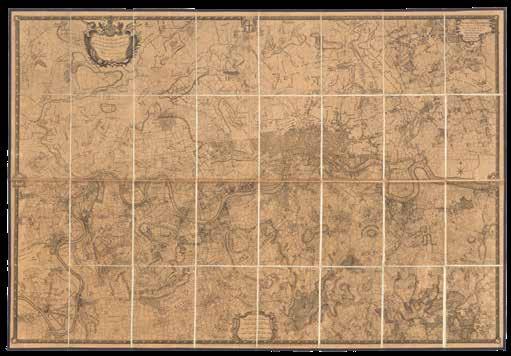
An Exact Survey of The City’s of London, Westminster ye Borough of Southwark and the Country Near Ten Miles Round Begun In 1741 & Ended In 1745.
Publication London, W. Edwards, 1747.
Description Folio (510 by 360 mm), title, list of subscribers and index, engraved map on 16 sheets, minor dampstaining to lower gutter, St James’s and Mayfair marked in red outline, later half-calf over marbled paper boards, title on red morocco label to spine, gilt.
Scale 5.5 inches to 1 statute mile.
References Howgego 94 (2).
Rocque’s Great Survey of Greater London
One of the finest maps of - what is now - Greater London ever produced. It would appear that John Rocque, a French Huguenot, emigrated with the rest of his family to London in the 1730s, where he began to ply his trade as a surveyor of gentlemen’s estates, and with plans of Kensington Gardens, and Hampton Court. However, in 1737 he applied his surveying skills to a much great task, that of surveying the entire built-up area of London. Begun in the March of 1737, the map would take nine years to produce, eventually being engraved upon 24 sheets of copper and published in 1746. Whilst engaged upon this project Rocque was also working on the present map of the country ten miles round London, and on a scale of 51/2 inches to the mile, or one quarter of the scale of the large survey. The completed map was published in 1746. The present map is Howgego state 2 with a few minor changes to the plates including the addition of White Chapel Mount, and ‘Mile End Old Town’, and ‘Mile End New Town’.
ROCQUE, John; Richard PARR
An Exact Survey of The City’s of London, Westminster ye Borough of Southwark and the Country Near Ten Miles Round Begun In 1741 & Ended In 1745.
Publication London, W. Edwards, 1748.
Description
Folio (530 by 390 mm), title, list of subscribers and index, engraved map on 16 sheets, later red half-calf over marbled paper boards, title to spine gilt.
Scale
5.5 inches to 1 statute mile.
References Howgego 94 intermediate state between (4) and (5).
Priests Bridge
The present example is an intermediate state between (4) and (5), with the addition of William Edward’s imprint and the date of 1748 to the title page, but with the New and Old King’s Roads not yet marked in Hyde Park, though ‘Peace Bridge’ in Barnes Common has been changed to ‘Priests Bridge’.
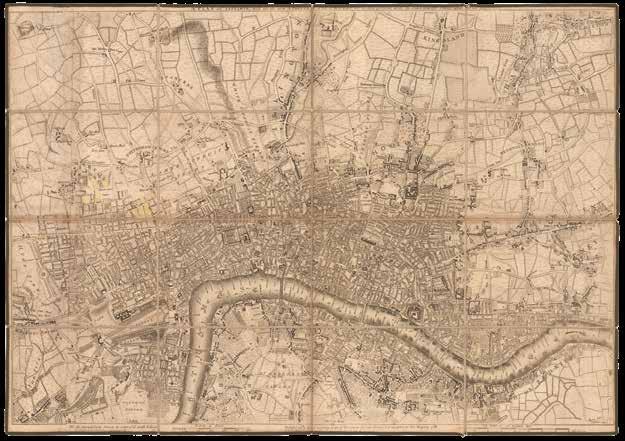
ROCQUE, John
A Plan of London, with all the new Streets, Lanes, Raods, &c. to this present year, by John Rocque Topographer to His Majesty.
Publication London, M. Rocque, 1766.
Description
Engraved plan, partially coloured, dissected and mounted on linen, edged in green silk folding into red marbled paper slipcase, with manuscript label.
Dimensions 510 by 750mm (20 by 29.5 inches).
Scale 5.5 inches to 1 statute mile.
References c.f. Howgego 94.
The Heart of Rocque’s Plan
The map is taken from the central secction of John Rocque’s 16-sheet survey of London 10 miles round. Following the death of John Rocque, in 1762, the business was carried on by his widow Mary Anne, who would have several of the old plates re-engraved and repurposed, as here. A title has been added, Blackfriars bridge is shown, as is the proposed road across St George’s Fields. Note that the new buildings and roads are highlighted in yellow.
The first Blackfriars Bridge was designed in the Italianate style by the architect, Robert Mylne. Consisting of nine semi-eliptical arches, and built in Portland Stone, it would take 9 years to complete, opening to the public in 1769.
Rocque’s Great Plan of Georgian London
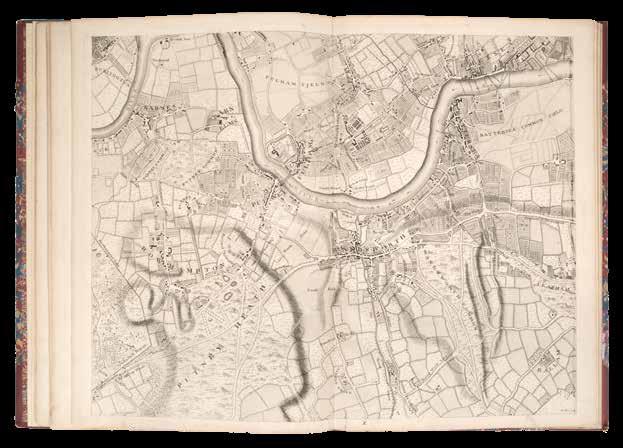
ROCQUE, John
A Plan of the Cities of London and Westminster and Borough of Southwark, with the contiguous Buildings. From an Actual Survey taken by John Roque, Land Surveyor and engraved by John Pine.
Publication
London, John Pine and John Tinney, 1746.
Description
Folio (530 by 400mm), engraved key-map, and 24 engraved maps, each interleaved with a sketch map of the city from the mid 1860s, some very minor offsetting, original tree calf boards, pannelled and richly gilt, spine rebacked to style, gilt with red morooco label.
Scale
26 inches to 1 statute mile.
References Howgego 96 (1).
In 1737, Rocque applied his surveying skills to a great task, that of surveying the entire built-up area of London. Begun in March of 1737, upon a scale of 26 inches to one statute mile, the map would take nine years to produce, eventually engraved upon 24 sheets of copper and published in 1746. The plan stretches west to east from Hyde Park to Limehouse and north to south from New River Head to Walworth. The map was supported by both the Royal Society and the City of London Corporation, and was carried out using the most accurate surveying techniques of the time. In accordance with his aim for accuracy, Rocque has dispensed with the threequarter or bird’s-eye-views, and gives us instead an elegant plan with rococo flourishes for the border and the three cartouches that adorn the bottom of the map. The work abounds with information, including public buildings, churches, chapels, almshouses, workhouses, hospitals, lunatic asylums, parks, pleasure gardens, squares, bridges, docks, fields, and lakes. The work was published by John Pine and John Tinney.
John Pine (?1690-1756), who also engraved the work, was generally agreed to be the finest engraver of his day. Apprenticed to the silver engraver John Roy Arnold in 1709, he was a friend of William Hogarth. John Tinney (d.1761) was, like Pine, an engraver, and is now best known as the teacher of other fine English engravers such as John Browne, Anthony Walker, and William Woollett.
This example contains the “contracted sketch of the Plan of London ... to show the General Appearance of the Whole; for use of those who bind it in a book”, and each sheet is interleaved with a sketch map of the area covered by Rocque’s plan from around 1865. Charing Cross station is marked (1864) but the Thames Embankment has yet to be completed.
ROCQUE, John
A Plan of the Cities of London and Westminster and Borough of Southwark, with the contiguous Buildings. From an Actual Survey taken by John Roque, Land Surveyor and engraved by John Pine.
Publication London, [c1770].
Description Folio (530 by 400mm), engraved key-map, engraved map on 24 sheets, minor soiling, last sheet torn with loss, skilfully repaired, stab-bound.
Scale 26 inches to 1 statute mile.
References Howgego 96 (4).
A later state with extensive erasures. The roads across St. George’s Fields, Brackfriars Bridge, the King’s Bench Prison in its new position, the removal of the starlings from London Bridge, and the site of the Adelphi are shown, among other amendments. This a most probably a proof state before extensive re-engraving to the erased parts were carried out.
DANIEL CROUCH RARE BOOKS
LONDON: THE ROGER CLINE COLLECTION (MAPS I)
JEFFERYS, Thomas
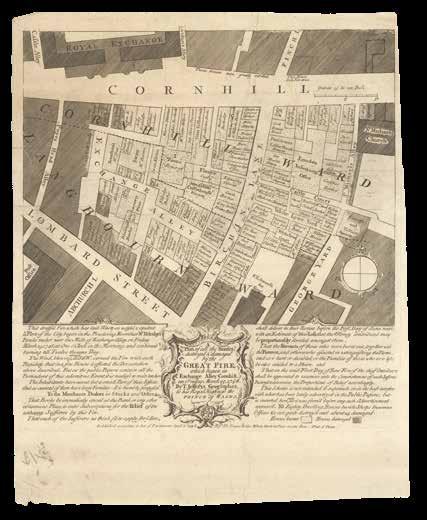
A Plan of all the Houses destroyed & damaged by the Great Fire which begun in Exchange Alley Cornhill on Friday March 25, 1748.
Publication London, M. Payne at the White Hart in Pater Noster Row, April 2, 1748.
Description Engraved plan.
Dimensions 242 by 305mm (9.52 by 12 inches).
References
B.L. n° Maps Crace Port. 8.56.
Fire in Exchange Alley
Separately published plan of Cornhill recording the damage done by the fire of 1748. The fire began at Mr. Eldridge’s a Perriwig-Maker in Exchange Alley, and consumed almost 100 houses before it was brought under control. It would be one of the worst fires to beset London since the Great Fire of 1666. The plan’s historical importance lies in the record it gives on the actual names of the various shops and trades caught up in the fire. The text below provides information on where the survivors might seek compensation for their loss.
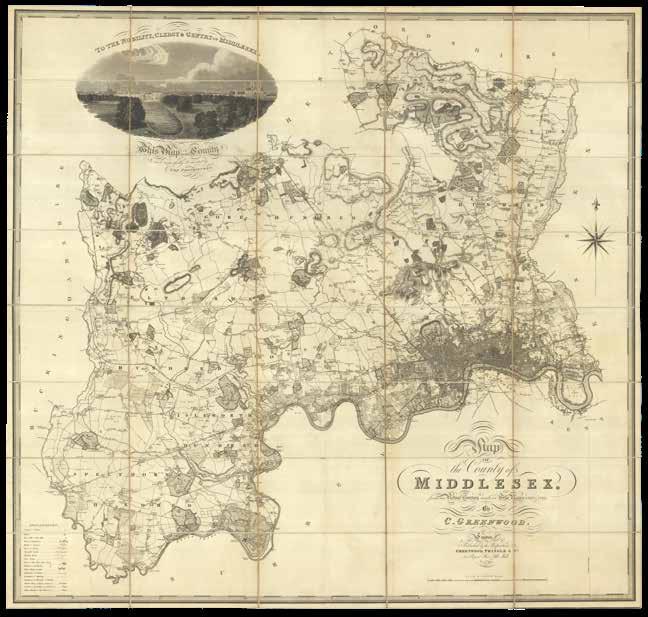
Rocque’s large-scale map of Middlesex
ROCQUE, John
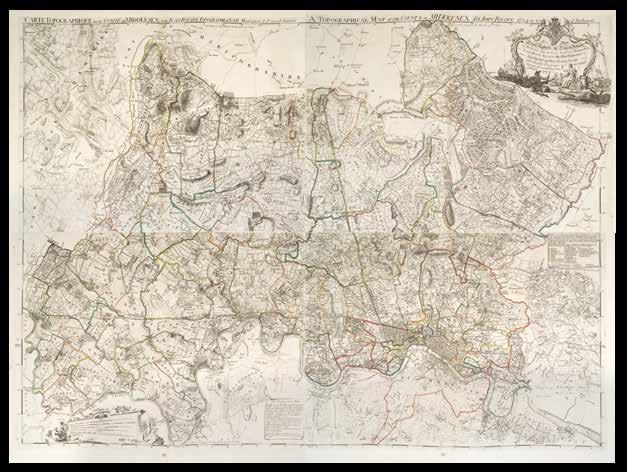
A Topographical Map of the County of Middlesex [together with:] Map of the County of Middlesex Reduced…
Publication London, John Rocque, 1754 and 1757.
Description Folio (595 by 520 mm), engraved reduction used as key sheet, large engraved map on four sheets, all sheets hand-coloured in outline, original half-calf over red marbled paper boards, rubbed, title on red morocco label to spine, gilt.
Scale 2 inches to 1 statute mile.
The map extends from Staines in the west to Leytonstone and from Harefield in the north to Kingston-upon-Thames in the south. To the upper centre is a fine title-cartouche with depictions of a Georgian surveyor holding a waywiser, and a putti using a plane. The text to the upper right gives details on the extent of the county, and of London, which is said to be 6 and a half miles in length, 2 and a half in breadth, and has a circumference of 8 and a half miles or 5455 acres.
Rocque’s rare 8 sheet plan of the city
ROCQUE,
John
A Plan of the Cities of London and Westminster, the Borough of Southwark, and the Contiguous Buildings; with all the New Roads…
Publication
London, John Pine, Thomas Bowles, & John Tinney, 1755.
Description Folio (530 by 320 mm), engraved map, on eight sheets, each mounted on linen, modern quarter calf over brown buckram boards.
Scale 13 inches to 1 statute mile.
References Howgego 103 (1).
Rare reduction on eight sheets of John Rocque’s monumental plan of Georgian London. Published six years after, in 1755, the map is here in its first state with the imprint of Pine, Bowles, and Tinney.
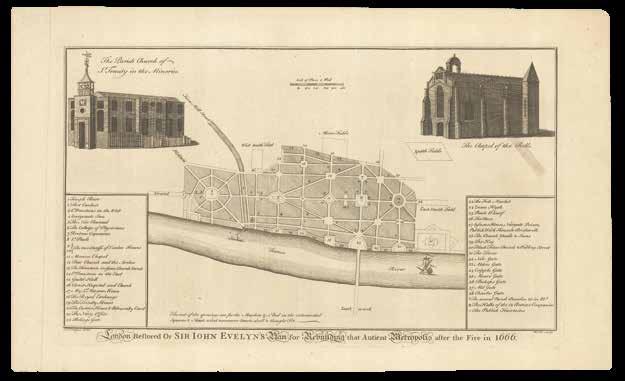
COLE, B. [after] John EVELYN
London Restored or Sir John Evelyn’s Plan for Rebuilding that Ancient Metropolis after the Fire in 1666.
Publication [London, c1756].
Description Engraving.
Dimensions 206 by 350 mm (8 by 13.75 inches).
Italianate London
John Evelyn, like Christopher Wren and Robert Hooke were among the architects and draughtsmen who submitted plans for the rebuilding of London after the Great Fire, proposing variations on a grid plan, with broad streets, squares and piazzas; similar to cities in Italy. In the event, due largely to robust property laws, the majority of property owners having survived the fire, and most importantly a lack of money, London rose from the ashes along more or less its old lines. The present engraving comes from William Maitland’s ‘The History and Survey of London From Its Foundation to the Present Time’.
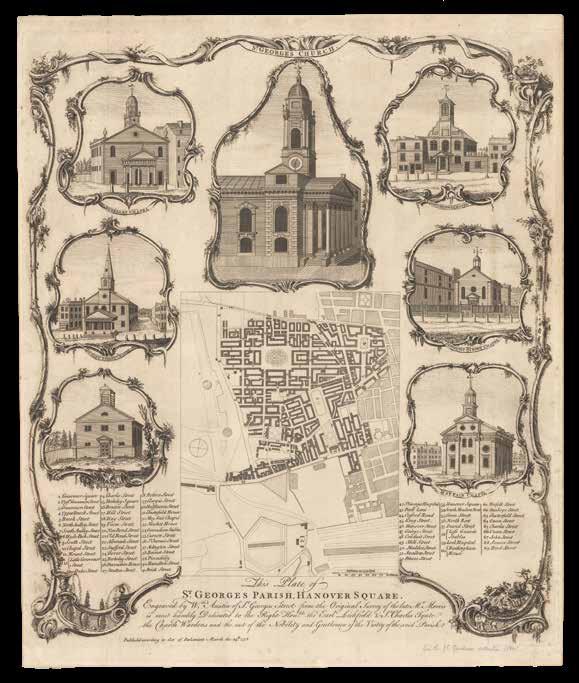
The plan bears a great deal of rococo decoration which not only encloses much of the map, but also the seven views of the parish churches and chapels of ease. Above the plan is a view of St. George’s Hanover Square; to the left views of Berkeley Chapel, Audley Street Chapel, and Chelsea Chapel, and to the right Knightsbridge Chapel, Conduit Street Chapel, and Mayfair Chapel. Below is a key together with a scale-bar, the imprint, and a dedication.
St. George’s Church was built in 1721-4 to the designs of John James and at a cost of £10,000, as one of fifty churches projected by Queen Anne’s Act of 1711. The parish for the new church was carved out of St. Martin-in-the-Fields and covered what are now the areas of Mayfair, Belgravia and Pimlico. The church itself was the site of many high-profile weddings, including those of the future American President Theodore Roosevelt and the architect John Nash. George Frederick Handel was a frequent worshipper at St. George’s, which is now home to the annual Handel Festival.
Audley Street Chapel, now Grosvenor Chapel, was built in 1730-31 by Benjamin Timbrell, and was where American servicemen worshipped during World War II. It is mentioned in John Summerson’s Georgian London: “The chapel-of-ease in South Audley Street is, externally, an unattractive building in brown brick and stone, though the interior has merit... It is very much a craftsman’s church... it is more like some of the churches of Maine, Connecticut and Massachusetts than the other London churches of the time”. Berkeley Chapel, which dates from around 1750, was pulled down in 1907 and replaced with Charles House.
Knightsbridge Chapel began as a chapel on Knightsbridge Green attached to a leper hospital founded by Westminster Abbey. The chapel was rebuilt in 1629, again in 1699, and renovated again in 1789. A new church, Holy Trinity Knightsbridge, was erected on its site in 1861. In 1901 it was demolished and rebuilt on a new site in Prince Consort Road, where it is still open.
Conduit Street (or Trinity) Chapel, is built on the site of a wooden field chapel built by James II. It was conveyed on wheels to wherever the king travelled, to be used for his private masses. In 1686 it was in his camp at Hounslow Heath, where it stayed until some time after the Revolution. It was then removed to Curzon Street, where it was later rebuilt in more durable materials and used as a chapel by the neighbouring inhabitants. The chapel was demolished in 1875. Mayfair (later named Curzon) Chapel was first erected in 1730, and was the location of numerous clandestine marriages, before the Marriage Act of 1753, including those of the Duke of Chandos and Mrs. Anne Jeffrey in 1744. The chapel was pulled down in 1899 and replaced by Sunderland House, built for the 9th Duchess of Marlborough.
Extremely rare; we are only able to trace one institutional example, in the British Library.
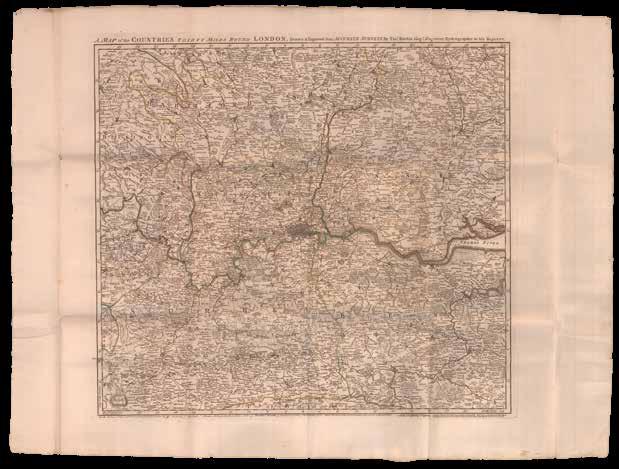
KITCHIN, Thomas
A Map of the Countries (sic) Thirty Miles Round London Drawn & Engraved from Accurate Surveys.
Publication London, T. Kitchin, 1758.
Description
Engraved map, hand-coloured in outline, folding into marbled slip case, with publisher’s label, defective.
Dimensions 465 by 525mm (18.25 by 20.75 inches).
Scale
1 inch to 3 satute miles.
References Howgego 110 (1).
The Penny Post
This map highlights the reach of the Penny Post, which had been re-established by an Act of Parliament in 1765; its extent is marked in red. A graphic key along the lower margin of the map identifies features such as towns and villages, close roads, open roads, churches, the seats and stately homes of nobility and gentlemen, parks, wind mills, and water mills. The imprint indicates that the map was printed simultaneously but separately by a number of mapmakers, being sold by Kitchin, Sayer, Carington Bowles, and Parker during the eighteenth century.
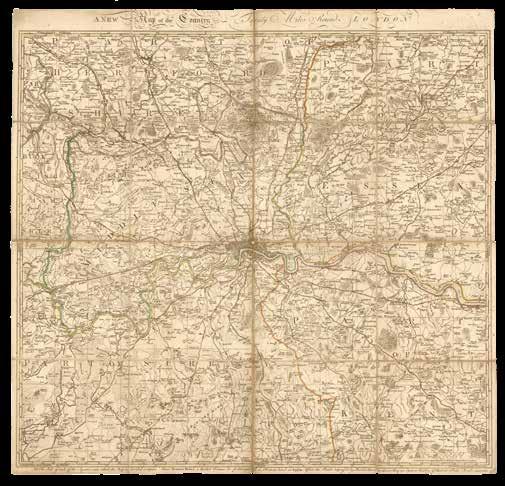
BOWLES, Carington
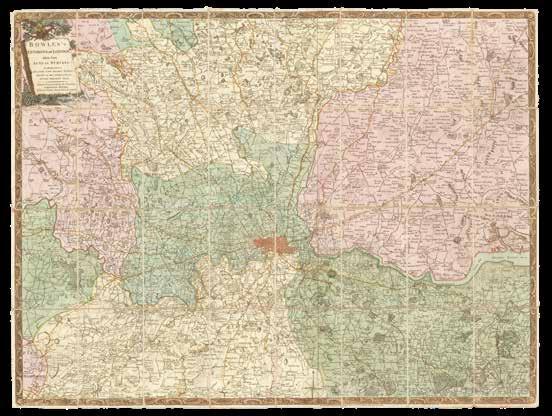
A New Map of the Country Twenty Miles Round London.
Publication London, Carington Bowles, 1770.
Description Engraved map, dissected and mounted on linen, some minor staining to verso, with manuscript label.
Dimensions 560 by 520mm (22 by 20.5 inches).
Scale (approx.) 1 inch to 2 statute miles.
References Howgego 116 (1).
Published in Chamberlain’s ‘A New and Compleat History and Survey of the Cities of London and Westminster’ (1770), this map extends outwards from London’s urban centre. Demand for cartographical representation of the city’s environs had increased alongside the introduction of turnpike roads and growing coach-traffic in and out of the capital. Symbols represent churches, hills and other architectural or geographical landmarks, while market towns are identified by stars and estates are labelled with their owners’ names.
JEFFREYS, Thomas
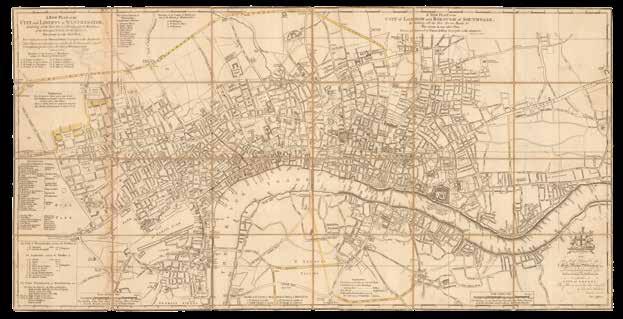
A New Plan of the City and Liberty of Westminster, Exhibiting all the New Streets & Roads, with the Residences of the Principal Nobility, Public Offices &c. not Extant in any other Plan.
Publication London, Thomas Jeffreys, 1766.
Description
Two engraved maps, hand-coloured in outline, joined and dissected and mounted on linen, minor stains at folds.
Dimensions
465 by 900mm (18.25 by 35.5 inches).
Scale 6.75 inches to one statute mile.
References Howgego 122 (2).
Companion Plans
These two companion plans exhibit a great deal of detailed information. Jefferys’s boast that much of the information was “Not extant on any other Plan” is in many ways borne out by the numerous tables, which contain information on the Great Offices of State, such as the master of the horse and the Board of Green Cloth; the Chief Magistrates of Westminster; and, most interestingly, the Parishes in Surrey and Middlesex which were in and outside the boundaries of the Bills of Mortality. The Bills of Mortality were set up at the end of the sixteenth century, in response to an outbreak of the plague. They initially recorded the number of deaths upon a weekly basis, however by the time of the publication of the map the bills included baptisms, cause of death and age of the deceased. The plan also shows the newly built Westminster and Blackfriars Bridges, together with the new roads. The Savoy is marked (later the site of the hotel) as belonging to the Duchy of Lancaster. The Duchy then, as now, is used to provide income for the British monarch.
ROCQUE, Mary Ann
The Environs of London Reduced from an Actual Survey in 16 Sheets, by the Late John Rocque, topographer to His Majesty with New Improvements to the Year 1763. To the Right Honorable George Montague Earl of Cardigan, Baron Brudenell &c. This Plan of the Environs of London Is humbly dedicated By His Lordship’s most humble & obliged servant, Mary Ann Rocque.
Publication London, Mary Anne Rocque, 1763.
Description Engraved map, dissecetd and mounted on linen, evenly age-toned.
Dimensions 940 by 1355mm (37 by 53.25 inches).
Scale 2.5 inches to one mile.
References Howgego 124 (1).
Rocque’s widow continues the business
This fine plan is a reduction of John Rocque’s monumental survey of London upon 16 sheets. The map bears the name of Rocque’s widow, Mary Ann, who continued his map publishing business. The plan also bears the imprint of Carington Bowles, to whom Mary would transfer much of the business at some time around 1769. Blackfriars Bridge, completed in the same year, is here shown under construction.
London in your pocket
SAYER, Robert
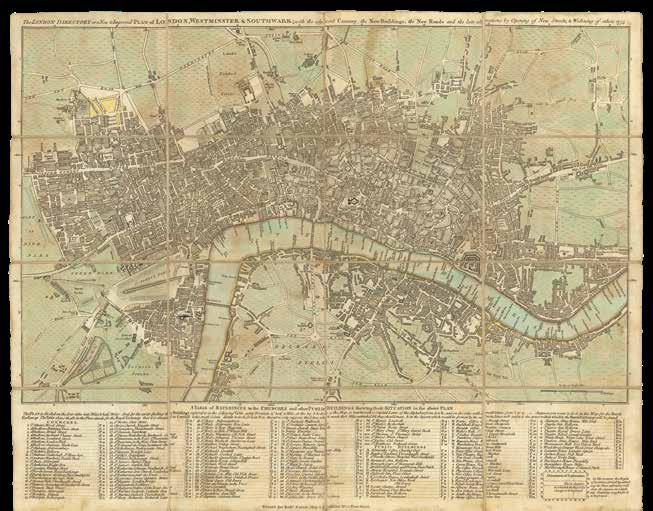
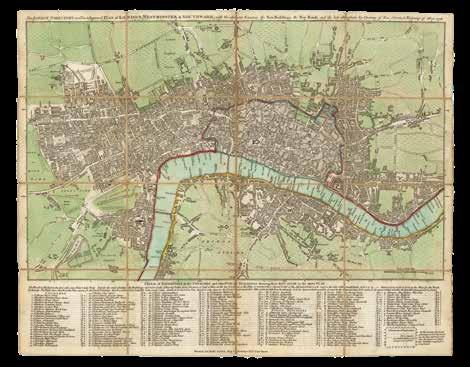
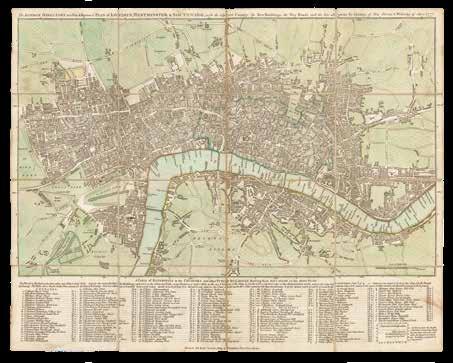
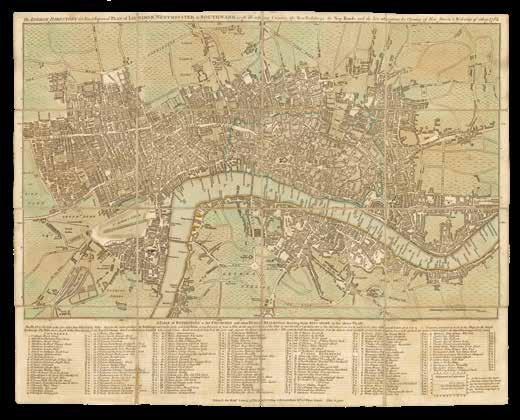
The London Directory, or a New & Improved Plan of London, Westminster and Southwark with the adjacent Country, the New Buildings, the New Roads and the late alterations by Opening of New Streets & Widening of others.
Publication London, Robert Sayer & J. Bennett, 1775.
Description Engraved plan, hand coloured, dissected and mounetd on linen, folding into red marbled paper slipcase, with publisher’s label.
Dimensions
390 by 500mm (15.25 by 19.75 inches).
Scale
4 inches to 1 statute mile.
References Howgego 138 (2).
Towards the end of the eighteenth century, London based mapmakers, such as Robert Sayer, and the Bowles family, began producing maps that were dissected and mounted on linen, usually housed in a slipcase, that could easily be stowed in a gentleman’s coat pocket. These proto-A to Zs, aided the local and tourist in navigating their way round a city, whose size and scope had boomed over the preceding century. To aid the traveller, Sayer has not only added a key to below the plan (listing some 103 churches and 57 public buildings), but provided each with a grid reference. So new was the system, that Sayer provides a “Geometric Explanation” at the end of the key.
508 SAYER, Robert
The London Directory, or a New & Improved Plan of London, Westminster and Southwark with the adjacent Country, the New Buildings, the New Roads and the late alterations by Opening of New Streets & Widening of others.
Publication London, Robert Sayer & J. Bennett, 1776.
Description
Engraved plan, hand-coloured in outline, dissected and mounted on linen, slipcase with publisher’s label, rubbed.
Dimensions 390 by 500mm (15.25 by 19.75 inches).
Scale 4 inches to 1 statute mile.
References Howgego 138 (3).
SAYER, Robert
The London Directory, or a New & Improved Plan of London, Westminster and Southwark with the adjacent Country, the New Buildings, the New Roads and the late alterations by Opening of New Streets & Widening of others.
Publication London, Robert Sayer & J. Bennett, 1777.
Description
Engraved plan, hand coloured in outline, dissected and mounted on linen, folding into faded purple marbled paper slipcase, rubbed.
Dimensions
390 by 510mm (15.25 by 20 inches).
Scale 4 inches to 1 statute mile.
References Howgego 138 - intermediate state between (3) and (3a).
The date in imprint has been changed to 1776, but not changes have been made to the map.
This 1777 edition bears no changes from previous states apart from date.
SAYER,
Robert
The London Directory, or a New & Improved Plan of London, Westminster and Southwark with the adjacent Country, the New Buildings, the New Roads and the late alterations by Opening of New Streets & Widening of others.
Publication London, Robert Sayer & J. Bennett, 1782.
Description Engraved plan, original hand colour,dissected and mounted on linen, folding into faded purple marbled slipcase.
Dimensions 390 by 515mm (15.25 by 20.25 inches).
Scale 4 inches to 1 statute mile.
References Howgego 138 - intermediate state between (6) and (7).
New streets and houses shown between Oxford Street and the New Road Paddington, in Marylebone.
Is that a map in your pocket?
BOWLES, Carington
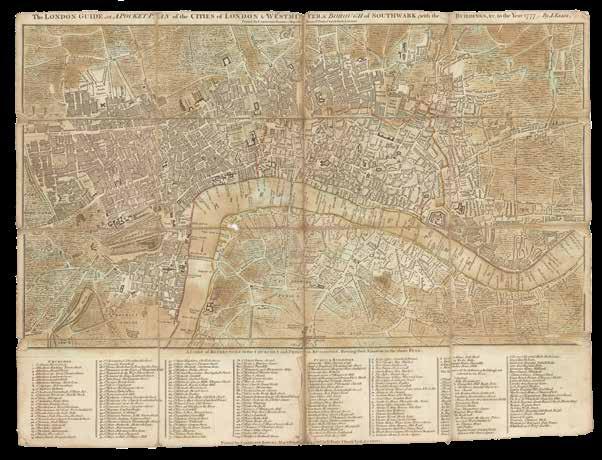
The London Guide, or A Pocket Plan of the Cities of London & Westminster & Borough of Southwark, with the buildings, &c. to the Year 1777.
Publication London, Carington Bowles, 1777.
Description
Engraved plan, hand-coloured, dissected and mounted on linen, some staining, wear to folds, and a small hole to centre of map, original marbled paper slipcase, rubbed.
Dimensions
390 by 515mm (15.25 by 20.25 inches).
Scale 4.5 inches to 1 statute mile.
References Howgego 141 - this state not listed.
Like Robert Sayer’s plan (item 507), the Bowles family of mapmakersthe present plan is published by Carrington Bowles - began producing portable guides to the city. Bowles’s title not only references it as a guide but also a “Pocket Plan”. Judging by the size of most of the “pocket plans” - when folded and in a slipcase - Georgians clearly had significantly larger pockets, than contemporary tourists. As with other plans of this time it bears an extensive key with grid references, and an explanation on how to use it to quickly find the relevant buildings.
KITCHIN, Thomas
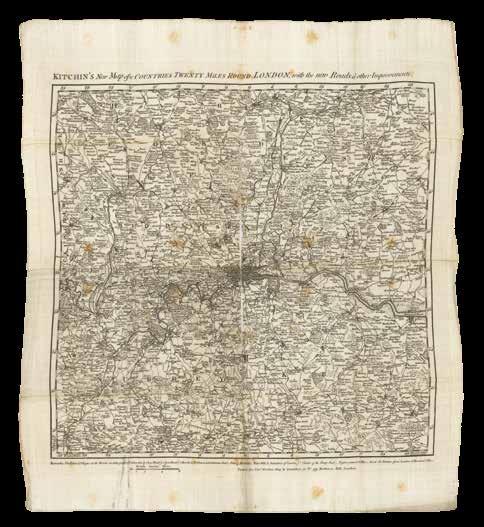
Kitchin’s New Map of the Countries Twenty Miles Round London with the new Roads & other improvements.
Publication London, Thomas Kitchin, [c1770].
Description Engraved map, printed on silk, significant tear to old folds.
Dimensions 360 by 380mm (14.25 by 15 inches).
Scale 1 inch to 3 statute miles.
References Not in Howgego.
Turnpike Mania
Kitchin’s rare map of London and its environs, printed on silk and showing Blackfriars Bridge (1769) but not yet Battersea Bridge (1772), indicating a publication date of around 1770.
Thomas Kitchin’s map of London and her environs, stretches some 25 miles from the city centre, to encompass the surrounding counties, and the rapid roll-out of new roads, which greatly aided the movement of goods and people in and out of London. The number and condition of the roads serving London, had markedly improved over the eighteenth century, due in main to the explosion in turnpike or toll road construction. The roads, that required a fee to use, meant that they were adequately maintained, and provided a source of revenue. So popular were the roads, that some 11.500 miles were constructed between 1750 and 1772. The period would become known as “Turnpike Mania”.
BOWLES, Carington
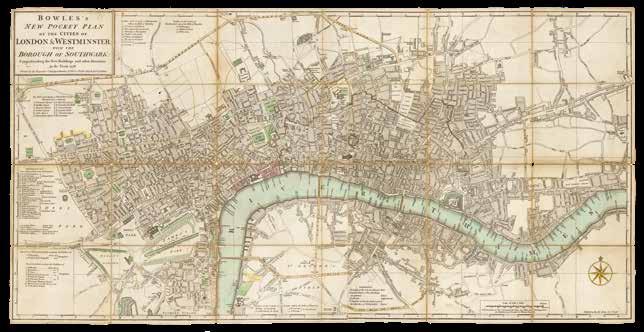
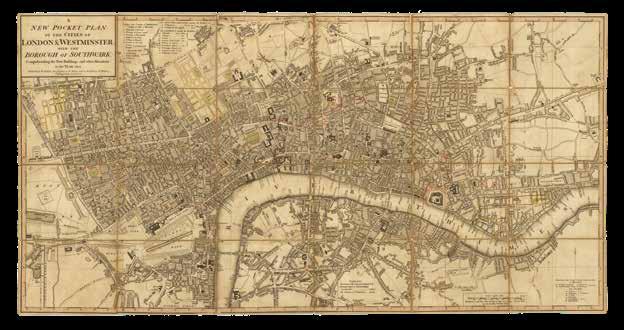
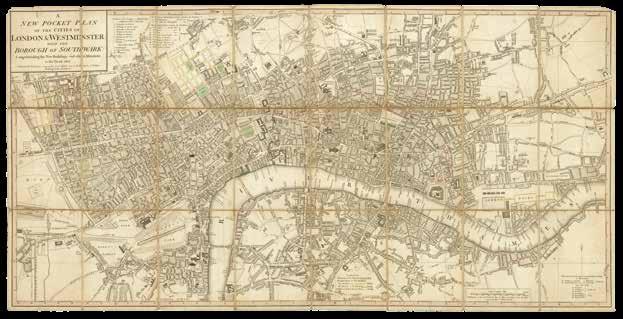
Bowles’ New Pocket Plan of the Cities of London and Westminster with the Borough of Southwark comprehending the New Buildings and other Alterations to the Year 1778.
Publication London, Carington Bowes, 1788.
Description Engraved plan, hand coloured in outline, dissected and mounted on linen, folding into blue marbled paper slipcase.
Dimensions
450 by 910mm (17.75 by 35.75 inches).
Scale 6.5 inches to 1 statute miles.
References Howgego 147A (6a).
New Roads marked in Yellow
‘Comprehending the New Buildings and other Alterations to the Year 1788’, this map extends from Lamb’s Conduit in the north to Tothill Fields in the south. It is an altered version of the map first issued in 1770 as ‘The Traveller’s Guide through London, Westminster and Borough of Southwark, with their Liberties’, and is the first edition with the new title, which would appear on many maps up until its final edition in 1794. Surrounding the plan are several keys, marking the Liberties, and Parishes that make up London, such as Westminster, and The City of London, together with the Great Offices of State, in Whitehall, Scotland Yard, and St James’s Palace. An explanation to the bottom of the plan, notes that the limits of the City are coloured red, with the new buildings under construction, light brown, and the new roads are marked in yellow.
The Foundling Hospital
BOWLES, John
The London Directory, or a New & Improved Plan of London, Westminster and Southwark with the adjacent Country, the New Buildings, the New Roads and the late alterations by Opening of New Streets & Widening of others.
Publication London, R. Wilkinson, 1789.
Description
Engraved plan, hand-coloued in outline, dissected and mounted on linen, folding into blue marbled paper slipcase, with publisher’s label, rubbed.
Dimensions
390 by 510mm (15.25 by 20 inches).
Scale
4 inches to 1 statute mile.
References Howgego 153 (3a).
On this 1789 edition of Bowles’ map of London, river and parks are hand coloured. Like Bowles’s previous plan of the city (see item 511), it bears an extensive key with grid references, and an explanation in how to use it to find a quick way round the metropolis.
One of the most prominent buildings on the plan is that of the Foundling Hospital, in its original position, just northeast of the British Museum. The hospital was founded in 1739, for the “education and maintenance of exposed and deserted young children”. By the time that the present plan was published, the hospital had become a fashionable cause, with funds being raised by the likes of William Hogarth, and concerts performed by Handel in the hospital’s chapel.
Alas the high mortality rate of the admitted children can be seen by the large “burial ground” to the rear of the hospital.
Bowles and Andrew’s map
BOWLES, Carington
Bowles’ Environs of London taken from Actual Surveys exhibiting all the new roads, parks, seats of Nobility &c. to the present year.
Publication London, Carington Bowles, [c1785?].
Description
Engraved plan, fine full wash handcolour, dissected and mounted on linen, with decorative title and border, minor separation from linen back, original marbled paper slipcase, with publisher’s label, rubbed.
Dimensions 630 by 840mm (24.75 by 33 inches).
Scale (approx.) 1 inch to 2 statute miles.
References Howgego 154 (3).
This map of what is now Great London, was first published by Carington Bowles and Andrew Dury in 1771. Subsequent editions of the map omit Dury’s name from the title as here; as Dury had by this time begun to work with John Andrews on several large-scale works of his own, including ‘A Map of the County Sixty-Five miles round London’.
The British Museum
BOWLES, Carrington
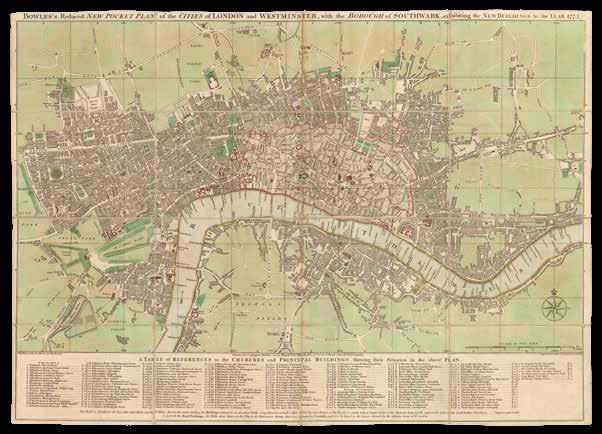
Bowles’s Reduced New Pocket Plan of the Cities of London and Westminster with the Borough of Southwark, exhibiting the New Buildings
Publication
London, Carington Bowles, 1773.
Description
Engraved map, hand coloured, dissected and mounted on linen, folding into red marbled paper slipcase, with publisher’s label.
Dimensions
380 by 540mm (15 by 21.25 inches).
Scale 4 inches to 1 statute mile.
References Howgego 158A (1).
First state of this plan by Carrington Bowles, extending from Islington to Shadwell. Below the plan is a list of principal buildings and churches. The plan is divided into squares lettered along the margins in order to aid reference. The built up areas in the City are stippled, whilst the other buildings are hatched.
To the north of Great Russell Street the British Museum (marked “Brit. Musaeum”), is shown. Founded in 1753, the museum moved into Montagu House, it’s first premises, in 1759. The trustees had contemplated using Buckingham House, but rejected it on the grounds of cost and the unsuitability of its location.
The
ANDREWS, John; [and] Andrew DURY
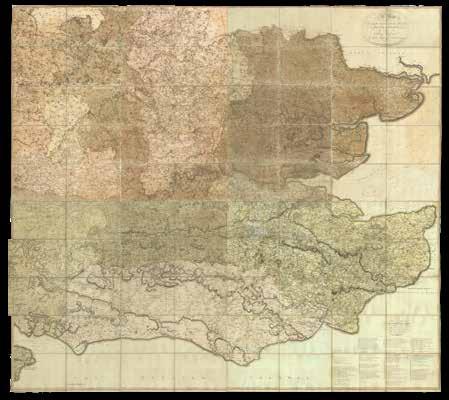
A Map of the County Sixty-five miles round London, from Actual Surveys by John Andrews & Andrew Dury.
Publication London, John Andrews and Andrew Dury, 1777.
Description Engraved map, hand-coloured, on 20 sheets, dissected and mounted on linen in 4 sections, housed in modern quarter-calf sollander box, over marbled paper boards, red morocco label to spine, gilt.
Dimensions (each sheet) 475 by 650 mm by 650mm (18726.5 by 25.5 inches).
Scale approx.) 1 inch to one statute mile.
References Howgego 160 (1) .
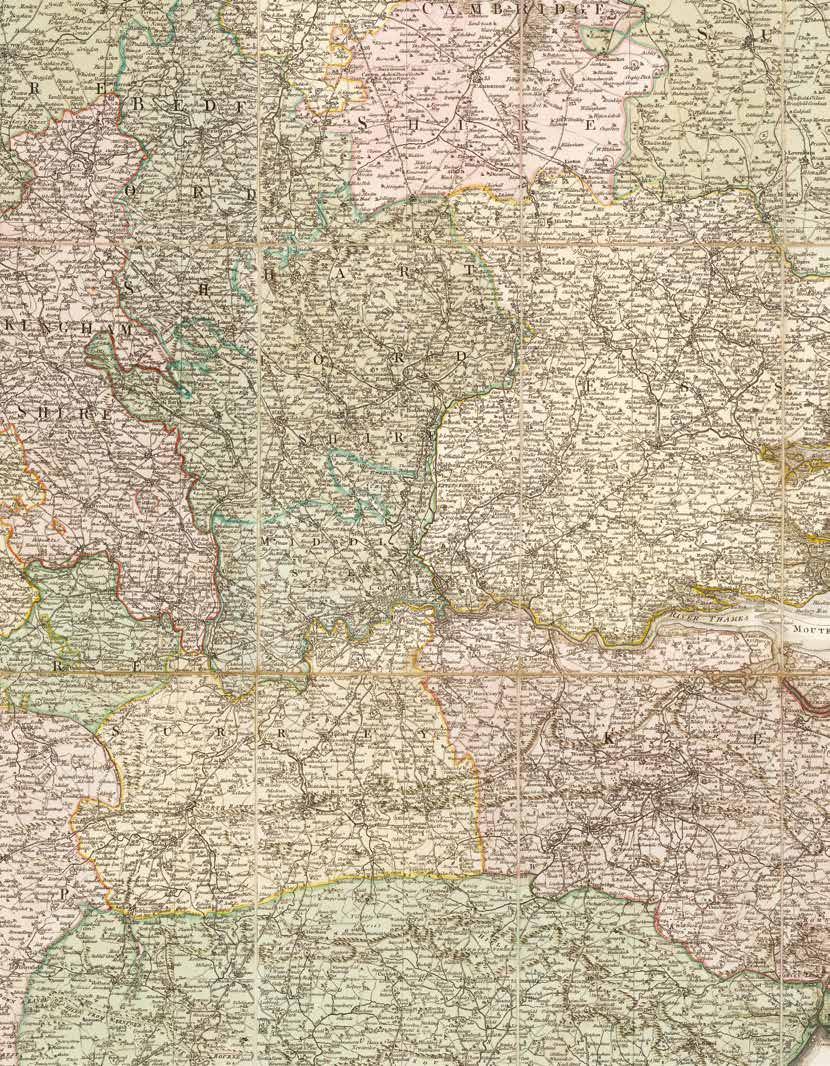
Andrews and Dury’s monumental map of the country 65 miles round the capital, encapsulating the whole of the Southeast, from Bedford in the north to the Isle of Wight in the south, and Newbury in the west to Margate in the east. Although the map is just shy of the scale of an inch to the mile that the Ordnance survey would use, it does show off the pair’s mapmaking skills that had been honed during the production of the large-scale county maps of Wiltshire, Hertfordshire and Kent.
BOWEN, M[aurice]
A Topographical survey of the Country from Thirty-Five to Forty Miles, Round London.
Publication London, Sayer and Bennett, 1775.
Description
Engraved map, hand-coloured in outline, dissected and mounted on linen, folding into red marbled paper slipcase with publisher’s label.
Dimensions 510 by 570mm (20 by 22.5 inches).
Scale
1 inch to 4 statute miles .
References Howgego 161.
Maurice Bowen’s Map
The map was engraved by Maurice Bowen (fl 1772-1775), son of the prolific mapmaker Emanuel Bowen. His working life was extremely brief and only a handful of maps are attributed to him. A key below the plan marks cross and open roads, gentlemen’s seats, parks, windmills, and watermills.
KITCHIN, Thomas
A New and Correct Plan of the Cities of London, Westminster and Borough of Southwark wherein all the Streets, Roads, Churches, Public Buildings & c. to the Present Year 1773 are exactly Delineated.
Publication London, T. Kitchin. 1773.
Description
Engraved plan printed on silk, large tear to upper part of central fold, a few minor spots.
Dimensions
435 by 685mm (17.25 by 27 inches).
Scale
5 inches to 1 statute mile.
References
Howgego 163 - this example pre-dates by two years the examples listed.
The Sun Fire Office
Extending from Islington Green in the north to Newington Butts in the south, and from Knightsbridge in the west to Shadwell in the east. To the upper left of the plan is a list of Great Offices of State, Public Buildings, Westminster Parishes, Liberties of said parishes, and the districts of the City of London and Westminster.
One of the more interesting public buildings named is the “Sun Fire Office” on Craig Street. The Sun Fire Office, had been set up by a group on insurers, in 1710, and by the latter half of the eighteenth century had become one of the largest insurers in Great Britain. The firm continues to this day, as the Royal & Sun Alliance Insurance Group.
ANDREWS, John; [and] Andrew DURY
A New Travelling Map of the Country Round London Extending from North to South 190 Miles and from East to West 150 Miles.
Publication
London, J. Andrews & A. Dury, 1776.
Description Engraved map, fine original hand-colour, dissected and mounted on linen, folding into original purple marbled paper slipcase, with publisher’s label, rubbed.
Dimensions 990 by 1250mm (39 by 49.25 inches).
Scale 1 inch to 4 statute miles.
References Howgego 165 (1).
Going Down to London
John Andrews and Andrew Dury were responsible for three large scale eighteenth century county surveys: Hertfordshire 1766, Kent 1769, and Wiltshire in 1773. In 1776, they also produced a “travelling map” for journeys to and from London. The map covers the vast region from Birmingham down to the south coast, and from Bristol to Lowestoft.
The London Cabbie
CARY, John
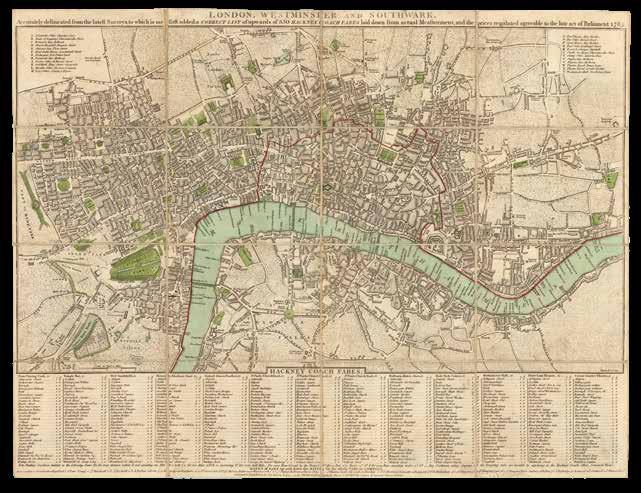
London, Westminster and Southwark Accurately deliniated from the latest Surveys, to which is now first added a Correct List of upwards of 350 Hackney Coach Fares.
Publication London, J. Cary, 1785.
Description
Engraved plan, hand-coloured in outline, Hackney Coach fares below, dissected and mounted on linen, folding into red marbled paper slipcase, with publisher’s label, rubbed.
Dimensions
410 by 550mm (16.25 by 21.75 inches).
Scale
4 inches to 1 statute mile.
References Howgego 173 (4).
CARY, John
London, Westminster and Southwark.
Publication London, J. Wallis, 1786.
Description Engraved plan, with hand colour, dissected and mounted on linen.
Dimensions 420 by 500mm (16.5 by 19.75 inches).
Scale
4 furlongs for half mile.
References Howgego 173 (5).
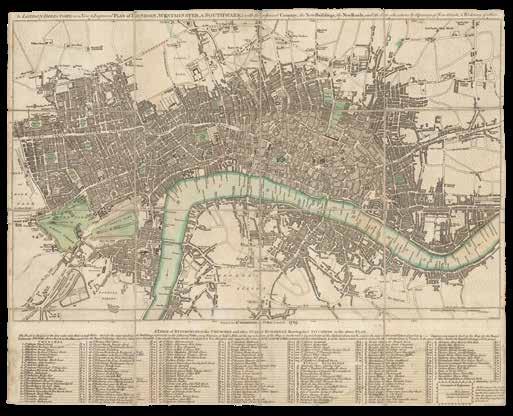
This map of London gives “Upwards of 350 Hackney coach Fares laid down by actual Measurement, and the prices regulated agreeable to the late act of Parliament 1786”. By the Act, the coachmen were allowed to charge by either time or distance: for 1s you could travel a mile and a quarter, or spend three-quarters of an hour in a cab. Anyone found exceeding the rates laid down were liable to be fined and summoned before the Hackney Coach Office at Somerset Place. The plan also gives the “rates of oars” up and down the Thames. The earliest recorded state of this map was issued in 1782, the present example having been published three years later.
John Cary (1754-1835) was a London based cartographer active in the early part of the nineteenth century. Ronald Vere Tooley, the prominent English map historian, writes of Cary, “As an engraver he was elegant and exact with fine clear lettering and great delicacy of touch”. Cary began his work as an engraver, cartographer, and globe maker in 1776 with his ‘New and Correct English Atla’s. This important atlas represented a new phase in cartography where accuracy and detail rose in prominence over the decorative embellishments of the eighteenth century. This change was indicative of the times when travel and commerce were expanding globally as never before. Cary’s mastery of both engraving and cartography resulted in a series of seminal works that redefined mapmaking in the early nineteenth century. His ‘New Universal Atlas’, published in 1808, set the standard for all cartographers who followed. Cary reissued this seminal atlas in 1811, 1819, 1824, 1828, 1833, 1836 and 1844. Cary also did considerable work on the English Ordinance Survey prior to 1805. His cartographic work particularly inspired the Edinburgh school of cartography as represented by John Pinkerton and John Thomson. In America, Cary’s work was used as the basis for Tanner’s important ‘New American Atlas’. Cary’s last published atlas appeared posthumously in 1844, however, by 1850 Cary’s work was being carried on by his sons and other well-known cartographers including James Wyld, John Tallis & Company, and Crutchley”.
The plan bears no changes from the previous example apart from the date in the imprint.
WALLIS, John
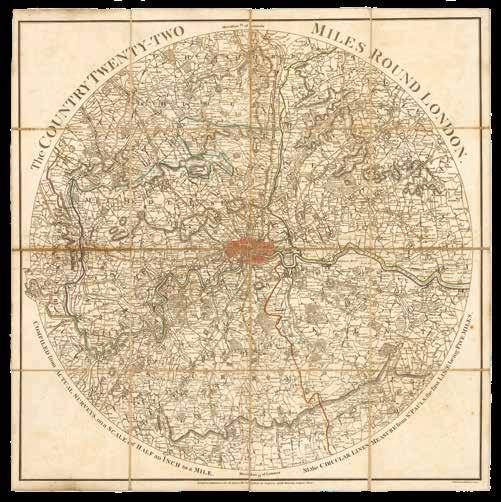
The Country Twenty-Two Miles Round London.
Publication London, John Wallis, 1783.
Description Engraved map, original hand-colour, minor foxing, dissecetd and mounted on linen, blue marbled paper slipcase, with publisher’s label on slipcase, rubbed.
Dimensions
600 by 600mm (23.5 by 23.5 inches).
Scale 1 inch to 2 statute miles.
References Howgego 176 (1).
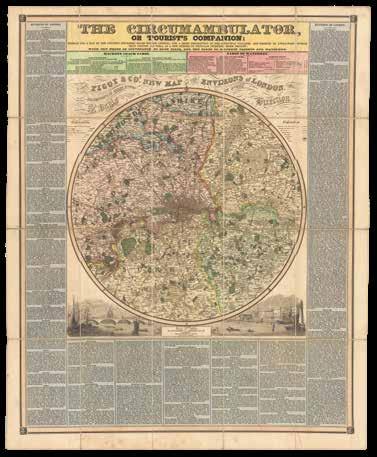
A Circular Map
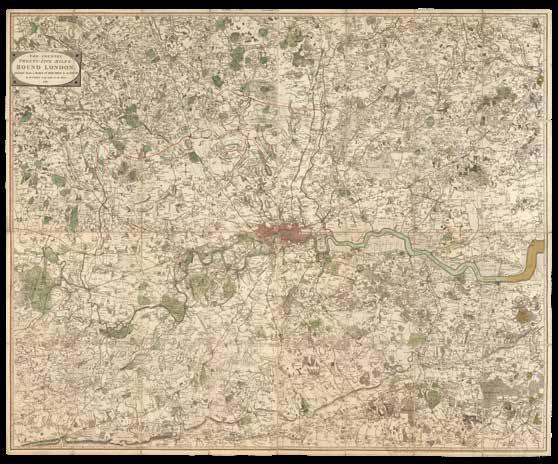
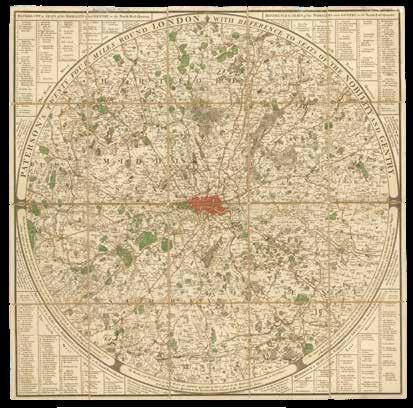
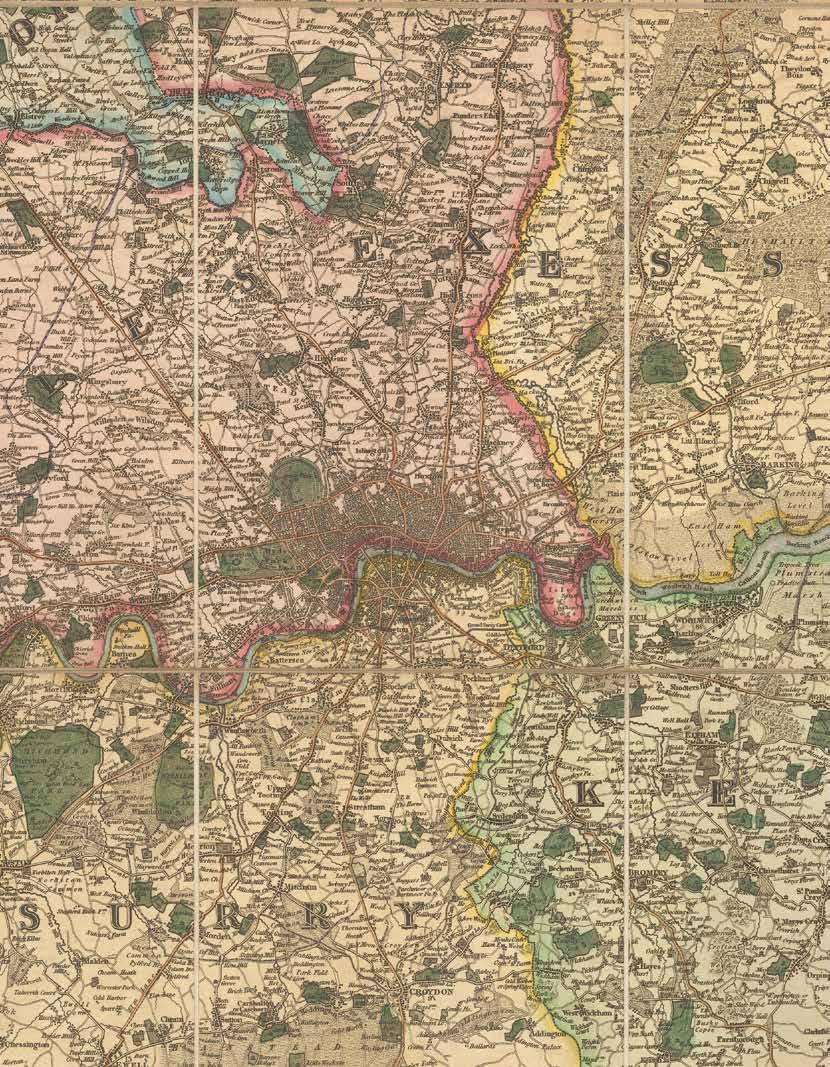
This interesting circular map of London and its the environs covers the area from Ware down to Dorking, and Tilbury across to Windsor. The city is coloured in dark red, each country in a separate colour, and parks and woodlands in green. After the five-mile radius from St Paul’s Cathedral, concentric lines mark intervals of one mile. Several roads leading out of the capital and identified, with distances marked. The map was made by John Wallis, who would later go into business with his son, Edward Wallis, famous for his cartographical board games.
WALLIS, John
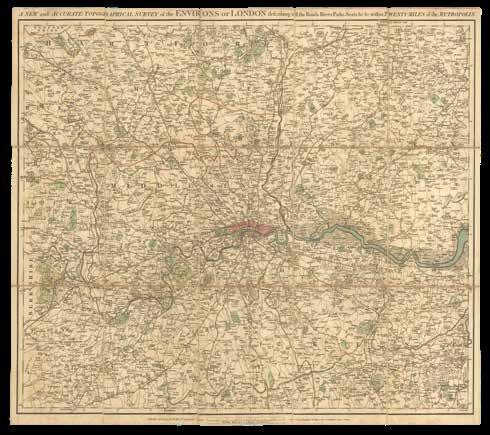
A New and Accurate
Topographical Survey of the Environs of London describing all the Roads, Rivers, Park’s,Seats &c &c within Twenty Miles of the Metropolis.
Publication London, John Wallis, 1783.
Description Engraved map, hand-coloured in outline, dissected and mounted on linen, folding into blue marbled paper slipcase, rubbed.
Dimensions 580 by 660mm (22.75 by 26 inches).
Scale 1 inch to 2 statute miles.
References Howgego 177.
Turnpike
Attactive map of London and the surrounding country. London is coloured as are the county boundaries; the margins are marked with degrees of longitude and latitude. The map signals huge increase in the Turnpike road network, that had occurred during the previous 50 years. The period is known as “Turnpike Mania”, when some 11,500 miles of toll roads were built in England, many emanating from London, to cities such as Birmingham, and Manchester: Links that would fuel the Industrial Revolution.
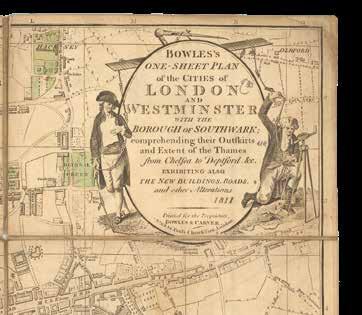
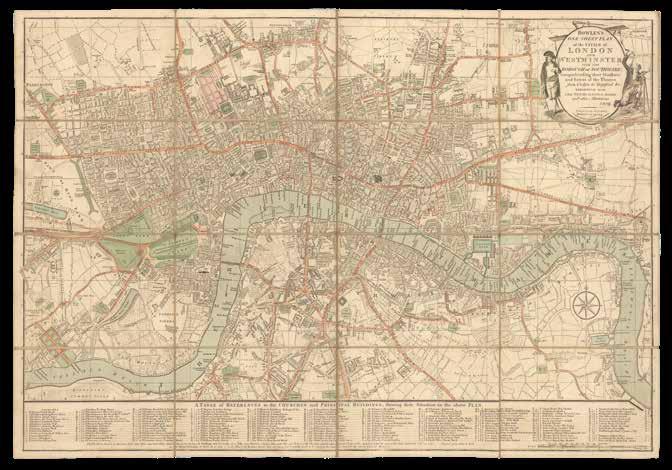
525 BOWLES, [Carington]; [and] S[amuel] CARVER
Bowles’s One-Sheet Plan of the Cities of London and Westminster with the Borough of Southwark; comprehending their Outskirts and Extent of the Thames from Chelsea to Deptford &c.
Publication London, Bowles & Carver, 1809.
Description
Engraved plan, hand-coloured in outline, street index below, dissected and mounted on linen.
Dimensions 438 by 650mm (17.25 by 25.5 inches).
Scale 4 inches to 1 statute mile.
References Howgego 181 - intermediate state between (12) and (13).
Going East
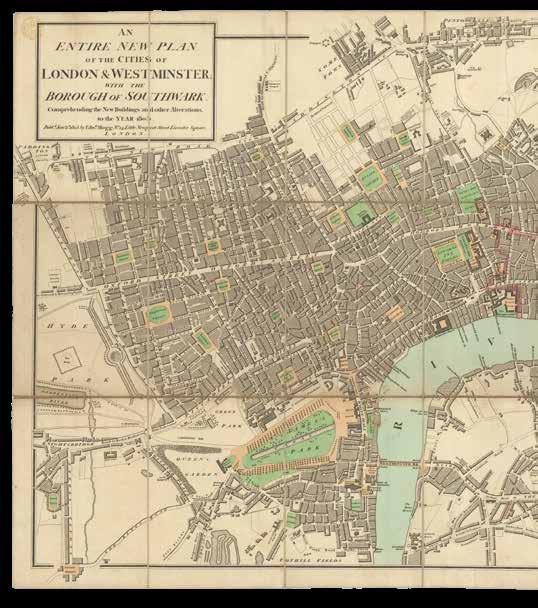
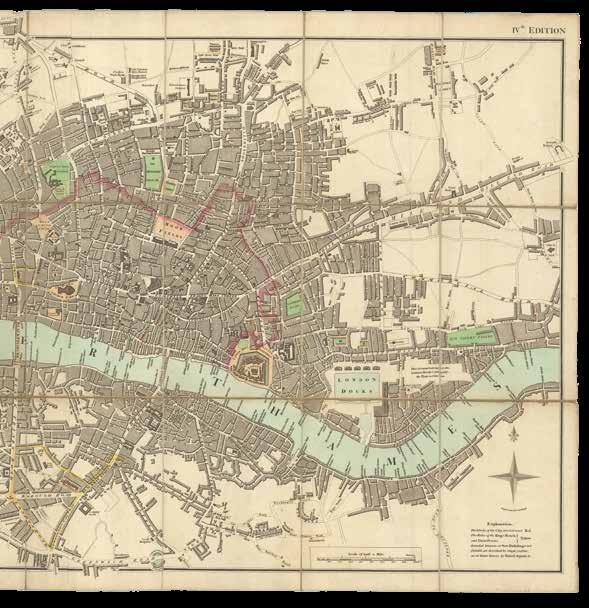
The present map was published by Bowles and Carver, showing London, from Islington in the north to Walworth in the south, and from Chelsea in the west to Limehouse in the east. By the beginning of the nineteenth century, mapmakers had begun to extend their maps east to include the all impotant docks, in Rotherhithe, and Limehouse (and later the Isle of Dogs) that landed the commodities, and wealth from Britain’s burgeoning Empire. Here the title is being held up by two surveyors with chains and a theodolite.
BOWLES, Carrington [and] S[amuel] CARVER
Bowles’s One Sheet Plan of the Cities of London and Westminster with the Borough of Southwark; comprehending their Outskirts and Extent of the Thames from Chelsea to Deptford &c.
Publication London, Bowles & Carver, 1811.
Description
Engraved plan, hand-coloured in outline, dissected and mounted on linen, evenly age-toned with tears to old folds.
Dimensions
438 by 650mm (17.25 by 25.5 inches).
Scale 4 inches to 1 statute mile.
References Howgego 181 (13).
The plan bears no changes from the previous example apart from the date in the imprint.
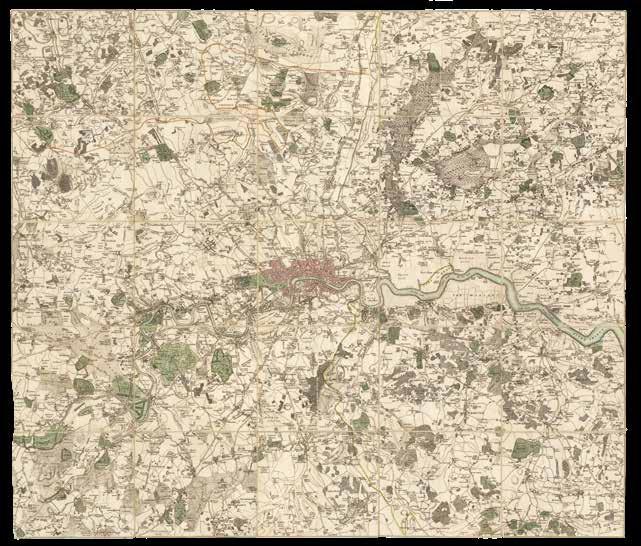
CARY, John
Cary’s Actual Survey of the Country Fifteen Miles Round London on a scale of one Inch to a mile Wherein the Roads, Rivers, Woods and Commons; as well as every Market Town, Village &c, are distinguished; and every seat shewn with the Name of the Possessor.
Publication London, J. Cary, 1786.
Description Engraved map, hand-coloured, dissecetd and mounted on linen, folding into blue marbled paper slipcase, with publisher’s label, slightly rubbed.
Dimensions 760 by 890mm (30 by 35 inches).
Scale 1 inch to 1 statute mile.
References Howgego 183 (1).
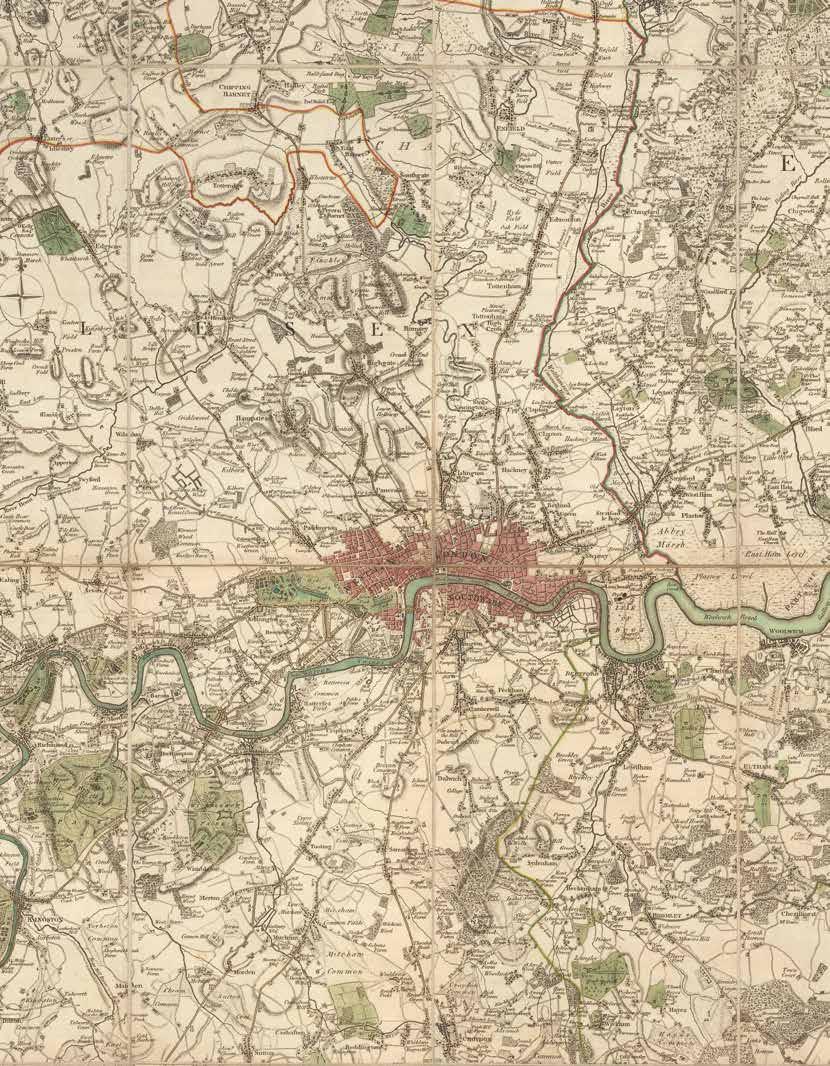
The first edition of Cary’s map of London and its environs from Wormley to Ashtead, and from Uxbridge to Brentwood. The large scale allowed Cary to achieve a good level of detail in depicting the road system and topography, so that even tracks and cart-ways are shown, and villages and towns are engraved even down to individual buildings. Hills, heaths, woods, parks and commons, marshes, rivers, ponds and watermills are all shown, as is the different types of woodland and the owners of the principal estates and houses. Many of the city’s key roads and main highways are already present, with the Mile End Road heading east and Tottenham Court Road beginning to become prominent. This map was also issued in the form of a 50-page atlas with an index and key sheet; though the index and key sheet are referred to on the label, they were likely not supplied for this folded format.
CARY, John
[Cary’s Actual Survey of the Country Fifteen Miles Round London].
Publication [London, J. Cary, c1819].
Description
Engraved map, hand-coloured in outline, trimmed to within the neatline, lacking title and date, evenly-age-toned, some tears to old linen, brown endpapers, worn.
Dimensions
760 by 890mm (30 by 35 inches).
Scale
1 inch to 1 statute mile.
References Howgego 183 - This state not listed.
Cary’s map of London and the surrounding counties has here been updated to show Waterloo Bridge (1817) and Southwark Bridge (1819). The Regent’s Canal (opened 1820) is also shown.
CARY, John
[Cary’s Actual Survey of the Country Fifteen Miles round London].
Publication [London], J. Cary, [c1825].
Description
Engraved plan, in original hand-colour, dissected and mounted on linen, trimmed at the margin, slipcase preserving original label, rubbed.
Dimensions
760 by 890mm (30 by 35 inches).
Scale
1 inch to 1 statute mile.
References Howgego 183 (4).
Though the map bears no date, it was most likely published around 1825 as Regent’s Canal is marked, though New London Bridge is not shown.
“The best of the London maps published by the firm”
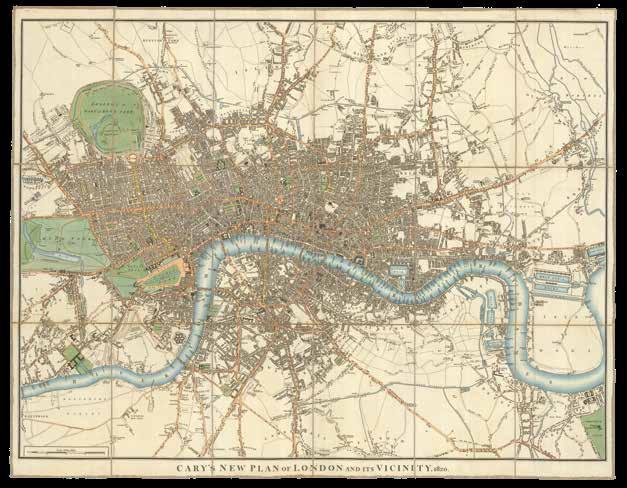
CARY, John
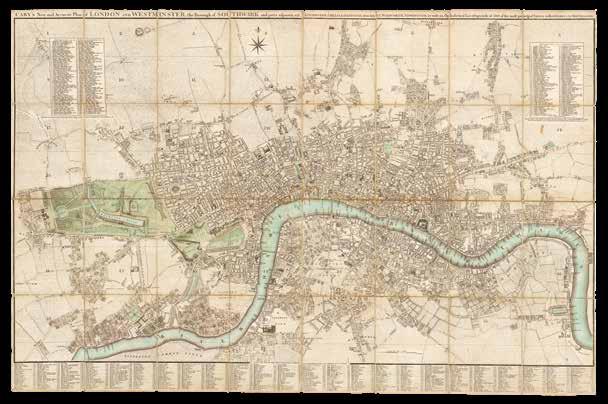
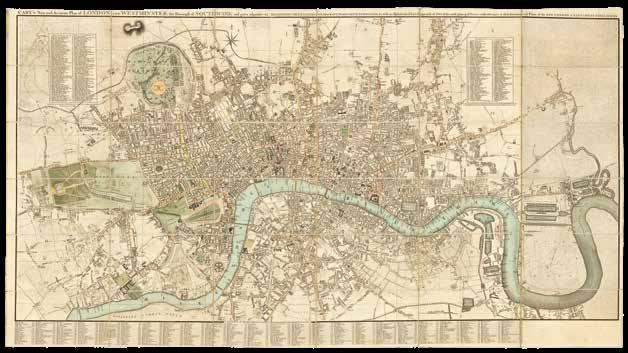
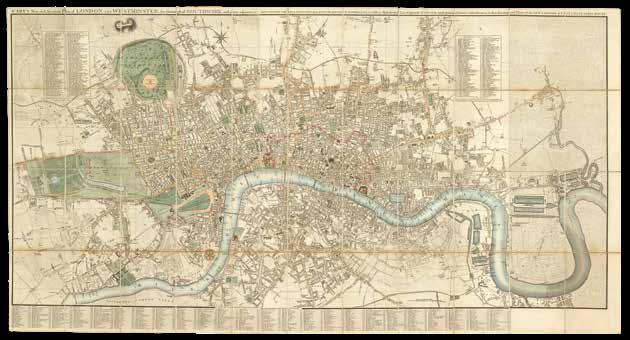
Cary’s New and Accurate Plan of London and Westminster the Borough of Southwark and parts adjacent; viz. Kensington, Chelsea, Islington, Hackney, Walworth, Newington, &c ...
Publication London, J. Cary, 1787.
Description
Engraved plan, original hand-colour, dissected and mounted on linen, some separation to linen, and rubbing, fold into green marbled paper slipcase, with publisher’s label, rubbed.
Dimensions
800 by 1250mm (31.5 by 49.25 inches).
Scale 6.5 inches to 1 statute mile.
References Howgego 184 (1).
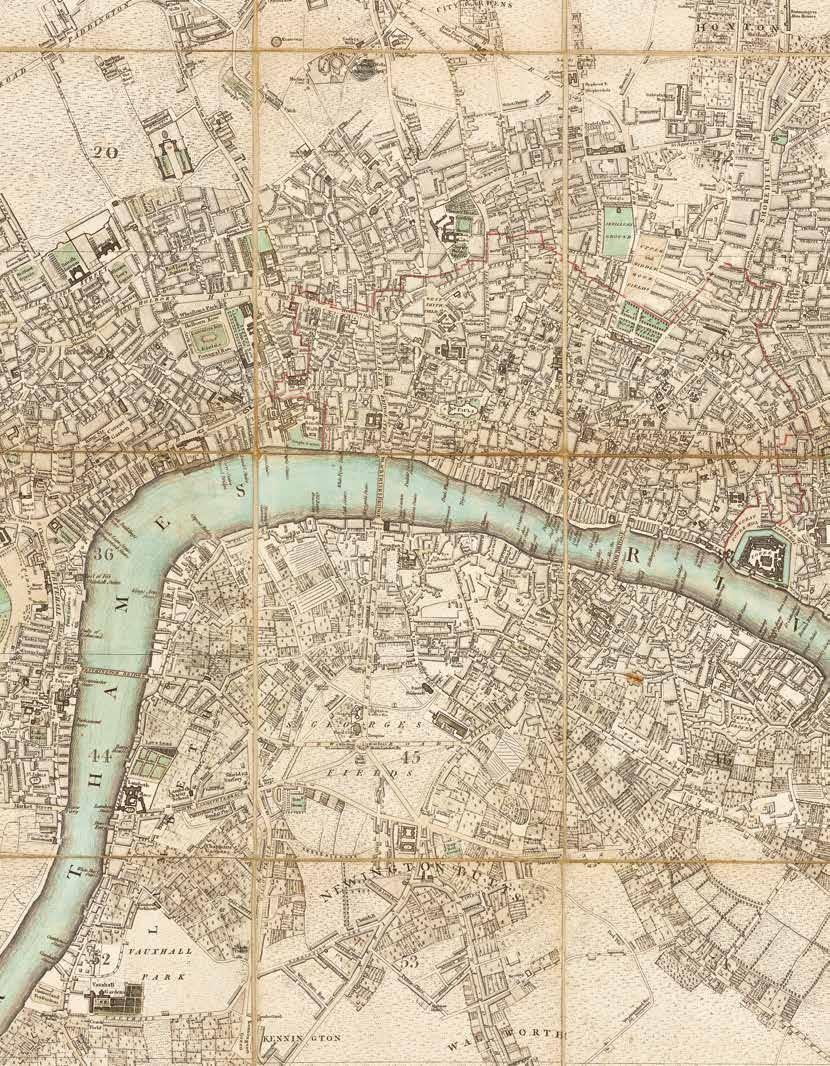
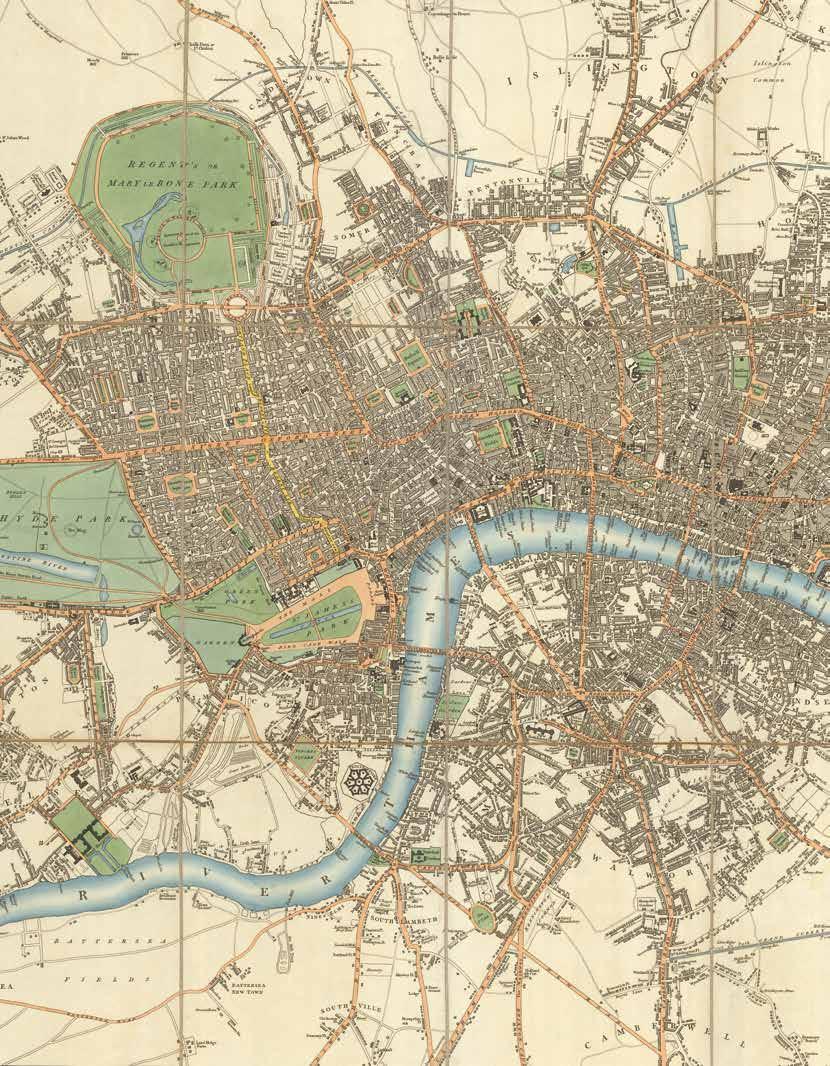
The first edition and earliest recorded state of “the best of the London maps published by the firm” (Howgego). At this point, the map extends from Kingsland in the north to Kennington in the south and from Kensington in the west to Stepney in the east, but would be significantly expanded throughout the twenty editions that followed. It includes a street index at the bottom of the map and two insets listing public buildings and churches.
531 CARY, John
Cary’s New and Accurate Plan of London and Westminster, the Borough of Southwark and parts Adjacents, VIZ.
Publication London, J. Cary, 1792.
Description
Engraved plan, in original hand colours, dissected and mounted on linen, folding into marbled paper slipcase, with publisher’s label, rubbed.
Dimensions 800 by 1250mm (31.5 by 49.25 inches).
Scale 6.5 inches to 1 statute mile.
References Howgego 184 (3).
The third edition. At this point, Lambeth Road is already named, and developments are shown in Somers Town. The plan includes its street index at the bottom of the map and the two insets listing public buildings and churches.
532
CARY, John
Cary’s New and Accurate Plan of London and Westminster the Borough of Southwark and parts adjacent; viz. Kensington, Chelsea, Islington, Hackney, Walworth, Newington, &C …
Publication London, J. Cary, 1806.
Description
Engraving plan, hand-coloured, dissected and mounted on linen, mounted and dissected on linen, blue marbled paper slipcase, with publisher’s label, rubbed.
Dimensions
800 by 1250mm (31.5 by 49.25 inches).
Scale 6.5 inches to 1 statute mile.
References Howgego 184 (9).
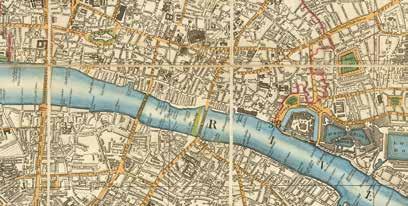
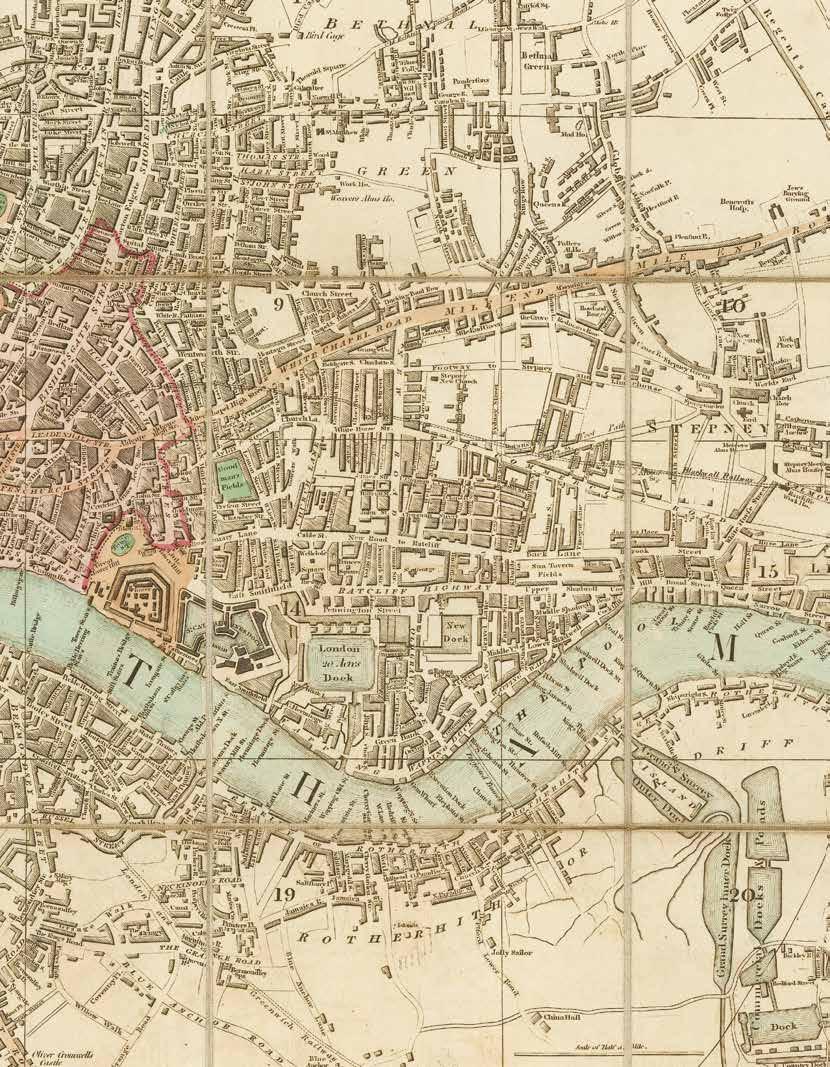
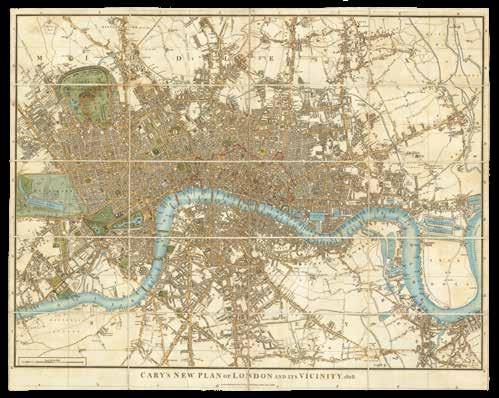
The map shows the latest developments in the city, including the London Docks, which had been opened in 1805, and the new developments to the east of Edgware Road and north of Russell Square.
533 CARY, John
Cary’s New and Accurate Plan of London and Westminster the Borough of Southwark and parts adjacent; viz. Kensington, Chelsea, Islington, Hackney, Walworth, Newington, &c ...
Publication London, J. Cary, 1819.
Description Engraved plan, hand-coloured in outline, dissected and mounted on linen, folding into dark green marbled slip case, with publisher’s label, rubbed.
Dimensions 800 by 1250mm (31.5 by 49.25 inches).
Scale
6.5 inches to 1 statute mile.
References Howgego 184 (16).
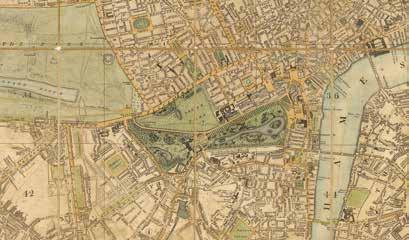
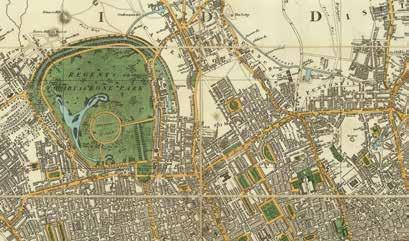
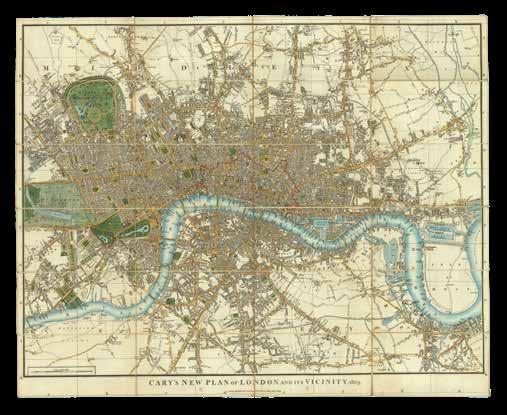
Cary’s map of 1819 incorporates the newly opened Waterloo Bridge and the approach road to the south of it, i.e. Waterloo Bridge Road, and Southwark Bridge. The collection of labourers’ shacks known as Tomlin’s Town is shown west of the Edgware Road, and the whole area around Regent’s Park remains under construction.
534
CARY, John
Cary’s New and Accurate Plan of London and Westminster the Borough of Southwark and parts adjacent; viz. Kensington, Chelsea, Islington, Hackney, Walworth, Newington, &c ...
Publication London, J. Cary, 1822.
Description
Engraved plan, hand-coloured, dissected and mounted on linen, folding into later green paper slipcase, with publisher’s label.
Dimensions 800 by 1250mm (31.5 by 49.25 inches).
Scale 6.5 inches to 1 statute mile.
References Howgego 184 (18).
Cary’s plan of London now includes the approach road to Waterloo Bridge, now named Waterloo Bridge Road, but which is here labelled ‘Great Waterloo Street’. The layout of Regent’s Park is not that which was finally adopted; at its centre is the ‘Intended site of Waterloo Monument’.
535 CARY, John
Cary’s New and Accurate Plan of London and Westminster the Borough of Southwark and parts adjacent: viz. Kensington, Chelsea, Islington, Hackney, Walworth, Newington, &c with an Alphabetical List of upwards of 500 of the most principal Streets with references to their situation.
Publication London, J. Cary, 1828.
Description Engraved plan, hand-coloured, dissecetd and mounted on linen, evenly age-toned, folding into original green covers.
Dimensions 800 by 1250mm (31.5 by 49.25 inches).
Scale 6.5 inches to 1 statute mile.
References Howgego 184 - This state not listed.
CARY, John
Cary’s New and Accurate Plan of London and Westminster the Borough of Southwark and parts adjacent: viz. Kensington, Chelsea, Islington, Hackney, Walworth, Newington, &c ….
Publication London, J. Cary, 1830.
Description
Engraved plan, hand-coloured in outline, dissected and mounted on linen, folding into green marbled paper slipcase with publisher’s label., rubbed.
Dimensions 800 by 1250mm (31.5 by 49.25 inches).
Scale 6.5 inches to 1 statute mile.
References Howgego 184 - This state not listed.
Cary’s plan of 1828 shows the Canal in St James’s Park accurately replaced by a lake, as it had been the previous year. St Katherine’s Dock is shown (1828) and the new General Post Office, which would open the following year. New London Bridge (opened 1831), and Thames Tunnel (opened 1843), appear under construction.
Shows both New and Old London Bridge, the former of which would be opened in 1831, and latter demolished in 1832. The proposed Lambeth Bridge is also shown. The Colosseum (1829) is shown at the south east corner of Regent’s Park.
CARY, George and John
Cary’s New and Accurate Plan of London and Westminster the Borough of Southwark and parts adjacent; viz. Kensington, Chelsea, Islington, Hackney, Walworth, Newington, &c ....
Publication London, J. Cary, 1832.
Description Engraved plan, hand-coloured, dissected and mounted on linen, in two sections, folding into green marbled paper slipcase with publisher’s label, rubbed.
Dimensions 800 by 1250mm (31.5 by 49.25 inches).
Scale 6.5 inches to 1 statute mile.
References Howgego 184 - This state not listed.
This map shows not only New London Bridge (1831), but also the proposals for Lambeth Bridge and the Thames Tunnel (1843). The first tunnel to be constructed under a navigable river.
FADEN, William
A New Pocket Plan of the Cities of London and Westminster with the Borough of Southwark comprehending the new Buildings and other Alterations to 1790.
Publication London, William Faden, 1790.
Description Engraved plan, dissected and mounted on linen, folding into brown marbled paper slipcase, with publisher’s label, worn.
Dimensions
445 by 775mm (17.5 by 30.5 inches).
Scale 6.25 inches to 1 statute mile.
References Howgego 186 (3).
Of Limbs and Trees
The plan gives information on parishes, in Westminster, Surrey, and Middlesex, with the Bills of Mortality. A coloured key shows the limits of the City of London, the intended buildings or new streets not finished, the Liberties of Westminster, and Rules of the Bench and Fleet. The border is divided into miles and furlongs based on St Paul’s, and intended and unfinished development includes the area east of the Edgware Road and south of Euston Road; a circus at the east end of the Strand; and the London Docks.
To the far left of the plan is marked “The St George’s Burying Ground”. Opened in 1763, to relieve over crowding. The ground was closed in 1854, following a damning report from the Board of Health, that found limbs in trees, and decomposing bodies dumped into a pit.
FADEN, William
A New Pocket Plan of the Cities of London and Westminster with the Borough of Southwark.
Publication London, William Faden, 1801.
Description
Engraved plan, hand-coloured in outline, dissected and mounted on linen, folding intoblue marbled paper slipcase, with publisher’s label.
Dimensions
445 by 775mm (17.5 by 30.5 inches).
Scale
6.25 inches to 1 statute mile.
References Howgego 186 (6).
A further example of Faden’s pocket plan of London, here with the outline of the London Docks superimposed. “Published by” replaces “Printed for” in the imprint.
FADEN, William
A New Pocket Plan of the Cities of London and Westminster with the Borough of Southwark.
Publication London, William Faden, 1803.
Description
Engraved plan, hand-coloured in outline, dissected and mounted on linen, folding into blue marbled paper slipcase, with publisher’s label, rubbed and scuffed.
Dimensions
445 by 775mm (17.5 by 30.5 inches).
Scale 6.5 inches to 1 statute mile.
References Howgego 186 (8).
A further example of Faden’s pocket plan of London, here London Docks shown and outlined in yellow.
FADEN, William
The Country Twenty-five Miles Round London planned from a Scale of One Mile to an Inch.
Publication London, William Faden, 1789.
Description
Engraved map, hand-coloured, dissected and mounted on linen, folding purple marbled paper slipcase, with publisher’s label, rubbed and torn.
Dimensions 1030 by 1250mm (40.5 by 49.25 inches).
Scale
1 inch to 1 statute mile.
References Howgego 188 (2).
Geographer to the King
William Faden (1750-1836) began his career in cartography after taking over the business of Thomas Jefferys, a highly respected British mapmaker. Initially publishing under the name Faden and Jefferys, he followed his predecessor by specialising in maps of North America, resulting in the publication of a collection of them in the ‘North American Atlas’ in 1777. Twice honoured by the Royal Society for his work, he became Geographer to the King in 1783, and was chosen in 1801 to create and print the first of the Ordnance survey maps. The present map shows an area much closer to home, extending from Hertford to Dorking, and from Beaconsfield to Chelmsford. All manner of geographical and topographical features are represented, with certain woodlands, fields and villages illustrated pictorially.
542 FADEN, Willam
The Country Twenty-five Miles Round London planned from a Scale of One Mile to an Inch.
Publication London, William Faden, 1800.
Description Engraved map, hand-coloured in outline, dissected and mounted on linen, folding red marbled paper slipcase, with publsiher’s label.
Dimensions 1030 by 1250mm (40.5 by 49.25 inches).
Scale 1 inch to 1 mile.
References Howgego 188 (5).
Date in imprint changed to 1800.
FADEN, William
The Country Twenty-five Miles Round London planned from a Scale of One Mile to an Inch.
Publication London, William Faden, 1802.
Description Engraved map, hand-coloured, dissected and mounted on linen, folding into dark blue slip-case, publisher’s label on cover.
Dimensions
1030 by 1250mm (40.5 by 49.25 inches).
Scale 1 inch to 1 mile.
References Howgego 188 (6).
Showing the West India Docks, which had been completed and opened in 1802, the year of the map’s publication.
544
FADEN, Willam
The Country Twenty-five Miles Round London planned from a Scale of One Mile to an Inch.
Publication London, William Faden, 1820.
Description
Engraved map, hand-coloured in outline, dissected and mounted on linen, in four sections, folding into blue marbled paper slip case, with publisher’s label, rubbed and scuffed.
Dimensions 1030 by 1250mm (40.5 by 49.25 inches).
Scale 1 inch to 1 statute mile.
References Howgego 188 (8).
Updated to show Waterloo Bridge (1817), Southwark Bridge (1819), Regent’s Canal (1820), and Millbank Penitentiary (1821).
545
FADEN, Willam
A New Map of the Country Twentyfive Miles Round London.
Publication London, James Wyld, 1838.
Description Engraved map, hand-coloured, dissected and mounted on linen, folding into brown slipcase, publisher’s label on front cover and advertisement on reverse, worn.
Dimensions 1030 by 1250mm (40.5 by 49.25 inches).
Scale 1 inch to 1 statute mile.
References Howgego 188 (10b).
The map is now published by James Wyld Senior, successor to William Faden. It has been updated with several new features: the London & Greenwich Railway is shown to Greenwich (1838), the Great Western Railway to Paddington (1838), and the Eastern Counties Railway to Shoreditch (1840). The London & Southampton is shown as built as far as Merton, and construction to Nine Elms (completed 1838).
FADEN, Willam
A New Map of the Country Twentyfive Miles Round London.
Publication London, James Wyld, [c1872].
Description Engraved map, hand-coloured, dissecetd and mounted on linen, folding into dark green slip case, publisher’s label to upper cover, rubbed.
Dimensions 1030 by 1250mm (40.5 by 49.25 inches).
Scale
1 inch to 1 statute mile.
References Hyde D&H 188 (3).
The map has here been updated to show the railway to Walthamstow (1870) extending south to Dalston (1872) but not yet north to Chingford (1873). The Great Northern Railway’s Barnet branch (1872) also appears.
FADEN, Willam
A further example of with the railways now extended to Alexandra Palace (1873) and to Chingford (1873). 547
A New Map of the Country Twentyfive Miles Round London.
Publication London, James Wyld, [c1873].
Description
Engraved map, hand-coloured, dissected and mounted on linen, in four sections, folding into red cloth slip case, with publisher’s label, defective.
Dimensions 1030 by 1250mm (40.5 by 49.25 inches).
Scale 1 inch to 1 statute mile.
References Hyde D&H 188 - This state not listed.
Using Searle’s tools
ELLIS,
Joseph
A Modern Map of the Countries Twenty-five Miles round London Drawn, From Accurate Surveys.
Publication London, Carington Bowles, [c1789].
Description
Folding engraved map, hand-colour in outline, dissected and mounted on linen, corners a bit frayed.
Dimensions 370 by 440mm (14.5 by 17.25 inches).
Scale: 1 inch to 4 statute miles
References Howgego 189.
This detailed map of London and the surrounding counties was included in Ellis’s ‘New English Atlas’. It covers the region from Welwyn to Tonbridge, and from Maidenhead to Chatham, with roads, villages, towns, woodlands, and various other features identified across the entire map. In the centre, London is represented as a dense collection of buildings. Joseph Ellis (c1734-1800), a map and caligraphic engraver, often erroneously referred to as John, was apprenticed to Richard William Searle in 1749. He married Searle’s daughter Elizabeth in 1755, and when Seale died in 1762, he inherited all his tools.
Hackney Coaches and Watermen
SAYER,
Robert
A New and Correct Plan of the Cities of London, Westminster .... and Borough of Southwark; wherein all the Streets, Roads, Churches, Public Buildings &c to the Present Year 1791 are exactly Delineated.
Publication London, Robert Sayer, 1791.
Description Engraved plan, hand-coloured, dissected and mounted on linen, folding into blue marbled paper slipcase, split to corners.
Dimensions 435 by 690mm (17.25 by 27.25 inches).
Scale 4.5 inches to 1 statute mile
References Howgego 190A - This state not listed.
As well as the index of churches along the lower edge, Sayer’s 1791 edition of his London map has two insets, one giving “A Table of the New Rates to be taken by Watermen” and the other the “New Act for regulating Hackney Coaches”.
The Hackney Coaches Act of 1786, introduced new fares for both time, and distance. The first 1.5 miles would cost the passenger, 1 shilling, with every additional half mile charged at 6 pence; with distance the first 45 minutes is charged at 1 shilling, with each additional 20 minutes at 6 pence. The coachman was at liberty to charge for either time or distance, but never both.
CARY, John
New Pocket Plan of London, Westminster and Southwark with all the adjacent Buildings in St. George’s Fields &C &C.
Publication London, J. Cary, 1800.
Description Engraved map, hand-coloured, dissected and mounted on linen, folding into blue marbled paper slip case with publisher’s label.
Dimensions 410 by 610mm (16.25 by 24 inches).
Scale 4 inches to one statute mile.
References Howgego 192 (6).
The Penny Post
The map extends from Islington in the north to Newington Butts in the south, and from Kensington Gore in the west to Shadwell in the east. Lists of Penny Post Receiving Houses - where letters were collected and delivered for a flat rate of one penny - and Hackney Coach Fares are given at the bottom of the plan. New construction can be seen to the east of Baker Street. Although the plan only lists some 135 Postal Receiving Houses, London by the middle of the eighteenth century, had some 600 receiving houses. Letter carriers would call every hour and take letters to the principal offices before sorting for delivery.
CARY, John
Cary’s New Pocket Plan of London, Westminster and Southwark with all the adjacent Buildings in St. George’s Fields &c &c.
Publication London, J. Cary, 1819.
Description
Engraved plan, hand-coloured in outline, dissected and mounted on linen, folding into dark green marbled paper slip case, with publisher’s label, rubbed.
Dimensions
410 by 610mm (16.25 by 24 inches).
Scale
4 inches to 1 statute mile.
References Howgego 192 (14).
The 1819 edition of Cary’s pocket plan again includes the lists of Penny Post Houses ard Hackney Coach Fares, but has been updated to show Vauxhall Bridge (1815), Strand Bridge, i.e.Waterloo Bridge (1817), Southwark Bridge (1819), Vauxhall Bridge Road (1816), and Milbank Penitentiary (completed 1821).
552
CARY, John
Cary’s New Pocket Plan of London, Westminster and Southwark. With all the adjacent buildings in St. George’s Fields &c.
Publication London, J. Cary, 1830.
Description Engraved plan, hand-coloured in outline, dissected and mounted on linen, cab fares below, folding into green marbled paper slipcase with publisher’s label, rubbed.
Dimensions
410 by 610mm (16.25 by 24 inches).
Scale 4 inches to 1 statute mile.
References Howgego 192 (17).
The 1830 edition of one of Cary’s earliest maps giving the Hackney Coach Fares, this example shows St Katherine’s Dock (1828), the new General Post Office in St Martin le Grand (1829), and the Colosseum in Regent’s Park (opened 1829). The Thames Tunnel, labelled Wapping Tunnel’, and New London Bridge are also shown under construction.
Around London
FADEN,
William
A Topographical Map of the Country Twenty Miles Round London, Planned from a scale of two miles to one inch.
Publication London, William Faden, 1800.
Description Engraved map, original hand-colour, dissected and mounted on linen, evenly age-toned, green paper slipcase,with publisher’s label, rubbed and worn.
Dimensions
610 by 635mm (24 by 25 inches).
Scale 1 inch to 2 statute miles.
References Howgego 193 (2).
The circular map shows the roads, parks, market towns, parishes, villages, forests and many other features within a radius of 20 miles. Beneath the map, in the lower corners, there are explanations about the mile stones that indicate the distance to other major destinations, and about the towns, villages and parishes shown. The Paddington Canal, which was to be opened in 1801, and the West India Docks, which would be opened the following year, are both already shown in the central portion of the map.
Laurie and Whittle Take the Reins
SAYER,
Robert
A New and Accurate Plan of London, Westminster ... & Borough of Southwark; wherein is distinctly inserted all the Additional Streets, Squares &c in and around the Metropolis.
Publication London, Laurie & Whittle, 1794.
Description Engraved map, hand-coloured in outline, dissected and mounted on linen, folding into red marbled paper slipcase, with publisher’s label.
Dimensions
390 by 560mm (15.25 by 22 inches).
Scale
4 inches to 1 statute mile
References Howgego 199 - This state not listed.
Robert Laurie had originally been apprenticed to Sayer in 1770, soon starting his own business as an accomplished engraver of mezzotint portraits and produced views and other decorative items. In about 1792 he returned to the Robert Sayer business and took it over from the ailing Sayer in 1794. In this venture, he was joined by James Whittle who had been apprenticed into the Needlemakers’ Company. Among the huge number of maps and charts they published during their partnership were further editions of Sayer’s map of London. The present example extends from Pentonville in the north to Walworth in the south, and from Knightsbridge in the west to Shadwell in the east, and includes the index of principal buildings.
HORWOOD, Richard
Plan of the Cities of London and Westminster the Borough of Southwark, and Parts adjoining Shewing every House.
Publication London, Horwood, 1792 - 1799.
Description
First edition. Folio (580 by 430mm). 32 engraved sheets, joined and bound as 8 large folding panels, original hand-colouring, title in an oval cartouche with compass star above, some slight offsetting and some minor staining to the margins, recent half brown morocco gilt, marbled boards.
Dimensions (if joined approx.) 4000 by 2280mm (157.5 by 89.75 inches).
Scale 26 inches to 1 statute mile.
References Howgego 200 (1).
The largest plan
ever
published in Georgian Britain
Horwood’s map was produced for use by the Phoenix Fire Office and is dedicated to the Trustees and Directors. It was the largest map ever printed in Britain at the time, and the first attempt to produce a map of London with all of the houses delineated and numbered, an invaluable aid for the insurance office and very useful in identifying the street numbering of eighteenth century London. The numbering of buildings did not begin until about 1735, when the practice of identifying a building by describing it as “by”, “opposite” or “over against” some other building was recognized as confusing and erroneous. However, even by the date of printing of Horwood’s map, it was still not universal.
The map is produced to exactly the same scale as the Rocque map of fifty years before and so enables us to compare the development of London on a street-by-street basis in the second half of the eighteenth century. It is also fascinating to look at the fringes of London and see the areas which were soon to be swallowed up. Thomas Lord’s cricket ground is shown in its original place, in what is now Dorset Square. It was opened there in 1787 (7 years before the relevant sheet on the map was published). The pressure of London’s development led to a rent increase in 1809 which resulted in Lord moving his cricket ground to the greener pastures of St. John’s Wood.
“The largest and most important London map of the eighteenth century is that of Richard Horwood. On a scale of about 25 inches to a mile, it covers an area extending north to Islington, east to Limehouse, south to Kennington and west to Brompton. Its intention was to show every house with its number and the boundaries of the various local divisions; but it proved impossible, even in the later editions, to make the numbering complete... every house was shown, nevertheless, with courts, alleys and vacant spaces away from the street frontage” (Howgego.)
Very little is known about Horwood (1758-1803). Most likely he was working for the Phoenix Assurance Company on surveying jobs when he began the enormous task of surveying the whole of the built-up area of London. “According to his own account the prepration of the plan gave him nine years’ severe labour and he himself “took every angle, measured almost every line, and after that plotted and compared the whole work”. He sent a small sample of the plan showing Leicester Square and its neighbourhood to all the London vestries with a letter promising that those “who gave him Encouragement” could have a “compleat” copy by “the year 1792”. His estimate proved to be over-optimistic and only one sheet - B2 (Grosvenor Square-Piccadilly) - was published by 1792” (Howgego, p. 22). In January 1798 he wrote to the Phoenix Assurance Company offering to dedicate his map to the company if the directors would make him a loan of £500 to enable him to finish the work. His request was granted but this, in addition to an award from the Society of Arts, were too little and too late and, in 1803, Richard Horwood died in Liverpool in poverty and obscurity, so sharing the fate of other great men like John Stow and Wenceslaus Hollar, to whom London had failed to honour her debt of gratitude.
FAIRBURN, John
London & Westminster.
Publication John Fairburn, 1799.
Description
Engraved plan, original hand colour, dissected and mounted on linen, later slipcase preserving original label, rubbed.
Dimensions 440 by 620mm (17.25 by 24.5 inches).
Scale (approx.) 3.75 inches to 1 statute mile.
References Howgego 203 - This state is not listed.
Fairburn’s plan
John Fairburn’s decorative plan of the city bears a charming vignette of a personification of the River Thames, reclining on a river bank. The map bears two insets: one for the proposed improvement of the docks at Wapping, and a plan of the Rules of Fleet Prison. New construction is shown east of the Edgeware Road.
John Fairburn (fl 1782-1851), was a publisher, and map a print seller based in London. The firm, which was carried on by his son John Fairburn junior, produced works of a liberal rather egalitarian streak, for the burgeoning middle classes. Unfortunately, in 1810, Fairburn senior spent a brief period in debtors prinson, when the firm was declared bankrupt.
FAIRBURN, John
London and Westminster.
Publication
London, John Fairburn, 1802.
Description
Engraved plan, hand coloured, dissected on linen, minor staining to verso.
Dimensions 460 by 817mm (18 by 32.25 inches).
Scale (approx.) 3.75 inches to 1 statute mile.
References Howgego 203 (6).
The plan has been extended to the east to incorporate the new construction. This includes the Commercial Road, opened in 1804, the London Docks of 1805, and the West India Docks, opened in 1802 on the Isle of Dogs, are all present.
As Britain’s empire grew, so new docks were required to handle the increase in trade, commerce, and wealth. The West India Docks were financed and constructed by the plantation, slave owners, and sugar merchants, who control much of the West India Trade. Angered at the delays and thefts, at the traditional riverside wharves, they lobbied parliament for a secure location in which to load and unload their cargo.
FAIRBURN, John
London and Westminster.
Publication
London, John Fairburn, 1803.
Description
Engraved plan, hand-coloured in outline, dissected and mounted on linen.
Dimensions 440 by 620mm (17.25 by 24.5 inches).
Scale (approx.) 3.75 inches to 1 statute mile.
References Howgego 203 (6a).
A further example of John Fairburn’s map of London and Westminster. No change from previous state apart from date in title.
PATERSON, Daniel
Paterson’s Twenty Four Miles round London With reference to the seats of the Nobility and Gentry.
Publication London, Carington Bowles, 1791.
Description Folding engraved map, hand-coloured, dissected and mounted on linen.
Dimensions 675 by 680mm (26.5 by 26.75 inches).
Scale (approx.) 1.5 inches to two statute miles.
References Howgego 212A. - This state not listed and pre-dates those states that are.
Gentlemen’s Seats around London
The seats of the nobility and gentry are coloured green, with the owner of each property identified by name in an extensive key around the plan, on this map that extends 24 miles around the City of London, from Ware to Dorking, and Windsor to Gravesend.
The work is based on Daniel Paterson’s ‘A New and Accurate Description of all the Direct and Principal Cross Roads in Great Britain’, a hugely influential work, first published in 1771, going through numerous editions up to 1822.
PATTERSON, Daniel
Paterson’s Twenty Four Miles Round London With reference to the Seats of the Nobility and Gentry.
Publication London, Bowles & Carver, 1806.
Description Engraved map, hand coloured in outline, dissected and mounted on linen.
Dimensions 680 by 678mm (26.75 by 26.75 inches).
Scale (approx.) 1.5 inches to two statute miles.
References Howgego 212A - This state not listed.
A further example of Paterson’s circular map showing the Paddington Canal and East India Docks (1806), with some alteration to the names of the owner’s of seats.
STOCKDALE, J[ohn]
A New Plan of London, XXIX Miles in Circumference.
Publication [London, J. Stockdale, [c1800].
Description Engraved map, hand coloured, on four sheets, dissected and mounted on linen, a few small tear along folding into dark green paper slipcase, rubbed.
Dimensions 1030 by 1450mm (40.5 by 57 inches).
Scale
6.5 inches to 1 statute mile.
References Howgego 213 - This state not listed.
In the style of Rocque
This large and detailed plan of London is very similar stylistically to much of the output of John Rocque, although Stockdale is somewhat sparser, with few baroque flourishes. The plan is dated 1797, yet it was clearly issued some twelve years later as it not only shows the West India Docks (opened in 1802), the London Docks (opened in 1805), and the East India Docks (opened in 1806), but also the Croydon Canal, which was not in use until 1809. Also shown are the intended routes, marked by dotted lines, of Regent’s Bridge (later renamed Vauxhall Bridge), and Waterloo Bridge. The map was engraved by Samuel John Neele, and the earliest known state of it appeared in 1797.
LAURIE, Robert & WHITTLE, James
New & Complete Plan of London, Westminster & Borough of Southwark containing all the improvements in and round the Metropolis.
Publication
London, Laurie & Whittle, 1799.
Description
Engraved map, original colour, dissected and mounted on linen, folding into blue marbled paper slipcase, contemporary slipcase worn and rubbed, slight staining.
Dimensions 460 by 930mm (18 by 36.5 inches).
Scale 6.5 inches to 1 statute mile.
References Howgego 219 (1).
The Pipe Office
Spanning the metropolis from Pentonville in the north to Elephant & Castle in the south, and from Knightsbridge in the west to Shadwell in the east, it presents several insets containing information about Parishes, New Hackney Coach Fares, and the Offices of State.
The plan lists the numerous offices of state that had moved into Sommerset House. By the middle of the eighteenth century, London had grown to such an extent that there was need for a purpose built space in order to consolidate the new, and old offices of state, which were often scattered throughout the city. Sommerset House was opened in 1776, and housed among other departments, The Pedlars and Hawkers Office, The Publick Lottery Office, and The Pipe Office: the financial records kept by the British Exchequer.
SMITH, Charles
Smith’s New & Correct Pocket Plan of the cities of London & Westminster and the Borough of Southwark comprehending all the New Buildings.
Publication London, C. Smith, 1817.
Description Engraved plan, with hand colours, dissected and mounted on linen, hand-colour.
Dimensions
410 by 610mm (16.25 by 24 inches).
Scale 2 inches to 1 statute mile.
References Howgego 225 (11).
Millbank Penitentiary in outline
Charles Smith (1768-1854) was a stationer, publisher and mapseller, working in the Strand from about 1800 onwards. He was appointed mapseller to the Prince of Wales in 1809 and from 1826 to 1854 the business traded as Charles Smith & Son. His son William Smith who would continue the businees followingh his death, is best remembered for his hugely popular ‘Indicator’ maps which came with a measuring tape to aid navigation. Smith’s plan shows both Waterloo and Southwark brigdes, as well as Millbank Penitentiary in outline (late the site of Tate Britain) and the proposed street from Regent’s Park to Carlton House in red.
SMITH, Charles
Smith’s New Plan of London, Westminster & Southwark; comprehending all the New Buildings and 350 References to the Principal Streets.
Publication London, C. Smith, 1823.
Description
Engraved plan, hand-coloured, dissected and mounted on linen, folding into green marbled paper slipcase, with publisher’s label.
Dimensions
340 by 600mm (13.5 by 23.5 inches).
Scale (approx.) 3.25 inches to 1 statute mile.
References Howgego 225 intermediate state between (14) and (15).
The plan shows the final layout of Regent’s Park, and Pentonville Prison together with extensive developments in Marylebone, Lambeth, and Knightsbridge.
SMITH, Charles
Smith’s New Plan of London, Westminster & Southwark. 1829.
Publication London, C. Smith, 1829.
Description
Engraved plan, hand-coloured in outline, dissected and mounted on linen, folding into brown paper slipcase with publisher’s label.
Dimensions
340 by 760mm (13.5 by 30 inches).
Scale (approx.) 3.25 inches to 1 statute mile.
References Howgego 225 - this state not listed.
The plan has been extended east to encompass the East and West India Docks.
Extensive construction to the west of Knightsbridge, including the Chelsea waterworks and the expansion of the Buckingham House, later Buckingham Palalce.
SMITH, Charles
Smith’s New Plan of London, Westminster & Southwark; comprehending all the New Buildings and 350 References to the Principal Streets.
Publication London, C. Smith, 1837.
Description Engraved plan, hand coloured, a few slight stains, dissected and mounted on linen, folding into dark green paper slipcase, with publisher’s label.
Dimensions
340 by 600mm (13.5 by 23.5 inches).
Scale (approx.) 3.25 inches to 1 statute mile.
References Howgego 225 - This state not listed.
A further example of ‘Smith’s New Plan of London’, here updated to show the London & Blackwall Railway (1840) and the London & Greenwich Railway (1838) represented by pecked lines, presumably to indicate they are under construction.
MOGG, Edward
An Entire New Plan of the Cities of London & Westminster with the borough of Southwark.
Publication London, Edward Mogg, 1805.
Description
Engraved plan, hand-coloured in outline, dissected and mounted on linen, folding into blue slipcase, with publisher’s label.
Dimensions 420 by 865mm (16.5 by 34 inches).
Scale 6.25 inches to 1 statute mile.
References Howgego 227 (9).
“Ground belong to the London Docks Company”
The fourth edition of Mogg’s map of London. Mogg’s address has been changed to “No. 14 Little Newport Street”.
London was under going a construction boom at the beginning of the eighteenth century, and Mogg shows the planned street layout, to the east of Tottenham Court Road, and east of Hyde Park.
Edward Mogg (fl.1803-1860) was a cartographer, engraver and publisher, active in London at the beginning of the nineteenth century. Rather unusually for the time he not only drew his own maps, but also engraved them. The business was mainly based upon the production of
pocket travel guides and maps. The plan shows the limits of the City of London in red; the Rules of the King’s Bench, and Fleet Prisons - in which some prisoners were allowed to reside - in yellow; parks and squares highlighted in green; and proposed streets and buildings are marked in outline - such as Bloomsbury and Marylebone. It indicates the intended layout of streets north of Russell Square. The second phase of the London Docks is marked with the words: “This Ground belongs to the London Dock Company the Plan not known”.
568
MOGG, Edward
An Entire New Plan of the Cities of London & Westminster with the borough of Southwark.
Publication London, Edward Mogg, 1812.
Description
Engraved plan, hand-coloured in outline, dissected and mounted on linen, folding into blue slip case with publisher’s.
Dimensions 420 by 865mm (16.5 by 34 inches).
Scale 6.25 inches to 1 statute mile.
References Howgego 227 (9).
The fifth edition of Mogg’s map of London shows some changes. The site formerly occupied by Bedlam in Moorfields, for example, is now vacant, and the site for the East London Dock and Basin is now shown.
569
MOGG,Edward
An Entire New Plan of The Cities of London and Westminster with The Borough of Southwark: Comprehending the New Buildings and Other Alterations to the Present Time.
Publication
London, Edward Mogg, [1815].
Description
Engraved plan, hand-coloured in outline, dissected and mounted on linen, some minor spotting and browning, tears along folds, folding into blue paper slipcase with publisher’s label.
Dimensions 470 by 910mm (18.5 by 35.75 inches).
Scale 6.25 inches to 1 statute mile.
References Howgego 227 (11a).
The map now dated to 1815, shows extensive construction to the West End, especially east of Hyde Park Corner. The plan now gives the address as No.51 Charing Cross.
MOGG,Edward
An Entire New Plan of The Cities of London and Westminster with The Borough of Southwark: Comprehending the New Buildings and Other Alterations to the Present Time.
Publication London, Edward Mogg, [1816].
Description Engraved plan, hand-coloured in outline, dissected and mounted on linen, staining to right portion of map, folding into blue paper slipcase with publisher’s label.
Dimensions 470 by 910mm (18.5 by 35.75 inches).
Scale 6.25 inches to 1 statute mile.
References Howgego 227 (12).
London Bridge is now marked, and the title has been re-engraved with the advert for Mogg’s ‘The Survey of the Roads’ removed.
LAURIE, Robert & WHITTLE, James
Laurie and Whittle’s New Map of London with its environs &c. Including the recent improvements.
Publication London, Laurie & Whittle, 1812.
Description
Engraved plan, hand-coloured, dissected and mounted on linen, evenly age-toned folding into red marbled paper slipcaase, with publisher’s label.
Dimensions 595 by 790mm (23.5 by 31 inches).
Scale 3.75 inches to 1 statute mile.
References Howgego 231 (4).
Stranded on Waterloo Bridge
Laurie & Whittle’s map of London, first published in 1804, here extends from Islington to Bow, and Camberwell to Paddington. Vauxhall and Waterloo bridges are depicted, with the latter still named Strand Bridge. The Bridge would be renamed Waterloo, in 1817, to commemorate Wellington’s victory over Napoleon in 1815.
LAURIE, Robert & WHITTLE, James
Laurie and Whittle’s New Map of London with its environs &c. Including the recent improvements.
Publication London, Laurie & Whittle, 1813.
Description Engraved plan, in original hand-colour, dissected and mounted on linen.
Dimensions 595 by 790mm (23.5 by 31 inches).
Scale 3.75 inches to 1 statute mile.
References Howgego 231 (5).
The Regents Canal is marked, the layout of Regents Park is amended from the 1812 edition. New construction is marked in yellow.
MOGG, Edward
Mogg’s Twenty Four Miles Round London.
Publication London, Edward Mogg, 1836.
Description Engraved map, hand-coloured, dissected and mounted on linen, some slight staining and foxing, folding into dark green slipcase with publisher’s label.
Dimensions 638 by 583mm (25 by 23 inches).
Scale 1 inch to 2 statute miles.
References Howgego 235 (9).
Intended as a guide to the principal roads (marked in yellow) in and out of London - notes on which, can be viewed in the maps margins, together with the boundary of the Penny Post - the map had been published by Edward Mogg, from the early 1800s. The present example is updated to show the London and Greenwich Railway, opened in 1836.
MOGG, Edward
London in Miniature with the Surrounding Villages.
Publication London, Edward Mogg, 1814.
Description Engraved plan, hand-coloured, dissected and mounted on linen, bookplate on verso, folding into grey paper slipcase, with publisher’s label, rubbed.
Dimensions 540 by 940mm (21.25 by 37 inches).
Scale 3.75 by 1 statute mile.
References Howgego 237 (8).
Regent’s park in it’s earliest state
The plan extends from Islington in the north to Camberwell in the south and from Kensington in the West to East India Dock in the east including Greenwich. Waterloo Bridge, Vauxhall Bridge, and their approach roads all appear to be under construction. Regent’s Park is not shown as it would ultimately appear, and Park Crescent is represented as a Circus.
DANIEL CROUCH RARE BOOKS
LONDON: THE ROGER CLINE COLLECTION (MAPS I)
575 MOGG, Edward
London in Miniature with the Surrounding Villages. An Entire New Plan in which Improvements both Present and Intended are actually reduced (by permission) from the surveys of the several Proprietors. The whole laid down from the best authorities and carefully corrected to the present time by Edward Mogg.
Publication London, Edward Mogg, 1815.
Description Engraved plan, hand-coloured in outline, dissedted and mounted on linen.
Dimensions 540 by 940mm (21.25 by 37 inches).
Scale 3.75 by 1 statute mile.
References Howgego 237 (9).
Date in imprint changed to 1815.
MOGG, Edward
London in Miniature with the Surrounding Villages. An Entire New Plan in which Improvements.
Publication London, Edward Mogg, 1817.
Description
Engraved plan, hand-coloured in outline, dissedted and mounted on linen, folding into blue paper slipcase, with publisher’s label.
Dimensions 540 by 940mm (21.25 by 37 inches).
Scale 3.75 by 1 statute mile.
References Howgego 237 (10).
Waterloo Bridge now named together with Vauxhall Bridge, and Pentonville Prison. There is extensive construction in Knightsbridge.
MOGG, Edward
London in Miniature with the Surrounding Villages [together with] Metropolitan Improvements.
Publication London, Edward Mogg, 1825.
Description
Enngraved plan, dissecetd and mounted on linen, with 16pp street index, and broadsheet of ‘Metropolitan Improvements’ folding into green marbled paper slipcase, with publisher’s label, rubbed.
Dimensions 540 by 940mm (21.25 by 37 inches).
Scale approx 3.75 inches to 1 statute mile.
References Howgego 237 (15a).
Development north of St John’s Wood now shown and large parts of Paddington with the proposed layout of streets.
MOGG, Edward
London in Miniature with the Surrounding Villages.
Publication London, Edward Mogg, 1828.
Description Engraved plan, hand-coloured, dissecetd and mounted on linen, with 16pp street index, and broadsheet of “Metropolitan Improvements” folding into orange marbled slip case, with publisher’s labels, rubbed.
Dimensions 540 by 940mm (21.25 by 37 inches).
Scale (approx.) 3.8 inches to 1 statute mile.
References Howgego 237 (17).
Metropolitan Improvements
Mogg’s ‘London in Miniature’ map is here issued with a separate 20-page street index and additional paper sheet entitled “Metropolitan Improvements”. It contains three plans at a scale of approximately 25 inches to the mile, showing the proposals for improvements at Charing Cross, King William Street and the Thames Tunnel, with an elevation of the tunnel and a vignette of the New London Bridge. A pencilled line traces Greenwich Rail Road, and St Katherine’s Dock (1828) are also shown.
MOGG, Edward
London in Miniature with the Surrounding Villages [together with] Metropolitan Improvements.
Publication London, Edward Mogg, 1832.
Description
Engraved plan, hand-coloured in outline, dissected and mounted on linen, folding into green marbled paper slipcase, with publisher’s label, rubbed.
Dimensions 540 by 940mm (21.25 by 37 inches).
Scale (approx.) 3.75 inches to 1 statute mile.
References Howgego 237 - intermediate state between state (18) and (19).
Much of the planned construction in Paddington has been laid out with houses and roads clearly marked.
MOGG, Edward
Strangers’ Guide to London and Westminster Exhibiting all the various Alterations & Improvements complete to the Present Time.
Publication London, Edward Mogg, 1806.
Description Engraved plan, hand-coloured, dissected and mounted on linen, folding into slate blue paper slipcase, with publisher’s label, worn.
Dimensions
375 by 560mm (14.75 by 22 inches).
Scale (approx.) 3.75 inches to 1 statute mile.
References Howgego 238 (1).
Clearing Ground for the London Docks
The plan shows the limits of the City of London in red, with the names of streets, parks, and other points of interest. Also shown are the sites cleared to accommodate London Docks’ Eastern Dock. The construction of the London Docks began in 1799, and took some 16 years to complete. The West Dock is clearly marked, though the Tabacco Dock, and smaller Eastern Dock have yet to be laid out.
MOGG, Edward
Strangers’ Guide to London Exhibiting all the various Alterations & Improvements complete to the Present Time.
Publication London, Edward Mogg, 1839.
Description
Engraved map in original colours mounted and dissected on linen, fold into blue slip case, With grey endpapers and publisher’s label on the cover. Slip case split, but otherwise a clean copy in very good condition.
Dimensions 470 by 560mm (18.5 by 22 inches).
Scale (approx.) 3.75 inches to 1 statute mile.
References Howgego 238 (11).
The eleventh state of Mogg’s ‘Strangers’ Guide to London’ has been updated with a new title and key below. And several recent developments in the capital are marked, including the London & Greenwich Railway to London Bridge, although the terminus building is not yet shown. London Dock’s Eastern Dock can be clearly seen.
STRATFORD, J[ames]
London extending from the Head of the Paddington Canal West to the West India Docks East with the proposed Improvements between the Royal Exchange & Finsbury Square.
Publication London, J. Stratford, 1806.
Description Engraved plan in original hand colour, folded.
Dimensions 350 by 545mm (13.75 by 21.5 inches).
Scale 8 furlongs to 1 mile.
References Howgego 240.
Debtor’s Prison
Stratford’s map of central London was published in David Hugson’s ‘London, being an accurate history & description of the British Metropolis’. London Dock’s Western Dock is clearly marked. Main roads are highlighted in yellow, parks in green, and the City of London outlined in Red. Part of the West India Docks can be seen to the far left. To the north of St Paul’s near the Royal Exchange and Finsbury Square, proposed construction is laid out. Below the plan is an extensive key, with a grid reference.
James Stratford (fl. 1780-1810), printer, publisher, and bookseller, he was, like serval of his trade, committed to Fleet Prison, in 1813, due to bankruptcy.
STRATFORD, J[ames]
London extending from the Head of the Paddington Canal West to the West India Docks East.
Publication London, J. Robins & Co, [1816].
Description Engraved plan, hand coloured, folded.
Dimensions 345 by 525mm (13.5 by 20.75 inches).
Scale 3 1/2 inches to 1 statute mile.
References Howgego 240.
A later state of Strarford’s plan of London, with the title and imprint amended. The plate presumably sold off by Stratford in order to settle some of his debts. Further amendments include the addition of Regent’s Park to the upper left, and additions to the key below. The map now bears the imprint of J. Robins and Company (fl1815-1830), a printer and bookseller, working in London.
DARTON, William
The Stranger’s Guide Through the Streets of London and Westminster &c. A New and Correct Plan of London and Westminster with the Latest Improvements.
Publication London, W. Darton, 1812.
Description Engraved plan, hand-coloured in outline, dissected and mounted on linen, folding into brown marbled paper slipcase, with publisher’s label.
Dimensions 410 by 580mm (16.25 by 22.75 inches).
Scale 3.75 inches to 1 statute mile.
References Howgego 240A (4).
For the Stranger
William Darton Junior (1781-1854) was an engraver, mapseller, bookseller, publisher and printseller, active in London at the beginning of the nineteenth century. Apprenticed to his father William Darton, in 1795, he branched out with his brother Thomas Darton in 1804, and set up on his own on in 1810. As well as maps of London and the English counties, he specialised in the publication of educational children’s games including jigsaws.
As the plan states in the title, the work was intended for the tourist. To this end the key below lists the 200 principal streets - with a grid reference - to aid the stranger’s navigation.
The Two Penny Post
LAURIE, Richard Holmes
A New Survey of the Environs of London Extending Twenty Miles North & South from the Parallel of St. Paul’s; and Twenty Six East & West from the Meridian of the same Place.
Publication
London, Richard Holmes Laurie, 1828.
Description
Engraved plan, hand-colored in outline, dissected and mounted on linen, folding into green marbled paper slip case, with publisher’s label, rubbed.
Dimensions 540 by 690mm (21.25 by 27.25 inches).
Scale 1 inch to 2 statute miles.
References Howgego 241A - This state not listed.
The map extends far beyond the urban limits of London, encompassing the region bounded by Guildford, Dorking and Tunbridge in the south, Rochester in the east, Hertford in the north and Windsor in the west. Coloured in red is the boundary of the Two Penny Postal Delivery.
The London Two Penny Post came into effect in 1802, replacing the previous One Penny Post. It’s aim was to deliver mail within London and the surrounding area for a modest sum. It would be used until the middle of nineteenth century, when it was subsumed into the UK wide, Uniform Penny Post.
STRATFORD, J[ames]
Map of the country surrounding London, to the extent of thirty miles.
Publication London, J. Stratford, 1808.
Description Engraved plan.
Dimensions 400 by 440mm (15.75 by 17.25 inches).
Scale 1/2 to 1 statute mile.
References Howgego 246.
This map extends from Endenbrige to Beaconsfield and from Ware to Vange, to a range of thirty miles from London. The work was published in David Hughson’s ‘London: being an accurate history and description of the British Metropolis’, and issued separately as here.
LUFFMAN, John
The Metropolis Displayed or Luffman’s Faithful Guide through London and places adjacent, in every direction from St Paul’s Catherdral.
Publication London, J. Luffman, [1822].
Description
Engraved plan, hand-coloured in outline, dissected an mounted on linen.
Dimensions 430 by 1010mm (17 by 39.75 inches).
Scale 3.75 inches to 1 statute mile.
References Howgego 248 (5).
John Luffman (1751-1821) had a long and successful career as a mapseller, printer, author and bookseller. He is best remember for the numerous maps that he produced to illustrate contemporary international events, most notably during the Napoleonic Wars. His map of London is somewhat unusual in including Hammersmith in the west. Waterloo bridge is named (opened in 1817), with the approach roads through St Peter’s Fields marked in red, as are the new roads linking Vauxhall Bridge to Chelsea.
FADEN, William
A New Topographical Map of the Country in the Vicinity of London Describing all the New Improvements.
Publication London, W. Faden, 1810.
Description Engraved plan, hand-coloured in outline, dissected and mounted on linen, folding into brown mottled paper slipcase, with publisher’s label.
Dimensions 775 by 805mm (30.5 by 31.75 inches).
Scale 2 inches to 1 statute mile.
References Howgego 250 (1).
The Canals of London
In 1810, William Faden published an updated version of his topographical map of London, extending from Upper Edmonton to Mitcham, and from Turnham Green to Plumstead. County boundaries are hand-coloured, and recent developments such as the Paddington Canal (1801), the Limehouse Cut (1770), the Grand Surrey Canal (1811), and the Croydon Canal (1809) are shown.
During the decades spanning the end of the eighteenth and the beginning of the nineteenth centuries, a phenomenon known as Canal Mania, a period of intense canal building and accompanying speculative frenzy.
WYLD, James
A New Topographical Map of the Country in the Vicinity of London Describing all the New Improvements.
Publication London, James Wyld, 1851.
Description
Engraved plan, hand-coloured, dissected and mounted on linen, folding into green cloth slipcase, with publisher’s label, upper left corner of label lacking.
Dimensions 775 by 805mm (30.5 by 31.75 inches).
Scale 2 inches to 1 statute mile.
References Howgego 250 (6a).
Shows the Great Exhibition in Hyde Park. The Great Northern Railway is shown to King’s Cross.
The City of London; in the time of the Saxon Dynasty about the year One Thousand: Compiled from the most Authentic Documents, public and private.
Publication London, William Darton, 58 Holborn Hill, [c1810].
Description Hand-coloured engraving.
Dimensions 445 by 540mm (17.52 by 21.26 inches).
Anglo-SaxonLondon
Rare broadsheet map imagining the layout of London at the turn of the first millennium, when the city was under Anglo-Saxon rule. Text to the lower right provides information on the history of the city up to the year 1000. The plan is sparsely populated, though records the heavily fortified Roman walls, important streets, such as Watling and the Praetorian Way, together with buildings such as St Paul’s Cathedral and other minor churches. A building marked Espiscopal Palace is marked, though there is no archaeological evidence for it’s existence. Speculative plans such as William Darton’s were quite popular at the beginning of the nineteenth century with the mapmaker Edward Wallis also producing a plan.
ROSE-BOUGHTON, Sir Charles
[Two manuscript plans of Regent’s Park and its surroundings].
Publication [London, 1811-1821].
Description Manuscript plan, pen and black ink on paper.
Dimensions
Sheet 1: 200 by 290 mm (8 by 11.5 inches).
Sheet 2: 336 by 401 mm (13.25 by 15.75 inches).
The hippdoamian plan
These two manuscript plans present Regent’s Park and its environs according to the hippodamian plan partially conceived by John Nash and also involving King George IV himself. Their maker, Sir Charles William Rouse Boughton (1747-1821), was an administrator in India with the East India Company and subsequently a member of the British House of Commons. His hand appears as a signature on the sheet at the ‘Circle in the Middle of the Park’.
MOGG, Edward
A Plan of the New Park at Mary Le Bone with the Regent’s Canal, from the Broadwaterr at Paddington to the Highgate Road.
Publication
London, E. Mogg 14 Little Newport Street, Leicester Square, March 23rd, 1812.
Description Engraving with hand-coloured.
Dimensions 452 by 577mm (17.75 by 22.75 inches).
The embryonic Regent’s Park
Among the few successful attempts to bring uniformity to London’s urban sprawl was a plan to homogenise the style of the buildings and landscape in St James’s Park and Regent’s Park, drawn up under architect John Nash’s supervision, as these plans show. His project was to lay out terraces around the perimeter of Regent’s Park, also proposing to demarcate poorer from richer areas by limiting park access. Regent’s Park was thus open to the public only two days a week! Nash also executed work on Piccadilly Circus and Buckingham Palace.
LANGLEY, Edward & William BELCH
New Map of London.
Publication London, Langley & Belch, 1812.
Description
Engraved plan, fine hand-colour, vignette views of public building above and below plan, dissected and mounted on linen, slipcase, publisher’s label, rubbed. label, rubbed.
Dimensions
543 by 795mm (21.5 by 31.25 inches).
Scale
1 inch to 1 mile.
References Howgego 256 (1).
Vignette Views
The plan shows the intended construction of two bridges across the Thames: that at Vauxhall, opened in 1816, and the other near the Strand, here named Strand Bridge but upon its opening in 1817 renamed Waterloo Bridge. The Regent’s Canal (completed 1820) is partly built, partly “intended”. The border is marked off in half miles, with the plan itself divided into lettered squares for use with Langley and Belch’s ‘Companion to their new map of London’. Above and below the plan are 24 views of London landmarks; they are in order from upper left to lower right: St. Paul’s Cathedral, Westminster Bridge, Bank, Lambeth Palace, Royal Exchange, Greenwich Hospital, Monument, Chelsea Hospital, Charing Cross, the Tower of London, Horse Guards, London Bridge, Westminster Abbey, Westminster Hall, The Admiralty, India House, Mansion House, the London Docks, West India Docks, East India Docks, The Queen’s Palace in St. James’s Park, Blackfriars Bridge, Somerset House, and the Guildhall. The ancestral city of London and the borough of Southwark are fully coloured to emphasize urban’s growth of the Metropolis. Prominent buildings of the city are depicted around the plan and further explanations are written at the bottom.
LANGLEY, Edward [and] BELCH, William Langley & Belch’s New Map of London.
Publication London, Langley & Belch, 1816.
Description
Engraved plan, hand-coloured, dissected and mounted on linen, folding into brown marbled paper slipcase with publisher’s label.
Dimensions
520 by 790mm (20.5 by 31 inches).
Scale
3.75 inches to 1 statute mile.
References Howgego 256 (2).
The 1816 edition depicts the new layout for Regents Park, and Pentonville Prison is shown under construction.
LUFFMAN, John
A Map of the Country round London, to the extent of Thirteen Miles: A New Survey, by John Luffman.
Publication London, John Luffman, 1814 [but later].
Description
Engraved map, original hand-colour, dissected and mounted on linen, tears to linen.
Dimensions 760 by 915mm (30 by 36 inches).
Scale (approx.) 1.5 inches to 1 statute mile.
References Howgego 257 (2) - but shows information from 1819.
Luffman’s Environs
John Luffman (1751-1821) was one of the more interesting English publishers of the first decade of the nineteenth century; he began his career as an engraver, trained by John Bayly, a noted map engraver in the Goldsmiths’ Company, producing a fine map of Antigua, where had resided in 1787 and 1789; however, and this was a common fate for engraver-mapmakers, he was declared bankrupt on 9th March, 1793, the bankruptcy certified on 21st December, 1793, and a dividend paid on 1st March, 1794. Although he continued in business, he was more cautious thereafter, restricting himself to producing small format atlases and handysized map of the theatres of war, principal towns and cities and battle-plans relating to the Wars of the French directorate and subsequent Napoleonic War. The present map showns London from Winchmore Hill to Croydon, and from Hanwell to Woolwich, and includes “the twopenny post directory”, a list of London districts. It also shows the “Strand’ Bridge, started in 1811, and completed 1817, as well as Southwark Bridge, started in 1814, and completed 1819, which was ultimately renamed Waterloo Bridge.
MOGG, Edward
Plan of the Intended Regent’s Park, Mary Le Bone.
Publication London, E. Mogg, N°51 Charing Cross, May 24th, 1813.
Description Engraving with hand-colour.
Dimensions 428 by 459 mm (16.75 by 18inches).
Regent’s Park Proposal
A plan of the proposed Regent’s Park. The plan represents the park in its earliest iteration, which was first proposed by the Prince Regent in the early 1810s. The plans would be drawn up by the leading architect of his day John Nash, with great scheme carried on by Nash, together with James Burton, and Decimus Burton. The plans would undergo significant revision during the next 20 years, with loss of the “hippodrome”, and the redesign of the central circle, together with much of the landscaping. Please see item 597 for the park’s final layout.
MOGG, Edward
Mogg’s New Plan of the Regents’ Park and Garden of the Zoological Society.
Publication
London, E. Mogg, n°14, Great Russell Street, Covent Garden, April 8th, 1828.
Description Engraving with hand-coloured.
Dimensions 442 by 499 mm (17.5 by 19.75 inches.
References P. Ackroyd, London the Biography, p.520.
A later example of Mogg’s plan of Regent’s Park which shows the extensive revision the park had under gone since the proposed plan of 1813.
NEELE, S[amuel] J[ohn]
Plan of the Districts Drained by Water Courses discharging into the River Thames, Between the City of London and the Parish of Fulham under the Jurisdiction of the Commissioners of Sewers for the City & Liberty of Westminster.
Publication London, S.J. Neele & Sons, 1817.
Description Engraved plan, dissected and mounted on linen, folding into green marbled paper slipcase, with publisher’s label.
Dimensions 970 by 1245mm (38.25 by 49 inches).
Scale (approx:) 8 inches to one statute mile.
References Not in Boyle.
The drains of London
The map, which shows London from Hampstead to Walham Green, from Shepherds Bush Green to the Strand, is unusually oriented along a north west axis. It focuses on the ‘Districts Drained by Water Courses discharging into the River Thames’, a system which would unfortunately culminate in the ‘Great Stink of 1858’. A note on the map states that it was “Reduced from the larger Plan compiled from Authentic Documents and Supplementary Surveys by Peter Potter persuant to an order of the Court, Octr. 1817”.
LAING, David [and] J. TAYLOR
General Plan of the streets, quays and warehouses in the vicinity of the New Custom House. Shewing the proposed enlargement of the streets and avenues leading to it.
Publication London, Aug. 12th., 1817.
Description Engraved plan.
Dimensions 399 by 584mm (15.71 by 22.99 inches).
The New Customs House
David Laing (1774–1856) was a British architect principally known as the architect of the New Custom House in London, which was completed in 1817 and collapsed in 1825. He also rebuilt the church of St Dunstanin-the-East between 1817 and 1821, but with the architectural disaster at New Custom House effectively put an end to his career.
DARTON, William
An Entire New Plan of the Cities of London & Westminster & Borough of Southwark...
Publication London, W. Darton, 1823.
Description
Engraved plan, hand-coloured, dissected and mounted on linen, Darton’s advertisement pasted to verso.
Dimensions 460 by 860mm (18 by 33.75 inches).
Scale 3.75 inches to 1 statute mile.
References Howgego 268 intermediate between states (2) and (3).
Proposed developments in Yellow
William Darton Junior (1781-1854) was an engraver, mapseller, bookseller, publisher and printseller, who had been apprenticed to his namesake father from 1795, and branched out to form his own business in 1804 and with his brother Thomas Darton in 1806 and later establish his own firm in 1810. As well as the educational children’s games including jigsaws, for which he became famous, Darton also published numerous maps of the English counties and London. The latter is represented here with his ‘Entire New Plan of the Cities of London & Westminster & Borough of Southwark’, which had first been published several years earlier. As well as buildings, roads and public spaces, the map presents proposed developments and improvements, highlighted in yellow, such as Bloomsbury, and Regents Street.
FADEN, William
A Plan of London and Westminster with the Borough of Southwark, 1817.
Publication London, William Faden, 1817.
Description
Engraved plan, hand-coloured in outline, dissected and mounted on linen, folding into blue marbled paper slipcase, with publisher’s label.
Dimensions 445 by 890mm (17.5 by 35 inches).
Scale
6.5 inches to one statute mile.
References Howgego 269 (1).
As well as the newly renamed Waterloo Bridge, in honour of the glorious victory - original named the Strand Bridge - Faden’s plan also shows intended works highlighted in yellow, such as the new approach to Waterloo Bridge from Southwark, and Regent’s Street; the intended road is shown snaking its way through the West End, from Pall Mall to Regent’s Park. The development would be hugely successful, and would become one of the premier retail streets in London.
FADEN, William
Plan of London and Westminster with the Borough of Southwark.
Publication London, James Wyld, 1825.
Description Engraved map, original hand-colour, dissected and mounted on linen, original marbled paper slipcase, slightly worn and rubbed.
Dimensions 585 by 1070mm (23 by 42.25 inches).
Scale
6.5 inches to 1 statute mile.
References Howgego 272 (6).
Apprentice succeeds Master
First published by William Faden in 1818, the plan shows London’s expansion eastward to include the East and West India Docks, which had been constructed at the beginning of the nineteenth century. To the west Regent’s Park is fully laid out. The plan bears the imprint of William Faden’s successor James Wyld, who took over Faden’s business following his retirement in 1823.
James Wyld, one of the most prominent map makers of the nineteenth century, was apprenticed to William Faden in the Clothworkers’ Company in 1804, and made free in 1811. After his freedom, Wyld seems to have worked as a surveyor and for the Quartermaster General’s Office, the
department of the army responsible for publishing maps, being involved in producing maps for use by the British Army in the Peninsula War. This war saw the first use of mass lithographic printing for map publishing.
At the end of the Napoleonic War, Wyld moved into commercial mapmaking and publishing, as an engraver, printer and publisher. In 1823 he took over the Faden mapmaking and publishing business, which he operated until his death in 1836. He was joined in partnership by his son, also James (1812-1887), who then succeeded him; he was succeeded in turn by his son James John Cooper Wyld (1844-1907).
603 FADEN, William
Plan of London and Westminster with the Borough of Southwark; Reduced from the Large Plan in forty Sheets.
Publication London, James Wyld, 1834.
Description
Engraved plan, hand-coloured, dissected and mounted on linen, with street index below, edged in green silk, brown paper self-covers.
Dimensions
740 by 1050mm (29.25 by 41.25 inches).
Scale (approx.) 5 inches to 1 statute mile.
References Howgego 272 (13).
The 1834 edition of Faden’s map. As well as the addition of a key the plan shows extensive changes to the previous example, with Buckingham Palace and Gardens redesigned a along with St James’s Park. To the east the Commercial Dock’s have been expanded.
FADEN, William
Plan of London and Westminster with the Borough of Southwark; Reduced from the Large Plan in forty Sheets.
Publication London, James Wyld, 1835.
Description
Engraved plan, hand-coloured, index to streets below, dissected and mounted on linen, a few tears to old folds.
Dimensions
560 by 1050mm (22 by 41.25 inches).
Scale (approx.) 5 inches to 1 statute mile.
References Howgego 272 (14).
A further example of Faden’s map of London, Buckingham Palace bears an extra wing, and Stanhope Square in Paddington has been constructed.
FADEN, William
Plan of London and Westminster with the Borough of Southwark; Reduced from the large plan in forty sheets.
Publication London, James Wyld, 1843.
Description Engraved plan, hand-colour, dissected and mounted on linen, folding into blue marbled paper endpapers.
Dimensions 560 by 1120mm (22 by 44 inches).
Scale 5 inches to 1 statute mile.
References Howgego 272 (19).
This late state of Faden’s plan of London displays an alphabetical list of principal streets, places, courts, squares and other features. It has been updated with recent developments such as the Eastern Counties Railway to Shoreditch (1840), and London & Blackwall Railway to Minories (1840). Construction continues apace to the north and around Regents Park.
Greenwood’s large-scale map of Middlesex
GREENWOOD, Christopher
Map of the County of Middlesex
From an Actual Survey made in the Years 1818 & 1819.
Engraved map dissected and mounted on linen, folding into green marbled paper slipcase, with publisher’s label.
Dimensions 1270 by 1320mm (50 by 52 inches).
Scale
2 inches to 1 statute mile.
The maps by Christopher and John Greenwood set new standards for large-scale surveys. Although they were unsuccessful in their stated aim to map all the counties of England and Wales, it is probably no coincidence that of the ones they missed, Buckinghamshire, Cambridgeshire, Herefordshire, Hertfordshire, Norfolk and Oxfordshire, all except Cambridgeshire were mapped by Andrew Bryant in a similar style and at the same period. From a technical point of view, the Greenwoods’ productions exceeded the high standards set in the previous century though without the decoration and charming title-pieces that typified large-scale maps of that period.
The Greenwoods started in 1817 with Lancashire and Yorkshire and by 1831 they had covered 34 counties. Their maps were masterpieces of surveying and engraving techniques, and in view of the speed at which they were completed, their accuracy is remarkable. They mark the boundaries of the counties, hundreds and parishes, churches and chapels, castles and quarries, farmhouses and gentlemen’s seats, heaths and common land, woods, parliamentary representatives and distances between towns. The price of 3 guineas each compares with the first edition Ordnance Survey sheets of 7s 6d, though the latter did not relate to complete counties.
CARY, George and John Cary’s New Plan of London and its Vicinity.
Publication London, G. & J. Cary, 1820.
Description Engraved plan, hand-coloured in outline, dissected and mounted on linen, French bookseller’s label to verso.
Dimensions 598 by 820mm (23.5 by 32.25 inches).
Scale 4.25 inches to 1 statute mile.
References Howgego 279 (1).
Cary’s hugely popular plan
This is the earliest recorded state of this map, which was regularly reissued with revisions over the next 45 years. Although John Cary Senior (1755-1835) was one of the most prominent and successful mapmakers of his day, his son’s George (II) and John (II) took the business in a new direction, focusing on scientific instruments and globes. Even so, they did publish a few maps, such as their hugely popular ‘Cary’s New Plan of London and its Vicinity’ - here in its first edition. It would continue to be produced for the next 45 years. The plan extends further north (Newington Green), and south (Camberwell), than many plans of this period., and includes Greenwich Hospital, and the West India Docks to the east, with Chealsea Hospital to the west. The plan displays the Cary’s firms sparse and elegant style, that had made their father so successful.
CARY, George and John
Cary’s New Plan of London and its Vicinity.
Publication
London, G. & J. Cary, 1822.
Description
Engraved plan, hand-coloured in outline, dissected and mounted on linen, folding into green paper slipcase with label.
Dimensions 598 by 820mm (23.5 by 32.25 inches).
Scale 4.25 inches to 1 statute mile.
References Howgego 279 intermediate state between (2) and (3).
Cary’s 1822 plan of London shows Vauxhall Bridge and the Millbank Penitentiary, both recently completed, as well as Regent Street. However, at the top of Portland Place is Regent’s Circus, which was never built. New roads and buildings are shown in yellow.
CARY, George and John
Cary’s New Plan of London and its Vicinity 1824.
Publication London, G. & J. Cary, 1824.
Description
Engraved plan, hand-coloured, dissected and mounted on linen, folding into dark green marbled paper slip case, with publisher’s label, rubbed.
Dimensions 610 by 825mm (24 by 32.5 inches).
Scale
4.25 inches to 1 statute mile.
References Howgego 279 (3).
The date in imprint has been changed to 1824, but there is no significant change to the cartography.
CARY, George and John
Cary’s New Plan of London and its Vicinity.
Publication
London, G.& I. Cary, 1828.
Description
Engraved plan, hand coloured in outline, dissected and mounted on linen, minor foxing, folding into dark green marbled paper slip case, with publisher’s label, rubbed.
Dimensions
610 by 770mm (24 by 30.25 inches).
Scale 4.25 inches to 1 statute mile.
References Howgego 279 (5).
Cary’s plan of London has here been updated to show the New London Bridge and the Thames Tunnel under construction, as well as the proposed Lambeth Bridge. The Colossuem, also shown at the south-east corner of Regent’s Park, would open in 1829.
Inspired by the Colosseum in Rome, the building was intended to exhibit Thomas Hornor’s ‘Panoramic View of London’, one of the largest paintings ever created.
CARY, George and John
Cary’s New Plan of London and its Vicinity.
Publication London, G. & J. Cary, 1829.
Description
Engraved plan, hand-coloured in outline, dissected and mounted on linen, minor dampstaining to folds, folding into green marbled paper slipcase with publisher’s label, rubbed.
Dimensions
625 by 825mm (24.5 by 32.5 inches).
Scale 4.25 inches to 1 statute mile.
References Howgego 279 (6).
Cary shows more construction work to the east of Regents Park, with Cumberland, York, and Clareance Market’s being cleared for the construction of John Nash’s grand terraces.
CARY, George and John Cary’s New Plan of London and its Vicinity.
Publication London, G. & J. Cary, 1830.
Description Engraved plan, hand-coloured in outline, dissected and mounted on linen, folding into green marbled paper slipcase with publisher’s label, rubbed.
Dimensions 625 by 825mm (24.5 by 32.5 inches).
Scale 4.25 inches to 1 statute mile.
References Howgego 279 (7).
A further example of Cary’s map showing the most recent updates to the city, including both New and Old London Bridge, the former of which would be opened in 1831, and latter demolished in 1832. The proposed Lambeth Bridge is also shown.
CARY, George and John Cary’s New Plan of London and its Vicinity.
Publication London, G.& J. Cary, 1832.
Description Engraved plan, hand-coloured, dissected and mounted on linen, folding into green marbled paper slipcase with publisher’s label, rubbed and bumped.
Dimensions 760 by 840mm (30 by 33 inches).
Scale 4.25 inches to 1 statute mile.
References Howgego 279 - This state not listed.
A further example of Cary’s map of London, here showing the proposed London & Greenwich Railway, opened in 1836. A red circle has been added to the map denoting the boundary of the Two-Penny Post Delivery. Hackney coachman were now permitted by a new Act of Parliament to change back fares from all places beyond this circle.
CARY, George & John
Cary’s New Plan of London and its Vicinity.
Publication
London, [G. & J. Cary, 1834].
Description
Engraved plan, hand-colour in outline, dissected and mounted on linen, folding into green marbled paper slipcase, with publisher’s label, rubbed.
Dimensions 625 by 825mm (24.5 by 32.5 inches).
Scale 4.25 inches to 1 statute mile.
References Howgego 279 intermediate state between (8) and (9).
The date to the title has been changed to 1834 but the cartographic information is the same as the 1832 edition.
The Surrey Zoological Gardens, which opened in 1832, are shown to the east of Kenington Road. The brain child of the impresario Edward Cross, and in direct competition with the new formed London Zoo in Regent’s Park, the menagerie consisted of lions, tigers, rhinos, and giraffes, together with numerous exotic trees and plants.
CARY, George and John
Cary’s New Plan of London and its Vicinity.
Publication London, G.& J. Cary, 1836.
Description
Engraved plan, hand coloured, dissected and mounted on linen, folding into dark green endpapers, tears to folds.
Dimensions 690 by 820mm (27.25 by 32.25 inches).
Scale 4.25 inches to 1 statute mile.
References Howgego 279 (10).
The 1836 edition of Cary’s London plan shows updates such as the London & Greenwich Railway (opened to Greenwich, 1838), and the London & Southampton Railway to Nine Elms (1838).
CARY, George and John
Cary’s New Plan of London and its Vicinity.
Publication
London, G. & J. Cary, 1838.
Description
Engraved plan, hand coloured, minor foxing, dissected and mounted on linen, folding into dark green paper slipcase, with publisher’s label, rubbed.
Dimensions 695 by 825mm (27.25 by 32.5 inches).
Scale 4.25 inches to 1 statute mile.
References Howgego 279 (12).
The 1838 edition of Cary’s London plan shows the London & Greenwich Railway (opened to Greenwich, 1838) and the London & Blackwall Railway (1840). Lambeth Bridge is shown as proposed.
CARY, George and John
Cary’s New Plan of London and its Vicinity.
Publication London, G. & J. Cary, 1841.
Description
Engraved plan, hand-coloured, dissected and mounted on linen, folding dark green paper slipcase, with publisher’s label.
Dimensions 690 by 820mm (27.25 by 32.25 inches).
Scale 4.25 inches to 1 statute mile.
References Howgego 279 (13b).
The thirteenth state of Cary’s plan of London has been updated to show the intended footbridge to Hungerford Market and the proposed Lambeth Bridge. The London & Southampton Railway is shown to Nine Elms (1838).
CARY, George and John Cary’s New Plan of London and its Vicinity.
Publication London, G. F. Cruchley, 1852.
Description Engraved plan, hand-coloured in outline, dissected and mounted on linen, folding into brown tartan endpapers, some slight staining.
Dimensions 625 by 775mm (24.5 by 30.5 inches).
Scale 4.25 inches to 1 statute mile.
References Hyde D&H 279 (2).
This plan by Cary shows Battersea Park, but not with the layout finally adopted, and the Great Northern Railway extension to King’s Cross Station (1852). It has a list of public buildings and places of interest pasted to the verso.
CRUCHLEY, [George Frederick]
New postal district map of London, Westminster & Southwark.
Publication London, G.F. Cruchley, 1860.
Description Engraved plan, hand coloured in outline, dissected and mounted on linen, folding into brown cloth boards, covers loose, with publisher’s label, map torn along folds.
Dimensions 610 by 810mm (24 by 32 inches).
Scale (approx.) 4 inches to 1 statute mile.
References Hyde D&H 279 (7) though on this copy the railway to Victoria Station shown completed.
Victoria Station
The plates have now passed into the hands of the mapselller George Frederick Cruchley, who has changed the title to show the new postal Districts, which came into force in 1856. Victoria Station is now shown complete.
LAURIE, Richard Holmes
Laurie’s New Plan of London and its Environs Comprising the new Buildings and Recent Improvements.
Publication London, R. H. Laurie, 1821.
Description Engraved plan, hand-coloured, dissected and mounted on linen, folding into green marbled paper slipcase, with publisher’s label, rubbed and scuffed.
Dimensions
635 by 805mm (25 by 31.75 inches).
Scale 4 inches to 1 statute mile.
References Howgego 283 (2).
Based on General Roy’s Survey
Richard Laurie’s map of London extends west to east from Hyde Park to Greenwich and north to south from Hampstead to Camberwell. The limits of the City of London, Westminster, Southwark, and Rules of the Kings Bench, Fleet Prisons, and Clink Liberty are all highlighted, with major roads highlighted in orange, and public buildings named. Laurie is at pains to show that the map was based upon a new survey by John Outhett, who, as the note beneath the title explains, based the map upon the trigonometric survey by General Roy - the man behind the Ordnance Survey - augmented “with a new series of 52 stations on elevated situations from which the positions of upwards of 450 steeples, domes, turrets, vanes, and other conspicuous objects within the limits of the plan, have been determined by means of more than 5000 angles”. Here, the site of Post Office in St Martin’s le Grand (construction started 1825) has been left blank.
621
LAURIE, Richard Holmes
Laurie’s New Plan of London and its Environs Comprising the new Buildings and Recent Improvements.
Publication London, R. H. Laurie 1823.
Description
Engraved plan, hand-coloured in outline, dissected and mounted on linen, folding into green slip case, with bookseller’s label.
Dimensions
635 by 805mm (25 by 31.75 inches).
Scale
4 inches to 1 statute mile.
References Howgego 283 (2a).
The 1823 edition of Laurie’s plan of London shows construction to the west of Regent’s park.
LAURIE, Richard Holmes
Laurie’s New Plan of London and its Environs Comprising the new Buildings and Recent Improvements.
Publication London, R. H. Laurie, 1828.
Description
Engraved plan, hand coloured in outline, dissected and mounted on linen, folding into green marbled paper slipcase, with publisher’s label.
Dimensions
635 by 805mm (25 by 31.75 inches).
Scale
4 inches to 1 statute mile.
References Howgego 283 (4a).
Updated with the proposed Thames Tunnel, the construction of which had begun in 1825.
MOGG, Edward
Mogg’s Forty-Five Miles Round London.
Publication London, Edward Mogg, 1834.
Description Engraved map, hand-coloured in outline, dissected and mounted on linen, folding into green marbled paper slipcase, with publisher’s label, rubbed.
Dimensions 990 by 1200mm (39 by 47.25 inches).
Scale 1 inch to 2 statute miles.
References Howgego 287 (4)
The Great Western Railway
Mogg’s map extends to 45 milesround the Metropolis with county boundaries, towns, villages, rivers, and main roads clearly marked.
Both Southampton Railway and the Great Western Railway have been added in manuscript. The Great Western Railway, the track designed and built by Isambard Kingdom Brunel, would be being to run trains to Bristol by 1841.
GARDNER, W[illiam] R[obert]
Map of the Country Twelve Miles Round London.
Publication London, C. Smith, 1823.
Description
Engraved map, hand-coloured in outline, dissected and mounted on linen, minor staining, folding into green marbled paper slip case, with publisher’s label, rubbed.
Dimensions
725 by 850mm (28.5 by 33.5 inches).
Scale 1.25 inches to 1 statute mile.
References Howgego 288 (2).
Engraver and Fraudster
Extending from Enfield Wash to Ewell, and from Southall to Dartford, the map covers most of London’s suburbs, and indicates the extent of the Twopenny Post. It also shows the recently completed Regent’s Canal (1820).
The map is engraved by the little known mapseller and engraver William Robert Gardener. In 1829, Gardener became infamous, when he was accused of massive financial fraud, with which he was funding his lavish life style. He was reputed to have stolen over £10,000, a huge sum in its day. Gardener managed to escape, along with his eight year old son, to New York before the authorities caught up with him. He left behind a wife and three other children, who all pleaded ignorant of his crimes.
GARDNER, W[illiam] R[obert]
Map of the Country Twelve Miles Round London.
Publication London, C. Smith, 1835.
Description
Engraved map, hand-coloured in outline, dissected and mounted on linen, folding into green cloth slipcase, with publisher’s label.
Dimensions
725 by 850mm (28.5 by 33.5 inches).
Scale 1.25 inches to 1 statute mile.
References Howgego 288 (6).
Updated with some of the latest developments including the London & Birmingham Railway, which is shown as far as Camden Town (opened to Euston 1837), and the London & Greenwich Railway (extended to Greenwich 1838).
THOMPSON, George
A New Map of London and its Environs From an Original Survey extending 8 Miles, East and West, 6 1/4 Miles, North & South ...
Publication London, Reeves & Hoare, 1822.
Description
Engraved map, hand-coloured, dissected and mounted on linen, folding into dark green slip case, green marbled paper endpapers.
Dimensions 635 by 795mm (25 by 31.25 inches).
Scale 3.75 inches to 1 statute mile.
References Howgego 289A (1).
A Frost Fair Publisher
George Thompson (1758-1826) was a letterpress printer, engraver, mapseller, bookseller and publisher, who was present at the final Frost Fair of 1814, having installed his printing press on the frozen Thames. The present map, which covers all of central London and most of its suburbs, shows a circus at the north end of Portland Place instead of the square and crescent. Regent’s Street is shown, but its layout is not exactly that was ultimately realised.
CARY, John and George
[On Slipcase] A Topigraphical Map of the Environs of London, comprehending the counties of Middlesex, Essex, Hertford, Oxford...
Publication London, G. and J. Cary, 1832.
Description
Engraved map, hand-coloured, dissected and mounted on linen, folding into blue marbled paper slipcase, with publisher’s label, rubbed.
Dimensions 960 by 1220mm (37.75 by 48 inches).
Scale 2 inches to 1 statute mile.
References Howgego 290 (2).
A map repurposed
Cary’s large map encompassing the counties surrounding London. The map bears no title, as John and George Cary have taken sheets No. 19, 20, 26, and 27, from their large map of ‘England and Wales’.
EBDEN, W[illiam]
Twelve Miles round London.
Publication London, Hoare & Reeves, 1823.
Description
Engraved map, hand-coloured in outline, dissected and mounted on linen, folding into green marbled paper slipcase with pulbisher’s label, rubbed.
Dimensions 570 by 700mm (22.5 by 27.5 inches).
Scale (appox.) 1 inch to 1 statute mile.
References Howgego 290A (1).
Ebden’s
Cartographer William Ebden (fl 1811-1830) produced several county maps for Laurie and Whittle, in the 1810s, but is best remembered for his series of county maps, each bearing a title, ‘Ebden’s New Map...’, engraved, as here, by the firm of Hoare and Reeves (fl 1822-1868). The present map would be one of the first to be published by Edward Hoare and James Reeves, having set up business in 1822. The newly laid out Regent’s Park is marked, as are the large marsh lands that flank the River Thames in the east.
TEGG, [Thomas]
Tegg’s New Plan of London &c. with 360 References to the Principal Streets &c. 1825.
Publication London, T. Tegg, 1825.
Description
Engraved plan, hand-coloured in outline, dissected and mounted on linen, folding into green marbled paper slipcase, with publisher’s label, rubbed.
Dimensions 440 by 620mm (17.25 by 24.5 inches).
Scale 4 inches to 1 statute mile.
References Howgego 295 (3).
Author
Thomas Tegg (1776-1845) bookseller and publisher, moved to London in 1796, having led a peripatetic bookseller’s life in Scotland and the north of England. After some poor business decisions, he eventually set up shop in Cheapside. It was here, in 1824, that he produced his most famous and enduring work the ‘London Encyclopedia’; together with several plans of the city. The present example boasts of an index below the map which lists 360 of London’s principal streets.
PIGOT, James & Co.
Pigot & Co.’s New Plan of London with the Geographical bearings from the Dome of St. Pauls formed by means of circular lines ...
Publication London, Pigot & Co, [1824].
Description
Engraved plan, hand-coloured, dissected and mounted on linen, with accompanying 115pp index and guide, folding into blue straight grained morocco, lettered in gilt.
Dimensions 510 by 775mm (20 by 30.5 inches).
Scale (approx.) four inches to one mile.
References Howgego 298 (2).
The plan is coloured to show the boundaries of the City of London, the Cities and “liberties” of Westminster, Southwark, the “rule” of the Kings Bench and Fleet Prison, and the liberties of Southwark. To the upper left of the plan is a detailed explanation: the concentric circles from St Pauls present on the plan are for the calculation of hackney fares, and are said to be no more than one mile apart after “allowing for the angular turns in the streets”. Each circle is divided into segments and numbered; the number corresponding to an index of streets and public buildings.
James Pigot (fl 1795-1843), engraver and map publisher, originally based in Manchester, Pigot moved to London in the late 1810s. He is best known for his ‘London Directory’, first published in 1823. In the 1830s he was joined in business by his son, renaming the firm Pigot and Sons, though this was short lived as in 1839 Pigot had partnered with his apprentice Isaac Slater (1803-1883). The firm would continue, following Pigot’s death, by Slater and his son J. W. Slater until 1892.
PIGOT, James & Co.
Pigot & Co.’s New Plan of London with the Geographical bearings from the Dome of St. Pauls formed by means of circular lines ...
Publication London, Pigot & Co, [c1830].
Description
Engraved plan, hand-coloured in outline, dissected and mounted on linen, folding into blind stamped green cloth slipcase.
Dimensions 510 by 775mm (20 by 30.5 inches).
Scale approx. 4 inches to 1 statute mile.
References Howgego 298 (3).
New London Bridge (1831), and Surrey Zoological Gardens (1832) are among the features shown, as well as the proposed Collier Docks on the Isle of Dogs.
“some of the clearest and most attractive London maps”
CRUCHLEY, [George Frederick]
Cruchley’s Environs of London Extending Thirty Miles from the Metropolis.
Publication
London, G. F. Cruchley, 1824.
Description Engraved map, hand-coloured in outline, dissected and mounted on linen, green marbled paper endpapers.
Dimensions 910 by 940mm (35.75 by 37 inches).
Scale
1.5 inches to 2 statute mile.
References Howgego 299 (1).
George Frederick Cruchley (1796-1880) was a publisher of “some of the clearest and most attractive London maps” (Howgego). Cruchley began his cartographic career in the publishing firm of Aaron Arrowsmith. In 1823, he set up on his own at 38 Ludgate Street until 1834, when he moved to 81 Fleet Street. It would appear that he had some help from his former employer, as much of his early output bears in the imprint “From Arrowsmith’s”. He would later acquire a great deal of Arrowsmith’s stock. In 1844, he took over the stock of George and John Cary, which he republished until 1876. The present map extends from Hatfield in the North to Reigate in the south, from Windsor in the West and Basildon in the East. This is the earliest recorded state of a particularly useful map. New states continued to be issued until the early years of the twentieth century. Distances from London are shown alongside names of towns, and many roads and footpaths are graded.
CRUCHLEY, [George Frederick]
Cruchley’s Environs of London Extending Thirty Miles from the Metropolis .
Publication
London, G. F. Cruchley, 1828.
Description
Engraved map, dissected andf mounted on linen, minor foxing, folding into green slip case, with publisher’s label.
Dimensions 890 by 910mm (35 by 35.75 inches).
Scale
1.5 inches to 2 statute mile.
References Howgego 299 (4).
CRUCHLEY, George Frederick
Cruchley’s Environs of London Extending Thirty Miles from the Metropolis.
Publication
London, G. F. Cruchley, [1839].
Description
Engraved map, hand-coloured, dissected and mouted on linen, edged in green cloth, publisher’s list pasted down on reverse, original aubergine endpapers.
Dimensions 910 by 940mm (35.75 by 37 inches).
Scale
1.5 inches to 2 statute mile.
Howgego 299 intermediate state bewteen (8a) and (9).
The 1828 edition of Cruchley’s map showing London’s environs has been updated with some of the latest developments in the city, such as the opening of Hammersmith Bridge the previous year.
A further examplle of Cruchley’s map of London, updated with the latest developments and constructions to 1839. Among the railways shown are the London & Birmingham Railway to Euston (1837), the Great Western Railway (1838), the Eastern Counties Railway to Shoreditch (1840), the London & Blackwall Railway (1840), the London & Greenwich Railway (1838), and the London & Southampton Railway to Nine Elms (1838).
CRUCHLEY, [George Frederick]
Cruchley’s Environs of London
Extending Thirty Miles from the Metropolis .
Publication
London, G. F. Cruchley, 1841.
Description
Engraved map, hand-coloured, dissected andf mounted on linen, Cruchley advertisement to verso, green cloth endpapers.
Dimensions
890 by 910mm (35 by 35.75 inches).
Scale
1.5 inches to 2 statute mile. Howgego 299 intermediate state between (9) and (10).
The 1841 edition shows the explosion in new railway lines emanating from the capital including: the Great Western, London and Birmingham, Northern and Eastern Counties, Blackwall, Brighton and Southampton.
CRUCHLEY, [George Frederick]
Cruchley’s Environs of London
Extending Thirty Miles from the Metropolis.
Publication
London, G. F. Cruchley, 1851.
Description
Engraved map, hand-coloured in outline, dissected and mounted on linen, folding into red tartan endpapers.
Dimensions 890 by 910mm (35 by 35.75 inches).
Scale 1.5 inches to 2 statute mile.
References Howgego 299, this state not listed.
Cruchley’s map of London and its environs has been updated to show the Great Northern Railway extended to King’s Cross.
[CRUCHLEY, George Frederick]
A Map of the Environs of London Extending Twenty Five Miles from the Metropolis.
Publication London, Edward Stanford, [c1880].
Description Engraved map, in four sections, dissected and mounted on linen, minor foxing, boards grubby, slip case defective.
Dimensions 880 by 900mm (34.75 by 35.5 inches).
Scale 1.5 inches to 2 statute mile.
References Hyde D&H 299 (5).
Extends 25 miles around London’s urban centre, Cruchley’s map now bears the imprint of Edward Stanford. It has been updated to Welwyn to show the Metropolitan Extension Railway from Willesden to Harrow (1880), and the railway running north from Bramley, drawn as a loop so as to join the Reading, Guildford & Reigate line at Shalford.
WALLIS, Edward
Guide for Strangers through London.
Publication
London, E. Wallis, 1840.
Description
Engraved plan, hand-coloured in outline, title and street index below, dissected and mounted on linen, folding into purple embossed cloth slipcase, lettered in gilt.
Dimensions 535 by 680mm (21 by 26.75 inches).
Scale
6 inches to 1 statute mile.
References Howgego 301 - intermediate state between (8) and (9).
A board game publisher
Wallis’s Guide for Strangers was a popular map, printed in numerous editions between 1813 and 1843. This edition shows the London and Greenwich Railway, opened between 1836 and 1838, which terminated at London Bridge, and was the first steam railway to have a terminus in the capital. Also shown is the London and Blackwall line, opened on July 6, 1840. This terminates at Minories on the current map, but was extended to Fenchurch Street in 1841. The London and Birmingham Railway was the first intercity line to be built into London. It terminates at Euston Station, which on this map is named as the Birmingham Railway Depot, and ran from 1833 to 1846, when it became part of the London and North Western Railway Line. Lastly is the Eastern Counties Railway, opened June 20, 1839. In July of 1840, it was extended to run from Shoreditch, as shown on this map, to Brentwood. In addition to selling maps and charts, Edward Wallis, with his father John, was the most prolific publisher of educational board games. His father was the inventor of the jigsaw puzzle.
WYLD, James
A New Plan of London and Westminster with the Borough of Southwark.
Publication London, James Wyld, 1824.
Description
Engraved plan, hand-coloured, dissected and mounted on linen, folding into brown marbled paper boards, gilt to spine, worn.
Dimensions 380 by 650mm (15 by 25.5 inches).
Scale 3.75 inches to 1 statute mile.
References Howgego 302 (1).
Geographer to the King
Published by James Wyld the Elder, whose fame as a cartographer would later be eclipsed by that of his namesake son, the present map spans London, bounded on the west by Hyde Park and to the north by Regent’s Park. The central city is densely packed with buildings, with the streets and squares labelled on the map.
James Wyld Elder (1790-1836) one of London’s leading mapsellers, publishers, amd globe maker, was apprenticed to William Faden (1749-1836), in 1804. He worked for a time at the Quartermaster General’s Office on
the Ordnance Survey. In 1823, when Faden retired Wyld took over Faden’s business, acquiring the majority of his plates. He would become Geographer to the King, a title which his son James Wyld (II) would inherit. Wyld (II) would take the firm to even greater heights following his fathers death in 1836, becoming the pre-eminent map publisher of his day.
WYLD, James
A New Plan of London and Westminster with the Borough of Southwark.
Publication London, James Wyld, 1838.
Description
Engraved plan, hand coloured, dissected and mounted on linen, folding into dark green cloth slipcase, publisher’s label on endpapers and slipcase.
Dimensions 380 by 650mm (15 by 25.5 inches).
Scale 3.75 inches to 1 statute mile.
References Howgego 302 (5).
The fifth state of Wyld’s plan of Central London incorporates some new details, including the London & Birmingham Railway (1837) and Eastern Counties Railway (not opened until 1840).
CRUCHLEY, George Frederick
Cruchley’s New Plan of London Improved to 1826, Including the East and West India Docks.
Publication
London, G.F. Cruchley, 1826.
Description
Engraved plan, dissected and mounted on linen, minor ink stain and slightly dirty on bottom margin, folding into green cloth slipcase, with yellow publisher’s label.
Dimensions 460 by 940mm (18 by 37 inches).
Scale 5 inches to 1 statute mile.
References Howgego 304B (1).
New and Old London Bridge
The first state of Cruchley’s ‘New Plan of London’, which would be re-issued several times throughout the following 20 years, each time updated with the latest additions. The map extends from Pentonville in the north to Vauxhall bridge in the south, and from Marble Arch in the west to East India dock in the east. It shows both New and Old London Bridges, as well as the proposed Lambeth Bridge, St Katherine’s Dock (1828), and the General Post Office (1828). Some features are presented differently to how they would come to be realised in the future: improvements in West Strand, for example, and the Canal in St James’s Park, which has yet to be remodelled as a lake.
DANIEL CROUCH RARE BOOKS
LONDON: THE ROGER CLINE COLLECTION (MAPS I)
CRUCHLEY, George Frederic
Cruchley’s New Plan of London Improved to 1827, Including the East and West India Docks.
Publication
London, G.F Cruchley, 1827.
Description
Engraved plan, hand-coloured in outline, dissected and mounted on linen, folding into green marbled paper slipcase, with C Smith bookseller’s label, slightly rubbed.
Dimensions
460 by 940mm (18 by 37 inches).
Scale
5 inches to 1 statute mile.
References Homgego 304B (2).
A further example of Cruchley’s plan of London, this example published in 1827, with the proposed new Collier Docks shown in the Isle of Dogs. The site is now occupied by Millwall Docks.
CRUCHLEY, George Frederick
Cruchley’s New Plan of London Improved to 1828, Including the East and West India Docks.
Publication
London, G.F. Cruchley, 1828.
Description
Engraved map, hand-coloured, dissected and mounted on linen, folding into dark green marbled slipcase, with publisher’s label, rubbed.
Dimensions 460 by 940mm (18 by 37 inches).
Scale
5 inches to 1 statute mile.
References Howgeo 304B (3).
This state shows developments to the East End, especially along the Mile End Road.
CRUCHLEY, George Frederick
Cruchley’s New Plan of London Improved. Including the East and West India Docks.
Publication
London, G.F Cruchley, [1829].
Description
Engraved map, hand-coloured in outline, disscted and mounted on linen, minor foxing, folding into dark green marbled slipcase, with publisher’s label, rubbed.
Dimensions
460 by 940mm (18 by 37 inches).
Scale 5 inches to 1 statute mile.
References Howgego 304B - This state not listed.
The slipcase label reads ‘Improved to 1829’. There are further developments to the Knightsbridge and the Regent’s Park.
645
CRUCHLEY, George Frederick
Cruchley’s New Plan of London Improved to 1829, Including the East and West India Docks.
Publication London, G.F. Cruchley, 1829.
Description
Engraved map, hand-coloured, dissected and mounted on linen, folding into dark green marbled slipcase, with publisher’s label, rubbed and scuffed.
Dimensions 460 by 940mm (18 by 37 inches).
Scale 5 inches to 1 statute mile.
References Howgego 304B (4).
A further example of Cruchley’s plan of London and its environs, showing St Katherine’s Docks, completed in 1828. The map bears the pasted on imprint of the globe sellers Newton Son, and Berry.
CRUCHLEY, George Frederick
Cruchley’s New Plan of London
Improved Including the East and West India Docks.
Publication
London, G.F. Cruchley, [1831].
Description
Engraved plan, hand-coloured in outline, minor foxing, dissected and mounted on linen, folding into green marbled paper slipcase, with publisher’s label, rubbed and scuffed.
Dimensions
460 by 940mm (18 by 37 inches).
Scale 5 inches to 1 statute mile.
References Howgego 304B (6).
A further example of the Cruchley’s prolific plan of London. No date on map but slipcase dated 1831. Shows the latest developments in Spa Fields.
647
CRUCHLEY, George Frederick
Cruchley’s New Plan of London
Improved Including the East and West India Docks.
Publication London, G.F. Cruchley, 1836.
Description
Engraved plan, hand-coloured in outline, dissected and mounted on linen, Folding into original green cloth slipcase,with publisher’s label.
Dimensions
510 by 760mm (20 by 30 inches).
Scale 5 inches to 1 statute mile.
References Howgego 304B (9a).
A further edition showing recent features including the London & Greenwich Railway (opened to Deptford in 1836), the London Grand Junction Railway to Skinner Street, which was never built, and the London & Blackwall Railway, taking a route that differs from that which was ultimately adopted, and with branches to the West India and East India Docks.
CRUCHLEY, George Frederick
Cruchley’s New Plan of London
Improved Including the East and West India Docks.
Publication
London, G.F. Cruchley, 1841 [but 1842].
Description
Engraved plan, hand-coloured, dissected and mounted on linen, fold into dark green marbled paper slipcase, 42pp street index, 8pp publisher’s catalogue, publisher’s label on slipcase chipped, some parts slightly rubbed.
Dimensions 460 by 940mm (18 by 37 inches).
Scale 5 inches to 1 statute mile.
References Howgego 304B (12).
Cruchley’s London plan, now in its twelfth state, shows the Hungerford and Lambeth Bridges, and the Thames Tunnel, all of which were not yet completed; here with a label on the slipcase on which the date 1842 is given.
CRUCHLEY, George Frederick
Cruchley’s New Plan of London
This example of Cruchley’s plan of London, despite reading that it is an “Improved Edition corrected to January 1st. 1841”, rather seems to have been ‘improved’ after this date, for the Thames Tunnel, opened in 1843, is now shown as completed rather than as proposed. Indeed, the slipcase date of 1843 seems more likely. 649
Improved Including the East and West India Docks.
Publication
London, G.F. Cruchley, 1841 [bur 1843].
Description
Engraved plan, hand-coloured in outline, dissected and mounted on linen, 8pp publisher’s catalogue pasted on reverse, publisher’s label on reverse, folding into dark green marbled paper slipcase.
Dimensions 460 by 940mm (18 by 37 inches).
Scale 5 inches to one mile.
References Howgego 304B (12).
CRUCHLEY, George Frederick
Cruchley’s New Plan of London
Improved Including the East and West India Docks
Publication
London, G.F. Cruchley, 1841 [but 1845].
Description
Engraved plan, hand-coloured, dissected and mounted on linen, edged in green silk, publisher’s adverts on verso, folding into green covers, original slip case, with publishers label.
Dimensions
480 by 1000mm (19 by 39.25 inches).
Scale
5 inches to 1 statute mile.
References Howgego 304B - This state not listed.
Although this is dated on the map as an example of the twelfth state of Cruchley’s London plan from 1841, the date of 1845 given on the slipcase seems to be more accurate. The Thames Tunnel is shown as finished (1843) and the Hungerford Suspension Bridge is complete (1845).
CRUCHLEY, George Frederick
Cruchley’s New Plan of London
Improved. Including the East and West India Docks.
Publication
London, G.F Cruchley, 1847.
Description
Engraved plan, hand-coloured, dissected and mounted on linen, folding into green cloth covers, with publisher’s label.
Dimensions
460 by 940mm (18 by 37 inches).
Scale
5 inches to 1 statute mile.
References
Howgego 304B - This state not listed.
A further example of Cruchley’s map of London, reading ‘Improved Edition corrected to 1847’, despite showing the London & Southampton Railway extension to Waterloo (1848). The Hungerford Suspension Bridge (1845) also appears, and the Great Northern is shown in progress towards King’s Cross.
CRUCHLEY, George Frederick
Cruchley’s New Plan of London improved to 1830.
Publication London, G.F. Cruchley, 1830.
Description Engraved plan, hand-coloured in outline, dissected and mounted on linen, index, 2pp advert, brown paper self-wrappers, folding into green marbled paper slipcase, with publisher’s label, rubbed.
Dimensions 510 by 1360mm (20 by 53.5 inches).
Scale 5 inches to 1 statute mile.
References Howgego 304C (1).
Trafalgar Square but not as we know it
The 1830 edition of Cruchley’s map of London shows both New and Old London Bridge, the former of which would be opened in 1831, and the latter demolished in 1832. The west end of The Strand Trafalgar Square is shown, though not as finally envisaged. To its north side is the National Gallery, with the centre of the square, where Nelson’s Column stands today, is a building marked Royal Academy, flanked by statues of George III and George IV. The building would never be realised with the Academy moving into the National Gallery’s east wing or Wilkins Building, in 1838.
DANIEL CROUCH RARE BOOKS
LONDON: THE ROGER CLINE COLLECTION (MAPS I)
CRUCHLEY, George Frederick
Cruchley’s New Plan of London improved to 1833.
Publication
London, G.F. Cruchley, 1833.
Description Engraved plan, hand-coloured in outline, border pasted on, dissected and mounted on linen, folding into brown slipcase with publisher’s label, rubbed.
Dimensions 510 by 1360mm (20 by 53.5 inches).
Scale 5 inches to 1 statute mile.
References Howgego 304C - intermediate between (1a) and (1b).
Scene of a murder
CRUCHLEY, George Frederick
Cruchley’s New Plan of London improved to 1834.
Publication
London, G.F. Cruchley, 1834.
Description Engraved plan, hand-coloured in outline, dissected and mounted on linen, folding into brown paper slipcase, rubbed.
Dimensions 515 by 1365mm (20.25 by 53.75 inches).
Scale 5 inches to 1 statute mile.
References Howgego 304C (1b).
The updated edition of Cruchley’s plan of London published in 1833 shows the proposed London & Greenwich Railway and Lambeth Bridge, as well as the construction of King William Street.
King William’s Street would be the scene, in 1902, of the murder of Arthur Reginald Baker by his lover Emma “Kitty” Byron. The crime took place in broad daylight, with Emma stabbing him three times. During the brief attack she severed his aorta, killing him instantly. When the police arrived they found Byron crouched sobbing over his body. Not surprisingly she was found guilty at the subsequent trial. Though the death penalty was later commuted to life imprisonment.
The updated edition of Cruchley’s plan of London published in 1834 show the proposed London & Greenwich Railway and Lambeth Bridge, as well as the construction of King William Street. 653
CRUCHLEY, George Frederick
Cruchley’s New Plan of London improved.
Publication London, G.F Cruchley, [c1847].
Description Engraved plan, hand-coloured in outline, dissected and mounted on linen, border pasted on, folding into green cloth slipcase, with publisher’s label.
Dimensions 510 by 1360mm (20 by 53.5 inches).
Scale 5 inches to 1 statute mile.
References Howgego 304C - This state not listed.
A further example of Cruchley’s map of London, showing the London & Southampton Railway extension to Waterloo (1848), the Hungerford Suspension Bridge (1845), and the progress of the Great Northern Railway towards King’s Cross.
CRUCHLEY, George Frederick
Cruchley’s New Plan of London Shewing all the New and Intended Improvements to the Present Time.
Publication London, G. F. Cruchley, 1830.
Description
Engraved plan, hand-coloured in outline, dissected and mounted on linen, key to plan to side and below plan, folding into brown marbled paper slipcase with publisher’s label, rubbed.
Dimensions
420 by 600mm (16.5 by 23.5 inches).
Scale 3.75 inches to 1 statute mile.
References Howgego 307A (4).
A key to principal Streets
The 1830 edition of Cruchley’s ‘New Plan of London’ shows both New and Old London Bridge, the former of which would be opened in 1831, and latter demolished in 1832.
The plan is flanked by an extensive key listing London’s principal streets.
CRUCHLEY, George Frederick
Cruchley’s New Plan of London
Shewing all the New and Intended Improvements to the Present Time.
Publication
London, G.F Cruchley, 1838.
Description
Engraved plan, hand-coloured in outline, dissected and mounted on linen, folding into green marbled slipcase, with publisher’s label.
Dimensions
440 by 630mm (17.25 by 24.75 inches).
Scale
3.75 inches to 1 statute mile.
References Howgego 307A (10).
The 1838 edition of Cruchley’s ‘New Plan of London’ shows the London & Greenwich Railway (1836), and the London & Birmingham Railway (1837). The London & Blackwall Railway is shown to Lime Street, not as it would finally be built. This map was also issued in the third edition of Cruchley’s ‘Picture of London’ guide book.
658
CRUCHLEY, George Frederick.
Cruchley’s New Plan of London
Shewing all the New and Intended Improvements to the Present Time.
Publication
London, G. F. Cruchley, 1839.
Description Engraved plan, hand-coloured, dissected and mounted on linen, some discolouration to plan, folding into green marbled paper slipcase, with publisher’s label.
Dimensions 420 by 595mm (16.5 by 23.5 inches).
Scale
3.75 inches to 1 statute mile.
References Howgego 307A (10a)
The 1839 edition of Cruchley’s ‘New Plan of London’ shows the London & Greenwich Railway (1836), and the London & Birmingham Railway (1837). The London & Blackwall Railway is shown to Lime Street, not as it would finally be built.
CRUCHLEY, George Frederick
Cruchley’s New Plan of London
Shewing all the New and Intended Improvements to the Present Time.
Publication
London, G.F Cruchley, 1838 [but 1840].
Description
Engraved plan, hand-coloured, dissected and mounted on linen, folding into dark green marbled paper slipcase, with publisher’s label, rubbed.
Dimensions
420 by 600mm (16.5 by 23.5 inches).
Scale
3.75 inches to 1 statute mile.
References Howgego 307A (10) - but later with information on map dating it to 1840.
An 1838 editon of Cruchley’s New Plan, but with the date on the slipcase of 1840: shows the London & Greenwich Railway (1838) and the London & Blackwall Railway (1840).
CRUCHLEY, George Frederick
Cruchley’s New Plan of London
Shewing all the New and Intended Improvements to the Present Time.
Publication
London, G. F. Cruchley, [1841].
Description
Engraved plan, hand-coloured in outline, dissected and mounted on linen, tartan self-wrappers.
Dimensions 440 by 630mm (17.25 by 24.75 inches).
Scale 3.75 inches to 1 statute mile.
References Howgego 307A (12).
The 1841 edition of Cruchley’s ‘New Plan’, shows the site for the New Houses of Parliament.
CRUCHLEY, George Frederick
Cruchley’s New Plan of London.
Publication London, Gall & Inglis, [c1884].
Description
Engraved plan, hand-coloured, dissected and mounted on linen, folding into red cloth boards, lettered in gilt.
Dimensions
450 by 620mm (17.75 by 24.5 inches).
Scale 5 inches to 1 statute mile.
References Hyde D&H 307A - This state not listed.
A later edition of Cruchley’s ‘New Plan of London’ following Gall and Inglis purchase of much of his stock. The map shows the completed Inner Circle (1884), Tothill Fields Prison has been demolish (1884) and for building Somers Town Goods Depot (opened 1887).
Cruchley extended
CRUCHLEY, George Frederick
Cruchley’s New Plan of London Shewing all the New and Intended Improvements to the Present Time.
Publication London, G. F. Cruchley, 1830.
Description
Engraved plan, hand-coloured in outline, dissected and mounted on linen, key to plan to side and below plan, folding into green marbled paper slipcase with publisher’s label, rubbed.
Dimensions
420 by 820mm (16.5 by 32.25 inches).
Scale (approx.) 3.5 inches to 1 statute mile.
References Howgego 307B (2).
Cruchley’s ‘New Plan of London’, updated to 1830, this variant of the previous plan has an extra section added to include the Isle of Dogs; shows both New and Old London Bridge, the former of which would be opened in 1831, and latter demolished in 1832.
DANIEL CROUCH RARE BOOKS
LONDON: THE ROGER CLINE COLLECTION (MAPS I)
CRUCHLEY, George Frederick
Cruchley’s New Plan of London
Showing all the New and Intended Improvements to the Present Time.
Publication
London, G. F. Cruchley, 1831.
Description
Engraved plan, hand-coloured, dissected and mounted on linen, advert to verso, folding into dark green marbled paper slipcase, with publisher’s label.
Dimensions
425 by 825mm (16.75 by 32.5 inches).
Scale (approx.) 3.5 inches to 1 statute mile.
References Howgego 307B (2a).
CRUCHLEY, George Frederick
Cruchley’s New Plan of London
Shewing all the New and Intended Improvements to the Present Time.
Publication
London, G. F. Cruchley, 1835.
Description
Engraved plan, hand-coloured in outline, dissected and mounted on linen, key to plan to side and below plan, folding into blue marbled paper slipcase with publisher’s label, rubbed and scuffed.
Dimensions 420 by 820mm (16.5 by 32.25 inches).
Scale (approx.) 3.5 inches to one statute mile.
References Howgego 307B intermediate state between (2) and (3).
Cruchley’s ‘New Plan of London’, here updated until 1831, with the most notable changes including: new approach road to London Bridge, Royal Arcade near Trafalgar Square removed, St James’s Park Lake modified, and St George’s Burial ground north of Hyde Park renamed Burial Ground.
Old London Bridge, which was pulled down in 1832, is no longer shown.
CRUCHLEY, George Frederick
Cruchley’s New Plan of London
Shewing all the New and Intended Improvements to the Present Time.
Publication
London, G. F. Cruchley, 1841.
Description
Engraved plan, hand-coloured in outline, dissected and mounted on linen, key to plan to side and below plan, folding into blue marbled paper slipcase with publisher’s label, defective.
Dimensions
420 by 820mm (16.5 by 32.25 inches).
Scale (approx.) 3.5 inches to one statute mile.
References Howgego 307B intermediate state between (3) and (4).
This shows Blackwall, Greenwich, and Eastern Counties railways, all operational by 1840. Pimlico is marked with extensive new roads.
CRUCHLEY, George Frederick
Cruchley’s New Plan of London
Showing all the New and Intended Improvements to the Present Time.
Publication
London, G. F. Cruchley, 1856 [but 1858].
Description
Engraved plan hand-coloured, dissected and mounted on linen, folding into dark green marbled paper slipcase, publisher’s label on front cover, advert on rear, slipcase a bit worn.
Dimensions
420 by 825mm (16.5 by 32.5 inches).
Scale (approx.) 3.5 inches to 1 statute mile.
References Howgego 307B - This state not listed.
A further example of Cruchley’s plan of London, dated ‘Jany. Ist 1856’ on the map, but 1858 on the slipcase. The Dover Railway to the Bricklayer’s Arms Station is marked (1844) together with King’s Cross Station (1852).
GREENWOOD, Christopher
Map of London from An Actual Survey made in the Years 1824, 1825. and 1826.
Publication London, Greenwood, Pringle & Co, August 21st. 1827.
Description Engraved plan, on six sheets, handcoloured in outline, dissected and mounted on linen, edged in green silk, blue marbled paper endpapers, rubbed.
Dimensions
1270 by 1888mm (50 by 74.25 inches).
Scale
8 inches to one statute mile.
References Howgego 309 state 1 in Hyde’s Motco article.
Christopher and John Greenwood state in the title that the plan was made from an “Actual Survey”, which had taken three years. Plans at the time were often copied from older surveys, or re-issued with minor updating; so conducting a new survey was indeed something to boast about. The plan, which was finely engraved by James and Josiah Neele, is stylistically similar to the Ordnance Survey maps of the time, although it was engraved on a much larger scale of 8 inches to the mile, compared to the OS one inch to the mile. It includes detailed depictions of streets, houses, public buildings, parks, squares, woods, plantations, rivers, hills, windmills; also the marking of the boundaries of the City of London, Westminster, Southwark, Rules of the King’s Bench & Fleet Prison, Clink Liberty, counties and parishes. Below the plan is a dedication to George IV, which is flanked by views of Westminster Abbey and St Paul’s Cathedral. The present example represents the second state of the first edition of Greenwood’s London map. The layout of the roads on the west side of Tyburnia has been slightly altered from the first state, and Westbourne Street is now named. The proposed Collier Docks on the Isle of Dogs are indicated by pecked lines, and a road on the Isle of Dogs from a point near Ferry House to Blackwall is also shown by pecked lines. This would become Manchester Road. The present example appears to be the very first state.
GREENWOOD, Christopher
Map of London from the Actual Survey made in the Years 1824, 1825, and 1826.
Publication London, Greenwood, Pringle & Co, August 21st 1827.
Description Engraved plan, hand-coloured, mounted and dissected on linen, original marbled paper self-wrappers covers, contemporary full mottled calf, gilt, pull-off case.
Dimensions 1270 by 1888mm (50 by 74.25 inches).
Scale 8 inches to 1 statute mile.
References Howgego 309 state 2 in Hyde’s Motco article.
A further example of Greenwood’s important map of London. The Zoological Society’s Gardens in Regent’s Park are now shown in more detail. The plan of St Katherine’s Church, Regent’s Park has been altered. The layout of the roads on the W. side of Tyburnia has been slightly altered, and Westbourne Street is now named. The proposed Collier Docks on the Isle of Dogs are indicated by pecked lines; and a road on the Isle of Dogs from a point near Ferry House to Blackwall is also shown by pecked lines. This would become Manchester Road.
GREENWOOD, Christopher
Map of London from an Actual Survey Comprehending the Various Improvements to 1835 humbly dedicated to his most gracious majesty King William the Fourth.
Publication London, Ruff & Co, 1835.
Description Engraved plan, on six sheets joined, handcoloured, dissected and mounted on linen, folding into green morocco pull-off slipcase, gilt.
Dimensions 1270 by 1880mm (50 by 74 inches).
Scale 8 inches to 1 statute mile.
References Howgego 309 (3). State (5) in Hyde’s detailed description of states of this map on motco.com.
A further example of Greenwood’s important map of London, with updates to 1835. The date in imprint is changed and the plan is dedicated to King William IV. The map has been extended down another 7 3/4 inches on the bottom centre sheet (in place of the dedication) to include parts of Stockwell, Camberwell and Peckham. A table of references to parishes has been included on the bottom right-hand sheet and reference numbers have been superimposed on the plan. Additions to the map include the Lea Union Canal, and the names “Bayswater” and “East Greenwich”. The map bears the imprint of E. Ruff & Co. a company who among other things mounted, varnished and placed on rollers, many of the maps produced by the Greenwoods. It is unknown how they came to acquire Greenwood’s plates, however, it is conceivable that the plates where in part payment for debts owed to Edward Ruff.
GREENWOOD, Christopher
Map of London from an Actual Survey Comprehending the Various Improvements to 1839 humbly dedicated to her most gracious majesty Queen Victoria.
Publication London, Ruff & Co, 1839.
Description Engraved plan, on six sheets, handcoloured, dissected and mounted on linen, edged in red silk, housed in red morocco slipcase, gilt, spine lettered in gilt.
Dimensions 1270 by 1898mm (50 by 74.75 inches).
Scale 8 inches to 1 statute mile.
References Howgego 309 (4). State (9) in Hyde’s detailed description of states of this map on motco.com.
The 1839 edition of Greenwood’s map of London is dedicated to Queen Victoria, who had been crowned the previous year, and has been updated to show some recent features, such as the Great Western Railway to Paddington, the London & Birmingham Railway to Euston, the Eastern Counties Railway to Bishopsgate, the Blackwall Railway to Fenchurch Street, and the London & Southampton Railway to Nine Elms. The Croydon Railway has also been added. Several roads in Bayswater which were formerly shown as proposed have now been removed, and Hyde Park Square, Hyde Park Gardens, Cambridge Square, and Burwood Crescent have all been added. Stanhope Square has been re-named Oxford Square.
LEIGH, Samuel
Leigh’s New Plan of London.
Publication London, Orlando Hodgson, [1843].
Description
Engraved plan, folding into brown cloth slipcase, with publisher’s label, rubbed.
Dimensions
500 by 600mm (19.75 by 23.5 inches).
Scale 3.75 inches to 1 statute mile.
References Howgego 310 (4).
S.Leigh Ride Through London
Based on Cruchley’s prolific map of the capital, Samuel Leigh’s ‘New Plan of London’, here updated to 1843, is much the same as the recent Cruchley edition, showing Blackwall, Greenwich, and Eastern Counties railways all operational by 1840. Likewise, Pimlico is marked with extensive new roads.
Samuel Leigh (c1780-1831), bookseller and publisher, produced a relatively small cartographic output - most notably ‘Leigh’s New Pocket Atlas’ of county maps. The business would be continued by his widow Mary Anne, following his suicide, in 1831. The business would later be taken over by their son James.
CROSS, Joseph
Cross’s New Plan of London.
Publication
London, J. Cross, 1834.
Description
Engraved plan, hand-coloured, dissected and mounted on linen, folding into dark green cloth slipcase with split at bottom right hand corner.
Dimensions 635 by 980mm (25 by 38.5 inches).
Scale 4.5 inches to 1 statute mile.
References Howgego 317 (3).
A-Cross London
The boundaries of Cities of London, Westminster, and Southwark are marked on this plan, as are the Rules of the Kings Bench Prison, Fleet Prison, and the extent of the Clink Liberty. To the upper right is a table of London parishes, which are marked on the plan by Roman Numerals. Also marked are their boundaries, and the extent of the Two Penny Post, and the limits of the Hackney Coach.
Joseph Cross (d 1854), bookseller, publisher, copperplate printer and engraver had a shop at 18 Holborn “opposite Furnival’s Inn” from about 1823 when he engraved ‘A new map of the county of Monmouth’. Joseph Cross appears to have been joined in business by his son from between 1847 and 1854, when their imprint changed to “J. Cross & Son”.
CROSS, Joseph
Cross’s New Plan of London.
Publication London, J. Cross, 1845.
Description
Engraved plan, hand-coloured, dissected and mounted on linen, folding into olive green slipcase, with publisher’s label.
Dimensions 635 by 980mm (25 by 38.5 inches).
Scale 4.5 inches to 1 statute mile.
References Howgego 317 (10).
The plan shows Hungerford Suspension Bridge, a foot bridge constructed in 1845, and named after the Hungerford Market, which it met at the north bank. The market and bridge would, later in the century, be replaced by Charing Cross railway bridge and station.
674
CROSS, Joseph
Cross’s New Plan of London.
Publication London, J. Cross, 1847.
Description
Engraved plan, hand-coloured, dissected and mounted linen, folding into green cloth covers, lettered in gilt.
Dimensions 645 by 1015mm (25.5 by 40 inches).
Scale
4.5 inches to 1 statute mile.
References Howgego 317 - This state not listed.
The London and Birmingham Railway is marked to Euston station. The station had opened in 1837. The plans still show the ‘sheds’ of the old terminus. These would be replaced in 1849 with the opening of the Great Hall.
CROSS, Joseph
Cross’s New Plan of London.
Publication London, J. Cross, 1853.
Description
Engraved plan, hand-coloured, dissected and mounted on linen, folding into green cloth covers, lettered in gilt.
Dimensions 660 by 1020mm (26 by 40.25 inches).
Scale 4.5 inches to 1 statute mile.
References Howgego 317 - This state not listed.
A further example with ink writing in the margins and the year 1853 added to the imprint by hand. The Great Exhibition of 1851 appears in Hyde Park, as does the Great Northern Railway to King’s Cross (1852), and the East & West India Docks & Birmingham Junction Railway (1851), which was renamed the North London Railway in 1853.
CROSS, Joseph
Cross’s New Plan of London.
Publication London, J. Cross, 1859.
Description Engraved map, hand-coloured, mounted and dissected on linen, folding into original green cloth covers, gilt.
Dimensions
870 by 1300mm (34.25 by 51.25 inches).
Scale
4.5 inches to 1 statute mile.
References
Howgego 317 - This state not listed.
A further example of Cruchley’s ‘New Plan of London’, showing developments up to 1859. This edition of Cross’s plan has been expanded to the north to include Hampstead and west to include Notting Hill. It is now a lithograph printed by Weller.
CRUCHLEY, George Frederick
Cruchley’s New Plan of London and its Environs.
Publication
London, G. F. Cruchley, 1828.
Description
Engraved map, hand-coloured in outline, on four sheets, border pasted on, each sheet dissected and mounted on linen, original green covers, housed in marbled paper slipcase, with publisher’s label, rubbed.
Dimensions 1200 by 1345mm (47.25 by 53 inches).
Scale 5 inches to 1 statute mile.
References Howgego 317A (1).
“From Arrowsmith”
Prior to setting up his own map publishing business in 1823, Cruchley worked with Arrowsmith and this is why his imprint sometimes includes the words “From Arrowsmith’s”, as here. This is the first issue of one of several maps of London and environs that he published, which shows both New and Old London Bridges, and Lambeth Bridge as proposed. Hammersmith Bridge (1827), St Katherine’s Dock (1828), and new General Post Office (1829) also appear. The metropolitan improvements shown taking place at the west end of the Strand are not those that would finally be adopted, and Bayswater too remains under construction. Likewise the National Gallery, which not built until 1832-1838, is already shown.
CRUCHLEY, George Frederick
Cruchley’s New Plan of London and its Environs.
Publication
London, G. F. Cruchley, 1830.
Description
Engraved plan, hand-coloured in outline, some minor foxing dissected and mounted on linen, in three sections, folding into green marbled paper slipcase with publisher’s label.
Dimensions
1200 by 1380mm (47.25 by 54.25 inches).
Scale
5 inches to 1 statute mile.
References Howgego 317A (3).
The 1830 edition of Cruchley’s map of London and its environs shows both New and Old London Bridge, the former of which would be opened in 1831, and latter demolished in 1832. St Katherine’s Dock (1828) is also shown, along with a number of metropolitan improvements at the west end of the Strand (i.e Trafalgar Square), although not as they would ultimately be realised. The National Gallery, on which construction stated in 1832 and was completed in 1838, is already shown.
CRUCHLEY, George Frederick
Cruchley’s plan of London and its environs has here been updated with representations of The Surrey Zoological Gardens in Walworth (1832), the proposed Collier Docks on the Isle of Dogs, the London & Greenwich Railway (1836) and the London & Birmingham Railway (1837). King William Street (completed 1835) is also shown under construction, while the Deptford Lower Road is being straightened. 679
Cruchley’s New Plan of London and its Environs.
Publication
London, G. F. Cruchley, 1833.
Description Engraved plan, hand-coloured, dissected and mounted on linen, slight tear to linen fold, folding into green cloth endpapers.
Dimensions
1200 by 1225mm (47.25 by 48.25 inches).
Scale 5 inches to 1 statute mile.
References Howgego 317A (4).
CRUCHLEY, George Frederick
Cruchley’s New Plan of London and its Environs.
Publication
London, G. F. Cruchley, 1835.
Description
Engraved plan, hand-coloured, dissected and mounted on linen, in three sections, folding into dark green cloth slipcase, with publisher’s label, rubbed.
Dimensions 1200 by 1380mm (47.25 by 54.25 inches).
Scale 5 inches to 1 statute mile.
References Howgego 317A - This state not listed.
A further example of Cruchley’s ‘New Plan of London’, showing the London & Greenwich Railway (opened 1838), the London & Birmingham Railway (opened 1838), and the London & Southampton Railway (opened 1838) all under construction. King William Street is also being built, as is Abbey Road in St John’s Wood, while Deptford Lower Road is being straightened.
CRUCHLEY, George Frederick
Cruchley’s New Plan of London and its Environs.
Publication
London, G. F. Cruchley, 1838.
Description
Engraved plan, hand coloured, dissected and mounted on linen, in four sections, green cloth endpapers, with bookplate.
Dimensions 1200 by 1370mm (47.25 by 54 inches).
Scale 5 inches to 1 statute mile.
References Howgego 317A (7).
A further edition of Cruchley’s ‘New Plan of London’, New railways include the London and Croydon, London and Cambridge, and the unnamed line from Skinner Street to Camden Town.
CRUCHLEY, George Frederick
Cruchley’s New Plan of London and its Environs.
Publication
London, G. F. Cruchley, 1839.
Description
Engraved plan, hand coloured, dissecetd and mounted on linen, in three sections, with 70 pp index to map, bound in green cloth, all housed in green cloth slipcase with publisher’s label.
Dimensions
1200 by 1370mm (47.25 by 54 inches).
Scale
5 inches to 1 statute mile.
References Howgego 317A (8).
Completed railways include the London & Greenwich Railway (1838), the London & Southampton Railway to Nine Elms (1838), and the Great Western Railway to Paddington (1838), while those in progress include the London & Blackwall Railway (1841) and the Eastern Counties Railway (1840).
CRUCHLEY, George Frederick
Cruchley’s New Plan of London and its Environs.
Publication
London, G. F. Cruchley, 1844.
Description
Engraved plan, hand-coloured, mounted and dissected on linen, in three sections, folding into dark green cloth sliipcase, with accompanying 70pp street index, 8pp publisher’s catalogue, publisher’s label on slipcase cover, some foxing.
Dimensions
1200 by 1380mm (47.25 by 54.25 inches).
Scale 5 inches to 1 statute mile.
References Howgego 317A (11).
Cruchley’s ‘New Plan of London and its Environs’, published in 1844, shows the Dover Railway to Bricklayers Arms (1844). Likewise, the West London Railway (built to Kensington in 1844) is shown in progress heading towards Knightsbridge and Chelsea.
CRUCHLEY, George Frederick
Cruchley’s New Plan of London and its Environs.
Publication London. G. F. Cruchley, [c1865].
Description Engraved map, hand-coloured in outline, dissected and mounted on linen, folding into blue cloth covers, with accompanying 79pp index.
Dimensions 1320 by 1450mm (52 by 57 inches).
Scale 5 inches to 1 statute mile.
References Hyde D & H. 320 (4).
South Eastern Railway to Charing Cross (1864), and London Chatham & Dover Railway to Farringdon (1866). The South Eastern Railway appears under construction to Cannon Street (completed 1866), and the Midland Railway to St Pancras (completed 1868).
[?DARTON, William]
London and Westminster in the Reign of Queen Elizabeth ANNO Dom. 1563.
Publication Surrey, W.T. George & Co, Wallington, 1829.
Description Engraved plan.
Dimensions 350 by 660mm (13.78 by 25.98 inches).
References B.L. Maps Crace Port. 1.29.
Agas with Vignettes
Based on the Agas view of London (see item 479), this plan was published by W. T. George, print and map publisher’s based in Wallington, Surrey. The plan was also published, at the same time, by London printseller William Darton. The plan is surrounded by numerous viignettes of Elizabethan London, including the Globe Theatre, Cornhill, and the Old London Bridge.
BASIRE, James
A Plan Shewing the Alterations
Proposed in St. James’ Park - Sixth Report of the Commisioners of His Majesty’s Woods Forests and Land Revenues...1829.
Publication
London, Luke G.Hansard & Sons, 5th June, 1829.
Description Engraved plan with original hand-colour.
Dimensions 425 by 930mm (16.73 by 36.61 inches).
A plan of St James’s Park showing the remodelling commissioned by the Prince Regent (later George IV), 1826-7, when he decided to make Buckingham Palace his London home. The canal was reshaped to make a more natural-looking lake, with the east end drained to create Horse Guards Parade, with meandering paths around the parkland. Both The Mall and Birdcage Walk had new avenues built and Marble Arch was placed in front of Buckingham Palace as a ceremonial entrance. The palace was also remodelled, although the spiralling costs caused Nash to be sacked as architect in 1829.
LAURIE, Richard Holmes
Survey of the Country Around London to the Distance of ThirtyTwo Miles from St. Paul’s
Publication London, R. H. Laurie, 1829.
Description
Engraved map, hand-coloured in outline, dissected and mounted on linen, folding into green paper slipcase with publisher’s label.
Dimensions 630 by 800mm (24.75 by 31.5 inches).
Scale
1 inch to 1.7 statute miles.
References Howgego 321 (1).
No not that Holmes
Published by Richard Holmes Laurie and engraved by Alexander Findlay, this map extends across London and its surrounding areas, covering 32 square miles (83 km2) from St Paul’s Cathedral, stretching from Ware to Dorking and from Maidenhead to Chatham.
Richard Holmes Lauire (1777-1858), map and chartseller, was son of the renowned chartseller Robert Laurie. In 1812, Richard took over his father’s share of the Laurie and Whittle firm, and began trading as Whittle and Laurie... Following Whittle’s death, in 1818, he continued as R. H. Laurie, eventually leaving his business in trust to his two daughters. Laurie’s chief engraver Alexander George Findlay would later acquire the business from them.
LAURIE, Richard Holmes
Survey of the Country Around London to the Distance of ThirtyTwo Miles from St. Paul’s.
Publication London, R. H. Laurie, 1839.
Description
Engraved map, with minor staining, dissected and mounted on linen, foldg into dark green cloth slipcase, with publisher’s label.
Dimensions
625 by 800mm (24.5 by 31.5 inches).
Scale
1 inch to 1.7 statute miles.
References Howgego 321 (2).
Updated with some recent developments, including the London & Greenwich Railway (1838), the London & Southampton to Nine Elms (1838), and the Great Western to Paddington (1838).
689
LAURIE, Richard Holmes
Survey of the Country Around London to the Distance of ThirtyTwo Miles from St. Paul’s.
Publication London, R. H. Laurie, 1842.
Description
Engraved map, hand-coloured, slight foxing and minor staining, dissected and mounted on linen, folding into brown cloth boards, Letts’ gilt crest on cover, rubbed.
Dimensions
630 by 800mm (24.75 by 31.5 inches).
Scale 1 inch to 1.7 statute miles.
References Howgego 321 - This state not listed.
A further edition of Laurie’s map of London and its environs, updated to 1842. The map shows no appreciable change to the 1839 edition except for the date in imprint.
LAURIE, Richard Holmes
Survey of the Country around London to the Distance of Thirtytwo Miles from St. Paul’s.
Publication London, John Lingard, [c1844].
Description Engraved map, hand-coloured, dissected and mounted on linen, extensive text below regarding cab and postal rates, folding into brown cloth slpcase, with publisher’s label, rubbed.
Dimensions 620 by 810mm (24.5 by 32 inches).
Scale 1 inch to 1.7 statute miles.
References Howgego 321 - This state not listed.
John Lingard of Pentonville was primarily an expert in the field of dry rot and consequently the majority of his written works focused on construction materials. It shows the Blackwall Railway to Fenchurch Street (1841), the Eastern Counties Railway to Bishopsgate (1840), and the West London Railway to Kensington (1844), but not the railway to Bricklayers Arms (1844). It is unclear why Lingard decided to overlay Laurie’s map, whatever his motivation, the concentric circles help calculate cab fairs, postal rates, distances, and delivery times; information vital for the burgeoning metropolis.
LAURIE, Richard Holmes
Survey of the Country Around London to the Distance of ThirtyTwo Miles from St. Paul’s
Publication London, R. H. Laurie, 1853.
Description
Engraved map, hand-coloured, dissected and mounted on linen, folding into green cloth slipcase, with publisher’s label, rubbed.
Dimensions 630 by 800mm (24.75 by 31.5 inches).
Scale 1 inch to 1.7 statute miles.
References Hyde D&H 321 (1).
The date in imprint altered to 1853. Crystal Palace is now shown in Sydenham.
LAURIE, Richard Holmes
Survey of the Country Around London to the Distance of ThirtyTwo Miles from St. Paul’s.
Publication London. R. H. Laurie, [c1858].
Description
Engraved map, hand-coloured, dissected and mounted on linen, folding into pale green cloth boards, lettered in gilt.
Dimensions
625 by 800mm (24.5 by 31.5 inches).
Scale
1 inch to 2 statute miles.
References Hyde D&H 321- This state not listed.
A further example of Laurie’s map of London, updated to show the Mid- Kent Railway from Lewisham to Beckenham (1858), and West End & Crystal Palace Railway to Crystal Palace (1856).
LAURIE, Richard Holmes
Survey of the Country Around London to the Distance of ThirtyTwo Miles from St. Paul’s.
Publication London, R. H. Laurie, 1876.
Description Engraved map, hand-coloured, dissected and mounted on linen, folding into brown cloth boards, lettered in gilt, minor staining.
Dimensions 620 by 790mm (24.5 by 31 inches).
Scale
1 inch to 1.7 statute miles.
References Hyde D&H 321 (7).
Updated with recent developments in the city and its suburbs, such as the East London Railway to Shoreditch (1876), and the Metropolitan Railway to Aldgate (1876).
694
LAURIE, Richard Holmes
Survey of the Country Around London to the Distance of ThirtyTwo Miles from St. Paul’s.
Publication London, R. H. Laurie, [c1876].
Description
Engraved map, hand-coloured, dissected and mounted on linen, folding into brown cloth boards, lettered in gilt.
Dimensions 620 by 790mm (24.5 by 31 inches).
Scale
1 inch to 1.7 statute miles.
References Hyde D&H 321 - This state not listed.
The Metropolitan Railway now extends to Aldgate (opened 1876).
CRUCHLEY, George Frederick
Cruchley’s Improved Environs of London
Publication
London, G. F. Cruchley, 1828.
Description Engraved map, hand-coloured in outline, dissected and mounted on linen, folding into green marbled paper endpapers, with publisher’s advertisement.
Dimensions 565 by 570mm (22.25 by 22.5 inches).
Scale
2 inches to 1.5 statute miles.
References Howgego 325A before state (1) which is dated 1830.
The earliest recorded state
Cruchley’s ‘Improved Environs of London’ map extends from Potters Bar to Epsom and from Watford to Crayford, and shows St Katherine’s Dock (1828).The map has been coloured to show county boundaries, and the extent of the Bills of Mortality and the Three Penny Post delivery.
Below the map is an extensive key providing information on roads, market towns, parishes, villages, gentleman’s seats, farms, churches and chapels, railways, canals, parks, woods, heaths, and marshes.
CRUCHLEY, George Frederick
Cruchley’s Improved Environs of London.
Publication London, G. F. Cruchley, 1831.
Description
Engraved map, hand-coloured in outline, dissected and mounted on linen, folding into blue marbled paper slipcase with publisher’s label, rubbed.
Dimensions 565 by 570mm (22.25 by 22.5 inches).
Scale
2 inches to 1.5 statute miles.
References Howgego 325A (2).
Cruchley’s ‘Improved Environs of London’ map extends from Potters Bar to Epsom and from Watford to Crayford, and shows St Katherine’s Dock (1828).
SMITH, Charles
Smith’s New Map of London.
Publication
London, C. Smith, 1862.
Description
Lithograph plan, hand-coloured, with indicator tape, and 34pp index, date in manuscript to index, folding into red cloth covers, with publisher’s label.
Dimensions
370 by 630mm (14.5 by 24.75 inches).
Scale
3.5 inches to 1 statute mile.
References Hyde D&H 328 (5).
Use your Indicator
Smith’s ‘Indicator Map’ not only has a measuring tape for the calculation of locations and distances, but also a 34-page index containing lists of streets, buildings and railways in London. On the map itself, it shows Charing Cross Station, and numerous proposed railways.
Charles Smith (1768-1854) was a publisher of maps, prints and charts. Appointed mapseller to the Prince of Wales in 1808. In 1826, his son William joined the business, with the firm now trading as Charles Smith & Son. William would take sole ownership, following his father’s passing in 1852. One of William’s most successful publications was the present ‘Indicator Map’, where places could easily be found by the use of the attached measuring tape in conjuction with the coordinates published in the attached guide. The map would go through numerous iterations through the rest of the nineteenth century. William’s son Guildford Smith (1838-1917) would take over the business, with the firm being acquired by George Philip in 1916.
Not
[ANONYMOUS]
London and its Environs for 1832.
Publication [London, Anonymous], 1832.
Description Engraved map, printed on silk, with some foxing.
Dimensions 875 by 910mm (34.5 by 35.75 inches).
Scale 6 inches to 1 statute mile.
References Howgego 328A (2).
A rare example of a plan printed on silk. These maps became hugely popular through the eighteenth and into the nineteenth century; easy to fold, and stronger than paper, they were often carried by gentleman, and used when taking snuff. The map shows both New and Old London Bridges. The former was opened in 1831, while the latter was demolished in 1832, the year of the map’s publication
FRASER, James
Fraser’s Panoramic Plan of London.
Publication London, James Fraser, 1831.
Description Engraved plan, hand-coloured, surrounded by vignette views of London, dissected and mounted on linen, folding into green cloth covers, with publisher’s label, upper cover detached.
Dimensions 435 by 564mm (17.25 by 22.25 inches).
Scale
3 inches to 1 statute mile.
References Howgego 332 (1).
Vignette’s of London
James Fraser (1804-1841) was a Scottish publisher working London during the late Regency period. His striking map of London, dedicated to Queen Adelaide, wife of King William IV, is surrounded by eighteen engravings of public buildings and bridges, including some that had been recently constructed, such as the Colosseum, London University, and Nash’s Buckingham Palace. The Thames Tunnel is also shown as proposed, although it had not been finished by the time of the map’s publication.
FRASER, James
Fraser’s Panoramic Plan of London Dedicated to her Most Gracious Majesty Queen Adelaide.
Publication London, James Fraser, [c1837].
Description
Engraved plan, hand-coloured, surrounded by vignette views of London, dissected and mounted on linen, folding into green cloth covers, with publisher’s label, upper cover detached.
Dimensions
380 by 560mm (15 by 22 inches).
Scale 3 inches to 1 statute mile.
References Howgego 332 (3).
A further example of Fraser’s plan of London dedicated to Queen Adelaide; Buckingham Palace is here labelled ‘Queen’s New Palace’, although this is probably a reference to Queen Victoria rather than to Queen Adelaide.
FROGGETT, J[ohn] W[alter]
Froggett’s Survey of the Country Thirty Miles round London.
Publication London, J. W. Froggett, 1831.
Description Engraved map, hand-coloured, dissected and mounted on linen, folding into brown marbled endpapers.
Dimensions 1085 by 1333mm (42.75 by 52.5 inches).
Scale 1 inch to 1 statute mile.
References Howgego 333 (1).
The
Froggett and Toad
John Walter Froggett (1784?-1850) was an engraver, publisher and writing engraver for the Ordnance Survey. His map of London and the surrounding counties spans the region from Hertford to Godalming, and from Maidenhead to Chatham.
County boundaries are marked, relief by hatchuring, together with towns, villages, roads, railways, rivers, forests, parks, and marshes.
FROGGETT, J[ohn] W[alter]
From the Ordnance Survey of the Country Thirty Miles round London.
Publication
London, G.F. Cruchley, 1863 [but 1864].
Description
Engraved map, hand-coloured, dissected and mounted on linen, folding into green cloth slipcase, black morocco label lettered in gilt, rubbed.
Dimensions 1050 by 1325mm (41.25 by 52.25 inches).
Scale 1 inch to 1 statute mile.
References Hyde D&H 333 (4).
Froggett’s map of London and its environs, now bears the imprint of George Frederick Cruchley, who acquired Froggett’s stock in the 1850s; despite being dated ‘January 1st. 1863’, the map shows the South Eastern Railway to Charing Cross (1864) and the Metropolitan Railway extended to Moorgate (1865).
FROGGETT, J[ohn] W[alter]
From the Ordnance Survey of the Country Thirty Miles round London.
Publication
London, G. F. Cruchley, 1863 [but 1873].
Description
Engraved map, hand-coloured, in four sections, dissected and mounted on linen, folding into green cloth slip case, red morocco label lettered in gilt.
Dimensions 1050 by 1325mm (41.25 by 52.25 inches).
Scale 1 inch to 1 statute mile.
References Hyde D&H 333 (4).
Froggett’s map of London and its environs, now bears the imprint of George Frederick Cruchley; despite being dated ‘January 1st. 1863’, the map shows later developments including the District Railway to Mansion House (1871) and the railway to Alexandra Palace (1873). The Great Eastern Railway is also being extended to Liverpool Street.
BALDWIN [and] CRADOCK
The Environs of London.
Publication London, Baldwin & Cradock, 1832.
Description
Engraved map, hand-coloured in outline, dissected and mounted on linen, folding into green cloth covers lettered in gilt.
Dimensions
310 by 395mm (12.25 by 15.5 inches).
Scale 1 inch to 1.5 statute miles.
References Howgego 339 (1).
Useful Knownledge Defused
Drawn and engraved by H. Waters, this map extends across London from Whetstone to Morden and from Hanwell to Bexley, with a circle in the central section marking the boundary of the Penny Post. The map was commissioned by the Society for the Diffusion of Useful Knowledge. The Society for the Diffusion of Useful Knowledge had been set up by Lord Brougham in the 1820s in order to provide affordable educational material for the middle and working classes. Their cartographic output consisted of some 209 maps, covering the whole of the world, and was one of the most successful parts of their business. The business was wound up in 1848, with the maps being sold to Charles Knight and then in 1856 to Edward Stanford.
PIGOT, James & Co.
Pigot & Co.’s New Map of the Environs of London Extending 14 miles Round St Paul’s in Every Direction.
Publication London, J. Pigot, [1830].
Description
Circular engraved map, text to borders, dissected and mounted on linen, folding into green marbled endpapers.
Dimensions 480 by 430mm (19 by 17 inches).
Scale
1 inch to 2 statute miles.
References Howgego 341 (1).
The map of London published by Pigot & Co. around 1830 encompasses much of London’s surburban area, from Cheshunt to Epsom and from Hayes in Middlesex to Dartford, at a range of 14 miles around the capital as measured from St Paul’s Cathedral.
Below the plan are two fine views of London. A key to the upper left and right provides information on towns, parishes, villages, rivers, canals, tunnels, boundry of the Two Penny Post, county boundaries, roads, railways, and parks.
PIGOT, James & Co.
Pigot & Co.’s New Map of the Environs of London Extending 14 miles Round St Paul’s in Every Direction.
Publication London, J. Pigot, 1832.
Description
Circular engraved map, hand-coloured, text to borders, dissected and mounted on linen, folding into green marbled paper slipcase, with publisher’s label, rubbed.
Dimensions 740 by 600mm (29.25 by 23.5 inches).
Scale 1 inch to 2 statute miles.
References Howgego 341 (2).
The map bears a further title - ‘The Cirumambulator or Tourists Companion’ - together with the addition of text to the left, right and below the map. The text provides detailed information on the areas around London, which were still villages at the time, including Chelsea, Twickenham, and Highgate. The text gives a brief history of the area, together with any interesting places to visit. Kentish Town is a described as a salubrious village, with many pleasant walks, how times have changed.
SHURY, John
The United Kingdom National Plan of London, from Actual Survey, 1832. Presented gratis to the readers of the United Kingdom Newspaper, by their obliged & humble servants The Proprietors.
Publication London, James Fraser, 1831.
Description Engraved plan, hand-coloured, dissected and mounted on linen, folding into blue marbled paper slipcase, rubbed.
Dimensions 535 by 810mm (21 by 32 inches).
Scale 3.75 inches to 1 statute mile.
References Howgego 343 - This state not listed.
John Shury (or Sherry) is mentioned in a letter from Richard Phillips, a distinguished chemist and member of the Royal Society, to Michael Faraday, dated 4 September 1821: “Send to the engraver to wait upon you for the plate - he is a civil but rather a stupid dog - his name is Shury, Charterhouse House [sic] Street, Charterhouse Square” (Letter 148, ‘The correspondence of Michael Faraday’, by Michael Faraday, Frank A. J. L. James).
This map was first issued as a free supplement with the United Kingdom Newspaper. It is highly detailed and extends to Islington, Limehouse, Kennington and Brompton. It shows the Surrey Zoological Gardens, opened 1832, New London Bridge and the positions of Lambeth Bridge and Thames Tunnel, then under construction. The ornamental title is embellished with the royal arms and the arms of the City of London and Westminster. The map is bordered on three sides by 33 engraved views of famous buildings including Westminster Abbey, Buckingham Palace and the House of Lords. Beneath the heraldic design on the present example appears the word “Specimen”, and in fact it differs considerably from the version that was actually published. Most of the images in the border would be re-engraved, and Guildhall substituted for the King’s Cross. The map itself would also have many minor differences.
SHURY, John
National Plan of London from Actual Survey.
Publication London, John Shury, 1834.
Description Engraved plan, hand-coloured, dissected and mounted on linen, edged in green silk, with blue marbled endpapers
Dimensions 535 by 810mm (21 by 32 inches).
Scale 3.75 inches 1 statute mile.
References Howgego 343 (3).
A further example of Shury’s plan of London, dated to 1834. This time coloured to show borough boundaries, with the names added. Further development is shown to the east of Regent’s Park and Chelsea such as the White Lead Factory. Proposed London to Greenwich railway is marked, opened in 1838.
WYLD, James Environs of London.
Publication London, James Wyld, 1832.
Description
Engraved map, hand-coloured, dissected and mounted on linen.
Dimensions Diameter: 585mm.
Scale 1 inch to 2 statute miles.
Reference Howgego 344 (1).
A Wyld Guide
This circular map by James Wyld the Elder extends 25 miles out from the urban centre into the surrounding counties, with railways, roads and parks all delineated by colour, and relief shown by hachures.
WYLD, James
Environs of London.
Publication
London, James Wyld, 1853.
Description
Engraved map, hand-coloured in outline, dissected and mounted on linen, red cloth endpapers.
Dimensions Diameter: 585mm.
Scale 1 inch to 2 statute miles.
References Hyde D&H 344 (2).
A further example of Wyld’s map of London and its surroundings, updated on the railway network with, for example, the line from Willesden to Kilburn (1852) and Willesden to Kew (1853).
WYLD, James
Environs of London.
Publication
London, James Wyld, [1868].
Description
Engraved map, hand-coloured, dissected and mounted on linen, folding into red marbled paper endpapers.
Dimensions Diameter: 585mm.
Scale
1 inch to 2 statute miles.
References Hyde D&H 344 - This state not listed.
Wyld’s ‘Environs of London’ here shows the South Eastern’s Dartford Loop (1866), the South Eastern south of Chislehurst (1868), and the Edgware, Highgate & Finchley branch of the Great Northern Railway (1867). The District Railway extended to Westminster (1868), however, does not yet appear.
ARCHER, Joshua
New Plan of London 1833.
Publication London, Edwards 12, Ave Maria Lane, 1833.
Description Engraved plan.
Dimensions
400 by 550 mm (15.75 by 21.65 inches. .
References
B.L. Maps Crace Port. 7.237; Howgego 346.
White on Black
This map appeared in William Pinnock’s ‘The Guide to Knowledge’ anthology of 1833. The map’s title, imprint and scale bar appear at bottom right. It shows the proposed Thames Tunnel, linking Wapping and Rotherhithe, as well as the Hungerford Bridge, and the Greenwich and Birmingham railway lines.
Joshua Archer (c1792-1863) engraver, printer and mapmaker, worked in around St Pancras. As with most engravers and mapmakers of the period, Archer struggled financially, being declared bankrupt in 1835, and being sent to debtor’s prison in 1845.
CRUCHLEY, George Frederick
24 Miles round London.
Publication London, G.F. Cruchley, 1833.
Description Engraved plan, printed on silk.
Dimensions
690 by 710mm (27.25 by 28 inches).
Scale 1 inch to 2 statute miles.
References Howgego 347 (1).
This circular map by Cruchley extends across a 24-mile diameter, from Hertford in the north to Reigate in the south, and from Windsor in the west to Brentwood in the east, with decorative motifs at each corner. It is here printed on silk. Several mapsellers published these map “handkerchiefs”, which were often used when taking snuff, a form of dried tobabcco that one would ingest through the nose.
CRUCHLEY, George Frederick
24 Miles round London.
Publication London, G.F. Cruchley, 1848.
Description
Engraved plan, hand-coloured, very minor spotting, folding into green mottled paper covers, bookseller’s label with vignette of Kensal Green Cemetery pasted to upper cover.
Dimensions 690 by 710mm (27.25 by 28 inches).
Scale 1 inch to 2 statute miles.
References Howgego 347 (3).
Railways in progress include the Great Northern Railway to King’s Cross, the Epping branch of the Eastern Counties Railway, and the East & West India Docks & Birmingham Railway.
SCHMOLLINGER, W[illiam]
Improved Map of London for 1833, from Actual Survey.
Publication London, W. Schmollinger, 1833.
Description Engraved plan, hand-coloured in outline, dissected and mounted on linen.
Dimensions 430 by 625mm (17 by 24.5 inches).
Scale (approx.) 3.5 inches to 1 statute mile.
References Howgego 349 (2).
Landlord at the Grasshopper Tavern
William Schmollinger (fl 1830-1837), map engarver and publisher, produced numerous county maps for Thomas Moule’s, ‘The English Counties Delineated’ (1830-37), together with three maps of London. Born around 1811, Schollinger’s brief map making career began in the 1830s. In 1833, he is recorded as being in partnership with Francis Roxburgh and James Bingley, a partnership that led to Bingley being imprisoned for debt and a court case between Roxburgh and Schmollinger. By 1841, he had, for understandable reason, left the trade and become the landlord of the Grasshopper Tavern, and later a contractor’s agent in living in Camberwell. He died age 58 in 1869.
The present map includes the proposed site of Lambeth Bridge, Thames Tunnel and Greenwich Railway, marked by dotted lines.
Rare large-scale plan of Marylebone
BARTLETT, F.A.
Topographical Survey of the Borough of St. Marylebone, as incorporated & defined by Act of Parliament 1832. Embracing & Marking the Boundaries of the Parishes of St Marylebone, St Pancras, & Paddington: also the extents and limits of the Principal Landed Estates with the Borough: and Plans & Elevations of the Buildings. Engraved by B.R. Davies, from Surveys & Drawings by J.A. Bartlett under the direction of John Britton F.S.A &c. &c. &c. Inscribed to the Dukes of Bedford, Portland, & St. Ablans, The Marquis Camden, The Lord Bishop of London, Lords Mansfield and Southampton, E.B. Portman, Esq. & other Landed Proprietors.
Publication
London, J. Britton, Burton Str., J. Taylor, 30 Upper Gower Str., & B.R. Davies, 16 George Str. Euston Squ., 1834.
Description
Folding engraved map with contemporary hand-colour in full, dissected and mounted on linen, folding into faded red cloth covers, rebacked.
Dimensions 1145 by 950mm (45 by 37.5 inches).
Scale
9 1/2 to 1 statute mile.
References
BL 10.c.3
The plan depicts the parliamentary constituency of Marylebone, which was brought into existence by the Great Reform Act of 1832; the constituency would last until 1885, when it was then split into eight new divisions. Marylebone returned two members to Parliament in 1832: the Liberals, Viscount Portman - to whom the plan is dedicated, among others - and Sir William Horne. The commissioners had recommended that the part of St Pancras parishes north of the Regent’s Canal should not form part of the constituency and should remain in the parliamentary county of Middlesex as this was still a largely rural area - as can be seen upon the present plan. However, the inhabitants of St. Pancras petitioned parliament for the inclusion of the entire parish, and this was accepted. The plan is replete with information obtained by the commissioners involved in drawing up the new parliamentary constituencies. Below right is a key detailing the parishes (Paddington coloured green, Marylebone red, and St Pancras yellow), borough boundaries are marked by a yellow line, and estate boundaries with red; a table of parish statistics including number of inhabited and uninhabited houses, male and female population, age and number of male and female servants, property valuations, comparative populations from 1801 to 1831, and numbers who voted in the 1832 election. Finally, there is a table of churches, chapels, and municipal buildings, detailing their cost and dates of foundation. To the lower left is a table of principal estates with the three parishes.
Above the plan are 15 elevations and plans of churches, chapels, and municipal buildings; these include among others, Euston Station, All Souls Church Langham Place, University College London, the Foundling Hospital, the Diorama, and the Colosseum. The inclusion of these elevations and plans was the work of John Britton (1771-1857) who over saw the production of the plan, and was a leading antiquarian, and architectural historian.
S.D.U.K.
717
SOCIETY FOR THE DIFFUSION OF USEFUL KNOWLEDGE
London.
Publication
London, S.D.U.K., 1836.
Description
Engraved map, hand-coloured in outline, mounted on linen, folding into red cloth slipcase with label.
Dimensions
640 by 410mm (25.25 by 16.25 inches).
Scale
3 inches to 1 statute mile.
References Howgego 354 (2).
The Society for the Diffusion of Useful Knowledge had been set up by Lord Brougham in the 1820s in order to provide affordable educational material for the middle and working classes. Their cartographic output consisted of some 209 maps, covering the whole of the world, and was one of the most successful parts of their business. The business was wound up in 1848, with the maps being sold to Charles Knight and then in 1856 to Edward Stanford. Before this, however, the present map of London was published by the Society. Drawn by architect, archaeologist and active member of the Society, W.B. Clarke, it shows London’s urban centre in much detail. The mass of buildings, many of which are named, are in grey black, with only the Thames and the parks printed in colour, blue and green respectively. In the upper right-hand corner beneath the title are two views showing boats on the Thames, while along the lower edge are illustrated the facades of some of the capital’s most iconic and recognisable buildings, including St Paul’s Cathedral and Westminster Abbey.
CARY, George and John
Cary’s Map Of The Country 12 Miles Round London. Cover Title Cary’s New And Accurate Map Of The Country Twelve Miles Round London. Exhibiting All Direct And Cross Roads, The Hills, Vales, Woods, Rivers, Canals, Towns, Villages, Hamlets, Parks and Seats Of...
Publication London, G & J Cary, 1835.
Description Engraved map, hand-coloured, dissected and mounted on linen, folding into dark green slipcase, partly split.
Dimensions 560 by 690mm (22 by 27.25 inches).
Scale 1 inch to 1 statute mile.
References Howgego 359A - This state not listed and pre-dates that which is.
Cary on Mapping
John Cary (?1754-1835) was described by his biographer, George Fordham as the “most prominent and successful exponent of his time… the founder of what we may call the modern English school [of mapmaking]”. He was a hugely prolific engraver and mapmaker, thought to have made upwards of six hundred individual maps and perhaps one thousand separate plates. The maps produced by Cary were firmly aimed at the growing middleclass of the late Georgian era. The present map was produced by his sons George and John junior, who would publish very few maps after taking over the business, instead concentrating on globes and scientific instruments. Extending 12 miles around London from Enfield to Ewell, and from Ruislip to Dartford, this map shows ongoing constructions such as the London & Greenwich Railway (opened to Deptford 1836).
CARY, George and John
Cary’s Map Of The Country 12 Miles Round London.
Publication London, G. & J. Cary, 1837.
Description
Engraved map, hand-coloured in outline, dissected and mounted on linen, green cloth slipcase, with publisher’s label.
Dimensions
600 by 735mm (23.5 by 29 inches).
Scale
1 inch to 1 statute mile.
References Howgego 359A.
A further example of Cary’s map encompassing twelve miles around London, here updated to show the London & Birmingham Railway to Euston (1837), the London & Greenwich to Greenwich (1838), and the London & Southampton to Nine Elms (1838).
CARY, George and John
The Great Western Railway to Paddington (1838), Eastern Counties to Shoreditch (1840), and London & Blackwall to Minories (1840). 720
Cary’s Map Of The Country 12 Miles Round London.
Publication London, G.& J. Cary, 1840.
Description
Engraved map, hand coloured in outline, some marginal spots and tears, dissected and mounted on linen, folding into green cloth slipcase with mapseller’s label.
Dimensions
585 by 720mm (23 by 28.25 inches).
Scale 1 inch to 1 statute mile.
References Howgego 359A - This state not listed.
CROSS, Joseph
Cross’s London Guide.
Publication London, J. Cross, 1839.
Description
Engraved plan, 72[pp] index and guide to plan, hand-coloured, dissected and mounted on linen, folding into dark green cloth boards, lettered in gilt to upper cover, rubbed.
Dimensions
430 by 690mm (17 by 27.25 inches).
Scale (approx.) 3.5 inches to 1 statute mile.
References Howgego 360, this state not listed.
Spanning London from Islington to Walworth, and from Kensington to Limehouse, Cross’ map is accompanied by a 72-page index to streets and catalogue of publisher’s maps, as well as an index to public buildings along the lower edge of the map. London & Blackwall, Great Western, London & Birmingham, and London & Greenwich Railways, and the position of the still incomplete Thames Tunnel is indicated. The view from Cross’s shop - Furnivals Inn - is represented in a vignette on the title label. The boundaries of Cities of London, Westminster, and Southwark are shown; as are the Rules of the Kings Bench Prison, Fleet Prison, and the extent of the Clink Liberty.
CROSS, [Joseph]
Cross’s London Guide.
A further edition of Joseph Cross’s plan of London, with the addition of Victoria Park (1846), which would later on in Queen Victoria’s reign become known as the “People’s Park”, and the completion of Bayswater estate. The Bricklayers Arms spur to the Croydon Railway (1844) and the Eastern Counties Railway (1840) are also shown. 722
Publication London, J. Cross, [1847].
Description Engraved plan, printed on Dowse’s Patent Vellum Writing Cloth, hand-coloured, folding into dark green cloth boards, with publisher’s label.
Dimensions
685 by 685mm (27 by 27 inches).
Scale
3.5 inches to 1 statute mile.
References Howgego 360 (3) though date does not appear on cover title.
CROSS, Joseph
Cross’s London Guide.
Publication
London, J. Cross, [1850].
Description
Engraved plan, hand-coloured in outline, dissected and mounted on linen, French bookseller’s label to verso, folding into brown marbled paper slipcase, with title in manuscript, rubbed.
Dimensions
460 by 760mm (18 by 30 inches).
Scale
3.5 inches to 1 statute mile.
References Howgego 360 - This state not listed.
A further edition of Joseph Cross’s plan of London, with the addition of the Great Northern Railway to King’s Cross (1850).
CROSS, Joseph
Cross’s New Plan of London.
Publication London, J. Cross, [1855].
Description
Engraved plan, printed on cloth, handcoloured in outline, with 59 pp index and guide pasted to upper pastedown, housed in green cloth covers with publisher’s label, rubbed.
Dimensions
460 by 760mm (18 by 30 inches).
Scale
3.5 inches to 1 statute mile.
References Howgego 360 - this state not listed.
A further edition of Joseph Cross’s plan of London, updated to the mid-1850s, shows site of the Great Exhibiton.
LAURIE, Richard Holmes
Laurie’s Plan of London, Westminster, Southwark, as trigonometrically surveyed by John Outhett.
Publication London, Richard Holmes Laurie, 1842.
Description Engraved plan, hand-coloured, dissected and mounted on linen, minor damp staining to verso, folding into green cloth slipcase, with publisher’s label.
Dimensions 660 by 1090mm (26 by 43 inches).
Scale (approx.) 3.75 inches to 1 statute mile.
References Howgego 361 (4).
Based on the Ordnance Survey
Laurie’s map of London after John Outhett (fl1809-1861), here updated with the Eastern Counties Railway to Shoreditch (1840), and the London & Blackwall to Fenchurch Street (1841). Laurie is at pains to show that the map was based upon a survey by John Outhett, who based the map upon the trigonometric survey by General Roy - the man behind the Ordnance Survey. Laurie had first used Outhett work on his early map of London published around 1820. The map would continue to be published well into the 1870, although Outhett’s name would later be omitted.
LAURIE, Richard Holmes
Lingard’s New and Improved Plan of London and its Environs.
Publication London, John Lingard, 1846.
Description Engraved plan, hand-coloured, dissected and mounted on linen, extensive text below plan detailing cab rates, distance, and postal rates, folding into red cloth slipcase, with publisher’s label of R. H. Laurie.
Dimensions 635 by 1070mm (25 by 42.25 inches).
Scale
4 inches to 1 statute mile.
References Howgego 361 - This state, with title label pasted over original and overlaid red grid, not listed.
This example bears a paste-over with the title altered to ‘Lingard’s New and Improved Plan...’, although John Outhett’s name is retained. Below is extensive information on Hackney Carriage regulations and an explanation of the special grid system used to establish mileage between places under the plan. The South Western Railway to Nine Elms (1838), the London & Blackwall Railway to Fenchurch Street (1841), and the London & Birmingham to Euston (1837) are all shown. Construction around Regent’s Park and Hyde Park.
John Lingard of Pentonville was primarily an expert in the field of dry rot and consequently the majority of his written works focused on construction materials. He also worked with the cartographer Richard Laurie to produce this detailed map of London.
LAURIE, Richard Holmes
Laurie’s Plan of London, Westminster and Southwark.
Publication London, R. H. Laurie, 1855.
Description
Engraved plan, hand-coloured,dissected and mounted on linen, folding into grey cloth boards, Letts’s gilt title to upper cover, spine slightly faded.
Dimensions 682 by 880mm (26.75 by 34.75 inches).
Scale 4 inches to 1 statute mile.
References Howgego 361 (10).
A smaller version Outhett’s map only extending to Hyde Park in the west. Great Northern Railway and the East and West India Docks Railway are shown. Tufnell Park is marked before the property boom of the second half of the nineteenth century would obliterate it - as is Battersea Park though it would not open to the public until 1858.
LAURIE, Richard Holmes
Laurie’s Plan of London, Westminster and Southwark &c. 1824.
Publication
London, R. H. Laurie, 1823.
Description
Engraved plan, hand-coloured dissected and mounted on linen, folding into red morocco covers, with publisher’s label, upper cover detached, rubbed.
Dimensions
375 by 640mm (14.75 by 25.25 inches).
Scale
4 inches to 1 statute mile.
References
This edition not in Howgego c.f. Howgego 370B for 1839 edition.
The First Immersive Experience
Laurie’s plan of London extends from Islington to Kennington, and from Paddington to Stepney, and is accompanied by an index of streets. The newly laidout Regents Park is shown to the northwest.
Laurie’s plan shows the City of London coloured red, parks and squares green, and mian roads, yellow. Below the plan is a list of Public Offices and Buildings. As well as the Offices of State, the list also includes churches, hospitals, clubs, theatres and other entertainment venue.
One such venue was the Panorama in Leicester Square. Open in 1793 by Robert Barker, it displayed huge 360 degree immersive murals, of cities, and contemporary events. One of the most popular was his panorama of the Battle of Waterloo - first exhibited a year after the battle. In order to properly capture the landscape and emotion Henry Aston Barker (Robert’s son) travelled to the site of the battle and to Paris to interview soldiers. It was so successful that it re-exhibited a number of times thereafter, drawing around £10, 000 in total.
LAURIE, Richard Holmes
Laurie’s Plan of London, Westminster and Southwark, &c. 1837.
Publication
London, R. H. Laurie, 1837.
Description
Engraved plan, hand-coloured, dissected and mounted on linen, folding into dark green slipcase, with publisher’s label.
Dimensions
375 by 640mm (14.75 by 25.25 inches).
Scale
Four inches to one mile.
References
This edition not in Howgego c.f. Howgego 370B for 1839 edition.
Extensive new developments are shown to Paddington and the surrounding area, as are new railway lines; including the London and Birmingham Railway and the Greenwich Railway.
730
LAURIE, Richard Holmes
Laurie’s Plan of London, Westminster and Southwark &c. 1839.
Publication London, R. H. Laurie, 1839.
Description
Engraved plan, hand-coloured, index below, dissected and mounted on linen, folding into green cloth endpapers.
Dimensions
375 by 640mm (14.75 by 25.25 inches).
Scale 4 inches to 1 statute mile.
References Howgego 370B.
The plan bears a grid reference, and the key, now in alphabetical order, includes roads as well as buildings, along with the grid reference. Hyde Park Gardens are shown complete.
POTTER, Peter
Plan of Proposed Turnpike Roads from the New Road Marylebone to Hampstead with Branches from or near to Kilburn in the Parishes of St. Marylebone & St. John Hampstead in the County of Middlesex. NB the proposed Roads are coloured red.
Publication [London, c1840].
Description Engraved map, hand-coloured in outline.
Dimensions 475 by 290mm (18.7 by 11.42 inches).
Rural Hampstead
Plan of St John’s Wood and Hampstead, at the end of the Georgian era. There are significant crossings out to the print, with the key listing only one of the turnpike roads, from the New Road Marylebone to Hampstead; highlighted in red on the plan. What is most striking is just how rural the area north of Regents Park still was by 1840. The building boom would not commence until the 1850s.