Catalogue edited by Arnie Anonuevo, Daniel Crouch, Rose Grossel, Kate Hunter, Ellida Minelli, Théophile De-Proyart, Mia Rocquemore, Dawlat Simko and Nick Trimming
Design by Ivone Chao and Nicky Valsamakis
Photography by Louie Fasciolo and Marco Maschiao
Cover: item 97
Terms and conditions: The condition of all books has been described. Each item may be assumed to be in good condition, unless otherwise stated. Dimensions are given height by width. All prices are net and do not include postage and packing. Invoices will be rendered in £ sterling. The title of goods does not pass to the purchaser until the invoice is paid in full.
Printed by Park Communications on FSC® certified paper. Park is an EMAS certified company and its Environmental Management System is certified to ISO14001. 100% of the inks used are vegetable oil based, 95% of press chemicals are recycled for further use and, on average 99% of any waste associated with this production will be recycled. This document is printed on Galerie Matt made of material from wellmanaged, FSC®-certified forests and other controlled sources. The pulp used in this product is bleached without the use of chlorine (ECF).
London: The Roger Cline Collection (Prints I)
“At best the graphic expression of almost infinite complication and endless variety of circumstance cannot but be imperfect”.
So said Charles Booth of his own iconic map of London, with areas delineated according to the wealth or poverty of those inhabiting it. The same applies to the cartography and chronicling of the capital in general. Attempts to confine to the page such an ever-changing and multi-layered city inevitably fail to capture the living London. While no one individual map, print or book, however, could itself serve as a comprehensive representation, the Cline Collection, consisting of almost 40,000 items, captures every facet of the protean city.
Founded by the Romans in the first century, London was originally built within the confines of a city wall. Although this wall fell during the Saxon period, it was restored in part after the Norman Conquest and continued to mark the boundaries of the City of London until population surges of the later Middle Ages forced its borders outwards. Eventually it was joined by the City of Westminster and the ancient Borough of Southwark to form the urban centre around which the city and country evolved.
Early printed depictions of London blur the boundary between map and view. During the sixteenth and first half of the seventeenth century, cartographers and printmakers generally portrayed the city in three dimensions, with its buildings, river, and population illustrated in wonderful detail. After the Great Fire of London in 1666, however, there was a shift towards two-dimensional cartography. In the wake of the disaster, the need to assess the damage and plan the reconstruction of the city spurred cartographers to undertake new and more accurate surveys than ever before.
The eighteenth century saw a London not only rebuilt but also greatly expanded, in every sense. Technology was slowly beginning to advance in the run-up to the Industrial Revolution, the population was increasing at a constant rate, and the borders of the city continued to creep into the fields of the surrounding counties. The first map of London and its environs, at a range of fifteen miles, had been produced in 1683, and throughout the following decades, such maps extended their scope to cover more and more of the capital’s growing suburbs.
Simultaneously the city itself was growing in density as industrialization led to extensive construction and urban migration. And yet, despite all the developments occurring across London, the capital’s cartographers did not seem to feel the changes warranted the undertaking of new surveys, or the making of new maps. In fact, for the majority of the eighteenth and nineteenth centuries, old maps were simply updated with new additions to the city’s infrastructure, or had novel information superimposed on existing topographical plans.
The latter often resulted in thematic maps which revealed as much about the cultural make-up of the city as they did about its geography or topography. The information included on these maps covered a wide range of topics, including disease, poverty, the sewage system, geology, education, the postal service, and London’s innumerable pubs. Maps of the final kind were not made to direct revellers to their next pint, but commissioned by concerned campaigners to raise awareness of the depth of the city’s alcohol problem! The clues about life in eighteenth and nineteenth century London given by such maps are complimented by the wealth of prints produced during this time, depicting everything from newly-constructed buildings to the fashion of the day.
As the Industrial Revolution began in earnest, London’s rate of expansion reached new heights. Maps and prints of the nineteenth century show the rapid development of new infrastructure, including embankments, markets, bridges, roads, canals, and railways. While maps of such changes were typically commissioned by the engineers, architects or boards behind them, they were also sold in individual sheets that allowed residents to see how their area would be affected. Construction around the city’s periphery also forced mapmakers to extend their range of focus: the rebuilding of the Crystal Palace at Sydenham pushed the map of London southwards, as did Alexandra Palace in Muswell Hill to the north.
Likewise, the improvement and extension of London and Britain’s railway network triggered a change: not only were maps and views of the capital now dominated by stations and tracks, but there was also an increased demand for them as a result of tourism. Better travel and communications meant that more and more people were able to visit the city, and consequently the production of guide books, excursion maps, and souvenir prints all boomed during this period.
As London expanded, so did the British Empire, making the city not only the capital of Great Britain but also the centre of a superpower spanning almost a quarter of the world’s landmass. People and artefacts from across the Empire were brought to London in 1851 for the Great Exhibition. Interestingly, no new maps of London were made for this event, which triggered the production of numerous books and prints, although practically all contemporary maps were updated to show the great Crystal Palace in Hyde Park.
Since the mid-nineteenth century, London has continued to shift and evolve. Its aspect has been altered by events such as the Blitz, and much new construction necessary to accommodate its millions of residents, while the question of what it means to be a Londoner has been opened up to previously unheard ideas and perspectives. Ultimately, all efforts to organize, categorize and neaten the living city are hampered by its scale and diversity, providing a powerful reminder that nature, whether rural or urban, organic or human, is impossible to pin down.
Order of the Catalogue
Roger Cline’s collection of London material spans nearly 40,000 items, which are listed in full in the final volumes of this catalogue. We have selected 1500 items that best represent the rich history of publication in and about the city, and examined these in greater detail in the five other catalogues presented here. They have been divided into prints (Volumes I and II), maps (Volumes III and IV) and books (Volumes V and VI), although the distinctions between these three media are sometimes blurred.
Within the volumes dedicated to prints and books, the items have been grouped according to subject, which we feel allows this vast and varied collection to be navigated most easily. Categories include subjects such as ‘Life on the River’, ‘Transport for London’, ‘Palaces, Politics, and Princes’ and ‘Industry, Education, and Amusement’. Items are then listed by date within their respective groups, demonstrating how individual features of the capital have evolved throughout the centuries. Date depicted has been, on the whole, preferred over date of publication in order for the illustrations to “read” in the correct order for the story of London.
To best show the legacy of certain cartographers and maps, the maps of London have been ordered according to their reference numbers in the important works of Ida Darlington, James Howgego and Ralph Hyde. Darlington and Howgego’s ‘Printed Maps of London circa 1553-1850’ (1964), and its 1978 second edition by Howgego alone, and Hyde’s ‘Printed Maps of Victorian London 1851-1900’ (1975). By adhering to these ordering principles where possible, Volumes III and IV help to illustrate the importance of specific maps in the historic cartographical depiction of London.
In cataloguing the general views of London, we are indebted to the unpublished notes of the late Ralph Hyde, who sadly died before he could complete his planned book on ‘Prospects and Panoramas’. Ralph and Roger were firm friends and it is fitting that something of Ralph’s work on this subject is published here.
The introduction of printing in England is generally attributed to William Caxton, who brought the technology back from his travels to Germany and set up the first English press in roughly 1474. He chose as his base of operations a workshop just south of Westminster Abbey. In doing so, Caxton planted a flag for London’s print trade, which remained centred in Westminster throughout the following century. Over time, new presses and firms began to be established across the capital, albeit under the strict control of the state, chiefly exercised by the Archbishop of Canterbury and the Stationers’ Company. In fact, in the early seventeenth century the latter even issued an order restricting the number of presses permitted within the City of London to just 19!
Thus the early history of printing in London is limited to a rather small number of printers, engravers, and draughtsmen who nonetheless made a great impact on the depiction and (self-)perception of the city. Among these was Wenceslaus Hollar, a Czech artist who lived in the city almost consistently from 1637 until his death in 1677. Hollar’s prospects, landscapes, and scenes of London provide an indispensable source of information about the history, topography, architecture, and culture of the capital during the seventeenth century. In particular, his prospect of London (items 11-13) offers an unparalleled view of the city as it stood before it was devastated by the Great Fire of 1666.
Another important prospect of early modern London was the work of Johannes Kip, again a foreigner who moved to the city and soon became one of the key figures in its print trade. In “the largest view of London ever to be published” (item 40), Kip eschewed the typical view taken from the South Bank in favour of an innovative perspective, showing the city from the roof of Buckingham House. None other than George I, with the Prince and Princess of Wales in tow, is shown crossing St James’s Park, a feature for which the print was initially suppressed during the Jacobite rebellion in 1715, but which served to prove Kip’s loyalty to the monarchy when finally published in 1720. Kip’s view thus demonstrates how such prints can convey all manner of biases and subtleties, as well as the straightforward appearance of a person or place.
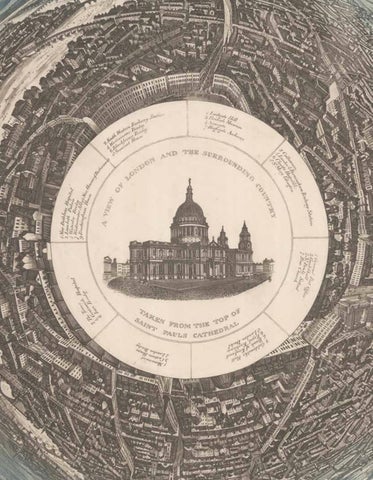
Although the urban vista had already been captured in a vast range of prints, it was not until the end of the eighteenth century that the first true panorama of London was made. Depicting the city from the southern end of Blackfriar’s Bridge, Barker’s original painting spanned a canvas of almost 1500 square feet and was taken on a tour of Europe. Simultaneously, printmaker Frederick Birnie produced “six elegant aquatint prints, which, if joined, will represent the City of London and the entire surrounding country as seen from the top of the Albion Mill” (item 63), thereby giving the public access to an original new form of art.
It was not only the lofty prospect of London, however, that printmakers felt worth committing to paper. The opening of a new building or bridge,
such as the 1751 iteration of Westminster Bridge (items 160-164), often encouraged the city’s publishers to produce commemorative prints of the structure, and likewise important events were almost inevitably accompanied by a wave of celebratory prints, some even produced at the event itself, as was the case with the Frost Fair of 1814 (items 211-213). Scenes such as William Hogarth’s series showing the capital’s streets at various times of the day (item 448),, Edwin Edward’s collection of inns (item 453), and Benjamin Read’s advertisements for his new sartorial collections (items 411-414) also shed light on day-to-day life for London’s inhabitants, both at work and play.
A constant feature on the changing face of London is the travel network. Coaching stations, memorably depicted by James Pollard (items 245, 247, and 248), would eventually come to be replaced by the railway (items 253-256), which was later joined by the underground system, imaginatively represented by MacDonald Gill in 1914 (item 987) before Beck’s iconic map of 1931 won its continued monopoly. Another key communications and travel route was provided by the Thames, which long served as the arterial pathway through the city. This contributed to its overcrowding, as shown in Joseph Stadler’s view from the South Bank (item 67), and contamination, hinted at in Haywood’s plan of the London sewer system (item 883), which was improved in response to the “Great Stink of 1858”.
The prints within this two-volume catalogue serve as a visual chronicle of an ever-expanding city, encompassing its people, buildings, culture, geography, politics, and history. They are testament to Dr Johnson’s claim that “when a man is tired of London, he is tired of life”.
Roger Cline
Roger Cline is a true collector. A patent attorney by trade, Roger was educated at Queen’s College, Oxford. His library started life as a reference collection for teaching Railway History at The City Lit adult education college almost 50 years ago. As time went on, interest became concentrated in the London area and the library soon became more of a London Topographical library, and Roger spent his Saturdays navigating home counties bookshops using Driffield’s idiosyncratic directory as his guide.
As the library grew, it absorbed several other important collections, including those of: Bernard Adams, author of ‘London Illustrated 1604-1851’ (1983); the bookseller Ben Weinreb (1912-1999), who had amassed a great number of books in order to prepare with Christopher Hibbert ‘The London Encyclopaedia’ (also 1983); the artist Peter Jackson (1922-2003), who had contributed to numerous books on the subject, including ‘London Bridge: a Visual History’ (2002), George Scharf’s ‘London’ (1987), ‘Walks In Old London’ (1993), ‘London: 2,000 Years of a City and its People’ (1974), ‘The History of London in Maps’ (1990), and ‘Pleasures of London’ (2003). Roger also acquired some 300 maps from the library of Joel Tabor (1922-1997), and a private collection of 500 large format prints.
Over half a century, Roger Cline has curated a collection of London material “Conteyning the Originall, Antiquity, Increase, Moderne estate, and description of that City” (John Stowe’s ‘A Survey of London’).
Roger, in the middle, University of Oxford Road Racing Team, 1960.
PANORAMAS AND PROSPECTS
THE TYPOGRAPHIC ETCHING COMPANY; [after] Antony van den WYNGAERDE
View of London (cir. A.D. 1550) by Antony Van den Wyngaerde.
Publication London, London Topographical Society, 1881-1882.
Description Facsimile, printed on seven sheets, housed in original portfolio.
Dimensions (if joined approx)
S: 800 by 460mm (31.5 by 18 inches).
P: 550 by 301mm (21.75 by 12 inches).
I: 510 by 2870mm (20 by 11.5 inches).
References Colvin and Foister, ‘The Panorama of London circa 1544, by Antonis van den Wyngaerde’, 1996; Hyde, [private notes].
The “earliest general view of London” (Hyde)
The “Wyngaerde Panorama” (1543/1544) is the earliest general view of London. Three metres in length, it is the work of Flemish artist Anton van den Wyngaerde, and was quite possibly commissioned by King Henry VIII. Wyngaerde’s original drawings, together with instructions as to how they should be coloured, are held in the Sutherland Collection, first housed in the Bodleian Library, now the Ashmolean Museum.
The present example is a seven-sheet facsimile of Wyngaerde’s work, with notes by Henry B. Wheatley, published by the London Topographical Society (LTS), between 1881 and 1882, as their first publication. A facsimile of the “Wyngaerde Panorama” had first been proposed around 1826 by the booksellers Messrs. Harding, Tiphook, and Lepard. After their venture foundered, Nathaniel Whittock (1791-1860), draughtsman, lithographer, and aquatint engraver, produced two tracings of the original drawings, presenting one set to Frederick Crace (now in the British Museum), and the other to the Corporation of London (now in the Guildhall Library), with a published facsimile following (for which, see items 2 and 3).
The London Topographical Society reprinted Wyngaerde’s panorama in 1996, as their publication No. 151, with a key to the buildings (see Colvin and Foister).
Anton van den Wyngaerde (1525-1571) made panoramic sketches and paintings of towns in the southern Netherlands, northern France, Italy, and, famously, 32 topographical studies of Spanish cities for Christopher Plantin (c1520-1589). In addition to his large prospect of London, he drew another series of sketches of English towns, while travelling through the country with Phillip II, King of Spain, and his wife, Queen Mary I of England.
2
WHITTOCK, N[athaniel]; [after]
Ant[on]y van den WYNGRERDE
London, Westminster and Southwark as they appeared A.D. 1543. From a drawing by Anty. van den Wyngrerde, Sutherland Collection, Bodleian Library, Oxford.
Publication
London, H. A. Rogers, 83 Hanley Road, [c1896].
Description Etching, printed on two sheets.
Dimensions (if joined)
S: 480 by 1640mm (19 by 64.5 inches).
P: 410 by 1555mm (16 by 61.25 inches). I: 300 by 1425mm (12 by 56 inches).
The “earliest general view of London” (Hyde) - Whittock’s version
In producing his sweeping panorama of London, which extends from the Palace of Westminster, on the left, to the Palace of Placentia, on the right, Nathaniel Whittock (1791-1860) made use of the “Wyngaerde Panorama”, Anton van den Wyngaerde’s three-metre panoramic view, the earliest of London, held at the time in the Bodleian Library (for a full description of which, see item 1).
Whittock also incorporated other sources, adding further detail to Wyngaerde’s work, for example in his depiction of Bermondsey Abbey. Such additions are, however, to be treated with caution, branded by Wheatley, in the introduction to his London Topographical Society facsimile (item 1), as “entirely untrustworthy”.
The present example is, according to Hyde, the second state of Whittock’s panorama, with the imprint of H.A. Rogers, the first published in 1849.
The “earliest general view of London” (Hyde) - Whittock’s version, in full colour
A further example of Whittock’s panorama of London, after Wyngaerde, here in full colour. For a full description of the print, see item 2. 3
WHITTOCK, N[athaniel]; [after] Ant[on]y van den WYNGRERDE
London, Westminster and Southwark, as they appeared A.D. 1543. From a drawing by Anty. van den Wyngrerde, Sutherland Collection, Bodleian Library, Oxford.
Publication
London, H. A. Rogers, 83 Hanley Road, [c1896].
Description Etching, printed on two sheets, with contemporary hand-colour in full, laid on card.
Whittock’s ‘Southwark and London Bridge as they appeared in about 1546’ was first published in 1844, appearing as an illustration in Edward Brayley’s ‘A Topographical History of Surrey’. The present print is from the 1878 edition, revised by Edward Walford.
The aerial view looks over Southwark towards the River Thames and London Bridge, with notable points, ranging from Queen Hythe, to St Saviour’s Church, to “The Stews”, to St Thomas’s Hospital, detailed using a 20-point key, set out below the image. Also depicted is Borough, a market-town which had been populated since early Saxon times and, by the Middle Ages, had become a notorious hot-bed of criminality. In the mid-sixteenth century it became known as the “Bridge Ward Without”, or the ward of “Bridge Without”.
The brass neck to ban the press gang
PYE, I.; [after] Tho[ma]s WOOD
To the Right Honourable Brass Crosby Esqr. Lord Mayor the Worshipfull Aldermen & the Common Council of the City of London. This South View of the said City and part of Southwarke as it appeared about the year 1599 is Dedicated by their most obedient humble Servant.
Publication [London], T. Wood in Bishops Court, Chancery Lane, Novr. 7, 1771.
Description Engraving.
Dimensions
S: 380 by 600mm (15 by 23.75 inches).
P: 360 by 590mm (14.25 by 23.25 inches).
I: 280 by 560mm (11 by 22 inches).
References GAC, 10388; Hyde, [private notes].
This view of London from Southwark is dedicated to Brass Crosby (1725-1793), a radical lawyer, who became Lord Mayor of London in 1770. One of his first acts as Lord Mayor was to refuse to enforce Admiralty warrants to coerce Londoners into joining the Royal Navy, ordering constables to be positioned “at all avenues” of the City to prevent men being press ganged into service.
Since the view is derived from that by Merian (for which, see item 9), the date of 1599, given in the title, as Hyde notes, “should not be taken seriously”.
The print was engraved by John Pye (fl1769-1789), engraver and printseller, who produced a range of landscapes, views, and trade-cards, after a work by Thomas Wood, about whom little is known.
[PULLAM, J.]; [after] C[laesz] J[ansz] VISSCHER
London.
Publication [London, Anne Evans & Son, 1848].
Description Engraved panorama, on four sheets, with contemporary hand-colour in full.
“one of the ... most important of the early London panoramas” (Howgego) - Pullam’s version
Visscher’s 1616 panorama of London is “one of the best known and most important of the early London panoramas” (Howgego). It is “a view of the City from the south and its title ‘LONDON’ appears in the sky on a ribbon held by herald angels. Generally pleasing to the eye – it is a favourite for photo-murals in home, office and showroom – it has certain weaknesses topographically. The Thames is shown flowing in a straight line from west to east (though some versions show an odd change of course at the east end); the vertical scale is greatly exaggerated, some of the architectural detail is suspect and although many of the buildings are shown in detail others are omitted altogether. Internal evidence suggests that the view was drawn about 1600. The Globe Theatre on Bankside, built in 1598, is shown but Northampton House constructed 1605-9 at Charing Cross, and Salisbury House, where Elizabeth I was entertained in 1603, are not. The arms of the Tudors, whose dynasty ended in 1603, appear on Bulmer’s water tower and on the banner of the royal barge. Some editions of the panorama bear the signature ‘C.J. Visscher delineavit’. C.J. Visscher, the
engraver, was born in 1587, son of another C.J. Visscher, variously described as a goldsmith and as a shipwright. There is no firm evidence that either the father or the son ever visited London and saw the City himself, and the inaccuracies in major buildings suggest that they did not” (Howgego). The present example is a “crudely etched” (Hyde) copy of Visscher’s panorama by J. Pullam, published in 1848. The etcher has bungled the name of Ludovicus Hondius, in the cartouche in the top-right corner, citing him as “tndo vicnc Bondius”…
[PULLAM, J]; [after] C[laesz] J[ansz] VISSCHER
London.
Publication
London, F. S. Nichols & Co., 12 Boro’ High St. London Bridge. S. E., [c1848].
Description
Etching, folding into original covers.
Dimensions
S: 520 by 2280mm (20.5 by 89.75 inches).
P: 450 by 2150mm (17.75 by 84.75 inches).
I: 420 by 2050mm (16.5 by 80.75 inches).
A further example of Visscher’s ‘London’ by Pullam, this one folding into original covers. For a full description of the panorama, see item 6.
DANIEL CROUCH
LONDON: THE ROGER CLINE COLLECTION (PRINTS I)
THE TYPOGRAPHIC ETCHING COMPANY; [after] C[laesz] J[ansz] VISSCHER
View of London. A Facsimile of the probably unique example of the original edition in the King’s Library, British Museum.
Publication [London], London Topographical Society, 1883-1884.
Description Etching, printed on four sheets; loose in original printed paper portfolio.
Dimensions (if joined)
S: 570 by 2380mm (18.5 by 93.75 inches).
P: 450 by 2270mm (17.75 by 89.5 inches).
I: 415 by 2145mm (16.5 by 84.5 inches).
References Hyde, [private notes].
The London Topographical Society’s version
A further example of Visscher’s ‘London’, for a full description of which, see item 6. The present example was engraved by the Typographic Etching Company for the London Topographical Society and boasts to be the most faithful facsimile to date: “there are several so-called reproductions of the original, that abound in topographical anachronisms and inconsistencies. The chief interest of the View is that it represents London as it was known to Shakespeare” (front cover).
Provenance
W ith the blind library stamp of Chetham Library, Manchester, the oldest free public reference library in the world, on the front cover.
DANIEL CROUCH
LONDON: THE ROGER CLINE
[MERIAN, Matthaeus]
London.
Publication [Frankfurt, Matthaeus Merian, c1638].
Description Engraving and etching.
Dimensions
S: 320 by 716mm (12.5 by 28 inches). P: 225 by 700mm (8.75 by 27.5 inches). I: 206 by 696mm (8 by 27.5 inches).
A pre-Fire view of London and the Thames taken from a vantage point over Southwark. Matthaeus Merian (1593-1650) was a Swiss engraver and publisher active in Germany. He moved to Frankfurt and worked for the de Bry publishing house, at that time run by Johann Theodor de Bry. Merian married Johann’s daughter Maria, and took over the publishing house in 1623 after his father-in-law’s death, before setting up as an independent publisher in 1626.
The plate was first used in ‘Neuwe Archontologia Cosmica’ by Johann Ludwig Gottfried, published by Merian in Frankfurt in 1638 (and republished in 1646, 1649, and 1695), but was also issued separately. It is based on earlier views by Visscher (see items 6-8) and John Norden.
Merian’s view provides some insight into life on the river. The “gally fuste” (41) is the galley foist, the official barge of the city of London, used for ceremonial occasions by the Mayor. The “eell schipes” (40) nearby were Dutch merchant vessels, which would transport live eels from Scandinavia in hold tanks full of muddy water, before anchoring in the Thames, ready for customers to row out to buy fresh eels. “Lion Kay” (27) was a busy water station, from which, ten years after this print was made, James II, then Duke of York, would escape during the Civil War.
HOLLAR, W[enceslaus]
Graenwich.
Publication
London, Peter Stent at Crowne in Giltspur Stree, [1644, or later].
Description Engraving.
Dimensions
S: 150 by 845mm (6 by 33.25 inches). I: 146 by 837mm (5.75 by 33 inches).
References
BM, 1880,1113.5510; Crace, XXXVI.13; New Hollstein, 246.V; Pennington, 977.iv.
A panoramic view of Greenwich, “the first important work” (Pennington), after his arrival in England, by one of “the most accomplished” of all etchers (Pennington), Wenceslaus Hollar.
Hollar (1607-1677) was a Czech-born engraver, printmaker, and cartographer. He joined the train of Thomas Howard, Earl of Arundel, while he was travelling through Europe, and returned to England with the Earl in 1637, making this panorama, the first state of which was published in 1637, one of Hollar’s earliest views of London.
The panorama highlights the features that made seventeenth-century Greenwich an important place. At the centre is the Queen’s House, gifted by King Charles I to his wife, Henrietta Maria. Only completed in 1635, this was the first major commission for renowned architect Inigo Jones, and the first building in England to be designed in classical style. To the left is Greenwich Palace. The birthplace of many Tudor monarchs and a favoured hunting lodge among London nobility, the palace would be used as a biscuit factory and prisoner-of-war camp during the English Civil War (1642-1651). Subsequently falling into disrepair, it would largely be demolished in 1660, with King Charles II’s ambitious plans for its reconstruction never coming to fruition.
The present example is, according to Hollstein, the fifth state of the panorama, with the Latin verse following “orbem” erased and replaced by a translation of the verses into English, “W. Hollar fecit” below the cartouche, and the imprint “London Printed and Sould by Peter Stent at the Crowne in Giltspur street betwixt new gate and pie Corner” in the margin bottom-left.
DANIEL CROUCH RARE BOOKS
LONDON: THE ROGER CLINE COLLECTION (PRINTS I)
MARTIN, Robert; [after] Wenceslaus HOLLAR
London. De Celeberrima & Florentissima rinobantiados Augustae Civitate...
Publication [London], 24, High Holborn, 1832.
Description Lithograph, printed on four sheets.
Dimensions
S: 540 by 2390mm (21.25 by 94 inches). I: 455 by 2320mm (18 by 91.5 inches).
References
BM, 1880,1113.1127; Crace, I.19; Darlington and Howgego, p10; GAC, 6180; Hyde, [private notes]; New Hollstein, 954 copy; Pennington, 1014 copy.
Hollar’s magnificent panorama of LondonMartin’s version
A facsimile example of “the most important... and the most accurate of the pre-Fire panoramas” (Darlington and Howgego). Hollar lived in London between 1637 and 1644, during which time he made the drawings for his great panorama of the city, probably supplementing them by referring to an earlier panorama of London by Claesz Visscher when he came to publish it in 1647. As an immigrant in the service of a recusant Catholic lord, he judged it best to leave England when the Civil War began. Luckily for history, this meant that he kept the Globe Theatre in the picture, although it had been demolished three years earlier.
Like Visscher, Hollar gets the Globe confused with another theatre nearby: the Globe is in fact the structure labelled as a “beer bayting h[ouse]”, not the building with the flagpole. It stands on the South Bank of the Thames, which had became a centre of entertainment in the late-sixteenth century, hosting numerous brothels and bear baiting houses. The Rose and Swan Theatres opened their doors here in 1587 and 1595 respectively. It was the perfect location for Shakespeare and his company, the Lord Chamberlain’s Men, to open their new theatre in 1599. The first globe was actually constructed using the timbers from an earlier theatre in Shoreditch. The father of the Burbage brothers, the major shareholders in the company, had built the theatre in 1576. After the owner of the land
on which the Shoreditch theatre was built threatened to seize the building when the lease expired, Shakespeare and the rest of the company dismantled the theatre and hid it in a warehouse, before ferrying it down the river to rebuild it in Southwark. The theatre on the panorama is actually the second Globe: the first burnt down in 1613.
Although other engravers had produced views of London, Hollar’s panorama was unusual in that it had a single viewpoint: the tower of St Saviour in Southwark, which is now Southwark Cathedral. He made all his preliminary sketches from this tower, and his sketch of the Globe is now in the Paul Mellon Collection at Yale. At the far left is a dedication to Mary, Princess Royal, the daughter of Charles I and Princess of Orange, surmounted by a “Nympha Brittanorum”. The dedication refers to Charles I as “the invincible king of Great Britain” - Pennington cites this as evidence that Hollar must have been working in exile, as a British audience might have found that statement questionable at a time when Charles was actually a prisoner of Parliament. At the far right there is a cartouche containing an ode to London between two panels symbolizing commerce and surmounted by a figure of a river god, emphasizing the importance of the River Thames to London’s position as a centre of trade.
The present example is a nineteenth-century facsimile, by Robert Martin.
London. De Celeberrima & Florentissima Trinobantiados Augustae Civitate...
Publication Melbourne, Walker, May & Co., Printers, Mackillop Street (off 56 Bourke Street West), 1879.
Description
Photo-lithograph, folding into original covers.
Dimensions
S: 515 by 2270mm (20.25 by 89.5 inches). I: 485 by 2255mm (19 by 88.75 inches).
References Hyde, [private notes].
Hollar’s magnificent panorama of LondonBroinowsky’s version
A further example of Hollar’s 1647 panorama of London, here an 1879 photolithographic replica of the original. The facsimile was produced by “Gracius J. Browne”, that is, the Polish-Australian artist Gracious Joseph Broinowsky (1837-1913). Broinowsky was also responsible for the six-volume series ‘Birds of Australia’. For a full description of Hollar’s panorama, see item 11.
DANIEL CROUCH RARE BOOKS
LONDON: THE ROGER CLINE COLLECTION (PRINTS I)
WALKER, Emery; [after] Wenceslaus HOLLAR
London. De Celeberrima & Florentissima rinobantiados Augustae Civitate...
Publication
London, London Topographical Society at 32 George Street Hanover Square, December 1907.
Description Photo-engraving.
Dimensions
S: 540 by 2390mm (21.25 by 94 inches). I: 455 by 2320mm (18 by 91.5 inches).
References Hyde, [private notes].
Hollar’s magnificent panorama of London - for the London
Topographical Society
A further example of Hollar’s 1647 panorama of London, here a facsimile published by the London Topographical Society in 1907, as their publication No. 19, and engraved by artist and prominent figure in the Arts and Crafts Movement, Emery Walker (1851-1933). For a full description of Hollar’s panorama, see item 11.
Provenance
With the blind library stamp of Chatham Library, Manchester, the oldest free public reference library in the English-speaking world, in the margin of each sheet.
DANIEL CROUCH
LONDON: THE ROGER CLINE COLLECTION (PRINTS I)
BENNING, R; [after Wenceslaus HOLLAR]
A View of London as it was in the Year 1647/ Vue de Londres comme il etait dans L’an 1647.
Publication London, John Boydell, 1756.
Description Engraving, printed on two sheets, joined.
Dimensions
S: 300 by 960mm (12 by 38 inches). I: 290 by 935mm (11.5 by 36.75 inches).
References BM, 1948,0315.2.87-88.
A thermal switch
A beautifully engraved view of pre-fire London, drawn and engraved by Richard Benning, after Hollar’s famous “London”, published in 1647 (for which, see items 11-13). The view, as Hollar’s, extends from Westminster Abbey, in the west, to “St. Catryns” (the hospital of St Katharine, near the Tower of London), in the east. Benning also, as Hollar, transposes the names of Shakespeare’s Globe and the Bear Garden. He deviates from Hollar, however, in giving the title, below the image, in English and French, along with an explanatory key, numbered 1-20, for each sheet. He has also removed the title-banner and the putti from the sky, and the cartouches, bottom-left and bottom-right.
Little is known about Benning (fl1743-1781), beyond his work. Born, perhaps, in St Martin in the Fields, in 1720, he was possibly related to William Benning (fl1746-1756), a copperplate printer. He engraved several plans and maps for John Rocque (of Paris, London, Berkshire).
DANIEL CROUCH
LONDON: THE ROGER CLINE COLLECTION (PRINTS I)
[HOLLAR, Wenceslaus]
London. The glory of Great Britaines ile behold her Landschip here, and tru pourfile.
Publication [London, 1657 or before].
Description Etching.
Dimensions
S: 287 by 376mm (11.5 by 14.75 inches).
P: 270 by 340mm (10.75 by 13.5inches).
I: 190 by 310mm (7.5 by 12 inches).
References Adams, 7.2; BM, 1868,0612.245; New Hollstein, 1632; Pennington, 1012.
“behold her Landschip here, and tru pourfile”
The present view extends from Charing Cross, in the west, to the Tower of London, in the east, with the four hills rising in the background labelled as “Harrowe”, “Hamsted”, “Hygate”, and “Hackney”. The title cartouche, in the sky, is held by two lions, with the arms of the city of London at the top.
The view was published in James Howell’s 1657 ‘Londinopolis’. It is difficult, however, to assign this date to the print, given that it does not show the Banqueting House, completed in 1622, nor the alterations to St Paul’s, completed in 1642. Some have even questioned whether the print can be attributed to Hollar, given that the foreground, as Pennington notes, is “not characteristic” of his work, and the Tower is illustrated without the round north-east turret, as usually depicted by Hollar. The most likely explanation for these anomalies, as proposed by Pennington, is that Hollar is copying an earlier view, probably that by Merian (for which, see item 9).
JONGHE, Clemendt de; [after Rombout van den HOEYE]
London. Londinum Celeberrimum Angliae Emporium.
Publication
Amsterdam, Gedruckt by Clement de Jonghe, [c1660].
Description Engraving.
Dimensions
S: 440 by 545mm (17.5 by 21.5 inches).
P: 400 by 505mm (15.75 by 20 inches).
I: 400 by 505mm (15.75 by 50 inches).
References
BL Maps *3518.(6); [van den Hoeye] BM, 1880,1113.1128.
Going Dutch
A print of the London skyline, with the crest of the Prince of Wales, top-left, and of the City of London, top-right. It is after Rombout van den Hoeye’s bird’s-eye print of the same subject, which in itself is a variant of Matthaeus Merian’s view (see item 9). While the example in the British Library is catalogued with a possible date of 1670, that the prospect shows both the old St Paul’s Cathedral (suggesting a date pre-1666 and the Great Fire) and the Globe theatre (suggesting a date before its closure in 1642) indicates that it might be earlier.
Clement de Jonghe (1624-1677) was a Dutch engraver, publisher, and print-dealer, a friend of Rembrandt, who, owning more than 60,000 plates, was a prominent figure in the art world in his own right.
JOLLAIN, [Gerard]
Londres. Origo et Descriptio Civitatis Londinensis.
Publication [Paris, c1666].
Description Engraving.
Dimensions
S: 415 by 545mm (16.5 by 21.5 inches).
P: 387 by 515mm (15.25 by 20.25 inches).
I: 377 by 510mm (14.75 by 20 inches).
Jollain family view of pre-fire London
Based on de Jonghe’s view of London (item 16), the image shows London before the Great Fire. This print, however, must have been published after the fire, as the French description beneath the image has been re-engraved to squeeze in an additional final sentence: “Le feut prit en cete ville le 12 Septembre 1666 et senbrasa tellement q.l consoma en cinq Iours plus des trois quarts dicelle aiant laise des marques de la plus funeste incendie quisesoit jamais veue” (“The fire took hold in this town on 12th September 1666 and spread such that it consumed in five days more than three quarters of the city, having made its mark as the most deadly fire that it had ever seen”).
Active in Paris from 1630 to 1683, engraver and printmaker Gerard Jollain founded a publishing dynasty consisting of his son François, grandson Jacques, great-grandson François-Gerard and great-greatgrandson Gerard. The publishing business continued to operate from the workshop Gerard had taken over from Jacques Honervogt in the rue St Jacques. Chez Jollain was responsible for a wide range of engraved material, from portraits to maps, and even the first harpsichord score printed in France.
[AVELINE, Pierre]
Londres. Ville Capital du Royaume D’Angleterre.
Publication Paris, Aveline, rue S. Jacques a la Reine de Fr, [c1686].
The first state of Aveline’s print showing London before the Fire from Southwark. The key identifies the most important buildings, including the Swan and Globe theatres, the old St Paul’s Cathedral, and the first London Bridge, complete with its buildings and the heads of traitors. The view is derived from Visscher’s prospect (for which, see items 6-8), via Merian’s (item 9). It shows London from Whitehall to St Katherine’s and beyond, with the fictitious north bend in the river on the right. Rather more of Southwark is shown, though the new topographical detail is also fictitious. In the foreground is an array of equestrian, perambulating, and seated figures, including an artist sketching the view.
This early state with Aveline’s imprint is rare; it is usually found in later states with the new St Paul’s Cathedral, or with the imprint “A Paris chez Jean, a rue de Jean Beauvais”, as recorded by Scouloudi. The example held by the British Library is catalogued with a tentative date of 1665, presumably to accommodate the pre-fire St Paul’s, but, as Aveline was only born in 1656 and only set up his business at le Petit-Pont in 1676, this is unlikely. It is possible, instead, that the print might date to c1686, at which point Aveline was granted a privilege to publish 115 views of royal residences (BnF).
Pierre Aveline (1656-1722) was a French printmaker and publisher, who specialized in topographic prints.
[AVELINE, Antoine]
Londres. Ville Capitale du Royaume D’Angleterre.
Publication Paris, chez Jean, rue Jean de Beauvais No.32, [c1690].
Description
Engraving, with hand-colour in full.
Dimensions
S: 395 by 500mm (15.5 by 19.75 inches).
P: 350 by 520mm (13.75 by 20.5 inches).
I: 325 by 515mm (12.75 by 20.25 inches).
References Scouloudi, pp48-49.
La vue française - après la conflagration
An engraved view of London with fine hand-colour, showing St Paul’s Cathedral, rebuilt after the Great Fire of 1666, London Bridge, complete with buildings and traitors’ heads, and the Globe and Swan theatres (although the latter two are not named in the ten-point key beneath the view).
This is a later state of item 18, the most significant difference being the addition of Wren’s domed St Paul’s. As Scouloudi notes, the view is “topographically useless”, but “is an interesting example of how earlier pre-Fire views were often adapted to show the post-Fire metropolis”.
[ANONYMOUS; after Pierre or Antoine AVELINE]
Londinum/Londinium Urbs Praecipua Regni Angliae.
Publication [Paris, c1700].
Description Engraving.
Dimensions
S: 430 by 530mm (17 by 21 inches).
P: 395 by 505mm (15.5 by 20 inches).
I: 365 by 490mm (14.5 by 19.25 inches).
References: Scouloudi, pp59–60.
La vue française - Latinized
A Latin version of Pierre Aveline’s prospect of London (for a full description of which, see item 18), which views London from Southwark, before the Great Fire of 1666. Although the engraver has changed the title cartouche, to read “Londinum”, instead of “Londres”, they have not updated the topography, with the London skyline still showing the Old St Paul’s and the Elizabethan theatres on Bankside, which had long since shut their doors.
Scouloudi records this as a variant of the view published by Antoine Aveline (1691–1743) in the early-eighteenth century, but she does not record the copy published by his father, Pierre Aveline. The present example could therefore be a variant on either the father’s or the son’s.
21 LEOPOLD, Joseph Fridrich
Londinium London.
Publication
Augsburg, cum Privileg. Sacrae Casarea Maiestat, [from 1690].
Description
Etching and engraving, text in Latin and German.
Dimensions
S: 224 by 321mm (9 by 12.75 inches).
P: 205 by 300mm (7.75 by 11.75 inches).
I: 200 by 290mm (7.75 by 11.5 inches).
References:
BM, 1948,0315.1.12; Marsch, in Paas (ed), ‘Augsburg, die Bilderfabrik Europas’, 2001, pp131-152..
A view of London before the Fire of 1666, with Old St Paul’s in the centre of the background.
In the foreground, there are people in conversation and travelling, both on foot and by horse and cart. Behind them is Southwark, at the time considered squalid, for its association with actors and prostitutes - a target for the Puritans from the 1640s onwards. In the background is the Thames and, running over it, London Bridge, with the City, extending from Westminster to the Tower of London, on the north side of the river.
Joseph Friedrich Leopold (1668-1726), was a publisher, engraver, printseller, and bookseller in Augsburg, and father of Johann Christian Leopold who succeeded him. This is one of many city views produced by Leopold, which the British Museum describes as a “German version of the standard Dutch view of London of the late seventeenth century”.
LEOPOLD, Joseph Fridrich
Londinium London.
Publication
Augsburg, cum Privileg. Sacrae Casarea Maiestat, [from 1690].
Description
Etching and engraving, text in Latin and German.
Dimensions
S: 224 by 321mm (9 by 12.75 inches).
I: 200 by 290mm (7.75 by 11.5 inches).
References BM, 1948,0315.1.12; Marsch, in Paas (ed), ‘Augsburg, die Bilderfabrik Europas’, 2001, pp131-152.
More Southwarkians
A variant issue of Leopold’s ‘Londinium’, here with “No. 4” scratched through lower left, and “L.8” added lower right. For a full description of the print, see item 21.
DE WIT, F[rederick]
London.
Publication Amsterdam, [c1694].
Description Engraving.
Dimensions
S: 534 by 622mm (21 by 24.5 inches).
P: 398 by 510mm (15.75 by 20 inches).
I: 388 by 509mm (15.25 by 20 inches).
References BM, 1880,1113.1180; V&A, 24429.
London
The present work is part of de Wit’s ‘Townbook’, which was published from 1694. In it, he compiled views of famous European and Asian cities, to be collected by armchair travellers across the continent. While the present example and that held by the V&A show St Paul’s in its pre-Wren state, the example held by the British Museum, which must be a later state, shows St Paul’s with its Wren dome. Below the image is a description in Dutch, French, German, and English, with a list of buildings on either side.
After moving to Amsterdam at around 18 years of age, in 1648, Frederick de Wit (1629-1706) studied the art of engraving and publishing under none other than Willem Jansz. Blaeu. By 1654, he had established a business on his own. In 1666, the year of the Great Fire, de Wit published a detailed broadside map of London.
SCHENK, Pet[er]
De so vermaerde Kerk van S. Paul tot London./ Templum D. Pauli apud Londinales Spectatis Semu.
Publication Amsterdam, [c1702].
Description Engraving.
Dimensions
S: 260 by 300 mm (10.25 by 12 inches).
P: 210 by 260 mm (8.25 by 10.25 inches).
I: 209 by 250mm (8.25 by 9.75 inches).
“The ages live in history through their anachronisms” (Wilde)
The present view, taken from the South Bank of the Thames, anachronistically shows the old St Paul’s Cathedral, long since destroyed and rebuilt. Also visible on the North Bank are York Water Gate (also known as Buckingham Gate), York Water Tower, and the Savoy.
At the age of 15, Peter Schenk (1660-1711) moved to Amsterdam from his native Germany to learn the art of mezzotint. After completing his training he established himself as an engraver and printer, and produced a vast array of prints, including portraits, prospects, and urban views. It was not until the 1690s, however, that Schenk properly entered the field of cartography, acquiring the stock of Jan Janssonius and subsequently printing a wide range of maps by the likes of Janssonius, Visscher, de Wit, Van Keulen, Danckerts, and his mentor, business partner, and brotherin-law, Gerard Valk.
SCHENK, Pet[er]
De so vermaerde Kerk van S. Paul tot London./ Templum D. Pauli apud Londinales Spectatis Semu.
Publication Amsterdam, [c1702].
Description Engraving, with fine early colour.
Dimensions
S: 285 by 335mm (11.25 by 13 inches).
P: 210 by 260mm (8.25 by 10.25 inches).
I: 209 by 250mm (8.25 by 9.75 inches).
A further example of Schenk’s view of the Thames (for a full description of which, see item 24), here with full hand-colour.
DE JONGHE, Clemendt
Londinum Celeberrimum Angliae Emporium. London.
Publication [Amsterdam, Clement de Jonghe, c1666].
Description Engraving.
Dimensions
S: 460 by 592mm (18 by 23.25 inches). P: 405 by 530mm (16 by 20.75 inches). I: 392 by 515mm (15.5 by 20.25 inches).
References BM, 1880,1113.1157; Crace, II.49.
De Jonghe’s view shows London in the midst of the Great Fire of 1666, smoke rolling up into the sky, the city ablaze. Below the plate, explanatory text is given in Latin, Dutch, and French. Churches and places of interest are identified by a numerical key on the bottom-right, while in the sky the title, ‘London’, appears in a scroll, with the coats-of-arms of the city of London and the Prince of Wales on either side.
[MERIAN, Matthaeus, the Younger]
Abbildung der Statt London sambt dem erschrocklichen brandt daselsten.
Publication [Frankfurt am Main, Matthaeus Merian, c1670].
Description Engraving.
Dimensions
S: 355 by 385mm (14 by 15 inches).
P: 220 by 350mm (8.75 by 13.75 inches).
I: 220 by 350mm (8.75 by 13.75 inches).
References Museum of London, A13123.
Merian’s prospect of London, as viewed from Southwark, shows the City engulfed by flames. In the banderole below the image, a numbered key with 20 references sets out points of interest.
Matthaeus Merian the Younger (1621-1687) would take over the business of his father, also Matthaeus, along with his brother, Caspar, in 1650.
[ANONYMOUS]
Londra lncendio della Gran Città di Londra Metropoli del Regno d’lnghilterra Successo Adi 21 di settembre 1666, Dal quale in 4 giorni fu abbruciata la piu gran pares con danno inestimabile.
Publication [Vienna, 1674].
Description Engraving.
Dimensions
S: 300 by 940mm (12 by 37 inches). P: 320 by 890mm (12.75 by 35 inches). I: 265 by 880mm (10.5 by 34.75 inches).
An unusual prospect of London during the fire, showing the Norman St Paul’s Cathedral in flames, and viewed from Southwark with the Globe and Swan theatres in the foreground, and severed heads raised on poles over the gate to London Bridge.
Scouloudi records this as a variant of Visscher’s view, and dates it around 1666, citing the Fire. However, Hyde notes that the print appears in Galeazzo Gualdo Priorato’s ‘Historia Leopoldo Cesare’, published in three volumes in 1674. The work is a detailed history of the military campaigns conducted by Emperor Leopold I (1640-1705), Holy Roman Emperor and King of Hungary and Bohemia. The engraving is unsigned, but the numerous plans in the work were engraved by F. van den Steen, C. Meijssens, G. Bouttats and others after J. Toorenvliet, A. Bloem, and others.
Galeazzo Gualdo Priorato (1606-1678), Count of Gomazzo, was one of the last Renaissance men: a condettiere who fought in battles from the siege of La Rochelle to expeditions in Brazil; historian in the service of Leopold I, Cardinal Mazarin and Christina of Sweden; and a military theorist whose drills were used by commanders across Europe.
BIRCH, W[illiam]; [after] Jan GRIFFIER
The Great Fire of London in the Year 1666.
Publication
London, W. Birch, No 2. Macclesfield Street, Soho, 1792.
Description
Engraving with aquatint, printed in sepia and finished by hand.
Dimensions
S: 291 by 392mm (10.5 by 15.5 inches).
I : 234 by 325mm (9.25 by 13 inches).
References BM, 1978,U.1739; GAC, 12831.
Escaping the fire
This dynamic view of London during the Great Fire features a man running, with his arms flailing, down the street from Ludgate. A castellated gateway to his left is in flames, and another man lies among the rubble of the adjoining jail on the right. This building appears to have fallen in, revealing behind it Old St Paul’s Cathedral and Bow Church. In the foreground a couple are loading a horse-drawn cart with bundles of clothes and a baby, who lies waiting in a cradle on the ground.
The print was engraved by William Birch (1755-1834), after a work by Jan Griffier (c1645-1718), etcher and landscape artist, known for the views of London that he produced from a yacht, sailing along the Thames.
[HOSMER SHEPHERD, Thomas]
London and Westminster 1669.
Publication
London, J. Mawman, January 1st 1821.
Description
Etching with aquatint, printed in sepia.
Dimensions
S: 230 by 864mm (9 by 34 inches).
P: 210 by 853mm (8.5 by 33.5 inches). I: 160 by 812mm (6.5 by 32 inches).
This imagined view shows London from Lambeth just three years after the Great Fire of 1666. Many of the churches, including St Paul’s, have yet to be rebuilt, and much of Lambeth and Southwark is fields, dotted with houses. Shepherd produced the drawings, after which this aquatint was made, from a drawing held in the British Museum, which, itself, was after a work in the journals of Cosmo III, housed in the Laurentian Library, in Florence.
Thomas Hosmer Shepherd (1793-1864),was a successful topographical draughtsman and watercolourist, who specialized in London topography, supplying numerous drawings for the print trade and as illustrations.
DANIEL CROUCH
LONDON: THE ROGER
A prospect and a perspective of London
NUTTING,
Jos[eph]; and Sutton NICHOLLS
A New Prospect of ye. North Side of ye City of London with New Bedlam & Moore Fields [and] A New Perspective View of London from the South with the Navigation on the River Thames, London and Black Friers Bridges, &c. &c.
Publication
London, James Walker at ye Star in Pycorner near West Smith Field [and] Robt Sayer Map and Printseller near Serjeants Inn, Fleet Street, [1704 and after 1762].
Description
A pair of engravings, each printed on three joined sheets.
Dimensions [North Side]
S: 700 by 1455mm (27.5 by 57.25 inches).
I: 680 by 1440mm (26.75 by 56.75 inches).
[From the South]
S: 670 by 1530mm (26.5 by 60.25 inches).
P: 640 by 1475mm (25.25 by 58 inches).
I: 625 by 1440mm (24.5 by 56.75 inches).
References
BM, 1880,1113.4086 [north]; Hyde, [private notes]; Peltz, for ODNB online; Sharp, for ODNB online.
A magnificent pair of engravings from the north side and south side of the river.
First edition of Joseph Nuttings’s ‘New Prospect of ye North-Side’. It extends from St Peter Cornhill on the left to St Martin Ludgate on the right. Dominating the foreground is Bethlehem Hospital (a psychiatric hospital, also known as “Bedlam”), which, founded in 1247, had opened at its new site in Moorefields in 1676, its building designed by Robert Hooke. Among the churches in the background are St Paul’s, its dome inaccurately rendered (understandable, given that it would not be completed until 1710), and St Michael’s, Crooked Lane, still lacking a spire. Staffage includes: booksellers, selling their wares from the hospital fance; a boy climbing over the fence into the hospital grounds; figures folding laundry on the hospital lawn; criers; and beggars.
Later edition of Sutton Nicholls’s ‘New Prospect of ye South-Side’, first published c1704, with the houses removed from London Bridge, and Blackfriars Bridge added on the left. The City of London is seen across the river extending from the Temple to the Tower of London.
Joseph Nutting (1660–1722), was apprenticed to John Savage in about 1680, before setting up in business as a “printmaker and printseller in Fleet Street, at the Gold and Blue Fans, near Salisbury Court. His output consisted mainly of portraits of near-contemporaries, such as Sir Edmund Berry Godfrey and John Locke, although one of his best prints is of Nicholas Monk, bishop of Hereford (d1661), and another shows Charles I with a group of his most prominent supporters (1706). Since Nutting worked extensively for the book trade, it is not surprising that many portraits by him were used as frontispieces, including those of Thomas Greenhill, ‘The Art of Embalming’ (1705), Sir Bartholomew Shower, ‘The Reports of Sir Bartholomew Shower of Cases Adjudg’d in the Court of King’s Bench’ (1708), and Dr Henry Sacheverell, ‘The Tryal of Dr Henry Sacheverell before the House of Peers’ (1710). He also engraved other subjects, among them topographical plates for John Slezer’s ‘Theatrum Scotiae’ (1693, 1710), an unusually large three-sheet ‘New Prospect of the North Side of the City of London, with New Bedlam and Moore Fields’ (c1690), and a book of penmanship (untraced). According to Vertue, Nutting was still working in London in 1713” (Sharp).
Sutton Nicholls (fl1680–1740), draughtsman and engraver, is “remembered primarily for his bird’s-eye prospects, sometimes depicting gentlemen’s seats but most often representing panoramic views of the streets and squares of the City of London and Westminster. No details are known of his life, but in 1713 George Vertue included his name in a list of ‘ye Engravers or Impres-gravers Burinators. Sculpture-Gravers Living in London’ (Vertue, Note books, 2.11). As he worked almost exclusively for book publishers, the clearest picture of Nicholls’s career can be derived from the various publications with which his name is associated... Throughout his career, however, Nicholls specialized in topographical designs and architectural elevations, many of which he either engraved or etched himself. Despite his rather ‘crude and hasty draughtsmanship’ (Adams, 69), the frequent inaccuracy of his views, and an apparently shaky grasp of perspective, he was repeatedly employed to produce illustrations for antiquarian accounts and topographical surveys of London... Aside from his book illustrations, Nicholls produced a few large-scale London prints, most of which were published by Henry Overton; however, one view, of the Tower of London, he published himself from the Golden Ball in St Paul’s Churchyard” (Peltz).
[KIP, Johannes, attributed to]
[A Prospect of the City of London/ La Ville de Londres Prospectus Londinensis].
Publication [London, c1713].
Description Engraving, printed on two sheets, proof impression without letters.
A fine view of the City of London, of particular note in that it is a proof impression, without the title in the banderole and text in the margin.
The prospect shows the city as seen from a high point on Southwark and extends from St Clement’s Church to the Tower of London. The dome of St Paul’s Cathedral and the many church towers dominate the skyline. As it is a contracted view, as Hyde notes, many riverside buildings have not been included, and there are further inaccuracies: St Michael’s Crooked Lane is, erroneously, illustrated with a regular-shaped spire, rather than one made up of three circular stages, and the tower of St Andrew’s, Holborn, appears without its urn pinnacles.
Johannes Kip (1653-1722) was a draughtsman, engraver, and print dealer. He briefly apprenticed with the printmaker Bastiaen Stopendaal in Amsterdam before setting up his own business. Shortly afterwards he followed William and Mary to London, where he settled in St John Street and conducted a thriving printselling business.
DANIEL CROUCH RARE BOOKS
LONDON: THE ROGER CLINE COLLECTION (PRINTS I)
[KIP, Johannes, attributed to]
La Ville de Londres Prospectus Londinensis - A Prospect of the City of London [and] La Ville de Westmunster - A Prospect of Westminster.
Publication [London, c1713 and c1710].
Description
A pair of engravings, each printed on two joined sheets.
A pair of fine views of London from the ‘Nouveau Théâtre de la Grande Bretagne’ published by David Mortier.
For a description of the ‘Prospect of the City of London’, see item 32. Here, the title has been written in the banderole and text added to the lower margin. The plate number (“I & II”) in the bottom-right corner of the panel below the view indicates, as Hyde notes, that this is the first state, published between 1713 and 1715 by David Mortier.
Forming a pair to the ‘Prospect of the City of London’ is Kip’s ‘Prospect of Westminster’, which extends from Millbank, in the west, to Temple, in the east. On the river, detail includes ferries carrying horses, while, on the North Bank, Westminster Abbey stands out, oriented, interestingly, north to south, not east to west. The present example is the first state, as set out by Hyde, with the plate number “1 & 2” bottom-right, the Maypole still visible on the Strand (which would be demolished in 1714), St Clement Danes with its pre-Gibbs (i.e. pre-1720) spire, and St Anne Soho without the spire that would be added to it in 1717.
MORDEN, Rob[er]t; [and] Phil[ip] LEA
A Prospect of London and Westminster Taken at several Stations to the Southward thereof.
Publication
London, Robt. Morden & Phl: Lea at the Atlas in Cornhill and at the Atlas and Hercules in Cheapside, [c1715].
Description Engraving, printed on four sheets, laid on card.
The present panorama extends from the Palace of Westminster, on the left, to Shadwell Dock, on the right. At the bottom of the image, centreleft and centre-right, are two boxes filled with 105 references, corresponding to numbers in the cityscape above, with points of interest including the “New Chapel” (that is, St Margaret’s Chapel, Westminster), the tennis court at Whitehall Palace, and Wren’s “New Canal” (that is, the Fleet River, dredged and improved).
The prospect was first published by William Morgan, as the first four sheets of his map ‘London &c. Actually Survey’d’ (1682). As advertised in the ‘Term Catalogue’ of November, 1682: “they that please may have the Map, without the Prospect; or the Prospect and Ornaments without the Map, at reasonable rates”. Morden and Lea acquired the plates for the prospect amongst Morgan’s stock. This is the second of the two states that they published, with the title, in its panel surrounded by putti (including a pair playing with a goat), altered to name Morden and Lea, and “at the Atlas in Cornhill and at the Atlas and Hercules in Cheapside” added after this.
Robert Morden and Philip Lea were map- and print-sellers trading respectively at the Atlas in Cornhill and the Atlas and Hercules in Cheapside near the corner of Friday Street. Morden published treatises on geography and navigation, cartographical pocket-books, military maps in conjunction with William Berry, and Hollar’s 1675 map of London with Robert Green. It was, perhaps, as a result of the sale of William Morgan’s maps and books conducted by Berry and other stationers at Garraway’s Coffee House (London Gazette 2235, 18-21 April 1687) that Morden became the publisher, in partnership with Lea, of two later issues (c1692 and 1720) of William Morgan’s 1681-1681 map ‘London Actually Survey’d’, complete with its 13 inset views, ornaments, and carefully drawn prospect of London from the Thames. The map and its appendages are described in detail in Lea’s undated ‘Catalogue of Globes, spheres, maps, Mathematical Projections, books and instruments’, probably compiled at the turn of the century, but by the date of their second issue both publishers had been dead for nearly 20 years and Lea’s widow Anne was carrying on the business. This catalogue also advertises, under the heading ‘Books of Maps &c. by Philip Lea’, ‘The Prospects of London, Westminster, and Southwark in 35 leaves, price 2s 6d’.
[AA, Pieter van de]
Londres. Capitale de l’Angleterre.
Publication [Leiden, c1720].
Description Engraving.
Dimensions
S: 355 by 415mm (14 by 16.5 inches).
P: 220 by 270mm (8.75 by 10.75 inches).
I: 215 by 268mm (8.5 by 10.5 inches).
London, est “Agreable”
Elegant and detailed view of London, which extends from a group of people and dogs in conversation, in the foreground, to the bustling metropolis of London, behind, with Southwark, the Thames, the City, and Whitehall all clearly marked. The view derives from that by De Wit (item 23), lacking the arms top-left and top-right, and the explanatory text below the image. Pieter van de Aa’s (1659-1733) career culminated with the publication of his illustrated atlas of the world, the ‘Galerie Agreable du Monde’, from which this print comes, the largest book of prints ever published. The ‘Galerie’ did not just cover geography, but also included more than 3,000 plates of native people, architecture, and historical events from around the world, and was issued in an astonishing 66 parts. Most of the plates were by other contemporary publishers, to which van der Aa added his signature broad decorative borders. A complete copy of the ‘Galerie’ cost the equivalent of a master craftsman’s annual salary.
S: 416 by 1130mm (16.5 by 44.5 inches). P: 320 by 1072mm (12.5 by 42 inches). I: 295 by 1065mm (11.5 by 42 inches).
References Hyde, [private notes].
First state of Wolff’s London
First state of Jeremias Wolff’s magnificent view of London. The prospect shows nearly 40 of the new churches (many designed by Sir Christopher Wren) built following the 1711 Act, which called for the creation of 50 new churches to replace those lost in the 1666 Great Fire. It also shows Wren’s Monument to the Fire, which was for many years the highest isolated column in the world, standing at 202 feet. A numbered key, in German, identifies the churches, as well as 25 other buildings.
Jeremias Wolff (1686-1724) was originally a clock and automaton maker, who later turned printer-publisher. Though he was never an engraver himself, he eventually became the biggest Augsburg publisher of his day.
While the plate is otherwise unsigned, the engraving could be attributed to Frederick Bernhard Werner (1690-1776), who specialized in panoramic town views and, from about 1729, made some 100 views of European towns for Jeremias Wolff and his heirs.
Probst’s panorama of London, after Friedrich Bernhard Werner (16901776), clearly draws on that by Jeremias Wolff (for which, see items 36 and 37), but is original in several points, among them: the explanatory key is now given both in German below the image and in English in the top-left and top-right corners; the heavy traffic of boats that clogs up the river to the right of London Bridge in Wolff’s view has been cleared; and the title roll has been re-engraved.
Johann Friedrich Probst (1721-1781) was the grandson of Jeremias Wolff. His father, Johann Balthasar Probst (1689-1750) had inherited Wolff’s firm, operating as “Wolff’s Heirs” (“Hoeres Jer. Wolffii”), and, after Johann’s death, his son acquired a part of the business, publishing under his own imprint, alongside his brothers, Georg Balthasar Probst (1732-1801) and Johann Michael Probst.
DANIEL CROUCH RARE BOOKS
LONDON: THE ROGER CLINE COLLECTION (PRINTS I)
S[AUR], F.I. [after]
London.
Publication
Augsburg, Georg Balthasar Probst exe: Aug V; Cum Gratia et Privilegio Sac: Caes: Majestatis., [c1780].
Description Engraved panorama on two joined sheets.
Dimensions
S: 435 by 1175mm (17.25 by 46.25 inches).
P: 380 by 1120mm (15 by 44 inches).
I: 379 by 1108mm (15 by 43.5 inches).
References Hyde, [private notes].
Another Probst, another panorama
The present panorama is, essentially, a re-engraved version of item 37, here with the imprint “Cum Gratia et Privilegio Sac. Caes: Majestatis”, added top-left, and Georg Balthasar Probst named as the publisher, bottom-right.
Georg Balthasar Probst (1732-1801) was the brother of Johann Friedrich Probst (1721-1781) and, most likely, published this panorama after his brother’s death. In his own right, Probst is known for his urban views of European and Asian cities, as well as his plates depicting scenes from the Bible.
The present example is, as Hyde notes, the first state of three.
DANIEL CROUCH RARE BOOKS
LONDON: THE ROGER CLINE COLLECTION (PRINTS I)
KIP, Johannes
Veue et Perspective de la Ville de Londre, Westminster et Parc St. Jaques.
Publication [London, ?Thomas Millward, after 1726].
Description
Engraving with etching, printed on eight sheets, joined as four.
Together with KIP, Johannes [after], ‘View of London and Westminster’, London, London Topographical Society, 16 Clifford’s Inn, Fleet St, 1903. Lithograph, printed on 12 sheets and laid down on linen (S: 1680 by 2400mm (66.25 by 94.5 inches)).
Dimensions (if joined)
S: 990 by 2030mm (39 by 80 inches).
I: 980 by 2010mm (38.5 by 79.25 inches).
References
BM 1880,1113.1181.1-1 [first state]; Hyde, [private notes]; Hyde and Jackson, ‘Jan Kip’s Prospect of London’, 2003.
“largest view of London ever to be published”
A fine example of Kip’s view of London, the “largest view of London ever to be published” (Hyde and Jackson).
Kip’s prospect was not only innovative in scale, but also in perspective. Most prospects of London focused on the city, usually viewed from the south of the river. Kip used “an entirely novel view-point - the roof of Buckingham House” (Hyde and Jackson). The cost of giving the Palace such prominence is a radical distortion of the more distant townscape. A satisfactory profile view of the City of London is achieved only by doubling the Thames back on itself.
The focus of the print is on St James’s Park, an epicentre of urban life. There is a herd of deer, who were tame enough to eat out of visitors’ hands, and a flock of cows who were driven to the Whitehall end of the park every day to be milked (Kip has changed this to the Buckingham House end). The inhabitants range from the trio of women selling oranges (wearing kerchiefs as a sign of respectability), to the men playing pall-mall, a game similar to croquet which gave the London street its name, to the family of beggars just outside the gate. The most important characters, however, are George I, shown in his coach, and the Prince and Princess of Wales in their own coach just behind, escorted by a group of Horse Guards. Kip’s decision to include them, as well as to use the viewpoint from Buckingham House, is a clear statement both of his loyalty and of where power in Britain now lay - in Westminster.
Publication was delayed by the Jacobite rebellion in 1715, and by the rift between the King and the Prince of Wales. Kip was left in a difficult position. Not only was the view dedicated to Caroline, Princess of Wales, who had defiantly chosen to go into political exile with her husband, even though it meant losing access to her children, but it also showed the Prince and Princess riding in a coach immediately behind the King. Luckily, the two were eventually reconciled and Kip was able to publish his view in 1720.
Hyde notes that most surviving copies, like this one, have eight sheets rather than the original 12, and identifies this as the third state, distinguished by the updated James Gibbs steeple on the church of St Martin in the Fields on sheet six (numbered 14) and the continuation of the neat lines around the references and title below the image. It must have been published after 1726, when St Martin in the Fields was reconsecrated, possibly by Thomas Millward who also published the second state (Hyde).
Together with a 1903 facsimile of the first state of Kip’s view, published by the London Topographical Society.
“the Metropolis and Glory of the Kingdom
of England”
BOWLES, John
The South Prospect of London and Westminster.
Publication London, John Bowles, Black Horse in Cornhill, [c1730].
Description
Engraving, printed on two sheets, joined.
Dimensions (if joined)
S: 490 by 1201mm (19.25 by 47.25 inches). I: 475 by 1145mm (18.75 by 45 inches).
References BM, G,8.1; Hyde, [private notes].
A fine prospect of the city of London and Westminster, extending from Westminster Stairs, in the west, to the Tower, in the east.
The title, on a banderole in the sky, is flanked by the arms of the See of Westminster, on the left, held by two putti, and by the arms of the city of London, on the right. In the scrolls in each of the top corners of the print is explanatory text in English, on the left, and, on the right, translated into French. The text includes panegyric of the city of London, describing it as: “the Metropolis and Glory of the Kingdom of England, the Residence of the British Monarchs, and the Source of all Trade and Commerce. It is the largest in Extent, the fairest Built, the best Inhabited by a Rich and Sober People, and the greatest Trading City of any in the
whole World”. Below the image are 118 references to points of interest, mainly to churches, ranging from “St. Vedast alias Foster”, “St. Mildred in Breadstreet”, and “St. Iames at Garlick Hill”.
As Hyde notes, the prospect is unusual in that it accurately indicates the southward bend of the river at Westminster. The print was first published c1722, illustrating St Clement Danes with its tower redesigned by Gibbs (completed 1720), but St Martin in the Fields with its tower as it was before its Gibbs renovation (1724). The present example, according to Hyde, is the third state, with Bowles’s post-1730 address (“ye Black Horse in Cornhill...”) given in the imprint.
DANIEL CROUCH
RUPPRECHT, Marc Abraham
Londinium Londen.
Publication I. Christoph Haffner, [c1740].
Description Engraving.
Dimensions
S: 290 by 750mm (11.5 by 29.5 inches). P: 283 by 635mm (11 by 25 inches). I: 232 by 620mm (9 by 24.5 inches).
Marc Rupprecht (1730-1800) was an Augsburg-based engraver, who inherited Christian Hafner’s business in 1754 and went on to run an important engraving company. This plate offers a long view from the South Bank over London Bridge towards St Paul’s Cathedral and the City, with St Clement’s on the left and the Tower on the right, taken from an imaginary hill in south London, across which an elegant carriage and a pair on horseback, preceded by a figure in Russian-style dress, travel.
The view is, as Hyde notes, “a curiosity and of very little topographical value”, still, in the eighteenth century, showing the Swan and Globe Theatres on the South Bank, both of which had closed in the mid-seventeenth century. Hyde dates the view, tentatively to 1730, while the BM dates it to c1740. It is possible that the print should be dated even later, since Marc Rupprecht was born only in 1730.
DANIEL CROUCH RARE BOOKS
LONDON: THE ROGER CLINE COLLECTION (PRINTS I)
ENGELBRECHT, Martin Londinum/Londen.
Publication Aug[sburg, c1740].
Description Engraving with etching.
Dimensions
S: 302 by 417mm (12 by 16.5 inches). I: 290 by 400mm (11.5 by 15.75 inches).
“Here’s the church, here’s the steeple...”
A fine depiction of London’s regeneration in the aftermath of the Great Fire of 1666, with the huge number of steeples visible across London’s skyline reflecting the over 52 churches and monuments erected by Sir Christopher Wren in the wake of the disaster, and the peacock which stands alongside the city’s coat of arms in the foreground symbolizing London’s pride in its new appearance.
Martin Engelbrecht (1684-1756) was an engraver based in Augsburg, best known for his invention of the diorama.
[NICHOLLS, Sutton]
A Prospect of Greenwich. Deptford and London taken from Flamstead [sic] Hill in Greenwich Park.
Publication London, Robt. Sayer at the Golden Buck in Fleet Street, [c1748-1766].
A prospect of London as seen from Greenwich. On the left stands Flamsteed house, the original Royal Observatory building at Greenwich. Designed by Sir Christopher Wren, it is named after John Flamsteed, the first Astronomer Royal, appointed to the position by King Charles II in 1676. Also illustrated is the Queen’s House, to this day one of the most important buildings in British architectural history, being the first building in Britain to be built in classical style and Inigo Jones’s first major commission. Here, as was fairly common in the eighteenth century, it has been named “The King’s House”. In the background, Wren’s many churches dominate London’s skyline. The print was initially published by Henry Overton, in 1723. The present example is a later state, published by Robert Sayer (c1725-1794), with Sayer’s imprint replacing that of Overton. With Sayer’s address given as the Golden Buck, in Fleet Street, it can be dated to between 1748 and 1766.
BUCK, S[amuel]; and N[athaniel] BUCK
This drawing, taken from Mr Scheve’s Sugar House, opposite to York House, & engraved by S & N Buck
This engraving presents a long view of London and Westminster from the new bridge at Westminster eastwards towards the Tower. The panorama, spread across five sheets, shows many boats on the Thames, as well as the North Bank’s many magnificent buildings, some of which are identified in a numerical key beneath the view.
In the ‘London Evening Post’, February 13-15, 1746, the Buck brothers announced they would be publishing four prospects of London and Westminster. These, together with two prospects of Portsmouth, would complete their English series. The advertisement concludes: “N.B. Though the Prospects of London &c. will take much more Time in performing than any of the former sets, the subscriptions will be no more than the former sets, that is, 5s. paid at the time of Subscribing, and 10s. upon Delivery”.
Nineteen months later, in the ‘London Evening Post’, November 24-26, 1747, subscribers were informed that five drawings of London and one of Portsmouth had been taken. Drawings and subscription lists could be examined at the Bucks’s Middle Temple chambers, from where proposals could be obtained. In the same newspaper a year and a half later, they asked subscribers to pardon them for the delay in publishing the London and Portsmouth views, a situation caused by Samuel’s indisposition and their desire to render the engravings as perfect as possible. Publication was assured for 1st September. On the 2nd, the Bucks announced in the ‘General Advertiser’ that the plates for London and Portsmouth were at last completed, and impressions were now being printed off. Delivery would be on the 11th, after which date no more subscriptions would be accepted. Gough in ‘British Topography’ records that the Bucks were “four months about it” - presumably the engraving of the London plates. The prints were extremely successful and continued to be marketed in the nineteenth century. They are listed in the catalogues of Sayer & Bennett, (1775), Robert Sayer, (1786), Laurie & Whittle, (1795), and Whittle & Laurie, (1813) (Hyde). The present example is, as Hyde notes, the second state, published by Robert Sayer in ‘Buck’s Perspective Views’, in 1774, with the plate numbers “41” to “45” in the margin top-right.
[BUCK, Samuel and Nathaniel BUCK]
A General View of London and Westminster.
Publication London, R. Sayer & J. Bennett N°53 Fleet Street, 10 Jany. 1777.
Description Engraving on five sheets, some marginal repairs, occasionally affecting the image.
Dimensions If joined
S: 316 by 4160mm (12.5 by 163.75 inches). I: 276 by 4035mm (11 by 158.75 inches).
References Hyde, [private notes]; Hyde [Prospect of Britain], p22, pp47-48.
Taking the loooooong view - the fourth state
A further example of Samuel and Nathaniel Buck’s monumental panorama of London, here the second Sayer and Bennett issue (the first issue was published in November 1776, with the Adelphi, Blackfriars Bridge, and the New Bridge added), and the fourth state overall, with the title, ‘A General View of London and Westminster’, added to the top margin of the third sheet.
For a full description of the panorama, see item 45.
DANIEL CROUCH
LONDON: THE ROGER CLINE COLLECTION (PRINTS I)
BOWLES, T[homas]
A General View of the City of London next to the River Thames Vue Generale de la Ville de Londres du cote de la Tamise.
Publication London, Robt. Sayer at the Golden Buck opposite Fetter Lane, Fleet Street, August 20, 1751.
The present view looks along the Thames, towards Westminster Abbey, in the distance on the left, and St Paul’s, in the distance on the right, with London Bridge running across the river.
Thomas Bowles (c1695-1767) was a prolific map publisher. His father, also called Thomas, was an engraver, and Bowles II took over the family business and established his own print shop in St Paul’s Churchyard in 1712. His brother, John Bowles, also ran a publisher at 13 Cornhill.
[?BOWLES, Thomas]
A General View of the City of London next to the River Thames Vue Generale de fa Ville de Londres qui comprend la partie la plus voisine de la Tamise.
Publication
London, John Bowles at the Black Horse in Cornhill & Carington Bowles in St. Pauls Church Yard, [after 1761].
Description Engraving.
Dimensions
S: 215 by 310mm (8.5 by 12 inches).
P: 175 by 270mm (6.75 by 10.75 inches).
I: 153 by 255mm (6 by 10 inches).
Ten-pin Bowles?
The present print closely resembles Thomas Bowles’s view of the city of London (item 47) and is also, possibly, to be attributed to him. Here, however, London Bridge is shown as it stood after 1761, following the demolition of the buildings on top of the bridge. Further, the river is crowded with more boats, many in full sail.
STEVENS, [John]; [after] [Antonio] CANALETTO
A North view of London I Vue Septentrionale de la Ville de Londres.
Publication [London], 1753.
Description Engraving.
Dimensions
S: 340 by 482mm (13.5 by 19 inches).
P: 260 by 400mm (10.25 by 15.75 inches).
I: 225 by 380mm (8.75 by 15 inches).
References [Canaletto drawing] BM, 1862,1213.51.
After Canaletto
Canaletto (1697-1768) visited Britain repeatedly from 1746, building on contacts he had made in Italy and painting many scenes of British urban life. The present print, engraved by John Stevens (fl1750s), a topographical engraver, views London from the north.
The print was first published in 1751, again, in 1753, as here, and would then be republished as late as 1793, by Laurie and Whittle.
Canaletto’s drawing is now held in the British Museum.
PHILIPS, C[aspar] Junior; [after] I[saak] TIRION
I Gezigt van den Tuin van Somerset’s Paleis, Langs den Theems tot op de Brig van Londen.
Publication [Amsterdam], 1753.
Description Etching.
Dimensions
S: 195 by 455mm (7.75 by 18 inches).
P: 175 by 435mm (7 by 17 inches).
I: 155 by 420mm (6 by 16.5 inches).
References Hibbert and Weinreb, ‘The London Encyclopedia’, p796.
The view from Somerset House
Somerset House is the site of the first Renaissance palace built in England, constructed around 1550. It was rendered possible thanks to the demolition of inns previously located there, which were owned by the Bishops of Chester and Worcester. In 1552, the Duke of Somerset was executed and the building was later given to Princess Elizabeth in exchange for Durham House. The palace was a meeting-place for the Council under Elizabeth I’s reign. During the Restoration, it was occupied by Henrietta Maria and then by Catherine of Braganza, with whose encouragement Italian opera was performed for the first time in England. Isaak Tirion (1705-1765) was an eighteenth-century publisher from the Northern Netherlands, where he encountered Caspar J. Philips, an engraver and architectural historian of the Low Countries. He is best known for his work on façades of Amsterdam and for his meticulous depiction of buildings.
[ANONYMOUS]
[Vue Perspective de l’Hospital de Greenwich prise de la Thamise [and] Vue du Parc de St James à Londres et du Canal de Buckingham prise de la cour de l’hôtel du même nom].
Publication [Paris, c1760].
Description
A pair of engravings with contemporary hand-colour, laid on card.
Dimensions [Greenwich]
S: 280 by 440mm (11 by 17.25 inches). I: 225 by 395mm (8.75 by 15.5 inches).
[St James’s]
S: 280 by 440mm (11 by 17.25 inches). I: 265 by 430mm (10.5 by 17 inches).
Park Life
A pair of engravings of St James’s Park and Greenwich.
The first illustrates the Royal Hospital, Greenwich, designed by Christopher Wren, with fishermen, rowing boats, and the stern of a larger ship in the foreground.
The second illustrates St James’s Park, as seen from Buckingham Palace. St James’s Park had been redesigned by Charles II in the 1660s, with the help of French landscape architect André Mollet (1600-1665).
Inspired by Charles’s love for formal French gardens, the remodelled St James’s Park, constructed along a series of straight lines, as the present print illustrates, featured lawns, walkways, and a showstopping tree-lined canal.
[ANONYMOUS]
Londres. Capitale de l’Angleterre Evesche et Célèbre Port de Mer.
Publication Paris, chez Chereau, [c1760].
Description Engraving, with hand-colour, laid on paper.
Dimensions
S: 208 by 305mm (8.25 by 12 inches). I: 163 by 223mm (6.5 by 8.75 inches).
Row, row, row the boat
A view from Southwark, with Borough in the foreground. A dense flow of rowing boats illustrated towards the northern bank reflects the importance of the River Thames for the traffic which moved across it no matter the tide. On either side of the title, an explanatory key sets out points of interest including a variety of churches and the Tower of London.
BOWLES, Carington
A General View of the City of London, taken from the Bowling Green at Islington. Vue Generale de la Ville de Londres, du Boulin Grin a Islington.
Publication
London, Carington Bowles, Map & Printseller, No.69 in St. Pauls Church Yard, [1766-1790].
Description Engraving.
Dimensions
S: 220 by 316mm (8.75 by 12.5 inches).
P: 175 by 275mm (7 by 11 inches).
I: 150 by 265mm (6 by 10.5 inches).
References BM, 1875,0710.4903.
Bowles from a bowling green
A view over the City from the Bowling Green at Islington, with the works of the New River Company, at Sadler’s Wells, in the foreground. The New River Company was founded in c1609 by Sir Hugh Myddelton, with the aim of constructing the “New River”, which would supply fresh water to London. Taken over by the Metropolitan Water Board in 1904, it is a direct ancestor of Thames Water.
Carington Bowles (1724-1793) worked as a publisher in partnership with his father John Bowles from about 1752 until 1763, before taking over the business of his uncle, Thomas Bowles.
PASTORINI, B
View of the South Front of the New Buildings called Adelphi, formerly Durham Yard, and also that part of the cities of London & Westminster which extends along the River Thames to the Monument. The above Print exhibits the Royal Terras, the Houses, and Openings of the Streets leading to the Strand; Together with the Wharfs, Arcade, and entrances to the Subterraneous Streets, and Warehouses of the Adelphi, which is a private Undertaking of Messrs. Adam, designed by them, and begun to be carried into Execution in July 1768, Being so contrived as to keep the Access to the Houses, level with the Strand, and distinct from the Traffic of the Wharfs and Warehouses.
Publication [London], 1770.
Description Engraving with etching.
Dimensions
S: 420 by 812mm (16.5 by 32 inches). I: 365 by 788mm (14.5 by 31 inches).
The Adelphi, a block of 24 neoclassical terraced houses, were designed by the Adam brothers (and so-named in an act of self-promotion: “adelphoi”, in ancient Greek, means brothers). In a remarkable feat of engineering, the houses were raised above the Thames on a series of vaulted warehouses, transforming the long-unfashionable area, known as Durham Yard.
Benedetto Pastorini (c1740-1806) was an engraver and etcher, who had worked for Robert Adam in Rome, between 1761 and 1762, and most likely came to London on his instigation.
DANIEL CROUCH RARE BOOKS
LONDON: THE ROGER CLINE COLLECTION (PRINTS I)
GREEN, V[alentine];, and F[rancis] JUKES; [after] W[illiam] MARLOW
View Near Westminster Bridge
From a Picture in the Possession of David Garrick Esq [and] View near Black Friers Bridge from a picture in the collection of David Garrick.
Publication
London, Boydell, J. Cheapside, Feb 20, 1777.
Description
Pair of engravings with aquatint, printed in sepia.
Dimensions
Each S: 440 by 550mm (17.25 by 21.5 inches).
References
BL Maps K.Top.22.37.n.; BL Maps K. Top.22.38.h; Gatrell, ‘The First Bohemians: Life and Art in London’s Golden Age’, plxxv; London Review and Literary Journal, January 1813.
Two tondi by a friend of Garrick
Two prints of the Thames after paintings by William Marlow (1740-1818), an English maritime painter. Marlow served as apprenticeship under Samuel Scott for five years, and in his early career specialized in similar maritime views. He was known amongst his peers for his somewhat unorthodox living arrangements. Joseph Farington recorded in his diary that Marlow moved to Twickenham to live in a ménage à trois with a butcher and his wife whom he had met in Vauxhall Pleasure Gardens (Gatrell). He went on to design scientific instruments, and, according to a contemporary obituary, the seals for the original 13 states of the United States of America. The same obituary notes that he was close friends with David Garrick (London Review).
David Garrick (1717-1779) was an English actor and playwright: the most famous thespian of his time, instrumental in transforming the theatre in England into a more respectable pastime and profession, and a noted connoisseur. Garrick was not only a collector of maritime art, but was also concerned with river life itself. He was nominated to a commission to build a new bridge at Richmond in 1773 and briefly took out a mortgage on Fresh Wharf near London Bridge, before the debtor ran away to the far east.
56
LERPINIERE, Daniel; [after]
George ROBERTSON
A South View of the Cities of London and Westminster, taken from Denmark Hall near Camberwell. From the Original Picture in the Possession of Mr Smart. [and] A North View of the Cities of London and Westminster, with part of Highgate taken from Hampstead Heath, near the Spaniards.
Publication London, John Boydell, Cheapside, May 1st 1779, [and] June 10th 1780.
Description
A pair of lozenge-shaped engravings, each within an intricate etched border.
Camberwell and Hampstead - rural outskirts of London
Robertson’s south view of London from Camberwell demonstrates just how rural the outskirts of the capital were in the late-eighteenth century. Camberwell was then a village, known for its flowers and fruit trees. Westminster Abbey and St Paul’s Cathedral are visible in the distance amid the general urban sprawl. In the centre is Denmark Hall, an upmarket entertainment venue, supposedly so-called after a visit by the King of Denmark, in 1768.
Robertson’s north view of London from Hampstead Heath is taken from near ‘The Spaniard’, a pub built in 1585 and still in operation today. ‘The Spaniard’ had played a crucial role in the Gordon Riots of 1780, the year in which this engraving was made. When a crowd descended on Hampstead Heath intent on attacking and burning Earl of Mansfield’s house, the landlord of the Spaniard gave each rioter a pint, keeping them occupied until the local militia arrived, thereby saving the house.
SHARP, William; [after] W[illia]m COLLINS; [after] Ralph WILLETT Britannia.
Publication [London, c1785].
Description Engraving.
Dimensions
S: 446 by 650mm (17.5 by 25.5 inches). I: 397 by 620mm (15.75 by 24.5 inches).
References BM, 1853,1210.378.
A national allegory
Ralph Willett (1719-1795) was both a prolific collector of art, his fortune derived from estates that he had inherited in the West Indies, and an artist in his own right, his work including this imaginative prospect of London from a columned window in St Paul’s Cathedral. The Cathedral, designed under Wren’s supervision, was conceived with St Peter’s basilica in Rome, in mind. In the foreground, prominent figures of English science and exploration, among them Sir Isaac Newton, John Cabot, and Sir Francis Drake, are depicted studying a map of New Albion. Britannia leads King George III towards the group.
ELLIS, W[illia]m; and Eliz[abeth] ELLIS; [after] Cha[rle]s TOMKINS; and Tho[ma]s HEARNE
A View of London from Flamstead Hill in Greenwich Park [and] A view of London from Wandsworth Hill in the County of Surry.
Publication
London, W. Ellis, No. 9. Gwynne’s Buildings, Islington and J Harris, No. 3 Sweetin’s Alley, Cornhill, 22nd May, 1786.
A pair of images of rural landscapes on the outskirts of south London: from Greenwich Park, with figures by the Royal Observatory and on the hill, and ships on the River Thames below; and from Wandsworth during the annual harvest. Far away, Westminster Abbey and St Paul’s Cathedral can be seen looming above the city’s smaller buildings. Both prints were etched by Elizabeth Ellis (fl1783-1792) and engraved by her husband William (1747-1810).
Charles Tomkins (1757-1823) was an artist and engraver, who exhibited landscapes and views at the Royal Academy. Thomas Hearne (1744-1817) was a watercolour painter and topograhpical draughtsman, who spent three years working in the Leeward Islands.
ELLIS, W[illia]m; and Eliz[abeth] ELLIS; [after] Cha[rle]s TOMKINS; and Tho[ma]s HEARNE
A View of London from Flamstead Hill in Greenwich Park [and] A view of London from Wandsworth Hill in the County of Surry.
Publication
London, J. Harris, No 3. Seething Alley, Cornhill and W. Ellis, No.9 Gwynne’s Buildings, Islington, 22nd May, 1786.
Description
A pair of engravings with etching, each with contemporary hand-colour in full, on card.
Dimensions [Greenwich]
S: 440 by 510mm (17.25 by 20 inches). I: 390 by 495mm (15.25 by 19.5 inches).
[Wandsworth]
S: 440 by 510mm (17.25 by 20 inches). I: 390 by 495mm (15.25 by 19.5 inches).
A further example of Tomkins and Hearnes’s pair of views of London, from Greenwich Park and from Wandsworth, engraved by William and Elizabeth Ellis, here in full colour. For a full description, see item 58.
SWERTNER, John
A view of the cities of London and Westminster with the Suburbs and Circumjacent Country Shewing the Steeples of all the Churches and many of the Public Buildings as are seen from the gallery of the steeple of Islington which Town appears in the fore ground.
Publication London, John Swertner No 10 Nevils Court Feuer Lane, July 1st 1789.
Description Engraving with aquatint, with engraved key sheet (320 by 810mm (12.5 by 32 inches)).
This engraving is drawn from St Mary’s church in Islington. As Hyde notes, the prospect is “highly professional and, in the selection of viewpoint, novel”, with Swertner providing us, in the foreground, with “a view of a North London suburb at a time of change and development”. A woman feeds a herd of pigs, while, behind her, a group of tilers are illustrated working on the roof of the chapel for the dissenting Islington blacksmith, John Ives. Mid-centre is Islington Green, with the backs of houses on Old Paradise Row. In the background of the image, London appears as an urban vista, with the Surrey Hills just visible, cresting the horizon, behind. The plate was originally accompanied by an index, which extends from Shoreditch in the east, to the Tottenham Court Road, and up to the Thames.
Jan Swertner (1746-1813), born in Haarlem, was a Moravian minister, engraver, and publisher.
EDY, J[ohn] W[illiam]
A View of London Taken on the Thames near York Stairs.
In the foreground, on the left, stands the elaborate “water gate” to York House, constructed in 1626 (possibly to a design by Inigo Jones), for George Villiers, 1st Duke of Buckingham. Today, the gate stands in Embankment Gardens. Behind this is the Adelphi, and, in the background, St Paul’s Cathedral and Blackfriars Bridge. In the foreground, on the Thames, are numerous ceremonial barges.
John William Edy (1760-1820) was a painter and engraver. He trained at the Royal Academy Schools from 1779, and made a successful career in landscapes, often working with the publisher John Boydell, who sent him to make drawings for his best known work, ‘Picturesque Scenery of Norway’.
EDY, John William
A View of London Taken on the Thames near York Stairs.
Publication
London, J. Harris Seething Alley nr 8 Broad Street, March 17, 1792.
Description
Engraving with aquatint, in full contemporary hand-colour, a closed tear crossing the image.
Dimensions
S: 555 by 810mm (21.75 by 32 inches). I: 485 by 755mm (19 by 29.75 inches).
References RMG, PAI7127; Hyde, [private notes].
A further example of Edy’s view of London, taken from near York Stairs, a later impression, with the caption faint, and with full contemporary hand-colour. For a full description of the view, see item 61.
[BIRNIE, Frederik; [after] Henry Aston BARKER; and Robert BARKER]
[London From the Roof of the Albion Mills].
Publication [London, Published as the Act Directs, 1792-1793].
Description Engraving with aquatint, with hand-colour in full, printed on six sheets.
Dimensions (if joined)
S: 430 by 3300mm (17 by 130 inches).
Reference Abbey, p460; Altick, ‘Shows of London’, pp130-132; ‘London from the roof of the Albion Mills: a facsimile of Robert and Henry Aston Barker’s panorama of 1792-3’; Hyde [Gilded Scenes], 59; Hyde, [Panoramania], 28; Hyde, [private notes]; Pragnell, ‘London panoramas of Robert Barker and Thomas Girtin’, 1968.
The world’s first panorama
A fine example of the world’s first panorama, in the original sense of the word. A panorama in the eighteenth century was a circular painting showing a landscape in the round, housed in a specially - built viewing structure. The first panorama was conceived by the British painter Robert Barker, who patented the idea in 1787, and began with the city of Edinburgh in the round. This first attempt was unsuccessful, and was dismissed by Sir Joshua Reynolds. Barker persevered, however, and his son Henry made the drawings for their London panorama from the roof of the Albion Sugar Mills at the south end of Blackfriars Bridge in the winter of 1790-1791. The vantage point was chosen because it was then the highest structure between St Paul’s Cathedral and Westminster Abbey, before the Mills burnt down shortly after the drawings were completed in March 1791. Robert enlarged the drawings onto a canvas measuring 1479 square feet, displaying it in a temporary rotunda in 1792. It was very popular, sparking interest in his panoramas of other cities, and Reynolds had a change of heart: “Nature can be represented so much better there than in a painting restricted by the normal format”.
In 1793 Barker commissioned an Edinburgh architect, Robert Mitchell, to design a special building for exhibiting panoramas. Mitchell’s rotunda was erected in Cranbourne Street, on the north side of Leicester Square. The building allowed for the simultaneous display of two panoramas in an Upper and a Large Circle, as shown in an aquatinted
cross-section of the building which Mitchell published in 1801. The panorama then toured Europe, visiting Hamburg, Leipzig, Vienna, Paris, and perhaps Amsterdam.
Frederick Birnie’s aquatints were made while the panorama was still on show, demonstrating the level of public interest. The aquatints also served as the source for the first panorama show in North America (Altick). The image was copied onto canvas by William Winstanley, who exhibited the resulting panorama in 1795 in Greenwich Street, New York.
To inform the public of the intended publication of the prints a handbill was circulated. A copy of it is to be found in ‘Preparations for a Third Edition of R. Gough’s British Topography’ in the Bodleian Library, Oxford. It reads:
“Proposals for publishing six elegant aquatinta prints, which, if joined will represent the City of London and the entire surrounding country as seen from the top of the Albion Mill, Conditions. No money additional at the time of subscribing. Each print to be 22 Inches by 17 Inches. To Subscribers 7s., if Coloured 14s. and to be paid for on delivery. Printed by James Adlard, No. 39 Duke Street, Smithfield”.
View from the tower of St Mary Lambeth, with Lambeth Palace in the foreground, Westminster Abbey and Westminster Bridge behind, and, in the background, St Paul’s Cathedral and Blackfriars Bridge. The curve of the river appears to have been adjusted to include St Paul’s and Blackfriars, since the angle would, in real life, exclude them from the prospect. Joseph Farington wrote in his diary, on 17th August 1794: “Went to the top of Lambeth steeple to look at the view of London” (Farington). On 18th August, he writes: “Went this morning to Lambeth & from the top of the Steeple began the view of London.”
Joseph Stadler (1780-1822) was a German engraver, who settled in London in the 1780s and specialized in aquatint engraving, reproducing many works by the English artist and diarist, Joseph Farington (1747-1821). Farington was an original member of the Royal Academy, and helped found the now defunct British Institution. He specialized in topographical views of Britain, which were particularly popular while continental war prevented travel.
Published in John and Josiah Boydell’s ‘An History of the River Thames’.
A picturesque view of London as seen from the Royal Observatory. Published in John and Josiah Boydell’s ‘An History of the River Thames’, as a companion to item 64.
On the left are illustrated the houses at the bottom of Croom’s Hill, with the church of St Alphege to the right of these, and in the far right, the town of Greenwich. In the middle distance, at Deptford, three ships are shown mid-construction.
Joseph Farington records in his diary, on 14th August 1794, how he used the camera obscura at Greenwich to make the view: “Dr. Maskelyline [the Astronomer Royal] shewed me the Camera at the top of the Observatory. Finding it wd. answer to me to trace the outline of the view of London from it, I procured the Doctor’s leave”.
SWERTNER, John London.
Publication
Bristol, J. Swertner, Maudlin Lane, St James’s, Juy 1st. 1801.
Description Etching.
Dimensions
S: 543 by 782mm (21.5 by 30.75 inches). P: 493 by 737mm (19.5 by 29 inches). I: 430 by 695mm (17 by 27.5 inches).
A view looking south-south-west, from Canonbury Tower, in Islington. Canonbury Place is visible in the foreground on the left, with its gardens and summerhouse, while the rest of the foreground is taken up with a haymaking scene. The New River flows towards Islington parish, with the church of St Mary, Islington, to the right.
STADLER, J[oseph] C[onstantine]; [after] N.R. BLACK
View of London taken from Albion Place Blackfryars Bridge. Vue de Londres prise d’Albion Place Pont de Blackfryars.
Publication
London, N.R. Black at the Engravers, no.15 Villiers Street Strand, May 2nd 1802.
Description Engraving with aquatint in full contemporary hand-colour.
A striking view of London from Blackfriars Bridge. The bridge was one of the busiest in London, as the numerous vehicles going across it (an omnibus, private carriages, wagons full of barrels and hay) reflect. The iteration of Blackfriars Bridge shown in this view is the original bridge, designed by Robert Mylne, which opened in 1769. Initially named “William Pitt Bridge”, as voted by the citizens of London, after the Prime Minister, it was colloquially known as “Blackfriars Bridge”, after the Dominican priory which had once stood nearby. Due to structural instability, the Bridge was demolished in 1860, with a new bridge opened in 1869.
Looking west
DANIELL, William
London.
Publication
London, William Daniell, No 9, Cleveland Street Fitzroy Square, August, 1804.
Description Engraving with aquatint in full contemporary hand-colour.
Dimensions
S: 525 by 680mm (20.75 by 26.75 inches).
P: 465 by 720mm (18.5 by 28.5 inches).
I: 395 by 650mm (15.5 by 25.5 inches).
References BM, G,13.12.
The present view looks westward across the Pool of London, the name given to the stretch of the Thames between London Bridge and Limehouse, here hosting a mass of vessels of various sizes.
William Daniell (1769-1837) was a painter and engraver, specializing in scenery, who often worked with George Dance the Younger (1741-1825), the architect and designer.
A View on Hampstead Heath looking towards London [and] A View from the Park near Highgate, looking over the Hampstead Reservoirs towards London.
Publication London, F. Jukes. No.10 Howland Street, Novr. 30, 1804.
Description
A pair of engravings with aquatint, fine contemporary hand-colour.
Dimensions
Each
S: 532 by 760mm (21 by 30 inches). P: 440 by 585mm (17.5 by 23 inches). I: 385 by 565mm (15 by 22.25 inches).
References
Nurse, ‘London Prints & Drawings before 1800’, 2017, p131; [Hampstead] BM, 1877,0609.1868; GAC, 4789; [Highgate] BM, 1877,0609.1869; GAC, 4790.
Hampstead and Highgate
In the late-eighteenth century, the growth of the middle-class had a noticeable effect on the villages surrounding London. While London’s environs remained undeniably rural until the first quarter of the nineteenth century, with main roads improved by the turnpike trusts, to make commuting a possibility, people began to choose to move out from the centre to places such as Hampstead.
Francis Jukes (1745-1812) was a prolific engraver and publisher, chiefly known for his topographical and shipping prints, the majority in aquatint, who produced this pair of engravings after works by Francis James Sarjent (fl1780-1812). The dome of St Paul’s Cathedral dominates the background of both views, while the shrubs and parkland of Highgate occupy the foreground of one, and cows, women hanging out washing, and a group of buildings feature in the foreground of the other.
To the Patron and Promoter of Arts, Manufactures, and Commerce, Matthew Boulton, Esqr. This View of the River Thames, The Cities of London and Westminster, with part of the Royal Hospital and adjacent Buildings taken from Greenwich Park, is most respectfully inscribed by his Old & faithful Servant Francis Jukes.
Publication London, F. Jukes No 10 Howland Street, March 1st 1804.
Description Engraving with aquatint, fine contemporary hand-colour.
A further collaboration between Jukes and Serjent (for which, see also item 69). The present prospect is taken from One Tree Hill, in Greenwich.
71
[ANONYMOUS]
Southwark, with part of Saint Georges Fields, Taken from an elevated situation at the back of Beaufort Buildings, Strand.
Publication [London], W. Richardson, York House, 31, Strand, June 1 1807.
Description Etching.
Dimensions
S: 465 by 1160mm (18.25 by 45.75 inches).
I: 335 by 1110mm (13.25 by 43.75 inches).
References BM, 1880,1113.1205; Crace, III.97.
Southwark from the North
A view of Southwark from the north bank of the River Thames, extending from London Bridge, in the east, to the church of St Mary Newington, in the west. Various buildings of interest are labelled along the lower edge, including the church of St John Horslydown, in Bermondsey, with its distinctive Hawksmoor spire, the Patent Shot Manufactory, the Windmill at Great Charlotte Street, and the Leverian Museum. The Leverian Museum had been opened by Ashton Lever (1729-1788), in 1775, as a home in which to exhibit his vast natural historical collection, which included specimens collected by Captain James Cook. By 1806, the collection would be sold at auction, and the museum closed.
The view was published by London print-dealer and publisher William Richardson (fl1778-1812), a noted specialist in portrait prints.
PUGIN, [Augustus]; [and] [Thomas] ROWLANDSON; [and] J. BLUCK
A View of London from the Thames, taken opposite the Adelphi.
Publication
London, Ackermann’s Repository of Arts 101 Strand, Nov. 1st 1809.
Description Engraving with aquatint in full contemporary hand-colour.
This plate presents a view of the Thames, with the Adelphi at far left on the opposite bank, St Paul’s Cathedral in mid-distance, Blackfriars Bridge to the right, and a steam engine at the York Buildings waterworks on the far right. The plate was drawn and engraved by painter, etcher, and caricaturist Thomas Rowlandson (1757-1827) and Augustus Pugin (1762-1832), skilled architectural draughtsman, writer, and artist in his own right, with aquatint by John Bluck (fl1791-1819).
FELLOWS, W[illiam] M.; [after] G[eorge] ARNALD
View of Westminster, taken from Lambeth Stairs.
Publication
London, John Thomas Smith, No.4 Polygon, Somers Town, 9 Janry. 1809.
Description
Engraving with aquatint, fine contemporary hand-colour.
George Arnald (1763-1841), while best known for his painting of the Battle of the Nile, largely produced topographical views and landscapes. The present view, of Westminster, as seen from Lambeth Stairs, was engraved by William Fellows (fl1803-1827), about whom little is known, beyond his work.
Dedicated to the Mayor
BENNET, W.; [after] G[eorge] F[ennel] ROBSON
South West view of Saint Paul’s Cathedral and Blackfriars Bridge. Dedicated by permission to the Right Thomas Smith Esqr. Lord Major of London, by his Lordship’s most obedient humble servant G.F. Robson.
Publication London, G. F. Robson. No 36 Percy Street, Octr. 9th 1810.
Description Engraving with aquatint in full contemporary hand-colour.
Dimensions
S: 535 by 710mm (21 by 28 inches).
P: 510 by 700mm (20 by 27.5 inches).
I: 410 by 695mm (16 by 27.5 inches).
References BM, 1880,1113.1485; Crace, VI.265.
Thomas Smith (1746-1823) was a wineseller on Bridge Street near Blackfriars for many years, and also served as a magistrate after his ascent to the position of Mayor. The present view of St Paul’s Cathedral and Blackfriars Bridge just to its south is dedicated to him.
William James Bennett (1787−1844) was a British painter and engraver, active in the United States from 1816. He was a founding member of the Associated Artists in Watercolour in 1808, and 12 years later was elected an Associate of the Water Colour Society.
George Fennel Robson (1788-1833) was an English watercolour painter, exhibited at the Royal Academy in 1807. He was a member of the Society of Painters in Oil and Watercolour, and was elected president in 1819 for a year.
HAVELL, D[aniel]; [after] H[enry] HASELER
A View of London from Greenwich Park.
Publication
London, T. Clay, 18 Ludgate Hill, Feb 20 1815.
Description Engraving with aquatint, fine contemporary hand-colour.
Dimensions
S: 490 by 660mm (19.5 by 26 inches).
P: 435 by 615mm (17 by 24 inches).
I: 390 by 570mm (15.5 by 22.5 inches).
References BL, Ktop XXI 57-5.
One Tree hill
This view of Greenwich and London, taken from One Tree Hill, shows in the foreground the Deer Park, replete with deer. Also visible is the Queen’s House, erected under Inigo Jones’s plan, and the famous Royal Hospital for Seamen, albeit slightly hidden by treetops. This last building was designed by Christopher Wren and erected between 1692 and 1712. Behind Greenwich and the river, the Isle of Dogs is still empty, undeveloped land, as it would remain until the construction of the West India Docks commenced, in 1802.
Daniel Havell (1785-1822) was an English topographical engraver, whose works fuelled the booming demand for aquatint views during the reign of George III. Henry Haseler (fl.1814-1825) was an English artist and engraver.
HAVELL, D[aniel]; [after] H[enry] HASELER
A View of London, from near the Adelphi.
Publication
London, T. Clay, 18 Ludgate Hill, 1815.
Description Engraving with aquatint.
Dimensions
S: 489 by 660mm (19 by 26 inches).
P: 445 by 622mm (17.5 by 24.5 inches).
I: 387 by 572mm (15.25 by 22.5 inches).
References
BL, Ktop XXI 57-4; Graham, ‘Arbiter of Elegance: A Biography of Robert Adam’, 2009, p264.
London on a grey day
A view of Waterloo Bridge, with the sun setting behind it, after an original by the British landscape painter Henry Haseler, one of only three views of London that the artist produced. The Adelphi of the title are the Adelphi Buildings, a block of terraced houses designed by the Adams brothers. They named the buildings in an act of self-promotion (from ‘adelphoi’, meaning brothers) and through royal favour were allowed to develop the shore from the Strand to the river by Act of Parliament in 1771, fuelling derisive commentary from a contemporary satirist:
“The Princess, fond of raw-boned faces, May give you all our posts and places; Take all to gratify your pride But dip your oatmeal in the Clyde” (Graham).
HAVELL, D[aniel]; [after] H[enry] HASELER
A View of London, from near the Adelphi.
Publication London, T. Clay, 18 Ludgate Hill, 1815.
Description Engraving with aquatint, fine contemporary hand-colour.
Dimensions
S: 418 by 600mm (16.5 by 23.5 inches). I: 387 by 590mm (15.25 by 23.25 inches).
References BL, Ktop XXI 57-4.
London on a grey day - in colour
A further example of Havell’s view of London, from near the Adelphi, for a description of which, see item 76.
HAVELL, D[aniel]; [after] H[enry] HASELER
A View of the London Dock, from St. Georges in the East.
Publication
London, T. Clay, 18 Ludgate Hill, 1816.
Description
Engraving with aquatint, fine contemporary hand-colour.
Dimensions
S: 472 by 675mm (18.5 by 26.5 inches).
P: 450 by 620mm (17.75 by 24.5 inches).
I: 391 by 581mm (15.5 by 23 inches).
References Museum of London, C104; YCBA, B1977.14.16541.
Constructed from 1714 to 1729, St George-in-the-East is one of just six Hawksmoor churches in London. The London Docks are viewed, here, as if from the church’s steeple. Until St Katharine Docks opened in 1828, the London Docks, which specialized in high-value commodities, such as ivory, spices, coffee, and cocoa, were the closest to the City. The warehouses which dominate the left-hand side of the plate would be destroyed by Nazi bombing raids during the Second World War.
WEBER, [?Frederick]
Vue de la Ville de Londres.
Publication
Paris, chez l’Editeur, Rue Hauteville, No. 28. Et chez Rauland, Md. D’Estampes, Places de Victoires, [c1820].
Description Engraving with aquatint, with hand-colour in full.
Dimensions
S: 612 by 823mm (24 by 32.5 inches).
P: 585 by 810mm (23 by 32 inches).
I: 510 by 732mm (20.25 by 29 inches).
References Hibbert and Weinreb, ‘The London Encyclopedia’, p336; Hyde, [private notes].
A view of the capital from Greenwich Park, taken, as Hyde notes, from an imagined road, leading into Greenwich. Greenwich is one of the oldest parks in London, enclosed for royal use in 1433 and the site of the Royal Naval College and the Queen’s House, built for Anne of Denmark. Although a popular place to escape from the hustle and bustle of the city, the area was still relatively rural at the time the print was made, as reflected by the countryman resting with his sheep and cows in the foreground. It was only when the railway reached Greenwich, a few decades after this print was made, that the population began to rise.
BAYNES, T[homas] M[ann]
View of the North Bank of the Thames from Westminster Bridge to London Bridge Shewing that part of the improvements suggested by Lt. Col Trench, which it is intended to carry into execution.
Publication
London, Ackermann 101 Strand, Jan. 1825.
Description
Lithographed panorama, printed on 10 sheets.
Dimensions (if joined)
S: 250 by 5520mm (10 by 217 inches). I: 190 by 4965mm (7.5 by 194 inches).
In 1824, Lt Col Frederick William Trench MP (1775-1859) issued a proposal for the Thames Quay. His vision was for an elegant quay, or embankment, designed by architects Philip (1785-1835) and Benjamin (1775-1852) Wyatt, which would extend along the North Bank, from Scotland Yard through to Blackfriars, incorporating such features as fountains, a promenade, and an impressive statue of George IV.
While Trench proposed the scheme with the aim both of improving the aesthetic of the North Bank and of relieving traffic on the Strand, he was met with sustained opposition from diverse quarters: wharf managers, aristocrats whose houses faced onto the Thames, Strand tradesmen, and Temple lawyers.
The present panorama was published in an attempt to convince the public of the viability of the scheme, issued, as an advertisement in the ‘Times’ from 5th March 1825 attests, just ten days before the debate on the Quay was to be held in the Houses of Parliament (and whilst protests against the plans were being organized).
Trench’s plans would never come to fruition.
The panoramas are after drawings by Thomas Mann Baynes (1794–1876), English artist and lithographer, who was probably the son of the watercolour artist James Baynes (1766-1837). The plates were printed by Charles Joseph Hullmandel (1789–1850), who would become the finest, and most prolific, lithographic printer in Britain of his day, having met Alois Senefelder, the inventor of the technique, in Paris in 1818.
BAYNES, Thomas Mann
View of the North Bank of the Thames from Westminster Bridge to London Bridge Shewing that part of the improvements suggested by Lt. Col Trench, which it is intended to carry into execution.
Lithograph panorama, printed on 10 sheets, plus map (S: 330 by 470mm (13 by 18.5 inches)), all laid on buff paper, together with a ‘Prospectus’, tipped in at front, housed in original marbled paper boards, title gilt.
Dimensions
Each sheet approximately: S: 250 by 405mm (9.75 by 16 inches). I: 200 by 350mm (7.75 by 13.75 inches).
Entrenched
A further example of Hullmandel’s and Baynes’s panorama (for a description of which, see item 80), here housed in its original covers, together with a ‘Prospectus of Proposed Improvement on the Banks of the Thames’, and a ‘Plan of the River Thames, from Westminster Bridge to Blackfriars Bridge. Shewing the line of New Quay, as proposed by Colonel Trench. M.P. &c. &c. &c.’, lithographed by T. Dighton.
GLADWIN, G[eorge]; R[obert] HAVELL Jnr.; and W. A. LIND; [after] Frederick WOOD; and William MOFFAT
To the King Most Excellent Majesty George the Fourth, this geometrical Landscape with tables of the Relative Altitudes calculated from the Trinity High Water Mark of the River Thames to the principal public & other Edifices, parks, squares & Reservoirs.
Publication London, J. Gardner, 163, Regent Street, September 1828.
Description Engraving with aquatint in full contemporary hand-colour, laid on linen.
Dimensions S: 932 by 610mm (36.75 by 24 inches). I: 905 by 595mm (36 by 23.5 inches).
High water mark
This rare geometrical landscape survey of the altitudes of London’s most prominent features is based on the survey and measurements carried out by land-surveyors Frederick Wood (1807-1893) and William Moffat, and is dedicated to King George the Fourth. It contains two index boxes on the left, the first alphabetical by subject and the second numerical by height. The landscape is divided from zero (the High Water Mark) into 44 parallels, each ten feet in height: the difference between the High Water Mark and the Low Water Mark is 18 feet. For example, St Paul’s Cathedral is placed on parallel number six in the landscape, its altitude being 52 Ft, 8 In and 40 Pts.
The interesting design was aquatinted by established artist Robert Havell Jr. (1793-1878), its buildings and text engraved by George Gladwin (fl1821-1854) and W.A. Lind, respectively, and published in September 1828 by J. Gardner.
CLARK, [John Heaviside]
View of London (from the Adelphi).
Publication
London, Samuel Leigh, 18, Strand, [c1829].
Description
Engraving with aquatint, folding into original buckram backed boards.
The present view is taken from the upper part of a house near the Adelphi, a position which “presents a greater portion of interesting objects than any other spot in the Metropolis”, according to the panorama’s introductory note, and which afforded a stunning 180-degree view of London.
While no date of publication is given on the print, Hyde suggests a date of 1829, seeing as the view was advertised as “Just Published”, in the ‘Literary Gazette’, on 19th December 1829. Hyde has also suggested that the view might be after a work by Thomas Hornor (for whom, see also items 97 and 452), given that Hornor, himself, lived in the Adelphi: “one may speculate in view of the date of publication, the lack of an
A further example of Clark’s view of London, here with contemporary hand-colour. For a full description of the panorama, see item 83.
artist’s name, and the fact that Hornor planned the production of one hundred select views of London [...] that Hornor was in fact the artist responsible for this image”.
Leigh claimed in the text that accompanied his panorama of Constantinople that the present London panorama was “the most comprehensive view that has hitherto appeared”. Indeed, detail on the view is extensive and includes, bottom-left, the sea water bath at the Adelphi, and, on the South Bank, the College Wharf Saw Mills and Peache Fowler’s Iron Works, with steamers, colliers, and ceremonial barges taking part in the Lord Mayor’s Parade visible on the Thames.
SCHULTZ, Jos[eph]; [after] RUNK
Vue de la Ville de Londres.
Publication
Vienne, chez Artaria et Comp, [c1830].
Description Engraving with contemporary hand-colour, laid on card.
Dimensions
S: 487 by 760mm (19 by 30 inches).
P: 474 by 742mm (18.75 by 29.25 inches).
I: 397 by 695mm (15.75 by 27.5 inches).
Traffic on the Thames
Schultz’s view of London taken from the south side of Blackfriars Bridge is closely based on that by Stadler, for a description of which, see item 67.
[HAVELL, Robert, Junior]
[An Aeronautical View of London].
Publication [London, c1831-1836].
Description Aquatint in full contemporary hand-colour.
Dimensions S: 270 by 1000mm (10.75 by 39.25 inches).
References: Burtt, ‘Steamers of the Thames & Medway’, 1949; Hyde, [private notes]; Hyde and Jackson, ‘The Rhinebeck Panorama of London, c1810’, 1981; Sotheby’s, ‘Important British Pictures’, sale catalogue, 9 June 1998.
The Rhinebeck panorama
The viewpoint is midway between Bermondsey and St Katherine’s from a station, according to the key, 402 feet above the Thames, looking west. It shows St Katherine’s Dock, opened in 1828, and New London Bridge, due to be opened on 1 August 1831. Old London Bridge, demolished in 1832, is not shown. The panorama’s title is likely to have been chosen to capitalize on the intense ballooning interest of the day.
The four large drawings for this panorama, measuring 2615 mm (103”) in total length, were purchased at auction by the Museum of London (Sotheby’s, 9 June 1998, lot 18). Discovered in 1940 stored in a barrel in the loft of a house in Rhinebeck, NY, they show London as it was in c1810 (conceivably 1814, during the visit of the Allied Sovereigns). Initially the drawings may have served as the illustration for a cosmorama-type entertainment; series of such views during this period were being exhibited at Spring Gardens. Three unidentified artists may have been involved, one providing the marine detail, the second the topography, and the third the more distant landmarks. Evidently by 1831 the drawings were in the hands of Robert Havell Junior who reduced the view and updated it, incorporating the newly built Custom House and St Katherine’s Dock, etc, and introducing some new vessels, such as the steam packets Dart and Columbine. The likelihood is that the drawings were taken by Havell to the US when he emigrated in 1839. The Havells ultimately settled on the Hudson, first at Ossining, then at Tarrytown, NY, approximately 50 miles down river from where the drawings were discovered. A thumbnail version of the panorama appears on one of Havell’s trade cards. It can also be identified hanging on the wall in an interior view of Havell’s Zoological Gallery, Oxford Street, which features on another trade card.
A separate key sheet, consisting of a key-block and 192 refs. was published. Two states of it are known, one with the imprint of R. Havell, Messrs. Treuttel, and Wurtz and Co., the other with the imprint consisting of Havell’s details only.
The publication of the print was announced in the ‘Literary Gazette’, 14 May 1831: “Interesting Novelty, just published. An Aeronautical View of London and its Environs, arranged in a novel and interesting Style, exhibiting every Feature of the British Metropolis, disposed in the form of a Rotunda, and viewed through the medium of Magnifying Glasses, producing an Appearance of Nature hitherto unattainable in other than large Panoramic Views. Price of the Print in Rotunda, with Magnifying Glasses and Portfolio, £1.15s. The Print with Key, 15s.”
Aeronautical views were enjoying a period of popularity. Moving panoramas at pantomimes at the Theatre Royal, Covent Garden, included Harlequin and Poor Robin (1824) - “The Clown’s Aeronautical Excursion from London to Paris, including various views from the English Metropolis till his Arrival in the Gardens of Thuilleries in Paris” (the clown being Grimaldi); and Harlequin and the Magick Rose (1826) with “A Panoramick
Aerial Voyage Representing the following Cities and Capitals... Constantinople, St Petersburgh... Amsterdam... Dover... Ramsgate Pier, and London Bridge, Nearer view of London Bridge, which changes to the intended New Bridge” painted by T. Grieve, Luppino, W. Grieve.
‘The Dart’ was built in 1823 by Evans of Rotherhithe for the London and Margate service. ‘The Columbine’ belonged to the General Steam Navigation Co. It was built by Evenden at Deptford, and in the 1840s was running to Havre. In 1855 it was stranded near Rotterdam.
We are aware of four states of this engraving: the first dated “April 20, 1831” (cf BM, Huntingdon, Yale); the second dated “1831”; the third with the date in the imprint altered to 1836 (BI, LMA, MoL); and the fourth, with a hot-air balloon, labelled ‘Graham’, added to the sky, with the aeronaut and artist, sketching, in the cockpit, and with wooden strips and eye-hooks attached to each end, to make the print suitable for a rotunda. Since the present example has been trimmed to the image, and the imprint has been lost, it is difficult to date with certainty, though the fourth state can be ruled out.
DANIEL CROUCH RARE BOOKS
LONDON: THE ROGER CLINE COLLECTION (PRINTS I)
HAVELL, R[obert]
An Aeronautical View of London.
Publication London, R. Havell, 77 Oxford Street, April 20, 1836.
Description Aquatint in full contemporary hand-colour.
Dimensions
S: 396 by 1100mm (15.5 by 43 inches).
P: 350 by 1040mm (13.75 by 41 inches). I: 272 by 1090mm (10.75 by 39 inches).
A further example of Havell’s ‘Aeronautical View of London’, here the third state, with the date in the imprint altered to 1836. For a full description of the panorama, see item 86.
DANIEL CROUCH
LONDON: THE ROGER
[ANONYMOUS; after Robert HAVELL]
Panorama de Londres de La Nacelle du Ballon.
Publication [Paris, Le Roi Place du Louvre, No 8, c1840].
Description Engraving with aquatint.
Dimensions
S: 305 by 1005mm (12 by 39.5 inches). I: 250 by 985mm (10 by 38.75 inches).
References Hyde, [private notes].
A French version of Havell’s famed panorama
A French edition of Havell’s great panorama of London (for which, see item 86), here with the references in French, without key numbers, in the lower margin.
HENSHALL, J[osiah]
A Panoramic view of London and Surrounding Country as taken from the upper gallery of Saint Paul’s Cathedral.
Publication [London, c1836].
Description
Engraved panorama, with engraved key (260 by 1190mm (10.25 by 46.75 inches)).
Dimensions
S: 230 by 1080mm (9 by 42.5 inches). I: 100 by 1070mm (4 by 42 inches).
The present view shows a panorama of London, as viewed from St Paul’s Cathedral. In essence, it is a reduced version of the Hornor-Parris panorama (for which, see items 97 and 452), exhibited at the Colosseum, in Regents Park. Over 239 buildings are identified in the accompanying key sheet, most likely, also the work of Henshall. Josiah Henshall (1806-1869) was an engraver and printer, who produced many maps for the Society for the Diffusion of Useful Knowledge.
YATES, G[ideon]
London from the Tower of St Saviour’s Church.
Publication [London], 1838.
Description Pen and ink with gouache and watercolour.
Dimensions
S: 394 by 653mm (15 by 25.75 inches). I : 345 by 616mm (13.5 by 24.25 inches).
References cf BM, 1880,1113.1595.
Two bridges in watercolour
The present plate depicts Blackfriars Bridge and London Bridge, the latter overcrowded with carriages and pedestrians. A number of boats travel along and across the river, a mode of transport which would remain one of the most efficient ways to cross from one side of the Thames to the other until the advent of the underground in the mid-nineteenth century. Gideon Yates (1790-1837) made 11 watercolours of London, all painted between 1827 and 1837 and most showing bridges over the Thames.
[ANONYMOUS]
Vue de Londres - Vista de Londres.
Publication Paris, chez Gosselin Imp. Et edit rue St. Jacques 71, [c1840].
Description Lithograph, with hand-colour.
Dimensions
S: 547 by 692mm (21.5 by 27.25 inches). I: 460 by 610mm (18 by 24 inches).
References Hyde, [private notes].
St Paul’s
St Paul’s Cathedral dominates this scene, the perspective and colours used emphasizing its importance. The scene is, largely, imagined, with a building vaguely resembling Greenwich Hospital, on the left, and a woman, regal in appearance, being escorted towards a barge on the river.
Christopher Wren, D.D.D. Carolus Robertus Cockerell. Dum Praeclare Opifex Tua quae Manus Una Creavit/ Compono en facta est Altera Roma Tibi. Note -The Principal Works only of Sir Chr .r . Wren, are given in this plate; but the number of them altogether (never yet collected) probably exceeds 100. The Parentalia cites 53 Churches built by him in London alone & a synopsis of his public works published in 1724 cites 63 buildings.
Publication
Edinburgh, Alexander Hill, Publisher to the Royal Scottish Academy, 67 Princes Street, [c1841].
Description
Steel engraving, printed on india paper, and laid down on heavy stock, separations at platemark, “first class proof”.
Dimensions
S: 612 by 717mm (24 by 28.5 inches).
P: 567 by 660mm (22.5 by 26 inches).
I: 518 by 560mm (20.5 by 22 inches).
References cf, BM, 1879,0308.7.
Tribute to
the memory of Sir Christopher
Wren
A striking montage of the works of Sir Christopher Wren. The image is dominated by Wren’s greatest achievement, St Paul’s Cathedral. Also featured are not only the great completed works such as the Royal Hospital at Greenwich, Temple Bar, the Royal Observatory at Greenwich, and Monument, but also unfinished masterpieces such as Winchester Palace. Intended as a mini-Versailles, the project ran into financial problems and the work was never completed. The print was usually sold with a key which marked all 62 buildings shown on the plan. This ambitious vision was the brainchild of Charles Robert Cockerell (1788-1863), an architect who was appointed surveyor of St Paul’s Cathedral in 1819, sparking an interest in Wren’s work. He was also Professor of Architecture at the Royal Academy from 1839, and was the second president of the Royal Institute of British Architects (1860-1861). Cockerell began gathering information for the print as early as 1825. All 136 preparatory sketches and the original watercolour on which the print is based are now housed in the RIBA Library.
[BOYS, Thomas Shotter]
London from Greenwich.
Publication [London, c1842].
Description
Lithograph, with contemporary hand-colour, laid on card.
Dimensions
S: 515 by 640mm (20.25 by 25 inches). I: 490 by 437mm (19.25 by 17 inches).
References GAC, 2083.
London from the Observatory
Thomas Shotter Boys (1803-1874) was well-known during his career for his urban landscapes. As a young man he went to Paris, where he met and worked with Richard Bonington. Together with Adolphe Rouargue and Turgis, he produced the collection entitled: ‘Picturesque Architecture Drawn from Life’ in 1833. On his own, he produced the 28 lithographs included in ‘Picturesque Architecture in Paris, Ghent, Antwerp, Rouen’, published in London in 1839. The present view shows London from Greenwich Observatory, looking down the slope of the hill from Greenwich to the River Thames beneath. Many figures are enjoying the park, all dressed in finery and looking out at the city skyline below.
[ANELAY, Henry]
London in 1842, taken from the summit of the Duke of York’s Column. This Picture of the Metropolis of the British Empire is presented to the Subscribers of the Illustrated London News by The Proprietors.
S: 890 by 1310mm (35 by 51.5 inches). I: 295 by 1200mm (11.5 by 47.25 inches).
References Hyde, [private notes].
The view atop the Duke of York’s Column
A pair of views, the first looking north, the second south, taken from the top of Duke of York’s Column. Details to the north include the church of St Martin in the Fields, its spire covered by scaffolding, following damage by lightning, and Nelson’s column, mid-construction. To the south stand the Houses of Parliament can be seen, half-built, as well as Marble Arch, still, at this time, serving as the entrance to Buckingham Palace.
Both prospects were drawn by Henry Anelay (1817-1883), after daguerrotypes taken from the top of Duke of York’s Column.
The print was issued as a “freebie”, for subscribers to the ‘Illustrated London News’. It was well-received, praised, by the ‘Morning Advertiser’, as the “most extraordinary example of pictorial illustration which has yet been offered by a paper”.
The present example is, as Hyde notes, the first state, with the title given in the top margin, the publication details in the bottom margin, and a vignette illustrating Duke of York’s Column in the middle. In the second state, the two views are linked, side-by-side, to form one continuous strip, then wound onto a wooden roller.
BANKS, J[ohn] H[enry]
A Cosmoramic view of London.
Publication
London, E. Wallis, 42 Skinner St. Snow Hill. & by I. H. Banks, 31 Tonbridge Place, Kings Cross, June 1st. 1843.
Description
Engraving with aquatint, with index booklet with key of reference (120 by 100mm).
Dimensions
S: 485 by 1090mm (19 by 43 inches).
P: 450 by 1040mm (17.75 by 41 inches).
I: 395 by 990mm (15.5 by 39 inches).
References Hyde, [private notes].
A “cosmoramic” view of London
Aerial view from a point just south of Elephant & Castle and valuable therefore in depicting the topography of South London. On the left edge are Vauxhall Bridge, Hyde Park Corner, and Regent’s Park; on the right the Tower and West India Docks; in the foreground Lambeth Palace and Elephant & Castle; and on the far horizon Highgate Archway. Street names appear on the image as they would on a map. About 300 buildings carry reference numbers.
Shows Hungerford Suspension Bridge, though it was not completed until 1845, and the Houses of Parliament, though they were not completed until 1860. A compass features in the centre of the title.
This, the first state of the print, carries the title ‘Cosmoramic View’, one presumes because its proportions and presentation of the subject were similar to those of the views exhibited in the Cosmorama Rooms, 209 Regent Street. Later views are entitled ‘Panoramic View…’. It would be intriguing to know the circumstances for the title change.
An advertisement for this print appears in ‘Brighton As It Is’ (London: Wallis 1844): ‘London at a Glance. Extraordinary Curiosity! A Cosmoramic View of London. Engraved on steel and exhibiting at one view every Public Building, with the Docks, Railroads, Parks, Bridges, Squares, Palaces, and every object worthy of notice; equally interesting and useful to the resident, stranger, or foreigner. Especially adapted for Coffee Rooms, Hotels, Libraries, and Public Buildings. Price 5s. Plain, or 15s. Coloured. Published by E. Wallis, 42 Skinner St. London.’
John Henry Banks (1816-1879) was a printer, engraver, and publisher active in London during the middle of the nineteenth century. He is most noted for his bird’s-eye views of London taken from both the north and the south.
A “panoramic” view of London
BANKS, J[ohn] H[enry]
A Panoramic view of London.
Publication
London, Edward Wallis. No 42. Skinner St. Snow Hill, [1845].
Description Engraving with aquatint with some hand-colour.
Dimensions
S: 440 by 1000mm (17.5 by 39.5 inches). I: 390 by 990mm (15.25 by 39 inches).
A further example of Banks’s view of London (for a full description of which, see item 95), here in its third state, with the title changed from ‘A Cosmoramic View of London’ to ‘A Panoramic View of London’.
[ANONYMOUS]
A View of London and the Surrounding Country taken from the top of Saint Pauls Cathedral.
Publication [London, c1845].
Description Tinted aquatint.
Dimensions S: 785 by 850 inches (31 by 33.5 inches). I: [diameter] 755mm (29.75 inches).
References Hyde [Panoramania], 79.
The Hornor-Parris panorama as a fish-eye view
This fish-eye view of London was “intended to be viewed in a viewing cabinet, recreating the vertigo feeling which visitors experienced at the Colosseum. Although derived from the Hornor-Parris panorama, the ‘View of London and Surrounding Country...’ was updated. The new Houses of Parliament, started in 1840, are referenced in the centre of the print though only the foundations are shown in the image. The third Royal Exchange, opened by Queen Victoria in 1844, is shown. One can also see the London & South Western Railway (until 1839 called the London & Southampton Railway), and the London & Birmingham Railway (which would change its name in 1846 to the North Western Railway). From this evidence it would seem that this print was produced between 1844 and 1846. The possibility is that it was published at the time of the reopening of the Colosseum by David Montague in 1845” (Hyde).
To create this wonderful image, “the keys to John Britton’s ‘Brief Account of the Colosseum in Regent’s Park’ (1829) must have been squared, and these squares lettered and numbered. A drawing in the first place consisting of concentric circles would have been made, each circle corresponding with one of the horizontal lines superimposed on Britton’s keys. Spokes would then have been added, each corresponding with a vertical line on the keys. Then the trapezoid cells would have been lettered and numbered. At this point the topographical detail could be transferred from the squares to the trapezoids. The fish-eye view is the outcome” (Hyde).
SMYTH, [James Frederick]
Panorama of the River Thames in 1845. Given with The Illustrated London News.
Publication
London, William Little, 198, the Strand, January 1845.
Description Wood engraved panorama, with engraved key (S: 255 by 390mm (10 by 15.5 inches)).
Dimensions S: 890 by 1310mm (35 by 51.5 inches). I: 295 by 1200mm (11.5 by 47 inches).
References
BM, 1880,1113.5503.1; BM, 1880,1113.5503.2; Bill Douglas Cinema Museum, ‘Digitisation of Smyth’s ‘Panorama of London’ by Ollie Anthony, https://www. bdcmuseum.org.uk; Crace, XXXVI.6.
“Given with the Illustrated London
To launch the third year of its publication, on January 11th, 1845, readers of the ‘Illustrated London News’, the world’s first illustrated weekly news magazine, were invited to buy, for just one penny, a copy of the ‘Panorama of London’. James Frederick Smyth had been commissioned by the magazine to produce the ‘Panorama of London’ as a 12-page supplement, in 1844, the illustration occupying “the Artists for several months, so that the strictest reliance may be place on its accuracy” (advertisement).
Little is known about Smyth, except that he produced a number of prints between 1842 and 1867, for publishers including Charles Knight’s magazines (Charles Knight & Company), William Little, and the ‘Illustrated London News’.
ARNOUT, Jules
Excursions Aeriennes. London, Charing Cross, The Strand, St. James Park, view taken in Balloon / Londres en Ballon, Charing Cross, Le Strand, Le Parc St. James, vue prise au dessous de Waterloo Road.
Publication
Paris, Bulla Freres et Jouy rue Tiquetonne 18 / London, Gambert, Junin & Co 25 Berners St. Oxford St, [c1846].
Description Lithograph.
Dimensions
S: 390 by 545mm (15.5 by 21.5 inches). I: 280 by 440mm (11 by 17.5 inches).
An aerial view of London, looking west from Waterloo Road. Jules Arnout (1814-1882) was a French painter and lithographer, who published his ‘Excursions Aériennes. Villes Européennes Vues du Ciel en Ballon’ in 1846. This series of aerial views - which included St Cloud, Versailles, Rouen, Epsom Races, and London, as here - was created from sketches that Arnout produced from a hot air balloon, a balloon which he then drew into each print.
[APPERT, Arnaud; after Nicolas Marie Joseph CHAPUY]
[Aspect General de Londres, vue prise de I’ Abbaye de Westminster].
Publication [Paris, Alfred Chardon, c1850].
Description Engraving with aquatint, proof before letters.
Dimensions
S: 590 by 885mm (23.25 by 35 inches). I: 520 by 830mm (20.25 by 32.75 inches).
References Hyde, [private notes].
Appert’s London - the first state, proof before letters
The rare first state of Appert’s impressive bird’s-eye view of Victorian London, here a proof before letters. The view looks east over the city, as if from a balloon above Westminster. In the foreground are Westminster Abbey and the Houses of Parliament, still under construction, with the Victoria Tower and the Clock Tower incomplete, and the ventilator tower incorrectly positioned. Hungerford Suspension Bridge, the construction of which was completed in 1845, is shown, and trains run into Waterloo Station, which had opened in 1848.
Nothing much is known about Appert, beyond his various addresses in Paris, and that he engraved a series of views of major European cities: Rome, Naples, Paris, and possibly St Petersburg, in addition to this magnificent one of London. Little is known, too, about Nicolas Marie Joseph Chapuy (1790-1858), a lithographer, who signed himself as “Chapuis”, and specialized in images of cathedrals.
APPERT, A[rnaud]; [after Nicolas Marie Joseph] CHAPUY
Aspect General de Londres, vue prise de l’Abbaye de Westminster.
Publication
Paris, N. Rémond, Impr. rue de la Vieille Estrapade 15, Publiée par A. Appert, 65 Rue de Paris à Belleville (B. de Paris), [c1850].
Description Engraving with aquatint.
Dimensions
S: 635 by 927mm (25 by 36.5 inches).
I: 520 by 830mm (20.5 by 32.75 inches).
References Hyde, [private notes].
Appert’s London - the third state
A further example of Appert’s view of London from Westminster (for a full description of which, see item 100), here in its third state, with the imprint “N. Rémond, Impr. rue de la Vieille Estrapade 15, Paris”, directly below the image, and, beneath the title, “Publiée par A. Appert, 65 Rue de Paris à Belleville (B. de Paris)”. The ventilator tower in the Houses of Parliament has now been correctly positioned, and the construction of the Houses of Parliament is complete, with a cluster of buildings which had stood in its shadow removed. In addition, tracery has been added to the south transept window of Westminster Abbey.
APPERT, A[rnaud]; [after Nicolas Marie Joseph] CHAPUY
Aspect General de Londres, vue prise de l’Abbaye de Westminster.
Publication
Paris, A Salmon Imp. rue de la Vieille Estrapade, 15, Publiée par A. Appert, 65 Rue de Paris à Belleville (B. de Paris), [c1852].
Description Engraving with aquatint.
Dimensions
S: 635 by 927mm (25 by 36.5 inches).
I: 520 by 830mm (20.5 by 33 inches).
References Hyde, [private notes].
Appert’s London - a variant issue
A further example of Appert’s view of London from Westminster (for a full description of which, see item 100), here a variant issue, somewhere between the third and fourth state, as described by Hyde, with “A Salmon” named below the image and King’s Cross Station added (as in state four), but Appert’s address still given as “65 Rue de Paris à Belleville (B. de Paris)” (as in state three).
APPERT, A[rnaud]; [after Nicolas Marie Joseph] CHAPUY
Aspect General de Londres, vue prise de l’Abbaye de Westminster.
Publication
Paris, A Salmon Imp. rue de la Vieille Estrapade, 15, Publiée par A. Appert, Grande Rue, No. 111 aux Près St. Gervais (Banlieu de Paris), [c1852].
Description
Engraving with aquatint, small tear to lower margin skilfully repaired.
Dimensions
S: 702 by 960mm (27 by 37.75 inches).
P: 650 by 905mm (25.5 by 35.5 inches).
I: 520 by 830mm (20.5 by 32.5 inches).
References Hyde, [private notes].
Appert’s London - the fourth state
A further example of Appert’s view of London from Westminster (for a full description of which, see item 100), here in its fourth state, with King’s Cross Station added, “A Salmon” named below the image, and Appert’s address given as “Grande Rue, No. 111 aux Près St. Gervais (Banlieu de Paris)”.
APPERT, A[rnaud]; [after Nicolas Marie Joseph] CHAPUY
Aspect General de Londres, vueprise de l’Abbaye de Westminster.
Publication
Paris, A Salmon Imp. rue de la Vieille Estrapade, 15, Publiée par A. Appert, Grande Rue, No. 111 aux Près St. Gervais (Banlieu de Paris), [c1852].
Description
Engraving with aquatint in full contemporary hand-colour.
Dimensions
S: 690 by 980mm (27.25 by 39.25 inches).
P: 650 by 905mm (25.5 by 35.75 inches). I: 520 by 830mm (20.25 by 33 inches).
References Hyde, [private notes].
Appert’s
London - the fourth state, in colour!
A further example of the fourth state of Appert’s view of London and Westminster (for a full description of which, see item 100), here with contemporary hand-colour in full.
A trilingual view
WENDLAND, J.; [after] DIEDRICH
London. Die Sudostliche Ansicht von Westminster von Somerset Pallast nach der Westminster Bruche gesehen. The South East Prospect of Westminster From Somerset House to Westminster Bridge.
Publication
Berlin, A. Martin jun, Friedrich Str. 31. [c1850-1880].
Description
Lithograph printed from two tint stones.
Dimensions
S: 300 by 376mm (12 by 15 inches).
I: 235 by 360mm (9.25 by 14.25 inches).
This view of London, which has the title printed below the image in both German, English, and Cyrillic, focuses on the Thames, which extends towards the west, with Westminster Abbey the most prominent building on the North Bank.
The Banks view
BANKS, John Henry
A Balloon view of London as seen from Hampstead.
Publication London, Banks & Co. 4 Little Queen Street, Holborn. Effingham Wilson, 11 Royal Exchange, May 1st 1851.
Description Engraving with aquatint.
Dimensions
S: 680 by 1090mm (26.75 by 43 inches). I: 630 by 950mm (24.75 by 37.5 inches).
References Hyde, [private notes].
Panoramic views started to gain popularity in the mid-nineteenth century and, combined with the new technological opportunities for survey by balloon, they also became something of a fashionable novelty. Contemporaneously with the present view, the publishers Appleyard and Hetling also produced ‘A Balloon View of London Taken by Daguerreotype Process’; the claim that it was made from a daguerreotype is misleading, since the first combination of balloon flight and photography famously occurred in Paris in 1858.
The present aerial view shows London from the north, Regents Park in the foreground and Camberwell and the North Downs in the far distance. In the east the view extends to Greenwich Reach, and crosses the city all the way to Kensington Palace in the west. Originally made by Banks for the Great Exhibition of 1851, the northern perspective of the view was probably chosen to emphasize the grandeur of the Crystal Palace, with the open space of Hyde Park in front of it. Other classically - Victorian features include the Vauxhall Pleasure Gardens, the Great Western Railway, the Millbank Prison, and the Surrey Zoological Gardens. Vauxhall Bridge, Hyde Park Corner, Kensington Gardens, and Battersea are seen to the right, while on the left the Tower and the Docks at Limehouse and Deptford are represented.
Six states of the map are known, each showing minor changes or small additions: this is Hyde state two, with the imprint of Effingham Wilson.
For further examples of aerial views by Banks, please see items 95 and 96.
[?DEACON, Octavius Dix]
[View of St Paul’s from Southwark Bridge].
Publication [London, William Tegg, c1851].
Description Lithograph printed from blue tint stones.
Dimensions
S: 255 by 505mm (10 by 20 inches). I: 185 by 435mm (7.25 by 17.25 inches).
“I built for eternity”
In Wren’s visionary redesign of London after the Great Fire of 1666, the magnificent St Paul’s Cathedral was to be the central point from which the streets extended. 35 years after construction started on the new cathedral, when Wren placed the last stone of the cupola, he said: “I built for eternity”.
Octavius Dix Deacon (1836-1916) was an artist, based in Essex, known for his scenes of Loughton, the Essex town in which he lived, as well as his views of London, and caricatures. An eccentric, who lived up to his initials “O.D.D.”, he was also a prolific letter-writer to the ‘Times’, waging some committed epistolary campaigns, among them for the erection of monuments to Thomas Newcomen and James Wyatt, the pioneers of steam power.
DANIEL CROUCH
LONDON: THE ROGER CLINE COLLECTION (PRINTS I)
WILLIAMSON, J[ames]; [after] G[eorge Housman] THOMAS
Sketches in London in 1851.
Publication London, William Little, 198, Strand, August, 23, 1851.
Description Wood engraving.
Dimensions
S: 795 by 995mm (32 by 39.25 inches). I: 690 by 930mm (21.25 by 36.5 inches).
References Science Museum Group, 2001-638; Worcester Art Museum, 1926.1726.
Issued as a supplement to accompany the ‘Illustrated London News’, in August 1851. The Great Exhibition, housed in the “Crystal Palace” in Hyde Park, had opened in May 1851. Showcasing art, design, and industry from across the globe, exhibits ranged from the Koh-i-Noor, at the time the largest diamond in the world, to an iron piano frame, to a machine that used leeches to predict the weather .
The ‘Illustrated London News’ also featured at the Exhibition, the Applegath Vertical Printing Machine, which could print 5,000 copies of the newspaper per hour, on display among the machinery.
In the central panel of the present print, an omnibus overflowing with passengers, making their way to the Great Exhibition, passes through the City. A roundel in each corner illustrates an allegorical figure (Sciences, Arts, Manufactures, and Commerce), surely an allusion to the Royal Society for the Encouragement of Arts, Manufactures, and Commerce, pivotal in organizing the Exhibition.
S: 543 by 1412mm (21.5 by 55.5 inches). I: 341 by 1192mm (13.5 by 47 inches).
References Hyde, [private notes].
Nathaniel Whittock (1791-1860) made the drawings for this panoramic aerial view of London from above Southwark. “Though by what means he could in that locality have attained such an elevation that enabled him to draw his plan, we are at a loss to conceive”, marvelled a contemporary writer in the ‘Art Journal’ (vol. V, p128).
Edmund Walker (c1813-1882) transferred Whittock’s drawing onto the plate, and the leading lithographers of the day printed it.
JOURDAN,
J.; [after] “CHAPUIS” [i.e. Nicolas Marie CHAPUY]
Londres Vue prise sur la Tamise / Londres Vista tomada sobre el Tamesis.
Publication Paris, Ve. Turgis, iditeur, 10 rue Serpente, [c1860].
Description
Lithograph, with hand-colour.
Dimensions
S: 440 by 530mm (17.5 by 21 inches).
I: 324 by 440mm (12.75 by 17.5 inches).
A charming river scene looking towards London Bridge, with St Paul’s Cathedral visible in the background.
The print is from a series by Nicolas Marie Joseph Chapuy showing well-known European sea ports. Chapuy (1790-1858) was a French architect and artist, serving initially in the French civil service and overseeing the restoration of medieval buildings. After the fall of Bonaparte, he refused to renounce his allegiance to the Emperor and left the government in 1817, beginning a career as an architecture and landscape artist. He travelled throughout Europe and found success through portraying well-known landmarks.
SULMAN, Thomas; [after] Robert LOUDAN
London from the South side of the Thames.
Publication
London, printed by Joseph Clayton for ‘The Illustrated London News’, February 9, 1861.
Description Wood engraving, old folds.
Dimensions
S: 560 by 1360mm (22 by 53.5 inches). I: 425 by 1320mm (16.75 by 52 inches).
References Boston Public Library, Leventhal Center, G5754.L7A31861.S85 ; Hyde, [private notes].
Industrial Revolution
Thomas Sulman (1834-1900) was an English draftsman who served as engraver for Dante Gabriel Rossetti. He was best known for his aerial views of various cities, which he often made from the vantage point of a hot air balloon. The present example is a panoramic aerial view of London as seen from the south side of the Thames. The view extends from Millbank, in the west, to St Katharine Docks, in the east, with Westminster Abbey and Hyde Park prominent features, and St Paul’s Cathedral the central focus.
The print was included in the February 9, 1861, issue of the ‘Illustrated London News’, where it was accompanied by six pages of text, ‘London as it is’, with a key identifying 282 buildings.
Based on a series of photographs, Hyde states that this panorama “reveals more effectively than any other print hitherto engraved “the thickly populated districts of Southwark and Lambeth which have contributed so largely to the vast increase of the extent of the metropolis within the present century”. The advertisement carried by the ‘Times’ proclaimed it to be “the largest, most beautiful, and correct view of London ever published”.
KOKUSAI, Konishi [YOSHIMORI, Utagawa, pseud]
View in London [Kakkoku Hanko zu Irigisu Rondon].
Publication [Japan, c1872].
Description
Oban Ukiyo-e Triptych, on three sheets, printed in colours on mulberry leaf paper.
Dimensions
Each sheet approximately: S: 370 by 250mm (14.5 by 10 inches).
References Met, 2007.49.242a–c.
A Japanese take on a vue d’optique
This triptych of the River Thames claims to be the work of Konishi Kokusai, whose name is a play on words: Konishi means “little west” and Kokusai sounds like the Japanese word for “international”, it is, in fact, by Utagawa Yoshimori. It was printed at the beginning of the opening of contact between Japan and the West, a process which had started with the Perry
Expedition (1852-1853 and 1854-1855), and was included in the artist’s ‘Popular Parts in Various Countries’. Kokusai never saw London, and instead created this image from a French “vue d’optique”: note the green windows, which are copied from the green paper backing of French “hold to light” prints.
YOSHITORA, Utagawa
[The Port of London in England].
Publication [Yamadaya Shojiro, 1862].
Description
Oban Ukiyo-e Triptych, on three sheets, printed in colours on mulberry leaf paper.
Dimensions
Each sheet approximately: S: 340 by 235mm (13.5 by 9.25 inches).
References Harvard Art Museum, 2007.214.48.2.
A London triptych
Yoshitora specialized in “Yokohama-e” (“Pictures of Yokohama”). Yokohama was the area to which foreigners were at first confined, after Japan opened up its ports to international trade in 1858. “Yokohama-e”, therefore, illustrate western culture (customs, dress, people, cities - often fictionalized), reflecting contemporary Japanese curiosity about the West. Yoshitora never saw any of the foreign scenes he depicted, probably copying them directly from Western paintings, drawings, and engravings.
Indeed, in the present print, the depiction of St Paul’s, in the central panel, is taken from the embossed cover of the ‘Illustrated London News’. The print illustrates those features of London that might reasonably be assumed to have reached the eyes and ears of a curious Japanes draughtsman: the yacht ships, carriages, costumes, courtiers, and bridge.
DANIEL CROUCH
LONDON: THE ROGER
HIROSHIGE II
[London Bridge and Port].
Publication [1862].
Description
Oban Ukiyo-e Triptych, on three sheets, printed in colours on mulberry leaf paper.
Dimensions
Each sheet approximately: S: 345 by 235mm (13.5 by 9.25 inches).
References Art Institute of Chicago, 1926.1766.
The Tower of London as a lighthouse
Hiroshige II (1826-1869) was a Japanese artist who produced “ukiyo-e”, having been a pupil of Hiroshige (1797-1858), the last great master of the genre. “Ukiyo-e” translates as “pictures of the floating world”, the “floating world” being a reference to the brothel and theatre districts that were to be found in cities of the Edo period. Common themes of these woodblock prints include courtesans, kabuki actors, landscapes, and folk tales.
The present print is a view of London Bridge, either imagined or taken from a Western drawing or print, with some notable inaccuracies, namely the depiction of the “Tower” of London as a lighthouse...
DANIEL CROUCH
LONDON: THE ROGER CLINE COLLECTION (PRINTS I)
[?YOSHITORI, Utagawa]
[London Bridge and Port].
Publication [Edo, ?Yamadaya Shojiro, c1862].
Description Oban Ukiyo-e, printed in colours on mulberry leaf paper.
Dimensions
S: 240 by 360mm (9.5 by 14.25 inches). I: 220 by 332mm (8.75 by 13 inches).
The South Bank
In this scene, Londoners are seen promenading along the South Bank, directly opposite St Paul’s Cathedral, with Blackfriars Bridge not far away. Yoshitori (fl1850-1880) was an artist, perhaps best-known for his “Yokohama-e” prints. He would never have seen the London that he depicts, deriving his image, instead, as many Japanese artists did, from Western paintings, drawings, and engravings - in this instance, as item 113, St Paul’s is drawn after the masthead of the ‘Illustrated London News’.
Bird’s-Eye view of London as Seen from a Balloon, 1884.
Publication
London, The Graphic, 31 May 1884.
Description
Wood-engraving; [with] one leaf accompanying ‘...Key-Block...’ [p537] S: 405 by 297mm (16 by 11.75 inches)).
Dimensions
S: 950 by 1180mm (37.5 by 4.5 inches). I: 830 by 1105mm (32.75 by 43.5 inches).
References Hyde, [private notes].
A “Graphic” view of London
A large and impressive view of Victorian London (“one of the largest wood-engravings ever issued by a newspaper” (Hyde)), with the rare key-sheet. The city is pictured as if seen from a balloon flying above Westminster, looking east. In the foreground are Westminster Abbey, the Houses of Parliament, and Whitehall, with St Paul’s Cathedral and the City in the distance. The view is reminiscent of Appert’s view of c1850 (for which, see item 100), but distinctive in its swirling clouds, with factories, houses, and steamboats on the river, pouring out swathes of steam and smoke.
The work is a collaboration between William Wyllie (1851-1931) and Henry Brewer (1836-1903). While the note, in the ‘Graphic’, accompanying the print, explains that it was produced from sketches that “one of our artists” had taken from a balloon, this would necessarily have been supplemented by sketches taken from such vantage points as the Victoria Tower, Westminster Abbey, and the summit of shot towers. Such an endeavour, was, as Hyde notes, not without mishap: once, Brewer armed with a black bag, a map scribbled with red lines and crosses, and a folding easel, was arrested outside the Houses of Parliament, on suspicion of being a Fenian.
William Lionel Wyllie (1851-1931), best remembered as a marine artist, began his career at the ‘Graphic’, an illustrated newspaper established in 1869 to compete with the ‘Illustrated London News’.
Henry Brewer (1836-1903) was an architectural draughtsman, renowned for his detailed city panoramas.
Description Offset lithograph mounted on paste-board.
Dimensions
I: 830 by 1100mm (32.75 by 43.5 inches).
S: 855 by 1100mm (33.75 by 43.25 inches).
A further example of Wyllie and Brewer’s bird’s-eye view of London, here a reproduction produced 100 years after the original publication. For a full description of the original prospect, please see item 116.
BREWER, H[enry] W[illiam]
A bird’s eye view of the West End of London.
Publication [London], The Graphic, September 21, 1889.
Description Wood engraving.
Dimensions
S: 480 by 1170mm (19 by 46 inches). I: 400 by 1110mm (15.75 by 43.75 inches).
References Hyde, [private notes].
The West End
This aerial view of the West End of London is dominated by the gothic architecture of Westminster Abbey, which looms large in the bottom-right corner. Also illustrated are Whitehall, Buckingham Palace, the Westminster Aquariam, the Brompton Oratory, and the Albert Hall.
The view was published as a supplement to the ‘Graphic’, in 1889. Brewer, in his accompanying description, explained the genesis of the project: “when our artists prepared the large view of London which we published some years back [i.e., item 116] it was found that, owing to the vastness of the capital city, it was simply impossible to include in the same illustrations the extreme Eastern and the extreme Western suburbs, and we determined therefore to take an early opportunity of supplementing the large view by another, taken from the same spot, but looking in the opposite direction, so as to show the Western or Court end of London, with as much of its suburbs as was found practicable...”
BREWER, H[enry]W[illiam]; after C[laesz] J[ansz], VISSCHER
London/London: 1890.
Publication
London, The Graphic, November 1, 1890.
Description Wood engraving.
Dimensions
S: 445 by 1110mm (17.5 by 43.75 inches). I: 404 by 1025mm (16 by 40.25 inches).
References
Howgego, p7; Hyde, [private notes]; Ordish, ‘Notes on Visscher’s View of London, 1616’, pp24-29.
From Shakespeare to Dickens in the first daily newspaper in England
Visscher’s iconic 1616 prospect of London (for which, see items 6, 7, and 8) is here juxtaposed with a plan of the city as it stood in 1890. While the River remains the city’s constant centre, its vista has changed dramatically: steam has replaced the sails of boats; five new bridges connect the North and South Banks; the city has grown into the hills of Highgate and Hampstead; and buildings have been built and rebuilt. The Tower of London and Southwark Priory, now Southwark Cathedral, are among the few points that have remained static.
In the issue of the ‘Graphic’ in which it was published, the newspaper asked: “If you would see how it has all changed look at the view beneath. Have we improved upon the London of our forefathers? Our readers must answer that question according to their own ideas”.
GAUTIER, Lucien
[London looking past the Adelphi [and] London across from Somerset House].
Publication
Paris, Jules Hautecoeur, January 1893.
Description
A pair of etchings printed on India paper and laid down on heavier stock.
Dimensions
Each
S: 625 by 930mm (24.75 by 36.75 inches).
P: 460 by 750mm (18 by 29.5 inches).
I: 385 by 700mm (15 by 27.5 inches).
Lucien Gautier’s (1850-1925) dark and brooding images of London, retain a sense of photo-realism and experiment with light, as the city emerges from the smoke and clear skies break through the clouds. Gautier began producing such cityscapes on a grand scale from 1875.
BRUNET DEBAINES, [Alfred Louis]
[The House of Westminster from the Thames].
Publication [London, Thomas Agnew and Sons. Publishers, 39, Old Bond Street, 1894].
Description Etching.
Dimensions
S: 650 by 950mm (25.5 by 37.5 inches).
P: 560 by 800mm (22 by 31.5 inches).
I: 450 by 740mm (17.75 by 29.25 inches).
Palace of Westminster
An atmospheric view looking towards the Houses of Parliament from the Thames, by Debaines (1845-1939), a French artist and printmaker, who had real success with his series of plates called ‘The Ruined Abbeys of Yorkshire’ (1883).
LUND, Niels M[oeller]
The Heart of the Empire. View of London from the Tower of the Royal Exchange at the accession of his Majesty King Edward the Seventh. [with] Key plan of The Heart of the Empire by Niels M. Lund.
Publication
Paris, London, New York, Berlin, Mani Toyant & Co / London, Manzi, Joyant & Co, 1905.
Description
Photogravure; with separate lithographed key-sheet, listing 80 landmarks (S: 507 by 634mm (20 by 25 inches)).
Dimensions
S: 900 by 1220mm (35.5 by 48 inches).
P: 665 by 800mm (26.25 by 31.5 inches).
I: 520 by 700mm (20.5 by 27.5 inches).
The Heart of the Empire
Photogravure of Niels Moeller Lund’s iconic painting, ‘The Heart of the Empire’.
Lund (1863-1916) was a Danish-born artist who grew up in Newcastle. The print shows the heart of London’s financial district, viewed from the roof of the Royal Exchange. It looks down on Bank Junction, with Mansion House on the left, surmounted by an English flag. Lund’s print presents London’s financial district as the powerhouse of British imperialism, providing the resources for expansion; Westminster and the Houses of Parliament appear only in the background. The architecture, such as that of Mansion House with its classical pediment and columns, also references the Roman Empire, to which the British Empire felt itself to be the heir.
The original painting now hangs in the Guildhall Art Gallery.
WALKER, Emery; [after] Edmund Hort NEW
The City and Port of London.
Publication Oxford, Edmund Hort New, at 17 Worcester Place, 1919.
Description
Photo-engraving, printed on three sheets.
Dimensions (if joined)
S: 392 by 1352mm (15.5 by 53.25 inches).
I: 340 by 1100mm (13.5 by 43.5 inches).
Elegant print of London, which reflects the bustling and increasingly industrial nature of the city in the early-twentieth century, with trains and cars now crossing the river, chimneys pouring out smoke, and buildings (for example the Port of London Authority) mid-construction. An explanatory key below the prospect illustrates the principal buildings from left to right, identifying them not with a number, but with a reduced illustration of their façade.
Emery Walker (1851-1933) was an engraver, photographer, printer, and key figure in the Arts and Crafts Movement, perhaps most influential for his role in the development of the Private Press Movement. A close friend of William Morris (who is said to have thought a day “without a sight” of Walker not complete), it was a lecture given by him that inspired Morris to set up the Kelmscott Press, in 1891. In 1900, Walker would set up his own Press, Doves Press, with T.J. Cobden-Sanderson. This partnership, however, soured, with a dispute over the rights to the Doves Type font culminating in Cobden-Sanderson, in a dramatic gesture, throwing the type into the Thames.
Edmund Hort New (1871-1931) was an artist and member of the Birmingham School, a group associated with the Arts and Crafts Movement. In addition to his work designing bookplates and providing illustrations for magazines, New worked with William Morris, taught drawing to T.E. Lawrence (“Lawrence of Arabia”), and designed the banner for the Oxford Women Students’ Society for Women’s Suffrage.
WYLLIE, W[illiam] L[ionel]
[View of the City of London from Westminster].
Publication [London, c1924].
Description Etching.
Dimensions
S: 276 by 465mm (11 by 18.5 inches).
P: 162 by 379mm (6.5 by 14.75 inches).
I: 161 by 378 mm (6.5 by 15 inches).
This etching depicts in the foreground Southwark with its lighthouse and dark chimneys. Houses and warehouses on the South Bank blur, while the river is cluttered with small boats, and St Paul’s looms in the background above the rest of the city.
William Lionel Wyllie (1851-1931) began his career at ‘The Graphic’, an illustrated newspaper, set up in 1869 to compete with ‘The Illustrated London News’. He would later become one of the leading marine artists of his day.
BROWN, Cecil
A Prospect of the City of London from the South East in the Year 1945 Shewing its architecture. The destruction caused by the King’s enemies during the previous five years and some of the means whereby the safety of the citizens was Maintained.
Publication [London], London Topographical Society, 1949.
Description Lithograph.
Dimensions S: 420 by 585mm (16.5 by 28 inches). I: 375 by 530mm (14.75 by 21 inches).
The Blitz
At the centre of this prospect, which shows the destruction wrought by the tens of thousands of bombs dropped on London by the Luftwaffe during the Second World War, stands St Paul’s Cathedral, which, despite suffering two direct hits, remarkably survived the war.
Cecil Brown dedicated his prospect to the citizens of London, commemorating their bravery with the extract, quoted in the cartouche, from a speech made by General Eisenhower, on 12th June 1945, after receiving the “Freedom of the City”, at London’s Guildhall: “You worked. From your needed efforts you would not be deterred. You carried on, and from your midst arose no cry for mercy, no wail of defeat. Your faith and endurance have finally been rewarded”.
Brown (1902-1983) was an architect, responsible for the reconstruction of several London churches destroyed during the Blitz, among them St Lawrence Jewry, one of the churches designed by Wren after the Great Fire of 1666.
INGAMELLS, Andrew
Lost London.
Publication [London, c1985-1986].
Description Etching, with hand-colour.
Dimensions
S: 910 by 630mm (36 by 25 inches). P: 720 by 465mm (28.25 by 18.25 inches). I: 720 by 465mm (28.5 by 18.5 inches).
References http://www.andrewingamells.co.uk/; Martin, introduction to ‘Andrew Ingamells’, exhibition at Grosvenor Gallery, 1994.
The sky’s the limit
Limited edition, numbered XL/L, and signed by the artist, at the bottom of the plate. Ingamells (b1956) produces, in effect, “portraits of buildings” (Martin). “Without doubt he is working - without any formal architectural training - in the tradition of fine architectural elevations, although what takes him beyond the constraints of functional drawing, where attention to detail is everything, is his aesthetic interest in atmosphere” (Martin). The present work is an architectural fantasy, an eclectic selection of buildings of “lost” London sitting alongside recognizable landmarks, as the city expands to fill the very sky.
The City after the Big Bang
CHANNER,
Belinda
The City.
Publication [London, c1988].
Description
Etching with aquatint.
Dimensions
S: 390 by 100mm (15.5 by 39.5 inches).
P: 192 by 915mm (7.5 by 36 inches).
I: 190 by 915mm (7.5 by 36 inches).
Limited edition, number 10 of 25, signed by the artist. Belinda Channer (b1961) is a contemporary British artist. Blackfriars Railway Bridge sits on the left of the plate, with the bridge constructed in 1869 under the direction of Joseph Cubitt on the right. St Paul’s Cathedral and numerous cranes can be seen in the distance.
INGAMELLS, Andrew
London. Haec pictura ad cives Londinii preateriti praesentesque futurique dedicata est anno MM Auctor operosus Andrew Ingamells.
Publication [London, Capital Prints and Art Contact, 2000].
This urban vista, numbered 9/125 and signed by the artist, is taken from Southwark Cathedral, just as Wenceslaus Hollar’s famous prospect of 1647 (for a description of which, see item 11).It presents modern London, with the O2, Canary Wharf, and the Barbican standing out in its skyline (though a seventeenth-century boat on the Thames serves as a nod to Hollar). An elaborate cartouche, with four vignettes of notable buildings, houses the title at the bottom-centre, while in each corner is a cartouche with Latin text, one topped with Themis, the other by Poseidon.
Hollar’s echo - in colour
INGAMELLS, Andrew
A further example of Ingamell’s prospect of London, here in colour. For a full description of the print, see item 128. 129
London. Haec pictura ad cives Londinii preateriti praesentesque futurique dedicata est anno MM Auctor operosus Andrew Ingamells.
Publication [London, Capital Prints and Art Contact, 2000].
A View of the East Side of London Bridge, with the Chapel of St. Thomas, in the Reign of King Henry VII, circa 1500, from an illumination in a Manuscript in The British Museum, Royal M.SS.16. F.ii. XV.
Publication [London], R. Martin & Co., 26, Long Acre, [c1830].
Description Lithograph, laid on paper.
Dimensions
S: 400 by 590mm (15.75 by 23.25 inches). I: 300 by 510mm (11.75 by 20.75 inches).
A view of London Bridge, the oldest river crossing in London. There has been a bridge on the site since Roman times, with Old London Bridge, as illustrated in the present print, opening in 1176, the first great stone arch bridge in Britain. It was the only bridge to cross the Thames east of Kingston-upon-Thames until Putney Bridge opened, in 1729.
The present print highlights the bustling nature of the Bridge, crammed with shops, houses, and even a chapel. The Chapel of St Thomas on the Bridge, dedicated to Thomas Becket, had been constructed in 1209. Although it would be deconsecrated in 1548, during the Reformation, the building would not be completely demolished until the demolition of the Old Bridge itself, in 1832, used in the meantime as a warehouse.
The lithograph was produced by Robert Martin (fl1770s-1838), engraver, lithographer, printer, and publisher.
[ANONYMOUS; after John NORDEN]
The View of London Bridge from East to West.
Publication [London, c1804].
Description Engraving.
Dimensions
S: 400 by 580mm (15.75 by 22.75 inches).
P: 295 by 520mm (11.5 by 20.5 inches).
I: 265 by 515mm (10.5 by 20.25 inches).
References BM, 1859,1210.1004.
Old London Bridge - under Elizabeth I
This view shows Elizabethan London Bridge, packed with buildings, and with the heads of traitors, impaled on spikes, visible on a gate on the left, as would be customary until c1660 (famous heads included William Wallace, Thomas Cromwell, and Thomas More). Below the main image is a letter to John Gore, who had been elected Lord Mayor of the City of London, in 1624, and was a member of the Worshipful Company of Merchant Taylors. In it, Norden calls London Bridge “one of the Wonders of the World”.
John Norden (c1547-1625) was a peripatetic cartographer and antiquary whose most significant work was his ‘Speculum Britanniae’, his chorography of Britain, first published in 1593.
WALKER, Emery; [after] John NORDEN
The View of London Bridge Photoengraved by the Courtesy of Sir. Sidney Lee from an impression, unique in this state, engraved, in the year 1597.
Publication
London, London Topographical Society at 17 Baker Street in the Borough of St. Maryle-bone, 1919.
Description Photo-zincograph.
Dimensions
S: 380 by 635mm (15 by 25 inches).
P: 420 by 520mm (16.5 by 20.5 inches).
I: 385 by 510mm (15 by 20 inches).
References
University of Chicago Library, G5754. L7:2L6A35 1597 .N6 1919 c.1.
Old London Bridge - under Elizabeth I, Walker’s version
A further interpretation of Norden’s view of London Bridge, here a 1919 facsimile by artist and prominent figure in the Arts and Crafts Movement, Emery Walker (1851-1933), for the London Topographical Society. For a description of the print, see item 131.
MARTIN, R[obert]; [after] John NORDEN
A View of the East Side of London Bridge from South to North, in the Reign of Queen Elisabeth, circa 1600, from an Engraving by John Norden.
Publication [London], R. Martin & Co., 26, Long Acre, [c1830].
Description Lithograph.
Dimensions
S: 415 by 645mm (13.5 by 25.5 inches). I: 300 by 505mm (12 by 20 inches).
References Adams, 168.2; BM, Heal, Topography.85.
Old London Bridge - under Elizabeth I, Martin’s version
A further example of Norden’s view of the East Side of London Bridge (for a description of which, see item 131, here an 1830 lithograph by Robert Martin. While keeping the distinctive architecture of Norden’s view of London Bridge, Martin has re-engraved both the sky and the Thames, softening the lines of the river and bringing more fluid movement to the clouds.
MARTIN, R[obert]; [after] [Claesz Jansz] VISSCHER
A View of London Bridge in the year 1616, from an Engraving by John Visscher.
Publication [London], R. Martin & Co., 26, Long Acre, [c1830].
Description Lithograph.
Dimensions
S: 400 by 590mm (15.75 by 23.25 inches). I: 300 by 505mm (12 by 20 inches).
This view of London Bridge in 1616 is a detail taken from Visscher’s panorama of the city (for which, see items 6, 7, and 8). As well as the prominent landmarks of the chapel, the drawbridge tower, and the stone gate, the Bridge is packed with buildings. Indeed, so filled was it with shops that it served as one of the four or five main shopping streets in the City of London.
MARTIN, R[obert]; [after Wenceslaus] HOLLAR
A View of London Bridge in the year 1647 from an engraving by Hollar.
Publication [London], 124, High Holborn, [c1830].
Description Lithograph.
Dimensions S: 410 by 640mm (16.25 by 25.25 inches). I: 300 by 510mm (12 by 20 inches).
The River Thames was a subject in which Hollar delighted. Martin engraved this lithograph from a detail of Hollar’s 1647 panorama of London (for which, see items 11-13). Martin also produced a much larger panorama, again after Hollar, in 1832. This suggests not only a nineteenth-century interest in topographical history, but also a passion for and pride in the city of London.
NICHOLLS, Sutton
The West-Side of London BridgeThe East-Side of London Bridge.
Publication [London], J. Smith in Exeter Exchange in the Strand, [c1710].
Description Engraving.
Dimensions
S: 647 by 938mm (25.5 by 37 inches).
P: 570 by 880mm (22.5 by 34.75 inches). I: 510 by 880mm (20 by 34.75 inches).
London Bridge as seen from both the west and east sides, with a panel of descriptive text (‘An Historical Description of the great and admirable Bridge in the City of London over the River Thames’), a poem (‘London Bridge and the Stupendous Site, and Structure thereof...’), and a key beneath. First issued in 1710, but included in Joseph Smith’s ‘Britannia Illustrata’, in 1724. Sutton Nicholls (fl1680-1740) is known only by his work, which consisted of topographical engravings of London and Westminster, published by Philip Ayres, Henry Overton, David Mortier, John Bowles, and John Stow.
MARTIN, R[obert]; [after] Sutton NICHOLLS
A View of the West Side of London Bridge, in the year 1710, from an Engraving by Sutton Nicholls.
Publication [London], R. Martin, 124, High Holborn, [c1830].
Description Lithograph.
Dimensions
S: 410 by 640mm (16 by 25.25 inches). I: 295 by 500mm (11.75 by 19.75 inches).
Robert Martin’s engraving of the west side of London Bridge, after the view by Sutton Nicholls (for a description of which, see item 136). In Martin’s view, the Thames is calm, with fewer boats, and the water has been re-engraved so that it reflects the buildings on the Bridge above.
Robert Martin has taken his detail of the view of the West Side of London from Samuel and Nathaniel Buck’s long view of London from Westminster Bridge (for which, see item 45). In his customary fashion, Martin has remained faithful to the architecture of the original print, but plays with the light, reflecting the buildings on the North Bank in the water of Thames.
MARTIN, R[obert]; [after] John BOYDELL
A View of London Bridge taken from Saint Olave’s Stairs, in the Year 1751, from an Engraving by John Boydell.
Publication [London], R. Martin & Co., 26, Long Acre, [c1830].
Description Lithograph.
Dimensions
S: 330 by 530mm (13 by 21 inches). I: 300 by 513mm (12 by 20.25 inches).
The present view looks out at London Bridge, complete with shops and houses, from St Olave’s Church, which was dedicated to an early Christian King of Norway and ally of Ethelred the Unready. There was a small dock next to the church that disappeared around this time, although the landing place, or St Olave’s Stairs, survived for another century.
John Boydell (1719-1804) was a British artist who specialized in landscapes, urban vistas, and architectural views. At the age of 20, inspired by W.H. Toms’s ‘View of Plawarden Castle’, he resolved to learn the art of engraving, and went to London, where he trained under Toms himself.
BICKHAM, Geo; [after] George DANCE; [and] Robert TAYLOR
A Description of the Centre for the Great Arch of London Bridge.
Publication [London], Feb. 1st 1760.
Description Engraving, with hand-colour.
Dimensions S: 421 by 550mm (16.5 by 21.75 inches).
References Sir John Soane’s Museum, Vol. 19/28.
Old London Bridge - the Great Arch
This plate illustrates the structure, designed by surveyors George Dance and Robert Taylor, which supported London Bridge’s Great Arch (proposed to replace the two central arches of the Bridge, in order to facilitate navigation beneath it), during its construction. The explanation below the image asserts the success of this feat of engineering: “when taken away in August 1759 every joint of the Arch stones was at perfect rest”.
Dance and Taylor’s confidence was, however, misguided. The creation of the Great Arch, in fact, weakened the structure of the Bridge, necessitating constant repairs and leading to repeated accidents (some fatal). As a result, pressure intensified for a modern replacement to the Bridge, which would culminate in the construction of New London Bridge, designed by John Rennie, and its opening in 1831.
CANOT, P[ierre] C[harles]; [after] Sam[ue]l SCOTT
A View of London Bridge before the late alteration as in the Year 1760. Engraved from the Original painting.
Publication [London], February 25, 1761.
Description Engraving, with hand-colour.
Dimensions
S: 327 by 543mm (13 by 21.5 inches). I: 290 by 543mm (11.5 by 21.5 inches).
Scott’s view of Old London Bridge was made shortly before the demolition of the buildings on the bridge, in 1761. This demolition followed decades of increasing decay: fire, subsidence, and structural instability.
Scott’s London Bridge shows the Great Stone Gateway, on the left, and the elegantly colonnaded shops, known as “The Piazza”, on the right. In the middle is a cluster of houses with roof gardens, known - creatively - as “The Middle”. Through the masts of the large ship on the right, the Monument is visible.
First worked by Scott as oil on canvas, in 1758, the image was engraved by French engraver Pierre-Charles Canot. Scott (1702-1772), a friend of Hogarth, was prominent among the English view painters influenced by Canaletto, and is known for his seascapes and his cityscapes.
The present view includes the church of St Magnus, at the north end of London Bridge, which was one of the many churches refurbished by Sir Christopher Wren after the Great Fire of London in 1666. At a cost of £9,579, St Magnus’s was the most expensive church to be built during the reconstruction of London.
The print was engraved by Joseph Constantine Stadler (fl17801822), a German engraver, who settled in London in the 1780s, and specialized in aquatint engraving, after a work by Joseph Farington (1747-1821), artist, diarist, and original member of the Royal Academy, who helped found the now defunct British Institution.
DANIELL, William
View of London, with its improvements of its Port.
Publication
London, William Daniell n°9 Cleveland Street Fitzroy Square, August, 15th 1802.
Description
Engraving with aquatint, in full contemporary hand-colour, laid on card.
Dimensions
S: 465 by 800mm (18 by 31.5 inches). I: 405 by 780mm (16 by 30.75 inches).
References BL, Maps, K.Top.21.31.4.11 TAB.
A new London Bridge - Dance’s proposal
This aerial view of London was produced and published in 1802 by the English landscape painter William Daniell (1769–1837), after his own painting exhibited at the Royal Academy that year. Daniell’s work visualizes a design for a new London Bridge by George Dance the Younger (1741–1825). Dance put forward a set of plans for improvements to the Port of London in his capacity as surveyor to the City, a post inherited from his father. He proposed that there should be two bridges, replacing the current London Bridge, to ease the traffic, linked by a piazza at each end, with monuments in the centre. The existing Monument to the Great Fire of London by Sir Christopher Wren would be retained, and a new naval monument erected on the opposite side. The challenge for the architects submitting designs was that tall river traffic had to pass through the bridge. Most submissions dealt with this by making the arches of the bridge higher. Dance chose to give each bridge a drawbridge in the middle, allowing ships to pass through one while traffic continued uninterrupted on the other.
MARTIN, R[obert]; [after] G[ideon] YATES
A View of the West Side of London Bridge, in the year 1823, after the removal of the Water Works, from a Drawing by Major G. Yates.
Publication [London], 74, St Martin’s Lane, & 26, Long Acre, [c1830].
Description Lithograph.
Dimensions
S: 400 by 600mm (15.75 by 23.75 inches). I: 300 by 500mm (12 by 19.75 inches).
Martin’s print shows Old London Bridge as it stood in 1823, with the waterworks, which once operated underneath its arches, removed.
The multiple arches of London Bridge made the water that flowed through them flow fast. The potential of this was first realized by Pieter Morice (d1588), a Dutch engineer. Morice installed his first waterwheel under the northernmost arch of the Bridge in 1581, paying the City of London a princely rent of ten shillings per year. From here, water was pumped into a tank, then into a network of underground wooden pipes, which provided (foul) water to the City.
In 1822, however, an Act of Parliament was passed to remove the waterworks, with the aim of improving navigation under the bridge. This resulted in the dissolution of the London Bridge Waterworks Company and the purchase of their licence, in 1822, by the New River Company.
Gideon Yates (1790-1837) made 11 watercolours of London, all painted between 1827 and 1837. He is particularly known for his views of bridges and buildings in London, mainly in the areas of Bermondsey and Southwark.
S: 335 by 485mm (13 by 19 inches). I: 260 by 400mm (10.25 by 15.75 inches).
References Twyman, for ODNB online.
Old London Bridge - from the south
This print depicts London Bridge taken from the South Bank. In the foreground, sailing boats are mooring at a wharf, contending with the intense current flowing under the bridge.
Charles Joseph Hullmandel (1789-1850) was a key figure in the development of lithography, innovative in the method that he developed for recreating the effects of soft colour washes and of gradations in tone, which allowed Romantic landscape paintings, such as those by J.M.W. Turner, to be printed.
[ANONYMOUS]
London Bridge 1824.
Publication London, J. Hudson, 85 Cheapside, May 1 1824.
Description Engraving with aquatint, in contemporaryl hand-colour.
Dimensions
S: 393 by 594mm (15.5 by 23.5 inches). I: 336 by 489mm (13.25 by 19.25 inches).
Old London Bridge - rhapsody in blue
This print of London Bridge, from the southwest, looking towards Fishmonger’s Hall and the Monument, is saturated in blue, from the Thames and the sky to the bridge itself.
MARTIN, R[obert]; [after] G[ideon] YATES
A View of the East Side of London Bridge in the Year 1827, after a drawing by Major G.Yates.
Publication [London], R. Martin & Co., 26, Long Acre, [c1830].
With the Thames flowing fast under the arches of London Bridge, a small boat fights against the current, while a dog watches from the southern wharfs. Fishmonger’s Hall, the Monument, and the spire of St Magnus the Martyr are all visible on the north side of the river.
COOKE, Edw[ar]d Will[ia]m
Arch of Old London-Bridge called Long-Entry-Lock taken from the Sterling at Low Water Oct 1. 1831.
A depiction of one of the arches (“Long-Entry-Lock”) of Old London Bridge, taken at low tide, with the wooden structures underneath the arch revealed. Each arch of the Bridge was given a nickname by the boatsmen who sailed through them, among them “Gut Lock”, “Pedlar’s Lock”, and “Rock Lock”.
YATES, [Gideon]
[London Bridge from Chamberlain’s Wharf, Tooley Street].
Publication [London], 1832.
Description Pen and ink, with gouache and watercolour.
Dimensions
S: 372 by 609mm (14.75 by 24 inches).
I: 317 by 558mm (12.5 by 22 inches).
Old
London Bridge - an original watercolour
In this watercolour by Gideon Yates (1790-1837), carriages and pedestrians make their way over London Bridge, while a number of boats (a preferred mode of transport for Londoners until the advent of the underground in the mid-nineteenth century) sail along the river.
The scene is viewed from a wooden wharf where a gentleman and a boy are looking to the arrivals from the river. Under the main arch of the bridge, a boat has lowered its mast to avoid height problems. On the opposite bank, St Paul’s Cathedral, the Monument, and many other grand buildings are shown.
MARTIN, Robert
New London Bridge, first stone laid by the right Honble. John Garratt, Lord Mayor, on the 15th of June 1825, opened by his Most Gracious Majesty William the Fourth the Ist of August, 1831.
Publication [London], R. Martin & Co., 26, Long Acre, [c1830].
Description Lithograph.
Dimensions
S: 400 by 620mm (15.75 by 24.5 inches). I: 330 by 520mm (13 by 20.5 inches).
References BM, 1880,0911.585.
New London Bridge - enhancing movement within the city
At the end of the eighteenth century, a competition was launched to design a new London Bridge, a competition which was won by Scottish engineer John Rennie (1761-1821), who was also responsible for Waterloo Bridge and Southwark Bridge. The present lithograph illustrates Rennie’s five-arch bridge, both in profile and from above. Construction was funded by the British Government and by the Corporation of London, on the grounds that it would enhance movement and communications within the city. New London Bridge would open in 1831.
KNIGHT, William
To the Right Honorable Mathias
Prime Lucas Lord Mayor of London. This sketch reprensenting the South View of a Portion of the Old London Bridge... [with] This sketch representing the North View of a Portion of the Old London Bridge with the works in progress...
Publication [London, 1827].
Description
A pair of etchings signed by the artist, proof after the letter.
This pair of etchings present the two sides of Old London Bridge, with “the works in progress for the relief of the navigation ... during the execution of the new bridge”, as the note underneath the image explains. The south side of the bridge is illustrated as it appeared in June 1826, while the north side is illustrated as it appeared in April 1827. The note also declares that the work was accomplished in just six weeks “without interrupting the public thoroughfare”.
SCHARF, G[eorge]
A View of High Street Southwark being The Ancient Roadway leading from Old London Bridge taken July, 1830, previous to its removal for the New Line of Approach [and] A View of the Northern Approach to London Bridge while in a state of progress shewing St. Michael’s Church, Crooked Lane, since taken down: taken on the spot, June, 1830.
Publication [London], C. Hullmandel, [1830].
Description
A pair of panoramic views, each printed on two sheets, joined, marginal repairs.
New London Bridge - the construction of the approaches
A pair of views of the construction of the approaches to the new London Bridge, which opened in 1831. Proposals for a new London Bridge were opened in 1799, but it would not be until 1824 that work on the bridge, designed by John Rennie, some 30 metres west of the old bridge, would commence, and a further seven years until it was completed.
The first view shows the building of the Southwark (southern) approach road, which along with its northern counterpart would cost three times as much as the bridge to construct. The second view shows London Bridge being constructed, with workmen and architects occupied to the left of the structure. In the background are many of London’s notable buildings, including St Michael’s Church, which was later demolished.
George Scharf (1788-1860) was a watercolourist, draughtsman, and lithographer, principally of contemporary London life. Born in Germany he first worked in Munich, coming to England in 1816 with the British army after Waterloo. He exhibited at the RA in 1817, 1826, 1828-1837, 1841, and 1848-1850, and was a member of the New Watercolour Society. He also worked as a scientific illustrator for different societies and even for Charles Darwin himself. This last project, however, was considered something of a failure, and Scharf’s career slowly dried up. Despite his precise way of etching and his skilfully varied use of dark tones, Scharf struggled to sell his works. After his death, Scharf’s widow sold over a thousand of his drawings and watercolours to the British Museum. Today, he is known as a prolific artist of the 1830-1840s.
MOTTLE, C.; [after] T[homas] S[idney] COOPER
New London Bridge. As it appeared August 1st 1831.
Publication
London, Ackermann 96 Strand / Cambridge, W. Mason, [1831].
Description
Lithograph, with hand-colour, with albumen highlights.
Dimensions
S: 292 by 430mm (11.5 by 17 inches). I: 196 by 367mm (7.75 by 14.5 inches).
References Met Museum, 62.696.28.
New London Bridge - flotillas, banquets, and a hot air balloon
A vibrantly colourful scene, which reflects the jubilant atmosphere that accompanied the opening of the new London Bridge by King William IV and Queen Adelaide, on 1st August 1831. Described as “the most splendid spectacle that has been witnessed on the Thames for many years” The Times, it included a royal procession from Somerset House, with a flotilla of boats and the royal bargemen in their new liveries, and, later in the day, an elaborate banquet for the King in a pavilion on the bridge. The hot air balloon illustrated in the top-right of the plate depicts the balloon ascension undertaken by celebrated aeronaut Charles Green (1785-1870), known for his record-breaking 480-mile flight, in 1836, from Vauxhall Gardens to Nassau in Germany.
HAVELL, R[obert]
The Opening of New London Bridge by their most Gracious Majesties William the 4th & Queen Adelaide.
Publication
London, R. Havell 77, Oxford St, [1831].
Description
Engraving with aquatint, printed in two colours and finished by hand.
Dimensions
S: 370 by 560mm (14.5 by 22 inches).
P: 310 by 510mm (12.25 by 20 inches).
I: 248 by 432mm (9.75 by 17 inches).
References
BM, 1880,1113.1592; Crace, VII.67; Science Museum Group, 1950-304/15.
New London Bridge - the pageantry continues
A further illustration of the opening of the new London Bridge by King William IV and Queen Adelaide, in 1831 (for a description of which event, see item 153). Here, a numerical key below the image identifies the passengers of each barge in the stately flotilla processing along the middle of the river.
PYALL, H[enry]; [after] H. C. Esq.r
The demolition of Old London Bridge 26th January 1832.
Publication London, S. Knight Sweetings Alley Cornhill, 31st March 1832.
Description Aquatint, printed in sepia.
Dimensions
S: 310 by 408mm (9 by 16 inches).
P: 300 by 376mm (12 by 15 inches).
I: 225 by 320mm (8.75 by 12.5 inches).
References Science Museum of London, 1984-459.
Old London Bridge - demolition
This print records the demolition, in 1832, of Old London Bridge, which had stood (in various permutations) for over 600 years, replaced by the bridge designed by John Rennie, which opened in 1831. The fabric of the Old Bridge has not disappeared completely, however, with fragments having been reused in some surprising locations: its pedestrian alcoves have been repurposed in Hackney’s Victoria Park and Guy’s Hospital, and the royal crest from the southern gateway of the bridge now adorns the façade of the King’s Arms pub in Southwark.
SABATIER, L.; [and] LEBRETON; [after] CHAPUIS [CHAPUYS, Nicolas Marie Joseph]
Londres prise du pont de Londres.
Publication
Paris, Jacomme et Cie, rue de Lancry, 12, Bulla Freres &Jouy Editeurs / Berlin, Ferd Ebner, 195, Friedrichsstrassel / London, E. Gambart & Co, 25 Berners St. Oxford Street / New York, Emile Seitz, 233 Broadway, ?[c1840].
Description
Lithograph, with hand-colour.
Dimensions
S: 460 by 620mm (18 by 24.5 inches). I: 395 by 570mm (15.5 by 22.5 inches).
New
London Bridge - a French view
The clouds and the steamboat in the foreground provide the only elements of movement in the present image. London itself, with its many churches, palaces, and smaller buildings, is peacefully still under the sun.
SIMPSON, W[illiam]; [after] E. WALKER
London Bridge, from above Bridge.
Publication
London, Messrs. Lloyd, Brothers & Co. 22 Ludgate Hill, May 1st 1852.
Description Lithograph, with hand-colour.
Dimensions
S: 350 by 440mm (13.75 by 17.5 inches).
I: 300 by 400mm (12 by 15.75 inches).
New London Bridge - from the southwest
A view of New London Bridge, which opened in 1831, from the southwest. In the foreground, tradesmen unload their wares from small rowing boats. Traffic on the bridge and in the river is heavy, and the buildings of the North Bank noticeably grander and cleaner than those on the South.
NEVINSON, Christopher Richard Wynne
[London Bridges].
Publication [London, 1919].
Description Etching with drypoint.
Dimensions
S: 382 by 522mm (15 by 20.5 inches).
P: 255 by 355mm (10 by 14 inches).
I: 250 by 350mm (10 by 13.75 inches).
References
Black, ‘C.R.W. Nevinson The Complete Prints’, 2014; Leicester Galleries catalogue, ‘Nash and Nevinson in War and in Peace’, 1977; Met Museum, 2019.592.212.
New London Bridge - so much flotsam
Christopher Nevinson (1889-1946) was a successful drypoint etcher, and renowned war artist. During the First World War, he created a series of prints about life in the trenches, and devasted areas such as Arras or Flanders. Here, he presents a blurry vision of London with heavy dark tones and small boats floating lifelessly on the slowly flowing river.
ALDIN, Cecil [London Bridge].
Publication [London, c1925].
Description
Crayon lithograph, finished by hand.
Dimensions
S: 310 by 450mm (12 by 17.75 inches).
New London Bridge - double-deckers
In this lithograph of London Bridge, the Thames is peaceful in the dawn light, with the double-decker buses crossing the bridge just beginning to carry commuters into the City. This iteration of London Bridge, designed by John Rennie and opened in 1831, would, by the 1960s become too narrow for its traffic of vehicles and pedestrians and would start to sink.
As a result, Mott, Hay & Anderson were commissioned, in 1967, to design a new bridge, which would open in 1973 and still stands today. Rennie’s bridge, meanwhile, would be sold to American entrepreneur Robert Paxton McCulloch, and reconstructed at Lake Havasu on the Colorado River in Arizona. Urban legend has it that McCulloch thought he was buying (the architecturally more iconic) Tower Bridge, but this is, in fact, a myth.
Cecil Aldin (1870-1935) was an illustrator best known for his paintings and sketches of animals.
FOURDRINIER, P[ierre]; [after] J[ohn] MAURER
A View of Westminster Bridge from Lambeth / Vue du Pont de Westminster du Lambeth.
Publication [London, Thomas Bowles and John Bowles], 1 August 1744.
Description Engraving.
Dimensions
S: 350 by 500mm (13.75 by 19.75 inches).
P: 250 by 410mm (10 by 16 inches).
I: 217 by 395mm (8.5 by 15.5 inches).
References BM, 1948,0315.1.142.
In the early part of his career, Pierre Fourdrinier (1698-1758) was employed in engraving portraits and book illustrations. He later moved from Amsterdam to England, where he opened a stationery business. There he produced a series of books consisting of numerous folding charts and marine paintings, which were displayed in Vauxhall Gardens. The present engraving is a view from Westminster Bridge, with a title in English and in French, followed by a numbered key identifying five buildings depicted in the image.
Westminster Bridge was designed by the Swiss architect Charles Labelye. Construction began in 1739, with the bridge opening in 1750. The bridge is notable in that it was the first bridge to be built nearer the City than Kingston-upon-Thames for 600 years. In this, it provoked spirited opposition, with both the Corporation of the City of London and the Watermen’s Guild reluctant to have their income (from tolls paid to cross London Bridge and from ferry fares, respectively) encroached upon.
Publication [London], J. Brindley in New Bond Street, 1747.
Description Engraving.
Dimensions
S: 470 by 610mm (18.5 by 24 inches).
I: 435 by 580mm (17.25 by 22.75 inches).
References BM, Mm,15.119.
Westminster Bridge - £389,500!
A view of Westminster Bridge from the south east, with a description of the construction of the bridge and its cost (£389,500!) underneath the image. The project was notable in that it pioneered the use of caissons, to support the bridge, as opposed to the traditional coffer dams.
The view is after Canaletto’s 1747 painting ‘Westminster Bridge, with the Lord Mayor’s Procession on the Thames’ (for which, see also items 164 and 167), which illustrated the festivities that accompanied the Lord Mayor’s Show, an annual event which has taken place since the thirteenth century and still takes place to this day. As Westminster Bridge had not, in 1747, yet been opened, the scene is, in part, imaginary.
View of the City of London to Sir Hugh Smithson Bart. Taken through one of the Centres of the Arches of the new bridge at Westminster from a Painting of Antonio Canaletto, is most humbly Dedicated this view of the City of London the new Bridge and engraved by his most Obliged Humble Servant.
Publication [London], J. Brindley, New Bond Str, 1747.
Description Engraving, with hand-colour, laid on card.
An unusual view, framed by one of the arches of Westminster Bridge, still, in 1747, under construction. Several rowing boats enjoy the shade afforded by the Bridge, while the wharfs and warehouses of the South Bank bustle with activity. The York Water Tower stands out on the left of the plate, while St Paul’s dominates the right.
The print is after a 1747 painting by Canaletto (1697-1768), dedicated to Sir Hugh Smithson Bart (1714-1786), first Duke of Northumberland and an important patron of Canaletto. The painting remains in the private collection of the Dukes of Northumberland. As Hyde notes, the print differs from the painting, in that the skyline features the church of St Mary le Strand.
WILLSON, Tho[mas]
An Exact prospect of the Magnificient stone bridge at Westminster with a View of the abbey, Lambeth Palace & up the river Thames.
Publication London, H. Overton at the White Horse, Newgate, 1751.
Description Engraving, on two sheets joined, with handcolour.
Dimensions (if joined)
S: 510 by 1215mm (20 by 48 inches).
P: 480 by 1212mm (19 by 47.75 inches).
I: 435 by 950mm (17 by 37.5 inches).
References BM, G,3.289.
Westminster Bridge - all the stones
The first stone of Westminster Bridge was laid by Henry Herbert, Earl of Pembroke (1693-1759), in 1739. Afterward, four different types of stones were used to erect the bridge’s 13 arches: Portland, Cornish Moor, Kentish Rag, and Purbeck.
Herbert was known for his architectural skill: for Horace Walpole “no man had a purer taste for construction”, and he was highly influenced by Inigo Jones and Andrea Palladio. Herbert was present at each of the 120 meetings arranged to plan and erect Westminster Bridge. He was the main advocate of its architect, Charles Labelye, despite vehement and general opposition.
On this plate, Lambeth Palace is shown on the southern bank of the river, which remains the main London residence of the Archbishop of Canterbury today. The other side of the Thames is far denser, with important buildings including Westminster Abbey and the Houses of Parliament.
DANIEL CROUCH
BOWLES, John; [after CANALETTO]
The North Prospect of Westminster Bridge.
Publication London, John Bowles at the Black Horse, Cornhill, [1751].
Description Engraving, printed on two sheets.
Dimensions (if joined)
S: 570 by 936mm (22.5 by 37 inches).
I: 520 by 916mm (20.5 by 36 inches).
Westminster Bridge - “Three Carriages & two Horsemen may pass abreast over it, without interrupting Foot Passengers”
As the note beneath the image states: “The River Thames is here 1223 feet wide from Wharf to Wharf; which is consequently ye Length of ye Bridge; but there is besides an abutment of strong Stone Work at each end, extending 751/2 into ye Land & 25 Feet on each side beyond ye breadth of ye Bridge which is 44 feet. Three Carriages & two Horsemen may pass abreast over it, without interrupting Foot Passengers, who have a Way on each side 7 feet wide, & raised about 12 inches. The arches are 13 large and 2 small; ye piers 14 each 70 feet long, & terminating in salient angles. They go deeper in Some Places than others according as ye Stratum of Gravel could be found, which lay deepest on ye Surry side, between ye Piers, which in all take up 353 feet ye Water has a free Course of 870 feet which is 4 times more than ye Space between ye Stairings of London Bridge, and prevents any fall. All ye arches spring from about 2 feet above Low-water Mark, and are semicircular .The Middle arch is 76 feet wide, and ye rest decrease each 4 feet to ye abutment arch which is only 25 feet. The Pier from ye Middle decrease 1 foot each. The two largest Piers contain 3000 Cube feet, or near 200 Tons of solid stone. The value of 40-000 £ is computed to be always under water in stone & other Works. The Caison, in which ye first large Pier was sunk contained 150 Loads of Timber. The Stone is of 4 sorts, Portland, Purbeck, Cornish moor & Kentish rag. The Earl of Pembroke laid ye first stone in Jany. 1738-9”.
John Bowles (c1701-1779) came from an artistic family that stood as one of London’s major publishing firms. He ran the business with his brother Thomas and together, in 1743, they published prints of the paintings that decorated Vauxhall Gardens. From then onwards they launched a long series of topographical views depicting the sights of London and the surrounding villages. His print of Westminster Bridge is after Canaletto’s 1747 ‘Westminster Bridge, with the Lord Mayor’s Procession on the Thames’ (for which, see also items 161 and 167). The festival atmosphere of Canaletto’s painting has, however, been toned down in Bowles’s print, with the majority of the ceremonial barges now replaced with more ordinary boats. Above the South Bank, in the top left, is an inset view, titled ‘A View of the Center, that the Arch was Turn’d on’, which is after the painting from under the central arch of Westminster Bridge by Canaletto (for a description of which, see item 162).
“BOULES”; [after Thomas BOWLES II; after Pierre FOURDRINIER]
A North Vien [sic] of Westminster Bridge - Vue du pont de Westminster du Coté du nort.
Publication [London, after 1753].
Description Engraving, with hand-colour, within a decorative border printed from a separate plate.
Dimensions
S: 327 by 505mm (13 by 20 inches).
P: 314 by 387mm (12.25 by 15.25 inches).
I: 306 by 386mm (12 by 15.5 inches).
Westminster Bridge - a pirated view
This crude copy, signed “Boules scup”, of Thomas Bowles’s view of Westminster Bridge, after Pierre Fourdrinier (1698-1758), published in his ‘Views in London’ (1753), illustrates Westminster Abbey and Westminster Hall, visible on the North Bank.
[BOYDELL, Thomas]
[A View of Westminster Bridge].
Publication
[London, John Boydell, 1753].
Description Engraving, with later hand-colour, laid on card.
Dimensions
S: 250 by 432mm (9.75 by 17 inches). I: 234 by 412mm (9.25 by 16 inches).
A view of Westminster Bridge at low tide, published by John Boydell (1720-1804), perhaps the most important print publisher of his day, who laid the foundations for an English tradition in the form, previously dominated by the French. Inspired by W.H. Toms’s ‘View of Plawarden Castle’, aged 20, Boydell resolved to learn the art of engraving and went to London, where he trained under Toms himself. An average engraver, Boydell found his metier as an exceptional print dealer, recognizing the market for engravings of popular works of art. With trade slowed by the French Revolutionary Wars (1792-1802), however, Boydell’s business declined, and he died near-bankrupt.
The print was drawn and engraved by Thomas Boydell (fl1751-1753), possibly John Boydell’s brother.
Westminster Bridge - by an engraving dynasty
COLE, B[enjamin ]; [after CANALETTO]
The South East Prospect of Westminster Bridge.
Publication [London, c1756].
Description Engraving.
Dimensions
S: 420 by 585mm (16.5 by 23 inches).
P: 400 by 580mm (15.75 by 23 inches).
I: 375 by 570mm (14.75 by 22.5 inches).
References BM, 1865,0520.277; GAC, 5599.
A view of Westminster Bridge after Canaletto’s 1747 painting ‘Westminster Bridge, with the Lord Mayor’s Procession on the Thames’ (for which, see also items 161 and 164). Benjamin Cole (c1697-1783) was from a dynasty of engravers and instrument-makers (of whom at least three others were also called Benjamin). His engravings included maps, architectural plates, bookplates, botanical prints, trade-cards, and portraits - the latter of which perhaps comprises his most intriguing work, with portraits including renowned pirates Ann Bonny and Mary Read, notorious poisoner Mary Blandy, and the female soldier Hannah Snell.
[ANONYMOUS]
Prospectus Pontis Westmonasteriensis Londini / Viso del Ponte de Westmiinster a Londra.
Publication [Paris, c1760].
Description Copper engraving.
Dimensions
S: 360 by 480mm (14.25 by 19 inches).
P: 320 by 425mm (12.5 by 16.75 inches).
I: 275 by 400mm (11 by 15.75 inches).
Westminster Bridge - the largest bridge in the world
View of the 13-arch Westminster Bridge. While the bridge played an important role in enabling economic expansion south of the river and in helping to ease congestion on the Strand, Fleet Street, and New Oxford Street, the present view highlights river, rather than road, traffic, with the Thames filled with boats.
[CANOT, Pierre Charles; after Samuel SCOTT]
[A View of Westminster Bridge].
Publication [London, Feby. 25, 1761].
Description Engraving, with hand-colour, proof before letters.
Dimensions
S: 330 by 565mm (13 by 22.25 inches). I: 290 by 545mm (11.5 by 21.5 inches).
References
Baetjer, ‘British Paintings in the Metropolitan Museum of Art 1575-1875’, 2009, pp48-50; BM, 1877,0609.1871; GAC, 5624; Tate Gallery, N00314; Waterhouse, ‘Painting in Britain 1530 to 1790’, 1994, pp159-160.
Westminster Bridge - by “the first painter of his own age” (Baetjer)
The completed Westminster Bridge, designed by Charles Labelye, based on a picture by the painter Samuel Scott (c1702-1772), and engraved by Pierre Charles Canot (c1710-1777). Pierre Canot arrived in England in 1740, living in London for the following four decades. His first artistic success was an engraving of the shipwreck suffered by the HMS ‘Victory’. He also reproduced Jean Pillement’s work in etchings to supply the demands of the time. He made prints of many contemporary paintings, including the present view after Samuel Scott.
Samuel Scott was a great friend of William Hogarth, acting as a Governor of the Foundling Hospital, with which Hogarth was heavily involved, and making up one of the party of four that Hogarth took with him on a journey around Kent, later recorded by Ebenezer Forest and illustrated by Scott and Hogarth. After focusing on purely maritime themes, the arrival and success of Canaletto in London inspired Scott to start painting more city views along the Thames, which were very successful. He was popular with his contemporaries, and was praised by Horace Walpole as “the first painter of his own age” (Baetjer).
CANOT, P[ierre] C[harles]; [after]
Sam[ue]l SCOTT
A view of Westminster Bridge, with parts adjacent as in the year 1760. Engraved from the original Painting.
Publication
London, R. Wilkinson, R. H. Laurie and Bowles & Carver, [after 1761].
Description Engraving, with hand-colour.
Dimensions
S: 370 by 605mm (14.5 by 24 inches).
P: 335 by 570mm (13.25 by 22.5 inches).
I: 290 by 545mm (11.5 by 21.5 inches).
Westminster Bridge - by “the first painter of his own age”, with letters
A further example of Canot’s view of Westminster Bridge, after Scott (for which, see item 169), here with the title and publication details added to the plate. The present example appears to be a later state, published by Wilkinson, Laurie, and Bowles & Carver.
[ANONYMOUS]
A View of Westminster Bridge / Vue du Pont de Westminster.
Publication
Paris, Chez Esnauts et Rapllny Rue St. Jaques a la Vine de Coutances, chez Daumont, Rue St. Martin, [c1768].
Description Engraving, with hand-colour.
Dimensions
S: 455 by 610mm (18 by 24 inches).
P: 350 by 550mm (13.75 by 21.75 inches).
I: 305 by 545mm (12 by 21.5 inches).
Westminster Bridge - a golden bridge
In this hand-coloured plate, printed on blue paper, Westminster Bridge appears almost golden, the text below the image noting its beauty: “ce pont que l’on met au nombre des plus beaux de l’Europe” (“this bridge which we put among the most beautiful in Europe”.
Jean-François Daumont (fl1740-1775) was a publisher of wallpaper and playing cards, as well as of vues d’optique. He moved to the Rue St Martin address in 1768, so the present example can be dated post-1768, and before the end of his career, in 1775.
Westminster Bridge - the tide is high
[ANONYMOUS]
A further view of Westminster Bridge published by Daumont (for which, see also item 171), here looking towards Westminster Abbey. 172
Prospectus Pontis Westminster a Septentrione -28e. Vue d’Optique Representant / Le Pont de Westminster du cote du Nord.
Publication Paris, chez Daumont rue de St Martin, [c1768].
Description Engraving, with contemporary hand-colour.
Dimensions
S: 290 by 420mm (11.5 by 16.5 inches).
P: 280 by 390mm (11 by 9.75 inches).
I: 245 by 380mm (9.75 by 15 inches).
[ANONYMOUS]
A View of Westminster Bridge from Stangate Stairs - Le Veue du Pont Westminster de Stangate Escalier.
A view of Westminster Bridge and Westminster Abbey, taken from Stangate Stairs. Stangate Stairs no longer exist, having been demolished in the 1860s, when the Albert Embankment was built. From the Stairs, which stood just south of Westminster Bridge, one could take a ferry across the river, transported by the Thames Watermen.
View of Westminster Bridge Including Westminster Hall and the Abbey.
Publication [London, Octr. 1 1790].
A striking view of Westminster Bridge by Joseph Stadler, with the impressive Westminster Palace looming to the north and many vessels on the river beneath.
The print was engraved by Joseph Constantine Stadler (fl1780-1822), a German engraver, who settled in London in the 1780s, and specialized in aquatint engraving, after a work by Joseph Farington (1747-1821), artist, diarist, and original member of the Royal Academy, who helped found the now defunct British Institution. 174
Description
Engraving with aquatint, in full contemporary hand-colour, laid on card.
Dimensions
S: 450 by 645mm (17.75 by 25.5 inches).
I: 400 by 610mm (15.75 by 24 inches).
References
BM, 1880,1113.1326; Crace, V.106; GAC,3762; Met Museum, 59.508.89; YCBA, B1977.14.1261.
A further example of Stadler’s view of Westminster Bridge (for a description of which, see item 174). Here, the pink tone on the plate presents London at dawn.
EDY, J[ohn] W[illiam]
A View of Westminster Bridge, The Abbey &c. From Kings Arms Stairs, Narrow Wall, Lambeth, Marsh.
Edy’s view of the river shows the river bank at Lambeth in the foreground, with Westminster Bridge and Westminster Abbey in the distance. The river bank is teeming with life: there are porters unloading cargo, a ferry arriving with passengers, and a flower seller with a boat full of plants. On a flight of steps off the shore a fashionably dressed couple converse. There is a lavishly decorated barge moored in the centre, surrounded by more humble craft. An interesting inclusion is the ‘Artificial Stone Manufactory’ visible at the far left: this is most probably the business of Eleanor Coade, a remarkable businesswoman and sculptor who produced durable stone-like products out of ceramic. She took over the factory from Daniel Pincot, a former employee of Josiah Wedgewood. Coade stone was used on buildings from the Royal Pavilion in Brighton to the Royal Naval College in Greenwich.
John William Edy (1760-1820) was a painter and engraver. He trained at the Royal Academy Schools from 1779, and made a successful career in landscapes, often working with the publisher John Boydell, who sent him to make drawings for his best known work, ‘Picturesque Scenery of Norway’.
ALIX, Pierre-Michel; [after CANALETTO]
Vue du Pont de Westminster.
Publication Paris, 1799.
Description
Engraving with aquatint, printed in colours, with some roulette work, numbered ‘No. 1r.’ at lower left.
Dimensions
S: 485 by 645mm (19 by 25.5 inches). I: 415 by 615mm (16.5 by 24.25 inches).
References BM, 1880,1113.1328; Crace, V.108.
Westminster Bridge - after Canaletto
A view of Westminster Bridge, with a single carriage crossing the bridge and boats sailing on the river below. The view looks west, towards a series of hills illustrated in the background. As also items 161, 164, and 167, the print is after Canaletto’s 1747 painting ‘Westminster Bridge, with the Lord Mayor’s Procession on the Thames’. In the present example, however, the buildings in the foreground on the left- and right-hand side of the river are larger.
The print is by Pierre Michel Alix (1762-1817), a French engraver and caricaturist, active in Paris, who made a successful career during the French Revolution producing prints of revolutionary leaders and allegories. He quietly destroyed these when the Revolution foundered and was later well-known for a print of Napoleon as Emperor. Alix also, following Jean-François Janinet and Louis-Marin Bonnet, helped to popularize the technique of multiple-plate colour printing for the intaglio processes of mezzotint, aquatint, stipple, and crayon printing.
The caption notes that this image is after an original painting hanging in the private collection of Marie Francois Drouhin (fl1791-1813), publisher, printer, and bookseller, self-described as the ‘Editeur & propriétaire des Antiquités Nationales, Rue Christine, No.2. F. S. G.’
MORRET,
[Jean Baptiste]; after [CANALETTO]
A View of Westminster Bridge. Vue du Pont de Westminster.
Publication Paris, chez M.F. Drouhin, Editeur et Impr. Rue Haute Feuille. 5, 1802.
Description
Engraving with aquatint, with contemporary hand-colour in full, with some roulette work, a few short closed tears, laid down on archival paper.
Dimensions
S: 468 by 620mm (18.5 by 24.5 inches). I: 410 by 605mm (16 by 24 inches).
References Museum of London, A15373.
An example of another view of Westminster Bridge after Canaletto (for which, see also items 161, 164, and 167), here engraved by Jean Baptiste Morret (1789-1820). In the addition to the symmetrical, substantial buildings at each end of the bridge, Morret seems strongly influenced by the version of the image engraved by Alix (see item 177). Indeed, the caption beneath the image notes that this print, too, is after the painting hanging in the private collection of Marie Francois Drouhin (fl1791-1813).
PUGIN, [Augustus]; [and] [Thomas]
ROWLANDSON; [and] J. BLUCK
View of Westminster Hall and Bridge.
Publication
London, Ackermann’s Repository of Arts 101 Strand, Feb. 1st 1810.
Description
Engraving with aquatint, in full contemporary hand-colour.
This view shows Westminster Bridge, to the right, and Westminster Hall, on the left. Westminster Hall, built in 1097, is virtually the only part of Westminster Palace now to survive and is the oldest building in the Parliamentary estate. At the time of its construction, it was the largest hall in England, and probably in Europe. Over the years, it has served various functions, but is perhaps most notable for being the location of the first English parliaments, the first of which was held in 1265, by Simon de Montfort. With knights coming together with representatives from different cities and boroughs to discuss matters of national concern, these meetings were the ancestor of today’s House of Commons. The plate was engraved by painter, etcher, and caricaturist Thomas Rowlandson (1757-1827), aquatint engraver John Bluck (fl1791-1819), and Augustus Pugin (1762-1832), skilled architectural draughtsman, writer, and artist in his own right - and father of the renowned architect of the same name, Augustus Pugin (1812-1852), whose design for the Elizabeth Tower (“Big Ben”) would transform the prospect of Westminster Bridge illustrated in the present plate.
WESTALL, W
Westminster Bridge.
Publication
London and Paris, Engelmann Graf Coindet & Co. 92 Dean Street Soho and Engelmann & Co, 1827.
Description Lithograph.
Dimensions
S: 450 by 570mm (17.75 by 22.5 inches). I: 230 by 335mm (9 by 13.25 inches).
References BM, 1877,0609.2007; GAC, 1136.
Westminster Bridge - from a Southwark wharf
Westminster Bridge, in this engraving after William Westall, is shown as if viewed from a wharf in Southwark. Small boats are docking and preparing to unload their goods and passengers. On the left-hand side of the plate, masts stand so densely that they obstruct the southern part of the bridge. At the far end of the view, Westminster Abbey stands tall.
William Westall (1781-1850) was an artist, perhaps best known for the landscapes that he painted in Australia, while on the voyage led by Matthew Flinders, on board HMS ‘Investigator’, which had as its aim to map the Australian coastline and to study its plants and animals. Westall undertook the voyage aged just 19, experiencing shipwreck, the loss of some of his work, and being marooned for eight weeks.
The present view of Westminster Bridge, engraved by Richard Gilson Reeve (1803-1889), with Westminster Abbey standing tall in the background, was issued as a plate in a ‘Picturesque Tour of the River Thames’, published by Rudolph Ackermann in 1828.
[ALDIN, Cecil]
[View of Westminster Bridge].
Publication [London, c1925].
Description
Lithograph, with hand-colour, finished by hand.
Dimensions
S: 385 by 465mm (15.25 by 18.25 inches).
Westminster Bridge - the Thames at night
This lithograph view shows Westminster Bridge as seen from the South Bank of the Thames by night, with steam boats anchored on the river and the light of the street lamps reflecting on the water. The first electric street lights had been introduced in 1878, illuminating the Thames Embankment and the area near the Holborn Viaduct, with more than 4,000 in use by 1881. The view also shows the Houses of Parliament, designed by Sir Charles Barry, with the assistance of Augustus Pugin, which had opened in 1860.
Cecil Aldin (1860-1935) was a British artist and illustrator, best known for his depictions of animals, the British countryside, and sports.
ROOKER, Edward
Part of the Bridge at Blackfriards as it was in July 1766.
Publication [London], Edward Rooker, December 1766.
Description Engraving with etching.
Dimensions
S: 440 by 580mm (17.5 by 22.75 inches).
P: 410 by 550mm (16.25 by 21.75 inches).
I: 377 by 529mm (37.5 by 42.75 inches).
References Adams, 58.3; BM, 1872,0113.861.
Blackfriars Bridge - under construction
This print shows the Blackfriars Bridge under construction as it appeared in 1766. The two central arches are nearing completion, the closest and the three farthest supported by scaffolding. Among the vessels on the Thames is a rowing boat carrying four figures and another loaded with sacks.
Edward Rooker (1724-1774) combined his work as an etcher and engraver, known for his architectural plates, with a career as an actor, singer, and dancer, one of David Garrick’s principal actors at the Drury Lane Theatre, for at least 22 seasons.
GODFREY, R.
The Temporary Bridge at Blackfriars. Engraved from Original Drawing.
Publication [London, Feb. 1st 1775].
Description Engraving on wove paper.
Dimensions
S: 440 by 315mm (17.5 by 12.5 inches).
P: 184 by 220mm (7.25 by 8.75 inches). I: 142 by 206mm (5.5 by 8 inches).
References BM, 1880,1113.1478; Science Museum Group Collection, 1987-714.
Blackfriars Bridge - the temporary bridge
Unusual view of Blackfriars Bridge from the North Bank, which shows the bridge under construction, a temporary wooden structure connecting the two shores. It is printed on wove paper, which began to be industrially produced in the West from 1777, having been used in Asia for centuries.
[ANONYMOUS]
One of the Ribs on which the second Arch from the Center of Pitt’s Bridge Blackfriars London was turned, extending 93 feet.
Publication London, I. Seago, High Street St Giles, Nov. 17, 1789.
Description Engraving, laid on laminated paper.
Dimensions S: 225 by 402mm (9 by 16 inches).
Blackfriars Bridge - Pitt’s rib
William Pitt the Elder (1708-1778) was a deeply influential figure in eighteenth-century British politics. As Secretary of State for the Southern Department and Leader of the House of Commons, he effectively led the country between 1756 and 1761, turning around the failures that had beset the early years of the Seven Years’ War (1756-1763) and ultimately leading Britain to victory. He was appointed Prime Minister in 1766, although resigned in 1768 due to ill health.
Pitt was highly popular among the people (though less so among other politicians), a popular appeal which is reflected by the decision to name Blackfriars Bridge in his honour. As the note on the present print, an illustration of the structure of one of the arches, explains: “The Citizens of London voted the Bridge to be inscribed with the name of William Pitt”. The name did not, however, last, with the bridge soon renamed Blackfriars Bridge, after a nearby Dominican priory.
Blackfriars Bridge and St Paul’s Cathedral from Joseph Farington’s series ‘History of the River Thames’. Farington made 76 drawings of the course of the Thames, which required some negotiation: his wife’s cousin, Horace Walpole, wrote to the Earl Harcourt asking for permission for Farington to sketch on his land. There was some delay between the drawings and publication while a suitable author was found to provide the accompanying text; Farington records in his diary on 15th July 1793 that publication “will now go on uninterruptedly as Mr. Coombe (sic) has promised to supply... manuscript as wanted” (Farington). William Combe was a somewhat surprising choice. Under his pen name, Dr Syntax, Combe had previously satirized travel books, in particular the work of William Gilpin. However, Combe was also notoriously bad with money, and probably welcomed the work.
Joseph Farington (1747-1821) was an English artist and diarist. He was an original member of the Royal Academy, and helped found the now defunct British Institution. He specialized in topographical views of Britain, which were particularly popular while continental war prevented travel. The ‘History of the River Thames’ was very successful. A copy was presented to George III, who “turned over every leaf ” with “approbation” (Farington).
Joseph Constantine Stadler (fl1780-1822) was a German engraver, who settled in London in the 1780s, and specialized in aquatint engraving.
EDY, J[ohn] W[illiam]
A View of London from Blackfriars Bridge.
Publication
[London, John Harris, no.3 Seething Alley & no.8 Old Bond Street, April 20, 1795].
Description
Engraving with aquatint, in full contemporary hand-colour.
Dimensions
S: 530 by 780mm (21 by 30.75 inches). I: 485 by 550mm (19 by 21.75 inches).
References
BM, 1880,1113.1481; Hyde, [private notes].
Blackfriars Bridge - from under the arches
The present plate presents a view of the Thames from beneath the arch of Blackfriars Bridge nearest to the South Bank, looking towards London Bridge, with St Paul’s on the opposite bank. In the foreground to the right sit a family by a small fire, caulking, with a man lounging in a boat and a ferry setting out behind, while on the left two men row under the bridge. The prominent building on the right is Albion Mills.
John William Edy (1760-1820) was a painter and engraver. He trained at the Royal Academy Schools from 1779, and made a successful career in landscapes, often working with the publisher John Boydell, who sent him to make drawings for his best known work, ‘Picturesque Scenery of Norway’.
LEWIS, F[rederick]; and G[eorge] LEWIS; [after] [Baroness] M[argaretta] E[lizabeth] ARDEN
Blackfriars Bridge. St. Paul’s &c from the House of M.A. Taylor Esq.r Whitehall.
Publication London, 1803.
Description
Etching with aquatint, printed in sepia.
Dimensions
S: 440 by 350mm (17.5 by 13.75 inches).
I: 160 by 327mm (6.5 by 13 inches).
References
BM, 1880,0911.564; Cambridge University Library, MS.Add.10198; NPG, D7088.
Blackfriars Bridge - a woman’s view
This prospect shows the river beginning from what is now Victoria Embankment, with the wooden warehouses of Southwark in the foreground, and the City with its many churches standing in the background.
Little is known about Margaretta Elizabeth, Lady Arden (1768-1851), described in BMC as an “amateur artist”. Her portrait, engraved by William Skelton, after a painting by George Francis Joseph, is held by the National Portrait Gallery. She seems to have commissioned Thomas Goff Lupton to produce an engraving after a portrait of her husband, Charles George Perceval, 2nd Baron Arden, following his death, which she sent round to minor royals, aristocrats, gentry, bishops, and clergy. A bound volume of letters of thanks, for the portrait, and condolence, addressed to Lady Arden, is held by Cambridge University Library.
Printed by brothers Frederick Christian Lewis (1779-1856) and George Robert Lewis (1782-1871), both printmakers and specialists in aquatint and reproducing drawings. Frederick was “Engraver of Drawings to the Queen”, who initially worked for Ottley, and then for many years for Thomas Lawrence. He was also a painter, who exhibited at the RA.
TURNER, Dan[ie]l; [and] Thomas SUTHERLAND; [after] Dan[ie]l TURNER
View of Blackfriars Bridge and St. Paul’s from the Patent Shot Manufactory on the South Side of the River.
Publication
London, Laurie & Whittle, 53, Fleet, September 1, 1803.
Description
Engraving with aquatint, in full contemporary hand-colour, laid on card.
Dimensions
S: 312 by 440mm (12.25 by 17.5 inches).
P: 295 by 415mm (11.75 by 16.5 inches).
I: 260 by 400mm (10.25 by 15.75 inches).
References BM, 1880,1113.5853; Crace, VI.263*.
Blackfriars Bridge - the Patent Shot Manufactory, in colour
A view of Blackfriars Bridge, with St Paul’s Cathedral in the background. The shot manufactory tower shown was the cutting edge of military technology. Invented by William Watt in 1782, it was used to create bullets: lead was dropped through a sieve at the top of the tower, formed perfect spheres as it fell, and was caught in a vat of water to cool it. Watts built the tower in London in 1789, with Philip George and Colonel Samuel Worrell as his partners.
A further example of Turner and Sutherland’s view of Blackfriars Bridge, with St Paul’s in the background, and the shot manufactory tower in the foreground, here in colour.
[?DEACON, Octavius Dix]
[Panoramic view from Blackfriars Bridge towards the City].
Publication [London, William Tegg, c1851].
Description Tinted lithograph, laid on card.
Dimensions
S: 242 by 478mm (9.5 by 19 inches). I: 185 by 430mm (7.25 by 17 inches).
References London Picture Archive, 1425.
Blackfriars Bridge - an industrial city
The present view shows Blackfriars Bridge, heavy with traffic, with the spires, crowded buildings, and smoking chimneys of the City behind.
Octavius Dix Deacon (1836-1916) was an artist, based in Essex, known for his scenes of Loughton, the town in which he lived, as well as his views of London, and caricatures. An eccentric, who lived up to his initials “O.D.D.”, he was also a prolific letter-writer to the ‘Times’, waging some committed epistolary campaigns, among them for the erection of monuments to Thomas Newcomen and James Wyatt, the pioneers of steam power.
DANIEL CROUCH
LONDON: THE ROGER
[ANONYMOUS; after George Haydock DODGSON]
[View of Blackfriars Bridge and St. Paul’s from Southwark].
Publication [London, c1860].
Description Chromolithograph, laid on card.
Dimensions S: 290 by 456mm (11.5 by 18 inches).
References BM, 1897,0114.27.
Blackfriars Bridge - in the smog
Blackfriars Bridge, here, is shown crowded with traffic of people, horses, and carriages. Behind, St Paul’s stands out over a city shrouded in a layer of smoke, most likely the noxious “smog” (a deadly cocktail of smoke and fog), which had become a common feature of the city in the wake of the Industrial Revolution (1760-1840), with the combination of factories and homes burning low-grade coal causing toxic pollution. It was not until the Clean Air Act of 1956, a response to the 1952 “Great Smog”, which may have caused up to 12,000 deaths, that action would be taken to reduce air pollution.
DUBOURG, M[atthew]; [after] William ANDERSON
A view of the Strand Bridge, from the Design of John Rennie, Esqr. FR.S. &c.&c.&c. Engineer to the Company. To Henry Swann Esqr. M.P. Chairman of Directors and the Company of Proprietors of the Strand Bridge this View is with permission Dedicated by their most Obedient Humble Servant William Anderson.
Publication
London, W. Anderson, Paddington Green, December 5th, 1811.
Description Engraving with aquatint, in fine contemporary hand-colour.
Dimensions
S: 540 by 875mm (21.25 by 34.5 inches). I: 430 by 810mm (17 by 32 inches).
References BL, Maps, K.Top.22.40.a.
The first Waterloo Bridge was constructed between 1811 and 1817, from a design by John Rennie, the Scottish architect also responsible for the new London Bridge and Southwark Bridge. Originally known as Strand Bridge, it was the brainchild of the Strand Bridge Company, a group of investors who wanted to take advantage of the growing number of people needing to cross the Thames by building a new toll bridge. Strand Bridge was, however, renamed by an Act of Parliament in 1816 in honour of the great victory won by the Duke of Wellington over Napoleon Bonaparte, and was opened by the Prince Regent on the second anniversary of the battle. The Italian sculptor Antonio Canova described it as “the noblest bridge in the world, worth a visit from the remotest corners of the earth”.
The print is dedicated to Henry Swann, a Tory politician and the chairman of the Strand Bridge Company.
William Anderson (1757-1837) was born in Scotland and became an artist specializing in maritime painting.
Matthew Dubourg (fl1786-1838) was an engraver in aquatint who often worked for the London publishers Edward Orme and Thomas McLean.
The smoking chimneys of the South Bank, illustrated on the present plate, reflect the increasing industrialization which came at the start of the nineteenth century. In the foreground, a ceremonial barge, possibly the mayoral barge, sails on the Thames, while people stroll on the terrace in front of Somerset House. Joseph Stadler (1780-1822) was a German engraver of the eighteenth century who exhibited his urban landscapes at the Royal Academy from 1787 onwards. Thomas Hosmer Shepherd (1791-1864) was a watercolourist, who specialized in topographical scenes of London.
[DUBOURG, Matthew]
Plan and Elevation of the Waterloo Bridge over the River Thames.
Publication
London, J. Taylor at the Architectural Library, High Holborn, [1822].
Description
Etching with aquatint, with hand-colour.
Dimensions
S: 340 by 675mm (13.5 by 26.5 inches).
P: 305 by 660mm (12 by 26 inches).
I: 258 by 610mm (10.25 by 24 inches).
References
BM, 1880,1113.1408; Crace, VI.188.
Waterloo Bridge - elements of a successful bridge
This panoramic view looks upstream from Waterloo Bridge, with the Shot Tower, Westminster Abbey, the Adelphi, and other London landmarks visible in the background. Below this is a plan of the superstructure of John Rennie’s nine-arch granite bridge, a plan of the piers, an illustration of someone passing through the toll gate on a horse, and a diagram of one of the arches.
Matthew Dubourg (fl1806-1838) was an engraver and aquatinter, often in collaboration with John Heaviside Clark (1771-1863).
WESTALL, W[illiam]
Waterloo Bridge.
Publication
London and Paris, Graf., Coindet & Co., 92 Dean Street Soho and Engelemann & Co., 27 Rue Louis le Grand Septr., 1826.
Description Lithograph
Dimensions
S: 355 by 485mm (14 by 19 inches). I: 230 by 335mm (9 by 13 inches).
References BM, 1880,1113.1410; Crace, VI.190.
Waterloo
Bridge - by one of the first European artists to work in
Australia
William Westall (1781-1850) was a British landscape artist best known as one of the first European artists to work in Australia. He travelled also in Madeira, Cape Colony, Jamaica, and China during his career, and was ordered by the Admiralty to depict these long voyages. He was also, however, responsible for less exotic images, including the present print of Waterloo Bridge. Designed by John Rennie in 1807 and opened to traffic ten years later, its elegant shape influenced many painters including John Constable and Claude Monet.
Publication London, R. Ackermann, 96, Strand, 1828.
Description Engraving with aquatint, in full contemporary hand-colour.
Dimensions S: 260 by 330mm (10.5 by 13 inches). I: 170 by 260mm (6.75 by 10.25 inches).
References GAC, 12476; Hibbert and Weinreb, ‘The London Encyclopedia’, p932.
Waterloo Bridge - “the noblest bridge in the world, worth a visit from the remotest corners of the earth” (Canova)
All manner of diplomatic figures were invited to the opening of Waterloo Bridge, in 1817 - although, upon discovering its name, the French and most other continental ambassadors decided not to attend this anglocentric celebration of the bridge described by Canova as “the noblest bridge in the world”.
HAVELL, Robert; [and] “Son” [i.e. Robert HAVELL Jr.]
View of Waterloo Bridge - Vue du Pont de Waterloo.
Publication London, F. West 83 Fleet Street, [c18331850].
Description
Engraving with aquatint, in fine contemporary hand-colour.
Dimensions
S: 342 by 435mm (13.5 by 17 inches).
P: 278 by 360mm (11 by 14.25 inches).
I: 220 by 308mm (9 by 12 inches).
References GAC, 2017.
Waterloo
Bridge - a stroll by the river
Boats dot the Thames, in the present print, while figures stroll along the North Bank. The work was both drawn and engraved by “Havell & Son”, that is the partnership of Robert Havell (1766-1832) and his son, also Robert (1793-1878).
PARROTT, W[illiam]
Somerset House, St. Paul’s & Blackfriars Bridge from Waterloo Bridge.
Publication [London, c1840].
Description Lithograph.
Dimensions
S: 295 by 480mm (11.75 by 19.25 inches).
I: 220 by 390mm (8.75 by 15.5 inches).
Waterloo Bridge - crowds at Somerset House
Waterloo Bridge here appears as the backdrop to the crowded terraces of Somerset House, and a shore and river packed with people and boats.
Topographical painter, watercolourist, and lithographer William Parrott (1813-1869) was the son of a farmer from Aveley, in Essex. He was initially apprenticed to engraver John Pye but later virtually abandoned engraving in favour of watercolour painting.
BURGESS, W[alter] W[illiam]
[Waterloo Bridge Shot Tower, and Palace of Westminster from West of Blackfriar’s Bridge].
Publication [London], 1907.
Description
Etching, signed by the artist in pencil at lower left, laid on card.
Dimensions
S: 510 by 690mm (20 by 27.25 inches).
P: 440 by 590mm (15.75 by 23.25 inches).
I: 370 by 585mm (14.75 by 23 inches).
Waterloo Bridge - the Dewar Challenge Trophy, signed by the artist
Sir Thomas R. Dewar (1864-1930) was a whisky magnate turned MP, who created several “Challenge Shields” for sports, including cycling, swimming, and shooting, as well as the Dewar Trophy, awarded by the RAC, for “Outstanding British Technical Achievement in the Automotive Industry”. The present certificate, inscribed “This is to certify that Mr W.C. Smith holds the Challenge Trophy for the Year 1907”, was perhaps awarded to the winner of the shooting contest, given its subject.
The plate depicts Waterloo Bridge, with the Watts Patent Shot Tower and the Shot Tower at the Lambeth Lead Works in the foreground, the latter, in particular, a prominent landmark which featured in paintings by J.M.W. Turner and would only be demolished in 1962, with the construction of the Queen Elizabeth Hall.
Walter William Burgess (1845-1908) was an etcher, who exhibited at the Royal Academy and the Royal Society of Etchers. He is perhaps best known for his collection of etchings, ‘Bits of Old Chelsea’.
[ANONYMOUS]
Southwark Bridge.
Publication
London, R. Ackermann’s Repository of Arts at 101, Strand, April 1. 1812.
Description Engraving with aquatint, in full contemporary hand-colour.
Dimensions
S: 355 by 535mm (14 by 21 inches).
P: 220 by 345mm (8.75 by 13.5 inches).
I: 180 by 280mm (7 by 11 inches).
Southwark Bridge - before its construction
The present plate shows the Thames in shadow, with Southwark Bridge illuminated. Dark clouds shroud the northern side of the river, while the sky to the south is quite clear.
Southwark Bridge opened in 1819, with construction having begun in 1814. Designed by John Rennie, the Scottish architect responsible for most London bridges of the early-nineteenth century (also Waterloo Bridge and the new London Bridge), this three-arch bridge was notable for having the largest cast iron span of the time. It was built by the Southwark Bridge Company, whose aim was to make money through tolls. The bridge was not, however, a commercial success, and would be taken over by the City of London, with the tolls removed.
Southwark Bridge - the largest cast iron bridge in the world
SUTHERLAND,
Thomas; [after] J. GENDALL
Southwark Iron Bridge as seen from Bank side.
Publication
London, R. Ackermann’s Repository of Arts, 101 Strand, Jany 1st 1819.
Description
Engraving with aquatint, in full contemporary hand colour.
Dimensions
S: 440 by 545mm (17.5 by 21.5 inches).
P: 420 by 525mm (16.5 by 20.75 inches).
I: 350 by 833mm (13.75 by 32.75 inches).
John Gendall began his working life as a servant to James White of Exeter who, recognizing his drawing talent, sent him with introductions to London in 1811. Although he lived in Devon and the bulk of his work is centred on that region, he also collaborated on the publication of a large number of books on various subjects, including ‘A Picturesque Tour of the Seine from Paris to the Sea’ (1821). His view of the newly-built iron bridge linking the Mansion House in the north to Southwark on the South Bank, shows the results of the project started in 1814 and completed five later, at which time it was the largest cast iron bridge in the world.
BENTLEY, C[harles]; [after] W[illiam] WESTALL
Southwark Bridge.
Publication
London, R. Ackermann, 96, Strand, 1828.
Description Engraving with aquatint, in full contemporary hand-colour.
Dimensions
S: 260 by 330mm (10.5 by 13 inches). I: 170 by 260mm (6.75 by 10.25 inches).
References GAC, 5954; YCBA, B1977.14.15464.
Southwark Bridge - on a clear day
This view of Southwark Bridge, engraved by Charles Bentley (1806-1854) after William Westall (1781-1850), would have been issued as a plate in ‘A Picturesque Tour of the River Thames in its Western Course: Including Particular Descriptions of Richmond, Windsor and Hampton Court’, published by Ackermann in 1828. The 24 views in the book were all engraved after drawings made “in situ” by either Samuel Owen or, as here, William Westall.
HAVELL, Robert; [and] “Son” [i.e. Robert HAVELL Jr.]
A View of Southwark Bridge -Vue du Pont de Southwark.
Publication London, F. West 83 Fleet Street, [c1833-1850].
Description
Engraving with aquatint, in fine contemporary hand-colour.
Dimensions
S: 342 by 435mm (13.5 by 17.25 inches).
P: 278 by 360mm (11 by 14.25 inches).
I: 220 by 308mm (8.75 by 12 inches).
References GAC, 2018.
Southwark Bridge - newly opened!
Southwark Bridge, which opened in 1819, here appears as the backdrop to a view of the Thames, with relaxed figures lounging on the South Bank, boats rowing across the Thames, and St Paul’s standing tall on the North Bank. The work was both drawn and engraved by “Havell & Son”, that is the partnership of Robert Havell (1766-1832) and his son, also Robert (1793-1878).
[SHOTTER BOYS, Thomas]
[View on Southwark Bridge].
Publication [London, c1860].
Description Tinted lithograph.
Dimensions
S: 255 by 492mm (10 by 19.5 inches).
I: 185 by 392mm (7.5 by 15.5 inches).
Southwark Bridge - Dickens’s “Iron Bridge”
The present print shows a view of the - minimal - traffic crossing Southwark Bridge. Indeed, the bridge, for which a toll had to be paid, was never a commercial success, with the City of London Corporation renting it from 1864 and buying it outright in 1868, abolishing the toll. Its quietness was renowned, with Charles Dickens writing in ‘Little Dorrit’: “Thus they emerged upon the Iron Bridge, which was as quiet after the roaring streets, as though it had been open country”.
STEVENSON, G. D.
Tower Bridge as passed by the House of Commons.
Publication London, Sprague & Co, June 1885.
Description A pair of “Ink-Photos”, one signed in pencil, lower left, “G.D. Stevenson. del”, laid on card.
Dimensions
Each
S: 335 by 490mm (13.25 by 19.25 inches). I: 275 by 440mm (11 by 17.5 inches).
Tower Bridge - as envisioned in June 1885
Two views of how the winning design of Tower Bridge might look on completion.
On 10th February 1876, the City of London Corporation commissioned the Bridge Houses Estate to set up the Special Bridge or Subway Committee to consider how a new bridge might be built across the River Thames near the Tower of London. An informal competition ensued, in which engineers and architects began submitting their designs. The challenge lay in designing a bridge that would not disrupt the access of ships to the Pool of London, with innovative solutions including low level bridges, bridges with a rolling road, and duplex bridges with a lock gate system that would allow simultaneous road and river access. No design, however, found success in the initial competition, and the enterprise was abandoned in 1878.
In 1884, however, it was decided to revive the design proposed by architect Sir Horace Jones (1819-1887) and, in collaboration with Sir John Wolfe Barry (1836-1918), the pair brought Jones’s bascule bridge to fruition. Construction began in 1886 and the bridge opened in 1894.
KELL, Thomas
Design of Roll Bridge over the river Thames below London Bridge.
Publication London, G. Barclay Bruce, 1876.
Description Lithograph with contemporary colour.
Dimensions
S: 660 by 1015mm (26 by 40 inches). I: 540 by 908mm (21.25 by 35.75 inches).
Tower Bridge -
the roll bridge that never was
A scarce lithograph showing a roll bridge on the Thames, as imagined by George Barclay Bruce (1821-1908). Bruce spent most of his career on railway projects across the world, and was selected president of the Institution of Civil Engineers in 1887. The bridge depicted here was proposed to the Special Bridge or Subway Committee, tasked, in 1876, with finding a design for a new bridge across the Thames east of London Bridge, which would not disrupt the river traffic that still needed to access the Port of London. While certainly innovative, Bruce’s design never came to fruition. In the background of the image the Tower of London and all the North Bank of the Thames up to St Paul’s Cathedral is shown.
HANSBRO, Brendan Patrick
The Tower Bridge.
Publication [London], 1999.
Description
Etching, printed in two colours (artist’s proof).
Dimensions
S: 565 by 760mm (22.25 by 30 inches).
P: 440 by 520mm (17.5 by 20.5 inches).
I: 440 by 520mm (17.5 by 20.5 inches).
References
Royal Society of Painter-Printmakers, ‘Brendan Hansbro ARE’, https://www.reprintmakers.com.
Tower Bridge
- artist’s proof, one of one
The present print depicts Tower Bridge almost like a cartoon, in surreal and disproportionate style, reflecting artist Brendan Patrick Hansbro’s interest in “inverting perspectives, channelling Byzantium and cubism in playful images of London” (Royal Society of Painter-Printmakers).
DANIELL, William
A View of the Bridge now building over the Thames at Vauxhall.
Publication
London, Wm Daniell, No 9 Cleveland Street, and by Messrs. Longman, Hurt, Rees, Orme & Brown Row, Novr 15. 1810.
Description Engraving with aquatint, in full contemporary hand-colour.
As the note beneath the images states: “The Metropolis extended upwards along the banks of the Thames & inclosed within its bounds the villages of Lambeth & Vauxhall on one side, & Chelsea on the other, a Magnificent Bridge, for the purpose of connecting these western limits of the Town is now constructing of which this plate gives a correct view, & also of the intended range of buildings on Mill bank. This important work promises to be not only a great public convenience, but an ornament to the capital, equally honourable to the taste and public spirit of the Individuals at whose expence it has been undertaken. It will consist of seven arches of Which the middle one will be 110 feet, the Two adjoining arches 106, the two next 100, & the two land arches 90 feet each; producing a water way of 702 feet & giving the whole an extent of 920 feet from side to side. It will be composed of the Dundee stone which is of great hardness & durability. This Bridge is designed by John Rennie Esqr., Civil Engineer, & is executing under his direction. To his Royal Highness George Prince of Wales this print is dedicated by his Royal Highnesses most obedient and devoted servant, William Daniell”.
William Daniell (1769–1837) was a painter and engraver, specializing in scenery, who often worked with George Dance the Younger (1741-1825), the architect and designer. The present view of Daniell’s, however, shows the vision of a different architect, John Rennie, for Vauxhall bridge. Daniell had been commissioned by the Vauxhall Bridge Company, set up in 1809 to construct a bridge between Vauxhall and Pimlico, to produce prints of the proposals. Rennie propsed a seven span bridge, in stone, the foundation stone for which was laid by Lord Dundas in 1811. Unfortunately, the Company failed to raise the required finance as stipulated in the Act of Parliament, and a new Act, for a cheaper iron bridge, was passed in 1812. The subsequent design by Samuel Bentham was also abandoned, and eventually a plan by the engineer James Walker was approved and built, consisting of nine 24-metre arches.
LIFE ON THE RIVER
[ANONYMOUS]
An exact and lively representation of Booths and all the varieties of showes and humours upon the ice on the River of Thames by London, during that memorable Frost in 2nd year of the Reigne of our Soverigne Lord King George Anno. D.ni. MDCCXVI.
Publication
London, John Lenthall at the Talbott against St Dunstans Church in Fleet street, 1716.
Description Engraving.
Dimensions
S: 315 by 415mm (12.5 by 16.5 inches).
Drinking on ice
The River Thames has been known to freeze over on several occasions, especially during the “Little Ice Age” of the sixteenth to nineteenth centuries, upon which the inhabitants of London took to the solid ice for business and pleasure. The most important of these “Frost Fairs” occurred in 695, 1608, 1683-1684, 1716 (as illustrated here), 1739–1740, 1789, and 1814. In 1684, during the Great Freeze of 1683-1684, which was the longest in London’s history and during which the ice reached depths of around 28cm, the diarist John Evelyn recorded the attractions of the Frost Fair: “Streetes of Boothes were set upon the Thames... all sorts of Trades and shops furnished, & full of Commodities... Coaches plied from Westminster to the Temple, and from several other stairs too and fro, as in the streets, sleds, sliding with skates, bull-baiting, horse and coach races, puppet plays and interludes, cooks, tippling and other lewd places, so that it seemed to be a Bacchanalian triumph, or a carnival on water”.
Many of London’s printmakers capitalized on this carnival atmosphere by producing souvenirs of the great event. These included engraved scenes, portraits, poems, and, perhaps most prolifically, personalized tickets, which gave attendees the opportunity to commemorate their trip onto the ice with a print bearing their own name.
This “exact and lively” illustration of the 1716 Frost Fair presents “all the varieties of showes and humours” that could be enjoyed on the river. As the alphabetical key below the image sets out, attractions ranged from the “The Roast Beefe Booth”, to “The Musick Booth”, to “The Lottery Booth”, to (perhaps most tantalizingly) “a Whole Sheep roasted and Crouds of People round it”. In the background, to the left, stand the Tower of London and the Monument, while across the river runs London Bridge, the many arches of which were key in creating the conditions that made the Frost Fairs possible, slowing the flow of the river and helping the water to freeze.
[ANONYMOUS]
Frost Fair.
Publication [London], Printed upon the River Thames when Frozen, Janu, the 28. 1739/40 / Printed upon the Thames when Frozen, January 30, 1740.
Description Engraving, laid on paper.
Dimensions
S: 363 by 350mm (14.5 by 13.75 inches).
I: 210 by 317mm (8.25 by 12.5 inches).
Printing on ice
Personalized souvenir print, printed on the Thames, during the Frost Fair of 1739/1740. At the top is an illustration of the fair, filled with revelers, and tents including the “Frost Fare Coffee House”, the “Frozenland Coffee House”, and “The Noble Art of Printing” - quite possibly the printers at which the present example was made. Below the image is a poem, which opens:
“Bleak North East, from rough Tartarian Shores, O’er Europe’s Realms its freezing Rigour pours”.
Beneath this is a ticket, bearing the names of “Margaret and John Sambach, junior”, possibly a mother and her child, whose souvenir the print was. Their names are set in a decorative cartouche, around which runs text setting out “The Noble Art and Mystery of Printing”.
[ANONYMOUS]
A view of Frost Fair, on the Thames, February 1814.
Publication London, T. Batchelor, 115, Long Alley, Moorfields, 1814.
Description Wood engraving, together with a woodcut souvenir ticket, laid on paper (S: 355 by 230mm (14 by 9 inches)).
Dimensions
S: 404 by 494mm (16 by 19.5 inches).
I: 330 by 460mm (13 by 18 inches).
The last Frost Fair
The last Frost Fair took place between Blackfriars Bridge and London Bridge for four days at the beginning of February 1814. As the note beneath the image reports: “The Year 1814 will be long remembered for the severe frost and heavy falls of snow with which it commenced, and by which the river were rendered unnavigable, and the public roads for several days impassable. At the beginning of February the river was completely blocked up with ice, between London and Blackfriars Bridges, where a fair was kept, 3 or four days, with booths, swings, skittle, presses printing tickets in commemoration, &c.”.
There was feasting, drinking, and activities such as nine-pin bowling, dancing, and swings. One of the highlights included an elephant being led across the river! On February the 5th, the fair ended when the ice began to break up, tragically resulting in several deaths. Since then, on account of the milder climate, the replacement of the Old London Bridge with a new one with wider arches, and the incremental embankment of the river, the Thames has not frozen over so completely as to allow another fair to take place upon it.
During the fair, London’s printmakers took advantage of the widespread enthusiasm and excitement it generated by producing souvenir prints to commemorate the spectacular event. In fact, during the fair of 1814, between eight to ten printers actually set up their presses on the ice, printing images and poems for punters there and then. One of these enterprising printmakers was George Davis, who published a short book, ‘Frostiana; or A History of the River Thames In a Frozen State’, which was actually printed on the frozen Thames. Alongside the present example is a souvenir ticket (“This was Printed on the River Thames, on Friday, February 4, 1814, opposite Queenhithe Stairs”), laid on the verso of a frontispiece to ‘The New Book of Martyrs’, with copious manuscript annotation, including, at the bottom of the ticket: “I saw this printed”.
[CLENNELL, Luke]
[Frost Fair].
Publication [London, Richard Reeve, 1814].
Description Engraving.
Dimensions
S: 314 by 520mm (12 by 20.5 inches).
The ice beginning to melt
A further illustration of London’s last Frost Fair, in 1814, for a description of which, see item 211.
Clennell’s print is a snapshot taken from life. Drawn on the ice, which is beginning to melt, it shows a printing press being worked, with St Paul’s Cathedral and Blackfriars Bridge in the background. The citizens of London are slipping about, swinging, buying and selling their wares, including the ice itself, which is being cut up, wrapped and tied in striped cloth to be taken home.
Best known as a coastal and landscape painter, Luke Clennell (1781-1840), was apprenticed to Thomas Bewick in 1797, and became a talented wood-engraver. “After completion of most ambitious work, ‘Banquet of the Allied Sovereigns in the Guildhall’, became insane in 1819 and from 1831 was permanently in an asylum” (British Museum).
[ANONYMOUS]
Frost Fair on the River Thames As it appeared in the hard Frost Feb. 4th. 1814 between London and Blackfriars Bridges &c.
Publication [London], G[eorge] Thompson, 1814.
Description Engraving, laid down on paper support
Dimensions
S: 410 by 510mm (16 by 20 inches).
P: 370 by 457mm (14.5 by 18 inches).
I: 337 by 450mm (13.5 by 17.75 inches).
References BM, 1931,1114.394; BM Satires, 12347.
Final days of the last Frost Fair
This view of the 1814 Frost Fair, published by George Thompson (d1826), is taken from Bankside, showing Blackfriars Bridge and St Paul’s on the left, London Bridge, the Monument, and St Magnus on the right. As with other views of the fair in its final days, the ice is full of tents and stalls, and people. The latter are slipping, sliding, swinging, and according to the key, “walking on the ice”, “printing”, and “playing at skittles”. There is a tent offering “Good Gin”, another purporting to be the “City of Moscow”, and advertising a “sheep to be roasted whole”. Also illustrated, at a stall in the centre of the river, is a printing press, where the printer is producing souvenir prints on demand for an eager queue of punters.
BOWLES, Thomas
A View of the Royal Hospital at Chelsea & The Rotunda in Ranelagh Gardens.
Publication [London and] Paris chez Mesard rue Greneta a la Renomée de la Cornemuse, August 20. 1761 [?but later].
Description Engraving, with contemporary hand-colour, lower margin repaired.
In the foreground, rowing and fishing boats move along the Thames, with one docking at the stairs of the Royal Hospital. The Royal Hospital Chelsea opened its doors in 1692, established as a home for veterans, known as Chelsea Pensioners. To the left of the hospital is the Rotunda in Ranelagh Pleasure Gardens. Modelled on the Pantheon at Rome, but made entirely of wood, this fashionable venue hosted concerts, including, in 1765, Mozart, aged nine. Closing in 1803, the Rotunda would be demolished in 1805, and Ranelagh Gardens subsumed into the grounds of the Royal Hospital. According to Kaldenbach, this view should normally bear a reverse title at the top of the engraving, in French, to be used with a zograscope. This engraving is a later issue.
WOOLLETT , W[illiam]; [after] Rich[ard] PATON
To the King’s most Excellent Majesty, This View of the Royal Dock Yard at Deptford.ls by Permission and with all Humility Inscribed By His Majesty’s most dutiful Subject and Servant, Rich Paton.
Publication London, F. Gamble, Feby. 14th 1775.
Description Engraving.
Dimensions
S: 590 by 870mm (23.25 by 34.25 inches).
P: 504 by 680mm (19.75 by 26.75 inches).
I: 450 by 650mm (17.75 by 25.5 inches).
References Bryan, ‘Bryan’s dictionary of painters and engravers’, vol 4, 1925, p394.
Canon at the ready!
The present plate illustrates the Royal Dockyard at Deptford. Established in 1513 by Henry VIII, this was the fourth largest of the royal dockyards, and was responsible for kitting out Captain Cook’s ships ‘Endeavour’, ‘Resolution’, and ‘Discovery’. With the need for facilities to construct wooden warships declining, however, the dockyard would close in 1869. Richard Paton (1717-1791) grew up in poverty, teaching himself to paint and to engrave. Specializing in marine and naval paintings, he first exhibited his work in 1758, subsequently showing a couple of times at the Royal Academy. In 1776, with the approval of King George III, he painted the Royal Dockyards at Deptford (the present print) and at Chatham (item 216). These paintings were engraved by William Woollett (1735-1785), appointed official engraver to George III in 1775, perhaps best known for his 1781 work ‘The Battle of La Hogue’. Woollett had the idiosyncratic habit of firing a little canon, which stood on the roof of his home in Leicester Square, each time that he finished a plate.
CANOT, P[ierre] C[harles]
To the King’s most Excellent Majesty, This View of the Royal Dock Yard at Chatham Is by Permission and with all Humility Inscribed By His Majesty’s most dutiful Subject and Servant, Rich Paton.
Publication London, F. Gamble, Feby. 14th 1775.
Description Engraving.
Dimensions
S: 590 by 870mm (23.25 by 34.25 inches). P: 504 by 680mm (20 by 26.75 inches). I: 450 by 650mm (17.75 by 25.5 inches).
References
BM, 1872,0608.117 [later state]; Sunderland, ‘John Hamilton Mortimer: his life and works’, 1986, 41.2c; The Historic Dockyard Chatham, https://thedockyard.co.uk.
A further illustration of a dockyard, after Richard Paton (for which, see also item 215). The present plate, the first state of this engraving, shows the Royal Dockyard at Chatham, in Kent, which was in operation from the sixteenth century right up until 1984, responsible for preparing the fleet that would face the 1588 Spanish Armada, constructing HMS ‘Victory’, Nelson’s flagship at the 1805 Battle of Trafalgar, and building submarines in the first half of the twentieth century.
WIRSING, A.L.; [after Thomas BOWLES]
The South East Prospect of Westminster from Somerset House to Westminster Bridge - Prospect von Westminster gegen Mittag des Pallasts von Somerset bey der neuen Brucken.
Publication Nuremberg, [c1780].
Description Engraving.
Dimensions
S: 333 by 487mm (13 by 19.25 inches).
P: 270 by 433mm (10.75 by 17 inches).
I: 248 by 407mm (9.75 by 16 inches).
The German edition
The Thames is shown packed with a large number of boats in the present image, which focuses on the stretch of the river by Westminster. Westminster Bridge, which had only just been completed, opening in 1750, is visible in the distance. Originally engraved and published by Thomas Bowles in London in 1750, the present example is an edition published in Nuremberg in around 1780, with a German title accompanying the English.
[JUKES, Francis; after John CLEVELY]
A view on the Thames near Westminster Bridge /Une Vue Sur la Tamise, pres le Pont de Westminster.
Publication
London, Mr. Acret, Wardour Street, Soho, June 16th 1786.
Description Aquatint, in full contemporary hand-colour.
Dimensions
S: 445 by 565mm (17.5 by 22.25 inches) I: 330 by 490mm (13 by 19.25 inches).
References
Ayres, ‘Art, Artisans and Apprentices: Apprentice Painters & Sculptors in the Early Modern British Tradition’, 2014, p236.
The windmills of your mind
John Cleveley the Younger (1747-1786) came from a family of marine painters. Originally a caulker like his father, Clevely turned to painting after his fellow workers laughed at him for wearing gloves (Ayres). He developed his maritime experience under rather unusual circumstances. He acted as draughtsman to Sir Joseph Bank’s expedition to Iceland in 1772 and also to Constantine, 2nd Baron Mulgrave on his expedition to the North Pole the following year, alongside a young Horatio Nelson.
Francis Jukes (1745-1812) was an aquatint engraver. He initially worked as a topographical painter, before becoming one of the first British aquatint engravers. He is thought to have learnt the method from Paul Sandby and some of his first aquatints are after Sandby’s designs. Jukes mainly produced landscapes, illustrating the Rev. William Gilpin’s ‘Observations on the River Wye’ (1782). Unfortunately, one consequence of his pioneering work may have been illness caused by fumes from the acid he used in the aquatinting process.
Engraving with aquatint, in full contemporary hand-colour.
Dimensions
S: 550 by 875mm (21.75 by 34.5 inches).
P: 485 by 830mm (19 by 32.75 inches).
I: 400 by 770mm (15.75 by 30 inches).
References
National Maritime Museum, PAI7125.
As the note beneath the image states: “This noble basin was executed from the design & at the individual expenses of John Perry Esqr. & was chiefly intended for accommodation and protection of Ships of the Humble. The East India Company. The whole excavation which contains about eight acres is divided into two parts (each having its distinct entrance) one of which is capable of receiving thirty of the largest East India Ships, & the other an equal number of smaller Vessels. This great & useful work was begun on the 2nd. March 1789 & the Dock was opened for the reception of Shipping on the 20th of Novr .1790. To John Perry Esqr this print is with his permission inscribed by his obedient Servant William Daniell”.
The print of Brunswick Dock was drawn, engraved, and published by Daniell, who also painted the same view in oil. John Perry constructed the dock shown in 1789-1790 and upon his retirement in 1803, he left the entire Blackwall shipyard, of which it was part, in the hands of his partners, the Wells, Wigram, and Green families.
William Daniell (1769–1837) was a painter and engraver, specializing in scenery, who often worked with George Dance the Younger (1741-1825), the architect and designer.
SUTHERLAND, Tho[ma]s; [after] Dan[ie]l TURNER
[View of the Thames from the Water Works, York Buildings, to Blackfriars Bridge].
Publication [London, Laurie and Whittle, No.53 Fleet Street, 1 September 1803].
Description Engraving with aquatint in contemporary hand-colour.
Dimensions
S: 320 by 400mm (12.5 by 15.75 inches). I: 255 by 380mm (10 by 15 inches).
Low tide at the water works - proof, before letters
This plate depicts the Thames at low tide, with St Paul’s Cathedral, the Adelphi, and Somerset House presented in detail.
The York Buildings Water Tower stands out in the foreground on the left. This distinctive octagonal building, 70ft tall, constructed in the late-seventeenth century by the York Buildings Company, was used to pump clean water into houses along the Strand.
SUTHERLAND, Tho[ma]s; [and] Dan[ie]l TURNER
View of the Thames, from the Water Works, York Buildings, to Blackfriar’s Bridge.
Description Engraving with aquatint, fine contemporary hand-colour.
Dimensions
S: 310 by 425mm (12.25 by 16.75 inches).
P: 293 by 395mm (11.5 by 15.5 inches).
I: 255 by 380mm (10 by 15 inches).
References BM, 1880, 1113.1376; Crace, V.156; National Trust Collections, 22261.
A further example of Sutherland and Turner’s view of the Thames from the York Buildings Water Tower, for a description of which see item 220, here with letters.
DANIELL, William
A view of the London Dock. This great national work, the primary object of which was to improve the port of London, besides affording extensive accommodation to shipping [...].
Description Engraving with aquatint, in full contemporary hand-colour.
Dimensions
S: 550 by 875mm (21.75 by 34.5 inches).
P: 485 by 830mm (19 by 32.75 inches). I: 400 by 770mm (15.75 by 30.5 inches).
References BL, K.Top.21.31.3.b.
At the cost of £2,000,000
The construction of London Dock, in Wapping, was begun in 1802, with the dockyard opening in 1805. Costing upwards of £2,000,000 to build, it was one of London’s first enclosed dockyards. Its aim was, in part, as the note beneath the image explains, to provide “equal security to the revenue & to commercial property”, allowing ships to unload their goods without risk of theft. The warehouses surrounding the dock stored wine, tobacco, tea, spices, and coffee.
BAYNES, T[homas] M[ann]
View of the Proposed St. Katharine’s Docks.
Publication [London], C. Hullmandel, [1827].
Description Lithograph.
Dimensions
S: 500 by 605mm (19.75 by 24 inches). I: 300 by 460mm (12 by 18 inches).
St Katharine Docks was officially opened in October 1828, its design overseen by Thomas Telford. Although well-used, it was not a great commercial success, since it was unable to accommodate large ships, as shown in this aerial view, in which the bigger boats are shown continuing on upstream.
Thomas Mann Baynes (1794–1876) was an English artist and lithographer. He was probably the son of the watercolour artist James Baynes (1766-1837).
Aerial view of St Katharine Docks
GORIN, S. J.
Beautés de Londres.
Publication ?[c1840].
Description
Chromolithograph.
Dimensions
S: 352 by 588mm (19 by 23 inches).
Thames beauties
This plate represents an overcrowded Thames with several sailing and steaming boats, a forest of masts and sails hiding London’s buildings. From where the prospect is taken, the masts appear higher even than the steeples of churches in the City and the Monument. The foreground shows a simple boat with three people aboard trying to cling to a buoy.
PARROTT, W[illiam]
Ship Building at Limehouse, the President on the Stocks.
Publication London, Henry Brooks, 319, Regent St. Portland Place, March, 1840.
Description Lithograph, with hand-colour.
Dimensions
S: 323 by 550mm (12.75 by 21.75 inches). I: 235 by 410mm (9.25 by 16 inches).
The present view shows the bank of the Thames at Limehouse, traditionally a big ship-building area, where men are hauling logs out of the river. The water itself is almost impossibly packed with ships.
Topographical painter, watercolourist, and lithographer William Parrott (1813-1869) was the son of a farmer from Aveley, in Essex. He was initially apprenticed to engraver John Pye but later virtually abandoned engraving in favour of watercolour painting.
“The Pool”
PARROTT, W[illiam]
The Pool from London Bridge. Morning.
Publication
London, Henry Brooks, 319. Regent Street, Portland Place, and 87, New Bond Street, April 15th, 1841.
Description Lithograph, with hand-colour.
Dimensions S: 315 by 505mm (12.5 by 20 inches). I: 220 by 410mm (8.75 by 16 inches).
References Adams, 198.9; BM, 1880,1113.1640; Crace, VIII.35; GAC, 6394; YCBA, B 2014 4; Princeton University, ‘William Parrott’s London from the Thames’, https://www. princeton.edu/~graphicarts.
The present print shows the stretch of the Thames between London Bridge and Limehouse known as the “Pool of London”. Here it is packed with sailing, steam, and rowing boats, with a narrow passage through the various vessels at the centre. On either side, London’s majestic buildings rise into the sky.
THOMAS, R.K.
Match between Eton and Westminster. Rowed at Putney, Aug.t 1st 1843. The Eton winning by fourteen boats length.
This plate depicts a race between the boat clubs of Westminster School (in pink, lagging behind on the left of the plate) and Eton College (in blue, lengths ahead) on the river at Putney. The race took place annually from 1829 to 2004.
Lithographed by Day & Haghe, one of the most prominent lithographic companies of the nineteenth century. They distinguished themselves from others by the use of chromolithography.
JACOTTET; [and] DE VILLAIN; [after Ambroise Louis] GARNERAY
Vue de la Tour de Londres depuis la Tamise.
Publication [Paris, ?c1850].
Description
Lithograph, printed on India and laid down on wove paper.
In the background of this plate, many boats are shown on the Thames, against the backdrop of the intimidating Tower of London.
Ambroise Louis Garneray (1783-1857) was imprisoned in England as a result of his pirating activities with the infamous Robert Surcouf (1773-1827), slave trader and perhaps France’s most famous eighteenthcentury privateer. Garneray spent his years in incarceration on squalid pontoons that had been transformed into jails for French soldiers during the Napoleonic Wars. As a sea painter, he learnt his art from Claude Joseph Vernet, who was famous for his harbour landscapes.
LENZ, F.
Ansicht von London. View of London.
Publication
London, C. Louis & Co., / Berlin, F. Lenz, ?[c1850].
Description
Lithograph, printed from three tint stones and finished by hand.
Dimensions
S: 467 by 596mm (11.5 by 23.5 inches). I: 275 by 373mm (11 by 14.75 inches).
The Royal barge
This lithograph of the Thames shows the Royal Barge sailing along the Thames, with, inexplicably, an Austrian flag fluttering in the wind. Next to her, a steam boat named the ‘Victoria’ is travelling rapidly upstream. F. Lenz was a Berlin-based engraver who specialized in urban landscapes.
Publication [London], Thos. McLean, 26, Haymarket, May 1st 1855.
Description
Lithograph printed from three tint stones, finished by hand with albumen highlighting.
Dimensions
S: 515 by 732mm (22.75 by 29 inches).
I: 480 by 705mm (19 by 27.75 inches).
The art of river painting in colours
John Wilson Carmichael (1800-1868) was a British marine artist, who published ‘The Art of Marine Painting in Water-Colours’ in 1859, and ‘The Art of Marine Painting in Oil-Colours’ in 1864. His painting of the Thames by St Saviour’s church in Southwark, with London Bridge in the background and numerous different vessels on the water, was made into a lithograph by Joseph Needbam in the mid-nineteenth century.
THOMAS, R.K.; and R.M. BRYSON
Thames Embankment. SteamBoat Landing Pier at Westminster Bridge. [with] Thames Embankment. Steam-Boat Landing Pier at Waterloo Bridge.
Publication
London, Day & Son, Lithographers to The Queen & H.R.H. The Prince of Wales, Gate Street Lincoln’s Inn Fields, June 11th 1864.
Description
A pair of lithographs, with hand-colour, laid on card, incorporating title.
Dimensions
Each
S: 345 by 520mm (13.5 by 20.5 inches). I: 200 by 355mm (8 by 14 inches).
Bazalgette’s Pier
The Metropolitan Board of Works (MBW) was founded in 1856, responsible for improving the infrastructure of a London that was expanding rapidly, from organizing a sewage system, to building bridges, to forming the Fire Brigade, to creating new parks, and developing the Thames Embankment, as the present plate illustrates. The MBW was not, however, without its detractors. Plagued by (founded) allegations of corruption (it became known as the “Metropolitan Board of Perks”), it would be disbanded in 1889, to be replaced by London County Council.
The development of the Thames Embankment had first been suggested by Sir Christopher Wren, in the 1660s. The project only became a tangible reality, however, with the work of Sir Joseph Bazalgette (1819-1891), Chief Engineer of the Metropolitan Board of Works, best known as the man responsible for London’s sewage system. Bazalgette designed the Victoria Embankment (which runs from the Palace of Westminster to Blackfriars) and the Chelsea Embankment (which runs from Chelsea to Millbank), reclaiming the marshland of the North Bank. These embankments contained sewers that carried waste out to East London and would, eventually, also house the Metropolitan District Railway (now the District and Circle lines). Bazalgette’s great grandson is the man responsible for bringing ‘Big Brother’ to our screens, thereby continuing the family tradition of channeling foul content.
ROSS, G.; [and] H. ABRAHAM
The Corporation plan for Bridgeing over Holborn Valley [with] Plan for Raising Holborn Valley and Improving the Neighbourhood, Adopted at the Sessions House, Old Bailey, May 12, 1865.
Publication [London], June, 1864.
Description Lithograph.
Dimensions
S: 235 by 414mm (9.25 by 16.5 inches).
The course of the Fleet river
A pair of plans for developing the area around Holborn Valley, that is the former course of the (now subterranean) River Fleet, now Farringdon Street, which runs left-to-right across both plates. The plans show the proposed construction of the Holborn Viaduct, built between 1863 and 1869, which passes over Farringdon Street. Designed to improve access into the City, it was one of the first modern flyovers in central London.
[ANONYMOUS]
Terrible disaster on the Thames.
Publication [London, 1878].
Description Press engraving.
Dimensions
S: 370 by 245mm (14.5 by 9.75 inches).
“600
On 3rd September 1878, SS ‘Princess Alice’, a passenger paddle-steamer, which was carrying hundreds of passengers back to London after a day on the Kent coast, collided with the collier ‘Bywell Castle’ and sank, leaving between 600 and 700 people dead. The present print memorializes the tragedy.
DANIEL
LAW, David
[Greenwich Hospital from the Isle of Dogs].
Publication [London, Robert Dunthorne], 1885.
Description Etching with drypoint.
Dimensions
S: 406 by 527mm (16 by 20.75 inches).
P: 368 by 461mm (14.5 by 18.25 inches).
I: 285 by 415mm (11.25 by 16.5 inches).
Sick as a dog
The present print shows the impressive façade of Greenwich Hospital, designed by Sir Christopher Wren, as seen from the Isle of Dogs. In 1873, the buildings of the Hospital were repurposed as the Royal Naval College, a training establishment for the Royal Navy, which it would remain until 1998. Here, numerous ships appear on the waters of the Thames, with clouds and birds gathering overhead.
David Law (1831-1901) was a watercolour painter and etcher, who began his career as an engraver (indeed, until 1870, he was a “hill” engraver for the Ordnance Survey). He played a key role in the Etching Revival and was a founder member of the Society of Painter-Etchers. His daughters, Annie and Beatrice, were also prominent artists.
GALLON, R[obert]
[Temple to Waterloo] and [Tidal Thames]
Publication
London, L. Brall & Sons 38 Hart Street, Bloomsbury WC, December 28th 1887 [and] July 2nd 1888.
Description
A pair of etched plates, laid on card.
Dimensions
Each approximately:
S: 390 by 795mm (15.5 by 31.5 inches).
P: 330 by 765mm (13 by 30 inches).
I: 230 by 680mm (9 by 26.75 inches).
Cranes over London, signed by the artist
Each a proof before letters, signed lower right by the artist.
Robert Gallon (1845-1925) was a painter and lithographer who specialized in landscape and topography. This atmospheric print of the Thames shows the effects of industrialization in Victorian London, with steamboats on the river and cranes along the bank.
McINTYRE, R.F.
Oxford and Cambridge Boat Race at Mortlake on the Thames.
Publication [London, c1890].
Description
Chromolithograph, laid on card.
Dimensions
S: 620 by 900mm (24.5 by 35.5 inches). I: 470 by 755mm (18.5 by 29.75 inches).
The Boat Race
Inaugurated in 1829, the Boat Race, between Oxford and Cambridge, has been held every year since 1856, with the exception of the two world wars and the 2020 pandemic.
Robert Finlay McIntyre (1846-1906) was a British artist who exhibited several times at the Royal Academy, with most of his work executed in an impressionist style.
MONK, W[illiam]
[View of the Pool of London].
Publication [London, c1920].
Description
Etching, printed on thin paper, proof before titles, signed in pencil by the artist.
Dimensions
S: 300 by 426mm (12 by 16.75 inches).
P: 200 by 282mm (8 by 11 inches).
I: 193 by 280mm (7.5 by 11 inches).
The Thames at Rotherhithe
A view from the Thames at Rotherithe, looking upstream towards London Bridge, the Monument, St Paul’s Cathedral, and Cannon Street station. William Monk (1863-1937) was a British etcher and engraver. Having trained first at Albion House, in his native Chester, then at the Royal Academy, Antwerp, he would become one of the leading practitioners of architectural engraving of the late-nineteenth and early-twentieth centuries, and a prominent figure in the British Etching Revival. He is perhaps best known for the ‘Calendarium Londinense’, often referred to as “Monk’s Calendar”, that he produced each year.
ALDIN, Cecil
[The Night Patrol].
Publication [Medici Art Society for the Modern Art Society, 1931].
Description
Crayon-lithograph, finished by hand.
Dimensions S: 385 by 465mm (15 by 18.5 inches).
The ‘Atrato’
The present lithograph depicts two boats, the one nearest the shore called the ‘Atrato’.
Cecil Aldin (1860-1935) was a British artist and illustrator, best known for his depictions of animals.
CHANNER, Belinda River Thames.
Publication [London, c1987].
Description
Etching with aquatint, printed on two sheets, joined.
Dimensions
S: 590 by 1425mm (23.25 by 56 inches).
P: 375 by 1223mm (14.75 by 48.25 inches).
I: 370 by 1220mm (14.5 by 48 inches).
One of 25 copies, signed by the artist
Limited edition, number four out of 25 examples, dated 1987 and signed by the artist. Belinda Channer (b1961) is a contemporary British artist. This black and white etching presents the Thames with its banks and bridges, as well as the steeples, factories, and numerous buildings of the City beyond.