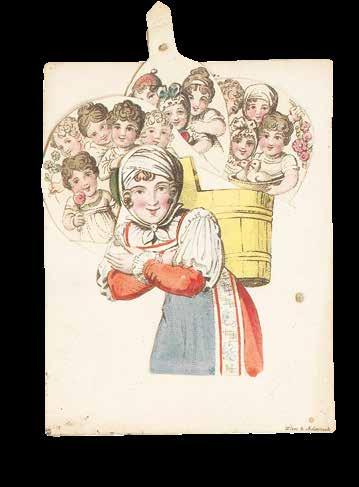
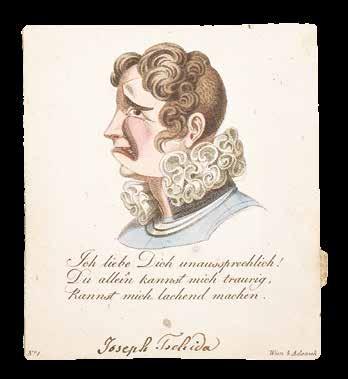
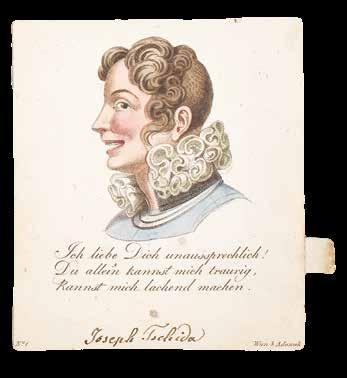
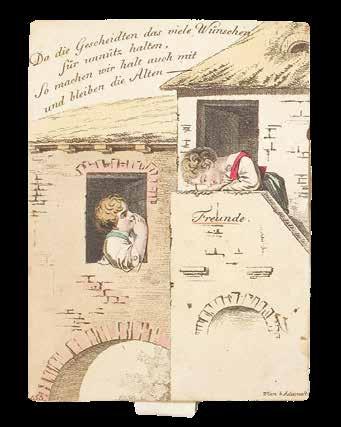
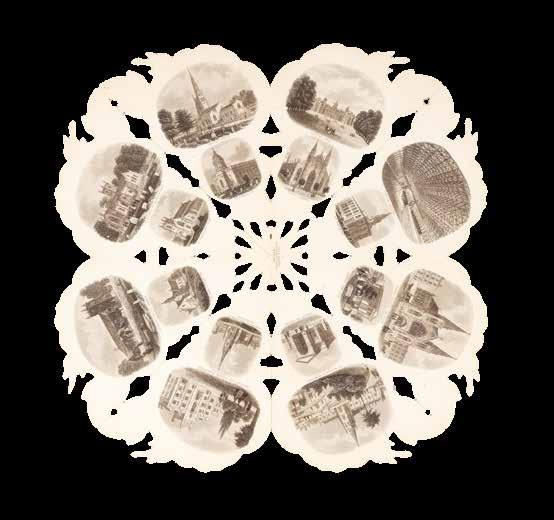
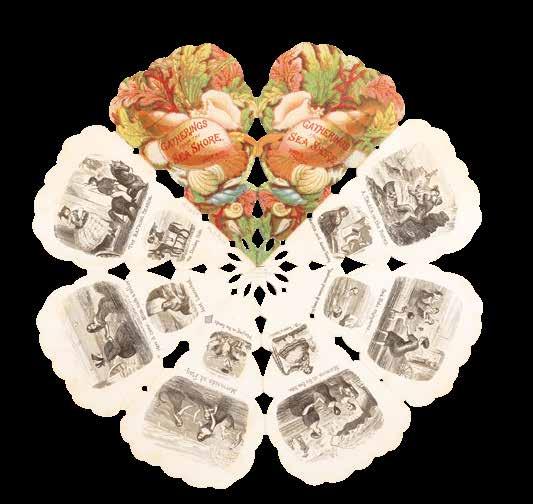
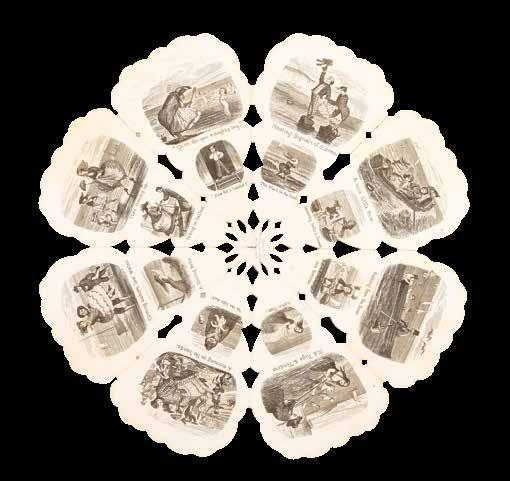
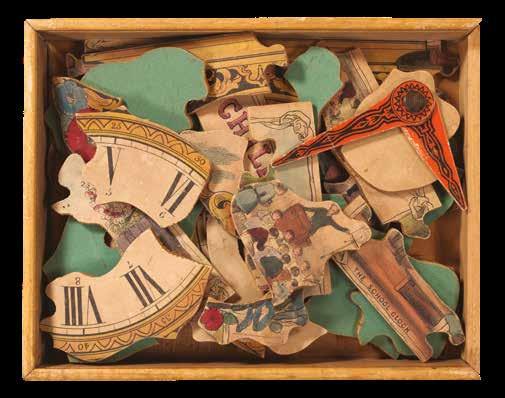
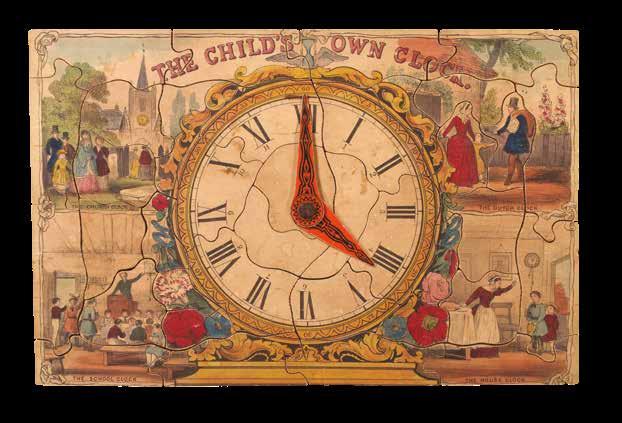
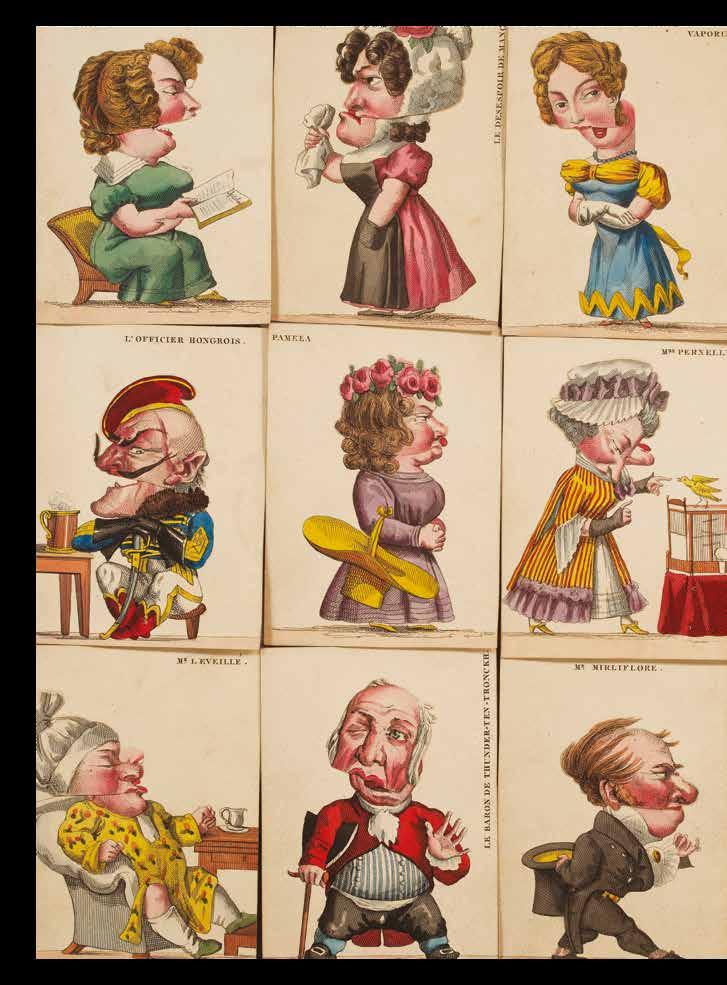
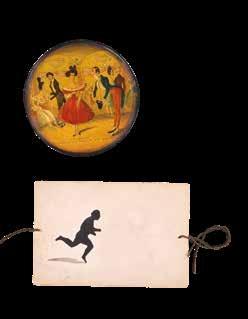
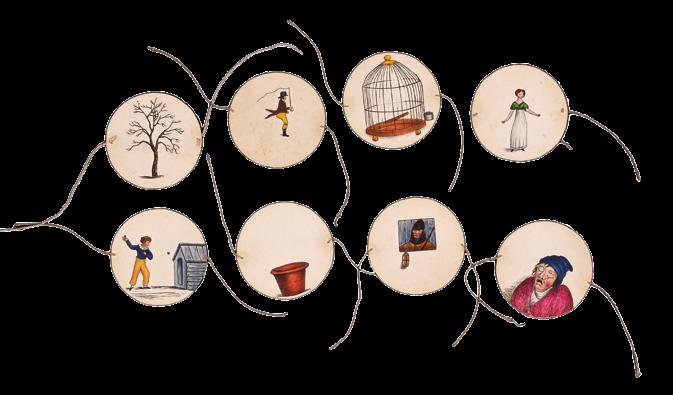
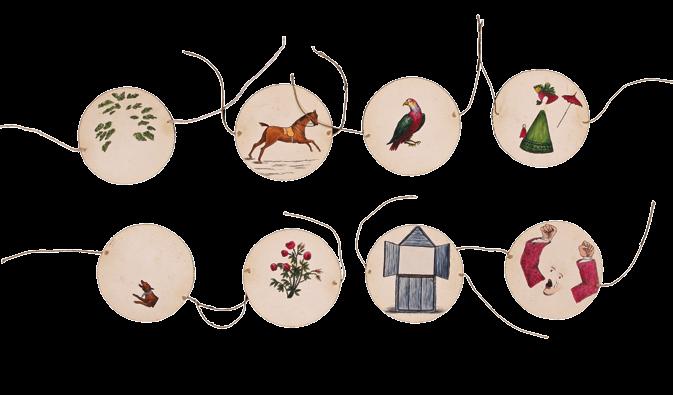
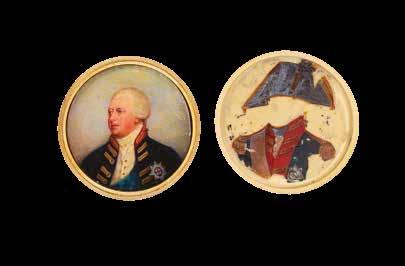
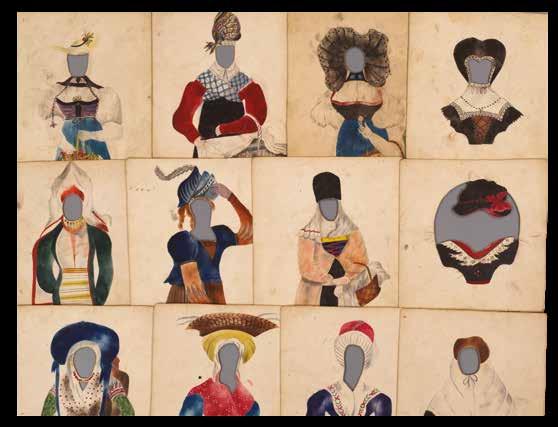
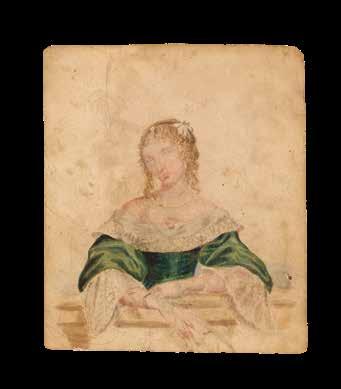
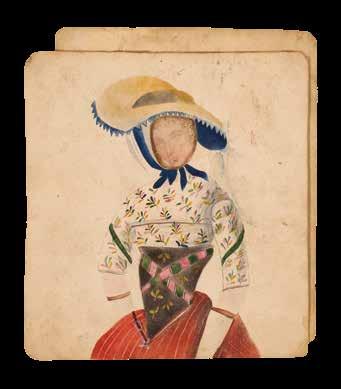
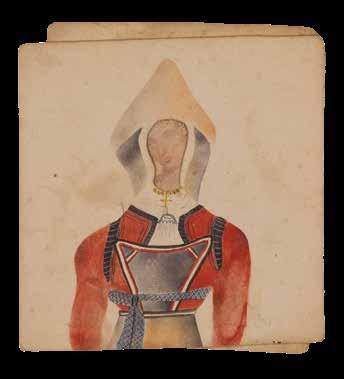
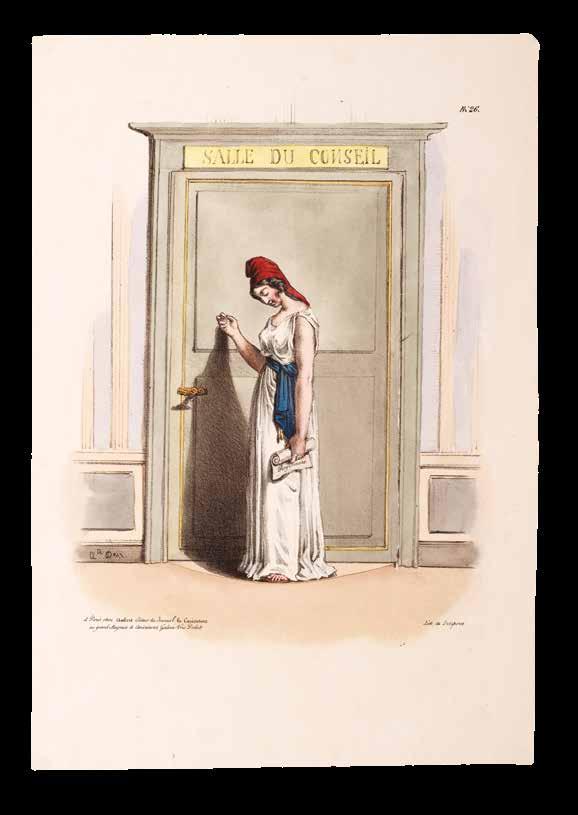
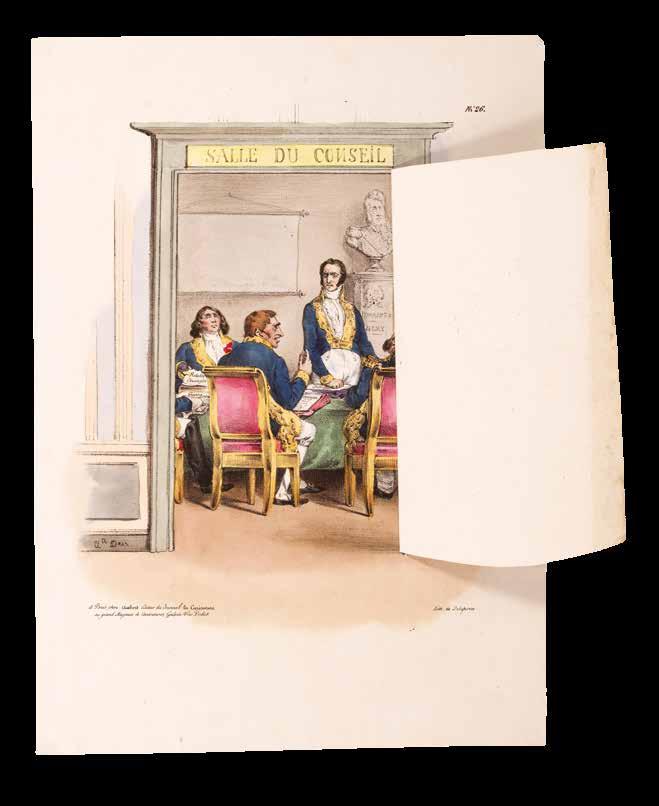
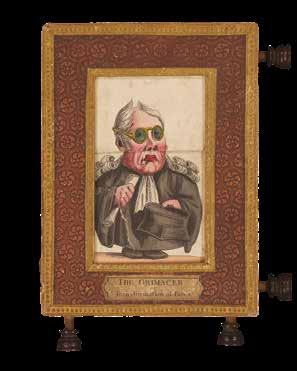
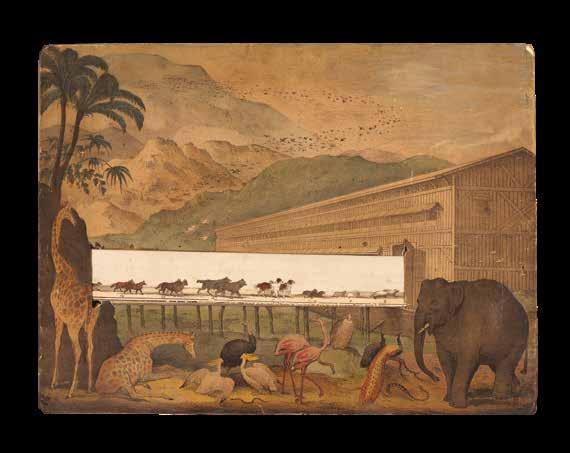
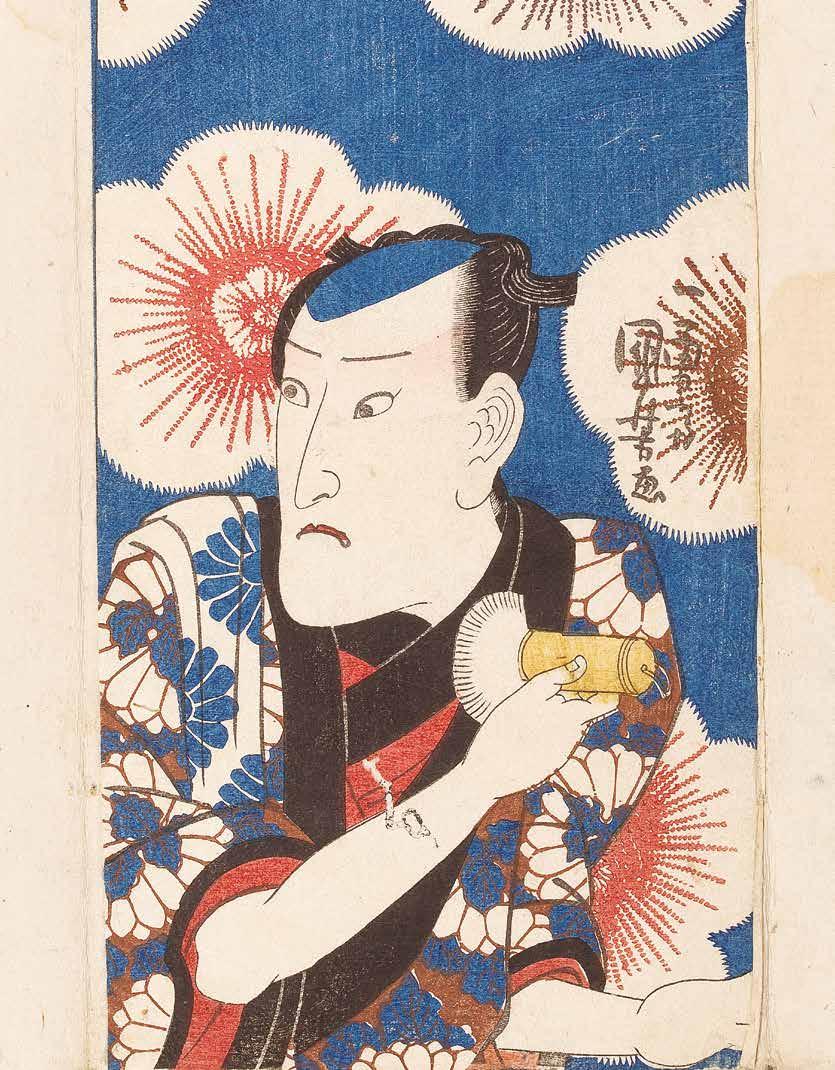
Catalogue edited by Arnie Anonuevo, Daniel Crouch, Rose Grossel, Kate Hunter, Ellida Minelli, Mia Rocquemore and Nick Trimming
Design by Ivone Chao
Photography by Louie Fasciolo and Marco Maschiao
Cover: item 193
Terms and conditions: The condition of all books has been described. Each item may be assumed to be in good condition, unless otherwise stated. Dimensions are given height by width. All prices are net and do not include postage and packing. Invoices will be rendered in £ sterling. The title of goods does not pass to the purchaser until the invoice is paid in full.
Printed by Park Communications on FSC® certified paper. Park is an EMAS certified company and its Environmental Management System is certified to ISO14001. 100% of the inks used are vegetable oil based, 95% of press chemicals are recycled for further use and, on average 99% of any waste associated with this production will be recycled. This document is printed on Galerie Matt made of material from wellmanaged, FSC®-certified forests and other controlled sources. The pulp used in this product is bleached without the use of chlorine (ECF).
A Moveable Feast:
The Temperley collection of paper engineered pop-ups, transformations, and other surprises
Volume II: Ephemera
Contents
Introduction / 7
Early Learning / 9 - 39
Appliquation / 41 - 69
Peepshows / 71 - 87
Calendars / 89 - 95
Biedermeier / 97 - 149
Hatched, Matched, Dispatched / 151 - 179
Playtime / 181 - 193
Silhouetted / 195 - 207
Dress-ups / 209 - 229
Transformational / 231 - 255
Performing Arts / 257 - 285
Machinations / 287 - 303
Origasmic / 305 - 309
Realpolitik / 311 - 315
World Views / 317 - 337
Mad Men/ 339 - 345
Bibliography / 346
Rosie and David Temperley believe that “communication, cooperation, and creativity” are the three key tenets for social cohesion, and life.
The Temperley Collection, their vast accumulation of books and ephemera, acquired over more than sixty years, is a blinding reflection of this bright ideal, illuminated via the ingenuity of a myriad of papery arts. The result is a cornucopia of marvels and delights that (literally) spring, bounce, twist, turn, fold, flap and flip – off, on and through the pages of thousands of books, cards, prints, and toys.
Over the course of the 500 years that the Temperley Collection spans, some of the most enlightened minds have used these methods to communicate the scientific and religious mysteries of our heavens and earth. Above all, the Temperley Collection practices what it preaches: it is a library that refuses to stay put on the shelves; it is an experience which demands immersion and participation.
Ephemera
Represented in the thousands of pieces of ephemera contained within the Temperley Collection is the whole gamut of moveable and interactive wonders, originating from across the globe and dating back five hundred years.
Many of these items were designed for children. The earliest, a hornbook (item 101) which is amongst the earliest known examples of such a didactic tool, was made to endure the assaults of youthful enthusiasm, while those published during the age of mass production were manufactured cheaply and deemed disposable. Some items were designed purely for pleasure, including paper dolls, board games, and jigsaw puzzles, while others were intended for rigorous educational purposes, such as a set of geometrical models of the Platonic solids (item 107).
Most, however, bridge the gap between these two extremes, in the spirit of ‘learning through play’. There is no greater example of this principle than the educational box made by Lady Charlotte Murray in the 1780s (item 103). Filled with games, puzzles, and diagrams that illustrate and reinforce lessons on botany, music, Latin, geography, history, and more, the box exemplifies the growing acknowledgement of the role that fun can, and should, play in learning.
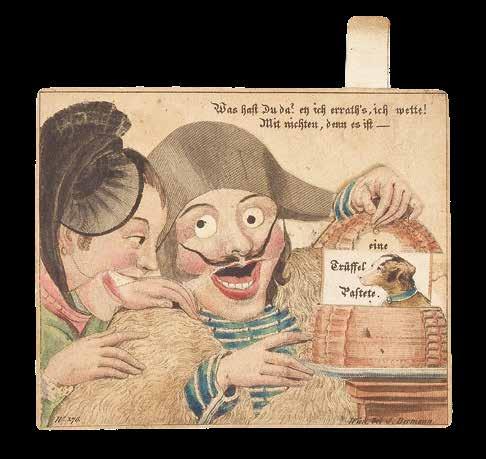
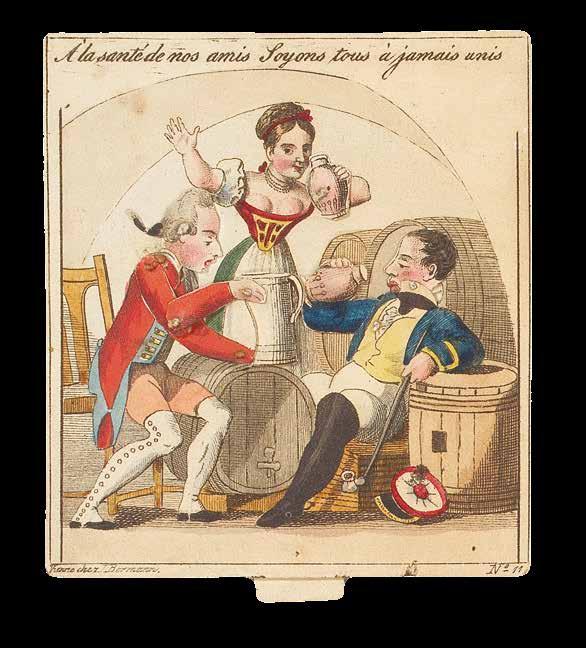
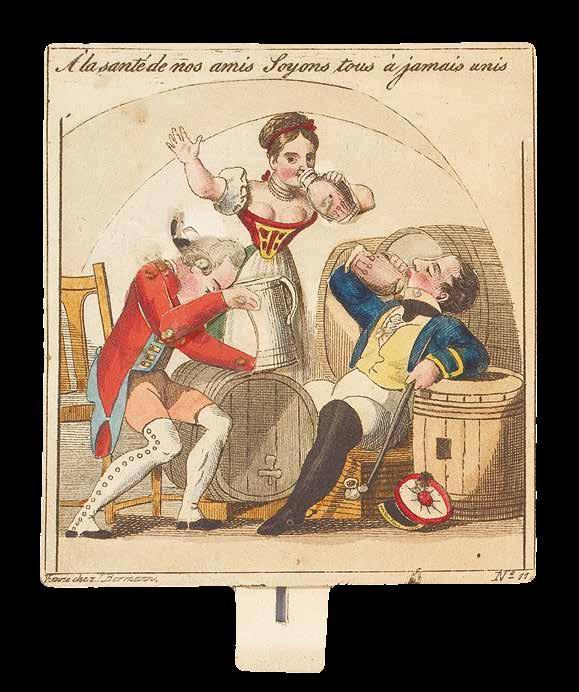
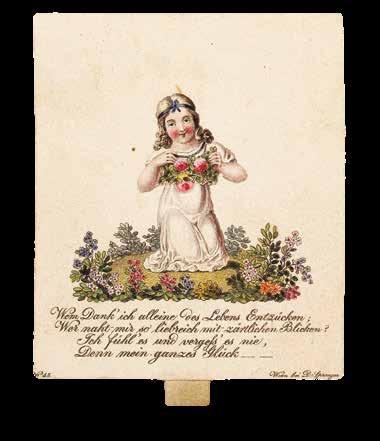
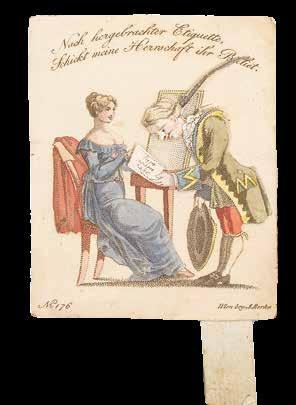
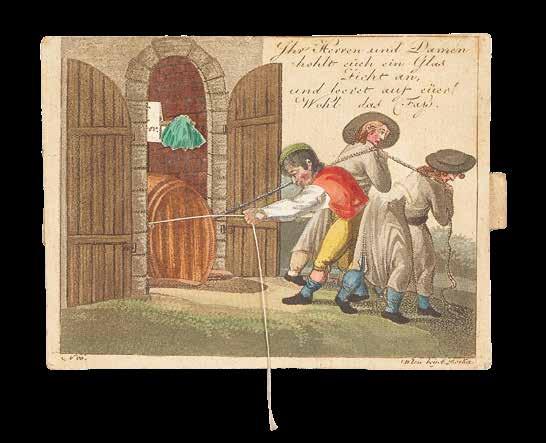
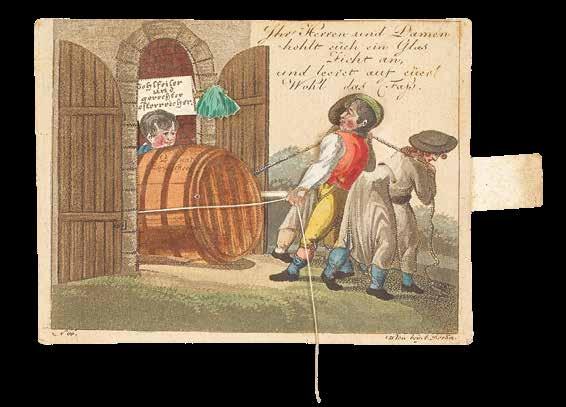
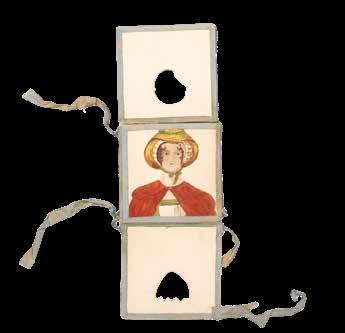
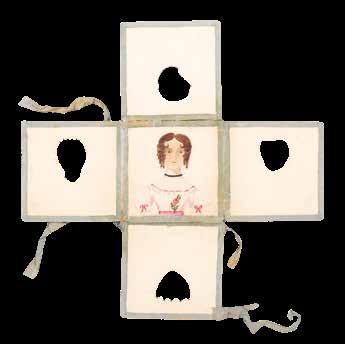
In addition to children’s materials, the Temperley Collection contains a wealth of ephemera aimed at an older market. Advances made in paper engineering during the eighteenth century gave rise to novelties and amusements enjoyed by all ages, such as Martin Engelbrecht’s perspective theatres (item 120), which allowed the delights of the travelling peepshow to be compressed into a small slipcase. Prints, pictures and portraits with different interactive mechanisms, such as pull-tabs (item 173), turning flaps
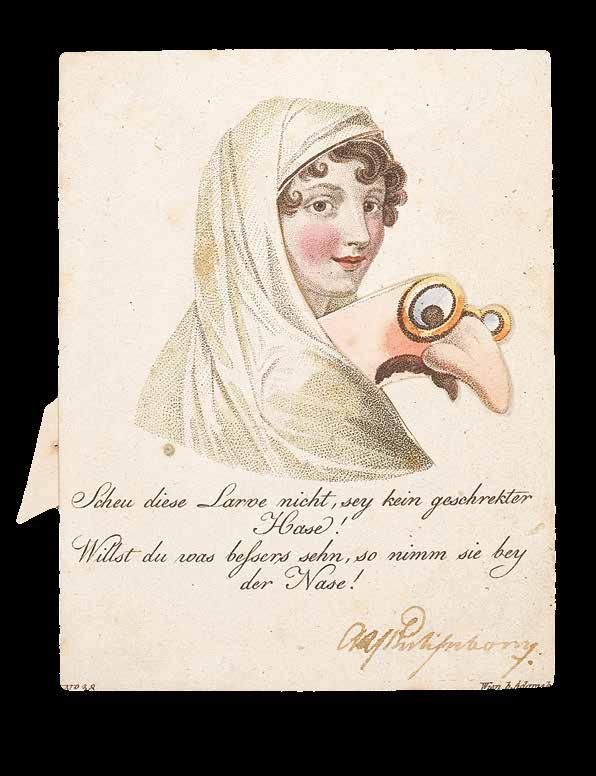
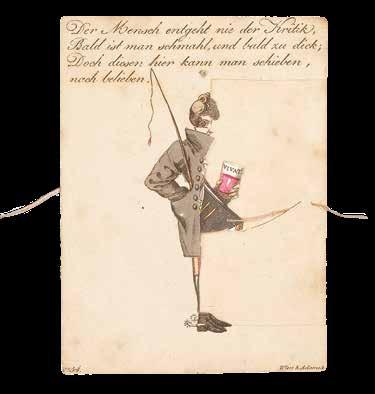
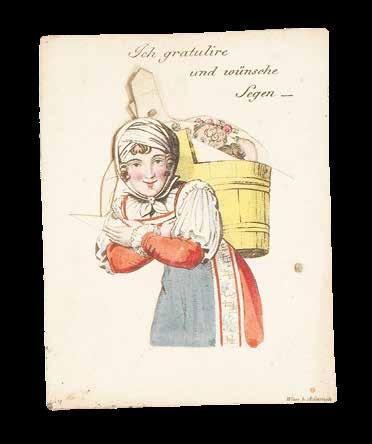
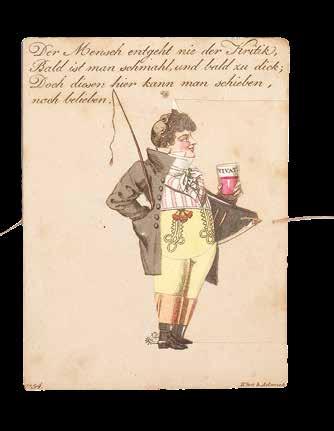
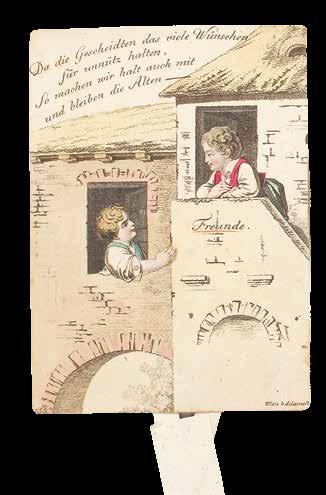
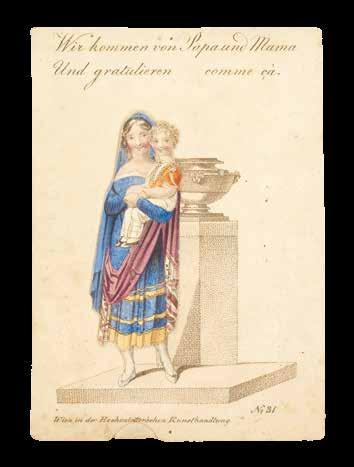
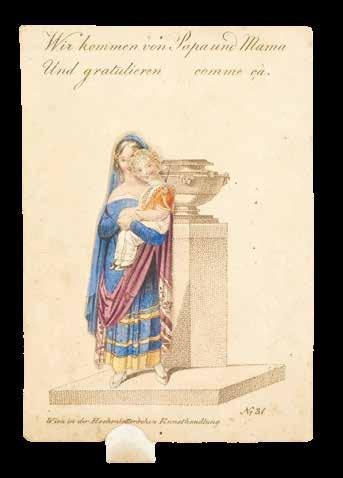
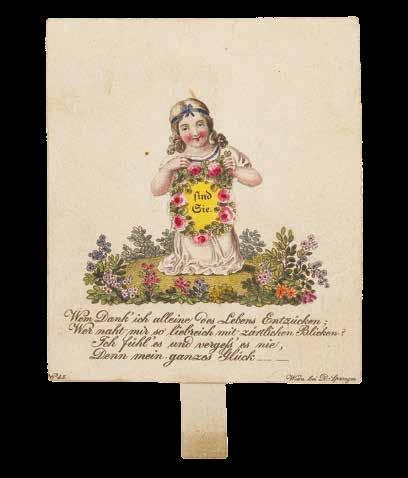
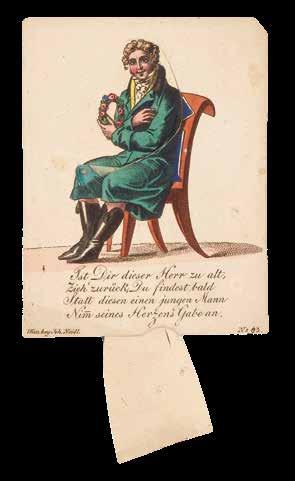
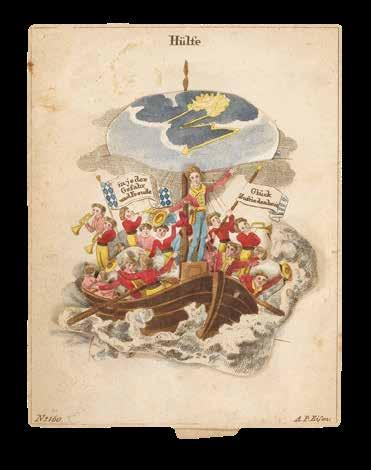
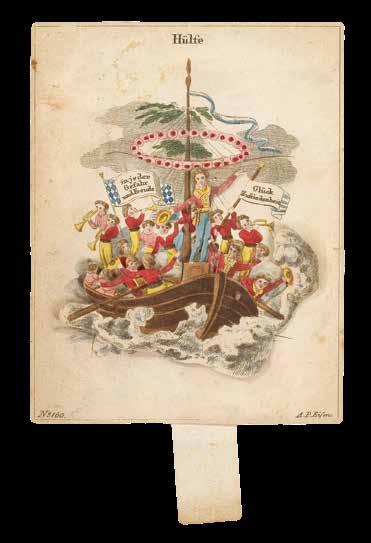
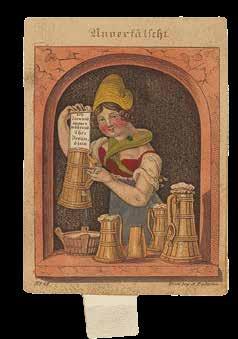
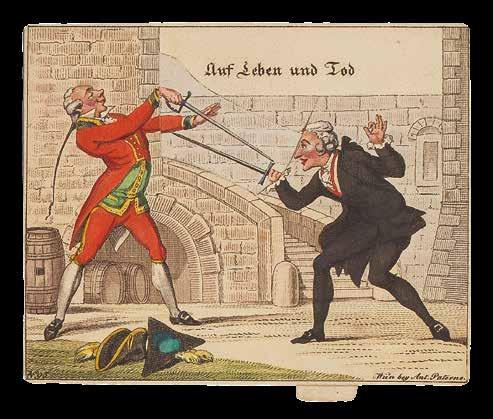
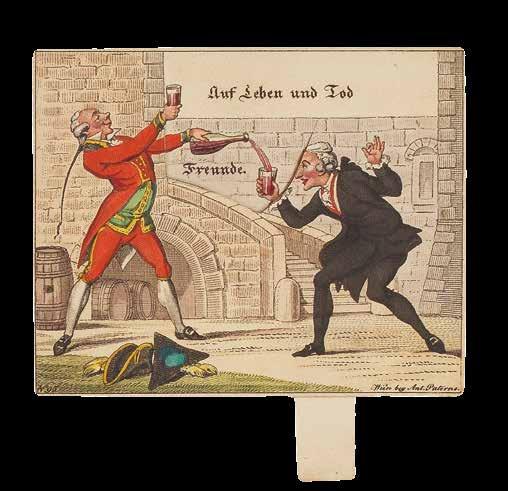
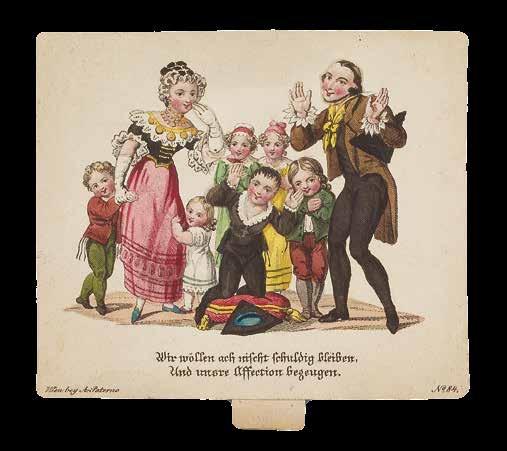
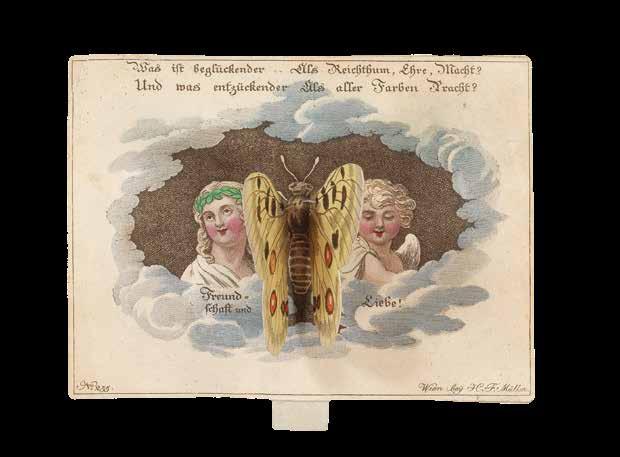
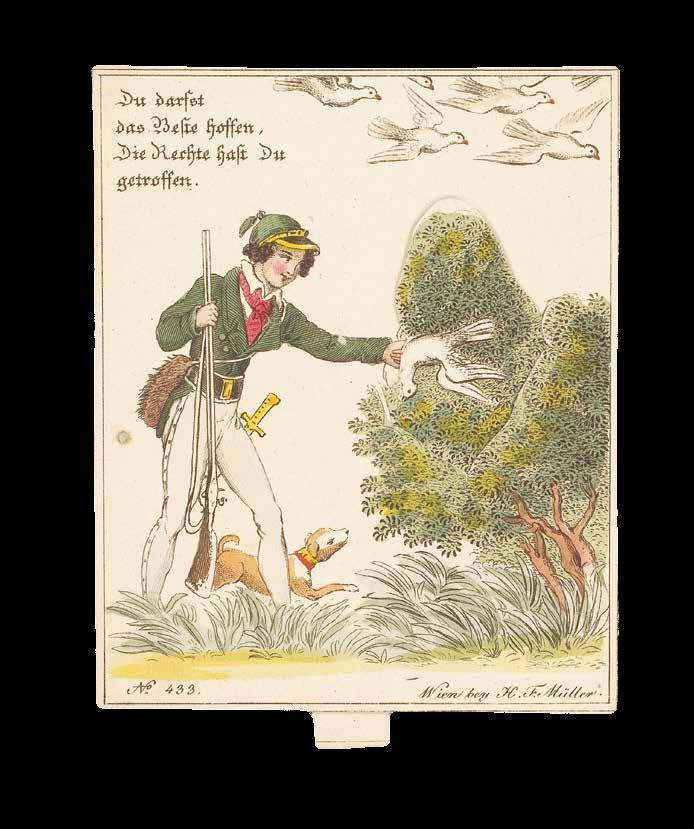
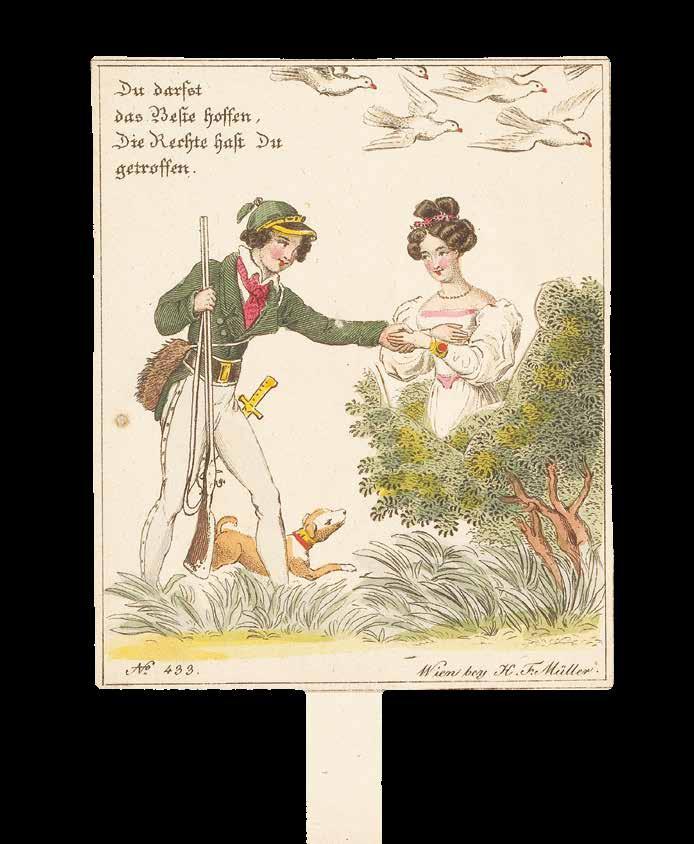
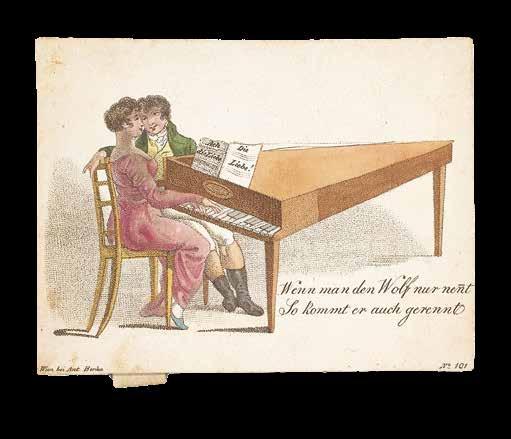
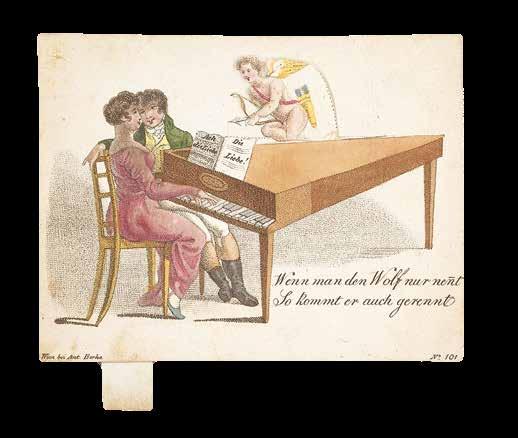
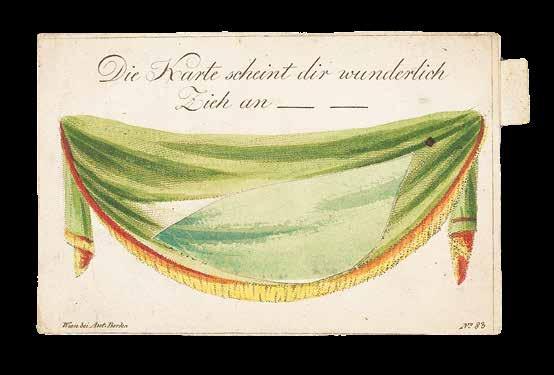
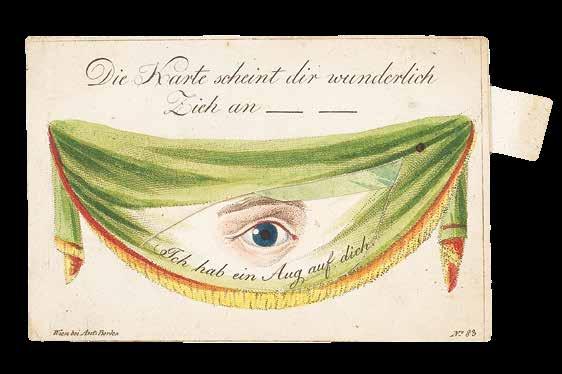
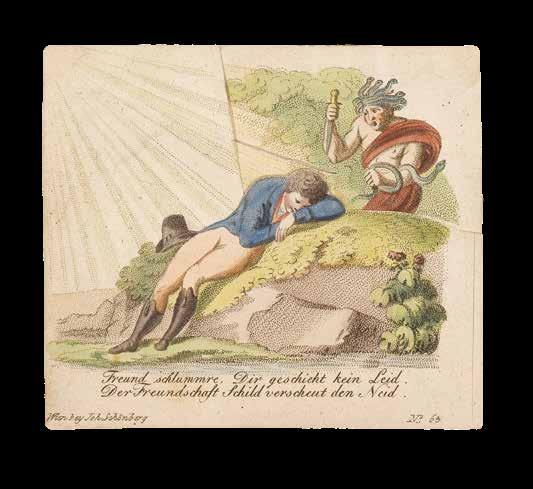
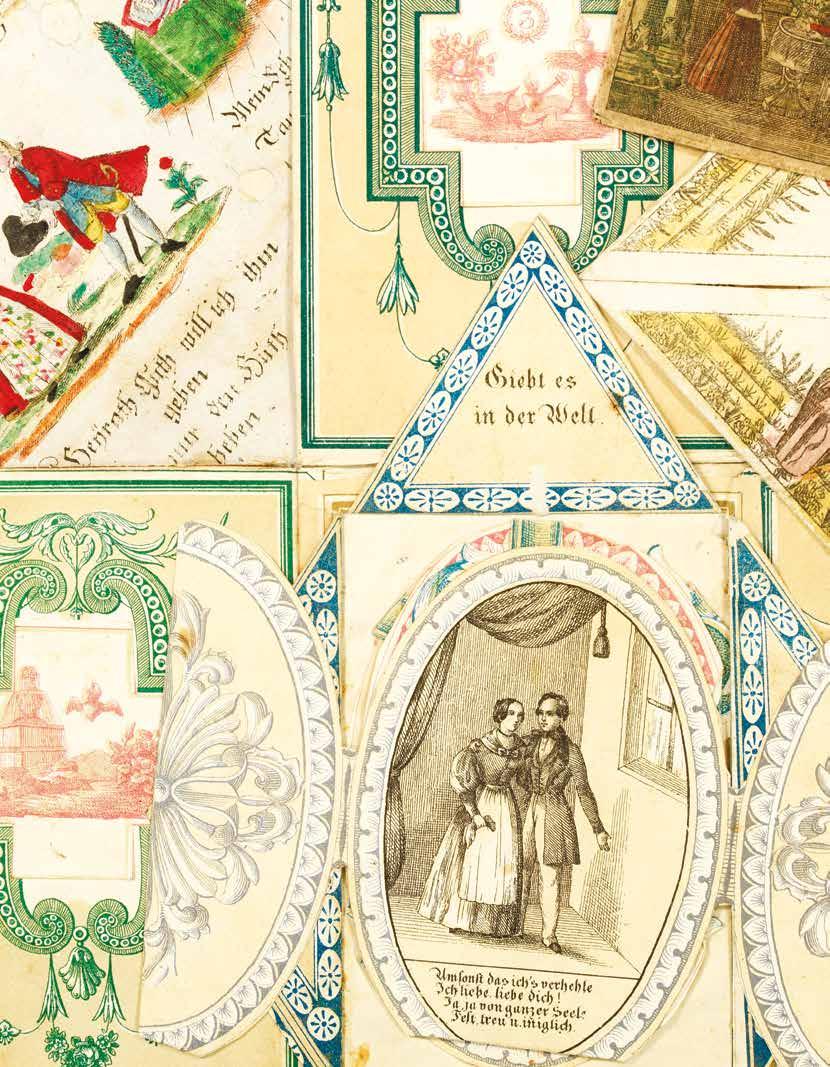
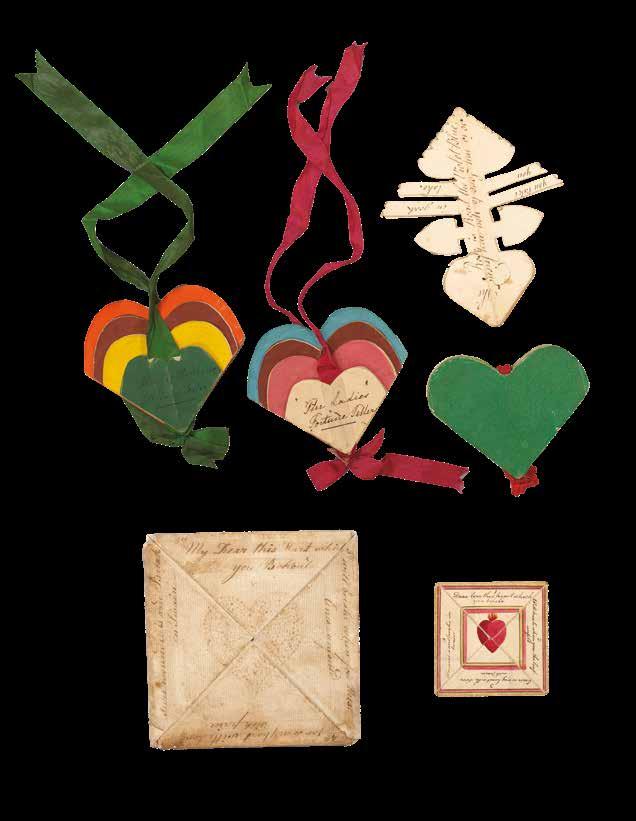
(item 171), rotating volvelles (item 187), and other optical transformations (item 162), bring to life classic tales, the news and figures of the day, advertisements, and a huge range of various sentiments and messages. Indeed, missives form a large body of the collection, with greetings cards (item 197), valentines (item 144), postcards (item 198), and mourning cards (item 148) betokening centuries of love and loss, humour and friendship. In particular, the period from 1815 to 1840 saw a surge in the exchanging of light-hearted greetings cards with moveable elements (items 126-143) by the burgeoning bourgeoisie of the Biedermeier movement in Austria and Germany, a trend which soon spread to neighbouring European countries. Papercraft was also exceptionally popular as a pastime, especially for women, and grew to prominence as materials became more readily accessible during the eighteenth and nineteenth century. Paper was folded, cut, glued, adorned, affixed, layered, and pricked in a myriad of ways and with a plethora of results. Themes depicted on these handmade creations include domestic motifs such as nature and family, current events from royal visits to football finals, and subjects deemed appropriate for women to pursue, including botany and art.
Items of the sort that were so often carelessly thrown away have been safeguarded by the Temperley Collection, and have much to teach us about the past, and about human nature. Through this ephemera, we can observe how methods of communication have changed over the past half-millennium, how creativity has been channelled through different materials and methods, and how makers have cooperated to produce some items that amuse for a moment, and others that have been treasured for generations.
EARLY LEARNING
[ANONYMOUS]
[An early Horn-Book Alphabet].
Publication [England, c.1500 - 1633].
Description
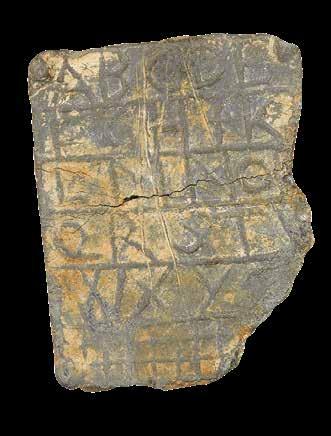
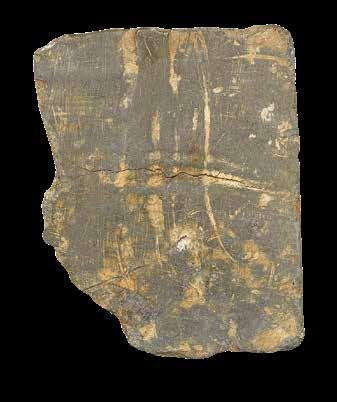
An almost complete cast lead horn book, inscribed on the recto with the alphabet in Roman capitals, in five lines, cross-hatching beneath, no image on the verso, right-hand edge and lower corner worn away, lacking handle.
Dimensions 40 by 30mm (1.5 by 1.25 inches).
References
D’Ambrosio, ‘Cabinet of Curiosities: The hornbook – teaching made handy’, in ‘The Book & Paper Gathering’, 2023; Tuer, ‘History of the Horn-Book’, 1897.
Number of items
1
As early as the fourteenth century, when paper was exceptionally precious, the monks who then lead almost all forms of formal education, devised a new method to protect their learning tools from destruction: the horn-book. A wooden panel with the alphabet, a verse, or a prayer glued or engraved to its surface, and protected by a thin transparent layer of horn, the horn-book persisted throughout the following centuries in Britain and America.
Early examples have been found of metal hornbooks cast in silver, pewter, brass, and lead, of which there is an example in the Temperley Collection.
Cast from a mould, this lead, or lead-alloy, horn-book would originally have been paddle-shaped, with a small handle extending from the lower edge. The Roman capital alphabet appears on the recto over five lines: A B C D E / F G H I K / L M N O / Q R S T (partial) V [sic] / W X Y (lacking Z). The letter “J” is not included, suggesting that this horn-book “predates the publication of Charles Butler’s ‘English Grammar’ (1633) which first distinguished between I and J. The letter U is also not included... The lead tablets are far smaller [than wooden hornbooks], and would probably have been either toys (Lewis 2012, 98-101) or cheaper versions of the full-size hornbooks” (Portable Antiquities Scheme Database online).
When it comes to dating hornbooks, the authoritative Tuer states that “it is the easiest thing in the world to be out by a century or more”, and cites another expert, who declared in examining one example that “it is just one of those things which may be of almost any date from 1550 to 1800”. The present fragment, however, seems to resemble in typography and format two examples discussed by Tuer, one of which he suggests is “probably the oldest horn-book in existence” (p.114).
Rare: very similar, to PASD ID#s YORYM-FA8FF1 (similar fragment), and LANCUM-5727FE (complete with handle), both dated to c.1500 - 1633.
[ANONYMOUS]
[Four Horn books].
Publication [Britain, ?eighteenth century].
Description
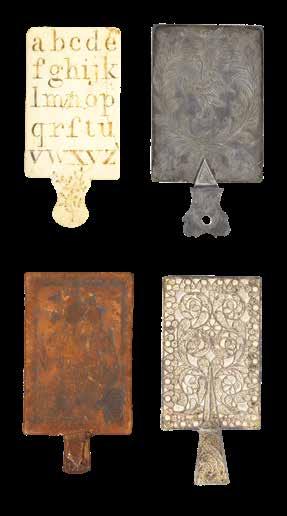
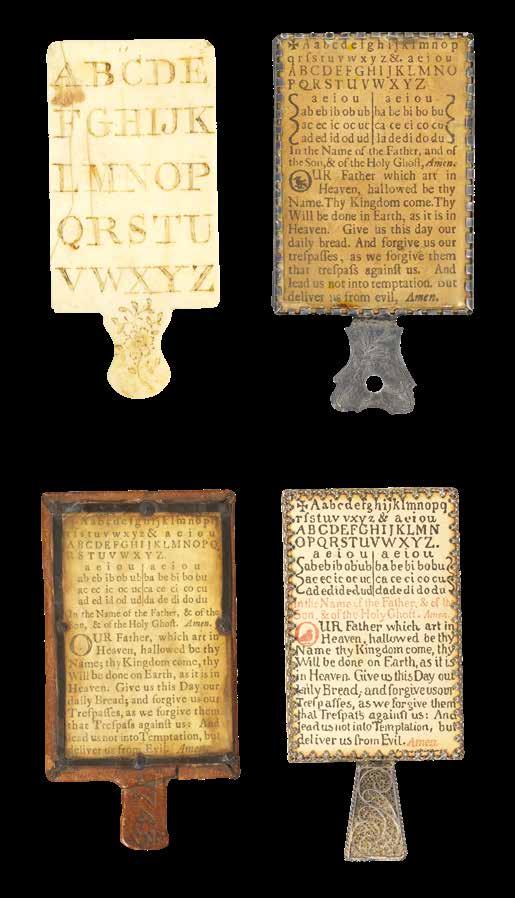
Three wooden paddle-shaped horn-books (c.105 by 60mm), each with woodblock text printed in black, and or red, ink on paper, protected by a thin layer of horn; one backed with tan calf decorated in blind, one with engraved silver, and one with elaborate silver filigree; and one bone paddle-shaped horn-book, engraved with an upper-case Alphabet on the recto, land ower-case on the verso; all housed in wooden box with hinged lid.
Dimensions 105 by 60mm (4.25 by 2.25 inches).
References Tuer, ‘History of the Horn-Book’, 1897.
Number of items 4
Horn-books through the ages
Four fine examples of horn-books, all probably dating from the eighteenth century.
Three of these display the standard formula of the alphabet, syllabary, and Lord’s Prayer printed on paper. Although the printed lesson sheets are clearly not from the same press, they are identical in their form and contents. On one, the Trinitarian formula and “amen” have been printed in red.
Tuer notes that, since “nearly all have been broken up for the sake of the metal... silver horn-books are exceedingly scarce”. The handles of all three are engraved with decorative designs, as are the backs of the silver examples, and one has the hole typically used to attached the tool to a belt or girdle by a strap.
The fourth horn-book is of bone and resembles those discussed by Tuer, as “fairly plentiful during the latter half of the last and the early years of this [the nineteenth] century”.
[MURRAY, Lady Charlotte]; and Henry CLAY
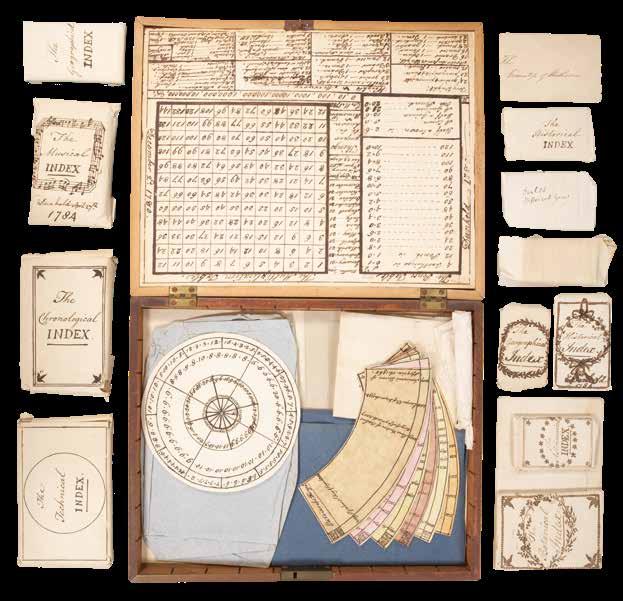
Lady Charlotte Murray’s ‘Flora Athollensis’: a portable botanical cabinet; with accompanying educational cabinet.
Publication [Scotland, Atholl House, and Dunkeld House, c.1780 - 1784].
Description
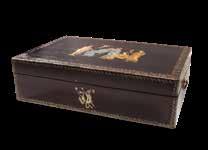
Herbarium: 267 original botanical graphite and watercolour drawings on paper, laid down on heavier stock (each 80 by 120mm); preserved in a decorative hinged lacquered box (335 by 230 by 95 mm), with silver handles, by Henry Clay of Birmingham.
Educational Cabinet: Multiple sets of original pen and ink manuscript cards, tables, charts and puzzles, and one printed poster, on many subjects; preserved in a contemporary hinged mahogany box (320 by 255 by 35mm) with inlays.
[WITH]: [MURRAY, Charlotte, Lady]. The British Garden. A Descriptive Catalogue of Hardy Plants, Indigenous, or Cultivated in the Climate of Great-Britain. Third Edition. London, Printed for Thomas Wilson, 10, London House Yard, St. Paul’s; and All Other Booksellers, 1808. Two volumes. Quarto (220 by 140mm). Original publisher’s drab paper boards, rebacked, preserving original spine labels.
References
Noltie, ‘A Scottish daughter of Flora: Lady Charlotte Murray and her herbarium portabile’, Archives of Natural History 46(2), 2019.
Number of items 2
A magnificent, and exceptionally rare, pair of interactive ladies’s botanical and educational cabinets
A pair of exceptionally fine, comprehensive and beautiful botanical and educational cabinets, created by Lady Charlotte Murray (1754-1808), eldest daughter of the third Duke of Atholl, at their Highland homes, Atholl House and Dunkeld House, during the long summers of the early 1780s. They are evidence, not only of Lady Charlotte Murray’s botanical expertise, but also of her passion for learning, cultivation of the curious mind, and dedication to bringing to life subjects previously taught in a formulaic and rigid way.
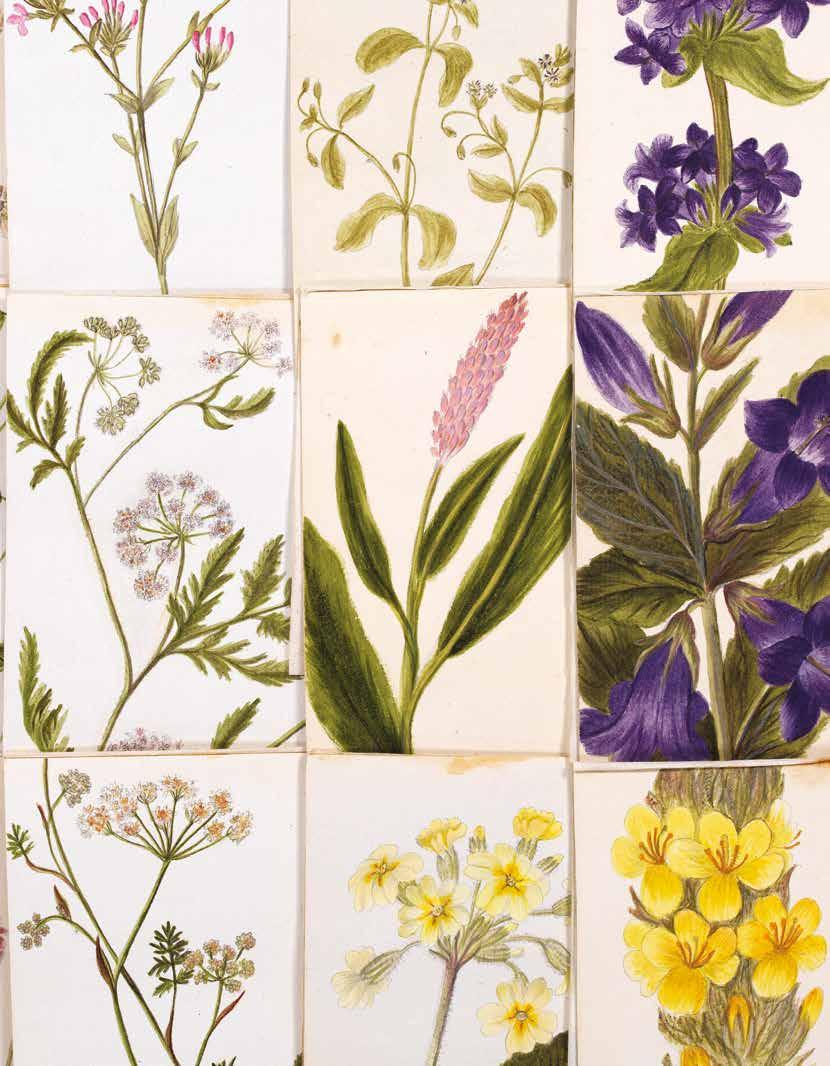
The botanical cabinet is one of the most comprehensive amateur herbaria of Scottish flowers recorded, with nearly 300 specimens drawn from life, noting the month drawn: May to August 1781, May to September 1782, April to August 1783, and April to August 1784. The versos of the cards are meticulously labelled with their Linnaean Class number, order number, Latin names, English (and in one case a Scottish) name. Noltie has made a comprehensive study of the contents and context of this cabinet, suggesting that the specimens were all gathered from the Atholl family land, Perthshire countryside, augmented by trips to the seaside, visits to “neighbouring aristocrats, gentry and kinsmen (of the extensive Murray and Drummond connexion) was an essential activity in the maintenance of polite society. Such visits - for example to Lord and Lady Stormont at Scone or the Earl of Kinnoull at Dupplin, two families that formed part of the same circle both in London and Perthshire - could well explain the origin of the specimens for some of these drawings. With the greater spearwort (Ranunculus lingua) comes a family link: close to its northern limit this handsome buttercup still grows at Marlee Loch. After the death of her first husband, Lady Charlotte’s paternal aunt Amelia had married a Farquharson of Invercauld whose lowland mansion was Marlee House near Blairgowrie” (Noltie).
As well as very many common plants, the ‘Flora Athollensis’ includes some scarce varieties, and in particular the Rubus arcticus, “one of the most enigmatic plants of the Scottish flora... known only from a scattering of data-deficient literature and herbarium records” (Noltie).
As Murray explains in her ‘The British Garden’, her motives for its creation are entirely democratic, and designed to promote education in the broadest sense, involving both the mind as well as the body: “The expensive apparatus of the Observatory, and the labours of Chemistry, confine the science of Astronomy, and the study of Minerals to a few; whilst the research into the animal kingdom is attended with many obstacles which prevent its general adoption, and preclude minute investigation; but the study of Botany, that science by means of which we discriminate and distinguish one plant from another, is open to almost every curious mind; the Garden and the Field offer a constant source of unwearying amusement, easily obtained, and conducing to health, by affording a continual and engaging motive for air and exercise” (‘Introductory Remarks’).
In identifying her specimens Murray has followed William Withering’s 1766 compendium, ‘A Botanical Arrangement of All the Vegetables Naturally Growing in Great Britain’, of which she owned a first edition. A few cards have later alterations and corrections made in red ink, perhaps by her niece, Lady Amelia Drummond. The initials “P”, “S”, “B” or “A”, sometimes found in the lower right-hand corner of the card reflect Withering’s designations of “S” for shrub or tree, “A” for annual, “B” for biennial and “P” for perennial. Some scholars have speculated that Murray’s use of the Linnaean Order number, rather than the name, is related to a proposed eighteenth-century reluctance to teach girls a classification system based on sex, even of plant parts! She also use Withering’s schemata for the design on the custom tray inside the beautifully designed cabinet lacquered cabinet by John Clay.
The educational cabinet further demonstrates Murray’s practical approach to education and life-long learning. Towards the end of the eighteenth century, children’s education was gradually moving away from the rigourous classical model, beginning to incorporate more interactive and engaging activities and tools, such as jigsaws, drawing, and cards. Her participation in this movement is further evidenced by the wealth of educational material housed in the box.
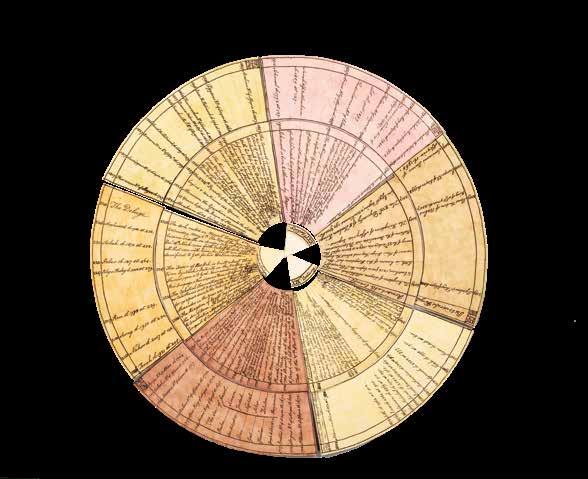
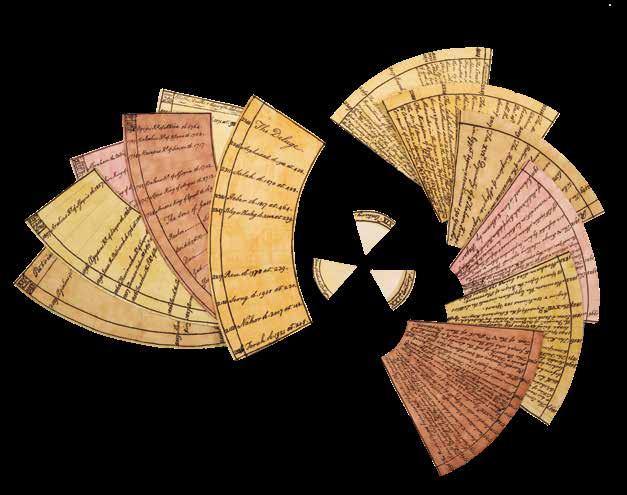
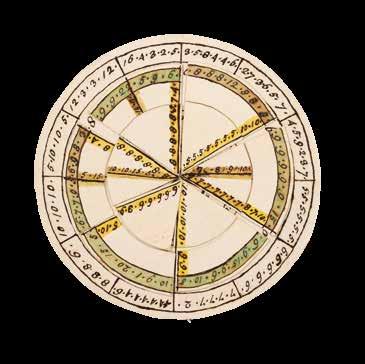
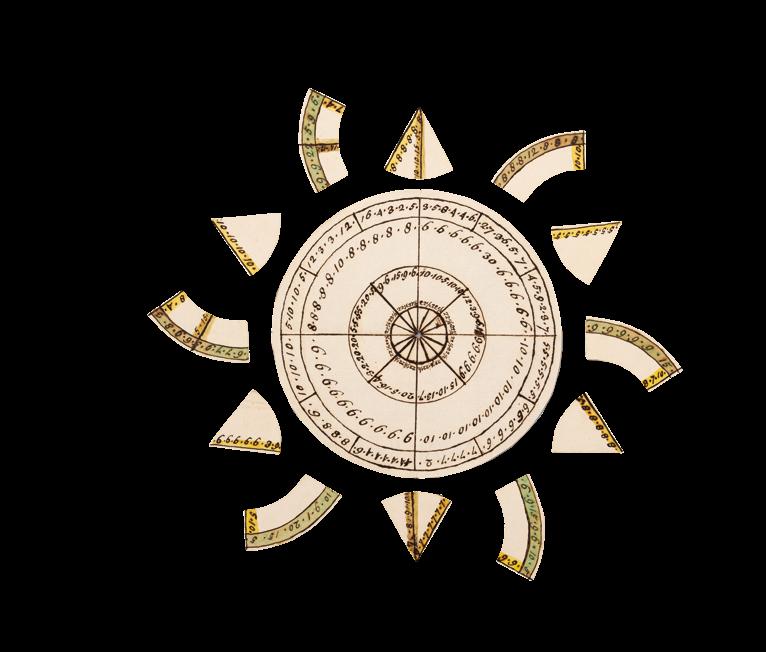
This cabinet includes sets of cards, tables, charts and puzzles on subjects including music, Latin, history, geography, mathematics, and science, all handmade by Murray during the 1780s. Among the most intricate is a circular chronology of the world, cut into fifteen coloured sections which had to be assembled by the student in the correct order. Various subject indices contain hand-written cards showing, for example, the conjugation of Latin verbs, or musical staves. Pasted to the inside of the box’s lid are a selection of “things proper to be known and remembered”, including conversion charts for weights, measures and currency, and the multiplication table. This sheet is dated to December 2nd, 1780, and ‘The Musical Index’ within to April 27th, 1784. Given the vast number of nieces, nephews and younger siblings Murray had, being the eldest of nine, it is possible that she created these games and activities with their development in mind. In fact, given the background knowledge required to play the botanical game, it may even be the case the Lady Charlotte herself used the set to personally instruct the younger members of the family.
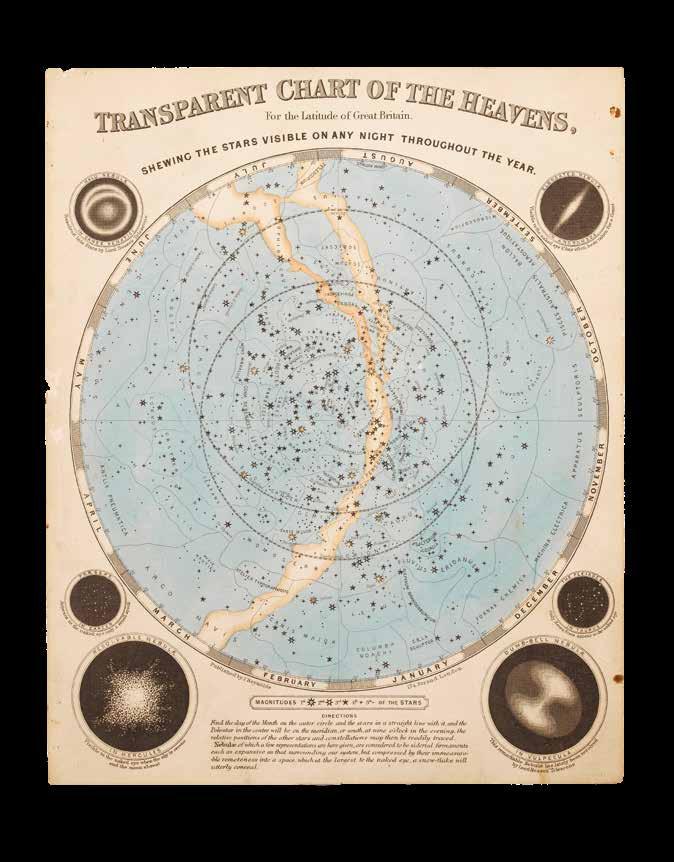
The pair of cabinets were bequeathed, with Murray’s manuscript of ‘The British Garden’, to her niece Lady Amelia, who married James Drummond of Stathallan. As well as being passed down through generations, the cabinets appear to have been well-used, and even augmented. A midnineteenth century astronomical print published by James Reynold has been added to the educational box. Backed on tissue paper and with holes in the card, the student could hold the print up to the light and see the stars shining through. To the verso is the inscription “To Amelia Ann
Marg[are]t Graeme from her affect[ionate] aunt Grace, Murray Field, J. 14 1853”. Amelia Ann was the granddaughter of Lady Amelia Drummond through her mother’s side, and Grace Graeme her paternal aunt.
Lady Charlotte Murray (1754-1808)
Born into Scottish nobility, Murray developed a love for botany at an early age, no doubt inspired by the wild natural landscape of the Highlands. The earliest painting of Murray shows her at the age of 12 with a garland of flowers, a prescient symbol of her later passion. Murray’s childhood was spent between the family home in Mayfair and Atholl House in Perthshire. The latter had extensive gardens, which were visited by notable botanists John Lightfoot and Thomas Pennant when Lady Charlotte was 18, as well as the spectacular landscape that surrounded the estate.
But even in London, Murray’s love of plants was encouraged by the contemporary interest in botany, which was seen as one of the few subjects suitable for women to study. In 1785, Lord Bute had dedicated his nine-volume ‘Botanical Tables’, illustrated with 600 drawings of plants, to Queen Charlotte, whose daughters were instructed in botanical art by some of the leading drawing-masters of the day. Lady Charlotte may have had a tutor, but much of her work indicates an auto-didactic approach and innate curiosity.
Following her father’s death in 1774, and her mother’s subsequent refusal to return to Perthshire for any extended period, Lady Charlotte lived peripatetically in a series of rented houses in Surrey and Lancashire, and on extended visits to other members of the British nobility, giving her the opportunity to observe new natural landscapes and cultivated plants. She is also known to have corresponded with fellow Scottish botanist James Brodie, to whom she sent a dried specimen of her own discovery. An 85-sheet herbarium of Swiss plants from the 1790s, now held in the National Library of Scotland, suggests that Murray may even have voyaged abroad in pursuit of new plants to observe and draw.
These years spent studying nature culminated in her compendious work ‘The British Garden’, a two-volume catalogue of Britain’s native plants and flowers first published in 1799, in which are listed numerous details, such as Linnaean name, common name, physical description, season, and cultivation history. The ‘Introductory Remarks’ state that the work was “undertaken at the request of a Friend, who wished to see those plants in the Hortus Kewensis as adapted to the British climate, in an English dress”. The compendium ran to several editions, of which the example in the Temperley Collection is the third.
Henry Clay (1737-1812)
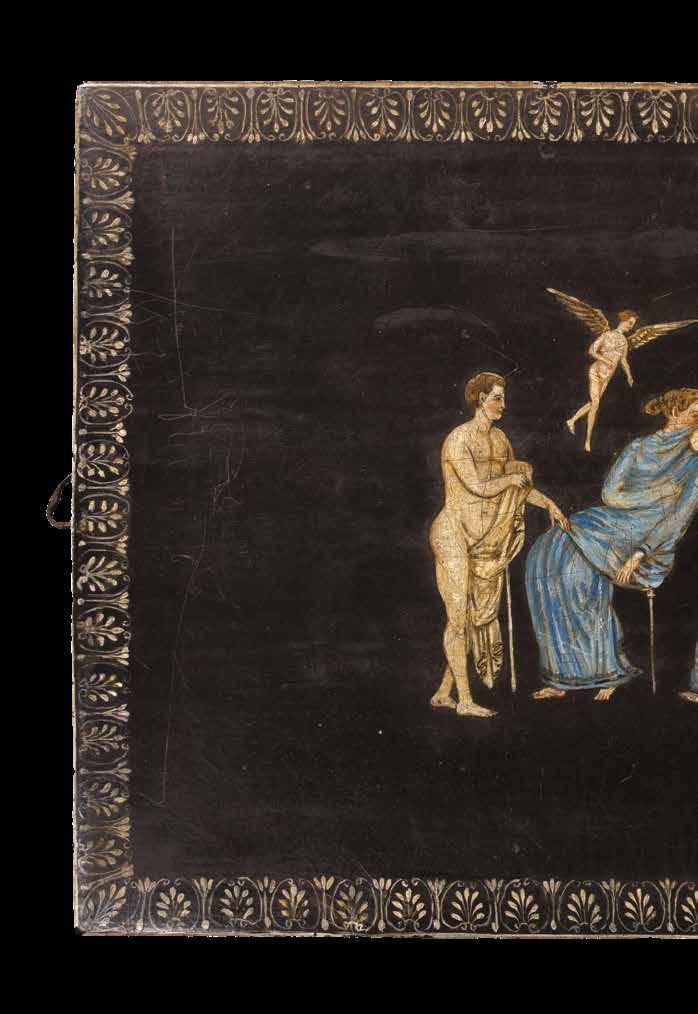
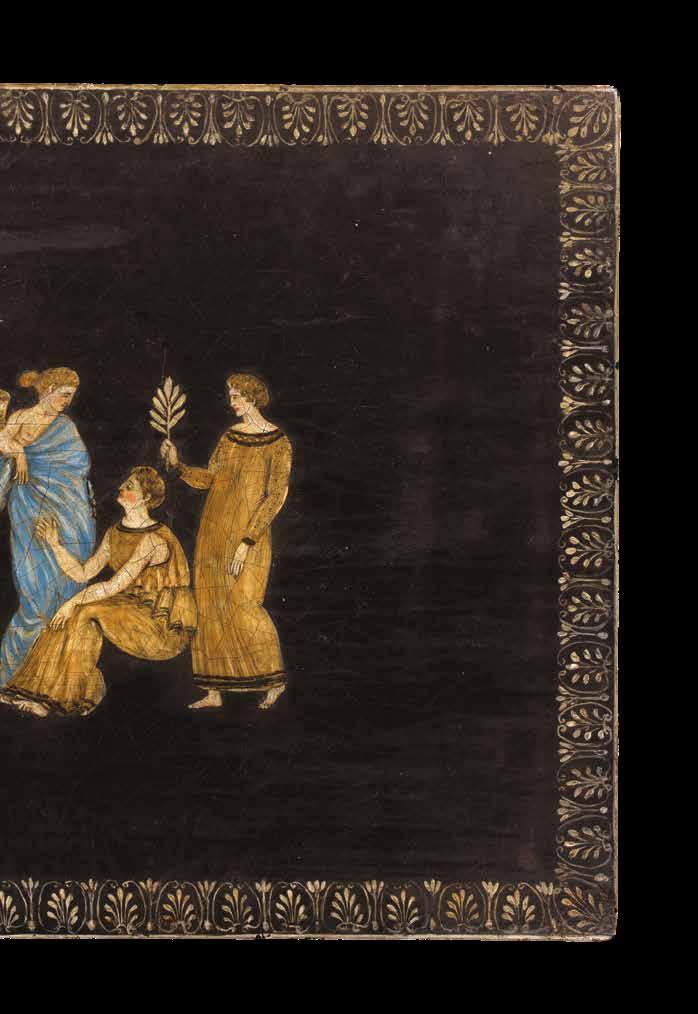
Clay, master “Japanner” of Birmingham, created the elaborate box that contains the ‘Flora Athollensis’. The lid is finely painted with a neo-classical style with Grecian figures, copied from an engraving in Hamilton and Hancarville’s ‘Collection of Etruscan, Greek, and Roman Antiquities’ (1766-1767).
From 1740, Clay was apprenticed to celebrated Birmingham publisher, and inventor of his eponymous type, John Baskerville of Birmingham. In 1749 he, not surprisingly, established himself as a printer, “but the wealth and fame that he subsequently achieved was based upon a patent taken out on 20 November 1772 for a “new Improved Paper-ware’”. This involved pasting sheets of paper together and then oiling, varnishing and stovehardening them. This process produced panels suitable for coaches, carriages, sedan chairs and furniture. It was claimed that the material could be “sawn, planed, dove-tailed or mitred in the same manner as if made in wood” (British and Irish Furniture Makers online). Using this technique, Clay produced luxury household items, such as tea-trays, caddies, dressing table boxes, decorated with Etruscan scenes and Chinoiserie. In 1790 he was appointed High Sheriff of Warwickshire.
Rarity
Lady Charlotte’s Botanical Cabinet is particularly noteworthy for it compactness, and portability, making it uniquely suited for interactive educational settings as she moved about within her wider family. There are, however, “botanical and artistic precedents, and from a similar social context... In terms of grand housing for such collections, perhaps the most extreme example is that of Mary Eleanor Bowes (1749-1800), married (briefly and unhappily) to the Earl of Strathmore... In 1782 she had a spectacular wooden cabinet made to house specimens. Now at the Bowes Museum in Barnard Castle, this is also decorated in the Neo-Classical style, but in the form of seven low-relief medallions of ancient and more modern poets/philosophers. With a vogue for botanical illustration in the later eighteenth century other botanophiles preferred to make two-dimensional representations of plants that could be mounted in albums - for example, the outstanding paper mosaics of Mary Delany (1700-1788), which she referred to as her ‘Flora Delanica’ or ‘hortus seccus’ (Laird & Weisberg-Roberts 2009). In Warwickshire, from 1784, Lady Louisa Thynne (1760-1832), a granddaughter of the Duchess of Portland, married to the Earl of Aylesford, over the next 32 years made watercolours of 2880 British plants, including many sent to her from the Scottish mountains by George Don of Forfar. The Aylesford drawings were also mounted on card, but of a much larger size (c.370 by 510mm), surrounded by watercolour wash-borders, and bound into 27 folio volumes for the lower shelves of a grand library at Packington” (Noltie).
Provenance
1. Lady Amelia Drummond, gift of her aunt Lady Charlotte Murray (1754-1808);
2. Amelia Anne Margaret Drummond-Graeme, gift of her grandmother Lady Amelia Drummond;
3. The Oswald family of Dunnikier, Kirkcaldy, their nineteenth century armorial bookplate on the front cover of ‘The British Garden’;
4. By descent to Viscount Strathallan, 17th Earl of Perth, Stobhall, his sale Bonhams, Edinburgh, 2012, lot 297.
[VARIOUS MAKERS]
[Seven sets of Educational Playing Cards].
Publication [Britain, France, Germany, and the Netherlands, c.1780s-1880s].
Description
Seven sets of cards (various sizes), variously printed, or pen and ink, each containing between ten and 26 cards, some colour printed, others with contemporary handcolour; preserved in contemporary paper over paste-board boxes, slipcases, and in one case bound in nineteenth century maroon morocco, gilt, “emblem” deck with significant wear to cards.
Number of items 7
The ten-der Pe-li-can, with cease-less cares
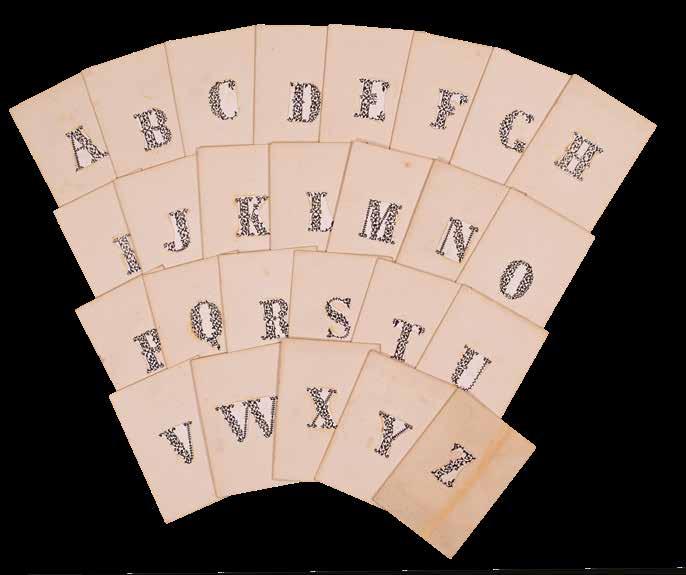
Educational card games became a very popular way of encouraging young people to learn through play during the eighteenth and nineteenth centuries. The Temperley Collection includes seven decks of cards from this period, all produced with the pedagogical purpose of helping children to learn the alphabet. The simplest cards are found in a handmade deck from the mid-nineteenth century, in which each card shows only a capital letter, cut and pasted from an engraved print. They are housed in the original paste-board case, decorated with the monogram of the maker, or the owner.
In addition to the alphabet, the other decks also include information and illustrations that might help users get to grips with the sounds and spellings associated with each letter. A bound deck of 24 German alphabet cards provides an image for each letter, such as a donkey (‘Esel’) for “E”, an ox (‘Ochse’) for “O” and pigeons (‘Tauben’) for “T”. A complete deck of 25 engraved Dutch cards from the 1820s also has an animal for each letter of the alphabet, and provides some information about the creature shown. The third card warns: “Do not heed anyone who calls to you; The cry of the crocodile is deceiving”.
The ‘A.B.C. des jeunes enfans, recueil alphabetique de jolies fleurs’ was published around 1820 by Mallez of Paris, although the current set lacks the “N” card. Each letter is given in various scripts, and associated with a flower beginning with the same letter, which is also illustrated. The deck contains two numerical cards, and three “récompense” cards illustrated with more flowers, to be used as part of an educational game. Another French deck presents a full set of 25 chromolithographed cards, showing caricatures captioned with a phrase or saying, the first letter of which represents each letter of the alphabet. The second card, for instance, is captioned “Baignade imprévue” and shows a boy tipping a pail of water over his friend, while the penultimate reads “Yacht nouveau modele”, and shows the boy presenting his friend with a toy soldier floating around a bowl of water in a wooden clog. The chromolithographed cards were probably made in the 1880s; at this time the letter W had recently been adopted into the French alphabet, but does not appear in the deck.
An incomplete deck of alphabet cards takes its content from John Wynne’s ‘Choice Emblems’, a book published in 1772 “to convey the golden Lessons of Instruction under a new and more delightful Dress”. Each letter is illustrated by an abstract noun, some virtues, like “Kind-ness” and “Restraint”, others vices, such as “Mad-ness” and “In-dis-cre-ti-on”. These are then described by two rhyming couplets below, and illustrated with the “emblems” from Wynne’s book. Another set of cards from the late-eighteenth century depict ten animals, accompanied by an illustration and descriptive verse. For example, “The Tigers breast no pity knows, To Man & Brutes the worst of foes; The Forests King he oft repels, Inferior Brutes shrink at his Yells”. While they do not appear to form an alphabet deck, since both “Cat” and “Cougar”, “Sheep” and “Stag”, are included, the cards seem intended to teach a young audience about different animals.
PARIS, Abbé; and others.
The Elements of Astronomy and Geography.
Publication London, John Wallis, 16 Ludgate Street, July 15th, 1795.
Description
40 engraved cards (100 by 65 by 25mm) with contemporary hand-colour, one with a volvelle attached by string, all with printed text to verso; housed in original publisher’s slipcase (100 by 65 by 25mm), with printed paper label to front cover.
Number of items
2
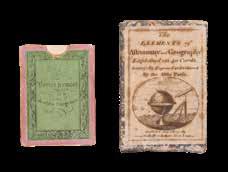
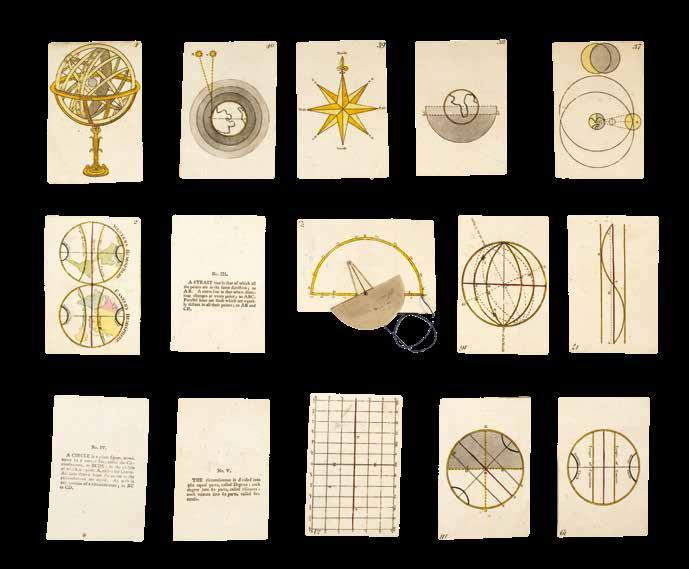
‘The Elements of Astronomy and Geography Explained on 40 Cards, beautifully Engraved and Coloured by the Abbé Paris’ is an educational game for between two and ten players. As explained in the accompanying rules sheet, the player aims to keep as many cards as possible, but “before he is entitled to keep Possession of them, he must explain the Figures on each Card without looking at the Back”. Said “figures” are a range of different scientific instruments and diagrams, one of which has a moveable volvelle attached by string, which allows the plate to be rotated for the measurement of angles. To the verso of each card is a brief description of the object, fact, or phenomenon shown on the front.
[WITH]:
- [ANONYMOUS]. ‘Portes Fermées ou Les Doubles surprises’. [Paris, c.1790]. Six livraisons, each a single sheet folded to make four pages, and accompanied by a lithographed illustration card, with hinged overslips, and contemporary hand-colour; housed in original pink paper over pasteboard slipcase (80 by 60 by 7mm) with green wood-engraved paper label on the front cover. Consisting of six folding sheets, each bearing a short story and accompanied by an illustrated card with a door or window that can be opened. ‘La Française’, for example, tells of a young niece’s tryst with a suitor of whom her aunt disapproves. The card shows the older lady seeing the younger off to a dinner party with a relative; the door of the carriage can be opened to show the niece within, and her suitor, secretly hidden inside the carriage. The same format appears on each of the illustrated cards, which accounts for the deck being described as full of ‘Double Surprises’.
‘The Uncle’s
[VARIOUS MAKERS]
[Six Battledores].
Publication [Britain and America, c.1810-1880].
Description
Six printed sheets (four 130 by 85mm, two 160 by 95mm), each folded three times, with the corners cut on first fold.
Number of items
6
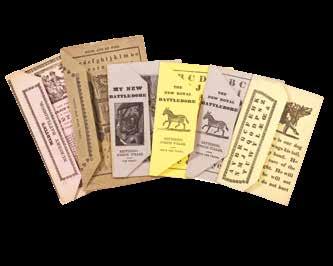
The growing availability and increasingly affordability of paper meant that in the eighteenth and nineteenth centuries, educational material for children began to be printed and circulated much more widely than ever before. This gave rise to the battledore, so-called because the first examples, modelled after hornbooks (see items 101 and 102), resembled the flat wooden paddles used to play the early game of badminton known by that name. Later battledores, of which there are six examples in the Temperley Collection, came to be more simply constructed, generally printed on thick paper or card and folded three times.
Like hornbooks, most battledores were rather basic primers, containing the letters of the alphabet and a syllabary. ‘Martin’s Nursery Battledoor’ contains an upper-case alphabet, as well as advertisements for the many other children’s books and products offered by Martin. Primers such as ‘The New Royal Battledore’ (two examples present) published in Kettering by Joseph Toller around 1880 also include “lessons” on more complicated syllables and short words. ‘My New Battledore’, also by Toller, has the addition of two vignettes, one showing a rustic farmhouse and the other a group of tourists visiting catacombs.
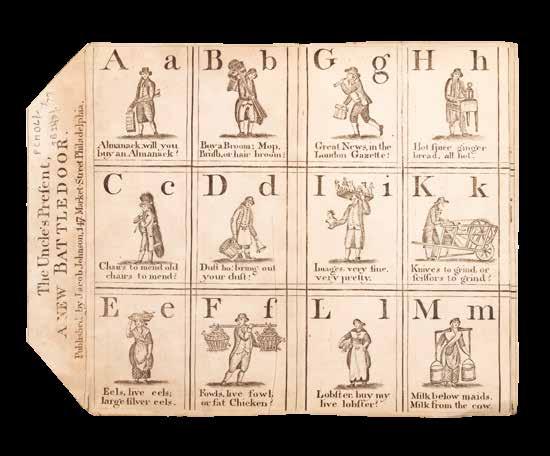
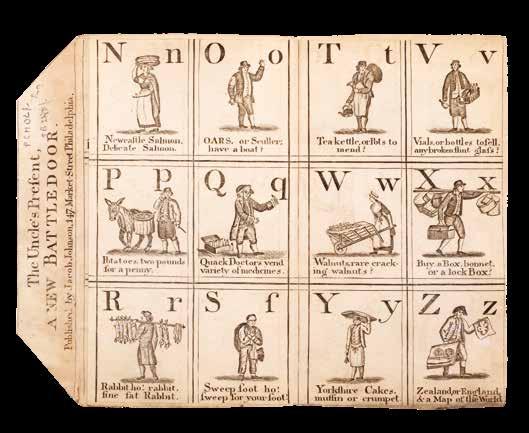
Published by W. Davison of Alnwick, the ‘English Battledore’ of 1830 features a reading exercise comprised of a simple paragraph about a faithful pet dog named Tray. ‘The Uncle’s Present, a New Battledoor’, published by Jacob Johnson in Philadelphia around 1810, includes an alphabet with each letter illustrated by a vendor offering wares beginning with the same one, a broom-seller, a milkmaid, and a tea-pot repairman among them!
[ANONYMOUS]
[Educational Geometry box].
Publication [Britain, c.1830s].
Description
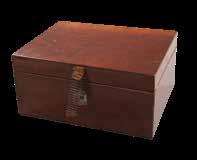
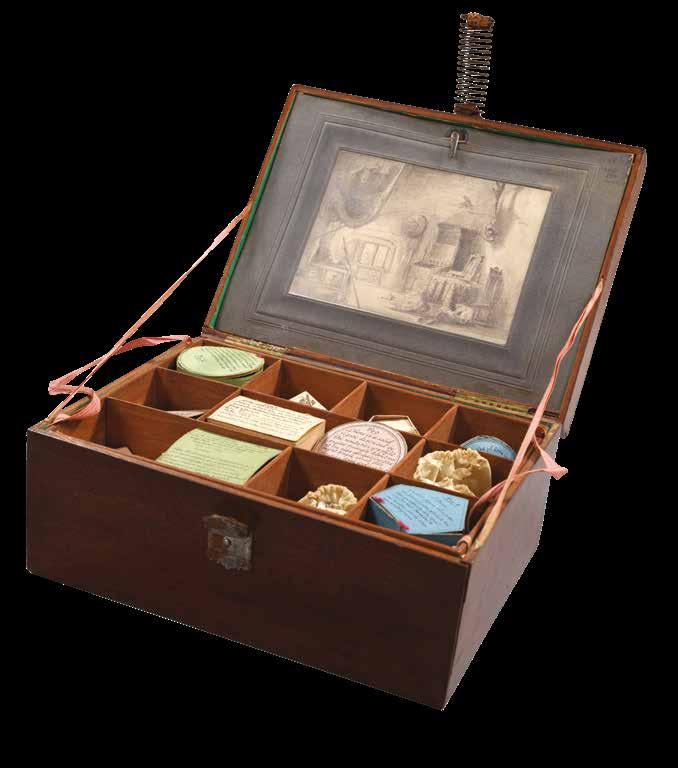
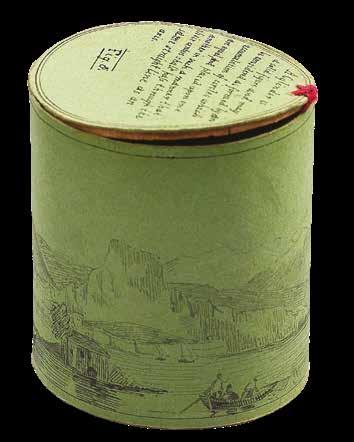
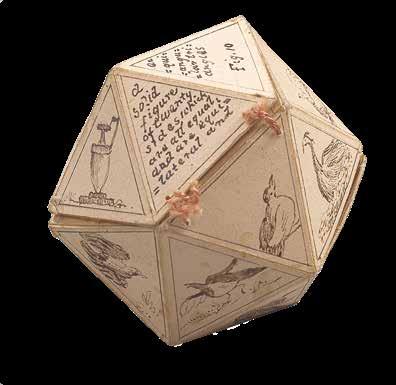
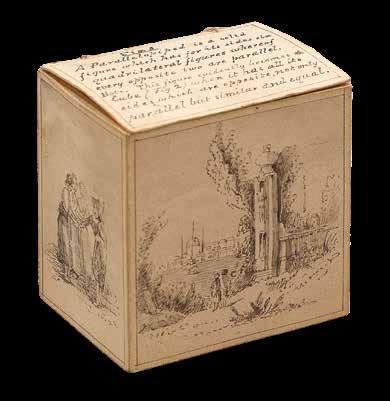
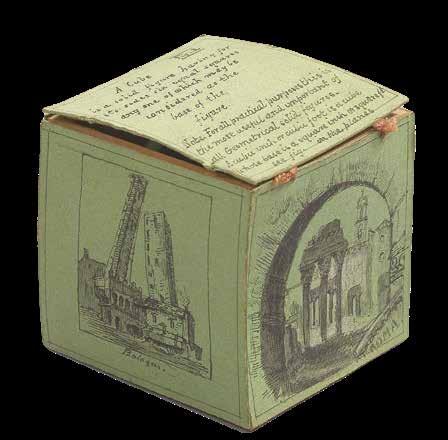
12 three-dimensional shapes (avg 450 by 550mm) made of folded coloured pasteboard, each with manuscript inscriptions to one or more sides, most with very accomplished original pen and black ink illustrations, some held together with silk thread or ribbon, the pyramids laid down on cream silk with drawstring to tops, accompanied by three two-dimensional shapes cut out of coloured paste-board, with manuscript inscriptions, and one circular fabric needlebook with seven needles; all housed in a contemporary wooden box (100 by 210 by 160mm) with custom wooden tray in 11 sections and pink ribbon handles, hinged lid with original mounted pencil drawing on the inside (90 by 125 mm), sprung metal closure stretched and detached from clasp.
Number of items 1
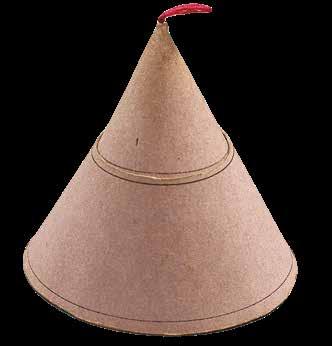
An educational box filled with handmade shapes to help children get to grips with geometry. Perhaps made by a tutor or governess, or by the pupils themselves, the set contains three two-dimensional shapes, a triangle and two circles, and 12 three-dimensional cardboard models: cylinder, cone (two examples), cube, pyramid, prism, tetrahedron, octahedron, a “parallelopiped”, dodecahedron (two examples), and an icosahedron.
All have descriptive information written on them in a very neat hand, giving the name and identifying features of the shape, as well as further geometrical details such as how it can be truncated to form other shapes. Two circles were needed to fit all the information about diameters, radii, segments and sectors drawn and described on them. A note on the cube states that “for all practical purposes this is the most useful and important of all geometrical solid figures”.
Several of the three-dimensional models are held together by thread or string, and for that reason a circular needlebook with seven needles is included in the set. Interestingly, the panels of the pyramid and tetrahedron are laid on silk, and brought together to form the three-dimensional shape by the pulling of the drawstring at the peak.
Many of the models have superb original illustrations of scenes, figures, objects, and animals on their panels, including a sketch that seems to be copied from Samuel Prout’s watercolour painting, ‘House of Petrarch at Arqua’.
Mounted on the inside lid of the wooden box in which the shapes are stored is a pencil sketch of a painting by Scottish artist David Robert. “Attic room, furnished as a studio”, painted during the 1830s, depicts various objects including a sword, a shield, an ornate chair, and a huge pair of antlers. The interior of the box has been compartmentalised to keep the shapes safely stored.
[VARIOUS MAKERS]
[Eight sets of Alphabet Tiles].
Publication [Britain and Germany, mid-nineteenth to mid-twentieth century].
Description
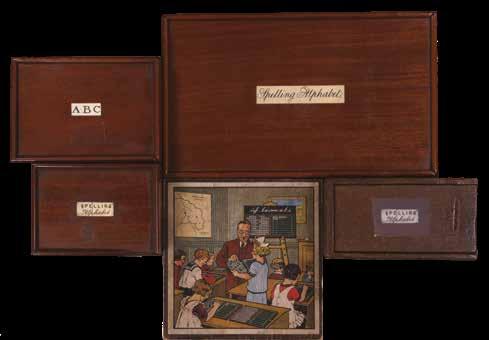
Eight sets of alphabet tiles (various sizes) painted or printed on bone, paper, and wood, some with illustrations to versos, several preserved in wooden boxes.
Number of items 8
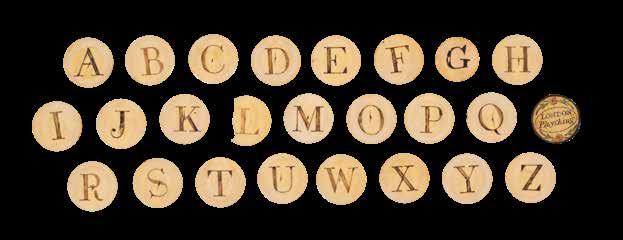
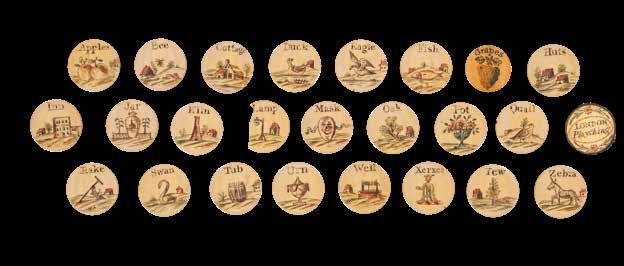
During the eighteenth and nineteenth centuries, pedagogical developments led to a number of new teaching methods, including more interactive approaches to learning. Among these were letter tiles used to teach children the alphabet and then spelling. The Temperley Collection contains eight sets of alphabets, ranging from simple bone tiles painted with individual letters - miniscule, majuscule, or both - to paper discs with the letter on one side and an illustration of an animal, object, place, or person beginning with the same letter on the other. One set has a title token, on which is written ‘London Plaything’. A wooden box contains upper-case letters cut from bone.
In Germany the educational reformer Johann Peter Hundeiker had introduced the Lesekasten (‘Reading Box’) during the late-eighteenth century. Containing letters of the alphabet on small pieces of paper or tiles, the box was used throughout the following centuries, and continues to be used in Montessori schools today. Twentieth century examples include the ‘Steglitzer Lesekasten’ (‘Steglitz Reading Box’), published between 1925 and 1940. The set originally contained letters in the traditional Sütterlin script. In the present example, however, the tiles have been replaced by Italian style lettering, presumably after Sütterlinschrift was banned by the Nazis in 1941.
BUSSEMACHER, Joan; after Martin DE VOS
[Group of three Spickelbildern illustrating scenes from the ‘Vita, passio et Resurrectio Iesu Christ’Stations of the Cross].
Publication [Cologne, Jan Sadeler, 1583].
Description
Three spickelbildern (avg. 250 by 210mm), etched prints, with contemporary handcolour and brocade applique swatches, inscription to verso in black ink, two small tears to paper.
Dimensions 250 by 210mm (9.75 by 8.25 inches).
Number of items 3
“This curious waste of ingenuity...”
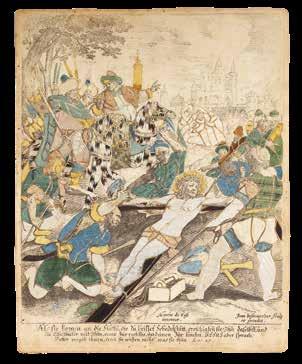
A 12-part series by Martin de Vos entitled ‘Vita, passio et Resurrectio Iesu Christ’, engraved by Johann Bussemacher for publication in 1582-1583 by Jan Sadeler.
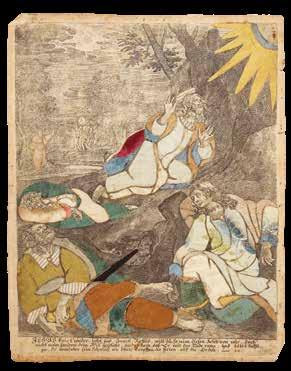
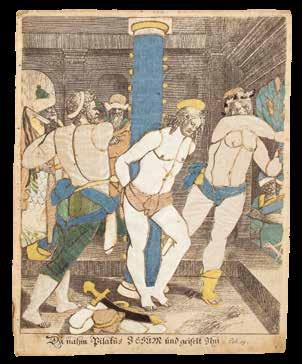
Present in the Temperley Collection are three etchings from the series, showing: Christ praying in the Garden of Gethsemane while Simon Peter, John and James sleep; Christ being flogged on the orders of Pontius Pilate; and Christ being nailed to the cross. Beneath each image is a verse from the Gospels, namely Luke 22, John 19, and Luke 23.
Notably, the etchings have been embellished with brocade fabric swatches, which add depth, colour and opulence to the scenes shown. For example, one of the disciples wears an ornately decorated robe, the pillar in Pilate’s palace is a rich patterned blue, and the horses in the background of the Crucifixion scene have appropriately-textured coats. This technique was generally carried out by nuns, and the images produced were known as “spickelbildern”. To the verso of the first spickelbilder a rather critical inscription reads: “This curious waste of ingenuity is the work of NunsI was told; but I could not learn of what convent or what date. Bought at Nuremberg”.
Martin de Vos (1532-1603), Flemish painter and draughtsman, catered to the contemporary appetite, both in the Spanish Netherlands and abroad, for devotional artwork. This desire for religious imagery was in part a response to the “Beeldenstorm” (literally, “attack on images”) of the mid-sixteenth century, during which particularly zealous Protestants had attacked and destroyed Catholic icons and art. In the aftermath of the tumult, de Vos was commissioned with the redecoration of several churches in Flanders, and his work came to embody the ideas and spirit of the Counter-Reformation. In addition to church paintings, de Vos also produced illustrations of religious and scriptural subjects which were engraved and published by a number of prominent Dutch publishers, including the present series.
Extremely rare: a complete set is held at the Allentown Art Museum in Pennsylvania, while the Germanishches Nationalmuseum in Nuremberg has five prints, lacking hand-colour.
[ANONYMOUS]
[Flower collage playing cards, from the reign of William and Mary].
Publication [Possibly London, c.1690-1694].
Description 12 woodcut playing cards (95 by 65mm) with contemporary stenciled colour, the versos elaborately decorated with flower collages of multiple layers of incised paper pasted to versos, with contemporary handcolour.
Dimensions 95 by 65mm (3.75 by 2.5 inches).
Number of items 1
Fashionable flower games
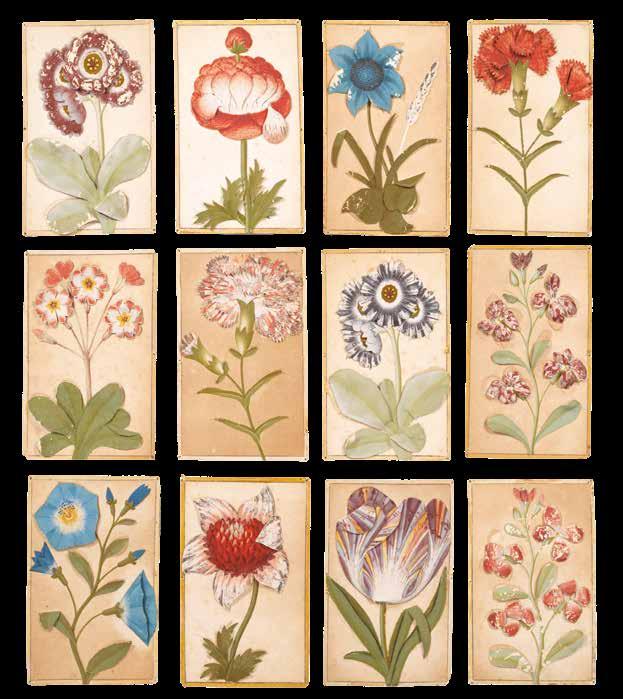
The verso of each one of these anonymous playing cards has been elegantly decorated with a beautiful flower collage, made of intricately cut layers of paper, some folding to give extra dimension and depth, and finished in a very painterly fashion.
The flowers portrayed seem to point to the reign of William and Mary (1689-1694), and may well have been made by someone close to their cause. The bouquet tellingly includes a beautiful example of a “Bizarden” tulip, with yellow, red, and white streaks, on a purple background. Bizarden - or “Bizarres” - tulips were highly sought-after during the Tulip Mania of the 1630s. The presence of Sweet Williams, and a magnificent double pom-pom marigold, would seem to clinch the House of Orange connection. However, there are also several specimens of varicoloured Auricular, which were a very English fad during the seventeenth century - as were pinks, carnations, and Morning Glories, also included here.
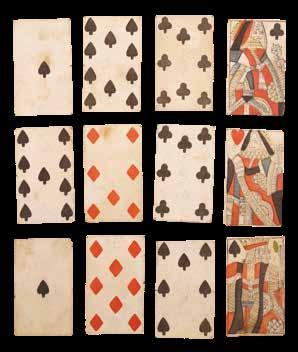
The front of each card displays the typical suit symbols, or pips, and in the case of the court cards, full-length portraits of the royal figures in the Rouen pattern, close to the style of Pierre Leroux of 1650-1660s.
[ANONYMOUS]
[Spickelbilder of Queen Anne and Members of her Government].
Publication
London, Printed Culred and sold by Iohn Overton at ye whit horse w.thout Newgate, [1702-1707].
Description
Etched print, with contemporary handcolour, cut to the image and laid down on brocade swatches, laid down on a contemporary pen and ink manuscript document, minor staining to verso.
Dimensions
280 by 215mm (11 by 8.5 inches).
Number of items 1
Queen Anne spickelbilded
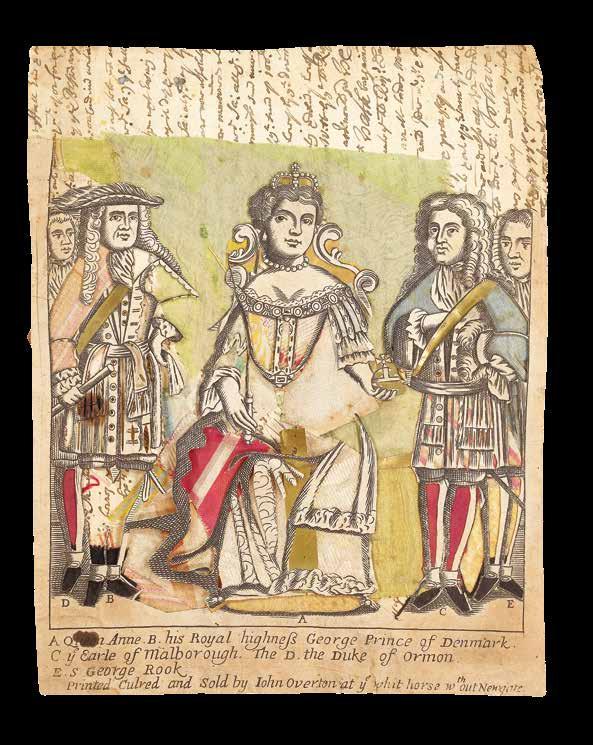
A spickelbilder etching depicting Queen Anne flanked by some of the most influential figures of her reign.
Queen Anne ruled from 1702-1714, and appears to be depicted here on the occasion of her coronation, seated on the throne with sceptre and orb in hand. On her right stands her husband, Prince George of Denmark, and to her left is the Duke of Marlborough, John Churchill, the husband of Anne’s closest friend, Sarah Churchill. The politics of the court and the nation led to a turbulent relationship between the monarchs and the Churchills over the course of her reign.
The two other figures shown were both Admirals of the Fleet under Anne: Edward Russell, the Earl of Orford, who had invited William of Orange to depose James II, and George Rooke, who captured Gibraltar for Britain in 1704. Each person is identified in an alphabetical key beneath the print, although the Duke of Marlborough is mis-titled as an Earl, and the Earl of Orford is named “the Duke of Ormon”.
The engraving was “Printed Culred [i.e. coloured] and Sold by Iohn Overton”, i.e. John Overton, with his address given as the White Horse without Newgate; Overton occupied these premises until 1707, providing a date of publication between 1702, when Anne was crowned, and 1707.
[VARIOUS MAKERS]
[22 pin-prick pictures].
Publication [Britain, nineteenth century].
Description
22 elaborately pin-pricked prints (various sizes), some with original hand-colour, some excised and and laid down on heavier stock.
Dimensions
Smallest: 140 by 160mm
Largest: 270 by 365mm
Number of items 22
Pin-prick pictures
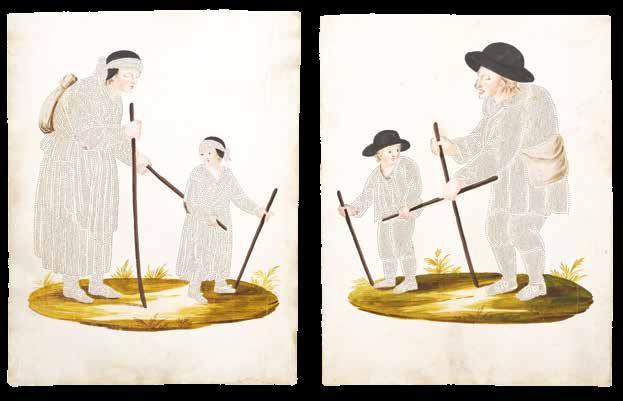
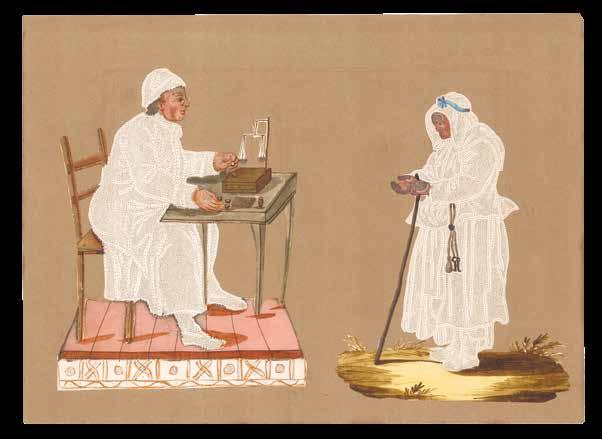
Women of leisure during the Regency and Victorian eras found pastimes in various creative and crafty outlets, from music to art. Alongside sketching, painting, and embroidery, pin-pricking was devised as an innovative medium for producing images and decorative motifs. Holes were pricked in paper, sometimes following a drawn sketch, to form an outline or an entire image, with depth added by the size of the holes created. Shops stocking resources and materials for amateur artists began to offer “fancy papers” for such activities, with different colours, thicknesses, and embossed options available.
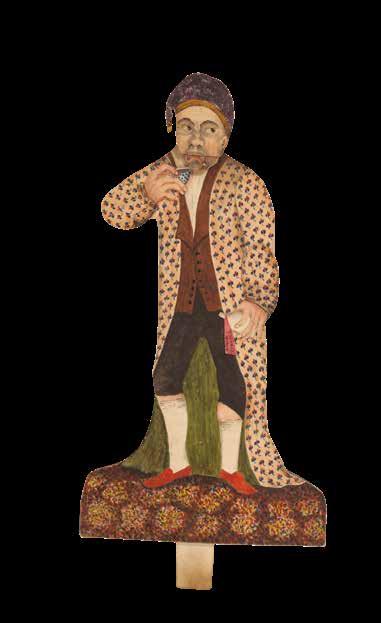
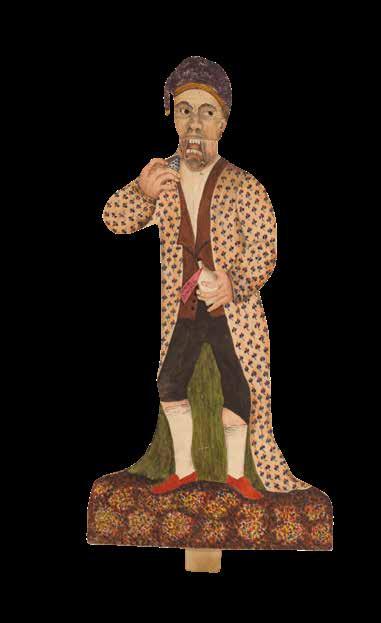
The 22 examples of pin-prick pictures in the Temperley Collection appear to have been made by amateur artists and show a variety of scenes, motifs and figures. Among the latter are rural characters in traditional dress, a moneychanger, perhaps from a Biblical scene, a black woman, a yawning man in his pyjamas, and a suspicious looking man carrying a bulging sack labelled “£20,000”.
A few are more simply executed, with holes punched through plain paper; one of these celebrates Nelson’s victory at Trafalgar in 1805, while another marks the death of Queen Caroline in 1821 after “afflictions sore for twenty five years she bore with sorrow, grief and pain, til God was pleased to come and ease her of all her troubles”.
Others have more elaborate cut-outs, include hand-colour, or are part of a collage incorporating additional printed material. Some contemporary themes are in evidence, such as Chinoiserie, patriotism, and the growing nineteenth-century cult of mourning.
[ANONYMOUS]
[Group of six Tinsel prints].
Publication
London, A. Park, No.6 Old St. Road, City Road, & J. Golding, 61 Oakley St., Lambeth [and] O. Hodgson, 10, Cloth Fair [and] Hodgson, No.10 Newgate Street [and] J. Dyer, 55 Bath Street, Old Street, [c.18101840].
Description
Six numbered etched prints (avg. 240 by 190mm), with contemporary hand-colour and coloured metal foil applique, one with graphite sketch to verso, minor damage to margins.
Dimensions 240 by 190mm (9.5 by 7.5 inches).
References Carpenter, ‘The Mirror of Taste, and Dramatic Censor’, Philadelphia, 1810, p.234; Robson, ‘Robson’s London Directory’, London, 1839, p.469.
Number of items
6
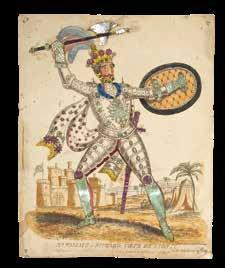
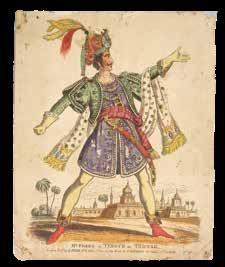
Theatre famously thrived in nineteenth-century Britain, and part of the public passion for stage performance included the veneration of actors and actresses. Pin-up posters of prominent performers were widely available, and “tinsel prints” became popular among their greatest admirers. These were prints embellished with watercolour paint, swatches of fabric, and other embellishments in the form of metal foil (or tinsel), leather, feathers and more. At first, practitioners of this unique hobby sourced their own materials, but by the 1830s “tinselling” had grown so popular that pre-cut metal foil and fabric swatches were often sold alongside the prints.
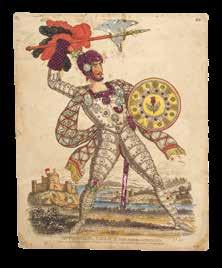
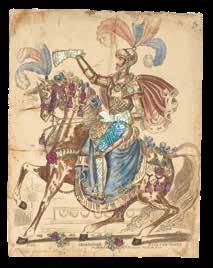
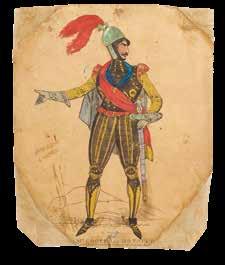
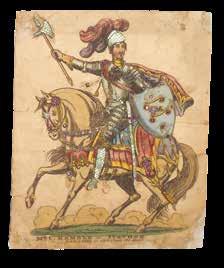
Throughout this period, Arthur Park and J. Golding jointly published a series of broadsides showing famous stage actors appearing in theatrical productions. The Temperley Collection includes those depicting “Mr Wallack as Richard Coeur de Lion”, at the Theatre Royal on Drury Lane in 1825,”Mr Cobham as Wallace the Hero of Scotland”, performed at Astley’s Amphitheatre in 1815, and “Mr Freer as Timour the Tartar”, of which there appears to be no record.
Also present is William Hodgson’s print of “Mr Cooper as Hotspur”, of whose performance in 1810 ‘The Mirror of Taste’ stated: “Of Mr. Cooper’s Hotspur we do not wish to speak in depreciation, nor are we prepared greatly to praise it”. On inheriting part of his father’s stock, Orlando Hodgson later published a theatrical poster showing a “Champion with the Glove”. William Hodgson had also released a poster of “Mr C. Kemble as Ivanhoe”; the present example has had both illustration and imprint changed, and is now attributed to J. Dyer of 55 Bath Street. Intriguingly, a Joseph Dyer is listed at that address in ‘Robson’s London Directory’ of 1839, working as a watch case maker.
It is not known who was responsible for the “tinselling” of any of these examples, but whoever was behind the bedazzling of Mr Cooper’s knees and sword seems also to have practised their sketching on the back of the poster!
RICKING, Mary, in the manner of [Mary DELANY; and others]
[Untitled flower “Mosaicks”].
Publication [Possibly Leicestershire], May, 1840 [and] July, 1845.
Description
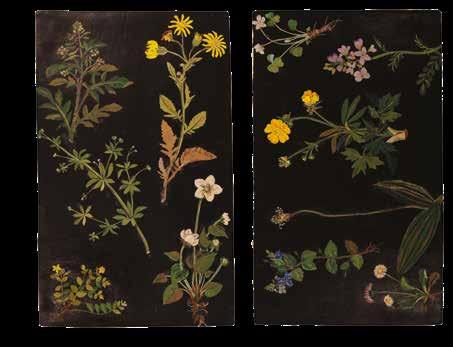
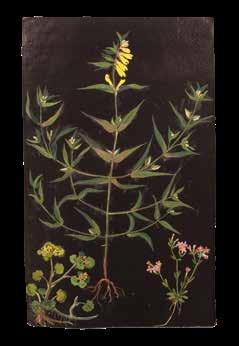
Three leaves of flower collages (330 by 205mm), with a total of 14 specimens, created of multiple layers of intricately incised coloured paper, pasted on black lacquered paper over paste-board, signed “Mary Ricking”, on paper slips on the verso, with other captions in her hand identifying the specimens with their Latin and common names.
Number of items 3
A magnificent myriad of Mary’s mosaicks
An exquisite collection of three flower “mosaicks”, in the manner of Mary Delany, who coined the phrase, by Mary Ricking, possibly of Hathern in Leicestershire. The beautiful and delicate collages include specimens of common wild flowers, such as Golden Saxifrage, Oxalis, Crowfoot, Speedwell, Belle Daisy, Ragwort, Mustard, and even Goose Grass.
Collage was yet another form of papercraft favoured as a pastime by Victorian women of leisure. Chief among the practitioners was Mary Delany (1700-1788), a woman of letters, artist, and amateur botanist. During a miserable marriage to a man over 40 years her senior, Delany had passed many lonely days in needlework, drawing, painting, and paper-cutting, or decoupage, which she took up again decades later. Between the age of 71 and 88, she created 985 detailed, tissue-paper collages of plants and flowers. So admired were her pieces, which she called “paper mosaiks”, that Queen Charlotte insisted “that any curious or beautiful plants should be transmitted to Mrs Delany when in blossom” to be replicated in paper.
Although less sophisticated than Delany’s collages, those in the Temperley Collection replicate the attention to detail and charm of her bouquets.
From the collection of Mrs. Charles James Longman, i.e. Harriet Ann Evans (1857-1938), wife of a scion of the family that operated the Longmans, Green & Co., publishing firm, and who was himself editor of ‘Longman’s Magazine’ during the 1880s. The firm published illustrated botanical works, such as ‘The Treasure of Botany’ by J. Lindley (1866).
Longman and his wife clearly shared a love of botanical illustration, and Harriet Ann, hand made her own game of botanical lotto (see item 119).
Provenance
“Lent by Mrs C. J. Longman, Upp Hall, Braughing, Ware”, in a twentieth century hand, on paper slips on the versos.
[ANONYMOUS]
[A Group of 18 Flower Collages].
Publication [Britain, eighteenth to nineteenth century].
Description 18 leaves of collages, made of multiple layers of incised coloured paper, some with manuscript inscriptions.
Dimensions
Smallest: 100 by 100mm
Largest: 335 by 210mm
Number of items 18
Flower collages
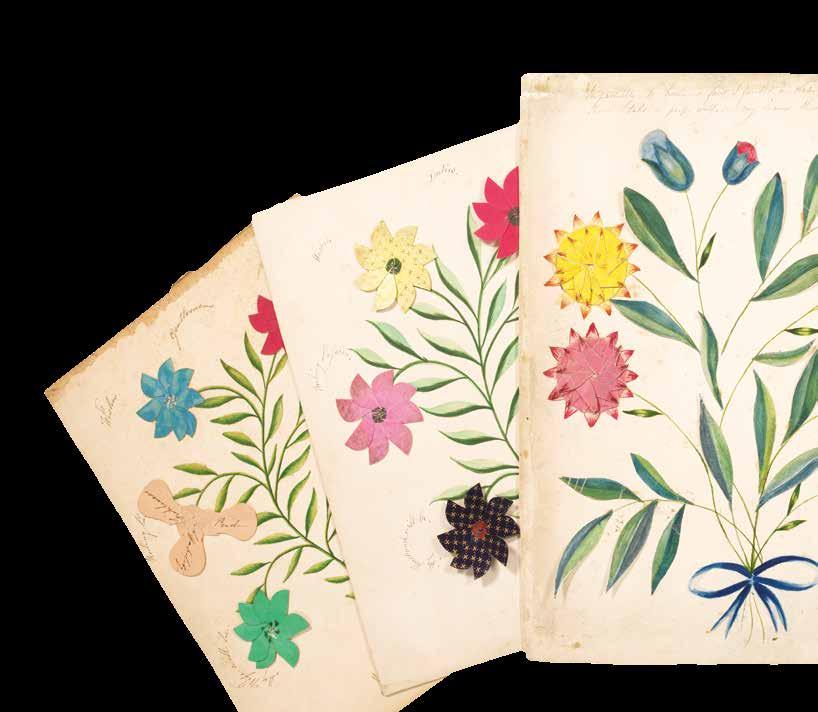
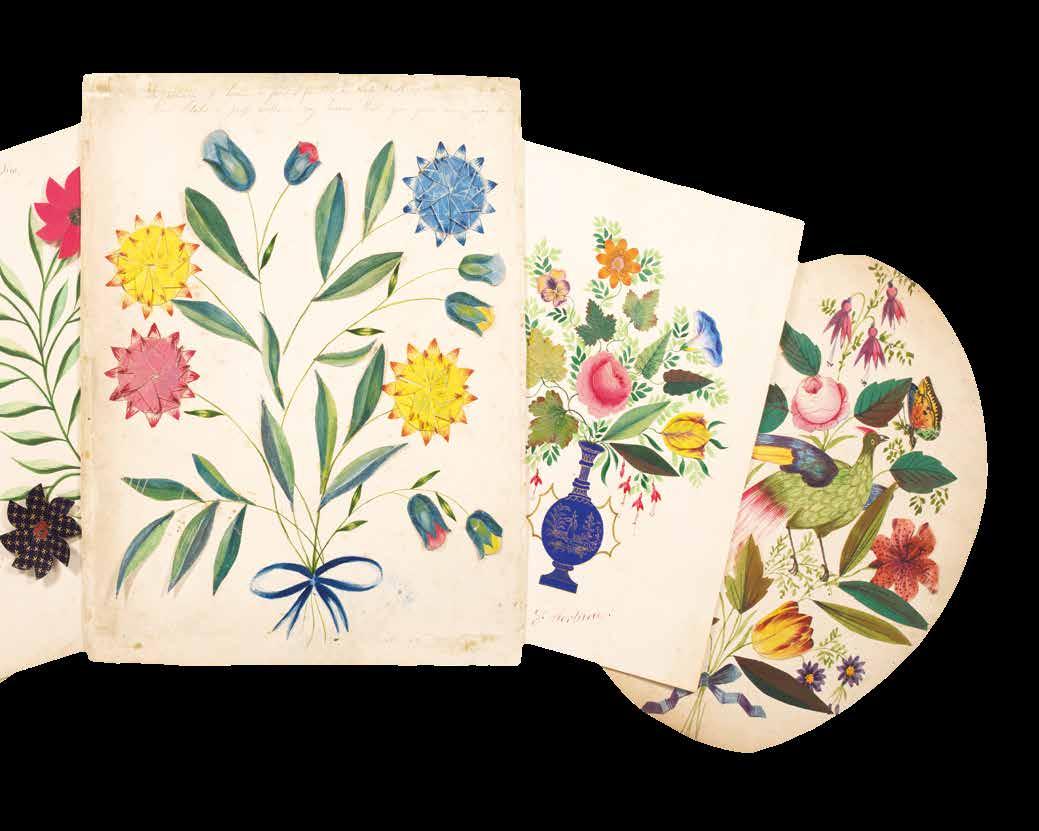
A collection of eighteen floral collages of the type popularised by Mary Delany during the eighteenth century, which then became a common pastime among nineteenth-century women of leisure. Some are purely decorative pieces, with a selection mounted on coloured paper, including blue and pink backgrounds, and one ornate creation featuring an exotic
24 elaborately folding engraved, intricately incised, and colour-printed cards (various sizes), occasionally embellished with metallic paper and fabric.
Dimensions
Smallest: 105 by 70mm
Largest: 285 by 225mm
Number of items 24
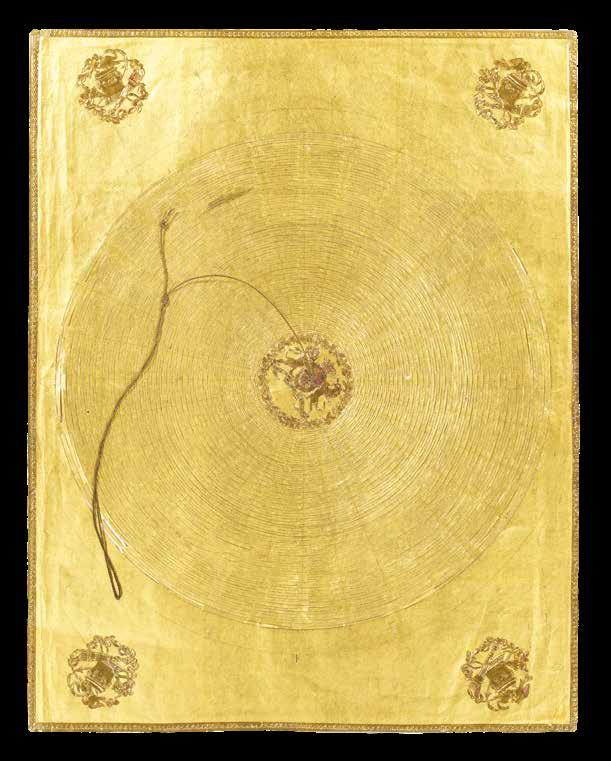
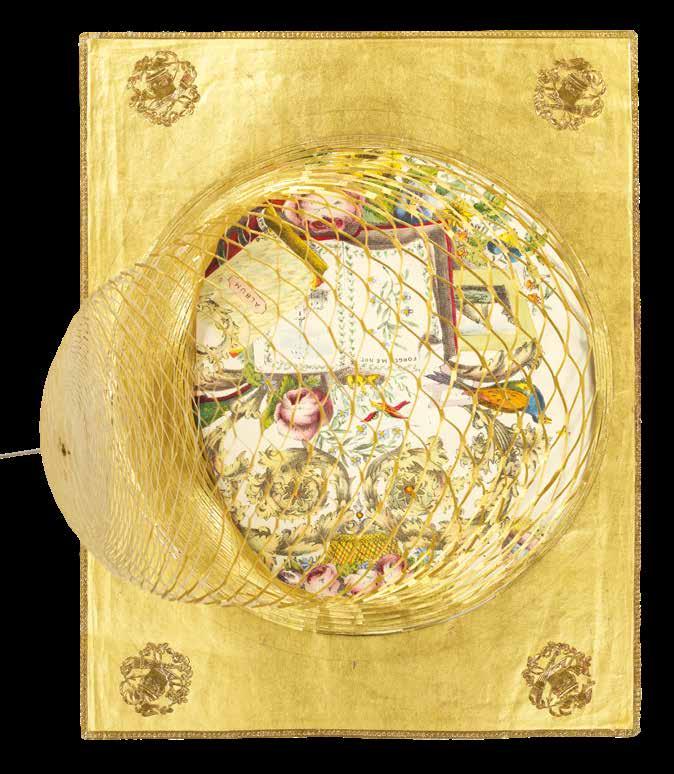
During the nineteenth century, moveable greetings cards became more elaborate, with increasingly sophisticated paper engineering and mechanisms, such as the “beehive” technique. Operated by pulling a string, the paper is cut in a honeycomb pattern, so that it can be raised upwards to create a three-dimensional “beehive”, with the image beneath visible through the small holes.
The Temperley Collection contains 23 beehive cards with a range of quaint domestic motifs, namely flowers, animals, and the home. They are dated between 1813 and 1892.
On one card, dated July 10th 1830, a circular vignette of a country house is shown, with the caption “This pretty mansion, Monsieur Souris Hall, is now on sale, and may be viewed by all; Just lift the latch, and you may see the house, But with due caution, or you’ll scare a Mouse”. When the string at the centre of the image is pulled, a tiny moveable mouse is revealed.
Another offers good tidings for the coming year, with the phrase “Love, Joy, Peace, crown thy New Year”. The circular illustration of two pheasants, symbols of good fortune, reveals, beneath, a basket of primroses. A Valentine’s card, sent to Elizabeth Hotchkiss in 1845 from Tobias, at first presents the rather unromantic image of a spider, whose web, when the central string is pulled, fans out to reveal an illustration of a couple peacefully reading together.
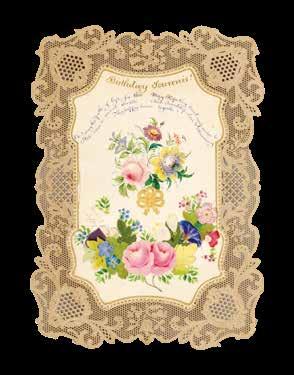
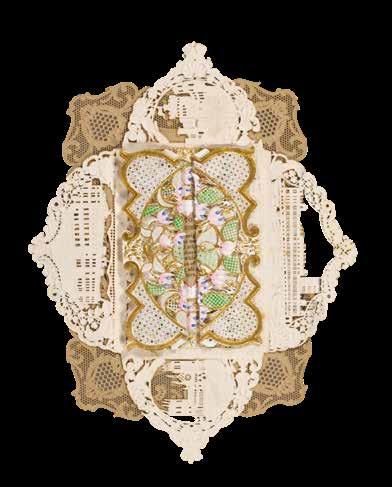
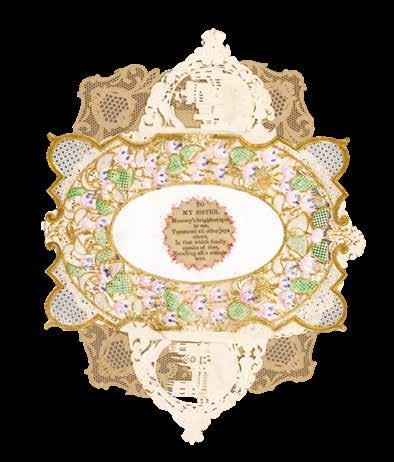
One print has two stanzas of original verse, while another bears the message “I will be true to thee”. Many are embellished with embossed designs, paper lace, and intricately-cut borders, such as a transforming wedding card bearing the watermark of Kent-based paper manufacturers Pine, Smith & Allnutt, of which the embossing and cutting is attributed to one “Wood”.
A large and impressive example with metallic foil appliqué looks like a sheet of gold when lying flat, but when the string is pulled, transforms into a radiant beehive, revealing beneath it a range of hand-drawn domestic and pastoral motifs, including a scrapbook, birds, and flowers.
In 1986, the Victoria & Albert Museum commissioned a beehive print, which was printed by Tien Wah Press and published by Alan Hutchinson Publishing Co. The flat image shows butterflies and birds, surrounded by flowers and foliage; when the honeycomb paper is pulled away, another botanical image is revealed beneath.
[VARIOUS MAKERS]
[13 paper cut-outs].
Publication [Britain and Europe, nineteenth century].
Description
13 leaves of paper cut-outs (various sizes), nine with contemporary hand-colour, one with manuscript inscription.
Number of items 13
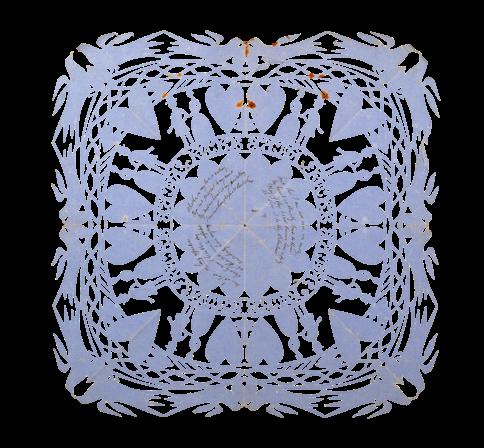
Representing another facet of nineteenth-century handicraft, the Temperley Collection contains a selection of 13 cut-out paper images and designs. While some are cut - albeit elaborately - out of plain paper, others have further embellishments including hand-painted pictures or motifs, multiple layers, or metallic appliqué. An uncut circular design houses an absolutely miniscule rendering of the Lord’s Prayer and Apostles’ Creed at its centre, while on a similar small piece of paper, cut into a sunburst shape, a poem has been written:
“To flourish near my native bower to blossom near my [cot] I cultivate a little flower they call forget me not.
Though oceans may between us roar though distant be our lot dearest Though we should meet no more sweet girl forget me not”
A near-identical verse was found on a manuscript Valentine’s “love knot” sent in 1830 by a Scottish gardener to his betrothed, which is now held in the National Records of Scotland.
One group of six illustrations shows a variety of scenes in forests and by a riverside, and include a cast of theatrically-dressed characters. The scenes bear a resemblance to those found on the cut-out sheets that were arranged in parallel to form Martin Englebrecht’s peepshows (see item 121).
[VARIOUS MAKERS]
[Paper Lace Stationery].
Publication [Britain, mid- to late-nineteenth century].
Description
Paper lace stationery (various sizes) including nine die-cut sheets, some with printed motifs, eleven envelopes, two with die-cut overlays, nine with illustrations in ink and coloured pencil, various manuscript inscriptions throughout, with one pressedcard pinwheel with contemporary pins.
Dimensions
Smallest: 65 by 100mm
Largest: 250 by 195mm
Number of items
20
Lace letters and embellished envelopes
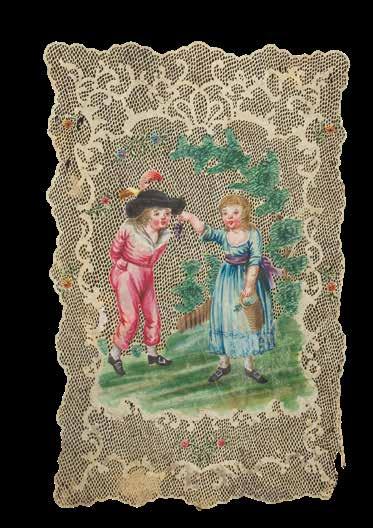
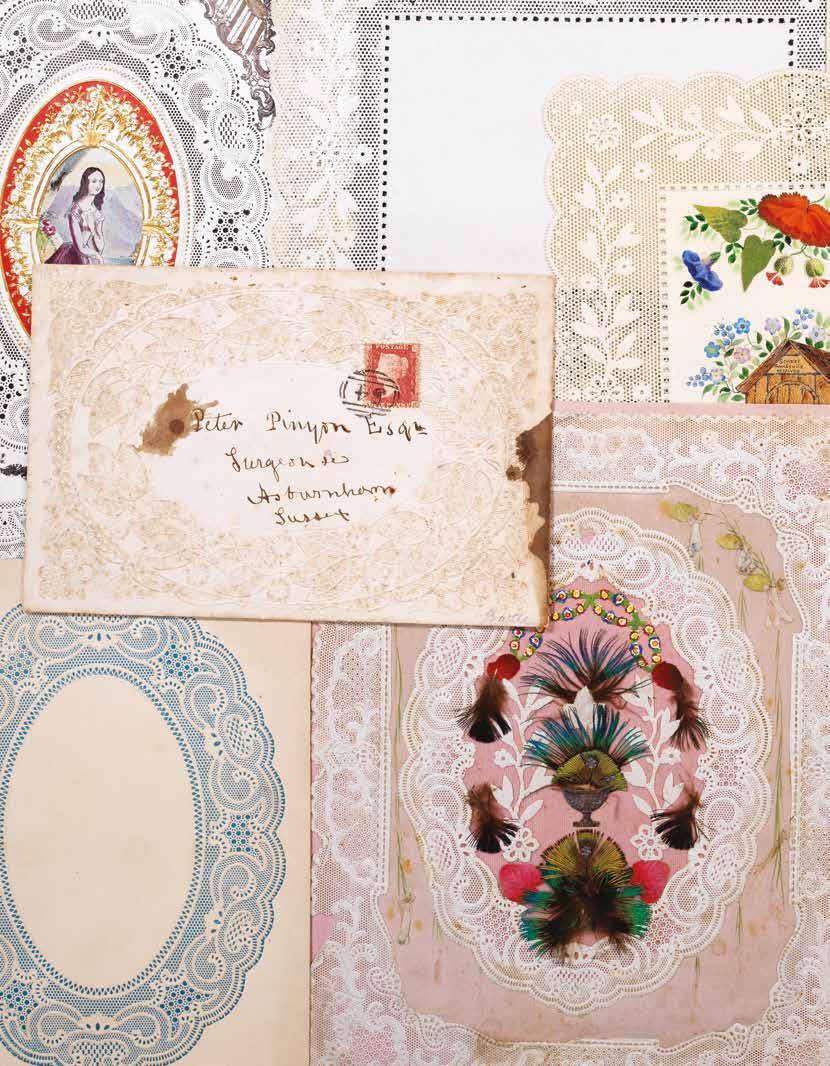
It is alleged that paper lace, which became a popular embellishment for Victorian stationery, was discovered by accident in 1834 when Joseph Addenbrooke, an employee at the Dobbs paper manufacturing firm, inadvertently cut off the raised embossing on a sheet of paper, resulting in a pattern of small holes resembling lace. Whether truly a happy accident, or simply good marketing, the technique was soon adopted by manufacturers throughout Britain. Paper lace became a particularly popular feature on Christmas and other greetings cards, as well as on general stationery items, including envelopes and letter-writing paper.
The Temperley Collection contains examples displaying varying degrees of complexity, with several made by Addenbrooke himself. Some examples are unused, while others have manuscript greetings and verse. Several lace-edged sheets of paper have additional designs, including an image of a cabin surrounded by flowers on the verso of one. One valentine, in addition to an intricate paper lace border, has a turn-the-flap illustration, showing an apple which turns up to reveal “Popping the Question, Name the Wedding Day”. The caption reads “Apple Sauce for my Valentine”. Other novelty stationery includes decorated envelopes. Bill Penn of 19 Westfield Road clearly had a very creative correspondent in “Sir Thomas”, who decorated the envelopes with various drawings including a seaside view, the silhouettes of two wayfarers, and animals. Two letters addressed to Mrs Crowther of 20 De Beauvoir Square were sent in envelopes illustrated with caricatures, namely a courtly bard and a refined gentleman in a top hat. The envelopes themselves have been made out of printed title pages, one from an official report and the other from a published sermon. Also included is a pinwheel produced by Peyton and Iles for the Great Exhibition of 1851. The firm manufactured sewing notions such as hooks and eyes, thimbles, and needles during 1850s, and exhibited at the fair a selection of these metal items, including a circular pressed-card pinwheel with an embossed view of the Crystal Palace at its centre.
LONGMAN, Harriet Ann
“Flower Lotto compiled by Harriet Ann Longman,... to be used in conjunction with flower “boards” in dark blue compendium”.
Publication [Britain], March 30, 1890.
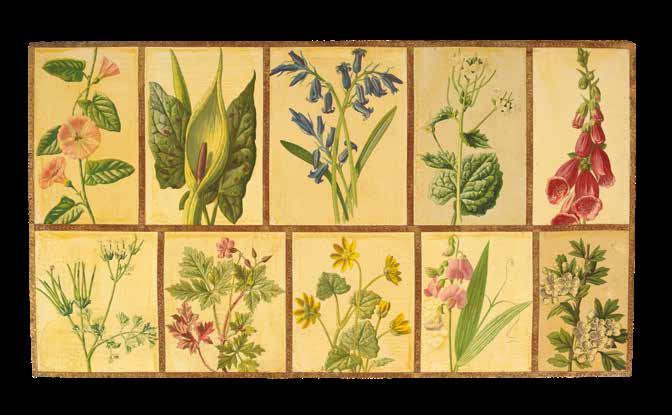
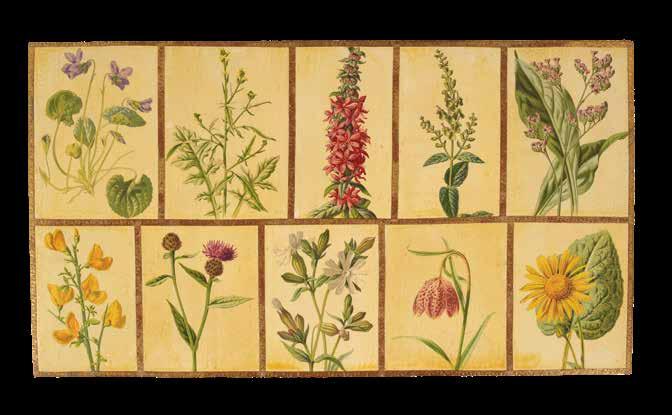
Description 20 original numbered collage cards (255 by 455mm), each composed of ten sheets of colour printed flower prints over pasteboard, decorated with metallic paper; 200 blue and pink tiles, each with the names of flowers in manuscript, housed in original blue and pink moiree silk bags, respectively; accompanied by a 22-page manuscript booklet (205 by 165mm), in a later hand, listing the names of the flowers that can be found on the cards, and tiles, bound in original blue glazed paper over paste-board covers; the cards housed in a custom half blue morocco, marbled paper boards, gilt, portfolio, morocco renewed, the tiles housed in custom marbled paper over boards clamshell case.
Number of items 3
Unsurprisingly, the exquisite lotto game made by Harriet Ann Longman (née Evans (1857-1938)) in 1890 has a botanical theme, for she was the wife of Charles James Longman, a scion of the family that operated the Longmans, Green & Co., publishing firm, and who was himself editor of ‘Longman’s Magazine’ during the 1880s. The firm published illustrated botanical works, such as ‘The Treasure of Botany’ by J. Lindley (1866), and Longman and his wife clearly shared a love of botanical illustration (see item 24998). In addition to botany and board games, Longman was a collector of posie rings and antique jewellery.
Lotto board games are similar to bingo, with players racing to fill up a card or reach a certain milestone as randomly-selected counters, numbers, words or symbols are drawn. For this game, players are equipped with one of 20 large, rectangular lotto cards, bearing collages of bright flowers and plant prints. These were to be checked off as the corresponding plant was pulled from the bag. A blue silk bag contains one hundred tiles on which are written the name of a flower or plant in English, its family, and its Latin name; a pink silk bag contains a further one hundred tiles.
[WITH]:
- [ANONYMOUS]. [A Household Lotto]. [c.1900]. Six original pencil and watercolour wash lotto cards, with accompanying manuscript list of related vocabulary; housed in original envelope (115 by 90mm). A handmade visual bingo game, includes six sheets, each divided up into 32 boxes containing coloured illustrations of various objects and items, such as a watering can, a rifle, a bridge, and a carriage. All 63 of them are listed on a separate piece of paper. Players would check off the box on their sheet as the corresponding item was called out, although it is not clear how the random number was generated, as there are no balls, counters or spinners included. The seven sheets are housed in an envelope that reads “Peallsgate School” on the back and is stamped “Bassett Down” on the front.
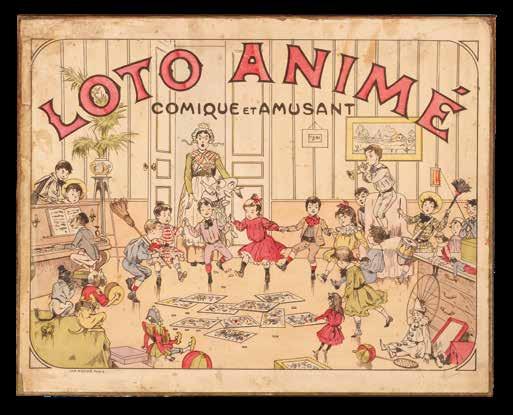
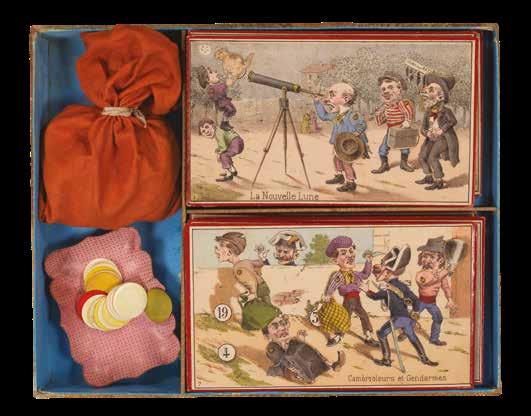
- [JEUX ET JOUETS FRANCAIS], as “J.F.J.”. ’Loto-Anime: Comique et Amusant’. Paris, Imp., Roche, [c.1904]. 12 (of 24) chromolithographed cards, moveable overlays attached with split pins, with 48 turned wooden counters numbered in ink, in original cloth bag, 19 unnumbered tiles, in original cloth bag, with pink paste-bard counter tray; all housed in original glazed paper over paste-board box (275 by 345 by 455mm) with chromolithographed label pasted to lid, and printed title and instructions pasted to inside of lid.
For ‘Loto-Animé’ the players take turns to draw and (hopefully) place correspondingly-numbered counters on their cards, competing to be the first to complete the task. This superb example was first published
by Mauclair et Dacier in about 1900, and then reprinted, as here, by the Society for “Jeux et Jouets Francais”.
To make it more interesting than a simple game of bingo, each of the cards in the present set has been animated with four moveable parts that both hide the numbers and illustrate a caricature scene of everyday life. The first card, ‘Le Nouvelle Lune’, illustrates an amateur astronomer trying to observe the moon through his telescope, watched by a variety of characters including a rat-catcher. The four moveable pieces covering the card’s numbers include the astronomer’s arm clutching his hat, boys lifting a dog to block the telescope, the rat-catcher with his trap in hand, and another man tilting his head back to reveal the number. With so many delicate moving parts, the game has rarely survived the rough treatment of children and time, and is scarcely found complete.
The manufacturers, Mauclair-Dacier, “fabrique spéciale de jeux” at 5 Rue Haudriettes in Paris, produced many games over a short period from its founding in 1893 until 1904 when it was subsumed into Les Jeux Réunis. The business attempted to produce new games every month with a special push towards Christmas, with products including moving panorama, zoetropes and several other sophisticated mechanisms.
ENGELBRECHT, Martin
[Engelbrecht’s bookbindery].
Publication Augsburg, [c.1720-1750].
Description
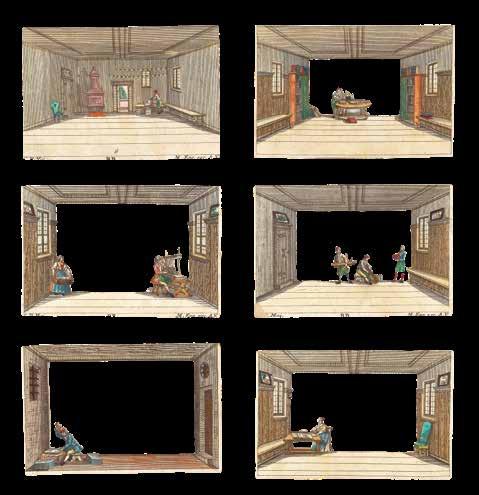
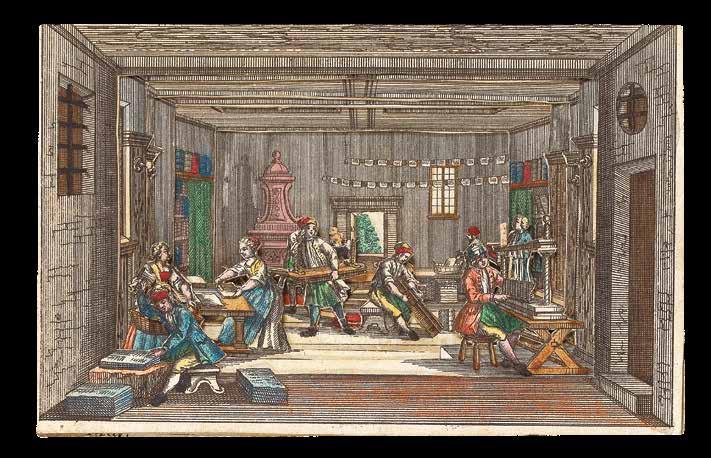
Peepshow (95 by 145mm) with six etched sections, each with hand-cut windows, and contemporary hand-colour, housed in paper wrapper with manuscript inscription “Bookbindery”.
Number of items 1
How to make a book
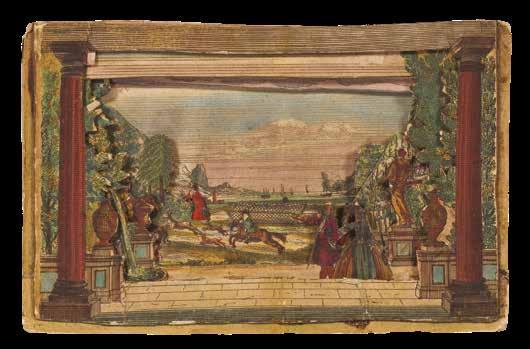
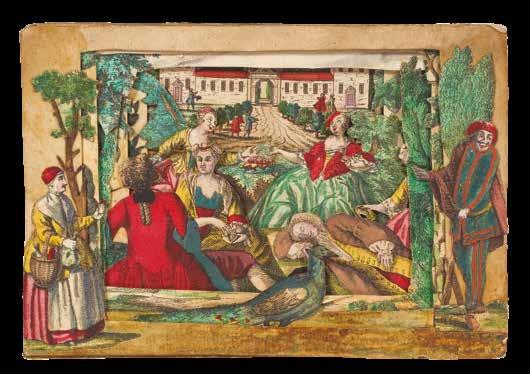
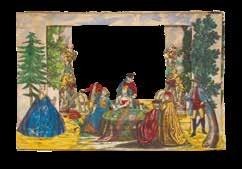
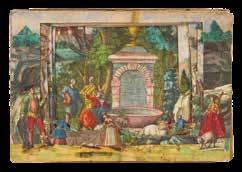
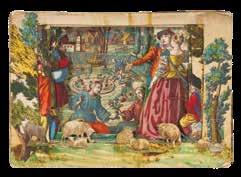
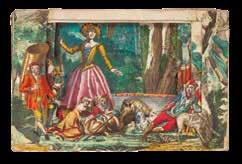
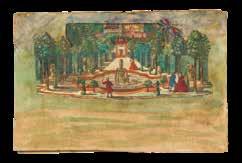
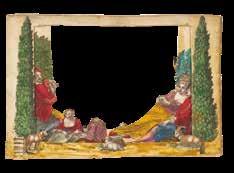
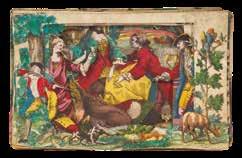
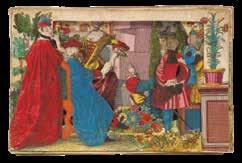
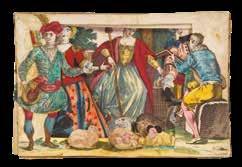
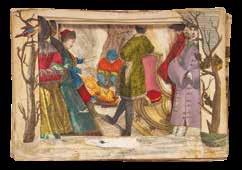
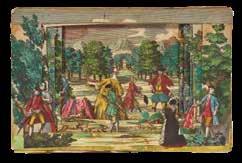
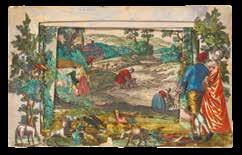
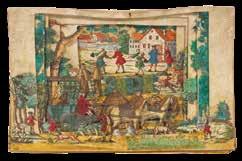
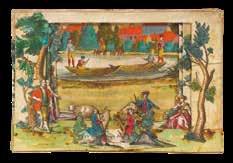
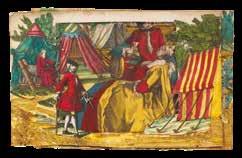
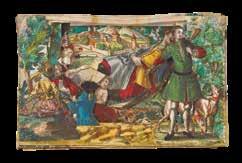
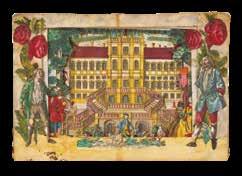
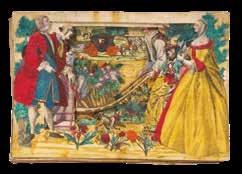
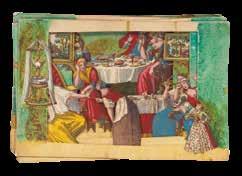
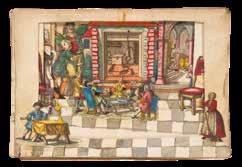
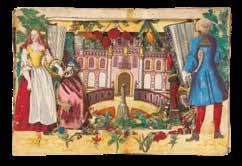
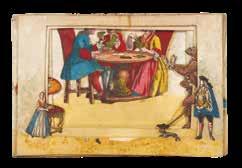
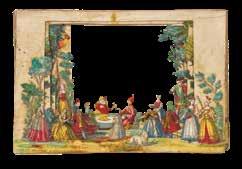
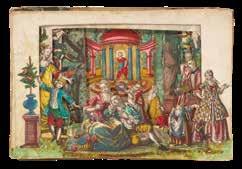
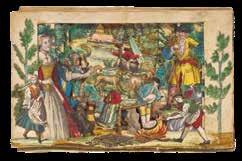
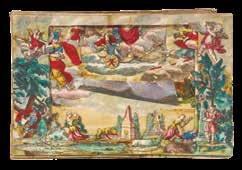
Engelbrecht’s many peepshows have subjects including festivals, landscape views, theatrical performances, Biblical scenes, and domestic life. Among the finest and most interesting is his ‘Bookbindery’, in which each panel represents a detailed aspect of the production of an eighteenth-century book. These include beating paper sheets, folding them, sewing pages together, and then trimming the edges of the bound pages.
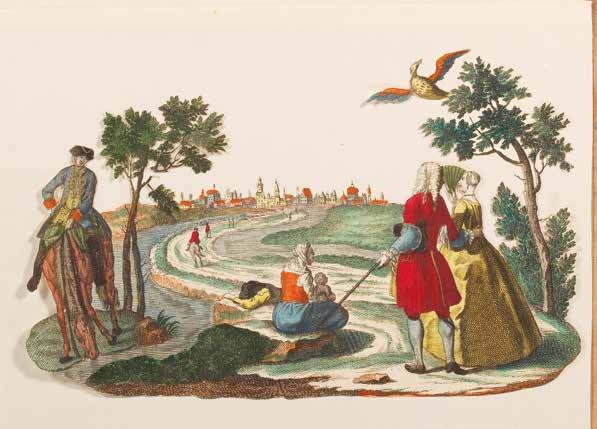
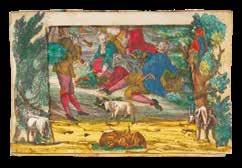
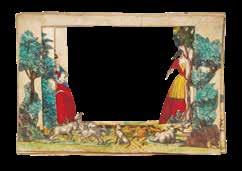
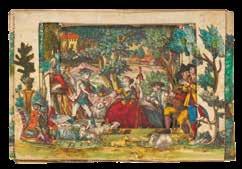
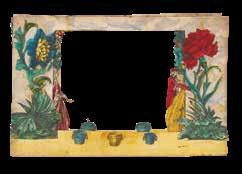
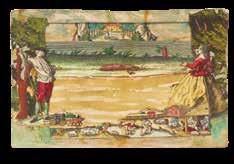
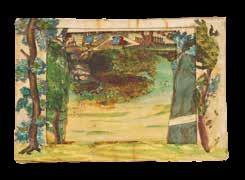
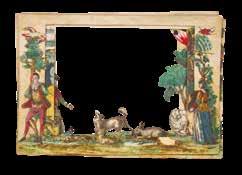
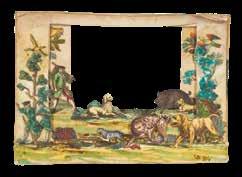
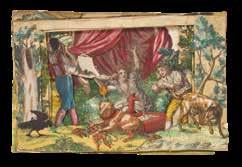
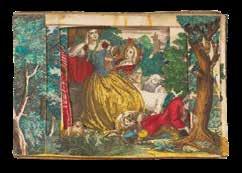
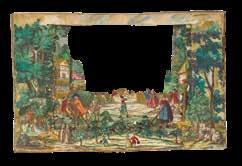
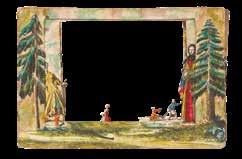
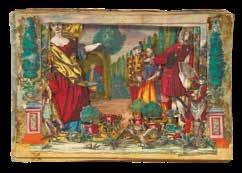
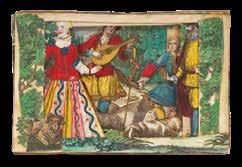
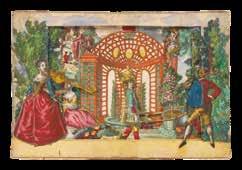
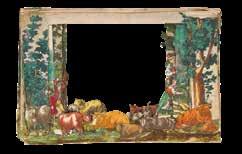
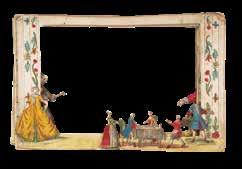
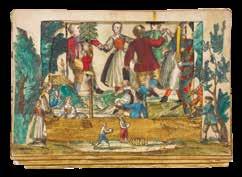
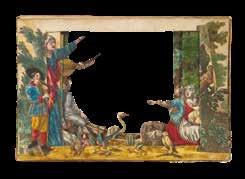
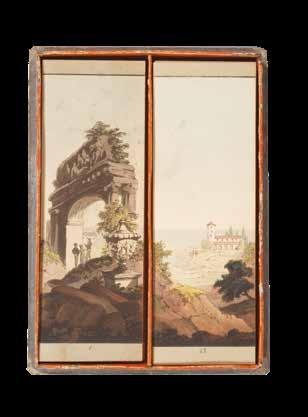
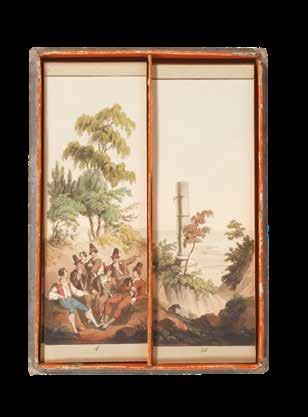
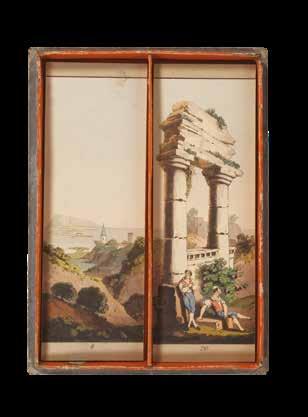
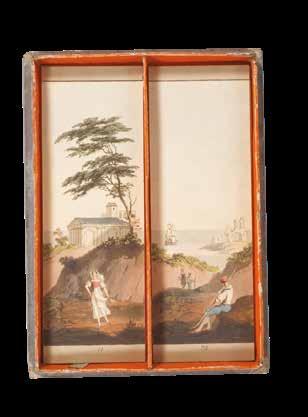
German engraver and publisher Martin Engelbrecht (1684-1756) devised “a revolutionary toy for parlour entertainment... sets of prints that were designed to be viewed slotted in specially designed boites d’optique” (Hyde). Engelbrecht’s perspective theatres, or dioramas, were compact versions of the traditional peepshow, a large box in which three-dimensional scenes or objects were displayed through a peephole or magnifying glass. Through intricate paper engineering, he was able to manufacture optical devices that achieved the same effect, but could be folded into a small slipcase. Cut-out panels were slotted into purpose-built wooden boxes at intervals of around 60mm, starting with the front framework and finishing with a final solid background.
Get some perspective
ENGELBRECHT, Martin
[Six Engelbrecht peepshows, together with 42 miscellaneous sheets].
Publication Augsburg, [c.1720-1750].
Description
Six peepshows (various sizes), each with five or six etched sections, most with hand-cut windows, and a backdrop, contemporary hand-colour, loose or in contemporary plain paper wrapper, with title and other manuscript inscriptions to versos.
Dimensions
Smallest: 75 by 90mm Largest: 195 by 210mm
References Hyde, ‘Paper Peepshows. The Jacqueline and Jonathan Gestetner Collection’, p.14.
Number of items 6
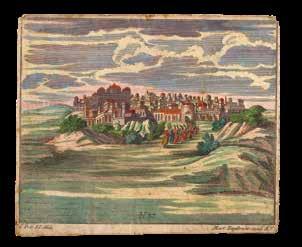
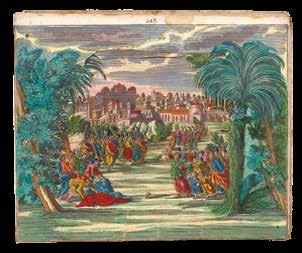
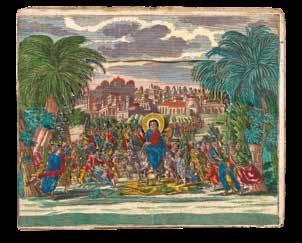
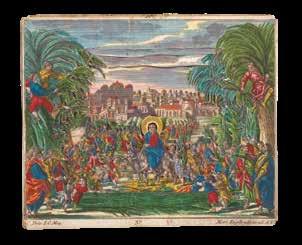
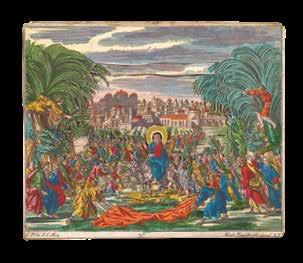
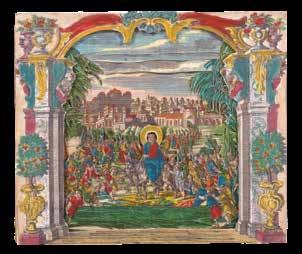
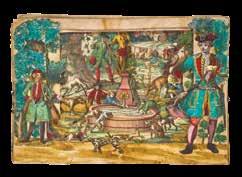
The Temperley Collection includes a wide selection of prints and views made by Martin Engelbrecht for his famous perspective theatres. Some sheets forming complete peepshows, while others are miscellaneous layers. Scenes include a Parisian cafe, a hunt, and the Biblical story of David and Goliath. Interestingly, the versos reveal that many were made on recycled paper, such as musical scores or calendars. For example, a peepshow depicting Christ entering Jerusalem on Palm Sunday, ornately hand-coloured and intricately cut, was made using paper on which the music and lyrics for a French ballad had been hand-written.
[ANONYMOUS after Martin ENGELBRECHT]
[Menotti archive of decoupage Engelbrecht peepshows].
Publication [Probably Germany, c.1780s].
Description
29 complete peepshows, 15 incomplete, and 17 single panels, composed of 317 collage sheets (avg. 105 by 155mm), cut from engravings with contemporary handcolour, and pasted to hand-coloured paper frames, some with manuscript inscriptions to verso in black ink; housed in 69 modern paper envelopes (avg. 190 by 125mm) with modern manuscript inscriptions in black ink.
References Alberto Milano, private correspondence with David Temperley.
Number of items
29 complete sets
15 incomplete sets 17 singletons
Perspective theatres with a theatrical provenance
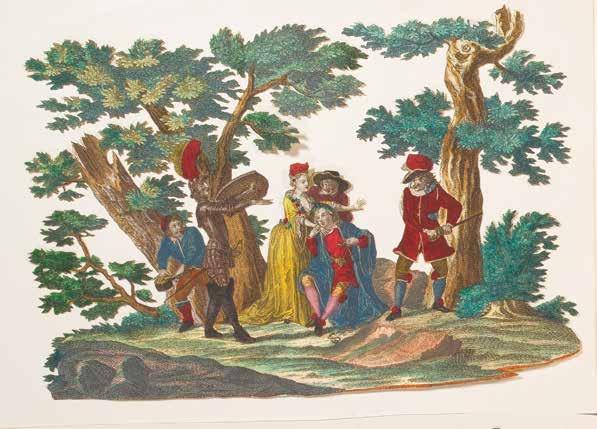
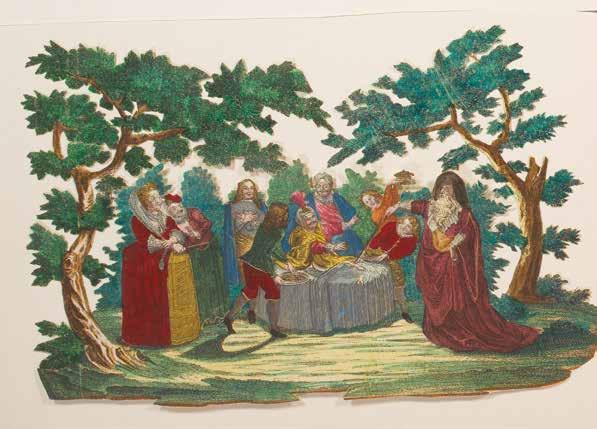
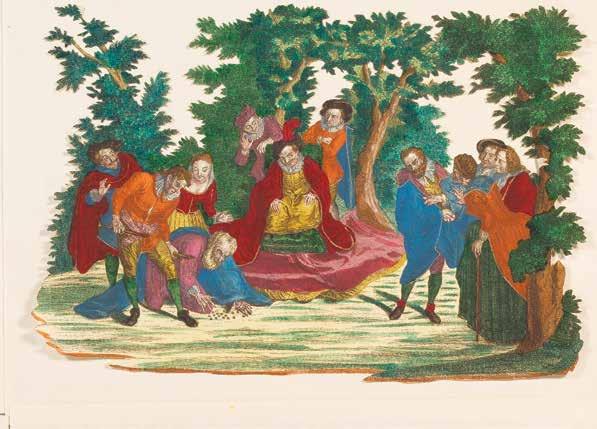
During the eighteenth and nineteenth centuries, some innovative amateurs took to creating their own sheets for peepshows (see item 123), by mixing and matching elements from existing prints. These collages frequently included characters, creatures, landscapes, and objects cut out from Engelbrecht sheets, and recomposed into new scenes. According to Alberto Milano, author of ‘Martin Engelbrecht: Perspektivtheater - Dioramen’, these ‘amateurs were often people of taste and ability at the level of professionals, several examples are known in the XVIII century aristocratic Italian families and many more could be found in France, England, Austria and Germany’.
The Temperley Collection includes 29 complete sets, each consisting of six collaged sheets, which would be slotted into a perspective theatre box to create full, detailed, and visually-deep scenes. The subjects portrayed include festivals, landscapes, and pleasure gardens. One set of six has images pasted to each side of the card. There are also numerous incomplete sets, seven containing two sheets, nine containing three, 15 containing four, and five with five sheets. In addition, there are 17 miscellaneous individual sheets, numbered on the back: of the “Number 1” cards there are seven: all distinct; there are two each of the “Number 3”, “Number 4”, and “Number 6” cards; and four “Number 5”s. Subjects include rural adventures, ornate rooms inside palaces, and bustling towns. Ironically, the perspective often gives away the amateur nature of these sheets, as many figures appear wildly out of proportion.
The sheets were owned by composer, director, and playwright, Gian Carlo Menotti. Menotti may have acquired them during the mid-twentieth century, when he was a central figure in the New York art scene. In 1972, he purchased a seventeenth-century estate, Yester House, in East Lothian, and upon his death in 2007 much of the estate was auctioned. The 317 cards are housed in modern envelopes with Menotti’s brief annotations, for example “confuso”, “quinte”, and “no completa”, as well as Rosemary Temperley’s notes.
Provenance
Gian Carlo Menotti (1911-2007), his sale Thomas Roddick, ‘The Residual Contents of Yester House, Gifford, Edinburgh’, October 8th, 2015, Lot 16.
VARIOUS MAKERS
[40 peepshows].
Publication Britain, France, Germany, Denmark, United States, [1820s]-2006.
Description
40 peep shows (various sizes), in various media - engraved, lithographed, digitally printed, and manuscript, some bound, some loose, some with original slipcases and envelopes.
Dimensions
Smallest: 105 by 140mm
Largest 190 by 235mm
Number of items
40
200 years of peeping
Eighteenth century advances in paper engineering meant that the peepshow, which had previously taken the form of a large box carried around by wandering showmen, could be made compact. Innovated in Germany by Martin Engelbrecht (see item 120), the paper peepshow was soon replicated in Britain and France, and became popular during the Victorian era. The back panel, on which a scenic background is typically found, can be pulled away from the front panel, which has a hole or wider framework through which to “peep”, to which it is attached by concertina hinges that connect multiple cut-out layers, augmenting the depth of the scene, by adding different figures, objects, and structures.
The Temperley Collection includes a wide range of nineteenth, twentieth, and even twenty-first century peepshows. Many of the earlier examples reflect the novelty of the form in their intriguing names, such as ‘The Areorama’, published by Samuel and Joseph Fuller in the 1820s and showing a view of Regent’s Park, the ‘Theatreama’, a playhouse peepshow from around 1825, and ‘Teleorama’, a German publication from the 1830s containing a pastoral scene for children.
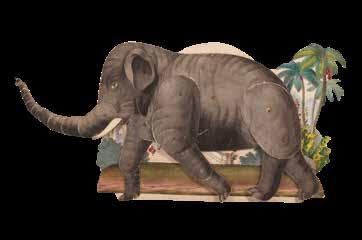
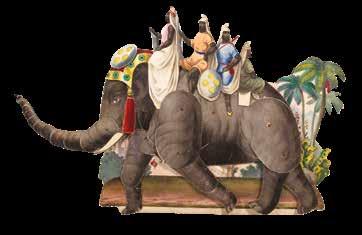
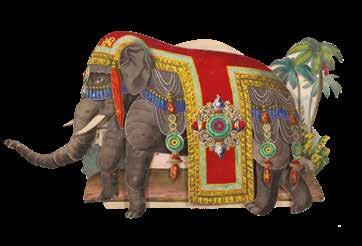
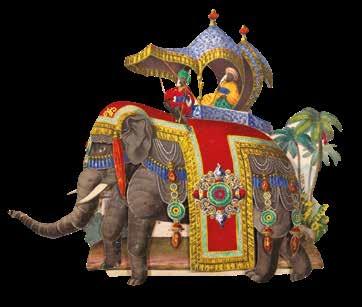
Notable events were often represented by peepshows and sold as souvenirs. For example, the appearance of the celebrated elephant, Mademoiselle D’Jeck, in a production of ‘The Elephant of Siam’ at the Adelphi Theatre in 1829 was made into one, with a folding panel allowing the scene to be changed.
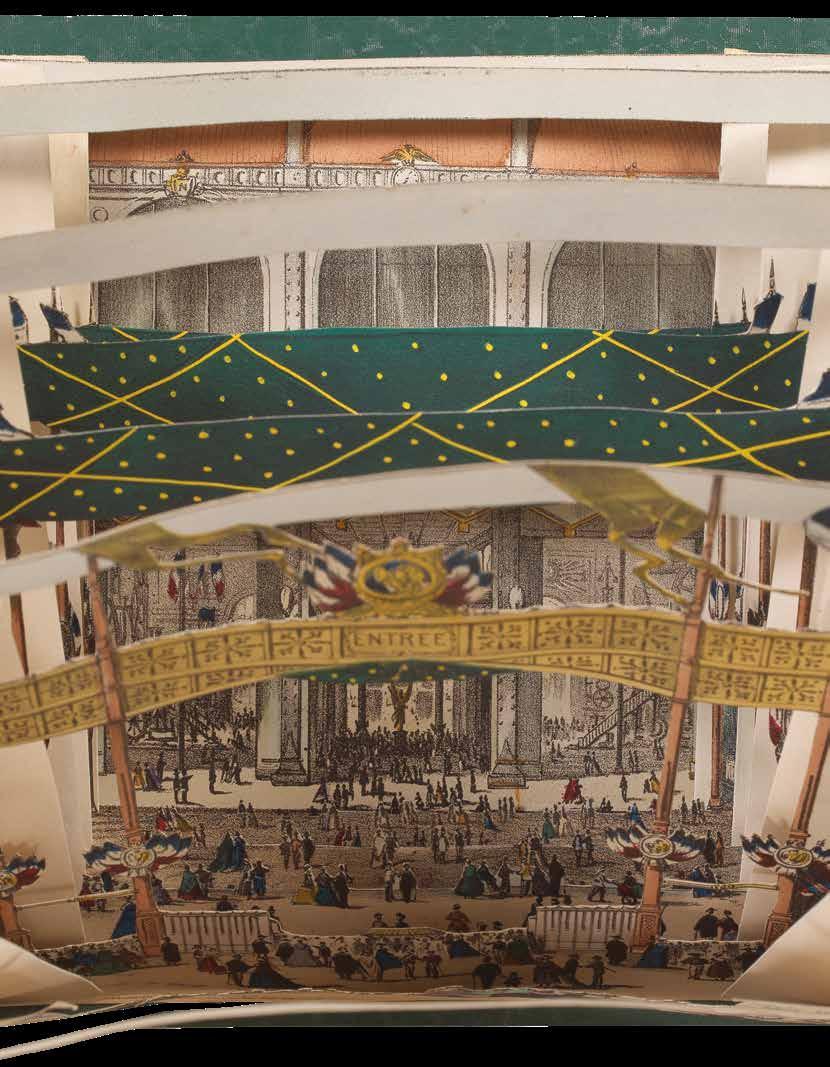
The Great Exhibition of 1851 also brought about many commemorative peepshows by prominent printmakers such as William Spooner and Charles Lane. ‘Lane’s Telescopic View of the Ceremony of her Majesty opening the Great Exhibition’ contains eight cut-out layers between the front peephole and the back board, creating a magnificent impression of the Crystal Palace bustling with visitors. The next decade, Paris hosted the Exposition Universelle of 1867, which is captured in a sumptuous peepshow showing the entrance to the fair, which was held on the Champ de Mars and attracted 15 million visitors in the seven months that it was open.
During the following century, peepshows began to be associated more with children, although this did not stop the Shell oil company producing one in 1935 to promote its advertising campaign: “In winter & in summer you can be sure of Shell”, accompanied by two telescopic views representing each season. Nonetheless, twentieth century peepshows were generally aimed at a young audience, with Thomas Werner Laurie publishing several series of “show books”, including works by Enid Blyton, Biblical scenes, and ballets. Each “Werner Laurie Showbook” came with instructions and diagrams of how to put together the peepshow, which involved the user removing the covers, cutting out the pages, and inserting them into the bellows. Much of the fun to be found in these volumes was no doubt in this construction!
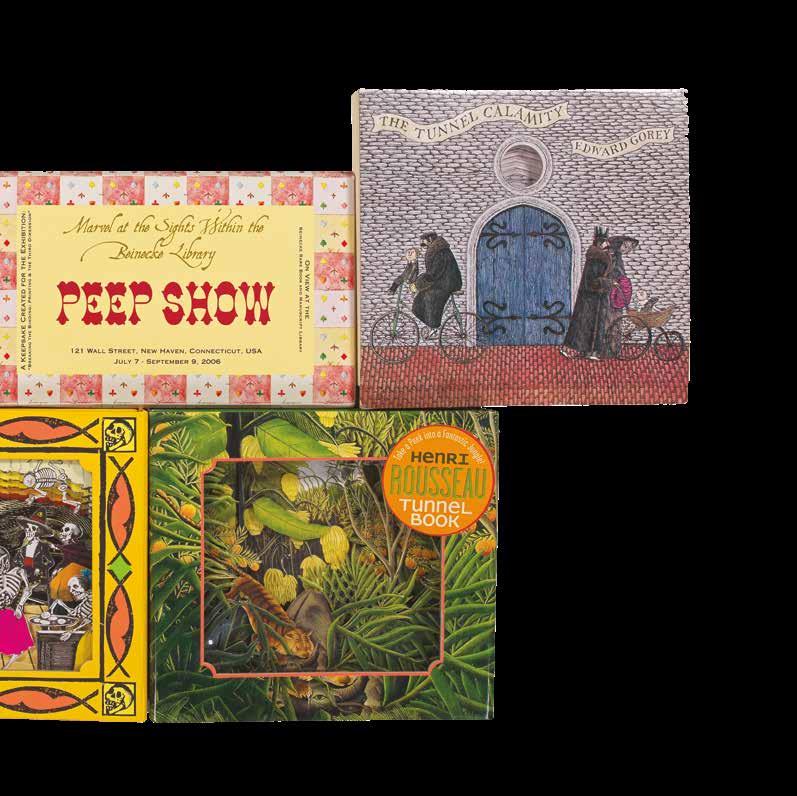
In 2006, the Beinecke Rare Book and Manuscript Library made “a keepsake created for the exhibition: “Breaking the Binding: Printing & the Third Dimension””, which invited the viewer to “marvel at the sights within the Beinecke Library”. A window in the side of the monumental building designed by Gordon Bunshaft allows the viewer a glimpse into the library with its famous translucent marble façade. Additional interchangeable panels are included, showing various features of the library, its huge collection, and figures associated with the institution.
[ANONYMOUS]
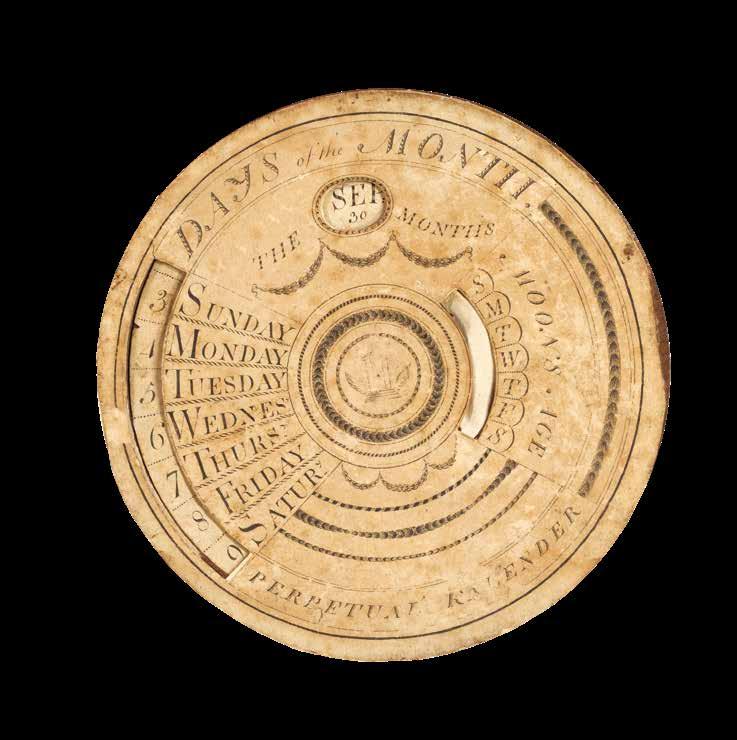
Perpetual Kalender.
Publication [Britain], 1783.
Description
Volvelle, engraved in three parts (165mm in diametre), showing the number of days in the month, the days on the week, lacking the “age of the moon” calendar, each mounted on concentric revolving wooden dials.
Dimensions 165 by 165mm (6.5 by 6.5 inches).
Number of items 1
A Gregorian Calendar
Dated “1783” in manuscript on the verso: an auspicious year, in which the Treaty of Paris was signed, ending the Revolutionary War; the “Great Meteor” passed over the British Isles; and the Robert frères flew in a balloon over Paris.
Invented in the mid-eighteenth century, the perpetual calendar allows the user to look up the day of the week for any given date. Revolving plates within the present instrument are turned to set the month, and the dates then line up alongside the relevant day.
[VARIOUS MAKERS]
[13 Calendars].
Publication [Britain, Germany, Austria, United States, c.1768-1934.
Description 13 calendars (various sizes), one manuscript and 12 printed, with various moveable elements, including flaps, popups, pull-tabs, rotating, and or drawstrings.
Dimensions
Smallest: 120 by 55mm
Largest: 405 by 280mm
Number of items
13
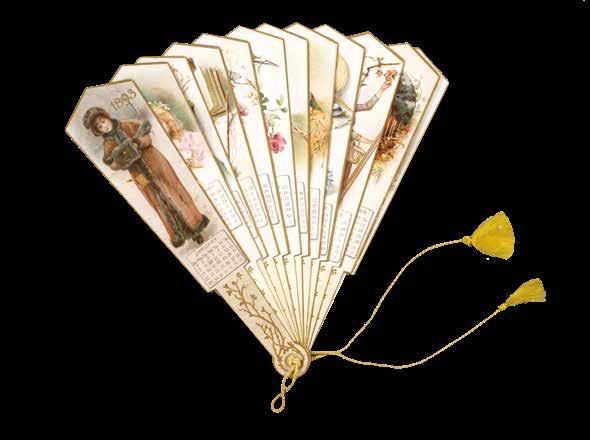
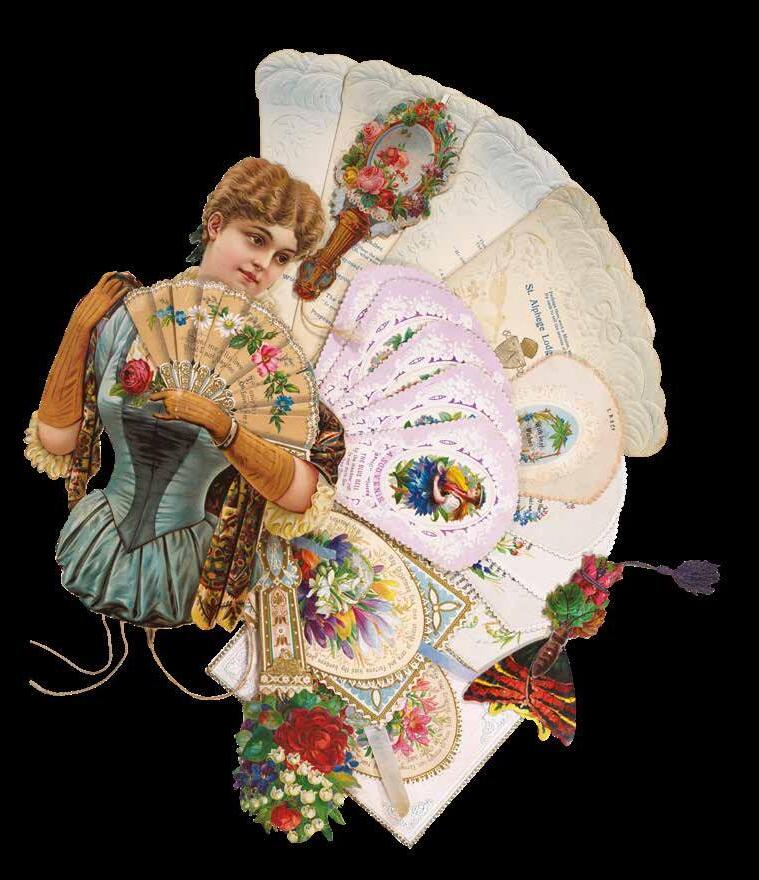
Everyday printed commodities such as playing cards, souvenirs, and calendars, which are either in constant use or widely proliferated, prove useful promotional tools, and for this reason were produced as some of the earliest forms of commercial advertising, outside of the notices listed in local newspapers. London stationers S.D. Edwins & Sons and Joseph Mansell, published a series of perfumed promotional calendars, of which the Temperley Collection contains those from 1874 and 1878 by the former, and that from 1877 by the latter, which unfolds into a small fan. A similarlystructured calendar for 1893 shows a different lady, domestic scene, or decorative motif on each slat of the fan.
Not all calendars were promotional, however, with printmakers selling ever more elaborate designs. To celebrate the dawn of a new century, Ernest Nister published a calendar featuring a moving view of the Houses of Parliament and Big Ben from across the Thames. When the drawstring is pulled, a boat glides across the river, lowering its funnel to pass beneath Westminster Bridge.
The same year, Raphael Tuck & Sons published a wonderful ‘Merrygo-Round Calendar for 1900’, consisting of a moving, three-dimensional paper model of a ferris wheel. In each of the swinging baskets, on which the monthly calendars are printed, ride anthropomorphised cats and dogs, looking both nervous and thrilled, while a pack of expectant pups wait for their turn at the bottom of the ride. Although the artist is not credited, the cats are drawn in the style of Louis Wain, who worked with the Tuck firm on multiple projects.
Anthropomorphised dogs featured again in Tuck’s 1908 calendar, which depicts a pack of pooches driving a car, the number plate of which is “AD1908”; the bonnet opens to reveal the days and months. Likewise, ‘Dog Days’ features a puppy with a white bow, framed by a wreath of canine portraits; the dog at the bottom of the wreath reveals a fan calendar for the year. Perhaps given as a Christmas or New Year’s present, an anonymous calendar for 1908 takes the form of a card, the front of which reads “Joyous Chimes”, and the interior of which features a multi-layered pop-up decorated with birds, bells, and flowers. A later calendar, published in 1934, probably in the United States, shows a figurine of a young boy captioned “I’se jest chock-full o’ dates”; he is holding the pages of the calendar, which are entitled ‘Many Happy Days’.
In addition to annual calendars, the Temperley Collections also includes an early advent calendar. The first printed advent calendars were made in Germany at the beginning of the twentieth century by lithographer Gerhard Lang. Soon numerous other publishers had begun producing their own, including St. Johannis-Druckerei Lahr-Dinglingen of Baden. In the 1920s and 1930s, this firm sold a three-dimensional calendar in the form of a house, whose 26 windows were to be opened one day at a time. On the upper storey, four nativity scenes are illustrated on each of
the sides, and above them are lyrics from the German Advent hymn ‘Wie soll ich dich empfangen’.
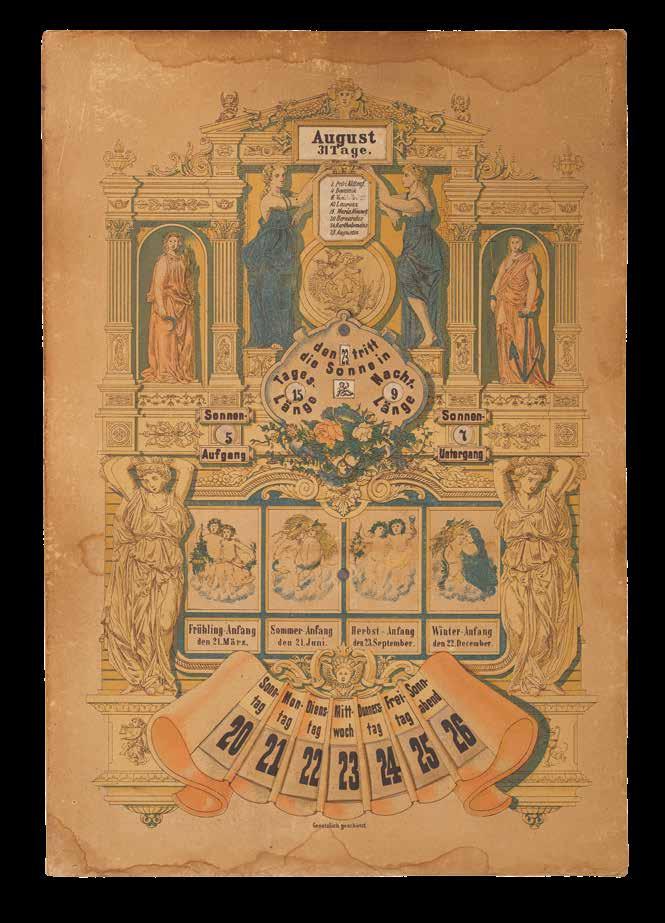
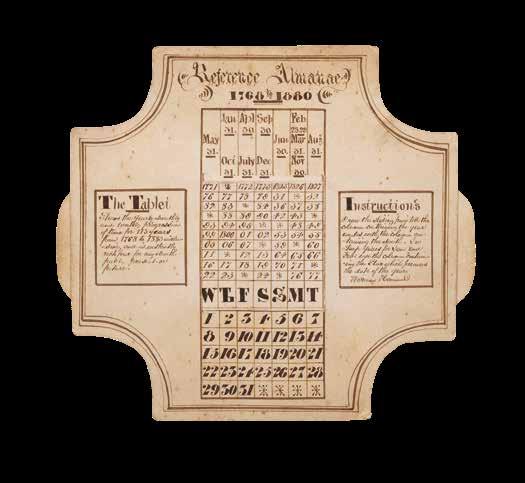
Another German print, probably published around the turn of the century in Austria, is a perpetual calendar with two volvelles, which can be turned to change the dates shown through the windows in the main image. By doing so, the user reveals all sorts of information, including the day of the week, hours of daylight, sunrise and sunset, saints’ days, and signs of the zodiac. Surrounding these details are Classical motifs including pillars, robed statues, and winged putti. A similar moveable almanac was made over a century earlier by William Hammond. The handmade calendar can be made to show information for the years 1768 to 1880: the instructions inform the user that they must “draw the sliding piece till the column containing the year unites with the column containing the months”.
[ANONYMOUS]
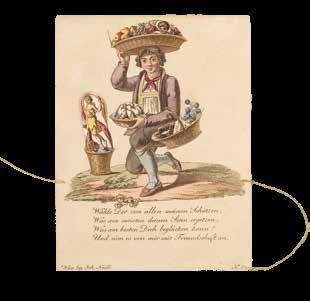
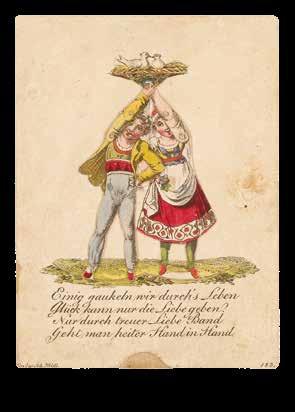
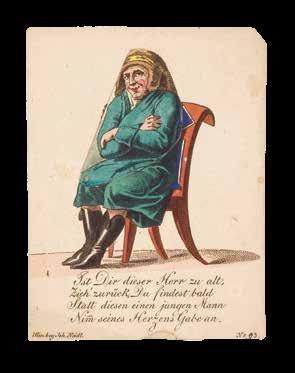
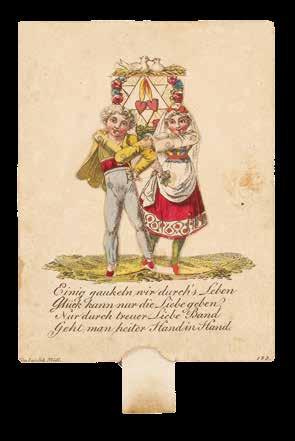
[Group of 67 Biedermeier cards].
Publication [1788-c.1830s].
Description
67 etched, engraved, stipple-engraved, and aquatint prints (various sizes), with contemporary hand colour, featuring a variety of shapes and transformational mechanisms, some with manuscript inscriptions in pen and ink.
Greeting cards from the late-eighteenth to midnineteenth century
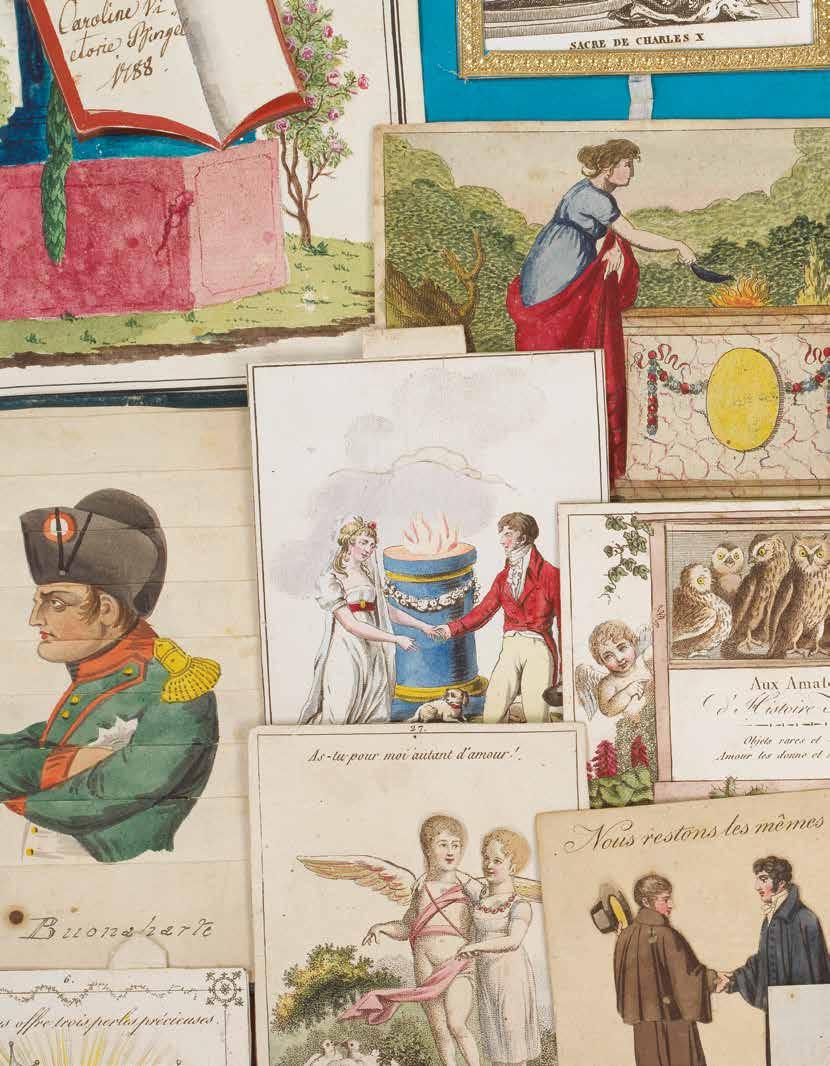
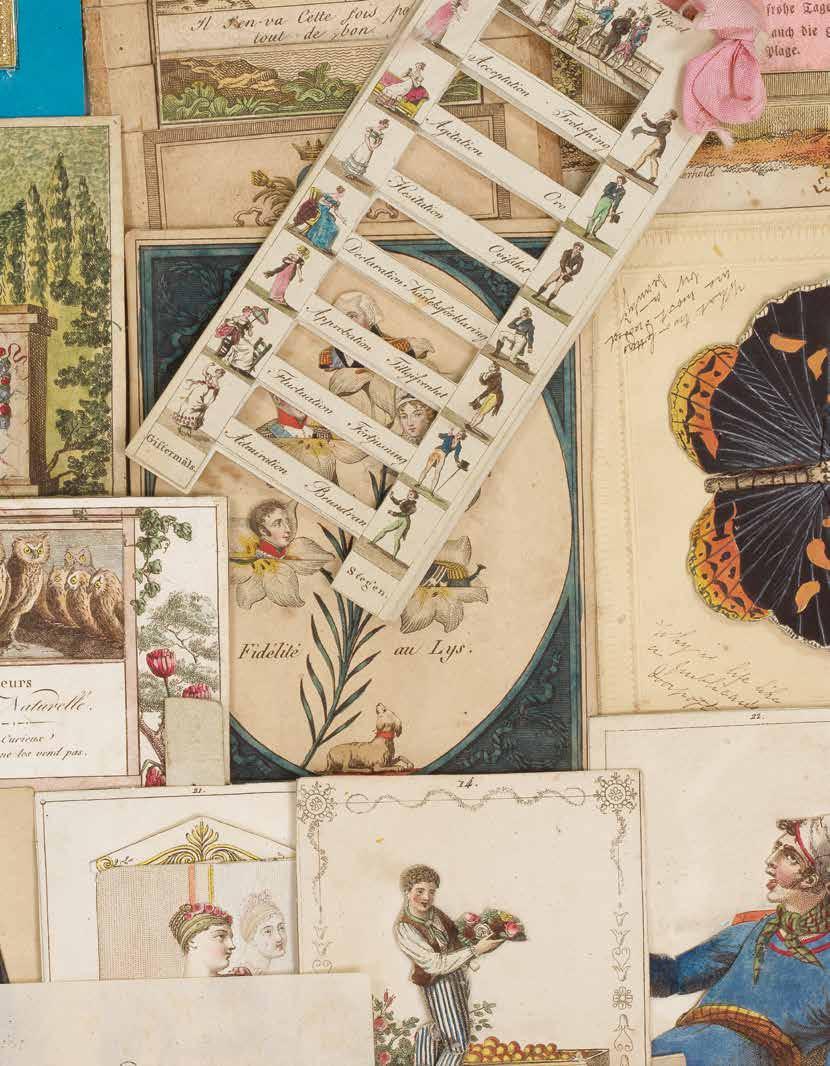
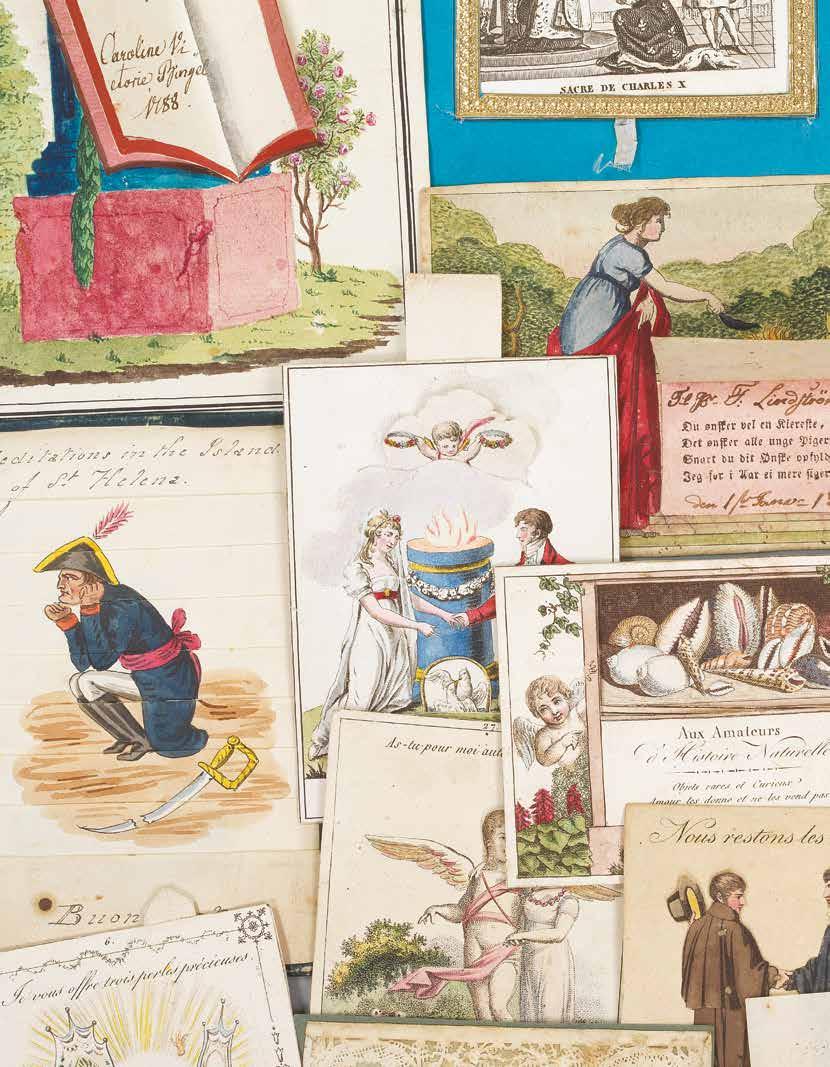
A significant collection of greeting cards in French, German, Danish and English, dating from the late-eighteenth to the mid-nineteenth century. The cards vary in subject from the romantic, with one Danish card predicting that the young recipient will find the boyfriend she’s been hoping for within the year, to the commemorative, with another mourning the death of a beloved uncle.
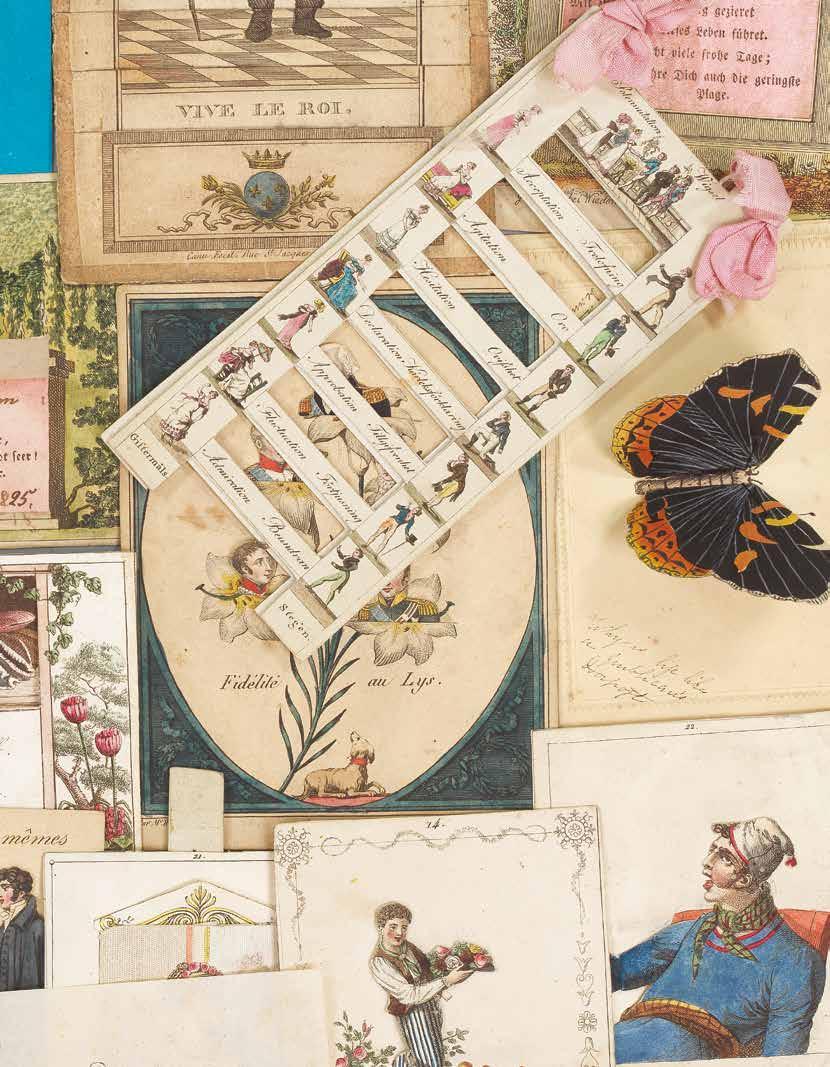
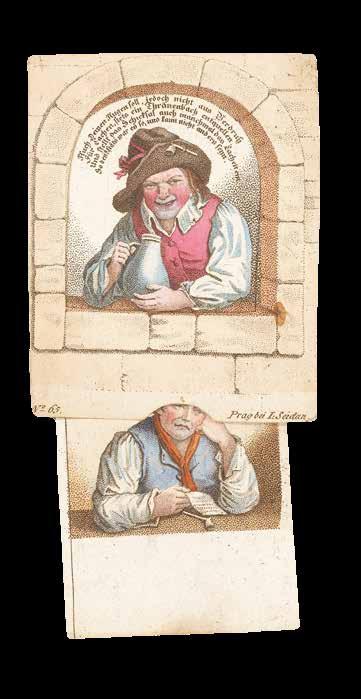
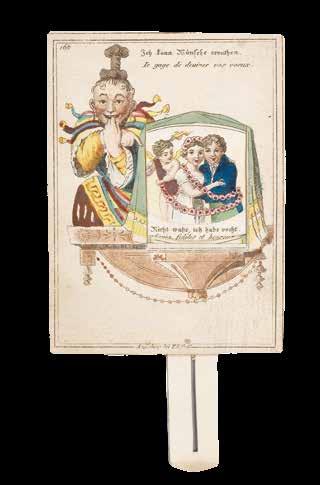
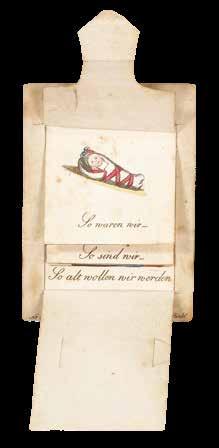
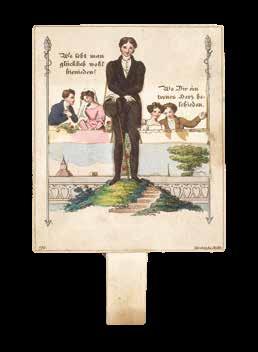
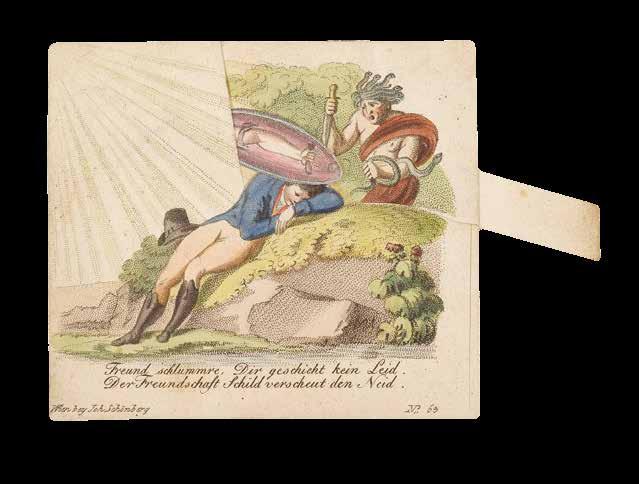
Some have moveable elements, for example a French card that shows a uniformed man looking out to sea and remarking that “He’s leaving for good this time” which, when transformed, shows Louis XVIII and is captioned “Vive le roi”. Another shows a portrait of Napoleon which can be transformed to show the leader crouching down beside a broken sword, captioned, in French: “Meditations in the Island of St. Helena”.
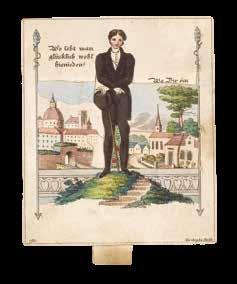
One German card takes the shape of a ladder, embellished at the top with two pink fabric bows. Each rung of the ladder, flanked by the portraits of a young couple, represents a stage in the courting process, starting with “admiration”, moving through “declaration” and “hesitation” until finally there is an “acceptance”, culminating in the “solemn words” of the marriage vow.
Biedermeier is a caricature of the everyman. The term comes from the German adjective “bieder”, meaning plain and conventional, and “meier”, a common surname, and came to be associated with the safe and moderate artistic style of the early-nineteenth century. The Congress of Vienna in 1815 had given rise to a period of stability and restoration, and there was a renewed interest in traditional values and home life. The domestic was exalted, and this is reflected in the artistic and cultural output of the time, including “Biedermeier cards”. These cards were exchanged on holidays, sent to mark milestones, and given in courtship. While their subject is generally limited to the sphere of domestic life, a huge variety were produced, often with exquisite paper engineering in the form of tab and flap mechanisms which transformed the scene shown on the card. Vienna was the centre of production for Biedermeier cards, although there are many examples from other cities such as Augsburg, Graz, Nuremberg and Prague.
“Forty out of approximately one hundred publishing houses marketing greeting cards during the Biedermeier era were located in Vienna. The city was the cradle of the “mechanical” greeting card, which between 1810 and 1830 stood out for its virtually inexhaustible reservoir of witty ideas. The so-called “Streifenzugkarte” (pull-strip card), a popular variant of accordion cards, featured images and texts on inserted and extendable paper strips or silk ribbons. Once their ends, extending beyond the margins,
were pulled, the contents of these cards were exposed. The so-called “Drehkarte” (pivoting card) was another popular type of greeting card. It functioned with a knotted thread that served as a pivot by which the scenes could be changed. The so-called “Hebelzugkarte” (lever and pull-out card) was a combination of these two variants and allowed movement in all directions. The most refined arrangements and combinations resulted in countless variants, all of which sought to conceal and playfully reveal the private secrets and wishes” (Weibel).
ADAMEK, [Johann]
[Group of 14 Biedermeier cards].
Publication Vienna, Adamek, [c.1800-1840].
Description
14 stipple-engraved prints, with contemporary hand-colour, each with moveable parts, of which ten are sliding paper pull-tabs, two with draw-string hinged overslips, two with folding overslips, and one with hinged overslips operated by pull-tab.
A significant selection of “Biedermeier” cards by Johann Adamek, featuring rather quaint scenes, such as parents rocking their baby’s crib, and a young man blowing a kiss to his beloved, both animated by a pull tab and hinges. Other mechanisms include: string, which draws a man’s overcoat; paper flaps, revealing a gardener enjoying the fruits of his labour; and pull-outs, with a brood of children popping out of a bucket, accompanied by the message “I send congratulations and wish blessings”.
As a young man, Czech artist Johann Adamek (1774-1840) moved to Vienna at the turn of the nineteenth century to join the Vienna Academy. In addition to etchings and portraits, he produced a large range of Biedermeier cards, many of which featured moveable mechanisms, as here.
Numbered stipple-engraved card (115 by 80mm) with contemporary hand-colour and sliding paper pull-tab.
Number of items 1
Mother and child
A card shows a well-dressed lady holding an infant in her arms, standing before a pillar on which stands a large urn, perhaps a baptismal font. When the paper tab is pulled, the mother and child bob up and down. The caption, in a mix of German and French, reads “Wir kommen von Papa und Mama Und gratulieren comme ça” (“We come from Papa and Mama And congratulate — like this”). The message does not make it entirely clear on what occasion the card would be sent, perhaps upon the birth or baptism of a new family member.
Austrian printmaker, bookseller and art dealer Lukas Hochenleitter was active in Vienna at the end of the eighteenth century. Among his publications were greetings cards, often with moveable elements, paper games, and views. Hochenleitter’s activities predate the Biedermeier period, which would see the production of many such cards.
HAASE, [Bohumil]
[Group of two Biedermeier cards].
Publication Prague, Haase, [c.1810s].
Description
Two stipple-engraved transformation prints, with contemporary hand-colour, each with sliding paper pull tab.
Dimensions
Smallest: 85 by 110mm
Largest: 105 by 130mm
Number of items
2
“With what I venture here to send, May goddess Fortuna make you content”
A New Year’s cards by Bohumil Haase showing a man on horseback bearing gifts, captioned in German: “With what I venture here to send, May goddess Fortuna make you content”. Another card offers some sage romantic advice for the coming year, also captioned in German: “He is indeed enchanted as a wild beast, but remember: what is worthy of awakening love must often hide in the ugliest shell. May the lovely core delight you! Don’t resent the effort!”. The accompanying image transforms from an anthropomorphised wolf on horseback into a mounted young gentleman. Czech publisher, printmaker and bookseller Bohumil Haase, known in German as Gottlieb, founded a printing house in Prague at the end of the eighteenth century, where he specialised in the production of New Year’s cards.
“More
SEIDAN, J[ohann]
[Group of three Biedermeier cards].
Publication Prague, J Seidan, [c.1810s].
Description
Three numbered stipple-engraved prints laid down on card, with original handcolour, one with a draw-string pull, and two with transformational pull-tabs one.
Dimensions
Smallest: 95 by 75mm
Largest: 95 by 105mm
Number of items
3
A selection of transformational cards by Johann Seidan. Card “No. 58” in Seidan’s series seems to be a wedding card: it shows a young family standing in a garden, captioned “In marriage, may a circle of good children bring you joy”. The central image can then be transformed to reveal the same family many years later, with the caption now reading, in German: “Their gratitude may gladden and refresh you in old age”.
Card “No. 65” includes the image of a leering man clutching a jug. The caption explains that he has decided to take life as it comes, and laugh through the pain. This image can then be completely transformed to another portrait of a man, holding an unwelcome letter and captioned, in German: “More bad news! There always has to be something that spoils our lives”.
The third Seidan card, “No. 67”, shows an angelic figure rowing two young women away from an erupting volcano. The title of the card reads: “Safety is the goal the sailor looks for, friendship is life’s sure safety; take rest, where all storms sleep, cheerfully cast anchor and live happily through it!”. The little boat can be made to move through the waves by a string.
Czech publisher and printmaker Johann Seidan was active in Prague during the early decades of the nineteenth century. He produced a wide range of ornate and unique cards, which often feature embossed patterns, intricate cut-outs, and unusual shapes, as well as the moveable elements typically found on Biedermeier cards.
STEEN, C[hristian]
[Biedermeier card].
Publication [Copenhagen, C. Steen, [1810s-1830s].
Description
Numbered etched print (105 by 70mm), with contemporary hand-colour, a turndown panel, and pull-tab moveable part, with manuscript inscription to verso in ink.
Number of items 1
In the bloom of youth
A Danish Biederemeir card, numbered 30 in its series, depicting a flower whose large petal opens to reveal a little girl standing within, bearing a package labelled “1000 luck”. The card is captioned, in Danish: “Here your intuition deceives you, the wish is in the tulip”. Handwritten on the verso is the name Ulrik Lindström, likely the sender or the recipient of the card.
Danish bookdealer and publisher Christian Steen (1786-1861) operated a bookshop and publishing house in Copenhagen throughout the first half of the nineteenth century, expanding into the manufacture of paper in 1844. Steen specialised in cartography and children’s material, and also appears to have been influenced by the Austrian trend of Biedermeier cards.
POLL, T. V.
[Group of two Biedermeier cards].
Publication
Augsberg, T. V. Poll, [c.1815].
Description
Two numbered stipple-engraved prints, with contemporary hand-colour, one with sliding paper pull-tab, and the other with draw-string pull-up.
Dimensions
Smallest: 60 by 90mm
Largest: 105 by 75mm
Number of items
2
“It awakens in us the urge to mate”!
An advertisement of 1815 states that T.V. Poll was pleased to offer a “fine stock of brand new, tasteful youth magazines with copperplate engravings, Christmas and New Year’s gifts with black and copperplate engravings, and pocket books” at his shop at No. 2 Maximiliansstrasse. Poll also produced and sold a series of moveable Biedermeier cards.
“No. 166” in this series shows a genie-esque figure claiming “I can grant wishes” and pointing to a covered box labelled “Here they are. Pull.”. When the tab at the bottom of the card is pulled, an image of a happy couple literally tied together by Cupid appears. The caption, the first sentence in German and the second in French, reads: “Not true, I am right here. Be cheerful and happy”.
Rather than the typical rectangular design, card “No. 131” itself is in the shape of a bowl of flowers, from which a string pulls up a family of 12! Indeed, the German caption expounds upon the reproductive benefits of harmonious marital relationships:
“Harmony, the strong bond of love, That unites lovers so closely It awakens in us the urge to mate, So that from two a third soon appears Thus, from a single pair,
A whole small group of people arises”.
Moy, ‘Augsburgische Ordinari Postzeitung’, 1815.
FRISTER, Jos[eph]
[Group of two Biedermeier cards].
Publication
Vienna, Jos. Frister, [c.1815-1830].
Description
Two stipple-engraved and etched cards with contemporaryl hand-colour, each with moveable parts operated by sliding paper pull-tab.
Dimensions
Smallest: 100 by 70mm
Largest: 105 by 80mm
Number of items 2
“To honour you properly today, I will empty the full sack here”
Two Biedermeier cards with flirtatious messages. The first bears the message, in German: “If there is a lover to be chosen, I hereby present myself with all due honour”. When the tab is pulled, Cupid appears from behind a partition. The second is rather more euphemistic, showing a man emptying a rather suggestively-shaped sack into a basket of flowers, with the message: “To honour you properly today, I will empty the full sack here”. Pulling the tab causes a stream of babies to tumble out of the bag...
Joseph Frister (1762–1832) was listed in a directory of 1794 as an art dealer active in Vienna, where he sold engravings, maps, musical scores, and greetings cards. In 1822, he was listed as a copper-engraver, indicating that he may have designed the cards he published himself.
BERMANN, J[eremias]
[Group of seven Biedermeier cards].
Publication
Vienna, J. Bermann, [c.1815-1836].
Description
Seven numbered stipple-engraved and etched prints, with contemporary handcolour, each with moveable parts, of which four are sliding paper pull-tabs, and three are hinged overslips operated by pull-tabs.
Dimensions
Smallest: 85 by 75mm
Largest: 80 by 100mm
Number of items
7
The Temperley Collection contains seven Biedermeier cards by Jeremias Bermann, all with paper tabs that are pulled to transform the image. These range from the romantic, with one couple’s faces becoming wrinkled and aged as they profess their lifelong love; to the bizarre, with a man telling a woman that she will never guess what is in his jar, only to reveal truffle pâté! Others show animals, such as “the hen brooding an egg here, in which your happiness may be contained” and a dog bringing the receiver “Glück” (‘happiness’).
One of the cards is captioned in French, which suggests that they were sufficiently popular to produce for foreign markets. It reads “To the health of our friends, let us all be united forever” and shows a woman in a dirndl and two men in different military uniforms toasting. This may reflect the Concert of Europe of the 1820s, which maintained an albeit fragile balance of power between the great states of Europe following the Napoleonic Wars, or the German Confederation, established by the Congress of Vienna in 1815 to unite 39 German-speaking states, including Austria. Born in Westphalia, Jeremias Bermann (1770-1855) moved to Vienna in 1807, and in 1815 took over the famous antiques shop run by his fatherin-law. The dealership was located in the ‘Zum schwarzen Elephanten’ - The Black Elephant, a building on the famous Graben square in the centre of Vienna, distinguished by a bas-relief of a man riding an elephant. In addition to portraits, engraved prints, sheet music, and games, Bermann published and sold a large variety of Beidermeier cards.
SPRENGER, D[aniel]
[Biedermeier card].
Publication Vienna, D. Sprenger, [c.1820].
Description
Numbered stipple-engraved print (90 by 75mm), with contemporary hand-colour and sliding paper pull-tab.
Number of items 1
A rather insipid Biedermeier card, numbered “No. 45” in its series, depicting a little girl kneeling in a flowerbed, captioned in German: “To whom alone do I thank for life’s delights? Who looks at me so lovingly with tender glances? I feel it and will never forget it, because of all my happiness - -”. When the paper tab along the lower edge of the card is pulled, a sign appears in the girl’s hands reading “find her”.
The imprint attributes the card to D. Sprenger of Vienna. This is like to be Daniel Sprenger (b.1793) an art-dealer and music-publisher who established a shop in Vienna in 1818. It appears that he was in business for only a short time, as his wife Karoline is listed as widowed in 1821.
GUBITZ, C.F.
[Biedermeier card].
Publication Berlin, C.F. Gubitz, [c.1820s].
Description
Numbered stipple-engraved print (75 by 85mm), with contemporary hand-colour and unfolding panel.
Number of items 1
Tweety pie
In keeping with the domestic motifs of the Biedermeier tradition, one card attributed to C.F. Gubitz of Berlin features a freshly-baked pie. The caption reads, in German: “Oh, if you were to form yourself within, There would be no more beautiful pie for me”. The pie itself can be unfolded to reveal two kissing pigeons, with the words “Oh, God have mercy! How warm it is in here”.
The name Gubitz can be found in Berlin directories of the midnineteenth century, associated with the art, music and publishing industries, but we have not been able to find a printmaker with the initials “C.F.”. Engravers Johann Christoph Gubitz (1754-1826) and his son Friedrich Wilhelm Gubitz (1786-1870) were both active in the city during the Biedermeier period, and it would appear likely that the present card was made by another member of this family.
NEIDL, Joh[ann Joseph]
[Group of three Biedermeier cards].
Publication Vienna, Joh. Neidl, [c.1820s].
Description
Three numbered stipple-engraved prints, with contemporary hand-colour, two with hinged overslips operated by pull tabs, one with a drawstring, renewed.
Dimensions
Smallest: 95 by 75mm
Largest: 115 by 85mm
Number of items
3
Two Biedermeier cards by Johann Neidl. On “No. 52”, a young man kneels besides baskets of his wares, and invites the recipient to “Choose from all my treasures what most delights your heart, what can best make you happy! And accept it from me with friendship”. A drawstring running through perforations in the card allow the image to be transformed, with the contents of the baskets revealed to be fruit, flowers and doves.
Card “No. 93” shows an older man who, by the pulling of a tab, suddenly becomes a young gentleman bearing a wreath of flowers. The German caption reads: “If this gentleman is too old for you, go back, you will soon find this young man instead and accept the gift of his heart”. The 183rd card in Neidl’s series also features a tab mechanism, by which the happy couple depicted are made to dance. The caption below them states: “Together we waltz through life. Only love can bring happiness. Giving only through the bond of faithful love do we walk cheerfully hand in hand”.
Born into a poor family in Graz, Johann Joseph Neidl (1776-1832) was apprenticed as a silversmith as a boy, and after showing artistic promise, was sent to Frankfurt to train as an engraver. He continued his training in Munich and Augsburg, before moving to Vienna where he established his own business as a copper engraver and printseller in the late-1790s. In addition to portraits of famous figures such as Archduke Karl of Austria and Ludwig van Beethoven, he produced a series of Biedermeier cards, as here.
EISEN, A[nton] P[aul]
[Biedermeier card].
Publication [Nuremberg], A. P. Eisen, [c.1820s-1830s].
Description
Numbered etched print (95 by 75mm), with contemporary hand-colour and sliding paper pull-tab.
Number of items 1
“In every danger and joy... Happiness, Contentment”
Card “No. 160” in Anton Paul Eisen’s series of Biedermeier cards, titled in German, “Help”, shows a ship packed with sailors who are celebrating and playing musical instruments in the midst of the turbulent waves. When the paper tab along the lower edge of the card is pulled, the stormy sky is transformed into a decorated mast. The crew are holding two banners that read: “In every danger and joy... Happiness, Contentment”.
Anton Paul Eisen (1777-1843) was an engraver based in Nuremberg where he sold etchings and engravings including a series of Biedermeier cards. After his death, his son, also Anton Paul Eisen, continued the family trade into the latter-half of the nineteenth century.
PATERNO, A[nton]
[Group of four Biedermeier cards].
Publication
Vienna, A. Paterno, [c.1820s-1830s].
Description
Four numbered stipple-engraved and etched prints, with contemporary handcolour, each with moveable parts, of which two are hinged overslips operated by pulltabs, one is a sliding paper pull-tab, and one of unfolding panels.
Dimensions
Smallest: 90 by 70mm
Largest: 80 by 90mm
References
Houze, ‘Textiles, Fashion, and Design Reform in Austria-Hungary Before the First World War’, 2015, p.43.
Number of items
4
Like many of his contemporaries, Anton Paterno published a long series of Biedermeier cards with moveable and interactive elements, four of which are held in the Temperley Collection. One shows a happy family of eight, with a somewhat strange German caption: “We do not want to remain guilty of anything, and testify to our affection”. Another shows a barmaid who, when the paper tab at the bottom of the card is pulled, reveals a secret message that states: “I am always your faithful girlfriend”. The card is titled “Unverfälscht”, which means “unadulterated” and, fittingly, can be applied to both alcohol and people.
“No. 95” in Paterno’s series shows two men jousting with swords, captioned with the words “life or death”. The scene can be transformed to show them sharing a drink, with the word “friends” appearing to complete the sentiment. Card “No. 89” has a different mechanism: it shows a jovial and snazzily-dressed man wearing a large sign around his neck that reads “The Pocket Well-Wisher”. This can be unfolded to reveal a poem with illustrations including a cat, a sword and a nose!
Viennese art dealer and music publisher Anton Paterno (1771-1835) produced material featuring Biedermeier designs and motifs during the 1820s and 1830s, with his wife taking over the business after his death. In addition to printed material, Paterno also produced needlepoint embroideries with Biedermeier subjects such as flowers and butterflies, even supplying these to the Austrian royal family.
RIEDEL
[Group of two Biedermeier cards].
Publication
Nurnberg, Riedel, [c.1820s-1830s].
Description
Two numbered engraved prints, with contemporary hand-colour, one with turnup and turn-down panels, and one with sliding paper pull-tab, with manuscript inscription to verso in ink.
Dimensions
Smallest: 85 by 70mm
Largest: 95 by 65mm
Number of items
2
The Temperley Collection includes two Biedermeier cards printed by the Riedel publishing house of Nuremberg. They are typical of the Biedermeier period in carrying sentimental messages revealed by moveable mechanisms.
“No. 7” shows “The Three Stages” of life by means of turn-up and turn-down panels. The first shows “how we were”, illustrated with a swaddled baby, the second “how we are”, and the third “how we want to be when old”, with an elderly couple holding hands.
Card “No. 193” shows a bachelor who asks “Where can one live happily down here?”. After the paper tab is pulled, two illustrations of the man accompanied by a pretty young woman are revealed, along with the answer “Where you can find a wonderful home”. To the verso is a hand-written note in German: “In memory of your sister”.
MÜLLER, H[einrich] F[riedrich]
[Group of six Biedermeier cards].
Publication
Vienna, H. F. Müller, [c.1820s-1840s].
Description
Six stipple-engraved and etched prints, with contemporary hand-colour, each with moveable parts, of which three are hinged overslips operated by pull-tabs, one sliding paper pull-tab, two paper pop-ups.
Dimensions
Smallest: 90 by 75mm
Largest: 105 by 85mm
Number of items
6
“What is more blissful than wealth, honour, and power?”
Six cards by Heinrich Friedrich Müller, all of which have moveable elements. At the pull of a paper tab, the recipient can cause a butterfly’s wings to flap, a woman to appear out of a tree, and a deceitful young man’s nose to grow. The most elaborate card transforms into a three-dimensional garden scene, with a young man kneeling among the flowers and wishing the recipient well-being and happiness. The cards all bear such positive messages, with one asking “What is more blissful than wealth, honour, and power? And what is more delightful than the splendour of all these?”. The answer, “friendship and love”.
Heinrich Friedrich Müller (1779-1848) was a printer, toy-maker, music-dealer, and publisher of German and English material, such as children’s books, card games, and musical scores. He also invented the “Teleorama”, a mechanical peepshow, in 1825. The co-founder of the Vienna Art Association and head of the board of Viennese art dealers, Müller published a wide variety of printed material including Biedermeier cards.
BERKA, A[nton]
[Group of four Biedermeier cards].
Publication
Vienna, A. Berka, [c.1830s].
Description
Four numbered stipple-engraved prints, with contemporary hand-colour, each with moveable parts, of which two are sliding paper pull-tabs, one with drawstring, and two are hinged overslips operated by pulltabs.
Dimensions
Smallest: 65 by 105mm
Largest: 90 by 120mm
Number of items
4
“This card seems strange to you...”
The Temperley Collection includes four Biedermeier cards by Anton Berka. Numbered “101”, one card shows a couple seated at a piano, captioned in German: “If you only call the wolf, he will come running”. This rather mysterious message is explained by the appearance of Cupid, armed with his dangerous arrows, when the paper tab is pulled. Another, “No. 176”, shows a woman receiving a bill from a messenger, whose hinged torso is made to bow by a tab along the lower edge of the card.
Card number “66” shows three men hauling a huge barrel out of a warehouse, with the jovial encouragement: “Gentlemen and ladies, get yourself a glass of beer and empty it on your own!”. Although the mechanism is once again a pull-tab, the rope held by one of the workers is actually a piece of string that can be moved independently. Finally, a rather flirtatious card (“No. 83”) features a green curtain, captioned “This card seems strange to you...”. When the tab is pulled, part of the curtain is drawn back to reveal an eye, and the words: “I have a crush on you”!
Anton Berka (1765–1838) was an engraver, and an art- and musicdealer based in Vienna, who sold copperplate engravings, oil paintings and sheet music from his premises at Seilergasse No.1082. Like a number of Viennese printers during the Biedermeier period, Berka published a large selection of moveable cards depicting cheerful day-to-day scenes.
SCHÖNBERG, Joh[ann]
[Biedermeier card].
Publication Vienna, Joh. Schönberg, [c.1830s].
Description
Numbered stipple-engraved print (90 by 105mm), with contemporary hand-colour and sliding paper pull-tab.
Number of items
1
“Slumber, friend, no harm will come to you”
Johann Schönberg was one of the many Viennese artists during the Biedermeier period to produce cards exchanged by members of the genteel Austrian society. The present card shows a finely-dressed young man asleep on a grassy rock. Behind him, a menacing figure with snakes for hair approaches carrying a dagger. When the paper tab at the side of the card is pulled, a shield appears out of nowhere, protecting the resting man. The caption explains the allegory: “Slumber, friend, no harm will come to you. The shield of friendship wards off envy”.
Johann Schönberg was a lithographer active in Vienna during the mid-nineteenth century, and not to be confused with the artist and warcorrespondent of the same name, born in 1844.
HATCHED, MATCHED, DISPATCHED
[VARIOUS MAKERS]
[13 early Valentine sheets].
Publication [Britain], 1770-1837.
Description
13 original valentines (various sizes), pen and ink on paper, some with contemporary colour wash, some with cut-paper or pin-pricked designs, one with conjoined address leaf.
Dimensions
Smallest: 115 by 90mm
Largest: 320 by 320mm
Number of items
The ancient feast day of the martyred Saint Valentine became associated with love and romance during the fourteenth and fifteenth centuries, and began to be commercialised during the late-eighteenth, with printmakers producing greeting cards to be exchanged by couples. ‘The Young Man’s Valentine Writer’ of 1797 even provided a set of suggested poems for those who were struggling to fill their cards with authentic sentiments. The popularity of Valentine’s cards soared during the Victorian era, with over a million cards sent annually by the 1870s, and thousands of women employed in their manufacture.
The Temperley Collection contains a group of original manuscript valentines, including some remarkable survivals from before the boom in printed material.
Sent by Joseph Condor in 1770, an elaborate cut-paper valentine features motifs including bells, flowers, and lovebirds, with the central text opening “Content my Dear I have when Im [sic] with you”. One sent in 1783 from a lover in Manchester to his beloved in Liverpool presents a vignette of a happy couple walking through a field; the surrounding wreath and the border of the sheet have been finely cut, and along each side has been written a stanza of verse, beginning:
“When little birds do choose their mates, How sweetly do they sing, They warble forth harmonious notes,
To hail the glorious spring.”
Another late-eighteenth century valentine features no text, but simply a cut-out depiction of Cupid. Woven through the square border is another strip of paper that culminates on either end with a rebus. Rebuses consist of pictures, symbols, or motifs, often in combination, that require the viewer to work out the hidden sentiment or meaning. They were popular features of early valentines, and those here - a line ending in two shorter lines, with arrows radiating out from the centre in four directions, and a circle with a short line extending from one point - may represent the sender’s unending love.
From early in the nineteenth century are a series of valentines featuring common motifs, such as hearts, flowers, and lovebirds, often depicted as ‘kissing’. Most examples include lines of verse, and have been coloured; several are intricately cut, while one is entirely pin-pricked (see item 112). Fold lines across one valentine, sent “for my friend” around 1820, show where the maker has folded the square of paper to enable them to cut perfectly symmetrical hearts. Sent around the same time, another valentine is itself in the shape of a heart, with poetry written around the edge, while the verse on a separate example is contained within the lines of a complex ‘love knot’. The final words meet with the
opening ones to complete a never-ending poem, no doubt reflecting the sender’s endless love.
The latest valentine, on paper watermarked in 1833 and postmarked in 1837, was made by hand at a time when commercially manufactured cards were easy to come by, perhaps as a signal of the sender’s dedication and care. Joined to its envelope, the missive conveys “love enflames”, and features two stanzas of poetry; the edge of the paper has been cut by the amateur to make a “lace” border.
[ANONYMOUS]
[Group of five Rosen].
Publication [Germany, 1790s-1830s].
Description
Four folding woodcut cards, with contemporary hand colour, and one lithographed.
Dimensions
Smallest (folded): 75 by 75mm
Largest (folded): 140 by 100mm
Number of items 4
During the eighteenth and early-nineteenth centuries, it was fashionable in Germany to send loved ones folding Liebesbrief: notes, novelties and puzzles, constructed with varying degrees of complexity. With layers of paper unfolding from the centre, these became known as Rosen (“roses”) and frequently displayed romantic or celebratory motifs. In addition to love notes, Rosen often depicted Lebensstationen, or the stages of life, from birth and baptism to old age and death.
The Temperley Collection includes a selection of Rosen with a range of subject matters. The present group includes three christening certificates which fold into cards showing the mother and child, godparents, and priest gathered around the baptismal font, watched over by the Holy Spirit, Christ, and John the Baptist.
Another Rose, sent as New Year’s card, begins with an encouraging message, in German: “Maiden, take heart, the time draws near When you shall soon receive a man”. The time must have been very near indeed, because the next panel reads: “My dear treasure, be of good cheer, I bring you the New Year’s child here”, illustrated by a happy family in traditional rural dress.
A larger Rose has multiple unfolding panels illustrated with various decorative motifs and bearing the sender’s well-wishes. However, despite claims to be “dedicated to friendship with high esteem and love”, romance seems to be the final goal, with one illustration of a young couple captioned “It’s no use hiding it, I love you! Yes, yes, with all my soul, I feel truly faithful”.
The ephemeral and personal nature of such Rosen makes it difficult to pin down their origins; the present examples, however, are dated from the 1790s to the 1830s and, like most missives of this kind, are German, although the trend for intricately folded notes also flourished elsewhere in Europe during this period.
[VARIOUS MAKERS]
[Seven Valentine origami].
Publication [Britain, early-nineteenth century].
Description
Seven folded sheets (various sizes), with manuscript inscriptions and several with illustrations and hand-colour, some cut, and some layered, affixed by ribbon.
Dimensions
Smallest: 65mm by 65mm
Largest: 365 by 295mm
Number of items
7
“I am sadly afraid You will be an old maid”
Sophisticated paper engineering techniques were applied to love-notes and valentines during the nineteenth century, with puzzle purses and fortune tellers proving particularly popular. The former consisted of a single sheet of paper with four edges folded into triangles, which then slipped within one another over the top of the central square, to form a self-sealed envelope. The combination of different sides and layers revealed a selection of messages and sentiments.
Two puzzle purses, when folded, form a heart and bear an almost identical message “My Dear this Hart with you Behould... will break when you these lines unfould... for so my hart with Love sick pain... sure wound it is and Breaks in Twain” [sic]. This indicates that there may have been a “standard model” for puzzle purse valentines. A rather less sophisticated piece, which does not have the intricate folds of the other puzzle purses, or cross-panel messages, was sent from George Penny to Jane Dunnegn in 1839. The floral motif at the centre, and the hearts around it have been embroidered onto the paper, and contain hand-written romantic sentiments.
Paper fortune tellers were also used in the complex field of Victorian romance, ostensibly predicting the future of one’s love life. ‘The Ladies Fortune Teller’ and ‘The Gentlemans Fortune Teller’, both by the same anonymous maker, probably during the 1830s, consist of many layers of differently-coloured paper, cut into flower shapes and connected by ribbon, pink for the ladies, green for the men. Users would presumably choose or roll a number, and the corresponding leaf would reveal their fate. Each fortune teller has 28 predictions told in rhyming couples, including: “You will wed a comely Dame of fifty, Kind hearted, too she’ll be & wise & thrifty”; “A canny Scottish man Will catch you if he can”; “I am sadly afraid You will be an old maid”!
An intricately cut and folded valentine, when opened, takes the form of a cross with arrows at each end, perhaps representing Cupid’s weapon. Romantic sentiments run up and down each arm, and along the lines that connect them. It seems to be an amateur attempt at a ‘love knot’, where the messages run on endlessly.
[VARIOUS MAKERS]
[Group of 20 Rose cards].
Publication [London and Germany, mid-nineteenth century].
Description
20 elaborately folding engraved and colourprinted cards (various sizes), occasionally embellished with metallic paper and fabric, three with original envelopes.
Dimensions
Smallest (folded): 50mm (diameter)
Largest (folded): 140 by 90mm
Number of items
20
Inspired by the cards and notes that came to be known as Rosen, thanks to their petal-like unfolding pages, a number of mid-nineteenth century printmakers and publishers in Germany and London produced cards with an innovative new floral design. As explained in an accompanying leaflet, “at first glance, the flower seems to be a flat piece of thick cardboard, but by carefully introducing the nail between the folds of the paper, it will be found capable of being opened again and again, until it attains somewhat the form of a circle, which is covered on every side with beautifully executed steel-engravings”. Very often, these engravings show the sights and structures of a city, designed as a souvenir for tourists.
The Temperley Collection contains 15 expanding rose keepsakes from Cheltenham, Bath, Oxford, Portsmouth, Edinburgh, Worcester, Birmingham (two examples), Dublin (two examples), Yorkshire, Brighton, the Isle of Wight, Carisbrooke Castle, and Germany, produced by publishers such as Joseph Myers & Co., Rock & Co., and J. New & Co. of London, and C. Adler of Hamburg. Among these, the souvenir from Worcester is the only one to unfold horizontally into a long series.
Also among the engraved bouquets is ‘The Rose Almanack’, which is housed in its original printed lace-paper envelope, and unfolds to reveal a calendar for 1860, and ‘The Language of Flowers’, which unfolds to reveal 14 different varieties of flowers, each accompanied by a poem.
The final three are greetings cards, namely a Christmas card which displays a Yuletide feast in the place of the rose, a memento from a trip to the seaside, on which the floral design has been replaced by shells and marine plants, and Valentine’s card with the individual petals folding back to reveal a young girl at the centre. The latter is by Ernest Nister, creator of many successful moveable children’s books, and was sold in London and New York, though printed in Bavaria.
[VARIOUS MAKERS]
[18 Mourning cards].
Publication [Britain], 1847-1887.
Description
Group of eighteen elaborately printed paper cards, some with incised and embossed designs; three housed in their original paper envelopes, one accompanied by manuscript letter on black-bordered paper.
Dimensions
Most average: 75 by 115mm
Largest size: 300 by 240mm
Number of items
18
Post-mortem prints
A selection of nineteenth-century mourning cards, commemorating the lives, and commiserating the deaths of ordinary Victorians, including a chaplain, a soldier, a “beloved wife”, and a young child. Mourning cards grew out of an earlier tradition for elaborately-designed funeral invitations, and became part of the post-mortem protocol that existed in Victorian England, which included wearing black, covering mirrors and windows, and displaying mementoes of the dead. These customs were cemented into nineteenth-century culture by the death of Prince Albert in 1961, and Queen Victoria’s enduring grief.
As part of this ritual, cards were sent out both to announce the death and to be kept as a reminder of the one who had passed. Made of heavy stock, generally featuring cut-outs, embossing, and a black border, these could be custom-made for the occasion, or ordered from a catalogue of standard designs. Catalogues of mourning cards show a standard set of motifs associated with death and loss, including urns, broken columns, tombs, weeping willows, angels, and mourners. Although the design and quality of these cards varied, and a discount could be obtained by allowing the funeral director to include the name and address of his business, the custom was observed by all classes of British society.
The mourning cards in the Temperley Collection are evidence of this, as they memorialize the deaths of a broad cross-section of Victorian society. Those remembered on the cards range in age from five to 84, and came from all over the country. Designs range from simple black-bordered cards, to elaborately cut paper creations, and there are two examples of larger decorative frameworks with rectangular spaces for the main mourning card to be inserted, featuring graveside scenes of mourning, replete with symbolic objects.
Many cards express messages of comfort, often in verse, encouraging recipients, for example, to “Dry up your tears and do not weep, My sufferings now are past; You gave to me your kindest aid As long as life did last”. The mourning card of Martha Watts, who died at 84, is accompanied by a hand-written letter from her granddaughter Eliza, on paper featuring a thick black border to symbolise her grief.
[ANONYMOUS]
[Erotic Transformation playing cards].
Publication [France, c.1850-1870].
Description
One deck of 31 printed playing cards, with hand-colour (80 by 55mm), enhanced with an illustrated middle layer appearing when cards are illuminated from behind; housed in a red morocco slipcase (85 by 65 by 15mm); [with] a further eight miscellaneous individual colour-printed playing cards (c.90 by 60mm), also with a risque middle layer.
Number of items 9
Transforming trysts
During the nineteenth century, transformation techniques were applied to playing cards: by inserting a third, illustrated, layer in between the front and back laminations, an erotic image could be concealed within, visible only when held to the light.
An incomplete deck of 31 cards appears completely innocent until illuminated from the back, upon which all sorts of erotic scenes and motifs (including winged phalluses!) shine through. The most extreme are those on the court cards, on which the kings, queens and jacks become engaged in a range of lascivious scenarios.
Also in the Temperley Collection are eight miscellaneous playing cards, of which the court cards at least - the Queen of Hearts and the Queen of Spades - are from a deck published around 1870. When held to the light, these cards too give a faint impression of an illicit sexual encounter. Information about the makers of such erotic cards is almost non-existent, but they are universally assumed to have been French.
[VARIOUS MAKERS]
[11 fans].
Publication [Britain, Germany], 1868-1926.
Description
11 folding paper fans (various sizes), with printed designs and text, some with gilt decoration, some mounted on embossed card with ribbon, most pierced with metal rivet, some tied with string, some with tassels, one with a metal handle.
Dimensions
Smallest: 75 by 15mm
Largest: 235 by 155mm
Number of items 11
A group of 11 paper fans dating from 1868 to 1926. Most serve a purpose beyond simple ventilation: a fan with 12 slats was produced for a ball at the Cambridge Barracks on June 3rd, 1868, on which the night’s 20 dances are listed on both the front and back of the ten middle slats. In addition to the order, style, and music, there is a blank space in which ladies could note the name of the partner to whom they have promised the dance; several of these have been filled-in on the present example, with the eleventh dance, a galop to ‘Express Train’, committed to “Wortham”, and the twelfth, a waltz to ‘Die Hydropaten’, to “Captain Fenton”. Likewise, the schedule for another event, the “Ladies’ Evening” hosted by the St Alphege chapter of the Freemasons on Feburary 26th, 1926, was also printed on a fan. Alongside the planned dances, this fan also details the night’s menu, toasts, and other entertainment.
Fans were also sent attached to, or in the place of, greeting cards, with Christmas wishes, New Year’s greetings, and romantic messages conveyed by the text and imagery. A Valentine’s day print shows a beautiful chromolithographed woman holding a closed fan; when the string is pulled, the fan opens to reveal the message: “Send me a line, love, If only to say, That I’m not forgotten On Love’s festive day!”. A souvenir fan shows different types of flowers on each of its slats. A twentieth-century German creation unfolds into a standing woman wearing a gaudy ensemble including yellow bonnet, a blue and yellow fringed shawl, a black skirt with red flowers, and checkered shoes.
[ANONYMOUS]
A Companion for a Single Gentleman.
Publication [Britain, c1880s].
Description
Single leaf of heavy stock, folded to make four pages (175 by 115mm), including a collage of pasted and sewn paper, fabric, buttons, and other notions, with manuscript inscriptions in pen and ink, manuscript title to first page, mild staining and a small ink burn.
Dimensions 175 by 115mm (7 by 4.5 inches).
Number of items 1
A charming card, presumably sent by a young lady to her “darling”, ‘A Companion for a Single Gentleman’ contains all the accoutrements a young man might need. Sewn to the inside of the card are a selection of buttons, pins, hooks and eyes, “tape black & white”, “thread black & white”, and a “needle book”. The sender has also included a miniature handkerchief monogrammed “M.S.” and a drawing of a tube of “hair restorer”, which she has noted is “for the growth of whiskers”.
Red fabric has been cut into the shape of a nightcap and slippers, captioned “bed room stripes”, as well as a small rectangle labelled “flanel for sore throat”. A clipping from ‘The Times’ of the paper’s name has been included as the requisite “morning paper”. Rolled up paper represents “royal wax” and “prime cigars”. A smaller paper card has been affixed along the lower edge, the front decorated with a heart pierced by Cupid’s arrow. Inside reads “Oh dear Doctor can you cure love”, with the response “Yes Sir Go to the door above”.
Above this, in the centre of the main card is a chromolithographed print cutting of a female portrait. The woman is dressed in a fashion typical of the late-nineteenth century, with a ribboned hat, a high-collared bodice, and a star brooch. Perhaps it is a hint that a young lady is one of the many things a single gentleman should have.
[ANONYMOUS]
[22 WWI silk postcards from the Front].
Publication [France, Belgium, and Germany, c.1915].
Description 22 postcards (avg. 145 by 90mm), of which 19 are embroidered silk, some as a pocket, and three are machine woven, some laid down on heavy stock.
Dimensions 145 by 90mm (5.75 by 3.5 inches).
Number of items 22
“A kiss from France”
Disguising the horrors of trench warfare and conditions at the front, the silk postcards sent home by British soldiers during the First World War often feature delicate and optimistic motifs, from flowers and butterflies to flags and reminders of British triumphs in battle.
Embroidered silk cards were manufactured throughout the first half of the twentieth century, but the First World War represents the peak of their production, with over ten million cards made during the four-year period. In general, these were sewn by women who lived in towns and villages near the front lines, who embroidered repeated designs on rolls of silk, which they then sent to Paris or other large cities to be cut and assembled into cards. Their labour-intensive handiwork came at a significant price, with postcards costing one to three francs, around a day’s pay for a private.
The 22 postcards in the Temperley Collection represent a range of sentiments, from “Christmas Greetings” and “loving birthday wishes”, to love notes sending “a kiss from France” and promising the recipient that “I’m thinking of you”. The accompanying motifs include symbolic flowers, the Union flag, an officer’s hat, and a church. Many of the embroidered designs have been assembled into silk pockets, in which a written note could be placed. Three are machine-woven cards, with more detailed images, depicting the destruction done to historic cities as part of the Allied victories during the war, such as those at Arras and Ypres.
[VARIOUS MAKERS]
[26 Erotic moveable prints].
Publication [Britain, France, and Germany, twentieth century].
Description
26 printed sheets (various sizes) and book (60 by 40mm), with a range of moveable mechanisms.
Dimensions
Smallest: 95 by 95mm
Largest: 200 by 110mm
Number of items 26
Inevitably, the various paper engineering techniques developed during the nineteenth century were put to use in the more liberal twentieth to animate all sorts of erotic and pornographic prints and images. The play ‘Room for Two’ was performed in 1939 at the Comedy Theatre in London and subsequently taken on tour; a paper advertisement for the Lincoln show has a peep-hole through which scandalous image of a naked woman can be seen, until it is revealed to be the eyes and nose of a dog when the page is unfolded. The caption reads “Lucky Dog he’s going to see “Room for Two””. While undoubtedly a bawdy farce, it’s not clear that the play would have lived up to the expectations set by such a raunchy advertisement. A set of nine (of ten) illustrated cards by Parisian publisher J. Lauwers show a naked young women getting into various scrapes, often with rather lecherous-looking men. Each card is captioned in French and English, instructing the viewer to “work a light in this side”. When a light is shone on the front of the card, a silhouette of the figures appears on the verso. Somewhere between tongue-in-cheek and blasphemous is a mini flip-book entitled ‘Susanna im Bade’. A reference to the 1890 painting of the same name and its subject, the apocryphal story from the Book of Daniel, in which a young woman named Susanna is spied on while bathing and then accosted by two old men, the book, when flicked through, reveals Susanna undressing and bathing. Another related chromolithograph shows another young woman named Susanna in the bath. The jets of water can be moved aside, changing the image from one woman standing in a bathing costume, to another crouched coquettishly and nude in the tub. The other erotic items in the Temperley Collection range from the tantalising, the silhouette of a nude woman, for example, to the graphic, with pornographic prints animated by hinged hips.
[ANONYMOUS]
Charades &c. Conundrums &c.
Publication [Britain, c.1800].
Description
Double-layered folding paper heart (55 by 70mm) with pink serrated edges and manuscript inscriptions, the layers joined by pink ribbon; with accompanying paper envelope (40 by 25mm) with pink edges and thread, tiny wax seal, containing folding sheet of inscribed paper.
Number of items
1
“Why is a decayed cheese like hope?”
A wonderful handmade game of ‘Charades [and] Conundrums’, with a separate miniature envelope containing the solutions.
Taking the form of a heart when closed, the game blossoms into a frilled carnation, to reveal 22 riddles on each heart-shaped petal. These include questions such as “why is Witbread’s brewery like the city of Jerusalem” (answer: “He-brews drink there”), and “why is decayed cheese like hope?” (answer: “because thousands live on it”).
There are also conundrums that require the player to work out the word from clues relating to its syllables: “My first is luminous, Your home my second, My whole a beacon By the seaman reckon’d” (answer: a lighthouse).
Riddles and similar parlour games were popular throughout the eighteenth and nineteenth centuries, with a collection of 22 ‘Charades &c. Written a hundred years ago by Jane Austen and Her Family’ published in London in 1895.
[VARIOUS MAKERS]
[26 Mix and Match boxed games].
Publication [London and Europe, nineteenth century].
Description
26 boxed games, each with multiple components, mostly engraved paper, with contemporary hand-colour; preserved in original cartonage or wooden boxes, many elaborately decorated.
Dimensions
Smallest box: 45 by 35 by 15mm
Largest box: 222 by 270 by 25mm
References
Rose, ‘Napoleon in Caricature 1795-1821’, 1911, p.15.
Number of items 26
Changing character cards and games were a popular amusement during the late-eighteenth and nineteenth centuries. Sets containing dissected portraits and pictures that could be mixed and matched to create novel and comic combinations were often sold in multi-lingual editions, indicating their popularity throughout Europe.
Examples in the Temperley Collection include ‘The Changing Companions - Die verändersichen Gesellschafter - Les Compagnons Inconstants’. Housed in the cloth-covered box are twelve lithographed characters, each dissected into four pieces, making the combinations of figures to be assembled practically endless.
Likewise, the 36 pieces that make up the ‘Nouvelles Metamorphoses de Voitures - New Carriage Metamorphses - Neue Wagen-Metamorphosen’ can be put together to form a number of unlikely coaching scenes, including a mother single-handedly pulling a wagon full of cattle. Another multilingual game, ‘The Comic Girl - Das komische Mädchen - La fiellette comique’ includes a selection of cut-out heads (three human, three animal) and five hats, to be arranged and placed on a body set on a wooden stand, which is made so as to allow the character to rock back and forth.
Such games often featured famous contemporary figures. For example ‘Johnston’s Moveable Characters’, published in 1812, includes “Hats, Caps and Wigs So that the most Laughable and Grotesque Figures may be brought to view: - for instance, place Bonaparte’s Hat on the Prince Regent or the Recorder’s Wig upon Buonaparte. The change is so great and singular that it produces a Fund of Amusement, and cannot fail to please all humours and dispositions. At least 30,000 portraits can be produced”.
Likewise, Rudolph Ackermann, whose “Repository of Arts” at 101 Strand sold all manner of paper novelties, published ‘Changeable Portraits of Gentlemen’, among whom were “found many celebrated characters, such as Mr. Pitt, Mr. Fox, Lord Nelson, Voltaire, Bonaparte, Blucher &c. &c”. With each portrait divided horizontally, the user could combine Napoleon’s uniform with Nelson’s nose, topped with Henry VIII’s hat! Ackermann makes sure to advertise on the box that “Changeable Ladies, Companions, are also to be had”.
Darton & Co. later published ‘Cruickshank’s [sic] Changeable Heads of Gentlemen’, which takes a similar format. The famous caricaturist, his brother, Robert, and his nephew, Percy, all provided illustrations for the publisher, making it difficult to know which Cruikshank was responsible for this game.
An alphabet game published in the 1820s in France consists of two sets of 25 cards, here lacking the “Y” card. The right-hand cards each give a letter of the alphabet and half of a caricatured figure in a comic pose, labelled below. The left-hand cards complete the figure and are captioned with an adjective, such as “charmont”, “joyeux”, and “perfide”. By mixing and matching the two sides, characters such as the ‘treacherous soldier’ and ‘jolly traitor’ can be created.
[VARIOUS MAKERS]
[Nine boxed jigsaw puzzles].
Publication [Britain, c.1815-1905].
Description
Nine engraved prints with original handcolour, laid down on wood and dissected; housed in original publisher’s pictorial paper over paste-board or wooden boxes, several with supplementary booklets or sheets.
Number of items 9
A puzzling selection
The emerging children’s culture of the mid-eighteenth century produced toys and games that were often as ornamental as they were practical, and the demand for increasingly unique and interesting items eventually resulted in jigsaw puzzles. The invention of these is widely attributed to John Spilsbury (1739-1769), a British cartographer, engraver and map-seller who, in 1766, affixed a world map to a wooden board and carved each country out. This continued as a popular format throughout the following century, with Philip, Son & Nephew selling a ‘Dissected Map of Asia’ at their ‘Educational & Geographical Depot’ in Liverpool. The puzzle, published in 1868, came with a printed example of W. Hughes’ map of Asia, to be used to help children assemble the cut-out pieces. Likewise, in the 1880s, G.W. Bacon & Co. published ‘Map Puzzle Box No.1’, containing four cartographical jigsaws of Europe, England and Wales, Asia, and North America.
In addition to geography, other educational puzzles were published to help children learn a range of skills. After putting together ‘The Child’s Own Clock’, published by J.W. Barfoot in the mid-nineteenth century, children could then make use of the assembled jigsaw to learn how to tell time. The accompanying booklet, ‘How to tell the time by the clock, by Peter Perkins, Schoolmaster’, is written in verse and instructs children how to read the clock, practising by turning the moveable hands at the centre of the puzzle. Earlier in the nineteenth century, Rudolph Ackermann had published ‘Geometrical Recreations’, a spatial-thinking puzzle in which the user has to assemble 15 differently-shaped wooden blocks into a square. This was part of a series of increasingly complex puzzles including ‘Architectural Recreations’ and ‘Chinese Puzzles’.
Other jigsaw puzzles were designed purely as pastimes, and featured well-known characters from both fiction, such as Dick Whittington, Little Red Riding Hood, and Cinderella, and contemporary culture, including the royal family. One anonymous puzzle, entitled ‘Land of Dreams’, simply shows a dissected landscape painting of an idyllic lakeside village.
FULLER, S[amuel] & J[oseph] after [ANONYMOUS]
Cartes Mimiques [and] Mimical Gentlemen.
Publication [Paris and] London, [c.1820]-1825.
Description 12 engraved cards with contemporary hand-colour, with sliding paper overlay and pull-tab to verso; housed in original slipcase; [with] a further eight engraved cards with contemporary hand-colour, with sliding paper overlay and pull-tab to verso; housed in original slip-case.
Number of items 20
Two decks of cards featuring moveable caricatures. Both 16-card decks show the same set of characters, some from literature, such as Madame Pernell from Molière’s ‘Tartuffe’, and social stereotypes, for example “Le Vieux Chasseur” (‘The Old Hunter’). The exaggerated faces of the different characters can be moved by a paper tab on the back of the card, so that a man in his pyjamas yawns, while a glutton indulging in a large pie takes a huge bite.
The two present examples of the deck include one published by Samuel and Joseph Fuller of London in 1825, entitled ‘Mimical Gentlemen’, here lacking eight cards, and one published under the French title ‘Cartes Mimiques’, lacking four cards. In the French edition, the cards are labelled with the characters’ names or titles, whereas there are no captions on the English cards. This suggests that the French deck may have been published first, and the English deck copied from it by the Fullers.
[ANONYMOUS]
[Nine Model-making sets].
Publication
London, H.C. Clarke & Co.; [and] G. Bishop & Co.; [and] J. Murray, [mid-nineteenth century].
Description
Nine wood-engraved broadsides and panoramas (145 by 110mm, two 230 by 145mm), some with contemporary hand colour, folding into original publisher’s illustrated coloured paper wrappers, some separations at folds.
Number of items 9
Victorian Britain’s next top model
Technical and social developments during the Victorian era brought about the expansion of the children’s goods industry. Books, educational material, and games for children became increasingly popular and accessible. Publishers competed to create attractive novelties, including moveable and interactive products. These included model-making kits, nine examples of which are found in the Temperley Collection.
H.G. Clarke & Co. published a wide range of material and books throughout the mid-nineteenth century, including series of games, puzzles, and modelling kits. ‘The Little Modeller’ series included volumes to suit every taste, including a racecourse, Shakespeare’s birthplace, Anne Hathaway’s cottage, a drawing room furniture set, and a Swiss cottage. The firm also published a ‘John Gilpin Panorama’ to accompany its edition of ‘The Diverting History of John Gilpin’ by William Cowper.
G. Bishop & Co. of Houndsditch also offered interactive products, including a ‘Working Model [of an] Organman and Dancing Monkey’, as did J. Murray of Lincoln’s Inn Fields, who published ‘A Windmill at Work’. The packs generally contained various figures and structures to be cut out and assembled with glue, and then arranged on the background supplied. For example, the Swiss village provides a blueprint for where to construct the paper cottage, and also includes all manner of farm animals and characters in traditional Alpine dress to be placed wherever the user likes, or perhaps left unstuck so as to be moved and rearranged as part of a make-believe game.
[VARIOUS MAKERS]
[18 sophisticated Silhouettes].
Publication [Britain and France], 1834-present.
Description
18 silhouettes on paper and one sycam ore leaf, variously printed, and pen and ink and / or watercolour drawing, some with manuscript annotations / accompanying text.
Dimensions
Smallest: 50mm (diameter)
Largest: 380 by 255mm
Number of items
18
The term Silhouette takes its name from Étienne de Silhouette, who served as the Controller-General of Finances under Louis XV. Silhouette’s frugality lead to his name becoming synonymous with penny-pinching, and as the paper cutting technique named for him came about as an inexpensive form of portraiture, it was labelled ‘à la Silhouette’, and eventually simply, ‘silhouette’.
In addition to portraits, including one of Napoleon, the silhouettes in the Temperley Collection depict a range of images and themes, including an ancient battle within an urn-shaped framework, bell-ringers, and a man being hanged by the devil! One serves as a certificate to commemorate West Brom’s 2-1 defeat of Birmingham in the 1931 FA cup final, and an incredibly intricate Bible verse and illustration appears to have been cut as a bookmark. An uncut sheet of childhood motifs by Parisian lithographer Garson bears instructions, in French, to “cut out all the white pieces, then a black design will remain on both sides, giving the impression of having been cut without a template”. Perhaps the most remarkable survival is a pastoral scene silhouetted on a leaf, by the pricking of the transparent areas with a needle.
Two contemporary items demonstrate the use of lazer cutting to create silhouette pieces. Born of a collaboration between Paper Tiger and Alljoy Designs is a map of Edinburgh’s New Town area, with notable buildings shown in silhouette and road names cut out. The map is on red paper set against a white background. Likewise, a swirling vortex design has been lazer-cut into a sheet of black paper, and is silhouetted against a neon green under-layer, exhibiting a thoroughly modern take on paper cutting.
Provenance
Including a number of items from the collection of Mary Doncaster Mary Doncaster (née Eversley), bookseller and art dealer, worked for Daniel Crouch Rare Books’ neighbours ‘The Mayor Gallery’ before establishing The Castle Bookshop in Colchester, together with her husband Anthony Doncaster.
MÜLLER, Wilhelm
[Silhouette album].
Publication
Düsselford, Wilhelm Müller, [c.1850].
Description
Quarto (225 by 190mm), 92 pages of pink paper, with 46 elaborate silhouette scenes cut from black paper; original tan calf, decorated in gilt.
Number of items 1
By trade a cobbler, Wilhelm Müller (1804-1865) also used his manual dexterity to create astoundingly intricate paper silhouettes, 46 of which are collected in the present album. The title-page shows ‘Wilhelm Müller in Düsseldorf’, the city in which he spent his entire life, cutting out a bucolic scene with a long and slender pair of scissors. Other scenes include outdoor celebrations featuring picnics and travelling merchants, and a boy playing with a dog. Such is the intricacy of Müller’s cutting that he is able to represent tiny details such as the pressure of a table and chairs upon the grass. Despite the sophistication and creativity of his pieces, however, it does not appear that Müller ever worked as a professional paper-cutter.
Look to the light
[VARIOUS MAKERS]
[22 “hold-to-the-light” pictures].
Publication [Britain, ninteenth century].
Description
22 silhouette prints (various sizes), of which three are uncut, nine are portraits, and ten are with multiple of intricately incised paper layers.
Dimensions
Smallest: 95 by 55mm
Largest: 285 by 225mm
Number of items
22
A selection of silhouettes and collages that manipulate light to create novel effects, shapes, and shadows. Several retailers, here including J.V. Quick of the Repository of Juvenile Arts in King’s Cross, and B. Macdonald of Great Sutton Street, sold interactive shadow scenes. ‘The Boy’s Own Dramatic Shadows’ and ‘Quick’s Candle-light Amusements’ both bear the same instructions: “Cut out with a pen-knife all the Black parts of the Engraving, and hold the Paper between the Candle and the Wall”. In so doing intricate shadows would be cast on the wall, depicting a scene from the tale of William Tell, in the case of the former, and a view of Windsor Castle with portraits of Queen Victoria and Prince Albert, in the latter.
A further selection of nine portrait-pieces were prepared for a similar purpose, with their silhouettes creating a shadow show on the wall. Another illuminated paper product aimed at children was ‘Joey’. Published in 1802 by H. Gouyn and sold for one shilling, this “new mechanical shadow of a celebrated clown... rolls its eyes and twists its mouth In all directions North and South”. The additional ten sheets are typical “hold to the light” designs, with layers of paper cut-outs forming landscape scenes or grand windows; the last layer is typically thinner, made of tissue paper, to let through a sufficient amount of light to bring the image to life.
SPOONER, W[illiam]; [William] MORGAN; [Lupton] RELFE; and “G.W”.
[23 optical transformations].
Publication London, [1830s].
Description
21 optical transformations, with two optical puzzles, prints with multiple layers and contemporary hand-colour, some still with tissue guard, most laid down on heavier stock.
Dimensions
Smallest: 265 by 210mm
Largest: 355 by 255mm
Number of items 21
“by holding the Print to a lighted candle...”
Between 1831 and 1850, lithographer William Spooner specialised in the production of light-hearted prints, including caricatures and interactive sheets. Perhaps his most novel series was ‘Spooner’s Protean Views’, in which the image was transformed when held up to the light. The Temperley Collection contains thirteen prints from this series: a snowy scene (“No. 2”); Eddyston Lighthouse (“No. 3”); a Swiss village during an avalanche (“No. 4”); the rose of England (“No. 5”); St. George’s Chapel at Windsor Castle (“No. 8”); Napoleon in exile (“No. 10”); a lion (“No. 11”); a Magic Lantern show (“No. 15”); a man in a reindeer sleigh in Lapland (“No.17”); The Houses of Parliament (“No. 25”); the Thames Tunnel (“No. 28”); Eglinton Castle (“No. 37”); Mount Vesuvius (unnumbered). Transformations include the burning of Parliament in 1834, the appearance of the Northern Lights in Lapland, and the eruption of the volcano. A lone print from another series, ‘Spooner’s Transformations’, is entitled ‘The Microscope’. When held to the light all sorts of nasties appear projected on the wall; the caption explains that it shows a “horror stricken old woman observing the wonderful inhabitants of a Drop of Water”. Spooner also published a puzzle print in the form of a maze, entitled ‘I Can’t Get In and I Can’t Get Out’.
Other publishers who produced optical transformation sheets include William Morgan, whose ‘Dioramic View of the Coronation [at] Westminster Abbey’ is populated when held to the light, and Lupton Relfe, whose first “Protean” likewise shows Queen Victoria on her coronation day. When held to the light the image shifts to show Victoria with her newborn child, accompanied by a proud Prince Albert and a lady-inwaiting. The queen also appears on ‘The Rose of England’, a transforming print by Alvey: “by holding the Print to a lighted candle a splendid Portrait of Her Majesty will appear in the centre of the Rose”.
An even more sophisticated transformation technique was employed by the unidentified “G.W.”, whose prints were stocked by several printsellers in London. The third in ‘G.W.’s Improved Magic Oddities’ series, entitled ‘The Enchanter’, shows a magician delivering on his promise that he will “turn that Cat Blue, the Camelion Green, and Miss Hink’s Parrot all the colors of the Rainbow”: when the print is held by the fire, the heat causes the colour of the animals to change! In another series, ‘G.W’s Transparencies’, the images are more simply illuminated by a bright background, with the moon made of thinner paper. Of these, the Temperley Collection includes ‘Funeral by Moonlight’, ‘Holyrood Chapel’, and ‘Gypsies’ Halt’.
A humorous and anonymous transformation print depicts a happily smiling couple, with a description of their courtships ending with a warning about marriage and the instruction to “turn upside down and then you’ll see”. Indeed, when the print is flipped, the pair now appear to be snarling at each other, explained by some questionable verse beneath their portraits:
“That form once oe’r with angry brow The married pair both peevish grow All night and day they scold and growl She calls him ass, he calls her fool”.
[ANONYMOUS]; and possibly “C.M.” [JENKINS]
[Original Thaumatropes].
Publication [Britain, c.1830s].
Description
Eight paper discs (diameter: 65mm) with original pen and ink and watercolour drawings to each side, and two strings attached on opposite sides; housed in later glazed paste-board box, with lithographed label with contemporary hand-colour pasted on the lid, signed “C.M.”.
Number of items 2
Thaumatropes
Consisting of a disc with complementary illustrations on either side, both of which appear simultaneously to the viewer when the disc is spun at sufficiently high speeds, the thaumatrope is of uncertain origins. Some attribute it to the British physician John Ayrton Paris, who described the mechanism in a book of 1827, while others claim that it was invented by geologist William Fitton, who had seen John Herschel demonstrating how both sides of a shilling could be seen at once by spinning it on a table. The first commercially produced thaumatropes were published by W. Phillips, and sold in sets of 12 or 18 discs.
The current selection was probably made in the 1830s, and perhaps inspired by those of Phillips. One disc has a boy standing outside a kennel on one side, and the front half of his pet dog on the other; when the disc is spun by twisting the strings attached to either side, the dog appears to sit in the entrance of his kennel. Another disc bears a birdcage on one side and a brightly-coloured bird on the other; when spun, the bird appears to be perched inside his cage.
[WITH]:
- ANONYMOUS]. [Silhouette Thaumatrope]. [second half nineteenth century]. Single sheet heavy stock (80 by 115mm) with silhouette of black paper with colour wash shadows, and manuscript inscriptions, on either side, two strings tied to opposite sides. The silhouette on one side is of a hunted man, and on the other, of the hunter. Each man has a painted shadow and is identified as “Deerfoot” and “Mills”, respectively. When spun, the dramatic chase is brought to life.
[ANONYMOUS]
[The many faces of Henrietta Maria].
Publication [London, c.1650].
Description Oil painting on copper (diameter: 65mm) with 19 painted mica overlays; housed inside original black morocco hinged box, decorated in blind.
Number of items 2
The royal wardrobe
When Henrietta Maria of France married Charles I, she brought with her to England a treasure trove of precious possessions, including trunks of diamonds and pearls, and a huge wardrobe of ornate clothing. As Queen consort from 1625 to 1649, she wore such an astonishing arrange of garments that her excessive shopping habits forced her to borrow money in secret. Her penchant for dressing up is captured in a set of overlays made in Britain or the Netherlands during the seventeenth century; the circular leather box contains a portrait of the young Henrietta Maria along with 19 sheets of transparent mica, painted with different outfits. When placed over the portrait, the discs show the Queen wearing all manner of costumes, including a fur-trimmed robe, a masquerade costume, and a nun’s habit!
[WITH]:
- [BEECHEY, William, after]. [The many faces of George III]. [London, c.1800]. Oil on bone (diameter: 65mm) with four painted mica overlays; housed inside a small ivory box. George can be dressed-up in four different royal outfits, including the Robe of State used at his coronation, and his military uniform.
[VARIOUS MAKERS]
[37 Paper dolls].
Publication [Britain, France, Austria, Germany, USA, c.1770-1950].
Description
37 paper dolls, variously printed or original pen and ink and colour wash, with numerous outfits and accessories, cut and uncut, some mounted on wooden stands, some with booklet, some in original envelopes, slipcases, and boxes.
Number of items
37
“The public have for years had but one idea of “a Doll”. It was a canvas and sawdust affair, with a wax, or china, or pasteboard head, with a wealth of flaxen hair”, wrote the manufacturers of ‘Dollie Daisie Dimple’ on the occasion of the doll’s debut in the 1880s. Despite their claims of novelty, however, paper dolls had already been popular for over a century, primarily among the upper class during the eighteenth century, when paper remained a relatively expensive material, and later with girls of all social ranks as the industrial revolution of the nineteenth made the toy increasingly accessible.
Some of the earliest examples of paper dolls in the Temperley Collection are original hand-made creations from the 1770s to the 1790s, consisting of cut-out illustrations of a woman or girl, with a number of cut-out dresses and accessories. These exhibit the fashions of the day, including many bonnets, petticoats, and ruffles! Papercrafts grew ever more popular over the following decades, with more handmade paper dolls produced during the Victorian era: in one set, likely made by a child, the figures have absurdly long legs and amateurly-drawn faces, and in the other the pieces can be layered so that the cherubic little girl holds a bouquet, a basket, a sheet, or a bird. The latter is housed in a handmade envelope decorated with drawings of birds and butterflies, and with metallic appliqué, and sealed with a ribbon.
While some chose to make their own paper dolls by hand, such toys and games could also be purchased from the many printmakers who had realised how profitable the market in children’s materials could be. These often consisted of a paper figurine of a scantily-clad lady, mounted on a wooden stand, and a huge wardrobe of ornate dresses, sometimes with a separate compartment for headwear and hairstyles. Examples of these sets include ‘La Psyche’, published by Lithographie Marotte in Paris, ‘Die Aussteuer der Puppe’ (‘The Doll’s Dowry’), made by H. F. Müller of Vienna, Rudolph Ackermann’s ‘La Poupee Modele’, and ‘La Coquette’ by Parisian lithographer H. Jannin, all from the 1830s and 1840s.
Similar paper dress-up games continued to be made throughout the following decades, with Emma S. Windsor of the “Kindergarten Toy, & Crawling Rug Depot” in South Kensington issuing a set featuring a mother and child in the 1890s, and Raphael Tuck & Sons publishing a series of ‘Dressing Dolls’ in 1894. One edition in this series was themed around fairy tales, including a witch’s costume and the famous red ridinghood, while others featured specific characters, namely ‘Courtly Beatrice’ and ‘Darling Hilda’.
Indeed, many dolls were assigned unique characters and even backstories, as in the case of Little Fanny. ‘The History of Little Fanny’ was published in 1810 by Samuel and Joseph Fuller, available alongside a whole range of printed toys at their Temple of Fancy. The booklet contains a series of anecdotes about the little girl and her various activities, including playing with her doll and going to fetch milk. The accompanying
cut-out figures allow Fanny to be dressed up for these adventures. The example in the Temperley Collection is a manuscript set of Little Fanny dolls and outfits, with a handwritten account of her story signed “by Uncle James”.
In 1854, Crosby, Nichols & Co. of Boston published ‘Fanny Gray, A History of her Life, illustrated by six coloured figures’. Based on the Fullers’ work, the Bostonian Miss Gray lives in a cottage in the woods with her mother, and is illustrated “by a talented lady of this vicinity”. Cut-out costumes can be layered over the main image to show Fanny feeding the chickens, picking flowers, and playing with her kitten. Hinde Bros also crafted an extensive history for the globe-trotting Dolly Daisy Dimple, whose suitcase, wardrobe, and living room could be purchased as separate sets and assembled by the user. Instructions are supplied “for making up the set of furniture”, which include cutting, sewing, and painting Miss Dimple’s chairs and tables.
Like many paper toys and games, including cards, pop-ups, and peepshows, dolls were also used for advertising. In the 1890s, the Clark cotton company issued a series of paper dolls advertising their “O.N.T. Spool Cotton”; ‘Our New Thread’ was manufactured by the Clark family firm during the Napoleonic blockade of Britain as an alternative to the silk thread that could not make it past the French ships. The collectable series of dolls, of which the Temperley Collection contains five, are double-layered and unfold to reveal an advertisement for the thread: “If the little girl who gets this doll is sent to the store for thread, she should as for Clark’s O.N.T. Spool Cotton. It is the best thread made for hand and machine sewing”.
Paper dolls of the twentieth century were often sold as books or booklets from which the child was able to cut out the doll and her outfits. These generally had foldable paper tabs that could be slotted into incisions in the figurine so that they stayed on. Examples include ‘Dolly Twinkle Toes’, a “cut-out story book with dresses to paint”, published around 1950 by Sandle’s of London, and ‘Titina y Titin’ by Ediciones Barsal in Barcelona, in which Titina can be dressed up as a nurse, doll or flamenco dancer, and Titin as a clown, chef, or native American. A set produced during the Second World War has a wardrobe that includes the summer and winter service uniforms of W.A.V.E.S. (Women Accepted for Volunteer Emergency Service). Toys and games celebrating the war effort were very popular, with cut-out servicewomen dolls produced as the ‘girly’ counterpart to toy soldiers.
[ANONYMOUS]
[A Lady and her Maid] and [Street Characters].
Publication [London, c.1820 and c.1860].
Description
Two wood-engraved portraits (55 by 45mm) with eight accompanying overlay outfits, with contemporary hand-colour [and] Original watercolour portrait of a woman (130 by 110mm), with 19 accompanying overlay costumes.
Number of items 2
Changing faces
Two nineteenth-century sets of portraits with different cut-out outfits, allowing the subjects to be dressed up in a variety of styles. The earlier set depicts a lady and her maid. The former has five outfits including a riding dress and gowns, while the latter, who appears rather aggrieved, has three, including one for the task of washing up! The style of the clothing indicates that the set was produced during the 1820s or 1830s, likely as a parlour game or amusement, although whether the overlays came pre-cut is not clear.
The second set allows a rather grumpy young woman to improve her mood by masquerading as a range of characters, including “a Billingsgate fisherman”, “a Russian lady”, “a Dutch peasant”, and “a Washerwoman of Paris”.
[ANONYMOUS]
[Original Transforming portraits].
Publication [Britain, c.1830].
Description
Three transformational portraits (folded: 80 by 80mm), original graphite and watercolour wash on paper, laid down on heavier stock, two with four hinged panels, one with three flaps, each with cut-out windows, one with green silk selvedge and ties.
Dimensions 80 by 80mm (3.25 by 3.25 inches).
Number of items 3
Outfit change
Folding portraits were one type of paper novelty produced during the nineteenth century as a pastime, children’s activity, or light-hearted correspondence; three examples are held in the Temperley Collection.
One shows a young lady on the central panel wearing clothing and a hairstyle typical of the 1830s. When folded, however, the four surrounding panels transform her garments to show the dress of a refined contemporary lady (left panel), the cape and bonnet of a middle-class traveller (right panel), the semi-formal garments and accessories of an upper-class woman, with poke bonnet and lace shawl (lower panel), and the costume of a seventeenth-century cavalier (top panel). The latter was revived during the nineteenth century as a masquerade, theatrical or fancy-dress outfit. Windows have been cut out of the four surrounding panels so that, no matter how it is folded, the face of the young lady on the central panel is always shown.
The central panel of another folding portrait presents a cherubic face borne aloft by a pair of angelic wings. The portrait can be transformed to show a nun, a soldier, a Trojan warrior, or a peasant woman, by folding over one of the four panels with cut-out windows. The third folding portrait appears to show the regal visage of Adelaide of Saxe-Meiningen, wife of King William IV and Queen of the United Kingdom between 1830 and 1837. Three folding panels allow her to become a long-haired artist with palette and brushes, an aged scholar, or a matron wearing a ruffled bonnet-cap.
[VARIOUS MAKERS]
[22 standing prints and pictures].
Publication [Britain, Germany, France, c.1890-1930].
Description
22 paper items (various sizes), variously printed, and pen and ink and / or watercolour drawing, several with manuscript inscriptions in black ink, some with pop-ups, folding or sliding parts, one with honeycomb tissue, most cut into interesting shapes, one bound with ribbon.
Number of items 22
An assortment of standing prints and pictures from the late-eighteenth and early-nineteenth century. Some serve specific purposes, such as place settings, menus, and advertisements, while others appear to have been produced purely as amusements.
A place setting for a banquet in honour of Major General Sir Frederick Sleigh Roberts, hosted on June 23rd, 1913, has been filled out for a Miss Greenway. The nameplate is decorated with the figure of a fashionably-dressed lady holding a parasol made out of real lace. A later set of place settings showing Art Deco figures seem to be based on those designed by celebrated English ceramicist, Clarice Cliff, in 1930. There are also two menus, one for a Christmas meal in 1937, written by hand on the inside of a shimmery golden card in the shape of a shoe, its two layers tied together with ribbon, and one presented as a paper menu through which a servant has thrust his head! A print promoting Brook Bond tea shows two young ladies sharing a pot, accompanied by their cat.
A print by Raphael Tuck & Sons, probably published around the turn of the century, shows three anthropomorphised dogs fishing off a boat called the ‘Saucy Polly’. On the back of the card is a short narrative poem by Clifton Bingham about the fishing trip, and instructions on how to make the model move. In the early twentieth century Munich printmaker Wilhelm Geppert published a series of pop-up cards showing various scenes in three-dimensions, accompanied by the message “Herzlichen glückwunsch” (Congratulations). Scenes include the mail being delivered, a finely-dressed couple preparing to go out, and a woman travelling by carriage.
There is also a printed card in the shape of a bell, bearing a religious verse, a brightly-coloured pop-up depicting a sunny day in the park, an ice cream vendor standing besides his three-dimensional cart, and a ‘pair’ of goatskin gloves which opens to reveal the pun within: two little girls captioned “a pair of kids”. Double-layered cut-out prints of scenes from fairy-tales and children’s stories - Cinderella, Sleeping Beauty, Bluebeard, and “Le Petit Poucet” - are featured on the lids of four French chocolate boxes. Likewise, the story of Ali Baba and the Forty Thieves appears on a folding chromolithograph; an abridged version of the story is given on the external side panels, while the front shows Ali Baba entering the cave, with a window through which the exotic background is visible.
The most inexplicable of these standing paper pieces, however, is a folding figure made in Germany. The chromolithographed man wears a red tailcoat and holds a little yellow chick. When the folded circles that make up his head are brought together, a beige sphere of honeycomb tissue is created, atop which sit a pair of glasses and a top hat. From between the two layers emerge a large nose and, rather disturbingly, a good quantity of what appears to be beard hair.
[ANONYMOUS]
[The Eight Immortals figurines].
Publication [China, post-1950].
Description
Four sets of figurines, two with six deities, one with seven, and one with nine, each a collage of fabric, cut paper, finished with printed and / or hand-coloured paper, hair; mounted, and sometimes folding, on paper, one set loose, three sets laid on pasteboard, two covered with fabric.
Dimensions
Smallest: 160 by 65mm
Largest: 385 by 125mm
Number of items 4
The Eight Immortals, almost
The Eight Immortals are figures in Chinese mythology who are believed to have supernatural powers, carry different objects, and are identified with areas of life, such as health, learning, and death. Frequently the subject of Chinese art and literature, the Eight Immortals are also represented as figurines in a range of media, including collage. The Temperley Collection includes four such sets, two containing six of the Immortals, one of seven, and one with an additional figure. Three of the sets have the figurines lined up horizontally against a plain background, two covered in fabric and folding, one a solid black board, while one set is loose.
The loose set of collage figurines, made of cut and painted paper, fabric, and in some cases hair, affixed to a paper figure, contains six of the Eight Immortals, namely Cao Guojiu with his castanets, Lan Caihe holding a flower basket, Lu Dongbin wearing scholar’s robes and a sword, Li Tieguai standing one-legged with a crutch, Han Xiangzi holding his flute, and Zhongli Quan clutching a palm-leaf fan. Missing from this set, is Zhang Guolao, the embodiment of longevity depicted with a traditional fish drum, who appears in the set of seven figurines, and He Xiangu, who is shown holding a lotus flower, and who is represented in the set of nine. The ninth figure depicts a female character with a flute, perhaps ones of the Immortals’ handmaidens, often included in early artistic depictions.
[ANONYMOUS]
[Chinese cut-paper figures].
Publication China, [c.1970s].
Description Ten cut-paper figures (average 230 by 145mm), mounted on heavy stock, eight with tissue guards, seven in original printed paper wrapper (260 by 180mm).
Number of items 10
“Chinese Folk Paper-Cuts”
The ancient Chinese art of paper cutting, known as jianzhi (剪紙) was invented by a court official during the second century, and over the subsequent millennia became a cornerstone of Chinese folk art. Used for decorative and ceremonial purposes, cut-paper designs are often to be found on the windows and doors of Chinese houses during special events such as New Years, weddings, and upon the arrival of a new baby, most frequently in the flower design called hua (花).
Other subjects depicted in jianzhi include Chinese folklore and theatre. The Temperley Collection includes an example showing two characters from the Chinese opera, wearing elaborate and colourful costumes, and bold facial masks. There are also two cut-paper figures from mythology, namely the deity Zhong Kui, and the Toaist hermit and magician Zuo Ci. Both cut from brightly-coloured paper, they are from a set of figures showing characters from the Three Kingdom period of the third century. The original envelope in which they would have been held bears both Chinese and English writing, indicating that it was manufactured with an international market in mind.
With the same English writing (“Chinese Folk Paper-cuts”) on the envelope is an example of jianzhi from the People’s Republic, depicting the contribution of “New Women” to the Cultural Revolution. Within are eight cut-paper scenes in various colours showing women driving trucks, fixing pylons, and working in dockyards. Made in the 1970s at the peak of the Maoist reforms, this propaganda celebrates the new role of women in industry.
[VARIOUS MAKERS]
[64 lift-the-flap Pictures and Cards].
Publication [Britain and France, nineteenth century].
Description
64 printed and / or pen and ink and watercolour drawings (various sizes), with paper flaps.
Dimensions
Smallest: 145 by 95mm
Largest: 380 by 280mm
Number of items
64
The Temperley Collection includes a wide selection of “lift-the-flap” pictures and cards, which grew popular as part of the rising fashion for ever-more intricate and novel paper goods during the nineteenth century. Numerous themes and figures are represented on the sheets, from cabinets to crabs, food produce to flirtatious messages.
The aforementioned crustacean appears on a circular lithograph print by Clerk & Co of London. Its shell can be opened to reveal another crab: a crotchety old man brandishing his cane at a boy who seems to have been pinching apples from his tree. Love notes include one themed around the French card game of Bezique. Against a cut-paper background, with a caption reading “I have something to declare”, the King and Queen of Heart cards form the moveable flaps, revealing beneath them “Matrimony”.
Several transformations revolve around puns, including ‘A Cabinet’ which opens to show the leading politicians of the day, and ‘The Royal Exchange’, with a hidden illustration of Queen Charlotte kissing King George II. A Valentine’s day card by S. Marks & Sons shows a couple taking a walk in the park. The verse beneath the image begins with the line “They say that fine feathers make a very fine bird”, which is given a double-meaning when the lady’s skirt is flipped up to reveal her plumagelike petticoat.
A political print by William Spooner shows the Lord Chancellor Henry Brougham; when the large flap depicting the lower half of his face is opened, he transforms into his successor, Lord Lyndhurst. The two chancellors had a tumultuous relationship, alternating between being adversaries and allies. Spooner of 259 Regent Street, who specialised in “Protean Views”, also published ‘The Album & Scrap Book Frontispiece’, on which a page of the album can be turned over to show a montage of images. There are prints on which the flaps take the form of doors, either to houses or to cabinets, opening to allow a glimpse within. One rather striking ‘Carte de Visite’ depicts a stern-looking pig, who becomes threedimensional when the flap is lifted. The diversity of these images demonstrates the boundless Victorian enthusiasm for exchanging and displaying interesting paper creations and novelties.
Provenance
1. Sir Paul Anstee (1928-2010).
[ANONYMOUS]
[Two-dimensional Model Dressing Cases and Medicine Chest].
Publication [Britain, nineteenth century].
Description
Four leaves (various sizes) with original illustrations in pen and black and red ink, one with hand-colour, all with hinged paper flaps, two with lace borders, one with a ribbon pull, housed in leather slipcase with embroidered design laid on one side.
Dimensions
Smallest: 50 by 110mm
Largest: 280 by 190mm
Number of items
1
Made to contain everything that a well-to-do gentleman might need on the road, dressing cases had been widely-used throughout the eighteenth century. During the nineteenth, however, their popularity soared, and as travel became more accessible to broader swathes of the population, including women, these cases proliferated. Men’s dressing cases included items such as shaving tools, hair combs, a mirror, and bottles and jars for various cosmetics. Women’s cases, known rather unfairly as vanity boxes, contained many of the same items with a greater range of cosmetics.
As with much Victoriana, the dressing case inevitably found itself represented as an elaborate paper design. The present drawings are plans showing all the necessary elements in the ideal case, including a mirror, earrings, rogue, lip salve, and “an excellent wash to preserve the complexion”, as well as more mysterious items such as “a lotion to be used with caution”, a “general beautifier”, and “drops to prevent ennui”. Text around the edge of one sketch reads: “The requisite contents of a lady’s dressing case. Without these articles none can be complete”. Beneath the various items, however, lie the true components of feminine beauty: revealed when the flaps are folded upwards are virtues such as “good humour”, “humility”, “benevolence”, “modesty”, and “a little flattery”.
A similar item is entitled ‘Medicine Chest’, housed in a leather slipcase with an embroidered flower. The two-dimensional “chest” within contains cures such as “a gentle opiate”, “balsamic tincture”, and “a tonic”. Each of these too can be unfolded to uncover the real solutions to any malady, including “temperance”, “occupation”, and “religion”.
[VARIOUS MAKERS]
[66 pull-tab Moving Pictures].
Publication [Britain and France, nineteenth century].
Description
66 printed and / or pen and ink and watercolour drawings (various sizes), each with pull-tab mechanisms.
Dimensions
Smallest: 75 by 120mm
Largest: 280 by 210mm
References
The Bookseller’, June 30, 1862, p.455.
Number of items
66
Opening up a tab
A significant collection of “pull-the-tab” moving pictures. Such transformations were one aspect of the trend for moveable stationery which arose in Europe during the eighteenth century; the paper can be engineered in different ways, from simple sliding panels to hinged cut-outs, all operated by the pulling or sliding of a paper tab along the edge of the sheet. The themes and subjects shown are typically light-hearted and often satirical.
For example, a group of 30 caricatures present here show a range of domestic scenarios accompanied by humorous captions or titles. These include a tired new father who appears to be unaware of how to handle the baby and, when the tab is pulled, rocks him up and down in vain, and a finely-dressed man about town, who transforms into a donkey, described in rather unflattering terms:
“Although you strutt about the town And try to ape the swell You’r [sic] nothing but a Donkey That any one can tell.
In spite of all your dandy airs The folks about you joke
So think how sad a thing it is To be a stupid Moke.”
Likewise, Parisian lithographer Jean-François Benard, who operated the imprimeur-lithographe Aubert during the early-nineteenth century, published a short series of ‘Caricatures orthopédiques’. “No. 3” in this satirical series shows a man working some rather complicated machinery; his hunchbacked form is dramatically elongated when the sheet is expanded. “No. 5” depicts a rather substantial lady, whose efforts to tighten her corset are shown by extending the page.
In addition to satire there are pull-tab pictures celebrating love, offering “to tell you your fortune”, or simply serving as novelties. A group of nine prints, signed “A. Pett”, who illustrated a book entitled ‘An excusion to Horace’s Sabine farm’ in 1846, shows pastoral scenes in which the characters and animals are made to move by two pull-tabs along the lower edges. There are several pictures which appear to have been made as keepsakes or sent with messages such as “I sigh for you”, illustrated with a portrait of a young woman who blinks when the tab is pulled.
Provenance
1. Sir Paul Anstee (1928-2010). ‘
[VARIOUS MAKERS]
[25 Transformations].
Publication [Britain, France, and Germany, c.1850-1944].
Description
25 lithographed prints and books (155 by 100mm), some colour printed, using a variety of transformational mechanisms.
Dimensions
Smallest (folded): 55 by 40mm
Largest (folded): 200 by 125mm
Number of items
25
Don’t get in a flap!
A selection of transforming pictures or “metamorphoses” with satirical and comic themes, from the mid-nineteenth to the mid-twentieth century.
A series of caricatures show characters such as a sober, refined gentleman who, when the concertina flap is unfolded, turns into a fish, or an innocent-looking young woman who becomes a snake. The captions explain these odd transformations: “To pose as a true blue abstainer you wish; yet I’m told that at home you drink like a fish!” and “By strangers you are often called a fascinating lass, but at home we know you better base serpent in the grass”. Another shows a hand of cards labelled “The odd trick - the rubber”. A new meaning is implied when the unfolded page reveals a suspicious-seeming widow crying crocodile tears, while advertising “Apartments for a gentleman - furnished”.
Other formats include a concertina panorama, that folds into boards. As the paper is unfurled illustrations begin to appear, the lower edge of each one forming the top of the next image. The ‘Livre de Metamorphoses’ depicts 12 full-length portraits of various characters, each cut horizontally into thirds. Eleven folding flaps can be turned to “mix and match” the different segments of their bodies and outfits to form, for example, a goose wearing tights, or a matron with a chicken’s head.
The same format appears in a book bearing 37 manuscript drawings of different characters. Amateur sketches appear on some of the remaining 27 pages. Another such casual doodle is found on a handmade folding transformation image. It shows a man standing at a gate, but when the flaps are opened he is, instead, standing in front of the gate. The rather childish scribble is captioned “Drawn for fun by Sir Edwin Lutyens P.R.A”. An esteemed architect, Lutyens was President of the Royal Academy between 1938 and 1944; it seems unlikely that he himself was responsible for this doodle!
1. ex libris of John Landwehr on the inside front-cover.
[ANONYMOUS]
[Two boxed games].
Publication [Vienna and Scotland, c.1780-1830].
Description
Wooden magic painting box (140 by 125 by 40mm) decorated with a glazed engraved print with contemporary hand-colour, surrounding a cut-out window, revealing a series of engraved images on a revolving disc; [with] a wooden fortune-telling box, decorated with an engraved print with contemporary hand-colour (170 by 165 by 30mm), above which there is a paper spinner, in the shape of a woodpecker, attached to centre with pin, with manuscript inscription to verso.
Number of items 2
Box of tricks
Two boxed games from the late-eighteenth and early-nineteenth centuries. Likely made in Vienna around 1780, the “magic box” features a scene in which an artist is displaying his work to a finely-dressed couple. The image on the canvas changes from portrait to still life to landscape, to match, as if by magic, the image on whichever of the four tiles is placed underneath it.
Contained in a wooden box hand-labelled ‘Old fortune telling game from Strathallan’ is an engraved wheel, divided into sections including: “Loose 1”, “Prize 2”, “Nothing”, and “Grand Prize takes all”. Pinned at the centre is a spinner in the shape of a woodpecker. Presumably, players would take it in turns to spin the bird, hoping to land on a prize. Beneath the spinner, at the centre of the wheel, is a vignette of a boy preparing to fly his kite.
MAZZINGHI, Joseph; and others
Mazzinghis Lusus Harmonia Mutabilis, For Two German Flutes Op. 54.
Publication
London, Published by Goulding and Co., 117 New Bond Street and 7 Westmorland St. Dublin, c.1805].
Description
A musical game, consisting of eight “divisions” or sets of bone and printed paper counters; preserved in internally compartmentalised, original publisher’s Tunbridge-ware white wooden box, with printed paper label, and hand-painted decorations, varnished on the lid.
Number of items 5
Nineteenth century children’s games often included educational elements, aiming to combine learning and play. Mazzinghi’s “Changeable Harmonies Game” suggests that players select a counter from each division (or compartment) and combine them to create a short musical score, with instructions on how to play it. The title on the box states that it is designed “for two German flutes”. Joseph Mazzinghi, was a pupil of Bach, and tutor to Queen Caroline. He worked in partnership with the Goulding firm, who published his compositions and games, including another ‘Lusus Harmoniae Multabilis’ for the piano around 1805.
[WITH]:
- [ANONYMOUS]. [Untitled Mathematical Game]. [Paris, c1840]. 42 lithographed standing figures, with contemporary hand-colour; preserved in a contemporary wooden box. The engaging figures include a harp-player and a grumpy priest. Along the base of each figure is a simple sum, such as “16 moins 6” and “2 fois 11”, the answer to which is revealed by removing the character’s head and reading it from the paper tab by which it is slid onto the body.
- MYERS, A.N. ‘Willy’s Walk to see Grandmamma’. [London, 1869]. Folding lithographed play-scape, with contemporary hand-colour, dissected and laid down on linen, with six-sided teetotum or spinner, and counters of glazed earthenware marked with the letters “A” to “H” on the top; preserved in original publisher’s green printed paper over paste-board box. This game is not explicitly educational. The aim is to be the first to reach “Grandmamma’s House” at the centre of the numbered spiral. Players spin the teetotum, and move their lettered counter along the steps; certain squares, however, contain advantages or disadvantages, explained in a key on the left-hand side. These include “Gets a ride by omnibus to 16”, “falls down, must wait till someone comes to pick him up, or miss 2 turns”, and “has lost a glove, goes back to 52 to find it”.
- [ANONYMOUS]. [Untitled Floristry Game]. [Britain, c.1880]. Seven compartments contain a range of paper shapes in the form of leaves, petals, and other parts of a flower to be assembled by the user; in original decorated clamshell cartonage box.
- SCHERER, L. ‘The Learned Swallow - Geographical Game’. (Paris, c.1890). Lithographed volvelles by L. Scherer, with contemporary hand-colour, preserved in original publisher’s decorative paste-board box. First published as ‘L’Hirondelle Savante’ (1890) in Paris by Saussine, who created a range of other children’s material. It is a geographical game, in which players spin the wheel and then match up question and answer. For example, “Which is the capital of Portugal?”, “Lisbon”, and “Which are the four cardinal points?”, “North, South, East, West”. The four corners of the board bear colourful illustrations of military scenes from different places, and the central spinner can be removed to reveal yet more illustrated soldiers beneath.
BARKER, W. [probably The Reverend William]
The Musical Dial.
Publication Woodbridge, Suffolk, W. Barker, [c.18061813].
Description
Circular card volvelle (60 by 60mm), outer case with small square windows, engraved on both sides with letters and numerals, edged with serrated gold paper, small piece missing, surrounding a serrated-edged wheel with engraved musical notation; together with original printed instruction sheet (190 by 155mm), old folds, small holes.
Dimensions 60 by 60mm (2.25 by 2.25 inches).
Number of items 1
Moving in musical circles
‘The Musical Dial’ “is an Instrument, intended to assist those who have commenced the study of Music. It should be held in the left hand and the with C uppermost, then, by turning round the centre card, any letter of the Gamut may be placed immediately under the C; and in the lower space will be found specified, the number of Flats or Sharps in that Key, if the number be under five, if above, the answer will be on the back of the Instrument, where the regular order of the flats and sharps are engraved and numbered.... as the questions this Instrument will solve, are almost innumerable, it may be advisable for beginners, to avail themselves of a few remarks from their Masters” (Barker).
The Reverend William Barker was headmaster of Woodbridge School (founded 1577), Suffolk, from 1806-1813.
[ANONYMOUS]
Scenen auf dem Schauplatz dieser Welt... Scènes du théâtre de ce monde... Scenes on the stage of the world.
Publication [Vienna, c.1815].
Description Toy Theatre: composed of six engraved prints (165 by 140mm) with contemporary hand-colour and pull-tab sliding mechanism; housed in original blue-painted wooden box, with engraved colour-printed pictorial paper label on the lid.
Number of items 2
All the world’s a stage
Two theatrical paper games allowing the user to build and change the scene depicted on the “stage”. Both are multilingual, attesting to the popularity of such games across Europe.
‘Scenen auf dem Schauplatz dieser Welt... Scènes du théâtre de ce monde... Scenes on the stage of the world’, published in Vienna around 1815, consists of six printed sheets with original hand-colour, showing various domestic and courtly scenes, each captioned in German, French, and English. Interestingly, the longer English lines are generally quotations from notable playwrights and poets such as Shakespeare and Oliver Goldsmith, whereas the German and French captions do not appear to be quoted from any famous sources. The scenes are transformed by pulling the paper tab at the top of the plate. On one sheet, the theatre curtains are drawn back to reveal the dramatis personae, including a king, a nun, a old lady, and a merchant; on another, a dance becomes a funeral, illustrating the quotation from Thomas Gray beneath: “Alas! How vain is happiness below, Man soon or late must have his share of woe”.
[WITH]:
“PCG”. ‘Malerische Zusammenstellung (Maehrchen) - Compositions Pittoresques (Contes) - Pictures for Grouping (Tales)’. [c. 1890s].Toy Theatre: composed of two aquatint background scenes, one depicting a forest, the other pastoral with river in the background, and six further uncoloured scenes for inspiration, accompanied by approximately 56 lithographed paper cut outs with tabs, with contemporary hand-colour, of pieces of additional scenery, figurines and animals; preserved in original publisher’s printed paper over paste-board clamshell box / theatrical frame (285 by 325mm), with eight printed sheets with original handcolour, with various cut slots, with 56 printed pieces with tabs, with six printed sheets.
The game is made up of the ‘theatre’, flanked by two comic medallions containing an anthropomorphised cat and dog, into which the player slides one of eight printed background scenes, such as a forest or an enchanted garden. These backgrounds have multiple slots, by which a number of the 56 paper props and figures can be affixed to it, creating a scene from a fairy tale. Six sheets show how the various scenes are to be assembled to create memorable moments from famous stories: ‘Cinderella’, ‘Sleeping Beauty’, ‘Puss in Boots’, ‘Hansel & Gretel’, ‘Little Red Riding Hood’, and ‘Snow White’.
Four theatrical shadow boxes (various sizes), painted and / or with printed paper over paste-board, showcasing a scrolling printed paper panorama with contemporary hand-colour, by means of hidden wooden spindles, three sets are operated by turned wood knobs, and one by an internal string and metal pulley mechanism operated by a handle, also with candle holder, one accompanied by printed booklet and poster, area of loss at end of scroll infilled with blank paper.
References
‘The Christmas Bookseller’, 1879, p.88.
Number of items 4
One of the more sophisticated printed novelties that emerged during the eighteenth century was the moving panorama. Also known as show boxes, or colloquially as “crankies”, they displayed a range of scenes and images printed on long scrolls of paper, which could be wound on rollers or rotated to transform the picture on display.
John Betts specialized in inexpensive educational products including “dissected puzzles, games, and maps, combining instruction with amusement”. Among these was ‘Bett’s Pictorial Noah’s Ark’, published in the midnineteenth century. Against a printed background showing the great ark awaiting the foretold flood, a parade of creatures can be made to enter the vessel by turning the handles connected to two rollers housed in the box attached to the back of the main board. The scroll of paper bears illustrations of all the different animals who went two-by-two into Noah’s ark.
Around the same time, the Massachusetts board game manufacturer Milton Bradley & Co. published ‘Santa Claus’ Panorama’, which is accompanied by a somewhat self-indulgent booklet describing at length the maker’s veneration of youth. It ends with the injunction to “live in the memory of Santa Claus till Santa Claus shall be no more”. The panorama itself is framed with illustrations of Father Christmas emptying out sacks of presents, and children happily playing with their new toys. The central image, which can be transformed by turning the knobs along the upper edge to rotate the internal rollers on which the paper is mounted, include idyllic scenes such as a mother playing with her two sons outside, and a little girl attempting to discipline her ginormous pet cat.
A late-nineteenth century toy, made by Joseph Walker of Birmingham, takes the form of a theatrical stage, on which various intrepid adventures are depicted. ‘Excursions on Land & Sea’ shows scenes including a volcanic eruption, an oceanic expedition on “Canadian Ice-Yachts”, and “Esquimaux hunting the seal”; ‘behind the scenes’ the two rollers on which the printed paper scroll is mounted can be controlled by a the wooden handle which, when turned, rotates them to change the image shown in the ‘theatre’. A candle holder behind the paper scroll would illuminate the image from behind.
Published in 1820 by Samuel and Joseph Fuller, ‘The Grimacer, or Transformation of Faces’ consists of two distinct scrolls of paper that are moved horizontally and vertically by knobs on the lower and right-hand side of the frame. When turned, the image reels through a series of six bodies and six heads, which can be arranged into humorous combinations.
[KUNIYOSHI, Utagawa, attributed to]
[Four Japanese Kabuki actors with accessories].
Publication [Japan, c.1830].
Description
Four woodblock prints (235 by 120mm) with contemporary hand-colour, accompanied by interchangeable elements, each with manuscript labels of blue paper, laid down on folding paper wrapper, with manuscript titles in black ink.
Number of items 4
Depicting famous actors from the Kabuki theatre, namely Onoe Kikugoro (1844-1903), Iwai Shijaku (1804-1845), Ichimura Uzaemon (1791-1820), and Nakamura Utaemon. The latter stage-name was shared by six generations of adopted actors, with the one here probably being either Nakamura Utaemon III (1778-1838), or Nakamura Utaemon IV (1796-1852).
Kabuki theatre was one of the predominant forms of art and entertainment in Edo Japan, and its actors some of the greatest celebrities. As such, they frequently feature in the woodblock prints of the ukiyo-e movement. Each of the present prints comes with a set of cut-out parts that allow the actor’s hair and facial expression to be changed by laying them over the top of the main print. The actors portray both male and female characters, and wear the extreme expressions characteristic of kabuki theatre.
[VARIOUS MAKERS]
[10 Japanese “Toy pictures”].
Publication [Japan, c.1850-1930].
Description
Ten woodblock prints (various sizes) with contemporary stencilled hand-colour, some with folding flaps, cut-outs, and pop-ups, one with wooden pins.
Dimensions
Smallest: 150 by 90mm
Largest: 270 by 235mm
Number of items
10
During the Edo period (1603-1868), the ukiyo-e (浮世絵) movement arose among Japan’s artists. Literally translated as “picture of the floating world”, ukiyo-e art is characterised by bold linework, strong shapes, and flat colour; its woodblock prints and paintings often depict idyllic or hedonistic subjects such as beautiful geishas, kabuki theatre, sumo wrestlers, landscapes, and erotica. In the late Edo and early Meiji period, during the latter-half of the nineteenth century, “toy pictures” or omocha-e (おもちゃ絵) became popular. Considered an inferior form of ukiyo-e, these prints were generally made for children and took many different forms, including toy theatres, paper dolls, board games, dioramas, and magic lanterns. Much like the paper toys being produced in Europe at the same time, omocha-e were often sold as single sheets which children could cut out and assemble themselves.
Despite their rarity, a wide range of omocha-e are held in the Temperley Collection, including a model Kabuki theatre. When folded, the print shows a portrait of famous Kabuki actor Ichikawa Danjuri IX as his character Watonai, after the respected ukiyo-e artist Kunichika. The print can be unfolded to reveal the inside of a theatre, with the narrator seated on the stage and the audience filling the rest of the room. Flaps can be turned to reveal different members of the audience, actors, and scenery. The same form is found on a print of a traditional Japanese temple, with two women kneeling before the shrine, and on two prints showing traditional Japanese houses inhabited by anthropomorphised cats. One cat is sewing, another cooking, and a mother and father cat are helping their kitten son put on his kimono. Ukiyo-e artist Utagawa Yoshifuji had popularised the theme, with humorous prints of cats at the bathhouse or the theatre.
One print appears to depict a shop with a checkered awning, which stocks paper lanterns. In addition to the theatre, houses, temple, and shop, there is also a paper model of the Tsukiji Hotel. Built in 1868 in a European style, and sadly destroyed by a fire just four years later, the establishment is considered to have been Japan’s first hotel, at least according to Western sensibilities. Elements of the building’s facade can be popped-up and kept open with the roof panels, reinforced by small wooden sticks, and to the verso chopsticks can be inserted to support the whole. Inside the hotel, European figures appear seated and standing, and atop the roof, there seems to fly a Norwegian flag.
A “scare reveal” omocha-e appears to be a normal tea-cabinet, but when opened reveals a whole host of spooky creatures, with a man-eating demon at the centre! Another folding sheet shows a leering face with its tongue out, similar to the grotesque designs often found on Berabō kites. It does not appear to be a kite, however, since it unfolds into a room, with removable parts. There are also several games, including the board games Juroku Musashi, in which players compete to capture each other’s
tokens, Sugoroku, which has players race around Tokyo from Shimbaski Station to Asakusa, and Shogi, or Japanese chess, although there are no pieces included.
A tourist map of Nikko, a small city situated in the mountains north of Tokyo, opens up to reveal an intricate pop-up of the city’s Tosho-gu shrine, dedicated to Tokugawa Ieyasu, the founder of the Tokugawa shogunate which effectively ruled Japan during the Edo period. The card was published in the 1930s, when domestic tourism was growing within Japan.
[ANONYMOUS]
[The Fiddler wind-up toy].
Publication [Germany, mid-nineteenth century].
Description
Engraved print with three articulated overlays and contemporary hand-colour, encased in glass-fronted wooden box (270 by 210 by 80mm), containing music box and gears, with two rotating keys.
Number of items 1
A manic musician
A moving musical box operated by two keys which, when turned, make the fiddler play a rippling melody. The main image shows the violinist bent over his instrument, standing in front of a music stand with a cat on the stool besides him. One key winds up the drum within the box, the other winds up the internal mechanism which causes the fiddler’s articulated arm, head, and foot to move; the arm violently bows the instrument, the head nods up and down, and the foot taps.
Mechanical sand-toy, printed figure with hand-colour, pasted on cardboard and articulated at limbs, painted backdrop, pin at centre, pasted label, encased glass-fronted wooden box (245 by 200 by 90mm), painted red.
Number of items 1
French acrobat and trapeze-artist Jules Léotard, from whom the clingy one-piece takes its name, is depicted in action in this Victorian sand-box toy. A small articulated figure representing Léotard is connected at its hands to a central peg, and encased within a box with a painted theatrical background.
The main box contains a quantity of sand which, after it has been “turned twice to the right”, begins to fall gradually onto a wheel, which in turn causes the central mechanism to make the acrobat spin round and round on his trapeze. These sand-operated automata were particularly popular during the mid- to late-nineteenth century in Britain, and were produced by a select group of craftsmen, including W.H. Cremer and A.R. Wallis. Wallis made other acrobatic automata representing Jules Léotard for Brown, Blondin & Co., a firm that does not appear in connection with any other documents or products. It is possible that it was established purely for the sale of these toys following Léotard’s visit to London in the early 1860s.
[ANONYMOUS]
[Punch and Judy picture puzzle].
Publication
[London, Frederick Warne & Co., 1874].
Description
Chromolithographed print (230 by 205mm) with the blank spaces and the corresponding ten printed pieces (various sizes), with two pieces applied to sheet with gum arabic.
Number of items 1
A Punch picture puzzle
During the 1870s, Frederick Warne & Co. published a series of children’s books called ‘Warne’s Picture Puzzle Toy Books’. Each edition consisted of six chromolithographed scenes with different themes, including holidays and trades; every scene had multiple blank spaces, which were to be filled with the correspondingly-shaped objects and items printed on a separate page, waiting to be “cut out neatly and stuck on with Gum Arabic”. The present print is taken from one of Warne’s Picture Puzzle books, and shows a street theatre, with a crowd gathered to watch a Punch & Judy show. Ten pieces have been cut-out to fill in the blanks, which include a gentleman’s top hat, a man begging among the spectators, and Toby the Dog, a puppet in the show. Punch himself, and part of the theatre’s framework, have already been stuck down neatly on the sheet.
[VARIOUS MAKERS]
[Nine Articulated Figures].
Publication [Britain, nineteenth to mid-twentieth century].
Description
Nine printed figures (various sizes), with fabric embellishments and hand-colour, some hinging at joints with split pins or tied by string, one uncut, one housed in original box with instruction booklet, one housed in paper envelope, various stickers and pencil inscriptions to versos.
Dimensions
Smallest: 270 by 115mm
Largest: 375 by 340mm
Number of items 9
Articulated figures were one type of moveable children’s toy popular during the nineteenth century. Like two-dimensional dolls or marionettes, these paper figures could be brought to life by moving one of their hinged joints. ‘The Magic Sailor’ by Clarke & Co. of London was part of the firm’s ‘The Magic Figures’ series, and is advertised as an “amusing figure, which will, when placed on the ground, immediately commence dancing in perfect time to any tune, astonishing all present, and defying detection”. The accompanying instruction booklet informs the user of how to create such an effect.
Toymaker Auguste Loriot, who stocked all manner of paper goods at his shop at 60 New Bond Street, sold a paper doll, whose dress is made out of real fabric and shoes embellished with sequins. During the first half of the twentieth century, ‘The Puppet Centre’ in Stratford-uponAvon sold an uncut sheet featuring “Clown Baldo”. The clown could be cut out and then assembled using the split pins attached in the upper corner; thread or string could then be added, so that the clown could be made to dance like a marionette.
Original pen, ink and colour wash figures include a pair of finelydressed young gentlemen, whose limbs are tied to their torsos with thread, a couple out on a ride, both riders and horses articulated, two dancers in fancy-dress, the woman’s gown made out of fabric, and a Scottish soldier from the 42nd Regiment of Foot, whose kilt is also fabric, and whose legs are dangling pieces of string ending in miniature boots. Likely a handmade gift for a young boy, the latter is housed within a paper envelope inscribed “For George”.
WALLIS, [Edward]
Wallis’s Revolving Alphabet.
Publication [London, E. Wallis, c.1820].
Description
Lithograph print with original hand-colour, window cut in upper-left, behind which is a printed alphabetical volvelle, both mounted on wood, operated by wooden knob at the centre of the print.
Number of items 1
John Wallis published and sold a large range of goods at his various premises in London from 1775 until his death in 1818. In addition to maps, charts, prints, musical scores, and books, the Wallis firm was one of the most prolific publishers of board games during the Regency and Victorian eras. Under the leadership of his son Edward Wallis, the company continued to publish interactive and novel products aimed at children and families. Among these was ‘Wallis’s Revolving Alphabet’, a tool to help parents teach their sons and daughters the alphabet. The main image shows a father pointing towards a clock or mirror on the wall, through the window in which the user can see a letter. When the knob at the centre of the print is turned, the internal volvelle rotates to cycle through the alphabet, with the child undoubtedly meant to recite the letters one by one.
Provenance
Inscribed on the verso, in a contemporary hand “Charlotte P. F’ct”.
SLY, Richard Evan; William SPOONER; W[illiam] FOLLIT; CHAPMAN & HALL; J.A. REEVES; and others
[16 Rotating Pictures].
Publication London, [c.1840s].
Description
16 printed and / or pen and ink and watercolour drawings (various sizes), some colour printed or with contemporary handcolour, 15 with volvelles, one with spinning dial.
Dimensions
Smallest: 230 by 195mm
Largest: 410 by 270mm
Number of items 16
The wheels on the prints go round and round
From 1839 to 1847, Richard Evan Sly engraved a handful of revolving prints under the banner ‘R. Evan Sly’s New & Amusing Mechanical Prints’, which were sold by a number of London printsellers. Each lithographed scene has one or more windows cut into it over the characters’ faces. Pinned to the verso is a rotating paper wheel, with a large number of alternative facial expressions. The wheel can be turned to cycle through a variety of smiles, grimaces, and leers to transform the main image. The Temperley Collection contains eight of Sly’s mechanical prints: ‘A Charming Young Sentinel’; ‘The Bachelor’s Looking Glass’; ‘The Rivals’; ‘The Infant’ (“Mewling and peuking in the Nurse’s arms”!); ‘A Few of my Fair Admirers’ (two examples); ‘Grimaldi’s Drolleries’; ‘Garrick and Hogarth or the Artist Puzzled’. The latter is the most sophisticated, with the portraits that appear on Hogarth’s canvases changing, in addition to the faces of the artist and his sitter.
Other revolving transformation prints include William Spooner’s ‘Changing Drolleries’, with examples showing a family playing music together, and a couple bickering in bed, Dean’s ‘The Royal Oak’, in which revolving portraits of the royal family are set within a literal family tree, William Follit’s ‘Punch’s Locomotive Picture Gallery’, which shows the puppet displaying a selection of 240 pictures, and Chapman & Hall’s ‘Physiognoscopography’, or ‘Anatomy of the Stage’, which cycles through 288 portraits of characters and actors.
Toymaker and publisher J. A. Reeves published a game called the ‘Prophetic Index and Path to Matrimony’, which is “dedicated to every unmarried sun & daughter of Adam”. The octagonal chromolithograph has a church at its centre, with a clock whose hand can be made to spin. Complicated pathways lead to the entrance, along which finely-dressed people wander in couples or groups. On the verso, the rules are explained:
“1. Any Lady or Gentleman may name their age, or a number between 13 and 50, and believe that this apparatus never told an untruth, although first cousin to a fortune teller.
2. The holder of this, will then turn the Index within, taking care not to press the outer Cards too tightly together, until the Number mentioned presents itself over the Church Door.
3. The Door may then be opened without further ceremony, and the long looked for secret unfolded.”
When the door is opened, it reveals a prophecy, for example:
“Your changeable fancies you soon must forego, Or they’ll plunge you in misery, affliction, and woe; For many a heart has been wounded already By conduct so wavering, so light, and unsteady”.
One volvelle, entitled ‘Choosing a Husband’, shows a woman sitting at her table, contemplating portraits of various suitors; the caption reads “ah there’s a decent looking fellow at last”. Another, manuscript, volvelle, made by one William Hart at “Mr Well’s School”, allows the user to calculate the time difference between major cities such as London (in bold), Berlin, Bombay, “Pekin”, and Washington. By turning the volvelle so that, for example, London is in line with the Roman numeral representing four o’clock AM, it is shown to be midnight in the Chinese capital. Along the lower edge is the Italian phrase “fatti e non parole” (‘deeds and not words’).
RAPHAEL TUCK & SONS
Father Tuck’s Mechanical Animals and Birds.
Publication
London, Raphael Tuck & Sons, [1910].
Description Eight numbered sets, each containing between four and eight multilayered colour printed paste-board animal figures with various moveable parts; preserved in original printed paper over paste-board boxes (350 by 260 by 750mm).
Number of items 8
A complete set of Tuck’s Mechanical Animals
In the first decade of the twentieth century Raphael Tuck & Sons released a series entitled ‘Father Tuck’s Mechanical Animals and Birds’, in eight sets. Each edition includes six moveable animal models, which “can be placed in hundreds of different life-like attitudes” by manipulating their hinging cardboard joints. To the verso of each figure, its name, both common and Linnaean, and a description are given.
For example, we are told that the leopard “is a subtle and crafty creature, and climbs trees with wonderful agility from the branches of which it drops upon the unsuspecting prey”. The Temperley Collection contains a complete set of the model animals, from cat to kangaroo, pig to polar bear; as a result of a publisher’s mistake, however, the Japanese Spaniel that was supposed to appear in Series 5 was replaced by the far more patriotic bull dog. On four occasions, the original boxes in which the figures are housed have been repeated:
Series 1 (in Series 5 box):
St Bernard, Cat, Goat, Pig, Donkey, Calf
Series 2 (in Series 4 box):
Bull Dog, Cow, Elephant, Rabbit, Deer, Sheep
Series 3:
Bear, Monkey, Rhinoceros, Lion, Tiger, Zebra
Series 4:
Pony, Camel, Polar Bear, Horse, Leopard, Fox
Series 5:
Fox Terrier, Pug, Dachshund, Prince Charles, Irish Terrier, Bulldog
German carpenter Raphael Tuck (1821-1900) relocated his family of nine to London in 1864, and within two years had established a shop selling frames and prints, most of which were imported from his native country. Soon Tuck had moved to a larger shop, and recruited his three sons, Herman, Adolph, and Gustave, to join the business. With their
help it soared to new heights, as they ventured into publishing with the manufacture of lithographs, oleographs, and chromolithographs. Children’s games and toys formed a successful branch of the business from the latenineteenth through to the mid-twentieth century, when their premises were destroyed in the Blitz. The early decades of the twentieth century, however, were prosperous ones, with Adolph Tuck awarded a baronetcy in 1910 thanks to the family’s contribution to the industry.
[VARIOUS MAKERS]
[21 pieces of Origami].
Publication [Japan, Italy, and Britain, c.1900s].
Description
21 colour-printed leaves, finished with contemporary hand-colour, folded into an array of complex designs (various sizes), one with a string-pull.
Dimensions
Smallest: 45 by 45mm
Largest: 140 by 160mm
Number of items
21
Although Japanese in origin, the term origami has come to denote all forms of paper-folding regardless of style or tradition.
Among the origami creations in the Temperley Collection is a series of ten folded squares decorated with riverside scenes. Another series consists of eight paper animals which stand up on their own when folded along the lines printed on the verso. The Linnaean name of each creature also appears on the verso, alongside the publisher’s trademark and name, Forbiacchio.
There are also three handmade items, including a circular twist tessellation on plain white paper, and a hand-coloured cherry blossom design with “Matsu-Ishi-Ya Porcelain Store” written on each petal. This shop in Yokohama is mentioned in numerous travellers’ handbooks for Japan from the late-nineteenth and early-twentieth centuries; it seems that the owners, recognising the market potential of the growing number of tourists visiting the country, produced adverts in English, of which this piece of origami may be an example. A string on the back allows the petals to be pushed up to make the flower three-dimensional.
A devotional origami item, when unfolded, forms the shape of a cross, each panel inscribed with a Christian virtue: love, mercy, justice, wisdom, truth, and power, alongside a Biblical verse.
[ANONYMOUS]
[12 pieces of Japanese origami].
Publication [Japan, c.1920].
Description
12 pieces of folding origami (various sizes) on crepe paper, woodblock with stencilled colour, housed in original paper wrapper (280 by 195mm) with woodblock print to recto.
Number of items 12
Origami for kids
As the price of paper fell during the eighteenth century, the art of origami, which had previously been practised only among the wealthy for formal ceremonies, religious rituals, or gift-giving, proliferated throughout Japanese society. Origami continued to be used on important occasions, but also formed a popular pastime. Even children practised recreational origami, with paper-folding methods appropriate for young children imported from Germany in the mid-nineteenth century, when the previously-isolationist Japan opened its borders to foreign people, goods, and ideas.
The Temperley Collection includes a selection of origami creations, housed in an envelope bearing an ukiyo-e print of a mother and her two children playing with similar pieces. Each item can be folded to reveal or create new designs and shapes, including origami cranes, frogs, and birds, a helmet, and two masks. Many motifs of ukiyo-e art are represented, including kabuki actors, figures from Japanese folklore, and animals.
Principalities and powers
[VARIOUS MAKERS]
[46 items relating to the British Monarchy, Global War, and Politics].
Publication
[Britain, Ireland, France, Germany and USA, early nineteenth century to early twentyfirst century].
Description
46 printed or pen and ink and /or watercolour drawings (various sizes), with different moveable mechanisms.
Dimensions
Smallest: 65mm (diameter)
Largest: 375 by 275mm
Number of items
46
The Temperley Collection contains a wealth of moveable material related to politics, royalty and war. Propaganda posters, commemorative cards, and social satires are here enhanced by all sorts of mechanisms, including volvelles, pop-ups, and folding transformations. Examples begin in the early-nineteenth century, with the antics of Napoleon, and extend all the way into the twenty-first, with a Christmas card from President Obama.
The British Royals have always been the subject of both adoration and antipathy, the former expressed in the huge quantity and variety of souvenirs and memorabilia generated by major royal events such as coronations, weddings, and jubilees. Items encompass celebrations of Queen Victoria; the coronation of her son, King Edward VII; his successor, King George V, including a ‘Souvenir Programme of the visit of ‘Their Majesties the King and Queen, July 10th, 1913’ to Blackburn, which unfolds to create an elaborate tissue fan; and an item commemorating the coronation of his son, the short-lived King Edward VIII, in the form of a fabric souvenir showing the king’s profile.
A range of other documents represent many of the wars and conflicts Britain was involved in before and during the reigns of these monarchs, beginning with a small circular box containing ‘Twelve battle scenes of different countries with description of each including particular events of Crimean and Chinese War and of Napoleon and Garbaldi’.
The majority of the items, however, are from the First World War, including four puzzle postcards that show wartime scenes and invite the recipient to “Find how London is guarded at night”, “Find the arrival of the letter”, “Find his sweetheart”, and “Find the torpedoed German cruiser”. A propaganda poster in the shape of Kaiser Wilhelm II’s head suggests one “lift his helmet or pull down moustache” to discover the true “author of Europe’s troubles”. When the helmet has been slid upwards and the moustache folded downwards, the German leader takes on a devilish form with horns.
Written in English and therefore likely aimed at a British or international audience, a postcard map made in 1920 by the Hungarian Women’s National Association shows their homeland with paper panels that allow the country to be partitioned into the regions of Austria, Czechoslovakia, Romania, and Yugoslavia, as proposed by the Treaty of Trianon. Each is labelled with its total landmass and the population of Hungarians it would incorporate.
A print by Tom Smith & Co., inventors of the Christmas cracker, shows a fox in pursuit of a goose labelled “Russia”. The caption invites the reader to “fold the paper and find D’Israeli”. Benjamin Disraeli’s second term as Prime Minister was dominated by the Eastern question, regarding Britain’s relationships with the Ottoman Empire and the Russians. His successful negotiations against the Russians at the Conference of Berlin may be represented in this print.
The collection also includes two moveable prints from the United States. The earliest, from the Civil War, is a portrait of Jefferson Davis showing the American politician “after the fall of Fort Sumter 1861”. By pulling the paper tab, the defeat changes to show “the fall of Fort Sumter 1863”. In 1876, Blackwell’s Durham Tobacco published a folding trade card on which was depicted Samuel Tilden, Democratic nominee in that year’s presidential election. Text above his portrait reads:
“Come all you true born democrats, You hardy hearts of oak. Who know a thing when it is good And Blacwell’s Durham smoke. Gave on this face and you will see Your presidential nominee The sage and statesman S. J. T.”
The lower half of Tilden’s face can be unfolded to transform him into the sitting president Ulysses S. Grant, ensuring that Blackwell’s appealed to customers on both ends of the political spectrum:
“And all you good republicans Will surely be enchanted, When you behold the visage here, And take the fact for Granted That he will win, if he will be Your presidential nominee, The soldier hero U.S.G.
But though you differ in your views Political, we hope You coincide when we remark, The choicest brand to smoke Is Blackwell’s Genuine Durham, that Suits every taste no matter what, Republican or Democrat.”
Finally, a Christmas card sent by the White House during the Obama administration shows a cut-out silhouette of the iconic building.
WORLD VIEWS
BRÈS, [Jean-Pierre]; John Heaviside CLARK; T. T. DALES; Robert HAVELL Junior; C. GRÜNWEDEL; NEWMAN NEAME LTD; and Tom GAULD [Nine Myrioramas].
Description Nine myrioramas (various sizes), composed of engraved plates, sometimes with aquatint, all with contemporary handcolour, each dissected into multiple vertical panels; preserved in original publisher’s pictorial paper over paste-board boxes.
References Hyde, ‘Myrioramas, Endless Landscapes. The Story of a Craze’, in ‘Print Quarterly’, December, 2004.
Number of items 9
Two centuries of the myriorama
In the early 1820s, French publisher Jean-Pierre Brès produced the first “Myriomara”, a set of folding printed sheets to be arranged by the user in a variety of combinations to produce different scenes. Brès’s first set, ‘Myriorama; Collection de Plusiers Milliers de Paysages’ caused quite a stir in the publishing industry, with the Literary Gazette running an article on the new form, and British printmakers racing to produce their own.
Perhaps in response to the competition his creation now faced, Brès published a second set of myrioramas in 1825, under the title ‘Componium Pittoresque, collection de plusieurs milliers de Paysages composés dans divers genres’. The set, here lacking one card, was designed as a rigourous educational tool, to instruct students in the art of drawing. It is accompanied by a 36-page booklet giving instructions in the use of the ‘Componium’ to learn the secrets of artistic composition, containing discussions of different genres and styles, and finishing with a fold-out table directing the user to different sheets, according to what feature they wish to learn how to draw.
One of the first British printmakers to have reacted to Brès’s invention was Samuel Leigh, who published a replica of the original ‘Myriorama - Collection of Many Thousand Landscapes’ in 1824, and following its success, a new ‘Myriorama: Second Series - Italian Scenery’ later that year. For both, the landscapes were painted by John Heaviside Clark. The works were an immediate hit, and were even replicated elsewhere in Europe, with a German edition of the first set appearing a few years later, here lacking three cards.
Also published in 1824 was T. T. Dales’s ‘Panoramacopia’, which consists of eighteen aquatinted cards depicting Gothic and classical ruins, houses and churches, and children. Both ‘Panoramacopia’ and ‘Natuorama’, published by Robert Havell & Son around 1825, are bound or boxed so as to appear as books. The latter contains views of the River Thames after Robert Havell Junior, one of which has a cut-out viewing frame, here in facsimile, showing Alexander Pope seated in his grotto.
Later in the nineteenth century, several myrioramas were published in Germany with plates by C. Grünwedel. While one set shows typical landscape views, another has a military theme, and is titled ‘SchlachtenMyriorama’ (‘Battle Myriorama’). The 18 cards within can be arranged into “more than a thousand battle paintings”. The twentieth and twentyfirst centuries also saw some new myrioramas, with Newman Neame Ltd’s ‘Pictorama’ published in the 1950s. “The myrioramic picture game” consists of 12 picture cards and 12 story cards, which “all join together to make complete pictures”, telling the story of the fairytale land of Erewon. Whether or not this is related to the Erewhon of Samuel Butler’s 1872 utopian novel is unclear! Designed by cartoonist and illustrator Tom Gauld and published by The Laurence Sterne Trust, ‘Endless Journey’ contains 12 illustrated cards, which can be arranged to create “479,001,600 different landscapes” inspired by the stories and characters of Laurence Sterne. The present edition is the second, published in 2015.
Lithographed paper over paste-board backdrop with contemporary hand-colour, to which is attached an articulated elephant (200 by 340mm), accompanied by 34 interchangeable cut-out pieces, eight of which are mounted on wooden stands, with eight uncoloured printed sheets (100 by 125mm), that can be mounted on a grooved wooden baton (15 by 220 by 35mm); housed in original publisher’s wooden box (250 by 345 by 120mm).
Number of items 1
“The Trained Elephant”
A multi-lingual tableau game from the mid-nineteenth century, in which players assemble standing scenes featuring a large articulated elephant. Eight lithographed sheets show the different scenes that can be formed by arranging the elephant, whose legs and trunk move, and accessorising him with a variety of accoutrements, props, and figures. “The Elephant of the Maharajah”, “The Marchant’s Elephant”, “The Trained Elephant” (three scenes); “The Elephant as Gunner”, “Hindostan Warriors”, and “Asiatic Warriors of Antiquity” are illustrated, and captioned in German, French, English, and Italian. The pieces can be inserted into a grooved wooden baton, which allows them to stand against a folding paper backdrop showing a lush landscape of forests, hills, and a fort.
Folding lithographed paper backdrop mounted on paste-board, with contemporary hand-colour in full, accompanied by 51 figurines with wooden stands; housed in glazed colour printed pictorial paper over paste-board box original (210 by 275 by 45mm); extraillustrated with two additional figurines from another game.
References Science Museum, ‘Catalogue of the Educational Division of the South Kensington Museum’, 1850, p.148. ]
Number of items 1
A Chinese tea set
Listed in the ‘Catalogue of the Educational Division of the South Kensington Museum’ of 1850 for six shillings, ‘The Tea Plantation’ was published and sold in London by Joseph, Myers, & Co., the British agent of Viennese publisher Matthias Trentsensky. This “drawing-room toy” consists of a folding lithographed backdrop showing a Chinese town on the slopes of a hill, and 51 cardboard figures and objects mounted on wooden stands, to be assembled in various arrangements. The figures are all engaged in different aspects of the tea-cultivation and preparation process, from sorting leaves to packing and weighing boxes. Each is numbered on the verso. Also included in the box are paper figures depicting two German gentleman, neither mounted on wooden blocks. One is a “Kiepenbauer”, or a basket-carrying merchant, with “Sutton. L.” written to the verso. It is likely that these two pieces were added by one of the game’s owners; they certainly seem lost on the tea plantation!
Provenance
With a typed label, “Lent by the Hon Steven Runciman”, (1903-2000).
Views of Paris
ARNAL, [Marcellin Alexandre], possibly Paris
6 Vues.
Publication Paris, Imp. Mazerand, [c.1900].
Description Six pull-up colour-printed pull-down city views (190 by 210mm), each made of four extending panels, a backdrop, folding into printed card cover; housed in original glazed printed paper over paste-board box (200 by 225 by 50mm).
Number of items
1
The Mazerand publishing firm, established in the 1870s by Jean Baptiste Mazerand, specialised in producing cardboard boxes for chocolatiers, but also published a wide range of luxury stationery, including special editions for events such as the Chicago World Fair in 1893. Likely made for the Exposition Universelle of 1900, held in Paris, these six views of the capital present iconic sites and scenes: la Place de la Concorde, la Place de l’Opéra, l’Hôtel de Ville, Notre-Dame, la Place du Carrousel, and le Palais de Justice. The imprint “Ch. Arnal” appears on the original box in which the views are housed. The Arnal family were intertwined with the Mazerands during the mid- to late-nineteenth century, with Marcellin Alexandre Arnal marrying Justine Adèle Mazerand in 1874, and Pierre Zacharie Mazerand wedding Marie Irma Arnal five years later. Arnal is also named on one of the firm’s advertisements as its representative, and winner of medals at various expositions.
[VARIOUS MAKERS]
[52 elaborate colour-printed Greetings cards].
Publication [Britain, France, Germany, late-ninteenth and early-twentieth century].
Description
52 colour-printed self-standing cards (various sizes), most with multiple layers, intricately cut, many with manuscript messages.
Dimensions
Smallest: 110 by 60mm
Largest: 240 by 390mm
Number of items
52
Three-dimensional greetings cards
A selection of elaborate colour-printed greetings cards from the turn of the twentieth century, bearing Christmas, New Years, Valentine’s and birthday messages. Vibrantly-coloured, and often embellished with paper lace, honeycomb paper, gilt, and embossing, the cards display light-hearted themes and motifs, such as childhood, nature, and romance. The majority have multiple layers that separate when the card is stood upright, creating a three-dimensional scenes or designs, including a flower-bedecked motorcar, and a extravagant floral arrangement.
197
[VARIOUS MAKERS]
[560 Greetings cards].
Publication [Britain, France, Germany, Russia, Israel, mid-nineteenth to late-twentieth century].
Description 560 greetings cards (various sizes) exhibiting the gamut of moveable mechanisms, some with manuscript messages.
Number of items 560
The exchanging of greetings cards can be dated back to ancient China, and traced through the centuries, with friends and family members wishing each other prosperity and happiness for the New Year, celebrating recent births, or expressing their passions with valentines. In medieval Germany, such missives began to be printed from woodcuts, but it was not until the nineteenth century that there was a boom in the production of commerciallyprinted cards. In Britain, the industrial revolution and the introduction of the Penny Post led to a surge in the exchange of cards for all sorts of occasions, from birthdays to holiday souvenirs. The Temperley Collection includes 500 greetings cards from around the world displaying a comprehensive array of moveable mechanisms and paper engineering techniques.
These include intricately-cut, embossed, honeycomb, and paper lace designs, with some cards cut into appropriate shape: a pair of knitted boots to celebrate the birth of a new baby, an ornate cross on the occasion of a first communion, and a deck of cards to wish the recipient luck. A variety of different materials are incorporated into collage cards, with animals’ tails often crafted from string. Many cards can be transformed into threedimensional scenes and objects, including a rocket named “Space-Xmas”, with separate entrances for Father Christmas and his elves.
Moveable elements include pull-tabs, rotating volvelles, lifting flaps, and articulations, which bring the subjects of the cards to life. A dog raises its paw and shakes the hand of its young master at the pull of a tab; the dreams of a sleeping child are revealed in the series of toys he envisages as the circular plate is turned; Father Christmas’s beard is flipped up to reveal a snowy scene beneath; an articulated owl can be made to flap its wings.
Further transformations occur on those cards which instruct the recipient to hold them to the light. By doing so a snowman is transformed into Father Christmas, and a Venetian evening scene illuminated by moonlight. There are also cards that serve as peepshows, with multiple layers creating a sense of depth when the extended.
Five remarkable “Fonoscope” cards from the mid-twentieth century have vinyl records embedded into the card. One, which shows the three kings on their way to the see the baby Jesus, can be set in a record player to play ‘While Shepherds watched their Flocks by Night’ and ‘Away in the Manger’. Another ingenious technique involves a thin translucent pouch containing sand, set within the card in the shape of a barrel, a bottle, and a toilet bowl. As the card is turned, the three receptacles are filled up or emptied!
[VARIOUS MAKERS]
[475 Postcards].
Publication [Britain, France, Germany, Austria, Japan, China, USA, late-eighteenth to midnineteenth century].
Description
475 postcards (various sizes) exhibiting the gamut of moveable mechanisms.
Number of items
475
In 1840, writer, intellectual, and professional prankster, Theodore Hook sent the first picture postcard, bearing a hand-painted caricature of post office scribes, to himself. This practical joke did not catch on, and it was not until several decades later that the public began to accept, and soon to adore, this radical new form of missive. The Temperley Collection includes a vast selection of 475 postcards, manufactured and sent from the lateeighteenth to the mid-nineteenth century, from all around the world.
Numerous different mechanisms, media, and materials are represented. Several postcards have unique shapes, often reflecting the destination from which they were sent. There is a rucksack from a traveller in Germany, a train from a rail trip to Birmingham, and a lighthouse from Scarborough. The large number of fish and sea creatures reflect the popularity of the British seaside; an oyster “picked up on Brighton Beach”, opens to reveal the written message within, as well as an unfolding set of photographic prints of the city.
Many of the postcards have pull-out elements, including an Israeli New Year’s card from the 1960s showing a paratrooper, from whose star-emblazoned parachute unfolds a prayer for safety, as well as a “year of peace and expansion”. There are series of postcards by the Valentine Publishing Company of Dundee dedicated to British domestic tourism, with designs showing boats, cars, and buses captioned according to the site or city being visited; part of the vehicle can be pulled out to show a set of photographic prints of the attractions. Other optical transformation are effected by holding the postcard to the light. Some of these cause a nighttime scene to be illuminated, while others reveal hidden elements, such as the legs of three men, captioned “Oxford Bags cover a multitude of S(h)ins”. One is even activated by being held to the heat, upon which a terrified man is presented with quadruplets by his wife!
Pull-the-tab mechanisms are employed to augment the comic effect of numerous caricature and comic postcards, from the portrait of a lady who suddenly pokes out her tongue, to a manservant who, upon the instruction to “serve the salad undressed”, swiftly abandons most of his clothing. Volvelles are also used to animate images: some rotate within a small range, allowing a rowing boat to move atop the waves, a couple to dance, and seated women to kick their legs, while others turn a full 360 degrees, so that the recipient can look through a series of snapshots from the sender’s holiday destination, or even play a game of taboo, complete with spinner to select the word.
Collage postcards were both made by hand and commercially manufactured, and often have subjects such as flowers, animals, or figures, and include materials such as feather, fabric, string, cut-paper, and even dissected stamps. A mother sending one such postcard from Hong Kong to her daughter in England points out this technique: “If you look closely at this picture, You will see it is all made of stamps. Isn’t it clever?”. Some postcards are themselves made of other materials, such as metal, cork, wood, and leather, and many of the paper examples include embossing and paper lace.
Collectable cards from Paris’s premium
department stores
LE BON MARCHÉ [and] GALERIES LAFAYETTE
[49 department store promotional cards].
Publication [France, c1890-1920].
Description
49 chromolithographed prints (various sizes) exhibiting the gamut of moveable mechanisms.
Dimensions
Smallest: 50 by 70mm
Largest: 105 by 165mm
Number of items
49
In 1852, French entrepreneur Aristide Boucicaut became a partner in a Parisian general store, Le Bon Marché. By improving the shopping experience with fixed prices, interactive displays, seasonal sales, elaborate window displays, and even a reading room where husbands could wait while their wives browsed, he transformed the shop into the first modern department store. In addition to these changes within the shop, Boucicaut launched a new marketing campaign which helped drive shoppers to his shelves. This involved issuing a series of collectable trade cards to be given to children accompanying their parents. A new card was produced each week, made by a wide range of French publishers. Le Bon Marché continued to produce these trade cards and adverts after Boucicaut’s death in 1877, and the Temperley Collection contains a selection of 49 promotional prints issued by the store from the late-nineteenth and early-twentieth centuries.
While some of the cards simply bear quaint images of families exploring Parisian landmarks, always well-dressed in the latest fashions available at Le Bon Marché, many feature moveable mechanisms that transform the pictures shown. Ornate dressing screens can be unfolded to show girls applying makeup; tabs are pulled so that, for example, a milkmaid drops her pail of milk; volvelles can be turned to rotate through a series of images. One card shows a young boy and girl on a rocking horse, which can be expanded by a drawstring. A rather useful print shows the northern hemisphere on a volvelle, which can be turned to show the hour in each time zone, as written along the circular border.
So successful was Le Bon Marché’s card campaign that it was soon replicated by numerous other Parisian businesses, including rival department store, Galeries Lafayette. Published around the turn of the century, one of their cards depicts Aesop’s story of the wolf and the lamb, perhaps as part of a series of fable cards designed for children.
[VARIOUS MAKERS]
[342 advertisements].
Publication [Britain, France, Germany, Austria, Czech Republic, USA, Argentina, late-nineteenth to early-twenty-first century].
Description
342 chromolithographed prints (various sizes) exhibiting the gamut of moveable mechanisms.
Dimensions
Smallest: 60 by 35mm
Largest: 360 by 285mm
Number of items
342
Commercial advertising rocketed from the mid-nineteenth century, with companies first placing advertisements in newspapers and magazines, and soon printing their own promotional material. Some such adverts may have been of genuine use - maps, recipes, fans, bookmarks, and rulers, for example - while many were intended simply as memorable amusements and, as such, feature a wide range of interactive mechanisms. The Temperley Collection contains 342 advertisements and other promotional material, mainly from the twentieth century, featuring a wide range of innovative and engaging moveables.
Many of the advertisements incorporate volvelles: a New York farrier shows his different wares on a rotating display, a basket of apples transforms into a bottle of Whiteway’s Devonshire Cider, and a production of Cinderella at the King’s Theatre in Edinburgh is performed, with scenes changing on the stage when the wheel is rotated. Lift-the-flap mechanisms are found on promotions for Bournville chocolate, Monkey soap, and Poulton & Noel potted meats, while pull-tabs transform images advertising Snider’s Catsup, Bovril, and L.J. Lecat’s “Savon Minéral”. Hold-to-thelight prints also bring to life various scenes, including one of three little children watching a sunrise, produced by Peek Freans and Co. biscuits makers. The image on one advert is even transformed when held to a source of heat.
Some advertisements are cut into the shape of their product, including a bar of Hudson’s soap, tea leaves sold by a Warwickshire merchant, and a bag of coal, emblazoned “more fires per ton”. Articulated figurines and standing models advertise a range of different products, such as Sunlight Soap, promoted on the back of a rocking horse. In 2007, department store Neiman Marcus published a pop-up book to celebrate its 100th anniversary, featuring three-dimensional scenes and figures relating to its wares; one page unfolds to reveal a model standing in a voluminous dress comprised of images of iconic looks from the shop.
Perhaps to ensure that they were interacted with, some adverts take the shape of jigsaws, or other types of puzzles and quizzes. Several ingenious advertisements take interactive to a whole new level: to advertise lightbulbs to its Spanish-speaking customers, General Electric produced a paper pistol which came with a set of cardboard GE tokens which could be fired from the toy, and Nestle published a Milky Bar promotional print with a cut spiral pattern that allows it to be transformed into a cap!
Not all examples are promoting goods or services: a flip book published by the Royal Society for the Prevention of Accidents for cyclists demonstrates the safe way to approach cross-roads, and a double-ended print by the Church Army Crusaders attempts to win converts by contrasting the unhappy face of the unbeliever with the beaming smile of the devout Crusader. The brochure for an exhibition by Austrian artist Edda SeidlReiter has a photographic print of a woman’s eyes with bright blue string pouring from her pupils.
The prevalence of moveable mechanisms in adverts, which has persisted from the late-nineteenth century into the twenty-first, indicates that physical interaction with a print has proven a reliable way to get a promotion, product, or message, to stick.
Bibliography
Abbey, ‘Scenery of Great Britain and Ireland in aquatint and lithography, 1770-1860’, 1952.
Adams, ‘Catalogue of books printed on the continent of Europe, 1501-1600 in Cambridge Libraries’, 2 volumes, 1967.
Alden, ‘European Americana: a chronological guide to works printed in Europe relating to the Americas, 1493-1776’, from 1980.
D’Ambrosio, ‘Cabinet of Curiosities: The hornbook – teaching made handy’, in ‘The Book & Paper Gathering’, 2023.
BM STC: Short-title catalogues of the British Museum.
Brunet, ‘Dictionnaire bibliographique, historique et critique des livres rares précieux, singuliers, curieux, estimés et recherchés’, 1802.
Carpenter, ‘The Mirror of Taste, and Dramatic Censor’, 1810.
Carrington, ‘Beyond the Book: Transforming Children’s Literature’, 2014.
Choulant-Franck, ‘History and bibliography of anatomic illustration’, 1945.
Conigliello, ‘Jacopo Ligozzi : le vedute del sacro monte della Verna, i dipinti di Poppi e Bibbiena’, 1992.
Dawson, ‘S Louis Giraud - the Wizard of Bookano - and the Development of Pop-up Books’, in ‘Antiquarian Book Monthly Review’, 1991.
Dawson, ‘The Collectible Children’s Curiosities of Vojtech Kubasta’, 1997.
Desse, ‘L’invention du livre a tirettes: ‘Le Livre joujou, de Jean-Pierre Bres’, 1931.
Dünnhaupt, G. Bibliographisches Handbuch der Barockliteratur, 1980-81.
Faber du Faur, ‘German Baroque literature: a catalogue of the collection in the Yale University Library’, 1958-69.
Georgs, ‘Schlagwort-katalog’, 1889.
Goedeke, ‘Grundrisz zur Geschichte der Deutschen dichtung aus den Quellen’, 1884.
Gumuchian, ‘Les Livres de l’enfance du XVe au XIXe Siecle’, 1930
Haining, ‘Moveable Books, An Illustrated History’, 1979.
Hardin Library for the Health Sciences, ‘Heirs of Hippocrates’, 1990.
Tuer, ‘History of the Horn-Book’, 1897.
Houze, ‘Textiles, Fashion, and Design Reform in Austria-Hungary Before the First World War’, 2015.
Houzeau & Lancaster, ‘Bibliographie générale de l’astronomie jusqu’en 1880’, 1964.
Hulskamp, ‘Literarischer Handweiser’, 1887.
Hurliman, ‘Europäische Kinderbücher’, 1963.
Hutson, ‘Introduction to ‘Gallucci’s Commentary on Dürer’s ‘Four Books on Human Proportion’, 2020.
Hyde, ‘Myrioramas, Endless Landscapes. The Story of a Craze’, in ‘Print Quarterly’, December, 2004.
Hyde, ‘Prospects and Panoramas of London’, 1994.
Hyde, ‘Paper Peepshows. The Jacqueline and Jonathan Gestetner Collection’, 2015.
Jantz, ‘German Baroque literature: a descriptive catalogue of the collection of Harold Jantz’, 1974.
Karp, ‘From the Ends of the Earth: Judaic Treasures of the Library of Congress’, 1991.
Keebaugh, ‘Pop-up, Spin, Pull, Fold: Toy Books from the Baldwin Library’, 2008.
Krahé, ‘Erscheinungsformen der Spielbilderbücher’, 2002.
Krahé, ‘Lothar Meggendorfers Spielwelt’, 1983.
Krivatsky, ‘A catalogue of seventeenth century printed books in the National Library of Medicine’, 1989.
Lowndes, ‘Bibliographer’s manual of English literature’, 1871.
McGrath, ‘This Magical Book: Movable Books for Children, 1771-2001’, 2002.
Montanaro, ‘Pop-Up and Movable Books: A Bibliography’, 1993.
Mortimer, ‘Catalogue of Books & Manuscripts: Part II, Italian Sixteenth-Century Books’, 1974.
Moy, ‘Augsburgische Ordinari Postzeitung’, 1815.
Murray, ‘Catalogue of a collection of early German books in the library of C. Fairfax Murray’, 1913.
Noltie, ‘A Scottish daughter of Flora: Lady Charlotte Murray and her herbarium portabile’, in the ‘Archives of Natural History’ 46(2), 2019.
Osborne, ‘The Osborne collection of early children’s books: A catalogue’, 1975.
Poggendorff, ‘Biographischliterarisches Handwörterbuch zur Geschichte der exacten Wissenschaften’, 1863.
Reed & Wallace, ‘Italian etchers of the Renaissance & baroque’, c.1989.
Reid-Walsh, ‘First impressions: Seeing the Sayer etched edition of The Beginning, Progress and End of Man circa 1767’, 2024.
Reid-Walsh, ‘Interactive Books: playful media before Pop-Ups’, 2018.
Riccardi, ‘Biblioteca matematica italiana dalla origine della stampa ai primi anni del secolo XIX. Correzioni ed aggiunte’, 1928.
Ries, ‘Illustration and Illustratoren: 1871-1914’, 1992.
Roberts & Trent, ‘’Bibliotheca Mechanica’, 1991.
Robson, ‘Robson’s London Directory’, 1839.
Rose, ‘Napoleon in Caricature 1795-1821’, 1911.
Sabin, ‘Dictionary of books relating to America from its discovery to the present time’, from 1868.
Science Museum, ‘Catalogue of the Educational Division of the South Kensington Museum’, 1850.
Schulz, ‘Poetiken des Blätterns’, 2015.
Seebaß-Edelmann, ‘Deutsche Literatur der Barockzeit’, 1967.
Sendak, ’The Genius of Lothar Meggendorfer’, 1985.
Simkin, ‘Changing Pages’, 1998.
Smith, ‘Rara arithmetica: a catalogue of the arithmetics written before the year MDCI, with a description of those in the library of George Arthur Plimpton of New York’, 1847.
Sotheby, Parke Bernet & Co., ‘The Honeyman collection of scientific books and manuscripts’, London, Sotheby Parke Bernet & Co., 1979-1981.
Speaight, ‘Harlequinade Turn-Ups’, in the ‘Theatre Notebook’. 45.2 (1991): 70-82.
Speaight, ‘The History of the English Toy Theatre’, 1969.
Steinschneider’s ‘Catalogus librorum hebraeorum in bibliotheca Bodleiana’, 1852-60.