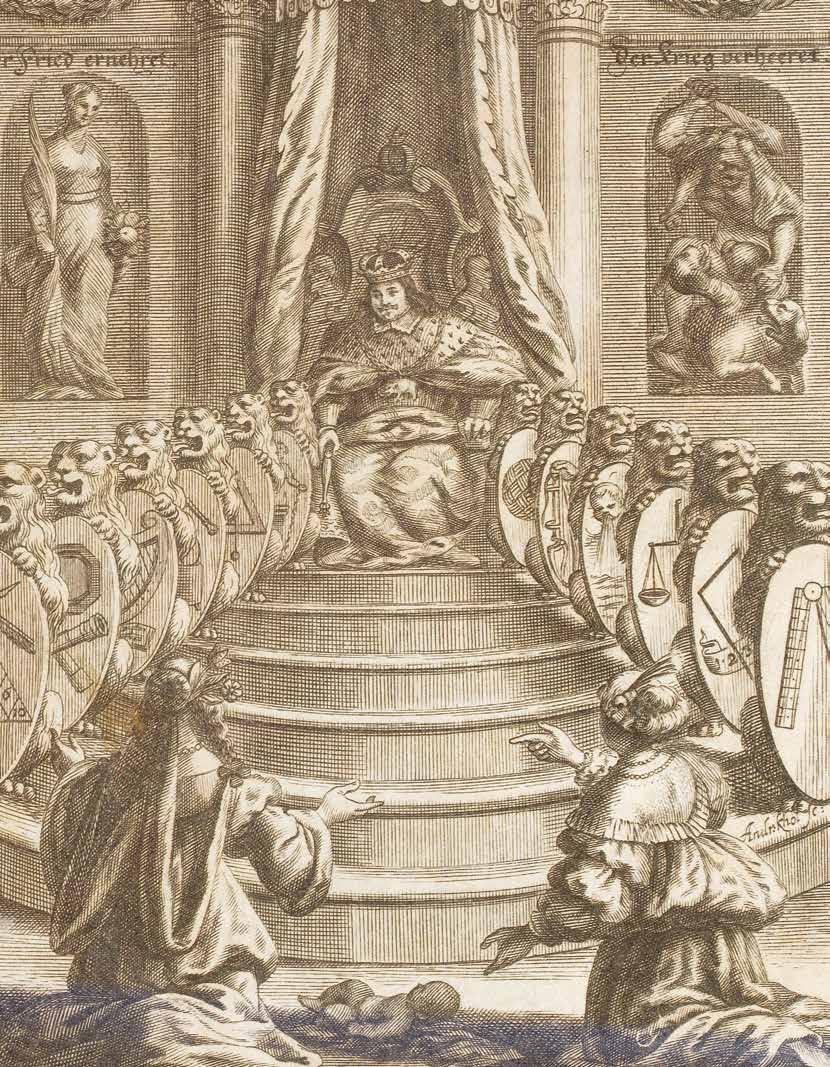
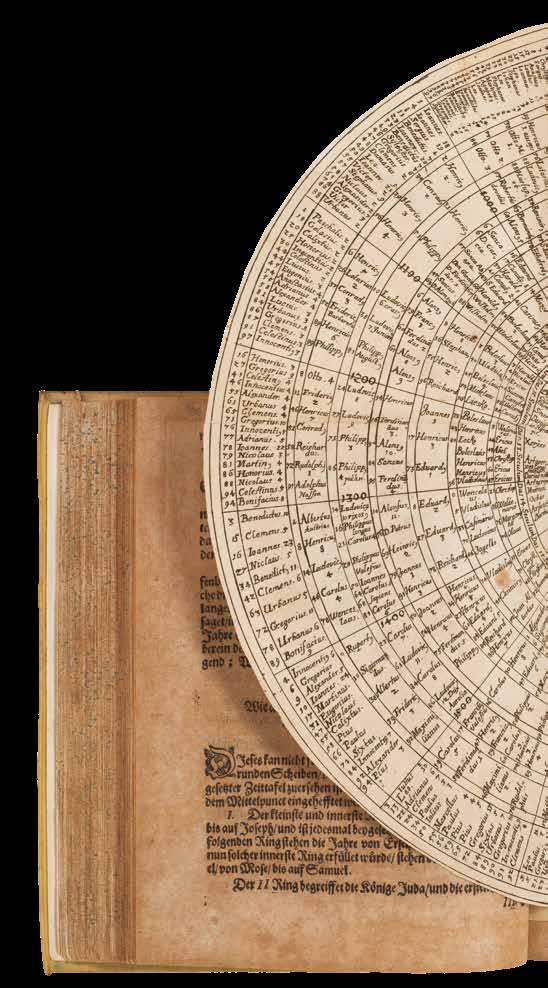
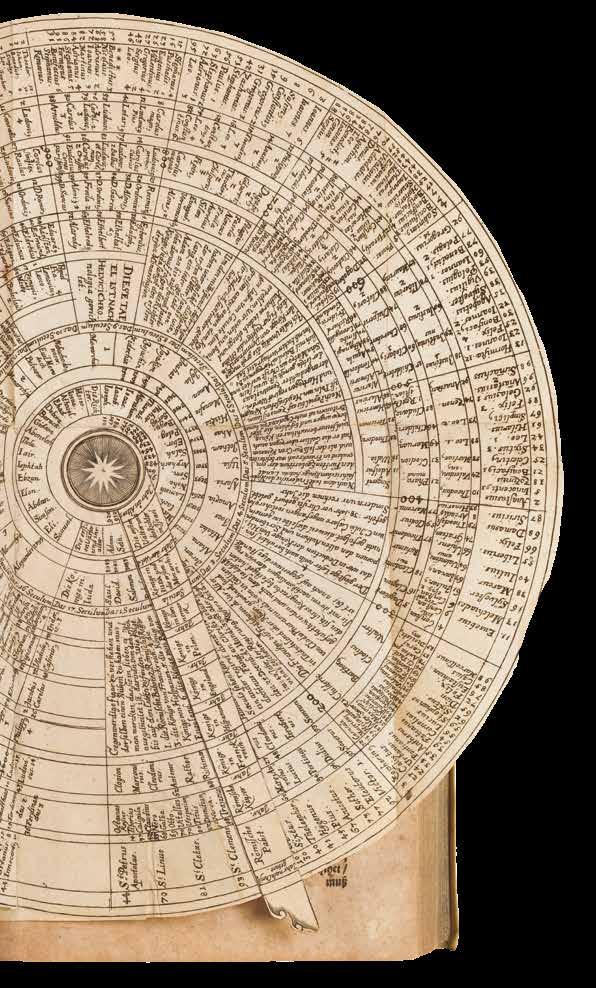
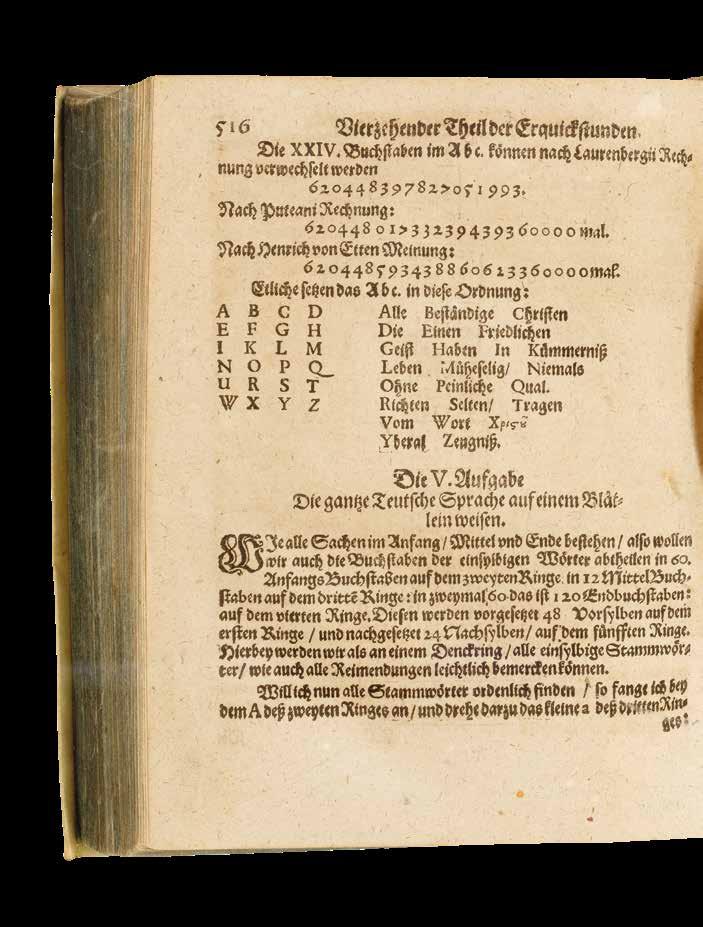
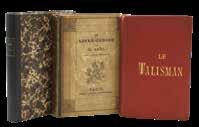
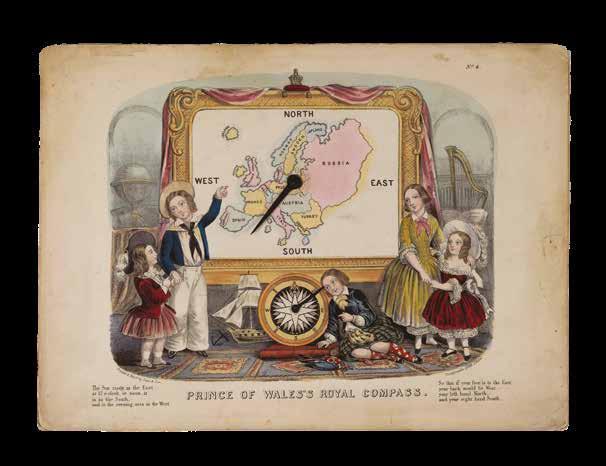
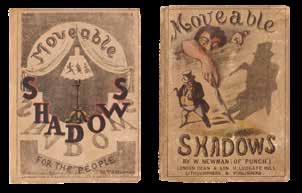
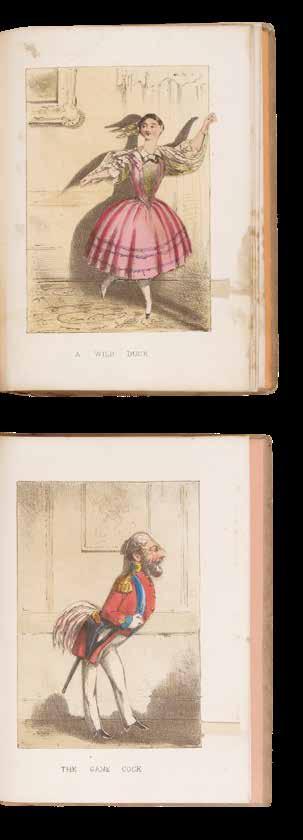
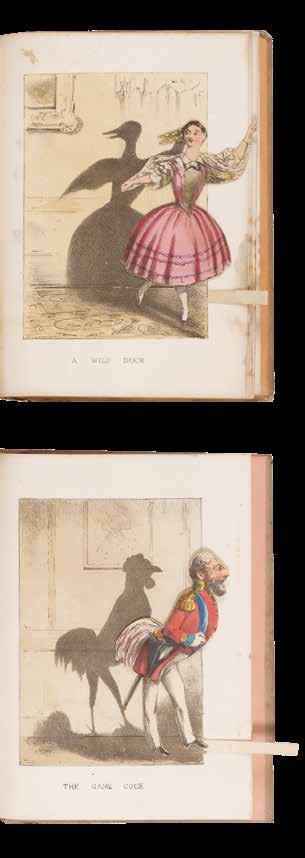
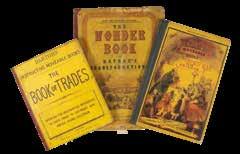
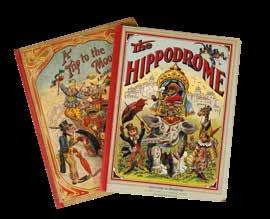
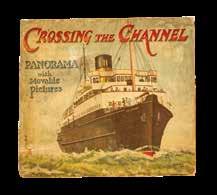
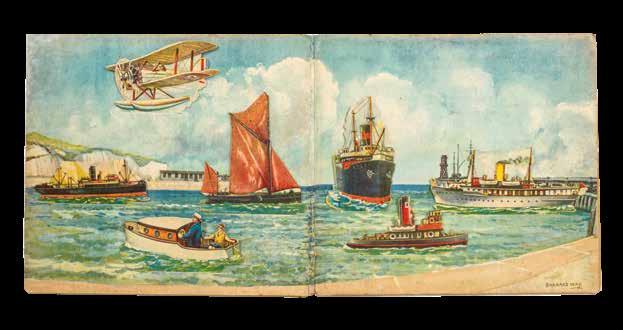
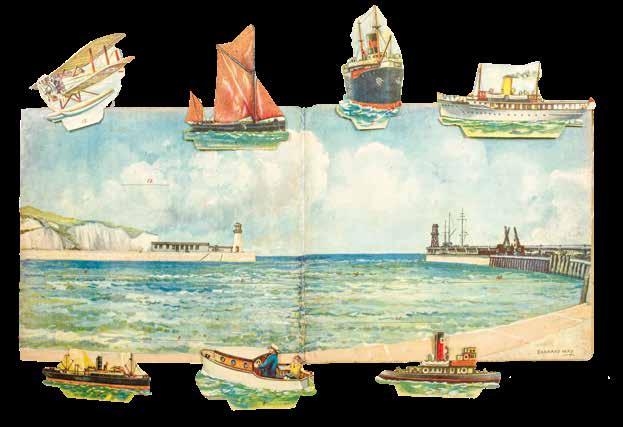
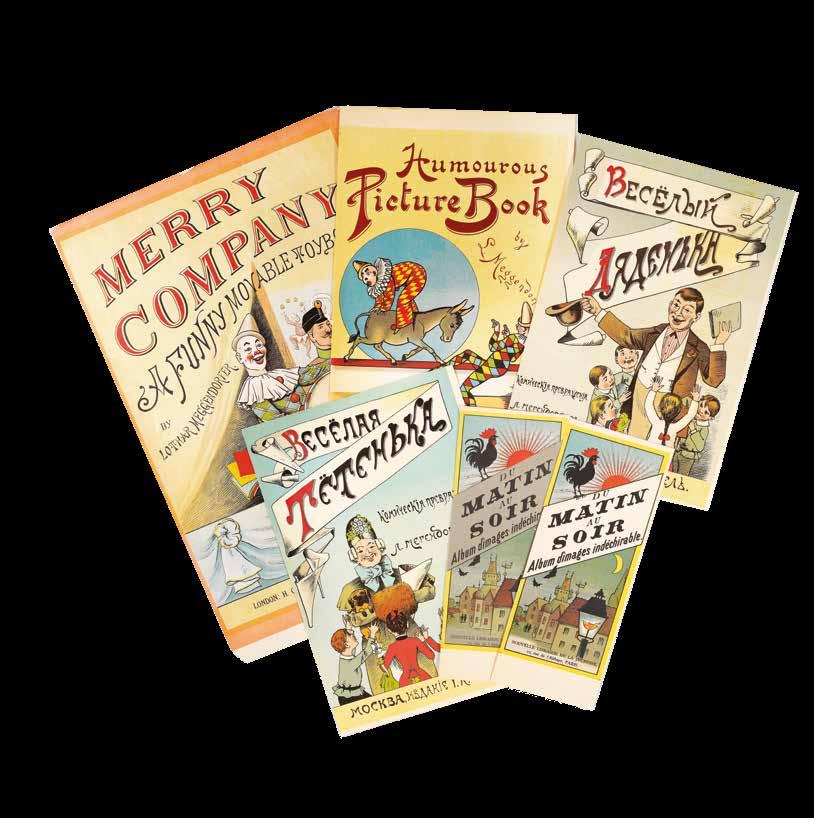
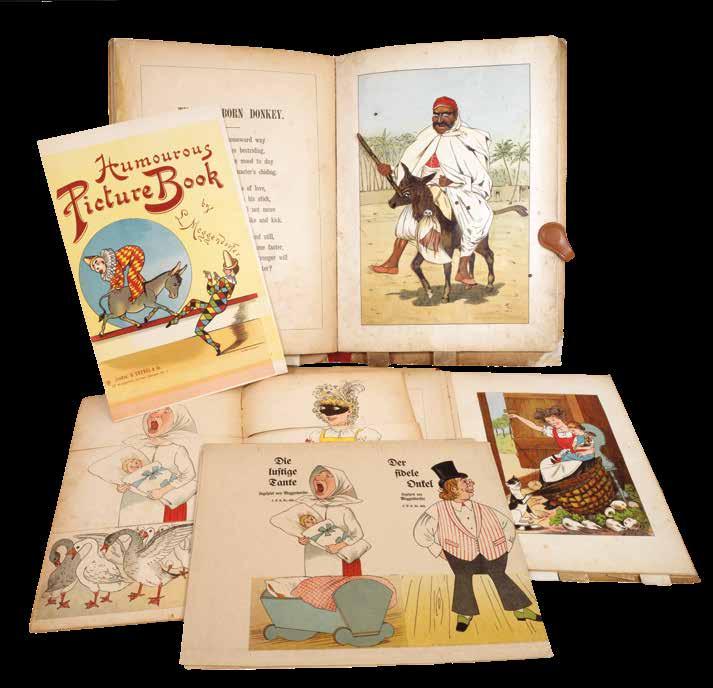
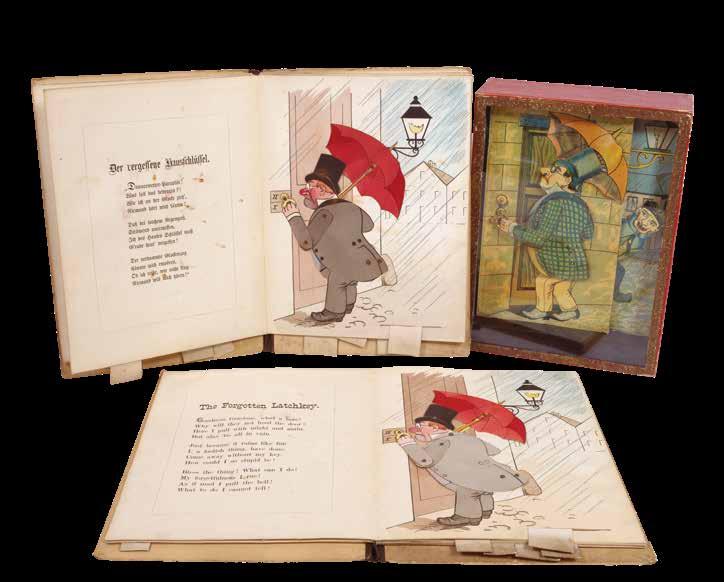
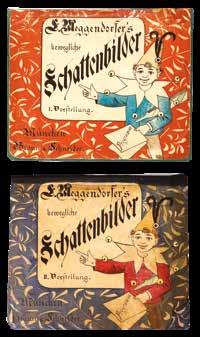
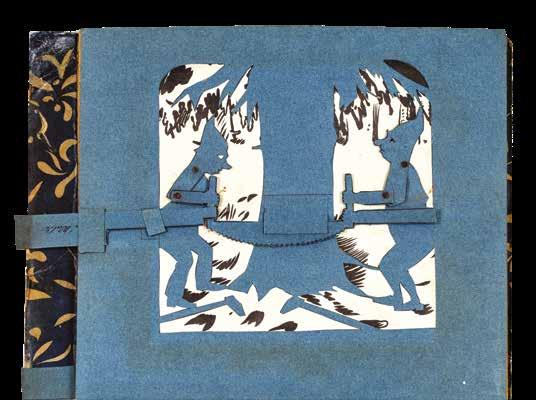
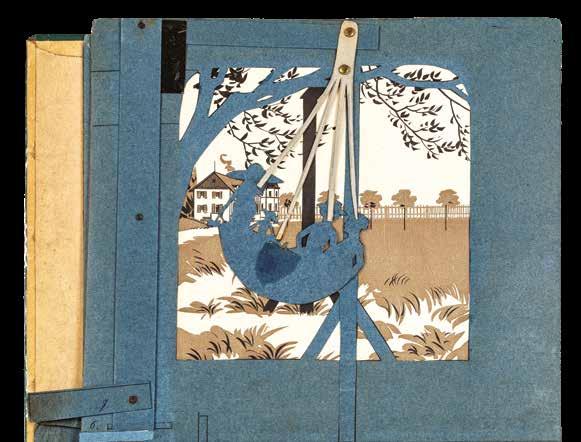
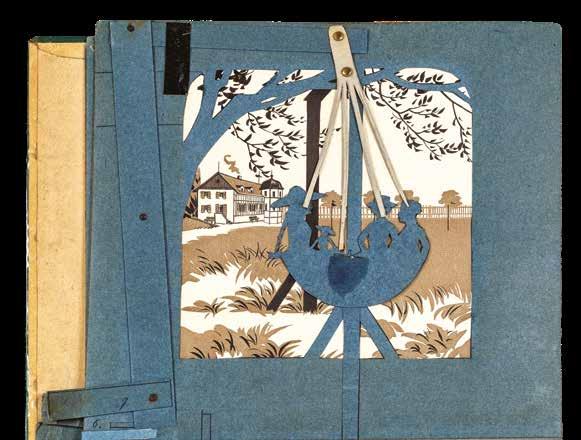
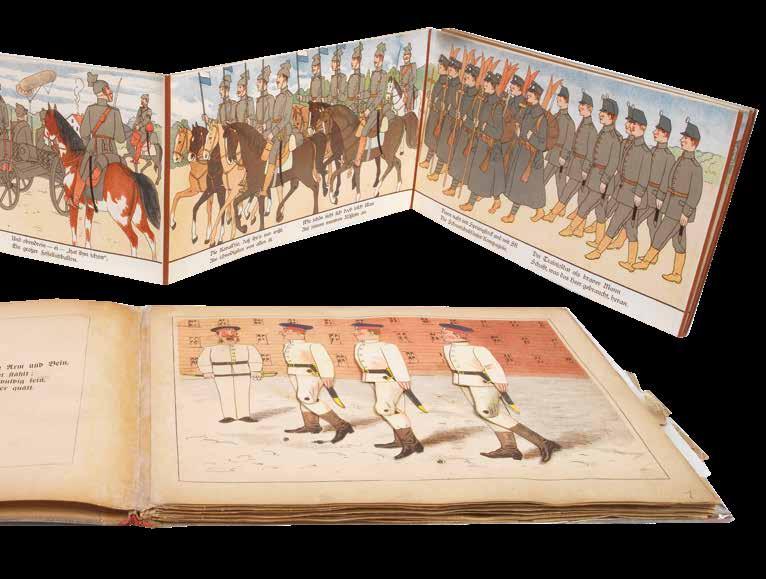
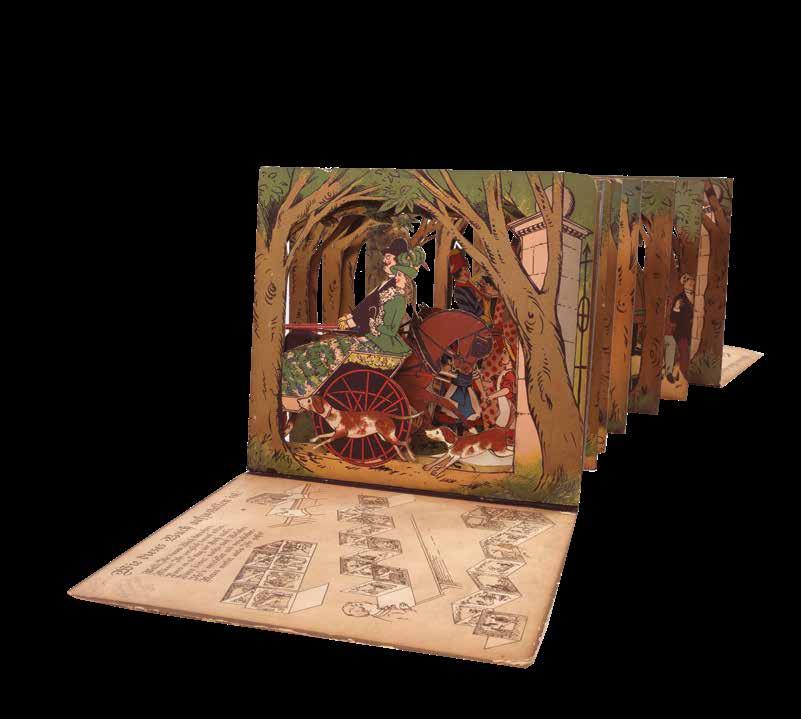
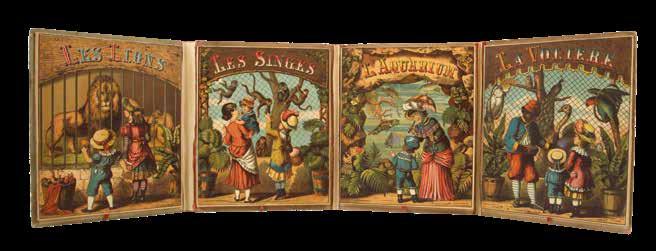
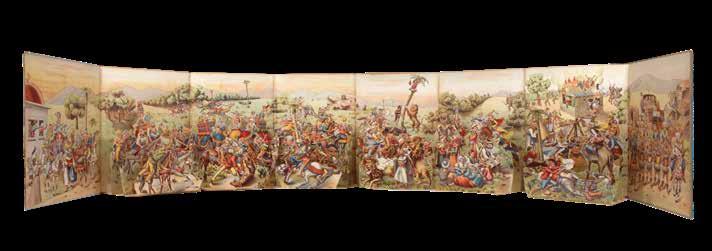
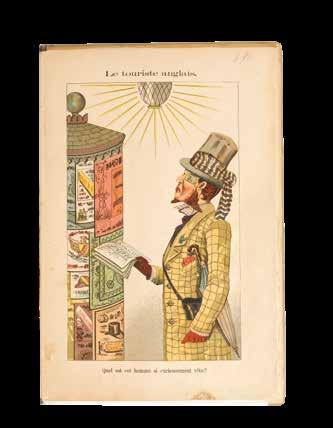
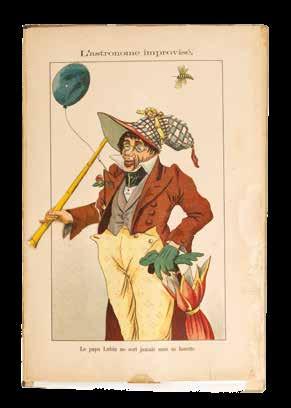
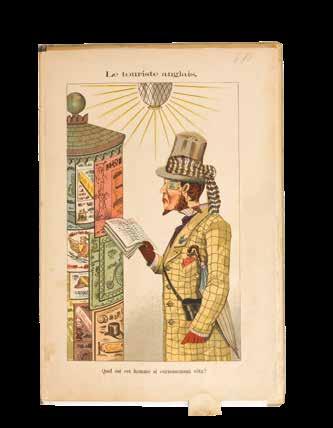
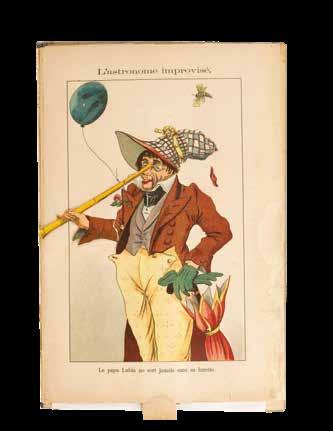
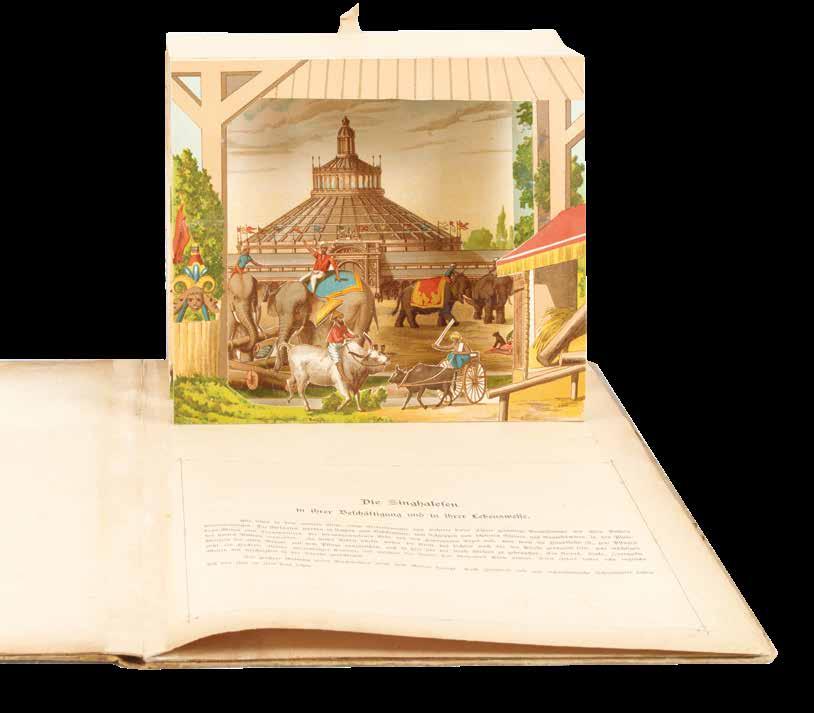
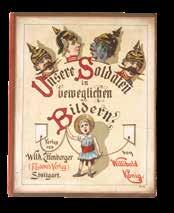
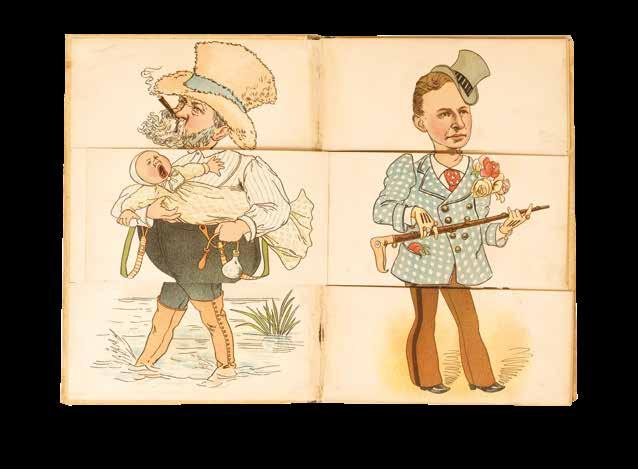
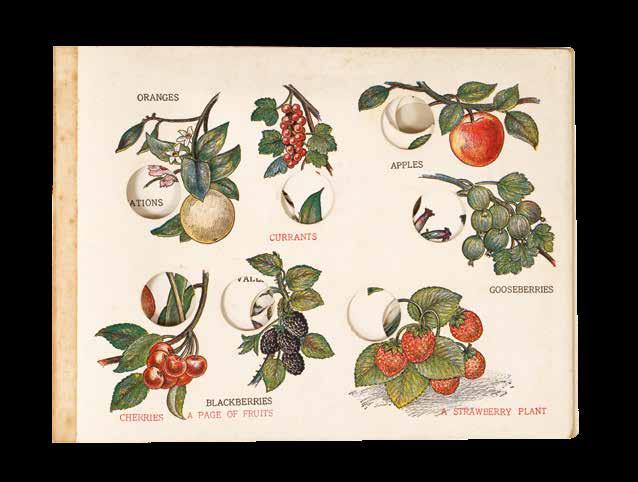
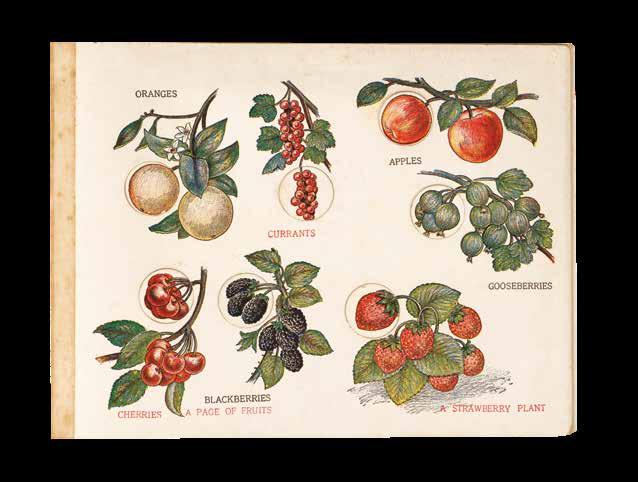
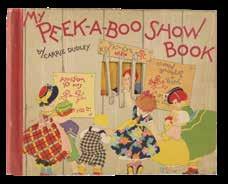
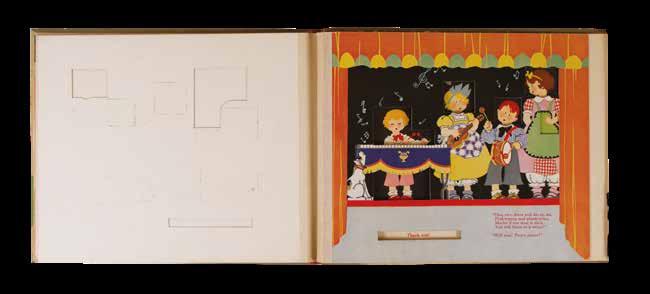
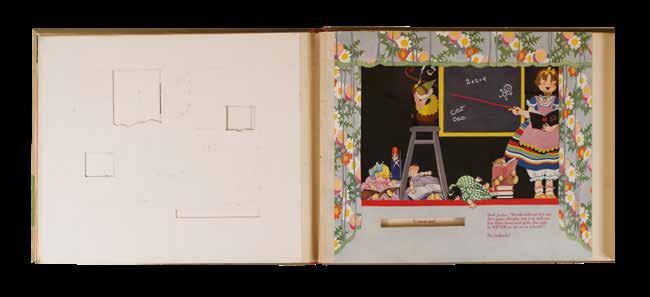
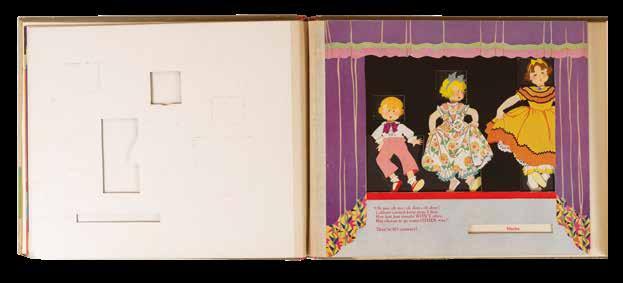
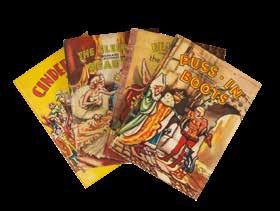
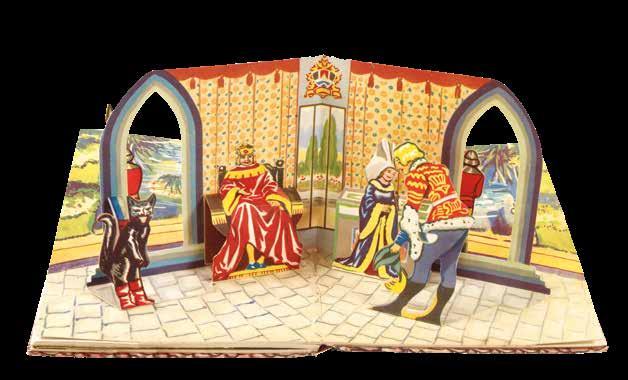
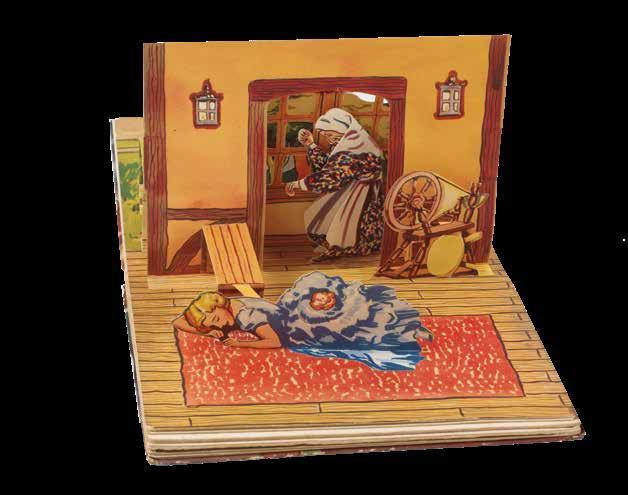
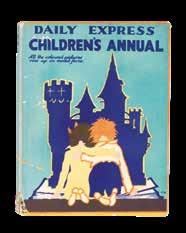
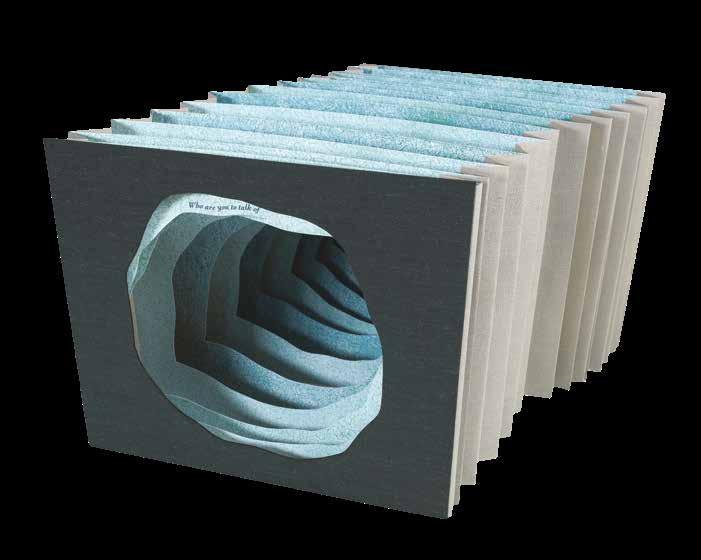
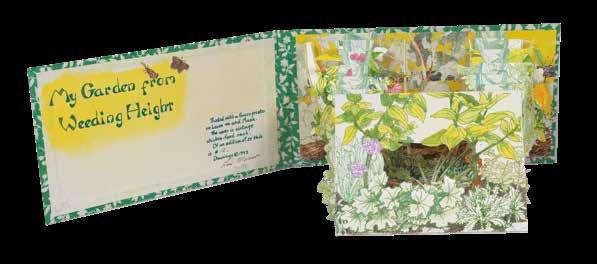
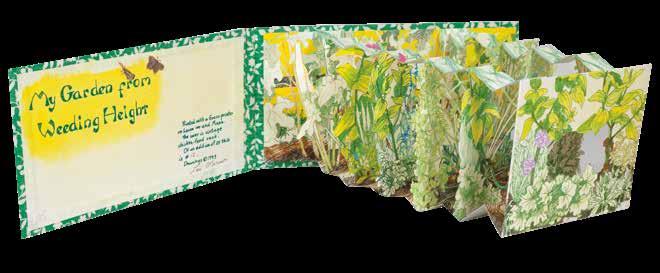
Catalogue edited by Arnie Anonuevo, Daniel Crouch, Rose Grossel, Kate Hunter, Ellida Minelli, Mia Rocquemore and Nick Trimming
Design by Ivone Chao
Photography by Louie Fasciolo and Marco Maschiao
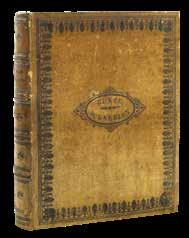
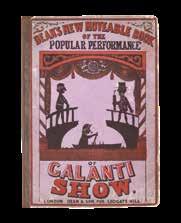
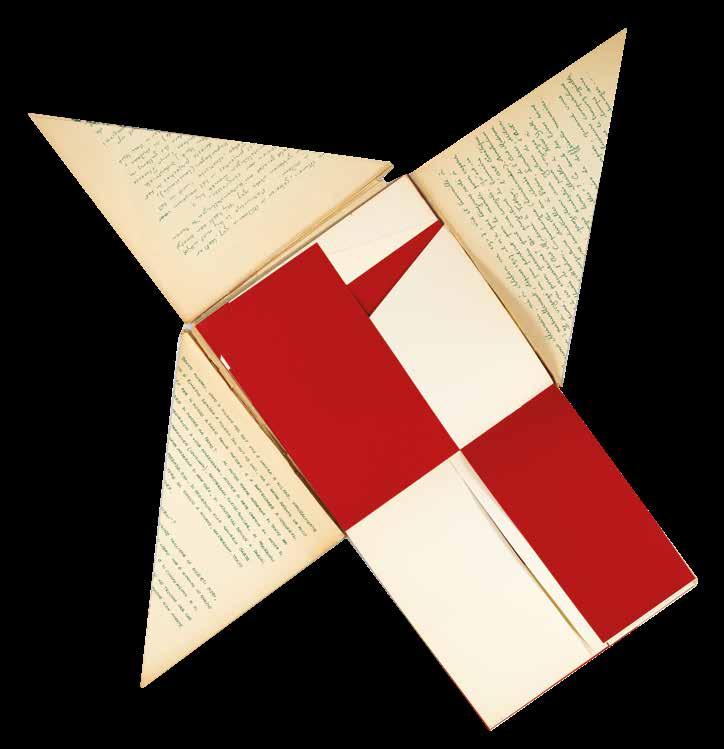
Cover: item 187
Terms and conditions: The condition of all books has been described. Each item may be assumed to be in good condition, unless otherwise stated. Dimensions are given height by width. All prices are net and do not include postage and packing. Invoices will be rendered in £ sterling. The title of goods does not pass to the purchaser until the invoice is paid in full.
Printed by Park Communications on FSC® certified paper. Park is an EMAS certified company and its Environmental Management System is certified to ISO14001. 100% of the inks used are vegetable oil based, 95% of press chemicals are recycled for further use and, on average 99% of any waste associated with this production will be recycled. This document is printed on Galerie Matt made of material from wellmanaged, FSC®-certified forests and other controlled sources. The pulp used in this product is bleached without the use of chlorine (ECF).
A Moveable Feast:
The Temperley Collection of paper engineered pop-ups, transformations, and other surprises
Volume I: Books
Introduction / 7
Wheels within Wheels / 11 - 45
Layers upon Layers / 47 - 61
Slip and Slide / 63 - 85
“Turn-ups” & “Turn-Downs” / 87 - 113
Infantesimal Progress / 115 - 125
Vanity of Vanities / 127 - 141
The Deans of Mean / 143 - 179
The Tuck Shop / 181 - 191
Mister Nister / 193 - 205
The German Empire / 207 - 249
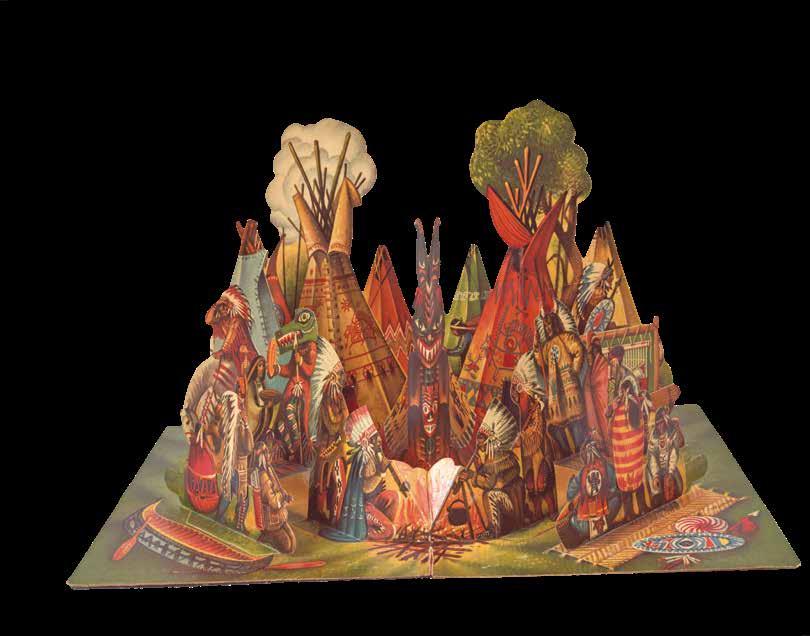
The Americans are Coming / 251 - 271
A European Union / 273 - 285
Livres d’Artistes / 287 - 315
ISBN / 317 - 333
Bibliography / 334
Rosie and David Temperley believe that “communication, cooperation, and creativity” are the three key tenets for social cohesion, and life.
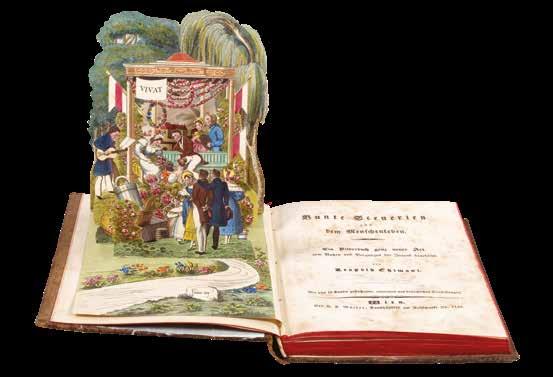
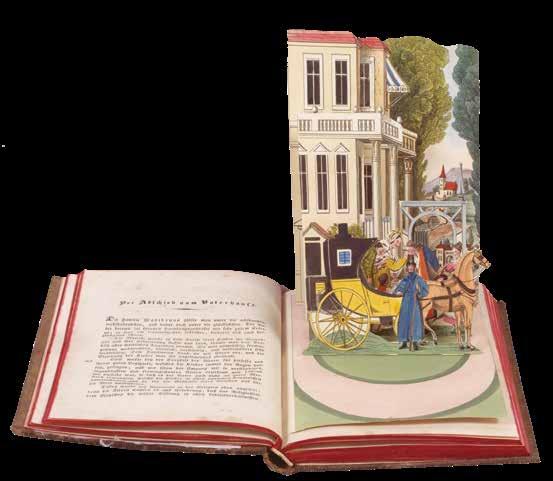
The Temperley Collection, their vast accumulation of books and ephemera, acquired over more than sixty years, is a blinding reflection of this bright ideal, illuminated via the ingenuity of a myriad of papery arts. The result is a cornucopia of marvels and delights that (literally) spring, bounce, twist, turn, fold, flap and flip – off, on and through the pages of thousands of books, cards, prints, and toys.
Over the course of the 500 years that the Temperley Collection spans, some of the most enlightened minds have used these methods to communicate the scientific and religious mysteries of our heavens and earth. Above all, the Temperley Collection practices what it preaches: it is a library that refuses to stay put on the shelves; it is an experience which demands immersion and participation.
Books
The best books come to life. Their stories, worlds, characters, and lessons burst from their pages, quite literally, in the case of the Temperley Collection.
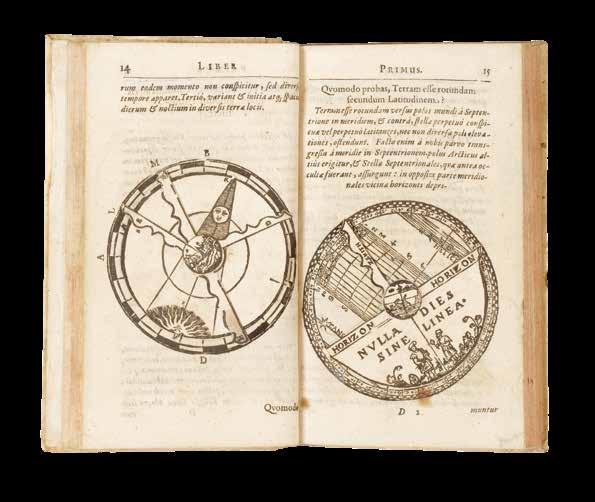
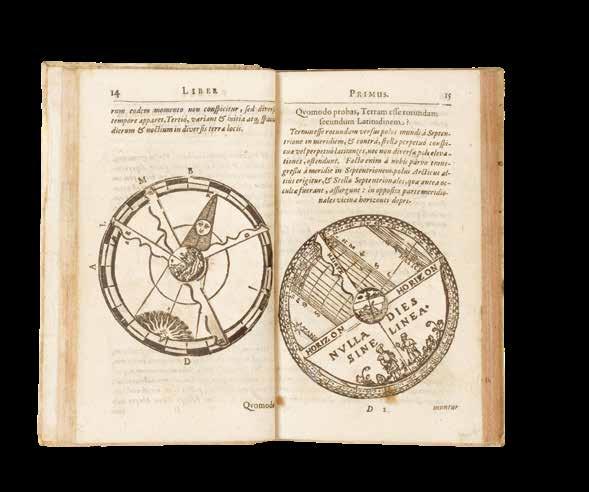
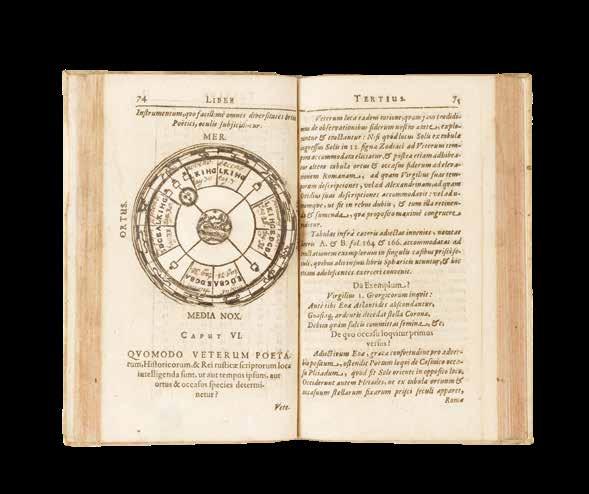
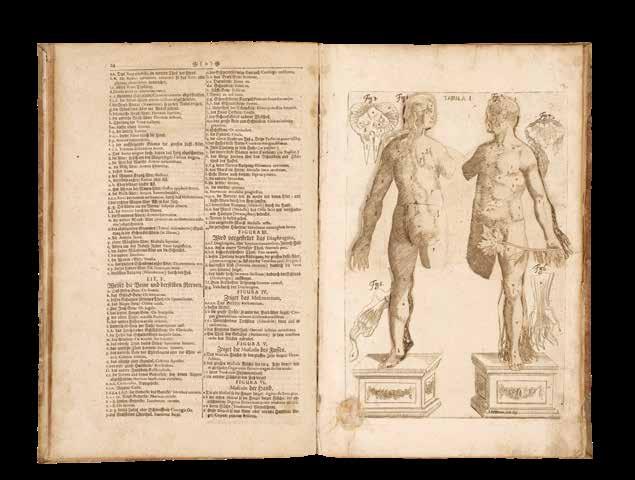
In early examples, moveable elements are used to explain or illustrate the subject of the book: from the two-dimensional volvelles of Apianus, Beilin, Blebelius, and Gallucci in the sixteenth century; the sometimes three-dimensional re-examination of scientific and mathematical methods by Cowley (item 15), Dudley, Hofmann (item 10), Keil (item 15), “Poliander” (item 5), and Schwenter (item 4), during the long eighteenth century; to the most extensive private collection of “turn-up, turn-down” books, which begin with “Adam & Eve” (items 21 forwards) transformations, include the escapades of that loveable rogue Harlequin, and reach their apotheosis with the medical dissection books of Remmelin (item 12), Tuson (item 18), and Witkowski (item 19), of the eighteenth and nineteenth centuries.
As well as astronomy and anatomy, the principles of geography, gardening, music, architecture, mechanics, and more are demonstrated and displayed by a range of paper engineering techniques. Indeed, moveable mechanisms have been used to portray everything from politics (item 85) to pornography (item 33).
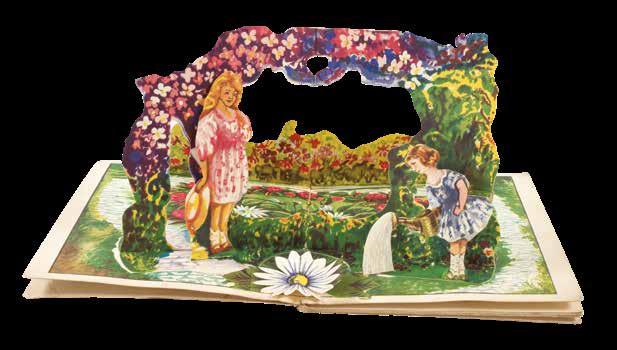
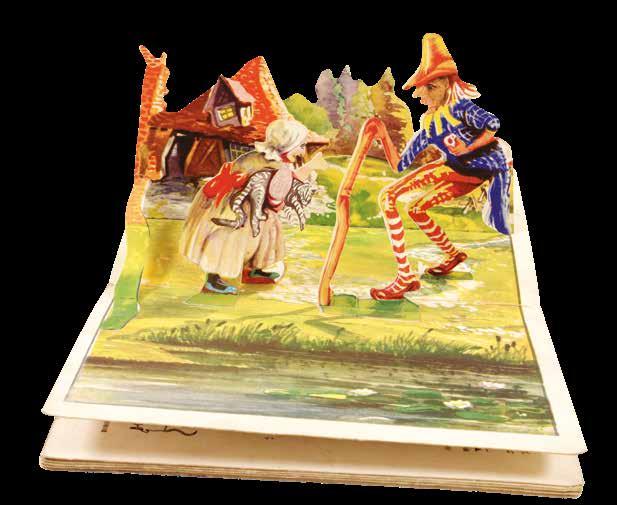
Moveable books for children began to be produced in the nineteenth century, when Brès added a pull-down mechanism to his playful book, ‘Livre Joujou’, in 1831 (item 30). Thus dawned a golden age of “pop-up” book production designed for a juvenile market. The firms of Meggendorfer, Dean, Nister, and Tuck, as well as their followers, lead the industry in the manufacture of ever-more exciting and interactive works. Increasingly complex paper engineering allowed three-dimensional scenes to spring from the pages, characters to move, and stories to be projected onto a wall or screen.
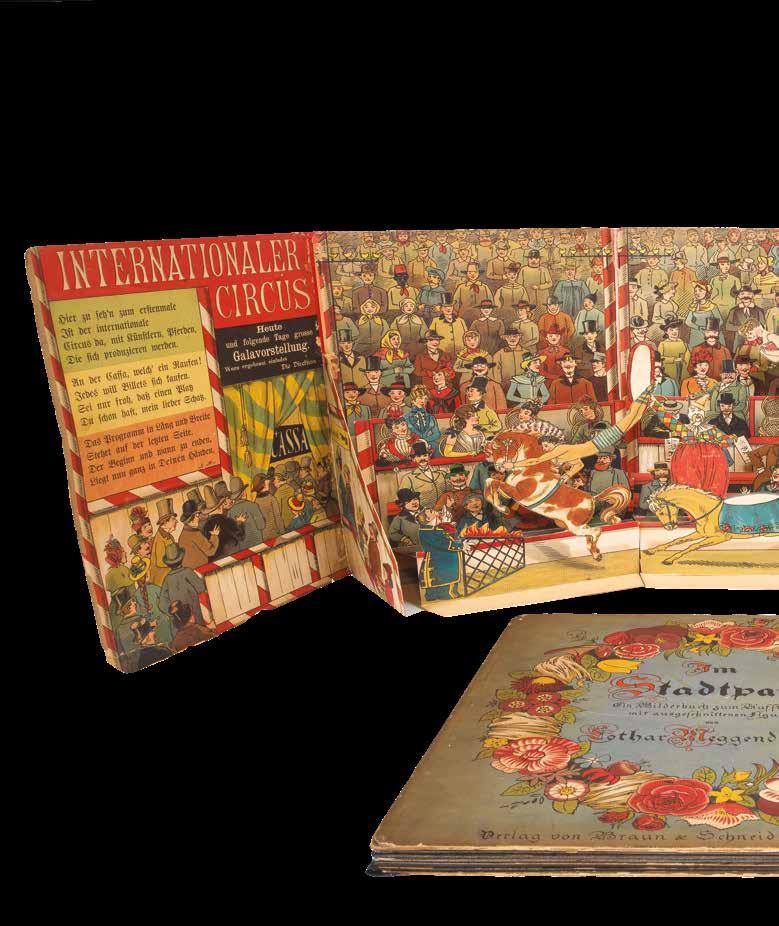
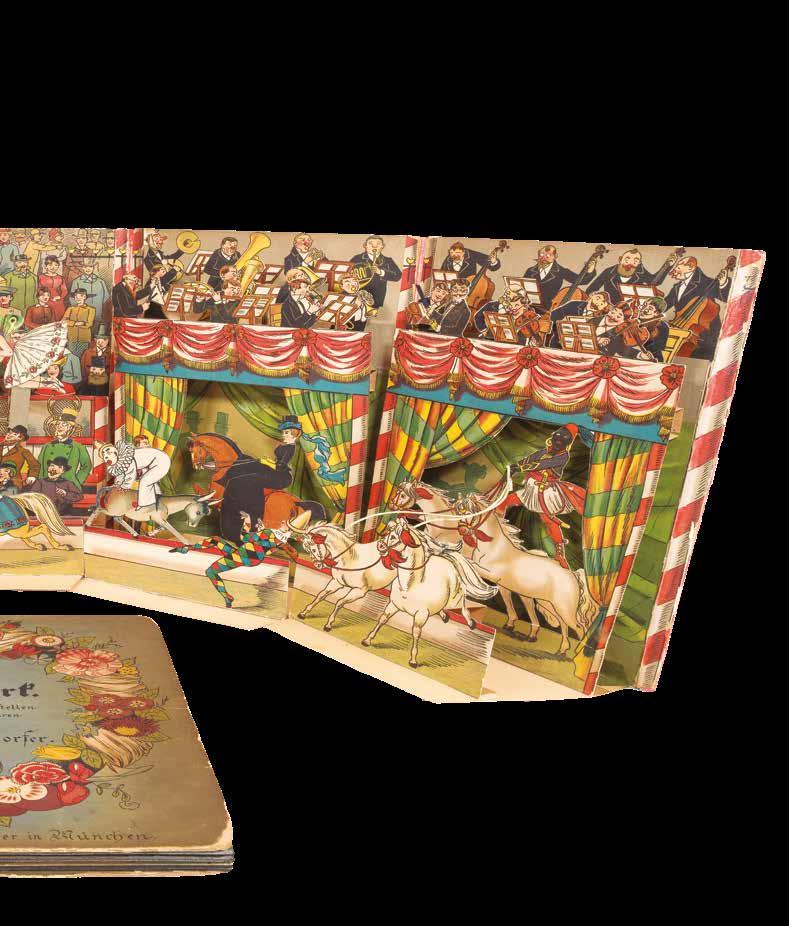
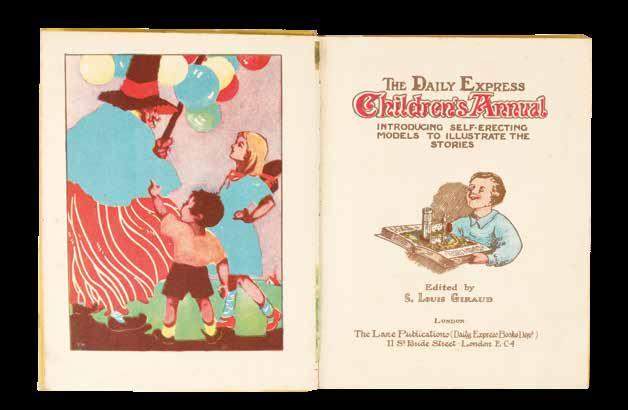
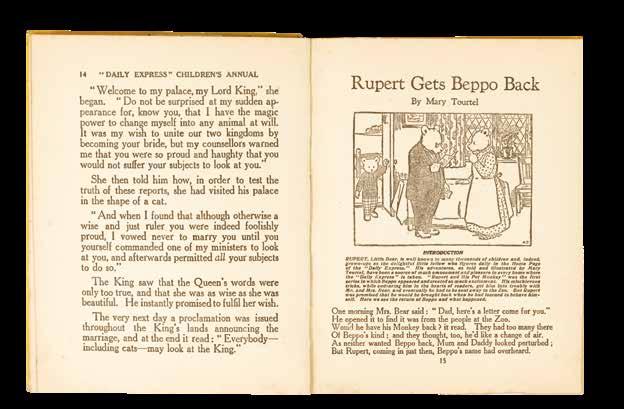
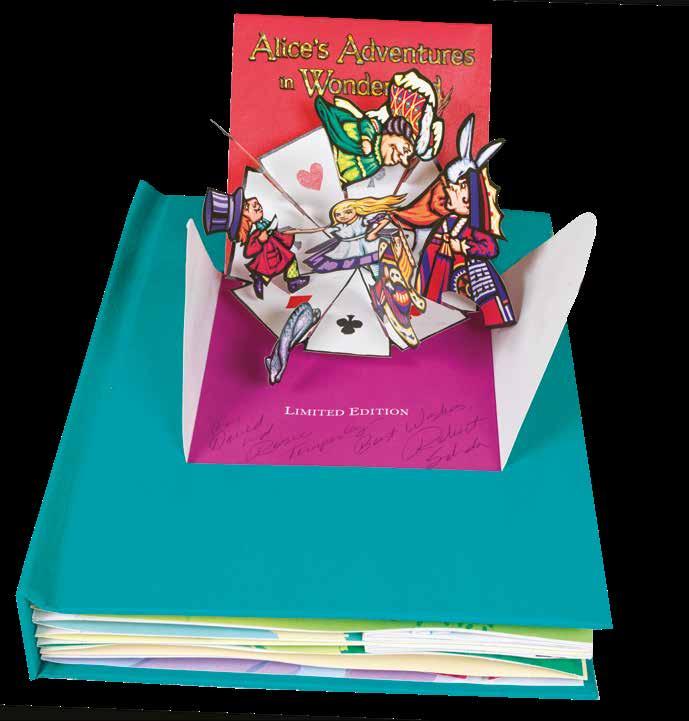
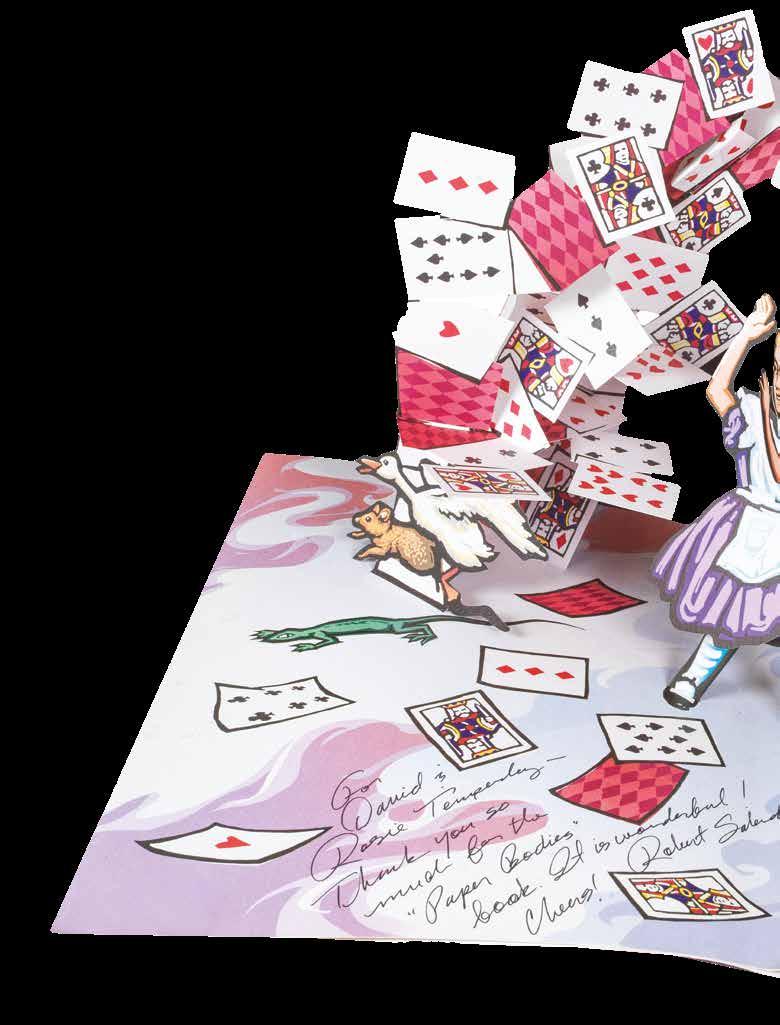
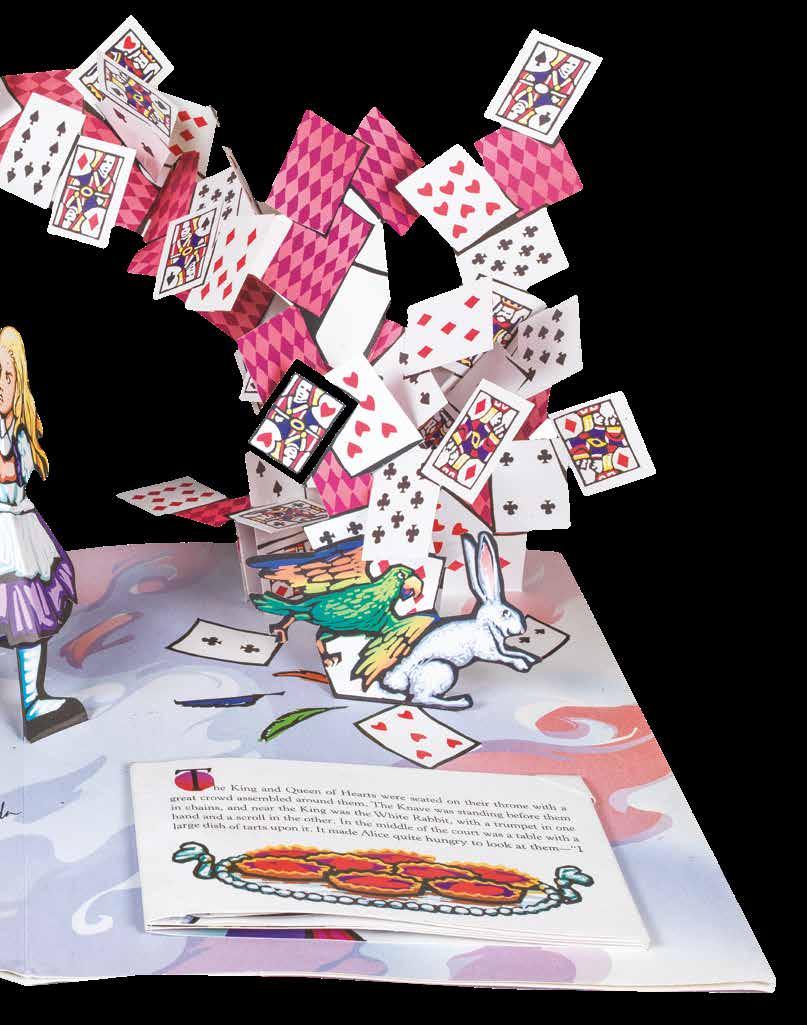
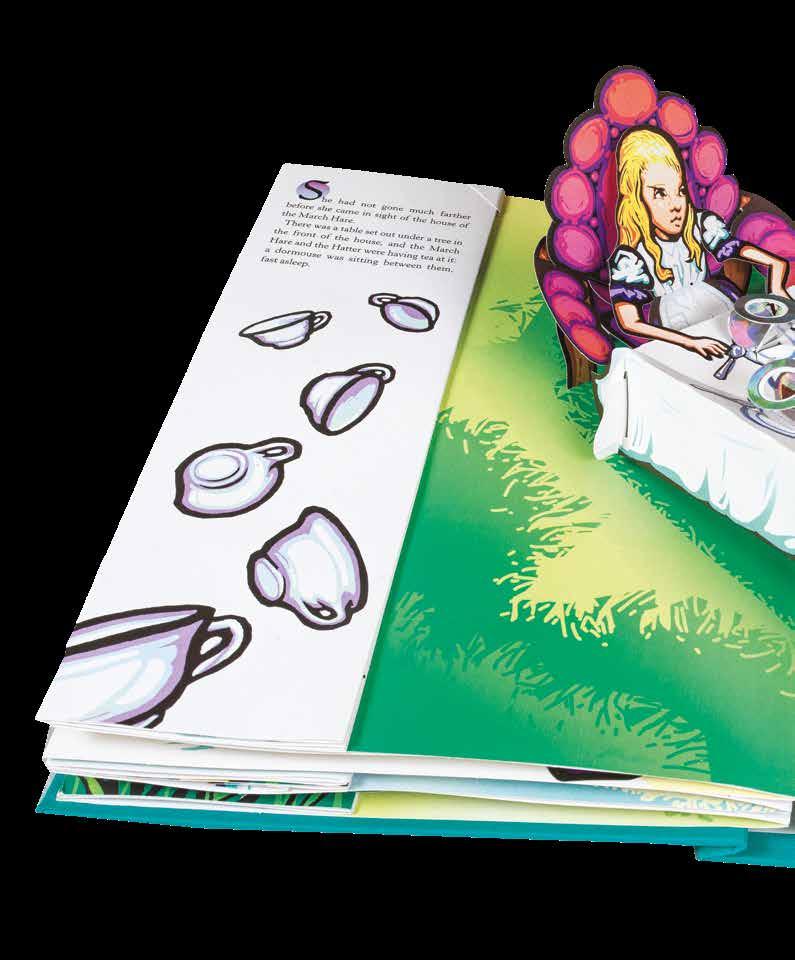
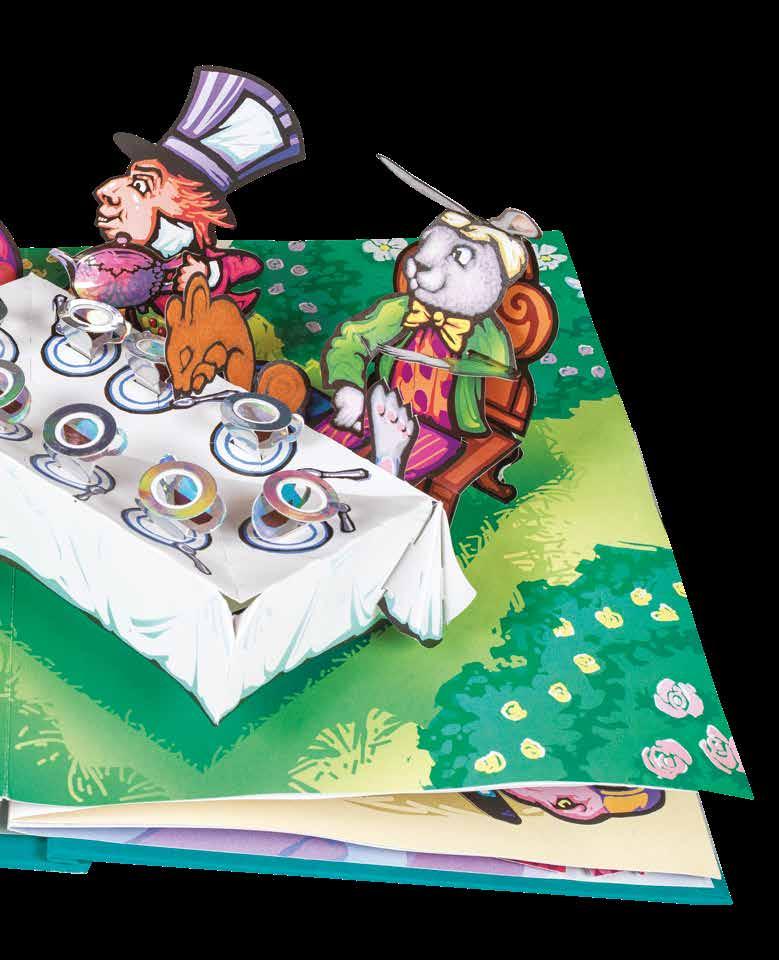
Such breakthroughs culminated in truly magnificent pieces, such as Meggendorfer’s ‘International Circus’ (item 62), and family favourites including Rupert Bear (item 76). During the twentieth century, Chad Valley made the first books to self-identify as “pop-ups”, Vojtěch Kubašta (item 83) published world-famous children’s books ‘from behind the Iron Curtain’, and in the twenty-first, Robert Sabuda’s renderings of classic stories such as ‘Alice’s Adventures in Wonderland’ and ‘The Wonderful Wizard of Oz’ (item 100) have elevated the art of paper engineering to new heights.
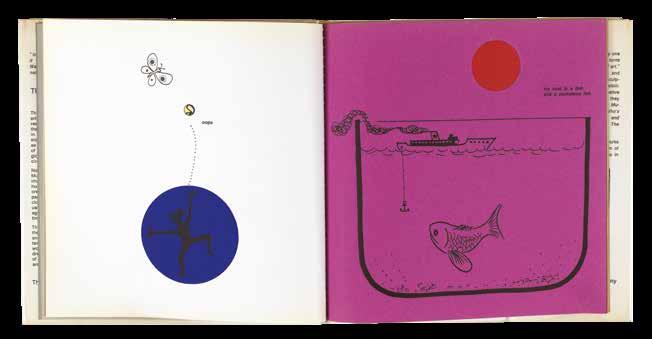
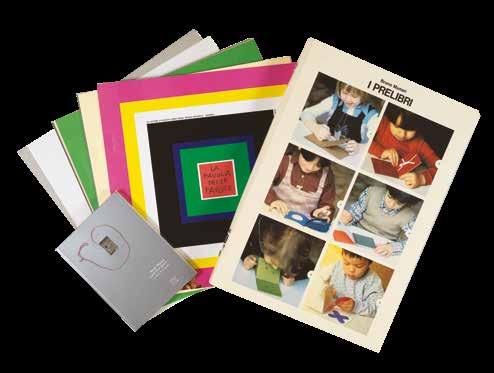
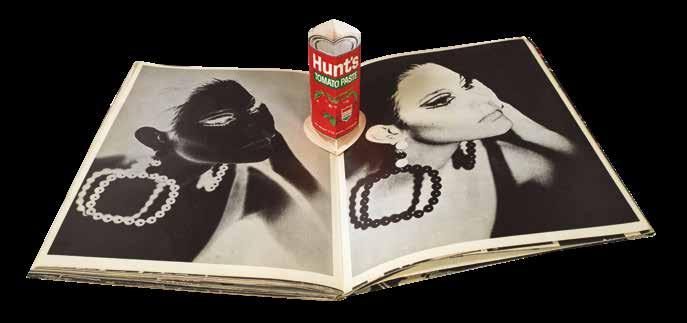
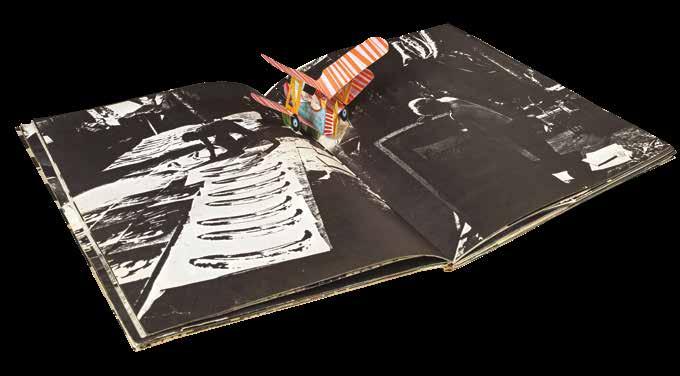
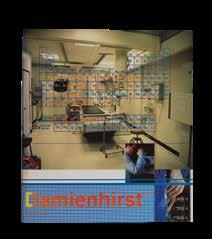
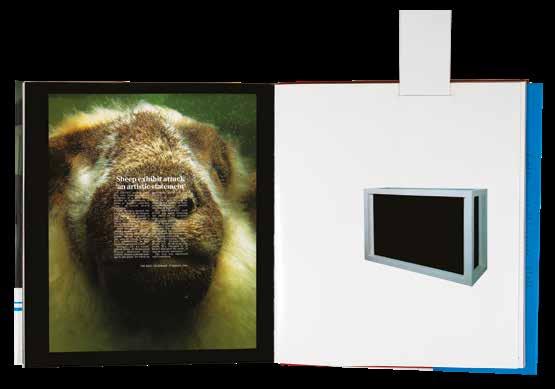
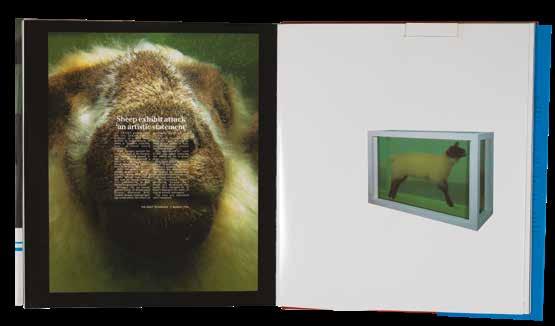
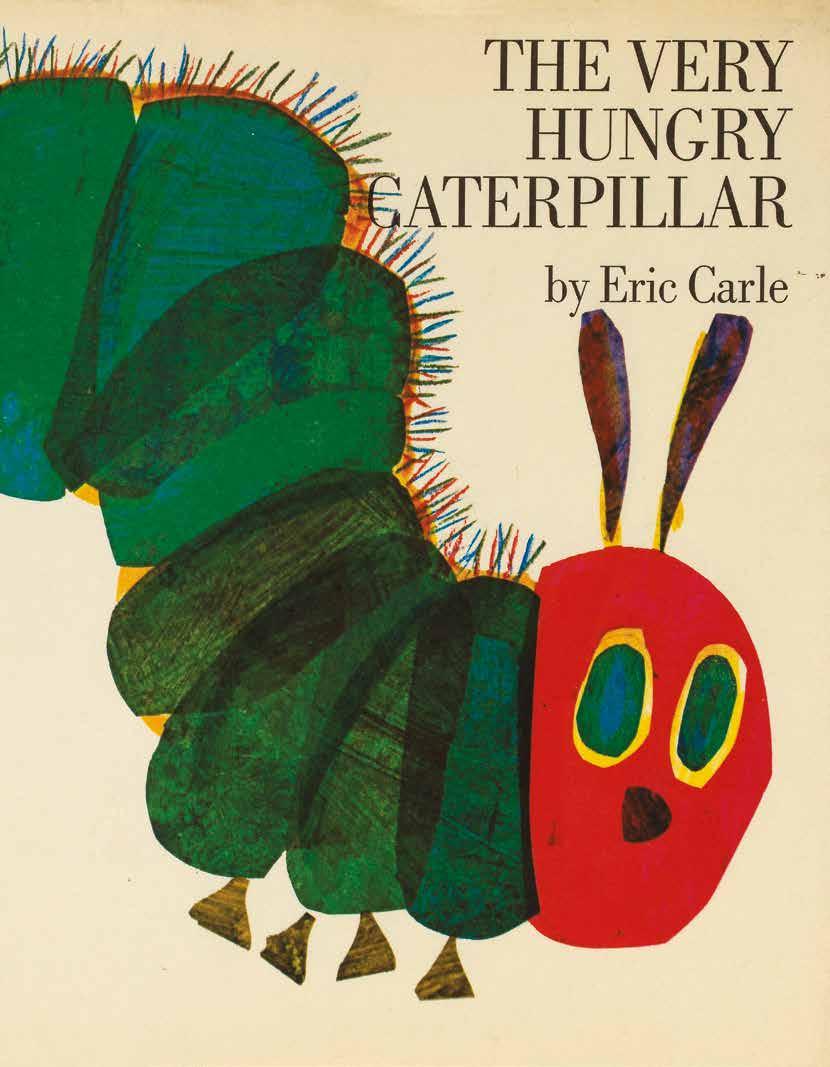
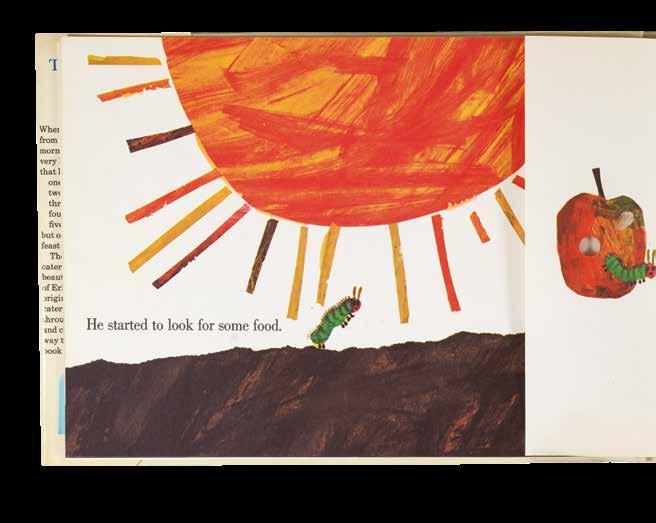
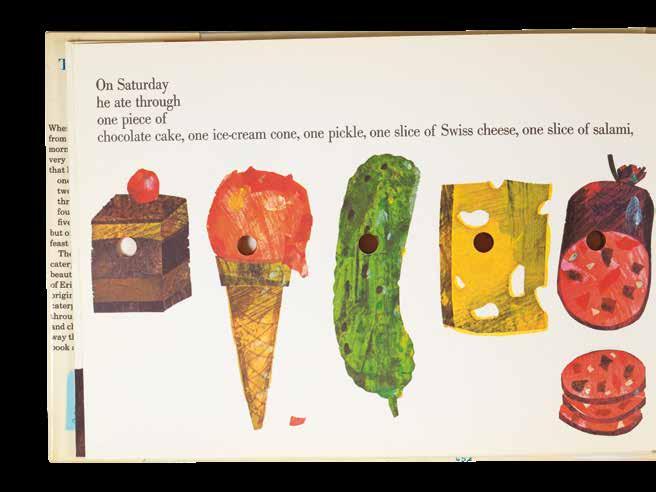
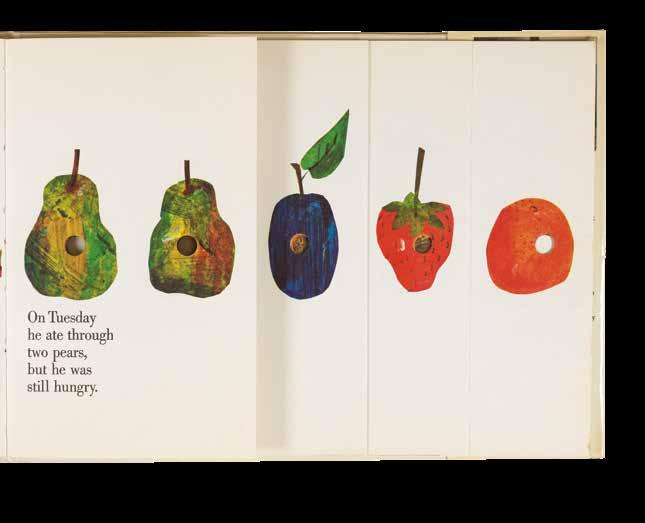
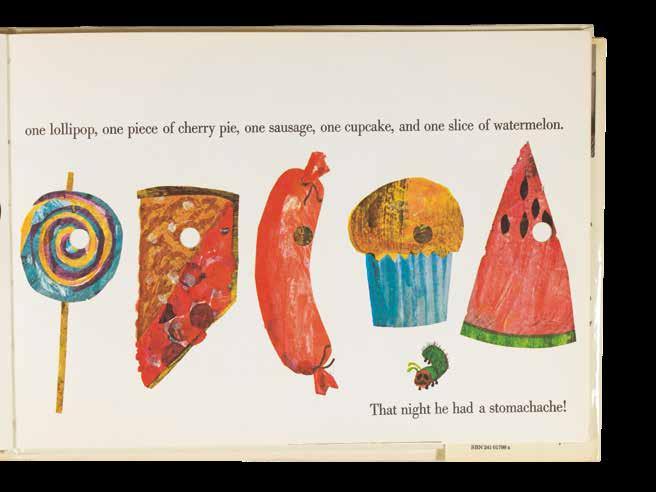
With the ability to mass-print inevitably came mass-production, and the Temperley Collection includes an entire room FULL of books published in the age of ISBN, including beloved works such as ‘The Very Hungry Caterpillar’ (item 100). The private and art presses are also very well represented, as some of the world’s greatest artists seized upon the medium as another way of conveying their creativity. Aptly enough, Pop artists Andy Warhol (item 90) and Damien Hirst (item 94) each produced pop-up books, which capture the playful and conceptual sides of their genius. Likewise, Italian designer Bruno Munari (items 86,88 and 89) created a series of books which challenge the very idea of what a book can be, playing in print and producing remarkable results.
The books within the Temperley Collection, both factual and fiction, invite adults and children alike to turn, twist, unfold, assemble, pull, feel, cut, paste, and explore. By getting to grips with the pages, the stories, messages, and lessons they bear are brought to life in the hands and the hearts of their readers.
WITHIN WHEELS
APIANUS, Petrus; and Gemma FRISIUS
Petri Apiani cosmographia, per Gemmam Phrysium, apud Lovanienses medicum ac mathematicum insignem, denuo restituta. Additis de eadem re ipsius Gemmae Phry. libellis.
Publication
Antwerp, in pingui gallina Arnoldo Berckmanno, 1540.
Description
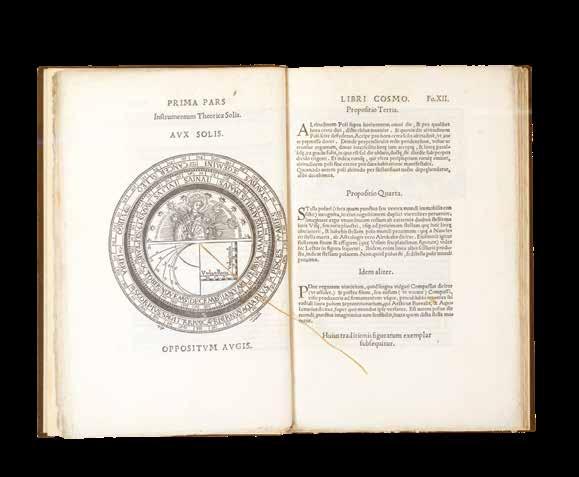
Quarto (250 by 165mm). Title-page with large woodcut vignette, further illustrations and diagrams throughout, five with volvelles, of which four have moveable parts, and one with a thread pointer, printer’s device at end, ink library stamps removed from first and last leaves, washed; modern tan calf, blind, antique.
One of the most popular books on cosmography ever published
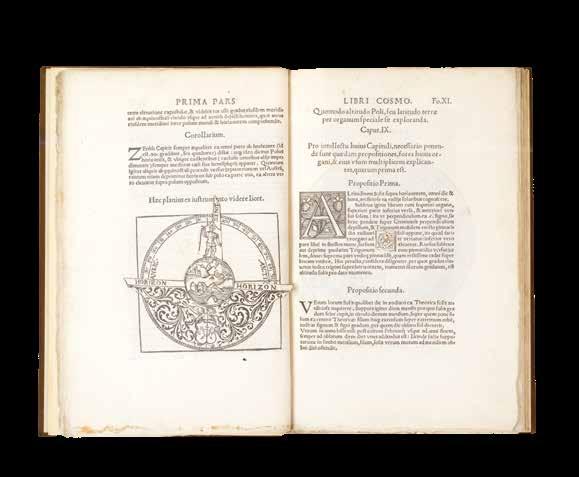
An early Latin edition of Apianus’s important contribution to the geography of the Renaissance was edited by his student, Gemma Frisius (1508-1555); it contains his account of Peru, and describes the discovery of America by Amerigo Vespucci, in 1497. The woodcut illustrations demonstrate the astronomical, cartological, mathematical and geographical concepts discussed in the treatise.
The ‘Cosmographia’ is one of the most popular books on cosmography ever published. It went through no fewer than 45 editions, was published in four languages, and was manufactured in seven cities, by at least 18 printers. This popularity derived principally from its maps and discussion of the New World, but also from its ingenious use of volvelles. Indeed, Frisius’s revisions to the work include a fourth volvelle showing the phases of the moon, not present in the original edition.
Peter Bienevitz (1501-52), better known as Petrus Apianus (1495-1552), was professor of mathematics and astronomy, holding chairs at Ingolstadt and Innsbruck. First published in 1524, the ‘Cosmographia’ was his first major work. It covers “the division of the earth into climatic zones, the uses of parallels and meridians, the determination of latitude, several methods for determining longitude including that of lunar distance, the use of trigonometry to determine distances, several types of map projections, and many other topics” (Karrow). Editions of the ‘Cosmographia’ printed after 1533 also include Frisius’s treatise on topographical triangulation, in which he was the first person to propose it as a means of locating and mapping places: a landmark in the history of cartography.
GALLUCCI, Giovanni Paolo
Theatrum mundi, et temporis, In quo non solum precipuae horum partes describuntur, & ratio metiendi eas traditur, sed accomodatssimis figuris sub oculos legentium facilè ponuntur. Ubi Astrologiae principia cernuntur ad medicinam accommodata, Geographica ad nauigationem, singulæ stellæ cum suis imaginibus, item ad medicinam, & Dei opera cognoscenda, & contemplanda, kalendarium Gregorianum ad diuina officia, diesque sestos celebrandos, et alia multa, quae studiosus letor facile in legendo cognoscet, ex quo sit, ut Theologis, Philosophis, Medicis, Astrologis, Nauigantibus, Agricolis, ceteris bonarum artium, & scientiarum professoribus sit opus utilissimum; nunc primum in lucem editum.
Publication
Venice, apud Ioannem Baptistam Somascum, 1588.
Description
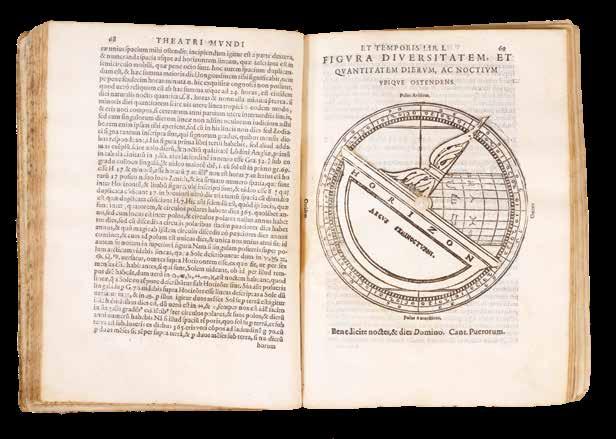
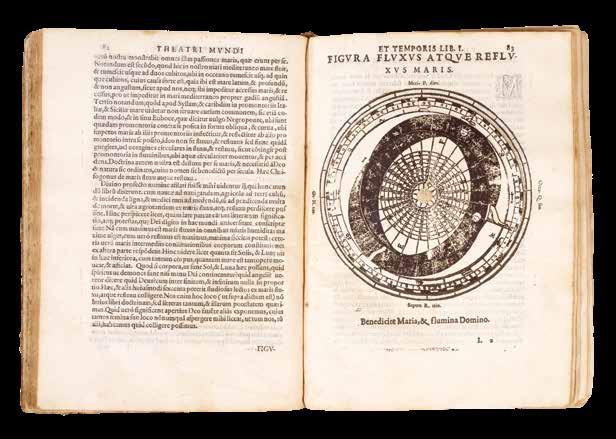
First issue. Six parts in one volume. Quarto (240 by 180mm). 50 woodcut volvelles, of which two are with three moveable parts, 14 are with two moveable parts, three are with some parts replaced in manuscript facsimile, and four possibly with parts in printed facsimile, 55 further circular woodcut illustrations, including two globular projections of the world (Shirley 160), 48 celestial charts, with the additional folding table ‘Canon Sexagenarius, vel Sexagesimorum scrupulorum’, with an Errata leaf on a cancel at end; contemporary limp vellum, yapp fore-edges, remains of two pairs of ties; preserved in modern maroon morocco backed clamshell box.
References Adams G168; BM STC ‘Italian’, page 289; Honeyman 1423 & 1424; Houzeau & Lancaster 2725; Hutson, ‘Introduction to ‘Gallucci’s Commentary on Dürer’s ‘Four Books on Human Proportion’ (2020); Mortimer, ‘Italian’ 206; Riccardi I, col. 568; Thorndike VI, pages 158-159.
Number of items 1
Enough “world and time”...
The first celestial atlas to map the heavens using Copernican co-ordinates, as published in his ‘De Revolutionibus’ (1543). This example includes the unsigned leaf of the constellation Cepheus, between Mm4 and NN1. The text is divided into six parts, and describes and maps both celestial and terrestrial worlds, with the inferno at the centre of the earth within ten concentric circles. Gallucci’s text is aimed at the lay-person with simple mathematical models and images, including Ptolemaic constellations illustrated with mythological figures.
Giovanni Paolo Gallucci’s (c.1538-1621) ‘Theatrum mundi, et temporis...’ was published in the “wake of an increased interest in celestial mapping in the second half of the century, spurred on by the papacy (especially that of Pius IV and Gregory XIII). In the same manner, the highly influential treatment was dedicated to Sixtus V (Felice Peretti di Montalto), and even invokes the name of the pope in the hope that he would promote the study of celestial science by establishing an astronomical observatory in Rome. The author notes the favorable conditions of clear skies and elevated hills and also claims that the renowned German Jesuit mathematician and astronomer Christopher Clavius (1538–1612) would be on hand to assist in such investigations. Published shortly after the Sixtus V’s papal bull, in which astrology and other methods of divination were banned,... The seminal publication would set forth the framing devices that he would extend to his works on the visual arts. The numerous reprints and even a Spanish translation attest to the popularity of the work. In the following century, the work would be published under a different title, clarifying that this ‘Theater of the World and Time’ “explains celestial bodies by means of instruments and figures” (Hutson).
Provenance
Manuscript ex libris of an ecclesiastical library of Granada at the head of the title-page.
BLEBELIUS, Thomas De
Sphaera, Primi Mobilis Rudimentis Libellus. Maxime Accommodatus: Accurata Methodo & Brevitate Conscriptus a M. Thoma Blebelio Budissino. prope Mendis Liberatus, Tabulisque Correctis Instructus. Adiectus ad Calcem est Canon Sinuum Joh. Regiomontani, ad Semidiametrum 10000000.
Two parts in one volume. Octavo (165 by 95mm). Woodcut vignette title-page, and numerous illustrations in the text, including four volvelles with moveable parts; near contemporary full vellum.
This very popular astronomical textbook was first published in 1564 by Thomas Blebelius (1539-1596), a schoolmaster in Hof, Vogtland. It contains methods for calculating distance, latitude and longitude, and astronomical tables. Blebelius also published a work on rhetoric (1584), and a Hebrew grammar (1587).
Provenance
Nineteenth century bibliographical notes on the inside front cover.
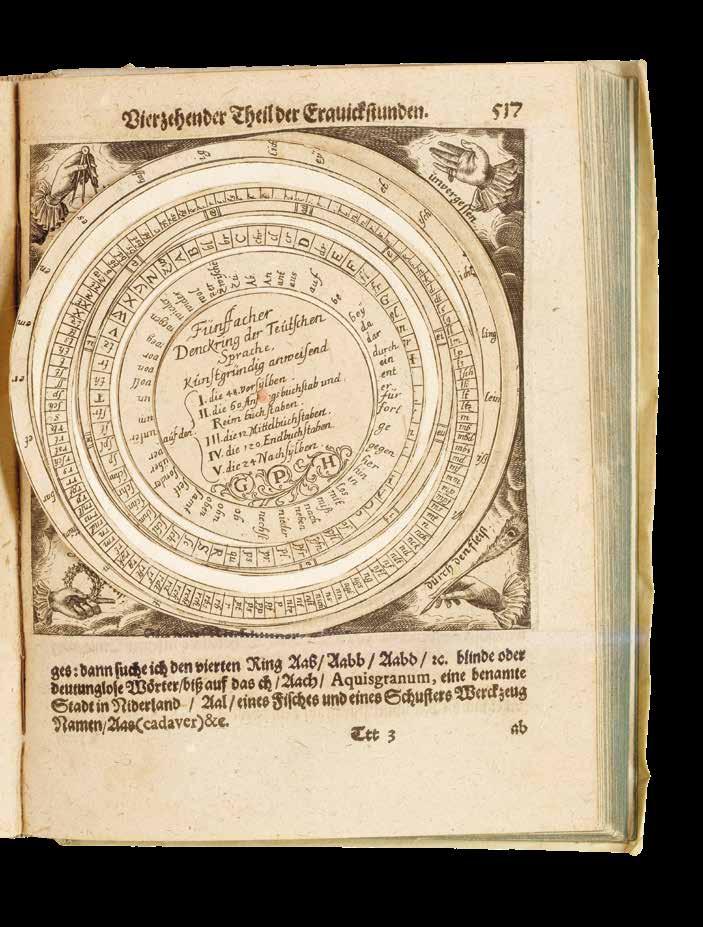
SCHWENTER, Daniel; and HARSDORFFER, Georg Phillipp
Deliciae physico mathematicae: Oder Mathemat: und Philosophische Erquickstunden. Darinnen Sechshundert Drey und Sechzig, Schöne, Liebliche und Annehmliche Kunststücklein, Auffgaben und Fragen, auß der Rechenkunst, Landtmessen, Perspectiv, Naturkündigung, und andern Wissenschafften genommen.
Second edition of volume one, first editions of volumes II and III. Three volumes. Quarto (200 by 150mm). Engraved titlepage in volume one, additional engraved title-pages in volumes II and III, illustrated throughout with numerous engravings, some folding, including two full-page volvelles with moveable parts, one repaired, one large folding volvelle with a moveable, and one full-page; contemporary vellum over paste-board, one and II matching, volume III from another set.
References Dünnhaupt, 2.I.1 (see “Harsdörffer”); Faber du Faur 508; Goedeke III, 119, 14; Jantz 2299; Poggendorff II, 878; SeebaßEdelmann 936; Smith I, 421; Thorndike VII, 594.
Number of items 1
Sundials and striking clocks
Schwenter and Harsdörffer’s work on mathematical problems is one of the most famous of the Baroque period. The first volume was initially published in the same year as Schwenter died, and then expanded by his student, Harsdörffer, over many years.
“This first work of the ‘Deliciae...’, written solely by Schwenter and published by his sons and daughters, dedicated to Duke Augustus the Younger of Brunswick, deals, among other things, with sundials and striking clocks, astrology, the art of writing, chemical recipes, the art of music and singing, the art of fire, water, and melting, architecture, optics, etc” (Seebaß-Edelmann). It also contains the first image of a fountain pen (page 520).
The work contains many puzzles to be solved; the “tricks are taken partly from previous authors such as Nicolaus Taurellus and Cardan, or, more recently, Galileo” (Thorndike).
Provenance
1. Early annotations to the title-pages of volumes one and II, dated 1660; 2. Volumes one and II, with the pencilled ownership of “Doublet” on the inside and outside front covers; 3. Volume III with the later armorial bookplate of “Nordkircher” on the inside front cover.
A veritable cabinet of curiosities
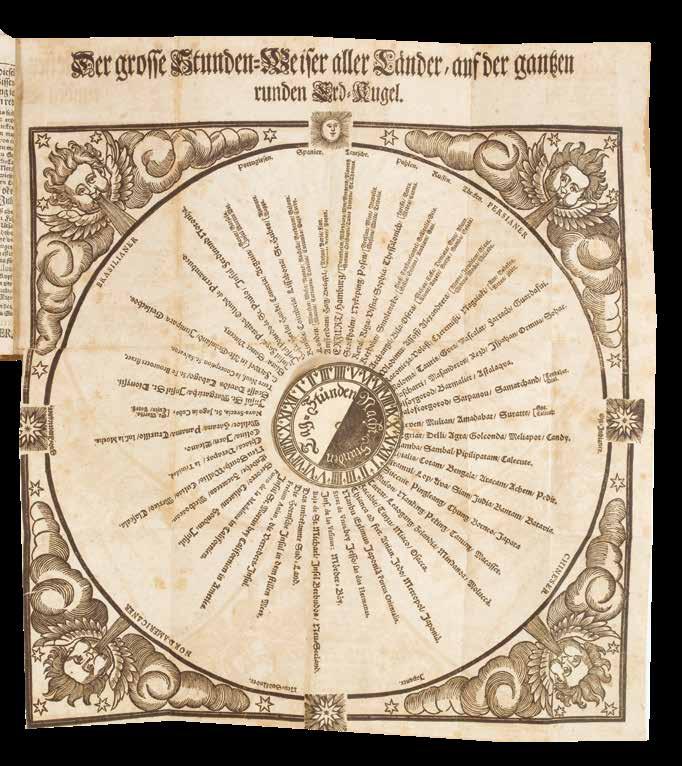
[ANONYMOUS], as “POLIANDER”
Analecta historico-literaria curiosa. Oder vermischte und gesammlete Anmerckungen aus der Historie, Litteratur, und curieusen Wissenschafften...
Publication Erffurt, per Johann Michael Funcke, 1720.
Description
Ten parts in one volume in one. Octavo (155 by 100mm). General title-page printed in red and black, engraved frontispieces to each part, and other illustrations throughout, large engraved folding volvelle, with one loose moveable part, lower margin page 19 torn with loss to text; contemporary vellum over paste-board, repaired.
References Uffenbacher, IV, 155.
Number of items 1
A periodical cabinet of curiosities, including ten issues paginated consecutively. Subjects discussed and illustrated include: chocolate; optics, such as telescopes; strange animals, such as sloths; stoves; plants; napkin folding, and all manner of other things.
The identity of “Poliander” is unknown and often the subject of debate: whether Stadtmann/Stadter/Stetter or Gramann/Graumann; or many different contributors, as the pseudonym implies.
Provenance
1. With the supra-libros of “C.P.Z. 1722” on the front cover; 2. Ink library stamp and manuscript shelfmarks on the title-page of the first volume.
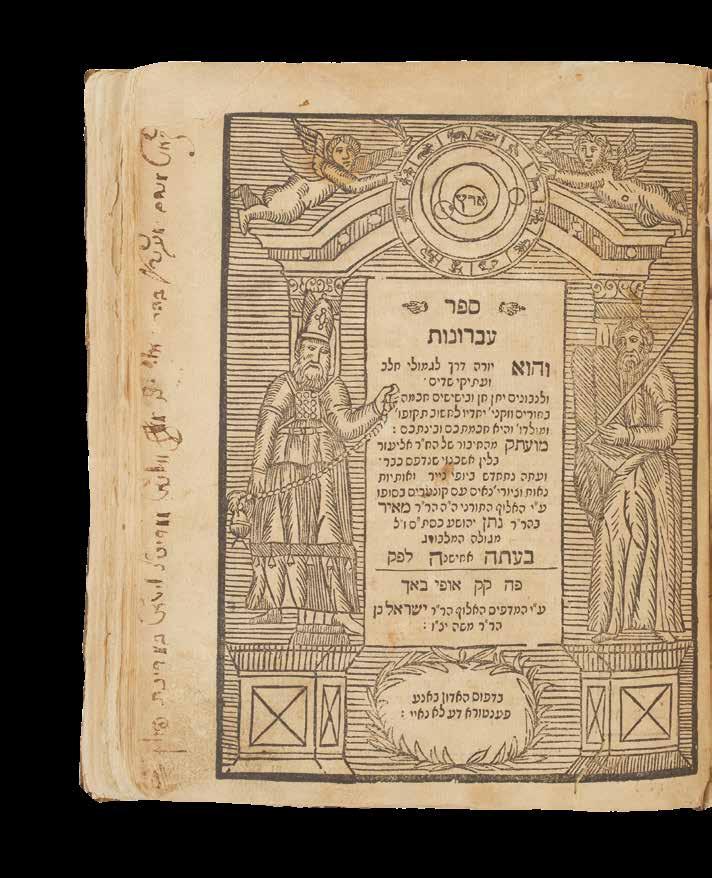
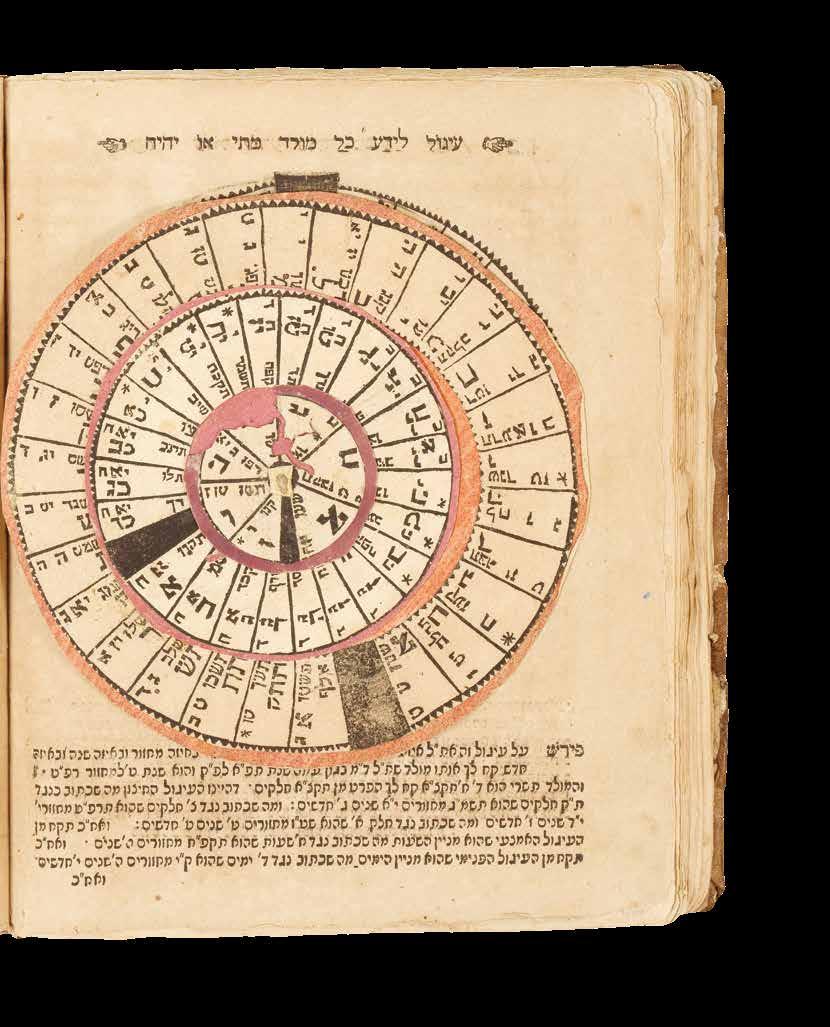
BEILIN, Eliezer ben Jacob; and Nathan Joshua HIMMELBURG
Sepher Ibronoth.
Publication
Offenbach, Israel ben Moses, 1722.
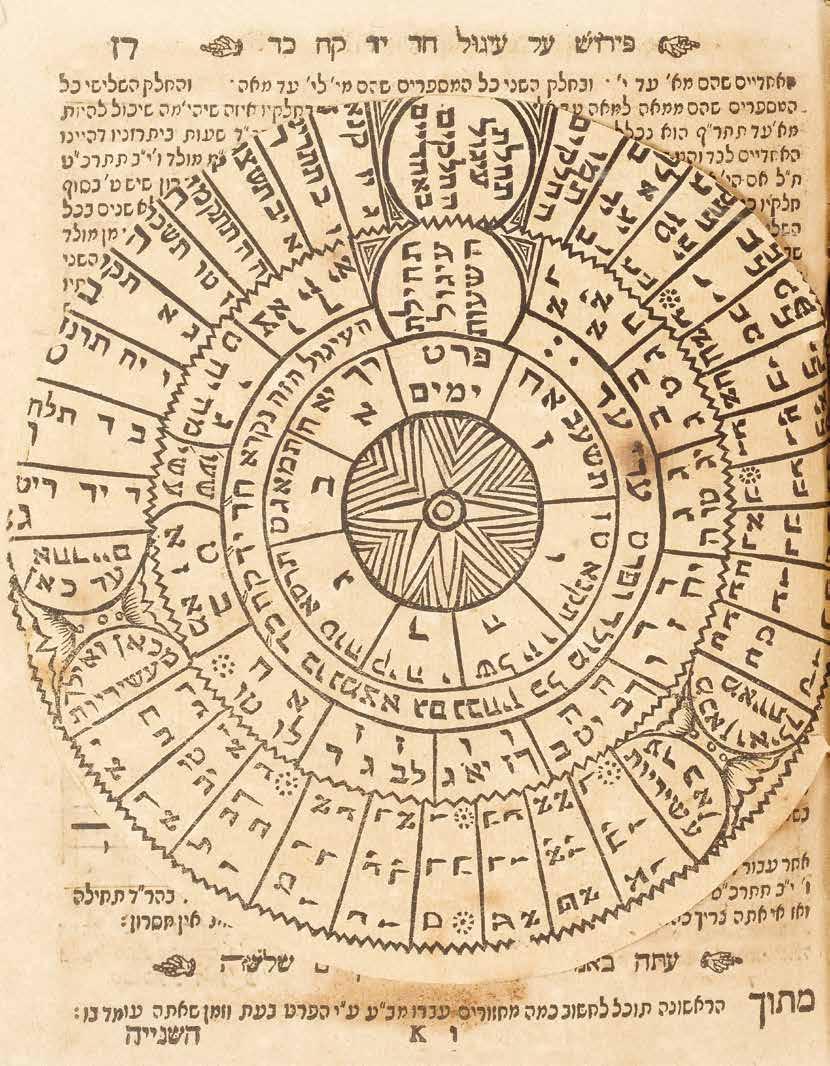
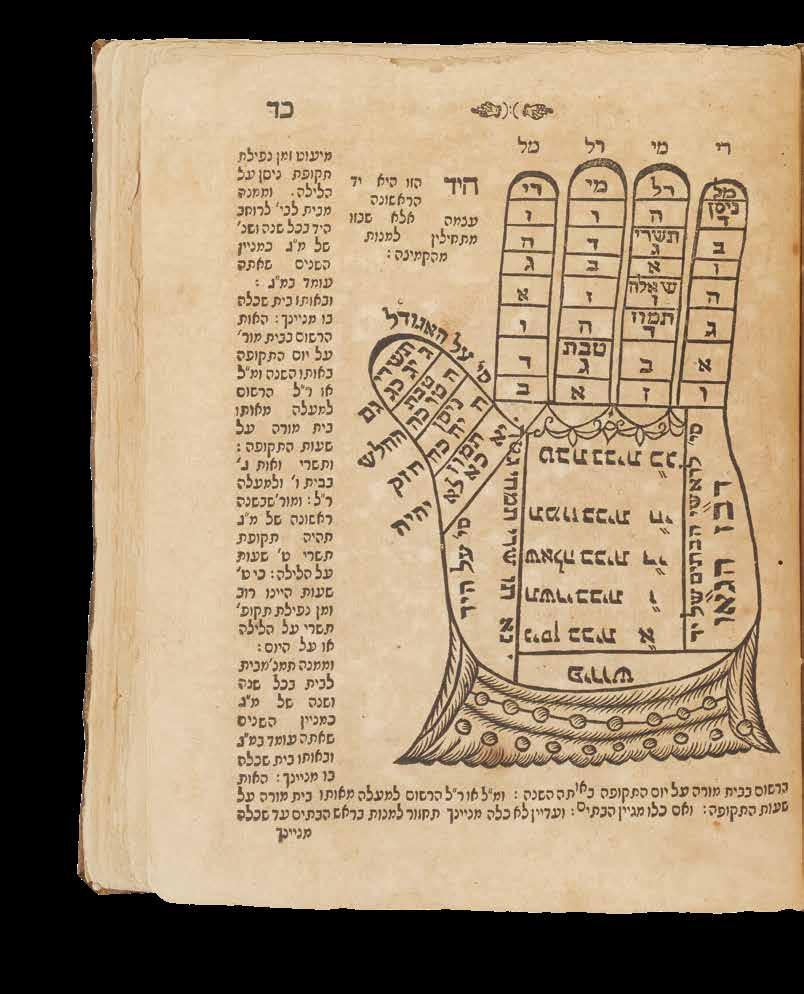
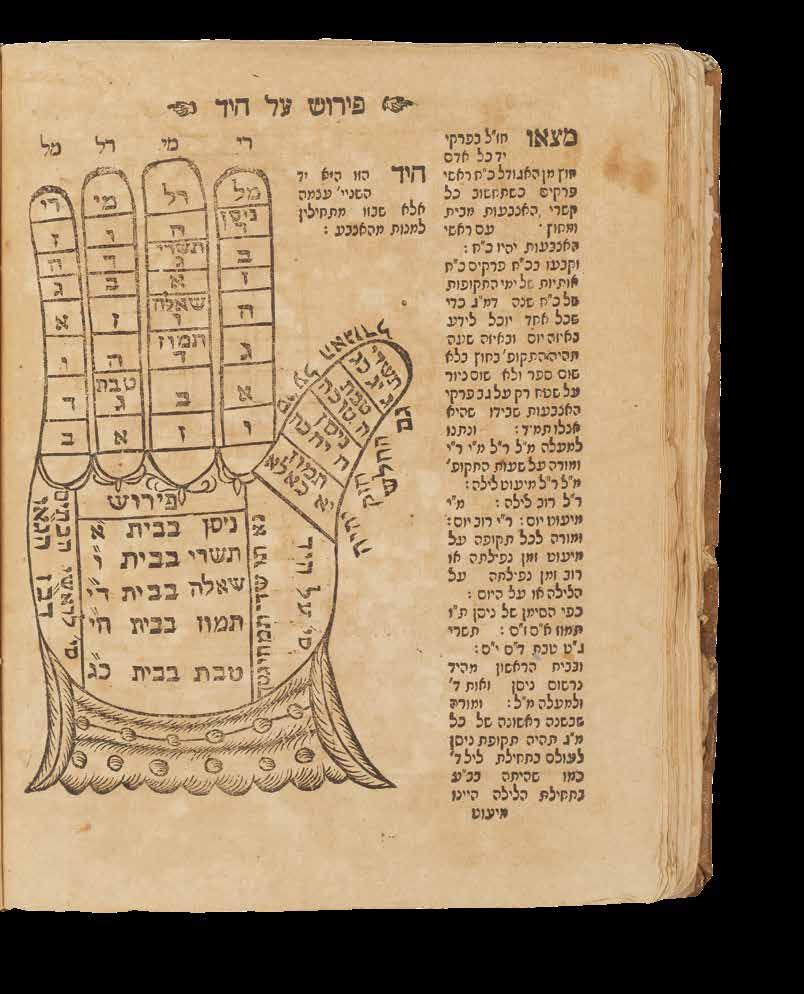
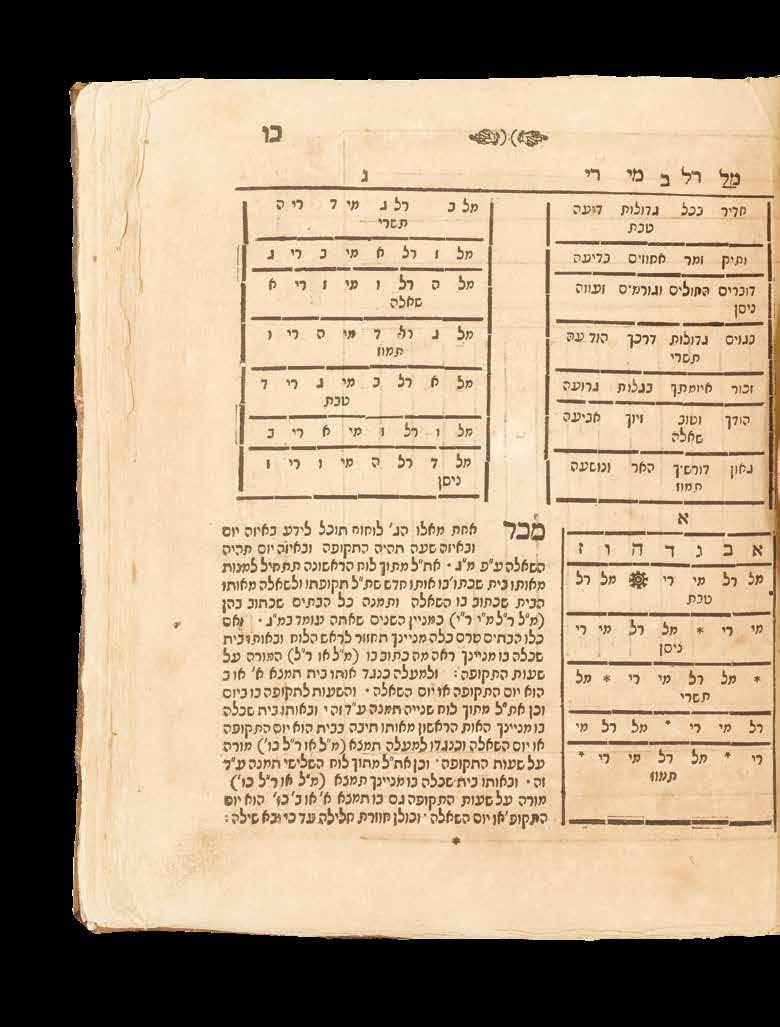
Description Fifth edition overall, first thus. Octavo (190 by 155mm). Woodcut title-page, two woodcut hand palms, one single volvelle, one with two moveable parts, and three with three, with contemporary hand-colour in part; contemporary cats-paw sheep, manuscript label on the spine.
References Karp, ‘From the Ends of the Earth: Judaic Treasures of the Library of Congress’, pages 197-98; Steinschneider 4988; Zedner 221.
Number of items 1
“Astronomy and Calculations of Intercalculation, and the Jewish Calendar” (title)
The first edition of Beilin’s Jewish calendar, “Ibronot”, to include Meir Nathan Joshua Himmelburg’s appendix of charts showing Christian holidays, Saints’ days, notes on solar leap year calculations, and the differences between the Gregorian and Julian calendars.
Beilin’s work is based on that of Jacob Marcaria (1561), and was first published in 1614-1615 (reprinted in 1640, 1691, and 1720). It includes an additional “circular table, which facilitated the determination of holidays and other important dates” (Jewish ‘Encyclopedia’). “The fifth [edition], published in Offenbach, is a particularly beautiful edition with fine illustrations and volvelles for calculations” (Karp).
Eliezer ben Jacob Beilin Ashkenazi was active from 1615.
Provenance
With some near contemporary marginal annotations.
A milestone in educational theory
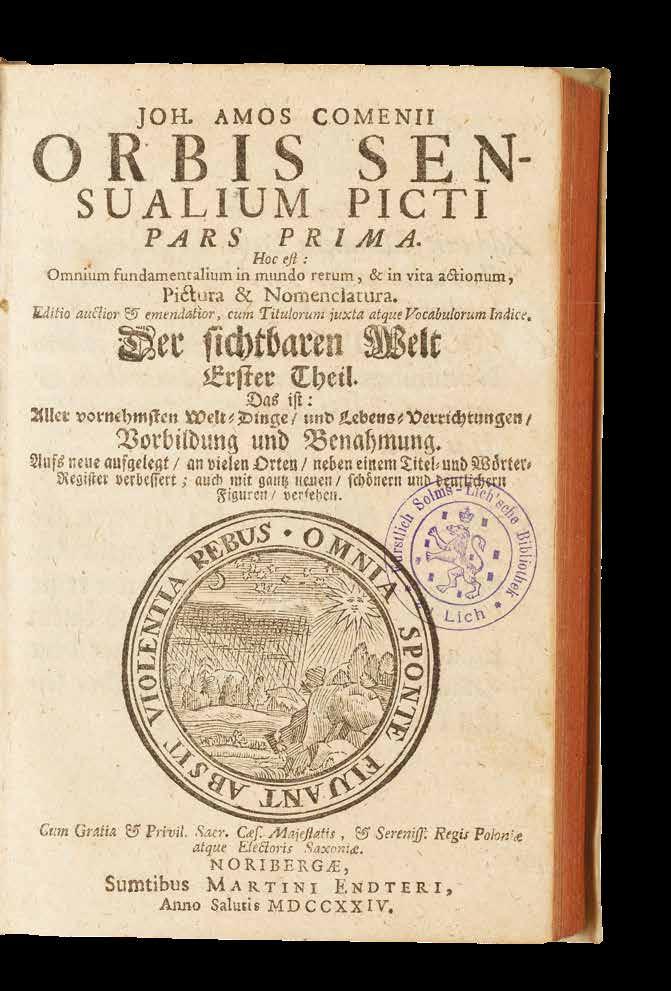
COMENIUS, Johann
Amos Orbis sensualium picti pars prima,...
Publication
Nuremberg, Martin Endter, 1724.
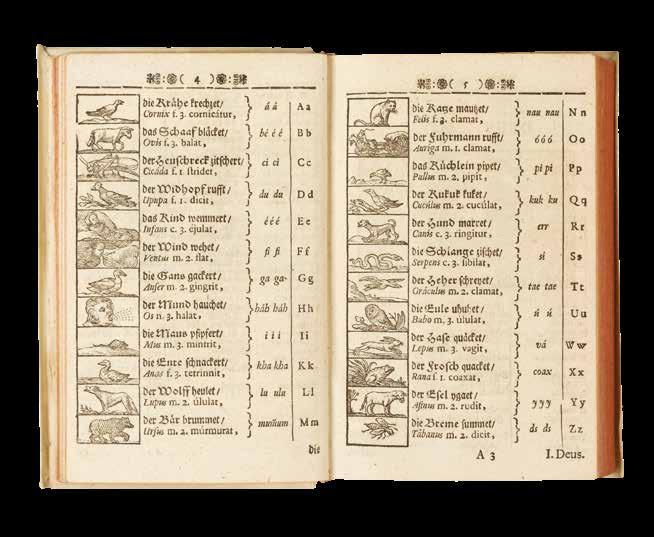
Description Octavo (165 by 110mm). 156 woodcut vignettes, numbered to I to CL, four unnumbered, III is a volvelle, repaired; contemporary polished vellum over pasteboard, yapp foredges.
Number of items 1
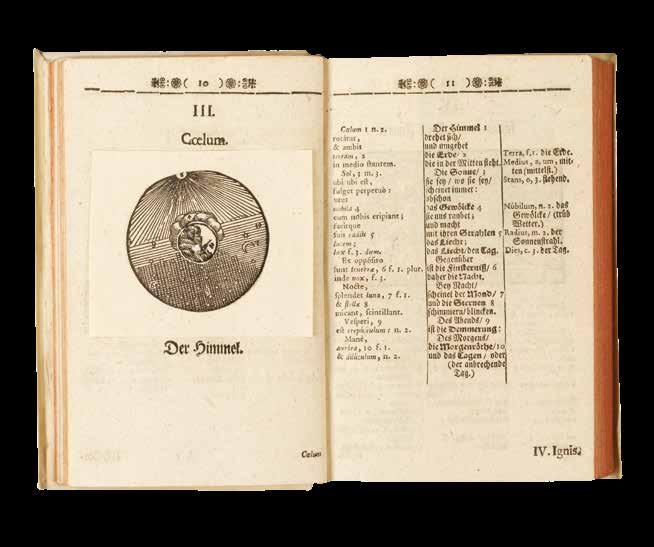
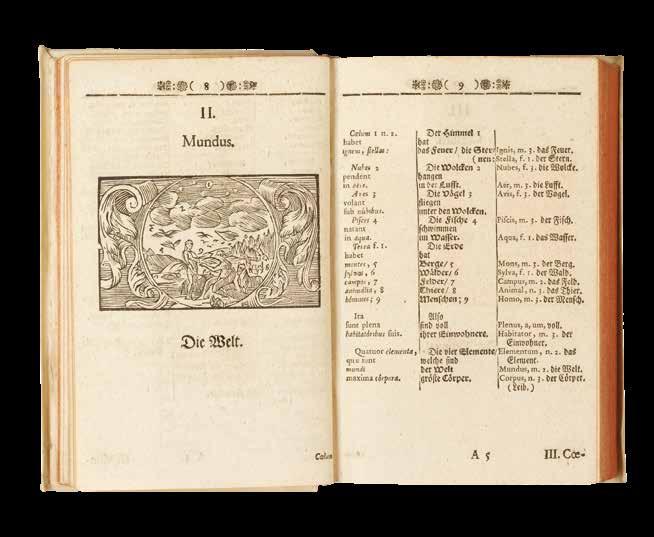
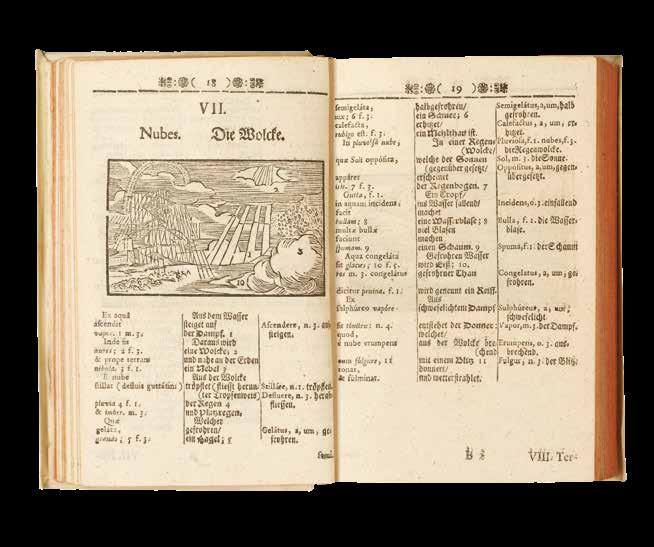
First published in Nuremberg as ‘Orbis pictus...’ in 1658, ‘Orbis sensualium’ is nevertheless an early illustrated book of instruction for children, covering the natural world, geography, religion, trades, etc. It is the second of a series of works by Johann Amos Comenius (1592-1670) on the subject of a holistic approach to education, which should be experiential and participatory. If only...
Provenance
Ink library stamp to title-page.
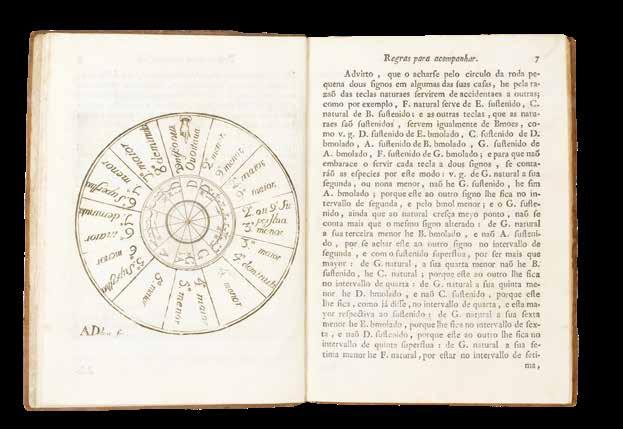
Rules for organs and harpsicords
SILVA, Alberto Joseph Gomes da Regras de Acompanhar para cravo ou orgaõ, e ainde tambem para qualquer outro instrumento de vozes, reduzidas a breve methodo, e fácil percepçaõ.
Publication Lisbon, Na Officina Patriarcal de Francisco Luiz Ameno, 1758.
Description First and only edition. Quarto (215 by 155mm). 12 pages of engraved musical notation, one engraved volvelle with a moveable part; contemporary speckled calf, gently conserved.
References Boaventura, ‘Dicionáro Biográfico Caravelas’; Inocêncio, I, page 24 and VIII, page 23; Vasconcelos, ‘Músicos’, II, page 167.
Number of items 1
As the title states, da Silva’s work is an educational one for beginners, explaining the “rules for the accompaniment of the harpsichord or organ, and also for any other vocal instrument, reduced to a brief and easy to understand method”. The volvelle illustrates the twelve intervals in all major and minor keys.
Alberto José Gomes da Silva (c.1713-1795) was a Portuguese classical organist, known for his operas and sonatas for piano.
Rare: known in only a handful of examples, at: National Library of Scotland, the British Library, the University of Utrecht, and University of Buffalo.
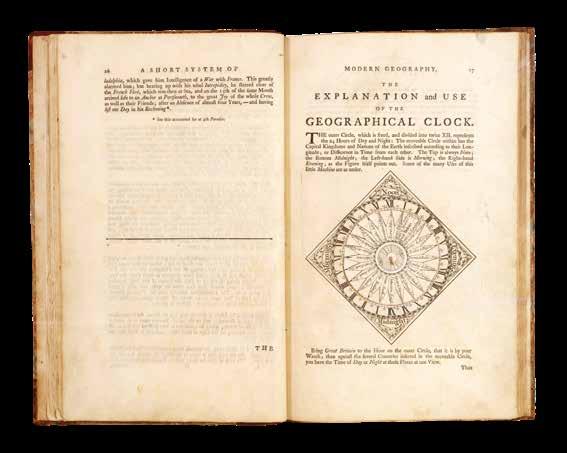
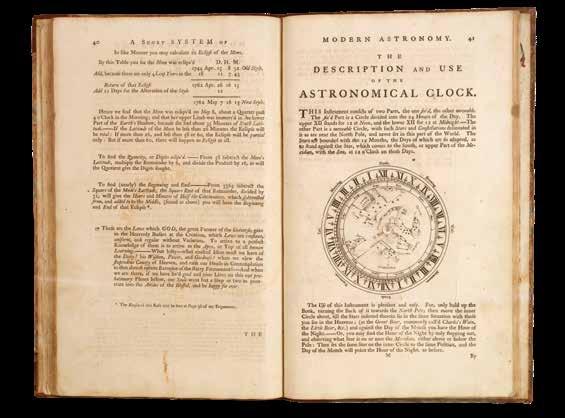
TURNER, Richard
A View of the Earth: Being a short, but comprehensive System of Modern Geography,... To which is added, A Description of the Terrestrial Globe:... [and] A View of the Heavens: Being a Short, but Comprehensive System of Modern Astronomy.... To which is added, The Use of the Caelestial Globe;...
Publication
London and Worcester, Printed for S. Crowder, in Pater-noster Row; and S. Gamidge, in Worcester, 1766 and 1765.
Description
Second edition of the ‘Earth’; first edition of the ‘Heavens’. Two works in one volume. Folio (320 by 200mm). ’Earth’ with engraved frontispiece map, five further maps, one plate, and illustrations in the text including one with a volvelle; ‘Heavens’ with two engraved plates, engraved illustrations in text including one with a volvelle; contemporary marbled paper boards, rebacked to style.
Number of items
1
Geographical and Astronomical clocks
With a double-hemisphere world map, maps of the continents, a plate of a terrestrial globe, and of geographical and astronomical clocks.
Richard Turner is described as “Late of Magdalen-Hall, Oxford; now Rector of Comberton, Vicar of Elmley, and Teacher of the Mathematics and Philosophy, at Worcester; Author of a ‘View of the Heavens, or an Introduction to Modern Astronomy’; ‘Plain Trigometry rendered easy and familiar, by Calculations in Arithmetic only’; and the ‘Chronologer Perpetual’” (title-page).
Provenance
With the near contemporary ownership inscription on the world map of William [illegible], and endpapers decorated with manuscript scale bars.
HOFMANN, Christian Gotthilf
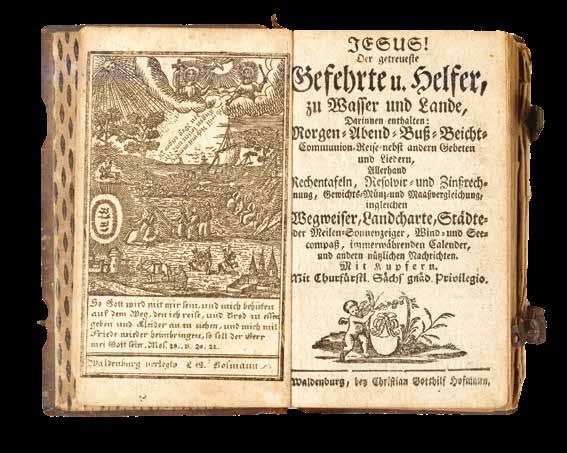
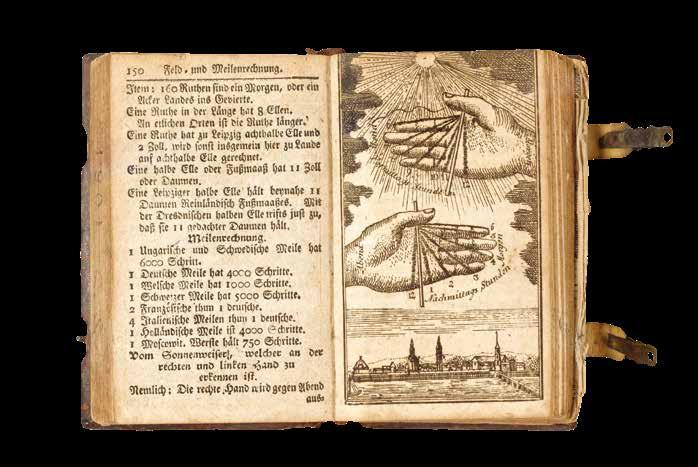
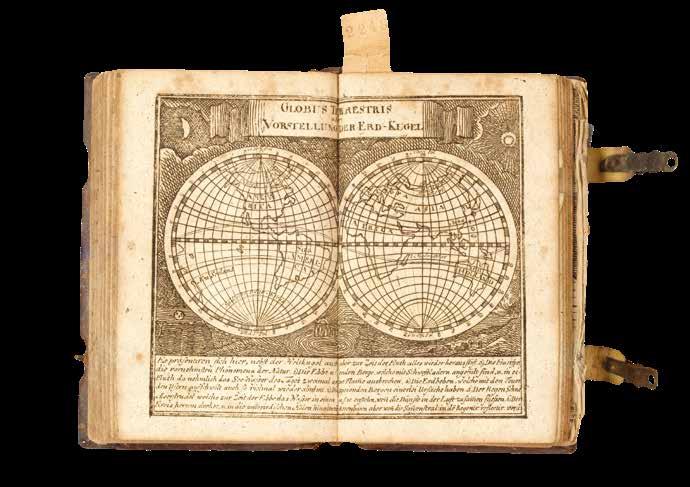
Jesus! Der getreue Gefahrte und Helfer - Der Getreue Gefahrte und Helfer. zu Wasser und Lande; darinnen enthalten: MorgenAbend- Buss- Beicht- CommunionReise- nebst andern Gebeten und Liedern, allerhand Rechentafeln, Resolvir- und Zinsrechnung, Gewichts- Münz- und MaassVergleichung, ingleichen Wegweiser, Landkarte, Städteoder Meilenzeiger, Sonnenzeiger, Wind- und Seecompass, immerwährenden Calender, und andere nützliche Nachrichten...
Publication Waldenburg, Christian Gotthilf Hofmann, [c.1786-1801].
Description
Two parts in one volume. 12mo., (115 by 70mm). Woodcut frontispiece, one doublepage and one folding map, two full-page plates, one with two volvelles, one loose and missing the phases of the moon, and a large folding engraved table of distances; contemporary polished calf, remains of clasps and catches.
Number of items c.40
How to make a compass with your hands
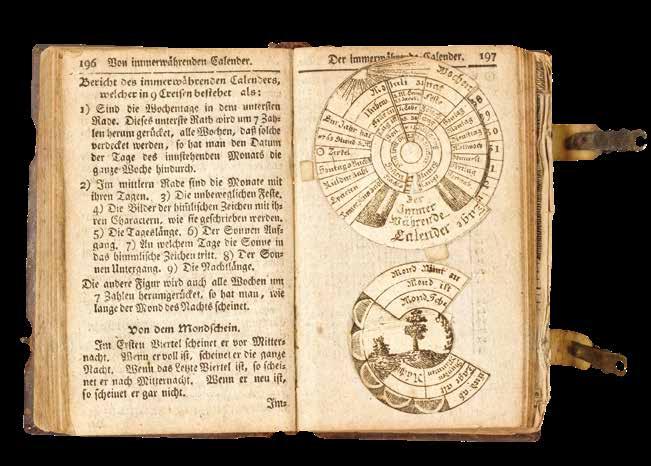
A pocket guide for travellers, including prayers and songs for various situations, conversion charts for all kinds of German currency, a folding map of Central Europe, instructions for making a “sun compass” with your hand, a world map, a folding chart of the distances from town to town as far as London and Constantinople, and a perpetual calendar consisting of two volvelles - one for the phases of the moon, and the other for the days of the week.
The calendar for calculating Easter dates runs from 1786 to 1880.
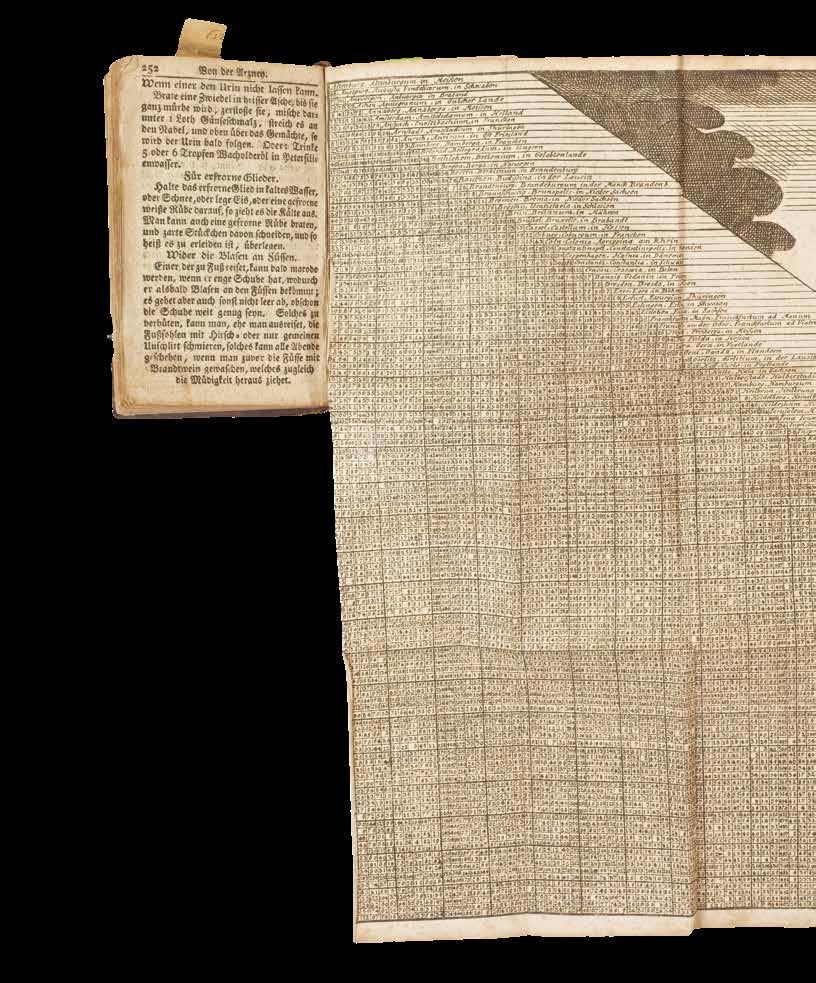
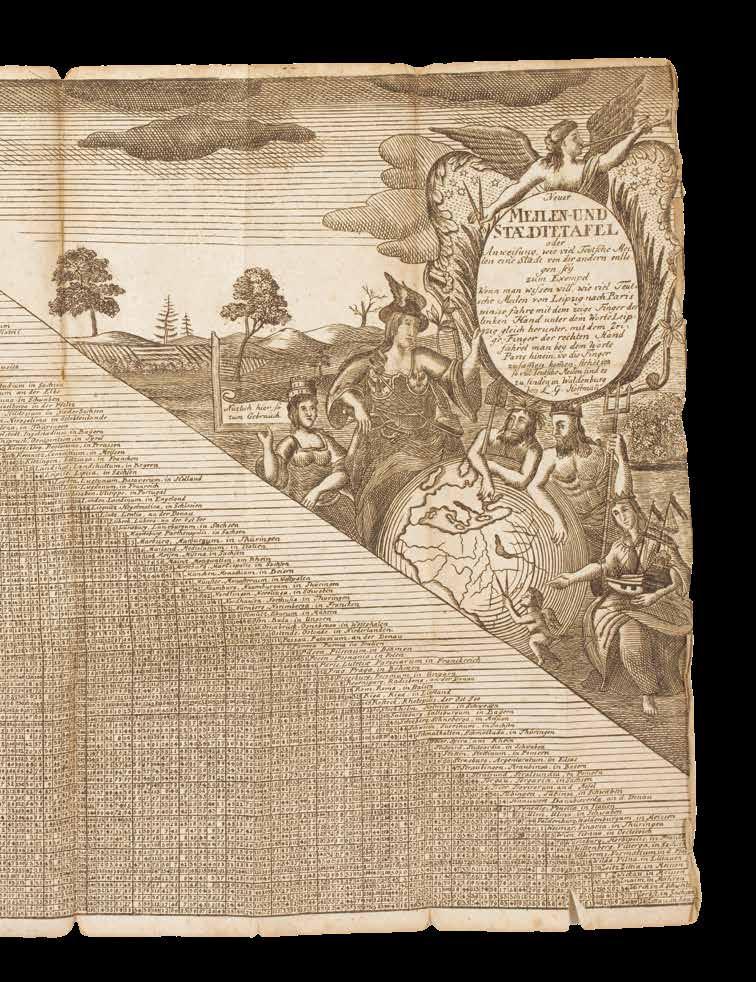
The extensive distance table, with a large decorative cartouche, contains a detailed legend on how to use the table: “New mile and city table or instructions on how many German miles one city is from another. For example, if you want to know how many German miles there are from Leipzig to Paris, move the two fingers of your right hand over the word Paris. Where the fingers come together, you will see that there are so many German miles to be found in Waldenburg by L.G. Hoffman”.
Provenance
Near contemporary wood-engraved bookplate printed in red and black at end; endleaves inscribed with copious contemporary notes; fore-edge inscribed “1801”.
[WITH]: A further significant collection of approximately 30 titles illustrated with volvelles. Including:
- DUDLEY, Robert. ‘Dell’Arcano del Mare,...’. Firenze, Nella Stamperia di Francesco Onofri, 1646. Two volumes (I and II only, of 6) in one. Folio. Vignette title-page to volume I; 29 engraved plates in volume I, 14 (lacking 13 charts) in volume II, some single, or two to a page, most double-page and or folding, and with volvelles; contemporary limp vellum, gilt, supralibros of the arms of Bourbon-Conde on both covers.
Provenance
1. Arms of Bourbon-Conde, probably Louis II de Bourbon (1621–1686), Prince of Condé (1646-1686);
2. Near contemporary marginal annotations; 3. by descent to Prince Francis of the Two Sicilies, Count of Trapani (1827-1892), inscribed (presumably) by him “Libro prezioso e rarissimo - Trapani”, on the verso of the first blank; 3. Miriam Leaber, her sale, Sotheby’s, London, November 1956, lot 444; 4. With Maggs Bros. The first two books, only, of the first edition of Dudley’s magnificent sea atlas, from the library of the Bourbon-Conde family. Book one deals with longitude; book two covers errors in the then-existing sea charts.
- Two facsimile examples of Apianus’s ‘Astronomicum Ceasareum’ (1967), copy number 100, and copy number 714.
- Sturt’s edition of the ‘Book of Common Prayer’ (1717).
- Mihill’s ‘A Treatise on the Lengths of Days, Nights and Twilightss’ (1755).
- Rubie’s ‘British Celestial Atlas’ (1830).
- Bentley’s ‘Mondern Geography’ (1839).
- White’s ‘Plain Spherical Globe’ (c.1840).
LAYERS UPON LAYERS
LINO, Moroni; Domenico FALCINI; Jacopo LIGOZZI; and Raphael SCIAMINOSSI
[Descrizione del Sacro Monte della Vernia].
Publication Florence, 1612.
Description
First edition. Folio (450 by 320mm). 24 leaves letterpress with typographic borders; elaborate engraved frontispiece altered in manuscript, 23 engraved and etched plates, including two folding, of which one is of three joined leaves, and one of is of two, four plates with a total of six engraved hinged overslips, complete; contemporary limp vellum, rebacked, soiled.
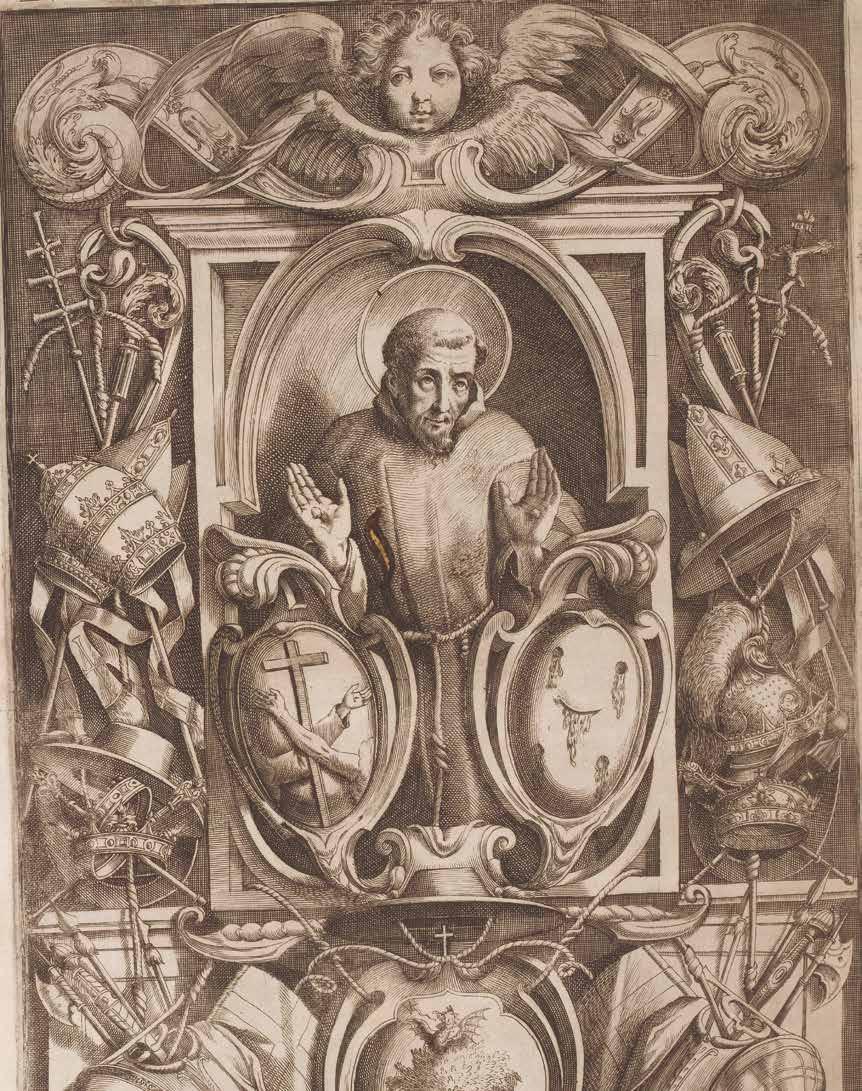
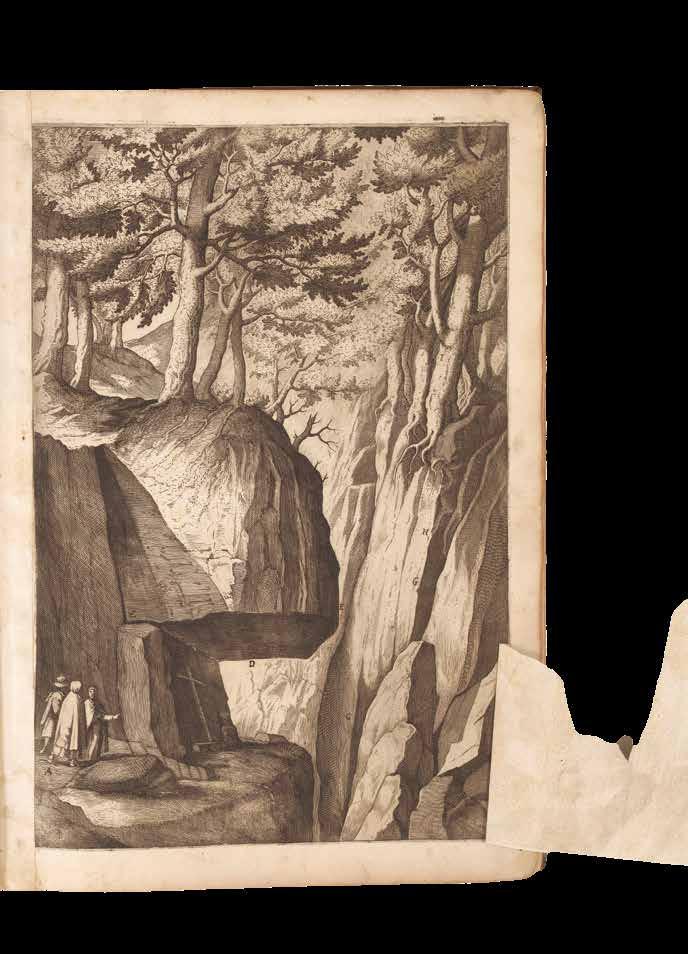
The defining miracle of Saint Francis of Assisi’s life occurred while he was praying at the hermitage at La Verna in 1224, when he received the stigmata (wounds) of Jesus Christ - nail marks on his hands and feet, and a gash in the side of his chest. The stigmata remained with St. Francis until his death two years later. In this example, the magnificent frontispiece is altered in manuscript to show the stigmata on St. Francis’s left side. Issued without a title-page, the dedication leaf reads: “Illmo. et reuerendissmo. patron mio colendissmo. monsignor arciuescouo di Monreale e generale de’ Minori osservanti, frate Arcangelo da Messina s. Dismettendo ogni cerimonia... vengo à dedicarli quest’opera della descrizione del sacro monte della Vernia... il disegnatore è stato... sig. Iacopo Ligozio... Di Fiorenza il dì primo di giugno 1612... Fra Lino Moroni di Firenze”.
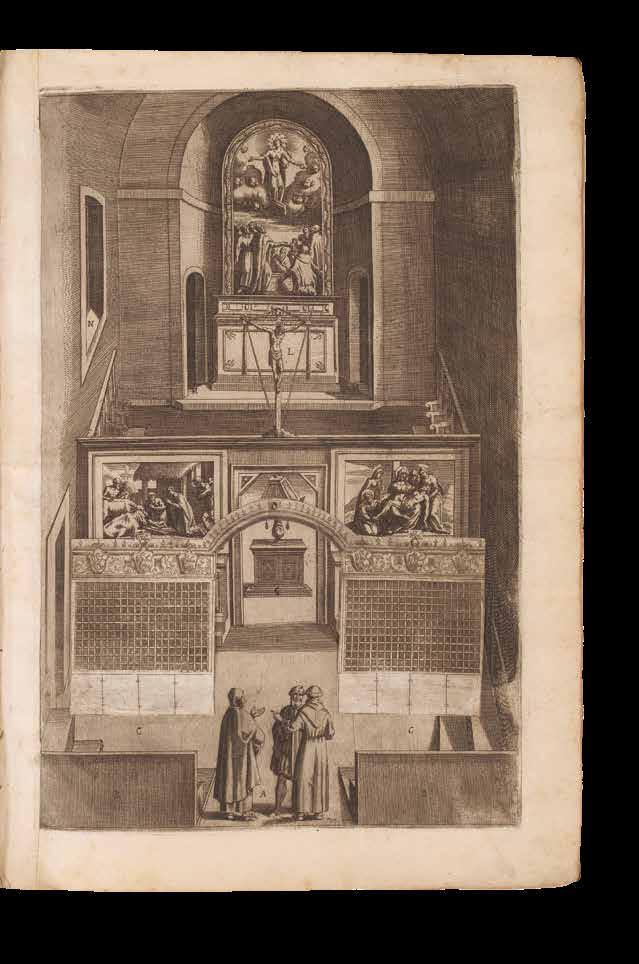
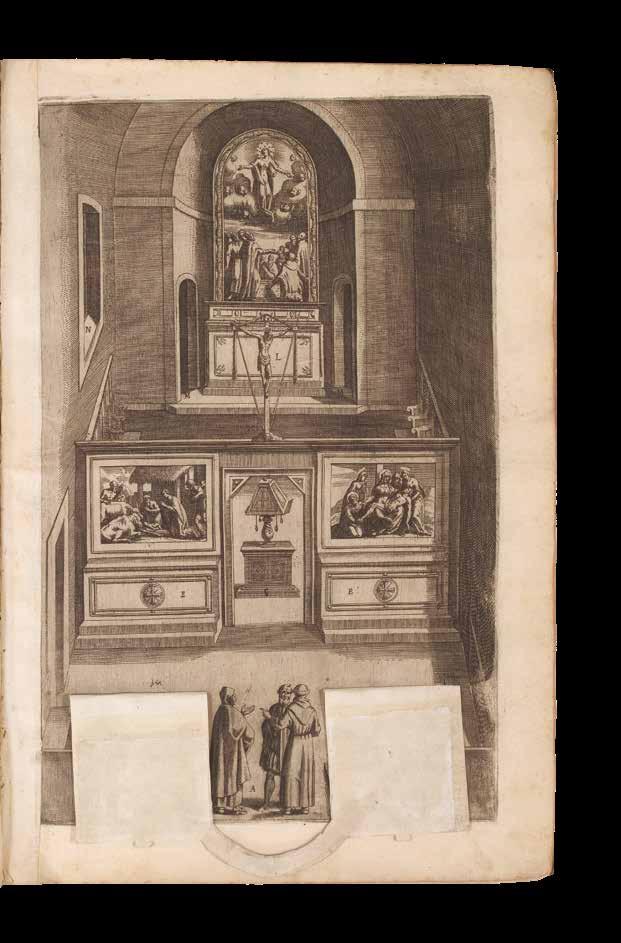
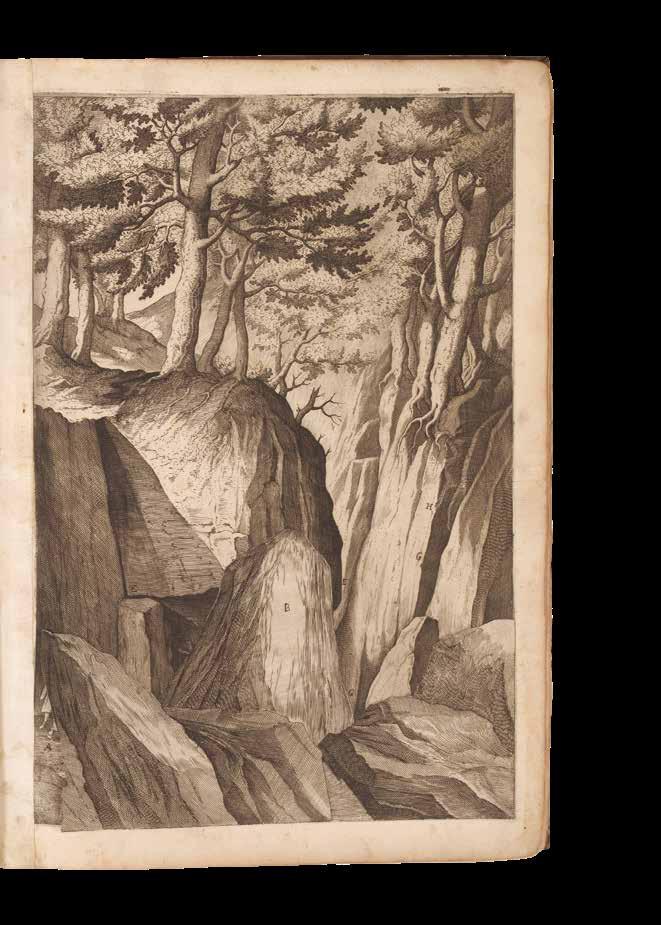
The extremely dramatic plates are by Jacopo Ligozzi and Raphael Sciaminossi, and illustrate St. Francis’s experiences on Mount Verna, in Tuscany. On several plates, hinged overslips are moved to reveal hidden staircases or entrances to small chapels. Fra Lino Moroni was a Franciscan Observant, and the provincial minister for the Tuscan order in 1607, when he made his pilgrimage to La Verna with artist Jacopo Ligozzi (1547–1627).
Rare. One example at Dumbarton Oaks Library; two copies in British Library.
Provenance
Numerous nineteenth-century notes inserted before the title-page.
St. Francis on La Verna
REMMELIN, Johan
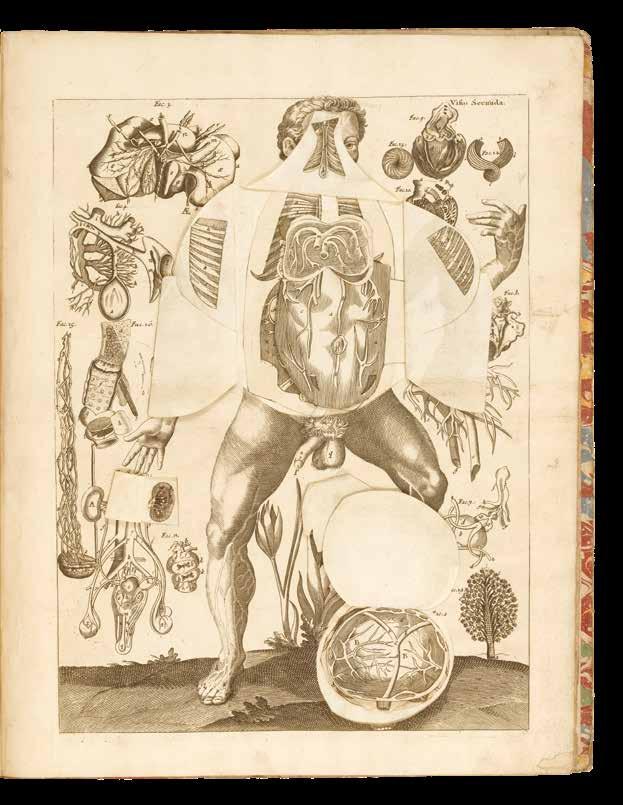
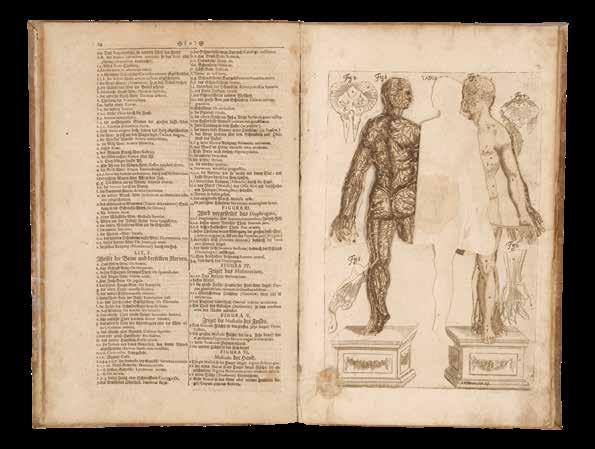
A Survey of the Microcosme: or, The Anatomy of the Bodies of Man and Woman. Wherein the Skin, Veins, Arteries, Nerves, Muscles, Viscera, Bones and Ligaments thereof are Accurately Delineated, and so Disposed by Pasting, as that all the Parts of the said Bodies, both Internal and External are Exactly Represented in their Proper Site. Useful for all physicians, chyrurgeons, statuaries, painters, &c. By Michael Spaher of Tyrol, and Remilinus. Corrected by Clopton Havers, M. D. and Fellow of the Royal Society.
Publication London, Dan. Midwinter, and Tho. Leigh, 1702.
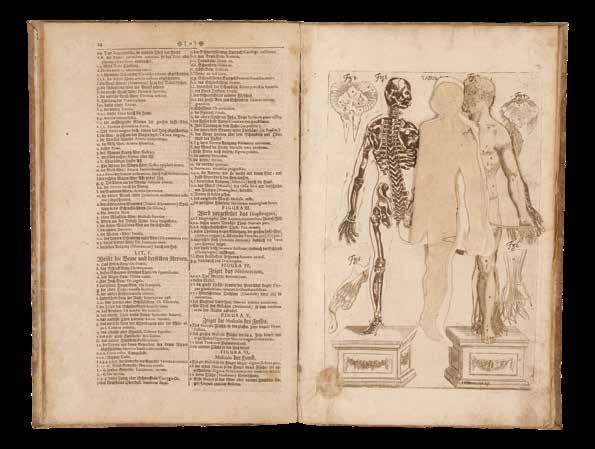
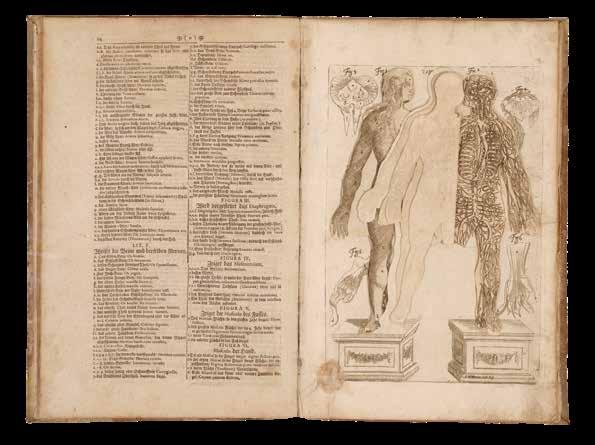
Description “Second edition”. Folio (400 by 325mm). Letterpress title-page, and four pages of text, some staining; four engraved plates with engraved hinged overslips; contemporary calf-backed marbled paper boards.
References cf. Choulant-Frank, page 232; ESTC T147736; cf.‘Heirs of Hippocrates’ 456; cf. Krivatsy 9551; cf. Wellcome I, 5418.
Number of items 1
“Useful for all physicians, chyrurgeons, statuaries, painters, &c.”
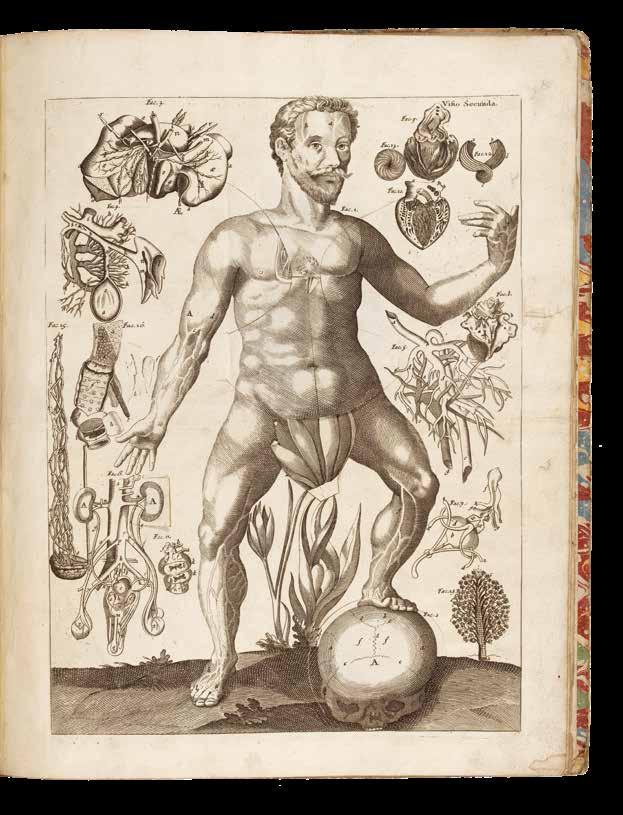
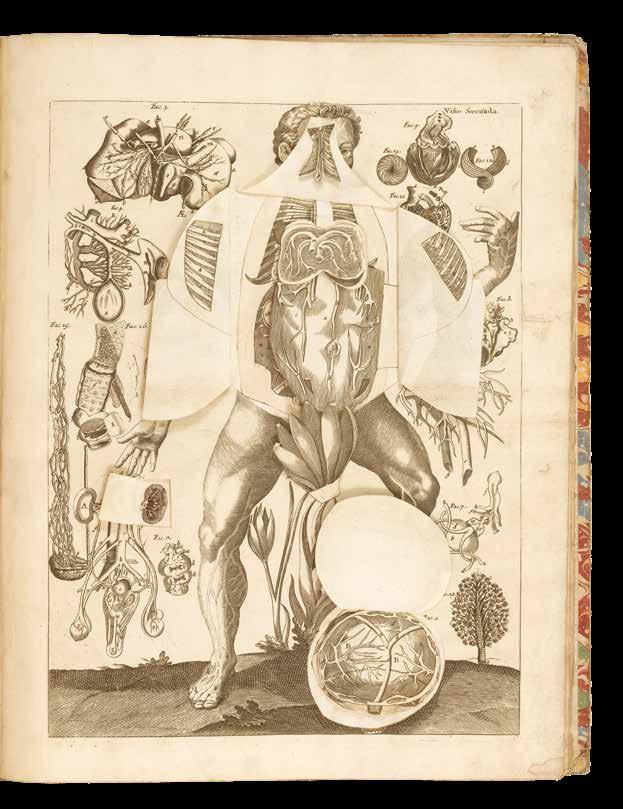
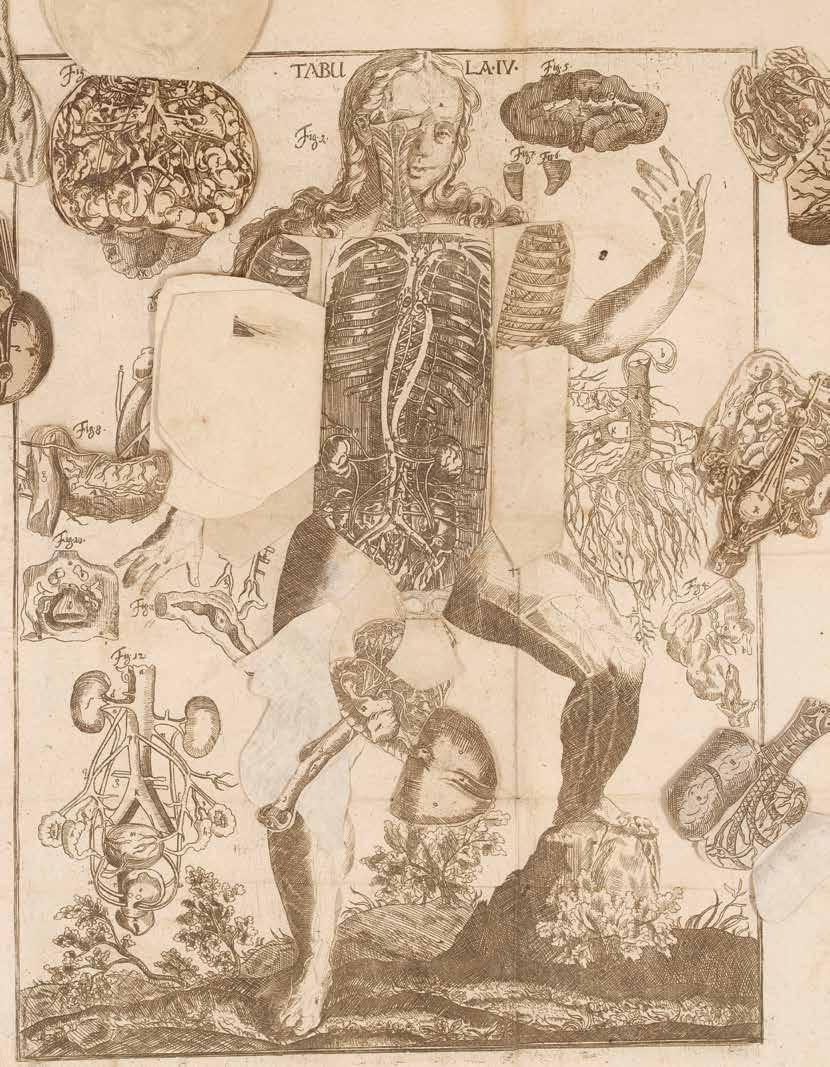
While “Adam & Eve” books, with multi-layered hinged overslips, or “flaps”, were a popular way to illustrate human anatomy throughout the sixteenth century, Remmelin’s ‘Catoptrum Microcosmicum’, is acknowledged as the first anatomical atlas, in which the muscles, bones, and viscera of the human body, are revealed in successive layers. Although first published in a pirated edition without text in 1613, the first “authorised” edition, ‘Catoptrum microcosmicum’ (Microcosmic Mirror) was designed to reflect the classical notion of man as microcosm, or the epitome of the universe. It was issued in Ulm in 1619, with text in Latin.
The current example, with English text, although referred to on the title-page as the “second edition”, is preceded by at least three earlier English issues published between 1675 and 1695; there was also a further subsequent edition in 1738. Michael Spaher of Tyrol is credited in the title, but it is not certain what role, if any, he had in the production of this work.
Johan Remmelin (1583-1632) was a doctor in Ulm, and then later in Augsberg, where he also served as a plague physician.
Provenance
From the library of Martin Woolf Orskey (1925-2018), bookseller.
HELLWIG, Christoph von; and Johann Heinrich WERNER
Nosce te ipsem, vel anatomicum vivum: Oder Kurtz gefastes doch richtig gestelltes Anatomisches Werck.
Folio (335 by 215mm). Title-page printed in red and black with vignette portrait of the author, title-page repaired lower outer corner; two full-page and two folding engraved plates with multiple engraved and etched hinged overslips, complete; half vellum, vinegar marbled paper boards.
Number of items 1
Remmelin
German-language adaptation of Johann Remmelin’s ‘Catoptrum microcosmicum’ (1613), with the plates reversed and reduced from the engravings for the Latin edition of 1619.
[TRABAUD, Jean]
Principes sur le mouvement et l’equilibre, pour servir d’introduction aux mecaniques & a la physique.
Publication Paris, Jean Desaint & Charles Saillant, 1741.
Description
First edition. Two parts in one volume. Quarto (245 by 185mm). Woodcut device on each title-page, 25 engraved folding plates, including one with complicated hinged overslips, woodcut initials and headpieces; contemporary polished mottled calf, gilt, front hinge weak.
References ’Bibliotheca Mechanica’, page 325; DSB I, 113; Honeyman, 805.
Number of items 1
An ellipse with some slips
In the mid-eighteenth century, French mathematician Jean-François Trabaud published an introductory work to mechanics and physics. The first work takes in all aspects of the movement of bodies and weights, percussions of bodies and statics, hydrostatics, and equilibrium of fluids and hydrodynamics; the second work concerns the formation of ellipse. The theoretical information is illustrated by diagrams and models, one of which is augmented by unfolding elements.
“In the text Trabaud makes reference to Jean Bernoulli, Leibniz, Varignon, Descartes, de la Hire, and other authors represented in this collection” (‘Bibliotheca Mechanica’).
With complicated moveable schemata
EUCLID; COWLEY, John Lodge
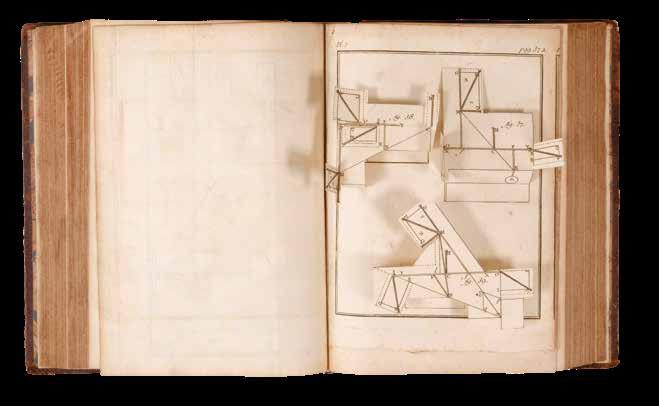
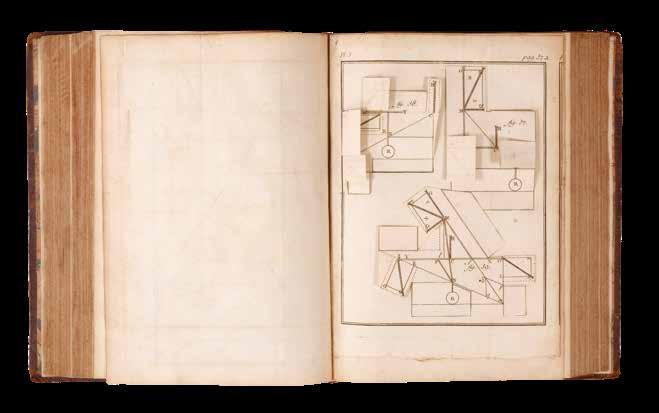
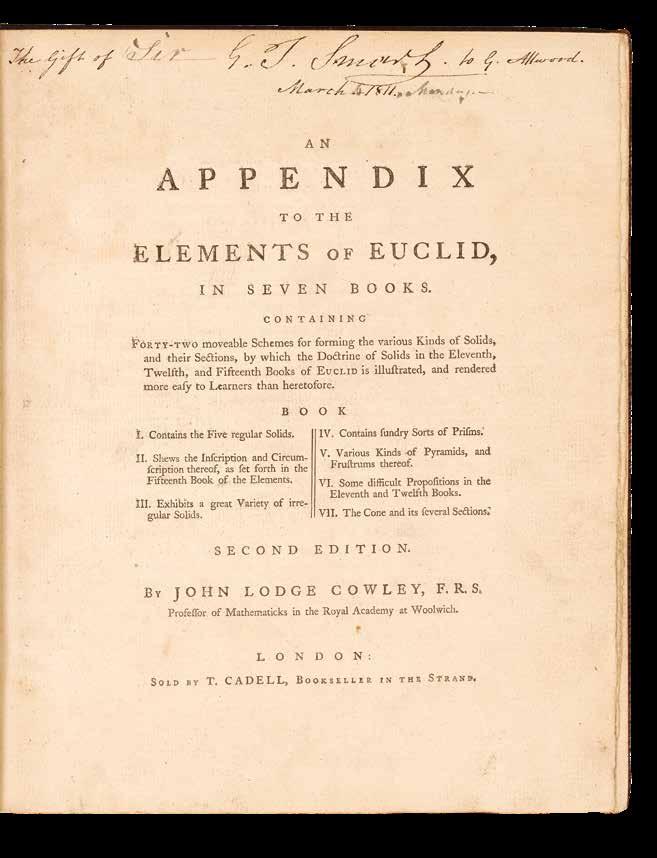
An Appendix to the Elements of Euclid in Seven Books; containing forty-two movable schemes for forming the various kinds of solids and their sections by which the doctrine of solids in the eleventh, twelfth, and fifteenth books of Euclid is illustrated, and rendered more easy to learners than heretofore.
Publication London, Sold by T. Cadell, Bookseller in the Strand, [1765].
Description
Second edition. Quarto (290 by 245mm). 42 engraved plates, all partly cut out to allow for the display of their complicated function; contemporary speckled calf, gilt.
References Lowndes, II, 540.
Number of items 1
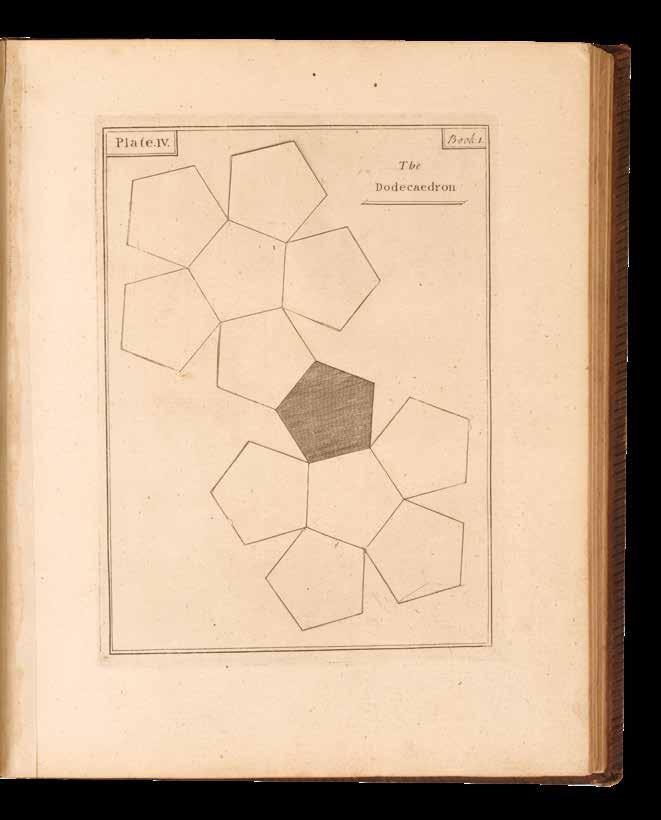
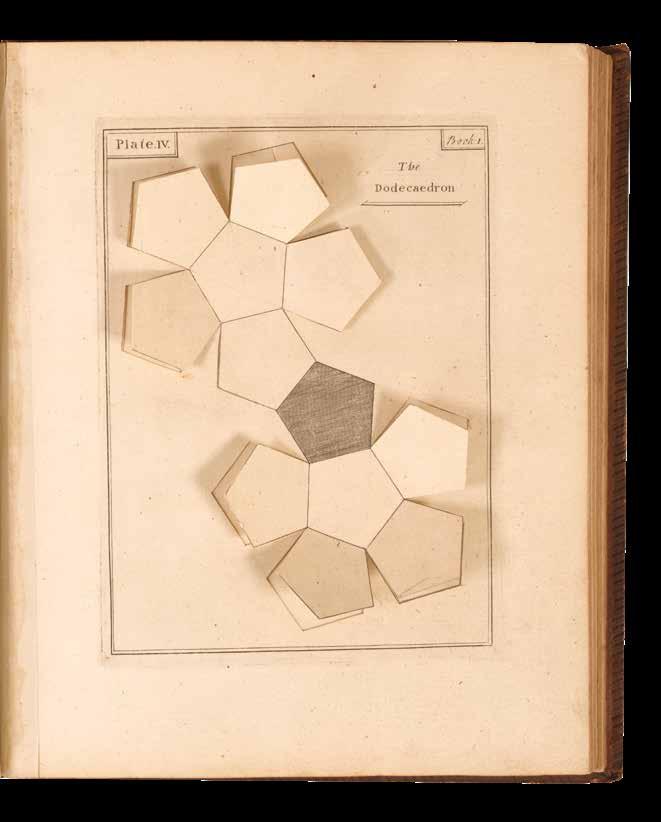
First published thus in 1758, the book includes a series of ingenious plates, partially incised and scored, that can be folded into precise three-dimensional solid shapes.
“Book I. Contains the five regular solids - II. Shews the inscription and circumscription thereof, as set forth in the fifteenth book of the elements - III. Exhibits a great variety of irregular solids - IV. Contains sundry sorts of prisms - V. Various kinds of pyramids, and frustrums thereof - VI. Some difficult propositions in the eleventh and twelfth books - VII. The cone and its several sections”.
John Lodge Cowley (1719-1797) mathematician, Professor of Mathematics at the Royal Military Academy, Woolwich (1761-1773), elected a Fellow of the prestigious Royal Society in April 1768, and cartographer Royal to King George II. He taught geometry at the St. Martin’s Lane Academy, and was the author of other geometrical books, ‘Geometry Made Easy’ (1752), ‘An Appendix to Euclid’s Elements’ (1758), and ‘The Theory of Perspective Demonstrated’ (1765). But his best-known work is perhaps ‘A new sett of pocket mapps of all the counties of England and Wales’ (1745).
[WITH]:
-EUCLID; KEIL, Dr. John; Samuel CUNN; and John HAM Elements of Geometry, from the Latin translation of Commandine. To which is added, A Treatise of the Nature of Arithmetic of Logarithms; Likewise Another of the Elements of Plain and Spherical Trigonometry; With a Preface, shewing the Usefulness and Excellency of this Work. By Doctor John Keil, F.R.S. and late Professor of Astronomy in Oxford. The Whole revised; where deficient, supplied; where lost or corrupted, restored. Also Many Faults committed by Dr. Harris, Mr. Caswel, Mr. Heynes, and other Trigonometrical Writers, are shewn; and in those Cases where They are mistaken, here are given Solutions Geometrically true... London, Printed for Tho. Woodward at the Half-Moon, between the Two Temple-Gates in Fleet Street, 1733. Third edition, “carefully revised and corrected”. Octavo (195 by 120mm). 18 folding engraved plates, the last with three hinged overslips; contemporary speckled calf, gilt, front cover a bit loose.
Provenance
1. “The Gift of Sir G.J. ?Schwartz to G. Atwood, March 4, 1811, Monday” inscribed on the title-page;
2. With the ownership inscription of “G. Atwood St. John’s Coll. 1815”.
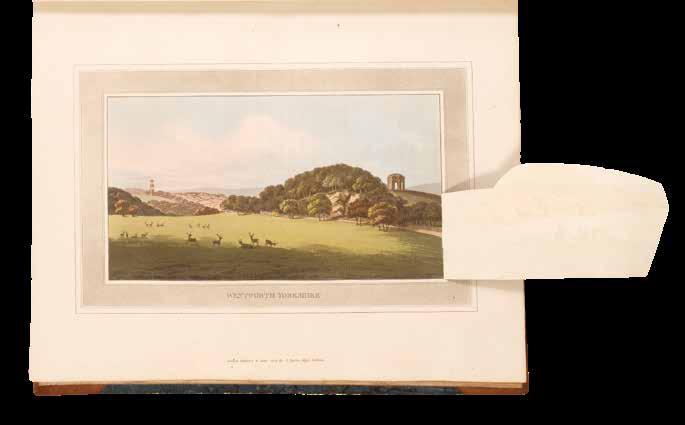
REPTON, Humphrey
Observations on the Theory and Practice of landscape Gardening: including some remarks on Grecian and Gothic architecture, collected from various manuscripts, in the possession of the different noblemen and gentlemen, for whose use they were originally written: the whole tending to establish fixed principles in the respective arts.
Publication London, Printed by T. Bensley, Bolt Court, for J. Taylor, at the Architectural Library, High Holborn, 1803.
Description
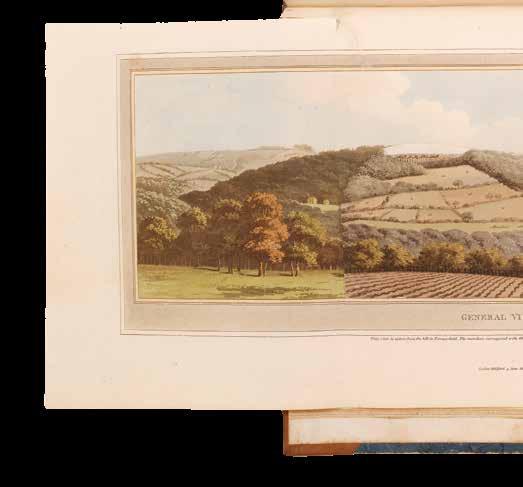
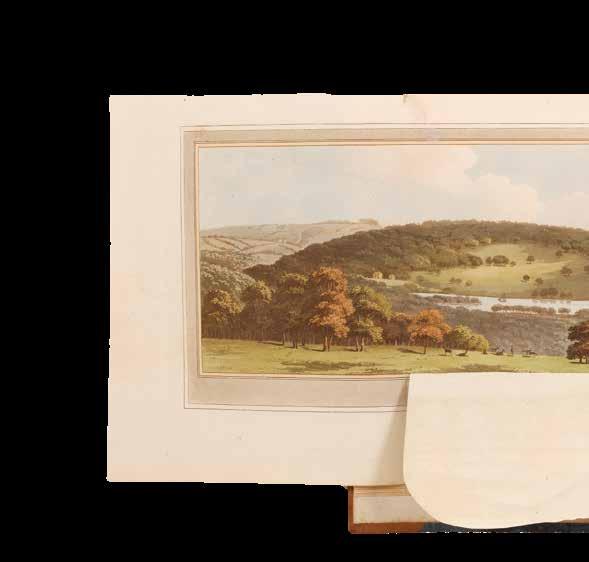
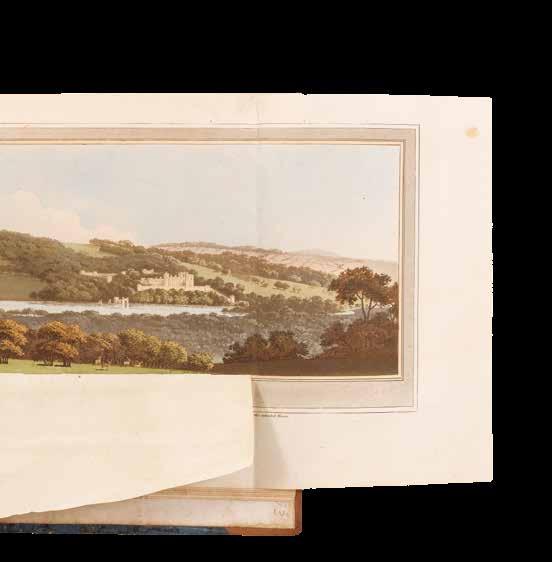
First edition. Folio (340 by 270mm). Stipple-engraved frontispiece portrait, 11 aquatint plates with contemporary handcolour, including nine with hinged overslips, and one folding, 14 engraved plates, many with aquatint, some tinted, three with hinged overslips, one double-page, and two engraved maps including one with contemporary hand-colour, 11 aquatint vignettes and illustrations in the text, two with hinged overslips, wood-engraved illustrations; modern half calf over early blue paper boards, antique.
“I must therefore intreat that the plates be rather considered as necessary than ornamental...”
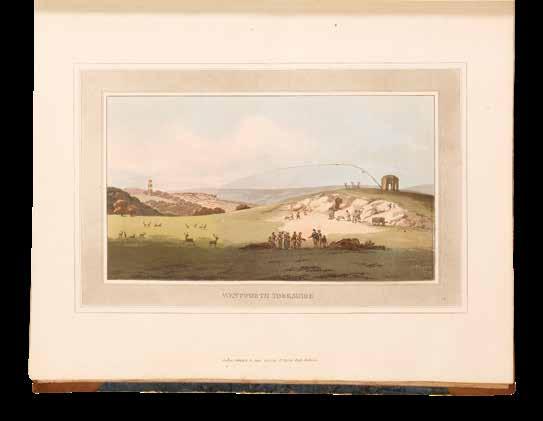
“The present work neither supersedes, nor contradicts my former work, neither is a repetition nor a continuation; but to avoid the oblong and inconvenient shape of that book the present volume is printed under a different form and title, because I am less ambitious of publishing a book of beautiful prints, than a book of precedents: I must therefore intreat that the plates be rather considered as necessary than ornamental; they are introduced to illustrate the arguments, rather than attract the attention. I wish to make my appeal less to the eye, then to the understanding” (’Advertisement’).
Humphrey Repton (1752–1818), landscape gardener, “fashioned his sense of self through his profession and the journeys which underpinned it but also how the concept of ‘character’ is central to his portrayal of both places and people. Despite Repton’s own pessimism about his career and reputation, his influence on English landscape gardening has proved more powerful than that of any of his predecessors, rivals, or successors. The flexibility of his style, applicable to small gardens and large parks, incorporating a variety of architectural and horticultural features, and accommodating informal, domestic social arrangements, has ensured an enduring appeal” (Daniels).
Provenance
Ownership inscription of Emma Bill dated 1817 on front free endpaper.
REPTON, Humphry; John ADEY; and George STANLEY
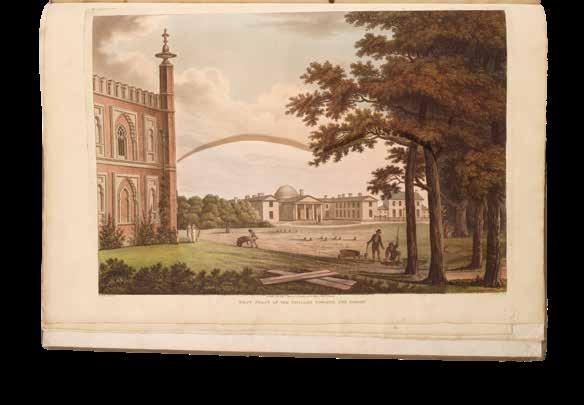
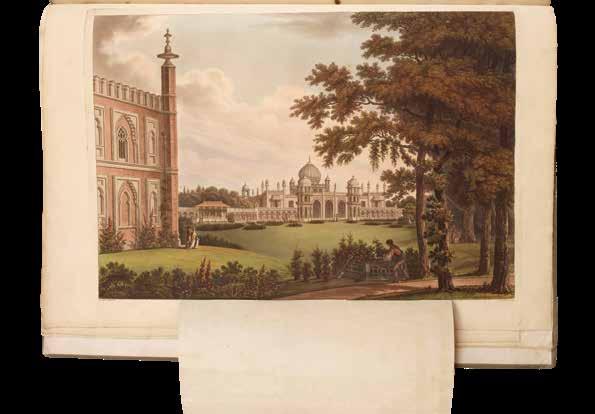
Designs for the Pavillon [sic] at Brighton. Humbly Inscribed to His Royal Highness the Prince of Wales. By H. Repton; with the assistance of his sons, John Adey Repton and G.S. Repton, Architects.
Publication
London, Printed for J.C. Stadler, no. 15, Villiers Street, Strand, and sold by Boydell and Co., Cheapside; Longman, Hurst, Rees, and Orme, Paternoster Row; White, Fleet Street; Cadell and Davies, Strand; Payne and Mackinlay, Strand; Payne, 86, Pall Mall; Miller, Albermarle Street; and Taylor, Holborn, 1808.
Description
First edition. Folio (550 by 380mm). Aquatint frontispiece, 18 further aquatint plates or illustrations, nine with contemporary hand-colour, two printed in sepia, six with hinged overslips, one with cut-out overpage, two double-page, one plan with contemporary hand-colour; modern cloth backed, original publisher’s grey paper boards, uncut.
The year of 1805, Repton wrote, was the “pinnacle of my ambition”, for he “secured his most promising commission of all, to refashion the Royal Pavilion at Brighton for the prince of Wales... Repton worked on the commission for Brighton Pavilion with three of his sons, John Adey, George Stanley, and Humphry the younger. They chose an Indian style, explicitly modelled on the illustrations in volume one of William Daniell’s ‘Oriental Scenery’ (1805), and prepared a sumptuous “red book”. Repton was again disappointed. His design was not implemented, nor was he paid for his work; moreover, John Nash prepared another design loosely based on Repton’s which was eventually built. Repton tried to salvage something from the commission by publishing ‘Designs for the Pavillon at Brighton’ [as here]” (1808).
Provenance
With the bookplate of Wigan Free Public Library on the front paste-down, and their blind library stamps in the margins of 6 plates.
TUSON, Edward William
Myology, Illustrated by Plates. In Four Parts. Part I. Muscles of the Anterior and Posterior Parts
The Thigh, Leg, and Foot; Part II. Muscles of the Anterior and Posterior Parts The Arm and Hand; Part III. Muscles of the Abdomen and Back; Part IV. Muscles of the Face and Eye, Anterior and Posterior Parts of the Neck, with the Muscles of the Perineum, completing the whole of the Muscles of the Human Body.
Publication London, Published by Callow and Wilson, Medical Booksellers, 16, Princes Street, Soho, 1828.
Description
Second edition. Folio (530 by 325mm). 17 lithographed plates with numerous hinged lithographed overslips, with contemporary hand-colour in part; modern russia backed, marbled paper boards, antique.
References Choulant-Frank page 234.
Number of items
3
“He can secure a constant supply of Subjects for Dissection”
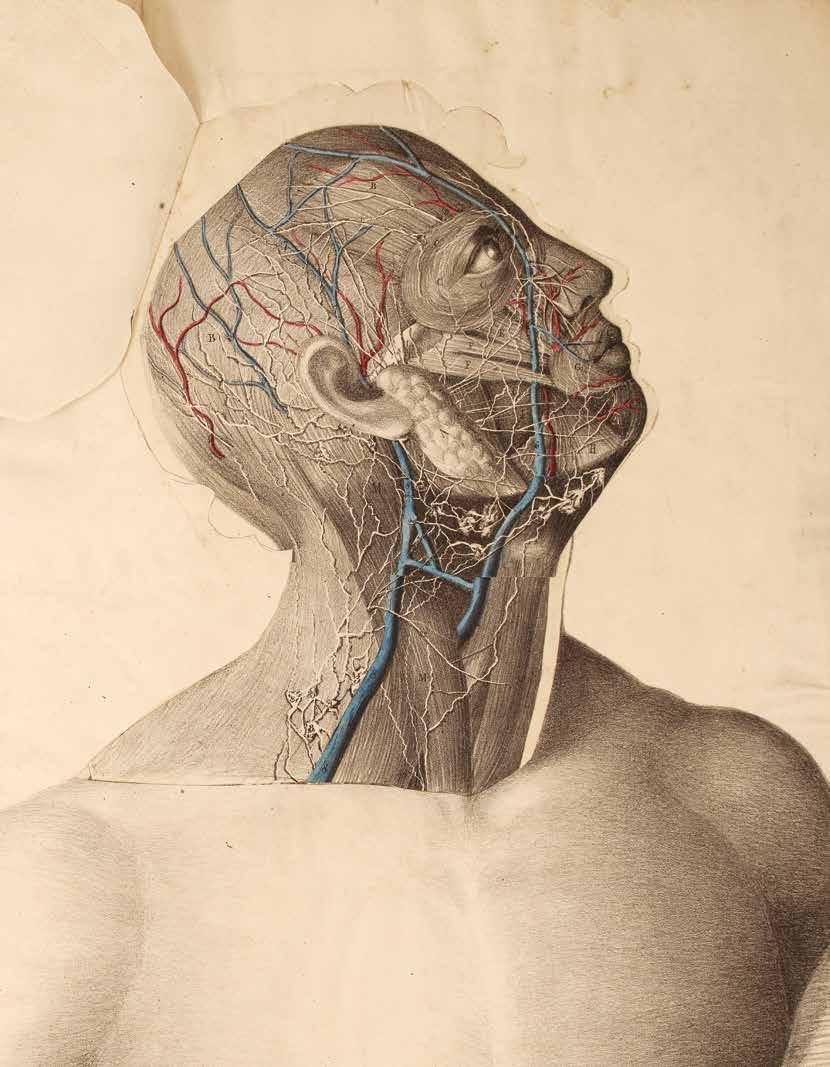
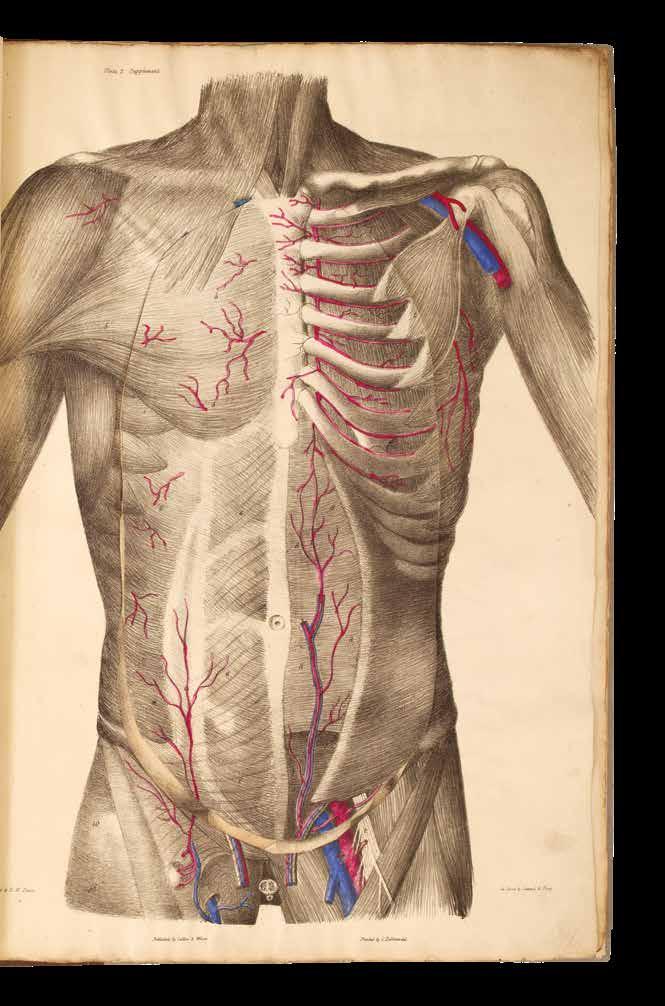
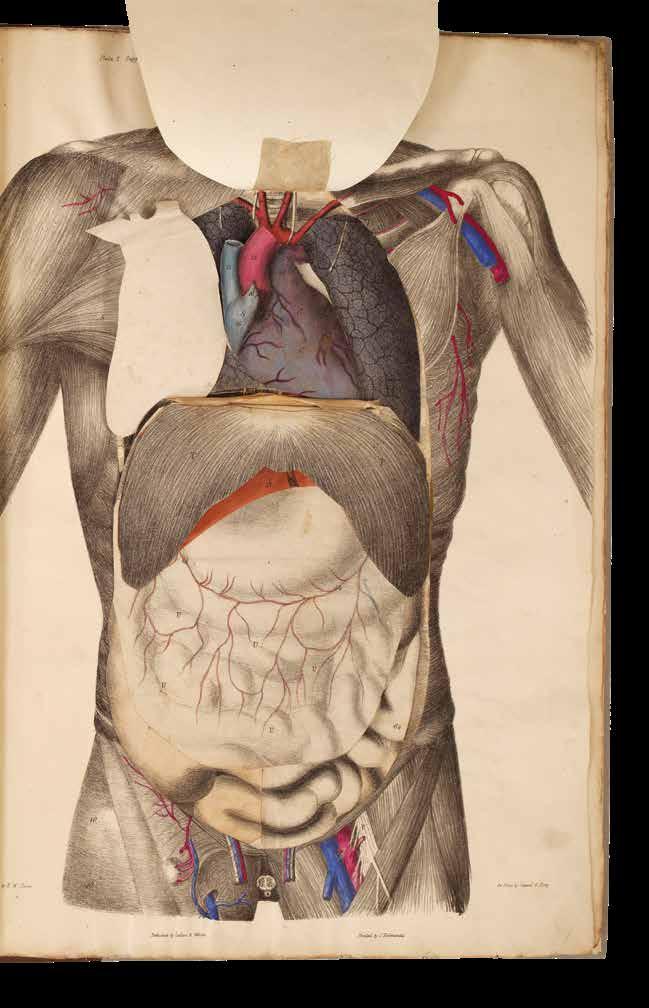
Edward Tuson was a precocious young medic of only 22, when he published his greatest and best-known work, ‘Myology’, for the first time in 1825. The importance of Tuson’s published works can “scarcely be estimated by the student of the present generation, for subjects for dissection were only to be obtained at the private schools through the agency of the resurrection men. Such superposed anatomical plates were in constant use throughout Europe in the sixteenth and seventeenth centuries, both by artists and medical students” (RCS online).
After qualifying from the Middlesex Hospital in 1826, Edward William Tuson (1802-1865) began to “lecture on anatomy on his own account. His lectures were given in a room in the Gerrard Street Dispensary, Soho. It was a small beginning, and he was proud when he had, as he thought, perfected his first pupil in anatomy... This was in 1826 before the reform of the College Examination system, and only a few years after Cruikshank had published his mordantly satiric drawing entitled ‘An Examination at the College’, in which a deaf examiner asks a student to describe the organs of hearing through an ear-trumpet... On February 28th, 1833, Tuson was elected Assistant Surgeon at the Middlesex Hospital, beating Benjamin Phillips and Alexander Shaw by a small majority. On June 2nd, 1836, he was elected to the office of Surgeon in succession to Sir Charles Bell, resigned. On the formation of the Medical School at the Middlesex Hospital, Tuson joined it and brought over to it his own pupils, thus materially contributing to its success” (RCS online).
[WITH]:
-TUSON, Edward William. ‘Supplement to Myology; containing the Arteries, Veins, Nerves, and Lymphatics of the Human Body, the Abdominal & Thoracic Viscera, the ear and eye, the Brain, and the Gravid Uterus, with the Foetal Circulation’. London, Published by Callow and Wilson, Medical Booksellers, 16, Princes Street, Soho, 1828. Folio (535 by 330mm). Nine lithographed plates with numerous hinged lithographed overslips, with contemporary hand-colour in part; modern brown cloth-backed blue paper boards, original publisher’s printed label on the front cover.
-TUSON, Edward William. ‘Anatomy and Physiology. Mr. E.W. Tuson delivers Three Courses of Lectures on Anatomy, Physiology, and Pathology, during the year each course commencing the First Monday in October, February, and June, at half-past two o’clock, daily’. Broadside, printed on recto only. Although it is not stated exactly where these lectures will take place, prospective pupils may apply to Tuson at his residence in Fitzroy Square, or at Callow & Wilson’s Medical Library, in Soho.
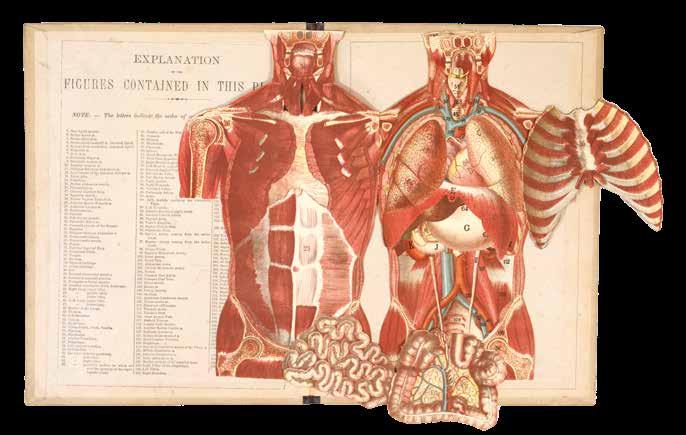
WITKOWSKI, Gustave Joseph; and Robert Hunter SEMPLE, and others
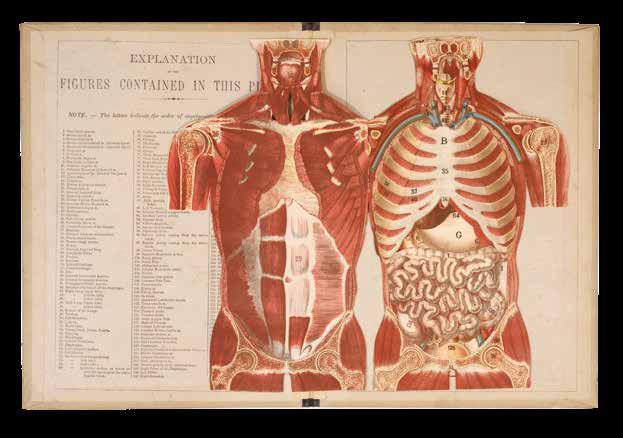
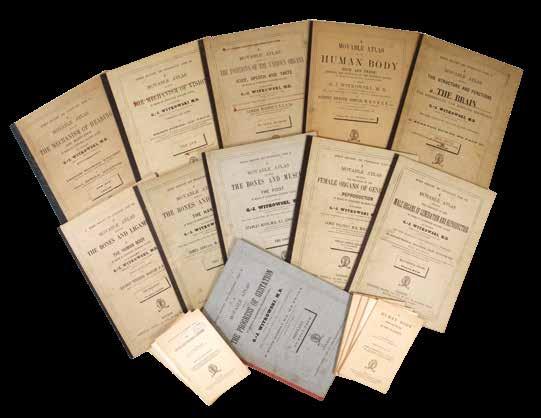
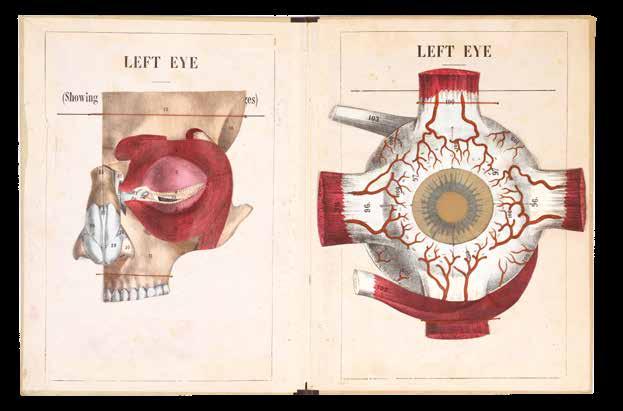
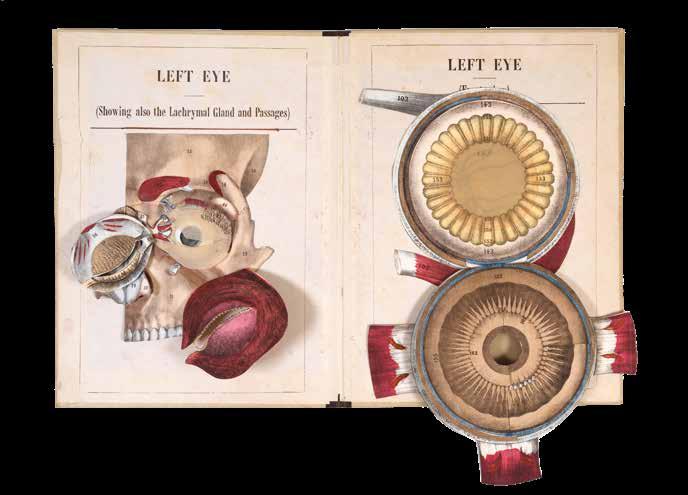
A Moveable Atlas of the Human Body.
Publication London, Bailliere, Tindall, and Cox, 18781888.
Description
First English edition. 11 Atlas volumes: Folio (375 by 280mm), illustrated throughout with numerous colour printed, and translucent sectionalised layers, and other moveable parts; original publisher’s cloth backed, drab printed paper boards. 11 Text fascicles (210 by 140mm); original publisher’s cream printed paper wrappers, stabbed and sewn as issued; preserved in contemporary custom cloth over wooden boards box by E. Bradstreet & Sons, Manufacturers.
Number of items 1
All the body parts of “Dr. Clam”...
Originally published in 1876 in France under the title ‘Anatomie iconoclastique’, this first English edition appeared in 11 parts from 1878-1888, and is exceptionally rare when complete, as here.
The different “atlases”, with accompanying text volumes, each had different translators, and covered the whole body, from top to toe:
- ‘Movable atlas of the human body, showing the positions of the internal organs’, translated by Robert Hunter Semple.
- ‘Movable atlas showing the positions of the various organs of voice, speech and taste’, translated by Lennox Browne.
- ‘A movable atlas showing the positions of the female organs of generation and reproduction. Female genital organs and perineum’, translated by James Palfrey.
- ‘Movable atlas showing the mechanism of vision’, translated by Henry Power.
- ‘Movable atlas showing the mechanism of the organs of hearing and mastication’, translation by Lennox Browne and Henry Sewill.
- ‘Movable atlas showing the structure and functions of the brain, the cerebellum and medulla oblongata’, translated by T. Stretch Dowse.
- ‘A movable atlas showing the positions of the male organs of generation and reproduction. Male genital organs and perineum’, translated by D. Campbell Black.
- ‘A movable atlas showing the bones and ligaments of the human body. The skeleton and its articulations. The bones and muscles of the human body’, translated and edited by Arthur Trehern Norton.
- ‘A movable atlas showing the bones and muscles of the hand. The hand’, translated by James Cantlie.
- ‘A movable atlas showing the bones and muscles of the foot. The foot’, translated by Stanley Boyd.
- ‘A movable atlas showing the progress of gestation. Pregnancy at full term’, translated by R. Milne Murray.
In addition to practising medicine, French physician GustaveJoseph- Alphonse Witkowski (1844-1923) wrote on the subject for a number of prominent newspapers and journals. He also published books on anatomy, as here, general medicine, and the history and culture of medicine, in particular on the management of medical students, as well as poetry and travel writing under the pseudonym “Docteur Clam”.
Provenance
With the ink library stamp of the library of the British Medical Association.
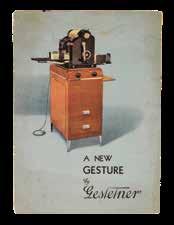
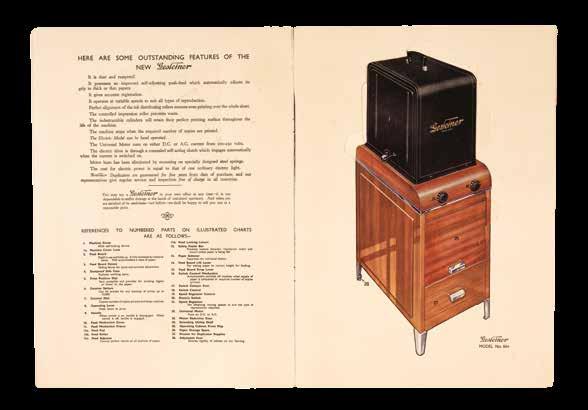
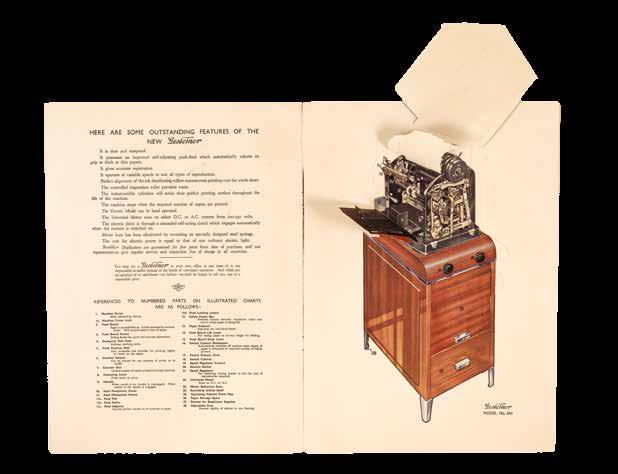
GESTETNER, David; and Raymond Fernand LOEWY
A New Gesture by Gestetner.
Publication London, D. Gestetner Limited, [c.1929-1933].
Description Folio (350 by 255mm). Three colour printed plates with hinged overslips, half-tone and colour printed illustrations; colour printed pictorial stiff paper wrappers, stapled as issued.
References Gestetner for ODNB online.
Number of items c.200
The new Gestetner Model 66, issued to celebrate the Golden Anniversary of the firm’s foundation.
David Gestetner (1854–1939), inventor of duplicating machinery and industrialist “filed the first of his many patents in connection with copying. His most fundamental patent, filed in 1881, was concerned with the invention of the Cyclostyle, a pen with a small, sharp-toothed, rotating wheel at its tip which could be used to write and draw by perforating a new kind of stencil; the latter was based on a Japanese tissue with which he was familiar from a period during which he sold kites in Chicago. The pen and the stencil used in conjunction enabled office duplicating to be done for the first time in quantity, at speed, and with good quality results, and Gestetner can with justification be called the founder of the worldwide office copying and duplicating industry” (Gestetner).
In 1929 Gestetner approached the American designer Raymond Loewy, and asked him to submit a design that would improve the appearance of their machines. The result was the new Gestetner Model 66. The “sleek black case Loewy designed was his first industrial commission, and the first example of the “streamlining” technique he is credited with inventing. Loewy went on to become a very successful industrial designer who applied streamlining to a wide range of industrial goods, including the classic Coca-Cola bottle, refrigerators, and the interior of the Skylab space station” (V&A online).
Provenance
Jonathan Gestetner.
[WITH]: A further significant collection of approximately 200 titles, illustrated with sectionalised layers, published before 1970.
Including:
- Nicolai’s ‘Sepulchris Hebraeorum’ (1706).
- Friedrich’s, ‘Relation der Schlacht Bei Preussisch-Eylau’ [and] ‘Relation der Schlacht Bey Freidland’ (1807).
- A facsimile edition of Repton’s “Red Books” (1973). Copy number 381, of 500.
DODSLEY, Robert
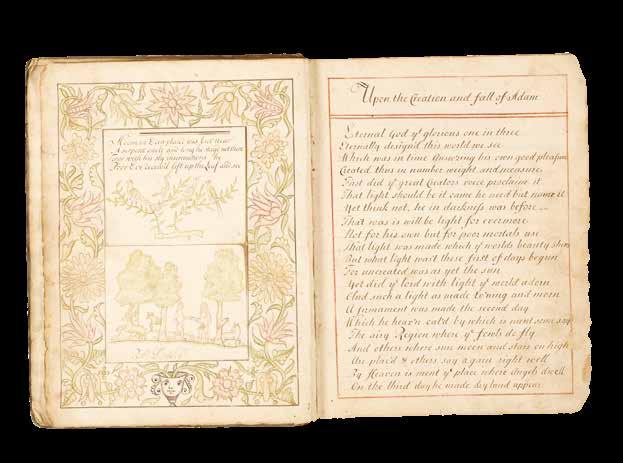
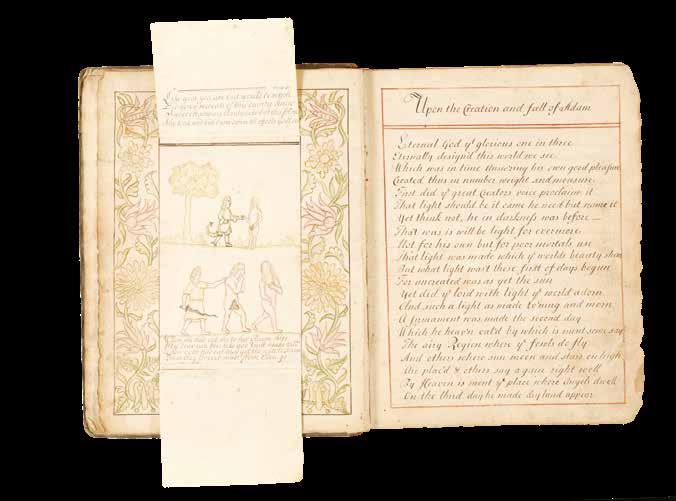
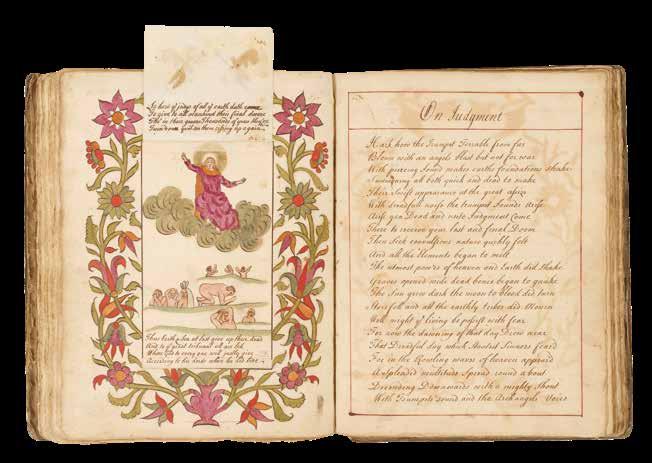
“Upon the Creation and fall of Adam,...”
Publication [?Nottingham, c.1720-1730].
Description
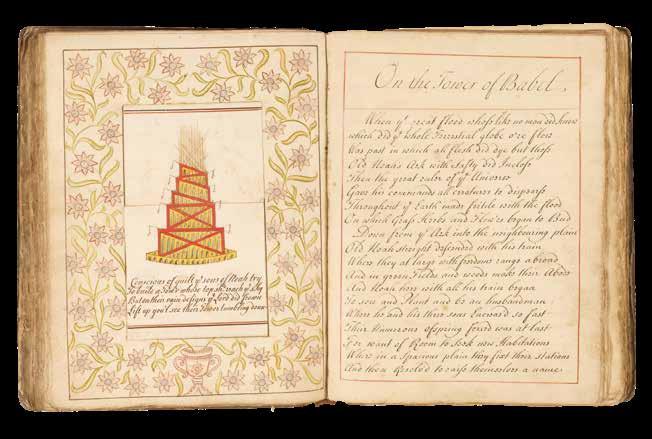
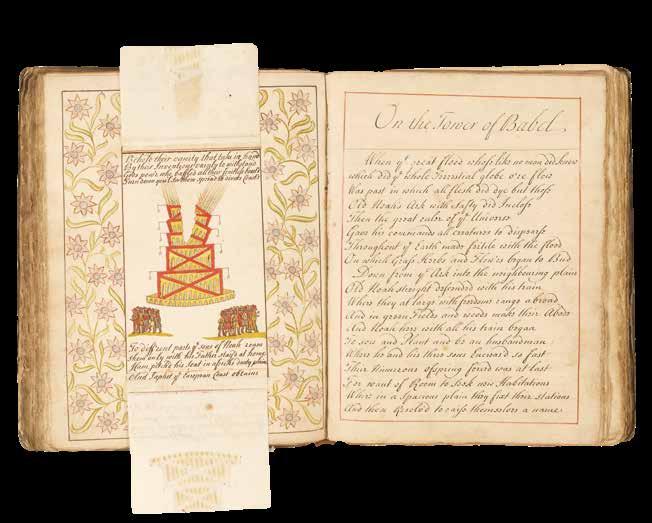
Quarto (250 by 195mm). Original manuscript, 198 pages of neat copperplate manuscript in brown ink within red ruled-borders, 16 original full-page watercolour drawings, most with decorative floral borders, including ten with “turn-ups” and “turn-downs”, some plates signed “Rob: Dodsley”, paper watermarked (Heawood 3236 - 1720-1730), and (close to Heawood 1806 - 1722-1727); original calf backed grey paper boards, manuscript paper label inscribed in a mid-late nineteenth century hand on front cover “lent by Mrs Dodsley Skegby Hall”.
References Straus, pages 6-8.
Number of items 1
An extremely early example of a manuscript work using transformational “turn-ups” and “turn-downs” in the manner of Bernard Alsop’s “The Beginning, Progress, and End of Man”, first printed in 1650.
With 10 chapters of biblical meditations and verses: ‘Upon the Creation’, ‘On Cain and Abel’, ‘On Noah’s Flood’, ‘On the Tower of Babel’, ‘On the Burning of Sodom’, ‘On Abraham Offering Isaac’, ‘On Death’, ‘On Judg[e]ment’, ‘On Heaven’, and ‘On Hell’, each illustrated with an elaborate and very dramatic watercolour “turn-up” and “turndown”, and one other full-page illustration.
When opened, the moveable flaps reveal the various consequences of the meditations, and were clearly used to instruct Dodsley’s pupils, and perhaps his own numerous children, one of whom was poet, playwright, cartographer, and publisher, also Robert Dodsley (1704-1765).
Robert Dodsley, the elder (c.1681-1750), was a master of the Free School in Mansfield, Nottinghamshire. He has been rather unkindly described as “a little deformed man, who, having had a large family by one wife, married when seventy-five a young girl of seventeen, by whom he had a child” (ODNB); he in fact married three times and had 14 children. Their descendants lived at Skegby Hall, Nottinghamshire from 1820 until the 1930s.
The current manuscript has been known about publicly, since 1910, when it was mentioned, rather bluntly, in a biography of Robert Dodsley (the younger) by Ralph Straus, and described as being in the possession of the family: it “is ornamented with coloured drawings and picturesque borders, crude all of them, but not devoid of interest. In the main its contents are original, and show no contemptible style of diction”.
Another example of this manuscript, identical in almost every way, is housed as “On Biblical Subjects” (MSS 04350), at the Thomas Fisher Rare Book Library in Toronto.
Provenance
1. Inscribed “Robert Dodsley his Book” on the inside front cover, i.e. Robert Dodsley (c.1681-1750);
2. John Dodsley, his son, and brother of writer and publisher Robert Dodsley (1704-1764); thence by descent.
[ANONYMOUS]; DICEY, William and Cluer; and William MARTIN
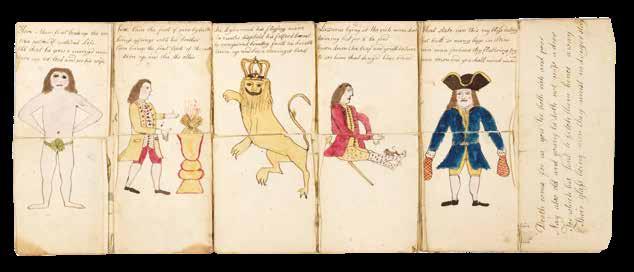
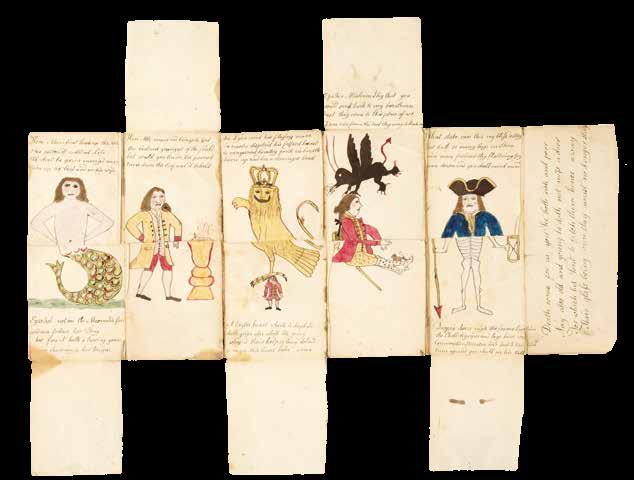
[“Adam & Eve”], or [“The Beginning, Progress, and End of Man”].
Publication [c.1750].
Description
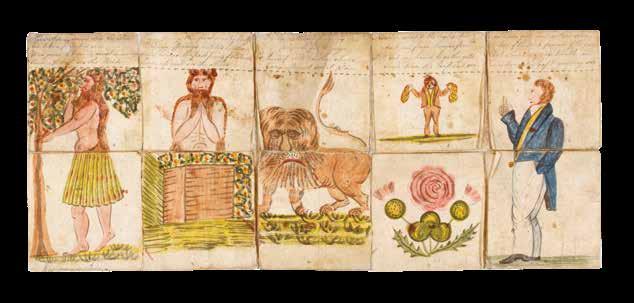
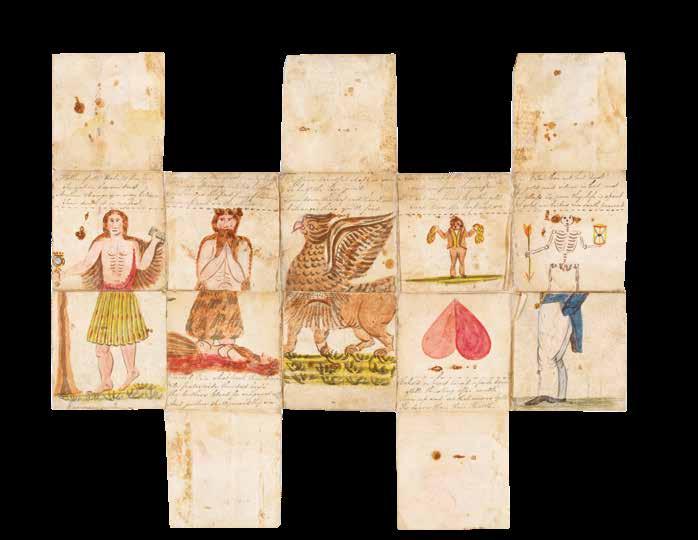
Single sheet (320 by 380mm) original pen and ink and colour wash, cut and folded into a concertina (160 by 75mm) with five foldup-fold-down panels.
References
Reid-Walsh, ‘First impressions: Seeing the Sayer etched edition of The Beginning, Progress and End of Man circa 1767’, online; Reid-Walsh, ‘Interactive Books: playful media before Pop-Ups’, Part II; Reid-Walsh, ‘The late 18th century Harlequinade: a migration from stage to book. A paper given at MIT4 The Work of Stories’, online; Speaight, ‘Harlequinade Turn-Ups’, in the ‘Theatre Notebook’, 45.2, pages 70-82.
Number of items
8
A significant collection of manuscript “TurnUps” and “Turn-Downs”
The earliest recorded manuscript example of the “The Beginning, Progress, and End of Man” dates to c.1698, and is held at the Morgan Library. It follows the traditional religious theme, first printed in England in 1650 by Bernard Alsop “for T. Dunster”. Only 23 manuscript examples, dating from 1698 to 1836, held in institutions worldwide, are recorded in the ‘Union Catalog of Early Moveable Books’ database online. Although 13 of those are part of the Cotzen Collection at Princeton, the Temperley collection bests the Morgan Library, the Bodleian, the British Library, and almost equals the holdings of the University of Pennsylvania, which houses six examples.
Typically, the “turn-ups” of the seventeenth century were religious in nature, as here: “while the eighteenth century turn-ups were adapted to oppositional ends: moral instruction and popular entertainment” (ReidWalsh). It is therefore likely, that the Temperley examples were created in the home.
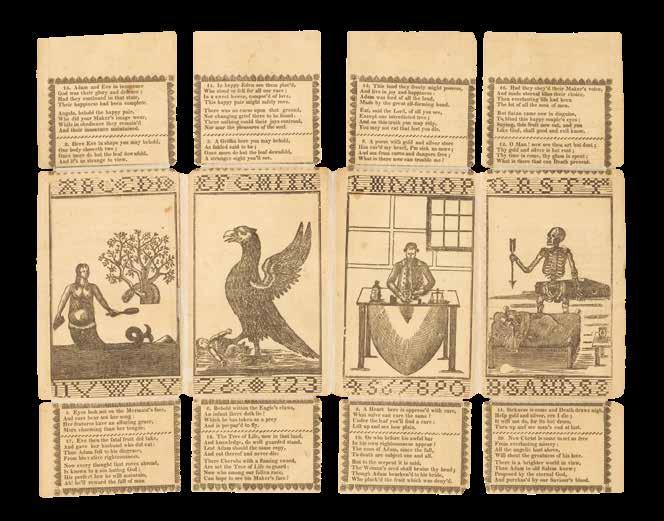
All examples of “The Beginning, Progress, and End of Man”, printed and in manuscript, begin with Adam and Eve, then a mermaid, sometimes followed by Cain and Abel, then a lion or griffin stealing a baby, then the baby grows to an avaricious young man, before growing into an old miser, sick and turning into a skeleton.
[WITH]:
-[ANONYMOUS]. [“Adam & Eve”], or [“The Beginning, Progress, and End of Man”] [c.1770]. Single sheet (420 by 530mm) original pen and ink and colour wash, cut and folded into a concertina with five fold-upfold-down panels (210 by 90mm), paper watermarked “J. What[man]”.
-[ANONYMOUS]. [“Beginning, Progress, and End of Man”]. [c.1815]. Single sheet (330 by 400mm) original pen and ink and grisaille colour wash, cut and folded into a concertina with five fold-up-fold-down panels (160 by 80mm), paper watermarked “T.W.B. FIELD 1815”, laid down on archival paper.
-[ANONYMOUS]. [“Adam & Eve”], or [“The Beginning, Progress, and End of Man”]. [c.1824]. Single sheet (380 by 460mm) original pen and ink and colour wash, cut and folded into a concertina with four fold-upfold-down panels (195 by 95mm), watermarked “C. Wilmot 1824”, laid down, repaired on verso.
[AND]: Two printed examples.
-[ANONYMOUS]. [“Adam & Eve”]. London: W[illiam] & C[luer]. Dicey, [c1736-1743]. Two sheets (350 by 415mm), letterpress and woodblock vignettes, cut and laid-down, and folded into a concertina (175 by 90mm) with five fold-up panels; laid-down on paper and repaired. Inscribed “Joseph Southgate, August 1st, 1743”.
-[ANONYMOUS]. [“End of Man”]. London: [probably W. Martin, Exhibits] No. 28 Hay Market, London, 1808, [Watts End, County] “of Northumberland, one Shilling each”. Single etched sheet (230 by 70mm), last fold-up-fold-down panel only [of four] (120 by 75mm).
Provenance
“Given to E. Curzon, Aug 15 1852”.
[ANONYMOUS]; Robert SAYER
Harlequin’s Invasion A New Pantomime,... Book 4.
Publication London, Publish’d According to Act of parliament by Rob.t Sayer, No. 53 in Fleet Street.... 6d Plain, 1s Colour.d., Septem.r ye 7th, 1770.
Description
Two engraved sheets, cut and laid-down, and folded into a concertina (80 by 185mm), with four fold-up-fold-down panels, with contemporary hand-colour in full, stabbed and sewn into original drab paper wrappers.
References Reid-Walsh, ‘First impressions: Seeing the Sayer etched edition of The Beginning, Progress and End of Man circa 1767’, online; Reid-Walsh, ‘Interactive Books: playful media before Pop-Ups’, pages 60127; Reid-Walsh, ‘The late 18th century Harlequinade: a migration from stage to book. A paper given at MIT4 The Work of Stories’, online; Speaight, ‘Harlequinade Turn-Ups’, in the ‘Theatre Notebook’, 45.2, pages 70-82.
Number of items 3
An exceptionally rare series of Robert Sayer’s “Harlequinades”
The first appearance of that loveable rogue, the Harlequin, in Robert Sayer’s series of “Moral and instructive Emblems for the Entertainment of children, commonly called TURN-UPS” (‘Catalogue’, 1775), and as a consequence referred to as “Harlequinades” ever since. Nevertheless, Sayer’s ambitions began as something far more didactic than a series of misadventures with their ancestral roots in the “Commedia dell’Arte”.
The first number in the series is in fact a printing of the well-known, even traditional, moral tale, “The beginning, progress and end of man”, published “as the Act directs” on the 17th of September 1767, and subsequently advertised in a Sayer & Bennett catalogue of 1775 as “Adam & Eve”, as part of their “Moral and instructive Emblems for the Entertainment of children, commonly called TURN-UPS. Price 6d. each”. It is known in only one example, in two separate unpublished sheets, at the Wellcome Library. It is clearly directly based (text and images) on Bernard Alsop’s publication of 1650 (”Printed by B. Alsop for T. Dunster, 1650”, further inscribed June 3 1650). Sayer, however, was not the first to re-print Alsop. It was expanded into a five-part “turn-up” and “both the words and images reworked by E. Alsop in 1654” (Reid-Walsh). There is a subsequent edition (1688-89), now held at The Bodleian Library, and a further seventeenthcentury edition at Penn State University Libraries.
In both Alsop and Sayer’s “The beginning, progress and end of man”, the “horizontal layout of the accordion folds allows for making a few different panel combinations. Engaging with both kinds of transformations, the intentional ones like Adam into Eve, or Eve into a Mermaid, or the apparently unintentional ones such as Adam into a merman and so on continues through all the panels. This ability emphasizes the playful choices that a reader-viewer-player, or interactor, can make while experiencing a turn-up book. Although the “upside down” playfulness was first apparent in the earliest religious ones, this is central feature in all the turn-up books–religious and educational, moral, and stage-based across the seventeenth to nineteenth centuries” (Reid-Walsh).
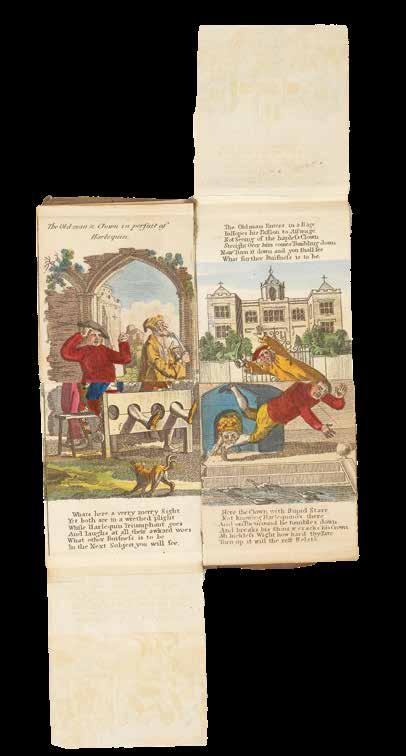
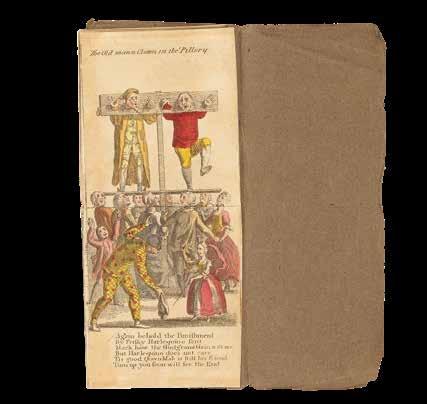
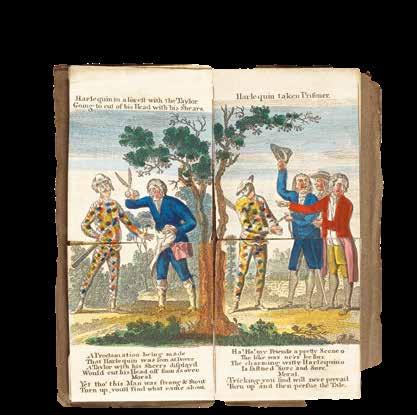
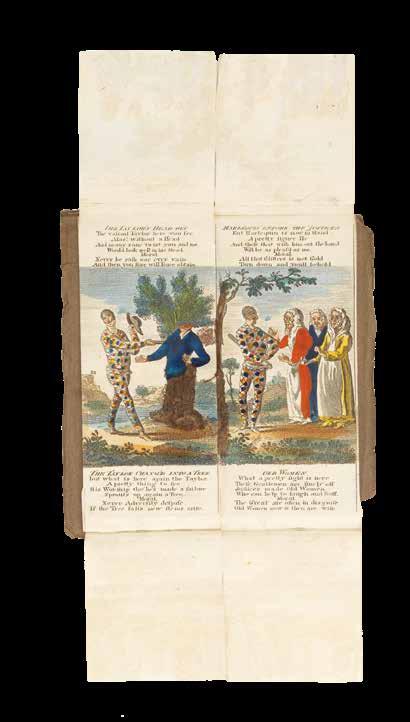
It isn’t until the fourth title that Sayer adapts the short sequences interspersed throughout the then traditional pantomime, where Harlequin, and his friends and confounders, from the “Commedia dell’Arte” appear, to mimic the more serious aspects of the performance, literally creating a flap... Because the nature of the plot of a pantomime, and a harlequinade, is conventional, the focus of the narrative is not on the outcome, but the seemingly haphazard twists and turns of getting there. In this respect, Sayer’s printed harlequinades are a superb visualisation of the experience of the original theatrical performance. As the audience was asked to participate, so too is the reader, and by turning a random selection of flaps, dictates the mayhem.
The complete set of titles, as of 1775, comprises: ‘Adam and Eve, &c’, ‘The King and the Clown, &c’, ‘The Industrious and Idle Apprentice’, ‘Harlequin’s Invasion, a new pantomime, with the different scenes’, ‘Jobson and Nell, or the Wives Metamorphos’d, with ditto’, ‘Queen Mab, or the Tricks of Harlequin, with ditto’, ‘Second part of Mother Shipton’, or Harlequin in the Dumps, with ditto’, ‘The Elopment, a new Harlequin entertainment, with ditto’, ‘Harlequin Cherokee, or the Indian Chiefs in London, with ditto’, ‘Punch’s Puppet Shew, or the Humours of Bartholomew’, ‘The Chimney Sweeper, a simile, with other entertaining subjects’.
[WITH]:
-SAYER, Robert. ‘Queen Mab, or the Tricks of Harlequin... Book 6’. London, Publish’d as the Act directs Feb.y 4th, 1771 by Rob.t Sayer, Map & Printseller No 53 in Fleet Street 6d Plain 1s Colour.d. Two engraved sheets, cut and laid-down, and folded into a concertina (89 by 185 mm) with four fold-up-fold-down panels, with contemporary hand-colour in full, stabbed and sewn into original drab paper wrappers.
-SAYER, Robert. ‘Dr. Last, or the Devil upon Two Sticks... Book 11’. London, Publish’d as the Act directs Nov.r the 21st 1771, by, by [sic] Rob.t Sayer, No. 53 Fleet Street. 6d Plain. 1s Colour.d. Single engraved sheet, printed on both sides, cut and folded into a concertina (80 by 185mm), with four fold-up-fold-down panels, with contemporary hand-colour in full, stabbed and sewn into original drab paper wrappers, bound into modern red morocco, gilt by Bernasconi & Goix.
[ANONYMOUS]; TRINGHAM, William, Elizabeth, and John; Henry WASS; I. MERRY; L. TOMLINSON; H. ROBERTS; William HARRIS; H. TURPIN; Benjamin TABART; G. MARTIN; and Mary GODWIN
A New Book of Emblems of the Different Diversions from Infancy to Manhood.
Publication London, Invented & Published as the Act directs; by E. Tringham under St. Dunstans Church in Fleet Street, Henry Wass, Lad Lane, I. Merry, at the Bible & Lamb, in Bishopsgate Street near Cornhill, & most of the Booksellers & Stationers in Great Britain, Price Six Pence, Colourd 1. Shilling, July 23.d, 1770.
Description
Two engraved sheets, cut and laid-down, and folded into a concertina (80 by 195mm), with four fold-up-fold-down panels, with contemporary hand-colour in full, stabbed and sewn into original blue paper wrappers; preserved in cloth clamshell box.
References
Reid-Walsh, ‘First impressions: Seeing the Sayer etched edition of The Beginning, Progress and End of Man circa 1767’, online; Reid-Walsh, ‘Interactive Books: playful media before Pop-Ups’, pages 60-127; ReidWalsh, ‘The late 18th century Harlequinade: a migration from stage to book. A paper given at MIT4 The Work of Stories’, online; Speaight, ‘Harlequinade Turn-Ups’, in the ‘Theatre Notebook’, 45.2, pages 70-82.
Number of items 10
Tringham family “Harlequinades”
While Robert Sayer, a publisher with considerable standing and clout, published his first “turn-up” featuring Harlequin on September the 7th, 1770, and claimed the bibliographic prize for inventing the “Harlequinade”, he was actually a few months late in transforming the characters then appearing on stage at Drury Lane into a format that had previously been used as gentle moral instruction. William Tringham, Senior (c.1723-1791)
“Invented & Published” the first “turn-up” to feature Harlequin, ‘The Magic Egg or Birth of Harliquin’ [sic], earlier that year on “Janry. 23d. 1770”. A popular engraver, and the son of another William Tringham, to whom he was apprenticed for seven years from 1737. He married Elizabeth in about 1745, and had a number of children, including another William (born 1749), and John (born 1752), both of whom appear to have worked for the family firm.
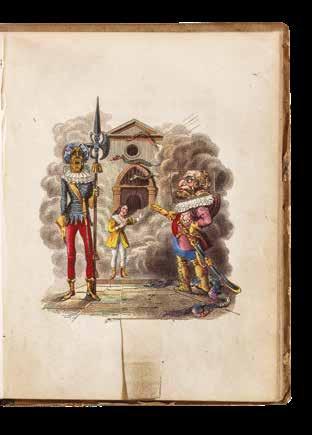
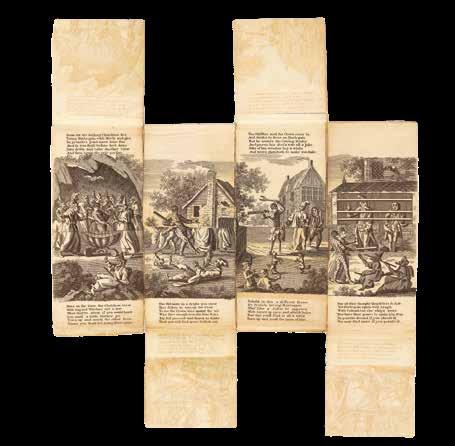
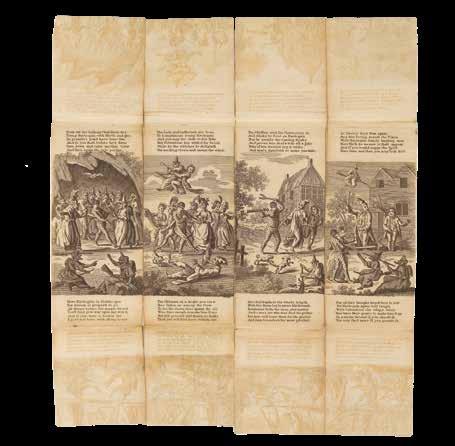
‘A New Book of Emblems of the Different Diversions from Infancy to Manhood’, published in 1770 under the imprint of Elizabeth Tringham, shows different stages of human life, with “turn-ups” and “turn-downs” revealing developmental milestones. The bachelor sitting with a glass of wine and contemplating the question of matrimony, for example, is joined by a wife and child, his glass transformed into a cup of tea. The same mechanism is used in William Tringham’s ‘The Shepherd, or ye Adventures of Harlequin’, published the same year, and ‘The Witches or Harlequin’s trip to Naples’, published in 1772 under Elizabeth’s imprint. Both sheets expand to show a story told in several scenes, each one with a “turn-up” and “turn-down” to reveal a new part of the plot.
[WITH]:
-TRINGHAM, William. ‘The Shepherd, or, ye Adventures of Harlequin, New Comic Entertaining Emblems, for the Amusement of Young Ladies & Gentlemen’. London, Invented & Publish’d, Oct.r 23.d, 1770, as the Act directs, by Wm. Tringham, under St. Dunstans Church, Fleet Street; Hen.ry Wass, Lad Lane; I. Merry next ye London Tavern, Bishopsgate Street; L. Tomlinson, White Chapel; and most of the Booksellers, Stationers and Toy Shops of Great Britain & Ireland. Price Six Pence, Colourd 1 Shilling. Two engraved sheets, cut and laid-down, and folded into a concertina (70 by 190mm), with four fold-up-fold-down panels, with contemporary hand-colour in full, partially laid down on linen.
-TRINGHAM, E[lizabeth]. ‘The Last Part of Mother Shipton Containing Scenes that are in no other’. London, Invented & Published May 23, 1772, as the Act directs by E. Tringham; No. 36, Hosier Lane, West Smithfield. I. Merry, next ye London Tavern, Bishopsgate Street; L. Tomlinson, White chapel; Wm. Harris, St. Paul’s Church Yard; and most of the Booksellers, Stationers, and Toy Shops of Great Britain & Ireland. Price Six Pence,
Colourd 1 Shilling. Two engraved sheets, cut and laid-down, and folded into a concertina (85 by 190mm) with four fold-up-fold-down panels, with contemporary hand-colour in full, stabbed and sewn into original blue paper wrappers, worn; accompanied by an early photograph of “Mother Shipton”.
-TRINGHAM, J[ohn]; ROBERTS, H. ‘The Witches or Harlequin’s trip to Naples’. London, Publish’d as the Act directs Aug.st 12th, 1772 by H. Roberts No. 56 almost opposite Great Turnstile Holborn and L. Tomlinson N 124 White Chaple. 6d Plain, 1s Colour’d. Two engraved sheets, cut and laid-down, and folded into a concertina (80 by 185mm) with four fold-up-fold-down panels, stabbed and sewn into original patterned paper wrappers.
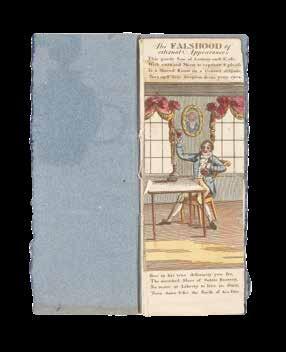
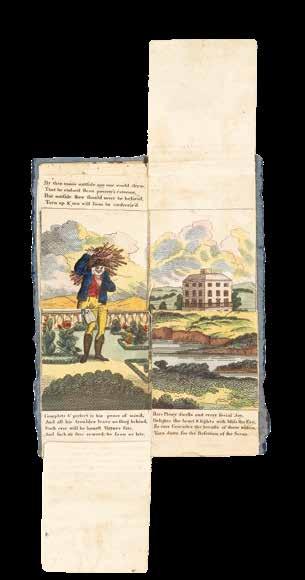
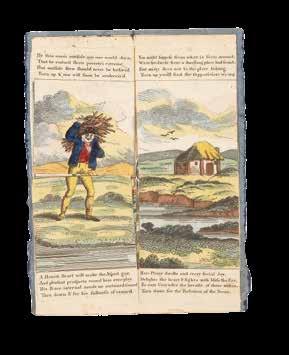
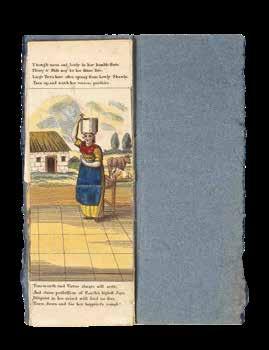
-[ANONYMOUS]. ‘The Falsehood of External Appearances’. [c.1775].
Two engraved sheets, cut and laid-down, and folded into a concertina (70 by 190mm) with four fold-up-fold-down panels, with contemporary hand-colour in full, stabbed and sewn into original blue paper wrappers.
-TURPIN, H. ‘The Old Man his Son & the Ass. A New Turn-up’. London, Printed & Sold by H. Turpin, Bookseller, Stationer, No. 18 near Grays Inn Gate, Holborn, [c.1775], where the Town & Country Booksellers, Stationers & Toy Shops, may be supplied Whole sale 6d Plain 1s Colour’d. Two engraved sheets, cut and laid-down, and folded into a concertina (80 by 170mm) with four fold-up-fold-down panels, stabbed and sewn into original blue paper wrappers, worn. Ownership inscription of “E. Bathurst Jun.r June 1791...”, “This book belong to my beloved and lamented mamma when a child - it was given me by my maternal Grandmother at Plymton Devonshire - June 1839”.
-TABART, Benhamin. [GODWIN, Mary Jane]. [’Blue Beard’]. [Benjamin Tabart], Pub. June 27, 1800 [sic, but ?1809]. Two engraved sheets, cut and laid-down, and folded into a concertina (80 by 175mm) with four fold-up-fold-down panels, with contemporary hand-colour in full (defective, lacking top flaps), modern paper wrappers.
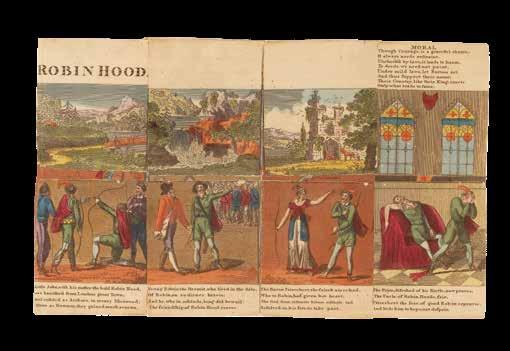
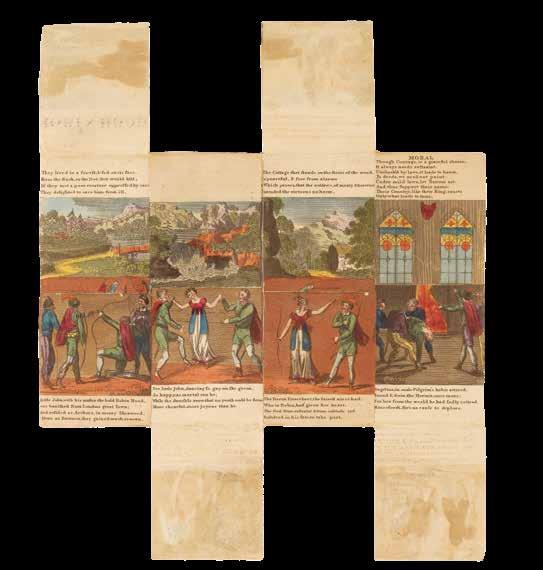
-TABART & Co., ‘Robin Hood’. [London], Published by Tabart & Co. June 1-1809. Two engraved sheets, cut and laid-down, and folded into a concertina (80 by 185mm) with four fold-up-fold-down panels, with contemporary hand-colour in full, stabbed and sewn into original woodcut illustrated pink paper wrappers.
-MARTIN, G. ‘The Pigmy Revels, or Harlequin Foundling’. London, Printed & Publish’d by G. Martin, 6, G.t S.t Thomas Apostle, [c.1810]. Two engraved sheets, cut and laid-down, and folded into a concertina (80 by 190mm) with four fold-up-fold-down panels, with contemporary hand-colour in full, stabbed and sewn into original orange paper wrappers, printed paper label on the front cover; preserved in twentieth-century card chemise; bookplate of D.G. Mackenzie.
-MARTIN, G. ‘Martin’s Turn Up and Down Books’. London, G. Martin, [c.1810]. Single sheet, folded to make four pages, letterpress on two, listing about 80 titles.
[SEDAINE DE SARCY, JeanFrançois]; after Nicolas-Medard AUDINOT; and Jean François ARNOULD, called “MUSSOT”
Le Serail a L’encan Petite Piece Turque en I. Acte Representee au Theatre l’Ambigu Comique. Sicut Pueri Audi nos. [WITH]: [Almanack for the year 1783, printed by Cailleau].
Publication [Paris, Pierre Audinot, 1783].
Description
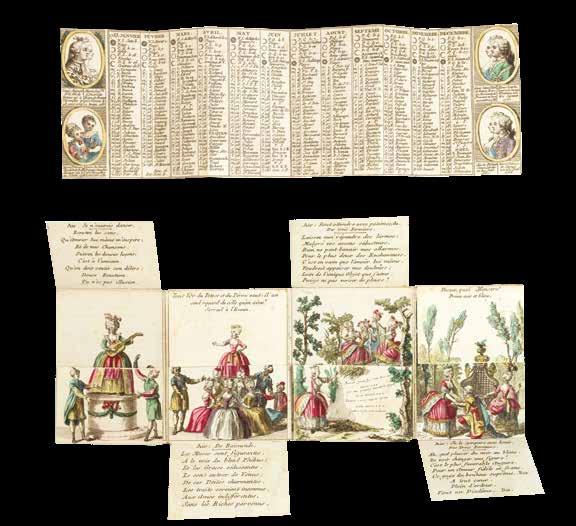
First edition. Single engraved sheet (225 by 350mm), printed on both sides, cut and folded into a concertina (190 by 80mm) with four fold-up-fold-down panels, with contemporary hand-colour in full, stabbed and sewn, with engraved title-page, into original green paper wrappers; [with]: single engraved sheet almanac (350 by 110mm), with contemporary hand-colour in part, folding into a concertina (115 by 95mm); preserved together in original green paper over paste-board slipcase, with citron morocco lettering-piece on the front cover, decorated in gilt, modern box.
References Gumuchian, 2956.
Number of items 1
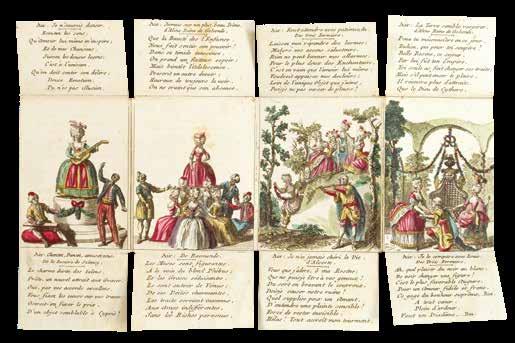
A charming souvenir of a magical theatre, including two selected scenes and lyrics, each, from two popular comic operas performed by children: Sedaine de Sarcy and Audinot’s ‘Le Sérail à l’encan’ (performed 1781, published 1783), and Arnould, or Mussot’s ‘Le Prince noir et blanc, féerie’ (performed 1780, published 1782).
From 1762, Nicolas-Médard Audinot (1732-1801) began entertaining the crowds at the annual Saint-Germain fair, and others in and around Paris, with his life-sized wooden marionettes, or “bamboches”. By 1769, he was so successful that he opened his own theatre on the Boulevard du Temple immediately next to the Théâtre de Nicolet. Initially known as the “Comediens du Bois”, Audinot soon changed the name to “Ambigu Comique”, because, by some magic, as the story goes, his marionettes were transformed during performances into live children. This was memorialised above the entrance to his theatre: “Sicut infantes audi nos” (listen to us, as if [we were] infants) which was bowdlerised into “Cigit les enfants d’Audinot” (Here lie the children of Audinot), and then transformed again to “Sicut pueri audi nos” (listen to us, as if [we were] children).
This exquisite transformational “turn-up” was probably sold as a souvenir at a performance at the “Ambigu Comique”. It was reissued in 1785 with a new calendar.
Exceptionally rare: only one institutional example known, and one in commerce; the later issue is more common, with examples found at the BnF, Houghton Library, and New York Public Library.
Provenance
From the distinguished library of John Landwehr, with his book label.
[ANONYMOUS]; SANDS, Benjamin; and James POUPARD
Metamorphosis; or, a Transformation of Pictures, with Poetical Explanations, for the Amusement of Young Persons.
Publication Philadelphia, Printed and Sold by Joseph Rakestraw, No. 248, North Third Street, 1811.
Description
Single sheet (360 by 290mm), letterpress and woodcut vignettes, printed on both sides, cut and folded into a concertina with four fold-up-fold-down panels, woodcut illustrated self wrappers.
Benjamin Sands’s ‘Metamorphosis or, A Transformation of Pictures with Poetical Explanations’, was first published in 1787, and a runaway success, with nearly forty editions published to 1820. Sands work is directly based (text and images) on Bernard Alsop’s “The Beginning, Progress, and End of Man”, first printed in 1650.
Many of the earlier editions of Sands’s work were illustrated by James Poupard (c.1769-1817), a French actor from Martinique who settled in Philadelphia in 1772, where he advertised in the ‘Pennsylvania Gazette’ as an “Engraver, Jeweler, and Goldsmith” operating on Front Street, Philadelphia. His first known engraving dates to 1774, followed by Croxall’s ‘Fables of Aesop’ (1777). In 1791 he came to the attention of Thomas Jefferson, who commissioned from him the engraving of the seal of the High Court of Chancery of Virginia. In 1793, Alexander Hamilton paid James Poupard for engraving seals for public offices in the Northwest Territory. By 1814, he was living it up in New York.
Benjamin Sands (1759–1840), was a minor American poet and writer, from Cow Neck, New York, best known for the current work.
[WITH]:
-[SANDS, Benjamin]. ‘Metamorphosis; or, a transformation of Pictures, with Poetical Explanations, for the Amusement of Young Persons’. New York, Sold by Samuel Wood and Sons, No. 357, Pearl Street. Joseph Rakestraw, Printer, Philadelphia, 1815. Single sheet (370 by 290mm), letterpress and woodcut vignettes, with contemporary hand-colour, printed on both sides, cut and folded into a concertina with four fold-up-folddown panels, woodcut illustrated self-wrappers, separations at folds repaired on verso. One of the first publications of this work by Rakestraw.
-[SANDS, Benjamin]. ‘Metamorphosis’. [Cadiz, Ohio], Published in 1836 by H. Anderson. Single sheet (395 by 320mm), letterpress and woodcut vignettes, with contemporary hand-colour, on both sides, cut and folded into a concertina with four fold-up-fold-down panels, woodcut illustrated yellow paper wrappers.
-[SANDS, Benjamin]. ‘Metamorphosis; or a Transformation of Pictures, with Poetical Explanations, for the Amusement of Young Persons’. Pottersville, Hunterdon Co., N.J., Published by WM. Hazen & Co., 1875. Single sheet (340 by 290mm), letterpress and woodcut vignettes on both sides, cut and folded into a concertina with four fold-up-fold-down panels.
BAMFORD, Samuel; John BLEASE; and Samuel DYSON
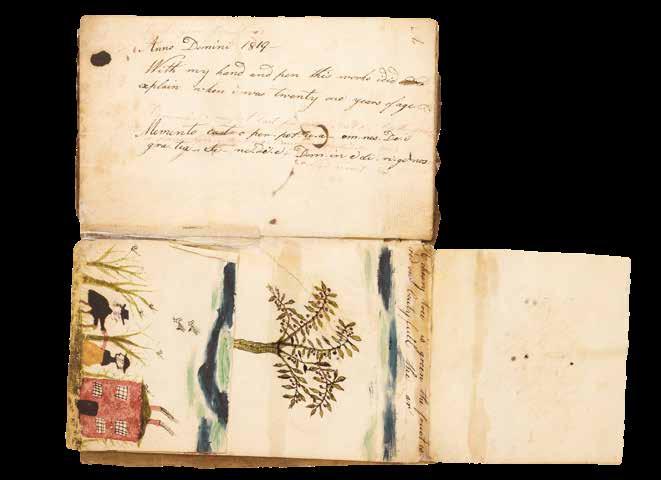
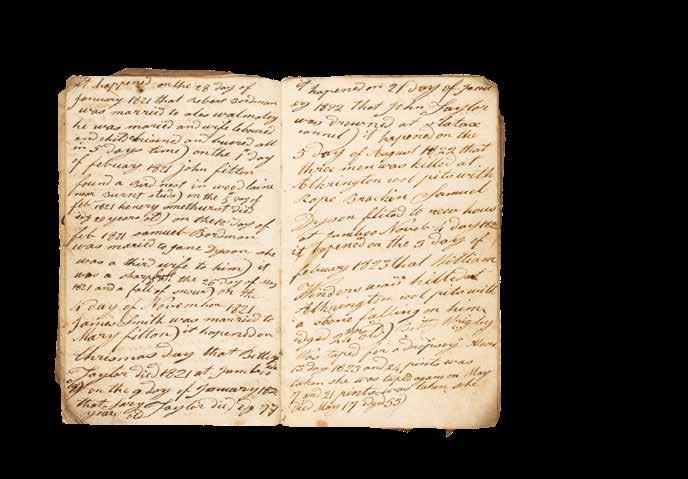
A small collection of Autograph Manuscripts, including: Samuel Bamford’s poem “I will never forget thee Love”; a “Turn-Up” by John Blease; and Samuel Dyson’s family “Crunakel”.
Publication Prestwick, 15th November, 1818.
Description Octavo (190 by 110mm). Nine leaves, manuscript testament of John Blease on the recto of the first leaf, manuscript poem, apparently in the hand of Samuel Bamford, laid down on the verso, eight further leaves with fold-up-fold-down panels illustrated with pen and ink and colour wash, two with full-page watercolour drawings on versos, other versos with manuscript text; stabbed and sewn into original brown paper wrappers, a manuscript poem, also possibly by Bamford, on the front cover, lacking lower cover.
Number of items 2
The Peterloo Massacre, “and some was killed and some was wounded by the yeoman cavalry”
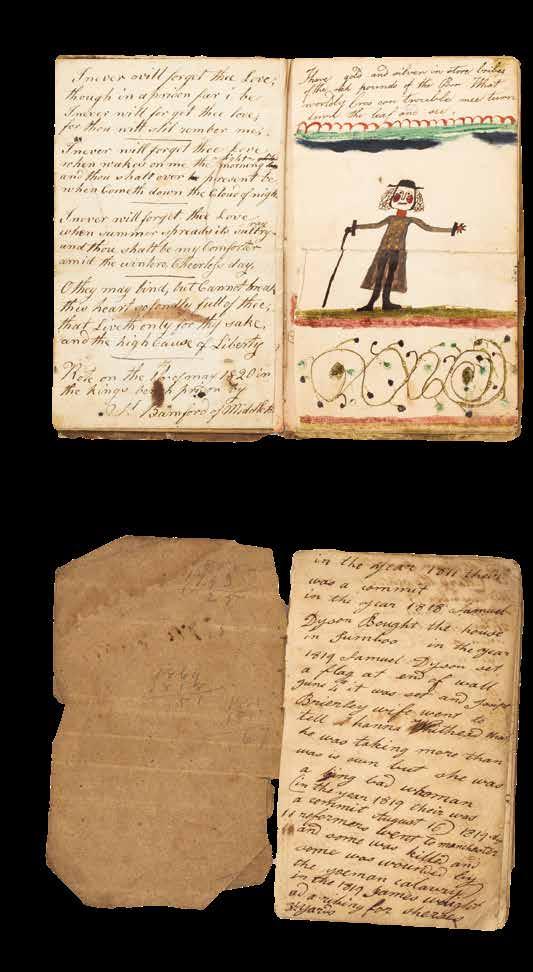
Created late in 1818, Blease gives testament at the beginning of his book, stating that he was born on the 28th of December 1797, “and that england is my nation and prestwick his my Dwelling place and Crist is my Salvation and when I ham Dead and in my grave and all my bones are roten this is for you to remember me when I ham quite for gotton, and wth my hand and pen turn over and see...[sic]”. Blease seems to have completed his “turn-up” in 1819: “With my hand and pen this works i did explain when i was twenty one years of age”.
Born into a Reformist family, in the poverty-stricken industrial town of Prestwick near Manchester, John Blease’s (born 1797) series of transformational “turn-ups” is a variation on the Bernard Alsop format of, “Adam & Eve”, or “The Beginning, Progress, and End of Man” established in 1650. However, he has conspicuously replaced some of the more contentious elements, for his tumultuous times and place, with images of the rewards of hard work. For example, there is no Lion Rampant (of the Royal Arms) and the final scene includes the apple tree of Eden transforming into the cherry tree of peaceable cultivation.
It is therefore not surprising that tipped-in to the front of his book is an, apparently original, draft of radical poet Samuel Bamford’s (1788–1872), poem “I will never forget thee Love,...”. Considered “the voice of a classconscious radicalism” (Spence), Bamford was arrested and charged with treason in August of 1819 for being present, with a cohort of men from Middleton, at the Peterloo Massacre. While he was being held in “the King’s bench prison”, on May the 16th, 1820, he composed this poem to his wife: “I will never forget thee Love, though in a prison far i be. I never will forget thee love, for thou wilt stil rember me, - I never will forget thee Love, when wakes on the morning light, and thou shalt ever present be when Cometh down the Cloud of night - I never will forget thee Love when summer spreads its sultry ray, and thou shalt be my Comforter amid the winders, Cheerless day, - O they may bind, but Cannot break this heart so fondly full of thee, that Liveth only for thy sake, and the high Cause of Liberty - Rote on the 16th of may 1820 in the King’s bench prison by S.l Bamford of Middleton”. The poem was later published in Bamford’s ‘Homely Rhymes’ (1843); and his account of the Peterloo Massacre, ‘Passages in the Life of a Radical’, was published between 1840 and 1844.
Octavo (190 by 113mm). Original autograph manuscript, ten pages, written on eight; original drab paper wrappers, stabbed and sewn as issued, worn with minor loss.
This brief ‘Crunakel Book’. (i.e. “Chronicle Book”) of the Dyson family and their neighbours, includes the traumatic years in the immediate aftermath of the Peterloo Massacre. Births, marriages, and christenings are recorded, but mostly deaths. Beginning with the portentous sighting of the “Great Comet of 1811”, the main narrative begins in 1818 when Samuel Dyson bought property in Peterloo, and “set a flag at end of wall. June 4th it was set and Josipht [sic] Brierley wife went to tell Hanna Whithead that he was taking more than was is own but she was a lying bad woman”. Another comet appears in 1819, but that fact is eclipsed by the terrible fate of 16 reformers who went to Manchester, and got caught up in the Peterloo Massacre, “and some was killed and some was wounded by the yeoman cavalry”...
A James Dyson had been one of the Middleton men that accompanied Samuel Bamford to Peterloo on the fateful day, and he later spoke in Bamford’s defence, recounting details of Bamford’s peaceful exhortation to his comrades, on the day of the massacre: “Friends and Neighbours, those of you who wish to join in the procession will endeavour to conduct yourselves orderly and peacefully so that you may go as comfortable as possible, if any person insults you or gives you offence take no notice of it. I make no doubt that there will be persons who will make it their business to go about in order to disturb the peace of the meeting,... if you would stay loitering or drinking in the streets, your enemies might take advantage of it and if they could raise a disturbance, you would be taken to the New Bayley” (National Archives online). In the same document, Bamford writes of himself that “I am a reformer and have always professed it that I am an enemy to a system that I do conceive the most highly detrimental to the interests of the Country. I shall always use my utmost endeavours to promote Parliamentary Reform by peaceful means, but although I am not an enemy to the principle I am not going to sacrifice every feeling. I am not a friend to blood but after what has taken place at Manchester I can hardly confine my expressions and although felt myself obnoxious to the provincial authorities whom by the bye I would rather glory in as enemies than count as friends and in consequence of that alone can I be brought to submit myself to your Lordships which I do in a hope that justice will be administered. I want only Justice – no Pity – I claim only Justice”.
Provenance
1. “John Blease His Book”, “November 15 in year 1818”, “With my hand and pen this works i did explain when i was twenty one years of age”; 2. The Dyson Family.
MARSHALL, John
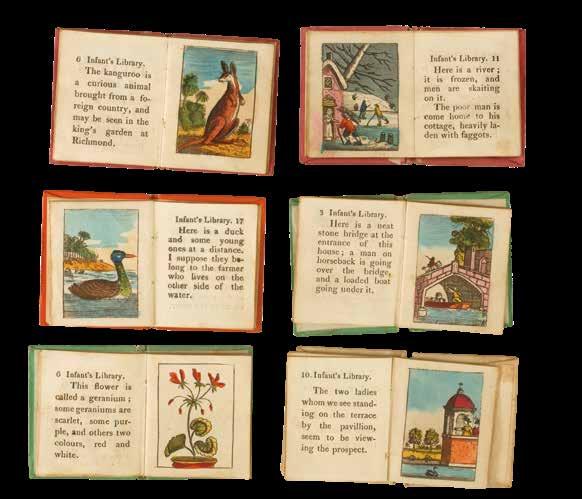
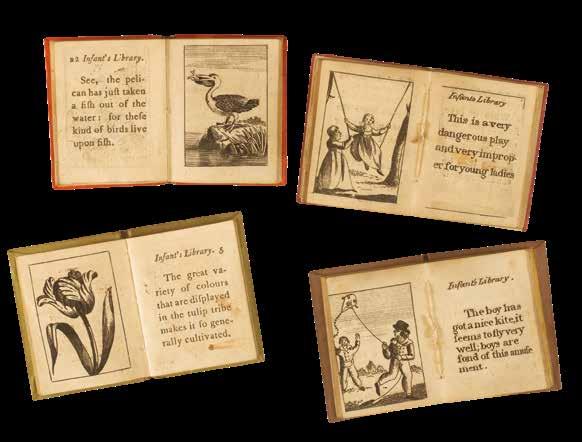
The Infant’s Library.
Publication
London, Printed and Sold by John Marshall, No. 4 Aldermary Church Yard, Bow Lane, Cheapside, 1801 [and] 1818.
Description
A pair of libraries (each 135 by 90mm): 1801 - 16 books (each 60 by 45mm), 15 numbered, illustrated throughout with engravings on various subjects; original harlequin paper over boards, printed paper labels on the front covers, original wooden bookcase, with printed paper over the sliding cover, complete; 1818 - 15 (of 16, without number four) numbered books, illustrated throughout with engravings on various subjects; with contemporary hand-colour in full, original harlequin paper over boards, worn with some loss to covers, original wooden bookcase, with printed paper over the sliding cover.
References Osborne II, page 899.
Number of items 2
Just a small library!
Exceptionally rare, complete, and with contemporary hand-colour. The subjects for each volume include: ‘Alphabets’, ‘Syllabary’, several volumes of ‘Scenes of Everyday Life’, ‘Everyday Objects’, ‘A Dissected Map of England Upon a New Plan’, ‘Animals’, ‘Flowers’, ‘Birds’, ‘Boys’ Games’, ‘Objects’, ‘Girls’ Games’, and ‘A Short History of England for the Infant’s Library’.
John Marshall (1783-1828) is best known for publishing miniature children’s books, like these, from about 1800: including ‘The Juvenile; or, Child’s Library’, ‘The Infant’s Library’ (published in various languages), ‘The Doll’s Library’, and ‘The Book-Case of Instruction and Delight’ (1802).
Provenance
With the contemporary ownership inscription of “Sammian” in the front of some books.
[KILNER, Dorothy, and Sir Richard PHILLIPS]; as “Margaret Pelham”
The Parents’ and Tutors’ First Catechism of the Dawnings of Juvenile Knowledge. Calculated to excite their curiosity, and enlarge their minds. With engravings representing the accidents of Children. By Margaret Pelham, author of the ‘London Primer’. Revised and improved by the Rev. David Blair.
Publication [London], Printed for Sir Richard Phillips and co., and to be had of all Booksellers. Price Nine-pence Sewed, or 13 to the Dozen. Printed by E. Hemsted & Co., Great NewStreet, Fetter-Lane, [from 1812].
Description
Two parts in one volume. 12mo., (120 by 100mm). Woodcut clock-face with moveable hands, illustrated throughout with woodcut vignettes; original drab printed paste-board covers, stabbed and sewn as issued.
References Osborne, Vol. II., page 729.
Number of items c.26
The earliest printed children’s book with a moveable part.
First entered into Stationers Hall by Sir Richard Phillips in 1812, and subsequently re-printed many times by various entities.
The frontispiece features a clock-face with moveable hands, and the work is generally regarded as the earliest printed children’s book with a moveable part.
The second part, entitled, ‘The Accidents of Children’, if “generally studied, it will save the lives of thousands, and relieve many families from long an unavailing misery. This chapter distinguishes the edition from all others; and will enable the public to discriminate between a genuine original Work, and its unprincipled piracies”. Amongst the many dangers to which frail children are prone are “Setting Clothes on Fire”, “Tumbling out of Window”, “Playing with knives”, “Riding a Wild Horse”, and being “Tossed by a Bull”. Wish I’d discovered this work earlier...!
Rare: only a handful of institutional examples known, only one example found in commerce since 1972.
[WITH]: A significant collection of approximately 25 works illustrated with clocks and clockfaces, all with moveable parts.
All three issues, each exceptionally scarce, of one of the earliest “moveables”
BRÈS, Jean-Pierre
Le Livre-Joujou.
Publication
Paris, Chez Louis Janet, Librairie, Rue SaintJacques, No. 59, 1831.
Description
First edition, first issue. Small quarto (140 by 150mm). Lithographed title-page, additional title-page with moveable parts, and a further 12 plates with pull-down tabs and moveable parts, with contemporary hand-colour in full; original green morocco backed, drab printed paper boards; preserved in modern maroon cloth clamshell box.
References Desse, ‘L’invention du livre a tirettes: ‘Le Livre joujou, de Jean-Pierre Bres’ (1931).
Number of items c.80
The first issue, printed by Gaspard Doyen. Including a pull-tab mechanism, ‘Le Livre-Joujou’ is considered one of the first true “moveable” books, only preceded by the so-called “Beidermeiers”, and similar, greetings cards of the early 1800s.
In his own introduction, Brès writes: “In order for this book to amuse you more, I wanted it to offer you some new features in the drawings contained therein”, and explains that he has invented a new mechanism by which scenes from a story progressed and transformed, before our very eyes. The plates are based on those found in earlier “toy-books” by Pintard, ‘Le petit fablier pittoresque ou fables mises en action’ (1817), and Lambert, ‘Le jeu des fables, ou Fables de La ete’ (1819), and tell the story of King Sélimour, who abandons his children, Prince Lindor and Princess Sérine, to go to war, leaving them to the mercy of their evil uncle and magician Grolino. The moveable plates recreate the trials and triumphs of the children.
Jean Pierre Brès (1782 - 1832) is credited with inventing “polyoptic pictures”, later referred to as “myrioramas”, which are a series of illustrated cards that can be rearranged to form alternative landscapes. He was originally from Limoges, and studied medicine as a student. He wrote a number of interesting scientific papers, including one on the association of sound and colour, and also Romantic poetry, which is reflected in his ‘Livre-Joujou’, one of many books he created for a juvenile audience.
-BRÈS, Jean-Pierre. ‘Le Livre-Joujou’. Paris, Chez Louis Janet, Librairie, Rue Saint-Jacques, No. 59, [1837]. Small quarto (140 by 150mm).
Lithographed title-page, additional title-page, and 12 plates with pull-down tabs and moveable parts, with contemporary hand-colour in full; modern morocco backed, marbled paper boards; preserved in modern maroon cloth clamshell box. First edition, second issue, printed by “Imprimerie de Ducessois”.
-TREMADEURE, Mlle. S.U. ‘Le Talisman. Histoire Amusante et Morale,...’ Paris, Mallez Aine, Editeur, [c.1875]. Small octavo (140 by 90mm). Lithographed title-page, additional engraved title-page and eight plates, each with additional flaps, and a moveable figurine slotted into the first plate; original publisher’s scarlet cloth, gilt, all edges gilt; preserved in modern maroon cloth clamshell box.
Rare: each title is exceptionally rare, with only a handful of examples known of each.
[WITH]: A further significant collection of about 75 books with figurines that can be moved between different “slots” throughout. Commonly referred to as “slotties”.
Provenance
The 1831 edition inscribed “Souvenir d’amitie offert par C. Dolmas a C. Westby le 12 juillet /33” on the verso of the front free endpaper; ‘Le Talisman’ is from the library of Robert Fleury, 1986.
Amongst the first books with individual foldout theatrical scenes
CHIMANI, Leopold
Bunte Scenerien aus dem Menschenleben. Ein Bilderbuch ganz neuer Art zum Nutzen und Vergnügen der Jugend bearbeitet.
Publication Vienna, 1836.
Description First edition. Quarto (185 by 140mm). Engraved frontispiece pull-up theatrical scene made of four extending panels and a backdrop, with contemporary hand-colour in full, and three further similar scenes; contemporary full tan printed paper boards, light spotting.
A superb example of a very beautiful book, described by Krahé as “the first book with individual pop-up elements”, which include: “Der Geburtstag”, “Der Abschied vom Elternhaus”, “Die Schlittenfahrt”, and “Der Jahrmarkt” (“The Birthday”, “The Farewell to the Parents”, “Home”, “The Sleigh Ride,” and “The Fair”).
Leopold Chimani’s (1774-1844) day job, from 1798, was as director of the secondary and industrial school in Korneuburg, but he was also the author of numerous, and memorable, books for children and young adults, of which this is one of the earliest and most scarce.
Exceptionally rare: only this example known.
Provenance
With the ink library stamp of “Wobeck” on the title-page.
GRIMALDI, Stacey; after [William GRIMALDI]; Antony IMBERT; and others
The Toilet.
Publication
London, Published by the Author, and Sold by W. Sams, Bookseller to H.R.H. The Duke of York, No. 1. St. James’s Street, 1821.
Description
First edition. 16mo., (125 by 100mm). Nine engraved plates with moveable flaps, with contemporary hand-colour in full; original printed drab paper boards, rebacked, facsimile frontispiece (not called for) tipped in. With the ownership inscription of Henriette Ellen Hayward, November 22nd 1836, on the inside front cover.
References Keebaugh, ‘Pop-up, Spin, Pull, Fold: Toy Books from the Baldwin Library’, 2008.
Number of items 16
Cleanliness is near to godliness...
A comprehensive collection of “Toilet” books, for ladies and gentlemen, based on a series of watercolours painted by William Grimaldi (1751–1830), well-known miniature-painter, who took as inspiration objects found on his daughter’s dressing table. Ever the opportunist, William’s son Stacey, published the drawings with verses of his own, reflecting on the moral repercussions of the implements of attending to one’s appearance.
Stacey Grimaldi (1790–1863) in addition to being the author of books on how the elements of beautification should reflect moral probity, had a keen interest in genealogy. A copy of his ‘The Genealogy of the Family of Grimaldi of Genoa and of England, shewing their relationship to the Grimaldis, Princes of Monaco’ (1834) contains manuscript additions by him, with the note: “The principality of Monaco is now [1834] claimed from the reigning Prince of Monaco by the Marquess Luigi Grimaldi della Pietra, on the ground that it is a male fief, and ought not to have descended to heirs female; and this pedigree has been compiled to show at Genoa and Turin that the Grimaldis of England are the oldest branch, and have prior claims”. Grimaldi was, in fact, the “great-grandson of Alexander Grimaldi of Genoa, who quitted that city after its bombardment by Louis XIV in 1684, and whose father of the same name had been doge of Genoa in 1671... Upon the death of his elder brother in 1835 the title of Marquis Grimaldi of Genoa and the claims on the family possessions in Genoa and Monaco became vested in him. For upwards of forty years he practised as a solicitor in Copthall Court in the city of London. He was eminent as a ‘record lawyer’ and was engaged in several important record trials and peerage cases. In 1824 he was elected a fellow of the Society of Antiquaries. In 1834 he was appointed to deliver lectures on the public records at the Law Institution, and in 1853 an auditor of the Incorporated Law Society. He was a frequent contributor to the ‘Gentleman’s Magazine’ from 1813 to 1861” (DNB).
[WITH]:
-[GRIMALDI, Stacey]. ‘The Toilet. Second edition’. London, Published by the Author, and Sold by W. Sams, Bookseller to H.R.H. The Duke of York, No. 1. St. James’s Street, 1821. 16mo., (125 by 100mm). Nine engraved plates with moveable flaps (lacking engraved frontispiece and one flap), with contemporary hand-colour in full; original printed drab paper boards, worn. The family example: inscribed on the front cover “William Beaufort Grimaldi”, with the engraved armorial bookplate of Stacey Grimaldi, dated 1824 on the inside front cover; a gift inscription to “Gertrude Hector from Winifred ?? Grimaldi, 1916”.
-[GRIMALDI, Stacey]. ‘The Toilet. Third edition’. London, Published by the Author, and Sold by W. Sams, Bookseller to H.R.H. The Duke of York, No. 1. St. James’s Street, and by R. Ackermann, 1821. 16mo., (125 by 100mm). Engraved frontispiece and nine engraved plates with moveable flaps (lacking one), with contemporary hand-colour in full; original printed drab paper boards.
-[GRIMALDI, Stacey]. ‘The Toilet. Third edition’. London, Published by the Author, and Sold by R. Ackermann, Strand; Harris and Son, St. Paul’s Church Yard; Sherwood, Neely, and Jones, Paternoster Row; and Simpkin and Marshall, Stationers’ Court, 1823. 16mo., (125 by 105mm).
Engraved frontispiece and nine engraved plates with moveable flaps, with contemporary hand-colour in full; contemporary maroon calf, gilt; preserved in a modern green cloth chemise. Percy Muir’s copy, exhibited at the National Book League, ‘Children’s Books of Yesterday’ (1946), item 795.
-[Three further examples]: 16mo., (115 by 90mm). Frontispiece and nine engraved plates with aquatint and contemporary hand-colour; original publisher’s morocco, gilt. London: Rock Brothers & Payne, [c1840].
-‘The Gentleman’s Toilet’. London: Rock Brothers & Payne, [1840]. Frontispiece and nine engraved plates with aquatint and contemporary hand-colour; original publisher’s morocco, gilt.
-[GRIMALDI, Stacey]. ‘A Suit of Armour for Youth’. London, Published by the Proprietor, 1824. First edition, no imprint on the front wrapper. 12mo., (190 by 120mm). 11 (of 12, lacking frontispiece, supplied in facsimile) engraved plates with moveable flaps; original publisher’s printed drab wrappers, corners repaired in facsimile. ?Advance copy, inscribed on the front cover “M. Sidmouth 1823”, and then by Lady Sidmouth a pair of brothers in 1827.
-[GRIMALDI, Stacey]. ‘A Suit of Armour for Youth’. London, Published by the Proprietor, 1824. 12mo., (180 by 110mm). Frontispiece and 11 further engraved plates with moveable flaps, with contemporary handcolour; modern half calf, marbled paper boards, original front wrapper bound in. Inscribed “James Wilton, 1837” on the front wrapper.
-[GRIMALDI, Stacey]. ‘A Suit of Armour for Youth’. London, Published by the Proprietor, [overslip of “R. Ackermann”, c.1840]. 12mo., (185 by 105 mm). Additional engraved title-page, 11 engraved plates with moveable flaps, two further plates, all with contemporary hand-colour in full; original publisher’s printed green cloth, gilt. Various inscriptions on the early blanks, dated from 1847.
-HOWARD, Frank. ‘The Art of Dress; or, Guide to the Toilette: with Directions for Adapting the Various Parts of the Female Costume to the Complexion and Figure; hints on cosmetics, &c. Embellished with engravings from designs by Frank Howard, Esq.’ London, Charles Tilt, 1739. 16mo., (160 by 100mm). Lithographed frontispiece with cutout overlay, and four further plates (of five??), with contemporary handcolour in full; original publisher’s mauve cloth, gilt, unevenly faded, all edges gilt. Gift inscription on the front free endpaper dated 1852, twentieth century engraved armorial bookplate on the inside front cover.
-[ANONYMOUS]. ‘Indispensable requisites for Dandies of both Sexes. By A Lady, author of the Emblematical Garden, &c. &c.’ Dublin, Printed by J. Jones, 40, South Great George St., [c1820]. Small quarto (130 by 110mm). Pink advertisement slip facing the title-page, nine etched plates with moveable flaps, with contemporary hand-colour in part; original printed pink paper boards, rebacked; preserved in a modern green cloth chemise. Percy Muir’s copy, exhibited at the National Book League, ‘Children’s Books of Yesterday’ (1946), item 795.
-[IMBERT, Anthony]. ‘The American Toilet... 2.d Edition ~ Copy-Right Secured’. New York, Printed and Published at Imbert’s Lithographic Office, No 79 Murray St., [1827]. Small quarto (130 by 100mm). Lithographed title-page and 19 further plates with moveable flaps; original publisher’s printed blue paper over boards, very worn. Near contemporary gift inscription on the inside front cover. Preserved in a modern maroon cloth clamshell case. Imbert (c.1794-1834) opened the first lithographic printing works in New York in 1825.
-WALKER, Mrs. A. ‘Female Beauty as Preserved and Improved by Regimen, Cleanliness and Dress,...’. London, Thomas Hurst, 65 St. Paul’s ChurchYard, 1837. Octavo (190 by 150mm). 12 lithographed plates, ten with cut-out overlays, all with contemporary hand-colour, one uncoloured plate; original publisher’s green morocco, gilt, all edges gilt, shaken. With the modern bookplate of Hardy Ames on the inside front cover
-[GASCOIGNE, Caroline Leigh Smith; after Stacey GRIMALDI]. ‘The Ladies Hand-Book’. [London, Privately Printed, 1846]. Octavo (195 by 125mm). Colour and gold printed title-page, nine original watercolour drawings on paper with moveable flaps, lace embossed colour printed borders, one leaf of manuscript verse; original blue cloth, gilt. One of only two examples known.
Shunga - Images of Spring
RYUSUITEI, Tanekiyo, otherwise known as “Insuitei”; after [?Harukawa GOSHICHI]
Shunjō Asakusa meisho (Spring Love Asakusa Famous Spot) chū no maki (Volume II).
Publication [Edo], [c.1830-1844].
Description
Octavo (220 by 150mm). One doublepage and folding woodblock, printed in colours, in six panels with two pull-up and down tabs with multiple moveable parts, 13 further full-page prints, all pages with decorative borders; original publisher’s decorative woodblock wrappers, stabbed and sewn as issued.
Number of items 2
Apparently the second volume of three, possibly titled ‘Ten-en kigu’ (three volumes). Only recorded in one other example, also volume II only, and without moveable parts, at the BnF.
While the artist of these erotic ukiyo-e (浮世絵) [“picture[s] of the floating world”] is unknown, the author of the licentious story is Tanekiyo Ryusuitei (1823-1907). He was a prolific author of sexual adventures during the Edo period, using the pseudonym “Insuitei” ( 淫 水亭), in which his characters engage in energetic sex against a famous backdrop. In this case, the antics occur in the Asakusa area of Tokyo, Japan, most famous for its Senso-ji buddhist temple, but also “an unfailing source of entertainments and novel delights throughout the nineteenth century. “”Perpetual Christmas reigns here”, writes one American visitor to this Japanese Vanity Fair in 1871, who later comments, “Every one in Japan has heard of Asakusa”. An intrepid Yorkshirewoman, following on his footsteps in 1878, introduces her disapproving catalog of the Okuyama’s bizarre delights with the concession: “No English fair in the palmiest days of fairs ever presented such an array of attractions”. It was not until the latter Meiji period, however, that Asakusa acquired its undisputed pre-eminence as a center for popular entertainments of every description” (Markus).
“Coming from a world where nudity was not necessarily perceived as erotic because of communal bath-houses, most shunga depict fully- or partially-clothed sex. This allows the print-makers to produce rich, colourful textures, and the artist to load the apparel with symbolism and help the reader identify various stock characters, such as courtesans, by their dress. Since shunga tend to depict a series of sexual tableaux, rather than a continuous narrative, each double-page scene is self-contained with the story printed as part of the background, and various symbolic props used as narrative devices. The genitalia are usually exaggerated and distorted, with the positions awkward or unrealistic, if not impossible, satisfying both a requirement for the sexually explicit and artistic composition.
“The demand for shunga meant that most ukiyo-e (浮世絵) [“picture[s] of the floating world”], artists -- including the highly talented -- were drawn to the genre as the commissions that could be generated were far greater than for standard work. Interestingly, although there is little evidence that producing shunga damaged an artist’s standing, few signed their work” (Wilson). However, these seem to derive from those of Harukawa Goshichi (1776-1831), otherwise known as Horaisanjin Kiyu, and Kamesuke, was a writer from Edo (now Tokyo) who lived in Kyoto and is known for a number of erotic prints and actors’ portraits, including ‘Ten-en kigu’ (three volumes) and ‘Kuchi Hatcho’ (middle-sized work).
[WITH]:
- [ANONYMOUS, c.1900]. Small quarto (135 by 150mm). Eight scenes with Arabic numerals, with transformational flaps, original folding pen and ink and watercolour wash, stabbed and sewn as issued. A violent story set in winter, in which the perpetrator gets his just deserts. Markus, ‘The Carnival of Edo: Misemono Spectacles from Contemporary Accounts’, 1985; Wilson ‘Conjugal Eddies in the Floating World’, 2012.
LAMPART; and Eduard ILLE
Lampart’s Lebendige Bilderbuch mit beweglichen figuren zur Belustigung fur Kinder. Acht Blatter nach Originalzeichnungen und mit Originaltert.
Publication
Ausburg, Verlag der Buchhandlung von Lampart & Comp., 1862.
Description
First edition. Folio (310 by 230mm). Eight colour-printed lithographed plates, each with pull-down tabs and multiple moveable parts; original publisher’s pictorial paper boards, stabbed and sewn, spine renewed and other minor repairs to extremities.
Number of items 1
Hanswurst-case scenario
The Temperley Collection includes a significant number of works that are associated with the Punch and Judy tradition, which has its origins in the Restoration Period, the stock characters imported from “Commedia dell’Arte”, to provide some much-needed comedic relief for English audiences after the fun-starved years of the Puritan interregnum. Initially presented as a marionette show in London’s Covent Garden, Punch and Judy glove puppets became more prominent in the eighteenth century, thanks to their durability and convenience, preferable for the travelling showmen who were beginning to take the shows on tours of the country.
It was during the Victorian era that Punch and Judy became predominantly a children’s form of entertainment, with characters such as the Devil and Pretty Polly, Punch’s mistresses, excluded from the action. Punch and Judy soon became cultural icons, with strong associations with Victorian entertainment: the red and white striped puppet-booth was a ubiquitous feature at the British seaside, and a popular satirical magazine established in 1841 took Punch as both its name and mascot.
Many such puppet shows developed in other European countries, including the Kasperltheate in Germany, Austria and Switzerland. Kasper and his wife Grete are the stars of this continental variant, accompanied by a cast of other characters, including the German stock character Hanswurst, who dates back to sixteenth-century comedy. In 1862, Augsburg publishers Lampart & Comp. published a children’s book illustrated by Eduard Ille, which is recognised as the first German moveable book. Ille’s drawings of the puppets, which were engraved by H. Rühling, come alive as the paper tabs are pulled. The work predates the books of Meggendorfer by several years, making this first edition an important landmark in the history of interactive books.
Rare: only two other examples known, one at Princeton, and one the University of Frankfurt.
Provenance
From the distinguished library of John Landwehr, with his book label.
KING, Ronald; and Roy FISHER
The Left-handed Punch.
Publication Guildford, Circle Press, 1986.
Description
Folio (370 by 285mm). 12 moveable puppet designs, and illustrated throughout with photo-collage vignettes and other materials; loose in original publisher’s red cloth portfolio, and blue and white striped tent, I mean slipcase.
Number of items 1
a Punch
A collaboration by poet Roy Fisher and publisher Ronald King took its theme from the Punch and Judy show. According to the introduction, the idea for ‘The Left-handed Punch, a new version of the comical tragedy of Punch and Judy’ came into being when Fisher sent King a Punch and Judy story published by Routledge in 1860. Fisher rewrote the text as a play, retaining long excerpts from the original, and King designed the book to include an array of photo-collage illustrations. There are also 12 moving figurines housed in a pocket.
Limited edition, number 75 of 80 examples signed by artist and poet, “plus eight copies marked A..P. and two marked H.C.”, with publisher’s prospectus.
THE DEANS OF MEAN
DEAN & MUNDAY; and [Robert EDGAR] as “Uncle Buncle”
An Exceptional Collection of Original Manuscripts of “Dame Wonder’s Transformations”.
Publication [London, Dean & Munday, Threadneedle Street, c.1840-1842].
Description
Six original manuscript works (250 by 145mm), each with six leaves of original drawings, pen and ink, and occasional colour-wash, five with cut-out windows where faces on the final leaves peek through, manuscript captions, stabbed and sewn; preserved in modern blue cloth clamshell case.
References Welsh, ‘Some Notes on the History of Books for Children’, in ‘The Newbery House Magazine’, 1891; Haining, ‘Moveable Books, An Illustrated History’, 1979; Vintage Pop-up Books, ‘Dean & Son Publishers - A Short History’, Movable Book Society Newsletter, 2013.
Number of items 6
Original manuscripts for “Dame Wonder’s Transformations”: all that are recorded
These six manuscripts for a selection of titles from the extremely popular “Dame Wonder’s Transformation Series” are from the library of celebrated illustrator, Maurice Sendak, and seem to represent all that are known to survive of one of the earliest publications of the Dean empire.
From 1810 to 1840, Dean & Munday published a wide range of material, including portraits, prints, and polemics, as well as books. Many of these were aimed at children, from the works of William Francis Sullivan, “Teacher of Elocution and Belles Lettres”, to national histories “adapted for youth, schools, and families”. The firm’s most extraordinary offering, however, was certainly its moveable books. From the 1840s, one of their most ingenious and novel formats was the mechanical book ‘Dame Wonder’s Transformations’, one of a series of titles in “Dean & Munday’s Original Toy Books by Uncle Buncle”, otherwise known as Robert Edgar, one of Dean’s most accomplished illustrators.
In these “transformations”, a complete image, including that of a girl, is printed on the last page of the book. Every previous and successive page presents an alternative scene, and outfit for the girl, with an oval window cut out to show the girl’s face from the last page, thus transforming her, and the story, as the reader turns each page.
During the first half of the nineteenth century, Thomas Dean (1783-1856) and Thomas Munday (1780-1849) established “a virtual monopoly on all forms of moveable books” (Haining). The two had met as apprentices at the printing offices of William Bailey who, at the turn of the nineteenth century, had published an alphabet book for children regarded as one of the first “toy books” produced in Britain. Whether true love, or a cunning attempt to climb the career ladder, the two apprentices married their master’s daughters, Mary Ann and Anna Maria.
Upon William’s death in 1794, his wife Susan took over the firm, publishing a number of romantic chapbooks under her own imprint. In turn, Susan left the company, then located at 35 Threadneedle Street, to her two daughters, Mrs Dean and Mrs Munday. Although Susan’s will stipulated the firm was “for their own sole use and benefit absolutely not to be subject of countrol of any present or future husbands”, the two Thomases were soon to be found at the helm. This may be down to the large number of children borne by each woman, which once led their harried nurse to identify them collectively as “Dean and Munday’s children!” when asked by one astonished observer.
The firm of Dean & Munday persisted for three decades, until it was dissolved in 1840, probably as a result of a copyright dispute that turned into a lengthy legal battle. The imprint of “Dean & Munday” continued to be used until 1842, however, and the following year Thomas Dean Jr., who had been apprenticed to his father and uncle along with
his cousin, Thomas (!) Munday Jr., reestablished the company as Thomas Dean & Co, and then as Thomas Dean & Son (or simply Dean & Son) from 1847, now located at 11 Ludgate Hill.
The original manuscripts:
-[EDGAR, Robert]. ‘A Day’s Employment’. Front cover and six leaves (250 x 145mm) of original drawings, pen and ink and occasional colour wash, facial cut-outs, manuscript captions, back cover blank, stabbed and sewn.
-[EDGAR, Robert]. ‘I much wished to be a Soldier...’ (first line of first caption). Six leaves (250 by 145mm) of original drawings, pen and ink, facial cut-outs, manuscript captions, stabbed and sewn.
-[EDGAR, Robert]. ‘Dame Wonder Transformations Animals and Birds’. Front cover and six leaves (250 by 145mm) of original drawings, pen and ink, pencil, and occasional colour wash, facial cut-outs, manuscript captions, back cover blank, stabbed and sewn.
-[EDGAR, Robert]. ‘The Fountain of Learning’ (first illustration). Six leaves (250 by 145mm) of original drawings, pen and ink, stabbed and sewn.
-[EDGAR, Robert]. ‘The snow laid thick upon the moor’ (first line of first caption). Six leaves (250 by 145mm) of original drawings, pen and ink, pencil, facial cut-outs, manuscript captions, stabbed and sewn.
-[EDGAR, Robert]. [’Dame Wonder’s Transformations of the Pence Tables’]. Front cover and six leaves (250 by 145mm) of original drawings, pen and ink, pencil, and colour wash, facial cut-outs, manuscript captions, back cover blank, stabbed and sewn.
Related printed works:
- [EDGAR, Robert]. ‘Dame Wonder’s Transformations of the Pence Tables’. London, Dean & Munday, Threadneedle Str.t, [c.1840]. Quarto bound in 6s, (200 by 140mm). Six lithographed plates with facial cut-outs, captioned beneath, with contemporary hand-colour in full; original publisher’s pictorial pale blue paper wrappers, rebacked; preserved in pale blue cloth chemise. “William Horwood, Jn.r, 1842, the gift of Mr. Adkins”.
-[EDGAR, Robert]. ‘Dame Wonder’s Transformations of the Pence Tables’. London, Dean & Munday, Threadneedle Str.t, [c.1840]. Quarto bound in 6s (200 by 140mm). Six lithographed plates with facial cut-outs, captioned beneath, with contemporary hand-colour in full; original publisher’s pictorial yellow paper wrappers, spine strengthened. “Maria Agnes from Aunt Hanna. 1842”.
-[EDGAR, Robert]. ‘Dame Wonder’s Transformations. Mary Goodchild’. London, Dean & Munday, Threadneedle Str.t, [c.1840]. Quarto bound in 6s (200 x 140mm). Six lithographed plates with facial cut-outs, captioned beneath, with contemporary hand-colour in full; original publisher’s pictorial green paper wrappers, rebacked. “Miss Maria S. Evans”.
-[EDGAR, Robert]. ‘Dame Wonder’s Transformations. The Orphan Girl’. London, Dean & Munday, Threadneedle Str. [c.1840]. Quarto bound in 6s (200 x 140mm). Six lithographed plates with facial cut-outs, captioned beneath, with contemporary hand-colour in full; original publisher’s pictorial green paper wrappers, edges a little frayed. “C.A. Baily with Cousin Mary’s love & a kiss”; library label of Megan & Michael Dawson.
-[EDGAR, Robert]. ‘Dame Wonder’s Transformations. The Orphan Girl’. Cincinnati, Egger’s & Co., Publishers, [c.1850s]. Quarto bound in 6s (195 by 130mm). Six leaves lithographed plates without facial cut-outs, captioned beneath, with contemporary hand-colour in full; original publisher’s decorative maroon and gilt paper wrappers, a bit worn. Library label of Marjorie Moon.
Provenance
1. From the library of Maurice Sendak (1928-1912); 2. With Justin G. Schiller, his catalogue 50, ‘Five Centuries of Childhood’, item 91.
DEAN & SON
[The Royal Nursery].
Publication
London, Dean & Son, Threadneedle Street, [and] Ludgate Hill, [c.1850-1860].
Description
Seven lithographed plates, with contemporary hand-colour in full, heightened with gum arabic; preserved in a modern blue cloth clamshell case.
References
Dean & Son Ltd, ‘Spring projecting figures; or, Dean’s New model book’, 1870; Eyre, ‘Catalogue of the Educational Division of the South Kensington Museum’, 1850; Vintage Pop-up Books, ‘Dean & Son Publishers - A Short History’, in ‘Movable Book Society Newsletter’, 2013.
Number of items
1
Having taken over the family firm of Dean & Munday in 1843, Thomas Dean Jr. (1796-1856) put his publishing pedigree to great use over the following decade. Under his leadership the company, known at first as Thomas Dean & Co., then from 1847 as Thomas Dean & Son, and finally as Dean & Son once his son George took over in 1856, developed the processes established by the previous generation to become the pre-eminent maker of moveable books and prints.
Refining and adapting lithographic technology for commercial use, and hiring skilled craftsman to engineer and execute the moving parts, the Deans were soon producing “children’s books of worldwide reputation”. Although the company rapidly branched out into other niches, making fans, almanacs, calendars and greeting cards, it was the moveable children’s books that secured the firm its success, and George Dean the reputation as “a friend of children”.
Around 1850, Dean & Son published a series of lithographed plates depicting scenes in the royal nursery featuring moveable elements. For example, the ‘Royal Nursery Clock’ has hands that actually turn, while the ‘Prince of Wales’s Royal Compass’ has a spinning needle.
The seven plates in the Temperley collection show:
-‘The Royal Nursery Clock’, [No.?], with moveable hands.
-‘A Royal Peep at natural History’, [No.?], with zoological spinner.
-‘Prince of Wales’s Royal Compass’, No. 4, with dial in facsimile.
-‘The Royal Nursery Musical Alphabet’ No. 5, with music sheet spinner.
-‘The Royal Nursery Calendar’, No. 5, with month and date spinner.
-‘Royal Nursery Geographical Companion’, No. 7, with geographical spinner.
-‘Royal Nursery Kings and Queens of England: or a Peep into History’, No. 11, with portrait spinner.
An advertisement of 1850 lists a total of 13 prints in the Royal Nursery series, and they were reprinted until at least the 1870s, when a similar advertisement was issued.
[DEAN & SON]; NEWMAN, W.
Moveable Shadows [and] Moveable Shadows for the People. Second Series.
Publication London, Dean & Son, 11 Ludgate Hill, [c.1857-1859].
Description
Two volumes. Octavo (190 by 140mm). Lithographed title-page in each volume, eight lithographed plates in Series one, and nine in Series II, with pull-along tabs and moveable parts, with contemporary hand-colour in full; original publisher’s lithographed pictorial tan paper boards, with contemporary hand-colour, backstrip of series II repaired.
References Brown, ‘William Newman (1817-1870): A Victorian Cartoonist in London and New York’, in ‘American Periodicals: A Journal of History and Criticism’, 2007.
Number of items 2
William Walker Newman (1817–1870) was an artist and engraver whose cartoons were published in both London and New York during the mid-nineteenth century. In additional to satirical prints, he also produced the title page for the first edition of ‘Punch’, and illustrated Charles Lever’s ‘A Day’s Ride’, published in weekly instalments in Harper’s Magazine. In the 1850s, Newman’s work was published by Dean & Son, the primary London manufacturer of books with moving parts.
Two books - ‘Moveable Shadows’ and ‘Moveable Shadows for the People’ - feature illustrations of people or objects that, when moved by means of a pull-tab, reveal a remarkable shadow left on the background. The shadow of a dancing girl resembles that of a crane, while a shouting officer leaves the imprint of a rooster.
DEAN & SON; and [possibly Edward] “CALVERT”
Dean’s New Book of Parlor Magic or Tricks for the Drawing Room.
Publication
London, Dean & Son, 11 Ludgate Hill, 1862.
Description Folio (270 by 190mm). Six lithographed plates with pull-down tabs and moveable parts, with contemporary hand-colour in full; original publisher’s linen-backed pictorial gold and purple paper boards, heightened with gum arabic.
References Lister, for ODNB online; Toole Stott 6061c; Vintage Pop-up Books, ‘Dean & Son Publishers - A Short History’, in the ‘Movable Book Society Newsletter’, 2013.
Number of items
6
A frequent illustrator of Dean and Son’s works under the leadership of George Dean was “Calvert”. This is possibly Edward Calvert (1799-1883), who having been one of William Blake’s ardent followers known as the “Ancients”, spent most of his artistic career as a painter “mainly in oil— dreamy classical pastorals” (Lister). However, during the 1850s and 60s his wife, Mary, became ill, and it may be that medical fees drew him back to the more regular work of published engraving. He likely contributed to the ‘New Book of Parlor Magic’, one of Dean and Son’s scarcest titles, with only one other example known, at Princeton. Each plate shows a different character performing a magic trick, animated by pull tabs at the bottom of the page.
Also by Calvert was ‘Dean’s New Peep Show Magic Picture Book’, another rare item, which contains four lithographed peep-shows. These present scenes in London, at Westminster Abbey, St. Paul’s Cathedral, The Thames Tunnel, and the Crystal Palace, each with five moveable panels creating a three-dimensional effect. A further, anonymous book entitled ‘The International Exhibition’ was published shortly after, also presenting a number of peepshows with moving elements.
Another author whose work was published by Dean & Son was Frances Upcher Cousens, who wrote a number of books in the second half of the nineteenth century, including ‘Sundays with Mamma, Or, The Commandments Explained’, ‘Good Morning and Good-Night, with Other Pretty Poems for Children’, and ‘Little Pollie and Her Pets’. Cousens wrote ‘Grandpapa’s Treat’, a story of the adventures of a grandfather and grandson, which was published by Dean & Son with six illustrative lithographic plates that were ‘popped-up’ by drawstrings and could then be expanded.
The firm’s interactive output also included ‘Dolly’s Wardrobe’, from which double-sided paper dolls could be cut out, along with a variety of outfits and accessories with which to equip them. Additionally, Dean & Son published advertisements, including a 14-leaf programme for the Theatre Royal on Drury Lane, which at the time was hosting a production of Sinbad the Sailor.
[WITH]:
-[CALVERT, Edward]. ‘Dean’s New Peep Show Magic Picture Book showing Wonderful & Lifelike Effects’. London, Dean & Son, Pub. Ludgate Hill, [1861]. Folio (280 by 190mm). Four lithographed peepshows each with five panels, with contemporary hand-colour in full; original purple and red printed paper boards, backed with black cloth, some restoration. Only a handful of examples known: at the British Library, the Morgan Library, and Princeton.
-[COUSENS, Francis Upcher]. ‘Grandpapa’s Treat. Containing: The Invitation, The Going Away, The Return, The Last Visit’. London, Dean & Son, Ludgate Hill, E.C., [1871]. 12mo., (125 by 85mm). Six lithographed draw-string pull-ups each with two extending panels, contemporary hand-colour in full; original publisher’s red pictorial cloth. “Auntie’s last new book - with Mary’s love to Marie Guermonprez”; ink library stamp of “H.L.F. Guermonprez”.
-[WADE, William]. ‘Drury Lane. Theatre Royal. Sinbad the Sailor’. London, Dean & Son, Publishers, 160A, Fleet Street, E.C., [c.1883]. Octavo, (205 by 115mm). 14-leaf colour printed transformation advertisement; original colour printed pictorial wrappers, rebacked. Theatre programme with a central elaborate transformation advertisement for Cremer night clubs in Regent Street and Bond Street.
-[ANONYMOUS]. ‘Dolly’s Wardrobe’. London: Dean & Son Limited, 160A, Fleet Street, E.C. [and] Philadelphia, New York & Chicago, Wolf & Co., [c.1895]. Complete with all colour printed paper board double heads, two sets of double skirts and feet, eight torsos and arms, four hats; original publisher’s folding pictorial paper boards wardrobe, modern ribbon.
-[ANONYMOUS]. ‘The International Exhibition’. London, Dean & Son. Pub., Ludgate Hill, [1862]. Concertina peepshow, eight lithographed panels with contemporary hand-colour in full, one with coloured cellophane, and one without. One of only two examples known. The International Exhibition of 1862, or the Great London Exposition, was a world’s fair held from May 1st to November 1st, 1862, beside the gardens of the Royal Horticultural Society in South Kensington, on a site that now houses museums including the Natural History Museum and the Science Museum. The exposition was sponsored by the Royal Society of Arts, Manufactures and Trade, and featured over 28,000 exhibitors from 36 countries, representing a wide range of industry, technology, and the arts. Over the six-month run the exhibition attracted 6.1 million visitors.
The Galant Galanti Galantee Show
DEAN & SON
Dean’s New Moveable Book of the Popular Performance of Galanti Show.
Publication
London, Dean & Son, Ludgate Hill, [1862].
Description
Quarto bound in 6s (270 by 195mm). Six lithographed plates of silhouettes behind translucent paper, with pull-down tabs and moveable parts, with lithographed theatrical frames, some minor repairs; original publisher’s black cloth-backed purple pictorial boards.
References
‘The Bookseller’, April 1852, page 270; ‘Notes and Queries’, 1888, page 265.
Number of items
1
The Galantee show was a type of theatrical light performance popular in Victorian England. Puppets and props would be moved before a light projector, thus forming shadows on a screen or wall. The term ‘Galantee show’, which is alternatively spelt ‘Galanty’ and ‘Galanti’, comes from the cry that the showman would give at the beginning of the presentation, but its origin remains a mystery.
In 1861, at the peak of the medium’s popularity, Dean & Son published an interactive book allowing children to recreate the show at home. Paper cut into various shapes, such as figures standing on a bridge, is set behind a translucent layer which can be held up to the light to form silhouetted scenes. The individual elements can be moved by means of pull tabs at the bottom of the page, and each scene is narrated in rhyming dialogue below. This was one of the many moveable books published by Dean & Son under the dynamic leadership of George Dean. Indeed, the firm’s 1862 catalogue, which included this work, was widely praised for the variety of materials on offer; ‘Bookseller’ magazine stated that “we have never seen such a collection before”.
Invention of the “ripple-fade”?
[DEAN & SON]; and [possibly Edward] “CALVERT”
Dissolving Views.
Publication London, Dean & Son, 11 Ludgate-Hill, [c.1862-63].
Description
Three volumes in one. Quarto (265 by 175mm). 18 wood-engraved plates with pull-down and pull-up tabs attached to moveable slats that change the views, with contemporary hand-colour in full, versos strengthened with japanese tissue; original publisher’s deluxe binding of mauve cloth, gilt, sun-faded.
References Lister, for ODNB online.
Number of items 1
A complete set of Dean and Son’s notoriously fragile ‘Dissolving Views’, first published from 1860. By the innovative means of moveable “slates”, each illustration displays its own opposite view when a tab is pulled: “Land” becomes “Sea”, “Fair” becomes “Dark”, “War” becomes “Peace”, and so on.
Around 1862, at the peak of their monopoly over moveable books, Dean & Son published a book of illustrations by painter and engraver, Edward Calvert.
Exceptionally rare, especially when fully functional, and when complete.
[DEAN & SON]; and “The Female Blondin”
Beweegbaar Prentenboek Vertooningen.
Publication
Leyden, P.J. Trap, [1864].
Description
Quarto (265 by 175mm). Eight lithographed plates with pull-down tabs and moveable parts, contemporary hand-colour in full; original publisher’s blue cloth-backed, pictorial paper boards.
References Toole, Stott ‘Circus’, 799.
Number of items 1
“The
Female Blondin”
In addition to its domestic success, Dean & Son won international renown and a “worldwide reputation”. In collaboration with European publishers, they produced editions of their most popular children’s books in local languages, which were then exported for sale through their continental colleagues. Not only was the language changed, but the stories and details too were often adapted to better suit the culture of the intended market. The firm coupled editorial flexibility with distinctive and recognisable trademarking, and by doing so made a significant and seminal impact on the international distribution of children’s books.
In 1862, Dean & Son published ‘Dean’s New Moveable Book of Leotard, Blondin as the Ape, Female Blondin, etc.’, which was themed around the circus with a special focus on Charles Blondin. The book, which is present in the Temperley collection in the 1864 Dutch edition, contained the eight hand-coloured lithographic scenes showing, for example, Blondin crossing the high-wire, and monkeys dressed as clowns doing balancing tricks. The illustrations are captioned in verse.
Renowned for his highwire performances, Blondin toured the world during the mid-nineteenth century, famously crossing the Niagara Gorge on a tightrope. Other stunts included performing blindfolded, with a wheelbarrow, and while cooking and eating an omelette. So iconic was Blondin that his name was adopted as a title for all tightrope performers. A number of “female Blondins” rose to prominence during the nineteenth century. Among these was Selina Young, also known as Pauline Violante, whose stunts involved walking a highwire across the Thames, the Crystal Palace, and at the Alhambra Theatre, and Selina Powell, known variously as Madame Geneive, who fell to her death while performing her act in Birmingham in 1863. The tragedy caused public outrage, especially when it was found that Powell had been pregnant at the time. The following year another “Female Blondin” who performed under the name of Madame Caroline, fell from the wire but was caught by the crowd.
Included in the Temperley collection is a card from funeral of Selina Powell, which was held on Monday, July 20th, 1863. The ornate card features a cut-out in the form of a tomb flanked by a mourner and an angel. It reads:
“She lost her life at Aston Fete, And left seven children dear; Alas! her efforts made to please, Should meet with death severe”.
FINBURGH, Simon
A collection of original uncut rag doll and rag book fabrics.
Publication London Dean’s Rag Book Co. Ltd., [and] Dean’s Rag Knockabout Toy Sheets, [c.1900-1922].
Description
Seven bolts of linen (various sizes), colourprinted with templates for creating several dolls, and one rag book.
References Vintage Pop-up Books, ‘Dean & Son Publishers - A Short History’, in ‘Movable Book Society Newsletter’, 2013.
Number of items 7
“Dean’s Rag Books Quite Indestructible”; “Washable and Hygienic”
In 1891, after the death of George Dean, under whose leadership Dean & Son had undergone great expansion and established a monopoly over the moveable children’s book trade, the company was taken over by his two sons, George and Henry. The brothers began a new venture in 1903, founding Dean’s Rag Book Company, which produced books printed on cloth, making them virtually indestructible and therefore perfect for children.
Naturally, the concept of durability appealed to parents, and Henry Dean decided to apply their new-found expertise in fabric to other enterprises, including manufacturing some of Britain’s first teddy bears. The company also published a series of cut-out books, which offered children the opportunity to cut shapes and patterns out themselves, and put them together to form a variety of creations from glove puppets to their own books.
Undoubtedly a highlight in the company’s indestructible oeuvre is ‘Dean’s A1 Alphabet Chart’, which begins with some fairly orthodox ideas: B being for Bunny, E for Elephant and H for Hen. Towards the end of the alphabet, however, the maker has had to employ new levels of creativity, with Q standing for “Quack-Quack” and illustrated by a duck, U for “Ugly Monkey”, and X and Z simply omitted.
Other templates included are:
-‘The Life Size Doll No.3 That’s Advertised Baby’s Clothes will now fit Dollie’, front and back, baby doll, and feet images. (1900).
-‘Dick Whittington’, front and back images. [N.d.]
-‘Rag Doll No. 3 Soldier’. “Painted by Samuel Finburgh, 5th June 1915”, front and back images.
-‘Charlie Chaplin’, multiple front and back images. (c.1920).
-‘Sunny Jim - Force Wheat Flakes’ - 2 strips, both front and back images c.1901). Part of an advertising campaign for ‘Force’ breakfast cereal, “Jimmy Dumps” was transformed into “Sunny Jim” after just one bowlful...!
-‘Dean’s Alphabet Chart’, for cutting and folding to create a rag book (c.1922).
-‘Dean’s Rag Glove Toys (Patented)’: ‘Punch and Judy’ - Single bolt with 4 separate glove puppets: ‘The Precious Mrs Judy’, ‘The Baby’, ‘The Precious Mr. Punch’, ‘The Precious Policeman’, and ‘The Precious dog Toby’. (c.1900-1920).
Provenance
Sotheby’s, London, 11th December 2002.
DEAN & SON; and Zou Zou Odette.
Publication
London, Dean & Son, Ltd., Debrett House, 29 King Street, Covent Garden W.C.2,... Printed in France, [1927].
Description Folio (610 by 220mm). Illustrated throughout; original doll-shaped glazed pictorial paper boards, with name-plate around her neck.
References Vintage Pop-up Books, ‘Dean & Son Publishers - A Short History’, Movable Book Society Newsletter, 2013.
Number of items c.230
In 1921, Odhams Press acquired Dean & Son at the price of £456,316 (the equivalent of almost £20 million today!) with the intention of keeping the brand operational under its existing and well-respected name. The new opportunities presented by this acquisition meant production and distribution on a larger-scale than previously possible, as well as another change of location, with the company moving to Covent Garden. Nonetheless, the quality and style of the firm’s output remained consistent with the legacy built up by the Dean family over the prior two centuries.
Early output as part of Odhams included ‘Odette’, a book manufactured in the shape of the eponymous little girl who serves as the story’s protagonists.
In the same style are ‘The Little Highlander’ and ‘The Tommy Alphabet’, published by Valentine & Sons. These books take the shape of a young Scotsman and a British soldier. Moreover, their front covers are three-dimensional, with the character’s faces rendered in plaster and polychrome, the former’s hat and sporran embellished with real fur. Each book is also illustrated within.
Valentine & Sons, Ltd. had been established in 1851 by Scottish photographer James Valentine. The firm published a variety of material, the most prolific of which was its picture postcards.
[WITH]: ‘The Little Highlander’. Dundee, London, Montreal, Valentine & Sons, Ltd, 1913. 12mo., (260 by 75mm). Illustrated throughout; original Highland Regiment soldier-shaped pictorial paper boards, plaster and polychrome face, fur hat and sporran.
[AND]: ‘The Tommy Alphabet’. Dundee, London, Montreal, Valentine & Sons, Ltd, 1915. 12mo., (250 by 90mm). Illustrated throughout; original English Soldier shaped pictorial paper boards, plaster and polychrome face.
[WITH]: A significant collection of approximately 200 shaped books.
[AND]: A significant collection of approximately 50 3-D books.
[WITH]: A significant collection of approximately 80 titles by the Dean firm.
Including titles from the following series:
-‘Mother Hubbard’
-‘Cock Robin’
-‘Dogs Party’
-‘Dean’s Moveable Children’s Sports and Pastimes’
-‘Old Woman and her Silver Penny’
-‘The Royal Punch and Judy’ (c.1858-1873), and other Punch and Judy titles
-‘The History of how Ned Nimble built his Cottage’
-‘The History of Three Little Kittens’
-‘Pussy’s Party’
-‘Robinson Crusoe’
-‘Aladdin and the Wonderful Lamp’
-‘Red Riding Hood’
-‘Cinderella’
-‘Walter Wonderment’s Wonderful Treble Chances’
-‘Dioramic Pages’
-‘The Farmer and his Family’
-‘Changing Transparencies’
-‘The Jumping Jack in the Box’
-‘Dean’s Moveable Books’
-‘Grand Circus Panorama’
-‘Dean’s New Book of Dissolving Views’,’...Scenes’,’...’Pictures’
-‘... Moveable Toy Book’, ‘...Dress Book’
-‘Nursery Rhymes’
-‘Dean’s Living Strewelpeter’
-‘The Child’s Book of Pictures’
The Dean & Son imprint continued throughout the twentieth century, while the company again changed hands: in 1963 it was absorbed into the International Publishing Corporation, which was itself acquired by the Reed Group in 1970. It remains active today as a private company owned by Egmont Holding Ltd.
BENNETT, E.C.; WARD & LOCK; and DARTON & CO.
Bennett’s Moveable Books. The Puppies Visit to his Friends.
Quarto bound in 6s (255 by 175mm). Eight wood-engraved plates with pull-down tabs and moveable parts, with contemporary hand-colour in full, letterpress captions; original publisher’s pictorial colour-printed yellow paper wrappers over boards, backed in black linen, inner front hinge repaired.
References Vintage Pop-up Books, ‘Dean & Son Publishers - A Short History’, in the ‘Movable Book Society Newsletter’, 2013.
Number of items
3
Rivals put out of business by Dean & Munday
Exceptionally rare: known in two examples: at Princeton, and Virginia. While other manufacturers began to produce moveable books and prints in the mid-nineteenth century, the monopoly held by Dean & Sons made it difficult for any other firm to compete. Among those whom the Dean firm swiftly displaced were E.C. Bennett, Ward & Lock, and Darton & Co..
Edward Colston Bennett was a stationer whose forays into children’s material, including a ‘Bennett’s Moveable Books’ and a number of games, left him bankrupt and in debtors’ prison during the 1860s. One of his moveable books was ‘The Puppies Visit to his Friends’, which features moveable scenes illustrating the adventures of an anthropomorphised dog. Ward & Lock was established in 1854 Ebenezer Ward and George Lock, with premises at 158 Fleet Street, and published a wide variety of printed material from books to maps. They too began to produce moveable children’s books in the 1860s, although the venture does not seem to have been a commercial success. Their ‘Wonder Book of Nature’s Transformations’ depicts a variety of changing landscapes, such as “London by Day”, which transforms into “London by Night” when the tab at the bottom is pulled. The firm of Darton & Co., which had been publishing entertaining and educational books for children since the late 1700s, fared slightly better. In fact, Darton is sometimes considered a contender for the title of ‘originator of the moveable children’s book’. Among the firm’s interactive output was ‘The Book of Trades’, which featured different professions accompanied by moveable illustrations of their practitioners at work. For example, the tailor’s arm is on a hinge and can be moved up and down as he takes his customer’s measurements. Nonetheless, Darton & Co. too finally succumbed to the Deans’ monopoly, closing in 1852.
-‘The Wonder Book of Nature’s Transformations’. London, Ward & Lock, 158, Fleet Street, [1861]. Quarto bound in 6s. (285 by 210mm). Six wood-engraved plates with pull-down tabs and moveable parts, with contemporary hand-colour in full, letterpress captions, some edges a little frayed; original publisher’s colour-printed pictorial boards, backed with red cloth, a little worn. Known in only a handful of examples: Bodleian, British Library, and Princeton.
-‘Darton’s Instructive Moveable Books. The Book of Trades: Showing the Mechanical Movements in each trade to instruct and amuse young Children’. London, Darton & Co., 58 Holborn Hill, [1847-1860]. Large octavo (200 by 170mm). Eight lithographed plates with pull-down tabs and moveable parts, with contemporary hand-colour in full; original publisher’s printed yellow paper over boards, backed with red cloth, a little worn.
Known in only two other examples: Morgan Library, and Princeton.
BIRN BROTHERS
Theatrical Picture-book.
Publication
London, Birn Brothers, London E.C., 12 Milton Street., [1873].
Description Folio (320 by 260mm). Four colour-printed pull-up theatrical scenes, each made of four extending panels, a backdrop, and a card cover; folding into modern black cloth-backed original publisher’s colour and gold printed pictorial paper boards, a little scuffed.
References Publishers’ Circular, June 1882, page 478.
Number of items 1
A list of ‘Trade Changes’ in the ‘Publishers’ Circular’ for June 1882 notified London’s publishers that “Messrs. Birn Brothers, fine-art publishers, of London Wall, E.C., have recently removed to 12 Milton Street, corner of Chapel Street, E.C.”. Founded and run by brothers J. and S. Birn, the firm was prolific in its output, producing a range of ephemera throughout the late-nineteenth and early-twentieth centuries, including cards, gifts and children’s novelties. Their material was partly original and partly imported, and they also served the American market with a showroom on Fifth Avenue, NY.
In 1873, the Birn Brothers published a ‘Theatrical Picture-book’ containing four full-coloured theatrical scenes that could be pulled out and expanded to create three-dimensional impressions of a stage set-up, each one accompanied by narrative text. The scenes are entitled “Poor Robinson”, “A rare Cat”, “Too much talking is hurtful” and “Awake, Sleeping Beauty”.
SUTHERLAND, Marion B.
The Hippodrome. With illustrations.
Publication
Newcastle-upon-Tyne, Browne & Browne, 103 Grey Street & 1 Central Arcade, [c.1890].
Description
Quarto bound in 6s (270 by 205mm). Six pull-up colour-printed Big-Top scenes made of two extending panels and a backdrop and a card cover; original publisher’s red cloth-backed glazed pictorial paper boards, corners a little scuffed.
Number of items 2
Nineteenth-century Newcastle booksellers and publishers, Browne & Browne, sold a large range of books, from contemporary fiction to children’s materials. Several of the latter were interactive books with moveable or pop-up elements. Marion Sutherland’s ‘The Hippodrome’ contains four full-colour lithographic plates which pop-up to reveal a circus attended by well-dress anthropomorphised animals. J.R. Pepper’s ‘A Trip to the Moon’ is illustrated with scenes that can be brought to life by pulling the paper tab along the lower edge of the plate.
-PEPPER,
J.R. ‘A Trip to the Moon: A Moveable Picture Book’.
Newcastle-upon-Tyne, Browne & Browne, 103 Grey Street & 1 Central Arcade, [c.1890]. Quarto bound in 6s (270 by 205mm). Five colourprinted plates with pull-down tabs and multiple moveable parts, some marginal repairs; original publisher’s red cloth-backed glazed pictorial paper boards, worn. Possibly lacking one plate.
Rare: The only examples known.
THE TUCK SHOP
TUCK, Raphael
Funny Town Fair.
Publication
London, Paris & New York, Raphael Tuck & Sons,... Publishers to Her Majesty the Queen,... Designed at the Studios in England and Printed at the Art Works in Bavaria, [1890].
Description
Folding panorama (1389 by 190mm) in six colour-printed panels, with a total of eight single-panel pop-up sections; original publisher’s pale linen-backed pictorial paper boards, front cover with hinged overslip, last panel detached.
References Not in Whitton.
Number of items 3
You can never have too much fun
When the Second Schleswig War broke out in 1864, German carpenter Raphael Tuck (1821-1900) decided to relocate his family of nine to London. Within two years Tuck and his wife had established a shop selling frames and prints, most of which were imported from Germany. Although he could sometimes be found on the street, hawking his wares from a wheelbarrow, Tuck enjoyed success from the start, and by 1869 had moved to a larger shop. This move coincided with Tuck’s three sons, Herman, Adolph, and Gustave, joining the business. With their help it soared to new heights, as they ventured into publishing with the manufacture of lithographs, oleographs, and chromolithographs, in which the firm excelled.
The most successful branch of the Tuck business was in cards: postcards, greeting cards, trade cards, and Christmas cards. The latter were promoted with particular zeal. In 1880, Adolph offered prizes of up to 500 guineas for new designs; thousands of entries were submitted, the best judged by experts from the Royal Academy, and eventually turned into a popular exhibition. Following Raphael’s retirement in 1881, Adolph continued to innovate and expand the company’s production, which came to include calendars, books, posters, and children’s material.
Included among the children’s materials was a number of moveable books, created from 1890 through to the mid-twentieth century. Unlike the pop-up works of some contemporaries, Tuck’s books relied more on the company’s distinctive high-quality chromolithography and attractive design than on the technicality and sophistication of their mechanical parts.
Three of Tuck’s early moveable books were ‘Funny Town Fair’, ‘Fun at the Circus’, and ‘Fun in the Forest’, all of which feature brightly-coloured illustrated scenes showing different activities and performances, from an acrobat jumping through a fiery hoop onto the back of a horse, to a dancing bear. These illustrations have pop-up sections to further bring them to life.
The little stories are written in somewhat questionable verse:
“Oh, Mr. Hippopotamus, you’re very bad indeed, Of medicines and tonics strong you greatly stand in need; You’ve got the toothache and the mumps, the throat-ache and the cramp, Which comes from taking gruel from a basin which was damp: You’ll find a mustard plaister twice a day will give you ease, And - Mr. Hippopotamus, my fee’s a guinea, please”.
In 1899, the firm moved to a five-storey building they renamed Raphael House, which would remain their premises until it was destroyed in the Blitz 40 years later, essentially putting an end to the business. The early decades of the twentieth century, however, were prosperous ones, with Adolph Tuck awarded a baronetcy in 1910 thanks to the family’s contribution to the industry.
Rare: the only example known.
-‘Fun at the Circus’. London, Paris & New York, Raphael Tuck & Sons, [c.1890]. Small quarto (175 by 135mm). One double-page and four full-page tinted lithographed plates with colour-printed single-panel pop-up sections; original brown cloth-backed publisher’s pictorial paper boards, a little worn at the extremities.
-‘Fun in the Forest’. London - Paris - New York, Raphael Tuck & Sons, Ltd.,... Designed in England. Printed in Bavaria, 1896. Quarto (255 by 195mm). Four colour-printed plates each with pull-down tabs and multiple moveable parts, further colour vignettes throughout, and one line drawing; original publisher’s brown cloth-backed pictorial paper boards.
Rare: One of only two known: at Cambridge, and the Bibliotheek Zuidkennemerland in the Netherlands.
Provenance “Bobbie from Sara”.
TUCK, Raphael; and Clifton BINGHAM
Slovenly Peter. Father Tuck’s “Mechanical” Series.
Publication
London - Paris - New York, Raphael Tuck & Sons, Ltd, Publishers to the Queen. Designed in England. Printed in Bavaria, [c.1895].
Description
Quarto (255 by 190mm). Four colourprinted plates each with pull-down tabs and multiple moveable parts, further colour vignettes, and some uncoloured, throughout; original publisher’s red clothbacked pictorial paper boards, a little scuffed at the extremities.
References Not in Whitton.
Number of items 1
One of the contributors to the “moveables” industry in London during the late-nineteenth century was lyricist and author Graham Clifton Bingham. He wrote a range of material for children, including operettas, musical sermons, and text in verse and prose for publishers including Ernest Nister and Adolph Tuck, as here.
When German doctor Heinrich Hoffmann wrote and illustrated a book entitled ‘Struwwelpeter’ (‘Slovenly Peter’) for his infant son, he was not aware that he had created one of the most influential children’s books of the day. Written in rhyming couplets, the book warns children of the dangers of behaviours such as playing with matches, fidgeting at mealtime, and sucking their thumbs. In the latter case, a creature with scissors for hands would come and chop off their thumbs!
The work was published in 1845 and within 30 years had run to 100 editions. Slovenly Peter proved popular abroad too, with translations into a number of languages including English. Towards the end of the nineteenth century, Raphael Tuck & Sons published a moveable edition, with coloured illustrations animated by pull-tabs. One such illustration shows a barber attempting to comb Peter’s slovenly mop!
Rare: the only known example.
TUCK, Raphael; and Louis William WAIN
Fun and Frolic. Father Tuck’s “Panorama” Series. With Louis Wain.
Publication
London, Paris, Berlin, New York, Raphael Tuck & Sons, Ltd., Publishers to Their Majesties the King & Queen & H.R.H The Prince and Princess of Wales,...Printed in Germany, [1896].
Description
Folding panorama (1700 by 110mm), in ten colour-printed panels; publisher’s red cloth-backed colour-printed paper boards.
References cf. Whitton, page 165; ‘ABC’: Whitton, pages 18-23, ill. V.; ‘Catland’, not in Whitton.
Number of items 2
“English cats that do not look and live like Louis Wain cats are ashamed of themselves” (Wells)
Raphael Tuck & Sons was the publisher of choice for several artists and illustrations, including Louis Wain (1860-1939). From the 1890s onwards, Wain illustrated over one hundred children’s books, generally incorporating the idiosyncratic anthropomorphised cats that made him a household name, and led H.G. Wells to declare that “English cats that do not look and live like Louis Wain cats are ashamed of themselves”.
‘Fun and Frolic’ was one of the many children’s books that featured Wain’s illustrations, including innumerable cats getting up to all sorts of mischief, as well as other animals such as butterflies, bears, and dogs, who are holding a rally to campaign against the muzzle. The accompanying verse was written by Clifton Bingham.
‘Days in Catland’ includes scenes such as a mother cat bathing one of her litter, and a schoolroom of kittens learning about the geography of Catland, which appears to be made up of regions such as “Meat Country” and “Meow Land”. It is narrated by verse by Arthur Burnaby, which explains how, for instance:
“At dinner-time they’re never late, And don’t they make a clatter! At such a rate they clear each plate, You see them getting fatter”.
On the envelope, Raphael Tuck instructs the reader to “insert the
-TUCK, Raphael; and Louis William WAIN. ‘Days in Catland with Louis Wain. Father Tuck’s Panorama’. London, Paris, New York, Raphael Tuck & Sons, Ltd., Publishers to Their Majesties the King & Queen,... Designed in England - printed in Bavaria, [1903]. Folding panorama (270 by 1200mm) in four colour-printed panels laid down on boards, with 14 numbered moveable figurines; original publisher’s colour-printed paper boards, integral envelope and flap on back cover, some minor restoration.
-TUCK, Raphael; and [?Louis William WAIN]. ‘Father Tuck’s ABC Spelling Book. Father Tuck’s Little Lesson Series’. London, Paris, New York, Raphael Tuck & Sons Ltd., Publishers to the Queen,... Designed in England. Printed in Bavaria, [after 1894]. Oblong quarto (200 by 285mm). Two double-page colour-printed plates, each with single extending concertina panel, endpapers and centrefold with sepia vignettes, complete paper Alphabet inserts in original envelope at end; original publisher’s light linen backed colour-printed pictorial paper over boards, stapled as issued, a little scuffed at the extremities.
Wain is not credited as the artist behind ‘Father Tuck’s ABC Spelling Book’, but given the similarity in style, the monopoly he had over cat portraits at the time, and his close working relationship with the Tuck firm, it is likely that he was responsible for its illustration.
In bi-plane sight
TUCK, Raphael; and Bernard WAY
Crossing the Channel. Panorama with Moveable Pictures.
Publication London, Paris, New York, Raphael Tuck & Sons, Ltd., Publishers to Their Majesties the King & Queen,... Designed in Englandprinted in Bavaria, [c.1920].
Description
Folding panorama (270 by 1200mm) in four colour-printed panels laid down on boards, with 12 numbered moveable figurines; original publisher’s colour-printed pictorial paper over boards, integral envelope, without flap, on back cover, hinges and some corners strengthened.
References Not in Whitton.
Number of items c.50
Among the artists whose work was published by Raphael Tuck & Sons was Bernard Way, who came from a family of printers and artists. Way made a niche for himself illustrating technical books, often about transport and industry, for both children and adults. In one publication, Way himself is described as “a well-known and eminent engineer”, a claim supported by the intricate details of the machinery and engines depicted in his illustrations. His ‘Crossing the Channel’ offers readers a panoramic view of the Channel, with moveable figurines of all manner of sea- and air-borne transportation, including sailing ships, seaplanes and steamboats. Although only 11 moveable figurines are called for, there is a twelfth, a soaring sea bi-plane, included in the present example.
[WITH]: A significant collection of approximately 50 titles by Tuck.
A shining light of children’s books
NISTER, Ernest
The Magic Toy-Book.
Publication
London, Ernest Nister, 24 St. Bride Street E.C. [and] New York, E.P. Dutton & Co., 31 West Twenty-Third Street. Printed by E. Nister at Nuremburg (Bavaria), [c.1890].
Description
Quarto (220 by 190mm). Colour-printed half-title, eight colour-printed lantern plates, illustrated throughout; original publisher’s blue cloth-backed glazed colour-printed paper boards, some leaves loose, but complete.
References Not in Hunt.
Number of items 1
The plates of ‘The Magic Toy-Book’ transform when a light is shone through from the other side. It is exceptionally rare, with only one other institutional example known, at the British Library.
German printmaker and publisher Ernest Nister (1842-1909) was an important figure in the “moveables” industry. In 1877, he acquired a small lithographic workshop in Nuremberg, where he manufactured a range of printed material including calendars and greeting cards. His international success, however, can be attributed to the pop-up children’s books in which he began to specialise towards the end of the nineteenth century.
Nister’s principal innovation was affixing the moveable pieces to facing pages, so that when the book was opened, the pop-up popped up automatically; by contrast, other moveable books of the time required the reader to manipulate pull-tabs or volvelles. He also included “dissolving” pictures, with the moveable components constructed like a Venetian blind, so the panels could be flipped over simultaneously to reveal a new image.
Such was the success of Nister’s books that he expanded his firm, setting up premises in London and working with a New York agent to distribute his work in the United States. He collaborated with several prolific contemporary artists, although he was accused of replacing their signatures with his own monogram on the final product.
Provenance
With the ownership inscription of “Gladys L. Trowsdale Sept: 15: 1898” on the front free endpaper.
NISTER, Ernest; G.W.
THOMPSON; Fred E. WEATHERLEY; Clifton BINGHAM
This Way and that Way: A book of Push and Pull Pictures.
Publication
London, Ernest Nister, 24 St. Bride Street, E.C., [and] New York: E.P. Dutton & Co., 31 West Twenty-Third Street [c.1890].
Description Folio (370 by 265mm). Eight colour printed plates each with pull-down tabs and multiple moveable parts; original publisher’s red cloth-backed glazed pictorial paper boards, gilt.
References Hunt, pages 292 and 340.
Number of items 1
One of the first moveables to include spinning figures
A superb example of one of the most complex “moveables”, incorporating a new form of spinning figure. Nister’s children’s books have a reputation for being sweet and wholesome, however ‘This Way and that Way’ is not at all in the same vein. There are eight plates in all: ‘The Boy and the Birch’ is self-explanatory; in ‘The Beau and the Belle’, a young buck summons an attendant; in ‘The Old Sportsman’, a man tries to shoot a rabbit; in ‘The Crocodile and the Dentist’,... well you can guess the outcome!; ‘Turning a Somersault’ involves a young larrikin and a policeman; and ‘A Night Alarm’ involves more shooting.
Among the contributors whose art and writing appeared in Nister’s moveable books were G.W. Thompson, who specialised in charming depictions of anthropomorphised animals, lyricist and lawyer Fred Weatherley, and illustrator Graham Clifton Bingham, who was also published by Adolph Tuck.
Rare: “This is the only Nister moveable that I have seen containing the most intricate hidden mechanisms that are very similar to the moveable picture books of Lothar Meggendorfer” (Hunt). Citing the Temperley example, Hunt goes on to say that she has not seen another. However, examples are known in the National Library of Scotland, at Cambridge, Yale, and Stanford.
Provenance
The retrospective ownership inscription of Dudley Thacker “189...”; and presented by him to “Betty & Winifred, from their loving Father Xmas 1919”, on the front endpapers.
NISTER, Ernest
The Soldier Panorama Book: A novel Colour Book for Children, with an Introduction by Clifton Bingham.
Publication
London, Ernest Nister [and] New York, E.P. Dutton & Co., [c.1903].
Description
First edition. Folio (290 by 250mm). Five double-page colour-printed plates each with double pop-up panels; original publisher’s brown cloth-back glazed colourprinted pictorial paper boards.
References Not in Hunt.
Number of items 1
‘The Soldier Panorama Book’, published by Nister in 1903, contains five coloured double-page illustrations of different militaries, namely The Royal Scots Fusiliers, the New South Wales Lancers and Irish Hussars, Lancers, Sailors and Infantry, Royal Horse Artillery and Dragoons, and Indian Soldiers with a British Army Officer. Each of these pages features two levels of pop-up illustrations to give depth to the scene depicted. The rest of the book is made up of illustrations showing other military activity or children play-fighting, and is narrated in verse:
“Alas! the gallant deed was rash, For down he tumbled with a crash; And, what was really worse than all, The drum was broken in the fall!”
Provenance
“To Allan, Wishing you a Merry Christmas from B.L. Cameron, R. Rich, F. Howard, W.D. Game, E. Molezappel, Christmas 1903” on the front free endpaper. Marching on
A puzzled H.M.S. Victory
NISTER, Ernest
The Puzzle Box of Ships.
Publication
London, Ernest Nister [and] New York, E.P. Dutton & Co., Printed in Bavaria, [c.1903].
Description
Six colour-printed paper over wood jigsaws, interleaved with original paste-board; loose in original colour-printed paper board covers, rebacked with red cloth.
Dimensions 300 by 220mm (11.75 by 8.75 inches).
References Hunt, page 108.
Number of items c.60
In addition to books that could be moved, painted, and played with, Nister published a number of puzzle boxes for children. One of these was ‘The Puzzle Book of Ships’, with scenes including: Fishing Boats, A Lifeboat Rescue’, ‘Nelson’s Warship H.M.S. Victory’, A Viking Longboat, ‘Shackleton’s Polar Explorer’, and ‘Racing Yachts’. These illustrations are cut into 15 jigsaw pieces to be assembled by the user.
Rare: only one other example known, in a box rather than a binding.
[WITH]: A significant collection of approximates 60 titles by Nister.
[JOHNSON, Alfred]
The Pop-Up Book With Original Rhymes and Drawings. Provisionally Patented.
Publication Harborne, England, The “Chad Valley” Toys & Games, [c.1907-1914].
Description Octavo (170 by 125mm). Eight leaves, each with colour-printed “Pop-up” figure, elastic mechanism renewed, other minor associated repairs; modern black cloth, original publisher’s pictorial paper boards, edges repaired.
References Worley, for ‘British Map Engravers - A Supplement’, online.
Number of items c.340
The first books to self-identify as Pop-Ups
“Pip pip and pop, I’m here on top, But just take a peep inside. The pictures will please, There’s nothing to tease, “Tip-top” you will quickly decide”.
The spring-loaded characters of these little “Chad Valley” books, are the first to be officially called “Pop-Up”: “It’s nice to read the Pop-up book / And then to pop into bed / To pull the bed-clothes very high / Almost over your head. / Then as to Dreamland off you go. / The pop up pictures pop to and fro”.
The popping figures include: A policeman - “Turn the pages and you’ll see Things much funnier than me”, “Archibald Brown” who “turned up his nose and it will not come down”, “Dinkie Darkie” and the “old moon”, “Sooty expelled from his chimney home”, the “Bubble Kid so airy”, the frog “Who wished to become as big as an ox. / He puffed up so with pride / That he burst his inside / And the bits were collected and put in a box”, an “old Toadstool Man”, and finally the wide-eyed child attempting sleep after all this excitement!
Precise dating of the books is difficult because the “Chad Valley” archive was destroyed when the production of toys moved from Harborne. Rosie Temperley’s review of the existing Chad Valley catalogues, 1907-08 (belonging to Philip Stokes) and also those of 1913-14 (belonging to the Temperleys) suggests that the recurring decorative motif that appears in both these examples was used exclusively by the company between 1907 and 1914.
The “Chad Valley” firm was the culmination of generations of innovative mechanical toy-making. Joseph Johnson (c.1787-1834), had been variously a metal-worker, toymaker, “maker of bits and stirrups, iron tinned spoons, enamelled wares, cutlery, surgical Instruments, buttons, warming-pans, swords, fancy dog-collars, and plated wares” (Worley). By 1851, from his premises in Birmingham, his son, Anthony Bunn Johnson (1808-1858), was employing upwards of twenty people, making simple children’s games, primarily composed of printed pictures on paper or card. After his death, his own sons, Alfred (1845-1932), and Joseph (1842-1904), initially trading as the “Johnson Brothers”, built up the firm which eventually became the “Chad Valley” toy-making business. Holders of the Royal Warrant from the 1930s, the company became the one of the leading toy-makers of the twentieth century, and survives to this day.
-The Pop-Up Book With Original Rhymes and Drawings. Provisionally Patented. Harborne, england, The “Chad Valley” Toys & Games, [c.19071914]. Octavo bound in 6s (170 by 130mm). Six leaves, each with colourprinted “Pop-up” figure, elastic mechanism renewed, other minor associated repairs; original publisher’s black cloth-backed pictorial paper boards, fragile. Exceptionally rare: only these examples recorded.
[WITH]: An extensive collection of approximately 340 titles published in Britain before 1970.
THE GERMAN EMPIRE
The ultimate in interchanging
[ANONYMOUS]
Ein hundert Bilder - A Hundret [sic] Pictures - Cent Tableaux
Publication [Leipzig, c.1860].
Description
Large octavo (290 by 220mm). Eight lithographed plates laid down on colour printed paper over paste-board with picture frame borders, with a further two lithographs tipped-in to the edges, cut and arranged as six interchangeable flaps, with contemporary hand-colour in full; modern cloth-backed, original publisher’s lithographed pictorial paper board front cover, with contemporary hand-colour in full, lower board plain.
Number of items 1
Without text, but the mangled title clearly indicates this entirely visual book was designed for a multi-lingual market. Each of these eight plates consists of multiple superimposed images, that can be manipulated into at least 100 variations of the absurd.
Rare: only one institutional example known, at the Pennsylvania State University.
Lothar Meggendorfer (1847-1925) was interested in the arts from a young age, attending the Academy of Arts in Munich from 15 and supporting himself by working as a musician. He also studied puppetry, which influenced his later creative work. At the age of 19 he began his professional artistic career as an illustrator at a number of magazines in his home city.
Over a decade later, Meggendorfer showed Braun and Schneider, the publishers of one of these journals, the moveable picture book he had created as a Christmas present for his son Adolph. They seized upon the novelty and had it manufactured and published in 1878. From there, Meggendorfer produced a large number of other moveable books for children, distinguished by his ingenious and sophisticated paper engineering. Instead of a single panel that could be flipped, slid or lifted, Meggendorfer’s “moveables” consisted of complex mechanisms which, when triggered by the pulling of the tab, set in motion a series of movements to animate the image.
The exceptional quality of his “moveables” meant that Meggendorfer won acclaim not only in his native Germany, but also abroad, with his books translated into multiple languages, and sold throughout Europe and the USA. From 1888 to 1905, Meggendorfer edited and published a satirical illustrated magazine, the Meggendorfer-Blätter.
The allied bombing of Munich during World War II destroyed the archive of Lothar Meggendorfer’s first publisher, Braun and Schneider. However, in the 1970s, Meggendorfer’s second publisher, J.F. Schreiber, had maintained a storage facility in Esslingen. That archive was rediscovered in the 1970s, and “provides a virtually complete record of Meggendorfer’s work published between 1886 and 1911 by J. F. Schreiber in Stuttgart” (Sotheby’s). A large portion of the archive is now housed at the University of Wisconsin-Madison.
The current selection includes unused front covers for:
-‘Du Matin au Soir: Album dimages indechirable’. Paris, Nouvelle Librarie de la Jeunesse, [c.1888]. Two examples, different states; Krahe 130.
-‘Vesily Dyadenka’. [Moscow, 1899]. (275 by 180mm); Krahe 36.
-‘Vaselaya Tetenka’. [Moskow, 1899]. (275 by 180mm); Krahe 85.
-‘Merry Company’. [London, 1891]; (415 by 280mm); not in Krahe.
-‘Humourous Picture Book’. London, [c.1894]. (315 by 185mm); not in Krahe.
[WITH]: Examples of related published works, supplied from other sources.
-MEGGENDORFER, Lothar. ‘Merry Company: A Funny Moveable Toybook’. London, H. Grevel & Co, 33 King Street, Covent Garden. W.C. Printed in Germany, [1891]. Folio (365 by 260mm). Eight colour-printed lithographed plates with pull-down tabs and moveable parts; original publisher’s colour printed pictorial paper over boards, rebacked, outer corners conserved. Not in Krahe.
-MEGGENDORFER, Lothar. ‘Humourous Picture Book’. London, H. Grevel & Co., 33 Kingstreet, Covent Garden W.C., Printed in Germany, [c.1894]. Quarto (260 by 195mm). Six colour-printed lithographed plates with pull-down tabs and moveable parts; original publisher’s colour printed pictorial paper over boards, backed with red cloth. Exceptionally rare: only known in one other example, location unknown. Not in Krahe.
-MEGGENDORFER, Lothar. ‘Ma Tante Gribiche: 500 Transformations Amusantes’. Paris, Nouvelle Librarie de la Jeunesse, Louis Westhausser, Editeur, 4, Rue de Lille, [c.1898]. Quarto (275 by 180mm). Six lithographed colour-printed lithographed leaves, images on both sides, each cut horizontally into three transformational “mix and match” parts, complete images on endpapers; original publisher’s colour-printed lithographed paper boards, rebacked, lacking first lower transformational part. Krahe 85.
Provenance
1. Meggendorfer Archive, their sale Sotheby’s 1982; 2. Maurice Sendak (1928-2012) illustrator of beloved children’s books.
Publication [Munich, probably, Verlag von Braun & Schneider, c.1887].
Description
Moveable mechanical toy “Der Vergessene Housschlussel” (305 by 220 by 90mm). Colour printed lithographed scene with mechanical movement, and wind-up key; original scarlet and gilt cartonage box behind plexi.
“Der Vergessene Housschlussel” is a beloved character first found in Meggendorfer’s ‘Zum Zeitvertreib’ (1885) and in the first English translation, both of which are in the Temperley collection:
-MEGGENDORFER, Lothar. ‘Zum Zeitvertreib fur brave Knaben & Madchen Ein Ziehbilderbuch’. Munchen, Verlag von Braun & Schneider, [1885]. Folio (330 by 230mm). Eight lithographed colour-printed plates with pull-down tabs and moveable parts; original publisher’s lithographed pictorial paper boards, backed with brown cloth, a little rubbed. With the ownership inscription of Geoffrey Hope Morley dated 1887 on the inside front cover.
-MEGGENDORFER, Lothar. ‘Always Jolly! A Moveable Toybook’. London, H. Grevel & Co., 33 King Street, Covent Garden, W.C., Printed in Germany, [c.1890]. Folio (300 by 240mm). Eight lithographed colourprinted plates with pull-down tabs and moveable parts; original publisher’s lithographed pictorial paper boards, backed with brown cloth, a little rubbed. With a gift inscription “M. Chapman, from ‘Arold. a little book for the feeble minded”, on the inside front cover. First English edition.
Shadowy Theatres
MEGGENDORFER, Lothar L.
Meggendorfer’s bewegliche Schattenbilder I. [and] II. Vorstellung.
First editions. Two volumes. Folio (285 by 330mm) each with eight shadow theatre scenes with multiple moving parts (volume one with some repairs, particularly to the first scene), interleaved with text-sheets printed in red and black; original colour printed pictorial covers, recased.
References Krahe, ‘Spielwelt’, 18; Ries 32 and S. 68; Von Katzenheim S. 198.
Number of items 2
A pair of magnificent shadow-puppet theatres, and priced at ten marks per volume, the most expensive of Meggendorfer’s books. The scenes are designed to be projected onto a wall. Meggendorfer himself issues a warning, however, in his introductory text: “be careful, as you look at it, that you don’t tear it up too quickly, because it will only bring you joy in the long run if you take care to protect it”.
Volume I includes scenes of farmers, craftsmen, and maids at work, a lady on a falcon hunt, and musicians. Volume II, includes a hermit in the forest, an Indian hunting a snake, a carpenter in his workshop, the peaceful botanist in nature, two boys on a seesaw, Hansel and Gretel cutting down a tree, a painter on a ladder, and a bootjack helping his master take off his boots.
Military build-up
MEGGENDORFER, Lothar
Militarisches Ziehbilderbuch.
Publication
Munich, Verlag von Braun und Schneid, [1890].
Description
Oblong folio (260 by 350mm). Eight colourprinted lithographed plates with pull-down tabs and moveable parts; original publisher’s colour printed pictorial paper over boards, backed with red cloth, a little worn.
References Krahe, ‘Spielwelt’, 52, 95.
Number of items 2
A popular theme for boys’ book was the military, a demand Meggendorfer met with ‘Militarisches Ziehbilderbuch’ and ‘Die grosse Parade’. The former presents various military scenes, with soldiers that can be moved via pull-tabs; the latter unfolds into a panorama of a military parade on 12 panels. Both books feature text in rhyming couplets.
-MEGGENDORFER, Lothar. ‘Die grosse Parade’. Berlin & Leipzig, Verlag von A. Anton & Co., [1916]. Folding panorama (3840 x 195mm) in 12 colour-printed lithographed panels laid down on board, hinged with brown cloth.
Provenance
From the distinguished library of John Landwehr, with his book label.
MEGGENDORFER, Lothar
Internationaler Circus.
Publication
Esslingen bei Stuttgart, Verlag von J.F. Schreiber, [1889].
Description
Folding concertina panorama (330 by 1760mm) in eight colour-printed panels with six pull-down Big Tent scenes with two to three extending panels and backdrop; folding into original publisher’s red cloth backed pictorial paper boards front cover, plain back cover.
Widely considered Meggendorfer’s magnum opus, the ‘Internationaler Circus’ was first published in 1887 by Shreiber in Esslingen. The front cover explains that “Seen here for the first time is the International Circus, with performing artists and horses... The full programme is on the last page. When it begins and when it ends is now entirely in your hands”. Indeed, by expanding the book’s six central lithographic pages and unfolding their pop-out elements, the user is able to form the big top, packed with a crowd of hundreds of figures in multiple tiers. Before them, acrobats, clowns and dancers perform their acts on the sand.
The book was a luxury, listed in contemporary catalogues at a cost of 7.50 marks, equivalent to around £150 today. Likewise, when an English-language edition was published in the United States in 1894, it came with a price tag of $3.50, roughly $130 today.
Another Meggendorfer creation with a similar design was ‘Im Stadtpark’, the pages of which could be unfolded to create a park scene. Figures stroll, ride and play among the trees, and animals such as swans, dogs, and deer are also illustrated. The book can be arranged in a variety of ways to create new scenes, by means of layering different pages against one another. Like the ‘Internationaler Circus’, the work came at a high price, retailing for five marks in 1889, equivalent to almost £100.
-‘Im Stadtpark ein Bilderbuch zum Husstellen mit ausgeschnitternen
Figuren’. Munchen, Verlag von Braun & Schneider, [1887]. Complex folding concertina panorama (300 by 3025mm), in 14 colour-printed cutout scenes, folding into modern black cloth-backed, original publisher’s pictorial paper boards. Krahe 63.
Provenance
Inscribed on the bottom of the first scene: “For George Emerson Bodenstein, Easter 1930. Tante Baa Baa’s [Bertha R. S. Ludwig] cherished German circus”.
[WITH]:
A significant collection of approximately 25 titles published by Meggendorfer.
[MEGGENDORFER, Lothar]
Le Jardin d’Acclimatation.
Publication Paris, A. Capendu, [1880].
Description
Folding panorama (320 by 1060mm) in four panels with colour-printed pull-up theatrical scenes, each made of three extending panels, a backdrop, and a card cover; modern red cloth-backed, original publisher’s colour and gold-printed pictorial front cover over drab boards. Including an aquarium scene behind celluloid.
Number of items c.110
We’re all going to the Zoo tomorrow...
Meggendorfer’s success was such that his works were published in a number of different European countries. The British publisher of Lothar Meggendorfer’s moveable marvels was the firm of Grevel & Co. of London. The company specialised in foreign books, which they distributed from their shop at 33 King Street, Covent Garden.
In Paris, Meggendorfer’s books were published and sold by Alexandre Capendu and Dambuyant & Guignard, proprietors of the Nouvelle Librairie De La Jeunesse. In 1880, Capendu published ‘Le Jardin d’Acclimatation’ illustrated by Julius Kocher for Meggendorfer, who is not credited. The book presents a visit to the zoo, with four pop-up panels showing different enclosures. Two columns of text beneath describes the exhibition. Guignard’s ‘Grande Chasse’ of 1900 details a wild animal hunt, forming a panorama when unfolded. The six boards and their extending panels present a large hunting party riding on elephants and horses, tracking lions and tigers.
In southern Germany, Jakob Ferdinand Schreiber published and sold Meggendorfer’s creations, as well as his magazine the MeggendorferBlätter. In 1800, he published Meggendorfer’s ‘Im zoologischen Garten’. When the six main plates are unfolded and their panels expanded, a zoological garden appears. The same mechanisms are applied in the 1884 ‘Grosse Menagerie’, illustrated by Oscar Schulz (fl.1878-1908), which extends to show a menagerie of animals.
In Sweden, Meggendorfer’s “moveables” were published by Oscar L. Lamm. ‘Stort Menageri’ is a Swedish edition of the ‘Grosse Menagerie’. In one three-layered pop-up illustration, an elephant steals a gentleman’s hat, while elsewhere two girls observe large fish in an aquarium. A layer of cellophane is designed to give the impression of a tank.
-SCHULTZ, Oscar; after Lothar MEGGENDORFER. ‘Grosse Menagerie. Heute und jeden Tag, so oft man’s sehen mag: grsse Vorstellung von Tieren auf zwei Beinen und auf Vieren’. Esslingen, Gebrucht und verlegt von J.F. Schreiber, [1884]. Folding panorama (325 by 1350mm) in eight panels, six with colour-printed enclosure scenes made of two extending panels and a backdrop; original publisher’s pictorial paper boards with a similar scene, hinged with black cloth tape; preserved in a modern green cloth slipcase. rare: only one other example recorded, whereabouts unknown. Krahe 51.
-[ANONYMOUS]. ‘Nyss anlandt! Stort Menageri. I dag och alla dagar, sa ofta ni behagar: Stor forestallning af djur pa tva ben och pa fyra...’ Stockholm, Oscar L. Lamm, Tryckt hos J.F. Schreiber, Esslingen, [c.1884]. Folio (350 by 240mm). Six colour-printed pull-up enclosure scenes, each made of two extending panels, a backdrop, and a card cover; original publisher’s black cloth-backed colour and gold-printed pictorial front cover over drab boards. Including an aquarium scene behind cellophane.
Rare: only a handful of examples known.
-[ANONYMOUS]. ‘Im zoologischen Garten. Ein Bilderbuch zum Aufstellen’. Esslingen & Munchen, Verlag von J.F. Schreiber, [c.1880]. Folding panorama (310 by 1350mm) in six panels, four with colourprinted pull-down enclosure scenes made of two or three extending panels; original publisher’s red cloth-backed glazed pictorial paper boards front cover, lower cover pale blue. Including an aquarium scene behind cellophane. Rare: known in only one other example, at Princeton.
[WITH]: A significant collection of approximately 15 titles published by Jakob Ferdinand Schreiber (b.1809).
A lithographer based in Esslingen in southern Germany, Schreiber produced a range of educational material for children including religious and scientific prints, and from the following decade began to manufacture and sell books. Many of these, produced in collaboration with Lothar Meggendorfer, included moveable elements. Schreiber was also the publisher of Meggendorfer’s magazine, the ‘Meggendorfer-Blätter’, and produced a range of cut-out sheets that enabled children to dress up dolls, build nativity scenes, and construct model airplanes.
-[ANONYMOUS]. ‘Grande Chasse’. Paris, Nouvelle Librairie de la Jeunesse R. Guignard, Editeur, 36, Rue Vivienne, [1900]. Folding panorama (335 by 1920mm) in eight panels, six with colour-printed pull-down action scenes made of three extending panels and a back-drop; original publisher’s red cloth-backed pictorial paper boards. Rare: known in only one other example, at the Library of Congress.
-KOCHER, Julius; Alexandre CAPENDU. Le Jardin d’Acclimatation. Paris, A. Capendu, [1880].
Folding panorama (320 by 1060mm) in four panels with colourprinted pull-up theatrical scenes, each made of three extending panels, a backdrop, and a card cover; modern red cloth-backed, original publisher’s colour and gold-printed pictorial front cover over drab boards. Including an aquarium scene behind celluloid.
A magnificent and detailed panorama from the “Librairie Enfantine Illustrée” series, and exceptionally rare: this is the only known example.
-DELCOURT, Pierre; and “MERUL” Les Excentriques. Paris, A Capendu, Editeur, [1910]. Folio (370 by 245mm). Six colourprinted plates each with pull-down tabs and multiple moveable parts; original publisher’s blue cloth-backed glazed pictorial paper boards.
French journalist and author Pierre Delcourt (1852-1931) had a wide and prolific output, contributing to a number of magazines and newspapers, writing for the stage (and the cabaret!), and producing nearly 200 children’s books. Among the latter was ‘Les Eccentriques’, published at the turn of the century by Parisian publisher Alexandre Capendu. Typically, Capendu’s moveable children’s books were French editions of those made abroad by the likes of Raphael Tuck and Dean & Son of London, and Lothar Meggendorfer of Munich. ‘Les Eccentriques’, however, is an original work.
Delcourt’s text is accompanied by six plates illustrated by an otherwiseanonymous “Merul”, depicting a set of “eccentric” figures, namely, three mad musicians, two clowns, an “improved astronomer” and, naturally, an English tourist. These characters can be made to move by the pulling of paper tabs.
Rare: no institutional examples known.
Provenance
From the distinguished library of John Landwehr, with his book label.
[WITH]: A significant collection of approximately 13 titles published by Alexandre Capendu, who acquired the firm of Guérin-Muller in 1880, and began to produce a range of printed works, including moveable children’s books. Although Capendu did commission and manufacture original works, his pop-up books were generally French editions of those made abroad by the likes of Raphael Tuck and Dean & Son of London, and Lothar Meggendorfer of Munich. His most notable “moveables” were those in the ‘Librairie enfantine illustrée’ series.
[AND]: A significant collection of approximately 60 titles published in France and Switzerland.
[AND]: A significant collection of approximately 15 titles published by Grevel & Co.
PICHLER, Theodor von Singhalesen und Sudanesen. Szenische Bilder aus fernen Landen.
Publication
Wien, Verlag von Moritz Perles, 1. Bauernmarkt 11, [1888].
Description
Folio (380 by 280mm). Eight colour-printed pull-up theatrical scenes, each made of two extending panels and a backdrop, with cloth tabs; original printed paper wrappers, in original publisher’s portfolio of modern yellow cloth-backed original publisher’s colour and gold printed pictorial cartonage front cover, with window viewer and spinning portrait display, over drab boards.
References Vintage Pop-up Books, ‘Grosse Menagerie - Lebende Bilder aus der Thierwelt Movable Pop-up Book VG’, 2025.
Number of items 1
Hate the sin, love the Sinhalese
Viennese artist Theodor von Pichler (b.1832) studied at the Academy of Fine Arts in Milan as a young man, before embarking on a career as an illustrator and draftsman. His primary and most commercially successful output was children’s material, including a number of pop-up books, at least one of which was authored by his father. The most impressive of these works were those in his panoramic series, in which different cities and landscapes were depicted in succession, as a moving tableau set in
Description Folio (340 by 270mm). Six colourprinted plates each with pull-down tabs and multiple moveable parts; original publisher’s red cloth-backed pictorial paper boards, a bit scuffed at the corners, one or two spots.
References Didaskalia, 21 April, 1881.
Number of items 1
Willibald König was a German writer and translator whose work of the late-nineteenth century seems to have received little in the way of praise. Reviews of his translation of Émile Zola’s ‘L’Assommoir’, and his discussion of the work of Rubens, indicate that König was seen as something of a laughing stock in local intellectual circles. It may have been as a result of this criticism that he turned to authoring children’s books, perhaps considering them more his paygrade. Sadly, little else is known of his life.
The present item is the only known example of König’s moveable children’s book ‘Unsere Soldaten in beweglichen Bildern‘ (‘Our soldiers in moving pictures’). Different types of soldiers are represented, accompanied by a few stanzas of verse describing some element of military life, and illustrated with a moving portrait. One soldier, for example, raises his hat in greeting.
Rare: only example known.
TEUTSCH-LERCHENFELD, Bernhard; and Christoph VOLKERT
Deutschland zur See in Wort und Bild dargestellt von Berhard Teutsch-Lerchenfeld unter Mitwirkung namhafter Fachleute und hervorragender Künstler. Beigegeben ist das zerlegbare Modell eines modernen Kriegsschiffes von Ingenieur Christoph Volkert.
Publication
Leipzig, Ernst Wiest Nachf., Gesellschaft mit beschrankter Haftung, 1904.
Description Later edition. Oblong folio (400 by 530mm). 39 colour-printed plates on paste-board, and one double-page folding model; original publisher’s grey cloth-backed pictorial paper boards.
Number of items 1
During the late-nineteenth and early-twentieth century, the Imperial Germany Navy grew out of the small Prussian Navy to become one of the world’s most powerful maritime forces. Some of the fleet’s finest ships are documented in Bernhard Teutsch-Lerchenfeld’s ‘Deutschland zur See’, first published in 1903, and subsequently in various formats, including a small volume of text.
Vessels including the armoured Panzerschiffe, the battleship Linienschiff, and highspeed Kreuzer are illustrated in colour by maritime artist Graf. Unfolding panels reveal different layers of the ships, and there is a threedimensional model of a warship is by Christoph Volkert.
[BÄHR, Adolf]
The Favourite Picture-Book. Copyright.
Publication [Berlin, Adolf Bähr & Co., c.1911].
Description Folio (340 by 210mm). Six double-page colour printed plates with exceptionally fine folding honeycomb tissue balloons; original publisher’s brown cloth-backed colourprinted pictorial stiff paper boards, a little scuffed at the extremities.
German inventor and manufacturer Adolf Bähr (1875–1943) registered a number of patents during the late-nineteenth and early-twentieth centuries in the fields of art, packaging and toys. In 1905 he registered a British patent for a ‘Picture Book with Representations of Objects in Model’, demonstrating how spiral-cut honeycomb tissue paper could be made to expand into dramatic three-dimensional shapes when the facing pages to which its sides were glued were opened. This innovation was used in ‘The Favourite Picture Book’, which he published some years later.
The book contains six double-page coloured plates to which Bähr’s new paper technology has been applied: one shows a family enjoying a ride in a hot air balloon, which literally balloons off the page thanks to the honeycomb-cut tissue used to represent it. The ingenious work must have been popular, as Bähr later turned ‘The Favourite Picture Book’ into a three-part series. The present example, however, seems to be the earliest edition, as it is not numbered. Tragically, the Jewish Bähr faced Nazi persecution during the 1930s, and eventually died in a concentration camp in 1943, after which there remains no records of his company continuing to publish its exquisite children’s books.
Rare: Only one other example known of this issue, in the Opie Collection at the Bodleian Library.
Provenance
“Frank Smith - Given as a Present from Mrs Berry, Berry Dower House, Bodmin, 1901”.
Aus dem Kleinen Alten Stadtchen. Nürnberger Bilderbücher, 25a. Mit Bildern.
Publication Oldenburg, Nurenberger Bilderbucher Verlag, Gerhard Stalling, [c.1923].
Description
Oblong quarto (295 by 325mm). Seven double-page colour-printed panels laid down on boards, with 25 moveable figurines; modern black cloth-backed, original publisher’s pictorial paper boards, a little scuffed.
Number of items 3
During the 1920s, and in keeping with the nostalgic mood of the times in Germany, Wenz-Vietor created three quaint books which feature many moveable figurines to be set against the backdrop of a ‘Little Old Town’, a ‘Carnival’, and a ‘Little Doll’s Town’. The latter was published in New York, indicating Wenz-Vientor’s new and growing international audience. Else Wenz-Vietor (1881-1973) initially worked as a professional freelance artist after studying at the School of Applied Arts in Munich, and subsequently as an illustrator for a variety of different publishing houses in Germany, specialising in children’s and picture books. Her work on so-called “slot” books, in which cut-out figures could be placed in various positions and poses within the book, began to be exported to North America during the 1920s. Although popular at the time, Wenz-Vietor’s work was later tarred by her involvement with the Nazi party.
-‘Der Jahrmarkt’, Oldenburg, Nurnberger Bilderbucher Verlag, [1926]. Oblong folio (280 by 330mm). Six colour-printed panels, with 61 moveable figurines and part of an uncut sheet of further figures; original publisher’s cloth-backed pictorial paper boards, a little scuffed.
“Nürnberger Bilderbücher, Nr. 32”.
-‘Our Little Doll’s Town’. New York, Atlantic Book & Act Corporation, 1923. Oblong quarto (290 by 335mm). Seven double-page colour-printed panels laid down on boards, with 18 moveable figurines; original red cloth-backed publisher’s pictorial paper boards, a little scuffed. Our town
LANGEN, Hilde; [and Gerda LANGEN]
Schneewittchen. Aus Grimms Marchen. Ziehbilderbuch
Oblong folio (295 by 375mm). 14 colourprinted plates, including seven with pull-down tabs and multiple moveable parts; original publisher’s red cloth-backed pictorial paper boards, a little scuffed.
References
The Ritman Library, ‘One Hundred Years of Anthroposophical Art’, 2015.
Number of items 4
The first full-length book produced by Hilde Langen (1901-1979) was a translation of the Grimm Brothers’ story of Snow White. Langen had initially trained as a seamstress and worked in a theatre as a costume maker. An acquaintance of philosopher and occultist Rudolph Steiner, she claimed to have clairvoyant abilities, and with his encouragement began to produce education pamphlets, which she illustrated herself.
In 1930, she established her own publishing house in Dornach, the ‘Zu den Sieben Zwergen’ (‘Of the Seven Dwarves’). In the subsequent years she produced a number of children’s books, many with moveable elements operated by drawstring, and some illustrated in collaboration with her sister, Gerda (1903-1973), another disciple of Steiner.
-LANGEN, Hilde. ‘Sommer-Ratsel. Ziebilderbuch’. Stuttgart, WaldorfschulSpielzeug u. Verlag, 1929. Oblong quarto (250 by 340mm). Five colourprinted plates, including four with drawstrings and multiple moveable parts; original publisher’s purple cloth-backed pictorial paper boards.
-LANGEN, Hilde. ‘Schneeweisschen und Rosenrot. Text frei nach Grimm, mit zwei Gedichten von Gerda Langen’. Dornach bei Basel, Verlag der Werkstatt, zu den sieben Zwergen, 1932. Oblong folio (300 by 390mm). Six colour-printed plates with pull-down tabs and multiple moveable parts; original publisher’s green cloth-backed pictorial paper boards, a little scuffed.
-LANGEN, Hilde. ‘Sleeping Beauty, from Grimms Fairy Tales translated by Erica von Baravalle. With Moveable Pictures’. Stuttgart, WaldorfschulSpielzeug & Verlag G.m.b.H., 1929. Oblong folio (300 by 370mm). Eight colour-printed plates, including six with pull-down tabs and multiple moveable parts; original publisher’s purple cloth-backed pictorial paper boards, a little scuffed.
SIEDMANN-FREUD, Tom
Das Zauberboot. Ein Bilderbuch zum Drehen bewegen und verwandeln (das neue wunderhaus).
Publication Berlin, Herbert Stuffer Verlag, 1930.
Description
Small quarto (240 by 205mm). Five colourprinted plates, three with pull-down tabs, a spinner, and moveable parts, one additional loose plate with die-cuts and a sheet of red glassine in a pocket at the end; original publisher’s cloth-backed pictorial paper boards.
Number of items c.40
The Magic Boat and the Miracle House
The niece of Sigmund Freud, Martha Gertrud Freud took on the pseudonym of Tom Seidmann-Freud for her work illustrating children’s books. In the 1920s, she and her husband Jakob Yankel Seidmann founded Peregrin publishing house, which specialised in book portraying the lives of Jewish immigrants, and the Ophir firm, which published the work of Hebrew poet Hayim Nahman Bialik, illustrated by Seidmann-Freud.
Nonetheless some of her work was published by other companies, such as Herbert Stuffer of Berlin, who issued ‘Das Zauberboot’ (‘The Magic Boat’) and ‘Das Wunderhaus’ (‘The Miracle House’) in 1930. The former was also translated into English. These books include many moveable elements, such as pop-ups, rotating mechanisms and pull-tabs. Unlike many other children’s moveable books, there is also a substantial amount of text in Siedmann-Freud’s books, telling tales such as ‘The Race between the Hare and the Hedgehog’ or narrating a trip to the circus.
-SIEDMANN-FREUD, Tom. ‘Das Wunderhaus ein Bilderbuch zum Drehen, Bewegen und Verwandeln’. Berlin, Herbert Stuffer Verlag, 1930. Small quarto (240 by 200mm). Eight colour-printed plates, four with pull-down tabs, a spinner, and moveable parts, one additional loose plate with die-cuts and a sheet of red glassine in a pocket at the end; original publisher’s cloth-backed pictorial paper boards.
-SIEDMANN-FREUD, Tom. ‘The Magic Boat. A Book to Turn, Move and Alter’. Berlin, Herbert Stuffer Verlag, [1935]. Small quarto (240 by 205mm). Five colour-printed plates, three with pull-down tabs, a spinner, and moveable parts, one additional loose plate with die-cuts and a sheet of red glassine in a pocket at the end; original publisher’s cloth-backed pictorial paper boards. First English edition.
[WITH]: A significant collection of approximately 35 titles in German.
[ANONYMOUS]
Western Life: Amusing Character Pictures with Descriptive Verses.
Quarto bound in 6s (250 by 165mm). Six double-page colour printed pop-up hinged folds; original publisher’s red cloth-backed publisher’s pictorial paper boards, back cover repaired.
Number of items 1
“Are they not a funny lot?”
An anonymous pop-up book printed in Germany for an English-speaking readership, describing life in the United States. The book contains five pop-up scenes featuring characters from American life, namely a baseball player, farmer, a cook, a policeman and a “crack shot”. Folded paper elements at the top of each pair of facing pages expand to show, for example, the cook’s kitchen shelves. Each illustration is accompanied by descriptive verse, for example:
“Here you have all sorts of people, Such as flourish in the West: Here’s the negro, here’s the farmer, And the dud so smartly drest. Here you see a base-ball player, And the famous rifle-shot, Saucy cooks and tall policemen, Are they not a funny lot?”
Rare: no institutional examples known.
SCHEUER, Edward
Bits of Prominent People. Or, Transformation Character Portraits.
Publication
New York, Worthington Company, 1892.
Description
Quarto bound in 6s (285 by 195mm). Six colour-printed leaves, images on both sides, each cut horizontally into three transformational “mix and match” parts, complete images on endpapers; original publisher’s green cloth backed, pictorial boards, corners scuffed.
Number of items 1
British emigrant Richard Worthington (1834-1894) established a book publishing firm in Montreal in the mid-nineteenth century, later relocating to Boston, and finally to New York in 1874. After declaring bankruptcy just two years later, he subsequently opened a new firm, R. Worthington, which was later rebranded as Worthington Co.. Financial burdens continued to plague him, but he managed to keep the company afloat until 1893.
The year before its collapse, Worthington Co. published a book ostensibly aimed at young people. Juvenilia was the firm’s specialty, and yet the political nature of this book makes it likely that it was more of a satirical novelty, published in the run-up to the 1892 election. It features comic depictions of prominent politicians, including the presidential candidates for that cycle, Benjamin Harrison and Grover Cleveland. Their full-length portraits are horizontally cut into three sections, so that the head, torso, and legs can be rearranged to create humorous images.
GARMAN, K.E.
Joyland: Fun with Faces for Boys and Girls.
Publication Chicago, Ideal Book Builders, 1912.
Description
First edition. Oblong octavo bound in 6s (210 by 280mm). Six colour-printed plates laid down on paste-board, text to versos, each with multiple die-cut windows, and 80 pictorial paper boards oval “fillers” in original envelope on inside front cover; original brown cloth-backed pictorial paper boards.
Number of items 2
Cut flowers
During the first quarter of the twentieth century, the Ideal Book Builders publishing house in Chicago produced a number of interactive children’s books on a variety of themes. These included ‘Joyland’, a sweet novelty book filled with colour illustrations of people, animals, and flowers, which are completed by the reader inserting a cut-out face from the loose selection found in the envelope attached to the front board. A note beneath reads:
“Try putting children’s faces in the flowers; animals’ faces on the toys; children’s faces on the animals; animals’ faces on the children; children’s faces on the toys and toys’ faces on the children, etc.. Extra set of assorted faces sent postpaid on receipt of 25 cents”.
‘Flowerland’, published two years later, also had a pocket of cut-out card pieces to be arranged in the blank spaces of the main book. In this case, the tokens show different flowers and fruits, which the reader was supposed to identify with the corresponding plant.
[WITH]: ‘Flowerland: The Nature Study Book’. Chicago, Ideal Book Builders, 1914. Oblong quarto bound in 6s (210 by 280mm). Six colourprinted plates laid down on paste-board, blank versos, each with multiple die-cut windows, and 45 pictorial paper boards circular “fillers” in original envelope on inside front cover; original publisher’s red cloth-backed pictorial paper boards. Later issue, first patented July 23, 1910.
DUDLEY, Carrie; and Polly Suzanne BUZZA
My Peek-a-Boo Show Book.
Publication Minneapolis, The Buzza Company, 1928.
Description
Oblong quarto (240 by 300mm). Eight colour-printed theatrical panels, some with illustrated versos, with multiple die-cut windows, six-page colour-printed booklet of uncut figurines at end, a few tape repairs; original publisher’s red cloth-backed pictorial paper boards, a little scuffed.
Number of items c.150
An unused example of this brightly-coloured children’s book of theatrical plates: at the back of the book are six pages of yet-uncut figurines of children in various characters, as well as props and costumes.
Carrie Dudley (1894-1982), who sometimes went by the pseudonym of “Douglas Ewen”, illustrated a number of children’s books and magazines, although her main professional output was Christmas cards.
The Buzza Company had been founded in 1907 by George Buzza, who sold advertising posters. During the mid-1910s the company pivoted to publishing greeting cards, and won great success throughout the 1920s, merging in 1928 with the Charles S. Clark Company. Polly Suzanne Buzza is credited as the “Stage Manager” for the ‘Peek-A-Boo Show’. Being only 10 at the time of its publication, George Buzza’s daughter is unlikely to have made significant contributions to the book’s production.
[WITH]: A significant collection of approximately 150 titles published in America, prior to the introduction of the ISBN.
Four volumes. Small quarto (185 by 135mm). Two double-page colour printed pop-up scenes in each volume, illustrated in black and white throughout; original publisher’s pictorial paper boards, some minor repairs.
References Dawson, ’S Louis Giraud - the Wizard of Bookano - and the Development of Popup Books’, in ‘Antiquarian Book Monthly Review’, 1991.
Number of items 4
“Living Picture Series”
The interwar period saw a lull in the manufacture of moveable children’s books and materials, which might be attributed to the severed relationship between Britain and Germany, which had been the nerve centres of pop-up production. One maker who persisted through this challenging time and even during the Second World War was Stephen Louis Giraud (1879-1950).
Giraud had been apprenticed to a printmaker in his youth, after which he began a career in journalism. Upon his return to the industry after WW1, he was appointed to manage the Books Department of the Daily News, and then joined the Daily Express in a similar role. In 1929, a punter arrived at his offices to pitch a number of folded paper contraptions he had designed, and Giraud quickly arranged to have a patent drawn up (under both their names!).
Over the course of that year, Giraud assembled a large team of young women to manufacture these pop-up models, preparing for his first annual, which was published in time for Christmas. Thus, at the age of 50, Giraud had found his niche. Between 1929 and 1934, the annuals were issued by the Daily Express, and were thenceforth published independently under the imprints of Strand Publications and Bookano Stories. To support this private endeavour, Giraud established his own factory in Finchley, where he was joined by the majority of his staff from the Express.
Giraud personally, and somewhat autocratically, directed operations until his death in 1950. During the Second World War, he adapted to the ubiquitous shortages and delays by reusing older materials, and not one year went by without the production of a Bookano annual. The final edition was prepared for Christmas 1949, shortly after which Giraud passed away, having produced 16 annuals and around 50 books in total.
Bookano published a series of ‘Living Picture’ books, which eventually consisted of 12 titles. The four present items are ‘Puss in Boots’ and ‘Beauty and the Beast’, both from the 1930s, with ‘The Story of Cinderella’ (1951), and ‘The Sleeping Beauty’ (1951). Each volume contains two doublepage colour illustrations with pop-up elements, showing Puss standing gleefully in the royal court, an exotic castle, Sleeping Beauty asleep on the floor besides the spinning wheel, and a despondent Cinderella before the fireplace.
Provenance
One or two ownership inscriptions.
BOOKANO; Louis S. GIRAUD; and Mary TOURTEL
The Daily Express Children’s Annual. Introducing Self-Erecting Models to Illustrate the Stories. Edited by S. Louis Giraud. [and]: Living Models Annual: introducing self-erecting models to illustrate the Stories.
Publication
London, The Lane Publications (Daily Express Books Dep.t), 11 St. Bride Street, E4, [1929-1933].
Description
Six volumes. Quarto (210 by 170mm). Seven colour-printed pop-up scenes in each volume of the ‘Daily Express’ series, five in the supplementary volume, ‘Living Models’, for a total of 40, illustrated throughout in black and white; original publisher’s pictorial paper boards, supplementary volume rebacked in cloth.
References Dawson, ’S Louis Giraud - the Wizard of Bookano - and the Development of Popup Books’, in ‘Antiquarian Book Monthly Review’, 1991.
Number of items
6
Rupert “the Little Bear”
A complete run of ‘Daily Express Children’s’ Annuals.
The annuals Giraud produced during his time at the ‘Daily Express’ famously featured Rupert “the Little Bear”, who had first appeared as a cartoon strip in the newspaper from 1920. His first 36 appearances, including those in the annuals, were illustrated and narrated by husband and wife duo, Herbert and Mary Tourtel. When Giraud left the Express, he also parted ways with Rupert, who got his own annual which has run without interruption since 1936.
BOOKANO; Louis S. GIRAUD; and Jocelyn HUGHES, as “J.H.”
Nursery Rhymes: Daily Express Living Models Series.
Publication London, Printed in England, [from c.1933].
Description
Five volumes. Quarto (215 by 165mm). One double-page colour-printed pop-up scene in each volume, illustrated in black and white throughout; original publisher’s pictorial stiff paper wrappers, extremities a bit frayed.
References Dawson, ’S Louis Giraud - the Wizard of Bookano - and the Development of Popup Books’, in ‘Antiquarian Book Monthly Review’, 1991.
Number of items
5
“Living Models Series”
According to Dawson, at least fifteen titles were published in the Bookano ‘Living Models Series’, “perhaps for promotional purposes. Each contains a single nursery rhyme illustrated by a simple pop-up”. The Temperley collection includes: ‘No. 3. See Mary-Mary Tend her Garden’, ‘No. 4. See Mary and her Lamb Stand Up!’, ‘No. 5. See the Crooked-Man Come to Life!’, ‘No. 11. See how far it is to Babylon’, ‘No. 14. See the Farmer & his Mare Stand up’. Each story is illustrated by a large three-dimensional scene, which pops up out of the centre pages of the book. They include Mary leading her little lamb, and a robed man standing with his camel before the exotic city of Babylon.
BOOKANO; and Louis S. GIRAUD
Bookano Stories with Pictures that Spring Up in Model Form.
Description 17 volumes (215 by 165mm). Four, five, six, or seven colour-printed pop-up scenes in each volume, for a total of 89, illustrated throughout in black and white; original publisher’s pictorial paper boards, number five with original mailing box, number nine spine defective, some bindings a little worn.
References Dawson, ’S Louis Giraud - the Wizard of Bookano - and the Development of Popup Books’, in ‘Antiquarian Book Monthly Review’, 1991.
Number of items 17
A complete run, including the variant issue of volume II
A complete set of the “Bookano Stories” series, consisting of 17 books published from 1934 to 1950, the final volume published just after Giraud’s death. Filled with children’s fiction, historical tales, and nursery rhymes, each volume has four to seven pop-ups. The 89 three-dimensional models found across the whole series present a variety of wonderful scenes, from St. George slaying the dragon to Father Christmas delivering a group of gleeful children a huge Christmas pudding. Also present here is an additional example of Volume 2, a publisher’s defective copy lacking one pop-up which was issued nonetheless, still in its original mailing box.
Description Quarto (270 by 195mm). Colour-printed frontispiece, pop-up “Goalie” and goal at centre-fold, counters and spinner in original envelope at end; original publisher’s blue cloth-backed pictorial paper boards, preserved in original mailing box from the Daily Express.
References Dawson, ’S Louis Giraud - the Wizard of Bookano - and the Development of Popup Books’, in ‘Antiquarian Book Monthly Review’, 1991.
Number of items 1
While still with the Daily Express, Giraud made an illustrated ‘Adventure Book for boys and girls’, filled with stories of adventure and intrigue to keep young readers hooked. It also contained factual articles and games, with cut-out counters (and even a cut-out goalie!) with which children could play the “Express Golf Course”, “The Cup Tie”, and “The Test Match”. The present example, in superb condition, is still in the original mailing box in which the Express shipped the book to customers.
Provenance
Shipped to “Mr. J. Evans,... Co. Durham”, “L.N.E.R. Paid from Letchworth”.
BOOKANO; Louis S. GIRAUD; and Jocelyn HUGHES, as “J.H.”
Adventure & Building BookBookano Series. Fiction and Fact to Read - “Living” Models to Make.
Description Quarto (275 by 215mm). Double-page colour printed pop-up “Enchanted Castle”, illustrated in colour and black and white throughout, with model-making templates; original publisher’s pictorial paper boards, extremities a little scuffed.
References Dawson, ’S Louis Giraud - the Wizard of Bookano - and the Development of Popup Books’, in ‘Antiquarian Book Monthly Review’, 1991.
Number of items c.20
Only one “do-it-yourself” in the series...
Soon after separating from the Daily Express and establishing Bookano, Giraud published the ‘Adventure & Building Book’, labelled “No. 1” in the series. “Although numbered as the first, no further titles seem to have appeared in these “do-it-yourself” series” (Dawson). The book includes factual articles, such as “The Power that Draws our Trains”, and short pieces of fiction, including “The Bandit and the Bag”, as well as instructions on “how to make and erect Bookano Living Models”. At the centre of the book is a pop-up “Enchanted Castle”, complete with a knight in shining armour at its entrance.
[WITH]: A significant collection of approximately 20 Bookano titles.
A EUROPEAN UNION
MANÉN, Antonio
Fonorama. Novedad Mundial que Acaba de Aparecer es la escenificacion del Fonografo combinando con un teatrino y un libro de escenas que cambian automaticamente durante el curso del disco.
Publication
Barcelona, Manén Sistemas y Modelos, Patentes Espagnola y Extranjeras; [and], Barcelona, Libros Infantiles, [c.1950-1951].
Description
The ‘Fonorama’ consists of a gilt-framed collapsable stage in which custom-made books can be viewed, two gramophone records, one with text for the first book, and some publicity material, including a photograph of the ‘Fonorama’ being demonstrated on BBC television, in the original card box (290 by 380mm); [WITH]: eight volumes. Oblong quarto (200 by 250mm). Six fold-down scenes with extending panels; ring bound.
References
Gobierno de la República española, Boletin Oficial del Estado, 1940, p.1446; Viader Sauret, G., ‘Els Manén i el teatre familiar d’en Folch i Torres’, Records Sauret, 2019.
Number of items c.40
“Un verdadero espectaculo en Casa”
The official Spanish state bulletin of February 1940 announced that Antonio Manén Jordana had been granted his application to establish ‘Gráficas Manén’, a lithography firm that would print foreign-language books for children, and other paper documents. The bulletin specifies that Manén’s work would be exported to the foreign companies specified by him in his application, verified, naturally, by the Spanish customs officers.
Included in Manén’s oeuvre was Fonorama, “a small theater and a book of scenes that change automatically during the course of the record”. The gilt-framed collapsable stage holds a ring-bound book, which unfolds vertically to reveal the illustration, with pop-out elements, and the narrative text.
There were eight books published to accompany the Fonorama, all of which are present in the Temperley collection: ‘El Flautista de Hamelin’, parts one and two; ‘Pulgarito’, parts one and two; ‘La Reina Envidiosa’; ‘Los 7 Enanitos’; ‘La Manzana Envenenada’; ‘El Principe Gentil’. The Manén Jordanas had regularly holidayed in the same town as Catalan author and playwright Josep Maria Folch i Torres and his family, and the families’ children had collaborated in a number of home-productions. This may have been the inspiration behind the Fonorama, which found great success abroad, being demonstrated on BBC television.
[WITH]: ‘La Bella ed il Mostro’, Coleccion Radial (Vol. 2) (Biblioteca Diorama Patenda); La Cenicienta’; ‘Navidad Diorama Patendo, Coleccion Radial (Vol. 3) Biblioteca Dioramica’; and ‘La Bella Addormentata nel Bosco’. Barcelona, Sociedad Anónima de Ediciones, [c.1950s]. Four volumes. Quarto (200 by 250mm), carousel panoramas, each with six double-page colour printed theatrical scenes with three extending panels and a backdrop; original publisher’s pictorial paper boards, with a text booklet tucked into the front cover. The tales include Beauty and the Beast, Sleeping Beauty, Cinderella, and the Nativity story. Rare: no other examples known.
Provenance
Antonio Manen Jordana’s own salesman’s set.
[WITH]: A significant collection of approximately 35 titles in Spanish.
Panascopic Model Books
KUBAŠTA, Vojtěch
A comprehensive collection of Panascopic Model Books.
Publication London, Bancroft & Co. (Publishers) Ltd., Greencoast House, Francis Street., London S.W.1, from 1961.
Description 17 volumes. Folio (335 by 240mm), large colour-printed and celluloid pop-ups in each; original publisher’s pictorial stiff paper wrappers.
References Dawson, ‘The Collectible Children’s Curiosities of Voytěch Kubašta’, in ‘Biblio’, 1997.
Number of items 17
Vojtěch Kubašta (1914-1992) trained as an architect in his native Czechoslovakia, and developed a love for all artistic media, including painting, piano and puppetry. Early in his career he was employed as a graphic artist in Prague, producing dust jackets, title pages, maps, and illustrations for Czech and foreign books. He also took on a role designing the scenery for a puppet theatre.
While working freelance in the mid-twentieth century, Kubašta expanded into pamphlets, posters and advertising materials, and then began producing moveable books. Over the course of his career, Kubašta designed well over 100 novelty books; although he sometimes wrote original stories, the text was often taken from the likes of Hans Christian Andersen, the Brothers Grimm, and even Walt Disney. The books were economically manufactured, assembled from single pieces of board folded concertina-style and secured with string, and then submitted to and issued by the official state publisher.
In 1954, his fellow Czech, Leopold Schliesser, who had emigrated to Britain where he ran an import-export company, Bancroft and Company, visited Prague and saw a number of Kubašta’s early pop-up books. Spotting the commercial potential, he founded a new department of Bancroft and Company, named Westminster Books, which would be responsible for the importation and distribution of Kubašta’s works, which thus came to be circulated around Europe and the USA. Their low price, the post-WW2 dearth of moveable books in the West, and perhaps the mystique of materials “from behind the Iron Curtain” led to the resounding success of Kubašta’s works on the international market: over ten million copies were sold worldwide, translated into 38 languages.
Nonetheless, upon his death in Prague in 1992, Kubašta had received no great recognition or financial reward for his work, which had been enjoyed by millions of children across at least four continents.
Designed specifically for the English-language market in the Britain and the United States, Kubašta’s “Panascopic Model Books” series was extremely successful, and ran to nearly 20 titles. “These are altogether more ambitious than Kubašta’s earliest works, printed in uniform large format, on heavier card, double-folded to open rather like a portfolio”. The astounding three-dimensional scenes within these works include models of two galleons clashing in the ocean, a joust before a medieval castle, and the camp of a native American tribe.
The Temperley collection includes the following titles in the “Panascopic Model Books”:
-KUBAŠTA, Vojtěch. [’Mecca’]. [Prague, Artia, 1955]. Double-page elaborate colour-printed pop-up; original publisher’s pictorial paper boards.
-KUBAŠTA, Vojtěch. ‘Tony and the Circus Boy’. Westminster London S.W.1, Bancroft & Co. (Publishers) Ltd, Printed in Czechoslovakia, Prague, Artia, 1960. Double-page elaborate colour-printed pop-up; original publisher’s pictorial paper boards. With text in English.
-KUBAŠTA, Vojtěch. ‘A Christmas tale’. Westminster London S.W.1, Bancroft & Co. (Publishers) Ltd, Printed in Czechoslovakia, [1961]. Double-page elaborate colour-printed pop-up; original publisher’s pictorial paper boards. With text in English.
-KUBAŠTA, Vojtěch. ‘Noah’s Ark’. Westminster London S.W.1, Bancroft & Co. (Publishers) Ltd, Printed in Czechoslovakia, An Artia Production, [1961]. Double-page elaborate colour-printed pop-up; original publisher’s pictorial paper boards. With text in English.
-KUBAŠTA, Vojtěch. ‘Moko and Koko in the Jungle’. Westminster
-KUBAŠTA, Vojtěch. ‘Father Christmas’. Westminster London S.W.1, Bancroft & Co. (Publishers) Ltd, Printed in Czechoslovakia, [1961]. Double-page elaborate colour-printed pop-up; original publisher’s pictorial paper boards. With text in English.
-KUBAŠTA, Vojtěch. ‘Prelude to Christmas’. Westminster London S.W.1, Bancroft & Co. (Publishers) Ltd, Printed in Czechoslovakia, An Artia Production [1961]. Double-page elaborate colour-printed pop-up; original publisher’s pictorial paper boards. With text in English.
-KUBAŠTA, Vojtěch. ‘Peter and Sally on the Farm’. Westminster London S.W.1, Bancroft & Co. (Publishers) Ltd, Printed in Czechoslovakia, An Artia Production [c.1961], Double-page elaborate colour-printed pop-up; original publisher’s pictorial paper boards. With text in English.
-KUBAŠTA, Vojtěch. ‘Easter’. Westminster London S.W.1, Bancroft & Co. (Publishers) Ltd, Printed in Czechoslovakia, [1961]. Double-page elaborate colour-printed pop-up; original publisher’s pictorial paper boards. With text in English.
-KUBAŠTA, Vojtěch. [‘Day of the Bison Hunt’]. Designed and Produced by Artia, Prague. Printed in Czechoslovakia, [1962]. Double-page elaborate colour-printed pop-up; original publisher’s pictorial paper boards.
-KUBAŠTA, Vojtěch. ‘El Torneo en el Castillo de Coster’. Westminster London S.W.1, Bancroft & Co. (Publishers) Ltd, Printed in Czechoslovakia, Prague, Artia, 1962. Double-page elaborate colour-printed pop-up; original publisher’s pictorial paper boards. With text in Spanish.
-KUBAŠTA, Vojtěch. ‘The Voyage of Marco Polo’. Westminster London S.W.1, Bancroft & Co. (Publishers) Ltd, Printed in Czechoslovakia, An Artia Production, [1962]. Double-page elaborate colour-printed pop-up; original publisher’s pictorial paper boards. With text in English.
-KUBAŠTA, Vojtěch. ‘How Columbus Discovered America’. Westminster London S.W.1, Bancroft & Co. (Publishers) Ltd, Printed in Czechoslovakia, An Artia Production [c.1960s], Double-page elaborate colour-printed pop-up; original publisher’s pictorial paper boards. With text in English.
-KUBAŠTA, Vojtěch. [’Polar Station’]. [Prague, Artia, late 1960s]. Double-page elaborate colour-printed pop-up; original publisher’s pictorial paper boards. No text.
-KUBAŠTA, Vojtěch. ‘Gloria in Excelsis Deo’. Prague, Vydano pro Sin umeni - podnik Ceske katolicke Charity, Praha 2. Karlovo nam...., 1973. Oblong quarto, double-page colour-printed pop-up scene with extending panels and a back-drop.
Counting with Kubašta
KUBAŠTA, Vojtěch
The Numbers Series.
Publication London, Bancroft & Co. (Publishers) Ltd., Greencoast House, Francis Street., London S.W.1, 1963-1965.
Description 12 volumes. Vertical concertina panoramas (120 by 110mm), each in ten panels with five pop-ups, folding into pictorial selfwrappers.
References cf. Dawson, ‘The Collectible Children’s Curiosities of Voytěch Kubašta’, in ‘Biblio’, 1997.
Number of items 1
The Temperley collection includes a complete set of Kubašta’s ‘The Numbers Series’. Published between 1963 and 1965, the series helped children learn to count, with each small volume teaching a number from one to ten through an illustrated short story. The books all have five pop-ups showing the characters of the tale about their adventures. For example, the eponymous one white daisy from the first volume is shown meeting with a bunch of friendly buttercups.
The twelve books are:
-KUBAŠTA, Vojtěch. ‘The Was One White Daisy’. 1963.
-KUBAŠTA, Vojtěch. ‘Two is Company’. 1964.
-KUBAŠTA, Vojtěch. ‘Three is a Crowd’. 1964.
-KUBAŠTA, Vojtěch. ‘Four Wheels to Carry Us’. 1964.
-KUBAŠTA, Vojtěch. ‘Ten Little Teddy Bears’. 1965.
-KUBAŠTA, Vojtěch. ‘The Kitten Eleven’. 1965.
-KUBAŠTA, Vojtěch. ‘The Twelve Months’. 1965.
KUBAŠTA, Vojtěch
Brno.
Publication Prague, Merkur, [1967].
Description
Concertina panorama (170 by 110mm) in 12 panels with six pop-ups, folding into original publisher’s orange cloth-backed pictorial stiff paper wrappers.
References Dawson, ‘The Collectible Children’s Curiosities of Voytěch Kubašta’, in ‘Biblio’, 1997.
Number of items c.25
The patriotic Kubašta published a pop-up book to celebrate the Czech city of Brno in 1967. The occasion may have been the relatively recent opening of the Janáček Theatre, a long-awaited event, as plans had been underway for its construction since 1910. It is one of the six sites showcased in three-dimensions within ‘Brno’, the others being the city’s Fair Ground, Spilberk Castle, The Moravian Karst, the Damn of Brno and the Dragon of Brno. According to local legend, a crocodile had been terrorising the city’s inhabitants; one bold citizen managed to poison the beast and its body has thenceforth been on display at the Old Town Hall. Each pop-up scene in Kubašta’s book has a paragraph of descriptive text in Czech and German.
The region of Moravia, of which Brno is the capital, had long been part of the Austrian Empire and therefore had a large German-speaking demographic.
[WITH]: A further significant collection of about 20 works by Kubašta, and his contemporaries, in several European languages.
LIVRES D’ARTISTES
Visualising Soviet statistics
LISITSKY, Lazar M. [A.K.A. El LISSITZKY]; Alexander S. GRIGOROVICH; and Mikhail V. NIKOLAEV USSR.
An Album Illustrating the State Organization and National Economy of the U.S.S.R.
Publication [Moskow], Scientific Publishing Institute of Pictorial Statistics, [1939].
Description
Oblong folio (245 by 350mm). Illustrated throughout, including some leaves with die-cuts [with]: ‘Basic Indices of the Economic and Cultural Growth of the U.S.S.R. According to the Third Five-Year Plan. 1938-1942’ loosely inserted; original publisher’s red cloth, gilt.
References Wolf, ‘El Lissitzky Artist Overview and Analysis’, online.
Number of items 1
One of the last works of El Lissitzky (1890-1941), a celebrated and extremely influential Russian painter, typographer, designer, and pioneer of non-representational art in the early-twentieth century. Best known for his “Prounen or Proun work, which spanned a variety of media from painting and illustration to physical installation, [which] was the artist’s effort to create three-dimensional environments in which two-dimensional shapes could exist in direct contrast to the space they inhabited. The end result for Lissitzky was ideally to create an ongoing tension between open, negative, three-dimensional space and flat, purely abstract, geometric forms. Painting and drawing, which had formerly existed independently of the three-dimensional media of sculpture and architecture, could now be fused to them to create new, integrated forms - ideally, the futuristic, Suprematist-style buildings Lissitzky envisioned” (Wolf).
MUNARI, Bruno
Nella notte buia.
Publication
Milano, stampato in italia da giuseppe muggiani, 1956.
Description
First edition. Octavo (230 by 170mm). Nine black leaves printed in blue, eight glassine leaves printed in red, green and black, eight grey leaves printed in black, with cutouts and onlays, with artist and publisher information at end; original black pictorial paper boards, original shipping carton.
Number of items
2
In the dark of the night
Bruno Munari (1907-1998) was “one of the most inventive Italian designers of this century” (Gielen), beginning as a graphic designer creating advertisements for Olivetti in the 1930s. In 1948 he was a founding member of the MAC (Movement for Concrete Art), aiming to bring abstract art out of the studios of the artists to the objects of daily life. His “Cubo” ashtray is still in production today. His ‘Manifesto del Macchinismo’ (1952) hailed the rise of kinetic art, and he was recognised with the first “Golden Compass”, the Nobel Prize of industrial design. Later he received the “Hans Christian Andersen Award” for his contribution to children’s literature.
In ‘nella notte buia’ Munari plays a printing game with darkness and light, “using different kinds of paper, different sizes of pages and die-cuts. These techniques, used in their ultimate refinement, resulted in what has been said his best work and praised as a milestone in children’s publishing, ‘Nella nebbia di Milano’ (1968)” (Gielen).
[WITH]: MUNARI, Bruno. ‘nella notte buia’. stampato in italia da giuseppe muggiani, 1996. Octavo (230 by 170mm). Nine black leaves printed in blue, eight glassine leaves printed in red, green and black, eight grey leaves printed in black, with cutouts and onlays, with artist and publisher information at end; original black pictorial paper boards.
Provenance
From the library of Barbara Stone, bookseller.
MUNARI, Bruno
Nella Nebbia di Milano.
Publication
Milano, Emme Edizioni, 1968.
Description
First edition. Quarto (215 by 210mm). Illustrated throughout in colour and black and white with translucent overlays and cutouts; original publisher’s glazed pictorial paper boards.
References
Tanchis, ‘Bruno Munari’, 1987.
Number of items 3
A journey through the fog
The “reader” is taken on a walk through the fog of Milan: “In winter nature sleeps, and when it dreams the mist appears. Walking in the mist is like wandering through nature’s dream: birds make short flights for fear of getting lost, road signs disappear, the traffic moves slowly - no sooner have you seen it than it’s gone. The red, green and yellow lights colour the huge mass of mist in the night. Everything becomes unreal” (’Introduction’), eventually emerging from the fog to a circus of bright lights.
[WITH]:
- MUNARI, Bruno. ‘The Circus in the Mist’. New York, The World Publishing Company, 1969. Illustrated throughout in colour and black and white with translucent overlays and cutouts; original publisher’s glazed pictorial paper boards. Dust jacket, torn lower front panel. First American edition, and the “story is simple - a trip through the foggy city when “birds make only short flights” and even “cats travel at man’s pace”. This in black on translucent gray paper evoking a synesthesia of silence till we come to the Grand Circus complete with clowns and the high trapeze where colors are hot and pages laced with cutouts. Here fancy roves unrestricted as horns blare and jugglers, literally, lose their heads. And then it’s time to “go home across the misty park”. Trees and traffic signs are again murky and unreal. But is that all? The limits are those of your imagination: a trip up Broad- way at night - suddenly there’s Times Square “growing brighter and brighter the nearer we come to the red and yellow lights” - and then it’s on uptown and back into the dark. Here is the conscious use of skill, taste and creative imagination. The effect is exquisite perfection in the graphic arts” (Ingeborg Roudreau for ‘The New York Times’, 1969).
- MUNARI, Bruno. ‘The Circus in the Mist’. Mantova, Corraini Editore, 1996. Illustrated throughout in colour and black and white with translucent overlays and cutouts; original publisher’s glazed pictorial paper boards. First edition thus, with a new translation by Isobel Butters Caleffi, and a new dedication “to Charlotte” rather Valeria.
Provenance
From the library of Barbara Stone, bookseller. Tanchis, ‘Bruno Munari’, 1987.
MUNARI, Bruno
I Prelibri.
Publication Milano, Danese, 1980.
Description
12 volumes (100 by 110mm). Each illustrated throughout using a variety of mechanical paper techniques; a variety of original publisher’s bindings, housed in original glazed photographic paper binding, with internal plastic trays, original shipping carton.
References Gielen, ‘Bruno Munari’; Tanchis, pp. 110 to 114.
Number of items
3
The ultimate library of “pre-” books
Described by Munari himself as “a whole bookcase full, little books made of many different kinds of materials. A book of optics, a book of tactile adventures, a book of geometry, one on gymnastics, a book of natural history, a book of philosophy, a love story, a book for all the colours of the rainbow, a transparent book, a soft book, a science fiction book...”
[WITH]:
-MUNARI, Bruno. ‘Saluti e Baci esercizi di evasione’. Montova, Maurizio Corraini, 1992. Octavo (160 by 120mm). Illustrated throughout from photographs, title-page with pink silk string marker, towers cutout loosely insterted; original silver cutout covers. Limited edition, number 136 of 150, of a total edition of 1000, original mailing envelope with stick enclosure.
-MUNARI, Bruno. ‘La Favola delle Favole’. Mantova, L’Editore di Questo Libro e Corraini, 1994. 56 loose leaves of different colours, textures, and some printed; original glazed pictorial paper cover, ? original plastic sleeve. 1000 copies printed.
MUNARI, Bruno
Libro illeggibile MN 1.
Publication
Manotva, edito da Maurizio Corraini, [1984].
Description
Small quarto (100 by 100mm). Seven double-page leaves of different colours and shapes; original taupe printed stiff paper wrappers, tied with red wool as issued, original glassine envelope.
Number of items 5
In 1949 Munari designed for the first time a series of “libri illeggibili” (unreadable books), “which abandon textual communication in behalf of aesthetic function only. Paper is no longer the support of the text only, but it also communicates a message through the format, the colour, the cuts and their successions. The elements that usually set up a book (like the colophon and the title-page) are kept off, and the reading seems the execution of a melody, with always different tones during the sequence of the pages. Dominated by visual rarefaction and materials’ experimentation, the production of the “libri illeggibili” has been carried on by Munari all life long. In 1955 some of them have been on display at the MoMA; in its Design Collection are still to see 9 “libri illeggibili”. The Libro illeggibile MN 1 was designed by Bruno Munari for our publishing house in the 1984” (MoMA online).
[WITH]:
-MUNARI, Bruno. ‘Un Libro Illegibile Quadrano’. Hilversum, Steendrukkerij de Jong & Co., 1953. Quarto (255 by 255mm). 11 double-page leaves of red, white and grey, and different shapes; original folding cream wrappers printed in green, some wear to wrappers. The first illegible book.
-MUNARI, Bruno. ‘Libro illeggibile MN 3 - Luna capricciosa’. Mantova, Edizioni Maurizio Corraini, 1992. Quarto (235 by 225mm). 16 double-page leaves of blue green, and purple, of different shapes, occasionally printed in white and pink, and with cutouts; original blue folding paper covers, tied with black silk, as issued, original perspex box. Signed on the front cover. Limited edition, “PdA” of 50 examples.
-MUNARI, Bruno. ‘Libro illeggibile MN4’. Mantova, Edizioni Maurizio Corraini, 1994. Quarto (235 by 230mm). 11 double-page leaves of black and white, of different shapes, occasionally printed in green and black, and with cutouts; original black folding paper covers, tied with yellow silk, as issued. Signed on the front cover. Limited edition, number 27 of 80 examples.
-MUNARI, Bruno. ‘Libro Illeggibile N.Y. 1’. New York and Milan, The Museum of Modern Art, 1967. Quarto (220 by 220mm). Nine doublepage leaves of black, grey and translucent, printed in black and white; original publisher’s black paper covers, sewn with red string and stapled, as issued, glazed red decorative dust jacket. Number 723.
Provenance
From the library of Barbara Stone, bookseller.
A
WARHOL, Andy; Stephen SHORE; Billy NAME; Nat FINKELSTEIN and others
Andy Warhol’s Index (Book).
Publication
New York, A Black Star Random House, 1967.
Description
First Printing. Quarto (275 by 215mm). Illustrated throughout with pop-ups and other surprises, including a melted balloon, and from black and white photographs; original publisher’s glazed silver and black stiff paper wrappers; preserved in modern black pictorial cloth slipcase.
References Parr and Badger, ‘The Photobook: A History’, volume II pp. 144-45.
Number of items
1
Stated first printing, but without holograph covers. With a pop-up castle, a red paper accordion that no longer makes sound, a pop-up biplane; a spring-loaded Chelsea Girls paper disc, an illustrated dodecahedron on a string, a 45 RPM flexi disc recording of Nico and others talking over fragments of Lou Reed’s songs ‘I’m Waiting for the Man’ and ‘Femme Fatale’ (loose), a large folding plate with nose flaps, a pop-up Hunt’s tomato paste can, four paper strips for wetting, and, as usual, the latex balloon has melted, and the page seals are broken.
Created with the assistance of Stephen Shore, Paul Morrissey, Ondine, Nico, Christopher Cerf, Alan Rinzler, Gerald Harrison, Akihito Shirakawa, David Paul, Nat Finkelstein, and Billy Name. The publisher Alan Rinzler (Bantam Books, Grove Press – later vice president of Rolling Stone Magazine & Straight Arrow books) “commissioned this title for Random House. The original idea was for a photobook to document the Factory scene, brought to Rinzler in 1965, by a photographer he remembers as Billy Lair (Freudian slip? Surely Billy Name?). When Warhol became involved, the idea evolved into creating a book that would be a work of art in itself: a pop-art multiple -for the masses.
When he visited the Random House to discuss the project, Warhol was shown various pop-up prototypes. I assume the idea of employing pop-ups in a book about pop-art appealed to Warhol’s sense of playful irony – conveying- that despite the serious tone of much of the press coverage, he didn’t take himself that seriously. Not only pop-ups typically of a children’s book were used, for instance to depict a Warhol staple such as soup cans (in this instance a tomato paste can) but he also utilised more unusual elements such as a disc on a spring, a pop-out dodecahedron and a flexi-disc record. Although Rinzler recalls Lou Reed being present and his face appearing on the flexi disc), the recording is an audio snapshot of a suitably vacant Nico (+ possibly a Welsh accent = John Cale?) being shown a rough draft of the book while snippets of I’m Waiting for the Man and Femme Fatale from the Velvet Underground’s 1st Lp are ‘featured’ in the background. According to Rinzler, they’d previously listened to The Beatles Sgt Pepper for the very first time (released June 1967) which explains Nico mimicking the track Good Morning Good Morning” (Pleasures of Past Times online).
Stated “First Printing. All rights Reserved. Published in New York by Random House, Inc., and simultaneously in Toronto, Canada, by Random House of Canada Limited. Produced in cooperation with Random House, Inc. by Graphics International, Inc. Library of Congress Catalog Card Number: 67-22621. Manufactured in Japan”. [sic]
Published simultaneously in hardback, and in a clear plastic bag with purple lettering, which is understandably rarely present!
KING, Ronald; and Roy FISHER
Bluebeard’s castle.
Publication Guildford, circle press publications, 1972.
Description Folio (285 by 200mm). Nine double-page pop-ups, composed of different materials and coloured card; loose in original brown card folding box.
Number of items 1
“The dead images of the sun wonderful”
Following some years of creative block, British poet and pianist Roy Fisher (1930-2017) wrote poetry based on Bartók’s opera ‘Duke Bluebeard’s Castle’ for a collaboration with publisher Ron King. In 1967, King had founded Circle Press, which specialised in the publication of art and poetry books. ‘bluebeard’s castle’ combined the two: it consists of nine folding plates with geometric and symbolic pop-up designs, each accompanied by a line or two of Fisher’s poetry, such as: “what the sun touches shines on forever the dead images of the sun wonderful”.
Limited edition, number 35 of the 175 stated examples in the limited edition, accompanied by 15 proofs signed by the designer and poet, as well as the publisher’s prospectus.
McDEVITT, Elizabeth; and Julie CHEN
Octopus.
Publication Berkeley, Flying Fish Press, 1992.
Description Concertina peepshow (270 by 340mm) in 13 colour-printed extending panels, a backdrop, and a cloth window; original publisher’s grey cloth clamshell case.
References Tilcock, ‘Flying Fish Press, 1992.
Number of items 1
Limited edition, number 59 of 100 examples printed on Magnani Pescia and Crescent papers.
Elizabeth McDevitt’s ‘Octopus Book’ was first published in 1989 as her thesis project which examined ‘Text, Structure, and Interior Space’ (1990), and suggested that three-dimensional depth and a “hint of intimate, secret viewing is a type of ‘visual seduction.’ The text for ‘Octopus Book’ is a poem by McDevitt that explores how distance is created between two people. She printed each line of the printed texts and aligned them so that when the book was opened the poem could be read as though one were looking at it through a deep, watery cave. In 1992, Julie suggested to McDevitt that ‘Octopus Book’ be brought back to life through Flying Fish Press, the imprint Julie adopted with her very first books. The resultant tunnel book, now called ‘Octopus’, remains one of Flying Fish’s bestknown books. The strong integration of text and structure are supported by Julie’s always-present attention to material and her meticulous application of craft” (Tilcock).
MORRISON, Lois
My Garden from Weeding Height.
Publication
New Jersey, Lois Morrison, 1993.
Description
Concertina peepshow (110 by 210mm) colour-printed garden scene in seven panels and a backdrop; original pattered “vintage chicken-feed sack” cloth, printed paper onlays.
Number of items 1
How does your garden grow
A charming peepshow by an enthusiastic gardener, ‘My Garden from Weeding Height’ depicts the maker’s garden in three-dimensions against an illustrated botanical backdrop. The five layers feature different types of plants and vegetation, with blue, purple, pink and yellow flower.
Morrison, of New Jersey, USA, is renowned for her “imaginative, contemplative, whimsical books... held in the collections of distinguished institutions such as Tate Gallery, London; The Cooper-Hewitt Museum, New York; and The Museum of Modern Art, San Francisco, among others. Her work has been exhibited extensively in such venues as the National Museum of Women in the Arts, New York Public Library, Center for Book Arts and Lafayette College” (Women’s Studio Workshop, online).
Limited edition, number 12 of 25 examples “Printed with a Gocco printer on Levor 100 and Masa. The cover is vintage chicken-feed sack”, made in 1993, and signed by Lois Morrison.
HIRST, Damien; and Jonathan BARNBROOK
I want to spend the rest of my life everywhere, with everyone, one to one, always, forever, now.
Description First edition. Large quarto (325 x 290mm). Illustrated throughout with cut-outs, pop-ups, and other surprises; original publisher’s red cloth, gilt, black and blind, dust jacket, with folding “Periodic table” and “Baby in formaldehyde” posters loosely inserted. lower case is intentional.
Number of items 1
Damien Hirst’s (b.1967) first venture into mainstream publishing. Wellknown leader of the Brit-pack artists, he is described in the Encyclopedia Britannica as an: “assemblagist, painter, and conceptual artist whose deliberately provocative art addresses vanitas and beauty, death and rebirth, and medicine, technology, and mortality. Considered an enfant terrible of the 1990s art world, Hirst presented dead animals in formaldehyde as art. Like the French artist Marcel Duchamp, Hirst employed ready-made objects to shocking effect, and in the process he questioned the very nature of art. In 1995 he won Tate Britain’s Turner Prize, Great Britain’s premier award for contemporary art”.
The monograph was designed by renowned graphic designer, Jonathan Barnbrook, and contains an essay by novelist Gordon Burn. It is a visual collection of Hirst’s ideas and work, containing text, photographs, stickers, posters, and a number of moveable elements, including moveable plates, folding parts, and pop-ups.
LATER, Stephanie Caracalla Carnivale.
Publication [1998].
Description
Quarto (220 by 150mm), carousel panorama in six double-page watercolour scenes, each with two extending panels and a backdrop, velcro fastening; original publisher’s marbled paper boards, decorated with ribbons and rhinestones, preserved in original publisher’s multi-coloured cloth clamshell case.
References Simkin, ‘Changing Pages’, 1998.
Number of items 1
A carousel of colour
A unique example of Stephanie Later’s work, heavily influenced by the “frenzied combination of artistry-dexterity-humour-passiondeceit-colour-confusion and music of the” Commedia Dell’Arte. The carousel panorama presents the lively scenes found at carnival, with vibrant ribbons in the end boards perhaps designed to be tied together to keep the carousel open. It was exhibited as part of the touring ‘Changing Pages: an exhibition on Moveable and Pop-Up Books’, organised by the University of Strathclyde, 1998.
MEORBEEK, Kees
Sleeping Beauty.
Publication
Usquert, The Netherlands, March 2002.
Description
Single double-page colour printed complex pop-up; original pictorial paper front cover over cloth, original publisher’s decorative clamshell case (505 by 300mm), original shipping carton.
Number of items 2
Peeping Beauty
Contemporary paper engineer and designer Kees Moerbeek has produced over one hundred pop-up projects, from children’s books to commercial advertisements. Many of these have been published in very small numbers for private patrons, with as few as two examples, in the case of ‘Sleeping Beauty’.
The work, commissioned by Rosie Temperley in 2002, is presented in an ornate illustrated box which opens to reveal the polygonal book within, its cover illustrated with a view of Sleeping Beauty’s palace and the approaching prince. The “book” contains only a single “page”, with the two boards unfolding into a hexagonal shape to show Beauty at the start of the story, alone in the palace on her fifteenth birthday. The room in which she stands is illustrated on the boards, while she and her dog are pictured on a pop-up element topped with an ornate mantle clock. The illustration is executed in a recognisably Dutch style.
Taking the same style, Moerbeek’s 2003 edition of ‘Rumpelstiltskin’ consisted of 40 examples. The unfolding image shows the woman at her spinning wheel approached by Rumpelstiltskin. Two lines of text beneath the illustration offer a brief narration: “But all at once the door opened and a little man stepped in... He said: “Good evening, mistress miller, why are you crying so?””. Once again, the room is illustrated on the main boards, while the characters appear on a pop-up element, at the top of which there is a bat extending its wings.
Both of the examples in the Temperley collection are, naturally, limited edition, and both signed by Moerbeek.
Limited edition, number two of two examples, signed by Moerbeek.
[WITH]: MOERBEEK, Kees. ‘Rumpelstiltskin’. Usquert, The Netherlands, February 2003. Single double-page colour printed complex pop-up; original pictorial paper front cover over cloth, original publisher’s decorative clamshell case (505 by 300mm).
Provenance
Commissioned by Rosie Temperley, with accompanying letter.
AMBECK, Mette-Sophie D.; and Tom SOWDEN
Steam Salt Milk: a nordic creation myth.
Publication Bristol, [Ambeck Design], 2010.
Description Quarto (210 by 200mm). Decorated throughout with papercuts and pop-ups; original publisher’s grey cloth backed grey boards, original embossed grey cloth slipcase.
Number of items 1
Cutting edge technology
Limited edition. Number two of ten numbered and signed examples. ‘Steam, Salt, Milk...’ was originally created as a unique book, handcut by Ambeck in 2000, as her MA graduation piece at Central Saint Martins College of Art & Design. It was inspired by the Danish version of the creation myth, published by Niels Saxtorph in 1992. The book’s white pages, with cut-out and pop-up designs, evoke the ethereal atmosphere associated with the mythology of Scandinavia.
Provenance
With related correspondence addressed to the Temperleys.
The
TRANT, Carolyn; and James SIMPSON
The Untenanted Room.
Publication Lewes, Parvenu Press, [c.2011].
Description Folio (280 by 150mm). Carousel panorama in six double-page colour-printed woodcut woodland scenes, each with two extending panels and a backdrop, velcro fastening; original publisher’s grey cloth slipcase, printed paper label on the spine.
Number of items c.90
Specially commissioned by Rosie Temperley, ‘The Untenanted Room’ is a dark work combining Simpson’s haunting reflections on humanity and the environment, with Trant’s sinister woodcuts, disconcertingly assembled as a carousel panorama, a format more commonly reserved for fun and frivolity. The images are enigmatic and ominous, with what appears to be body parts hanging from trees, and a crowd of people silhouetted against a forest background.
Carolyn Trant is an artist who works in a range of media, such as painting and printmaking. She has made woodcuts for several anthologies by poet James Simpson, who also collaborated with her to provide text for some of her pieces.
Rare: the only known example in this format.
Provenance
With associated correspondence between the artist and Rosie Temperley.
[WITH]: A significant collection of approximately 90 Livres d’Artistes.
[CERF, Christopher B.]; and Akihito SHIRAKAWA
Pop-Up Animal-Alphabet Book.
Publication
London, R.H.S. (Publications) Ltd., [and] New York, Random House, 1969.
Description
Quarto (225 by 165mm). Eight double-page colour-printed plates, and one full-page, with pop-ups and other moveable parts; original publisher’s glazed pictorial paper boards.
Number of items 3
The
In 1965, statistician Gordon Foster had been hired by W. H. Smith to devise a standard numbering system for its books, giving rise to the Standard Book Number (SBN). The system was then adapted for international use, and the 10-digit ISBN format was finalised in 1967 by publisher David Whitaker. It was adopted as ISO (International Organisation for Standardisation) in 1970. In 2007, the ISBN was expanded to 13-digits to make it identical to the parallel European system, thus creating a truly international system. Though there is no official database, it is estimated that over one hundred million ISBNs have been assigned. The two present editions of Cerf’s pop-up alphabet book highlight the advent of this important literary development.
Christopher B. Cerf (b.1941) is best-known for his work on Sesame Street and the Muppets, for which he composed songs, voiced characters, and directed the division responsible for non-television products, including toys, records, and books. In 1969, two of these books were published by Random House, which Cerf’s father had co-founded: ‘A Sesame Street Pop-Up. In and Out’ and ‘Pop-Up Animal-Alphabet Book’. Both were illustrated by Akihito Shirakawa, who contributed the art for several moveable books by Random House.
The former presents scenes with a variety of opposing adjectives, such as “low” and “high”, illustrated by a moving illustration of two children on a see-saw, which could be animated by moving a pull-tab. The latter aims to teach children the alphabet by associating each letter with an illustrated animal. For example, “S stands for Seagulls, who hunt in the sea”, while “T stands for Turtles, who are slow as can be”. The turtle is rendered in three-dimensions with its shell popping up as the book is opened to the relevant page. A second example of the ‘Pop-Up AnimalAlphabet Book’ from 1973 is the same except for one addition: an ISBN.
[WITH]:
-[CERF, Christopher B.]; Akihito SHIRAKAWA; and Ib PENICK. ‘A Sesame Street Pop-Up. In and Out’. R.H.S. (Publications) Ltd., [and] New York, Random House, 1969. Quarto (225 by 165mm). Four doublepage and 11 full-page colour-printed plates with pop-ups and other moveable parts; original publisher’s glazed pictorial paper boards.
-[CERF; Christopher B.]; and Akihito SHIRAKAWA. ‘Pop-Up AnimalAlphabet Book’. New York, Random House, [1973]. Quarto (225 by 165mm). Eight double-page colour-printed plates, and one full-page, with pop-ups and other moveable parts; original publisher’s glazed pictorial paper boards.
Hallmark Children’s Editions - pre ISBN
HENDRICKS, Stanley; Al MUENCHEN; and Howard LOHNES
Astronauts on the Moon. The Story of the Apollo Moon Landings.
Publication Kansas City, Missouri, Hallmark Cards, [1969].
Description Octavo (225 by 165mm). Eight double-page colour-printed plates with pop-ups and other moveable parts; original publisher’s glazed pictorial boards.
Number of items c.2500
“That’s one small step for man, one giant leap for mankind”. On July 20th, 1969, Neil Armstrong stepped out onto the surface of the moon, and into history. In 1970, the 10-digit ISBN format was adopted as ISO (International Organisation for Standardisation). None of these examples of the Hallmark book, that so vividly captures the monumental moment of the moon landing, bears an IBSN, identifying them as amongst the first examples of the work issued, and also amongst the last of a bygone publishing era.
Hallmark Cards added moveable books to its extensive output in 1966, with a collection of pop-up animal books for children. Over the next decade the company would produce numerous moveable books, including ‘Astronauts on the Moon’ in 1969 to celebrate America’s landmark achievement in the space race. Given the global importance of such an accomplishment, the book was published in multiple countries and translated into several languages: the Temperley collection includes an example published in the United Kingdom, and one in Munich, translated into German.
When opened, an usnfolding pop-up shows the rocket blasting off of the title page, and a detailed three-dimensional model of the lunar lander appears at the centre of the book. Pull-tabs throughout the book allow readers to move elements of the illustrations, making one of the astronauts bound through zero-gravity. A paragraph of text on each of the pages provides factual information about space and the moon landing.
[WITH]:
-HENDRICKS, Stanley; Al MUENCHEN; and Howard LOHNES. ‘Astronauts on the Moon: The Story of the Apollo Moon Landings’. United States and Canada, Hallmark Cards, Inc., [and] England, Roger Schlesinger, [1969]. Quarto (265 by 195mm). Eight double-page colour-printed plates with pop-ups and other moveable parts; original publisher’s glazed pictorial boards.
-HENDRICKS, Stanley; Al MUENCHEN; and Howard LOHNES. ‘Astronauts on the Moon: The Story of the Apollo Moon Landings’. United States and Canada, Hallmark Cards, Inc., [and] England, Roger Schlesinger, [1969]. Quarto (265 by 195mm). Eight double-page colour-printed plates with pop-ups and other moveable parts; original publisher’s glazed pictorial boards.
-HENDRICKS, Stanley; Al MUENCHEN; and Howard LOHNES. ‘Astronauten auf dem Mond. Die Geschichte der Apoloo-Mondlandungen’. Muchen [sic], Hallmark Cards GMBH, [1969].
[WITH]: Approximately 2500 titles.
Highlights include:
- CARLE, Eric The Very Hungry Caterpillar. London, Hamish Hamilton, 1971. Oblong quarto (220 by 300mm). Illustrated throughout, with die-cut plates of varying sizes; original publisher’s glazed pictorial paper boards, dust jacket, short tear to lower edge of the front panel.
First UK edition, second printing, of one of the most iconic children’s book of the twentieth century, first published in New York in 1969, and then in London in 1970.
As every child knows: this immensely popular book tells the tale of a poor caterpillar on the hunt for some food. The various things he finds to eat, including one apple on Monday, two pears on Tuesday, and three plums on Wednesday, are depicted with holes punched through them. When none of these healthy choices satisfies the caterpillar, he indulges in the ultimate cheat day, with Saturday’s fare consisting of “one piece of chocolate cake, one ice-cream cone, one pickle, one slice of Swiss cheese, one slice of salami, one lollipop, one piece of cherry pie, one sausage, one cupcake, and one slice of watermelon”. These delights are all rendered in Carle’s charming collage style.
Eric Carle (1929-2021) was born in New York but returned to his parents’ native Germany as a child, where he attended art school in Stuttgart. Following the devestation of the Second World War, Carle returned to the United States and started working as a graphic designed at The New York Times, but shortly after beginning there was drafted in to the Korean War. After the war, he continued working as an illustrator and was eventually appointed the art director of a New York advertising agency.
In this role, one of his illustrations came to the attention of Bill Martin Jr., a publishing executive responsible for over 300 20th century children’s books. This marked the start of Carle’s success as an independent publisher, which reached a peak with the triumph that was ‘The Very Hungry Caterpillar’, considered one of the greatest children’s books of all time. It exemplifies Carle’s collage style, crafted out of pieces of paper painted, cut and arranged by hand.
-PELHAM, David. ‘Dimensional Man’. London, Jonathan Cape Limited, [c.1980s]. Folding and pop-up 3-D human body; preserved in original pictorial envelope. “Six feet tall, half skeletal, half muscular, ‘Dimensional Man’ is a life-size pop-up figure which provides an excellent and fascinating introduction to basic anatomy”.
-PELHAM, David; and Heather COUPER. ‘The Universe’. Century Publishing Co. Ltd., [1985]. Quarto (300 by 300mm). Illustrated throughout with double-page pop-ups; original publisher’s pictorial paper boards.
- SABUDA, Robert Alice’s Adventures in Wonderland. New York, Little Simon, Simon & Schuster, 2003. Quarto (260 by 200mm). Five colourprinted double-page very complex pop-ups; original publisher’s turquoise cloth, with inset presentation pop-up envelope, cloth slipcase.
[WITH]: Original artist’s colour-printed pop-up gift card (255 by 200). Limited-edition, hors commerce, retained by the artist for presentation, in addition to 26 lettered examples, 250 numbered examples, and a trade edition.
Often considered the greatest pop-up book of the twenty-first century, Robert Sabuda’s ‘Alice in Wonderland’ exhibits a complexity and dynamism difficult to be matched in the world of paper engineering. The book consists of six double-page scenes, which rise up into intricate three-dimensional models when opened: Alice spotting the White Rabbit; Alice growing to fill his house; Alice at the Duchess’s house; the Mad Hatter’s tea party; the Queen of Heart’s croquet match; Alice swarmed by a pack of cards.
In order to give prominence to Sabuda’s jaw-dropping creations, Lewis Carroll’s text is given in the booklets attached to each page. All facing pages of the booklets also have miniature moving models, such as the Five of Spades painting the roses red, and Alice swimming in her own tears. The first page also features a Victorian-style peep show, appropriately labelled “Open Me”. When expanded, the concertina paper model allows the viewer to look through the peep hole to see Alice falling through the kaleidoscopic rabbit hole.
As a child, Robert Sabuda (b.1965) received a pop-up edition of Cinderella by Vojtěch Kubašta, which ignited his passion for “moveables”. Relying on his carpenter father for construction advice and his secretary mother for a steady supply of paper, he began to produce his own pop-up projects. During the 1980s, he was an intern at Dial Books for Young Readers, where he worked initially as a package designer and then as an illustrator. Throughout the following decades, Sabuda would make 28 moveable children’s books with a variety of themes, from animals to the alphabet, Christmas to classic fairy tales. Sabuda’s complex paper engineering and attractive illustrations allowed him to monopolise the 21st century market.
[WITH]: ‘The Wonderful Wizard of OZ. A Commemorative Pop-Up’. Quarto (260 by 205mm). Seven colour-printed double-page very complex pop-ups; original publisher’s glazed pictorial paper boards. First edition. Inscribed on the front turn-in by Sabuda.
Similarly astounding is Sabuda’s edition of ‘The Wonderful Wizard of Oz’, in which L. Frank Baum’s beloved children’s novel is rendered in seven incredible paper models showing: the hurricane that takes Dorothy and Toto to Oz; the house in the land of the Munchkins; the poppy field that puts them all to sleep; the Emerald City; the Wicked Witch of the East’s lair; the Wizard leaving Oz in his hot air balloon; Glinda the Good Witch’s castle.
The models are marvels of paper-engineering, with the tornado spinning as the first page is opened, and Oz’s balloon levitating in the air, suspended on a string between two sticks. A shortened version of Baum’s story is given in attached booklets, with each set of facing pages animated by a moving model showing, for example, Dorothy dousing the witch in water, or tapping together the heels of her slippers. The Emerald City pages also have a pair of green-tinted glasses in a pocket for the reader to wear.
Provenance
Inscribed to Rosie and David Temperley inside the presentation envelope.
-MESSENGER, Norman. ‘Imagine’. London, Walker Books, 2005. First edition. Quarto (300 by 200mm). Illustrated throughout a wide variety of transformational pop-up and folding techniques; original publisher’s pictorial paper boards, half wrapper.
-THOMSON, Iain. ‘Dimensions of Frank Lloyd Wright: six of his greatest buildings paper engineered’. Kent, Grange Books, 2002. First edition. Quarto (330 by 330mm). Six double-page and folding pop-up plates; original publisher’s pictorial paper boards.
-HEDGECOE, John; and Ron van der MEER. ‘‘The Working Camera: the world’s first pop-up guide to photography’. London, Angus & Robertson Publishers, 1986. First English edition, first published in 1985 in Los Angeles. Quarto (300 by 225mm). Illustrated throughout with doublepage and full-page pop-ups and a variety of other transformational techniques; original publisher’s pictorial paper boards.
-MEER, Ron van der; and Michael BERKELEY. ‘The Music Pack’. London, Ebury Press,. Quarto (300 by 300mm). Illustrated throughout with a variety of transformational and moveable parts; original publisher’s pictorial paper boards. [WITH]: accompanying CDs.
-TOLKEIN, J.R.R.; and John HOWE. ‘The Hobbit’. Harper Collins. Quarto (275 by 225mm). Five double-page pop-up plates; original publisher’s pictorial paper boards, gilt.
Bibliography
Abbey, ‘Scenery of Great Britain and Ireland in aquatint and lithography, 1770-1860’, 1952.
Adams, ‘Catalogue of books printed on the continent of Europe, 1501-1600 in Cambridge Libraries’, 2 volumes, 1967.
Alden, ‘European Americana: a chronological guide to works printed in Europe relating to the Americas, 1493-1776’, from 1980.
D’Ambrosio, ‘Cabinet of Curiosities: The hornbook – teaching made handy’, in ‘The Book & Paper Gathering’, 2023.
BM STC: Short-title catalogues of the British Museum.
Brunet, ‘Dictionnaire bibliographique, historique et critique des livres rares précieux, singuliers, curieux, estimés et recherchés’, 1802.
Carpenter, ‘The Mirror of Taste, and Dramatic Censor’, 1810.
Carrington, ‘Beyond the Book: Transforming Children’s Literature’, 2014.
Choulant-Franck, ‘History and bibliography of anatomic illustration’, 1945.
Conigliello, ‘Jacopo Ligozzi : le vedute del sacro monte della Verna, i dipinti di Poppi e Bibbiena’, 1992.
Dawson, ‘S Louis Giraud - the Wizard of Bookano - and the Development of Pop-up Books’, in ‘Antiquarian Book Monthly Review’, 1991.
Dawson, ‘The Collectible Children’s Curiosities of Vojtech Kubasta’, 1997.
Desse, ‘L’invention du livre a tirettes: ‘Le Livre joujou, de Jean-Pierre Bres’, 1931.
Dünnhaupt, G. Bibliographisches Handbuch der Barockliteratur, 1980-81.
Faber du Faur, ‘German Baroque literature: a catalogue of the collection in the Yale University Library’, 1958-69.
Georgs, ‘Schlagwort-katalog’, 1889.
Goedeke, ‘Grundrisz zur Geschichte der Deutschen dichtung aus den Quellen’, 1884.
Gumuchian, ‘Les Livres de l’enfance du XVe au XIXe Siecle’, 1930
Haining, ‘Moveable Books, An Illustrated History’, 1979.
Hardin Library for the Health Sciences, ‘Heirs of Hippocrates’, 1990.
Tuer, ‘History of the Horn-Book’, 1897.
Houze, ‘Textiles, Fashion, and Design Reform in Austria-Hungary Before the First World War’, 2015.
Houzeau & Lancaster, ‘Bibliographie générale de l’astronomie jusqu’en 1880’, 1964.
Hulskamp, ‘Literarischer Handweiser’, 1887.
Hurliman, ‘Europäische Kinderbücher’, 1963.
Hutson, ‘Introduction to ‘Gallucci’s Commentary on Dürer’s ‘Four Books on Human Proportion’, 2020.
Hyde, ‘Myrioramas, Endless Landscapes. The Story of a Craze’, in ‘Print Quarterly’, December, 2004.
Hyde, ‘Prospects and Panoramas of London’, 1994.
Hyde, ‘Paper Peepshows. The Jacqueline and Jonathan Gestetner Collection’, 2015.
Jantz, ‘German Baroque literature: a descriptive catalogue of the collection of Harold Jantz’, 1974.
Karp, ‘From the Ends of the Earth: Judaic Treasures of the Library of Congress’, 1991.
Keebaugh, ‘Pop-up, Spin, Pull, Fold: Toy Books from the Baldwin Library’, 2008.
Krahé, ‘Erscheinungsformen der Spielbilderbücher’, 2002.
Krahé, ‘Lothar Meggendorfers Spielwelt’, 1983.
Krivatsky, ‘A catalogue of seventeenth century printed books in the National Library of Medicine’, 1989.
Lowndes, ‘Bibliographer’s manual of English literature’, 1871.
McGrath, ‘This Magical Book: Movable Books for Children, 1771-2001’, 2002.
Montanaro, ‘Pop-Up and Movable Books: A Bibliography’, 1993.
Mortimer, ‘Catalogue of Books & Manuscripts: Part II, Italian Sixteenth-Century Books’, 1974.
Moy, ‘Augsburgische Ordinari Postzeitung’, 1815.
Murray, ‘Catalogue of a collection of early German books in the library of C. Fairfax Murray’, 1913.
Noltie, ‘A Scottish daughter of Flora: Lady Charlotte Murray and her herbarium portabile’, in the ‘Archives of Natural History’ 46(2), 2019.
Osborne, ‘The Osborne collection of early children’s books: A catalogue’, 1975.
Poggendorff, ‘Biographischliterarisches Handwörterbuch zur Geschichte der exacten Wissenschaften’, 1863.
Reed & Wallace, ‘Italian etchers of the Renaissance & baroque’, c.1989.
Reid-Walsh, ‘First impressions: Seeing the Sayer etched edition of The Beginning, Progress and End of Man circa 1767’, 2024.
Reid-Walsh, ‘Interactive Books: playful media before Pop-Ups’, 2018.
Riccardi, ‘Biblioteca matematica italiana dalla origine della stampa ai primi anni del secolo XIX. Correzioni ed aggiunte’, 1928.
Ries, ‘Illustration and Illustratoren: 1871-1914’, 1992.
Roberts & Trent, ‘’Bibliotheca Mechanica’, 1991.
Robson, ‘Robson’s London Directory’, 1839.
Rose, ‘Napoleon in Caricature 1795-1821’, 1911.
Sabin, ‘Dictionary of books relating to America from its discovery to the present time’, from 1868.
Science Museum, ‘Catalogue of the Educational Division of the South Kensington Museum’, 1850.
Schulz, ‘Poetiken des Blätterns’, 2015.
Seebaß-Edelmann, ‘Deutsche Literatur der Barockzeit’, 1967.
Sendak, ’The Genius of Lothar Meggendorfer’, 1985.
Simkin, ‘Changing Pages’, 1998.
Smith, ‘Rara arithmetica: a catalogue of the arithmetics written before the year MDCI, with a description of those in the library of George Arthur Plimpton of New York’, 1847.
Sotheby, Parke Bernet & Co., ‘The Honeyman collection of scientific books and manuscripts’, London, Sotheby Parke Bernet & Co., 1979-1981.
Speaight, ‘Harlequinade Turn-Ups’, in the ‘Theatre Notebook’. 45.2 (1991): 70-82.
Speaight, ‘The History of the English Toy Theatre’, 1969.
Steinschneider’s ‘Catalogus librorum hebraeorum in bibliotheca Bodleiana’, 1852-60.