K12 Digest – January 2026

Page 1


Managing Editor

Sarath Shyam

Consultant Editors

Dr. John Andrews

Emma James

Andrew Scott

Naomi Wilson

Stanly Lui

Joseph Alex

Art & Design

Charlie Jameson

Sales & Marketing

Jennifer Anderson

Alice Smith

Monica Davis

Anna Elza

K12 Digest www.k12digest.com is a global knowledge sharing digital platform published by Connecta Innovation Private Limited. All rights reserved. The opinions expressed in the content and pictures provided are those of the authors. They do not purport to reflect the opinions or views of Connecta Innovation Private Limited or any of its members and we do not assume any responsibility. The publisher does not assume any responsibility for the advertisements, its content, pictures, and all representation of warranties made in such advertisements are those of the advertisers and not of the publisher. K12 Digest www.k12digest.com is a Free Subscription and Free-to-read digital platform strictly not for sale and has to be strictly for internal private use only. Publisher does not assume any responsibility arising out of anyone modifying content and pictures, printing a copy of this digital platform in any format and in any country and all matters related to that.

The Quiet Power of Staying the Course

In education today, change has become a badge of honor. New frameworks, new tools, new reforms arrive with impressive speed, each promising to fix what the last one could not. Yet, in many classrooms and corridors, a quieter question lingers. Are we changing too fast to notice what children actually need? Having watched schools reinvent themselves repeatedly over the years, I have often felt that the most meaningful progress comes not from constant motion, but from thoughtful pause. Stability, when done right, does not resist progress. It gives progress a place to land.

Consider this. Studies across global education systems consistently show that students perform better when they feel emotionally safe, supported, and connected to their school culture. Yet many institutions find themselves in a near-permanent state of reform. Policies shift faster than people can adapt. Teachers are asked to reset before roots have time to grow. In that churn, continuity quietly disappears, and with it, trust.

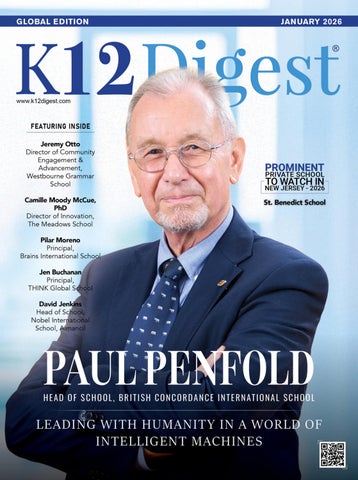
This is why our January 2026 cover story feels timely and necessary. In our conversation with Paul Penfold, Head of School at British Concordance International School, we encounter a leadership philosophy that values what is often overlooked. Paul speaks not of grand gestures, but of invisible leadership. Culture over noise. Long-term thinking over quick wins. His four decades in education and global consulting remind us that schools flourish when people feel secure enough to take risks, and when values remain steady even as methods evolve.

This issue of K12 Digest builds on that idea from multiple angles. Alongside the cover story, readers will find perspectives that examine leadership, wellbeing, innovation, and learning environments through both local and global lenses. Together, these voices reflect a shared belief that education is not a sprint toward the next reform, but a long walk that shapes lives over time.

As you turn these pages, I invite you to slow down. Read not just for ideas to implement tomorrow, but for principles worth holding onto for years. In a world racing toward the next big change, choosing stability might just be the most strategic decision education can make.

Enjoy Reading.

HEAD OF SCHOOL, BRITISH CONCORDANCE INTERNATIONAL SCHOOL

LEADING WITH HUMANITY IN A WORLD OF INTELLIGENT MACHINES

PAUL PENFOLD

PROMINENT PRIVATE SCHOOL TO WATCH IN NEW JERSEY - 2026

38 Where Faith, Learning and Service Grow Together

ST. BENEDICT SCHOOL

INDUSTRY PERSPCTIVE 24

EMPOWERING THE NEXT GENERATION OF INNOVATORS & CREATORS

ACADEMIC VIEW

EMPOWERING EDUCATION THROUGH COMMUNITY

Pilar Moreno, Principal, Brains International School

18

62

BUILDING BRIDGES THROUGH EDUCATION AND COMMUNITY

Jeremy Otto, Director of Community Engagement & Advancement, Westbourne Grammar School

BEST PRACTISES

EVALUATION OF TEACHERS MUST HIGHLIGHT EXCELLENCE—AND CONFRONT MEDIOCRITY—TO KEEP STUDENT LEARNING THE PRIORITY

Dr. Greg Rockhold & Dr. Hans A. Andrews

58

ADMIN PERSPCTIVE

EMPOWERING SCHOOLS THROUGH PEOPLE-CENTERED LEADERSHIP

David Jenkins, Head of School, Nobel International School, Almancil

32

52

TRANSFORMING EDUCATION THROUGH GLOBAL EXPERIENCES

Jen Buchanan, Principal, THINK Global School

Looking back on your career, what have been the key milestones and turning points that shaped your educational philosophy?

Looking back on my career, the key milestones that shaped my educational philosophy began with military service in Germany and Singapore during the 1960s, a period of my life that provided a foundational sense of discipline and global perspective. This was followed by a transformative period between 1980 and 1985 in the refugee camps along the Thai-Cambodian border. Coordinating adult literacy and education programmes for the UNHCR and TEAR Fund for displaced Hmong and Cambodian populations established my core conviction that education is fundamentally about human dignity and possibility. My journey continued through the “Open Learning revolution” of the mid-eighties, where I developed a solid grasp of distance learning methodologies, further reinforcing my belief that learning should be accessible and flexible.

As Head of School of a young international institution, what major challenges have you faced in establishing BCIS’s identity and culture and how have you turned those challenges into opportunities?

As the Head of School at a young institution like British Concordance International School (BCIS), the major challenge has been establishing a distinct identity while navigating rapid growth from 34 to over 380 students. I have turned these challenges into opportunities by positioning BCIS as a “school for the community” and intentionally embedding the BRAVE values—

The biggest opportunity for K–12 schooling is the ability to provide immersive, experiential learning, yet the significant risk is the potential loss of the “human” element; therefore, we ensure that technology serves to enhance human connection and imagination rather than replace it

Belonging, Respect, Aspiration, Vitality, and Excellence—into daily school life. By focusing on “invisible” leadership—the trust nurtured and the culture built through small, repeated actions like greetings and feedback—we have created a stable environment where a diverse student body of 29 nationalities can flourish.

Technology and AI are rapidly changing education. How are you integrating emerging technologies at BCIS, and what do you see as the biggest opportunities and risks for K–12 schooling?

Technology and AI are integrated at BCIS through the development (in progress) of a future-ready 2030+ curriculum model that prioritises AI literacy. Drawing on my pioneering research into virtual learning environments, such as the PolyU Virtual Hotel in Second Life, I view technology as a workplace simulator that prepares students for a world where collaboration with intelligent machines is the norm. The biggest opportunity for K–12 schooling is the ability to provide immersive, experiential learning, yet the significant risk is the potential loss of the “human” element; therefore, we ensure that technology serves to enhance human connection and imagination rather than replace it.

Leadership in schools often means balancing tradition and innovation. How do you approach this balance, especially in an international setting where global best practices and local culture may intersect?

In an international setting, I approach the balance between tradition and innovation by bridging

Western educational models with local cultural contexts. This is informed by my research into how Asian culture affects learning and my experience developing national curricula in countries like Myanmar and Vietnam. At BCIS, we maintain the rigour of traditional UK standards, such as IGCSE and A-Levels, while remaining sensitive to local traditions and ensuring that our strategic vision is always tempered with relentless practicality and cultural rapport.

Success in an evolving landscape comes from noticing effort in others, staying “human” despite the weight of responsibility, and standing firm on values even when no one is watching

Outside your professional work, what personal values, interests or passions drive you and how do those inform how you lead and engage with students and staff?

Outside my professional work, I am driven by personal values of community, empathy, and imagination. A recent creative writing project, “The Dim Knight Chronicles,” which I am coauthoring with my son, Jacob, has been a great way to get inside the thinking of a primary school child. This interest in storytelling informs how I engage with students and staff, as it reflects my belief that imagination is fundamental to education. I am also an avid reader, contributor to Linkedin, and still continuing my own lifelong learning journey which I encourage my staff to consider too. I love to camp with friends and my son, and during the cool season in North Thailand we camp 8 or 9 weekends in the mountains near to Chiang Mai.

For students at BCIS and young professionals aspiring to work in education or leadership, what advice would you give them about building meaningful impact in an evolving educational landscape?

For students and young professionals, my advice is to focus on building meaningful impact through human-centred responsibility. I encourage them to be “practitioner-scholars” who can bridge the gap between theory and practice and keep grounded and focused on more than just the work, to ensure the human factors remain central to their thinking and their career. Success in an evolving landscape comes from noticing effort in others, staying “human” despite the weight

of responsibility, and standing firm on values even when no one is watching.

Looking ahead three to five years, how do you envision BCIS evolving, academically, culturally and technologically and what role do you hope to play in that evolution?

Looking ahead three to five years, I envision BCIS evolving into a fully CIS-accredited

institution that leads the way in integrating character education with advanced AI literacy. My goal is to continue as a forwardlooking leader who fosters an environment where the culture is felt through trust and stability. I hope to see the school further solidify its role as a community hub that prepares students not just for exams, but for meaningful lives in an uncertain, rapidly changing world.

ACADEMIC

VIEWS

Empowering Education through Community

Hi Pilar. Can you tell us about your career journey and how you got to where you are today?

My journey in education began when I was offered a role as Assistant to the Director of a school, a position that would change the course of my life. In that role, I worked closely with María Hita, a leader who truly shaped my understanding of what education and leadership can be. Under her guidance I learned what it means to lead with vision,

empathy, and integrity. I observed how she listened to teachers, supported families, managed the complexity of a school, and I absorbed everything I could.

As time went by, I gradually took on more responsibilities: coordinating teams, liaising with families and educators, each challenge taught me something new about leadership, communitybuilding…Those years working “in the trenches” gave me the experience, resilience and the values that underpin my educational philosophy today.

Teaching and leading a school can be demanding, and without a strong framework of mentorship and collaboration, people risk burnout or disillusionment

Pilar Moreno is Principal at Brains International School Conde de Orgaz and President of ASIBI, Association of International School in Spain and Portugal. She has over 20 years of experience in education. She is a qualified English philologist and can read in several languages, as well as an expert in protocol. Throughout her career, Pilar has attended numerous international education conferences, learning from global best practices.

Recently, in an exclusive interview with K12 Digest, Pilar shared her inspiring journey in education, emphasizing the importance of human connection, empathy, and community-based learning. She believes education should be holistic, focusing on social skills, emotional intelligence, and global citizenship. She also shared her personal hobbies and interests, future plans, words of wisdom, and much more. The following excerpts are taken from the interview.

Eventually I became Director at Brains International School Conde de Orgaz, a position where I can put into practice all the lessons, I learned working under María Hita. Later, embracing a broader vision of educational

collaboration, I accepted the role of President of ASIBI, striving to support bilingual and international schools across the country. Looking back, that path — from assistant to director, from following to leading, has been

Schools are increasingly recognizing that learning involves more than academic achievement as social skills or emotional intelligence

guided by mentors, hard work, and a deep conviction that education is about shaping people’s lives.

What do you love the most about your current role?

What brings me the greatest satisfaction is that every day I have the opportunity to make decisions and that has an impact into the Community.

And, perhaps most importantly, I love the chance to foster a school culture where each person feels seen, heard, and valued. That human dimension, empathy, respect, belonging, is for me, the core of meaningful education.

What do you think are some of the biggest challenges facing educators today, and how can they be addressed?

One of the biggest challenges is, I would say, maintaining human connection. With everything it means.

Another challenge is supporting educators themselves: helping them grow, adapt, remain motivated and valued. Teaching and leading a school can be demanding, and without a strong framework of mentorship and collaboration, people risk burnout or disillusionment.

And I believe strongly in a communitybased approach: when teachers, families, administrators and students work together, rooted in empathy, trust, and mutual respect, education can meet its highest purpose.

What do you think are the most significant trends or changes in the world of education?

We are in a very special and delicate moment. My personal point of view is that education has to have an holistic model.

Teachers must listen carefully, guide thoughtfully, collaborate openly, and build trust with students, families, and colleagues

Schools are increasingly recognizing that learning involves more than academic achievement as social skills or emotional intelligence.

The global dimension of education is more relevant than ever. Students must be prepared to engage with different languages, cultures, and international challenges.

In our school, Brains International School, we think that we play a key role in fostering open-mindedness, global citizenship, and intercultural understanding.

Education is becoming more humane: more attentive to the whole child, to their context, their needs, their individuality.

Have you had any mentors or role models who have influenced your career path?

I’ve been fortunate to learn from exceptional people at different moments of my career. María Hita, and in the last few years, my General Manager, Luis Manuel Tolmos.

One of the most influential people in my early career was María Hita. She taught me not only the practical side of school leadership but also the human dimension behind every decision.

Later in my journey, Luis also became a defining influence for me. As my leader, he encouraged me to aim high, to trust my own vision, and to believe deeply in what I could achieve.

He pushed me to step outside my comfort zone, to embrace ambition without fear, and to cultivate high expectations. His leadership gave me the confidence and the freedom to “fly higher,” and that has had a lasting impact on my professional evolution.

Their combined influence continues to guide my decisions and the values I bring to every role I undertake.

What do you think are some of the most important qualities or skills for educators to have, and why?

It’s actually a very difficult question to answer. It is so difficult because we cannot choose a single skill.

Teaching is nearly something divine and profoundly complex.

But if I had to choose just three, I would say communication, passion for education and flexibility.

Educators also need curiosity, fundamental for teachers and pupils.

Teachers must listen carefully, guide thoughtfully, collaborate openly, and build trust with students, families, and colleagues.

We forget as well that teachers are people with feelings, problems, and sometimes society ask them to solve problems that should be solved at home.

What is your favourite quote?

“Education is not preparation for life; education is life itself.” John Dewey

I love this quote because it reminds me that learning happens every day. For example, as Principal, I see students developing resilience and teamwork during a simple group project or learning empathy when helping a classmate. These everyday experiences are as important as academic knowledge—they shape who they are today.

This is why I focus on creating a school environment where every moment is an opportunity to learn, grow, and live fully.

Can you share a favourite hobby or interest outside of work that helps you recharge?

I enjoy playing tennis, practicing ballet, and Reading. Each of these helps me to recharge in different ways.

I also love traveling, discovering new places, and experiencing different cultures. These hobbies allow me to step away from my daily routine, reflect, and return to work with fresh energy and inspiration.

Where do you see yourself in the next 5 years?

A very good question, I have no answer at this moment. A wish could be continuing to serve the educational community. And I hope to continue learning — because as educators we never stop being students ourselves. At the same time, I am open to new adventures and opportunities that allow me to grow, explore, and contribute in different ways.

What advice would you give to someone just starting out in their career in education?

I’m not usually someone who gives advice, but if I could share a few thoughts, I would say: surround yourself with good people who inspire and support you, nurture creativity in yourself and your students, don’t be afraid of change, and always dare to aim high. Education is a journey full of challenges and opportunities, and having courage, curiosity, and strong companions by your side makes all the difference. And very important, start with humility and curiosity.

INDUSTRY PERSPECTIVE

Empowering the Next Generation of Innovators & Creators

Hi Camille. Can you tell us about your career journey and how you got to where you are today?

I started my career at IBM, working as part of a team selling PCs to computer value added resellers (one of whom was Mark Cuban), before becoming a teacher. I initially taught math in a potato farming community in rural Texas, then – in an “I can do that!” moment in the early 90s – I became a teacher-of-the-air, instructing physics via satellite to kids in remote communities. An astronaut I interviewed for a TV special connected me with NASA, where I next worked for several years as an anchor-producer, creating live educational shows featuring the agency’s research. There have many steps along the way since then but saying “I can do that!” to every opportunity has allowed me to grow professionally and work in a wide variety of roles communicating and cultivating innovation education – STEM, CS, and business – to kids and teachers. I’ve developed a college bound program, worked as a PBS Ready To Learn specialist in Title I schools throughout Las Vegas, served as school principal and

Camille Moody McCue, PhD, is an educator who serves as a school leader, STEM/CS teacher, and Dummies author, and is the Director of Innovation at The Meadows School in Las Vegas. She worked previously as High School Principal at The Adelson School where she built a K12 Startup Incubator and developed a schoolwide innovation program. Camille earned her BA in mathematics from the University of Texas at Austin, and her PhD in curriculum and instruction from the University of Nevada, Las Vegas. She loves encouraging all students to hone their innovation skills — in computer science, engineering, and business and entrepreneurship. Recently, in an exclusive interview with K12 Digest, Camille shared insights into empowering students to become innovators and creators, emphasizing the importance of adapting to trends in education and leveraging technology to prepare students for real-world challenges. She also shared her personal hobbies and interests, future plans, words of wisdom, and much more. The following excerpts are taken from the interview.

built a startup incubator at the Adelson School, been the launching author of the Dummies for Kids series, taught university courses and kids coding camps, and more. For me, any initiative that entails helping tweens and teens think and work innovatively is my professional sweet spot. My personal joy is building people who build the world.

What do you love the most about your current role?

I love building opportunities that help students see themselves as creators, innovators, and entrepreneurs. My favorite moments are when students come bursting through the classroom door breathlessly asking, “What are we going to make today?!” Seeing them build something, pitch something, or solve something – taking ideas out of their heads and building them digitally and physically in the real world – is awesome! Crafting those experiences, and the programs that make them possible, keeps me energized.

What do you think are some of the most significant trends or changes in the world of education, and how do you think educators can adapt?

It’s necessary to align learning experiences with trends that match the evolution of technology in the workplace. We’re seeing rapid shifts driven by AI, interdisciplinary learning, and a stronger emphasis on real-world skills. Students need to be problem-solvers who can collaborate, design, and iterate. Educators can adapt by embracing project-based learning, integrating technology meaningfully, and giving students authentic challenges that mirror the world they’re entering.

What inspired you to write “Dummies for Kids”, and what do you hope young readers will take away from the book?

Media in online and print formats expand my instructional reach and allow me to connect with audiences worldwide. I began writing Dummies tech books in 1997 (starting with a PowerPoint Quick Reference) and, after a few

It’s necessary to align learning experiences with trends that match the evolution of technology in the workplace

years, I proposed to Wiley that we launch a tech line for kid readers. My first Dummies for Kids book was Coding for Kids; we’ve just published its third edition. I love hearing from my readers – many of them post comments on my Scratch projects featured in the book! It’s my hope that readers find the featured projects fun and foundational, and that they feel confident to level up in coding, to text-based languages such as Python and JavaScript.

What do you think are some of the most important qualities or skills for educators to have in order to be truly effective?

I subscribe to H.G. Wells’ philosophy of “adapt or perish.” Great educators stay curious about their craft and never stop learning. If you’re teaching the same thing in the exact same way you taught a decade ago, then you have room for improvement. Constantly refreshing your content knowledge and skills – through courses, conferences, and other mechanisms – keeps you professionally up to date. It also refreshes your memory of how it feels to be a student, building empathy for your own students and reminding you of intellectual and scheduling challenges they face in completing work you

assign. I also think it’s important to seek out and participate in competitions that take your students beyond the walls of their school sites. While it’s comfortable to be “champion of your classroom,” educators and their students can expand their creative thinking by engaging with a larger population and greater diversity of people through participating in expositions and competitions. Lastly, you must like kids and enjoy their energy (including this year’s annoying “6-7” malarkey). Having patience, a sense of humor, and willingness to try new things go a long way!

How do you stay current with the latest trends and developments in STEM education, and what resources do you recommend for educators?

My students and I are in “constant learning mode.” Together, we pay attention to news, podcasts, and local events and find routes to connect our classroom to the world. Let me share some examples of how we tap into the resources of our local community. Living in Las Vegas, we are surrounded by casinos, and I worked with my sixth-grade students to design and code slot machines, including conducting the

probability computations to determine payouts. The process sets the stage for them in the game design industry. And understanding the “house edge” helps students grasp how our city was built! In an engineering class, our F1 STEM Racing students visit the F1 Grand Prix on the Strip each year, drawing parallels between the real racecars and the 1/20 scale versions they design and mill, then race in competition. To support their work, a UNLV professor further elevates their understanding of streamlined car designs by collaborating with the students on building computation fluid dynamics (CFD) models. Lastly, in our DECA business courses, I connect our students with experts through Lunch & Learn events; host seasonal business sprints (and share videos of students in action on LinkedIn); and conduct mock role play events in which students pitch to parents who possess expertise in everything from hospitality to entrepreneurship. For every educator, it’s important to know that there are many people in

your local community who want to support your students; they will give their time and expertise – just reach out and ask for help.

Have you had any mentors or role models who have influenced your career path?

For every educator, it’s important to know that there are many people in your local community who want to support your students; they will give their time and expertise – just reach out and ask for help

Absolutely. I’ve been fortunate to have many mentors who exhibited intellectual curiosity and “cleared the road” for me to be bold in designing new programs. There are too many to list, but I fondly recall the incredible support of Dr. Samuel Massenberg and Dr. Malcom Phelps, my managers at NASA, who made it possible for me in my early career to divert from the traditional way of doing things. And day-to-day, my family members are my role models: each of them engages curiosity and innovation, learns voraciously, persists in the face of challenges, works hard, and leads with optimism. Their energy is infectious, and their practical guidance helps me feel supported in pursuing new initiatives.

Can you share a favorite hobby or interest outside of work that helps you recharge?

Hanging out with my Corgis, rewatching Big Bang Theory, exercising at F45, vegetarian cooking, listening to Audible books, meeting and chatting with experts of all stripes, enjoying a night out in Las Vegas, and conversations with my family all help me recharge. Those moments away from school help me reset and spark fresh ideas.

Where do you see yourself in the next 5 years?

I see myself continuing to lead innovative STEM/CS and business programs, writing more books, and expanding opportunities

for students. My north star is helping young people design inspired futures, and I want to keep scaling that impact.

What advice would you give to educators who are looking to incorporate more STEM and coding into their teaching practices? Start small, be playful, and let students explore. You don’t need to be an expert — you just need to start learning, create space in your classroom for curiosity, and convey to students a disposition of collaborative problemsolving, stick-to-it-ness, and optimism. There are many superb, free and inexpensive tools, organizations, and competitions you can dive into to get kids excited and learning. Scratch is perfect as an entry point to coding, and Code. org (including its cool App Lab) is excellent for teaching foundational computer science at all levels; Microsoft’s MakeCode for micro:bit provides a fun pathway for exploring small electronics; the FAA Airport Design Challenge provides an easy way, using Minecraft, to try design engineering; TinkerCad is fabulous for teaching 3D design and the FlashForge printer is a reliable, reasonably-priced workhorse of a 3D printer for the classroom; and DECA provides a full platform of resources and competitions (including Stock Market Challenge) to spark enthusiasm for business and entrepreneurship. And of course, taking any of the offerings on Coursera will help you grow content and skills that will expand your practice in pretty much any subject you can think of. Most importantly, don’t let perfect be the enemy of good – just get started!

Transforming Education through Global Experiences

Passionate about student agency, wellbeing, and creative potential, Jen is committed to building positive, equitable, and engaging learning environments. With extensive experience in progressive and trailblazing schools, she brings a deep understanding of how to turn educational vision into meaningful change. Jen is Principal of THINK Global school, the world’s first travelling boarding school. A dedicated lifelong learner, Jen holds a Master of Education from The University of Melbourne, where she researched how schools can foster “flow” in learning, and a second Master’s degree from Deakin University, focusing on the experiences of graduate teachers. Beyond education, Jen is an adventure-seeker and creative spirit. Whether hiking, camping off the grid, or creating ceramics and short films, she brings curiosity, playfulness, and a love of storytelling to everything she does.

Recently, in an exclusive interview with K12 Digest, Jen shared insights into her journey as an educator, the power of human-centered learning, and THINK Global School’s innovative approach to education. She also shared her personal hobbies and interests, future plans, words of wisdom, and much more. The following excerpts are taken from the interview.

Hi Jen. Can you walk us through your career journey, and how you’ve progressed from a teacher to a school leader?

My career began in some fairly unconventional places. At 26, I found myself working as a language teacher for the United Nations in Timor Leste, an experience that shaped me profoundly at a formative stage of my life. It wasn’t something I had deliberately set out to do; rather, it grew out of a genuine love of different cultures, places, and people, and

a curiosity about how education functions across contexts. That early experience taught me that learning is deeply relational and inseparable from lived experience, especially in environments shaped by displacement, difference, and change. From there, I continued to seek out international teaching roles with two of my favourite places being in Riyadh, Saudi Arabia and Bali, Indonesia. I’ve always carried with me the understanding that education is always human before it is academic. My

When learning is grounded in real places, real questions, and real responsibility, students engage not because they have to, but because it matters

Inclusive education requires not only representation, but intentional reflection on power, perspective, and belonging

progression into school leadership, particularly at THINK Global School, felt less like a shift in direction and more like an expansion of that original insight: that schools have the power to shape not only what young people know, but who they become, especially when learning is grounded in empathy, trust, and connection.

What do you think sets THINK Global School apart as an educational institution?

What truly sets THINK Global School apart is that it understands education as something that must be lived in order to be meaningful. The school’s global, traveling model reflects a belief that learning happens through immersion, relationship, and reflection, not

just instruction. Students are continually invited into new cultural contexts, asked to listen carefully, adapt thoughtfully, and reflect on their own identities as they move through the world. This approach honors students as whole human beings, capable of responsibility, curiosity, and growth, and it challenges the idea that education should be confined to static classrooms or predetermined pathways.

What do you believe are the most significant challenges facing education today, and how do you think they can be addressed?

One of the most significant challenges facing education today is the human experience. Many systems prioritize efficiency, predictability, and

narrow definitions of success, often at the expense of curiosity, wellbeing, and relevance. Students feel this disconnection acutely. Addressing it requires re-centering education around relationships and purpose, designing learning that is responsive to the world students are actually living in. When learning is grounded in real places, real questions, and real responsibility, students engage not because they have to, but because it matters.

How do you think about the intersection of education and creativity, and what role do you see arts playing in educational settings?

I see creativity as fundamental to how humans learn and make meaning. The arts, in particular, create space for emotion, ambiguity, and multiple perspectives, all of which are essential for deep understanding. At THINK Global School, creativity is woven throughout the learning experience, whether students are telling stories, designing solutions, or reflecting on identity and place. The arts help students express what they are learning about the world and about themselves, and they cultivate the kind of flexible, empathetic thinking that complex global challenges demand.

Can you share your thoughts on the importance of diversity, equity, and inclusion in education?

Diversity, equity, and inclusion are inseparable from human-centered education. Learning across cultures, as our students do, makes it impossible to treat diversity, equity, and inclusion as a theoretical exercise. It becomes lived, relational, and ongoing. Inclusive education requires not only representation, but intentional reflection on power, perspective, and belonging. When

Outside of work, I am passionate about travel, learning from different cultures, and spending time in environments that invite reflection and curiosity

schools create environments where students feel seen and valued while also being challenged to engage respectfully with difference, they help young people develop empathy, humility, and a sense of shared responsibility.

What is your favorite quote?

One of my favorite quotes comes from Jane Goodall, who once said, “They used to say that I was a difficult woman, but that is why

there are so many of us.” I love this quote because it reframes difficulty as conviction and courage. In education, especially when pushing against conventional systems or advocating for more humane, equitable approaches, being labeled “difficult” often simply means being unwilling to accept the status quo. It’s a reminder that meaningful change is rarely comfortable, and that collective progress often begins with

individuals who are prepared to ask hard questions and persist anyway.

Can you tell me about a role model or mentor who has inspired you?

I have been most inspired by mentors who lead with humanity at the center of their work. Leaders I have worked with, particularly at THINK Global School, have shown me that

strong leadership is rooted in listening, trust, and care, not control. They have modeled how to hold high expectations while remaining deeply attentive to the people doing the work.

What are your passions outside of work?

Outside of work, I am passionate about travel, learning from different cultures, and spending time in environments that invite reflection and curiosity. I also have a pottery wheel at home, so when not travelling, I truly enjoy being in a creative space and making my “wonky” pots.

Where do you see yourself in the next 5 years?

In the next five years, I see myself continuing to work in roles that allow me to shape and support human-centered educational models. I am interested in contributing to spaces that challenge conventional schooling while remaining deeply relational, and in mentoring educators who are navigating complexity with care and purpose.

What advice would you give to aspiring educators or leaders looking to make a positive impact?

To aspiring educators and leaders, I would say this: stay close to the human heart of the work. Slow things down and make time for being present. Education is not about perfect systems or fixed answers, but about relationships, curiosity, and growth over time. Be willing to take unconventional paths, listen deeply, and learn alongside your students. When you design learning experiences that honor vulnerability, purpose, and connection, you create conditions where meaningful change, for both individuals and communities, can take root.

PROMINENT PRIVATE SCHOOL TO WATCH IN NEW JERSEY - 2026

ST. BENEDICT SCHOOL

Where Faith, Learning and Service Grow Together

Faith guides daily life at St. Benedict School in ways that feel steady and familiar. It is present in classrooms, shared prayers, and simple moments of care between students and teachers. For the school community, Catholic education is about giving children a strong grounding that will carry them through life, both academically and personally. “Our Catholic faith is at the core of our education here at St. Benedict School. We provide our students with a Foundation for Life. This foundation is designed to equip students with the values, skills, and breadth of knowledge they need to be successful in their lives,” says Nicholas Cammarano, Principal of St. Benedict School. That sense of purpose is reflected in the school’s mission, which calls the community to joyful worship, respect for life, generosity toward others, and gratitude for individual gifts. Learning is approached as something meaningful and lasting. “Our entire staff

is committed to setting the tone for our school by going above and beyond for our students, staff, and families,” Cammarano adds, pointing to the importance of generosity, a positive outlook, and a warm, family atmosphere across the campus.

Over time, St. Benedict School has evolved along with its surroundings. As several Catholic schools in the area closed, families from across the region began to see St. Benedict as their school. The result is a community that is proudly diverse and shaped by a wide range of backgrounds. In 2022, the school celebrated its 60th anniversary, marking more than six decades of Catholic education rooted in continuity and care.

The school’s work begins early, with PreK programs that welcome its youngest learners. “Our PreK programs have become a tremendous feeder for the school. They allow us to reach students early and provide a strong academic and social foundation that supports long-term success,” shares Megan Gallagher, Vice Principal of St. Benedict School.

Learning at St. Benedict often extends beyond classroom walls. The Great Outdoor Learning Center, with its gardens, koi pond, and outdoor classroom, has become a meaningful part of daily life on campus. “This space has

strengthened our commitment to environmental stewardship and hands-on discovery. It helps students understand not just the environment, but their responsibility to care for it,” Gallagher explains.

Inside the school, technology supports active learning. Students in grades two through eight use one-to-one devices, while the STEM Lab offers tools such as 3D printers, tower gardens, and modern science equipment. These resources help students explore ideas, test solutions, and build confidence in an increasingly digital world.

Service remains central to the school’s identity. Through community service clubs, an on-site St. Vincent de Paul food pantry, and outreach initiatives that support families in need, students learn the value of compassion through action. “Our emphasis on service has truly defined who we are as a school community,” Cammarano notes.

Spiritual guidance at St. Benedict School is led with clarity and care, shaping how faith is taught and lived each day. Father Garry Koch serves as the head of both the school and parish, providing steady guidance and setting the tone for educational standards and religious life. Faculty and families alike look to him as a trusted presence and a clear moral compass. Supporting that vision is Lori McCahill, Head of Religious Studies, who shapes the religion curriculum and

leads sacramental preparation, helping students understand faith as something lived and practiced.

The school’s middle school theology program is led by newly ordained Deacon Anthony Cullen, whose presence resonates deeply with students. By openly balancing service to the Church with family life and career, he shows students that faith is attainable and relevant. His classes blend thoughtful use of technology with real-world discussion, guiding students through modern questions with the grounding of Scripture and Catholic teaching.

A Community Where Learning Takes Root

St. Benedict School holds a distinct place within New Jersey’s Catholic education community, not because it tries to stand apart, but because

it stays grounded in what matters most. The school places equal care on academic growth, faith formation, and the everyday development of each child. Classrooms are active and purposeful. Students move between science labs, art spaces, music rooms, outdoor classrooms, and the gym, learning that education engages both mind and body.

“Our goal has always been to support the whole child. That means strong academics, a solid faith foundation, and plenty of opportunities for hands-on learning,” says Cammarano. These experiences are not treated as extras. They are built into daily life, helping students gain confidence through doing, creating, and exploring.

Relationships play an important role in shaping that experience. St. Benedict maintains

close ties with local Catholic high schools, including Saint John Vianney and Christian Brothers Academy. High school students often visit the campus to lead service projects, host clubs, or give presentations. Younger students watch closely. They ask questions. They imagine themselves in those same uniforms one day. Over time, those encounters turn into real aspirations and familiar pathways.

Service extends well beyond the classroom walls. Through a range of student-led service clubs, the school reaches families and individuals in need across the wider community. “Our students learn early that helping others is part of who we are. It becomes a habit, not a requirement,” Cammarano explains.

Success at St. Benedict is measured thoughtfully. Test scores matter, but they are

not the only marker. Each year, graduates move on to a wide range of competitive high schools, including Catholic, magnet, parochial, and specialized programs. They leave prepared and self-assured. Growing enrollment tells a similar story. Families stay. New families arrive. Trust builds slowly and steadily.

That sense of belonging carries well beyond graduation. Alumni return often, sometimes as guest speakers, sometimes as teachers. This past year, a former student delivered the graduation address, standing at the same podium where they once sat in uniform. Several faculty members are alumni themselves, drawn back by a school that shaped them. Their presence, along with the long tenure of many staff members, gives St. Benedict a rare continuity. The faces may change, but the spirit remains familiar.

Learning by Doing

St. Benedict School holds a distinct place within New Jersey’s Catholic education community, not because it tries to stand apart, but because it stays grounded in what matters most

St. Benedict School continues to adjust thoughtfully to a changing world, guided by curiosity rather than urgency. New tools are welcomed, but never at the expense of real experiences. “We’re always looking for ways to introduce students to new ideas and technology while keeping learning grounded and handson,” says Gallagher.

That balance is easy to see in the school’s STEM Lab and Great Outdoor Learning Center. On a typical day, students might move from indoor experiments to garden beds outside, notebooks in hand. In the outdoor space, learning unfolds slowly and deliberately. Under the guidance of STEM teacher Mrs. Campasano, students plant seeds, tend vegetables, and wait. They watch growth happen over time.

“They plant, grow, and harvest the vegetables themselves. It teaches patience, responsibility,

St. Benedict School is EcoSchools U.S. Green Flag Certified, meeting rigorous standards for conservation, wildlife protection, and community involvement

and care,” Gallagher adds. The harvest does not end in the garden. Students sample what they grow during classroom taste tests. Teachers look forward to the “Greens and Gratitude” salad bar hosted during parent-teacher conferences. During Lent, the project takes on deeper meaning. Through the “Harvest and Donate” initiative, students collect fresh produce and deliver it to the St. Vincent de Paul Food Pantry on campus. In 2024 alone, 125 bags of vegetables were donated. By year’s end, fifth graders celebrate with a simple salad party, sharing food they nurtured together.

These experiences have earned St. Benedict national recognition. The school is EcoSchools U.S. Green Flag Certified, meeting rigorous standards for conservation, wildlife protection, and community involvement. It has also been featured by the Catholic Garden Network. For students, the recognition matters less than the message behind it. They see how faith, care for creation, and everyday choices connect.

“We want students to understand that caring for the environment is part of caring for others,” Gallagher says. The lessons are practical and visible. Dirt under fingernails. Vegetables in baskets. Food shared with those in need. As

learning continues to evolve at St. Benedict School, one idea remains constant. Education is strongest when students are invited to participate fully, with their hands, their minds, and their sense of responsibility.

Preparing Students for What Comes Next

As students approach the end of eighth grade at St. Benedict School, the focus begins to widen. The question is no longer only how well they perform in class, but how ready they feel to step into a larger world. By the time they leave, the hope is that they carry both confidence and clarity. Confidence in their abilities. Clarity in their values. “When our students transition from eighth grade to high school, we want them to know who they are and what they stand for. We want them to step into that next chapter with a strong foundation in both faith and knowledge, knowing they have a community behind them,” says Cammarano.

Academically, expectations are clear and consistent. Students are challenged to meet and exceed grade-level standards, preparing them for the rigor of the competitive high schools many go on to attend. At the same time, character

remains central. Teachers speak openly about integrity, responsibility, and service. Students are encouraged to lead by example, to make thoughtful choices, and to stay connected to their faith as they grow more independent.

Mornings at St. Benedict begin with prayer before giving way to a full academic day. Alongside core subjects, students rotate through a range of “specials” that add rhythm and balance to the schedule. Art, STEM, physical education, music, and Spanish each offer a different way to engage and express learning.

In the gym, Dr. Fitzpatrick leads physical education classes that focus on strength,

teamwork, and the simple joy of movement. Laughter carries easily during games and drills. Down the hall, the art room tells its own story. Under the guidance of Mrs. Audra Erkman, the space fills with color and imagination. Student work lines the walls, changing with the seasons and giving students a place to explore creativity without pressure.

Music is another constant presence. Led by Mrs. Ellen Remick, the program helps students build both skill and confidence. Choir rehearsals, classroom lessons, and school productions bring voices together in shared effort. Several times a year, families gather for performances that reflect steady growth. Each show feels a little stronger than the last.

Middle school learning at St. Benedict is designed to be active and demanding. Lessons emphasize participation and critical thinking, with teachers adapting instruction to meet students where they are. Technology supports

St. Benedict School’s Model UN team recently earned Middle School Best Small Delegation honors, with several students recognized individually for their leadership and preparation

that work in practical ways. Students in grades two through eight use one-to-one devices that connect them to digital resources tied to their coursework, helping personalize learning without replacing human guidance.

The school day often extends well beyond dismissal. After-school clubs and activities give students space to explore new interests and deepen existing ones. From crochet club to Model United Nations, there is room for curiosity in many forms. The Model UN team recently earned Middle School Best Small Delegation honors, with several students recognized individually for their leadership and preparation.

The arts continue after hours as well. The drama program, supported by the Arts Association and led by Mrs. Remick, brings students together for large-scale productions. This year’s performance of Mary Poppins Jr. fills the stage with music, choreography, and carefully crafted sets, all built through collaboration.

Athletics are equally vibrant. Cross country, cheerleading, baseball, volleyball, and basketball draw strong participation, while both the boys’ and girls’ soccer teams celebrated undefeated championship seasons. Wins matter, but sportsmanship and commitment matter more. “Our goal is not just to prepare students for high school. It’s to help them carry faith, knowledge, and service into whatever comes next,” says Gallagher.

Service as a Part of Daily Life

Service at St. Benedict School is a part of the school’s rhythm, showing up in small, steady ways throughout the year. Students collect food for local drives, volunteer at the St. Vincent de Paul food pantry housed on campus, and organize toy collections during the Christmas season. They visit nursing homes. They support RAINE Foundation initiatives. Over time, these experiences teach students that care for others is

an everyday responsibility. “Our students don’t see service as something extra. It’s simply part of who they are and how they show up for the community,” opines Cammarano.

Student leadership plays a visible role in this work. Lauren’s Light EXPLORERS, a club focused on empowering young female leaders, encourages students to speak up, take initiative, and lead with purpose. Athletic teams also carry service into their seasons. Through Catholic Athletes for Christ, the school became the first grammar school chapter in the country. The program emphasizes sportsmanship, integrity, and outreach, values that extend well beyond the field and court. For St. Benedict athletes, community involvement is expected, not optional.

St. Benedict School hosts events that bring parents and children together around learning and shared experiences

One moment that captures the school’s spirit each year is the Veterans Day celebration. The day begins with a simple but powerful scene. Students line the walkways, waving small American flags as veterans arrive. Applause fills the air. The celebration continues with a prayer service and a reception honoring those connected to the school community. It is a quiet lesson in gratitude, patriotism, and respect, felt by students of every age.

The sense of community extends into family life as well. Through the PTA’s Foundation for Life series, St. Benedict hosts events that bring parents and children together around learning and shared experiences. Family STEM Night hums with activity. The Educational Art Museum invites conversation and curiosity. Guided reading sessions and middle school gatherings help families connect across grade levels. These moments build familiarity and trust, strengthening relationships beyond the classroom.

Schoolwide traditions give the year its milestones. The Science Fair fills hallways with experiments and excitement, recognizing creativity as much as achievement. Field Day brings friendly competition and laughter from PreK through eighth grade. Holiday pageants and the annual tree lighting gather the community in celebration, marking time together in ways that feel both joyful and grounding.

Behind much of this energy is a deeply committed parent community. Volunteerism is woven into the school’s structure through the PTA, Grace Association, Arts Association, and Athletics Association. Parents lead, organize, and support programs that enrich student life. “Our families are true partners in what we do. Their time, ideas, and generosity make a real difference every day,” says Gallagher. Local businesses also lend their support, helping fund events and initiatives that strengthen the school. It is a shared effort, built on trust and longstanding relationships.

Looking Ahead with Purpose

At St. Benedict School, growth is approached with care. Progress begins with the adults in the

building, where learning never stops. Teachers take part in regular in-house professional development while also attending external workshops and training sessions. These experiences keep instruction current and responsive. Just as important are the moments when teachers sit together, share what is working, and refine lessons as a team. Collaborative planning time is treated as essential, giving educators the space to strengthen curriculum and better support every learner. “Our teachers learn alongside one another. That shared commitment helps us stay focused on what our students truly need,” says Cammarano.

Families play a meaningful role in that effort. The school’s PTA serves as both a partner and a steady support system. Funds raised through PTA initiatives are reinvested directly into classrooms, helping teachers access resources and meet everyday needs. The result is a school that can respond quickly and thoughtfully as programs evolve.

Technology is woven into daily learning with intention. Students begin using one-toone devices in second grade, building comfort and confidence over time. Digital tools are used

Today, St. Benedict is often viewed as a model within the Diocese of Trenton and across New Jersey, known for balancing growth with community

consistently across subjects, making transitions to computer-based testing feel familiar rather than stressful. Technology supports learning without overshadowing it.

Steady enrollment growth has also allowed St. Benedict to invest in its physical space. Recent will include a new music room, additional classrooms, and plans for a future auditorium. Each addition reflects long-term thinking, designed to support both current students and the programs still taking shape.

Looking ahead, the school is beginning to explore age-appropriate AI learning opportunities. The goal is practical and grounded. “We want our students to build skills they’ll need for the future while keeping learning meaningful and human,” says Gallagher. At the same time, the school remains attentive to the broader needs of its community. Academic support, spiritual care, financial considerations, and social-emotional well-being are addressed together, so students feel supported in every sense.

Recent years have brought notable growth, especially in early education. To expand the preschool program, the school added two modern mobile classrooms for three-year-old students. Welcoming new families has strengthened the school’s future while preserving the close-knit feel that defines daily life on campus. Today, St. Benedict is often viewed as a model within the Diocese of Trenton and across New Jersey, known for balancing growth with community.

Plans for campus expansion continue, guided by a clear priority. Growth will not come at the expense of connection. “Maintaining our sense of family is non-negotiable,” Cammarano notes. As the school looks toward the next decade, the vision remains focused. The hope is to graduate students who are prepared for academic challenge, comfortable with evolving technology, and grounded in lasting values. Graduates leave with confidence, curiosity, and a sense of responsibility to others.

“Our vision is that St. Benedict students continue to grow into leaders who serve with compassion and live their faith with integrity,” Gallagher says. It is a future shaped by careful choices, steady relationships, and a belief that education, when done well, leaves a lasting mark.

Empowering Schools Through People-Centered Leadership

David Jenkins is an experienced international school leader with nearly 30 years in education across Europe, Africa, Asia, and the Americas. He has led IB continuum schools through authorisations, evaluations, and periods of growth, and is known for being a visible, people-centred leader who values strong relationships with students, staff, and families. Passionate about holistic education, David believes academic excellence and wellbeing go hand in hand. Outside school, he enjoys sport and travel and leads with a simple principle: take the work seriously, but not yourself.

Recently, in an exclusive interview with K12 Digest, David shared his journey into education leadership, insights into how schools can better support student mental health and wellbeing, his favorite book, future plans, words of wisdom, and much more. The following excerpts are taken from the interview.

What inspired you to pursue a career in education leadership?

I started teaching because I enjoy working with young people. I moved into leadership at a very early age, primarily due to luck (depends how you look at it!). I had just started my teaching career at the age of 22 and the school I was working in had just started the process to become an IB Middle Years Programme school. It was new to everyone, and no one wanted to take the lead on the coordinator’s role. Fresh out of university and belief in myself (with a sprinkling of naivety on top!), I went for it. I soon realised that the right

leadership can make everyone’s life better: students, teachers, and parents alike. Early on, I saw how a good decision at leadership level could turn a stressful school into a positive one, and a poor decision could do the opposite. That was enough motivation for me to want to help tip the balance in the right direction and I haven’t looked back since.

What do you love the most about your current role?

100% the students. The best part is still being in the thick of school life. I enjoy talking with students, supporting teachers, and working with

No algorithm has yet managed playground duty or a worried parent at pick-up time, and I suspect it won’t anytime soon

parents; and yes, that includes early mornings, late evenings, and the occasional difficult conversation. I also enjoy the strategic side of the role, but only when it stays connected to reality. I’ve learned that the best strategies are the ones that still make sense at 8:15 on a wet Monday morning.

Do you think AI in classrooms by 2030 will be an opportunity or threat?

Having led IB schools through authorisations, evaluations, new programmes, and technological change, I’ve learned that change works best when people understand why it’s happening. I have seen the value of AI and how it can

help, not hinder, education (for students and teachers). I’m optimistic about technology and AI, as long as they support teachers rather than replace them. No algorithm has yet managed playground duty or a worried parent at pick-up time, and I suspect it won’t anytime soon.

How do you think schools can better support student mental health and wellbeing?

This is becoming an increasing concern of mine, and I am finding youngsters are facing challenges that I never had as a student. I don’t believe wellbeing can be fixed with a single initiative or a poster in the corridor. It comes from adults who notice students, routines that feel safe, and expectations that are high but human. When students feel known and supported, behaviour improves, learning improves, and everyone sleeps better; including the Head.

In your opinion, should “international-mindedness” be part of national curricula?

In today’s day and age, it has to; this is nonnegotiable, and to avoid it is reckless. After working across Europe, Africa, Asia, and the Americas, I’ve led schools where students speak two or three languages before lunchtime. That experience teaches you quickly that there’s more than one right way to do things. International-mindedness, for me, is about curiosity, humility, and a sense of humour when cultural assumptions don’t quite land as expected. We need to embrace and celebrate our differences, and focusing on cultural awareness is a key aspect in achieving this.

Is there a book that shaped your view on education? Why?

Being a true IB Learner, I will choose to be a risk-taker here. I grew up with the likes of Not

Listen more than you speak, and remember that leadership is a marathon, not a sprint

The Nine O’clock News, The Young Ones, Only Fools & Horses, and the iconic Blackadder. These shows, in their own way, questioned formal education, and they showcased the importance of common sense, soft skills, and the need to not take things so seriously. One book that’s stayed with me is Stark by Ben Elton. It’s sharp, funny, and uncomfortably relevant, especially in how it highlights inequality, privilege, and shortterm thinking. It reminded me that education isn’t just about qualifications; it’s about helping young people think critically, question power, and understand their responsibility to the world around them. Also, any book that makes you laugh and feel uneasy at the same time is probably worth paying attention to.

Do you have a personal mantra you live by? What is it?

As a parent and as an educator I often refer to the importance of those skills that require zero talent. Being respectful, making an effort, collaborating, being on time and caring are all things that require zero talent, yet they are some of the most important traits in life; more so than being able to regurgitate information in an exam setting, or a grade.

What’s one thing you’re passionate about outside of education?

Sport; playing and watching. While I used to be very competitive when I was younger, I always enjoyed the banter and the camaraderie of being part of a team. I was fortunate enough to captain several teams I played for in my younger years, and I always relished the opportunity and the responsibility that came with this. Sport has also been my crutch throughout my nomadic existence. Before I

was 18, I had lived in Denmark, Iran, Portugal and three different regions in the UK. Football was my “in” and how I made friends. My adult life has taken me back to Denmark, to Spain, the US, Mauritius and Portugal, and the strong bonds I still have in each area are because of sport. This is also why I am a very strong supporter of the promotion of sports in schools.

Where do you see yourself in the next 5 years?

In July 2026 I will be taking on a new challenge in Oman, and I am very excited by the prospect. Having worked in different parts of the world, the Middle East is one of the few regions I have yet to experience. I see myself continuing to lead by example and empowering my colleagues while remaining focused on people, culture, and student experience. Most importantly, I see myself still learning; always learning. Anyone who says they’ve got leadership completely figured out probably hasn’t been in a school recently.

Looking back on your career, what advice would you give to someone just starting out in school leadership?

The key aspect for me is visibility. You should be the first person the students and parents see when they come in through the gates and as visible and available throughout the day. Stay connected to teachers, students and parents. Listen more than you speak, and remember that leadership is a marathon, not a sprint. It is also imperative that you do not take yourself too seriously and you also own every decision; the good, the bad and the ugly ones. And trust me, there will be bad ones. Also, never underestimate the power of a well-timed cup of coffee and a genuine “thank you.”

Evaluation of Teachers Must

Highlight Excellence—and Confront Mediocrity—to Keep Student Learning the Priority

Decades of teaching and administrative experience at both the K–12 and community college levels have taught us a hard truth: when action on behalf of students is necessary, it must move forward despite resistance. Change in education is rarely comfortable, but inaction is far more damaging.

The Failure of Traditional Evaluation Models

When any of us was assigned as a community college instructional administrator to evaluate faculty, it quickly became clear that practical resources on teacher evaluation were limited. A thorough search revealed only two books on the topic—both written by university professors,

Boards of education and boards of trustees want effective evaluation systems, but the responsibility for developing them cannot be outsourced

Dr. Greg Rockhold, a former Superintendent, has served on the National Association of Secondary School Principals board as president of the New Mexico Coalition of School Administrators and executive director of the New Mexico Association of Secondary School Principals.

Dr. Hans Andrews is a distinguished fellow in community college leadership through Olney Central College (Illinois) and a former college president. He started the first dual-credit program between community colleges and secondary schools in the country.

Dr. Greg Rockhold
Dr. Hans A. Andrews

neither rooted in the real experience of evaluating classroom instruction, coaching teachers for improvement, or handling remediation and dismissal when improvement did not happen.

These texts relied almost exclusively on three approaches:

Student evaluations collected at the end of a course

Self-evaluation reports written by instructors

Peer evaluations are conducted intermittently over long periods

While each of these tools may have limited value, research consistently shows that none, alone or in combination, constitutes a valid or reliable system for evaluating instructional effectiveness (Danielson, 2007; Toch & Rothman, 2008).

Joint Planning: Administration and Faculty Leadership

Boards of education and boards of trustees want effective evaluation systems, but the responsibility for developing them cannot be outsourced. Meaningful evaluation systems must be collaboratively designed by administrators and teacher leaders, clearly defining:

What high-quality teaching looks like

How instructional weaknesses will be identified

What remediation will entail

What happens when improvement does not occur

Once adopted by a governing board, such systems gain legal standing—critical when due process and personnel actions are challenged (Odden & Kelley, 2002).

Teacher Response: Quiet Support, Not Revolt

Contrary to popular stories, resistance didn’t come from effective teachers. Strong educators were quietly supportive; they already knew who the weakest performers were in their departments. New teachers often appreciated the clarity, seeing evaluation as a tool for professional growth rather than punishment.

In one notable instance, a union representative present during a follow-up conference with an underperforming instructor later remarked: “Don’t misunderstand my role—we want the same thing you want: excellence in teaching.”

Over 18 years at one community college, 14 tenured faculty members were dismissed after documented evaluations and remediation efforts, following the adoption of honest, systematic evaluation practices that had not been in place before.

Outcomes That Matter: Student Success

The results were measurable. Over seven years, graduates from this community college who transferred to a major Illinois state university earned:

The highest GPAs among transfers from 49 community colleges in 12 of 14 semesters

The second-highest GPAs in the remaining two semesters

These data were shared each semester with faculty and trustees, reinforcing pride, accountability, and a common commitment to instructional quality.

Students Know Who the Weak Teachers Are

Students have always known. During a visit by secondary school journalists to the Chicago

The issue is no longer whether we should actively assess teaching but why we keep avoiding it

Tribune, every student could identify the weakest teachers in their schools. When one asked about “mediocre” teachers, the accompanying principal responded honestly: “It’s too complicated to do anything about them.”

That resignation—not contractual language or legal process—is the actual failure.

Time to Wake Up

The issue is no longer whether we should actively assess teaching but why we keep avoiding it. Incompetent teaching must be:

1. Properly evaluated using clear, professional standards

2. Addressed through structured remediation

3. Re-evaluated with evidence of progress

4. Terminated when improvement does not occur

Anything less prioritizes adult convenience over student learning—and violates the profession’s ethical obligations.

Why good evaluation matters

These principles are reflected in state educator codes of ethics nationwide, which uniformly require educators and administrators to prioritize student learning and welfare, maintain professional competence, and take corrective action when performance deficiencies are identified.

Building Bridges through Education and Community

Hi Jeremy. What inspired you to pursue a career in education?

Originally, I had planned to study Business and Economics at University. Most of my university preferences were Business related with the last being Education. I never really considered Education as a career until I had a great Y12 teacher that shared with me that I should look into it as I would make a good teacher. A day before my results came out, I changed my preferences to Creative Industries Drama and Education to number 1. I attended an audition and interview (this

was to get into the Drama component) and have never looked back.

What do you love the most about your current role?

Prior to my current role as Director of Community Engagement and Advancement, I have held a variety of different roles from Director of Teaching and Learning, Deputy Principal, Head of Middle School and Head of Department. My current role is a big change from what I have done over my career. I really enjoyed the wide scope of

Institutions must be willing to adapt their practices, programs, and support structures in response to emerging needs rather than relying solely on traditional models

Jeremy Otto is a relational leader who believes community is built one meaningful moment at a time. An experienced educator and senior leader, he has held roles including Deputy Principal, Director of Teaching and Learning and international IB consultant, where he advanced student centered approaches in schools across the world. Jeremy is currently the Director of Community Engagement and Advancement at Westbourne Grammar School, a Graduate of the Australian Institute of Company Directors, currently completing his MBA at Melbourne Business School. Guided by kindness, authenticity and trust, he is committed to creating cultures where people feel connected, supported and proud to belong.

Recently, in an exclusive interview with K12 Digest, Jeremy shared insights into his journey in education, the importance of community engagement, and his vision for the future of K12 education. He also shared his personal hobbies and interests, future plans, words of wisdom, and much more. The following excerpts are taken from the interview.

my current role and that every day is different. I am lucky to oversee Admissions, Marketing, Communications, Events, Scholarships, Archives and Philanthropy. One week I could be overseas meeting our agents, future international students to the next, collaborating around our Marketing strategy, meeting with Alumni and conducting school tours. I get to meet and work with so many people across our community that it is that it is incredibly fulfilling. Being able to connect with students, families, staff, alumni, and external partners allows me to see firsthand the impact our work has on shaping the experience of our community. It is this constant sense of purpose and connection that I value most.

In your opinion, how can institutions adapt to changing student needs?

We need to be agile and genuinely listen to the voices of our community, especially our students. Institutions must be willing to adapt their practices, programs, and support structures in response to emerging needs rather than relying solely on traditional models. This includes creating regular opportunities for student feedback, involving students in decisionmaking processes, and staying attuned to broader societal trends that shape their expectations and experiences. By being flexible, innovative, and responsive, we can ensure that our learning environment remains relevant, supportive, and empowering for all students.

With New Year 2026 right around the corner, what emerging K12 trends are you most excited about?

In 2026, I believe we will continue to see schools strengthening community as a strategic asset. I am passionate about the shift toward

‘If you want to go far, go together’ reminds me that progress is always greater when we learn from one another, support one another and move forward as a community

relationship -centered models that bring students, families, alumni and partners together in more meaningful ways. At the same time, we must thoughtfully continue to embrace AI. In the community space, AI has enormous potential to streamline processes while also offering a more personalised and responsive experience for every member of our school community

Many congratulations on being named in the Hot List for 2025, alongside educators who are shaping Australian education and creating meaningful opportunities for students across the country. Our readers would love to know the secret mantra behind your success.

Thank you. The truth is that any success I have is the result of having an exceptional team, both within our community team and across the executive. There is a deep sense of trust and shared purpose in the way we work together. This acknowledgement reflects the collective effort of an outstanding group of colleagues at Westbourne Grammar School whose dedication, expertise and commitment to our community elevate everything we do. I value how each day we challenge our thinking, strengthen connections and design experiences that enable every individual to thrive.

What is your favorite quote?

If you want to go far, go together. I chose this quote because it reflects what I believe leadership is really about. Nothing meaningful is achieved alone. Every success I have been part of has come from collaboration, trust and the collective strength

of a dedicated team. ‘If you want to go far, go together’ reminds me that progress is always greater when we learn from one another, support one another and move forward as a community

Can you share a favorite hobby or interest outside of work that helps you recharge?

I grew up in Queensland and have always valued the outdoors. Spending time at the beach, enjoying the sunshine and keeping active are the things that really help me recharge. Whether it is a walk/ run or simply being outside, I find that time gives me energy and balance.

Where do you see yourself in the next 5 years?

In the next five years, I hope to be leading a school or working within an organisation where I can make a meaningful impact. I am

motivated by roles that allow me to shape culture, strengthen communities and create environments where both students and staff can thrive. Wherever I am, I hope to contribute in a way that makes a positive and lasting difference.

What advice would you give to emerging leaders in education?

My advice to emerging leaders is to surround yourself with great people. Leadership is never a solo endeavour. The people you choose to learn from, collaborate with and rely on will shape your growth. It is important to seek colleagues who challenge your thinking, lift you up and bring strengths that complement your own. Always remain curious, listen deeply and remain open to feedback. When you build strong relationships and work alongside people who inspire you, you are able to achieve far more than you could ever do alone.

Turn static files into dynamic content formats.

Create a flipbook
Issuu converts static files into: digital portfolios, online yearbooks, online catalogs, digital photo albums and more. Sign up and create your flipbook.
K12 Digest – January 2026 by Connecta Innovation - Issuu