Professor Angel Zhong Director of Research –Regenerative Futures, RMIT University
David K Moldoff CEO and Founder, AcademyOne
Dr. LaNaé Budden Director First-Generation Center, University of South Carolina
FEATURING INSIDE
Mona El Khafif Associate Professor and Director of Urban Design, University of Virginia
Noah Giansiracusa Visting Scholar, Harvard University, Associate Professor, Bentley University
Professor Nick Watts Director, Centre for Sustainable Medicine, National University of Singapore
Managing Editor
Shyam
Consultant Editors
Dr. John Andrews
Emma James
Andrew Scott
Naomi Wilson
Stanly Lui
Joseph Alex
Creative Consultants
Charlie Jameson
Edwards Gonzalez
Branding & Marketing Partnerships
Jennifer Anderson
Alice Smith Lucy Jones Anna Elza
International Partnerships admin@highereducationdigest.com
Americas Europe Middle East & Africa Asia-Pacific Follow Us On www.linkedin.com/company/ highereducationdigest www.facebook.com/HigherEducationDigest
Higher Education Digest www.highereducationdigest.com is a global knowledge sharing digital platform published by Connecta Innovation Private Limited. All rights reserved. The opinions expressed in the content and pictures provided are those of the authors. They do not purport to reflect the opinions or views of Connecta Innovation Private Limited or any of its members and we do not assume any responsibility. The publisher does not assume any responsibility for the advertisements, its content, pictures, and all representation of warranties made in such advertisements are those of the advertisers and not of the publisher. Higher Education Digest www.highereducationdigest.com is a Free Subscription and Free-to-read digital platform strictly not for sale and has to be strictly for internal private use only. Publisher does not assume any responsibility arising out of anyone modifying content and pictures, printing a copy of this digital platform in any format and in any country and all matters related to that.
Sarath
Beyond the Balance Sheet: Rethinking the Promise of Business Education
There was a time when business schools were judged almost entirely by starting salaries, rankings, and return on investment. Those metrics still matter, of course. But lately, a different question keeps surfacing in classrooms, boardrooms, and campus corridors alike: what does society really expect from its future business leaders? I have found myself returning to this question often, especially when conversations about AI, trust in institutions, and economic inequality intersect. According to global surveys, public confidence in business leadership has become increasingly fragile, even as technology races ahead. The gap between capability and responsibility is widening, and education sits right in the middle of it.
This is where our January cover story feels especially timely. In our conversation with Dr. Paul A. Pavlou, Dean and Leonard M. Miller Professor at Miami Herbert Business School, University of Miami, the idea of a new social contract comes alive. His leadership reflects a clear belief that business education must move beyond algorithms and efficiency models to cultivate judgment, creativity, and ethical clarity. As a globally respected voice in AI and
a proven crisis leader, Dr. Pavlou brings both rigor and humanity to the table. What makes his perspective compelling is not just how he embraces innovation, but how firmly he anchors it in shared governance, community belonging, and societal impact. It is leadership that listens before it acts, and education that prepares students for consequences, not just careers.
This issue of Higher Education Digest continues that broader conversation. Alongside the cover story, readers will find diverse viewpoints from academicians, institutional leaders, and industry thinkers who are questioning long-held assumptions about the role of higher education. Together, these pieces reflect a sector in motion, thoughtful, selfcritical, and quietly ambitious about its future.
As you turn these pages, I invite you to read with curiosity and perhaps a bit of healthy discomfort. The future of business education is not just about keeping up with change. It is about earning trust, serving society, and preparing leaders who understand that progress without purpose is a fragile victory. January feels like the right moment to reset the conversation. I hope this issue sparks ideas that stay with you long after the last page.
Enjoy Reading.
Sarath Shyam
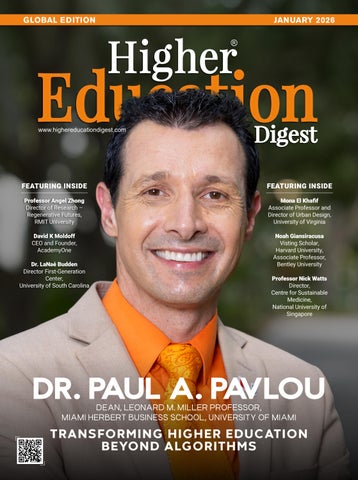
DR. PAUL A. PAVLOU
DEAN, LEONARD M. MILLER PROFESSOR,
MIAMI HERBERT BUSINESS SCHOOL, UNIVERSITY OF MIAMI
TRANSFORMING HIGHER EDUCATION BEYOND ALGORITHMS
ACADEMIC VIEW
EMPOWERING COMMUNITIES THROUGH URBAN DESIGN
Mona El Khafif, Associate Professor and Director of Urban Design, University of Virginia
IT TAKES A CAMPUS: CONNECTING FIRST-GENERATION STUDENTS TO OPPORTUNITIES AND RESOURCES TO HELP THEM THRIVE
Dr. LaNaé Budden, Director First-Generation Center, University of South Carolina
WHY TOMORROW’S CLINICIANS MUST BE CLIMATE LEADERS
Professor Nick Watts, Director, Centre for Sustainable Medicine, National University of Singapore
ACADEMIC VIEW
LEADING INNOVATION AT THE INTERSECTION OF EDUCATION AND TECHNOLOGY
SHAPING FUTURE-READY FINANCE AND SUSTAINABILITY LEADERS IN A CHANGING WORLD
Professor Angel Zhong, Director of Research – Regenerative Futures, RMIT University 54
COVER STORY
DR. PAUL A. PAVLOU
DEAN, LEONARD M. MILLER PROFESSOR, MIAMI HERBERT BUSINESS SCHOOL, UNIVERSITY OF MIAMI
TRANSFORMING HIGHER EDUCATION BEYOND ALGORITHMS
Dr. Paul A. Pavlou serves as Dean and university-wide Lead for Executive Education at the University of Miami. A transformative servant leader, he drives AI-enabled innovation, advances research, fosters student success, strengthens community belonging, and amplifies societal impact. A globally recognized AI thought leader and proven crisis leader, Paul has guided top AAU/R1 institutions through challenges with shared governance, fiscal stability, and transformative results.
At the University of Miami, he has reimagined higher education through a bold strategy that positioned the university for Top 20 national recognition, achieving historic firsts: #1 graduate career placement, #2 global faculty research productivity, and #3 in executive education (Financial Times 2025). As continuing education lead, he established Miami as a national model of AI-driven innovation and crosscampus collaboration through interdisciplinary programs, industry partnerships, and global alliances. Previously, as Dean and Cullen Distinguished Professor at the University of Houston’s Bauer College of Business, Dr. Paul led record enrollment growth (+40%), 90%+ graduation and 99% job placement rates, and over $150 million in philanthropy. He elevated the MBA program to the Top 25 and the undergraduate program to the Top 15 among public universities, while leading the Entrepreneurship program to five consecutive #1 global rankings (Princeton Review).
In this conversation with Higher Education Digest, Dr. Paul shares how he is transforming business education beyond algorithms by blending innovation with human insight. As AI reshapes the future of learning, he believes business schools must go beyond technology to cultivate creativity, ethical judgment, and purposeful leadership.
His vision reimagines business education as a space where intelligence meets integrity, preparing future leaders to shape a rapidly changing world. Below are the excerpts of the interview.
What inspired your journey into academic leadership, and what continues to drive your vision for business education today?
As a first-generation college student from a small Mediterranean island, I experienced firsthand how education can transform lives and create opportunity for everybody, irrespective of background. Therefore, I was inspired by the transformative power of higher education and its potential to transform lives. That belief has guided my journey through every leadership role I have had the privilege to hold. What continues to drive me is a conviction that higher education must evolve to meet a rapidly changing world, particularly in today’s AI era where many entry-level cognitive jobs are disappearing. My goal has always been to reimagine higher education as a dynamic, personalized, and globally immersive experience that empowers students to reach
their full potential, prepares them to shape the future, and helps them make a societal impact.
The education landscape is changing rapidly. What are the biggest opportunities and challenges facing business schools?
The biggest opportunity, and simultaneously the greatest challenge, is organizational and societal transformation because of AI. Emerging technologies and artificial intelligence are redefining how we live, work, and learn. Students no longer accept one-size-fits-all education; they expect learning to adapt to them, not the other way around. Business schools and universities have a unique opportunity to lead this transformation. The challenge is to use technology and AI to make education more personalized and interactive. We must teach our students to pair data-driven decisionmaking with empathy, critical thinking, ethical
My goal has always been to reimagine higher education as a dynamic, personalized, and globally immersive experience that empowers students to reach their full potential, prepares them to shape the future, and helps them make a societal impact
judgment, and adaptability, human intelligence skills that no machine can replace (at least in the foreseeable future!).
How do you see artificial intelligence transforming the way business schools teach, learn, and lead?
AI will transform higher education just as electricity transformed the world; it will quietly power and transform everything around us. In higher education, AI will change how we recruit students, how we teach in the classroom, how we guide careers, and how we connect with alumni throughout their lives.
But AI alone is not the solution and the end game. The real transformation would come when AI will be intelligently used to focus more deeply on the human side of education, such as personalized mentoring, encouraging creativity, developing ethical reasoning, and building leadership skills. The future belongs to institutions that can combine AI (artificial intelligence) with human emotional and moral intelligence, something that I term “augmented intelligence”. The more we can instill augmented intelligence in our students, the more they will be prepared to succeed and thrive!
How do you approach leading a business school that honors its legacy while embracing technological and pedagogical change?
Leadership in higher education means harmonizing tradition with transformation. I see the legacy of 100 years at the University of Miami as our foundation, not a limitation. We honor our history of academic excellence, but we should also have the courage to challenge
convention when it no longer serves our students or society.
At the University of Miami, our approach is to preserve the intellectual rigor that defines great business schools while integrating cuttingedge innovation with AI, data analytics, and interdisciplinary collaboration into everything we do. We must protect what makes us great while continuously reinventing what makes us relevant, especially in this era of AI that many of the conventions of higher education are being challenged in front of our very eyes.
How would you describe your leadership philosophy, and how has it evolved through your experiences across different institutions?
My leadership philosophy is grounded in servant leadership, guided by purpose and ethics, and inspired by the desire to transform the institution. I believe great leaders listen first, act boldly, and measure success by the success of others and the institution that they serve.
In
higher education, AI will change how we recruit students, how we teach in the classroom, how we guide careers, and how we connect with alumni throughout their lives
Over the years, my approach has evolved from merely empowering and inspiring people to amplifying possibility for the institution, by aligning people with purpose, leveraging the power of technology into processes, and crafting a bold vision that draws upon the shared mission. I strongly believe that leadership today is not about control. It is about creating the conditions for everybody in the institution to thrive, innovate, and make an impact. This is the essence of servant transformative leadership that I actively promote in all my roles.
Outside of your academic responsibilities, what activities or interests help you stay grounded and inspired?
Balance is essential for success. I find inspiration through time with family, travel, sports, and the arts. As a former professional basketball player, I value teamwork, discipline, and determination; the same principles that guide my leadership style. The arts remind me why education matters because they help expand imagination, empathy, and judgment. Whether at a concert or
Whether at a concert or an opera, I am reminded that creativity is the fuel of innovation and the heart of leadership, and we need to embrace the liberal arts along with technology and business
an opera, I am reminded that creativity is the fuel of innovation and the heart of leadership, and we need to embrace the liberal arts along with technology and business.
What advice would you offer to students and young professionals who aspire to lead in an era defined by AI, data, and digital transformation?
First, while you should be fluent with technology and AI, and leverage them extensively, ultimately lead with your humanity and judgment. AI can process data, but it (still) cannot feel compassion or show integrity. Those are your true differentiators as a leader.
Second, stay endlessly curious. The future belongs to lifelong learners who embrace change as an opportunity, not a threat. Do not see AI as a threat, but as an opportunity to amplify your (augmented) intelligence.
Third, be a great public speaker. While generative AI can help with your writing, solve problems, and retrieve all the knowledge in the university, you should be the carrier of the output to others through public speaking. People want to interact and hear from other people, and public speaking will be one of the last human skills to be replaced by AI.
Fourth, be accountable for everything you produce. While you may ethically use technology and AI to support your work, you are ultimately responsible for everything you put out there.
Fifth, be brave. Disruption rewards those who think differently, take calculated risks, and act with intent. Use AI to enhance your impact, not replace you. In a world shaped by AI, your character and personality will always be your greatest competitive advantage, so make sure you work on your human intelligence skills!
ACADEMIC VIEW
It Takes a Campus: Connecting First-Generation Students to Opportunities and Resources to Help Them Thrive
Dr. LaNaé Budden, Director First-Generation Center, University of South Carolina
Dr. LaNaé Budden is a proud first-generation college graduate and is the inaugural director of the First-Generation Center at the University of South Carolina. In this role, she is responsible for connecting first-generation students with resources and services to successfully navigate their progress towards graduation through programmatic efforts and campus partnerships. With over 20 years of experience in higher education in various administrative and executive leadership roles, Dr. Budden is passionate about creating meaningful support systems that empower first-generation students to thrive in all aspects of their collegiate journey and beyond.
Fierce. Inspirational. Resilient. Scholar. Trailblazers. First-generation (first-gen) college students– those whose parents did not complete a baccalaureate degree– embody these qualities and more. They enrich our campuses with their experiences and strengths. Their pursuit and completion of a college degree has the potential to transform their life and that of their families for generations. Administrators, faculty, and staff must be intentional about fostering environments where first-gen students can
thrive. By focusing on connecting students to mentoring, networking, leadership experiences, high impact practices, and basic needs and financial support, students will be positioned for success.
Building first-gen students’ social capital should be a priority. While mentoring programs between first-year students and upper-class students are a common practice for connecting students with their peers as they adjust to campus—don’t stop there. Go beyond this traditional format and design mentoring
By focusing on connecting students to mentoring, networking, leadership experiences, high impact practices, and basic needs and financial support, students will be positioned for success
initiatives that include faculty, staff, alumni, and community leaders, because networking is a skill that students will use throughout their lives.
Prep them on how to prepare for networking engagements.
Show them how to introduce themselves and follow-up with their new connections.
Practice etiquette dinners so students can practice their dining skills before formal events. Host networking dinners with faculty and alumni to encourage a deeper understanding of the importance of networking through experiential learning.
First-gen students also thrive when they can take part in leadership experiences. Student organizations and other peer leadership roles, such as resident assistants and orientation leaders, are a great way for them to get started. Their experiences add great value to the teams
We
cannot begin to talk to a first-gen student about leadership opportunities if they are experiencing housing and food insecurity
they serve and allow them to be role models for their peers. Representation of first-gen students in key leadership roles matters.
Faculty and staff can nominate students for positions or even mention to them that they may be a good fit for an opportunity.
Provide opportunities for students to go to conferences in their academic discipline to learn new information and expand their social network.
Ensure first-gen students are at the table to share their feedback and experiences through focus groups and student advisory councils, which can help your department gain a clearer student perspective.
In addition to creating spaces for firstgen students to share their voices, faculty and staff can also connect students to high-impact practices (HIPs). HIPs encompass a range of impactful experiences, such as:
Offering first-gen sections of first-year seminars can be a great way to support students during their first semester and year. Tailor the curriculum to best meet the needs of this population.
First-gen living and learning communities, especially faculty-directed ones, allow students to engage in intentional activities in a residential environment that champions academic and student success. Internships give an opportunity for students to gain practical experience to prepare them for post-graduate success.
Many students cannot work while doing their internship. Remove this barrier by working with businesses to offer paid internships.
Involving students in undergraduate research with faculty can also expand their knowledge and prepare them for graduate school.
Study abroad experiences expose students to not only a new geographical area but also an immersion into another culture.
Last and certainly not least, first-gen students come from a variety of socio-economic backgrounds, and we must anticipate and proactively address barriers that can hinder their involvement and experiences. It is hard to think about these opportunities if they are wondering how they will pay their remaining balance from the semester and afford their tuition next semester. We cannot begin to talk to a first-gen student about leadership opportunities if they are experiencing housing and food insecurity. For example, before announcing a leadership or academic conference, we should also ask ourselves:
Are there scholarships first-gen students can apply for if they do not have the funds?
What grants exist to help study abroad be a reality for them?
Is your development office fundraising for scholarships to help students with their tuition and fees?
Are you advocating for continued availability of grants and loans that many students depend on to access higher education?
Now, more than ever, we must foster environments where first-gen students thrive. We must be strategic and intentional in connecting them to opportunities and ensuring they have the resources to succeed. Each administrator, faculty, and staff member plays a role in their success. Reflect on what you can do as an individual and what your office can do to better serve your first-gen students. When we support first-gen students, we strengthen the entire campus community. It truly does take a campus to ensure first-gen students thrive!
ACADEMIC VIEW
Empowering Communities through Urban Design
Mona El Khafif, Associate Professor and Director of Urban Design, University of Virginia
Mona El Khafif Mona El Khafif is an architect, urban designer, and dedicated educator who has taught at leading institutions in Austria, Germany, Canada, and the United States. She currently serves as an Associate Professor at the University of Virginia School of Architecture, where she directs the School’s Urban Design programs. El Khafif is the co-author of the award-winning URBANbuild: Local/ Global (2009, with Ila Berman), the author of Staged Urbanism (German edition, 2009), and the coeditor of Next New York (2022, with Seth McDowell). Her work spans multiple scales and investigates temporal, typological, and collaborative strategies in urban design and architecture. These themes are being further developed in her forthcoming book, On Urban Prototyping.
Recently in an exclusive interview with Higher Education Digest, Mona shared insights into her passion for urban design, the importance of community engagement in urban planning projects, and her vision for the future of urban design. Mona also shared her favorite quotes, long-term career aspirations, and advice for students and young professionals interested in urban design and planning. The following excerpts are taken from the interview.
Hi Mona. What drives your passion for urban design, architecture, and planning?
First, thank you for reaching out to me. I very much appreciate this opportunity to be in conversation with you. My passion for urban design and architecture stems from a deep fascination with how the built environment shapes human
experience and social interaction across multiples scales and temporalities. While I truly appreciate excellent design at the scale of the building (to the point that good architecture whether built or unbuilt fills me with happiness and excitement), I have also been drawn to projects that connect people, place, and ecology, where design has the power to create meaningful, equitable, and
In my research and teaching, I emphasize participatory processes that value diverse voices, because urban design that ignores social context risks creating spaces that are underused, inequitable, or unsustainable
sustainable urban life. For me, urban design is not only about structures or landscapes only, but about understanding the complexity of urban environments as living systems and fostering interventions that enhance both human, nonhuman, and ecological resilience and wellbeing. This holistic perspective has guided both my practice and my teaching, as I seek to help students appreciate the profound social and environmental implications of every design decision. I also like to break through and work across disciplinary containers. Our constructed environment is shaped through many forces and interests. If we want to design within these complexities, we cannot build silos around our disciplines. I define urban design in this context more as a bridge between multiples disciplines that shape the city and therefore as a “field”.
I am an architect and simply love and admire what good design can bring to our daily lives. But I was also always interested in the collective and was eager to understand the larger systems.
What role do you think community engagement plays in successful urban planning projects?
When I was still teaching at the TU Vienna at the Institute for Urban Design and Landscape Architecture, Community Engagement became a required part of planning and design processes in Austria, and I assume also other European countries. The “Agenda 21”, adopted at the 1992 Rio Earth Summit, emphasized community engagement as a cornerstone of sustainable development. It called for local governments to create action plans, requiring broad public participation in decision-making. This framework positioned communities not as passive recipients but as active partners in
As climate change is showing its impacts through extreme weather events like heatwaves and flooding, we must design and regenerate cities that accommodate for cooling, absorb water, and offer habitat for humans but also non-humans
shaping policies that balance environmental, social, and economic goals. By institutionalizing participation, Agenda 21 made community involvement a requirement rather than an option for achieving sustainability. Hence, since I am in academia community engagement had been a part of the implementation of urban design projects. However, even at this time, the implementation and development of these models were in the hand of spatial sociologists and planning practice. More recent paradigm shifts in the United States calling for social and environmental justice and the increased impact of climate change on our communities created an urgent call for community engagement across multiple disciplines and I would say that the field of UD plays a key role.
When I launched our Master of Urban Design (MUD) at UVA I received a Center of Teaching Excellence Grant from the university to strengthen these aspects in the curriculum. The challenge though is not teaching “about” community engagement, but to prepare students for this practice in a curriculum that is project based. In other words, how can you integrate these aspects into the design process and how can you prepare students to sit in a community engagement workshop? In this context I published a paper entitled “In Action: Urban Design Pedagogy for Co-Production“. The paper introduces game strategies to integrate participation into the design process itself. It also introduces how educators can use role plays to prepare students for community engagement processes.
Maybe to summarize, I believe that community engagement is central to meaningful urban design. Projects succeed when they respond not only to technical, ecological,
or aesthetic considerations but to the lived experiences and aspirations of the people who inhabit the spaces. Engagement allows designers to uncover nuanced insights that might otherwise be overlooked, and it fosters a sense of ownership and shared responsibility among community members. This ownership but also responsibility that comes with it is very important if we all want to call the neighborhoods we live in “our cities”. It is also true to observe that cities’ need everyone’s support to create and maintain public assets, social infrastructures, and open spaces.
In this context colleagues and I developed a mobile app game called “We Are Martinsville (WAM)”. This gaming application was developed to encourage community engagement by prompting players to explore but also identify the city’s points of interest (POIs). It uses creative placemaking—leveraging Martinsville’s history, cultural assets, and landscape—to strengthen local identity through location-based gameplay, quizzes, event participation, photo submissions, and more. But most importantly it provides a digital infrastructure to engage with the place and to shape its identity through feedback and data submission. For me this is a powerful form of community engagement.
In my research and teaching, I emphasize participatory processes that value diverse voices, because urban design that ignores social context risks creating spaces that are underused, inequitable, or unsustainable.
How do you see the field of urban design evolving in the next 5-10 years?
I see urban design increasingly operating at the intersection of social equity, ecological resilience, and technological innovation. Climate adaptation,
tactical urbanism, and biophilic design are gaining traction, but the field will also need to contend with rapidly shifting demographics and economic pressures as well as new technologies that currently develop at light speed. I am here not only referring to what is described as “smart cities” but AI implementations in design pedagogy and practice.
In pedagogy, there is a growing emphasis on teaching students to think systemically and critically, integrating ecological, social, and technological frameworks rather than treating them separately. I anticipate that future urban designers will need to be both strategic thinkers, excellent designers, and empathetic collaborators, capable of negotiating complex social and environmental challenges while crafting spaces that are meaningful and adaptive.
When it comes to environmental challenges then I believe a large emphasis will be to design not only for growth but also for degrowth and repair. As climate change is showing its impacts through extreme weather events like heatwaves and flooding, we must design and regenerate cities that accommodate for cooling, absorb water, and offer habitat for humans but also non-humans. Just think about the efforts that Copenhagen is putting into place to retrofit the city with green and blue infrastructures that operate above and below ground to absorb water. Or Barcelona’s superillas (superblocks) to improve Cerda’s original masterplan. These infrastructures need to be understood as multifunctional spaces, as places and habitats. I believe that we need new typologies that can accommodate for this and one chapter in my current book project “On Urban Prototyping” will be dedicated to these topics.
Meanwhile many urban territories will not be retrofitted. Either because there is not enough time or not enough funds or energy to do this. How can we design for a retreat that is considering environmental justice and environmental protection? What are the new models of co-production?
What has been your most careerdefining moment that you are proud of?
Well, this is a difficult question, considering my age. When I graduated in the middle of the 1990s most of my peers applied for positions in Berlin, that at this time underwent a huge building boom due to the unification efforts and Berlin becoming the new capital of Germany. I was drawn to good housing models instead and decided to go into the opposite direction. I left Germany and moved
to Vienna (Austria) a city that until today is known for its excellent public housing projects. I originally left for 1 or 2 years but never returned to Germany. This decision to move to Vienna probably impacted my professional career most, as it was the first departure followed by a series of other moves.
When I was an assistant professor at TU Vienna, we had a summer exchange program with Tulane University in New Orleans. My first engagement was in 2004, when colleagues and I organized a summer school in Vienna dedicated to rooftop urbanism. The following year, Hurricane Katrina struck New Orleans, devastating the city and our partner university. I had initially been invited to give a presentation on Urban Regeneration: Lessons from Vienna, but the circumstances shifted completely, and instead I was invited to join a new HUD-
As a designer, your work is never truly finished. I learned this early on as a student and later during my years in Vienna in professional practice
funded grant project as a visiting professor for URBANbuild. This program focused on four neighborhoods in the aftermath of Katrina, spanning studios from the city and regional scale down to the design-build of individual houses. Excited by the opportunity, I took a leave from my position in Vienna to join the effort.
Arriving in New Orleans, I quickly realized that the term urban design—so critical in the context of a flooded city—had very different connotations. Some students and colleagues equated it with urban planning, and when it comes to rebuilding, they focused primarily on the 1:1 scale of rebuilding, which was understandable given the massive housing losses. I faced two major challenges: first, adapting to the very different teaching culture in the U.S., and second, introducing students to a field they did not yet fully understand. At times I felt lost, but I persisted, and today I am proud that many of those first-year students came to see the value of urban design. Some pursued urban theses, some enrolled in post-professional urban degree programs, or are now working professionally on urban-scale projects. A turning point was taking students on a travel abroad program to the Netherlands, where they could directly study how cities live with water. Our work culminated
My best ideas and strategies to approach a challenge are rarely coming when I am staring at the problem; they emerge when my mind is allowed to let go—often while I am running or walking outside
in the 2008 publication URBANbuild: Local/ Global, which reflects on how New Orleans can learn from other cities to adapt to and coexist with water. I extended my leave but in 2008 I was asked to return to Vienna. I decided to stay in the US for private and professional reasons, and I would say that this decision was one of the most important turning points in my career. I discovered that cities are the best classrooms places to learn from.
How do you prioritize your own wellbeing and self-care given the demands of your work?
As a designer, your work is never truly finished. I learned this early on as a student and later during my years in Vienna in professional practice. Even now in academia that hasn’t changed, but I’ve come to understand the importance of balance. I remind my students: try to give your best but also take care of yourself—because only then can you truly excel.
However, it took a long time to learn this myself. When I was writing my dissertation in Vienna, I worked with a coach who encouraged me to discover what recharged me. She used to say, “When you’re out running in the Prater, you’re working on your dissertation—recharging is part of the work.” She also helped me recognize my own biorhythms. Some people are more productive in the morning, others in the afternoon or evening. I discovered that I had very specific times when I could generate new content, and other times better suited for editing or graphic work. That discovery was empowering, and it’s something I encourage my students to explore for themselves.
Today, I still rely on nature to recharge—I go for long hikes, even when deadlines are pressing.
I know that once I return, I am more productive and focused. In fact, my best ideas and strategies to approach a challenge are rarely coming when I am staring at the problem; they emerge when my mind is allowed to let go—often while I am running or walking outside.
Is there a particular person you are grateful for who helped get you to where you are?
I am deeply grateful to the many mentors and colleagues who have shaped my thinking and supported my development over the years. It begins with my doctoral advisers and mentors at TU Vienna, who gave me a strong foundation as a scholar and designer, and extends to the many collaborators I have been fortunate to work with since. Each of them has influenced the way I approach design, teaching, and leadership. It is easy, however, to single out one person who has had an especially profound impact: Ila Berman, the former Associate Dean at Tulane University who was originally responsible for securing the URBANbuild grant and who invited me to join the project. Ila became a mentor to me at a pivotal moment in my career. She not only provided invaluable guidance but also created opportunities that allowed me to grow as a designer, researcher, and educator. Her vision for design as both a cultural and civic practice inspired me deeply, and her confidence in my work helped shape the trajectory of my career
What role has mentorship played in your career development, and how have you mentored others?
I believe mentorship is essential to becoming one’s fullest self. Mentors guide us in finding our path, help us build confidence, and equip us with
the skills we need to excel in our professions. Sometimes mentors are inspiring because they show us what is possible. At the same time—and this may sound unconventional—I don’t think mentors are always those who are further along than we are. I have learned a great deal from my students, even when I was in the role of being their mentor. For this reason, I see mentorship as a reciprocal relationship, one that flows in both directions and that and strengthens the field by cultivating the next generation of thoughtful, socially conscious designers.
Overall, I would say, that mentorship has been foundational in my career, providing guidance, perspective, and opportunities for growth. Equally important has been the responsibility to mentor others, particularly emerging designers and researchers.
What is your favorite quote?
I think over the last 20 years I tried to follow.
“Ever tried. Ever failed. No matter. Try again. Fail again. Fail better.” Worstward Ho (1983) Samuel Beckett.
What are your long-term career aspirations, and how do you see yourself evolving as a leader over the next five years?
This is an interesting question. I consider myself both strategic and tactical, which means I like to pursue opportunities where they arise. Yet, looking back, I can see a clear consistency in my career decisions. Since the beginning of my academic career, I have focused on contributing to urban design education within architecture schools. In Europe, urban design is a core component of the curriculum, and upon moving to the U.S., I have consistently sought
to strengthen urban design education at every institution I have been part of.
I founded or co-directed two labs: URBANlab at California College of the Arts (2008-2013) and the DATAlab at the University of Waterloo School of Architecture (2013-2016) together with Maya Przybylski. At UVA, I established two urban design programs—the master’s in urban design (MUD) and the Urban Design Certificate (UDC) and several years ago, together with colleagues from urban design programs across the U.S., I co-founded the Urban
Mentors guide us in finding our path, help us build confidence, and equip us with the skills we need to excel in our professions
Design Academic Council. Today, I serve on its steering committee, and alongside my colleague Nico Larco from the University of Oregon, I am particularly interested in developing urban design education for undergraduates, continuing education, and networked pedagogy that spans multiple institutions through summer schools and virtual modules. I can imagine continuing this work at UVA or another institution, where I
can lead a program or chair an institute dedicated to advancing urban design education. However, last year, I was a visiting professor at the University of Toronto’s School of Cities. The School of Cities does not offer a standard curriculum; rather, it serves as a world-leading center for innovative, interdisciplinary urban research and engagement. Its goal is to bring together diverse communities—including
The years ahead will be marked by uncertainty and rapid change, making thoughtful, socially responsible, and well-informed design essential for creating cities that are livable, equitable, and resilient
scholars, practitioners, and residents— to collaboratively address complex urban challenges and design creative solutions that enable cities and their citizens to thrive.
I found this approach very inspiring, and I can envision a light shift in my career toward applied academic practice—steering somewhat away from traditional teaching and more toward initiatives like the School of Cities or others that bridge research, practice, and city partnerships.
What advice would you give to students and young professionals interested in urban design and planning?
My advice to students and young professionals entering urban design is to cultivate curiosity, resilience, and a deep understanding that design should always contribute positively to the world. Urban design truly matters—it shapes how we live, interact, and experience our cities. More architects, planners, and landscape architects should enter this field, as their expertise is urgently needed in the face of complex social,
environmental, and infrastructural challenges. The years ahead will be marked by uncertainty and rapid change, making thoughtful, socially responsible, and well-informed design essential for creating cities that are livable, equitable, and resilient.
To meet these challenges, stay open to new ideas, diverse perspectives, and the voices of the communities you serve while committing to what you can contribute to the process. Cultivate resilience to embrace uncertainty, learn from setbacks, and continue moving forward. Let sustainability, equity, and care for the living world guide your work—not as addons, but as foundations. Remember that cities are collective projects: the most meaningful outcomes emerge from collaboration, listening, and co-creating shared visions.
Finally, commit to lifelong learning and recognize that your work matters. In shaping the future, you also take on the role of teaching and inspiring others. Together, we share the responsibility of designing a better world for tomorrow.
ACADEMIC VIEW
Why Tomorrow’s Clinicians Must Be Climate Leaders
Professor Nick Watts, Director, Centre for Sustainable Medicine, National University of Singapore
Professor Nick Watts is the Director of the Centre for Sustainable Medicine at the National University of Singapore (NUS), leading its mission to advance sustainable healthcare locally and globally. Previously, he served as Chief Sustainability Officer of the United Kingdom’s National Health Service (NHS), where he spearheaded efforts to make it the world’s first net-zero health system. His leadership saw the programme embedded into national legislation and secured over $1 billion in funding for sustainable healthcare.
Nick was also Executive Director of the Lancet Commission and later the Lancet Countdown on Health and Climate Change, building a global research collaboration spanning more than 50 academic institutions and United Nations agencies.
Trained in medicine and public policy at University College London and the University of Western Australia, he is a Fellow of the Royal College of Physicians’ Faculty of Public Health and holds adjunct professorships at the University of Notre Dame and Monash University. He also founded the Global Climate and Health Alliance and the UK Health Alliance on Climate Change, amplifying the health sector’s role in tackling climate challenges.
In this interview with Higher Education Digest, Professor Nick Watts shares insights on why sustainability must become a core competency in medical education, how universities can prepare future health leaders for the climate crisis, and why sustainable care often means better care for patients. He also highlights the role of innovation, leadership, and cross-sector collaboration in transforming healthcare into a climate-resilient system for the 21st century.
What inspired you to work at the intersection of climate change and health?
For me, it started in clinical training and early work in global health. As a doctor, I was struck
by how often environmental factors were shaping the health of the patients in front of me, from air pollution worsening respiratory disease, to heat stress driving hospital admissions, to the spread of infectious diseases influenced by change in
By equipping leaders from medicine, public health, policy, business, and engineering with the skills and networks they need, we can create ripples of impact that reach far beyond any single institution
weather patterns. I still remember sitting in one of my first lectures as a medical student, hearing about the social determinants of health – that the world outside the operating theatre mattered – and thinking, wow, that changes everything. The science was clear, and it just became impossible to ignore.
That realisation pulled me into research and then into leadership roles, first as the founding Executive Director of the Lancet Countdown, where we worked to build the evidence base linking climate change and health and to shape the global conversation. Later, as Chief Sustainability Officer for the NHS, I had the privilege of turning that evidence into action at
If we want resilient, highquality care, we have to train clinicians who can diagnose, treat, and reduce the environmental footprint of the very systems they work in
scale, working with one of the world’s largest employers to set and deliver on ambitious net zero targets. Those experiences convinced me that the intersection of climate and health is not a side project but a central pillar of protecting population health in the 21st century.
You’ve worked across the health systems, global policy forums, and academia. What have been some defining moments in your career (that shaped your thinking on sustainability in healthcare)?
Looking back, it all sounds much cleaner than it really was. The truth is, the reality was messy. Change never happens in a straight line.
Leading the Greener NHS programme was one of those moments that shaped me. It showed me what happens when sustainability isn’t treated as a side project but becomes part of the core business of healthcare. Embedding it into every clinical and operational decision in the NHS was hard work – but it proved that change at scale is possible when you have persistence, measurable goals, and the engagement of everyone from senior executives to ward staff.
Another defining moment was launching the Lancet Countdown, which had a proper global spotlight. I remember celebrating and then freezing when I realized we’d promised to do this every single year, with a momentary, “What have I done?” But that uncomfortable pace is exactly what the climate crisis demands. And it showed me the power of framing – that when you talk about climate change as a health issue, you can bring health professionals, doctors, and nurses, who are some of the most trusted people in every community, at the forefront of important conversations.
And most recently, moving to Singapore and launching the Master of Science (MSc) and Executive Fellowship in Sustainable Healthcare with NUS has been a reminder that education can be one of the most powerful levers for change. By equipping leaders from medicine, public health, policy, business, and engineering with the skills and networks they need, we can create ripples of impact that reach far beyond any single institution.
Why do you believe sustainability must be a core competency in health professional education today?
Healthcare is responsible for somewhere between 5–8% of global emissions. That means every health professional, whether they know it or not, is making decisions with a carbon impact. And climate change is already shaping the caseload: more respiratory disease, more heat stress, more extreme weather disasters. If we want resilient, high-quality care, we have to train clinicians who can diagnose, treat, and reduce the environmental footprint of the very systems they work in. And if we don’t teach this now, we’re sending graduates into practice unprepared for the world they’re inheriting.
What do you see as the most urgent challenges for healthcare systems when it comes to sustainability and climate resilience?
When it comes to big hospitals and health systems, sometimes having the evidence and ambitious targets just isn’t enough. The reality is messy, and health systems can be stubborn. I’ve worked with many clinicians who were ready to enact change, but had to
push through many layers of bureaucracy to get there. That inertia can be frustrating. This means that leaders need to be willing to listen to those on the frontlines and foster a culture where environmental performance is seen as fundamental to healthcare quality — an extension of our core mandate to do no harm.
Another challenge lies in the invisibility of much of our impact. A significant share of healthcare’s emissions happens before a patient ever walks through the door, hidden deep within supply chains — in the production of medicines, the manufacturing of equipment, the transport of goods. Addressing this means bringing other industries into the conversation and setting new expectations for how we work together. And like any clinical programme, it starts with knowing the numbers. Yet too many hospitals still lack a clear baseline of their emissions, making it hard to act with precision.
The solutions are already out there. The task now is to weave them into the fabric of how health systems operate, so climate action becomes a core part of delivering safe, highquality care.
Ultimately, higher education isn’t just about teaching skills; it’s shaping the culture of the workforce that will inherit the climate challenge
What do you think is the biggest misconception people have about sustainable healthcare?
People often think sustainability means compromising on quality. In fact, low-carbon care is often better care. Switching anaesthetic gases, for example, can cut emissions and costs while maintaining or improving patient outcomes.
Another misconception is that it’s a “nice-tohave.” It’s not. Sustainability is about whether the system can keep caring for patients in a changing world. And when it comes to reducing
emissions, people often think it’s just about energy use and recycling. In reality, the biggest opportunities are in clinical practice and procurement. Rethinking what we prescribe, what we purchase, and how we deliver care has a far greater impact.
What role should universities and higher education institutions play in preparing the next generation of healthcare professionals for the climate crisis?
Universities are where the next generation of leaders are shaped – if we miss this chance, we’ve missed an entire generation. This is the place to teach systems thinking, climatehealth literacy, and leadership skills. At NUS, it’s been a joy to see applicants and eventual students come not just from medicine, nursing, and public health, but also from engineering, economics, and business – because this is inherently a cross-sector problem. And this can’t be an optional module tucked away in the curriculum. It has to be mainstreamed into how we train health professionals, so they graduate ready to lead change from day one.
Ultimately, higher education isn’t just about teaching skills; it’s shaping the culture of the workforce that will inherit the climate challenge.
From your perspective, what knowledge and skills are most critical for healthcare professionals to develop in order to lead sustainable transformation in their organisations? You need to understand the science and the tools to act on it. That means carbon literacy
specific to healthcare. For instance, knowing the footprint of an anaesthetic choice or the environmental impact of a diagnostic pathway. At the same time, you need to be able to use the data in systems thinking to drive change. The great thing about the healthcare industry is that a decision in one clinic can ripple through the whole organisation and beyond. But none of it sticks without leadership and relationships. You need people around you who will come with you on the journey.
That’s exactly why we built the MSc and Executive Fellowship in Sustainable Healthcare at NUS. These programmes combine the science, the metrics, and the leadership training so that graduates leave ready to design, implement, and scale solutions in their own organisations, with the networks and confidence to make those changes stick.
How do you see the field of climate and health evolving in the next 5–10 years?
We’ll see climate change move from niche to mainstream in healthcare. In ten years’ time, we’ll look back and wonder how we ever measured quality without measuring sustainability – in the same way that safety indicators are now non-negotiable. We’ll also see new tools transforming the way we work. Digital health and AI will help us measure and reduce environmental impacts in real time. And most importantly, we’ll have a generation of clinicians who see sustainability not as an optional extra, but as part of their professional responsibility to protect health. That’s the shift that excites me most.
ACADEMIC
VIEW
Leading Innovation at the Intersection of Education and Technology
David K Moldoff, CEO and Founder, AcademyOne
David K. Moldoff is the Founder and CEO of AcademyOne, a pioneer in higher education technology dedicated to improving learner mobility, prior learning recognition, and workforce alignment. With more than fifty years of experience, he has led innovation at the intersection of education, data standards, and system design. A lifelong advocate for interoperability and collaboration, David has helped shape national and international initiatives that connect education to employment. His thought leadership spans credit portability, artificial intelligence, and the future of shared infrastructure. He continues to champion solutions that place learners at the center of a rapidly changing global landscape.
Recently, in an exclusive interview with Higher Education Digest, David shared his background in higher education technology, motivations behind founding AcademyOne, significant shifts in the field, views on AI in education, future plans, words of wisdom, and much more. The following excerpts are taken from the interview.
Hi David. Please tell us about your background and areas of expertise.
My background spans more than five decades of work in higher education technology, entrepreneurship, and system design. I have always been drawn to the intersection of education and innovation—how information systems can empower learners, connect institutions, and bridge the gap between learning and earning. My expertise lies in building
scalable platforms, shaping data standards, and creating pathways that make education more transparent, portable, and student-centered.
As the CEO and Founder of AcademyOne, what were some of the key motivations behind establishing the company, and how has its focus evolved? When I founded AcademyOne, my motivation was to address the barriers learners face when
Over four decades, the most significant shifts have been the rise of digital platforms, the push toward interoperability, and the recognition that learners—not institutions— are the true center of the system
navigating education systems. Everything is so siloed. The legacy of data systems has kept many from achieving the levels of service and transformation they see as the opportunity for. Too often, transfer, prior learning recognition, and credit portability were opaque processes that left students at a disadvantage. Over time, the company has evolved from a focus on course articulation and transfer pathways to a broader mission: building trust infrastructures, advancing interoperability, and leveraging artificial intelligence responsibly to better serve learners and institutions.
Looking back over four decades, what are some of the most significant shifts you’ve seen in higher education technology, and how have you adapted?
Over four decades, the most significant shifts have been the rise of digital platforms, the push toward interoperability, and the recognition that learners—not institutions—are the true center of the system. Systems are still to insular. They are transactional. Efficiency is the first priority. Effectiveness second.
The emphasis on student agency, addressing their mobility, and the shared infrastructure needed to support them is a ways off. I have adapted by leaning into standards, governance, and market collaboration, while also embracing new technologies with a healthy respect for their limitations.
What are you most curious about right now in terms of future developments in education technology?
I am most curious right how artificial intelligence is reshaping the technology
landscape. AI promises to personalize pathways, automate recognition of prior learning, and create more dynamic bridges between education and the workforce.
But I am equally interested in how trust, service and affirmation will be engineered into these systems—ensuring that what is built is not only scalable but also reliable, ethical, and transparent. People don’t like to interface with Bots, Auto attendant Messaging or websites that block them. They want things to be streamlined, save time and ensure a process they can trust in.
As someone who’s led development and commercialization of many applications, what do you think are critical factors in translating innovation into practical, scalable solutions for learners?
Innovation becomes practical and scalable when it rests on three pillars: trust in the data, collaboration across silos, and clear alignment with learner expectations/outcomes. It is not enough to have a great idea. The real challenge lies in translating that idea into a framework that providers (I say this to be inclusive) can adopt, sustain, and integrate without losing their unique missions.
How do you stay inspired and motivated given your decades-long involvement in this field?
Life is not static. Every day brings new challenges in equity, technology, and alignment. The knowledge that our work can change a trajectories—by saving time, reducing costs, or opening doors—remains my greatest motivation. My hope is to have an impact. To give back the wisdom I have accumulated,
through the shared experiences working with bright minds.
Have you had any mentors or role models who have influenced your career path?
Yes. I have been fortunate to be influenced by mentors and peers across education and technology. Mr. Jerry Fastman from the days he worked with me after he left SCT back in 90’s. Dr. Brian Hawkins, the former President of EDUCAUSE. My role models are not just
individuals but also communities of practice where collaboration and shared purpose set the tone. The standards bodies I have worked with, such as PESC and DSU, have reinforced the power of collective effort in shaping longlasting change.
What is your favorite quote?
Have a couple: “Learning is Work. Work is Learning.” Also. “ We Don’t fade. We Echo.” “Information is the resolution of uncertainty” is attributed to Claude Shannon 1948. Think we have proven that the opposite has happened.
What are your long-term career aspirations, and how do you see yourself evolving as a leader over the next five years?
Innovation becomes practical and scalable when it rests on three pillars: trust in the data, collaboration across silos, and clear alignment with learner expectations/ outcomes
My long-term aspiration is to continue shaping the infrastructure that enables education systems to work better together. Over the next five years, I see myself deepening my role as both a builder and a convener—helping to orchestrate the digital freeways, standards, and governance structures that will sustain learning for generations.
I also want to accelerate my writing and publishing fiction and non-fiction.
What advice would you give to someone starting out in the field of educational technology and automation?
My advice to those starting out in education technology is to look beyond the hype and focus on the foundations. Standards, interoperability, and trust matter more than quick wins. If you keep learners at the center and design for longevity, your work will have lasting impact.
Noah Giansiracusa is an associate professor of mathematics at Bentley University, visiting scholar at Harvard, and co-host of the AI in Academia podcast. He is the 2026 recipient of a national communication award for “bringing mathematical ideas and information to nonmathematical audiences,” an honor shared by past recipients including Nate Silver, Roger Penrose, and Martin Gardner. Noah has appeared on CNN and BBC and written for Washington Post, Scientific American, TIME, Wired, Boston Globe, and others.
Recently, in an exclusive interview with Higher Education Digest, Noah shared insights into his background and expertise in mathematics and data science. He discussed his passion for explaining complex algorithms to students and the public, and his work as a visiting scholar at Harvard and associate professor at Bentley University. Noah also talked about his books, podcasting, views on AI’s impact on society and academia, and much more. The following excerpts are taken from the interview.
Hi Noah. Please tell us about your background and areas of expertise.
I started my professional journey in pure mathematics, which is the very theoretical kind of math where you come up with theorems and proofs about abstract concepts. In the late 2010s I noticed that many of my students were majoring in math because they wanted to do data science, so I decided to head
in that direction myself. But what I found myself most drawn to, more than traditional academic research, is helping my students make sense of the data-driven algorithms that we all encounter in life but which few if any of us really understand. This became a real passion, I loved the sleuthing aspect of trying to figure these algorithms out even when the companies behind them were
The main movements we’ll see is a continuation of all the uses we’ve seen the past 20 years in the “surveillance capitalism” era of the internet, but everything will be more individualized
AI will speed things up so much that we all end up so busy trying to keep up that we end up with even less time to think deeply about research the way we used to
reluctant to spill many details, and I loved finding ways of explaining these complex algorithms to my students in ways that made them seem understandable and manageable. At some point I realized I could do this for the broader public, not just my own students, and that’s what I mostly do now and I love it!
What do you love the most about your current role?
I love that I spend my days talking to people in so many different areas and roles, academics in a range of fields but also professionals like journalists and congressional staffers, people I never thought I’d be interacting with when I first went into mathematics. I also love that I get to do so much public speaking and popular writing---academia is great, but I really come alive when I get to share my insights with people outside the ivory tower.
How do you think algorithms will continue to shape our society in the next 5-10 years?
Wonderful question. I think it’s pretty clear that we’ll mostly be talking about AI when we talk about algorithms (perhaps that’s already the case), so the question is really about how AI will shape society, and that’s the trillion dollar question, very hard to answer but very important to think about. In broad strokes, I think one of the main movements we’ll see is a continuation of all the uses we’ve seen the past 20 years in the “surveillance capitalism” era of the internet, but everything will be more individualized: ads won’t just be targeted based on what you click on social media or search in Google, they’ll be woven into chatbot conversations
and they’ll served up around the web based on the intimate conversations you have with chatbots. There will be plenty more good and bad coming from AI to be sure, but that’s a big theme that I think is nearly undeniable and inescapable.
What impact do you think AI will have on
academic and research?
This might sound silly but I think it’ll be somewhat similar to the impact of email— not necessarily in scale, AI will almost surely be bigger, but in terms of the general direction of the impact. What I mean is that email drastically sped up communication— researchers didn’t have to wait days for letter correspondence, journals could send out papers for review and reviews could send back reports faster, etc.—so research has certainly sped up due to email, but at the same time I think we all feel inundated, that every day we have so many emails to catch up on that we barely have time for research any more. I suspect AI will be similar, it will speed things up so much that we all end up so busy trying to keep up that we end up with even less time to think deeply about research the way we used to. Hopefully I’m wrong and AI frees us up to think more slowly and deeply, but based on past technologies like email I’m just not too hopeful about that.
What inspired you to write your books, and what do you hope readers take away from them?
The first book, How Algorithms Create and Prevent Fake News, came out of the classroom. I was teaching a 1st-year seminar on data & society in Spring 2020 when
the first pandemic lockdowns occurred. My students were sent home and we finished the class remotely, and while doing so we all had so many questions about what was happening and what we were seeing online and what news we could trust, so I pivoted the class to focus on the role data-driven algorithms play in our information ecosystem. I had several students tell me they were sharing what they learned with their parents and siblings at home. That’s when I realized I could share this material with a much wider audience than one classroom, hence the book. For the second book, Robin Hood Math, I was just so tired of reading critiques of big tech and what algorithms are doing to society without seeing any concrete suggestions for how people can resist the algorithmic influences and take back control of their lives—so I decided to write a book explaining how people of all backgrounds can use math to do this, how we can take back algorithmic power from the rich and give it to the rest of us.
How did you get involved in podcasting, and what do you enjoy about it?
Due to my books I had been invited on a few shows as a guest, but I never thought about hosting a show. Then one of my colleagues, Gaurav Shah, the head of academic technologies at my university, said he was planning on launching a podcast around AI in higher education and he heard one of my podcast appearances and thought we’d make a perfect pair. He’s a great guy, really smart and really kind and really fun, so it’s wonderful working with him. And he’s got a more practical and more optimistic outlook than me regarding AI and technology in general, so while we get along great
The best part of podcasting really is spending time with my co-host, and meeting and spending time with the guests. Even if nobody listened
to the show,
it
would be worth it for that
there’s a healthy contrast between us that I think works well as co-hosts. The best part of podcasting really is spending time with my co-host, and meeting and spending time with the guests. Even if nobody listened to the show, it would be worth it for that.
Have you had any mentors or role models who have influenced your career path?
Yes! What seems to happen is that my career kinds taking these winding paths with unexpected twists and turns, and each time it does I somehow manage to find a wonderful mentor that’s perfect for whatever it is I’m doing or aspiring to do at the time. In college this was my math professor Jim Morrow, who recently passed away and whom my latest book is dedicated to, and my physics professor Gerald Seidler whom I’m still in touch with. In grad school it was my PhD adviser, Dan Abramovich, who has remained an important mentor for many years. In my early postdoc and tenure-track years it was a colleague Angela Gibney. In my latest career phase I feel like it’s less about an individual mentor and more about a whole community of people—some who have supported me more generously than I deserve, others don’t even know me but they serve as inspirations and role models. If I had to single out just a couple, I’d say the economist Paul Romer and my literary agent Luba Ostashevsky— both somehow saw a potential in me before anyone else (even myself!) saw it.
What is your favorite quote?
I tend to write very long rambling emails—I don’t know why, I just can’t seem to help
In every discipline there are plenty of wonderful ideas that could make the world a better place, the challenge is getting these ideas out of academic journals and into the public’s imagination
it—and I recently saw a marvelous Mark Twain quote that has made me think about that: he wrote a lengthy letter to a friend and began “My apologies for such a long letter, I didn’t have time to write a shorter one.” (Some claim the quote has earlier origins, but you know how these things go…) You have to think about this quote for a minute, but it’s spot on.
What are your long-term career aspirations, and how do you see yourself evolving as a leader over the next five years?
Fascinating question, I’m so focused on the moment I haven’t thought about this! Honestly, I love what I’m doing so much that I just want to keep doing it as long as I can! I would like to help others join me on this career path though—I keep hearing from other academics who want to write books and do media appearances but don’t know how to break into that world—so I think I’ll focus more on mentorship in coming years and find more ways to share with others what I’ve learned about making this professional pivot from academia to public spotlight.
What advice would you give to aspiring leaders looking to drive positive change in your field?
In every discipline there are plenty of wonderful ideas that could make the world a better place, the challenge is getting these ideas out of academic journals and into the public’s imagination. Don’t overlook the importance of communicating ideas, not just creating them.
Wa n t t o S e l l o r fi n d
I nve s t o rs f o r yo u r
B u s i n e s s ?
Shaping Future-Ready Finance and Sustainability Leaders in a Changing World
ProfessorAngelZhong, Director of Research – Regenerative Futures, RMIT University
Professor Angel Zhong is currently the Director of Research, Regenerative Futures Institute at RMIT University, and the Vice President of the Financial Research Network. She is an award-winning finance academic who specialises in empirical asset pricing, digital finance, global financial markets, investor behaviour and the recent trends in retail investing. She is an editorial board member of three prestigious field journals. Her research has strong investment applications for industry professional and investors. Her work has attracted over $600,000 in external research funding. Angel remains engaged with external stakeholders while undertaking her academic responsibilities. Her research has frequently attracted significant mainstream media attention internationally. Her commitment to translating her research to improve the financial literacy and wellbeing of Australians has seen her recognised as the finalist of the Women in Finance Awards 2021 and 2023 in Australia, in the category of ‘Thought leader of the Year.’ She is also recognised as a Linkedin Top Voice.
In this insightful conversation with Higher Education Digest, Professor Angel Zhong shares her journey from exploring digital finance and investor behavior to leading research that champions resilience and sustainability. She discusses the urgent need for interdisciplinary learning, the rise of ESG-driven investing, and how higher education must adapt to prepare future leaders for purpose-driven impact.
Your academic and research journey has traversed diverse facets of finance, from empirical asset pricing to the pulse of digital finance. Looking back, what key milestones or moments shaped your path to becoming the Director of Research at the Regenerative Futures Institute?
My journey has been shaped by a deep curiosity about how financial systems evolve and how
individuals interact with them. Early in my academic career, I was drawn to empirical asset pricing because of its analytical rigour and real-world relevance. As digital finance began to transform markets, I pivoted to explore how technology reshapes investor behaviour and market dynamics. A pivotal moment was when I began engaging more directly with industry and policymakers. This helped me see
The role of educators is shifting from teaching static content to mentoring students through dynamic, real-world challenges
Institutions need to break down silos and foster collaboration across disciplines to address the complexity of sustainability in finance
the importance of translating research into action. Becoming Director of Research at the Regenerative Futures Institute was a natural progression, allowing me to bring together my academic expertise and passion for impactdriven research. It’s a role that enables me to shape a research agenda aligned with longterm societal and environmental resilience.
With your extensive experience in digital finance and global financial markets, how do you see the role of universities evolving in empowering the next generation of finance professionals in an increasingly technology-driven world? Universities must evolve from being knowledge providers to becoming innovation ecosystems. In a technology-driven world, finance professionals need more than technical skills. They need adaptability, ethical grounding,
and a systems-thinking mindset. Universities should embed interdisciplinary learning, integrate real-time data and fintech tools into the curriculum, and foster partnerships with industry to ensure students are exposed to emerging trends. At RMIT, we’re focused on experiential learning and co-creation with external stakeholders, ensuring our graduates are not only job-ready but also future-ready. The role of educators is shifting from teaching static content to mentoring students through dynamic, real-world challenges.
You’ve received significant recognition, including being a finalist for the “Thought Leader of the Year” in the Women in Finance Awards both in 2021 and 2023. What do you consider your most meaningful achievement so far, and how has it influenced your approach as an academic leader?
While I’m honoured by the recognition, the most meaningful achievement for me has been the ability to influence public discourse on finance and improve financial literacy across diverse communities. Seeing my research cited in mainstream media and used to inform policy conversations has been incredibly rewarding. It reinforces my belief that academic work should not stay within the confines of journals. Tt should be accessible, actionable, and inclusive. This perspective shapes my leadership approach: I encourage my team to pursue research that not only advances theory but also addresses realworld problems. I also prioritise mentorship, especially for early-career researchers and women in finance, to help build a more inclusive academic community.
Sustainable finance and retail investing have seen a surge in interest in recent years. What are the most promising trends or innovations you observe, and what challenges do they present for higher education and research institutions worldwide?
One of the most promising trends is the integration of environmental, social, and governance (ESG) factors into mainstream investment strategies. Retail investors, particularly younger ones, are increasingly demanding transparency and impact from their portfolios. Innovations like green bonds, climate risk analytics, and digital platforms for sustainable investing are reshaping the landscape. However, these developments also present challenges for higher education. We must rapidly update curricula, develop new research methodologies, and build capacity in areas like climate finance and data science. Institutions need to break down silos and foster collaboration across disciplines to address the complexity of sustainability in finance.
Higher education faces mounting global challenges, from technological disruption to funding constraints and shifting student expectations. What are the most urgent hurdles academic leaders need to address, and how is RMIT’s Regenerative Futures Institute responding?
One of the most urgent challenges is ensuring that higher education remains relevant and responsive in a rapidly changing world. Students expect more than degrees. They seek purpose, flexibility, and real-world impact. At the same
In finance and sustainability research, we’ll see a shift toward transdisciplinary approaches that combine economics, environmental science, technology, and social equity
time, universities face funding pressures and the need to adapt to digital transformation.
At the Regenerative Futures Institute, we’re responding by reimagining research and education through a regenerative lens. This means focusing on long-term systems change, co-designing with communities, and aligning our work with global sustainability goals. We’re also investing in digital infrastructure and new models of engagement that allow us to be agile, inclusive, and impactful.
Looking ahead, how do you envision the future of higher education, particularly in the context of finance and sustainability research? What new models or approaches do you believe will define the next decade?
The future of higher education will be defined by integration, innovation, and impact. In finance and sustainability research, we’ll see a shift toward transdisciplinary approaches that combine economics, environmental science, technology, and social equity. New models will prioritise collaboration with industry,
government, and civil society to co-create solutions. Micro-credentials, lifelong learning pathways, and AI-driven personalised education will become more prominent. Research will need to be not only academically rigorous but also agile and policy-relevant. Institutions that embrace openness, experimentation, and a commitment to societal good will lead the way.
To conclude, could you share a personal philosophy or guiding principle that has sustained you through challenges and inspired you to pursue excellence in research, teaching, and leadership?
A guiding principle that has always sustained me is the belief that knowledge should serve people and the planet. I see research not just as a pursuit of truth, but as a tool for transformation. This belief keeps me grounded during challenges and motivates me to lead with purpose and empathy. I also hold strongly to the value of integrity— doing the right thing, even when it’s difficult. Whether in teaching, research, or leadership, I strive to create environments where curiosity, collaboration, and compassion can thrive.