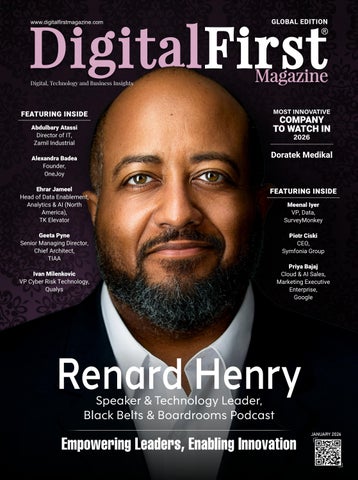
Priya Bajaj Cloud & AI Sales, Marketing Executive Enterprise, Google
Renard Henry
Managing Editor
Sarath Shyam
Dr. John Andrews
Emma James
Andrew Scott
Sabrina Samson
Keith Alexander Consultant Editors
Naomi Wilson
Stanly Lui
Steve Hope
Shirley David Creative Consultants
Charlie Jameson
Louis Bernard
Branding & Marketing Partnerships
Jennifer Anderson
Monica Davis
Jessica Edword
Rachel Roy
Anna Elza
Stephen Donnell
Cathy Chen
Free Subscription
Free Subscription www.digitalfirstmagazine.com
International Partnerships
Americas Europe
Middle East & Africa Asia-Pacific
admin@digitalfirstmagazine.com
Follow Us On www.linkedin.com/company/ digitalfirstmagazine www.facebook.com/digitalfirstmagazine
Digital First Magazine www.digitalfirstmagazine.com is a global knowledge sharing digital platform published by Connecta Innovation Private Limited. All rights reserved. The opinions expressed in the content are those of the authors. They do not purport to reflect the opinions or views of Connecta Innovation Private Limited or any of its members or associates. The publisher does not assume any responsibility for the advertisements and all representation of warranties made in such advertisements are those of the advertisers and not of the publisher. Digital First trademark is owned by DFG Digital First Infotech Pvt Ltd. and Connecta Innovation Pvt Ltd. has permission to use Digital First brand name. Digital First Magazine www.digitalfirstmagazine. com is a Free Subscription and Free-to-read digital platform strictly not for sale and has to be strictly for internal private use only. Publisher does not assume any responsibility arising out of anyone modifying content and pictures, printing a copy of this digital platform in any format and in any country and all matters related to that.
When IT Stopped Fixing Problems and Started Shaping Decisions
Not long ago, the IT department lived in the background. It kept the lights on, the servers humming, and the systems patched, often noticed only when something broke. Today, that quiet role no longer exists. Technology has moved from the engine room to the boardroom, and with it, the expectations placed on IT leaders have changed dramatically. They are no longer just solving technical problems; they are helping businesses make sense of an increasingly complex world.
I see this shift everywhere. Leaders no longer ask, “Can we build this?” They ask, “Should we build this, and why?” According to recent industry surveys, a growing share of CEOs now look to their IT leaders as strategic partners rather than support functions. Yet many organizations still struggle with one fundamental challenge: translating digital complexity into business clarity. Tools are plentiful. Insight is not.
This is where our January cover story finds its relevance. In our conversation with Renard Henry, Speaker & Technology Leader, Black Belts & Boardrooms Podcast, we see a leadership journey that mirrors the evolution of IT itself. Renard’s path from hands-on IT support to enterprise leadership is not just a career story; it is a blueprint for what modern technology leadership looks like. His people-first philosophy reminds us that strategy does not emerge from systems alone. It emerges from empowered individuals who understand both the technology and the business it serves.
What makes this perspective timely is its emphasis on self-leading teams. In an age of constant disruption, clarity cannot flow from a single office or title. It must be distributed, cultivated, and trusted. IT leaders today are not just architects of systems; they are translators, mentors, and sense-makers.
Beyond the cover story, this issue of Digital First Magazine brings together voices that examine leadership, transformation, and the human side of digital progress from multiple angles. You will find reflections that challenge assumptions, interviews that ground ambition in experience, and ideas that encourage thoughtful action.
As you turn these pages, I invite you to read not just for answers, but for perspective. Because in the digital age, the real advantage belongs to those who can turn complexity into clarity, and clarity into purposeful action.
Enjoy Reading.
Iskender Ersan, (Co-Owner)
Selin Aric, (Co-Owner and CEO)
How Generative AI is Empowering Leadership and People Management
Alexandra Badea, Founder, OneJoy
Driving Digital Transformation with Strategic Vision
Abdulbary Atassi, Director of IT, Zamil Industrial
Driving Business Growth through Next Gen Architecture
Geeta Pyne, Senior Managing Director and Chief Architect, TIAA
Transforming Cybersecurity in the Cloud Era
Ivan Milenkovic, VP Cyber Risk Technology, Qualys
Empowering Teams, Driving Innovation
Ehrar Jameel, Head of Data Enablement, Analytics & AI (North America), TK Elevator
Pioneering Generative AI Solutions for RealWorld Impact
Priya Bajaj, Cloud & AI Sales & Marketing Executive Enterprise, Google
INSIGHTS
Democratizing Data to Drive Business Growth
Meenal Iyer, VP, Data, SurveyMonkey
Empowering Businesses with WorldClass Digital Tools
Piotr Ciski, CEO of Symfonia Group and Symfonia
Renard Henry COVERSTORY
Speaker & Technology Leader, Black Belts & Boardrooms Podcast
Empowering Leaders, Enabling Innovation
Renard Henry is a technology leader known for building high-performing teams and driving digital transformation. With a people-first leadership philosophy, he focuses on developing leaders who can lead themselves and create lasting business impact. Renard is a black belt in Brazilian Jiu-Jitsu, where he draws lessons in discipline, adaptability, and calm under pressure. He is also the co-host of the Black Belts & Boardrooms, where martial arts principles intersect with executive leadership and real-world business experience.
Recently, in an exclusive interview with Digital First Magazine, Renard shared insights into his journey from IT support to becoming a visionary leader, emphasizing people-first leadership and developing self-leading teams. He revealed that empowering people and building leaders is what motivates him most. He also shared his personal hobbies and interests, future plans, words of wisdom, and much more. The following excerpts are taken from the interview.
Hi Renard. How did you transition from IT support to becoming a visionary IT leader?
When I first started my career in IT, I did not set out to become a leader. Like many people coming out of college, my initial focus was simply finding a job and building stability. Over time, I had the opportunity to work alongside some exceptional leaders, and watching how they influenced people and organizations made me realize that leadership was something I wanted to pursue. As I grew, I learned that leadership is not about title or authority, it is about enabling others. My success ultimately came from understanding that the strongest leaders focus on developing people who can lead themselves.
What do you love the most about your current role?
What I enjoy most about my current role is the ability to build, develop, and empower people. Technology is important, but the real impact comes from helping teams grow, giving them the confidence to lead, and creating an environment where innovation can thrive. I value how the work we do enables the broader organization to move faster and make better decisions. At this stage in my career, creating other leaders is what motivates me the most.
How will AI/ML reshape enterprise IT by 2030?
By 2030, AI and machine learning will fundamentally reshape enterprise IT by shifting teams away from reactive operations and toward more predictive, proactive models. We will see AI increasingly embedded into core IT functions
TECHNOLOGY IS IMPORTANT, BUT THE REAL IMPACT COMES FROM HELPING TEAMS GROW, GIVING THEM THE CONFIDENCE TO LEAD, AND CREATING AN ENVIRONMENT WHERE INNOVATION CAN THRIVE
such as monitoring, incident management, security, and application development, allowing teams to anticipate issues before they impact the business. Beyond efficiency, AI will also change how IT partners with the business, helping leaders make faster, more informed decisions through better insights and automation. The role of IT will continue to evolve from system management to strategic enablement, with a stronger focus on governance, ethics, and trust as AI becomes more deeply integrated across the enterprise.
What’s the role of quantum computing in cybersecurity?
Quantum computing will play a significant role in the future of cybersecurity, but that role is still evolving. On one hand, quantum computing has the potential to break many of the encryption methods we rely on today, which creates real long-term risks if organizations are not preparing. On the other hand, it also presents opportunities to develop stronger, quantumresistant encryption and more advanced security models. From a leadership perspective, the key is not panic, but preparedness. IT leaders should be aware of the implications, begin planning for post-quantum cryptography, and ensure their organizations are building security strategies that can adapt as the technology matures.
Are there any particular books, articles, or resources that have significantly influenced your thinking or approach?
A few books have had a meaningful influence on how I think and lead. Supercommunicators and The Power of Habit reinforced how critical asking the right questions truly is. They
challenged me to think beyond surface-level communication and recognize how habits, language, and intent shape outcomes, whether I am leading teams, navigating change, or building trust across an organization.
The Art of Laziness and The Diary of a CEO offered a different but equally important perspective. They emphasized that fulfillment matters, that sustainable performance comes from doing work you genuinely enjoy, and that time is a finite resource that must be protected. Together, these works helped me adopt a more intentional and human-centered approach to leadership, one that values clarity, purpose, and long-term impact over constant motion.
Do you mentor others in IT? What’s your approach?
Yes, mentoring is something I am deeply committed to. Early in my career, while I was still in college and working my first IT job, someone took a chance on me and said, “I’m going to teach you everything I know.” That moment stayed with me, and I have been paying it forward ever since. My approach to mentoring is centered on seeing potential in people, sometimes before they see it in themselves. I focus on understanding where they are in their career today, where they want to go, and helping them build the confidence and perspective to close that gap.
What’s one skill every IT leader must master?
Executive Presence is one skill every IT leader must master. Technical expertise will get you into the room, but executive presence determines how your ideas are received once
FOR ME, SUCCESS IS MEASURED NOT ONLY
BY PROFESSIONAL GROWTH,
BUT BY THE LEADERS, TEAMS, AND ORGANIZATIONS THAT ARE STRONGER BECAUSE I WAS PART OF THEIR JOURNEY
you are there. It requires “Being a Lion in a Room with other Lions.” That means strong communication skills, and the ability to clearly articulate how your strategy and decisions create business value. I also believe that every interaction matters. Whether formal or informal, your always being interviewed and vetted. Being prepared, confident, and intentional positions you for opportunities long before they appear.
What are some of your passions outside of work? What do you like to do in your time off?
Outside of work, I value time with my family above everything else. I also spend a significant amount of my time training Brazilian Jiu-Jitsu. I
am
a black belt and have been training for over 14 years. Jiu-Jitsu has played a meaningful role in shaping how I lead, particularly in teaching me how to stay calm under pressure, think strategically, and remain grounded in challenging situations. I also enjoy co-hosting my podcast, Black Belts & Boardrooms, alongside my co-host Amir Khawaja, where we blend lessons from martial arts with executive leadership and real-world business experience.
What is your biggest goal? Where do you see yourself in 5 years from now? My biggest goal is to continue growing as a leader while creating lasting impact through
the people and organizations I serve. Over the next five years, I see myself operating at the executive level, influencing strategy, developing strong leadership teams, and helping organizations navigate transformation in thoughtful and sustainable ways.
Just as important, I want to expand my impact beyond a single organization by continuing to mentor and coach executives and by serving on boards where I can contribute to governance, long-term strategy, and leadership development. For me, success is measured not only by professional growth, but by the leaders, teams, and organizations that are stronger because I was part of their journey.
What advice would you give to someone just starting out in their career in IT?
My advice to anyone starting out in IT is to build relationships early and be intentional about them. Early in my career, I believed that if I worked hard and kept my head down, someone would eventually notice, and the opportunities would come. Hard work absolutely matters, but I learned that relationships often matter just as much. The right connections can open doors, create opportunities, and accelerate growth in ways that talent alone sometimes cannot. Some of those professional relationships will even turn into lifelong friendships that outlast any role, company, or title.
How Generative AI is Empowering Leadership and People Management
Alexandra Badea, Founder, OneJoy
What excites you the most about the advancements in AI, particularly generative AI, and its potential in business applications?
AI is no longer just about automation—it’s about unlocking human potential, creativity, and problem-solving at scale. What excites me the most is how AI can bridge the gap between technology and people, making businesses
more human-centric while staying datadriven. Through OneJoy, my AI custom GPT, I explore how AI can enhance mental well-being, improve habit formation, and support career resilience. I also see massive potential in AI-driven people management, where businesses can leverage AI not just for efficiency, but for better leadership, team engagement, and strategic decision-making.
In recruitment and HR, AI is helping businesses identify talent beyond traditional CV screening, reducing bias, and improving employee experience
Alexandra Badea is an entrepreneur, AI strategist, and psychologist passionate about bridging the gap between technology and people. With a background in psychology and AI, she has built innovative EdTech and AI-driven solutions that enhance learning, career growth, and people management. As the founder of OneJoy, an AI-powered platform focused on mental well-being and habit change, Alexandra explores how AI can support emotional resilience and leadership development. She is also a published author, combining her expertise in human behavior and technology to create impactful content. A strong advocate for AI for Good, Alexandra helps businesses integrate custom GPT solutions and AI-driven people management strategies, ensuring AI empowers, rather than replaces, human potential. Through her work, she supports leaders, entrepreneurs, and teams in navigating the future of AI-powered work with innovation, empathy, and purpose. She believes that AI can help us to finally find thebalancebetweenpersonalandprofessional life, but we need to start the journey with accepting AI and learning tools.
In a recent interview with Digital First Magazine, Alexandra Badea discussed her experience with AI and Business. She shared her views on advancements in AI, how generative AI is transforming industries, AI-driven solutions, human-centered approach, and many more.
How do you see generative AI transforming industries, and which sectors are benefiting the most from its adoption?
Generative AI is fundamentally changing the way we learn, work, and make decisions. In education, it’s creating personalized learning experiences, something I explore in my book and through my EdTech initiatives. In recruitment and HR, AI is helping businesses identify talent beyond traditional CV screening, reducing bias, and improving employee experience. AI is also transforming mental health and well-being, which is a key focus of OneJoy, by offering personalized emotional support and self-improvement tools. The biggest winners are the industries that embrace AI as an enabler for human growth, not just automation and keep the human touch.
What are some of the biggest misconceptions about AI in business, and how should leaders address them?
Many believe AI is too technical for HR, leadership, or coaching, when in reality, AI is a game-changer in people management. Leaders also fear that AI will make their roles obsolete, when in fact, the best leaders will be those who understand how to integrate AI with human insights. This is exactly where I come in—helping companies build a bridge between tech and people, ensuring AI is used for better decisionmaking, team dynamics, and leadership growth.
With AI tools evolving rapidly, how can businesses stay ahead of the curve while ensuring ethical and responsible AI usage?
The key is to start with a clear AI strategy— one that prioritizes both business efficiency and
Companies that succeed are those that use AI to enhance, not replace, human intelligence, ensuring that technology serves the people, not the other way around
human-centered leadership. As a strong advocate for AI for Good, I believe that responsible AI starts with transparency, education, and a commitment to ethical AI development. Companies that succeed are those that use AI to enhance, not replace, human intelligence, ensuring that technology serves the people, not the other way around.
What are the key challenges organizations face when integrating AI-driven solutions, and how can they overcome them?
The biggest challenge is bridging the gap between AI and human teams. Businesses often adopt AI tools without thinking about how employees interact with them, how leadership communicates AI adoption, or how to ensure alignment between people and technology. That’s where I help— guiding companies through AI-powered people management, ensuring AI doesn’t just optimize processes but creates better workplace cultures, smarter leadership, and stronger teams.
How do you see generative AI enhancing creativity, decision-making, and automation within business environments?
I’ve seen first-hand how AI unlocks hidden creativity—from helping teams brainstorm new ideas faster to allowing leaders to make databacked yet intuitive decisions. AI is becoming the ultimate business partner, offering insights, automation, and even emotional intelligence coaching. With the right implementation, AI can help leaders become more empathetic, proactive, and strategic—something I integrate into my custom GPT solutions for businesses looking to optimize their decision-making and leadership structures.
AI will play a crucial role in mental well-being, workplace culture, and career development, which is why I focus on helping businesses adopt AI not just for efficiency, but for people-centered growth
What are some of the most promising generative AI tools that businesses should be exploring right now?
For businesses focusing on people management and leadership, I recommend exploring custom GPT models, which I help companies implement to enhance employee engagement, streamline communication, and offer AIdriven career coaching. AI tools in HR tech, AI-powered mental well-being assistants, and predictive workforce analytics are also crucial for businesses that want to stay ahead. The key is not just picking the right tools, but aligning them with business culture and leadership values—something I help companies navigate.
Looking ahead, how do you see AI shaping the future of work and leadership in the next decade?
AI will not replace leaders, but it will redefine leadership. The best leaders will be those who understand how to work with AI, integrate it into decision-making, and use it to strengthen human connections, not weaken them. AI will play a
crucial role in mental well-being, workplace culture, and career development, which is why I focus on helping businesses adopt AI not just for efficiency, but for people-centered growth. OneJoy and my AI-driven consulting work are rooted in this vision—assisting companies to build AI strategies that empower, rather than replace, human talent.
What advice would you give to business leaders looking to harness AI’s full potential while maintaining a humancentered approach?
AI should always be used to empower, not replace. My advice? Start small, think humanfirst, and integrate AI into areas where it enhances decision-making and leadership. AI is not just about data—it’s about understanding people better, anticipating needs, and building more adaptive, inclusive workplaces. Businesses that succeed will be those that use AI for good—for better leadership, smarter people management, and stronger connections between technology and humanity.
Wa n t t o S e l l o r fi n d
I nve s t o rs f o r yo u r
B u s i n e s s ?
Doratek Medikal
Engineering Care That Stands the Test of Time
Doratek Medikal was founded in 2008 with a focused ambition, to build a Turkish medical technology company that could stand shoulder to shoulder with global players. From the outset, the goal was not scale for its own sake, but reliability, precision, and trust. The company emerged in response to a clear gap in the market, a need for orthopedic and surgical solutions rooted in strong engineering, close collaboration with clinicians, and manufacturing discipline aligned with international standards. What began as a tightly knit, innovationdriven initiative has since grown into a global
organization, with Doratek products now used in more than 80 countries. Over the years, the company has steadily expanded its portfolio across arthroscopy, sports medicine, spine, cranial, maxillofacial, and trauma implants. Its evolution into the Doratek Group marked another defining chapter, opening doors to biomaterials, cartilage regeneration, and bone-filling technologies. Growth, however, has never diluted focus. Doratek’s progress has been shaped by a consistent emphasis on technological rigor, regulatory compliance, and long-term partnerships with surgeons who rely on its solutions in real clinical settings.
Iskender Ersan, (Co-Owner)
Aric, (Co-Owner and CEO)
Selin
At the center of this journey is Selin Aric, Co-Owner and CEO, whose leadership reflects the same balance of clarity and discipline that defines the organization. She describes her approach as grounded in openness and shared responsibility. “My leadership style is built on transparency, collaboration, and a clear, purpose-driven approach,” Aric explains. For her, innovation is not a moment of inspiration but a structured outcome. “Meaningful innovation happens when engineering expertise, clinical insight, and operational discipline work together toward a shared vision,” she adds.
That philosophy has shaped Doratek’s internal culture as much as its external growth. Teams are encouraged to communicate openly, question assumptions, and take ownership of
continuous improvement. This mindset has helped the company remain agile in a highly regulated and fast-evolving global industry. By staying closely connected to surgeons and integrating their feedback into strategic decisions, Aric ensures that Doratek’s direction remains anchored in real healthcare needs rather than abstract market trends.
This steady, values-driven leadership has allowed Doratek to enter new markets and invest in new technologies without losing sight of what matters most, quality, trust, and innovation that serves a clear clinical purpose. It is this balance of ambition and restraint that sets the tone for Doratek’s story, a story that continues to unfold as the company looks toward its next phase of growth.
By staying closely connected to surgeons and integrating their feedback into strategic decisions, Aric ensures that Doratek’s direction remains anchored in real healthcare needs rather than abstract market trends
Building Credibility in a Regulated World
From the early days, Doratek faced a reality that defines the medical device industry, progress is inseparable from regulation. Competing on a global stage meant meeting some of the most demanding standards in healthcare, from documentation and traceability to quality systems that leave no room for shortcuts. At the same time, the company was stepping into markets shaped by long-established international brands, while expanding into advanced implant systems and regenerative solutions that required deep technical and clinical confidence.
Rather than viewing these constraints as barriers, Doratek treated them as a foundation. The company invested early in high-precision engineering, strengthened its regulatory and quality infrastructure, and committed resources to modern manufacturing technologies. Just as important was its decision to stay close to the operating room. Continuous collaboration with surgeons became a strategic anchor, ensuring that innovation was guided by real clinical needs, not assumptions. Reflecting on this approach, Selin notes, “Meaningful innovation only works when technical excellence and regulatory discipline are matched with real clinical insight.”
This mindset is most clearly reflected in PIEX®, Doratek’s flagship brand spanning sports surgery, spinal, cranial, orthopedic, and trauma implants. In a crowded global market, PIEX® stands apart through its development philosophy rather than marketing claims. Each system is shaped through close collaboration with experienced surgeons, with careful
Training programs delivered via Doratek Academy support surgeons and distributors alike, strengthening PIEX® as a trusted and differentiated global
brand
attention to ergonomics, technique compatibility, and intraoperative performance. The result is a portfolio designed to fit seamlessly into surgical workflows, not disrupt them.
Material science and durability are treated with the same seriousness. High-quality biomaterials, advanced surface technologies, and longevity-focused design principles are built into every system. In sports medicine, for example, fixation solutions such as knotless anchors are designed to deliver strong fixation even in compromised bone conditions, helping surgeons reduce operative time and lower the risk of revision procedures. Beyond the products themselves, Doratek reinforces confidence through structured education. Training programs delivered via Doratek Academy support surgeons and distributors alike, strengthening PIEX® as a trusted and differentiated global brand.
Where Engineering Meets the Operating Room
Clinical collaboration is not a checkpoint in Doratek’s R&D process. It is the starting
point. From the earliest concept discussions, engineering teams work closely with physicians and surgeons to understand daily challenges, workflow realities, and unmet needs that rarely surface in product specifications. This dialogue continues through structured consultations, prototype evaluations, simulation studies, and cadaver labs, creating a feedback loop that is both rigorous and practical.
This constant exchange shapes an iterative development process where designs are refined based on hands-on surgical insight. The same model guides Doratek’s work in biomaterials and regenerative solutions, where safety, usability, and clinical relevance must align. “If a solution looks good on paper but does not work naturally in the surgeon’s hands, it is not finished,” Selin explains. By integrating clinical expertise from concept through validation, Doratek ensures its products are technologically advanced while remaining grounded in the realities of modern surgery.
Behind this collaboration sits a disciplined manufacturing ecosystem. Doratek has invested steadily in advanced production capabilities,
including multi-axis CNC machining centers, precision metrology, surface treatment systems, and automated quality controls. Digital engineering tools such as simulation, finite element analysis, and rapid prototyping accelerate development while allowing performance to be validated early. Every stage of manufacturing follows ISO 13485 standards, with full traceability from raw material to final product, a requirement for global trust and reproducibility.
This same precision extends to Doratek’s expanding regenerative and biomaterial portfolio. Whether serving surgeons in Turkey or partners abroad, the company applies the same standards of quality, safety, and consistency. Domestically, Doratek maintains close relationships with hospitals and healthcare institutions, ensuring responsive support and access to its latest technologies. Internationally, its growth strategy is shaped by regulatory alignment, long-term partnerships, and a diversified portfolio under the Doratek Group. Today, Doratek exports to more than 80 countries, with strong momentum across Latin
America, the Middle East, the Gulf region, Africa, and select European markets aligned with MDR requirements. By tailoring commercial and educational strategies to local needs while holding firm on global standards, Doratek balances its home-market responsibilities with focused international expansion. It is a model built on patience, precision, and a clear understanding that sustainable growth in healthcare is earned step by step, not claimed overnight.
Discipline Behind Every Decision
At Doratek, quality is not treated as a function. It is treated as a responsibility. Every stage of manufacturing and operations is designed around patient safety and long-term reliability, starting with the choice of biocompatible, highgrade materials and extending through strict, repeatable quality controls. The company operates under ISO 13485 standards with full traceability, and its teams regularly refine processes through data-driven evaluation and lean manufacturing practices. Precision here is not aspirational. It is operational.
Sustainability follows the same logic of intent and execution. Doratek has steadily integrated energy-efficient production systems, responsible waste management practices, and environmentally conscious packaging into its operations. Ethical sourcing, supplier transparency, and lifecycle-focused product development guide decisions across implant and biomaterial lines. Selin views this balance as essential rather than optional. “Growth only matters if it supports clinical excellence and responsibility at the same time. Otherwise, it does not last,” Selin says.
That philosophy is reinforced through a rigorous and integrated quality and regulatory framework. Every Doratek product undergoes
comprehensive technical documentation, biocompatibility assessments, mechanical and fatigue testing, sterilization validation, and structured risk analysis to meet CE-MDR and other global regulatory requirements. Regulatory affairs teams work closely with engineering and quality functions to maintain complete traceability from raw material selection to final inspection. This cross-functional discipline ensures consistency, even as the portfolio expands.
Advanced metrology systems, automated control processes, and continuous monitoring safeguard precision across implants and biomaterials alike. What emerges is a culture of continuous improvement grounded in evidence
rather than assumption. By aligning regulatory discipline with high-precision engineering, Doratek ensures that every solution entering the market meets global expectations for safety, reliability, and clinical performance. It is quiet work, often unseen, yet it defines the company’s credibility.
Designing the Next Decade
Looking ahead, Doratek’s leadership team is clear-eyed about the road in front of them.
Over the next five to ten years, the company aims to strengthen the global presence of its PIEX® brand, expand its portfolio of minimally invasive surgical solutions, and deepen its footprint in the United States and Europe. These ambitions are supported by continued investment in R&D, broader use of digital tools across the organization, and next-generation manufacturing technologies that enhance precision, scalability, and sustainability.
The medical device industry is evolving quickly, with rising expectations around clinical data, digital integration, and regulatory rigor. Doratek is preparing by adopting advanced materials, simulation-based development methods, and data-informed decision-making. Surgeon training is also evolving, with digital platforms playing a greater role. Alongside this, the Doratek Group continues to expand its biomaterial and regenerative product lines, reinforcing a diversified strategy built for longterm relevance rather than short-term gains.
Several innovation programs already point to what comes next. The company is advancing next-generation arthroscopy systems, refined spine instrumentation, and minimally invasive solutions developed in close collaboration with
international clinical partners. These projects reflect Doratek’s long-standing belief that engineering precision must always be guided by surgical reality. They are not departures from the company’s past but extensions of its core approach.
Biomaterials and regenerative technologies represent another frontier. Solutions focused on bone healing, cartilage repair, and biological support are opening new opportunities to improve patient outcomes across multiple treatment areas. As these products enter highpotential markets, Doratek is strengthening global partnerships and expanding educational support through Doratek Academy, including simulation-based learning. Together, these initiatives signal a future shaped by preparedness rather than prediction.
For Selin, the most meaningful measure of progress remains personal. “The most rewarding part of my journey has been seeing how our technologies improve patients’ lives and watching a local vision grow into a global organization trusted by surgeons,” she shares. Her advice to future leaders is grounded in experience. She adds, “Stay curious. Stay close to clinical realities. Make decisions based on purpose, not convenience. Technology matters, but integrity, empathy, and resilience are what sustain long-term success.”
As Doratek moves forward, those principles continue to guide its path. The company’s story is not one of sudden breakthroughs, but of steady, deliberate progress. It is a reminder that in healthcare, lasting innovation is built through discipline, listening, and a genuine commitment to improving human well-being.
Driving Digital Transformation with Strategic Vision
Abdulbary Atassi, Director of IT, Zamil Industrial
Hi Abdulbary. Can you share a moment that sparked your interest in pursuing a career in IT and business solutions?
That summer during junior high, when I couldn’t travel, turned out to be a pivotal moment. I spent my days at my father’s company, surrounded by these old business applications. With all that free time and no internet, I decided to learn BASIC programming and even built a
phone dictionary. It was pure curiosity at first, but it ignited something that stayed with me. Even as I worked in IT operations, that initial interest in building solutions never faded. It drove me to learn, grow, and eventually carve out a career that took me from developer to consultant, project manager, business applications manager, and ultimately, to where I am today as an IT director.
What really drives me is the constant exploration of new technologies, the challenge of using them to build solutions that genuinely help people
Abdulbary Atassi is a seasoned IT professional with a passion for driving digital transformation. Currently serving as an IT Director in Zamil Industrial, Saudi Arabia, he leverages extensive experience in enterprise applications, databases, and information systems to optimize business solutions. His career spans development, consulting, and project management, fueled by a lifelong fascinationwithtechnology.Atassichampions a collaborative leadership style, emphasizing strategic vision, team empowerment, and continuous innovation. He’s dedicated to exploring emerging technologies like AI and IoT, while balancing a commitment to family and personal well-being.
Recently, in an exclusive interview with Digital First Magazine, Abdulbary shared insights on a defining moment that shaped his path in ITand business solutions, personal role model, future plans, words of wisdom, and much more. The following excerpts are taken from the interview.
What do you love the most about your current role?
What really drives me is the constant exploration of new technologies, the challenge of using them to build solutions that genuinely help people. It’s a collaborative process, working together to tackle a problem, and seeing that solution come to life. And let’s be real, there’s nothing quite like the feeling of announcing a successful go-live, knowing you’ve delivered something valuable.
How do you stay current with the latest trends and developments in IT and digital transformation?
Of course, staying up-to-date with tech providers, influencers, and industry news is
essential. But what really makes a difference is building strong, genuine partnerships with our technology providers and system integrators. I always tell companies who want to work with us: take the time to truly understand our business, our technology, and how we operate. Come to us with ideas, with use cases that are tailored to our needs.
That’s how we create real value together.
Is there a particular person you are grateful for who helped get you to where you are?
My dad’s influence on my career is undeniable. He was the one who opened our eyes to the world of technology, showing me and my brothers all the cool things you could
My philosophy is simple: create a clear, strategic vision that stretches beyond the immediate horizon, at least three years
do. And watching him build business applications at his company? That’s what really cemented my decision to pursue computer science. Later, during my Masters, I naturally gravitated towards databases and information systems. It’s like he knew what I’d love before I did.
What are some of your passions outside of work? What do you like to do in your time off?
Time off is a rare luxury these days, but I’m a firm believer in making time for what matters. That’s why I prioritize at least an hour of exercise every single day. And, like most of us, I have to admit I get sucked into the social media vortex now and then. But at the end of the day, family comes first. I make sure to carve out quality time with my kids and loved ones.
How do you approach leadership and team management, and what qualities do you believe are essential for effective leadership?
My philosophy is simple: create a clear, strategic vision that stretches beyond the immediate horizon, at least three years. Then, find the best people to lead the charge. But here’s the key – trust them. Listen to their ideas, give them ownership, and empower them to make decisions. Don’t try to be the bottleneck. Shared ownership is where real innovation happens.
Which technology are you investing in now to prepare for the future?
Our journey started with a clear ‘cloud-first’ vision, and we’ve come a long way. After
Start with the fundamentals. Don’t try to understand business solutions without knowing how they’re actually constructed, both technically and functionally
successfully transitioning to a new SaaS ERP, we shifted our focus to unlocking the power of analytics. Now, it’s all about AI and IoT – exploring the cutting edge! But we’re not neglecting security. In fact, we’re doubling down on cybersecurity, especially solutions that leverage AI to stay ahead of evolving threats.
What is your biggest goal? Where do you see yourself 5 years from now?
Right now, my big focus is nailing down our digital transformation strategy at Zamil Industrial. I’m really passionate about streamlining our processes, moving away from relying so heavily on Excel for reporting and email for communication. Imagine bringing everything into our digital platforms –that’s the dream! And beyond that, I’m eager to push the boundaries of AI and data science, to uncover those hidden insights and see how much more we can automate. Personally, after years working with enterprise applications, I’m genuinely curious about what’s next. Is Gen AI the ultimate game-changer? Can AI truly revolutionize how we handle business tasks? We’re about to find out.
What advice would you give to someone looking to break into the IT field, particularly in enterprise business solutions?
Start with the fundamentals. Don’t try to understand business solutions without knowing how they’re actually constructed, both technically and functionally. Get into the weeds with databases, learn how they’re built for accuracy, consistency, and performance. And then, roll up your sleeves and learn the business processes – the modules, the functions, the relationships. That’s the practical knowledge that will give you a real, working understanding of enterprise solutions.
Driving Business Growth through Next Gen Architecture
Geeta Pyne, Senior Managing Director and Chief Architect, TIAA
Hi Geeta. What inspired you to pursue a career in enterprise architecture and technology strategy, and what motivates you to continue in this field? I started my career in Space Research and worked across several industries, always figuring out new ways of delivering, driving innovations and transformations. I like big hairy problems, I think Big, Bold and challenge all assumptions. While a tech nerd at heart, I also love people, working
with people, bringing the best out of people, aligning on a common mission, and driving companywide transformations – this is what excites me and drives me, I excel and where I see enterprise architecture and technology strategy gives me that intersection of driving change, growing people while delivering growth for the company, making impact to the Customers. Chief Architect roles are never easy, it requires a unique mindset, ability to influence without
EAs must drive transformation with architecture for good, good for humanity and establish to get a seat at the table of at World Economic Forums and other venues discussing critical skills and initiatives to make the world a better place
Geeta Pyne is a highly experienced Chief Architect and Engineering Leader with about 30 years of industry experience. She has a proven track record of leading digital transformations with next generation architecture strategies to deliver innovative capabilities that drive profitable business outcomes and accelerates SaaS business. A Data Strategy & Enterprise Architecture expert, she has built global high-performance teams, leading to significant improvements in efficiency, cost savings, and new revenue generation. Geeta started her career as a research scientist developing algorithms for Satellite Image Processing and takes pride in holding IP in India’s first parallel computer PARAM and Image Processing system ISROVISION.
Geeta is a trusted advisor to CIOs/CTOs, transformation leader, and change agent with an entrepreneurial mindset with core strengths in enterprise & products architecture, data, AI, and enterprise IT. Additionally, she is an advisor to multiple startups, and is passionate about growing and coaching the next generation of talents. She is also a BoardMember/Advisorforseveralorganizationssuch as Chief Architect Forums & Women in Architecture, SIM, Bay Area, Evanta San Francisco, a Gartner company, Evanta Global CIO, Gartner Peer Insights Ambassador and GTM Capital Advisory Board and to several startups and VCs. She loves to mentor, grow next generation talent, and make a difference especially to young graduates entering the workforce.
Recently, in an exclusive interview with Digital First Magazine, Geeta shared insights on the evolution of enterprise architecture in the next 5-10 years, words of wisdom, the secret mantra behind her success, significant career milestones, future plans, and much more. The following excerpts are taken from the interview.
authority, change mindset while continuing to learn and grow, that’s what keeps me motivated to continue in this field.
What do you love the most about your current role?
Driving change in 100+ years old company, bringing people across, inspiring, motivating, mentoring and showing the art of possible. Changes are never easy especially in a large legacy company, challenges bring the best of me, and I love being able to influence, push conventional thinking, helping people finding their purpose and making people fall in love with what they do!
How do you see the field of enterprise architecture evolving in the next 5-10 years, and what skills or competencies will be most important for success?
The field of enterprise architecture is getting more and more an integral part of how we run the business, driving business strategy, understanding the intricacies and dependencies of geo-political influence, resiliency and economic factors will be key for enterprises to thrive in the coming years. The enterprise architects will need to be business savvy, understand key industry trends, double down on critical thinking, be extremely flexible and adaptive, start with first principle thinking, bring innovation in every conversation, reimagine and rethink everything. EA’s must drive skills of the future, architect the organizations, and take central roles of shaping the future. EA’s must be very versatile, besides the core tech technologies like AI and Data, Cloud and Edge, new ways
of Compute, Network, Storage, they must pick up skills around responsible policies, ethics, compliance, governance and understand how they come together and last but not the least, sustainability. EAs must drive transformation with architecture for good, good for humanity and establish to get a seat at the table of at World Economic Forums and other venues discussing critical skills and initiatives to make the world a better place. Stay humble, stay hungry!
Can you share your thoughts on the importance of diversity, equity, and inclusion in the field of enterprise architecture, and how do you promote these values in your work?
Enterprise Architecture is rooted in diversity, diversity of thoughts, diversity of problems, diversity of approaches, there is no one size fits all. Different perspectives matter the most and looking from several angles, and you can’t build an EA team without diversity. For me, it is not about gender, it is about bringing talent from all backgrounds to have a holistic thinking and completeness of vision, including everyone’s opinion, giving a seat at the table.
I practice this every day, my team at TIAA and in prior companies, have people from different background, engineering, program management, business analysts, product managers to architects across the stack. What I look for is curiosity, willingness to learn, problem solving attitude, working across the isles, and always looking to bring people together. I encourage everyone to speak up, I create an environment of trust and safety and promote these values leading by examples.
Congratulations on being honored with the AI100 award, Geeta! Your leadership and expertise in enterprise architecture have been an inspiration to many. As someone who has achieved so much in their career, what advice would you give to others looking to follow in your footsteps, and what’s the one thing that’s been key to your success?
Thank you so much for your kind words. My advice to anyone looking to make an impact and establish as enterprise architect, will be to start with foundations, get really good in going deep in certain domains, before going broad. You have to be known for your craft in certain domain, for me it has always been data and integrations. Never stop learning, and embracing different perspectives. Be curious, never say no to an opportunity unless you try, shadow anyone you admire, be in business or tech or sales – there is so much to learn from people that complement you. Surround yourself with people that are smarter, different, who will challenge you, push you – get comfortable being uncomfortable, be open, and always believe in the art of possible.
There is no short cut for hard work, put in the effort and do everything with utmost diligence and commitment. For me, my hunger and curiosity, relentless effort in the success of the projects and organizations, and putting team and company first, has been the key to success. For me making a difference, making an impact, driving change and making people smile – yes if I can bring smile to anyone, that makes my Day.
How do you stay current with the latest developments and trends in technology and enterprise architecture?
It is very hard to stay current with so much happening at the speed of light. I follow brilliant minds, that includes startups and establish trend setting companies. Outside work, I am involved with startups and VCs as well as building and contributing to communities to learn, share and grow each other. Communities both inside and outside companies are great sources for me to keep learning. In addition, reading industry journals, attending summits, reading books.
I feel every night I sleep, I wake up knowing so little as the world has advanced while I was
My advice to anyone looking to make an impact and establish as enterprise architect, will be to start with foundations, get really good in going deep in certain domains, before going broad
I can learn tech any day but being able to bring purpose for people, letting them see the light – that’s my career defining moment and I wouldn’t trade that for anything in the world
sleeping ! The more I know, the more I realize how little I know!
Who has been a significant influence or mentor in your career, and how have they helped shape your professional journey?
There have been many people in different stages of my life and career. From my mother who was and still is the biggest inspiration forever to instill the confidence, yes, I can, and I will, making me resilient, helping with grit, perseverance and persistence. I have had managers and business partners who believed in me, who saw in me more than what I thought of me, who threw me in the path of challenging projects, only to make me thrive. This has happened in m y first job at ISRO in India, at Arrow Electronics in New York, and later now with VCs and startups. So many people to name, I don’t want to take one or two, but pretty much anyone I worked with either as a peer, or junior or my manager, somehow or the other they all shaped me to be who I am today.
What has been your most career-defining moment that you are proud of?
Looking back, there are so many moments. I would call out a moment from the first chapter of my career from ISRO. When I was waiting at the ground station to run the software on the first batch of satellite data that was captured on the satellite’s on-board tape recorder, execute my software and being able to see if the algorithm worked, that thrill, that exuberance, that joy, I can’t express in words. Also, the moment I was able to program on India’s first indigenous Parallel Computer, PARAM, with optimized software, and being able to see the parallel data processing with the lights on the PARAM showing the path of compute and processing,
wow those were the moments that made it worth being a computer science engineer. Later in my career, as I switched from being the senior most individual contributor to a people leader, and being able to mentor and grow people, getting people motivated and providing with a purpose, that changed everything for me. I can learn tech any day but being able to bring purpose for people, letting them see the light – that’s my career defining moment and I wouldn’t trade that for anything in the world.
How do you prioritize your well-being and self-care amidst a demanding career?
This is a very hard and tough task and especially in today’s always ON world. Still, I try to keep my physical being well, exercise, walk, and most importantly recharging my inner self. Keeping spirits high and positive energy is critical for
me, it is not about how long I work but it is about am I surrounding myself with positivity – negativity drains me, and I try to get out, meet people, walk in nature with my husband, listening to music, watching good movies etc. re-deposit positivity to keep me going. But I still need to do more for taking care of myself so as not to run out of gas.
What are your long-term career aspirations, and how do you see yourself evolving as a leader over the next five years?
I would like to play a bigger and broader role in the world, would be great to be part of cross companies, global initiatives, creating a platform to innovate on common hard topics, and being an influencer in global architecture and technology, teaching and giving back more to the next generations.
Transforming Cybersecurity in the Cloud Era
Ivan Milenkovic, VP Cyber Risk Technology, Qualys
What drives your passion for cybersecurity, and how do you stay current with the latest threats and trends?
My passion for cybersecurity is fuelled by its rapid pace of change and the sheer breadth of challenges it presents. Over the past twentyfive years, I have witnessed more innovation in this field than many other disciplines see over several generations. I began my journey in IT, moved into the identity space as it piqued my curiosity, and evolved into focusing on risk and trust. Staying current involves seeking out a close network of peers, tapping into trusted
sources, and maintaining a healthy dose of inquisitiveness. Continuous education is vital, which is why I chose to pursue a Cyber MBA –largely because I felt I wasn’t learning enough in my day-to-day role. I also stay engaged by advising start-ups and diving into the latest trends firsthand.
What do you love the most about your current role?
I relish having a break from day-to-day operational demands and using that time to guide others – exploring their challenges and helping them find the right solutions. At Qualys,
I liken high-performing cybersecurity teams to successful sports teams: the collective performance must surpass individual heroics, as relying on ‘heroes’ alone isn’t sustainable
Ivan Milenkovic serves as Vice President for Cyber Risk Technology at Qualys, a pioneering provider of disruptive, cloud-based IT, security, and compliance solutions designed to consolidate and streamline customers’ security requirements on a single platform. With over 20 years of experience in aligning complex technology landscapes and fluctuating risks with core business objectives, Ivan’s background includes a Group CISO role at a major multinational BPO, running a cyber advisory practice, and serving on multiple advisory boards. Earlier in his career, he was involved in the design and operations of systems supporting the Olympic Games, and he proudly notes having delivered projects across every continent except the frozen ones.
Ivan is a Certified Information Security Officer (S-CISO®) and is one of the trainers on the CISO2.0 course for the SECO Institute (for the S-CISO certification). He is currently pursuing a Cyber MBA at Lancaster University in the UK.
Recently, in an exclusive interview with Digital First Magazine, Ivan shared insights on the role of artificial intelligence and machine learning in supporting cybersecurity efforts, personal hobbies and interests, his favorite quote, future plans, words of wisdom, and much more. The following excerpts are taken from the interview.
my work involves evangelising in the field of risk management, helping clients identify the real cybersecurity issues, sharing hard-earned insights with CISOs and their teams, and educating prospective CISOs through the CISO2.0 course offered by the SECO Institute (for the S-CISO certification). Despite stepping away from an operational role, I still meet new, inspiring people. Ultimately, I find satisfaction in making a difference – whether that’s by simplifying complexity or offering a fresh perspective.
Can you describe your approach to building and managing high-performing cybersecurity teams?
I liken high-performing cybersecurity teams to successful sports teams: the collective performance must surpass individual heroics, as relying on ‘heroes’ alone isn’t sustainable. Trust serves as the bedrock, and diversity ensures a range of perspectives and skill sets. Once the team is in place, I like to ‘lead from behind,’ granting autonomy and supplying the right tools and guidance, while offering protection and support when needed. I truly believe a leader’s role is to nurture, support, and enable, rather than command and control.
I encourage team members to make mistakes and learn from them. Mentorship, combined with candid yet caring feedback, helps nurture an environment where people can challenge each other, grow professionally, and stay motivated.
What role do you believe artificial intelligence and machine learning play in supporting cybersecurity efforts?
AI and ML are increasingly indispensable in cybersecurity, acting as force multipliers for both
detection and response. They reduce noise by automating routine tasks, allowing practitioners to concentrate on higher-level, creative problemsolving. This productivity boost is critical in a field where response times can make all the difference. However, it’s important to remember that AI isn’t a magic bullet: human expertise remains central to interpreting results, making final decisions, and ensuring we stay relevant in an automated world. Moreover, there is still no replacement for human creativity.
What personal or professional philosophies have contributed to your success, and how have you applied these principles in your career?
At the heart of my philosophy is Radical Candor (thank you, Kim Scott) – caring personally yet challenging directly. Although the book and the philosophy behind it are relatively new, I recognised much of my own approach in its principles. I believe in taking ownership of one’s success: life is too short to wait for opportunities to appear at your doorstep. My moves across four countries exemplify this outlook. I also adhere to ‘walk the walk’ – talking about doing something is never the same as actually doing it. Failing is part of the journey, but honesty with oneself and others fosters genuine growth. This transparent approach, coupled with a willingness to put myself out there, has been key to every role I’ve undertaken – often resulting in invitations from companies that valued my authenticity.
What are some of your passions outside of work? What do you like to do in your time off?
When I’m not consumed by my work, I devote my energy to supporting my two boys, taking
AI and ML are increasingly indispensable in cybersecurity, acting as force multipliers for both detection and response
long walks with the dog, and tinkering with tech projects around the house. I’m also quite enthusiastic about cars, happily handling some of the servicing myself. While I’m more of a tennis spectator than a player these days, the sport still inspires me and reminds me of the importance of agility, strategy, and stamina – traits I find equally valuable in both work and leisure.
What is your favourite quote?
“Talking isn’t doing.” — William Shakespeare
This quote resonates with me because it underscores the importance of action. Words can inspire, but real change only happens when we roll up our sleeves and make it happen.
Which technology are you investing in now to prepare for the future?
Technology evolves at a head-spinning rate, so I prioritise investing in my family and myself above all else. Nonetheless, I keep a keen eye on solutions that streamline cyber risk management, whether through automation,
Over the next few years, I plan to transition fully into a Non-Executive Director (NED) capacity, contributing my insights and experience to help organisations make informed, forward-looking decisions
data analytics, or enhanced threat intelligence. Specific tools may change, but the principle remains the same: continuously adapt to stay ahead of the ever-shifting risk landscape.
What are your long-term career aspirations, and how do you see yourself evolving as a leader over the next five years?
I’m increasingly drawn to the non-operational side of the industry, focusing on shaping strategic direction rather than hands-on execution. Over the next few years, I plan to transition fully into a Non-Executive Director (NED) capacity, contributing my insights and experience to help organisations make informed, forward-looking decisions. By doing
so, I’ll continue refining my leadership style –leveraging Radical Candor, promoting trust, and ensuring diverse teams thrive.
What advice would you give to someone looking to break into the field of cybersecurity?
Curiosity is essential: always question, always learn. Find a niche that excites you and trust in your ability to develop expertise in it. Bring your authentic self to the table –be a bit rebellious if it suits you! Identifying your ‘superpower’ and perfecting it is an excellent way to stand out in a competitive field. Ultimately, believe in yourself, remain open to continuous change, and don’t shy away from calculated risks.
Empowering Teams, Driving Innovation
Ehrar Jameel, Head of Data Enablement, Analytics & AI (North America), TK Elevator
Hi Ehrar. What drives your passion for data and analytics, and how do you stay current with emerging trends and technologies?
For me, the excitement in Data and AI comes from the opportunity to solve complex problems and genuinely impact people’s lives through innovation. I’m naturally competitive and strategic. I love identifying big-picture opportunities and then rallying teams around ambitious goals. Bringing diverse teams together to turn visionary ideas into practical
solutions energizes me. Honestly, my greatest satisfaction is seeing my team’s work translate directly into measurable value for our business.
To me, analytics isn’t just technology; it’s about connecting with people, understanding their unique challenges, and crafting solutions that truly matter. That human aspect keeps me motivated every day.
Staying at the cutting edge of AI and analytics means constant learning—I actively engage with professional communities, speak at global events, mentor team members, and experiment
To me, analytics isn’t just technology; it’s about connecting with people, understanding their unique challenges, and crafting solutions that truly matter
Ehrar Jameel is an award-winning Data and AI leader recognized for transforming organizations through strategic innovation, AI governance, and advanced analytics. Currently leading Data & AI initiatives at TK Elevator, Ehrar drives measurable impact across global teams, spearheading multimilliondollar projects in AI, Machine Learning, MDM, and Salesforce migration. His dynamic, collaborative leadership style—rooted in high emotional intelligence and a passion for empowering teams—has earned him multiple accolades, including recognition as an AI100 Leader at MachineCon 2025 and a nominee for DataIQ’s Top 10 AI Leaders in NA. Ehrar serves as a Governing Body Member for Gartner’s C-communities and as an Advisory Board Member for the CDAO Circle. Outside work, he enjoys cricket, gardening, woodworking, fishing with his family, mentoring aspiring data leaders, and actively supporting social causes close to his heart.
Recently, in an exclusive interview with Digital First Magazine, Ehrar shared insights on what drives his passion for data and analytics, the secret mantra behind his success, his favorite quotes, future plans, words of wisdom, and much more. The following excerpts are taken from the interview.
hands-on with emerging technologies. The LinkedIn community and broader data industry connections inspire me daily, keeping my ideas fresh and my enthusiasm high.
What do you love the most about your current role?
What I love most about my role at TK Elevator is the incredible opportunity to blend my passion for innovation with my strengths in strategic thinking and collaboration. The organization’s trust in exploring cutting-edge ideas fuels my drive and keeps my competitive spirit energized.
Leading a global, cross-functional Data & AI team, I get immense satisfaction from seeing our collective vision become reality—transforming ideas into measurable business impact. Whether it’s preventing contract cancellations using AI, predicting sales with advanced analytics, or deploying generative AI knowledge bots, the tangible outcomes are deeply rewarding.
Above all, working closely with talented individuals across diverse backgrounds— understanding what uniquely motivates each person and empowering them—is what makes my role so fulfilling.
What are some common misconceptions or myths about AI that you’d like to debunk?
One myth I love debunking is that AI will steal our jobs—trust me, it’s not here to replace us, but to augment and supercharge our work. Every company has a huge backlog of tasks, and AI helps us efficiently tackle that backlog, enabling us to achieve far more with less. But the key is proactive adoption—embracing AI today means we’ll spend less time catching up tomorrow!
One myth I love debunking is that AI will steal our jobs— trust me, it’s not here to replace us, but to augment and supercharge our work
Another common misconception is that AI can fully replace human intuition. Not really! AI complements human judgment beautifully, but it simply can’t replicate intuition, creativity, or emotional intelligence—those uniquely human strengths that truly drive innovation.
What personal or professional philosophies have contributed to your success, and how have you applied these principles in your career?
My philosophy is simple: “Dream big, act fast, and build meaningful relationships along the way.” Leveraging my strengths in strategic thinking and influencing others, I proactively identify opportunities and quickly turn ideas into actions, motivating teams around clear, ambitious goals. I’m always striving for excellence, but I deeply value individual connections— understanding each team member’s unique strengths and empowering them. In practice, this means fostering enthusiasm, collaboration, and a culture where innovation thrives, ultimately delivering measurable results and sustained impact across the organization.
What are some of your passions outside of work? What do you like to do in your time off?
I thrive in dynamic environments, professionally and personally. Cricket fuels my competitive spirit and is my favorite way to recharge, while family is at the heart of my life—especially spending quality time with my mom, wife & kids, gardening, or building backyard projects like our vegetable garden. I’ve discovered the joy of fishing with my son, a peaceful yet exciting new hobby. I also deeply enjoy mentoring others, nurturing their unique
strengths, and empowering them to excel. These experiences ground me, inspire fresh ideas, and bring balance to my high-energy, results-driven professional life.
What is your favorite quote?
“The purpose of life is a life of purpose.” This quote deeply resonates with me. Personally, and professionally, I strive to ensure every moment and interaction counts. My Clifton Strengths reflect my passion for connecting with people, inspiring teams, swiftly turning strategic ideas into impactful results, and—most importantly— uplifting others. Nothing brings me greater joy than seeing people succeed, grow, and reach their fullest potential.
The saying, “If you want to go fast, go alone; if you want to go far, go together,” further reinforces my belief in combining speed with meaningful collaboration. My focus remains purposeful impact, continuous growth, and building lasting connections.
Congratulations on being recognized as an AI100 Leader at MachineCon 2025! Our readers would love to know the secret mantra behind your success.
Thanks so much! Honestly, the secret isn’t very secret—it’s curiosity, stubborn persistence, competitive enthusiasm, and plenty of coffee! But most importantly, it’s about always staying humble, hungry, and willing to embrace discomfort. My real superpower lies in recognizing each individual’s unique strengths and placing them in roles where they can truly shine. For me, building a winning team means collectively showcasing our best sides while covering each other’s weaknesses. I’m incredibly fortunate to lead amazing teams that embrace bold, visionary ideas and turn them into reality. My mantra for AI remains simple: “Start small, dream big, move fast— and have fun along the way!”
I’m always striving for excellence, but I deeply value individual connections— understanding
each team member’s unique strengths and empowering them
Which technology are you investing in now to prepare for the future?
At TKE we are predominantly an Azure shop and right now, my primary focus is on Data & AI Governance, building a Common Data Platform across all BUs, generative AI, and AI agents—particularly their ability to automate complex tasks and significantly enhance decision-making. I’m especially passionate about bringing these transformative AI capabilities to customers who genuinely need
help but might lack the resources or expertise to fully leverage data.
Also, someday hopefully will get time to focus on my startup, Datakeys.ai, I’m committed to taking advanced data and AI solutions to organizations ready to transform their businesses but unsure where to start. With robust governance frameworks and ethical AI at its core, Datakeys.ai will ensure sustainable innovation—amplifying human potential and delivering real, measurable impact.
My advice is simple: Stay curious, keep learning, and never underestimate the power of building genuine relationships
What are your long-term career aspirations, and how do you see yourself evolving as a leader over the next five years?
Long-term, my goal is to significantly scale my impact as a strategic and innovative Data & AI leader, driving transformational change on larger projects and across broader global teams. Over the next five years, I confidently see myself stepping into greater strategic roles, including formally embracing a Chief Data & Analytics Officer (CDAO) position. Additionally, I’m deeply passionate about scaling my startup, Datakeys.ai, to deliver powerful, practical AI and data solutions to a wider range of organizations. Regardless of path, my leadership evolution will remain anchored in empowering teams, fostering innovation, and creating measurable, lasting value.
What advice would you give to aspiring data and analytics leaders?
My advice is simple: Stay curious, keep learning, and never underestimate the power of building genuine relationships. As you grow, focus on understanding people as much as you understand data—great analytics leaders don’t just drive numbers; they inspire, connect, and empower those around them.
Invest in your EQ as much as your IQ, embrace collaboration across teams, and proactively adopt new technologies. And most importantly, always lead with authenticity, humility, and purpose. Remember, your success isn’t measured just by achievements, but by the positive impact and lasting value you create for others.
Pioneering Generative AI Solutions for Real-World Impact
Priya Bajaj, Cloud & AI Sales & Marketing Executive Enterprise, Google
Hi Priya. What drives your passion for data-driven transformation, and how do you stay up-to-date with the latest trends?
What really fuels my passion for datadriven transformation is seeing how it can fundamentally change the way organizations operate and connect with their customers. I’ve always been driven by the power of data to tell a story and create a more efficient, insightful, and even personalized experience. My background as an engineer, combined with my MBA, gives me a unique perspective: I love diving deep into complex challenges,
but I also enjoy translating those insights into clear, strategic plans that drive real-world results. For me, it’s about bridging the gap between the data and the decision-makers.
And what’s particularly exciting right now is the role of AI in all of this. To stay on the cutting edge, I’m constantly exploring the latest AI advancements, especially generative AI and its potential to revolutionize industries. My current work involves partnering with consulting firms to pioneer and implement these AI-driven solutions on Google Cloud platforms, helping companies in sectors like consumer goods and media & entertainment
The intersection of technology, business, and social impact is where I believe the future’s greatest potential lies
Priya Bajaj is a Global Enterprise Sales Executive at Google Cloud, where she helps businesses navigate the exciting and complex world of datadriven transformation in the AI era. Combining her background as an engineer with her MBA, Priya is passionate about pioneering generative AI solutions that solve real-world problems. But her drive extends beyond the corporate sphere. Believing in the power of community and connection, Priya co-chairs the Fundraising Board for Trail Blazers, and co-founded It’s Ok Yaar with her husband, a content platform that educates, entertains, and empowers South Asian immigrants. Driven by a “People First” mindset, Priya is committed to the intersection of technology, community building, and creating positive social impact.
Recently, in an exclusive interview with Digital First Magazine, Priya shared insights on the importance of diversity, equity, and inclusion in the tech industry, her favorite quote, significant career milestones, future plans, words of wisdom, and much more. The following excerpts are taken from the interview.
When we create truly inclusive spaces, we unlock creativity, build better products, and create a more just world
transform their businesses for the digital age. It’s incredibly rewarding to be part of that process.
Beyond the technical side, I believe in the importance of staying informed and openminded. That’s why I actively seek out diverse perspectives on the field. I enjoy listening to podcasts, reading non-fiction books which offer different viewpoints, and I connect with other professionals online to exchange ideas. For me, it’s a continuous journey of learning and contributing to the evolution of this space.
What do you love the most about your current role?
The most exciting part of my role is the chance to drive real innovation and see its impact firsthand. I partner with leading consulting firms to not just implement, but invent generative AI solutions that transform how businesses operate. We’re often building from zero to one, imagining what’s possible and then bringing it to life. This blend of creativity and strategic thinking is incredibly fulfilling. Plus, the dynamic, fastpaced environment, where you have to be resourceful and constantly push boundaries, is a huge draw.
How do you envision the intersection of technology, business, and social impact evolving in the future, and what role do you see yourself playing in this space?
The intersection of technology, business, and social impact is where I believe the future’s greatest potential lies. Technology, particularly AI, has the power to solve some of the world’s most pressing problems, but only if it’s developed and deployed ethically.
Seeing the Ghibli trend, where AI-generated content appropriated and arguably devalued the work of artists, deeply concerns me. It underscores the urgent need for ethical AI frameworks.
I want to be a force for good in shaping this future. I’m focused on building AI responsibly and collaborating with organizations that share that vision. I also believe in the importance of community and inclusivity. My own journey has been shaped by the support of others, which is why I co-founded It’s Ok Yaar with my husband. It’s a platform dedicated to educating, entertaining, and empowering South Asian immigrants. I see my role as bridging the gap between technology, business, and social impact by prioritizing people, fostering community, and using my platform to uplift others.
Can you share your perspective on the importance of diversity, equity, and inclusion in the technology industry, and how you promote these values in your own leadership practice?
For me, diversity, equity, and inclusion are deeply personal values, and I see them as crucial for the technology industry’s progress. When we create truly inclusive spaces, we unlock creativity, build better products, and create a more just world. I strive to lead with a ‘People First’ mindset, which means prioritizing genuine connections, actively seeking out different perspectives, and ensuring everyone feels valued and has the opportunity to succeed. My work with It’s Ok Yaar, a platform I co-founded with my husband to support the South Asian immigrant
community, is a core part of my commitment to building inclusive communities. I’m also dedicated to mentorship, believing in the power of opening doors and empowering individuals from all backgrounds to thrive in tech.
Who has been a significant influence or mentor in your career, and how have they helped shape your professional journey?
I owe a great deal of my professional growth to the many mentors, sponsors, and allies who have invested in me and opened doors along the way. Their support has been invaluable, and I’m profoundly grateful for their belief in my abilities.
What I’ve come to appreciate about mentorship is that it’s a dynamic relationship. It requires a strong connection and active participation from both sides. It’s perfectly fine to recognize when a mentorship isn’t serving you and to seek out guidance that better aligns with your goals. In fact, as we advance in our careers, we often need different mentors who can provide tailored advice for each new challenge. And I’ve even learned valuable lessons from managers who I didn’t necessarily ‘vibe’ with. Those experiences taught me what I did not want to do when I started leading my own team, which has been incredibly helpful.
And I’ve also learned the immense power of sponsorship. Having someone who champions you behind closed doors and advocates for you when you’re not in the room can be a game-changer. It’s about getting you a seat at the table you might not otherwise reach. I’m passionate about becoming that
My long-term career vision is to use technology as a powerful force for both business growth and positive social impact, but on a much larger scale
kind of sponsor for others, empowering them to achieve their full potential.
What is your favorite quote?
There’s a quote that really resonates with me, and it’s: ‘Live with no excuses, love with no regrets.’ In today’s social media forward world, it’s easy to get caught up in the pressure to be perfect and to dwell on mistakes. But this quote reminds me to take responsibility for my actions, learn from them, and keep moving forward. And the ‘love with no regrets’ part is a good reminder to build strong relationships and value the people around you, which I think is crucial for collaboration and success.
What has been your most careerdefining moment that you are proud of?
It’s difficult to choose just one career-defining moment, as I’ve been proud of various achievements. However, what stands out is my ability to reinvent myself every few years to stay at the forefront of the industry. From leading in AdTech to building teams to learning cloud and AI, each transition has been powerful and humbling. It’s taught me that with determination, I can conquer any challenge.
Leading a team through significant ambiguity shaped my leadership principles and taught me how I want to lead moving forward. It was a crucial experience. But I’m equally proud of co-founding It’s Ok Yaar and witnessing its positive impact on the South Asian immigrant community. These experiences, both in the corporate world and in community building, have reinforced the importance of combining ambition with compassion.
How do you prioritize your well-being and self-care amidst a demanding career?
It’s a constant balancing act, isn’t it? Prioritizing well-being in a demanding career is something I’m still actively figuring out. I’ve learned that it’s not about perfection, but about consistent effort and finding what truly nourishes you. What’s working for me involves a few things. Pursuing passions, for example, through co-chairing fundraising for the non-profit Trail Blazers (where we raised over $300,000 last year) and building It’s Ok Yaar with my husband, provides a different kind of energy and fulfillment that’s incredibly important. Connecting with others by building strong relationships and fostering a sense of community is vital for my wellbeing. And I’m making a conscious effort to find more balance in my life, recognizing that it’s essential for my energy, focus, and ability to support others. It’s an ongoing process, and I am still figuring it out.
What are your long-term career aspirations, and how do you see yourself evolving as a leader over the next five years?
My long-term career vision is to use technology as a powerful force for both business growth and positive social impact, but on a much larger scale. When I was selected for the High Potential Leadership Program at Harvard Business School, it was my commitment to continuous learning and developing my leadership skills by surrounding myself with the best and brightest to uncover my blind spots and really challenge me in a different
My advice to women aiming for leadership roles in tech is this: Be bold, curious, and persistent
way. I don’t know exactly what the next five years hold, but I’m focused on developing the agility and skills to excel in roles that may not even exist today. Above all, I’m driven to champion diversity and inclusion within the tech industry and beyond. It’s important to me to continue ‘sending the elevator back down,’ mentoring and supporting the next generation of leaders
What advice would you give to women looking to break into leadership roles in tech, and how can we support their growth?
My advice to women aiming for leadership roles in tech is this: Be bold, curious, and persistent. Build a powerful network of mentors, sponsors, and allies who will champion
you. Continuously develop your skills and stay at the forefront of technology. Embrace challenges, step outside your comfort zone, and don’t let anyone else define your path to success. Speak up, share your expertise, and own your voice. Don’t be afraid to take on ambitious projects and step outside your comfort zone, and don’t let anyone else define what ‘perfect’ success looks like for you. And for those of us in a position to create change, we have a responsibility to build more inclusive and equitable workplaces where women’s contributions are not only valued but celebrated. It’s crucial to remember that ambition and compassion are not opposing forces; they can and should work together to create a better future.
Democratizing Data to Drive Business Growth
Meenal Iyer, VP, Data, SurveyMonkey
Hi Meenal. What inspired you to pursue a career in data and analytics, and how has your journey evolved over the past 20+ years?
I stepped into the world of data by chance. Early in my career, I had the opportunity to build a leasing data mart from scratch, and I was immediately hooked. I enjoyed the challenges it presented and decided to grow in this space. As I delved deeper, I realized the immense value data could bring beyond just reporting—it could drive decisions, strategies, and innovation. That realization pulled me further, and now I can’t imagine my life
without data. Over the years, I’ve intentionally worked across multiple industries to learn about different businesses, solve diverse data problems, and help organizations become data-driven. This varied experience has given me a playbook to help organizations succeed with data. I hope to continue in this field until I retire—it’s truly my passion.
What do you love the most about your current role?
What I love most is seeing data generate tangible value, whether through monetization, cost optimization, or influencing strategy.
The opportunity lies in using AI to enhance efficiency and productivity, treating it as a thought partner rather than just a tool
Meenal Iyer is a Data and Analytics strategist and transformational leader with over 20 years of experience building data and analytics platforms, driving enterprises to be insights-driven. She specializes in data literacy, monetization, democratization, and crafting enterprise data strategies from vision to execution. Her expertise extends to AI and machine learning, and enterprise data governance. Passionate about leveraging data to create value and enable data-driven decisions, Meenal is also a thought leader and an active member of Data and Analytics executive networks in Northern California, contributing to the advancement of the field.
Recently, in an exclusive interview with Digital First Magazine, Meenal shared her professional trajectory, insights on the future of data and analytics and how organizations must prepare for the opportunities and challenges that may lie ahead, significant career milestone, future plans, words of wisdom, and much more. The following excerpts are taken from the interview.
My role as a data leader is unique because it allows me to drive data-driven decisionmaking and transform the data culture within the organization. Watching this transformation unfold and knowing I’ve played a part in it makes me proud and fuels my passion for what I do.
What do you see as the future of data and analytics, and how do you think organizations can best prepare for the opportunities and challenges ahead?
AI is set to revolutionize every aspect of data and analytics. It will transform how we ingest, process, and report data, how we democratize it, how we tell stories with it, and how we build trust in data to ensure that AI and machine learning models are reliable. The key challenge for organizations is to ensure their data strategy incorporates AI effectively. It’s also crucial to upskill teams and provide them with a sense of security, helping them understand that AI will evolve their roles rather than replace them. The opportunity lies in using AI to enhance efficiency and productivity, treating it as a thought partner rather than just a tool. Organizations that embrace this mindset will be better positioned to thrive in the future.
How do you stay current with the latest trends and developments in data and analytics, and what sources do you rely on for insights and information?
I stay current by subscribing to newsletters that provide daily updates on the world of data and analytics. I dedicate an hour each day to reading these summaries, diving deeper into topics that catch my interest. I also follow
top leaders in the field on LinkedIn, attend webinars and conferences as a speaker or panelist, and actively engage with the data and analytics community. Being a thought leader in these groups allows me to share my experiences while learning from others. Additionally, I advise VC firms and interact with early-stage startups, which helps me stay ahead of the curve and understand emerging trends.
Who has been a significant influence or mentor in your career, and how have they helped shape your professional journey?
My first manager at my first full-time job had a profound impact on my career. He taught me how to think about data, lead with a datadriven mindset, and partner effectively with the business. He also showed me how to build highperforming teams, empower them, and help them succeed. His guidance shaped my approach to leadership and inspired me to focus on driving organizations to be data-driven and innovative.
What has been your most careerdefining moment that you are proud of?
There have been many defining moments, but the one that stands out most is when I built my first Customer Lifetime Value model. At the time, I was a data engineer, and the head of revenue management asked me to operationalize a model his team had developed. I had to learn Java within a week to implement it—this was before the days of YouTube and readily available online resources. That experience opened my eyes to how data is used in the real world, and I’ve never looked back since. It sparked my passion for customer analytics and for driving
Over the next five years, I aim to continue driving innovation, building highperforming teams, and helping organizations unlock the full potential of their data
organizations to be data-driven, which has been my guiding principle ever since.
How do you prioritize your well-being and self-care amidst a demanding career?
I make exercise a priority, dedicating at least 60 minutes every day to physical activity, preferably outdoors. Whether it’s a walk, bike ride, or gym workout, exercise gives me the space to think about pressing issues without the distractions of a laptop or phone. It’s energizing and refreshing, and I often find solutions to problems during this time. I also use this time to listen to podcasts and audiobooks, which helps me stay informed and inspired.
What are your long-term career aspirations, and how do you see yourself evolving as a leader over the next five years?
My long-term vision is to become a Chief Data and Analytics Officer and eventually grow into the role of Chief AI Officer. As a data leader, I’m uniquely positioned at the intersection of business and technology. I see myself as a business partner, not just a technologist, and my focus is on ensuring that the value proposition of data remains high within the organization. Over the next five years, I aim to continue driving innovation, building high-performing teams, and helping organizations unlock the full potential of their data.
Which technology are you investing in now to prepare for the future?
AI is the technology I’m investing my time and resources in. It has the potential to drive
Data is at the heart of AI, so it’s critical to build trust in your data and ensure that trust extends to any AI outputs
efficiency, scale, and impact across every area of an organization. By understanding and leveraging AI, I’m preparing myself and my teams to stay ahead of the curve and embrace the opportunities it presents.
What advice would you give to aspiring data and analytics leaders looking to build their careers in this field?
Always remember that technology is an enabler, not the driver of strategy. Use AI
as a thought partner to scale and enhance your strategy, but don’t rely on it to define your direction. Data is at the heart of AI, so it’s critical to build trust in your data and ensure that trust extends to any AI outputs. Finally, continuous learning is essential. With AI evolving rapidly, it’s important to stay ahead by upskilling yourself and your team. Embrace change, and view it as an opportunity to grow and innovate.
Empowering Businesses with World-Class Digital Tools
Piotr Ciski, CEO of Symfonia Group and Symfonia
Hi Piotr. Can you walk us through your background and what you’re most passionate about in your work?
My journey has always been driven by a passion for digital transformation. Early in my career, I recognized that technology isn’t just a tool – it’s a driver of growth and efficiency. My experience in leading tech firms has reinforced my belief that small and mediumsized businesses (SMBs) need solutions that are not only powerful but also intuitive. At Symfonia, I’m most passionate about helping SMBs navigate their digital journey, ensuring
they have the right tools to scale, optimize operations, and future-proof their businesses.
What was the inspiration behind establishing Symfonia? What sets it apart from other market competitors?
Symfonia was built on a simple but powerful idea: to create a harmonious ecosystem that enables SMBs to grow through digitalization. Many companies focus on enterpriselevel solutions, leaving smaller businesses struggling with complex, fragmented systems. We wanted to change that. What sets us apart
The biggest opportunity lies in leveraging automation, AI, and cloud solutions to improve efficiency, reduce costs, and gain competitive advantages
Piotr Ciski has been CEO of Symfonia since 2015, leading its transformation into a tech innovator for Polish and CEE SMEs. With 30 years of experience in IT and business strategy, he secured a Silicon Valley investor and led Symfonia’s first international acquisition in 2024. He holds a Computer Science and Econometrics degree and an Executive MBA from the Warsaw University of Technology. A member of the Digital Poland Foundation Council, he advocates for digital education. An ultramarathon runner and mountain trail enthusiast, Piotr embodies resilience both in business and personal pursuits.
Recently, in an exclusive interview with Digital First Magazine, Piotr shared his professional journey, the inspiration behind establishing Symfonia and what sets it apart from other market competitors, significant career milestone, personal hobbies and interests, future plans, words of wisdom, and much more. The following excerpts are taken from the interview.
is our deep understanding of SMBs’ pain points and our ability to offer integrated, scalable solutions. Symfonia is more than just software – it’s about empowering businesses with technology that grows alongside them.
Looking ahead to the future, what do you see as the biggest opportunities and challenges for small and mediumsized businesses, and how can they prepare to address these?
SMBs are at a crossroads where digital transformation is no longer optional – it’s essential. The biggest opportunity lies in leveraging automation, AI, and cloud solutions to improve efficiency, reduce costs, and gain competitive advantages. The challenge, however, is keeping up with the rapid pace of technological change while maintaining agility. To prepare, businesses should focus on adopting flexible, cloud-based solutions, investing in employee digital skills, and ensuring cybersecurity measures are in place.
What role do you think technology plays in enabling business growth and innovation, and how do you see this evolving in the future?
Technology is the backbone of modern business growth. It automates repetitive tasks, streamlines operations, and provides actionable insights that drive better decisionmaking. Moving forward, AI and predictive analytics will play a bigger role in helping SMBs anticipate market shifts and customer needs. We’re also seeing a rise in no-code and low-code platforms, making technology more accessible to non-technical users. The key will be human-centered digital
transformation, where technology supports –not replaces – people.
What has been your most careerdefining moment that you are proud of?
One of the most defining moments in my career was leading Symfonia’s carve-out from Sage in 2021. Securing private equity investment from MidEuropa allowed us to establish Symfonia as an independent entity on the Polish market, setting the stage for rapid growth, and to serve SMBs more effectively. Two years later, I spearheaded a strategic partnership with Accel-KKR, a renowned Silicon Valley-based investor. This was more than just financial backing – it enabled us to expand beyond Poland and accelerate our international ambitions. By 2024, we had achieved our first international acquisition, marking a pivotal step in Symfonia’s evolution from a national leader to a global player.
We are now accelerating on this path, growing both organically and through acquisitions. I firmly believe that this most career-defining moment is still ahead of me.
This journey has reinforced my belief that growth isn’t just about scale; it’s about smart, meaningful expansion. Each acquisition, investment, and strategic decision has been guided by our commitment to building a powerful, tech-driven ecosystem for SMBs. Seeing our vision take shape and deliver tangible value to businesses has been incredibly rewarding - both professionally and personally.
Who has been a significant influence or mentor in your career, and how have they helped shape your professional journey? I’ve had the privilege of working with visionary leaders who taught me that customer-first innovation is the key to long-term success.
In the coming years, I want to mentor the next generation of tech leaders, foster an environment of continuous learning, and push
the boundaries of what’s possible in business automation
One mentor, in particular, emphasized that technology should anticipate problems before they arise. That mindset has shaped my approach at Symfonia, where we focus on delivering solutions that aren’t just reactive but proactively support business growth.
What are some of your passions outside of work? What do you like to do in your time off?
I believe in lifelong learning – whether it’s staying updated on emerging technologies, reading about behavioral economics, or traveling to understand different business cultures. Beyond that, I enjoy running ultramarathons and mountain trailing. I strive to embody resilience and determination in all aspects of my life. Balance is crucial, and I always encourage my team to prioritize their well-being alongside professional success.
Which technology are you investing in now to prepare for the future?
We are adopting cloud-based solutions to ensure flexibility, scalability, and seamless access from anywhere. We take a modular approach to our products, allowing businesses to customize solutions to their specific needs rather than forcing them into one-size-fits-all systems. AI is becoming a central part of our ecosystem, helping businesses analyze data, make better decisions, and automate repetitive tasks. Beyond the technology itself, we believe that digital transformation is a continuous process. That’s why we are committed to regular updates and continuous development,
ensuring that our solutions evolve with market needs. We also invest in strong technical and educational support, so our customers can fully leverage the potential of our systems. The goal is not just to offer quality technology, but to empower businesses with the knowledge and tools they need to grow sustainably.
What are your long-term career aspirations, and how do you see yourself evolving as a leader over the next five years?
I see myself continuing to drive innovation in the SMB tech space, ensuring that businesses of all sizes have access to worldclass digital tools. In the coming years, I want to mentor the next generation of tech leaders, foster an environment of continuous learning, and push the boundaries of what’s possible in business automation. Leadership is about continuous evolution, and I strive to remain adaptable and forward-thinking.
What advice would you give to entrepreneurs and business leaders looking to build a competitive edge in their respective markets?
Start with the customer, not the product. Too many companies build technology first and then look for a problem to solve. The best innovations come from deeply understanding customer pain points and solving them in a scalable, intuitive way. Another key lesson: Adaptability is everything. Markets shift, challenges arise, but businesses that embrace continuous learning and digital agility will always stay ahead.