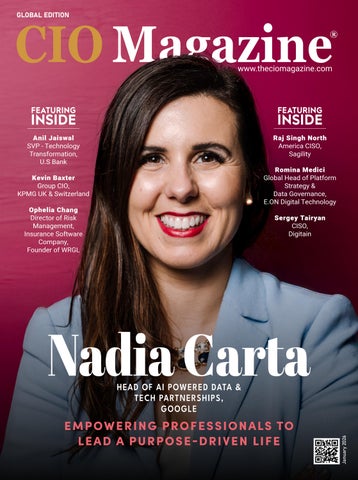
CIO Magazine – January 2026

Page 1


FEATURING INSIDE

Anil Jaiswal SVP - Technology Transformation, U.S Bank

Kevin Baxter Group CIO, KPMG UK & Switzerland

Ophelia Chang Director of Risk Management, Insurance Software Company, Founder of WRGL

FEATURING INSIDE

Raj Singh North America CISO, Sagility

Romina Medici Global Head of Platform Strategy & Data Governance, E.ON Digital Technology

Sergey Tairyan CISO, Digitain

Nadia Carta

HEAD OF AI POWERED DATA & TECH PARTNERSHIPS, GOOGLE

admin@thecioomagazine.com

www.thecioomagazine.com

admin@thecioomagazine.com

www.linkedin.com/company/ciomagazine

CIO Magazine www.theciomagazine.com is a global knowledge sharing digital platform published by Connecta Innovation Private Limited. All rights reserved. The opinions expressed in the content and pictures provided are those of the authors. They do not purport to reflect the opinions or views of Connecta Innovation Private Limited or any of its subsidiaries, its members or associates and we do not assume any responsibility. The publisher does not assume any responsibility for the advertisements. The content, pictures, and all warranties made in such advertisements are the sole responsibility of the advertisers. CIO Magazine www.theciomagazine.com is a Free Subscription and Free-to-read digital platform strictly not for sale and must be strictly for internal private use only. Publisher does not assume any responsibility arising out of anyone modifying content and pictures, printing a copy of this digital platform in any format and in any country and all matters related to that. “CIO Magazine www.theciomagazine.com“ and “The CIO Magazine www.theciomagazine.com“ trademarks are owned by Connecta Innovation Private Limited.

WHEN TECHNOLOGY LEARNS TO FEEL

Notlong ago, digital transformation meant speed. Faster systems. Faster decisions. Faster growth. Somewhere along the way, many organizations mistook velocity for progress. I have sat in boardrooms where the dashboards were glowing, the data immaculate, and yet the room felt oddly disconnected. Everyone was informed, but few were aligned. This is not a rare problem. According to multiple global studies, a majority of digital transformation initiatives still fall short of expectations, not because the technology fails, but because people struggle to adapt, trust, and engage. The real bottleneck today is not infrastructure. It is emotion.

That is why our January 2026 cover story feels timely and necessary. In our conversation with Nadia Carta, Head of AI Powered Data & Tech Partnerships at Google, we explore a side of transformation that rarely gets board-level attention. Nadia’s journey, shaped by deep technical expertise and an equally deep understanding of human motivation, challenges a long-held assumption in enterprise leadership: that logic alone drives change. Her work reminds us that AI strategies succeed only when leaders understand fear, curiosity, resistance, and purpose as well as they understand algorithms. This perspective matters now, as organizations move from experimenting with intelligence to living with it.

Beyond the cover story, this issue brings together voices that look at leadership, innovation, and careers through a more human lens. You will find perspectives from executives, educators, and thinkers who question old playbooks and offer grounded insights for navigating complexity without losing clarity. Together, they reflect a simple truth: progress is strongest when diverse experiences meet open minds.

As you turn these pages, I invite you to slow down just a little. Pay attention not only to what technology can do, but to how it makes people feel, act, and decide. The next phase of digital transformation will not be led by the most advanced tools alone, but by leaders who understand the quiet power of empathy. This issue of CIO Magazine is an invitation to lead with both head and heart.

Enjoy Reading.

Sarath Shyam

NADIA CARTA

HEAD OF AI POWERED DATA & TECH PARTNERSHIPS, GOOGLE

EMPOWERING PROFESSIONALS TO LEAD A PURPOSE-DRIVEN LIFE

Kevin Baxter 18 Group CIO, KPMG UK & Switzerland

Unlocking the Power of AI and Automation in Professional Services

EXECUTIVE OP-EDS

Ophelia Chang 24 Director of Risk Management at an insurance software company & Founder of WRGL

Beyond Silos: Why Cross-Sector Governance Is Critical in a Fragile Digital Ecosystem

TALKS

Romina

Anil

Nadia Carta

HEAD OF AI POWERED DATA & TECH PARTNERSHIPS, GOOGLE

EMPOWERING PROFESSIONALS TO LEAD A PURPOSE-DRIVEN LIFE

Nadia Carta is a catalyst for transformative growth and a Tech Executive at Google, where she serves as an AI Business Strategist and Head of AI Powered Data & Tech Partnerships. Born in Sardinia, Italy, she combines technical expertise with deep emotional intelligence to humanize the tech industry. Beyond her 17year corporate career, Nadia is an ICFcertified executive coach, Author, TEDx speaker and founder of Spark Your Zeal®, a movement empowering spiritually curious leaders to achieve "Soul-Aligned Success" without burnout. She also co-hosts the 99 Humans podcast. Residing in Manhattan with her family, Nadia is dedicated to helping professionals ignite their passion and design their own destiny.

Recently, in an exclusive interview with CIO Magazine, Nadia shared insights into the future of AI and data technology, emphasizing the importance of aligning business strategies with human values. She also shared her personal hobbies and interests, future plans, words of wisdom, and much more. The following excerpts are taken from the interview.

Hi Nadia. What inspired you to pursue a career in AI and data technology?

My journey started when I was a teenager in a small modest house in Sardinia, the gorgeous island off the coast of Italy. I was 14 years old, attending a computer programming high school and learning all about computer logic and coding. That year, my mom bought a Commodore 64 so that I could study and work on building my programs in COBOL. During the day, I would attend classes, and late into the evenings, I would work on the computer for endless hours, which I loved.

At that time, my world felt very small. I was growing up in a strict Jehovah's Witness community, and my future felt like it had already been written for me within very tight margins. That all changed one day when we became one of the early households to get access to the Internet. I was 16 and the moment I connected to the World Wide Web, everything changed. A window had been thrown open for me.

For the first time, I saw a world full of different people, ideas, and possibilities that I had never known existed. That glowing screen became my lifeline. It gave me the hope—and the practical tools—to dream of a life where I could escape the restrictions, go to college, and define who I wanted to be.

That early experience is the heartbeat of my career.

Today, I don’t love technology just because it’s "innovative." I love it because I know, personally and deeply, that it is a force for individual agency. It gives us the power to design our own destiny. Whether I’m coding a program back then or leading an AI strategy session at Google today, my mission is the same: to use technology to give people the freedom to

build the life and work they are truly capable of. Without limits.

What do you love the most about your current role?

I am about to enter my 17th year at Google, and I have never been more excited than I am at this very moment. I truly love that I get to be a guide in the middle of a platform shift that is so unique and revolutionary.

Right now, we are at an inflection point with AI, and I believe my role allows me to operate on three levels that I find incredibly energizing.

First, it’s the elevation of the work. I always tell my clients: we are done just building 'better ads' or 'better marketing.' We are here to build better businesses. I love working with clients to deploy cutting-edge AI solutions that don't just optimize a metric, but actually solve complex business challenges. We are putting the consumer back at the center of the equation. When we get this right, we act as a growth engine that transforms how businesses operate.

Second, I love holding the space for that transformation. The AI shift is exciting, but it can also be overwhelming for leaders. My favorite moments are during my sessions— whether it's a room of 500+ people at Adidas or a boardroom of five executives at Telecom Argentina—where I can actually feel the energy shift. My job is to take them from uncertainty to inspiration. I get to help them see AI not as a threat to be managed, but as a canvas for their creativity. Watching that lightbulb turn on—that spark of possibility—is addictive.

Finally, it’s about leading at the edge of excellence. I love leading teams that are running toward the highest standard of performance. We are navigating uncharted territory, which

demands a level of agility and precision that is thrilling. Driving that high performance— helping my team achieve things they didn't think were possible—is deeply fulfilling to me.

What role will AI play in shaping the future of data management, and how can organizations prepare for this shift?

We are witnessing the end of "data management" as we know it and the beginning of data activation.

For the last decade, organizations have been obsessed with building bigger libraries— collecting and storing massive amounts of data. But the reality is, most of that data sat gathering dust. AI changes the game because it doesn't just organize the library; it reads the books and tells you the answer.

The future of data isn't about storage; it’s about conversation. AI allows us to query our data in natural language, turning complex datasets into immediate business intelligence. It democratizes access, taking insights out of the hands of the few data scientists and putting them into the hands of the marketers, the creatives, and the decision-makers.

To prepare, organizations need to focus on two things:

Get your house in order. There is no AI strategy without a data strategy. AI is an amplifier—if you feed it "messy" data, you will just get chaos at scale. The unsexy work of governance and privacy is now the most critical foundation for innovation.

Shift the culture. You have to stop treating data like a guarded asset and start treating it like a shared language democratizing access.

Whether I’m coding a program back then or leading an AI strategy session at Google today, my mission is the same: to use technology to give people the freedom to build the life and work they are truly capable of. Without limits

The companies that will win are the ones that train their teams not just to use new tools, but to ask better questions and leverage those insights for better and fester business decisions.

What is Spark Your Zeal, and how does it help people?

Spark Your Zeal® is my answer to the epidemic I see in every boardroom and Zoom call: high-performing leaders who are successful on paper but empty on the inside.

Fundamentally, it is a movement dedicated to "Soul-Aligned Success."

I founded it because I realized that we have optimized everything about our work— our data, our systems, our AI—except the

human operating system running it all. People are burning out because they are trying to fuel their careers with adrenaline and stress, which is a non-renewable resource.

Spark Your Zeal helps people switch their fuel source. We teach leaders how to tap into "Zeal"—that divine, intrinsic fire that motivates you not because you have to work, but because you love to create.

We do this through what I call "Spiritual Strategy." This isn't just about taking a bubble bath or a day off. It is a rigorous, practical toolkit—including frameworks like the Wheel of Zeal and the Infinite Zeal Toolkit—that helps professionals identify exactly where they are leaking energy and how to plug back into their source.

We are witnessing the end of "data management" as we know it and the beginning of data activation

We help people realize that you don't have to choose between being a powerhouse executive and being a happy, grounded human. You can be both. My mission with Spark Your Zeal is to show people how to live on fire without burning out and magnetize what is meant for you.

What's the most important thing people should know about reigniting their zeal, and how can they start today?

The most important thing to know is that Zeal is not excitement. Excitement is cheap; it burns out. Zeal is different. It is a deep, sustainable spiritual fire. It is your birthright. You are born with it.

Most people think they need to 'find' their passion, as if it’s lost under a rock somewhere. You don't find it; you uncover it. It is already inside you, likely buried under years of 'shoulds,' obligations, and the relentless pursuit of other people’s definitions of success.

Zeal is not just a feeling—it is a frequency.

When your frequency is low, everything suffers—your decision-making, your creativity, your leadership. Most executives think the only way to fix this is to either quit their job or push harder. But that is a false choice. I believe in a 'Third Path': where ambition and alignment coexist.

The truth is, the next level of your leadership isn't about more doing; it is about deeper being.

To start today, I recommend what I call the 'Zeal Ritual.' It doesn't require a sabbatical; it just requires one intentional hour.

Start by closing your laptop and asking yourself one question: 'Where am I operating on autopilot?'

We all have places where we are just going through the motions—in our meetings, our

relationships, or even our self-care. Identify one area where you have lost your spark, and make a conscious decision to bring your full presence back to it.

Reigniting your zeal isn't about changing your entire career overnight. It is about resetting your nervous system from survival mode to creation mode. When you do that, you don't just feel better—you lead better. Overall is about showing up for yourself, with the highest selflove possible. Taking radical responsibility over your own life path and purpose.

Can you share a book or resource that inspires you and why?

It has to be The Power of Intention by Dr. Wayne Dyer. This book didn't just inspire me; it provided the spiritual blueprint for Spark Your Zeal®.

In the corporate world, we are conditioned to believe that "intention" is synonymous with "grit." We think success comes from snapping a goal into existence through sheer force of will. We push, fight, and grind. That is the path of the Ego, and it is exactly why so many highachievers burn out.

Dr. Dyer teaches the opposite. He reveals that Intention isn't something you do; it’s a source you connect to.

This is the core principle behind Spark Your Zeal®. What Dr. Dyer calls "connecting to Source," I call "Igniting your Zeal." It is about plugging back into that divine, intrinsic fire that fuels you without draining you.

Reading this book confirmed for me that Soul-Aligned Success is the only sustainable kind. It taught me that we don't attract what we want; we attract what we are. If I lead from a place of stress and scarcity, I create resistance.

But if I align my frequency with abundance—if I spark my Zeal—I enter a state of flow where results happen with ease.

This book is essential for modern leaders because it reminds us that true power doesn't come from forcing the world to bend to your will; it comes from aligning your energy with your vision and live by it. With unstoppable Zeal.

How do you stay current with the latest developments in AI and data technology?

I have a simple rule I live by: You cannot learn AI and technology just by reading about it; you have to get your hands dirty.

The pace of change is too fast for traditional learning. By the time a textbook is written, it is obsolete. I rely on a three-pronged approach to stay on the bleeding edge.

First, I leverage the power of proximity. Being at Google gives me a front-row seat. I make it a priority to spend time with the engineers and product leaders at DeepMind and Google Cloud who are actually building the models. I don’t just ask them what is new; I ask them why it matters.

Second, I believe in learning by teaching. As an AI Business Strategist I inspired over 5000 leaders with the power of AI. When you have to explain complex GenAI concepts to the CMO of a global beauty brand or the CTO of a financial firm, you are forced to master the material. My clients' questions are actually my best research tool—they tell me where the real-world friction lies.

Finally, I look outside the echo chamber. If you only listen to technologists, you get a very narrow view of the future. I actively seek out

artists, philosophers, and ethicists to understand the human implications of these tools.

To truly stay current, you can't just track the code; you have to track the culture.

What are some of your passions outside of work? What do you like to do in your time off?

I spend my working days living in the future, dealing with AI and rapid transformation. So, when I am off, I go completely analog.

My sanctuary is our home in Upstate New York. I have a strict rule there: no computers and no phones. It is about reconnecting with the tangible world. You will usually find me taking long, meditative walks in the forest or horseback riding with my husband and my daughters. There is something incredibly grounding about being in the company of animals; they bring you right back to the present moment.

I also find deep therapy in the kitchen. For me, baking a cake or cooking a delicious meal isn't a chore; it’s a ritual. It’s a way to create something with my hands that nourishes the people I love.

On a more personal level, I am unapologetic about embracing my spirituality. I love chanting Kirtan music, reading tarot and oracle cards, or simply sitting down to color and journal. These aren't just hobbies; they are how I clear the static and reconnect with my spirit.

And, of course, I am always reading. Books are my constant companions. Right now, I am reading The Universe Has Your Back by Gabrielle Bernstein. It’s a beautiful reminder to trust the flow of life rather than trying to control it—a lesson that serves me just as well in the boardroom as it does in the forest.

Last but not least I love writing. I just finished my first book, titled Spark Your Zeal®: Activate

Your Fire and Reclaim the Life You Were Born For which will be released in 2026!

What is your biggest goal? Where do you see yourself in 5 years from now? If you had asked me this ten years ago, I would have given you a job title. Today, my answer is radically different.

My biggest goal is not professional; it is biological and spiritual. I was born in a Blue Zone, where people live active, vibrant lives well into their hundreds. My ultimate goal is to honor that heritage—to cultivate a level of radical health and vitality that allows me to be fully alive for every moment of this journey.

In five years, I won't measure my success by where I sit in an org chart, but by how I stand in my own truth, and how calm is my nervous system.

I also see myself living in total alignment with my Dharma—my cosmic purpose. That means waking up every day without that lowlevel hum of anxiety or 'seeking,' and instead feeling a deep, resonant peace with what I am doing. I see myself being a sanctuary for my family, my extended communities (at work and outside) and a point of reference for society. A spiritual guide so to say.

We spend so much of our lives building a resume. In the next chapter, I am building a legacy of love. I want to look back and say that I didn't just work hard, but that I loved well, lived long, and stayed true to the spark within me.

What advice would Nadia give to someone looking to reignite their passion and purpose?

My advice is to stop looking outward for answers and start a conversation inward.

I have a simple rule I live by: You cannot learn AI and technology just by reading about it; you have to get your hands dirty

We spend our entire lives responding to emails, Slacks, and other people's demands. But we rarely take the time to send a message to our own soul.

To reignite your passion, I recommend a practice I call the 'Zeal Letter.'

This is not just journaling; it is a ritual rooted in both neuroscience and spirituality. The practice is simple but profound: you write a letter from your Spirit to your Self.

When you do this, something powerful happens physiologically. We know that practices like this can help stimulate the vagus nerve, which regulates your nervous system

and moves you out of 'fight or flight' and into a state of connection and safety.

Most people feel lost because the voice of their 'inner executive'—the one obsessed with deadlines and metrics—is shouting over the whisper of their 'inner zeal.' Writing this letter hands the microphone back to your spirit.

If you are feeling disconnected today, sit down for five minutes. Ask your spirit: 'What have you been trying to tell me that I have been too busy to hear?'

Whatever comes out on that paper is your roadmap. That is where your passion is hiding.

Wa n t t o S e l l o r fi n d

I nve s t o rs f o r yo u r

B u s i n e s s ?

Kevin Baxter

Group CIO, KPMG UK & Switzerland

Unlocking the Power of AI and Automation in Professional Services

Kevin Baxter is Group CIO for KPMG UK and Switzerland. He has held IT leadership positions for some of the world’s biggest brand across a wide variety of industries such as Finance, Media, Energy, Pharmaceuticals and Professional Services. He has led diverse and global teams, running many large programmes of technical, digital, business and operational change. He was previously Chairman of the British Computer Society Standards Committee and has a Master’s Degree in ‘IT Service Management’.

Recently, in an exclusive interview with CIO Magazine, Kevin shared insights into his journey in technology, the evolving role of the CIO, and the opportunities for innovation in professional services. He also shared his passion for exercise, travel, and giving back to the community. The following excerpts are taken from the interview.

Hi Kevin. How did you first become interested in technology and what propelled you into it?

My very first job was working on a first-line IT Service Desk trying to fix corrupted structured query language databases within an impossible service level agreement! We worked in long shifts across 24 hours and to this day, it was by far the hardest job I’ve ever done. In many ways it was the perfect first job as after a few months I was completely hooked on the pressure and adrenaline but also became convinced that technology could be managed in a much better and much more proactive way; I’ve been implementing those proactive principles in various organisations and various industries ever since.

What do you love the most about your current role?

I was a KPMG customer for a decade before I became a KPMG employee and always admired their approach to business challenges. It is the most ambitious company I have worked for and some of the things we have done in my two years at KPMG UK include a full data centre exit to the cloud, re-sourcing all of our managed service agreements and merging the entire UK firm with the KPMG Swiss firm. It’s been really fun and I’m working with exceptional people.

What do you believe are the most significant opportunities for technology to drive innovation in professional services?

It’s impossible to think of a limitation to the opportunities that are available to us now and there has never been a more exciting time to be working in professional services. Every

aspect of the work KPMG does for our clients has already been enhanced by a mixture of AI, Automation and Integration from both a qualitative and quantitative perspective. Some of the technology changes we have made over the last 18 months mean that KPMG can provide faster, more accurate and more efficient services than ever before. That work continues and there are some amazing developments in the pipeline.

How have you seen the role of the CIO change in the last 5-10 years, and what changes do you see on the horizon in the years ahead?

Being a CIO has never been easier than it is today as there’s just such an incredible amount of opportunities to drive improvements through the business. We no longer need to ‘sell’ the benefits of technology to our business colleagues

and customers, they already know it, they feel it and they want the help of the CIO to fulfil the potential of that technology. That is a big and exciting change for me.

Can you share a book, podcast, or resource that inspires you, and why?

The book I return to again and again is Hans Rosling “Factfulness”. It’s an incredible read and it lays out our place in the world in the clearest way possible.

What does the term "authentic leadership" mean to you?

Authentic leadership is a bit of an older term now but still relevant as we all aspire for a world based on an agreed set of values. At KPMG one of our core values is “Trusted to Make the Difference” which means we strive to help our

IT’S IMPOSSIBLE TO THINK OF A LIMITATION TO THE OPPORTUNITIES THAT ARE AVAILABLE TO US NOW AND THERE HAS NEVER BEEN A MORE EXCITING TIME TO BE WORKING IN PROFESSIONAL SERVICES

BE SOMEONE WHO PEOPLE ENJOY WORKING WITH. BE SUPPORTIVE OF OTHER PEOPLE AND SUPPORTIVE OF NEW IDEAS

clients, our people and the communities we live and work in. This is what Authentic Leadership feels like to me.

Can you share a mentor or role model who has had a significant impact on your career, and what advice they gave you?

My father probably had the biggest impact on my career although he never touched a computer in his life! He ran his own plant-hire business for decades through various economic climates and multiple recessions. He had an amazing way of dealing with people and incredible work ethic. I’m still aspiring to get to that level.

What are some of your passions outside of work? What do you like to do in your time off?

My role involves being sat down for most of the day so outside of work I like to do as much exercise as I can. I do Crossfit each day, play tennis whenever I can and I’m a keen supporter of my local football team Reading FC. Travelling has also been important to me too and I’ve enjoyed visiting slightly more unusual

places likes Uzbekistan, Alaska, Iceland, Costa Rica, Cambodia etc.

What is your biggest goal? Where do you see yourself in 5 years from now?

I am a bit embarrassed to say that even though KPMG give us dedicated free time to spend in the charity sector, I simply haven’t done enough of that. KPMG UK’s current national charity partner is Fareshare which is a fantastic organisation specialising in surplus food distribution to other frontline charities and so my biggest goal over the next few years is to try and maximise the time I spend helping them.

What advice would you give to aspiring CIOs or technology leaders?

It’s a bit of a cliché but I would say that you should always try to be the most optimistic and positive person in the room. Be someone who people enjoy working with. Be supportive of other people and supportive of new ideas. In my experience the best and most talented people in the team also happen to be most enthusiastic about new technology, new ideas and new ways of working.

BEYOND

SILOS: WHY CROSS-SECTOR

GOVERNANCE IS CRITICAL IN A FRAGILE DIGITAL ECOSYSTEM

Ophelia Chang

Director of Risk Management at an insurance software company & Founder of WRGL

Ophelia Chang is a risk and governance executive with over 15 years of experience leading enterprise-wide resilience across financial services, private equity, and technology. She currently serves as Director of Risk Management at an insurance software company, where she oversees global risk strategy, operational resilience, and regulatory oversight. She is also the Founder and Executive Director of Women in Risk & Governance Leadership (WRGL), an award-winning nonprofit advancing inclusive leadership through education and communitybuilding. Ophelia serves on multiple boards and advisory committees, bringing a cross-sector lens to governance, risk culture, and strategic oversight. Her expertise spans cybersecurity, ESG, M&A, and third-party risk, with a consistent focus on aligning risk appetite with long-term growth. She holds the CISA and CIA designations, and is ITIL-certified.

When AWS’s US-East-1 region went down on October 19, 2025, the disruption was swift and far-reaching. A DNS error in DynamoDB triggered cascading failures across more than 140 services, including EC2, Lambda, and CloudWatch. The outage

impacted everything from retail operations and financial platforms to education portals and internal enterprise systems. Just months earlier, a critical vulnerability in SharePoint exposed sensitive data across sectors, highlighting the fragility of widely adopted collaboration tools.

CROSS-SECTOR BOARD MEMBERS

BRING THE FORESIGHT TO ANTICIPATE HOW RISKS TRAVEL, MUTATE, AND AMPLIFY

These events weren’t isolated. They were systemic failures that underscored a deeper truth: our risks are interconnected, and our governance must be too.

Cross-Sector Experience: A Strategic Advantage

Boards traditionally prioritize industry-specific expertise. But in today’s landscape, sectoral silos can be blind spots. Directors with crosssector experience bring a broader lens — one that recognizes how a technical failure in one domain can cascade across others. They ask different questions, challenge assumptions, and help organizations anticipate risks that conventional models overlook.

A director with experience in digital infrastructure may flag third-party dependencies that others might miss. Someone from a regulated industry may raise concerns about continuity planning or data governance that haven’t yet surfaced. These insights aren’t peripheral — they’re essential to building systemic resilience.

Interdependence is the New Normal

Digital infrastructure is shared. Regulatory shifts are global. Public trust is fragile. In this context, governance must evolve from reactive oversight to proactive stewardship. That means: Mapping interdependencies across vendors, platforms, and ecosystems.

Stress-testing assumptions about resilience and continuity.

Embedding cross-sector dialogue into board strategy and risk appetite discussions. Boards that embrace this approach are better equipped to navigate complexity. They move beyond compliance and toward foresight — anticipating not just what could go wrong, but how it might spread.

Conclusion: Governing for a Connected Future

Resilience today requires more than robust controls — it demands perspective. Cross-sector board members bring the foresight to anticipate how risks travel, mutate, and amplify. They help organizations move from reactive governance to proactive stewardship.

In a world where a cloud outage can halt a hospital or a school board, governance must be as interconnected as the systems it oversees. As boards reflect on their composition and strategic priorities, broadening the lens may be one of the most powerful steps toward resilience.

Shaping Business Impact through Data, Platforms and Governance Romina Medici

Global Head of Platform Strategy & Data Governance, E.ON Digital Technology

Romina Medici is the Global Head of Platform Strategy & Data Governance at E.ON Digital Technology, leading the company’s Data & AI ecosystem across 40 business units and 17 countries. Managing a €25 million portfolio and serving 2,000+ users, she has unified E.ON’s data landscape into a value-driven platform that enables smarter decisions and responsible innovation. Her mission is to make data and AI tangible and outcome-oriented, bridging technology, business, and governance. Under her leadership, E.ON built one of Europe’s most mature data foundations, engaging over 250 data owners and 1,000+ connected sources.

Romina combines analytical precision with empathy, fostering environments where diverse teams thrive. Recognized among Europe’s leading voices in Data & AI strategy, she speaks at global forums and mentors emerging leaders, especially women in tech. A lifelong learner, she believes sustainable innovation arises when people, data, and technology evolve together with clarity and purpose.

In this insightful conversation with CIO Magazine, Romina shares her journey from analytics and supply chain to leading one of Europe’s most advanced Data & AI ecosystems. She discusses the real challenges behind building a data-driven culture, balancing innovation with structure, and fostering leadership grounded in empathy and trust. Below are the excerpts of the interview.

You’ve built an impressive career at the crossroads of data, technology, and business strategy. What originally drew you toward this field, and how has your journey shaped your perspective on leadership and innovation?

My professional roots have always been grounded in analytics and numbers. I started my career in Controlling, where I quickly realized that many of our KPIs hadn’t been recalculated in years — simply because the data wasn’t available. That was my first wake-up call to how much we rely on accurate, accessible data for good decisionmaking. Later, in Supply Chain, I focused on optimizing tender processes through costing models and manufacturing process analysis. That’s when I met Peter Neumann, who introduced me to linear regression and predictive methods — we could suddenly calculate product prices without needing all the traditional inputs. It was a revelation.

I remember the feeling vividly: using these methods in negotiations and achieving better results for the company felt powerful. I thought, “Everyone should have access to such an agent — a small assistant that helps them do a better job.” That was over ten years ago, long before we talked about AI agents.

So, I decided to study Data Science and later moved into our central IT organization to drive data transformation for the entire E.ON Group — not just one function. Eight years later, I’m still doing exactly that: shaping how data, platforms, and governance come together to drive business impact. And I’m still as passionate as on day one.

THE BETTER YOUR DATA, THE BETTER YOUR STRATEGIC AND OPERATIONAL CHOICES — WHETHER PREDICTING

CUSTOMER CHURN, ASSET FAILURES, OR MARKET DEMAND

In your view, what are some of the biggest opportunities and challenges organizations face today when it comes to building a truly data-driven culture?

The opportunities are endless. Data can make any part of an organization more cost-efficient — from Supply Chain and Operations to Finance and Sales. It enables smarter, faster, and more confident decisions because data is the reflection of business reality. The better your data, the better your strategic and operational choices — whether predicting customer churn, asset failures, or market demand.

Beyond efficiency, data has a unifying effect. It creates one common language across business units — one way to calculate KPIs, one shared understanding of performance. That alignment builds trust and collective focus.

The challenges, however, are just as significant. Like all foundational topics, data’s value is often invisible until something breaks. We rarely think about the ground we walk on — yet it’s what allows everything else to exist. Data is the same: when it’s weak, everything on top becomes unstable.

Another misconception is that technology alone can fix it. In reality, success depends on orchestrating six dimensions: technology, governance, processes, people, finance and execution. Only when all are aligned can transformation truly take root.

As throughout the years I learned – it also needs to earn money and be properly planned.

And finally, data work is never “done.” It’s continuous. We need to accept that managing and improving data is part of daily business — just like managing your budget. That’s

when data maturity becomes a living, evolving capability rather than a one-off project.

As someone leading platform strategy and data governance on a global scale, how do you balance technological innovation with the need for structure, security, and compliance?

It’s a delicate balance that constantly shifts depending on context and timing. There are

phases when innovation takes the lead — like now, with AI being at the top of every board agenda — and others where structure and compliance must anchor the foundation. I see it much like capital markets: there are cycles, momentum, and hype phases that can accelerate certain topics, but also risks of bubbles if the fundamentals aren’t in place.

Consistency is the real differentiator. You need a clear strategy, a long-term vision, and

WE CAN INTERACT WITH DATA CONVERSATIONALLY, GENERATE SUMMARIES OR PRESENTATIONS AUTOMATICALLY, AND ENABLE ALMOST ANYONE — NOT JUST EXPERTS — TO BUILD AUTOMATIONS OR RPAS

the discipline to execute it regardless of external noise. I often compare it to investing in an ETF: you don’t buy once and expect instant returns. You invest continuously — month by month — and over time, the results compound. That’s how I approach data and platform strategy. It’s not a sprint. It’s a marathon built on steady, strategic progress.

Emerging technologies like AI, machine learning, and automation are transforming industries at a rapid pace. How do you see these technologies influencing the future of work within your sector?

They already have — and we’re only at the beginning. AI today helps us calculate grid loads to ensure that when someone installs a PV system on their roof, it doesn’t cause local blackouts. It allows us to predict with more than 80% accuracy which cables are likely to fail, optimizing investment and improving the grid’s ROI. It predicts customer churn, supports pricing decisions, and ensures we trade energy at the best possible times — maintaining competitive prices even during crises like the war in Ukraine.

Now we’re entering a new phase with generative AI and intelligent agents. We can interact with data conversationally, generate summaries or presentations automatically, and enable almost anyone — not just experts — to build automations or RPAs.

The next frontier is autonomous agents that act as digital colleagues — small, reliable assistants that handle repetitive tasks and scale our productivity. I can’t wait for the day I have an entire “army” of these agents supporting my teams. It will fundamentally change how we work — and I’d rather be one of the people shaping that future than watching it unfold.

Leadership today is as much about empathy and culture as it is about strategy. What principles or habits guide you as a leader when it comes to motivating and empowering diverse teams?

I believe leadership starts with truly seeing the individual — understanding their strengths, their ambitions, and even their limits. Once you know your people, you can help them find the role where they truly thrive. I make it a point that every voice is heard — not just within the

BUILD YOUR NETWORK EARLY AND USE IT — NOT JUST TO ADVANCE YOURSELF BUT TO LEARN AND GROW THROUGH OTHERS

team but across teams — because diversity only creates value when it’s expressed and listened to. We always build a shared vision that everyone can connect to in their own way. My teams are known for making things work that others said were impossible. That’s our trademark. It creates a unique bond, deep trust, and an energy that drives us through even the hardest transformations. We’re ambitious, committed, and motivated by purpose — and that’s what sustains us through the marathon of change.

Outside of your professional role, what inspires you or keeps you grounded? Are there personal interests or values that influence how you approach your work?

Absolutely. I love reading — it’s both calming and inspiring. I mostly read nonfiction, and I’m fascinated by the collective human intellect — how almost any problem we face today has been faced, studied, and overcome by someone before us. It gives me perspective, reminds me that I’m part of something larger, and reinforces the belief that there’s always a solution if you stay curious and keep learning.

So far this year, I’ve already read twelve books, and I have at least another twenty waiting on my shelf. Reading is my way of recharging, reflecting, and staying connected to growth — both personally and professionally.

What advice would you share with young professionals, especially those starting out in technology or leadership who aspire to make an impact in the digital world?

Dare to just start. If you don’t understand something, don’t wait for someone to explain it — read, research, experiment. Build your network early and use it — not just to advance yourself but to learn and grow through others. Stay curious and be bold enough to take responsibility for your own journey.

It doesn’t matter if you studied the field or not, or if you feel like an expert yet. Expertise comes with time, but courage and curiosity are choices you can make every day. That’s what truly makes the difference.

Driving Digital Trust through Secure Innovation Raj Singh

North America CISO, Sagility

Raj Singh is the North America CISO and Global Director of Security at Sagility, leading enterprise and customer security across global healthcare ecosystems. With a background in electrical engineering and computer science, he operates at the intersection of cybersecurity, AI governance, and digital trust. Featured in CIO Magazine and a Gartner C-Level CISO member, Raj is an Influencer CISO, Elite CISO Network member, and global strategist in security and AI. He speaks at conferences, panels, and podcasts, advising boards and mentoring leaders on Zero Trust, ethical AI, and resilience. His philosophy: Build trust, enable innovation, and keep learning—always.

Recently, in an exclusive interview with CIO Magazine, Raj shared insights into his career journey, from electrical engineering to cybersecurity leadership, and his current role as North America CISO and Global Director of Security at Sagility. He discussed the importance of building trust, enabling innovation, and driving digital resilience, as well as his thoughts on the future of cybersecurity, the role of AI, and the evolving responsibilities of CISOs. Raj also emphasized the value of mentorship, continuous learning, and staying curious in the field of cybersecurity. The following excerpts are taken from the interview.

WHETHER IT WAS REDUCING RISK THROUGH AUTOMATION, STRENGTHENING DATA PROTECTION, OR ALIGNING SECURITY WITH OPERATIONS, THE FOCUS WAS ALWAYS ON ONE THING — MAKING SECURITY A BUSINESS ADVANTAGE, NOT A BARRIER

Hi Raj. Can you walk us through your career journey and how you became a cybersecurity leader?

My path into cybersecurity wasn’t something I planned - it evolved naturally from curiosity and a love for solving real problems.

I started with a Bachelor’s in Electrical Engineering, which grounded me in how technology works — circuits, networks, control systems — the foundation of everything digital today. Later, I earned my Master’s in Computer Science, and that’s where I began to see how software, data, and connectivity were shaping the modern world. But it also made me realize something deeper — the more connected we become, the more exposed we are.

Early in my career, I worked as a software engineer, writing code and building systems. But I found myself constantly asking, what happens if someone breaks this? That question changed the direction of my career. I shifted from writing code to protecting code — from building systems to securing them.

That curiosity led me into identity and access management, and over time, into broader areas like enterprise security architecture, AI governance, and Zero Trust transformations. Each step gave me a chance to look at cybersecurity not just as a technical discipline, but as a strategic enabler — something that protects people, earns trust, and keeps organizations moving forward safely.

I’ve been fortunate to work across healthcare, finance, and government, leading modernization programs that improved both security and business agility. Whether it was reducing risk through automation, strengthening data protection, or aligning security with operations,

the focus was always on one thing — making security a business advantage, not a barrier.

Today, as the North America CISO and Global Director of Security at Sagility, I bring together technology, governance, and leadership to create secure ecosystems that support innovation. My approach is rooted in people and purpose — using technology wisely, empowering teams, and keeping security aligned with the organization’s goals.

Looking back, my journey from electrical engineering to cybersecurity leadership has been driven by one consistent mindset: a desire to build things that last — and protect the trust that keeps them running.

What do you love the most about your current role?

What excites me most about my role is shaping a security culture that blends innovation with trust — where cybersecurity isn’t just a control, but a catalyst for growth. I lead a global team safeguarding enterprise and customer ecosystems in one of the most regulated industries, where protecting data goes beyond compliance — it’s a moral responsibility.

Collaboration drives our strategy at Sagility. Together, we’ve built an AI-powered, Zero Trust framework that anticipates risks and strengthens resilience across regions. Yet, what I value most is the human element — fostering a culture where security is part of everyone’s DNA.

This transformation reflects our core values: sparking curiosity to innovate, moving as one team, taking action for results, and always leading with purpose and integrity. Ultimately, it’s about protecting trust — because in a

world built on people and data, trust isn’t just everything; it’s our direction.

What role do you think AI will play in shaping the future of cybersecurity?

AI is going to reshape cybersecurity from the ground up — not just how we defend, but how we think about risk.

On the defense side, AI is already helping us move faster than ever. Instead of waiting for alerts, we’re now using machine learning to predict and prevent attacks before they happen. It’s spotting subtle anomalies humans might miss and automating routine responses, which means incidents that used to take hours to detect can now be handled in minutes.

But the challenge is that attackers are learning, too. They’re using AI to create more targeted, adaptive, and intelligent attacks — everything from deepfakes to self-evolving malware. That means the next big focus isn’t just “AI for cybersecurity,” but cybersecurity for AI — making sure our models, data, and decisions remain trustworthy.

In the end, AI won’t replace the human element — it’ll amplify it. The future belongs to security leaders who can combine human judgment with intelligent automation to build resilience, not just defense.

How do you see the role of the CISO evolving in the next few years?

For me, the CISO role has already evolved — and it will continue moving from being purely a technical function to being a strategic leadership role that connects technology, business, and people.

A few years ago, the CISO was expected to focus only on firewalls, compliance, and incident response. But today, and even more so in the coming years, the CISO must think like a business strategist and relationship builder — someone who can translate security priorities into business value, trust, and resilience.

The future CISO will need to be as comfortable in the boardroom as in the SOC. The role is now about influence, coordination, and foresight — aligning with every business unit, from operations to HR, to ensure security becomes part of how the organization works, not an afterthought.

I’ve always seen myself as a connector and collaborator — a CISO who builds strong relationships across functions, who understands both the language of the engineer and the perspective of the CFO. To me, success comes from coordination and shared accountability, not from control.

Another big shift is mindset. The CISO of tomorrow must have curiosity and innovation at their core. We’re operating in an environment driven by AI, automation, and data intelligence — and that requires CISOs who can think creatively, adapt fast, and turn emerging technologies into secure business enablers.

At Sagility, I’ve seen how this plays out in real life — leading security operations across North America, partnering with leaders across other regions, and embedding security into every transformation initiative. It’s about being a strategic bridge between technology, governance, and business outcomes.

Is there a particular person you are grateful for who helped get you to where you are?

I’ve been fortunate to have remarkable mentors who’ve shaped my leadership journey and perspective. Early in my career, I worked under leaders who placed their trust in me to lead large-scale global initiatives in Identity and Access Management, Zero Trust architecture, and enterprise security transformation. That trust gave me the confidence to make decisions, take ownership, and lead through influence rather than authority.

Today, I continue to learn from visionary peers who believe in collaboration, innovation, and purpose-driven leadership. Together, we’ve built a security culture that protects data in highly regulated environments — not by slowing the business down, but by enabling it to move faster, smarter, and more securely.

But the person who has influenced me the most, is my father, a retired Subedar Major & Honorary Captain in the Indian Army. From him, I learned the timeless values of discipline, consistency, humility, and perseverance. He’s always told me that no matter how loud life gets or how tough things seem, just keep moving forward. Talent might open doors, but it’s consistency that keeps them open.

Even today, his advice echoes in everything I do — never stop running, because giving up was never an option. Those words have shaped more than just my career; they’ve defined my leadership philosophy: stay grounded, stay consistent, and keep pushing forward, no matter how challenging the road ahead may be.

THE FUTURE BELONGS TO SECURITY LEADERS WHO CAN COMBINE HUMAN JUDGMENT WITH INTELLIGENT

AUTOMATION TO BUILD

RESILIENCE, NOT JUST DEFENSE

How do you stay current with the latest cybersecurity trends and threats?

For me, staying current in cybersecurity isn’t a task — it’s a mindset. This field evolves daily, and if you stop learning, you fall behind.

I stay engaged through Gartner Security Summits, CISO roundtables, and CIO Magazine forums — not just to listen, but to contribute and learn from global peers. I also rely on Gartner insights, Forrester research, and industry case studies to connect emerging trends like AIdriven defense and identity resilience to real business outcomes.

LinkedIn and mentorship play a big part too. Engaging with other CISOs and guiding new professionals keeps my perspective sharp and forward-looking.

In short, I stay current by staying curious, connected, and hands-on — because in

cybersecurity, learning never stops, and neither should we.

Can you share a book or resource that inspires you and why?

I draw inspiration from thought leaders like Simon Sinek, whose work on leadership and purpose reminds me that cybersecurity leadership is as much about people as it is about technology. His ideas emphasize that great leaders start with “why” — a principle that deeply influences how I approach building trust and direction within teams.

Books have also played a major role in shaping my leadership philosophy. The 5 AM Club by Robin Sharma taught me the value of discipline, mindset, and intentional living — the importance of starting each day with clarity and focus. Atomic Habits by James

Clear reinforced how small, consistent actions lead to meaningful, long-term results. Extreme Ownership by Jocko Willink and Leif Babin redefined my understanding of accountability, teamwork, and leading under pressure.

Together, these ideas remind me that true leadership isn’t just about strategy or skill — it’s about mastering yourself, continuously improving, and empowering others to grow with you.

What are some of your passions outside of work? What do you like to do in your time off?

Family time is non-negotiable — it’s my reset and reminder of what truly matters. I’m also big

on practical wellness; I take walking meetings to think, recharge, and spark new ideas.

Lately, I’ve been diving into AI — exploring how it can reshape cybersecurity and leadership. That curiosity keeps me learning and evolving. I also mentor rising cybersecurity professionals and advise startups on building security into innovation early on.

And when I’m off the grid, I love traveling and experiencing new cultures — it broadens my perspective and makes me a better collaborator and leader.

My simple rule: say yes only to what aligns with your purpose — it keeps me intentional in both work and life.

MY SIMPLE RULE: SAY YES ONLY TO WHAT ALIGNS WITH YOUR PURPOSE — IT KEEPS ME INTENTIONAL IN BOTH WORK AND LIFE

What is your biggest goal? Where do you see yourself in 5 years from now?

My goal is to help redefine how organizations build digital trust through secure and ethical AI adoption. In five years, I see myself continuing to lead global security transformation initiatives— where I can help organizations across industries and geographies strengthen their cyber resilience.

I want to be a key security advisor and strategic partner to global enterprises, helping them navigate the complex intersection of cybersecurity, AI governance, and innovation. At the same time, I aim to mentor the next generation of security leaders and collaborate with boards and governments to shape policies that enable responsible AI and digital trust on a scale.

What advice would you give to someone looking to get into cybersecurity?

If you’re looking to build a career in cybersecurity, don’t overthink it. See it as a continuous journey where growth comes through curiosity, consistency, and experience rather than shortcuts. You evolve with every phase — not overnight, but through deliberate learning and practice.

Start by understanding the big picture. Cybersecurity isn’t just about tools or certifications; it’s about how people, processes, and technology work together to protect information. Learn the “why” behind every control, not just the “how.” Certifications like CISSP or CISM can help you frame that knowledge, giving you both

a technical foundation and a leadership mindset. But remember, the goal isn’t to collect credentials — it’s to connect strategy with security and understand how decisions impact risk.

Once you have the basics, apply what you’ve learned. Real expertise is earned through experience, not theory. If you’re already in a job, find ways to contribute to cybersecurity initiatives — participate in audits, shadow your IAM team, or review security policies. Every organization needs champions who care about protecting its data. The moment you start applying concepts to real-world problems, you’ll realize cybersecurity is full of nuances and trade-offs, and that’s where real learning happens.

Along the way, seek out people who are smarter and more experienced than you. Mentorship is one of the fastest ways to accelerate growth. Surround yourself with leaders, architects, and practitioners who’ve faced real challenges and can share lessons that books can’t teach. Attend conferences, join CISO and cybersecurity forums, and stay active on platforms like LinkedIn. Conversations with peers and mentors often spark the insights that shape your professional philosophy.

Finally, don’t be afraid to take risks. Volunteer for challenging projects, experiment with new tools, and lead small initiatives. Cybersecurity evolves daily — so must you. The best professionals in this field stay curious, adaptable, and humble, no matter how senior they become. Growth in cybersecurity isn’t about chasing titles; it’s about mastering the art of learning, leading, and protecting what matters most.

Building a Safer Digital Future Sergey Tairyan

CISO, Digitain

Sergey Tairyan is a Global CISO, security innovator, and international speaker with over 15 years of experience across government, finance and iGaming sectors. As Group CISO at Digitain, he built the company’s entire cybersecurity ecosystem from the ground up, achieving ISO 27001 and PCI DSS compliance while pioneering Armenia’s first internal bug-bounty programs. Sergey holds a Ph.D. in Mathematical Cybernetics and multiple top international certifications. A recognized thought leader, he frequently speaks at global conferences and mentors the next generation of cybersecurity professionals, driving innovation in AI-driven and post-quantum security worldwide.

Recently, in an exclusive interview with CIO Magazine, Sergey shared insights into his journey to becoming a cybersecurity leader, emphasizing the importance of continuous learning and hands-on experience. He highlighted the transformative impact of artificial intelligence on cybersecurity, noting both new challenges and unprecedented defensive advantages. Sergey also stressed that cybersecurity is a mindset and lifestyle, requiring constant adaptation and knowledge-sharing, and advised aspiring leaders to build a strong technical foundation and inspire a culture of security. The following excerpts are taken from the interview.

Hi Sergey. Can you walk us through your career journey and how you became a cybersecurity leader?

My journey started in quite a hands-on way. I began as a technical intern at an insurance company, just a one-month internship. On the third day, I handed a USB flash drive to the CEO and told him to keep it safe because it contained all the company’s data from 1997 up to that moment in 2010. That simple act of awareness about data value and risk got me hired permanently as an IT specialist the same day.

From there, I transitioned into information security. My first project involved deploying antivirus systems and integrating employee check-in/check-out logs with Active Directory to prevent unsanctioned logins - early but practical cybersecurity measures that built my foundation.

Over the years, I moved step by step - from system administrator to IT manager, then IT auditor, and eventually managing entire IT security units. That gradual evolution, staying close to technology while understanding business risk, shaped my leadership approach and prepared me for my current role as CISO.

What do you love the most about your current role?

In my seven years at Digitain, I’ve had the privilege of building the company’s entire cybersecurity ecosystem from the ground up. When I joined, there were no formal teams, processes or monitoring. Today, we operate fully mature Red, Blue, and Purple Teams, each integrated into every stage of the business and product lifecycle.

The Red Team is embedded directly into product development. Our ethical hackers

continuously test our security controls, applications and infrastructure. They don’t just find vulnerabilities, they teach developers and engineers to understand root causes, turning every penetration test into a learning experience.

The Blue Team manages a 24/7 Security Operations Center (SOC) with real-time monitoring, advanced threat detection, and incident response capabilities. The SOC correlates millions of daily events across EDR, SIEM and threat-intelligence platforms to detect anomalies before they become incidents.

The Purple Team bridges offense and defense, converting Red Team insights into stronger detection and response mechanisms. They refine playbooks, update rules, and continuously improve our metrics.

Under my leadership, Digitain achieved multiple international certifications, including ISO 27001, PCI DSS, and a range of iGaming compliance licenses such as GLI 19, GLI 33, and others - a reflection of both technical excellence and regulatory maturity.

What I love most about my role is seeing this ecosystem operate flawlessly even in my absence. I can take a long vacation knowing that everything runs perfectly because the processes, culture and people are aligned. That’s what true leadership means to me, when a vision becomes a self-sustaining system that keeps growing, learning, and protecting the business long after you step away.

What do you think is the most exciting development in cybersecurity right now and why?

Without question - artificial intelligence.

AI is transforming both defense and offense of cybersecurity. On one side, we now face new challenges: deep-fakes, AI-generated phishing emails, synthetic voice/video fraud and social engineering campaigns that are almost indistinguishable from reality. On the other side, AI also gives defenders an unprecedented advantage, from predictive analytics and autonomous detection to intelligent correlation of security events across vast data streams.

I see AI today as being at the same stage as the Internet in the early 1990s. Back then, people laughed at the idea of ordering pizza online; now, almost everything we do happens online. The same will happen with AI, those who understand how to use it strategically will lead the next decade and billion-dollar companies that fail to adapt will eventually fall behind.

That’s why I believe every modern organization should have an AI R&D team, people who not only understand technology but also deeply understand the business and know how to apply AI throughout the entire value chain, not just in cybersecurity. The companies that combine technical security expertise with AI-driven innovation will define the future of our industry.

Can you share your thoughts on the importance of continuous learning and professional development in cybersecurity?

My day always starts with reading technical and cybersecurity news. I’ve set up several automations that deliver real-time updates on zero-day exploits, vendor vulnerabilities and

I SEE AI TODAY AS BEING AT THE SAME STAGE AS THE INTERNET IN THE EARLY 1990S. BACK THEN, PEOPLE LAUGHED AT THE IDEA OF ORDERING PIZZA ONLINE; NOW, ALMOST EVERYTHING WE DO HAPPENS ONLINE

emerging threats directly to me throughout the day. Continuous awareness is key in this field, if you stop learning, even for a short time, you quickly fall behind.

After earning my PhD in 2010, I continued to build my professional foundation by obtaining certifications such as CISM, CGEIT, CEH, ISO 27001 Lead Auditor and CIPP/E, among others. Each one gave me a new perspective, from governance and auditing to ethical hacking and privacy.

Cybersecurity evolves every single day. Technologies, attack vectors and business models all change faster than ever. To be among the best, you must read, study and experiment daily. Even on vacation, I keep up with industry news and professional books, not out of obligation, but out of genuine curiosity and respect for the craft. Because if you stop for two or three days, you’ll need twice as much time to catch up. Continuous learning isn’t optional in cybersecurity - it’s mandatory.

Is there a particular person you are grateful for who helped get you to where you are?

Yes - my father.

CONTINUOUS

AWARENESS IS KEY IN THIS FIELD, IF YOU STOP LEARNING, EVEN FOR A SHORT TIME, YOU QUICKLY FALL BEHIND

It was 1997 in The National Children’s Library after Khnko Aper. There was a program that selected promising students from city schools to study basic programming and internet. I joined when I was in fifth grade. During one internet class the tutor left the room and I, like any curious kid, found a website with adult pictures. All the other boys gathered around my computer. When the tutor returned, she saw the open page and blamed me, sending me home.

At home I told my father what happened. Instead of punishment, he smiled and asked how I had managed to bypass their content filter. He put a book of Rubens’ paintings in my hands and told me to look at art more than that rubbish on the net. The next class he came with me. When the tutor tried to scold me, he quietly stopped her and said: if an eleven-year-old can find a weakness in your system, that’s a problem to fix and the right response is to encourage the child and learn how they did it, not shame them.

That story gave me two things - a passion for hacking and a love of art. He taught me to be

curious, to look for weaknesses and to see beauty. I’m grateful to him every day.

Can you share a book or resource that inspires you and why?

There are two books I always recommend to anyone interested in cybersecurity and technology.

The first is The Art of Deception by Kevin Mitnick. I first read it in 2004 and still return to it from time to time. Even after more than 20 years, most of the attack patterns and social engineering schemes described there remain relevant. It’s a timeless lesson that the human factor is still the weakest link and understanding how people can be manipulated is the foundation of real security awareness.

The second is Neuromancer by William Gibson, a classic science fiction novel I first read in the late 1990s. It shaped the way I imagined artificial intelligence, augmented reality and digital consciousness long before these technologies became part of everyday life. Reading it now feels prophetic, many of the ideas that seemed futuristic in 1984 are realities today. It reminds me how imagination often precedes innovation and how fiction can inspire the next generation of cybersecurity and AI pioneers.

What are some of your passions outside of work? What do you like to do in your time off?

I’ve always been passionate about learning something new. Around ten years ago, I became deeply interested in blockchain technology, not just from a technical perspective, but also in how it can be used to improve transparency and trust in public systems. I even proposed implementing blockchain solutions for Yerevan Municipality

to prevent document tampering and ensure the authenticity of official records.

Today, my main passion is artificial intelligence. I spend much of my free time studying AI concepts, reading research papers and building my own AI agents designed to automate and enhance cybersecurity workflows. Experimenting with AI has become both a hobby and a creative outlet, a way to merge my curiosity, technical background, and vision for the future.

For me, learning isn’t separate from leisureit’s what energizes me. Every new concept, every test, every prototype is a way to see the future a bit earlier than others.

What is your biggest goal? Where do you see yourself in 5 years from now?

My biggest goal is to build a cybersecurity tool for ordinary people - because they are the weakest link in the global digital ecosystem. Our parents, children, teachers and small business owners often don’t have access to enterprise-grade protection, yet they face the same threats. I want to give them a simple, intelligent AI companion that keeps them safe online.

I’ve already developed a prototype of an AI agent (www.oky.ai – beta version available on Telegram) that analyzes any URL and gives a verdict - Safe, Suspicious or Malicious. My vision is to expand it into a full platform and mobile app that can automatically scan emails, messages and attachments across iOS, Android and Windows. I’m teaching this AI everything I’ve learned during my cybersecurity career, so for ordinary users it becomes a personal security buddy, and for enterprises, it evolves into a virtual CISO capable of protecting entire organizations.

In five years, I see myself as the architect of a global security company that safeguards not

FOR ME, LEARNING ISN’T SEPARATE FROM LEISURE

- IT’S WHAT ENERGIZES ME. EVERY NEW CONCEPT, EVERY TEST, EVERY PROTOTYPE IS A WAY TO SEE THE FUTURE A BIT EARLIER THAN OTHERS

just businesses, but also the most vulnerable sectors, especially hospitals and healthcare institutions. These organizations often suffer from cyberattacks due to limited security budgets, yet they protect lives. My mission is to change that, to create technologies that defend those who defend us.

What advice would you give to someone looking to transition into a cybersecurity leadership role?

Information security is not just a profession; it’s a mindset and a lifestyle. If you want to become a cybersecurity leader, you must be ready to live it 24/7, 365 days a year. Threats evolve constantly, so you need to keep

learning, adapting and sharing knowledge with others every single day.

Start from the basics - understand how networks, systems and technologies really work. Build your foundation step by step, because real leadership in cybersecurity comes from deep technical understanding combined with strategic vision.

And finally, remember great cybersecurity leaders don’t just protect systems, they build cultures of security. If you can inspire others to care about protection as much as you do, you’ve already taken the most important step toward leadership.

You become a true leader when you grow leaders who grow leaders.

Transforming Organizations with Data-Driven Leadership

Anil Jaiswal

SVP - Technology Transformation, U.S Bank

Anil Jaiswal is a visionary technology leader at the forefront of cloud transformation, AI innovation, and data leadership in highly regulated industries. With two decades of experience, he has led groundbreaking initiatives, from migrating critical systems to the cloud to architecting secure data lakes and real-time regulatory platforms, enabling organizations to achieve compliance, efficiency, and innovation at scale. Anil’s expertise lies in turning complexity into clarity, bridging the gap between cutting-edge technology and measurable business impact. His work empowers organizations to operate smarter, faster, and more securely, ensuring technology serves as a force multiplier for growth and resilience.

A passionate mentor and advocate for ethical, scalable technology, Anil is committed to democratizing innovation and fostering the next generation of leaders. His leadership philosophy "Excellence is not a destination; it is a continuous journey that never ends", embodies his dedication to lifelong learning, transformative solutions, and creating lasting impact.

Recently, in an exclusive interview with CIO Magazine, Anil shared insights into his journey as a visionary technology leader, emphasizing the importance of turning complexity into clarity and bridging the gap between cutting-edge technology and measurable business impact. He highlighted emerging trends in technology transformation, including AI-augmented decisionmaking, regulated cloud and data sovereignty, and democratization of data and AI. The following excerpts are taken from the interview.

Hi Anil. What inspired you to pursue a career focusing on technology transformation and data leadership?

My passion for technology transformation was sparked by a critical incident early in my career at a financial firm. We experienced a major system outage that delayed a critical overnight batch process from two hours to ten, leaving risk teams stranded and a compliance review unresolved as markets opened. That moment drove home a powerful lesson: technology isn’t just infrastructure, it’s the backbone of trust, decision-making, and operational resilience.

I became fascinated by the challenge of turning chaotic, siloed data into reliable, actionable intelligence, especially in industries where precision is non-negotiable. This experience led me to pursue data leadership, where I could design systems that not only perform but also protect and empower, whether through secure cloud migrations, real-time regulatory platforms, or scalable AI solutions.

What inspires me is the opportunity to transform complexity into clarity. I’ve seen firsthand how legacy systems and manual processes create inefficiencies and risks, and I’m driven by the potential of technology to unlock human potential. My goal is to help organizations leverage data and cloud technologies to work smarter, faster, and more securely, turning challenges into strategic advantages.

What do you love the most about your current role?

What excites me most is the opportunity to bridge the gap between cutting-edge technology and real-world business outcomes. In my current role, I get to design scalable solutions that solve critical challenges, whether it’s migrating complex systems to the cloud, building secure data platforms for regulatory compliance, or leveraging AI to transform workflows. I love seeing how strategic technology adoption empowers teams, reduces operational friction,

MY GOAL IS TO HELP ORGANIZATIONS LEVERAGE DATA AND CLOUD TECHNOLOGIES TO WORK SMARTER, FASTER, AND MORE SECURELY, TURNING CHALLENGES INTO STRATEGIC ADVANTAGES

and ultimately creates measurable value for customers and stakeholders. The blend of technical innovation, leadership, and impact keeps me motivated every day.

What do you see as emerging trends or priorities in technology transformation and data management in the next few years?

Over the next five years, I foresee three pivotal trends reshaping technology transformation and data management:

1. AI-Augmented Decision Making:

AI will move beyond automation to become a co-pilot for strategic decisions. In fields like legal, finance, and compliance, AI will help professionals predict risks, optimize workflows, and personalize services at scale. For example, AI-driven platforms are already being used to reduce compliance errors and improve efficiency.

2. Regulated Cloud and Data Sovereignty:

As industries adopt cloud technologies, compliance and security will remain paramount. The focus will shift to zerotrust architectures, automated governance, and data residency controls to ensure that cloud migrations meet stringent regulatory standards without sacrificing agility.

3. Democratization of Data and AI:

Tools that were once accessible only to large enterprises will become available to smaller firms and individuals, closing the justice and innovation gaps. This means simpler, more intuitive platforms that allow non-technical users to leverage advanced analytics and AI— without needing a data science degree.

What do you believe are critical skills for a technology executive leading transformation initiatives in today's businesses?

Leading transformation in today’s fast-paced environment requires a mix of technical, strategic, and soft skills:

Strategic Vision: The ability to align technology with business goals and articulate a clear roadmap for stakeholders. This means understanding not just what to build, but why it matters.

Cross-Functional Leadership:

Transformation isn’t just about tech, it’s about people, processes, and culture. Executives must collaborate with legal, compliance, operations, and business teams to drive adoption and mitigate resistance.

Hands-On Technical Expertise: While you don’t need to code, deep knowledge of cloud architectures, AI/ML, DevOps, and data governance is essential to make informed decisions and earn credibility with technical teams.

Risk Management and Compliance:

In regulated industries, security and compliance can’t be an afterthought. Leaders must embed these principles into every phase of transformation.

Adaptability and Continuous Learning:

The tech landscape evolves rapidly. Staying ahead means embracing lifelong learning, experimenting with new tools, and fostering a culture of innovation.

Empathy and Communication:

Transformation is disruptive. The best leaders listen to concerns, communicate clearly, and inspire teams to embrace change.

How do you stay current with rapidly evolving technologies like Cloud, AI/ ML, and Big Data in the IT landscape?

Staying ahead in this fast-moving landscape requires a multi-pronged approach that blends structured learning with real-world application. Here’s how I do it:

Certifications and Courses: I actively pursue certifications in cloud architecture, AI/ ML, and data science to stay grounded in the fundamentals while exploring cutting-edge advancements.

Hands-On Projects: There’s no better teacher than building and experimenting. Whether it’s architecting cloud migration frameworks or developing AI-driven solutions, I learn by doing, applying theory to realworld challenges and refining my approach through iteration.

Industry Networks and Conferences:

Engaging with tech communities at events like AWS re:Invent, Google Next, and industry-specific forums keeps me connected to the pulse of innovation. These spaces are invaluable for exchanging ideas with peers and thought leaders.

Reading and Research: I’m an avid reader of strategy books on data, AI, and cloud, from technical deep dives to business-

oriented perspectives. I also follow tech blogs, whitepapers, and publications like Harvard Business Review to bridge the gap between technological advancements and strategic business applications.

Podcasts and Thought Leadership:

I regularly listen to podcasts on AI, cloud computing, and digital transformation, they’re a great way to absorb insights from industry pioneers while on the go. Hearing diverse perspectives helps me anticipate trends and challenges before they become mainstream.

Mentorship and Collaboration:

Some of my most valuable lessons come from mentoring others and collaborating across disciplines. Working with data scientists, compliance experts, and business stakeholders keeps my perspective well-rounded and grounded in practical realities.

What mentors or influences in your career have had a notable impact on your leadership journey?

My leadership journey has been profoundly shaped by a combination of mentors, real-world experiences, and transformative books. Here’s how these influences have guided me:

Early Career Mentors: Early in my career, I was fortunate to work under senior architects and technology leaders who instilled in me the importance of balancing technical excellence with business impact. They taught me that great technology is only meaningful if it solves realworld problems, a lesson that has stayed with me throughout my career.

Industry Leaders: I’ve drawn inspiration from leaders who drive innovation with integrity, emphasizing empathy, inclusivity, and long-term vision. Their ability to align cuttingedge technology with ethical responsibility has deeply influenced my approach to leadership.

Peers and Cross-Functional Teams:

Some of my most valuable lessons have come from collaborating with diverse teams— risk experts, compliance professionals, and operations specialists. These experiences taught me how to integrate regulatory and business needs into technical solutions without sacrificing innovation.

Books That Shaped My Mindset:

Books have played a pivotal role in shaping my leadership philosophy. Here are a few that have had a lasting impact:

"Good to Great" by Jim Collins – Taught me the importance of disciplined leadership and focusing on what truly drives success.

"Growth Mindset" by Carol Dweck –Reinforced the power of embracing challenges, learning from failures, and fostering a culture of continuous improvement.

STAYING AHEAD IN THIS FAST-MOVING LANDSCAPE REQUIRES A MULTI-PRONGED APPROACH THAT BLENDS STRUCTURED LEARNING WITH REALWORLD APPLICATION

"Ordinary People, Extraordinary Products" by Lisa Regula Meyer – Inspired me to focus on people and processes to create exceptional outcomes.

"Dare to Lead" by Brené Brown – Showed me how vulnerability, courage, and empathy are critical to effective leadership.

"Successful AI Product Creation" by Shub AI – Provided a practical framework for building AI-driven solutions that align with business goals.

I’VE DRAWN INSPIRATION FROM LEADERS WHO DRIVE INNOVATION WITH INTEGRITY, EMPHASIZING EMPATHY, INCLUSIVITY, AND LONG-TERM VISION

"The Unicorn Project" and "Wiring the Winning Organization" by Gene Kim – Deepened my understanding of DevOps, organizational agility, and how to create highperforming teams.

"Mastering the Data Paradox" by Nitin Seth – Helped me navigate the complexities of data strategy and balance innovation with governance.

These books, combined with my handson experiences and mentorship, have been instrumental in shaping my approach to technology leadership, team collaboration, and driving meaningful transformation.

What are some of your passions outside of work? What do you like to do in your time off?

Outside of work, I’m deeply passionate about exploring the world, giving back, and continuous learning.

Travel and Adventure: I love to travel, as it opens my mind to new cultures, perspectives, and ideas. Whether it’s hiking in the mountains or exploring historical sites, these experiences help me unplug, recharge, and gain fresh insights that often inspire my work in technology.

Reading and Lifelong Learning: I’m an avid reader, especially of books that challenge my thinking, whether it’s sci-fi, leadership, or technology. Reading fuels my creativity and keeps me curious about the world and its possibilities.

Mentoring the Next Generation: I’m committed to mentoring aspiring technologists and entrepreneurs, particularly those from underprivileged backgrounds. Sharing knowledge and guiding others on their career journeys is incredibly fulfilling.

Charity and Education: I actively support charities focused on education for underprivileged children. Believing that every child deserves access to quality education, I contribute to initiatives that help bridge the gap and create opportunities for those in need.

Family Time: Spending time with my family is my anchor. Whether it’s coaching my kids or simply enjoying quality time together, these moments remind me of what truly matters and keep me grounded.

These passions not only bring balance to my life but also fuel my creativity, empathy, and drive to make a positive impact both in my professional work and in the world around me.

What is your favorite quote?

One quote that has deeply influenced my approach to both life and leadership is:

comes from relentless improvement and a commitment to growth. Whether it’s modernizing legacy systems, leading technology transformations, or mentoring future leaders, I see every challenge as an opportunity to push boundaries and refine my craft. It reminds me that innovation and leadership are not one-time achievements but ongoing pursuits—and that the journey itself is where the real value lies.

What is your biggest goal? Where do you see yourself in 5 years from now? My biggest goal is to democratize access to intelligent, secure, and scalable technology, especially in industries like legal, finance, and healthcare, where transformation can have a profound societal impact.

In 5 years, I see myself:

Leading a global technology initiative that bridges the gap between AI, cloud, and regulatory compliance, making advanced tools accessible to organizations of all sizes.

Expanding the influence of AI-driven platforms, helping businesses leverage technology to reduce costs, improve accuracy, and enhance user experiences.

Mentoring and investing in the next generation of tech leaders and entrepreneurs, particularly those focused on ethical AI and sustainable innovation.

"Excellence

is not a destination; it is a continuous journey that never ends."

This quote resonates with me because it encapsulates my belief that true success

Writing and speaking more extensively on the future of work, AI governance, and digital transformation, sharing lessons from my journey to inspire others.

Ultimately, I want to be remembered as someone who pushed boundaries, empowered teams, and built technology that makes a tangible difference in people’s lives.

MY BIGGEST GOAL IS TO DEMOCRATIZE ACCESS TO INTELLIGENT, SECURE, AND SCALABLE TECHNOLOGY, ESPECIALLY IN INDUSTRIES LIKE LEGAL, FINANCE, AND HEALTHCARE, WHERE TRANSFORMATION CAN HAVE A PROFOUND SOCIETAL IMPACT

What advice would you give to aspiring technology leaders looking to make an impact in data and IT transformation? For aspiring leaders, here’s my advice:

1. Start with the "Why": Technology is a means to an end. Understand the business problem you’re solving and align your work

with measurable outcomes. Whether it’s cost savings, compliance, or customer experience, impact matters more than hype.

2. Embrace Failure as a Teacher: Transformation is messy. Not every project will succeed, but each failure is a lesson. Cultivate a growth mindset and encourage your team to experiment, iterate, and improve.

3. Develop Soft Skills: Technical expertise alone won’t make you a great leader. Communicate clearly, listen actively, and inspire your team. The best leaders bridge the gap between technology and people.

4. Build a Strong Network: Surround yourself with mentors, peers, and industry experts. Join tech communities and forums to stay connected and learn from others.

5. Stay Curious and Adaptable: The tech landscape evolves rapidly. Commit to lifelong learning, whether through courses, conferences, or side projects. The leaders who thrive are those who anticipate change and adapt quickly.

6. Lead with Empathy: Transformation affects people. Understand their concerns, celebrate their wins, and support them through change. A team that feels valued will go above and beyond to achieve shared goals.

7. Think Big, but Start Small: Dream boldly, but execute in manageable steps. Break down large initiatives into milestones, celebrate progress, and scale what works. As I often say: "Think in billions, not millions."

Turn static files into dynamic content formats.

Create a flipbook
Issuu converts static files into: digital portfolios, online yearbooks, online catalogs, digital photo albums and more. Sign up and create your flipbook.