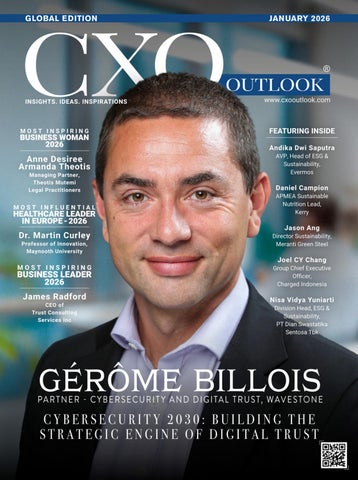
CXO Outlook – January 2026

Page 1


January 2026

Creative Consultants

Charlie Jameson

Louis Bernard

Managing Editor

Sarath Shyam

Branding & Marketing Partnerships

Jennifer Anderson

Monica Davis

Jessica Edword

Consultant Editors

Dr. John Andrews

Emma James

Andrew Scott

Sabrina Samson

Editorial Enquiry admin@cxooutlook.com

Naomi Wilson

Stanly Lui

Steve Hope

Keith Alexander

Anna Elza

Stephen Donnell

Susan Miller

Partnerships Enquiry admin@cxooutlook.com

Asia-Pacific International Partnerships admin@cxooutlook.com

CXO Outlook www.cxooutlook.com is a global knowledge sharing digital platform published by Connecta Innovation Private Limited. All rights reserved. The opinions expressed in the content and pictures provided are those of the authors. They do not purport to reflect the opinions or views of Connecta Innovation Private Limited or any of its members and we do not assume any responsibility. The publisher does not assume any responsibility for the advertisements, its content, pictures, and all representation of warranties made in such advertisements are those of the advertisers and not of the publisher. CXO Outlook www.cxooutlook.com is a Free Subscription and Free-to-read digital platform strictly not for sale and has to be strictly for internal private use only. Publisher does not assume any responsibility arising out of anyone modifying content and pictures, printing a copy of this digital platform in any format and in any country and all matters related to that.

When Cyber Crises Grew Up: From Panic Rooms to Strategic Command Centers

Not long ago, a cyber crisis meant one thing inside most organizations: panic. Phones rang, inboxes overflowed, and leadership teams searched for answers they wished they had asked much earlier. I have seen this play out across industries. Capable people, well-run businesses, and yet a familiar sense of being unprepared. Today, that reaction is beginning to change. Cyber crises are no longer rare disruptions. They have become expected tests of leadership, culture, and judgment. The challenge is not just frequency, but scale. Cyber threats are faster, quieter, and deeply embedded in everyday operations. A single incident can affect customers, partners, regulators, and markets within hours. Yet many organizations still treat cyber incidents as technical failures rather than leadership moments. That disconnect, between preparedness on paper and decision-making in real time, is where modern cyber crisis management is being redefined.

This is why our January 2026 cover story feels especially relevant. In his opinion article, “Cybersecurity 2030: Building the Strategic Engine of Digital Trust,” Gérôme Billois, Partner for Cybersecurity and Digital Trust at Wavestone, urges leaders to rethink cybersecurity not as a defensive function, but as a strategic capability. Drawing on nearly 25 years of experience and his work founding CERT-Wavestone, he

makes a compelling case for moving beyond reaction toward resilience. In this model, cyber crises are anticipated, rehearsed, and governed at the highest levels of the organization.

What stands out is not only the strategic architecture he describes, but the mindset behind it. Effective crisis management today is less about heroic recovery and more about clarity, shared accountability, and trust built well before an incident occurs.

Beyond the cover story, this issue of CXO Outlook Magazine brings together voices exploring leadership under pressure, digital responsibility, and the human side of complex systems. The perspectives in these pages challenge assumptions and offer grounded insight for a world that rarely slows down.

As you read this issue, I invite you to think not just as a spectator, but as a leader in preparation. Cyber crises may be inevitable. Panic does not have to be.

Enjoy Reading.

22 MOST INSPIRING BUSINESS WOMAN 2026

Anne Desiree Armanda Theotis

Managing Partner, Theotis Mutemi Legal Practitioners

Practicing the Discipline of Leading with Integrity

40 MOST INFLUENTIAL HEALTHCARE LEADER IN EUROPE - 2026

Dr. Martin Curley

Creating Systems That Deliver Better Care Professor of Innovation, Maynooth University

60 MOST INSPIRING BUSINESS LEADER 2026

James Radford

Redefining How Modern Work Gets Done CEO of Trust Consulting Services Inc

LEADER'S INSIGHTS

Daniel Campion, APMEA Sustainable Nutrition Lead, Kerry Sustainable Nutrition as the New Edge in Food

Making ESG and Sustainability Work at Scale

Nisa Vidya Yuniarti, Division Head, ESG & Sustainability, PT Dian Swastatika Sentosa Tbk

LEADER'S INSIGHTS

Inside the Growth of Indonesia’s Social Commerce and MSME Ecosystem

Andika Dwi Saputra, AVP, Head of ESG & Sustainability, Evermos

Rethinking Mobility for a Cleaner Future

Joel CY Chang, Group Chief Executive Officer, Charged Indonesia

Engineering a New Era of Responsible Steel

Jason Ang, Director Sustainability, Meranti Green Steel

GÉRÔME BILLOIS

PARTNER - CYBERSECURITY AND DIGITAL TRUST, WAVESTONE

Gérôme Billois is a Partner at Wavestone, where he has spent nearly 25 years helping global organizations strengthen their cybersecurity and digital trust strategies. A recognized expert in cyber crisis management and AI security, he founded CERT-Wavestone and advises executive committees worldwide on turning cyber risk into strategic resilience. Gérôme sits on the boards of Campus Cyber and CLUSIF, contributes to major international initiatives on cyber innovation and sustainability, and frequently speaks in global media and conferences. He is also the author of several reference books on cybersecurity and a driving force behind public awareness programs on digital safety.

Cybersecurity has already crossed a threshold. It is no longer optional but a structural pillar of how organizations operate, and its importance will grow as risks and digital transformations accelerate. Digital ecosystems are becoming denser and more interdependent. AI driven processes are reshaping decision cycles. Regulations are multiplying. Geopolitical tensions are fragmenting global technology landscapes. In this environment, cybersecurity is shifting from a specialist function to one of the primary engines supporting organizational growth. This transformation requires a strategic approach that goes beyond technical uplift. It demands the ability to see across increasingly complex environments, to rebuild trust in the foundations of digital interaction, to increase the speed at which cybersecurity acts when events unfold, and to demonstrate that it creates measurable value. These imperatives form the strategic architecture of cybersecurity in 2030.

The race for visibility

As digital systems expand, visibility becomes the first source of strategic advantage. The attack surface no longer resides within an organization’s infrastructure. It now stretches across SaaS ecosystems, third party integrations, CI or CD pipelines, and AI agents embedded in business processes. These developments are not theoretical. In 2025, we saw attacks targeting Salesforce, compromises of NPM packages, the Shai Hulud campaign, and even cases of fake employees linked to North Korea. Without unified visibility, executives and cyber teams remain blind to vulnerabilities accumulating across these layers.

By 2030, organizations will need a visibility fabric capable of capturing and interpreting signals across all populations and environments. This is particularly important for insider risks, which now arise less from carelessness and more from compromised accounts, misused partner privileges, or the deviation of autonomous agents. Behavioral analytics powered by AI will be essential to identify anomalies that escape traditional monitoring.

The same applies to the convergence of IT, OT, and digital products. Industrial protocols, product telemetry, and real time security levels must be integrated into security operations so that incident response is coordinated across domains that were previously siloed. Without comprehensive visibility, neither agility nor trust can be achieved at the scale required for 2030.

Rebuilding trust in a fragmented world Trust is one of the most threatened assets of the next five years. It is weakened by the instability of global supply chains, the fragmentation of digital sovereignty, and the erosion of cryptographic certainties. Executives must recognize that trust is not static. It must be engineered and renewed.

Cryptography illustrates this clearly. Quantum progress is accelerating, and governments on both sides of the Atlantic expect organizations to migrate to post quantum standards within the next five years. This requires new governance, lifecycle management, and an architectural redesign to introduce crypto agility. Organizations that delay action risk long term exposure to harvest now decrypt later scenarios, especially for sensitive data with long confidentiality horizons.

Resilience must also be redefined. The integrated global IT model of the past twenty

By 2030, organizations will need a visibility fabric capable of capturing and interpreting signals across all populations and environments

years is in retreat. Localization requirements, cross border limitations, and technology restrictions are increasing. Organizations must map digital dependencies with precision and identify the minimal capabilities required to operate under severe disruption. Crisis planning must include supplier collapse, network partitioning, and loss of integration with global platforms. Resilience becomes not a question of backup but of structural independence.

Identity completes this triad. It has become the foundation of digital trust, yet identity systems remain fragmented across human, machine, partner, and AI populations. By 2030, identity governance must be unified under a dedicated executive role, the Chief Identity Officer, capable of harmonizing platforms and supporting zero trust models without adding friction. Trust will fail where identity remains divided.

The strategic role of speed

The third imperative is the need for speed. Offensive innovation is moving at machine pace. AI models capable of generating exploits, identifying vulnerabilities, and testing intrusions have eliminated the temporal buffers defenders once relied on. Patch cycles measured in weeks are incompatible with this new dynamic.

Recent breakthroughs make this clear. The CVE Genie project at the University of California showed that AI can create working exploits with a 51 percent success rate across 841 vulnerabilities at 2.77 dollars each. The DARPA AIxCC challenge demonstrated that AI can identify vulnerabilities with 70 percent accuracy and generate patches with 61 percent success. Most importantly, AI completed the entire remediation cycle autonomously by

evaluating source code, proposing corrective patches, and testing them at unit and integration levels. This process, traditionally requiring coordinated effort, was executed in an average of 45 minutes at a cost of roughly 450 dollars.

To keep pace, cybersecurity must move into real time. This requires two architectural breakthroughs: a cyber data lake that consolidates fragmented telemetry into a unified, enriched, continuously updated source of truth; and the rise of agentic AI platforms. AI agents will analyse signals, prioritise actions, adjust configurations, recommend patches, and contain threats. They reduce decision latency and unlock capabilities such as real time assurance, digital twins, automated data classification, accelerated third party risk evaluations, continuous application security analysis, and faster SOC triage. In 2030, speed becomes a structural attribute, not an ambition.

The necessity of demonstrating value

Cybersecurity will not secure sustainable funding without demonstrating clear value. Boards increasingly assess cybersecurity through a value creation lens and expect transparency on how it contributes to business

growth, operational efficiency, product trustworthiness, and regulatory confidence. A new governance capability is required. Leading organizations are establishing a Value Realization Office under the CISO to measure the economic and strategic impact of cyber initiatives. This includes reduced downtime, accelerated product deployment, improved partner onboarding, and enhanced client trust. As cyber becomes more automated and embedded in workflows, demonstrating value will become easier and essential.

The new strategic engine

By 2030, cybersecurity will define the organization’s ability to navigate uncertainty. Visibility will provide clarity. Trust will sustain continuity. Speed will shape resilience. Value will secure long term investment. Executives who embrace these imperatives will build the strategic engine that enables digital ambition and competitive advantage.

If you want to know more about this vision and its operational deployment, the complete Top 30 actions for 2030 list is available at https://www.wavestone.com/en/insight/cisoradar-top-30-actions-for-2030/

Wa n t t o S e l l o r fi n d

I nve s t o rs f o r yo u r

B u s i n e s s ?

Making ESG and Sustainability Work at Scale

You’ve held leadership roles in both development-oriented organisations and a large industrial conglomerate. Looking back, how would you describe the key milestones that shaped your journey into ESG and sustainability leadership?

There are three key milestones that shaped my leadership in ESG and sustainability. The first was personal. I grew up in an area affected by recurring floods linked to nearby industrial activity. Seeing firsthand how environmental issues disrupt daily life sparked my interest in sustainability early on and motivated me to pursue related studies during university and later in my master’s degree. The second milestone

came through my early career in the development sector. Working with NGOs and international donor projects exposed me to sustainability from a community and policy perspective. I learned the importance of stakeholder engagement and inclusive solutions, and that real progress requires collaboration across different actors. The third milestone was my transition into the corporate world. I realised that the private sector holds significant resources and influence to drive measurable and scalable sustainability outcomes. Indeed, my current role has also strengthened my view that sustainability cannot operate in isolation, it needs to be integrated into business decisions to deliver long-term value for both the company and the communities around it.

When ESG is framed as risk management and value protection, it earns stronger buy-in from leadership and becomes embedded in core strategy rather than treated as an optional initiative

Nisa Vidya Yuniarti is a sustainability professional driving ESG integration and responsible business practices in Indonesia’s energy and resources sector. She is the Division Head of ESG & Sustainability at PT Dian Swastatika Sentosa Tbk (DSSA), leading group-wide ESG initiatives, climate-related tracking, and sustainability alignment across subsidiaries. Her experience spans sustainability reporting, ESG data governance, and global frameworks including GRI, IFRS-S, TCFD, and IRMA. Nisa holds a Master’s degree in Environment and Development from the London School of Economics and a Bachelor’s degree in Geography from the University of Indonesia.

In an exclusive conversation with CXO Outlook, Nisa Vidya Yuniarti talks about how sustainability is evolving from a compliance-driven function into a core business strategy that strengthens resilience competitiveness and long-term value. She shares candid insights on implementing ESG across complex industrial sectors amid shifting global climate priorities and regulatory uncertainty. The discussion also explores how sustainability is being reframed as a risk and resilience imperative rather than a standalone initiative. Below are the excerpts of the interview.

These experiences continue to shape how I see sustainability that meaningful progress is where environmental responsibility, social impact, and business performance reinforce each other.

The industries DSSA operates in, including mining, chemicals, renewables and technology are undergoing deep shifts. What are the biggest challenges you see today when it comes to implementing ESG in these sectors, and how are you addressing them?

Implementing ESG in industries like mining, chemicals, renewables, and technology comes with unique challenges, especially in a global context where commitment to climate action has become inconsistent. When major economies soften their sustainability stance, it creates mixed signals for the private sector. Companies begin to question whether strong ambition is still necessary, and this hesitation slows progress. Another challenge is also the tendency to take a moderate, wait-and-see position. This is because sustainability innovation often requires investment and calculated risk-taking, yet first movers are not always the ones who eventually get rewarded. As a result, adoption of new technologies and transition strategies becomes more gradual than the urgency of climate and social issues demand. To navigate this, I think it is time to approach ESG through the lens of risk and resilience. Rather than promoting sustainability as a trend or external expectation, we focus on material risks that directly affect long-term business continuity, from regulatory shifts to operational vulnerabilities and climaterelated disruptions. When ESG is framed as

risk management and value protection, it earns stronger buy-in from leadership and becomes embedded in core strategy rather than treated as an optional initiative.

In your view, how is sustainability redefining competitiveness, resilience and long-term value creation for a company like DSSA, especially in a country navigating energy transition and infrastructure growth?

Sustainability is redefining how companies compete, build resilience, and create longterm value and this is especially relevant for DSSA as Indonesia advances its energy transition and infrastructure development. What used to be viewed as an add-on to business has evolved into a new operating model, where environmental and social impact are embedded in strategic decisions. For a company with a long-standing energy portfolio, this shift opens new possibilities. Sustainability enables DSSA to explore renewables and emerging technologies while strengthening the foundation of its existing businesses. It also broadens the definition of success. Competitiveness today is not only about scale or efficiency, but about the ability to grow while supporting broader societal progress, for example, ensuring access to affordable energy while gradually investing in cleaner alternatives that secure the company’s future. Finally, sustainability enhances resilience by helping companies avoid shortsighted decisions that may carry long-term risks. ESG frameworks guide us to focus on material issues that influence business continuity and competitiveness.

Emerging technologies such as AI, digitalization and industrial automation are becoming increasingly relevant to ESG, and we see them as important enablers for the future

Emerging technologies, including AI, digitalisation and industrial automation, are increasingly relevant to ESG. How are you leveraging or planning to leverage these technologies in your sustainability agenda, and what impact are you seeing or expecting?

Emerging technologies such as AI, digitalization and industrial automation are becoming increasingly relevant to ESG, and we see them as important enablers for the future. At this stage, our priority is to strengthen the foundations, particularly the consistency and quality of ESG data across our businesses. Once this baseline is solid, more advanced tools can deliver real value rather than become a superficial upgrade. Looking ahead, we expect technology to play a meaningful role in improving data integrity and reporting accuracy. AI has the potential to streamline consolidation and support better transparency, but it can only do so effectively when supported by strong data governance, which we are currently reinforcing. Beyond reporting, we are also interested in how technology can support operational sustainability more broadly. AI and digital solutions can increase efficiency in energy use, logistics, waste management and worker safety, helping reduce environmental and social impacts while strengthening business performance. As these technologies mature, we see opportunities to integrate them where they can contribute meaningfully. Overall, we aim to adopt technology when it can genuinely improve ESG performance, reduce risk and create long-term value for the business and our stakeholders.

As a leader responsible for a division in sustainability, what leadership principles or practices do you emphasise to mobilise your teams and stakeholders, especially when some priorities may feel long-term and non-tangible?

Leading sustainability requires more than technical expertise, it requires the ability to mobilize people toward goals that are long-term, cross-functional and sometimes intangible. That’s why one of the leadership principles I emphasise is a stakeholder-driven mindset. Sustainability practitioners can become accustomed to a preferred approach or methodology, but real progress happens when we start from stakeholders’ priorities, constraints and motivations. When people feel understood, collaboration becomes much easier. I also, as much as I can, prioritize two-way dialogue and a complete feedback loop. ESG teams often gather data and support from many departments, yet we sometimes forget to return with insights. Stakeholders deserve to know what their contribution led to, what worked, what did not, and what we can improve together. This makes people feel part of the outcome rather than just a source of information, and it builds sustained engagement. Equally important is clarity of ownership and communication. Sustainability is inherently cross-functional, so success depends on shared responsibility. That means reducing jargon, defining roles clearly from the start, and helping each contributor see how their work connects to the bigger outcome. When expectations are clear, sustainability stops feeling like an additional task, and it rather becomes part of how the organisation succeeds together.

Beyond the professional sphere, many sustainability leaders bring personal values, passions or interests that inform their work. Could you share something about your personal interests or values outside of work, and how they connect with your professional mission?

My motivation for working in sustainability is deeply personal. I grew up in a community that faced regular flooding during the rainy season, largely linked to industrial activity. My parents were blue-collar workers in textile factories, so I saw both sides of the story very early, that the same industries which supported our family’s livelihood were also contributing to the environmental problems affecting our daily lives. Even as a child, I felt torn by that contradiction. When my father later lost his job due to an accident, I learned how fragile opportunity can be for working families. That experience shaped a belief that economic progress should never come at the expense of community well-being. People shouldn’t have to choose between a source of income and a safe, healthy place to live. This value continues to guide me today. Sustainability, to me, is not about limiting growth, it is about ensuring that growth creates shared benefits and protects the future of the people who depend on it. That’s the kind of development I want to help build.

What advice would you give to young professionals who aspire to contribute meaningfully in ESG, sustainability or responsible business roles, particularly in emerging-market contexts?

My advice to young professionals entering ESG and sustainability, especially in emerging markets

When expectations are clear, sustainability stops feeling like an additional task, and it rather becomes part of how the organisation succeeds together

is to approach the work with both ambition and humility. Sustainability can look glamorous from the outside, but the reality is that much of the work involves navigating competing priorities and perspectives. It’s important to remember that what we consider urgent may not be at the top of someone else’s agenda, and that doesn’t make the sustainability mission less important. Effective leadership in this field starts with listening, understanding stakeholders’ needs, constraints and motivations, then shaping strategies that bring people along rather than pushing ideals onto them. In emerging markets, the pace of change can be even more

demanding. New regulations, standards and reporting frameworks are constantly evolving, and it can quickly become overwhelming. My suggestion is not to fall into the trap of treating ESG as a checklist exercise. Applying multiple frameworks without a clear direction can dilute impact. Instead, anchor our work in a longterm sustainability roadmap that reflects the our organization’s context and material priorities. Frameworks and standards should support the strategy, not replacing it. Of course it’s always good to stay grounded, curious and collaborative, that way our ability to drive meaningful impact will grow over time.

MOST INSPIRING BUSINESS WOMAN 2026

Anne Desiree Armanda Theotis

MANAGING PARTNER, THEOTIS MUTEMI LEGAL PRACTITIONERS

PRACTICING THE DISCIPLINE OF

LEADING

WITH INTEGRITY

Anne Desiree Armanda Theotis leads with a quiet certainty shaped by principle, discipline, and an unshakable belief in service. As Managing Partner of Theotis Mutemi Legal Practitioners, she heads a Zambian law firm known for its steady focus on excellence, integrity, and practical problem-solving. Her work spans litigation, corporate advisory, arbitration, mediation, and adjudication, a breadth that reflects both technical depth and a clear-eyed understanding of how legal decisions affect businesses and people alike. For Theotis, the law is not an abstract system. It is a tool that must work, fairly and efficiently, for those who depend on it.

That belief took root early. Long before she entered a courtroom, she found inspiration in unlikely places. “As a child, I was captivated by Petrocelli, a 1970s legal series where the protagonist was committed to securing justice for his clients rather than chasing money,” she recalls. That image of a principled, people-centered lawyer stayed with her. It was reinforced at home, where structure and discipline were part of daily life. Her parents were strict, she says, but the lessons they passed on became lifelong anchors. “My father was always ready to help people who had less and watching him consistently make time for the less fortunate taught me that service is not an act, but a way of living,” she shares. Law, to her,

ANNE DESIREE ARMANDA THEOTIS, MANAGING PARTNER, THEOTIS MUTEMI LEGAL PRACTITIONERS

Theotis Mutemi Legal Practitioners brings together three partners, six associates, and a dedicated support team, each contributing deep expertise across multiple areas of law

became a natural calling because it offered the power to protect, empower, and restore balance. Her early years in practice were demanding and formative. Immersed in high-pressure litigation and technically complex corporate work, she also encountered the strain of a justice system grappling with limited capacity. Those

experiences sharpened her perspective. “I learned quickly that while the law is strong on principle, the lived experience of litigants can be very different,” she says. That realization shaped her approach, pushing her to balance precision with empathy, and legal rigor with an understanding of the human stakes involved in every dispute.

Today, as Managing Partner, Theotis brings that balance into the firm’s leadership and operations. She has focused on strengthening internal systems, investing in the growth of young lawyers, and embedding strategic thinking into how the firm serves its clients. Alongside this, she is pursuing an MBA at the University of Edinburgh Business School, expanding her grasp of leadership and organizational decisionmaking.

At the core of her work is a simple conviction. Law firms, she believes, must stand for more than expertise alone. They must offer ethical leadership, timely solutions, and meaningful engagement with the communities they serve. It is a philosophy that continues to guide her journey and sets the stage for the impact she is building next.

Building a Firm That Thinks Beyond the Case

At Theotis Mutemi Legal Practitioners, structure and intent go hand in hand. The firm brings together three partners, six associates, and a dedicated support team, each contributing deep expertise across multiple areas of law. What distinguishes the practice is not size, but focus. The lawyers are trained to be decisive, commercially aware, and solution-oriented, approaching each brief with what Theotis describes as “a razor-sharp focus on finding solutions that best serve the client’s needs.” Initiative and creative problem-solving are not optional traits here. They are part of the firm’s daily discipline, allowing the team to manage both straightforward and highly complex matters with efficiency and cost awareness.

Theotis handled cases where clients suffered not because the law was unclear, but because the system was stretched beyond capacity

For Theotis, the firm’s purpose extends well beyond legal advice. In moments of uncertainty, clients often seek more than technical answers. They need clarity, stability, and reassurance. That understanding shapes how the firm positions itself. It acts as a strategic partner that looks past statutes and contracts to consider business pressures, human dynamics, and the emotional weight that disputes often carry. Internally, the same sense of responsibility applies. Developing young lawyers who value integrity, accountability, and continuous learning is central to the firm’s identity. In Theotis’ words, the goal is not only to solve problems, but “to elevate trust in the legal profession.”

Her own practice has reinforced that philosophy. Complex commercial disputes, she notes, are among the most demanding. They test legal precision while requiring a deep grasp of commercial realities and long-term relationships. “The biggest test is balancing the need for a firm, strategic position with an appreciation for the broader relationships and long-term implications for clients,” she explains. That balance, between strength and restraint, has become a defining feature of her leadership style.

The transition into leadership was shaped by a growing unease with systemic delays in the justice process. She handled cases where clients suffered not because the law was unclear, but because the system was stretched beyond capacity. “Justice delayed is justice denied,” she says, a realization that sharpened her interest in alternative dispute resolution. Mediation and arbitration offered clients a way to achieve closure without years of uncertainty. Over time, this commitment to practical outcomes reshaped how she viewed the role of a law firm itself.

Stepping into the managing partner role widened her lens. The focus shifted from individual cases to building an institution that could deliver consistently. Leadership, she understands, is less about personal output and more about creating systems that allow others to perform at their best. “Success is not measured by how busy I am personally, but by how effectively the entire team can operate when supported by clear processes and shared purpose,” she explains. It is a perspective that anchors the firm’s culture and prepares it for sustained impact.

When the Law on Paper Meets Reality

One of the most persistent gaps in the legal system, Theotis observes, lies between the law as written and the law as experienced. Nowhere is this more visible than in timelines. Statutes and procedural rules often prescribe strict periods for rulings and judgments. On paper, these deadlines appear reasonable. In practice, they can be unworkable. Courts face chronic shortages of judicial officers, crowded dockets, frequent adjournments, and administrative constraints. A single judge may be managing an overwhelming caseload, making compliance with prescribed timelines physically impossible.

For litigants, the result is frustration and a sense of failure by the system. Delays erode trust and compound the emotional and financial cost of disputes. Lawyers, Theotis believes, see this disconnect more clearly than most because they witness its impact firsthand. That proximity brings responsibility. Rather than responding only after disputes arise, she argues that lawyers should help shape the systems meant to prevent

them. “Waiting to respond only after disputes arise is reactive and inefficient,” she notes. The profession adds the greatest value when it contributes to policy formulation, institutional reform, legislative review, and the development of modern dispute-resolution frameworks. This forward-looking stance reflects her broader view of leadership in law. Legal professionals are not just interpreters of rules. They are participants in the design of systems that influence economic activity, access to justice, and social stability. By engaging earlier, and more thoughtfully, lawyers can help reduce conflict, improve access, and support sustainable development. It is an outlook that points beyond the courtroom and sets the stage for a deeper discussion on leadership, reform, and responsibility in the legal profession.

Integrity as a Business Discipline

For Theotis, the tension between commercial reality and professional responsibility is not a dilemma to be managed occasionally. It is a discipline that must be practiced daily. A law firm, she acknowledges, must operate sustainably. Yet reducing legal work to a revenue exercise risks eroding the very trust that sustains long-term success. Clear engagement terms, transparent billing, and early expectation-setting form the backbone of how her firm reconciles business demands with ethical duty. These practices create alignment from the outset and protect the lawyer’s obligation to justice and the public interest, which she believes can never be compromised. Experience has reinforced a simple truth. Clients value honesty more than convenience. “I have consistently found that clients value

Within her firm, Theotis places strong emphasis on training and clear guidance, not to create dependency, but to develop sound judgment

integrity and frank advice far more than shortterm convenience,” she says. Over time, that reputation becomes an asset no transaction can replace. Principled practice, she notes, strengthens a firm far more than any single deal ever could.

Her approach to dispute resolution reflects the same thinking. Many conflicts, she has observed, do not begin with bad intent. They emerge from miscommunication, misaligned expectations, or a failure to listen early enough. A constructive approach focuses on clarity at the outset and a genuine effort to understand what is driving each party. In her work as an arbitrator and mediator, Theotis has seen how powerful that shift can be. “When people feel heard and respected, they are more open to pragmatic solutions,” she explains. Constructive resolution avoids needless escalation, protects long-term relationships, and allows parties to move forward with clarity rather than resentment. It is not a softer option, but a smarter one.

Excellence Built on Structure and Trust

Excellence, in Theotis’ view, is rarely accidental. It is the result of deliberate structure, supportive leadership, and consistent expectations. Within her firm, she places strong emphasis on training and clear guidance, not to create dependency, but to develop sound judgment. Younger lawyers are encouraged to think, question, and take responsibility rather than simply follow instructions. The goal is confidence grounded in competence.

Discipline plays a central role, shaped by her upbringing, yet it is balanced by mentorship and support. Law is a demanding profession, and

pressure is part of the terrain. Recognizing this, she has worked to build an environment where standards are high, but support is real. Today, excellence within the firm is defined not only by technical ability, but by professionalism, reliability, and a genuine commitment to client welfare. These are the traits that endure when complexity increases and stakes rise.

Client expectations have also evolved. Corporate leaders now look to their legal advisors for insight that connects legal risk with operational and strategic decisions. Boards expect clarity, speed, and advice that reflects a deep understanding of their industry context. They want lawyers who can anticipate regulatory shifts, design mitigation strategies, and support growth while ensuring compliance. Theotis is clear on this point. The modern client is not seeking abstract analysis. They want commercially grounded guidance that enables confident decision-making. Law, at this level, becomes a leadership function in its own right.

Preparing for the Next Legal Economy

Looking ahead, Theotis sees a legal environment shaped by technology, tighter regulation, and rising expectations for transparency. Businesses will demand faster, more proactive advice and stronger risk-management frameworks. On the profession’s side, firms will need to invest thoughtfully in cybersecurity, knowledgemanagement systems, and staff retention to remain competitive. Cross-border work and the growing role of digital evidence will continue to reshape practice, requiring lawyers to expand their commercial and technological awareness alongside legal expertise.

Innovation, she believes, will matter most where pressure is highest. Dispute resolution will continue to evolve as businesses seek outcomes that are faster and less adversarial. Alternative dispute resolution will play a growing role, offering certainty without prolonged disruption. At the same time, areas such as data protection, cybersecurity, and fintech law are set to expand rapidly as digital transformation accelerates across sectors.

The need to innovate does not stop at clientfacing work. Internally, law firms must rethink how they deliver service, manage knowledge, structure billing, and develop talent. These changes are not about chasing trends, but about staying relevant to clients whose expectations continue to rise. For Theotis, the future of the profession belongs to firms that combine legal rigor with adaptability, and leadership with accountability. It is a future she is actively preparing for, one decision at a time.

Sustainable Nutrition as the New Edge in Food

Could you walk us through your career journey and share a milestone that stands out for you?

I have been with Kerry 21 years across B2C in the UK & Ireland and B2B in both retail and Foodservice channels in Europe and APMEA, being based in Singapore since 2014. Starting in Finance, I transitioned to general management, completing a Stanford LEAD Corporate Innovation Certificate and becoming a distinguished scholar. I moved into the role of APMEA sustainable nutrition lead and completed the Cambridge Business Sustainability Management course and became an associate

of the International Society of Sustainability Professionals (ISSP).

A milestone that stands out to me is the launch of our Small Acts Matter program in 2024. The change management program was born from the tagline ‘Think Big, Start Small, Act Now’ and we had great engagement across the pilot sites. One of those sites, Tampoi Malaysia, painted a massive mural on their wall to mark the occasion. They were pioneers in sustainable operations and recently received the recognition they deserve by winning Runner-Up – Energy Management in Large Industry at the Malaysia National Energy Awards 2025.

For sustainability action, APMEA food industry value chains are highly cost sensitive and are typically globally supplied from different regions depending on cost, regulation and trading dynamics

Daniel Campion is the Asia Pacific, Middle East and Africa Sustainable Nutrition Lead at Kerry, where he drives the company’s Beyond the Horizon strategy to advance sustainable nutrition across global food systems. With over 20 years of experience in the food industry, he has worked across B2C markets in the UK and Ireland and across B2B retail and foodservice channels in Europe and the APMEA region.

Based in Singapore since 2014, Daniel began his career in finance before transitioning into general management. He is a distinguished graduate of the Stanford LEAD Corporate Innovation program and has completed the Cambridge Business Sustainability Management course. He is also an associate of the International Society of Sustainability Professionals.

Passionate about creating a food system that is better for people and the planet, Daniel actively collaborates with customers and partners to deliver nutritious, sustainable and commercially viable solutions. He is also a committed volunteer and mentor, supporting initiatives across sustainability, education and social impact.

In an exclusive conversation with CXO Outlook, Daniel talks about how sustainable nutrition is reshaping the future of the food industry across Asia Pacific, Middle East and Africa, and why the next wave of growth will belong to companies that align taste health and planetary impact.

He also shares how data innovation and emerging technologies are helping Kerry and its customers measure impact more precisely while creating solutions that consumers genuinely love and can afford. Below are the excerpts of the interview.

From your vantage point in the region, what are the biggest strategic and operational challenges facing the foodindustry value chain today, particularly in sustainability, nutrition and supplychain resilience?

The science is clear: to avoid the most catastrophic effects of climate change, we must limit global warming to 1.5°C or suffer the unnatural consequences of increased floods, fires, heatwaves and droughts. The higher the temperature the more the economic and social effects multiply. As Swedish scientist Johan Rockström notes, the world could see an annual loss of 18% in global GDP or an estimate US$38 trillion by 2050.

For sustainability action, APMEA food industry value chains are highly cost sensitive and are typically globally supplied from different regions depending on cost, regulation and trading dynamics. Supply within the region is typically driven by smallholder farming. This means that consistency of supply to scale initiatives over time and number of stakeholders to be engaged are higher, which can mean scaling progress is more challenging. This is why we need ‘Act Now’ to build the pilots and identify the most scalable activities for the greatest impact.

At Kerry you describe “sustainable nutrition” as more than simply product reformulation. How do you see sustainability redefining competitiveness, resilience and longterm value for brands and ingredientpartners in the next decade?

“Sustainable Nutrition” is providing food solutions that maintain people's health, in a way that protects society and the planet for future

“Sustainable Nutrition” is providing food solutions that maintain people's health, in a way that protects society and the planet for future generations

generations. Consumers want to make choices that support sustainable nutrition, once the impact is transparent and they aren’t asked to sacrifice taste or affordability. At Kerry we can partner with our customers to solve these challenges.

For example, in the cocoa crisis we partnered with a customer to mitigate the supply chain and cost challenges through reformulation while also moving to Rainforest Alliance-certified cocoa to provide greater value to consumers, increasing their competitiveness.

Another example is how we worked with a foodservice operator in India to extend the shelf life of their back of house fresh chicken. Not only did this mean lower wastage, saving both cost and the carbon generated to produce the fresh chicken, it also resulted in greater supply

chain efficiencies with fewer deliveries needed to service their outlets.

Emerging technologies, from digital modelling to smart ingredients and data platforms, are influencing almost every part of the value chain. How are you leveraging technologies in your sustainable-nutrition agenda at Kerry, and what do you see as the most promising technology front?

We have embedded carbon data across all our systems so that each function can include carbon in their decision making. Building the visibility for the most impactful actions and working cross functionally together to reduce our footprint and the footprint of our

customers is very promising. It makes it easier to build scale, overcome barriers and deliver a combined impact much greater than what we could achieve on our own.

Research & development can see carbon in their innovation tool and can innovate or reformulate with carbon in mind alongside taste, cost and functionality. Factories report monthly on their carbon result, and their pipeline to reduce, building visibility on how

we will achieve our 55% absolute reduction target by 2030. Procurement can see carbon with their supplier data to be able to target the greatest impact supply chain decisions.

Our climate transition plan for our SBTi validated 1.5° aligned carbon reduction targets brings these actions together into one cohesive pathway with actions that we will continuously assess the effectiveness of, as we deploy and scale initiatives.

If we can help our stakeholders understand the most impactful action, listen to their concerns so we can make it easier for them to transition, that’s how we can Think Big, Start Small & Act Now

Leadership in such a complex global context demands both vision and operational rigour. What leadership attributes have you found most critical as you drive sustainability transformation across diverse markets, and is there one achievement you’re particularly proud of in this journey?

Acting on climate change can be difficult at times. I try to focus on what is within my control, including expanding my sphere of influence, and I remind myself that it’s because it’s difficult that it needs leaders to step up. We have a great opportunity to step up and have an impact if we have the courage.

Jim Collins in his book Good to Great describes "The Stockdale Paradox" where you must maintain unwavering faith that you can and will prevail in the end, regardless of the difficulties, and at the same time, have the discipline to confront the most brutal facts of your current reality, whatever they might be.

The brutal facts for climate change action are complexity, competing priorities and lack of knowledge or belief for the most impactful actions. If we can help our stakeholders understand the most impactful action, listen to their concerns so we can make it easier for them to transition, that’s how we can Think Big, Start Small & Act Now.

At a global Kerry level, I was very proud when Kerry was ranked 9th of 350 Food companies by the world benchmarking alliance for our progress on sustainable nutrition.

Within Kerry APMEA, I was very proud of the engagement and commitment we had from leadership for a leader training on change management for sustainable nutrition, with

Younger professionals building careers should seek to build functional excellence that can be applied to delivering sustainable nutrition outcomes

each leader committing what they would do differently in their roles to accelerate our regional transition for sustainable nutrition.

Outside of work, many leaders draw inspiration from personal values or experiences. Could you share a personal interest or value outside of work that shapes how you approach your professional mission?

I am a father of two. I want to be able to tell my children I did my best to fight for their futures, and the freedom to live without significant increases in unnatural disasters, freedom to dive coral reefs or explore natural habitats and see the beauty we can see today, and freedom not to have to pay for a crisis others have created in higher costs and taxes.

Finally, for younger professionals looking to build a career at the intersection of food, nutrition and sustainability: what advice would you offer to help them prepare for this evolving space?

To truly scale sustainable nutrition, it needs to be embedded in everything that we do. In my opinion, younger professionals building careers should seek to build functional excellence that can be applied to delivering sustainable nutrition outcomes. The more we understand how the sustainable nutrition lens can be added to our existing lens, the greater the scale up. How can we innovate the best solutions, communicate and influence for the greatest level of scale up, update our procurement policies, measure and forecast performance for the greatest clarity and contingency building, and project manage the most impactful outcomes.

MOST INFLUENTIAL HEALTHCARE LEADER IN EUROPE - 2026

Dr. Martin Curley

PROFESSOR OF INNOVATION, MAYNOOTH UNIVERSITY

CREATING SYSTEMS THAT DELIVER BETTER CARE

Dr. Martin Curley’s career sits at the intersection of innovation, public service, and leadership at scale. As Professor of Innovation at Maynooth University and Director of the Digital Health Ecosystem at the Innovation Value Institute in Ireland, he has spent decades turning ideas into systems that work in realworld environments. His work exemplifies a steady focus on making technology practical, adoptable, and valuable for the institutions and people it serves.

That focus became especially visible during his tenure as Chief Information Officer and Director of Digital Transformation for Ireland’s National Health Service. At a time when

healthcare systems were under growing strain, Dr. Curley helped shape the foundations for long-term digital capability. He founded the National Digital Academy and continues to codirect a national MSc program in Digital Health Transformation, strengthening leadership capacity alongside infrastructure.

Dr. Curley’s influence extends well beyond national boundaries. As Chair of the UN General Assembly Digital Health Symposium and former Chair of the European Commission’s Open Innovation Strategy and Policy Group, he has contributed to how governments, industry, and academia collaborate around complex challenges. His role in shaping Open Innovation 2.0 and co-founding the Innovation

Value Institute reflects a long-standing belief in ecosystem-driven progress. At IVI, he led the development of the IT Capability Maturity Framework, now used by hundreds of organizations worldwide to strengthen digital and IT value creation.

Recognition has followed sustained impact. Dr. Curley has been named among the world’s most influential healthcare leaders by international publications and has received multiple honours for technology and public sector innovation. He is also the author of 10 books and a regular contributor to executive education programs across the globe. His attention, however, remains on what comes next: building resilient healthcare systems, developing leaders who can navigate complexity, and ensuring digital progress delivers measurable outcomes.

Dr. Curley has been named among the world’s most influential healthcare leaders by international publications and has received multiple honours for technology and public sector innovation

From Global Platforms to Public Purpose

Before healthcare became the centre of his work, Dr. Curley built his leadership foundations inside some of the world’s most influential technology companies. His corporate career included senior roles at Mastercard, where he served as Senior Vice President and led the Global Digital Practice, and at Intel Corporation, where he held positions spanning Vice President, Senior Principal Engineer, Director of Intel Labs Europe, and Global Director of IT Innovation. Earlier engineering leadership roles at Philips and General Electric further shaped his understanding of large-scale systems, execution, and operational discipline. Those years were marked by both scale and learning. “Working for great companies with great people has been a terrific motivator and learning opportunity,” Dr. Curley recalls.

One formative chapter came early at Intel, when he relocated to Phoenix, Arizona to help design automation systems for semiconductor manufacturing. It was there that he saw, up close, how deeply digital systems could reshape productivity, precision, and global competitiveness. “To work for a company that was not just shaping an industry, but also the trajectory of our future digital world, was a tremendous honour,” he says.

As Global Director of IT Innovation at Intel, Dr. Curley moved from designing systems to shaping direction. He established a global network of IT innovation centres, creating a platform that allowed ideas to move across geographies and industries. That vantage point revealed both progress and imbalance. While sectors such as manufacturing and finance were rapidly adopting digital tools, healthcare stood

apart. Despite its talent and mission, it lagged in digital adoption. Dr. Curley had already interacted with the UK’s National Health Service through Intel and had personal experiences as a patient that reinforced the opportunity. Healthcare, he believed, was fundamentally an information management discipline. If digital tools could transform factories and financial networks, they could also transform care delivery.

That belief was later tested and validated during his tenure as Director of Digital Transformation for Ireland’s Health Service Executive, particularly during the Covid pandemic. Digital platforms enabled speed,

Healthcare, in Dr. Curley’s view, is a complex adaptive system. Transformation does not come from a single organization or technology, but from the ecosystem moving together

coordination, and visibility at a moment when delay carried real consequences. The experience confirmed what Dr. Curley had long suspected: when deployed systematically and with purpose, digital technology could significantly improve healthcare outcomes.

Long before healthcare became his focus, Dr. Curley had already witnessed how connectivity could change the nature of work itself. He points to his collaboration with Peter Rogers, then CEO of Westminster City Council, during the early rollout of Wi-Fi across London. Access to the internet reshaped roles across the public sector, from traffic wardens to social workers, altering how services were delivered and decisions were made. One moment stayed with him. Speaking at a conference in an old monastery in Sestri Levante, Italy, Dr. Curley connected to email over Wi-Fi for the first time. “That was the moment I realized the world had changed. The opportunity for transformation was suddenly everywhere,” he says. That realization would later guide his approach to healthcare innovation.

Co-Innovation at Scale

At the core of Dr. Curley’s leadership philosophy is a simple but demanding idea: complex problems cannot be solved in isolation. This belief underpins Open Innovation 2.0, a model he has championed for years. The approach brings government, industry, academia, and citizens together in what he

describes as a quadruple helix of co-innovation, aligned around a shared vision. In healthcare, this means involving patients and clinicians directly in the design of digital solutions. “It is crucial to have patients involved in the codesign and co-innovation processes for digital health solutions,” Dr. Curley explains, pointing to living lab environments as a practical way to make that collaboration real.

Healthcare, in his view, is a complex adaptive system. Transformation does not come from a single organization or technology, but from the ecosystem moving together. Dr. Curley has seen too many sectors fragment into competition when coordination would have delivered better results. Over time, he has observed a clear progression, from competition to coordination, then cooperation, collaboration, and ultimately co-innovation. Each stage requires trust, shared values, and leadership willing to prioritize collective outcomes over individual advantage.

This ecosystem-based approach proved its value during one of the most critical periods in modern healthcare. In early 2020, Dr. Curley led Ireland’s digital clinical response to the Covid pandemic. Working alongside clinicians and an ecosystem of digital health companies, solutions were developed and deployed at unprecedented speed. One standout example was the co-development of a remote monitoring platform for Covid patients with Dublin-based PatientMpower. Within 48 hours, the solution was built. Within days, it was live in major Dublin hospitals, allowing patients with mild to moderate symptoms to be monitored safely from home while preserving hospital capacity for the most critical cases.

The same principles shaped earlier and parallel efforts in Europe. Dr. Curley takes particular pride in creating and leading Intel Labs Europe, which he grew from 18 labs and 800 researchers to 55 labs and 5,500 researchers

Dr. Curley takes particular pride in creating and leading Intel Labs Europe, which he grew from 18 labs and 800 researchers to 55 labs and 5,500 researchers in just over three years

in just over three years. Guided by Open Innovation 2.0, the network delivered industrial research that benefited Intel while strengthening Europe’s broader innovation ecosystem. His 2009 vision, titled Digital Europe, aimed to advance society through digital technology alongside product development and later influenced the European Commission’s Digital Agenda.

Another example of impact comes from Donegal in northwest Ireland, where a digitally enabled home-care model transformed outcomes for patients with chronic obstructive pulmonary disease. Remote monitoring allowed clinicians to intervene early, reducing hospital admissions and easing pressure on acute care. The results were measurable across multiple dimensions, better patient outcomes, lower costs, improved

clinician experience, and greater sustainability through fewer journeys and shorter hospital stays. For Dr. Curley, this represents the future of healthcare. Digital innovation, when codesigned and responsibly deployed, creates value across the system, not just within it.

Bridging Two Worlds of Innovation

Across decades of leadership in both the private and public sectors, Dr. Curley has developed a clear-eyed view of how culture shapes outcomes. Talent and commitment exist on both sides. The difference, he has observed, often lies in how systems are designed to encourage or constrain innovation.

“There are many super smart, dedicated, and passionate people in both the public and private sectors,” Dr. Curley notes. Yet the environments they operate in can feel fundamentally different. Variations in pace, risk tolerance, and operating models often place the two sectors on separate tracks. In the private sector, innovation is closely tied to survival. Organizations understand that relevance depends on continuous reinvention. Dr. Curley often returns to a line he quotes from former U.S. President Barack Obama: “Innovation just doesn’t change our lives; it is how we make a living.”

Public systems, particularly in healthcare, face a different reality. Incentives to innovate are weaker, and in some cases, the effort to challenge existing models can meet resistance. “Sometimes people who strive to innovate are actually resisted and isolated,” Dr. Curley shares. He has seen highly capable individuals within health systems hold back ideas, not from lack of ambition, but from concern about consequences. Hierarchical structures and risk-averse cultures can quietly stall progress, even when the need for change is widely acknowledged.

Clinicians, Dr. Curley emphasizes, enter the profession with deep motivation and a strong sense of purpose. What often limits innovation is not intent, but capacity. Clinical environments are demanding and saturated with tasks, leaving little room to absorb new tools or processes. Dr. Curley’s response has been to focus on vision and design. By articulating a clear picture of a future health system, he aims to build commitment rather than compliance. “My approach is to create a compelling vision of a future health system state and then design innovations for adoption,” he explains. Solutions must be easy to use, clearly better than what came before, and grounded in the realities of daily clinical work. Digital technologies, when applied thoughtfully,

Through initiatives such as Stay Left, Shift Left 10X and Open Innovation 2.0, Dr. Curley has worked to outline a practical vision for healthcare that is both ambitious and achievable

provide the building blocks for that kind of transformation.

Leading from the Front

For Dr. Curley, innovation leadership is not a distant or abstract exercise. It is practical, visible, and rooted in relationships. In fast-moving environments like healthcare, he believes leaders must be present, listening closely to patients, clinicians, and administrators. “There is no room for armchair generals,” he says. Real insight comes from being close to the work and the people doing it.

Relationships, in Dr. Curley’s experience, sit at the centre of sustained change. High trust and high capability partnerships enable progress when strategies and plans fall short.

“Relationships are the foundation of all accomplishments,” he underlines. They outlast individual initiatives and provide the stability required to navigate uncertainty. This focus on trust has shaped how he builds teams and ecosystems across sectors.

One of Dr. Curley’s most effective tools for driving adoption is visibility. He often returns to a simple idea: seeing changes minds faster than documents ever will. Digital technologies make it possible to prototype quickly and demonstrate

what is possible before full-scale deployment. A defining example was the creation of the Mother of All Demos for Health, or MOADH, developed with fifteen organizations and showcased at the International Digital Health Summer School at Maynooth University. The live demonstrations showed how an integrated digital health system, built on a secure patient information network, could fundamentally improve care delivery. “When people saw the working prototypes, they realized not only that it was possible, but that it was necessary,” Dr. Curley recalls.

Dr. Curley remains measured about his role in shaping the future. He sees himself as part of a larger system, contributing ideas and frameworks that others will carry forward. Through initiatives such as Stay Left, Shift Left 10X and Open Innovation 2.0, he has worked to outline a practical vision for healthcare that is both ambitious and achievable. “We are all just small parts of a much bigger entity, but I hope we can point the way to a health system that is significantly better,” he says. It is a perspective that closes the loop on his leadership journey, grounded in humility, driven by purpose, and focused on impact that extends well beyond any single role.

Rethinking Mobility for a Cleaner Future

Could you walk us through the key moments in your career that led you to your current role at Charged Indonesia and how each shaped your leadership approach?

I began my journey in the automotive world as a marketing manager and eventually grew into the role of Group CEO for a BMW dealer group, where I spent 13 years leading its expansion across Southeast Asia and China. Over time, my focus shifted toward the future of mobility, and I spent the next eight years moving from traditional combustion vehicles into the world of electric mobility, covering technology, manufacturing and distribution aimed at improving lives

and livelihoods. Along the way, a series of expeditions exposed me first-hand to the realities of climate change. Seeing its impact up close strengthened my belief that electric mobility can play a powerful role in improving health outcomes and shaping better futures for developing cities and communities.

What are the biggest hurdles you see in making electric two-wheel mobility mainstream in Southeast Asia and how do you believe they can be overcome?

One of the biggest hurdles to making electric two-wheel mobility mainstream in Southeast Asia is range anxiety, which can only be

Autonomous mobility will drive the next generation of safer and more productive transportation across all sectors, delivering stronger value and setting a new standard for the industry

Joel CY Chang is Group CEO at Charged Asia; an electric motorcycle developer that manufactures, distributes direct to users and exports their own branded cloud connected fleets that are competitive, affordable, and practical compared to traditional combustion motorcycles. To accelerate mass adoption, the scale-up offers a range of flexible subscription plans for their vehicles. The scale-up delivers 5 models with up to 6-Kilowatt hour batteries capable of travelling up to 300Km on one full charge. Charged Motorcycles are also capable of ultra-fast charging of 100kms range in 10mins. Charged Asia was launched in 2023 in Greater Jakarta at a 16,000 sqm positive energy “Giga-Shed” powered entirely by solar and battery energy storage to house its experiential centre, research and development, as well as production operations. Charged’s mission is to deploy 10 million bikes in 10 years to lead the adoption of sustainable mobility enabling better health and livelihoods for everyone in South East Asia.

In this conversation with CXO Outlook, Joel talks about the shifts redefining the future of mobility and why Southeast Asia stands at a crucial turning point. He highlights the biggest hurdles slowing down electric two-wheel adoption, from infrastructure gaps to financing priorities, and shares why long-term structural policies will matter far more than short-term subsidies. He also discusses how emerging technologies such as AI, connected fleets and battery intelligence are transforming the way Charged operates and the broader value they unlock for developing cities. Below are the excerpts of the interview.

addressed through fast-charging electric motorcycles supported by a wide and reliable charging infrastructure. Another challenge is that local financing institutions have not yet made EV adoption and transition a priority within their loan books, which slows down mass-market access. Beyond that, regulatory advocacy needs to evolve from one-off subsidies to long-term structural policies, such as tightening combustion-emission standards and introducing zero-tailpipe-emission traffic zones, to create a sustainable and forwardlooking ecosystem for electric mobility.

In your view, how is sustainability, whether environmental, social or business resilience, redefining what competitiveness means in the transportation industry?

Sustainability is reshaping competitiveness in the transportation industry in several fundamental ways. The future of automotive financing will increasingly revolve around ESG priorities, as companies need this focus to remain both competitive and relevant. Electric mobility has already proven to be not only more environmentally sustainable than combustion engines but also more commercially sustainable, and the industry has passed the tipping point where EVs are no longer simply “ESG better” but better across the board. The most successful mobility companies will be those that lead the transition and know how to extract value across the entire circular economy of electric mobility. Looking ahead, autonomous mobility will drive the next generation of safer and more productive transportation across all sectors,

delivering stronger value and setting a new standard for the industry.

Emerging technologies such as AI, connected fleets and batteryanalytics are reshaping mobility. How are you integrating these at Charged and what impact do you foresee?

At Charged, we integrate emerging technologies in ways that directly strengthen how we operate and serve our customers. We use AI across our customer-facing engagements to reduce routine workload for our teams and to handle complex data analysis that helps generate meaningful insights for improving our R&D, manufacturing and distribution functions. Every vehicle, battery and charger in our ecosystem is cloud-connected and remotely controlled through our proprietary full-stack hardware and software platforms, allowing us to manage fleets efficiently at scale and across wide geographies. We also have remote capabilities to monitor, analyse and control our battery systems, which are already helping us enhance battery safety, extend lifespan and improve overall performance.

Looking back on your tenure as CEO, which achievement are you most proud of and why?

The achievement I am most proud of is receiving encouraging feedback from both my team and our customers, knowing that our mission is genuinely improving their lives and livelihoods. Hearing their experiences and seeing the impact firsthand reinforces the purpose behind the work we do and motivates me to keep pushing forward.

he ability to move is what allows people to improve their place in life and society, yet the pollutive cost of mobility should never have to come at the expense of our health or the environment

Outside of the boardroom and factory floor, what interests or values guide you? How do they feed into your professional mission?

Outside of work, the value that guides me most is the belief in doing good while doing well.

I’ve always felt that we can create positive impact while building a successful commercial enterprise, and that these two goals should never be seen as separate. In fact, they reinforce each other and create exponential mutual value. This mindset shapes how I lead and how I want our mission to show up in the lives of the people and communities we serve.

What advice would you give to young professionals hoping to shape the future of sustainable mobility in their careers? My advice is to start by believing that mobility is a fundamental human right. The ability to move is what allows people to improve their place in life and society, yet the pollutive cost of mobility should never have to come at the expense of our health or the environment. Stay curious and stay focused on the mission of impact. There will be days when it feels like all hope is lost, but remind yourself not to give up, because the energy transition toward sustainable mobility is not only worthwhile; it is necessary.

Inside the Growth of Indonesia’s Social Commerce and MSME Ecosystem

Could you walk us through the pivotal moments in your professional journey that led you to become Head of ESG & Sustainability at Evermos?

My journey into ESG and sustainability has been shaped by a long-standing intention to create impact that is both meaningful and scalable, especially for communities that sit at the margins of economic participation. Early in my career, I worked closely on CSR and community empowerment initiatives, and those experiences grounded me in a simple truth: real change only happens when solutions are practical, data-driven, and embedded into

the way a business operates, not treated as something separate.

As I grew into broader sustainability roles, I became increasingly drawn to the discipline behind ESG: connecting purpose with measurable outcomes, understanding risk through a more holistic lens, and ensuring that organisations act responsibly not only toward shareholders but toward society and the environment. I spent years learning how frameworks and global best practices can be translated into everyday decision-making, especially in emerging markets where the needs and the opportunities are greatest.

The most pressing sustainability challenge for Indonesia’s socialcommerce and MSME ecosystem today is the wide capability gap that separates small entrepreneurs from the demands of an increasingly competitive market

Andika Dwi Saputra is a sustainability and ESG professional with over a decade of experience across the retail, manufacturing, logistics, and e-commerce sectors. As Head of ESG & Sustainability at Evermos, he leads the integration of environmental, social, and governance principles into the company’s business strategy, aligning commercial growth with real social impact. His work has advanced initiatives in women’s economic empowerment, digital literacy, and entrepreneurship across Indonesia. Beyond corporate life, Andika actively contributes to cross-sector collaborations and community initiatives focused on social equity, disaster resilience, and sustainable development, advocating sustainability as a foundation for long-term business competitiveness.

In an exclusive conversation with CXO Outlook, Andika talks about how his purposedriven professional journey shaped his approach to ESG and sustainability, and why embedding impact into core business strategy is no longer optional but essential. He shares sharp insights on the real challenges facing Indonesia’s social-commerce and MSME ecosystem, especially the gaps in capability, access, and inclusivity for women entrepreneurs in emerging cities. The discussion also explores how sustainability is fast becoming a competitive advantage, how data analytics and AI are strengthening ESG execution, and the leadership mindset required to move from intent to measurable impact. Below are the excerpts of the interview.

Joining Evermos was a pivotal moment because it brought together everything I care about. The company’s mission to empower over a million micro-entrepreneurs (most of whom are women from lower-tier cities) resonated deeply with my values. What made it even more compelling was that sustainability was not an add-on; it was inherently integrated into the core business model. Evermos was already proving that commercial growth and social progress can reinforce each other, and I saw the opportunity to build a sustainability ecosystem that amplifies this strength even further.

Taking on the role of Head of ESG & Sustainability allowed me to shape a direction where impact is intentional, measurable, and systemic. From establishing structured ESG education for MSMEs, to aligning our reporting with global standards, to building programs that directly strengthen resilience in our ecosystem, each step has been about ensuring that sustainability becomes a long-term advantage, not just for the company, but for the millions of people whose livelihoods depend on it.

This journey continues to inspire me, it’s a chance to prove that when you create the right enabling environment, people regardless of their background can thrive. And for me, that is the kind of work worth dedicating a career to.

In your view, what are the most significant sustainability challenges facing social-commerce and MSME ecosystems in Indonesia today and how is your organisation addressing them? The most pressing sustainability challenge for Indonesia’s social-commerce and MSME ecosystem today is the wide capability gap that separates small entrepreneurs from the

Companies that integrate sustainability today will not only stay relevant—they will help shape the future of Indonesia’s commerce landscape

demands of an increasingly competitive market. Many MSMEs still operate with limited exposure to technology, fragmented supply chains, and basic business literacy, which makes it difficult for them to grow consistently. This challenge is structural, not individual, reflecting differences in access, connectivity, and the maturity of local support systems across Indonesia’s diverse regions.

Inclusivity is another core challenge. A large share of Indonesia’s entrepreneurs, especially women in lower-tier cities, work with non-fixed incomes, limited time, and restricted mobility. For them, the barrier to entry is not knowledge alone, but the lack of an enabling environment that recognises their realities. Without support systems that are designed around their constraints, many talented individuals remain excluded from the benefits of digital commerce. This creates a sustainability issue at a national level, because economic participation becomes uneven.

At Evermos, we address these challenges by focusing on empowerment and ecosystem resilience rather than narrow compliance-driven approaches. Our work emphasises practical, scalable interventions like training, fair access to markets, community-based support networks, and responsible sourcing practices that strengthen trust across the value chain. By making entrepreneurship accessible to people who would otherwise be left behind, we help build a more balanced and equitable social-commerce landscape.

How do you see sustainability becoming a competitive advantage and resilience tool for companies like Evermos over the next five years?

Over the next few years, sustainability will become a key marker of credibility, trust,

and market access. For Evermos, whose strength lies in community networks and broad participation, embedding sustainability is essential for long-term resilience. As regulations rise across Indonesia and Southeast Asia, companies that prepare early will have a clear advantage.

We’re also seeing a shift where practices once associated only with large corporations are moving down to businesses of every size, including MSMEs. This is driven by changing expectations from consumers, supply-chain partners, and the wider market. MSMEs that understand this transition early will be better positioned to grow and stay competitive.

That’s why Evermos has started to build ESG and sustainability awareness within our ecosystem. We want MSMEs to be informed, prepared, and capable of keeping up with these changes, not only to meet emerging expectations, but to strengthen their long-term competitiveness. When entrepreneurs grow stronger, the entire ecosystem grows with them, and that naturally reinforces Evermos’s own foundation.

In this context, sustainability becomes a competitive moat. It builds loyalty, attracts long-term partners, and positions Evermos as a trusted player in a fast-changing digital economy. Companies that integrate sustainability today will not only stay relevant—they will help shape the future of Indonesia’s commerce landscape.

With emerging technologies such as AI and data analytics increasingly shaping commerce and operations, how are you leveraging these tools in your ESG and sustainability work?

We rely on data analytics to anchor our ESG strategy in measurable progress, from tracking

operational risks to identifying where our sustainability performance can improve. AI helps us detect patterns across large datasets, whether in energy use, supplier compliance, or engagement trends, so we can prioritise the interventions that have the greatest impact. It also streamlines processes like ESG scoring, monitoring, and reporting, enabling greater consistency and speed across the organisation. At the same time, technology does not replace the human judgment required in sustainability. We still depend on collaborative engagement, field insights, and cross-functional dialogue to ensure that data-driven findings translate into meaningful actions. This balance between analytics and human perspective is what allows us to drive ESG integration in a way that is both scalable and grounded in real operational context.

From your leadership standpoint, what achievement are you most proud of and what leadership behaviours do you believe make the difference in driving sustainability initiatives forward?

I’m most proud of helping shift sustainability from a “nice-to-have” into a practical, accessible, and business-driven part of our ecosystem. Instead of treating sustainability as a side element, we’ve embedded it into how the business grows, so that commercial success and positive impact reinforce each other. When the business scales, impact scales with it, and the ecosystem becomes stronger as a whole. What truly drives this progress is consistent and clear leadership. I focus on translating complex sustainability concepts into concrete, doable steps that people can understand and act on. I also lead by listening first, building trust, and ensuring that every

initiative has a clear pathway to real impact, not just good intentions.

Outside of your professional life, what personal values or interests guide your approach to sustainability and leadership?

I’m guided by the belief that sustainability must be inclusive, something people can understand and benefit from regardless of their background or resources. Curiosity, fairness, and a genuine desire to expand opportunities for underserved communities shape how I approach both leadership and impact. Even in my personal interests, such as tennis, I find parallels that reinforce these values. The sport teaches discipline, consistency, and respect for the process, qualities that translate directly into how I work. It reminds me that progress comes from steady effort, clear intention, and a commitment to doing the hard things well. These principles keep me grounded and aligned with a version of sustainability that is ultimately about improving lives, not just meeting standards.

What advice would you offer to young professionals who aspire to a role in ESG or sustainability, especially in markets like Southeast Asia?

Start by understanding the local context and the people behind the data. Technical skills matter, but empathy and the ability to communicate simply are equally important. In Southeast Asia, many sustainability challenges are tied to structural gaps, so focus on solutions that are practical, scalable, and culturally relevant. And most importantly, stay patient and persistent; meaningful change takes time, but your consistency will compound into real impact.

MOST INSPIRING BUSINESS LEADER 2026

James Radford

CEO OF TRUST CONSULTING SERVICES INC

REDEFINING HOW MODERN WORK GETS DONE

James “JW” Radford, Founder and Chief Executive Officer of Trust Consulting Services Inc., leads with a conviction shaped less by ambition and more by responsibility. At the helm of a fast-growing professional services and technology firm serving federal, state, and commercial clients, Radford has built his leadership philosophy around integrity, accountability, and service. These are not values framed for a boardroom slide. They are principles tested through experience and sustained under pressure.

Radford’s path to leadership was neither accelerated nor inherited. It was earned through steady progression, hard lessons, and an enduring commitment to doing the work the

right way. “I would describe my journey as one defined by responsibility, resilience, and an unwavering commitment to building something meaningful,” he shares. For Radford, leadership has never been about the authority of a title. It has been about ownership of outcomes, trust built over time, and accountability when it matters most. Today, he views his role as broader than executive oversight. “I see my role not just as a CEO, but as a steward of people, missions, and long-term value,” he adds.

That sense of stewardship was shaped early. Observing the discipline and sacrifices of those around him instilled a respect for effort, humility, and keeping one’s word. Later, professional environments defined by

structure, compliance, and mission reinforced those lessons. They sharpened his belief that effective leadership requires clarity of purpose and empathy in execution. “Strong leadership,” Radford notes, “requires discipline, clarity, and empathy.” It is a balance he continues to refine as the organization scales.

The founding of Trust Consulting Services was a deliberate decision to translate principle into practice. Radford set out to build an organization where people are valued, standards are clear, and trust is treated as a daily obligation rather than a branding exercise. “I wanted to build an organization where excellence was expected, and where trust was not just a slogan but a standard,” he says. At its core, the venture was also personal, a statement that principled leadership and commercial success can grow side by side. That belief now anchors the company’s direction and sets the tone for the chapters ahead.

At its core, Trust Consulting Services positioned itself around thoughtful expertise and tailored execution, pairing experienced consultants with flexible approaches designed around real business needs

When Growth Demands a Different Kind of Leadership

Every founder encounters a moment when momentum exposes the limits of instinct alone. For Radford, that moment arrived when growth began to outpace structure, and responsibility became impossible to ignore. What had started as a vision-driven venture was now a living organization, one that depended on deliberate leadership rather than sheer effort. “My defining low point came when growth outpaced structure, and the weight of responsibility became unmistakably real,” he recalls.

The period was marked by long days, constant problem-solving, and decisions made without a safety net. It was not glamorous work, but it was necessary. Radford was forced to confront his own limits and rethink how he showed up for others. “That period reshaped me into a more deliberate leader, one who listens more closely, plans more rigorously, and understands that strength includes vulnerability,” he says. Purpose, more than certainty, carried him

forward. His belief in the mission, and in the people who had placed their trust in him, provided the clarity he needed to keep moving.

The shift from experiment to enterprise became undeniable when clients began entrusting Trust Consulting Services with increasingly complex, mission-critical work. That trust marked a turning point. The company was no longer proving an idea, it was delivering outcomes. At its core, Trust Consulting Services positioned itself around thoughtful expertise and tailored execution, pairing experienced consultants with flexible approaches designed around real business needs. The focus was not on scale for its own sake, but on precision, speed, and reliability.

Established as a professional services firm with a broad and disciplined scope, Trust Consulting Services delivers support across acquisition, program and financial management, facilities management, and IT systems and networking. Each engagement is built with security, accountability, and longterm impact in mind. For Radford, this phase reinforced a critical insight. Growth does not reward urgency alone. It demands structure, trust, and leadership that evolves with the business.

Letting Go to Lead Forward

As Trust Consulting Services matured, Radford recognized that sustaining momentum

Looking ahead, Radford’s focus remains firmly on impact and legacy. The opportunity to expand the company’s reach while preserving its values is what motivates him most

required a fundamental shift in how he led. The instinct to stay involved in every detail had to give way to something more durable. “As the organization grew, I had to transition from being involved in everything to empowering others to lead,” he says. That transition was not easy, but it was necessary for the company to scale with intention rather than strain.

Some of the most difficult decisions during this phase involved people. Making changes for the health of the organization demanded clarity, consistency, and fairness. For Radford, trust was not an abstract concept. It was measured through alignment between words

and actions, and through accountability applied evenly across the organization. Leadership, he learned, often requires choosing what is right over what is comfortable.

Looking ahead, Radford’s focus remains firmly on impact and legacy. The opportunity to expand the company’s reach while preserving its values is what motivates him most. He stays grounded by remaining curious, listening closely to those around him, and investing in continuous learning. The next chapter of Trust Consulting Services is not about chasing relevance, but about earning it, one decision at a time.

Engineering a New Era of Responsible Steel

Could you walk us through the key milestones in your career and explain how each step shaped your leadership in sustainability within the steel sector?

A pivotal milestone in my career was the opportunity to work in the upstream steelmaking in Australia. Witnessing the full complexity of large-scale manufacturing and construction make me appreciate how environmental integrity, human safety and operational excellence are deeply interconnected. That experience shaped the way I approach leadership to this day.

As I grew into senior roles, I had the privilege of leading cross-functional teams,

navigating evolving ESG expectations. I was honored to receive several employee of the year recognitions which I viewed as a reflection of the collective commitment and effort of the teams I worked alongside.

Throughout my career, I have continually deepened my knowledge, enabling me to stay relevant and translate emerging sustainability principles into practical solutions for my company. Whether implementing management systems, shaping policy frameworks or guiding organizational change, each milestone deepened my belief that the steel sector has both the opportunity and responsibility to lead global

Whether implementing management systems, shaping policy frameworks or guiding organizational change, each milestone deepened my belief that the steel sector has both the opportunity and responsibility to lead global decarbonization

Jason Ang is the Director Sustainability at Meranti Green Steel, a company that offers a new approach to low-emission steelmaking that is both sustainable and commercially competitive. With over 20 years of leadership experience across the manufacturing, built environment and steel industries, Jason brings a deep understanding of operational performance and organizational transformation. He was most recently the Business Leader for NS BlueScope Lysaght Singapore, where he oversaw financial performance, business strategy and sustainable growth initiatives. Prior to this, he held a series of leadership roles spanning Operations, Environment, Health & Safety, Sustainability, and Supply Chain.

A Mechanical Engineer by training, Jason completed the Executive Master of Science in Sustainability at Nanyang Technological University. He combines technical expertise with strategic management skills to enhance operational efficiency, workplace safety and sustainability practices. Throughout his career, Jason has led cross-functional teams, driven operational excellence and implemented strategies that align economic outcomes with longterm sustainability goals.

In an exclusive conversation with CXO Outlook, Jason explores how sustainability in the steel sector is moving rapidly from a compliance mandate to a powerful driver of long-term value and competitive strength. Jason highlights on the deep link between safety, operational excellence, and environmental responsibility, shaped by his experience across large-scale manufacturing. He speaks candidly about the realities of decarbonization, the need to balance ambition with commercial discipline, and how digital tools like artificial intelligence and real-time analytics are reshaping sustainability decision-making. Below are the excerpts of the interview.

Sustainability has now moved far beyond compliance.
In today’s environment, it is a differentiator that shapes access to markets, finance and partnerships

decarbonization. This journey ultimately led me to Meranti Green Steel, where safety, innovation, sustainability, partnership, quality and drive are foundational core values of our mission.

The steel industry faces intense pressure on environmental, social and governance fronts. What have been the most difficult challenges you’ve encountered, and how is your organization adapting to them?

One of the toughest challenges has been balancing the urgency to decarbonize with the realities of

operating in markets where technology, policy and infrastructure are evolving at different speeds.

At Meranti Green Steel, we are uniquely positioned to meet this challenge because we can design for sustainability from the outset. Without legacy constraints, we embed clear roles, responsibilities and accountabilities across the organization to ensure sustainability is not a separate function but part of the way everyone operates.

Our approach combines investment in cleaner production pathways, resilient strategy and transparent stakeholder engagement. Every step is guided by scientific evidence and commercial discipline, proving that ambitious sustainability goals can be achieved responsibly and effectively

In your view, how is sustainability evolving from being a compliance requirement into a strategic lever for competitiveness, resilience and long-term value creation in resourceintensive industries?

Sustainability has now moved far beyond compliance. In today’s environment, it is a differentiator that shapes access to markets, finance and partnerships. Resource-intensive industries are realizing that sustainability is central to risk management, operational efficiency and brand trust. Evidence increasingly shows that sustainable approaches can also be commercially successful.

What once regulatory reporting is now integrated into capital allocation, supply chain strategy and product innovation. For companies that embrace this shift, sustainability becomes a lens through which long-term competitiveness is strengthened.

Emerging technologies such as artificial intelligence, real-time data analytics and automation are being applied across industries. How are these technologies reshaping sustainability practice and operational decisions at your company? We have used artificial intelligence in safety monitoring about 5 years ago, these technologies have since evolved and are transforming how we measure, understand and manage sustainability. Real-time data analytics allows us to monitor energy use, emissions and resource efficiency with unprecedented transparency, helping us model scenarios, optimize processes and predict risks, which is particularly valuable in a sector as complex as steel.

Automation strengthens consistency, safety and quality while reducing waste. At Meranti Green Steel, we are integrating digital tools into our core operations and governance systems so that sustainability insights inform day-to-day decisions. The result is a more agile, data-driven organization capable of responding to both market expectations and environmental requirements.

As a leader, what principles or values guide your decisions, and what achievement in your professional journey are you most proud of?

Throughout my career, I am always guided by integrity, clarity, accountability and leading by example. I believe leadership means creating alignment, fostering innovations, empowering teams and making decisions that stand the test of time. I place great value in transparency, being honest about challenges and methodical in implementing solutions.

Autonomous mobility will drive the next generation of safer and more productive transportation across all sectors, delivering stronger value and setting a new standard for the industry

What I am most proud of is building teams and systems that elevate safety and sustainability from an aspiration into an operational reality. Seeing cross-functional teams embrace shared responsibility and deliver measurable long-term impact in human safety, climate resilience and operational excellence is the most meaningful achievement of my career.

Outside of your work, how do you recharge and find inspiration? Are there personal interests or experiences that influence how you lead?

I recharge by spending time in environments that allow me to disconnect from the pace of industry and reconnect with clarity, whether it’s travel, nature or time with family. I also draw inspiration from observing how different cultures approach problem-solving and resilience. These experiences remind me that leadership is not only about expertise but about empathy, curiosity and the ability to adapt. I also run regularly and setting running targets gives me a structured way to reset, stay disciplined and return to work with renewed focus and energy.

What advice would you offer to young professionals who aspire to build a career at the intersection of industry, sustainability and innovation?

To all aspiring young professionals, learn to ask questions and embrace both courage and curiosity. Be willing to fail and learn from mistakes, this is how real growth happens. Understand the fundamentals of the industries you want to influence but also build literacy in sustainability frameworks, technology trends and stakeholder expectations. Stay curious, passionate and grounded in data and never underestimate the importance of communication.

Above all, approach sustainability as a mindset, one that seeks to create value, inspire progress and shape industries for the better. You are the next generation that has the chance to redefine what it means to innovate responsibly and the opportunities to lead with purpose have never been greater.

Turn static files into dynamic content formats.

Create a flipbook
Issuu converts static files into: digital portfolios, online yearbooks, online catalogs, digital photo albums and more. Sign up and create your flipbook.