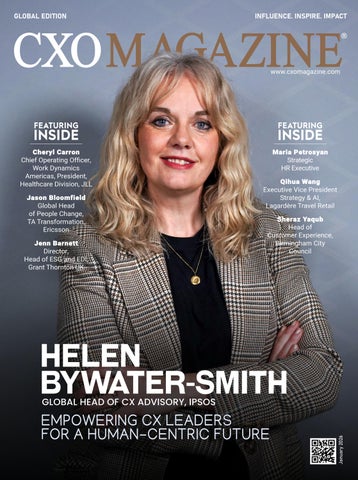
CXO Magazine – January 2026

Page 1


FEATURING INSIDE

Cheryl Carron Chief Operating Officer, Work Dynamics Americas, President, Healthcare Division, JLL

Jason Bloomfield Global Head of People Change, TA Transformation, Ericsson

Jenn Barnett Director, Head of ESG and EDI, Grant Thornton UK

FEATURING INSIDE

Maria Petrosyan Strategic HR Executive

Qihua Wang Executive Vice President Strategy & AI, Lagardère Travel Retail Sheraz Yaqub Head of Customer Experience, Birmingham City Council

HELEN BYWATER-SMITH

GLOBAL HEAD OF CX ADVISORY, IPSOS

EMPOWERING CX LEADERS FOR A HUMAN-CENTRIC FUTURE

SUBSCRIBE FREE

Managing

Editor Consultant Editors

Art & Design

Branding & Marketing Partnership

Sarath

Emma

Sabrina

Naomi

Andrew

Free Subscription www.cxomagazine.com

Charlie

Louis

Shirley

Jennifer

Monica

Rachel

WHEN EXPERIENCE STARTS PAYING THE BILLS

Not long ago, competitive advantage was defined by sharper pricing, faster delivery, or a larger footprint. Those things still matter, but they no longer seal the deal on their own. What people remember today is how a brand made them feel. We have all faced that moment. Two companies offer the same product at nearly the same price. One leaves you frustrated or unheard. The other makes the process simple, respectful, and human. The decision becomes easy, and it has very little to do with cost.

This shift is not emotional thinking. It is sound business strategy. Research consistently shows that customers are willing to pay more for better experiences and that loyalty grows from trust, not features. Yet many organizations still treat experience as a supporting act rather than a central business driver. The real challenge is no longer access to customer data. It is the ability to turn insight into everyday decisions that actually improve lives.

That is what makes our January 2026 cover story so timely. In our conversation with Helen Bywater-Smith, Global Head of CX Advisory at Ipsos, we explore what it truly takes to make experience a competitive currency. Working across 90 markets, Helen helps organizations move beyond surface-level metrics and embed customer understanding into how decisions are made. She speaks thoughtfully about designing experiences that deliver measurable returns while still honoring the emotional side of human behavior.

What stands out in this conversation is balance. Alongside systems thinking, journey mapping, and neuroscience, Helen shares her personal journey, her interests beyond work, and the values that guide her leadership. It is a reminder that meaningful experiences are always shaped by people long before they reach customers.

This issue of CXO Magazine also brings together a diverse mix of perspectives from business leaders, practitioners, and academics. Each explores experience from a different lens, whether leadership, culture, technology, or purpose.

As you dive into this issue, I hope it prompts you to reflect on the experiences you create every day, for customers, colleagues, and communities alike. In a crowded world, experience is no longer a nice-to-have. It is the advantage. Enjoy Reading.

HELEN BYWATER-SMITH

GLOBAL HEAD OF CX ADVISORY, IPSOS

EMPOWERING CX LEADERS FOR A HUMAN-CENTRIC FUTURE

18

Qihua Wang, Executive Vice President Strategy & AI, Lagardère Travel Retail A Strategic Leader’s Blueprint for AI Transformation & Global Governance

INTERVIEW

28

Jason Bloomfield, Global Head of People Change & TA Transformation, Ericsson

Transforming Talent Acquisition and AI Strategy

34 Cheryl Carron, Chief Operating Officer, Work Dynamics Americas & President, Healthcare Division, JLL

Building a Better Tomorrow through Innovation

42 Maria Petrosyan, Strategic HR Executive Driving Transformation through HR

48 Jenn Barnett, Director, Head of ESG and EDI, Grant Thornton UK

Empowering Leaders for a Better Tomorrow INTERVIEW

54

Sheraz Yaqub, Head of Customer Experience, Birmingham City Council

Empowering Communities with Digital Innovation

COVER STORY

HELEN BYWATER-SMITH

GLOBAL HEAD OF CX ADVISORY, IPSOS

EMPOWERING CX LEADERS FOR A HUMAN-CENTRIC FUTURE

Helen Bywater-Smith is the Global CX Advisory Lead at Ipsos. She works with Ipsos teams across 90 markets, shaping advisory solutions that integrate with CX programmes. These solutions help clients become customer-centric, hardwire CX data into decisions, and design experiences that deliver ROCXI (Return on CX Investment).

With over 20 years’ experience, she blends qualitative expertise, humancentred design, systems thinking, and neuropsychology with tools like journey mapping and workshop facilitation. Helen co-developed the Forces of CX framework, holds a degree in Marketing, a diploma in Neuropsychology, HumanCentred Design and UX credentials. She is an Associate Lecturer on Service Design at the University of Warwick and speaks globally on CX and HI + AI about designing experiences that create emotional attachment and long-term memories. She co-hosts The Ipsos Experience Perspective podcast on CX topics. Recently, in an exclusive interview with CXO Magazine, Helen shared insights into her career path, the future of CX, and her passion for creating emotional connections with customers. She also shared her personal hobbies and interests, future plans, words of wisdom, and much more. The following excerpts are taken from the interview.

Hi Helen. Can you walk us through your career path and how you ended up in CX?

Ever since I can remember, customer experience has been a thread running through my life. My mum worked in a bank, and through her, I saw the impact great service has on people’s lives and the relationships it builds. Additionally, my brother is blind, so growing up, I experienced the world alongside him; being his eyes in all experiences taught me to critically view every interaction through an accessibility lens. From both these perspectives, I observed

the impact of customer experience from the colleagues providing the service and the customers receiving it.

As a teenager, I took on front-line and behind-the-scenes roles in hotels, restaurants, and retail. I loved serving people. I studied Marketing at university and specialised in qualitative research because I enjoy open conversations, getting under the skin of people’s lives, surfacing insights, and feeding them into business strategy. I worked as a qualitative specialist in boutique agencies and joined Synovate, which Ipsos acquired, as I wanted to work for a global insights agency.

My first dedicated CX project at Ipsos was a multinational journey-mapping programme for a fuel retailer. I was then asked to take those insights across the client business, inspiring teams to put the customer front and centre in experience design and delivery. That’s where my passion for working in CX really took off. I could see the connections between Brand, Marketing, Operations, and the end-to-end customer journey.

With a vision to bring qualitative depth to quantitative CX programmes, I left the Qualitative team and joined CX to form an Advisory practice. We integrated journey

mapping, co-creation workshops, service design, and CX programme optimisation to drive actionable insights from the data.

Drawing on my knowledge of customer emotional understanding from the Qualitative team, I co-developed the Forces of CX framework, which identifies six key dimensions that are crucial for building strong customer relationships and driving financial performance. This is now embedded across our markets and programmes, from CX measurement and management to design and delivery.

As the UK team grew in strength, I was invited to join the global team at Ipsos. Today,

Drawing on my knowledge of customer emotional understanding from the Qualitative team, I co-developed the Forces of CX framework, which identifies six key dimensions that are crucial for building strong customer relationships and driving financial performance

I lead our CX Advisory solutions across 90 markets. Our advisory work is integrated with our CX programmes, helping clients become more customer-centric, embed CX data in decision-making and prioritisation, and design experiences that deliver a clear return on CX investment.

What do you love the most about your current role?

What I love most is the variety and the constant learning. Working across 90 markets from Peru to New Zealand and everywhere in between, I get to partner with fantastic teams, brands, and clients, and through them, listen to customers

I expect a reset with renewed training, coaching, and empowerment, where AI co-pilots handle routine tasks and humans focus on the moments that truly matter, with clear guardrails and seamless hand-offs

from all backgrounds. In the morning, I might be supporting our team in rethinking banking journeys in Malaysia; by the afternoon, I’m helping design a CX Maturity programme for an airline in Latin America. With so much innovation in our industry and our company, every day is a school day. I’m endlessly curious

and always looking for the 'why behind the why'. I’ve stayed an absolute “Quallie” at heart.

Within Ipsos, I coach team members on their career journeys and specialise in parental coaching. Balancing parenting, life, and work can be challenging, and I find fulfilment in providing individuals with the opportunity to reflect and design their ideal lives, enabling them to bring their best selves as parents and colleagues. Additionally, coaching skills help me in interviews with stakeholders and frontline and in facilitating workshops.

Alongside my role, I am an Associate Lecturer on Service Design, a module I codesigned, at the University of Warwick. Spending time with students and younger generations is energising; they teach me as much as I teach them.

Ultimately, my passion is seeing and helping people grow and improve. Whether it's my colleagues, those I coach and train internally, or the students, clients, and frontline teams I interact with externally.

What do you think is the future of CX, and how do you see the field evolving in the next 5-10 years?

AI is accelerating, especially agentic commerce, where AI agents conduct transactions and solve problems on behalf of customers and brands. But we can’t take our eyes off the human. At Ipsos, our mantra is HI + AI: Human Intelligence plus Artificial Intelligence. AI will enhance experiences but won’t entirely replace them.

CX and Employee Experience (EX) have always been intertwined, but we’ll see teams, and the data we analyse, come even closer together. As a new generation of frontline talent arrives, we must ensure traditional

The biggest misconception is that CX is one person's job or one team’s responsibility. Everyone has a role to play

service standards don’t slip. I expect a reset with renewed training, coaching, and empowerment, where AI co-pilots handle routine tasks and humans focus on the moments that truly matter, with clear guardrails and seamless hand-offs. As a client once told me, “Humans will always electrify experiences.”

CX will be hybrid and measured more through a mix of research, behavioural and conversational signals. Different kinds of data will be used to provide a more holistic picture, and the approach will be inclusive by design. The goal stays the same: turning insight into action that customers can feel and businesses can measure.

What do you think is the biggest misconception about CX, and how do you work to dispel this myth?

The biggest misconception is that CX is one person's job or one team’s responsibility. Everyone has a role to play. It’s far more than managing KPIs and dashboards; it’s about building a culture that runs from the C-suite to the contact centre, frontline, operations, and to cleaning teams.

When the whole system works together, it drives the right behaviours at every touchpoint, creates emotional attachment, builds memories, turns customers into authentic advocates, and keeps them coming back.

CX obsession should really be people obsession, for colleagues and customers, and must start at the top and be a collective responsibility across the organisation. I recently heard of a CEO who moved the contact centre onto the executive floor so leaders could literally sit with the voice of the customer. That kind of visible respect for CX, and for the people serving customers every day, should be front and centre of a CEO’s remit.

What do you think is the most important quality for a CX professional to have, and why?

People often say “empathy.” However, I’d go one step further: compassion. Empathy is understanding how someone feels; compassion is the motivation to act on it. It’s proactive and solution-oriented, turning insight into action that improves customer outcomes and business results. Service design embodies this philosophy, and it’s what I aim for in every client project, building compassion from human insight that catalyses action and creates measurable impact.

Second is systems thinking. The ability to visualise how your organisation delivers the experience end-to-end, bridge teams and silos, and align people, processes, tech, and data so the brand promise matches operational reality.

Third is communication and influence. CX must work across every level, so you need to tailor the message, from a one-pager for the CEO to clear frontline behaviours, translating data into stories, listening well, and building coalitions to get change done.

Together, compassion, systems thinking, and clear communication turn CX from managing KPIs and dashboards into managing a discipline.

Congratulations on being recognised as one of the Top 40 CX Leaders to follow in 2026 from across the world. Our readers would love to know the secret mantra behind your success.

Thank you. I’m proud to be included, and congratulations to the other 39 inspiring leaders too. My mantra is simple: “Be the solution.” If I can’t help, I’ll help you find the person who can.

Every day I look for how to improve things. For the Ipsos teams I work with, for our clients, and most importantly for their frontline teams and customers. I genuinely want the teams I work with and our clients to be personally successful, brands to be profitable, and colleagues and customers’ lives to be easier because of the work we do.

Can you share a book, podcast, or resource that has inspired you recently?

I’ve been especially inspired by the book ‘Belonging: The Ancient Code of Togetherness’ by Owen Eastwood. It helped shape the Service Design course I co-designed at the University of Warwick. Eastwood draws on the South African philosophy of Ubuntu, “I am because we are” and the Māori concept of Whakapapa, our interwoven genealogy across people, place, and time. That lens of belonging, which is also one of our Forces of CX, is vital in CX: we share responsibility for how we connect our teams and the customers we serve, and for designing inclusive experiences that build trust and attachment.

In terms of podcast, I have to take the opportunity to plug our podcast, Ipsos Experience Perspective, where we dig into CX, EX and Mystery Shopping with practitioners and clients from across the world. Beyond that, I’m a fan of Mel Robbins for her tools to help you take action and ‘Diary of a CEO’ for its thoughtful, in-depth conversations on leadership, habits, and purpose.

What are some of your passions outside of work? What do you like to do in your time off?

Outside work, we have an extremely busy household. I’m first and foremost a mum of

two teenagers, which means my husband and I share the roles of family chauffeur, cook, sports cheerleaders, performance watchers, and PTA helpers.

I’ve also recently become a dog-mum, and my highly energetic cocker spaniel, Freyja, makes sure I never miss my step count. I recharge through Pilates, the gym, and meditation. I’ve learned that protecting that time helps me reset, and everyone benefits. I’m an avid reader and love book recommendations: business, fiction, history.

I’m also passionate about community and have co-founded a Residents' Association for the area we live in, connecting different generations, council members, and local initiatives.

What is your biggest goal? Where do you see yourself in 5 years from now?

As I mentioned earlier, every day is a school day, and with so much change in our industry, there’s still plenty I want to do in this role.

I love the team I’m in and the people I work with across markets, and I’m excited for the future of CX.

Over the next five years, I’m focused on:

- Deepening and expanding our HI + AI CX Advisory across our 90 markets, embedding the Forces of CX and moving more insight into action that customers feel and that grows businesses' top line.

- Outside of my day-to-day role, I’d like to take on a few special projects linked to my role with universities and institutes, co-designing

modules, creating pathways, and mentoring to inspire more people into the field.

- Continuing coaching within Ipsos and launching a programme for parents from underserved communities, especially those with limited access to support networks. Parenting doesn’t come with a handbook, and so many parents feel isolated. Ensuring parents feel supported benefits all children.

If in five years I can point to business growth, stronger client outcomes, a broader, more diverse CX talent pipeline and a coaching programme that’s made a tangible difference, I’ll be proud of the progress.

What advice would you give to someone just starting out in their CX career?

Learn to listen, properly. Qualitative listening is a real skill that you should invest in learning, as well as understanding quantitative methods too; but know that open-ended responses do not equal true qualitative insight.

Tune into people’s words, silences, body language, pauses, and tone. AI will take us so far, but it won’t replace real human understanding and compassion. Get out from behind your screens and go and meet your customers in their homes and places of work.

Finally, get close to your frontline operation too. I like to say they are the “souls of your business” as they know better than anyone what’s working well and what isn’t, so listen to them and learn how to support them better.

A Strategic Leader’s Blueprint for AI Transformation & Global Governance

Qihua (Mia) Wang is a senior leader in strategy, AI, and transformation with experience across Europe and Asia. Her career spans global consulting and corporate roles, where she built AI capabilities, led major strategic initiatives, and supported enterprise-wide change.

She founded Lighthouse Planet, a professional development platform serving young Chinese professionals worldwide, and is also a thought leader, coach, and speaker on AI.

Recently, in an exclusive interview with CXO Magazine, Qihua shared insights into the future of AI transformation and its impact on businesses and society. She also shared her personal hobbies and interests, significant career milestones, words of wisdom, and much more. The following excerpts are taken from the interview.

Qihua, your career spans continents and disciplines. How did you move from traditional strategic consulting to leading AI transformation?

I started my career in Strategic Consulting, working with global clients at firms like Oliver Wyman. That experience was invaluable—it taught me the rigor of structured problemsolving, the precision of communication, stakeholder management and the ability to dissect complex business challenges into actionable strategies.

But I knew I had to ride the wave of the future. Coming from China, I had a front-row seat to a different speed of digital adoption. I realized that if I wanted to remain relevant, I couldn't just understand the market; I had to embrace the trends and understand the engine driving it.

After I took on the role of Global Head of Strategy at Lagardère Travel Retail, I led the firm's five-year strategic planning and the operationalization of that plan. When the Generative AI wave broke in late 2022, I recognized it immediately as a structural shift, not a hype cycle.

I didn't wait for a mandate to explore Artificial Intelligence. Instead, I took ownership of the entire AI value chain: I built the division from the ground up, designed the strategy, delivered the actual AI solutions and agents, and established the end-to-end governance. It was about securing a competitive edge before the market dictated we had to. Today, we have a pretty advanced AI governance framework and we have achieved a best-in-class daily AI adoption rate across operations.

I must thank Lagardère Travel Retail's top management for demonstrating incredible

foresight and trust by giving me the autonomy to start this adventure.

How can AI create values for companies today?

We can see AI creating value at three levels with different approachs:

At the individual level, the focus is on building foundational skills and enabling employees to use internal AI tools like Copilot or Google workspace effectively. This ensures everyone can integrate AI into their daily work.

At the departmental level, AI drives efficiency through small automations, teamspecific use cases, and bespoke machine learning projects, helping teams streamline processes and make better decisions.

Finally, at the organizational level, AI delivers the greatest impact by embedding intelligence into core workflows—such as modern data platforms, end-to-end product

information management, and automated IT support—creating scalable transformation and competitive advantage. The key is to start small, build capabilities, and scale strategically. But usually to reach this level we need heavy investment and transformation on technology and organization level.

The first individual level is what firms usually underestimate that I believe is the foundation and can already create significant value.

What is your approach to identify and design AI projects? How do you turn technological potential into operational reality?

There are usually three blocks of work we need to do to implement an AI project:

1. Defining Strategic Value (The 'What'): Value Stream Diagnosis: We mandate a business-first approach, deeply embedding with functions to diagnose root-cause friction

Today, we have a pretty advanced AI governance framework and we have achieved a best-in-class daily AI adoption rate across operations

points and translate them directly into highvalue AI use cases.

Feasibility and Value Assessment: This involves a rigorous assessment of current technology trends and limitations. We must know what AI can and cannot yet do to ensure the selected use cases are feasible and deliver maximum ROI.

2. End-to-End Orchestration (The 'How'):

Solution Delivery: This is the operational core—designing the technical architecture, orchestrating the data infrastructure, and delivering the actual AI solutions and intelligent agents that solve the prioritized use cases.

Governance and Alignment: Strategic Governance: Responsible scaling is nonnegotiable. I established a high-stakes AI Steering Committee, composed of top decisionmakers and business owners, to ensure joint ownership, ethical oversight, and complete alignment of all initiatives with the five-year strategic plan.

3. Cultural and Human Enablement:

Cultural Adoption Mandate: We drive commitment by securing executive buy-in and leading continuous cultural enablement— actively managing friction, providing bespoke training, and ensuring every team member is equipped to succeed. This is the engine of our best-in-class daily adoption rate.

As an executive, what is the most critical misunderstanding you see regarding AI ?

There are many misconceptions I see. Mostly due to lack of knowledge of AI or operational experience in AI projects.

One common myth is that AI is an IT topic or tech topic. It is, but only for tech companies.

For established organizations, AI is a business transformation mandate that happens to use technology. Crucially, the governance and organizational structure of the AI program often have a greater impact on final results than the technology itself.

People often focus on the "shiny" 30%— the algorithms and the tools. But the success of an AI strategy relies 70% on people. It relies on governance, on fixing process issues, on upskilling, and fundamentally, on trust. If you build a powerful tool but your teams are not using it, or don't know how to use it, your ROI is zero.

People often focus on the "shiny" 30%—the algorithms and the tools. But the success of an AI strategy relies 70% on people

I treat AI transformation as a change management project first. You have to anchor the strategy in the human element. If you can't bring the people along, the technology doesn't matter.

Focusing beyond the corporate world, what is the single most important thing people should know about AI's impact? What I really want to say is: whatever you do, whoever you are, learn about AI.

For the next generation, AI will act as the ultimate amplifier, but it’s a doubleedged sword. I learned English myself when I was young because of lack of access to English teachers. No one will live through

that again. For students who are curious and disciplined, AI is the best teacher. It allows for unprecedented acceleration. But for those who lack that inner drive, who rely on the tool to solve the problem for them, AI risks eroding their capacity for deep thinking and true problem-solving. This creates a massive gap in cognitive capability that our current education system is not prepared to handle.

Ultimately, we have reached the point where we cannot afford to ignore or avoid this topic. The world our children will inherit is fundamentally different from the one we grew up in, and we are responsible for setting their trajectory. The earlier we, as individuals,

choose to learn, engage, and adapt, the more actively we can choose to shape AI, rather than simply being shaped by it.

What are some of your passions outside of work? What do you like to do in your time off?

I actually founded a global network for young Chinese professionals. This began during the 2020 lockdown when I realized the need to connect with people. I founded "Lighthouse Planet," a platform dedicated to coaching young Chinese professionals building careers abroad.

Having personally navigated the cultural challenges of integrating into French society, I understand the struggle to overcome—the soft skills, networking, and communication required to break through the executive leadership ceiling. I coached more than 300 brilliant young talents and many of them have taken leadership position today. They are not only my mentees but some of them are my close friends today. Whereever I travel to, I can find someone I’ve coached and we’d meet up for dinner. It’s an amazing feeling.

Your experience as coach is very interesting. How does this impact your professional life?

The two facets of my life are mutually beneficial, unified by the art of translation and empathy.

I basically function as a translator across multiple divides: converting complex technical capabilities into clear business strategy, and bridging cultural values (East and West). I excel in communication because I've repeatedly simplified complexity and navigated cultural gaps.

Ultimately, both roles hinge on people and change management. I recognize the difficulty in asking an organization to fundamentally change; therefore, I focus on the people. Success is driven by adoption, which requires deep trust and cultural sensitivity. My coaching work confirms that a mindset shift is consistently more critical than upskilling a specific technical skill, which is also what I witness in corporate transformation projects.

What is the highlight of your career so far?

The highlight is probably having built the AI division at Lagardère Travel Retail from a blank page.

The hardest part was securing genuine commitment from all high-level stakeholders and driving the necessary organizational change for a new, complex topic within a large enterprise. It wasn't a project I was assigned; it was a future I advocated for. I had to build the business case, deliver the first use cases, secure the budget, and build the team. We defined a roadmap of over sixty GenAI and Predictive AI use cases. To go from zero to a fully operational, valuegenerating division is a testament to the entrepreneurial mindset I value most.

Recently, speaking at the Adopt AI Summit at the Grand Palais was a special moment. Grand Palais Paris is one of my favorite historical monuments that I visit often with my family. Standing on that

My coaching work confirms that a mindset shift is consistently more critical than upskilling a specific technical skill, which is also what I witness in corporate transformation projects

Stop trying to compete with the machine on computation, and start competing on humanity

stage, sharing the work we’d done, provided a powerful, personal validation of the strategic risk I took.

Can you share a book, podcast, or resource that has inspired you recently?

Recently I’ve been listening to “Acquired.”

It’s a great podcast focused on the business model evolution of big corporates, delivered with incredibly powerful narrative storytelling. It consistently reinforces the idea that true, structural success comes from designing resilient business models, which is precisely the long-term goal of any solid AI strategy.

What is your advice for professionals who want to future-proof their careers?

Stop trying to compete with the machine on computation, and start competing on humanity.

If you are a technical expert, learn to speak the language of business. If you are a business leader, learn the fundamentals of data. But above all, become a Strategic Translator. The market is flooded with specialists, but it is starving for people who can connect the dots.

Be the person who bridges the gap, who can explain why a technology matters and how it serves the human mission of the company. That is a position AI cannot automate.

Transforming Talent Acquisition and AI Strategy

Jason Bloomfield is a strategic operations and transformation executive with over 15 years of experience leading large-scale business transformation, AI enablement, operational excellence, and enterprise change programs on both sides of the Atlantic. He has a proven ability to translate C-suite vision into actionable roadmaps and measurable business outcomes. He has thrived in cross-functional leadership, digital innovation, data-driven decision-making, and stakeholder engagement across technology, telecom, financial services, and digital industries. Most importantly, he has a passion and record of building high-performing teams and actively contributing to their career growth. He is a thought leader and public speaker across Europe, UK and US.

Recently, in an exclusive interview with CXO Magazine, Jason shared insights into his career journey, the role of AI in recruitment and talent management, and his approach to leadership. He discussed how his early experiences in tech and marketing shaped his career, and how he's driven to make a meaningful impact in his current role. Jason also emphasized the importance of empathy, creativity, and continuous learning in driving business success and employee satisfaction. The following excerpts are taken from the interview.

Global Head of People Change & TA Transformation, Ericsson

Jason Bloomfield

Hi Jason. Can you tell me about your career path and how you got to where you are today?

My first career interests were technology and marketing.

As a kid in the suburbs my first corporate job was as an hourly-wage person supporting financial advisers with their tech needs. And clearly something was done right; getting the attention of corporate HQ in New York City where I was offered a regional role and from there roles of increasing scope and span including driving a $2.3b multinational M&A integration, building and leading a PMO of 60, scaling new product and distribution channels by 40% and driving multi-million dollar digital

transformation strategy initiatives globally.

When I relocated to the UK and shifted focus from NYC to London, I sought to change industry. I was hungry to learn all-new challenges and opportunities. On this side of the Atlantic I have delivered 50% efficiency gains across 12 markets, accelerated planning cadence from 9 months to 90 days, built and scaled a service design capability across a £63m portfolio within my first five years here.

And most recently? Another industry change, and, my first time working for a Swedish company where I’m very proud to have program managed a generational transformation of our talent acquisition capability – this was under NDA and in just 90 days we divested

from two global RPOs, drove process and knowledge transfer, managed the onboarding of more than 180 new employees while caring for decisions and risks across 8 SME centers of excellence. That’s just secondment! My core role is accountable for improving our employee experience across our digital HR stack; and there I crafted and then executed a strategy that has increased satisfaction between 57% and 81% since 2022.

What do you love the most about your current role?

I love learning, and have learned an incredible amount about how to care for HR capabilities at a 149 year old company with 94k employees

across 140 countries. I was familiar with commercial differences across regions but less so HR differences and so learning and navigating these has been a great experience.

What role do you see AI playing in the future of recruitment and talent management?

It’s the present, not, the future...right now AI is already playing a key role across both streams but the difference I see between today and tomorrow is focus and approach.

Now? There is a lazy rationale and focus on avoidance and reduction; I believe this must change to a higher-effort but more powerful outcome that is both creative and additive in

We see SaaS vendors seeking to charge additional money for using AI in a way that reminds me of the antiquated model we all used to pay per text message – in my mind either AI is included or a competitor will earn my business

terms of both profit margin and retention because our human employees will love their jobs more – outsourcing or delegating annoying things to a digital direct-report. Ignorance will say this can be done without change management; that is a warning sign if you hear it and preview of an outcome where adoption and ROI will fall short of expectations.

This brings me to the change in approach; as of today the landscape is largely generative and agentic is emerging. We see SaaS vendors seeking to charge additional money for using AI in a way that reminds me of the antiquated model we all used to pay per text message – in my mind either AI is included or a competitor will earn my business. Your new UI will be oddly like a much older UI – back before Windows and MacOS – a text prompt as your starting point.

How do you stay current with the latest trends and technologies in your field?

First comes mindset; it’s not a burden but rather a joy for me to read (including CXO Magazine) and engage with conferences and podcasts. The idea of an echo chamber scares the hell out of me, and has always driven me to seek out diverse perspectives across industries. Every team I’ve built, I’ve recruited skills from outside of industry, this helps to spur innovation. Strategy fascinates me as it calls upon both fact and imagination – left brain, right brain.

What were some key milestones or experiences that shaped your professional journey?

2 come to mind. . .the first takes me back to the suburbs, prior to my job supporting financial advisers. I was working at a family-owned

mortgage company with no path for career progression as family members were incumbents and so I gave notice. The principal owner didn’t offer encouragement or congratulations to the then 20-year old Jason, instead he said of the global company in New York City that I was joining “You won’t last 4 weeks there; you’ll get lost there.” Guess what? He was right. I wouldn’t last 4 weeks, instead it was 17 fantastic years and during that time I held multinational senior leadership roles in strategy, operations, technology and also commercial.

The second that comes to mind was the result of taking an Innovation mini-MBA via Google which introduced me to design thinking. It was just lightning; it offered a framework for how I intuitively had approached situations but now I could better scale. Design thinking demands empathy, insights, listening and never being married to a solution; let the facts guide your way.

Is there a particular person you are grateful for who helped get you to where you are?

I’m afraid I need to mention not one but two people. The first is my mom who always drilled into me and my siblings the importance of work ethic. The second is that family business owner who told me if I left I wouldn’t succeed; proving his ignorance was ironically a tremendous professional motivator. It’s like a sports team putting up a negative media quote in the locker room for motivation.

What are some of your passions outside of work? What do you like to do in your time off?

The answer here is one in the same – my family. Outside of work what I like to do most is be

5 years from now I see myself driving differentiated strategy which delivers differentiated outcomes on a global scale; developing and stretching fantastic teams along the way

present and create lasting memories for my children alongside my wife. Intentionally I now actively manage work/life balance which is a great place to be.

What is your favorite quote?

This has changed over time. Currently my favorite quote is by a French mathematician named Blaise Pascal; it’s sometimes attributed to others but as best I can tell he is the originator in 1657: “If I had more time, I would write you a shorter letter.” For me, this reminds and drives me to simplify any and everything for my stakeholders and customers, [relentlessly] on their behalf.

What is your biggest goal? Where do you see yourself in 5 years from now?

I’ll tell you what is not my goal or role - I’m not interested in ‘BAU’ or ‘keeping the lights on’. I am not interested in just one role, one region, or just one industry.

5 years from now I see myself driving differentiated strategy which delivers differentiated outcomes on a global scale; developing and stretching fantastic teams along the way.

What advice would you give to others who are looking to pursue a career in a similar field?

Don’t just hear. . .listen.

Accomplishment is a team sport and any given role or player can have a profound impact on the outcome. Welcome the strange, the ambiguous, the unfamiliar as it will summon you to develop skills and strategies in unexpected ways. From there it’s about what resonates with you and your professional passion; the great news is that your growth is transferable and knows no limit.

Building a Better Tomorrow through Innovation

Cheryl Carron is Chief Operating Officer of Work Dynamics Americas and President of JLL’s Healthcare Division. As COO, Cheryl works in partnership with the CEO to define regional operational and business strategy, manage governance, drive operational excellence and performance, evolve talent and promote growth and productivity. As the President of JLL’s Healthcare business, Cheryl leads and evolves JLL products and services to meet the needs of health systems while developing and delivering scalable real estate solutions to improve the customer, patient, and team experience. She leads 2,300+ specialists who improve client outcomes through real estate and technology outsourcing solutions.

Recently, in an exclusive interview with CXO Magazine, Cheryl shared insights into her journey in commercial real estate, the power of data-driven decisions, and her advice for finding passion and purpose. She also shared her personal hobbies and interests, future plans, pearls of wisdom, and much more. The following excerpts are taken from the interview.

Hi Cheryl. What initially sparked your interest in the commercial real estate and facilities management industry, and what keeps you passionate about it today?

I originally planned to go into management consulting and was all set to pursue this route when an opportunity to go into real estate came along. It not only provided me the client interaction I was looking for but also gave me the ability to directly impact their business in a real and meaningful way. So, I took the leap!

Over the course of my career, I’ve had incredible opportunities to work all over the world

across diverse services, products and industries in the commercial real estate space. What keeps me passionate is the constant evolution of the industry and how every day is different. Whether it’s new technology, macro-economic shifts or climate change, it all impacts our industry, and each challenge helps me grow and expand my perspective, knowledge and impact.

What do you love the most about your current role?

What I love most about my role is bringing teams together to tackle complex challenges for our clients and our teams at JLL. I’m driven by

growth and enabling team members to achieve more together than they could alone.

What do you think is the most pressing issue facing businesses today, and how can the commercial real estate and facilities management industry help address it?

Businesses are navigating rapid AI-driven transformation that is reshaping operations and accelerating the need to innovate. In commercial real estate and facilities management, we play a pivotal role in creating processes and tools that optimize building performance and

efficiency, while equipping the workforce with training and skills to lead through these transformations. More roles than ever are interacting with AI and even as technology advances, people remain the critical factor in turning AI’s potential into real value.

Can you share your thoughts on the role of data and analytics in driving business decisions, and how the industry is using data to inform its strategy?

Data and analytics are central to driving smarter, more informed business decisions. Today’s building management systems generate

In commercial real estate and facilities management, we play a pivotal role in creating processes and tools that optimize building performance and efficiency, while equipping the workforce with training and skills to lead through these transformations

vast amounts of information, and when paired with AI, they enable more accurate predictions and efficient operations. For example, we have a Fortune 100 client that uses Corrigo, our facilities management platform that provides real-time data. With this platform, we have digitized workflows to process over 600 work orders per week, achieving significant savings and improvement in work order response times.

To use data effectively for strategy, defining clear objectives and ensuring data quality is critical. It has the power to drive more confident decision-making – from enabling predictive maintenance and automating routine building tasks to optimizing space design and utilization and to overall portfolio planning.

What are the most important qualities or skills you think leaders in the industry should possess, and how can they develop these?

I find that successful leaders embrace continuous learning and regularly seek new ideas and diverse perspectives. These qualities naturally lend themselves to a collaborative mindset, which is just as important. To develop these qualities and skills, I would encourage leaders to take on new challenges outside of their comfort zone and actively invest in connections with peers, partners and clients. Change is constant: lean into it, it will make you better.

What mentors or role models have had a significant impact on your career?

There are too many to count! I’m fortunate to have former bosses, colleagues and clients among the list of people who have influenced my career. I’ve had leaders and managers show me what I wanted to avoid in my own leadership

style and so many outstanding people who taught me the power of good leadership, how to guide teams through challenging times, foster development and embrace change with resilience. All of this has collectively help shape my career and who I have become as a leader. I am grateful for all of it.

Can you share a book, podcast, or resource that has inspired you recently?

I recently finished “The Crux” by Richard Rumelt. I love how it simplifies what business leaders and employees have struggled with for decades: solving critical challenges through

strategy. Get to the “crux” of the issue quickly, and do not avoid it – those leaders and companies that do so are the ones who will achieve success.

What are some of your passions outside of work? What do you like to do in your time off?

Outside of work, I enjoy spending time with my family and friends traveling mainly to Europe and the UK. I read anything that broadens my perspective and teaches me something new and keep active with cross country skiing in the winter months and hiking anytime, anywhere.

Today’s building management systems generate vast amounts of information, and when paired with AI, they enable more accurate predictions and efficient operations

I’m also passionate about community involvement and leadership development. I’ve been fortunate to serve as chair of the Milwaukee Ballet, a long-time board member with the United Way of Greater Milwaukee & Waukesha County and as an emeritus member of the Women’s Leadership Council, which focuses on issues impacting women and girls.

What is your biggest goal? Where do you see yourself in 5 years from now?

I’m focused on remaining relevant and strengthening our position in the markets we choose to operate. Technology is a powerful

Technology is a powerful force across all industries and using it effectively is essential to evolving our people and business for today and tomorrow

force across all industries and using it effectively is essential to evolving our people and business for today and tomorrow.

While five years seems like a lifetime these days, I would say my aim is continuous growth and evolution, in my personal and professional life.

What advice would you give to others who may be struggling to find their passion or purpose?

Finding your passion or purpose often starts with self-reflection: Take time to notice what

truly energizes you and where you naturally thrive. Stay open to new opportunities and challenges, as every experience teaches you something valuable and can lead you to paths you never knew existed. Seek out mentors and colleagues across different parts of your organization; their perspectives can inspire new ideas and help you see your strengths in a new light. And commit to continuous learning — cultivating curiosity and adaptability is one of the most powerful ways to discover, and continually evolve, your sense of purpose.

Wa n t t o S e l l o r fi n d

I nve s t o rs f o r yo u r

B u s i n e s s ?

Driving Transformation through HR

Maria Petrosyan is a strategic HR executive and organizational development professional with over 20 years of leadership across multinational corporations, NGOs, hospitality, and academia. She has held senior roles at Synopsys, Pepsi, and World Vision, and taught Strategic HRM at the American University of Armenia, driving transformation, talent development, and cultural change. With a Master’s in Oriental Studies and executive education from UC Berkeley, Yale, and Oxford, Maria blends global insight with innovative, humancentric leadership. Passionate about building agile organizations, she partners with businesses to align people strategies, integrate AIdriven solutions, and deliver sustainable impact.

Recently, in an exclusive interview with CXO Magazine, Maria shared insights into her journey in HR, the evolving world of work, and her passion for driving transformation and impact. She also shared her personal hobbies and interests, future plans, words of wisdom, and much more. The following excerpts are taken from the interview.

Hi Maria. What motivated you to pursue a career in HR?

In the early days of my career, I did not envision myself working in HR. What I did know, however, was that whatever path I chose had to be impactful and bring meaningful change to the reality around me. Life often presents opportunities we may not actively seek, and the key lies in having the intuition to recognize them. One such opportunity was my transition into the HR domain. What has motivated me to remain in this field is the profound ability to create impact — not only by driving organizational progress but also by influencing people’s lives in a positive and lasting way. HR leadership carries both a responsibility and a privilege: the chance to shape cultures, foster agility, and build environments where individuals and organizations can thrive together. This opportunity to create something both beautiful and transformative continues to inspire my work every day.

What do you think are some of the most pressing issues facing organizations today, and how do you think HR can help address them?

Organizations today are navigating drastic market shifts that bring both challenges and opportunities. These shifts often translate into an enormous number of changes happening simultaneously — new structures, processes, and strategies introduced within compressed timeframes. Under such conditions, employees frequently face burnout as they struggle to comprehend, adapt to, and manage these transitions, all while operating in an environment of economic uncertainty.

This is where HR plays a pivotal role. Effective HR leadership ensures that change is not only managed but also embraced. By fostering a resilient organizational culture and transparent communication, HR helps employees adapt, engage, and ultimately drive transformation rather than resist it. HR leaders champion employee wellbeing, recognizing that no strategy or change initiative can succeed without employees actively supporting and propelling it forward.

In essence, HR is the bridge between organizational ambition and human capacity. By guiding change, nurturing culture, and safeguarding wellbeing, HR empowers organizations to remain agile and employees to thrive — turning disruption into sustainable progress.

What do you think are some of the most significant trends or changes in the world of work, and how do you think HR can help organizations adapt?

Two major trends are reshaping the world of work and require focused attention.

1. New Ways of Working

COVID19 proved that productivity is possible from anywhere. Remote and hybrid models are now part of reality, even for organizations that cannot fully adopt them. HR must help leaders manage these models effectively — ensuring compliance with local legislation, maintaining organizational effectiveness, and fostering social connections among dispersed teams. This shift demands upgraded management skills and innovative approaches to embedding corporate culture across all employees.

2. The Rise of Artificial Intelligence

AI is transforming roles, job scopes, and entire industries, often sparking employee insecurity. HR plays a critical role in guiding this cultural shift by investing in trust, clear communication, and continuous learning. By promoting psychological safety and helping employees see AI as a multiplier of human ingenuity, creativity, and critical thinking, HR enables adoption, experimentation, and innovation.

In essence, HR is the catalyst that helps organizations adapt to disruption — building cultures that are agile, and futureready.

Can you describe a mentor or role model who's had a significant impact on your career, and why?

HR leadership carries both a responsibility and a privilege: the chance to shape cultures, foster agility, and build environments where individuals and organizations can thrive together

Well, I’m not sure about a single role model, however there were people in my life who profoundly impacted my journey. My father taught me to look beyond immediate circumstances, to apply critical thinking when faced with challenges, and to believe in myself even when the path seemed daunting. Friends inspired me by trusting my abilities and leadership qualities, often reminding me of my own strengths when I felt overwhelmed. And my husband stood beside me as a great support, helping me balance the demands of raising two young children while working fulltime, consulting for the UN, and lecturing at the university.

I have the happiness of meeting great people on my path. Being surrounded by them, I learned resilience, courage, and the power of encouragement. Their influence has been a continuous reminder that with trust, and persistence, we can achieve heights we might never imagine possible.

The most important lesson I’ve learned is that you are the primary architect of your own career. No one else is more interested in your development than you

What do you think are some of the most important qualities or skills for HR professionals to have, and why?

I would suggest a blend of perseverance and the ability to truly listen as universal qualities. Beyond these, practicing critical thinking is essential — rules should never be seen as fixed, but rather as frameworks to be questioned, adapted, and aligned with the realities of the business. To add genuine value,

HR must deeply understand the organization it serves, ensuring that strategies, and actions are not only connected to business goals but actively drive them forward.

Equally important is the human dimension. HR leaders must recognize the impact that policies and strategies have on people. Without this awareness, even the most sophisticated plans risk remaining abstract ideas on paper. By balancing business acumen

with empathy, HR professionals can create environments where both organizations and employees thrive.

Can you share a book, podcast, or resource that has inspired you recently?

A book I am currently rereading is Homo Deus: A Brief History of Tomorrow by Yuval Noah Harari. With the rapid rise of AI in the HR domain, this book feels relevant as I reflect on how technology integrates into organizational systems and the challenges humans face in embracing it. Harari explores humanity’s pursuit of immortality and divinity, and raises profound questions about how data and algorithms may reshape our future. For me, the food for thought is how these ideas translate into HR: helping employees overcome resistance, fostering trust, and guiding organizations through cultural shifts so that AI becomes a multiplier of human ingenuity rather than a source of fear.

What are some of your passions outside of work? What do you like to do in your time off?

Outside of my professional life, I find joy in experiences that bring me closer to family and creativity. We often travel with family. It allows me to stay close with my kids, explore new cultures and perspectives while creating lasting memories together. I also enjoy cooking, often experimenting with new recipes and flavours — a way to combine creativity with care and connection. These passions help me recharge.

What is your biggest goal?

Where do you see yourself in 5 years from now?

At this stage of my career, with a wealth of knowledge and experience, I believe it is essential to give back to the community. Over the next years, I see part of my job to be contributing to the development of the next generation of leaders — lecturing at universities and supporting the lifelong education of professionals who have chosen HR as their domain. At the same time, I will continue partnering with and consulting major organizations to drive transformation and impact at scale. And amidst these professional aspirations, I aspire to remain a happy mother, celebrating the achievements of my children and promoting a right fit of both work and life.

What advice would you give to someone just starting out in their HR career?

The most important lesson I’ve learned is that you are the primary architect of your own career. No one else is more interested in your development than you. No one will shape your path for you — that responsibility lies with you. Where others may see obstacles or drama, train yourself to see possibilities. Progress often comes through consistent, small steps taken every day, each one building toward something greater. Believe in yourself, stay resilient, and you will find doors opening in places you never imagined. HR is a field of impact and transformation, and your confidence and initiative will be the keys to unlocking it.

Empowering Leaders for a Better Tomorrow

Jenn Barnett is a culture change specialist leading Equity, Diversity, Inclusion (EDI) and ESG for Grant Thornton. As a trained psychologist, executive leadership coach, and EDI expert, she designs and implements unique ESG and EDI strategy, focusing on reducing environmental impact and enabling an inclusive culture that prioritises well-being and community impact. Her priorities include governance, chairing diversity and sustainability boards, respectfully challenging behaviour, leading policy change, and leveraging technology to eliminate operational barriers. Previously, as People Experience Director, she shaped the employee value proposition and influenced leaders to enhance employee experiences. Jenn also held senior roles at Co-operative Group, BAE Systems, and BAA at Heathrow.

Recently, in an exclusive interview with CXO Magazine, Jenn shared insights into the importance of coaching and leadership development in driving business success and creating a positive impact. She also shared her personal hobbies and interests, future plans, words of wisdom, and much more. The following excerpts are taken from the interview.

Hi Jenn. What inspired you to specialize in culture change and leadership development?

Trying to understand the impact of my background on my mental health and my triggers to situations led me to study psychology in my bachelor's and master’s degrees, and more recently neuroscience. I then discovered fulfilment in helping organisations evolve and adapt to changing environments, creating positive workplace cultures and seeing the impact that could have on productivity, mental health and engagement. Leadership development focuses on nurturing individual skills and potential, enabling individuals to grow, adapt and develop and I believe this

creates resilience and healthy approaches to workplace dynamics. Culture change and leadership development help equip teams to navigate challenges, build personal resilience and embrace change positively, skills that are only increasing in importance as we move forward.

What do you love the most about your current role?

The variety, the challenges are all very different; and the impact my role can have on creating positive change. Where more people feel empowered and valued, they bring more to a business; and a confidence to help to solve complex issues and work together. I

Coaching instils a sense of accountability and responsibility, encouraging a results-oriented culture

believe this genuinely leads to better solutions for clients and a diverse mix of people helps us to have greater client affinity. I also love the communities we build that enable real conversations, education and vulnerability in the culture.

What role do you see coaching and leadership development playing in driving business success?

I think coaching instils a sense of accountability and responsibility, encouraging a resultsoriented culture. It also helps leaders to develop essential skills such as decision-making, communication, and emotional intelligence, which are vital for effective leadership. For individuals it creates the space to think. We rarely look after our mental health in the same way we do our physical fitness. I believe many of us can suffer from poor mental health, which can be event triggered, situational or longer term, and rarely do we talk about it or prioritise preventative measures. If we can learn to prioritise our mental fitness and create healthier and more sustainable habits, I think it can have an enormous impact on our overall strength and capability. That’s just one of the values I see in coaching.

What do you think is the biggest misconception about diversity and inclusion?

That having diverse teams means everyone automatically feels included and that it’s easy to fix. It’s hard because it requires the majority to shift to enable the minority to positively flourish and it requires an organisation to look at its whole system, which takes time to achieve. We still have work to do in levelling

up, understanding difference and being comfortable having tough conversations about exclusion and tackling this.

Congratulations on being recognized as one of the Top 100 Change Leaders 2025! Our readers would love to know the secret sauce behind your success. Thank you for your kind words. While I may not have a "secret sauce," my character stems from my background. Growing up in a small town near Chester-le-Street, after my parents divorced, I attended a Church of Englandfunded school in Durham, where my mum and I struggled with belonging due to wealth differences. Meeting Sam Friedman, author of "The Class Ceiling," resonated with me, when he described feeling like an imposter in a room of peers, when he started his career. These emotional triggers fuelled my determination, self-reliance, and my passion for addressing barriers that differences create.

Also, in 2018, I was diagnosed with Dermatomyositis, a rare condition affecting muscle strength and skin, which will be a lifelong challenge. Coming to terms with that was tough, but it instilled perspective, strength, humility, and perspective in me. I've developed successful strategies by focusing on what I can control, such as planning and preparation, staying informed, prioritising fitness, nutrition, rest, and my own mental health. While I can't control life's events, I can manage my response, which ultimately affects outcomes.

What mentors or role models have had a significant impact on your career?

I tend to have several role models and mentors in my life, for different reasons and at different

moments, so this is a hard question. One who had a significant impact on my career, was during my transition from Manager to Senior Manager. She stood out because she genuinely cared, she offered me valuable advice based on her own experiences, opened her network so that I could expand mine, and most importantly, she never sugar coated developmental feedback. She challenged me, she boosted me and she enabled me to believe in myself. When it mattered, she was true to her values and operated with integrity, and taught me a lot about the leader I wanted to be.

Can you share a book, podcast, or resource that has inspired you recently?

I love reading and learning and always grateful to receive a good book recommendation. A book that was memorable was "Atomic Habits" by James Clear. It focuses on the power of small changes and how they can lead to significant improvements over time. It offers practical strategies for building good habits and breaking bad ones.

What are some of your passions outside of work? What do you like to do in your time off?

I’m married and have two stepchildren and I love animals. I have a horse and a dog that I spend as much as possible with, they both have the added benefit of keeping me active and in the outdoors. I enjoy giving back, so I sit on the Board of Access Accountancy, and I am a trustee and chair of the HR Committee for Lord Taverner’s (a charity

supporting disabled children). I also mentor young people from deprived backgrounds through One Million Mentors and the Amos Bursary.

What is your biggest goal? Where do you see yourself in 5 years from now?

I think for me it’s about impact on others and creating a bigger contribution by deepening my professional skills and leading initiatives that have a positive impact on the people around me through mentoring, shared learning and developing new initiatives. I really enjoy executing complex culture change programmes, leading into the unknown and setting the direction for new areas, and I see that deepening as my work develops and my reach and impact on others continues to grow.

As a coach supervisor, what advice would you give to leaders looking to develop their coaching skills?

Be fully present during coaching conversations, that the biggest compliment you can pay to someone. This is one of the hardest skills to practice as a coach and it means not just hearing words but also understanding the emotions and intentions behind them. I tend to use techniques like playing back what I think I have heard to ensure clarity and asking powerful openended questions that enable reflection and deeper thinking. I encourage coaches to regularly evaluate coaching sessions; what went well, what could be improved, and what you learned about yourself as a coach. This ongoing reflection is key to personal growth.

Empowering Communities with Digital Innovation

Sheraz Yaqub is the Head of Customer Experience and Customer Programmes at Birmingham City Council. With over 20 years of experience in service transformation, he has been leading and pioneering initiatives in customer experience, digital innovation, including AI-driven customer support and voice automation. He has been recognised as one of the UK’s AI 100 Digital Leaders and finalist at the LGC Awards 2025 (Digital Impact Award). He is passionate about creating inclusive, customer-centric services that make a real difference to communities.

Recently, in an exclusive interview with CXO Magazine, Sheraz shared insights into his career journey, leadership experiences, and vision for customer experience transformation in local government, highlighting his passion for creating inclusive, customer-centric services and leveraging digital innovation to drive meaningful impact. The following excerpts are taken from the interview.

The move towards data-driven decision-making has also been pivotal, enabling us to design services around real user needs rather than organisational structures

Can you describe your career journey and how you've evolved as a leader over time?

My career began in the private sector as an operations Manager in a corporate contact centre, where I learned the fundamentals of

service delivery and team leadership. Joining Birmingham City Council in 2008 marked a turning point. Over the years, I’ve moved from operational roles into strategic leadership, shaping customer experience across multiple channels. This evolution has been driven by

curiosity and a commitment to continuous improvement. I’ve led major transformations, from redesigning the council’s digital front door to introducing voice automation and AI powered services. Each step has taught me that leadership is less about authority and more about influence, empathy, and creating an environment where people feel empowered to innovate and collaborate.

What do you love the most about your current role?

What I enjoy most is solving complex problems through the lens of the customer. Every challenge is an opportunity to make life easier for residents, whether that’s reducing waiting times through automation or ensuring vulnerable customers can access services without barriers. Leading the Customer Experience Programme has allowed me to combine strategic thinking with hands-on delivery, and seeing tangible improvements like a 40% reduction in calls to agents across 25 services, delivering over 300+ journey’s for services where there is repeatable contact type enquiries, 80% utterance detection, extended service 24/7 outside of the core contact centre operational hours, creating integrations with line of business systems to read, update or report end to end transactions, pioneering and delivering re-useable and scalable features, introducing identification and verification into council services through voice automation, channel shifting customers to self-service channels where 70% of transactions now take place online and a 98% satisfaction score for our AI chatbot supporting customers with right first time guidance to information, advice,

guidance and transactional services makes the work incredibly rewarding.

How have you seen the role of customer experience evolve in local government, and what changes have had the most significant impact?

Customer experience in local government has shifted from being a back-office function to a strategic priority. Residents now expect the same seamless service they get from leading brands, and councils must rise to that challenge. The biggest changes have come from embracing digital innovation, voice automation, AI chatbots, and identity verification have transformed how people interact with us. These tools don’t just improve efficiency; they make services more inclusive and accessible. The move towards datadriven decision-making has also been pivotal, enabling us to design services around real user needs rather than organisational structures. We are re-thinking how we deliver the right outcomes for our customers through redesigning what we do, adopting new design principles, leaning out our process, understanding our customer pain points, building trust with our customers and using the data and insights to inform how we can lean out end to end journey’s and embrace technology to assist us in doing things differently.

What skills or qualities do you think are essential for a successful leader in local government, and how have you developed these in yourself?

Resilience, adaptability, and emotional intelligence are non-negotiable. Local government operates in a complex environment with competing priorities, so being able to navigate ambiguity while keeping people motivated is key. I’ve

honed these qualities by actively seeking feedback, building trust with colleagues, and embracing agile ways of working. Leading multidisciplinary teams has taught me the value of collaboration and transparency. I also invest in continuous learning whether through formal development or simply staying curious about emerging trends and technologies.

How do you stay current with the latest trends and technologies in customer experience and digital innovation?

I make it a priority to engage with industry networks, attend conferences, and collaborate with partners who bring fresh perspectives. Being named in the UK’s AI 100 Digital Leaders list was a proud moment, but more importantly, it connected me with a community of innovators across sectors. Internally, I encourage a culture of experimentation piloting new tools like voice automation and AI-driven chat before scaling them. I also keep a close eye on data and insights from our own services, which often reveal trends before they hit the headlines.

What are some of your passions outside of work? What do you like to do in your time off?

Outside of work, I’m happiest in my garden, growing vegetables and tending to my Japanese Koi Pond. It’s a grounding hobby that contrasts beautifully with the fast pace of digital transformation. I also love spending time with my daughter, especially practising archery together a skill she’s already better at than me! These moments remind me why balance matters and why wellbeing should be a priority for every leader. When I get a chance, I do try and keep up with my teenage

passion of cricket I just love hitting those fours and sixes from time to time which sits quite right in my mindset to delivering outcome for our customers. Sometimes it’s just a run or two but keeps the score ticking to continuous improvement.

What is your favourite quote?

One quote that resonates deeply with me is: “Design with empathy, deliver with intelligence.” It’s more than a slogan—it’s a mindset that drives our ambition to transform services and set new standards in local government.

What is your biggest goal? Where do you see yourself in 5 years from now?

My biggest goal is to create a truly customercentric council where every interaction feels effortless and inclusive. Over the next five years, I see myself continuing to lead transformative programmes but also mentoring the next generation of leaders who will take this vision further. Ultimately, success for me is measured not by titles but by the impact we make on people’s lives.

What advice would you give to leaders looking to drive customer-centric transformation in their organisations? Start with empathy. Understand your customers’ needs before you design solutions and involve them in the process. Transformation isn’t just about technology, it’s about culture. Build trust, communicate openly, and empower your teams to innovate. Remember, progress often comes from small, iterative changes rather than bigbang projects. Keep listening, keep learning, and never lose sight of the human being at the end of every service.

Turn static files into dynamic content formats.

Create a flipbook
Issuu converts static files into: digital portfolios, online yearbooks, online catalogs, digital photo albums and more. Sign up and create your flipbook.