An Analytical Determination of Kidney and Bladder Stone Causing Minerals and Compounds in Dog Foods Ari Klausner, Student Researcher, University of Redlands, CA, 92374 Research Advisor Dr. David Schrum, PhD Collaborator: Dr. Rebecca Lyons, PhD
Major Canine Stones
• Urolithiasis and Nephrolithiasis have grown in prevalence in the last 50 years • Attributed to the mass production of dog kibble first begun in 1956 by extrusion • This process was economically efficient and therefore became advertised as the healthiest option for pets • Canine consumption of the highly processed dry dog food has led to a spike in Kidney and bladder stone formation • Human medicine has seen a decrease in stone disease cases while veterinary medicine has seen this spike due to this disparity in diets.
1
0.45
0.9
0.4
0.8
0.35
0.7
0.3
0.6
0.25
y = 0.0889x + 0.0123 R² = 0.9952
0.15
• Two major stones that form in dogs • Calcium Oxalate Stones • Struvite stones • Magnesium ammonium phosphate stones • This was essential in selection of analytes to be analyzed
Mg2+ Calibration Curve
0.5
0.2
0.5
y = 1.5132x + 0.1468 R² = 0.9902
0.4 0.3
0.1
0.2
0.05
0.1
0
0 0
1
2
3 ppm Ca2+
4
5
6
0
0.1
• Determine concentrations in various dog foods of: • Ca2+ • Oxalate • Mg2+ • P • Na+ • Compare concentrations analytically determined to reported concentrations in each dog food
Materials and Methods • Sample Selection
Acknowledgements/References
1. 2. 3. 4. 5.
Acknowlegements: Dr. David Schrum, Dr. Rebecca Lyons University of Redlands Chemistry Department References:
Mechanism for stone formation in dogs:
• Analytical Techniques • • Oxalate content and P content will be analyzed using IC
Ca2+ content and Mg2+ content will be analyzed using AA
• Procedure
Dog food sample ground with mortar and pestle
200mg weighed out
Diluted samples run on AA or IC and compared with standards
0.3 ppm Mg2+
0.4
0.5
0.6
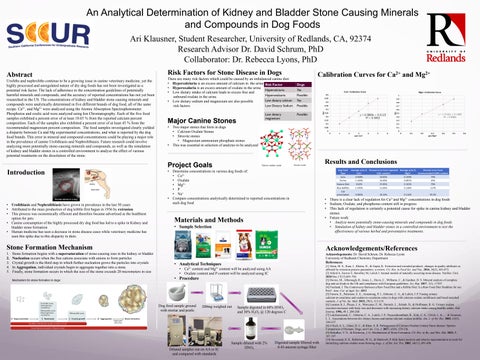
• There is a clear lack of regulation for Ca2+and Mg2+ concentrations in dog foods • Sodium, Oxalate, and phosphorus content still in progress • This lack of regulation is certainly a potential cause for spike in canine kidney and bladder stones • Future work: • Analyze more potentially stone-causing minerals and compounds in dog foods • Simulation of kidney and bladder stones in a controlled environment to test the effectiveness of various herbal and preventative treatments.
Stone Formation Mechanism Stone formation begins with a supersaturation of stone-causing ions in the kidney or bladder Nucleation occurs when the free cations associate with anions to form particles Crystal growth is the third step in which further nucleation grows the particles into crystals In Aggregation, individual crystals begin to aggregate together into a stone Finally, stone formation occurs in which the size of the stone exceeds 20 micrometers in size
0.2
Results and Conclusions
Project Goals Introduction
Ca2+ Calibration Curve
Abs
Uroliths and nephroliths continue to be a growing issue in canine veterinary medicine, yet the highly processed and unregulated nature of dry dog foods has not been investigated as a potential risk factor. The lack of adherence to the concentration guidelines of potentially harmful minerals and compounds, and the accuracy of reported concentrations has not yet been researched in the US. The concentrations of kidney and bladder stone causing minerals and compounds were analytically determined in five different brands of dog food, all of the same recipe. Ca2+, and Mg2+ were analyzed using the Atomic Absorption Spectrophotometer. Phosphorus and oxalic acid were analyzed using Ion Chromatography. Each of the five food samples exhibited a percent error of at least 10.65 % from the reported calcium percent composition. Each of the samples also exhibited a percent error of at least 45 % from the recommended magnesium percent composition. The food samples investigated clearly yielded a disparity between Ca and Mg experimental concentrations, and what is reported by the dog food brands. This error in mineral and compound concentrations could be playing a major role in the prevalence of canine Urolithiasis and Nephrolithiasis. Future research could involve analyzing more potentially stone-causing minerals and compounds, as well as the simulation of kidney and bladder stones in a controlled environment to analyze the effect of various potential treatments on the dissolution of the stone.
There are many risk factors which could be caused by an imbalanced canine diet: • Hypercalciuria is an excess amount of calcium in the urine • Hyperoxaluria is an excess amount of oxalate in the urine • Low dietary intake of calcium leads to excess free and unbound oxalate in the urine. • Low dietary sodium and magnesium are also possible risk factors
2+ 2+ Calibration Curves for Ca and Mg
Abs
Abstract
Risk Factors for Stone Disease in Dogs
Sample digested in 68% HNO3 and 30% H2O2 @ 120 degrees C
Sample diluted with 2% HNO3
Digested sample filtered with 0.45-micron syringe filter
[1] Alam, M. S., Kaur, J., Khaira, H., & Gupta, K. Extrusion and extruded products: changes in quality attributes as affected by extrusion process parameters: a review. Cri. Rev. in Food Sci. and Nut., 2016, 56(3), 445-473. [2] Alford A, Furrow E, Borofsky M, Lulich J. Animal models of naturally occurring stone disease. Nat Rev Urol. 2020 Dec;17(12):691-705. [3] Davies, M., Alborough, R., Jones, L., Davis, C., Williams, C., & Gardner, D. S. Mineral analysis of complete dog and cat foods in the UK and compliance with European guidelines. Sci. Rep. 2017, 7(1), 17107. [4] Freeland, J. The Controversy Between a Raw Food Diet and a Kibble Diet: Is a Raw Food Diet Healthier for our Pets?. Ame. Col. of Appl. Sci. 2012 [5] Furrow, E., Patterson, E. E., Armstrong, P. J., Osborne, C. A., & Lulich, J. P. Fasting urinary calcium‐to‐creatinine and oxalate‐to‐creatinine ratios in dogs with calcium oxalate urolithiasis and breed‐matched controls. J. of Vet. Int. Med. 2015, 29(1), 113-119. [6] Lemann Jr, J., Pleuss, J. A., Worcester, E. M., Hornick, L., Schrab, D., & Hoffmann, R. G. Urinary oxalate excretion increases with body size and decreases with increasing dietary calcium intake among healthy adults. Kid. Interna. 1996, 49.1, 200-208 [7] Lekcharoensuk, C., Osborne, C. A., Lulich, J. P., Pusoonthornthum, R., Kirk, C. A., Ulrich, L. K., ... & Swanson, L. L. Associations between dry dietary factors and canine calcium oxalate uroliths. Am. J. of Vet. Res. 2002, 63(3), 330-337. [8] O’Kell, A. L., Grant, D. C., & Khan, S. R. Pathogenesis of Calcium Oxalate Urinary Stone disease: Species Comparison of Humans, Dogs, and Cats. Uro. J. 2017, 45(4), 329-336. [9] Ratkalkar, V. N., & Kleinman, J. G. Mechanisms of Stone Formation. Cli. Rev. in Bo. and Min. Met. 2011, 9, 187-197. [10] Stevenson, A. E., Robertson, W. G., & Markwell, P. Risk factor analysis and relative supersaturation as tools for identifying calcium oxalate stone‐forming dogs. J. of Sm. Ani. Pra. 2003, 44(11), 491-496.