
Sample Read




PRIVATE SECURITY AGENCIES CENTRAL MODEL RULES, 2020

Private Security Agencies (Regulation) Act, 2005
[29 OF 2005]*
An Act to provide for the regulation of private security agencies and for matters connected therewith or incidental thereto.
BE it enacted by Parliament in the Fifty-sixth Year of the Republic of India as follows:
Short title, extent and commencement.
1. (1) This Act may be called the Private Security Agencies (Regulation) Act, 2005.
(2)It extends to the whole of India 1[***]
(3)It shall come into force on such date2 as the Central Government may, by notification in the Official Gazette, appoint.
Definitions.
2. In this Act, unless the context otherwise requires,—
(a)“armoured car service” means the service provided by deployment of armed guards along with armoured car and such other related services which may be notified by the Central Government or as the case may be, the State Government from time to time;
(b) “Controlling Authority” means the Controlling Authority appointed under sub-section (1) of section 3;
(c)“licence” means a licence granted under sub-section (5) of section 7;
(d)“notification” means a notification published in the Official Gazette;
(e)“prescribed” means prescribed by rules made under this Act;
(f)“private security” means security provided by a person, other than a public servant, to protect or guard any person or property or both and includes provision of armoured car service;
*Dated 23-6-2005.
1. Words “except the State of Jammu and Kashmir” omitted by the Jammu and Kashmir Reorganisation Act, 2019, w.e.f. 31-10-2019.
2. With effect from 14-3-2006 vide Notification No. S.O. 317(E), dated 15-3-2006.
(g) “private security agency” means a person or body of persons other than a government agency, department or organisation engaged in the business of providing private security services including training to private security guards or their supervisor or providing private security guards to any industrial or business undertaking or a company or any other person or property;
(h) “private security guard” means a person providing private security with or without arms to another person or property or both and includes a supervisor;
(i) “State Government”, in relation to a Union territory, includes the Administrator of that Union territory appointed by the President under article 239 of the Constitution.
COMMENTS
CASE LAWS
Employer Liability for Provident Fund Contributions - The Supreme Court addressed the applicability of the Employees’ Provident Funds and Miscellaneous Provisions Act, 1952, to Panther Security Service Private Limited, a private security agency registered under PSARA. The agency argued it was merely a facilitator for client-hired security personnel. The Court ruled that, as per section 2(g) of PSARA, the agency is legally the employer, responsible for training, supervision, and wage disbursement to guards, and thus liable for provident fund contributions under the EPF Act. The appeal was dismissed, reinforcing that security agencies employing more than 20 personnel are subject to EPF regulations. – Panther Security Service Private Limited v. Employees’ Provident Fund Organisation AIRONLINE 2020 SC 873.
Applicability of EPF Act to Private Security Agencies - The Supreme Court considered whether Panther Security Service Private Limited, a private security agency, was covered by the Employees’ Provident Funds and Miscellaneous Provisions Act, 1952 (EPF Act). The agency argued it only facilitated the provision of guards (chowkidars) to clients, who paid them directly. However, the Court ruled that as per section 2(g) of the Private Security Agencies (Regulation) Act, 2005, the agency was responsible for training and deploying security guards, making it their employer. Thus, Panther Security was liable for provident fund contributions under the EPF Act, as the payments were routed through the agency, aligning with EPF Act requirements. – Panther Security Service Private Limited v. Employees’ Provident Fund Organisation AIR 2021 SC 42.
Appointment of Controlling Authority.
3. (1) The State Government shall by notification, designate an officer not below the rank of a Joint Secretary in the Home Department of the State or an equivalent officer to be the Controlling Authority, for the purposes of this Act.
(2) The State Government may, for efficient discharge of functions by the Controlling Authority, provide it with such other officers and staff as that Government considers necessary.
Persons or Private Security Agency not to engage or provide private security guard without licence.
4. No person shall carry on or commence the business of private security agency, unless he holds a licence issued under this Act:
Provided that the person carrying on the business of private security agency, immediately before the commencement of this Act, may continue to do so for a period of one year from the date of such commencement and if he has made an application for such licence within the said period of one year, till the disposal of such application:
Provided further that no private security agency shall provide private security abroad without obtaining permission of the Controlling Authority, which shall consult the Central Government before according such permission.
COMMENTS
SECTION NOTES
4.1 Mandatory Licensing for Private Security Agencies
Requirement of a Licence: Section 4 of the Act makes it mandatory for any person or entity to obtain a licence under the Act before initiating or continuing the business of a private security agency.
The term private security agency is defined under section 2(g) of the Act and covers any person or body of persons, excluding government entity, engaged in providing private security services.
The definition spans various services, including the training of security guards and supervisors, as well as providing guards to business undertakings, company, persons or property.
Transitional Provision for Existing Agencies: The person carrying on the business of private security agency before the enactment of this Act are granted a transitional period of one year from the commencement date of the Act. This period allows them to continue operations temporarily without a licence.
Continuance of existing agency pending disposal of application: The proviso to section 4 provides that if an agency submits a licence application within this one-year period, it is permitted to continue its business until the application is processed and a decision is made.
4.2 Restriction on Providing Security Services Abroad
The second proviso to section 4 clearly prohibits a private security agency from providing security services outside India without first obtaining permission from the Controlling Authority.
The Controlling Authority is further required to consult the Central Government before granting such permission.
According to section 2(b), Controlling Authority refers to the authority appointed under Section 3(1) of the Act.
Section 3(1) mandates the State Government to appoint, the Controlling Authority through an official notification.
The controlling authority, so appointed must be of a rank not lower than that of a Joint Secretary in the Home Department or an equivalent position.
4.3 Penalty for Contravention
Section 20(1) provides for punishment for any person who engages in private security business without obtaining a licence as mandated by section 4.
The Punishment includes:
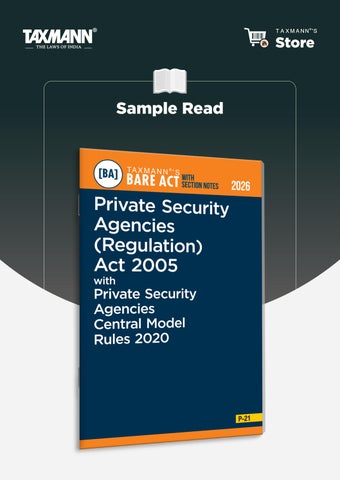
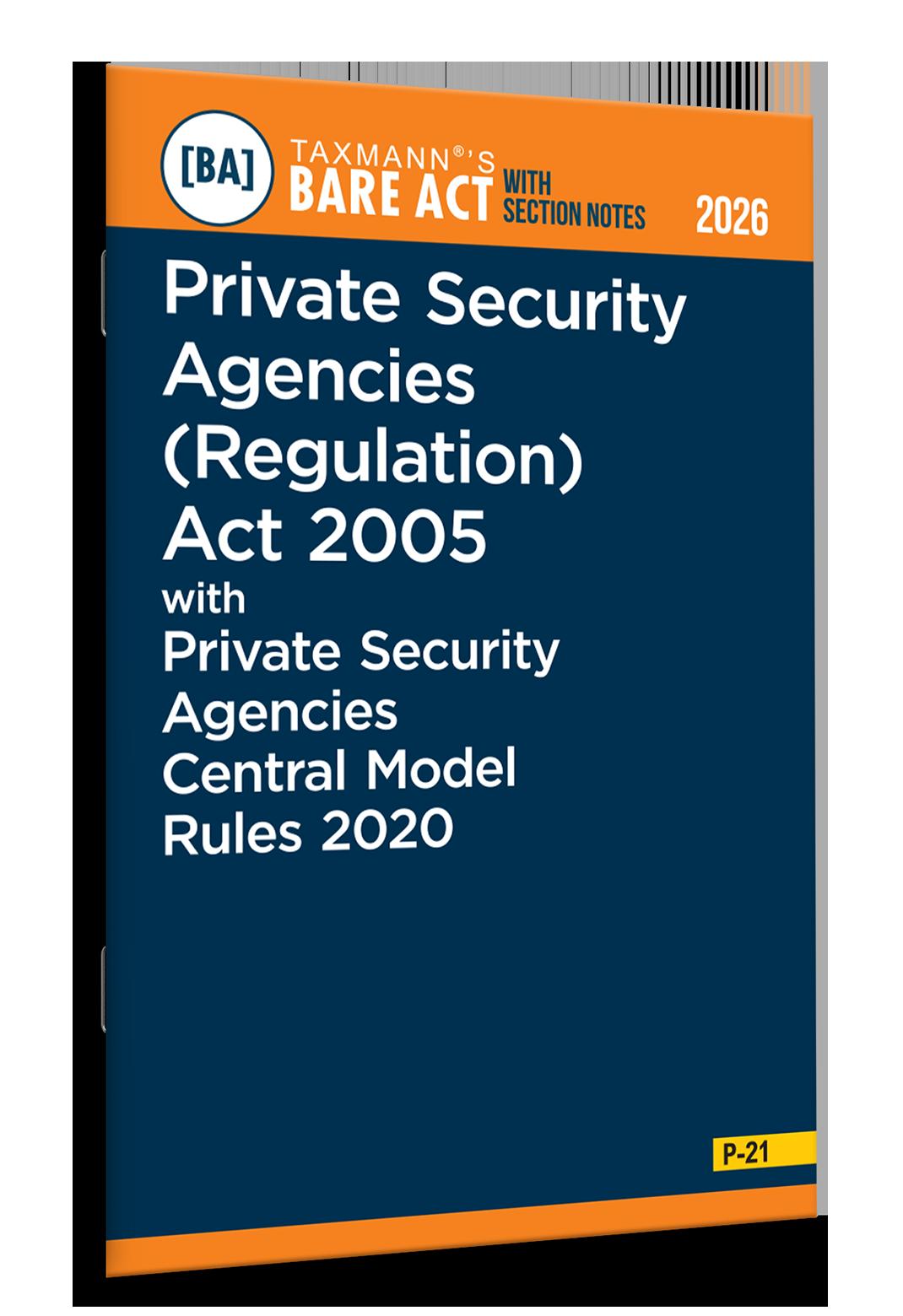
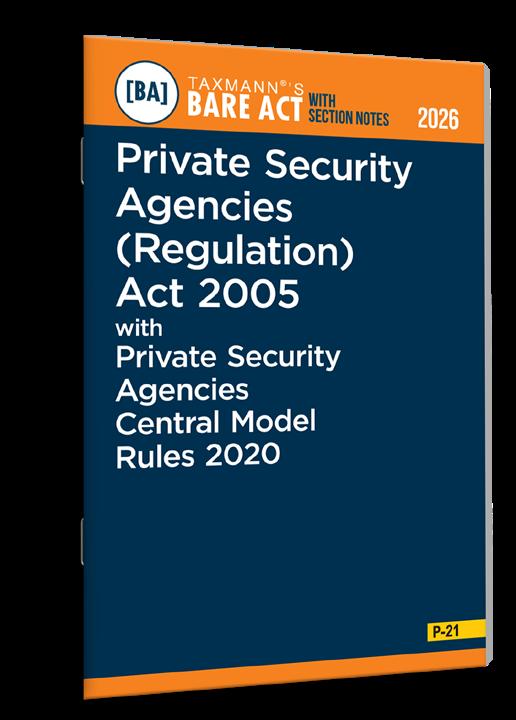
Private Security Agencies (Regulation) Act 2005 with Private Security Agencies Central Model Rules 2020 – Bare Act with Section Notes
AUTHOR : Taxmann’s Editorial Board
PUBLISHER : Taxmann
DATE OF PUBLICATION : December 2025
EDITION : 2026 Edition
ISBN NO : 9789371269711
No. of Pages : 60
BINDING TYPE : Paperback
Rs. 115
DESCRIPTION
Private Security Agencies (Regulation) Act 2005 with Private Security Agencies Central Model Rules 2020 [Bare Act with Section Notes] by Taxmann is an authoritative legal compendium compiling the full text of the Act and the Central Model Rules 2020. Enhanced with detailed section notes, case law commentary, and practical explanations, it is an indispensable resource for understanding the regulatory framework governing private security agencies in India—from definitions and licensing to enforcement and appeals.
This book is intended for the following audience:
• Legal Practitioners and Academics
• Industry Professionals
• Government Officials & Regulators
• Policy Makers
The Present Publication is the 2026 Edition, covering the amended and updated text of the Private Security Agencies (Regulation) Act [Act No. 29 of 2005] with Private Security Agencies Central Model Rules 2020, with the following noteworthy features:
• [Complete Bare Act Text] Presents the full text of the Act alongside the updated Central Model Rules 2020
• [Updated & Amended] Reflects the latest legal developments and judicial trends
• [Section Notes & Commentary] Offers detailed notes, explanations, and case law references to clarify statutory language and judicial interpretations
• [Annotated Provisions] Provides in-depth analysis of key sections such as licensing requirements, eligibility, disciplinary measures, and the appointment of Controlling Authorities
• [Comprehensive Forms] Includes all prescribed forms (Forms I–XI) for applications, verifications, affidavits, appeals, and record maintenance, serving as a practical guide for compliance