
Sample Read

© All rights reserved
Price : ` 445
Sixth Edition : January 2026
Published by :
Taxmann Publications (P.) Ltd.
Sales & Marketing :
59/32, New Rohtak Road, New Delhi-110 005 India
Phone : +91-11-45562222
Website : www.taxmann.com
E-mail : sales@taxmann.com
Regd. Office : 21/35, West Punjabi Bagh, New Delhi-110 026 India
Printed at :
Tan Prints (India) Pvt. Ltd.
44 Km. Mile Stone, National Highway, Rohtak Road Village Rohad, Distt. Jhajjar (Haryana) India
E-mail : sales@tanprints.com
Disclaimer
Every effort has been made to avoid errors or omissions in this publication. In spite of this, errors may creep in. Any mistake, error or discrepancy noted may be brought to our notice which shall be taken care of in the next edition. It is notified that neither the publisher nor the author or seller will be responsible for any damage or loss of action to any one, of any kind, in any manner, therefrom. No part of this book may be reproduced or copied in any form or by any means [graphic, electronic or mechanical, including photocopying, recording, taping, or information retrieval systems] or reproduced on any disc, tape, perforated media or other information storage device, etc., without the written permission of the publishers. Breach of this condition is liable for legal action.
For binding mistake, misprints or for missing pages, etc., the publisher’s liability is limited to replacement within seven days of purchase by similar edition. All expenses in this connection are to be borne by the purchaser. All disputes are subject to Delhi jurisdiction only.
Module-wise Marks Distribution
Comparison with Study Material
SECTION A COMMERCIAL LAWS
SECTION B INDUSTRIAL LAWS
SECTION C CORPORATE LAWS
SECTION D
Module-wise Solved Paper December 2024 (Suggested Answers) P.1
Module-wise Solved Paper June 2025 (Suggested Answers) P.16
Module-wise Solved Paper December 2025 (Suggested Answers) P.27
SALE OF GOODS ACT, 1930
CHAPTER 3.1
ESSENTIAL CONDITIONS OF A CONTRACT OF SALE
A Quick Review
The law related to sales and purchases of goods was regulated by the Indian Contract Act, 1872, but later it was repealed from the Act and new separate act was introduced to regulate the same named as “The Indian Sale of Goods Act, 1930” which came into force on 1st July, 1930. The word ‘Indian’ was also removed on 22nd September, 1963 leaving the Act as the Sale of Goods Act, 1930. This Act extends to the whole of India.
Sale is a transfer in business affected by contract of sale or to sale. It must have all valid elements of contract.
An “absolute sale” deed is defined by having no conditions attached to the sale except the buyer’s payment of the purchase price.
ESSENTIALS CONDITIONS (SINE QUA NON) OF A CONTRACT OF SALE:
It must involve two parties. The goods need to transfer from one entity to another. The goods cannot be bought from one’s own self and be called a contract.
The transfer must involve the transfer of title to the goods or the transfer of ownership of the goods.
A contract of sale is not complete unless there is a certain subject matter which is to be transferred in lieu of a specific amount of consideration. As per Section 2(7) of the Act the subject matter is the goods. The subject matter of the contract is the goods which can be either existing goods, owned or possessed by the seller, or future goods.
The consideration in such contracts needs to be a designated amount payable in money and not in exchange of other goods of similar value or otherwise.
The price in the contract of sale has to be fixed by:
Contract itself or
Be xed in a manner agreed between the parties or Determined by their course of dealing.
SECTION A : COMMERCIAL LAWS
If the price has not been fixed then the buyer shall pay the seller a reasonable price which would be determined based on the relevant circumstances of each particular case.
TYPES OF GOODS








PAST EXAMINATION QUESTIONS
OBJECTIVES


Fill in the blanks:
Q. 1. “Sale” is an _____________contract. [June 2017, 1 Mark]
Ans. Executed
Q. 2. Goods to be manufactured or produced or acquired by the seller after making of the contract of sale are called _______________ good. [June 2018, 1 Mark]
Ans. Future
Multiple Choice Questions:
Q. 1. Which of the followings are not Goods as per Sale of Goods Act?
(a)Actionable claims
(b)Stock and share
(c)Growing crops
(d)Grass or things attached to earth
[Dec. 2015, 1 Mark]
Q. 2. Goods displayed in a shop with a price tag are an ______________.
(a) Offer
(b) Invitation to offer
(c) Counter offer
(d) None of the above
[Dec. 2015, 1 Mark]
Q. 3. If P makes an agreement with Q, an artist, to paint a portrait of P for ` 2,000 and Q use his own canvas & paint. Here it is:
(a) Contract of Sale
(b) Contract of work and material.
(c) Sale on approval
(d) Hire Purchase agreement.
[Dec. 2017, 1 Mark]
Q. 4. ‘Future good’ is the goods to be manufactured or produced or acquired by the seller:
(
a) After starting of the business
(
b) Beginning of the nancial year
(
c) Making of the contract of sale
(
d) Receiving of the supply order
[Dec. 2022, 1 Mark]
Q. 5. Which one of the following is not feature of agreement to sale?
(
a) It gives a right to the buyer against the seller to sue for damages.
(
b) The seller can sue for damages only in case of breach by the buyer.
(
c) Sales take place for existing & speci c goods.
(
d) It is an executory contract.
[July 2023, 1 Mark]
Q. 6. A contract of sale of goods is a contract whereby the seller transfers the property in goods to the buyer for:
(
a) Exchange of goods
(
b) A price
(
c) A gift
(
d) Mutual satisfaction
[July 2023, 1 Mark]
Q. 7. Under the Sales of Goods Act, which of the delivery of goods is called as delivery by attornment?
(
a) Actual
(b) Symbolic
(
(
c) Constructive
d) Physical
ANSWERS:
THEORY QUESTIONS
[Dec. 2023, 1 Mark]
Q. 1. Parties to a contract of sale can get the price of goods fixed by third parties. Comment. [June 2013, 2 Marks]
Ans. As per Section 9 of Sale of Goods Act, 1930, the price in contract of sale may be left to be fixed in manner agreed between the parties or determined by course of their dealings. Thus the parties to a contract may agree that price of goods will be fixed by a third party.
Q. 2. Sale of Goods Act is applicable to both movable and immovable goods. Offer your views. [Dec. 2013, 2 Marks]
SECTION A : COMMERCIAL LAWS
Ans. As per Section 2(7) of Sale of Goods Act, 1930, goods means every kind of movable property other than actionable claims and money; and includes stock and shares, growing crops, grass and things attached to or forming part of the land which are agreed to be severed before sale or under the contract of sale.
It only includes movable property other than actionable claims and money.
Q. 3. Define Sales (Sale of Goods Act). [Dec. 2013, 3 Marks]
Ans. As per Section 4 of Sale of Goods Act, 1930, a contract of sale of goods is a contract where by the seller transfers or agrees to transfer the property in the goods to the buyer for a price. It is not conditional.
The ownership of property transfers immediately to the buyer.
It creates right in rem i.e. right against whole world.
The contract may provide for the immediate delivery of the goods or immediate payment of the price or both or for the delivery or payment by instalments, or that the delivery or payment or both shall be postponed.
Subject to provisions of any laws for the time being in forces, a contract of sale may be made in writing or by word of mouth, or partly in writing and partly by word of mouth or may be implied from the conduct of the parties.
Q. 4. Write short note on: Essential of a Contract of sale. [Dec. 2013, 4 Marks]
Ans.
It must involve two parties. The goods need to transfer from one entity to another. The goods cannot be bought from one’s own self and be called a contract.
The transfer must involve the transfer of title to the goods or the transfer of ownership of the goods.
A contract of sale is not complete unless there is a certain subject matter which is to be transferred in lieu of a speci c amount of consideration. As per Section 2(7) of the Act the subject matter is the goods. The subject matter of the contract is the goods which can be either existing goods, owned or possessed by the seller, or future goods.
The consideration in such contracts needs to be a designated amount payable in money and not in exchange of other goods of similar value or otherwise.
A contract of sale may be absolute or conditional.
All essential elements of a valid contract must be present in a contract of sale.
Q. 5. Explain “Agreement to sell at valuation” under Sale of Goods Act, 1930. [June 2014, 2 Marks]
Ans. As per Section 10 of Sale of Goods Act, 1930:
Where there is an agreement to sell goods on the terms that the price is to be xed by the valuation of a third party and such third party cannot or does not make such valuation, the agreement is thereby avoided.
If the goods or any part thereof have been delivered to, and appropriated by, the buyer, he shall pay a reasonable price therefor. Where such third party is prevented from making the valuation by the fault of the seller or buyer, the party not in fault may maintain a suit for damages against the party in fault.
Q. 6. How would you differentiate between contract of sale & agreement to sell? [Dec. 2023, 7 Marks]
Ans.
Particulars
Definition Where under a contract the property in the goods is transferred from the seller to the buyer, the contract is called a sale.
Where the property in the goods is to be transferred to the buyer at some future date or on the fulfilment of a certain conditions, the contract of sale is called an agreement to sell.
Conditional It is not conditional. It is a conditional sale.
Transfer of ownership and possession
Transfer of ownership
Both are transferred immediately. Ownership is transferred at future date.
The ownership of property transfers immediately to the buyer.
The ownership of property transfers at a future date (as decided between the parties) the buyer.
Type of contract It is an executed contract. It is an executory contract.
Creation of rights It creates right in rem i.e. right against whole world.
Responsibility of loss
Resale
Destruction of goods
The buyer is responsible for any loss or destruction of the goods even if the goods are in the possession of the seller.
The seller cannot resale the goods. If he resells the goods, the buyer can claim damages for conversion and exercise right of recovery of goods from 3rd party.
If the goods are destroyed by accident, the buyer has to bear the loss even if goods are in possession of seller.
It creates right in personam i.e. rights against particular individual only.
The seller is responsible for any loss or destruction of goods even if the goods are in the possession of the buyer.
Here, the buyer can only claim damages.
If the goods are destroyed by accident, the seller has to bear the loss even if goods are in possession of buyer.
SECTION A : COMMERCIAL LAWS
Particulars Sale Agreement to sell
Section 4(1) 4(3)
Insolvency of buyer In case of buyer’s insolvency, the seller must deliver the goods (in absence of lien) and claim only rate-able dividend from price due.
Insolvency of seller The buyer can recover the goods (if price is paid) from official receiver of the seller.
In case of buyer’s insolvency, the seller can deny delivery of goods unless price is received for same as ownership still lies with seller.
If the buyer has paid the price, then he can claim rate-able dividend for it.
Liability of sales tax The sale is liable to GST.Agreement to sell is not liable to sales tax. But it will be payable as soon as it converts into sales.
PRACTICAL QUESTIONS
Q. 1. Mr. A purchased a Refrigerator from Mr. B on hire purchase agreement expiring on 31-12-15. Mr. A sold on 1-5-13 that refrigerator to C who purchased against adequate consideration. A has right to give good title to Mr. C. Comment. [June 2013, 2 Marks]
Ans. Under Hire Purchase Agreement, the ownership passes to buyer only on payment of last instalment. The hirer under hire purchase system has no title to the refrigerator therefore Mr. A cannot give a good title to Mr. C. This is because Mr. C. does not get a better title than Mr. A had.
Q. 2. Mr. Amit is the owner of a writing table but he does not know that he is the owner of table. Mr. Sumit pretends to be the owner of that table and sells to Mr. Amit. Whether this is a sale as per the Sale of Goods Act, 1930? [Dec. 2014, 2 Marks]
Ans. In the case of sale there must be at least two parties because the property in goods has to pass from one person to another. Its first essential, therefore, is that the seller and buyer must be different persons. A person cannot buy his own goods. In given case, there is no sale because Amit cannot buy the table which is already belongs to him.
Q. 3. With a view to boost the sales, M/s. ABC Ltd. sells a new machine to Mr. B on trial basis for a period of 3 days with a condition that if Mr. B is not satisfied with the performance of the new machine, he can return back the new machine. However, the machine was destroyed in a fire accident at the place of Mr. B before the expiry of 3 days. Decide whether Mr. B is liable for the loss suffered under Sale of Goods Act, 1930. [June 2015, 3 Marks]
Ans. Section 8 of Sale of Goods Act, 1930, describes about goods perishing before sale but after agreement to sell. If without any fault of seller or buyer, the goods in contract perishes or gets damaged leaving them not matching with description before passing of risk to buyer, the agreement becomes void.
In given case, new machine was destroyed before the transfer of property from the seller to the buyer. The risk passes only when the ownership is transferred to the buyer. Therefore, Mr. B is not liable for the loss suffered due to the fire accident over which B has no control.
Thus M/s. ABC Ltd. will have to bear whatever loss that has taken place due to the fire accident.
Q. 4. Angel agrees to sell to Peter his two Mercedes cars on the terms that the price was to be fixed by David. Peter takes the delivery of one car immediately. David refuses to oblige Angel and Peter and fixes no price. Angel asks for the return of the car already delivered whereas Peter insisted on the delivery of the second car to him for a reasonable price of both the cars. Decide the case.
[June 2015, 3 Marks]
Ans. As per Section 10 of the Sale of Goods Act, the parties to the contract of sales may agree to the valuation done by the 3rd party which have no interest in the contract except making a fair valuation of the subject matter of sales.
It is quite possible that the 3rd party may not do the valuation due to his own inability or due to fault of either of the parties to the contract.
If the 3rd party does not make any valuation for reasons which are not attributable to any party, then the contract is void.
If non-valuation of the goods by the 3rd party is attributed to any fault on the part of any party to the contract, the aggrieved party may sue the party at fault for breach of contract and even demand damages from him.
In given case, the 3rd party refuses to fix the price, the contract becomes void except as to part of goods delivered and accepted pay as regards which the buyer must pay a reasonable price.
Thus as regards the car already delivered, Angel cannot ask for its return and must accept a reasonable price for that. As regards the second car, Peter cannot insist on its delivery to him since the contract has become void. But, on mutual understanding both of them deal accordingly.
Q. 5. What are the consequences of ‘destruction of goods’ under the Sale of Goods Act, 1930, where the goods have been destroyed after the agreement to sell but before the sale is affected.
[Dec. 2016, 4 Marks; Dec. 2017, 5 Marks]
Ans. Section 7 & Section 8 of Sale of Goods Act, 1930 are applicable only in case of specific goods and not unascertained/generic goods. It may further be noted that if the seller was aware of the destruction of goods and still enters into a contract, then he is stopped from disputing the contract. In such case the buyer can sue him for breach of contractual obligations and claim damages.
SECTION A : COMMERCIAL LAWS
Section 7
Goods perishing before making the contract.
If without the seller’s knowledge, at time of making contract the goods in contract perishes or gets damaged leaving them not matching with description, the contract becomes void.
A Quick Review
Section 8
Goods perishing before sale but after agreement to sell.
If without any fault of seller or buyer, the goods in contract perishes or gets damaged leaving them not matching with description before passing of risk to buyer, the agreement becomes void.
CHAPTER 3.2
TRANSFER OF OWNERSHIP
Property in goods means the ownership of the goods from seller to buyer so as to constitute the buyer the real owner of the goods.
PASSING OF PROPERTY
Goods must be ascertained
Intention of parties
Speci c goods in deliverable state
Speci c goods to be put in deliverable state
Speci c goods in deliverable state but the seller has to do something in order to ascertain the price
Sale of unascertained goods by description
Delivery to carrier
Goods on approval or on sale or return basis
RISK PRIMA FACIE PASSES WITH PROPERTY
The rule regarding risk passes with the property enshrined in Section 26 is subject to the following exceptions:
Where delivery has been delayed through the fault of either party the buyer or the seller, the goods are at the risk of the party at fault as regards any loss which might not have been occurred but for such fault. The goods are at the risk of the party who is at fault in delay of delivery.
If there is a custom in that particular trade that the risk does not pass with property, in such a case the risk will pass as per the custom.
Risk and property may be separated by agreement between the parties.
SALE BY PERSON NOT THE OWNER (NEMO DAT QUOD NON HABET)
Sale by mercantile agent
Sale by one of joint owners
Sale by person in possession under voidable contract
Seller or buyer in possession of goods after sale
Sale by estoppel
Sale by nder of goods u/s 169 of Indian Contract Act, 1872
Sale by pawnee u/s 176 of Indian Contract Act, 1872
Sale by of cial receiver or Assignee Under Negotiable Instruments Act
PAST EXAMINATION QUESTIONS
OBJECTIVES
Multiple Choice Questions:
Q. 1. Amit tells Bharat in the presence of Chetan that Amit is agent of Chetan. Chetan maintain silence instead of denying it. Later, if Amit sells Chetan’s goods to Bharat, Chetan cannot dispute Bharat’s title to the goods. This is example of:
(
a) Sale by of cial receiver
(b) Sale by a nder of goods
(
c) Sale by estoppel
(d) Execution of Sale
[June 2014, 1 Mark]
Q. 2. Under Sale of Goods Act, which of the delivery of goods is called as delivery by attornment?
(a) Actual
(b) Symbolic
(
c) Constructive
(d) Physical
Q. 3. The Latin Maxim “Nemo Dat Quod non Habet” means:
(a) No man can pass a better title than he has
(b) Let the Buyer beware
(c) No consideration – No contract
(d) Ignorance of law is no excuse
ANSWERS: 1. (c) 2. (c) 3. (a)
THEORY QUESTIONS
[Dec. 2015, 1 Mark]
[June 2019, 1 Mark]
Q. 1. Transfer of Title to goods takes place when it is intended. Whether it is correct? [June 2013, 2 Marks]
Ans. As per Section 19 of Sale of Goods Act, 1930, in contract for sale of specific or ascertained goods, the property in them is transferred to buyer as such times as the parties to contract intend it to be transferred.
3.10
SECTION A : COMMERCIAL LAWS
The intention can be ascertained as per the terms of contract, conduct of parties & circumstances of the case.
Q. 2. Risk is transferred only on delivery – Comment. [Dec. 2013, 2 Marks]
Ans. As per Section 26 of the Sale of Goods Act, 1930, the goods remains at the seller’s risk until the property therein is transferred to the buyer, but when the property in goods is transferred to the buyer the goods are at the risk of the buyer whether delivery of the goods has been made or not.
It is permissible for the parties to provide in the agreement that although the property does not pass, the risk passes and they may fix the point of time when it is to pass.
Section 26 further provides that the provision of this section does not affect the duties and liabilities of either the seller or buyer as the bailee of goods of the other party.
Q. 3. A non-owner can convey a better title to the bona fide purchaser of goods for value in certain cases. List out those cases. [Dec. 2013, 6 Marks]
Ans. Nemo dat quod non habet - “No one gives what they do not have”. It is a legal rule, sometimes called the nemo dat rule which states that any purchase of a possession from someone who has no ownership right to it also denies the purchaser any ownership title.
In short non-owner cannot make valid transfer in goods and if he sells them the buyer (even if he is honest) who purchases those goods also doesn’t get valid title as the seller also didn’t have the same. In order to protect bona fide buyers who purchased goods in good faith for value certain exceptions to this doctrine were made as follows:
Sale by mercantile agent (Section 27)
Sale by one of joint owners (Section 28)
Sale by person in possession under voidable contract (Section 29)
Seller or buyer in possession after sale (Section 30)
When a mercantile agent in ordinary course of business, sells any goods in his possession or of document of title to goods with consent of owner shall be as valid as he was expressly authorized by owner provided buyer buys in good faith and has not noticed at time of contract that seller has no authority to sell.
With permission of co-owners, if one of the joint owners has the possession of goods, then on selling these goods, the property in goods transfers to buyer if buyer has purchased in good faith without having notice at time contract that seller has no authority to sell. The property in goods doesn’t transfer in case of unascertained goods, until the goods are ascertained.
When the seller of goods has obtained possession thereof under a contract voidable under Section 19 or Section 19A of the Indian Contract Act, 1872, but the contract has not rescinded at the time of the sale, the buyer acquires a good title to the goods, provided he buys them in good faith and without notice of the seller’s defect of title.
1. Where a person, having sold goods, continues or is in possession of the goods or of the documents of title to the goods, the delivery or transfer of goods or document
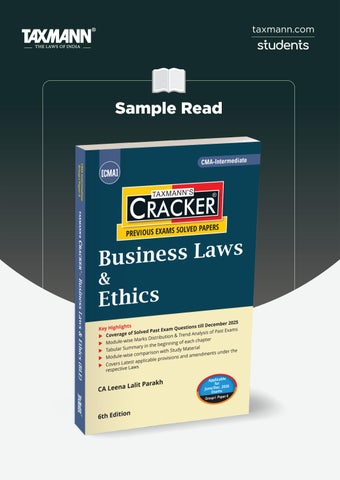
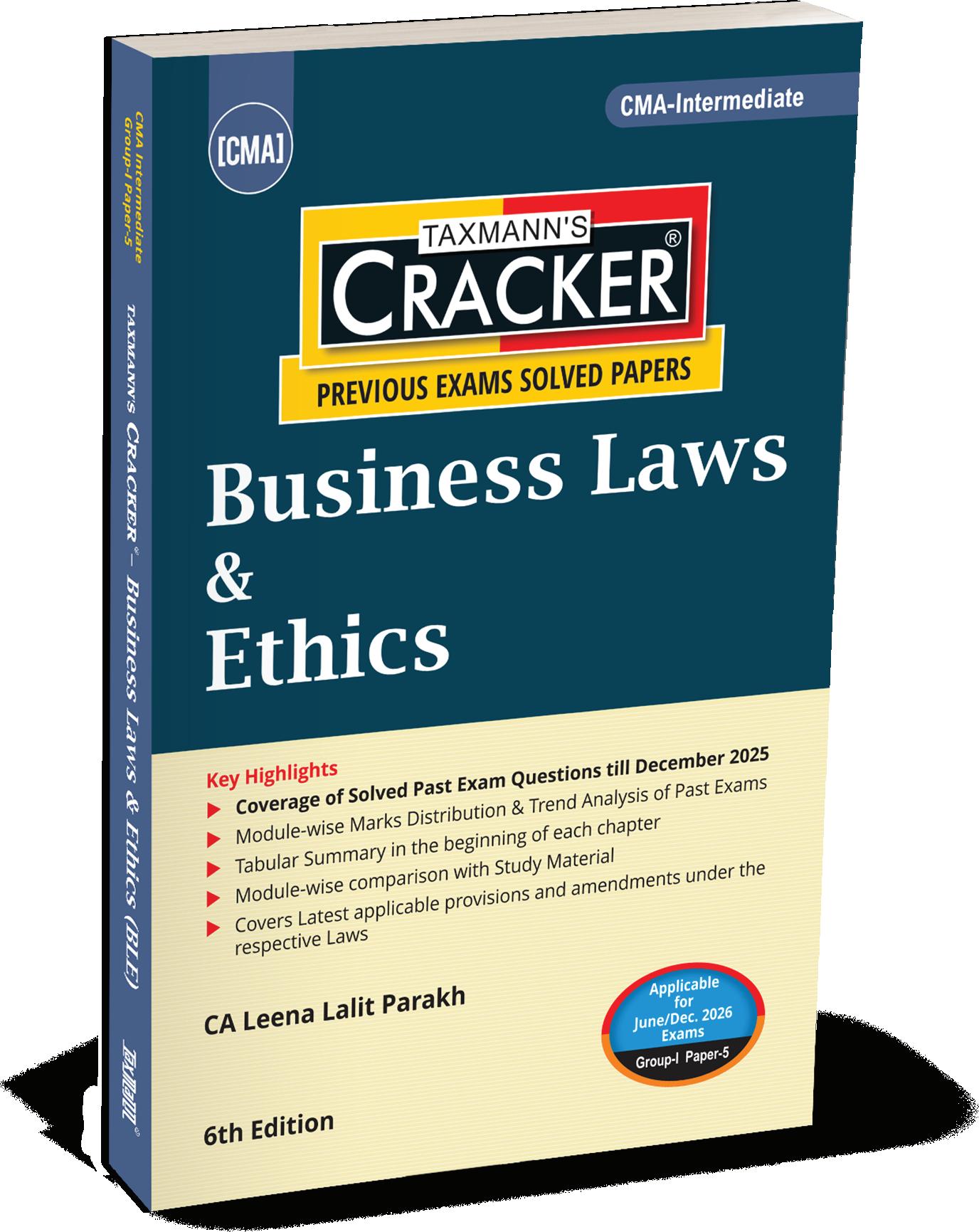
BUSINESS LAWS & ETHICS (LAW /BLE)
| CRACKER
AUTHOR : Leena Lalit Parakh
PUBLISHER : Taxmann
DATE OF PUBLICATION : December 2025
EDITION : 6th Edition
ISBN NO : 9789375616795
NO. OF PAGES : 468
BINDING TYPE : Paperback
DESCRIPTION
Business Laws & Ethics | CRACKER is a focused exam-prep guide for CMA Intermediate Group 1 –Paper 5, designed to support study and revision. This Edition provides comprehensive coverage of the syllabus, systematically solved papers (till December 2025), and practical trend analysis, all tailored to boost conceptual clarity and exam performance.
The Present Publication is the 6th Edition for the June/Dec. 2026 Exams. This book is authored by CA. Leena Lalit Parakh, with the following noteworthy features:
• [Solved Past Papers] Covers previous exam questions up to December 2025, reflecting the latest question formats and marking schemes
• [Trend & Marks Analysis] Module-wise marks distribution and trend charts highlight frequently tested topics
• [Tabular Summaries] Each chapter starts with a concise table summarising key concepts for fast revision
• [Comparison with Study Material] Direct mapping with the CMA study material ensures complete syllabus coverage
• [Latest Amendments] Content updated for all recent statutory amendments and examrelevant legal changes
• [Quick Revision Tools] Includes summaries, tables, and solved papers for effective last-minute preparation
• [Reliable & Updated] Written by an experienced author, ensuring accuracy and examreadiness