
Sample Read


CHAPTER

THEORETICAL QUESTIONS
Q.1. High return on investment (ROI) indicates efficient use of assets. Comment. [June 2015 (4 Marks)]
Ans. Return on Investment (ROI) ratio shows how much a company is earning on its investments i.e. capital employed. This ratio is considered to be one of the most important ratios because it reflects the overall efficiency with which capital/assets are used.
A high ratio indicates efficient use of assets and low ratio indicates ineffective use of assets. Return on investment is also an important measure of profitability and is useful for inter-firm comparison.
This ratio is calculated as under:
Return on Investment = Operating profit (EBIT) × 100 Capital Employed
Q.2. A firm having high current ratio may not necessarily be treated as being favourably placed as regards payment of its current liabilities. Comment. [Dec. 2015 (5 Marks)]
Ans.
Current ratio = Current Assets Current Liabilities & Provisions
The ideal Current ratio is taken as 2:1.
This ratio measures the short-term solvency of the company.
Current Assets are those assets, which can be converted into cash within a year. Current Liabilities and provisions are those liabilities that are payable within a year.
Significance: A very high current ratio will have adverse impact on the profitability of the organization. A high current ratio may be due to high level of inventory, inefficiency in collection of debtors, high balances in cash and bank accounts without proper investments. Thus it is correct to say that firm having high current ratio may not necessarily be treated as being favourably placed as regards payment of its current liabilities.
PART I : CORPORATE ACCOUNTING
PROBLEMS & SOLUTIONS
Problem No. 1] You have applied for the position of Assistant Company Secretary in Sashvati Ltd. As part of the pre-interview scanning, the following information has been provided to you:
Sales ` 1,825 lakh Net Worth to Sales90%
Current Liabilities to Net Worth20%
Total Debt to Net Worth50%
Receivables average collection period44 Days
Inventory Turnover (Based on Cost of Goods Sold)4.839 Times
Number of days in a year365
Ratio of inventory, receivables and cash & bank balance in current assets 3:2:1
Cash sales are 1/4th of credit sales.
As part of scanning exercise, you are required to calculate and inform to the interviewer, following values:
(1) Non-current debt (as per the Companies Act, 2013)
(2) Receivables
(3) Current assets
(4) Cost of goods sold [June 2019 (5 Marks)]
Ans.
Calculation of non-current debt:
Net Worth = 1,825 lakh × 90% = 1,642.50 lakh
Current Liabilities = 1,642.50 lakh × 20% = 328.50 lakh
Total Debt = 1,642.50 lakh × 50% = 821.25 lakh
Non-Current Debt = 821.25 lakh – 328.50 lakh = 492.75 lakh
Calculation of receivables:
Sales = Cash Sales + Credit Sales
1,825 lakh = 0.25x + x
1,825 lakh = 1.25x
x = Credit Sales = 1,460 lakh
Receivables collection period = Debtors × 365 days Credit sales
44 = x × 365 days
1,460 lakh
x = Receivables = 176 lakh
Calculation of current assets:
Ratio of inventory, receivables and cash & bank balance in current assets is 3:2:1 = 6
Receivables are 176 lakh.
Current Assets = 176 lakh × 6 = 528 lakh 2
Hence, Current Assets = 176 lakh × 6/2
Calculation of cost of goods sold:
Inventory = 176 lakh × 3 = 264 lakh 2
Inventory Turnover = Cost of goods sold Inventory
4.839 = Cost of goods sold 264 lakh
Cost of goods sold = 1277.496 lakh
Problem No. 2] Following Summarized Statement of Profit/Loss and Balance Sheet are provided by ABC Ltd.: Summarized Profit/Loss account of ABC Ltd. (For the year ended on 31st March, 2023)
Problem No. 3] Prabhuji is a first-generation entrepreneur engaged in the bakery business. Prabhuji is the proprietor of B & Sons - a Mumbai based concern manufacturing bakery products, confectioneries and sweets. The products are manufactured and sold in wholesale to retailers under a brand name “Bread & More”. Products were essentially sold to retailers who would then sell the final customer. Since the year 2020 - the next generation of Prabhuji’s family started participating in the business. The new generation is technologically aware and suggested direct sales to customers through omni channel (online sales). The bakery brand was only known locally. However, due to sales online and due to the good quality of the products - the bakery product’s started gaining traction nationally. Demand for the products increased. As a result, there was a need to increase manufacturing capacity. The new members in the business suggested borrowing or setting up a Special Purpose Vehicle for the new manufacturing unit. Private Equity players can then invest in the Special Purpose Vehicle. Prabhuji is a conservative businessman. While not being average to expansion - Prabhuji suggests minimizing the need for external finance while relying more on internal accruals. Following are some financial details:
at 1st April, 20221,00,000
at 31st March, 20232,00,000
1st April, 20222,50,000
Jimsha is a financial expert and consultant and is a school friend of Prabhuji. One of the key questions was on improvement in cash flows. Jimsha made a suggestion regarding study of working capital management. A number of firms ignore funds blocked in working capital. Prabhuji was also concerned about the return on funds invested in business as capital. Jimsha advised Prabhuji to use DuPont Analysis to check whether funds are used efficiently.
Prabhuji mentions the increase in demand and possible need to increase capacity. There are various options available to meet the demand. Outsource the production to third party.
Expand the production capacity by incurring certain capital expenditure. There are concerns around manufacturing quality if production is outsourced. The cost of the additional capacity is likely to be substantial. A capex of ` 5,00,000 financed 80% by debt raised at 10% and remaining through new equity is required. Financial projections are given below: Information for 2023-24CurrentNew
charges50,00050,000 + Interest on new debt
Gross profit ratio remains same as previous year. On the basis of above information, answer the following questions:
(
(
a) Calculate inventory turnover, average collection period and interpret the ratios.
b) Calculate Return on Equity by using DuPont Analysis. Comment on how can Return on Equity be improved.
(c) Prepare the estimate of Profit & Loss A/c for 2023-24. What will be the Owner’s capital as on 31st March, 2024? [June 2024 (5 + 5 + 5 = 15 Marks)]
Ans.
(a) Financial position of Prabhuji for the year 2022-23: Profit & Loss Account
For the year ended 31st March 2023
ToOpening inventory1,00,000By Sales
ToPurchase9,50,000- Credit (25,00,000 × 80%)20,00,000
ToWages7,00,000- Cash (25,00,000 × 20%)5,00,000
ToCarriage inward1,50,0002,00,000
ToGross profit 8,00,000 27,00,00027,00,000
ToAdministrative expenses2,50,000By Gross profit8,00,000
ToDepreciation2,00,000
ToFinance charges50,000
ToIncome tax @ 30%1,05,000
ToTo Net profit2,45,000 8,00,0008,00,000
Balance Sheet As on 31st March 2015
Gross Profit Ratio = 8,00,000 × 100 = 32% 25,00,000
Cost of goods sold = 25,00,000 – 8,00,000 = 17,00,000
Average inventory = (1,00,000 + 2,00,000)/2 = 1,50,000
Inventory Turnover Ratio = Cost of goods sold
Average inventory = 17,00,000 1,50,000 = 11.33
The inventory turnover ratio measures how many times a company’s inventory has been sold during the year. If the inventory turnover ratio is low, it means that either inventory’s growing or sales are dropping. Low inventory turnover has impact on the liquidity of the business.
Average debt collection period = Average Receivables × 12 Credit Sales = 1,75,000 × 12 20,00,000 = 1.05 months i.e. 31.5 days say 32 days
This ratio shows the average collection period. It is indicating that company takes 32 days to collect the money from debtors.
(b) As per DUPONT Analysis, Return on Investment (ROI) represents the earning power of the company. ROI depends on two ratios:
(a) Operating Profit Ratio (Net profit i.e. Operating Profit/Sales) × 100 & (b) Capital Turnover Ratio (Sales/Capital Employed) × 100.
Operating Profit (EBIT) × Sales × 100 SalesCapital Employed
Operating Profit = 8,00,000 – 2,50,000 – 2,00,000 = 3,50,000
Sales = 25,00,000
Capital employed = Total assets = 24,00,000
3,50,000 × 25,00,000 × 100= 0.1558 i.e. 14.58%
25,00,00024,00,000
(c) Projected financial position of Prabhuji for the year 2023-24:
Projected credit sales = 20,00,000 × 130% = 26,00,000
Projected cash sales = 5,00,000 × 130% = 6,50,000
Gross profit = (26,00,000 + 6,50,000) × 32% = 10,40,000
Finance charges = 50,000 + (5,00,000 × 80% × 10%) = 90,000 Profit & Loss Account
For the year ended 31st March 2023
ToAdministrative expenses2,75,000By Gross profit10,40,000
ToDepreciation3,00,000
ToFinance charges90,000
ToIncome tax @ 30%1,12,500
ToNet profit2,62,500 10,40,00010,40,000
Owner’s equity as on 31st March, 2024:
Owner’s equity as on 32.3.202320,00,000
Profit for the year 2022-20232,45,000
New finance obtained in year 2023-2024 (5,00,000 × 20%)1,00,000
Profit for the year 2023-20242,62,500
Owner’s equity as on 31.3.202426,07,500
Problem No. 4] Komal is a third-generation businesswomen in the dairy business ‘‘Bharat Ghee & Co.’’. The business is run under the brand “Pure Ghee”. The company prepares milk-based products and is known for good quality in the market. The sales are made through self-owned stores, other retailers at locations where self-owned stores are not present and online.
The business is run by Komal’s family on a strategic and operational basis. However, now the business is growing at a rapid pace. There is a need to get in professional management to run the business. ‘‘Bharat Ghee & Co.’’ hires a new CEO - Garima, who has three decades of experience in the dairy industry. Komal will now be Executive Chairman and provide a guiding role in the business. The first task that Garima has on hand is to identify issues that are hindering business growth. Komal asks Garima to list major concerns that the business is facing:
Lower margins where sales are made through other retailers and online. Online platforms are charging a big commission for making sales.
High chance of spoilage due to perishable nature of the raw material. Due to perishable nature of material – inventories are kept at a negligible level.
Capacity increase may be necessitated in the near future for which capital will have to be raised.
Garima requests the Accounts Head - Naina for key financial metrics of ‘‘Bharat Ghee & Co’’. Naina provides the following details to Garima:
Key Financials of Bharat Ghee & Co.:
Garima does some quick calculations to derive Return on Equity and Return on Capital Employed.
Komal indicates willingness to contribute fresh equity in the business and payoff the loans.
However, Garima is not in favour of repayment of loans.
Garima has made a business plan to change the strategy to decrease dependence from third party vendors. The new plan recommends creation of infrastructure to enable sales at locations which are serviced by channel partners. A new strategic business unit is to be created for implementation of the business plan.
The following infrastructure facilities need to be created:
The aforementioned infrastructure will be set up using debt and equity in the ratio of 2:1. The new debt will be raised at a rate of 14%.
The average depreciation will be 30%.
The above investment and raising of debt will be done on October 1. The organization follows on April to March financial year.
The average receivables at the end of the financial year from the new business will be `10,80,00,000/-. The receivables turnover days will be 45 days. Assume 180 days to calculate receivables turnover ratio.
The gross profit margin will be 20%.
Indirect expenses other than depreciation will be `2,00,00,000/-.
Income-tax rate is 25%.
Komal asks for the projected P&L before approving the required investment amount:
(a) Calculate current Net Profit Margin, Return on Equity and Return on Capital Employed.
(b) If debt is paid-off using fresh equity, what will be new Net Profit Margin and Return on Equity? Assume debt is repaid on first day of financial year. Comment on change in return on equity.
(
c) Prepare the projected Profit & Loss Account of the new business unit. [Dec. 2024 (5 + 5 + 5 = 15 Marks)]
8.10 PART I : CORPORATE ACCOUNTING
Ans.
(a) Calculation of cash revenue:
Credit Revenue
80,00,00,000
Cash Revenue 0.2x
Total Revenue x
80,00,00,000 + 0.2x = x
80,00,00,000 = 0.8x
x = Total Revenue = 1,00,00,00,000
Cash Revenue = 1,00,00,00,000 – 80,00,00,000 = 20,00,00,000
Projected income statement (before approval of new investment plan): Particulars `
Credit Revenue
80,00,00,000
Cash Revenue 20,00,00,000
Total Revenue1,00,00,00,000
(-) Variable Cost [GP Ratio is 30%; it means variable cost ratio is 70%](70,00,00,000)
Gross Profit [1,00,00,00,000 × 30%]30,00,00,000
(-) Indirect Expenses (10,00,00,000)
Earnings Before Interest & Tax (EBIT)20,00,00,000
(-) Interest (12,00,00,000)
Profit before tax (PBT)8,00,00,000 (-) Tax [8,00,00,000 × 25%](2,00,00,000)
Profit After Tax (PAT)/Net profit available to equity shareholders 6,00,00,000
Net Profit Margin = Profit After Tax (PAT) × 100 Total Revenue = 6,00,00,000 × 100 1,00,00,00,000 = 6%
Debt = 12,00,00,000 = 1,00,00,00,000 0.12
Debt to Equity = Debt Equity
2 = 1,00,00,00,000 Equity
Existing Equity = 50,00,00,000
Return on Equity (ROE) = Net profit available to equity shareholders × 100 Equity
Corporate
Accounting & Financial Management (CAFM | CA & FM) | CRACKER
AUTHOR : N.S. Zad
PUBLISHER : Taxmann
DATE OF PUBLICATION : January 2026
EDITION : 6th Edition
ISBN NO : 9789375610120
No. of Pages : 536
BINDING TYPE : Paperback
Rs. 595

DESCRIPTION
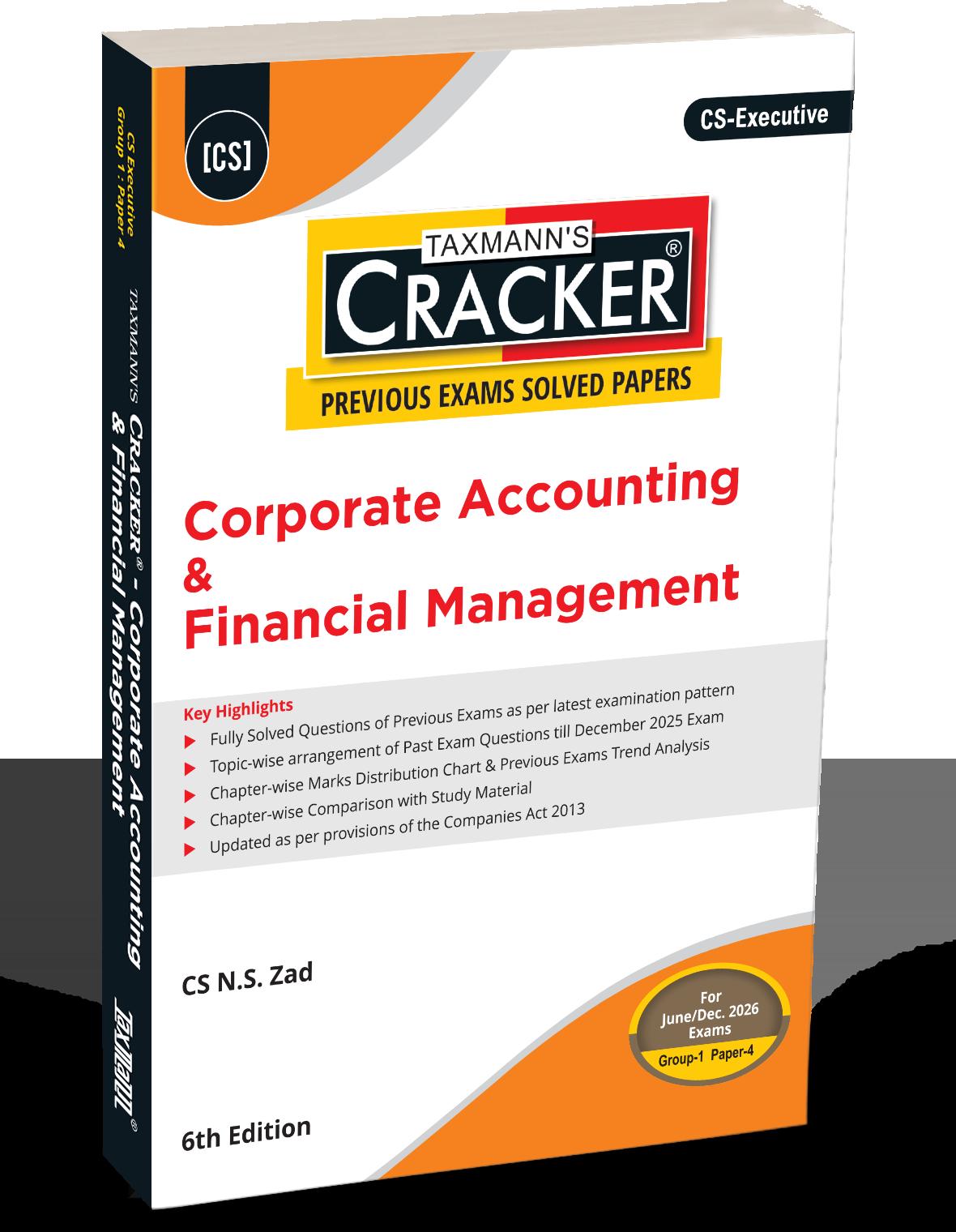
Corporate Accounting & Financial Management – CRACKER (Previous Exams Solved Papers) is an examfocused, data-driven preparation manual developed exclusively for CS Executive – Group 1 | Paper 4, applicable for the June and December 2026 examinations. The book converts nearly five examination cycles of CS Executive question data (up to December 2025) into a structured preparation and scoring framework. Each chapter, question, and solution is aligned with ICSI’s actual testing and evaluation methodology, enabling focused preparation based on examiner expectations rather than theoretical syllabus sequencing. Its core strength lies in integrating fully solved questions, marks analytics, trend analysis, and study material mapping, providing clarity on priority areas, the depth of answers, and scoring patterns.
The Present Publication is the 6th Edition, authored by CS N.S. Zad, with the following noteworthy features:
• [Fully Solved Previous Examination Questions] All past CS Executive Paper 4 questions up to December 2025 are fully solved in accordance with ICSI’s marking scheme, evaluation logic, and answer-presentation standards
• [Clear Segregation of Practical & Descriptive Questions] Questions are distinctly classified as practical or descriptive, reflecting the actual examination pattern and guiding the appropriate answering approach
• [Chapter-wise Marks Distribution & Weightage Analysis] Analytical tables highlight year-wise and chapter-wise marks allocation, identifying consistently high-weightage areas such as:
o Accounting for Share Capital
o Working Capital Management
o Capital Budgeting
o Financial Statement Analysis
o Capital Structure & Leverage
• [Previous Exams Trend Analysis] Structured trend matrices track:
o Repetition of chapters across exam cycles
o Distribution of 5-mark, 10-mark, and 20-mark questions
o Shifts in examiner focus over time
• [Chapter-wise Mapping with ICSI Study Material] Each chapter is precisely mapped with the corresponding ICSI Study Material chapter, ensuring seamless alignment and avoiding duplication