
Sample Read

© Taxmann
Price : ` 275
Law stated in this book is as updated till 15th November, 2025
Published by : Taxmann Publications (P.) Ltd.
Sales & Marketing :
59/32, New Rohtak Road, New Delhi-110 005 India
Phone : +91-11-45562222
Website : www.taxmann.com
E-mail : sales@taxmann.com
Regd. Office :
21/35, West Punjabi Bagh, New Delhi-110 026 India
Printed at :
Tan Prints (India) Pvt. Ltd.
44 Km. Mile Stone, National Highway, Rohtak Road Village Rohad, Distt. Jhajjar (Haryana) India
E-mail : sales@tanprints.com
Disclaimer
Every effort has been made to avoid errors or omissions in this publication. In spite of this, errors may creep in. Any mistake, error or discrepancy noted may be brought to our notice which shall be taken care of in the next edition. It is notified that neither the publisher nor the author or seller will be responsible for any damage or loss of action to any one, of any kind, in any manner, therefrom. It is suggested that to avoid any doubt the reader should cross-check all the facts, law and contents of the publication with original Government publication or notifications.
No part of this book may be reproduced or copied in any form or by any means [graphic, electronic or mechanical, including photocopying, recording, taping, or information retrieval systems] or reproduced on any disc, tape, perforated media or other information storage device, etc., without the written permission of the publishers. Breach of this condition is liable for legal action. For binding mistake, misprints or for missing pages, etc., the publisher’s liability is limited to replacement within seven days of purchase by similar edition. All expenses in this connection are to be borne by the purchaser. All disputes are subject to Delhi jurisdiction only.
CONTENTS
Table showing sections of Indian Evidence Act, 1872 and corresponding sections of Bharatiya Sakshya Adhiniyam, 2023 I-7
Table showing sections of Bharatiya Sakshya Adhiniyam, 2023 and corresponding sections of Indian Evidence Act, 1872 I-19
Table showing new sections of Bharatiya Sakshya Adhiniyam, 2023 I-31
Table showing sections of Indian Evidence Act repealed by Bharatiya Sakshya Adhiniyam, 2023 I-33
Section key to Bharatiya Sakshya Adhiniyam, 2023 I-35
Comparative Study of Bharatiya Sakshya Adhiniyam, 2023 and Indian Evidence Act, 1872 I-49
Arrangement of sections 1 Text of Bharatiya Sakshya Adhiniyam, 2023 11
248th Report on Bharatiya Sakshya Bill, 2023 - Parliamentary Standing Committee on Home Affairs - Observations/ Recommendations - At a glance 247
Speech of Honourable Minister of Home Affairs and Minister of Cooperation (Shri Amit Shah) in Lok Sabha on 20-12-2023 251
Appendix : Provisions of other Acts Referred to in Bharatiya Sakshya Adhiniyam, 2023 253
Subject Index 255

BHARATIYA SAKSHYA ADHINIYAM,
2023 [47 OF 2023]
An Act to consolidate and to provide for general rules and principles of evidence for fair trial.
BE it enacted by Parliament in the Seventy-fourth Year of the Republic of India as follows:—
PART I
CHAPTER I
PRELIMINARY
Short title, application and commencement.
1. (1) This Act may be called the Bharatiya Sakshya Adhiniyam, 2023.
(2)It applies to all judicial proceedings in or before any Court, including Courts-martial, but not to affidavits presented to any Court or officer, nor to proceedings before an arbitrator.
(3)It shall come into force on such date as the Central Government may, by notification in the Official Gazette†, appoint.
Corresponding Provision : Section 1 of Indian Evidence Act, 1872
COMMENTS
SECTION NOTES
1.1 Short title
This Act may be called the Bharatiya Sakshya Adhiniyam, 2023. [Section 1(1) of BSA]
1.2 Application to Judicial proceedings
It applies to all judicial proceedings in or before any Court, including Courts-martial. [Section 1(2) of BSA]
1.3 Applicability to Courts-martial
Section 1 of the Evidence Act provided that the said Act did not apply to Courts-
† Notification No. S.O. 849(E), dated 23-2-2024 - In exercise of the powers conferred by sub-section (3) of section 1 of the Bharatiya Sakshya Adhiniyam, 2023 (47 of 2023), the Central Government hereby appoints the 1st day of July, 2024 as the date on which the provisions of the said Adhiniyam, shall come into force.
martial convened under the Army Act, the Naval Discipline Act or the Indian Navy (Discipline) Act, 1934 (34 of 1934), or the Air Force Act .
Section 1(2) of the Adhiniyam omits the words “convened under the Army Act, the Naval Discipline Act or the Indian Navy (Discipline) Act, 1934 (34 of 1934), or the Air Force Act”.
Thus, unlike the Evidence Act, the Adhiniyam shall also apply to courts-martial convened under the Army Act, the Naval Discipline Act or the Indian Navy (Discipline) Act, 1934 (34 of 1934), or the Air Force Act.
1.4 Applicability to affidavits
BSA shall not apply to affidavits presented to any Court or officer [Section 1(2) of BSA]
Affidavits are typically sworn statements or written evidence submitted to the court outside the regular trial process.
1.5 Applicability to arbitration proceedings
BSA shall not apply to proceedings before an arbitrator. [Section 1(2) of BSA]
It does not matter whether arbitration is pursuant to arbitration clause or arbitration agreement or whether arbitration is pursuant to statutory provision like section 18 of Micro, Small and Medium Enterprises Development Act, 2006
Arbitration proceedings are typically governed by separate arbitration laws and rules.
1.6 Date of commencement
BSA shall come into force on 1-7-2024 - Vide Notification No. SO 849(E), dated 23-2-2024. [Section 1(3) of BSA]
Evidence Act stands repealed on and from the date of coming into force of BSA, i.e., 1-7-2024 [Section 170(1)]
Date of commencement is material as section 170(2) provides that if, immediately before the date on which BSA comes into force, there is any trial, application, inquiry, investigation, proceeding or appeal pending, then, such application, trial, inquiry, investigation, proceeding or appeal shall be dealt with under the provisions of the Evidence Act, 1872, as in force immediately before such commencement, as if BSA has not come into force.
In other words, BSA will apply only to fresh trials, applications, inquiries, investigations, proceedings or appeals commenced on or after date of coming into force of BSA, i.e. 1-7-2024.
Definitions.
2. (1) In this Adhiniyam, unless the context otherwise requires,—
(a) “Court” includes all Judges and Magistrates, and all persons, except arbitrators, legally authorised to take evidence;
Corresponding Provision : Section 3, para 1 of Indian Evidence Act, 1872
(b) “conclusive proof” means when one fact is declared by this Adhiniyam to be conclusive proof of another, the Court shall, on proof of the one fact, regard the other as proved, and shall not allow evidence to be given for the purpose of disproving it;
Corresponding Provision : Section 4, para 3 of Indian Evidence Act, 1872
(
c) “disproved” in relation to a fact, means when, after considering the matters before it, the Court either believes that it does not exist, or considers its non-existence so probable that a prudent man ought, under the circumstances of the particular case, to act upon the supposition that it does not exist;
Corresponding Provision : Section 3, para 8 of Indian Evidence Act, 1872
(d) “document” means any matter expressed or described or otherwise recorded upon any substance by means of letters, figures or marks or any other means or by more than one of those means, intended to be used, or which may be used, for the purpose of recording that matter and includes electronic and digital records.
Illustrations
(i) A writing is a document.
(ii) Words printed, lithographed or photographed are documents.
(iii) A map or plan is a document.
(iv) An inscription on a metal plate or stone is a document.
(v) A caricature is a document.
(
vi) An electronic record on emails, server logs, documents on computers, laptop or smartphone, messages, websites, locational evidence and voice mail messages stored on digital devices are documents;
Corresponding Provision : Section 3, para 5 of Indian Evidence Act, 1872
(e) “evidence” means and includes—
(i) all statements including statements given electronically which the Court permits or requires to be made before it by witnesses in relation to matters of fact under inquiry and such statements are called oral evidence;
(ii) all documents including electronic or digital records produced for the inspection of the Court and such documents are called documentary evidence;
Corresponding Provision : Section 3, para 6 of Indian Evidence Act, 1872
(f) “fact” means and includes—
(i) any thing, state of things, or relation of things, capable of being perceived by the senses;
(ii) any mental condition of which any person is conscious.
Illustrations
(i) That there are certain objects arranged in a certain order in a certain place, is a fact.
(ii) That a person heard or saw something, is a fact.
(iii) That a person said certain words, is a fact.
(iv) That a person holds a certain opinion, has a certain intention, acts in good faith, or fraudulently, or uses a particular word in a particular sense, or is or was at a specified time conscious of a particular sensation, is a fact;
Corresponding Provision : Section 3, para 2 of Indian Evidence Act, 1872
(
g) “facts in issue” means and includes any fact from which, either by itself or in connection with other facts, the existence, non-existence, nature or extent of any right, liability or disability, asserted or denied in any suit or proceeding, necessarily follows.
Explanation.—Whenever, under the provisions of the law for the time being in force relating to Civil Procedure, any Court records an issue of fact, the fact to be asserted or denied in the answer to such issue is a fact in issue.
Illustrations
A is accused of the murder of B. At his trial, the following facts may be in issue:—
(i) That A caused B’s death.
(ii) That A intended to cause B’s death.
(iii) That A had received grave and sudden provocation from B.
(iv) That A, at the time of doing the act which caused B’s death, was, by reason of unsoundness of mind, incapable of knowing its nature;
Corresponding Provision : Section 3, para 4 of Indian Evidence Act, 1872
(h) “may presume”.—Whenever it is provided by this Adhiniyam that the Court may presume a fact, it may either regard such fact as proved, unless and until it is disproved or may call for proof of it;
Corresponding Provision : Section 4, para 1 of Indian Evidence Act, 1872
(i) “not proved”.—A fact is said to be not proved when it is neither proved nor disproved;
Corresponding Provision : Section 3, para 9 of Indian Evidence Act, 1872
(j) “proved”.—A fact is said to be proved when, after considering the matters before it, the Court either believes it to exist, or considers its existence so probable that a prudent man ought, under the circumstances of the particular case, to act upon the supposition that it exists;
Corresponding Provision : Section 3, para 7 of Indian Evidence Act, 1872
(k) “relevant”.—A fact is said to be relevant to another when it is connected with the other in any of the ways referred to in the provisions of this Adhiniyam relating to the relevancy of facts;
Corresponding Provision : Section 3, para 3 of Indian Evidence Act, 1872
(l) “shall presume”.—Whenever it is directed by this Adhiniyam that the Court shall presume a fact, it shall regard such fact as proved, unless and until it is disproved.
Corresponding Provision : Section 4, para 2 of Indian Evidence Act, 1872
(2) Words and expressions used herein and not defined but defined in the Information Technology Act, 2000 (21 of 2000), the Bharatiya Nagarik Suraksha Sanhita, 2023 and the Bharatiya Nyaya Sanhita, 2023 shall have the same meanings as assigned to them in the said Act and Sanhitas.
COMMENTS
SECTION NOTES
2.0-1 Sub-section (1): Definitions of certain words and expressions used in BSA
Section 2 of BSA has two sub-sections — sub-sections (1) and (2).
Sub-section (1) of section 2 provides for definition of certain expressions used in the Legislation (BSA).
All definitions in sub-section are prefaced with the opening words “ In this Adhiniyam, unless the context otherwise requires”.
All definitions given in sub-section (1) have to be read with and subject to words “In this Adhiniyam, unless the context otherwise requires”.
2.0-2 “Court”
The Adhiniyam applies to proceedings before Courts. Therefore, clause (a) of subsection (1) defines “Court”.
2.0-3 “Fact”
Adjudication by Courts is based on the existence or non-existence of facts. If adjudication is not based on facts, it would lead to manifest injustice. Clause (f) of sub-section (1) of section 2 defines “facts”.
2.0-4 “Evidence”
Evidence is the means to establish the existence or non-existence of facts to the satisfaction of a court. Parties to a suit or proceeding will give evidence of facts to establish the existence or non-existence of facts. Clause (e) of sub-section (1) of section 2 defines “evidence”.
2.0-5 “Document”
Evidence may be oral evidence or documentary evidence. Clause (c) of sub-section (1) defines “document” for the purpose of documentary evidence.
2.0-6 “Proved”, “not proved” and “disproved”
Evidence given may produce three effects on the mind of a Judge trying a case as regards existence or non-existence of a fact — proved, disproved and not proved. Clauses (k), (d) and (j) of sub-section (1) define the terms “proved”, “disproved” and “not proved” respectively.
2.0-7 “Facts in issue” and “relevant facts”
Again, parties cannot be permitted to give evidence of all facts under the sun irrespective of relevance and waste the precious time of the Courts. Therefore, BSA permits evidence to be given in courts of only of “facts in issue” and “relevant facts”. Clause (g) of sub-section (1) of section 2 defines “facts in issue” while clause (l) of sub-section (1) defines when a fact is said to be “relevant”.
2.0-8 “Conclusive proof”, “shall presume” and “may presume”
It is not desirable that parties be made to prove the existence or non-existence of all facts as it will unnecessarily prolong the litigation. Presumptions are rules of evidence which reduce the workload and time of parties in giving evidence and of courts in evaluating and appreciating the same. Besides, public policy demands that certain evidence may be treated as conclusive proof without being allowed to
be contradicted by evidence. Clause (m) of sub-section (1) defines “shall presume” while clause (i) defines “may presume”. Clause (b) defines “conclusive proof”.
Presumption is an inference of a certain fact drawn from other proved facts - Law gives absolute discretion to Court to presume existence of any fact which it thinks likely to have happened. In that process Court may have regard to common course of natural events, human conduct, public or private business vis-a-vis facts of particular case. Discretion is clearly envisaged in section 114 of Evidence Act. Presumption is an inference of a certain fact drawn from other proved facts. While inferring existence of a fact from another, Court is only applying a process of intelligent reasoning which mind of a prudent man would do under similar circumstances. Presumption is not final conclusion to be drawn from other facts. But it could as well be final if it remains undisturbed later. Presumption in law of evidence is a rule indicating stage of shifting burden of proof. From a certain fact or facts Court can draw an inference and that would remain until such inference is either disproved or dispelled. For purpose of reaching one conclusion Court can rely on a factual presumption. Unless presumption is disproved or dispelled or rebutted Court can treat presumption as tantamounting to proof. [Paras 17, 18 and 19] - State of A.P. v. Vasudeva Rao AIR 2004 SC 960.
2.0-9 Sub-section (2): Interpretation of words and expressions used in BSA but not defined in BSA
Sub-section (2) of section 2 provides for interpretation of words and expressions used in BSA but not defined in BSA
If such words and expressions are defined in Information Technology Act,2000, Bharatiya Nagarik Suraksha Sanhita, 2023 (BNSS) or Bharatiya Nyaya Sanhita, 2023 (BNS), they shall have the same meanings as assigned to them in the said Act and Sanhitas.
COURT [SEC. 2(1)(a)]
SECTION NOTES
2.1-1 Inclusive definition, not exhaustive definition
According to clause (a), the term “Court” includes: all Judges and Magistrates, and all persons, except arbitrators, legally authorised to take evidence
Clause (a) gives an inclusive definition, not an exhaustive definition.
2.1-2 Courts-martial are Courts for BSA purposes
Clause (a) should be read with section 1(2) which deals with applicability of BSA. When so read, it is clear that, for the purposes of BSA, “Courts” will include courtsmartial.
Section 1 of the Evidence Act provided that the said Act did not apply to Courtsmartial convened under the Army Act, the Naval Discipline Act or the Indian Navy (Discipline) Act, 1934, or the Air Force Act.
Section 1(2) of the Adhiniyam omits the words “convened under the Army Act, the Naval Discipline Act or the Indian Navy (Discipline) Act, 1934, or the Air Force Act”
Thus, unlike the Evidence Act, the Adhiniyam shall also apply to courts-martial convened under the Army Act, the Naval Discipline Act or the Indian Navy (Discipline) Act, 1934, or the Air Force Act.
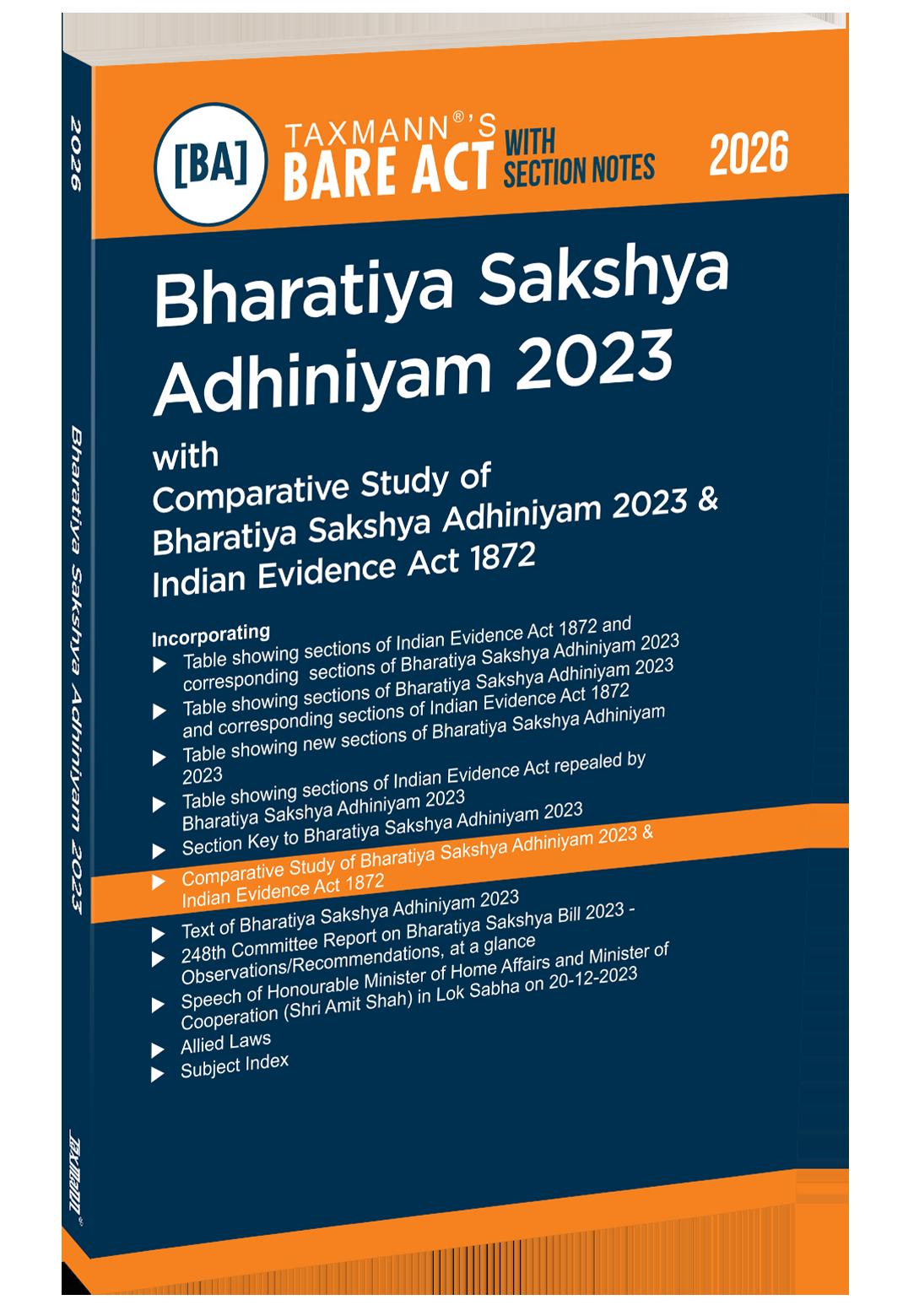
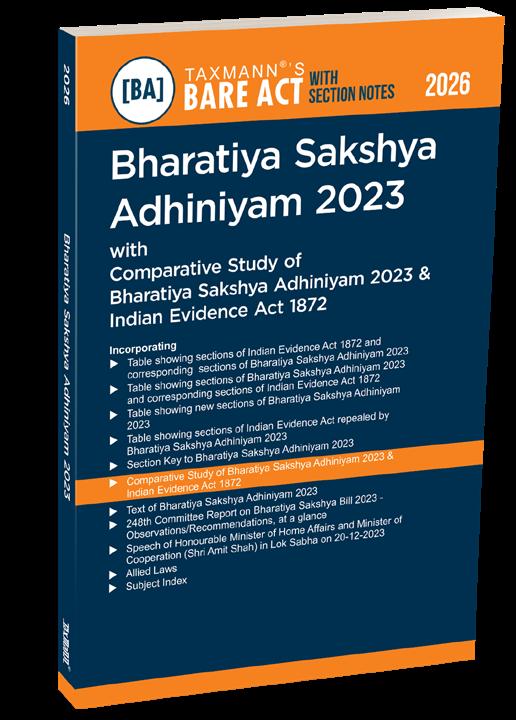
Bharatiya Sakshya Adhiniyam (BSA) 2023 – Bare Act with Section Notes
AUTHOR : Taxmann’s Editorial Board
PUBLISHER : Taxmann
DATE OF PUBLICATION : December 2025
EDITION : 2026 Edition
ISBN NO : 9789371262811
No. of Pages : 352
BINDING TYPE : Paperback
Rs. 275
DESCRIPTION
Bharatiya Sakshya Adhiniyam (BSA) 2023 [Bare Act with Section Notes] by Taxmann is a comprehensively enhanced statutory publication presenting the complete and authoritative text of India’s new law of evidence. This 2026 Edition goes well beyond a conventional Bare Act by integrating structured section notes, comparative tools, editorial aids, and transition-focused guidance, thereby serving as a reliable statutory reference and transition manual for the post–Evidence Act regime. In addition to reproducing the verbatim statutory text of the Bharatiya Sakshya Adhiniyam 2023, the publication is enriched with expertly drafted Section Notes explaining the intent, scope, interpretation, and practical application of each provision. Unlike ordinary Bare Act editions that merely reproduce statutory language, this Edition is designed to help readers understand how the new evidentiary law operates, how it differs from the 1872 framework, and how it is to be applied in judicial and investigative practice. A key strength of the book lies in its multi-layered comparative framework, which enables clear tracing of continuity, substitution, repeal, and innovation between the BSA and the IEA. Through correspondence tables, a comparative study, section keys, and transition aids, the publication facilitates instant cross-referencing between old and new provisions. This Edition is designed for a wide range of stakeholders in the justice and legal ecosystem, including:
• Judges, Judicial Officers & Trial Courts
• Advocates, Litigators & Law Firms
• Police, Prosecutors & Investigative Agencies
• Law Students, Academicians & Researchers
• Corporate Legal Teams & Compliance Professionals
• Policy Analysts, Training Institutes & Forensic Professionals
The Present Publication is the 2026 Edition, covering the amended and updated text of the Bharatiya Sakshya Adhiniyam [Act No. 47 of 2023], with the following noteworthy features:
• [Complete Text of the Bharatiya Sakshya Adhiniyam 2023] Authentic and updated statutory text with clean formatting and editorial accuracy
• [Detailed Section Notes] Section-wise notes explaining:
o Legislative intent and object
o Scope and applicability
o Evidentiary principles and standards
o Practical implications for investigation, trial, and adjudication
• [Comprehensive Comparative Tables with the Indian Evidence Act, 1872] including:
o IEA 1872 sections and corresponding BSA 2023 sections
o BSA 2023 sections and corresponding IEA 1872 provisions
o New sections introduced under the BSA 2023
o Sections of the IEA 1872 repealed by the BSA 2023
• [Comparative Study of BSA & IEA] Highlighting structural changes, modernised definitions, presumptions, and policy-driven reforms
• [Section Key to the Bharatiya Sakshya Adhiniyam] For quick subject-based identification and cross-referencing
• [Focus on Electronic & Digital Evidence] Covering electronic records, certification formats, statutory safeguards, and digital presumptions
• [Legislative & Parliamentary Background], including:
o Statement of Objects and Reasons
o Notes on Clauses
o 248th Parliamentary Standing Committee Report (at a glance)
o Speech of the Hon’ble Union Home Minister (Shri Amit Shah)
• [Appendices, Schedules & Subject Index]
o Provisions of other Acts referred to in the BSA
o Statutory schedules and prescribed certificate formats
o Detailed subject index for efficient navigation