
Sample Read

© All rights reserved
Price : ` 660
Sixth Edition : January 2026
Published by :
Taxmann Publications (P.) Ltd.
Sales & Marketing : 59/32, New Rohtak Road, New Delhi-110 005 India
Phone : +91-11-45562222
Website : www.taxmann.com
E-mail : sales@taxmann.com
Regd. Office : 21/35, West Punjabi Bagh, New Delhi-110 026 India
Printed at :
Tan Prints (India) Pvt. Ltd.
44 Km. Mile Stone, National Highway, Rohtak Road Village Rohad, Distt. Jhajjar (Haryana) India
E-mail : sales@tanprints.com
Disclaimer
Every effort has been made to avoid errors or omissions in this publication. In spite of this, errors may creep in. Any mistake, error or discrepancy noted may be brought to our notice which shall be taken care of in the next edition. It is notified that neither the publisher nor the author or seller will be responsible for any damage or loss of action to any one, of any kind, in any manner, therefrom. It is suggested that to avoid any doubt the reader should cross-check all the facts, law and contents of the publication with original Government publication or notifications.
No part of this book may be reproduced or copied in any form or by any means [graphic, electronic or mechanical, including photocopying, recording, taping, or information retrieval systems] or reproduced on any disc, tape, perforated media or other information storage device, etc., without the written permission of the publishers. Breach of this condition is liable for legal action. For binding mistake, misprints or for missing pages, etc., the publisher’s liability is limited to replacement within seven days of purchase by similar edition. All expenses in this connection are to be borne by the purchaser. All disputes are subject to Delhi jurisdiction only.







(2) Period for which preference shares can be issued: If authorized by its articles, a company limited by shares may issue preference shares which are liable to be redeemed within a period not exceeding 20 years from the date of their issue subject to prescribed conditions.
However, a company may issue preference shares for a period exceeding 20 years for infrastructure projects, subject to the redemption of prescribed percentage of shares on an annual basis at the option of such preferential shareholders.
As per Rule 10 of the Companies (Share Capital & Debentures) Rules, 2014, a company engaged in the setting-up and dealing with of infrastructural projects may issue preference shares for a period exceeding 20 years but not exceeding 30 years, subject to the redemption of a minimum 10% of such preference shares per year from the 21st year onwards or earlier, on proportionate basis, at the option of the preference shareholders. The term ‘‘infrastructure projects’’ means the infrastructure projects specified in Schedule VI.
(3) Source of funds for redemption: Preference shares shall be redeemed:
(a) Out of the profits of the company which would otherwise be available for dividend.
(
(
b) Out of the proceeds of a fresh issue of shares.
c) Partly out the profits of the company and partly out of the proceeds of a fresh issue of shares.
(4) Paid-up value of redemption: Preference shares shall be redeemed only if they are fully paid-up.
(5) Capital Redemption Reserve Account: Where preference shares are proposed to be redeemed out of the profits a sum equal to the nominal amount of the shares should be transferred to the Capital Redemption Reserve Account.
Capital Redemption Reserve Account may be applied for issue of fully paid-up bonus shares.
(6) Premium on redemption of preference shares:
(i) In case of prescribed class of companies whose financial statement required to comply with the prescribed accounting standards under section 133, the premium, if any, payable on redemption shall be provided for out of the profits of the company, before the shares are redeemed.
(ii) In a other cases, the premium payable on redemption shall be provided for:
(a) Out of the profits of the company.
(b) Out of the company’s securities premium account, before such shares are redeemed.
(c) Partly out the profits of the company and partly out of securities premium account.
(7) Redemption of preference shares by issue of further redeemable preference shares: Where a company is not in a position to redeem any preference shares or to pay dividend, if any, on such shares in accordance with the terms of issue (such shares referred as unredeemed preference shares), it may, with the consent of the holders of 3/4th in value of such preference shares and with the approval of the Tribunal on a petition made by it in this behalf, issue further redeemable preference shares equal to the amount due, including the dividend thereon, in respect of the unredeemed preference shares, and on the issue of such further redeemable preference shares, the unredeemed preference shares shall be deemed to have been redeemed.
While giving approval, the Tribunal shall order the redemption forthwith of preference shares held by such persons who have not consented to the issue of further redeemable preference shares.
Explanation: The issue of further redeemable preference shares or redemption of preference shares shall not be deemed to be an increase or a reduction, in the share capital of the company.
3. In no circumstances a company can issue redeemable preference shares with a redemption period of 20 years. [June 2015 (5 Marks)]
Ans.: As per Section 55 of the Companies Act, 2013, a company limited by shares shall not issue preference shares which are irredeemable.
A company limited by shares may issue preference shares which are liable to be redeemed within a period 20 years from the date of issue.
As per Rule 10 of the Companies (Share Capital & Debentures) Rules, 2014, a company engaged in the setting up and dealing with of infrastructural projects may issue preference shares for a period exceeding 20 years but not exceeding 30 years, subject to the redemption of a minimum ten percent of such preference shares per year from the 21st year onwards or earlier, on proportionate basis, at the option of the preference shareholders. The term ‘‘infrastructure projects’’ means the infrastructure projects specified in Schedule VI. Thus, it is incorrect to say that in no circumstances a company can issue redeemable preference shares with a redemption period of 20 years.
4. Distinguish between: Preference Share Capital & Equity Share Capital [Dec. 2015 (4 Marks)]
Ans.: Following are the main points of distinction between preference share capital & equity share capital: Points Preference
Dividend Preference shares are entitled to a fixed rate of dividend. Rate of dividend on equity shares is recommended by the board of directors in its report to the shareholders, which is approved by the shareholders at the AGM.
Points Preference Share CapitalEquity Share Capital
Preference in dividend
Dividend on the preference shares is paid in preference to the equity shares.
Preference in winding-up In case of winding-up, preference shareholders get preference over equity share holders with regard to the payment of capital.
Cumulativeness
Voting rights
Bonus & right shares
Redemption
Dividend on preference share may be cumulative.
Voting rights of preference shareholders are restricted. As per Section 47(2), a preference shareholder can vote only in following cases:
(
a) When his special rights as a preference shareholder are being varied.
(
b) Any resolution for the winding-up of the company or for the repayment or reduction of its equity or preference share capital.
(c) If preference dividend has not been paid for a period of 2 years or more.
No bonus shares/right shares are issued to preference share holders
Preference shares are liable to be redeemed within a period 20 years from the date of issue.
Dividend on equity shares is paid only after preference dividend has been paid.
In case of winding-up, equity shareholders get payment of capital after the payment of capital to preference shareholders.
Dividend on equity shares is not cumulative.
An equity shareholder can vote on all matters affecting the company.
A company may issue rights shares or bonus shares to the company’s existing equity shareholders.
Equity shares cannot be redeemed except under a scheme involving reduction of capital or buy-back of its own shares.
5. Peacock Home Appliances Limited, an unlisted public company was incorporated in the year 2015 to manufacture domestic pressure cookers. In the year 2017, the company issued six-years, 7%, non-convertible, cumulative preference shares for ` 15 Crore to another company called Classic Appliances Limited. Due to intense competition in the home appliances market, the company was just able to break even. The company did not declare any dividend (both on equity shares and preference shares) since incorporation and unable to redeem preference shares during the year 2023 on maturity.
Referring to the provisions of the Companies Act, 2013 explain the way for redemption of unredeemed preference shares and how the outstanding preference dividend can be discharged, as the profit is not available for the redemption of preference shares and payment of outstanding dividend. [Dec. 2023 (5 Marks)]
Ans.: As per section 55(3) of the Companies Act, 2013, where a company is not in a position to redeem any preference shares or to pay dividend, if any, on such shares in accordance with the terms of issue (such shares referred as unredeemed preference shares), it may, with the consent of the holders of 3/4th in value of such preference shares and with the approval of the Tribunal on a petition made by it in this behalf, issue further redeemable preference shares equal to the amount due, including the dividend thereon, in respect of the unredeemed preference shares, and on the issue of such further redeemable preference shares, the unredeemed preference shares shall be deemed to have been redeemed.
While giving approval, the Tribunal shall order the redemption forthwith of preference shares held by such persons who have not consented to the issue of further redeemable preference shares.
Explanation: The issue of further redeemable preference shares or redemption of preference shares shall not be deemed to be an increase or a reduction, in the share capital of the company.
Thus, if profit is not available for redemption, Peacock Home Appliances Limited can redeem its preference share and preference dividend as per provisions stated above.
ISSUE OF SHARES AT PREMIUM
6. Amount lying in the securities premium account belongs to the shareholders and can be used freely for their benefit. [June 2021 (5 Marks)]
Ans.: A company may issue securities at a premium when it is able to sell them at a price above face value. The Companies Act, 2013, does not stipulate any conditions or restrictions regulating the issue of securities by a company at a premium. However, it imposes conditions regulating the utilization of the amount of premium collected on securities.
Securities Premium Account [Section 52(1)]: Where a company issues shares at a premium, whether for cash or otherwise, a sum equal to the aggregate amount of the premium received on those shares shall be transferred to a “securities premium account” and the provisions of the Act relating to reduction of share capital of a company shall, except as provided in this section, apply as if the securities premium account were the paid-up share capital of the company.
Conditions relating to utilization of securities premium [Section 52(2)]: Securities premium can be used by the company for the following purposes:
(a) Issuing fully paid bonus shares.
(b) Writing off the preliminary expenses.
(c) Writing off commission or discount or the expenses on issue of shares or debentures.
(d) Writing off premium on redemption of redeemable preference shares or debentures.
(e) Buy-back of face value of shares and writing off premium on buy-back. Conditions relating to utilization of securities premium in case of prescribed class of companies [Section 52(3)]: In case of prescribed class of companies whose financial statement comply with the accounting standards prescribed under section 133, securities premium account can be used for the following purposes:
(
i) Issuing fully paid-up bonus shares.
(ii) Writing off expenses or commission or discount on any issue of equity shares.
(iii) Buy-back of face value of shares and writing off premium on buy-back.
7. In view of provisions of the Companies Act, 2013 relating to ‘securities premium’, state whether the amount lying in securities premium account of a company can be used:
(
i) For issuance of Bonus shares; and
(ii) For payment of dividend declared by the company at its General Meeting. [Dec. 2015 (4 Marks)]
Ans.: Conditions relating to utilization of securities premium [Section 52(2)]: Please refer to Section 52(2) discussed earlier.
In view of above provisions, answer to given case is as follows:
(i) Company can use the amount laying in securities premium for issuance of bonus shares.
(ii) Company cannot use the amount laying in securities premium for payment of dividend declared by the company at its general meeting.
8. Radhika Textile Limited has utilized the securities premium during the financial year 2016-2017 as follows:
(i) ` 15 lakh against expense of foreign travelling of directors.
(ii) ` 5 lakh for writing-off the balance of preliminary expenses of the company.
(iii) ` 10 lakh distributed as dividend for the financial year ending 31st March, 2017.
You, being the secretarial Auditor of the company, referring to the provision of the Companies Act, 2013 relating to securities premium account, examine the validity of the above. [June 2017 (8 Marks)]
Ans.: Conditions relating to utilization of securities premium [Section 52(2)]: Please refer to Section 52(2) discussed earlier.
In view of above provisions, answer to given case is as follows:
(i) Balance in securities premium cannot be utilized for writing-off expenses of foreign travelling of directors.
(ii) Balance in securities premium can be utilized writing-off preliminary expenses of the company.
(iii) Balance in securities premium cannot be utilized for payment of dividend.
ISSUE OF SHARES AT DISCOUNT
9. Write a short note on: Issue of shares at discount
Ans.: Prohibition on issue of shares at discount [Section 53]: Except as provided in Section 54 [issue of sweat equity shares], a company shall not issue shares at a discount.
Any share issued by a company at a discount price shall be void. However, a company may issue shares at a discount to its creditors when its debt is converted into shares in pursuance of any statutory resolution plan or debt restructuring scheme in accordance with any guidelines or directions or regulations specified by the RBI under the Reserve Bank of India Act, 1934 or the Banking (Regulation) Act, 1949.
Penalty: Where any company fails to comply with the provisions of this section, such company and every officer who is in default shall be liable to a penalty which may extend to an amount equal to the amount raised through the issue of shares at a discount or ` 5 lakh, whichever is less. The company shall also be liable to refund all monies received with interest at the rate of 12% p.a. from the date of issue of such shares to the persons to whom such shares have been issued.
SWEAT EQUITY SHARES
10. Write a short note on: Sweat Equity Shares [Dec. 2014 (4 Marks)]
Ans.: Sweat Equity Shares [Section 2(88)]: Sweat equity shares means equity shares issued by a company to its directors or employees at a discount or for consideration, other than cash for providing know-how or making available rights in the nature of intellectual property rights or value additions, by whatever name called.
Issue of sweat equity shares [Section 54]: A company can issue sweat equity shares, of a class of shares already issued, if the following conditions are satisfied:
(a) The issue has been authorized by a special resolution passed by the company in the general meeting.
(b) Such special resolution should clearly specify:
- Number of shares
- Current market price
(
- Consideration and
- Classes of directors or employees to whom such equity shares are to be issued.
c) At least 1 year should have elapsed from the date on which the company was entitled to commence business. [Deleted by the Companies (Amendment) Act, 2017]
(
d) A company whose shares are listed on a recognized stock exchange issuing sweat equity shares should comply with the SEBI (Share Based Employee Benefits & Sweat Equity) Regulations, 2021.
(
e) A company whose shares are not so listed should comply with the Companies (Share Capital & Debentures) Rules, 2014.
Rights, limitations, restrictions applicable to sweat equity shares [Section 54(2)]: The rights, limitations, restrictions and provisions as are for the time being applicable to equity shares shall be applicable to the sweat equity shares issued and the holders of sweat equity shares shall rank pari passu (on an equal footing) with other equity shareholders.
11. The share capital of Raney Ltd. is ` 30 Crore. ‘Russel’ is appointed as the managing director of the company, the company wants to compensate him by issue of shares for supplying technical know-how without any cost. In this context, answer the following:
(i) Whether the company is allowed to allot such shares?
(ii) Is approval of shareholders required for issuing such shares?
(iii) If found eligible to allot such shares, what will be the quantum (value) of shares that can be allotted?
(iv) Can Russel sell such allotted shares in the market?
(v) Will the amount that he receives on sale of his shares be considered a part of his remuneration? [Dec. 2019 (1 × 5 = 5 Marks)]
Ans.: Considering provisions of Section 2(88), Section 54 of the Companies Act, 2013 read with the Companies (Share Capital & Debentures) Rules, 2014 relating to Sweat Equity Shares, answer to given case is as follows:
(i) Sweat equity shares can be issued by a company to its directors or employees for providing know-how or making available rights in the nature of intellectual property rights or value additions. Thus, the company can compensate its managing director by issuing to Sweat Equity Shares for providing technical know-how.
(ii) The special resolution is required to be passed for issue of sweat equity shares. Such resolution is valid for making the allotment within a period of not more than 12 months from the date of passing of the special resolution.
(iii) The company shall not issue sweat equity shares for more than 15% of the existing paid-up equity share capital in a year or shares of the issue value of ` 5 Crore, whichever is higher.
As the paid-up share capital of the company is ` 30 Crore. The company can allot sweat equity shares of ` 4.5 Crore (30 Crore × 15%) or ` 5 Crore, whichever is higher.
Thus, Raney Ltd. can allot maximum ` 5 Crore value of sweat equity shares to its directors and employees.
(iv) Sweat equity shares issued to directors or employees shall be locked-in/ non-transferable for a period of 3 years from the date of allotment and the fact that the share certificates are under lock-in and the period of expiry of lock in shall be stamped in bold or mentioned in any other prominent manner on the share certificate.
Hence, the sweat equity shares allotted to Russel can be sold in the market only after the expiry of the lock-in period of 3 years.
(
v) The amount of sweat equity shares issued shall be treated as part of managerial remuneration for the purposes of Sections 197 & 198 of the Companies Act, 2013, if the following conditions are fulfilled –
(a) Sweat equity shares are issued to any director or manager; and
(b) They are issued for consideration other than cash, which does not take the form of an asset which can be carried to the balance sheet of the company in accordance with the applicable accounting standards.
In simple words, amount of sweat equity shares issued shall be treated as part of managerial remuneration only if it is expensed in the books of the company.
12. Sita Ltd. intends to issue sweat equity shares to its employees for a non-cash consideration. Managing Director believes that the sweat equity shares can only be issued for consideration received in cash. Do you agree? [June 2022 (3 Marks)]
Ans.: Sweat Equity Shares [Section 2(88)]: Sweat equity shares means equity shares issued by a company to its directors or employees at a discount or for consideration, other than cash for providing know-how or making available rights in the nature of intellectual property rights or value additions, by whatever name called.
As per Section 54 of the Companies Act, 2013, a company may issue sweat equity shares of a class of shares already issued, if the issue is authorized by a special resolution passed by the company. Such resolution specifies the number of shares, the current market price, consideration and the class or classes of directors or employees to whom such equity shares are to be issued.
Further, as per Rule 8(9) of the Companies (Share Capital & Debentures) Rules, 2014, company can issue sweat equity shares for non-cash consideration on the basis of valuation report in respect thereof obtained from a registered valuer. Based on above provisions, we can conclude that the view of the Managing Director is not correct.
13. ABC Limited is a subsidiary company of XYZ Limited. Deepak is working as an executive director in ABC Limited. XYZ Limited passed an ordinary resolution in its general meeting to issue Sweat equity Shares to Deepak for providing his professional services. Pankaj who is Company Secretary in XYZ Ltd., objected the following:
(
i) Sweat equity shares cannot be issued to Deepak, who is an executive director in Subsidiary company i.e., ABC Limited.
(ii) Special resolution is required to be passed in the general meeting, of XYZ Ltd. Examine the validity of objection of Company Secretary of XYZ Limited under the provisions of Companies Act, 2013. [Dec. 2023 (5 Marks)]
Ans.: As per section 2(88) of the Companies Act, 2013, sweat equity shares means equity shares issued by a company to its directors or employees at a discount or for consideration, other than cash for providing know-how or making available rights in the nature of intellectual property rights or value additions, by whatever name called.
Sweat equity shares can be issued to director who may be whole time or part time i.e. executive or non-executive.
As per section 54(1), a company can issue sweat equity shares, of a class of shares already issued, if the issue has been authorized by a special resolution passed by the company in the general meeting.
As per Rule 8(1) of the Companies (Share Capital & Debentures) Rules, 2014, employee means:
(a) A permanent employee of the company who has been working in India or outside India.
(b) A director of the company, whether a whole time director or not.
(c) An employee or a director of a subsidiary, in India or outside India, or of a holding company of the company.
Considering above provisions, answer to given case is as follows:
(i) XYZ Limited can issue sweat equity shares to Deepak who is executive director of ABC Limited (Subsidiary of XYZ Limited).
(ii) XYZ Limited will have to pass special resolution for issuing sweat equity shares. Such shares cannot be issued by passing ordinary resolution.
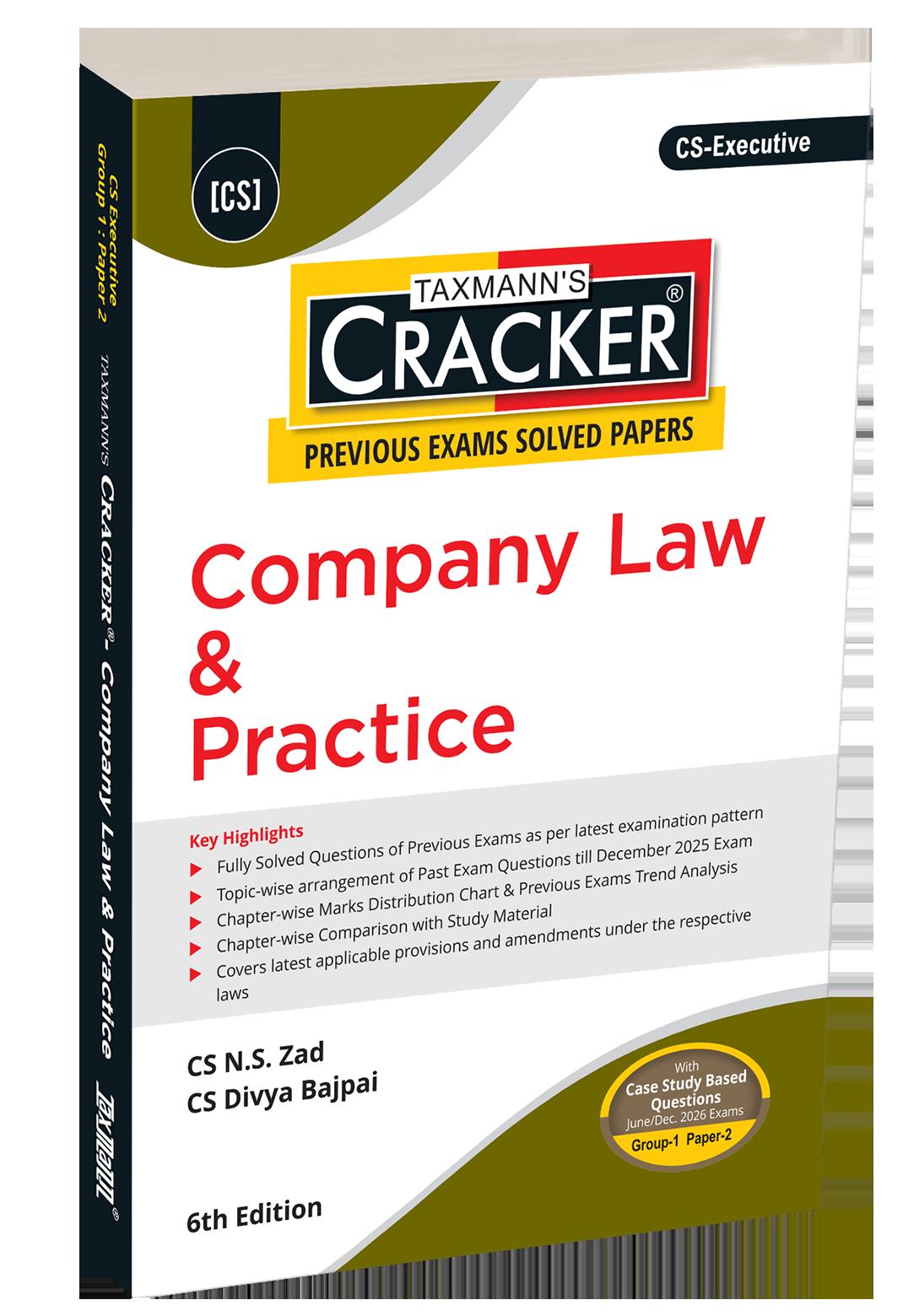
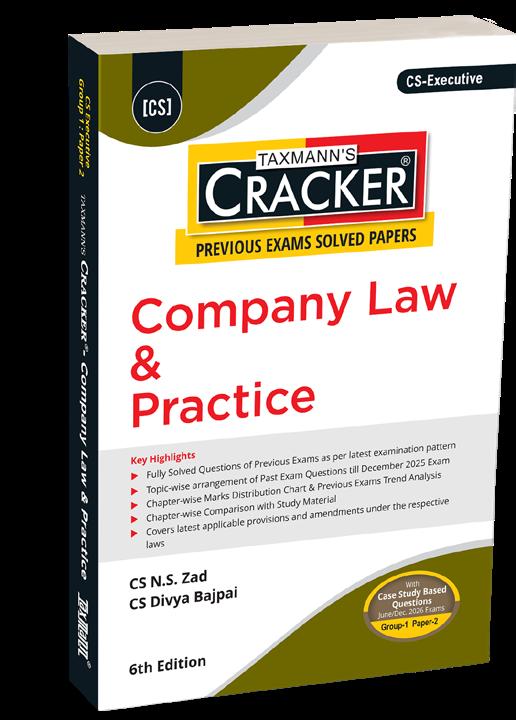
Company Law & Practice (Company Law) | CRACKER
AUTHOR : N.S. Zad, Divya Bajpai
PUBLISHER : Taxmann
DATE OF PUBLICATION : January 2026
EDITION : 6th Edition
ISBN NO : 9789375618638
No. of Pages : 620
BINDING TYPE : Paperback
Rs. 660
DESCRIPTION
Company Law & Practice – CRACKER is a focused, exam-oriented publication designed exclusively for CS Executive – Group 1 | Paper 2, fully aligned with the latest ICSI syllabus and examination pattern applicable for June/December 2026. This Edition follows a data-driven preparation approach built on actual past examination questions, examiner trend analysis, and practical application of company law provisions. Adopting a question-centric pedagogy, the book enables students to learn through systematically solved past exam questions, including a dedicated, high-weightage section on Case Study-Based Questions. By integrating topic-wise coverage, marks analytics, and study material mapping, the CRACKER transforms past exam papers into a structured, high-scoring preparation tool.
The Present Publication is the 6th Edition, authored by CS N.S. Zad & CS Divya Bajpai, with the following noteworthy features:
• [Fully Solved Previous Exam Questions] Step-by-step solutions to past examination questions prepared strictly as per the latest ICSI examination pattern
• [Topic-wise Arrangement of Questions] Topic-wise and chapter-wise presentation of questions asked up to the December 2025 examination
• [Case Study-Based Question Coverage] A dedicated chapter covering extensively tested case study–based questions, reflecting the practical orientation of the paper
• [Chapter-wise Marks Distribution Charts] Marks distribution tables highlighting chapter-wise weightage and scoring potential across multiple exam cycles
• [Previous Exams Trend Analysis] Analytical insights into question frequency, recurring chapters, and examiner focus
• [Study Material Comparison Mapping] Chapter-wise alignment with the ICSI Study Material to ensure complete and accurate syllabus coverage
• [Updated Law & Amendments] Updated to incorporate the latest applicable provisions, amendments, and regulatory changes