
Sample Read


MODULE 3
A QUICK REVIEW
The statement of cash flows shall report cash flows during the period classified under the following three categories —
(a)Cash flow from operating activities;
(b)Cash flow from investing activities; and
(c)Cash flow from financing activities.
Note: Sum of these three types of cash flows reflects the net change in cash and cash equivalent of the entity.
Cash and Cash Equivalents:
(a)Cash shall consist of cash in hand and demand deposits; and
(b)Cash equivalent consist of short-term, highly liquid investments that are readily convertible to known amounts of cash and which are subject to an insignificant risk of changes in value.
Types of Cashflows:
(a)Cash flow from operating activities
Cash flows from operating activities are primarily derived from the principal revenue producing activities of the entity. Therefore, they generally result from the transactions and other events that enter into the determination of profit or loss.
Examples of cash flows from operating activities are:
(i) cash receipts from the sale of goods and the rendering of services;
(ii)cash receipts from royalties, fees, commissions and other revenue;
(iii)cash payments to suppliers for goods and services;
(iv)cash payments to and on behalf of employees;
(v) cash receipts and cash payments of an insurance entity for premiums and claims, annuities and other policy benefits;
(vi) cash payments or refunds of income taxes unless they can be specifically identified with financing and investing activities; and
(vii) cash receipts and payments from contracts held for dealing or trading purposes.
(
Note: Cash received on account of sale of an item of plant is a cash flow from investing activities.
Again, cash flows arising from the purchase and sale of dealing or trading securities are classified as operating activities. Similarly, cash advances and loans made by financial institutions are usually classified as operating activities since they relate to the main revenue-producing activity of that entity.
b) Cash flow from investing activities
The activities of acquisition and disposal of long-term assets and other investments not included in cash and cash equivalents are investing activities. However, only expenditures that result in a recognized asset in the balance sheet are eligible for classification as investing activities.
Examples of cash flows arising from investing activities are:
(i) cash payments to acquire property, plant and equipment, intangibles and other long-term assets. These payments include those relating to capitalised development costs and self-constructed property, plant and equipment;
(ii) cash receipts from sales of property, plant and equipment, intangibles and other long-term assets;
(iii) cash payments to acquire equity or debt instruments of other entities and interests in joint ventures (other than payments for those instruments considered to be cash equivalents or those held for dealing or trading purposes);
(iv) cash receipts from sales of equity or debt instruments of other entities and interests in joint ventures (other than receipts for those instruments considered to be cash equivalents and those held for dealing or trading purposes);
(v) cash advances and loans made to other parties (other than advances and loans made by a financial enterprise);
(vi) cash receipts from the repayment of advances and loans made to other parties (other than advances and loans of a financial enterprise);
(vii) cash payments for futures contracts, forward contracts, option contracts and swap contracts except when the contracts are held for dealing or trading purposes, or the payments are classified as financing activities; and
(viii) cash receipts from futures contracts, forward contracts, option contracts and swap contracts except when the contracts are held for dealing or trading purposes, or the receipts are classified as financing activities.
(
c) Cash from financing activities
These are activities that result into change in size and composition of owner’s capital and borrowing of the organisation. Accordingly, it includes receipts from issue of shares, bonds and other instruments, borrowing and repayment of loans.
Examples of cash flows arising from financing activities are:
(i) cash proceeds from issuing shares or other similar instruments;
(ii) cash proceeds from issuing debentures, loans, notes, bonds, mortgages and other short-term or long-term borrowings;
(iii) cash repayments of amounts borrowed.
PAST EXAMINATION QUESTIONS
OBJECTIVE QUESTIONS
Q. 1. Interest and Dividends received in the case of a manufacturing concern should be classified as cash flow from:
(A) Operating activities (B) Financing activities (C) Investing activities (D) None of the above. [June 2013, 1 Mark]
Ans. (C) Investing activities
Q. 2. Which of the following items is not a part of cash flow from operating activities?
(A) Collection from customers
(B) Payment of outstanding wages
(C) Payment to suppliers of machinery
(D) Advances to foreign suppliers for raw materials [June 2017, 1 Mark]
Ans. (C) Payment to suppliers of machinery
Q. 3. While preparing Cash Flow Statement of XY Ltd., a finance company, interest received on loans should be shown as:
(A) Cash Flow from Operating Activities
(B) Cash Flow from Investing Activities
(C) Cash Flow from Financing Activities
(D) Cash and Cash Equivalent [Dec. 2017, 1 Mark]
Ans. (A) Cash Flow from Operating Activities
Q. 4. Which of the following is not a component of Cash Flow Statement?
(A) Cash payments to suppliers for goods and services
(B) Charging of Depreciation
(C) Cash advances and loans made to third parties
(D) Cash repayments of amounts borrowed [June 2018, 1 Mark]
Ans. (B) Charging of Depreciation
Q. 5. In case of Cash Flow Statement prepared under indirect Method, decrease in current liabilities is:
(A) Added to cash flow from operating activities
(B) Deducted to cash flow from operating activities
(C) Added to cash flow from investing activities
(D) None of the above [June 2019, 1 Mark]
Ans. (B) deducted to cash flow from operating activities
Q. 6. How should the revaluation of Fixed Assets be treated in a Cash Flow Statement?
(A) Under cash flow from financing activities
(B) Do not appear in cash flow statement
(C) Under cash flow from operating activities
(D) Under cash flow from investing activities [Dec. 2021, 1 Mark]
Ans. (B) Do not appear in cash flow statement
Q. 7. Cash Flow arising from which of the following Operating, Investing or Financing Activities may be reported on a net basis? Name one item. [Dec. 2021, 1 Mark]
Ans. Cash receipts and payments on behalf of customers when the cash flow reflect the activities of the customer rather than those of the entity OR cash receipts and payments for items in which turnover is quick, the amounts are large, and the maturities are short.
Q. 8. Increase in Bank Overdraft is:
(A) Increase in Cash and Cash equivalents
(B) Decrease in Cash and Cash equivalents
(C) Inflow from Financial activities
(D) Outflow from Financial activities [Dec. 2022, 1 Mark]
Ans. (B) decrease in Cash and Cash equivalents
Q. 9 Net profit for the year ended 31.12.2022 ` 15,000, interest received in advance on 1st January, 2022 ` 2,000 and 31st December, 2022 ` 3,000. Cash from operations will be _____.
(A) 16,000
(B) 22,000
(C) 13,000
(D) 15,000 [July 2023, 1 Mark]
Ans. (A) 16,000
Working Note:
Q. 10. Payment of income tax is classified under cash flow from financing activity. (True/ False) [July 2023, 1 Mark]
Ans. False
Q. 11. Cash payment to suppliers is a part of _________ under direct method.
(A) Cash flow from operating activities
(B) Cash flow from investing activities
(C) Cash flow from financing activities
(D) Cash flow from non-operating activities [Dec. 2023, 2 Marks]
Ans. (A) cash flow from operating activities
Reason: Payment to suppliers represents payment for goods and services procured as a part of routine business activity, hence classified into operating activities.
Q. 12. Which of the following is a part of cash flow from financing activities of manufacturing company?
(A) Proceeds from sale of old machinery
(B) Collection from customers
(C) Dividend received from a foreign company
(D) Interest paid on a partly convertible debenture [Dec. 2023, 1 Mark]
Ans. (D) Interest paid on a partly convertible debenture
Q. 13. Which of the following is not treated as Cash Flow from operating activities in Cash Flow Statement?
(A) Cash Receipts from Sale of goods
(B) Cash Receipts from Royalties, Commission
(C) Cash payments for Insurance premium
(D) Cash receipts from other parties for repayment of Loans [Dec. 2024, 2 Marks]
Ans. (D) Cash receipts from other parties for repayment of Loans
DESCRIPTIVE QUESTIONS
Q. 1. What is the meaning of the expression ‘cash equivalent’? [Dec. 2013, 2 Marks]
Ans. Cash equivalent means bank balance and other risk-free short-term investments and advances which are readily encashable. Cash equivalents means short-term
highly liquid investments that are readily convertible into known amounts of cash and which are subject to an insignificant risk of changes in value.
Q. 2. State the classification of cash flow activities as per AS-3. [Dec. 2014, 2 Marks]
Ans.
Cash Flow Statement explains cash movements under three different heads, namely: Cash flow from operating activities; Cash flow from investing activities; Cash flow from financing activities.
Q. 3. Write a short note on objectives of preparing Cash Flow Statement. [June 2017, 4 Marks]
Ans.
Objectives of preparing Cash Flow Statement:
(i) To provide information about firm’s liquidity, flexibility and ability to generate future cash flow.
(ii) To provide information about firm’s ability to meet future obligations.
(iii) To enhance comparability among firms.
(iv) To assess reliability of net profit and quality of earnings.
(v) To enable the users to assess how assets and liabilities have increased or decreased.
(vi) To project future cash flow streams.
(vii) To provide information on different types of cash flow.
Q. 4. Reasons for preparation of Cash Flows. [June 2019, 4 Marks]
Ans.
Cash Flow statement is considered to be a summarized statement showing sources of Cash Inflows and application of cash outflows of an enterprise during a particular period of time.
It is prepared on the basis of the published data as disclosed by the Financial Statement of two different financial periods. It is an essential tool for managerial decision-making.
Cash Flow Statement reports the management net Cash Flow (i.e. cash inflow less cash outflow or vice versa) from each activity of the enterprise as well as of the overall business of the enterprise.
The management of the enterprise gets a picture of movement of cash resources from the Cash Flow Statement and can assess the stronger and weaker area of movement of cash for different activities of the business for drawing up the future planning.
PRACTICAL PROBLEMS
Q. 1. The following relevant items from the Balance Sheet of LM Limited are provided: Particulars31-03-2012 (`)31-03-2013 (`)
Depreciation amounting to ` 1,42,000 and Profit on sale of Machinery amounting to ` 21,000 appeared in the Profit and Loss A/c for the year ending 31-3-2013. During the year 2012-13 ` 1,00,000 was paid as Income Tax. You are required to calculate Net Cash Flow from operating activity for the year ending 31st March, 2013. [Dec. 2013, 4 Marks]
Ans.
Statement showing cash flow from operating activities for the year ended 31st March 2013:
Particulars ` `
(A) Cashflow from Operating Activities: Increase in balance of Profit & loss (6,25,000 – 4,15,000)2,10,000 Profit on sale of machinery(21,000) Provision for tax1,50,000 Depreciation1,42,000
Goodwill written off15,000
Transfer to general reserve50,0003,36,000
Operating profit before working capital changes5,46,000
Changes in working Capital:
Decrease in prepaid expenses3,000
Decrease in provision for doubtful debts(2,250)
Increase in Inventories(95,000)
Increase in creditors35,000
Decrease in Debtors23,000(36,250)
Tax paid(1,00,000)
Net Cash flow from Operating activities4,09,750
Working Note: (1) Provision for tax:
1,05,000
(1,00,000)
(1,55,000)
Provision 1,50,000
Q. 2. Shyama Limited has given the following information for the preparation of cash flow statement for the year 2013-14:
You are required to prepare the Cash Flow Statement for the year 2013-14 in accordance with AS-3. [June 2014, 10 Marks]
Ans.
Cash Flow Statement for the year ended 31st March 2014 Particulars
(A) Cashflow from Operating Activities:
Net profit before Taxation60,000 Depreciation40,000
Loss on sale of assets80
Amortization of capital grant(12)
Profit on sale of investments(200)
Interest received in investments(5012)
Interest expenses20,00054,856
Operating profit before working capital changes1,14,856
Changes in working Capital:
Decrease in current liabilities(34,650)
Increase in current assets(77,500)(1,12,150)
Tax paid(8,496)
Net Cashflow from Operating activities(5,790)
(B) Cashflow from Investing Activities:
Sale of Assets290
Sale of Investments55,730
Interest received on investments5,012
Purchase of Fixed Assets(29,120)
Purchase of Investments(7,700)
Expenditure on Capital Work-in-progress(69,480)
Net Cashflow from Investing activities(45,268)
(C) Cash flow from Financing Activities:
Receipt of Grant for capital projects28
Proceeds from issue of share capital51,960
Proceeds from issue of debenture41,150
Interest paid(21,040)
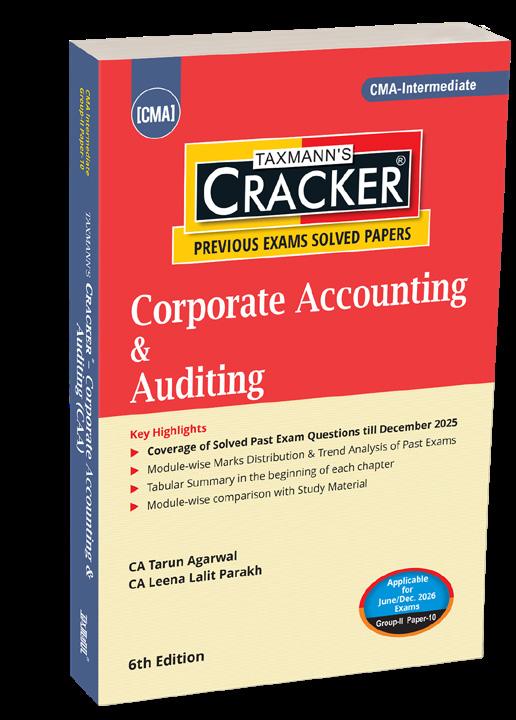
Corporate Accounting & Auditing (CAA) | CRACKER
AUTHOR : Tarun Agarwal, Leena Lalit Parakh
PUBLISHER : Taxmann
DATE OF PUBLICATION : January 2026
EDITION : 6th Edition
ISBN NO : 9789375614340
No. of Pages : 536
BINDING TYPE : Paperback
Rs. 475
DESCRIPTION
Corporate Accounting & Auditing – CRACKER (Previous Exams Solved Papers) is a focused, exam-oriented practice manual for CMA Intermediate – Group II | Paper 10, applicable for the June/December 2026 examinations. The January 2026 Edition is developed through a rigorous analysis of past CMA examination papers up to December 2025, transforming historical exam data into a structured preparation strategy. Unlike conventional question banks, this CRACKER decodes examiner trends and recurring patterns, enabling students to identify what to study, the depth of coverage required, and consistently tested scoring areas for result-oriented preparation.
The Present Publication is the 6th Edition, authored by CA. Tarun Agarwal and CA. Leena Lalit Parakh, with the following noteworthy features:
• [Comprehensive Past Exam Coverage] Module-wise coverage of previous CMA examination questions up to December 2025, with fully solved, exam-compliant answers for both theory and practical questions
• [Previous Exams Trend Analysis] Detailed year-wise and question-wise trend analysis highlighting:
o Compulsory vs optional questions
o Chapters/modules tested
o Marks allocation
o Nature of questions (Theory/Practical)
o This enables the identification of frequently tested and high-weightage topics
• [Module-wise Marks Distribution] Structured presentation of historical marks distribution across Corporate Accounting and Auditing modules, aiding effective study prioritisation
• [Chapter-opening Tabular Summaries] Each chapter begins with a concise snapshot outlining:
o Topics covered
o Past exam relevance
o Trend indicators
o Facilitates quick orientation and selective revision
• [Module-wise Comparison with CMA Study Material] Dedicated module-mapping table aligning CRACKER content with CMA Study Material modules, ensuring complete syllabus coverage and avoiding duplication
• [Exam-oriented Answer Presentation] Solutions drafted strictly in line with CMA examination requirements, focusing on clarity, statutory references, and effective marks presentation
• [Balanced Theory & Practical Coverage] Proportionate coverage of numerical problems and descriptive questions, reflecting actual exam composition