
Sample Read
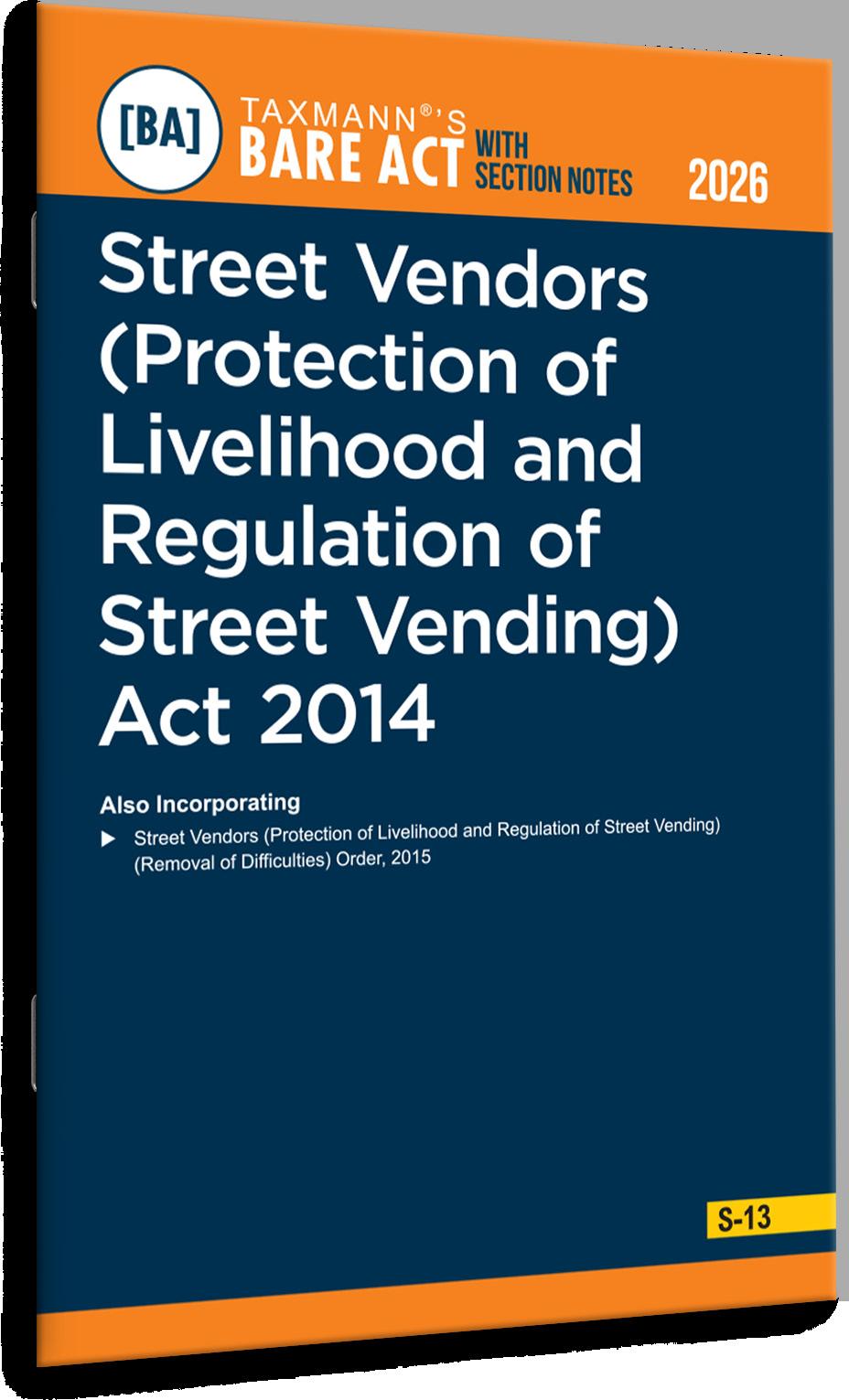



STREET VENDORS (PROTECTION
OF LIVELIHOOD AND REGULATION OF STREET VENDING) ACT, 2014
CHAPTER I PRELIMINARY
1. Short title, extent, commencement and provisions 1
2. Definitions 2
CHAPTER II REGULATION OF STREET VENDING
3. Survey of street vendors and protection from eviction or relocation 5
4. Issue of certificate of vending 7
5. Conditions for issue of certificate of vending 9
6. Categories of certificate of vending and issue of identity cards 10
7. Criteria for issuing certificate of vending 10
8. Vending fees 11
9. Validity and renewal of certificate of vending 11
10. Cancellation or suspension of certificate of vending 11
11. Appeal from decision of Town Vending Committee 12
CHAPTER III
RIGHTS AND OBLIGATIONS OF STREET VENDORS
12. Rights of street vendors 13
13. Right of street vendor for a new site or area on relocation 14
14. Duty of street vendors 14
15. Maintenance of cleanliness and public hygiene 14
16. Maintenance of civic amenities in vending zone in good condition 14
17. Payment of maintenance charges 14
CHAPTER IV
RELOCATION AND EVICTION OF STREET VENDORS
18. Relocation or eviction of street vendors 14
19. Seizure and reclaiming of goods 16
CHAPTER V DISPUTE REDRESSAL MECHANISM
20. Redressal of grievances or resolution of disputes of street vendors 17
CHAPTER VI PLAN FOR STREET VENDING
21. Plan for street vending 17
CHAPTER VII TOWN VENDING COMMITTEE
22. Town Vending Committee 18
23. Meetings of Town Vending Committee 19
24. Temporary association of persons with Town Vending Committee for particular purposes 19
25. Office space and other employees for Town Vending Committee 19
26. Publication of street vendor’s charter and data-base and carrying out of social audit 20
CHAPTER VIII
PREVENTION OF HARASSMENT OF STREET VENDORS
27. Prevention of harassment by police and other authorities 20
28. Penalty for contraventions
29. Provisions of this Act, not to be construed as conferring ownership rights, etc.
30. Returns
32.
33.
34.
35.

Street Vendors (Protection of Livelihood and Regulation of Street Vending) Act, 2014
[7 OF 2014]
An Act to protect the rights of urban street vendors and to regulate street vending activities and for matters connected therewith or incidental thereto.
Be it enacted by Parliament in the Sixty-fifth Year of the Republic of India as follows:—
CHAPTER I PRELIMINARY
Short title, extent, commencement and provisions.
1. (1) This Act may be called the Street Vendors (Protection of Livelihood and Regulation of Street Vending) Act, 2014.
(2)It extends to the whole of India except the State of Jammu and Kashmir1
(3)It shall come into force on such date2 as the Central Government may, by notification in the Official Gazette, appoint; and different dates may be appointed for different States and any reference in any provision to the commencement of this Act shall be construed in relation to any State as a reference to the coming into force of that provision in that State.
(4) The provisions of this Act shall not apply to any land, premises and trains owned and controlled by the Railways under the Railway Act, 1989 (24 of 1989).
COMMENTS
SECTION NOTES
This Act extends to the whole of India.
1.This Act is made applicable to territory of Jammu and Kashmir and the Union territory of Ladakh. Vide the Jammu and Kashmir Reorganisation (Removal of Difficulties) Order, 2019, w.e.f. 31-10-2019.
2.With effect from 1-5-2014 vide Notification No. S.O. 1185 (E), dated 1-5-2014.
Act not to apply to land, premises and trains of Railways
The provisions of this Act shall not apply to any land, premises and trains owned and controlled by the Railways under the Railway Act, 1989 (24 of 1989).
Section 1.
STATE AMENDMENT
UNION TERRITORY OF JAMMU AND KASHMIR AND LADAKH
In sub-section (2), omit ‘except the State of Jammu and Kashmir’. [Vide the Union Territory of Jammu and Kashmir Reorganisation (Adaptation of Central Laws) Second Order, 2020, w.e.f. 5-10-2020 and vide the Union Territory of Ladakh Reorganisation (Adaptation of Central Laws) Order, 2020, w.e.f. 23-10-2020.]
Definitions.
2. (1) In this Act, unless the context otherwise requires,—
(a) “appropriate Government” means in respect of matters relating to,—
(i) a Union territory without Legislature, the Central Government;
(ii) the Union territories with Legislature, the Government of the National Capital Territory of Delhi or, as the case may be, the Government of Union territory of Puducherry;
(iii) a State, the State Government;
(b) “holding capacity” means the maximum number of street vendors who can in any vending zone and has been determined as such by the local authority on the commendations of the Town Vending Committee;
(c) “local authority” means a Municipal Corporation or a Municipal Council or a Nagar Panchayat, by whatever name called, or the Cantonment Board, or as the case may be, a civil area committee appointed under section 47 of the Cantonment Act, 2006 (41 of 2006) or such other body entitled to function as a local authority in any city or town to provide civic services and regulate street vending and includes the “planning authority” which regulates the land use in that city or town;
(d) “mobile vendors” means street vendors who carry out vending activities in designated area by moving from one place to another place vending their goods and services;
(e) “natural market” means a market where sellers and buyers have traditionally congregated for the sale and purchase of products or services and has been determined as such by the local authority on the recommendations of the Town Vending Committee;
(f) “notification” means a notification published in the Official Gazette and the term “notify” shall be construed accordingly;
(g) “planning authority” means an Urban Development Authority or any other authority in any city or town designated by the appropriate Government
STREET VENDORS ACT, 2014 S. 2
as responsible for regulating the land use by defining the precise extent of areas for any particular activity in the master plan or development plan or zonal plan or layout plan or any other spatial plan which is legally enforceable under the applicable Town and Country Planning Act or the Urban Development Act or the Municipal Act, as the case may be;
(h) “prescribed” means prescribed by rules made under this Act by the appropriate Government;
(i) “Schedule” means the Schedule annexed to this Act;
(j) “scheme” means a scheme framed by the appropriate Government under section 38;
(k) “stationary vendors” means street vendors who carry out vending activities on regular basis at a specific location;
(l) “street vendor” means a person engaged in vending of articles, goods, wares, food items or merchandise of everyday use or offering services to the general public, in a street, lane, sidewalk, footpath, pavement, public park or any other public place or private area, from a temporary built up structure or by moving from place to place and includes hawker, peddler, squatter and all other synonymous terms which may be local or region specific; and the words “street vending” with their grammatical variations and cognate expressions, shall be construed accordingly;
(m) “Town Vending Committee” means the body constituted by the appropriate Government under section 22;
(n) “vending zone” means an area or a place or a location designated as such by the local authority, on the recommendations of the Town Vending Committee, for the specific use by street vendors for street vending and includes footpath, side walk, pavement, embankment, portions of a street, waiting area for public or any such place considered suitable for vending activities and providing services to the general public.
(2) Any reference in this Act to any enactment or any provision thereof, shall, in relation to an area in which such enactment or such provision is not in force be construed as a reference to the corresponding law, if any, in force in that area.
COMMENTS
SECTION NOTES
Street Vendor [Section 2(1)(l)]
“Street vendor” means a person engaged in vending of articles, goods, wares, food items or merchandise of everyday use or offering services to the general public, in a: street, lane, sidewalk, footpath,
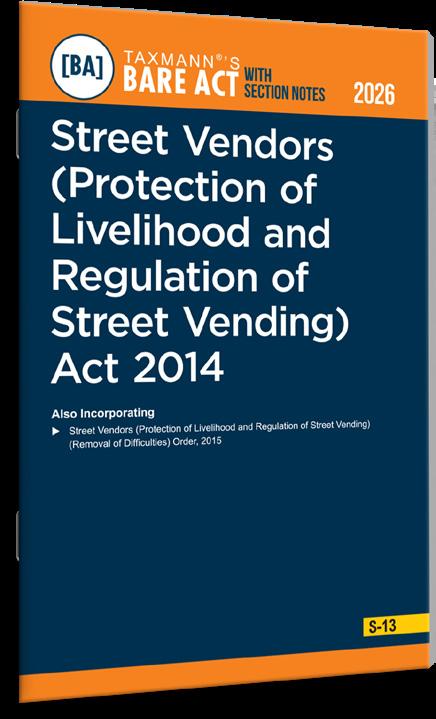
Street Vendors (Protection of Livelihood and Regulation of Street
Vending) Act 2014 – Bare Act
with Section Notes
AUTHOR : Taxmann’s Editorial Board
PUBLISHER : Taxmann
DATE OF PUBLICATION : December 2025
EDITION : 2026 Edition
ISBN NO : 9789375613916
No. of Pages : 44
BINDING TYPE : Paperback
Rs. 95
DESCRIPTION
Street Vendors (Protection of Livelihood and Regulation of Street Vending) Act 2014 [ Bare Act with Section Notes ] by Taxmann is an updated and authoritative statutory publication presenting the complete text of India’s principal law governing urban street vending. The book combines verbatim statutory provisions with well-structured section notes, commentary, and judicial references, offering a clear, practitioner-oriented understanding of the legal framework that protects street vendors’ livelihoods while ensuring regulated, orderly urban spaces. Going beyond a conventional Bare Act, this publication explains legislative intent, procedural requirements, institutional mechanisms, and practical application of each provision. It also incorporates applicable State amendments, relevant judicial interpretations, and the Street Vendors (Protection of Livelihood and Regulation of Street Vending) (Removal of Difficulties) Order 2015, enabling readers to stay aligned with the evolving regulatory landscape governing street vending in India.
This book is intended for the following audience:
• Legal Practitioners & Academicians
• Government Officials & Urban Planners
• Street Vendor Associations & NGOs
• Students & Researchers
The Present Publication is the 2026 Edition, covering the amended and updated text of the Street Vendors (Protection of Livelihood and Regulation of Street Vending) Act [ Act No. 7 of 2014 ], with the following noteworthy features:
• [Up-to-date Statutory Text] Complete text of the Act along with applicable State amendments and the Removal of Difficulties Order 2015
• [Pre-amendment Provisions in Footnotes] Pre-amendment versions of provisions included in amendment footnotes to facilitate historical and transitional understanding
• [Section-wise Notes & Commentary] Concise explanatory notes highlighting legislative intent, procedural safeguards, compliance requirements, and practical implications
• [Judicial References] Select important case law illustrating interpretation and enforcement by High Courts and the Supreme Court
• [Conceptual Clarity] Clear explanations of key terms such as street vendor, vending zone, holding capacity, and Town Vending Committee
• [User-friendly Editorial Structure] Logical progression from preliminary provisions to regulatory, institutional, and enforcement mechanisms