
Sample Read

DIVISION 1
LAW RELATING TO NON-BANKING FINANCIAL COMPANIES
DIVISION 2
LAW RELATING TO MORTGAGE GUARANTEE COMPANIES
DIVISION 8
DIVISION 9

RESERVE BANK OF INDIA (NON-BANKING
FINANCIAL COMPANIES - ACCEPTANCE OF PUBLIC DEPOSITS) DIRECTIONS, 2025
MASTER DIRECTION NO. RBI/DOR/2025-26/346 DOR.FIN.REC.NO. 265/03/ 10.119/2025-26, DATED 28-11-2025
In exercise of the powers conferred under sections 45J, 45JA, 45K, 45L and 45MA of the Reserve Bank of India Act, 1934 (Act 2 of 1934), sections 30, 30A, 32 and 33 of the National Housing Bank Act, 1987 (Act 53 of 1987) and of all the powers enabling it in this behalf, the Reserve Bank of India being satisfied that it is necessary and expedient in the public interest so to do, hereby, issues the Directions hereinafter specified.
CHAPTER I
PRELIMINARY
A.Short Title and Commencement
1. These Directions shall be called the Reserve Bank of India (Non-Banking Financial CompaniesAcceptance of Public Deposits) Directions, 2025.
2. These Directions shall become effective on the day these are placed on the official website of the Reserve Bank.
B.Applicability
3. The applicability of these Directions shall be as follows:
(1) These Directions shall be applicable to the following Non-Banking Financial Companies (hereinafter collectively referred to as ‘NBFCs’ and individually as an ‘NBFC’):
(i) NBFC-D registered with the RBI under the provisions of the RBI Act, 1934.
(ii) Deposit taking HFC registered with the RBI under the provisions of the NHB Act, 1987. Provided that Paragraphs 10, 11, 30, 40, 50 to 52, 62 and 63 shall not be applicable to deposit taking HFC. The deposit taking HFC may be guided by the provisions contained in Chapter VI of Reserve Bank of India (Housing Finance Company) Directions, 2025. Provided further that necessary reporting prescribed in these Directions to Supervisors shall be done to respective Supervisors by deposit taking HFC.
(iii)NBFC being a Government company as defined under clause (45) of section 2 of the Companies Act, 2013.
(2) These Directions shall not be applicable to the following:
(i) A Mutual Benefit Financial Company or a Mutual Benefit Company.
Provided that the application of Mutual Benefit Company is not rejected by Government of India under the provisions of the Companies Act, 1956 (Act 1 of 1956).
(ii)An insurance company holding a valid certificate of registration issued under section 3 of the Insurance Act, 1938 (Act 4 of 1938), or a stock exchange notified under section 4
(
(
of the Securities Contracts (Regulation) Act, 1956 (Act 42 of 1956), or a stock broking company defined in section 12 of the Securities and Exchange Board of India Act, 1992 (Act 15 of 1992);
iii) An NBFC not accepting/holding any public deposit:
Provided that the company shall pass in the meeting of its board of directors within thirty days of the commencement of the next financial year and each subsequent financial year, a resolution to the effect that the company has neither accepted public deposit nor would accept any public deposit during the year.
iv) An HFC not accepting/holding any public deposit:
Provided that the company shall pass in the meeting of its board of directors within thirty days of the commencement of the next financial year and each subsequent financial year, a resolution to the effect that the company has neither accepted public deposit nor would accept any public deposit during the year.
(
v) A company,
(a) which has acquired shares/securities of its own group/holding/subsidiary companies only and such acquisition is not less than 90 per cent of its total assets at any point of time;
(b) which does not trade in such shares/securities; and
(c) which does not accept/hold any public deposit;
Provided that the company passes in the meeting of its board of directors within thirty days of the commencement of each subsequent financial year a resolution to the effect that the company has invested or would invest/hold its investments in the shares/securities of its group/holding/subsidiary companies of not less than 90 per cent of its assets and (name of each company to be specified), that it would not trade in such shares/securities and that it has neither accepted nor would accept any public deposit during the year.
4. The Reserve Bank may, if it considers necessary for avoiding any hardship or for any other just and sufficient reason, grant extension of time to comply with or exempt any company or class of companies from all or any of the provisions of these Directions either generally or for any specified period subject to such conditions as the Reserve Bank may impose.
5. These Directions consolidate the regulations as issued by Department of Regulation, Reserve Bank of India. However, any other Directions/guidelines issued by any other Department of the Reserve Bank, as applicable to a Deposit taking NBFC shall be adhered to, by it.
6. Deposit taking NBFCs intending to offer green deposits to their customers shall comply with the Reserve Bank of India (Non-Banking Financial Companies – Climate Finance and Management of Climate Change Risks) Directions, 2025, as amended from time to time.
C. Definitions
7. For the purpose of these Directions, unless the context otherwise requires:
(1) ‘depositor’ means any person who has made a deposit with a company; or an heir, legal representative, administrator or assignee of the depositor.
(2) ‘deposit taking HFC’ means a Housing Finance Company which has been granted registration by the Reserve Bank to accept public deposits.
(3) ‘deposit taking NBFC’ (NBFC-D) means an NBFC which has been granted registration by the Reserve Bank to accept public deposits.
(4) ‘free reserves’ means the aggregate of the balance in the share premium account, capital and debenture redemption reserves and any other reserve shown or published in the balance sheet of a company and created through an allocation of profits not being a reserve created for repay-
ment of any future liability or for depreciation in assets or for bad debts or a reserve created by revaluation of the assets of the company.
(5) ‘hybrid debt’ shall have the same meaning as defined in the Reserve Bank of India (Non-Banking Financial Companies – Prudential Norms on Capital Adequacy) Directions, 2025;
(6) ‘insurance company’ means any company registered under section 3 of the Insurance Act, 1938 (Act 4 of 1938).
(7) ‘Investment and Credit Company’ shall have the same meaning as assigned to the term ‘NBFCICC’ in the Reserve Bank of India (Non-Banking Financial Companies – Registration, Exemptions and Framework for Scale Based Regulation) Directions, 2025.
(8) ‘lending public financial institution’ means –
(i) a public financial institution specified in or under section 4A of the Companies Act, 1956; or
(ii) a State Financial, Industrial or Investment Corporation; or
(iii) a scheduled commercial bank; or
(
iv) the General Insurance Corporation of India established in pursuance of the provisions of section 9 of the General Insurance Business (Nationalisation) Act, 1972 (Act 57 of 1972); or
(
v) any other institution which the Reserve Bank may, by notification, specify in this behalf.
(9) ‘mutual benefit financial company’ means any company which is a financial institution notified by the Central Government under section 620A of the Companies Act, 1956;
(10) ‘mutual benefit company’ means a company not notified under section 620A of the Companies Act, 1956 and carrying on the business of a non-banking financial institution, —
(i) on 9th January 1997; and
(ii) having the aggregate of net owned funds and preferential share capital of not less than ten lakhs of rupees; and
(iii) has applied for issue of certificate of registration to the Reserve Bank on or before 9th July 1997; and
(iv) is complying with the requirements contained in the relevant provisions of the Directions issued under section 637A of the Companies Act, 1956 applicable to Nidhi Companies by the Central Government.
(11) ‘net owned fund’ refers to the net owned fund (NOF) as defined under section 45-IA of the RBI Act, 1934 including the paid up preference shares which are compulsorily convertible into equity.
(12) ‘non-banking financial company’ (NBFC), for the purpose of these Directions, means only the non-banking institution which is an investment and credit company or Housing Finance Company or a mutual benefit financial company or a factor registered with the Reserve Bank under section 3 of Factoring Regulation Act (2011).
(13) problem NBFC means an NBFC- —
(i) has refused or failed to meet within five working days any lawful demand for repayment of the matured public deposits; or
(ii) intimates the Company Law Board/NCLT under section 58AA of the Companies Act, 1956 or the corresponding provision of Companies Act, 2013, about its default to a small depositor in repayment of any public deposit or part thereof or any interest thereupon; or
(iii) approaches the Reserve Bank for withdrawal of the liquid asset securities to meet its deposit obligations; or
(
iv) approaches the Reserve Bank for any relief or relaxation or exemption from the provisions of these Directions or from that of any other Directions applicable to a non-banking financial company for avoiding default in meeting public deposit or other obligations; or
(
v) has been identified by the Reserve Bank to be a problem NBFC either suo moto or based on the complaints from the depositors about non-repayment of public deposits or on complaints from the company’s lenders about nonpayment of dues.
(14) ‘public deposit’ means a deposit as defined under section 45-I(bb) of the RBI Act, 1934, excluding the following:
(
i) any amount received from the Central Government or a State Government or any amount received from any other source and whose repayment is guaranteed by the Central Government or a State Government or any amount received from a local authority or a foreign Government or any other foreign citizen, authority or person;
(
ii) any amount received from the Industrial Development Bank of India established under the Industrial Development Bank of India Act, 1964 (Act 18 of 1964), or the Life Insurance Corporation of India established under the Life Insurance Corporation Act, 1956 (Act 31 of 1956), or the General Insurance Corporation of India and its subsidiaries established in pursuance of the provisions of section 9 of the General Insurance Business (Nationalisation) Act, 1972 (Act 57 of 1972), or the Small Industries Development Bank of India established under the Small Industries Development Bank of India Act, 1989 (Act 39 of 1989), or the Unit Trust of India established under the Unit Trust of India Act, 1963 (Act 52 of 1963), or National Bank for Agriculture and Rural Development established under the National Bank for Agriculture and Rural Development Act, 1982, or an Electricity Board constituted under the Electricity (Supply) Act, 1948, or the Tamil Nadu Industrial Investment Corporation Ltd., or the National Industrial Development Corporation of India Ltd., or the Rehabilitation Industries Corporation of India Ltd., or the Industrial Credit & Investment Corporation of India Ltd., or the Industrial Finance Corporation of India Ltd., or the Industrial Investment Bank of India Ltd., or the State Trading Corporation of India Ltd., or the Rural Electrification Corporation Ltd., or the Minerals and Metals Trading Corporation of India Ltd., or the Agricultural Finance Corporation Ltd., or the State Industrial and Investment Corporation of Maharashtra Ltd., or the Gujarat Industrial Investment Corporation Ltd., or Asian Development Bank or International Finance Corporation or a company incorporated under the Companies Act, 1956; or a Corporation established by or under any Statute; or a cooperative society registered under the Cooperative Societies Act of any State and any other institution that may be specified by the Reserve Bank in this behalf;
(iii) any amount received by a company from any other company;
(
iv) any amount received and held pursuant to an offer made in accordance with the provisions of the Companies Act, 2013, towards subscription to any securities, including share application money or advance towards allotment of securities pending allotment, to such extent and for such period as permissible under the Companies (Acceptance of Deposit) Rules, 2014 and as amended from time to time;
(
v) any amount received from a person who at the time of receipt of the amount was a director of the company or any amount received from its shareholders by a private company or by a private company which has become a public company under section 43A of the Companies Act, 1956 and continues to include in its Articles of Association provisions relating to the matters specified in clause (iii) of sub-section (1) of section 3 of the Companies Act, 1956:
Provided that the director or shareholder, as the case may be, from whom the money is received furnishes to the company at the time of giving the money, a declaration in
(
writing to the effect that the amount is not being given out of funds acquired by him by borrowing or accepting from others;
Provided further that in the case of joint shareholders of a private company, monies received from or in the name of the joint shareholders except the first named shareholder shall not be eligible to be treated as the receipt of money from the shareholder of the company;
vi) any amount raised by the issue of bonds or debentures secured by the mortgage of any immovable property of the company; or by any other asset or which would be compulsorily convertible into equity in the company provided that in the case of such bonds or debentures secured by the mortgage of any immovable property or secured by other assets, the amount of such bonds or debentures shall not exceed the market value of such immovable property/other assets;
(vii) any amount raised by issuance of non-convertible debentures with a maturity more than one year and having the minimum subscription per investor at ` one crore and above, provided that such debentures have been issued in accordance with the guidelines issued by the Reserve Bank as in force from time to time in respect of such non-convertible debentures.
(viii) any amount brought in by the promoters by way of unsecured loan in pursuance of stipulations of lending institutions subject to the fulfilment of the following conditions, namely:-
(
a) the loan is brought in pursuance of the stipulation imposed by the lending public financial institution in fulfilment of the obligation of the promoters to contribute such finance,
(
b) the loan is provided by the promoters themselves and/or by their relatives, and not from their friends and business associates, and
(c) the exemption under this sub-clause shall be available only till the loan of financial institution is repaid and not thereafter;
(ix) any amount received from a Mutual Fund which is governed by the Securities and Exchange Board of India (Mutual Funds) Regulations, 1996;
(
x) any amount received as hybrid debt or subordinated debt the minimum maturity period of which is not less than sixty months provided there is no option for recall by the issuer within the period;
(xi) any amount received from a relative of a director of the NBFC.
Note: The deposit shall be accepted only on an application made by the depositor containing therein that as on the date of deposit, he is related to the specific director in the capacity of a relative as defined under Companies Act, 1956 or Companies Act, 2013;
(xii) any amount received by issuance of commercial paper, in accordance with Master Direction – Reserve Bank of India (Commercial Paper and Non-Convertible Debentures of original or initial maturity up to one year) Directions, 2024;
(xiii) any amount received by a NBFC-Middle Layer and above (except deposit taking NBFCs) by issuance of ‘perpetual debt instruments’ in accordance with guidelines issued in this regard by the Reserve Bank and as amended from time to time;
Explanation: NBFC-Middle Layer has been defined in Reserve Bank of India (Non-Banking Financial Companies – Registration, Exemptions and Framework for Scale Based Regulation) Directions, 2025.
(xiv) any amount raised by the issue of infrastructure bonds by an Infrastructure Finance Company, as specified in the notification issued from time to time by the Central Government under section 80CCF of the Income Tax Act, 1961;
(xv) any amount received by an HFC from NHB or any Public Housing Agency.
(15) ‘securities’ means securities as defined in section 2(h) of the Securities Contracts (Regulation) Act, 1956 (Act 42 of 1956).
(16) ‘subordinated debt’ shall have the same meaning as defined and accorded treatment in the Reserve Bank of India (Non-Banking Financial Companies -Prudential Norms on Capital Adequacy) Directions, 2025.
(17) ‘stock broking company’ means a company doing the business of a stockbroker or sub-broker holding a valid certificate of registration obtained under section 12 of the Securities and Exchange Board of India Act, 1992 (Act 15 of 1992);
(18) ‘stock exchange’ means a company recognised as a stock exchange under section 4 of the Securities Contracts (Regulation) Act, 1956 (Act 42 of 1956).
(19) ‘tiny deposit’ means the aggregate amount of public deposits not exceeding `10,000/- standing in the name of the sole or the first named depositor in the same capacity in all the branches of the NBFC.
8. Words or expressions used in these Directions but not defined herein and defined in the RBI Act, 1934 shall have the same meaning as assigned to them in the RBI Act, 1934. Any other words or expressions used in these Directions and not defined in these Directions or in the RBI Act, 1934 or any of the Directions issued by the Reserve Bank, shall have the meanings respectively assigned to them under the Companies Act, 1956 or Companies Act, 2013 as the case may be.
9. (1) If any question arises as to whether a company is a financial institution or not, such question shall be decided by the Reserve Bank in consultation with the Central Government and the decision of the Reserve Bank shall be final and binding on all the parties concerned.
(2) If any question arises as to whether a company, which is a financial institution, is an Investment and Credit Company; such question shall be decided by the Reserve Bank, having regard to the principal business of the company and other relevant factors and the decision of the Reserve Bank shall be final and binding on all the parties concerned.
CHAPTER II
REQUIREMENT OF MAINTENANCE OF LIQUID ASSETS
10. Every NBFC-D, shall invest and continue to invest in India in unencumbered approved securities valued at the price not exceeding the current market price of such securities an amount which shall, at the close of business on any day, not be less than 15 per cent of the ‘public deposit’, as defined under paragraph 7(14) of these Directions, outstanding at the close of business on the last working day of second preceding quarter; and
11. All other provisions of section 45-IB of the RBI Act, 1934 shall mutatis-mutandis be applicable to the above requirement as if the expression ‘public deposit’ is the same as the expression ‘deposit’ as contemplated under the said provision.
Provided that such NBFCs shall be entitled to invest an amount equal to or in excess of ten per cent of public deposits, in unencumbered approved securities and the remaining in unencumbered (1) term deposits in any scheduled commercial bank, Small Industries Development Bank of India (SIDBI) or National Bank for Agriculture and Rural Development (NABARD) or (2) bonds issued by SIDBI or NABARD.
Provided further that, the aggregate of the amount invested in unencumbered approved securities, term deposits and the bonds as aforesaid shall not be less than 15 per cent of public deposits.
CHAPTER III
RESTRICTION ON ACCEPTANCE OF PUBLIC DEPOSIT BY NBFC
A. Minimum Credit Rating
12. No NBFC shall accept public deposit unless it has obtained minimum investment grade for fixed deposits from any one of the approved credit rating agencies at least once a year and a copy of the rating is sent to the Reserve Bank along with return on prudential norms.
13. In the event of upgrading or downgrading of credit rating of any NBFC to any level from the level previously held by the NBFC, it shall within fifteen working days of its being so rated inform the Reserve Bank in writing, of such upgrading/downgrading.
B. Approved Credit Rating Agencies and Minimum Investment Grade Credit Rating
14. The minimum investment grade credit rating shall be ‘BBB-’ from any of the SEBI- registered Credit Rating Agencies.
C. Prohibition from Accepting Demand Deposit:
15. No NBFC shall accept any public deposit which is repayable on demand.
D. Period of Public Deposit
16. No NBFC shall accept or renew any public deposit, unless such deposit is repayable after a period of twelve months but not later than sixty months from the date of acceptance or renewal thereof.
E. Ceiling on Quantum of Deposit:
17. An NBFC
(1) having minimum NOF as stipulated by the Reserve Bank, and (2) complying with all the prudential norms, shall accept or renew public deposit, together with the amounts remaining outstanding in the books of the company as on the date of acceptance or renewal of such deposit, not exceeding one and onehalf times of its NOF.
Provided that an NBFC holding public deposits in excess of the limit of one and one-half times of its NOF shall not renew or accept fresh deposits till such time it reaches the revised limit.
Provided further that no matured public deposit shall be renewed without the express and voluntary consent of the depositor.
F. Downgrading of Credit Rating
18. In the event of downgrading of credit rating below the minimum specified investment grade as provided for in paragraph 15 above, an NBFC, shall regularise the excess deposit as provided hereunder; (1) with immediate effect, stop accepting fresh public deposits and renewing existing deposits; (2) all existing deposits shall run off to maturity; and (3) report the position within fifteen working days, to the concerned Regional Office of the Reserve Bank where the NBFC is registered.
G. Ceiling on the rate of interest
19. No NBFC shall invite or accept or renew public deposit at a rate of interest exceeding twelve and half per cent per annum. Interest may be paid or compounded at rests which shall not be shorter than monthly rests.
H. Deposits from Non-Resident Indians
20. No NBFC shall invite or accept or renew deposits from Non-Resident Indians/ persons of Indian origin, unless it is in compliance with regulations prescribed vide Foreign Exchange Management (Deposit) Regulations, 2016 (as amended from time to time) and such deposits shall not be at a rate exceeding the rate specified by the Reserve Bank for such deposits with scheduled commercial banks. Explanation - The period of above deposits shall be not less than one year and not more than three years.
I. Payment of Brokerage
21. No NBFC shall pay to any broker on public deposit collected by or through him, —
(1) brokerage, commission, incentive or any other benefit by whatever name called, in excess of two per cent of the deposit so collected; and
(2) expenses by way of reimbursement on the basis of relative vouchers/bills produced by him, in excess of 0.5 per cent of the deposit so collected.
J. Intimation of Maturity of Deposits to Depositors
22. It shall be the obligation of the NBFC to intimate the details of maturity of the deposit to the depositor at least 14 days before the date of maturity of the deposit.
K. Renewal of public deposit
23. Where an NBFC permits an existing depositor to renew the deposit before maturity for availing of the benefit of higher rate of interest, such company shall pay the depositor the increase in the rate of interest provided that, —
(1) the deposit is renewed in accordance with the other provisions of these Directions and for a period longer than the remaining period of the original contract; and
(2) the interest on the expired period of the deposit is reduced by one percentage point from the rate which the company would have ordinarily paid, had the deposit been accepted for the period for which such deposit had run; any interest paid earlier in excess of such reduced rate is recovered/adjusted.
L. Payment of interest on overdue public deposits
24. An NBFC may, at its discretion, allow interest on an overdue public deposit or a portion of the said overdue deposit from the date of maturity of the deposit subject to the conditions that:
(1) the total amount of overdue deposit or the part thereof is renewed in accordance with other relevant provisions of these Directions, from the date of its maturity till some future date; and
(2) the interest allowed shall be at the appropriate rate operative on the date of maturity of such overdue deposit which shall be payable only on the amount of deposit so renewed:
Provided that where an NBFC fails to repay the deposit along with interest on maturity on the claim made by the depositor, the NBFC shall be liable to pay interest from the date of claim till the date of repayment at the rate as applicable to the deposit.
25. In regard to the payment of interest on such deposit which have either been seized by the government authorities, and/or have been frozen till further clearance is received by the concerned Government authorities, the NBFCs shall follow the procedure mentioned below:
(1) A request letter shall be obtained from the depositor on maturity. While obtaining the request letter from the depositor for renewal, NBFCs shall also advise the depositor to indicate the term for which the deposit is to be renewed. In case the depositor does not exercise his option of choosing the term for renewal, NBFCs shall renew the same for a term equal to the original term.
(2) No new receipt shall be issued. However, suitable note shall be made regarding renewal in the deposit ledger.
(3) Renewal of deposit shall be advised by registered letter/speed post/courier service to the concerned Government department under advice to the depositor. In the advice to the depositor, the rate of interest at which the deposit is renewed shall also be mentioned.
(4) If overdue period does not exceed 14 days on the date of receipt of the request letter, renewal shall be done from the date of maturity. If it exceeds 14 days, NBFCs shall pay interest for the overdue period as per the policy adopted by them, and keep it in a separate interest free sub-account which shall be released when the original fixed deposit is released.
26. However, the final repayment of the principal and the interest so accrued shall be done only after the clearance regarding the same is obtained by the NBFCs from the respective Government agencies.
M. Joint deposit
27. Where so desired, deposits may be accepted in joint names with or without any of the clauses, namely, ‘Either or Survivor’, ‘Number One or Survivor/s’, ‘Anyone or Survivor/s’.
N. Particulars to be specified in application form soliciting public deposits
28. No NBFC shall accept or renew any public deposit except on a written application from the depositor in the form to be supplied by the company, which form shall contain all the particulars specified in the Non-Banking Financial Companies and Miscellaneous Non-Banking Companies (Advertisement) Rules, 1977, made under section 58A of the Companies Act, 1956 and also contain the specific category of the depositor, i.e., whether the depositor is a shareholder or a director or a promoter of the company or a member of public.
29. The application form shall also contain the following:
(1) the credit rating assigned for its fixed deposit and the name of the credit rating agency which rated the company
(2) clause to the effect that in case of non-repayment of the deposit or part thereof as per the terms and conditions of such deposit, the depositor may approach the Eastern/Western/Northern/ Southern (delete which are inapplicable) Bench of Company Law Board or NCLT whose full address is given hereunder:
(3) clause to the effect that in case of any deficiency of the company in servicing its deposit, the depositor may approach the National Consumers Disputes Redressal Forum, the State Level Consumers Disputes Redressal Forum or the District Level Consumers Disputes Redressal Forum for relief;
(4) a statement that the financial position of the company as disclosed and the representations made in the application form are true and correct and that the company and its Board of Directors are responsible for the correctness and veracity thereof;
(5) a statement to the effect that the financial activities of the company are regulated by the Reserve Bank. It must, however, be distinctly understood that the Reserve Bank does not undertake any responsibility for the financial soundness of the company or for the correctness of any of the statements or the representations made or opinions expressed by the company; and for repayment of deposit/discharge of liabilities by the company;
(6) at the end of application form but before the signature of the depositor, the following verification clause by the depositor shall be appended: ‘I have gone through the financials and other statements/particulars/representations furnished/made by the company and after careful consideration I am making the deposit with the company at my own risk and volition’;
(7) the information relating to and the aggregate dues from the facilities, both fund and non-fund based, extended to, and the aggregate dues from companies in the same group or other entities or business ventures in which the directors and/or the NBFC are holding substantial interest and the total amount of exposure to such entities.
30. Every NBFC shall obtain proper introduction of the new depositors before opening their accounts and accepting the deposits and keep on its record the evidence which it has relied upon for the purpose of such introduction.
O. Advertisement and statement in lieu of advertisement:
31. Every NBFC soliciting public deposits shall comply with the provisions of the Non- Banking Financial Companies and Miscellaneous Non-Banking Companies (Advertisement) Rules, 1977 and shall also specify in every advertisement to be issued thereunder, the following:
(1) the actual rate of return by way of interest, premium, bonus, other advantage to the depositor;
(2) the mode of repayment of deposit;
(3) the maturity period of deposit;
(4) the interest payable on deposit;
(5) the rate of interest which will be payable to the depositor in case the depositor withdraws the deposit prematurely;
(6) the terms and conditions subject to which a deposit will be renewed;
(7) any other special features relating to the terms and conditions subject to which the deposit is accepted/renewed;
(8) the information, relating to the aggregate dues (including the non-fund based facilities provided to) from companies in the same group or other entities or business ventures in which, the directors and/or the NBFC are holding substantial interest and the total amount of exposure to such entities; and
(9) that the deposits solicited by it are not insured.
32. Where an NBFC displays any advertisement in electronic media such as TV, even without soliciting deposits, it shall incorporate a caption/band in such advertisements indicating the following:
(1) As regards deposit taking activity of the company, the viewers may refer to the advertisement in the newspaper/information furnished in the application form for soliciting public deposits;
(2) The company is having a valid Certificate of Registration dated _________ issued by the Reserve Bank under section 45-IA of the RBI Act. However, the Reserve Bank of India does not accept any responsibility or guarantee about the present position as to the financial soundness of the company or for the correctness of any of the statements or representations made or opinions expressed by the company and for repayment of deposits/discharge of the liabilities by the company.
33. Where an NBFC intends to accept public deposit without inviting or allowing or causing any other person to invite such deposit, it shall, before accepting such deposit, deliver to the Reserve Bank for record, a statement in lieu of advertisement containing all the particulars required to be included in the advertisement pursuant to the Non-Banking Financial Companies and Miscellaneous Non-Banking Companies (Advertisement) Rules, 1977 as also the particulars stated in paragraph 31 above, duly signed in the manner provided in the aforesaid Rules.
34. A statement delivered under paragraph 33 above shall be valid till the expiry of six months from the date of closure of the financial year in which it is so delivered or until the date on which the balance sheet is laid before the company in general meeting or where the annual general meeting for any year has not been held, the latest day on which that meeting should have been held in accordance with the provisions of the Companies Act, 1956 or the Companies Act, 2013, whichever is earlier, and a fresh statement shall be delivered after the expiry of the validity of the statement, in each succeeding financial year before accepting public deposit in that financial year.
CHAPTER IV
GENERAL PROVISIONS REGARDING REPAYMENT OF PUBLIC DEPOSIT
A. Minimum Lock-in Period and Repayment in the event of death of the depositor
35. No NBFC shall grant any loan against a public deposit or make premature repayment of a public deposit within a period of three months (lock-in period) from the date of its acceptance:
Provided that in the event of death of a depositor, a NBFC shall repay the public deposit prematurely, even within the lock-in period, to the surviving depositor/s in the case of joint holding with survivor clause, or to the nominee or the legal heir/s of the deceased depositor, on the request of the surviving depositor/s/nominee/legal heir, and only against submission of proof of death, to the satisfaction of the company.
B. Repayment of Public Deposits by an NBFC not being a Problem NBFC
36. Subject to the provisions contained in paragraph 35, an NBFC not being a problem NBFC may,
(1) permit premature repayment of a public deposit at its sole discretion:
Provided such NBFC shall, if so, permitted by the terms and conditions of acceptance of such deposit, repay it prematurely at the request of the depositor, after the expiry of three months from the date of deposit;
(2) grant a loan up to 75 per cent of the amount of public deposit to a depositor after the expiry of three months from the date of deposit at a rate of interest two percentage points above the interest rate payable on the deposit.
C. Repayment of Public Deposit in order to meet certain expenses of an emergent nature
37. An NBFC not being a problem NBFC, in order to meet certain expenses of an emergent nature, subject to the satisfaction of the NBFC concerned about such circumstances–
(1) ‘Tiny deposits’ may prematurely be paid to individual depositors, at the request of the depositor, before the expiry of three months from the date of acceptance of such deposits, in entirety, without interest;
(2) In case of other public deposits, not more than 50 per cent of the amount of the principal sum of deposit or `5 lakh, whichever is lower, may be prematurely paid to individual depositors, at the request of the depositors, before the expiry of three months from the date of acceptance of such deposits, without interest; the remaining amount with interest at the contracted rate shall be governed by the provisions of the extant directions as applicable for public deposits;
Provided that in cases of critical illness, 100 per cent of the amount of the principal sum of deposit, may be prematurely paid to individual depositors, at the request of the depositors, before the expiry of three months from the date of acceptance of such deposits, without interest.
Explanation:
(i) For this purpose, expenses of an emergent nature include medical emergency or expenses due to natural calamities/disaster as notified by the concerned Government/authority.
(ii) For the definition of ‘Critical illness’, NBFCs shall be guided by the IRDAI (Health Insurance) Regulations, 2016 and the guidelines issued thereunder, as amended from time to time.
(iii) The amount as per these provisions shall also apply to the existing deposit contracts wherein the individual depositor does not have a right to premature withdrawal of the deposit before the expiry of three months.
D. Repayment of Public Deposits by a Problem NBFC
38. Subject to the provisions contained in paragraph 35, in order to enable a depositor to meet expenses of an emergent nature, a problem NBFC may make premature repayment of, or grant a loan against, a public deposit in the following cases only, namely:
(1) repay a tiny deposit in entirety or repay any other public deposit up to an amount not exceeding `10,000/-; or
(2) grant a loan against a tiny deposit or up to an amount not exceeding `10,000/- against any other deposit, at a rate of interest two percentage points above the interest rate payable on the deposit.
E. Clubbing of Deposits by a Problem NBFC
39. All deposit accounts standing to the credit of sole/first named depositor in the same capacity shall be clubbed and treated as one deposit account for the purpose of premature repayment or grant of loan by a problem NBFC:
Provided that this clause shall not apply to premature repayment in the event of death of depositor as provided in paragraph 35.
F. Rate of interest on premature repayment of public deposits
40. Where an NBFC, whether at its sole discretion or at the request of the depositor, as the case may be, repays a public deposit after three months from the date of its acceptance, but before its maturity (including premature repayment in the case of death of the depositor), it shall pay interest at the following rates:
After 3 months but before 6 monthsNo interest
After 6 months but before the date of maturity
The interest payable shall be 2 per cent lower than the interest rate applicable to a public deposit for the period for which the public deposit has run or if no rate has been specified for that period, then 3 per cent lower than the minimum rate at which public deposits are accepted by the NBFC.
CHAPTER V
MISCELLANEOUS INSTRUCTIONS
A. Furnishing of receipt to depositor
41. Every NBFC shall furnish to every depositor or his agent or group of joint depositors, a receipt for every amount received by the company by way of deposit.
42. The said receipt shall be duly signed by an officer authorised by the company in that behalf and shall state the date of deposit, the name of the depositor, the amount in words and figures received by the company by way of deposit, rate of interest payable thereon and the date on which the deposit is repayable:
Provided that, if such receipts pertain to instalments subsequent to the first instalment of a recurring deposit it may contain only name of the depositor and date and amount of deposit.
B. Register of Deposit
43. Every NBFC shall keep one or more registers in respect of all deposits in which shall be entered separately in the case of each depositor the following particulars, namely: — (1) name and address of the depositor, (2) date and amount of each deposit, (3) duration and the due date of each deposit, (4) date and amount of accrued interest or premium on each deposit, (5) date of claim made by the depositor, (6) date and amount of each repayment, whether of principal, interest or premium, (7) the reasons for delay in repayment beyond five working days and (8) any other particulars relating to the deposit.
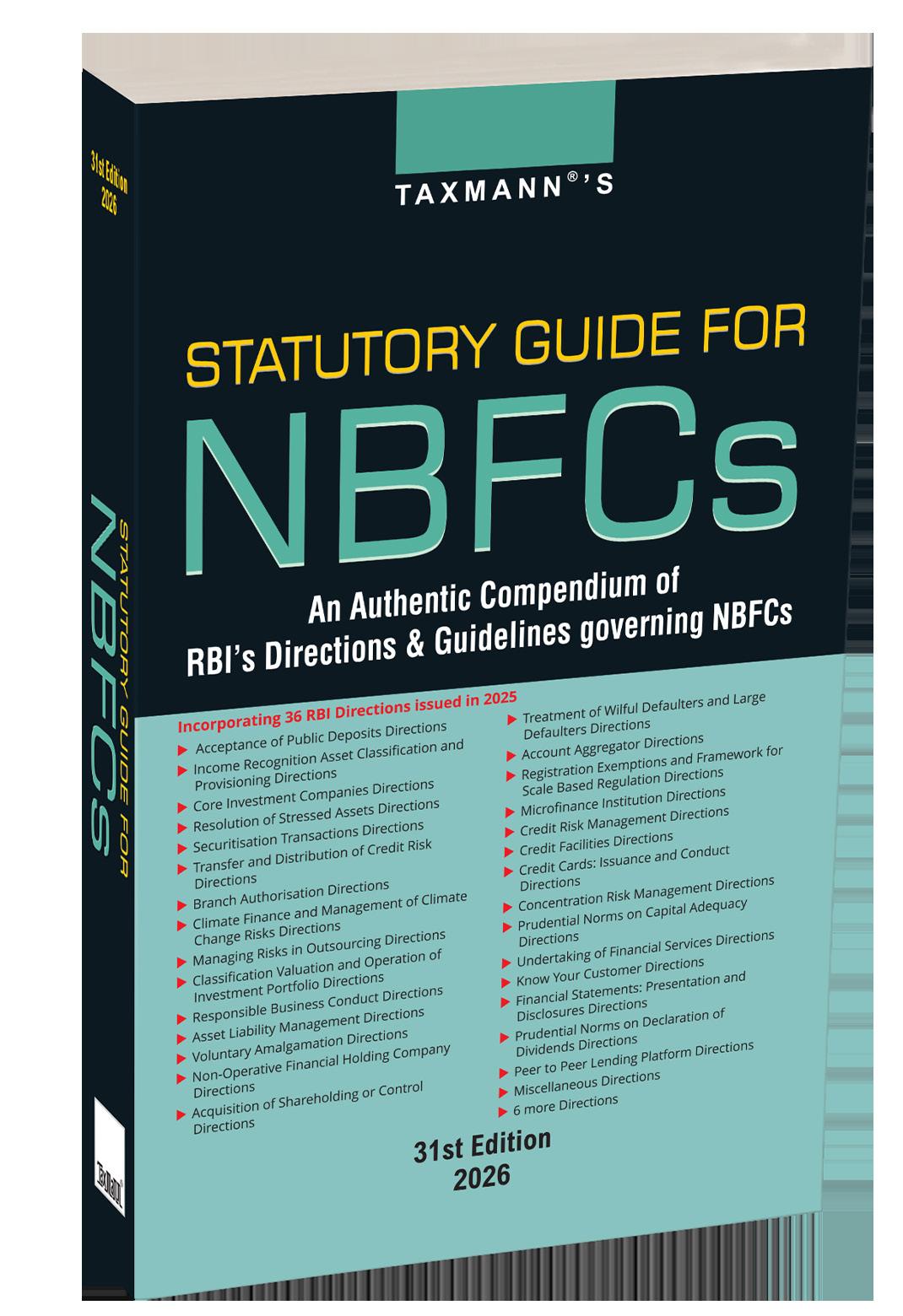
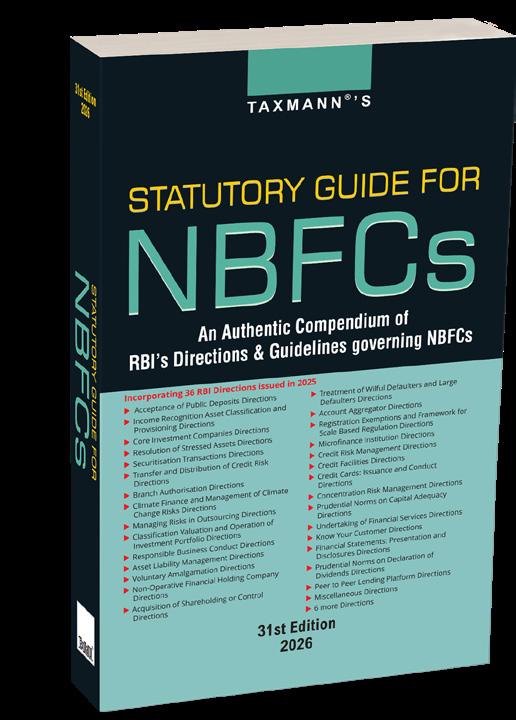
Statutory Guide for NBFCs
AUTHOR : Taxmann’s Editorial Board
PUBLISHER : Taxmann
DATE OF PUBLICATION : January 2026
EDITION : 31st Edition | 2026
ISBN NO : 9789371264990
No. of Pages : 912
BINDING TYPE : Paperback
DESCRIPTION
Statutory Guide for NBFCs – An Authentic Compendium of RBI’s Directions & Guidelines Governing NBFCs is a comprehensive, practice-oriented statutory reference that consolidates the complete regulatory framework issued by the Reserve Bank of India for Non-Banking Financial Companies (NBFCs) and allied regulated entities. Updated with the law as applicable, the book reflects the RBI’s evolved, risk-sensitive, governance-driven, and scale-based supervisory regime. This publication is designed as a statutory working manual, not a narrative commentary. It reproduces RBI Master Directions and allied regulatory instruments in their operative form, together with all relevant chapters, annexures, illustrations, reporting formats, and implementation frameworks required for compliance, audit, and regulatory assurance. This Edition is particularly significant as it incorporates 36 RBI Directions issued or consolidated during 2025, covering major regulatory rationalisation across prudential norms, conduct regulation, digital lending, climate risk, and governance standards.
This publication is intended for stakeholders who require authoritative, up-to-date, and implementation-ready regulatory text, including:
• NBFC Boards, CXOs, Compliance Heads, and Risk Functions (ALM, Credit, IRACP, Capital, Governance, Outsourcing, Conduct)
• Internal Audit, Concurrent Audit, & Statutory Audit Teams
• Chartered Accountants, Company Secretaries, Cost Accountants, & Legal Advisors
• Treasury, Securitisation, & Structured Finance Teams
• HFCs, CICs, SPDs, & Specialised NBFC Categories
• Policy Teams, Researchers, & Academic Institutions
The Present Publication is the 31st Edition | 2026, updated till 31st December 2025. This book is edited by Taxmann’s Editorial Board, with the following noteworthy features:
• [Complete Consolidation of RBI Directions] Brings together RBI Master Directions and allied regulatory frameworks governing NBFCs and related entities in a single volume
• [Incorporation of 36 RBI Directions Issued in 2025] Captures RBI’s 2025 consolidation across deposits, IRACP, stressed assets, securitisation, credit risk transfer, governance, disclosures, and conduct norms
• [Direction-wise, Statute-first Presentation] Each RBI Direction is reproduced as a self-contained instrument, preserving original structure, applicability, definitions, commencement provisions, and annexures
• [Practice-facing Utility] Includes embedded illustrations, disclosure formats, reporting templates, and prescribed returns for compliance use
• [Alignment with Scale-Based Regulation (SBR)] Reflects differential compliance obligations across NBFC layers and specialised categories
• [Comprehensive Navigation Aids] Supported by a List of Master Directions and a detailed Subject Index for quick referencing