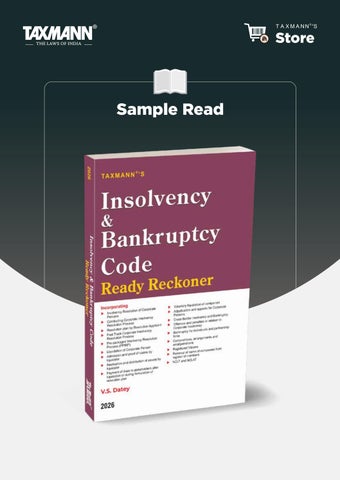
Taxmann's Insolvency & Bankruptcy Code Ready Reckoner

Page 1


Sample Read

DECLINING STAGE OF AN ORGANISATION

1.1

1.3

1.4

1.5 Provisions in Companies Act, 2013 relating to winding up are applicable to the extent not contrary to Insolvency

1.6

1.10

1.11

1.12 Lenders may apply under SARFAESI and DRT and in addition they can go for Insolvency resolution

1.13 Parallel proceedings under SARFAESI/RDBA, Civil Court and Insolvency Code permissible

1.14 Income tax provisions for corporate debtors where application for CIRP has been admitted

1.15 Promoter/director can be Resolution applicant if Corporate Debtors is MSME

1.16

1.17 Institution and/or continuation of proceedings under FTDR against companies against whom proceedings have been instituted under Insolvency Code

1.18

INSOLVENCY PROFESSIONAL

3.10 Withdrawal of application after admission with approval of 90% voting by CoC

CONDUCTING CORPORATE INSOLVENCY

RESOLUTION PROCESS

4.1 Background

4.2 Moratorium and public announcement

4.3 Public announcement of corporate insolvency resolution process

4.4 Appointment and tenure of interim resolution professional 120

4.5 Submission of proof of claims to interim resolution professional 125

4.6 Committee of Creditors (CoC)

4.7 Appointment of resolution professional in first meeting of CoC

4.8 Powers and functions of Committee of Creditors (CoC)

4.9 Duties of resolution professional 143B

4.10 Prior approval of committee of creditors for certain actions by resolution professional

4.11 Preparation of information memorandum

4.12 Protection to insolvency resolution professional in respect of earlier transactions

4.13 Special Provisions in respect of NBFC with assets of Rs. 500 crore or more

RESOLUTION PLAN BY RESOLUTION APPLICANT

5.1 Background

5.2

5.3 Invitation for expression of interest

5.4 Submission of resolution plan by resolution applicant to insolvency professional

5.5 Insolvency resolution process costs

5.6 Approval of resolution plan by Committee of Creditors

5.7 Submission of plan to Adjudicating Authority

5.8 Assistance of district administration in implementing the resolution plan 187

5.9 Effect if resolution plan rejected by NCLT 187

5.10 Appeal against order of adjudicating authority 187

5.11 Immunity from prosecution of corporate debtor after approval of CIRP 187

5.12 No action against property of corporate debtor in respect of offence committed prior to CIRP if there was change in management or sale of assets 189

5.13 Corporate debtor and new management to provide assistance to investigating agency 189B

5.14 Preservation of records of CIRP by RP 189B

FAST TRACK CORPORATE INSOLVENCY RESOLUTION PROCESS

6.1 Speedy process for insolvency resolution 190

6.2 Application for fast track process 190

6.3 Procedure for fast track process 191

6.4 NCLT can recall its order in interest of justice 192 6A

PRE-PACKAGED INSOLVENCY RESOLUTION PROCESS (PPIRP)

6A.1 Background of the PPIRP (Pre-Packaged Insolvency Resolution Process) 193

6A.2 Basic design of Pre-Packaged Insolvency Resolution Process (PPIRP) 197

6A.3 Application of provisions of CIRP to PPIRP 201

6A.4 Priority to PPIRP over CIRP, except where CIRP proceedings have already commenced 203

6A.5 Eligibility and conditions to apply for PPIRP 205

6A.6 Initiation of PPIRP by Corporate Debtor 207

6A.7 Duties and authorities of Insolvency Professional proposed to be appointed as Resolution Professional 209

6A.8 Procedure prior to application to AA for approval to initiate PPIRP 211

6A.9 Filing of application by Corporate Applicant with Adjudicating Authority 213

6A.10 Admission or rejection of application by Adjudicating Authority (NCLT) 215

6A.11 Moratorium during PPIRP period 216

6B

PROCEDURE FOR PPIRP AFTER ADMISSION OF APPLICATION

6B.1 Formal process of PPIRP starts only after admission of application 217

6B.2 Conduct of PPIRP by Resolution Professional 218

6B.3 Powers of Resolution Professional during initial stages of PPIRP 220

6B.4 Filing of Application for avoidance of transactions 221

6B.5 Prior approval of Committee of Creditors (CoC) for certain actions by corporate debtor 223

6B.6 Information to be supplied by financial institutions to Resolution Professional 225

6B.7 Submission of List of claims and its updation in PPIRP 225

6B.8 Conduct of business of Corporate Debtor during PPIRP 228

6B.9 Constitution and functioning of Committee of Creditors in PPIRP 229

6B.10 Meeting of Committee of Creditors in PPIRP 232

6C

SUBMISSION AND APPROVAL OF RESOLUTION PLAN UNDER PPIRP

6C.1 What is a resolution plan 239

6C.2 Submission of Base Resolution Plan by RP to CoC 243

6C.3 Invitation to Resolution Applicants if CoC does not approve base resolution plan or operational creditors cannot be satisfied 245

6C.4 Furnishing of information to Resolution Applicants 247

6C.5 Submission of resolution plan by resolution applicant and its evaluation 249

6C.6 Submission of Resolution Plans by Resolution Professional to CoC

6C.7 Submission of Resolution Plan approved by CoC for approval by AA

6C.8 Termination of PPIRP which ultimately results in liquidation of corporate debtor 255

6C.9 CoC may terminate PPIRP if corporate debtor eligible for CIRP 257

LIQUIDATION OF CORPORATE PERSON

7.1 Initiation of Liquidation

7.2 Appointment of Liquidator and his fees

7.3 Powers and duties of Liquidator

7.4 Liquidation Estate

7.5

7.6 Distribution of

7.7 Liabilities of contributory in liquidation

ADMISSION AND PROOF OF CLAIMS BY LIQUIDATOR

8.1 Liquidator has powers to access information

8.2 Ascertaining claims against corporate debtor

8.3 Avoidance of preferential transactions by liquidator

8.4 Avoidance of undervalued transactions

8.5 Action if corporate debtor had defraud creditors

8.6 Protection to corporate debtor against extortionate credit transactions

8.7 Position of secured creditor in liquidation proceedings

REALISATION AND DISTRIBUTION OF ASSETS BY LIQUIDATOR

9.1 Realisation of assets by Liquidator

Mode of sale

9.3 All money to be paid into bank account except

9.4 Distribution of

9.5 Distribution of cash to

9.6 Completion of liquidation within

9.7 Final report by Liquidator prior to dissolution

9.8 Unclaimed proceeds of liquidation or undistributed assets to be transferred to Corporate Liquidation Account

9.9

PAYMENT OF DUES TO STAKEHOLDERS AFTER LIQUIDATION OR DURING FORMULATION OF RESOLUTION PLAN

10.1 Insolvency Code is complete code in respect of distribution of

10.2

in

10.4 Workmen’s portion of Workmen’s dues previous for two years have overriding

10.5 Provisions

10.6

10.8

10.9

VOLUNTARY LIQUIDATION OF COMPANIES

11.8 Completion of liquidation

11.9 Cases where voluntary liquidation was allowed

ADJUDICATION

AND APPEALS FOR CORPORATE PERSONS

12.1 Adjudicating Authority in relation to insolvency resolution and liquidation for corporate persons

12.2 Appeals and Appellate Authority

12.3 Appeal to Supreme Court on question of law

12.4 Civil Court not to have jurisdiction where NCLT or IBBI has jurisdiction

12.5 Expeditious disposal of applications

12.6 Penalty for fraudulent or malicious initiation of proceedings

12.7 Penalty of carrying on business fraudulently to defraud traders

CROSS BORDER INSOLVENCY

AND BANKRUPTCY

13.1 Enabling provisions for cross border transactions

13.2 Agreements with foreign countries

13.3 Letter of request to a country outside India in respect of assets

OFFENCES AND PENALTIES IN RELATION TO CORPORATE INSOLVENCY

14.1 Punishments for offences

14.2 Punishment for concealment of property

14.3 Punishment for transactions defrauding creditors

14.4 Punishment for misconduct in course of corporate insolvency resolution process

14.5 Offences by insolvency professional

14.6 Punishment for falsification of books of corporate debtor

14.7 Punishment for wilful and material omissions from statements relating to affairs of corporate debtor

14.8 Punishment for false representations to creditors

14.9 Punishment for contravention of moratorium or the resolution plan

14.10 Punishment for false information furnished in application

14.11 Punishment for non-disclosure of (a) dispute, or (b) payment of debt by operational creditor

14.12 Punishment for providing false information in application made by corporate debtor

14.13 Residual punishment of fine for violation of provisions of Insolvency Code

14.14 NCLT can ask Government to investigate and Government can file complaint before Special Court

14.15 Punishment for providing false information in Pre-Packaged Insolvency Resolution Process

14.16 Punishment in case of contravention of provisions of Chapter III-A (Pre-Packaged Insolvency Resolution Process)

14.17 When the application shall be deemed to be false in material particulars

BANKRUPTCY FOR INDIVIDUALS AND PARTNERSHIP FIRMS

15.1

FRESH START PROCESS

17.5

17.6

17.7

17.8

BANKRUPTCY ORDER FOR INDIVIDUALS AND FIRMS

18.10

19.1

BANKRUPTCY TRUSTEE

19.4

19.5

19.6

19.7

19.8

REGISTERED

22.1

22.2

22.3

22.4

22.5

22.6

CHAPTER

Conducting corporate insolvency resolution process

After commencement of corporate insolvency resolution process under section 7, 9 or 10 of Insolvency Code, 2016, further action will commence before Adjudicating Authority (NCLT).

Procedure before NCLT shall be as per rules 20 to 24 and 26 of Part III of NCLT Rules, 2016 [Till rules under Insolvency and Bankruptcy Code are notified] - rule 10 of Insolvency and Bankruptcy (Application to Adjudicating Authority) Rules, 2016.

A Committee of Creditors (CoC) is required to be constituted to oversee the insolvency resolution process.

The actual work will be done by ‘resolution professional’ under supervision of Committee of Creditors and Adjudicating Authority (NCLT).

Normally, the Corporate Insolvency Resolution Process (CIRP) is required to be completed within 180 days from date of application by NCLT to initiate the corporate insolvency process - section 12(1) of Insolvency Code, 2016.

This period can be extended if resolution professional files application to Adjudicating Authority, if instructed by resolution passed at a meeting of the Committee of Creditors (CoC) by a vote of sixty-six per cent (66%) of the voting shares – section 12(2) of Insolvency Code, 2016 [Till 6-6-2018, the resolution was required to be passed by seventy-five per cent (75%) of voting shares of CoC].

“Voting share” means the share of the voting rights of a single financial creditor in the committee of creditors which is based on the proportion of the financial debt owed to such financial creditor in relation to the financial debt owed by the corporate debtorSection 5(28) of Insolvency Code, 2016.

On receipt of such approval, resolution professional shall make application to adjudicating authority (NCLT) - Regulation 40 of IBBI (Insolvency Resolution Process for Corporate Persons) Regulations, 2016.

The resolution professional shall continue to discharge his responsibilities under the corporate insolvency resolution process, till the application for extension is decided by the Adjudicating Authority - clarification to Regulation 40(2) of IBBI (Insolvency Resolution Process for Corporate Persons) Regulations, 2016 inserted on 15-2-2024.

On receipt of such application, Adjudicating Authority (NCLT) can grant only one extension up to maximum 90 days - section 12(3) of Insolvency Code, 2016.

If initially 30 days extension was granted, further 60 days extension can be grantedBrasher Boot Co v. Forward Shoes (2018) 146 SCL 1- 90 taxmann.com 41 (NCLT).

Such application should be filed before expiry of 180 days. If not so filed, the moratorium will not be extended - Anshuman Chaturvedi v. IDBI Bank Ltd. (2018) 145 SCL 507 = 89 taxmann.com 175 (NCLT).

Model time line for completion of CIRP Model time line for each stage of completion of CIRP (total 180 days) has been specified in Regulation 40A of IBBI (Insolvency Resolution Process for Corporate Persons) Regulations, 2016 inserted w.e.f. 25-7-2019 and amended on 18-9-2023 and 24-9-2024.

Reporting by RP or IRP or RP or IPA in respect of time line at each stage electronically on IBBI platform - The insolvency professional, interim resolution professional or resolution professional, as the case may be, or Insolvency Professional Agency acting as Insolvency Entity, shall file the Forms, along with the enclosures thereto, on an electronic platform of IBBI, as per the timelines stipulated against each Form. Fees is payable for delayed submission. IBBI can take action for delay or wrong submission or non-submission of form - Regulation 40B of IBBI (Insolvency Resolution Process for Corporate Persons) Regulations, 2016 inserted w.e.f. 27-11-2019 and amended on 19-5-2025.

The forms CP-1, CP-2, CP-3, CP-4 and CP-5 have been introduced w.e.f. 19-5-2025.

Details about requirements of these new forms have been explained in IBBI Circular No. IBBI/CIRP/85/2025, dated 26-5-2025.

Late fee of Rs 500 are payable for delay of each month after 1-4-2020 (not each day) [late fee negligible indeed].

This reporting is also required to be done by Insolvency Professional Agency acting as Insolvency Entity, for which facility has been provided on IBBI website - IBBI Circular No. IBBI/CIRP/60/2023 dated 1-9-2023.

Reporting in form CIRP-7 if specified activity is not completed within specified timeAs per Regulation 40B(1A) of IBBI (Insolvency Resolution Process for Corporate Persons) Regulations, 2016 (inserted w.e.f. 15-3-2021), where any of following activity is not completed by the date specified, the interim resolution professional or resolution professional, as the case may be, shall file Form CIRP 7 within three days of the said date, and continue to file Form CIRP 7, every 30 days, until the said activity remains incomplete.

(1) Public announcement is not made by T+3rd day (T = Insolvency commencement date)

(2) Appointment of RP is not made by T+30th day

(3) Information memorandum is not issued within 51 days from the date of public announcement

(4) RFRP is not issued within 51 days from the date of issue of information memorandum

(5) CIRP is not completed by T+180th day

Subsequent filing of Form CIRP 7 shall not be made until thirty days have lapsed from the filing of an earlier Form CIRP 7. Only one Form CIRP 7 shall be filed at any time whether one or more activity is not complete by the specified date.

The Regulation gives illustrations about due dates of filing CIRP 7 in various situations. This is also clarified in IBBI circular No. IBBI/CIRP/41/2021 dated 18-3-2021.

Reporting of undervalued, preferential or extortionate credit transaction within 140 days - Reporting of undervalued, preferential or extortionate credit transaction shall be done in form CIRP-8 within 140 days– Regulation 40B(1B) of IBBI (Insolvency Resolution Process for Corporate Persons) Regulations, 2016 inserted w.e.f. 14-7-2021.

Matters to be considered while taking decision for liquidation by Committee of Creditors CoC, while considering liquidation of corporate debtor, may also consider various factors like non-operational status for last three years, goods produced or services offered are obsolete, absence of assets, lack of intangible assets, brand value, intellectual property, accumulated losses, deprecation etc. Such considerations shall be recorded in application for liquidation process to adjudicating authority - Regulation 40D of IBBI (Insolvency Resolution Process for Corporate Persons) Regulations, 2016 inserted w.e.f. 16-9-2022.

Period for completion of CIRP is 330 days even including time of appeal, stay etc. - The corporate insolvency resolution process (CIRP) shall mandatorily* be completed within a period of 330 days from the insolvency commencement date, including any extension of the period of corporate insolvency resolution process granted under section 12 of Insolvency Code and the time taken in legal proceedings in relation to such resolution process of the corporate debtor - second proviso to section 12(3) of Insolvency Code, inserted vide Insolvency and Bankruptcy Code (Amendment) Act, 2019 w.e.f. 16-8-2019.

* The word ‘mandatorily’ has been held invalid by Supreme Court in following decision. If resolution plan is approved (though delayed due to various reasons), it should be implemented at the earliest and that is the mandate under Insolvency Code - Committee of Creditors of AMTEK Auto Limited v. Dinkar T Venkatasubramanian [2022] 4 SCC 754 = 169 SCL 443 = 133 taxmann.com 17 (SC).

In Committee of Creditors of Essar Steel India Ltd. v. Satish Kumar Gupta [2019] 111 taxmann.com 234 = (2020) 8 SCC 531 (SC 3 member bench), the amendment was held valid but the word ‘mandatory’ was struck down as excessive, arbitrary and unreasonable restriction and violative of Articles 14 and 19(1)(g) of Constitution of India. It was held that extension can be granted in exceptional cases.

Similar views have been expressed in Dena Bank v. C. Shivakumar Reddy [2021] 167 SCL 453 = 129 taxmann.com 60 (SC) * Arcelormittal India P Ltd. v. Satish Kumar Gupta [2019] 2 SCC 1 = 150 SCL 354 = 98 taxmann.com 99 (SC), where it was held that the period can be extended.

Thus, NCLT can condone delay if for valid reasons.

Lockdown period would be excluded for counting period under section 12 - Period of lockdown ordered by Government would be excluded for purpose of counting period for resolution process under section 12 and any interim order passed by Appellate Tribunal would continue till next date of hearing - Suo Motu, In re [2020] 117 taxmann.com 180 (NCLAT).

Extension in extra-ordinary circumstances - In Jaiprakash Associates Ltd. v. IDBI Bank (2020) 3 SCC 328, extension was granted due to extraordinary situation, as none of the parties could be blamed for the delay.

Exclusion of period when matter was sub-judice If matter was in appeal, the period should be excluded Jalesh Kumar Grover v. Akme Projects Ltd. (2021) 130 taxmann.com 334 (NCLAT).

Order of liquidation if process not completed in 330 days - In ICICI Bank Ltd. v. Innoventive Industries Ltd. (2018) 145 SCL 463 = 88 taxmann.com 230 (NCLT), the insolvency resolution process of 270 days was over and hence order of liquidation of corporate debtor was made (now upper limit is 330 days)- similar order in Raman Ispat P Ltd. In re (2018) 146 SCL 583 = 91 taxmann.com 408 (NCLT) - similar order in Punjab National Bank v. Ajmer Singh Bhullar (2018) 150 SCL 345 = 99 taxmann.com 63 (SC) * S C Sekaran v. Amit Gupta (2019) 152 SCL 536 = 103 taxmann.com 222 (NCLAT) * Namdhari Food International P Ltd. In re (2019) 153 SCL 155 = 104 taxmann.com 329 (NCLT) * Ram Niwas Basis v. Vijender Sharma (2019) 154 SCL 103 = 106 taxmann.com 81 (NCLAT) * D R Balakrishna Raja v. Indian Bank (2019) 154 SCL 516 = 107 taxmann.com 254 (NCLAT) * First Step Ventures v. Frontier Lifeline P Ltd. (2019) 156 SCL 451 = 110 taxmann.com 39 (NCLAT) * Milind Dixit v. Elecon Engineering (2019) 156 SCL 464 = 109 taxmann.com 215 (NCLAT) * Sai Regency Power Corporation P Ltd. In re [2021] 166 SCL 214 = 127 taxmann.com 117 (NCLT).

In Hero Steels Ltd. v. Rolex Cycles (P.) Ltd. [2018] 146 SCL 302 = 91 taxmann.com 45 (NCLT), no resolution plan was submitted by RP and even extension was not asked for. Hence, liquidation was ordered but with different liquidator/RP.

Resolution applicant can file resolution plan if time period is extended - In Punjab National Bank v. Bhushan Power (2018) 147 SCL 475 = 92 taxmann.com 369 (NCLT), Applicant (Liberty House) had filed resolution plan to participate in Corporate Insolvency Resolution Process 30 days before expiry of maximum period provided under section 12, which was extended. Hence, it was held that resolution plan of Applicant (Liberty House) should be considered - affirmed in Tata Steel v. Liberty House Group Pte Ltd. (2019) 152 SCL 575 = 102 taxmann.com 103 (NCLAT).

Speed is essence -- Speed is essence - time limit of 330 days is mandatory (but tribunal has to take practical view also) - Arcelormittal India P Ltd. v. Satish Kumar Gupta (2019) 2 SCC 1 = 150 SCL 354 = 98 taxmann.com 99 (SC).

Speed is essence - Committee of Creditors of Essar Steel India Ltd. v. Satish Kumar Gupta [2019] 111 taxmann.com 234 = (2020) 8 SCC 531 (SC 3 member bench).

Delay in taking over by IRP - In Velamur Varadan Anand v. Union Bank of India [2018] 94 taxmann.com 58 (NCLAT), Adjudicating Authority admitted application to initiate corporate insolvency resolution process and same was informed to Resolution Professional, but he took over charges after 30 days of admission of such applicationThis period of 30 days was to be excluded for purpose of counting period of 180 days for completing CIRP [In any case, the period cannot go beyond 330 days including time spent in legal process].

Attempt should be made to revive corporate debtor, less it is exposed to liquidation process

- Jaiprakash Associates Ltd. v. IDBI Bank (2019) 156 SCL 782 = 111 taxmann.com 46 (SC). Para 4.1

After admission of application, Adjudicating Authority shall pass following orders [section 13(1) of Insolvency Code, 2016]:

(a)declare a moratorium for the purposes referred to in section 14 of Insolvency Code, 2016.

(

b)cause a public announcement of the initiation of corporate insolvency resolution process and call for the submission of claims under section 15 of Insolvency Code, 2016, and

(c)appoint an interim resolution professional in the manner as laid down in section 16 of Insolvency Code, 2016.

The public announcement referred to above shall be made immediately after the appointment of the interim resolution professional – section 13(2) of Insolvency Code, 2016.

Meaning of Moratorium - A “moratorium” is a delay or suspension of an activity or a law. In a legal context, it may refer to the temporary suspension of a law to allow a legal challenge to be carried out. It is legal authorisation to debtors to delay payments due.

Current dues should be paid, moratorium only in respect of past dues - If current dues are not paid, electricity supply can be disconnected - Noida Power Company Ltd.v.Gaurav Katiyar RP of Earthcon Universal Infractech (P.) Ltd. [2024] 167 taxmann.com 145 (NCLAT).

No recovery proceedings after moratorium granted under Insolvency Code - Once NCLT has issued moratorium under section 14 of Insolvency Code in respect of company in liquidation, Bank cannot pursue proceedings under section 19 of RDBA [EARLIER RDDBFI] Act for recovery of loan - Sanjeev Shriya v. State Bank of India (2017) 144 SCL 545 = 87 taxmann.com 309 (All HC).

Bank cannot adjust its dues once moratorium ordered Bank cannot adjust its dues against credit balance of corporate debtor, once moratorium is ordered Bank of India v. Bhuban Madan (2021) 168 SCL 316 = 129 taxmann.com 413 (NCLAT).

Financial creditor cannot recover any amount from account of Corporate Debtor after moratorium is declared - Indian Overseas Bank v. Dinkar T Venkatsubramaniam

Resolution Professional for Amtek Auto Ltd. (2018) 145 SCL 138 = 88 taxmann.com 132 (NCLAT).

Corporate guarantee cannot be invoked after application is admitted and moratorium orders - Axis Bank Ltd. v. Edu Smart Services P. Ltd. (2017) 87 taxmann.com 99 (NCLT).

No auction of property once moratorium granted – Auction of assets of corporate debtors cannot be conducted once moratorium is granted to corporate debtor - Anand Rao Korada v.Varsha Fabrics (P.) Ltd. [2019] 111 taxmann.com 474 (SC).

Counter claim is not prohibited under section 14 during moratorium - Counter claim is not prohibited under section 14 during moratorium, if it is integral to recovery sought for by the company under CIRP – SSMP Industries v. Perkan Food Processors [2019] 110 taxmann.com 212 (Del HC).

No arbitration proceedings after moratorium - Once petition under Insolvency Code is admitted by NCLT, moratorium comes into effect and arbitration proceedings cannot continue - Alchemist Asset Reconstruction Co. Ltd. v. Hotel Gaudavan P. Ltd. (2017) 88

taxmann.com 202 (SC) – followed in K S Oils v. State Trading Corporation of India (2018) 146 SCL 588 = 91 taxmann.com 423 (NCLAT).

Electricity connection cannot be cut after moratorium - Section 14(2) of Insolvency Code prevails over section 56 of Electricity Act, since electricity is ‘essential goods’ to corporate debtor. Hence, power supply to corporate debtor cannot be cut during moratorium period - ABG Shipyard v. ICICI Bank (2018) 145 SCL 430 = 88 taxmann.com 196 (NCLT) * Nitin Hasmukhlal Parikh v. Madhya Gujarat Vij Company Ltd. [2018] 90 taxmann.com 398 (NCLT) * Citi Bank NA v. Cosmic Ferro Alloys (2018) 146 SCL 727 = 92 taxmann.com 32 (NCLT). * Damodar Valley Corporation v. Karthik Alloys Ltd. (2022) 137 taxmann.com 234 (NCLAT).

In Dakshin Gujarat Vij Co. Ltd. v. Jitendra Kumar Yadav (2019) 102 taxmann.com 149 (NCLT), it was held that current dues of electricity supply should be paid as insolvency resolution process cost as electricity was essential supply to run business as a going concern. In respect of past dues, the electricity company can lodge claim of electricity charges with Resolution Professional. same view in Harish Taneja v. Dakshin Haryana Bijli (2022) 169 SCL 195 = 133 taxmann.com 146 (NCLAT).

If current dues are not paid, electricity supply can be disconnected - Noida Power Company Ltd. v. Gaurav Katiyar RP of Earthcon Universal Infractech (P.) Ltd. [2024] 167 taxmann.com 145 (NCLAT).

Customs Authorities can determine customs duty payable but cannot initiate recovery proceedings are moratorium - Insolvency Code overrides Customs Act. Once moratorium is imposed in terms of Section 14 or 33(5) of the Insolvency Code as the case may be, the customs authority only has a limited jurisdiction to assessee/determine the quantum of customs duty and other levies. The respondent authority does not have the power to initiate recovery of dues by means of sale/confiscation, as provided under the Customs Act - Sundaresh Bhatt, Liquidator of ABG Shipyard v. Central Board of Indirect Taxes and Customs [2022] 141 taxmann.com 471 = 94 GST 1 = 381 ELT 731 (SC 3 member bench).

Customs cannot conduct auction to sale assets of corporate debt after moratoriumCustoms cannot conduct auction to sale assets of corporate debt after moratorium to recover customs dues payable by corporate debtor – CC (Preventive) v. Ram Swarup Industries (2019) 155 SCL 547 = 108 taxmann.com 315 (NCLAT).

Recovery of tax dues prohibited during moratorium period - During moratorium period, GST department cannot direct Bank of Corporate debtor to pay dues to State Tax department. Payment by Bank to tax department is in violation of section 14 - Sundaresh Bhat Resolution Professional of Sterling Biotech Ltd. v. Assistant Commissioner of State Tax [2020] 120 taxmann.com 154 (NCLT) [But damage has already been done].

Tax dues cannot be recovered by selling goods in auction during CIRP Asstt. Commissioner v. Pravin Charan Dwary (2022) 136 taxmann.com 190 (NCLAT).

Directors cannot withdraw moneys from bank of corporate debtor at back of IRP after moratorium - Directors cannot withdraw moneys from bank of corporate debtor at back of IRP after moratorium. Such withdrawal is illegal and IRP can move adjudicating authority and police to trace money and get it back - Manoj K Daga v. ISGEC Heavy Engineering (2020) 161 SCL 437 = 117 taxmann.com 249 (NCLAT). Para 4.2

Performance guarantees given to customs by corporate debtor can be encashed during moratorium - Performance guarantees given to customs by corporate debtor can be encashed during moratorium, as section 3(31) of Insolvency Code clearly says that performance guarantee are not included in security interest - Nitin Hasmukhlal Parikh v. Madhya Gujarat Vij Company Ltd. [2018] 90 taxmann.com 398 (NCLT).

Goods in custody of customs authorities cannot be taken possession by Corporate Debtor during moratorium - Even if moratorium is ordered, goods in customs warehouse in custody of customs authorities cannot be taken possession by Corporate Debtor during moratorium, without clearance from customs authorities (on payment of customs duty due) – Bharati Defence and Infrastructure Ltd. v. Mannu Carrier (2018) 147 SCL 43 = 91 taxmann.com 367 (NCLT).

Set off of dues not permissible during moratorium - No dues can be set off during period of Corporate Insolvency Resolution Process (CIRP) when moratorium is in force as provisions of Code will prevail over accounting conventions - Vijay Kumar V Iyer v. Bharti Airtel Ltd. [2020] 163 SCL 25 = 119 taxmann.com 178 (NCLAT) - view confirmed in Bharti Airtel v. Vijaykumar V Iyer (2024) 182 SCL 438 = 158 taxmann.com 108 (SC), where it was held that section 14 of Insolvency Code grants protection and prevent a scramble for dissipation of assets of corporate debtor.

Set off of income tax refund against income tax demands of corporate debtor not permissible - Set off of income tax refund against income tax demands of corporate debtor is not permissible during period of moratorium Devarajan Raman v. Principal CIT (2024) 185 SCL 94 = 163 taxmann.com 92 (NCLAT).

Contract cannot be terminated during moratorium period by creditor, only if arising out of insolvency or liquidation proceedings - In TATA Consultancy Services Ltd. v.Vishal Ghisulal Jain, Resolution Professional, SK Wheels (P.) Ltd. [2022] 2 SCC 583 = 132 taxmann.com 232 = 170 SCL 153 (SC), it was held that NCLT can exercise its residuary jurisdiction under section 60(5)(c) of IBC to adjudicate contractual disputes between parties only if such dispute had arisen in relation to insolvency of corporate debtor. In this case, the contract was terminated dehors the insolvency proceedings i.e. had no nexus between termination of contract and insolvency resolution proceeding. Criteria laid down in Gujarat Urja Vikas Nigam Ltd. v. Amit Gupta [2021] 7 SCC 209 = 167 SCL 241 = 125 taxmann.com 150 (SC) are required to be satisfied.

Incomplete Auction sale under SARFAESI Act cannot be completed during moratorium- Incomplete Auction sale under SARFAESI Act cannot be completed during moratorium in view of section 14(1)(c) of Insolvency Code Indian Overseas Bank v. RCM Infrastructure (2022) 8 SCC 516.

Provident Fund Commissioner cannot attach bank account during moratorium and PF dues can be considered only if claimed in CIRP - Provident Fund Commissioner cannot attach bank account during moratorium. Further, PF dues can be claimed only if claimed during CIRP, and not on basis of earlier attachment order - B Parameshwara Udpa (RP) v. ACFC [2023] 150 taxmann.com 129 (NCLAT).

PF dues cannot be recovered during moratorium - Employees’ Provident Fund v. Jaykumar Pesumal Arlani (2025) 188 SCL 133 = 171 taxmann.com 522 (NCLAT).

Penalty is not ‘debt’ and hence moratorium is not applicable - Penalties imposed by NCDRC under consumer protection laws are regulatory in nature and do not constitute

“debt” under Insolvency Code; moratorium under section 96 does not extend to regulatory penalties imposed for non-compliance with consumer protection laws - Saranga Anilkumar Aggarwal v. Bhavesh Dhirajlal Sheth [2025] 172 taxmann.com 145 = 188 SCL 286 (SC).

Company cannot file appeal after CIRP is admitted? - In Shree Ganesh Jewellery House (I) Ltd. v. Abhishek Stock Broking Services (P.) Ltd. [2018] 93 taxmann.com 46 (NCLAT), it was held that Once CIRP (Corporate Insolvency Resolution Process) is admitted and IRP(Interim Resolution Professional) is appointed, appeal by corporate debtor through its suspended Board of Directors was not maintainable [Then the provision of appeal against order would be meaningless].

Writ powers of High Court and Supreme Court not affected by moratorium - A person can approach High Court or Supreme Court under Articles 32 and 226 as Writ powers of High Court and Supreme Court not affected by moratorium - Power Grid Corporation v. Jyoti Structures (2018) 145 SCL 449 = 88 taxmann.com 124 (Del HC).

However, if alternate remedy of appeal against order of NCLT are available, writ petition should be dismissed – SEL Manufacturing Co. v. UOI – (2018) 147 SCL 426 = 93 taxmann.com 103 (P&H HC DB).

On the insolvency commencement date, the Adjudicating Authority shall by order declare moratorium for prohibiting all of the following [section 14(1) of Insolvency Code, 2016]

(a )the institution of suits or continuation of pending suits or proceedings against the corporate debtor including execution of any judgment, decree or order in any court of law, Tribunal, arbitration panel or other authority.

(b)transferring, encumbering, alienating or disposing of by the corporate debtor any of its assets or any legal right or beneficial interest therein.

(c)any action to foreclose, recover or enforce any security interest created by the corporate debtor in respect of its property including any action under the Securitisation and Reconstruction of Financial Assets and Enforcement of Security Interest Act, 2002.

(d)the recovery of any property by an owner or less or where such property is occupied by or in the possession of the corporate debtor.

Section 14 is to protect corporate debtor from dissipation of assets - Section 14 of Insolvency Code grants protection and prevent a scramble for dissipation of assets of corporate debtor - Bharti Airtel v. Vijaykumar V Iyer (2024) 182 SCL 438 = 158 taxmann.com 108 (SC).

Moratorium applies to property in possession even if not owned by Corporate Debtor - Moratorium applies to property in possession of corporate debtor, even if he (corporate debtor) does not have rights or interest in the property. Thus, if occupation was handed over under Joint Development Agreement, moratorium applies - Rajendra K Bhutta v. Maharashtra Housing and Area Development Authority (2020) 160 SCL 95 = 114 taxmann.com 655 (SC).

Provision of moratorium not applicable to notified transactions - The provisions of section 14(1) of Insolvency Code shall not apply to such transactions, agreements or other arrangements, as may be notified by the Central Government in consultation with any

financial regulator or any other authority - section 14(3)(a) of Insolvency Code inserted w.e.f. 6-6-2018. The words in italics inserted vide IBC (Amendment) Act, 2020, w.r.e.f. 28-12-2019.

This is only an enabling provision to avoid possible misuse of provision of moratorium. Provision of moratorium does not apply to transactions relating to aircraft, aircraft engines, airframes and helicopters - Provision of moratorium does not apply to transactions, arrangements or agreements relating to aircraft, aircraft engines, airframes and helicopters under the Convention and protocol, relating to aircraft, aircraft engines, airframes and helicopters. This convention was adopted under joint auspices if International Civil Aviation Organisation and International Institute for Unification of Private Law concluded on 16-11-2001 - Notification SO 4321(E) dated 3-10-2023

Provision of moratorium shall not apply to specified agreements or arrangements under Oilfields (Regulation and Development) Act - Provision of moratorium shall not apply where the corporate debtor has entered into to following transactions, arrangements or agreements under Oilfields (Regulation and Development) Act, 1948 - (i) the Production Sharing Contracts, Revenue Sharing Contracts, Exploration Licenses and Mining Leases made under the Oilfields (Regulation and Development) Act, 1948 and rules made thereunder; and (ii) any transactions, arrangements or agreements, including Joint Operating Agreement, connected or ancillary to the transactions, arrangements or agreements referred to in clause (i) - Notification No. SO 2660(E), dated 14-6-2023.

Provision of moratorium not applicable to guarantor - The provisions of section 14(1) of Insolvency Code shall not apply to a surety in a contract of guarantee to a corporate debtor – section 14(3)(b) of Insolvency Code inserted w.e.f. 6-6-2018.

Thus, recovery proceedings, insolvency resolution process or bankruptcy proceedings against surety (guarantor) can be initiated even if moratorium is granted to corporate debtor.

Moratorium not applicable to directors and officers of Corporate Debtor - Moratorium does not extend to directors or officers of corporate debtor - Ansal Crown Heights Flat Buyers v. Ansal Crown Infrabuild (2024) 182 SCL 471 = 158 taxmann.com 592 (SC).

No moratorium on essential supplies - The supply of essential goods or services to the corporate debtor as may be specified under Regulations shall not be terminated or suspended or interrupted during moratorium period – section 14(2) of Insolvency Code, 2016.

Essential supplies have been defined in regulation 32 of IBBI (Insolvency Resolution Process for Corporate Persons) Regulations, 2016. These cover electricity, water, telecommunication services and information technology services.

The essential goods and services referred to section 14(2) of Insolvency Code shall mean - (a) electricity (b) Water (Water supplied to a corporate debtor will be essential supplies for drinking and sanitation purposes, and not for generation of hydro-electricity) (c) telecommunication services; and (d) information technology services, to the extent these are not a direct input to the output produced or supplied by the corporate debtorRegulation 4 of IBBI (PPIRP) Regulations, 2021.

In Innoventive Industries v. Maharashtra State Electricity Distribution Co. (2017) 144 SCL 446 = 87 taxmann.com 59 (NCLAT), the Appellate Tribunal allowed the resolution professional to pay electricity dues for period during moratorium and asked electricity

company to restore electricity within 49 hours. However, it was made clear that dues prior to period of moratorium can be considered only at the time of payment of dues to creditors (resolution plan).

Moratorium under section 14 of the Insolvency Code (IBC) covers criminal proceedings for dishonour of cheque under section 138 of the Negotiable Instruments Act against the corporate debtor, but not against persons in charge like MD, WTD - The objective of moratorium is to form a scheme which shields the corporate debtor from pecuniary attacks against it in the moratorium period so that the corporate debtor gets breathing space to continue as a going concern in order to ultimately rehabilitate itself. - - A quasicriminal proceeding that is contained in Chapter XVII of the Negotiable Instruments Act would amount to a “proceeding” within the meaning of Section 14(1)(a) of Insolvency Code. Hence, institution or continuation of a proceeding under section 138/141 of the Negotiable Instruments Act can be said to be covered by the moratorium. Declaration of moratorium under section 14 of the Insolvency and Bankruptcy Code (IBC) covers criminal proceedings for dishonour of cheque under section 138 of the Negotiable Instruments Act against the corporate debtor. However, such proceedings can continue against natural persons specified in section 141 of Negotiable Instruments Act i.e. persons in charge (MD, WTD etc.) - P. Mohanraj v. Shah Brothers Ispat P. Ltd. [2021] 125 taxmann.com 39 (SC 3 member bench)

[Reversing Shah Brothers Ispat (P.) Ltd. v. P. Mohanraj [2018] 97 taxmann.com 233 (NCLAT)] [Contrary judgments in Tayal Cotton v. State of Maharashtra (2018) 149 SCL 453 = 97 taxmann.com 12 (Bom HC) * Ajay Kumar Bishnoi v. Tap Engineering (2020) 159 SCL 134 = 113 taxmann.com 439 (Mad HC) also get impliedly overruled].

Proceedings under section 138 of Negotiable Instruments Act cannot continue against corporate debtor once moratorium ordered NAG Leathers v. Dynamic Marketing (2022) 2 SCC 271.

However, proceedings against directors of corporate debtor can continue during moratorium Narinder Garg v. Kotak Mahindra Bank (2022) 172 SCL 359 = 137 taxmann.com 476 (SC).

Moratorium in Insolvency proceedings does not provide shield against prosecution to debtors under section 138 of Negotiable Instruments Act - Rakesh Bhanot v. Gurdas Agro (2025) 173 taxmann.com 249 = 188 SCL 748 (SC).

In Ajay Kumar Radheyshyam Goenka v. Tourism Finance Corporation of India Ltd. [2023] 148 taxmann.com 280 = 178 SCL 401 (SC), it was held that where proceedings under section 138 of Negotiable Instruments Act (bouncing of cheque) have commenced against company and during pendency of proceedings, resolution plan of company is approved or company gets dissolved, signatories/directors cannot escape from their liability by citing its dissolution; what is dissolved, is only company, not personal liability of accused covered under section 141 of NI Act. After passing of resolution plan under section 31 of IBC by Adjudicating Authority and in light of provisions of section 32A of IBC, criminal proceedings under section 138 of NI Act will stand terminated only in relation to corporate debtor if same is taken over by a new management. Section 138 proceedings in relation to signatories/directors who are liable/covered by two provisos to section 32A(1) will continue in accordance with law.

Provisions of moratorium do not apply to goods attached under PMLA as proceeds of crime - Provisions of moratorium under section 14 do not apply to goods attached under

PMLA (Prevention of Money Laundering Act), as these are ‘proceeds of crime’. Section 14 does not have overriding effect over provisions of PMLA – Varrsanna Ispat v. Deputy Director, Enforcement (2019) 155 SCL 48 = 198 taxmann.com 96 (NCLAT) – followed in Rotomac Global P Ltd. v. Deputy Director, Directorate of Enforcement (2019) 155 SCL 250 = 108 taxmann.com 397 (NCLAT) same view in Rajiv Chakraborty Resolution Professional of Eiel v. Directorate of Enforcement [2022] 145 taxmann.com 21 (Delhi HC).

Property attached under PMLA much prior to CIRP cannot be ordered to be detachedDirectorate of Economic Offences v. Binay Kumar Singhania [2021] 127 taxmann.com 173 (NCLAT).

Section 238 of Insolvency Code does not override PMLA with respect to proceedings involving proceeds of crime. Attachment order under PMLA is valid. If it is confirmed, it cannot be undone merely because CIRP is pending. NCLT has no jurisdiction if provisional attachment under PMLA is subsequently confirmed - Anil Kohli v. Directorate of Enforcement (2025) 176 taxmann.com 218 (NCLAT).

PMLA is a distinct statute having its own special object of preventing money laundering and its recovery, which involves an overriding public interest; NCLT has got no jurisdiction to go into matters governed under PMLA. NCLT cannot consider issue in respect of property attached under PMLA - Deputy Director, Office of the Joint Director v. Asset Reconstruction Company (India) Ltd. [2020] 160 SCL 721 = 117 taxmann.com 41 (Madras HC DB).

In Anil Goel, Liquidator v. Ms Ramanjit Kaur Sethi, Dy. Director, Directorate Enforcement (2019) 152 SCL 294 = 102 taxmann.com 152 (NCLT), it has been held that if property has been attached under PMLA (Prevention of Money Laundering Act), the liquidator has to approach authorities under PMLA for withdrawal of attachment. - - In a contrary view, in SBER Bank v. Varrsana Ispat Ltd. (2020) 161 SCL 158 = 118 taxmann.com 141 (NCLT), it was held that in view of section 32A of Insolvency code, liquidator can continue with sale of assets of corporate debtor and then buyer can take steps to get property de-attached.

However, in Directorate of Enforcement v. Manoj Kumar Agarwal, (RP) [2021] 126 taxmann.com 210 (NCLAT), it was held that even if a property has been attached in PMLA which is belonging to corporate debtor, if CIRP is initiated, property should become available to fulfil objects of Insolvency Code till a resolution takes place or sale of liquidation asset occurs in terms of section 32A.

In Committee of Creditors v. Directorate of Enforcement (2025) 188 SCL 71 = 169 taxmann.com 752 (SC), order of provisional attachment of properties of corporate debtor passed by ED after NCLT had approved the resolution plan was set aside and property was ordered to be handed over to resolution applicant.

Moratorium protects only existing rights, not forfeited rights - Moratorium under section 14 of Insolvency Code protects only existing, enforceable, and subsisting rights; it does not protect inchoate or forfeited rights arising from default or non-performance - A A Estates (P.) Ltd. v. Kher Nagar Sukhsadan Co-operative Housing Society Ltd. [2025] 181 taxmann.com 5 (SC).

Property attached much prior to CIRP cannot be detached - Property attached under PMLA much prior to CIRP and produced before designated Court of Economic Offenses, cannot be ordered to be detached - Directorate of Economic Offences v. Binay Kumar Singhania [2021] 168 SCL 601 = 127 taxmann.com 173 (NCLAT).

INSOLVENCY & BANKRUPTCY CODE

READY RECKONER

AUTHOR : V.S. Datey

PUBLISHER : Taxmann

DATE OF PUBLICATION : January 2026

EDITION : 2026 Edition

ISBN NO : 9789371263917

NO. OF PAGES : 452

BINDING TYPE : Paperback

1,595

DESCRIPTION

Insolvency & Bankruptcy Code Ready Reckoner is a comprehensive, practice-oriented reference that presents the Insolvency and Bankruptcy Code 2016 (IBC) as a complete insolvency resolution and economic revival framework, rather than a mere debt recovery statute. Designed as a true ready reckoner, this publication explains the law as it operates in practice, covering corporate insolvency resolution, pre-packaged insolvency, liquidation, individual and partnership bankruptcy, adjudication, appeals, and enforcement within a single, integrated volume. The 2026 Edition incorporates legislative amendments, regulatory developments, and evolving judicial interpretation. Structured around the actual lifecycle of insolvency proceedings, the book enables readers to move seamlessly from default and initiation through resolution or liquidation to distribution, dissolution, and appellate remedies. Its paragraph-numbered format makes it a dependable desk reference for practical insolvency work. This book is intended for the following audience:

• Insolvency Professionals (IRPs, RPs, Liquidators, IPEs)

• Advocates and Insolvency Litigators

• Banks, Financial Institutions, ARCs, and Credit Teams

• Chartered Accountants, Company Secretaries, Cost Accountants, and Registered Valuers

• Corporate Management, In-house Legal, and Compliance Teams

• Academicians, Researchers, and Advanced Students

The Present Publication is the 2026 Edition, updated till 20th December 2025. It is authored by V.S. Datey with the following noteworthy features:

• [Process-oriented Ready Reckoner] Follows the complete lifecycle of insolvency proceedings, enabling quick, stage-wise reference during live matters

• [End-to-end Insolvency Coverage] Covers CIRP, PPIRP, Fast Track CIRP, liquidation, voluntary liquidation, and bankruptcy of individuals and partnership firms within one integrated framework

• [Resolution-first Orientation] Explains IBC as a revival and value-maximisation mechanism, reinforcing liquidation as a measure of last resort

• [Resolution Plan & CoC Mechanics] Analyses resolution applicant eligibility, plan formulation and approval, CoC decision-making, and post-approval consequences

• [Dedicated PPIRP Coverage] Provides structured treatment of PPIRP, including eligibility, initiation, claims handling, competitive improvement of plans, and approval, with special relevance for MSMEs

• [Liquidation & Distribution Framework] Examines liquidator powers, claims admission, avoidance transactions, asset realisation, distribution waterfall, stakeholder payments, and dissolution

• [Cross-statute & Regulatory Integration] Explores interaction with the Companies Act, limitation law, SARFAESI/DRT, and GST/Income-tax implications during insolvency

• [Adjudication & Appellate Architecture] Covers NCLT and NCLAT jurisdiction, procedure, and appeals to the Supreme Court

• [Offences, Penalties & Enforcement] Explains offences and penalties under IBC and related enforcement mechanisms

• [Individual & Partnership Insolvency] Covers Fresh Start Process, insolvency resolution, and bankruptcy proceedings for individuals and partnership firms

• [Institutional & Professional Framework] Explains the role of IBBI, Information Utilities, Registered Valuers, and other institutional participants

• [Jurisprudence-backed Interpretation] Integrates key judicial precedents to clarify interpretation and guide practical application

• [Navigation & Reference Tools] Includes acronyms, paragraph-wise numbering, section index, and subject index for rapid reference

Turn static files into dynamic content formats.

Create a flipbook
Issuu converts static files into: digital portfolios, online yearbooks, online catalogs, digital photo albums and more. Sign up and create your flipbook.