
Sample Read




INDUSTRIAL EMPLOYMENT
INDUSTRIAL EMPLOYMENT (STANDING ORDERS) CENTRAL RULES,

Industrial Employment (Standing Orders) Act, 1946
[20 OF 1946]*
An Act to require employers in industrial establishments formally to define conditions of employment under them.
WHEREAS it is expedient to require employers in industrial establishments to define with sufficient precision the conditions of employment under them and to make the said conditions known to workmen employed by them;
It is hereby enacted as follows :-
STATE AMENDMENT
MAHARASHTRA
For long title, the following shall be substituted, namely:–
“An Act to provide for defining with sufficient precision certain conditions of employment in industrial establishments in the State of Bombay.” - vide Bombay Act No. XXI of 1958.
In the preamble for the portion beginning with the words “to require” and ending with the words “by them”, the words “to provide for defining with sufficient precision certain conditions of employment in industrial establishments in the State of Bombay, and for certain other matters” shall be substituted - vide Bombay Act No. XXI of 1958.
Short title, extent and application
1. (1) This Act may be called the Industrial Employment (Standing Orders) Act, 1946.
(2)It extends to the whole of India 1[* * *].
2[(3) It applies to every industrial establishment wherein one hundred or more workmen or employed, or were employed on any day of the preceding twelve months :
*Dated 23-4-1946.
1. Words “except the State of Jammu and Kashmir” omitted by the Central Labour Laws (Extension to Jammu and Kashmir) Act, 1970, w.e.f. 1-9-1971. Earlier these words were substituted for “except Part B States” by the Part B States (Laws) Act, 1951, w.e.f. 1-4-1951.
2. Substituted by the Industrial Employment (Standing Orders) (Amendment) Act, 1961, w.e.f. 2-5-1961
Provided that the appropriate Government may, after giving not less than two months’ notice of its intention so to do, by notification in the Official Gazette, apply the provisions of this Act to any industrial establishment employing such number of persons less than one hundred as may be specified in the notification:
3[***]]
4[(4) Nothing in this Act shall apply to—
(i) any industry to which the provisions of Chapter VII of the Bombay Industrial Relations Act, 1946 (11 of 1947), apply; or
(ii) any industrial establishment to which the provisions of the Madhya Pradesh Industrial Employment (Standing Orders) Act, 1961 (26 of 1961) apply :
Provided that notwithstanding anything contained in the Madhya Pradesh Industrial Employment (Standing Orders) Act, 1961 (26 of 1961), the provisions of this Act shall apply to all industrial establishments under the control of the Central Government.]
STATE AMENDMENTS
KARNATAKA
In section 1, in its application to the State of Karnataka, for the words “one hundred” occurring in sub-section (3) and in the proviso to it the word “fifty” shall be substituted—vide Karnataka Act No. XXXVII of 1975.
MAHARASHTRA
In sub-section (3) of section 1, for the words “one hundred” the word “fifty” shall be substituted - vide Bombay Act No. XXI of 1958.
Interpretation
2. In this Act, unless there is anything repugnant in the subject or context,—
5[(a) “appellate authority” means an authority appointed by the appropriate Government by notification in the Official Gazette to exercise in such area as may be specified in the notification the functions of an appellate authority under this Act:
Provided that in relation to an appeal pending before an Industrial Court or other authority immediately before the commencement of the Industrial Employment (Standing Orders) Amendment Act, 1963 (39 of 1963), that Court or authority shall be deemed to be the appellate authority;]
3. Second proviso omitted by the Industrial Employment (Standing Orders) (Amendment) Act, 1963, w.e.f. 23-12-1963. Earlier, it was substituted by the Industrial Employment (Standing Orders) (Amendment) Act, 1961, w.e.f. 2-5-1961.
4. Inserted, ibid
5. Substituted by the Industrial Employment (Standing Orders) (Amendment) Act, 1963, w.e.f. 23-12-1963.
(b) “appropriate Government” means in respect of industrial establishments under the control of the Central Government or a 6[Railway administration] or in a major port, mine or oilfield, the Central Government, and in all other cases, the State Government:
7[Provided that where any question arises as to whether any industrial establishment is under the control of the Central Government, that Government may, either on a reference made to it by the employer or the workman or a trade union or other representative body of the workmen, or on its own motion and after giving the parties an opportunity of being heard, decide the question and such decision shall be final and binding on the parties;]
8[(c) “Certifying Officer” means a Labour Commissioner or a Regional Labour Commissioner, and includes any other officer appointed by the appropriate Government, by notification in the Official Gazette, to perform all or any of the functions of a Certifying Officer under this Act;]
(
d) “employer” means the owner of an industrial establishment to which this Act for the time being applies, and includes—
(i) in a factory, any person named under 9[clause (f) of sub-section (1) of section 7 of the Factories Act, 1948 (63 of 1948)], as manager of the factory;
(ii) in any industrial establishment under the control of any department of any Government in India, the authority appointed by such Government in this behalf, or where no authority is so appointed, the head of the department;
(
iii) in any other industrial establishment, any person responsible to the owner for the supervision and control of the industrial establishment;
(
e) “industrial establishment” means—
(i) an industrial establishment as defined in clause (ii) of section 2 of the Payment of Wages Act, 1936 (4 of 1936), or
8[(ii) a factory as defined in clause (m) of section 2 of the Factories Act, 1948 (63 of 1948), or]
(iii) a railway as defined in clause (4) of section 2 of the Indian Railways Act, 1890 (9 of 1890), or
(iv) the establishment of a person who, for the purpose of fulfilling a contract with the owner of any industrial establishment, employs workmen;
6. Substituted for “Federal Railway” by the Adaptation of Laws Order, 1950.
7. Inserted by the Industrial Employment (Standing Orders) (Amendment) Act, 1982, w.e.f. 17-5-1982.
8. Substituted by the Industrial Employment (Standing Orders) (Amendment) Act, 1961, w.e.f. 2-5-1961.
9. Substituted for “clause (e) of sub-section (1) of section 9 of the Factories Act, 1934 (25 of 1934)”, ibid.
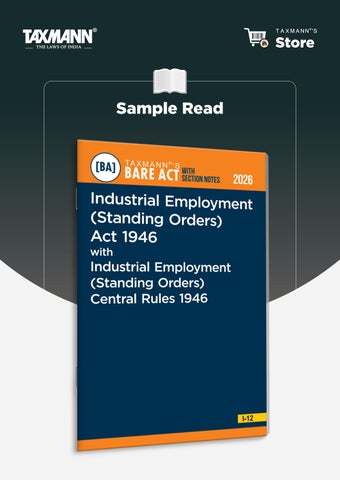
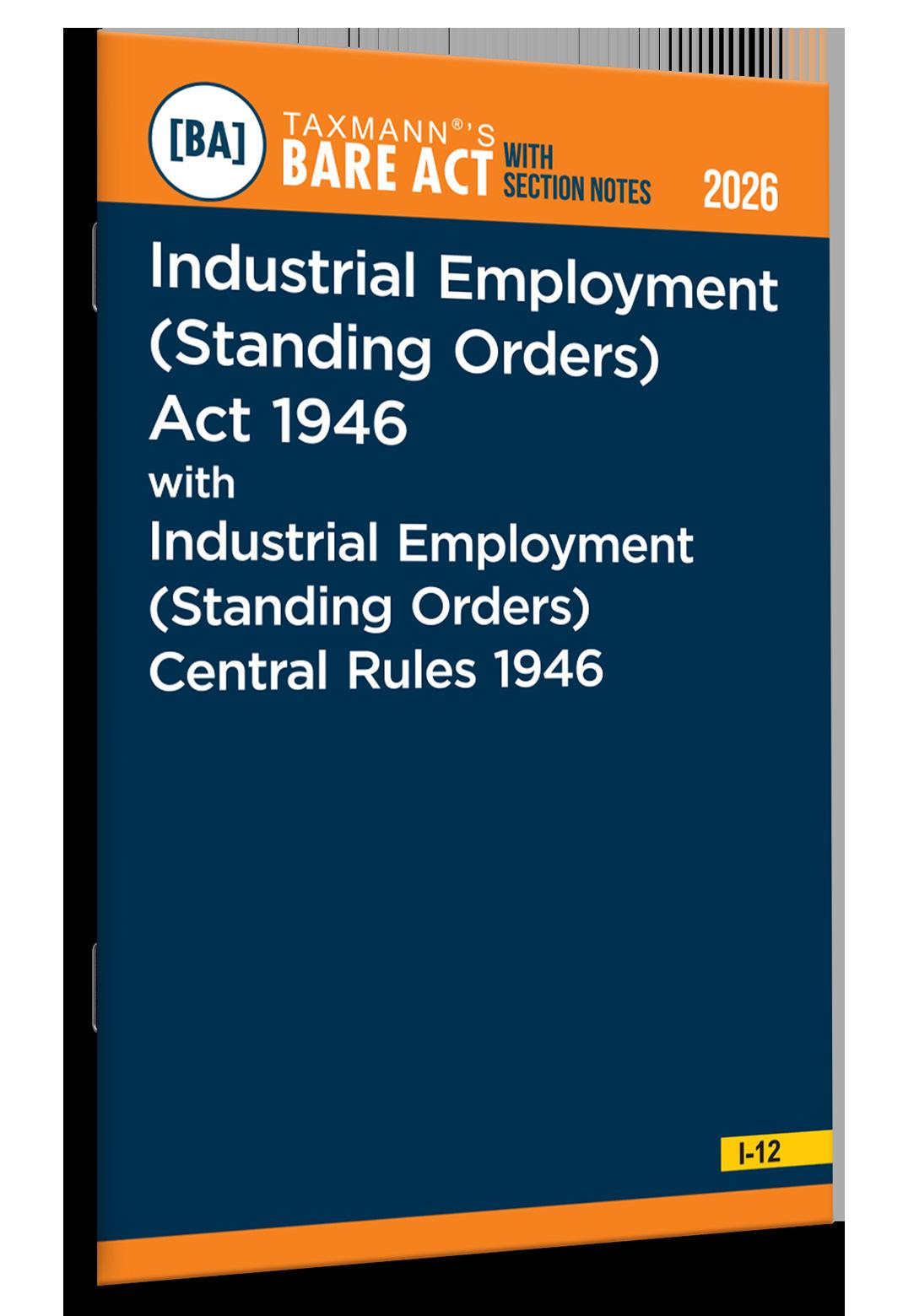
Industrial Employment (Standing Orders) Act 1946 with Industrial Employment (Standing Orders) Central Rules 1946 – Bare Act with Section Notes
AUTHOR : Taxmann’s Editorial Board
PUBLISHER : Taxmann
DATE OF PUBLICATION : December 2025
EDITION : 2026 Edition
ISBN NO : 9789371264006
No. of Pages : 60
BINDING TYPE : Paperback
Rs. 115
DESCRIPTION
Industrial Employment (Standing Orders) Act 1946 with Industrial Employment (Standing Orders) Central Rules 1946 [Bare Act with Section Notes] by Taxmann is a concise and authoritative statutory reference on the law governing conditions of employment in industrial establishments in India. The publication reproduces the complete, amended, and updated text of the Act and the Central Rules, supplemented with clear sectionwise notes, relevant State amendments, key judicial references, Model Standing Orders, and prescribed statutory forms. It serves as a reliable single-point reference for understanding service conditions, disciplinary procedures, certification and modification of standing orders, and statutory compliance under industrial employment law.
This book is intended for the following audience:
• Legal Professionals & Consultants
• Human Resource & Industrial Relations Managers
• Trade Unions & Workers’ Representatives
• Labour Law Academicians & Students
• Industrial Establishments & Employers
The Present Publication is the 2026 Edition, covering the amended and updated text of the Industrial Employment (Standing Orders) Act [Act No. 20 of 1946] and Central Rules, with the following noteworthy features:
• [Authentic Bare Act Text] Updated and authoritative text of the Act and Central Rules
• [Pre-amendment Provisions] Earlier provisions reproduced in footnotes for transitional understanding
• [Concise Section Notes] Practical notes explaining legislative intent, compliance aspects, and interpretation
• [Case Law References] Select judicial pronouncements clarifying the application of the Act
• [Model Standing Orders & Forms] Coverage of Model Standing Orders (including coal mines) and statutory forms
• [State Amendments Incorporated] Relevant State-specific amendments integrated at appropriate places
• [User-friendly Indexing] Marginal notes and subject index for quick reference
• [Compliance-focused] Assists in meeting statutory obligations and reducing litigation risk