
Sample Read




PASSPORTS ACT, 1967
7.
PASSPORTS RULES, 1980
PASSPORTS APPLICATION (FACILITATION AND PROCESSING) RULES,

Passports Act, 1967
[15 OF 1967*]
An Act to provide for the issue of passports and travel documents, to regulate the departure from India of citizens of India and other persons and for matters incidental or ancillary thereto.
BE it enacted by Parliament in the Eighteenth Year of the Republic of India as follows:—
Short title and extent.
1. (1) This Act may be called the Passports Act, 1967.
(2)It extends to the whole of India and applies also to citizens of India who are outside India.
COMMENTS
SECTION NOTES
1.1 Short Title [Section 1(1)]
The Act is officially titled the Passports Act, 1967.
1.2 Territorial Extent [Section 1(2)]
1.2-1 Application Within India:
The Act extends to the whole of India, covering all territories under Indian sovereignty.
1.2-2 Extra-Territorial Application:
The Act applies to Indian citizens outside India:
Definitions.
2. In this Act, unless the context otherwise requires,—
(a)“departure”, with its grammatical variations and cognate expressions, means departure from India by water, land or air;
(b)“passport” means a passport issued or deemed to have been issued under this Act;
*Dated 24-6-1967.
(c)“passport authority” means an officer or authority empowered under rules made under this Act to issue passports or travel documents and includes the Central Government; 1
(d) “prescribed” means prescribed by rules made under this Act;
(e) “travel document” means a travel document issued or deemed to have been issued under this Act.
COMMENTS
SECTION NOTES
2.1 Departure [Section 2(a)]:
Includes leaving India by water, land, or air.
Covers all modes of international travel, ensuring comprehensive regulation.
2.2 Passport Authority [Section 2(c)]:
Refers to the officer or authority empowered to issue passports or travel documents, including:
Officials designated under rules made under this Act.
The Central Government, ensuring centralized oversight.
2.3 Travel Document [Section 2(e)]:
Includes documents issued or deemed issued under this Act that enable international travel, other than regular passports.
CASE LAWS
Passport as Property Under Penal Code - The Supreme Court affirmed that a passport, being a tangible document that provides international travel benefits and recognizes citizenship, qualifies as “property” under sections 415 and 420 of the IPC. The case arose from a conspiracy involving fraudulent passport applications, resulting in unauthorized issuance of passports. The Court held that a passport’s value to its holder and potential misuse under fraudulent circumstances render it property, even without inherent monetary value. This classification supported the conviction for cheating and criminal conspiracy.—Nrisingha Murari Chakraborty v. State of W.B. AIR 1977 SC 1174.
Nature of Passport as Property - The Supreme Court, examining the nature of passports, emphasized that a passport is a political document conferring upon its holder the recognition of citizenship and serving as a request for free passage internationally. It is a crucial travel document, representing tangible value and ownership rights. Initially, it remains the State’s property when held by the issuing authority but transitions to the grantee’s property upon issuance. The Court clarified that even without direct monetary value, a passport is “property” under sections 415 and 420 of the IPC, as it holds intrinsic importance for its holder. This determination was critical to affirming the conviction for cheating the passport authority through false representations.—Nrisingha Murari Chakraborty v. State of W.B. 1977 Cri LJ 961.
Passport or travel document for departure from India.
3. No person shall depart from, or attempt to depart from India, unless he holds in this behalf a valid passport or travel document.
Explanation.—For the purposes of this section,—
(a) “passport” includes a passport which having been issued by or under the authority of the Government of a foreign country satisfies the conditions
prescribed under the Passport (Entry into India) Act, 1920 (34 of 1920), in respect of the class of passports to which it belongs;
(b) “travel document” includes a travel document which having been issued by or under the authority of the Government of a foreign country satisfies the conditions prescribed.
COMMENTS
SECTION NOTES
3.1 Requirement for Valid Documentation
No person is permitted to depart from India or attempt to depart without possessing a valid:
Passport, or Travel Document.
3.2 Explanation of Key Terms
3.2-1 Passport [Section 3(a)]:
Includes:
Passports issued by foreign governments. Such passports must comply with the conditions prescribed under the Passport (Entry into India) Act, 1920, for the class of passports to which they belong.
3.2-2 Travel Document [Section 3(b)]:
Includes:
Travel documents issued by foreign governments. These must also satisfy conditions prescribed under relevant rules.
CASE LAWS
Visa Violations and Unlawful Stay - The Nagpur High Court ruled that under section 3 of the Passports Act, 1920, a person entering India on a limited-duration visa cannot overstay beyond the permitted period unless protected under Articles 5 to 10 of the Constitution. In this case, a widow who returned to India on a single-journey visa after residing in Pakistan was found liable for unlawful stay after exceeding her visa’s validity. The Court underscored the importance of compliance with visa conditions, emphasizing that personal intent to settle cannot override legal provisions.—Karimun Nisa v. State Government of M.P. AIR 1955 Nag 6.
Prosecution Without Central Government Sanction - The Allahabad High Court upheld the acquittal of two accused charged under Section 3 of the Passports Act, 1967, for lacking the mandatory sanction required under Section 15 of the Act. The Court noted that prosecution for offences under the Passports Act is invalid without prior approval from the Central Government. As no such sanction was obtained, the Trial Court’s decision to acquit the accused was affirmed.—State of U.P. v. Gayur AIR ONLINE 2019 ALL 3106.
Unauthorized Possession of Foreign Passport - The Supreme Court considered whether possessing a Pakistani passport violated Section 3 of the Passports Act, which restricts departure from India without a valid passport or travel document. The Court clarified that mere possession of a foreign passport does not contravene Section 3 unless the person attempts to leave India. The accused, who held both Indian and Pakistani passports, was found to have entered India lawfully but had not attempted departure, making his conviction under Section 12 of the Act unsustainable.—Akmal Ahmad v. State of Delhi AIR 1999 SC 1315.
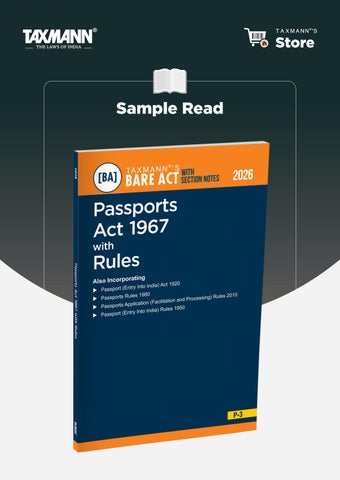
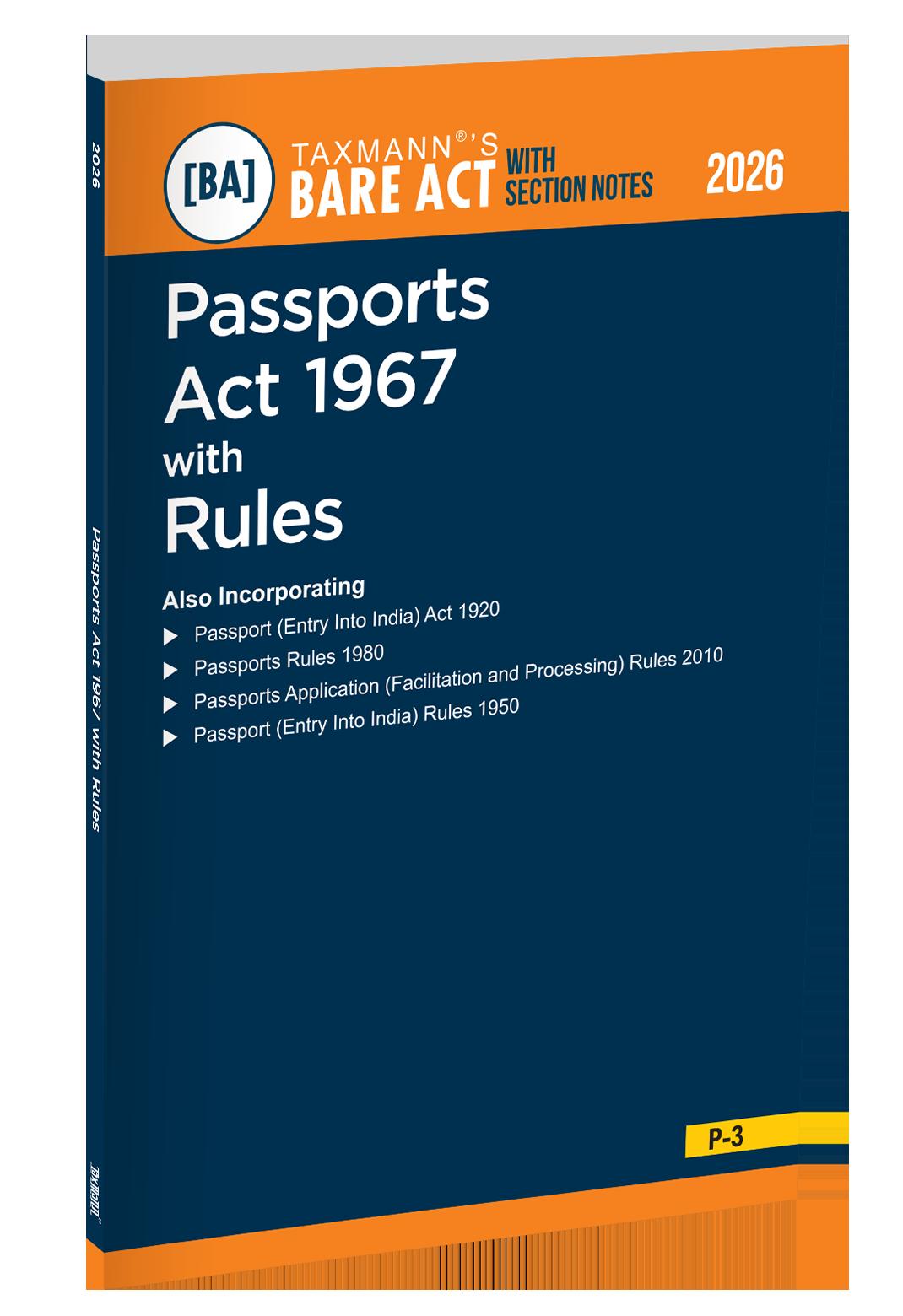
Passports Act 1967 with Rules – Bare Act with Section Notes
AUTHOR : Taxmann’s Editorial Board
PUBLISHER : Taxmann
DATE OF PUBLICATION : December 2025
EDITION : 2026 Edition
ISBN NO : 9789371260039
No. of Pages : 176
BINDING TYPE : Paperback
Rs. 225
DESCRIPTION
Passports Act 1967 with Rules [Bare Act with Section Notes] by Taxmann is a concise and authoritative statutory compilation presenting the complete and updated text of the Act, together with the relevant Rules and allied legislation governing passports and travel documents in India. The publication incorporates all amendments and notifications in force, ensuring statutory accuracy. Alongside the verbatim law, it provides clear, section-wise notes that explain key provisions, procedural requirements, and the scope of executive powers, making it a reliable guide to the legal framework governing the issuance, refusal, impounding, suspension, revocation, and regulation of passports.
This book is intended for the following audience:
• Lawyers & Advocates
• Judicial Officers & Academicians
• Government Officials & Passport Authorities
• Students of Law
• General Readers & Travellers
The Present Publication is the 2026 Edition, covering the amended and updated text of the Passports Act [Act No. 15 of 1967] and Rules, with the following noteworthy features:
• [Complete Text of the Passports Act 1967 & Allied Laws] The Bare Act in its current, amended form with full statutory coverage
• [Relevant Updates & Amendments] All applicable amendments and notifications integrated up to the latest cut-off date
• [Pre-amendment Provisions] Earlier versions of amended provisions included through detailed amendment footnotes
• [Incorporation of Rules & Supplementary Legislation] Includes the Passport (Entry into India) Act, 1920; Passport (Entry into India) Rules, 1950; Passports Rules, 1980; and Passports Application (Facilitation and Processing) Rules, 2010
• [Section-wise Notes & Commentary] Explains legislative intent and interpretational aspects for practical application
• [Practical Guidance] Covers procedures, powers, penalties, exemptions, and compliance aspects
• [User-friendly Layout] Clear typography, systematic arrangement, and an intuitive subject index