Sample Read
© Taxmann
Price : ` 105
Law stated in this book is as updated till 1st December, 2025
Published by : Taxmann Publications (P.) Ltd.
Sales & Marketing :
59/32, New Rohtak Road, New Delhi-110 005 India
Phone : +91-11-45562222
Website : www.taxmann.com
E-mail : sales@taxmann.com
Regd. Office :
21/35, West Punjabi Bagh, New Delhi-110 026 India
Printed at :
Tan Prints (India) Pvt. Ltd.
44 Km. Mile Stone, National Highway, Rohtak Road Village Rohad, Distt. Jhajjar (Haryana) India
E-mail : sales@tanprints.com
Disclaimer
Every effort has been made to avoid errors or omissions in this publication. In spite of this, errors may creep in. Any mistake, error or discrepancy noted may be brought to our notice which shall be taken care of in the next edition. It is notified that neither the publisher nor the author or seller will be responsible for any damage or loss of action to any one, of any kind, in any manner, therefrom. It is suggested that to avoid any doubt the reader should cross-check all the facts, law and contents of the publication with original Government publication or notifications.
No part of this book may be reproduced or copied in any form or by any means [graphic, electronic or mechanical, including photocopying, recording, taping, or information retrieval systems] or reproduced on any disc, tape, perforated media or other information storage device, etc., without the written permission of the publishers. Breach of this condition is liable for legal action.
For binding mistake, misprints or for missing pages, etc., the publisher’s liability is limited to replacement within seven days of purchase by similar edition. All expenses in this connection are to be borne by the purchaser. All disputes are subject to Delhi jurisdiction only.
NOTARIES ACT, 1952
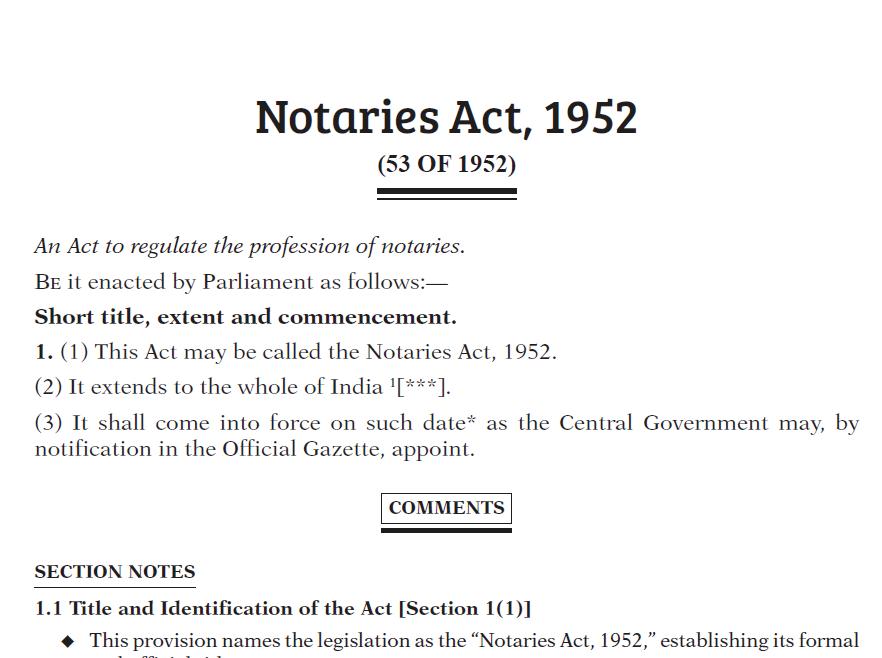
Notaries Act, 1952
(53 OF 1952)
An Act to regulate the profession of notaries.
Be it enacted by Parliament as follows:—
Short title, extent and commencement.
1. (1) This Act may be called the Notaries Act, 1952.
(2)It extends to the whole of India 1[***].
(3)It shall come into force on such date* as the Central Government may, by notification in the Official Gazette, appoint.
COMMENTS
SECTION NOTES
1.1 Title and Identification of the Act [Section 1(1)]
u This provision names the legislation as the “Notaries Act, 1952,” establishing its formal and official title.
1.2 Scope of Application [Section 1(2)]
u The Act’s application is extended across the entire country of India.
u The phrase “extends to the whole of India” indicates the geographical jurisdiction of the Act, ensuring that its provisions are uniformly applicable throughout India.
1.3 Commencement and Government Notification [Section 1(3)]
u This section delegates the responsibility of the Act’s commencement to the Central Government, which will determine the date of enactment through a formal notification in the Official Gazette.
Definitions.
2. In this Act, unless the context otherwise requires,—
(a) 2[***]
(b) “instrument” includes every document by which any right or liability is, or purports to be, created, transferred, modified, limited, extended, suspended, extinguished or recorded;
*With effect from 14-2-1956
1. Words “except the State of Jammu and Kashmir” omitted by the Central Laws (Extension to Jammu and Kashmir) Act, 1968, w.e.f. 15-8-1968.
2. Clause (a) omitted, ibid. Prior to omission, clause (a) read as under: ‘(a) “India” means the territories to which this Act extends;’
3[(c) “legal practitioner” means an advocate entered in any roll under the provisions of the Advocates Act, 1961 (25 of 1961);]
(d) “notary” means a person appointed as such under this Act:
Provided that for a period of two years from the commencement of this Act it shall include also a person who, before such commencement was appointed a notary public 4[under] the Negotiable Instruments Act, 1881 (26 of 1881), 5[***] and is, immediately before such commencement, in practice in 6[any part of India:
Provided further that in relation to the State of Jammu and Kashmir the said period of two years shall be computed from the date on which this Act comes into force in that State];
(e) “prescribed” means prescribed by rules made under this Act;
(f) “Register” means a Register of Notaries maintained by the Government under section 4;
7[(g) “State Government”, in relation to a Union territory means the administrator thereof.]
COMMENTS
SECTION NOTES
2.1 Interpretation Clause
u The definitions provided under section 2 are prefaced by “unless the context otherwise requires,” meaning the defined terms apply throughout the Act unless specific provisions necessitate a different interpretation.
2.2 Definition of “Instrument” [Section 2(b)]
u The term “instrument” is broadly defined to include any document that creates, alters, transfer, or records rights or liabilities.
2.3 Definition of “Legal Practitioner” [Section 2(c)]
u A “legal practitioner” under this Act refers specifically to advocates registered under the Advocates Act, 1961.
3. Substituted by the Notaries (Amendment) Act, 1999, w.e.f. 17-12-1999. Prior to substitution, clause (c) read as under:
‘(c) “legal practitioner” means any advocate or agent of the Supreme Court or any advocate, vakil or attorney of any High Court or any pleader authorised under any law for the time being in force to practise in any court of law;’
4. Substituted for “either under” by the Central Laws (Extension to Jammu and Kashmir) Act, 1968, w.e.f. 15-8-1968.
5. Words “or by the Master of Faculties in England” omitted by the Central Laws (Extension to Jammu and Kashmir) Act, 1968, w.e.f. 15-8-1968.
6. Substituted for “any part of India”, ibid.
7. Substituted by the Adaptation of Laws (No.3) Order, 1956, w.e.f. 1-11-1956. Prior to substitution clause (g) read as under:
‘(g) “State Government”, in relation to a Part C State, means the Lieutenant Governor, or, as the case may be, the Chief Commissioner.’
2.4 Definition of “Notary” [Section 2(d)]
u The term “notary” refers to individuals officially appointed under the Notaries Act.
2.4-1 Notary Public Under NI Act, 1881 [Provided that]
u Individuals appointed as “notary public” under the Negotiable Instruments Act, 1881, for two years post-commencement, are recognized as notaries under this Act.
- Such Notary Public must be practicing in any part of India immediately prior to the commencement.
- For the State of Jammu and Kashmir the period of two year shall be computed from the commencement date of this Act.
2.5 Definition of “Register” [Section 2(f)]
u “Register” here refers to the official record of notaries maintained by the government, as mandated under section 4 of the Act.
CASE LAWS
u Advocate’s Role as Notary Linked to Professional Conduct - The Supreme Court held that an advocate’s status is integral to their recognition as a notary under section 2(c) of the Notaries Act. The Court ruled that misconduct in notarial acts, such as attesting blank stamp papers with a seal and signature, constitutes a breach of both the Notaries Act and the Advocates Act. It rejected the argument that an advocate’s role as a notary is distinct from their professional conduct as a lawyer, affirming that misconduct in one role affects the other. Punishment was reduced, but the advocate was barred from future recognition as a notary. — Bar Council of Andhra Pradesh v. B. Narayan Swamy AIR ONLINE 2014 SC 8.
Power to appoint notaries.
3. The Central Government, for the whole or any part of India, and any State Government, for the whole or any part of the State, may appoint as notaries any legal practitioners or other persons who possess such qualifications as may be prescribed.
COMMENTS
SECTION NOTES
3.1 Authority to Appoint Notaries
u Section 3 confers the authority to appoint notaries upon both the Central and State Governments.
3.2 Geographical Scope of Appointment
u The Central Government has the power to appoint notaries for all of India or specific regions within the country, while State Governments can appoint notaries within their respective state or designated parts of it.
3.3 Eligibility for Appointment
u The Act allows for the appointment of “legal practitioners” (i.e., advocates registered under the Advocates Act, 1961) or other qualified individuals as notaries.
3.3-1 Qualification for Appointment as a Notary
u The qualifications for appointment as a notary are determined by rules prescribed under the Act [See Rule 3 of the Notaries Rules, 1956].
NOTARIES ACT 1952 WITH NOTARIES RULES 1956 – BARE ACT WITH SECTION NOTES
AUTHOR : Taxmann's Editorial Board
PUBLISHER : Taxmann
DATE OF PUBLICATION : December 2025
EDITION : 2026 Edition
ISBN NO : 9789371269940
NO. OF PAGES : 56
BINDING TYPE : Paperback
Rs. 105
DESCRIPTION
Notaries Act 1952 with Notaries Rules 1956 [Bare Act with Section Notes] by Taxmann is a comprehensive compilation of the Act and Rules, with section notes on each provision. The 2026 Edition incorporates recent amendments, judicial interpretations, and procedural guidelines vital for anyone engaged in notarial services in India. This book is intended for the following audience
• Practising Advocates & Legal Professionals
• Law Students & Academics
• Judicial & Quasi-Judicial Authorities
• Researchers & Policy Analysts
The Present Publication is the 2026 Edition, covering the amended and updated text of the Notaries Act [Act No. 53 of 1952] and Rules, with the following noteworthy features:
• [Authoritative Text] Accurate, complete presentation of the Act and Rules
• [Section Notes & Analysis] Clarifies terms, definitions, and procedures
• [Latest Amendments & Notifications] Reflects current legislative changes relevant to notarial practice
• [Pre-amendment Provisions] Provides earlier text in amendment footnotes for historical context
• [Case Law References] Summarises pivotal judgments regarding notarial duties and penalties
• [Practical Insights] Includes sample forms, protests, affidavits, and flowcharts
• [Easy Reference Tools] Subject indexes, cross-references, and a well-organised table of contents
Buy Now