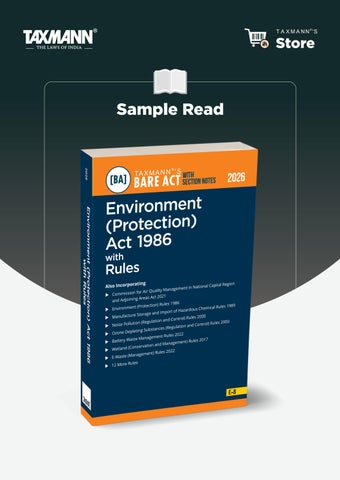
Environment (Protection) Act, 1986
[29 OF 1986]*
An Act to provide for the protection and improvement of environment and for matters connected therewith.
WHEREAS decisions were taken at the United Nations Conference on the Human Environment held at Stockholm in June, 1972, in which India participated, to take appropriate steps for the protection and improvement of human environment; AND WHEREAS it is considered necessary further to implement the decisions aforesaid in so far as they relate to the protection and improvement of environment and the prevention of hazards to human beings, other living creatures, plants and property;
BE it enacted by Parliament in the Thirty-seventh Year of the Republic of India as follows:—
CHAPTER I PRELIMINARY
Short title, extent and commencement.
1. (1) This Act may be called the Environment (Protection) Act, 1986.
(2)It extends to the whole of India.
(3)It shall come into force on such date1 as the Central Government may, by notification in the Official Gazette, appoint and different dates may be appointed for different provisions of this Act and for different areas. Definitions.
2. In this Act, unless the context otherwise requires,—
(a)“environment” includes water, air and land and the interrelationship which exists among and between water, air and land, and human beings, other living creatures, plants, micro-organism and property;
(b)“environmental pollutant” means any solid, liquid or gaseous substances present in such concentration as may be, or tend to be, injurious to environment;
1.With effect from 19-11-1986, vide Notification No. G.S.R. 1198(E), dated 12-11-1986. *Dated 23-5-1986.
(
c) “environmental pollution” means the presence in the environment of any environmental pollutant;
2[(ca) “Fund” means the Environmental Protection Fund established under section 16];
(d) “handing”, in relation to any substance, means the manufacture, processing, treatment, package, storage, transportation, use, collection, destruction, conversion, offering for sale, transfer of the like of such substance;
(
e) “hazardous substance” means any substance or preparation which, by reason of its chemical or physico-chemical properties or handling, is liable to cause harm to human beings, other-living creatures, plants, microorganism, property or the environment;
(
f) “occupier”, in relation to any factory or premises, means a person who has control over the affairs of the factory or the premises and includes, in relation to any substance, the person in possession of the substance;
(g) “prescribed” means prescribed by rules made under this Act.
COMMENTS
SECTION NOTES
2.1 Definition of “environment” [Section 2(a)]
Elements Included in “environment”
The term “environment” includes the physical elements of water, air, and land.
“Environment” further includes the interrelationship which exists among and between the following:
The physical elements of water, air, and land.
Human beings.
Other living creatures, plants, and micro-organism.
Property.
2.2 Definition of “environmental pollutant” [Section 2(b)]
Constituents of “environmental pollutant”
“Environmental pollutant” means any substance that can be classified as:
Solid substances.
Liquid substances.
Gaseous substances.
Condition for classification as pollutant
These substances must be present in such a concentration as may be, or tend to be, injurious to the environment.
2. Inserted by the Jan Vishwas (Amendment of Provisions) Act, 2023, w.e.f. 1-4-2024.
2.3 Definition of “handling” [Section 2(d)]
Scope of “handling” in relation to any substance
The term “handling”, in relation to any substance, means the following activities concerning that substance: Manufacture; Processing; Treatment; Package; Storage; Transportation; Use; Collection; Destruction; Conversion;
Offering for sale;
Transfer or the like of such substance.
2.4 Definition of “hazardous substance” [Section 2(e)]
Characteristics of “hazardous substance”
A “hazardous substance” means any substance or preparation that is liable to cause harm due to either of the following reasons: Its chemical or physico-chemical properties. Its handling.
Recipients of potential harm
The harm caused by the substance is liable to affect the following: Human beings.
Other living creatures, plants, and microorganism.
Property.
The environment.
2.5 Definition of “occupier” [Section 2(f)]
“Occupier” in relation to a factory or premises
“Occupier” means a person who has control over the affairs of the factory or the premises.
“Occupier” in relation to any substance (Inclusion)
The term “occupier” also includes, in relation to any substance, the person in possession of the substance.
CHAPTER II GENERAL POWERS OF THE CENTRAL GOVERNMENT
Power of Central Government to take measures to protect and improve environment.
3. (1) Subject to the provision of this Act, the Central Government shall have the power to take all such measures as it deems necessary or expedient for the pur-
pose of protecting and improving the quality of the environment and preventing, controlling and abating environmental pollution.
(2) In particular, and without prejudice to the generality of the provisions of sub-section (1), such measures may include measures with respect to all or any of the following matters, namely :—
(i) co-ordination of actions by the State Governments, officers and other authorities—
(
a) under this Act, or the rules made thereunder; or
(b) under any other law for the time being in force which is relatable to the objects of this Act;
(
ii) planning and execution of a nation-wide programme for the prevention, control and abatement of environmental pollution;
(iii) laying down standards for the quality of environment in its various aspects;
(iv) laying down standards for emission or discharge of environmental pollutants from various sources whatsoever:
Provided that different standards for emission or discharge may be laid down under this clause from different sources having regard to the quality or composition of the emission or discharge of environmental pollutants from such sources;
(
v) restriction of areas in which any industries, operations or processes or class of industries, operations or processes shall not be carried out or shall be carried out subject to certain safeguards;
(vi) laying down procedures and safeguards for the prevention of accidents which may cause environmental pollution and remedial measures for such accidents;
(vii) laying down procedures and safeguards for the handling of hazardous substances;
(viii) examination of such manufacturing processes, materials and substances as are likely to cause environmental pollution;
(ix) carrying out and sponsoring investigations and research relating to problems of environmental pollution;
(x) inspection of any premises, plant, equipment, machinery, manufacturing or other processes, materials or substances and giving, by order, of such directions to such authorities, officers or persons as it may consider necessary to take steps for the prevention, control and abatement of environmental pollution;
(xi) establishment or recognition of environmental laboratories and institutes to carry out the functions entrusted to such environmental laboratories and institutes under this Act;
(xii) collection and dissemination of information in respect of matters relating to environmental pollution;
(xiii) preparation of manuals, codes or guides relating to the prevention, control and abatement of environmental pollution;
(xiv) such other matters as the Central Government deems necessary or expedient for the purpose of securing the effective implementation of the provisions of this Act.
(3) The Central Government may, if it considers it necessary or expedient so to do for the purposes of this Act, by order, published in the Official Gazette, constitute an authority or authorities by such name or names as may be specified in the order for the purpose of exercising and performing such of the powers and functions (including the power to issue directions under section 5) of the Central Government under this Act and for taking measures with respect to such of the matters referred to in sub-section (2) as may be mentioned in the order and subject to the supervision and control of the Central Government and the provisions of such order, such authority or authorities may exercise the powers or perform the functions or take the measures so mentioned in the order as if such authority or authorities had been empowered by this Act to exercise those powers or perform those functions or take such measures.
Appointment of officers and their powers and functions.
4. (1) Without prejudice to the provisions of sub-section (3) of section 3, the Central Government may appoint officers with such designations as it thinks fit for the purposes of this Act and may entrust to them such of the powers and functions under this Act as it may deem fit.
(2) The officers appointed under sub-section (1) shall be subject to the general control and direction of the Central Government or, if so directed by that Government, also of the authority or authorities, if any, constituted under sub-section (3) of section 3 or of any other authority, or officer.
Power to give directions.
5. Notwithstanding anything contained in any other law but subject to the provisions of this Act, the Central Government may, in the exercise of its powers and performance of its functions under this Act, issue directions in writing to any person, officer or any authority and such person, officer or authority shall be bound to comply with such directions.
Explanation.—For the avoidance of doubts, it is hereby declared that the power to issue directions under this section includes the power to direct—
(a) the closure, prohibition or regulation of any industry, operation or process; or
(b) stoppage or regulation of the supply of electricity or water or any other service.
3[Appeal to National Green Tribunal.
5A. Any person aggrieved by any directions issued under section 5, on or after the commencement of the National Green Tribunal Act, 2010, may file an appeal to the National Green Tribunal established under section 3 of the National Green Tribunal Act, 2010, in accordance with the provisions of that Act.]
3. Inserted by the National Green Tribunal Act, 2010, w.e.f. 18-10-2010.
Rules to regulate environmental pollution.
6. (1) The Central Government may, by notification in the Official Gazette, make rules in respect of all or any of the matters referred to in section 3.
(2) In particular, and without prejudice to the generality of the foregoing power, such rules may provide for all or any of the following matters, namely:—
(a) the standards of quality of air, water or soil for various areas and purposes;
(
b) the maximum allowable limits of concentration of various environmental pollutants (including noise) for different areas;
(c) the procedures and safeguards for the handling of hazardous substances;
(d) the prohibition and restrictions on the handling of hazardous substances in different areas;
(e) the prohibition and restrictions on the location of industries and the carrying on of processes and operations in different areas;
(f) the procedures and safeguards for the prevention of accidents which may cause environmental pollution and for providing for remedial measures for such accidents.
CHAPTER III
PREVENTION, CONTROL AND ABATEMENT OF ENVIRONMENTAL POLLUTION
Persons carrying on industry, operation, etc., not to allow emission or discharge of environmental pollutants in excess of the standards.
7. No person carrying on any industry, operation or process shall discharge or emit or permit to be discharged or emitted any environmental pollutant in excess of such standards as may be prescribed.
Persons handling hazardous substances to comply with procedural safeguards.
8. No person shall handle or cause to be handled any hazardous substance except in accordance with such procedure and after complying with such safeguards as may be prescribed.
Furnishing of information to authorities and agencies in certain cases.
9. (1) Where the discharge of any environmental pollutant in excess of the prescribed standards occurs or is apprehended to occur due to any accident or other unforeseen act or event, the person responsible for such discharge and the person in charge of the place at which such discharge occurs or is apprehended to occur shall be bound to prevent or mitigate the environmental pollution caused as a result of such discharge and shall also forthwith—
(a) intimate the fact of such occurrence or apprehension of such occurrence; and
(b) be bound, if called upon, to render all assistance, to such authorities or agencies as may be prescribed.
(2) On receipt of information with respect to the fact or apprehension of any occurrence of the nature referred to in sub-section (1), whether through intimation under that sub-section or otherwise, the authorities or agencies referred to in sub-section (1) shall, as early as practicable, cause such remedial measures to be taken as are necessary to prevent or mitigate the environmental pollution.
(3) The expenses, if any, incurred by any authority or agency with respect to the remedial measures referred to in sub-section (2), together with interest (at such reasonable rate as the Government may, by order, fix) from the date when a demand for the expenses is made until it is paid, may be recovered by such authority or agency from the person concerned as arrears of land revenue or of public demand. Powers of entry and inspection.
10. (1) Subject to the provisions of this section, any person empowered by the Central Government in this behalf shall have a right to enter, at all reasonable times with such assistance as he considers necessary, any place—
(
a) for the purpose of performing any of the functions of the Central Government entrusted to him;
(
b) for the purpose of determining whether and if so in what manner, any such functions are to be performed or whether any provisions of this Act or the rules made thereunder or any notice, order, direction or authorisation served, made, given or granted under this Act is being or has been complied with;
(
c) for the purpose of examining and testing any equipment, industrial plant, record, register, document or any other material object or for conducting a search of any building in which he has reason to believe that an offence under this Act or the rules made thereunder has been or is being or is about to be committed and for seizing any such equipment, industrial plant, record, register, document or other material object if he has reasons to believe that it may furnish evidence of the commission of an offence punishable under this Act or the rules made thereunder or that such seizure is necessary to prevent or mitigate environmental pollution.
4[(2) Every person carrying on any industry, operation or process of handling any hazardous substance shall render assistance, as may be required, to the person empowered by the Central Government under sub-section (1) for carrying out the functions under that sub-section and if he fails to do so without any reasonable cause, he shall be liable to penalty provided under section 14B.
4. Substituted by the Jan Vishwas (Amendment of Provisions) Act, 2023, w.e.f. 1-4-2024. Prior to their substitution, sub-sections (2) to (4) read as under:
“(2) Every person carrying on any industry operation or process or handling any hazardous substance shall be bound to render all assistance to the person empowered by the Central Government under sub-section (1) for carrying out the functions under that sub-section and if he fails to do so without any reasonable cause or excuse, he shall be guilty of an offence under this Act.
(3) If any person wilfully delays or obstructs any person empowered by the Central Government under sub-section (1) in the performance of his functions, he shall be guilty of an offence under this Act.
(Contd. on page 8)
(3) If any person wilfully delays or obstructs any person empowered by the Central Government under sub-section (1) in the performance of his functions under sub-section (1) or (2), he shall be liable to penalty provided under section 14B.
(4) The provisions of the Code of Criminal Procedure, 1973 (2 of 1974)†, shall, so far as may be, apply to any search or seizures under this section as they apply to any search or seizures made under the authority of a warrant issued under section 94 of that Code.]
Power to take sample and procedure to be followed in connection therewith.
11. (1) The Central Government or any officer empowered by it in this behalf, shall have power to take, for the purpose of analysis, samples of air, water, soil or other substance from any factory, premises or other place in such manner as may be prescribed.
(2) The result of any analysis of a sample taken under sub-section (1) shall not be admissible in evidence in any legal proceeding unless the provisions of sub-sections (3) and (4) are complied with.
(3) Subject to the provisions of sub-section (4), the person taking the sample under sub-section (1) shall—
(
a) serve on the occupier or his agent or person in charge of the place, a notice, then and there, in such form as may be prescribed, of his intention to have it so analysed;
(
b) in the presence of the occupier or his agent or person, collect a sample for analysis;
(
c) cause the sample to be placed in a container or containers which shall be marked and sealed and shall also be signed both by the person taking the sample and the occupier or his agent or person;
(d) send without delay, the container or the containers to the laboratory established or recognised by the Central Government under section 12.
(4) When a sample is taken for analysis under sub-section (1) and the person taking the sample serves on the occupier or his agent or person, a notice under clause (a) of sub-section (3), then—
(a) in a case where the occupier, his agent or person wilfully absents himself, the person taking the sample shall collect the sample for analysis to be placed in a container or containers which shall be marked and sealed and shall also be signed by the person taking the sample, and
(b) in a case where the occupier or his agent or person present at the time of taking the sample refuses to sign the marked and sealed container
(Contd. from page 7)
(4) The provisions of the Code of Criminal Procedure, 1973 (2 of 1974), or, in relation to the State of Jammu and Kashmir, or any area in which that Code is not in force, the provisions of any corresponding law in force in that State or area shall, so far as may be, apply to any search or seizure under this section as they apply to any search or seizure made under the authority of a warrant issued under section 94 of the said Code or, as the case may be, under the corresponding provisions of the said law.”
† Now see the Bharatiya Nagarik Suraksha Sanhita, 2023 (46 of 2023) [Vide Notification No. 2790(E), dated 16-7-2024].
or containers of the sample as required under clause (c) of sub-section (3), the marked and sealed container or containers shall be signed by the person taking the samples, and the container or containers shall be sent without delay by the person taking the sample for analysis to the laboratory established or recognised under section 12 and such person shall inform the Government Analyst appointed or recognised under section 13 in writing, about the wilful absence of the occupier or his agent or person, or, as the case may be, his refusal to sign the container or containers.
Environmental laboratories.
12. (1) The Central Government may, by notification in the Official Gazette,—
(
a) establish one or more environmental laboratories;
(b) recognise one or more laboratories or institutes as environmental laboratories to carry out the functions entrusted to an environmental laboratory under this Act.
(2) The Central Government may, by notification in the Official Gazette, make rules specifying—
(
a) the functions of the environmental laboratory;
(b) the procedure for the submission to the said laboratory of samples of air, water, soil or other substance for analysis or tests, the form of the laboratory report thereon and the fees payable for such report;
(c) such other matters as may be necessary or expedient to enable that laboratory to carry out its functions.
Government Analysts.
13. The Central Government may, by notification in the Official Gazette, appoint or recognise such persons as it thinks fit and having the prescribed qualifications to be Government Analysts for the purpose of analysis of samples of air, water, soil or other substance sent for analysis to any environmental laboratory established or recognised under sub-section (1) of section 12.
Reports of Government Analysts.
14. Any document purporting to be a report signed by a Government Analyst may be used as evidence of the facts stated therein in any proceeding under this Act.
5[Penalty for contravention of section 7 or section 8.
14A. (1) If any person, contravenes provisions of section 7 or section 8 or the rules made thereunder, he shall be liable to penalty in respect of each such contravention, which shall not be less than one lakh rupees but which may extend to fifteen lakh rupees.
(2) Where any person continues contravention under sub-section (1), he shall be liable to additional penalty of fifty thousand rupees for every day during which such contravention continues.
5. Inserted by the Jan Vishwas (Amendment of Provisions) Act, 2023, w.e.f. 1-4-2024.
COMMENTS
SECTION NOTES
14A.1 Penalty for single contravention
Applicable contraventions
If any person contravenes the provisions of section 7 or section 8 or the rules made thereunder.
Quantum of penalty
The person shall be liable to a penalty in respect of each such contravention, which is subject to the following financial limits:
Minimum Limit: Shall not be less than one lakh rupees (` 1,00,000).
Maximum Limit: May extend up to fifteen lakh rupees (` 15,00,000).
14A.2 Additional penalty for continuing contravention
Condition for Liability
Where any person continues a contravention that is described under subsection (1).
Rate of additional penalty
The person shall be liable to an additional penalty of fifty thousand rupees (` 50,000) for every day during which such contravention continues.
Penalty for contravention of sections 9, 10 and 11.
14B. (1) If any person contravenes or does not comply with the provisions of section 9, section 10 or section 11 or orders or directions issued under those sections, he shall be liable to penalty in respect of each such contravention which shall not be less than ten thousand rupees but which may extend to five lakh rupees.
(2) Where any person continues contravention under sub-section (1), he shall be liable to additional penalty of ten thousand rupees for every day during which such contravention continues.]
COMMENTS
SECTION NOTES
14B.1 Penalty for single contravention
Applicable contraventions
If any person contravenes or does not comply with the following:
The provisions of section 9, section 10, or section 11. Orders or directions issued under those sections.
Quantum of penalty
The person shall be liable to a penalty in respect of each such contravention, which is subject to the following financial limits:
Minimum Limit: Shall not be less than ten thousand rupees (` 10,000).
Maximum Limit: May extend up to five lakh rupees (` 5,00,000).
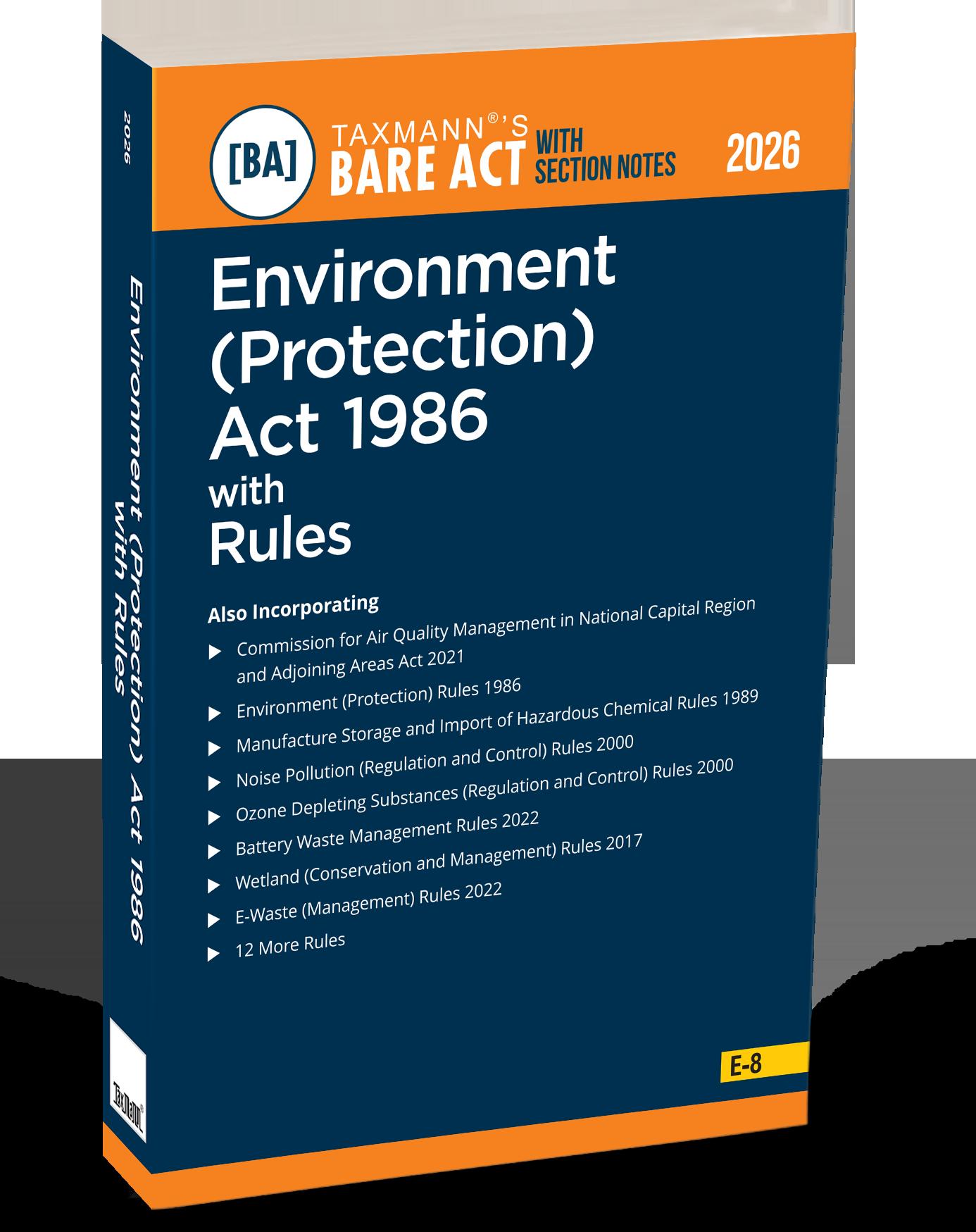
ENVIRONMENT (PROTECTION) ACT 1986 WITH RULES – BARE ACT WITH SECTION NOTES
AUTHOR : Taxmann's Editorial Board
PUBLISHER : Taxmann
DATE OF PUBLICATION : January 2026
EDITION : 2026 Edition
ISBN NO : 9789364552806
NO. OF PAGES : 740
BINDING TYPE : Paperback
Rs. 795
DESCRIPTION
Environment (Protection) Act 1986 with Rules [Bare Act with Section Notes] by Taxmann is an authoritative and up-to-date statutory reference that presents India's principal legal framework for environmental protection, pollution control, and ecological governance. Enacted to empower the Central Government with comprehensive authority to safeguard and improve environmental quality, the Act forms the backbone of India's environmental regulatory regime. This Edition reproduces the complete and amended text of the Act along with all allied Rules, supported by concise section-wise notes that facilitate clear statutory understanding and practical application. The publication serves as a reliable reference for interpreting environmental standards, regulatory controls, enforcement mechanisms, and compliance obligations. This publication is indispensable for a broad spectrum of professionals and institutions, including:
• Advocates & Environmental Law Practitioners
• Judges, Judicial Officers & Legal Researchers
• Corporate Legal & Compliance Teams
• Environmental Consultants & ESG Professionals
• Government Officials & Regulators
• Law Students & Academicians
The Present Publication is the 2026 Edition, covering the amended and updated text of the Environment (Protection) Act [Act No. 29 of 1986] and Rules, with the following noteworthy features:
• [Comprehensive Text with Section Notes] Complete and updated text of the Act, supported by concise section-wise explanatory notes
• [Updated Amendments] Incorporates all statutory amendments and changes notified up to date
• [Pre-amendment Provisions] Includes pre-amendment text in relevant amendment footnotes for contextual clarity
• [Inclusion of Allied Rules] Covers all Rules framed under the Act in full
• [Regulatory & Enforcement Framework] Clearly sets out provisions relating to standards, inspections, directions, penalties, and prosecution
• [Structured Indexing] Logical arrangement and detailed subject index for quick and efficient reference