ARTICLES OF ASSOCIATION 6 CHAPTER
ARTICLES OF ASSOCIATION [SEC. 2(5)]
As per Sec. 2(5), “Articles” means the Articles of Association of a company as originally framed or as altered from time to time or applied in pursuance of any previous company law or of this Act.
Articles are rules and regulations for the internal management of the company. Articles are bye laws of the company. It governs the relationship between the members and the company (Naresh Chandra Sanyal v. Calcutta Stock Exchange Association Ltd.). The articles are not enforceable by outsiders (Eley v. Positive Government Life Assurance Company Ltd.)
CONTENTS OF ARTICLES (SEC. 5)
1. The articles of a company shall contain regulations for management of the company.
2. The articles contain matters relating to share capital, lien of shares, calls on shares, transfer and transmission of shares, proceedings at general meeting etc. Company may include such additional matters in its articles as may be considered necessary for its management.
3. Entrenchment clause (i.e. Super majority Clause) in the Articles of Association:
(a) The articles may contain provisions for entrenchment to the effect that specified provisions of the articles may be altered only if conditions or procedures as that are more restrictive than those applicable in the case of a special resolution, are met or complied with.
(b) The provisions for entrenchment shall only be made either on formation of a company, or by an amendment in the articles agreed to by all
the members of the company in the case of a private company and by a special resolution in the case of a public company.
(c) Where the articles contain provisions for entrenchment, whether made on formation or by amendment, the company shall give notice to the Registrar of such provisions in such form and manner as may be prescribed.
Model Form of Articles: The articles of a company shall be in respective forms specified in Tables F, G, H, I and J in Schedule I as may be applicable to such company.
Schedule I
Table F : Articles of Association of a company limited by shares.
Table G : Articles of Association of a company limited by Guarantee and having a share capital.
Table H : Articles of Association of a company limited by Guarantee and not having a share capital.
Table I : Articles of Association of an unlimited company and having share capital.
Table J : Articles of Association of an unlimited company and not having share capital.
In case the registered articles of the company do not exclude or modify the regulations contained in the model articles applicable to such company, those regulations shall, so far as applicable, be the regulations of that company in the same manner and to the extent as if they were contained in the duly registered articles of the company.
ALTERATION OF ARTICLES OF ASSOCIATION (SEC.14)
A company may alter its articles by a special resolution. It is rightly said that a company has wide power to alter articles as this can be done by simply passing special resolution in general meeting.
Restrictions or Limitations on Alteration of Articles
No alteration in Articles of Association shall be valid unless it is in accordance with the following conditions:
(a) As Articles of Association is a document subordinate to the Companies Act and Memorandum of Association so any alteration in Articles of Association cannot be against the provisions of the Companies Act and Memorandum of Association.
(b) If Articles of Association contain ‘entrenchment clause’ then alteration to be valid with regard to change requiring ‘superior majority’ shall be valid only when it is in compliance with that.
(
c) Alteration in Articles of Association for conversion of public company into private company shall not be valid without the approval of Central Government (now Regional Director).
(
d) Alteration must not constitute fraud on minority by majority.
Case law
Brown v. British Abrasive Wheel Co. Ltd. (1919)
The shareholders holding 98% of the shares passed a resolution that upon the request of holders of 9/10th of the issued shares, a shareholder shall be bound to sell his shareholding. The alteration was held to be invalid since it amounted to oppression of minority by majority.
(
e) The alteration to be valid must be bona fide in the interest of the company (Allen v. Gold Reefs of West Africa). This is popularly known as Allen’s Test.
Case law
Allen v. Gold Reefs of West Africa (1900)
A company had a lien on partly paid-up shares only. Mr. A owned some fully paid-up and some partly paid-up shares. The company altered its articles and gave itself a right of lien on all shares. The alteration was held to be valid as it was bona fide for the interest of the company as a whole.
(f) Alteration cannot validate anything which is illegal, immoral or opposed to public policy.
The articles cannot be altered to enable a company to carry on an illegal scheme (Pioneer Mutual Benefit Society v. Assistant Registrar).
(
g) Alteration cannot be against the order of the Tribunal. Can a company justify a breach of contract with third party by altering Articles?
By effecting alteration in its Articles, a company cannot defeat or escape from contractual liability. As the power to alter Articles is statutory and contractual obligation in Articles of Association cannot limit statutory powers.
Note: For further clarity reader is advised to go to next heading.
Effect of Memorandum and Articles
According to Sec. 10(1) subject to the provisions of this Act, the Memorandum and Articles shall, when registered, bind the company and the members thereof to the same extent as if they respectively had been signed by the company and by each member, and contained covenants on its own and his part to observe all the provisions of the Memorandum and Articles.
The binding effect can be understood in terms of the following propositions:
(1) Company bound to the members: Whatever is stated in the Memorandum and Articles that creates binding between company and members for his rights as a member.
(2) Members bound to the company: Where a shareholder who became bankrupt was asked to sell his shares to a person at price fixed by the directors under the provisions of Articles, he was bound by such provision (Borland’s Trustee v. Steel Bros. & Co. Ltd.)
(3) Member to a Member in exceptional cases only. In Rayfield v. Hands (1960), directors being members in this case were compelled to buy shares of a member as Articles gave him this right to sell shares at a fair value.
Are the Articles enforceable by the outsiders?
The answer is No. ‘A third person who purports to have rights against the company would be precluded from relying on the Articles as a basis of his claim and must prove a special contract outside the Articles (Iyengar v. United India Life Insurance Co.).
In Eley v. Positive Life Assurance Co. Ltd. (1876) person named in articles as a solicitor was unable to enforce the provisions when the company employed someone else; the articles conferred no rights as between him and the company (reproduced as stated on page 100 of Company Law, Brenda Hannigan, 3rd edition, Oxford University Press, UK). It held that AoA were a matter between the members inter se or the members and the company for their rights as members.
Binding effect of Memorandum and Articles can be summarised as follows:
(1) Company and Members:
(
a) Members are bound to the company always.
(
b) Company is bound to the members for their rights as members.
(2) Company and Outsiders:
(i) Where Articles is not the basis of contract between company and outsiders: If by alteration in Articles any term with outsider is breached, outsider can file a claim for breach under separate contract which he has with company.
(
ii) Where Articles of Association is the only basis of contract between company and outsiders: Here also Articles can be altered, as nothing can deprive the company of its statutory right to alter the Articles (Southern Foundaries Ltd. v. Shirlaw). While in such a case, the outsider shall be able to claim damages arising from alteration of Articles.
Doctrine of Constructive Notice
As per Sec. 399, any person may inspect or get a copy or extract of any document or any part of any document from Registrar of Companies, on payment of such
fee as may be prescribed. Any outsider dealing with the company is supposed to have constructive or implied notice of company’s document because by virtue of Sec. 399, he has access to such documents. This doctrine protects the company as outsiders cannot later on allege that they did not know whether the act (i.e., agreement which they entered into with the company) was legitimate or not.
The above doctrine proved to be highly inconvenient and unjustifiable under certain circumstances and therefore other doctrine as an antithesis to doctrine of constructive notice got evolved.
DOCTRINE OF INDOOR MANAGEMENT (TURQUAND RULE)
This doctrine is an exception to the doctrine of constructive notice. It got established in Royal British Bank v. Turquand (1856) case where when a person was denied payment on maturity of bonds by the company, on the ground that resolution was required for authorization of issue of bonds and since no such resolution was passed by the company hence company is not liable on such bonds. Here the learned Judge opined that outsider cannot enquire into ‘internal regularities of the company’. The doctrine of indoor management emphasizes that outsider is not expected to know beyond a point, therefore, his interest needs to be protected and he cannot be penalized for none of his fault.
Exceptions to Doctrine of Indoor Management
1. Knowledge of Irregularity: If the person dealing with the company has knowledge of irregularity then protection under doctrine of indoor management shall not be available to him as was established in Howard v. Patent Ivory Manufacturing Co. In this case the directors of the company had the authority to borrow up to £ 1000 without consent of shareholders. For borrowings exceeding £ 1000, consent of the shareholders through resolution at the general meeting was required. Directors lent £ 3500 to the company without consent of shareholders. It was held that the company would be bound to pay only £ 1000 as the protection under Doctrine of Indoor Management cannot be claimed by those who know of irregularity.
2. Negligence: If the person himself was not careful enough, should he be given benefit for his own negligence? Answering in ‘No’ in case of Anand Bihari Lal v. Dinshaw & Co. Ltd. (1942), it was held that where the person supposed that the accountant had authority to sell company’s property without ‘power of attorney’ such person cannot be given protection under doctrine of indoor management for being negligent himself.
3. Forgery: Protection under doctrine of indoor management shall not be available in case of forgery. As forgery is null & void and the aggrieved person shall have a right to allege the person who did forgery but shall not have any protection under doctrine of indoor management (Ruben v. Great Fingall Consolidated, 1906).
TABLE 6.1 : DIFFERENCE BETWEEN MEMORANDUM OF ASSOCIATION & ARTICLES OF ASSOCIATION
Basis
Memorandum of Association
Contents Memorandum contains basic information about the company in form of different clauses such as Name clause, State clause, Objects clause, Liability clause, Capital clause (only in case of company having share capital), Subscription or Association clause in MoA is as per requirements of Sec. 3 of the Companies Act. Nomination clause only in case of OPC.
Model form
Entrenchment clause
Subordination
The Memorandum of a company shall be in respective forms specified in Table A, B, C, D and E of Schedule I as may be applicable to such company
Articles of Association
The Articles contain the regulations for management of the company.
Ultra vires acts
No such provision in MoA
The Articles of a company shall be in respective forms specified in Table F, G, H, I and J in Schedule I as may be applicable to such company. A company may adopt all or any of the regulations contained in the model articles applicable to such company. All the companies need to file AoA. In case company’s AoA are silent on some matters then reference shall be made to model AoA.
The AoA may contain Entrenchment clause.
MoA is subordinate to the Companies Act. (Sec. 6) AoA is subordinate to the Companies Act as well as the MoA.
Acts which are ultra vires (outside the powers) the object clause of MoA can never be made intra vires (inside the powers) even by unanimous consent rule laid down in Ashbury Railway Carriage Company Ltd. vs. Riche.
Acts which are ultra vires the AoA but intra-vires the MoA can be ratified.
QUESTIONS
Q 1. How is Articles of Association different from Memorandum of Association? (DU, B.Com. 2024)
Q 2. What is the meaning of ‘Entrenchment Clause’ in the Articles of Association?
Q 3. “The power to alter the Articles conferred by the Companies Act is very wide, yet it is subject to a large number of limitations”. Explain. (DU, B.Com. 2019, Modified, B.Com.(H) 2023, 2024)
Q 4. “A company cannot justify a breach of contract by altering its Articles of Association.” Explain. (DU, B.Com. 2022)
Q 5. Discuss the binding effect of Memorandum of Association and Articles of Association of a company on the shareholders, outsiders and the company itself. (DU, B.Com. 2023, Modified)
Q 6. Explain Doctrine of Indoor Management (or Turquand’s Rule). Are there any exceptions to it? (DU, B.Com. 2019, B.Com.(H) 2022, Modified, B.Com.(H) 2023, 2024)
Q 7. 'Doctrine of indoor management was enunciated as an exception to the doctrine of constructive notice' Elucidate the given statement. (DU, B.Com., 2025).
Q 8. “An outsider is presumed to know the constitution and the statutory public documents of a company, but not what may or may not have taken place within the doors that are closed to him.” Explain with reference to the doctrine of Indoor Management.
PRACTICAL PROBLEMS
Q 1. The Articles of a company stated that Mr. A will be the financial advisor of the company. The company in its general meeting passed a resolution to appoint Mr. B in place of Mr. A as the financial advisor of the company by altering the articles of the company. Explain with reasons whether the company can do so. (DU, B.Com.(H) 2022)
(Hint: yes, Eley v. Positive Govt. Life Assurance Company Ltd.)
Q 2. The directors of a company borrowed Ten lakh rupees from Mr. X. They had the power to borrow such money, but only subject to the ordinary resolution, passed at the general meeting of the company. In fact no such resolution had been passed. Is the company bound to repay to Mr. X? Give reasons. (DU, B.Com.(H) 2025, Modified)
(Hint: yes. The company is bound to repay. Refer Royal British Bank v. Turquand)
Q 3. Articles of a limited company state that ‘A’ shall be the law officer of the company and shall not be removed except on the ground of proved misconduct. The company removed him even though he was not guilty of misconduct. State whether company’s action is valid or not.
(Hint: Company’s action is valid)
Q 4. The articles of a company provided that the shares of a member who becomes bankrupt would be offered for sale to other shareholders at a certain price. Is the provision binding on the shareholders? (DU, B.Com.(H) 2024, Modified)
(Hint: yes, Refer Borland Trustees v. Steel Bros. & Co. Ltd.)
Q 5. The directors of a company had the power to borrow up to ` 20 lakh without resolution in general meeting. The directors themselves lent ` 50 lakh to the company without resolution in general meeting. Is the company liable for ` 50 lakh?
(Hint: No, The company is liable only up to ` 20 lakh. Protection under Doctrine of Indoor Management is not available to those who know of irregularity. Refer Howard v. Patent Ivory Co.)
Q 6. A company was in financial difficulties and the majority shareholders representing 95% of the shares were willing to provide the required capital if remaining shareholders amounting to 5% would sell their shares to the majority shareholders. However, the minority shareholders refused to sell their shares to majority shareholders, but the company altered its Articles so as to authorize the majority shareholders to purchase the shares of minority shareholders compulsorily upon certain terms. Are the minority shareholders bound by this alteration? Explain.
(Hint: No, as this alteration in AoA is not valid. Brown v. British Abrasive Wheel Co. Ltd.)
PRACTICAL EXERCISE
Access E-book of the Companies Act, 2013 from MCA portal
Examine attached Schedule I and try to discern how does AoA differ depending on whether it is -
A Company limited by shares, or
A Company limited by guarantee not having share capital, etc.
COMPANY LAW
AUTHOR : Rajni Jagota
PUBLISHER : Taxmann
DATE OF PUBLICATION : December 2025
EDITION : 5th Edition | 2026
ISBN NO : 9789375613145
NO. OF PAGES : 284
BINDING TYPE : Paperback
Rs. 475
DESCRIPTION
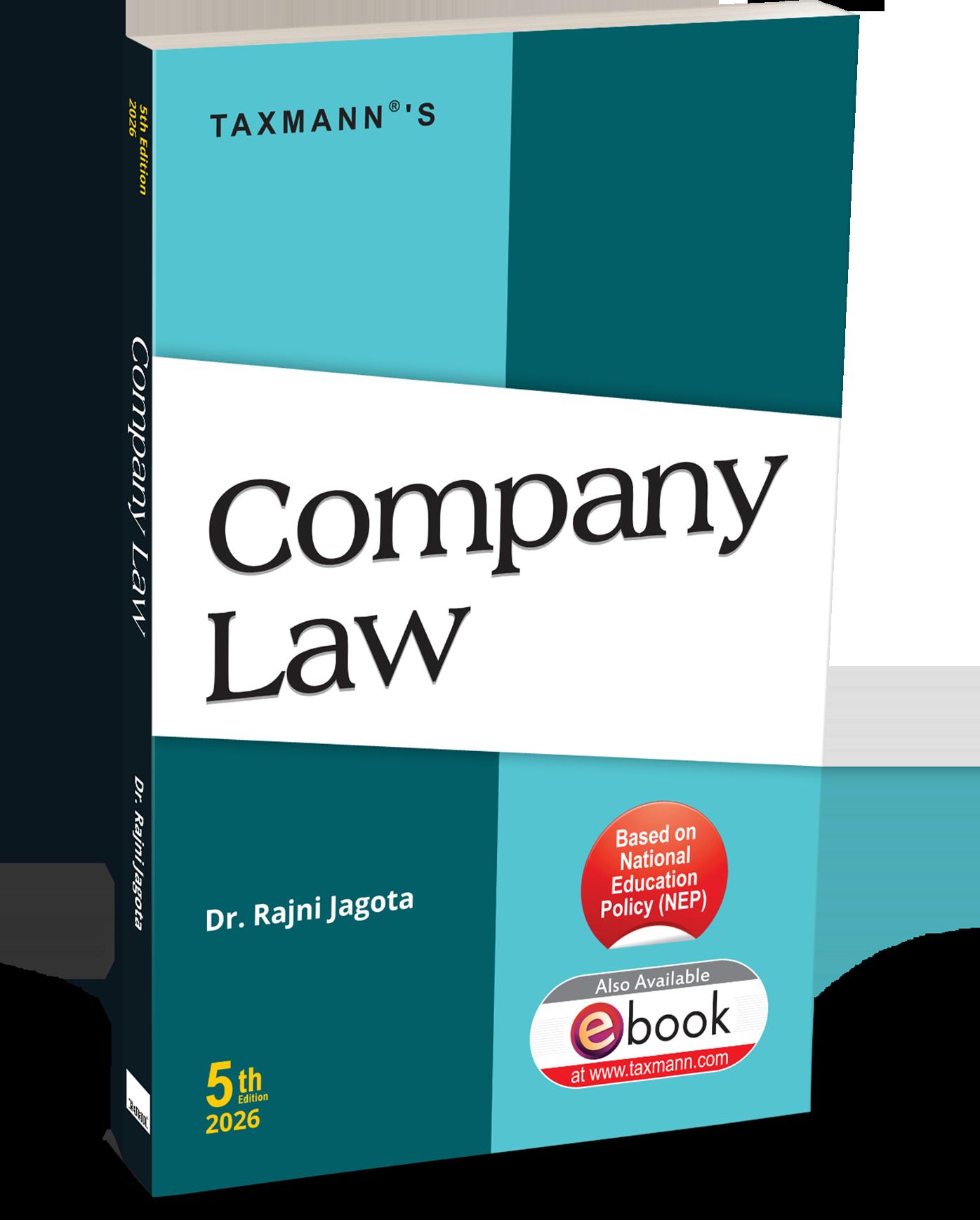
Company Law is an authoritative and curriculum-integrated textbook on Indian Company Law, developed in strict alignment with the Companies Act 2013, the allied MCA Rules, and select SEBI regulations applicable to listed companies. Structured in accordance with the National Education Policy (NEP), the book focuses on building conceptual clarity, analytical ability, and procedural understanding. Positioned between a bare commentary and a purely academic text, it explains statutory provisions alongside the administrative and digital compliance framework through which company law operates in practice. The 5th Edition reflects the contemporary, post-IBC corporate regulatory environment. It incorporates key developments, including revised company classification thresholds, restructuring within MCA administration, judicial clarification of corporate personality principles, migration to MCA V3, and the evolving framework for virtual corporate governance. This book is intended for the following audience:
• Undergraduate Commerce Students (B.Com. (Hons.), B.Com. (Programme), BBA, BMS, and allied programmes)
• Postgraduate Students (M.Com., MBA, and related disciplines)
• Law Students (Introductory to Intermediate Level)
• Faculty Members and Academic Institutions
• Learners Preparing for Professional Exposure
The Present Publication is the 5th Edition | 2026(based on the National Education Policy [NEP]), authored by Dr Rajni Jagota, with the following noteworthy features:
• [NEP-aligned, Outcome-Based Learning] Chapters structured around clearly defined learning outcomes for competency-based assessment
• [Integrated Statute–Rules–Regulation Approach] Companies Act 2013 explained with corresponding MCA Rules and relevant SEBI regulations
• [Updated for 2025–26 Corporate Governance] Covers revised Small Company thresholds, OPC jurisprudence, Virtual General Meetings, MCA V3 migration, and updated regulatory administration
• [Procedural and Compliance Focus] Explains incorporation, capital raising, meetings, audit, and winding up through statutory forms, portal-based workflows (SPICe+, AGILE-PRO-S), timelines, and compliance consequences
• [Pedagogical Support] Includes 'Did You Know' notes, 'Knowledge Points', chapter-end questions, practical problems, and NEP-aligned exercises