CINEMATOGRAPH ACT, 1952
1. Short title, extent and commencement 1
2. Definitions 2
2A. [Omitted by the Jammu and Kashmir Reorganisation (Adaptation of Central Laws) Order, 2020, w.e.f. 18-3-2020 and Union Territory of Ladakh Reorganisation (Adaptation of Central Laws) Order, 2020, w.e.f. 23-10-2020]
5A.
5B. Principles for guidance in certifying films 10
5C. Appeals 12
5D. [Omitted by the Tribunals Reforms Act, 2021, w.r.e.f. 4-4-2021] 13
5DD. [Omitted by the Tribunals Reforms Act, 2021, w.r.e.f. 4-4-2021] 13
5E. Suspension and revocation of certificate 14
5F. Review of orders by Central Government 14
6. [Omitted by the Cinematograph (Amendment) Act, 2023, w.e.f. 11-8-2023] 15
6A. Information and documents to be given to distributors and exhibitors with respect to certified films 17
6AA. Prohibition of unauthorised recording 17
6AB. Prohibition of unauthorised exhibition of films 18
6B. [Omitted by the Cinematograph (Amendment) Act, 1984, w.e.f. 27-8-1984] 18
7. Penalties for contraventions of this Part 18
7A. Power of seizure
7B. Delegation of powers by Board
7C. Power to direct exhibition of films for examination 23
7D. Vacancies, etc. not to invalidate proceeding 23
7E. Members of the Board and advisory panels to be public servants 23
7F. Bar of legal proceedings 23
8. Power to make rules 23
9. Power to exempt 25 PART III
bition
7.
8.
9.
10.
11.
12.
13.
CINEMATOGRAPH (CERTIFICATION) RULES, 2024
30. Compliance with
31.
32. Certificates
33. Fees
34.
35. Advertisement of
36. Maintenance of
37.
38.
GUIDELINES FOR CERTIFICATION OF FILMS FOR PUBLIC EXHIBITION
Cinematograph Act, 1952
[37 OF 1952]1
An Act to make provision for the certification of cinematograph films for exhibition and for regulating exhibitions by means of cinematographs.
Be it enacted by Parliament as follows:—
PART I
PRELIMINARY
Short title, extent and commencement.
1. (1) This Act may be called the Cinematograph Act, 1952.
(2)Parts I, II and IV extend to the whole of India 2[***] and Part III extends to 3[the Union territories] only.
(3)This Act shall come into force on such date4 as the Central Government may, by notification in the Official Gazette, appoint:
5[***]
1. Dated 21-3-1952.
This Act has been extended to Dadra and Nagar Haveli by the Dadra and Nagar Haveli (Laws) Regulation, 1963 w.e.f. 1-7-1965 and to Goa, Daman and Diu by the Goa, Daman and Diu (Laws) No. 2 Regulation, 1963, w.e.f. 19-12-1963.
Parts I and II of the Act came into force in the State of Jammu and Kashmir w.e.f. 1-5-1974, vide G.S.R. 183(E), dated 23-4-1974.
Part III of the Act came into force in the Union Territory of Arunachal Pradesh, w.e.f. 1-10-1984, vide S.O. 757(E), dated 29-10-1984.
2. Words “except the State of Jammu and Kashmir” omitted by the Cinematograph (Amendment) Act, 1973, w.e.f. 28-5-1973.
3. Substituted for “Part C States” by the Cinematograph (Amendment) Act, 1959, w.e.f. 12-3-1959.
4. With effect from 28-7-1952.
5. Omitted by the Cinematograph (Amendment) Act, 2023, w.e.f. 11-8-2023. Prior to its omission, proviso as inserted by the Cinematograph (Amendment) Act, 1973, w.e.f. 28-5-1973, read as under:
“Provided that Parts I and II shall come into force in the State of Jammu and Kashmir only on such date after the commencement of the Cinematograph (Amendment) Act, 1973 (25 of 1973), as the Central Government may, by notification in the Official Gazette, appoint.”
COMMENTS
SECTION NOTES
u This Act applies to the whole of India.
u No exemption from applicability for any State/UT.
Definitions.
2. In this Act, unless the context otherwise requires,—
(a) “adult” means a person who has completed his eighteenth year;
6[(b) “Board” means the Board of Film Certification constituted by the Central Government under section 3;]
7[(bb) “certificate” means the certificate granted by the Board under section 5A;]
(
c) “cinematograph” includes any apparatus for the representation of moving pictures or series of pictures;
(d) “District Magistrate”, in relation to a presidency-town, means the Commissioner of Police;
8[(dd) “film” means a cinematograph film;]
9(ddd) “infringing copy” shall have the same meaning as assigned to it in subclause (ii) of clause (m) of section 2 of the Copyright Act, 1957 (14 of 1957);]
(
e) “place” includes a house, building, tent and any description of transport, whether by sea, land or air;
(f) “prescribed” means prescribed by rules made under this Act;
7[(g) “regional officer” means a regional officer appointed by the Central Government under section 5 and includes an additional regional officer and an assistant regional officer;
(h) 10[***]]
9[(i) “UA marker” means an age-based indicator for a film which has received or is intended to receive a ‘‘UA’’ certificate under section 4 and such indicator may be “UA 7+” or “UA 13 +” or “UA 16 +”:
Provided that where the Central Government is satisfied that it is necessary or expedient so to do in public interest, it may, by an order published in the Official Gazette and for the reasons to be recorded in writing, declare such other indicators.]
6. Substituted by the Cinematograph (Amendment) Act, 1981, w.e.f. 1-6-1983. Prior to its substitution, clause (b), read as under: ‘(b) “Board” means the Board of Film Censors constituted by the Central Government under section 3.’
7. Inserted by the Cinematograph (Amendment) Act, 1981, w.e.f. 1-6-1983.
8. Inserted by the Cinematograph (Amendment) Act, 1959, w.e.f. 12-3-1959.
9. Inserted by the Cinematograph (Amendment) Act, 2023, w.e.f. 11-8-2023.
10. Omitted by the Tribunals Reforms Act, 2021, w.r.e.f. 4-4-2021. Prior to its omission, clause (h) as inserted by the Cinematograph (Amendment) Act, 1981, w.e.f. 1-6-1983, read as under: ‘(h) “Tribunal” means the Appellate Tribunal constituted under section 5D.’
COMMENTS
SECTION NOTES
This Section defines various terms like “adult,” “Board,” “cinematograph,” and “certificate.” as follows:
u Adult: A person who is 18 years old or older.
u Board: This refers to the Central Board of Film Certification (CBFC), popularly known as ‘the Censor Board’, set up by the Central Government to certify films.
u Certificate: The certificate granted by the Board of Film Certification under section 5A, which allows the public exhibition of a film.
u Cinematograph: Any device used to display moving pictures or a series of pictures, such as projectors or other equipment used for film exhibitions.
u District Magistrate: In cities (presidency towns), this refers to the Commissioner of Police.
u Film: Any cinematograph film or motion picture that can be shown to the public.
u Infringing Copy: As defined in the Copyright Act, 1957, it refers to any illegal copy of a film.
u Place: Any location, including buildings, tents, or transportation (whether by sea, land, or air), where films can be shown.
u Prescribed: Refers to the rules established under this Act.
u Regional Officer: An officer appointed by the Central Government to oversee film certification, including additional and assistant regional officers.
u UA Marker: An age-based indicator for films given a “UA” certificate, specifying categories like “UA 7+”, “UA 13+”, or “UA 16+”, depending on the content’s suitability for different age groups.
CASE LAWS
u Definition of Cinematograph – Inclusion of VCR/VCP - The appellants, operators of video parlours in Haryana, contended that video cassette recorders (VCRs) and video cassette players (VCPs) did not fall within the ambit of the term ‘cinematograph’ under section 2(c) of the Cinematograph Act, 1952, and therefore, they were not required to obtain licenses under the applicable State legislation. The Supreme Court rejected this contention, affirming that the definition of ‘cinematograph’ is inclusive and extends to any apparatus for the representation of moving pictures, which by statutory interpretation includes VCRs and VCPs. The Court applied the principle that statutory definitions must be interpreted in light of technological advances, and observed that legislative intent should be presumed to encompass new developments unless expressly excluded. Accordingly, it upheld the requirement that those operating video parlours must obtain licences in accordance with the provisions of the Cinematograph Act and relevant State rules. – Laxmi Video Theaters v. State of Haryana AIR 1993 SUPREME COURT 2328.
u Scope of Cinematograph – Inclusion of VCR, VCP, and TV Projector - The appellant, who operated a video parlour exhibiting films through a video cassette recorder (VCR), video cassette player (VCP), and a TV projector on a separate wide screen, contended that such exhibition did not fall within the meaning of ‘cinematograph’ under section 2(c) of the Cinematograph Act, 1952. The Supreme Court rejected this argument, holding that the inclusive definition of ‘cinematograph’ encompasses any apparatus used for the exhibition of moving pictures, including VCRs, VCPs, and projectors. The Court emphasized that statutory definitions must adapt to scientific developments, and that
the presence of a separate screen, not inbuilt within a television set, does not exclude the applicability of the Act. The Court also referred to specific regulatory rules (Rules 98–100) that govern video cinema exhibition in Haryana, affirming the requirement of a license for such parlours. The High Court’s restrictive interpretation was reversed. – Regal Video v. State of Haryana AIR 1993 SUPREME COURT 2372.
Construction of references to any law not in force or any functionary not in existence in the State of Jammu and Kashmir.
2A. 11[*** ]
PART II
CERTIFICATION
OF FILMS FOR PUBLIC EXHIBITION
12[13[Board of Film Certification.]
3. (1) For the purpose of sanctioning films for public exhibition, the Central Government may, by notification in the Official Gazette, constitute a Board to be called the 13[Board of Film Certification] which shall consist of a Chairman and 14[not less than twelve and not more than twenty-five] other members appointed by the Central Government.
(2) The Chairman of the Board shall receive such salary and allowances as may be determined by the Central Government, and the other members shall receive such allowances or fees for attending the meetings of the Board as may be prescribed.
(3) The other terms and conditions of service of the members of the Board shall be such as may be prescribed.
COMMENTS
SECTION NOTES
u The Central Government is empowered to form a Board to certify films for public exhibition.
u Pursuant to its powers under this section, the Central Government has set up the Central Board of Film Certification (CBFC)
u The CBFC is known in ordinary popular parlance as ‘the Censor Board’ .
11. Omitted by the Jammu and Kashmir Reorganisation (Adaptation of Central Laws) Order, 2020, w.e.f. 18-3-2020 and Union Territory of Ladakh Reorganisation (Adaptation of Central Laws) Order, 2020, w.e.f. 23-10-2020. Prior to its omission, section 2A, as inserted by the Cinematograph (Amendment) Act, 1973, w.e.f. 28-5-1973, read as under:
“2A. Construction of references to any law not in force or any functionary not in existence in the State of Jammu and Kashmir.—Any reference in this Act to any law which is not in force, or any functionary not in existence, in the State of Jammu and Kashmir, shall, in relation to that State, be construed as a reference to the corresponding law in force, or to the corresponding functionary in existence, in that State.”
12. Sections 3, 4, 5, 5A, 5B, 5C and 6 substituted for sections 3, 4, 5 and 6 by the Cinematograph (Amendment) Act, 1959, w.e.f. 12-3-1959. Earlier, section 6 was amended by the Cinematograph (Amendment) Act, 1953, w.e.f. 16-5-1953 and Repealing and Amending Act, 1957, w.e.f. 17-9-1957.
13. Substituted for “Board of Film Censors” by the Cinematograph (Amendment) Act, 1981, w.e.f. 1-6-1983.
14. Substituted for “not more than nine”, ibid
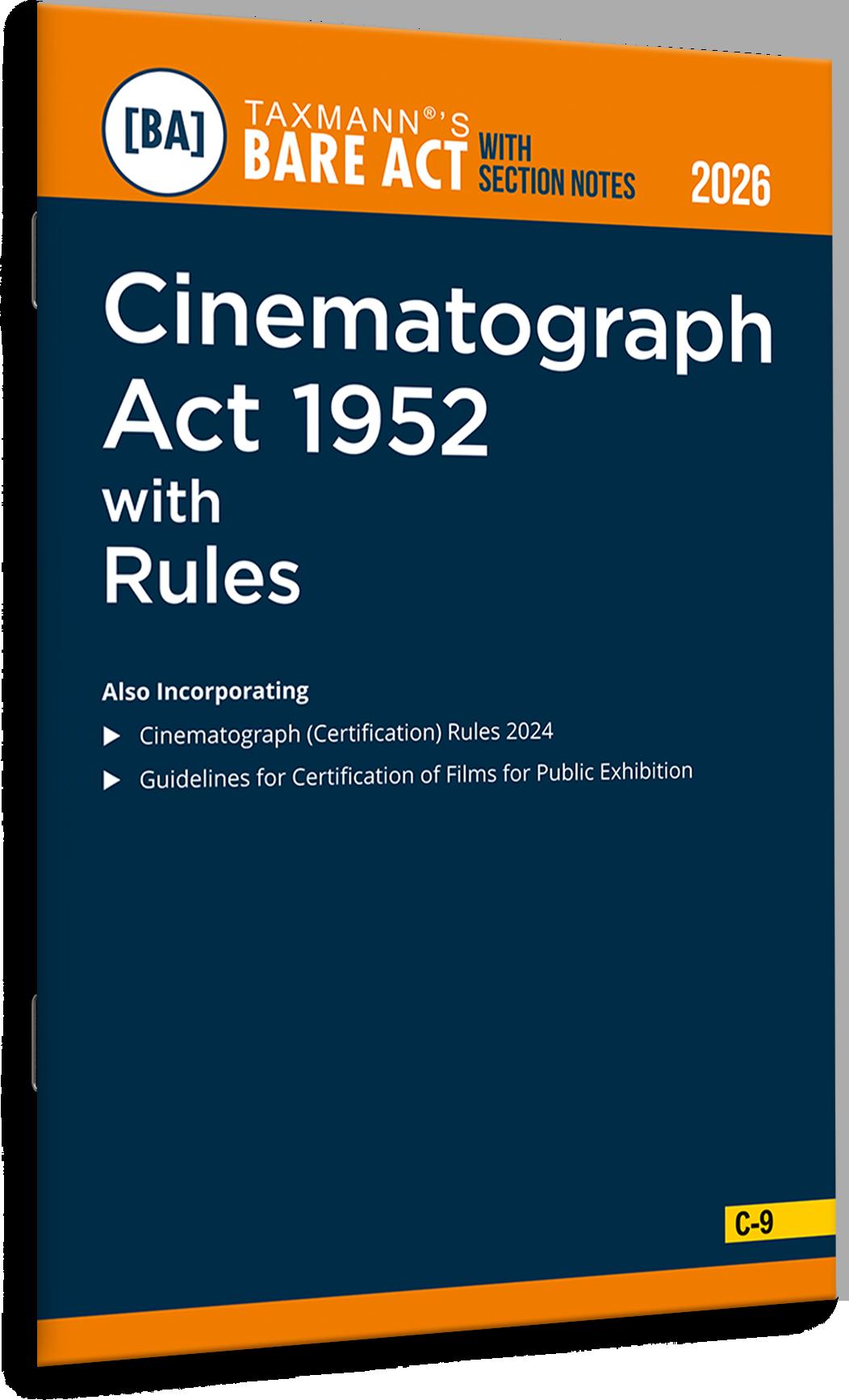
CINEMATOGRAPH ACT 1952 WITH RULES –
BARE ACT WITH SECTION NOTES
AUTHOR : Taxmann's Editorial Board
PUBLISHER : Taxmann
DATE OF PUBLICATION : November 2025
EDITION : 2026 Edition
ISBN NO : 9789371262057
NO. OF PAGES : 72
BINDING TYPE : Paperback
Rs. 125
DESCRIPTION
Cinematograph Act 1952 with Rules [Bare Act with Section Notes] by Taxmann is a compact yet comprehensive statutory reference that presents the fully updated text of India's law on film certification, film exhibition, anti-piracy controls, and licensing of cinematograph shows. This Edition incorporates the Cinematograph (Certification) Rules 2024, Guidelines for Certification of Films, and crisp Section Notes supported by practical explanations and leading case law. It offers a clear, practitioner-oriented understanding of both the legal provisions and their real-world application. This book is intended for the following audience:
• Advocates, Legal Practitioners & Law Firms
• Producers, Directors & Film Production Houses
• OTT Platforms, Broadcasters & Distribution Companies
• CBFC Practitioners, Compliance Officers & Industry Consultants
• Media Students, Researchers & Academicians
• Cinema Owners, Exhibitors & Licensing Authorities
The Present Publication is the 2026 Edition, covering the amended and updated text of the Cinematograph Act [Act No. 37 of 1952] and Rules, with the following noteworthy features:
• [Complete & Updated Statutory Text] Incorporates all amendments up to date, including the 2023 anti-piracy provisions (Sections 6AA & 6AB)
• [Pre-amendment Provisions] Prior versions of amended sections provided in footnotes for historical and transitional reference
• [Detailed Section Notes] offering:
o Clear explanations
o Practical interpretation
o Legislative background
o Procedural guidance
o Cross-links to relevant Rules
• [Leading Supreme Court & High Court Judgments] on:
o Censorship and free-speech rights
o Powers of the CBFC
o Film bans and statutory validity
o Piracy and unauthorised exhibition
o Constitutional scrutiny of certification procedures
• [Cinematograph (Certification) Rules 2024] is covered in this Bare Act
• [Guidelines for Certification of Films] detailing various evaluation standards
• [Embedded Tables, Schedules & Forms] including official certification forms, schedules, and fee tables