













































































































































Dan Marshall








For Holly, Milly & Winnie. xx
UK | USA | Canada | Ireland | Australia India | New Zealand | South Africa
Puffin Books is part of the Penguin Random House group of companies whose addresses can be found at global.penguinrandomhouse.com
www.penguin.co.uk www.puffin.co.uk www.ladybird.co.uk
First published in Australia by Walker Books Australia Ltd 2025 First published in Great Britain by Puffin Books Ltd 2026 001
Text and images copyright © Dan Marshall, 2025
The moral right of the author and illustrator has been asserted Penguin Random House values and supports copyright. Copyright fuels creativity, encourages diverse voices, promotes freedom of expression and supports a vibrant culture. Thank you for purchasing an authorized edition of this book and for respecting intellectual property laws by not reproducing, scanning or distributing any part of it by any means without permission. You are supporting authors and enabling Penguin Random House to continue to publish books for everyone. No part of this book may be used or reproduced in any manner for the purpose of training artificial intelligence technologies or systems. In accordance with Article 4(3) of the DSM Directive 2019/790, Penguin Random House expressly reserves this work from the text and data mining exception.
Printed and bound in China
The authorized representative in the EEA is Penguin Random House Ireland, Morrison Chambers, 32 Nassau Street, Dublin D02 YH68
A CIP catalogue record for this book is available from the British Library
ISBN: 978–0–241–79184–4
All correspondence to: Puffin Books
Penguin Random House Children’s One Embassy Gardens, 8 Viaduct Gardens, London SW11 7BW Penguin Random Hous e is committed to a sustainable future for our business , our readers and our planet. is book is made from Forest Stewardship Council® certified paper

























































Dan Marshall











































Hello there, my name is Slimon. I love things that are grim, gross, odious, offensive, horrid, horrible, rotten, revolting, despicable and downright disgusting. I also love facts about science. And that’s what this book is all about – the filthiest and foulest facts along with the most putrid pictures. You’ll also have the chance to do your own gross experiments. You’re going to love it, and I’ll be right with you all the way to help you learn just how gross our universe is. Let’s do this!
Are things gross all on their own, or are they only gross because people think they are?
When you see something disgusting, what happens to your face? What do you feel? Does your stomach turn over, or your throat tighten?





What types of things disgust you? Common things that people find disgusting are: bodily products and insides, such as poo, pee, puke, mucus and boogers; certain foods; things that smell bad; things that are diseased or dying; things that are ugly.
The main facts in this book each get a rating on my grossometer. The system goes from 1 to 5, with only the most revolting facts getting the highest score. But what’s gross for one person isn’t necessarily gross for another, which is why I want you to rate each fact, too. Why not ask your friends what their scores would be? There’s a hole in the middle of the grossometer for you to write down what you think the fact should be rated. Maybe you’ll agree with me, maybe you won’t. There are no right or wrong answers –just as beauty is in the eye of the beholder, so is grossness!
Always ensure an adult is supervising the science experiments in this book.
2 3 4 5
Enjoy scoring the facts yourself. That’s what the hole’s for!

Littering is something we all try not to do. There’s always a bin nearby for us to dispose of our rubbish. But the astronauts on the six Apollo Moon landing missions did not have this luxury. Because the astronauts on board those landers collected large amounts of Moon rocks to return to Earth, the extra weight had to be offset by leaving some things behind on the Moon so the landers could lift off.
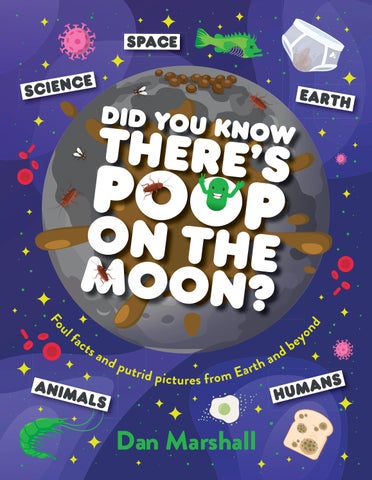
This discarded junk included, among other things, 2 golf balls, 12 cameras, 12 pairs of boots, 1 gold-plated telescope and almost 100 bags of human waste. This means that right now, there are bags of poo on the surface of the Moon. And lots of them!
It isn’t just poo that the human waste bags contain. For extra yuckiness, there is also vomit and pee inside them. Eww, gross!
The number of bags of human waste that are currently on the surface of the Moon.
The extreme conditions of the Moon’s surface wouldn’t have allowed any microorganisms in the poo to grow over the past 50 years, but today’s astrobiologists are interested in seeing if those microorganisms have undergone any genetic mutations. They’re hoping someone will bring the poo back home to study.
During their flight to the Moon, the astronauts relied on a plastic bag that was taped to their buttocks to capture poos – a space nappy! It was a revolting and inconvenient process that the astronauts, understandably, did not enjoy.
If our future selves ever manage to leave Earth and explore the depths of outer space, they might encounter a beautiful nebula 5,000 light years away in the constellation Puppis. This is the Calabash Nebula, a gas cloud over one quadrillion (1,000,000,000,000,000) metres in length.
While it may be beautiful from a distance, up close, things would take a rather pungent turn. The nebula has a lot of the sulphur compounds found in both stink bombs and rotten eggs. For this reason, astronomers have given the nebula the noxious name of the Rotten Egg Nebula.
Within the nebula is a red giant star that is undergoing a high-energy conversion – a transformation so powerful that the smelly sulphurous molecules are forced out into space. In other words, the nebula is doing a star fart. Cosmic trumps!
Rotten eggs smell so stinky because they produce a toxic gas called hydrogen sulphide (H2S)
kilometres per hour 1 MILLION
The incredible speed at which the gas is being forcefully ejected out into space.
OH 231.8 +04.2
The technical name for the Calabash Nebula –nowhere near as catchy as the Rotten Egg Nebula.
The surface of our neighbour Venus is not somewhere you’d want to find yourself. It’s hot enough to melt lead and has an atmosphere so thick it would crush you. And, if that wasn’t bad enough, it would smell like rotten eggs, thanks to clouds of sulphuric acid.
Our other neighbouring planet is made up of carbon dioxide, sulphur, iron, acids and magnesium. With chemical compounds like that, it’s fortunate that we cannot breathe on Mars, as the atmosphere too would smell of rotten eggs.
On first impression, Uranus has no smell at all, with an atmosphere consisting mainly of the odourless gases hydrogen and helium. But travel deeper into the planet, and thanks to liquid ammonia, hydrogen sulphide, methane and carbon dioxide, you will smell farts.
If you stand in the great outdoors here on Earth and take a really deep breath, chances are you’ll smell nothing but clean, fresh air. (Unless, of course, you’re standing near a particularly smelly farmyard or the elephant enclosure at your local zoo.) But this is not the case on other planets in the solar system. Even though humans have not yet set foot on any of these
Perhaps the smelliest of all the planets in our solar system is Jupiter. Its size means that it has different smells depending on which layer of the planet you’re on. On the outer layer, the pong you can smell is ammonia, which smells like urine and cleaning products. Travel deeper and you’ll smell rotten eggs mixed with ammonia – double trouble! The heavier inner layer smells of urine, too, but this is mixed with hydrogen cyanide, which smells like bitter almonds or marzipan.
Astronaut Gene Cernan compared the smell of the Moon to spent gunpowder. As for space itself, that’s a tough smell to agree upon. Different astronauts have compared it to a steak sizzling in a frying pan, metal being welded together, a pile of wet clothes and even walnuts.
planets, thanks to techniques such as spectroscopy, astronomers’ telescopes can analyse the light from planets in space. From this, they can figure out what planets are made of – and what
they smell of. In other words, we’re using our telescopes as noses, taking a huge cosmic sniff, and what we’re smelling from some planets is pretty pongy indeed.
Astronauts on board the International Space Station (ISS) are fond of the saying, ‘Today’s coffee is tomorrow’s coffee!’, which is a polite way of saying that they drink their own recycled urine.
Water is extremely heavy and difficult to transport into orbit, which is why the ISS has to be remarkably resourceful when it comes to recycling. Or should that be ‘peecycling’?
A special filter takes not only the astronauts’ urine, but also their sweat, and over eight days the bodily fluids are turned from waste into drinking water. This may sound disgusting, but this water is purer than the water most of us drink from our taps at home. Nice!
730
This is the number of litres of sweat and urine that an astronaut will drink per year to survive on board the ISS.
The ISS has two water filtration systems on board – one that the Americans use and one that the Russians use. The Russian system only recycles condensate, which comes from breath and sweat. They refuse to drink recycled urine, leaving that to their American comrades.
So they don’t contaminate the water with chemical detergents and make it hard to filter and re-use, astronauts don’t wash their clothes. Instead, they wear them until they are too soiled or smelly to deal with. Even their underwear!
The fact that the astronauts on the ISS don’t wash their clothes or underwear led science officer Don Pettit to get inventive when it came to growing plants on board the ship. Since there was no soil, he looked to his dirty undies as a planter solution. He folded his old underwear into a sphere and held it in place with a few stitches. For the outside of the planter, he sewed Russian space toilet paper to the surface. Very clever and very gross.