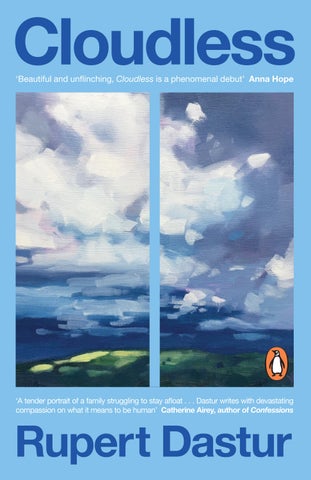
Cloudless RUPERT dAsTUR
PENGUIN BOOK S
UK | USA | Canada | Ireland | Australia
India | New Zealand | South Africa
Penguin Books is part of the Penguin Random House group of companies whose addresses can be found at global.penguinrandomhouse.com
Penguin Random House UK , One Embassy Gardens, 8 Viaduct Gardens, London sw11 7bw
penguin.co.uk
First published by Fig Tree 2025 First published in Penguin Books 2026 001
Copyright © Rupert Dastur, 2025
The extract on page vii is from Collected Poems: 1945-1990 by R. S. Thomas, copyright © Orion Publishing Group Limited. Reproduced with permission of the Licensor through PLS clear; the extracts from the Iraq Body Count are reproduced with permission of the Iraq Body Count; and on page 3 there is an extract from the Chilcot Report
The moral right of the author has been asserted
Penguin Random House values and supports copyright. Copyright fuels creativity, encourages diverse voices, promotes freedom of expression and supports a vibrant culture. Thank you for purchasing an authorized edition of this book and for respecting intellectual property laws by not reproducing, scanning or distributing any part of it by any means without permission. You are supporting authors and enabling Penguin Random House to continue to publish books for everyone. No part of this book may be used or reproduced in any manner for the purpose of training artificial intelligence technologies or systems. In accordance with Article 4(3) of the DSM Directive 2019/790, Penguin Random House expressly reserves this work from the text and data mining exception
Typeset by Falcon Oast Graphic Art Ltd
Printed and bound in Great Britain by Clays Ltd, Elcograf S.p.A.
The authorized representative in the EEA is Penguin Random House Ireland, Morrison Chambers, 32 Nassau Street, Dublin d02 yh68
A CIP catalogue record for this book is available from the British Library isbn : 978–0–241–65471–2
Penguin Random House is committed to a sustainable future for our business, our readers and our planet. This book is made from Forest Stewardship Council® certified paper.
For my parents, Bill and Elisabeth
The Welsh Hill Country
Too far for you to see
The fluke and the foot-rot and the fat maggot
Gnawing the skin from the small bones,
The sheep are grazing at Bwlch-y-Fedwen,
Arranged romantically in the usual manner
On a bleak background of bald stone.
Too far for you to see
The moss and the mould on the cold chimneys,
The nettles growing through the cracked doors,
The houses stand empty at Nant-yr-Eira,
There are holes in the roofs that are thatched with sunlight, And the fields are reverting to the bare moor.
Too far, too far to see
The set of his eyes and the slow phthisis
Wasting his frame under the ripped coat,
There’s a man still farming at Ty’n-y-Fawnog, Contributing grimly to the accepted pattern, The embryo music dead in his throat.
– R. S. Thomas, An Acre of Land, 1952
Iraq Body Count: 1,676*
* The public database of violent civilian deaths in the invasion of Iraq, 2003 onwards.
315. [. . .] the media reported that Mr Annan was urging caution.* In a letter to leaders of the US, UK and Iraq he warned of the potential impact of major military offensives on Iraq’s political process and warned: ‘The threat or actual use of force not only risks deepening the sense of alienation of certain communities, but would also reinforce perceptions among the Iraqi population of a continued military Occupation.’
– The Report of the Iraq Inquiry, Volume VII, Section 9.3 (John Chilcot, 2016)
* BBC News, 6 November 2004, ‘Kofi Annan’s Letter Criticizing the Imminent Assault on Falluja’.
One of the hens isn’t laying but Catrin hasn’t told John yet, knowing he’d wring its neck that same day. She doesn’t want to think about dead things. Today. Tomorrow. Not until Harri is home from the war.
The eggs are pleasurably warm in her icy fi ngers as she retrieves them from their straw nests. Her breath clouds as she stretches into the huts. The flies dance about in the cold air and feathers stick to the smooth shells. The hens cluck and bob. She counts the eggs, counts the birds, shakes her head. There’d be a reckoning soon. But not today.
Checking her watch, Catrin hopes Rhys has pulled himself from bed. He’s already missed the school bus once this week and she doesn’t have time to drive him in, but with his GCSEs next summer she’ll be damned if she lets him skive again. John has a different opinion – says there’s no need for periodic tables or Shakespeare on a farm – but the boy’s got to have choices, doesn’t he? She’s always said that about her sons. They deserve options; can’t have the farm hanging round their neck, heavy as an albatross.
The November air is frosty and despite the many layers she’s wearing Catrin is cold beneath her skin. The sky is paperwhite with a smudge of grey. John is already worrying about the winter, saying the berries are on the bushes early, that he can taste snow in the air, that his leg is playing up, which is always a sign. He still talks about the snowfall of ’63, back when he was a lad, just as his father had talked of ’47. They’d spend days and nights digging dead ewes out of the snow. Whole flocks gone
in a flurry of white. The weather, the sheep, the horses. That’s all he ever talks about, when he talks at all.
Catrin licks her cracked lips as she reties the wool scarf tight around her neck – folds it in half, pulls the ends through the loop – and picks up the carton of eggs before returning to the yard. A breeze funnels between the kennel and stable blocks, towards the large stone farmhouse that lies opposite. The building is a mottled grey, built from mountain rock, the same heft and colour as the stone used for the miles of winding dry walls that separate fields and boundaries; walls that rise into the hills and stretch up around the peaks, rolling all the way down to the valleys and towns below. The sky is dark and wide, and down here, where there’s often the bustle of men and beasts, the air carries the smell of livestock, turned earth and manure; but higher up, where the land is steeper and the sole company to be had is a peppering of ewes, there’s a freshness unlike anything else – a freedom she’d fallen in love with all those years ago when she’d first met John, before they were married, before the boys.
She shivers, thinking of the Christmas lights and decorations that will be going up soon in the shops down in Llandudno Town. John will complain it’s too early, like he does every year. It’s not even December, he’ll say, his eyebrows heavy. He’s become so morose of late and it’s beginning to rust her mood; something will snap soon, she knows it. There’s only so much weathering a person can take.
Walking back home, she visualizes her day ahead. She’s read all about the potential benefits: picture your future and it’ll come to pass. She imagines herself in a steaming bath, scented candles, a book. Fat chance. The magazines at the hairdresser’s were all about pampering yourself, putting yourself first, but if she did that there’d be nothing to eat and they’d all be wearing the same clothes each week. Besides, she likes the quiet
when she can fold clothes, listen to Melvyn Bragg’s In Our Time. She likes his voice and the things he knows. She can forget about Harri all the way out there, Rhys and his studies, their lack of money, which is grinding them all down like baked earth beneath a boot. Things are so tight she’s been speaking to John about letting the farmhands go; not something either of them had ever imagined doing.
Entering the farmhouse, Catrin’s slapped by the sound of the telly blaring from the living room. She slugs off her boots and then pauses by her piano. Its solid presence fills the hall. For now, it stands silent and waiting, ready for her touch. A wedding gift from her parents, her piano is her peace, her past, her independence – the one thing in this old house that is hers alone.
The telly thunders out an American accent and Catrin enters the living room, eggs in hand. She finds John there, dressed in jeans and a thick fleece. He’s perched on the edge of the sofa, arms crossed.
George Bush is on the screen, standing in front of a lectern.
‘You should be out with the ewes,’ says Catrin. ‘The lads will be waiting.’
‘The bastard’s been elected again,’ replies John. His voice slices through the air, the sound of a saw through wood.
‘Turn it off, won’t you?’ says Catrin. She’s tried to avoid the news these last few weeks.
‘You know what this means, don’t you?’ says John, at last craning round to look at her. ‘Listen to the bastard. Cut his teeth in his first term and now says he’s ready to make a big difference. A fucking difference? Can you believe this man?’
‘I’ve got to make breakfast,’ says Catrin. ‘Is Rhys up?’
‘Listen to this, Catrin. Just listen.’
On the TV, the newly elected George W. Bush commits to sending 125,000 troops to the front lines of Iraq by January
next year. He says that with God’s help they’ll bring down strongholds in the cities and in Fallujah –
‘Is Rhys up?’ Catrin repeats. Her voice comes out louder than she intended, interrupting the President with his expansive, winner’s smile.
‘Did you hear that? Fallujah. That’s where our Harri’s been sent.’
‘He’ll be back soon enough.’
‘Six months.’ John shakes his head.
‘R&R in three,’ she says.
‘And anything could happen,’ says John, his eyes storm-dark. ‘Anything.’
‘Don’t say that,’ says Catrin. ‘Don’t you say that.’ She is trembling. The eggs feel heavy in her hands.
‘I never wanted him to join,’ says John. ‘I said it back then and I’ll say it now. But you pushed and pushed.’
‘He wanted it, John. You remember how it was: he came home all fired up, saying how they’d pay for university; how they’d take him around the world kayaking and mountaineering and the like. And all they’d want in return, once he’d graduated, was a few years of service.’
‘He was only sixteen.’
‘I didn’t know this would happen.’ And she hadn’t. So much had changed.
‘You had us sign the papers,’ says John. ‘If we’d waited, at least until he’d been to Bangor, he might have changed his mind.’
‘It was his choice, John. And he got himself that scholarship, didn’t he? You were proud enough then. Neither of us knew this was –’
‘It’s the Army, Catrin. What did you expect? That he’d be playing toy soldiers?’ With that, John returns his attention to the TV, reaches for the remote and turns up the volume.
Catrin retreats to the kitchen, her hands tightly balled, thoughts like shattered glass.
An Aga hums at the far end of the room, its heat offering some respite in the late-autumn weather. A wooden table stands in the middle, one leg thinner than the others, splintered down by the claws of an old moggy. There’s a heap of unopened letters and a stack of Racing Posts on the worktop. Catrin takes in the smell of dog and cat and the hint of last night’s dinner: corned beef with new potatoes. Beneath one of the ceiling lights, she sees a spider dancing a delicate web, its long legs connecting thread. Flint, her old dog, is under the table, his tail beating up and down as he regards her with a single open eye. She dumps the eggs on the table and kneels down on the floor to rest a palm on his warm, black fur. His legs are going, poor old boy. But he eats well enough.
Catrin closes her eyes and breathes in and out, slowly, counting out the seconds, just like she’d taught Harri when he was a little boy and he’d come in, upset at someone or something, nose running. She’d held his heaving shoulders, her voice calm and comforting, until his lower lip stopped its trembling. She wonders what has happened to the last twenty-plus years. The thought of decades slipping through her fingers like dry soil gives her pause. In some ways, John’s right. How could she have let her baby go like that? But Harri had been so certain it’s what he wanted and there’d been no hint of war back then.
‘Mam?’ Catrin looks up and sees Rhys staring at her. Her little boy, sixteen going on seventeen. How the years amass, one after the other.
‘You’re up.’
‘Miss Marple strikes again,’ he says.
She smiles. ‘The cheek.’
‘He’s getting old,’ says Rhys, nodding at Flint.
‘Don’t remind me,’ replies Catrin. She looks him over: his short brown hair is still damp from the shower. There are freckles over his nose. He’s broad-shouldered like Harri – both
boys take after their father. Rhys’s socks are odd, but that’s a battle she gave up long ago. He was old enough to dress himself.
‘You’ve only got time for toast. Bus’ll be off in twenty. Now make us a quick tea, won’t you? Your da is still here so make it three. Use the flask.’
‘He’s here?’
‘Watching the news. Bush has been re-elected.’
‘Bastard.’
‘None of that, Rhys.’
‘It’s what Da thinks.’
‘Can you just get on with the tea, please?’
‘I’m getting, see.’ Rhys gives a wolfish smile and Catrin has the sudden urge to put him on her knee, bounce him up and down, never let him go, tell him she’ll always keep him safe no matter what. But he’s old enough not to need his mother and it’d be a lie, wouldn’t it? She can’t always be there. Harri was proof enough of that.
The phone rings and Catrin looks at it. She’s already come to hate the way it sounds like an alarm. Always she wonders: could it be her Harri in trouble?
Or perhaps it’s Matthew Edevane? Ever since she’d heard he was back in town, Catrin had been expecting a call. Hoping for it, even.
She picks up the receiver, feels both relief and disappointment at the voice she recognizes. It’s their neighbour – John’s old friend Tim Evans, his voice croaking like he’s sucked the soot from a chimney. Catrin listens while watching Rhys spread marmalade over buttered toast.
‘We’re doing okay,’ says Catrin. ‘Yes, I’ll tell him. And to you. Take care now.’ She puts the receiver down, walks over to the window, picks a Vaseline from the collection of bottles and tubes on the ledge and applies some to her hardened, winter-wrecked
lips. She misses the spring hyacinths and summer dahlias, the way the world is all softness and scent.
‘The gathering’s been pushed back to next Monday,’ she explains.
‘So I’ll have the weekend off ?’ asks Rhys.
‘Maybe,’ says Catrin.
‘What about Monday? Da said he wanted me working one of the dogs.’
‘You can’t miss school. Not with your exams this year.’
‘Next year,’ counters Rhys.
‘School year. This school year.’
‘Da says –’
She holds up a hand. ‘Please, Rhys.’
‘Have you heard from Harri?’ he asks, changing tune.
The sudden shift of conversation takes her off-balance. ‘It’s only been three days,’ she replies.
‘It’s bullshit, you know.’
‘Let’s not do this now.’
‘Well,’ he says, getting through the last of his toast, ‘time for me to go.’ He pulls his black polyester tie from his jacket pocket.
‘Be good –’
‘Work hard –’
‘And stay out of trouble,’ concludes Catrin.
‘Every damn day. I know, I’ve got it,’ says Rhys. He pauses at the door. ‘Hwyl am rwan.’
Bye for now. It’s what Harri would say.
Catrin watches as her boy goes out of the door, sees him pause in the yard, hunching his shoulders against the cold, before striding off down the road; after a fifteen-minute march along winding lanes he’ll reach the bus stop. And that’s it, she thinks. She’d be alone if it weren’t for John next door, eyes burning a hole through the TV.
She’d have liked more children, a whole brood to look after and love.
And lose.
That voice, that ever-present voice, so quick to invade.
Catrin advances beyond the protective warmth of her home. Flint, her trusty black Lab, is with her. The two of them step into the morning, greeting it for the second time with another shiver. Her breath fills the air as she zips up her coat and makes her way towards the kennel, where the sheepdogs will be alert to her approach. Behind the farmhouse and outbuildings, the hills rise up and out, bathed in the last of the dawn’s light and a lingering mist. The ewes will be huddled together, keeping warm beneath their thick coats, while their feet press against the frost-hard grass.
Opening the door to the kennel, Catrin is met by an acrid, canine smell – thick fur, saliva, flatulence. The kennel is home to four working dogs that clamour at her approach, stretching out and clambering against the metal bars of the enclosure, rising up on their hind legs, front paws against the gate.
‘Sit,’ says Catrin. The four settle down.
She slides the bar to the left and opens the metal gate and tells the dogs to get on. They rush forward, muzzles sniffing at her trousers, tongues reaching towards Flint, who accepts their greeting with an old authority. They scramble along the corridor, paws scratching against the grey linoleum. Catrin follows, Flint at her side.
The dogs gambol along the path that leads beyond the farmhouse. They pass the lake and run towards Coed Ty-mawr, a large wood that John and Catrin significantly added to more than twenty years ago – the legacy of an old government
conservation initiative that still brought in close to five hundred pounds in revenue each year. It was the perfect place to be alone, to find solitude and peace among the trees, the birches, beeches and maples. The boys used to enjoy coming here, too. Deep into the woods there is, somewhere, an old treehouse they’d played in.
Noses following fresh animal prints across the leafy floor, the dogs chase after scents left by the small, nocturnal creatures of the undergrowth. Catrin stalks a trail between wooden spines and roots, a gloved hand reaching out to grip the bark. She loves this wood, loves the way it has flourished, loves its feel of permanence, the steady, certain advance of branch and leaf, the sense of seasonal change it brings, the promise of renewal after winter. She used to come here more often, usually to get away from the noise of the house or to marinate half-formed harmonies, compositions in their genesis. There is one there now, gathering at the back of her thoughts, coalescing like the sudden chirping of birds about to take flight. Her fingers twitch, pressing ghostly keys. Later, she will go back to the piano, solidify the sounds with each testing touch.
Once the dogs have stretched and done the morning business, Catrin leads the four of them back into their kennel. Flint watches, panting.
She lifts the lid of the large chest freezer by the rear wall, peers at the small frozen bodies wrapped in old shopping bags and does a quick count. They’re running low – John will have to go out with quad and rifle again soon. She pulls out two of the rabbits, removes each one from the plastic and places them on the large wooden board. She feels the bodies of the small animals, stiff with ice. Catrin picks up the hand-axe from the shelf above, her fingers tight around the weapon.
She thinks about the long six months, waiting for Harri. If
only she could close her eyes and fast-forward, skip straight to the end.
But Harri is out there and she is here, home at the farm, and time will pass as it has always done: season by season, month by month, day by day. There is no going forward or back, there are just moments following on from moments. There is the soil and the sky, the animals in the hills, the rising and setting of the sun and the small necessities in between.
Catrin lifts her arm and brings the sharp blade of the axe swinging down into the centre of the first rabbit, cutting through fur and flesh. She works the tool free and then repeats the action until the animal is split in two. Flint licks at the bits of bloody ice that fall to the floor. By the time the second rabbit is halved, her breath is heavy, steaming in the grey light that filters through the high windows above the breeze-block walls. Filling the stainless-steel bowls, Catrin turns to the four dogs. They watch, eyes bright, wet noses poking through the metal bars. She tells them to sit, opens the gate, then slides the bowls along the concrete floor. The dogs pounce on the food, pink tongues licking at the frozen meat.
Biting her lips at the cold, Catrin washes her hands in the sink before wiping them dry on the rag hanging on a nail above. She touches the copper pipes and shakes her head, wondering when John will get round to insulating them. She’s already bought the lagging, tape and clips; all he has to do is to put the sleeves on. But wasn’t that always the case with John? Last year the pipes had frozen and they’d had to lug buckets over from the farmhouse, the horses and dogs watching them slosh water about as they filled dog bowls and horse troughs.
She looks back at the dogs gnawing on frozen fur and meat. It can’t taste of much, dished out like that, but John has always insisted, said it slowed them down and reduced the risks of a twisted gut. God knows they didn’t need an episode like the
Turners’d had a few years back: their old sheepdog Penny arching her spine, retching, mouth foaming. Dead within a few hours and the vet, Cai Bracken, shaking his head, saying there was nothing he could do, though he’d tried all he could and there was the bill to prove it, over a thousand pounds in all, and later the insurance company sliding this way and that, snake-like, saying the operation should have been confirmed by them first, and Lisa Turner demanding to know how exactly they were supposed to do that on a Sunday past ten at night, their dog at death’s door and to hell with their terms and conditions, hadn’t they paid their pound of flesh each month and wasn’t that what the damn insurance was for, emergencies like that, wasn’t it to help people like them and the animals they cared for and loved?
Catrin thinks again of Harri and John’s words come back to her, bone-deep: Anything could happen.
When she leaves the kennel, Catrin’s surprised to find Simon lurking in the yard, looking up at the house, hands in his pockets. He’s typical of the farmhands who work the hills, with his wide shoulders, hair the colour of faded straw and a smattering of red in his two-day stubble. The lad’s worked on the farm since he was thirteen, supporting his own parents, who’d had troubles enough. John used to have him walking the dogs and helping with the horses but for several years now he’s been working the sheep. He’s the same age as Harri and Catrin feels a keen affection for the young man.
‘Simon. Everything okay? You look lost.’
He gives a warm smile and shakes his head as if he’s dispelling a dream. ‘John said to come see you about the wages for last week,’ he says, his dark-brown eyes round and serious.
Catrin pictures John making his excuses and feels her lips thinning into a tight grimace. But it isn’t the lad’s fault so she holds her tongue.
‘Come inside, won’t you? We’ll sort things out now.’
‘That would be grand, thank you.’
There’s an old-fashioned way to Simon that Catrin fi nds endearing and it cools the heat in her. He follows her into the warmth of the house and in the kitchen she pulls out some bread and jam, has him sit at the table, puts the kettle on to boil.
‘Now what was it John said to you?’
Simon pulls out a piece of lined paper from his pocket, the rows of numbers in two columns written in pencil. He hands it over to Catrin.
‘My hours are on the left,’ he says.
‘And he told you to come here and ask, is that right?’
‘That’s right.’
Catrin can feel her insides twisting and tightening. With her back to Simon, she pours boiling water, adds some milk, stirs.
‘Has he paid the other lads?’ she asks, not turning around, not able to, not right now. The teaspoon clatters around the side of the mug.
‘I couldn’t say, I’m afraid.’
‘I see,’ says Catrin. She composes herself, turns to face him and offers the steaming brew.
‘I think he might not have got round to it, though.’ He was always a tactful boy.
‘I see,’ repeats Catrin. ‘Would you mind waiting here a moment? I’ll be back in two ticks.’
She heads up the stairs and stops in front of the bookshelves on the landing, pulling out an old, hollowed copy of Miller’s Antiques from the top shelf. Inside there’s a sizeable roll of notes – money she’s earnt from her weekly piano lessons. Fifteen pounds an hour. She begins counting out the fives, tens
and twenties, watching them pile up. Safe from the taxman and, more importantly, safe from John. Or so she’s always thought. They had an unspoken agreement when it came to her lessons: her work, her money, her spends. It tore something in her, to be doing this, for John to be betraying her like this.
Back in the kitchen, Simon has finished up and is stroking Flint, who stares unwaveringly at the side plate littered with crumbs, drool gathering at the edges of his lips.
‘Here we are, then,’ says Catrin, handing over the wages, carefully collected with a rubber band. ‘I’m sorry about that. John did mention he’d not had time to go to the bank this week.’ The lie sits uncomfortable with her, but it’s better than people talking, whispering that the Williams family don’t pay their workers.
‘That’s grand, thank you,’ he says, rising to his feet. ‘There was one other thing.’
‘What’s that?’
‘Harri’s there now, isn’t he?’
‘That’s right. They flew out last week.’
‘Could I have his address, do you think? You know, where to send airmail and that. If it’s not too much trouble?’
Such a sweet young man, thinks Catrin. John would say he was a little limp-wristed but what of it? She reaches for a notepad and pen on the kitchen table and scribbles down the details. She knows them by heart, has repeated them over and over again like a chorus. ‘It’s kind of you,’ she says with a smile. ‘He’ll appreciate that. I know he will.’
‘Thanks,’ says Simon, folding the paper, slipping it into the back pocket of his jeans before heading for the door. ‘And thanks for the cash.’
Once he’s left, Catrin sinks into the chair. The farm is in trouble and one day there’ll be the men in their suits saying they’re ever so sorry, Mrs Williams, ever so sorry. Meek and
mild they’ll be, while they explain that debt isn’t something you can magic away, that no amount of smiling and keeping on and carrying on negates the neat stack of red zeroes.
She has tried to talk to John. Something needed to change if they were to keep the roof over their heads. But John would just shrug her off again and say it was no concern of hers. But how could it not be? And, behind it all, Catrin can hear her mother saying, ‘I told you he was no good. I warned you, didn’t I? Said it wouldn’t be the life you expected.’ Her mother was right in that last respect, at least. The farm, when you had to work it, was a far cry from watching fat cows in butter fields.
She goes back upstairs and opens the book containing her hard-earnt cash. It isn’t much but it allows her the occasional pleasure: a haircut, a manicure, a new book; something that reminds her there’s a life beyond the farm, that reminds her that even now she is smart and can scrub up well; that she deserves to be loved.
Catrin scans her books, which are scattered among Harri’s own second-hand copies. She’d been so proud when he’d gone off to Bangor University, following in her own footsteps. She remembers packing up the car with all the things he’d need for his time away: his own bedsheets, suitcases filled with clothing, toiletries, kettle, toastie-maker. She’d helped Harri get settled, sorting out his desk, bed and cupboards; all the while, memories of her own start at university had filtered over the present and she’d felt the heavy press of time.
Catrin had made it on to the motorway before the tears had fallen. My boy, she’d thought. My Harri. When she’d got back to the farm, the house had been emptier and quieter. John had been in the kitchen after a day’s work with the sheep. ‘Well,’ he’d said. ‘That’s that.’
Catrin pulls a book of R. S. Thomas’s poetry from the shelf, scans the contents and finds the poem about the old farmer
working his fallow fields. Her hand traces the lines until she comes to the right bit. There it is, the farmer in the field: alive but rotting nonetheless.
Catrin’s stomach growls as she pushes against the old church door. She’s missed lunch and is already running behind schedule. There had been a problem with one of the stock orders for feed and she’d been on the phone for almost an hour. The horses will also need seeing to when she gets back.
Catrin’s ambivalent when it comes to God but she likes the way the Church brings people together. And she enjoys playing the organ, with its bellowing pipes. Their new vicar, Susan, was refreshing after the dour old Gerald, who was High Church and too liberal with the incense but too conservative with the wine. And his sermons! Dull enough to send even the most devout to sleep.
She takes a deep breath of the holy air and tries to think holier thoughts. She enjoys the smell of old polished wood and centuries of candle smoke that have seeped their way into the ancient brick of St Mary’s. The cavernous space is empty and her feet clip-clop on the stone flags like horse’s hooves. Two of the windows have new flower arrangements ready for Remembrance Sunday, the work of Betty Jones, a widow who’s been doing the church flowers for several decades. Every year the results are more chaotic, with hacked bits of foliage bundled together, but no one likes to say anything. Catrin walks over to check the floral block has been watered. It’s as dry as the nose of a sick dog.
After rescuing the bedraggled arrangement, she heads over to the organ and settles herself on the saggy seat. This is what she’s been waiting for. She presses her two hands on the keys
like someone unschooled, feet on the pedals, releasing a tuneless, furious roar of noise into the church, all her frustrations of the morning and beyond. As the thunder turns into a wheeze, she releases the pressure on the keys and pedals and then, from the chaos of sound, she begins to arrange her hands, flexing her fingers, and with barely a pause she dives into the opening of Bach’s Tocatta and Fugue in D minor, the single-voice flourish spiralling down, thrumming through the ear and sending the heart beating wildly. She repeats the whole piece twice, indulging in the music in the same way she will sometimes escape to town for a manicure or a sugary cupcake. Because even dependable Catrin, who’s always ready with a smile and who keeps going no matter what, deserves the occasional moment of joy. Yes, she thinks, fingers pressing down. Yes, I do.
When at last the music stops, Catrin licks her cracked lips, immediately regretting it; she knows it only exacerbates the problem but she can’t seem to break the habit. Checking her watch, she releases a sigh, not wanting to move just yet. The sudden stillness and silence of the church fills her with the sense of things on hold. She could fall asleep here, content to let the world outside spin without her. But, no, she must get on.
She wonders what Harri will be doing and pictures him sitting in the heat of that dust-filled land, taking apart his gun, cleaning it, putting it back together again. That was something he’d learnt to do on the farm, breaking it down to stock, action and barrel; sitting at the kitchen table with cleaning rods, bronze brush, chamber brush and even a toothbrush for those tricky bits; applying some oil to the action but not so much it clogs up the inertia mechanism. He learnt other things, too: how to hold a gun, keep it safe, keep it close, keep it ready. He learnt how to kill. She wonders what this would do to her boy, going as he was from pointing a gun at an animal to pointing it at a man, a woman. Even a child. Would he have to do that?
She’d read about it. The way insurgents would strap explosives to a young boy or girl and push them out in front of allied vehicles.
The groaning of the church door and swash of cool air announces the arrival of the vicar, her cheeks flushed, eyes sparkling behind gold-framed spectacles that have turned steamy. She spies Catrin by the organ.
‘Hello, there,’ Susan calls, wiping the lenses on her cassock.
‘Afternoon,’ says Catrin. ‘I’m just collecting the music for Sunday.’
‘Cold out there,’ says the vicar.
‘It’ll get colder yet.’
‘I hope not! And how’s the family?’
‘They’re keeping well, thank you. Same old.’
‘And Harri?’
‘He’s fine,’ says Catrin. ‘Doing his bit.’ What else is she supposed to say?
‘You’ve heard from him, then?’
‘Not yet but you know how it is. They deployed only a few days ago so he’ll be settling, establishing patrol routes and all that.’
‘Yes, of course,’ says Susan, cheeks returning to a lighter shade of pink.
‘It’s not like he’s working at the Tesco down the road,’ adds Catrin. She starts sifting through sheets of music and makes a move to stand.
‘No, no, of course not,’ replies Susan. ‘But everything is all right, is it, Catrin?’
‘Everything’s fine, yes. Fine. Why wouldn’t it be?’
‘That’s good. That’s very good. Well, my door’s always open if there is anything you want to talk about.’
Catrin notes the crow’s feet at the corners of the other woman’s eyes. It’s hard to tell how old she is. When Susan first
arrived in the parish, she caused quite a stir. A female vicar, short hair, never married. People talked.
‘Thank you,’ says Catrin. And she means it, even though part of her wishes Susan would mind her own business and not go about scrambling a person’s thoughts. Asking someone if they were all right was kind but it also made you wonder at it. Worry at it. And talking didn’t bring Harri back; it didn’t balance the books or change the past. Far better to get on.
Shaking her head, she shuts the lid of the organ with a thud, gathers up her music, smiles and heads for the exit.
Outside, Catrin steps between the graves of the dead, her greying hair blowing in the wind. She looks above the dates, the names, the ages on the tombstones. She will not think about it. She cannot think about it. Her son is serving his country. He’ll return a hero. That is all there is to say.
In the dead of night, Catrin wakes up to the gentle snoring of John, his bulk hidden beneath the thick duvet. They had argued again and she had gone to bed early, leaving him to nurse a whisky.
It wasn’t a war on terror, he’d said. It was a war of terror and their son was caught right in the middle of it.
Dreamy-eyed, sleep-distilled thoughts drifting in and out of focus, Catrin slips from the sheets, steps along the cold wooden floor and listens to the creak of boards that murmur early-hour greetings. Home. This place, with blood and bone, life and death, old and new histories running through the fabric of the building. She pauses by Rhys’s door, listens. It wasn’t so long ago that she might have quietly turned the handle, put her head through the gap, checked he was sleeping safe and sound. But these last few years have quaked that easy relationship and now
he wants his space, his privacy, his independence. He doesn’t need or want his mam worrying over where he is or what he’s doing. She’s had to learn to knock.
Feeling the tight twist of time, Catrin enters Harri’s room with its empty bed. She whispers his name as if he might be there, repeats it again as if she might summon him, an apparition, spirit. She touches his bedsheets, looks at the posters, the books, files of old university work.
She leaves on tiptoe and shuts the door with the slightest of sounds, before heading down the stairs, guided by the moon’s light. Flint wanders through from the kitchen and follows her into the living room, where she switches on the TV, mutes the volume. She can’t avoid the news, no matter how much she might wish to.
Catrin takes a seat on the sofa, wrapping her dressing gown tightly around her body. The television shows a British journalist in khaki clothing, helmet and body armour. The man’s face is red and sweaty. Catrin leans forward, her eyes reflecting the images in miniature. The pictures flash, illuminating the room, casting shadows against her face, which is beginning to gather the full flavour of her forty-six years. She keeps her eyes on the young men behind the reporter, rifles in their hands, smiling at the camera. They occupy a land of rubble, buildings unbricked, dust and danger beneath their feet. Catrin had said she wouldn’t do this, had promised herself she wouldn’t obsess over headlines, but here she is, already drawn to the faces that play on repeat, wondering if one morning she will come down to find Harri’s caught on film, his image transmitted through space and time, beamed through millions of TVs across the world.
Flint, who can sense that there is something amiss, suddenly rises up on to his four legs, slowly staggers over to Catrin and rests his head upon her lap, and, as she feels the weight of his jaw upon her knee, they hear the litany of rain coming down
upon the mountains, swelling the streams and rivers, soddening the earth.
‘Oh, cariad, love,’ she says, her eyes beginning to fill.
And, because she is alone, and because no one can see her, and because John is right that anything could happen, and because he’s wrong in so many other ways, she lets them fall, silent and shining as they catch the light of the moon.