IV. Foundation in the Spirituality of the Heart of Jesus
1 The Way of the Heart Updates the Devotion to the Heart of Jesus
2. Apostolic Dimension of the Spirituality of the Heart of Jesus
3 Conclusions
Appendices – Schematics
PROLOGUE
When the Pope’s Worldwide Prayer Network launched the digital platform of The Way of the Heart in May 2020, few could have imagined the magnitude of the journey that was about to unfold..At that time, as we were putting the final touches on the graphic design of the eleven books in Spanish, something more than a simple collection of texts was taking shape: a new stage in the renewal of the work was being born.
That moment marked a turning point in the mission to share the particular way the Prayer Network lives out the Spirituality of the Heart of Jesus: The Way of the Heart. The invitation to join this spiritual experience spread like ripples in a pond, gradually reaching more people and crossing borders.
The international team was then faced with multiple challenges: on the one hand, to encourage and coordinate formation opportunities so that national directors, coordinators, and teams could experience this itinerary firsthand and be prepared to share it in their own countries; on the other hand, to begin the delicate work of translating and adapting the materials into other languages. Throughout 2020 and 2021, we saw the first seeds take root in different soils. The experiences multiplied, from one-day gatherings to cycles of fourteen biweekly sessions, offered both online and in person People from various countries, mainly Spanish-speaking, began walking this path, praying with it, embodying it in their daily lives, allowing themselves to be gradually transformed by the Lord through each step..
Like a new Pentecost, the first translations into English, French, Portuguese, and Italian opened up new horizons. Retreats and workshops began to blossom in those languages as well, and before long the path also found itself translated into Japanese, Filipino, and other languages, each one bringing its own unique flavor to this universal experience
The year 2022 marked another milestone with the launch of the first training course for facilitators in Spanish. This initiative responded to a growing need: to equip those who felt called to share this path with others and to prepare them to serve as well-formed, attentive facilitators and companions. Since then, we have witnessed sustained growth, step by step, both in the number of people living the way and in those preparing to share it with
others. The materials have been adapted and enriched through practice, shaped by the needs of different contexts and communities. Looking back on this journey has made it clear that a new step was needed, and so the book you now hold was born
Book 12 is the fruit of the lived experience of these past years. It was born from the need to gather and organize what we have learned, organizing those contents that have proven especially valuable for deepening the understanding of the journey. It is not a rigid manual but a travel companion, a flexible and adaptable toolkit to be used according to the needs of each context and group.
Throughout its chapters, this book weaves together a network of connections: with the history of devotion to the Heart of Jesus, with the tradition of spirituality rooted in the Spiritual Exercises of Saint Ignatius, and with the practical experiences of teams around the world From historical insights to methodological tools, each section is crafted to guide and enrich the work of those who accompany others along this spiritual path.
Chapter One explores The Way of the Heart as a whole, explaining its meaning, structure, and foundational practices
Chapter Two explores the inner spiritual dynamics of each step along the path, including necessary pauses and the connections between them.
Chapter Three offers methodological aids for facilitators who guide others in the experience of The Way of the Heart
Chapter Four presents a spiritual and historical synthesis, showing how The Way of the Heart is rooted in the tradition of the Pope’s Worldwide Prayer Network
Finally, the appendix includes visual diagrams that bring the book’s narrative to life.
The content of this book is not meant to exhaust the possibilities of each of the topics it addresses, but rather to inspire and serve as a support for those who wish to accompany this experience. Each person who facilitates this journey is encouraged to prepare a proposal adapted to the reality in which they serve
For those who wish to go deeper into the themes or approaches touched on in these pages, the eleven published books of The Way of the Heart and the materials developed during the Recreation Process of the Pope’s Worldwide Prayer Network are available online
We offer this resource in the hope that it will inspire and sustain the mission of sharing theThe Way of the Heart, and of accompanying new travelers along the path We also dare to dream that, in the not-too-distant future, these pages will be enriched by new contributions and fruits, born from the experiences of those who bring this itinerary into diverse contexts and creatively adapt it to the circumstances of different people, times, and places.
For The Way of the Heart is a living path, always in dialogue with the reality of our time, each time it is lived, each time it is offered, each time a person or group walks it. May this book be a light to guide your steps as you accompany others on this beautiful spiritual adventure
May you have a good journey…
Cristóbal Fones, SJ International Director
1. The Way of the Heart as a Mission of Compassion for the World
The Way of the Heart is a mystagogical1 and a catechetical process that gives structure to a spiritual experience. It is a way of encountering Christ, inviting us into a personal and profound friendship with Him so that we may share in His mission of compassion for the world It helps us attune our hearts to the Heart of Christ, cultivating His feelings and attitudes, and from that transforming encounter, enter into His mission of compassion.
The Way of the Heart renews devotion to the Sacred Heart of Jesus from an apostolic perspective and presents the richness of the Apostleship of Prayer in the light of the Spiritual Exercises of St. Ignatius of Loyola.
The spirituality of the Heart of Jesus is the spiritual foundation of our mission, and the Way of the Heart is a specific way we can live it For this reason, it is the formation itinerary of the Pope's Worldwide Prayer Network.
The Way of the Heart helps us see the world’s challenges through the eyes of Jesus Christ and to respond each month with openness to the Holy Spirit through prayer and service, for the needs of humanity and the mission of the Church.
1 Mystagogy, from the Greek mystagogía, means the act of introducing someone into the mystery of faith in an experiential way that is, through a journey that engages not only reason and imagination, but also the senses and the heart.
This formation program draws us into the life and mission of the Pope's Worldwide Prayer Network. It is the fruit of a decade of prayerful discernment, international collaboration, and lived experiences in the context of spiritual retreats Above all, it is a spiritual journey lived both personally and in community , whether in personal retreats or integrated into daily life through workshops, day-long sessions, or online or in-person encounters.
The Statutes of the Pope’s Worldwide Prayer Network affirm in Article 4 that through the Way of the Heart, "the missionary vocation of the baptized is awakened, enabling them to collaborate in their daily life with the mission the Father entrusted to His Son (...)." And it continues: "The Way of the Heart, this pedagogically structured spiritual itinerary, aims at an identification with the thoughts, will, and projects of Jesus. Thus, the baptized person becomes capable of embracing and serving the Kingdom of God, motivated by compassion according to the way of the Son of God. This path makes them available for the mission of the Church" (Art 5)
2. General Presentation of its Structure
The Way of the Heart is a process of unfolding distinct moments and elements that form a coherent whole. It is not a series of spiritual talks, nor a set of isolated spiritual experiences. It is a spiritual guidebook.
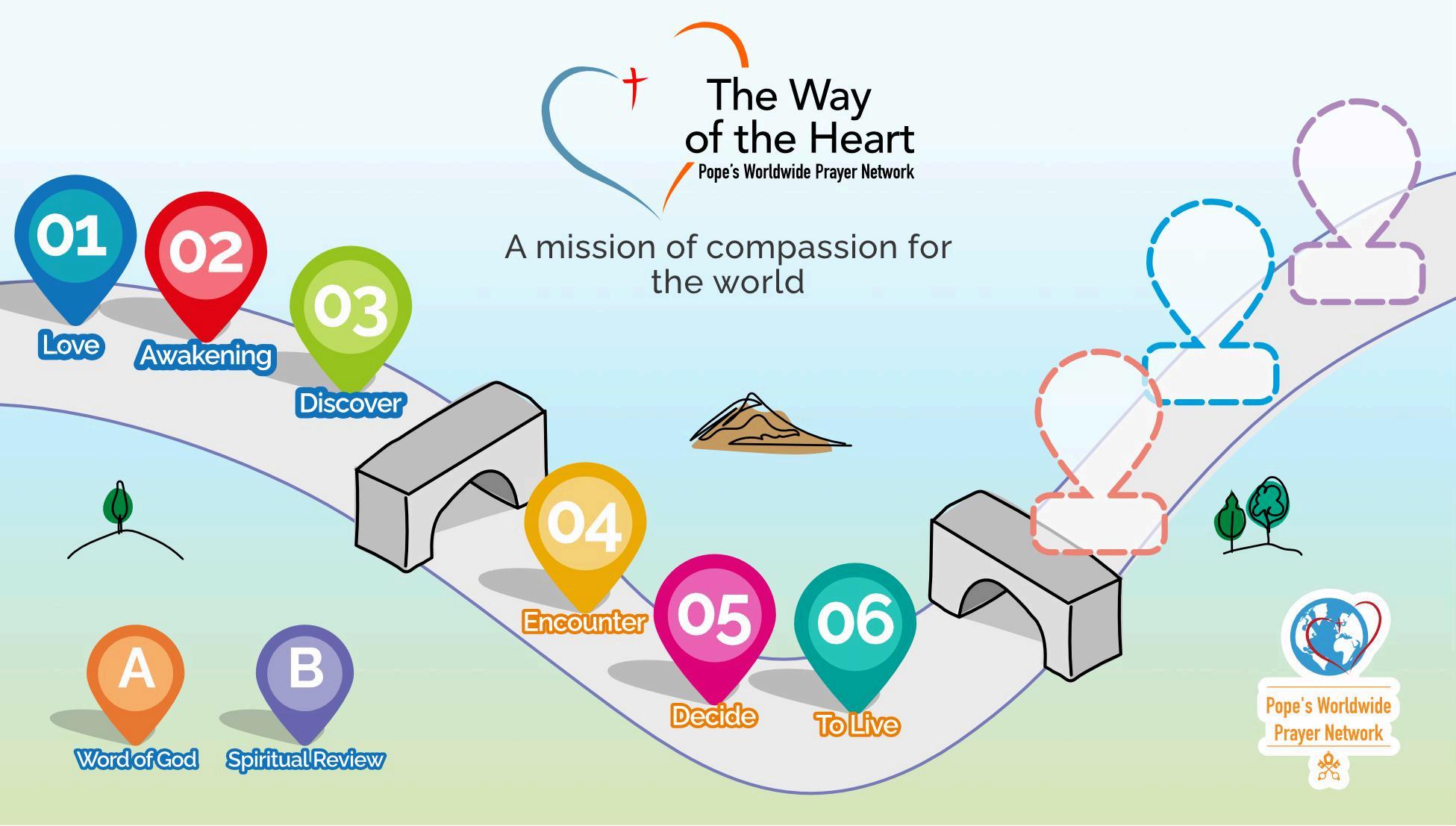
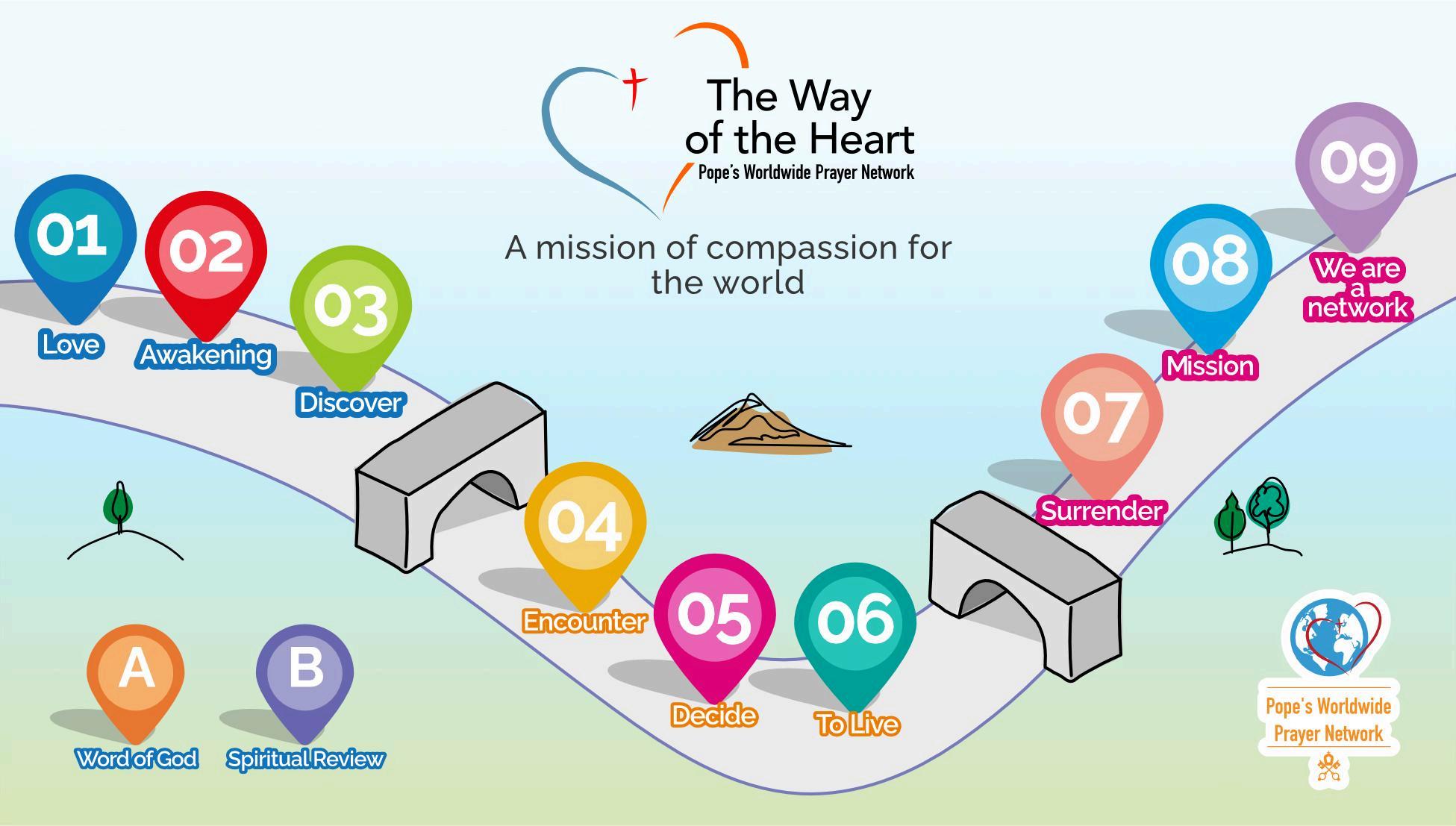
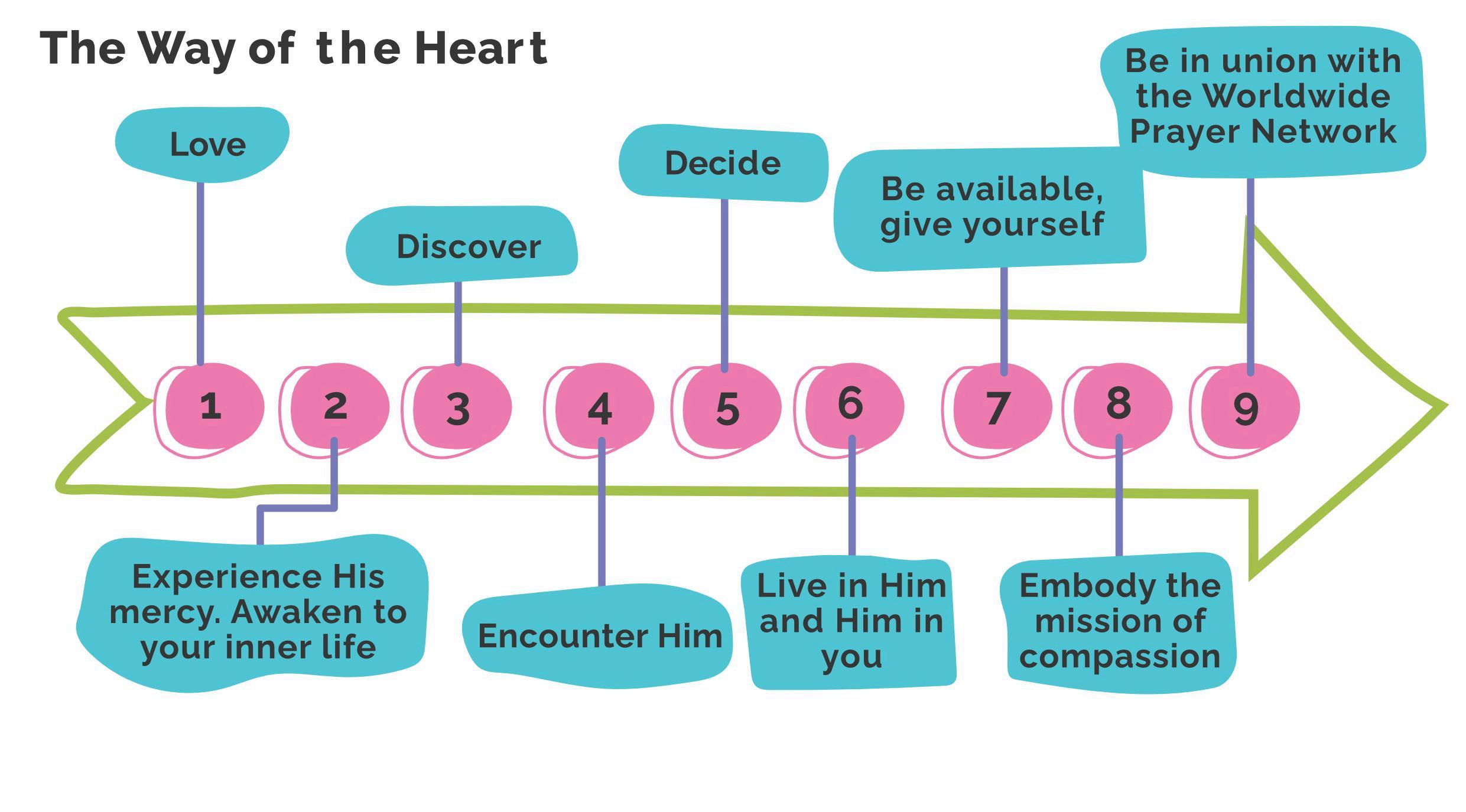
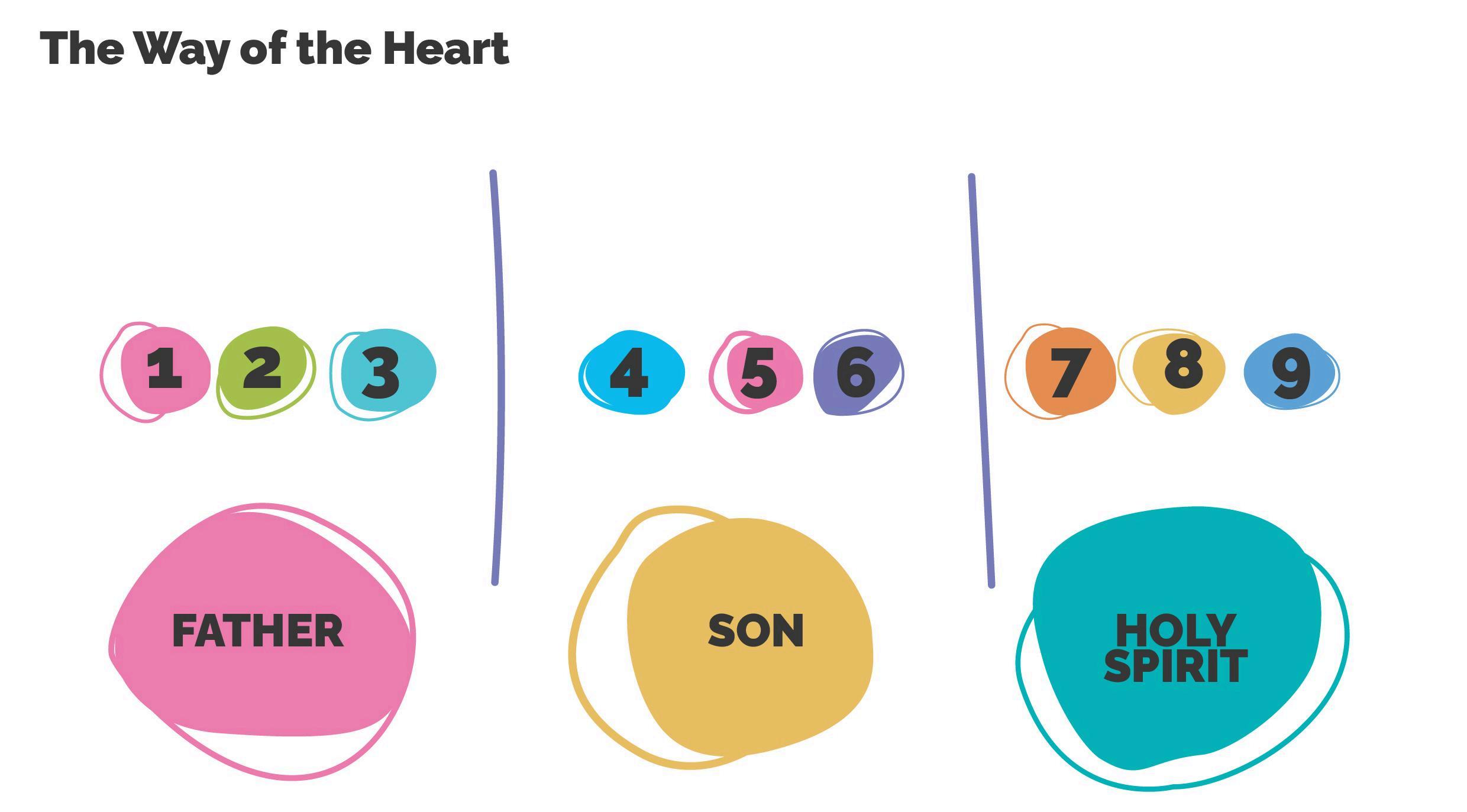
It is structured in nine stages which are presented in an articulated, sequenced, and coherent way One stage presupposes the previous and opens to the next. These nine stages also correspond to the tradition of the first nine Fridays of the month, in the spirituality of the Heart of Jesus, which was understood as a transformative path of friendship with the Lord through sacramental communion and prayer
Nine months, nine stages, nine steps. Nine isa number of fullness, completeness, or totality This process is a transformative sequence of growth and maturation, to give birth to new life It invites us to journey toward a new birth, a new life as close as possible to the Heart of Jesus: His manner of being, His feelings, and His way of proceeding. The Way of the Heart helps us be born into the life of the Spirit
We call the 9 stages of the Way of the Heart "steps," because it is a journey to be walked. In relation to this "journey" experience, we note that although it has a general forward motion, it is not a linear experience It is more like a "helicoidal" process, like the blades of a helicopter or the shape of a spring laid horizontally. It may seem to move backward, but in this helicoidal movement, it gradually advances forward.
It is also helpful to think of the process as a spiral staircase, which depicts the same helicoidal motion, but vertically. The traveler gains in "depth" or "height," passing through the same places such that the "picture of the journey" may appear identical, but is different because it is experienced at different depths or heights
This process includes the experience of "repetition," similar to the dynamics of the Spiritual Exercises of St. Ignatius of Loyola. In this Ignatian repetition, we return to dynamics, themes, and fruits that, though they may seem the same, are not essentially the same. This is because every experience reveals something new. Even if the traveler “passes” through the same path, he or she will no longer be the same, because the journey itself is what transforms us. The experience will be different because it will be received in a different way
3. Steps – Triads – Pauses
As we have said, the path unfolds in steps, each of which has its own internal dynamic We could say that each step opens and closes itself, yet at the same time its closure opens the way to the next step.
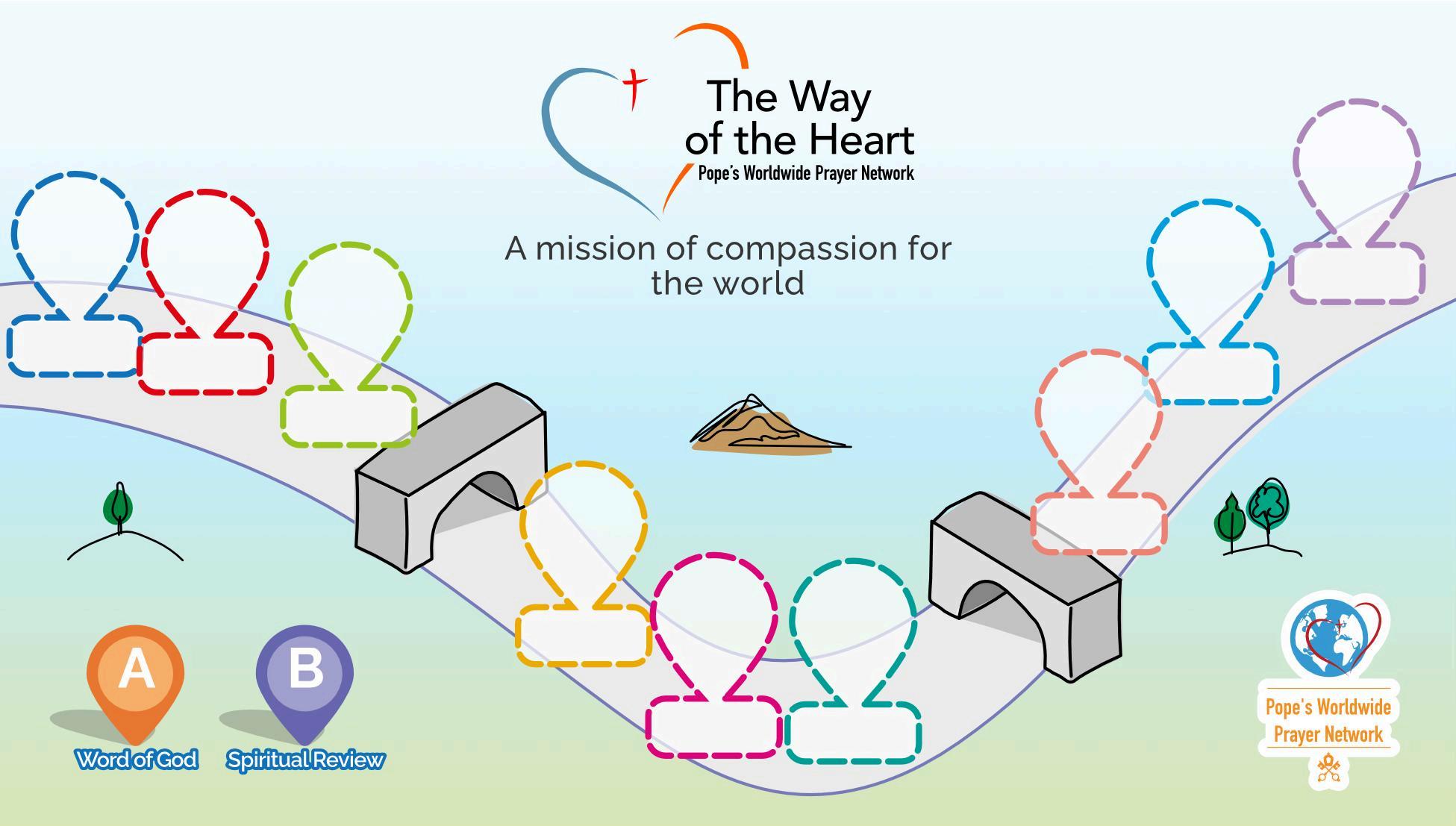
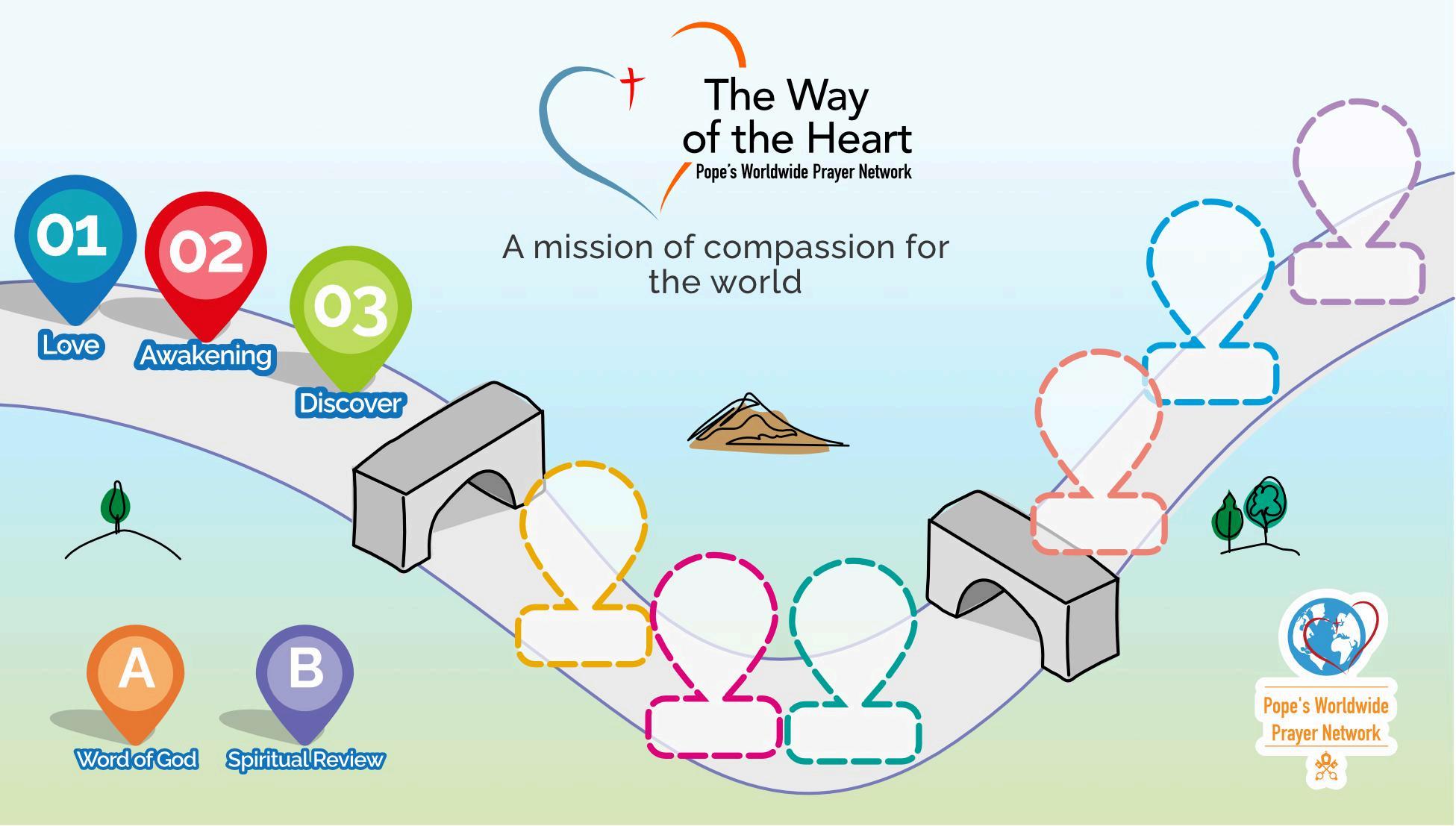
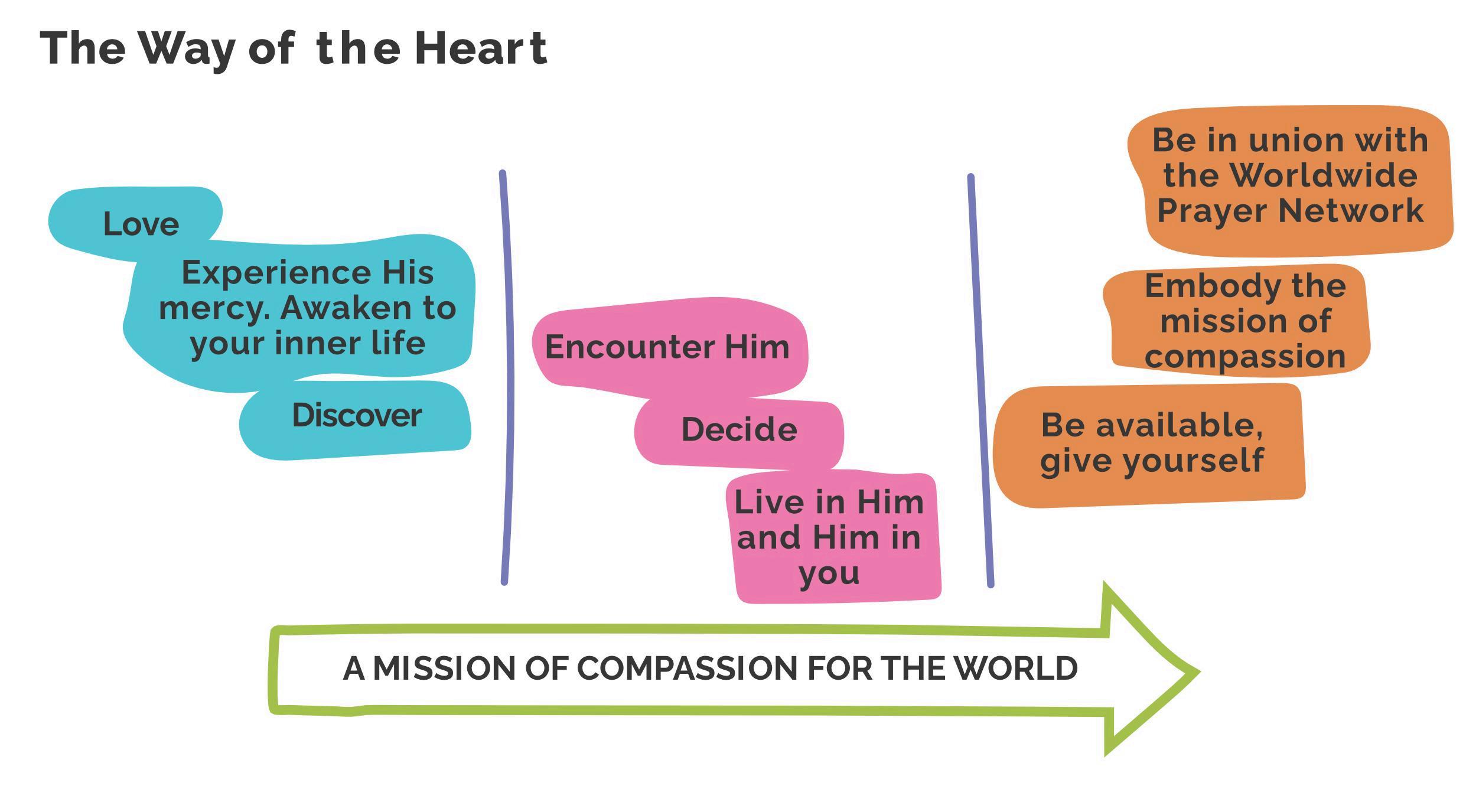
Steps 1, 2, and 3 form the first triad Steps 4, 5, and 6 form the second triad Steps 7, 8, and 9 form the third triad At the end of each triad there is a pause, which can also be understood as a "bridge" between the triad that ends and the one that begins. Each triad also has its own spiritual dynamic which at its conclusion opens the door for the dynamic of the next triad
Those who lead and accompany the Way of the Heart must keep in mind the structure and organization of the whole journey, since it serves as a roadmap for the spiritual itinerary However, from the perspective of the one walking the path, the internal dynamic, the sequence, and the linkage of the stages are to be lived and not studied. It is not about intellectual knowledge. The
participants do not need to know the structure beforehand; they simply live, experience, and gradually come to understand it through the reflections or insights shared by the facilitator
Those who lead and accompany the Way of the Heart must not only intellectually understand the experience, but above all must have personally walked it. For in the spiritual life, we communicate an experience the encounter with the risen Christ
4. Foundational Practices of the Way of
the Heart
The Way of the Heart, as an itinerary of encounter with the Lord, is supported by two foundational practices: prayer in the light of the Word of God, and spiritual review or examen.
Listening to the Lord and remaining in His Word is the foundation of the Way of the Heart. Throughout the nine steps, participants are invited to become friends of Jesus; to listen to Him, to see Him act, to be with Him during the day, and to keep watch with Him at night, until they know His Heart and choose Him. Only the Gospel reveals who Jesus Christ is, which is why the participant is invited to meditate and contemplate the Word. The Gospel is Jesus Himself.
In addition to the meditation and contemplation of Sacred Scripture, the Way of the Heart invites the daily practice of spiritual review, also called the Examen, which is a way of recognizing the Lord’s presence in daily life. This practice helps participants align their hearts with the Lord's Heart, recognizing His presence in their lived experience, and listening to His voice from moments during their day. It helps discern and choose the paths that lead to life and reject those that lead to death. This itinerary is also a journey of spiritual combat, encouraging the practice of discernment to avoid the traps of the enemy and embrace the Lord's offer of Life, allowing oneself to be transformed from the heart. The practice of spiritual review is the foundation of spiritual discernment, so that the traveler is guided by the Spirit of the Lord and chooses according to the Heart of Jesus, in both great and small daily decisions
Prayer in the light of the Gospel and the practice of spiritual review are foundational in at least two ways:
First, both elements must be presented and proposed at the beginning of the journey as integral practices of the itinerary, explaining their methodology and meaning. Participants must experience praying with the Word and practicing spiritual review to properly enter and move through the process.
Second, these two elements permeate the entire experience. That is, they are present in each step. Facilitators must propose them consistently. Each of the nine steps suggests various review exercises at the end of each book, as well as specific biblical texts that illuminate each stage The Word illuminates and grounds each step, and spiritual review is the basis for spiritual discernment. Therefore, it is essential that participants pray with the Word and practice spiritual review throughout the entire journey.
Embodying these two foundational practices is not an end in itself but a means of strengthening spiritual life beyond the bounds of this spiritual itinerary. Learning to examine our daily life and know the Lord through the Gospels are pillars of a disciple’s spiritual life who chooses to follow Christ This is because they learn and become familiar with Him in His earthly journey and, from that lived experience, recognize Him in daily life. The encounter with the Risen Jesus in the Word (praying with the Word) echoes and speaks in the daily life of the disciple (spiritual review)
5. Steps of Prayer with the Word
There are many ways to pray with the Word of God Lectio divina is an ancient tradition of the Church, and various models of it can help benefit us spiritually Here, we offer some suggestions inspired by the experience of St. Ignatius of Loyola. These are simply points to help foster an encounter with the Lord. Each person must, in light of their own experience, discern what helps or hinders them We must help each participant discover what suits them best
First, one must prepare the body and heart. That is to be mindful in choosing the time for prayer, identifying the best moment of the day when one can find minimal distractions Set a duration that is reasonable and sustainable Choose a place that fosters recollection.
Before praying, the participant may begin by slowly reading the passage to be meditated on, in order to recall it and prepare for it. Then, they choose a posture that grounds them in the present, aware of how it influences their interiority They come calmly before the Lord, perhaps making the sign of the cross, and enter into inner silence not with effort, but by welcoming the silence that awakens divine presence. They ask the Lord to be fully oriented toward Him, imagine the setting of the Gospel scene, and formulate a grace-filled petition based on what they desire in their relationship with God Without rushing, they remain in whatever brings spiritual consolation, allowing the encounter with the Lord to guide their prayer.
Next is meditation They begin to meditate by recalling the Scripture text a story not of their own making but one that is given. They seek to grasp the meaning of the story, not to gain knowledge but to discover how they participate in it and how it speaks to their life. They allow the meditation to resonate within, touching the heart more than the intellect These moments are not rigidly separated the goal is not to accumulate wisdom but to open an inner transformation, to see life with new eyes.
Finally is the conclusion At the end of the meditation, they take time to speak with the Lord as one friend speaks with another, sharing what the meditation has stirred in their heart. This dialogue arises after a time of listening and may conclude with the words of Jesus in the “Our Father.” Then, they briefly review the experience: how the meditation went (place, duration, posture), whether the suggestions helped or they rushed into the text They reflect on the experience, asking whether they received what they asked for, whether their desire changed, and what they discovered about themselves, the world, and God Finally, they take note of their interior state joy, peace, emptiness, etc to recognize how the Spirit of the Lord is guiding them
6. Steps of Spiritual review
Spiritual review is above all a space for prayer with the Lord There are three key moments that create the foundation of discernment: thanksgiving observation, and looking toward tomorrow.
Thanksgiving This is the fruit related to the foundation of the entire Way of the Heart Gratitude humanizes, orders the inner and affective life, and orients the participant’s heart toward life.
Observation. Some people tend to make a list of sins or mistakes in their daily examen, as if conducting an examination of conscience This is not the attitude called for by spiritual review and the true meaning of the examen. It seeks to acknowledge sin, fragility, and what separates us from Love, all that leads to death. Not to provoke judgment, but to learn from experience what hinders life and distances us from Christ Also, to become aware of the consequences of disordered acts, words, and decisions, so that, based on this awareness and sincere repentance, one may learn to choose life.
Looking toward tomorrow Through this experience, the participant is invited by the Spirit to reject what brings death in their life separation from the Lord and from others and to embrace what opens them to the life God offers. This review leads, in daily life, to a true “guarding of the heart,” according to the teaching of monastic tradition
General Dynamic of the Experience
The first three steps are key in this process of the Way of the Heart, in which the participant progressively opens with greater freedom to a gratuitous call of love and disposes oneself to respond to that invitation.
To awaken this openess which is the foundation for responding to this encounter of love a process that allows for encounter, call, and response over time is necessary.
Even though we know that all life is born of love and directed toward love, we live in a broken world a world where the love that underpins everything is sometimes hard to recognize or discover. And in the midst of that broken world, it is not always easy to hear the call to friendship, and the openness to respond often meets obstacles.
This journey begins, therefore, with the recognition of the existence of that love which sustains all things, and how it finds only a fragile welcome in each heart and within the dynamics of the world. In the first three steps, the participant will explore the dynamics of the love that underlies their life, experiencing the tension between the gratuitousness of infinite Love, the restless yearnings of their heart, and life in a broken world.
Step One
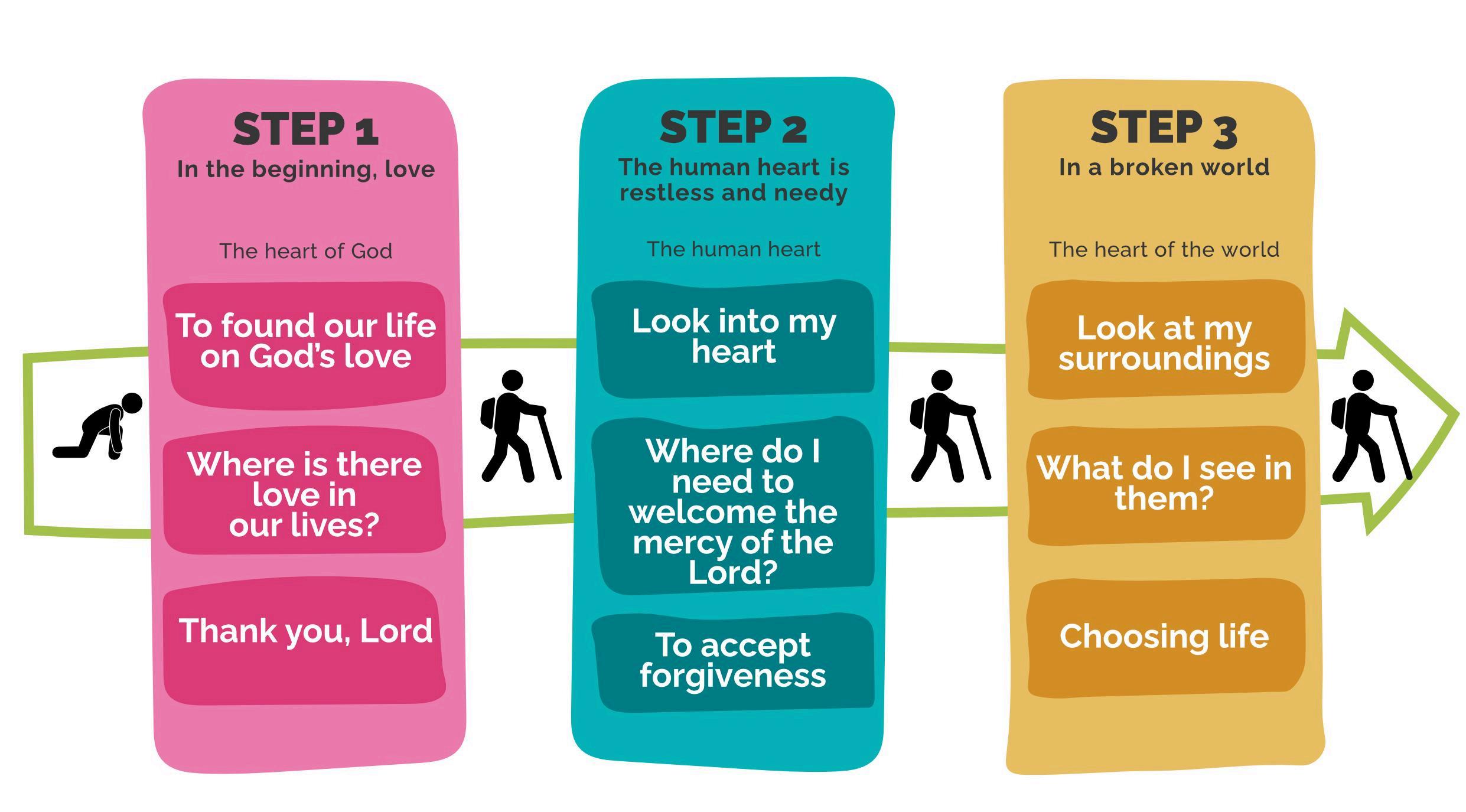
The first step in the Way of the Heart, " In the beginning... there was Love," is an opportunity for the participant to enter the heart of God, to ground their spiritual experience in His Love and not in their own holy intentions or expectations to “obey” the divine plan There are many false images of God that have not been fully Christianized. That is why it is essential that the entire experience begins by being grounded in Love. The dynamic of Step One involves recognizing a love that is concrete, real, and lived a love the participant can perceive within their own personal story Connection with the concrete love of the Lord, recognized in one’s own lived experience, gives rise to the miracle of loving trust in God's will, which expresses itself as gratitude. This experience can transform everything.
This first step and cornerstone of the journey invites the participant to “recognize” how love is a concrete and tangible force in their life. It is not theoretical or generic, but personal, with specific names and faces. Love takes shape in real people present in one's life, in faces, in events that happened at specific times and places, involving people the participant is able to identify and name.
This step does not “talk” about love, nor does it invite a dynamic that “explains” what love is The core of this step is for the participant to recognize through experiences, people, events, real and concrete situations in their life—that love has shaped their existence, not only giving them life but also sustaining and helping them grow And in recognizing that love, they are moved to give thanks
This initial step is crucial, as it marks the beginning of the journey and the foundation of the first triad—where everything is rooted. It is essential that people have a concrete experience of recognizing love in their lives in order to move on to the next steps Without this experience, the journey remains fragile and lacks a solid foundation.
Step Two
The second step in the Way of the Heart, "The human heart, restless and needy," is an opportunity to help the participant enter their own heart, from their personal experience with its lights and graces, but also with its shadows and wounds, sin and brokenness having already tasted and felt the love that comes first from the Heart of God. After having experienced Step One, it naturally follows that in the face of such love, one’s own poor response becomes apparent Everyone experiences the same world founded in love, yet the free relationships we create often threaten, distort, deny, or sweeten that love in order to manipulate it.
At this point in the journey, we help the participant examine the tensions in their heart the desire to love and respond, but also the fragility in responding to such great love. Step Two invites us to look at sin from a healthy and liberating perspective, one that focuses on our responsibility in using our freedom in relation to love
Here, the facilitator begins to help the participant become familiar with the first rules of discernment2 , starting from the participant’s own experience. The rules of discernment offer the light necessary to illuminate the experience For the heart to be attuned to the Heart of Jesus, it is necessary to better understand the interior life, the alternation between consolation and desolation, and how to interpret it. There can be no discernment without attention to one’s affective life that is, the relational dimension each human being embodies: with oneself, with God, and with all of creation
Those who live this experience begin to recognize that the inner life is a spiritual battle between dynamics that open us to life and others that close us to it, leading us down paths of death The facilitator helps the participant perceive how life experiences, encounters, and events affect and generate interior movements, or motions. Awakening one’s inner life is the first step in the spiritual life—that is, the life lived according to the Holy Spirit.
2 Book of Spiritual Exercises of St Ignatius of Loyola from No 313 to No 336 It is important to understand these rules in their meaning and application
Step Three
Step Three of the Way of the Heart, "In a broken world," invites the participant to enter the heart of humanity, to connect with its painful search amid a broken world, full of contradictions often woven between its hopes and its choices This step encourages a responsibility of compassion through a more conscious and supportive openness, an active love in the way of Jesus from the heart of the Trinity.
Step Three invites us not only to contemplate the world in terms of its dynamic of life and death but also to recognize how the participant positions themselves and makes decisions in response to this dynamic. It is a closing step, bringing with it its own interior dynamic, and it concludes the first stage of the journey
This block of three steps could be described as the dynamic of Creative Love that flows from the Heart of the Father. During this first block, the participant experiences the tension between the love that precedes them and their own fragility in responding to it, witnessing the consequences of love and its dynamic of Life and Death in their own heart and its reflection in the world.
Closing the Triad – The First Pause
Three words are important to consider at the conclusion of the first triad—before moving on to the second (which begins with Step Four)—to help those we accompany deepen the journey they have made: stop, silence, interlude
From a methodological perspective, it is helpful to take a moment to pause the process and look back The image of a bridge on the path helps to illustrate this moment a place we “ascend” to gain distance, to observe the journey taken so far, to return to the heart, deepen the experiences, take a rest, and pause. Then, with renewed hope, we look forward toward Step Four.
By looking back and gathering what has been lived, people will also recognize things they had overlooked and can now identify; other things they considered more quickly now have time to be examined more deeply. A clear and intentional time of pause must be proposed to recap the entire journey made up to this point
The close of this triad is also the conclusion of a particular dynamic in the journey that has, until now, centered on the personal experience of the Father’s creative Love, the way in which people receive and express that love in the world, and the fragility of our relationships with one another and with Creation.
Step Four
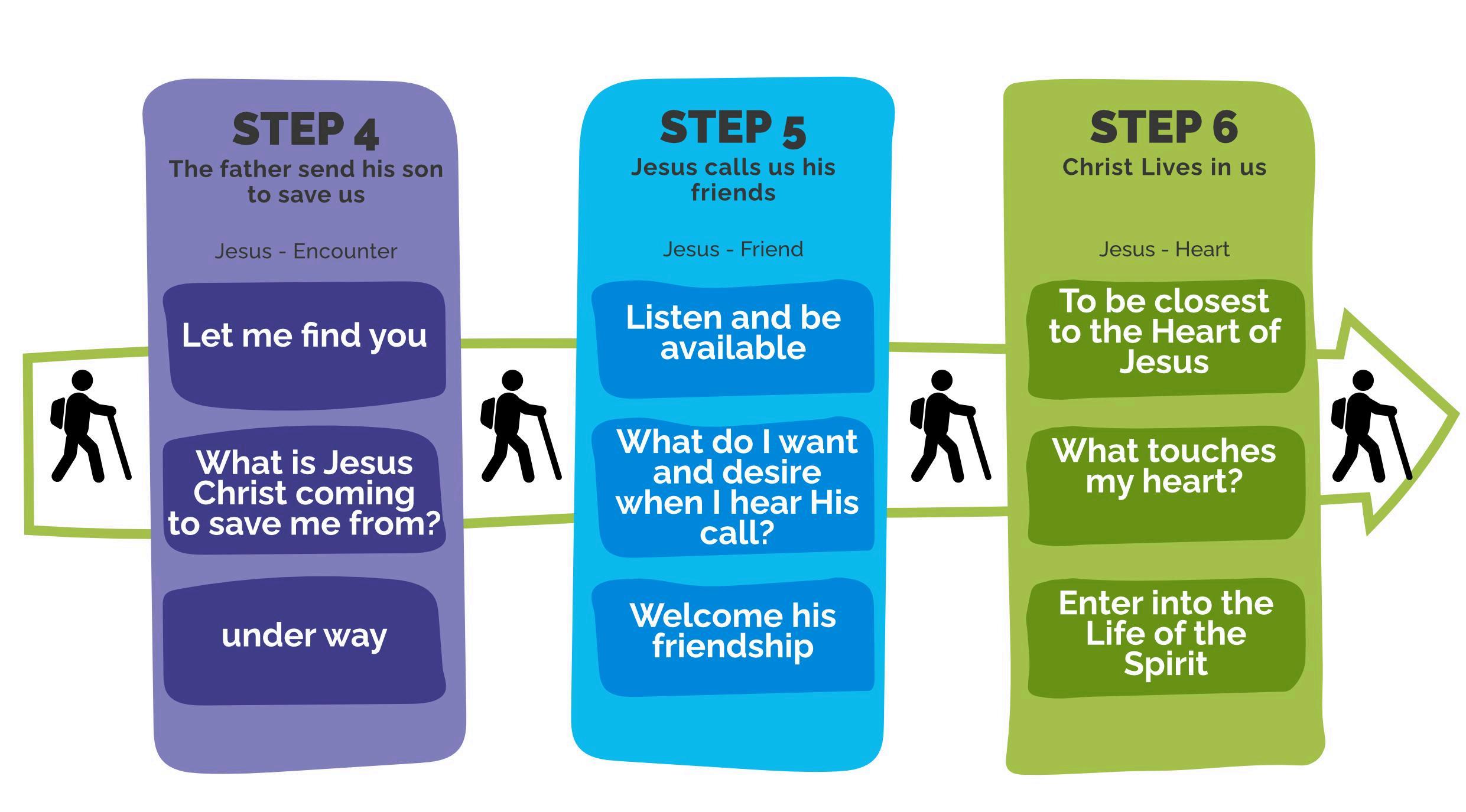
Step Four of the Way of the Heart, “The Father Sends His Son to Save,” marks the beginning of the second triad. At this point, the facilitator should be able to perceive whether the participant has had an experience of being saved by Christ or at least a memory of such an experience that still touches and moves their heart today, recognizing that Christ has saved them.
In this new triad, the participant gradually and gently draws closer to the center of the encounter with Jesus, who calls them by name “to be with Him and be sent” to share in His mission of liberation (Mk 3:13–15), compassion, and service in the face of human suffering.
For those who open themselves up to this truth with the help of grace, the passage from an awareness of a broken life to a real experience of salvation is made possible (cf. Internal Dynamic of Step Four). Thus, the meditation on the kenosis, or “self-emptying” of Jesus (cf Phil 2:5–11) who, not clinging to His divine condition, becomes a servant and the least among men is the backbone of this step. It helps the participant to enter the very dynamic of God's Heart by contemplating how Jesus understands power: not as self-assertion or superiority, but as self-giving that brings salvation
The goal is to help the participant realize that from the beginning Jesus does not come to condemn but to save. This step leads them to feel saved, supported, and brought back to the path by Jesus inviting them to meditate and contemplate Jesus in the Gospel, to perceive His ways, and how He draws near to those in need. Here, the participant is also introduced to the
practice of Gospel meditation in the manner of the Spiritual Exercises of St. Ignatius of Loyola, praying with the faculties of the soul (memory, understanding, and will), oriented toward a personal encounter and relationship with Jesus who lifts the person up, sets them on the path, and allows them to hear His call.
Step Five
In Step Five of the Way of the Heart, “He Calls Us His Friends,” the participant deepens the journey that began with a saving encounter with Christ, now moving into a stronger relationship of friendship The invitation is to keep learning from His way of life how He was born, how He spoke, how He related to others, why He wept, laughed, dreamed, and loved all rooted in the Gospels.
It is strongly recommended in this step to invite participants to read an entire Gospel. The suggested one is the Gospel of Mark, for two main reasons. First, although it begins with the baptism and does not include the “hidden life” of Jesus as Luke and Matthew do, it is the shortest and easiest to read Second, being the oldest, it is more directly connected to the early community's oral tradition of Jesus’ sayings and deeds (known as “Q source”), and it contains fewer theological interpretations added later. Jesus appears in a more “raw” or direct form, with emotions that are easier to perceive tenderness, anger, fatigue, joy, and so on In this step, the participant is invited into a deeper spiritual knowledge of the man Jesus, the One who “became man”: Jesus the Lord.
The focus of the Way of the Heart becomes increasingly clear as a path of apostolic availability not just intimacy in the relationship with the Lord, but a loving decision that calls for resolution and pursuance. In this step, the participant is drawn into contemplation in the Ignatian sense: contemplating Jesus as if standing beside Him, listening and watching Him act, until they hear His voice calling and thus make a choice for Him.
At this stage, it is crucial to pay more attention to the relationship with Jesus than to the great projects the participant may wish to undertake. There will be time later to pray about and discern one’s specific mission (in education, social work, governance, ministry, etc ), but the facilitator must help participants focus first on what is essential: th call of the person of Jesus and His Heart. Often, there is a temptation to interpret the call primarily as a task, not a relationship. This distortion must be corrected. The task is not central it is “hearing the call to a personal relationship of friendship and responding by accepting that friendship.”
The experience unfolds with the understanding that Jesus invites the participant to be part of the Father’s project, not alone but together with others. We are called to freely accept that invitation, to allow ourselves to be called by Christ to be with Him and be sent by Him. In accompanying this step, it is important to attend to the participant’s inner dynamic how they grow in their desire to be with Jesus and become more enthused by His mission. This step should ignite a sense of determination and joy in Jesus’ mission, encouraging people to make a firm decision to follow Him.
Step Six
Step Six, “Christ abides in us,” leads the participant even deeper into a personal relationship with the Risen Jesus. This deeper relationship will attune the person’s “ears and heart” to hear His voice amid many others. It is the final step of the second triad and the deepest point in the inner dynamic of the Way of the Heart Here, the participant is invited to remain in contemplation of the Lord, to deepen their inner knowledge of His person, to learn from His manner, His way of living, His decisions. The call is to stay with Jesus, with all senses attuned, strengthening the bond, and allowing His way of proceeding to permeate the heart It is, in a way, a moment of “heart-to-heart”
As with those who love and spend time together, words often become fewer. This step is usually more “silent,” where the journey becomes rooted and the experience takes deeper hold It is a more profound and intimate time with the Lord. The general invitation in this step is to continue praying with the Word of God, deepening in the discernment of spirits in order to be docile to the voice of the Holy Spirit, and growing in intimacy and familiarity with the Heart of Christ
This step marks the end of the second triad and the entrance into the final section of the journey It is like a hinge step, essential because it centers on personal and deep love for Jesus Christ The role of the facilitator is to create the conditions for this encounter discreetly designing the proposal without introducing distracting activities or dynamics. Rather, the facilitator should ensure that prayer is simplified, quieted, and opened to contemplation of the
Lord so that the participant can be found by Him. At this point, the participant may feel they are revisiting earlier experiences, but doing so in a new way, going deeper (as in a spiraling journey)
Closing the Triad – The Second Pause
Once again in the Way of the Heart, it is time to pause a moment to return to the heart and revisit the overall dynamic lived in this second block of the journey. A bridge for looking back, resting, and beginning again.
To enter into the meaning of this second pause, it helps to ask: What has been the spiritual experience lived in this second triad? From Step Four to Step Six, the participant journeys deeper into closeness with Jesus, asking for and desiring familiarity with the Lord, knowledge of His way of being and acting. A person cannot truly move on to Step Seven without having deeply lived this dynamic
Only from this personal encounter, with a heart transformed, is the desire to follow Jesus in His way and to serve His mission of compassion by offering one's life alongside Him born Only then will the journey that unfolds in the third triad sending the participant “outward and back again” to their reality become the true altar of their self-offering, where their mission is incarnated as a living experience of love for the Lord and for others.
If the internal dynamic of the second triad has been weak if the encounter with the Lord has not truly happened it is better to not move on. Instead, pause, wait, give time, and revisit whatever moments are necessary to foster the experience Otherwise, there is a risk that the participant remains on the surface and does not truly enter into the experience of Steps Seven and Eight, and that any commitment they make “to serve the mission” may become a voluntaristic or partially self-centered and self-gratifying. It is essential that those walking the Way of the Heart be ready for this encounter without trying to force it, demand it, or control it but rather giving it the time it needs to be received as a gift. This is an intimate
experience that cannot be controlled, only welcomed and recognized when it is given. For facilitators, this requires profound respect for each person’s process, offering the time and space for the Lord to meet and speak to them
This second pause is also an invitation for the participant to examine the dynamic of their own desires—moving away from self-centered loops and gradually becoming centered on the Lord. The goal is to help them perceive themselves and their longings, to name and identify their desires, recognizing what has been stirred within them and where those movements are leading. The encounter with the Lord, welcoming His friendship, and being willing to spend time with Him does not leave a person the same as when they began the journey This pause is the moment to make this spiritual review
This pause may also be an ideal opportunity for the facilitator to meet personally with the participant, to verify and discuss their experience. A one-on-one conversation in the spirit of accompaniment can help orient and guide the process, if necessary.
Step Seven
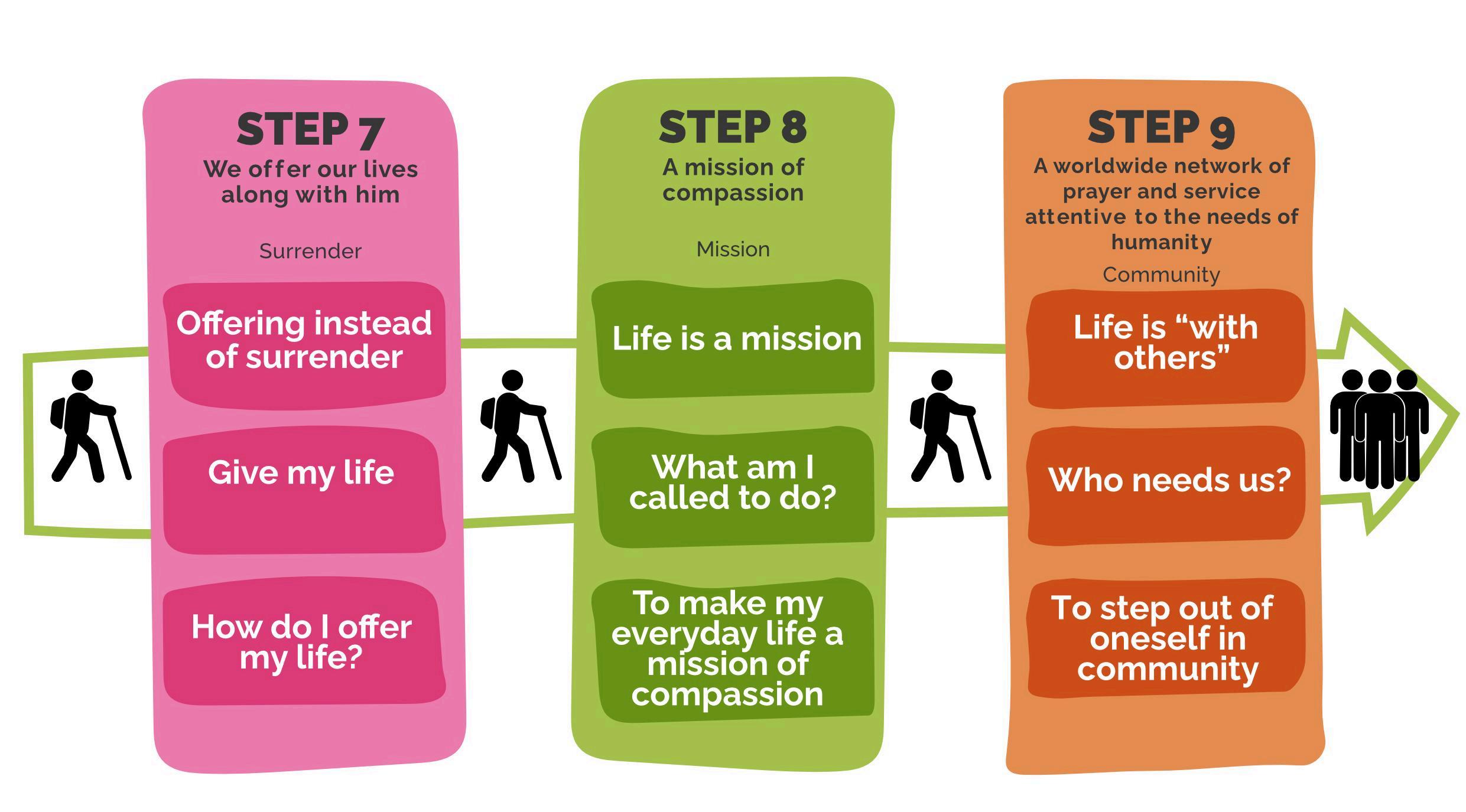
Step Seven, “ We offer our lives along with Him,” helps the participant to enter into the experience of Eucharistic life of self-offering in daily life, in the midst of how they are living The union with Jesus, which the participant deepened in the previous triad (so well expressed in the doxology of the Eucharistic Prayer: “ … through Him, with Him, and in Him…”), gradually becomes an identification with His way of proceeding, of living, of speaking, and of dreaming the world
In this step, the participant experiences that Jesus’ way is a reflection of the way God chose to reveal Himself to us: through self-giving. Not only does He “give things” (life, affection, family, message, a model ), but above all He gives Himself in His Son and His Son, in turn, in a fully offered human life. The core of this step lies in the experience of the sacrificial dimension that is intrinsic to love (as in a mother, father, friend, child, or partner), because it also reflects God’s love, which is intrinsically self-giving (offering) rather than possessive (clinging)
In contemplating the Paschal Mystery, we do not focus only on the Passion and Death but help participants to read all of Christ’s loving life through that lens, just as the Evangelists did to understand His sacrifice in connection with His life and Resurrection. The participant enters into this mystery of Christ’s offering (already glimpsed in the Incarnation) brought to fulfillment in His vocation: in how and with whom He related, the places He chose to dwell, how He faced difficulty and threats of death, how He was killed and above all, how He lived all of this with faith. And finally, in being raised by the Father,
this “way” is confirmed. It is not just a praiseworthy act that “earned” salvation, but a permanent disposition that shows us a more human way of living.
The Paschal Mystery is expressed in the Eucharist In this step, the participant learns the experience of “dying to live” (being broken and shared), which is not always dramatic but becomes a vital paradigm.
Here, the participant confronts the dilemma of Christian life not to avoid suffering at all costs but to embrace love in every circumstance, accepting the suffering that may come as a consequence of choosing to love. The key is to be, with Jesus, bread that is broken and shared.. The participant begins to realize that loving entails, in the world, certain sacrifices misunderstandings, rejection, inconvenience, and in this sense, crosses a “breaking.” And while we know there is more joy in giving than in receiving, and that the dynamic of self-offering brings peace and meaning, this does not lessen the depth of the pain, which remains a sacred mystery It is not a pain “chosen or sought,” but accepted as the result of wanting to remain faithful to the decisions made to be faithful to love.
Step Eight
Step Eight, “A Mission of Compassion,” leads the participant toward a synthesis in which the mission is no longer just the fruit of enthusiasm in hearing the call, but of a deep identification with Jesus and His cause—a readiness to accept, as far as possible, all that it entails. It is the real-life expression of the desire for self-giving experienced in Step Seven
The mission of compassion is both a gift and a task. One cannot simply decide to be compassionate; it must first be received as a gift a sending forth and it involves the whole of one’s existence That is, the mission comes to the participant from the Lord Himself. But at the same time, it does not happen without a personal, free decision to be sent every day, in every circumstance. It is a decision that only becomes authentic through the experience of the Risen One And this experience does not depend on the participant. It is not primarily the participant who seeks Him out, but the Risen Jesus who shows Himself and fills the participant with true joy, making tangible the bond of love. This is the experience we accompany in this step.
This step centers on the mission a mission of compassion But what does compassion mean? Compassion is a principle of action and behavior, not merely sensitivity. Compassion, “to suffer with” (cum-patire), is the ability to recognize the suffering of others through empathy and listening, without judgment, leading the participant to act to alleviate that suffering It is not sentimentalism. A good example of this dynamic is the story of the Good Samaritan (Luke 10:25–37).
Jesus Christ invites the participant to look at the world with His eyes, to feel compassion from the depths, to be moved, and to decide to work and collaborate with Him in the mission He received from His Father a mission of compassion for the most vulnerable and fragile He is the one sent, the one who “goes first” in the mission; the participant collaborates with Him.
By this point in the journey, the participant has walked alongside the Lord and can perceive the invitation to the mission What remains is to make it concrete to embody this principle of compassionate action in real life. To work for others, to serve and give oneself wherever one is invited to live out the mission: in relation to oneself, the Lord, others, and all creation. This historical concreteness seeks to “ground” the motions received along the way in real, possible steps, so that they do not remain only good intentions, but become action.
In this step, the participant may realize that the mission is not always about what is most appealing or pleasing but it is about what builds the Kingdom and promotes the good in each situation and for each person. Often, this requires decisions that may go against their own preferences or unexamined feelings against what they “like” The key is that compassion is a principle of action, not a feeling
It is important to notice any indiscreet fervor or undiscerning desires that arise in the participant to do great things, because these things may not be coming from the Lord but instead from their own ambition True consolation moves people toward real, possible actions based on their life situation. The participant must be able to root their desires in the concrete realities of daily life
Step Nine
Step Nine, “A Worldwide Network of Prayer and Service attentive to the needs of humanity,” is the projection of the journey into daily life The Way of the Heart is a spiritual journey intended to transform concrete life not an afterthought or escape from reality through a specific moment in the participant’s spiritual life, even if it is a strong spiritual moment.
The mission that has been prayed and discerned now becomes a continual reality lived integrally and fundamentally with others in community. While it is a personal journey with Jesus, it is not an individualistic process. This distinction is important: the Way of the Heart is not a self-help recipe to become a better person, but a journey within the Church (the community of the baptized) for the service of Jesus’ mission of compassion for the world.
This global network (family or community) of prayer is made up of those who, through the daily offering of their lives, make themselves available to collaborate in the mission of compassion of the Risen Christ, in whatever situation or state of life they may find themselves in.
The call to mission that the Lord makes to the participant is the fire that makes them an apostle, sent from the Heart of the Father to the heart of the world. Thus, Jesus is what unites us. He is the one who calls and gathers us in a common mission. What unites us is not our personal affinities, a specific charism, our friendship, or socio-cultural homogeneity, but the person of Jesus in His most intimate center: His Heart
Step Nine is the last step of the third triad the going-forth part. The participant prepares to return to the world and share with others what they have seen and heard on this journey It is the part that prepares them for a concrete mission, for self-offering, for the mission of compassion, and for community. “A commitment to the mission of compassion lived in a network, in community.”
This moment may be accompanied by a presentation of the different ways to participate and belong to the Pope’s Worldwide Prayer Network. It is an opportunity to help the participant reflect on how they live and feel within the Church. This step opens the way to reflect on the mission that is lived in community
Closing the Triad – Final Harvest
Having arrived at Step Nine, participants complete the third triad and the entire itinerary. It is always appropriate to dedicate quality time to making a good closure, enabling recognition, naming, and harvesting the graces received. The goal is to ensure that it is not just one more spiritual experience but an opportunity to clearly recognize how the Lord has spoken throughout the journey
Depending on the format of the journey (online, in person, retreat or workshop, over a few days or many), the timing and shape of the harvest will vary. What matters most is that people complete the journey and allow its graces to shape their daily lives.
The harvest will be expressed in desires, motions, new ideas, fresh clarity, new ways of being, seeing or doing things, renewal of relationships, relaunching of projects… People will recognize the different ways in which the Lord has spoken to their hearts.
It is possible that the full process may naturally conclude with the end of the third triad, without requiring a distinct pause. However, time can be set aside to close the triad centered on community mission first, then followed by a full process closure. What’s most important is that the journey is closed with a review that helps identify, name, and give thanks for the gifts received.
Some Methodological Aids
Let us now consider some recommendations that can help in designing an experience of the Way of the Heart These are small additions to the journey that may enhance the experience and allow for greater spiritual fruit.
1. About the Process
Since this is a process-based experience, not simply a sequence of unrelated talks, the methodology must ensure that participants truly embark on a journey and can both recognize and express that process
To make the journey perceptible, visible, and tangible, it is helpful to use didactic resources that convey the sense of a path being built step by step. For example, participants might complete a drawing or composition through prompts, or assemble a path with hearts, images, or other suggested visuals. Symbols, letters, numbers, photos, and words can be added progressively, representing each stage of the journey as it unfolds.
The possibilities are many, but the goal is always the same: to help participants perceive their progress, to feel that they are walking along a meaningful path, and to see their experience take shape in concrete ways.
Usually, the process has a thread or trace, more or less visible, that gives continuity to what is being lived, and the participant should be able to identify it. For example, this could take the form of a consistent method for review at each step, a mnemonic word to help recall the review process, a repeated sequence that accompanies each stage, beginning or ending each step in the same way, or a recurring element such as an icon, a color, or music that evokes the thread connecting the experiences.
Ultimately, the process must be lived and recognized by the participant, and the methodological tools must serve and support that purpose.
1.a
Triads, Steps, Pauses
When designing a proposal, it is important that the facilitator maintains a clear view of the entire path and understands the overall dynamic: the flow of each triad, the unfolding of the steps, and the purpose of the pauses. Careful attention should be given to the structure and internal rhythm of the steps and triads as presented in the books when preparing a proposal or planning an encounter, whether offering the full experience or only a part of it.
The proposal must remain centered on the essence of each step: the desired fruit, the key word that gives shape to the step, and the internal dynamic that defines it. Whether the format is long-term or more condensed, topics and activities should support the core elements outlined in the framework for each step These elements serve as guiding criteria for discerning which approach, activity, music, or image is most appropriate
1.b Time Frame
The Way of the Heart can be offered in a variety of timeframes. It may take the form of a closed retreat experience lasting two or three days, or it can be structured as full-day or half-day sessions Another format is a series of weekly or bi-weekly meetings over several months, in which participants attend a group session and then sustain a personal rhythm of prayer in daily life, deepening the proposed theme This list is not exhaustive; many possibilities can and should be adapted to the concrete reality of the participants and the facilitator.
What matters most is that the process opens and closes with purpose and structure, preparing hearts to receive grace and bear fruit It is important to avoid the temptation to present a disconnected sequence of spiritual topics from the Way of the Heart, even when time is short.
For example, the Way of the Heart could be presented in four stages: an initial block with two introductory sessions followed by one block for each triad. This approach to segmenting, pausing, and grouping aligns well with
the internal dynamic of the journey without distorting it. Another option is five meetings: one for the introduction, one for each triad, and a final session dedicated to spiritual harvest
It is also possible to present the Way of the Heart as a one-day retreat that includes personal prayer spaces, small sharing groups facilitated by those who have already completed the experience, and a final moment of spiritual harvest The design will depend on the time available, the setting, and the needs of the people involved.
1.c Spiritual Experience
The Way of the Heart is, above all, a spiritual experience The facilitator must prepare and shape the proposal so that those who embark on the journey enter into a genuine encounter with God. The goal is to move from the head to the heart. It is not about grasping concepts, but about awakening a deeper awareness that embraces the affective dimension, including feelings, desires, thoughts, and even the body itself as the resonance chamber of the experience.
Keeping this in mind helps us discern the methods we use. For example, in Step One the aim is for participants to recognize the love that has sustained them from the beginning, not to receive explanations about love. The goal is not to define what love is, but to guide each person to discover it in their own life and to name it.
A key aspect of this journey is that participants must be able to recognize and express their experience in some way: by naming it, describing it, drawing it, singing it, or embodying it in another form. It is not an intellectual exercise alone, but one that involves the whole person For this reason, it is helpful to offer elements that awaken and engage the senses.
One way to foster this experience is by first inviting participants to recognize what is being sought, such as love, pain, sin, tension, encounter, friendship, self-gift, or mission, outside themselves in a real-life story, a video, a song, a narrative, or a poem. These external expressions then act as a mirror, helping them reflect on their own lives.
In this sense, any use of sensory elements should serve to draw participants into the heart of the experience and prepare them to receive the grace of each step They should never be used as mere decoration or filler Finally, it can be helpful for participants to share what they are living in small groups, through activities that provide prompts for reflection and dialogue. This allows each personal experience of the journey to be deepened in community.
1.d Format of presence
The experience can be offered either in person or online. The frequency and duration of each session can be adapted based on the number of participants and the context The interval between sessions should help preserve rhythm and the sense of process so that the experience is not diluted The participant needs to be able to sustain the memory of what they are living in order to build the process. If the gap between sessions is too long, it becomes harder to maintain that sense of unity
1.e Support Materials
It is important that participants in the Way of the Heart have a Bible in their native language so they can engage directly with the Gospel and other passages from Sacred Scripture through their own personal experience of prayer
It is also essential that each participant have a notebook, which may be used for writing, drawing, or painting This serves as a personal record of the journey that can be revisited at any time and is especially helpful for the practice of spiritual review or the daily examen.Participants should also have access to materials that support prayer, reflection, meditation, or exercises related to the session theme These may include selections from the books as well as other appropriate resources such as songs, videos, poems, or Scripture texts. Anything that fosters deeper reflection on the step addressed in the session can be valuable.
1.f Prayer Experience
This is, above all, a prayer-based experience, an encounter with the Lord. The design must therefore include moments of personal prayer, including guided prayer when appropriate, to help participants extend and deepen these moments in their daily life between sessions This cannot be assumed or left aside. While the Way of the Heart is formative, it is not a course in spirituality but an itinerary that is rooted in personal prayer.
The guides provided should introduce different methods of praying with the Word, such as meditation, contemplation, vocal prayer, and lectio divina, selecting the approach that best supports the experience. For those who are familiar with the Spiritual Exercises of St Ignatius, can also use his prayer methods
Group meetings should also encourage the practice of personal prayer with the Word and spiritual review, so that participants gradually internalize these practices and make them part of their daily rhythm For example, each session could begin with reviewing the previous one, reflecting on how participants lived the time between sessions and how prayer with a given passage resonated with them. Living the Way of the Heart as a lifestyle means cultivating the daily practice of spiritual review and prayer with the Word of God.
2. About the Pilgrims
When designing the proposal, it is essential to consider the age, spiritual background, and particular needs of those taking part in the journey A proposal designed for adult parish leaders from Apostleship of Prayer groups will look very different from one created for a camp of young leaders from the Eucharistic Youth Movement One that is created for a stable community of adorers or musicians, will look different than a proposal for an open gathering of people who do not yet know each other.
It is also important to plan for both group and individual accompaniment In some cases, larger groups may benefit from being divided into smaller communities, each with a facilitator who can regularly guide and support the sharing of spiritual experience. In certain situations, individual accompaniment may also be appropriate It is particularly advisable to include a moment of one-on-one accompaniment at the end of the second triad to take the pulse of each participant’s journey.
3. About the Facilitators
3.a Role of the Facilitator
The person who accompanies the experience of the Way of the Heart is responsible for creating the conditions that allow participants to enter into it This person helps, facilitates, and provides the framework so that others may walk the path. The means chosen to support the journey should always be those most suitable for the people, the timing, and the circumstances. Different resources may be included as long as they serve the ultimate purpose. There are no fixed tools; only those that best fit the specific experience.
For example, in some cases it may be best to introduce a theme through a video, in others through a Gospel text, or by means of an image. At times music or a dance may be helpful. In other moments, painting or crafts might play a role, while in others only Scripture texts may be appropriate.
It is important to avoid overwhelming participants with too many external stimuli or excessive explanations of the themes. The proposal is not the focus; it is simply a means. The facilitator is not the center either; their role is to help participants encounter the Lord in this journey What truly matters is that each participant enters into the experience, and every chosen method should serve this goal. Even if a methodology appears perfect on paper, if it does not help, it should be set aside. The priority is always whatever proves most helpful, and that will always be the best and most beautiful choice
Facilitators should exercise prudence and avoid the temptation to over-explain. Their role is to introduce the theme clearly but briefly, without replacing the participant’s personal task of discovering and engaging with the material in their own way They must also resist taking on the role of teacher and instead act as a fellow traveler someone who has already walked this path and now helps others by removing obstacles, guiding the way, and gently correcting direction.
3.b Making the Experience Explicit
It is highly beneficial for the proposed framework to include opportunities for participants to put their spiritual experience into words. This allows them to look at their process, give it structure, and discover new insights Speaking about the process helps clarify and integrate the lived experience
However, not just any speech is helpful—only words that deepen the experience are helpful Therefore, the facilitator should offer clear guidelines for sharing, whether in small groups or in larger gatherings Clear instructions should be given on what to share, how to share it, and within what time frame. For example, whether they should write, draw, or simply speak—when and for how long. These guidelines help reduce individual and group dispersion and give structure to the experience
After listening to participants, there should be time set aside to reflect back what was heard. This affirms the participants that they are welcomed and have been truly listened to It is not advisable to end a sharing session without offering a simple reflection like this in return. This process of naming and reflecting back helps make the experience more concrete, reveals spiritual fruits, redirects when necessary, synthesizes insights, and encourages the journey forward
3.c Suggestions for Using the Books
The books in The Way of the Heart series are a toolbox for the one accompanying others in the experience. They are also helpful for personal prayer and reflection, but their primary purpose is to guide content for those facilitating the journey. As such, they should be used only insofar as they serve the participants.
A clear understanding of the framework for each step is crucial for the facilitator. This helps identify the key elements of the journey, provides general orientation, and serves as a criterion for choosing materials appropriate to each step It may also be helpful for participants especially those in the first triad to become familiar with the framework and its internal dynamics, as it lays the foundation for the rest of the itinerary.
This does not mean that participants need to read the texts word for word However, it is advisable that the content of the first triad be guided by the structure laid out in the books especially for those who are new to the journey. As the experience deepens and progresses, facilitators can choose other entries from the books to present at each step The content from the books can also be complemented by additional resources videos, texts, songs, etc. provided they do not overload the process.
3.d Suggestions for the Pauses
Here are three ideas that may be helpful during the pause moments after each triad. These should not be seen merely as breaks, but as spiritual spaces for processing and digesting the journey: stopping, silence, and in-between time.
Stopping is essential in the Way of the Heart. It allows us to break from routine (even spiritual routines) and listen to the source of life: God. It is an act of freedom that creates space for discernment, distancing us from impulsiveness and drawing us closer to the Holy Spirit Stopping is not an end in itself it prepares the way for deeper encounter with the Lord, who awaits us in the ordinary.
Silence is also key to hearing what often goes unnoticed from the faintest sounds to the voice of God within. It involves quieting both external noise and inner restlessness, opening the way for deep dialogue with the Lord. Even reading and stimuli should be quieted so that the themes of the Way of the Heart do not take up space meant for the encounter itself This silence is not an empty time but fertile ground for the Spirit to act and move
The in-between time—between structured prayer moments and daily life—is also significant Like the seed in the parable of the sower, growth happens on
its own if space is given. This free time doesn’t require specific actions, but rather an attitude of trust and openness, allowing the Word sown in the heart to bear fruit without trying to control its growth
Finally, it is important to help the participants keep alive their desire to live the Way of the Heart in its fullness. Through daily spiritual review, they can check whether the way they are living aligns with the steps of the itinerary, trusting that the Lord is at work in their hearts, even in the midst of daily responsibilities.
4. About the
Future
Eventually the participants return to their daily lives How can we help them sustain the momentum and keep the flame of this experience alive? At this stage—as during the journey itself—we can find support in the Pope’s monthly prayer intentions and in the resources offered by the Pope’s Worldwide Prayer Network. This is a stage especially enlivened by the Holy Spirit, who is the driving force of our mission.
Praying and discerning the will of the Heart of Jesus in daily life is no easy task After being accompanied through such an intense spiritual journey, participants may face discouragement or frustration. They may leave full of resolutions that are hard to maintain. And just like any relationship between hearts between people this one must be cultivated through shared time and daily life Otherwise, the relationship may grow cold (at least on our side), become distracted, or turn utilitarian.
4.a Available Resources
How can a spiritual life be sustained in the midst of daily life, without the accompaniment or structured prayer moments that supported the participant during the nine steps? Discernment in prayer, enlightened by daily Scripture, and the practice of Spiritual Review or Daily Examen are the main ways a person can extend the experience of The Way of the Heart into their everyday life
The three daily moments of prayer proposed by the Pope’s Worldwide Prayer Network can be a great support. The Daily Offering and morning Scripture reading become the key that opens the participant to consciously and actively live their day united to the Heart of Jesus and in a missionary spirit. The afternoon examen is a fruitful moment to “keep our eyes fixed on Jesus” (Hebrews 12:1–2), on His criteria and way of acting. It also connects the participant’s actions to the broader monthly prayer intention proposed by the Pope Meanwhile, the evening spiritual review or examen allows one to look with gratitude, humility, and generosity at the gift of God's love recognizing His graces and invitations, asking forgiveness for failings, and looking forward with hope, aligning one’s desires to those of Jesus.
Other concrete support include: a personal prayer corner or home altar, a spiritual journal, an image that recalls the journey of The Way of the Heart, the Rosary, and the Click To Pray platform.
4.b With Others in Community
Living in community is challenging... but it is something that helps make us who we are. Celebrating the Eucharist in community is perhaps the most concrete experience that can help participants recognize themselves as part of the Body As a theologian of the 20th century said, “The Church makes the Eucharist, and the Eucharist makes the Church.” We all matter in it, because we are members of the family of the baptized. The liturgical celebration of the Eucharist despite all the flaws and particularities of the people involved remains, in our Christian experience, the “source and summit” (Lumen Gentium 11) of the life and mission of Jesus’ community.
Participation in the Pope’s Worldwide Prayer Network includes our belonging to the Catholic Church Connecting with one’s local ecclesial community will always be important for those who live The Way of the Heart.
A second way to build community is through participation in some form within the Pope’s Worldwide Prayer Network, which offers various possibilities For those who wish to be more involved, it is important to engage with the initiatives and communication channels of the National Office, whether through personal commitment, a parish prayer group, an Apostleship of Prayer group, the Eucharistic Youth Movement (EYM/MEJ),
or another community that belongs to the Prayer Network. For some, that deeper commitment may take the form of a personal alliance with Jesus or a consecration.
4.c Formation and Ongoing Accompaniment
Though The Way of the Heart is now lived in everyday life, this doesn’t mean that one cannot return to a more intense experience that helps to renew in us the fruits of the steps of this spiritual journey much like a retreat As with the Spiritual Exercises, it is possible to participate in The Way of the Heart more than once and in various formats.
That said, it is especially important for those who feel called to become formators to enter into the experience of the Spiritual Exercises of St. Ignatius of Loyola, in the forms available in their country. The Exercises are likely the best resource to continue nurturing and shedding light on the experience already lived through The Way of the Heart, and to better understand the inner dynamics that must be accompanied and safeguarded in others as a formator.
It is also important to participate in the Formation for Formators of The Way of the Heart, in one of the formats offered by the Prayer Network, in order to systematize the tools and pedagogy of this itinerary.
In the same way, both for those who live The Way of the Heart and for those who accompany others on the journey, it is vital to consider receiving formal personal spiritual accompaniment or direction. This will help over the years to examine one’s process and discern the deceits of the evil spirit. If spiritual direction was not provided during the journey itself, this may be an important time to invite those who need it to access this ministry of the Church in a mature and committed way.
Foundation in the Spirituality of the Heart of Jesus
We begin with two affirmations:
1. The Way of the Heart updates the devotion to the Sacred Heart of Christ from an apostolic perspective and presents, in a coherent way, the treasure of the Apostleship of Prayer (now the Pope’s Worldwide Prayer Network) in light of the Spiritual Exercises of St. Ignatius of Loyola.
2The spirituality of the Heart of Jesus is the spiritual foundation of our mission, and The Way of the Heart is a specific way of living it That is why we call it our spiritual formation itinerary.
Let us now explore what we mean by these statements. A brief historical synthesis will help us draw the connection between The Way of the Heart and the Spirituality of the Heart of Jesus, which is its foundation. This synthesis also aims to provide some interpretative elements to broaden the frame of reference of this itinerary starting from its foundation.
1. The Way of the Heart updates the devotion to the Heart of Jesus
Devotion to the Heart of Jesus, rooted in a spirituality centered on the person of Jesus Christ, has a long and rich history. Over the centuries, it has taken on new forms and expressions, shaped by changing historical and cultural contextsThe Gospel of John speaks of the “pierced heart of Jesus” (Jn 19:34), which was deeply reflected upon by the early Church Fathers and interpreted by medieval mysticism as the wound that reveals the depth of God’s love.
In more recent centuries, some of the most prominent expressions of this devotion include the revelations given to Saint Margaret Mary Alacoque in the 17th century, and the flourishing cult of the Sacred Heart in the 19th century, which found an apostolic orientation through the Apostleship of Prayer. In the early 20th century, the revelations of Divine Mercy to Saint Faustina Kowalska further deepened this spiritual current Today, the Pope’s Worldwide Prayer
Network, formerly known as the Apostleship of Prayer, stands as a living example of this ongoing inculturation.
The Church’s Magisterium has also spoken about this spirituality in the encyclicals on the Sacred Heart, such as Pope Pius XII’s Haurietes aquas (1956) and Saint John Paul II’s Dives in Misericordia (1980). More recently, Pope Francis has published the encyclical letter Dilexit Nos (2024).
The Society of Jesus has been closely linked to the spirituality of the Heart of Christ from its very origins. This connection is rooted above all in the spiritual experience of Saint Ignatius of Loyola, whose Spiritual Exercises lead believers into a profound contemplation of the mysteries of Jesus’ life It is also expressed through the Jesuits’ ministry of prayer and apostolic service, lived as a collaboration in Christ’s mission of compassion for the world. For this reason, the entrusting of the Pope’s Worldwide Prayer Network to the Society of Jesus as a pontifical work carries a particular significance, uniting a deeply Christ centered spirituality with a missionary outlook that seeks to serve the needs of humanity.
The Apostleship of Prayer, first conceived as a spiritual mission and later taking shape as an association of the faithful, was founded in 1844 in a Jesuit formation house in southern France. Shortly thereafter, its close link with devotion to the Sacred Heart of Jesus came to define the very core of its apostolic activity, which soon spread across the globe under the guidance of the Society of Jesus
This connection can be traced even earlier to the collaboration between Saint Margaret Mary Alacoque and her Jesuit spiritual director, Saint Claude La Colombière With his guidance, Margaret Mary was able to discern and share more fully the depth of the mercy revealed in the Heart of Jesus. In her final vision of 1688, which the Church later recognized, the Lord entrusted this mission to the Visitation Sisters and to the Jesuits, charging them with the responsibility of transmitting to the world both the experience and the understanding of the mystery of the Sacred Heart.
Almost two hundred years later, in 1883, the Society of Jesus officially accepted this “most pleasant mission” (munus suavissimum), to practice, promote, and spread the devotion to the Heart of Jesus, through decree 46 of the 23rd General Congregation. In 1915, decree 21 of the 26th General
Congregation stated that “the Apostleship of Prayer is an excellent means to advance this devotion.”
From the end of the 20th century, the Jesuits began promoting a renewal of the spirituality of the Heart of Jesus, seeking to refound the Apostleship of Prayer. Father Pedro Arrupe, SJ, Superior General of the Society of Jesus (1965–1983), already affirmed this in a letter sent to all Jesuits in 1972, consecrating the entire Society to the Heart of Jesus: “This means of the Apostleship of Prayer, which has greatly helped the People of God, can today renewed and adapted offer new and increased service, particularly in our current need to form apostolic prayer groups and foster serious spiritual commitment”
Pope John Paul II, in 1986, confirmed the Society of Jesus in the mission it had received from Christ Himself to spread the devotion to His divine Heart, as well as in the privileged means He had chosen to accomplish this mission the Apostleship of Prayer with these words: “I ask you to make every effort to always better fulfill the mission that Christ Himself has entrusted to you—the spread of devotion to His divine Heart.”
Other more recent Superiors General of the Society of Jesus have also responded to this call. Fr. Peter-Hans Kolvenbach, SJ (1983–2008), noted in his writings on the Heart of Christ that the Society has “solemnly bound the promotion of devotion to the Heart of Jesus to the Apostleship of Prayer” Fr Adolfo Nicolás, SJ (2008–2016), was the one who led the re-creation of the Apostleship of Prayer as the Pope’s Worldwide Prayer Network, and therefore the renewal of its spiritual foundation, the spirituality of the Heart of Christ. Fr. Arturo Sosa, SJ, current Superior General of the Society of Jesus, renewed the consecration of the Society to the Heart of Jesus on July 31, 2022, the feast of Saint Ignatius, and participated in the drafting of the definitive Statutes of the Pope’s Worldwide Prayer Network, published by the Vatican Secretariat of State in July 2024
These statutes affirm that its foundation is the spirituality of the Heart of Jesus, clearly articulated in the Re-creation Document of the Apostleship of Prayer titled A Way with Jesus in Apostolic Availability (Rome, December 3, 2014) This document offers disciples of Jesus a concrete path for shaping their feelings and actions according to the Heart of Christ, within a mission of compassion for the world (Statutes, 2).
In light of this history, we can see that the Pope’s Worldwide Prayer Network, a Pontifical Work entrusted to the Society of Jesus, is firmly rooted in the spirituality of the Heart of Jesus It is lived as a path of friendship with the Lord and of service to His mission, guided by the pedagogy of The Way of the Heart.
2. The Apostolic Dimension of the Spirituality of the Heart of
Jesus
The intuition of apostolic prayer, which eventually gave rise to the Apostleship of Prayer, began with the French Jesuit Fr François-Xavier Gautrelet, on December 3, 1844, the feast of Saint Francis Xavier, in the context of the missionary century. At the formation house in Vals-près-le-Puy, he observed young men deeply moved by missionary stories, especially from Madurai, India He encouraged them to live out their missionary zeal in the present moment, telling them:“Your mission is here, in your studies and in the simple things of daily life. By fulfilling them in availability to the will of God, you are already apostles helping the entire Church.”
This simple and profound invitation resonated immediately with the desires of the young Jesuits. It gave them a concrete way to participate in Christ’s mission even as they continued their formation, deepening their sense of spiritual availability The intuition also reached beyond the Jesuit house, striking a chord with many laypeople eager to contribute to the missionary vitality of their time.
In 1849, Fr Gautrelet formally established the Apostleship of Prayer in Toulouse, France The movement flourished especially under the leadership of Fr. Henri Ramière, SJ, one of his former students. Fr. Ramière connected the Apostleship of Prayer more directly with devotion to the Heart of Jesus, placing it firmly within a missionary perspective In 1861, he launched the Messenger of the Sacred Heart, a publication that continues to exist in many countries today.
Under Fr. Ramière’s guidance, the Apostleship of Prayer, deepened its foundation in the Heart of Jesus The prayer of offering was no longer limited to one’s studies, work, and daily activities, but was joined to intercessory
prayer for the Church’s mission.This offering became an act of uniting one’s whole life to the Heart of Jesus and His mission of compassion for the world.
Through the Messenger of the Sacred Heart, Fr Ramière invited the faithful to pray for the intentions of the Heart of Jesus. A decisive development came in 1879, when Pope Leo XIII began to entrust his monthly prayer intentions to the Apostleship of Prayer. This made clear that the prayer was not only personal but also apostolic, helping the faithful unite with the Heart of Jesus in service of His mission.
- By framing the daily offering within this apostolic perspective, Fr. Ramière formed what he called a “league” of prayer united to the Heart of Jesus. In doing so, he emphasized that not only prayer, but one’s entire life, is called to be apostolic. What he described as “prayer and zeal” we now call “prayer and service,” since authentic prayer opens us to others and disposes us to action The daily offering, united with a prayer intention, leads to an inner disposition of availability for mission.
3. Synthesis
As stated in the Statutes, the Pope’s Worldwide Prayer Network offers Catholics a spiritual path called The Way of the Heart, which integrates two key dimensions:(a) compassion for the world and for all human beings, and (b) communion with the mission of the Son:
“Through this spiritual path, animated and coordinated by the PWPN, the missionary vocation of the baptized is renewed, enabling them to collaborate in their daily lives with the mission that the Father has entrusted to His Son. In this way, they become inwardly available to the call of God through His Holy Spirit, who touches and guides each heart and every human conscience toward the good” (Statutes, 4).
Today, we can affirm—in tune with the founding intuitions—that the Pope’s Worldwide Prayer Network is “a network of hearts united with the Heart of Jesus,” promoting apostolic prayer for the Pope’s prayer intentions It is made up of groups and individuals with diverse charisms, within which The Way of the Heart is lived as a spiritual itinerary that helps us to be conformed to Christ and to collaborate with His mission
1. Steps – Triads – Pauses
The Way of the Heart unfolds in steps, each of which has its own internal dynamic We could say that each step opens and closes in on itself, yet at the same time its closure opens the way to the next step
Steps 1, 2, and 3 form the first triad.
Steps 4, 5, and 6 form the second triad.
Steps 7, 8, and 9 form the third triad.
At the end of each triad there is a pause, which can also be understood as a “bridge” between the triad that ends and the one that begins Each triad also has its own spiritual dynamic, and its conclusion allows the dynamic of the next triad to begin.
2. General outline of the path and keyword
The outline is completed in a coherent itinerary in its blocks or triads and in each stage or step. Each step has a “classifying” keyword, a clue that helps to “focus” on its central point This keyword also serves as a criterion for discernment in the design of the pedagogical proposal and for the selection of dynamics and materials to be used. If helpful, “key verbs,” “key phrases,” and other resources aimed at the same goal of “helping to focus” can also be used in training Here is an example in which the keyword has been enriched according to the context of the training being offered See also outline 3
3. Diagram showing the path taken by the walker, with increasing depth
Step 6 is the deepest point of intimacy and encounter with the Lord
4. Trinitarian dynamics of the journey
Always keeping in mind that these are only some theoretical connections intended to foster deeper spiritual reflection and not strict theological parallels (much less exclusive ones) it is also possible to approach The Way of the Heart from a Trinitarian perspective, considering each triad separately in its internal steps and, at the same time, the whole journey in a more general way
The first triad invites us to focus on Love, which is the very essence of God. In general terms, it can be associated with the FATHER, who speaks directly to our hearts in a language we can understand concretely and experientially within our own personal history (“my heart”)
Moreover, within this triad we can contemplate a Trinitarian dynamic: The Father is the foundation of all generative love (Step 1), who communicates himself by giving himself completely to us as his deeply beloved sons and daughters
The Son represents the incarnate outward movement of that love, which becomes present in humanity and beats within its historical unfolding (Step 2), taking on the vulnerability of our own nature, symbolized by the heart
The Holy Spirit reflects this heart in expansion, which groans in labor pains throughout all creation as it longs for the fullness of redemption (Step 3), pointing us toward the love of the Beloved, from whom we so often become alienated in a heartless world
The second triad connects us with the Mystery of Salvation, offered and revealed through Jesus Christ. This triad can be associated with the mission of the SON, who comes to bring us life in abundance At this stage of the journey, Jesus is presented to us his choices and his feelings revealing to us the human and divine love of his Sacred Heart (“his heart”).
Here too, we can deepen our understanding in a Trinitarian key: The Father, in his infinite love, sends his only Son for the redemption of the human family (Step 4), forgiving our sins and opening for us the doors of salvation.
The Son comes out to meet us and invites us into a relationship of friendship and apostolic collaboration (Step 5), calling upon our freedom to welcome his invitation and share life with him
It is the Holy Spirit who transforms us inwardly, conforming us to Christ and his feelings (Step 6), allowing us to be inhabited by him and by his way of proceeding.
The third triad leads us to integrate the Christian experience into daily life, animated by the Spirit of God. It is precisely the HOLY SPIRIT who gathers us as “sons and daughters in the Son” and constitutes us as community, a reflection of the relational bond within the Trinity (“our hearts”)
Within this triad, we can also identify Trinitarian references: Integrating the loving will of the Father in the midst of a wounded world implies participation in the Paschal Mystery (Step 7) The obedience of Jesus is expressed through our Eucharistic life: we are broken and shared with him; we are his Mystical Body. In this way, the Father continues to nourish the world.
It is the Son, the Risen Jesus, who makes us participants in his mission of compassion in everyday life (Step 8), transforming our criteria and attitudes within our particular contexts. Finally, the action of the Holy Spirit links us together as a true universal network (Step 9), uniting diverse charisms and mobilizing us through prayer and service to face the challenges of humanity in a shared mission
5. Development of the inner dynamics of the journey
We present, in a schematic way, the inner dynamics of each step: its starting point and the general question that moves the pilgrim toward receiving the grace or fruit that is given. Likewise, we then present the inner dynamics of each triad, understood as a transversal axis that flows from the title of the step.