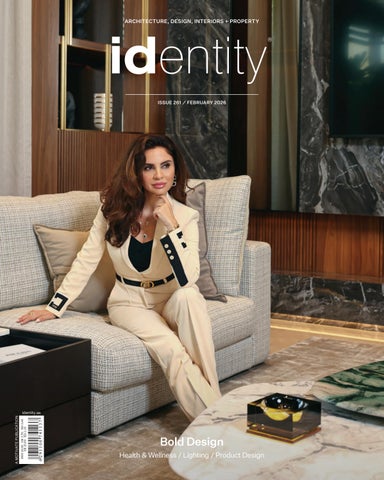
Identity-February 2026

Page 1


ISSUE 261 / FEBRUARY 2026 Health & Wellness / Lighting / Product Design Bold Design

GRANI MARMO CLASSIC

Grani Marmo Classic is a Dubai-based specialist in natural and engineered Kalinga Stones, sourcing over 300 varieties from 40 countries and delivering premium craftsmanship across more than 1,000 projects throughout the MENA region. Kalinga Stone offers some of the world’s finest engineered stone surfaces, strengthening product access and enhancing project delivery capabilities.

22 Total Turnkey Transformation

Designed and completed by Dipiugi in a super-short timeframe, this exceptional villa in Dubai meets the specific requirements of the client and their family while meeting the exacting standards of the studio’s founder and creative director

48 On Location @Maison&Objet

From the exhibition halls to the galleries of Paris, Maison&Objet 2026 revealed itself as a considered journey rather than a spectacle – one where living design, craftsmanship and cultural continuity shaped a quieter, more reflective future

60 A Brave New Design World

As the future becomes ever more difficult to predict, leading designers consider some of the biggest changes taking place in the region and beyond, and what this means for us all

66 Chromatic Haven

Nestled among water and lush vegetation, this private Florida residence translates music, sport and personal history into a richly layered interior narrative shaped by colour, craft and confidence

Surface Solutions, Designed By

Editor-in-Chief

Obaid Humaid Al Tayer

Managing Partner and Group Editor

Ian Fairservice

Chief Commercial Officer

Anthony Milne

Group Content Director

Thomas Woodgate

Editor

Aneesha Rai

Contributing Editor

Rebecca Anne Proctor

Senior Art Director

Olga Petroff

Designer

Vibha Monteiro

Sub-editor

Max Tuttle

Senior Partnerships Manager

Sharmine Khan

General Manager - Production

Sunil Kumar

Production Manager

Binu Purandaran

Assistant Production Manager

Venita Pinto

Head Office: Media One Tower, PO Box 2331, Dubai, UAE; Tel: +971 4 427 3000, Fax: +971 4 428 2260; E-mail: motivate@motivate.ae

Dubai Media City: SD 2-94, 2nd Floor, Building 2, Dubai, UAE; Tel: +971 4 390 3550, Fax: +971 4 390 4845

Abu Dhabi: PO Box 43072, UAE, Tel: +971 2 677 2005, Fax: +971 2 677 0124; E-mail: motivate-adh@motivate.ae

Saudi Arabia: Regus Offices No. 455 - 456, 4th Floor, Hamad Tower, King Fahad Road, Al Olaya, Riyadh, Kingdom of Saudi Arabia; Tel: +966 11 834 3595 / +966 11 834 3596; E-mail: motivate@motivate.ae

London: Acre House, 11/15 William Road, London NW1 3ER, UK; E-mail: motivateuk@motivate.ae

ATELIER FOR CURATED SURFACES

Editor’s Note

By February, the year starts to feel real. The energy of January settles, routines return and ideas begin to take shape in a more considered way. This issue reflects that shift – one that’s less about bold declarations and more about refinement, clarity and purpose.

This month, identity was in Paris for Maison&Objet 2026, and being there felt important. Not just to report on what we saw, but to experience the fair as it unfolded – across the exhibition halls and throughout the city. What stood out wasn’t excess or spectacle, but a noticeable sense of restraint. Many of the conversations, installations and collections pointed towards a quieter way forward for design – one rooted in craft, perception and cultural continuity. Maison&Objet felt less like a prediction of what’s next, and more like a moment to pause and reassess where design is heading, and why.

That same sense of discipline and focus carries through to our cover feature with Sawsan Chammas Haber of Sobha Villa, where Dipiugi delivered a full turnkey home under intense time pressure. Completed in just four months for a client overseas, the project is a reminder that strong design isn’t about chasing trends – it’s about experience, judgement and knowing when to hold back. Through proportion, material choices and meticulous attention to detail, Haber shows how speed and quality don’t have to be at odds when there’s clarity of vision. Our cover feature is a must-read.

On a very different scale, one of this issue’s interiors stories looks at Titter Totter in Abu Dhabi – a children’s play space that deliberately steps away from noise and visual overload. Designed by Sneha Divias Atelier, the project treats play as something thoughtful rather than chaotic, using architecture, materiality and calm to encourage imagination. It’s a refreshing take and one that speaks to a broader shift in how we design spaces for younger generations – with care, intelligence and long-term thinking.

As the year continues to unfold, February feels like a moment to slow slightly, reflect and look more closely during Ramadan and move forward with confidence rather than noise.

Welcome to the February issue of identity.

On the cover
Sawsan Chammas Haber, founder and Creative Director Dipiugi
A view of the Saddle Workshop

Arabian Equestrian Heritage Meets Contemporary Craft

Lebanese design duo David/Nicolas design ADREA, a New Abu Dhabi Riding School

WORDS – REBECCA ANNE PROCTOR

The Arab world’s Islamic concept of Furusiyya is a medieval ethical code and discipline of knighthood developed during the Medieval period and deeply rooted in equestrian philosophy. The term is derived from the Arabic word faras, meaning “horse,” and also encompasses martial arts and ethical conduct for the mounted warrior or knight, known in Arabic as faris. It is a concept that Lebanese Milan-based design duo David/Nicolas have thoroughly researched to design two spaces for ADREA, Abu Dhabi Royal Equestrian Arts in Abu Dhabi, marking the world’s fifth school of classical horsemanship and the first to be based outside of Europe. ADREA, which opened its doors in November 2025, represents an authentic Emirati interpretation of Furusiyya uniting heritage, discipline and artistry. At its core ADREA is a hub for equestrian performances, the preservation of knowledge, and immersive learning experiences embodying the harmony between horse and rider. “For ADREA, we wanted architecture to speak through material, rhythm and proportion,” said David Raffoul and Nicolas Moussallem. “Drawing from Emirati eques-

trian traditions, we designed spaces that feel rooted in heritage yet contemporary, where craft, movement and the bond between horse and rider quietly shape the experience.”

David/Nicolas designed two key spaces for ADREA, the Equestrian Library and the Saddle Workshop. The designers emphasise how the creation of both spaces went beyond just the physical design process but encompasses a need to articulate a wider cultural narrative through materials and craftsmanship that reflected ADREA’s contemporary vision, grounded in the preservation of equestrian arts. The intention, the designers emphasise, was to create environments that feel intimately connected to tradition through an emphasis

on materiality, texture and proportion to project ADREA’s narrative. The two meticulously proportioned spaces that are anchored in Abu Dhabi’s identity and draw from regional Arabian craftsmanship, the world of stables and the rituals of horsemanship.

In the Library, the emphasis is placed on curved steel bookshelves that offer a continuous rhythm, reflecting the movement and posture of a horse. In the centre of the space is a solid, hand-carved wooden volume, created in Lebanon. The space offers a rich contrast between the central anchor and the undulating shape of the surrounding bookshelves as well as the idea, explain the designers, of relishing in a quiet, contemplative moment to entering a space that is collectively shared.

Along the outer walls of the Saddle Room, visitors will immediately see wooden hooks displaying saddles in the process of being made, until they enter the central space. Here, a woodpanelled room with numerous grids of holes used for interchangeable pegs to display tools, leather straps and brass hardware can be found.

A few workshop tables, featuring intricate marquetry incorporating geometric forms reflective of Emirati architecture, occupy the room with chairs offering space for focused production. The Saddle Room features the physicality of the craftsmanship through the hung leather, brass and utilitarian tools, in a structure that is elevated through its refined design. The two spaces highlight materiality and proportion. Both rooms highlight wood as a key material, while emphasising local craftsmanship and equestrian heritage, forging a grounded experience bridging the past with the present.

Above – David Raffoul and Nicolas Moussallem, founders of the Lebanese design studio David/Nicolas; Below – (left to right) The Library; the Saddle Workshop

Jumeirah’s New Design-Led Sanctuary in Dubai

Palace Group has launched AYA, an exclusive residential development in Jumeirah Garden City, blending intentional luxury, design and meaningful living

How does a property offer an architecture and design that caters to purposeful living? AYA, a new exclusive residential development in Jumeirah Garden City in Dubai, aims to provide a design-led sanctuary in the heart of Dubai through contemporary interiors, refined architecture with an abundance of open-air spaces and holistic living.

Launched by the Palace Group, a respected name in the UAE’s luxury real estate sector, the development has been thoughtfully designed by award-winning architects John McAslan + Partners and features just 70 thoughtfully designed one- and two-bedroom residences spread across 12 elegantly crafted floors. Residences feature open-air terraces, pockets of verdant landscape and spatial transitions between buildings to offer boutique-style residential living in the heart of Jumeirah Garden City.

Inside each residence the design journey continues with thoughtfully designed spaces created to encourage a sense of calm and reflection. Natural materials are incorporated alongside soft organic curves and an abundance of natural lighting to create welcoming and intuitive living environments connected to nature. The open-plan layouts of each space cater to versatility, allowing for both private and intimate areas as well as more communal spaces for collective gathering. At the same time, extended balconies provide moments for quiet escape.

AYA offers walkable, centrally connected living within one of Dubai’s rising, sought-after districts, providing easy access to Dubai International Financial Centre and Downtown Dubai with the calm of a thoughtfully planned residential community. As Dubai continues to develop, this new residence offers a harmonious escape within the heart of a bustling, ever-evolving metropolis.

A Luminous Orb for Dubai’s Skyline

Dutch Studio MVRDV has revealed the design for a pearllike sky lounge for Dubai’s Inaura skyscraper
WORDS –

It’s hard to compete with the plethora of glistening skyscrapers that have taken over Dubai’s skyline. Yet, Dutch studio MVRDV seems to have found a way to create a building that will command attention. The Inaura skyscraper, a 210-meter building set to be built in Downtown Dubai, will incorporate what the studio has called “a jewel-like orb” on its upper floors. A luxury hotel and residential tower will be clearly visible from – and have its own views of – the Burj Khalifa and the Dubai Fountain.

“Inaura brings a character to the Dubai skyline that hasn’t really been explored before

– something that is exquisite yet simultaneously demure, in a way,” said MVRDV founding partner Jacob van Rijis. “Beyond its visual effect, however, it is also a tremendously practical design: the tower has efficient, rectangular floorplans and there is no wasted ‘vanity height’ that you see in towers with intricate crowns.” The building’s structure is in the form of a standard, rectangular shape, while the topmost part of the tower appears to be sitting on the giant, glistening orb. Within the pearl will be a VIP area while the surrounding area will have a residents’ lounge alongside a

viewpoint for gazing at the Burj Khalifa, the tallest building in the world.

“The Sky Lounge instead serves to organise and communicate the building’s program, attuned to the city at its lower levels and to the skyline at the top, with its signature feature forming a horizon in between,” he added.

The building’s four-story plinth will have a restaurant and lobbies on the ground floor and a three-story gym above. On the roof of the plinth will be an infinity pool and a spa on the floor above. Above, in the lower part of the tower, is the 101-room hotel and 105 one-to threebedrooms called “Urban Apartments.” The seven floors above the Sky Lounge are home to luxurious four-to six-bedroom “Sky Villas.”

The design’s façade is equally eye-catching and is characterised by strong horizontal bands created by two-metre-deep wraparound balconies – a design feature to help protect the building’s interiors from strong sunlight. Other features include motifs that gradually change from the tower’s base to become rounded at the top alongside mirrored glass reflecting the city at the base of the building which becomes increasingly transparent as it reaches the sky – like a radiant, glistening jewel.

Photography: The Boundary, MVRDV

An Arabian Jewel: Rosewood Doha Opens its Doors

The new Rosewood Doha, designed by Qatari architect Ibrahim Jaidah, blends natural local influences and modern luxury with Arabian heritage

WORDS – REBECCA ANNE PROCTOR

Two towers clad in design inspired by Arabian Gulf coral reefs shoot up towards the Qatari skyline. They belong to the new Rosewood Doha in the Qatari capital’s Lusail Marina which opened in early January. Designed by Qatari architect Ibrahim Jaidah, the hotel’s evocative architecture blends futuristic design with Qatari heritage, culture and numerous references to its various natural environments.

Revolving around the intersection of past and present Qatari and wider Arabian heritage, the Rosewood Doha is not meant to be experienced quickly. Its design invites a long, leisurely and thoughtful visit. From the moment the visitor arrives, they will be ushered

into manor-style living, embodying a residential, private-estate feel blending historical grandeur with modern luxury, as found in the original Rosewood mansion on Turtle Creek in Dallas, Texas or in properties like the Rosewood London and Rosewood Hong Kong’s Manor Suites. The Qatari property, however, as designed by Jaidah, seeks to intricately dialogue with its Arabian location, incorporating the organic shapes of coral formations and the flowing patterns of Qatar’s historic pearldiving tradition, reflecting the ever-evolving relationship between nature and innovation.

“Material selection was driven primarily by environmental performance, durability, and sustainability,” explains Jaidah. “As

architects, our focus was on the exterior expression; choosing materials that respond effectively to Qatar’s climate. Each material was carefully selected to ensure long-term resilience while supporting the project’s sustainable design objectives.”

Across its 155 guest rooms and suites, 162 apartments and 276 residences, the property offers spaces filled with culture and character. Each space is designed with contrasting warm and cool tones and materials that evoke Qatar’s coast and desert landscapes. Additionally, thoughtfully incorporated specially commissioned artworks by Qatari artists reflect the Gulf nation’s present culture and heritage. Their artwork can be found throughout suites,

residences, and public spaces. Each space is imagined as a private rhythm within the pace of the city, shaped by a deep awareness of how atmosphere influences emotion. Light shifts gently across walls in tones both warm and cool. Materials evoke the coast and the desert.

Thoughtfully placed pieces of local art don’t simply hang, they speak. Much of the hotel’s visual storytelling is shaped by collaborations with leading Qatari artists, whose works reflect the landscapes, memories and layered identity of Qatar, not as seen from afar, but as lived and felt from within. A particular highlight is the collaboration with Qatari ceramic artist Ghada El Khater, founder of Clay Encounters. Her mesmerising ceramics collection, thoughtfully placed within the hotel’s residences, are coloured in various hues and strongly rooted in Qatari’s local and natural heritage and demonstrate art as a core pillar of the property while highlighting Qatar’s local creative talent.

The luxury hotel operator’s latest destination strives to go beyond its hospitality mission and serve as a destination for culture, experience, memory and meaning. An overnight stay or visit to the hotel provides various upscale culinary spaces for guests to enjoy. These include Mila, a 24-hour Levantine brasserie, serving Middle Eastern comfort food within an elegant, contemporary setting.

There’s also Asaya Kitchen which takes a wellness approach to Mediterranean cuisine, offering dishes that are flavourful and especially nourishing through locally sourced seasonal ingredients. A nod to Asian cuisine can be found with the eatery Koo Madame, inspired by 1920s Shanghai and the legacy of Madame Wellington Koo, blending bold Chinese flavours within a theatrical ambiance rich with mystique and meticulous detail.

Head to Stoke & Stoker bar to continue a cultural journey through the hotel, inspired by the golden age of travel. For cigar lovers, Sikar, the hotel’s plush cigar lounge offers rare cigars and curated spirits to encourage guests to wind down. In the Butterfly Room, a poetically designed space once again blends Qatari cultural references within an upscale, elegant setting ideal for refined lunches, teas, and evening gatherings. Here, the Butterfly Pâtisserie, led by award-winning chocolatier and Executive Pastry Chef Tony, transforms chocolate and pastry into artistic creations.

Qatari storytelling is incorporated into everyday rituals, making the new Rosewood Doha more than just a luxury hotel but a place for cultural exchange, inspiration and immersive learning experiences.

rosewoodhotels.com/doha

Photography: Jonathan Maloney
The Fox Studio

An Exceptional Balancing Act

Designed by AlHumaidhi Architects, the luxurious White House in Kuwait City is sensitive to its urban context and cleverly utilises contrasting elements to deliver a sophisticated living environment

WORDS – MAX TUTTLE

This page – The clever interplay of solid and void, shadow and light, openness and enclosure enables White House to achieve a delicate balance of spatial richness and formal restraint

Left page – The solid white masses and vertical aluminium louvres that make up the front façade of White House create dynamic visuals that transition throughout the day

Situated in the prestigious Kaifan district of Kuwait City, White House is a sensitively and thoughtfully designed single-frontage home that has been designed to provide exceptional accommodation while blending seamlessly into its urban surroundings. The property is the work of AlHumaidhi Architects, well known for creating original and intelligently designed commercial and luxury residential spaces since 1992, under the guidance of its Principal, Abdulaziz AlHumaidhi. Completed in 2025, White House is set on a 500-square metre plot in a compact residential neighbourhood. Its situation demanded careful calibration of its scale and massing to align with adjacent structures and to ensure it integrates harmoniously into the existing architectural fabric, rather than imposing upon it. In addition to maintaining a respectful, modest presence on the street, the architectural narrative centred on maximising internal spatial quality.

The front façade is defined by predominantly horizontal solid white masses and vertical aluminium louvres, creating dynamic visuals that transition throughout the day. The louvres serve multiple purposes – providing privacy, filtering natural light and tempering the visual weight of the elevation. “At dusk,” says AlHumaidhi, “the house becomes a softly glowing volume, with internal illumination subtly diffused through the louvred surfaces, generating a lantern-like presence.”

The ground floor looks inwards and is organised around a private indoor pool and courtyard, which together form a tranquil core away from the street. There is abundant natural light throughout the ground floor, captured through double-height spaces and perimeter glazing that creates a feeling of openness while maintaining privacy for the occupants.

The first floor is home to the main family living areas, which have been strategically placed above the pool’s double-height void. An interplay between opacity and transparency is created by a second skin of louvres – this time more articulated – that also reinforces the layered reading of the mass. This duality means the building may be seen as a solid sculptural form, or as a permeable skin, depending on the time of day and light conditions.

The top level has been conceived as a retreat and houses a gym, office and music room, all of which open onto a generously-sized private terrace. The terrace is the perfect setting

for enjoying outdoor life in pleasant weather; it also, says AlHumaidhi, “acts as a spatial release at the top of the structure – extending the interior outward while framing select views of the sky and surrounding greenery.”

White House achieves a delicate balance through the clever interplay of solid and void, shadow and light, openness and enclosure –delivering a sophisticated living experience that is spatially rich and formally restrained. As AlHumaidhi concludes, “This residence asserts a quiet confidence while contributing to the continuity of the neighbourhood’s architectural language.”

Photography: Nelson Garrido

Monumental Art Returns to AlUla

Desert X AlUla returns for its fourth edition under the theme ‘Space without Measure,’ presenting specially commissioned site-responsive artworks throughout Saudi’s ancient desert region

WORDS – REBECCA ANNE PROCTOR

Saudi Arabia’s ancient vast desert region is becoming a global hotspot for culture and heritage. The returning fourth edition of biannual Desert X AlUla, presents monumental site-responsive artworks that challenge how individuals perceive art within a natural environment. This edition, which features works by 11 artists positioned throughout the AlUla landscape, reflecting a diversity of concepts, materials and traditions, draws inspiration from the literary and poetic works of Lebanese American writer Khalil Gibran who once described dreams as “Space without measure.”

Desert X AlUla, which runs until February 28, 2026, is a cornerstone of the annual AlUla Arts Festival, this year marking its fifth edition and which

Ibrahim El-Salahi, Haraza Tree, Desert X AlUla, 2026
Mohammed AlFaraj, What Was the Question Again?, Desert X AlUla, 2026

transforms the ancient oasis city of AlUla into an immersive platform for art and culture.

Curated this year by Wejdan Reda, Zoé Whitley, with artistic direction by Neville Wakefield and Raneem Farsi, Desert X AlUla presents commissioned monumental works by participating artists Sara Abdu, Mohammad Alfaraj, Mohammed AlSaleem, Tarek Atoui, Bahraini Danish, Maria Magdalena CamposPons, Agnes Denes, Ibrahim El-Salahi, Basmah Felemban, Vibha Galhotra, and Héctor Zamora.

“Desert X AlUla is such an expansive context for artists’ ideas to be realised, true to poet Khalil Gibran’s observation that dreams are ‘time limitless’ and provide ‘space without measure’,” said Whitley. “A stone’s throw from a UNESCO World Heritage site, vast history meets the contemporary moment. It’s been a remarkable collaborative process to see how the artworks were each conceived, inspired by and in harmony with the surrounding landscape.”

From monumental kinetic sculpture to sound-based creations located above and below the desert landscape, each commission is rooted in a mission to dialogue visually and thematically with AlUla’s distinctive natural environment. Highlights include Saudi artist Mohammad Alfaraj’s What was the Question Again? highlighting a palm tree made of numerous grafted trunks reflecting ideas of renewal, harmony with nature and the intricate relationships between people and their environment. There’s also the evocative installation Imole Red by Cuban-born, US-based multidisciplinary artist Maria Magdalena Campos-Pons which channels the land, spiritual heritage and light. Inspired by AlUla’s sunsets and West African Yoruba traditions, the work incorporates coluor and energy, transforming such elements into a flowing, alchemical garden that cherishes the valley’s past and its connection to water. Leading Sudanese modernist artist Ibrahim ElSalahi presents the installation Haraza Tree, inspired by the resilient acacias that grow throughout AlUla’s canyons. The work features a forest of sculptural meditation trees that reflect ideas of unity derived from multiplicity. Meanwhile, Saudi artist Basmah Felemban’s Murmur of Pebbles brings into focus and magnifies the smallest geological elements of the surrounding landscape and transforms them into monumental limestone sculptures, reflecting the ancient rivers that once shaped AlUla’s desert. The pebbles, now in their grandeur, highlight ideas of memory and resilience encapsulated within each stone.

The works presented communicate with AlUla’s landscape and explore Gibran’s meditations on the realm of possibility and the enduring strength of the human spirit.

Sara Abdu, A Kingdom Where No One Dies: Contours of Resonance, Desert X AlUla, 2026
Photography: Lance Gerber

Total Turnkey Transformation

Designed and completed by Dipiugi in a super-short timeframe, this exceptional villa in Dubai meets the specific requirements of the client and their family while meeting the exacting standards of the studio’s founder and creative director

WORDS – MAX TUTTLE

Most of us dream about being given almost completely free rein to design a luxurious villa. But what if it were for a client who was abroad and would be moving in with their family the moment they returned? And if the timescale for completion was just four months?

That was the challenge given to Sawsan Chammas Haber, founder and Creative Director of UAE-based studio Dipiugi. The brief was concise: “This had to be a fully turnkey project – even down to the last accessory –as the client made it clear they would not have time to do anything when they arrived in the country. Dipiugi did the interiors, the exteriors, the landscaping – everything!”

Chammas Haber describes the project as a “very tough challenge: a very short timescale, and with very high expectations” – but she has always been highly motivated, having begun her career in 1995 while still studying, aged just nineteen. She became Chief Designer at Robert Chouchani Interiors in Beirut and in 1999 graduated with a Bachelor’s Degree in Interior Architecture from the Lebanese University of Fine Arts. Just one year later, she got married and moved to Dubai.

In 2003, she set up her own company: K-Kids. “Rather than competing with the big companies I decided to do something niche. I specialised in kids’ bedrooms, nurseries –all interior design relating to children – and

created a furniture line.” Chammas Haber estimates the company had designed around 300 bedrooms by 2013. Dipiugi was set up at the end of 2004 and quickly established a reputation for outstanding design and exacting standards. “It has been a beautiful journey,” says the company founder, “because I started from scratch, on my own – I really had to believe that my capabilities, fresh ideas and passion would enable me to succeed.” She looks back on that time as a ‘golden era’, and recommendations from delighted clients kept the project pipeline flowing.

Today, Dipiugi has employees in Dubai and abroad and is, says Chammas Haber, “A couture studio for interior design. I want each client to have their own experience; a home that reflects their lifestyle – and I am humbled but also proud that people want my company to design their homes.”

Total transformation

Chammas Haber believes the personal approach taken by Dipiugi paid dividends during this project. “Every client is different – I might say that I’m not only a designer, but also a psychologist,” she says. “For every project, I get to know them and their personality, lifestyle, routines, demands, expectations and emotional attachments. This is the starting point for delivering homes that are personal, but also aesthetically and architecturally strong.”

Those values shine through in Sobha Villa, a large five-bedroom property in Dubai. Yet the villa that Chammas Haber saw when she met the client in person (the only time before the project began) was devoid of all character. “It was totally empty and everything was very rigid, very plain.”

The client asked that this lifeless shell be transformed by Dipiugi into a luxurious home for him and his young family. Within a month, the design work had been undertaken and the client’s go-ahead received, giving Chammas Haber and the Dipiugi team just four months to complete the project. “It was a crazy schedule – we worked day and night,” she says. “Each of us in the team working on this villa lost around six or seven kilograms!” With the client being abroad, they were kept informed of progress via reports and videos shared by WhatsApp.

Balance and proportion

This page – The garden of Sobha Villa was transformed into a ‘small Maldives’ complete with gazebo and small beach, as well as palm trees and a large olive tree that required a crane to put in place

Left page – The double height in the living area is celebrated with high-reaching joinery and cladding giving an elongated feel to the wall, but low-level furniture producing a cosy feel

Upon entering the villa, any visitor will be struck by the double-height volumes of the dining area and living area, complete with jaw-dropping chandeliers of impressive scale. These spaces were challenging, as Chammas Haber explains: “Balance and proportion were vital – the two areas are architectural features but are also warm and inviting. The extra height is celebrated, with the two libraries, tinted mirrors and high-reaching joinery and cladding giving an elongated feel to the wall, but low-level furniture produces a cosy feel to the living area. The skill is to blend what could be disproportionate elements into the volume.”

This skilful blending can be seen throughout the villa. “When I use any mixture of colour, I always go with colours that last – I use a lot of subtle green in my projects, such as that in the living area. There are strong browns,

but not too much – it needs to pop out. It’s about how you balance homogeneity and contrast. Each room is like a painting – blended together but with something of interest that draws attention,” the designer states.

The villa also clearly reflects Chammas Haber’s approach for using lasting materials such as wood, marble, stones and metals. “I try not to go ‘crazy’ with fixed things, and I don’t follow trends – for example, if a certain wood or veneer is ‘trending’, then it’s likely to look old-fashioned in a few years when that trend is ‘dead’. The same is true for colours. If I go ‘crazy’, it’s with an item of furniture – such as a chair or a floor lamp – that can act as a statement element. This means that a client – or the new owner –can make changes without ripping it all down.”

The designer says she had a vivid validation of this approach recently: “I visited a project that we handed over in 2006. It still looks

great – in fact, the client had a guest there who thought it has just been done!” That’s not to say that improvisation is not required sometimes: “The staircase of Sobha Villa was originally designed to be black marble, but as the project evolved and I saw the walls I realised it needed something different. So I went to the marble supplier and searched for the right stone –even though I didn’t know exactly what I was looking for. The staircase is now quartzite, and the combination of colours is beautiful.”

Embracing illumination

Lighting is found everywhere in the villa –from gentle background illumination around wall components and in storage areas to perfectly judged lighting either side of the lift, underneath each stair and within the brass stair handrails, which were electroplated to ensure a rich, sophisticated tone. The villa’s chandeliers are true statement pieces, which take time to perfect, as Chammas Haber explains: “The shape, size, location and height of each one is unique. I am always there when they’re being put in place – I fix them piece by piece –as that’s the only way I can judge how they look and feel, even if 3D models have been produced. I see it from every angle – just like occupants and visitors will. This is why a chandelier can

take two full days to get right; I treat them like sculptures. But I enjoy it – it’s like creating art and putting my personal touch on the project.”

Attention to the smallest detail

One stand-out aspect of this project, Chammas Haber says, is how completely Dipiugi was involved. “This was not just about finishing the structure – we styled this villa! Everything in it – right down to the figurines and the accessories – was specified and sourced by us. Virtually all furniture came from abroad, with most pieces being produced in Portugal and Italy. There were many problems with shipping from Europe at the time – another challenge to overcome so that handover was not delayed.”

There were some stipulations, notably around technology and entertainment: “As the client trades and is online a lot, it was extremely important that his office [part of the master suite that also includes a bedroom, walk-in closet, sitting area and massage room] was designed in a certain way, to accommodate several screens and discreet electrical and data connections, which were also needed for entertainment and digital art. He also wanted a TV in each room, which is challenging to accommodate while creating a special appearance and ambiance, and for the specific surround

sound system to reach every area of the home – including the bathrooms and the garden!” Throughout the home, the invisible inclusion of technology extends to the curtains and the lighting, which can all be controlled through the home automation system.

A compact space, a big challenge

Despite its relatively compact size, the garden was transformed into the ‘small Maldives’ that the client wanted, complete with a gazebo and a small beach. Here, there was a huge challenge: “To fully achieve the desired look and feel, we included palm trees and a huge olive tree; with the garden being at the back of the villa, this was a challenge; we had to use a crane to put everything in place,” recalls Chammas Haber.

The crane was also used to lift a single, large piece of precious marble into place in the first-floor office. “It was too large to go up the staircase or in the lift, and utilising the crane allowed us to keep a single piece, with no joins; we wanted to fix it as a single piece; we did not want to cut it.” The success of Dipiugi’s transformation of Sobha Villa was confirmed immediately at an emotional handover. “The clients said ‘Thank you for giving us our dream home’ – it was beautiful to see that level of satisfaction in their eyes,” reflects Chammas Haber.

Above – (from left) Outside the massage room in the master suite of Sobha Villa, warm lighting, wall features and the custommade chandelier complement the Stonehenge console by Boco do Lobo; Dipiugi’s involvement in the design of Sobha Villa was exhaustive, from the furniture that was sourced mainly from Portugal and Italy, to the figurines and the accessories

Where Curves Meet Craft and Light

From lamps to furniture, design guides how we see and feel interiors

WORDS – NILUFER NAJEEB

[ABOVE]

KAMEH

KAMEH 0.6 draws inspiration from the desert rose, a natural crystal formation of gypsum and barite, whose layered petals balance delicacy with endurance. This duality informs the collection, where crystalline forms become functional sculptures that feel unearthed rather than made.

BELLHOP BY FLOS

Developed by Flos in collaboration with British designers Edward Barber and Jay Osgerby, Bellhop Glass expands the iconic Bellhop family into a refined collection of suspension and ceiling lamps in blown glass, designed to offer both diffused ambient light and precise illumination from below.

When a design achieves widespread recognition, its form naturally becomes archetypal. Bellhop follows this trajectory, reinterpreted here through the softness and depth of blown glass, which lends the lamp a lighter, more tactile presence while preserving its distinctive silhouette.

The suspension version is defined by a carefully engineered double opening: one at the top to house the electrical components, and a second at the bottom, framed by a coloured aluminium ring that directs a focused, non-dazzling cone of light onto the surface below. Light expands evenly within the glass body, creating a warm, homogeneous glow throughout the space. A painted metal cylinder emerging from the top references the original Bellhop design, while the lateral exit of the electrical cable introduces a subtle, choreographic detail that transforms a technical element into an intentional design gesture.

The works explore scale, texture, and materiality: charred timber evokes both tactile memory and resilience, its matte surface strengthened by fire, while raw stones and mirrored plinths introduce reflection, depth, and shifting perspectives. Small-scale handcrafting in the UAE ensures each piece carries subtle irregularities, celebrating human touch alongside natural influence.

KAMEH 0.6 transforms mineral growth into domestic design, bridging landscape and interior. Objects invite contemplation through contrast, intimate detail versus expansive presence, permanence versus impermanence. Each sculpture becomes a portal to the desert, where material, craft, and space converge into a thoughtful, sculptural experience that embodies memory, movement, and quiet strength.

[LEFT]
Photography by Natelee

LAGO

Lago presents the Mezz’aria armchair, designed by Daniele Lago, exploring lightness and suspension through a pronounced cantilever, where structure appears to defy gravity while remaining solid and reassuring. Its quilted padding wraps the seat and backrest, combining comfort with visual refinement.

The dynamic silhouette and unique leg inclination give the chair a distinctive presence, emphasising innovation in both form and function.

Designed for versatility, Mezz’aria adapts seamlessly to residential and contract spaces, maintaining its sculptural integrity across different environments. Available in a range of finishes and upholstery, the armchair responds to varied stylistic interpretations, balancing technical precision with elegance. Mezz’aria exemplifies a furniture language where form, comfort, and materiality converge, creating a piece that is simultaneously functional, expressive, and sculptural.

GIOPATO

Giopato & Coombes presented Mini Maxi at their Paris gallery, the collection brought together a constellation of works, during Maison&Objet in January 2026. The presentation explored how changes in scale transform the perception of light and space.

The collection featured Bolle Small and Bolle Large, with scale as its central concept. In the Mini versions, light appeared as delicate bubbles: compact, intimate forms meant to be discovered up close. In contrast, the Maxi versions stretched into the suspended space, occupying the room with a slow, orbiting presence that engaged with the environment as a whole.

Through this contrast, Bolle offered two complementary experiences: leaning in to appreciate intricate detail, or stepping back to take in the full spatial effect. Scale became more than a measurement, it became a tool to shape intensity, presence, and atmosphere, making the collection both visually captivating and conceptually expressive.

[RIGHT]
[BELOW]

MARIONI

Designed by La Récréation for MARIONI, the Palm series is part of the Notorious collection, which explores a playful reinterpretation of 1930s–40s seaside architecture through furniture and lighting. Combining brass structures, lacquered wood shelves, and ceramic elements, the collection creates pieces of varying heights and proportions that are both functional and visually striking.

The Palm floor lamp exemplifies this approach. Alternating truncated conical ceramic elements in contrasting aquamarine and black, it rests on a brushed brass base and is crowned by a spherical satin glass diffuser. The combination of geometric forms, rich materials, and contrasting tones creates a light that is both elegant and original, while maintaining a reassuring aesthetic quality.

Ceramic components are available in multiple glaze combinations, allowing each lamp to be customised to suit residential or hospitality settings. As with all pieces in the Notorious collection, careful attention to detail and adherence to safety standards ensure a product that is both beautiful and enduring.

[ABOVE]

[BELOW]

MUSOLA

Musola made its debut at Maison&Objet Paris 2026 with a selection of furniture that explores the intersection of structure, material, and adaptability, proposing a design language conceived to move seamlessly between outdoor and interior spaces. The collection is defined by clean geometries, sculptural volumes, and a careful balance between technical performance and visual lightness.

Tables, seating systems, and sofas reveal a consistent approach to design, where modularity and proportion guide each piece. Ceramic surfaces, metal structures,

and upholstered elements are combined to create furniture that feels both robust and refined, capable of adapting to different settings without losing its identity.

Designed in collaboration with studios such as Yonoh, Santiago Sevillano, and Carlos Guijarro, the collection reflects a shared focus on versatility and clarity of form. Together, the pieces create a cohesive landscape of contemporary furniture, where durability, comfort, and design precision define a timeless approach to living across spaces.

A Moroccan Wellness Escape

A series of new wellness journeys within the Moroccan-inspired design of The Oberoi, Marrakech offer a rejuvenating escape in North Africa’s famed Red City

In the mystical Moroccan city of Marrakech, the revered Indian family-founded luxury hotel chain known as The Oberoi Group presents a resort featuring Moroccaninspired architecture spread across 28 acres of gardens, calming water features and orchards with views of the Atlas mountains with a focus on wellbeing and rejuvenation. Marking

the group’s 33rd hotel, the property offers 84 rooms, suites and villas, many with private pools and gardens, three restaurants and a spa. As the nascent new year continues to commence, the hotel has unveiled SAHA, a collection of immersive wellness journeys designed to guide guests into 2026 with clarity, balance, and a restored sense of vitality.

A trip to Marrakech is filled with memorable experiences, both cultural and leisurely, as visitors eagerly explore the city’s vibrant scene, rich history and mesmerising architecture. A centuries-old magnetic destination for European artists and intellectuals, like designer Yves Saint Lauret and Henri Matisse, and statesmen like Winston Churchill and Franklin D. Roosevelt, the city, also known as the Red City for its distinctive red sandstone buildings and ramparts, can be bustling and dynamic or calm and reinvigorating. With The Oberoi, Marrakech’s latest wellness collection, it is proposing an escape based on the latter. SAHA offers a personalised journey to start the year feeling lighter, calmer, clearer and full renewed. Grounded in Moroccan wellness wisdom, SAHA offers three signature wellness journeys. Each experience is available as a three, four or five-day program providing guests with the ability to choose the extent of their wellness journey and what best aligns with their personal goals – whether it be increased strength, vitality or stillness. The first journey, titled Tranquil Aura, offers a journey into rest, stillness and inner calm, providing a sanctuary for those desiring emotional balance and deep nervous system recovery. Aiming to

quiet the anxious mind while gently restoring the body’s natural sleep rhythm, the journey features slow, rhythmic therapies and grounding rituals that create space for profound rest. The program, ideal for guests deeply affected by stress, fatigue or overwhelm from a busy life, includes treatments such as Himalayan Singing Bowls Massage, Sound healing or breath-focused meditation, personalised yoga sessions and the signature Dhara massage, a luxurious Ayurvedic treatment combining a full-body massage with a focused, rhythmic pouring of warm, therapeutic liquid such as oil, buttermilk or herbal decoctions on the forehead. Tranquil Aura can be experienced across three to five days and is designed to fully reset the mind and the body to emotional balance and inner calm and clarity.

The second journey is Silhouette, offering a detox that works to refine the body and renew the metabolism through a blend of detox therapies, body-sculpting rituals and mindful movement. The programme includes graceful physical transformation through sessions such

as personalised Pilates or cross-training, body sculpting and body shaping, Chinese meridian acupressure, foot reflexology and aromatherapy. The journey, grounded in experiences deeply rooted in the movement of the body, aims to return guests to a state of high energy and alignment, both physically and psychologically.

Vital Flame, the third journey, offers a programme anchored in energy, movement and rejuvenation, ideal for those experiencing fatigue, stagnation or physical and mental tension. The journey, aimed at upliftment and reigniting physical energy, increases flexibility and restores a sense of vibrant flow in the mind and body. Treatments include personalised cardio boxing or Pilates and volcanic hot stones therapy, a deeply relaxing massage incorporating smooth, heated basalt or volcanic stones placed on the body in tandem with massage strokes to relieve muscle tension, reduce tension and improve circulation. There is also a fruity, anti-fatigue massage and strength and muscle reinforcement sessions. Guests can opt for three to five days of the programme to

experience greater physical vitality, clarity and a sense of lightness.

While the various SAHA journeys focus on mind and body wellness through diverse treatments, the hotel offers parallel culinary experiences that complement each journey. Thoughtfully prepared vegan dishes are crafted to complement each wellness path, with each meal aligning with the programme’s philosophy, aimed to ensure harmony between therapy, movement and nutrition.

SAHA transforms The Oberoi, Marrakech into an oasis of wellness. While each programme goes deeply to heal the mind and the body of its ailments, the surrounding natural landscape and beauty of the resort’s design and architecture go equally to provide a setting that is inspiring, grounding and physically and mentally elevating. Rooted in wellness wisdom from Morocco alongside ancient and contemporary wellbeing therapies, aesthetic and natural beauty unite with rituals for self-care in experiences that are timeless and deeply memorable. oberoihotels.com/hotels-in-morocco-marrakech

Things to Covet

The bold and colourful pieces that will elevate any space

WORDS – NILUFER NAJEEB

1. Storet by Acerbis

Storet chest of drawers brings Nanda Vigo’s playful vision into functional form. Available as a vertical tower or nightstand, produced in black ash, dark-stained walnut, or matt lacquer, its vertical structure showcases extensive wood surfaces with visible grain. Glossy lacquered drawers, including fluo green, reference Vigo’s iconic light installations, transforming storage into a dynamic, sensory design statement.

2. Bilboquet by FLOS

Designed by Philippe Malouin, this sleek LED table lamp has an adjustable head for focused lighting. Crafted from pigmented polycarbonate sourced from paper by-products, it features a steel sphere with PVD coating. Fully recyclable and glue-free, it combines sustainability with elegant, precise engineering.

3. Linear by Jaipur Rugs

Elevating interiors with hand-tufted area rugs that combine wool and viscose for a luxurious, silky sheen. Bold colour blocks, sharp geometries and pronounced borders create striking contemporary patterns, while contoured designs bring harmony and balance.

4. Michel Ducaroy’s Togo for Ligne Roset Deep blues define 2026 interiors, offering rich, grounding alternatives to black and grey.

Shades like navy and midnight add depth and calm without overwhelming spaces, pairing beautifully with warm woods and soft lighting. Ligne Roset’s Michel Ducaroy-designed Togo collection embodies this comfort, blending ergonomic design with inviting quilted upholstery for ultimate relaxation.

5. Dojo bookcase by Marcel Wanders for Roche Bobois

Inspired by Japanese sliding partitions, the Dojo bookcase by Marcel Wanders for Roche Bobois features five black lacquered shelves framed by mobile geometric panels. Available in oak veneer or high-gloss colours, its modular design blends tradition and modernity with smoked bronze mirror accents for a truly striking, versatile statement piece.

6. Aperitivo Pendant lamp by Servomuto

Designed by Servomuto, known for embracing sartorial precision, the Aperitivo pendant lamp evokes the lively spirit of 1930s Italian bars, where Campari and Depero’s artworks set the scene. Available in three jacquard or geometric Hermèsinspired colourways ivory, emerald, and rust, it features warm brass detailing and precise proportions, making it a timeless, elegant statement for modern interiors.

7. TRAGA Glass

A refined dual-sided glass designed for versatility and ritual. Crafted from durable borosilicate glass, it withstands hot and cold temperatures with ease. Finished in teal and blue tones inspired by Italian palazzo interiors, it includes a sleek steel skewer for garnishing, an elegant expression of Daniel Nikolovski’s timeless, detaildriven design approach.

8. Curvy Table Mini by Gustaf Westman

A handcrafted wooden mini sideboard or stool, available in semi-matte lacquer or natural matte pine or oak Origin.

Vibha Monteiro

Horizons in Design on the Red Sea

The Red Sea Resort positions Shura Island as a study in light, architecture and serenity along Saudi Arabia’s western coast

A palette of stone, timber and woven textures grounds the architecture in place

On the shores of the Red Sea, where turquoise waters meet gently shifting desert dunes, InterContinental

The Red Sea Resort unfolds as a carefully composed architectural landscape. Set on Shura Island, the resort introduces a vision of luxury shaped not by excess, but by light, form and a measured dialogue with its surroundings.

From arrival, the experience is guided by architecture. Conceived by Foster + Partners, the resort is defined by curving facades, sunlit volumes and structures that trace the natural rhythm of the island’s coastline. Buildings appear to rise organically from the terrain, their scale softened through repetition, curvature and a deliberate relationship to the sea.

A palette of natural materials – stone, timber and woven texture – grounds the architecture, creating spaces that feel contemporary yet deeply rooted in place. Interiors by Kristina Zanic Consultants extend this sensibility indoors, where muted tones, soft lighting and curated artworks by Saudi creatives establish a calm, reflective atmosphere across guest rooms and public spaces alike. Together, architecture and interiors form a narrative that encourages exploration through stillness rather than spectacle. Sustainability informed the project at every level, from orientation and massing to material selection. Buildings are positioned to maximise natural daylight, reduce energy demand and respond

sensitively to the island’s climate and topography. This integrated approach culminated in LEED BD+C Platinum certification, reinforcing the resort’s commitment to environmental responsibility as a design principle rather than a visible statement.

Accommodation is conceived as an extension of the surrounding landscape. Guest rooms and suites are defined by generous proportions, floor-to-ceiling windows and gently curved walls that frame uninterrupted views of the Red Sea. Layered textures and tactile finishes add warmth and depth, while a restrained interior language maintains continuity throughout the resort. Club InterContinental offers a quieter, more private expression of this design approach, with spaces that emphasise discretion, comfort and spatial calm.

Beyond the rooms, the architectural narrative continues through a series of experiences shaped by movement and flow. SPA InterContinental is conceived as a retreat within the retreat, where spatial sequencing, filtered light and material restraint foster a sense of sensory balance. Across the island, cycling paths, gardens and waterfront routes are choreographed to encourage slow discovery, allowing guests to engage with both the built environment and the preserved natural landscape.

Design extends seamlessly into familyoriented spaces. Planet Trekkers introduces younger guests to marine-inspired interiors that balance colour, light and playful form, while outdoor environments are carefully calibrated to feel both engaging and secure. These areas are integrated into the wider masterplan, ensuring that family experiences sit harmoniously alongside the resort’s overall sense of calm.

Dining venues further reflect the resort’s design philosophy. Each space is defined by a distinct material and spatial identity, from Moroccan and Levantine influences to interiors inspired by mangrove ecosystems and Mediterranean coastal ease. Rather than standing apart, the restaurants form part of the architectural rhythm of the resort, reinforcing the idea that every experience is shaped by design.

Through its architecture, interiors and sensitive integration with nature, InterContinental

The Red Sea Resort presents Shura Island as more than a destination. It is a carefully layered environment where light, landscape and built form converge, offering a composed and immersive encounter with the Red Sea – one defined by restraint, clarity and a deep respect for place.

Above – Generous guest rooms and suites feature floor-to-ceiling windows and gently curved walls framing views of the Red Sea

Palm Jumeirah’s New Opulent Residence

Alpago Group has unveiled the Curve DiLusso villa on Palm Jumeirah featuring a design highlighting local craftsmanship

Astunning new palatial residence has arrived on Palm Jumeirah. Curve DiLusso, located in Palm Jumeirah’s Frond C, is an elegant beachfront property with residences estimated at Dhs95 million and spanning 7,496 sq. ft. in built-up area, offering residents a reclusive upscale oasis in one of Dubai’s most sought-after districts.

Launched by Alpago Design & Build, the villa features a dynamic marble façade with a curved design offering graceful, seamless movement, built with hundreds of handcrafted pieces, meticulously aligned and placed with precision.

The villa’s architectural silhouette has been conceived by the iconic Italian design house Pininfarina, a name synonymous with a timeless sense of modernity, craftsmanship and sculptural purity. The interiors have been curated with the incorporation of furniture by leading international furniture brands, including Antonio Luppi, Henge, Matteo Gennari, Rimadesio, Molteni, Galotti & Radice, Gessi, Reflex, Laura Meroni, Galotti & Radice, Paolo Castelli, Bonaldo, B&B Italia, Baxter, and Poliform.

Once inside, the interiors span three levels, connected by a majestic triple-height staircase positioned below a skylight, and feature five bedrooms and six bathrooms as well as a cinema and a state-of-the-art gym. A feature of the villa, and among its architectural masterpieces, is a grand spiral staircase, adding once again fluid, harmonious curve and movement to the villa. Residents can also use the private elevator to move from floor to floor.

At the centre of this architectural masterpiece is a grand spiral staircase, bringing harmony to all levels, while the floor-to-ceiling windows offer natural light and uninterrupted views of the beach.

Each space features warm tones and textured surfaces used to enhance states of calm. The bathrooms feature a distinctive use of marble in shades of blue, grey and green that injects the space with vibrancy and movement.

For ultimate seclusion and stunning views of the beaches on Palm Jumeirah, the Super Master Bedroom spans the entire upper level and is bathed in natural light and designed to offer a luxurious cocoon filled with handcrafted pieces, sculpted stone elements and textured accents alongside a warm colour palette to evoke further tranquilty.

Outside, a landscaped terrace with an infinity pool offers a luxurious oasis merged with the natural environment and views overlooking the Palm Jumeirah skyline.

WORDS – REBECCA ANNE PROCTOR

Built-in lounge seating in durable finishes allows for comfort and clear sightlines, with quiet corners for reading or a pause

Play, Reconsidered

At Reem Mall in Abu Dhabi, Titter Totter by Sneha Divias Atelier redefines the children’s play space as an exercise in architectural restraint – where proportion, materiality and calm replace colour overload, and design becomes a quiet framework for imagination

WORDS – THOMAS WOODGATEPHOTOGRAPHY – NATELEE COCKS

In a retail landscape dominated by noise, colour and spectacle, Titter Totter presents a markedly different proposition. Located within Abu Dhabi’s Reem Mall, the 350-square-metre children’s play space has been conceived not as an explosion of stimuli, but as a carefully calibrated environment – one that treats early childhood with seriousness, dignity and architectural intent.

Designed by Sneha Divias Atelier, the project responds to a brief that demanded more than a conventional playroom. The client sought a space that could inspire creativity and independence in children while offering comfort, reassurance and visibility for parents. Durable, hygienic and safe, yet emotionally intelligent, Titter Totter was envisioned as a sanctuary where play, discovery and rest could coexist seamlessly. Rather than adopting themed graphics or cartoon references, the design embraces a measured, almost civic approach. Architecture itself becomes the pri-

mary tool for engagement, learning and exploration. Montessori-inspired principles inform the layout, privileging independence, sensory awareness and self-directed movement. The result is an interior that feels calm, intuitive and quietly engaging – an environment that allows children to author their own experiences rather than respond to pre-scripted ones.

A restrained palette of light oak, terracotta accents and moss-green details establishes warmth and continuity throughout. Curves dominate the spatial language: arches, rounded walls and carved-out niches soften the interior and cultivate a sense of safety and approachability. The architecture avoids rigid zoning, instead unfolding as a sequence of interconnected spaces that follow the natural rhythm of a child’s day.

Active areas – climbing structures, padded ramps and a marble-run wall – are deliberately balanced with quieter moments. Reading pods offer retreat, while a workshop room sup-

ports art-making and storytelling. Movement is carefully choreographed: bursts of energy give way to pause, encouraging children to navigate intuitively between stimulation and calm. The space remains open and legible, yet articulated through smaller niches that allow for both sociable play and private exploration.

“Children don’t need noise to be inspired,” says Sneha Divias. “Give them proportion, texture and light, and they will create the story themselves.” That philosophy underpins every decision. Rounded edges, tactile surfaces and furniture scaled precisely to young bodies encourage confidence and independence. Rather than directing behaviour, the space functions as a form of architectural pedagogy – where spatial fluency and aesthetic literacy are absorbed instinctively.

Titter Totter also rethinks the role of adults within children’s environments. Parents are not relegated to the margins but considered integral to the experience. Lounge seating in durable, refined finishes and builtin benches provide comfort without intrusion, while clear sightlines allow for supervision at a distance. Quiet corners support reading, light work or pause, transforming the venue into a shared family environment rather than a transactional drop-off point. Behind the project’s calm aesthetic lies a rigorous technical framework, executed with a level of precision more commonly associated with boutique hospitality interiors. Impact-absorbing floors, rounded radii, antimicrobial finishes and firerated upholstery ensure durability and safety without visual compromise. Acoustic treatments, concealed within ceiling clouds and upholstered panels, absorb excess noise so that even at peak times, the atmosphere remains composed rather than overwhelming.

Environmental systems further support sensory balance. Climate control and air purification maintain consistent comfort, while programmable lighting shifts subtly from energetic play to quieter storytelling sessions. These elements operate discreetly in the background, reinforcing the sense that every detail has been considered. Beyond its immediate function, Titter Totter reflects a broader cultural shift in the region. As Abu Dhabi continues to invest in family-focused infrastructure, there is growing recognition that children’s spaces deserve the same design intelligence as galleries, hotels and cultural institutions. This project treats young users as discerning occupants, capable of appreciating beauty, order and subtlety.

“Designing for children is designing for the future,” Divias reflects. “These are the spaces where first memories are formed.” Playful yet composed, tactile yet restrained, Titter Totter stands as a quiet counterpoint to visual excess – setting a new benchmark for how children’s environments might be conceived, with intention, care and enduring quality.

Active areas – Climbing structures, padded ramps and a marble-run wall introduce active play, balanced by softer, quieter moments

On Location @Maison&Objet

From the exhibition halls to the galleries of Paris, Maison&Objet 2026 revealed itself as a considered journey rather than a spectacle – one where living design, craftsmanship and cultural continuity shaped a quieter, more reflective future

WORDS – SHARMINE KHAN

Maison&Objet has long been a marker of where design is heading, but in 2026 it felt less like a forecast and more like a moment of recalibration. Walking through the fair this year in Paris, I was struck not by excess or novelty, but by restraint – by a collective shift towards perception, craft and cultural continuity. This was a show less concerned with making more, and far more interested in seeing more clearly.

That idea was captured succinctly by Harry Nuriev, Designer of the Year 2026, whose words lingered well beyond his installation: “Transformism is not about invention – it’s about perception. Not about making more, but seeing more clearly.” It became a useful lens through which to experience the fair, framing a broader conversation about how design is evolving.

This year, Maison&Objet placed the spotlight on living design – objects and environments shaped by narrative, memory and intent. Across the halls, four key themes emerged: Metamorphosis, Mutation, Baroque Revisited and Neo-Folklore. Rather than reading as competing trends, they felt interconnected, each exploring transformation through material, form and cultural reference. What united them was a renewed respect for artisanship, treated not as nostalgia but as a contemporary, evolving practice.

Several brands embodied this approach with quiet confidence. Talenti SPA presented outdoor collections that balanced sculptural presence with material restraint. Kana Objects demonstrated how subtle geometry and texture can elevate everyday forms, while Giopato & Coombes offered lighting that felt atmospheric rather than decorative – pieces designed to shape mood as much as space. Senimo and Lumen Centre also stood out, their displays composed and thoughtful, allowing the work to speak without spectacle.

The fair’s curated platforms added depth to the narrative. What’s New in Décor, curated by Elizabeth Leriche in Hall 2, was particularly resonant. Her scenography created an immersive journey where each installation reflected an exhibitor’s evolution, while collectively establishing a dialogue between past and future. It was less about trends as instructions, and more about trajectories – where design has come from, and where it might be heading.

In Hall 4, What’s New in Hospitality, curated by Rudy Guenaire, offered a more experiential lens. His aviation-inspired scenography was futuristic and dreamlike, evoking the romance of ultra-luxury travel without tipping into fantasy. It suggested how hospitality design might balance escapism with sophistication in the years ahead.

Beyond the fairgrounds, Maison&Objet in the City extended the experience into Paris itself. Moving between galleries, showrooms and private presentations, I encountered founders of collectible design studios, art gallerists and furniture makers, reinforcing the idea that design thrives within cultural ecosystems rather than isolated platforms. Christie’s and Gilles & Boissier, in particular, offered moments where art, interiors and collectability intersected with clarity and confidence.

Paris in January was unforgivingly cold, a practical reminder for visitors to layer accordingly. Logistically, public transport remained the most efficient way to reach the fair, with the RER B and complimentary shuttles from Charles de Gaulle Airport offering seamless access. Leaving Maison&Objet 2026, I felt a sense of calm rather than overload. The fair did not shout for attention; it invited reflection. In doing so, it reaffirmed Paris as more than a host ciy – it positioned it as a cultural anchor, where design continues to evolve through perception, dialogue and purpose.

This page – (clockwise from top left) Harry Nuriev, Designer of the Year 2026; Talenti; Vips and Friends. Left page – What’s New In Decor by Elizabeth Leriche
Photography: Anne Emmanuelle Thion

A Secret Garden in the Desert

Set within a protected wildlife reserve, Raffles Al Areen Palace

Bahrain unfolds as a quietly luxurious retreat where light, landscape and local craft shape an experience of understated refinement

Amid sweeping palm groves on the edge of Bahrain’s desert landscape, Raffles Al Areen Palace Bahrain reveals itself slowly. Conceived as a sanctuary rather than a statement, the palace sits within a protected wildlife reserve, its architecture and interiors designed to encourage pause, reflection and discovery. Here, luxury is not announced; it is felt – layer by layer, moment by moment. From the outset, the design approach favoured restraint over spectacle. Rather than relying on overt grandeur, the interiors are shaped to unfold gradually, allowing guests to encounter a sequence of spaces defined by texture, light and atmosphere. It is an experience rooted in quiet confidence, where refinement is embedded in detail rather than display. “The resort was designed to be experienced in moments,” explains Shazad Azam, Founder of IDA Global, lead consultant on the project. “Luxury here is quiet, layered and deeply connected to place.” This philosophy is expressed through the overarching concept of the Secret Garden – a narrative thread woven throughout the palace interiors. Drawing on Bahrain’s indigenous flora, surrounding wildlife and cultural heritage, the design establishes a dialogue between nature and architecture. Materials, surfaces and spatial rhythms are carefully composed to reflect local identity while maintaining a sense of timeless elegance. The arrival sequence sets the tone. A centuries-old olive tree marks the threshold, acting as a symbolic pause between the outside world and the sanctuary within. Beyond it, a conservatory-like lobby opens up, where natural light filters across crisp white surfaces and curated greenery blurs the boundary between indoors and out. Inside, the lobby functions as a living garden. Cascading plants, gentle water features and emerald-hued seating create a calm, immersive composition. Throughout the day, shifting light animates the space, subtly transforming mood and perception as it moves across stone, metal and soft furnishings. “Light became one of our most important design materials,” says Shazad. “It changes the atmosphere throughout the day, bringing a sense of movement and life to the interiors.”

A restrained palette allows craftsmanship to take centre stage. Book-matched Calacatta marble and black Marquina stone anchor the interiors in classical refinement, while laser-cut metal screens reinterpret traditional Arabic geometry through a contemporary lens. Rather than acting as an ornament, these elements establish rhythm and depth, guiding movement through the palace. Local craftsmanship is embedded throughout the project. Handmade pottery, resin stone fountains and bespoke botanical installations are integrated seamlessly into the architecture, forming part of the spatial language rather than serving as decorative accents. Art is similarly woven into the narrative, with works by regional

artists – including canvas paintings, sculptural pieces, macramé and planter – positioned as quiet focal points that reinforce Bahrain’s creative identity. Originally conceptualised by Smallwood, the project evolved when IDA Global was appointed to reimagine the interiors and elevate the existing structure to palace standard. Working within real site constraints and an inherited framework, the team refined proportions, materials and spatial sequences to align with both Raffles’ hospitality standards and the project’s cultural context. Transforming an existing structure demanded precision and adaptability. Every intervention was carefully calibrated to respond to site conditions while enhancing the guest experience and ensuring operational excellence. “Working within an existing structure requires absolute precision,” Shazad notes.

“Each decision had to elevate the experience while respecting what was already there.”

Sustainability is woven quietly into the fabric of the palace. Native planting, locally sourced materials and regionally crafted elements reduce environmental impact while strengthening the resort’s connection to its surroundings. Rather than making a visible statement, sustainability is expressed through thoughtful, responsible choices that support longevity, authenticity and a sense of place.

Today, Raffles Al Areen Palace Bahrain stands as an exercise in interior storytelling. Shaped by light, material and intent, the Secret Garden unfolds as a sanctuary of calm – an interior landscape that honours Bahrain’s culture and environment while redefining contemporary luxury through restraint, atmosphere and enduring craft.

The Art of Trunkmaking Reimagined

Each handcrafted trunk, specially made in Jaipur, India, is tribute to the culture and architecture of India’s famed Pink City as well as a quest to preserve beautiful craftsmanship

WORDS – REBECCA ANNE PROCTOR

From ancient storage chests to essential 19th-century travel gear for the elite, a stylish, leather-bond trunk often conjures up images of transatlantic travel from Europe to America, historically defined by ocean liners. Trunks are also synonymous with the Indian maharajas of the 20th century, reflecting their immense wealth and lifestyle of travel and glamor, often purchased from Louis Vuitton, and designed to hold, display and protect precious jewels, refined clothing and personal belongings. Trunks are often a reflection of a slower, bygone era of glamour. For today’s frequent travelers, they have been replaced with more functional, easy-to-use suitcases. However, in Jaipur, India, a city known as the gem capital of the world, a homegrown company called Trunks Company, is making trunks a comeback item.

Situated off a bustling side street in Jaipur, also known as the Pink City for its charming, pink-coluored architecture, a multi-floor showroom reveals a variety of handcrafted, leather trunks made in diverse colours for various uses. The showroom, like a treasure chest for those passionate about upscale craftsmanship, luxury, and design, is a testament to the founder of Trunks Company, Paritosh Mehta who established the company in 2011 with a mission to revitalise the bygone aesthetics of steamship travel. Mehta has brought back the trunk as an upscale, leather-bound design object to be used for everything from vaults for fine watches and jewellery, an elaborate bar cabinet, a make-up counter, a case for crystals, books, a cigar humidor, a chess set, coffee, music and even turbans and casinos.

“It all started with my natural affinity towards the culture and craftsmanship of our region, and a mission to contribute and evolve such arts and interpret them in a way where we can show the best of what we have to the world,” explains Mehta, originally from Jaipur. “Trunks became a vehicle for us to express our creativity. It was a very intuitive idea that led to the establishment of Trunks Company. All our creations have a regional interpretation, not only in terms of craftsmanship, but in terms of design.”

While visitors to the showroom in Jaipur can marvel as the diversely designed trunks open and close, like jewellery boxes, revealing exceptionally crafted interiors for unique, upscale objects, it is when they travel around Jaipur that they learn of the inspiration and heritage behind each trunk. Each individually handmade trunk inspired by the culture and architectural heritage of Jaipur – even the company’s floral emblem draws its design from the traditional jali or perforated latticed screens that are a defining feature of Jaipur’s architecture and date back to the 16th century. “In India, there is no other company, apart from ours that creates trunks,” adds Mehta, emphasising how they only have the capacity to create 100 trunks per year.

Its discerning local and international clientele are growing and include Gulf royalty, an installation for Mumbai’s Taj Mahal Palace and specialised pieces for Bollywood actor Ranbir Kapoor, among many others. In 2025, Trunks Company made history as the first Indian design atelier to have a bespoke trunk for a watch collector, auctioned by Sotheby’s in New York, selling for $US 40,640. It was designed by Mehta in collaboration with Sotheby’s, Global Head of Watches, Geoff Hess and used leather, teakwood and brass and took 2,200 hours to make.

“We draw our inspiration from the city of Jaipur, from architectural marvels like Amer Fort, Hawa Mahal and City Palace,” muses Mehta. “We have created an entire lifestyle around the trunks – they have become a means to appreciate and discover the rich heritage of Jaipur.”

Each trunk is prepared meticulously by hand. While some designs are the creations entirely of Mehta, others are bespoke requests, made from in-depth one-on-one meetings to understand a client’s requests and their lifestyle. Each trunk then takes between two to eight months to complete. A combination of pigments, oils and dyes, master colourists carefully sponge and layer paint onto the leather to give it its unique coluor. Leather handles are stitched entirely by hand while brass clasps, knobs, hingers and corners are fastened by hand onto the trunk. Each process, explains Mehta, takes numerous drafts, often reaching 100 tries until the design element is perfect for the trunk to be created.

Mehta emphasises how many of his clients use the trunks as functional works of art – to be used and then passed down across generations. Some trunks now also incorporate gradients of colour, akin to a meditative Rothko painting or incorporate brass in unique positions like an edgy design object.

There’s no limit to Mehta’s creativity nor his vision for Trunks Company. Jaipur is renowned for its traditional art forms, including delicate jewellery, blue pottery, vibrant block-printed textiles and marble carving, among others. Perhaps someday it will also be recognised for its trunks.

Like Jaipur, a jewel of a city rife with discovery, a trunk from Trunks Company constitutes its own cherished jewel. It reflects a reverence for the heritage and the city of Jaipur and a mission to preserve craft while celebrating the beauty of a functional design object. trunkscompany.com

This page – In the breakfast area, a layered installation comprising mirrors and textiles with outlined foliage reflects the verdant garden outside, creating a seamless continuation between the interior and exterior spaces

Right page – A central steel table designed for infinite configurations, where shifting floral displays continuously redefine the space

A New Cultural Sanctuary

The Meld Concept, a new cultural hangout in Dubai designed by Dubai-based VSHD Design, repurposes a disused 1970s villa into a sleek, contemporary haven for creatives

Among the abundance of new creative spaces in Dubai is a unique new landmark: The Meld Concept. Located in Jumeirah, the space opened late last year and is founded by sisters Afra and Shama Al Ghurair with the mission to offer a cultural sanctuary and escape within the city through inspiring cuisine, design and fashion.

Designed by Dubai-based VSHD Design, the multi-use concept store and café blends features and a structure that masterfully repurposes a 1970s residential villa in Dubai’s Jumeirah neighbourhood and transforms it into a contemporary setting featuring a minimalist design with great natural lighting. The design offers an open layout divided into curated spaces, providing gallery-like spaces for young artists and homegrown brands, where Afra and Shama Al Ghurair and clients can

showcase their products, such as the sisters’ contemporary abaya label, Fold. There is also Kadi boutique, presenting a curated selection of artisanal objects and Bayn Coffee, the homegrown, specialty Emirati café from Al Ain, enhancing the space for intimate, communal gatherings. The design, aligned with VSHD Design’s signature design, evokes minimalist refinement and a strong interplay of natural lighting, textures and proportion. A key feature of the layout is the visual and physical connection to the outdoor courtyard which includes a water feature and a shaded seating area extending the retail and café experience into the garden space.

“One of the first things we noticed on site were these beautiful trees, already thriving,” says interior architect Rania Hamed, founder of VSHD Design. “Rather than removing it, we

chose to build around it. The existing trees became a key part of the design story, shaping how the space flows and how light filters through.”

The Meld was designed as more than just a concept store, emphasises Hamed. Its tranquil colour palette and unfinished paper-like backdrop offered a canvas for creativity and experimentation. “What began as a constraint became a guiding force,” she adds. “We embraced the site as it was, letting it inform the design rather than erase it.” VSHD Design wanted the space to offer the look of a creative lab rather than a traditional retail store.

The Meld Concept is designed as a cultural ecosystem that is mean to breathe life, creativity and inspiration, grounded in Emirati heritage. The space also offers workshops, talks and collaborations with emerging brands, adding to Dubai’s evolving cultural community.

Above – (left) A long communal table in resin made from recycled materials gathers people together for shared meals and conversion, while long rectangular steel lighting overhead illuminates the space; (right) A sleek sculptural metal hanging rail positioned in the retail area
Photography: oculis project

The layout of The

Concept flows seamlessly through curated spaces, including an area for retail, a café, chocolatier and a flower shop

Meld

A Brave New Design World

As the future becomes ever more difficult to predict, leading designers consider some of the biggest changes taking place in the region and beyond, and what this means for us all

WORDS – MAX TUTTLE

For the Zayed National Museum in Abu Dhabi, Agata Kurzela studio was tasked with creating interiors that would sit in dialogue with the architecture while expressing Emirati culture through contemporary materials and artistic language – spatially interpreting rather than presenting history, bringing in the voice of Emirati designers through project-specific pieces.

Image: Sebastian Boettcher
Above – The brief to Agata Kurzela studio presented a dual challenge: to create a space that resonates with the drama of Formula 1 while showcasing Emirati hospitality, design and art in a contemporary way. Creative reuse, regional materials and makers and innovative solutions were central to the design process

The world is changing more quickly than ever, and our realm of design and architecture is no exception, with technology often at the forefront of discussions. Mohammed Adib is Chief Design Officer at UAE-headquartered Dewan Architects & Engineers; he states, “We are currently at a crossroads in design, and I think the basis of the advantages and disadvantages of AI in design will unfold during this coming year. I truly hope that in the foreseeable future we will be able to optimise design production processes through AI and dedicate more time to creative BI (Biological intelligence) processes.”

Agata Kurzela, founder of her eponymous studio in Dubai, agrees, adding that technology will be integrated into design thinking, production and everyday use. “AI, automation and data-driven tools will become part of common workflows, from concept generation to documentation and fabrication. This integration will be largely invisible and taken for granted. For many, the challenge will no longer be access to technology but judgement in its application.”

The idea that technology is most beneficial when it forms an invisible layer is shared by Bani Singh, founder of Dubai-based Grounded Design, who says: “Technology continues to accelerate, but the best design hides the complexity. AI, parametric tools and digital modelling are everywhere, yet the most sophisticated outcomes feel tactile, human and restrained. Designers should interpret technology, not celebrate it. In the next five years, AI should evolve into a collaborator, with designers curating, editing and applying judgment rather than generating endlessly. Two decades from now, design briefs will be informed by data analysing social mood and environmental pressure, while spaces can respond dynamically to human behaviour through light, sound and temperature.” There is a flip-side to technology, says Singh: “Clients increasingly conduct their own research. Platforms and generative tools make discovery faster while shaping preferences at the same time. This makes education harder rather than easier. Designers now work against pre-formed opinions driven by algorithms. Their role shifts toward editing, filtering and applying judgement where technology accelerates choice but does not evaluate quality. Clients expect designers to interpret technology, not worship it.”

Sustainability and substance

The short-lived nature of trends often places them in opposition to long-term value, says Kurzela, who believes the design industry needs to make bigger steps forward, noting, “The industry faces a credibility gap. Highly visible failures, such as ‘sustainable structures’ dismantled shortly after completion of

Above – With a host of amenities along the waterfront, this development by Dewan features a central podium, bustling piazzas and conveniently located bridges that allow residents to move freely throughout inviting open spaces

the recent Expo, and destined for firewood, expose the distance between narrative and lifecycle reality. In the Middle East, where long-term operational costs are often passed to tenants, climate-responsive and circular design are still not embedded as standard practice. Sustainability must move from intention to implementation, with shared accountability between designers and clients – and perhaps a more prescriptive regulatory framework.”

“I truly hope that sustainability, circularity and ethics become norms – we need stringent legislation – and not guidelines in the near future,” says Adib. “We are way past the expiry date of our planet and the construction sector is still doing what is has always done, while being one of the main carbon-guzzling industries.” Singh echoes this sentiment, adding, “Designers must move from material selection to system design. Logistics, repair, afterlife and responsibility should become core to the brief, and ethics should become operational rather than aspirational. I hope that within the next five years sustainability stops being a differentiator and becomes assumed.”

Authenticity is something else Singh hopes to see more of in 2026, with design that’s reassuring rather than spectacular, and “less about impact and more about confidence. After years of volatility, clients are seeking spaces and objects that feel steady, trustworthy and emotionally grounding. Loud gestures are giving way to quiet assurance. In the Middle East, this shift is particularly evident. Ambition remains high, but there is a growing preference for work that feels timeless rather than attention-seeking. Calm is becoming a luxury.”

She also believes that behaviour will become more important than storytelling: “Brands are increasingly judged by what they do, not what they say. Traceable materials, ethical labour, longevity, repairability and carbon awareness are no longer optional. Design becomes the visible proof of brand behaviour. Here, luxury is moving away from excess and toward intelligence. Clients are asking for things that last, not things that shout. In the future, I hope to see objects that evolve over time, with forms that subtly change and finishes that patinate by design, coupled to a backlash against constant ‘optimisation’.”

From here to the world

Kurzela notes that a stronger cultural scene across the GCC is emerging as a parallel generator of relevance: “Biennales, museums, art fairs and new institutions increasingly shape taste and legitimacy, providing slower, more credible reference points than social platforms.” This means that “cultural exchange now flows outward as much as inward. The global spread of phenomena such as Dubai chocolate and the adoption of Middle Eastern flavours across breakfast buffets at international hotel chains reflect a broader normalisation of regional culture. Food, recipes and spices travel easily; materials and cultural codes less so.” Singh concurs, adding, “The Middle East increasingly exports rather than imports culture. There is a confident blend of heritage, futurism and hospitality, with a clear preference for timelessness over trend-chasing. Global brands are being asked to localise deeply, not cosmetically. The region

is becoming a testing ground for climateresponsive architecture, luxury sustainability and new public space typologies.”

Meaningful collaborations

The popularity of collaborations looks set to continue, but Singh and Kurzela agree that they will evolve and mature. Singh: “I expect to see fewer hype-driven pairings and more long-term partnerships based on shared values. Cross-disciplinary teams should become the norm, bringing together designers, scientists, technologists and sociologists.” Kurzela: “The focus is shifting from headline international partnerships to locally rooted, knowledge-driven alliances. Depth and longterm relevance are replacing visibility as the primary value.” As Adib notes, “Any collaboration is a healthy exercise, and can augment specialisation in certain aspects of design, as no one firm can cover all fields, which should further encourage specialisation.”

Opportunities in a changing world

Even in turbulent times, opportunities will present themselves – especially in this region, says Kurzela, where its “density of capital, ambition and returning talent creates rare conditions for experimentation. The opportunity lies not in scale and capital accumulation alone, but in aligning scale with cultural intelligence.”

Singh believes that budget pressure and risk awareness are sharpening design rather than diluting it. “Modular systems, adaptable spaces and fewer but better resolved elements are becoming standard. There is a renewed respect for function and clarity, almost a warmer form of modern pragmatism. In a region known for scale, this realism is encouraging smarter briefs and more disciplined outcomes.”

As has always been the case, good design will triumph, now and in the long-term. Adib states, “Design cannot be a trend; it should serve the user it is destined for or the culture it is intended to be placed in.” Singh agrees, adding, “Trends are not invented. They surface where pressure builds, through social anxiety, technological shifts, economic constraint and cultural aspiration. If you understand why things are changing, you can respond intelligently without chasing trends.” Kurzela takes a similar approach: “Rather than predicting aesthetics, it’s more reliable approach to observe values – what is being cherished and valued, what is being questioned or no longer acceptable. In the GCC, these signals tend to surface early, often making the region a preview of what is to come, if not an incubator of new ideas.”

Perhaps the last word should go to Singh, who wisely states, “Good designers do not predict the future. They design things that still make sense when it arrives.”

This page – Redwood Villa is an exquisite modern farmhouse retreat nestled amidst the verdant expanses of a lush golf course. GroundedDesign created a home that balances modern style with rustic charm, transforming a previously dark villa into an open, spacious home

Right page – Working with the vision of creating a seamless blend of modern minimalism and luxury, GroundedDesign created a villa that is centred around a harmonious balance of forms and textures, its architectural language defined by flowing, curvilinear elements that contrast with the angularity of the structural shell

Chromatic Haven

Nestled among water and lush vegetation, this private Florida residence translates music, sport and personal history into a richly layered interior narrative shaped by colour, craft and confidence

WORDS – KARINE MONIÉ PHOTOGRAPHY – NICK JOHNSON

Soaring 22-foot ceilings frame the great room, where bold contemporary artworks punctuate a soft palette of pinks, violets and blues

A lilac-toned office features custom-made furnishings by Shanna Gatanis Studio, an ombré rug by Stark and a Trapezi chandelier by Silvio Mondino Studio

Set within a verdant Florida landscape, where water and dense planting frame long, low views, this expansive private residence presents a bold interpretation of contemporary domestic design. Blending modern and Mediterranean architectural influences, the estate reveals itself as a sequence of immersive interiors – each space unfolding with its own chromatic identity, yet bound together by a shared sense of rhythm and intent.

Rather than relying on neutrality, the home embraces colour as a primary design tool. From a piano lounge infused with references to hiphop culture to an indigo-hued game room and a lilac-toned office, the interiors draw on music, sport and personal expression to create environments that feel both energetic and deeply considered. “From the outset, our client’s energy and creative vision set the tone,” says Shanna Gatanis, Founder of Shanna Gatanis Design Studio. “She was drawn to luxurious

finishes, custom pieces and a vibrant mix of palettes with a cultural edge. Our role was to translate that into a home that feels elevated, expressive and entirely personal.”

Spanning 30,000 square feet across two levels, the seven-bedroom main residence balances expansive volumes with more intimate, purpose-driven spaces. Alongside generous entertaining areas, spaces include a sneaker gallery, private hair salon and barber shop, a cinema, and a fully equipped music recording studio – reflecting the owner’s lifestyle while reinforcing the home’s narrative of creativity and performance.

The design draws heavily on the client’s roots in New York City, where hip-hop, basketball and the tempo of urban life inform the interiors’ expressive language. Against a composed foundation of ivory tones and layered shades of chocolate, warm saturated colours and sculptural artworks introduce movement

This page – Light oak and walnut are paired with hand-finished plaster, while velvets, linens and wool-and-silk rugs introduce softness and cohesion

Right page – Italian marble and jewel-toned glass frame a sculptural resin, illuminated by a custom chandelier by Gabriel Scott

and contrast. Here, colour operates not as decoration but as structure – guiding the experience from room to room.

Soaring ceilings of up to 22 feet lend a sense of grandeur to the main living areas, while careful planning ensures flow, comfort and cohesion. In the great room, bold contemporary artworks punctuate the space with flashes of neon, while softer accents of pinks, violets and blues create a lyrical counterpoint to the darker architectural base. The result is a balance that feels both feminine and edgy, refined yet unapologetically confident.

Materiality plays a crucial role in grounding the home’s scale and intensity. Light oak and rich walnut surfaces are paired with handfinished plaster, while velvets, linens and rugs in wool and silk introduce softness and tactility. Italian marble and jewel-toned glass in hues of amber, violet and blush catch and refract light, adding depth and subtle drama. A sculptural fireplace installation, crafted in resin and plaster, anchors the main living space as both a functional element and an artwork.

Throughout the home, nearly every element was bespoke-designed by the studio, with furnishings and finishes sourced from artisans across Italy, Portugal, Denmark and South America, alongside lighting from Canada, vintage pieces from Paris and Milan, and handwoven rugs from Nepal. The effect is layered rather than eclectic – a careful composition where global references are unified by a clear design language. Beyond the main residence, the estate extends to include a 3,000-square-foot guest house with three additional bedrooms and living quarters, as well as a garden cabana conceived as a tranquil, Zen-like retreat. Completing the ensemble is an 8,000-squarefoot basketball and sports training facility, reinforcing the project’s emphasis on movement, wellness and play.

Together, the buildings form a private world where architecture, interiors and personal narrative converge. Confident in its use of colour and cultural reference, the home stands as a celebration of individuality – an immersive environment where design becomes an extension of identity rather than a backdrop to it.

The Afterlife of Materials

A design philosophy rooted in salvage and reuse

In Retrouvius: Contemporary Salvage, Maria Speake, founder of the London-based studio Retrouvius, invites readers into a world where salvage and reuse become artful, multilayered design. With a foreword by Helena Bonham Carter and contributions from co-founder Adam Hills, Emma CrichtonMiller, Bella Freud and Mary Miers, the book is an absolute delight. Multilayered, textured

and rich with character, the materials Speake and Hills assemble are not merely reused, they are reawakened. The studio celebrates patina, imperfection and the accumulated beauty of time. It feels less like conventional design and more like a thoughtful act of re-composition. Hills’ eye is attuned to discovery: windows from Battersea Power Station; oak pilasters from grand buildings; sea-defence timber weathered by England’s southern coast; and vintage wooden cigar moulds. Speake’s genius lies in bringing these fragments together, restoring coherence without erasing history. In one of their projects, cheese-maturing boards line a games room, the aforementioned cigar molds form kitchen joinery, and a copper henhouse roof becomes a washstand. The result is ambitious reclamation, where scars are not disguised but rendered quietly sublime.

This book offers a thoughtful entry into the world of Retrouvius, presenting their defining projects through photography and reflective text. The spaces revealed are expressive, shaped for contemporary living, and yet quietly timeless, lived-in, and full of character. rizzolibookstore.com

Photography: Michael Sinclair
Below – North London home, redesigned by Retrouvius
Photograph by Yousef Al Harmoodi

A Revival of the Modern Trunk

Jaipur’s Trunks Company is reviving the lost art of handcrafted trunks. Once a cherished possession, especially for travellers journeying across seas, the company is bringing the trunk back as a handcrafted design item used for a variety of purposes, to hold crystal, turbans, jewellery, watches and like this trunk pictured here, make-up. Created in fine-grain leather, wood and brass, the trunk features a design with a mesmerising nod to old world charm, blending the age-old tradition of dressing up and beautifying with the need for meticulous care, privacy and organisation. As its leather façade unfolds into the microfabric-sheathed inside, an extendable wooden workstation comes into view in addition to built-in pouf and swivel drawers. Each detailing – from a bulb illuminated mirror to hidden recesses – is sculpted to reflect meticulous aesthetic functionality. This trunk offers a world of vanity epitomising the ageless art and timeless ritual of adorning oneself with beauty. trunkscompany.com

Image: Courtesy of Trunks Company

Turn static files into dynamic content formats.

Create a flipbook
Issuu converts static files into: digital portfolios, online yearbooks, online catalogs, digital photo albums and more. Sign up and create your flipbook.