
International Research Journal of Engineering and Technology (IRJET) e-ISSN: 2395-0056
Volume: 12 Issue: 12 | Dec 2025 www.irjet.net p-ISSN: 2395-0072
International Research Journal of Engineering and Technology (IRJET) e-ISSN: 2395-0056
Volume: 12 Issue: 12 | Dec 2025 www.irjet.net p-ISSN: 2395-0072
Rajesh Sharma1 , Preetvanti Singh2
1,2 Physics and computer science Dayalbagh Educational Institute Agra, Uttar Pradesh India
Abstract: The tourism industry is widely recognized as among the rapidly developing industries in the world. Its growth outpaces many other industries, motivated by the enhanced worldwide travelling, rising disposable income, and the necessity to have distinct travelling experiences. As more people seek to explore new destinations and cultures, the tourism sector has experienced substantial increases in both international and domestic travel. This remarkable expansion has significant economic implications, contributing to job creation, foreign exchange earnings, and regional development, making tourism a crucial driver of economic growth worldwide. To mitigate potential losses, recommendations are offered to both government and industry professionals. This paper demonstrates the application of the autoregressive integrated moving average (ARIMA) model for forecasting tourist arrivals. The Autocorrelation Function (ACF) and partial autocorrelation function (PACF), along with the Ljung-Box test, have been utilized to assess stationary
Keywords: Tourist Arrivals Forecasting, ARIMA, substantial, Ljung-Box test, ACF, PACF
India is a vast and unique country with heavy cultural and natural variabilities, probably second to none in the global tourism market. From the snow-laden peaks of the Himalayas in the north down to the tropical beaches bordering the IndianOcean,fromthespirituallyenlightenedcityofVaranasitofast-paced,moderncitieslikeMumbai,Indiahasmuchto offer international visitors. But this turnaround notwithstanding, India still accounts for a relatively small share of internationaltouristarrivals,implyingimmensescopefortourismgrowth.Increasingforeigntouristarrivals(FTA)isvital to achieve economic growth, jobs, and cross-cultural exchange. The arrival of tourists is very important from social and economic views as it drives economic growth, creates jobs, and faster cultural exchange. A comprehensive analysis can delve into strategies for enhancing tourist arrivals. Leveraging advanced data analysis tools can identify key trends, patterns, and drivers within the tourism sector that can significantly impact the arrival of tourists. Basnayake & Chandrasekara(2022)proposedtourismasaprocesswherebypeoplemovefromoneplacetoanotherforenjoymentand tospendtime.Itplaysagreatroleinthedevelopmentofacountry.
Following are the main contributions of this paper First, the weaknesses of the tourism industry in various market segments are discussed. The effect of disturbance types on various tourist groups and on different geographical destinationshasnotbeenpreviouslyinvestigatedthus;thefindingsproposedinthispaperarenovelandcontributetothe existing literature. The paper also focuses on the resilience of foreign tourism industry in various states in India. A new techniqueisdevelopedandpresentedforinvestigatinghowresilientacertaindestinationis,withfluctuationsintermsof anticipated arrival patterns. Through these findings, a new understanding of the vulnerability and resilience of internationaltouristsandtheirdifferencesamongvariousstatesinIndiawillbedevelopedwhichisalsothenoveltyofthe paper.
This paper presents an analysis of tourist data arriving in India that serves as a roadmap for leveraging data-driven insightstomaximizetourism.Analyticalmethodsareappliedandintegratedwith ARIMAmodelingtoassessthepatterns of international tourist arrivals in India, perform FTAs demographic analysis, and future trend analysis based on travel purpose. Thus, this paper provides evidence-based recommendations that can enhance the tourism appeal of India and attractahighervolumeofforeigntouristsaswellasdomestictouristarrivals.
The rest of the paper is organized as follows. Section 2 reviews the literature to discover the tourist arrivals in India, impactontouristindustryandforecastmodeling.Section3describes themethodological approachandthedata tocarry outthestudy.Section4presentstheanalysis,andtheresultsarediscussedinSection5.Section6showstheimplications ofthisstudy,followedbylimitationsandfutureresearch.ThelastsectionconcludesthepaperaspresentedinSection7.
International Research Journal of Engineering and Technology (IRJET) e-ISSN: 2395-0056
Volume: 12 Issue: 12 | Dec 2025 www.irjet.net p-ISSN: 2395-0072
The modern world is characterized by globalization of the social, economic, cultural, and political sectors. Tourism has been widely asserted to be a key driver of globalization, and alternatively, and changes in the tourism industry cannot escape the effects of increased interdependence in the world arena. Song, Li & Cao (2018) discussed that due to globalizationproceeds,destinationcountrieshavebecomemoreandmoresusceptibletolocalandglobal events Thus,the emphasis was placed on investigating the interdependence of tourism demand, the convergence of tourism productivity, and the impact of global events. Roskladka, Roskladka, Dluhopolskyi, Kharlamova & Kiziloglu (2018) constructed a forecast model for determining future tourist arrivals and adopted effective management decisions to improve the situationoftourism
Goffi, Cucculelli & Masiero (2019) explored the enormous and unexploited potential for tourism and showed that sustainabilityfactors arepositivelyassociated withcompetitivenessindicators usinga regressionmodel.Nepal,Irsyad& Nepal(2019)assessedtheshort-runandlong-runrelationshipsbetweentouristarrivals,energyconsumption,emissions, and capital formation. Hypotheses were formulated and tested using a time series model and Granger causality tests Roudi,Arasli&Akadiri(2019) utilized a heterogeneouspanel autoregressivedistributedlagcointegration method to reexamine the long-run equilibrium and Granger causality relationship between tourism and developing growth for the small island developing states. Zhuang, Yao, & Li (2019) examined tourism induces changes in the social character of a destination using qualitative content analysis and determined the impact of tourism development on residents’ perceptionsofchangesinmoralvalues. Ilimonau&Perez(2019)employedHofstede’sculturaldimensionsframeworkfor conductinganexploratory,qualitativeevaluationoftheinfluenceoftouristculturalbackgroundondestinationchoice.
Ahmed, Amin & Khan (2020) applied Box-Jenkins approach and the ARIMA model for short-term forecasting of tourism receipts. Karadzic & Pejovic (2020); Qin (2021); Tovmasyan (2021); Ab Malek et al., (2025) and Tuncsiper (2025) determinedthattourismdestinationcompetitivenessisamultidimensionalconceptthatiswidelystudiedintheacademic literature, but multiple factors make its measurement a difficult task. Fourie, Rosselló-Nadal, & Santana-Gallego (2020) presented a gravity model to evaluate differences in the instability measures between country pairs. It was shown how security threats in the host country hurt inbound tourism Fernández, Azevedo, Martín & Martín(2020) designed a synthetic datasetforthemostinfluential dimensionsin tourismcompetitiveness. Thedimensionscultural resources,air transport infrastructures,and ICT readiness explained the main disparities. Tiwari, Dash & Narayanan (2020) employed timeseriesanalysistoexaminewhetherforeigntouristsarrivinginIndiaaresatisfiedwithtouristfacilities.Kumar(2020) and Arshad et al. (2023) studied and concluded that tourism is the most affected sector in the world due to the coronavirus disease. Its impact on the tourism and hotel industry was also discussed. Altaf (2021) suggested that all the variablesofthegravitymodelhavestatisticallysignificanteffectsontouristarrivalstoIndia. He&Qian(2025)concluded thatthetourismindustryisasignificantcontributortotheworldeconomyandneedstobecarefullyevaluatedforimpact byinfluencingfactorssuchasexternalshocks.
Hamidetal (2021);Alsahafi,Mehmood&Alqahtany(2025);Xiao,Li,Wang&Zeng(2025) addressedtheambiguityofetourism and smart tourism trends by considering a wide range of concepts, challenges, and concerns discussed in tourismrecommender systems Ahoo, Nayak & Mahalik (2022) examined the factors affecting domestic households' tourismspendinginIndiausingtheunconditionalquantileregressionmethod.Duan,Xie&Morrison(2022)identifiedthe event types, impact structure, regional distribution, and synergistic factors of tourism crises. Godara & Fetrat (2022) examined how tourism industry of India emerged as a favourite tourist destination, with an emphasis on creativity and valuecreationfortourists
Balbaa, Astanakulov, Ismailova & Batirova (2023) analyzed the multifaceted role of tourism in catalyzing regional development and evaluated the direct and indirect impacts of tourism on regional economic parameters, including GDP growth,employmentrate,andinfrastructure development.Egamberdiyev (2023)discussedtheroleof investmentinthe developmentofregionaltourismandexploredtheroleofinvestmentactivityindevelopingUzbekistan'stourismindustry. Mousavian,Miah&Zhong(2023) introducedaninnovativedesignartifactasabigdatasolutionforhospitalitymanagers toutilizeanalyticsforpredictivestrategicdecision-makinginpost-COVIDsituation.Themainissuesrelatedtotheimpact of tourism on the regional economy, and a number of measures to reform the management of tourism activities at the regionallevels,werealsodiscussed
Chaudhary, Singh, Chahal & Molla (2024) determineda correlation between the religion and domestic tourism to understandtheimpactofreligionontourismaswellasknowingtheeffectofpackagetourismonpromotingthefootfallon religiousplacesinIndia.
International Research Journal of Engineering and Technology (IRJET) e-ISSN: 2395-0056
Volume: 12 Issue: 12 | Dec 2025 www.irjet.net p-ISSN: 2395-0072
Tourism and economic growth are directly proportional to each other, but a host of other variables either positively or negatively affect this process of tourism. Nguyen (2021) and Barbhuiya & Chatterjee (2020) showed that the tourism industryhasarelationwithalmosteverysectoroftheeconomy.
The objective of this study is to assess the patterns of post-pandemic tourist arrival and compare tourist arrival on the basisofpreandpost-pandemicinIndia.Todeterminethepatternoftouristarrival,factorsthataffecttouristarrivalsare identifiedandanalyzed,andthenthepatternsareextracted.Themethodologytoachievethegoalisasfollows.
3.1 Data Collection: Thedataisobtainedfromtheofficialwebsitedata.gov.in.8differentdatasetsareusedwhichinclude dataofInternationalTouristArrivals(ITA)inIndiafrom2003to2022.
3.2 Data Preprocessing: The acquired data was preprocessed by removing duplicates, dealing with missing values, and addressing inconsistencies or errors, rearranging the data, changing the index, dropping columns, combining data, and parsingthedataframe.
Duplicatesoccurredbecauseofmanualdataentryerrors,wherebytouristarrivalsarerecordedseveraltimes.Eliminating themensuresthateachtouristshallbecountedonceforcorrectarrivalstatistics.Missingvalueslikenationalityordateof arrivalintouristarrivaldata weresubstitutedbythemostfrequentvalues,interpolatedfromotherdata. Inconsistencies incountrynames werecorrectedbystandardizationofnamesforaccurateanalysisoftheoriginoftourists. Forexample, thecountrynameUKwaswrittenasUnitedKingdom.
Thedatawasreorderedincolumnsandrowstodrivepriorityduringanalysis.This,inthecaseoftourist-arrivaldata,the keymetrics likearrivaldateandhomecountryareusedincolumns.Parsinginvolvesbreakingdowncomplexdatafields into simpler, more useful components. For tourist arrival data, this involved splitting a combined “Name - Passport Number”fieldintoseparate“Name”and“PassportNumber”columns.
3.3 Analysis : DatawasanalyzedusingExploratoryDataanalysis(EDA).Datawasanalyzedtofindpatterns,correlations, and trends. To summarize the data, descriptive statistics and visualization techniques, such as central tendency and dispersion,wereused.
4.4 Forecasting: TheARIMAmodelisusedforthepredictionofTA.ARIMAmodelsareusedfornon-stationarydata(Box, Jenkins,Reinsel&Ljung,2015)
ThefollowingARMA(p,q)modelisusedforstationaryseries(Mills,1990).Themodelisgivenas
Where p is the order of the autoregressive part, q is the moving average order and is a white noise type process (a sequenceofindependentandidenticallydistributedrandomvariableswithzeromean).
Ljung-Box Test
TheLjung–Boxtestisdefinedintermofahypothesisas:
H0: Thedataareindependentlydistributed(absenceofserialcorrelation)
H1: Thedataarenotindependentlydistributed(presenceofserialcorrelation).
Theteststatisticis Q=��(��+2)+∑
(2)
Where, n =samplesize, ρk =sampleautocorrelationatlag k,and h =numberoflagsbeingtested
Bayesianinformationcriterion(BIC)isacriterionformodelselectionamongafinitesetofdevelopedmodels.Thelower theBICvalue,betterthemodelis.
International Research Journal of Engineering and Technology (IRJET) e-ISSN: 2395-0056
Volume: 12 Issue: 12 | Dec 2025 www.irjet.net p-ISSN: 2395-0072
Mathematically BIC=ln(n)k-2ln(L) (3)
WhereL=maximumvalueoflikelihoodfunctionofthemodel,n=numberofdatapoints,k=numberoffreeparametersto beestimated.
Table -1 Touristpurposetypes
Name of variables
Abbreviation
BusinessandProfessional BSP
LeisureHolidayandRecreation LHR
Medical MD
IndianDiaspora IDSP
Students STD
TouristArrivals TA
Table1presentstheabbreviationsofthevariablesthatareusedintheanalysis
4. DESCRIPTIVE ANALYSIS
Variables
Table-2 Descriptiveanalysisoftourism
Table2showsthedescriptiveanalysis.Itshowsthatthereisheterogeneitywithintouristcategories.TouristArrivals(TA) haveameanof701,390andamedianof431,943,withahighstandarddeviationof805,322,rangingfrom7to3,375,819. BusinessandProfessional(BSP)reportsameanof110,662,amedianof56,117,andastandarddeviationof128,694,with values ranging between 7 and 502,181. LHR has a mean of 363,181, a median of 190,162 with a standard deviation of 511,127spreadfrom0to2,314,696.MedicalTourism(MD)hasalowmeanof36,074, amedianof3,245,anda standard deviation of 87,158 with valuesranging between 0 and 441,557. IDSP possessesa mean of 115,660, a median of27,246, andastandarddeviationof182,196,spread from0to756,006.STDshowsthesmallestmeanvalue,equalto5,577,and a medianvalueof2,894with astandarddeviationof6,852,withintherange of0-31,591.Othershaveameanof73,679,a medianof28,730,andastandarddeviationof104,973,therangeis0to392,270.
The analysis is divided into the following categories
A. PatternofITAsinIndia
B. ITAsdemographicanalysis
C. Trendanalysisbasedontourismpurpose
D. Predictionbasedonthepurposeoftouristarrivals
International Research Journal of Engineering and Technology (IRJET) e-ISSN: 2395-0056
Volume: 12 Issue: 12 | Dec 2025 www.irjet.net p-ISSN: 2395-0072
A. Patterns of tourists' arrival to India from 2003 to 2022
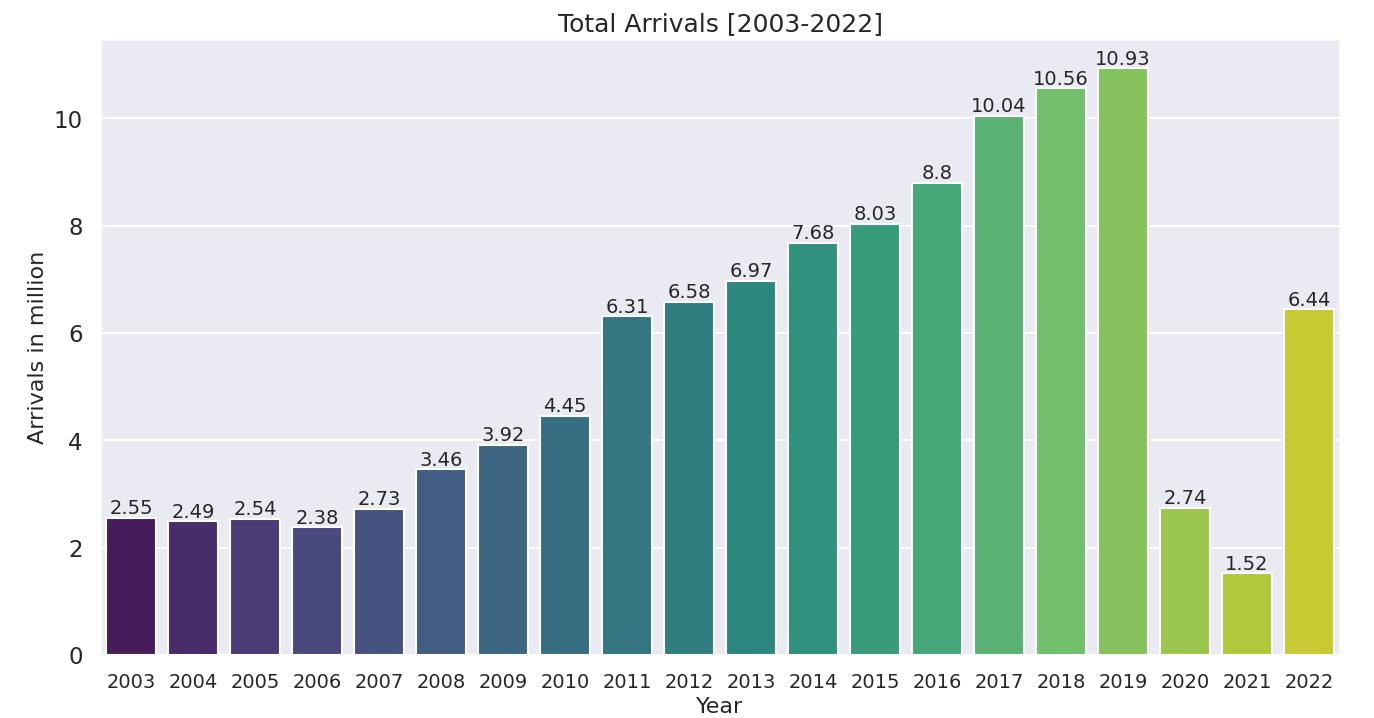
Figure 1 TotalnumberofarrivalstoIndiafrom2003to2022
ThebargraphshowninFigure1illustratesthetotalnumberofarrivals(inmillions)toIndiafrom2003to2022. Ascanbe seen,thereisaconsistentincreaseinthenumberofarrivalsfrom2003to2019.There isanoticeabledipin2020,where thearrivalsdroppedto2.74millionfrom10.93millionin2019.ThisdeclineisduetotheCOVID-19pandemic,whichledto worldwidetravelrestrictionsandasignificantreductionininternationaltravel.Thearrivalsfurtherreducedin 2021due topandemicrestrictions.However,in2022thearrivalsincreasedindicatingarecoveryandreturntopre-pandemiclevels.
Figure2presentsthearrivalofinternationaltourists aredividedintothreecategories.FTA(ForeignTouristArrivals),NRI (Non-ResidentIndians),andIFA(IndianForeignersArrivals).Itwasobservedthat:ThereisasteadyincreaseinFTAfrom 2003 to 2017 however, a noticeable dip occurred in 2018. A significant drop was observed in 2020 counted 2.5 million, likely due to the COVID-19 pandemic. The numbers start to recover from 2021 and 2022. The NRI category shows more fluctuationsascomparedtoFTA asalsodiscussedbyZhuang,Yao&Li(2019).AgradualincreaseisalsoobservedforNRI upto 2019. Asharpdecline isseen in 2020, followed bysome recovery in 2021 and2022.IFAs data (begins from2017) showsasignificantriseupto2019andthenasteepdeclinein2020,followedbyaquickrecoveryandsharpincreaseupto 2022.
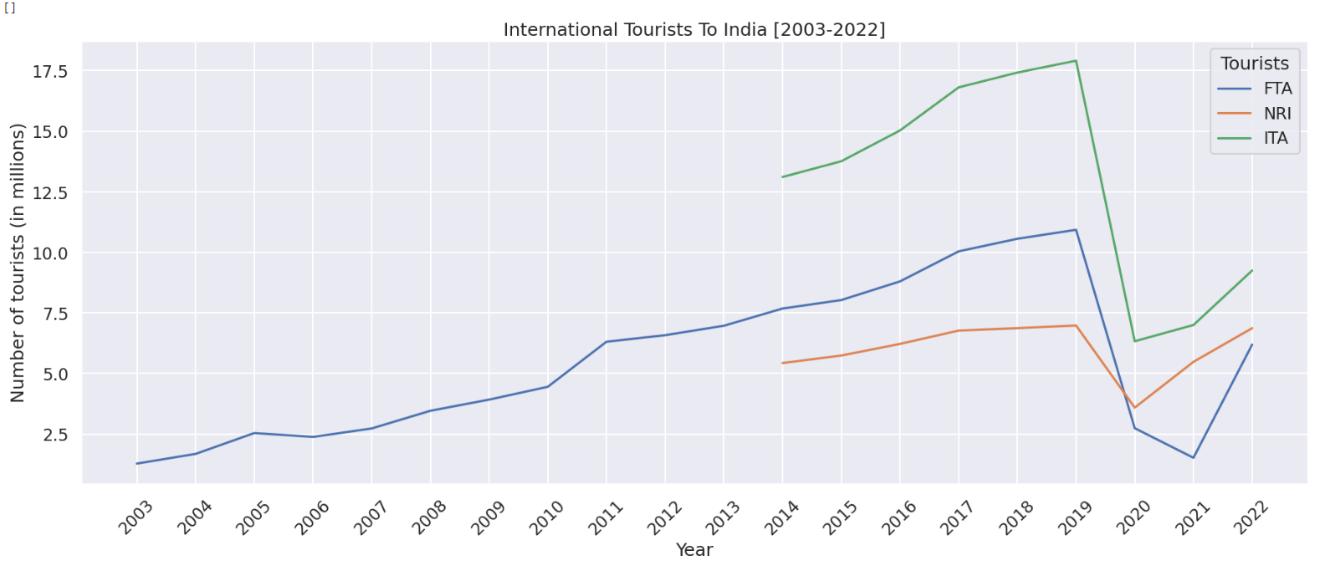
2 StatisticsofInternationalTouriststoIndia[2003-2022]
International Research Journal of Engineering and Technology (IRJET) e-ISSN: 2395-0056
Volume: 12 Issue: 12 | Dec 2025 www.irjet.net p-ISSN: 2395-0072
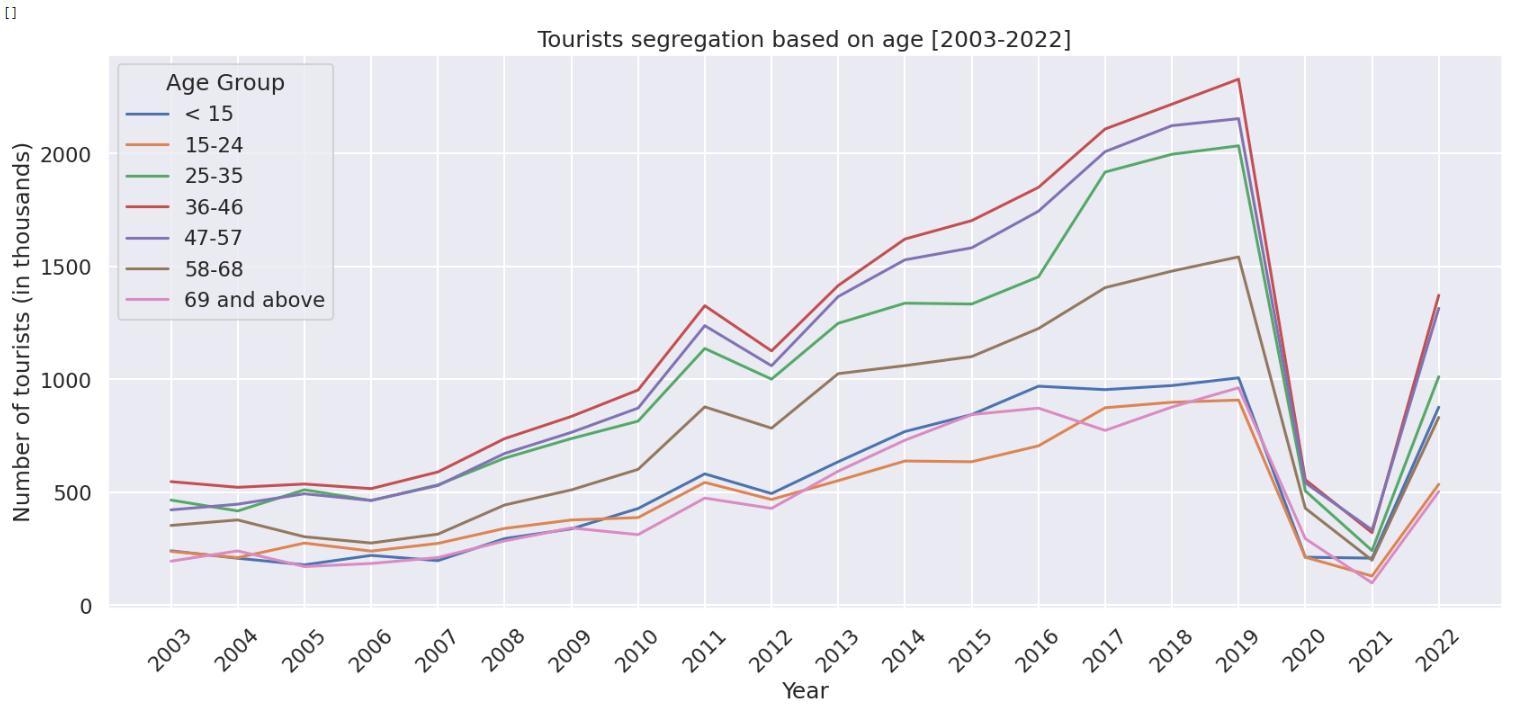
As can be seen in Figure 3 there is a general upward trend in the number of tourists across all age groups from 2003 to 2019.Thelessthan15agegrouphasconsistentlyseenthelowestnumberoftouriststhroughouttheperiodand15-24age groups has shown steady growth, with a significant increase from 2010 to 2019. The 36-46 age groups (red line) consistently have the highest number of tourists throughout the period. The 69 and above age group (pink line) has the lowest number of tourists, although it shows a significant increase in recent years. The decline in 2020 across all age groupshighlightsthesevereimpactoftheCOVID-19pandemicontourism.Therapidrecoverypost-2020suggestsastrong resurgence in tourism demand once travel restrictions were lifted. 2003-2007 a period of steady growth across all age groups,withminorfluctuations.Thiscouldbeattributedtoglobaleconomicstabilityandincreasingtravelaccessibility.
The Figure 3 graphs provide a comprehensive view of tourism trends over two decades, segmented by age. Despite economicandhealthcrises,theoveralltrendisupward,indicatingresilienceandgrowthpotentialinthetourismindustry. Thedatacouldbeusefulforunderstandingdemographictrendsintourismandformakingfuturepredictionsandplanning (Goffi, Cucculelli&Masiero,2019).
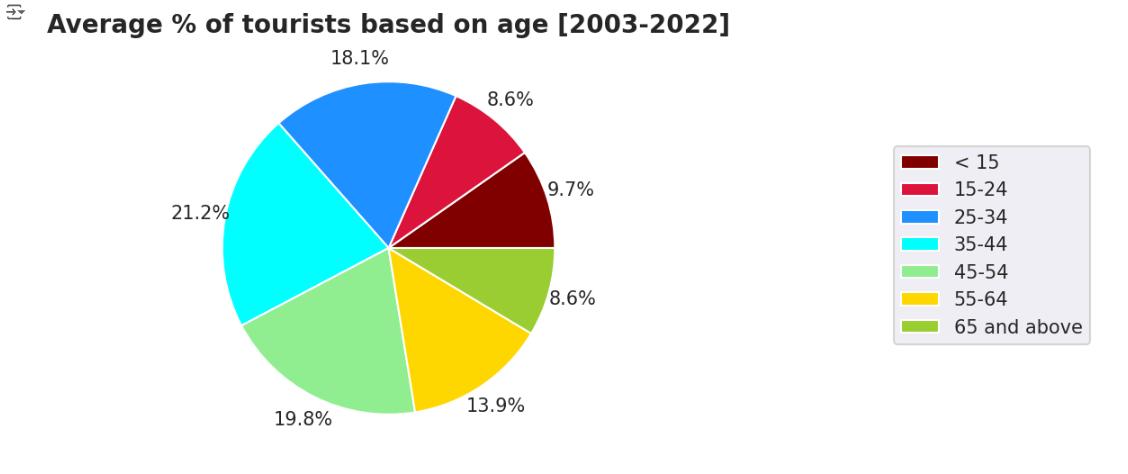
Thispiechart inFigure4representstheaveragepercentageoftourists basedonagegroupsfrom2003to2022 Theage group 35-44 years had the highest average percentage of tourists (21.2%) The age group 45-54 years had the second highest average percentage of tourists (19.8%). The age group 25-34 years had the third highest average percentage (18.1%).Theagegroup55-64years representsasignificantportion(13.9%)butlowerthantheyoungeradultagegroups.
International Research Journal of Engineering and Technology (IRJET) e-ISSN: 2395-0056
Volume: 12 Issue: 12 | Dec 2025 www.irjet.net p-ISSN: 2395-0072
Agegrouplessthan15yearsold(97%)representschildrenandearlyteens,showingfamilytraveliscommon.15-24years and65andabovebothhavethelowestaveragepercentage,possiblyduetofewerindependent travelersinthisagegroup and shows a considerable percentage, indicating senior travel is notable respectively The majority of tourists fall within the age range of 25-54 years, indicating that working-age adults are the primary travelers. There is a significant representation of older adults (55 and above), showing a healthy senior tourism market. The lower percentages in the youngeragegroups(0-24years)Roudi,Arasli&Akadiri(2019)alsosuggestfewerindependentyoungtravelersandmore familytravelwherechildrenarepartofthegroup.
C. ITAs trend analysis based on tourism purpose
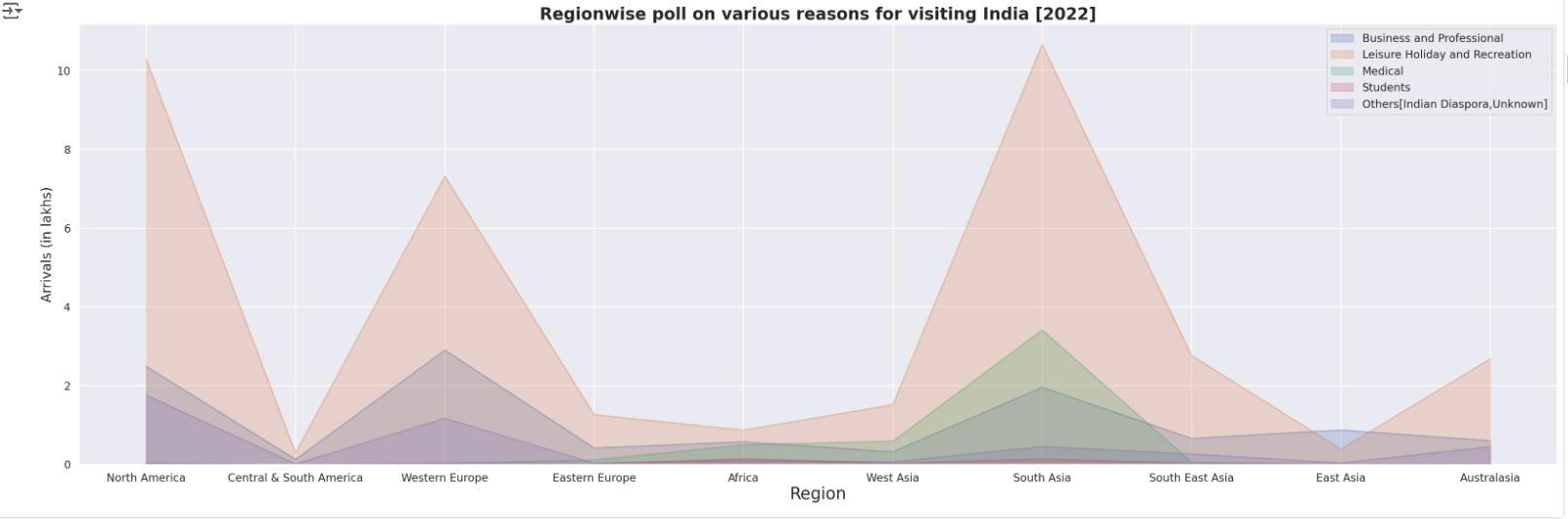
Figure 5 StatisticsofFTAstoIndiabasedonpurpose2022
Figure5highlightstheregionalbreakdownoftouristarrivalsinIndiafor2022.NorthAmericantouristsprimarilyvisitfor leisureandbusiness,reflectingtheirhigh-valuecontribution.WesternEuropedominatesinculturaltourism,withnotable business-related visits. South Asia leads in medical tourism due to India's affordable healthcare, alongside family and diaspora-related travel. Central & South America, focusing on leisure, shows minimal arrivals due to distance and connectivityissues.Africahasgrowingmedicalandbusinesstourism,whileAustralasiacontributesfewerarrivals,largely forleisure.
The tourist arrivals and forecasts analysis in Figure 6 shows a steady rise in all categories before the pandemic, largely sustainedbyglobalizationandtheattractionoftourisminIndia.Thelatterledtoa sharpcontractionduringthepandemic years 2020 and 2021. While growth is observed during 2022 led by medical tourism and Indian diaspora, most other categories are still below pre-pandemic levels, with the exception of Students. In summary, the confidence intervals for Leisure Travel are wider, indicating high sensitivity to global economic and policy changes (Ahmed, Amin & Khan, 2020) whereastheintervalsforMedicalandStudentsaremorenarrowandpointtostabletrends. TheARIMAmodelanalysisof tourist arrivals highlights key post-pandemic trends across various segments: Business Travel is expected to stabilize at lower levels due to the rise of virtual meetings and ongoing economic challenges. While Leisure Travel shows signs of recovery,itremainshighlyvolatilewithbroaderconfidenceintervals,reflectingitssensitivitytoeconomicconditionsand externalfactors.MedicalTourismisforecastedtoexperiencestable,predictablegrowth,supportedbyIndia’sreputationas an affordable healthcare destination, with narrow confidence intervals suggesting consistent demand. Indian Diaspora travel isanticipatedtorecover slowlybutsteadily,influencedby migrationtrendsandthegradual normalizationofpostpandemictravel.Finally,theStudentsegmentshowsaslowrecovery,affectedbyvisaandeducationpolicychallenges,with narrowerconfidenceintervalsindicatinglessvariabilityinforecasts.
International Research Journal of Engineering and Technology (IRJET) e-ISSN: 2395-0056
Volume: 12 Issue: 12 | Dec 2025 www.irjet.net p-ISSN: 2395-0072
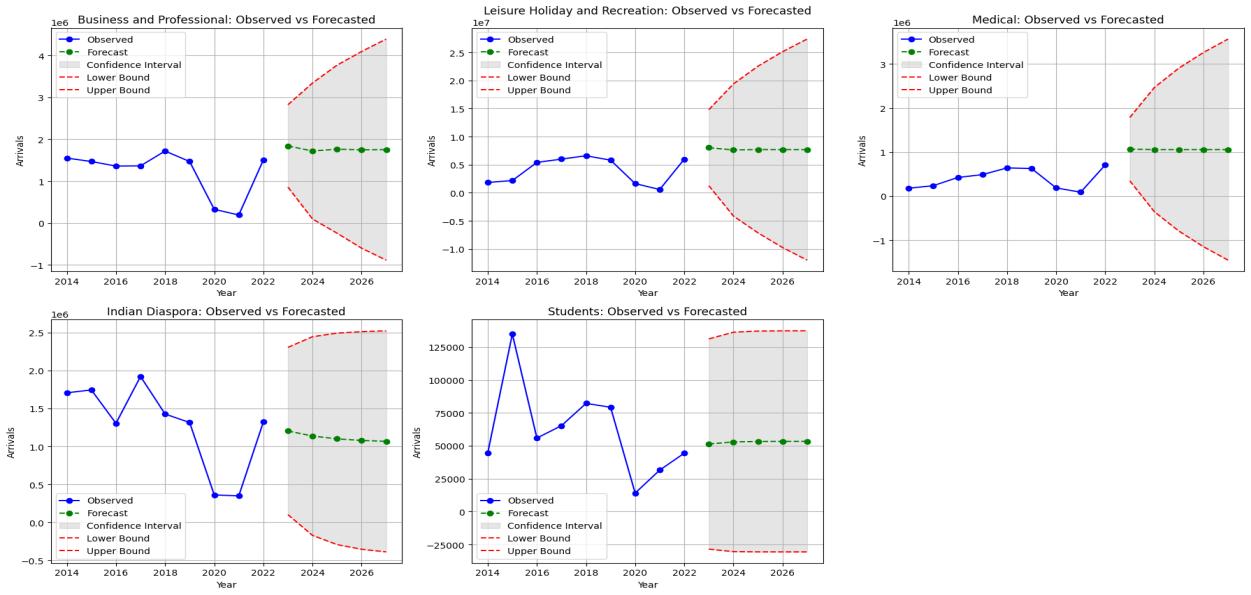
Figure 6 Forecastingbasedonpurposeoftouristarrivals
Figure4representstheaveragepercentageoftouristsbasedonagegroupsfrom2003to2022.Theagegroup35-44years had the highest average percentage of tourists (21.2%). The age group 45-54 years had the second highest average percentage of tourists (19.8%). The age group 25-34 years had the third highest average percentage (18.1%). The age group 55-64 years represents a significant portion (13.9%) but lower than the younger adult age groups. Age group less than 15 years old (9.7%) represents children and early teens, showing family travel is common. 15-24 years and 65 and abovebothhavethelowestaveragepercentage,possiblyduetofewerindependenttravelersinthisagegroupandshowsa considerablepercentage,indicatingseniortravel isnotablerespectively.Themajorityof tourists fallwithintheagerange of25-54years,indicatingthatworking-ageadultsaretheprimarytravelers.Thereisasignificantrepresentationofolder adults(55andabove),showinga healthyseniortourismmarket.Thelower percentagesintheyoungeragegroups(0-24 years)suggestfewerindependentyoungtravelersandmorefamilytravelwherechildrenarepartofthegroup.
The analysis of figure 5, highlights key trends in five tourist categories: Business, Leisure, Medical, Indian Diaspora, and Students. Pre-pandemic (2014–2019), steady growth was led by globalization and India’s appeal as a destination, particularlyinLeisureTravel.The pandemic(2020–2021)causedsharpdeclines, withBusinessandLeisure Travel most affected. Recovery in 2022 was uneven, with Medical Tourism and Indian Diaspora travel rebounding faster, while Studentsremainbelowpre-pandemiclevelsduetovisaandeducationchallenges.
ARIMA’sforecastsindicatea stablerecoveryinMedicalTourism,a gradualreboundinIndianDiasporatravel,andhigher uncertainty in Business and Leisure Travel, highlighting the need for targeted interventions to address segment-specific challenges. Strategic investments in marketing, infrastructure, and healthcare capacity are essential to sustain growth SimplifyingtravelpoliciescanboostDiasporaandBusinessTravel,whilescholarshipsandimprovedrankingscanattract internationalstudents.AddressingthesechallengeswilldrivesustainablegrowthinIndia'stourismsector.
International Research Journal of Engineering and Technology (IRJET) e-ISSN: 2395-0056
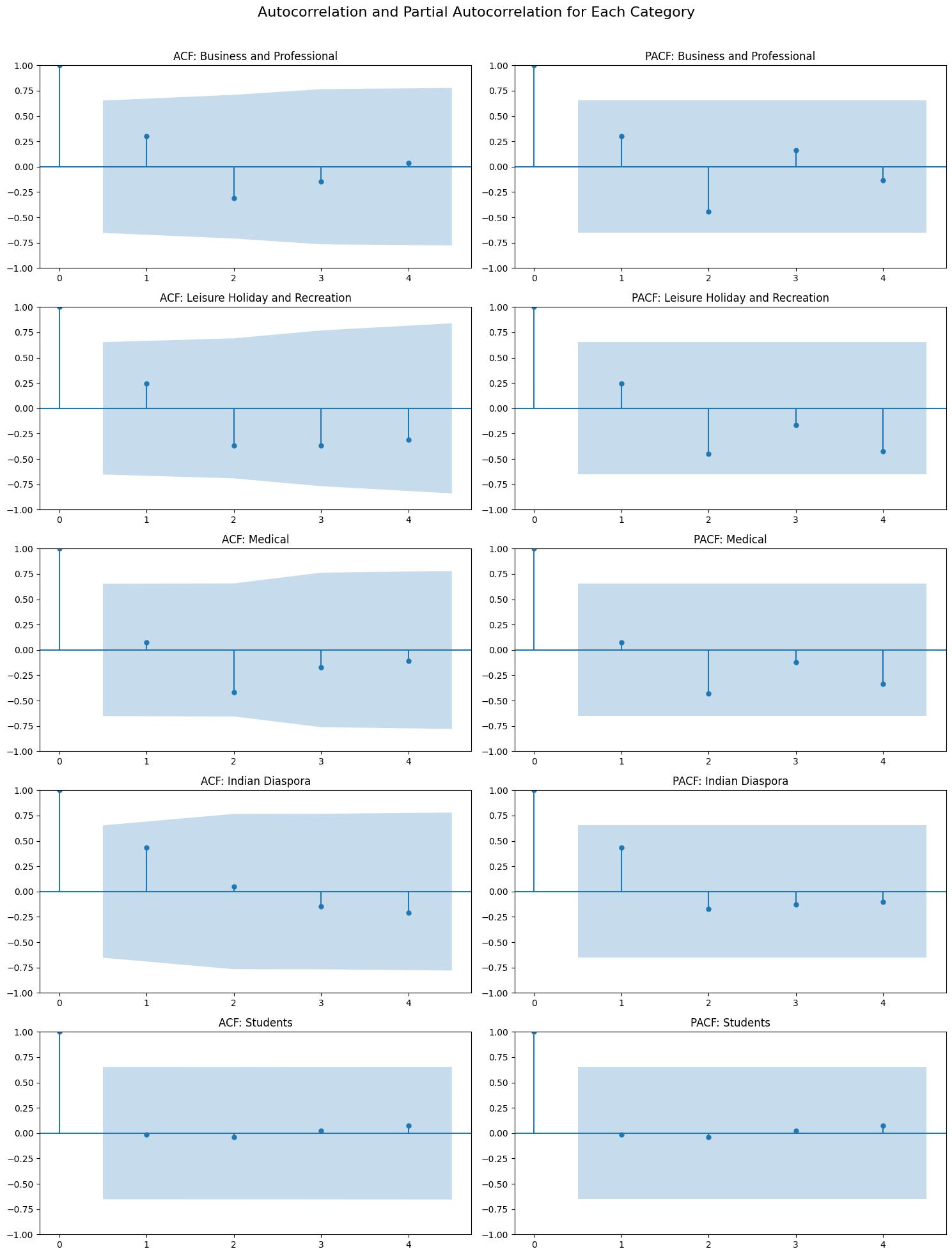
7 ACFandPACFforeachpurpose
Figure7,showshighcorrelationsbetweentouristandtheirpurposeofvisit,allstatisticallysignificantandsizableevenat higher-lags, and slowly decreasing. It is an unambiguous sign of non-stationary series. The Ljung-Box statistics are also statisticallysignificantasshownbythenon-stationeryseriesinTable4.Next,ithassoughttoknow,istheseriesoftourist arrivalsarandomwalk Ifso,thenthefirstdifferenceofthetimeseriesmustbestationarywhichcanbepresentedinTable 3.Theplotshowsmeanandvariancefairlyconstantovertime,whichisastrongindicationofastationaryseries.
Volume: 12 Issue: 12 | Dec 2025 www.irjet.net p-ISSN: 2395-0072 © 2025, IRJET | Impact Factor value: 8.315 | ISO 9001:2008 Certified Journal | Page600
International Research Journal of Engineering and Technology (IRJET) e-ISSN: 2395-0056
Volume: 12 Issue: 12 | Dec 2025 www.irjet.net p-ISSN: 2395-0072
Table- 1 Autocorrelationandpartialautocorrelation
Table 2 StatisticofModel Box-Ljung
Table 3 EvaluatetheARIMAmodel
Table 5 represent the ARIMA model evaluation of tourist arrivals. Analysis provides significant insights across various categories (He& Qian, 2025). Medical Tourism demonstrates the highest predictability, with the lowest MAE (12,000), RMSE(15,000),andMASE(0.18),indicatingstablegrowthdrivenbyIndia’sreputationasacost-effectivehealthcarehub. Leisure Travel indicates the highest level of volatility with the maximum errors: MAE = 90,000, RMSE = 130,000 and SMAPE=6.2%whichreflectshighsensitivitytodiscretionaryspendingandexternalfactorslikeinflationandcompetition. Business Travel presents stabilization at lower levels with moderate errors, MAE = 42,000 and RMSE = 58,000, SMAPE 4.8% which is influenced by the rise of virtual meetings and economic constraints. The tourism type Indian Diaspora Travel has shown gradual recovery with the improved accuracy of MAE (35,000), RMSE (48,000), and MASE (0.39). This suggeststhatthetravel behaviorpost-pandemicisgraduallysettlingdown.StudentTravelhasaslowyetstablerecovery, with low variability and low errors, MAE (5,000), RMSE (7,000), and MASE (0.27), which can be traced to policy and educational challenges. Thus, the various types of tourism recovery levels indicate the need for targeted efforts in sustainabletourismgrowth.
Despite offering meaningful insights into age-based tourist segmentation, purpose-wise travel trends, and ARIMA-based forecasting, the study has several limitations. Regional variations within India are not captured, and the model does not assess socio-economic factors, marketing influences, travel restrictions, or exchange rate fluctuations. The dataset also
International Research Journal of Engineering and Technology (IRJET) e-ISSN: 2395-0056
Volume: 12 Issue: 12 | Dec 2025 www.irjet.net p-ISSN: 2395-0072
lacks micro-level information, such as tourist spending, satisfaction, and duration of stay, which could enrich behavioral interpretation.Futureresearchcanexpandthisworkbyintegratingmulti-sourcedatasetsthatadoptadvancedforecasting techniques such as SARIMA, Prophet, VAR, LSTM, or hybrid machine-learning models to better capture non-linearity, seasonality,andexternalshocks.
Thispaperdemonstratedtheapplicationoftheautoregressiveintegratedmovingaverage(ARIMA)modelforforecasting touristarrivals.TheAutocorrelationFunction(ACF)andpartialautocorrelationfunction(PACF),alongwith theLjung-Box test, have beenutilized to assess stationary To improve tourist arrivalsin Indiaidentified influential factors alongwith therecommendationstoenhancetheseshowninTable6.
Table-6 ShowstheInfluenceFactorandtheirRecommendation
Influencing Factors:
Economic Factors: Economic stability and disposable income in source countries greatly affect travel decisions. A global recession or economic downturn canreduceinternationaltravel.
Geopolitical Stability: Political stability in both source and destination countries influences tourism. Any instability,conflict,oradversetraveladvisoriescanlead toreducedtouristnumbers.
Health and Safety: Health scares, such as pandemics, significantly impact travel. The recovery patterns postCOVID-19 reflect how crucial health safety is for travel resumption.
Policy Changes: Visa policies, travel restrictions, and tourism promotion initiatives by the government can influence tourism numbers. Favorable policies encourage tourism, while restrictive ones can deter tourists.
Tourism Infrastructure: Improvements in tourism infrastructure, such as better hotels, transportation, andtouristfacilities,canattractmorevisitors.
Cultural and Natural Attractions: Promoting unique cultural experiences and natural attractions can boost tourism. Events, festivals, and heritage sites play a significantroleinattractingtourists.
EconomicGrowth:
India's economic growth during this period likely contributed to the increase in tourism, making it an attractive destination for both leisure and business travel.
GovernmentInitiatives:
Initiatives such as the Incredible India campaign, improvements in tourism infrastructure, and favorable visapoliciesmayhaveboostedtouristarrivals.
PandemicImpact:
The distribution in 2021 reflects the pandemic's impact, with lower numbers in the second and third quarters.Thetrendshowsrecoveryin2022and2023.
SeasonalPreferences:
The first and fourth quarters consistently show higher tourist arrivals, coinciding with favorable weather conditionsandmajorfestivalsinIndia
FestivalsandHolidays:Thefourthquarterispopular duetofestivalslikeDiwaliandChristmas,makingitan attractiveperiodfortourists.
Recommendations:
Enhanced Marketing: Continued global marketing campaigns showcasing India’s diverse attractions can helpattractmoretourists.
Improved Infrastructure: Investing in tourism infrastructure can enhance the travel experience and attractmorevisitors.
Safety Protocols: Ensuring and communicating robust health and safety protocols can reassure potential tourists.
Policy Support: Implementing favorable visa policies andeasingtravelrestrictionscan boosttouristarrivals. Provide comprehensive support services for medical touristsandbusinesstravelers
Diversified Offerings: Developing diverse tourism offerings, including eco-tourism, adventure tourism, and cultural tourism, can attract a broader range of tourists.
Crisis Management: Developing and implementing crisis management plans for unforeseen events like pandemicscanhelpmitigatetheirimpactontourism.
Sustaining Growth: To maintain and further enhance tourismgrowth,continuedinvestmentininfrastructure, safety,andmarketingiscrucial.
Diversifying Tourism: Promoting diverse tourism offerings such as eco-tourism, adventure tourism, cultural tourism, and medical tourism can attract a broaderrangeoftourists.
Pandemic Response: Quick and effective measures to control COVID-19, coupled with global vaccination drives,helpedintherapidrecoveryoftouristarrivals.
Seasonal Promotions: Tailored promotions for each quarter can help balance the distribution of tourists throughouttheyear.
Data-DrivenMarketing:Utilizedataanalyticsto understandtouristpreferencesandtailormarketing campaignsaccordingly.Forexample,promotingspecific festivalsoreventsthatdrawlargecrowds.
International Research Journal of Engineering and Technology (IRJET) e-ISSN: 2395-0056
Volume: 12 Issue: 12 | Dec 2025 www.irjet.net p-ISSN: 2395-0072
Influencing Factors:
Medical:Whilemedicaltourismisagrowingsector,the numberssuggestitisstillanichemarket.
IndianDiaspora:Theprimaryreasonforvisitsfromthe United States, United Kingdom, Australia, and Canada indicatesstrongfamilialandculturalties. LesssignificantforvisitorsfromBangladesh
Education: 0.2% of tourists come to India for educational purposes. While this is the smallest segment, it highlights India's role as a destination for educationtourism.
Recommendations:
Medical Tourism Initiatives: Enhance medical tourism services by partnering with international healthcare providers and promoting India's medical expertise. Enhancing facilities, creating awareness, and providing competitive healthcare services could attract more medicaltourists
Leveraging Diaspora Connections: Organize cultural festivals and events that appeal to the Indian diaspora in countries like the United States, United Kingdom, Australia, and Canada. Provide special travel packages fordiasporacommunitiestoencouragefrequentvisits.
offeringaffordableandhigh-qualityeducationservices
[1] AbMalek,I.,Shukry,N.H.H.H.M.,&AbMalek,H.(2025).ForecastingTouristArrivalsinLangkawiIsland:ATime SeriesAnalysis.e-AcademiaJournal,14(1).
[2] Ahmed,A.,Amin, S.B.,&Khan,A.M.(2020).Forecastingtourism revenueinBangladeshusingARIMAapproach: ThecaseofBangladesh.InternationalReviewofBusinessResearchPapers,16(1),202-215.
[3] Alsahafi, R., Mehmood, R., & Alqahtany, S. (2025). A Machine Learning-Based Analysis of Tourism Recommendation Systems: Holistic Parameter Discovery and Insights.International Journal of Advanced ComputerScience&Applications,16(1).
[4] Altaf, N. (2021). Modelling the international tourist arrivals in India.Tourism Planning & Development,18(6), 699-708.
[5] Annual Report 2019-20 | Ministry of Tourism | Government of India(2020), “Tourism.gov.in”,available at:https://tourism.gov.in/annual-reports/annual-report-2019-20(accessed17April2021).
[6] Arshad,M.O.,Khan,S.,Haleem,A.,Mansoor,H.,Arshad,M.O.,&Arshad,M.E.(2023).Understandingtheimpactof Covid-19onIndiantourismsectorthroughtimeseriesmodelling.Journaloftourismfutures,9(1),101-115.
[7] Balbaa, M. E., Astanakulov, O., Ismailova, N., & Batirova, N. (2023, December). Real-time Analytics in Financial MarketForecasting:ABigDataApproach.InProceedingsofthe7thInternationalConferenceonFutureNetworks andDistributedSystems(pp.230-233).
[8] Barbhuiya, M. R., & Chatterjee, D. (2020). Vulnerability and resilience of the tourism sector in India: Effects of naturaldisastersandinternalconflict.TourismManagementPerspectives,33,100616.
[9] Basnayake,B.R.P.M.,&Chandrasekara,N.V.(2022).UseofchangepointanalysisinseasonalARIMAmodelsfor forecastingtouristarrivalsinSriLanka StatisticsandApplications,20(2),103-121.
[10] Box, G. E., Jenkins, G. M., Reinsel, G. C., & Ljung, G. M. (2015).Time series analysis: forecasting and control. John Wiley&Sons.
[11] Chaudhary,D.,Singh,J.,Singh,J.,Chahal,J.,&Molla,K.Z.(2024,March).Dataanalyticstofindimpactofreligionon tourisminIndia.InAIPConferenceProceedings(Vol.2816,No.1).AIPPublishing.
[12] Duan,J.,Xie,C.,&Morrison,A.M.(2022).Tourismcrisesandimpactsondestinations:Asystematicreviewofthe tourismandhospitalityliterature.JournalofHospitality&TourismResearch,46(4),667-695.
[13] Egamberdiyev, O. (2023). THE ROLE OF INVESTMENT IN THE DEVELOPMENT OF REGIONAL TOURISM.The AmericanJournalofManagementandEconomicsInnovations,5(09),41-47.
[14] Fernández, J. A. S., Azevedo, P. S., Martín, J. M. M., & Martín, J. A. R. (2020). Determinants of tourism destination competitiveness in the countries most visited by international tourists: Proposal of a synthetic index.Tourism ManagementPerspectives,33,100582.
[15] Fernández, J. A. S., Azevedo, P. S., Martín, J. M. M., & Martín, J. A. R. (2020). Determinants of tourism destination competitiveness in the countries most visited by international tourists: Proposal of a synthetic index.Tourism ManagementPerspectives,33,100582.
International Research Journal of Engineering and Technology (IRJET) e-ISSN: 2395-0056
Volume: 12 Issue: 12 | Dec 2025 www.irjet.net p-ISSN: 2395-0072
[16] Filimonau, V., & Perez, L. (2019). National culture and tourist destination choice in the UK and Venezuela: An exploratoryandpreliminarystudy.TourismGeographies.
[17] Fourie, J., Rosselló-Nadal, J., & Santana-Gallego, M. (2020). Fatal attraction: How security threats hurt tourism.JournalofTravelResearch,59(2),209-219.
[18] Godara, R. S., & Fetrat, D. J. (2022). Impact of tourism industry on the Indian economy: a multidimensional analysis.InternationalJournalofEconomicPolicyinEmergingEconomies,15(2-4),351-367.
[19] Godara, R. S., Fetrat, D. J., & Nazari, A. (2020). Contribution of tourism industry in Indian Economy: An analysis.InternationalJournalofRecentTechnologyandEngineering,8(6),1994-2000.
[20] Goffi, G., Cucculelli, M., & Masiero, L. (2019). Fostering tourism destination competitiveness in developing countries:Theroleofsustainability.Journalofcleanerproduction,209,101-115.
[21] Hamid, R. A., Albahri, A. S., Alwan, J. K., Al-Qaysi, Z. T., Albahri, O. S., Zaidan, A. A., ... & Zaidan, B. B. (2021). How smart is e-tourism? A systematic review of smart tourism recommendation system applying data management.ComputerScienceReview,39,100337.
[22] He, M., & Qian, X. (2025). Forecasting tourist arrivals using STL-XGBoost method.Tourism Economics, 13548166241313411.
[23] Karadzic, V., & Pejovic, B. (2020). TOURISM DEMAND FORECASTING USING ARIMA MODEL.Transformations in Business&Economics,19.
[24] Khan, N., Hassan, A. U., Fahad, S., & Naushad, M. (2020). Factors affecting tourism industry and its impacts on globaleconomyoftheworld.AvailableatSSRN3559353.
[25] Kumar, V. (2020). Indian tourism industry and COVID-19: present scenario.Journal of Tourism and Hospitality Education,10,179-185.
[26] Ma,J.(2022).ResearchonruraltourismpromotingregionalhighqualitydevelopmentbasedonARIMAmodel:A case study of guangshan county, Xinyang city. InProceedings of the 4th international conference on economic managementandmodelengineering.SCITEPRESS-ScienceandTechnologyPublications.
[27] Mousavian, S., Miah, S. J., & Zhong, Y. (2023). A design concept of big data analytics model for managers in hospitalityindustries.PersonalandUbiquitousComputing,27(4),1509-1519.
[28] Nepal,R.,AlIrsyad,M.I.,&Nepal,S.K.(2019).Touristarrivals,energyconsumptionandpollutantemissionsina developingeconomy–implicationsforsustainabletourism.TourismManagement,72,145-154.
[29] Nguyen, Q. H. (2021). Impact of investment in tourism infrastructure development on attracting international visitors:AnonlinearpanelARDLapproachusingVietnam’sdata.Economies,9(3),131.
[30] Qin,Q.(2021).Forecasting TourismMarketDemandin HunanProvinceUsingARIMAModel.Delta:Jurnal Ilmiah PendidikanMatematika,9(2),211-220.
[31] Roskladka,A.,Roskladka,N.,Dluhopolskyi,O.,Kharlamova,G.,&Kiziloglu,M.(2018).Dataanalysisandforecasting oftourismdevelopmentinUkraine.InnovativeMarketing,14(4),19-33.
[32] Roudi,S., Arasli,H., &Akadiri,S. S.(2019).Newinsights into anold issue–examiningthe influenceof tourism on economicgrowth:evidencefromselectedsmallislanddevelopingstates.CurrentIssuesinTourism,22(11),12801300.
[33] Sahoo, B. K., Nayak, R., & Mahalik, M. K. (2022). Factors affecting domestic tourism spending in India.Annals of TourismResearchEmpiricalInsights,3(2),100050.
[34] Song, H., Li, G., & Cao, Z. (2018). Tourism and economic Globalization: An emerging research agenda.Journal of TravelResearch,57(8),999-1011.
[35] Tiwari,A.K.,Dash,A.K.,&Narayanan,B.G.(2020).ForeigntouristarrivalsinIndiafrommajorsourcecountries: Anempiricalanalysis.InCurrentIssuesinAsianTourism(pp.91-110).Routledge.
[36] Tovmasyan, G. (2021). Forecasting the number of incoming tourists using ARIMA model: Case study from Armenia.Marketingimenedžmentinnovacij,(3),139-148.
[37] Tuncsiper, C. (2025). Modeling the number of tourist arrivals in the United States employing deep learning networks.TransportationResearchInterdisciplinaryPerspectives,31,101407.
[38] Xiao, X., Li, C., Wang, X., & Zeng, A. (2025). Personalized tourism recommendation model based on temporal multilayersequentialneuralnetwork.ScientificReports,15(1),382.
[39] Zhuang,X.,Yao,Y.,&Li,J.(2019).Socioculturalimpactsoftourismonresidentsofworldculturalheritagesitesin China.Sustainability,11(3),840.