
International Research Journal of Engineering and Technology (IRJET) e-ISSN: 2395-0056
Volume: 12 Issue: 12 | Dec 2025 www.irjet.net p-ISSN: 2395-0072
International Research Journal of Engineering and Technology (IRJET) e-ISSN: 2395-0056
Volume: 12 Issue: 12 | Dec 2025 www.irjet.net p-ISSN: 2395-0072
P.Sri AASHISH1 , Dr. K. Ramu 2
1Post graduation Student, Department of Civil Engineering, University College of Engineering Kakinada(A), JNTUK, Kakinada, Andhra Pradesh, India
2Professor, Department of Civil Engineering, University College of Engineering Kakinada(A), JNTUK, Kakinada, Andhra Pradesh, India
Abstract - Expansive soils such as Black Cotton Soil pose majorchallengesingeotechnicalengineeringduetotheirhigh swelling–shrinkage behavior, low strength, and moisture sensitivity. This study investigates the combined effect of marble dust powder, an industrial waste by-product, and sodium silicate, a chemical binder, on the stabilization of Black Cotton Soil. The primary objective is to evaluate improvements in plasticity characteristics, swelling potential and engineering strength parameters such as Unconfined Compressive Strength (UCS) and California BearingRatio(CBR)
Marble dust powder was added to the soil at varying percentages to utilize its calcium-rich composition for pozzolanicreactions,whilesodiumsilicatewasintroducedas aliquidstabilizertoenhancebondingandreducemicro-voids. LaboratorytestsincludingAtterberglimits,standardProctor compaction, free swellindex, UCS, andsoaked/unsoaked CBR were conducted.
Theresultsindicatea significantreductioninplasticityand swell index with increasing marble dust content, while sodium silicate further improved cementation and early strengthgain.Thecombinedtreatmentproduceddensersoil matrices, higher maximum dry density, reduced optimum moisture content, and substantial enhancement in loadbearing capacity. Overall, the dual stabilization technique demonstrates an effective, economical, and environmentally friendly method for improving the engineering properties of expansive soils, making it suitable for subgrade and foundation applications.
Keywords: Expansive Soil (ES), Marble Dust Powder (MDP), Sodium Silicate.
BlackCottonSoil,classifiedasanexpansivesoil,isoneofthe mostproblematicgeomaterialsencounteredingeotechnical engineering. Predominantly found in the central, western, andsouthernregionsofIndia,thissoilischaracterizedbyits dark color and high content of montmorillonite, a clay mineral known for its exceptional swelling and shrinkage
behavior. When water is absorbed, the soil undergoes substantial volume expansion,andduringdryseasons,it experiencessevere shrinkage and cracking. Thesecyclic volumetric changes pose serious challenges to civil engineering structures, including pavements, foundations, pipelines,canallinings,andembankments.
Marble dust powder is a finely divided waste material generated during the cutting, shaping, polishing, and processing of marble stones in the construction and decorative stone industries. With rapid growth in marblebasedindustriesworldwide,largequantitiesofthiswasteare produced,oftenleadingtoseriousenvironmentalconcerns such as soil contamination, air pollution, and improper landfill usage. Due to its high calcium carbonate (CaCO₃) content, marble dust possesses physical and chemical characteristics that make it a valuable additive in civil engineeringapplications.
Sodiumsilicate,alsoknownaswaterglassorliquidglass,isa compound that consists of sodium oxide (Na₂O) and silica (SiO2)invariousproportions.Itiscommonlyrepresentedby theformulaNa2SiO3.Sodiumsilicateisaversatilematerial used in various industrial applications due to itsadhesive, binding,andsealantproperties.Inthepresentstudy,Sodium Silicate with the chemical name of Sodium Silicate (Meta) Non-hydrate(i.eNa2SiO3.9H2O)fromoneofnon-traditional LobaChemiePvt.Ltd,whichisstabilizers,hasbeenused.
2. OBJECTIVE OF THIS PRESENT STUDY
● TostudythepropertiesofExpansiveSoil.
● ToinvestigatetheeffectofMarbleDustPowderas astabilizingmaterial.
ToaccesstheeffectofvaryingdosageofSodiumSilicate(1%, 2% 3% 4%5% by dry weight of soil) on the strength properties
International Research Journal of Engineering and Technology (IRJET) e-ISSN: 2395-0056
Volume: 12 Issue: 12 | Dec 2025 www.irjet.net p-ISSN: 2395-0072
1.C.C. Ikeagwuani Emerging trends in expansive soil stabilization: Are view (2019). Good recent review of stabilizationtechniquesandtrends.
2. A.K.Jain Geotechnicalbehaviorandmicro-analysesof expansivesoils(2020). Usefulformicrostructuralevidence andexperimentalresultsonblackcottonsoils.
3.Akash&AhsanRabbani Swell–shrinkcharacteristicsof expansivesoil:areview(2019).Acompactreviewfocusedon swelling–shrinkagemechanismsandtesting.
4. I. H. Umar Marble Powder as a Soil Stabilizer: An ExperimentalStudy(MDPI,2024).Laboratorystudyshowing UCS/CBRimprovementsandtemporalstrengthtrendswith MDP.
5. N. W. Jassim Utilization of waste marble powder as sustainable stabilizer (2022).Discusses optimal low percentages(e.g.,~3%)andenvironmentaladvantages.
6.W.Fathonah Sustainablesoilstabilizationusingmarble dust waste on high plasticity soils (2023/24). Good empirical results on PI reduction and CBR increase; usefulformixpercentages.
7. C.H.Hurley SodiumSilicateStabilizationofSoils(TRB annotated bibliography, classic reference). 8. Studies on sodium-silicate grout systems & organic soil stabilization e.g.,stabilizationoforganicsoilusingsodium silicate system grout (research gate). Useful for grouting methodsandgelationchemistry.
9.V.G.Kiunaetal. Effectofsodiumsilicateandcementon soil improvement(2023).Recent experimental paper showing combined sodium silicate + cement effects on strengthofproblematicsoils.
10.W. Hou et al. (2025) Experimental study on mechanical properties of sodium-silicate activated slag / soils.
Showshighstrengthgainswithsilicate-activatedbinders usefulforadvancedchemicalstabilizationroutes.
4. METHODOLOGY
The experimental program was carried out in several stages to evaluate the performance of black cotton soil stabilizedwithmarbledustpowderandSodiumsilicatethe overall procedure included soil collection, material preparation,proportioningofmixes,laboratorytesting,and analysisofresults.
ExpansiveSoilrequiredforthestudywascollectedfrom peapod,,EastGodavaridistrict,AndhraPradesh.atadepthof about2mbelowgroundleveltoavoidsurfacecontamination. Thesoilsampleswerecarefullyexcavated,transportedtothe laboratory, and air-dried under shade to preserve their naturalproperties.
1. Expansive Soil: Thecollectedsoilsamplewasused as the base material for the stabilization study. Preliminarytestswereconductedtodetermineits indexandengineeringproperties,whichservedas thefoundationforfurtherstabilizationanalysis.
2.Bagasse Ash: This ash,a by-productofsugarand powerplants,isrichinamorphoussilicaandhas pozzolanicproperties.
3.Sodium Silicate: Sodiumsilicate,alsoknownas water glass or liquid glass, is a compound that consistsofsodiumoxide(Na₂O)andsilica(SiO2) in various proportions. Sodium silicate is a versatile material used in various industrial applications
4.3Mix
Thestabilizationprocessinvolvedpreparingsoilsamples with different proportions of marble dust powder and SodiumSilicate, mixratioswereconsidered,with5%,10%, 15%,20%, 25% for marble dust powder and 1%, 2%, 3%,4%and5%forSodiumSilicate(bydryweightofsoil) addedtoExpansivesoil.Foreachpercentage,twosetsof sampleswereprepared:onewithonlymarbledustpowder and another with combined with Sodium Silicate . This allowed a comparison between mechanical stabilization andcombinedmechanical–chemicalstabilization.
Table -1: MixProportionsfortestingSoil
S.NO StabilizingAgent Mixproportions
1 MarbleDustPowder 5,10,15,20,25
2 SodiumSilicate 1,2,3,4,5
4.4
To assess the influence of marble dust powder and Sodium SilicateonthepropertiesofExpansivesoil,aseries of laboratory tests were carried out in accordance with relevantIScodes.Thetestsconductedareasfollows:
International Research Journal of Engineering and Technology (IRJET) e-ISSN: 2395-0056
Volume: 12 Issue: 12 | Dec 2025 www.irjet.net p-ISSN: 2395-0072
Specific Gravity Test (IS: 2720 Part 3 – 1980)
Thistestdeterminesthespecificgravityofsoilsolids, whichhelpsinidentifyingthetypeandclassification ofsoil.Itisanessentialpropertyusedincalculating varioussoilparameterssuchasvoidratio,degreeof saturation,andunitweightrelationships.
Differential Free Swell (DFS) Test (IS 2720 – Part 40):The free swell behavior of the untreated and treated Expansive Soil was studied to evaluate the reduction in expansiveness after stabilization. The DFSvaluewasobtainedbyimmersingoven-driedsoil samplesinkeroseneanddistilledwaterseparately, and calculating the difference in swell percentage. Thistestingisprovidedtoreflectthepotentialofthe soiltoswellunderdifferentconditions.
Atterberg Limits Test (IS 2720 – Part 5): Thistest was conducted to determine the liquid limit, plastic limit, and plasticity index of both untreated and stabilizedsoilsamples.TheAtterbergLimitstesthelps toidentifythecriticalwatercontentsoffine-grained soils, particularly clays and silts, which define their consistencystatesandplasticbehavior.
Modified Proctor Compaction Test (IS 2720 – Part 7): Compactiontestswerecarriedouttodeterminethe MaximumDryDensity(MDD)andOptimumMoisture Content (OMC) for each mix proportion. These tests wereusedtoevaluatetheeffectofmarbledustpowder Ash and Sodium Silicate on the densification characteristicsandmoisturerequirementsofthesoil.
California Bearing Ratio (CBR) Test (IS 2720 – Part 16): Both soaked and unsoaked California Bearing Ratio(CBR)testswereconductedtoevaluatetheloadbearing capacity of the stabilized soil. The results provided valuable insight into the improvement in strengthcharacteristicsandthepotentialsuitabilityof thestabilizedexpansivesoilforuseasafoundationor subgradematerialinpavementconstruction.
Triaxial Compression Test (IS: 2720 Part 11 –1993)
The triaxial compression test was conducted to determine the shearstrength parameters of the soil, namelycohesion(c)andtheangleofinternalfriction (ϕ), under varying drainage and loading conditions. Thistestprovidesarealisticsimulationofin-situstress conditions by subjecting the soil specimen to both confiningandaxialpressures.Itaidsinunderstanding the stress–strain behavior of soil under controlled conditions and is widely used for the analysis and designofslopes,foundations,andembankments
Table -2: PropertiesofExpansiveSoil
5. RESULTS AND DISCUSSION
5.1Differential free swell
Table -3: ResultsofFreeswellindextest
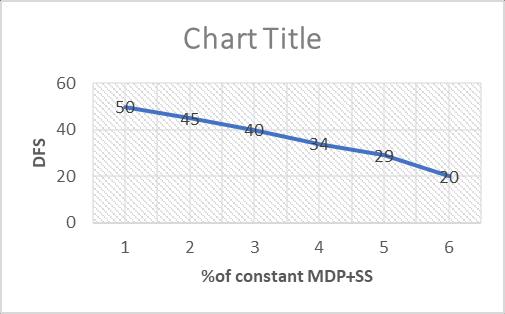
Fig -1:VariationinDFSofExpansivesoilandmarbledust powdertreatedwithpercentageof SodiumSilicate.
Volume: 12 Issue: 12 | Dec 2025 www.irjet.net p-ISSN: 2395-0072
Table -4: ResultsofAtterberg’slimittest S.NO
Table -6: ResultsofCBRtest
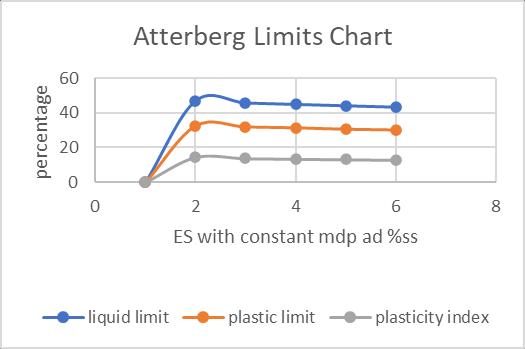
Fig -2:Variationinliquidlimit,plasticlimit,plasticityindexof Expansivesoilandconstantmarbledustpowdertreatedwith percentageof SodiumSilicate.
Table -5: ResultsofModifiedProctorCompaction test
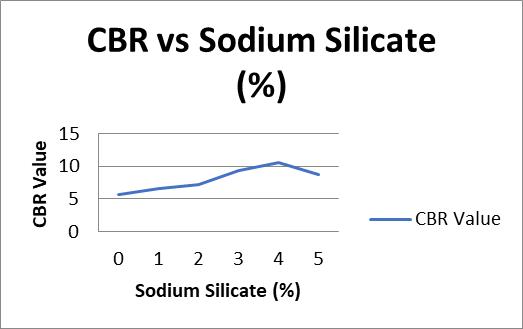
Fig -4:VariationinCBRtestBlackCottonSoilandconstant MarbleDustPowderand%ofSodiumSilicateused.
Thefollowingconclusions werebasedonthelaboratory studies carried out of Marble Dust Powder and Sodium Silicate found through the laboratory on this study. From the laboratory investigations the Optimum percentageresearchis20%and4%respectively.
Table -7: Optimum Percentages of MDP and SS, observedthelaboratoryinvestigations
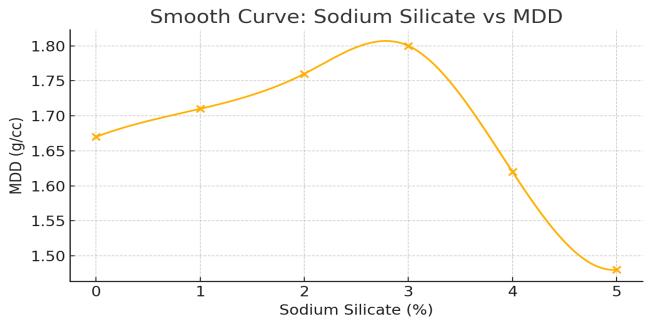
Fig -3:VariationofmddinExpansivesoilandconstant marbledustpowdertreatedwithpercentageof sodium silicate
isnoticedfromthelaboratorytestresultsthatthe DifferentialFreeSwellIndexofExpansivesoilhas beenreducedfrom90%to50%ontheadditionof 20%MDPandithasbeenfurtherreducedfrom 50% to 20% with and addition of 5% Sodium Silicate. When compared with untreated Expansivesoil.
International Research Journal of Engineering and Technology (IRJET) e-ISSN: 2395-0056
Volume: 12 Issue: 12 | Dec 2025 www.irjet.net p-ISSN: 2395-0072
Itisobservedfromthelaboratorytestresultsthat the Liquid limit of Expansive Soil has been decreased from 73.23%% to 46.92% on the addition of 20% MDP and it has been further decreased from 46.92% to 41.12% with an additionof5%SodiumSilicate
Itisobservedfromthelaboratorytestresultsthat thePlasticlimithasbeenincreasedfrom28.3%to 3244%inadditionto20%
It is noticed that the Plasticity Index has been decreasedfrom44.93%to14.48%inadditionto 20% MDP and it has been further decreased fromaddingSodiumSilicate.
Itisobservedfromthelaboratoryteststhatthe OMC of the Expansive soil has been decreased from29.42%to24.78%on theadditionof20% MDP and it has been further decreased from 24.78% to 19.86% with addition of 5%Sodium silicate.
Itisobservedfromthelaboratoryteststhatthe MDD of the Expansive Soil has been increased from1.52/ccto1.67g/ccontheadditionof20% MDP and it has been further increased from 1.67g/cc to 1.8g/cc with addition of 3%Sodium silicate.
It isobservedthattheCBRoftheExpansivesoil hasbeenincreasedfrom1.54%to5.65%onthe addition of 20% MDP and it has been further increasedfrom5.65%to10.5%withadditionof 4%Sodiumsilicate.
ItisobservedthattheCohesionofthesoilis130
ItisobservedthattheAngleofInternalFrictionof theExpansivesoilis 2.2⁰ .
ItisalsoobservedthatMDDisdecreasedafter adding4%,5%.
[1] Abbas J. Al-Taie, Abeer F. Hussein, Ahmed S Ali (2019), "A Review on Stabilization of Expansive Soil Using Different Methods." Journal of GeotechnicalEngineering.Vol6,Iss:3,pp32-40.
[2] AbdulShukoor(2017),"StabilizationofExpansive ClayUsingRHAandTSP."InternationalJournalfor Research in Applied Science and Engineering Technology(IJRASET),pp2833-2837.
[3] Adunoye G. O., Yinusa I., Chibuogwu D E (2024), "Effects of Lime on Bagasse Ash- It Stabilised Expansive Soils" African journal of environment andnaturalscienceresearch.ISSN2689-9434.
[4] Ahmed SA. Al-Gharbawi, Ahmed M Najemalden, Mohammed Y. Fattah (2022), "Expansive Soil StabilizationwithLime,Cement,andSilicaFume" AppliedSciences,Vol13,Iss:1,pp436-436.
[5] Al-Swaidani,A.,Hammoud, 1.Meziab, AEffect of adding natural pozzolana on geotechnical properties of lime-stabilized clayey soil. J. Rock Mech.Geotech.Eng2016,8,714-725.
[6] AnilKumarSinghai(2014),"Laboratorystudyon soilstabilizationusingflyashandricehuskash." International Journal of Research in Engineering andTechnology.Vol.03,Iss:11,pp348-351.
[7] Anggraini,V.;Asadi,A.,Farzadnia,N,Jahangırıan, H., Huat, B.B.K. Effect of coir fibres modified Ca(OH)2 and Mg (OH)2 nanoparticles on mechanicalpropertiesoflime-treatedmarineclay. Geosynth.Int2016,23,206-218
[8] Kharade Amit S., Suryavanshi Vishal V., Gujar BhikajiS.;DeshmukhRohankitR.:(2014)“Waste product bagasse ash from sugar industry can be used as stabilizing material for expansive soils” IJRET,ISSN:2321-7308.
[9] Shambamaheshwari,ands.s.goliya.stabilizationof blackcottonsoilforpavementusingflayashand lime.international journal of engineering developmentandresearch2016.

Author-: P. SRI AASHISH, Post Graduationstudent,SoilMechanics & Foundation Engineering, Department of Civil Engineering, UniversityCollegeofEngineering, JNTUK,Kakinada,AndhraPradesh,