
International Research Journal of Engineering and Technology (IRJET) e-ISSN:2395-0056
Volume: 12 Issue: 08 | Aug 2025 www.irjet.net p-ISSN:2395-0072
International Research Journal of Engineering and Technology (IRJET) e-ISSN:2395-0056
Volume: 12 Issue: 08 | Aug 2025 www.irjet.net p-ISSN:2395-0072
Viraj
Prabhu1 , Siddhant Sawant2 , Radhika Godambe3 , Ghrani Poojari4 , Nidhi Gaur5
Computer Engineering Department St. Francis Institute of Technology Mumbai, India
Computer Engineering Department St. Francis Institute of Technology Mumbai, India
Computer Engineering Department St. Francis Institute of Technology Mumbai, India
Computer Engineering Department St. Francis Institute of Technology Mumbai, India
Professor, Computer Engineering Department St. Francis Institute of Technology Mumbai, India
Abstract In today’s digital era, access to timely medical care, especially life-saving resources like blood, remains critically dependent on efficient and responsive systems. Traditional blood donation methods while foundational often suffer from delays, limited accessibility, and inefficient coordination. RedRespond is a centralized, technology-driven platform designed to modernize the blood donation ecosystem by bridging the gap between donors, recipients, and blood banks. The system enables real-time search for nearby blood banks, monitors blood availability, facilitates donor registration with verification, and ensures reliable scheduling and inventory management for blood banks. It integrates real-time alerts for emergencies, reminders for donors, and a seamless interface to improve user engagement and awareness. RedRespond enhances the transparency, safety, and efficiency of blood donations, reducing response time in critical situations and minimizing wastage through smarter inventory control. By leveraging digital connectivity and automation, RedRespond aims to create a responsive, reliable, and equitable blood donation network that saves lives and strengthens healthcare infrastructure.
With the growing global population, rapid urbanization, andincreasinghealthcaredemands,theneedforefficientand accessible medical resources has become more critical than ever. Among these resources, blood stands out as one of the mostessentialandlife-savingelementsinmodernhealthcare. Despite advancements in medical science, traditional blood donation systems such as hospital-based registrations, community blood drives, and manual donor tracking are still plagued by inefficiencies like outdated databases, slow responsetimes,andlackofreal-timeavailability.
To address these challenges, there is a pressing need for a digital-first platform that leverages modern technology to streamline and optimize the blood donation process. This is where RedRespond comes in a smart and responsive blood donation management system designed to bridge the gap
between donors, recipients, and blood banks. By providing real-time data, seamless communication, and automated features, RedRespond not only accelerates the process of blood allocation but also improves safety, trust, and transparency.
Theplatformfocusesoncreatinga smarterhealthcare infrastructure by ensuring faster emergency response, improving donor engagement through timely reminders, and enabling better inventory control for blood banks. Ultimately, RedRespond aims to enhance the accessibility and reliability of blood donation services, creating a more efficient, connected, and lifesavingnetworkforall.
In the context of enhancing blood donation systems through digital platforms, several studies and reports havebeeninstrumental in shapingthedevelopmentof RedRespond. The following literature review delves into key publications that have informed this project, highlighting their contributions and relevance.[1] provides an overview of India's healthcare infrastructure, emphasizing the critical role of blood transfusion services. It highlights challenges such as uneven distribution of blood banks, reliance on replacement donors, and the need for improved coordination among blood banks. The report underscores the importance of integrating digital technologiestoenhancetheefficiencyandaccessibility of blood donation services. These insights have been pivotal in conceptualizing RedRespond's centralized platform, aiming to streamline donor-recipient interactionsandoptimizebloodbankoperations.
[2], an annual report sheds light on the organization's effor2qts in promoting voluntary blood donation across the country. It discusses initiatives undertaken to raise awareness, organize blood donation camps,
International Research Journal of Engineering and Technology (IRJET) e-ISSN:2395-0056
Volume: 12 Issue: 08 | Aug 2025 www.irjet.net
and maintain a steady supply of safe blood. The report also addresses challenges such as donor retention andthe need for real-time tracking of blood availability. These findings have influenced RedRespond's features, including real-time notifications for urgent blood requirements and reminders for donors, to enhanceengagementandensurea reliablebloodsupply.
[3]introducesDONAPP,adigitalplatformdesignedtoconnect blood donors with recipients efficiently. The application features a user-friendly interface, real-time updates on blood availability, and a verification system to ensure donor eligibility. The research emphasizes the importance of leveraging technology to overcome challenges in traditional blood donation systems, such as delayed communication and lack of transparency. The insights from this paper have been instrumental in shaping RedRespond's core functionalities, focusing on seamless connectivity and trust-building among users.
[4] discusses the development of the Network of Community Blood Bank (NCB), a web-based system integrating Geographic Information System (GIS) to manage blood bank operations. The system enables spatial analysis of donor distribution,facilitatingefficientallocationofbloodresources. It also provides functionalities for donor registration, appointment scheduling, and real-time tracking of blood availability. The incorporation of GIS in NCB has inspired RedRespond to consider location-based services, enhancing the platform's ability to connect donors and recipients effectively.
[5] presents a comprehensive software solution aimed at simplifying blood donation procedures and ensuring timely access to blood for patients. The system focuses on maintaining accurate donor records, managing blood inventory, and facilitating communication between donors andmedicalprofessionals.Byaddressingissueslikeimproper documentation and inefficient coordination, the study highlights the potential of digital platforms in enhancing the safety and reliability of blood transfusion services. These considerations have been integral to RedRespond's design, emphasizing secure data management and streamlined operations.
[6] This paper outlines the development of a Blood Bank Management System (BBMS) that automates various aspects ofbloodbankoperations,includingdonormanagement,blood testing, and inventory control. The system aims to enhance operationalefficiencyandensuretheavailabilityofsafeblood products. Key features include real-time tracking, reporting tools, and compliance with regulatory standards. The
p-ISSN:2395-0072
comprehensive approach detailed in this study has influenced RedRespond's architecture, focusing on automation andadherencetosafetyprotocols
Access to timely and compatible blood remains a critical challenge inthehealthcaresector,particularlyin developing countries like India. Despite the existence of numerous blood banks and donor organizations, there exists a significant disconnect between blood donors, recipients,andmedicalinstitutions.Thisgapisprimarily due to fragmented data systems, poor real-time communication, manual processes, and the lack of a centralized digital infrastructure to manage blood donationsandinventoryeffectively.
The current blood donation ecosystem faces several limitations, including inefficient donor-recipient matching, underutilized donor databases, delays in emergency response, and inadequate tracking of blood stock levels across multiple locations. These shortcomings can lead to life-threatening consequences, especially during emergencies, pandemics, or natural disasterswhendemandforbloodsurgesunexpectedly.
There is an urgent need for an integrated and intelligentsystemthatcanstreamlinetheblooddonation process, enhance coordination among stakeholders, provide real-time updates, and ensure that blood resources are efficiently managed and accessible whenever needed.Theproposedsolutionaimsto bridge this gap by leveraging digital technologies to create a centralized, transparent, and responsive blood management platform that improves both operational efficiencyandhealthoutcomes.
This research proposes RedRespond, an integrated blood donation management platform aimed at improving coordination between blood donors, blood banks,andrecipients.Thesystemisdesignedtoaddress the challenges of timely blood availability, donor engagement, and real-time communication. The primary featuresoftheproposedsolutionareasfollows:
4.1. Seamless Blood Bank Search and Real-Time Availability
RedRespond allows users to locate nearby blood banks based on location and required blood type. The system
International Research Journal of Engineering and Technology (IRJET) e-ISSN:2395-0056
Volume: 12 Issue: 08 | Aug 2025 www.irjet.net p-ISSN:2395-0072
4.2. Donor Registration and Eligibility Verification fetches and displays real-time information on blood stock availability, thereby minimizing delays in fulfilling bloodrequirements.
The platform facilitates donor registration, enabling individuals to create accounts, register as donors, and schedule appointments with nearby blood banks. A built-in verification mechanism ensures that only eligible andhealthy individuals are approved, thereby maintaining the quality andsafetyofthedonatedblood.
A dedicated interface for blood banks allows them to manage essential operations efficiently. Key functionalitiesinclude:
Maintenanceofanup-to-datedonordatabase,
Schedulingandmanagingdonationappointments,
Monitoringcurrentbloodstocklevelsanddonoractivity.
4.4. Real-Time Alerts and Notifications
To ensure timely action, RedRespond offers automated notificationsfor:
Emergency blood requirements, to quickly mobilize potentialdonors.
Donorremindersbasedondonationeligibilityintervals,
Updates regarding upcoming donation drives or scheduledappointments.
4.5. Local Server Deployment and Modularity
The platform is designed to operate on a local server, eliminating reliance on constant internet connectivity. Thisconfigurationprovides:
Enhanceddataprivacyandcontrol,
Asecureandtestableenvironmentthatcloselysimulates real-worlddeployment,
Easiercustomizationforinstitutionalorregionalneeds
.4.6. Role-Specific Dashboards
RedRespond employs a modular, role-based dashboard system:
Donor Dashboard: Enables tracking of donation history,scheduling,andreceivingalerts.
Blood Bank Dashboard: Provides tools for managing donors, updating blood stock, andresponding torequests.
Administrator Dashboard: Facilitates oversight of platform activity, donor verification, and inter-entitycommunication.
Advanced filtering options enhance the search functionality,allowing users to quickly identify nearby blood bankswith the required blood type in stock. This feature significantly improves response time in criticalscenarios.
4.8. System Impact
The proposed solution ensures improved efficiency, faster emergency response, and higher donor engagement. By leveraging real-time data, modular interfaces, and localized deployment, RedRespond contributes to creating a more responsive and reliable blooddonationecosystem.
5.IMPLEMENTATION
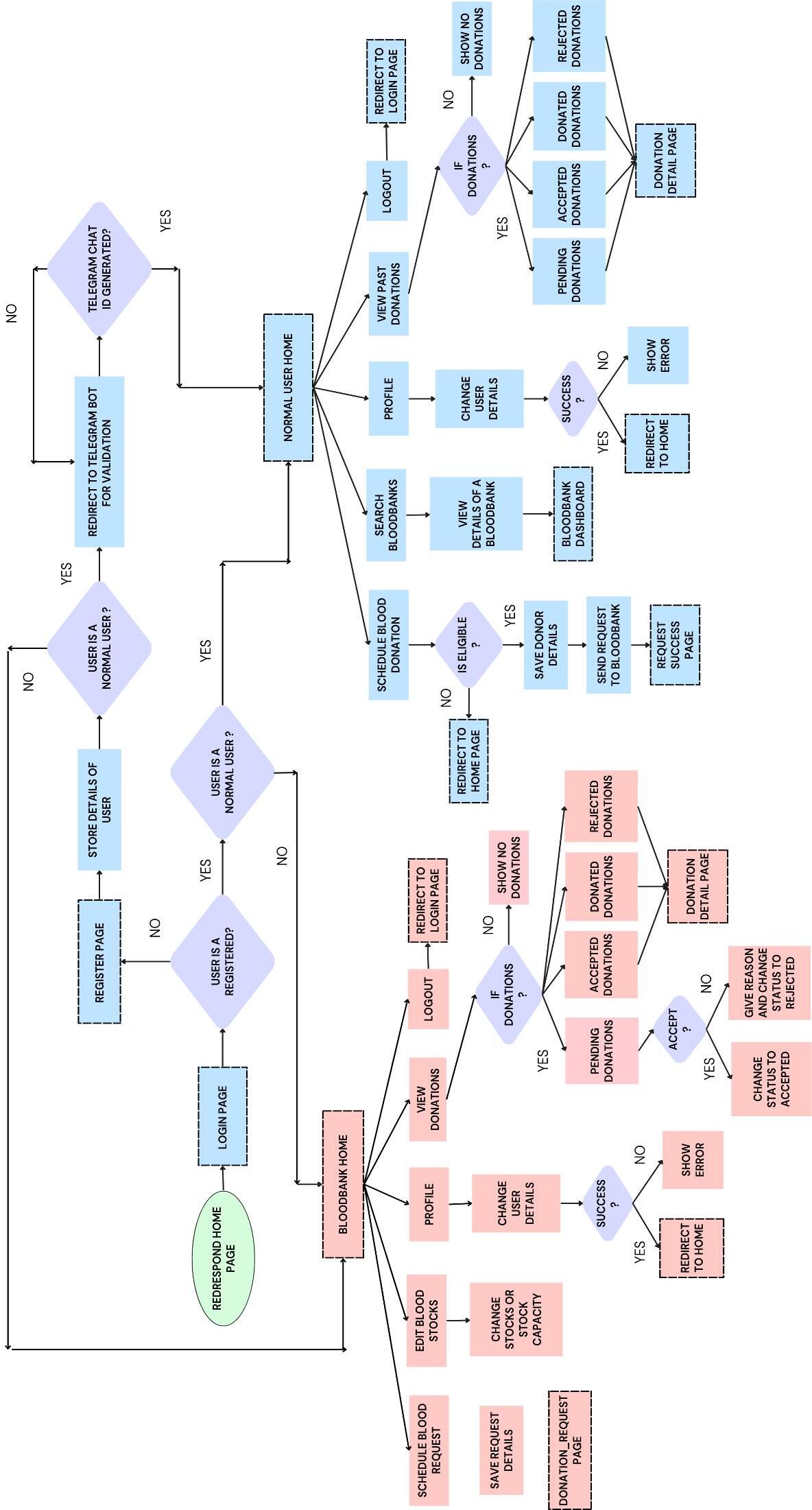
The proposed system, RedRespond, is structured into three conceptual layers: the Data Acquisition Layer, the Processing and Logic Layer, and the Application and Interaction Layer. This modular architecture facilitates seamlessinteractionamongusers,ensuresdataintegrity and responsiveness, and enhances the system’s capacity toscaleandadapttofutureextensions.
5.1. Data Acquisition Layer This foundational layer is responsible for capturing and updating real-time information relevant to donors, recipients, and blood inventory.Keycomponentsinclude:
User Registration Interfaces: Web-based forms enable secure collection of user credentials, blood type, medicalhistory,location,andavailability.
Background Scheduling Tasks: Using Celery, this layerensuresperiodicdatasynchronizationsuchaslast
Donation dates, eligibility resets, and inventory level checks.
International Research Journal of Engineering and Technology (IRJET) e-ISSN:2395-0056
Volume: 12 Issue: 08 | Aug 2025 www.irjet.net
Geolocation Tracking: Donor location data is gathered during registration and periodically updated basedoninteractionswiththeplatformorTelegrambot commands.
Thislayerensuresaccurateandup-to-datedataflowinto the system and minimizes manual intervention through automation.
5.2. Processing and Logic Layer
Serving as the system’s core, this layer implements the business logic and decision-making mechanisms that driveRedRespond’sfeatures.Majoroperationsinclude:
Donor–Recipient Matching: Algorithms compare blood type compatibility, urgency, and geolocation to establishoptimaldonor-recipientpairingsinrealtime.
Inventory Monitoring: The system dynamically tracksbloodstockacrossregisteredhospitals.Ittriggers alerts and donor outreach protocols when levels fall belowdefinedthresholds.
Emergency Response Logic: In critical scenarios, the system elevates requests based on urgency, proximity, and donor availability, initiating rapid donor notificationworkflows.
Verification and Access Control: Implements rolebased authentication, document validation, and audit trails toensureauthorizeddataaccessandaction.
This layer is built in Django, utilizing ORM for efficient data manipulation and integrates with asynchronous task queues to handle concurrent processing without performancedegradation.
5.3. Application and Interaction Layer
This top layer provides intuitive interfaces and communicationmechanismsthatallowuserstoengagewith theplatformeffectively.Keyfunctionalitiesinclude:
Responsive Web Dashboard: Enables hospitals, administrators, and users to manage profiles, request donations,monitorinventory,andscheduleappointments.
Telegram Bot Integration: Facilitates lightweight interaction with the system, allowing donors to receive alerts,confirmavailability,andsharelocationseffortlessly.
Smart Notifications and Scheduling: Implements eligibility-based reminders and appointment systems that are personalized according to donation history and medical guidelines.
Real-Time Status Updates: Users are informed of donation request statuses, confirmations, and upcoming eventstoenhancetransparencyanduserengagement.
This layer emphasizes usability, accessibility, and real-time feedback,essentialfortime-sensitivehealthinterventions.
The implementation strategy follows a three-phase developmentcycle:
1. Data Visualization: RedRespond incorporates graphical dashboards, heatmaps of blood availability, and donorengagementstatisticstofacilitatedecision-makingfor bothusersandadministrators.
2. System Simulation: Before deployment, test environments simulate real-world emergency scenarios, stress-test donor matching logic, and assess system throughputunderpeakloads.
3. Predictive Modeling (future extension): With sufficient usage data, machine learning models can forecast future blood demand trends, identify donor attrition risk, andoptimizestockallocationacrossregions.
To ensure the reliability and efficiency of the RedRespond platform,acomprehensivetestingandvalidationphasewas conducted following the implementation. The primary objectives were to assess system responsiveness, accuracy of real-time data updates, and robustness of emergency responsefeatures.
Each module, including donor registration, blood bank inventory updates, and real-time notifications, was subjected to rigorous unit testing using Django’s in-built testing framework. Test cases were designed to verify properfunctioningofuser roles,validationmechanisms, andreal-timestatusupdates.
International Research Journal of Engineering and Technology (IRJET) e-ISSN:2395-0056
Volume: 12 Issue: 08 | Aug 2025 www.irjet.net
To simulate peak emergency scenarios, the system was evaluated under varying data loads using locust-based stress testing. The tests ensured the platform could handle concurrent user requests, high-frequency notificationtriggers,andcontinuousdatapollingwithout performancedegradation.
6.3.Usability Testing
A group of testers including students, volunteers, and healthcare personnel participated in a closed beta test. Feedback was collected regarding dashboard intuitiveness, Telegram bot responsiveness, and overall user experience. Iterative improvements were made based on this feedback to refine navigation flows and optimizeresponsetimes.
6.4.Failure and Recovery Testing
System resilience was validated by simulating network failures and server restarts to confirm proper local data handling and recovery mechanisms. The platform demonstrated successful fallback to cached data with automaticre-synchronizationuponreconnection.
The testing phase confirmed RedRespond’s capability to operate effectively in real-world conditions, ensuring reliable performance, user satisfaction, and system integrity.
p-ISSN:2395-0072
International Research Journal of Engineering and Technology (IRJET) e-ISSN:2395-0056
Volume: 12 Issue: 08 | Aug 2025 www.irjet.net p-ISSN:2395-0072
International Research Journal of Engineering and Technology (IRJET) e-ISSN:2395-0056
Volume: 12 Issue: 08 | Aug 2025 www.irjet.net p-ISSN:2395-0072
7. CONCLUSION
WithRedRespond,yougainsmartercontroloverlife-saving blood donation processes, while automating crucial tasks likereal-time donoralerts,inventoryupdates,andlocationbased donor-recipient matching. It provides key insights into blood availability and donation trends, helping hospitals, donors, and recipients make timely, informed decisions. RedRespond streamlines blood bank operations by tracking donation patterns, automating reminders, and reducing manual errors. It pinpoints areas of shortage or surplus, ensuring better distribution and reduced wastage. By connecting donors, recipients, and blood banks through anintelligent,user-friendlyplatform,RedRespondsimplifies the donation process, enhances responsiveness, and ultimatelycontributesto a more efficient,humane, and lifesavinghealthcareecosystem.
As AI-Powered Donor-Recipient Matching: Implement an AI-based system that uses machine learning algorithms to match donors with recipients based on their blood type, location,andurgencyofneed.Thissystemcouldanalyzethe historical data of blood donations and transfusions to predict demand and supply patterns, helping optimize the allocationofbloodresourcesinrealtime.
Mobile App Development: While the website serves the primary purpose, creating a mobile application for iOS and Android could significantly enhance accessibility for users. The mobile app could provide notifications, quick registration for donation drives, blood bank locations with mapintegration,andeasydonationtrackingforbothdonors andbloodbanks.
Blockchain for Donation Transparency: Integrating blockchain technology to record donations securely and transparently could help prevent fraud and provide a trustworthy,immutableledgerofdonorhistory.Thiswould ensure that all donation records are easily verifiable by donors, blood banks, and recipients, making the process moretransparentandreducingtheriskoferrorsorfraud.
Integration with Health Monitoring Devices: Future work could include integrating wearable health devices (e.g., fitness trackers or health apps) with RedRespond. By syncingbloodpressure,heartrate,andotherhealthmetrics, these devices could notify users when they are eligible for donation based on their health status, providing personalizeddonationrecommendations.
Gamification of Donor Engagement: Adding gamified elementssuchasdonationmilestones,leaderboards, and
badges for donors could encourage more frequent donations and create a sense of community. Donors could earn points for participating in drives, referring others, or donating regularly, which could be redeemed forrewardsorrecognition.
Real-Time Blood Availability Dashboard: Expanding the system to include a real-time blood stock dashboard forbothdonorsandbloodbankscouldmakeiteasierfor users to see which blood types are most needed. The platformcouldsendautomatedalertstobloodbanksand donorsbasedondemandandavailableinventory.
[1] C. -S. Yang, P. -W. Tsai, M. -Y. Liao, C. -C. Huang, C. E. Yeh, "Location-Based Mobile Multimedia Push System," ,International Conference on Cyber-Enabled Distributed ComputingandKnowledgeDiscovery,Nov.2010.
[2] S. Singh, S. Sambhav, V. Ravi, A. Arya, T. Alahmadi, P. Singh, M. Diwakar, "DONAPP: A Centralized Platform for Bridging the Gap between Donors and Recipients," TheOpenNursingJournal,vol.18,pp.99-120,Mar.2024.
[3] P. Sudha B G, S. Swamy, B. Adiga,"AnApplicationTo Find Spatial Distribution Of Blood Donors From Blood Bank Information System" Mallige College of Pharmacy, vol.1,no.2,pp.13-21,Sep.2024.
[4] A. Nagurney, A. H. Masoumi and M. Yu, "Supply chain network operations management of a blood banking system with cost and risk minimization", Computational Management Science, vol. 9, no. 2, pp. 205-231,Jan.2012.
[5] Telegram, "Telegram Bot API," https://core.telegram.org/bots/api,Apr.2025
[6] Python-Telegram-Bot https://python-telegram-bot.readthedocs.io/,Apr.2025.
[7] Leaflet, "Leaflet:An Open-Source JavaScript Library forInteractiveMaps,"https://leafletjs.com/,Apr.2025.
[8] Celery Project, "Celery Documentation," https://docs.celeryproject.org/,Apr.2025.