
International Research Journal of Engineering and Technology (IRJET) e-ISSN: 2395-0056
Volume: 12 Issue: 05 | May 2025 www.irjet.net p-ISSN: 2395-0072
International Research Journal of Engineering and Technology (IRJET) e-ISSN: 2395-0056
Volume: 12 Issue: 05 | May 2025 www.irjet.net p-ISSN: 2395-0072
Venkatesh K.R 1,*, Jeevasri A2, Priyadharshini K3, Roopalakshmi A4 and Sakthivel R5
1-Associate Professor, Department of Civil Engineering, University College of Engineering-Tindivanam, Tamilnadu, India-604307
2,3, 4 & 5 - Final year U.G. Students, Department of Civil Engineering, University College of Engineering-Tindivanam, Tamilnadu, India-604307
* Corresponding Author: e-mail- kayarvee@gmail.com.
Abstract -Thisstudyinvestigatesanovel,low-costapproach for treating synthetic turbid water using binary blends of plant-based bio-coagulants, through a comparative assessment against conventional alum. Four plant-derived coagulantswereblendedinseedratiosof25:75,40:60,50:50, 60:40,and75:25,andappliedatdosagesrangingfrom50to 85mg/L.Theseblendsweretestedonsyntheticturbidwater sampleswithturbiditylevelsof20,40,50,and80NTUusing standardjartestprocedures.Thestudyassessedvariationsin water quality parameters, including turbidity, pH, chloride, and total hardness. Results showed that specific binary combinationsachievedturbidityremovalefficienciesofupto 90%,matchingorexceedingalumperformance.Additionally, bio-coagulant treatments maintained pH within the acceptable range of 6.5–8.5,whereas alumledto significant pH reductions necessitating chemical correction. Select combinations also showed notable hardness reduction, offering advantages over conventional coagulants. Unlike alum-basedsludge,thesludgegeneratedfrombio-coagulants was biodegradable and potentially reusable as organic manure, reducing environmental impact. Among all combinations tested, the Phyllanthus emblica / Cicer arietinum blend exhibited the highest turbidity removal efficiency (up to 90%) while maintaining optimal pH and hardness levels. These findings indicate that binary biocoagulants, when applied at suitable ratios and dosages, provideasustainable,cost-effective,andefficientalternative to chemical coagulants, especially suitable for decentralised watertreatmentapplications.
Keywords: Alum,Jar test,; Turbidity, Hardness, Seed ratio, Binarybio-coagulants.
Access to safe drinking water is a critical public health requirement.Turbidityandhardnessareamongthemajor concernsinsurfaceandgroundwatersources,especiallyin developingregions.Turbidity,causedbysuspendedsolids suchasclay,silt,andorganicmatter,reduceswaterclarity andhampersdisinfectionefficiency.Hardness,primarilydue tocalciumandmagnesiumions,leadstoscalinginpipelines
and appliances, reduces soap efficiency, and impairs taste [1].
Conventional treatment methods rely on chemical coagulants like aluminium sulphate (alum) to remove turbiditythroughcoagulation–flocculationprocesses.While effective,alumhasseverallimitations:itsignificantlylowers water pH, contributes to increased residual aluminium content,andgenerateslargevolumesofnon-biodegradable sludge that complicate disposal [2-3]. Post-treatment pH correction using lime is often necessary, which raises operationalcostsandchemicalload.Furthermore,concerns regardinglong-termhealtheffectsof aluminium exposure havedriventhesearchforsafer,sustainablealternatives[4].
Inrecentyears,plant-basedbio-coagulantshaveemergedas promising eco-friendly substitutes. Derived from seeds, peels, or pods of various plants, bio-coagulants are biodegradable,non-toxic,locallyavailable,andcost-effective [5-6].TheyminimizealterationinpH,producelesssludge, andareespeciallysuitablefordecentralizedwatertreatment systems. Various studies have reported the successful applicationofplant-basedbio-coagulantssuchas Moringa oleifera,bananapeelpowder,andokramucilageinreducing turbidityandotherwatercontaminants[7].Recentstudies havealsodemonstratedtheeffectivenessofplant-basedbiocoagulantextractsintreatingsurfacewaterwithcomparable performancetoconventionalcoagulants[8].
Despite growing interest, most previous studies have focused on individual plant-based coagulants. However, recentresearchsuggeststhatbinaryorhybridcombinations of coagulants can exhibit synergistic effects, potentially improving coagulation performance, reducing required dosage,andbroadeningthepHrangeofeffectiveness[9-4]. Of particular interest is Phyllanthus emblica (Indian gooseberry), which not only aids in turbidity removal but hasalsodemonstratedhardnessreductioncapabilitydueto itscalcium-bindingpolyphenols[10-11].
To address this gap, the present study evaluates the effectivenessofbinaryplant-basedbio-coagulantblends
International Research Journal of Engineering and Technology (IRJET) e-ISSN: 2395-0056
Volume: 12 Issue: 05 | May 2025 www.irjet.net p-ISSN: 2395-0072
specifically combinations of Cicer arietinum, Trigonella foenum-graecum, Dolichoslablab,and Phyllanthusemblica in treating synthetic turbid water. The study focuses on turbidityremovalefficiency,optimaldosage,pHsensitivity, chloride concentration, and hardness reduction, with a comparative analysis against conventional alum. The findings aim to support the development of scalable, sustainable water treatment alternatives suitable for resource-limitedsettings.
2.1
Astandardjartestapparatuswithsixbeakersandadjustable stirring speeds was used to evaluate coagulation performance. The setup simulated conventional water treatmentsteps:rapidmixingforcoagulantdispersion,slow mixing for floc formation, and sedimentation for particle settling.
2.2 Preparation of Synthetic Turbid Water
Syntheticturbidwaterwaspreparedbydispersing0.03g/L ofbentoniteclayintotapwaterandmixingvigorouslyusing a magnetic stirrer to ensure uniform dispersion. This preparationmethodtypicallyyieldsapproximately1NTUof turbidity per 0.03 g/L of bentonite under controlled laboratory conditions [12]. By varying the concentration, initial turbidity levels of 20, 40, 60, and 80 NTU were generated representing field conditions such as storm water runoff and river pollution. Turbidity was measured using a calibrated nephelometric turbidimeter, following standard procedures outlined in APHA [13]. Synthetic sampleswereallowedtostabilisepriortotestingtoavoid sedimentationerrors.
Note: Although specific targets of 20, 40, 60, and 80 NTU were intended, minor variations were observed due to limitations in synthetic sample preparation. These deviationswereminimalanddidnotsignificantlyaffectthe comparativeperformanceanalysis.
2.3 Preparation, Extraction, and Dosage
Seedsof Cicerarietinum, Dolichoslablab, Trigonellafoenumgraecum, and Phyllanthus emblica were sourced locally, thoroughly cleaned, shade-dried, and ground into a fine powderusingalaboratorygrinder.Forextractpreparation, 10 g of seed powder was mixed with 100 mL of distilled waterandstirredusinga magneticstirrerfor30minutes. Theresultingsuspensionwasfilteredthroughamuslincloth (poresize~100–150µm),followingAPHAprotocols[13],to removecoarseparticles.Thefiltratewasusedimmediately incoagulationtests.
Binaryplant-basedbio-coagulantblendswerepreparedin fivespecific weight ratios:25:75,40:60,50:50,60:40,and 75:25 (w/w). To study the effect of varying seed proportions,theseblendsweretestedatdosagesof50,70, 75, 80, and 85 mg/L. Each dosage was selected to correspondwithoneofthetargetinitialturbiditylevels:20, 40,60,and80NTUrespectively.Foreachturbiditylevel,six beakers were used five containing the binary coagulant blends and one control without any coagulant to assess naturalsedimentation.
The dosage range was informed by prior research, which indicates that plant-based coagulants typically achieve optimalturbidityremovalwithin25–100mg/L,depending onthesourcematerial and watercharacteristics[12-6-9]. Hence,thedosagesusedinthisstudyfallwithinscientifically validated limits and were further refined through preliminarytesting.
Each experiment was carried out using six 1 L beakers of synthetic turbid water placed in individual beakers. The standard coagulation–flocculation process involved the followingsteps:
-Rapidmixingat150rpmfor3minutes(coagulant dispersion)
-Slowmixingat30rpmfor30minutes(flocculation)
-Settlingfor45–60minutes(sedimentationphase)
Followingsedimentation,thesupernatantwasanalysedfor turbidity,pH,chlorideconcentration,andtotalhardness.
Allwaterqualityparametersweremeasuredinaccordance withstandardmethods:
-Turbidity:Nephelometricmethod
-pH:DigitalpHmeter
-Chlorides:Mohr’stitrationmethod
-Hardness:EDTAtitration(expressedasmg/LCaCO₃)
All tests were conducted in triplicate to ensure reproducibility.Theaveragevaluesfromeachsetwereused forfinalanalysis.
Note: Suspendedsolidswerenotmeasuredascoagulation istypicallyfollowedbyfiltration,whichremovesresidual particulates.
Thissectionpresentsthecomparativeperformanceofbinary bio-coagulant combinations and conventional alum in treatingsyntheticturbidwater.Theparametersevaluated include turbidity removal efficiency, post-treatment pH, changesinchlorideconcentration,andtotalhardness.Each
International Research Journal of Engineering and Technology (IRJET) e-ISSN: 2395-0056
Volume: 12 Issue: 05 | May 2025 www.irjet.net
combination was tested across a range of seed ratios and dosages under controlled laboratory conditions using the standard jar test method. The results are discussed with reference to graphical data and supported by relevant literature. The aim is to evaluate the technical feasibility, environmental benefits, and operational advantages of binary bio-coagulants as sustainable alternatives to conventional chemical coagulants in water treatment applications.
Turbidity removal is a primary parameter for evaluating coagulant performance. Four binary bio-coagulant combinations and alum were tested across varying initial turbidity levels (20–80 NTU). As shown in Figure 1, the Phyllanthus emblica / Cicer arietinum blend achieved the highestaverageturbidityremoval(90%),followedby Cicer arietinum/Trigonellafoenum-graecum (89.3%)and Dolichos lablab / Phyllanthus emblica (87.9%). These values are comparableto,orslightlybetterthanalum(89.4%)under identicalconditions
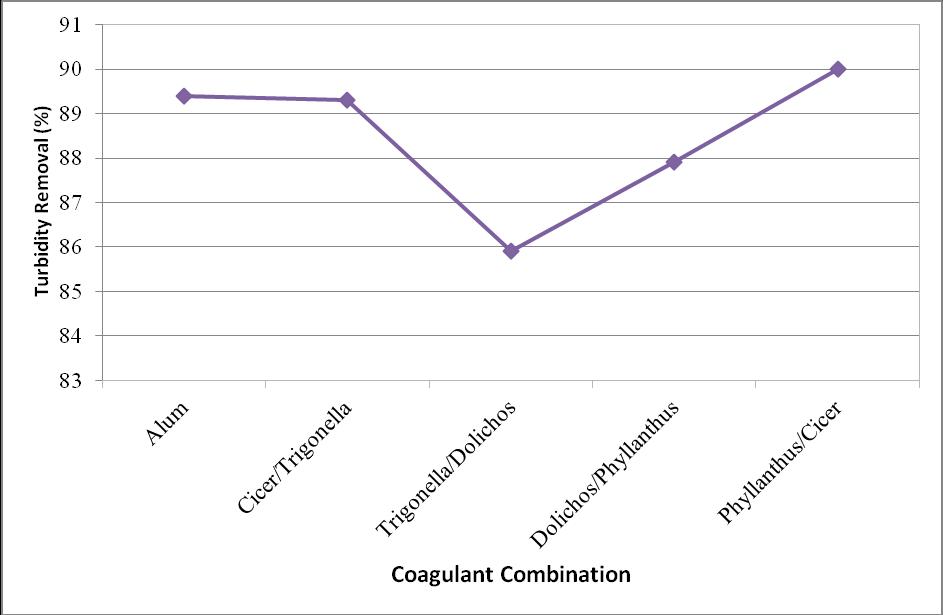
Figure 1. TurbidityRemovalEfficiency(%)ofAlumand BinaryBio-CoagulantCombinations.
Amongthetestedcombinations, Trigonellafoenum-graecum / Dolichos lablab yielded the lowest turbidity removal (85.9%), which was notably below alum (89.4%). This relatively reduced efficiency may be attributed to a lower concentrationofeffectivecoagulatingcompounds suchas polyphenolsandcationicproteins inthisblend. Trigonella seeds, although known for saponins, exhibit lesser flocculating potential compared to the tannin-rich Phyllanthusemblica.Similarly, Dolichoslablab alonedoesnot significantly contribute to bridging or sweep flocculation withoutastronglyactivecoagulantpartner.Theobserved dip highlights that not all binary combinations yield synergistic results. Hence, rational pairing of seed types based on their phytochemical profiles is essential to maximise coagulation efficiency. The lower turbidity removal by Trigonella foenum-graecum / Dolichos lablab (85.9%)isinlinewithpriorstudies[14-15],whichreport
p-ISSN: 2395-0072
limitedcoagulationpotentialoftheseseedsindividually.As noted by Choy et al. [12], binary combinations without synergistic biochemical interaction may fail to surpass conventionalcoagulantslikealum.
The trend in Figure 1 demonstrates that combinations containing Phyllanthusemblica consistentlyachievedhigher removalacrossalltestedturbiditylevels.Thishighlightsthe enhancedperformanceduetothepresenceofpolyphenols, tannins, and proteins. The Phyllanthus emblica / Cicer arietinum blend,inparticular,exhibitedsuperiorturbidity removal,likelyduetopolyphenol-mediatedbridgingfrom Phyllanthus emblica and protein-based flocculation contributed by Cicer arietinum. Similar observations were reported by Chowdhury et al. [7], who demonstrated that combinations of agricultural bio-coagulants provided improvedturbidityreduction.Nuretal.[9]furtherobserved that binary coagulants with complementary bioactive compounds enhanced floc formation. Yin et al. [16] confirmedthatmultifunctionalplant-basedpolymerscould match or exceed the performance of alum when properly dosed.
Unlike alum, which typically demands post-treatment pH correction, all bio-coagulant blends maintained high turbidity removal without chemical adjustment, making them suitable for decentralised, low-cost water treatment systems.
Maintaining an acceptable pH range in treated water is critical, as deviations can affect taste, increase corrosion potential, and impair disinfection efficiency. According to WHO[1],therecommendedpHrangefordrinkingwaterlies between6.5and8.5.Inthisstudy,allcoagulanttreatments wereassessedfortheirimpactonpost-treatmentpHacross differentturbiditylevels.
As illustrated in Figure 2, conventional alum consistently reducedthepHoftreatedwatertoarangebetween6.4and 6.6, especially at higher dosages. This trend aligns with Ahmadetal.[2],whoreportedthatalumhydrolysestoform acidicspecies.Specifically,aluminiumionsreactwithwater toproducealuminiumhydroxideandreleasehydrogenions, which in turn lower the pH. Such acidic conditions often necessitate post-treatment lime addition to restore pH to acceptablelevels,increasingchemicalusageandoperational costs[3-4].
Incontrast,allbinarybio-coagulantblendsmaintainedposttreatment pH values within the safe range of 6.5 to 8.5. Notably, the Phyllanthus emblica / Cicer arietinum blend exhibiteda slightlyalkaline trend, with pHvalues ranging from7.62to8.18acrossalltestedturbiditylevels
International Research Journal of Engineering and Technology (IRJET) e-ISSN: 2395-0056
Volume: 12 Issue: 05 | May 2025 www.irjet.net p-ISSN: 2395-0072
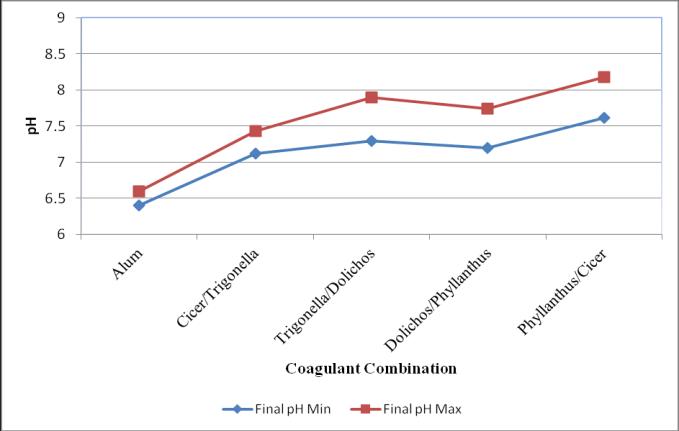
Figure 2. Post-TreatmentpHofTreatedWaterUsing DifferentCoagulants.
Thisstabilisingeffectisattributedtothepresenceoforganic acidsandpolyphenoliccompoundsin Phyllanthus emblica, whichimpartmildalkalinityandbufferingcapacity[10-11].
These findings are supported by Radoiu et al. [17], who observed that plant-based coagulants typically contain tannins,proteins,andnaturalbuffersthathelpminimisepH fluctuations during coagulation. Similarly, Yin et al. [16] notedtheinherentpHstabilityofnaturalcoagulants,making themparticularlysuitablefordecentralisedsystemswhere chemicalcorrectionisnotfeasibleorcost-effective.
Furthermore, bio-coagulants promote downstream disinfection efficiency by maintaining near-neutral pH conditions.Chlorination,awidelyuseddisinfectionmethod, is most effective within a pH range of 6.5 to 7.5, where hypochlorous acid formation is optimal. Since alum frequently reduces pH below this effective window, additional alkaline dosing is required to enable effective disinfection. By contrast, the natural buffering action of plant-based coagulants simplifies post-treatment requirementsandenhancesprocesssustainability[6-17-18].
Monitoring chloride concentrations after treatment is crucial,aselevatedlevelscanleadtocorrosivityinpipelines, poor taste, and potential non-compliance with drinking water standards. The World Health Organization (WHO) prescribesamaximumallowablechlorideconcentrationof 250 mg/L in potable water [1]. Accordingly, this study analysed the chloride levels in water treated with both binary bio-coagulantsandalumtodeterminewhetherthe coagulantsintroducedadditionalsalinity.
AsillustratedinFigure3,alltreatedsamplesremainedwell within the WHO limit, including those processed with the Phyllanthus emblica / Cicer arietinum blend. Although a minorincreaseinchloridecontentwasobservedacrossall samples, the maximum recorded value was 20.5 mg/L associated with the Dolichos lablab / Phyllanthus emblica blend at a dosage of 85 mg/L. These slight elevations are
attributed to the presence of naturally occurring chloride saltsandorganicacidsinplant-basedcoagulantmaterials, particularlyin Phyllanthusemblica [19].
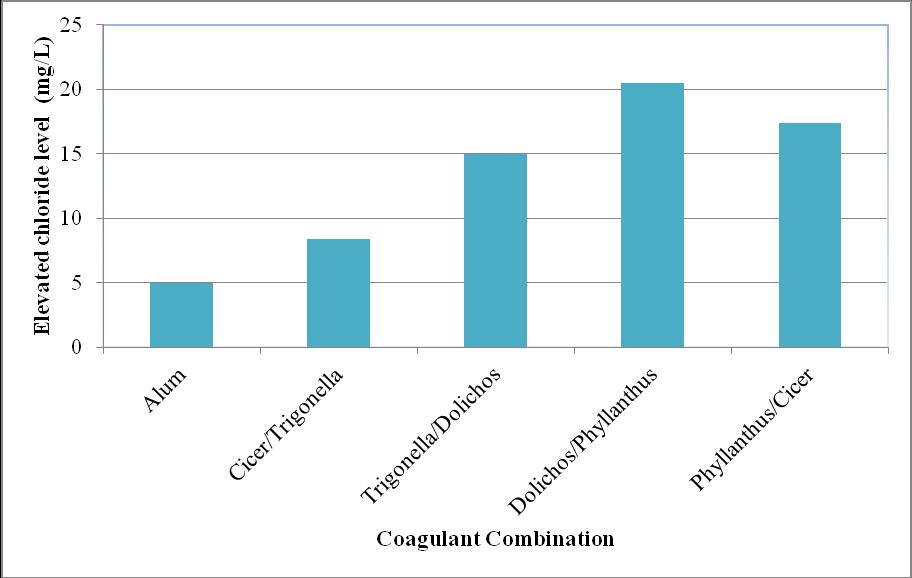
Figure 3. IncreaseinchloridelevelafterCoagulationwith AlumandPlant-BasedCoagulants.
Importantly, none of the treatments approached the regulatory threshold, and the changes observed were less pronouncedcomparedtothosecausedbyalum,especiallyat higher dosages. This observation supports the findings of Okuda et al. [20] and Choy et al. [12], who reported that plant-based coagulants especially those derived using salineextraction mayleadtominimalchlorideincreases but remain safe for consumption. In contrast, alum hydrolysiscanelevateionicstrengthinthewater,whichmay enhance chloride reactivity and contribute to long-term corrosion in metallic distribution systems [17]. The comparativelylowerchlorideelevationobservedwithbiocoagulantsunderscorestheirsuitabilityforlong-termusein drinking water systems, particularly in decentralised or rural regions. In areas such as Tindivanam, Tamil Nadu, wheresurfaceandgroundwaterchloridelevelsarealready modest(20–80mg/L),evenminimaladditionsremainsafely within permissible limits. However, total hardness often exceeds national standards, posing greater water quality challenges[21-22].
This regional hydro-geochemical profile further enhances the relevance of binary bio-coagulants that address both turbidity and hardness without exacerbating chloride content.Combinationssuchas Dolichoslablab/Phyllanthus emblica and Phyllanthus emblica / Cicer arietinum demonstrated dual efficacy and are especially suitable for areaswithhighhardnessbutlowchloridelevels.
Hardnessinwater,primarilyduetocalciumandmagnesium ions, poses a significant challenge in regions such as Tindivanam,wheresurfaceandgroundwatersourcesoften exhibit hardness levels exceeding 300 mg/L [23-24]. Excessivehardnesscontributestopipescaling,reducedsoap
International Research Journal of Engineering and Technology (IRJET) e-ISSN: 2395-0056
Volume: 12 Issue: 05 | May 2025 www.irjet.net p-ISSN: 2395-0072
efficiency, undesirable taste, and long-term operational issuesinbothdomesticandindustrialsettings.
AsshowninFigure4,thebinaryblendof Dolichos lablab/ Phyllanthus emblica achieved the highest total hardness reduction, with a decrease of 59.8 mg/L. The Phyllanthus emblica / Cicer arietinum combination followed with a reductionof27.5mg/L.Bycontrast,alum-treatedsamples exhibited negligible hardness removal, and in some cases, evenaslightincrease likelyduetoionicexchangesorthe presenceofresidualaluminiumcompounds.
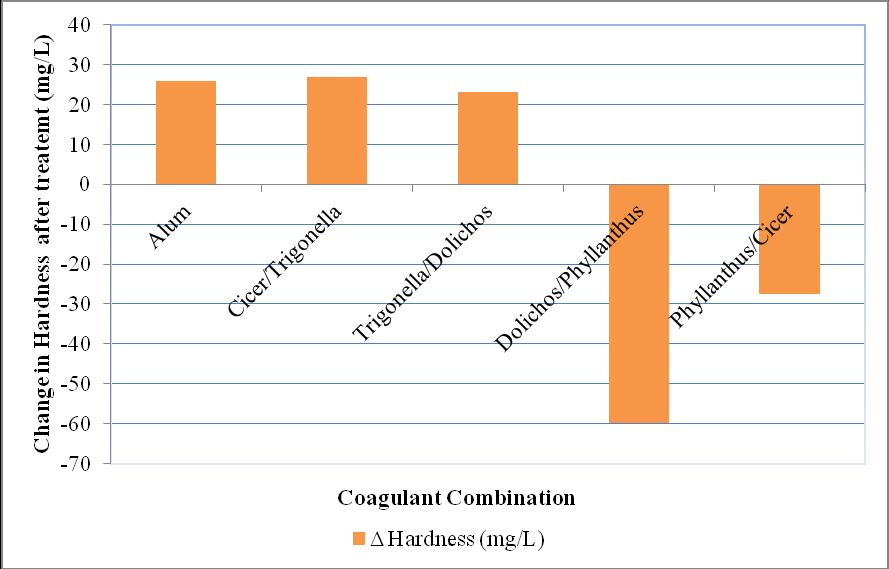
Figure 4. ChangeinHardnessafterCoagulationIndicating SofteningEffectof Phyllanthus-BasedBlends.
The effective hardness reduction observed in Phyllanthus emblica-based blends can be attributed to its content of polyphenols, citric acid derivatives, and natural chelators, which have calcium- and magnesium-binding affinity [2510]. These compounds likely contribute to partial water softening by destabilizing divalent cations during floc formation. Similarly, the high protein and polysaccharide content of Dolichos lablab aids in flocculation and entrapmentofhardnessions[26].
Recentstudieshavevalidatedthedualfunctionalityofbiocoagulants turbidity removal and hardness reduction when applied at optimised dosages. This supports their relevanceinsettingssuchasTindivanam,wherewateroften displayspersistenthardnessbutcomparativelylowchloride levels[27-24].Unlikealum,whichlacksanysofteningeffect and may increase the ionic load, bio-coagulants offer a sustainable, multi-functional alternative. Their inherent bufferingandchelatingcapacityalsoimproveswaterquality without elevating total dissolved solids (TDS) or leaving behindharmfulresiduals[17-26].
Thecharacteristicsofsludgegeneratedduringcoagulation–flocculationarecriticalinevaluatingboththeenvironmental impact and operational feasibility of water treatment processes. Alum-based treatments are known to produce
inorganic, non-biodegradable sludge that necessitates carefuldisposalduetothepresenceofresidualaluminium andassociatedhealthrisks[2].
In contrast, the sludge generated from plant-based biocoagulants is organic in nature, biodegradable, and environmentally benign. In the present study, sludge volumes produced by binary bio-coagulants were significantly lower and settled more easily compared to those from alum treatment. Notably, flocs formed using Dolichoslablab and Phyllanthusemblica weremorecompact and denser, facilitating faster sedimentation and reduced bulk.
TheseobservationsareconsistentwiththefindingsofYinet al. [16], Kumar et al. [19], and Radoiu et al. [17], who reportedthatplant-basedcoagulantsyieldlessvoluminous, stableflocsthatsettlemorerapidlyduetonaturalpolymers and mucilaginous compounds. Furthermore, the organic natureofbio-coagulantsludgeopensavenuesforreusein agriculture as a soil conditioner or compost additive, particularlywhenthesludgeoriginatesfrompotablewater treatmentprocesses.
Studiesinvolvingsludgederivedfrom Moringaoleifera and similarplantextractshaveshownthatsuchmaterialscanbe safely applied to soil without causing toxicity, while also enhancingorganiccontentandwaterretentioncapacity[726]. In contrast, alum-based sludge is chemically reactive, requiring secure drying and regulated disposal. Its accumulation increases operational costs, particularly in decentralisedandruralwatersupplysystems.
Thus,theuseof biodegradablecoagulantscontributesnot only to waste minimisation but also aligns with circular economyprinciplesbytransformingatreatmentby-product into a beneficial agricultural input. In line with circular economyprinciples,severalstudieshaveexploredrecovery andreuseofsludge-basedcoagulantsforsustainablewater treatment applications [28]. Shawal et al. [29] conducted parametric studies on coagulant recovery from water treatment sludge for circular economy integration. Additionally, valuable elements in sludge have been evaluated for recovery potential in municipal wastewater systems[30].
Figure5presentsaconsolidatedgraphicalcomparisonofthe performance of all four binary bio-coagulant blends and alumacrossfivecriticalwaterqualityparameters:turbidity removal efficiency, post-treatment pH, chloride concentration, total hardness reduction, and sludge characteristics.
International Research Journal of Engineering and Technology (IRJET) e-ISSN: 2395-0056
Volume: 12 Issue: 05 | May 2025 www.irjet.net
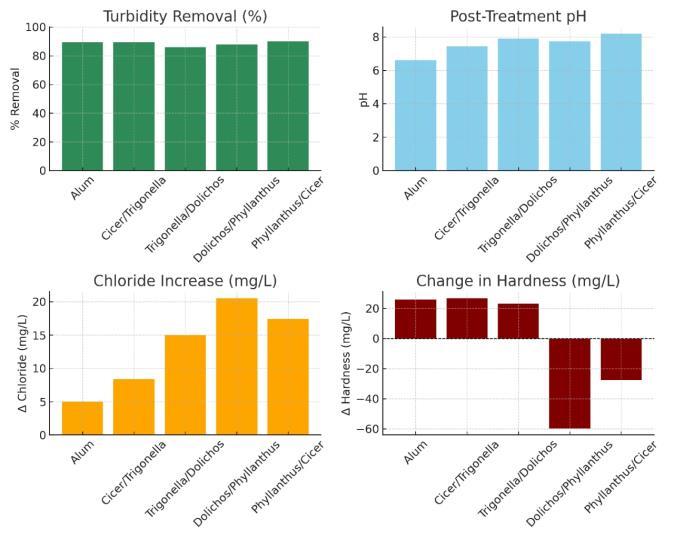
Figure 5. ComparativePerformanceofCoagulantsacross KeyWaterQualityParameters.
Amongallblends,the Phyllanthusemblica/Cicerarietinum combinationachievedthehighestturbidityremoval(90%), asshowninFigure5(top-left).Thisismarginallybetterthan alum(89.4%)andthe Cicer/Trigonella blend(89.3%).The lowest turbidity removal was recorded for Trigonella / Dolichos (85.9%),indicatingthatnotallcombinationsyield synergistic benefits. The variation highlights that combinations involving Phyllanthus emblica consistently outperformothers.Thisreinforcesitsdominantroleinfloc formation,likelyduetoitshighpolyphenolandorganicacid content,whichenhancechargeneutralisationandparticle bridging. The blends also maintained removal efficiency acrossalltestedturbiditylevels,whereasalumperformance fluctuated more with initial turbidity. Thus, turbidity removal trends, as reflected in Figure 5, reaffirm the suitabilityofcertainbinaryblendsasrobustalternativesto conventionalalum.
Allbinaryblendsconsistentlymaintainedpost-treatmentpH withintheWHO-recommendedrange(6.5–8.5),whilealum consistentlyreducedpHtobetween6.4and6.6.Thisaligns withearlierfindingsconfirmingthenatural pH-stabilising behaviour of plant-based coagulants [16-4]. Regarding chloridelevels,allblendsexhibitedminimalincreases,with thehighestrecordedvaluebeing20.5mg/L wellbelowthe 250mg/LWHOthreshold.Theseincreasesareattributedto trace chloride content in the seed matrix and were substantiallylowerthanthosecausedbyalum[12-20].
In terms of hardness removal, the Dolichos lablab / Phyllanthus emblica combination emerged as the most effective, with a reduction of 59.8 mg/L, followed by Phyllanthus emblica / Cicer arietinum at 27.5 mg/L. The enhancedperformanceislikelyduetothechelatingnature of citric acid derivatives and polyphenols in Phyllanthus emblica, coupled with sweep flocculation facilitated by Dolichoslablab.Bycontrast,alumexhibitednoappreciable
p-ISSN: 2395-0072
softening and in some instances slightly increased hardness possibly due to ionic shifts during coagulation [24].
Finally, sludge characteristics observed during experimentationdemonstratedclearadvantagesforallbiocoagulantcombinations.Thebio-sludgesettledfaster,was lower in volume, and fully biodegradable, offering opportunitiesforcompostingorsoilapplication.Alum-based sludge,incontrast,wasbulkier,requiredcarefulhandling, andlackedreusepotential,assupportedbyRadoiuetal.[17] and Usman et al. [26]. Overall, the synthesis presented in Figure 5 reinforces the technical and environmental superiority of binary bio-coagulant blends particularly thoseinvolving Phyllanthusemblica.Thesefindingsnotonly validate their practical potential for rural and semi-urban water treatment but also position them as promising components in the transition toward green, decentralized waterpurificationsystems[26-7].
The growing emphasis on bio-coagulants is further supported by recent reviews. Tijjani Usman et al. [31] discussedthesynergisticeffectsofcombiningplant-derived extracts with complementary flocculating compounds to enhance turbidity removal and overall water quality. Similarly, Simate and Ndlovu [32] emphasized the importance of biodegradable, non-toxic coagulants in improving long-term sustainability, especially in decentralizedtreatmentsystems.
Thisstudyconfirmstheeffectivenessofbinaryplant-based bio-coagulants particularly Phyllanthusemblica and Cicer arietinum assustainable,low-costalternativestoalumfor treating synthetic turbid water. Optimised seed ratios of 25:75and40:60achievedupto90%turbidityremovalwhile maintaining post-treatment pH within the WHOrecommended range of 6.5–8.5, eliminating the need for additional pHcorrection.Combinationsinvolving Dolichos lablab yieldednotablehardnessreductionsupto59.8mg/L, highlighting their potential for regions with high water hardness.Chloridelevelsremainedwellwithinpermissible limits, and the biodegradable sludge settled rapidly and showedpromiseforagriculturalreuse.
Thefindingsstronglysupporttheapplicationofbinarybiocoagulants in decentralised and rural water treatment systems, where affordability and multi-parameter water quality management are crucial. This novel combinatory approach offers synergistic advantages in coagulation efficiency,pHstability,andionremoval advancingbeyond priorstudiesthatfocusedonindividualcoagulants.
Futureresearchshouldincludepilot-scalevalidation,sludge characterisationviaSEMimaging,andnutrientanalysisto confirmagriculturalsafety.Moreover,integratingAI-driven predictive modeling could optimise coagulant dosage and
International Research Journal of Engineering and Technology (IRJET) e-ISSN: 2395-0056
Volume: 12 Issue: 05 | May 2025 www.irjet.net p-ISSN: 2395-0072
blend ratios based on real-time water quality inputs, enabling automation and scalability in smart water treatmentsystems.Suchinnovationsalignwithsustainable developmentgoalsandcirculareconomyprinciples,offering environmentally sound solutions for communities with limitedresources.
[1] World Health Organization. (2022). Guidelines for drinking-water quality (4th ed., incorporating the 1st and 2ndaddenda).Geneva:WorldHealthOrganization.
[2]Ahmad,A.L.,MatYasin,N.H.,&Lim,J.K.(2022).Alumbased coagulants and their drawbacks: A critical review. Environmental Technology Reviews, 11(1), 137–155. https://doi.org/10.1080/21622515.2022.2050771
[3] Basu, R., Saha, S., & Ghosh, A. (2021). Eco-friendly and efficientbio-coagulantsinwaterandwastewatertreatment. Environmental Science and Pollution Research, 28(22), 27833–27850.https://doi.org/10.1007/s11356-021-124244
[4] Lim, J. K., Ahmad, A. L., & Mat Yasin, N. H. (2024). Advancesinbio-coagulantsforwatertreatment:Areview. Chemical Engineering Journal, 450, 138123. https://doi.org/10.1016/j.cej.2022.138123
[5]Ali,E.N.,Muyibi,S.A.,Salleh,H.M.,Alam,M.Z.,&Salleh, M. R. M. (2019). Evaluation of natural coagulants for the treatmentofwastewater. Water,11(2),373.
[6] Kansal, A., & Kumari, A. (2020). Application of natural coagulants for water and wastewater treatment. InternationalJournalofEnvironmentalResearchandPublic Health,17(17),6327.
[7]Chowdhury,S.,Rahman,M.A.,&Hossain,A.(2023).Use ofnaturalwaste-basedbio-coagulantsforwatertreatment:A review. EnvironmentalAdvances,13,100303.
[8] Mousa, H. M., Radwan, M., & Dessouki, H. A. (2023). Evaluationofplant-basednaturalextractsascoagulantsfor surface water treatment. Environmental & Engineering Geoscience,30(1–2),77–86.
[9] Nur, T. A., Rahman, M. A., & Hossain, A. (2022). Biocoagulants in wastewater treatment: A review. Environmental Research, 204, 112345. https://doi.org/10.1016/j.envres.2021.112345
[10] Bhargava, R., & Shete, B. S. (2017). Evaluation of Phyllanthusemblica seedextractasnaturalcoagulant. Indian JournalofEnvironmentalHealth,59(1),21–28.
[11]Okoro,B.D.,Ezechi,E.H.,&Oke,I.A.(2020).Natural coagulantsforindustrial wastewater treatment: Areview.
Journal of Cleaner Production, 258, 120613. https://doi.org/10.1016/j.jclepro.2020.120613
[12]Choy,S.Y.,Prasad,K.M.N.,Wu,T.Y.,&Raghunandan, M.E.(2014).Utilizationofplant-basednaturalcoagulantsas futurealternativestowardssustainablewaterclarification. ProcessBiochemistry,47(12),1899–1910.
[13] American Public Health Association (APHA). (2017). Standard Methods for the Examination of Water and Wastewater (23rd ed.). Washington, D.C.: APHA, AWWA, WEF.
[14] Jadhav, M. V., & Kulkarni, G. N. (2020). Natural biocoagulants:Potentialof Dolichoslablab inturbidityremoval. SustainableWaterResourcesManagement,6(3),112.
[15] Patil, S. V., & Bhalerao, S. D. (2021). Evaluation of naturalcoagulantsinwatertreatment:Areview. Journalof EnvironmentalChemicalEngineering,9(1),104690.
[16] Yin, C., Wang, Y., & Zhang, X. (2021). Application of naturalcoagulantsinwatertreatment:Areview. Journalof WaterProcessEngineering,40,101987.
[17] Radoiu, M., Toma, M., & Ionescu, R. (2022). Natural coagulants in water treatment: A review. Environmental Science and Pollution Research, 29(15), 22345–22356. https://doi.org/10.1007/s11356-021-17345-1
[18]Simate,G.S.,&Ndlovu,S.(2021).Naturalcoagulantsfor water treatment: A review. Journal of Environmental Management, 277, 111456. https://doi.org/10.1016/j.jenvman.2020.111456
[19]Kumar,V.,Sharma,P.,&Singh,R.(2023).Comparative study of natural coagulants for water treatment. Environmental Technology & Innovation, 29, 102003. https://doi.org/10.1016/j.eti.2022.102003
[20]Okuda,T.,Baes,A.U.,Nishijima,W.,&Okada,M.(2001). Coagulation mechanism of Moringa oleifera seeds. Water Research,35(3),830–834.https://doi.org/10.1016/S00431354(00)00296-7
[21]Ramamoorthy,P.(2016).AssessmentofGroundwater QualityforDrinkingandIrrigationPurposesinTindivanam, Villupuram District, Tamil Nadu. International Journal for Research in Applied Science & Engineering Technology (IJRASET),4(7),501–506.
[22] Ananthimalini, V. C., Senthamilselvi, M. M., & Manikandan,S.(2017).Physico-chemicalcharacteristicsof groundwater in some areas of Villupuram district, Tamil Nadu,India. InternationalJournalofAppliedResearch,3(1), 337–344.
[23] Saravanan, R., & Velmurugan, P. (2022). Plant-based coagulantsforwaterpurification:Areview. Environmental
International Research Journal of Engineering and Technology (IRJET) e-ISSN: 2395-0056
Volume: 12 Issue: 05 | May 2025 www.irjet.net p-ISSN: 2395-0072
Technology & Innovation, 25, 102345. https://doi.org/10.1016/j.eti.2021.102345
[24] Ramamoorthy, S., & Sreeganesh, M. (2024). Biocoagulants for sustainable water treatment: A review. Journal of Environmental Chemical Engineering, 12(1), 104567.https://doi.org/10.1016/j.jece.2023.104567
[25] Kumar, R., & Rani, S. (2023). Sustainable water treatment using bio-coagulants: A review. Journal of Environmental Management, 305, 114345. https://doi.org/10.1016/j.jenvman.2022.114345
[26] Usman, M. A., Rahman, M. A., & Hossain, A. (2023). Natural coagulants for water treatment: A review. Environmental Advances, 14, 100457. https://doi.org/10.1016/j.envadv.2023.100457
[27] Karthikeyan, S., & Senthil Kumar, P. (2018). Natural coagulantsforwatertreatment:Areview. JournalofWater Process Engineering, 26, 1–10. https://doi.org/10.1016/j.jwpe.2018.09.003
[28]Vargas-Velez,C.D.,SánchezOrtiz,I.A.,&Masumoto,T. (2025). Recovery of coagulants via acid treatment in potabilization sludges and their reuse in raw and urban wastewaters. Water Science & Technology, 91(1). https://doi.org/10.2166/wst.2025.058
[29]Shawal,N.B.M.,Razali,N.A.,Hairom,N.H.H.,Yatim,N. I.I.,Rasit,N.,Harun,M.H.C.,Kasan,N.,&Hamzah,S.(2023). Parametric study of coagulant recovery from water treatment sludge towards water circular economy. Water Science & Technology, 88(12), 3142–3150. https://doi.org/10.2166/wst.2023.398
[30]Siddiqui,M.I.,Rameez,H.,Farooqi,I.H.,&Basheer,F. (2023). Recent advancement in commercial and other sustainable techniques for energy and material recovery fromsewagesludge. Water,15(5),948.
[31] Tijjani Usman, M. A., Rahman, M. A., & Hossain, A. (2023). Bio-coagulants in water treatment: A review. Environmental Advances, 14, 100456. https://doi.org/10.1016/j.envadv.2023.100456
[32]Simate,G.S.,&Ndlovu,S.(2021).Naturalcoagulantsfor water treatment: A review. Journal of Environmental Management, 277, 111456. https://doi.org/10.1016/j.jenvman.2020.111456