
International Research Journal of Engineering and Technology (IRJET) e-ISSN: 2395-0056
Volume: 11 Issue: 04 | Apr 2024 www.irjet.net p-ISSN: 2395-0072
International Research Journal of Engineering and Technology (IRJET) e-ISSN: 2395-0056
Volume: 11 Issue: 04 | Apr 2024 www.irjet.net p-ISSN: 2395-0072
Shwetansh Singh1 , Prachi Lohani2 , Sumedh Kumar3, Sakshi Malhotra4
1B. Tech student, Dept. of Information Technology, Galgotias College of Engineering and Technology, Uttar Pradesh, India
2B. Tech student, Dept. of Information Technology, Galgotias College of Engineering and Technology, Uttar Pradesh, India
3B. Tech student, Dept. of Information Technology, Galgotias College of Engineering and Technology, Uttar Pradesh, India
4Professor, Dept. of Information Technology, Galgotias College of Engineering and Technology, Uttar Pradesh, India
Abstract - ThisreviewexploresIndia'sirrigationlandscape, where only 36.7% of crop land is reliably irrigated, with groundwaterconstituting65%ofirrigation.Emphasizingthe importance of enhancing irrigation practices, the paper navigates the evolving precision agriculture domain, considering both IoT and non-IoT methodologies. Non-IoT approaches are highlighted for their potential costeffectiveness,reducedmaintenance,andlowerenvironmental impact. Machine learning is identified as a promising avenue for creating sensor-free irrigation systems. The paper identifies research gaps, urging exploration of alternative pathwaysinirrigationoptimization.Comparativeevaluations include AI applications in agriculture, diverse uses of IoT, a WSN-based soil moisture system, a cloud-based IoT plant monitoring system, an economic model for irrigation, and solutions for drought-affected areas. It anticipates a shift in irrigation management towards economic goals and a broader definition of optimal irrigation, emphasizing social benefits and the need for advanced models and analytical techniques.
Key Words: IoT, Non-IoT, Irrigation, Agriculture, Wireless sensors, Artificial Intelligence, Cloud systems, Economic model, Irrigation management.
1.1 Background
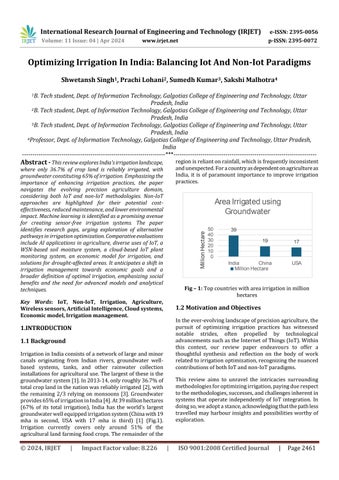
IrrigationinIndiaconsistsofanetworkoflargeandminor canals originating from Indian rivers, groundwater wellbased systems, tanks, and other rainwater collection installationsforagriculturaluse.Thelargestoftheseisthe groundwatersystem[1].In2013-14,onlyroughly36.7%of totalcroplandinthenationwasreliablyirrigated[2],with the remaining 2/3 relying on monsoons [3]. Groundwater provides65%ofirrigationinIndia[4].At39millionhectares (67% of its total irrigation), India has the world's largest groundwaterwellequippedirrigationsystem(Chinawith19 mha is second, USA with 17 mha is third) [1] (Fig.1). Irrigation currently covers only around 51% of the agriculturallandfarmingfoodcrops.Theremainderofthe
regionisreliantonrainfall,whichisfrequentlyinconsistent andunexpected.Foracountryasdependentonagricultureas India, it is of paramount importance to improve irrigation practices.
Intheever-evolvinglandscapeofprecisionagriculture,the pursuit of optimizing irrigation practices has witnessed notable strides, often propelled by technological advancementssuchastheInternetofThings(IoT).Within this context, our review paper endeavours to offer a thoughtful synthesis and reflection on the body of work relatedtoirrigationoptimization,recognizingthenuanced contributionsofbothIoTandnon-IoTparadigms.
This review aims to unravel the intricacies surrounding methodologiesforoptimizingirrigation,payingduerespect tothemethodologies,successes,andchallengesinherentin systems that operate independently of IoT integration. In doingso,weadoptastance,acknowledgingthatthepathless travelledmayharbourinsightsandpossibilitiesworthyof exploration.
International Research Journal of Engineering and Technology (IRJET) e-ISSN: 2395-0056
Volume: 11 Issue: 04 | Apr 2024 www.irjet.net p-ISSN: 2395-0072
A key focal point of this review is the identification and illuminationoftheexistingresearchgapwithintheirrigation optimizationdomain.WhileIoTsolutionshaveundeniably leftasignificantmark,wepositthatalternativeapproaches mayholdoverlookedpotential.Throughoutthispaper,our intent is to underscore the often-unnoticed advantages of non-IoTmethodologies emphasizingtheirpotentialcosteffectiveness, reduced maintenance requirements, and a lower environmental impact, particularly in terms of electronicwastegeneration.Inparticular,machinelearning may be a promising technology to create a sensor free irrigationmanagementsystem.
Werecognizethatthefieldofirrigationoptimizationisvast, and our understanding is but a modest contribution to a broaderconversation.Byadoptingthisperspective,wehope to foster a collective interest in exploring alternative pathways, thereby nurturing a holistic understanding of irrigation optimization that extends beyond the prevalent useofIoT-basedsolutions.Throughthismodestreview,we extendanopeninvitationtoscholarsandpractitionersalike to join us in navigating these unexplored territories, envisioning a future where irrigation optimization is not onlytechnologicallyadvancedbutalsomindfullyconsiders economicconsiderationsandenvironmentalresponsibility.
Theprimaryfocusofthispaperistoconductanextensive examination of the diverse applications of Artificial Intelligence in agriculture [5]. The integration of Artificial Intelligence (AI) into agriculture has catalyzed a transformative revolution, addressing and mitigating numerous challenges facedby the agricultural sector. This cutting-edge technology has proven instrumental in safeguardingcropyieldsamidstthecomplexitiesarisingfrom climate change, population growth, employment concerns, andfoodsecurityissues.
One pivotal application pertains to precision irrigation, weeding, and spraying facilitated by AI-driven sensors embeddedinroboticsystemsanddrones.Thistechnological synergy aims to optimize resource usage by curbing excessive water, pesticide, and herbicide utilization. Furthermore, it plays a crucial role in soil fertility maintenance while concurrently streamlining manpower utilization, ultimately enhancing overall productivity and elevatingthequalityofagriculturaloutputs.
Thispapermeticulouslysurveystheextensivebodyofwork conducted by researchers in the field, providing a comprehensiveoverviewofthecurrentstateofautomation in agriculture. Particular emphasis is placed on the development of automated weeding systems employing robotsanddrones.Theexplorationencompassesvarioussoil
water sensing methodologies and delves into two distinct automated weeding techniques. Moreover, the implementation of drones in agriculture is thoroughly examined,encompassingthediversemethodsemployedfor sprayingandcropmonitoring.
Inessence,thispaperservesasaholisticexplorationofthe multifaceted applications of AI in agriculture, providing insights into the present landscape of automation and the advancementsmadeinweedingsystems,soilwatersensing, anddronetechnologyforprecisionfarming.
Table1hassomeofthenotableexamplesfromthepaper.
The author of the literature under review provides an extensive overview of all the different studies done in the area of IoT monitoring in agriculture[6]. The writer uses examples from several regions, including China, Malaysia, Thailand,andothers,toshowthevarietyofIoT'sagricultural applications. The assessment provides information on prospectiveIoTusesinagriculturewhichcouldhavea big impactonfarmersandthesectorasawhole.
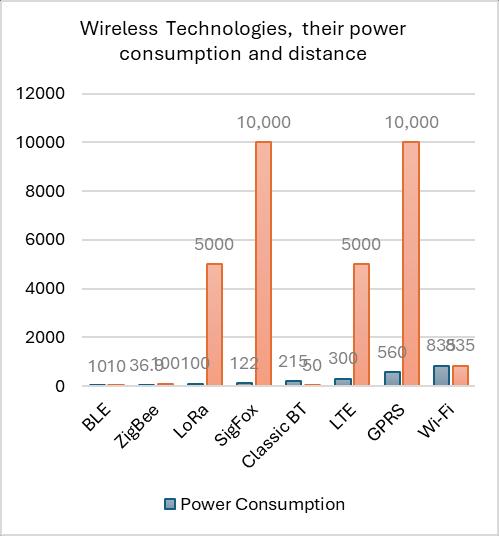
The author lists number of open-source software for agriculturalfarmmanagement.Usingthesefreelyavailable tools, farmers can increase their output and reduce labor costs.TheauthoralsolistnumberofIoTsensors,theirpower consumption and communication distance for easy comparison. The review also examines the difficulties encountered in the field, such as problems with data management, infrastructure, and technology standards. If these difficulties can be resolved, it will speed up and improvetheuseofIoTmonitoringinagriculture.
Theauthorsofthispaperofferacomprehensiveexploration into the practical implementation of a Wireless Sensor Network(WSN)-basedsoilmoisturemonitoringsystem[7] (Fig 2). Designed with the specific goal of prolonging the system'soperationallifetime,theWSNismeticulouslycrafted tobebattery-operated.TheintegrationoftheExponentially Weighted Moving Average (EWMA) event detection algorithm is a pivotal aspect of this system. Notably, the algorithm generates events solely when predetermined threshold conditions are met, ensuring a judicious use of resources.Duringperiodswhenthethresholdconditionsare not fulfilled, the sensor nodes transition into a powerefficientsleepstate,therebyconservingenergy.
Thesignificanceofthisworkisunderscoredbyitspotential forfurtherexpansionandrefinement.Anoteworthyavenue forextensioninvolvestheincorporationofmultiplesensor modules.By exploring the integration ofadditional sensor modules,thisresearchpavesthewayforamoreintricateand
International Research Journal of Engineering and Technology (IRJET) e-ISSN: 2395-0056
Volume: 11 Issue: 04 | Apr 2024 www.irjet.net p-ISSN: 2395-0072
nuanced understanding of soil moisture dynamics. Such expansionscouldcontributetoamoreholisticapproachto environmental monitoring and offer valuable insights into optimizingresourceutilizationinagriculturalcontexts.The subsequent sections of this paper delve into the intricatetechnical details, methodologies, and findings of this WSN- based soil moisture monitoring system, providing a robust foundation for future research endeavors and practical applications.
No. ALGORITHM
1 PLSRandother regression Algorithm
2 ArtificialNeural Network based controlsystem
Table - 1: Examplesofartificialintelligenceinagriculture[5]
Evapotranspiration model
SensorsforData collection,IOT Hardware Implementation
Increased Efficiency And EconomicFeasibility
Evapotranspiration model Sensors for measurement of soil, temperature, windspeedetc Automation
3 FuzzyLogic FAOPenman-Monteith Method Optimization
4 ANN (Multilayer neuralmodel) Penman-Monteith Method
5 FuzzyLogic ------ WSN,ZigBee
6 ANN (Feed Forward, Backpropagatio n ------
Evaporation decreased due to scheduleandsavingobservedin waterandelectricalenergy
Evaporationresultsverification Canbeappliedtohomegarden andgrass
Optimizationofwaterresource inasmartfarm
7 Fuzzy Logic Controller Penman-Monteith Method WirelessSensors Drip irrigation prevents wastageofwaterevaporation
8 Machine Learning Algorithms -------
Sensors, ZigBee, Arduino Microcontroller
Predictionandtacklesdrought situations
REFERENCES
Choudhary et al.(2019)
Umair and Usman(2010)
Kiaetal (2009)
Karasekreter et al (2013)
Al-Alietal (2015)
Dela Cruz Et al (2017)
Arvindetal (2015)
Arvindetal (2017)
International Research Journal of Engineering and Technology (IRJET) e-ISSN: 2395-0056
Volume: 11 Issue: 04 | Apr 2024 www.irjet.net p-ISSN: 2395-0072
This literature presents the development of an automated plant monitoring and data storage system, with a specific emphasisontheimplementationofacloud-basedInternetof Things (IoT) plant monitoring framework [8]. The central objective of this paper is to highlight the utilization of the ThingSpeak cloud platform for the purpose of seamlessly storingdatacollectedfromvarioussensorsontothecloud. This system offers a comprehensive solution for real-time monitoring, ensuring efficient data management and accessibility in the context of plant growth and environmental conditions. The subsequent sections delve into the technical aspects and functionalities of this innovative cloud based IoT plant monitoring system, providing insights into its design, implementation, and potential applications within the realm of precision agriculture.
Basedonaneconomic efficiencycriterion,anoptimization model has been presented to carry out water distribution planningincomplexdeficientagricultural waterresources systems [9]. To tackle the issue, it is divided into three separatesubsystems,eachwithvaryinglevelsofresolution.
Themodeloffersthebestirrigationwatervolumesandflows forirrigationareasgeneratedfromeachreservoir,changesin the storage quantities they hold, and network flows. The combinedeconomicfunctionsforeveryirrigationregionare producedbythemodel,andthebestdistributionoflandand waterresourcesforeachcropinthecroppingpattern,while
accountingforcroppingpattern,area-specificlimits,landand waterlimitations,andoptimizedwaterproductionfunctions for each crop. Each crop's water timing and production functionsaredeterminedbytakingintoaccountthecrop's sensitivitytowaterstressthroughoutitsphenologicalphases, reference evapotranspiration and effective precipitation, irrigationuniformity,andwaterapplicationdistribution.
The most effective optimization strategies have been highlighted by comparing non-linear approaches. For the purpose of resolving water allocation issues, non-linear approachesworkbetterthanlinearones.
Asensitivityanalysisofeveryparameterusedintheplanning ofwaterallocationcanbeperformedbythemodel.Economic analysis can be used to examine the effects of various meteorological and economic situations, modifications to irrigationtechniques,andmodernizationoftransportation andstorageinfrastructure.
There are several aspects to managing water scarcity in irrigatedagriculture.Thesehavetodowiththenatureofthe currentissuesaswellasthexericregime,whichisthesource ofwaterscarcity.Thedeficitirrigationresultsreportedinthis paper demonstrate that related solutions exhibit distinct economic responses during droughts and become more challengingorevenimpracticaltoimplementincomparison to non-drought conditions [10]. A broader consensus on conceptsandperformanceindicatorswouldbebeneficialin ordertodevelopirrigationwatermanagementpoliciesthat areappropriateinthefaceofwaterscarcity.Policiesshould generallywork to reducethe non-beneficial uses ofwater, especiallythosethatareassociatedwithwaterconsumption andtheportionofdivertedwaterthatisnotreusable.Butin ordertoproperlyexploretheseideas primarilyforbasin and system-scale planning and management appropriate proceduresmustbecreated.
Thegoalofsupplymanagement,whichistoincreasedelivery flexibilityanddependability,iscrucialtotheeffectivenessof decreased demand management since decisions made offfarmhaveanimpactontheschedulingandmanagementof farmirrigationsystems.Salinefluidsandwastewatersmust beappropriatelycontrolledfortheireffectsonhumanhealth and the environment before being added to the irrigation supply. The degree oftreatment of the effluents, the crops cultivated, the farming techniques, and the irrigation techniques all have an impact on wastewater reuse. The primaryconcernsmightbewithmonitoring,specificallywith regardtocroplimitationsinwastewater-usingareasandthe proper selection of appropriate irrigation techniques and procedures.Similartothis,managementandcarefulselection ofirrigationtechniquesandmonitoringareessentialforthe safeuseofsaltwater.
International Research Journal of Engineering and Technology (IRJET) e-ISSN: 2395-0056
Volume: 11 Issue: 04 | Apr 2024 www.irjet.net p-ISSN: 2395-0072
Adopting deficit irrigation and enhanced farm irrigation systems can reduce demand. A better level of irrigation uniformity is closely correlated with the improvement of irrigation systems. Better design, attentive maintenance, suitableirrigationequipmentselection,andincreasedfield evaluation are all implied by this. Improved homogeneity createstheopportunitytouselow-qualitywaterswithless environmentalimpactandtoachievehigherefficiency.The reviewhasdemonstratedthatbecauseawiderangeoffactors affect irrigation performance, the economic effects of upgradingirrigationarenotwellunderstood.
Generally speaking, the most limited resource in places of water shortage is water rather than land. In these circumstances, maximizing the return per unit of water rather than the return per unit of land can be more advantageous. This appears to be the case for the supplemental watering of cereals, but other important considerationsshouldalsobemade,suchastheamountof fertilizerappliedandthetimingofsowing.However,when supplementalirrigationistakenintoaccount,thequantityof rainfall that is available has a significant impact on the economic outcomes at the farm level. The review also demonstrates that, in typical climates, deficit irrigation of certain crops may be possible, but not in drought-prone areas,asdemonstratedbythepotatocropasanexample.In places where water is scarce, irrigation schedules that maximize water production and farm profitability must followcertainprinciples.
Itisanticipatedthatintheupcomingdecades,theprimary goalofirrigationwillchangefromthephysiologicalgoalof increasingcropyieldsperunitoflandtoaneweconomicgoal of maximizing net returns to irrigation [11]. This could be called,toputitsimply,an"optimization"paradigm.Lower irrigationdepthsandloweryieldsperunitofirrigatedland are typically associated with optimization. However, farm profitability will rise as running costs are decreased and waterisfreedupforotherfruitfuluses.Whenreturnflows from irrigation would otherwise be irretrievably lost, additional water may become available to other off-farm purposes.
Optimal management practices should still be expected to benefit farmers and other water users through lower production costs, better water distribution, and less environmentalimpact,evenincaseswhereirrigationreturn flows are nearly totally recovered. A broader definition of optimal irrigation from a social standpoint would be the maximization of all benefits, which would include nonfinancialadvantagessuchthepreservationofwaterquality, food security, job growth, and population relocation. The optimizationmethodwillbemoredifficultthanthecurrent standard irrigation practices. Crop-water production functionsandspecificcostfunctionsthatarenownottaken intoaccountinirrigationplanningorschedulingwillneedto
be included in irrigation planning. Salinity is frequently a major problematic element. Analysts will typically have to handle a variety of goals and a broad range of potential approaches.Theymayalsoneedtotakeuncertaintyandthe potential for increased financial risk into account. These kinds ofintricate assessments will require moreadvanced physicalmodelsandrelyonoperationsresearchanalytical techniques.
Table 2 is a comparison of the various methodologies discussedabove:
Table – 2: Comparisonofalldiscussedmethodologies
No. PAPER TECHNOLOGIES/AL GORITHMS USED REFERENC E
1 Implementatio nofArtificial Intelligencein Agriculturefor Optimizationof Irrigation and Applicationof Pesticidesand Herbicides
Various ML algorithms have beendiscussed,like, Fuzzy Logic and ANN [5]
2 IoT Enabled Plant Soil Moisture Monitoring UsingWireless Sensor Networks Wireless Sensor Network, Exponentially Weighted Moving Average (EWMA) event detection algorithm [7]
3 IoT Based Intelligent Agriculture Field Monitoring System IoT sensors (soil moisture and temperature sensors), Cloud infrastructure [8]
4 Optimization Model for Water Allocation in Deficit Irrigation Systems Economic optimizationmodel [9]
5 Irrigation Management under Water Scarcity Improvement in various irrigation techniques have beendiscussed [10]
6 A paradigm shift in irrigation management Various irrigation techniques have been discussed in thepaper [11]
International Research Journal of Engineering and Technology (IRJET) e-ISSN: 2395-0056
Volume: 11 Issue: 04 | Apr 2024 www.irjet.net p-ISSN: 2395-0072
In concluding our comprehensive review of various methodologies for irrigation optimization in agriculture, it becomes evident that the field is teeming with diverse approaches,eachcontributinguniquelytotheoverarching goalofresource-efficientandsustainablewatermanagement. Aswereflectontheextensivebodyofworkexploredinthis paper, a notable observation emerges the conspicuous absence of non-IoT methodologies, particularly those that leverageMachineLearning(ML)withoutdirectrelianceon sensors.
WhileIoT-basedsolutionshaverightfullygarneredattention fortheirefficacyinreal-timedataacquisition,itiscrucialto acknowledge the research gap pertaining to non-IoT methodologies in the realm of irrigation optimization. Notably,MLalgorithmsthatoperateindependentlyofsensor input present an intriguing avenue for exploration. These methodologies, which often draw from historical data, climaticpatterns,andsoilcharacteristics,offerapragmatic alternative, particularly in scenarios where sensor deploymentmightbeeconomicallyorlogisticallychallenging.
Byunderscoringthescarcityofnon-IoTmethodologies,our aim is to stimulate future research endeavors in this direction. The potential of ML-driven approaches without sensorrelianceissubstantial,offeringnotonlycost-effective alternativesbutalsocircumventingthechallengesassociated withsensormaintenance,deployment,andelectronicwaste generation. This void in the literature prompts a call for nuancedinvestigationsintotheuntappedpotentialofdatadrivenirrigationoptimizationmethodsthatoperateoutside theconventionalIoTparadigm.
Inessence,thisreviewservesasahumbletestamenttothe richtapestryofmethodologiesthathaveevolvedtoenhance irrigationpractices.Byaccentuatingtheabsenceofnon-IoT methodologies,particularlythoserootedinML,wehopeto inspireresearchers,practitioners,andpolicymakerstodelve intounexploredrealms.Thefutureofirrigationoptimization maywellhingeonembracingdiverse,sensor-independent approachesthatharnessthepowerofdata-driveninsightsto propelagriculturetowardamoresustainableandefficient future.
[1] S.Siebertetal(2010),Groundwateruseforirrigation–aglobalinventory,Hydrol.EarthSyst.Sci.,14,pp.1863–1880
[2] Agricultural irrigated land (% of total agricultural land)TheWorldBank(2013)
[3] Economic Times: How to solve the problems of India's rain-dependent on agricultural land
[4] PMLaunchesRs6,000CroreGroundwaterManagement Plan,NDTV,25December2019.
[5] Talaviya,T.,Shah,D.,Patel,N.,Yagnik,H.andShah,M., 2020. Implementation of artificial intelligence in agricultureforoptimizationofirrigationandapplication of pesticides and herbicides. Artificial Intelligence in Agriculture, 4,pp.58-73
[6] Kassim, M.R.M., 2020, November. Iot applications in smartagriculture:Issuesandchallenges.In 2020 IEEE conference on open systems (ICOS) (pp.19-24).IEEE.
[7] Ezhilazhahi,A.M.andBhuvaneswari,P.T.V.,2017,May. IoT enabled plant soil moisture monitoring using wireless sensor networks. In 2017 Third International Conference on Sensing, Signal Processing and Security (ICSSS) (pp.345-349).IEEE
[8] AshifuddinMondal,M.andRehena,Z.,2018,January.IoT based intelligent agriculture field monitoring system. In 2018 8th International Conference on Cloud Computing,DataScience&Engineering(Confluence) (pp. 625-629).IEEE.
[9] Reca,J.,Roldán,J.,Alcaide,M.,López,R.andCamacho,E., 2001.Optimisationmodelforwaterallocationindeficit irrigation systems: I. Description of the model. Agricultural water management, 48(2), pp.103116.
[10]Pereira, L.S., Oweis, T. and Zairi, A., 2002. Irrigation management under water scarcity. Agricultural water management, 57(3),pp.175-206.
[11]English, M.J., Solomon, K.H. and Hoffman, G.J., 2002. A paradigm shift in irrigation management. Journal of irrigationanddrainageengineering, 128(5),pp.267-277.