
International Research Journal of Engineering and Technology (IRJET) e-ISSN: 2395-0056
Volume: 11 Issue: 03 | Mar 2024 www.irjet.net p-ISSN: 2395-0072
International Research Journal of Engineering and Technology (IRJET) e-ISSN: 2395-0056
Volume: 11 Issue: 03 | Mar 2024 www.irjet.net p-ISSN: 2395-0072
Sayali Rajendra Kadam1 , Dr. Nitin Naik2 , Dr.Prashant Sunagar3
1P.G. Student, Sanjivani College of Engineering, Kopargaon, Maharashtra State, India
2Professor, Dept. of Civil Engineering, Sanjivani College of Engineering, Kopargaon, Maharashtra State, India
3Professor, Dept. of Civil Engineering, Sanjivani College of Engineering, Kopargaon, Maharashtra State, India
Abstract - The foundation, the surrounding and underlying soil, and the building itself form interconnected systems that collectively determine a structure's response to seismic activity. Evaluating the interplay between soil and structure is crucial in understanding their combined reaction to specific ground movements. In literature, the terms "soil-structure interaction" (SSI) and "soil-foundation-structure interaction" (SFSI) are often used interchangeably to describethisphenomenon.Despitethepotentialimpactof SSI,structuralengineerssometimesoverlookitsinfluence, assuming it has no detrimental effects on the structure. However, this assumption may not always hold true. Recognizing the foundation's critical role in the structure, thisprojectadoptstheterm"SSI."Foranalyticalpurposes, we consider a B+S+24 R.C.C. building to compare the influence of SSI. Furthermore, we investigate two distinct soil types soft soil and hard soil by measuring their stiffness using techniques developed by Richart and Lysmer. Our analysis examines the advantages and disadvantages of soil-structure interaction. We conduct initial static analyses of the building, evaluating factors such as bending moment, shear force, and axial force for comparison. Subsequently, we contrast the impact on beams and columns with and without SSI. Dynamic response spectrum analysis is then applied to assess the building's behavior, including story drift, lateral displacement, base shear, and time period, with and without considering SSI. Our findings underscore the paramount importance of accounting for SSI, or soilfoundation-soilinteraction,instructuralassessments."
Key Words: Soil structure interaction, framed structure, Behavior of foundation, ETABS, Response spectrum analysis
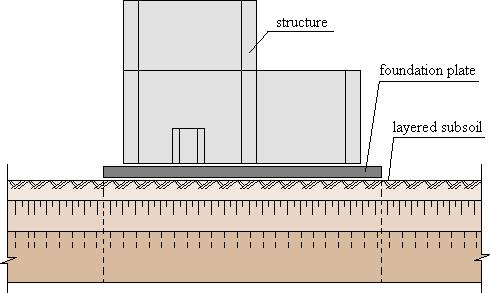
Theterm"soil-structureinteraction"encompassesarange of processes that influence the response of soil to the presence of structures and vice versa, affecting how structures respond to the flexible soil beneath their foundations. Illustrated in Figure 1, a complete soilfoundation-structure system comprises a superstructure frame, its foundation, and the supporting soil. Differential settlement, stemming from variations in soil characteristics across different areas beneath the structure, can impact both axial forces and moments withinstructuralmembers.
The majority of civil structures include at least one component directly in contact with the ground. When external forces, such as earthquakes, act upon these systems, ground displacements and structure displacements become interdependent. Soil-structure interaction (SSI) describes the reciprocal influence betweensoilresponseandstructuralmovements.
The degree of load redistribution within structural components is determined by the structural rigidity and the soil's capacity for settling under load. Consequently, numerous studies in the literature have investigated the impact of this factor. Traditional structural design methodsoftenoverlookthe effectsofSSI. Whileitmaybe reasonable to disregard SSI in light constructions on relatively hard soil, such as low-rise buildings and basic solid retaining walls, massive structures like skyscrapers, nuclear power stations, and highways situated on softer soilsaresignificantlyaffectedbySSI.
Yassine Razzouk et. al. (2023) aimed to investigate the impact of soil-structure interaction (SSI) on the seismic behavior of reinforced concrete buildings. A sophisticated numerical model for soil-structure interaction (SSI) was developed and validated using ABAQUS software. The seismic response of a twelve-story building was analyzed on four different types of soil (rock, dense soil, stiff soil, and soft soil) using a Normalized Response Spectra based on the Moroccan para seismic regulation RPS 2011. The studycomparedthegloballateraldisplacement,interstory drift, and period for both column and shear wall bracing systems. The results revealed significant differences in seismicresponsesbetweenshearwallbracingandcolumn bracing in soil-structure systems, highlighting the
International Research Journal of Engineering and Technology (IRJET) e-ISSN: 2395-0056
Volume: 11 Issue: 03 | Mar 2024 www.irjet.net p-ISSN: 2395-0072
considerable influence of SSI on the seismic behavior of buildings.[1]
M.E. Hossain1, A. Sakib, M. Hasan (2022) aimed to identify the influence of soil-structure interaction (SSI) subjected to seismic forces with fixed and flexible base conditions in multistory buildings through numerical simulations. A finite element-based software program calledETABSwasemployedtomodelG+9storeybuilding frames. Dynamic analysis was conducted using the response spectrum method. The Winkler technique was utilized to incorporate soil flexibility through a spring model. The study compared the responses of structures with flexible and fixed bases, considering various structural components such as tale drift, story displacement,andnaturalperiod.Itwasobservedthattale displacement, tale drift, and the natural period were smallerinfixed-basestructurescomparedtoflexible-base structures. Structures designed without considering the impacts of soil-structure interaction (SSI) may be less resilientduringearthquakes.Therefore,itisimperativeto account for these effects and select an appropriate foundation system during the construction of a building. [2]
Srijit Bandyopadhyay et. al. (2021) studiedtheeffectof structure soil structure interaction of the two adjacent ReinforcedConcrete(RC)threestoriedstructures,located inhighestseismiczoneofIndiaarestudied. Onestructure wasinstalledonaleadrubberbearingbaseisolator,while the other was a conventional reinforced concrete (RC) framed construction. Seismic sensors were installed in both buildings, and their actual seismic responses were recorded between 2006 and 2007. As expected, the baseisolated structure exhibited a frequency 2.6 times lower than that of the conventional structure, and its response was also 4–5 times lower. However, the response of the base-isolated building indicated structure-soil structure interaction, as it reflected the frequency of the surrounding structure. In a numerical simulation, two nearby structures were considered along with comprehensive soil modeling, and the numerical results werevalidatedusingactualearthquakedata.Additionally, the responses of both buildings to a stronger earthquake inthesameregion,withapeakgroundacceleration(PGA) of0.26g,wereexamined.Theresponseaccelerationofthe base-isolatedbuildingwasapproximately4.1timesslower than that of the conventional building. Furthermore, due to the nonlinear deformation of the isolator, resulting in varying effective stiffness for different displacements during cyclic motion, the floor spectra of the roof of the base-isolated structure exhibited multiple peaks. It was also demonstrated that as peak ground acceleration increased, the frequency of the base-isolated building decreased[3]
Wesam Al Agha et. al. (2021) considered SSI using the direct method (i.e. FEM soil medium) and studied the effect of changing soil type (soft soils and hard soils) on the performance of the tall building under consideration. The structure, consisting of 16 floors and employing a twin wall-framed design to withstand seismic loads, was analyzed using Abaqus software (Simulia's Abaqus 6.14). The boundaries of the soil media were modeled using semi-infinite elements from the Abaqus solid element library. El-Centro acceleration time-history data were utilizedastheseismicloadinginput.Theanalysisrevealed notable differences between hard and soft soil types, particularly in terms of base shear values and displacements. It was concluded that when soil-structure interaction is considered, displacement values should be increased. In comparing displacement values between hardandsoftsoil,thevaluesinhardsoilcloselyresembled those from the fixed-base scenario. Base shear values decreasedwithsoil-structureinteractionbetweensoftand hard soil, but base shear values in hard soil were nearly equivalent to those in the fixed-base scenario. This study highlights the importance of considering soil-structure interaction, especiallyin softsoilconditions,and suggests extendingtheanalysistimeframetoaccuratelycapturethe effectsofsoil-structureinteraction.[4]
Deepashree R et. al. (2020) studied 6 models of G+13 multi-storey symmetrical RC building with storey height 3m is modelled using ETABS which was assumed to be located in Hard-soil, Medium-soil and Soft-soil of zone-IV was subjected to response spectrum analysis. The structure was initially analyzed without considering soilstructureinteraction(SSI),anditsbehaviorwascompared tothe scenario where SSI effectswereincorporated using spring elements. Various systematic characteristics were examined and compared, including natural period, storey stiffness, overturning moment, base shear, storey displacement, storey drift, and storey shear. The analysis revealedthatsoftsoilconditionsaremorecritical,andthe structurerespondsmoresignificantlywhenSSIeffectsare considered.Therefore,itisimperativetoaccountforthese impacts when designing a structure, especially in regions withsoftsoilconditions.[5]
Hossein Tahghighi and Ali Mohammadi (2020) aimed to investigate whether the seismic performance and vulnerability of reinforced concrete (RC) structures were affected by soil–structure interaction (SSI). The OpenSees finite-element framework was utilized to construct and modelaseriesofreinforcedconcrete(RC)framessituated onthreedistincttypesofsoil.Theinteractionbetweenthe soil and the foundation was simulated using a nonlinear Winkler-basedapproach.Seismic behaviorandfragilityof RC buildings were evaluated in relation to rigid and flexible base assumptions through nonlinear static analysis and incremental dynamic analysis. Numerical results demonstrated the significant impact of soil-
International Research Journal of Engineering and Technology (IRJET) e-ISSN: 2395-0056
Volume: 11 Issue: 03 | Mar 2024 www.irjet.net p-ISSN: 2395-0072
structure interaction (SSI) on altering the fragility and performanceofstructureswithrigidbases.Furthermore,a straightforward method was proposed to derive vulnerability values for structures with flexible bases by adjusting the basic mode spectral acceleration. Pushover analysisandincrementaldynamicanalysiswereemployed to investigate the effects of SSI inclusion on the seismic performance and fragilities of RC buildings. Foundation flexibility was modeled using the Beam on Nonlinear Winkler Foundation (BNWF) approach, assuming a range of soil conditions from soft to hard. The findings underscored the crucial role of seismic SSI in altering structural demands and emphasized the potential inaccuraciesinperformanceandfragilityassessmentifSSI effectsaredisregarded.Additionally,itwasconcludedthat foundation flexibility has minimal impact on the period andresponsemodificationfactorsofRCmoment-resisting frames (MRFs), suggesting that it can be disregarded in their assessment. Moreover, the results highlighted a significant enhancement in the performance level of midrise frames when positioned on soft soil sites, further emphasizing the importance of considering SSI effects in seismicdesignandassessment.[6]
Purva M. Kulkarni, Dr. Y.M. Ghugal (2019) attemptedto understandtheinfluenceofsoilflexibilityinsoilstructure interaction (SSI) on building frames resting on piled raft foundation. Finite element-based program ETABS was employedforbuildingframemodeling.G+10storyframes were subjected to earthquakes on various homogenous and stratified soil types, with and without soil-structure interaction (SSI). The study compared fixed bases with buildings supported by piled raft foundations. IS 1893:2002 Response Spectra was utilized for dynamic analysis, and the Winkler technique (spring model) was used to incorporate soil flexibility. The analysis investigated the impact of SSI on various structural characteristics, including natural time period, lateral displacement,androofdisplacement.Itwasobservedthat time duration and displacement increased significantly with the inclusion of SSI. The study concluded that the foundationandsoiltypesplayedamajorroleintheimpact ofSSIonstructuralbehavior.[7]
Taha A. Ansari, Sagar Jamle (2019) attempted to understand the effect interaction of soil and structure on building with underground storey. Nonlinear static analysis was utilized to compare the seismic response of ten-story buildings with fixed bases and subsurface stories. Factors such as pushover curves, performance points, and hinge formation were taken into account. The studyexamineddifferencesinseismicanalysisparameters between linear and nonlinear static analyses, considering the impact of soil-structure interaction (SSI) for medium stiffMLsoilandlowstiffCHsoil.Itwasconcludedthat,for bothMLandCHsoiltypes,designstoreyshearforceswere lowerforatypicalten-storybuildingwithanunderground
storey when SSI effects were considered compared to a fixed-base building. Demand capacity curves for undergroundstoreybuildingsindicatedthatthebuilding's performance point remained nearly the same. Furthermore,additionalhingeswereobservedinthefixed foundation building for the underground structure, particularlynearthebuilding'sends.[8]
Ajit C. Suryawanshi, V. M. Bogar (2019) consideredRCC structures along with and without soil structure interaction on sloping ground to compare the displacement, story shear, story drift and base shear of buildings. Buildings situated on sloping terrain were evaluated based on predetermined criteria, with and without considering soil-structure interaction (SSI). Response spectrum analysis was employed to assess the performanceofthesestructures.Toachievethisobjective, ETABS 2016 was utilized to model G+19 structures both with and without soil-structure interaction. The analysis of the G+19 building models incorporated soil-structure interactionand wasconductedfromvariousperspectives. Thestudyconcludedthat,comparedtoconventionalfixedbase (NSSI) models, the story displacement of building models with SSI was greater. This effect was particularly pronounced in soft soil conditions. Notably, the highest story displacement was observed in building models situated on a 30° slope, regardless of soil type and the presence of soil stabilization. Furthermore, it was observedthatinmodelswithconventionalfixedbases,the base shear value increased with the model's number, whereas in models with SSI, the base shear value decreased.[9]
Following the initial loading, soil exhibits nonlinear behavior due to its flexible nature. Engineers have long struggled to accurately model this behavior mathematically due to its complexity, which is further compounded by its time-dependent nature. This nonlinearity is the primary source of uncertainty in predicting the static behavior of the soil foundationsuperstructuresystempost-construction.
Physically, when an external load is applied to the soil mass, soil particles tend to reorganize themselves to minimize potential energy and achieve stability. Initially, the strain transferred to the soil mass is elastic up to a certain stress threshold. Depending on the magnitude of the applied load, it may progress into the plastic range. Subsequently,thereisvisco-plasticdeformationcausedby viscous inter-granular activity, leading to strain accumulationovertime.
International Research Journal of Engineering and Technology (IRJET) e-ISSN: 2395-0056
Volume: 11 Issue: 03 | Mar 2024 www.irjet.net p-ISSN: 2395-0072
a) Heterogeneous Distribution: Soil properties such as composition, density, and moisture content can vary widely across a given area, leading to heterogeneous behaviorinresponsetoexternalloads.
b) Anisotropy: Soil may exhibit different properties or behaviors depending on the direction of stress or loading duetofactorssuchassedimentationpatternsorgeological features.
c) Geometric Differences (Large Displacements): Large displacements, such as those caused by excavation or construction activities, can significantly alter the soil's behavior, leading to nonlinear responses and potential instability.
d) Nonlinear Behavior Between Interfaces: Interfaces between different soil layers or between soil and structural elements can exhibit nonlinear behavior under stress,impactingtheoverallbehaviorofthesoil-structure system.
e)Cracks:Thepresenceofcracksinsoilduetofactorslike shrinkage,settlement,ordifferentialloadingcaninfluence soil behavior by altering its strength, stiffness, and permeability.
f) Underground Water Consolidation: Changes in groundwaterlevelsandwaterflowpatternscanaffectsoil behavior through processes such as consolidation, swelling,orerosion,leadingtochangesinsoilvolumeand strength.
These factors, among others, contribute to the complex andvariedbehaviorofsoil,highlightingthe importanceof considering them in engineering analyses and designs involvingsoil-structureinteraction.
1.2 Effect of soil structure interaction on structural response
It has been a longstanding belief in the engineering communitythattheinteractionbetweensoilandstructure can enhance a structure's seismic response. Many design guidelines have historically suggested that the effects of soil-structureinteraction(SSI)canbeneglectedinseismic analysis of buildings. This misconception stems from the idea that SSI can improve safety margins by reducing a structure's overall seismic response. Most design codes utilize a simplified design spectrum that accelerates in a certain manner before monotonically decreasing over time.Inconventionalstructuraldesign,thesubstructureis typically treated as inflexible. However, considering soilstructureinteractionmakesthesubstructuremoreflexible or less rigid. Consequently, the structure becomes more flexibleandexhibitsalongernaturalperiodcomparedtoa
similar structure with fixed supports. Additionally, considering the SSI effect results in an increase in the system's effective damping ratio. The smooth idealization ofthedesignspectrum,combinedwiththeriseineffective damping ratio and natural period due to SSI, suggests a reduced seismic response. This led to the misconception that SSI could be conveniently disregarded for conservativedesign.
Neglecting SSI allows designers to simplify their analysis and overlook the complexities associated with soilstructure interaction, which can be advantageous for certain types of structures on relatively hard soils. However, this assumption does not hold true in all cases. In reality, SSI can have adverse effects on structural response, and ignoring SSI in analysis may pose risks for foundation and superstructure designs. Therefore, it is important to carefully consider the effects of SSI in structural analysis and design, particularly for structures onsoftersoilsorinregionswithhighseismicactivity.
1. To check the stability of structure with seismic loadindifferentseismiczones(IV&V)
2. To understand the effect of soil structure interactionforsoftandmediumsoil.
3. TofindtheeffectofSSIonstructure.
4. To suggest the suitable methodology to include theeffectofsoilstructureinteraction.
For the current project, seismic analysis is being conducted on a reinforced concrete moment-resistant high-rise building frame, specifically a B+S+24 storey structure.Theaimofthisstudyistoexaminetheimpactof soil-structure interaction (SSI) on tall buildings. The structure in question stands at a height of 83.1 meters above ground level. Each of the 24 storeys is situated 3 meters above ground level, with a stilt height of 3.9 meters. This configuration is crucial for understanding how SSI influences the seismic behavior of tall buildings, as the interaction between the building's foundation and the underlying soil becomes increasingly significant with height.
Twotypesofbuildingsconsideredinthestudy,whichare
1) Buildingswithoutfixedbase(softandhard)
2) BuildingswithflexiblebasewithSSI
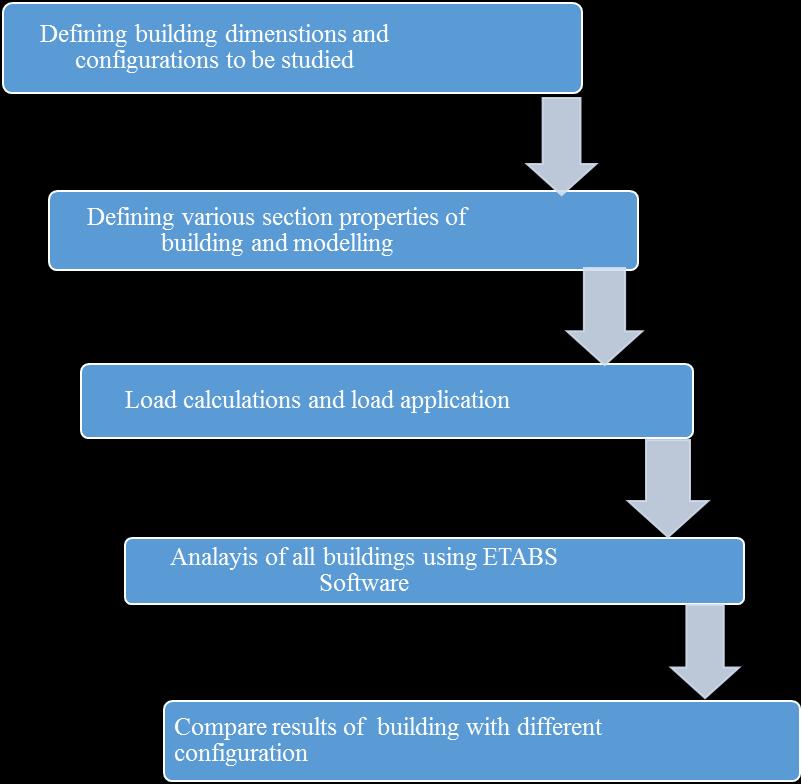
In order to facilitate modeling, the ETABS software has been utilized to simulate a 26-story case study building.
International Research Journal of Engineering and Technology (IRJET) e-ISSN: 2395-0056
Volume: 11 Issue: 03 | Mar 2024 www.irjet.net p-ISSN: 2395-0072
The entirebuildingis represented bya three-dimensional reinforcedconcrete(R.C.C.)framemodel.TheR.C.C.frame model utilizes 3-D beam elements with 6 degrees of freedom at each node to accurately model beams and columns. The slab is treated as a fairly stiff membrane in itsownplanetoprovidediaphragmactionfortransferring horizontalloadstocolumnsandshearwalls. Theframeof thebuildingismodeledusingthe3DR.C.C.beamelement, with beams and columns incorporated in the modeling process. The columns are constructed using M35 grade concreteandFe500gradesteel,whilethebeamsandslab are made using M30 grade concrete and Fe 500 grade steel,inaccordancewithdesignspecifications.
R.C.C. shell elements are employed in modeling the shear walls. These shell elements consist of monolayer membranes with varying thicknesses and eccentricities, providing resistance to membrane forces, bending, and shearing. Membrane elements are used to simulate floor slabs, which are considered stiff diaphragms. Seismic barriers are simulated using 3D quadrilateral shell elements, with each shell element assigned M35 grade material properties. This comprehensive modeling approach allows for accurate representation of the building'sstructuralcomponentsandtheirbehaviorunder seismicloadingconditions.
2.1
The coordinate points, which denote the locations of the columns in relation to the base plan arrangement of the building,arecrucialforanalysis.Inafixedbasecondition, all points are constrained with displacements in the x, y,
andzdirections(ux,uy,uz),aswellasrotationsaboutthe x,y,andzaxes(rx,ry,rz).Thismeansthatbothlinearand rotational displacements are restricted. In the structural model, the first floor is designated as the master storey, and subsequent levels are modeled accordingly. Each storey is represented by appropriate beams, columns, slabs, and shear walls, ensuring a comprehensive representation of the entire structure. The threedimensional perspective of the towering building can be visualized in Figure 2, illustrating the arrangement of beams, columns, slabs, and shear walls in the structural model.Thisperspectiveprovidesaclearunderstandingof thebuilding'sgeometryandstructuralcomponents.
To replicate the effects of Soil-Structure Interaction (SSI) in clayey soil, thick reinforced concrete (R.C.C.) shell elements are employed in the raft foundation model. These elements are designed to accurately capture the behavior of the foundation under the influence of soil interaction. The model of the structure with the raft foundationisdepictedinFigure3.
Table 1 presents the assumed and computed parameters of the soil, which are crucial for accurately modeling the interaction between the structure and the underlying clayey soil. These parameters are determined based on empirical data and analysis methods such as the Richart and Lysmer models. In accordance with these models, spring stiffness values are established for various modes of deformation, including twist, rocking, and horizontal motion. These stiffness values are essential for defining the behavior of the soil-structure system under different loading conditions. Quad shell elements are utilized to mesh the entire region encompassing the foundation and surrounding soil. Additionally, soil springs are applied to represent the interaction between the structure and the underlying soil, ensuring an accurate simulation of SoilStructureInteractioneffectsintheanalysis.
International Research Journal of Engineering and Technology (IRJET) e-ISSN: 2395-0056
Volume: 11 Issue: 03 | Mar 2024 www.irjet.net p-ISSN: 2395-0072
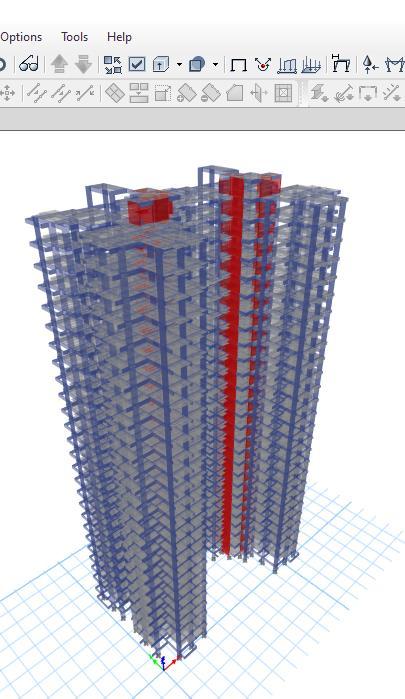
2: 3Drenderingviewofbuildingwithfixedbasein ETABS
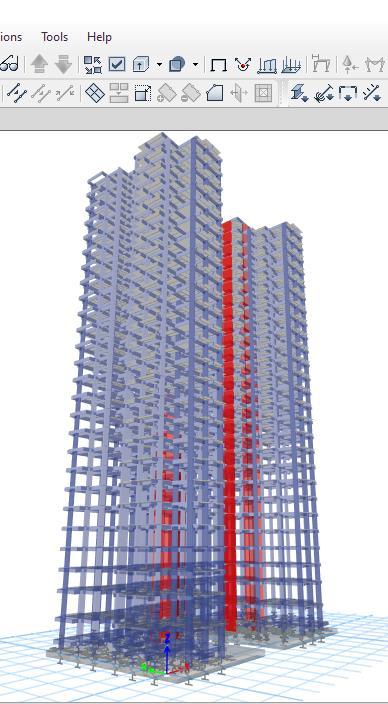
Fig. 3: 3Drenderingviewofbuildingwithraftfoundation andappliedsoilspringsinETABS
Table 1: Soil Spring Values as Per Richart and Lysmer
Direction SpringValues Equivalent Radius
Vertical
Horizontal K
Volume: 11 Issue: 03 | Mar 2024 www.irjet.net
Thevalueofaxial forceincolumnsdoes notchange much withsoilstructureinteractionforhardsoilascomparedto fixed base scenario, but it does decrease marginally for soft soil case for earthquake zones IV and V, according to our examination of all the models using response spectrum analysis. It is discovered that, in comparison to the fixed base case for earthquake zones IV and V, the values of bending moment in the stilt beam group rise by 20–35%forsoftsoilwithsoilstructureinteractionbutdo not vary much for hard soil. It is discovered that, in comparison to fixed bases for seismic zone IV, values of lateral displacement (mm) with floor level in the X direction do not change significantly for hard soil but increasedslightly,byabout70–80%,forsoftsoilwithsoil structure interaction. I discovered that, for seismic zone IV, the values of the time period of a building with mode no drop by about 1-2% when compared to a fixed basis, butthevaluesdonotvarydependingonthekindofsoil. It isdiscoveredthat,incomparisontoafixedbase,valuesof Story Drift with floor level inthe Xdirection roseslightly, by around 40–60%, for soft soil with soil structure interactionbutdidnotvarymuchforhardsoil. Itisfound out that, base shear in X direction for seismic zone IV is same in both cases as there is no increase in seismic weightofthebuilding.
International Research Journal of Engineering and Technology (IRJET) e-ISSN: 2395-0056
Volume: 11 Issue: 03 | Mar 2024 www.irjet.net p-ISSN: 2395-0072
Chart-5:VariationofmaximumS.F.instiltbeamB52,B47 andB35forzoneIV
Chart-8:VariationofmaximumB.M.instiltbeamB52, B47andB35forzoneV
Chart-6:VariationofmaximumS.F.instiltbeamB52,B47 andB35forzoneV
Chart-7:VariationofmaximumB.M.instiltbeamB52, B47andB35forzoneIV
Chart-9:Variationoflateraldisplacement(mm)withfloor levelinXdirectionforzoneIV
Chart-10:Variationoflateraldisplacement(mm)with floorlevelinXdirectionforzoneV
International Research Journal of Engineering and Technology (IRJET) e-ISSN: 2395-0056
Volume: 11 Issue: 03 | Mar 2024 www.irjet.net p-ISSN: 2395-0072
Chart-11:Variationoflateraldisplacement(mm)with floorlevelinYdirectionforzoneIV
Chart-12:Variationoflateraldisplacement(mm)with floorlevelinYdirectionforzoneV
Chart-14 VariationofStoryDriftwithfloorlevelinX
Chart-13 Variationoftimeperiodofbuildingwithmode shapenoforzoneIVandV directionforzoneIV
Chart-15 VariationofStoryDriftwithfloorlevelinX directionforzoneV
Chart-16 VariationofStoryDriftwithfloorlevelinY directionforzoneIV
International Research Journal of Engineering and Technology (IRJET) e-ISSN: 2395-0056
Volume: 11 Issue: 03 | Mar 2024 www.irjet.net p-ISSN: 2395-0072
Chart-17 VariationofStoryDriftwithfloorlevelinY directionforzoneV
Chart-20 Variationofbaseshear(kN)ofbuildingsinY directionforzoneIV
Chart-18 Variationofbaseshear(kN)ofbuildingsinX directionforzoneIV
Chart-19 Variationofbaseshear(kN)ofbuildingsinX directionforzoneV
Chart-21 Variationofbaseshear(kN)ofbuildingsinY directionforzoneV
For hard soil, the influence of Soil-Structure Interaction (SSI) on axial force and bending moment in the column group is negligible and not significant. However, for soft soil, there is a considerable increase of 100–130% in bending moment for both seismic zones IV and V, highlighting the importance of considering SSI in design for structures built on soft soil. Similarly, the variation in shear force and bending moment in the stilt beam group caused by SSI is insignificant for hard soil. However, for soft soil, there is a notable increase of 20-30% in shear force and 30-45% in bending moment for both seismic zones IV and V. This underscores the necessity of incorporating seismic safety engineering (SSI) when constructingonsoftsoilduetothesignificantfluctuations observed. In terms of storey drift, the middle storeys
International Research Journal of Engineering and Technology (IRJET) e-ISSN: 2395-0056
Volume: 11 Issue: 03 | Mar 2024 www.irjet.net p-ISSN: 2395-0072
experience the greatest drift in both scenarios, with a parabolic difference in storey drift. While there is little change in story drift when SSI is considered for hard soil, there is a noticeable increase of around 30-60% in storey drift for soft soil. Additionally, the highest stories exhibit the greatest variation in lateral displacement, with a notableincreaseobserved whenSSIis considered forsoft soil.
Despitethesevariations,theseismicweightofthebuilding remains the same in both seismic zones, regardless of whether SSI is considered or not. The base shear for the scenario with soil-structure interaction is nearly identical to that of the fixed base case. However, the natural time period is somewhat shorter when constructing with soilstructureinteractioncomparedtothefixedbasescenario. Overall, buildings situated on soft soil demonstrate a significantincreaseinresponseforbothfixedbaseandSSI cases compared to hard soil. The flexibility introduced in the base contributes to the significant rise in skyscraper reaction when considering SSI. Therefore, it is recommended to apply SSI while designing high-rise structures, particularly when constructed on soft soil, to ensureadequateseismicperformance.
1. Razzouk, Y., Ahatri, M., Baba, K. and El Majid, A., 2023.Optimalbracingtypeofreinforcedconcrete buildings with soil-structure interaction taken intoconsideration.CivilEngineeringJournal,9(6), pp.1371-1388.
2. Hossain, M.E., Sakib, A. and Hasan, M., 2022. Evaluation of Seismic Response of RCC Building WithConsideringSoilStructureInteraction.
3. Bandyopadhyay, S., Parulekar, Y.M., Sengupta, A. andChattopadhyay,J.,2021,August.Structuresoil structure interaction of conventional and baseisolated building subjected to real earthquake. InStructures(Vol.32,pp.474-493).Elsevier.
4. Al Agha, W., Almorad, W.A., Umamaheswari, N. and Alhelwani, A., 2021. Study the seismic responseofreinforcedconcretehigh-risebuilding with dual framed-shear wall system considering the effect of soil structure interaction.Materials Today:Proceedings,43,pp.2182-2188.
5. Deepashree, R., Kavitha, S., Mamatha, P.G. and Vishal, B.V., 2020, December. Evaluation of the effects of soil structure interaction on a multistorey rc building. InJournal of Physics: Conference Series(Vol. 1706, No. 1, p. 012136). IOPPublishing.
6. Tahghighi, H. and Mohammadi, A., 2020. Numericalevaluationofsoil–structureinteraction effects on the seismic performance and vulnerability of reinforced concrete buildings.International Journal of Geomechanics,20(6),p.04020072.
7. Kulkarni, P.M. and Ghugal, Y.M., 2019. Dynamic analysisofRCCbuildingconsideringsoilstructure interaction.
8. Ansari, T.A. and Jamle, S., 2019. Performance BasedAnalysisofRCBuildingswithUnderground Storey Considering Soil-Structure Interaction.International Journal of Advanced EngineeringResearchandScience,6(6).